Cambridge A Level Chemistry 9701 — 2021 Oct/Nov Paper 1 · Variant 2
9701/12/O/N/21 · 40 questions · 40 marks · ≈45 min
The question paper and its mark scheme, free to read here and free to download. This is Cambridge’s own paper, exactly as it was sat.
Question paper16 pages

Mark scheme3 pages
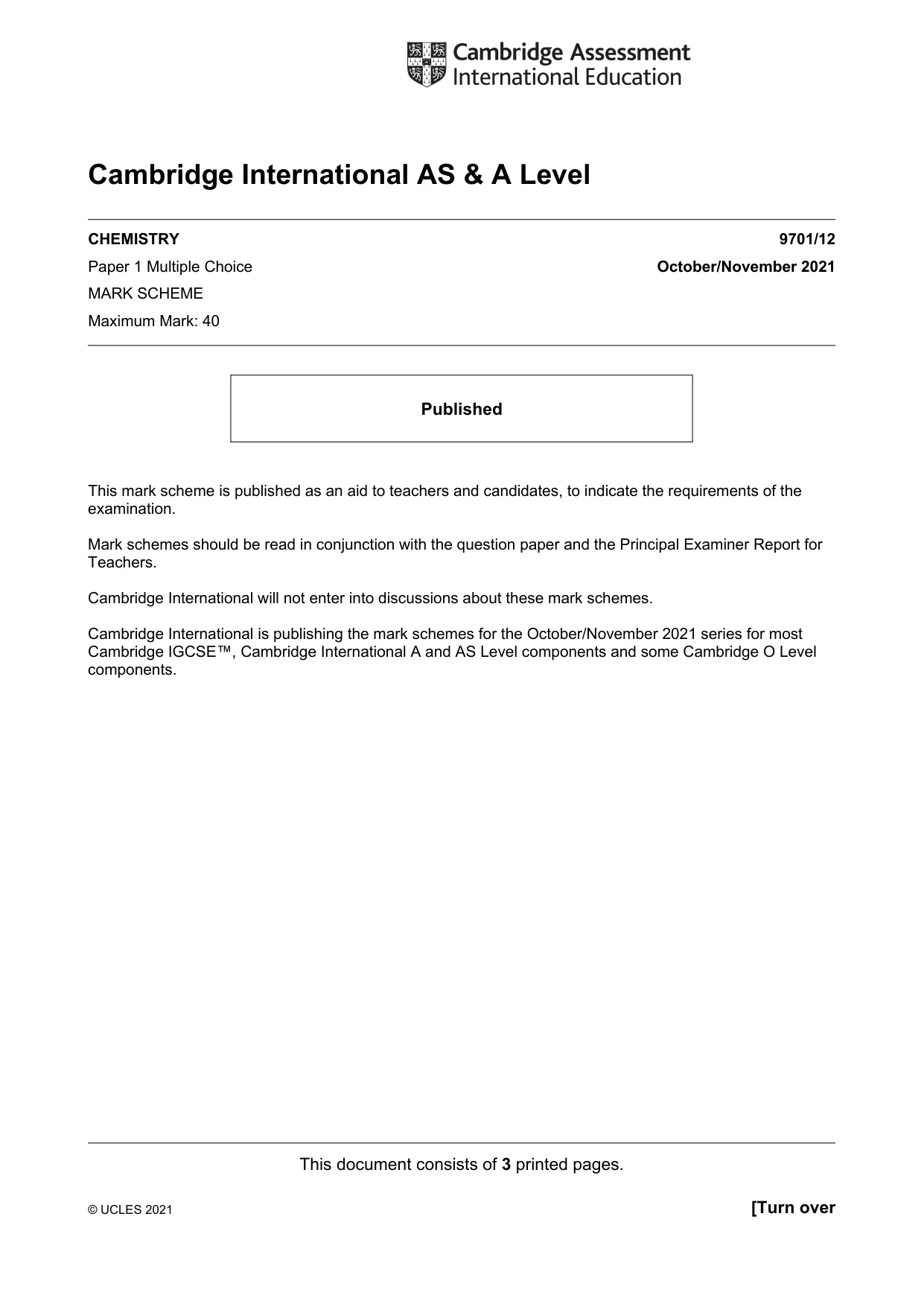
Answers below. Sit the paper first if you are practising.
Questions as text
Q1 · Compound X consists of 40.0% carbon, 6.7% hydrogen and 53.3% oxygen by mass
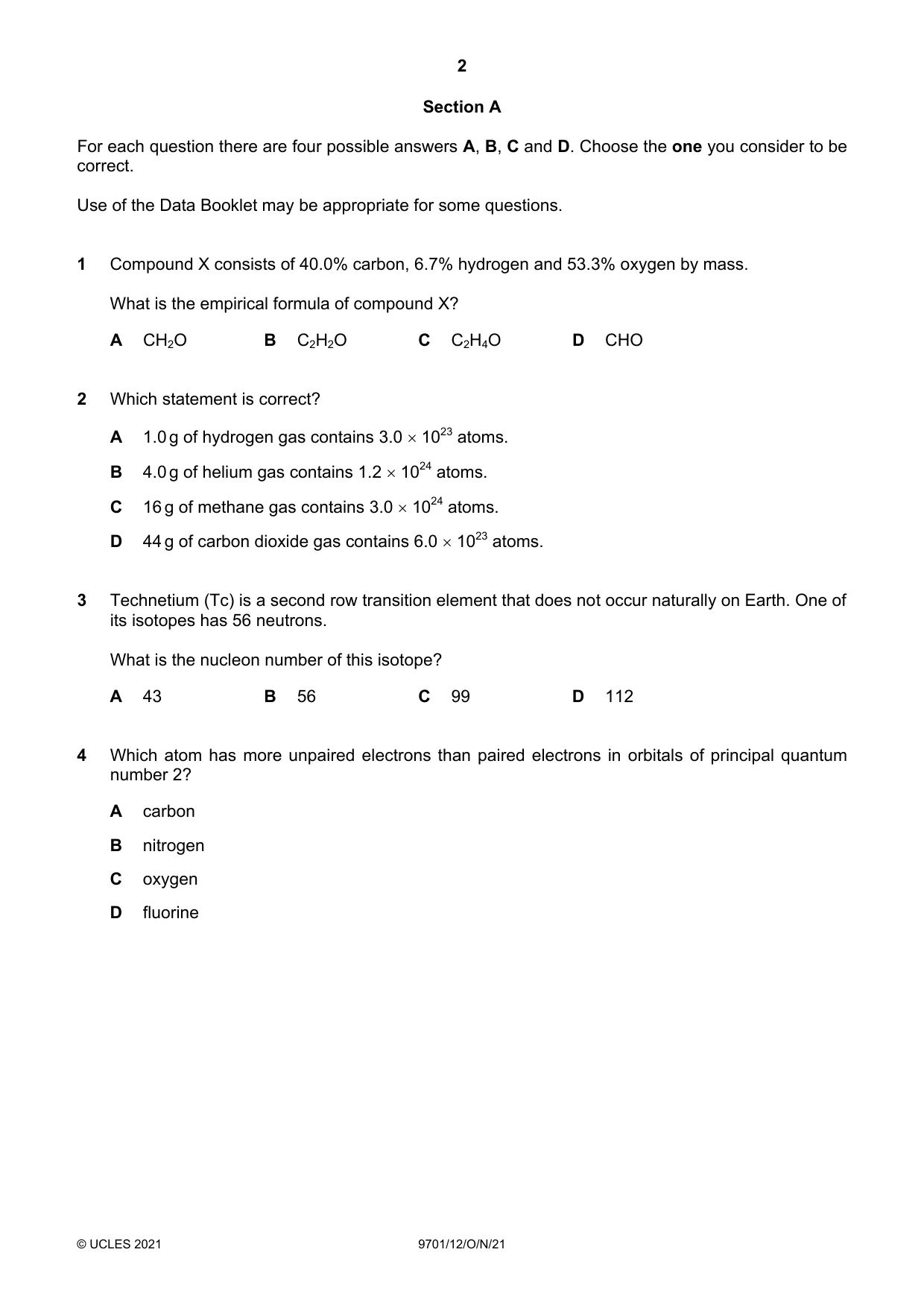
1 Compound X consists of 40.0% carbon, 6.7% hydrogen and 53.3% oxygen by mass. What is the empirical formula of compound X? A CH2O B C2H2O C C2H4O D CHO
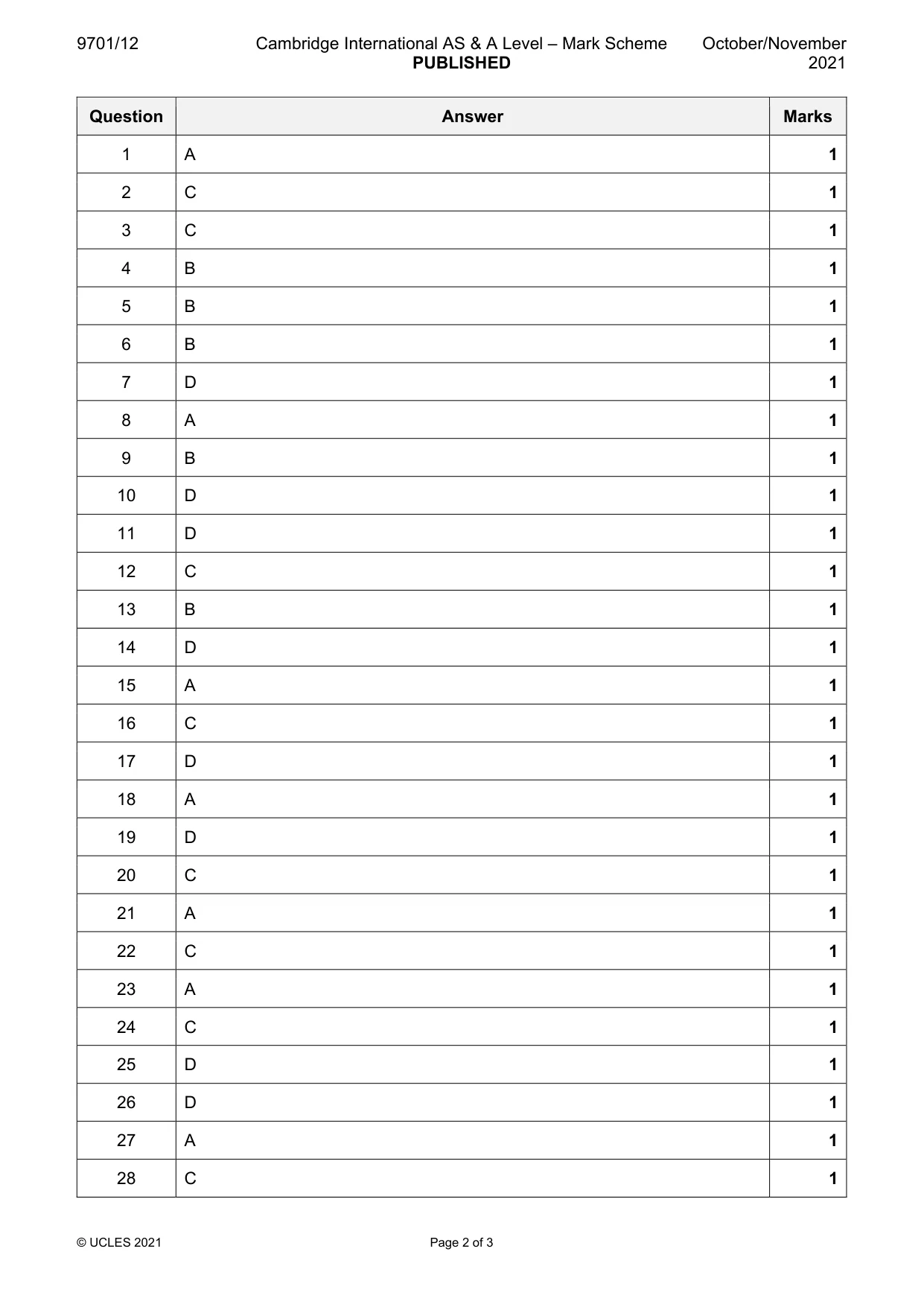
Mark scheme: A
Q2 · Which statement is correct?
2 Which statement is correct? A 1.0 g of hydrogen gas contains 3.0 1023 atoms. B 4.0 g of helium gas contains 1.2 1024 atoms. C 16 g of methane gas contains 3.0 1024 atoms. D 44 g of carbon dioxide gas contains 6.0 1023 atoms.
Mark scheme: C
Q3 · Technetium (Tc) is a second row transition element that does not occur naturally on Earth
3 Technetium (Tc) is a second row transition element that does not occur naturally on Earth. One of its isotopes has 56 neutrons. What is the nucleon number of this isotope? A 43 B 56 C 99 D 112
Mark scheme: C
Q4 · Which atom has more unpaired electrons than paired electrons in orbitals of principal…
4 Which atom has more unpaired electrons than paired electrons in orbitals of principal quantum number 2? A carbon B nitrogen C oxygen D fluorine
Mark scheme: B
More questions on Electrons, energy levels and atomic orbitals
Q5 · Atom X is the central atom in a molecule
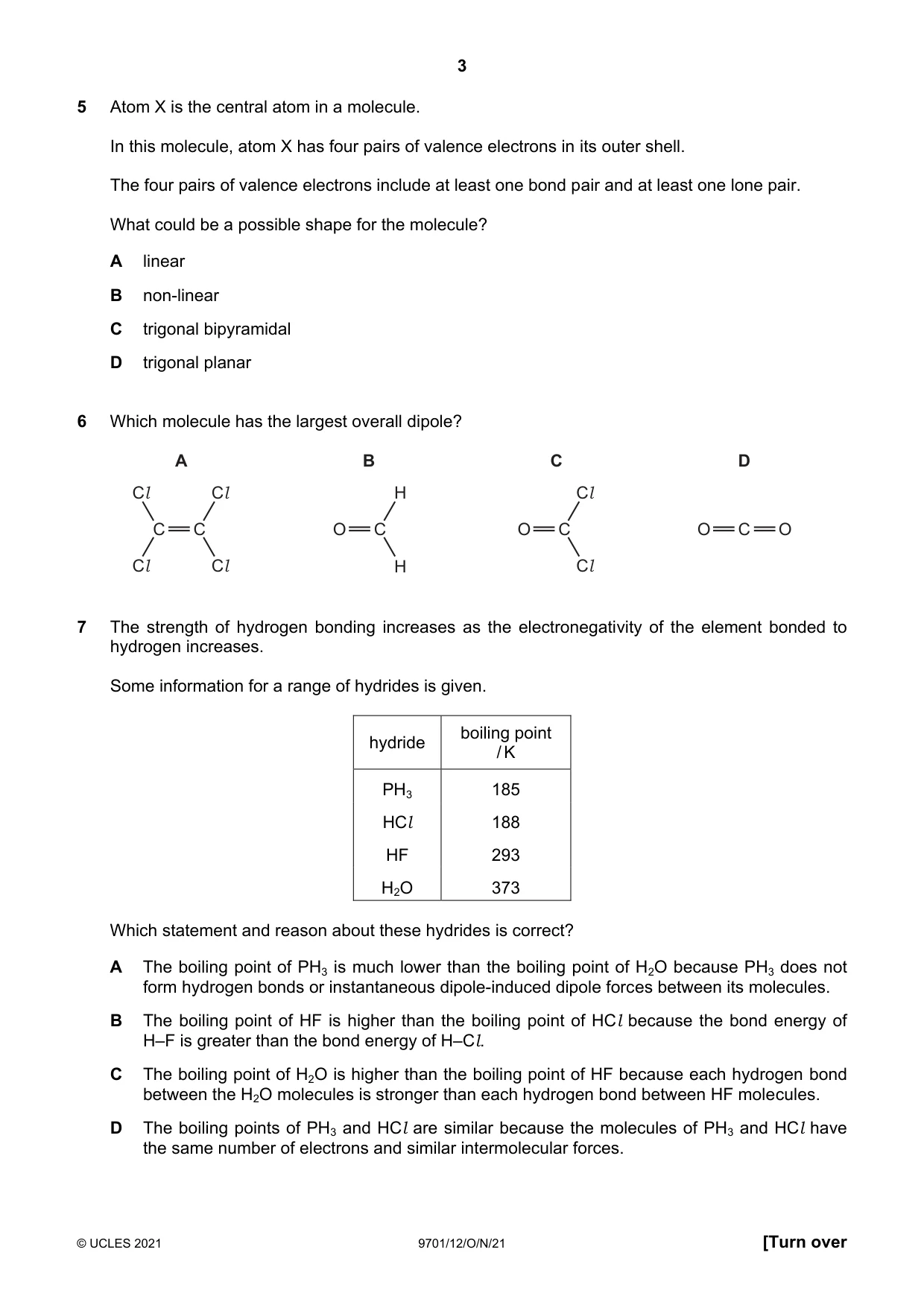
5 Atom X is the central atom in a molecule. In this molecule, atom X has four pairs of valence electrons in its outer shell. The four pairs of valence electrons include at least one bond pair and at least one lone pair. What could be a possible shape for the molecule? A linear B non-linear C trigonal bipyramidal D trigonal planar
Mark scheme: B
Q6 · Which molecule has the largest overall dipole?
6 Which molecule has the largest overall dipole? A B C D Cl Cl H Cl C C O C O C O C O Cl Cl H Cl
Mark scheme: B
More questions on Intermolecular forces, electronegativity and bond properties
Q7 · The strength of hydrogen bonding increases as the electronegativity of the element bonded…
7 The strength of hydrogen bonding increases as the electronegativity of the element bonded to hydrogen increases. Some information for a range of hydrides is given. boiling point hydride / K PH3 185 HCl 188 HF 293 H2O 373 Which statement and reason about these hydrides is correct? A The boiling point of PH3 is much lower than the boiling point of H2O because PH3 does not form hydrogen bonds or instantaneous dipole-induced dipole forces between its molecules. B The boiling point of HF is higher than the boiling point of HCl because the bond energy of H–F is greater than the bond energy of H–Cl. C The boiling point of H2O is higher than the boiling point of HF because each hydrogen bond between the H2O molecules is stronger than each hydrogen bond between HF molecules. D The boiling points of PH3 and HCl are similar because the molecules of PH3 and HCl have the same number of electrons and similar intermolecular forces.
Mark scheme: D
More questions on Intermolecular forces, electronegativity and bond properties
Q8 · The general gas equation can be used to calculate the value of the Mr of a gas
8 The general gas equation can be used to calculate the value of the Mr of a gas. For a sample of a gas of mass m grams, which expression will give the value of Mr? mRT pVRT mpV pV A Mr = pV B Mr = C Mr = RT D Mr = mRT m
Mark scheme: A
More questions on The gaseous state: ideal and real gases and pV = nRT
Q9 · The equation for the formation of ammonium chloride is shown
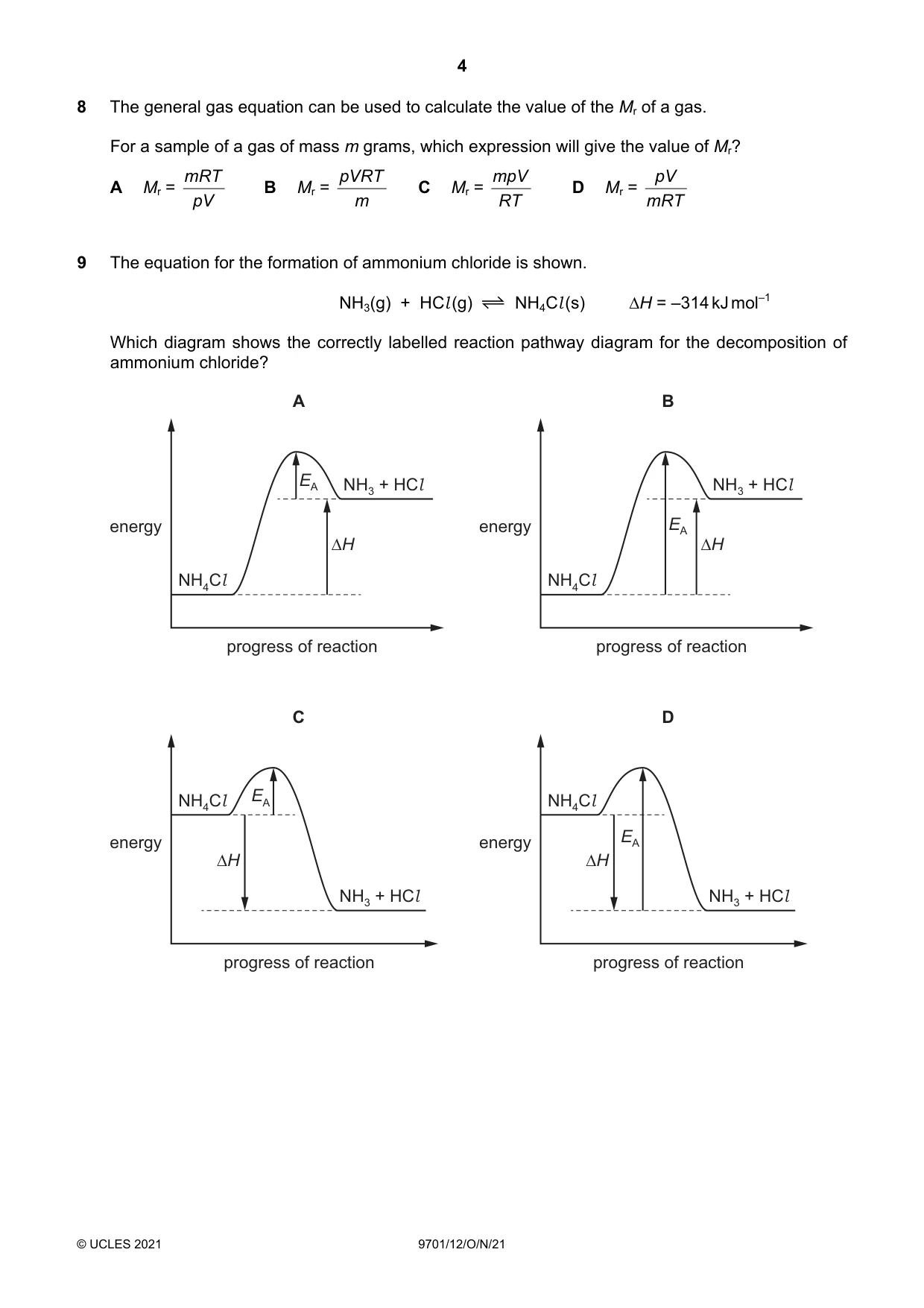
9 The equation for the formation of ammonium chloride is shown. NH3(g) + HCl (g) NH4Cl (s) H = –314 kJ mol–1 Which diagram shows the correctly labelled reaction pathway diagram for the decomposition of ammonium chloride? A B EA NH3 + HCl NH3 + HCl energy energy EA ∆H ∆H NH4Cl NH4Cl progress of reaction progress of reaction C D NH4Cl EA NH4Cl energy energy EA ∆H ∆H NH3 + HCl NH3 + HCl progress of reaction progress of reaction
Mark scheme: B
Q10 · In a catalytic converter in the exhaust system of a car, carbon monoxide is oxidised to…
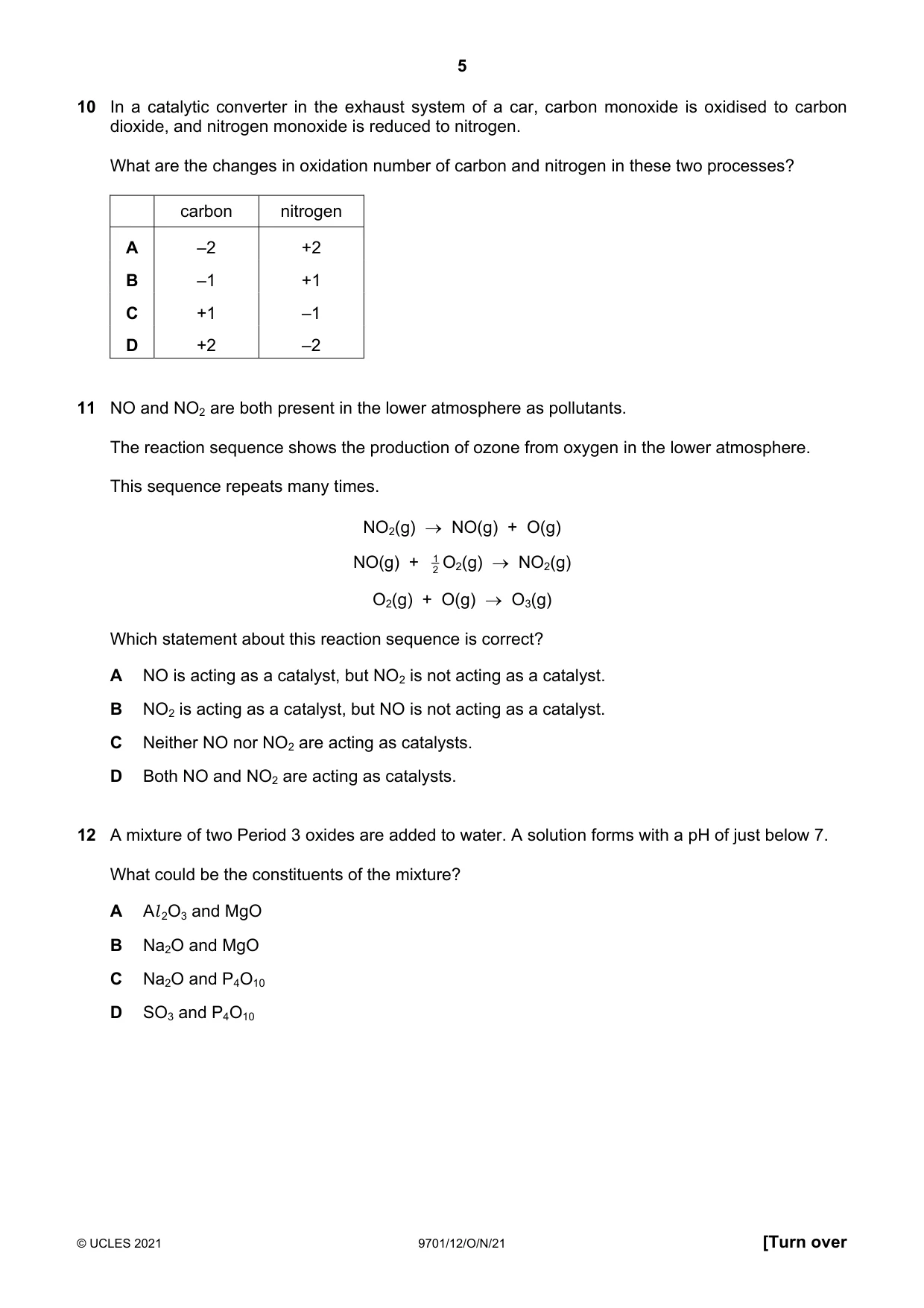
10 In a catalytic converter in the exhaust system of a car, carbon monoxide is oxidised to carbon dioxide, and nitrogen monoxide is reduced to nitrogen. What are the changes in oxidation number of carbon and nitrogen in these two processes? carbon nitrogen A –2 +2 B –1 +1 C +1 –1 D +2 –2
Mark scheme: D
Q11 · NO and NO2 are both present in the lower atmosphere as pollutants
11 NO and NO2 are both present in the lower atmosphere as pollutants. The reaction sequence shows the production of ozone from oxygen in the lower atmosphere. This sequence repeats many times. NO2(g) NO(g) + O(g) NO(g) + 1 2 O2(g) NO2(g) O2(g) + O(g) O3(g) Which statement about this reaction sequence is correct? A NO is acting as a catalyst, but NO2 is not acting as a catalyst. B NO2 is acting as a catalyst, but NO is not acting as a catalyst. C Neither NO nor NO2 are acting as catalysts. D Both NO and NO2 are acting as catalysts.
Mark scheme: D
Q12 · A mixture of two Period 3 oxides are added to water
12 A mixture of two Period 3 oxides are added to water. A solution forms with a pH of just below 7. What could be the constituents of the mixture? A Al 2O3 and MgO B Na2O and MgO C Na2O and P4O10 D SO3 and P4O10
Mark scheme: C
More questions on Periodicity of chemical properties of the elements in Period 3
Q13 · Which statement about the compounds of the Group 2 metals is correct?
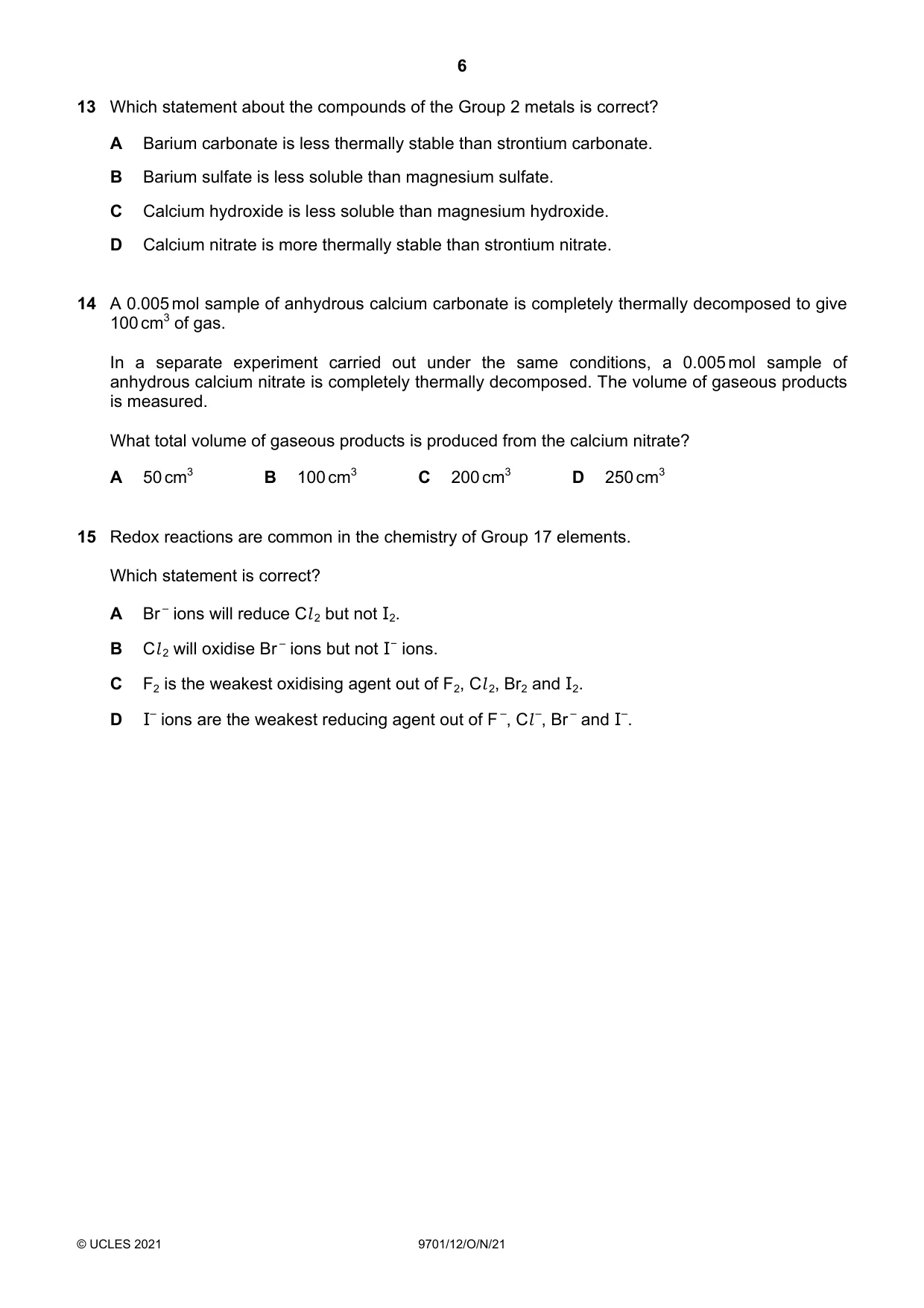
13 Which statement about the compounds of the Group 2 metals is correct? A Barium carbonate is less thermally stable than strontium carbonate. B Barium sulfate is less soluble than magnesium sulfate. C Calcium hydroxide is less soluble than magnesium hydroxide. D Calcium nitrate is more thermally stable than strontium nitrate.
Mark scheme: B
Q14 · A 0.005 mol sample of anhydrous calcium carbonate is completely thermally decomposed to…
14 A 0.005 mol sample of anhydrous calcium carbonate is completely thermally decomposed to give 100 cm3 of gas. In a separate experiment carried out under the same conditions, a 0.005 mol sample of anhydrous calcium nitrate is completely thermally decomposed. The volume of gaseous products is measured. What total volume of gaseous products is produced from the calcium nitrate? A 50 cm3 B 100 cm3 C 200 cm3 D 250 cm3
Mark scheme: D
Q15 · Redox reactions are common in the chemistry of Group 17 elements
15 Redox reactions are common in the chemistry of Group 17 elements. Which statement is correct? A Br – ions will reduce Cl 2 but not I2. B Cl 2 will oxidise Br – ions but not I– ions. C F2 is the weakest oxidising agent out of F2, Cl 2, Br2 and I2. D I– ions are the weakest reducing agent out of F –, Cl –, Br – and I–.
Mark scheme: A
More questions on The chemical properties of the halogen elements and the hydrogen halides
Q16 · Silver chloride and silver iodide form equilibria when added to water
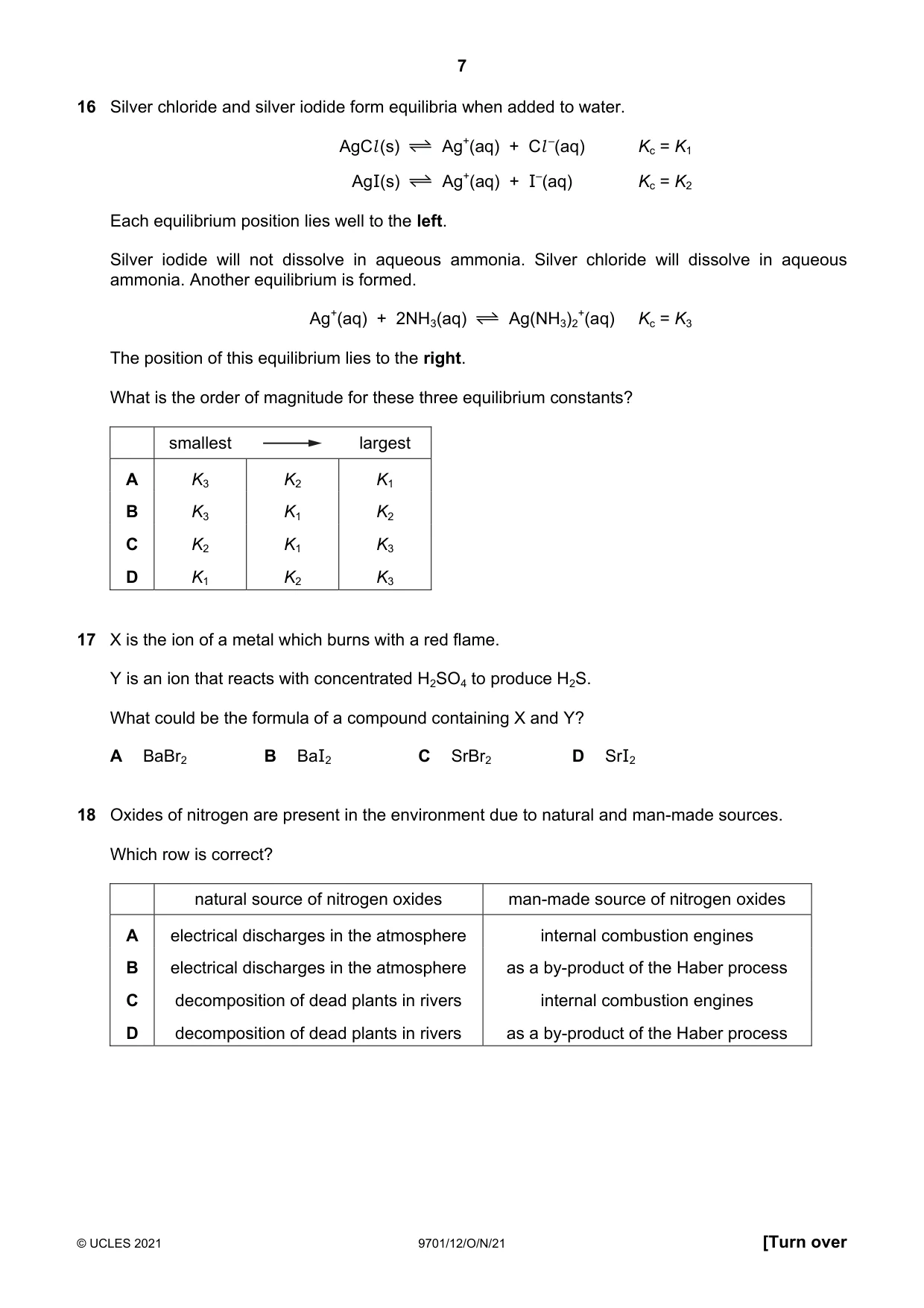
16 Silver chloride and silver iodide form equilibria when added to water. AgCl (s) Ag+(aq) + Cl –(aq) Kc = K1 AgI(s) Ag+(aq) + I–(aq) Kc = K2 Each equilibrium position lies well to the left. Silver iodide will not dissolve in aqueous ammonia. Silver chloride will dissolve in aqueous ammonia. Another equilibrium is formed. Ag+(aq) + 2NH3(aq) Ag(NH3)2 +(aq) Kc = K3 The position of this equilibrium lies to the right. What is the order of magnitude for these three equilibrium constants? smallest largest A K3 K2 K1 B K3 K1 K2 C K2 K1 K3 D K1 K2 K3
Mark scheme: C
More questions on Chemical equilibria: reversible reactions, dynamic equilibrium
Q17 · X is the ion of a metal which burns with a red flame
17 X is the ion of a metal which burns with a red flame. Y is an ion that reacts with concentrated H2SO4 to produce H2S. What could be the formula of a compound containing X and Y? A BaBr2 B BaI2 C SrBr2 D SrI2
Mark scheme: D
Q18 · Oxides of nitrogen are present in the environment due to natural and man-made sources
18 Oxides of nitrogen are present in the environment due to natural and man-made sources. Which row is correct? natural source of nitrogen oxides man-made source of nitrogen oxides A electrical discharges in the atmosphere internal combustion engines B electrical discharges in the atmosphere as a by-product of the Haber process C decomposition of dead plants in rivers internal combustion engines D decomposition of dead plants in rivers as a by-product of the Haber process
Mark scheme: A
Q19 · Magnesium hydroxide dissolves in aqueous ammonium chloride, but not in aqueous sodium…
19 Magnesium hydroxide dissolves in aqueous ammonium chloride, but not in aqueous sodium chloride. Which statement explains this observation? A The ionic radius of the NH4 + ion is similar to that of Mg2+ but not that of Na+. B NH4Cl dissociates less fully than NaCl. C The Na+ and Mg2+ ions have the same number of electrons. D The NH4 + ion can donate a proton.
Mark scheme: D
Q20 · The formula of hydrocortisone acetate is shown
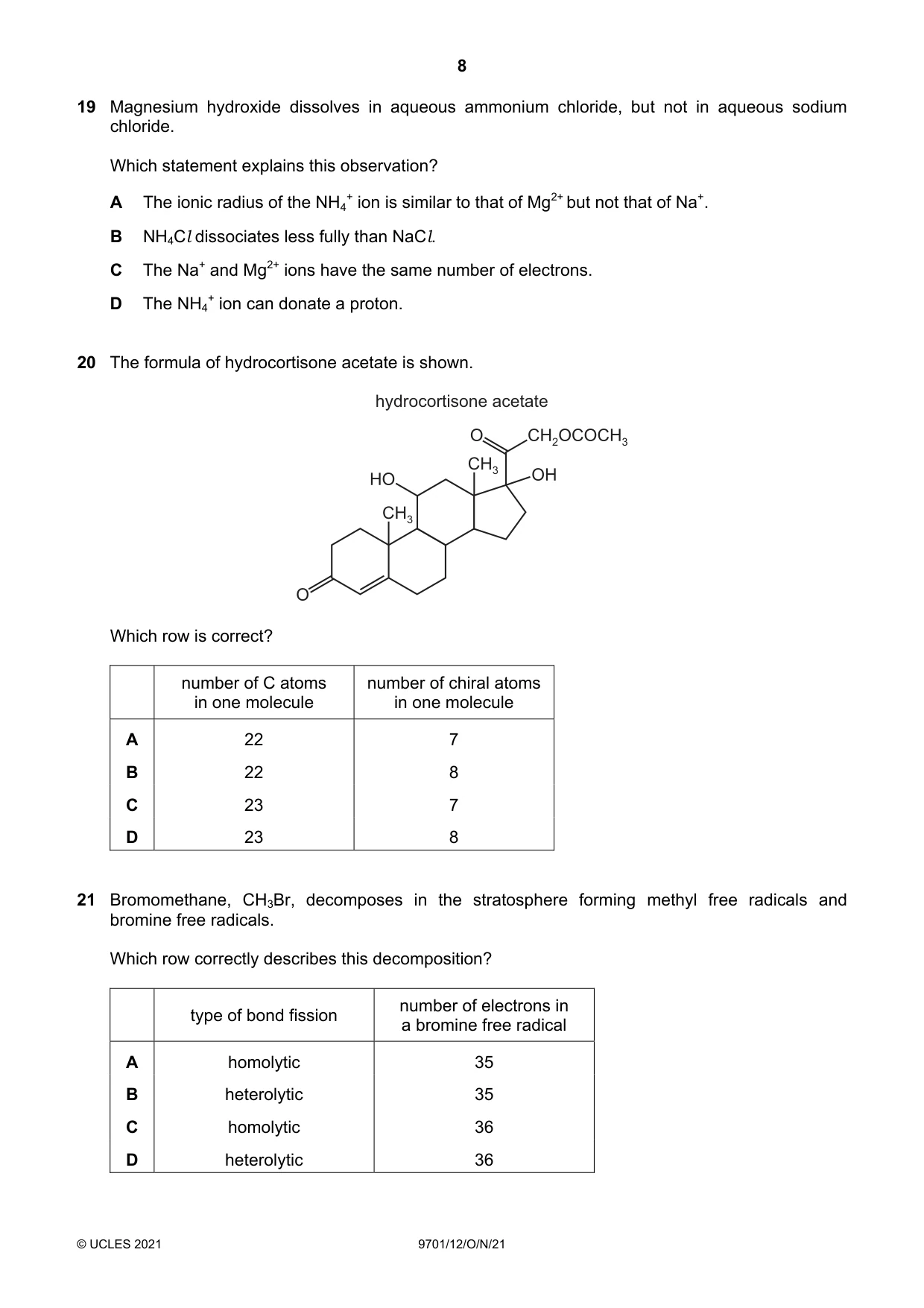
20 The formula of hydrocortisone acetate is shown. hydrocortisone acetate O CH2OCOCH3 CH3 HO OH CH3 O Which row is correct? number of C atoms number of chiral atoms in one molecule in one molecule A 22 7 B 22 8 C 23 7 D 23 8
Mark scheme: C
More questions on Isomerism: structural isomerism and stereoisomerism
Q21 · Bromomethane, CH3Br, decomposes in the stratosphere forming methyl free radicals and…
21 Bromomethane, CH3Br, decomposes in the stratosphere forming methyl free radicals and bromine free radicals. Which row correctly describes this decomposition? number of electrons in type of bond fission a bromine free radical A homolytic 35 B heterolytic 35 C homolytic 36 D heterolytic 36
Mark scheme: A
Q22 · Structural and stereoisomerism should be taken into account when answering this question
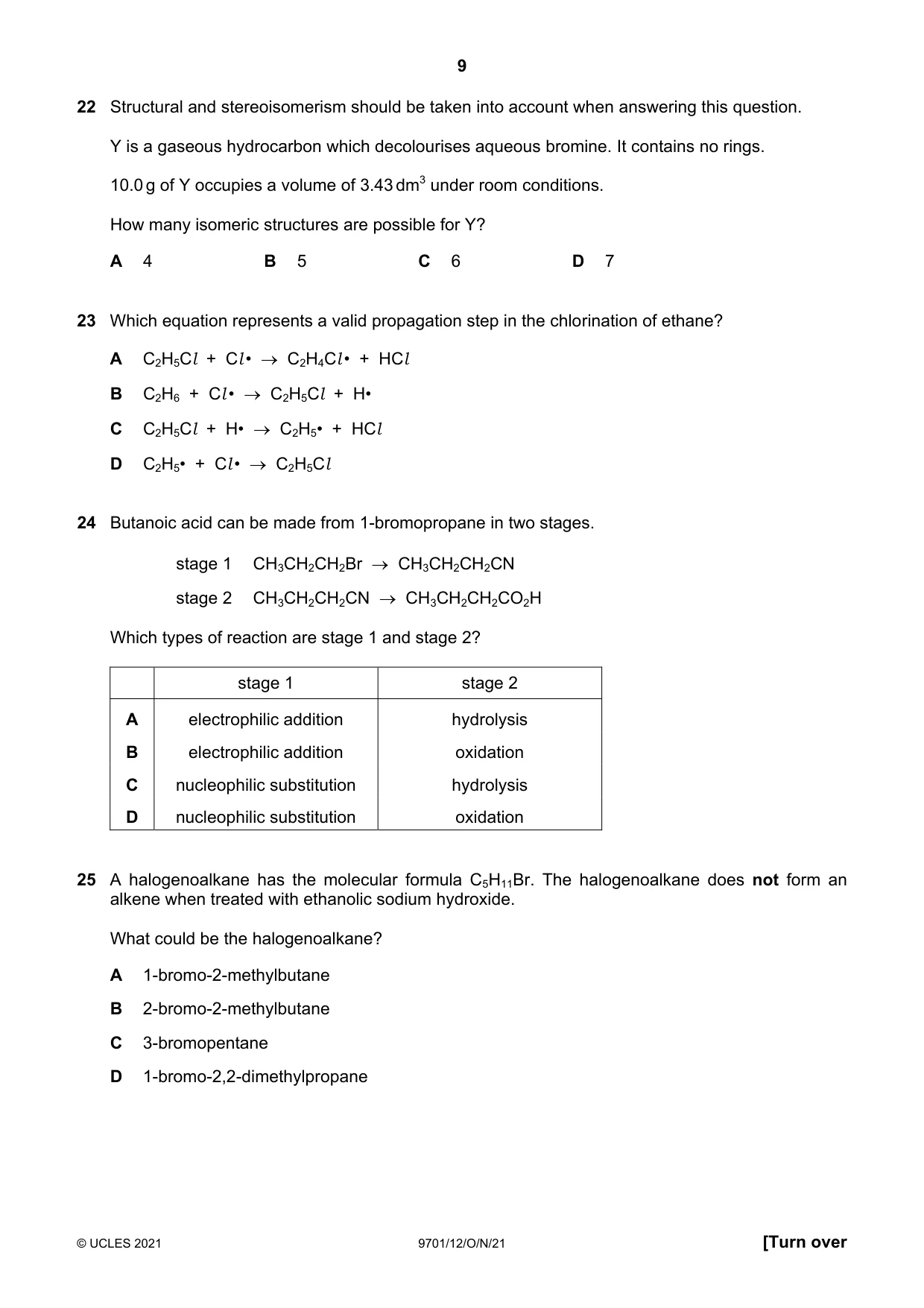
22 Structural and stereoisomerism should be taken into account when answering this question. Y is a gaseous hydrocarbon which decolourises aqueous bromine. It contains no rings. 10.0 g of Y occupies a volume of 3.43 dm3 under room conditions. How many isomeric structures are possible for Y? A 4 B 5 C 6 D 7
Mark scheme: C
Q23 · Which equation represents a valid propagation step in the chlorination of ethane?
23 Which equation represents a valid propagation step in the chlorination of ethane? A C2H5Cl + Cl • C2H4Cl • + HCl B C2H6 + Cl • C2H5Cl + H• C C2H5Cl + H• C2H5• + HCl D C2H5• + Cl • C2H5Cl
Mark scheme: A
Q24 · Butanoic acid can be made from 1-bromopropane in two stages
24 Butanoic acid can be made from 1-bromopropane in two stages. stage 1 CH3CH2CH2Br CH3CH2CH2CN stage 2 CH3CH2CH2CN CH3CH2CH2CO2H Which types of reaction are stage 1 and stage 2? stage 1 stage 2 A electrophilic addition hydrolysis B electrophilic addition oxidation C nucleophilic substitution hydrolysis D nucleophilic substitution oxidation
Mark scheme: C
Q25 · A halogenoalkane has the molecular formula C5H11Br
25 A halogenoalkane has the molecular formula C5H11Br. The halogenoalkane does not form an alkene when treated with ethanolic sodium hydroxide. What could be the halogenoalkane? A 1-bromo-2-methylbutane B 2-bromo-2-methylbutane C 3-bromopentane D 1-bromo-2,2-dimethylpropane
Mark scheme: D
Q26 · Compound P is heated under reflux with an excess of acidified potassium dichromate(VI) to…
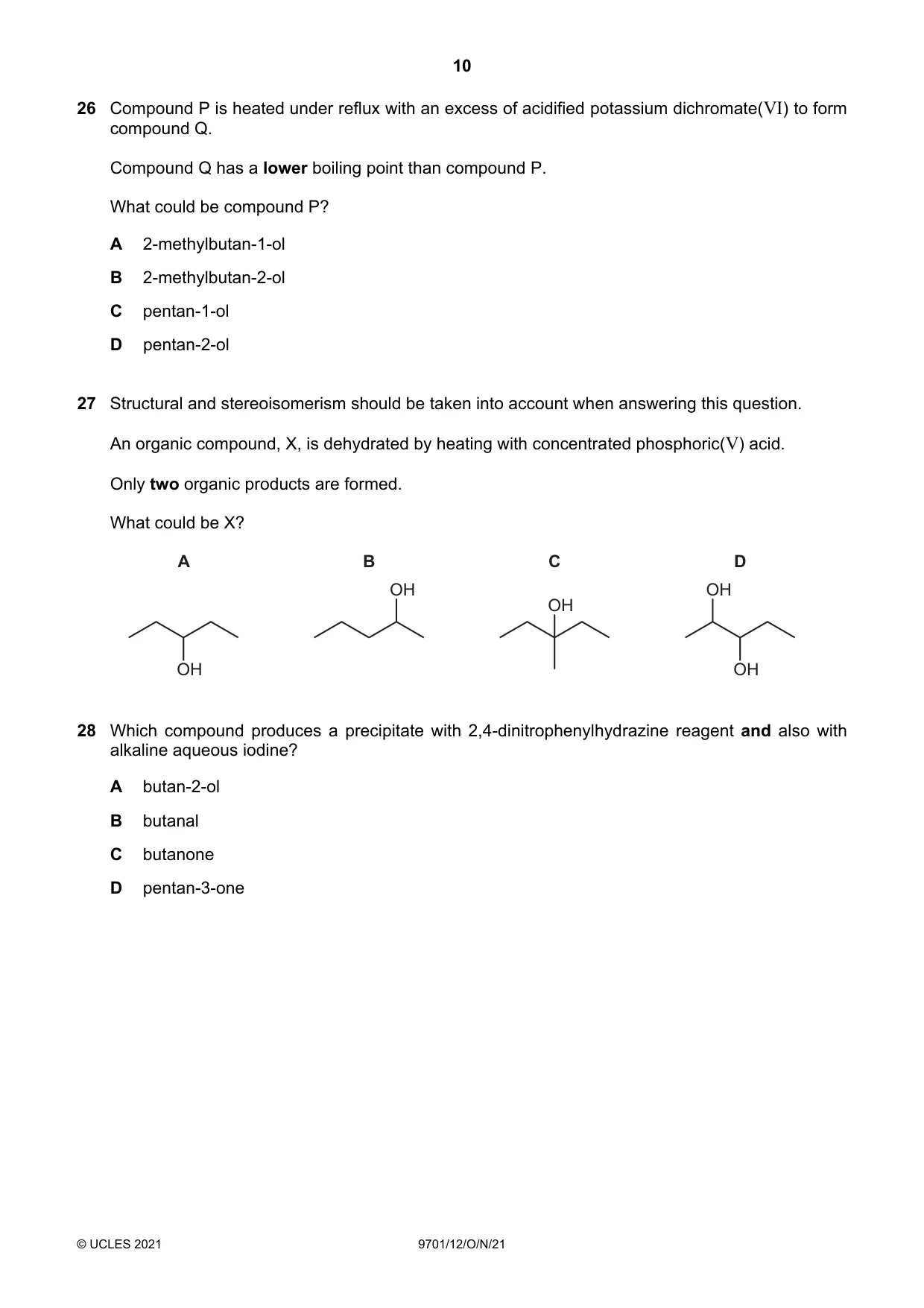
26 Compound P is heated under reflux with an excess of acidified potassium dichromate(VI) to form compound Q. Compound Q has a lower boiling point than compound P. What could be compound P? A 2-methylbutan-1-ol B 2-methylbutan-2-ol C pentan-1-ol D pentan-2-ol
Mark scheme: D
Q27 · Structural and stereoisomerism should be taken into account when answering this question
27 Structural and stereoisomerism should be taken into account when answering this question. An organic compound, X, is dehydrated by heating with concentrated phosphoric(V) acid. Only two organic products are formed. What could be X? A B C D OH OH OH OH OH
Mark scheme: A
Q28 · Which compound produces a precipitate with 2,4-dinitrophenylhydrazine reagent and also…
28 Which compound produces a precipitate with 2,4-dinitrophenylhydrazine reagent and also with alkaline aqueous iodine? A butan-2-ol B butanal C butanone D pentan-3-one
Mark scheme: C
Q29 · Organic compound Z has an alcohol group and a carboxylic acid group
29 Organic compound Z has an alcohol group and a carboxylic acid group. Compound Z reacts with magnesium carbonate to make a salt with a relative formula mass of 230.3. Compound Z does not react with acidified potassium manganate(VII). What could be the identity of compound Z? A 2-hydroxy-2-methylbutanoic acid B 2-hydroxy-2-methylpropanoic acid C 3-hydroxy-2-methylbutanoic acid D 3-hydroxy-2-methylpropanoic acid
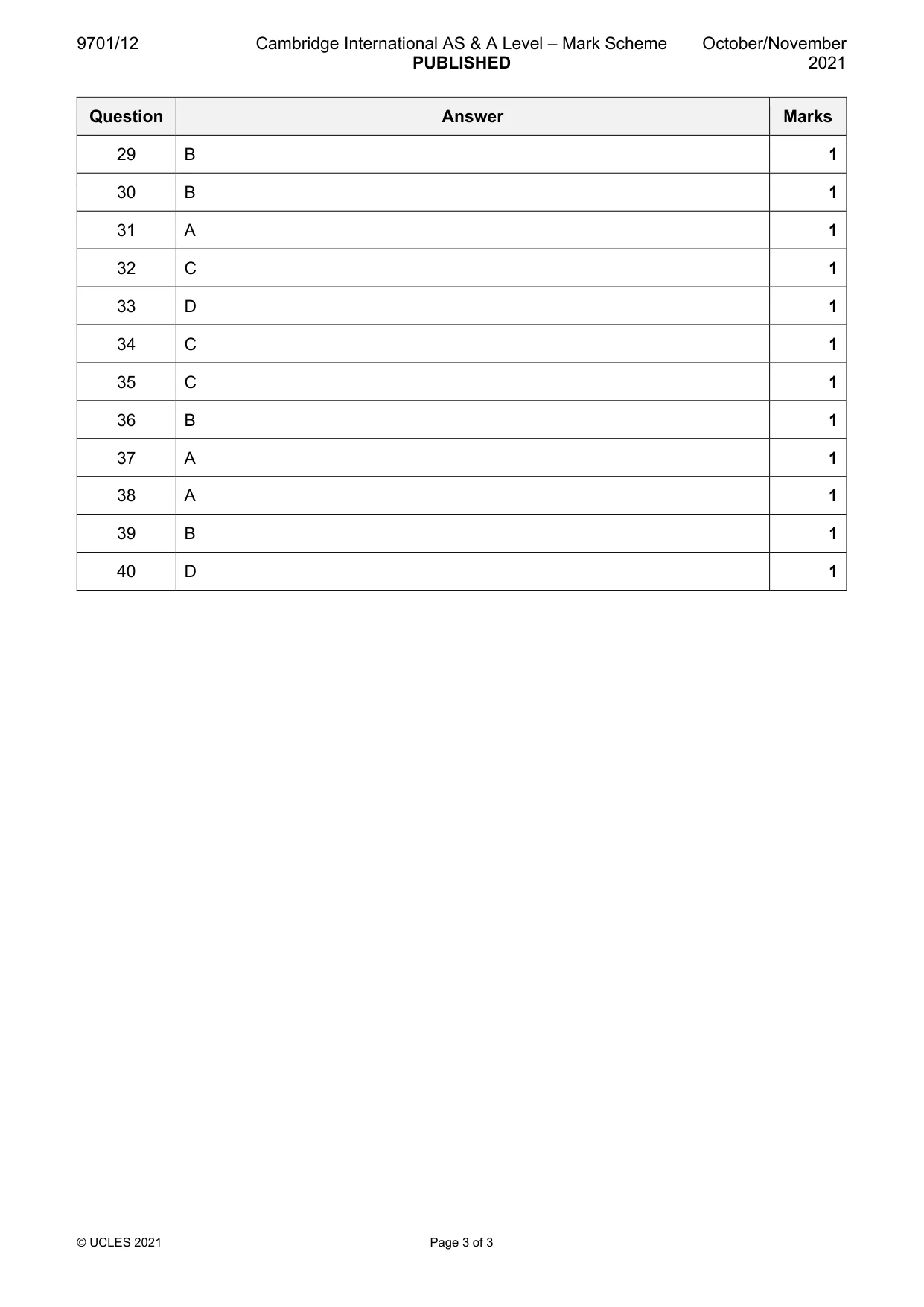
Mark scheme: B
Q30 · The infra-red spectrum of Y is shown
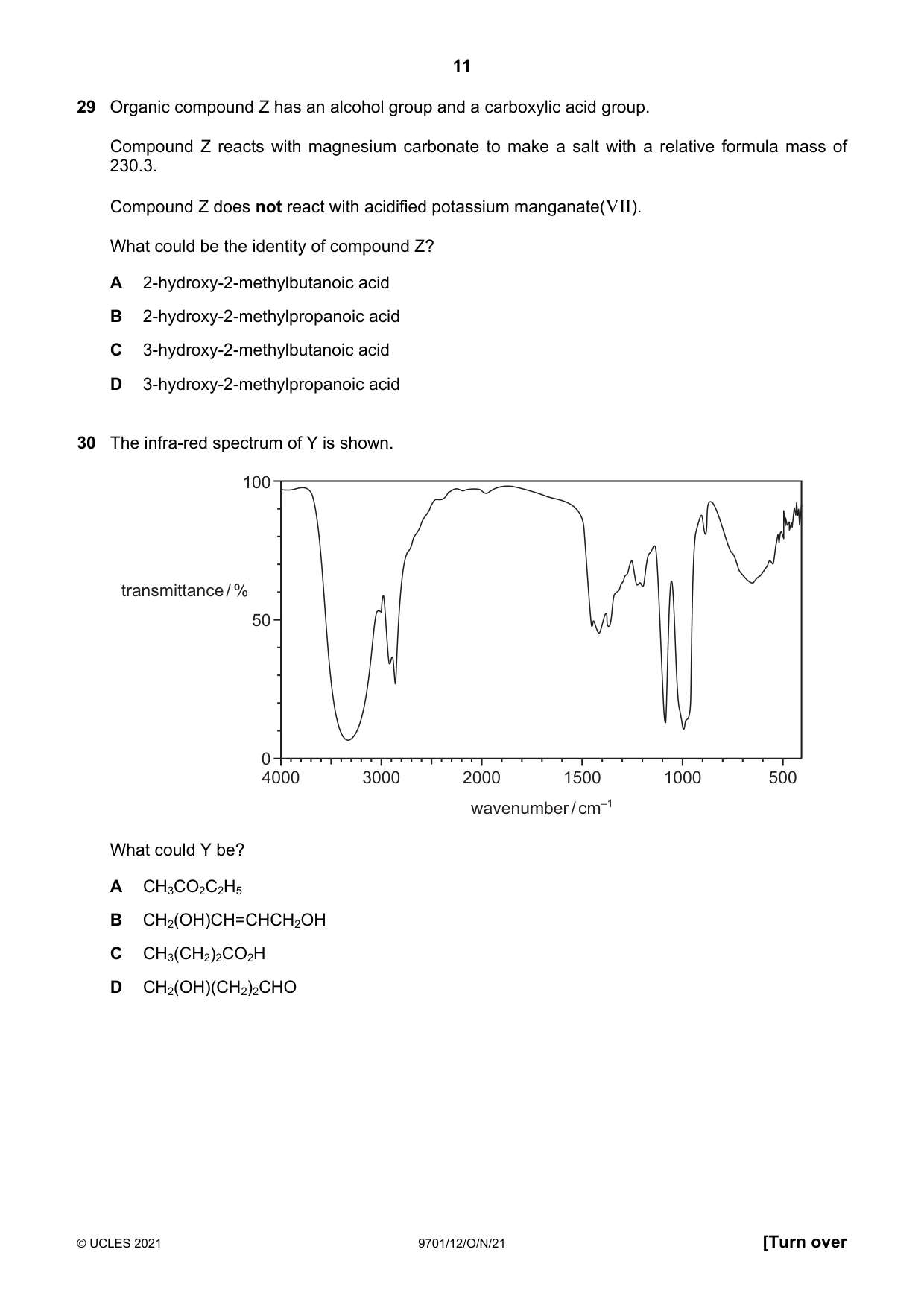
30 The infra-red spectrum of Y is shown. 100 transmittance / % 50 0 4000 3000 2000 1500 1000 500 wavenumber / cm–1 What could Y be? A CH3CO2C2H5 B CH2(OH)CH=CHCH2OH C CH3(CH2)2CO2H D CH2(OH)(CH2)2CHO
Mark scheme: B
Q31 · The Boltzmann distribution diagram shows a fixed amount of a gas at two different…
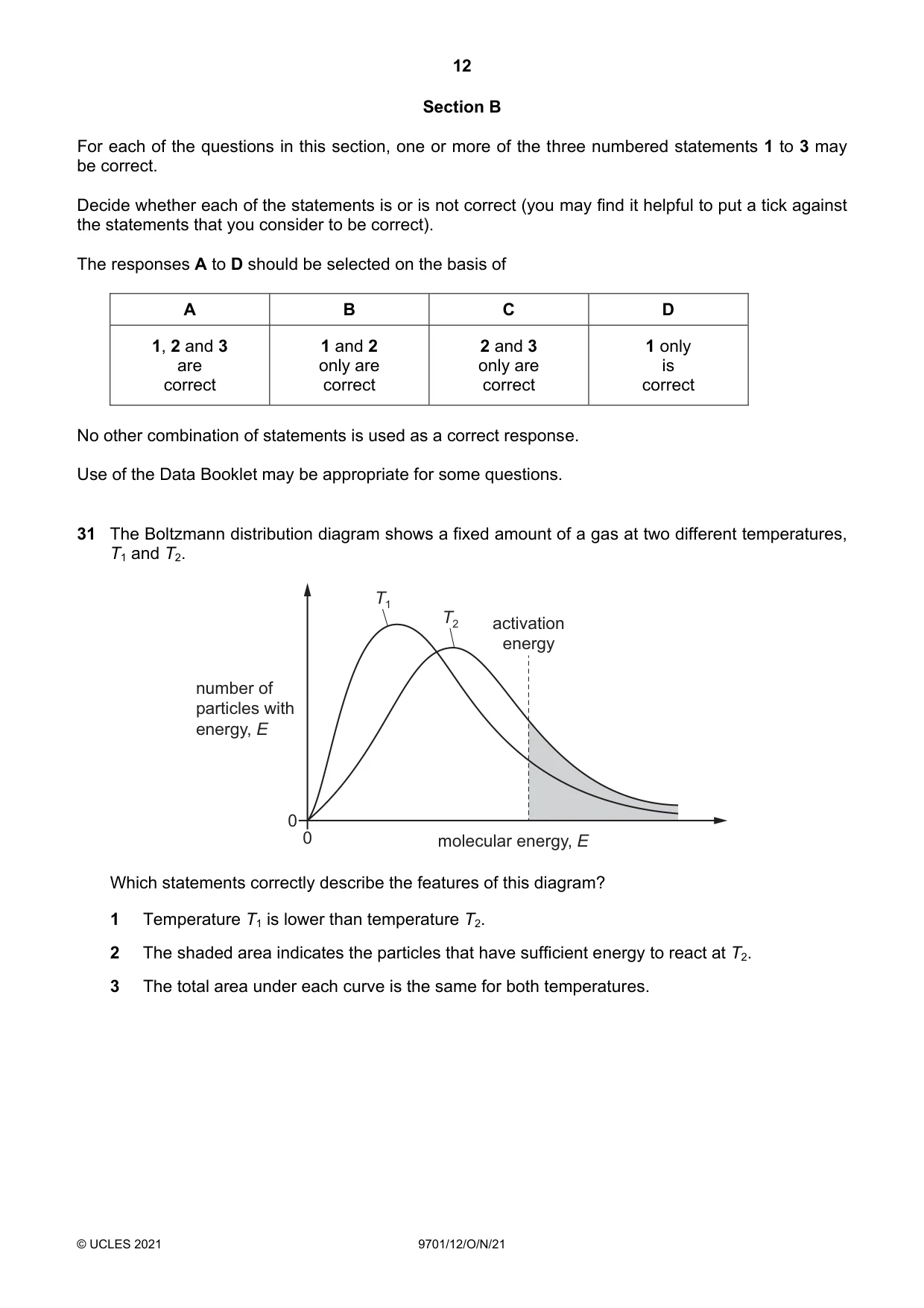
31 The Boltzmann distribution diagram shows a fixed amount of a gas at two different temperatures, T1 and T2. T1 T2 activation energy number of particles with energy, E 0 0 molecular energy, E Which statements correctly describe the features of this diagram? 1 Temperature T1 is lower than temperature T2. 2 The shaded area indicates the particles that have sufficient energy to react at T2. 3 The total area under each curve is the same for both temperatures.
Mark scheme: A
More questions on Effect of temperature on reaction rates and the concept of activation energy
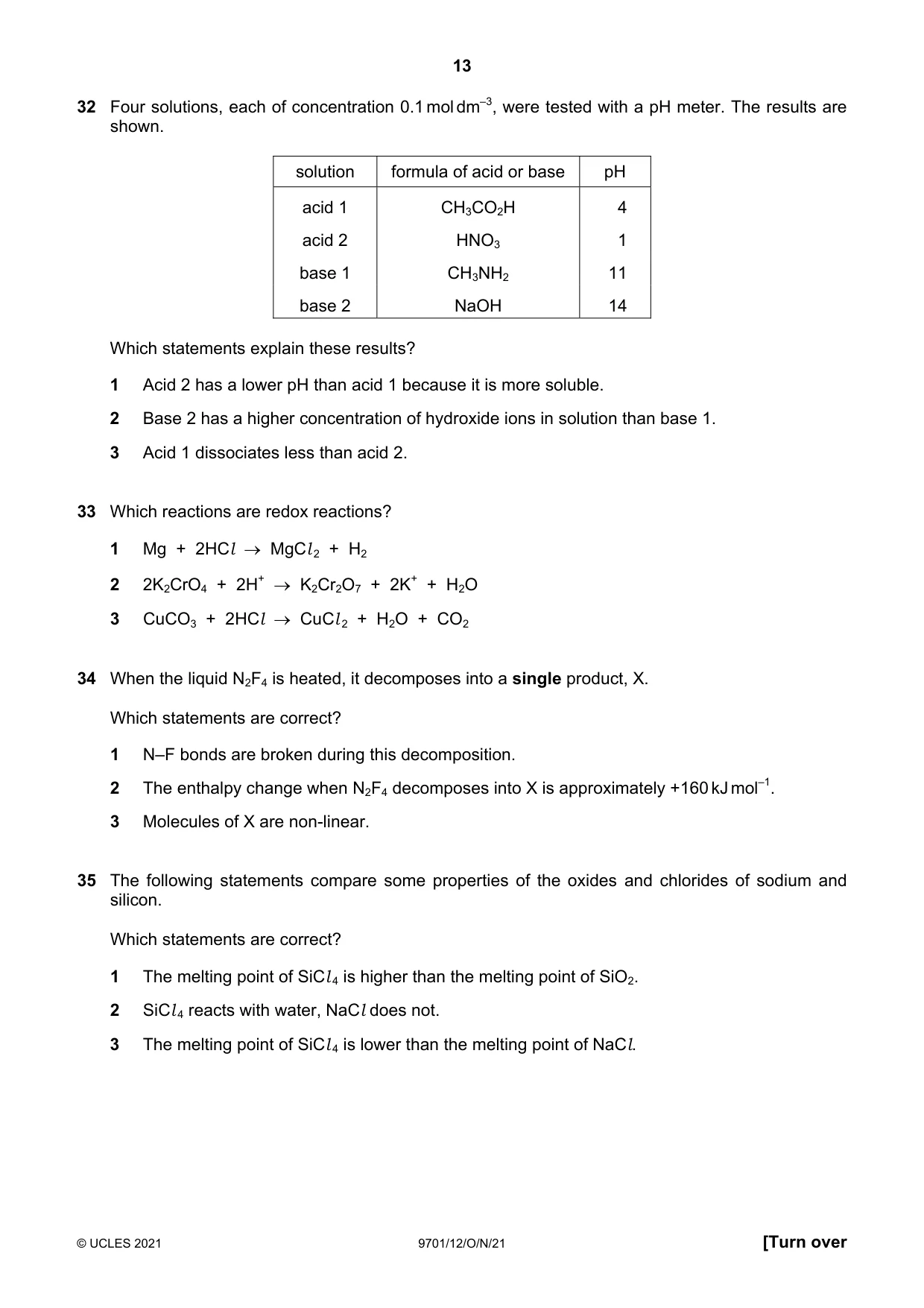
Q32 · Four solutions, each of concentration 0.1 mol dm–3, were tested with a pH meter
32 Four solutions, each of concentration 0.1 mol dm–3, were tested with a pH meter. The results are shown. solution formula of acid or base pH acid 1 CH3CO2H 4 acid 2 HNO3 1 base 1 CH3NH2 11 base 2 NaOH 14 Which statements explain these results? 1 Acid 2 has a lower pH than acid 1 because it is more soluble. 2 Base 2 has a higher concentration of hydroxide ions in solution than base 1. 3 Acid 1 dissociates less than acid 2.
Mark scheme: C
Q33 · Which reactions are redox reactions?
33 Which reactions are redox reactions? 1 Mg + 2HCl MgCl 2 + H2 2 2K2CrO4 + 2H+ K2Cr2O7 + 2K+ + H2O 3 CuCO3 + 2HCl CuCl 2 + H2O + CO2
Mark scheme: D
Q34 · When the liquid N2F4 is heated, it decomposes into a single product, X
34 When the liquid N2F4 is heated, it decomposes into a single product, X. Which statements are correct? 1 N–F bonds are broken during this decomposition. 2 The enthalpy change when N2F4 decomposes into X is approximately +160 kJ mol–1. 3 Molecules of X are non-linear.
Mark scheme: C
Q35 · The following statements compare some properties of the oxides and chlorides of sodium…
35 The following statements compare some properties of the oxides and chlorides of sodium and silicon. Which statements are correct? 1 The melting point of SiCl 4 is higher than the melting point of SiO2. 2 SiCl 4 reacts with water, NaCl does not. 3 The melting point of SiCl 4 is lower than the melting point of NaCl.
Mark scheme: C
More questions on Periodicity of physical properties of the elements in Period 3
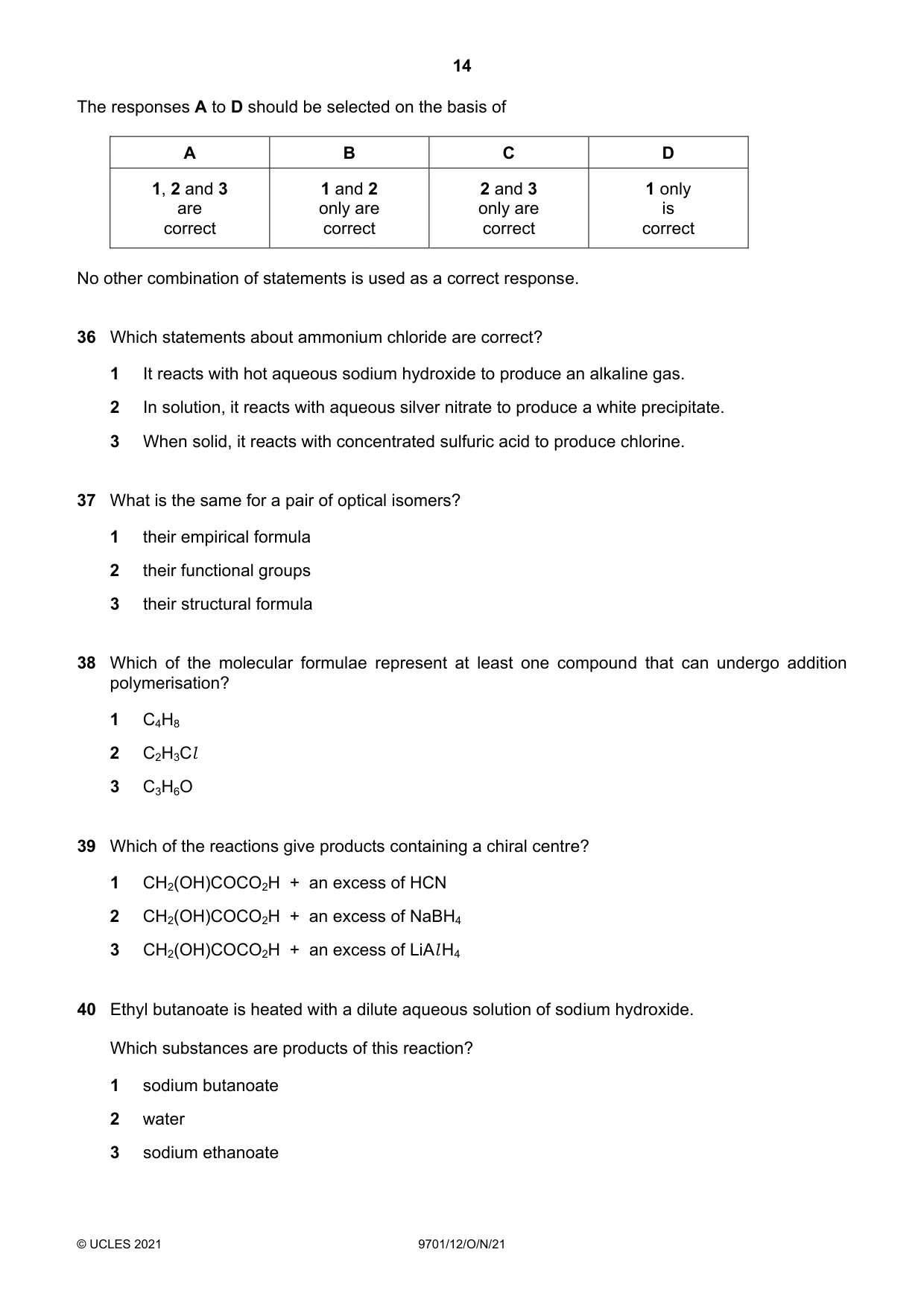
Q36 · Which statements about ammonium chloride are correct?
36 Which statements about ammonium chloride are correct? 1 It reacts with hot aqueous sodium hydroxide to produce an alkaline gas. 2 In solution, it reacts with aqueous silver nitrate to produce a white precipitate. 3 When solid, it reacts with concentrated sulfuric acid to produce chlorine.
Mark scheme: B
Q37 · What is the same for a pair of optical isomers?
37 What is the same for a pair of optical isomers? 1 their empirical formula 2 their functional groups 3 their structural formula
Mark scheme: A
Q38 · Which of the molecular formulae represent at least one compound that can undergo addition…
38 Which of the molecular formulae represent at least one compound that can undergo addition polymerisation? 1 C4H8 2 C2H3Cl 3 C3H6O
Mark scheme: A
Q39 · Which of the reactions give products containing a chiral centre?
39 Which of the reactions give products containing a chiral centre? 1 CH2(OH)COCO2H + an excess of HCN 2 CH2(OH)COCO2H + an excess of NaBH4 3 CH2(OH)COCO2H + an excess of LiAl H4
Mark scheme: B
Q40 · Ethyl butanoate is heated with a dilute aqueous solution of sodium hydroxide
40 Ethyl butanoate is heated with a dilute aqueous solution of sodium hydroxide. Which substances are products of this reaction? 1 sodium butanoate 2 water 3 sodium ethanoate
Mark scheme: D
What was in this paper
The subtopics covered by these 40 questions, and how many questions each got. Open one in a new tab to see every Cambridge question on it.
3Acids and bases2Alcohols2Alkanes2Halogenoalkanes2Intermolecular forces, electronegativity and bond properties2Isomerism: optical2Redox processes: electron transfer and changes in oxidation number (oxidation state)2Shapes of molecules2Addition polymerisation1Aldehydes and ketones1Alkenes1Carboxylic acids1Chemical equilibria: reversible reactions, dynamic equilibrium1Effect of temperature on reaction rates and the concept of activation energy1Electrons, energy levels and atomic orbitals1Enthalpy change, ΔH1Esters1Formulas1Homogeneous and heterogeneous catalysts1Infrared spectroscopy1Isomerism: structural isomerism and stereoisomerism1Isotopes1Nitrogen and sulfur1Periodicity of chemical properties of the elements in Period 31Periodicity of physical properties of the elements in Period 31Some reactions of the halide ions1The chemical properties of the halogen elements and the hydrogen halides1The gaseous state: ideal and real gases and pV = nRT1The mole and the Avogadro constant1What you needed in this session
Cambridge’s own grade thresholds for 2021 Oct/Nov, Paper 1 · Variant 2. A higher threshold means an easier paper — the bar moves with how the cohort did.