Cambridge A Level Chemistry 9701 — 2015 May/June Paper 1 · Variant 2
9701/12/M/J/15 · 40 questions · 40 marks · ≈45 min
The question paper and its mark scheme, free to read here and free to download. This is Cambridge’s own paper, exactly as it was sat.
Question paper16 pages
Mark scheme2 pages
Answers below. Sit the paper first if you are practising.
Questions as text
Q1 · Use of the Data Booklet is relevant to this question
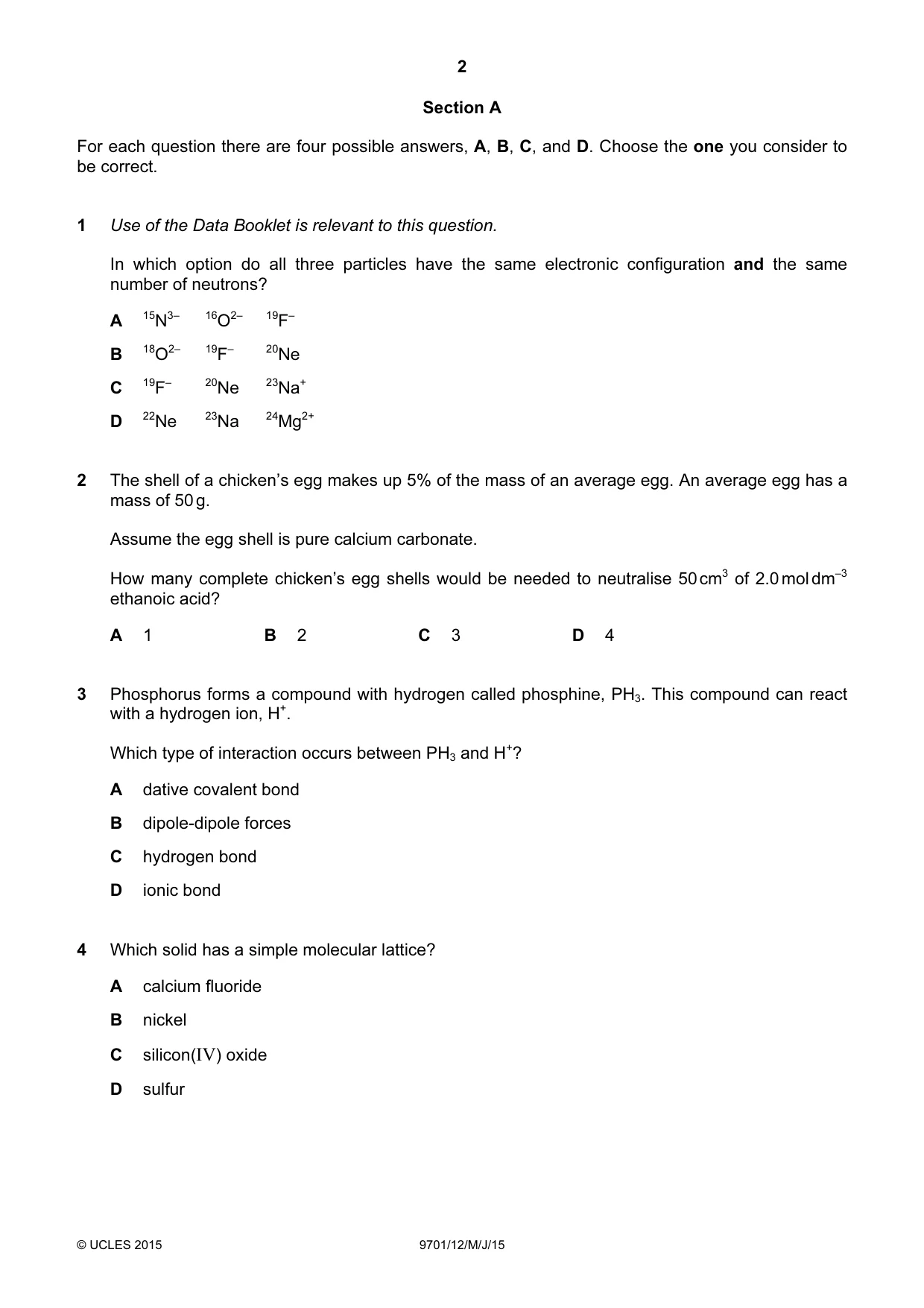
1 Use of the Data Booklet is relevant to this question. In which option do all three particles have the same electronic configuration and the same number of neutrons? A 15N3– 16O2– 19F– B 18O2– 19F– 20Ne C 19F– 20Ne 23Na+ D 22Ne 23Na 24Mg2+
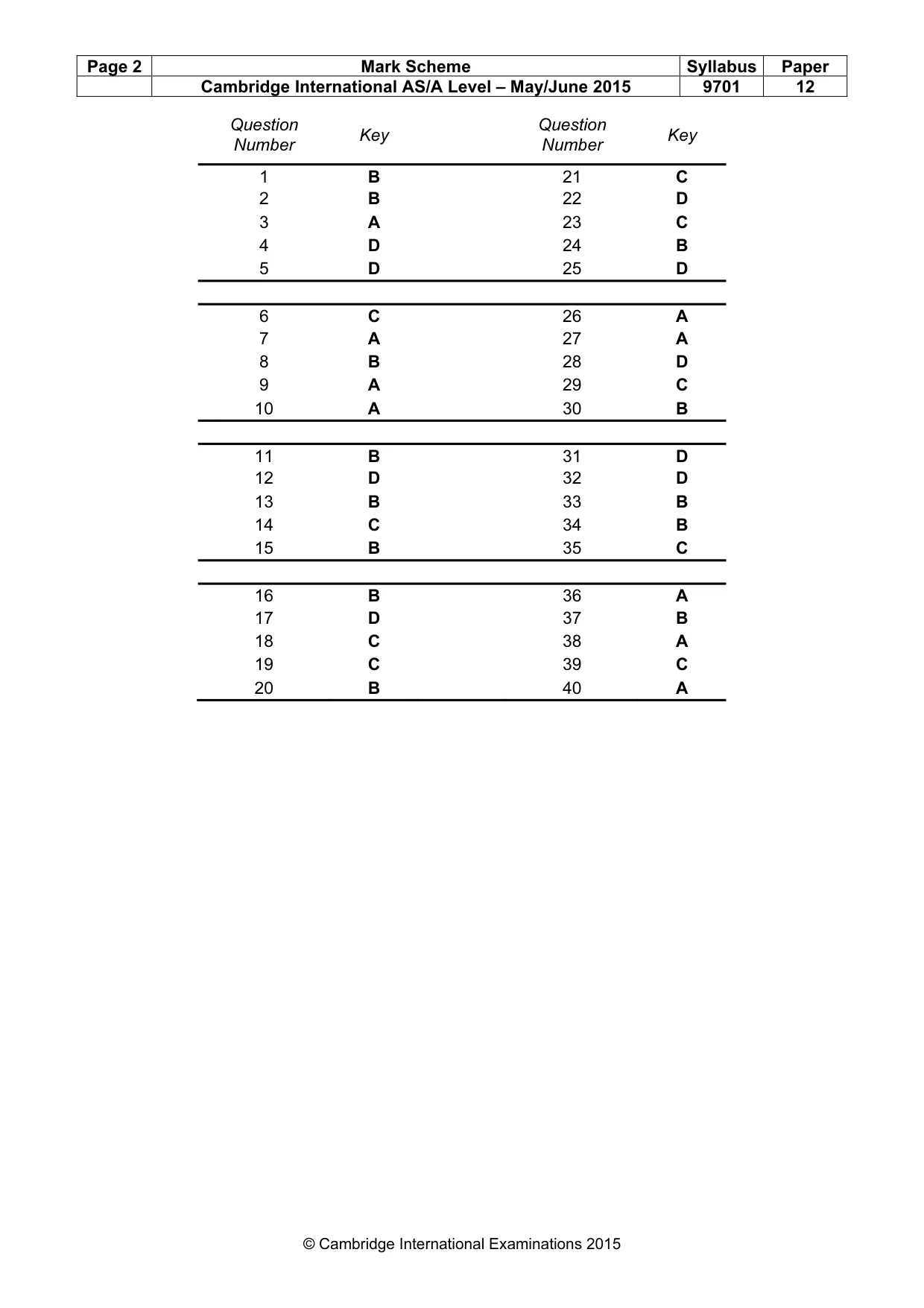
Mark scheme: B
Q2 · The shell of a chicken’s egg makes up 5% of the mass of an average egg
2 The shell of a chicken’s egg makes up 5% of the mass of an average egg. An average egg has a mass of 50 g. Assume the egg shell is pure calcium carbonate. How many complete chicken’s egg shells would be needed to neutralise 50 cm3 of 2.0 mol dm–3 ethanoic acid? A 1 B 2 C 3 D 4
Mark scheme: B
More questions on Reacting masses and volumes (of solutions and gases)
Q3 · Phosphorus forms a compound with hydrogen called phosphine, PH3
3 Phosphorus forms a compound with hydrogen called phosphine, PH3. This compound can react with a hydrogen ion, H+. Which type of interaction occurs between PH3 and H+? A dative covalent bond B dipole-dipole forces C hydrogen bond D ionic bond
Mark scheme: A
More questions on Covalent bonding and coordinate (dative covalent) bonding
Q4 · Which solid has a simple molecular lattice?
4 Which solid has a simple molecular lattice? A calcium fluoride B nickel C silicon(IV) oxide D sulfur
Mark scheme: D
Q5 · Use of the Data Booklet is relevant to this question
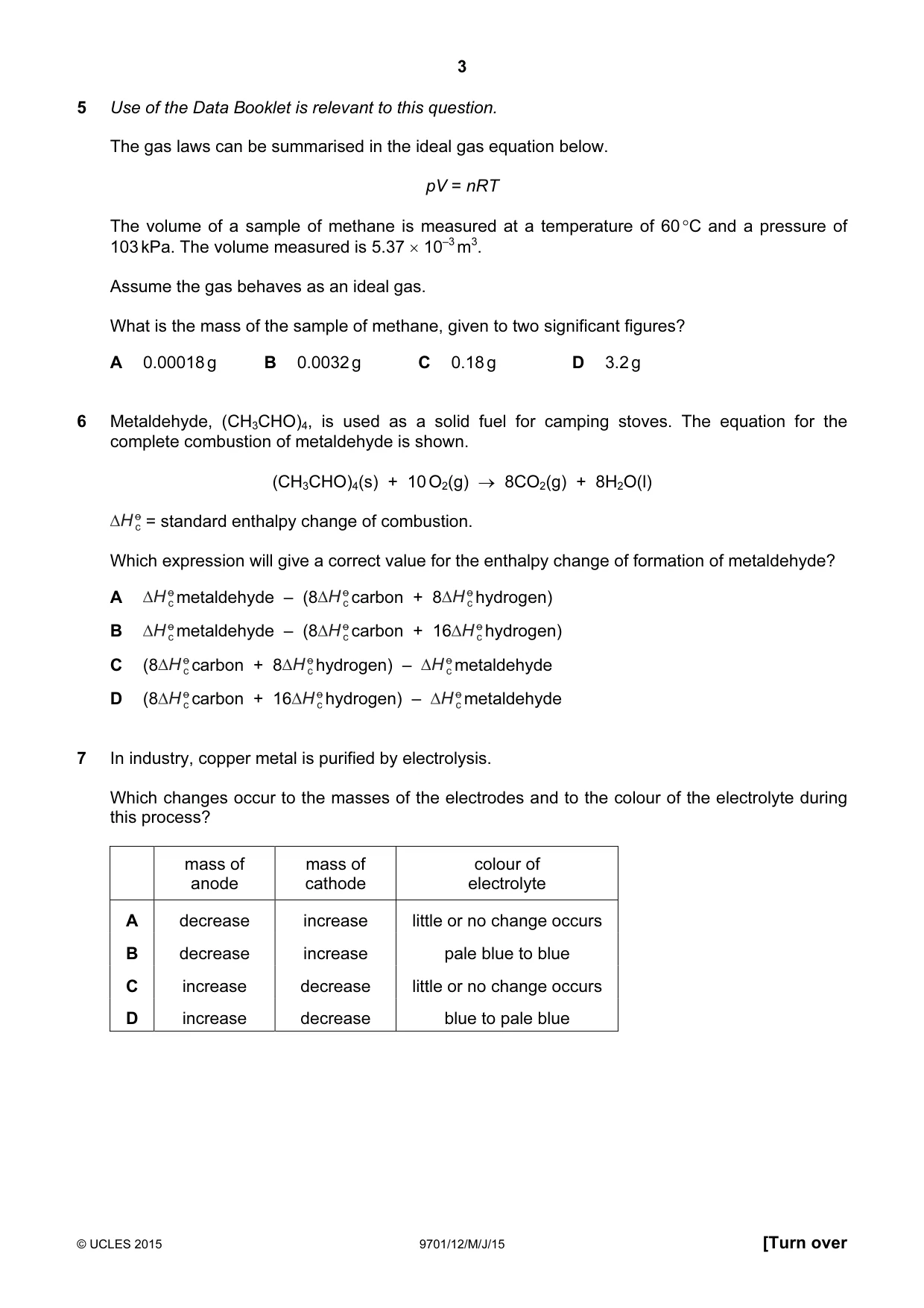
5 Use of the Data Booklet is relevant to this question. The gas laws can be summarised in the ideal gas equation below. pV = nRT The volume of a sample of methane is measured at a temperature of 60 °C and a pressure of 103 kPa. The volume measured is 5.37 × 10⁻³ m3. Assume the gas behaves as an ideal gas. What is the mass of the sample of methane, given to two significant figures? A 0.00018 g B 0.0032 g C 0.18 g D 3.2 g
Mark scheme: D
More questions on The gaseous state: ideal and real gases and pV = nRT
Q6 · Metaldehyde, (CH3CHO)4, is used as a solid fuel for camping stoves
6 Metaldehyde, (CH3CHO)4, is used as a solid fuel for camping stoves. The equation for the complete combustion of metaldehyde is shown. (CH3CHO)4(s) + 10 O2(g) → 8CO2(g) + 8H2O(l) = standard enthalpy change of combustion. Which expression will give a correct value for the enthalpy change of formation of metaldehyde? A metaldehyde – (8 carbon + 8 hydrogen) B metaldehyde – (8 carbon + 16 hydrogen) C (8 carbon + 8 hydrogen) – metaldehyde D (8 carbon + 16 hydrogen) – metaldehyde
Mark scheme: C
Q7 · In industry, copper metal is purified by electrolysis
7 In industry, copper metal is purified by electrolysis. Which changes occur to the masses of the electrodes and to the colour of the electrolyte during this process? mass of mass of colour of anode cathode electrolyte A decrease increase little or no change occurs B decrease increase pale blue to blue C increase decrease little or no change occurs D increase decrease blue to pale blue
Mark scheme: A
Q8 · Nitrogen dioxide, NO2, exists in equilibrium with dinitrogen tetroxide, N2O4
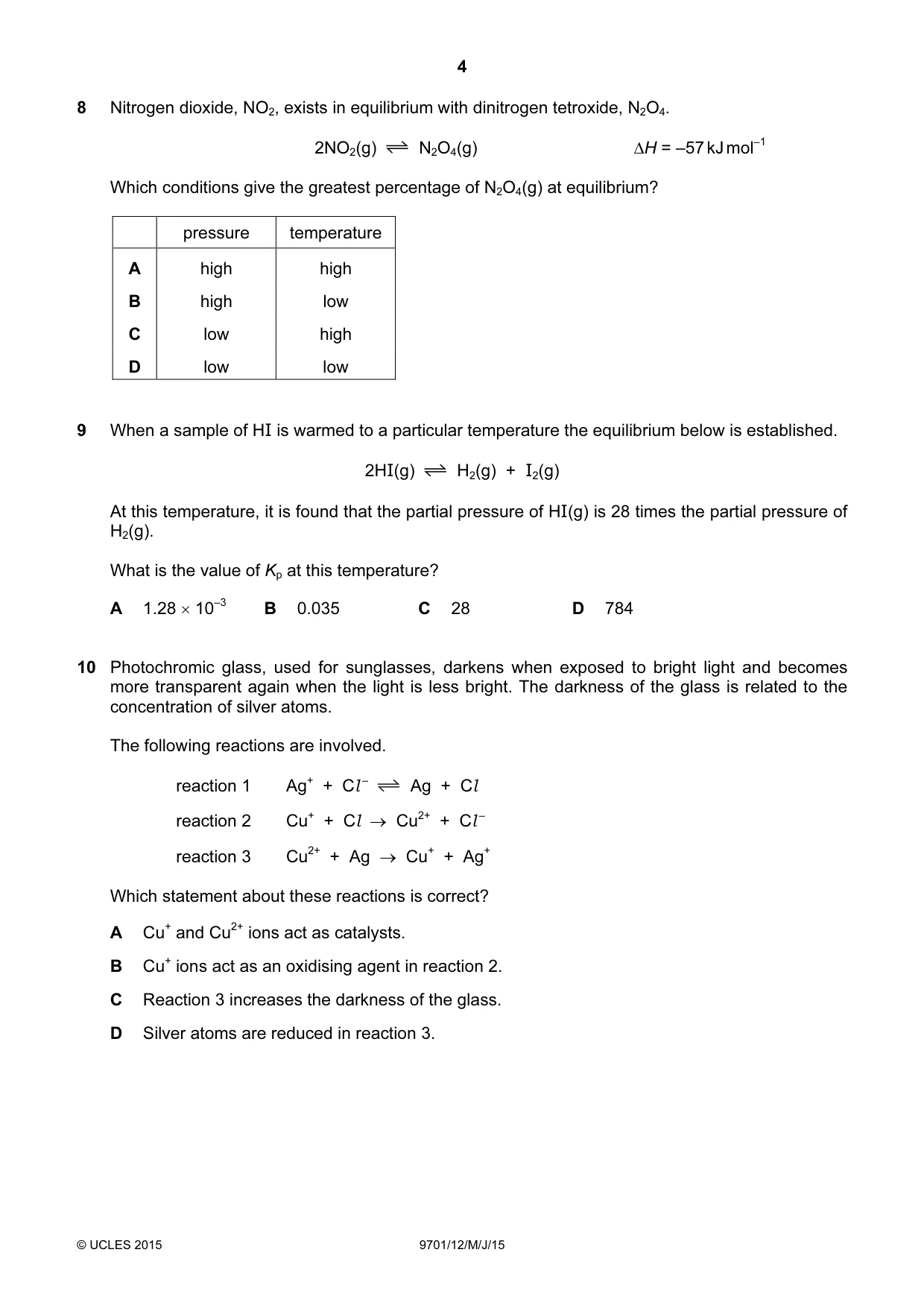
8 Nitrogen dioxide, NO2, exists in equilibrium with dinitrogen tetroxide, N2O4. 2NO2(g) N2O4(g) ∆H = –57 kJ mol–1 Which conditions give the greatest percentage of N2O4(g) at equilibrium? pressure temperature A high high B high low C low high D low low
Mark scheme: B
More questions on Chemical equilibria: reversible reactions, dynamic equilibrium
Q9 · When a sample of HI is warmed to a particular temperature the equilibrium below is…
9 When a sample of HI is warmed to a particular temperature the equilibrium below is established. 2HI(g) H2(g) + I2(g) At this temperature, it is found that the partial pressure of HI(g) is 28 times the partial pressure of H2(g). What is the value of Kp at this temperature? A 1.28 × 10⁻³ B 0.035 C 28 D 784
Mark scheme: A
More questions on Chemical equilibria: reversible reactions, dynamic equilibrium
Q10 · Photochromic glass, used for sunglasses, darkens when exposed to bright light and becomes…
10 Photochromic glass, used for sunglasses, darkens when exposed to bright light and becomes more transparent again when the light is less bright. The darkness of the glass is related to the concentration of silver atoms. The following reactions are involved. reaction 1 Ag+ + Cl – Ag + Cl reaction 2 Cu+ + Cl → Cu2+ + Cl – reaction 3 Cu2+ + Ag → Cu+ + Ag+ Which statement about these reactions is correct? A Cu+ and Cu2+ ions act as catalysts. B Cu+ ions act as an oxidising agent in reaction 2. C Reaction 3 increases the darkness of the glass. D Silver atoms are reduced in reaction 3.
Mark scheme: A
Q11 · The Boltzmann distribution below shows the distribution of molecular energies in a sample…
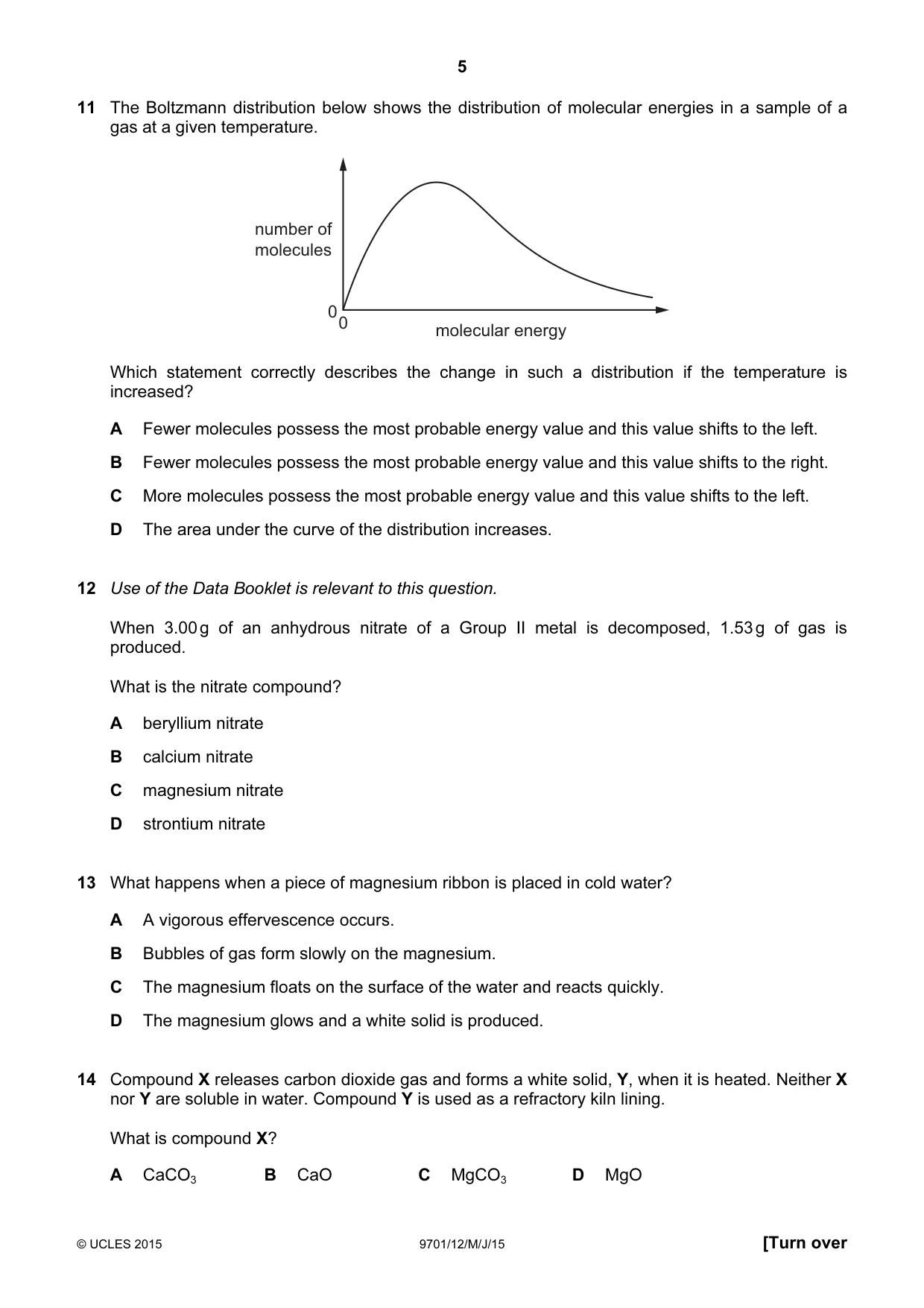
11 The Boltzmann distribution below shows the distribution of molecular energies in a sample of a gas at a given temperature. number of molecules 00 molecular energy Which statement correctly describes the change in such a distribution if the temperature is increased? A Fewer molecules possess the most probable energy value and this value shifts to the left. B Fewer molecules possess the most probable energy value and this value shifts to the right. C More molecules possess the most probable energy value and this value shifts to the left. D The area under the curve of the distribution increases.
Mark scheme: B
More questions on Effect of temperature on reaction rates and the concept of activation energy
Q12 · Use of the Data Booklet is relevant to this question
12 Use of the Data Booklet is relevant to this question. When 3.00 g of an anhydrous nitrate of a Group II metal is decomposed, 1.53 g of gas is produced. What is the nitrate compound? A beryllium nitrate B calcium nitrate C magnesium nitrate D strontium nitrate
Mark scheme: D
Q13 · What happens when a piece of magnesium ribbon is placed in cold water?
13 What happens when a piece of magnesium ribbon is placed in cold water? A A vigorous effervescence occurs. B Bubbles of gas form slowly on the magnesium. C The magnesium floats on the surface of the water and reacts quickly. D The magnesium glows and a white solid is produced.
Mark scheme: B
Q14 · Compound X releases carbon dioxide gas and forms a white solid, Y, when it is heated
14 Compound X releases carbon dioxide gas and forms a white solid, Y, when it is heated. Neither X nor Y are soluble in water. Compound Y is used as a refractory kiln lining. What is compound X? A CaCO3 B CaO C MgCO3 D MgO
Mark scheme: C
Q15 · Use of the Data Booklet is relevant to this question
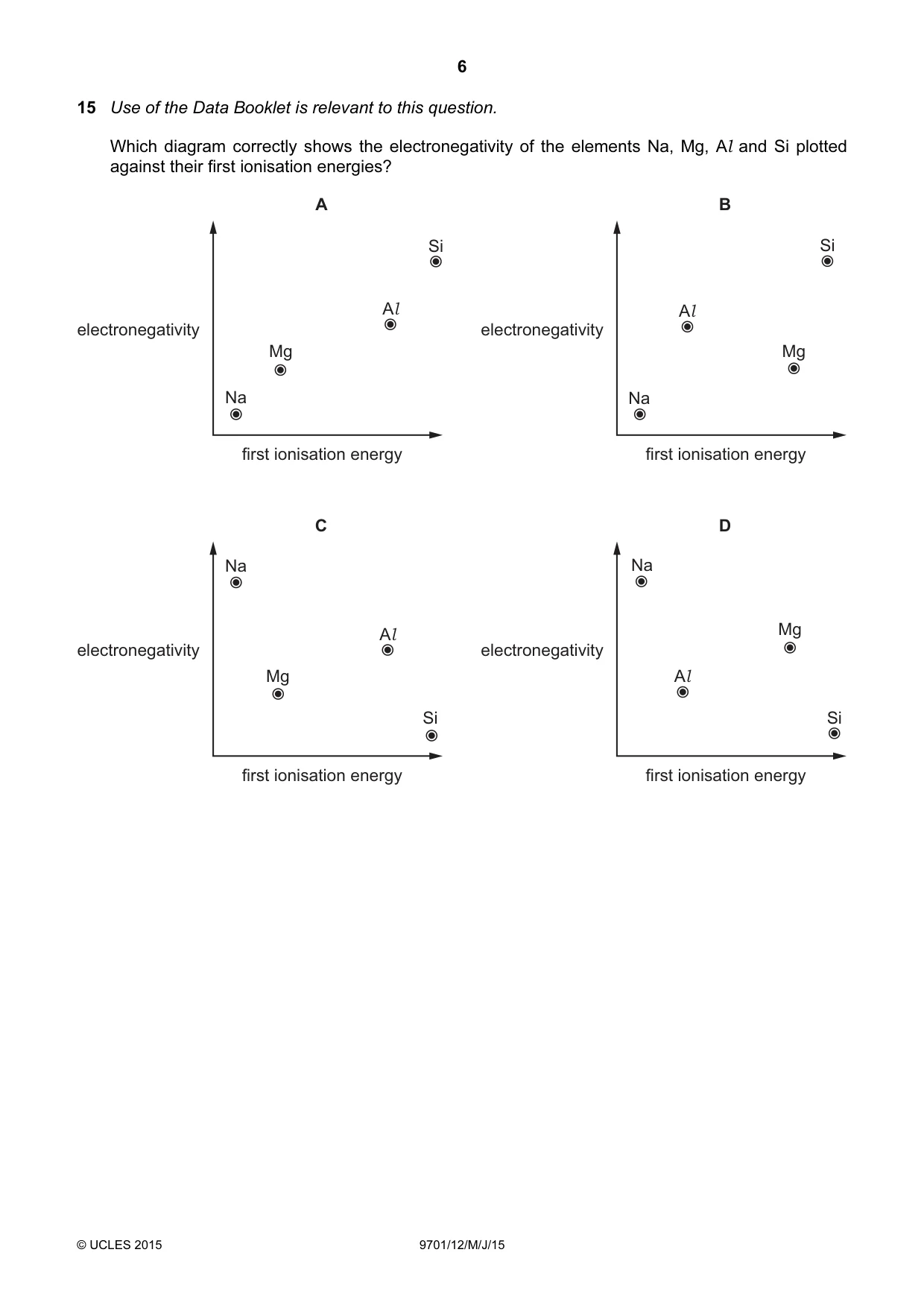
15 Use of the Data Booklet is relevant to this question. Which diagram correctly shows the electronegativity of the elements Na, Mg, Al and Si plotted against their first ionisation energies? A B Si Si Al Al electronegativity electronegativity Mg Mg Na Na first ionisation energy first ionisation energy C D Na Na Al Mg electronegativity electronegativity Mg Al Si Si first ionisation energy first ionisation energy
Mark scheme: B
More questions on Periodicity of physical properties of the elements in Period 3
Q16 · The diagram shows a diaphragm cell used for the electrolysis of brine
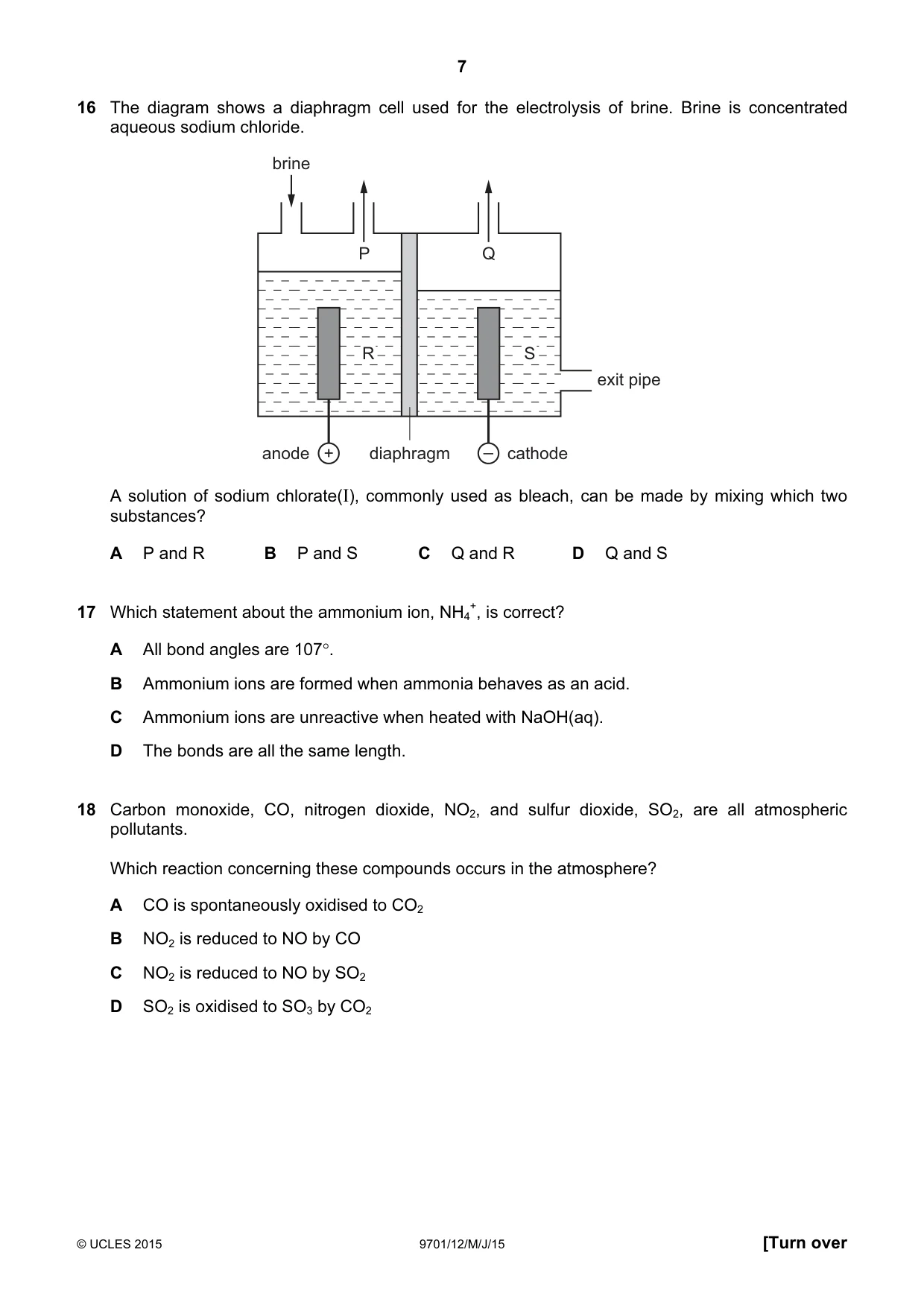
16 The diagram shows a diaphragm cell used for the electrolysis of brine. Brine is concentrated aqueous sodium chloride. brine P Q R S exit pipe _ cathode anode + diaphragm A solution of sodium chlorate(I), commonly used as bleach, can be made by mixing which two substances? A P and R B P and S C Q and R D Q and S
Mark scheme: B
Q17 · Which statement about the ammonium ion, NH4 +, is correct?
17 Which statement about the ammonium ion, NH4 +, is correct? A All bond angles are 107°. B Ammonium ions are formed when ammonia behaves as an acid. C Ammonium ions are unreactive when heated with NaOH(aq). D The bonds are all the same length.
Mark scheme: D
Q18 · Carbon monoxide, CO, nitrogen dioxide, NO2, and sulfur dioxide, SO2, are all atmospheric…
18 Carbon monoxide, CO, nitrogen dioxide, NO2, and sulfur dioxide, SO2, are all atmospheric pollutants. Which reaction concerning these compounds occurs in the atmosphere? A CO is spontaneously oxidised to CO2 B NO2 is reduced to NO by CO C NO2 is reduced to NO by SO2 D SO2 is oxidised to SO3 by CO2
Mark scheme: C
Q19 · Chlorate(V) ions, Cl O3 –, are produced in the redox reaction between chlorine and hot…
19 Chlorate(V) ions, Cl O3 –, are produced in the redox reaction between chlorine and hot aqueous sodium hydroxide. Oxidation numbers can be used to help balance the equation for this reaction. What will be the values of coefficients v, x and y in the balanced equation? vCl 2(g) + wOH–(aq) → xCl –(aq) + yCl O3 –(aq) + zH2O(l) v x y A 2 3 1 B 3 4 2 C 3 5 1 D 7 12 2
Mark scheme: C
Q20 · Which alcohol will react with an acidified solution of potassium dichromate(VI) to…
20 Which alcohol will react with an acidified solution of potassium dichromate(VI) to produce a ketone containing six carbon atoms? A 2,2-dimethylbutan-1-ol B 2-methylpentan-3-ol C 3,3-dimethylpentan-2-ol D 3-methylpentan-3-ol
Mark scheme: B
Q21 · What is the major product formed when compound Q is warmed with excess HBr?
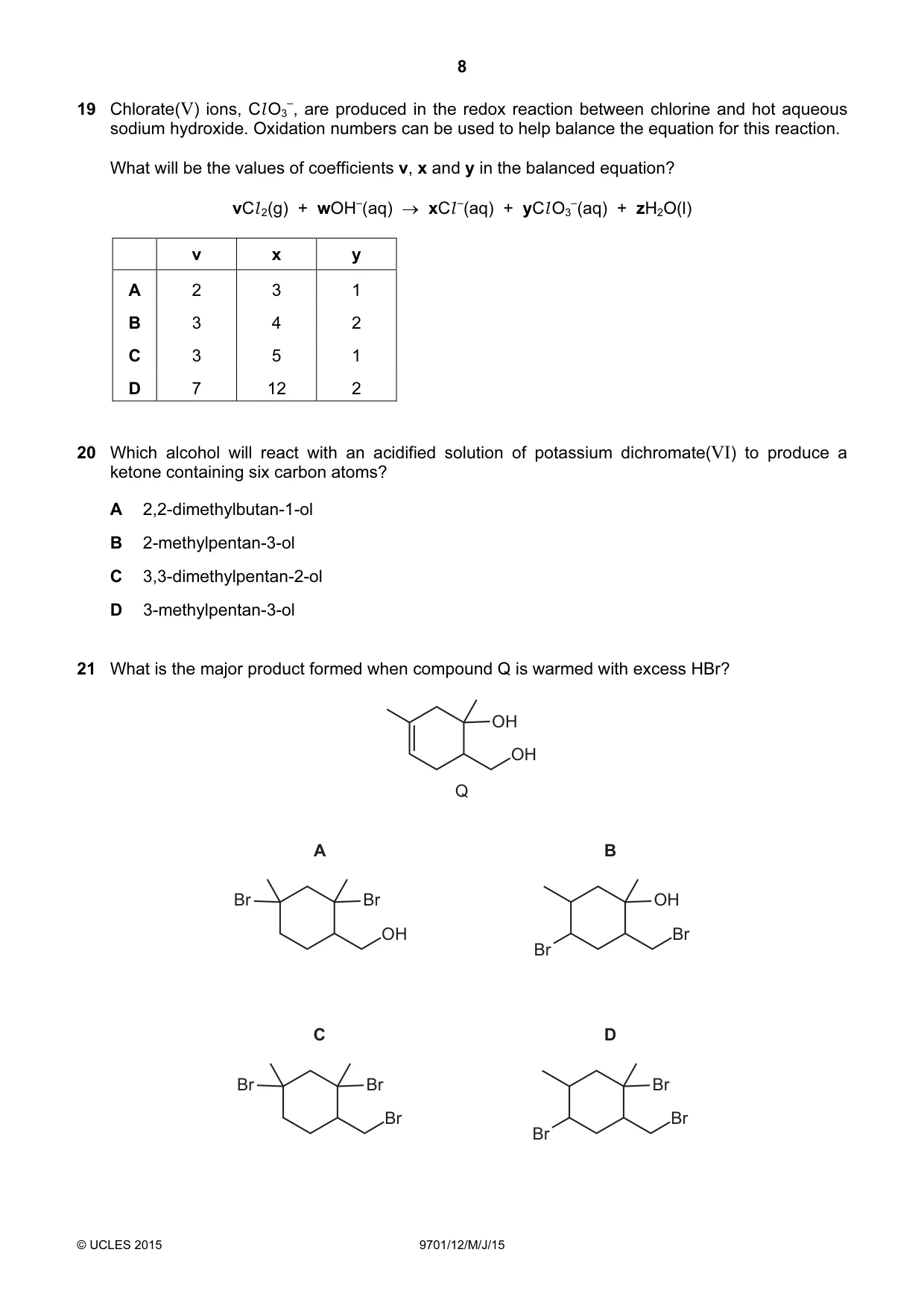
21 What is the major product formed when compound Q is warmed with excess HBr? OH OH Q A B Br Br OH OH Br Br C D Br Br Br Br Br Br
Mark scheme: C
Q22 · Four students, W, X, Y and Z, made the following statements about alkanes and alkenes
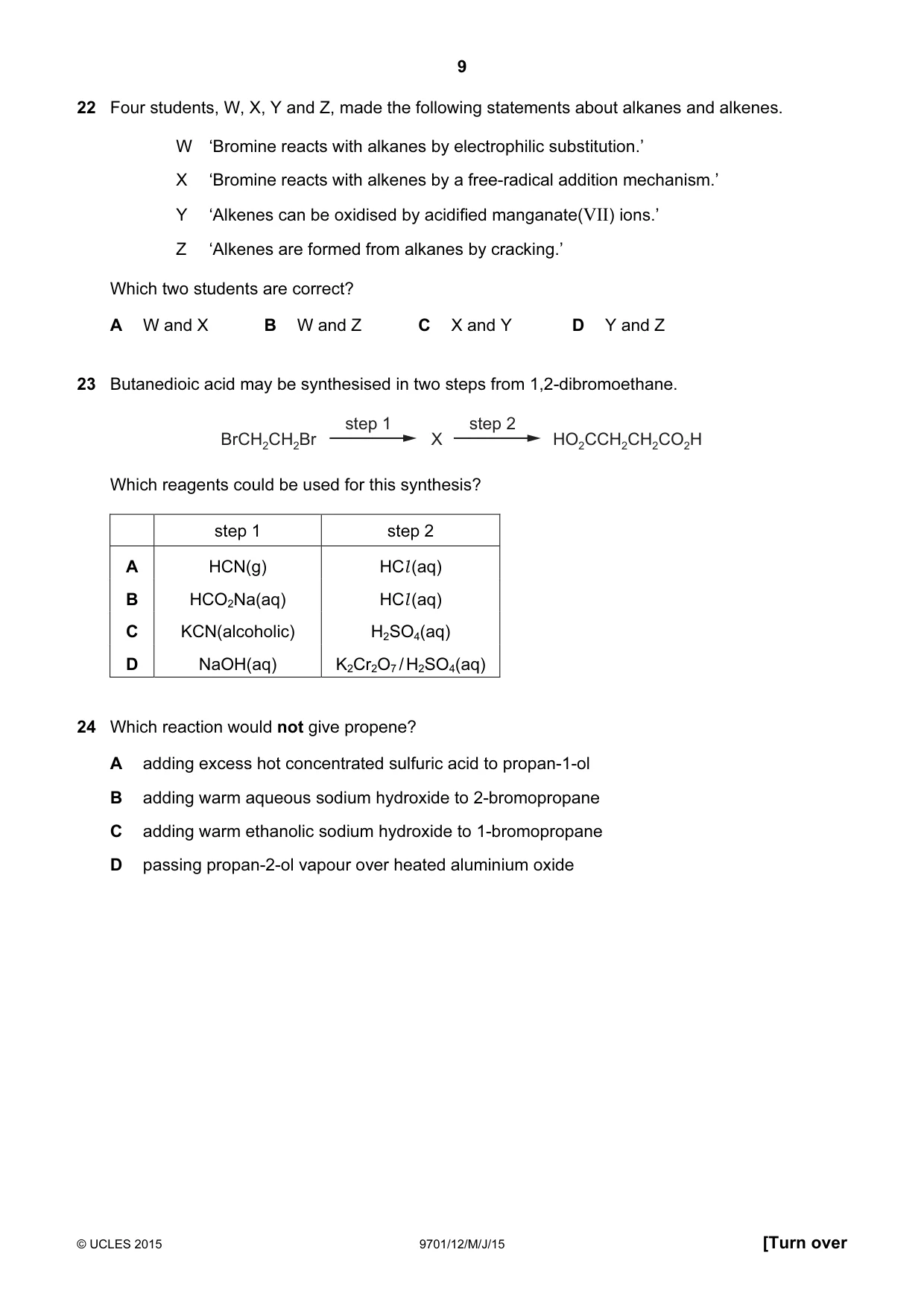
22 Four students, W, X, Y and Z, made the following statements about alkanes and alkenes. W ‘Bromine reacts with alkanes by electrophilic substitution.’ X ‘Bromine reacts with alkenes by a free-radical addition mechanism.’ Y ‘Alkenes can be oxidised by acidified manganate(VII) ions.’ Z ‘Alkenes are formed from alkanes by cracking.’ Which two students are correct? A W and X B W and Z C X and Y D Y and Z
Mark scheme: D
Q23 · Butanedioic acid may be synthesised in two steps from 1,2-dibromoethane
23 Butanedioic acid may be synthesised in two steps from 1,2-dibromoethane. step 1 step 2 BrCH2CH2Br X HO2CCH2CH2CO2H Which reagents could be used for this synthesis? step 1 step 2 A HCN(g) HCl (aq) B HCO2Na(aq) HCl (aq) C KCN(alcoholic) H2SO4(aq) D NaOH(aq) K2Cr2O7 / H2SO4(aq)
Mark scheme: C
Q24 · Which reaction would not give propene?
24 Which reaction would not give propene? A adding excess hot concentrated sulfuric acid to propan-1-ol B adding warm aqueous sodium hydroxide to 2-bromopropane C adding warm ethanolic sodium hydroxide to 1-bromopropane D passing propan-2-ol vapour over heated aluminium oxide
Mark scheme: B
Q25 · Terpinen-4-ol is one of the active ingredients in tea tree oil
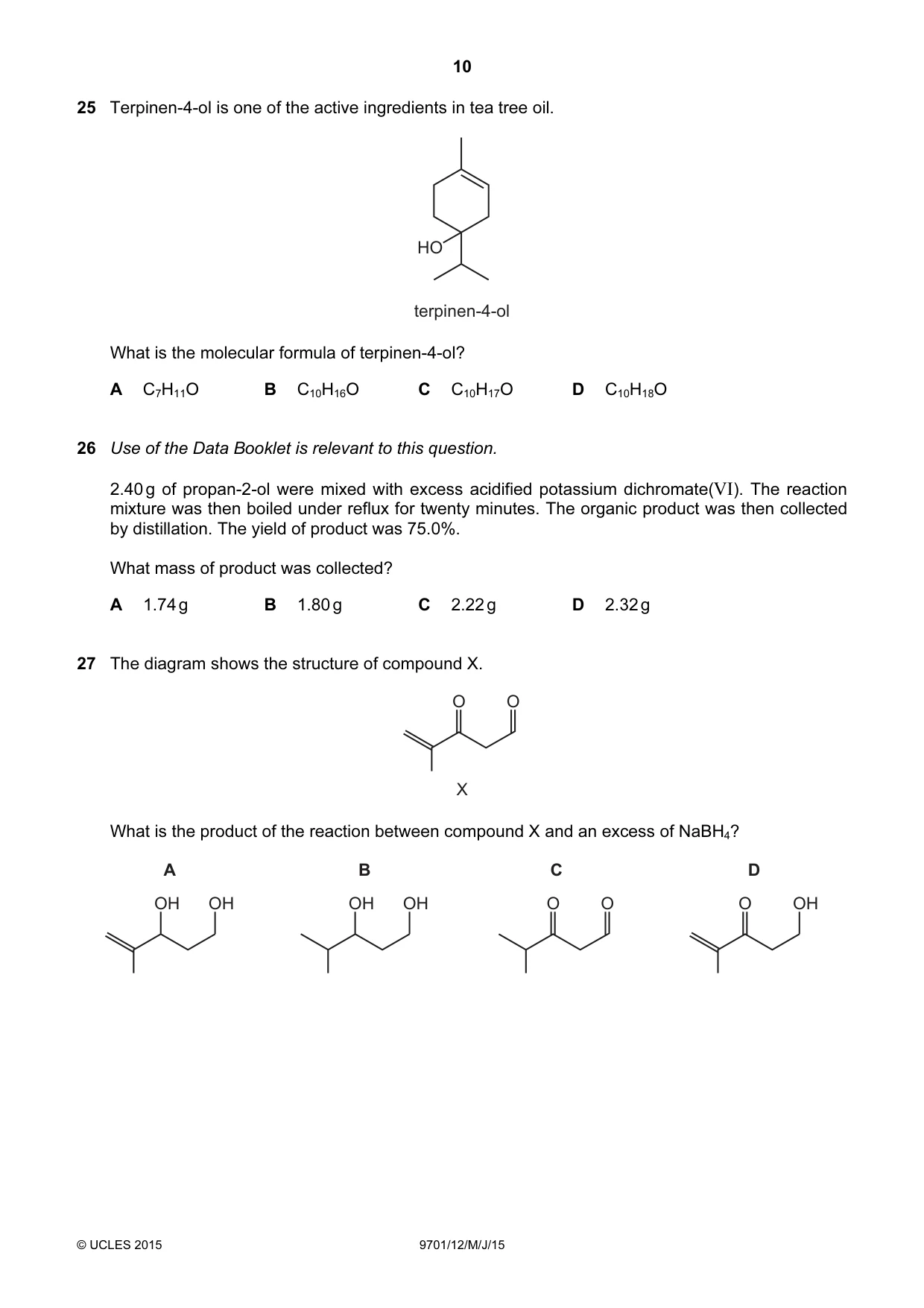
25 Terpinen-4-ol is one of the active ingredients in tea tree oil. HO terpinen-4-ol What is the molecular formula of terpinen-4-ol? A C7H11O B C10H16O C C10H17O D C10H18O
Mark scheme: D
More questions on Formulas, functional groups and the naming of organic compounds
Q26 · Use of the Data Booklet is relevant to this question
26 Use of the Data Booklet is relevant to this question. 2.40 g of propan-2-ol were mixed with excess acidified potassium dichromate(VI). The reaction mixture was then boiled under reflux for twenty minutes. The organic product was then collected by distillation. The yield of product was 75.0%. What mass of product was collected? A 1.74 g B 1.80 g C 2.22 g D 2.32 g
Mark scheme: A
Q27 · The diagram shows the structure of compound X
27 The diagram shows the structure of compound X. O O X What is the product of the reaction between compound X and an excess of NaBH4? A B C D OH OH OH OH O O O OH
Mark scheme: A
Q28 · Lactic acid occurs naturally, for example in sour milk
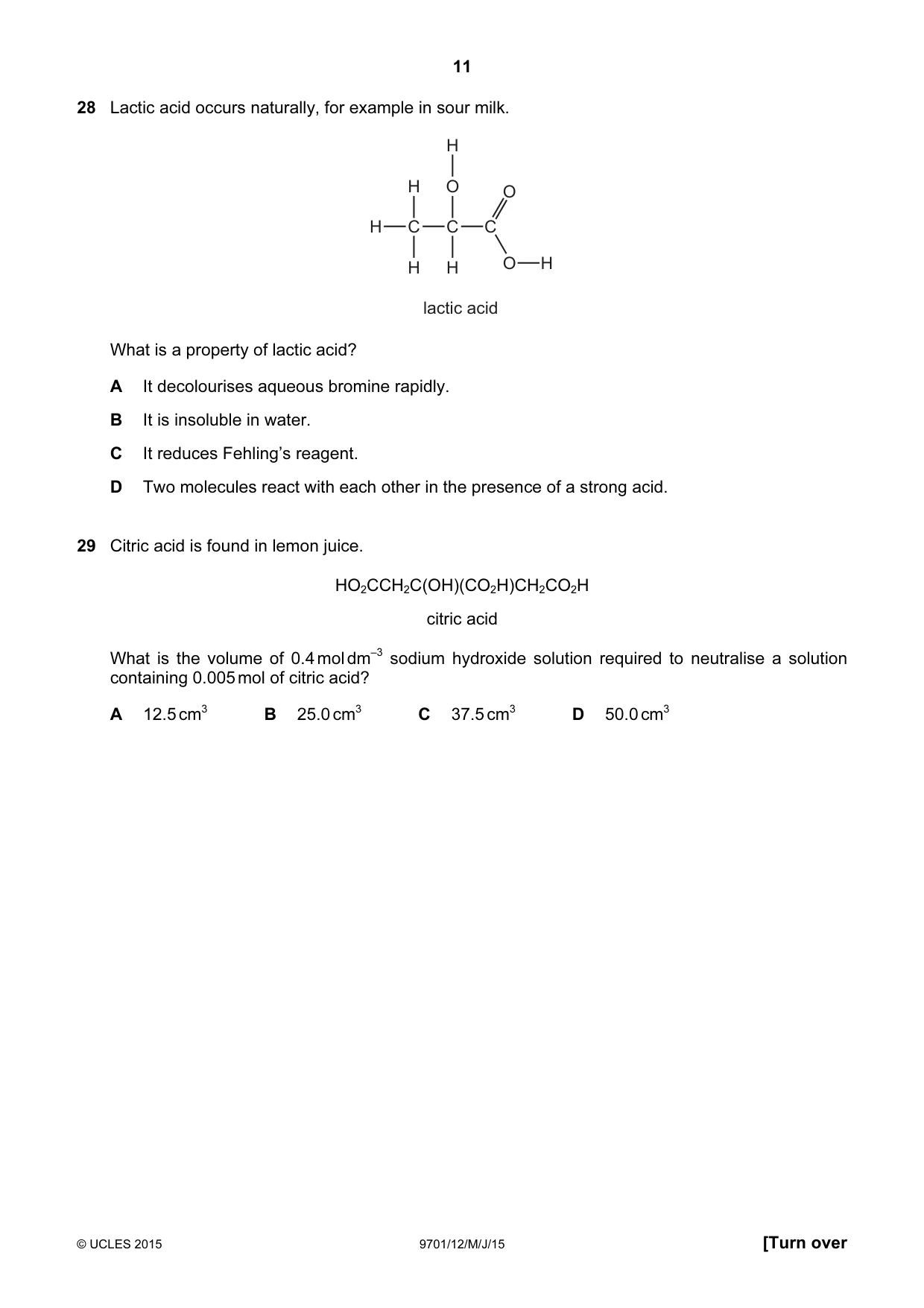
28 Lactic acid occurs naturally, for example in sour milk. H H O O H C C C H H O H lactic acid What is a property of lactic acid? A It decolourises aqueous bromine rapidly. B It is insoluble in water. C It reduces Fehling’s reagent. D Two molecules react with each other in the presence of a strong acid.
Mark scheme: D
Q29 · Citric acid is found in lemon juice
29 Citric acid is found in lemon juice. HO2CCH2C(OH)(CO2H)CH2CO2H citric acid What is the volume of 0.4 mol dm–3 sodium hydroxide solution required to neutralise a solution containing 0.005 mol of citric acid? A 12.5 cm3 B 25.0 cm3 C 37.5 cm3 D 50.0 cm3
Mark scheme: C
More questions on Reacting masses and volumes (of solutions and gases)
Q30 · The drug Sirolimus is used to treat patients after kidney transplants
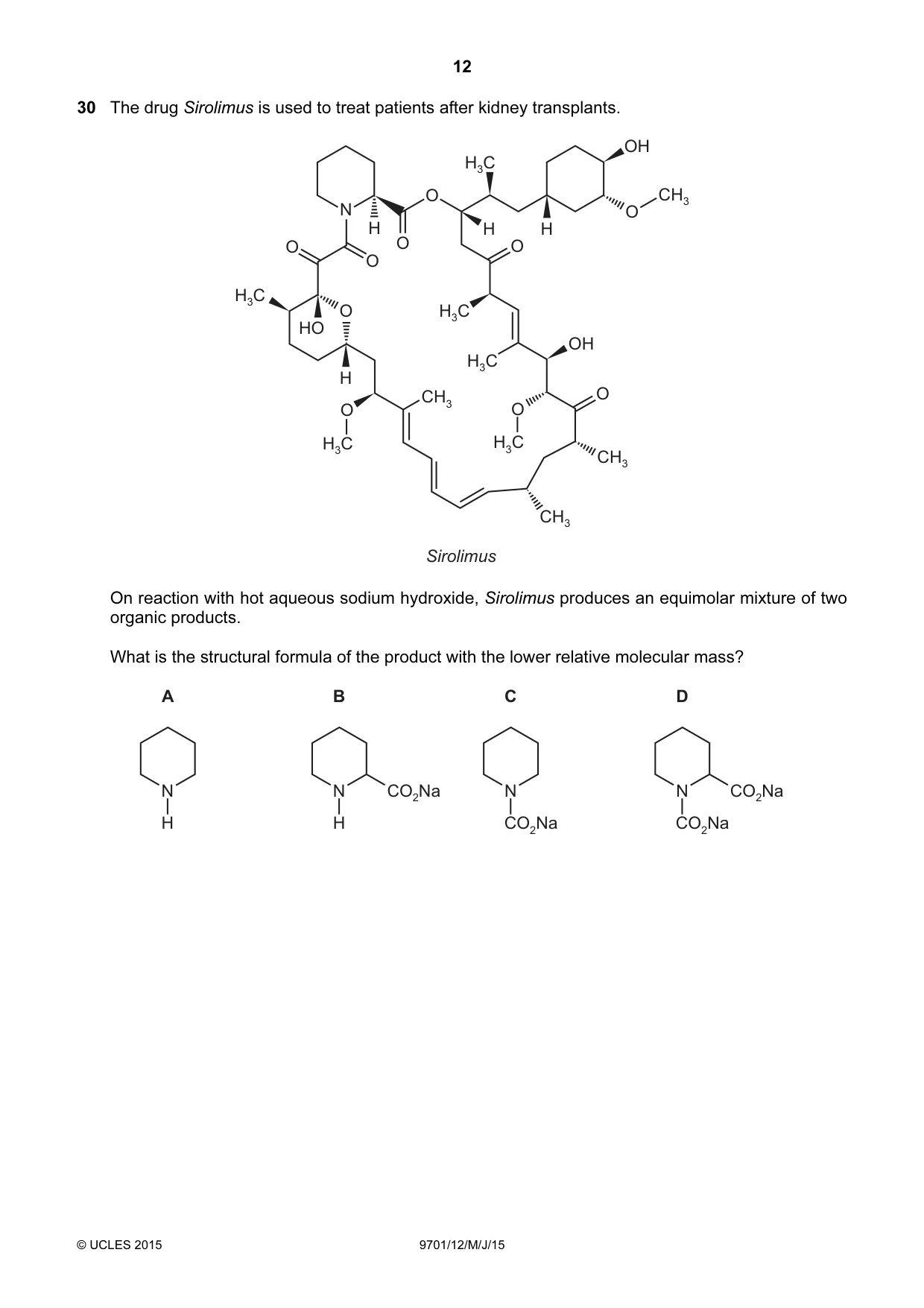
30 The drug Sirolimus is used to treat patients after kidney transplants. OH H3C O CH3 N O H H H O O O O H3C O H3C HO OH H3C H CH3 O O O H3C H3C CH3 CH3 Sirolimus On reaction with hot aqueous sodium hydroxide, Sirolimus produces an equimolar mixture of two organic products. What is the structural formula of the product with the lower relative molecular mass? A B C D N N CO2Na N N CO2Na H H CO2Na CO2Na
Mark scheme: B
Q31 · Use of the Data Booklet is relevant to this question
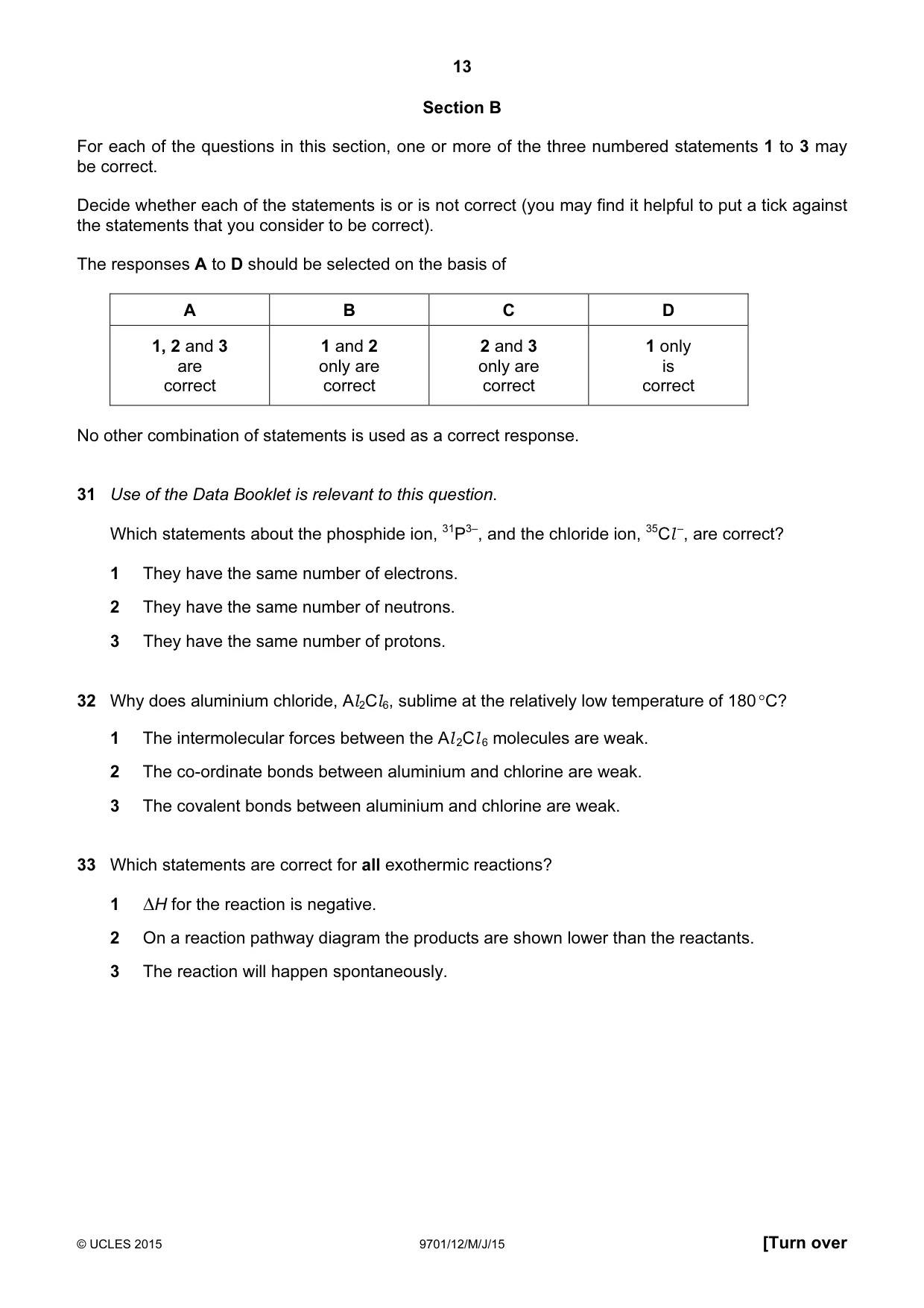
31 Use of the Data Booklet is relevant to this question. Which statements about the phosphide ion, 31P3–, and the chloride ion, 35Cl –, are correct? 1 They have the same number of electrons. 2 They have the same number of neutrons. 3 They have the same number of protons.
Mark scheme: D
Q32 · Why does aluminium chloride, Al 2Cl 6, sublime at the relatively low temperature of 180…
32 Why does aluminium chloride, Al 2Cl 6, sublime at the relatively low temperature of 180 °C? 1 The intermolecular forces between the Al 2Cl 6 molecules are weak. 2 The co-ordinate bonds between aluminium and chlorine are weak. 3 The covalent bonds between aluminium and chlorine are weak.
Mark scheme: D
Q33 · Which statements are correct for all exothermic reactions?
33 Which statements are correct for all exothermic reactions? 1 ∆H for the reaction is negative. 2 On a reaction pathway diagram the products are shown lower than the reactants. 3 The reaction will happen spontaneously.
Mark scheme: B
Q34 · Which of these reactions are redox reactions?
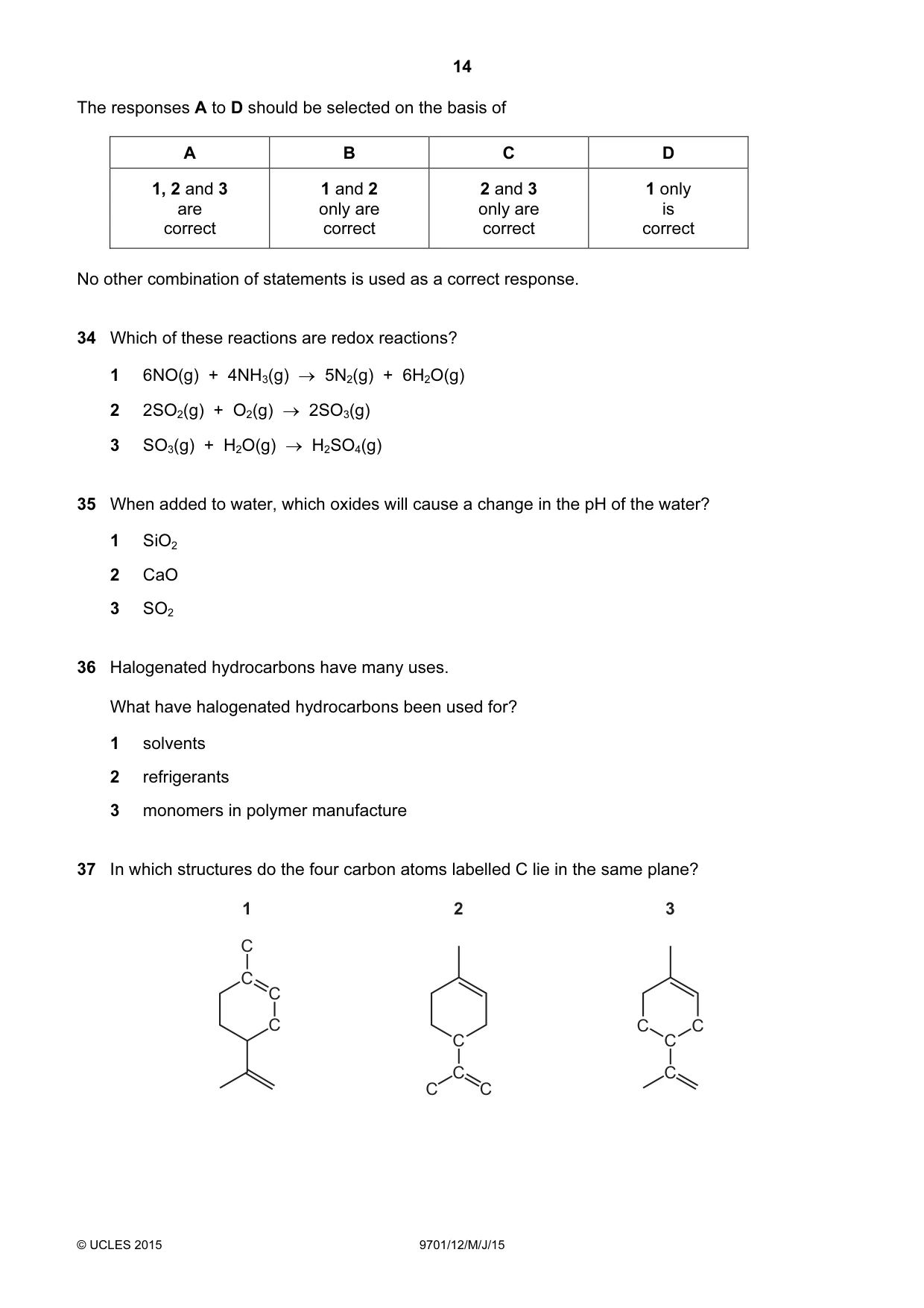
34 Which of these reactions are redox reactions? 1 6NO(g) + 4NH3(g) → 5N2(g) + 6H2O(g) 2 2SO2(g) + O2(g) → 2SO3(g) 3 SO3(g) + H2O(g) → H2SO4(g)
Mark scheme: B
Q35 · When added to water, which oxides will cause a change in the pH of the water?
35 When added to water, which oxides will cause a change in the pH of the water? 1 SiO2 2 CaO 3 SO2
Mark scheme: C
More questions on Periodicity of chemical properties of the elements in Period 3
Q36 · Halogenated hydrocarbons have many uses
36 Halogenated hydrocarbons have many uses. What have halogenated hydrocarbons been used for? 1 solvents 2 refrigerants 3 monomers in polymer manufacture
Mark scheme: A
Q37 · In which structures do the four carbon atoms labelled C lie in the same plane?
37 In which structures do the four carbon atoms labelled C lie in the same plane? 1 2 3 C C C C C C C C C C C C
Mark scheme: B
More questions on Shapes of organic molecules; σ and π bonds
Q38 · Which statements about 2-methylbutan-1-ol are correct?
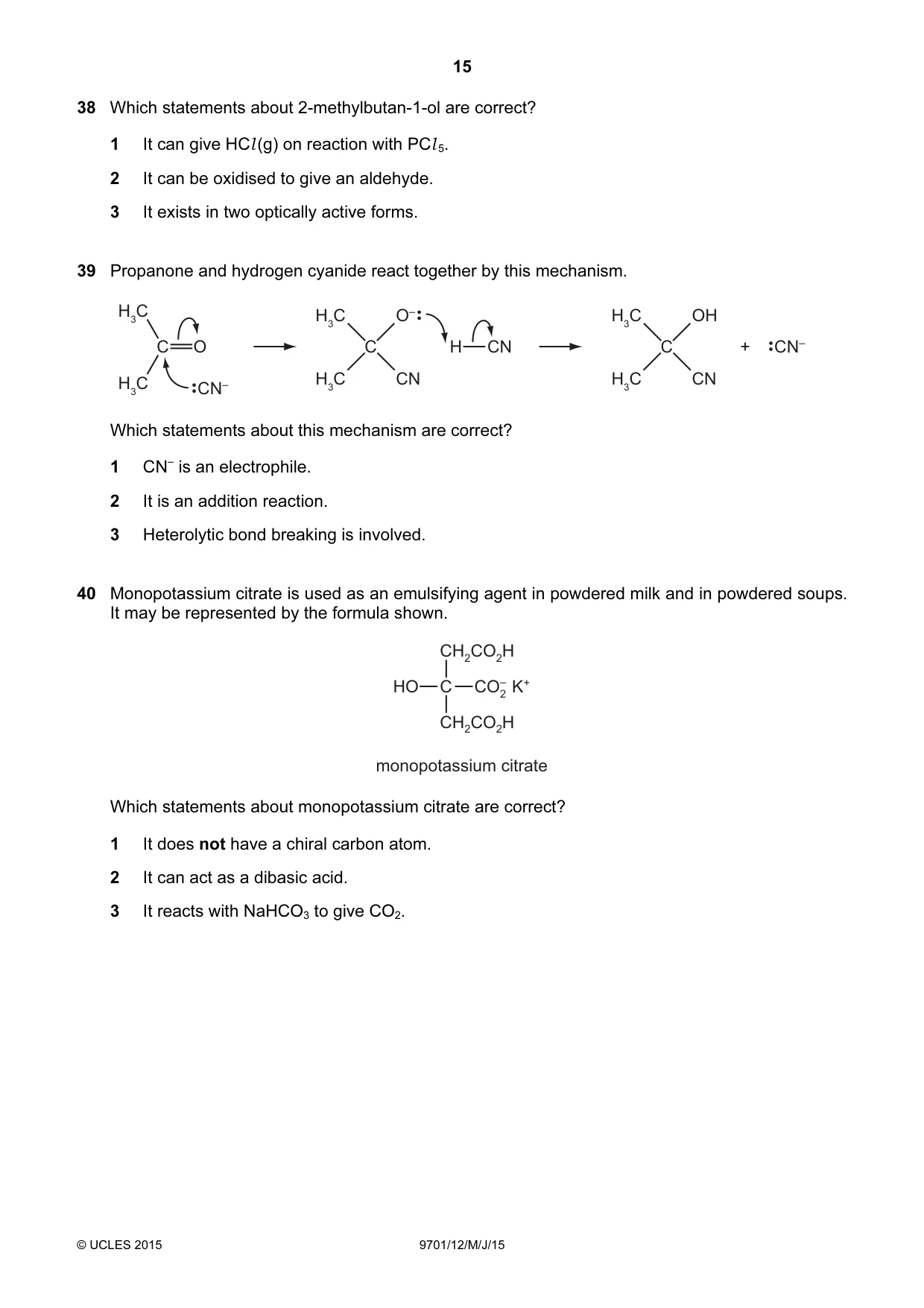
38 Which statements about 2-methylbutan-1-ol are correct? 1 It can give HCl (g) on reaction with PCl 5. 2 It can be oxidised to give an aldehyde. 3 It exists in two optically active forms.
Mark scheme: A
Q39 · Propanone and hydrogen cyanide react together by this mechanism
39 Propanone and hydrogen cyanide react together by this mechanism. H3C H3C O– H3C OH C O C H CN C + CN– H3C H3C CN H3C CN CN– Which statements about this mechanism are correct? 1 CN– is an electrophile. 2 It is an addition reaction. 3 Heterolytic bond breaking is involved.
Mark scheme: C
Q40 · Monopotassium citrate is used as an emulsifying agent in powdered milk and in powdered…
40 Monopotassium citrate is used as an emulsifying agent in powdered milk and in powdered soups. It may be represented by the formula shown. CH2CO2H HO C CO2 K+ – CH2CO2H monopotassium citrate Which statements about monopotassium citrate are correct? 1 It does not have a chiral carbon atom. 2 It can act as a dibasic acid. 3 It reacts with NaHCO3 to give CO2.
Mark scheme: A
What was in this paper
The subtopics covered by these 40 questions, and how many questions each got. Open one in a new tab to see every Cambridge question on it.
4Redox processes: electron transfer and changes in oxidation number (oxidation state)4Similarities and trends in the properties of the Group 2 metals, magnesium to barium, and their compounds3Alcohols2Aldehydes and ketones2Bonding and structure2Carboxylic acids2Chemical equilibria: reversible reactions, dynamic equilibrium2Enthalpy change, ΔH2Reacting masses and volumes (of solutions and gases)2Alkenes1Covalent bonding and coordinate (dative covalent) bonding1Effect of temperature on reaction rates and the concept of activation energy1Electrolysis1Esters1Formulas, functional groups and the naming of organic compounds1Isotopes1Nitriles and hydroxynitriles1Particles in the atom and atomic radius1Periodicity of chemical properties of the elements in Period 31Periodicity of physical properties of the elements in Period 31Shapes of molecules1Shapes of organic molecules; σ and π bonds1The gaseous state: ideal and real gases and pV = nRT1The reactions of chlorine1What you needed in this session
Cambridge’s own grade thresholds for 2015 May/June, Paper 1 · Variant 2. A higher threshold means an easier paper — the bar moves with how the cohort did.