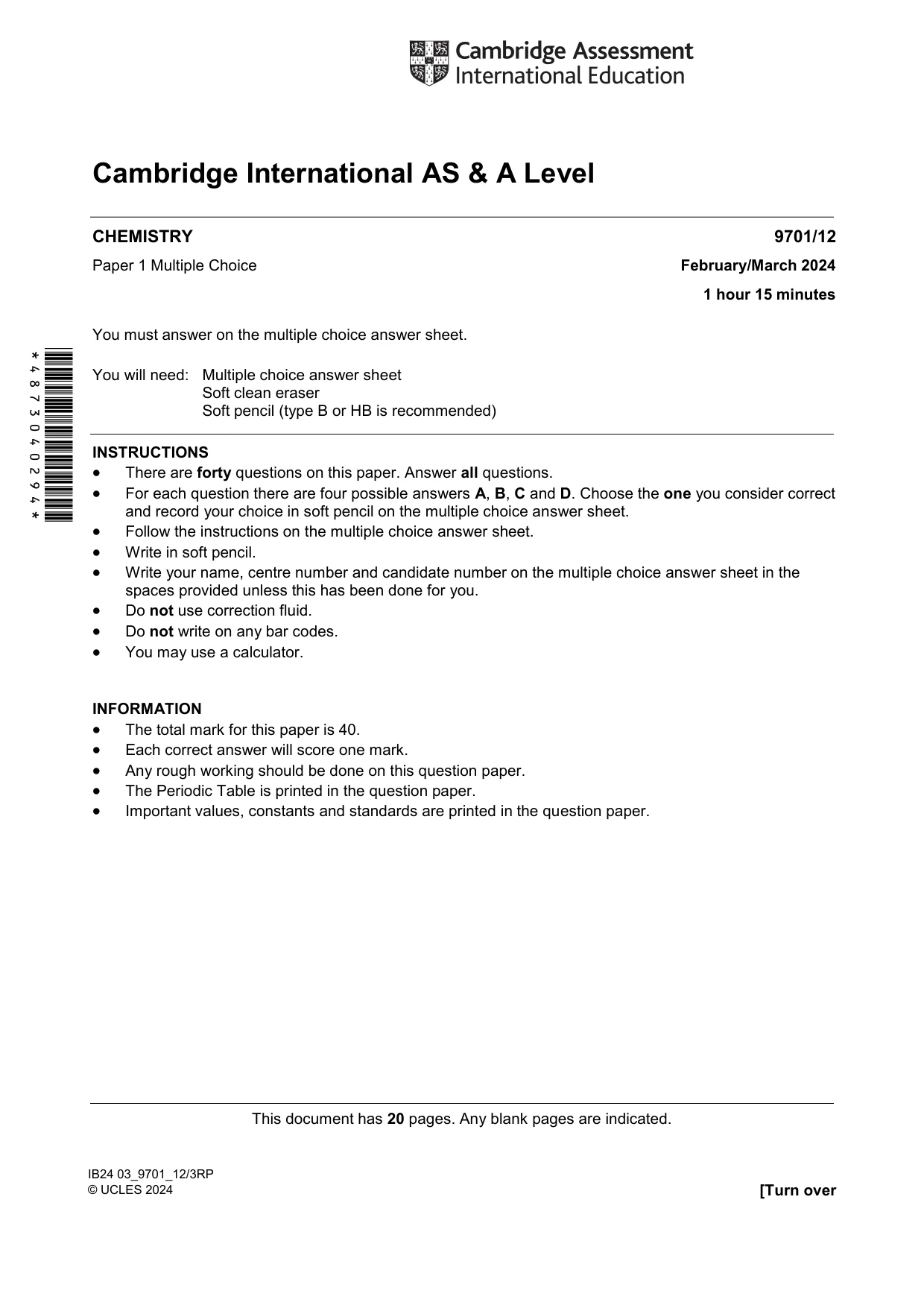
Cambridge A Level Chemistry 9701 — 2024 Feb/March Paper 1 · Variant 2
9701/12/F/M/24 · 40 questions · 40 marks · ≈45 min
The question paper and its mark scheme, free to read here and free to download. This is Cambridge’s own paper, exactly as it was sat.
Question paper20 pages


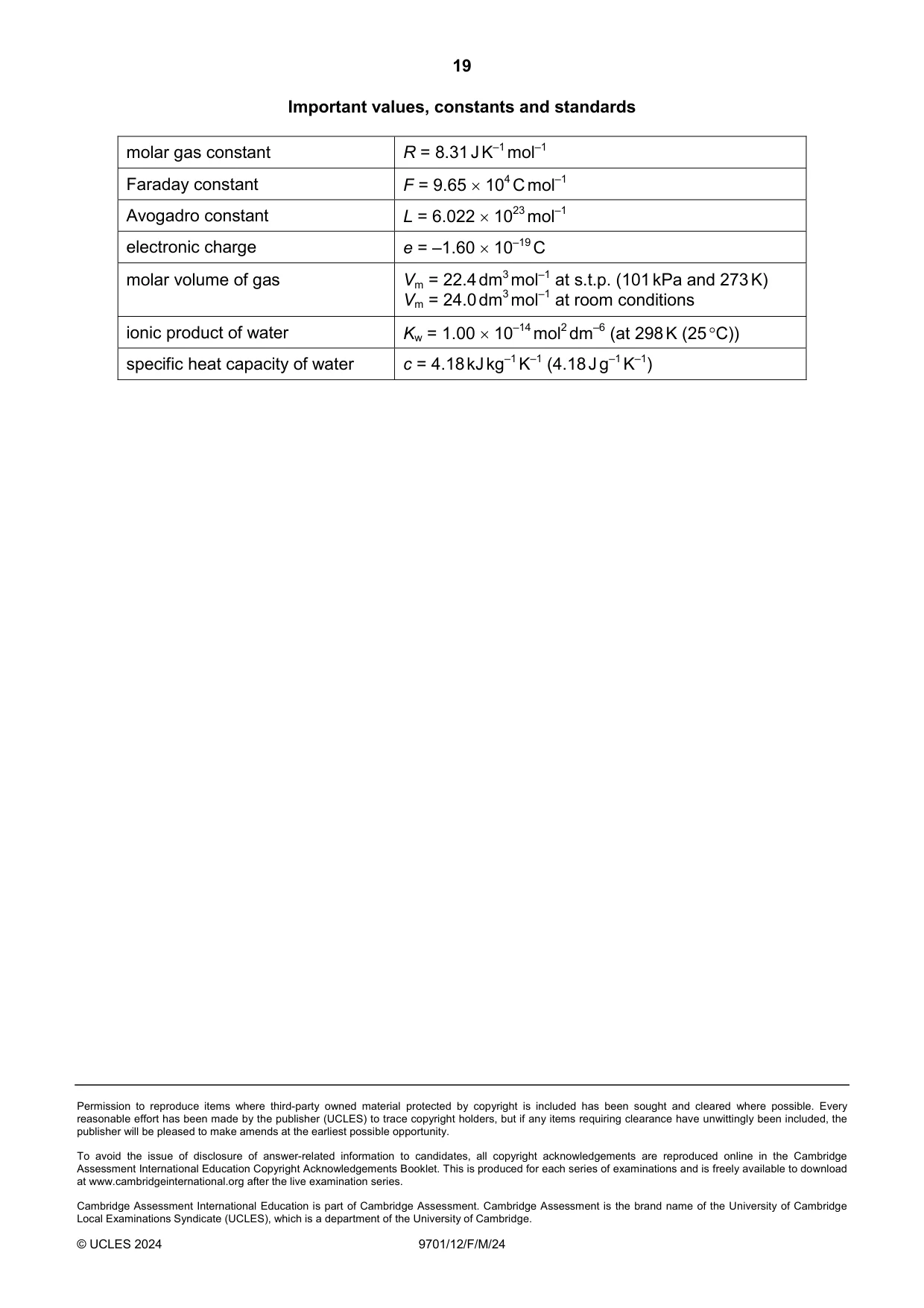
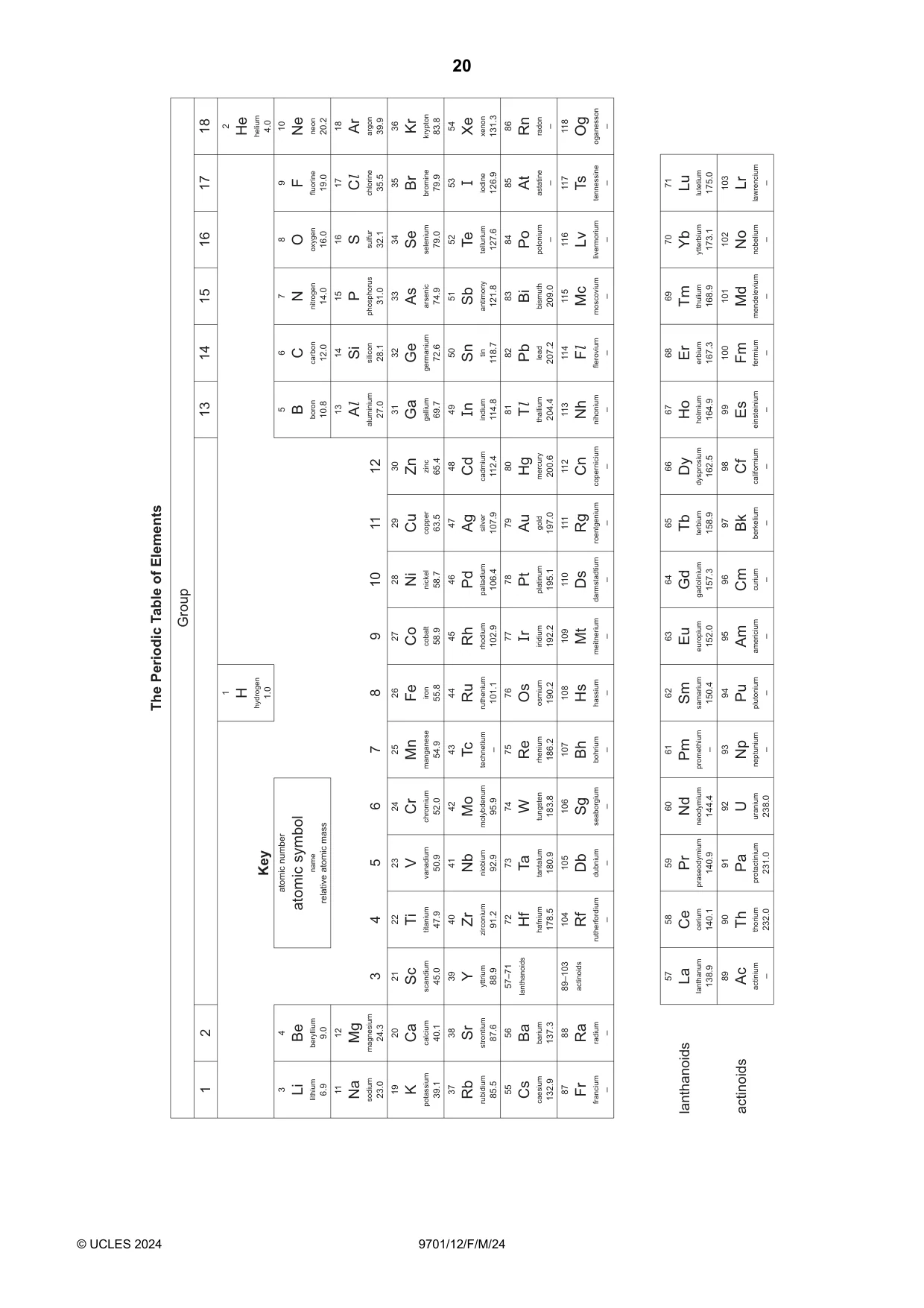
Mark scheme3 pages
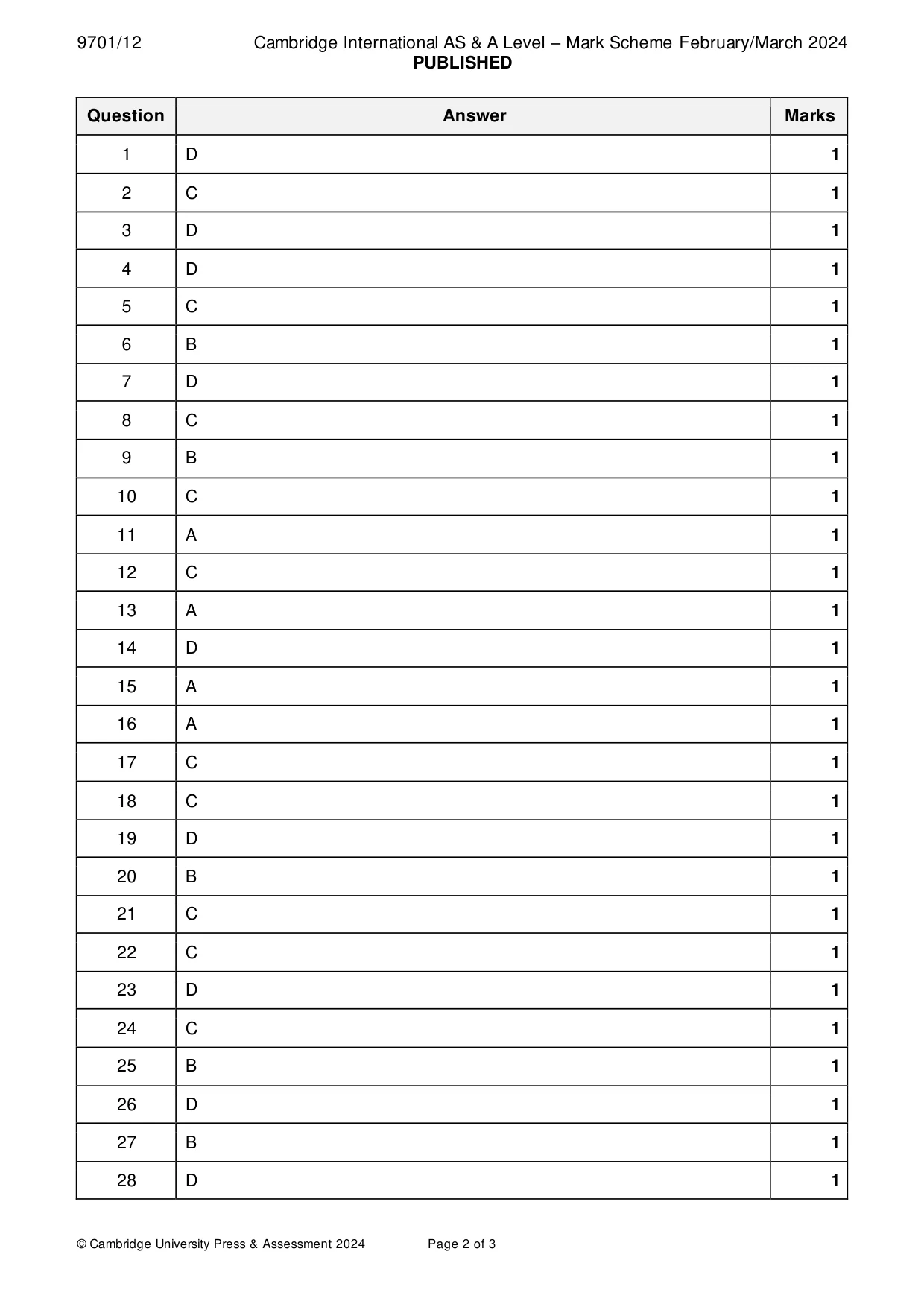
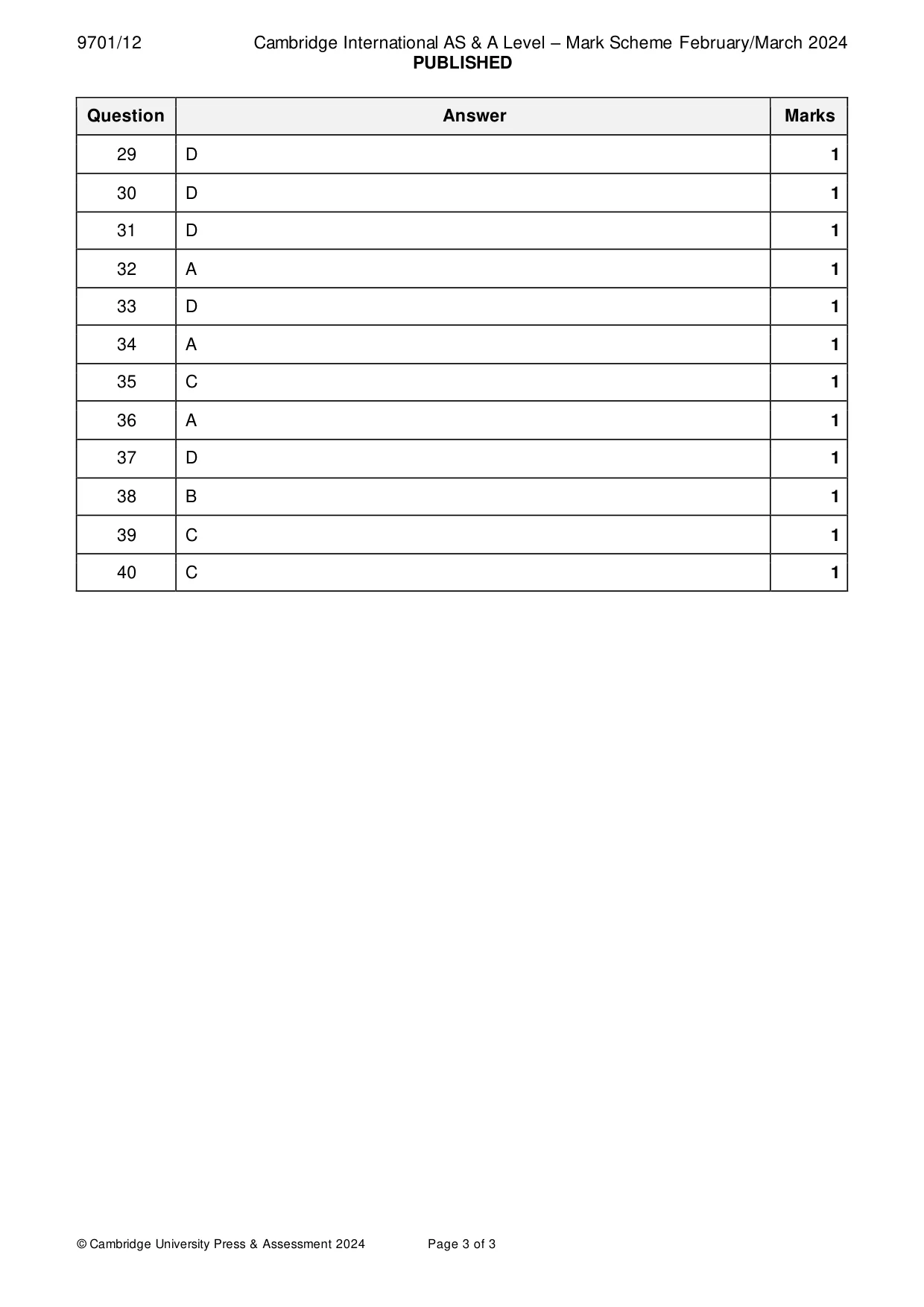
Answers below. Sit the paper first if you are practising.
Questions as text
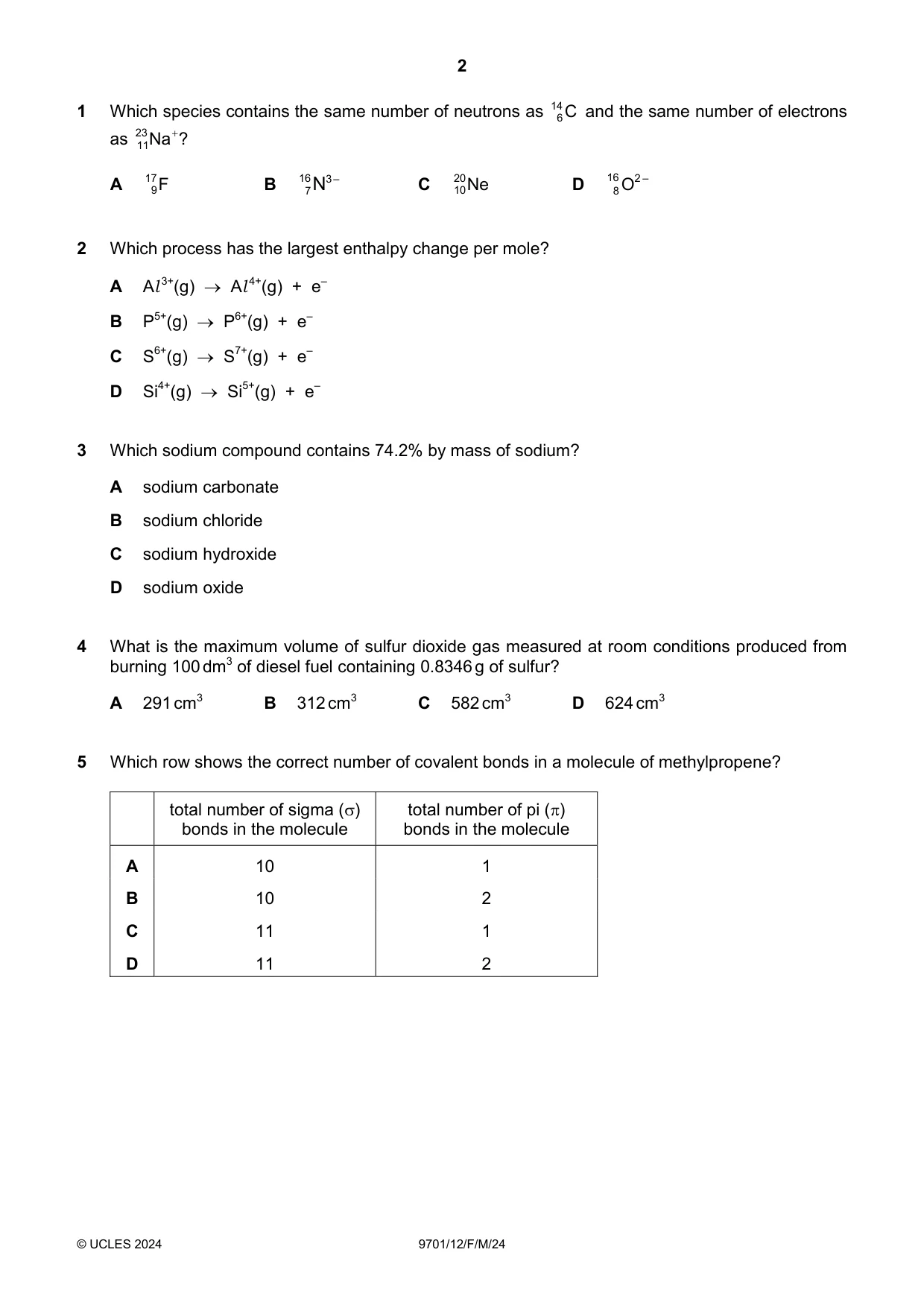
Q1 · Which species contains the same number of neutrons as 14 C and the same number of…
1 Which species contains the same number of neutrons as 14 C and the same number of electrons 6 as 23 Na ? 11 A 17 F B 16 7N 3 – C 20 Ne D 16 8O 2 – 9 10
Mark scheme: D
Q2 · Which process has the largest enthalpy change per mole?
2 Which process has the largest enthalpy change per mole? A Al 3+(g) Al 4+(g) + e– B P5+(g) P6+(g) + e– C S6+(g) S7+(g) + e– D Si4+(g) Si5+(g) + e–
Mark scheme: C
Q3 · Which sodium compound contains 74.2% by mass of sodium?
3 Which sodium compound contains 74.2% by mass of sodium? A sodium carbonate B sodium chloride C sodium hydroxide D sodium oxide
Mark scheme: D
Q4 · What is the maximum volume of sulfur dioxide gas measured at room conditions produced…
4 What is the maximum volume of sulfur dioxide gas measured at room conditions produced from burning 100 dm3 of diesel fuel containing 0.8346 g of sulfur? A 291 cm3 B 312 cm3 C 582 cm3 D 624 cm3
Mark scheme: D
More questions on Reacting masses and volumes (of solutions and gases)
Q5 · Which row shows the correct number of covalent bonds in a molecule of methylpropene?
5 Which row shows the correct number of covalent bonds in a molecule of methylpropene? total number of sigma () total number of pi () bonds in the molecule bonds in the molecule A 10 1 B 10 2 C 11 1 D 11 2
Mark scheme: C
More questions on Shapes of organic molecules; σ and π bonds
Q6 · Aluminium chloride exists as Al 2Cl 6 molecules at room temperature
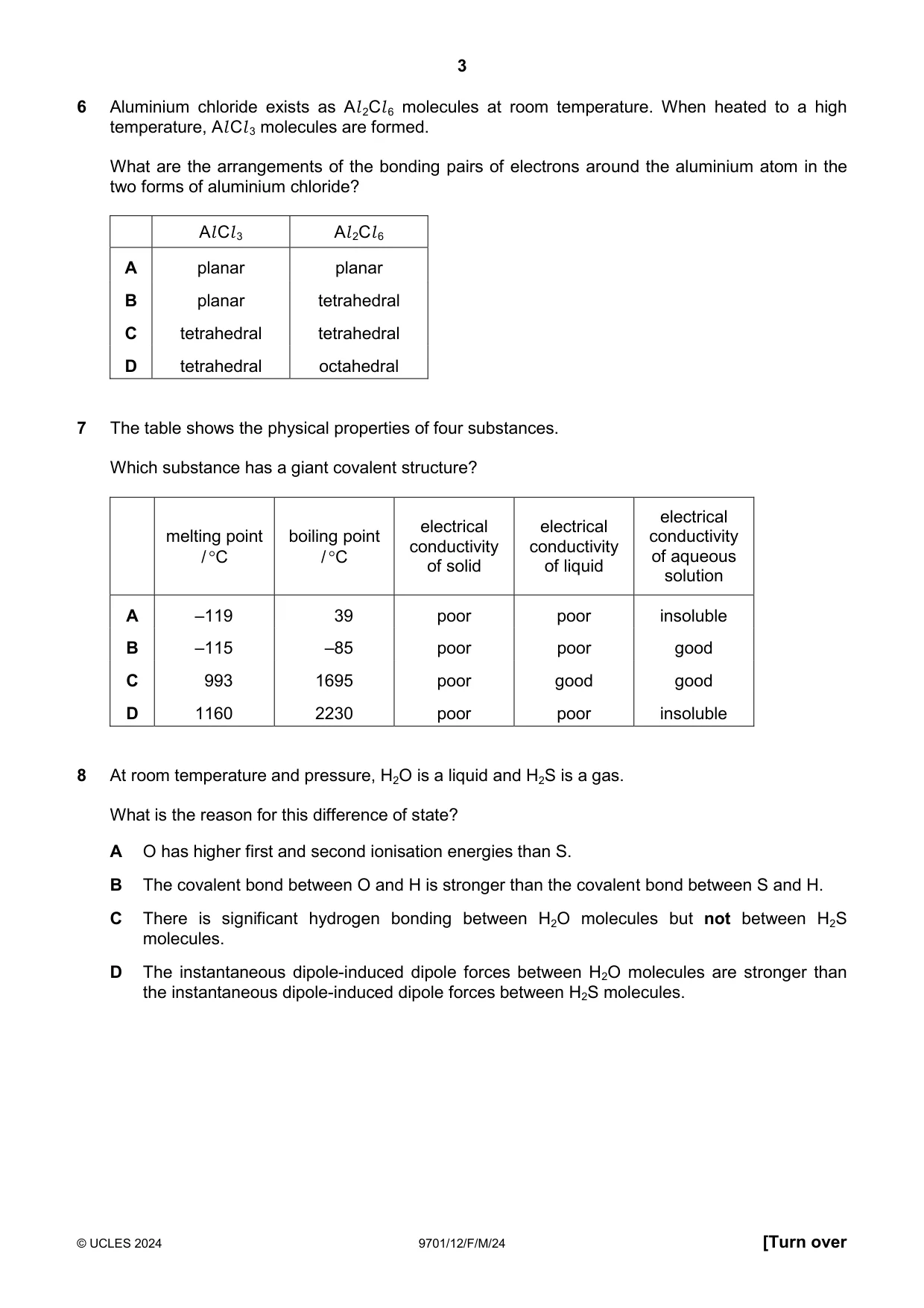
6 Aluminium chloride exists as Al 2Cl 6 molecules at room temperature. When heated to a high temperature, Al Cl 3 molecules are formed. What are the arrangements of the bonding pairs of electrons around the aluminium atom in the two forms of aluminium chloride? Al Cl 3 Al 2Cl 6 A planar planar B planar tetrahedral C tetrahedral tetrahedral D tetrahedral octahedral
Mark scheme: B
Q7 · The table shows the physical properties of four substances
7 The table shows the physical properties of four substances. Which substance has a giant covalent structure? electrical electrical electrical melting point boiling point conductivity conductivity conductivity / C / C of aqueous of solid of liquid solution A –119 39 poor poor insoluble B –115 –85 poor poor good C 993 1695 poor good good D 1160 2230 poor poor insoluble
Mark scheme: D
Q8 · At room temperature and pressure, H2O is a liquid and H2S is a gas
8 At room temperature and pressure, H2O is a liquid and H2S is a gas. What is the reason for this difference of state? A O has higher first and second ionisation energies than S. B The covalent bond between O and H is stronger than the covalent bond between S and H. C There is significant hydrogen bonding between H2O molecules but not between H2S molecules. D The instantaneous dipole-induced dipole forces between H2O molecules are stronger than the instantaneous dipole-induced dipole forces between H2S molecules.
Mark scheme: C
More questions on Intermolecular forces, electronegativity and bond properties
Q9 · The enthalpy change for a reaction can be calculated from values of: ● enthalpies of…
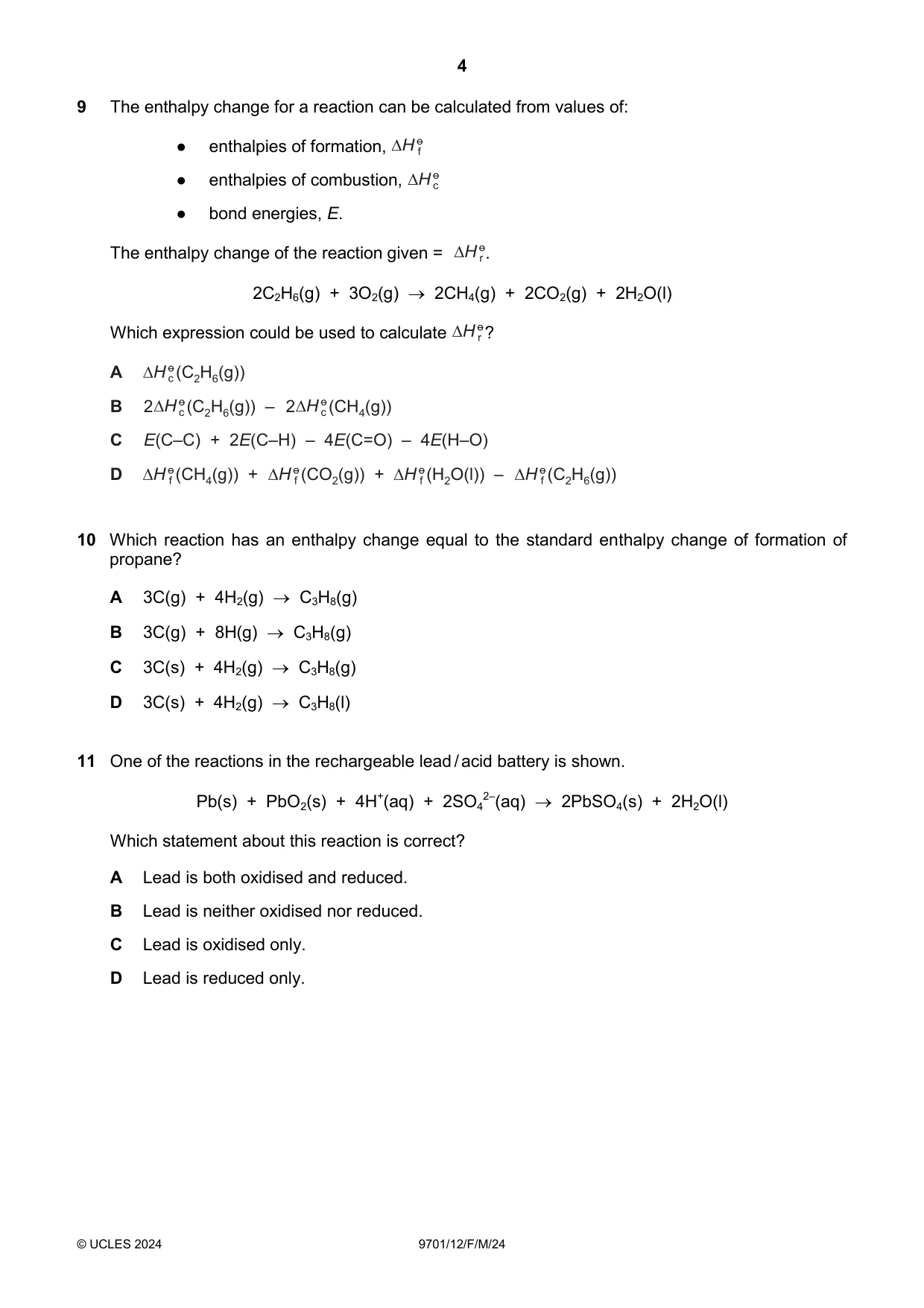
9 The enthalpy change for a reaction can be calculated from values of: ● enthalpies of formation, ● enthalpies of combustion, ● bond energies, E. The enthalpy change of the reaction given = . 2C2H6(g) + 3O2(g) 2CH4(g) + 2CO2(g) + 2H2O(l) Which expression could be used to calculate ? A (C2H6(g)) B 2 (C2H6(g)) – 2 (CH4(g)) C E(C–C) + 2E(C–H) – 4E(C=O) – 4E(H–O) D (CH4(g)) + (CO2(g)) + (H2O(l)) – (C2H6(g))
Mark scheme: B
Q10 · Which reaction has an enthalpy change equal to the standard enthalpy change of formation…
10 Which reaction has an enthalpy change equal to the standard enthalpy change of formation of propane? A 3C(g) + 4H2(g) C3H8(g) B 3C(g) + 8H(g) C3H8(g) C 3C(s) + 4H2(g) C3H8(g) D 3C(s) + 4H2(g) C3H8(l)
Mark scheme: C
Q11 · One of the reactions in the rechargeable lead / acid battery is shown
11 One of the reactions in the rechargeable lead / acid battery is shown. Pb(s) + PbO2(s) + 4H+(aq) + 2SO4 2–(aq) 2PbSO4(s) + 2H2O(l) Which statement about this reaction is correct? A Lead is both oxidised and reduced. B Lead is neither oxidised nor reduced. C Lead is oxidised only. D Lead is reduced only.
Mark scheme: A
Q12 · KMnO4 is an oxidising agent
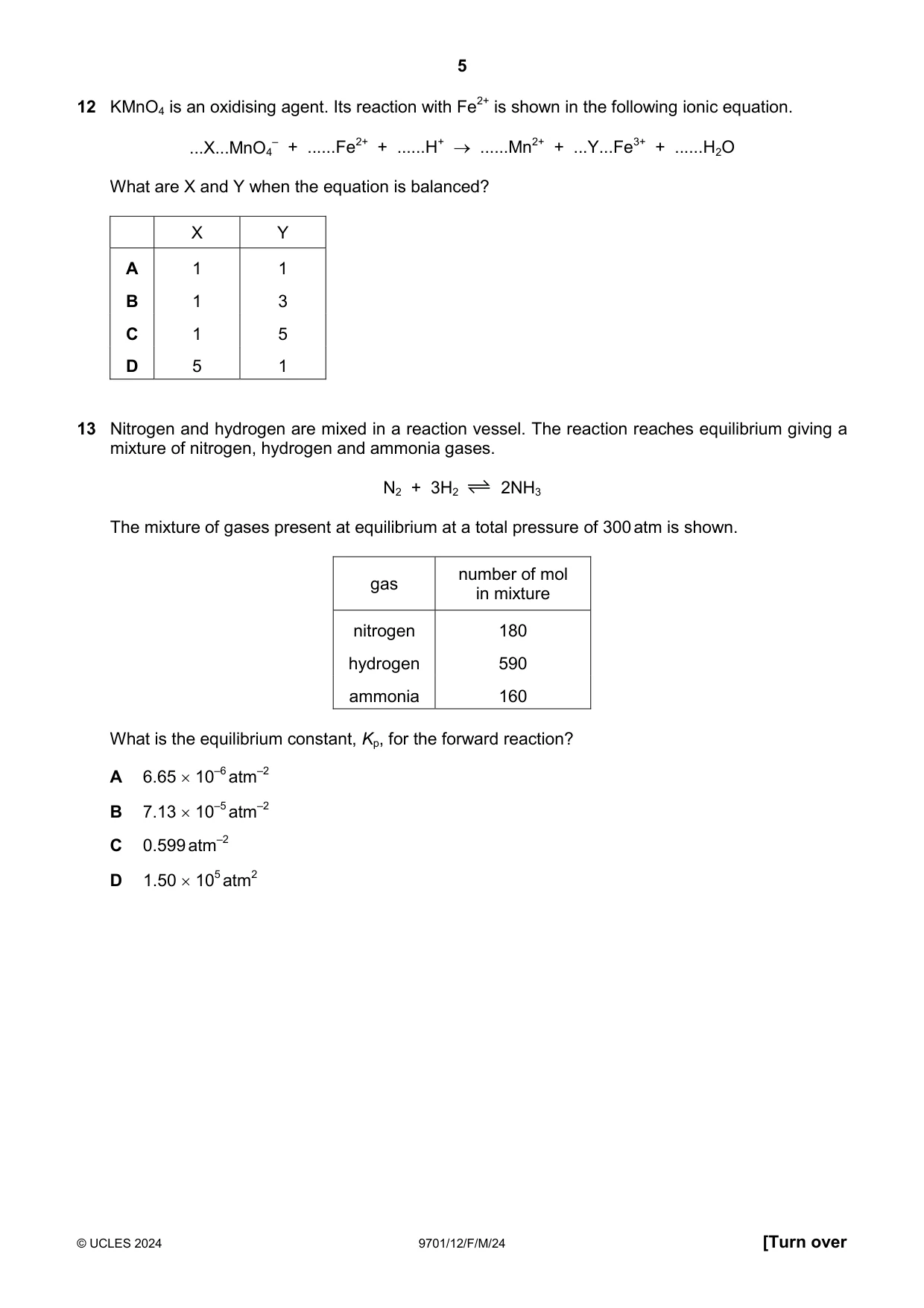
12 KMnO4 is an oxidising agent. Its reaction with Fe2+ is shown in the following ionic equation. ...X...MnO4 – + ......Fe2+ + ......H+ ......Mn2+ + ...Y...Fe3+ + ......H2O What are X and Y when the equation is balanced? X Y A 1 1 B 1 3 C 1 5 D 5 1
Mark scheme: C
Q13 · Nitrogen and hydrogen are mixed in a reaction vessel
13 Nitrogen and hydrogen are mixed in a reaction vessel. The reaction reaches equilibrium giving a mixture of nitrogen, hydrogen and ammonia gases. N2 + 3H2 2NH3 The mixture of gases present at equilibrium at a total pressure of 300 atm is shown. number of mol gas in mixture nitrogen 180 hydrogen 590 ammonia 160 What is the equilibrium constant, Kp, for the forward reaction? A 6.65 10–6 atm–2 B 7.13 10–5 atm–2 C 0.599 atm–2 D 1.50 105 atm2
Mark scheme: A
More questions on Chemical equilibria: reversible reactions, dynamic equilibrium
Q14 · A mixture of hydrogen gas and iodine gas is placed in a reaction vessel of volume V at…
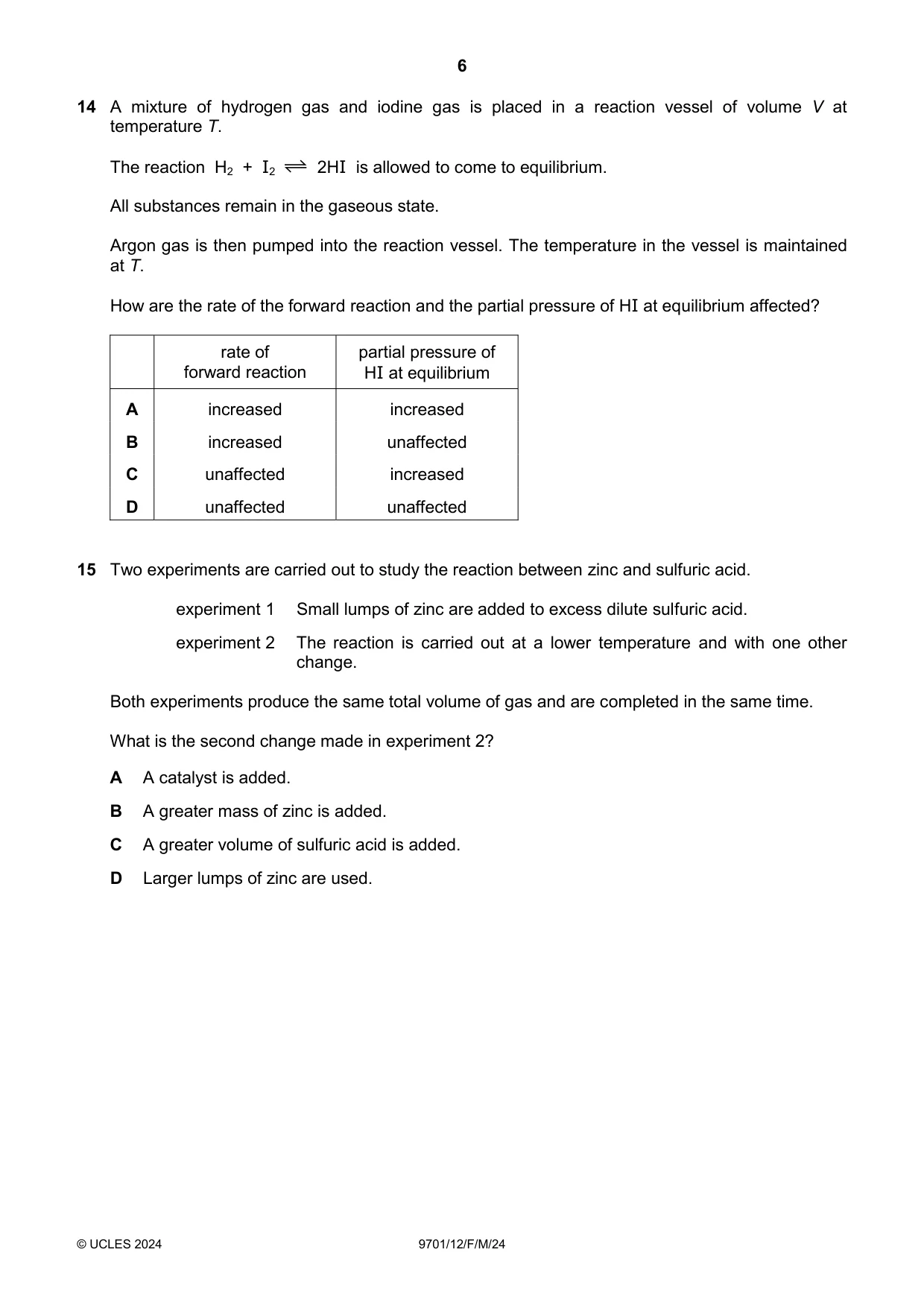
14 A mixture of hydrogen gas and iodine gas is placed in a reaction vessel of volume V at temperature T. The reaction H2 + I2 2HI is allowed to come to equilibrium. All substances remain in the gaseous state. Argon gas is then pumped into the reaction vessel. The temperature in the vessel is maintained at T. How are the rate of the forward reaction and the partial pressure of HI at equilibrium affected? rate of partial pressure of forward reaction HI at equilibrium A increased increased B increased unaffected C unaffected increased D unaffected unaffected
Mark scheme: D
More questions on Chemical equilibria: reversible reactions, dynamic equilibrium
Q15 · Two experiments are carried out to study the reaction between zinc and sulfuric acid
15 Two experiments are carried out to study the reaction between zinc and sulfuric acid. experiment 1 Small lumps of zinc are added to excess dilute sulfuric acid. experiment 2 The reaction is carried out at a lower temperature and with one other change. Both experiments produce the same total volume of gas and are completed in the same time. What is the second change made in experiment 2? A A catalyst is added. B A greater mass of zinc is added. C A greater volume of sulfuric acid is added. D Larger lumps of zinc are used.
Mark scheme: A
Q16 · The relative magnitude of the property X of five elements is shown
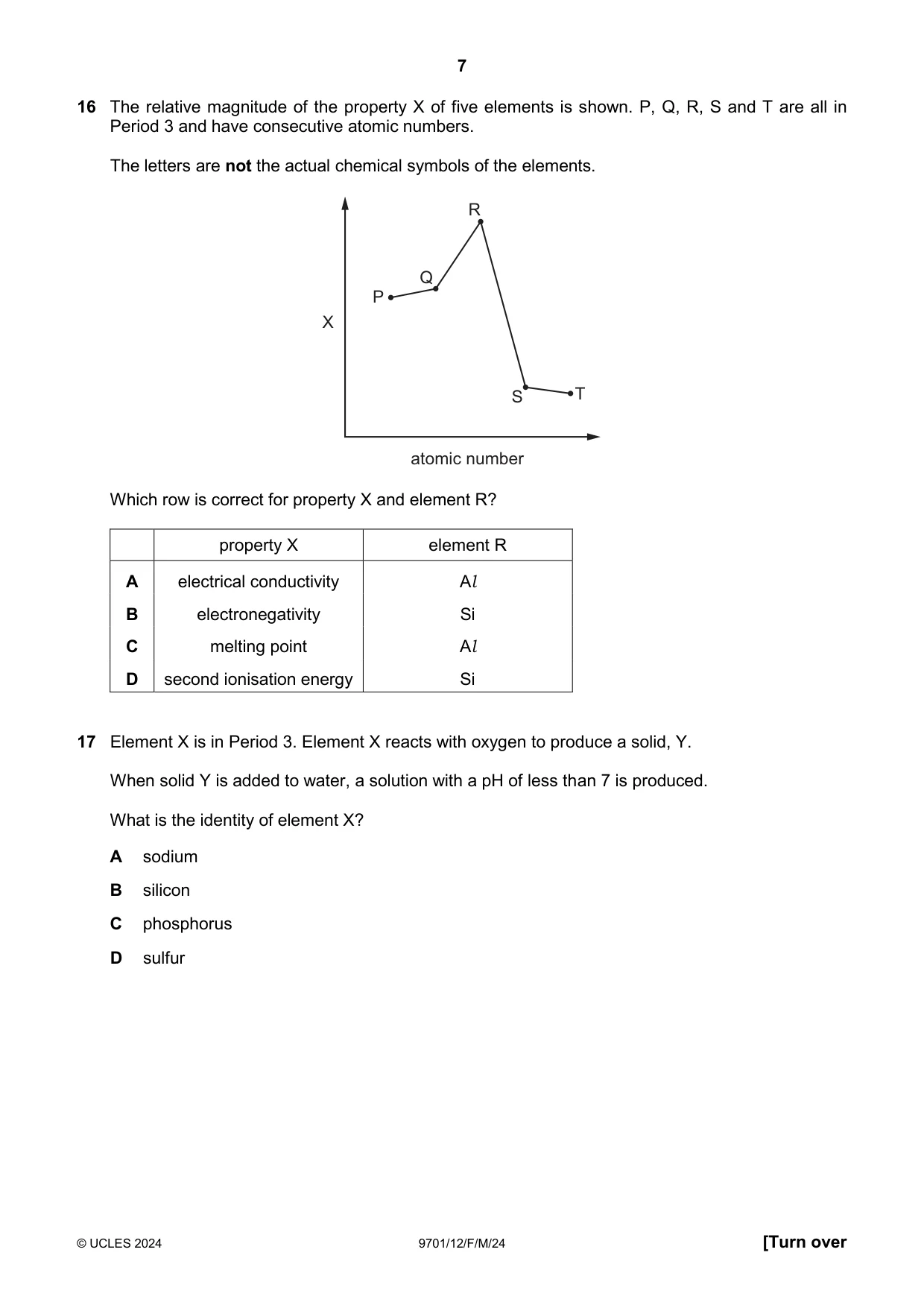
16 The relative magnitude of the property X of five elements is shown. P, Q, R, S and T are all in Period 3 and have consecutive atomic numbers. The letters are not the actual chemical symbols of the elements. R Q P X S T atomic number Which row is correct for property X and element R? property X element R A electrical conductivity Al B electronegativity Si C melting point Al D second ionisation energy Si
Mark scheme: A
More questions on Periodicity of physical properties of the elements in Period 3
Q17 · Element X is in Period 3
17 Element X is in Period 3. Element X reacts with oxygen to produce a solid, Y. When solid Y is added to water, a solution with a pH of less than 7 is produced. What is the identity of element X? A sodium B silicon C phosphorus D sulfur
Mark scheme: C
More questions on Periodicity of chemical properties of the elements in Period 3
Q18 · This question refers to isolated gaseous species
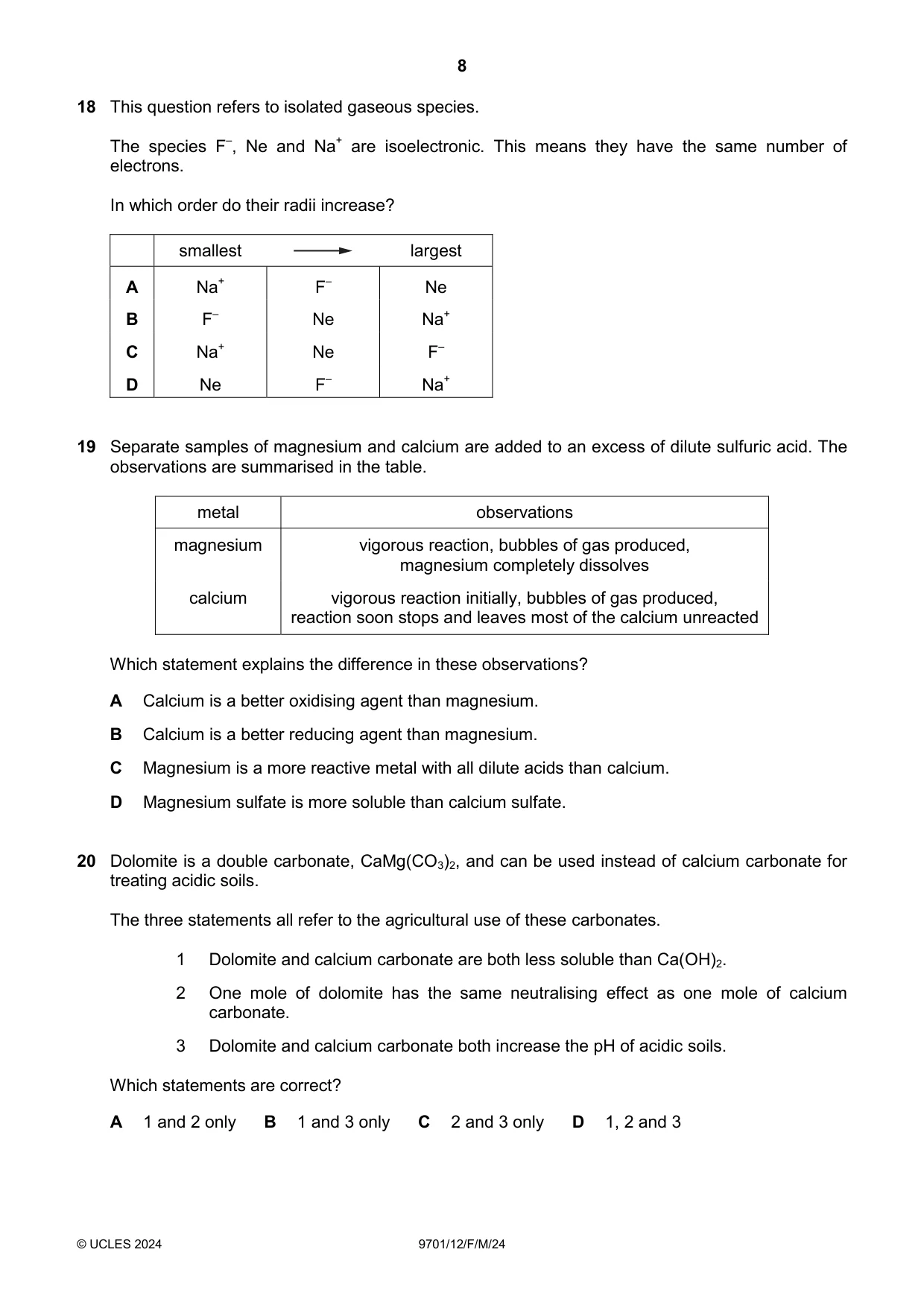
18 This question refers to isolated gaseous species. The species F–, Ne and Na+ are isoelectronic. This means they have the same number of electrons. In which order do their radii increase? smallest largest A Na+ F– Ne B F– Ne Na+ C Na+ Ne F– D Ne F– Na+
Mark scheme: C
Q19 · Separate samples of magnesium and calcium are added to an excess of dilute sulfuric acid
19 Separate samples of magnesium and calcium are added to an excess of dilute sulfuric acid. The observations are summarised in the table. metal observations magnesium vigorous reaction, bubbles of gas produced, magnesium completely dissolves calcium vigorous reaction initially, bubbles of gas produced, reaction soon stops and leaves most of the calcium unreacted Which statement explains the difference in these observations? A Calcium is a better oxidising agent than magnesium. B Calcium is a better reducing agent than magnesium. C Magnesium is a more reactive metal with all dilute acids than calcium. D Magnesium sulfate is more soluble than calcium sulfate.
Mark scheme: D
Q20 · Dolomite is a double carbonate, CaMg(CO3)2, and can be used instead of calcium carbonate…
20 Dolomite is a double carbonate, CaMg(CO3)2, and can be used instead of calcium carbonate for treating acidic soils. The three statements all refer to the agricultural use of these carbonates. 1 Dolomite and calcium carbonate are both less soluble than Ca(OH)2. 2 One mole of dolomite has the same neutralising effect as one mole of calcium carbonate. 3 Dolomite and calcium carbonate both increase the pH of acidic soils. Which statements are correct? A 1 and 2 only B 1 and 3 only C 2 and 3 only D 1, 2 and 3
Mark scheme: B
Q21 · This question is about two salts, NaI and NaCl
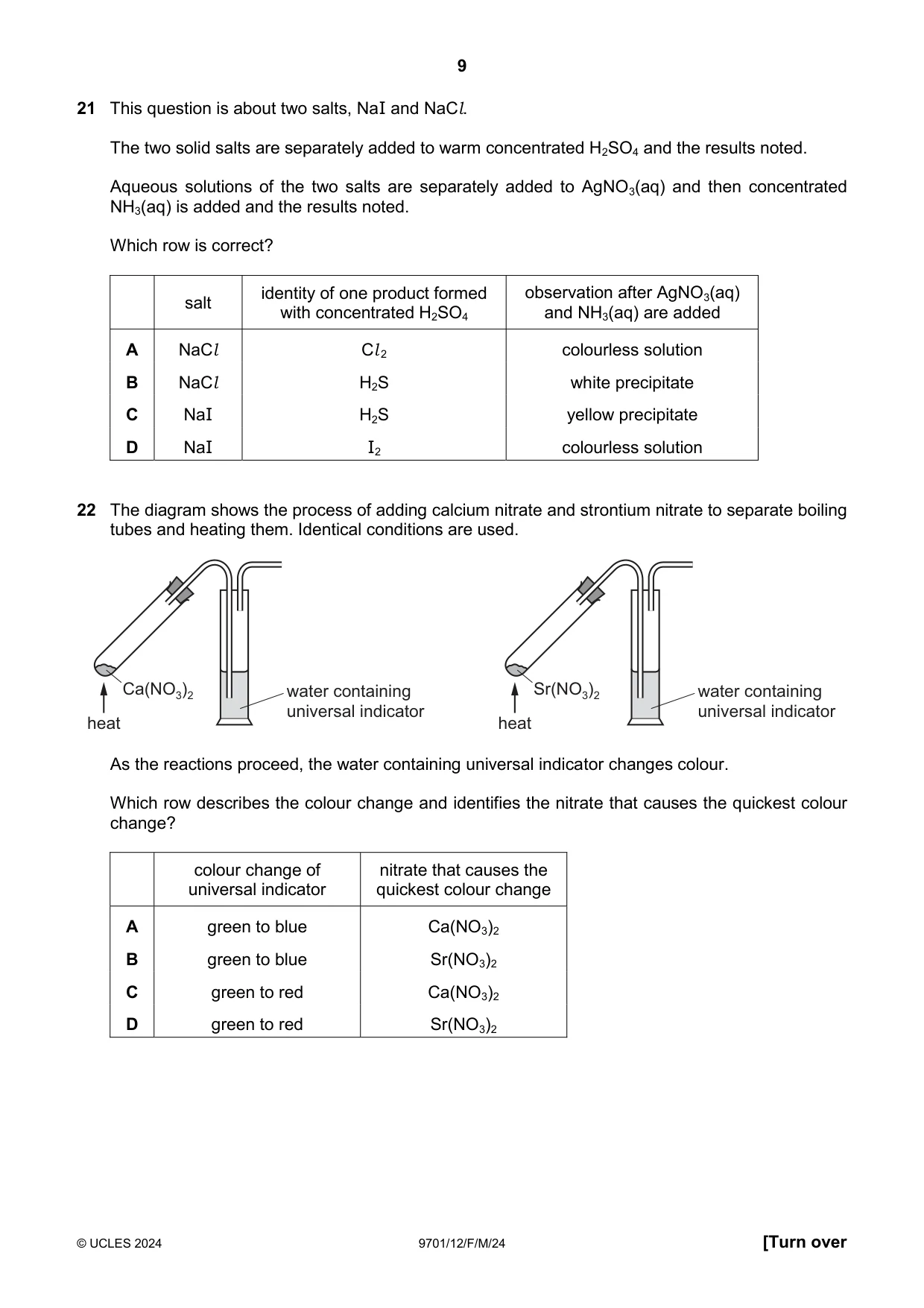
21 This question is about two salts, NaI and NaCl. The two solid salts are separately added to warm concentrated H2SO4 and the results noted. Aqueous solutions of the two salts are separately added to AgNO3(aq) and then concentrated NH3(aq) is added and the results noted. Which row is correct? identity of one product formed observation after AgNO3(aq) salt with concentrated H2SO4 and NH3(aq) are added A NaCl Cl 2 colourless solution B NaCl H2S white precipitate C NaI H2S yellow precipitate D NaI I2 colourless solution
Mark scheme: C
Q22 · The diagram shows the process of adding calcium nitrate and strontium nitrate to separate…
22 The diagram shows the process of adding calcium nitrate and strontium nitrate to separate boiling tubes and heating them. Identical conditions are used. Ca(NO3)2 water containing Sr(NO3)2 water containing universal indicator universal indicator heat heat As the reactions proceed, the water containing universal indicator changes colour. Which row describes the colour change and identifies the nitrate that causes the quickest colour change? colour change of nitrate that causes the universal indicator quickest colour change A green to blue Ca(NO3)2 B green to blue Sr(NO3)2 C green to red Ca(NO3)2 D green to red Sr(NO3)2
Mark scheme: C
Q23 · The equations for three reactions involving chlorine or its compounds are listed
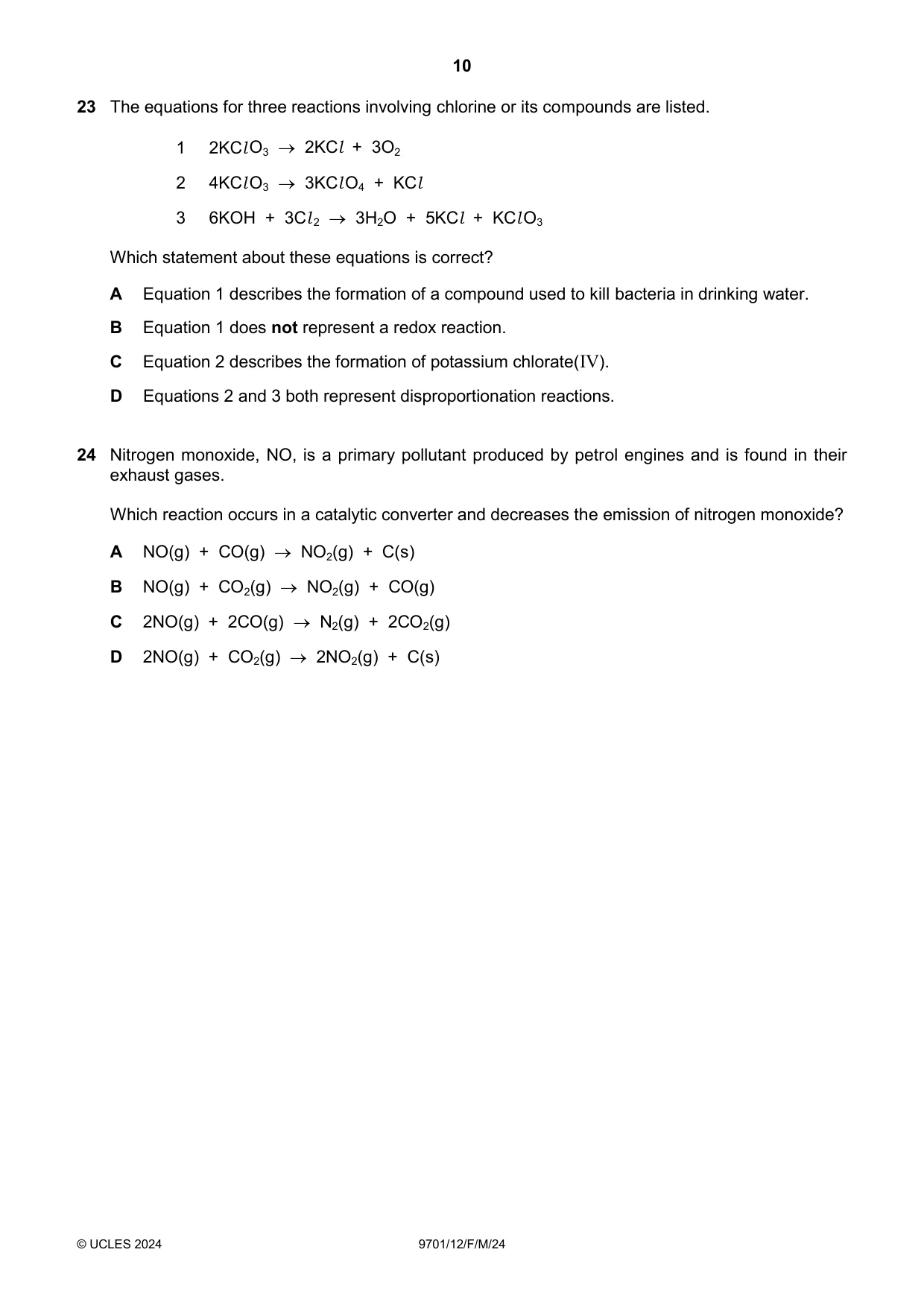
23 The equations for three reactions involving chlorine or its compounds are listed. 1 2KCl O3 2KCl + 3O2 2 4KCl O3 3KCl O4 + KCl 3 6KOH + 3Cl 2 3H2O + 5KCl + KCl O3 Which statement about these equations is correct? A Equation 1 describes the formation of a compound used to kill bacteria in drinking water. B Equation 1 does not represent a redox reaction. C Equation 2 describes the formation of potassium chlorate(IV). D Equations 2 and 3 both represent disproportionation reactions.
Mark scheme: D
Q24 · Nitrogen monoxide, NO, is a primary pollutant produced by petrol engines and is found in…
24 Nitrogen monoxide, NO, is a primary pollutant produced by petrol engines and is found in their exhaust gases. Which reaction occurs in a catalytic converter and decreases the emission of nitrogen monoxide? A NO(g) + CO(g) NO2(g) + C(s) B NO(g) + CO2(g) NO2(g) + CO(g) C 2NO(g) + 2CO(g) N2(g) + 2CO2(g) D 2NO(g) + CO2(g) 2NO2(g) + C(s)
Mark scheme: C
Q25 · The diagram shows the structure of the naturally occurring molecule cholesterol
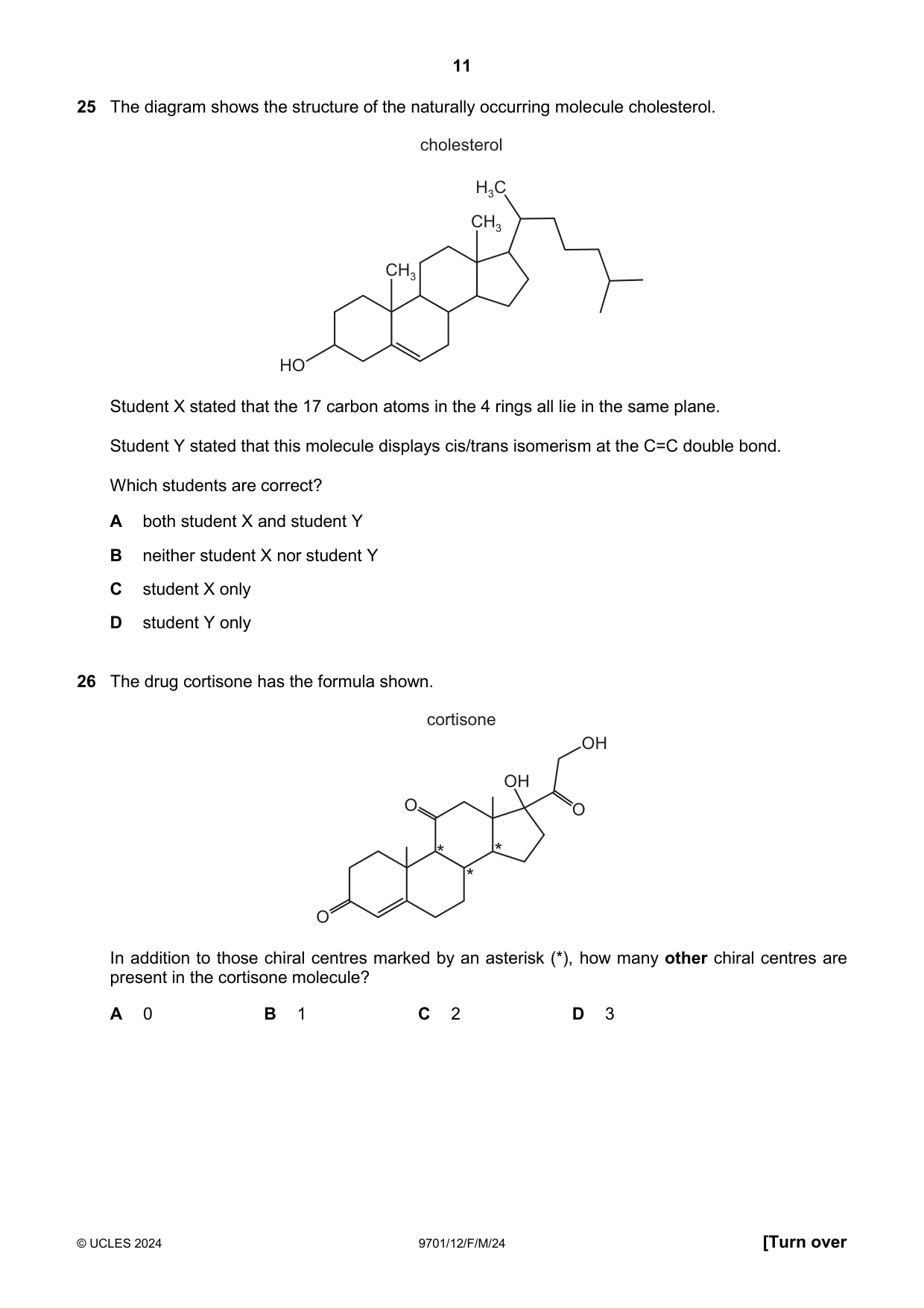
25 The diagram shows the structure of the naturally occurring molecule cholesterol. cholesterol H3C CH3 CH3 HO Student X stated that the 17 carbon atoms in the 4 rings all lie in the same plane. Student Y stated that this molecule displays cis/trans isomerism at the C=C double bond. Which students are correct? A both student X and student Y B neither student X nor student Y C student X only D student Y only
Mark scheme: B
More questions on Isomerism: structural isomerism and stereoisomerism
Q26 · The drug cortisone has the formula shown
26 The drug cortisone has the formula shown. cortisone OH OH O O O In addition to those chiral centres marked by an asterisk (*), how many other chiral centres are present in the cortisone molecule? A 0 B 1 C 2 D 3
Mark scheme: D
Q27 · But-2-ene reacts with cold dilute acidified KMnO4 to give product X
27 But-2-ene reacts with cold dilute acidified KMnO4 to give product X. But-2-ene reacts with hot concentrated acidified KMnO4 to give product Y. Which statement about product X and product Y is correct? A Both product X and product Y will react with 2,4-dinitrophenylhydrazine. B Neither product X nor product Y will react with 2,4-dinitrophenylhydrazine. C Product X will react with 2,4-dinitrophenylhydrazine, product Y will not. D Product Y will react with 2,4-dinitrophenylhydrazine, product X will not.
Mark scheme: B
Q28 · A sequence of reactions takes place
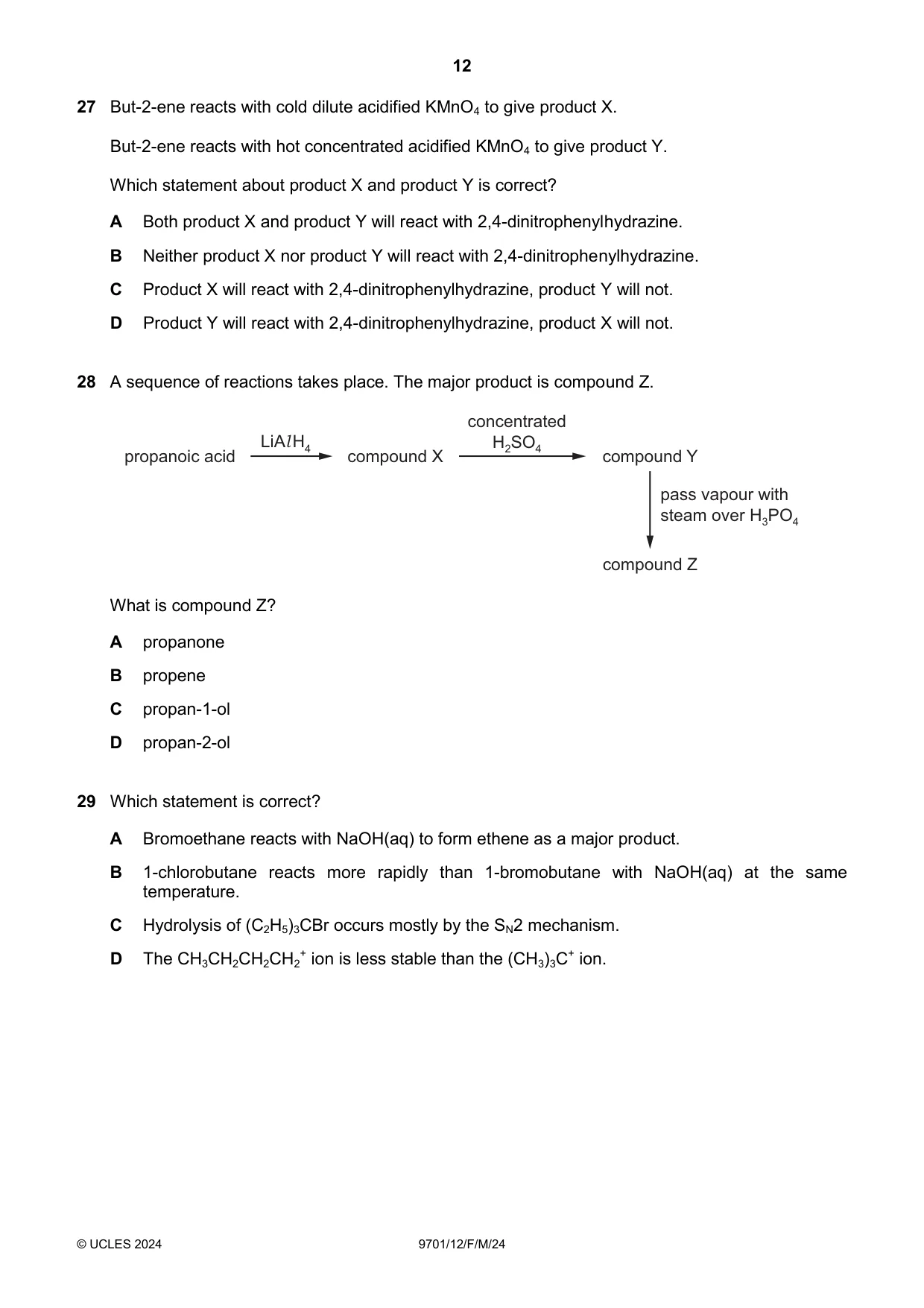
28 A sequence of reactions takes place. The major product is compound Z. concentrated LiAl H4 H2SO4 propanoic acid compound X compound Y pass vapour with steam over H3PO4 compound Z What is compound Z? A propanone B propene C propan-1-ol D propan-2-ol
Mark scheme: D
Q29 · Which statement is correct?
29 Which statement is correct? A Bromoethane reacts with NaOH(aq) to form ethene as a major product. B 1-chlorobutane reacts more rapidly than 1-bromobutane with NaOH(aq) at the same temperature. C Hydrolysis of (C2H5)3CBr occurs mostly by the SN2 mechanism. D The CH3CH2CH2CH2 + ion is less stable than the (CH3)3C+ ion.
Mark scheme: D
Q30 · In the hydrolysis of bromoethane by aqueous NaOH, what is the nature of the attacking…
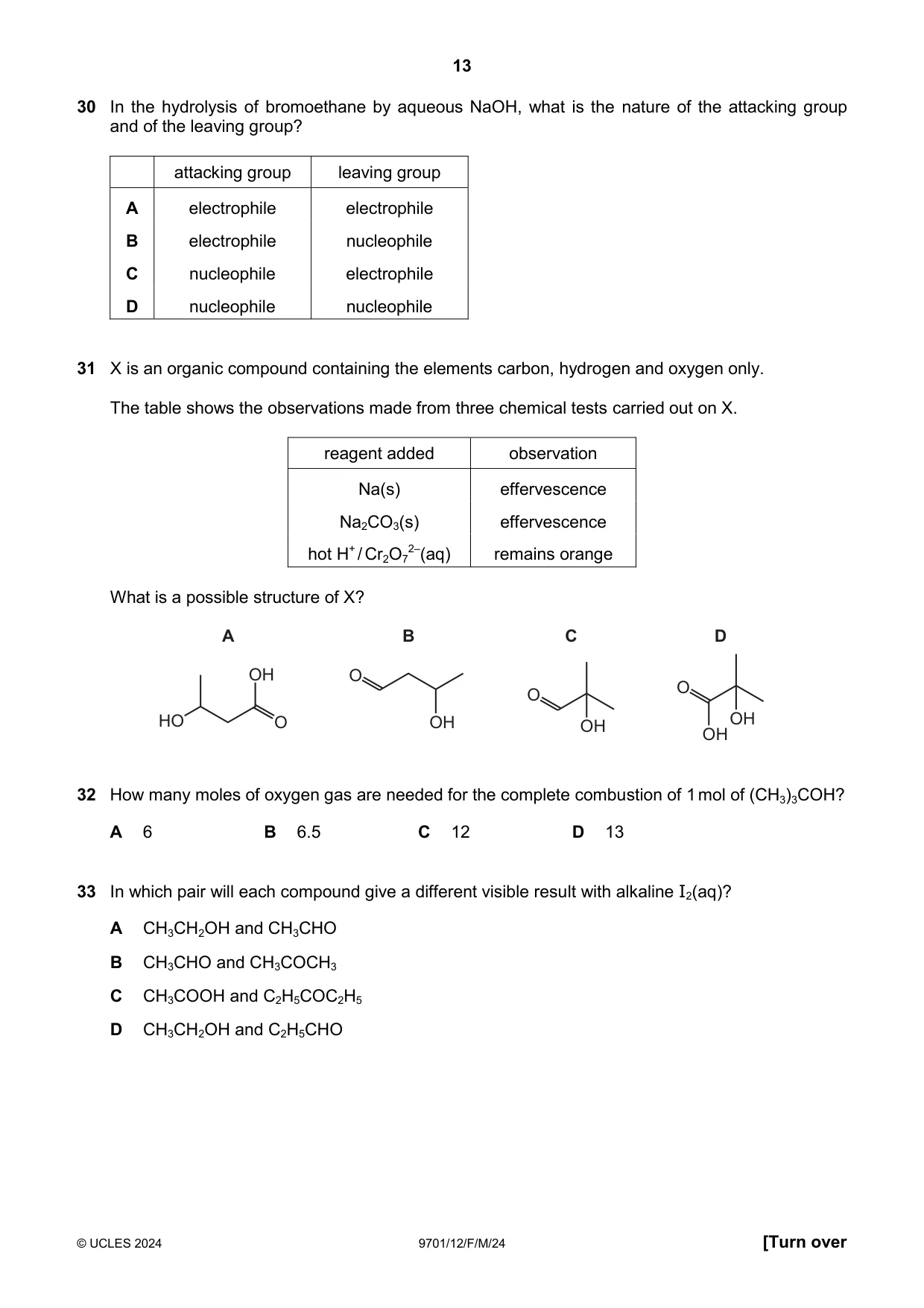
30 In the hydrolysis of bromoethane by aqueous NaOH, what is the nature of the attacking group and of the leaving group? attacking group leaving group A electrophile electrophile B electrophile nucleophile C nucleophile electrophile D nucleophile nucleophile
Mark scheme: D
Q31 · X is an organic compound containing the elements carbon, hydrogen and oxygen only
31 X is an organic compound containing the elements carbon, hydrogen and oxygen only. The table shows the observations made from three chemical tests carried out on X. reagent added observation Na(s) effervescence Na2CO3(s) effervescence hot H+ / Cr2O7 2–(aq) remains orange What is a possible structure of X? A B C D OH O O O HO O OH OH OH OH
Mark scheme: D
Q32 · How many moles of oxygen gas are needed for the complete combustion of 1 mol of (CH3)3COH?
32 How many moles of oxygen gas are needed for the complete combustion of 1 mol of (CH3)3COH? A 6 B 6.5 C 12 D 13
Mark scheme: A
Q33 · In which pair will each compound give a different visible result with alkaline I2(aq)?
33 In which pair will each compound give a different visible result with alkaline I2(aq)? A CH3CH2OH and CH3CHO B CH3CHO and CH3COCH3 C CH3COOH and C2H5COC2H5 D CH3CH2OH and C2H5CHO
Mark scheme: D
Q34 · Which reagent gives a positive result with propanone?
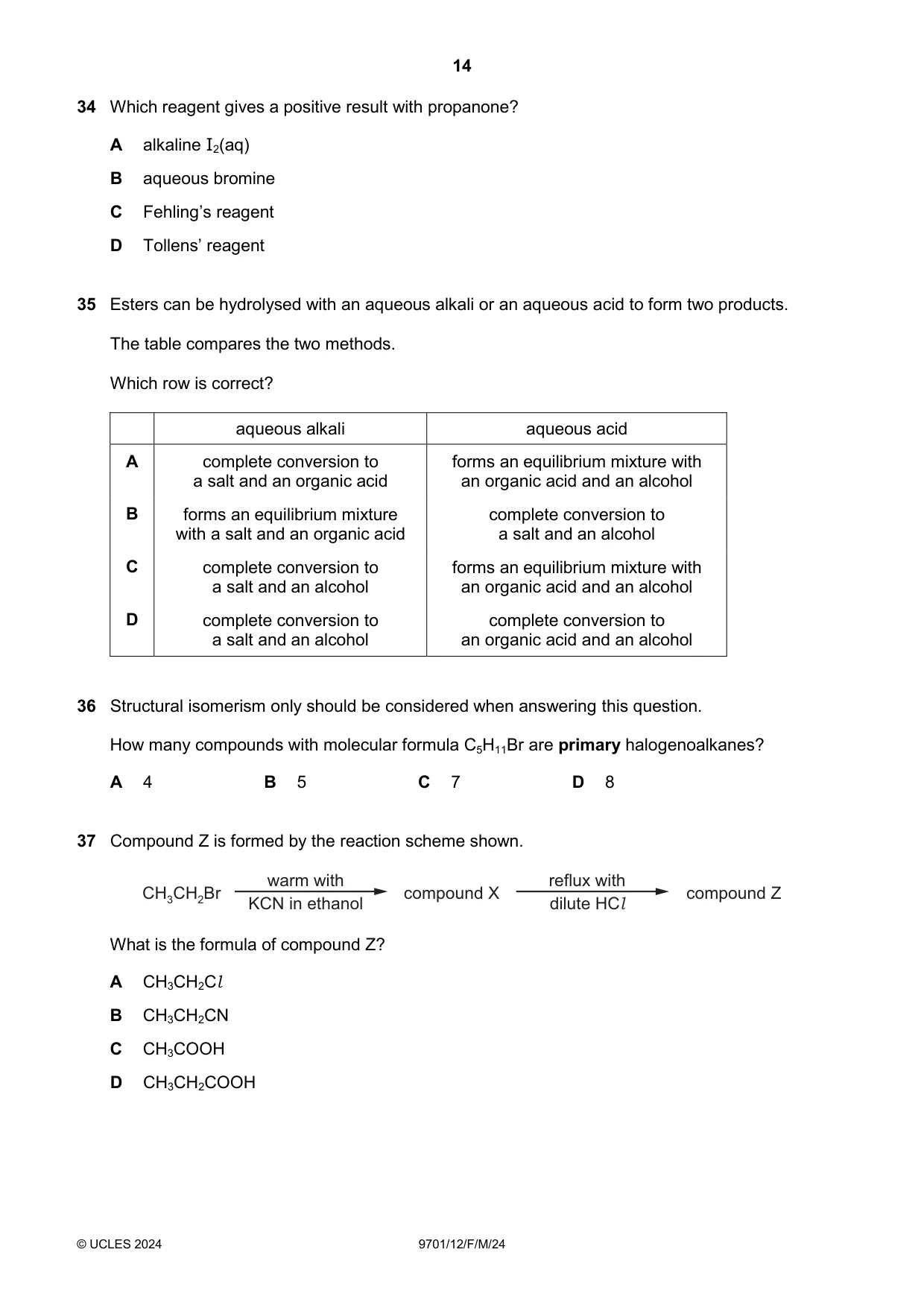
34 Which reagent gives a positive result with propanone? A alkaline I2(aq) B aqueous bromine C Fehling’s reagent D Tollens’ reagent
Mark scheme: A
Q35 · Esters can be hydrolysed with an aqueous alkali or an aqueous acid to form two products
35 Esters can be hydrolysed with an aqueous alkali or an aqueous acid to form two products. The table compares the two methods. Which row is correct? aqueous alkali aqueous acid A complete conversion to forms an equilibrium mixture with a salt and an organic acid an organic acid and an alcohol B forms an equilibrium mixture complete conversion to with a salt and an organic acid a salt and an alcohol C complete conversion to forms an equilibrium mixture with a salt and an alcohol an organic acid and an alcohol D complete conversion to complete conversion to a salt and an alcohol an organic acid and an alcohol
Mark scheme: C
Q36 · Structural isomerism only should be considered when answering this question
36 Structural isomerism only should be considered when answering this question. How many compounds with molecular formula C5H11Br are primary halogenoalkanes? A 4 B 5 C 7 D 8
Mark scheme: A
Q37 · Compound Z is formed by the reaction scheme shown
37 Compound Z is formed by the reaction scheme shown. warm with reflux with CH3CH2Br compound X compound Z KCN in ethanol dilute HCl What is the formula of compound Z? A CH3CH2Cl B CH3CH2CN C CH3COOH D CH3CH2COOH
Mark scheme: D
Q38 · Hydroxyethanal, HOCH2CHO, is heated under reflux with an excess of acidified K2Cr2O7…
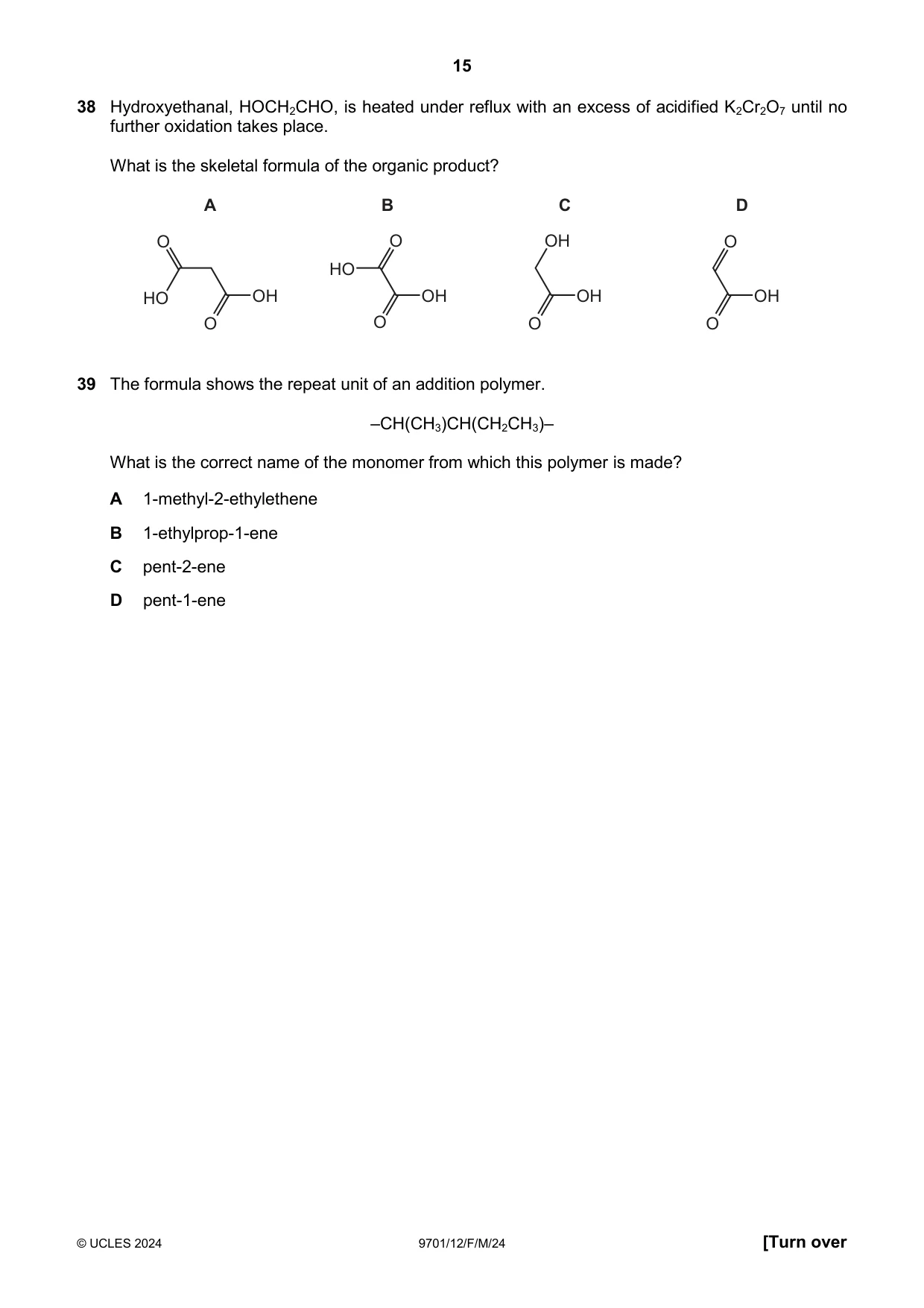
38 Hydroxyethanal, HOCH2CHO, is heated under reflux with an excess of acidified K2Cr2O7 until no further oxidation takes place. What is the skeletal formula of the organic product? A B C D O O OH O HO HO OH OH OH OH O O O O
Mark scheme: B
Q39 · The formula shows the repeat unit of an addition polymer
39 The formula shows the repeat unit of an addition polymer. –CH(CH3)CH(CH2CH3)– What is the correct name of the monomer from which this polymer is made? A 1-methyl-2-ethylethene B 1-ethylprop-1-ene C pent-2-ene D pent-1-ene
Mark scheme: C
Q40 · The infrared spectrum of a compound is shown
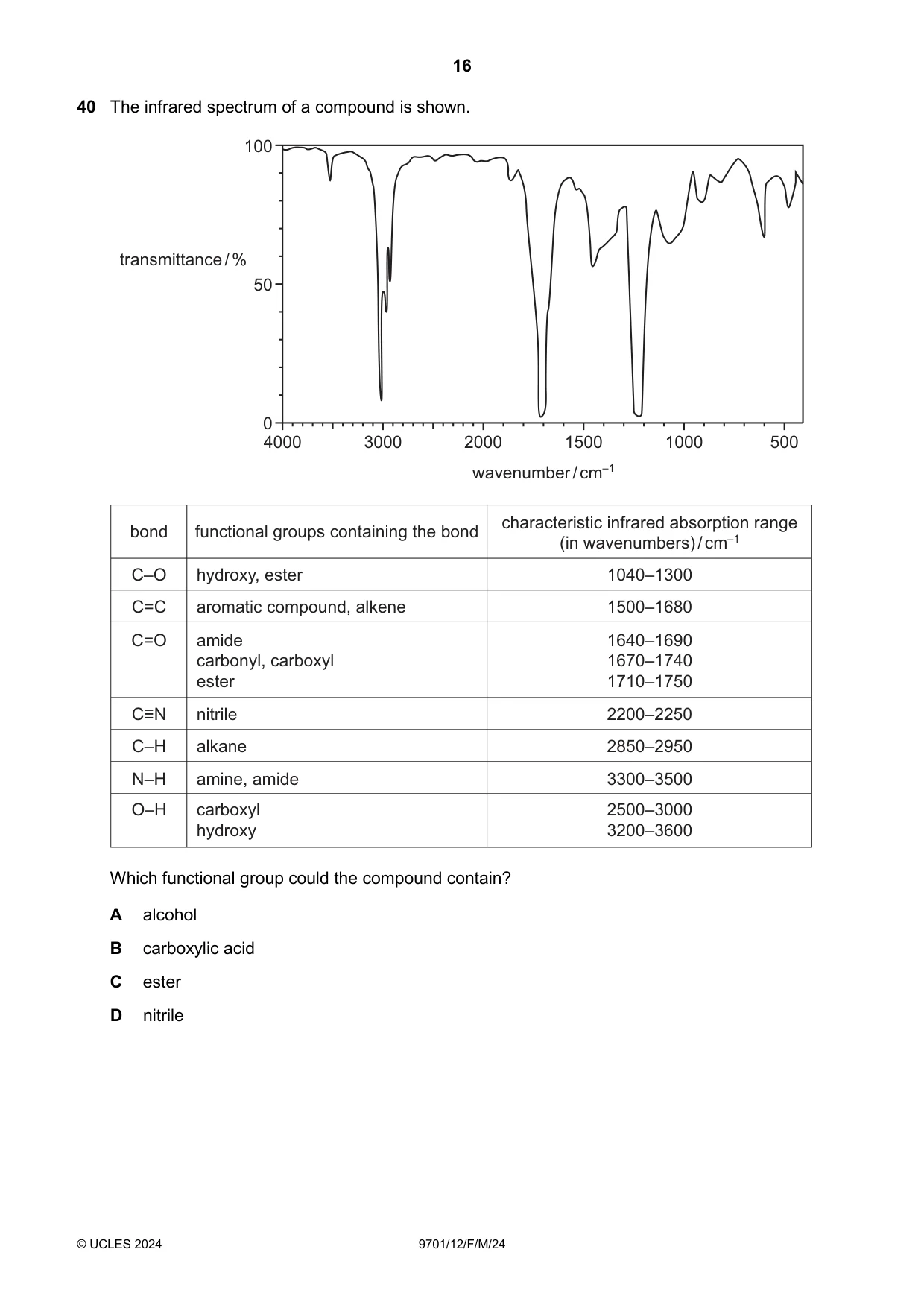
40 The infrared spectrum of a compound is shown. 100 transmittance / % 50 0 4000 3000 2000 1500 1000 500 wavenumber / cm–1 characteristic infrared absorption range bond functional groups containing the bond (in wavenumbers) / cm–1 C–O hydroxy, ester 1040–1300 C=C aromatic compound, alkene 1500–1680 C=O amide 1640–1690 carbonyl, carboxyl 1670–1740 ester 1710–1750 C≡N nitrile 2200–2250 C–H alkane 2850–2950 N–H amine, amide 3300–3500 O–H carboxyl 2500–3000 hydroxy 3200–3600 Which functional group could the compound contain? A alcohol B carboxylic acid C ester D nitrile
Mark scheme: C
What was in this paper
The subtopics covered by these 40 questions, and how many questions each got. Open one in a new tab to see every Cambridge question on it.
3Similarities and trends in the properties of the Group 2 metals, magnesium to barium, and their compounds3Alcohols2Aldehydes and ketones2Carboxylic acids2Chemical equilibria: reversible reactions, dynamic equilibrium2Enthalpy change, ΔH2Particles in the atom and atomic radius2Redox processes: electron transfer and changes in oxidation number (oxidation state)2Addition polymerisation1Alkenes1Bonding and structure1Esters1Formulas1Infrared spectroscopy1Intermolecular forces, electronegativity and bond properties1Ionisation energy1Isomerism: optical1Isomerism: structural isomerism and stereoisomerism1Nitriles and hydroxynitriles1Nitrogen and sulfur1Periodicity of chemical properties of the elements in Period 31Periodicity of physical properties of the elements in Period 31Rate of reaction1Reacting masses and volumes (of solutions and gases)1Shapes of molecules1Shapes of organic molecules; σ and π bonds1Some reactions of the halide ions1The reactions of chlorine1What you needed in this session
Cambridge’s own grade thresholds for 2024 Feb/March, Paper 1 · Variant 2. A higher threshold means an easier paper — the bar moves with how the cohort did.