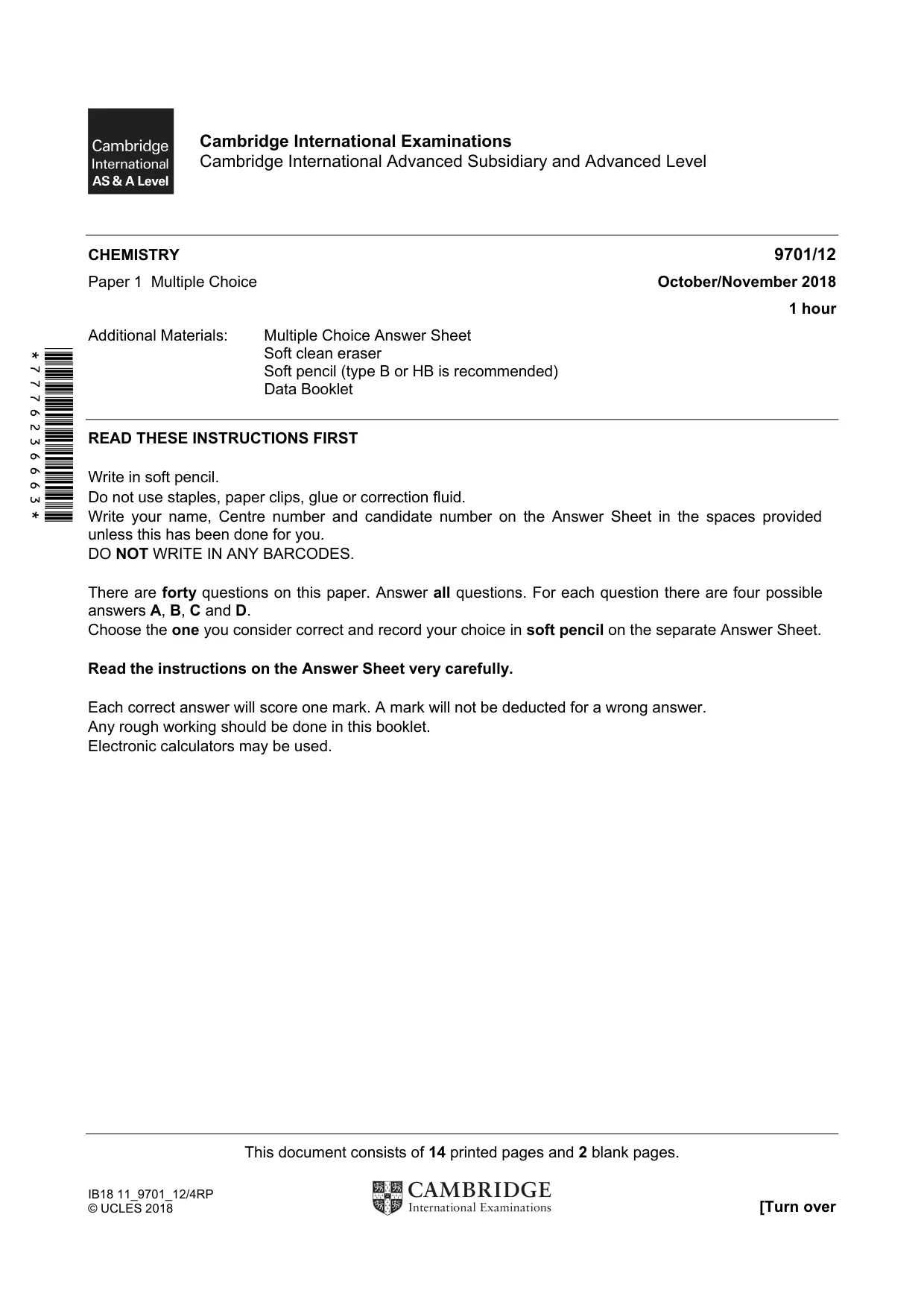
Cambridge A Level Chemistry 9701 — 2018 Oct/Nov Paper 1 · Variant 2
9701/12/O/N/18 · 40 questions · 40 marks · ≈45 min
The question paper and its mark scheme, free to read here and free to download. This is Cambridge’s own paper, exactly as it was sat.
Question paper16 pages

Mark scheme3 pages
Answers below. Sit the paper first if you are practising.
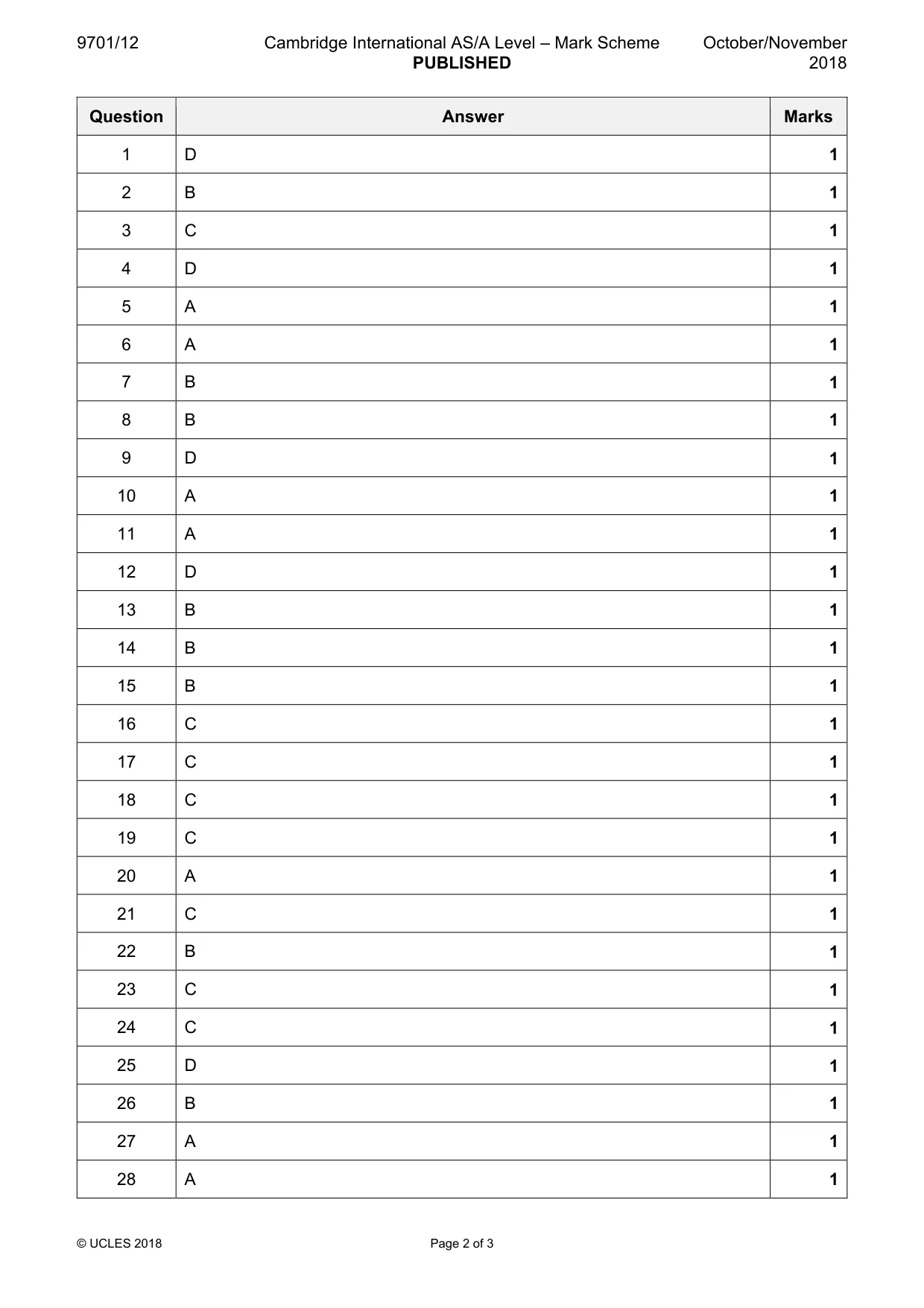
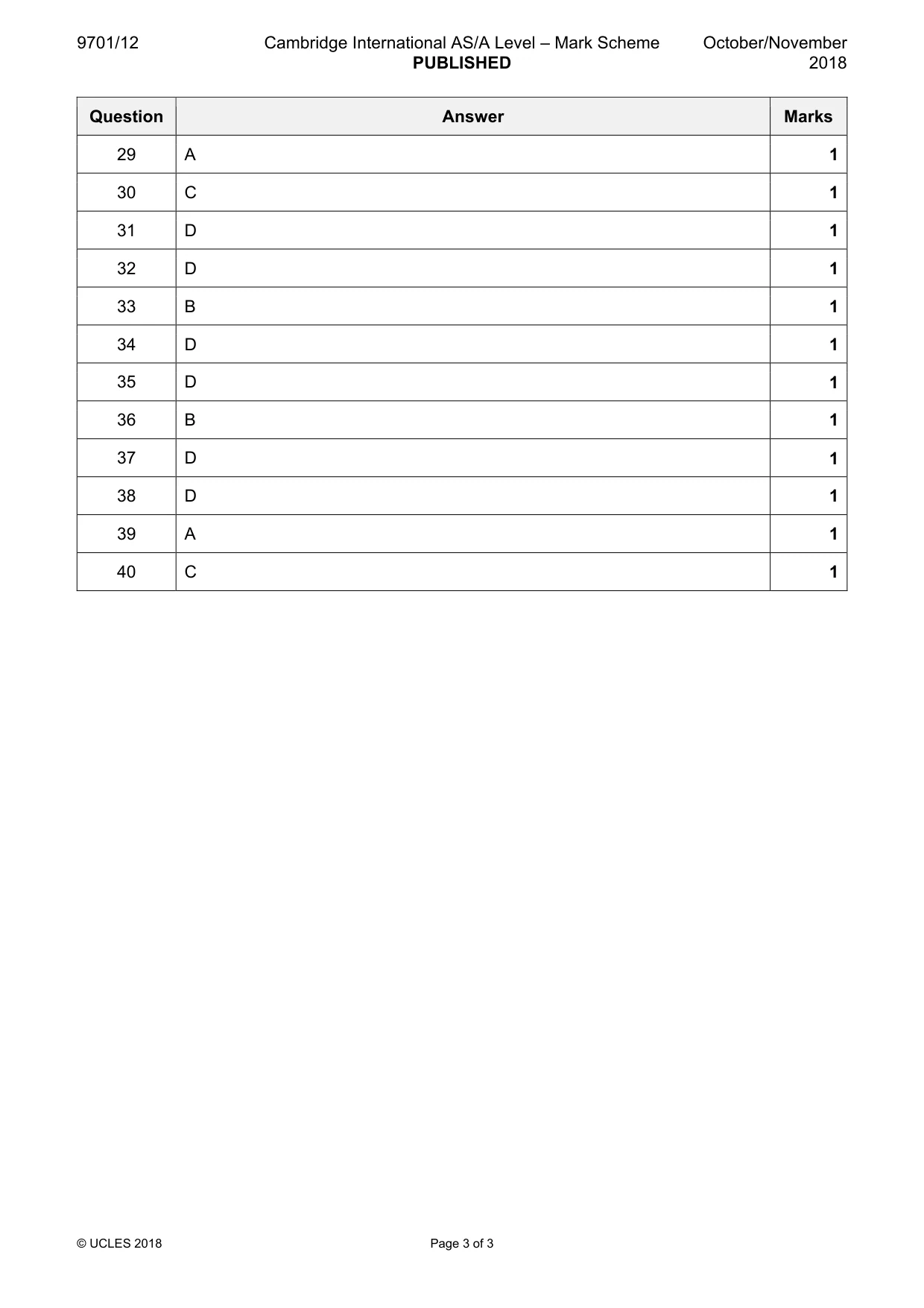
Questions as text
Q1 · Which statement about enthalpy changes is correct?
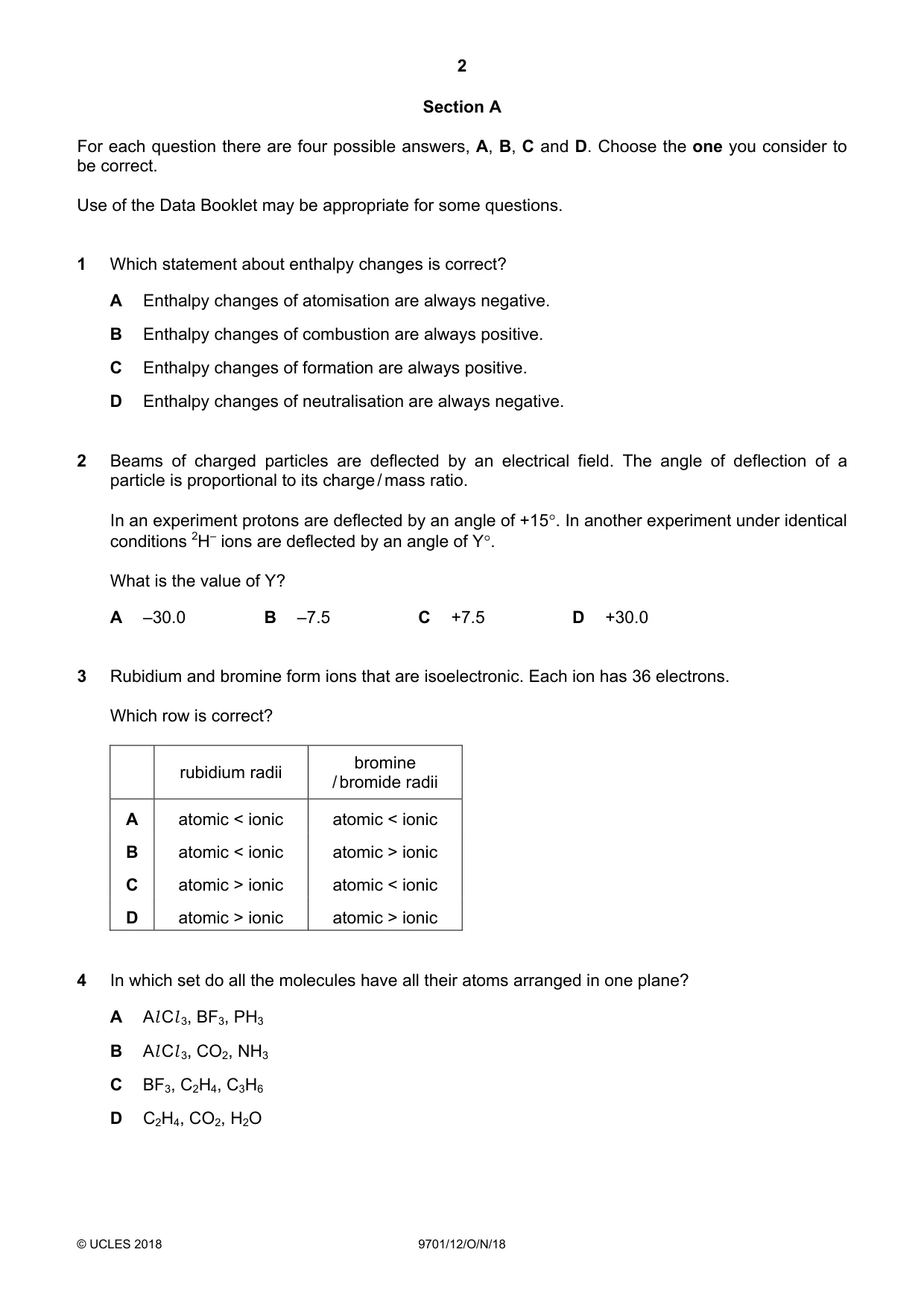
1 Which statement about enthalpy changes is correct? A Enthalpy changes of atomisation are always negative. B Enthalpy changes of combustion are always positive. C Enthalpy changes of formation are always positive. D Enthalpy changes of neutralisation are always negative.
Mark scheme: D
Q2 · Beams of charged particles are deflected by an electrical field
2 Beams of charged particles are deflected by an electrical field. The angle of deflection of a particle is proportional to its charge / mass ratio. In an experiment protons are deflected by an angle of +15°. In another experiment under identical conditions 2H– ions are deflected by an angle of Y°. What is the value of Y? A –30.0 B –7.5 C +7.5 D +30.0
Mark scheme: B
Q3 · Rubidium and bromine form ions that are isoelectronic
3 Rubidium and bromine form ions that are isoelectronic. Each ion has 36 electrons. Which row is correct? bromine rubidium radii / bromide radii A atomic < ionic atomic < ionic B atomic < ionic atomic > ionic C atomic > ionic atomic < ionic D atomic > ionic atomic > ionic
Mark scheme: C
Q4 · In which set do all the molecules have all their atoms arranged in one plane?
4 In which set do all the molecules have all their atoms arranged in one plane? A Al Cl 3, BF3, PH3 B Al Cl 3, CO2, NH3 C BF3, C2H4, C3H6 D C2H4, CO2, H2O
Mark scheme: D
Q5 · Flask X contains 5 dm3 of helium at 12 kPa pressure and flask Y contains 10 dm3 of neon…
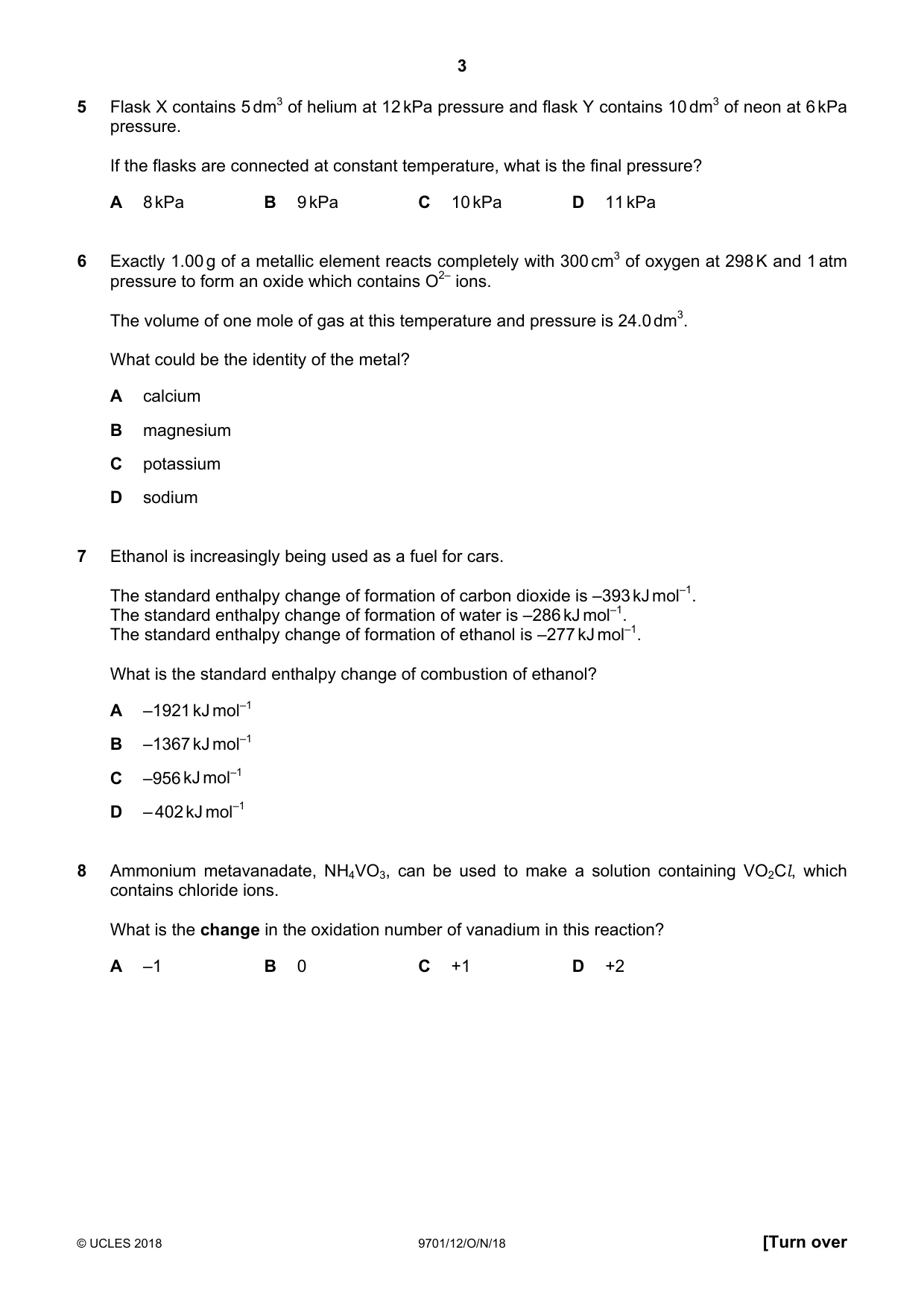
5 Flask X contains 5 dm3 of helium at 12 kPa pressure and flask Y contains 10 dm3 of neon at 6 kPa pressure. If the flasks are connected at constant temperature, what is the final pressure? A 8 kPa B 9 kPa C 10 kPa D 11 kPa
Mark scheme: A
More questions on The gaseous state: ideal and real gases and pV = nRT
Q6 · Exactly 1.00 g of a metallic element reacts completely with 300 cm3 of oxygen at 298 K…
6 Exactly 1.00 g of a metallic element reacts completely with 300 cm3 of oxygen at 298 K and 1 atm pressure to form an oxide which contains O2– ions. The volume of one mole of gas at this temperature and pressure is 24.0 dm3. What could be the identity of the metal? A calcium B magnesium C potassium D sodium
Mark scheme: A
More questions on Reacting masses and volumes (of solutions and gases)
Q7 · Ethanol is increasingly being used as a fuel for cars
7 Ethanol is increasingly being used as a fuel for cars. The standard enthalpy change of formation of carbon dioxide is –393 kJ mol–1. The standard enthalpy change of formation of water is –286 kJ mol–1. The standard enthalpy change of formation of ethanol is –277 kJ mol–1. What is the standard enthalpy change of combustion of ethanol? A –1921 kJ mol–1 B –1367 kJ mol–1 C –956 kJ mol–1 D – 402 kJ mol–1
Mark scheme: B
Q8 · Ammonium metavanadate, NH4VO3, can be used to make a solution containing VO2Cl, which…
8 Ammonium metavanadate, NH4VO3, can be used to make a solution containing VO2Cl, which contains chloride ions. What is the change in the oxidation number of vanadium in this reaction? A –1 B 0 C +1 D +2
Mark scheme: B
Q9 · In this question, all pressures are measured in atm
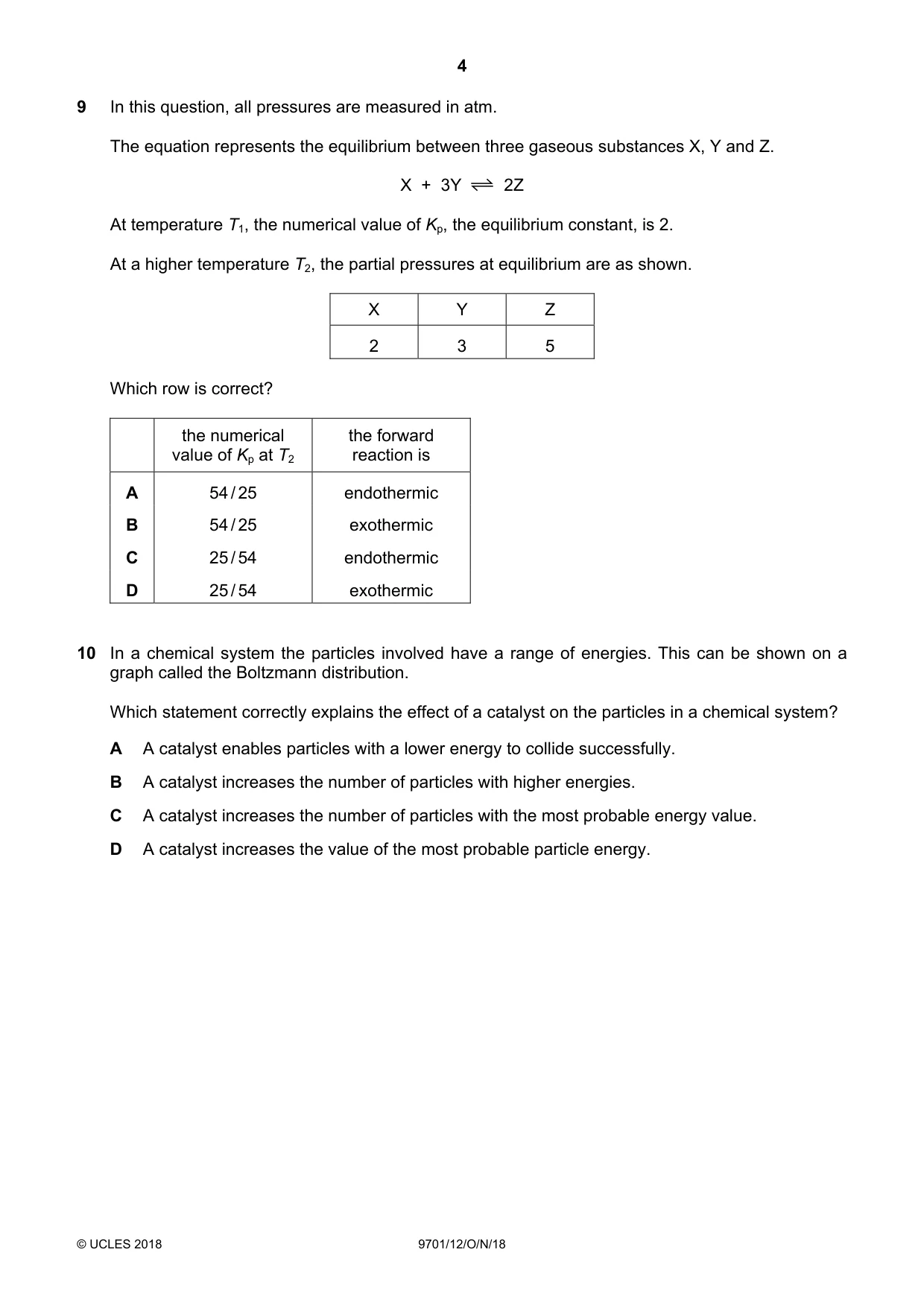
9 In this question, all pressures are measured in atm. The equation represents the equilibrium between three gaseous substances X, Y and Z. X + 3Y 2Z At temperature T1, the numerical value of Kp, the equilibrium constant, is 2. At a higher temperature T2, the partial pressures at equilibrium are as shown. X Y Z 2 3 5 Which row is correct? the numerical the forward value of Kp at T2 reaction is A 54 / 25 endothermic B 54 / 25 exothermic C 25 / 54 endothermic D 25 / 54 exothermic
Mark scheme: D
More questions on Chemical equilibria: reversible reactions, dynamic equilibrium
Q10 · In a chemical system the particles involved have a range of energies
10 In a chemical system the particles involved have a range of energies. This can be shown on a graph called the Boltzmann distribution. Which statement correctly explains the effect of a catalyst on the particles in a chemical system? A A catalyst enables particles with a lower energy to collide successfully. B A catalyst increases the number of particles with higher energies. C A catalyst increases the number of particles with the most probable energy value. D A catalyst increases the value of the most probable particle energy.
Mark scheme: A
More questions on Effect of temperature on reaction rates and the concept of activation energy
Q11 · Nitrogen and hydrogen can react together to form ammonia
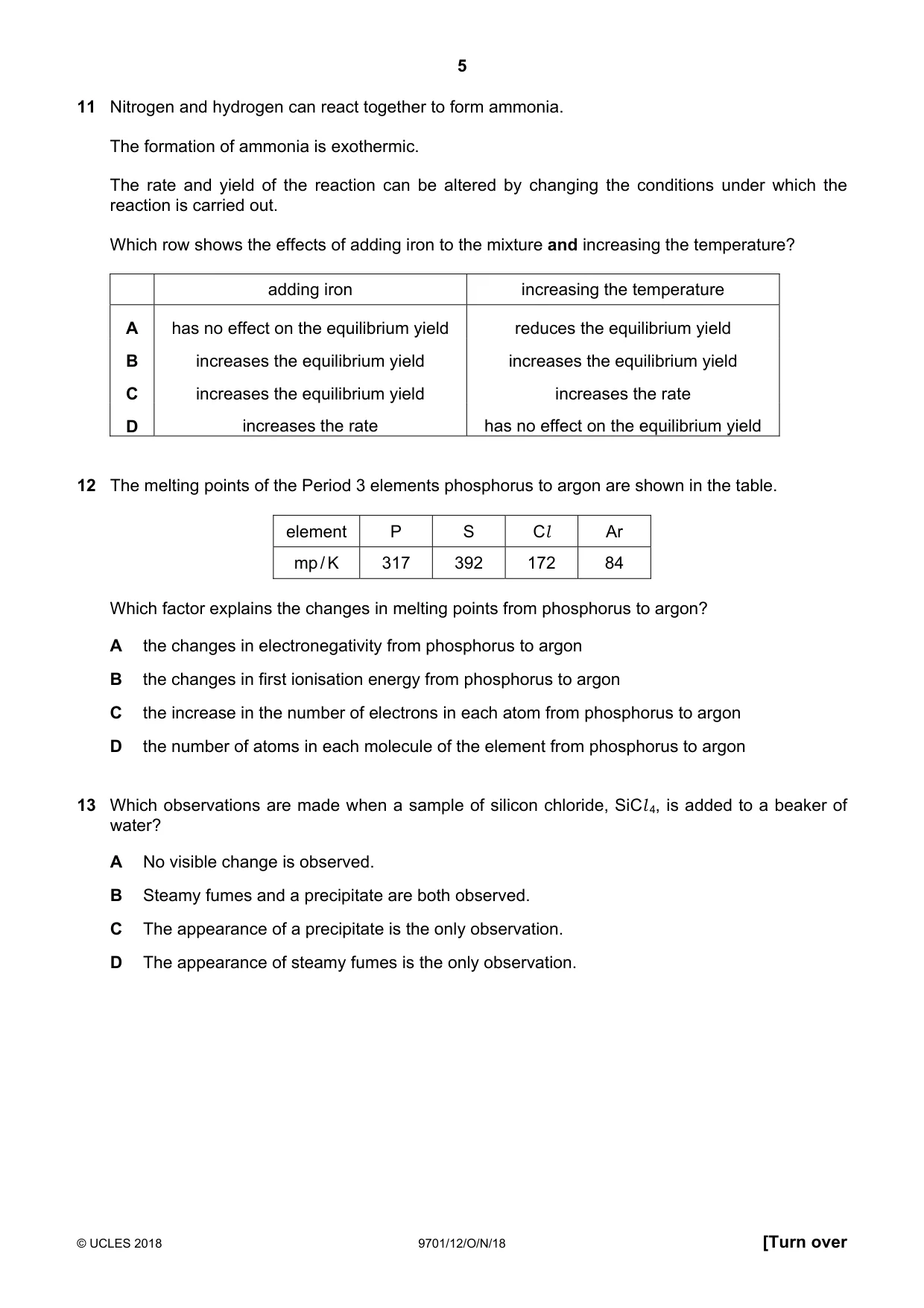
11 Nitrogen and hydrogen can react together to form ammonia. The formation of ammonia is exothermic. The rate and yield of the reaction can be altered by changing the conditions under which the reaction is carried out. Which row shows the effects of adding iron to the mixture and increasing the temperature? adding iron increasing the temperature A has no effect on the equilibrium yield reduces the equilibrium yield B increases the equilibrium yield increases the equilibrium yield C increases the equilibrium yield increases the rate D increases the rate has no effect on the equilibrium yield
Mark scheme: A
More questions on Chemical equilibria: reversible reactions, dynamic equilibrium
Q12 · The melting points of the Period 3 elements phosphorus to argon are shown in the table
12 The melting points of the Period 3 elements phosphorus to argon are shown in the table. element P S Cl Ar mp / K 317 392 172 84 Which factor explains the changes in melting points from phosphorus to argon? A the changes in electronegativity from phosphorus to argon B the changes in first ionisation energy from phosphorus to argon C the increase in the number of electrons in each atom from phosphorus to argon D the number of atoms in each molecule of the element from phosphorus to argon
Mark scheme: D
More questions on Periodicity of physical properties of the elements in Period 3
Q13 · Which observations are made when a sample of silicon chloride, SiCl 4, is added to a…
13 Which observations are made when a sample of silicon chloride, SiCl 4, is added to a beaker of water? A No visible change is observed. B Steamy fumes and a precipitate are both observed. C The appearance of a precipitate is the only observation. D The appearance of steamy fumes is the only observation.
Mark scheme: B
More questions on Periodicity of chemical properties of the elements in Period 3
Q14 · A 4.00 g sample of an anhydrous Group 2 metal nitrate is heated strongly until there is…
14 A 4.00 g sample of an anhydrous Group 2 metal nitrate is heated strongly until there is no further change. A solid residue of mass 1.37 g is formed. Which metal is present? A barium B calcium C magnesium D strontium
Mark scheme: B
Q15 · In which row are all statements comparing magnesium and barium correct?
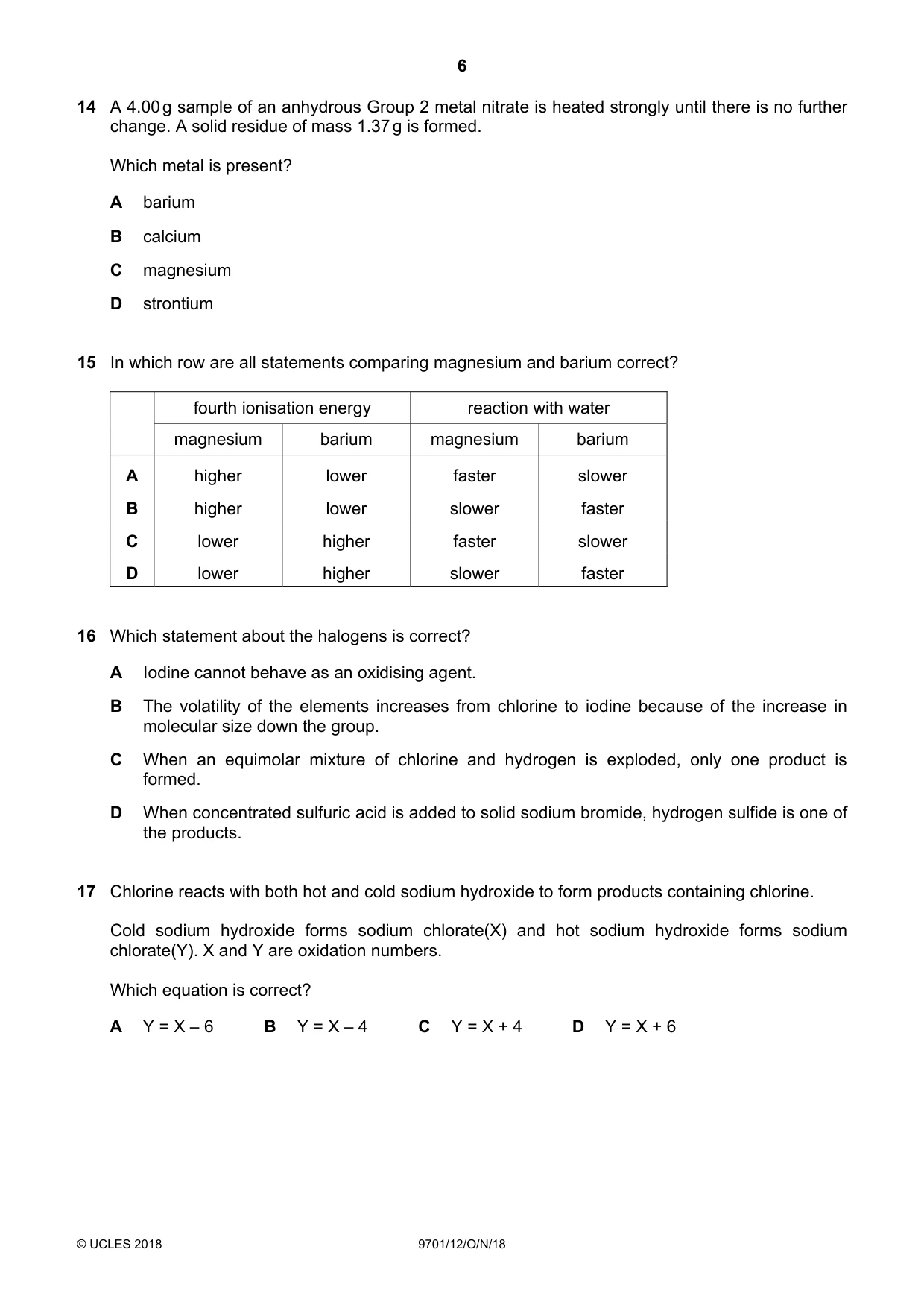
15 In which row are all statements comparing magnesium and barium correct? fourth ionisation energy reaction with water magnesium barium magnesium barium A higher lower faster slower B higher lower slower faster C lower higher faster slower D lower higher slower faster
Mark scheme: B
Q16 · Which statement about the halogens is correct?
16 Which statement about the halogens is correct? A Iodine cannot behave as an oxidising agent. B The volatility of the elements increases from chlorine to iodine because of the increase in molecular size down the group. C When an equimolar mixture of chlorine and hydrogen is exploded, only one product is formed. D When concentrated sulfuric acid is added to solid sodium bromide, hydrogen sulfide is one of the products.
Mark scheme: C
More questions on Physical properties of the Group 17 elements
Q17 · Chlorine reacts with both hot and cold sodium hydroxide to form products containing…
17 Chlorine reacts with both hot and cold sodium hydroxide to form products containing chlorine. Cold sodium hydroxide forms sodium chlorate(X) and hot sodium hydroxide forms sodium chlorate(Y). X and Y are oxidation numbers. Which equation is correct? A Y = X – 6 B Y = X – 4 C Y = X + 4 D Y = X + 6
Mark scheme: C
Q18 · The product of the Contact process is Z
18 The product of the Contact process is Z. Which reaction or process leads to the formation of a gas that can neutralise an aqueous solution of Z? A atmospheric lightning B combustion of fuel in an internal combustion engine C the Haber process D thermal decomposition of Group 2 nitrates
Mark scheme: C
Q19 · If ammonium cyanate is heated in the absence of air, the only product of the reaction is…
19 If ammonium cyanate is heated in the absence of air, the only product of the reaction is urea, CO(NH2)2. No other products are formed in the reaction. What is the formula of the cyanate ion present in ammonium cyanate? A CON2 – B CON2 2– C OCN– D OCN2–
Mark scheme: C
More questions on Formulas, functional groups and the naming of organic compounds
Q20 · There are three structural isomers with the formula C5H12
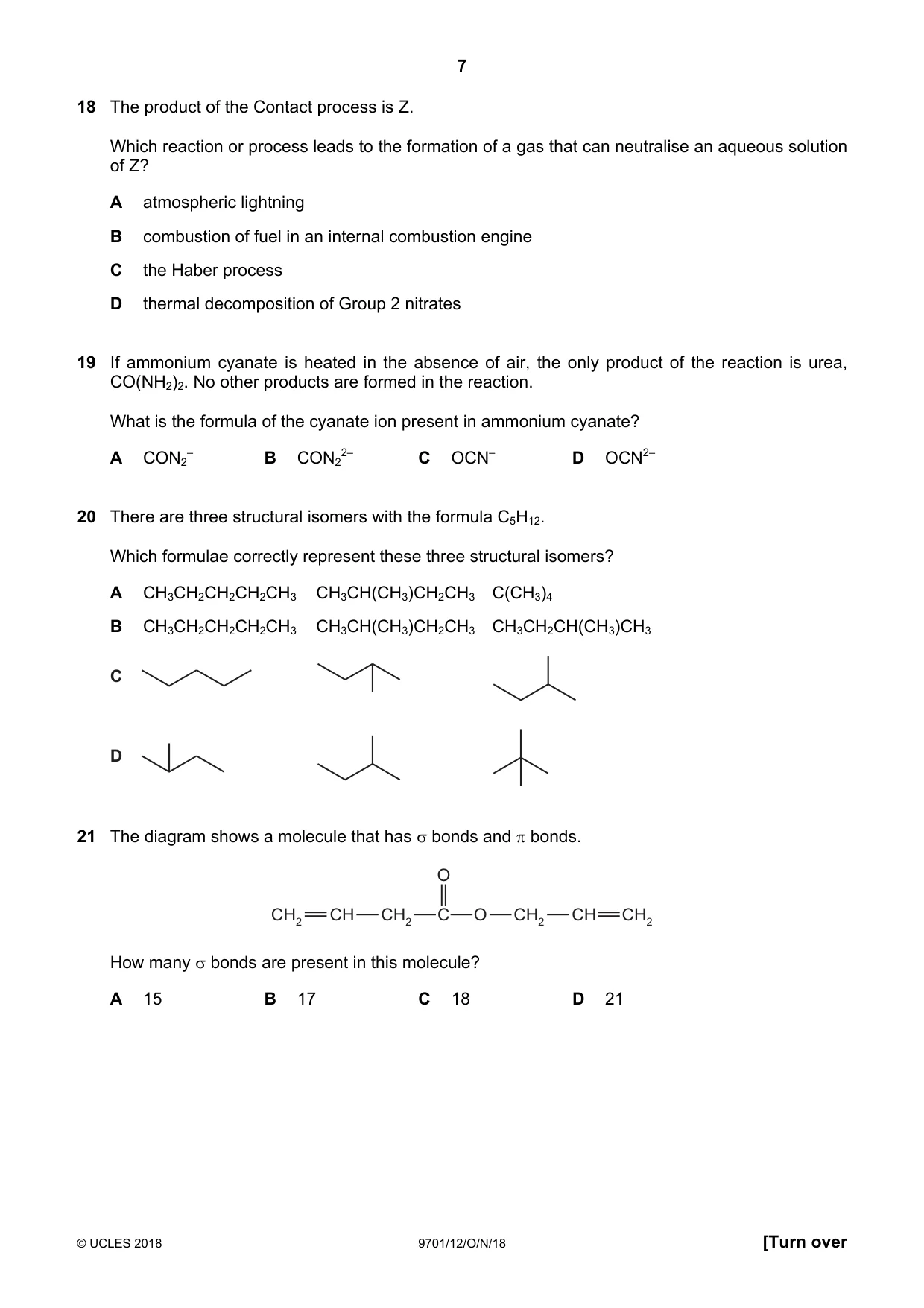
20 There are three structural isomers with the formula C5H12. Which formulae correctly represent these three structural isomers? A CH3CH2CH2CH2CH3 CH3CH(CH3)CH2CH3 C(CH3)4 B CH3CH2CH2CH2CH3 CH3CH(CH3)CH2CH3 CH3CH2CH(CH3)CH3 C D
Mark scheme: A
More questions on Isomerism: structural isomerism and stereoisomerism
Q21 · The diagram shows a molecule that has σ bonds and π bonds
21 The diagram shows a molecule that has σ bonds and π bonds. O CH2 CH CH2 C O CH2 CH CH2 How many σ bonds are present in this molecule? A 15 B 17 C 18 D 21
Mark scheme: C
More questions on Shapes of organic molecules; σ and π bonds
Q22 · Polyethene is made by the polymerisation of ethene
22 Polyethene is made by the polymerisation of ethene. Which statement is correct? A The monomer and the polymer have different empirical formulae. B The monomer can be oxidised without heat whereas the polymer cannot. C The monomer can be used as a fuel whereas the polymer cannot. D The monomer has greater van der Waals’ forces than the polymer.
Mark scheme: B
Q23 · Compound P reacts separately with KOH(aq) and HBr
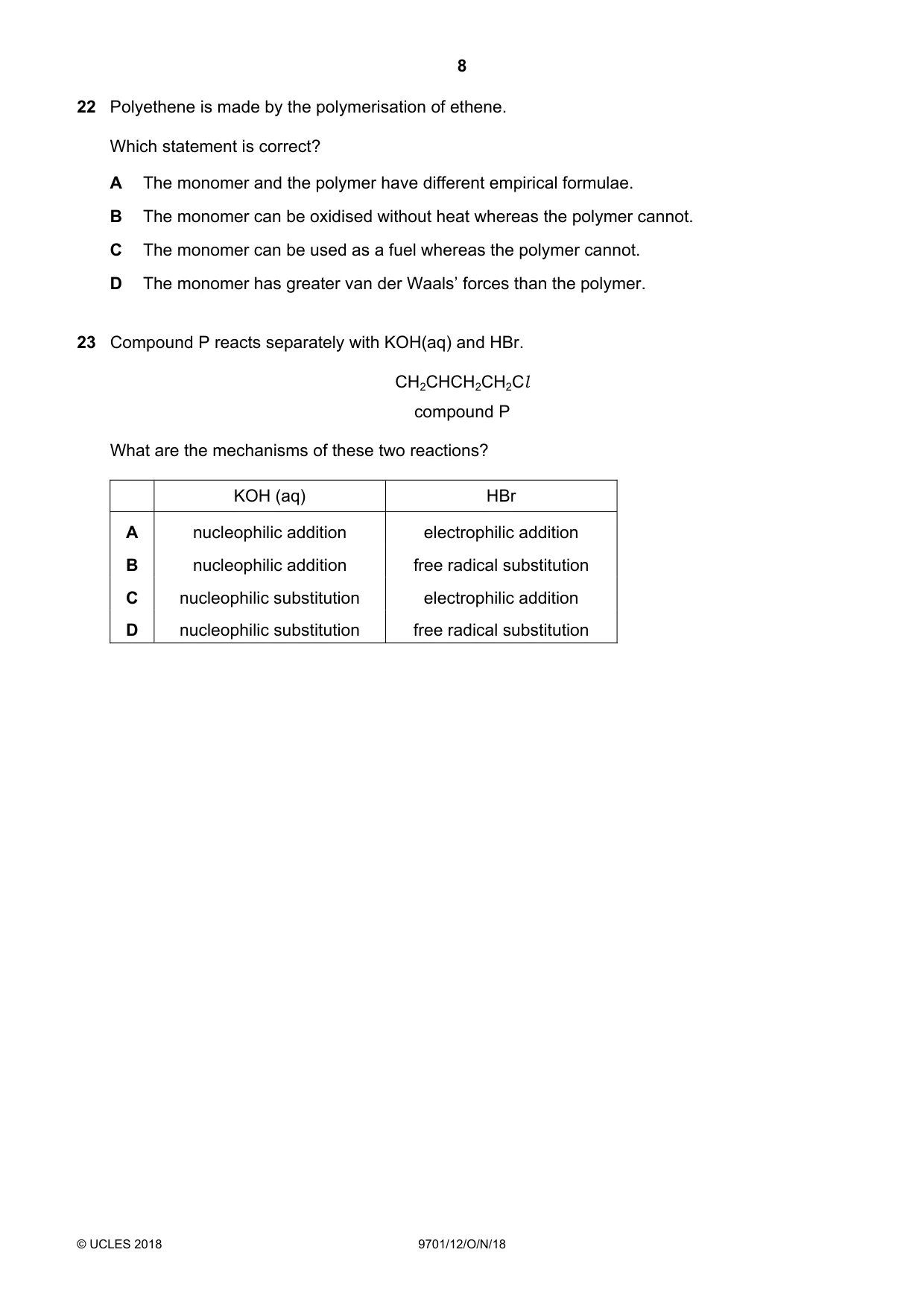
23 Compound P reacts separately with KOH(aq) and HBr. CH2CHCH2CH2Cl compound P What are the mechanisms of these two reactions? KOH (aq) HBr A nucleophilic addition electrophilic addition B nucleophilic addition free radical substitution C nucleophilic substitution electrophilic addition D nucleophilic substitution free radical substitution
Mark scheme: C
Q24 · Which statement about compound Q is correct?
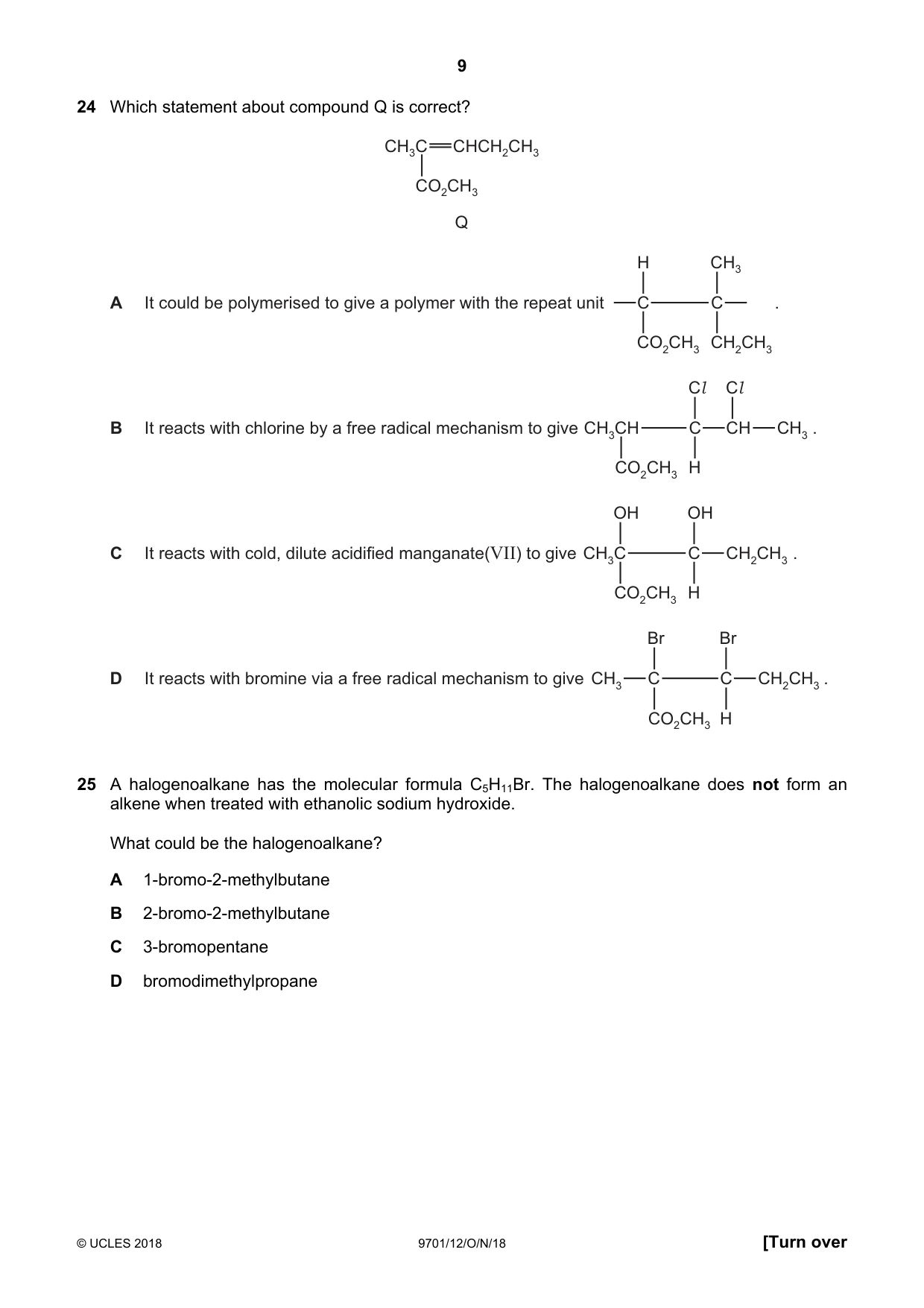
24 Which statement about compound Q is correct? CH3C CHCH2CH3 CO2CH3 Q H CH3 A It could be polymerised to give a polymer with the repeat unit C C . CO2CH3 CH2CH3 Cl Cl B It reacts with chlorine by a free radical mechanism to give CH3CH C CH CH3 . CO2CH3 H OH OH C It reacts with cold, dilute acidified manganate(VII) to give CH3C C CH2CH3 . CO2CH3 H Br Br D It reacts with bromine via a free radical mechanism to give CH3 C C CH2CH3 . CO2CH3 H
Mark scheme: C
Q25 · A halogenoalkane has the molecular formula C5H11Br
25 A halogenoalkane has the molecular formula C5H11Br. The halogenoalkane does not form an alkene when treated with ethanolic sodium hydroxide. What could be the halogenoalkane? A 1-bromo-2-methylbutane B 2-bromo-2-methylbutane C 3-bromopentane D bromodimethylpropane
Mark scheme: D
Q26 · The reactions of four organic compounds are given in the table
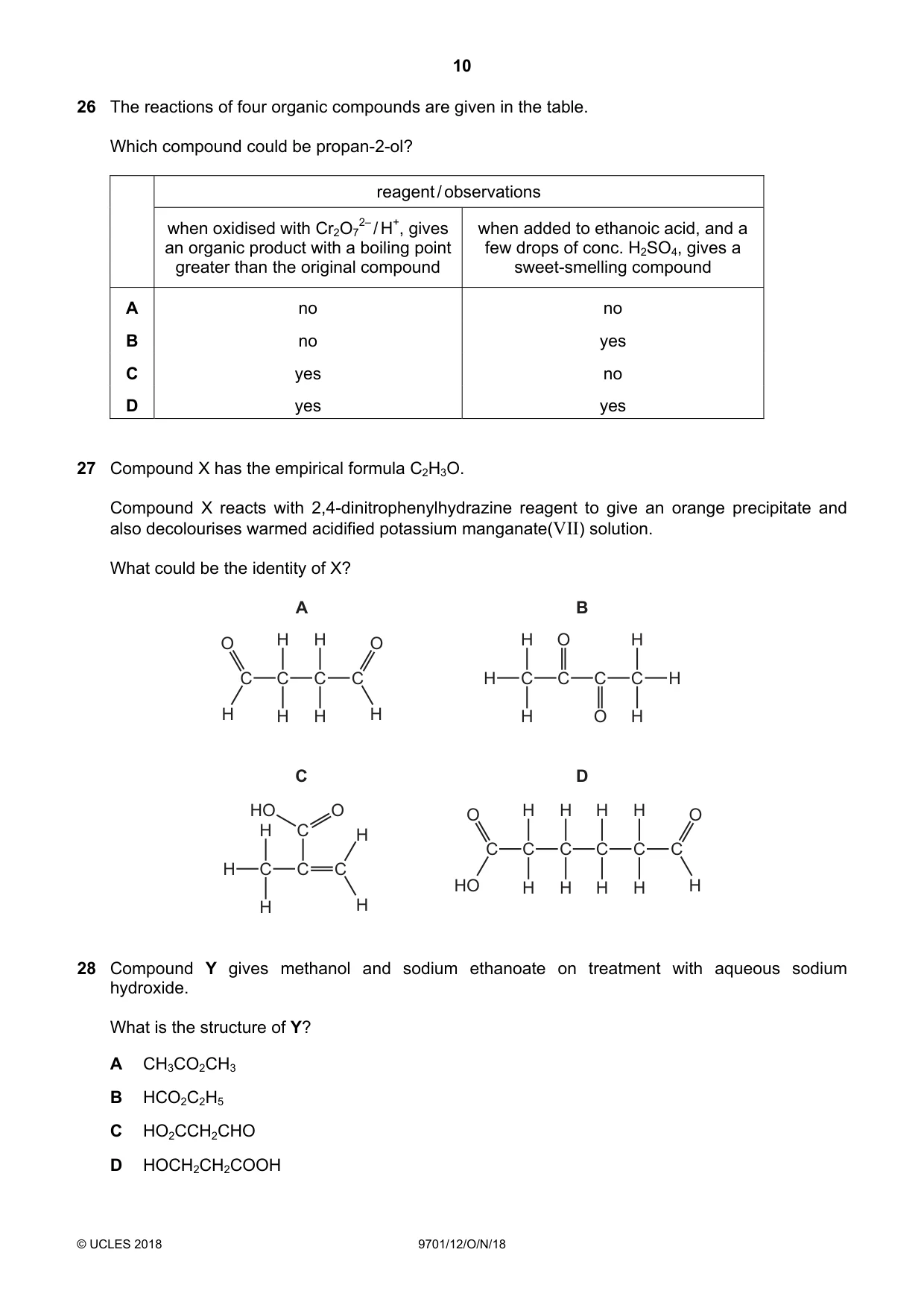
26 The reactions of four organic compounds are given in the table. Which compound could be propan-2-ol? reagent / observations when oxidised with Cr2O7 2– / H+, gives when added to ethanoic acid, and a an organic product with a boiling point few drops of conc. H2SO4, gives a greater than the original compound sweet-smelling compound A no no B no yes C yes no D yes yes
Mark scheme: B
Q27 · Compound X has the empirical formula C2H3O
27 Compound X has the empirical formula C2H3O. Compound X reacts with 2,4-dinitrophenylhydrazine reagent to give an orange precipitate and also decolourises warmed acidified potassium manganate(VII) solution. What could be the identity of X? A B O H H O H O H C C C C H C C C C H H H H H H O H C D HO O O H H H H O H C H C C C C C C H C C C HO H H H H H H H
Mark scheme: A
Q28 · Compound Y gives methanol and sodium ethanoate on treatment with aqueous sodium hydroxide
28 Compound Y gives methanol and sodium ethanoate on treatment with aqueous sodium hydroxide. What is the structure of Y? A CH3CO2CH3 B HCO2C2H5 C HO2CCH2CHO D HOCH2CH2COOH
Mark scheme: A
Q29 · Which compound can be used to make propanoic acid by treatment with a single reagent?
29 Which compound can be used to make propanoic acid by treatment with a single reagent? A CH2=CHCH2CH3 B CH3CH2CH2CN C CH3CH(OH)CN D CH3CH(OH)CH3
Mark scheme: A
Q30 · The infra-red spectrum of compound L is shown
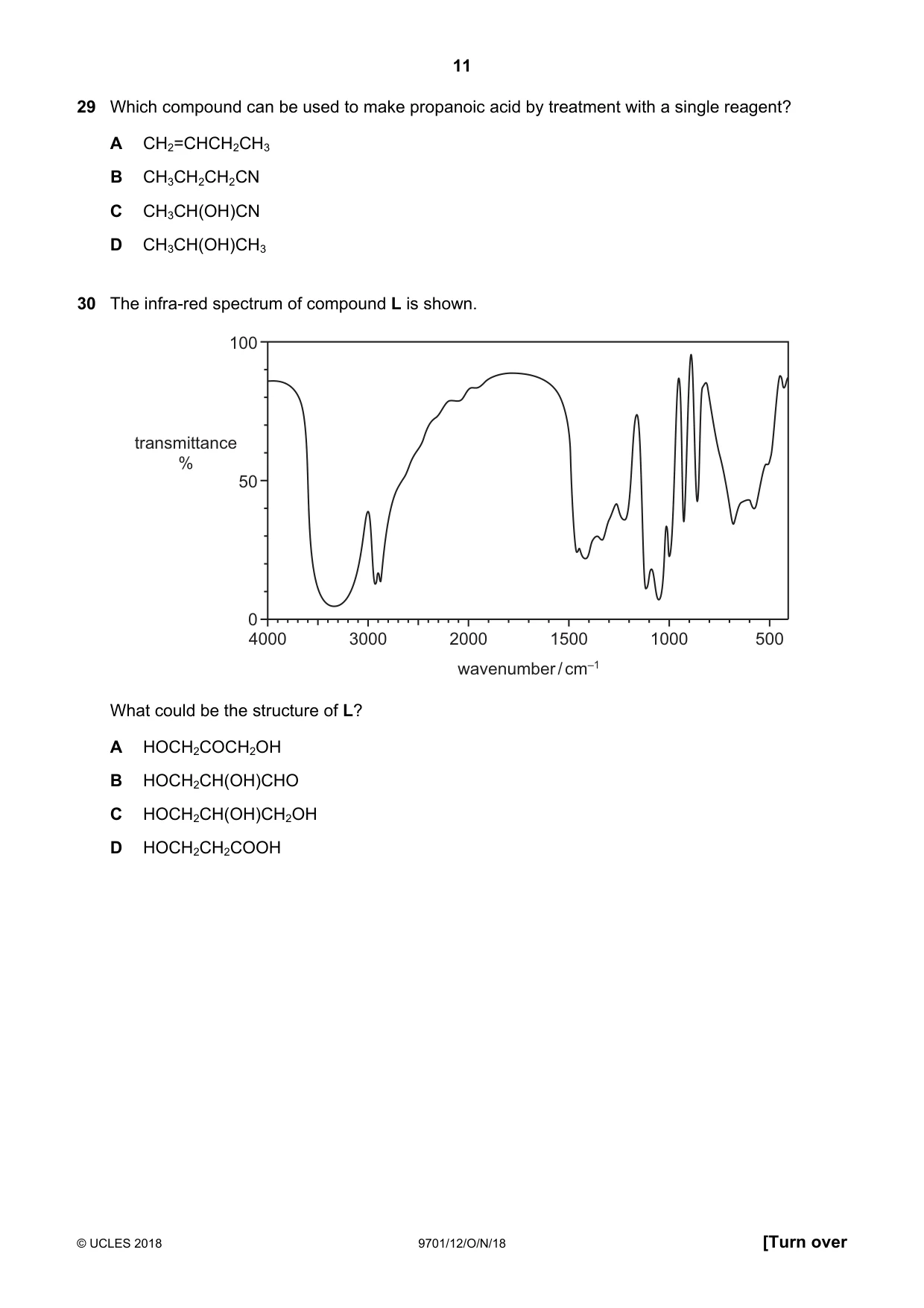
30 The infra-red spectrum of compound L is shown. 100 transmittance % 50 0 4000 3000 2000 1500 1000 500 wavenumber / cm–1 What could be the structure of L? A HOCH2COCH2OH B HOCH2CH(OH)CHO C HOCH2CH(OH)CH2OH D HOCH2CH2COOH
Mark scheme: C
Q31 · Zinc reacts with hydrochloric acid according to the following equation
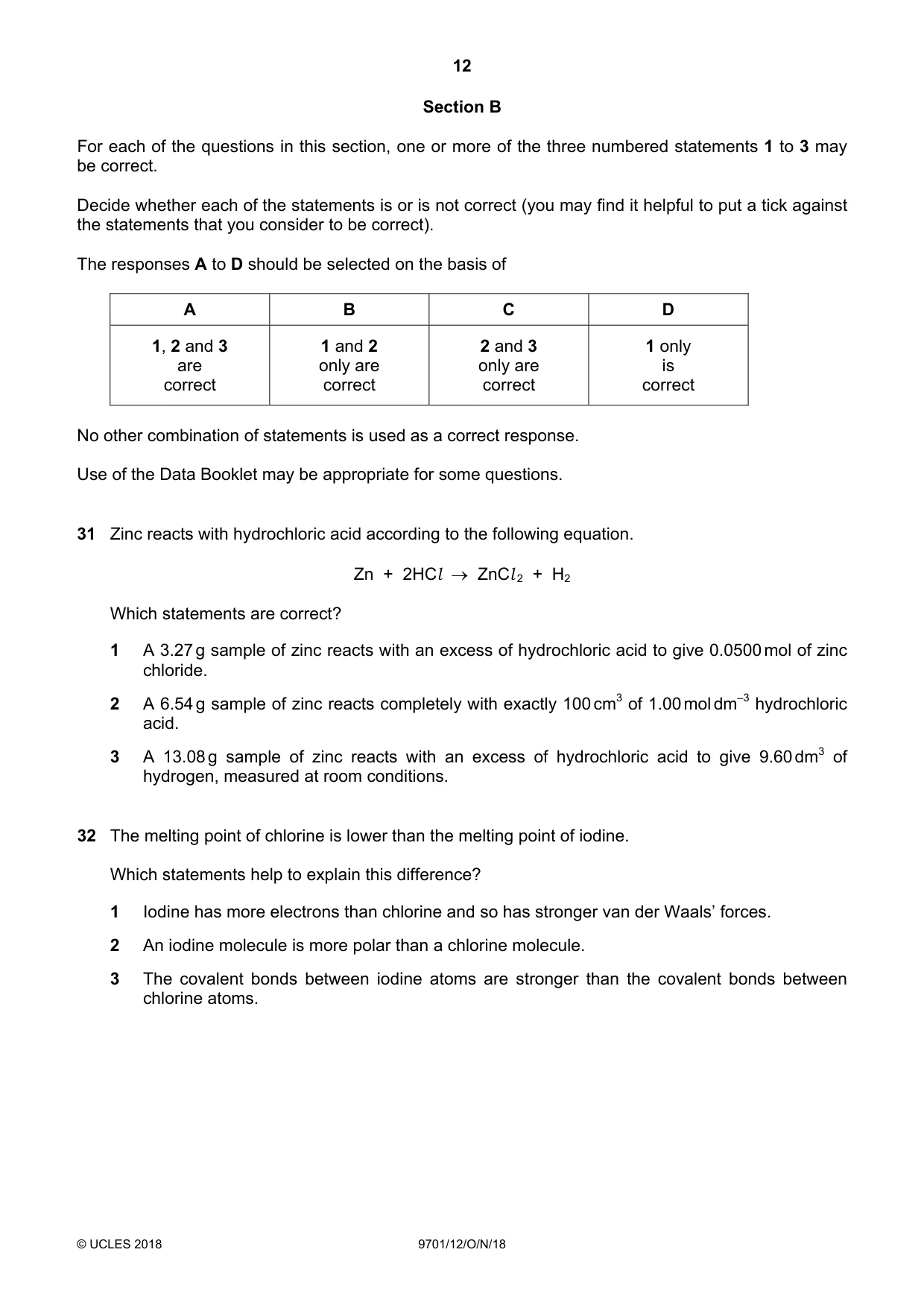
31 Zinc reacts with hydrochloric acid according to the following equation. Zn + 2HCl → ZnCl 2 + H2 Which statements are correct? 1 A 3.27 g sample of zinc reacts with an excess of hydrochloric acid to give 0.0500 mol of zinc chloride. 2 A 6.54 g sample of zinc reacts completely with exactly 100 cm3 of 1.00 mol dm–3 hydrochloric acid. 3 A 13.08 g sample of zinc reacts with an excess of hydrochloric acid to give 9.60 dm3 of hydrogen, measured at room conditions.
Mark scheme: D
More questions on Reacting masses and volumes (of solutions and gases)
Q32 · The melting point of chlorine is lower than the melting point of iodine
32 The melting point of chlorine is lower than the melting point of iodine. Which statements help to explain this difference? 1 Iodine has more electrons than chlorine and so has stronger van der Waals’ forces. 2 An iodine molecule is more polar than a chlorine molecule. 3 The covalent bonds between iodine atoms are stronger than the covalent bonds between chlorine atoms.
Mark scheme: D
More questions on Intermolecular forces, electronegativity and bond properties
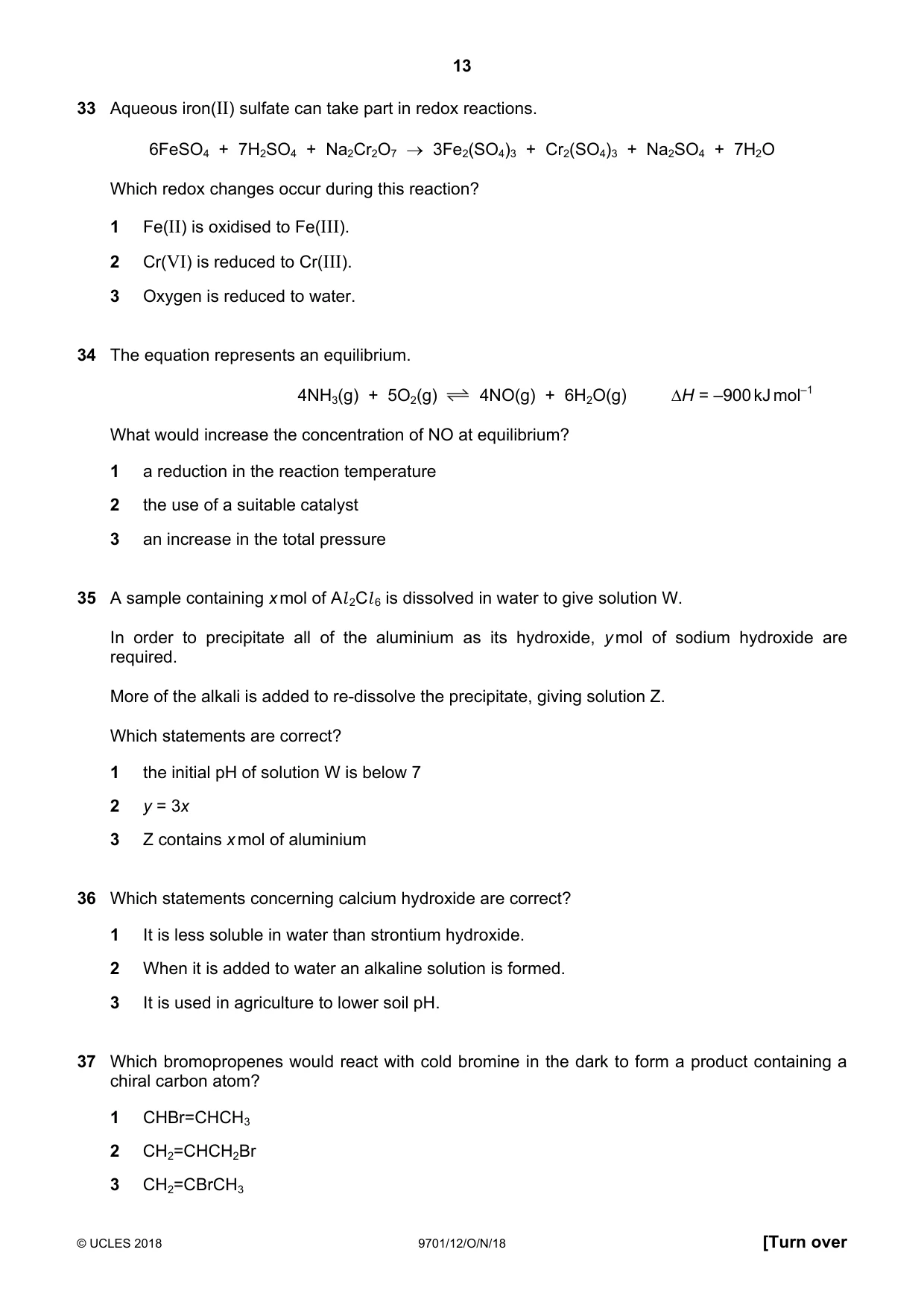
Q33 · Aqueous iron(II) sulfate can take part in redox reactions
33 Aqueous iron(II) sulfate can take part in redox reactions. 6FeSO4 + 7H2SO4 + Na2Cr2O7 → 3Fe2(SO4)3 + Cr2(SO4)3 + Na2SO4 + 7H2O Which redox changes occur during this reaction? 1 Fe(II) is oxidised to Fe(III). 2 Cr(VI) is reduced to Cr(III). 3 Oxygen is reduced to water.
Mark scheme: B
Q34 · The equation represents an equilibrium
34 The equation represents an equilibrium. 4NH3(g) + 5O2(g) 4NO(g) + 6H2O(g) ∆H = –900 kJ mol–1 What would increase the concentration of NO at equilibrium? 1 a reduction in the reaction temperature 2 the use of a suitable catalyst 3 an increase in the total pressure
Mark scheme: D
More questions on Chemical equilibria: reversible reactions, dynamic equilibrium
Q35 · A sample containing x mol of Al 2Cl 6 is dissolved in water to give solution W
35 A sample containing x mol of Al 2Cl 6 is dissolved in water to give solution W. In order to precipitate all of the aluminium as its hydroxide, y mol of sodium hydroxide are required. More of the alkali is added to re-dissolve the precipitate, giving solution Z. Which statements are correct? 1 the initial pH of solution W is below 7 2 y = 3x 3 Z contains x mol of aluminium
Mark scheme: D
More questions on Periodicity of chemical properties of the elements in Period 3
Q36 · Which statements concerning calcium hydroxide are correct?
36 Which statements concerning calcium hydroxide are correct? 1 It is less soluble in water than strontium hydroxide. 2 When it is added to water an alkaline solution is formed. 3 It is used in agriculture to lower soil pH.
Mark scheme: B
Q37 · Which bromopropenes would react with cold bromine in the dark to form a product…
37 Which bromopropenes would react with cold bromine in the dark to form a product containing a chiral carbon atom? 1 CHBr=CHCH3 2 CH2=CHCH2Br 3 CH2=CBrCH3
Mark scheme: D
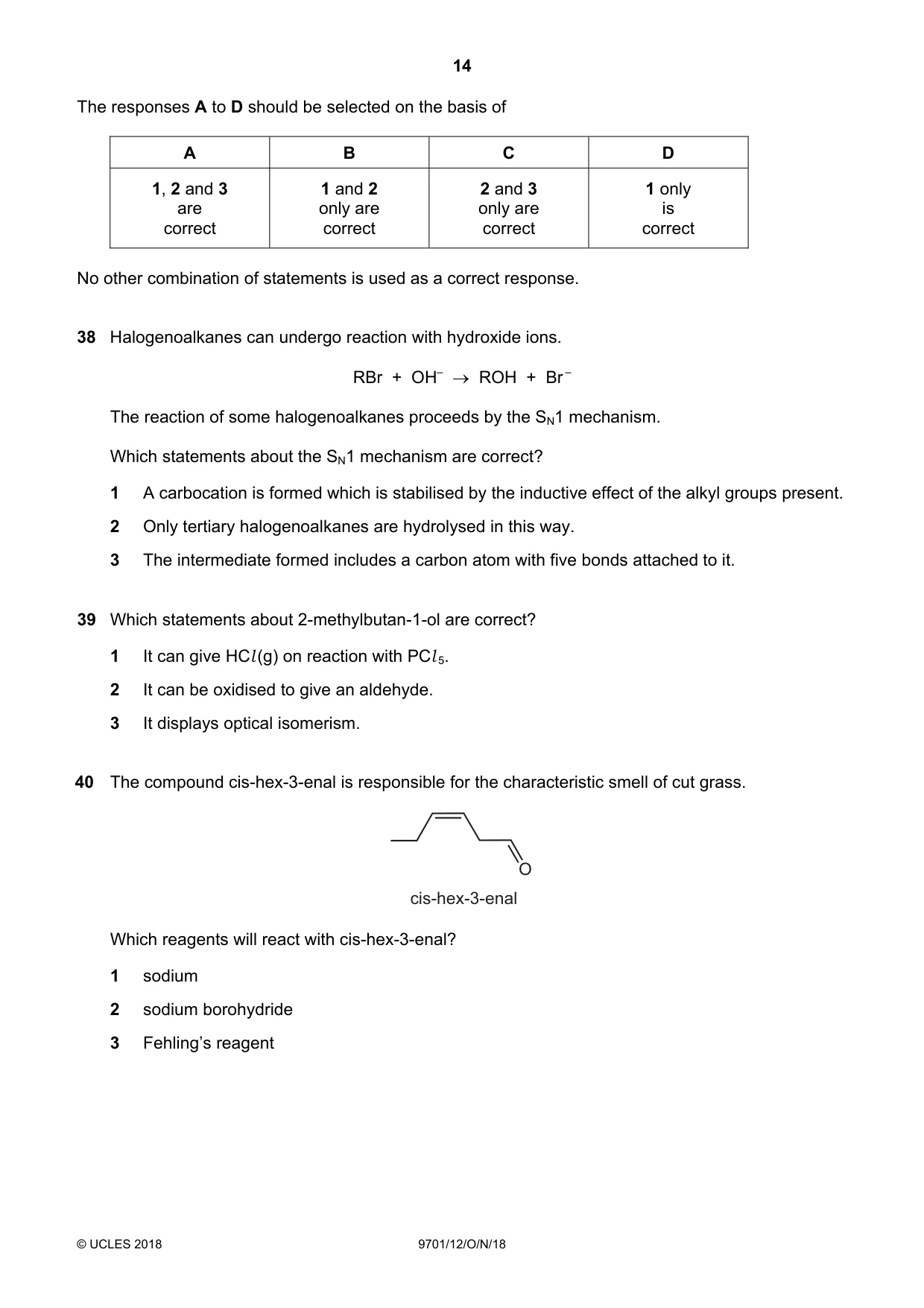
Q38 · Halogenoalkanes can undergo reaction with hydroxide ions
38 Halogenoalkanes can undergo reaction with hydroxide ions. RBr + OH– → ROH + Br – The reaction of some halogenoalkanes proceeds by the SN1 mechanism. Which statements about the SN1 mechanism are correct? 1 A carbocation is formed which is stabilised by the inductive effect of the alkyl groups present. 2 Only tertiary halogenoalkanes are hydrolysed in this way. 3 The intermediate formed includes a carbon atom with five bonds attached to it.
Mark scheme: D
Q39 · Which statements about 2-methylbutan-1-ol are correct?
39 Which statements about 2-methylbutan-1-ol are correct? 1 It can give HCl (g) on reaction with PCl 5. 2 It can be oxidised to give an aldehyde. 3 It displays optical isomerism.
Mark scheme: A
Q40 · The compound cis-hex-3-enal is responsible for the characteristic smell of cut grass
40 The compound cis-hex-3-enal is responsible for the characteristic smell of cut grass. O cis-hex-3-enal Which reagents will react with cis-hex-3-enal? 1 sodium 2 sodium borohydride 3 Fehling’s reagent
Mark scheme: C
What was in this paper
The subtopics covered by these 40 questions, and how many questions each got. Open one in a new tab to see every Cambridge question on it.
3Similarities and trends in the properties of the Group 2 metals, magnesium to barium, and their compounds3Aldehydes and ketones2Halogenoalkanes2Particles in the atom and atomic radius2Periodicity of chemical properties of the elements in Period 32Reacting masses and volumes (of solutions and gases)2Redox processes: electron transfer and changes in oxidation number (oxidation state)2Addition polymerisation1Alcohols1Alcohols1Alkenes1Effect of temperature on reaction rates and the concept of activation energy1Enthalpy change, ΔH1Esters1Formulas, functional groups and the naming of organic compounds1Halogen compounds1Hess’s law1Infrared spectroscopy1Intermolecular forces, electronegativity and bond properties1Isomerism: optical1Isomerism: structural isomerism and stereoisomerism1Nitriles and hydroxynitriles1Nitrogen and sulfur1Periodicity of physical properties of the elements in Period 31Physical properties of the Group 17 elements1Shapes of molecules1Shapes of organic molecules; σ and π bonds1The gaseous state: ideal and real gases and pV = nRT1The reactions of chlorine1What you needed in this session
Cambridge’s own grade thresholds for 2018 Oct/Nov, Paper 1 · Variant 2. A higher threshold means an easier paper — the bar moves with how the cohort did.