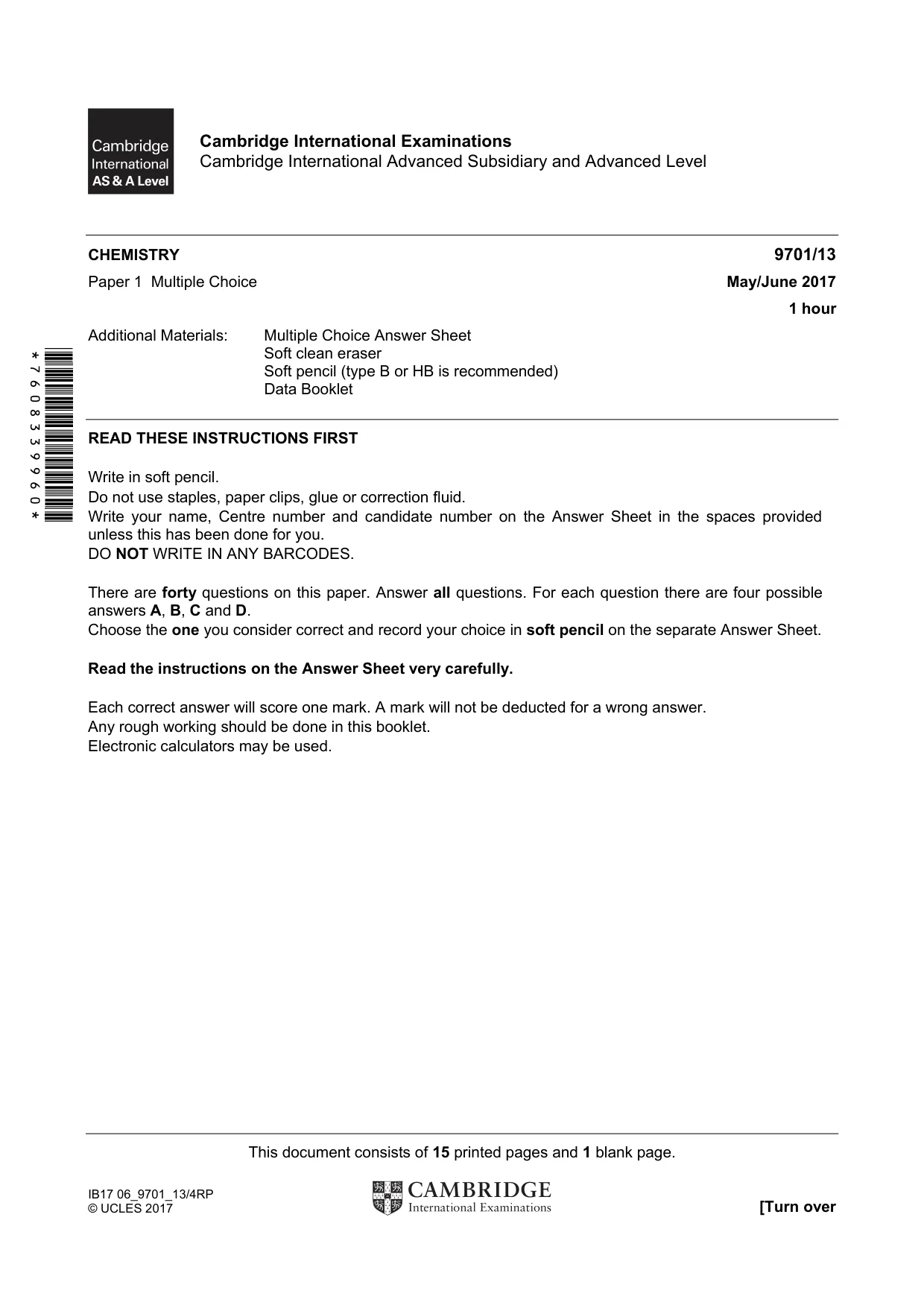
Cambridge A Level Chemistry 9701 — 2017 May/June Paper 1 · Variant 3
9701/13/M/J/17 · 40 questions · 40 marks · ≈45 min
The question paper and its mark scheme, free to read here and free to download. This is Cambridge’s own paper, exactly as it was sat.
Question paper16 pages
Mark scheme3 pages
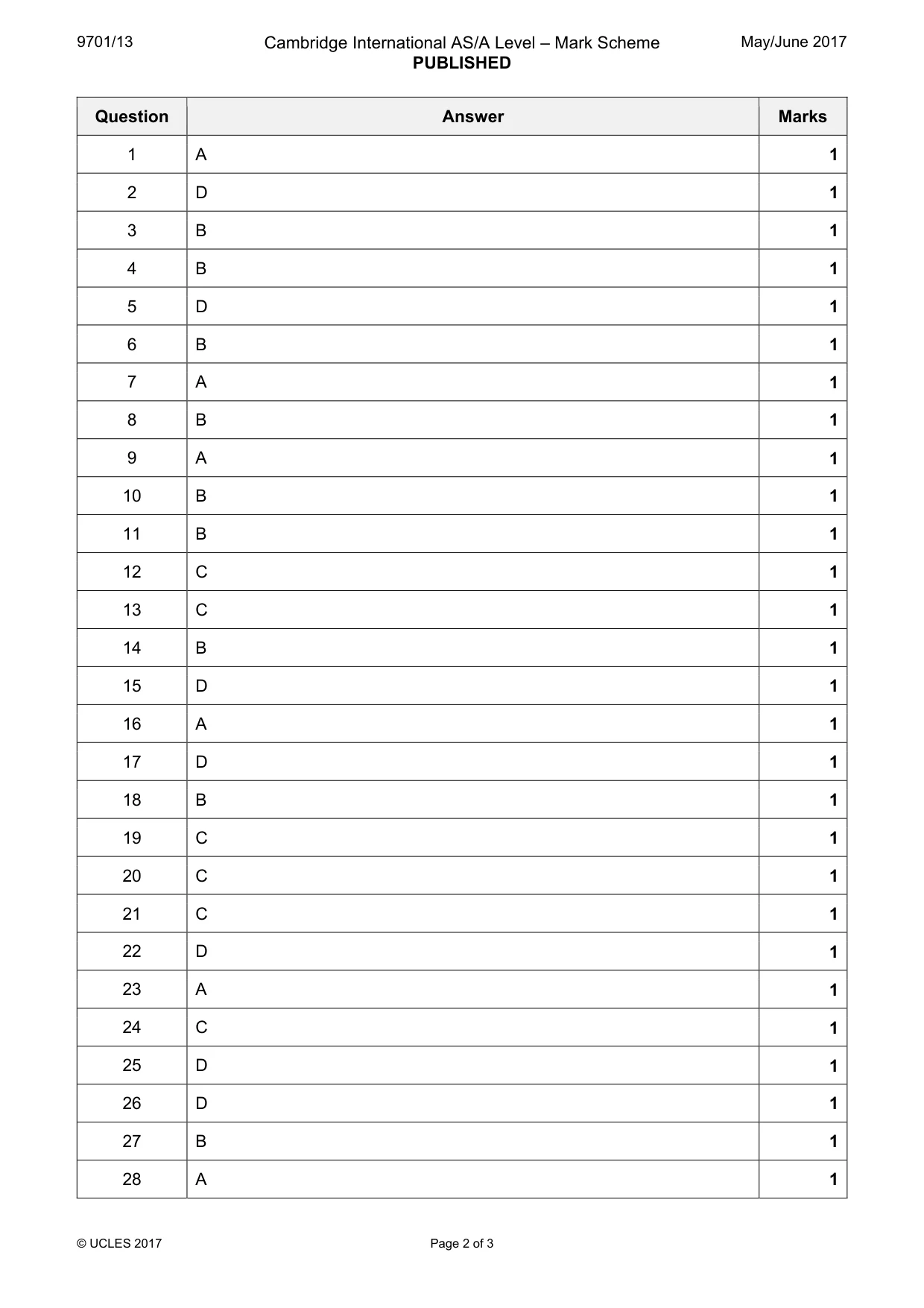
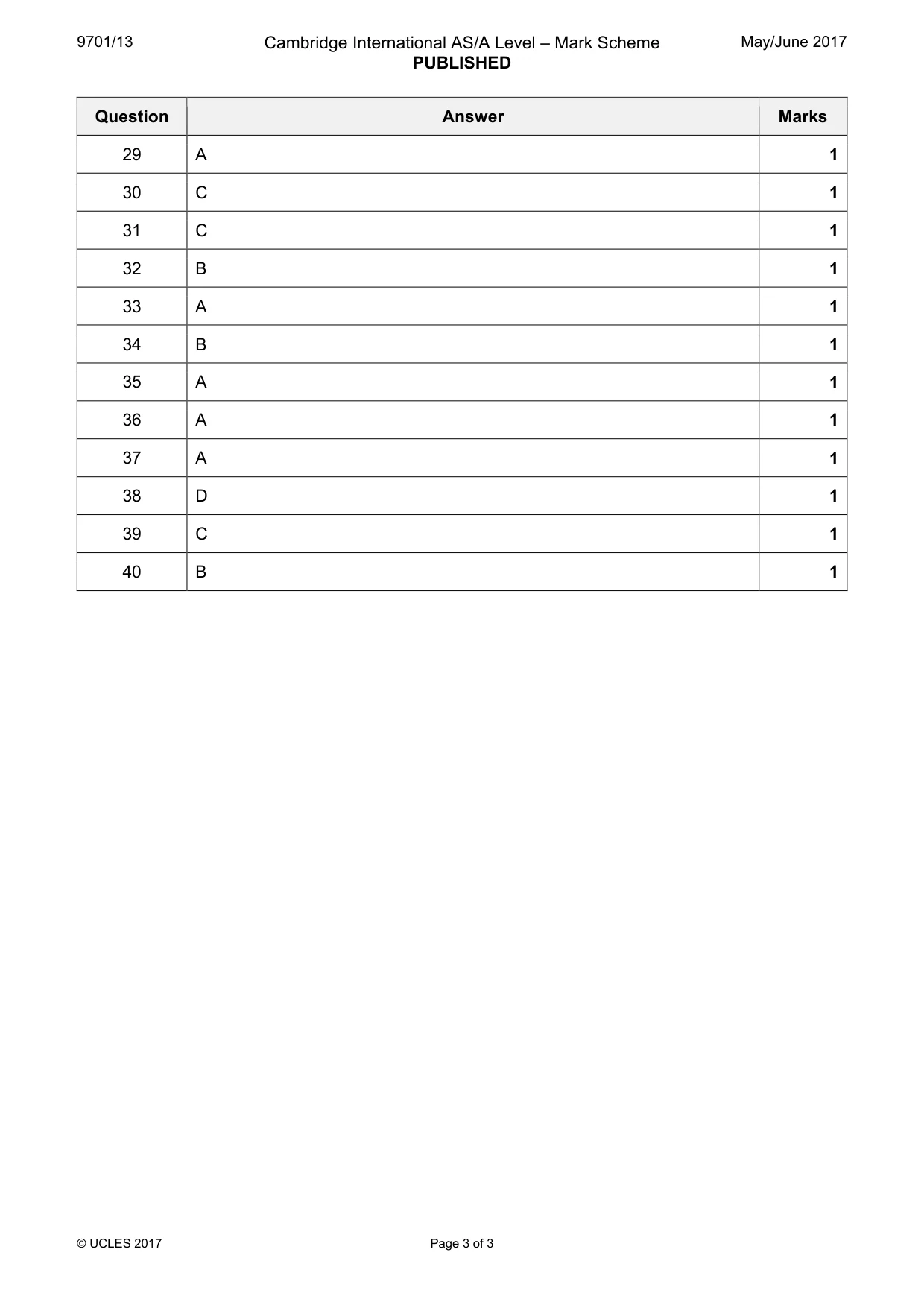
Answers below. Sit the paper first if you are practising.
Questions as text
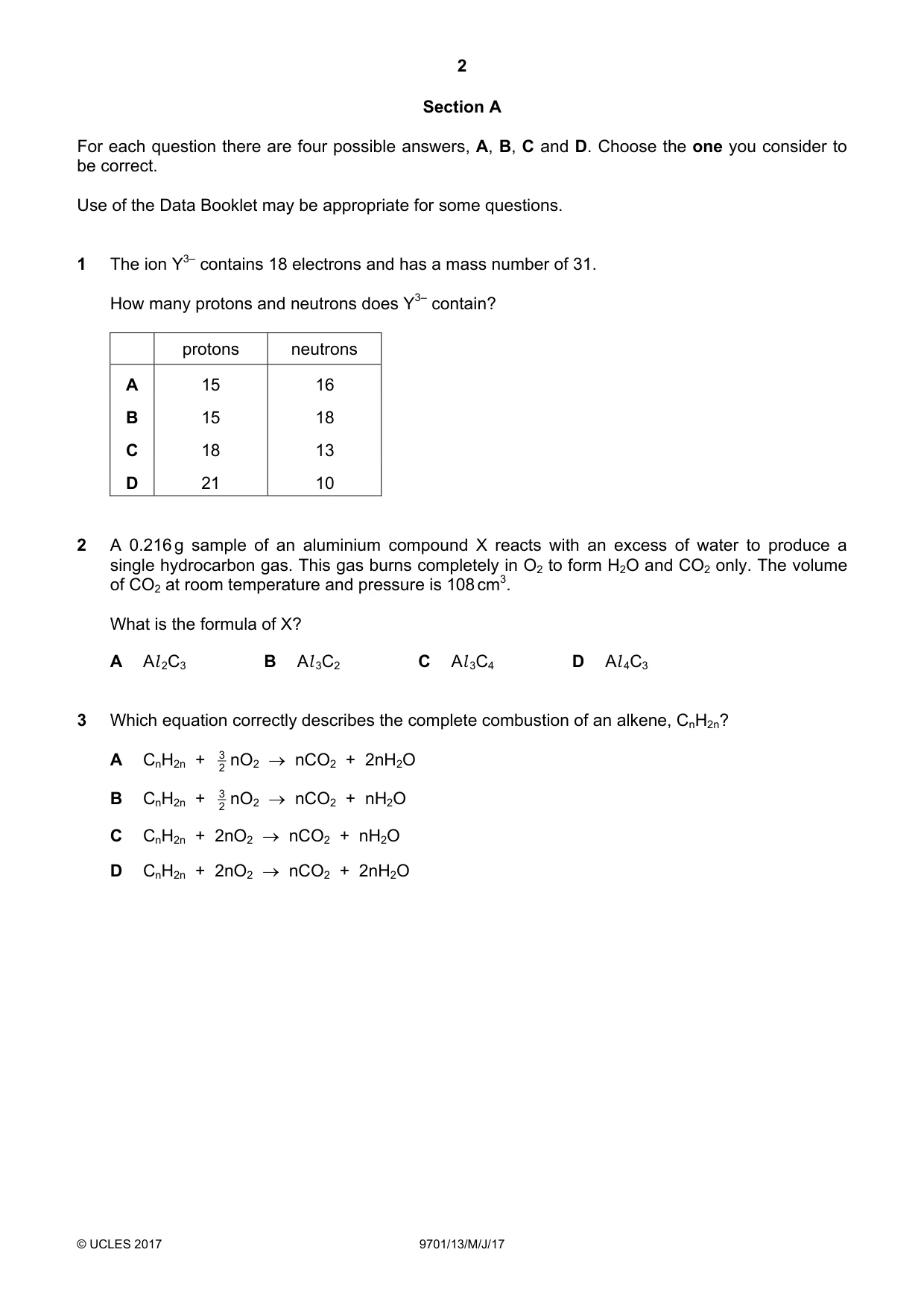
Q1 · The ion Y3– contains 18 electrons and has a mass number of 31
1 The ion Y3– contains 18 electrons and has a mass number of 31. How many protons and neutrons does Y3– contain? protons neutrons A 15 16 B 15 18 C 18 13 D 21 10
Mark scheme: A
Q2 · A 0.216 g sample of an aluminium compound X reacts with an excess of water to produce a…
2 A 0.216 g sample of an aluminium compound X reacts with an excess of water to produce a single hydrocarbon gas. This gas burns completely in O2 to form H2O and CO2 only. The volume of CO2 at room temperature and pressure is 108 cm3. What is the formula of X? A Al 2C3 B Al 3C2 C Al 3C4 D Al 4C3
Mark scheme: D
More questions on Reacting masses and volumes (of solutions and gases)
Q3 · Which equation correctly describes the complete combustion of an alkene, CnH2n?
3 Which equation correctly describes the complete combustion of an alkene, CnH2n? A CnH2n + 2 3 nO2 → nCO2 + 2nH2O B CnH2n + 2 3 nO2 → nCO2 + nH2O C CnH2n + 2nO2 → nCO2 + nH2O D CnH2n + 2nO2 → nCO2 + 2nH2O
Mark scheme: B
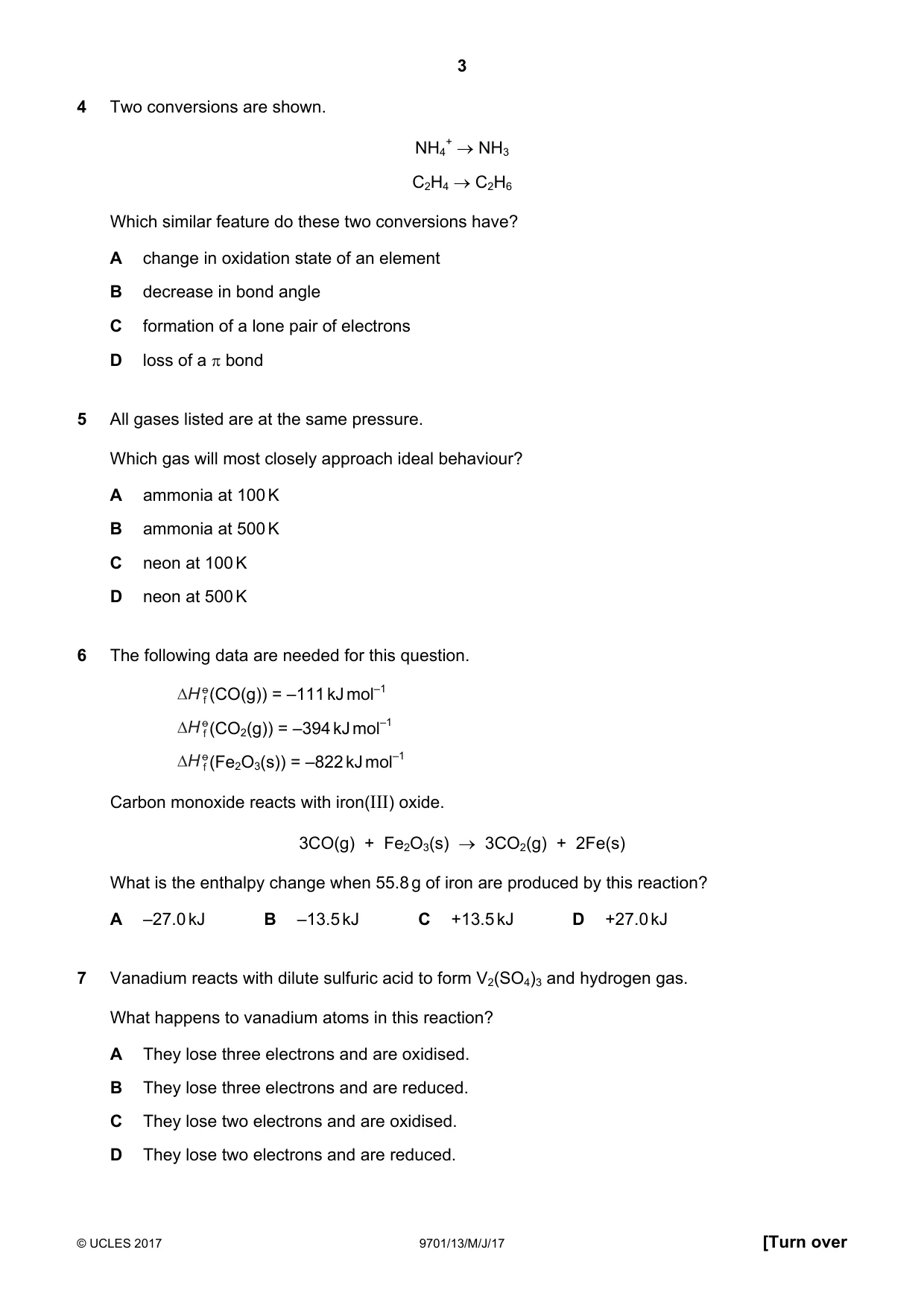
Q4 · Two conversions are shown
4 Two conversions are shown. NH4 + → NH3 C2H4 → C2H6 Which similar feature do these two conversions have? A change in oxidation state of an element B decrease in bond angle C formation of a lone pair of electrons D loss of a π bond
Mark scheme: B
Q5 · All gases listed are at the same pressure
5 All gases listed are at the same pressure. Which gas will most closely approach ideal behaviour? A ammonia at 100 K B ammonia at 500 K C neon at 100 K D neon at 500 K
Mark scheme: D
More questions on The gaseous state: ideal and real gases and pV = nRT
Q6 · The following data are needed for this question
6 The following data are needed for this question. (CO(g)) = –111 kJ mol–1 (CO2(g)) = –394 kJ mol–1 (Fe2O3(s)) = –822 kJ mol–1 Carbon monoxide reacts with iron(III) oxide. 3CO(g) + Fe2O3(s) → 3CO2(g) + 2Fe(s) What is the enthalpy change when 55.8 g of iron are produced by this reaction? A –27.0 kJ B –13.5 kJ C +13.5 kJ D +27.0 kJ
Mark scheme: B
Q7 · Vanadium reacts with dilute sulfuric acid to form V2(SO4)3 and hydrogen gas
7 Vanadium reacts with dilute sulfuric acid to form V2(SO4)3 and hydrogen gas. What happens to vanadium atoms in this reaction? A They lose three electrons and are oxidised. B They lose three electrons and are reduced. C They lose two electrons and are oxidised. D They lose two electrons and are reduced.
Mark scheme: A
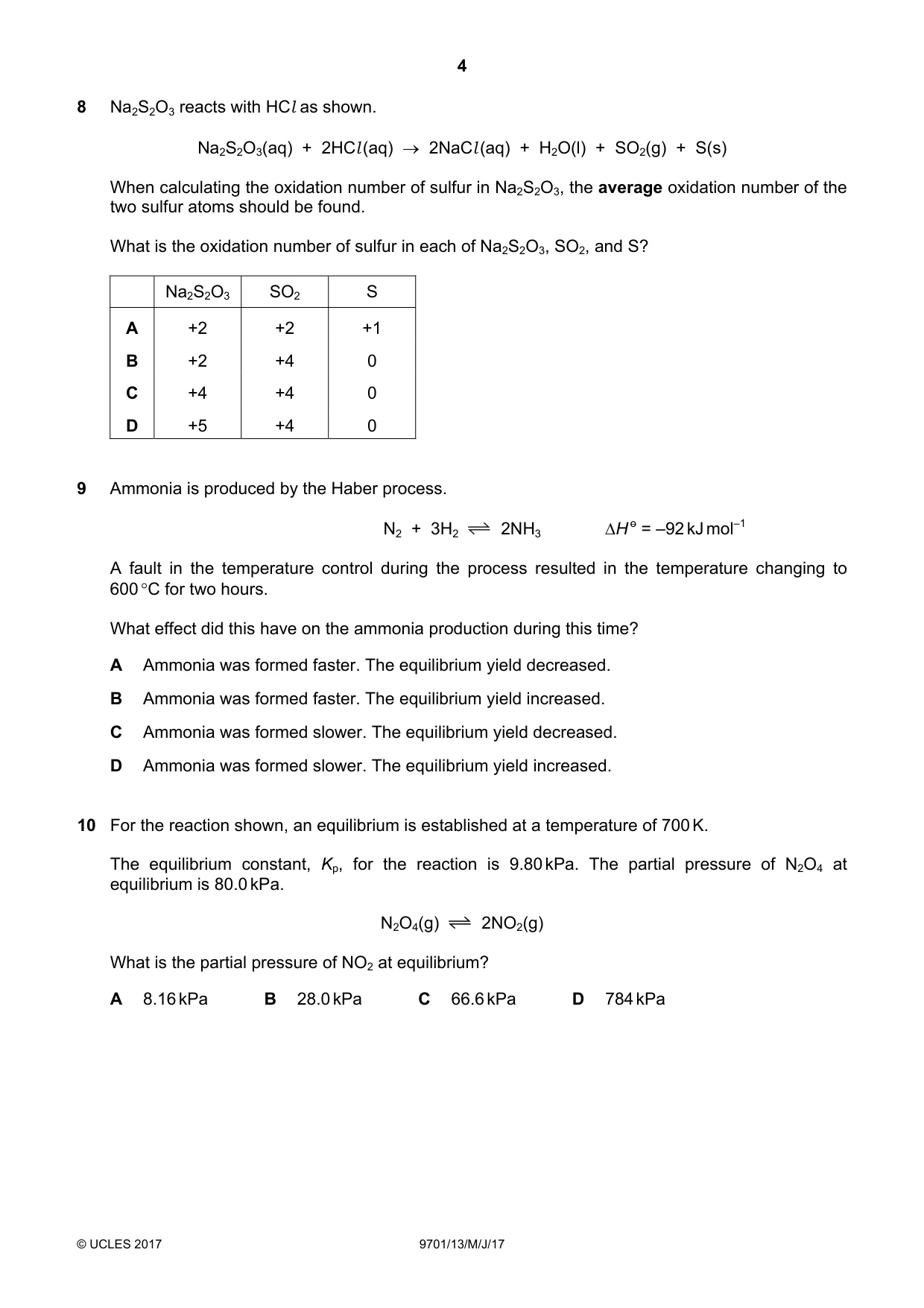
Q8 · Na2S2O3 reacts with HCl as shown
8 Na2S2O3 reacts with HCl as shown. Na2S2O3(aq) + 2HCl (aq) → 2NaCl (aq) + H2O(l) + SO2(g) + S(s) When calculating the oxidation number of sulfur in Na2S2O3, the average oxidation number of the two sulfur atoms should be found. What is the oxidation number of sulfur in each of Na2S2O3, SO2, and S? Na2S2O3 SO2 S A +2 +2 +1 B +2 +4 0 C +4 +4 0 D +5 +4 0
Mark scheme: B
Q9 · Ammonia is produced by the Haber process
9 Ammonia is produced by the Haber process. N2 + 3H2 2NH3 ∆H o = –92 kJ mol–1 A fault in the temperature control during the process resulted in the temperature changing to 600 °C for two hours. What effect did this have on the ammonia production during this time? A Ammonia was formed faster. The equilibrium yield decreased. B Ammonia was formed faster. The equilibrium yield increased. C Ammonia was formed slower. The equilibrium yield decreased. D Ammonia was formed slower. The equilibrium yield increased.
Mark scheme: A
More questions on Chemical equilibria: reversible reactions, dynamic equilibrium
Q10 · For the reaction shown, an equilibrium is established at a temperature of 700 K
10 For the reaction shown, an equilibrium is established at a temperature of 700 K. The equilibrium constant, Kp, for the reaction is 9.80 kPa. The partial pressure of N2O4 at equilibrium is 80.0 kPa. N2O4(g) 2NO2(g) What is the partial pressure of NO2 at equilibrium? A 8.16 kPa B 28.0 kPa C 66.6 kPa D 784 kPa
Mark scheme: B
More questions on Chemical equilibria: reversible reactions, dynamic equilibrium
Q11 · The diagram shows the Boltzmann distribution of the energy of gaseous molecules at a…
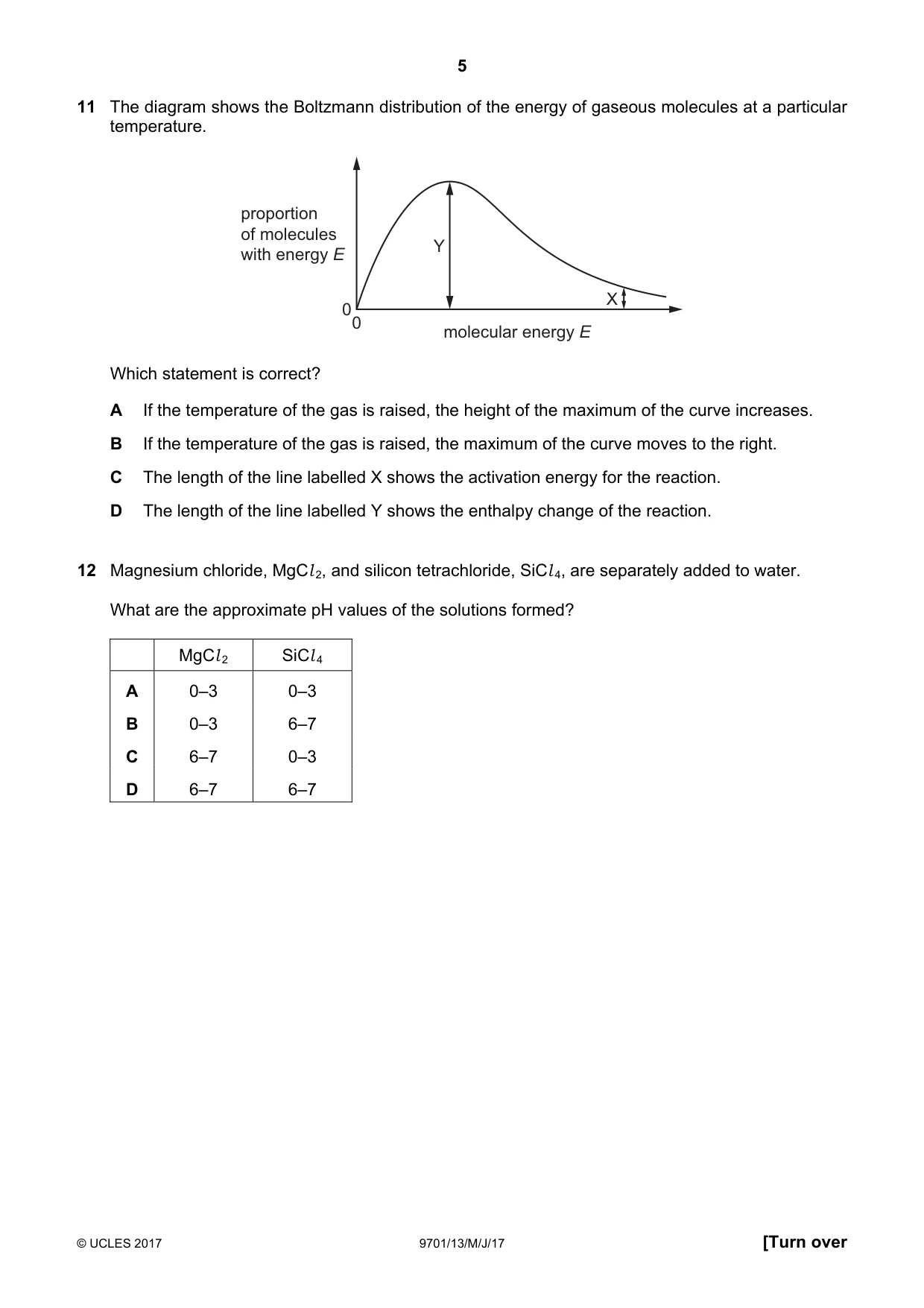
11 The diagram shows the Boltzmann distribution of the energy of gaseous molecules at a particular temperature. proportion of molecules Y with energy E X 00 molecular energy E Which statement is correct? A If the temperature of the gas is raised, the height of the maximum of the curve increases. B If the temperature of the gas is raised, the maximum of the curve moves to the right. C The length of the line labelled X shows the activation energy for the reaction. D The length of the line labelled Y shows the enthalpy change of the reaction.
Mark scheme: B
More questions on Effect of temperature on reaction rates and the concept of activation energy
Q12 · Magnesium chloride, MgCl 2, and silicon tetrachloride, SiCl 4, are separately added to…
12 Magnesium chloride, MgCl 2, and silicon tetrachloride, SiCl 4, are separately added to water. What are the approximate pH values of the solutions formed? MgCl 2 SiCl 4 A 0–3 0–3 B 0–3 6–7 C 6–7 0–3 D 6–7 6–7
Mark scheme: C
More questions on Periodicity of chemical properties of the elements in Period 3
Q13 · Which graph correctly shows the relative melting points of the elements Mg, Al, Si and P…
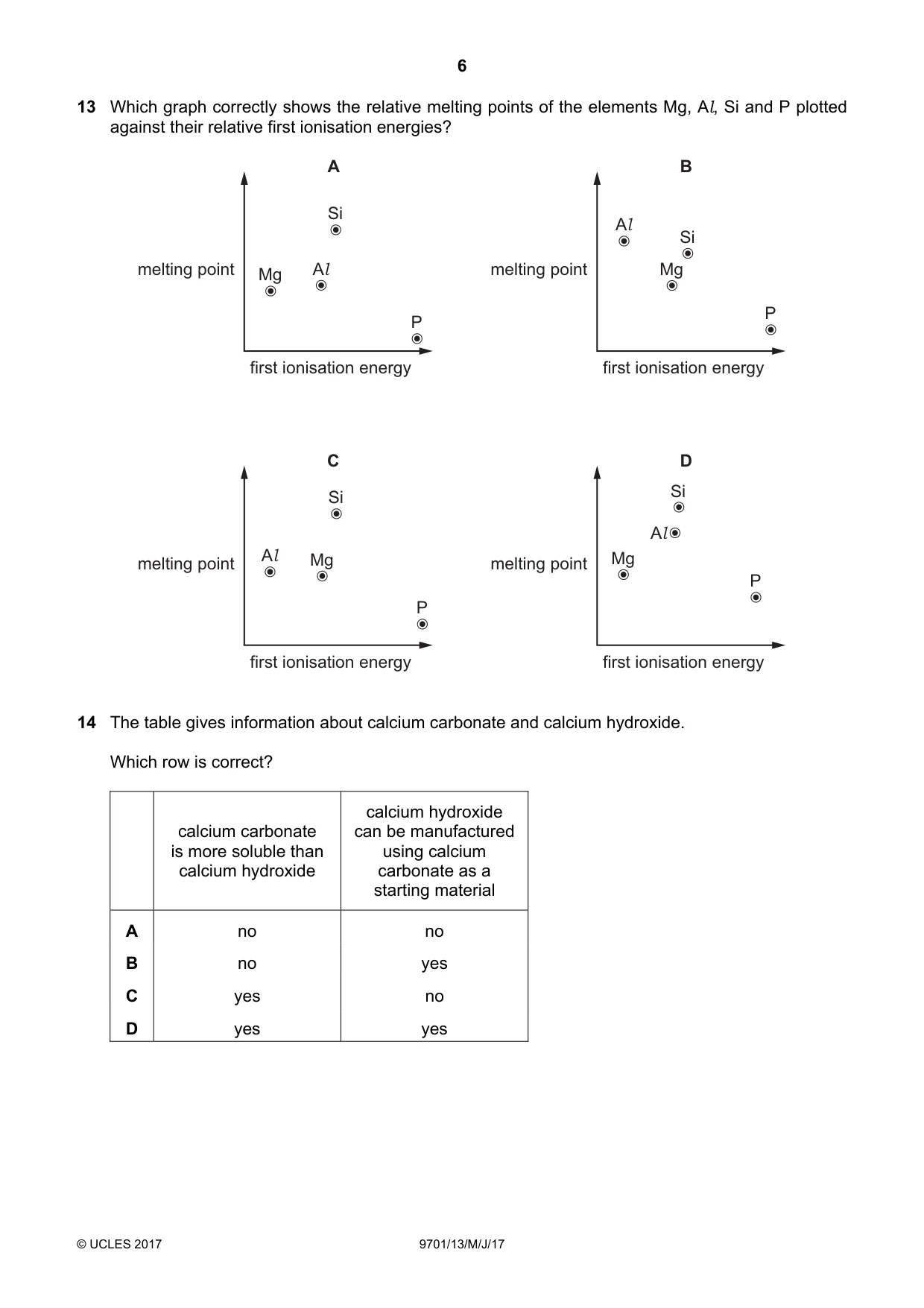
13 Which graph correctly shows the relative melting points of the elements Mg, Al, Si and P plotted against their relative first ionisation energies? A B Si Al Si melting point Mg Al melting point Mg P P first ionisation energy first ionisation energy C D Si Si Al Al Mg Mg melting point melting point P P first ionisation energy first ionisation energy
Mark scheme: C
More questions on Periodicity of physical properties of the elements in Period 3
Q14 · The table gives information about calcium carbonate and calcium hydroxide
14 The table gives information about calcium carbonate and calcium hydroxide. Which row is correct? calcium hydroxide calcium carbonate can be manufactured is more soluble than using calcium calcium hydroxide carbonate as a starting material A no no B no yes C yes no D yes yes
Mark scheme: B
Q15 · Which row correctly describes the reactions of calcium and strontium with water?
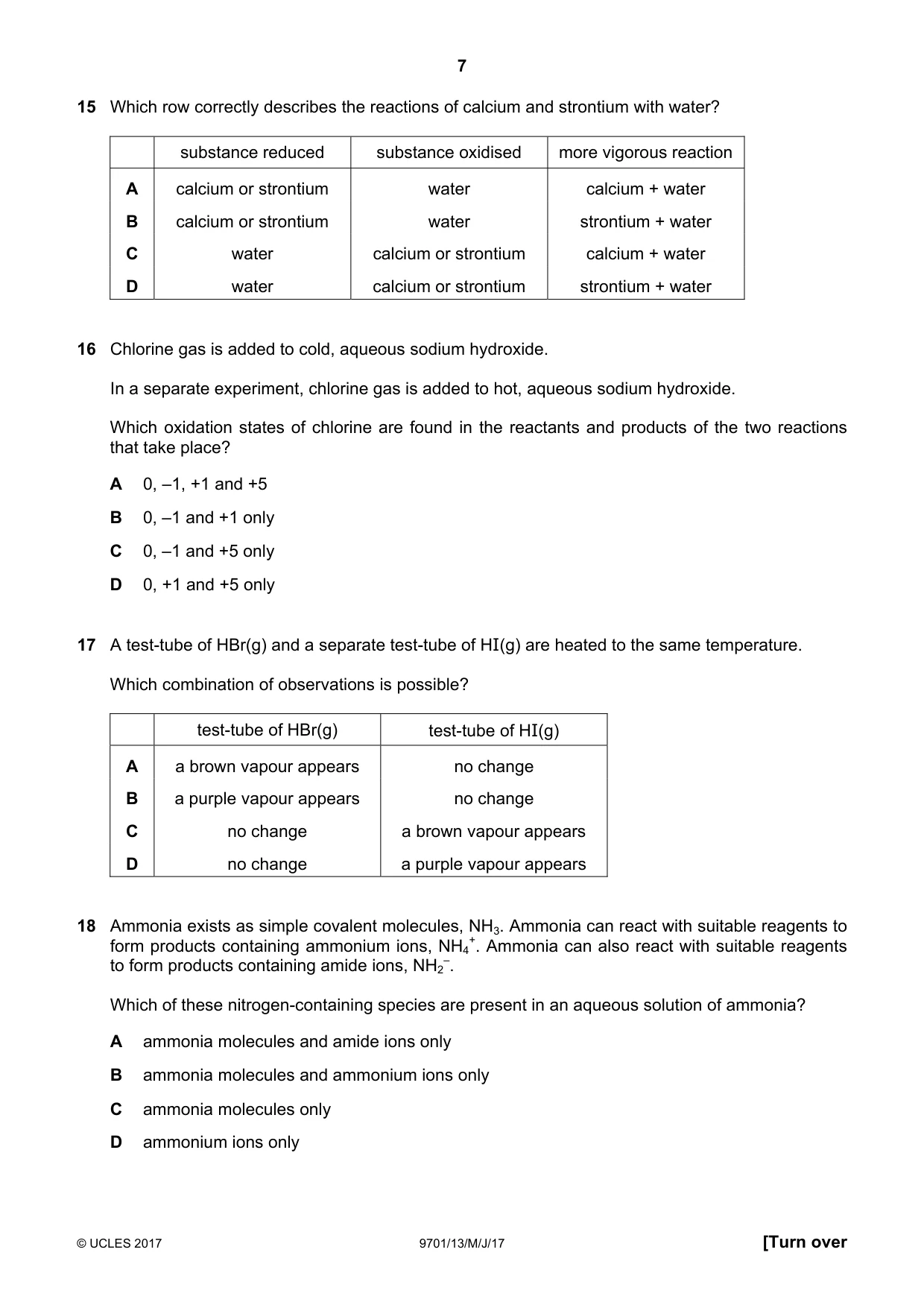
15 Which row correctly describes the reactions of calcium and strontium with water? substance reduced substance oxidised more vigorous reaction A calcium or strontium water calcium + water B calcium or strontium water strontium + water C water calcium or strontium calcium + water D water calcium or strontium strontium + water
Mark scheme: D
Q16 · Chlorine gas is added to cold, aqueous sodium hydroxide
16 Chlorine gas is added to cold, aqueous sodium hydroxide. In a separate experiment, chlorine gas is added to hot, aqueous sodium hydroxide. Which oxidation states of chlorine are found in the reactants and products of the two reactions that take place? A 0, –1, +1 and +5 B 0, –1 and +1 only C 0, –1 and +5 only D 0, +1 and +5 only
Mark scheme: A
Q17 · A test-tube of HBr(g) and a separate test-tube of HI(g) are heated to the same temperature
17 A test-tube of HBr(g) and a separate test-tube of HI(g) are heated to the same temperature. Which combination of observations is possible? test-tube of HBr(g) test-tube of HI(g) A a brown vapour appears no change B a purple vapour appears no change C no change a brown vapour appears D no change a purple vapour appears
Mark scheme: D
More questions on The chemical properties of the halogen elements and the hydrogen halides
Q18 · Ammonia exists as simple covalent molecules, NH3
18 Ammonia exists as simple covalent molecules, NH3. Ammonia can react with suitable reagents to form products containing ammonium ions, NH4 +. Ammonia can also react with suitable reagents to form products containing amide ions, NH2 –. Which of these nitrogen-containing species are present in an aqueous solution of ammonia? A ammonia molecules and amide ions only B ammonia molecules and ammonium ions only C ammonia molecules only D ammonium ions only
Mark scheme: B
Q19 · What would be produced when 60 g of nitrogen monoxide react with an excess of carbon…
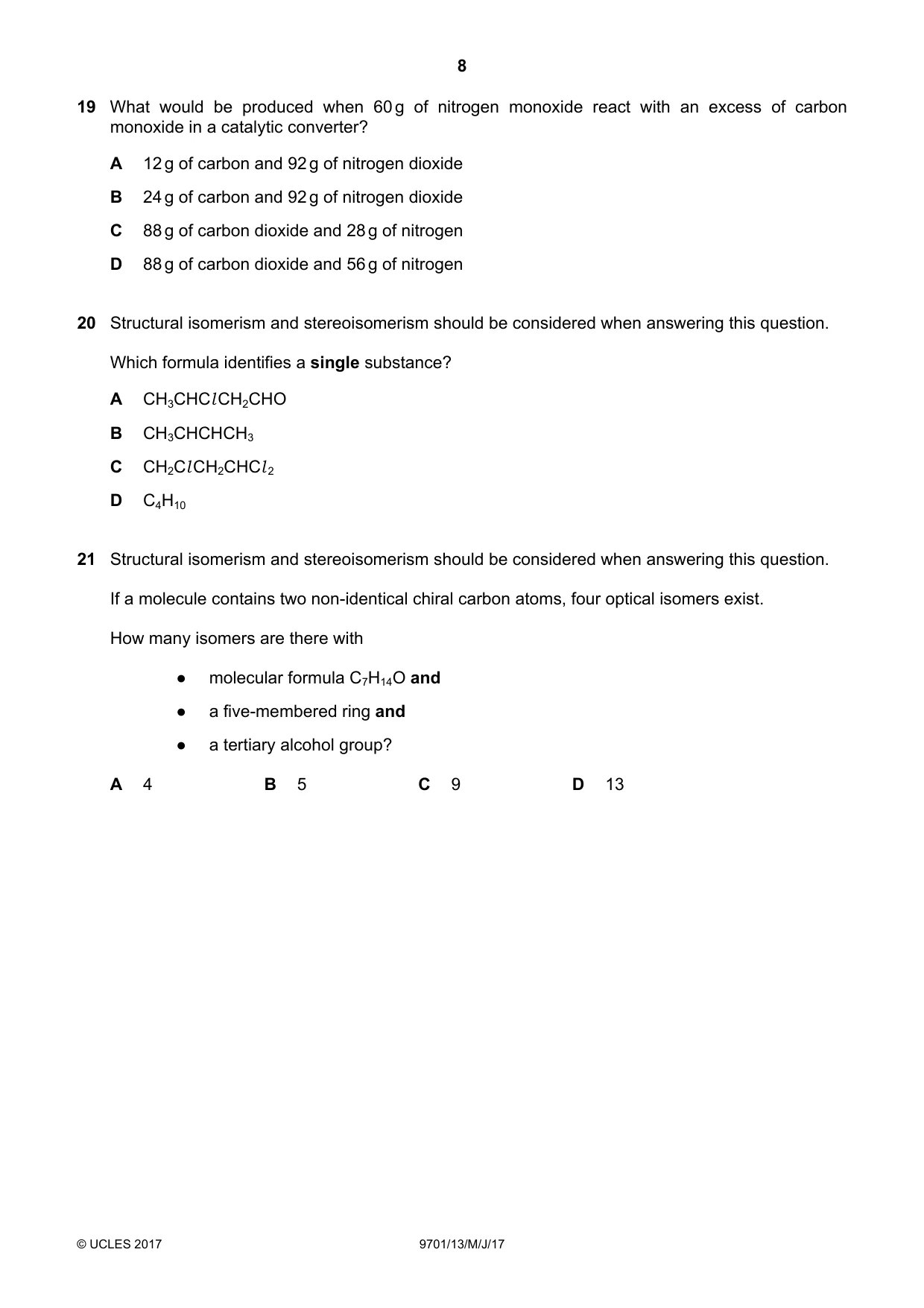
19 What would be produced when 60 g of nitrogen monoxide react with an excess of carbon monoxide in a catalytic converter? A 12 g of carbon and 92 g of nitrogen dioxide B 24 g of carbon and 92 g of nitrogen dioxide C 88 g of carbon dioxide and 28 g of nitrogen D 88 g of carbon dioxide and 56 g of nitrogen
Mark scheme: C
More questions on Reacting masses and volumes (of solutions and gases)
Q20 · Structural isomerism and stereoisomerism should be considered when answering this question
20 Structural isomerism and stereoisomerism should be considered when answering this question. Which formula identifies a single substance? A CH3CHCl CH2CHO B CH3CHCHCH3 C CH2Cl CH2CHCl 2 D C4H10
Mark scheme: C
More questions on Isomerism: structural isomerism and stereoisomerism
Q21 · Structural isomerism and stereoisomerism should be considered when answering this question
21 Structural isomerism and stereoisomerism should be considered when answering this question. If a molecule contains two non-identical chiral carbon atoms, four optical isomers exist. How many isomers are there with ● molecular formula C7H14O and ● a five-membered ring and ● a tertiary alcohol group? A 4 B 5 C 9 D 13
Mark scheme: C
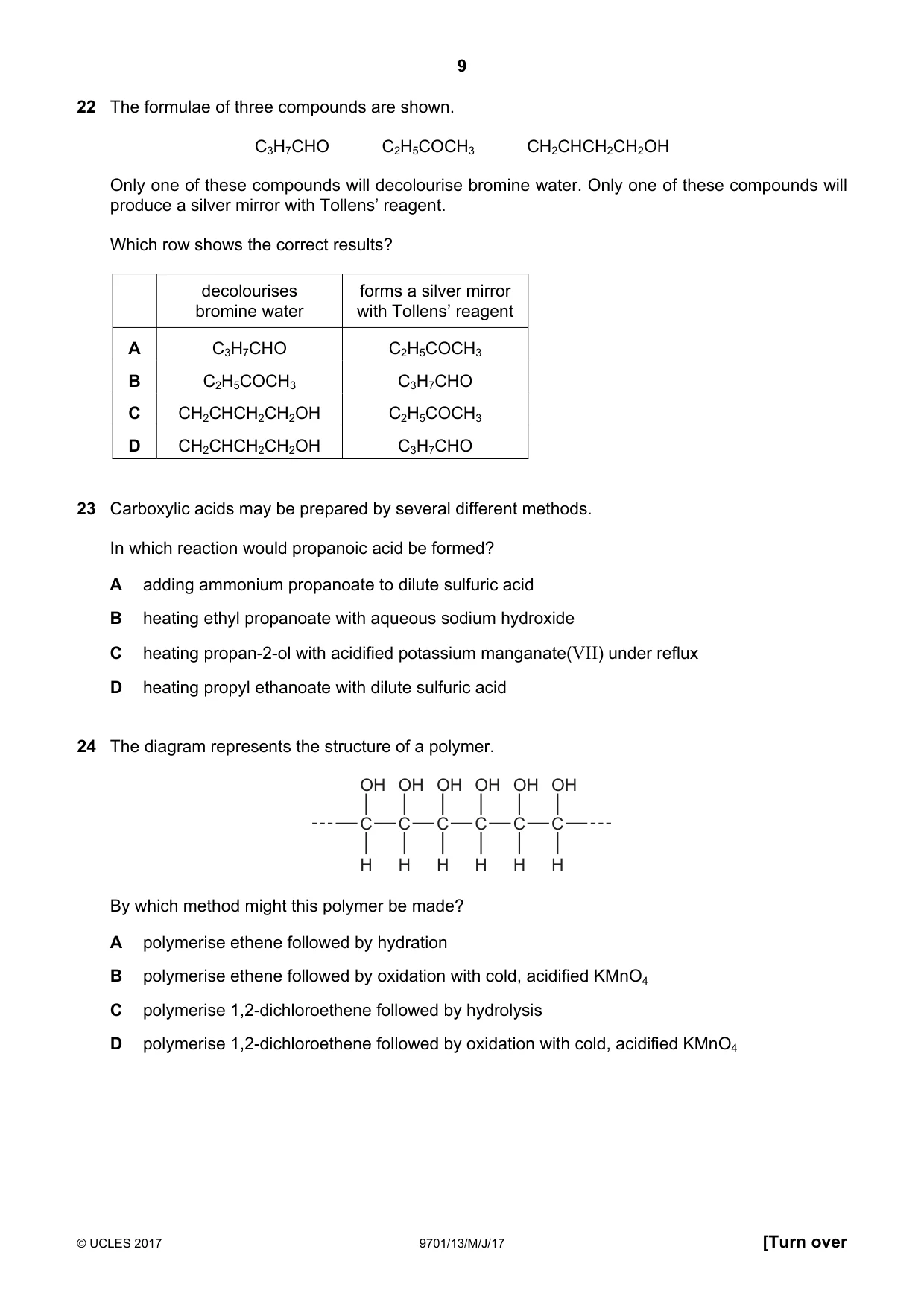
Q22 · The formulae of three compounds are shown
22 The formulae of three compounds are shown. C3H7CHO C2H5COCH3 CH2CHCH2CH2OH Only one of these compounds will decolourise bromine water. Only one of these compounds will produce a silver mirror with Tollens’ reagent. Which row shows the correct results? decolourises forms a silver mirror bromine water with Tollens’ reagent A C3H7CHO C2H5COCH3 B C2H5COCH3 C3H7CHO C CH2CHCH2CH2OH C2H5COCH3 D CH2CHCH2CH2OH C3H7CHO
Mark scheme: D
Q23 · Carboxylic acids may be prepared by several different methods
23 Carboxylic acids may be prepared by several different methods. In which reaction would propanoic acid be formed? A adding ammonium propanoate to dilute sulfuric acid B heating ethyl propanoate with aqueous sodium hydroxide C heating propan-2-ol with acidified potassium manganate(VII) under reflux D heating propyl ethanoate with dilute sulfuric acid
Mark scheme: A
Q24 · The diagram represents the structure of a polymer
24 The diagram represents the structure of a polymer. OH OH OH OH OH OH C C C C C C H H H H H H By which method might this polymer be made? A polymerise ethene followed by hydration B polymerise ethene followed by oxidation with cold, acidified KMnO4 C polymerise 1,2-dichloroethene followed by hydrolysis D polymerise 1,2-dichloroethene followed by oxidation with cold, acidified KMnO4
Mark scheme: C
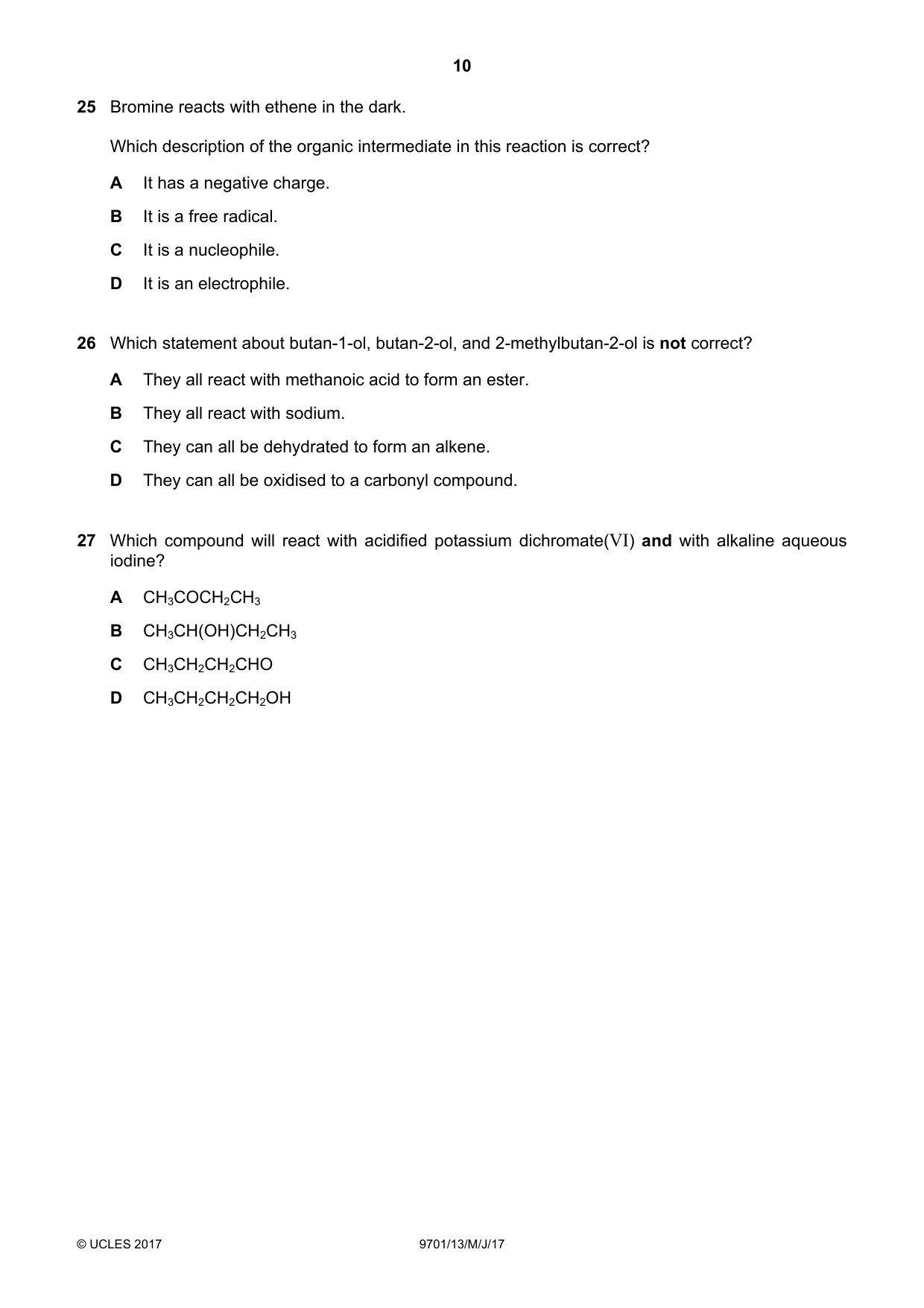
Q25 · Bromine reacts with ethene in the dark
25 Bromine reacts with ethene in the dark. Which description of the organic intermediate in this reaction is correct? A It has a negative charge. B It is a free radical. C It is a nucleophile. D It is an electrophile.
Mark scheme: D
Q26 · Which statement about butan-1-ol, butan-2-ol, and 2-methylbutan-2-ol is not correct?
26 Which statement about butan-1-ol, butan-2-ol, and 2-methylbutan-2-ol is not correct? A They all react with methanoic acid to form an ester. B They all react with sodium. C They can all be dehydrated to form an alkene. D They can all be oxidised to a carbonyl compound.
Mark scheme: D
Q27 · Which compound will react with acidified potassium dichromate(VI) and with alkaline…
27 Which compound will react with acidified potassium dichromate(VI) and with alkaline aqueous iodine? A CH3COCH2CH3 B CH3CH(OH)CH2CH3 C CH3CH2CH2CHO D CH3CH2CH2CH2OH
Mark scheme: B
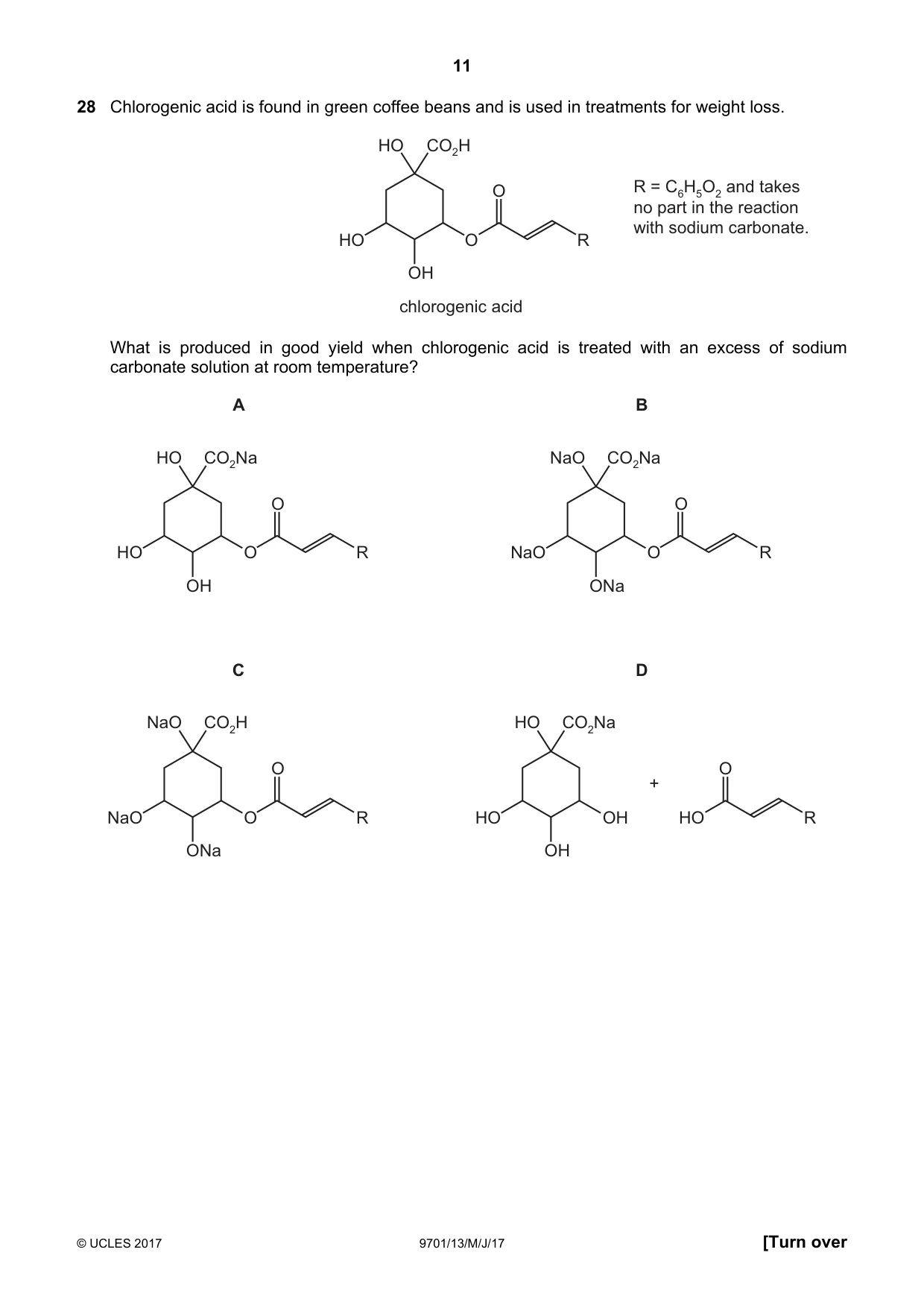
Q28 · Chlorogenic acid is found in green coffee beans and is used in treatments for weight loss
28 Chlorogenic acid is found in green coffee beans and is used in treatments for weight loss. HO CO2H O R = C6H5O2 and takes no part in the reaction with sodium carbonate. HO O R OH chlorogenic acid What is produced in good yield when chlorogenic acid is treated with an excess of sodium carbonate solution at room temperature? A B HO CO2Na NaO CO2Na O O HO O R NaO O R OH ONa C D NaO CO2H HO CO2Na O O + NaO O R HO OH HO R ONa OH
Mark scheme: A
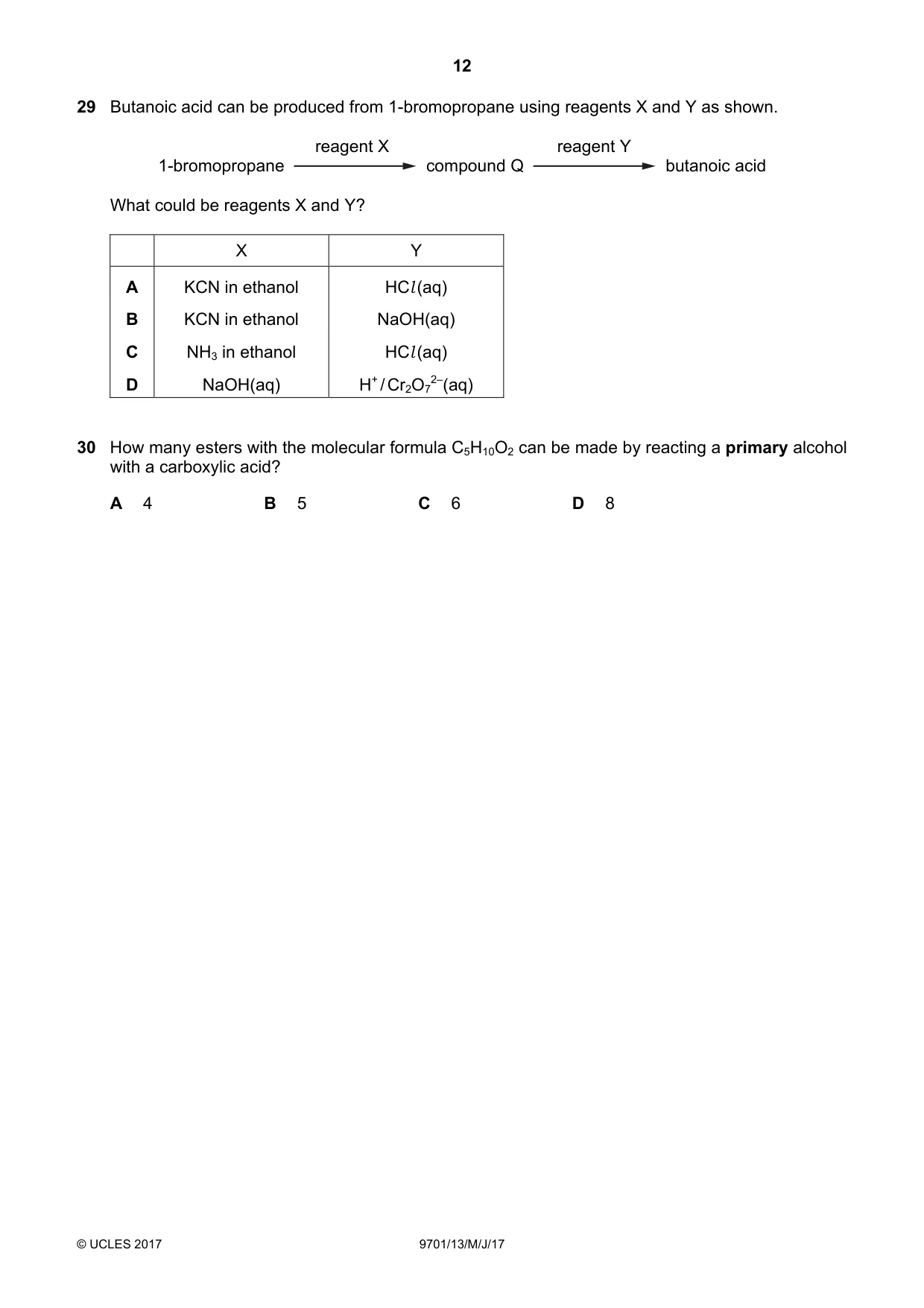
Q29 · Butanoic acid can be produced from 1-bromopropane using reagents X and Y as shown
29 Butanoic acid can be produced from 1-bromopropane using reagents X and Y as shown. reagent X reagent Y 1-bromopropane compound Q butanoic acid What could be reagents X and Y? X Y A KCN in ethanol HCl (aq) B KCN in ethanol NaOH(aq) C NH3 in ethanol HCl (aq) D NaOH(aq) H+ / Cr2O7 2–(aq)
Mark scheme: A
Q30 · How many esters with the molecular formula C5H10O2 can be made by reacting a primary…
30 How many esters with the molecular formula C5H10O2 can be made by reacting a primary alcohol with a carboxylic acid? A 4 B 5 C 6 D 8
Mark scheme: C
Q31 · Which statements about the atoms 23Na and 24Mg are correct?
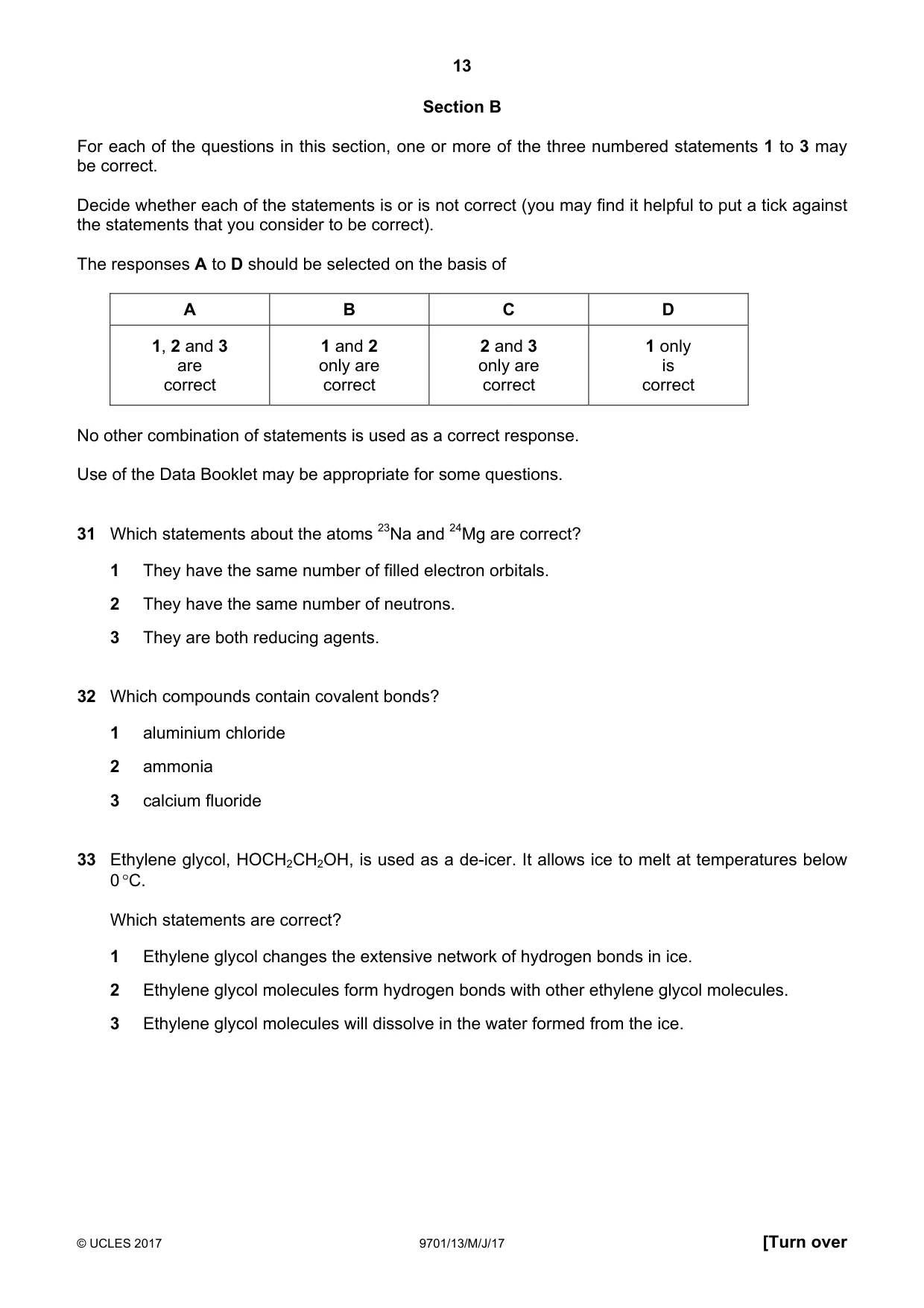
31 Which statements about the atoms 23Na and 24Mg are correct? 1 They have the same number of filled electron orbitals. 2 They have the same number of neutrons. 3 They are both reducing agents.
Mark scheme: C
More questions on Electrons, energy levels and atomic orbitals
Q32 · Which compounds contain covalent bonds?
32 Which compounds contain covalent bonds? 1 aluminium chloride 2 ammonia 3 calcium fluoride
Mark scheme: B
More questions on Covalent bonding and coordinate (dative covalent) bonding
Q33 · Ethylene glycol, HOCH2CH2OH, is used as a de-icer
33 Ethylene glycol, HOCH2CH2OH, is used as a de-icer. It allows ice to melt at temperatures below 0 °C. Which statements are correct? 1 Ethylene glycol changes the extensive network of hydrogen bonds in ice. 2 Ethylene glycol molecules form hydrogen bonds with other ethylene glycol molecules. 3 Ethylene glycol molecules will dissolve in the water formed from the ice.
Mark scheme: A
More questions on Intermolecular forces, electronegativity and bond properties
Q34 · A student carried out two experiments using MnO2 as a catalyst to decompose hydrogen…
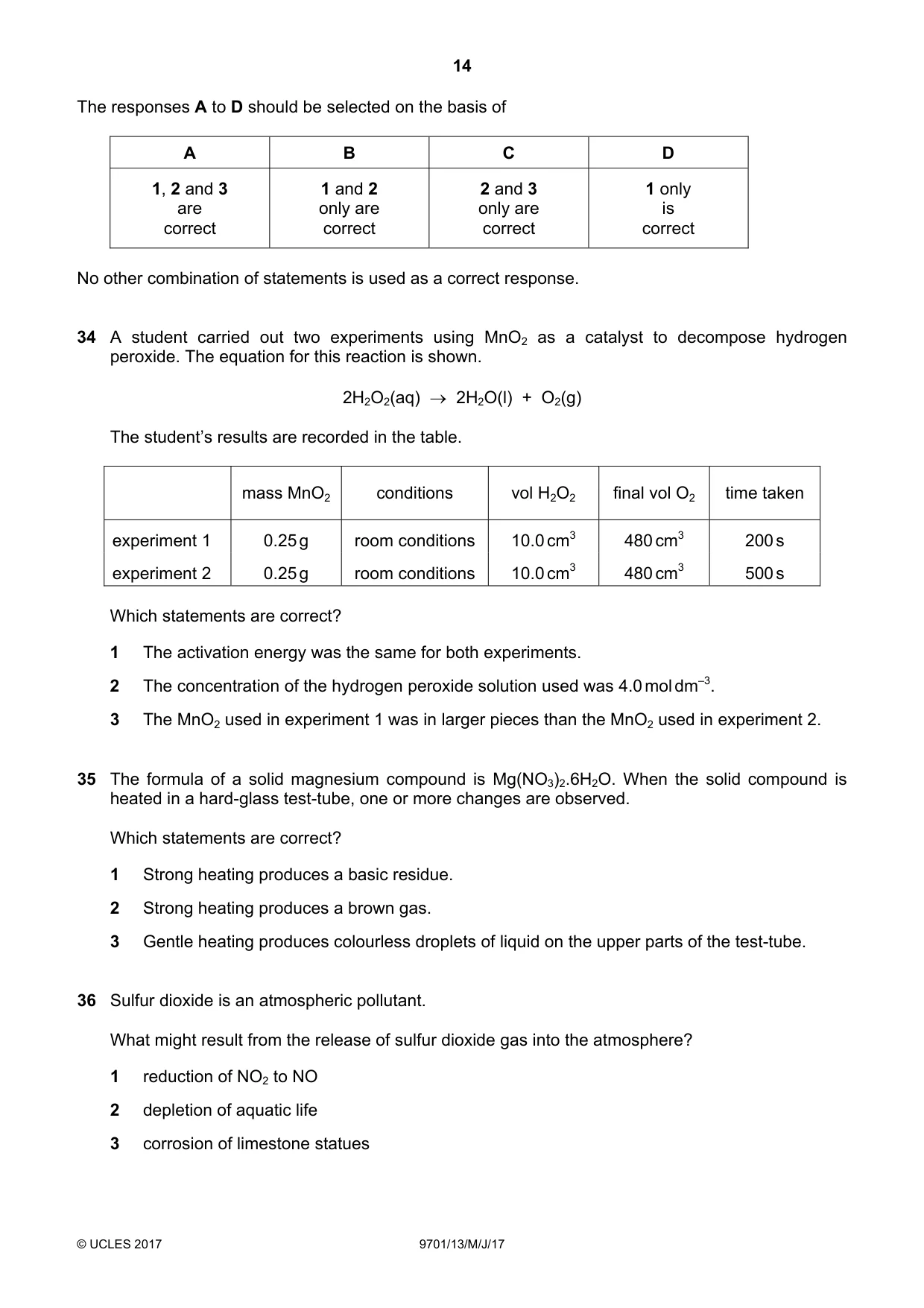
34 A student carried out two experiments using MnO2 as a catalyst to decompose hydrogen peroxide. The equation for this reaction is shown. 2H2O2(aq) → 2H2O(l) + O2(g) The student’s results are recorded in the table. mass MnO2 conditions vol H2O2 final vol O2 time taken experiment 1 0.25 g room conditions 10.0 cm3 480 cm3 200 s experiment 2 0.25 g room conditions 10.0 cm3 480 cm3 500 s Which statements are correct? 1 The activation energy was the same for both experiments. 2 The concentration of the hydrogen peroxide solution used was 4.0 mol dm–3. 3 The MnO2 used in experiment 1 was in larger pieces than the MnO2 used in experiment 2.
Mark scheme: B
Q35 · The formula of a solid magnesium compound is Mg(NO3)2.6H2O
35 The formula of a solid magnesium compound is Mg(NO3)2.6H2O. When the solid compound is heated in a hard-glass test-tube, one or more changes are observed. Which statements are correct? 1 Strong heating produces a basic residue. 2 Strong heating produces a brown gas. 3 Gentle heating produces colourless droplets of liquid on the upper parts of the test-tube.
Mark scheme: A
Q36 · Sulfur dioxide is an atmospheric pollutant
36 Sulfur dioxide is an atmospheric pollutant. What might result from the release of sulfur dioxide gas into the atmosphere? 1 reduction of NO2 to NO 2 depletion of aquatic life 3 corrosion of limestone statues
Mark scheme: A
Q37 · Which mechanisms are represented in this sequence of reactions?
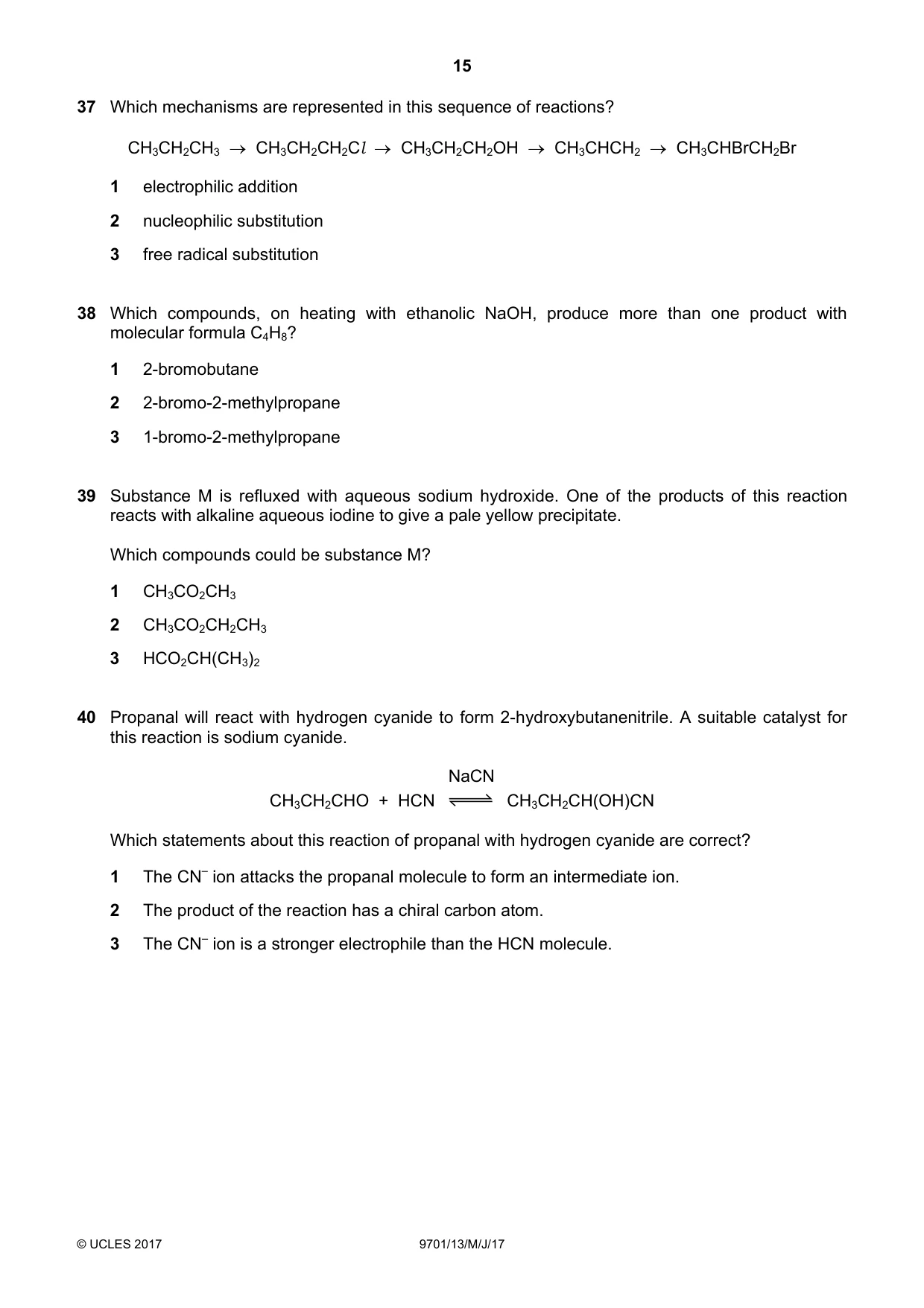
37 Which mechanisms are represented in this sequence of reactions? CH3CH2CH3 → CH3CH2CH2Cl → CH3CH2CH2OH → CH3CHCH2 → CH3CHBrCH2Br 1 electrophilic addition 2 nucleophilic substitution 3 free radical substitution
Mark scheme: A
Q38 · Which compounds, on heating with ethanolic NaOH, produce more than one product with…
38 Which compounds, on heating with ethanolic NaOH, produce more than one product with molecular formula C4H8? 1 2-bromobutane 2 2-bromo-2-methylpropane 3 1-bromo-2-methylpropane
Mark scheme: D
Q39 · Substance M is refluxed with aqueous sodium hydroxide
39 Substance M is refluxed with aqueous sodium hydroxide. One of the products of this reaction reacts with alkaline aqueous iodine to give a pale yellow precipitate. Which compounds could be substance M? 1 CH3CO2CH3 2 CH3CO2CH2CH3 3 HCO2CH(CH3)2
Mark scheme: C
Q40 · Propanal will react with hydrogen cyanide to form 2-hydroxybutanenitrile
40 Propanal will react with hydrogen cyanide to form 2-hydroxybutanenitrile. A suitable catalyst for this reaction is sodium cyanide. NaCN CH3CH2CHO + HCN CH3CH2CH(OH)CN Which statements about this reaction of propanal with hydrogen cyanide are correct? 1 The CN– ion attacks the propanal molecule to form an intermediate ion. 2 The product of the reaction has a chiral carbon atom. 3 The CN– ion is a stronger electrophile than the HCN molecule.
Mark scheme: B
What was in this paper
The subtopics covered by these 40 questions, and how many questions each got. Open one in a new tab to see every Cambridge question on it.
2Chemical equilibria: reversible reactions, dynamic equilibrium2Esters2Reacting masses and volumes (of solutions and gases)2Redox processes: electron transfer and changes in oxidation number (oxidation state)2Similarities and trends in the properties of the Group 2 metals, magnesium to barium, and their compounds2Alcohols1Alcohols1Aldehydes and ketones1Brønsted–Lowry theory of acids and bases1Carboxylic acids1Carboxylic acids1Condensation polymerisation1Covalent bonding and coordinate (dative covalent) bonding1Effect of temperature on reaction rates and the concept of activation energy1Electrons, energy levels and atomic orbitals1Halogen compounds1Hess’s law1Intermolecular forces, electronegativity and bond properties1Isomerism: optical1Isomerism: structural isomerism and stereoisomerism1Nitriles and hydroxynitriles1Nitrogen and sulfur1Organic synthesis1Particles in the atom and atomic radius1Periodicity of chemical properties of the elements in Period 31Periodicity of physical properties of the elements in Period 31Rate of reaction1Shapes of molecules1Similarities and trends in the properties of the Group 2 metals, magnesium to barium, and their compounds1The chemical properties of the halogen elements and the hydrogen halides1The gaseous state: ideal and real gases and pV = nRT1The reactions of chlorine1Thin-layer chromatography1What you needed in this session
Cambridge’s own grade thresholds for 2017 May/June, Paper 1 · Variant 3. A higher threshold means an easier paper — the bar moves with how the cohort did.