Cambridge A Level Chemistry 9701 — 2020 Feb/March Paper 1 · Variant 2
9701/12/F/M/20 · 40 questions · 40 marks · ≈45 min
The question paper and its mark scheme, free to read here and free to download. This is Cambridge’s own paper, exactly as it was sat.
Question paper16 pages

Mark scheme3 pages
Answers below. Sit the paper first if you are practising.
Questions as text
Q1 · What number of protons, neutrons and electrons are present in the ion 54Fe3+?
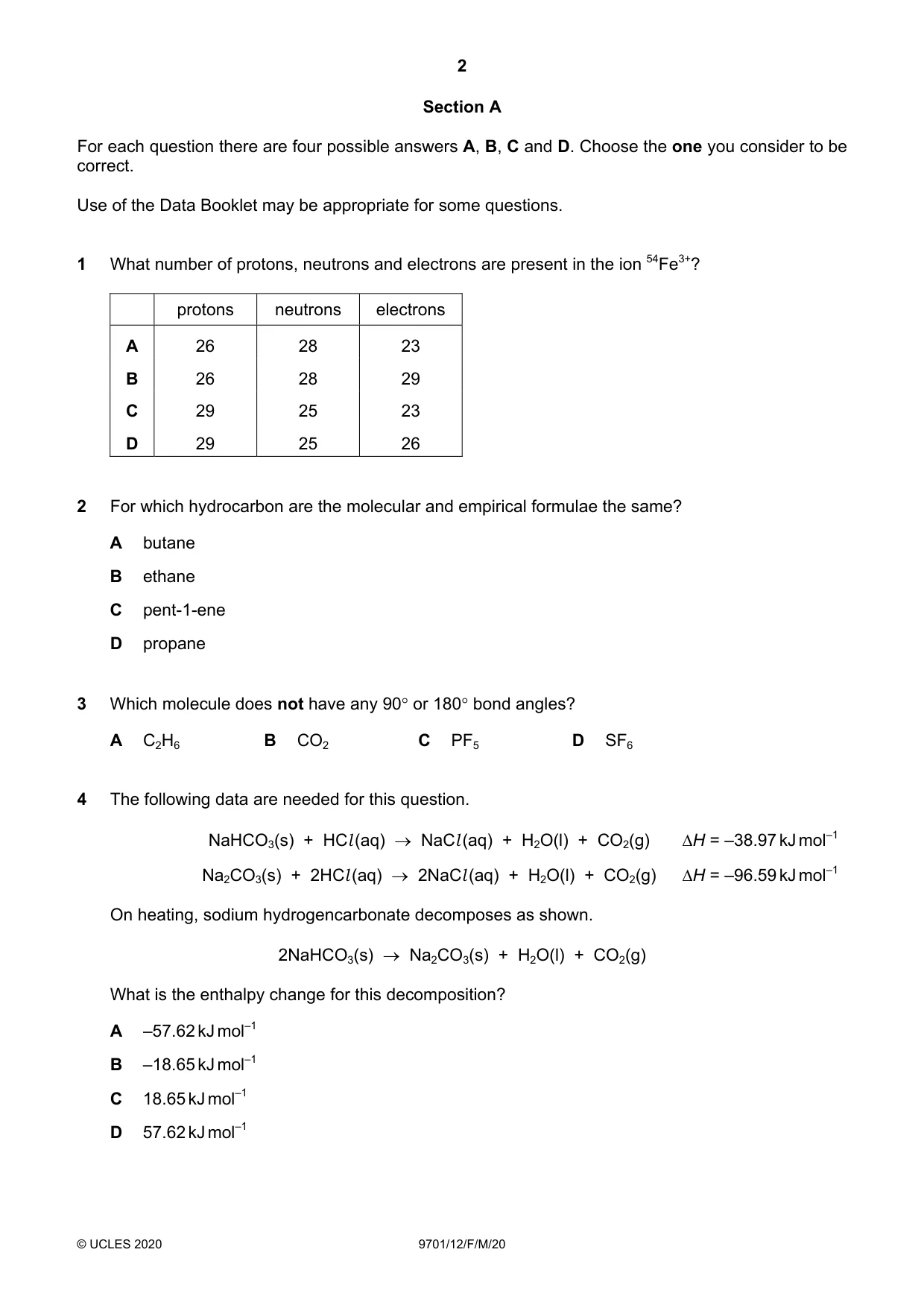
1 What number of protons, neutrons and electrons are present in the ion 54Fe3+? protons neutrons electrons A 26 28 23 B 26 28 29 C 29 25 23 D 29 25 26
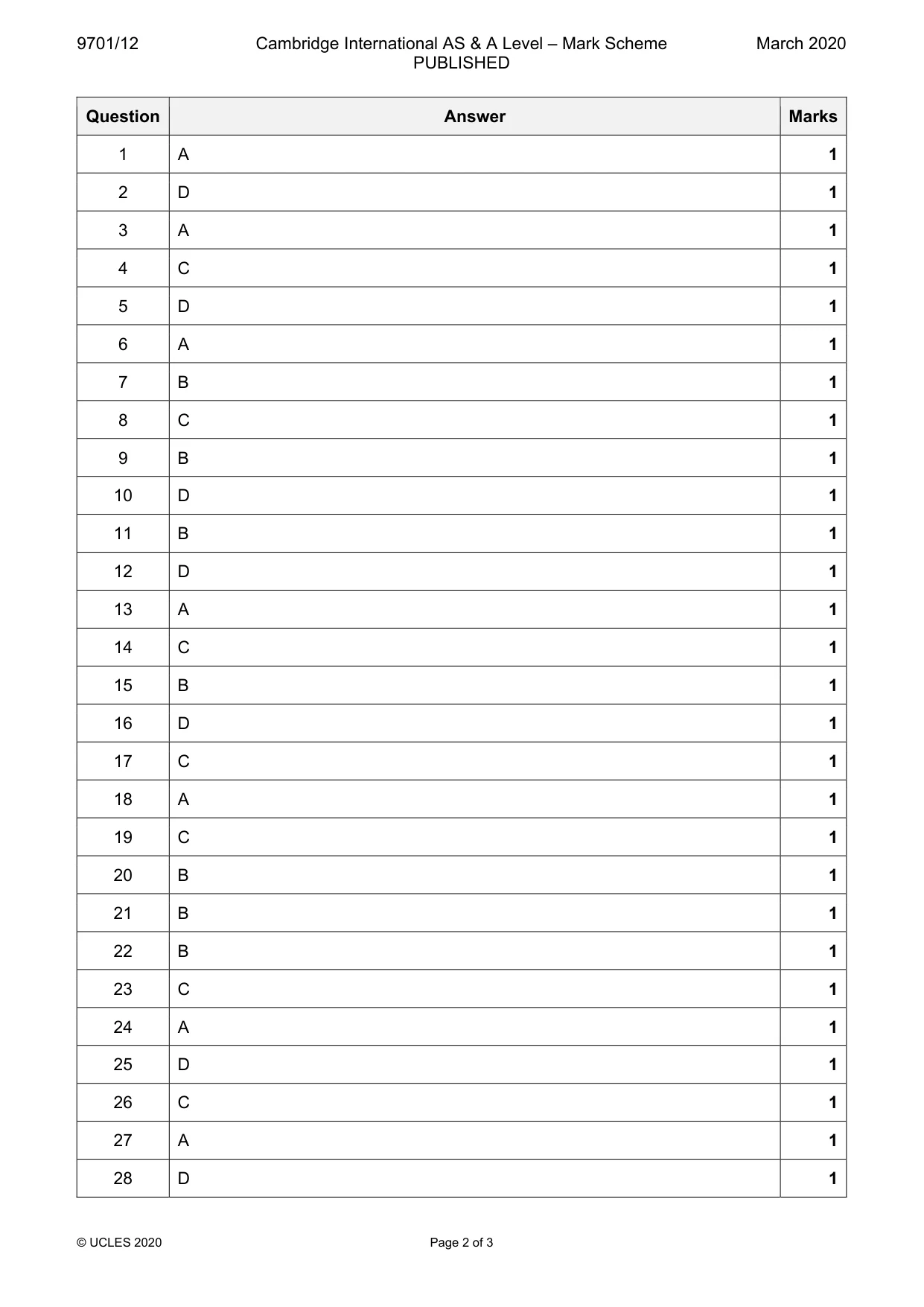
Mark scheme: A
Q2 · For which hydrocarbon are the molecular and empirical formulae the same?
2 For which hydrocarbon are the molecular and empirical formulae the same? A butane B ethane C pent-1-ene D propane
Mark scheme: D
Q3 · Which molecule does not have any 90° or 180° bond angles?
3 Which molecule does not have any 90° or 180° bond angles? A C2H6 B CO2 C PF5 D SF6
Mark scheme: A
Q4 · The following data are needed for this question
4 The following data are needed for this question. NaHCO3(s) + HCl (aq) → NaCl (aq) + H2O(l) + CO2(g) ∆H = –38.97 kJ mol–1 Na2CO3(s) + 2HCl (aq) → 2NaCl (aq) + H2O(l) + CO2(g) ∆H = –96.59 kJ mol–1 On heating, sodium hydrogencarbonate decomposes as shown. 2NaHCO3(s) → Na2CO3(s) + H2O(l) + CO2(g) What is the enthalpy change for this decomposition? A –57.62 kJ mol–1 B –18.65 kJ mol–1 C 18.65 kJ mol–1 D 57.62 kJ mol–1
Mark scheme: C
Q5 · In the redox reaction shown, how do the oxidation states of vanadium and sulfur change?
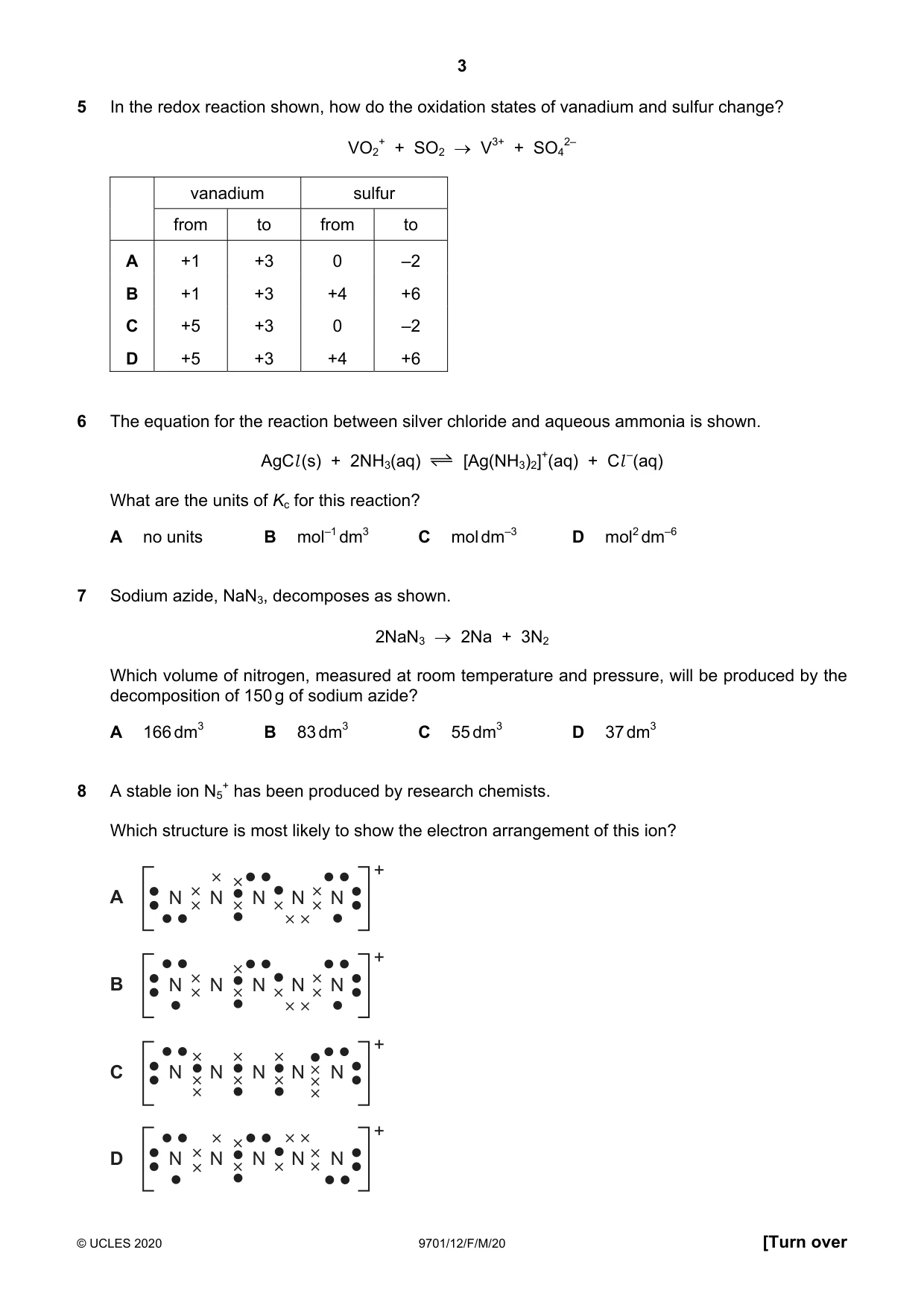
5 In the redox reaction shown, how do the oxidation states of vanadium and sulfur change? VO2 + + SO2 → V3+ + SO4 2– vanadium sulfur from to from to A +1 +3 0 –2 B +1 +3 +4 +6 C +5 +3 0 –2 D +5 +3 +4 +6
Mark scheme: D
Q6 · The equation for the reaction between silver chloride and aqueous ammonia is shown
6 The equation for the reaction between silver chloride and aqueous ammonia is shown. AgCl (s) + 2NH3(aq) [Ag(NH3)2]+(aq) + Cl –(aq) What are the units of Kc for this reaction? A no units B mol–1 dm3 C mol dm–3 D mol2 dm–6
Mark scheme: A
More questions on Chemical equilibria: reversible reactions, dynamic equilibrium
Q7 · Sodium azide, NaN3, decomposes as shown
7 Sodium azide, NaN3, decomposes as shown. 2NaN3 → 2Na + 3N2 Which volume of nitrogen, measured at room temperature and pressure, will be produced by the decomposition of 150 g of sodium azide? A 166 dm3 B 83 dm3 C 55 dm3 D 37 dm3
Mark scheme: B
More questions on Reacting masses and volumes (of solutions and gases)
Q8 · A stable ion N5 + has been produced by research chemists
8 A stable ion N5 + has been produced by research chemists. Which structure is most likely to show the electron arrangement of this ion? + A N N N N N + B N N N N N + C N N N N N + D N N N N N
Mark scheme: C
Q9 · 1.8 g of water, heated to 227 °C in a sealed container, turns to steam with a pressure of…
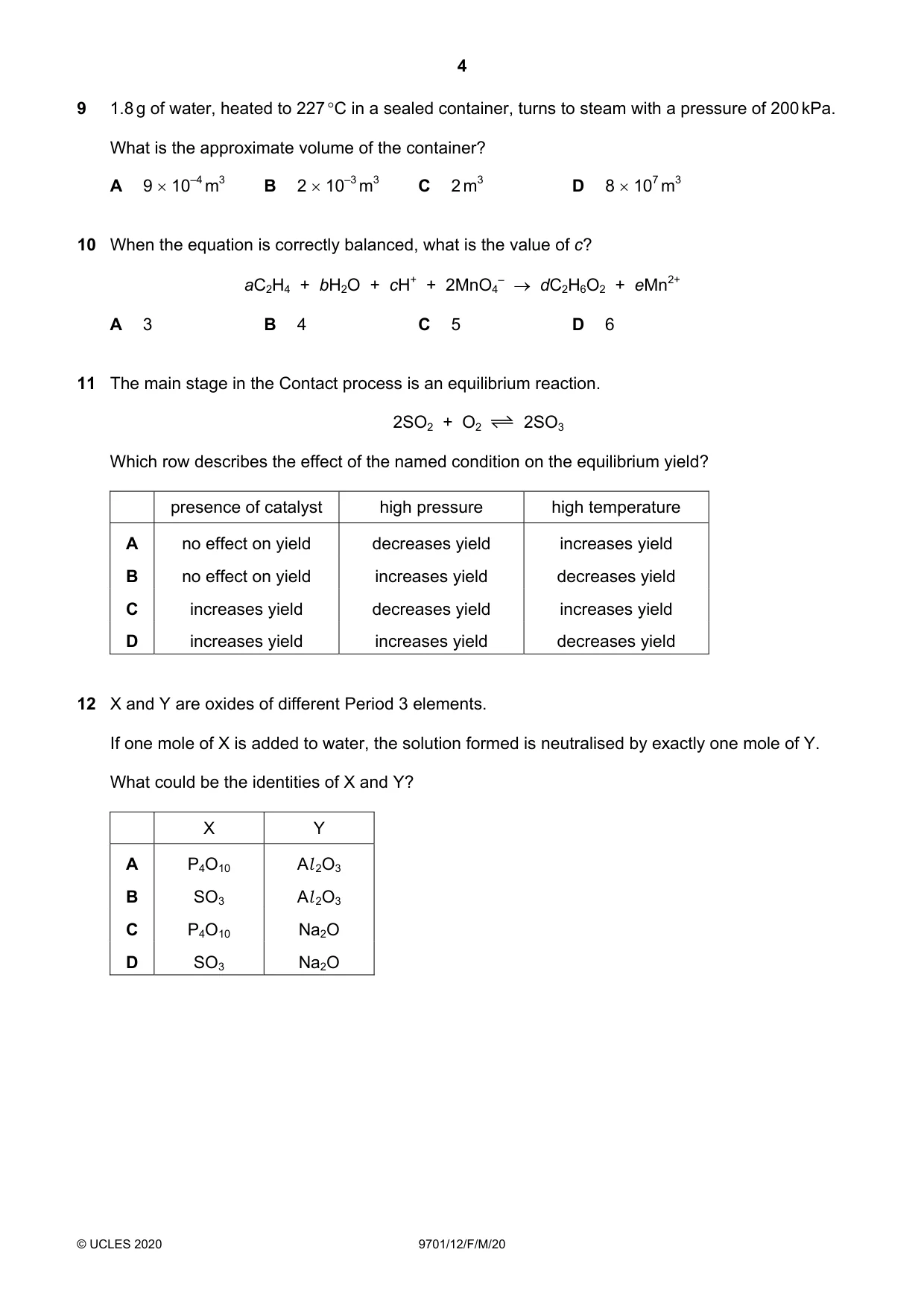
9 1.8 g of water, heated to 227 °C in a sealed container, turns to steam with a pressure of 200 kPa. What is the approximate volume of the container? A 9 × 10⁻⁴ m3 B 2 × 10⁻³ m3 C 2 m3 D 8 × 10⁷ m3
Mark scheme: B
More questions on The gaseous state: ideal and real gases and pV = nRT
Q10 · When the equation is correctly balanced, what is the value of c?
10 When the equation is correctly balanced, what is the value of c? aC2H4 + bH2O + cH+ + 2MnO4 – → dC2H6O2 + eMn2+ A 3 B 4 C 5 D 6
Mark scheme: D
Q11 · The main stage in the Contact process is an equilibrium reaction
11 The main stage in the Contact process is an equilibrium reaction. 2SO2 + O2 2SO3 Which row describes the effect of the named condition on the equilibrium yield? presence of catalyst high pressure high temperature A no effect on yield decreases yield increases yield B no effect on yield increases yield decreases yield C increases yield decreases yield increases yield D increases yield increases yield decreases yield
Mark scheme: B
More questions on Chemical equilibria: reversible reactions, dynamic equilibrium
Q12 · X and Y are oxides of different Period 3 elements
12 X and Y are oxides of different Period 3 elements. If one mole of X is added to water, the solution formed is neutralised by exactly one mole of Y. What could be the identities of X and Y? X Y A P4O10 Al 2O3 B SO3 Al 2O3 C P4O10 Na2O D SO3 Na2O
Mark scheme: D
More questions on Periodicity of chemical properties of the elements in Period 3
Q13 · Compound Z is insoluble in water but soluble at low pH
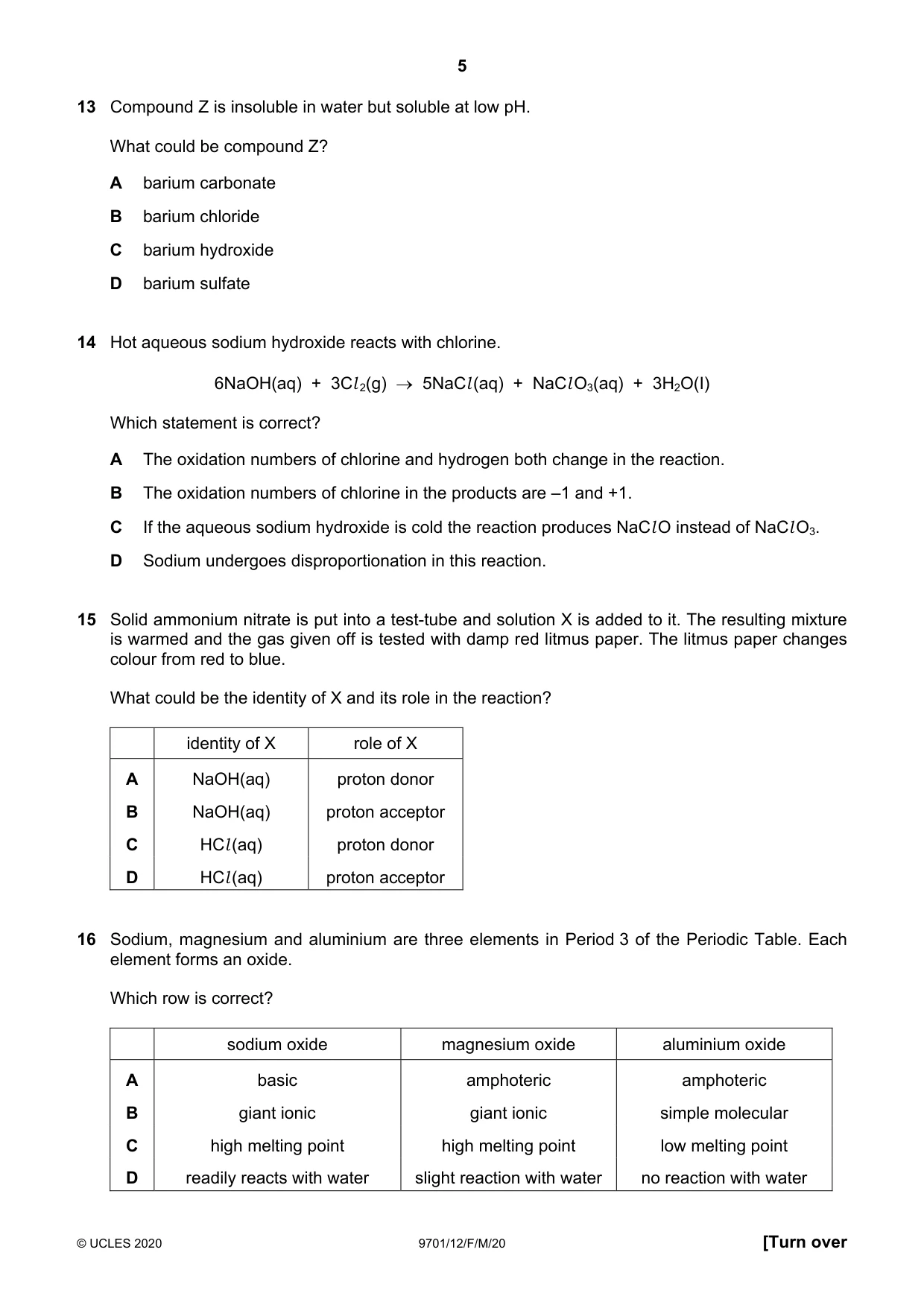
13 Compound Z is insoluble in water but soluble at low pH. What could be compound Z? A barium carbonate B barium chloride C barium hydroxide D barium sulfate
Mark scheme: A
Q14 · Hot aqueous sodium hydroxide reacts with chlorine
14 Hot aqueous sodium hydroxide reacts with chlorine. 6NaOH(aq) + 3Cl 2(g) → 5NaCl (aq) + NaCl O3(aq) + 3H2O(I) Which statement is correct? A The oxidation numbers of chlorine and hydrogen both change in the reaction. B The oxidation numbers of chlorine in the products are –1 and +1. C If the aqueous sodium hydroxide is cold the reaction produces NaCl O instead of NaCl O3. D Sodium undergoes disproportionation in this reaction.
Mark scheme: C
Q15 · Solid ammonium nitrate is put into a test-tube and solution X is added to it
15 Solid ammonium nitrate is put into a test-tube and solution X is added to it. The resulting mixture is warmed and the gas given off is tested with damp red litmus paper. The litmus paper changes colour from red to blue. What could be the identity of X and its role in the reaction? identity of X role of X A NaOH(aq) proton donor B NaOH(aq) proton acceptor C HCl (aq) proton donor D HCl (aq) proton acceptor
Mark scheme: B
Q16 · Sodium, magnesium and aluminium are three elements in Period 3 of the Periodic Table
16 Sodium, magnesium and aluminium are three elements in Period 3 of the Periodic Table. Each element forms an oxide. Which row is correct? sodium oxide magnesium oxide aluminium oxide A basic amphoteric amphoteric B giant ionic giant ionic simple molecular C high melting point high melting point low melting point D readily reacts with water slight reaction with water no reaction with water
Mark scheme: D
More questions on Periodicity of chemical properties of the elements in Period 3
Q17 · A student investigates calcium nitrate crystals by heating them in the apparatus shown
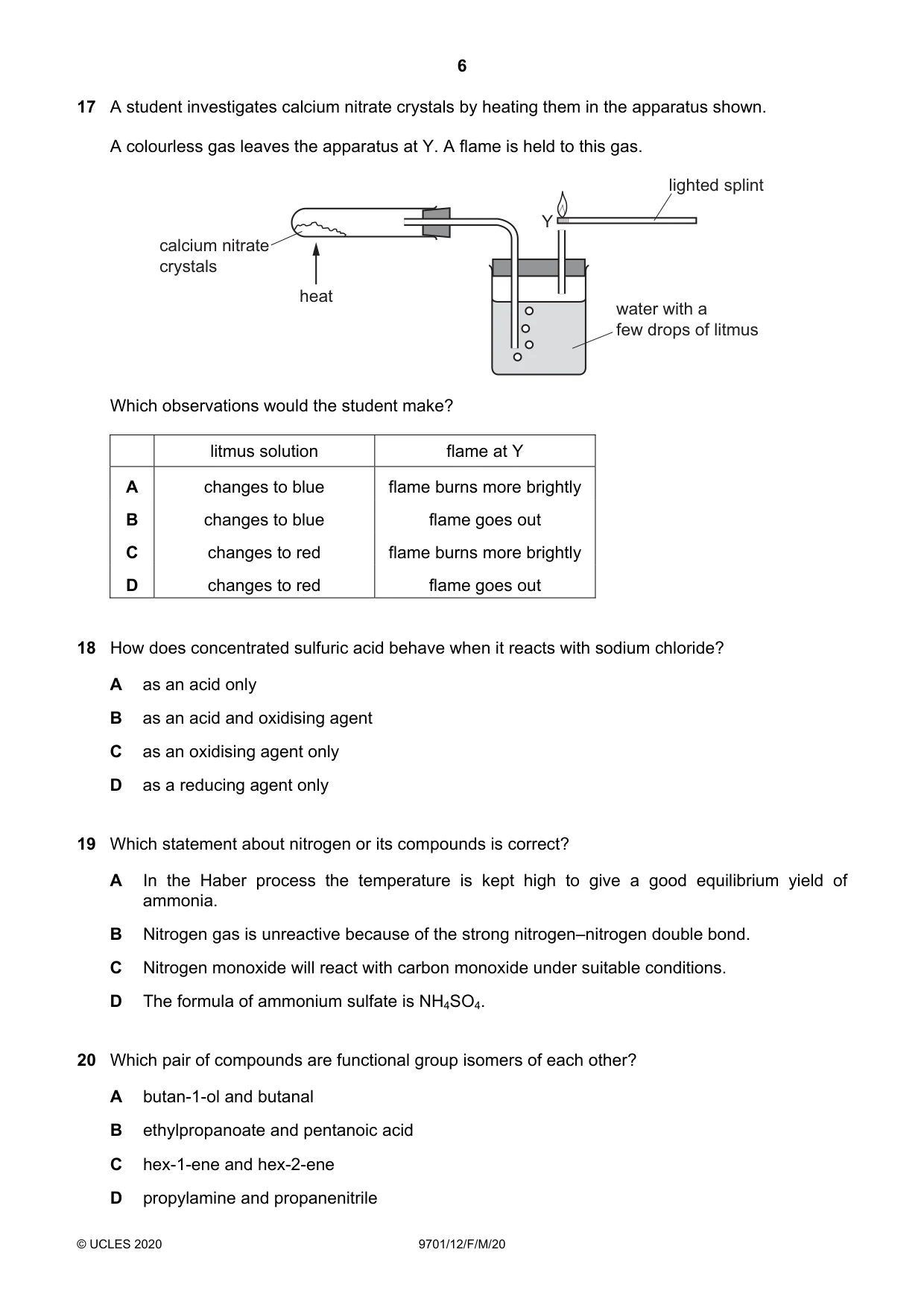
17 A student investigates calcium nitrate crystals by heating them in the apparatus shown. A colourless gas leaves the apparatus at Y. A flame is held to this gas. lighted splint Y calcium nitrate crystals heat water with a few drops of litmus Which observations would the student make? litmus solution flame at Y A changes to blue flame burns more brightly B changes to blue flame goes out C changes to red flame burns more brightly D changes to red flame goes out
Mark scheme: C
Q18 · How does concentrated sulfuric acid behave when it reacts with sodium chloride?
18 How does concentrated sulfuric acid behave when it reacts with sodium chloride? A as an acid only B as an acid and oxidising agent C as an oxidising agent only D as a reducing agent only
Mark scheme: A
More questions on The chemical properties of the halogen elements and the hydrogen halides
Q19 · Which statement about nitrogen or its compounds is correct?
19 Which statement about nitrogen or its compounds is correct? A In the Haber process the temperature is kept high to give a good equilibrium yield of ammonia. B Nitrogen gas is unreactive because of the strong nitrogen–nitrogen double bond. C Nitrogen monoxide will react with carbon monoxide under suitable conditions. D The formula of ammonium sulfate is NH4SO4.
Mark scheme: C
Q20 · Which pair of compounds are functional group isomers of each other?
20 Which pair of compounds are functional group isomers of each other? A butan-1-ol and butanal B ethylpropanoate and pentanoic acid C hex-1-ene and hex-2-ene D propylamine and propanenitrile
Mark scheme: B
More questions on Isomerism: structural isomerism and stereoisomerism
Q21 · Which row identifies a suitable starting material and reagent that can be used to produce…
21 Which row identifies a suitable starting material and reagent that can be used to produce butanenitrile? starting material reagent A CH3CH2CH2Br HCN B CH3CH2CH2Br NaCN C CH3CH2CH2CH2Br HCN D CH3CH2CH2CH2Br NaCN
Mark scheme: B
Q22 · The diagram shows the structure of ethanedioic acid
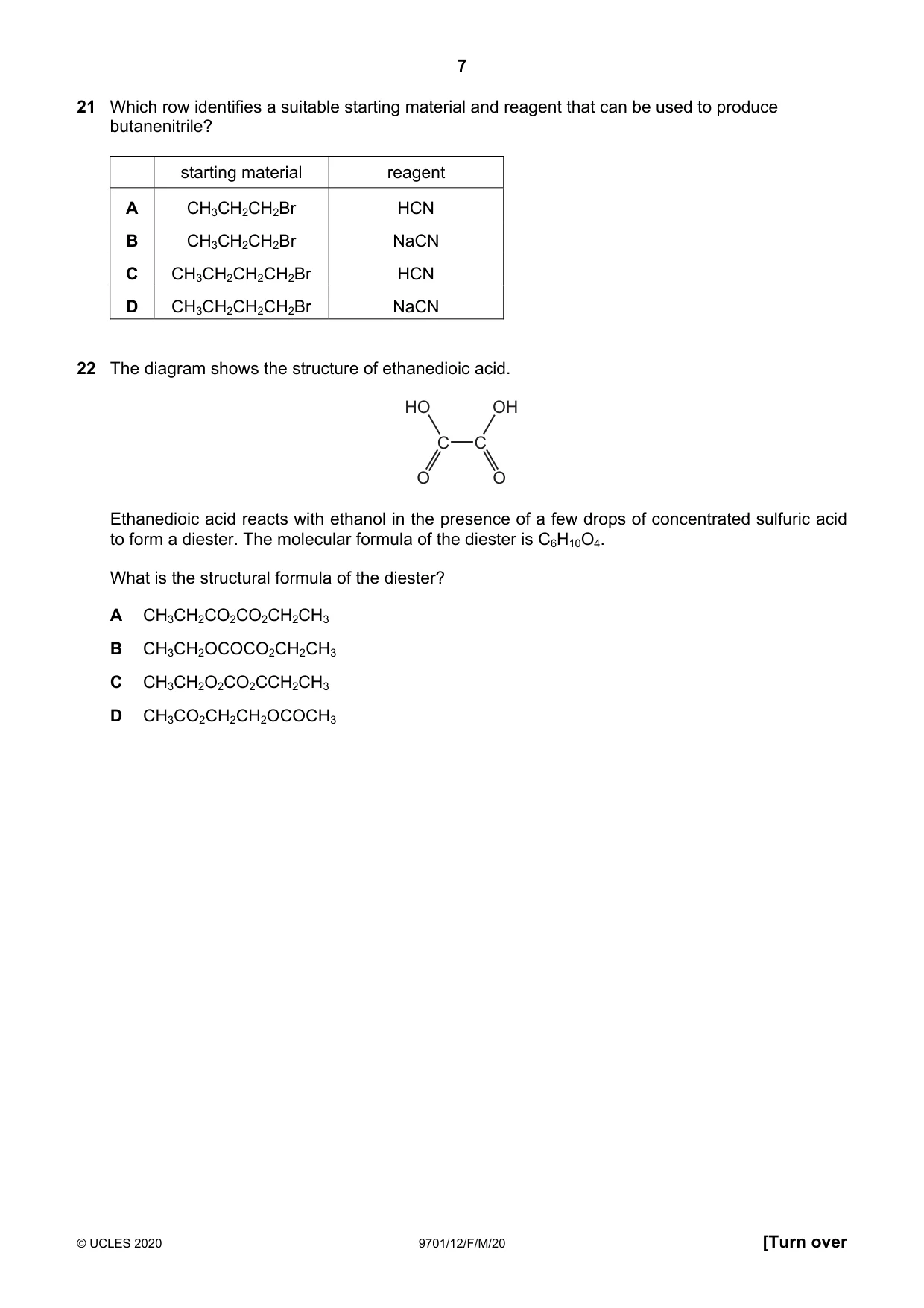
22 The diagram shows the structure of ethanedioic acid. HO OH C C O O Ethanedioic acid reacts with ethanol in the presence of a few drops of concentrated sulfuric acid to form a diester. The molecular formula of the diester is C6H10O4. What is the structural formula of the diester? A CH3CH2CO2CO2CH2CH3 B CH3CH2OCOCO2CH2CH3 C CH3CH2O2CO2CCH2CH3 D CH3CO2CH2CH2OCOCH3
Mark scheme: B
Q23 · The infrared spectrum shown was obtained from a compound J
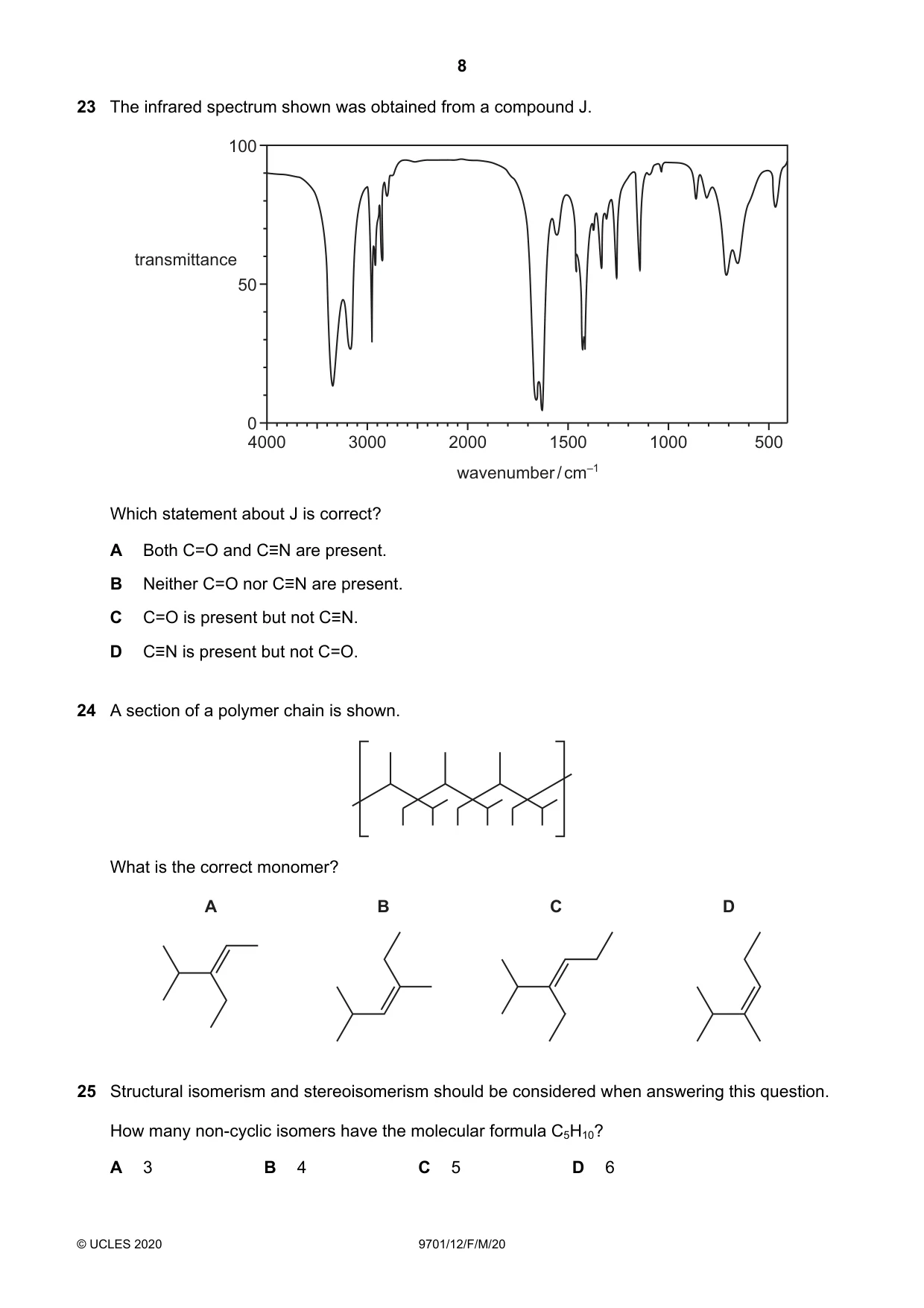
23 The infrared spectrum shown was obtained from a compound J. 100 transmittance 50 0 4000 3000 2000 1500 1000 500 wavenumber / cm–1 Which statement about J is correct? A Both C=O and C≡N are present. B Neither C=O nor C≡N are present. C C=O is present but not C≡N. D C≡N is present but not C=O.
Mark scheme: C
Q24 · A section of a polymer chain is shown
24 A section of a polymer chain is shown. What is the correct monomer? A B C D
Mark scheme: A
Q25 · Structural isomerism and stereoisomerism should be considered when answering this question
25 Structural isomerism and stereoisomerism should be considered when answering this question. How many non-cyclic isomers have the molecular formula C5H10? A 3 B 4 C 5 D 6
Mark scheme: D
More questions on Isomerism: structural isomerism and stereoisomerism
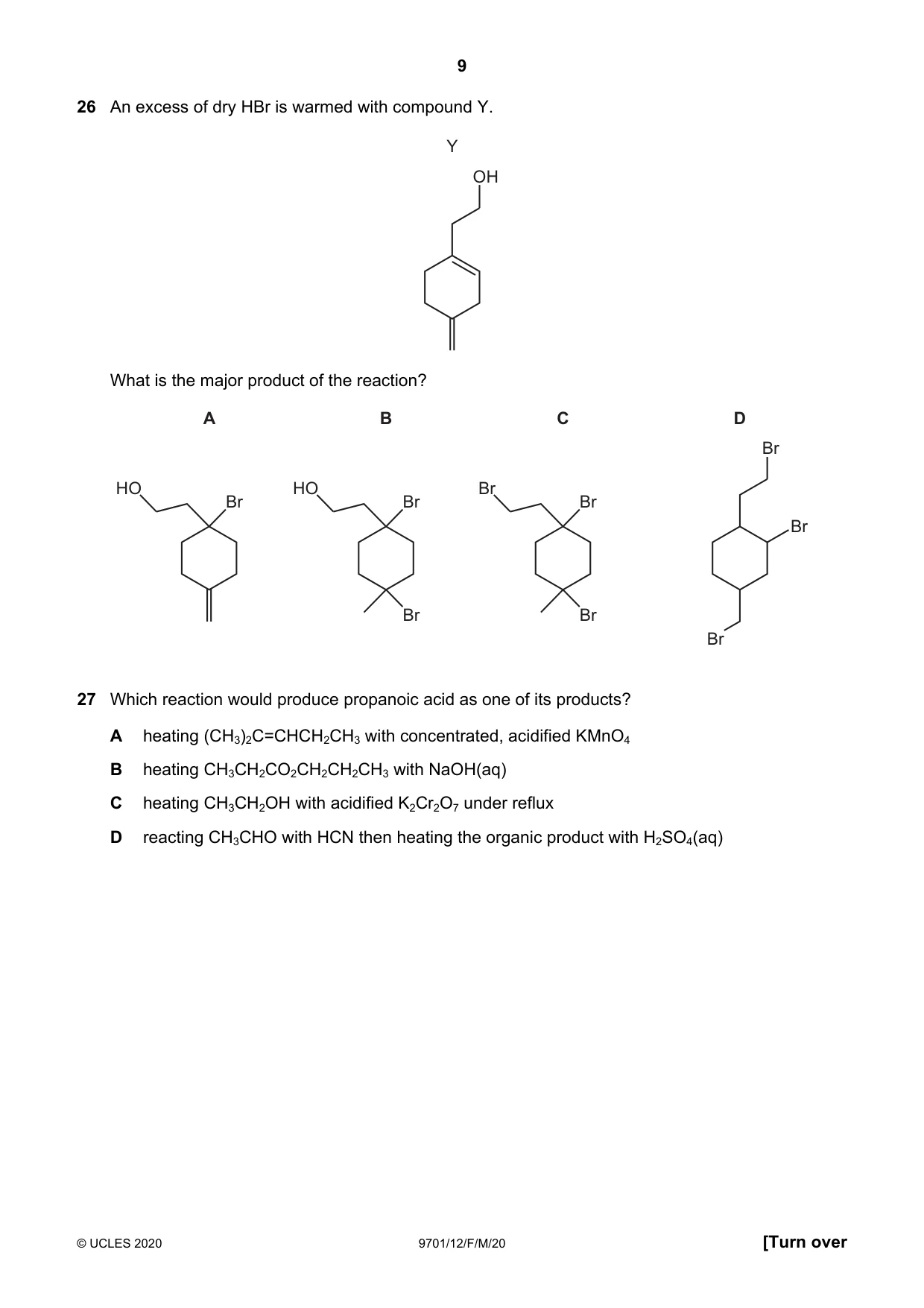
Q26 · An excess of dry HBr is warmed with compound Y
26 An excess of dry HBr is warmed with compound Y. Y OH What is the major product of the reaction? A B C D Br HO HO Br Br Br Br Br Br Br Br
Mark scheme: C
Q27 · Which reaction would produce propanoic acid as one of its products?
27 Which reaction would produce propanoic acid as one of its products? A heating (CH3)2C=CHCH2CH3 with concentrated, acidified KMnO4 B heating CH3CH2CO2CH2CH2CH3 with NaOH(aq) C heating CH3CH2OH with acidified K2Cr2O7 under reflux D reacting CH3CHO with HCN then heating the organic product with H2SO4(aq)
Mark scheme: A
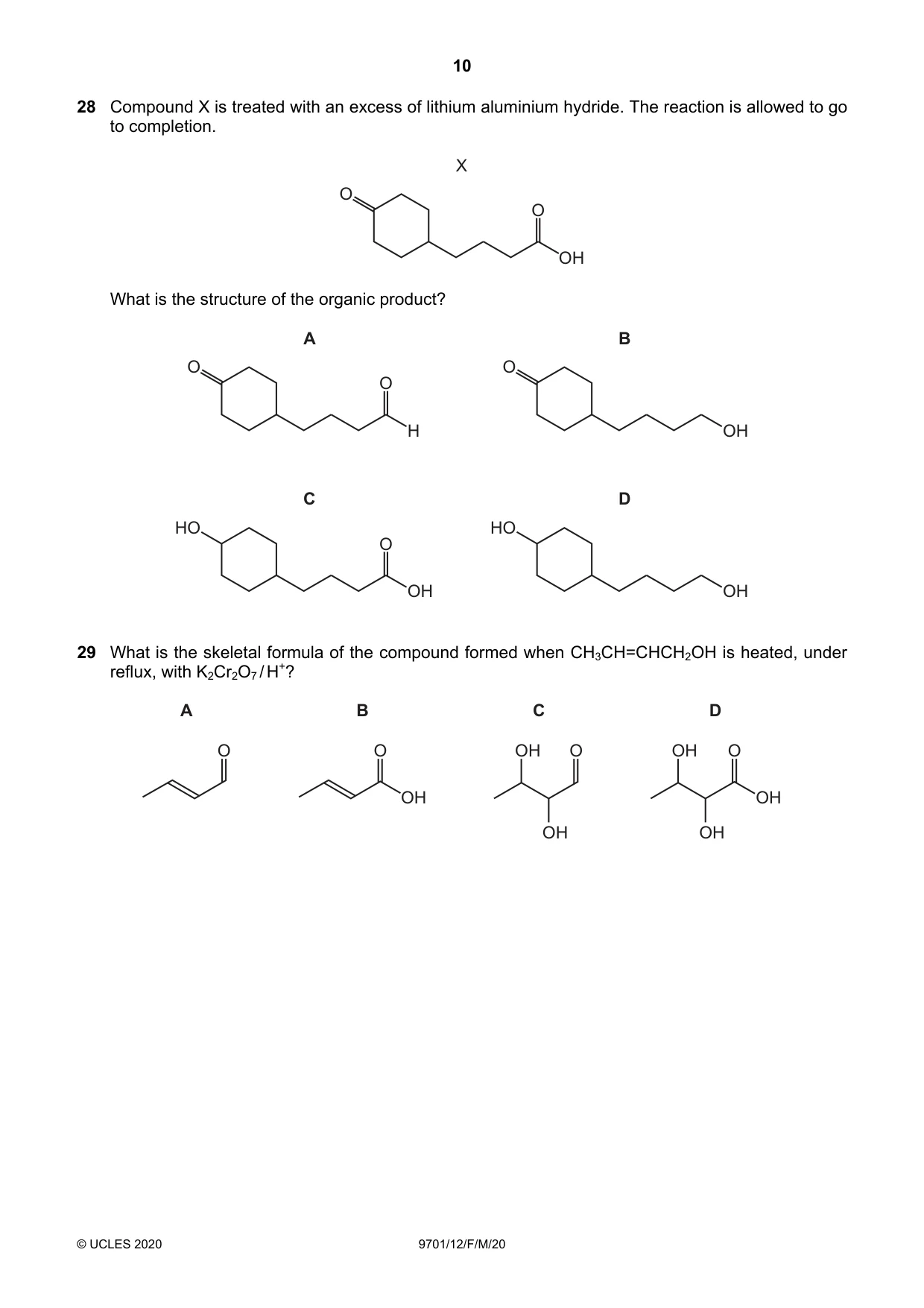
Q28 · Compound X is treated with an excess of lithium aluminium hydride
28 Compound X is treated with an excess of lithium aluminium hydride. The reaction is allowed to go to completion. X O O OH What is the structure of the organic product? A B O O O H OH C D HO HO O OH OH
Mark scheme: D
Q29 · What is the skeletal formula of the compound formed when CH3CH=CHCH2OH is heated, under…
29 What is the skeletal formula of the compound formed when CH3CH=CHCH2OH is heated, under reflux, with K2Cr2O7 / H+? A B C D O O OH O OH O OH OH OH OH
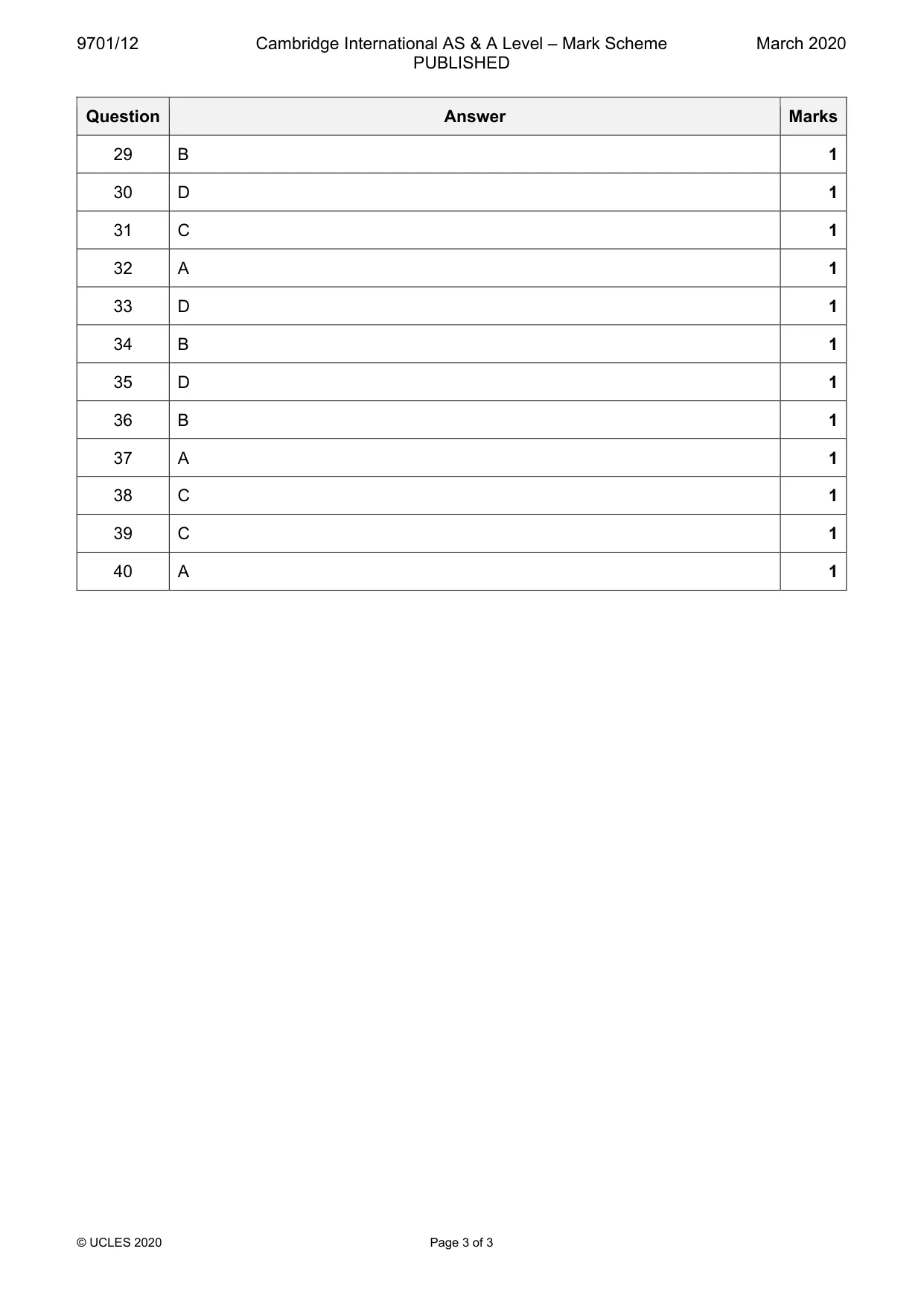
Mark scheme: B
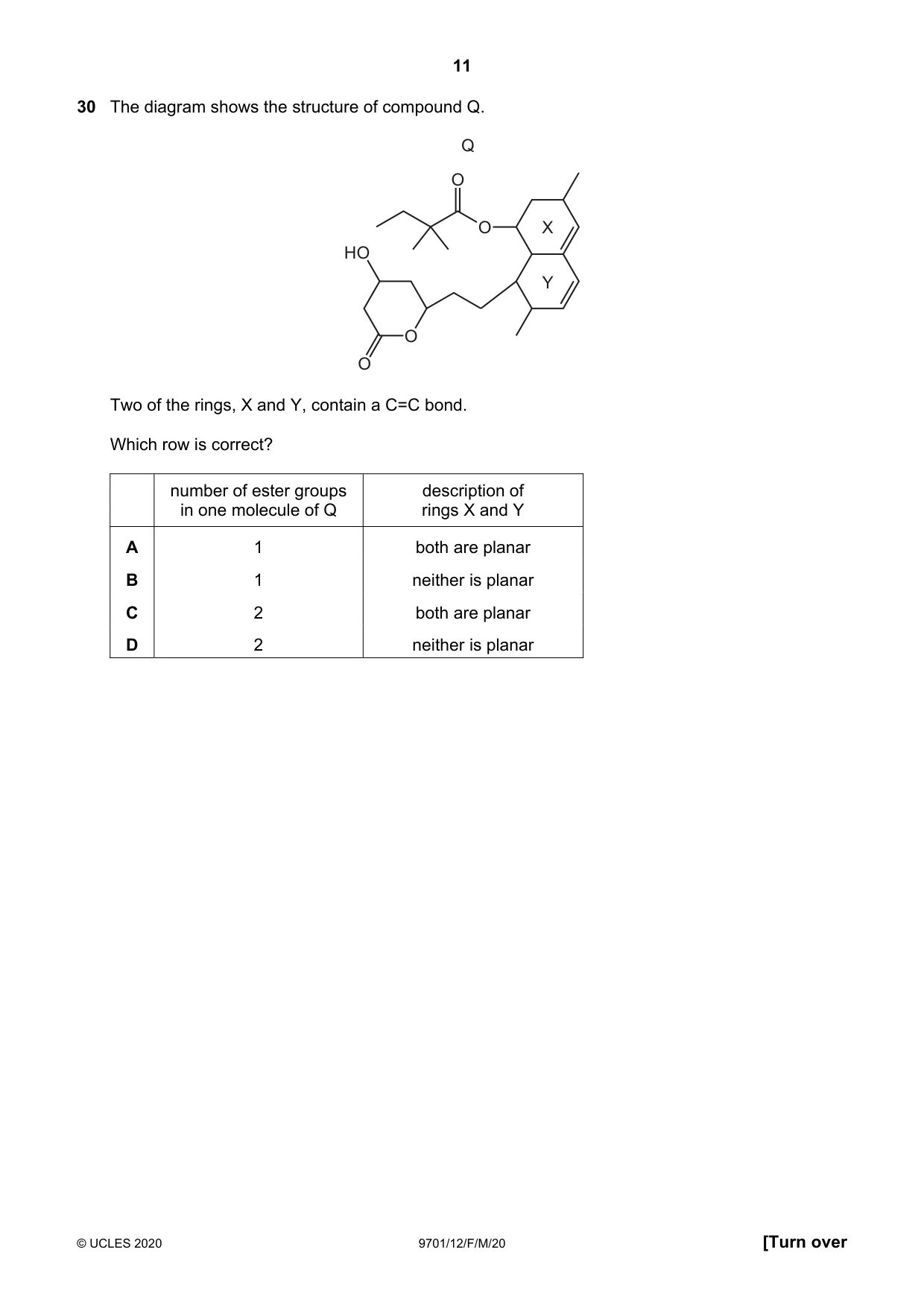
Q30 · The diagram shows the structure of compound Q
30 The diagram shows the structure of compound Q. Q O O X HO Y O O Two of the rings, X and Y, contain a C=C bond. Which row is correct? number of ester groups description of in one molecule of Q rings X and Y A 1 both are planar B 1 neither is planar C 2 both are planar D 2 neither is planar
Mark scheme: D
More questions on Shapes of organic molecules; σ and π bonds
Q31 · Carbon and nitrogen are adjacent in the Periodic Table
31 Carbon and nitrogen are adjacent in the Periodic Table. Which properties do they both have? 1 There is an empty 2p orbital in each atom of the element. 2 The principal quantum number of the highest occupied orbital is 2. 3 They can form compounds in which their atoms form four bonds.
Mark scheme: C
More questions on Electrons, energy levels and atomic orbitals
Q32 · The strong hydrogen bonding present in liquid water causes an increase in which…
32 The strong hydrogen bonding present in liquid water causes an increase in which properties? 1 viscosity 2 boiling point 3 surface tension
Mark scheme: A
More questions on Intermolecular forces, electronegativity and bond properties
Q33 · A reaction between carbon and oxygen is shown
33 A reaction between carbon and oxygen is shown. C(s) + 1 O (g) → CO(g) 2 2 How can the standard enthalpy change of this reaction be described correctly? 1 standard enthalpy change of formation 2 standard enthalpy change of combustion 3 standard enthalpy change of atomisation
Mark scheme: D
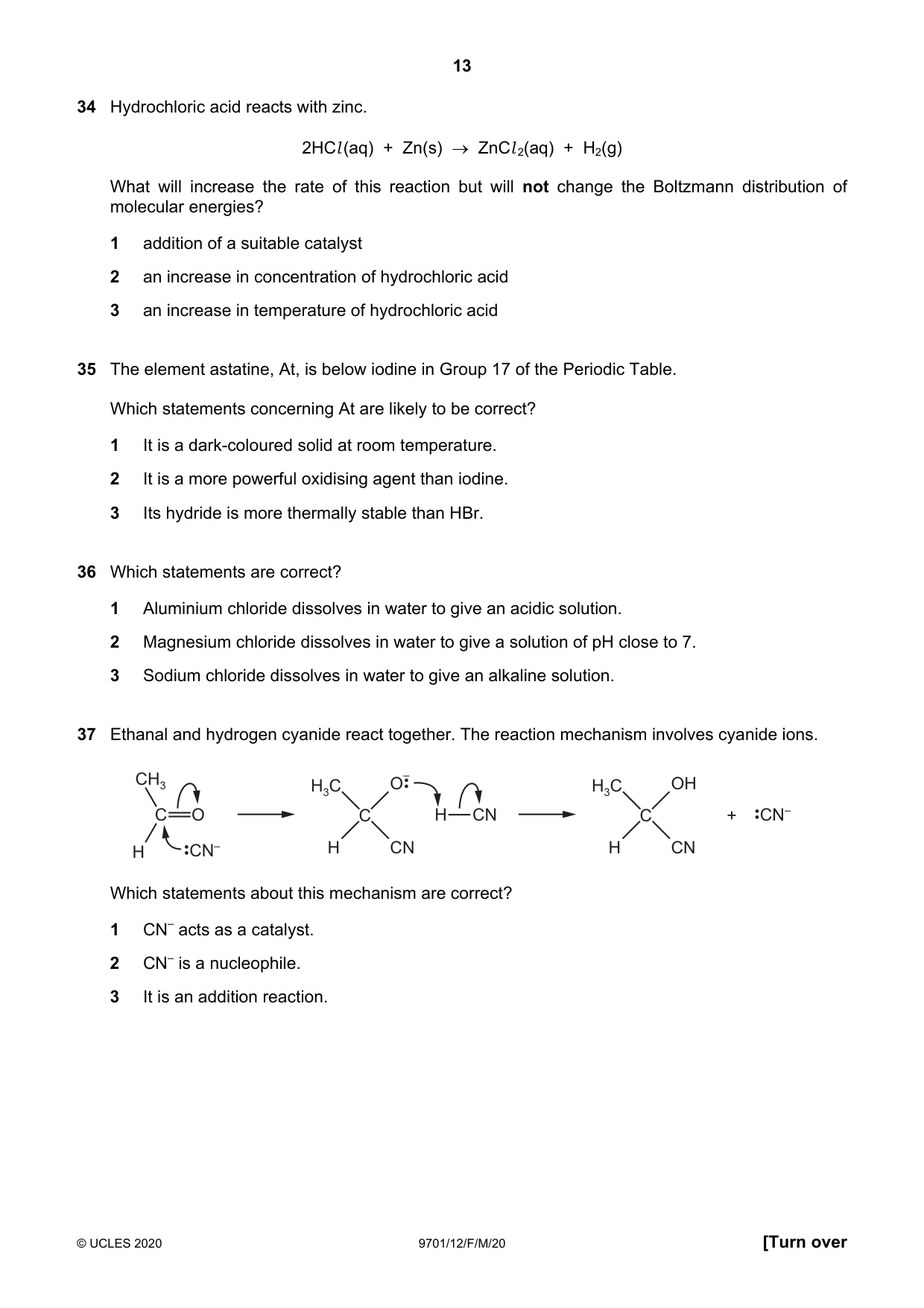
Q34 · Hydrochloric acid reacts with zinc
34 Hydrochloric acid reacts with zinc. 2HCl (aq) + Zn(s) → ZnCl 2(aq) + H2(g) What will increase the rate of this reaction but will not change the Boltzmann distribution of molecular energies? 1 addition of a suitable catalyst 2 an increase in concentration of hydrochloric acid 3 an increase in temperature of hydrochloric acid
Mark scheme: B
Q35 · The element astatine, At, is below iodine in Group 17 of the Periodic Table
35 The element astatine, At, is below iodine in Group 17 of the Periodic Table. Which statements concerning At are likely to be correct? 1 It is a dark-coloured solid at room temperature. 2 It is a more powerful oxidising agent than iodine. 3 Its hydride is more thermally stable than HBr.
Mark scheme: D
More questions on Physical properties of the Group 17 elements
Q36 · Which statements are correct?
36 Which statements are correct? 1 Aluminium chloride dissolves in water to give an acidic solution. 2 Magnesium chloride dissolves in water to give a solution of pH close to 7. 3 Sodium chloride dissolves in water to give an alkaline solution.
Mark scheme: B
More questions on Periodicity of chemical properties of the elements in Period 3
Q37 · Ethanal and hydrogen cyanide react together
37 Ethanal and hydrogen cyanide react together. The reaction mechanism involves cyanide ions. CH3 H3C O – H3C OH C O C H CN C + CN– H CN– H CN H CN Which statements about this mechanism are correct? 1 CN– acts as a catalyst. 2 CN– is a nucleophile. 3 It is an addition reaction.
Mark scheme: A
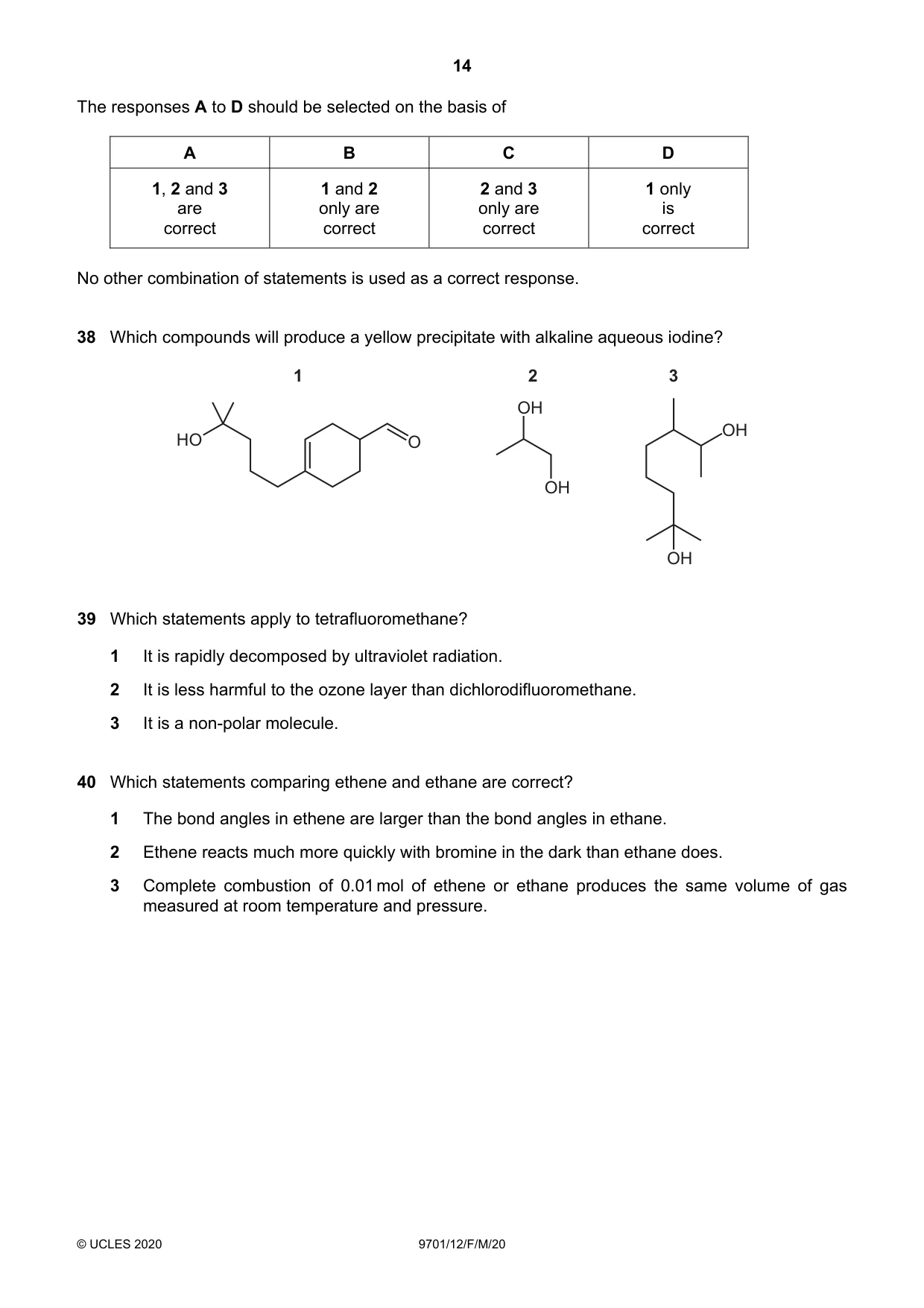
Q38 · Which compounds will produce a yellow precipitate with alkaline aqueous iodine?
38 Which compounds will produce a yellow precipitate with alkaline aqueous iodine? 1 2 3 OH OH HO O OH OH
Mark scheme: C
Q39 · Which statements apply to tetrafluoromethane?
39 Which statements apply to tetrafluoromethane? 1 It is rapidly decomposed by ultraviolet radiation. 2 It is less harmful to the ozone layer than dichlorodifluoromethane. 3 It is a non-polar molecule.
Mark scheme: C
More questions on Intermolecular forces, electronegativity and bond properties
Q40 · Which statements comparing ethene and ethane are correct?
40 Which statements comparing ethene and ethane are correct? 1 The bond angles in ethene are larger than the bond angles in ethane. 2 Ethene reacts much more quickly with bromine in the dark than ethane does. 3 Complete combustion of 0.01 mol of ethene or ethane produces the same volume of gas measured at room temperature and pressure.
Mark scheme: A
What was in this paper
The subtopics covered by these 40 questions, and how many questions each got. Open one in a new tab to see every Cambridge question on it.
3Periodicity of chemical properties of the elements in Period 33Chemical equilibria: reversible reactions, dynamic equilibrium2Intermolecular forces, electronegativity and bond properties2Isomerism: structural isomerism and stereoisomerism2Redox processes: electron transfer and changes in oxidation number (oxidation state)2Similarities and trends in the properties of the Group 2 metals, magnesium to barium, and their compounds2Addition polymerisation1Alcohols1Alkenes1Brønsted–Lowry theory of acids and bases1Carboxylic acids1Dot-and-cross diagrams1Electrons, energy levels and atomic orbitals1Enthalpy change, ΔH1Esters1Formulas1Halogenoalkanes1Hess’s law1Infrared spectroscopy1Nitriles and hydroxynitriles1Nitrogen and sulfur1Particles in the atom and atomic radius1Physical properties of the Group 17 elements1Rate of reaction1Reacting masses and volumes (of solutions and gases)1Shapes of molecules1Shapes of organic molecules; σ and π bonds1The chemical properties of the halogen elements and the hydrogen halides1The gaseous state: ideal and real gases and pV = nRT1The reactions of chlorine1What you needed in this session
Cambridge’s own grade thresholds for 2020 Feb/March, Paper 1 · Variant 2. A higher threshold means an easier paper — the bar moves with how the cohort did.