Cambridge A Level Chemistry 9701 — 2014 Oct/Nov Paper 1 · Variant 2
9701/12/O/N/14 · 40 questions · 40 marks · ≈45 min
The question paper and its mark scheme, free to read here and free to download. This is Cambridge’s own paper, exactly as it was sat.
Question paper16 pages
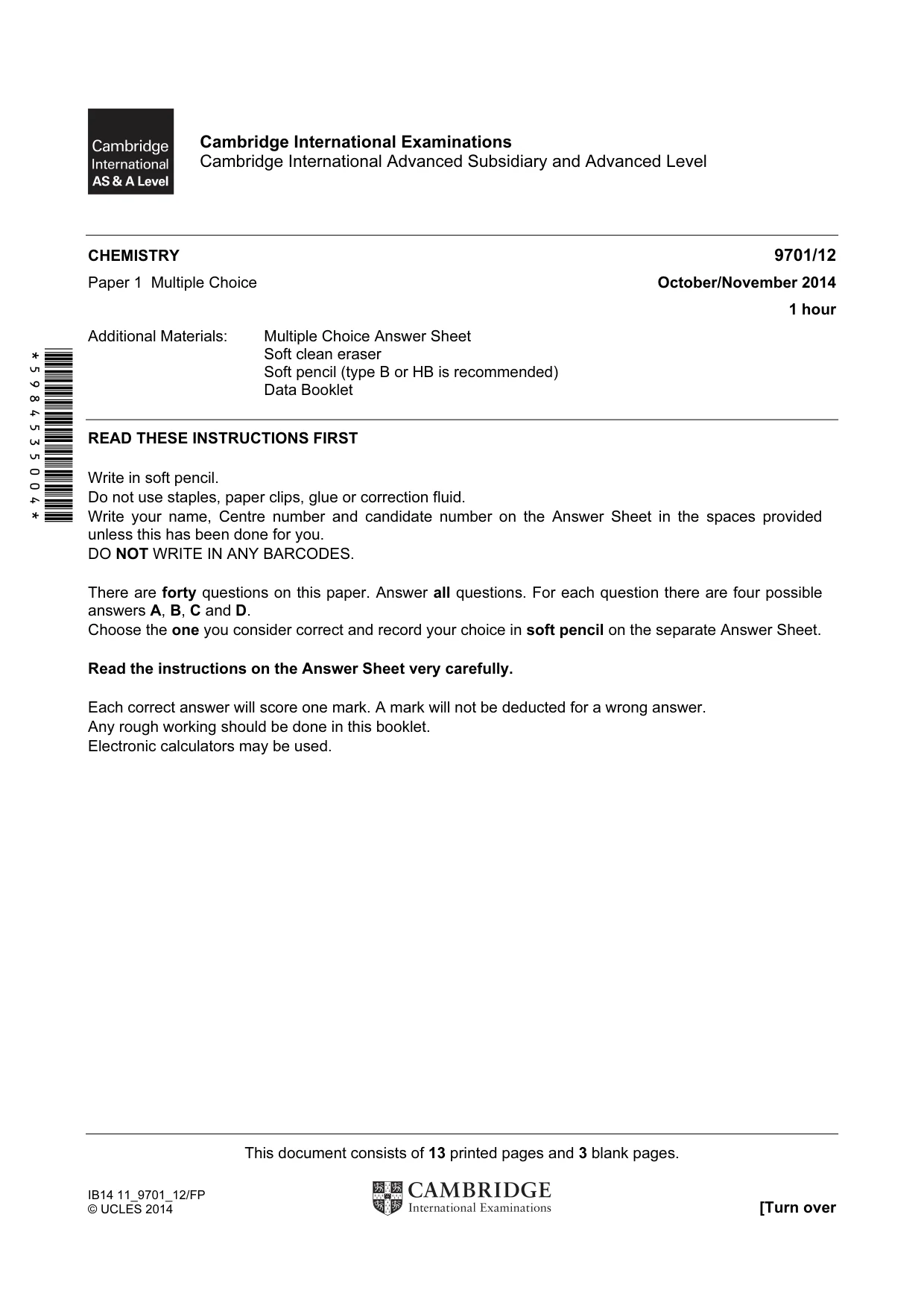
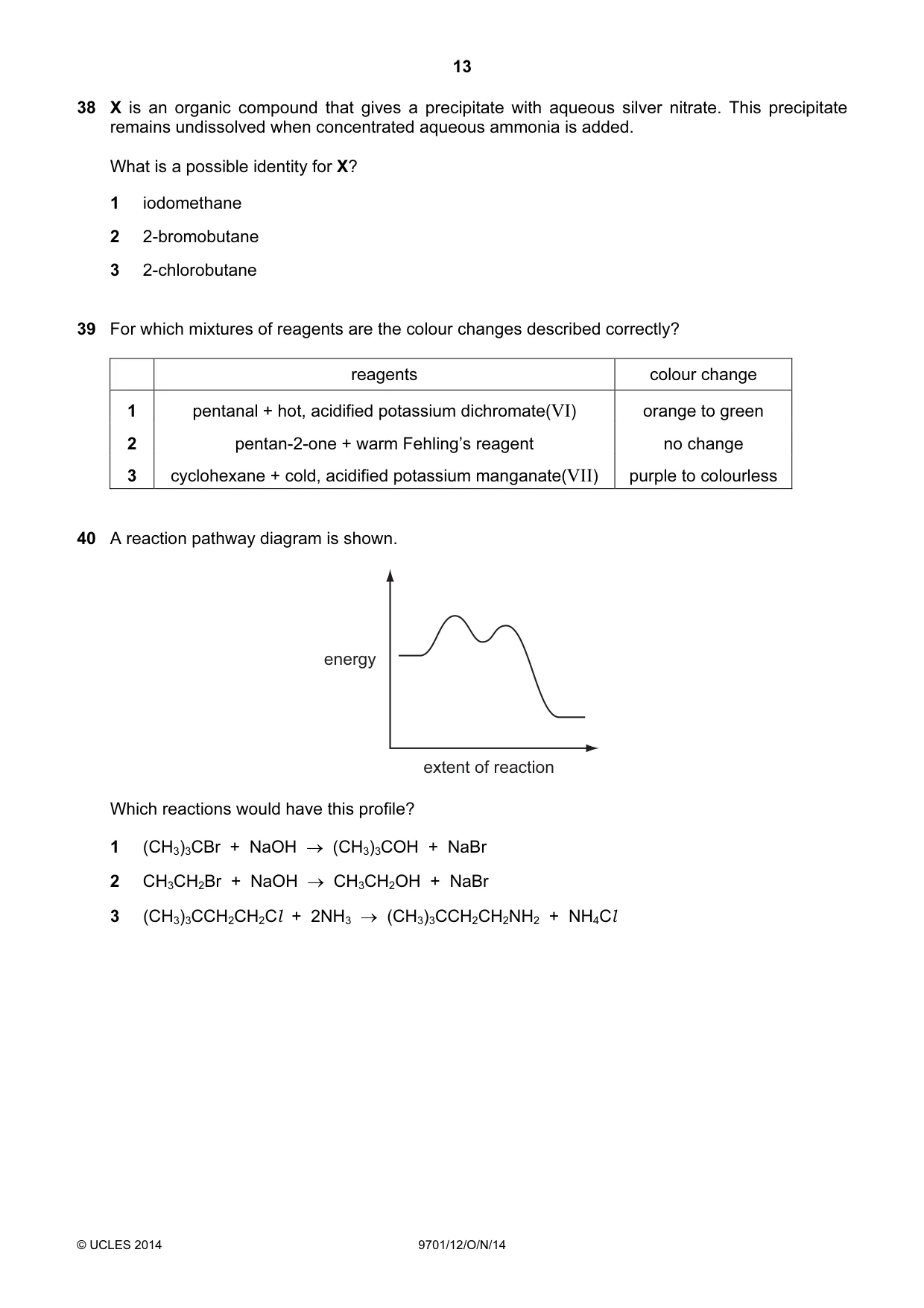


Mark scheme2 pages
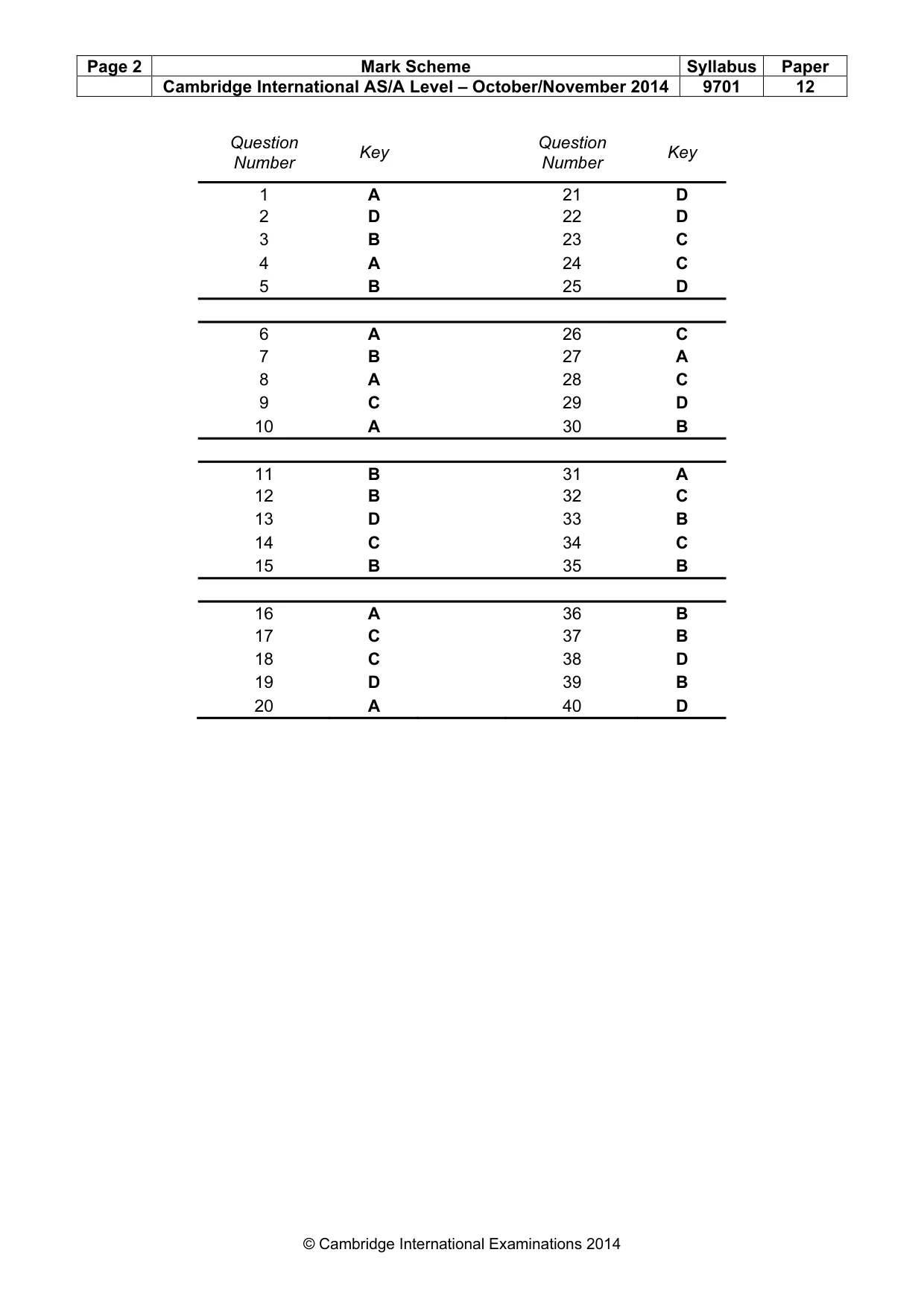
Answers below. Sit the paper first if you are practising.
Questions as text
Q1 · Which solid-line curve most accurately represents the distribution of molecular energies…
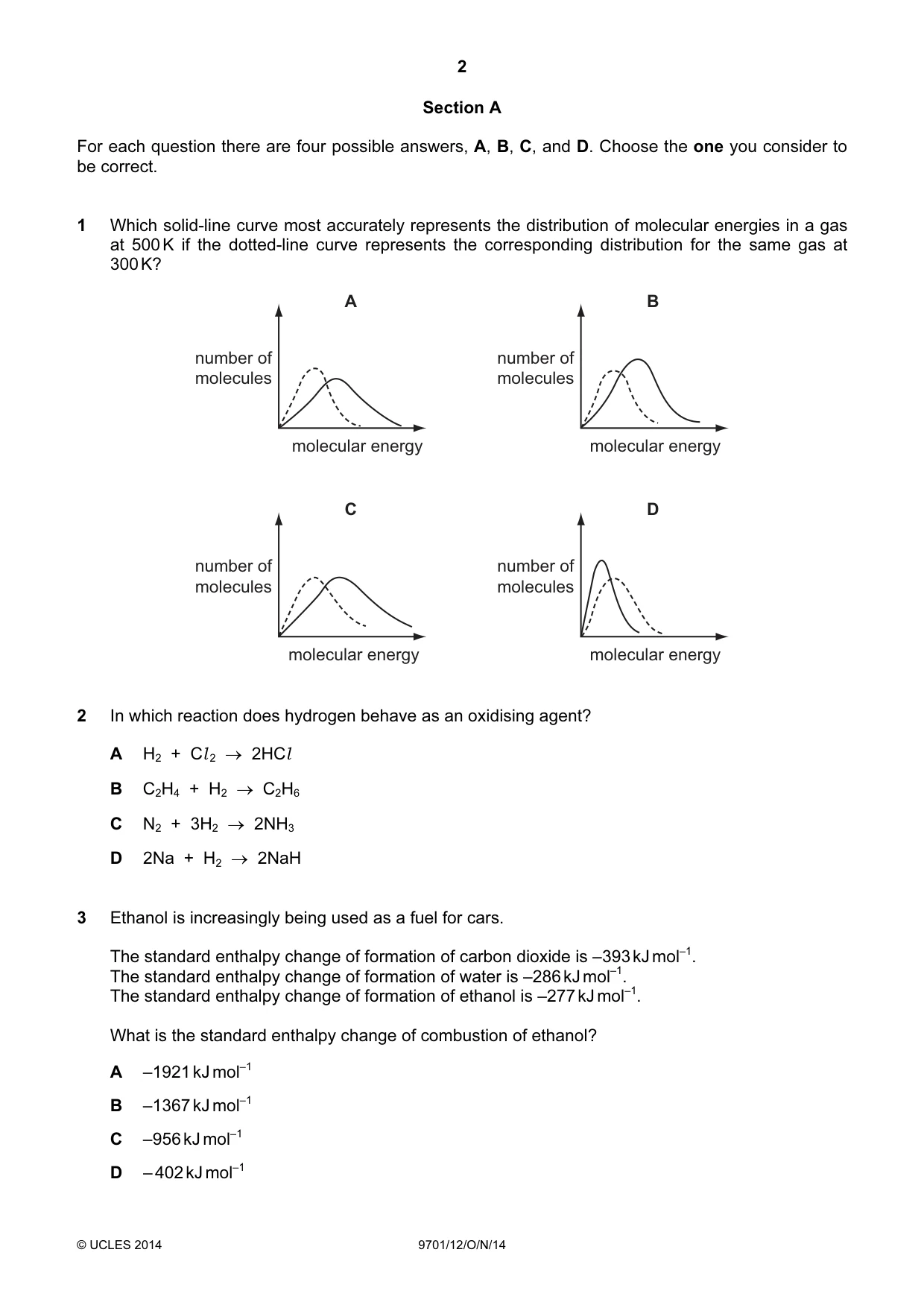
1 Which solid-line curve most accurately represents the distribution of molecular energies in a gas at 500 K if the dotted-line curve represents the corresponding distribution for the same gas at 300 K? A B number of number of molecules molecules molecular energy molecular energy C D number of number of molecules molecules molecular energy molecular energy
Mark scheme: A
More questions on Effect of temperature on reaction rates and the concept of activation energy
Q2 · In which reaction does hydrogen behave as an oxidising agent?
2 In which reaction does hydrogen behave as an oxidising agent? A H2 + Cl 2 → 2HCl B C2H4 + H2 → C2H6 C N2 + 3H2 → 2NH3 D 2Na + H2 → 2NaH
Mark scheme: D
Q3 · Ethanol is increasingly being used as a fuel for cars
3 Ethanol is increasingly being used as a fuel for cars. The standard enthalpy change of formation of carbon dioxide is –393 kJ mol–1. The standard enthalpy change of formation of water is –286 kJ mol–1. The standard enthalpy change of formation of ethanol is –277 kJ mol–1. What is the standard enthalpy change of combustion of ethanol? A –1921 kJ mol–1 B –1367 kJ mol–1 C –956 kJ mol–1 D – 402 kJ mol–1
Mark scheme: B
Q4 · Two glass vessels M and N are connected by a closed valve
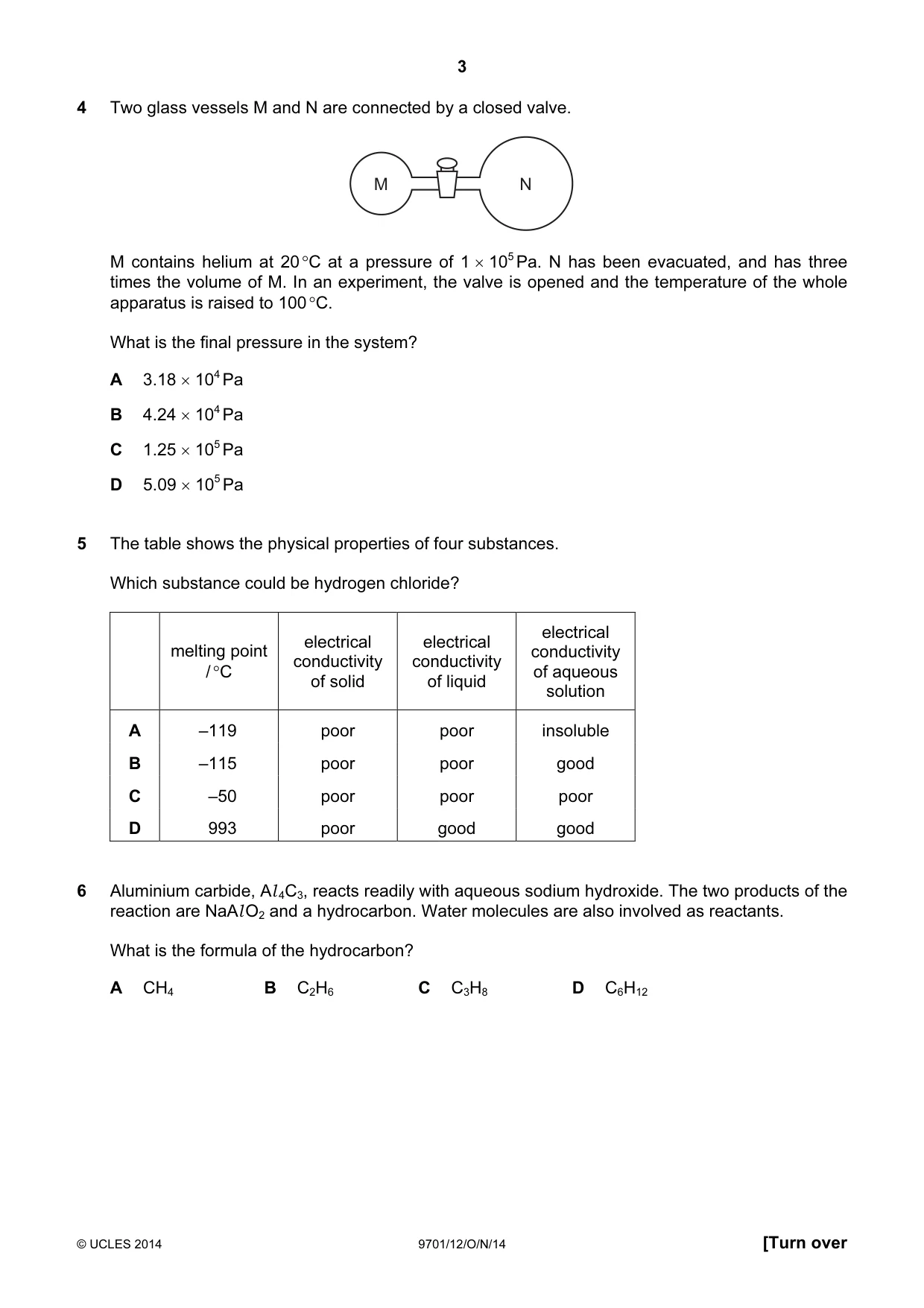
4 Two glass vessels M and N are connected by a closed valve. M N M contains helium at 20 °C at a pressure of 1 × 10⁵ Pa. N has been evacuated, and has three times the volume of M. In an experiment, the valve is opened and the temperature of the whole apparatus is raised to 100 °C. What is the final pressure in the system? A 3.18 × 10⁴ Pa B 4.24 × 10⁴ Pa C 1.25 × 10⁵ Pa D 5.09 × 10⁵ Pa
Mark scheme: A
More questions on The gaseous state: ideal and real gases and pV = nRT
Q5 · The table shows the physical properties of four substances
5 The table shows the physical properties of four substances. Which substance could be hydrogen chloride? electrical electrical electrical melting point conductivity conductivity conductivity / °C of aqueous of solid of liquid solution A –119 poor poor insoluble B –115 poor poor good C –50 poor poor poor D 993 poor good good
Mark scheme: B
Q6 · Aluminium carbide, Al 4C3, reacts readily with aqueous sodium hydroxide
6 Aluminium carbide, Al 4C3, reacts readily with aqueous sodium hydroxide. The two products of the reaction are NaAl O2 and a hydrocarbon. Water molecules are also involved as reactants. What is the formula of the hydrocarbon? A CH4 B C2H6 C C3H8 D C6H12
Mark scheme: A
Q7 · In an experiment to calculate the enthalpy change of combustion of a fuel, 1.5 g (0.0326…
7 In an experiment to calculate the enthalpy change of combustion of a fuel, 1.5 g (0.0326 mol) of the fuel was used to heat 200 g of water. The temperature of the water rose from 25 °C to 55 °C. The specific heat capacity of water is 4.18 J g–1 K–1. There is significant heat loss in this experiment. Therefore, the experimental value for the enthalpy change of combustion, ∆Hc, of the fuel will be different from the theoretical value. Using the information above, what is the experimental value for the enthalpy change of combustion, ∆Hc, of the fuel? A –1410 kJ mol–1 B –769 kJ mol–1 C –30.7 kJ mol–1 D –16.7 kJ mol–1
Mark scheme: B
Q8 · The reaction pathway diagram below illustrates the energies of the reactants, the…
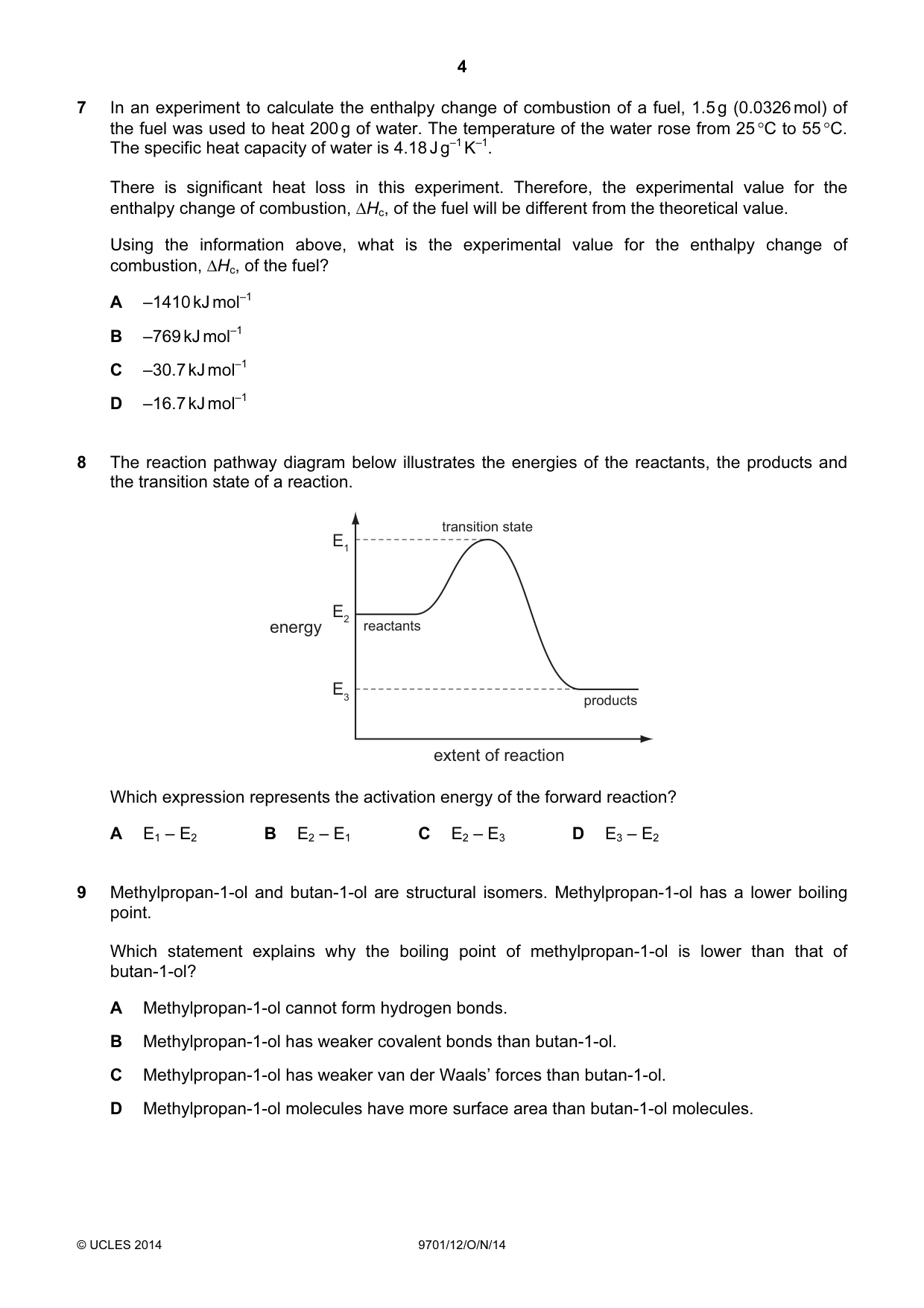
8 The reaction pathway diagram below illustrates the energies of the reactants, the products and the transition state of a reaction. transition state E1 E2 energy reactants E3 products extent of reaction Which expression represents the activation energy of the forward reaction? A E1 – E2 B E2 – E1 C E2 – E3 D E3 – E2
Mark scheme: A
More questions on Effect of temperature on reaction rates and the concept of activation energy
Q9 · Methylpropan-1-ol and butan-1-ol are structural isomers
9 Methylpropan-1-ol and butan-1-ol are structural isomers. Methylpropan-1-ol has a lower boiling point. Which statement explains why the boiling point of methylpropan-1-ol is lower than that of butan-1-ol? A Methylpropan-1-ol cannot form hydrogen bonds. B Methylpropan-1-ol has weaker covalent bonds than butan-1-ol. C Methylpropan-1-ol has weaker van der Waals’ forces than butan-1-ol. D Methylpropan-1-ol molecules have more surface area than butan-1-ol molecules.
Mark scheme: C
More questions on Intermolecular forces, electronegativity and bond properties
Q10 · Which row correctly describes the electrodes used in the electrolysis cell for the…
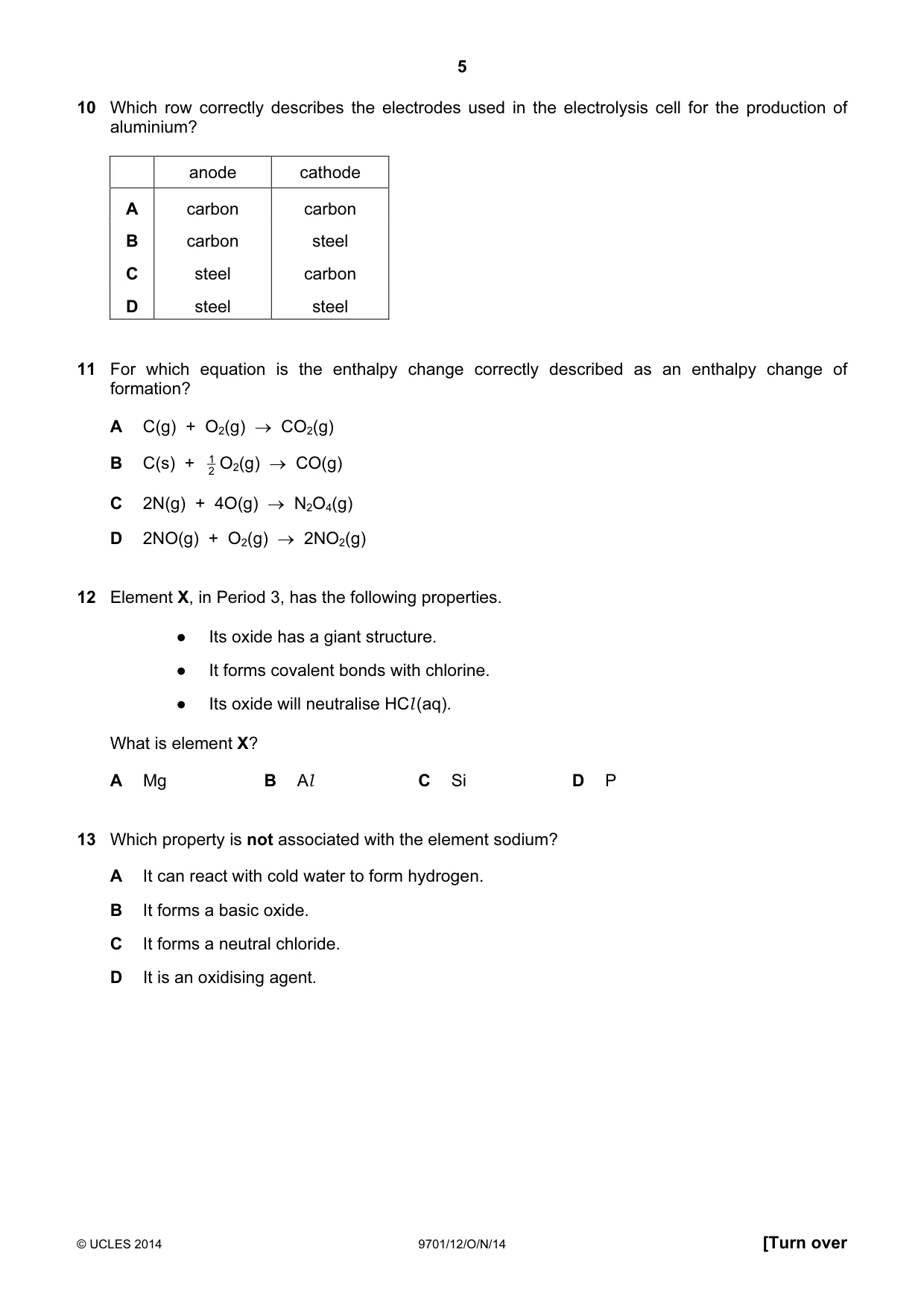
10 Which row correctly describes the electrodes used in the electrolysis cell for the production of aluminium? anode cathode A carbon carbon B carbon steel C steel carbon D steel steel
Mark scheme: A
Q11 · For which equation is the enthalpy change correctly described as an enthalpy change of…
11 For which equation is the enthalpy change correctly described as an enthalpy change of formation? A C(g) + O2(g) → CO2(g) B C(s) + 2 1 O2(g) → CO(g) C 2N(g) + 4O(g) → N2O4(g) D 2NO(g) + O2(g) → 2NO2(g)
Mark scheme: B
Q12 · Element X, in Period 3, has the following properties
12 Element X, in Period 3, has the following properties. ● Its oxide has a giant structure. ● It forms covalent bonds with chlorine. ● Its oxide will neutralise HCl (aq). What is element X? A Mg B Al C Si D P
Mark scheme: B
More questions on Periodicity of chemical properties of the elements in Period 3
Q13 · Which property is not associated with the element sodium?
13 Which property is not associated with the element sodium? A It can react with cold water to form hydrogen. B It forms a basic oxide. C It forms a neutral chloride. D It is an oxidising agent.
Mark scheme: D
More questions on Periodicity of chemical properties of the elements in Period 3
Q14 · Use of the Data Booklet is relevant to this question
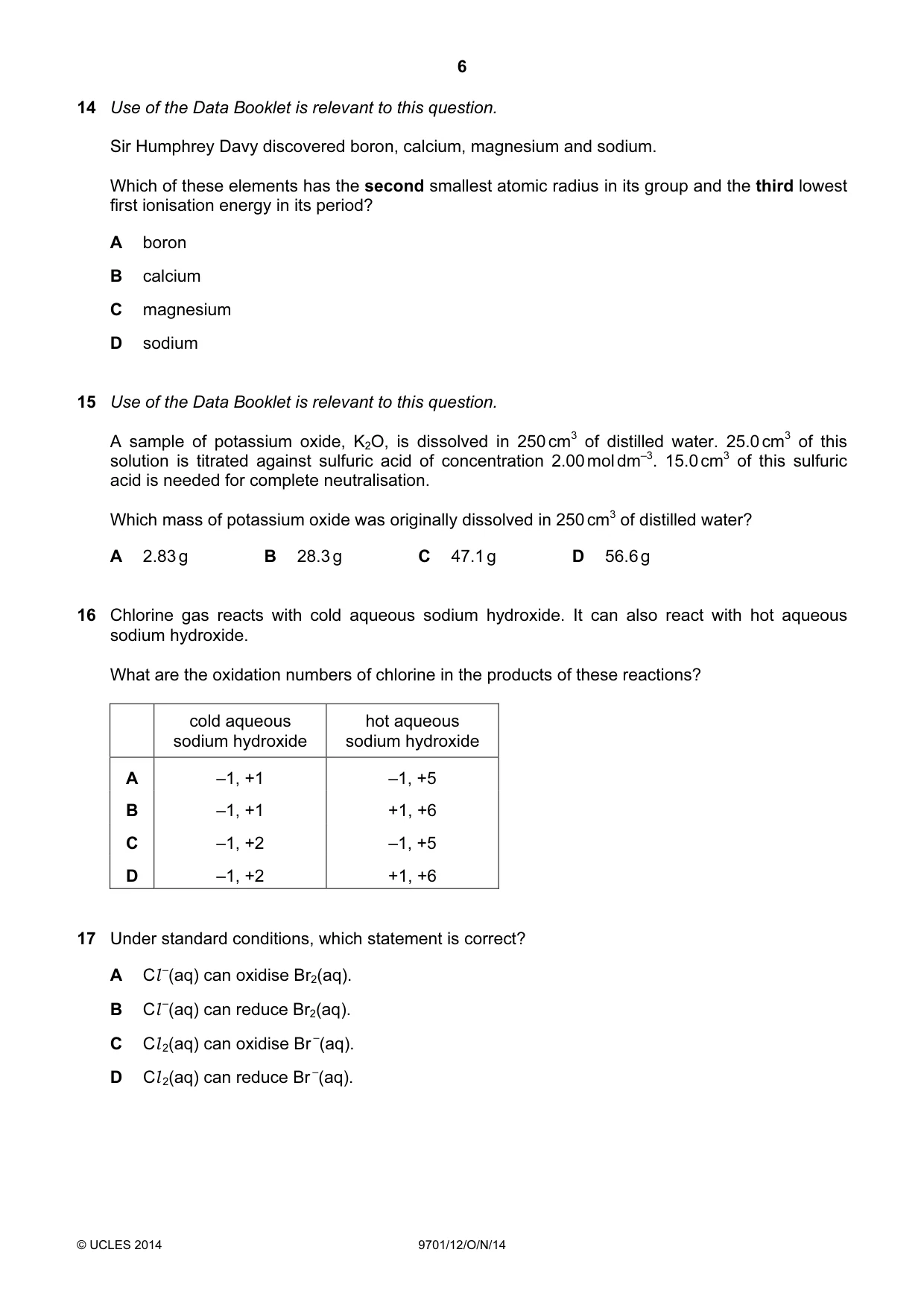
14 Use of the Data Booklet is relevant to this question. Sir Humphrey Davy discovered boron, calcium, magnesium and sodium. Which of these elements has the second smallest atomic radius in its group and the third lowest first ionisation energy in its period? A boron B calcium C magnesium D sodium
Mark scheme: C
Q15 · Use of the Data Booklet is relevant to this question
15 Use of the Data Booklet is relevant to this question. A sample of potassium oxide, K2O, is dissolved in 250 cm3 of distilled water. 25.0 cm3 of this solution is titrated against sulfuric acid of concentration 2.00 mol dm–3. 15.0 cm3 of this sulfuric acid is needed for complete neutralisation. Which mass of potassium oxide was originally dissolved in 250 cm3 of distilled water? A 2.83 g B 28.3 g C 47.1 g D 56.6 g
Mark scheme: B
More questions on Reacting masses and volumes (of solutions and gases)
Q16 · Chlorine gas reacts with cold aqueous sodium hydroxide
16 Chlorine gas reacts with cold aqueous sodium hydroxide. It can also react with hot aqueous sodium hydroxide. What are the oxidation numbers of chlorine in the products of these reactions? cold aqueous hot aqueous sodium hydroxide sodium hydroxide A –1, +1 –1, +5 B –1, +1 +1, +6 C –1, +2 –1, +5 D –1, +2 +1, +6
Mark scheme: A
Q17 · Under standard conditions, which statement is correct?
17 Under standard conditions, which statement is correct? A Cl –(aq) can oxidise Br2(aq). B Cl –(aq) can reduce Br2(aq). C Cl 2(aq) can oxidise Br –(aq). D Cl 2(aq) can reduce Br –(aq).
Mark scheme: C
More questions on Physical properties of the Group 17 elements
Q18 · Total removal of the pollutant sulfur dioxide, SO2, is difficult
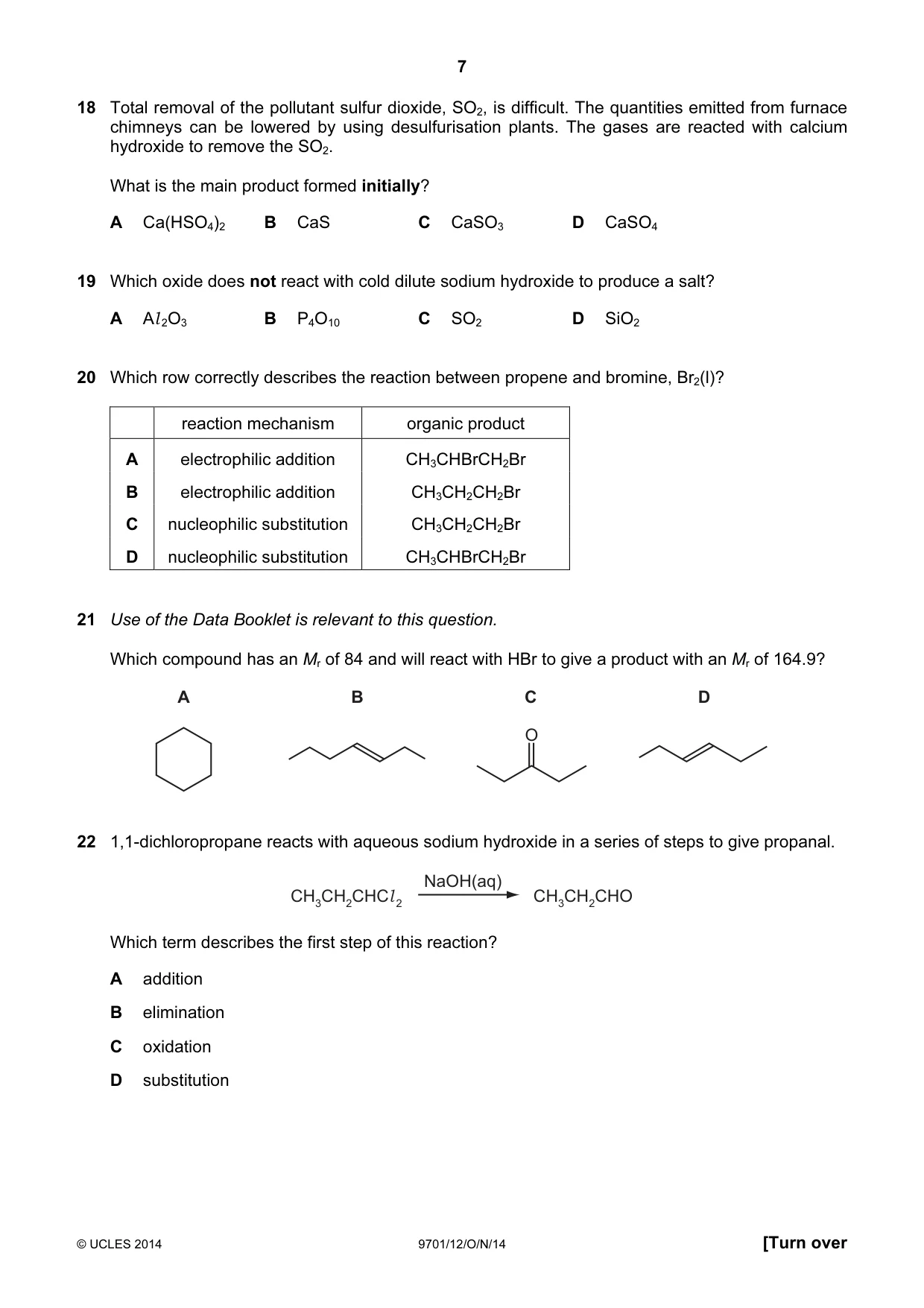
18 Total removal of the pollutant sulfur dioxide, SO2, is difficult. The quantities emitted from furnace chimneys can be lowered by using desulfurisation plants. The gases are reacted with calcium hydroxide to remove the SO2. What is the main product formed initially? A Ca(HSO4)2 B CaS C CaSO3 D CaSO4
Mark scheme: C
Q19 · Which oxide does not react with cold dilute sodium hydroxide to produce a salt?
19 Which oxide does not react with cold dilute sodium hydroxide to produce a salt? A Al 2O3 B P4O10 C SO2 D SiO2
Mark scheme: D
More questions on Periodicity of chemical properties of the elements in Period 3
Q20 · Which row correctly describes the reaction between propene and bromine, Br2(l)?
20 Which row correctly describes the reaction between propene and bromine, Br2(l)? reaction mechanism organic product A electrophilic addition CH3CHBrCH2Br B electrophilic addition CH3CH2CH2Br C nucleophilic substitution CH3CH2CH2Br D nucleophilic substitution CH3CHBrCH2Br
Mark scheme: A
Q21 · Use of the Data Booklet is relevant to this question
21 Use of the Data Booklet is relevant to this question. Which compound has an Mr of 84 and will react with HBr to give a product with an Mr of 164.9? A B C D O
Mark scheme: D
Q22 · 1,1-dichloropropane reacts with aqueous sodium hydroxide in a series of steps to give…
22 1,1-dichloropropane reacts with aqueous sodium hydroxide in a series of steps to give propanal. NaOH(aq) CH3CH2CHCl 2 CH3CH2CHO Which term describes the first step of this reaction? A addition B elimination C oxidation D substitution
Mark scheme: D
Q23 · Considering only structural isomers, what is the number of alcohols of each type with the…
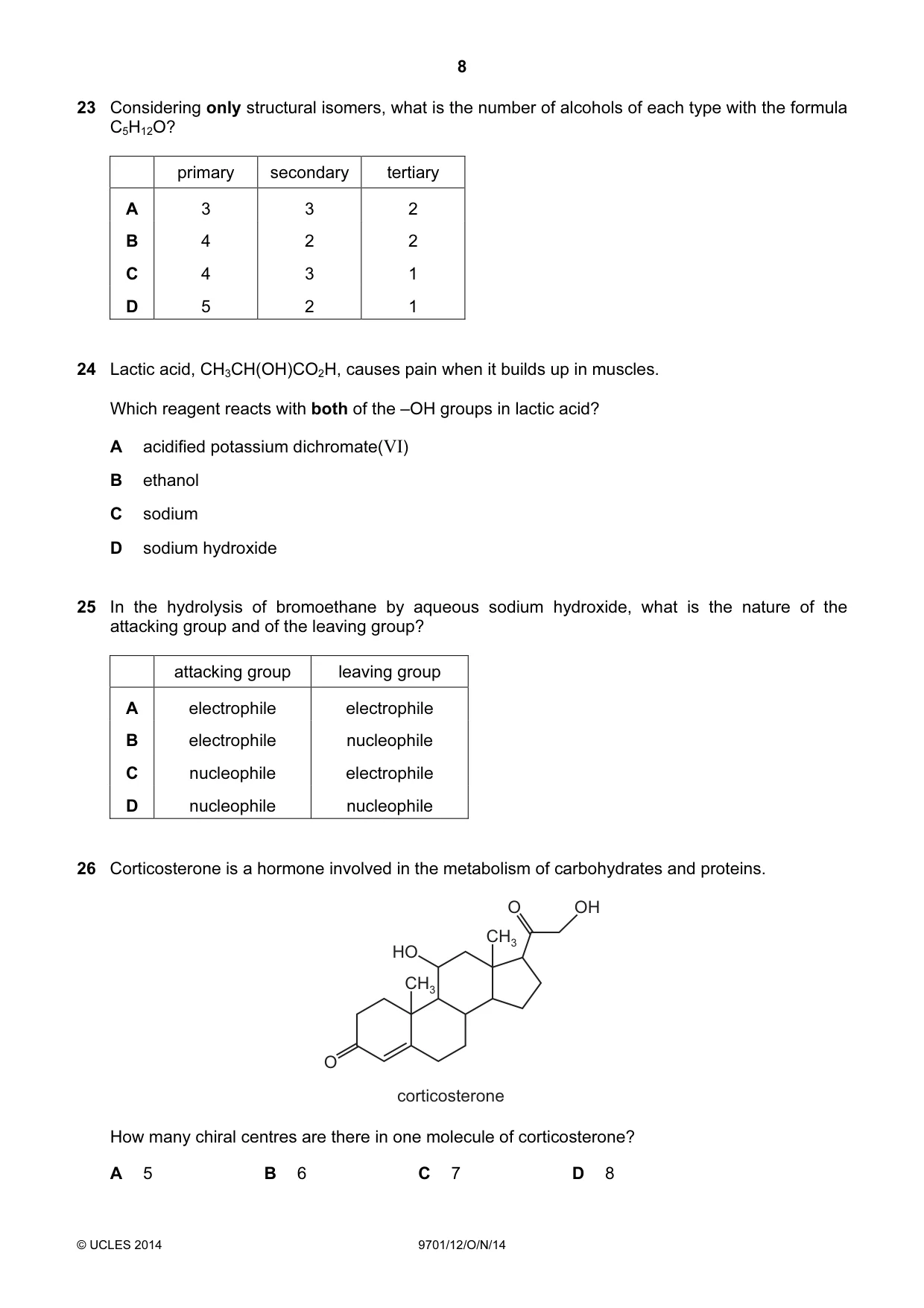
23 Considering only structural isomers, what is the number of alcohols of each type with the formula C5H12O? primary secondary tertiary A 3 3 2 B 4 2 2 C 4 3 1 D 5 2 1
Mark scheme: C
Q24 · Lactic acid, CH3CH(OH)CO2H, causes pain when it builds up in muscles
24 Lactic acid, CH3CH(OH)CO2H, causes pain when it builds up in muscles. Which reagent reacts with both of the –OH groups in lactic acid? A acidified potassium dichromate(VI) B ethanol C sodium D sodium hydroxide
Mark scheme: C
Q25 · In the hydrolysis of bromoethane by aqueous sodium hydroxide, what is the nature of the…
25 In the hydrolysis of bromoethane by aqueous sodium hydroxide, what is the nature of the attacking group and of the leaving group? attacking group leaving group A electrophile electrophile B electrophile nucleophile C nucleophile electrophile D nucleophile nucleophile
Mark scheme: D
Q26 · Corticosterone is a hormone involved in the metabolism of carbohydrates and proteins
26 Corticosterone is a hormone involved in the metabolism of carbohydrates and proteins. O OH CH3 HO CH3 O corticosterone How many chiral centres are there in one molecule of corticosterone? A 5 B 6 C 7 D 8
Mark scheme: C
Q27 · Methyl methylpropenoate is the monomer used to make Perspex
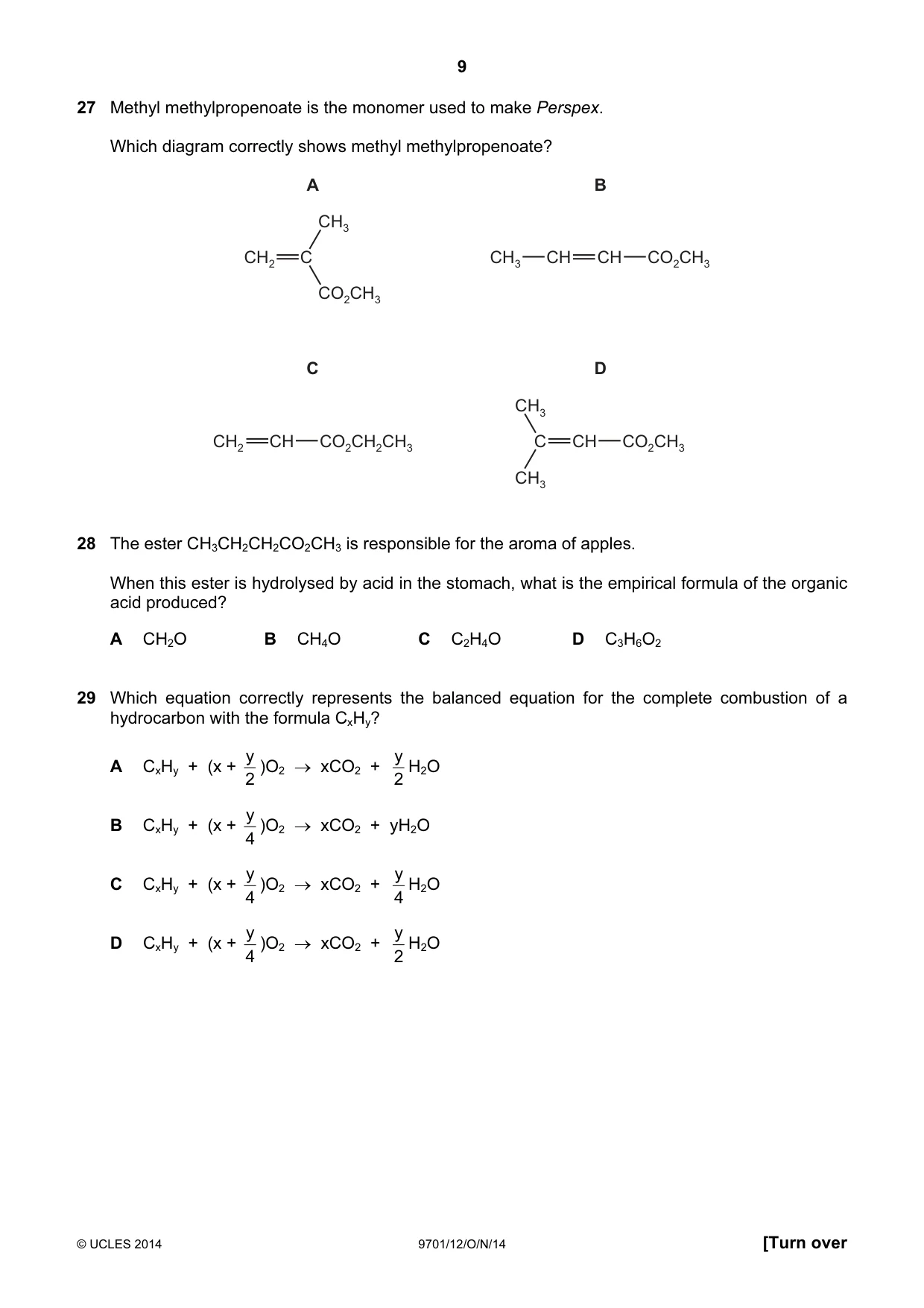
27 Methyl methylpropenoate is the monomer used to make Perspex. Which diagram correctly shows methyl methylpropenoate? A B CH3 CH2 C CH3 CH CH CO2CH3 CO2CH3 C D CH3 CH2 CH CO2CH2CH3 C CH CO2CH3 CH3
Mark scheme: A
More questions on Formulas, functional groups and the naming of organic compounds
Q28 · The ester CH3CH2CH2CO2CH3 is responsible for the aroma of apples
28 The ester CH3CH2CH2CO2CH3 is responsible for the aroma of apples. When this ester is hydrolysed by acid in the stomach, what is the empirical formula of the organic acid produced? A CH2O B CH4O C C2H4O D C3H6O2
Mark scheme: C
Q29 · Which equation correctly represents the balanced equation for the complete combustion of…
29 Which equation correctly represents the balanced equation for the complete combustion of a hydrocarbon with the formula CxHy? A y )O2 → xCO2 + 2 y H2O CxHy + (x + 2 B y )O2 → xCO2 + yH2O CxHy + (x + 4 C y )O2 → xCO2 + 4 y H2O CxHy + (x + 4 D y )O2 → xCO2 + 2 y H2O CxHy + (x + 4
Mark scheme: D
Q30 · Β-carotene is responsible for the orange colour of carrots
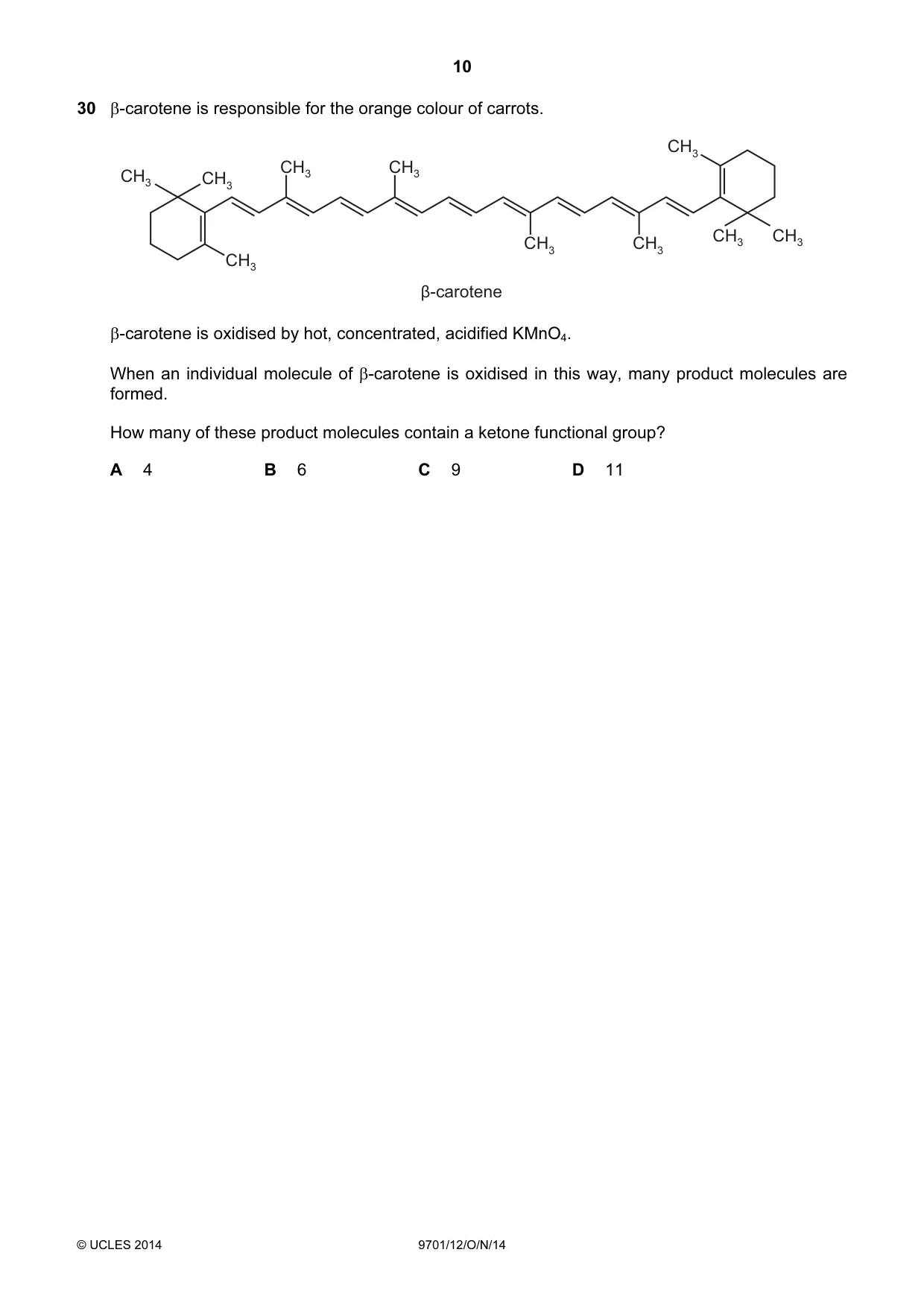
30 β-carotene is responsible for the orange colour of carrots. CH3 CH3 CH3 CH3 CH3 CH3 CH3 CH3 CH3 CH3 β-carotene β-carotene is oxidised by hot, concentrated, acidified KMnO4. When an individual molecule of β-carotene is oxidised in this way, many product molecules are formed. How many of these product molecules contain a ketone functional group? A 4 B 6 C 9 D 11
Mark scheme: B
Q31 · Use of the Data Booklet is relevant to this question
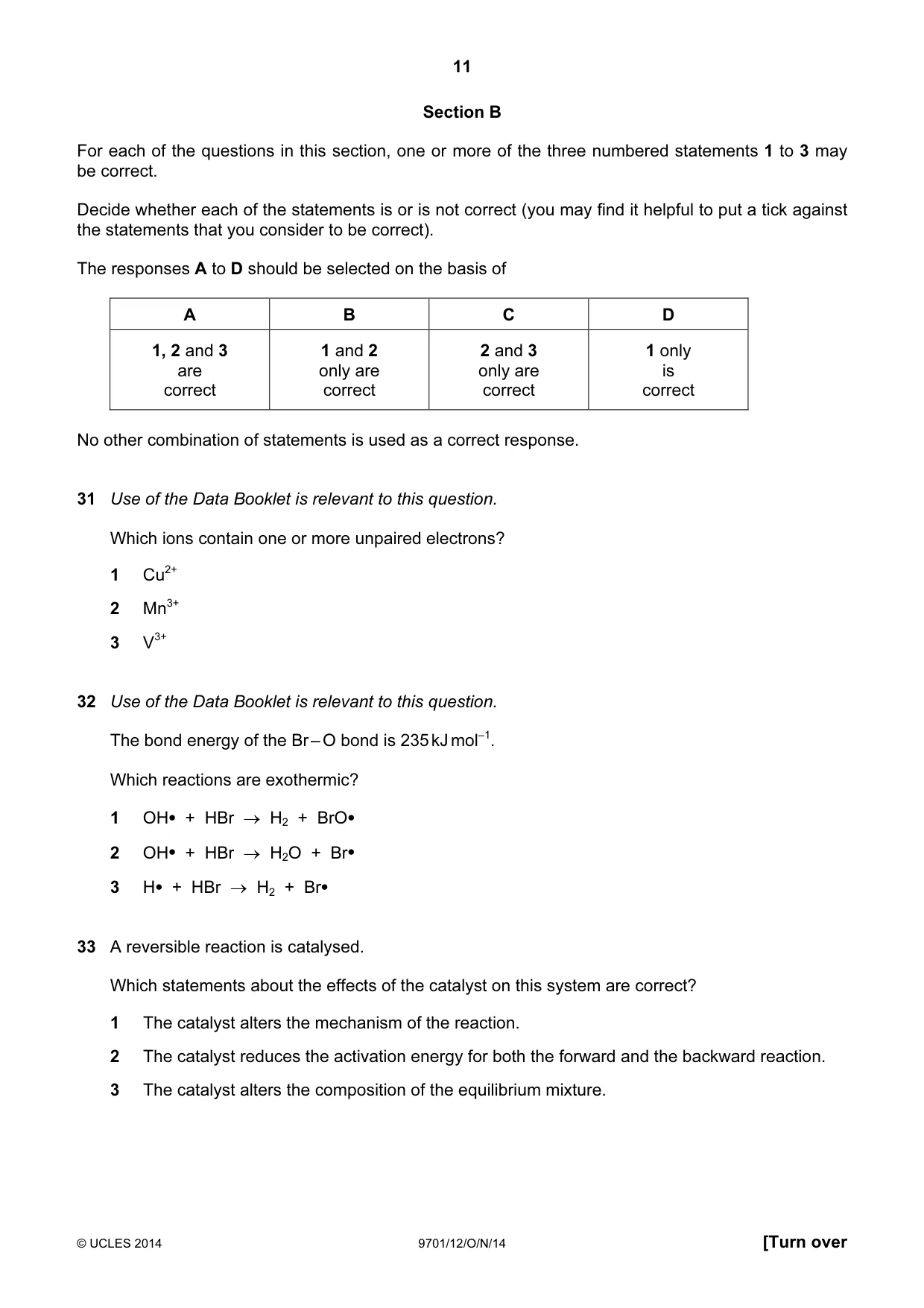
31 Use of the Data Booklet is relevant to this question. Which ions contain one or more unpaired electrons? 1 Cu2+ 2 Mn3+ 3 V3+
Mark scheme: A
Q32 · Use of the Data Booklet is relevant to this question
32 Use of the Data Booklet is relevant to this question. The bond energy of the Br – O bond is 235 kJ mol–1. Which reactions are exothermic? 1 OH• + HBr → H2 + BrO• 2 OH• + HBr → H2O + Br• 3 H• + HBr → H2 + Br•
Mark scheme: C
Q33 · A reversible reaction is catalysed
33 A reversible reaction is catalysed. Which statements about the effects of the catalyst on this system are correct? 1 The catalyst alters the mechanism of the reaction. 2 The catalyst reduces the activation energy for both the forward and the backward reaction. 3 The catalyst alters the composition of the equilibrium mixture.
Mark scheme: B
Q34 · A student borrowed a friend’s chemistry notes and copied out the notes in the box below
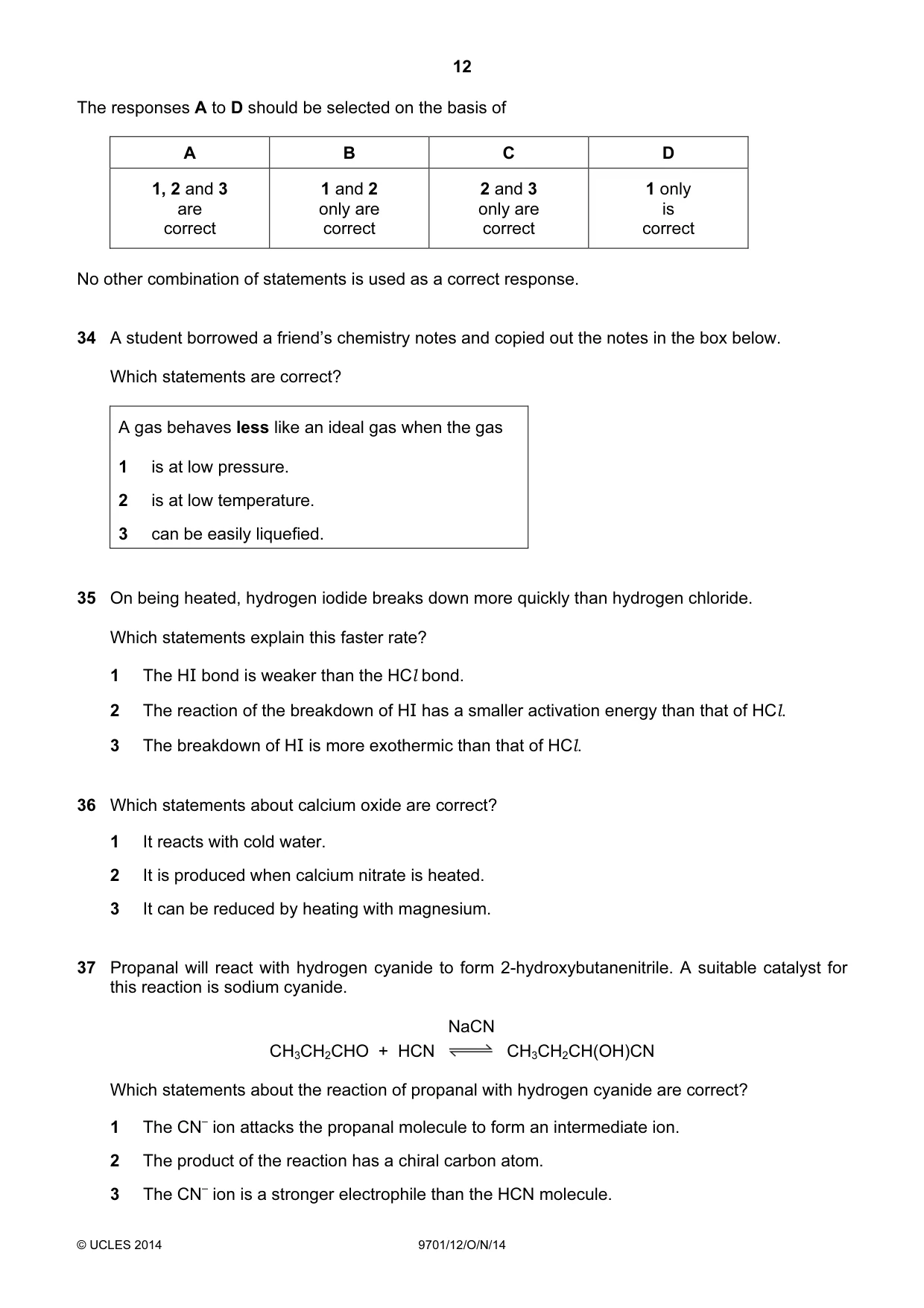
34 A student borrowed a friend’s chemistry notes and copied out the notes in the box below. Which statements are correct? A gas behaves less like an ideal gas when the gas 1 is at low pressure. 2 is at low temperature. 3 can be easily liquefied.
Mark scheme: C
More questions on The gaseous state: ideal and real gases and pV = nRT
Q35 · On being heated, hydrogen iodide breaks down more quickly than hydrogen chloride
35 On being heated, hydrogen iodide breaks down more quickly than hydrogen chloride. Which statements explain this faster rate? 1 The HI bond is weaker than the HCl bond. 2 The reaction of the breakdown of HI has a smaller activation energy than that of HCl. 3 The breakdown of HI is more exothermic than that of HCl.
Mark scheme: B
More questions on Effect of temperature on reaction rates and the concept of activation energy
Q36 · Which statements about calcium oxide are correct?
36 Which statements about calcium oxide are correct? 1 It reacts with cold water. 2 It is produced when calcium nitrate is heated. 3 It can be reduced by heating with magnesium.
Mark scheme: B
Q37 · Propanal will react with hydrogen cyanide to form 2-hydroxybutanenitrile
37 Propanal will react with hydrogen cyanide to form 2-hydroxybutanenitrile. A suitable catalyst for this reaction is sodium cyanide. NaCN CH3CH2CHO + HCN CH3CH2CH(OH)CN Which statements about the reaction of propanal with hydrogen cyanide are correct? 1 The CN– ion attacks the propanal molecule to form an intermediate ion. 2 The product of the reaction has a chiral carbon atom. 3 The CN– ion is a stronger electrophile than the HCN molecule.
Mark scheme: B
Q38 · X is an organic compound that gives a precipitate with aqueous silver nitrate
38 X is an organic compound that gives a precipitate with aqueous silver nitrate. This precipitate remains undissolved when concentrated aqueous ammonia is added. What is a possible identity for X? 1 iodomethane 2 2-bromobutane 3 2-chlorobutane
Mark scheme: D
Q39 · For which mixtures of reagents are the colour changes described correctly?
39 For which mixtures of reagents are the colour changes described correctly? reagents colour change 1 pentanal + hot, acidified potassium dichromate(VI) orange to green 2 pentan-2-one + warm Fehling’s reagent no change 3 cyclohexane + cold, acidified potassium manganate(VII) purple to colourless
Mark scheme: B
Q40 · A reaction pathway diagram is shown
40 A reaction pathway diagram is shown. energy extent of reaction Which reactions would have this profile? 1 (CH3)3CBr + NaOH → (CH3)3COH + NaBr 2 CH3CH2Br + NaOH → CH3CH2OH + NaBr 3 (CH3)3CCH2CH2Cl + 2NH3 → (CH3)3CCH2CH2NH2 + NH4Cl
Mark scheme: D
What was in this paper
The subtopics covered by these 40 questions, and how many questions each got. Open one in a new tab to see every Cambridge question on it.
4Effect of temperature on reaction rates and the concept of activation energy3Halogenoalkanes3Periodicity of chemical properties of the elements in Period 33Alcohols2Aldehydes and ketones2Alkenes2Formulas2The gaseous state: ideal and real gases and pV = nRT2Bonding and structure1Colour of complexes1Electrolysis1Esters1Formulas, functional groups and the naming of organic compounds1Halogen compounds1Homogeneous and heterogeneous catalysts1Intermolecular forces, electronegativity and bond properties1Ionisation energy1Isomerism: optical1Nitriles and hydroxynitriles1Nitrogen and sulfur1Physical properties of the Group 17 elements1Reacting masses and volumes (of solutions and gases)1Redox processes: electron transfer and changes in oxidation number (oxidation state)1Similarities and trends in the properties of the Group 2 metals, magnesium to barium, and their compounds1The reactions of chlorine1What you needed in this session
Cambridge’s own grade thresholds for 2014 Oct/Nov, Paper 1 · Variant 2. A higher threshold means an easier paper — the bar moves with how the cohort did.