Cambridge A Level Chemistry 9701 — 2016 May/June Paper 1 · Variant 3
9701/13/M/J/16 · 40 questions · 40 marks · ≈45 min
The question paper and its mark scheme, free to read here and free to download. This is Cambridge’s own paper, exactly as it was sat.
Question paper16 pages
Mark scheme2 pages
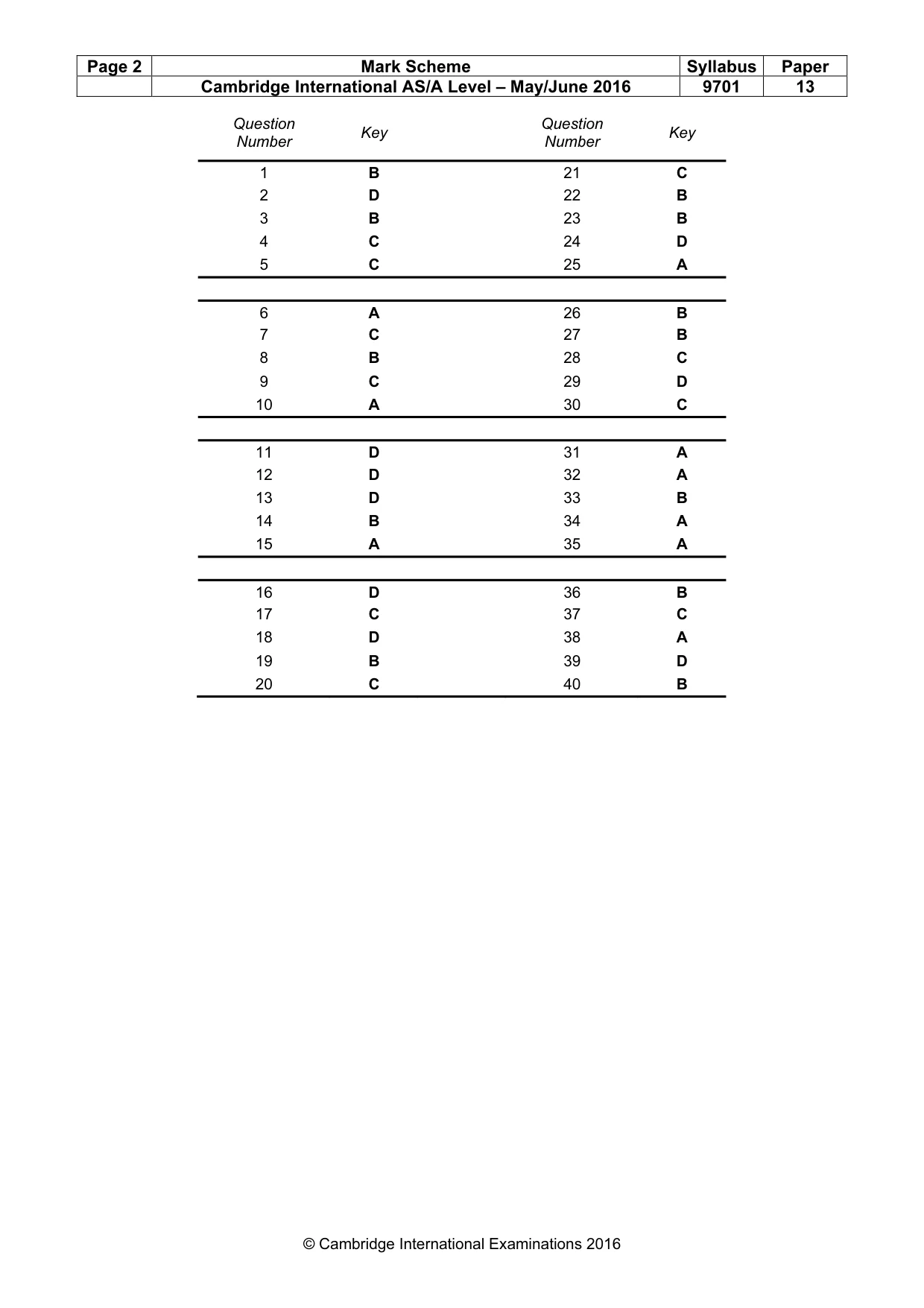
Answers below. Sit the paper first if you are practising.
Questions as text
Q1 · Enthalpy changes, ∆H, can be positive or negative
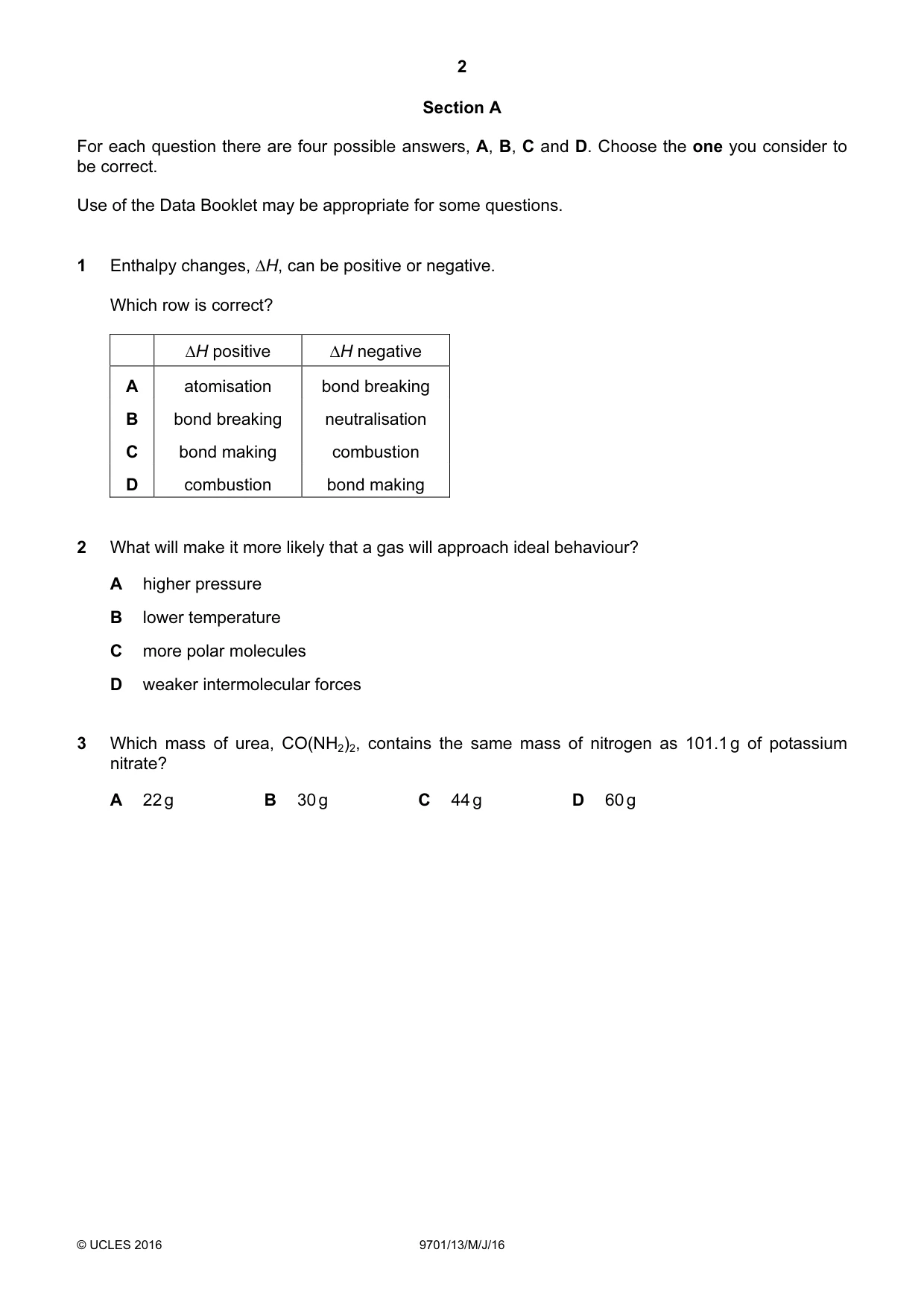
1 Enthalpy changes, ∆H, can be positive or negative. Which row is correct? ∆H positive ∆H negative A atomisation bond breaking B bond breaking neutralisation C bond making combustion D combustion bond making
Mark scheme: B
Q2 · What will make it more likely that a gas will approach ideal behaviour?
2 What will make it more likely that a gas will approach ideal behaviour? A higher pressure B lower temperature C more polar molecules D weaker intermolecular forces
Mark scheme: D
More questions on The gaseous state: ideal and real gases and pV = nRT
Q3 · Which mass of urea, CO(NH2)2, contains the same mass of nitrogen as 101.1 g of potassium…
3 Which mass of urea, CO(NH2)2, contains the same mass of nitrogen as 101.1 g of potassium nitrate? A 22 g B 30 g C 44 g D 60 g
Mark scheme: B
Q4 · The relative atomic mass of copper is 63.5
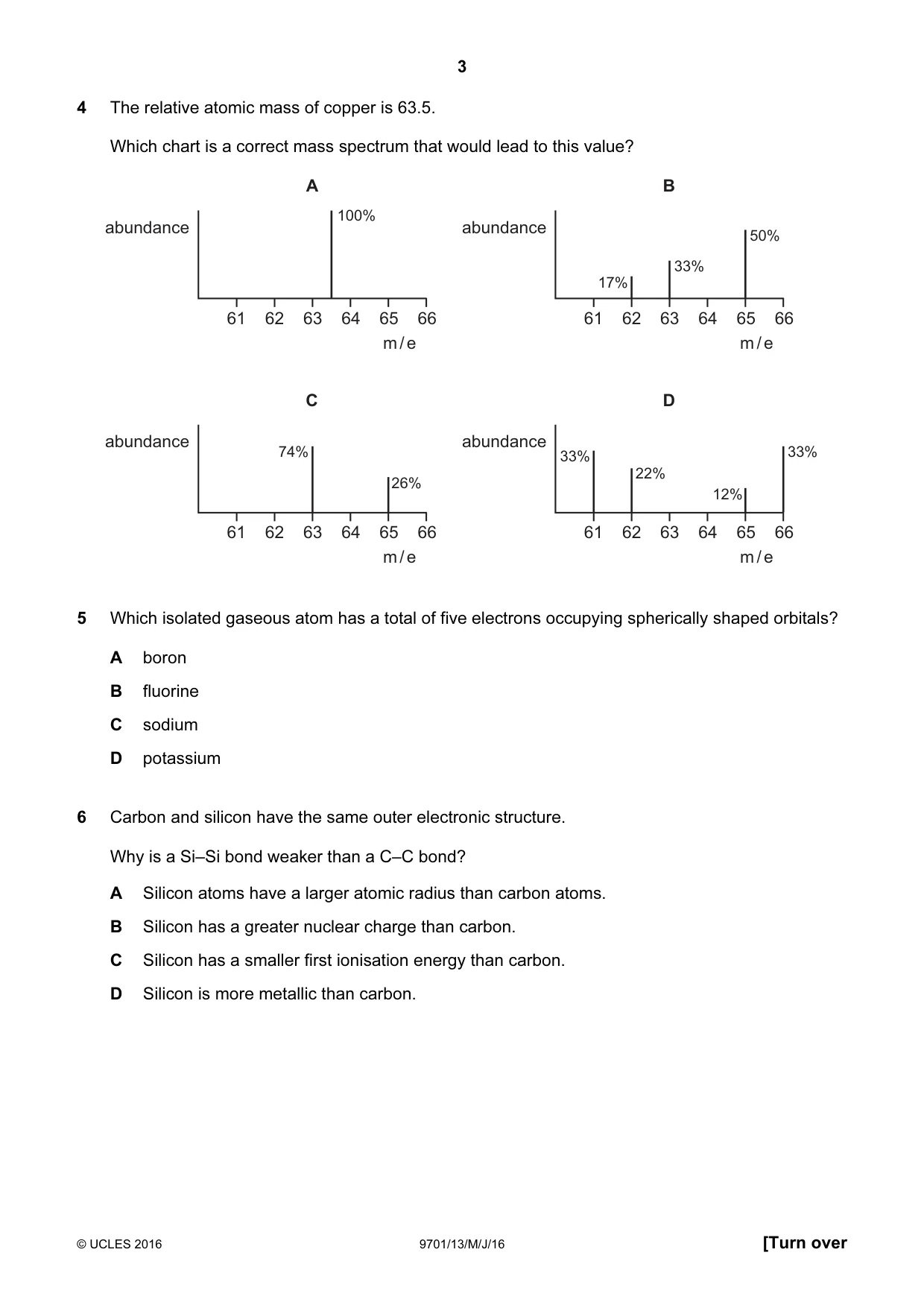
4 The relative atomic mass of copper is 63.5. Which chart is a correct mass spectrum that would lead to this value? A B 100% abundance abundance 50% 33% 17% 61 62 63 64 65 66 61 62 63 64 65 66 m / e m / e C D abundance abundance 74% 33% 33% 22% 26% 12% 61 62 63 64 65 66 61 62 63 64 65 66 m / e m / e
Mark scheme: C
Q5 · Which isolated gaseous atom has a total of five electrons occupying spherically shaped…
5 Which isolated gaseous atom has a total of five electrons occupying spherically shaped orbitals? A boron B fluorine C sodium D potassium
Mark scheme: C
More questions on Electrons, energy levels and atomic orbitals
Q6 · Carbon and silicon have the same outer electronic structure
6 Carbon and silicon have the same outer electronic structure. Why is a Si–Si bond weaker than a C–C bond? A Silicon atoms have a larger atomic radius than carbon atoms. B Silicon has a greater nuclear charge than carbon. C Silicon has a smaller first ionisation energy than carbon. D Silicon is more metallic than carbon.
Mark scheme: A
Q7 · Methyl isocyanate, CH3NCO, is a toxic liquid which is used in the manufacture of some…
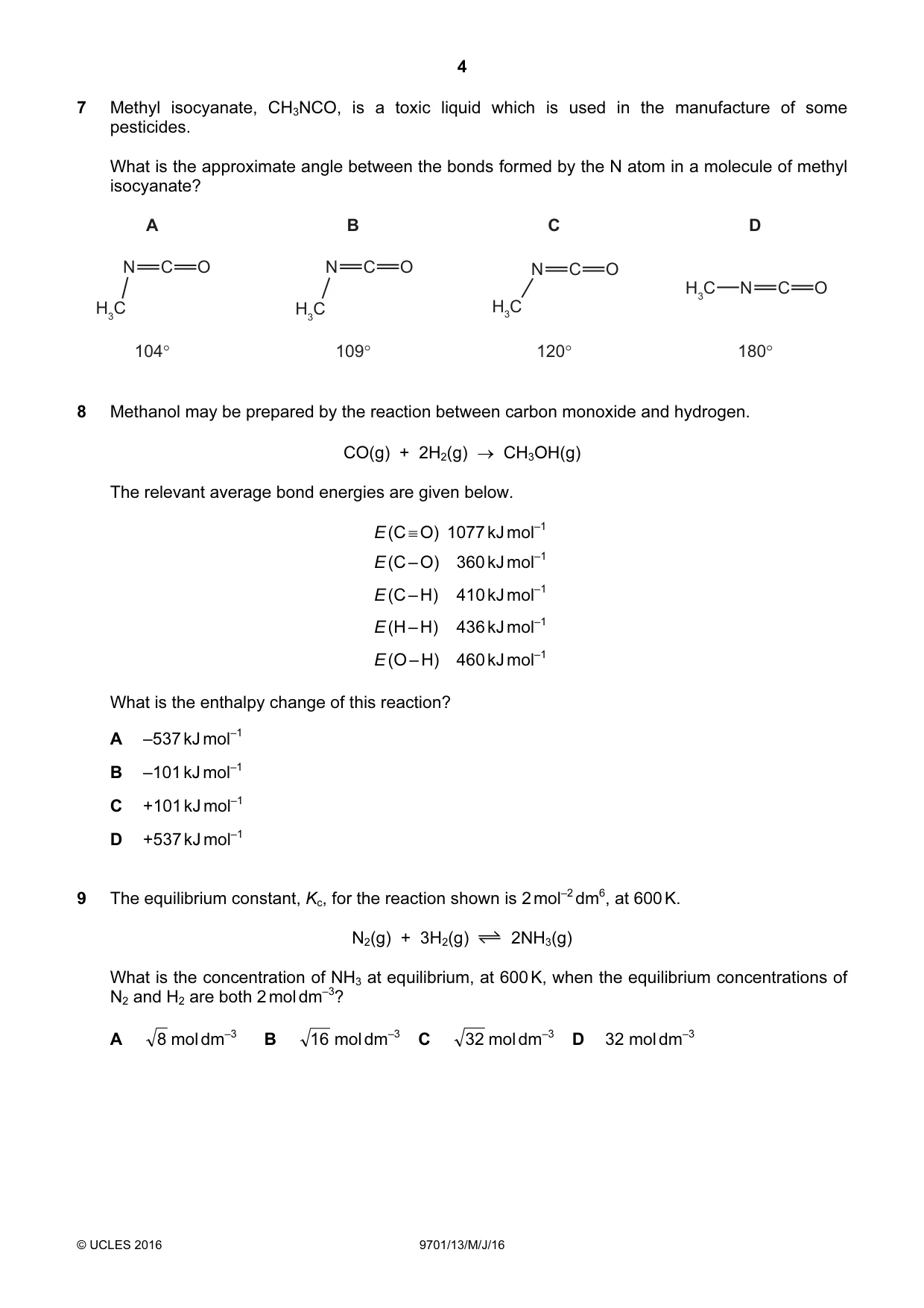
7 Methyl isocyanate, CH3NCO, is a toxic liquid which is used in the manufacture of some pesticides. What is the approximate angle between the bonds formed by the N atom in a molecule of methyl isocyanate? A B C D N C O N C O N C O H3C N C O H3C H3C H3C 104° 109° 120° 180°
Mark scheme: C
Q8 · Methanol may be prepared by the reaction between carbon monoxide and hydrogen
8 Methanol may be prepared by the reaction between carbon monoxide and hydrogen. CO(g) + 2H2(g) → CH3OH(g) The relevant average bond energies are given below. E (C ≡ O) 1077 kJ mol–1 E (C – O) 360 kJ mol–1 E (C – H) 410 kJ mol–1 E (H – H) 436 kJ mol–1 E (O – H) 460 kJ mol–1 What is the enthalpy change of this reaction? A –537 kJ mol–1 B –101 kJ mol–1 C +101 kJ mol–1 D +537 kJ mol–1
Mark scheme: B
Q9 · The equilibrium constant, Kc, for the reaction shown is 2 mol–2 dm6, at 600 K
9 The equilibrium constant, Kc, for the reaction shown is 2 mol–2 dm6, at 600 K. N2(g) + 3H2(g) 2NH3(g) What is the concentration of NH3 at equilibrium, at 600 K, when the equilibrium concentrations of N2 and H2 are both 2 mol dm–3? A 8 mol dm–3 B 16 mol dm–3 C 32 mol dm–3 D 32 mol dm–3
Mark scheme: C
More questions on Chemical equilibria: reversible reactions, dynamic equilibrium
Q10 · Sulfur dioxide is used as a preservative in wine making
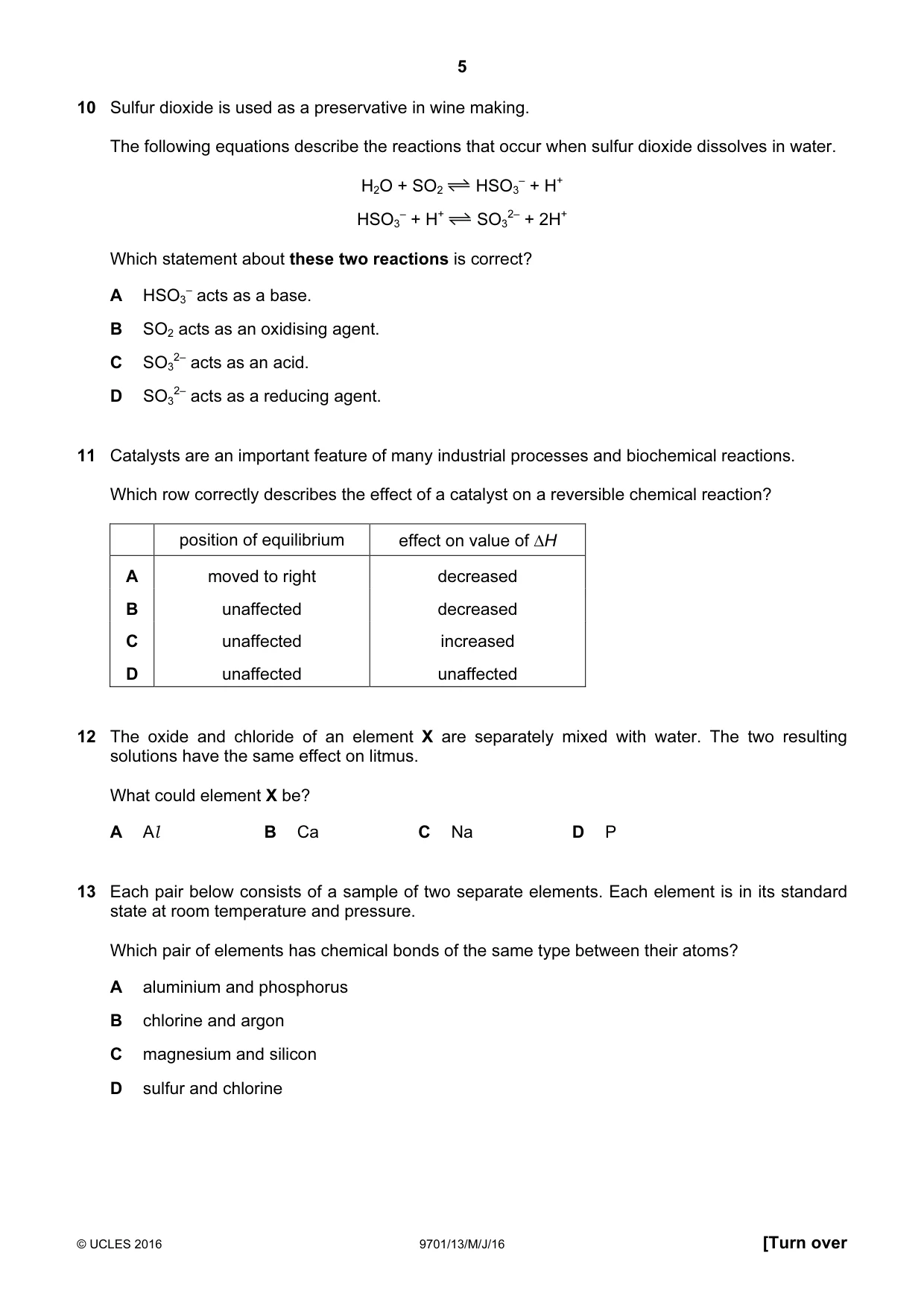
10 Sulfur dioxide is used as a preservative in wine making. The following equations describe the reactions that occur when sulfur dioxide dissolves in water. H2O + SO2 HSO3 – + H+ HSO3 – + H+ SO3 2– + 2H+ Which statement about these two reactions is correct? A HSO3 – acts as a base. B SO2 acts as an oxidising agent. C SO3 2– acts as an acid. D SO3 2– acts as a reducing agent.
Mark scheme: A
Q11 · Catalysts are an important feature of many industrial processes and biochemical reactions
11 Catalysts are an important feature of many industrial processes and biochemical reactions. Which row correctly describes the effect of a catalyst on a reversible chemical reaction? position of equilibrium effect on value of ∆H A moved to right decreased B unaffected decreased C unaffected increased D unaffected unaffected
Mark scheme: D
Q12 · The oxide and chloride of an element X are separately mixed with water
12 The oxide and chloride of an element X are separately mixed with water. The two resulting solutions have the same effect on litmus. What could element X be? A Al B Ca C Na D P
Mark scheme: D
More questions on Periodicity of chemical properties of the elements in Period 3
Q13 · Each pair below consists of a sample of two separate elements
13 Each pair below consists of a sample of two separate elements. Each element is in its standard state at room temperature and pressure. Which pair of elements has chemical bonds of the same type between their atoms? A aluminium and phosphorus B chlorine and argon C magnesium and silicon D sulfur and chlorine
Mark scheme: D
Q14 · Solutions of Mg(NO3)2 and Ba(NO3)2 separately undergo a series of reactions
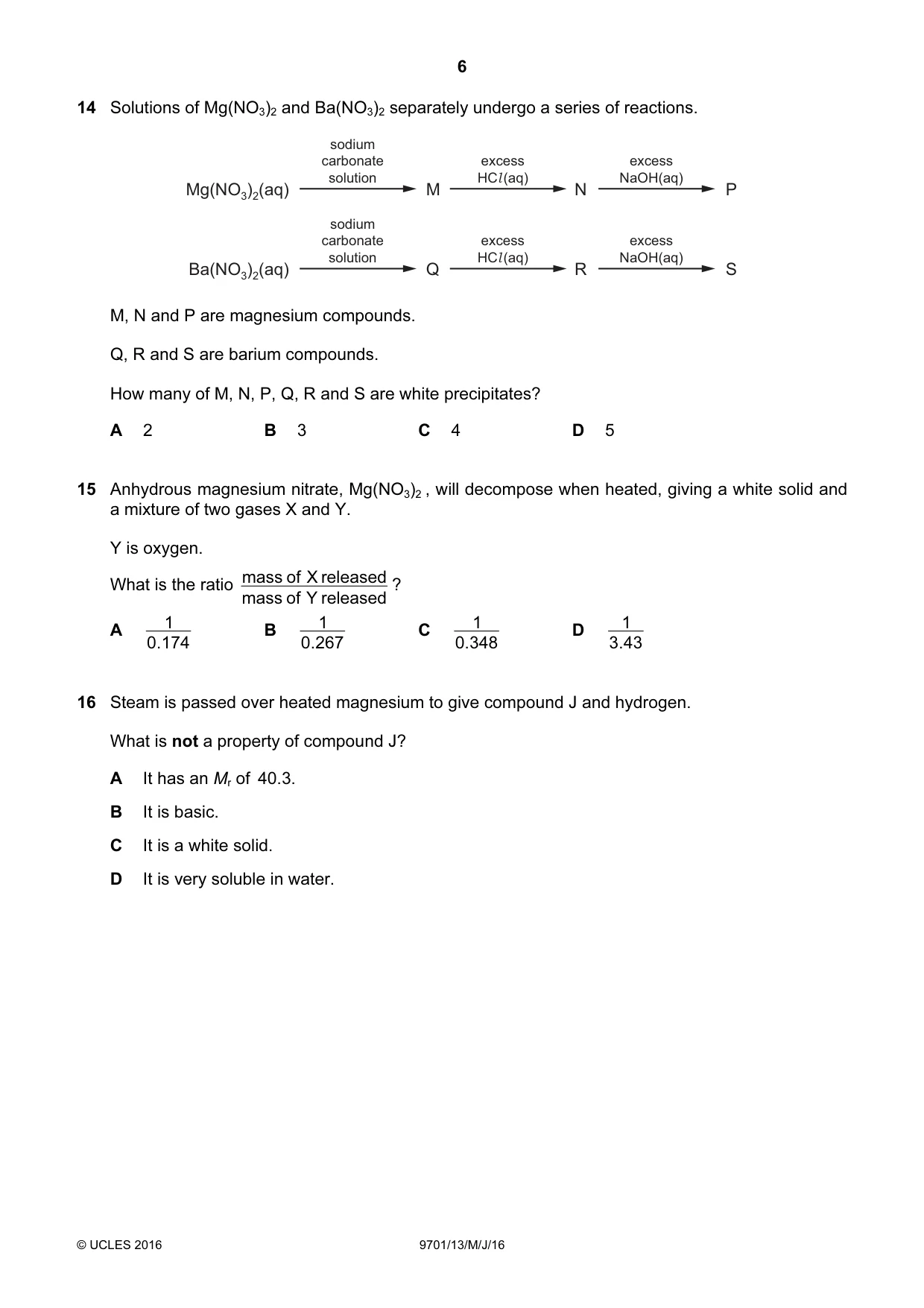
14 Solutions of Mg(NO3)2 and Ba(NO3)2 separately undergo a series of reactions. sodium carbonate excess excess solution HCl (aq) NaOH(aq) Mg(NO3)2(aq) M N P sodium carbonate excess excess solution HCl (aq) NaOH(aq) Ba(NO3)2(aq) Q R S M, N and P are magnesium compounds. Q, R and S are barium compounds. How many of M, N, P, Q, R and S are white precipitates? A 2 B 3 C 4 D 5
Mark scheme: B
Q15 · Anhydrous magnesium nitrate, Mg(NO3)2 , will decompose when heated, giving a white solid…
15 Anhydrous magnesium nitrate, Mg(NO3)2 , will decompose when heated, giving a white solid and a mixture of two gases X and Y. Y is oxygen. mass of X released What is the ratio ? mass of Y released A 1 B 1 C 1 D 1 0 . 174 0 . 267 0 . 348 3 . 43
Mark scheme: A
Q16 · Steam is passed over heated magnesium to give compound J and hydrogen
16 Steam is passed over heated magnesium to give compound J and hydrogen. What is not a property of compound J? A It has an Mr of 40.3. B It is basic. C It is a white solid. D It is very soluble in water.
Mark scheme: D
Q17 · Two students, P and Q, were asked to draw bar charts to represent how some properties of…
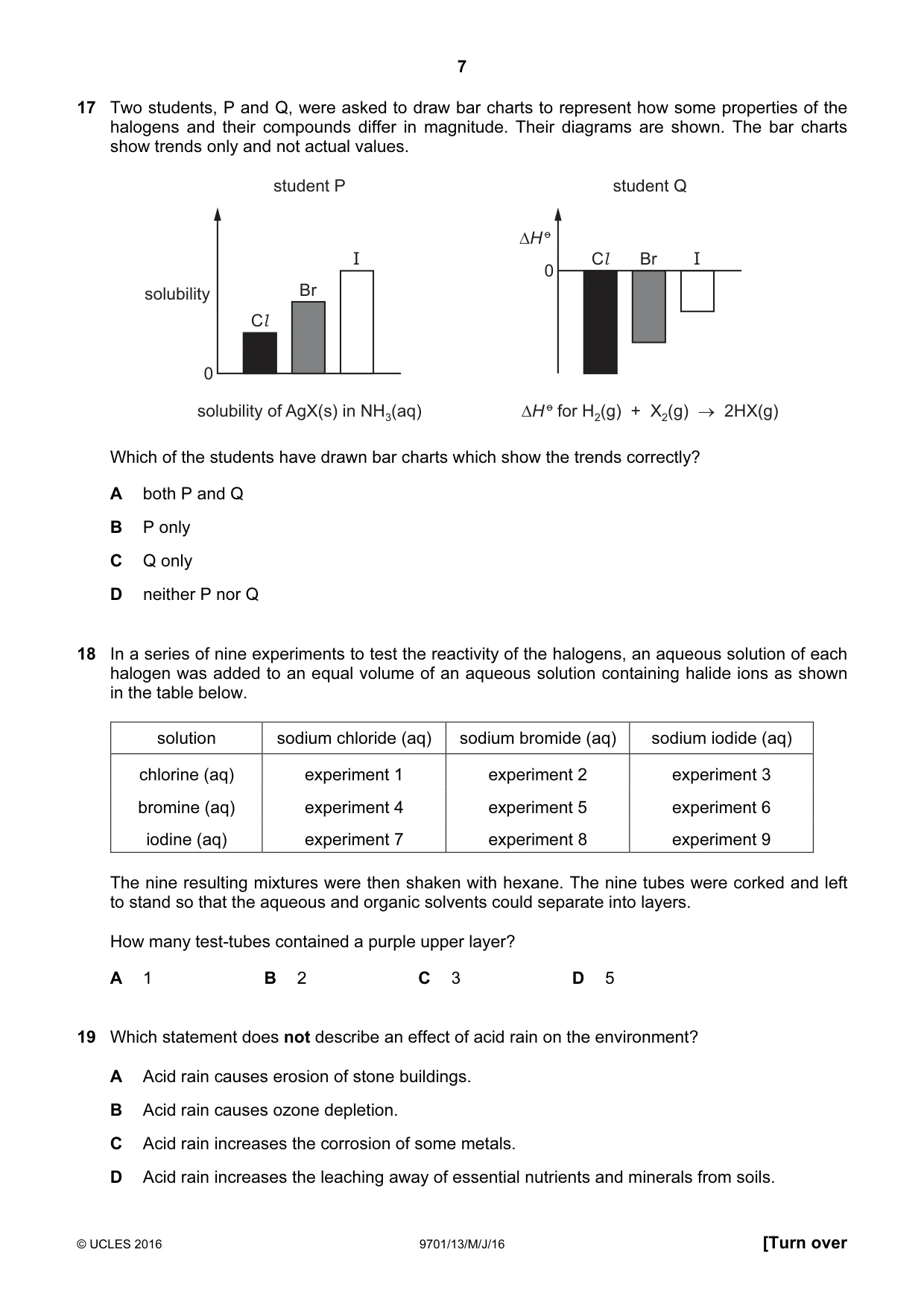
17 Two students, P and Q, were asked to draw bar charts to represent how some properties of the halogens and their compounds differ in magnitude. Their diagrams are shown. The bar charts show trends only and not actual values. student P student Q ∆H o I Cl Br I 0 solubility Br Cl 0 solubility of AgX(s) in NH3(aq) ∆H o for H2(g) + X2(g) → 2HX(g) Which of the students have drawn bar charts which show the trends correctly? A both P and Q B P only C Q only D neither P nor Q
Mark scheme: C
More questions on Physical properties of the Group 17 elements
Q18 · In a series of nine experiments to test the reactivity of the halogens, an aqueous…
18 In a series of nine experiments to test the reactivity of the halogens, an aqueous solution of each halogen was added to an equal volume of an aqueous solution containing halide ions as shown in the table below. solution sodium chloride (aq) sodium bromide (aq) sodium iodide (aq) chlorine (aq) experiment 1 experiment 2 experiment 3 bromine (aq) experiment 4 experiment 5 experiment 6 iodine (aq) experiment 7 experiment 8 experiment 9 The nine resulting mixtures were then shaken with hexane. The nine tubes were corked and left to stand so that the aqueous and organic solvents could separate into layers. How many test-tubes contained a purple upper layer? A 1 B 2 C 3 D 5
Mark scheme: D
More questions on The chemical properties of the halogen elements and the hydrogen halides
Q19 · Which statement does not describe an effect of acid rain on the environment?
19 Which statement does not describe an effect of acid rain on the environment? A Acid rain causes erosion of stone buildings. B Acid rain causes ozone depletion. C Acid rain increases the corrosion of some metals. D Acid rain increases the leaching away of essential nutrients and minerals from soils.
Mark scheme: B
Q20 · What is the correct name of the molecule with the skeletal formula shown?
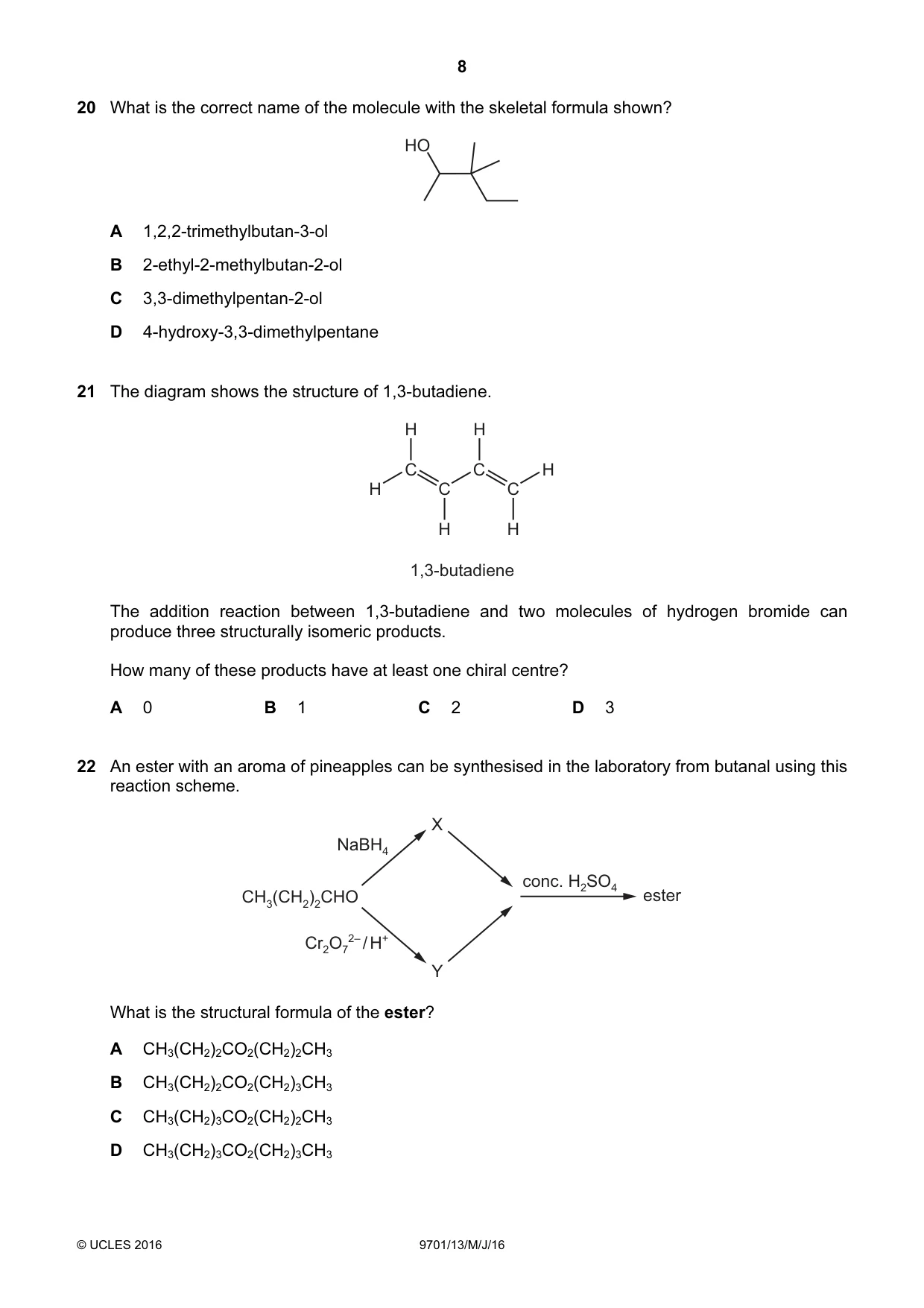
20 What is the correct name of the molecule with the skeletal formula shown? HO A 1,2,2-trimethylbutan-3-ol B 2-ethyl-2-methylbutan-2-ol C 3,3-dimethylpentan-2-ol D 4-hydroxy-3,3-dimethylpentane
Mark scheme: C
More questions on Formulas, functional groups and the naming of organic compounds
Q21 · The diagram shows the structure of 1,3-butadiene
21 The diagram shows the structure of 1,3-butadiene. H H C C H H C C H H 1,3-butadiene The addition reaction between 1,3-butadiene and two molecules of hydrogen bromide can produce three structurally isomeric products. How many of these products have at least one chiral centre? A 0 B 1 C 2 D 3
Mark scheme: C
More questions on Isomerism: structural isomerism and stereoisomerism
Q22 · An ester with an aroma of pineapples can be synthesised in the laboratory from butanal…
22 An ester with an aroma of pineapples can be synthesised in the laboratory from butanal using this reaction scheme. X NaBH4 conc. H2SO4 CH3(CH2)2CHO ester Cr2O7 2– / H+ Y What is the structural formula of the ester? A CH3(CH2)2CO2(CH2)2CH3 B CH3(CH2)2CO2(CH2)3CH3 C CH3(CH2)3CO2(CH2)2CH3 D CH3(CH2)3CO2(CH2)3CH3
Mark scheme: B
Q23 · When heated with chlorine, the hydrocarbon 2,2-dimethylbutane undergoes free radical…
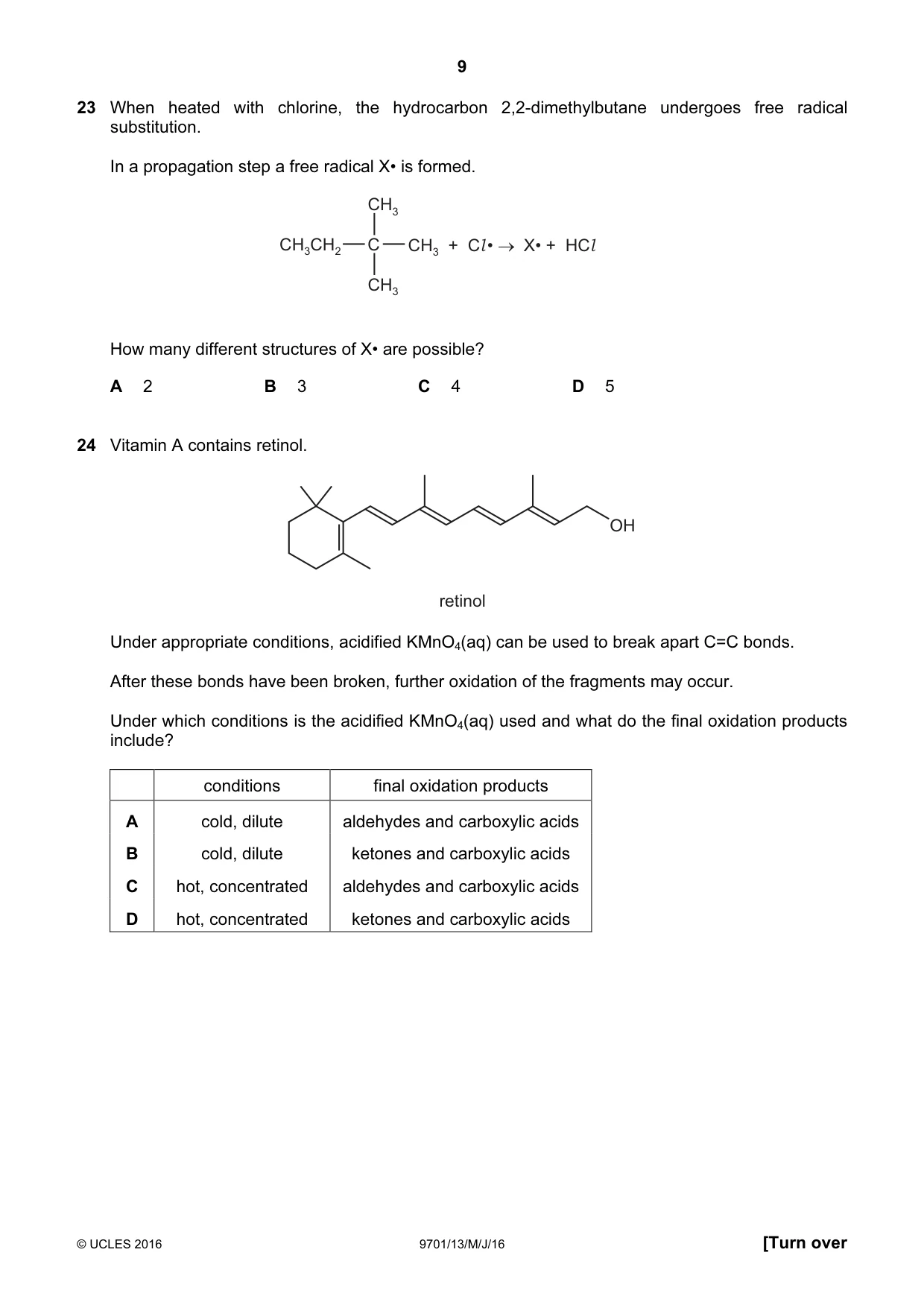
23 When heated with chlorine, the hydrocarbon 2,2-dimethylbutane undergoes free radical substitution. In a propagation step a free radical X• is formed. CH3 CH3CH2 C CH3 + Cl • → X• + HCl CH3 How many different structures of X• are possible? A 2 B 3 C 4 D 5
Mark scheme: B
Q24 · Vitamin A contains retinol
24 Vitamin A contains retinol. OH retinol Under appropriate conditions, acidified KMnO4(aq) can be used to break apart C=C bonds. After these bonds have been broken, further oxidation of the fragments may occur. Under which conditions is the acidified KMnO4(aq) used and what do the final oxidation products include? conditions final oxidation products A cold, dilute aldehydes and carboxylic acids B cold, dilute ketones and carboxylic acids C hot, concentrated aldehydes and carboxylic acids D hot, concentrated ketones and carboxylic acids
Mark scheme: D
Q25 · A reaction pathway diagram is shown
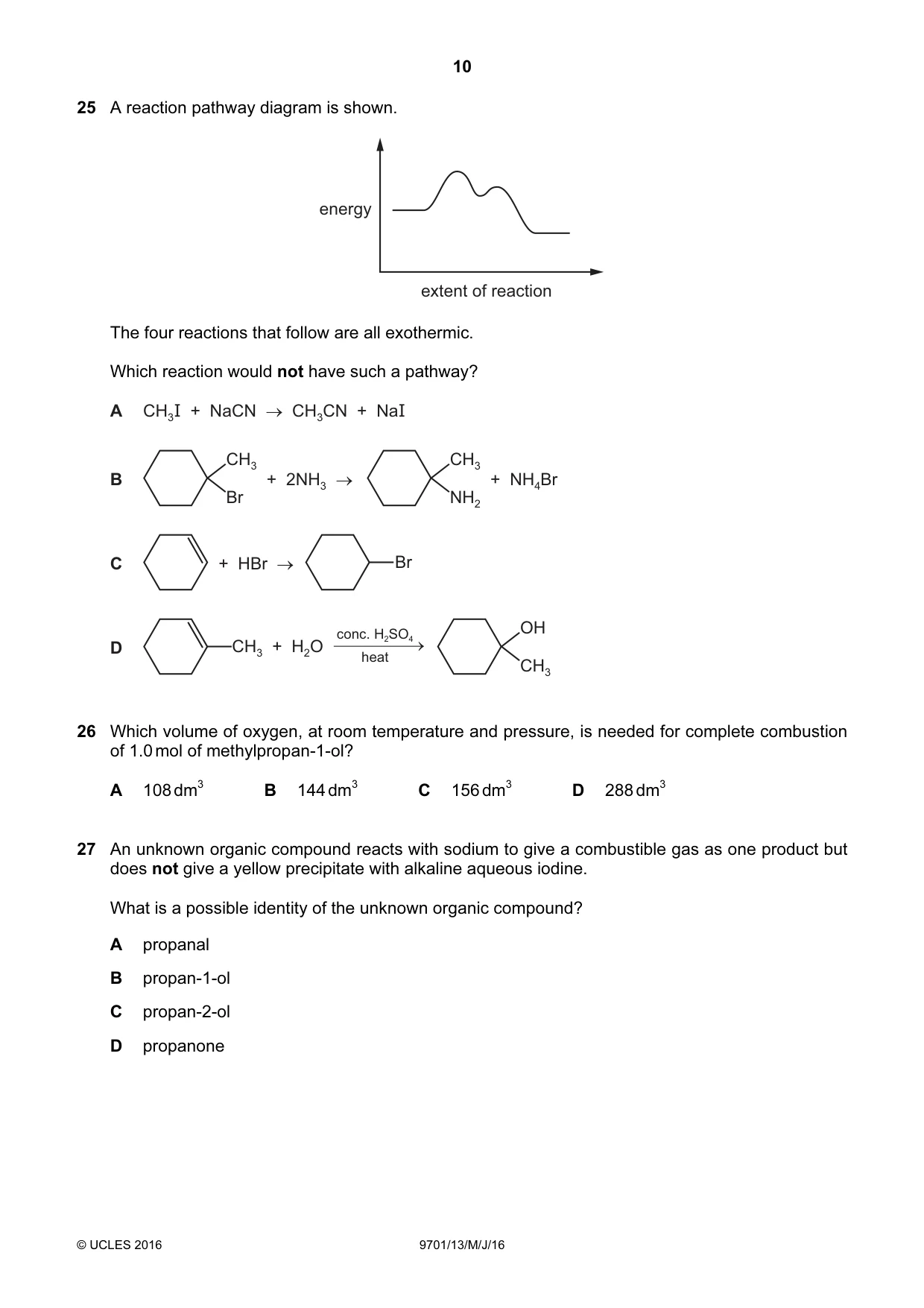
25 A reaction pathway diagram is shown. energy extent of reaction The four reactions that follow are all exothermic. Which reaction would not have such a pathway? A CH3I + NaCN → CH3CN + NaI CH3 CH3 B + 2NH3 → + NH4Br Br NH2 C + HBr → Br conc. H2SO4 OH D CH3 + H2O heat CH3
Mark scheme: A
Q26 · Which volume of oxygen, at room temperature and pressure, is needed for complete…
26 Which volume of oxygen, at room temperature and pressure, is needed for complete combustion of 1.0 mol of methylpropan-1-ol? A 108 dm3 B 144 dm3 C 156 dm3 D 288 dm3
Mark scheme: B
More questions on Reacting masses and volumes (of solutions and gases)
Q27 · An unknown organic compound reacts with sodium to give a combustible gas as one product…
27 An unknown organic compound reacts with sodium to give a combustible gas as one product but does not give a yellow precipitate with alkaline aqueous iodine. What is a possible identity of the unknown organic compound? A propanal B propan-1-ol C propan-2-ol D propanone
Mark scheme: B
Q28 · Which reaction will give 2-chloropropane in the best yield?
28 Which reaction will give 2-chloropropane in the best yield? A propane gas with chlorine gas in the presence of ultraviolet light B propan-2-ol with dilute NaCl (aq) C propan-2-ol with SOCl 2(l) D propene with dilute HCl (aq)
Mark scheme: C
Q29 · The ester, CH3CH2CO2CH3, is hydrolysed by boiling with aqueous sodium hydroxide
29 The ester, CH3CH2CO2CH3, is hydrolysed by boiling with aqueous sodium hydroxide. Which compound is one of the products? A ethanol B propan-1-ol C sodium methanoate D sodium propanoate
Mark scheme: D
Q30 · Caprolactone is a cyclic ester
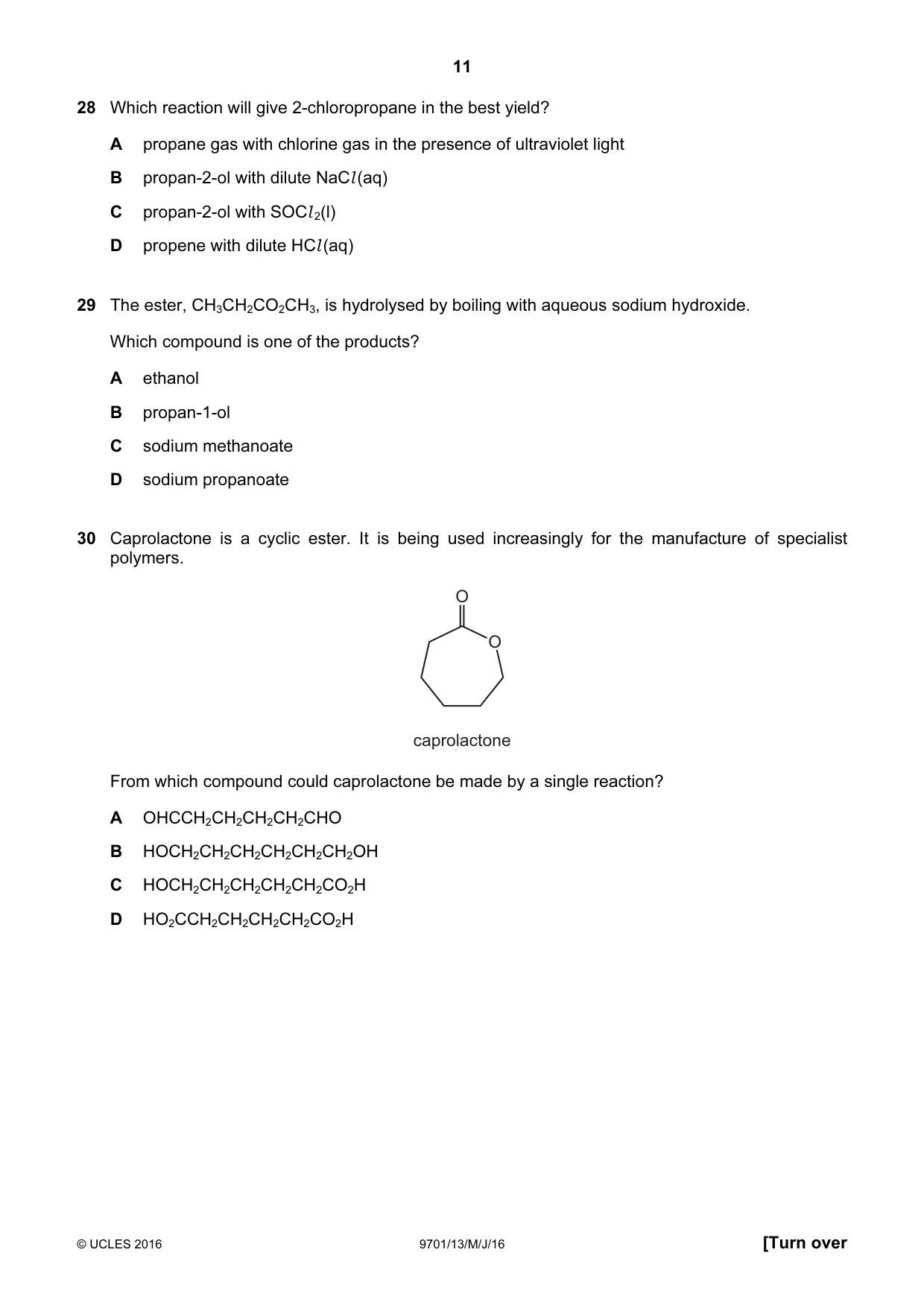
30 Caprolactone is a cyclic ester. It is being used increasingly for the manufacture of specialist polymers. O O caprolactone From which compound could caprolactone be made by a single reaction? A OHCCH2CH2CH2CH2CHO B HOCH2CH2CH2CH2CH2CH2OH C HOCH2CH2CH2CH2CH2CO2H D HO2CCH2CH2CH2CH2CO2H Section B
Mark scheme: C
Q31 · Compound X is made from two elements
31 Compound X is made from two elements. One element has the second highest value of first ionisation energy in its group and the other element has the third highest value of first ionisation energy in its group. Which compounds could be compound X? 1 calcium chloride 2 magnesium bromide 3 potassium sulfide
Mark scheme: A
Q32 · Water has some unusual physical properties compared to other hydrides of Group 16 elements
32 Water has some unusual physical properties compared to other hydrides of Group 16 elements. Some of these properties are due to hydrogen bonds. These intermolecular forces are much stronger in water than they are in H2S, for example. Which statements are correct? 1 Hydrogen bonds cause the melting point of ice to be higher than expected. 2 Hydrogen bonds cause the surface tension of water to be higher than expected. 3 Hydrogen bonds cause the viscosity of water to be higher than expected.
Mark scheme: A
More questions on Intermolecular forces, electronegativity and bond properties
Q33 · The diagram shows the Boltzmann distribution of molecular energies in one mole of a gas…
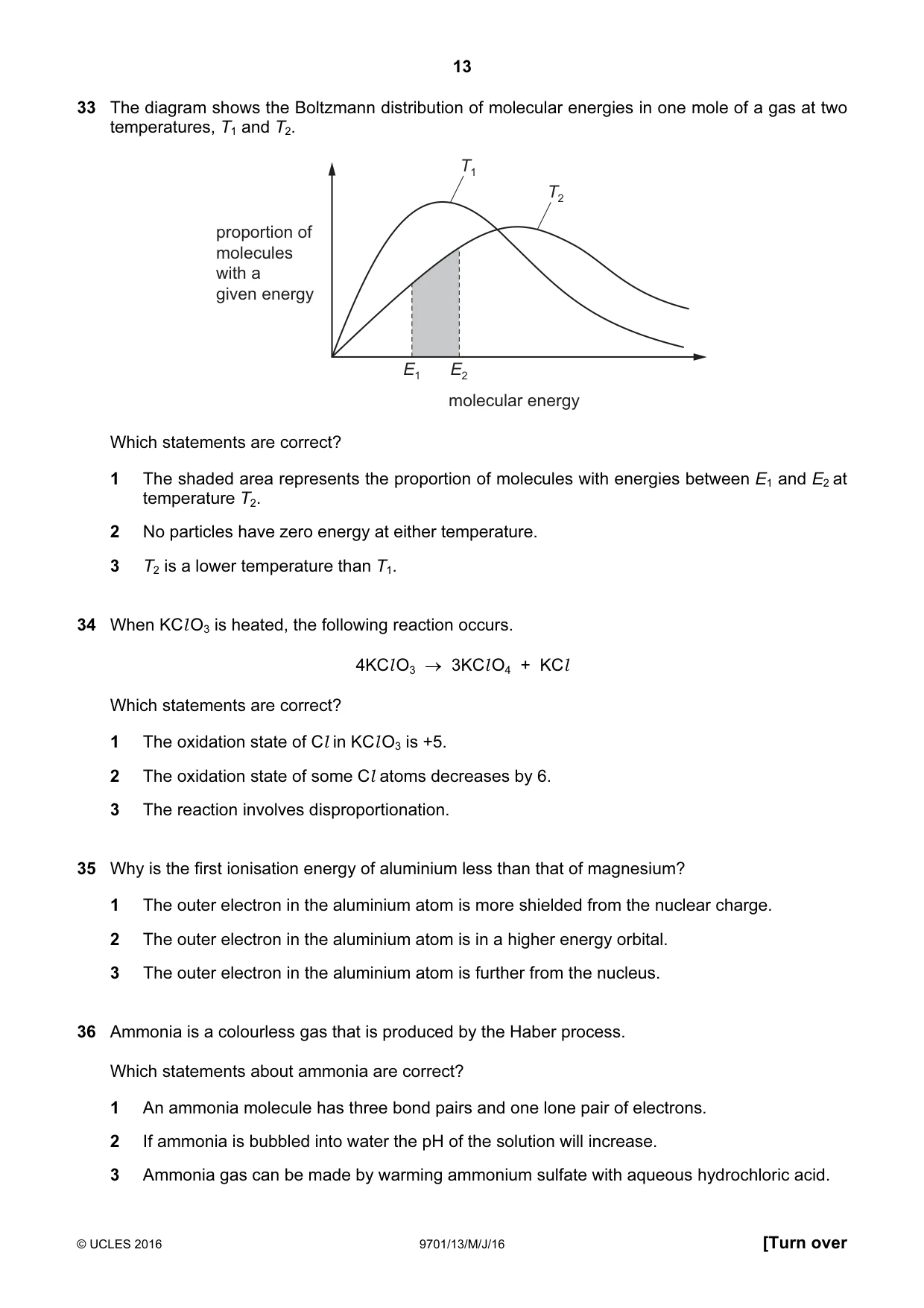
33 The diagram shows the Boltzmann distribution of molecular energies in one mole of a gas at two temperatures, T1 and T2. T1 T2 proportion of molecules with a given energy E1 E2 molecular energy Which statements are correct? 1 The shaded area represents the proportion of molecules with energies between E1 and E2 at temperature T2. 2 No particles have zero energy at either temperature. 3 T2 is a lower temperature than T1.
Mark scheme: B
More questions on Effect of temperature on reaction rates and the concept of activation energy
Q34 · When KCl O3 is heated, the following reaction occurs
34 When KCl O3 is heated, the following reaction occurs. 4KCl O3 → 3KCl O4 + KCl Which statements are correct? 1 The oxidation state of Cl in KCl O3 is +5. 2 The oxidation state of some Cl atoms decreases by 6. 3 The reaction involves disproportionation.
Mark scheme: A
Q35 · Why is the first ionisation energy of aluminium less than that of magnesium?
35 Why is the first ionisation energy of aluminium less than that of magnesium? 1 The outer electron in the aluminium atom is more shielded from the nuclear charge. 2 The outer electron in the aluminium atom is in a higher energy orbital. 3 The outer electron in the aluminium atom is further from the nucleus.
Mark scheme: A
Q36 · Ammonia is a colourless gas that is produced by the Haber process
36 Ammonia is a colourless gas that is produced by the Haber process. Which statements about ammonia are correct? 1 An ammonia molecule has three bond pairs and one lone pair of electrons. 2 If ammonia is bubbled into water the pH of the solution will increase. 3 Ammonia gas can be made by warming ammonium sulfate with aqueous hydrochloric acid.
Mark scheme: B
Q37 · Halogenoalkanes show trends in their physical and chemical properties
37 Halogenoalkanes show trends in their physical and chemical properties. Which properties steadily increase from C2H5Cl to C2H5Br to C2H5I ? 1 the polarity of the carbon-halogen bond 2 the boiling point of the halogenoalkane 3 the rate of reaction of the halogenoalkane with nucleophiles
Mark scheme: C
More questions on Intermolecular forces, electronegativity and bond properties
Q38 · Ethanal and hydrogen cyanide react together to form a compound used in the production of…
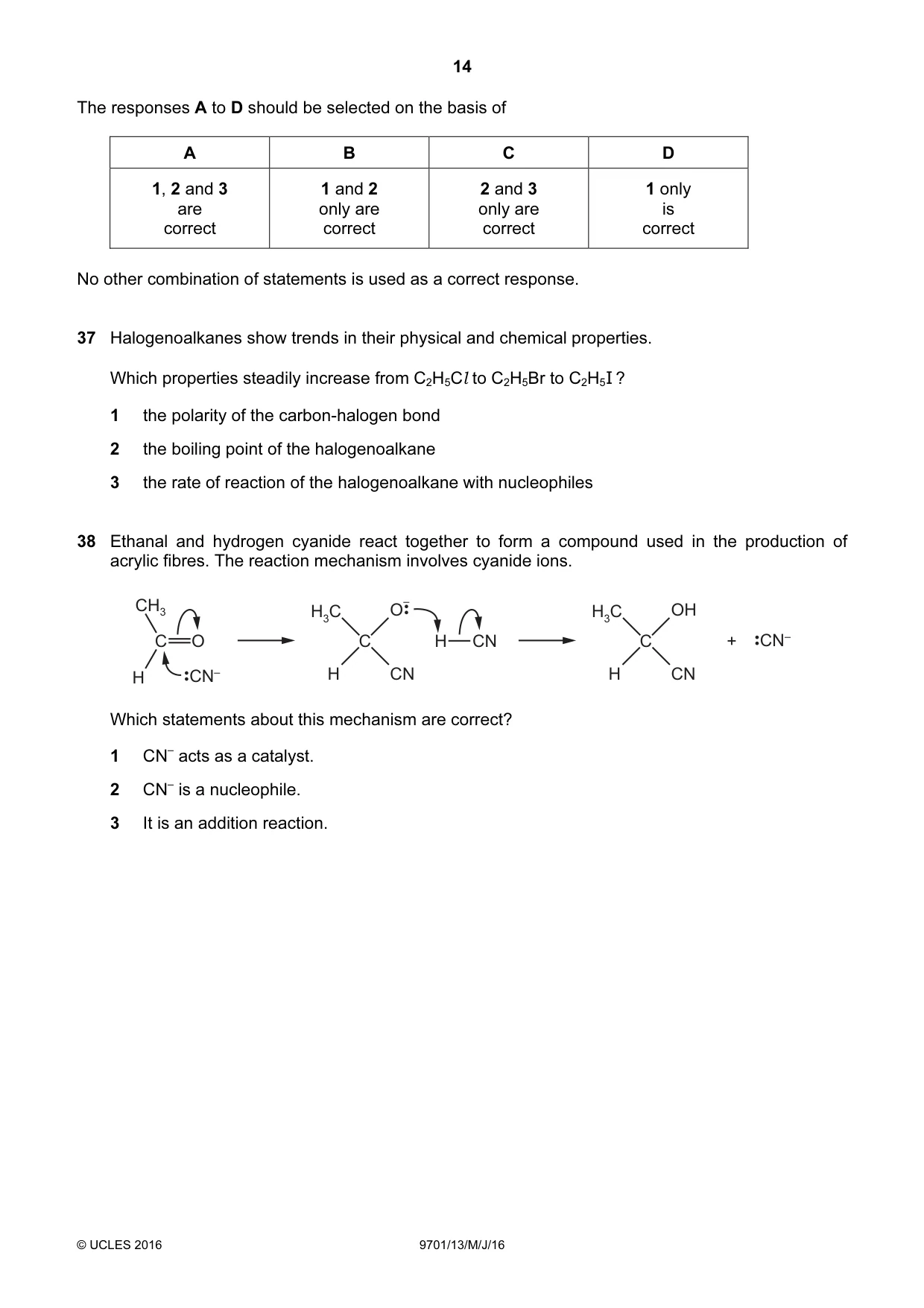
38 Ethanal and hydrogen cyanide react together to form a compound used in the production of acrylic fibres. The reaction mechanism involves cyanide ions. CH3 H3C O – H3C OH C O C H CN C + CN– H CN– H CN H CN Which statements about this mechanism are correct? 1 CN– acts as a catalyst. 2 CN– is a nucleophile. 3 It is an addition reaction.
Mark scheme: A
Q39 · Which compounds will give an orange precipitate with 2,4-dinitrophenylhydrazine reagent?
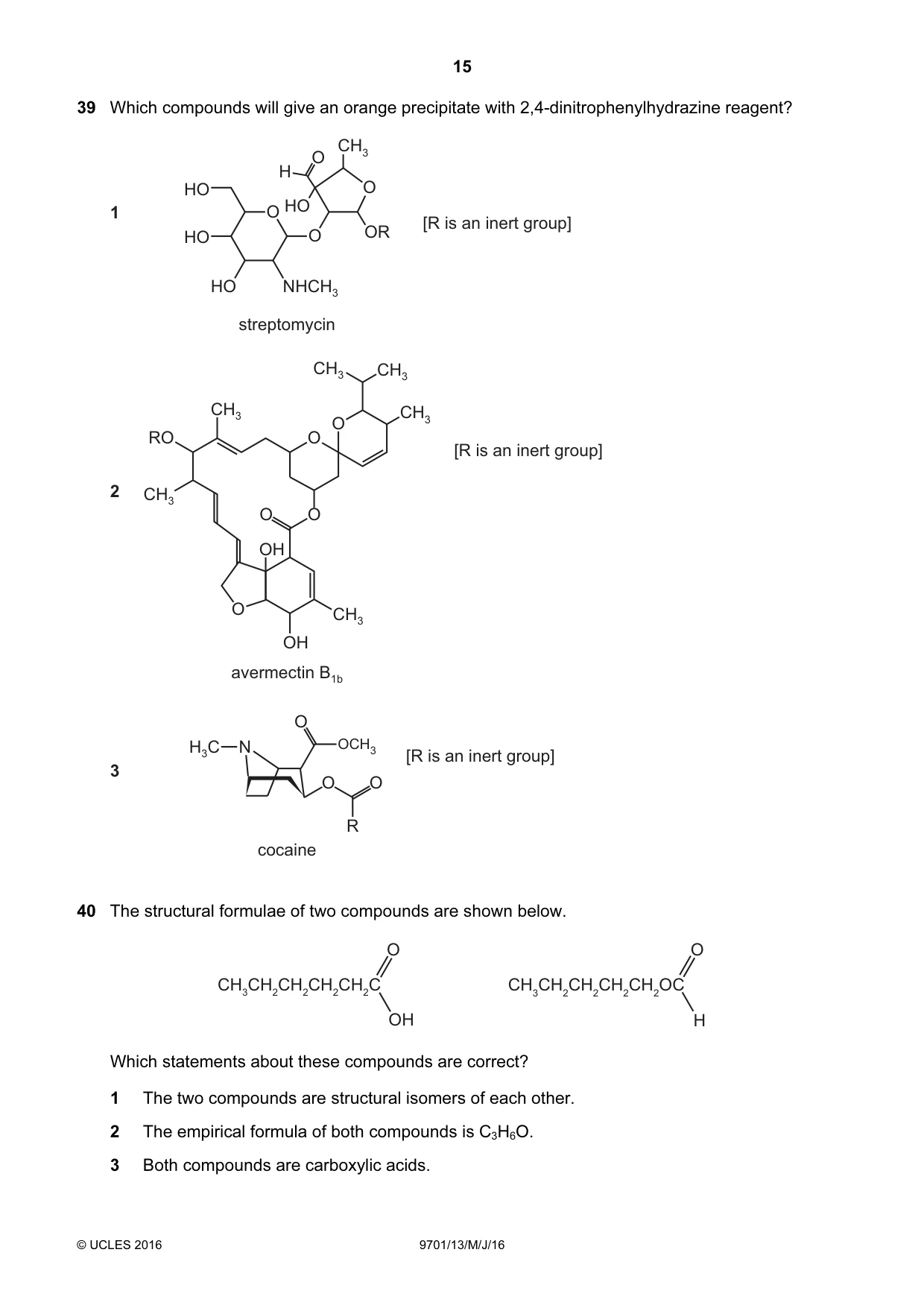
39 Which compounds will give an orange precipitate with 2,4-dinitrophenylhydrazine reagent? CH3 O H HO O 1 O HO [R is an inert group] HO O OR HO NHCH3 streptomycin CH3 CH3 CH3 CH3 O RO O [R is an inert group] 2 CH3 O O OH O CH3 OH avermectin B1b O H3C N OCH3 [R is an inert group] 3 O O R cocaine
Mark scheme: D
Q40 · The structural formulae of two compounds are shown below
40 The structural formulae of two compounds are shown below. O O CH3CH2CH2CH2CH2C CH3CH2CH2CH2CH2OC OH H Which statements about these compounds are correct? 1 The two compounds are structural isomers of each other. 2 The empirical formula of both compounds is C3H6O. 3 Both compounds are carboxylic acids.
Mark scheme: B
What was in this paper
The subtopics covered by these 40 questions, and how many questions each got. Open one in a new tab to see every Cambridge question on it.
3Enthalpy change, ΔH2Esters2Halogenoalkanes2Intermolecular forces, electronegativity and bond properties2Ionisation energy2Organic synthesis2Redox processes: electron transfer and changes in oxidation number (oxidation state)2Shapes of molecules2Alcohols1Aldehydes and ketones1Alkanes1Alkenes1Bonding and structure1Chemical equilibria: reversible reactions, dynamic equilibrium1Effect of temperature on reaction rates and the concept of activation energy1Electrons, energy levels and atomic orbitals1Formulas, functional groups and the naming of organic compounds1Homogeneous and heterogeneous catalysts1Isomerism: structural isomerism and stereoisomerism1Mass spectrometry1Nitriles and hydroxynitriles1Nitrogen and sulfur1Particles in the atom and atomic radius1Periodicity of chemical properties of the elements in Period 31Physical properties of the Group 17 elements1Reacting masses and volumes (of solutions and gases)1The chemical properties of the halogen elements and the hydrogen halides1The gaseous state: ideal and real gases and pV = nRT1The mole and the Avogadro constant1What you needed in this session
Cambridge’s own grade thresholds for 2016 May/June, Paper 1 · Variant 3. A higher threshold means an easier paper — the bar moves with how the cohort did.