Questions as text
Q1 · The table shows the enthalpy change of neutralisation per mole of water formed, ∆H, for… 9701/11 Oct/Nov 2005
7 The table shows the enthalpy change of neutralisation per mole of water formed, ∆H, for various acids and bases. acid base ∆H / kJ mol–1 hydrochloric acid sodium hydroxide –57.0 P sodium hydroxide –54.0 hydrochloric acid Q –52.0 nitric acid R –57.0 What are P, Q and R? P Q R A ethanoic acid ammonia potassium hydroxide B ethanoic acid sodium hydroxide ammonia C sulphuric acid ammonia potassium hydroxide D sulphuric acid sodium hydroxide ammonia
1 marks
Answer: A
This question in 9701/11 Oct/Nov 2005
Q2 · In the conversion of compound X into compound Z, it was found that the reaction proceeded… 9701/11 May/June 2006
8 In the conversion of compound X into compound Z, it was found that the reaction proceeded by way of compound Y, which could be isolated. The following steps were involved. X → Y ; ∆H, positive Y → Z ; ∆H, negative Which reaction profile fits these data? A B C D Y Y Y energy energy energy energy X Z X X Y Z Z X Z progress of progress of progress of progress of reaction reaction reaction reaction
1 marks
Answer: A
This question in 9701/11 May/June 2006
Q3 · The gaseous oxides of nitrogen have positive enthalpy changes of formation 9701/11 May/June 2006
19 The gaseous oxides of nitrogen have positive enthalpy changes of formation. Which factor is likely to make the most significant contribution to these enthalpy changes? A the high bond energy of the nitrogen molecule, N2 B the high electron affinity of nitrogen atoms C the high electron affinity of oxygen atoms D the similarity of the electronegativities of oxygen and nitrogen
1 marks
Answer: A
This question in 9701/11 May/June 2006
Q4 · Sodium ions can be formed from sodium atoms 9701/11 May/June 2006
32 Sodium ions can be formed from sodium atoms. Na(s) → Na+(g) Which quantities are required to calculate the enthalpy change of formation of gaseous sodium ions? 1 enthalpy change of atomisation of sodium 2 first ionisation energy of sodium 3 enthalpy change of formation of sodium
1 marks
Answer: B
This question in 9701/11 May/June 2006
Q5 · For which equation is the enthalpy change correctly described as an enthalpy change of… 9701/11 Oct/Nov 2006
8 For which equation is the enthalpy change correctly described as an enthalpy change of formation? A 2NO(g) → N2(g) + O2(g) B 2CO(g) + O2(g) → 2CO2(g) C H2O(l) + NaCl(s) → NaCl(aq) D K(s) + Mn(s) + 2O2(g) → KMnO4(s)
1 marks
Answer: D
This question in 9701/11 Oct/Nov 2006
Q6 · Which equation represents the standard enthalpy change of atomisation of bromine? 9701/11 Oct/Nov 2007
8 Which equation represents the standard enthalpy change of atomisation of bromine? A Br2(l) → 2Br(g) B Br2(g) → 2Br(g) C 2 Br2(l) → Br(g) 1 D 2 Br2(g) → Br(g) 1
1 marks
Answer: C
This question in 9701/11 Oct/Nov 2007
Q7 · Carbon monoxide burns readily in oxygen to form carbon dioxide 9701/11 Oct/Nov 2007
32 Carbon monoxide burns readily in oxygen to form carbon dioxide. What can be deduced from this information? 1 The +4 oxidation state of carbon is more stable than the +2 state. 2 The standard enthalpy change of formation of carbon dioxide is more negative than that of carbon monoxide. 3 The value of the equilibrium constant for the reaction, 2CO(g) + O2(g) 2CO2(g), is likely to be high.
1 marks
Answer: A
This question in 9701/11 Oct/Nov 2007
Q8 · Which statements are correct about the activation energy of a reaction? 9701/11 Oct/Nov 2007
34 Which statements are correct about the activation energy of a reaction? 1 It is different for the forward and back reactions in an exothermic process. 2 It is low for a reaction that takes place slowly. 3 It is unaffected by the presence of a catalyst.
1 marks
Answer: D
This question in 9701/11 Oct/Nov 2007
Q9 · For which equation does the enthalpy change correspond to the enthalpy change of… 9701/11 May/June 2008
9 For which equation does the enthalpy change correspond to the enthalpy change of atomisation of iodine? A ½ I2(s) → I(s) B ½ I2(s) → I(g) C I2(g) → 2I(g) D I2(s) → 2I(g)
1 marks
Answer: B
This question in 9701/11 May/June 2008
Q10 · Titanium occurs naturally as the mineral rutile, TiO2 9701/11 May/June 2008
10 Titanium occurs naturally as the mineral rutile, TiO2. One possible method of extraction of titanium is to reduce the rutile by heating with carbon. TiO2(s) + 2C(s) → Ti(s) + 2CO(g) The standard enthalpy changes of formation of TiO2(s) and CO(g) are –940 kJ mol–1 and –110 kJ mol–1 respectively. What is the standard enthalpy change of this reaction? A –830 kJ mol–1 B –720 kJ mol–1 C +720 kJ mol–1 D +830 kJ mol–1
1 marks
Answer: C
This question in 9701/11 May/June 2008
Q11 · Which statements about the properties of a catalyst are correct? 9701/11 May/June 2008
33 Which statements about the properties of a catalyst are correct? 1 A catalyst increases the average kinetic energy of the reacting particles. 2 A catalyst increases the rate of the reverse reaction. 3 A catalyst has no effect on the enthalpy change of the reaction.
1 marks
Answer: C
This question in 9701/11 May/June 2008
Q12 · The diagram represents the reaction pathway for the following reaction 9701/11 Oct/Nov 2008
9 The diagram represents the reaction pathway for the following reaction. W(g) + X(g) → Y(g) + Z(g) energy W + X Y + Z reaction pathway What statement can be made about the reverse reaction, Y(g) + Z(g) → W(g) + X(g)? A It will have a larger activation energy and a positive ∆H. B It will have a larger activation energy and a negative ∆H. C It will have a smaller activation energy and a positive ∆H. D It will have a smaller activation energy and a negative ∆H.
1 marks
Answer: A
This question in 9701/11 Oct/Nov 2008
Q13 · For which reactions does the value of ∆Ho represent both a standard enthalpy change of… 9701/11 May/June 2009
33 For which reactions does the value of ∆Ho represent both a standard enthalpy change of combustion and a standard enthalpy change of formation? 1 C(s) + O2(g) → CO2(g) 2 2C(s) + O2(g) → 2CO(g) 3 CO(g) + 2 1 O2(g) → CO2(g)
1 marks
Answer: D
This question in 9701/11 May/June 2009
Q14 · The first stage in the industrial production of nitric acid from ammonia can be… 9701/11 Oct/Nov 2009
6 The first stage in the industrial production of nitric acid from ammonia can be represented by the following equation. 4NH3(g) + 5O2(g) 4NO(g) + 6H2O(g) Using the following standard enthalpy change of formation data, what is the value of the standard enthalpy change, ∆Ho, for this reaction? compound ∆Hf o / kJ mol–1 NH3(g) –46.1 NO(g) +90.3 H2O(g) –241.8 A +905.2 kJ mol–1 B –105.4 kJ mol–1 C –905.2 kJ mol–1 D –1274.0 kJ mol–1
1 marks
Answer: C
This question in 9701/11 Oct/Nov 2009
Q15 · Some bond energy values are listed below 9701/11 May/June 2010
4 Some bond energy values are listed below. bond bond energy / kJ mol–1 C–H 410 C–Cl 340 Cl–Cl 244 Br–Br 193 These bond energy values relate to the following four reactions. P Br2 → 2Br Q 2Cl → Cl2 R CH3 + Cl → CH3Cl S CH4 → CH3 + H What is the order of enthalpy changes of these reactions from most negative to most positive? A P → Q → R → S B Q → R → S → P C R → Q → P → S D S → P → Q → R
1 marks
Answer: C
This question in 9701/11 May/June 2010
Q16 · Some bond energy values are listed below 9701/12 May/June 2010
4 Some bond energy values are listed below. bond bond energy / kJ mol–1 C–H 410 C–Cl 340 Cl–Cl 244 Br–Br 193 These bond energy values relate to the following four reactions. P Br2 → 2Br Q 2Cl → Cl2 R CH3 + Cl → CH3Cl S CH4 → CH3 + H What is the order of enthalpy changes of these reactions from most negative to most positive? A P → Q → R → S B Q → R → S → P C R → Q → P → S D S → P → Q → R
1 marks
Answer: C
This question in 9701/12 May/June 2010
Q17 · The percentage of ammonia obtainable, if equilibrium were established during the Haber… 9701/12 May/June 2010
11 The percentage of ammonia obtainable, if equilibrium were established during the Haber process, is plotted against the operating pressure for two temperatures, 400 °C and 500 °C. Which diagram correctly represents the two graphs? A B 40 400 °C 40 500 °C % NH3 at % NH3 at 20 500 °C 20 400 °C equilibrium equilibrium 0 0 0 0 10 20 10 20 pressure / 103 kPa pressure / 103 kPa C D 40 40 400 °C 500 °C % NH3 at % NH3 at 20 20 equilibrium equilibrium 500 °C 400 °C 0 0 0 0 10 20 10 20 pressure / 103 kPa pressure / 103 kPa
1 marks
Answer: A
This question in 9701/12 May/June 2010
Q18 · Given the following enthalpy changes, I2(g) + 3Cl2(g) → 2ICl3(s) ∆Ho = –214 kJ mol–1… 9701/13 May/June 2010
4 Given the following enthalpy changes, I2(g) + 3Cl2(g) → 2ICl3(s) ∆Ho = –214 kJ mol–1 I2(s) → I2(g) ∆Ho = +38 kJ mol–1 What is the standard enthalpy change of formation of iodine trichloride, ICl3(s)? A +176 kJ mol–1 B –88 kJ mol–1 C –176 kJ mol–1 D –214 kJ mol–1
1 marks
Answer: B
This question in 9701/13 May/June 2010
Q19 · Some bond energy values are listed below 9701/13 May/June 2010
5 Some bond energy values are listed below. bond bond energy / kJ mol–1 C–H 410 C–Cl 340 Cl–Cl 244 Br–Br 193 These bond energy values relate to the following four reactions. P Br2 → 2Br Q 2Cl → Cl2 R CH3 + Cl → CH3Cl S CH4 → CH3 + H What is the order of enthalpy changes of these reactions from most negative to most positive? A P → Q → R → S B Q → R → S → P C R → Q → P → S D S → P → Q → R
1 marks
Answer: C
This question in 9701/13 May/June 2010
Q20 · Enthalpy changes of combustion can be used to determine enthalpy changes of formation 9701/11 Oct/Nov 2010
8 Enthalpy changes of combustion can be used to determine enthalpy changes of formation. The following equation represents the enthalpy change of formation of butane. 4C(s) + 5H2(g) → C4H10(g) By using the following standard enthalpy of combustion data, what is the value of the standard enthalpy change of formation, , for this reaction? compound o carbon –394 hydrogen –286 butane –2877 A –5883 kJ mol–1 B –129 kJ mol–1 C +129 kJ mol–1 D +2197 kJ mol–1
1 marks
Answer: B
This question in 9701/11 Oct/Nov 2010
Q21 · In a calorimetric experiment 1.60 g of a fuel is burnt 9701/11 Oct/Nov 2010
9 In a calorimetric experiment 1.60 g of a fuel is burnt. 45 % of the energy released is absorbed by 200 g of water whose temperature rises from 18 °C to 66 °C. The specific heat capacity of water is 4.2 J g–1 K–1. What is the total energy released per gram of fuel burnt? A 25 200 J B 56 000 J C 89 600 J D 143 360 J
1 marks
Answer: B
This question in 9701/11 Oct/Nov 2010
Q22 · Which equation represents the change corresponding to the enthalpy change of atomisation… 9701/11 Oct/Nov 2010
11 Which equation represents the change corresponding to the enthalpy change of atomisation of iodine? A 1 I2(g) → I(g) 2 B I2(g) → 2I(g) C 1 I2(s) → I(g) 2 D I2(s) → 2I(g)
1 marks
Answer: C
This question in 9701/11 Oct/Nov 2010
Q23 · Methanol may be prepared by the reaction between carbon monoxide and hydrogen 9701/12 Oct/Nov 2010
4 Methanol may be prepared by the reaction between carbon monoxide and hydrogen. CO(g) + 2H2(g) → CH3OH(g) The relevant average bond energies are given below. E(C≡O) 1077 kJ mol–1 E(C–O) 360 kJ mol–1 E(C–H) 410 kJ mol–1 E(H–H) 436 kJ mol–1 E(O–H) 460 kJ mol–1 What is the enthalpy change of this reaction? A –537 kJ mol–1 B –101 kJ mol–1 C +101 kJ mol–1 D +537 kJ mol–1
1 marks
Answer: B
This question in 9701/12 Oct/Nov 2010
Q24 · Enthalpy changes of combustion can be used to determine enthalpy changes of formation 9701/13 Oct/Nov 2010
11 Enthalpy changes of combustion can be used to determine enthalpy changes of formation. The following equation represents the enthalpy change of formation of butane. 4C(s) + 5H2(g) → C4H10(g) By using the following standard enthalpy of combustion data, what is the value of the standard enthalpy change of formation, , for this reaction? compound o carbon –394 hydrogen –286 butane –2877 A –5883 kJ mol–1 B –129 kJ mol–1 C +129 kJ mol–1 D +2197 kJ mol–1
1 marks
Answer: B
This question in 9701/13 Oct/Nov 2010
Q25 · In a calorimetric experiment 1.60 g of a fuel is burnt 9701/13 Oct/Nov 2010
12 In a calorimetric experiment 1.60 g of a fuel is burnt. 45 % of the energy released is absorbed by 200 g of water whose temperature rises from 18 °C to 66 °C. The specific heat capacity of water is 4.2 J g–1 K–1. What is the total energy released per gram of fuel burnt? A 25 200 J B 56 000 J C 89 600 J D 143 360 J
1 marks
Answer: B
This question in 9701/13 Oct/Nov 2010
Q26 · Which equation represents the change corresponding to the enthalpy change of atomisation… 9701/13 Oct/Nov 2010
13 Which equation represents the change corresponding to the enthalpy change of atomisation of iodine? A 1 I2(g) → I(g) 2 B I2(g) → 2I(g) C 1 I2(s) → I(g) 2 D I2(s) → 2I(g)
1 marks
Answer: C
This question in 9701/13 Oct/Nov 2010
Q27 · The equation below represents the combination of gaseous atoms of non-metal X and of… 9701/11 May/June 2011
8 The equation below represents the combination of gaseous atoms of non-metal X and of hydrogen to form gaseous X2H6 molecules. 2X(g) + 6H(g) → X2H6(g) ∆H = –2775 kJ mol–1 The bond energy of an X–H bond is 395 kJ mol–1. What is the bond energy of an X–X bond? A – 405.0 kJ mol–1 B – 202.5 kJ mol–1 C +202.5 kJ mol–1 D +405.0 kJ mol–1
1 marks
Answer: D
This question in 9701/11 May/June 2011
Q28 · 50 cm3 of 2.50 mol dm–3 hydrochloric acid was placed in a polystyrene beaker of… 9701/11 May/June 2011
9 50 cm3 of 2.50 mol dm–3 hydrochloric acid was placed in a polystyrene beaker of negligible heat capacity. Its temperature was recorded and then 50 cm3 of 2.50 mol dm–3 NaOH at the same temperature was quickly added, with stirring. The temperature rose by 17 °C. The resulting solution may be considered to have a specific heat capacity of 4.2 J g–1 K–1. What is an approximate value for the molar enthalpy change of neutralisation of hydrochloric acid and sodium hydroxide from this experiment? − ( 50 x 4 . 2 x 17 ) − 1 A J mol ( 0 . 050 x 2 . 5 ) − ( 50 x 4 . 2 x 17 ) − 1 B J mol ( 0 . 10 x 2 . 5 ) − ( 100 x 4 . 2 x 17 ) − 1 C J mol ( 0 . 050 x 2 . 5 ) − ( 100 x 4 . 2 x 17 ) − 1 D J mol ( 50 x 2 . 5 )
1 marks
Answer: C
This question in 9701/11 May/June 2011
Q29 · Which reaction has an enthalpy change equal to the standard enthalpy change of formation… 9701/12 May/June 2011
8 Which reaction has an enthalpy change equal to the standard enthalpy change of formation of propane? A 3C(g) + 4H2(g) → C3H8(g) B 3C(g) + 8H(g) → C3H8(g) C 3C(s) + 4H2(g) → C3H8(g) D 3C(s) + 4H2(g) → C3H8(l)
1 marks
Answer: C
This question in 9701/12 May/June 2011
Q30 · In the conversion of compound X into compound Z, it was found that the reaction proceeded… 9701/12 May/June 2011
9 In the conversion of compound X into compound Z, it was found that the reaction proceeded by way of compound Y, which could be isolated. The following steps were involved. X → Y ; ∆H, positive Y → Z ; ∆H, negative Which reaction profile fits these data? A B C D Y Y Y energy energy energy energy X Z X X Y Z Z X Z progress of progress of progress of progress of reaction reaction reaction reaction
1 marks
Answer: A
This question in 9701/12 May/June 2011
Q31 · 50 cm3 of 2.50 mol dm–3 hydrochloric acid was placed in a polystyrene beaker of… 9701/13 May/June 2011
8 50 cm3 of 2.50 mol dm–3 hydrochloric acid was placed in a polystyrene beaker of negligible heat capacity. Its temperature was recorded and then 50 cm3 of 2.50 mol dm–3 NaOH at the same temperature was quickly added, with stirring. The temperature rose by 17 °C. The resulting solution may be considered to have a specific heat capacity of 4.2 J g–1 K–1. What is an approximate value for the molar enthalpy change of neutralisation of hydrochloric acid and sodium hydroxide from this experiment? − ( 50 x 4 . 2 x 17 ) − 1 A J mol ( 0 . 050 x 2 . 5 ) − ( 50 x 4 . 2 x 17 ) − 1 B J mol ( 0 . 10 x 2 . 5 ) − ( 100 x 4 . 2 x 17 ) − 1 C J mol ( 0 . 050 x 2 . 5 ) − ( 100 x 4 . 2 x 17 ) − 1 D J mol ( 50 x 2 . 5 )
1 marks
Answer: C
This question in 9701/13 May/June 2011
Q32 · The equation below represents the combination of gaseous atoms of non-metal X and of… 9701/13 May/June 2011
9 The equation below represents the combination of gaseous atoms of non-metal X and of hydrogen to form gaseous X2H6 molecules. 2X(g) + 6H(g) → X2H6(g) ∆H = –2775 kJ mol–1 The bond energy of an X–H bond is 395 kJ mol–1. What is the bond energy of an X–X bond? A – 405.0 kJ mol–1 B – 202.5 kJ mol–1 C +202.5 kJ mol–1 D +405.0 kJ mol–1
1 marks
Answer: D
This question in 9701/13 May/June 2011
Q33 · Hydrazine, N2H4, is widely used as a rocket fuel because it reacts with oxygen as shown… 9701/13 May/June 2011
11 Hydrazine, N2H4, is widely used as a rocket fuel because it reacts with oxygen as shown, producing ‘environmentally friendly’ gases. N2H4(l) + O2(g) → N2(g) + 2H2O(g) ∆H = –534 kJ mol–1 Despite its use as a rocket fuel, hydrazine does not burn spontaneously in oxygen. Which statement explains why hydrazine does not burn spontaneously? A Hydrazine is a liquid. B The activation energy is too high. C The N N bond is very strong. D The reaction is exothermic.
1 marks
Answer: B
This question in 9701/13 May/June 2011
Q34 · The standard enthalpy change for the reaction 2NF3(g) → 2N(g) + 6F(g) is ∆H o = +1668 kJ… 9701/11 Oct/Nov 2011
6 The standard enthalpy change for the reaction 2NF3(g) → 2N(g) + 6F(g) is ∆H o = +1668 kJ What is the bond energy of the N–F bond? A –556 kJ mol–1 B –278 kJ mol–1 C +278 kJ mol–1 D +556 kJ mol–1
1 marks
Answer: C
This question in 9701/11 Oct/Nov 2011
Q35 · When gaseous iodine is heated with hydrogen at 450 °C, an equilibrium is established 9701/11 Oct/Nov 2011
10 When gaseous iodine is heated with hydrogen at 450 °C, an equilibrium is established. H2(g) + I2(g) 2HI(g) ∆H = +53 kJ mol–1 colourless purple colourless Which change of conditions will cause the purple colour of the equilibrium mixture to become paler? A decrease in pressure B decrease in temperature C increase in pressure D increase in temperature
1 marks
Answer: D
This question in 9701/11 Oct/Nov 2011
Q36 · Which reaction is endothermic? 9701/11 Oct/Nov 2011
19 Which reaction is endothermic? A 2HBr → H2 + Br2 B N2 + 3H2 → 2NH3 C 2SO2 + O2 → 2SO3 D SO3 + H2O → H2SO4
1 marks
Answer: A
This question in 9701/11 Oct/Nov 2011
Q37 · The definitions of many chemical terms can be illustrated by chemical equations 9701/11 Oct/Nov 2011
31 The definitions of many chemical terms can be illustrated by chemical equations. Which terms can be illustrated by an equation that shows the formation of a positive ion? 1 first ionisation energy 2 heterolytic fission 3 enthalpy change of atomisation
1 marks
Answer: B
This question in 9701/11 Oct/Nov 2011
Q38 · Hess’s Law can be used to calculate the average C-H bond energy in methane 9701/12 Oct/Nov 2011
10 Hess’s Law can be used to calculate the average C-H bond energy in methane. = standard enthalpy change of atomisation = standard enthalpy change of formation = standard enthalpy change of combustion Which data values are needed in order to perform the calculation? A (C), (H), (CH4) B (C), (H2), (CH4) C (C), (H2), (CH4) D (CH4) only, as (C), and (H2), are defined as zero
1 marks
This question in 9701/12 Oct/Nov 2011
Q39 · The standard enthalpy changes of formation of HCl and HI are –92 kJ mol–1 and +26 kJ… 9701/12 Oct/Nov 2011
17 The standard enthalpy changes of formation of HCl and HI are –92 kJ mol–1 and +26 kJ mol–1 respectively. Which statement is most important in explaining this difference? A Chlorine is more electronegative than iodine. B The activation energy for the H2 + Cl2 reaction is much less than that for the H2 + I2 reaction. C The bond energy of HI is smaller than the bond energy of HCl. D The bond energy of I2 is smaller than the bond energy of Cl2.
1 marks
This question in 9701/12 Oct/Nov 2011
Q40 · An energy profile diagram is shown 9701/12 Oct/Nov 2011
32 An energy profile diagram is shown. W reactants enthalpy, H Y Z X products progress of reaction What do the labels on the diagram represent? 1 W = ∆H of the forward reaction, Y = Ea of the backward reaction 2 Z = ∆H of the backward reaction, Y = Ea of the backward reaction 3 X = ∆H of the forward reaction, W = Ea of the forward reaction
1 marks
This question in 9701/12 Oct/Nov 2011
Q41 · The standard enthalpy change for the reaction 2NF3(g) → 2N(g) + 6F(g) is ∆H o = +1668 kJ… 9701/13 Oct/Nov 2011
7 The standard enthalpy change for the reaction 2NF3(g) → 2N(g) + 6F(g) is ∆H o = +1668 kJ What is the bond energy of the N–F bond? A –556 kJ mol–1 B –278 kJ mol–1 C +278 kJ mol–1 D +556 kJ mol–1
1 marks
Answer: C
This question in 9701/13 Oct/Nov 2011
Q42 · When gaseous iodine is heated with hydrogen at 450 °C, an equilibrium is established 9701/13 Oct/Nov 2011
8 When gaseous iodine is heated with hydrogen at 450 °C, an equilibrium is established. H2(g) + I2(g) 2HI(g) ∆H = +53 kJ mol–1 colourless purple colourless Which change of conditions will cause the purple colour of the equilibrium mixture to become paler? A decrease in pressure B decrease in temperature C increase in pressure D increase in temperature
1 marks
Answer: D
This question in 9701/13 Oct/Nov 2011
Q43 · Which reaction is endothermic? 9701/13 Oct/Nov 2011
19 Which reaction is endothermic? A 2HBr → H2 + Br2 B N2 + 3H2 → 2NH3 C 2SO2 + O2 → 2SO3 D SO3 + H2O → H2SO4
1 marks
Answer: A
This question in 9701/13 Oct/Nov 2011
Q44 · The definitions of many chemical terms can be illustrated by chemical equations 9701/13 Oct/Nov 2011
31 The definitions of many chemical terms can be illustrated by chemical equations. Which terms can be illustrated by an equation that shows the formation of a positive ion? 1 first ionisation energy 2 heterolytic fission 3 enthalpy change of atomisation
1 marks
Answer: B
This question in 9701/13 Oct/Nov 2011
Q45 · The equation for a reaction is shown 9701/11 May/June 2012
3 The equation for a reaction is shown. H2(g) + 2 1 O2(g) → H2O(l) ; ∆H = x kJ mol–1 Which pair of descriptions is fully correct for this reaction? type(s) of enthalpy change value of x A formation only positive B formation only negative C combustion, formation positive D combustion, formation negative
1 marks
Answer: D
This question in 9701/11 May/June 2012
Q46 · Propanone has the molecular formula C3H6O 9701/11 May/June 2012
7 Propanone has the molecular formula C3H6O. The enthalpy change of combustion of hydrogen is –286 kJ mol–1. The enthalpy change of combustion of carbon is –394 kJ mol–1. The enthalpy change of combustion of propanone is –1786 kJ mol–1. Using this information, what is the enthalpy change of formation of propanone? A –1106 kJ mol–1 B –540 kJ mol–1 C –254 kJ mol–1 D +1106 kJ mol–1
1 marks
Answer: C
This question in 9701/11 May/June 2012
Q47 · Slaked lime, Ca(OH)2, may be made from limestone, CaCO3 9701/12 May/June 2012
14 Slaked lime, Ca(OH)2, may be made from limestone, CaCO3. On heating in a lime kiln at 1000 °C, limestone decomposes as follows. reaction 1 CaCO3(s) → CaO(s) + CO2(g) Water is then reacted with calcium oxide, CaO, as follows. reaction 2 CaO(s) + H2O(l) → Ca(OH)2(s) What are the enthalpy changes of these reactions? reaction 1 reaction 2 A endothermic endothermic B endothermic exothermic C exothermic endothermic D exothermic exothermic
1 marks
Answer: B
This question in 9701/12 May/June 2012
Q48 · The equation for a reaction is shown 9701/13 May/June 2012
4 The equation for a reaction is shown. H2(g) + 2 1 O2(g) → H2O(l) ; ∆H = x kJ mol–1 Which pair of descriptions is fully correct for this reaction? type(s) of enthalpy change value of x A formation only positive B formation only negative C combustion, formation positive D combustion, formation negative
1 marks
Answer: D
This question in 9701/13 May/June 2012
Q49 · Use of the Data Booklet is relevant to this question 9701/11 Oct/Nov 2012
4 Use of the Data Booklet is relevant to this question. A reaction which causes the presence of oxides of nitrogen in car exhausts is the formation of NO. N2 + O2 → 2NO ∆H = +180 kJ mol–1 What is the bond energy in kJ mol–1 of the bond between the atoms in NO? A 655 B 835 C 1310 D 1670
1 marks
Answer: A
This question in 9701/11 Oct/Nov 2012
Q50 · In the table below, • ‘+’ means that this type of standard enthalpy change can only have… 9701/11 Oct/Nov 2012
5 In the table below, • ‘+’ means that this type of standard enthalpy change can only have positive values, • ‘–’ means that this type of standard enthalpy change can only have negative values, • ‘+ / –’ means that either positive or negative values are possible. Which row is correct? atomisation formation solution A + + + / – B + + / – + / – C – + / – – D – – +
1 marks
Answer: B
This question in 9701/11 Oct/Nov 2012
Q51 · A student calculated the standard enthalpy change of formation of ethane, C2H6, using a… 9701/11 Oct/Nov 2012
10 A student calculated the standard enthalpy change of formation of ethane, C2H6, using a method based on standard enthalpy changes of combustion. He used correct values for the standard enthalpy change of combustion of ethane (–1560 kJ mol–1) and hydrogen (–286 kJ mol–1) but he used an incorrect value for the standard enthalpy change of combustion of carbon. He then performed his calculation correctly. His final answer was –158 kJ mol–1. What did he use for the standard enthalpy change of combustion of carbon? A –1432 kJ mol–1 B –860 kJ mol–1 C –430 kJ mol–1 D –272 kJ mol–1
1 marks
Answer: C
This question in 9701/11 Oct/Nov 2012
Q52 · Which process could be used to calculate the bond energy for the covalent bond X-Y by… 9701/11 Oct/Nov 2012
11 Which process could be used to calculate the bond energy for the covalent bond X-Y by dividing its ∆H by n? A XYn(g) → X(g) + nY(g) B 2XYn (g) → 2XYn-1(g) + Y2(g) C Y(g) + XYn-1(g) → XYn(g) D nXY(g) → nX(g) + n Y2(g) 2
1 marks
Answer: A
This question in 9701/11 Oct/Nov 2012
Q53 · Use of the Data Booklet is relevant to this question 9701/12 Oct/Nov 2012
4 Use of the Data Booklet is relevant to this question. A reaction which causes the presence of oxides of nitrogen in car exhausts is the formation of NO. N2 + O2 → 2NO ∆H = +180 kJ mol–1 What is the bond energy in kJ mol–1 of the bond between the atoms in NO? A 655 B 835 C 1310 D 1670
1 marks
Answer: A
This question in 9701/12 Oct/Nov 2012
Q54 · In the table below, • ‘+’ means that this type of standard enthalpy change can only have… 9701/12 Oct/Nov 2012
5 In the table below, • ‘+’ means that this type of standard enthalpy change can only have positive values, • ‘–’ means that this type of standard enthalpy change can only have negative values, • ‘+ / –’ means that either positive or negative values are possible. Which row is correct? atomisation formation solution A + + + / – B + + / – + / – C – + / – – D – – +
1 marks
Answer: B
This question in 9701/12 Oct/Nov 2012
Q55 · A student calculated the standard enthalpy change of formation of ethane, C2H6, using a… 9701/12 Oct/Nov 2012
10 A student calculated the standard enthalpy change of formation of ethane, C2H6, using a method based on standard enthalpy changes of combustion. He used correct values for the standard enthalpy change of combustion of ethane (–1560 kJ mol–1) and hydrogen (–286 kJ mol–1) but he used an incorrect value for the standard enthalpy change of combustion of carbon. He then performed his calculation correctly. His final answer was –158 kJ mol–1. What did he use for the standard enthalpy change of combustion of carbon? A –1432 kJ mol–1 B –860 kJ mol–1 C –430 kJ mol–1 D –272 kJ mol–1
1 marks
Answer: C
This question in 9701/12 Oct/Nov 2012
Q56 · Which process could be used to calculate the bond energy for the covalent bond X-Y by… 9701/12 Oct/Nov 2012
11 Which process could be used to calculate the bond energy for the covalent bond X-Y by dividing its ∆H by n? A XYn(g) → X(g) + nY(g) B 2XYn (g) → 2XYn-1(g) + Y2(g) C Y(g) + XYn-1(g) → XYn(g) D nXY(g) → nX(g) + n Y2(g) 2
1 marks
Answer: A
This question in 9701/12 Oct/Nov 2012
Q57 · Ethyne, C2H2, completely combusts, as shown in the equation 9701/13 Oct/Nov 2012
5 Ethyne, C2H2, completely combusts, as shown in the equation. H C C H + 2 2 1 O O → H2O + 2CO2 Using the average bond enthalpies in the table, what is the enthalpy change of combustion of ethyne? average bond bond enthalpy / kJ mol–1 C H 410 C C 840 O O 496 C O 740 O H 460 C O 360 A –980 kJ mol–1 B –540 kJ mol–1 C +540 kJ mol–1 D +980 kJ mol–1
1 marks
Answer: A
This question in 9701/13 Oct/Nov 2012
Q58 · The enthalpy change of the neutralisation given below is –114 kJ mol–1 9701/13 Oct/Nov 2012
10 The enthalpy change of the neutralisation given below is –114 kJ mol–1. 2NaOH(aq) + H2SO4(aq) → Na2SO4(aq) + 2H2O(l) By using this information, what is the most likely value for the enthalpy change of the following neutralisation? Ba(OH)2(aq) + 2HCl(aq) → BaCl2(aq) + 2H2O(l) A –57 kJ mol–1 B –76 kJ mol–1 C –114 kJ mol–1 D –228 kJ mol–1
1 marks
Answer: C
This question in 9701/13 Oct/Nov 2012
Q59 · The reaction pathway for a reversible reaction is shown below 9701/11 May/June 2013
7 The reaction pathway for a reversible reaction is shown below. 30 energy / kJ mol–1 50 extent of reaction Which statement is correct? A The activation energy of the reverse reaction is +80 kJ mol–1. B The enthalpy change for the forward reaction is +30 kJ mol–1. C The enthalpy change for the forward reaction is +50 kJ mol–1. D The enthalpy change for the reverse reaction is +30 kJ mol–1.
1 marks
Answer: A
This question in 9701/11 May/June 2013
Q60 · Use of the Data Booklet is relevant to this question 9701/11 May/June 2013
12 Use of the Data Booklet is relevant to this question. This question should be answered using bond enthalpy data. The equation for the complete combustion of methane is given below. CH4 + 2O2 → CO2 + 2H2O What is the enthalpy change of combustion of methane? A –1530 kJ mol–1 B –1184 kJ mol–1 C –770 kJ mol–1 D –688 kJ mol–1
1 marks
Answer: D
This question in 9701/11 May/June 2013
Q61 · When a red-hot platinum wire is plunged into a test tube of hydrogen iodide, the gas is… 9701/11 May/June 2013
36 When a red-hot platinum wire is plunged into a test tube of hydrogen iodide, the gas is decomposed into its elements. If the experiment is repeated with hydrogen chloride, no change occurs. Which factors contribute to this behaviour? 1 the strength of the hydrogen-halogen bond 2 the size of the halogen atom 3 the standard enthalpy of formation, , of each of the products of decomposition
1 marks
Answer: B
This question in 9701/11 May/June 2013
Q62 · Use of the Data Booklet is relevant to this question 9701/12 May/June 2013
10 Use of the Data Booklet is relevant to this question. A student mixed 25 cm3 of 0.10 mol dm–3 sodium hydroxide solution with 25 cm3 of 0.10 mol dm–3 hydrochloric acid and noted a temperature rise of 2.5 °C. What is the enthalpy change of the reaction per mole of NaOH? A –209 kJ mol–1 B –104.5 kJ mol–1 C –209 J mol–1 D –522.5 J mol–1
1 marks
Answer: A
This question in 9701/12 May/June 2013
Q63 · Which energy change corresponds to the enthalpy change of atomisation of hydrogen at 298… 9701/12 May/June 2013
11 Which energy change corresponds to the enthalpy change of atomisation of hydrogen at 298 K? A the bond energy of a H – H bond B half the bond energy of a H – H bond C minus half the bond energy of a H – H bond D minus the bond energy of a H – H bond
1 marks
Answer: B
This question in 9701/12 May/June 2013
Q64 · The diagram shows the reaction pathway for a reversible reaction 9701/12 May/June 2013
32 The diagram shows the reaction pathway for a reversible reaction. energy 90 / kJ mol–1 30 extent of reaction Which statements are correct? 1 The enthalpy change for the backward reaction is +90 kJ mol–1. 2 The forward reaction is exothermic. 3 The enthalpy change for the forward reaction is –30 kJ mol–1.
1 marks
Answer: C
This question in 9701/12 May/June 2013
Q65 · Use of the Data Booklet is relevant to this question 9701/13 May/June 2013
11 Use of the Data Booklet is relevant to this question. This question should be answered using bond enthalpy data. The equation for the complete combustion of methanal is given below. H2C=O + O2 → CO2 + H2O What is the enthalpy change of combustion of methanal? A +416 kJ mol–1 B +396 kJ mol–1 C –344 kJ mol–1 D –690 kJ mol–1
1 marks
Answer: C
This question in 9701/13 May/June 2013
Q66 · The reaction pathway for a reversible reaction is shown below 9701/13 May/June 2013
33 The reaction pathway for a reversible reaction is shown below. 50 energy / kJ mol–1 20 extent of reaction Which statements are correct? 1 The enthalpy change for the backward reaction is –20 kJ mol–1. 2 The forward reaction is endothermic. 3 The activation energy for the forward reaction is +70 kJ mol–1.
1 marks
Answer: A
This question in 9701/13 May/June 2013
Q67 · Use of the Data Booklet is relevant to this question 9701/11 Oct/Nov 2013
11 Use of the Data Booklet is relevant to this question. A student carried out an experiment to determine the enthalpy change for the combustion of methanol. The following results were obtained by the student. start temperature of the water 20 °C final temperature of the water 53 °C mass of alcohol burner before burning 259.65 g mass of alcohol burner after burning 259.15 g mass of glass beaker plus water 150.00 g mass of glass beaker 50.00 g How much of the heat energy produced by the burning of methanol went into the water? A 209 J B 13 794 J C 20 691 J D 22 154 J
1 marks
Answer: B
This question in 9701/11 Oct/Nov 2013
Q68 · Use of the Data Booklet is relevant to this question 9701/12 Oct/Nov 2013
11 Use of the Data Booklet is relevant to this question. A student carried out an experiment to determine the enthalpy change for the combustion of methanol. The following results were obtained by the student. start temperature of the water 20 °C final temperature of the water 53 °C mass of alcohol burner before burning 259.65 g mass of alcohol burner after burning 259.15 g mass of glass beaker plus water 150.00 g mass of glass beaker 50.00 g How much of the heat energy produced by the burning of methanol went into the water? A 209 J B 13 794 J C 20 691 J D 22 154 J
1 marks
Answer: B
This question in 9701/12 Oct/Nov 2013
Q69 · The following equilibrium is an exothermic reaction in the forward direction 9701/13 Oct/Nov 2013
34 The following equilibrium is an exothermic reaction in the forward direction. 2CrO4 2–(aq) + 2H+(aq) Cr2O7 2–(aq) + H2O(l) What happens when the concentration of CrO4 2– ions increases and the temperature decreases? 1 The concentration of Cr2O7 2– ions increases. 2 The equilibrium constant increases. 3 The activation energy decreases.
1 marks
Answer: B
This question in 9701/13 Oct/Nov 2013
Q70 · A student mixed 25.0 cm3 of 0.350 mol dm–3 sodium hydroxide solution with 25.0 cm3 of… 9701/11 May/June 2014
5 A student mixed 25.0 cm3 of 0.350 mol dm–3 sodium hydroxide solution with 25.0 cm3 of 0.350 mol dm–3 hydrochloric acid. The temperature rose by 2.50 °C. Assume that no heat was lost to the surroundings. The final mixture had a specific heat capacity of 4.20 J cm –3 K–1. What is the molar enthalpy change for the reaction? A –150 kJ mol–1 B –60.0 kJ mol–1 C –30.0 kJ mol–1 D –0.150 kJ mol–1
1 marks
Answer: B
This question in 9701/11 May/June 2014
Q71 · Use of the Data Booklet is relevant to this question 9701/11 May/June 2014
31 Use of the Data Booklet is relevant to this question. When the liquid N2F4 is heated, it decomposes into a single product, X. Which statements are correct? 1 N – F bonds are broken during this decomposition. 2 The enthalpy change when N2F4 decomposes into X is approximately +160 kJ mol–1. 3 Molecules of X are non-linear.
1 marks
Answer: C
This question in 9701/11 May/June 2014
Q72 · Which equation represents the standard enthalpy change of formation of ethanol, C2H5OH? 9701/12 May/June 2014
8 Which equation represents the standard enthalpy change of formation of ethanol, C2H5OH? A 2C(g) + 3H2(g) + 2 1 O2(g) → C2H5OH(l) B 2C(s) + 3H2(g) + 2 1 O2(g) → C2H5OH(l) C 2C(s) + 3H2(g) + 2 1 O2(g) → C2H5OH(g) D 2C(g) + 6H(g) + O(g) → C2H5OH(l)
1 marks
Answer: B
This question in 9701/12 May/June 2014
Q73 · The reaction E + F G + H is catalysed by platinum 9701/12 May/June 2014
32 The reaction E + F G + H is catalysed by platinum. Which statements about the properties of the catalyst are correct? 1 The catalyst has no effect on the enthalpy change of the reaction. 2 The catalyst increases the rate of the reverse reaction. 3 The catalyst increases the average kinetic energy of the reacting particles.
1 marks
Answer: B
This question in 9701/12 May/June 2014
Q74 · A reaction pathway diagram is shown 9701/13 May/June 2014
3 A reaction pathway diagram is shown. enthalpy reactants products progress of reaction Which enthalpy change could the diagram not apply to? A enthalpy of atomisation B enthalpy of combustion C enthalpy of formation D enthalpy of neutralisation
1 marks
Answer: A
This question in 9701/13 May/June 2014
Q75 · Which reaction has an enthalpy change equal to the standard enthalpy change of formation… 9701/13 May/June 2014
11 Which reaction has an enthalpy change equal to the standard enthalpy change of formation of propane? A 3C(g) + 4H2(g) → C3H8(g) B 3C(g) + 8H(g) → C3H8(g) C 3C(s) + 4H2(g) → C3H8(g) D 3C(s) + 4H2(g) → C3H8(l)
1 marks
Answer: C
This question in 9701/13 May/June 2014
Q76 · Ethanol is increasingly being used as a fuel for cars 9701/11 Oct/Nov 2014
3 Ethanol is increasingly being used as a fuel for cars. The standard enthalpy change of formation of carbon dioxide is –393 kJ mol–1. The standard enthalpy change of formation of water is –286 kJ mol–1. The standard enthalpy change of formation of ethanol is –277 kJ mol–1. What is the standard enthalpy change of combustion of ethanol? A –1921 kJ mol–1 B –1367 kJ mol–1 C –956 kJ mol–1 D – 402 kJ mol–1
1 marks
Answer: B
This question in 9701/11 Oct/Nov 2014
Q77 · In an experiment to calculate the enthalpy change of combustion of a fuel, 1.5 g (0.0326… 9701/11 Oct/Nov 2014
7 In an experiment to calculate the enthalpy change of combustion of a fuel, 1.5 g (0.0326 mol) of the fuel was used to heat 200 g of water. The temperature of the water rose from 25 °C to 55 °C. The specific heat capacity of water is 4.18 J g–1 K–1. There is significant heat loss in this experiment. Therefore, the experimental value for the enthalpy change of combustion, ∆Hc, of the fuel will be different from the theoretical value. Using the information above, what is the experimental value for the enthalpy change of combustion, ∆Hc, of the fuel? A –1410 kJ mol–1 B –769 kJ mol–1 C –30.7 kJ mol–1 D –16.7 kJ mol–1
1 marks
Answer: B
This question in 9701/11 Oct/Nov 2014
Q78 · For which equation is the enthalpy change correctly described as an enthalpy change of… 9701/11 Oct/Nov 2014
11 For which equation is the enthalpy change correctly described as an enthalpy change of formation? A C(g) + O2(g) → CO2(g) B C(s) + 2 1 O2(g) → CO(g) C 2N(g) + 4O(g) → N2O4(g) D 2NO(g) + O2(g) → 2NO2(g)
1 marks
Answer: B
This question in 9701/11 Oct/Nov 2014
Q79 · Use of the Data Booklet is relevant to this question 9701/11 Oct/Nov 2014
32 Use of the Data Booklet is relevant to this question. The bond energy of the Br – O bond is 235 kJ mol–1. Which reactions are exothermic? 1 OH• + HBr → H2 + BrO• 2 OH• + HBr → H2O + Br• 3 H• + HBr → H2 + Br•
1 marks
Answer: C
This question in 9701/11 Oct/Nov 2014
Q80 · Ethanol is increasingly being used as a fuel for cars 9701/12 Oct/Nov 2014
3 Ethanol is increasingly being used as a fuel for cars. The standard enthalpy change of formation of carbon dioxide is –393 kJ mol–1. The standard enthalpy change of formation of water is –286 kJ mol–1. The standard enthalpy change of formation of ethanol is –277 kJ mol–1. What is the standard enthalpy change of combustion of ethanol? A –1921 kJ mol–1 B –1367 kJ mol–1 C –956 kJ mol–1 D – 402 kJ mol–1
1 marks
Answer: B
This question in 9701/12 Oct/Nov 2014
Q81 · In an experiment to calculate the enthalpy change of combustion of a fuel, 1.5 g (0.0326… 9701/12 Oct/Nov 2014
7 In an experiment to calculate the enthalpy change of combustion of a fuel, 1.5 g (0.0326 mol) of the fuel was used to heat 200 g of water. The temperature of the water rose from 25 °C to 55 °C. The specific heat capacity of water is 4.18 J g–1 K–1. There is significant heat loss in this experiment. Therefore, the experimental value for the enthalpy change of combustion, ∆Hc, of the fuel will be different from the theoretical value. Using the information above, what is the experimental value for the enthalpy change of combustion, ∆Hc, of the fuel? A –1410 kJ mol–1 B –769 kJ mol–1 C –30.7 kJ mol–1 D –16.7 kJ mol–1
1 marks
Answer: B
This question in 9701/12 Oct/Nov 2014
Q82 · For which equation is the enthalpy change correctly described as an enthalpy change of… 9701/12 Oct/Nov 2014
11 For which equation is the enthalpy change correctly described as an enthalpy change of formation? A C(g) + O2(g) → CO2(g) B C(s) + 2 1 O2(g) → CO(g) C 2N(g) + 4O(g) → N2O4(g) D 2NO(g) + O2(g) → 2NO2(g)
1 marks
Answer: B
This question in 9701/12 Oct/Nov 2014
Q83 · Use of the Data Booklet is relevant to this question 9701/12 Oct/Nov 2014
32 Use of the Data Booklet is relevant to this question. The bond energy of the Br – O bond is 235 kJ mol–1. Which reactions are exothermic? 1 OH• + HBr → H2 + BrO• 2 OH• + HBr → H2O + Br• 3 H• + HBr → H2 + Br•
1 marks
Answer: C
This question in 9701/12 Oct/Nov 2014
Q84 · Hydrogen sulfide, H2S, is released from volcanoes 9701/13 Oct/Nov 2014
5 Hydrogen sulfide, H2S, is released from volcanoes. It reacts with oxygen in the air to form sulfur dioxide. 2H2S(g) + 3O2(g) → 2H2O(l) + 2SO2(g) ∆Hf o [H2S(g)] = –21 kJ mol–1 ∆Hf o [H2O(l)] = –286 kJ mol–1 ∆Hf o [SO2(g)] = –297 kJ mol–1 What is the standard enthalpy change of this reaction? A –1208 kJ mol–1 B –1124 kJ mol–1 C –562 kJ mol–1 D –541 kJ mol–1
1 marks
Answer: B
This question in 9701/13 Oct/Nov 2014
Q85 · Nitrogen monoxide is an atmospheric pollutant that is formed inside car engines by an… 9701/13 Oct/Nov 2014
10 Nitrogen monoxide is an atmospheric pollutant that is formed inside car engines by an endothermic reaction between nitrogen and oxygen. N2(g) + O2(g) → 2NO(g) ∆H = +66 kJ mol–1 Which labelled diagram correctly represents the energy profile for this reaction? A B energy Ea energy Ea ∆H ∆H 00 00 extent of extent of reaction reaction C D Ea Ea energy energy ∆H ∆H 00 00 extent of extent of reaction reaction
1 marks
Answer: A
This question in 9701/13 Oct/Nov 2014
Q86 · Use of the Data Booklet is relevant to this question 9701/13 Oct/Nov 2014
11 Use of the Data Booklet is relevant to this question. When 0.47 g of a hydrocarbon was completely burnt in air, the energy released heated 200 g of water from 23.7 °C to 41.0 °C. What was the amount of energy absorbed by the water? A 0.47 × 4.18 × 17.3 J B 0.47 × 4.18 × (273 + 17.3) J C 200 × 4.18 × 17.3 J D 200 × 4.18 × (273 + 17.3) J
1 marks
Answer: C
This question in 9701/13 Oct/Nov 2014
Q87 · Which names can be applied to the enthalpy change of the reaction shown? 9701/13 Oct/Nov 2014
34 Which names can be applied to the enthalpy change of the reaction shown? H2(g) + 1 O2 (g) → H2O(l) 2 1 enthalpy change of formation 2 enthalpy change of combustion 3 enthalpy change of hydration
1 marks
Answer: B
This question in 9701/13 Oct/Nov 2014
Q88 · The diagram shows a reaction pathway for an endothermic reaction 9701/11 May/June 2015
11 The diagram shows a reaction pathway for an endothermic reaction. Which arrow represents the activation energy for the forward reaction? C enthalpy B / kJ mol–1 A D 00 extent of reaction
1 marks
Answer: B
This question in 9701/11 May/June 2015
Q89 · Metaldehyde, (CH3CHO)4, is used as a solid fuel for camping stoves 9701/12 May/June 2015
6 Metaldehyde, (CH3CHO)4, is used as a solid fuel for camping stoves. The equation for the complete combustion of metaldehyde is shown. (CH3CHO)4(s) + 10 O2(g) → 8CO2(g) + 8H2O(l) = standard enthalpy change of combustion. Which expression will give a correct value for the enthalpy change of formation of metaldehyde? A metaldehyde – (8 carbon + 8 hydrogen) B metaldehyde – (8 carbon + 16 hydrogen) C (8 carbon + 8 hydrogen) – metaldehyde D (8 carbon + 16 hydrogen) – metaldehyde
1 marks
Answer: C
This question in 9701/12 May/June 2015
Q90 · Nitrogen dioxide, NO2, exists in equilibrium with dinitrogen tetroxide, N2O4 9701/12 May/June 2015
8 Nitrogen dioxide, NO2, exists in equilibrium with dinitrogen tetroxide, N2O4. 2NO2(g) N2O4(g) ∆H = –57 kJ mol–1 Which conditions give the greatest percentage of N2O4(g) at equilibrium? pressure temperature A high high B high low C low high D low low
1 marks
Answer: B
This question in 9701/12 May/June 2015
Q91 · Which statements are correct for all exothermic reactions? 9701/12 May/June 2015
33 Which statements are correct for all exothermic reactions? 1 ∆H for the reaction is negative. 2 On a reaction pathway diagram the products are shown lower than the reactants. 3 The reaction will happen spontaneously.
1 marks
Answer: B
This question in 9701/12 May/June 2015
Q92 · Hess’ law may be used to determine enthalpy changes using average bond energies, as shown… 9701/12 Oct/Nov 2015
6 Hess’ law may be used to determine enthalpy changes using average bond energies, as shown in the diagram. isolated gaseous atoms U V W reactants products U is the sum of the average bond energies of the reactants, and V is the sum of the average bond energies of the products. For the reaction shown below, which expression will give a value for W, the enthalpy change of combustion of methane? CH4 + 2O2 → CO2 + 2H2O A U – V B U + V C 2(U – V) D V – U
1 marks
This question in 9701/12 Oct/Nov 2015
Q93 · The decomposition reaction SF6(g) → SF4(g) + F2(g) can be described by the reaction… 9701/12 Oct/Nov 2015
10 The decomposition reaction SF6(g) → SF4(g) + F2(g) can be described by the reaction pathway diagram shown. Y SF4(g) + F2(g) X energy SF6(g) extent of reaction What are the values of ΔH o and Ea for this reaction? ΔH o Ea A X X + Y B X Y C X – Y X D Y – X X
1 marks
This question in 9701/12 Oct/Nov 2015
Q94 · Nitric oxide, NO, and bromine vapour react together according to the following equation 9701/12 Feb/March 2016
5 Nitric oxide, NO, and bromine vapour react together according to the following equation. 2NO(g) + Br2(g) → 2NOBr(g) ΔH o= –23 kJ mol–1 The reaction has an activation energy of +5.4 kJ mol–1. What is the correct reaction pathway diagram for this reaction? A B EA enthalpy EA enthalpy ΔH o / kJ mol–1 ΔH o / kJ mol–1 extent of reaction extent of reaction C D EA EA enthalpy enthalpy / kJ mol–1 ΔH o / kJ mol–1 ΔH o extent of reaction extent of reaction
1 marks
Answer: D
This question in 9701/12 Feb/March 2016
Q95 · Which equation has an enthalpy change of reaction which corresponds to the standard… 9701/12 Feb/March 2016
10 Which equation has an enthalpy change of reaction which corresponds to the standard enthalpy change of atomisation of chlorine? A 1 Cl 2(g) → Cl (g) 2 B 1 Cl 2(l) → Cl (g) 2 C Cl 2(g) → 2Cl (g) D Cl 2(l) → 2Cl (g)
1 marks
Answer: A
This question in 9701/12 Feb/March 2016
Q96 · Which equation shows the reaction that occurs during the standard enthalpy change of… 9701/11 May/June 2016
1 Which equation shows the reaction that occurs during the standard enthalpy change of atomisation of bromine? A Br2(l) → 2Br(g) B Br2(g) → 2Br(g) C 1 Br2(l) → Br(g) 2 D 1 Br2(g) → Br(g) 2
1 marks
Answer: C
This question in 9701/11 May/June 2016
Q97 · Gaseous phosphorus pentachloride can be decomposed into gaseous phosphorus trichloride… 9701/11 May/June 2016
8 Gaseous phosphorus pentachloride can be decomposed into gaseous phosphorus trichloride and chlorine by heating. The table gives the bond energies. bond bond energy / kJ mol–1 P–Cl (in both chlorides) 330 Cl –Cl 242 What is the enthalpy change for the decomposition of PCl 5 to PCl 3 and Cl 2? A –418 kJ mol–1 B –88 kJ mol–1 C +88 kJ mol–1 D +418 kJ mol–1
1 marks
Answer: D
This question in 9701/11 May/June 2016
Q98 · The equation for the complete combustion of propan-1-ol is shown 9701/12 May/June 2016
8 The equation for the complete combustion of propan-1-ol is shown. CH3CH2CH2OH(l) + 4 2 1 O2(g) → 3CO2(g) + 4H2O(l) Standard enthalpy changes of formation are given. compound CH3CH2CH2OH(l) CO2(g) H2O(l) ∆Hf o –303 kJ mol–1 –394 kJ mol–1 –286 kJ mol–1 What is the standard enthalpy change of combustion of propan-1-ol, in kJ mol–1? A –394 – 286 – 303 B 303 – (4 × 286) – (3 × 394) C 394 + 286 – 303 D (3 × 394) + (4 × 286) + 303
1 marks
Answer: B
This question in 9701/12 May/June 2016
Q99 · An ethanol burner can be used to heat water 9701/12 May/June 2016
34 An ethanol burner can be used to heat water. If appropriate measurements are taken, a value for the enthalpy of combustion of ethanol can be calculated. The equation heat transferred = –mc∆T is used as part of the calculation. Which symbols are correctly described? 1 ∆T is the change in temperature of the water. 2 m is the mass of water used in the experiment. 3 c is the specific heat capacity of ethanol.
1 marks
Answer: B
This question in 9701/12 May/June 2016
Q100 · Enthalpy changes, ∆H, can be positive or negative 9701/13 May/June 2016
1 Enthalpy changes, ∆H, can be positive or negative. Which row is correct? ∆H positive ∆H negative A atomisation bond breaking B bond breaking neutralisation C bond making combustion D combustion bond making
1 marks
Answer: B
This question in 9701/13 May/June 2016
Q101 · Methanol may be prepared by the reaction between carbon monoxide and hydrogen 9701/13 May/June 2016
8 Methanol may be prepared by the reaction between carbon monoxide and hydrogen. CO(g) + 2H2(g) → CH3OH(g) The relevant average bond energies are given below. E (C ≡ O) 1077 kJ mol–1 E (C – O) 360 kJ mol–1 E (C – H) 410 kJ mol–1 E (H – H) 436 kJ mol–1 E (O – H) 460 kJ mol–1 What is the enthalpy change of this reaction? A –537 kJ mol–1 B –101 kJ mol–1 C +101 kJ mol–1 D +537 kJ mol–1
1 marks
Answer: B
This question in 9701/13 May/June 2016
Q102 · An important reaction in the manufacture of nitric acid is the catalytic oxidation of… 9701/11 Oct/Nov 2016
8 An important reaction in the manufacture of nitric acid is the catalytic oxidation of ammonia. 4NH3(g) + 5O2(g) 4NO(g) + 6H2O(g) For every mole of O2 that reacts in this way, 181.8 kJ of energy are released. A factory makes 2.50 × 10⁵ mol of NO every day. How much energy, in kJ, is released every day? A 3.64 × 10⁷ B 4.55 × 10⁷ C 5.68 × 10⁷ D 2.27 × 10⁸
1 marks
Answer: C
This question in 9701/11 Oct/Nov 2016
Q103 · At 550 °C nitrogen dioxide reacts with unburnt hydrocarbon fragments such as CH3• in the… 9701/11 Oct/Nov 2016
15 At 550 °C nitrogen dioxide reacts with unburnt hydrocarbon fragments such as CH3• in the catalytic converter of a motor vehicle. 4CH3• + 7NO2 → 3 2 1 N2 + 4CO2 + 6H2O The following table lists types of energy change for this reaction and possible reasons for them. Which row gives the energy change for this reaction and the reason for it? energy change reason why the reaction is endothermic of reaction or exothermic A endothermic chemical energy is converted to heat energy B endothermic the N≡N bond energy is very high C exothermic CO2 and H2O have large negative values D exothermic double bonds are broken in NO2
1 marks
Answer: C
This question in 9701/11 Oct/Nov 2016
Q104 · For which enthalpy changes is the value of ∆H always negative? 9701/11 Oct/Nov 2016
33 For which enthalpy changes is the value of ∆H always negative? 1 combustion 2 hydration 3 solution
1 marks
Answer: B
This question in 9701/11 Oct/Nov 2016
Q105 · An important reaction in the manufacture of nitric acid is the catalytic oxidation of… 9701/13 Oct/Nov 2016
8 An important reaction in the manufacture of nitric acid is the catalytic oxidation of ammonia. 4NH3(g) + 5O2(g) 4NO(g) + 6H2O(g) For every mole of O2 that reacts in this way, 181.8 kJ of energy are released. A factory makes 2.50 × 10⁵ mol of NO every day. How much energy, in kJ, is released every day? A 3.64 × 10⁷ B 4.55 × 10⁷ C 5.68 × 10⁷ D 2.27 × 10⁸
1 marks
Answer: C
This question in 9701/13 Oct/Nov 2016
Q106 · At 550 °C nitrogen dioxide reacts with unburnt hydrocarbon fragments such as CH3• in the… 9701/13 Oct/Nov 2016
15 At 550 °C nitrogen dioxide reacts with unburnt hydrocarbon fragments such as CH3• in the catalytic converter of a motor vehicle. 4CH3• + 7NO2 → 3 2 1 N2 + 4CO2 + 6H2O The following table lists types of energy change for this reaction and possible reasons for them. Which row gives the energy change for this reaction and the reason for it? energy change reason why the reaction is endothermic of reaction or exothermic A endothermic chemical energy is converted to heat energy B endothermic the N≡N bond energy is very high C exothermic CO2 and H2O have large negative values D exothermic double bonds are broken in NO2
1 marks
Answer: C
This question in 9701/13 Oct/Nov 2016
Q107 · For which enthalpy changes is the value of ∆H always negative? 9701/13 Oct/Nov 2016
33 For which enthalpy changes is the value of ∆H always negative? 1 combustion 2 hydration 3 solution
1 marks
Answer: B
This question in 9701/13 Oct/Nov 2016
Q108 · In the high temperatures of car engines, nitrogen reacts with oxygen to give nitrogen… 9701/12 May/June 2017
7 In the high temperatures of car engines, nitrogen reacts with oxygen to give nitrogen monoxide. 1 N2(g) + 2 1 O2(g) → NO(g) ∆H o = +90 kJ mol–1 2 This reaction has activation energy Ea. Which reaction pathway diagram could correctly represent this reaction? A B Ea NO(g) Ea 1 N2(g) + O2(g) 1 1 N2(g) + O2(g) 1 ∆H o energy 2 2 energy 2 2 ∆H o NO(g) extent of reaction extent of reaction C D NO(g) NO(g) Ea Ea 1 N2(g) + O2(g) 1 ∆H o 1 N2(g) + O2(g) 1 ∆H o energy 2 2 energy 2 2 extent of reaction extent of reaction
1 marks
Answer: C
This question in 9701/12 May/June 2017
Q109 · Which statements about endothermic reactions are correct? 9701/12 May/June 2017
33 Which statements about endothermic reactions are correct? 1 On the reaction pathway diagram the products of the reaction are lower than the reactants. 2 There is a net transfer of heat energy from the surroundings to the reacting system. 3 the total bond energies of the reactants > the total bond energies of the products
1 marks
Answer: C
This question in 9701/12 May/June 2017
Q110 · The following data are needed for this question 9701/13 May/June 2017
6 The following data are needed for this question. (CO(g)) = –111 kJ mol–1 (CO2(g)) = –394 kJ mol–1 (Fe2O3(s)) = –822 kJ mol–1 Carbon monoxide reacts with iron(III) oxide. 3CO(g) + Fe2O3(s) → 3CO2(g) + 2Fe(s) What is the enthalpy change when 55.8 g of iron are produced by this reaction? A –27.0 kJ B –13.5 kJ C +13.5 kJ D +27.0 kJ
1 marks
Answer: B
This question in 9701/13 May/June 2017
Q111 · Sulfur can be oxidised in two ways 9701/11 Oct/Nov 2017
8 Sulfur can be oxidised in two ways. S(s) + O2(g) → SO2(g) ∆H o = –296.5 kJ mol–1 2S(s) + 3O2(g) → 2SO3(g) ∆H o = –791.4 kJ mol–1 Sulfur trioxide can be made from sulfur dioxide and oxygen. 2SO2(g) + O2(g) → 2SO3(g) What is the standard enthalpy change for this reaction? A –1384.4 kJ mol–1 B –989.8 kJ mol–1 C –494.9 kJ mol–1 D –198.4 kJ mol–1
1 marks
Answer: D
This question in 9701/11 Oct/Nov 2017
Q112 · 200 g of water are at 25 °C 9701/11 Oct/Nov 2017
11 200 g of water are at 25 °C. The water is heated to 75 °C by burning 2 g of ethanol. What is the amount of energy transferred to the water? A 0.418 kJ B 10.4 kJ C 41.8 kJ D 62.7 kJ
1 marks
Answer: C
This question in 9701/11 Oct/Nov 2017
Q113 · The definitions of many chemical terms can be illustrated by chemical equations 9701/11 Oct/Nov 2017
31 The definitions of many chemical terms can be illustrated by chemical equations. Which terms can be illustrated by an equation that includes the formation of a positive ion? 1 first ionisation energy 2 heterolytic fission of a covalent bond 3 enthalpy change of atomisation
1 marks
Answer: B
This question in 9701/11 Oct/Nov 2017
Q114 · In calculating the enthalpy change, ∆H, of an experiment involving solutions, the mass of… 9701/12 Oct/Nov 2017
6 In calculating the enthalpy change, ∆H, of an experiment involving solutions, the mass of the solution, m, specific heat capacity of the solution, c, and the temperature change, ∆T, are needed. ∆T = Tfinal – Tinitial Which expression for ∆H is correct? mc − mc A ∆H = B ∆H = C ∆H = mc∆T D ∆H = –mc∆T ∆ T ∆ T
1 marks
Answer: D
This question in 9701/12 Oct/Nov 2017
Q115 · The following data are needed for this question 9701/12 Oct/Nov 2017
7 The following data are needed for this question. (P4O10(s)) = –3012 kJ mol–1 (H2O(l)) = –286 kJ mol–1 (H3PO4(s)) = –1279 kJ mol–1 What is ∆H o for the reaction shown? P4O10(s) + 6H2O(l) → 4H3PO4(s) A –9844 kJ mol–1 B –388 kJ mol–1 C –97 kJ mol–1 D +2019 kJ mol–1
1 marks
Answer: B
This question in 9701/12 Oct/Nov 2017
Q116 · Sulfur can be oxidised in two ways 9701/13 Oct/Nov 2017
8 Sulfur can be oxidised in two ways. S(s) + O2(g) → SO2(g) ∆H o = –296.5 kJ mol–1 2S(s) + 3O2(g) → 2SO3(g) ∆H o = –791.4 kJ mol–1 Sulfur trioxide can be made from sulfur dioxide and oxygen. 2SO2(g) + O2(g) → 2SO3(g) What is the standard enthalpy change for this reaction? A –1384.4 kJ mol–1 B –989.8 kJ mol–1 C –494.9 kJ mol–1 D –198.4 kJ mol–1
1 marks
Answer: D
This question in 9701/13 Oct/Nov 2017
Q117 · 200 g of water are at 25 °C 9701/13 Oct/Nov 2017
11 200 g of water are at 25 °C. The water is heated to 75 °C by burning 2 g of ethanol. What is the amount of energy transferred to the water? A 0.418 kJ B 10.4 kJ C 41.8 kJ D 62.7 kJ
1 marks
Answer: C
This question in 9701/13 Oct/Nov 2017
Q118 · The definitions of many chemical terms can be illustrated by chemical equations 9701/13 Oct/Nov 2017
31 The definitions of many chemical terms can be illustrated by chemical equations. Which terms can be illustrated by an equation that includes the formation of a positive ion? 1 first ionisation energy 2 heterolytic fission of a covalent bond 3 enthalpy change of atomisation
1 marks
Answer: B
This question in 9701/13 Oct/Nov 2017
Q119 · Which equation represents the standard enthalpy change of formation of water? 9701/12 Feb/March 2018
8 Which equation represents the standard enthalpy change of formation of water? A H2(g) + 2 1 O2(g) → H2O(g) B H2(g) + 2 1 O2(g) → H2O(l) C 2H2(g) + O2(g) → 2H2O(g) D 2H2(g) + O2(g) → 2H2O(l)
1 marks
Answer: B
This question in 9701/12 Feb/March 2018
Q120 · Hess’ Law and bond energy data can be used to calculate the enthalpy change of a reaction 9701/12 Feb/March 2018
9 Hess’ Law and bond energy data can be used to calculate the enthalpy change of a reaction. Bromoethane, CH3CH2Br, can be made by reacting ethene with hydrogen bromide. CH2=CH2 + HBr → CH3CH2Br What is the enthalpy change for this reaction? A – 674 kJ mol–1 B – 64 kJ mol–1 C +186 kJ mol–1 D +346 kJ mol–1
1 marks
Answer: B
This question in 9701/12 Feb/March 2018
Q121 · Enthalpy changes of combustion can be used to determine enthalpy changes of formation 9701/11 May/June 2018
7 Enthalpy changes of combustion can be used to determine enthalpy changes of formation. The following equation represents the enthalpy change of formation of butane. 4C(s) + 5H2(g) → C4H10(g) By using the following standard enthalpy of combustion data, what is the value of the standard enthalpy change of formation, , of butane? substance C(s) –394 H2(g) –286 C4H10(g) –2877 A –5883 kJ mol–1 B –129 kJ mol–1 C +129 kJ mol–1 D +2197 kJ mol–1
1 marks
Answer: B
This question in 9701/11 May/June 2018
Q122 · Calcium reacts with water to form calcium hydroxide and hydrogen 9701/11 May/June 2018
33 Calcium reacts with water to form calcium hydroxide and hydrogen. Ca(s) + 2H2O(l) → Ca(OH)2(s) + H2(g) The standard enthalpy change for this reaction is – 414 kJ mol–1. What further information is needed in order to calculate the standard enthalpy change of formation of calcium hydroxide, Ca(OH)2(s)? 1 for H2O(l) 2 for H2(g) 3 first and second ionisation energies of Ca
1 marks
Answer: D
This question in 9701/11 May/June 2018
Q123 · The enthalpy change of reaction 1 is –114 kJ mol–1 9701/12 May/June 2018
7 The enthalpy change of reaction 1 is –114 kJ mol–1. 2NaOH(aq) + H2SO4(aq) → Na2SO4(aq) + 2H2O(l) reaction 1 By using this information, what is the most likely value for the enthalpy change of reaction 2? Ba(OH)2(aq) + 2HCl (aq) → BaCl 2(aq) + 2H2O(l) reaction 2 A –57 kJ mol–1 B –76 kJ mol–1 C –114 kJ mol–1 D –228 kJ mol–1
1 marks
Answer: C
This question in 9701/12 May/June 2018
Q124 · For which reactions does the value of ∆H o represent both a standard enthalpy change of… 9701/12 May/June 2018
33 For which reactions does the value of ∆H o represent both a standard enthalpy change of combustion and a standard enthalpy change of formation? 1 C(s) + O2(g) → CO2(g) 2 2C(s) + O2(g) → 2CO(g) 3 CO(g) + 1 O2 (g) → CO2(g) 2
1 marks
Answer: D
This question in 9701/12 May/June 2018
Q125 · Hydrogen is produced industrially from methane as shown in the equation 9701/13 May/June 2018
9 Hydrogen is produced industrially from methane as shown in the equation. CH4(g) + H2O(g) CO(g) + 3H2(g) ∆H o = +205 kJ mol–1 Which conditions would most favour the formation of hydrogen? pressure temperature A high high B high low C low high D low low
1 marks
Answer: C
This question in 9701/13 May/June 2018
Q126 · The diagram shows the reaction pathway for a reversible reaction 9701/13 May/June 2018
34 The diagram shows the reaction pathway for a reversible reaction. energy 90 / kJ mol–1 30 extent of reaction Which statements are correct? 1 The forward reaction is exothermic. 2 The enthalpy change for the forward reaction is –30 kJ mol–1. 3 The enthalpy change for the backward reaction is +90 kJ mol–1.
1 marks
Answer: B
This question in 9701/13 May/June 2018
Q127 · A butane burner is used to heat water 9701/11 Oct/Nov 2018
6 A butane burner is used to heat water. The Mr of butane is 58. ● of butane is –2877 kJ mol–1. ● 250 g of water is heated from 12 °C to 100 °C. ● The burner transfers 47% of the heat released from the burning fuel to the water. Assume that the butane undergoes complete combustion and none of the water evaporates. What is the minimum mass of butane that must be burnt? A 0.068 g B 1.85 g C 3.94 g D 4.48 g
1 marks
Answer: C
This question in 9701/11 Oct/Nov 2018
Q128 · Which statements are correct for all exothermic reactions? 9701/11 Oct/Nov 2018
33 Which statements are correct for all exothermic reactions? 1 ∆H for the reaction is negative. 2 On a reaction pathway diagram the products are shown lower than the reactants. 3 The reaction will occur without heating.
1 marks
Answer: B
This question in 9701/11 Oct/Nov 2018
Q129 · Which statement about enthalpy changes is correct? 9701/12 Oct/Nov 2018
1 Which statement about enthalpy changes is correct? A Enthalpy changes of atomisation are always negative. B Enthalpy changes of combustion are always positive. C Enthalpy changes of formation are always positive. D Enthalpy changes of neutralisation are always negative.
1 marks
Answer: D
This question in 9701/12 Oct/Nov 2018
Q130 · A butane burner is used to heat water 9701/13 Oct/Nov 2018
6 A butane burner is used to heat water. The Mr of butane is 58. ● of butane is –2877 kJ mol–1. ● 250 g of water is heated from 12 °C to 100 °C. ● The burner transfers 47% of the heat released from the burning fuel to the water. Assume that the butane undergoes complete combustion and none of the water evaporates. What is the minimum mass of butane that must be burnt? A 0.068 g B 1.85 g C 3.94 g D 4.48 g
1 marks
Answer: C
This question in 9701/13 Oct/Nov 2018
Q131 · Which statements are correct for all exothermic reactions? 9701/13 Oct/Nov 2018
33 Which statements are correct for all exothermic reactions? 1 ∆H for the reaction is negative. 2 On a reaction pathway diagram the products are shown lower than the reactants. 3 The reaction will occur without heating.
1 marks
Answer: B
This question in 9701/13 Oct/Nov 2018
Q132 · The equation for a chemical reaction is shown 9701/12 Feb/March 2019
9 The equation for a chemical reaction is shown. All substances are in their standard states. XeF6 + 3H2O → XeO3 + 6HF Which statement describes the standard enthalpy change of reaction for this reaction? A the enthalpy change when a total of one mole of products is produced B the enthalpy change when a total of one mole of reactants is reacted C the enthalpy change when one mole of water reacts D the enthalpy change when six moles of hydrogen fluoride are produced
1 marks
Answer: D
This question in 9701/12 Feb/March 2019
Q133 · Hydrogen iodide gas decomposes reversibly producing iodine vapour and hydrogen 9701/11 May/June 2019
10 Hydrogen iodide gas decomposes reversibly producing iodine vapour and hydrogen. 2HI(g) I2(g) + H2(g) ∆H = +12 kJ mol–1 The position of the equilibrium for this reaction may be altered by changing the external conditions. Which row correctly describes the change in position of equilibrium? effect of increasing effect of increasing the pressure the temperature A moves to the right moves to the right B moves to the right moves to the left C no change moves to the right D no change moves to the left
1 marks
Answer: C
This question in 9701/11 May/June 2019
Q134 · At 550 °C nitrogen dioxide reacts with unburnt hydrocarbon fragments such as CH3 in the… 9701/11 May/June 2019
18 At 550 °C nitrogen dioxide reacts with unburnt hydrocarbon fragments such as CH3 in the catalytic converter of a motor vehicle. 4CH3 + 7NO2 → 3 1 N + 4CO2 + 6H2O 2 2 Which row gives the energy change for this reaction and a possible reason for it? energy change reason why the reaction is endothermic of reaction or exothermic A endothermic chemical energy is converted to heat energy B endothermic the N≡N bond energy is very high C exothermic CO2 and H2O have negative values D exothermic double bonds are broken in NO2
1 marks
Answer: C
This question in 9701/11 May/June 2019
Q135 · Which statements about enthalpy changes are correct? 9701/11 May/June 2019
33 Which statements about enthalpy changes are correct? 1 The enthalpy change of atomisation is always positive. 2 The enthalpy change when a C–C bond is broken is positive. 3 The enthalpy change of neutralisation of a weak acid is always negative.
1 marks
Answer: A
This question in 9701/11 May/June 2019
Q136 · A reaction pathway diagram is shown 9701/12 May/June 2019
8 A reaction pathway diagram is shown. M N reactants energy O P K L products progress of reaction Which row is correct? enthalpy change of activation energy of the forward reaction the reverse reaction A K M B K O C L O D P M
1 marks
Answer: B
This question in 9701/12 May/June 2019
Q137 · The reaction pathway diagram for a chemical reaction is shown 9701/13 May/June 2019
6 The reaction pathway diagram for a chemical reaction is shown. energy progress of reaction Which statement is correct? A The activation energy of the forward reaction and the enthalpy change of the backward reaction have the same sign. B The activation energy of the forward reaction is more than twice the enthalpy change of the backward reaction and opposite in sign. C The enthalpy change of the forward reaction and the activation energy of the backward reaction have the same sign. D The enthalpy change of the forward reaction is more than twice the activation energy of the backward reaction.
1 marks
Answer: C
This question in 9701/13 May/June 2019
Q138 · X and Y react together to form Z in a reversible reaction 9701/13 May/June 2019
10 X and Y react together to form Z in a reversible reaction. The equilibrium yield of Z is lower at higher temperature. The equilibrium yield of Z is lower at lower pressure. Which equation could represent this reaction? A X(g) + Y(g) Z(g) ∆H = –100 kJ mol–1 B X(g) + Y(g) Z(g) ∆H = +100 kJ mol–1 C X(s) + Y(g) 2Z(g) ∆H = –100 kJ mol–1 D X(s) + Y(g) 2Z(g) ∆H = +100 kJ mol–1
1 marks
Answer: A
This question in 9701/13 May/June 2019
Q139 · For which enthalpy changes is the value of ∆H always negative? 9701/13 May/June 2019
33 For which enthalpy changes is the value of ∆H always negative? 1 combustion 2 hydration 3 solution
1 marks
Answer: B
This question in 9701/13 May/June 2019
Q140 · The following data are needed for this question 9701/11 Oct/Nov 2019
7 The following data are needed for this question. (N2H4(l)) = 50.6 kJ mol–1 (N2O4(g)) = 9.2 kJ mol–1 (H2O(g)) = –241.8 kJ mol–1 Hydrazine, N2H4(l), reacts with dinitrogen tetraoxide, N2O4(g), to form nitrogen gas and water vapour. 2N2H4(l) + N2O4(g) → 3N2(g) + 4H2O(g) What is the enthalpy change for this reaction? A –1077.6 kJ mol–1 B –856.8 kJ mol–1 C –301.6 kJ mol–1 D –182.0 kJ mol–1
1 marks
Answer: A
This question in 9701/11 Oct/Nov 2019
Q141 · Sodium burns in oxygen giving out heat energy and forming the compound Na2O 9701/11 Oct/Nov 2019
8 Sodium burns in oxygen giving out heat energy and forming the compound Na2O. The equation for this reaction is shown. 2Na(s) + 1 O2 (g) → Na2O(s) 2 Which statement about the reaction is correct? A ∆H o for the reaction is equal to twice the bond energy of the Na–O bond. B ∆H o for the reaction is positive. C The equation represents the standard enthalpy change of combustion of sodium. D The equation represents the standard enthalpy change of formation of sodium oxide.
1 marks
Answer: D
This question in 9701/11 Oct/Nov 2019
Q142 · Liquids X and Y do not react with one another 9701/11 Oct/Nov 2019
33 Liquids X and Y do not react with one another. They have identical boiling points. When a particular volume of X is shaken with a similar volume of Y, they form a liquid mixture Z. The average intermolecular forces in liquid Z are stronger than the average of the forces in X and the forces in Y. Which deductions from this information are correct? 1 The mixing of X and Y is exothermic. 2 The vapour pressure of liquid Z will be less than that of either liquid X or liquid Y at the same temperature. 3 The boiling point of liquid Z will be lower than that of either liquid X or liquid Y at the same pressure.
1 marks
Answer: B
This question in 9701/11 Oct/Nov 2019
Q143 · Which reaction is endothermic? 9701/12 Oct/Nov 2019
6 Which reaction is endothermic? A Ca(OH)2(aq) + 2HCl (aq) → CaCl 2(aq) + 2H2O(l) B 2Cl (g) → Cl 2(g) C 2Ca(s) + O2(g) → 2CaO(s) D CaCO3(s) → CaO(s) + CO2(g)
1 marks
Answer: D
This question in 9701/12 Oct/Nov 2019
Q144 · Which equation correctly represents the standard enthalpy change of atomisation of the… 9701/12 Oct/Nov 2019
7 Which equation correctly represents the standard enthalpy change of atomisation of the given element? A 1 I2(g) → I(g) 2 B Na(s) → Na(g) C Cl 2(g) → 2Cl (g) D Na(g) → Na+(g) + e–
1 marks
Answer: B
This question in 9701/12 Oct/Nov 2019
Q145 · The reaction pathway diagram for a reversible reaction is shown 9701/12 Oct/Nov 2019
34 The reaction pathway diagram for a reversible reaction is shown. 50 energy / kJ mol–1 20 progress of reaction Which statements are correct? 1 The enthalpy change for the backward reaction is –20 kJ mol–1. 2 The forward reaction is endothermic. 3 The activation energy for the forward reaction is +70 kJ mol–1.
1 marks
Answer: A
This question in 9701/12 Oct/Nov 2019
Q146 · The following data are needed for this question 9701/13 Oct/Nov 2019
7 The following data are needed for this question. (N2H4(l)) = 50.6 kJ mol–1 (N2O4(g)) = 9.2 kJ mol–1 (H2O(g)) = –241.8 kJ mol–1 Hydrazine, N2H4(l), reacts with dinitrogen tetraoxide, N2O4(g), to form nitrogen gas and water vapour. 2N2H4(l) + N2O4(g) → 3N2(g) + 4H2O(g) What is the enthalpy change for this reaction? A –1077.6 kJ mol–1 B –856.8 kJ mol–1 C –301.6 kJ mol–1 D –182.0 kJ mol–1
1 marks
Answer: A
This question in 9701/13 Oct/Nov 2019
Q147 · Sodium burns in oxygen giving out heat energy and forming the compound Na2O 9701/13 Oct/Nov 2019
8 Sodium burns in oxygen giving out heat energy and forming the compound Na2O. The equation for this reaction is shown. 2Na(s) + 1 O2 (g) → Na2O(s) 2 Which statement about the reaction is correct? A ∆H o for the reaction is equal to twice the bond energy of the Na–O bond. B ∆H o for the reaction is positive. C The equation represents the standard enthalpy change of combustion of sodium. D The equation represents the standard enthalpy change of formation of sodium oxide.
1 marks
Answer: D
This question in 9701/13 Oct/Nov 2019
Q148 · Liquids X and Y do not react with one another 9701/13 Oct/Nov 2019
33 Liquids X and Y do not react with one another. They have identical boiling points. When a particular volume of X is shaken with a similar volume of Y, they form a liquid mixture Z. The average intermolecular forces in liquid Z are stronger than the average of the forces in X and the forces in Y. Which deductions from this information are correct? 1 The mixing of X and Y is exothermic. 2 The vapour pressure of liquid Z will be less than that of either liquid X or liquid Y at the same temperature. 3 The boiling point of liquid Z will be lower than that of either liquid X or liquid Y at the same pressure.
1 marks
Answer: B
This question in 9701/13 Oct/Nov 2019
Q149 · A reaction between carbon and oxygen is shown 9701/12 Feb/March 2020
33 A reaction between carbon and oxygen is shown. C(s) + 1 O (g) → CO(g) 2 2 How can the standard enthalpy change of this reaction be described correctly? 1 standard enthalpy change of formation 2 standard enthalpy change of combustion 3 standard enthalpy change of atomisation
1 marks
Answer: D
This question in 9701/12 Feb/March 2020
Q150 · Ethene can be oxidised to form epoxyethane, C2H4O 9701/11 May/June 2020
1 Ethene can be oxidised to form epoxyethane, C2H4O. C2H4(g) + 2 1O2(g) C2H4O(g) ∆H o = –107 kJ mol–1 Which set of conditions gives the greatest yield of epoxyethane at equilibrium? temperature pressure / °C A high 100 B high 200 C low 100 D low 200
1 marks
Answer: A
This question in 9701/11 May/June 2020
Q151 · Two reactions are shown 9701/11 May/June 2020
5 Two reactions are shown. H2(g) → 2H(g) CO(g) + 2 1O2(g) → CO2(g) If molar amounts are used, how can the two energy changes associated with these reactions be described? A enthalpy of atomisation and enthalpy of combustion B enthalpy of atomisation and enthalpy of formation C bond energy and enthalpy of combustion D bond energy and enthalpy of formation
1 marks
Answer: C
This question in 9701/11 May/June 2020
Q152 · The definitions of many chemical terms can be illustrated by chemical equations 9701/11 May/June 2020
31 The definitions of many chemical terms can be illustrated by chemical equations. Which terms can be illustrated by an equation that includes the formation of a positive ion? 1 first ionisation energy 2 heterolytic fission of a covalent bond 3 enthalpy change of atomisation
1 marks
Answer: B
This question in 9701/11 May/June 2020
Q153 · Carbon monoxide burns readily in oxygen to form carbon dioxide 9701/11 May/June 2020
34 Carbon monoxide burns readily in oxygen to form carbon dioxide. What does this information suggest? 1 The +4 oxidation state of carbon is more stable than the +2 state. 2 The standard enthalpy change of formation of carbon dioxide is more negative than the standard enthalpy change of formation of carbon monoxide. 3 The value of the equilibrium constant for the reaction, 2CO(g) + O2(g) 2CO2(g), is likely to be high.
1 marks
Answer: A
This question in 9701/11 May/June 2020
Q154 · Solid sulfur consists of S8 molecules 9701/12 May/June 2020
4 Solid sulfur consists of S8 molecules. Which equation represents the standard enthalpy of atomisation of sulfur? A 1S8(s) → S(g) 8 B 1S8(g) → S(g) 8 C S8(s) → 8S(g) D S8(g) → 8S(g)
1 marks
Answer: A
This question in 9701/12 May/June 2020
Q155 · Which reactions would have the reaction profile shown? 9701/12 May/June 2020
32 Which reactions would have the reaction profile shown? energy progress of reaction 1 NaOH + HCl → NaCl + H2O 2 CaCO3 → CaO + CO2 3 2MgO → 2Mg + O2
1 marks
Answer: C
This question in 9701/12 May/June 2020
Q156 · The enthalpy changes of two reactions are shown 9701/13 May/June 2020
4 The enthalpy changes of two reactions are shown. K2CO3(s) + 2HCl (aq) → 2KCl (aq) + H2O(l) + CO2(g) ∆H = –34.0 kJ mol–1 KHCO3(s) + HCl (aq) → KCl (aq) + H2O(l) + CO2(g) ∆H = +32.8 kJ mol–1 What is the enthalpy change for the reaction shown? 2KHCO3(s) → K2CO3(s) + H2O(l) + CO2(g) A –31.6 kJ mol–1 B 1.2 kJ mol–1 C 66.8 kJ mol–1 D 99.6 kJ mol–1
1 marks
Answer: D
This question in 9701/13 May/June 2020
Q157 · Which pair of standard enthalpy changes are numerically equal? 9701/11 Oct/Nov 2020
6 Which pair of standard enthalpy changes are numerically equal? A atomisation of CH4(g) and formation of CH4(g) B combustion of CH3OH(l) and combustion of graphite + 2(combustion of H2(g)) C combustion of graphite and formation of CO2(g) D neutralisation of HCl (aq) with NaOH(aq) and formation of H2O(l)
1 marks
Answer: C
This question in 9701/11 Oct/Nov 2020
Q158 · An energy cycle is drawn for the following reaction 9701/11 Oct/Nov 2020
7 An energy cycle is drawn for the following reaction. Br2(l) + 3F2(g) 2BrF3(l) 2Br(g) + 6F(g) +698 kJ 2BrF3(g) Br2(l) + 3F2(g) 2BrF3(l) The standard enthalpy of formation of BrF3(l) = –301 kJ mol–1. The enthalpy change of BrF3(l) to BrF3(g) is +44 kJ mol–1. What is the average bond energy of the Br–F bond in BrF3? A 152 kJ mol–1 B 202 kJ mol–1 C 304 kJ mol–1 D 404 kJ mol–1
1 marks
Answer: B
This question in 9701/11 Oct/Nov 2020
Q159 · Nitrogen forms a number of oxides 9701/11 Oct/Nov 2020
31 Nitrogen forms a number of oxides. Their enthalpies of formation are given. [NO(g)] = +90 kJ mol–1 [N2O(g)] = +82 kJ mol–1 [NO2(g)] = +33 kJ mol–1 Which statements are correct? 1 If N2O(g) is oxidised by O2(g) to NO2(g), 16 kJ is released per mole of N2O. 2 The decomposition of N2O(g) to N2(g) and O2(g) is exothermic. 3 The reaction between NO and oxygen is exothermic.
1 marks
Answer: A
This question in 9701/11 Oct/Nov 2020
Q160 · Which statements are correct? 9701/11 Oct/Nov 2020
32 Which statements are correct? 1 enthalpy of combustion of H2 = enthalpy of formation of H2O 2 enthalpy of formation of H2 = –(enthalpy of atomisation of H2) 3 enthalpy of solution of HCl = enthalpy of hydration of H+ + enthalpy of hydration of Cl –
1 marks
Answer: D
This question in 9701/11 Oct/Nov 2020
Q161 · The diagram illustrates the enthalpy changes of a set of reactions 9701/12 Oct/Nov 2020
33 The diagram illustrates the enthalpy changes of a set of reactions. ∆H = –134 kJ mol–1 R S ∆H = +92 kJ mol–1 ∆H = –75 kJ mol–1 T U Which statements are correct? 1 The enthalpy change for the transformation U → R is + 42 kJ mol–1. 2 The enthalpy change for the transformation T → S is endothermic. 3 The enthalpy change for the transformation R → T is – 33 kJ mol–1.
1 marks
Answer: D
This question in 9701/12 Oct/Nov 2020
Q162 · Which pair of standard enthalpy changes are numerically equal? 9701/13 Oct/Nov 2020
6 Which pair of standard enthalpy changes are numerically equal? A atomisation of CH4(g) and formation of CH4(g) B combustion of CH3OH(l) and combustion of graphite + 2(combustion of H2(g)) C combustion of graphite and formation of CO2(g) D neutralisation of HCl (aq) with NaOH(aq) and formation of H2O(l)
1 marks
Answer: C
This question in 9701/13 Oct/Nov 2020
Q163 · An energy cycle is drawn for the following reaction 9701/13 Oct/Nov 2020
7 An energy cycle is drawn for the following reaction. Br2(l) + 3F2(g) 2BrF3(l) 2Br(g) + 6F(g) +698 kJ 2BrF3(g) Br2(l) + 3F2(g) 2BrF3(l) The standard enthalpy of formation of BrF3(l) = –301 kJ mol–1. The enthalpy change of BrF3(l) to BrF3(g) is +44 kJ mol–1. What is the average bond energy of the Br–F bond in BrF3? A 152 kJ mol–1 B 202 kJ mol–1 C 304 kJ mol–1 D 404 kJ mol–1
1 marks
Answer: B
This question in 9701/13 Oct/Nov 2020
Q164 · Nitrogen forms a number of oxides 9701/13 Oct/Nov 2020
31 Nitrogen forms a number of oxides. Their enthalpies of formation are given. [NO(g)] = +90 kJ mol–1 [N2O(g)] = +82 kJ mol–1 [NO2(g)] = +33 kJ mol–1 Which statements are correct? 1 If N2O(g) is oxidised by O2(g) to NO2(g), 16 kJ is released per mole of N2O. 2 The decomposition of N2O(g) to N2(g) and O2(g) is exothermic. 3 The reaction between NO and oxygen is exothermic.
1 marks
Answer: A
This question in 9701/13 Oct/Nov 2020
Q165 · Which statements are correct? 9701/13 Oct/Nov 2020
32 Which statements are correct? 1 enthalpy of combustion of H2 = enthalpy of formation of H2O 2 enthalpy of formation of H2 = –(enthalpy of atomisation of H2) 3 enthalpy of solution of HCl = enthalpy of hydration of H+ + enthalpy of hydration of Cl –
1 marks
Answer: D
This question in 9701/13 Oct/Nov 2020
Q166 · An experiment was performed to determine the enthalpy of combustion of ethanol 9701/12 Feb/March 2021
7 An experiment was performed to determine the enthalpy of combustion of ethanol. thermometer test-tube water spirit burner ethanol The data collected are shown. mass of water = W g mass of ethanol burned = X g temperature rise = Y C molar mass of ethanol = Z g mol–1 specific heat capacity of water = 4.2 J K–1 g–1 Which expression can be used to calculate the enthalpy of combustion of ethanol in kJ mol–1? 4.2 WYZ 4.2 WYX 4.2 XYZ 4.2 X Y ( 273) Z A B C D 1000 X 1000 Z 1000 W 1000 W
1 marks
Answer: A
This question in 9701/12 Feb/March 2021
Q167 · An energy cycle for the combustion of methane is shown 9701/12 Feb/March 2021
32 An energy cycle for the combustion of methane is shown. ∆H o CH4(g) CH4(g) + 2O2(g) c CO2(g) + 2H2O(l) ∆H o CH4(g) ∆H o f z C(s) + 2H2(g) + 2O2(g) Which expressions can be used to calculate the energy change, ? ∆H o z 1 ∆H o CH4(g) + ∆H o CH4(g) f c 2 ∆H o C(s) + 2∆H o H2(g) c c 3 ∆H o CO(g) + 2∆H o H2(g) c c
1 marks
Answer: B
This question in 9701/12 Feb/March 2021
Q168 · Is the standard enthalpy of formation of methane 9701/11 May/June 2021
4 is the standard enthalpy of formation of methane. is the standard enthalpy of combustion of carbon. is the standard enthalpy of combustion of hydrogen. CH4(g) + 2O2(g) CO2(g) + 2H2O(l) Which expression is equivalent to ? A – + B – 2 – C – + D + 2 –
1 marks
Answer: D
This question in 9701/11 May/June 2021
Q169 · Ethanol combines with ethanoic acid to form ethyl ethanoate according to the following… 9701/11 May/June 2021
31 Ethanol combines with ethanoic acid to form ethyl ethanoate according to the following reaction. C2H5OH(I) + CH3CO2H(I) CH3CO2C2H5(I) + H2O(I) ∆H o = –6 kJ mol–1 9.2 g ethanol, 12 g ethanoic acid and 8.8 g ethyl ethanoate are mixed and allowed to stand at 298 K, until equilibrium is reached. (Mr: C2H5OH, 46; CH3CO2H, 60; CH3CO2C2H5, 88) The resulting equilibrium mixture is found to contain 4.8 g ethanoic acid. The experiment is repeated at 323 K. Which statements are correct? 1 There are 0.22 moles of ethyl ethanoate in the mixture at equilibrium at 298 K. 2 The equilibrium mixture at 323 K will contain more than 4.8 g of ethanoic acid. 3 If a small amount of water is added at the start of either experiment the value of Kc would not be affected.
1 marks
Answer: A
This question in 9701/11 May/June 2021
Q170 · The diagram shows an incomplete energy profile diagram for a reaction 9701/11 May/June 2021
32 The diagram shows an incomplete energy profile diagram for a reaction. products enthalpy reactants progress of reaction Which reactions could this diagram refer to? 1 CaCO3(s) CaO(s) + CO2(g) 2 H2(g) 2H(g) 3 Cl –(aq) Cl –(g) + aq
1 marks
Answer: A
This question in 9701/11 May/June 2021
Q171 · Nitrogen and oxygen can react together to form nitrogen monoxide, NO 9701/12 May/June 2021
8 Nitrogen and oxygen can react together to form nitrogen monoxide, NO. N2 + O2 2NO H = +180 kJ mol–1 What is the bond energy of the bond between the atoms in NO? A 630 kJ mol–1 B 810 kJ mol–1 C 1260 kJ mol–1 D 1620 kJ mol–1
1 marks
Answer: A
This question in 9701/12 May/June 2021
Q172 · In order to determine the enthalpy of neutralisation of a strong acid and a strong… 9701/11 Oct/Nov 2021
7 In order to determine the enthalpy of neutralisation of a strong acid and a strong alkali, 25.0 cm3 of 2.00 mol dm‒3 sodium hydroxide is added to 25.0 cm3 of 2.00 mol dm‒3 hydrochloric acid. The increase in temperature is 12 C. In a second experiment, the same method is used, but 50.0 cm3 of 2.00 mol dm‒3 sodium hydroxide is added to 50.0 cm3 of 2.00 mol dm‒3 hydrochloric acid. What is the increase in temperature in the second experiment? A 6 C B 12 C C 24 C D 48 C
1 marks
Answer: B
This question in 9701/11 Oct/Nov 2021
Q173 · Which equation represents the enthalpy change of atomisation of iodine? 9701/11 Oct/Nov 2021
8 Which equation represents the enthalpy change of atomisation of iodine? 1 I2(g) I(g) A 2 B I2(g) 2I(g) 1 I2(s) I(g) C 2 D I2(s) 2I(g)
1 marks
Answer: C
This question in 9701/11 Oct/Nov 2021
Q174 · The equation for the formation of ammonium chloride is shown 9701/12 Oct/Nov 2021
9 The equation for the formation of ammonium chloride is shown. NH3(g) + HCl (g) NH4Cl (s) H = –314 kJ mol–1 Which diagram shows the correctly labelled reaction pathway diagram for the decomposition of ammonium chloride? A B EA NH3 + HCl NH3 + HCl energy energy EA ∆H ∆H NH4Cl NH4Cl progress of reaction progress of reaction C D NH4Cl EA NH4Cl energy energy EA ∆H ∆H NH3 + HCl NH3 + HCl progress of reaction progress of reaction
1 marks
Answer: B
This question in 9701/12 Oct/Nov 2021
Q175 · When the liquid N2F4 is heated, it decomposes into a single product, X 9701/12 Oct/Nov 2021
34 When the liquid N2F4 is heated, it decomposes into a single product, X. Which statements are correct? 1 N–F bonds are broken during this decomposition. 2 The enthalpy change when N2F4 decomposes into X is approximately +160 kJ mol–1. 3 Molecules of X are non-linear.
1 marks
Answer: C
This question in 9701/12 Oct/Nov 2021
Q176 · In order to determine the enthalpy of neutralisation of a strong acid and a strong… 9701/13 Oct/Nov 2021
7 In order to determine the enthalpy of neutralisation of a strong acid and a strong alkali, 25.0 cm3 of 2.00 mol dm‒3 sodium hydroxide is added to 25.0 cm3 of 2.00 mol dm‒3 hydrochloric acid. The increase in temperature is 12 C. In a second experiment, the same method is used, but 50.0 cm3 of 2.00 mol dm‒3 sodium hydroxide is added to 50.0 cm3 of 2.00 mol dm‒3 hydrochloric acid. What is the increase in temperature in the second experiment? A 6 C B 12 C C 24 C D 48 C
1 marks
Answer: B
This question in 9701/13 Oct/Nov 2021
Q177 · Which equation represents the enthalpy change of atomisation of iodine? 9701/13 Oct/Nov 2021
8 Which equation represents the enthalpy change of atomisation of iodine? 1 I2(g) I(g) A 2 B I2(g) 2I(g) 1 I2(s) I(g) C 2 D I2(s) 2I(g)
1 marks
Answer: C
This question in 9701/13 Oct/Nov 2021
Q178 · The equation shows that H2(g) and I2(g) react to form an equilibrium mixture 9701/13 Oct/Nov 2021
10 The equation shows that H2(g) and I2(g) react to form an equilibrium mixture. H2(g) + I2(g) 2HI(g) H o = –9.6 kJ mol–1 A mixture containing equal amounts of H2(g) and I2(g) is made at temperature T1 and the composition of the mixture is monitored. A graph of the results is shown. 0.5 mole fraction of I2(g) 0.23 0 0 time The experiment is repeated at a lower temperature, T2. Which new graph would be obtained? A B 0.5 0.5 mole fraction mole fraction of I2(g) of I2(g) 0.23 0.23 0 0 0 time 0 time C D 0.5 0.5 mole fraction mole fraction of I2(g) of I2(g) 0.23 0.23 0 0 0 time 0 time
1 marks
Answer: B
This question in 9701/13 Oct/Nov 2021
Q179 · The equation for an enthalpy change is shown 9701/11 May/June 2022
9 The equation for an enthalpy change is shown. The enthalpy change is Q. Q 2C(s) + 3H2(g) + 3.5O2(g) 2CO2(g) + 3H2O(l) What is the correct expression to calculate Q? A 2 [CO2(g)] – 3 [H2(g)] B 3 [H2O(g)] + 2 [CO2(g)] C 2 [CO2(g)] – 3 [H2(g)] D 3 [H2O(l)] + 2 [CO2(g)]
1 marks
Answer: D
This question in 9701/11 May/June 2022
Q180 · A reaction pathway diagram for the reaction of aqueous sodium hydroxide and dilute… 9701/11 May/June 2022
10 A reaction pathway diagram for the reaction of aqueous sodium hydroxide and dilute sulfuric acid is shown. 2NaOH + H2SO4 y energy x Na2SO4 + 2H2O progress of reaction What is the value of the enthalpy change of neutralisation, Hneut? x (x y) A x B x – y C 2 D 2
1 marks
Answer: C
This question in 9701/11 May/June 2022
Q181 · Separate samples of 25.0 cm3 of 0.1 mol dm–3 NaOH(aq) are added to each of three… 9701/12 May/June 2022
10 Separate samples of 25.0 cm3 of 0.1 mol dm–3 NaOH(aq) are added to each of three different acid solutions, as described. The temperature of each of the solutions was 298 K before mixing. concentration volume sample acid type of acid / mol dm–3 / cm3 1 H2SO4 strong 0.05 25.0 2 HCl strong 0.05 25.0 3 CH3CO2H weak 0.05 25.0 Which statement describes the temperature rises that occur on mixing each of these three acids separately with NaOH? A The temperature rise in all three mixtures is the same. B The temperature rise using H2SO4 and HCl is the same. C The temperature rise using CH3CO2H is greater than using HCl. D The greatest temperature rise occurs using H2SO4.
1 marks
Answer: D
This question in 9701/12 May/June 2022
Q182 · Which equation represents an enthalpy change that is the average bond energy of the C–H… 9701/13 May/June 2022
9 Which equation represents an enthalpy change that is the average bond energy of the C–H bond in methane? A 1 C(g) + H(g) 4 1 CH4(g) 4 B 1 CH4(g) 4 1 C(g) + H(g) 4 C CH4(g) C(g) + 4H(g) D CH4(g) CH3(g) + H(g)
1 marks
Answer: B
This question in 9701/13 May/June 2022
Q183 · At 550 C nitrogen dioxide reacts with unburnt hydrocarbon fragments, such as CH3, in the… 9701/13 May/June 2022
25 At 550 C nitrogen dioxide reacts with unburnt hydrocarbon fragments, such as CH3, in the catalytic converter of a motor vehicle. 4CH3 + 7NO2 3 1 N + 4CO2 + 6H2O 2 2 Which row gives the energy change for this reaction and a possible reason for it? energy change reason why the reaction is endothermic of reaction or exothermic A endothermic chemical energy is converted to heat energy B endothermic the NN bond energy is very high C exothermic CO2 and H2O have negative values D exothermic double bonds are broken in NO2
1 marks
Answer: C
This question in 9701/13 May/June 2022
Q184 · The enthalpy changes of formation, , of both PCl 3 and PCl 5 are exothermic 9701/11 Oct/Nov 2022
9 The enthalpy changes of formation, , of both PCl 3 and PCl 5 are exothermic. PCl 3 reacts with chlorine. PCl 3(l) + Cl 2(g) → PCl 5(s) = –124 kJ mol–1 Which pair of statements is correct? statement 1 statement 2 A is less negative than The Cl 2 bond energy is needed in calculating (PCl 5). from enthalpies of formation. B is more negative than The Cl 2 bond energy is needed in calculating (PCl 5). from enthalpies of formation. C is less negative than The Cl 2 bond energy is not needed in calculating (PCl 5). from enthalpies of formation. D is more negative than The Cl 2 bond energy is not needed in calculating (PCl 5). from enthalpies of formation.
1 marks
Answer: C
This question in 9701/11 Oct/Nov 2022
Q185 · A student mixes 25.0 cm3 of 0.350 mol dm–3 sodium hydroxide solution with 25.0 cm3 of… 9701/11 Oct/Nov 2022
10 A student mixes 25.0 cm3 of 0.350 mol dm–3 sodium hydroxide solution with 25.0 cm3 of 0.350 mol dm–3 hydrochloric acid. The temperature increases by 2.5 °C. No heat is lost to the surroundings. The final mixture has a specific heat capacity of 4.2 J cm–3 K–1. What is the molar enthalpy change for the reaction? A –150 kJ mol–1 B –60 kJ mol–1 C –30 kJ mol–1 D –0.15 kJ mol–1
1 marks
Answer: B
This question in 9701/11 Oct/Nov 2022
Q186 · In which equilibrium reaction is the position of equilibrium moved to the right-hand side… 9701/11 Oct/Nov 2022
13 In which equilibrium reaction is the position of equilibrium moved to the right-hand side by increasing the temperature and also by decreasing the pressure? A H2(g) + CO2(g) H2O(g) + CO(g) ∆H = 40 kJ mol–1 B N2O4(g) 2NO2(g) ∆H = 58 kJ mol–1 C 2SO2(g) + O2(g) 2SO3(g) ∆H = –197 kJ mol–1 D 2HI(g) H2(g) + I2(g) ∆H = –10 kJ mol–1
1 marks
Answer: B
This question in 9701/11 Oct/Nov 2022
Q187 · The reaction pathway for the forward reaction of a reversible reaction is shown 9701/12 Oct/Nov 2022
9 The reaction pathway for the forward reaction of a reversible reaction is shown. 30 energy / kJ mol–1 50 progress of reaction Which statement is correct? A The activation energy of the reverse reaction is +80 kJ mol–1. B The enthalpy change for the forward reaction is +30 kJ mol–1. C The enthalpy change for the forward reaction is +50 kJ mol–1. D The enthalpy change for the reverse reaction is +30 kJ mol–1.
1 marks
Answer: A
This question in 9701/12 Oct/Nov 2022
Q188 · The enthalpy changes for the possible reactions W, X, Y and Z are given 9701/12 Oct/Nov 2022
10 The enthalpy changes for the possible reactions W, X, Y and Z are given. W NaOH(aq) + HCl (aq) NaCl (aq) + H2O(l) H o = –56 kJ mol–1 X NaCl (aq) + H2O(l) NaOH(aq) + HCl (aq) H o = +56 kJ mol–1 Y 2HI(g) H2(g) + I2(g) H o = +11 kJ mol–1 Z H2(g) + I2(g) 2HI(g) H o = –11 kJ mol–1 Which statement about the activation energies of these reactions is correct? A X is greater than W; Z is greater than Y. B X is greater than W; Y is greater than Z. C W is greater than X; Z is greater than Y. D W is greater than X; Y is greater than Z.
1 marks
Answer: B
This question in 9701/12 Oct/Nov 2022
Q189 · Use relevant enthalpy changes from the tables to answer this question 9701/12 Oct/Nov 2022
16 Use relevant enthalpy changes from the tables to answer this question. reaction H / kJ mol–1 C(s) + 2H2(g) CH4(g) –76 CH4(g) + 2O2(g) CO2(g) + 2H2O(g) –890 CH4(g) C(g) + 4H(g) 1648 3C(s) + 4H2(g) C3H8(g) –105 bond enthalpy bond / kJ mol–1 H–H 436 C–C 350 C=C 610 C=O 805 Which value can be calculated for the enthalpy change for the following reaction? 2C(g) + 6H(g) C2H6(g) A –2822 kJ mol–1 B –2122 kJ mol–1 C –1998 kJ mol–1 D –1772 kJ mol–1
1 marks
Answer: A
This question in 9701/12 Oct/Nov 2022
Q190 · A student mixes 25.0 cm3 of 0.350 mol dm–3 sodium hydroxide solution with 25.0 cm3 of… 9701/13 Oct/Nov 2022
10 A student mixes 25.0 cm3 of 0.350 mol dm–3 sodium hydroxide solution with 25.0 cm3 of 0.350 mol dm–3 hydrochloric acid. The temperature increases by 2.5 C. No heat is lost to the surroundings. The final mixture has a specific heat capacity of 4.2 J cm–3 K–1. What is the molar enthalpy change for the reaction? A –150 kJ mol–1 B –60 kJ mol–1 C –30 kJ mol–1 D –0.15 kJ mol–1
1 marks
Answer: B
This question in 9701/13 Oct/Nov 2022
Q191 · In which equilibrium reaction is the position of equilibrium moved to the right-hand side… 9701/13 Oct/Nov 2022
13 In which equilibrium reaction is the position of equilibrium moved to the right-hand side by increasing the temperature and also by decreasing the pressure? A H2(g) + CO2(g) H2O(g) + CO(g) ∆H = 40 kJ mol–1 B N2O4(g) 2NO2(g) ∆H = 58 kJ mol–1 C 2SO2(g) + O2(g) 2SO3(g) ∆H = –197 kJ mol–1 D 2HI(g) H2(g) + I2(g) ∆H = –10 kJ mol–1
1 marks
Answer: B
This question in 9701/13 Oct/Nov 2022
Q192 · The equation for a chemical reaction is shown 9701/12 Feb/March 2023
10 The equation for a chemical reaction is shown. All substances are in their standard states. XeF6 + 3H2O →XeO3 + 6HF Which statement describes the standard enthalpy change of reaction for this reaction? A the enthalpy change when a total of one mole of products is produced B the enthalpy change when a total of one mole of reactants is reacted C the enthalpy change when one mole of water reacts D the enthalpy change when six moles of hydrogen fluoride are produced
1 marks
Answer: D
This question in 9701/12 Feb/March 2023
Q193 · Which equation represents the reaction whose standard enthalpy change is the standard… 9701/13 May/June 2023
10 Which equation represents the reaction whose standard enthalpy change is the standard enthalpy change of formation of water? A 2H2(g) + O2(g) →2H2O(l) B H2(g) + O2(g) →H2O(l) C H+(aq) + OH–(aq) →H2O(l) D 2H(g) + O(g) →H2O(l)
1 marks
Answer: B
This question in 9701/13 May/June 2023
Q194 · The enthalpy change for neutralisation of HNO3(aq) with NaOH(aq) is –57.0kJmol–1 9701/13 May/June 2023
12 The enthalpy change for neutralisation of HNO3(aq) with NaOH(aq) is –57.0kJmol–1. In an experiment, 20.0cm3 of 4.00moldm–3 HNO3 is mixed with 30.0cm3 of 2.00moldm–3 NaOH in an insulated container. The initial temperature of both solutions is 25.0 °C. It can be assumed that the heat capacity of the product mixture is 4.2Jcm–3°C–1 and that there are no heat losses. What is the maximum final temperature of the mixture? A 41.3°C B 44.0°C C 46.7°C D 52.1°C
1 marks
Answer: A
This question in 9701/13 May/June 2023
Q195 · Some bond energies are listed 9701/13 May/June 2023
13 Some bond energies are listed. bond energy bond /kJmol–1 H–H 436 O–H 463 O–O 146 O=O 496 One mole of hydrogen reacts with oxygen to give water vapour. Using the bond energy data, what is the value for the enthalpy change of this reaction? A +221kJmol–1 B +6kJmol–1 C –242kJmol–1 D –417kJmol–1
1 marks
Answer: C
This question in 9701/13 May/June 2023
Q196 · Which statement about enthalpy changes is correct? 9701/11 Oct/Nov 2023
9 Which statement about enthalpy changes is correct? A Enthalpy changes of reaction are always negative. B Enthalpy changes of combustion are always positive. C Enthalpy changes of formation are always positive. D Enthalpy changes of neutralisation are always negative.
1 marks
Answer: D
This question in 9701/11 Oct/Nov 2023
Q197 · What is the definition of standard enthalpy change of neutralisation, ? 9701/11 Oct/Nov 2023
10 What is the definition of standard enthalpy change of neutralisation, ? A when one mole of an aqueous acid is neutralised by an aqueous alkali B when one mole of an aqueous alkali is neutralised by an aqueous acid C when one mole of an aqueous acid is neutralised by one mole of an aqueous alkali D when an aqueous acid and an aqueous alkali react together to produce one mole of water
1 marks
Answer: D
This question in 9701/11 Oct/Nov 2023
Q198 · Nitrogen dioxide, NO2, exists in equilibrium with dinitrogen tetroxide, N2O4 9701/11 Oct/Nov 2023
12 Nitrogen dioxide, NO2, exists in equilibrium with dinitrogen tetroxide, N2O4. 2NO2(g) ⇋N2O4(g) H = –57kJmol–1 Which conditions give the greatest percentage of N2O4(g) at equilibrium? pressure temperature A high high B high low C low high D low low
1 marks
Answer: B
This question in 9701/11 Oct/Nov 2023
Q199 · The forward reaction of a reversible reaction is exothermic and has an activation energy… 9701/11 Oct/Nov 2023
15 The forward reaction of a reversible reaction is exothermic and has an activation energy of +30kJmol–1. The reverse reaction proceeds by a mechanism that is the exact reverse of the mechanism of the forward reaction. Which statement about the activation energy of the reverse reaction is correct? A The activation energy for the reverse reaction is equal to –30kJmol–1. The activation energy for the reverse reaction is greater than 0kJmol–1 but less than B +30kJmol–1. C The activation energy for the reverse reaction is equal to +30kJmol–1. D The activation energy for the reverse reaction is greater than +30kJmol–1.
1 marks
Answer: D
This question in 9701/11 Oct/Nov 2023
Q200 · Which statement about enthalpy changes is correct? 9701/13 Oct/Nov 2023
9 Which statement about enthalpy changes is correct? A Enthalpy changes of reaction are always negative. B Enthalpy changes of combustion are always positive. C Enthalpy changes of formation are always positive. D Enthalpy changes of neutralisation are always negative.
1 marks
Answer: D
This question in 9701/13 Oct/Nov 2023
Q201 · What is the definition of standard enthalpy change of neutralisation, ? 9701/13 Oct/Nov 2023
10 What is the definition of standard enthalpy change of neutralisation, ? A when one mole of an aqueous acid is neutralised by an aqueous alkali B when one mole of an aqueous alkali is neutralised by an aqueous acid C when one mole of an aqueous acid is neutralised by one mole of an aqueous alkali D when an aqueous acid and an aqueous alkali react together to produce one mole of water
1 marks
Answer: D
This question in 9701/13 Oct/Nov 2023
Q202 · The enthalpy change for a reaction can be calculated from values of: ● enthalpies of… 9701/12 Feb/March 2024
9 The enthalpy change for a reaction can be calculated from values of: ● enthalpies of formation, ● enthalpies of combustion, ● bond energies, E. The enthalpy change of the reaction given = . 2C2H6(g) + 3O2(g) 2CH4(g) + 2CO2(g) + 2H2O(l) Which expression could be used to calculate ? A (C2H6(g)) B 2 (C2H6(g)) – 2 (CH4(g)) C E(C–C) + 2E(C–H) – 4E(C=O) – 4E(H–O) D (CH4(g)) + (CO2(g)) + (H2O(l)) – (C2H6(g))
1 marks
Answer: B
This question in 9701/12 Feb/March 2024
Q203 · Which reaction has an enthalpy change equal to the standard enthalpy change of formation… 9701/12 Feb/March 2024
10 Which reaction has an enthalpy change equal to the standard enthalpy change of formation of propane? A 3C(g) + 4H2(g) C3H8(g) B 3C(g) + 8H(g) C3H8(g) C 3C(s) + 4H2(g) C3H8(g) D 3C(s) + 4H2(g) C3H8(l)
1 marks
Answer: C
This question in 9701/12 Feb/March 2024
Q204 · An energy cycle is shown 9701/11 May/June 2024
9 An energy cycle is shown. CH4 + 2O2 X Y C + 2H2 + 2O2 CO2 + 2H2O Z The energy changes involved are X, Y and Z. The numerical value of energy change Y is either –890 or +890. The numerical value of energy change Z is either –964 or +964. Which of the three values are negative? A X and Z B X only C Y and Z D Y only
1 marks
Answer: C
This question in 9701/11 May/June 2024
Q205 · For a certain endothermic reaction, the activation energy is numerically equal to twice… 9701/11 May/June 2024
10 For a certain endothermic reaction, the activation energy is numerically equal to twice the enthalpy change of reaction. Which reaction pathway diagram is correct for this reaction? A B energy energy progress of reaction progress of reaction C D energy energy progress of reaction progress of reaction
1 marks
Answer: B
This question in 9701/11 May/June 2024
Q206 · Ethane can react with fluorine to produce 1,2-difluoroethane, C2H4F2 9701/12 May/June 2024
9 Ethane can react with fluorine to produce 1,2-difluoroethane, C2H4F2. C2H6 + 2F2 C2H4F2 + 2HF H = –960 kJ mol–1 energy bond / kJ mol–1 C–H 410 C–C 350 F–F 158 H–F 562 What is the bond energy of the C–F bond in 1,2-difluoroethane? A 407 kJ mol–1 B 474 kJ mol–1 C 486 kJ mol–1 D 972 kJ mol–1
1 marks
Answer: C
This question in 9701/12 May/June 2024
Q207 · Which equation has an enthalpy change equal to the standard enthalpy of formation of… 9701/12 May/June 2024
10 Which equation has an enthalpy change equal to the standard enthalpy of formation of sodium oxide? A Na(s) + 4 1 O2(g) 2 1 Na2O(s) B Na(s) + O2(g) Na2O(s) C 2Na(s) + 2 1 O2(g) Na2O(s) D 4Na(s) + O2(g) 2Na2O(s)
1 marks
Answer: C
This question in 9701/12 May/June 2024
Q208 · The apparatus used to determine a value for the enthalpy of combustion of butan-1-ol is… 9701/13 May/June 2024
9 The apparatus used to determine a value for the enthalpy of combustion of butan-1-ol is shown. The mass of 1.00 cm3 of water is 1.00 g. thermometer copper can 175 cm3 water butan-1-ol in burner initial mass of burner + butan-1-ol 58.34 g initial temperature of water 17.6 C final mass of burner + butan-1-ol 57.85 g final temperature of water 41.1 C butan-1-ol Mr = 74 Which value, to three significant figures, for the enthalpy of combustion of butan-1-ol can be calculated from these data? A –114 J mol–1 B –17.2 kJ mol–1 C –2600 kJ mol–1 D –4540 kJ mol–1
1 marks
Answer: C
This question in 9701/13 May/June 2024
Q209 · In the high temperatures of car engines, nitrogen reacts with oxygen to produce nitrogen… 9701/13 May/June 2024
10 In the high temperatures of car engines, nitrogen reacts with oxygen to produce
nitrogen monoxide.
+No(g) + 40.(g) > NO(g) AH° = +90kJ mol"
2
This reaction has activation energy Ea.
Which reaction pathway diagram correctly represents this reaction?
extent of reaction extent of reaction
energy
extent of reaction extent of reaction
1 marks
Answer: C
This question in 9701/13 May/June 2024
Q210 · Hydrogen is produced industrially from methane as shown in the equation 9701/13 May/June 2024
12 Hydrogen is produced industrially from methane as shown in the equation. CH4(g) + H2O(g) CO(g) + 3H2(g) H o = +205 kJ mol–1 Which conditions give the highest yield of hydrogen at equilibrium? pressure temperature A low high B high low C high high D low low
1 marks
Answer: A
This question in 9701/13 May/June 2024
Q211 · The standard enthalpy change of combustion of carbon is –394 kJ mol–1 9701/11 Oct/Nov 2024
9 The standard enthalpy change of combustion of carbon is –394 kJ mol–1. The standard enthalpy change of combustion of hydrogen is –286 kJ mol–1. The standard enthalpy change of formation of butane is –129 kJ mol–1. What is the standard enthalpy change of combustion of butane? A –551 kJ mol–1 B –2877 kJ mol–1 C –3135 kJ mol–1 D –4307 kJ mol–1
1 marks
Answer: B
This question in 9701/11 Oct/Nov 2024
Q212 · Three processes are described 9701/11 Oct/Nov 2024
10 Three processes are described. 1 H+(aq) + OH–(aq) H2O(l) 2 CH4(g) + 2O2(g) CO2(g) + 2H2O(l) 3 NH3(g) NH3(l) Which statement is correct? A None of the processes have a positive enthalpy change. B Only process 1 has a positive enthalpy change. C Only process 2 has a positive enthalpy change. D Only process 3 has a positive enthalpy change.
1 marks
Answer: A
This question in 9701/11 Oct/Nov 2024
Q213 · For which reaction is the enthalpy change an enthalpy change of formation? 9701/12 Oct/Nov 2024
9 For which reaction is the enthalpy change an enthalpy change of formation? A C(g) + 2H2(g) CH4(g) B 1 N2(g) + 2 1 O2(g) NO(g) 2 C Na2O(s) + SO3(g) Na2SO4(s) D PCl 3(g) + Cl 2(g) PCl 5(g)
1 marks
Answer: B
This question in 9701/12 Oct/Nov 2024
Q214 · The standard enthalpy change of combustion of carbon is –394 kJ mol–1 9701/13 Oct/Nov 2024
9 The standard enthalpy change of combustion of carbon is –394 kJ mol–1. The standard enthalpy change of combustion of hydrogen is –286 kJ mol–1. The standard enthalpy change of formation of butane is –129 kJ mol–1. What is the standard enthalpy change of combustion of butane? A –551 kJ mol–1 B –2877 kJ mol–1 C –3135 kJ mol–1 D –4307 kJ mol–1
1 marks
Answer: B
This question in 9701/13 Oct/Nov 2024
Q215 · Three processes are described 9701/13 Oct/Nov 2024
10 Three processes are described. 1 H+(aq) + OH–(aq) H2O(l) 2 CH4(g) + 2O2(g) CO2(g) + 2H2O(l) 3 NH3(g) NH3(l) Which statement is correct? A None of the processes have a positive enthalpy change. B Only process 1 has a positive enthalpy change. C Only process 2 has a positive enthalpy change. D Only process 3 has a positive enthalpy change.
1 marks
Answer: A
This question in 9701/13 Oct/Nov 2024
Q216 · A student mixes 25.0 cm3 of 0.100 mol dm–3 sodium hydroxide solution with 25.0 cm3 of… 9701/12 Feb/March 2025
12 A student mixes 25.0 cm3 of 0.100 mol dm–3 sodium hydroxide solution with 25.0 cm3 of 0.100 mol dm–3 hydrochloric acid and the student records a temperature rise of 2.50 °C. What is the enthalpy change of the reaction per mole of NaOH? A –209 kJ mol–1 B –104.5 kJ mol–1 C –209 J mol–1 D –522.5 J mol–1
1 marks
Answer: A
This question in 9701/12 Feb/March 2025
Q217 · All the reactants and products of an exothermic reaction are gaseous 9701/12 Feb/March 2025
15 All the reactants and products of an exothermic reaction are gaseous. Which statement about this reaction is correct? A The total bond energy of the products is less than the total bond energy of the reactants, and H for the reaction is negative. B The total bond energy of the products is less than the total bond energy of the reactants, and H for the reaction is positive. C The total bond energy of the products is more than the total bond energy of the reactants, and H for the reaction is negative. D The total bond energy of the products is more than the total bond energy of the reactants, and H for the reaction is positive.
1 marks
Answer: C
This question in 9701/12 Feb/March 2025
Q218 · The reaction of hydrogen with oxygen is shown 9701/11 May/June 2025
5 The reaction of hydrogen with oxygen is shown. 2H2(g) + O2(g) 2H2O(l) Which expression corresponds to the standard enthalpy change of this reaction? A 2 (H2O) B (H2O) – (H2) C (H2) D 2 (H2O) + 2 (H2)
1 marks
Answer: A
This question in 9701/11 May/June 2025
Q219 · 50cm3 of 1.0moldm–3 H2SO4 is added to 100cm3 of 1.0moldm–3 NaOH in an insulated vessel 9701/11 May/June 2025
11 50cm3 of 1.0moldm–3 H2SO4 is added to 100cm3 of 1.0moldm–3 NaOH in an insulated vessel. Both solutions are at a temperature of 20°C before mixing. After mixing, the temperature rises and the highest temperature reached is 29°C. Assume that: ● all the energy released in the reaction goes into raising the temperature of the aqueous reaction mixture ● the specific heat capacity of the mixture is 4.2Jcm–3 K–1. What is the value of the enthalpy of neutralisation determined from this experiment? A –113.4kJmol–1 B –56.7kJmol–1 C –37.8kJmol–1 D –18.9kJmol–1
1 marks
Answer: B
This question in 9701/11 May/June 2025
Q220 · The average intermolecular forces in water are much stronger than the average… 9701/12 May/June 2025
10 The average intermolecular forces in water are much stronger than the average intermolecular forces in steam. The average intermolecular forces in ice are slightly stronger than the average intermolecular forces in water. Enthalpy changes are associated with the equilibrium processes shown. H2O(l) H2O(g) Hb H2O(s) H2O(l) Hm Which statements are correct? 1 Hb and Hm are both negative. 2 Hb is greater than Hm. 3 The intermolecular forces in ice and water are of the same type. A 1, 2 and 3 B 1 and 2 only C 1 and 3 only D 2 and 3 only
1 marks
Answer: D
This question in 9701/12 May/June 2025
Q221 · Under certain conditions, CCl 4 and H2O react as shown 9701/12 May/June 2025
13 Under certain conditions, CCl 4 and H2O react as shown. The activation energy for the reaction is +62 kJ mol–1. CCl 4 + 2H2O CO2 + 4HCl H = –61.5 kJ mol–1 Which enthalpy profile diagram best fits this reaction? A B CCl 4 + 2H2O CO2 + 4HCl enthalpy CO2 + 4HCl enthalpy CCl 4 + 2H2O reaction path reaction path C D CO2 + 4HCl CCl 4 + 2H2O enthalpy enthalpy CO2 + 4HCl CCl 4 + 2H2O reaction path reaction path
1 marks
Answer: D
This question in 9701/12 May/June 2025
Q222 · The equation for the reaction of nitrogen with hydrogen is shown 9701/13 May/June 2025
12 The equation for the reaction of nitrogen with hydrogen is shown. N2(g) + 3H2(g) 2NH3(g) = –92.2kJmol–1 Which statement is correct? A is measured at 298°C. B is measured at 101kPa. C represents the standard enthalpy change for the formation of ammonia gas. D represents the enthalpy change when 1.0mol of N2(g) reacts with 1.0mol of H2(g).
1 marks
Answer: B
This question in 9701/13 May/June 2025
Q223 · Solid sulfur consists of molecules made up of eight atoms covalently bonded together 9701/14 May/June 2025
5 Solid sulfur consists of molecules made up of eight atoms covalently bonded together. The bonding in sulfur dioxide is O=S=O. enthalpy change of combustion of S8, S8(s) = –2376 kJ mol–1 energy required to break 1.0 mol S8(s) into gaseous atoms = 2232 kJ mol–1 O=O bond enthalpy = 496 kJ mol–1 Using these data, what is the value of the S=O bond enthalpy? A 239 kJ mol–1 B 257 kJ mol–1 C 319 kJ mol–1 D 536 kJ mol–1
1 marks
Answer: D
This question in 9701/14 May/June 2025
Q224 · Which equation represents the standard enthalpy change of formation, , for ethanol? 9701/14 May/June 2025
13 Which equation represents the standard enthalpy change of formation, , for ethanol? A 2C(s) + 2 1 H (g) + 1 O2 (g) C2H5OH(g) 2 2 2 B 2C(s) + 2 1 H (g) + 1 O2 (g) C2H5OH(l) 2 2 2 C 2C(s) + 3H2(g) + 1 O2 (g) C2H5OH(g) 2 D 2C(s) + 3H2(g) + 1 O2 (g) C2H5OH(l) 2
1 marks
Answer: D
This question in 9701/14 May/June 2025
Q225 · When 1.0mol of ethanoic acid, CH3COOH, in aqueous solution is neutralised by an excess of… 9701/11 Oct/Nov 2025
7 When 1.0mol of ethanoic acid, CH3COOH, in aqueous solution is neutralised by an excess of aqueous sodium hydroxide, 55kJmol–1 of energy is released. Which statement about this reaction is correct? A The reaction is exothermic because only bond breaking takes place. B The reaction is exothermic because only bond forming takes place. C The reaction is exothermic because more energy is given out in breaking bonds than is taken in to form bonds. D The reaction is exothermic because more energy is given out in forming bonds than is taken in to break bonds.
1 marks
Answer: D
This question in 9701/11 Oct/Nov 2025
Q226 · In an experiment, 1.60g of a fuel is burnt 9701/11 Oct/Nov 2025
8 In an experiment, 1.60g of a fuel is burnt. 45.0% of the energy released is absorbed by 200g of water. The temperature of the water rises from 18.0°C to 66.0°C. What is the total energy released per gram of fuel burnt? A 25100J B 55700J C 89200J D 143000J
1 marks
Answer: B
This question in 9701/11 Oct/Nov 2025
Q227 · When 0.47 g of a hydrocarbon is completely burnt in air, the energy released heats 200 g… 9701/12 Oct/Nov 2025
9 When 0.47 g of a hydrocarbon is completely burnt in air, the energy released heats 200 g of water from 23.7 °C to 41.0 °C. What is the amount of energy absorbed, in Joules, by the water? A 0.47 4.18 17.3 B 0.47 4.18 (273 + 17.3) C 200 4.18 17.3 D 200 4.18 (273 + 17.3)
1 marks
Answer: C
This question in 9701/12 Oct/Nov 2025
Q228 · One commercially available ‘heat pad’ contains iron, activated carbon and water 9701/12 Oct/Nov 2025
10 One commercially available ‘heat pad’ contains iron, activated carbon and water. The ‘heat pad’ is activated by air. This causes the pad to get hotter. Which statement describes the chemical reaction occurring in the ‘heat pad’ when it is exposed to air? A The reaction is endothermic and iron gains electrons. B The reaction is endothermic and iron loses electrons. C The reaction is exothermic and iron gains electrons. D The reaction is exothermic and iron loses electrons.
1 marks
Answer: D
This question in 9701/12 Oct/Nov 2025
Q229 · When 1.0mol of ethanoic acid, CH3COOH, in aqueous solution is neutralised by an excess of… 9701/13 Oct/Nov 2025
7 When 1.0mol of ethanoic acid, CH3COOH, in aqueous solution is neutralised by an excess of aqueous sodium hydroxide, 55kJmol–1 of energy is released. Which statement about this reaction is correct? A The reaction is exothermic because only bond breaking takes place. B The reaction is exothermic because only bond forming takes place. C The reaction is exothermic because more energy is given out in breaking bonds than is taken in to form bonds. D The reaction is exothermic because more energy is given out in forming bonds than is taken in to break bonds.
1 marks
Answer: D
This question in 9701/13 Oct/Nov 2025
Q230 · In an experiment, 1.60g of a fuel is burnt 9701/13 Oct/Nov 2025
8 In an experiment, 1.60g of a fuel is burnt. 45.0% of the energy released is absorbed by 200g of water. The temperature of the water rises from 18.0°C to 66.0°C. What is the total energy released per gram of fuel burnt? A 25100J B 55700J C 89200J D 143000J
1 marks
Answer: B
This question in 9701/13 Oct/Nov 2025
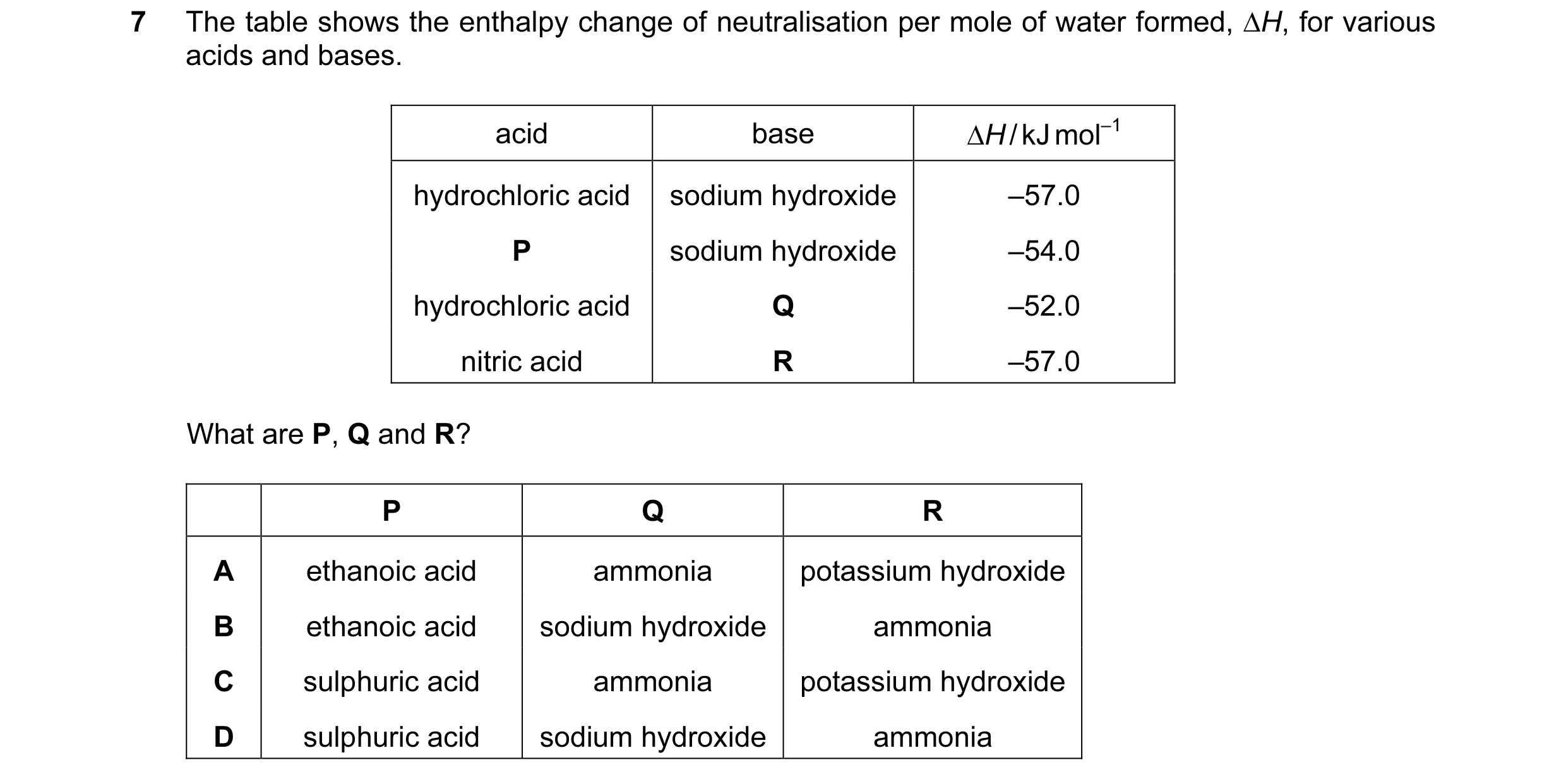
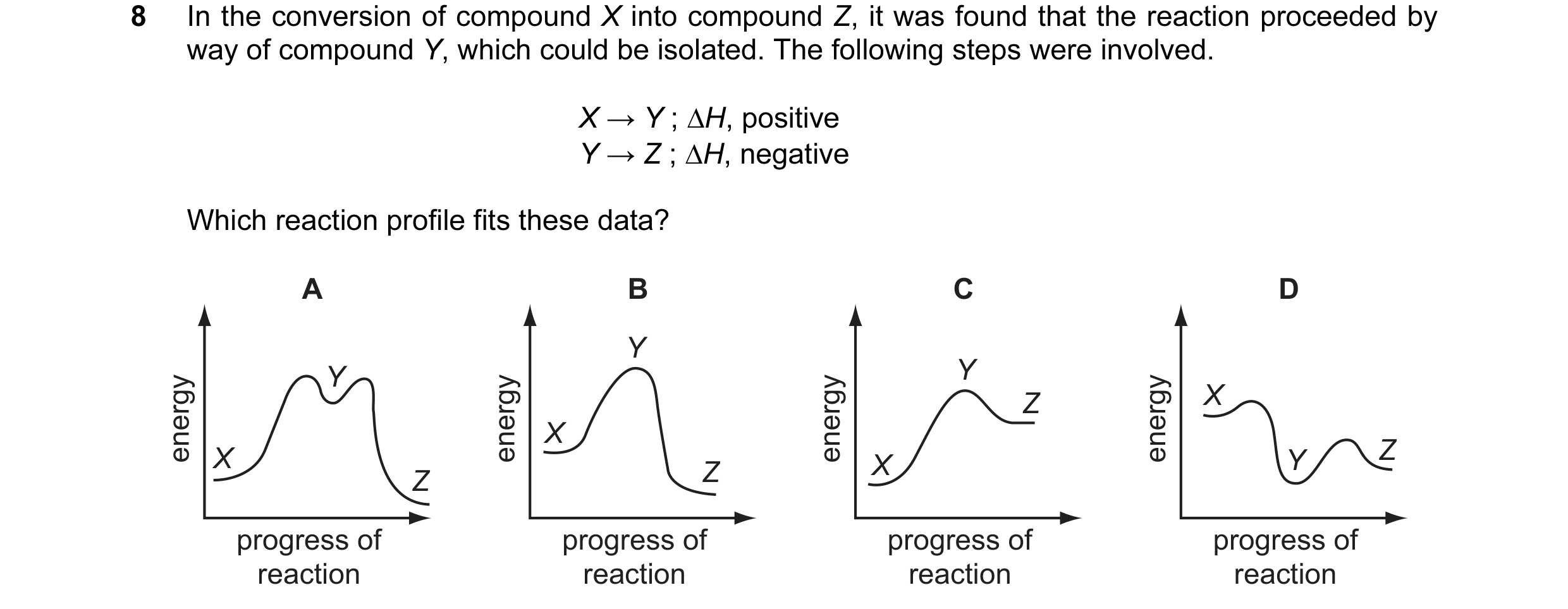
 1 / 67
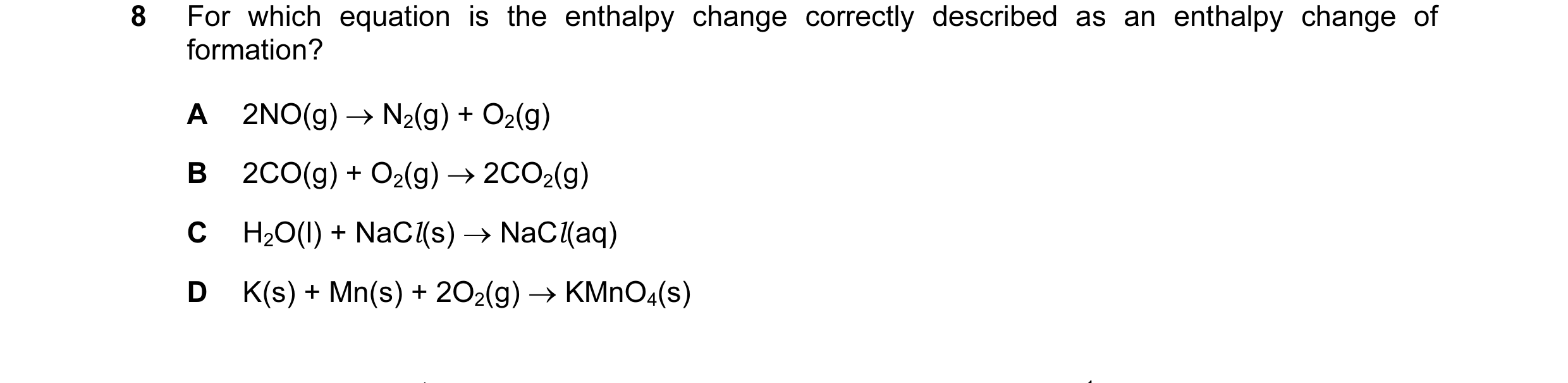
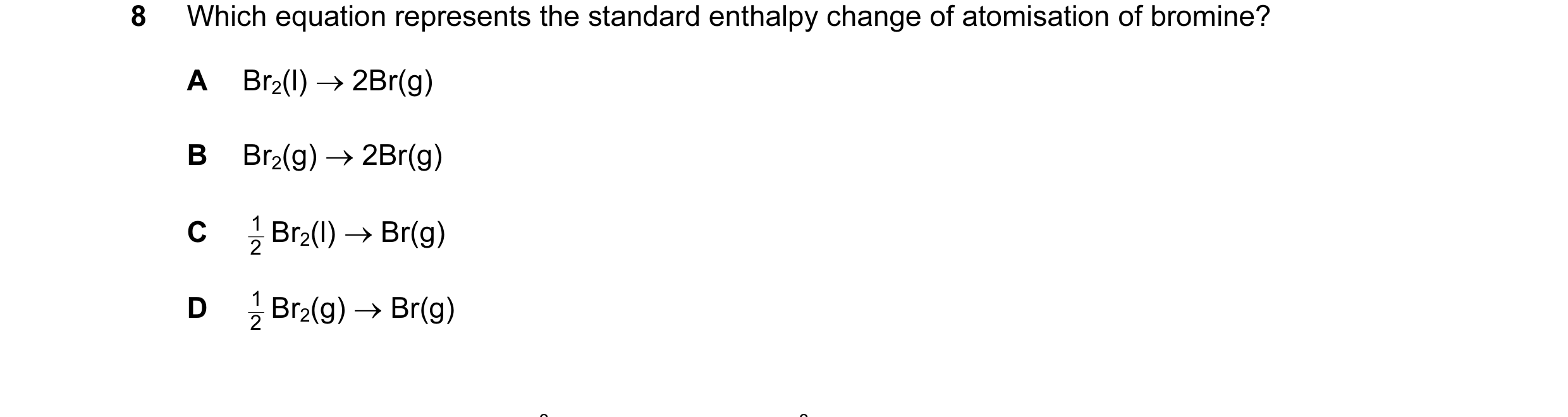
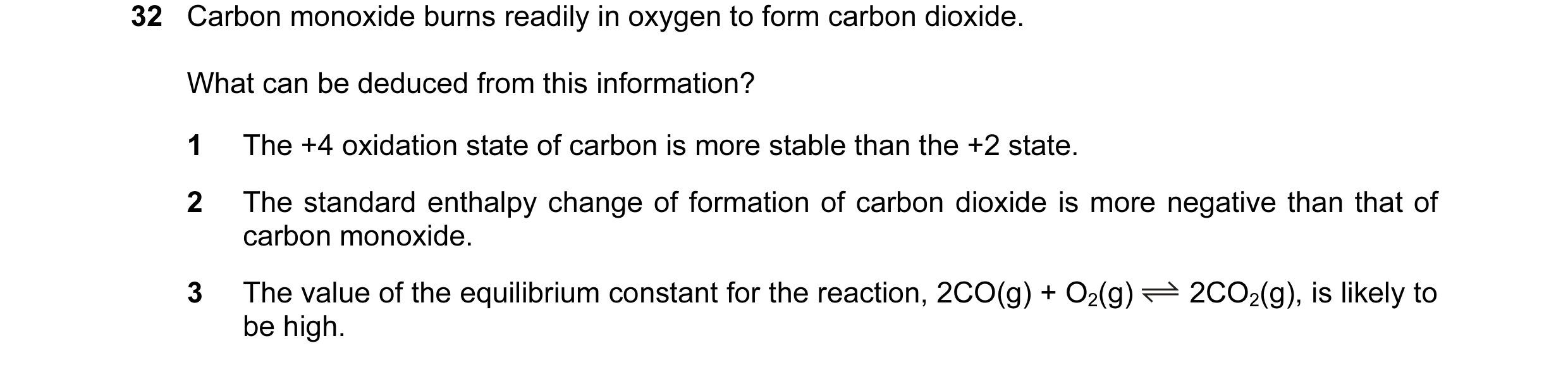
 2 / 67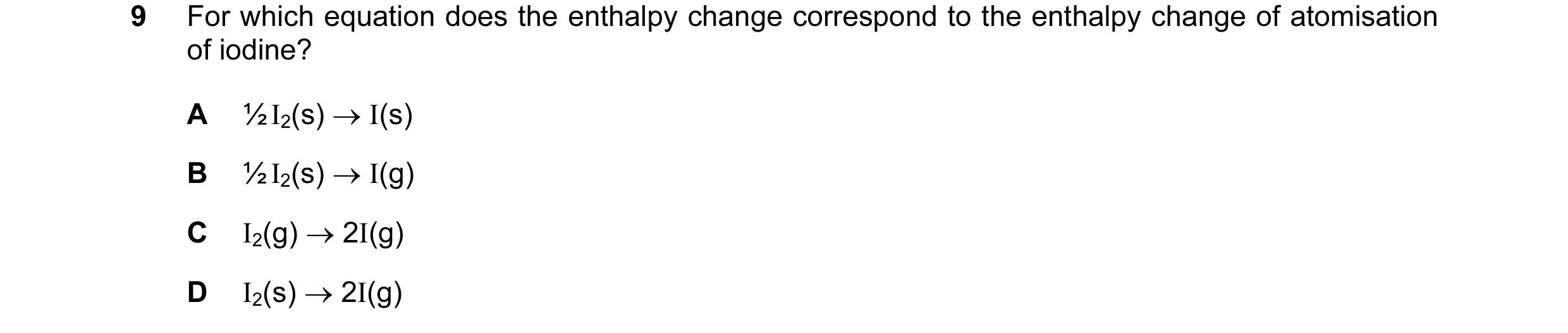
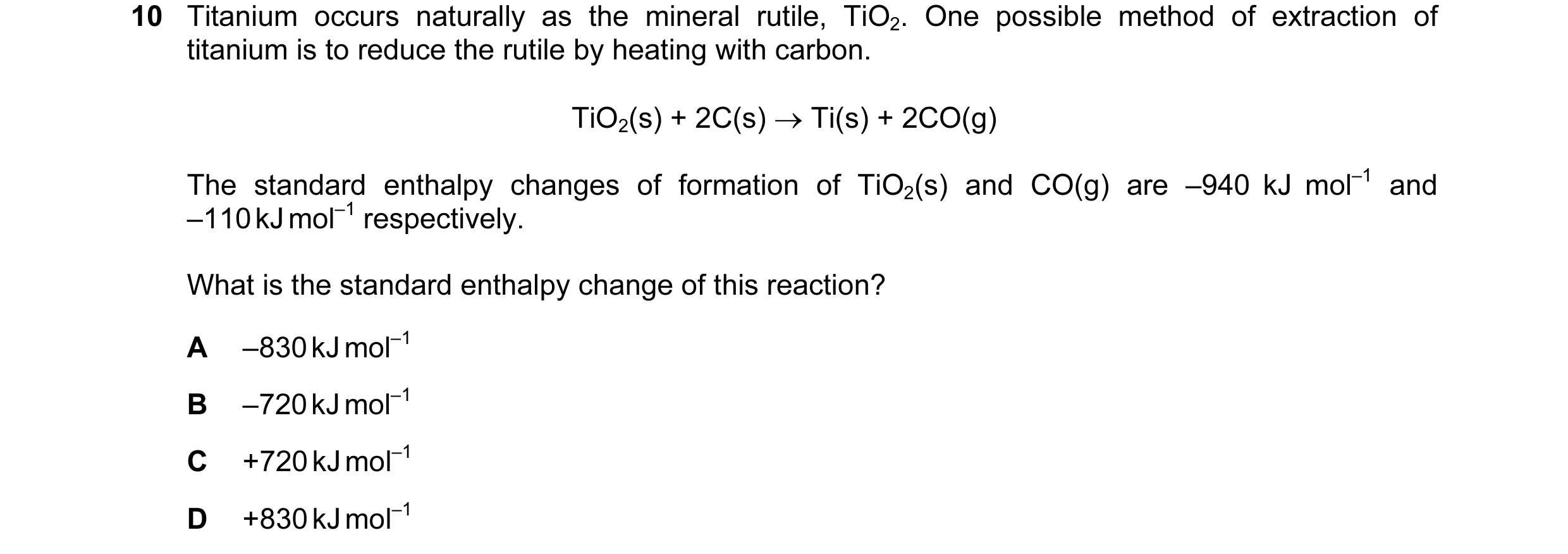

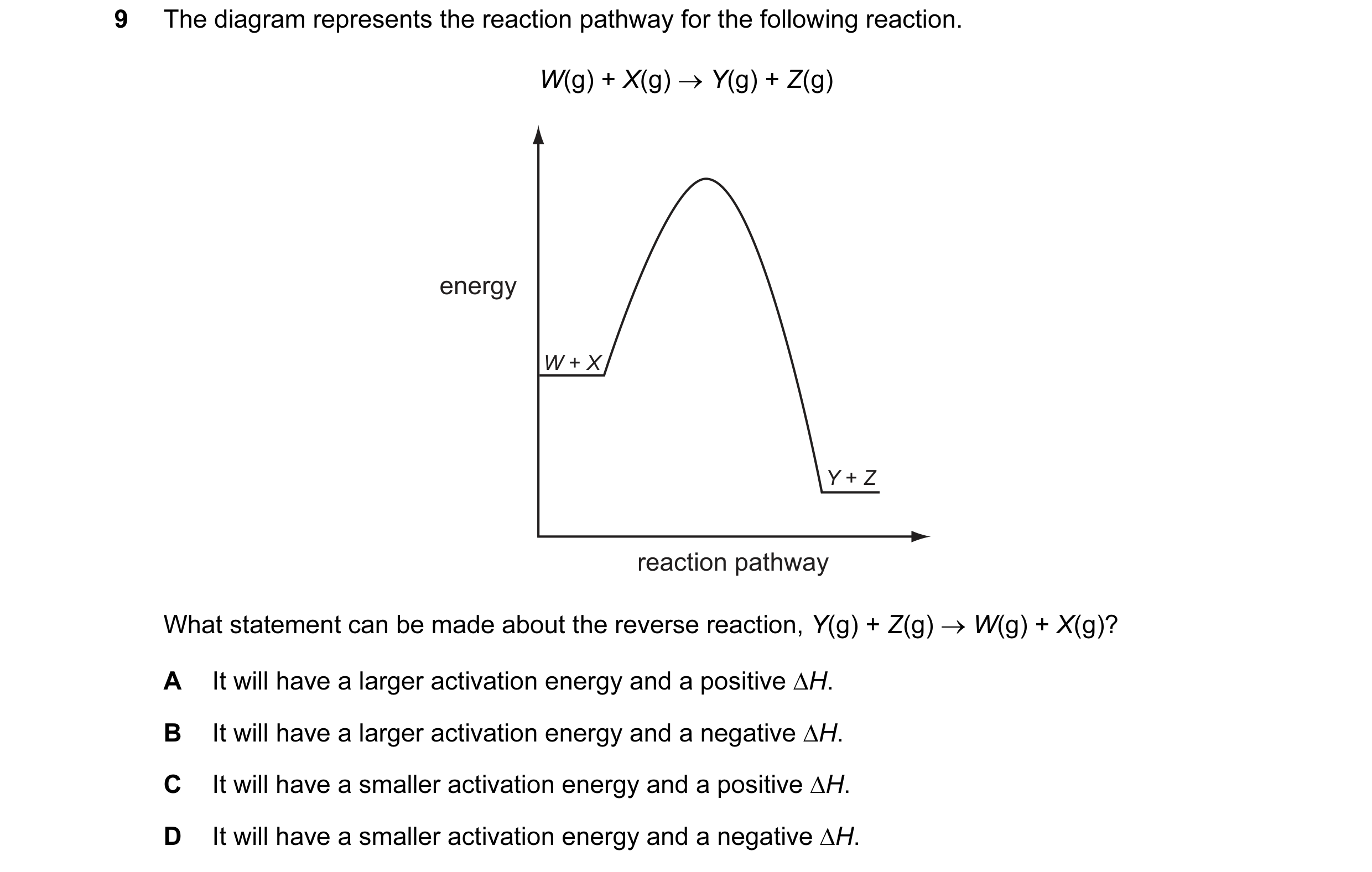 3 / 67
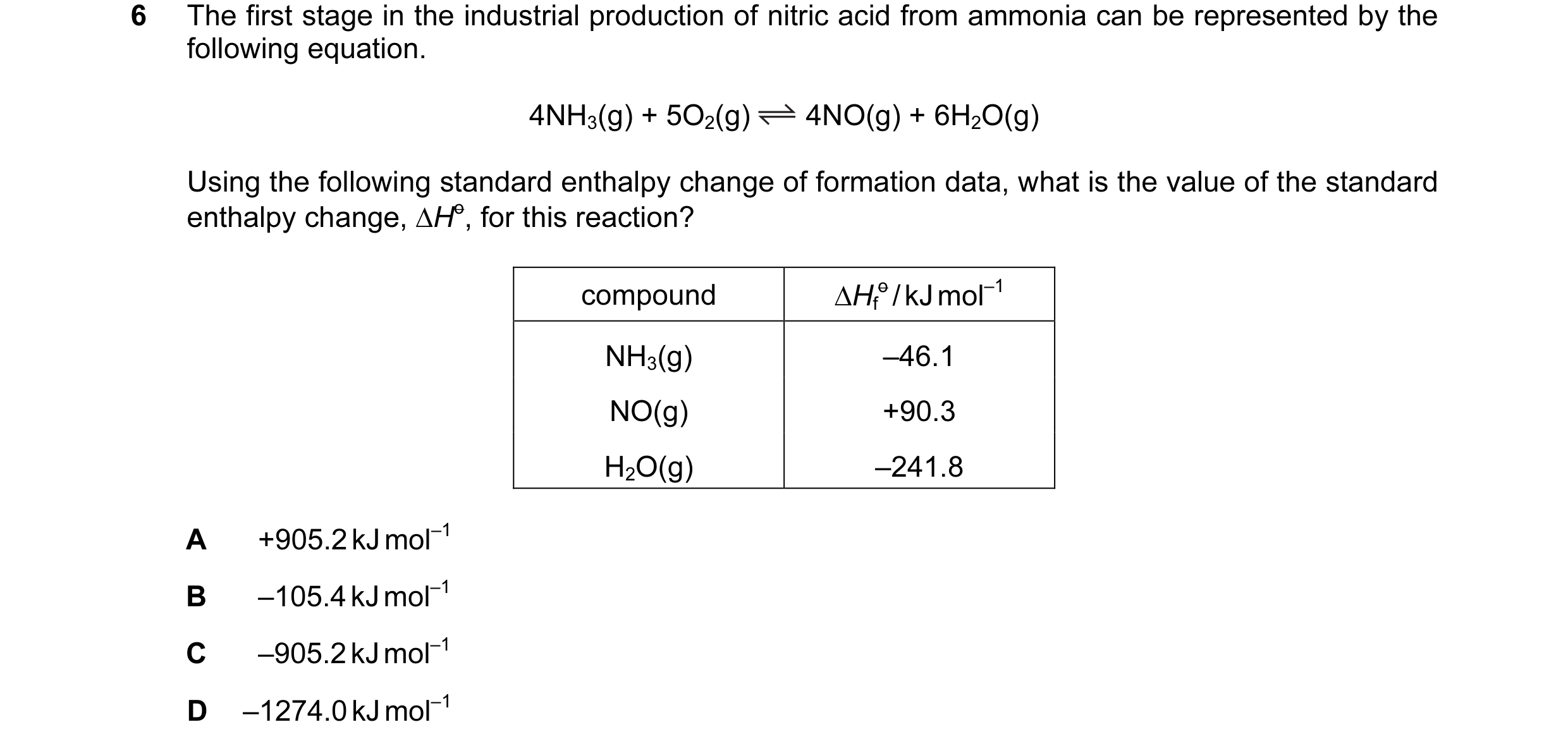
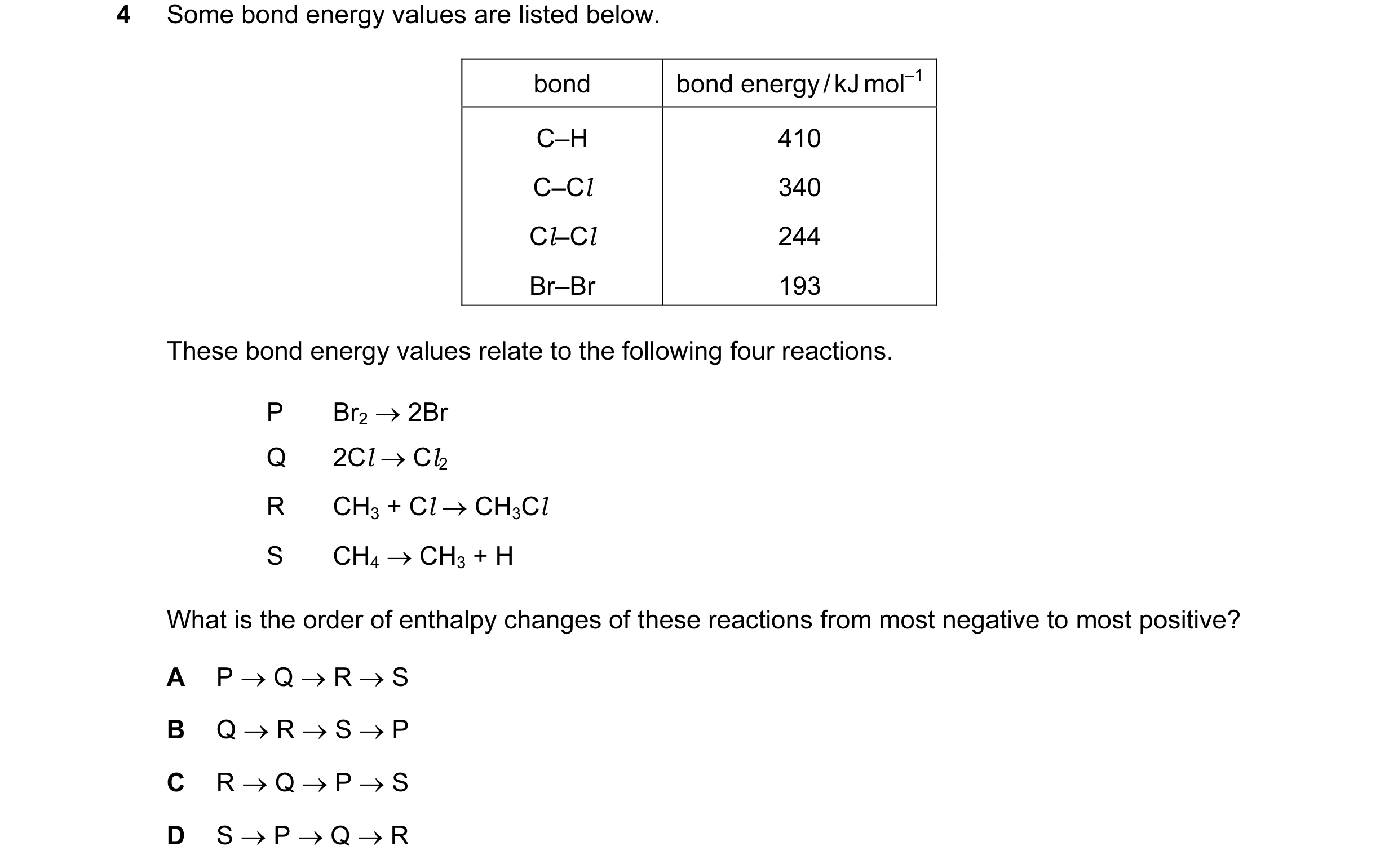 4 / 67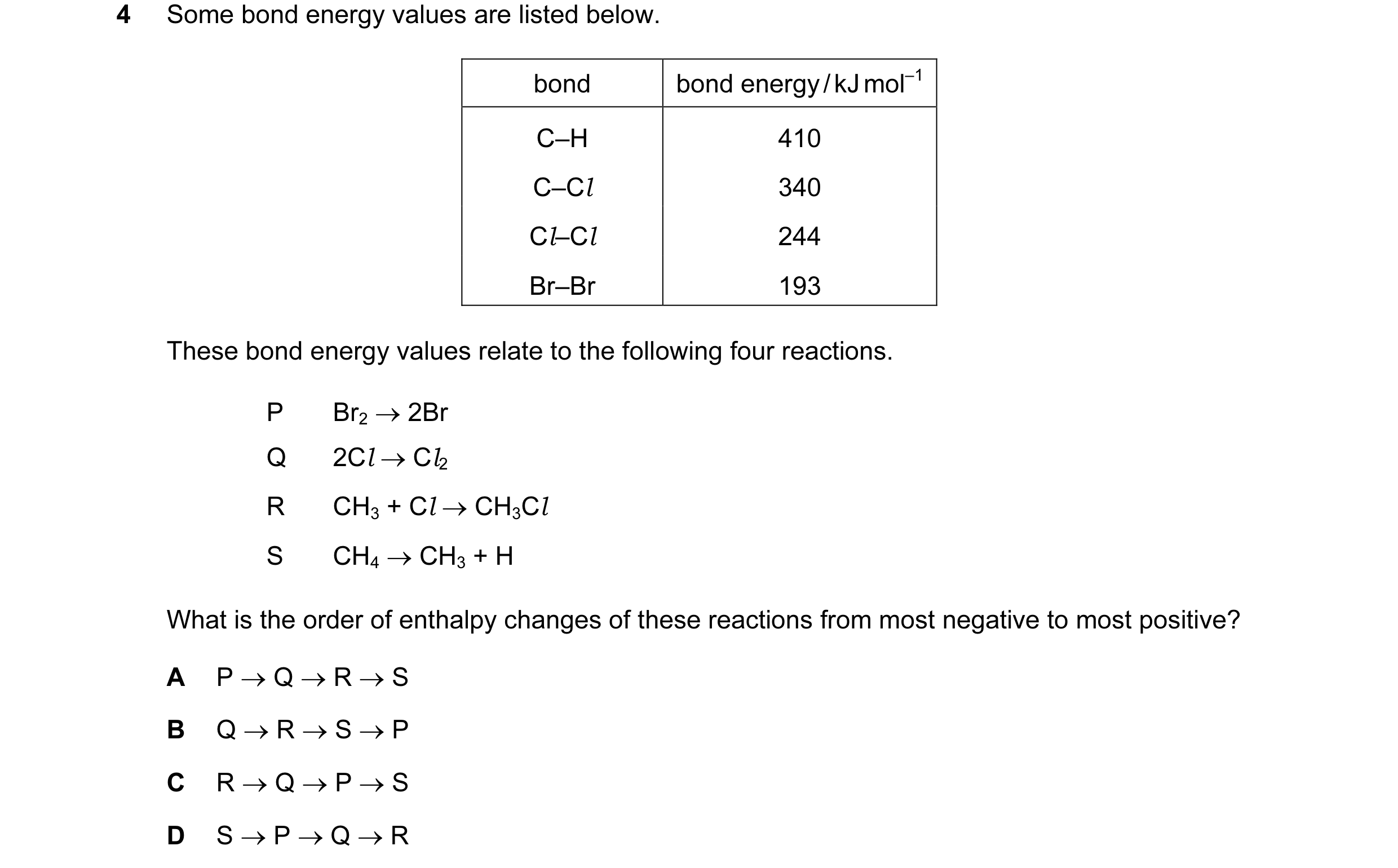
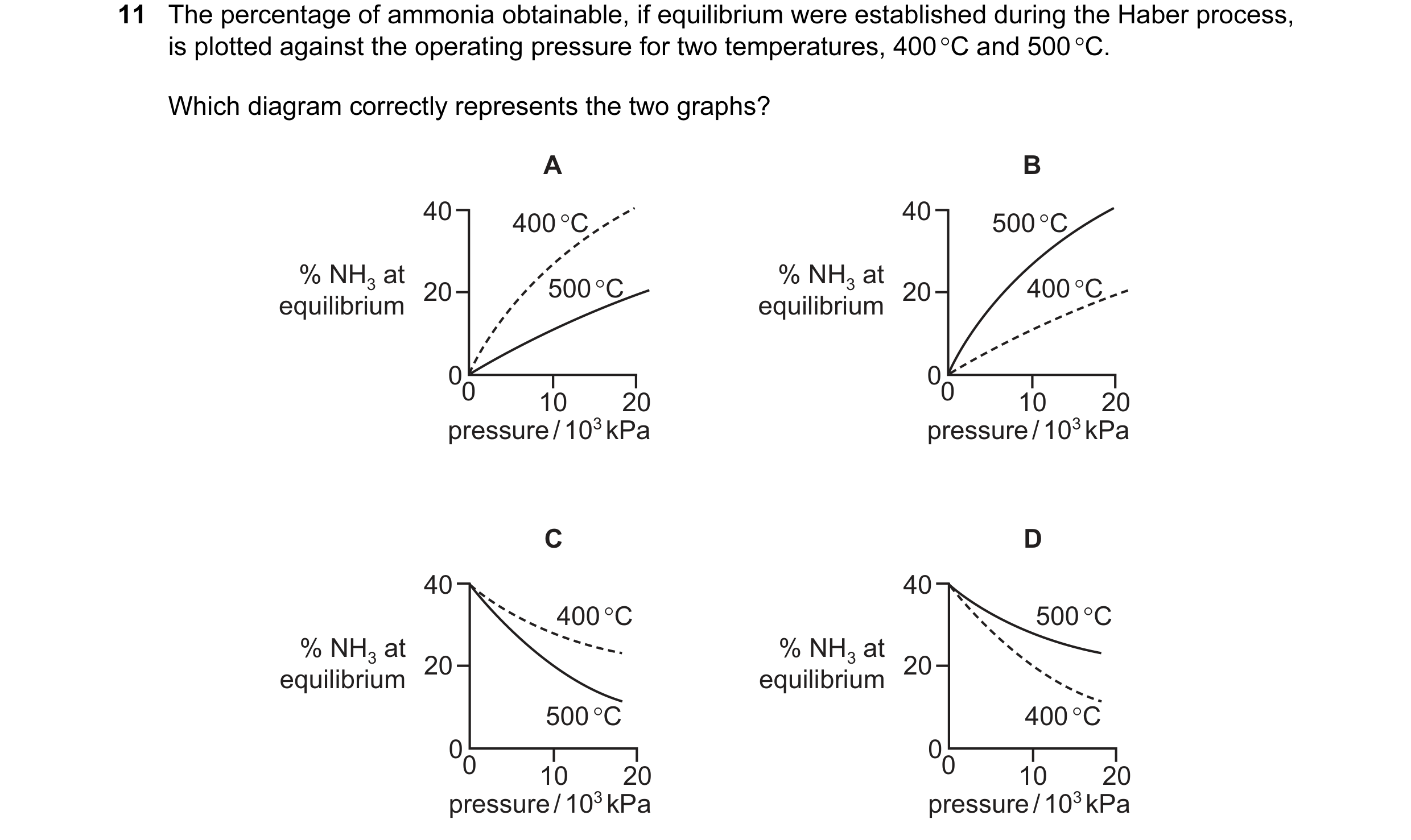 5 / 67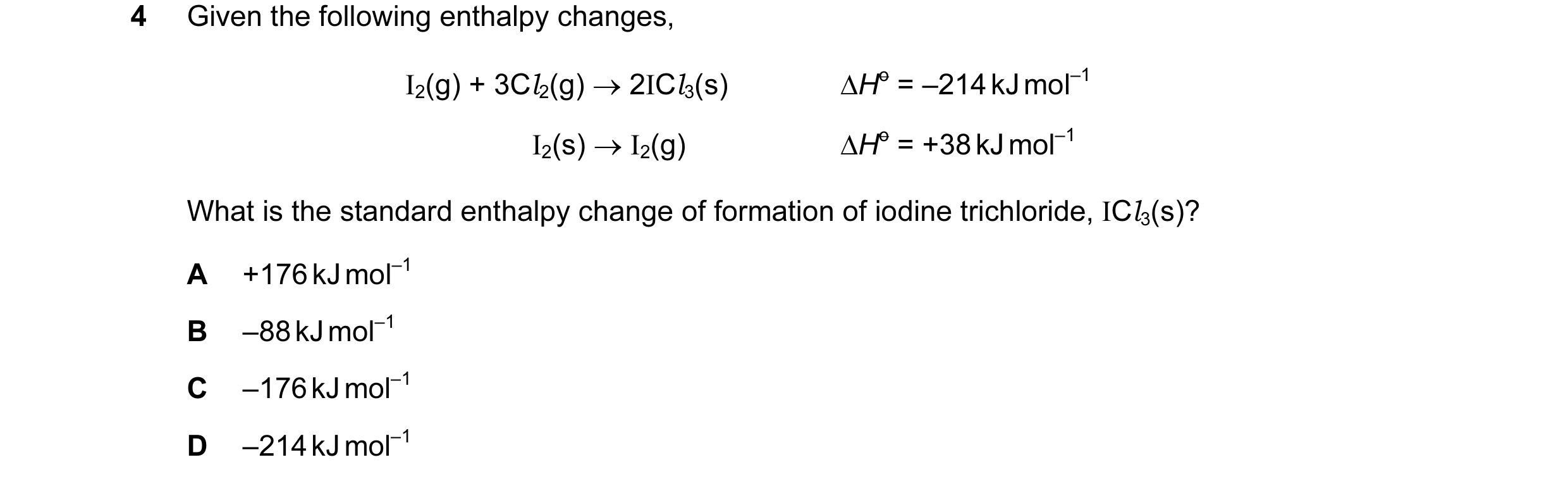
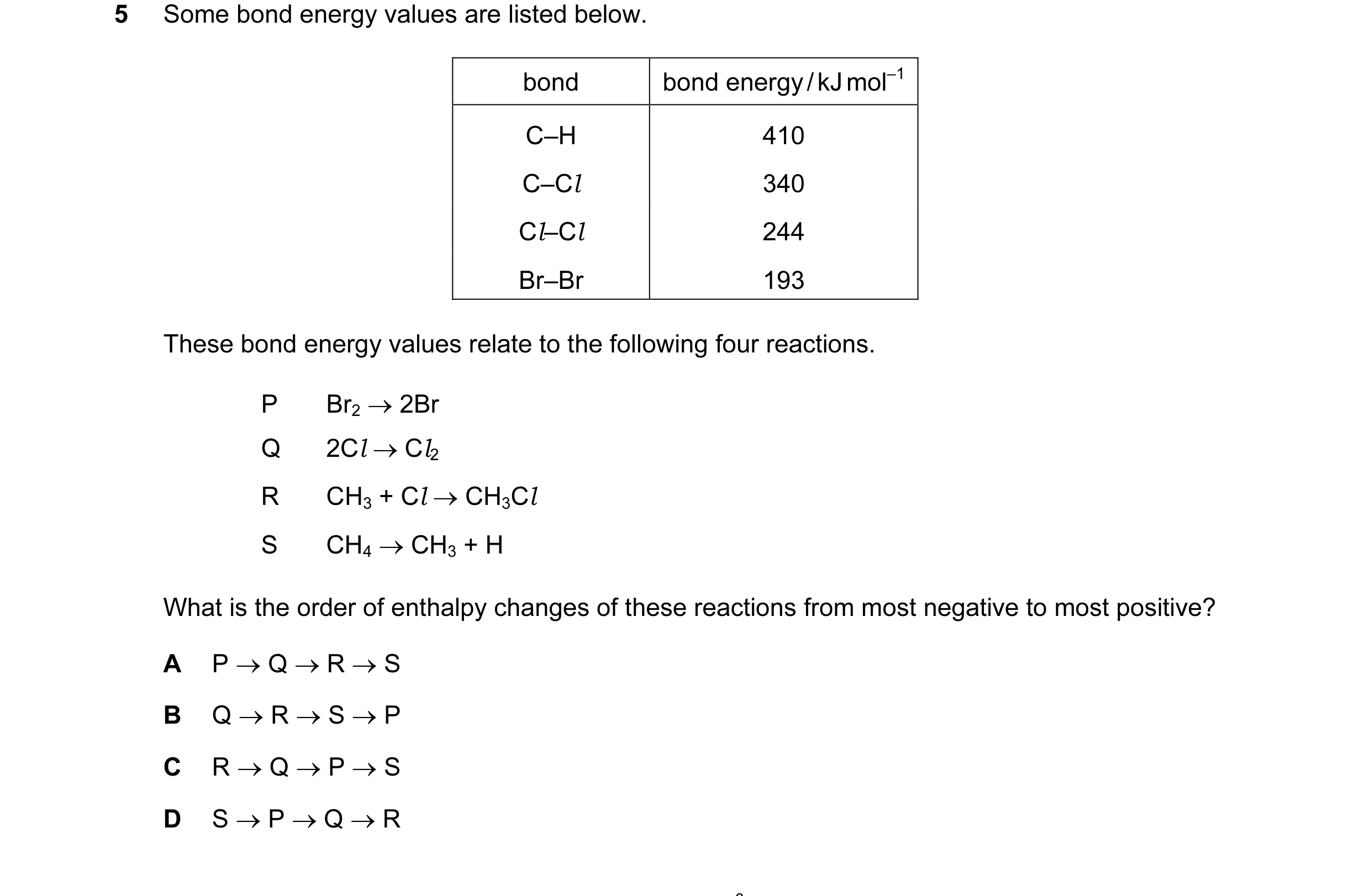 6 / 67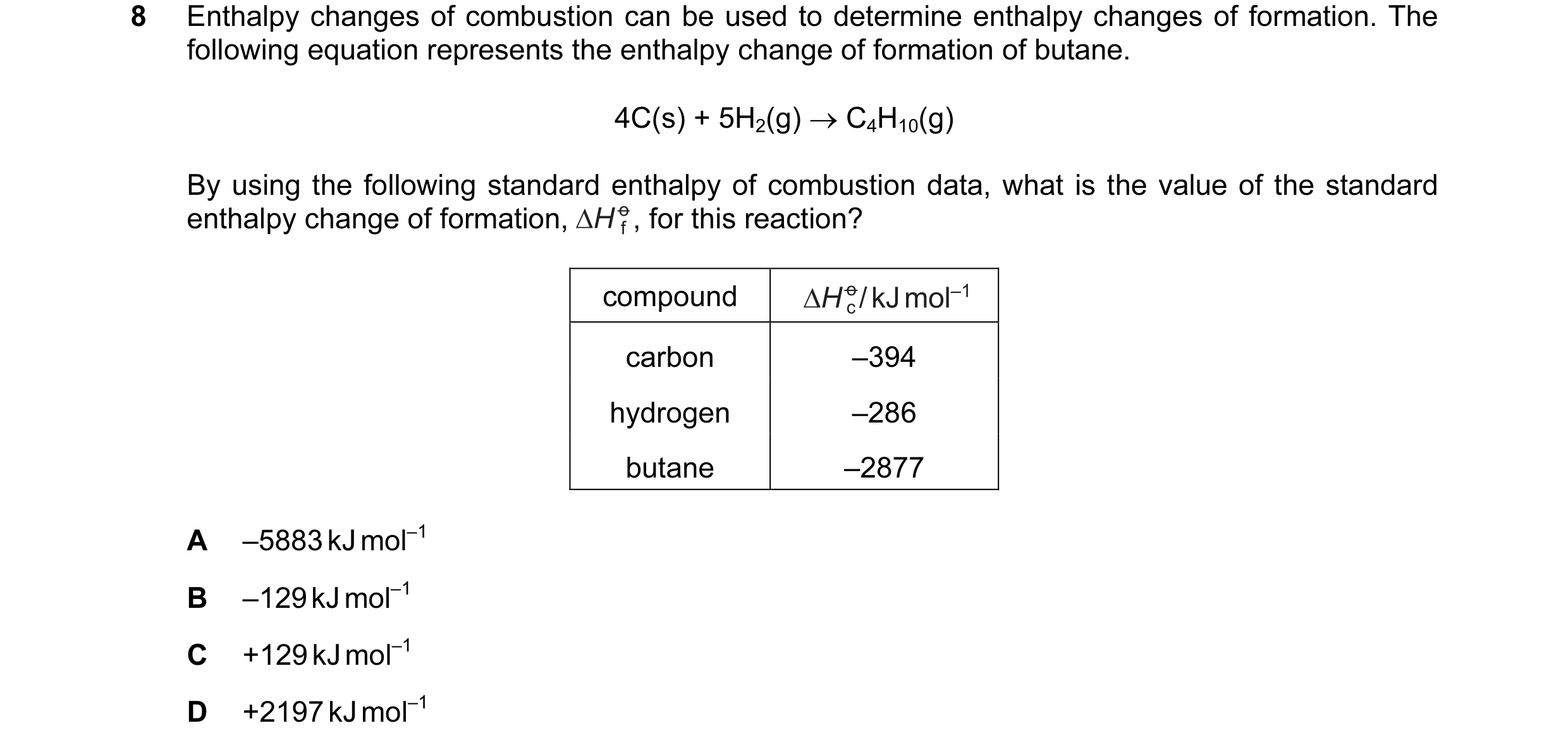

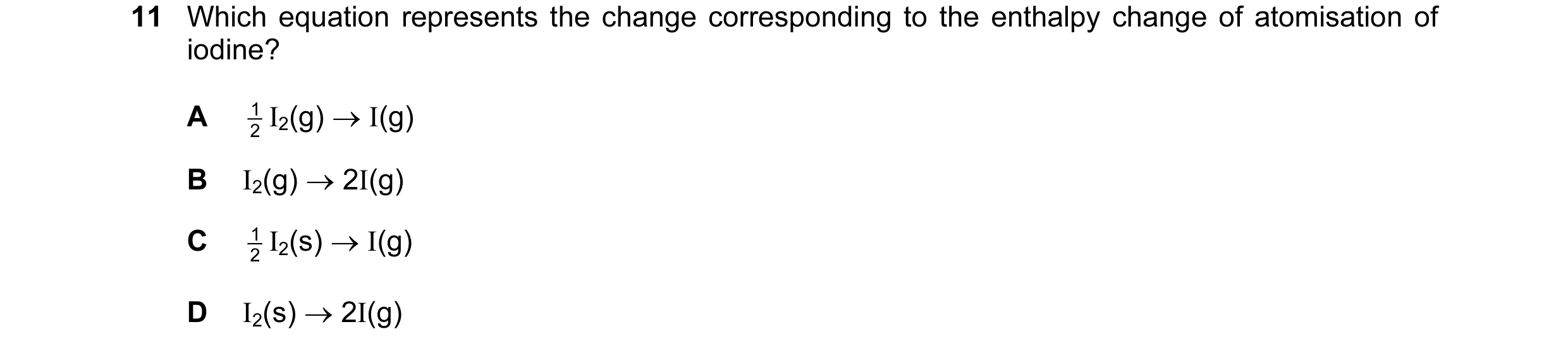 7 / 67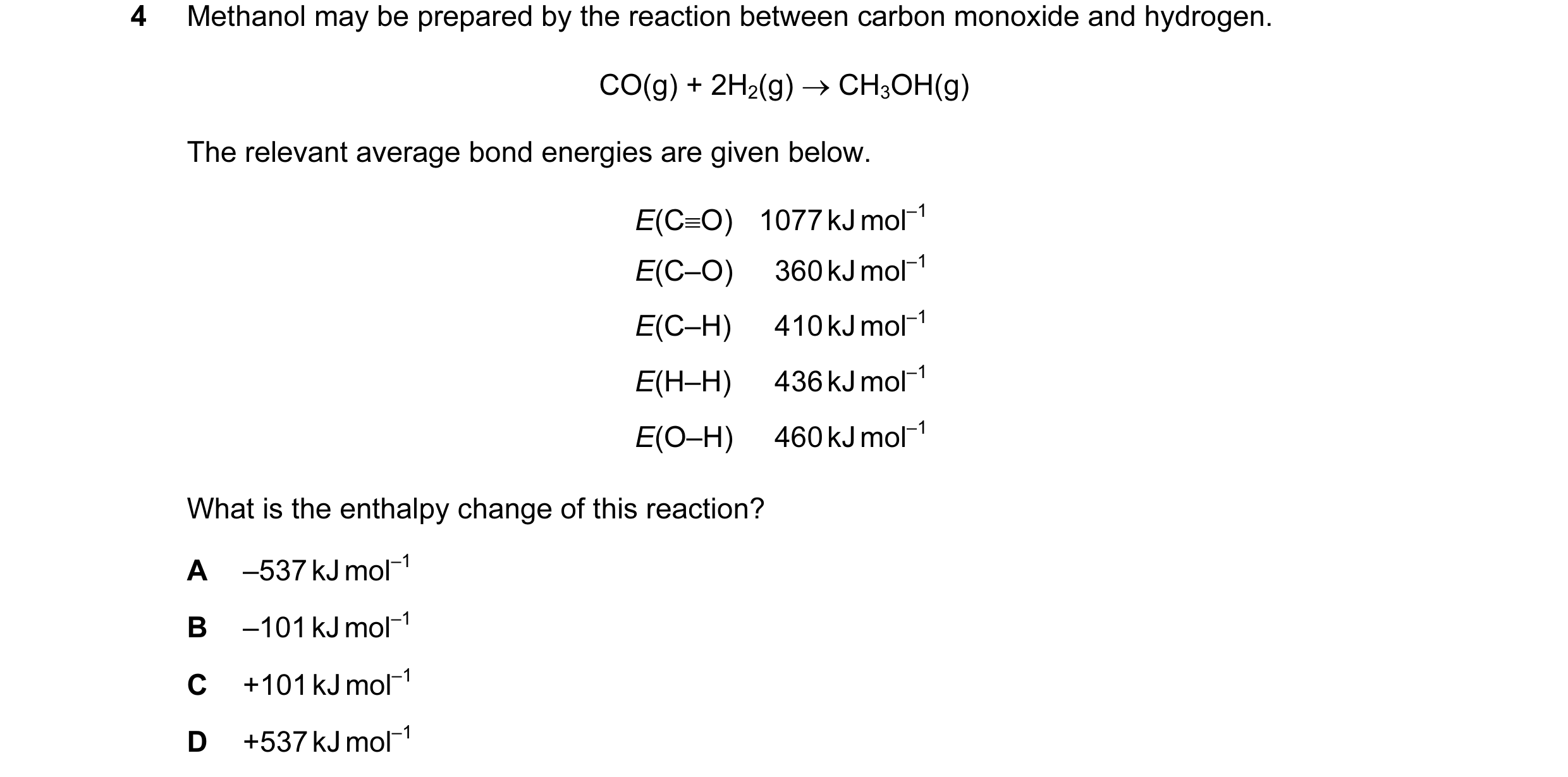
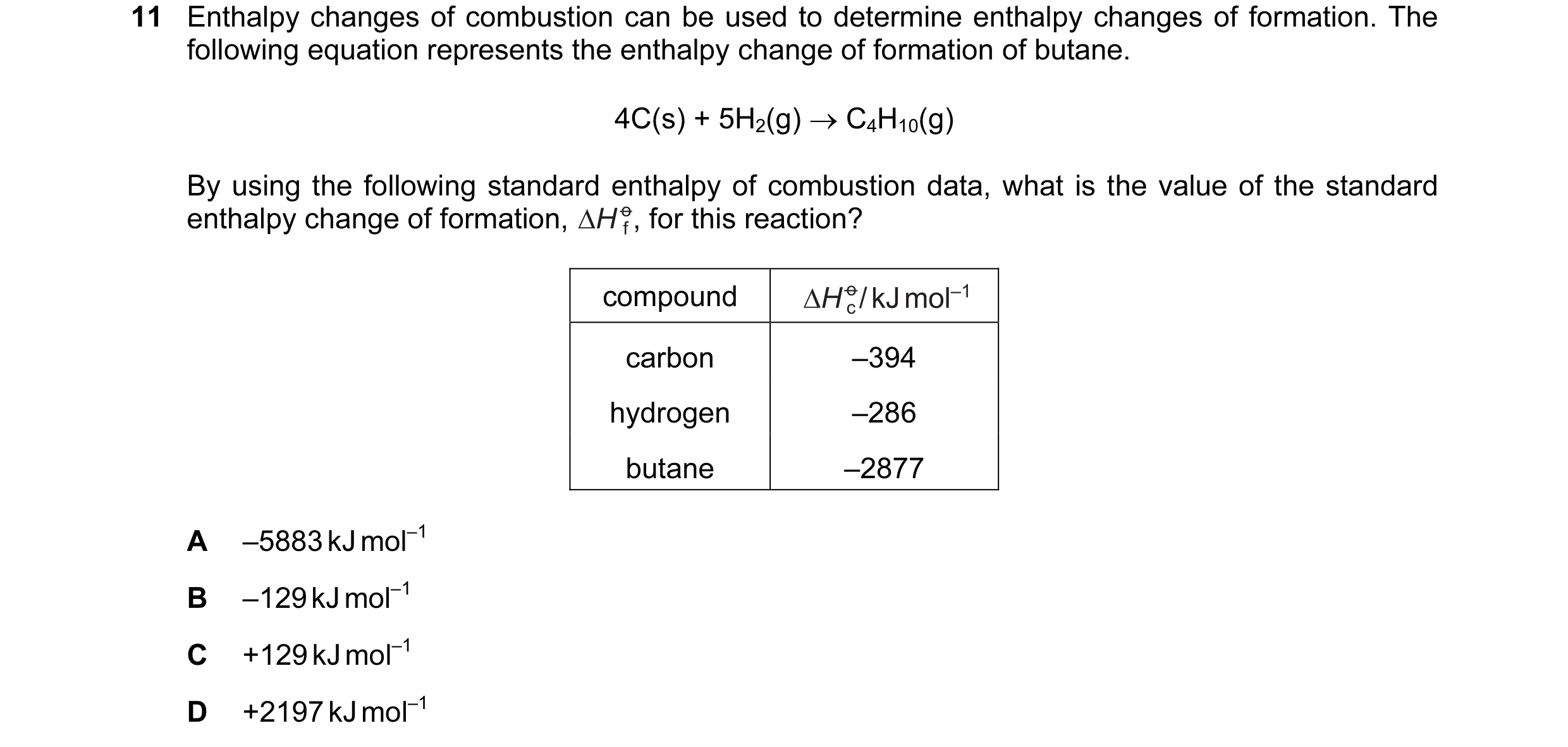
 8 / 67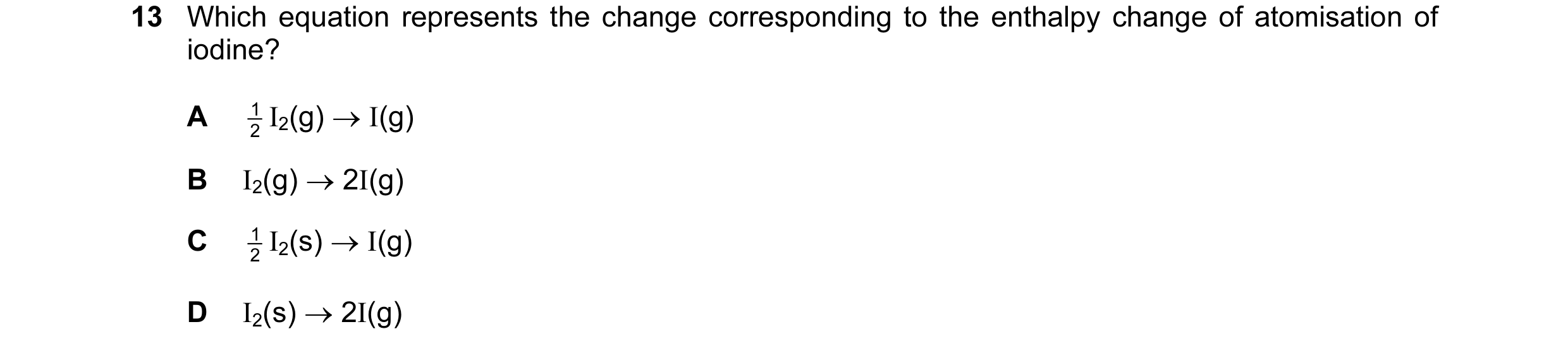
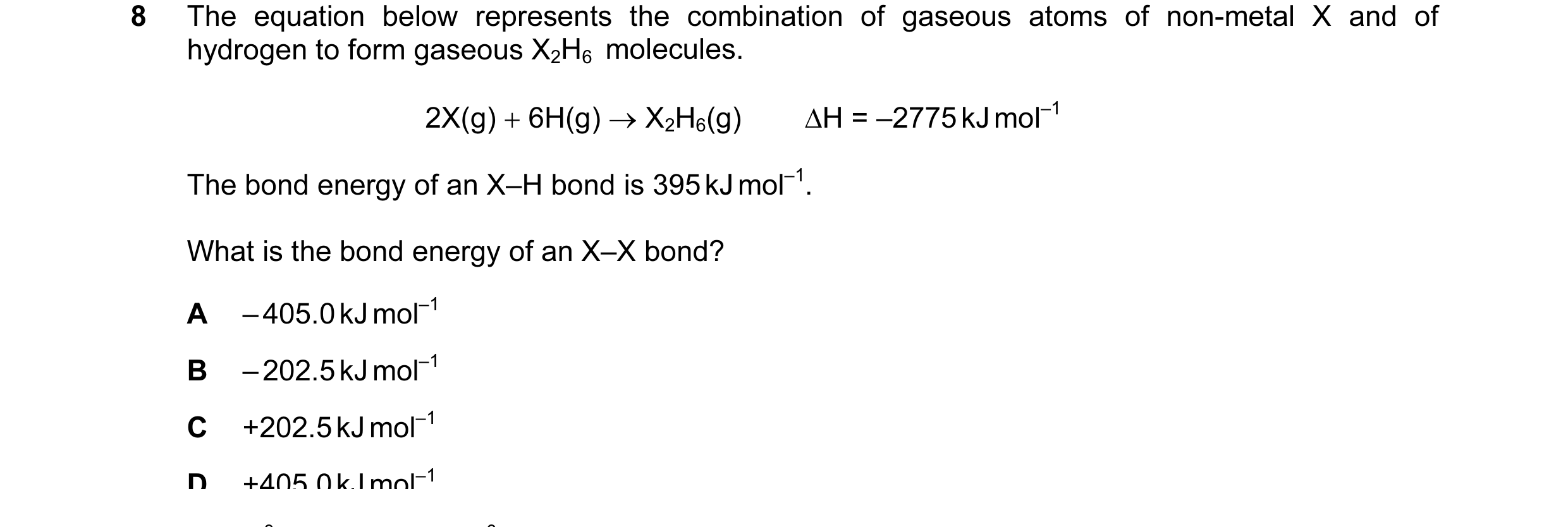
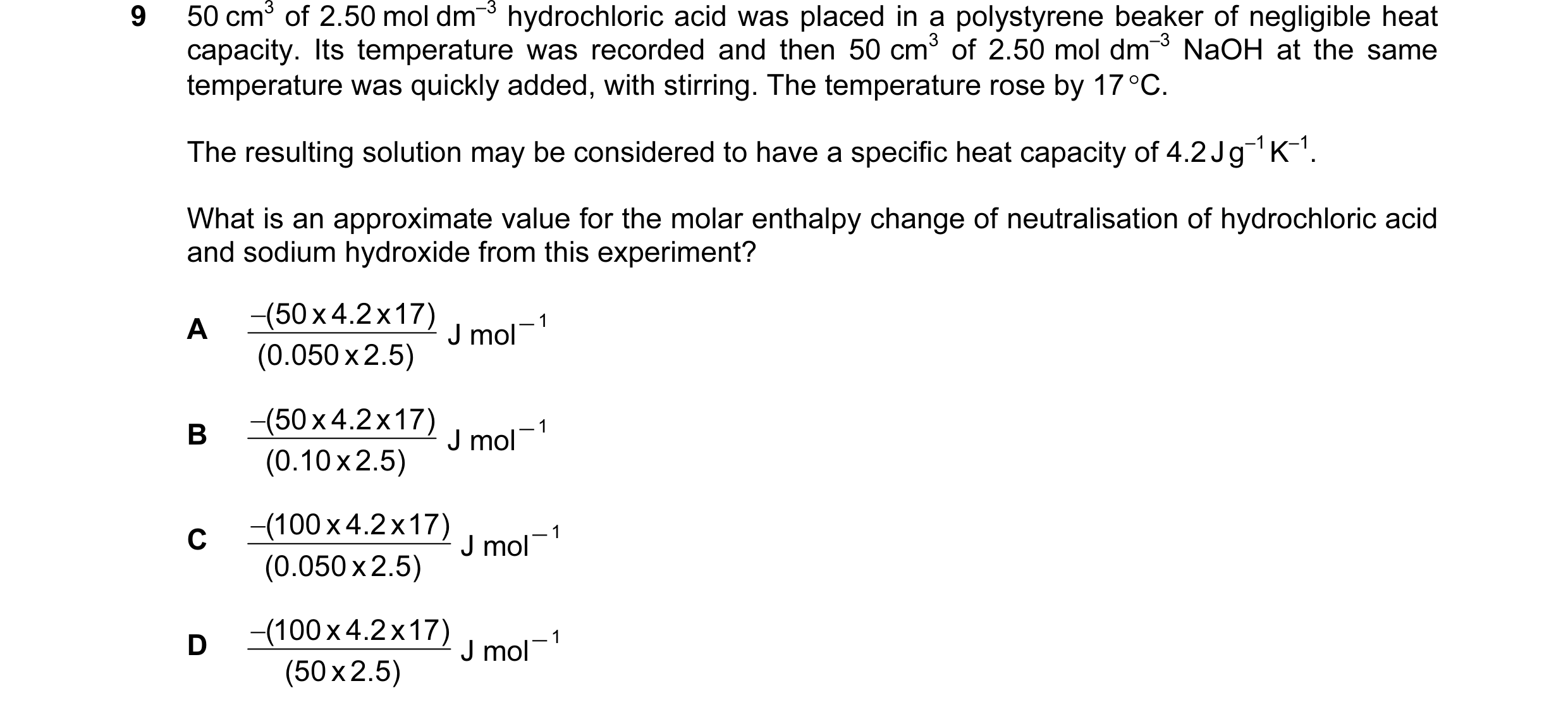
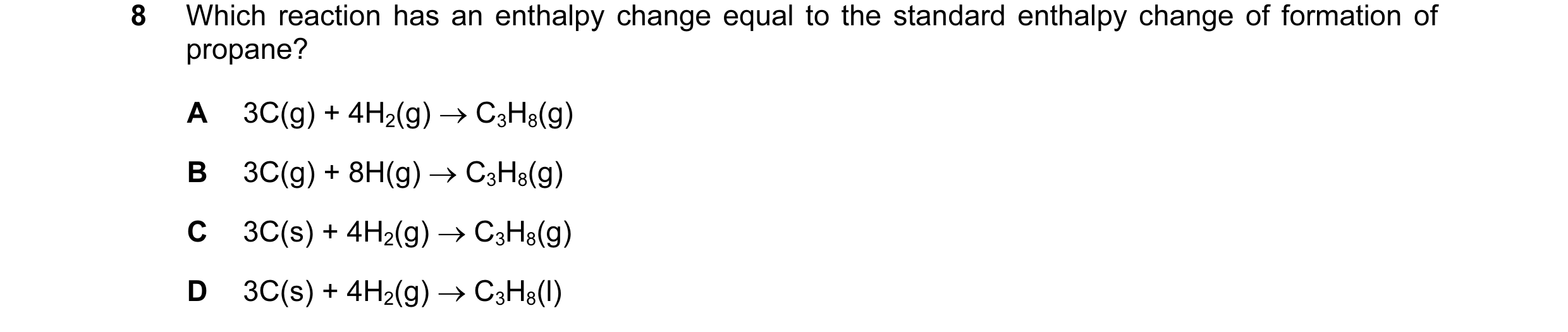 9 / 67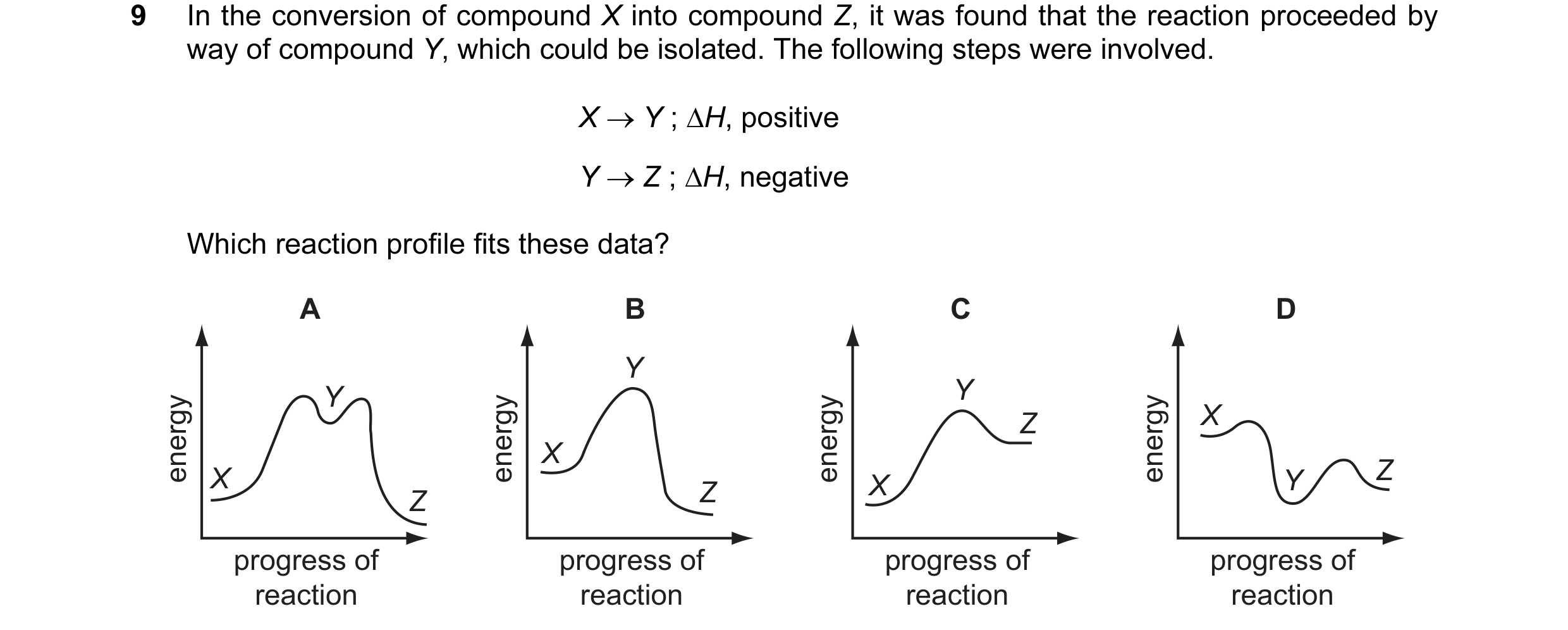
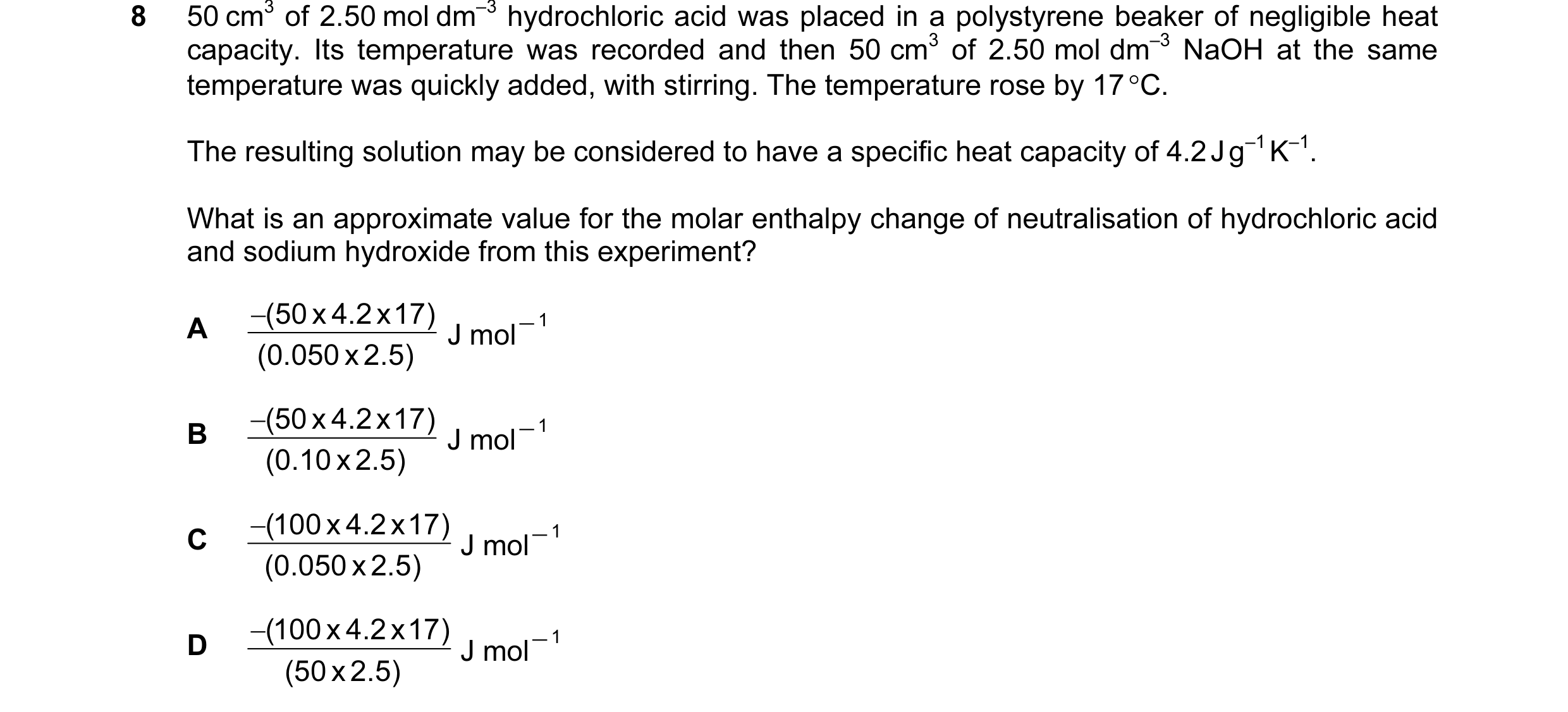
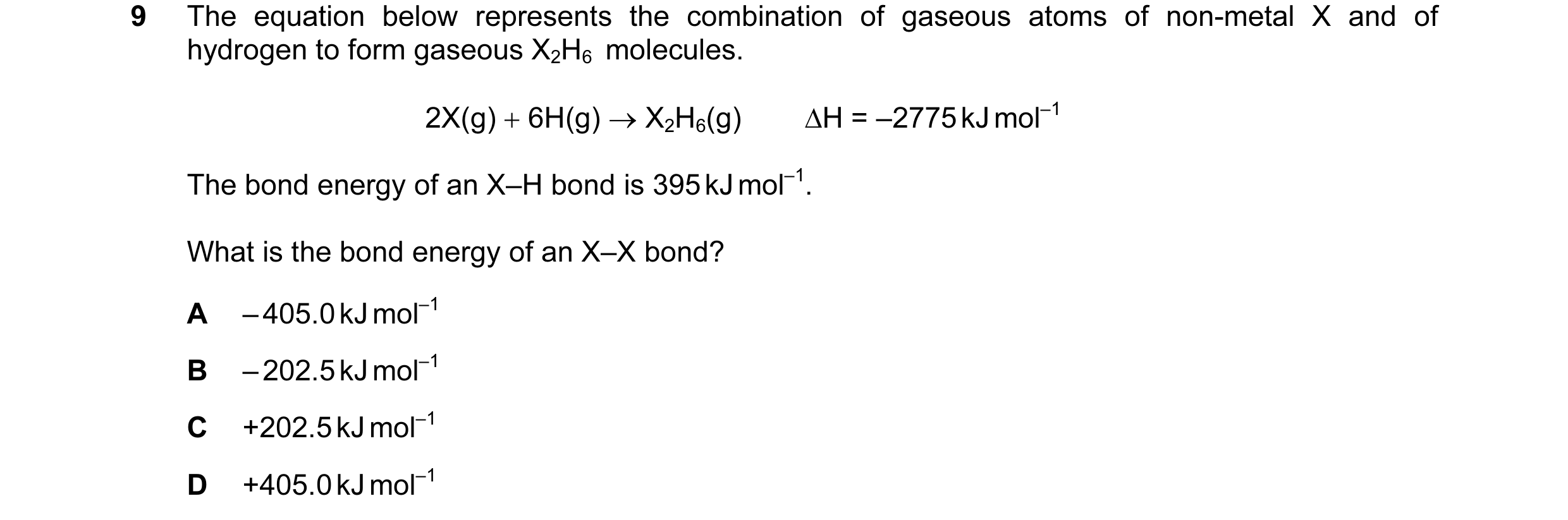 10 / 67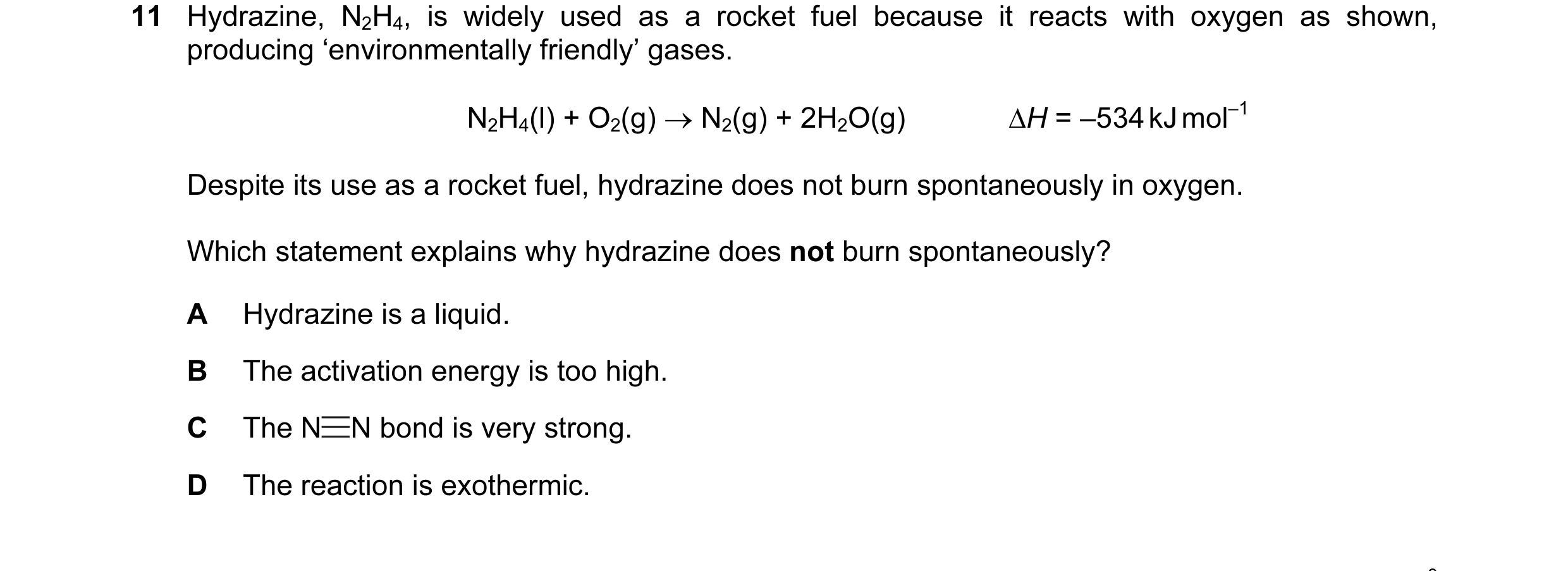
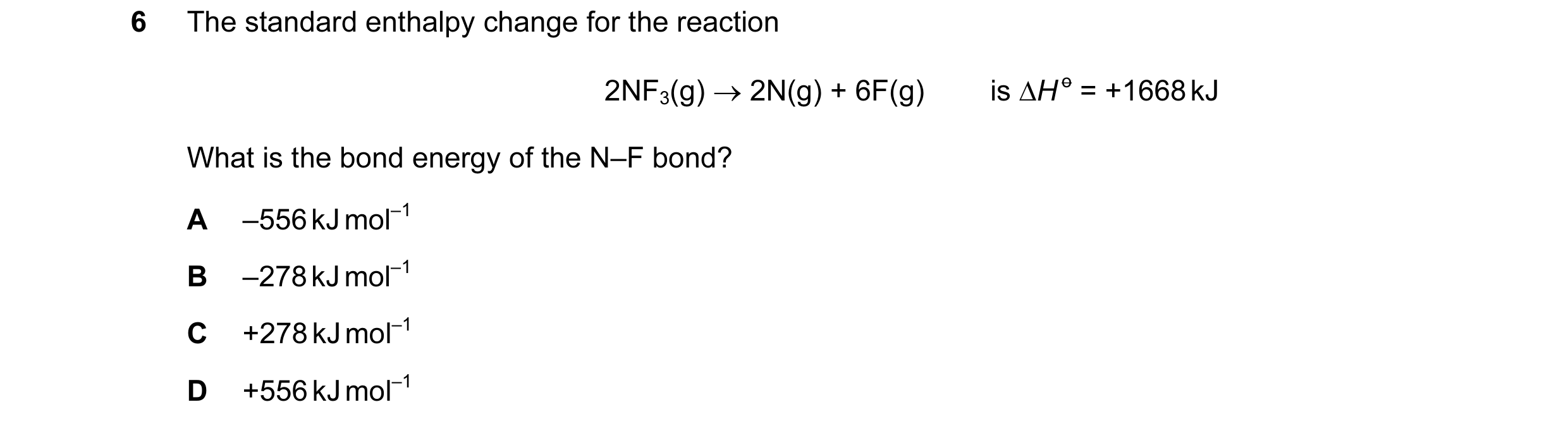
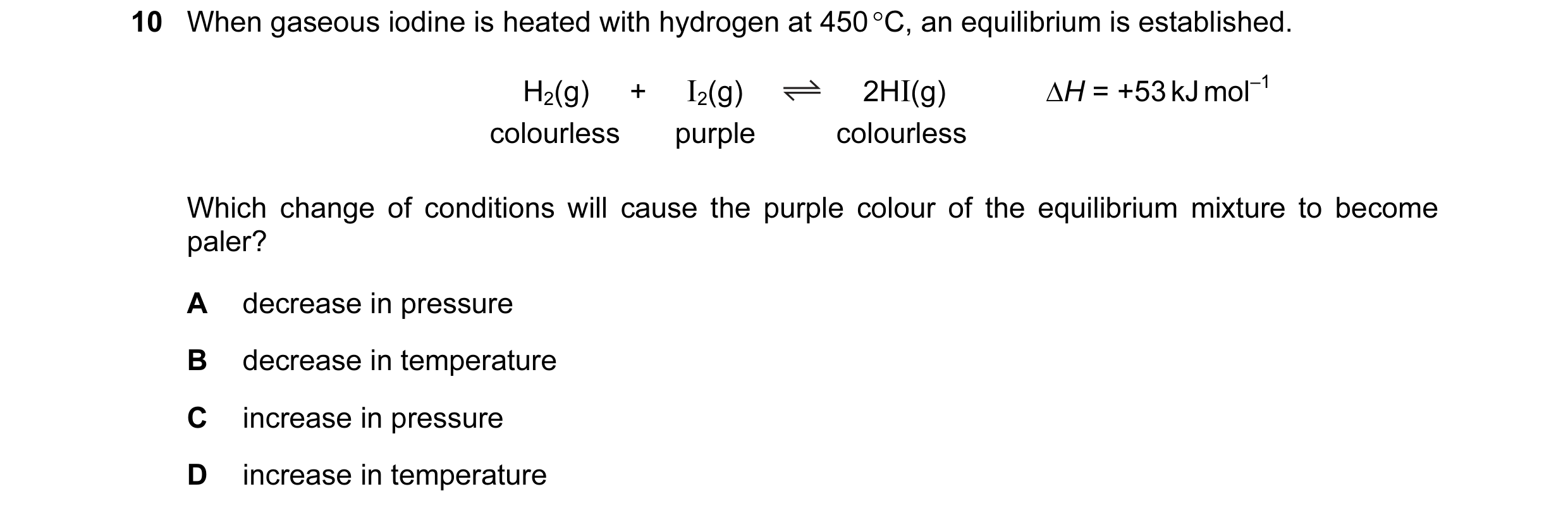
 11 / 67
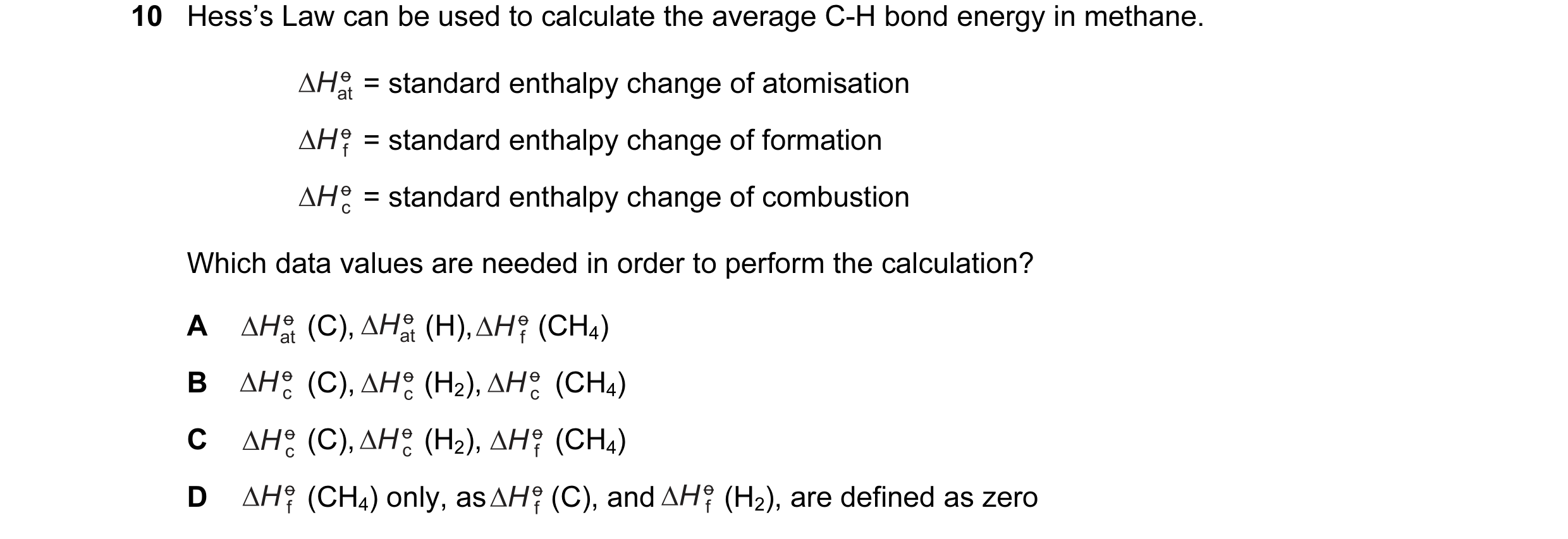
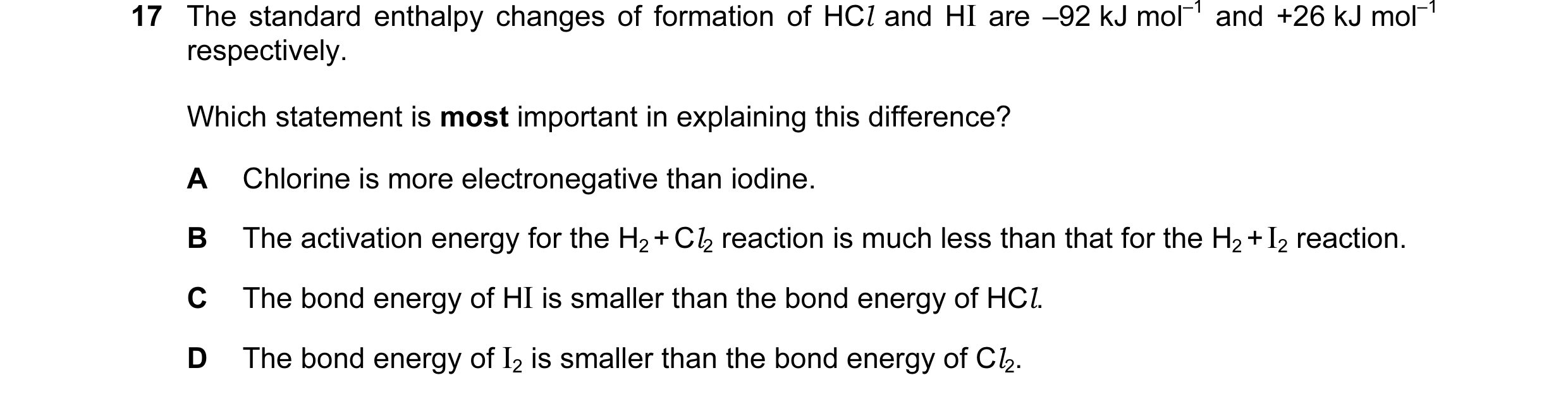
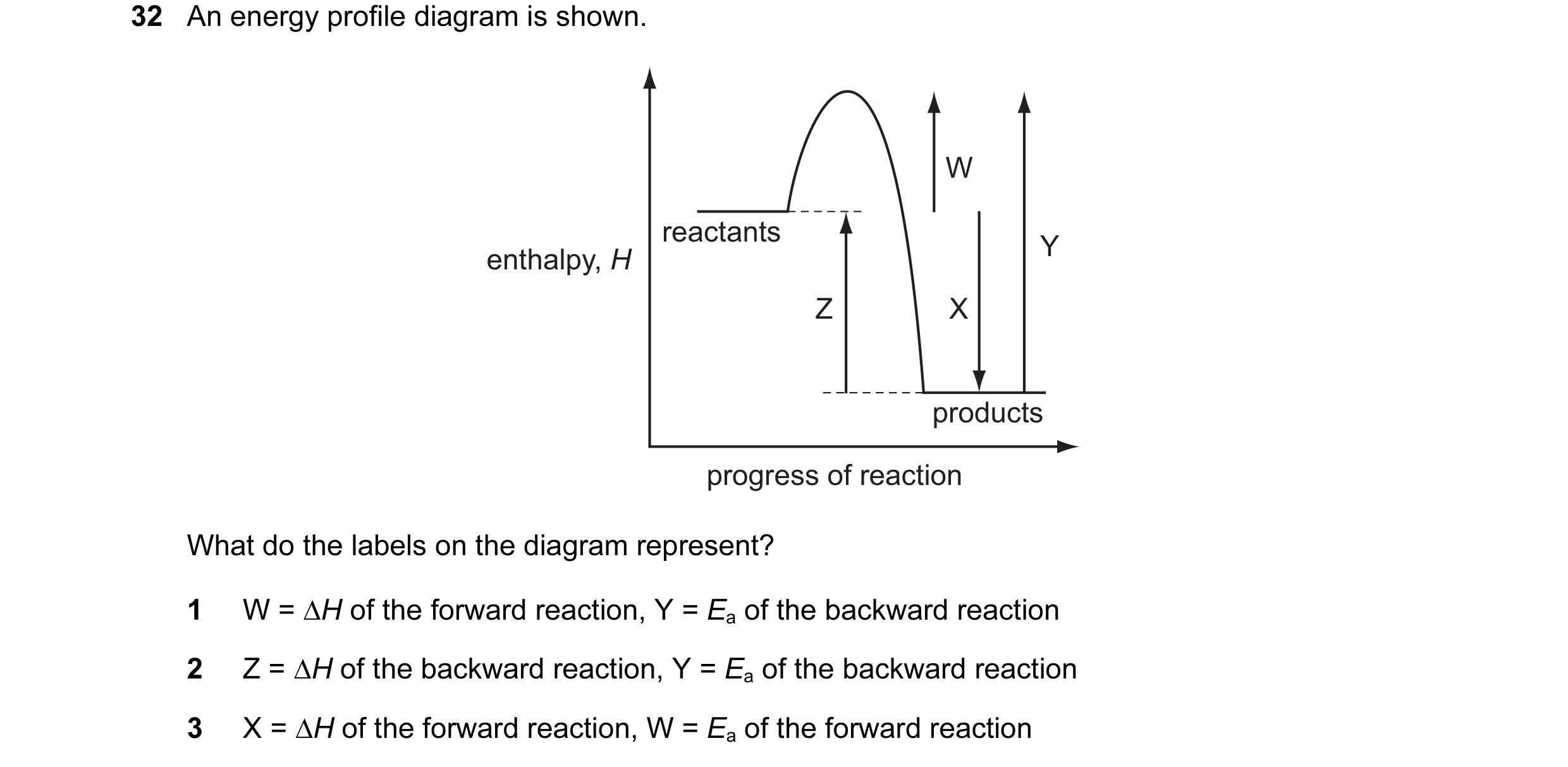 12 / 67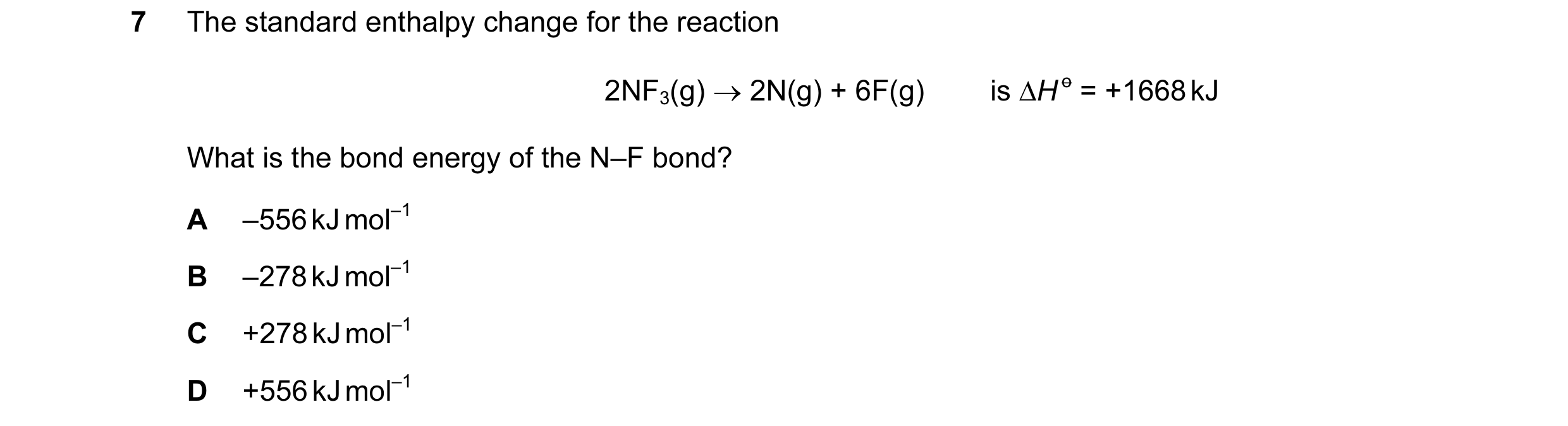
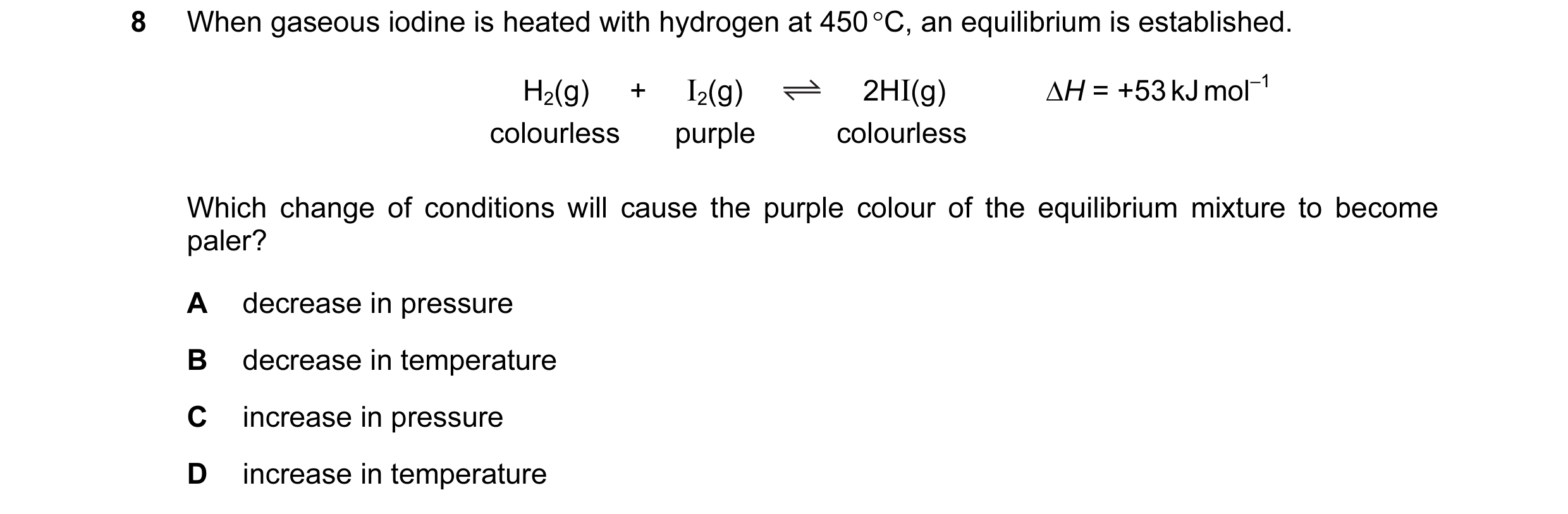

 13 / 67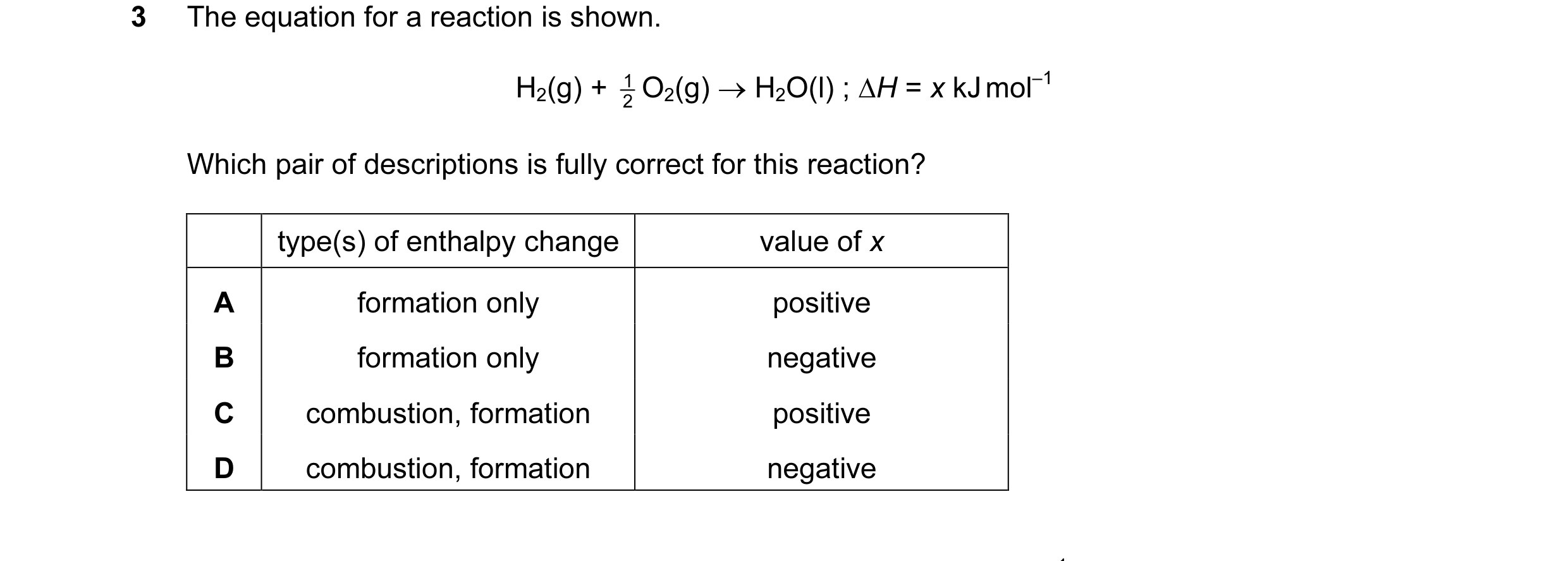
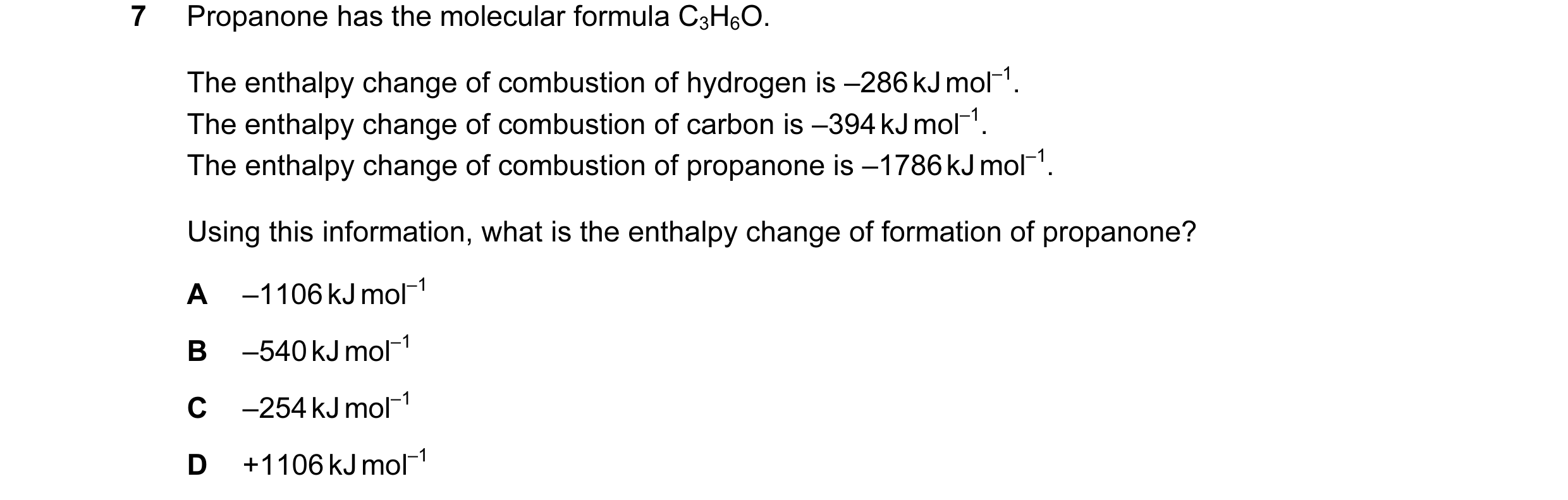
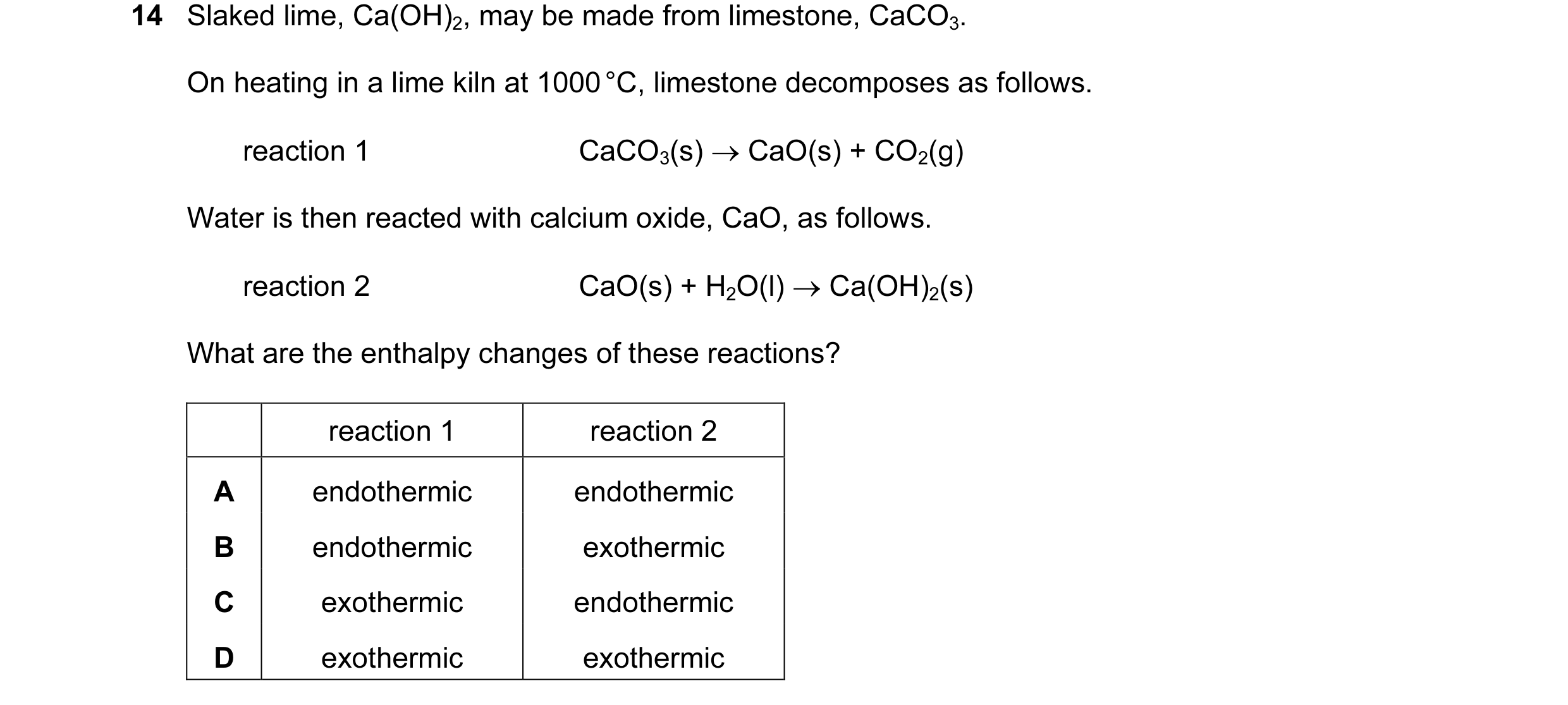 14 / 67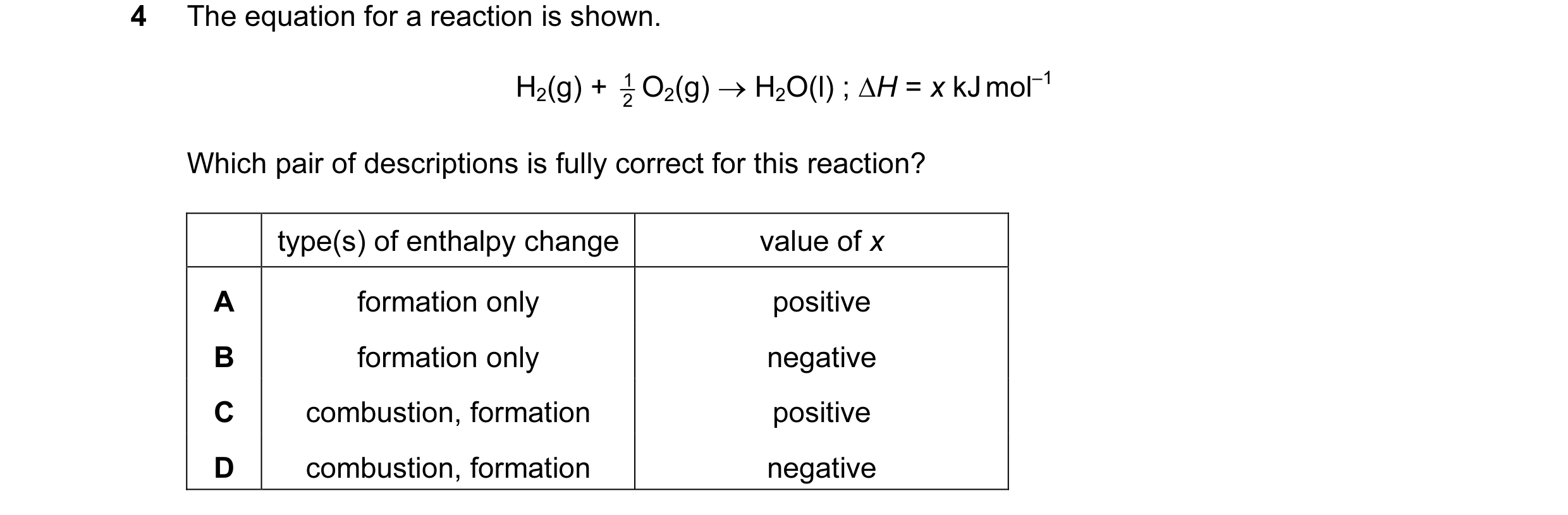
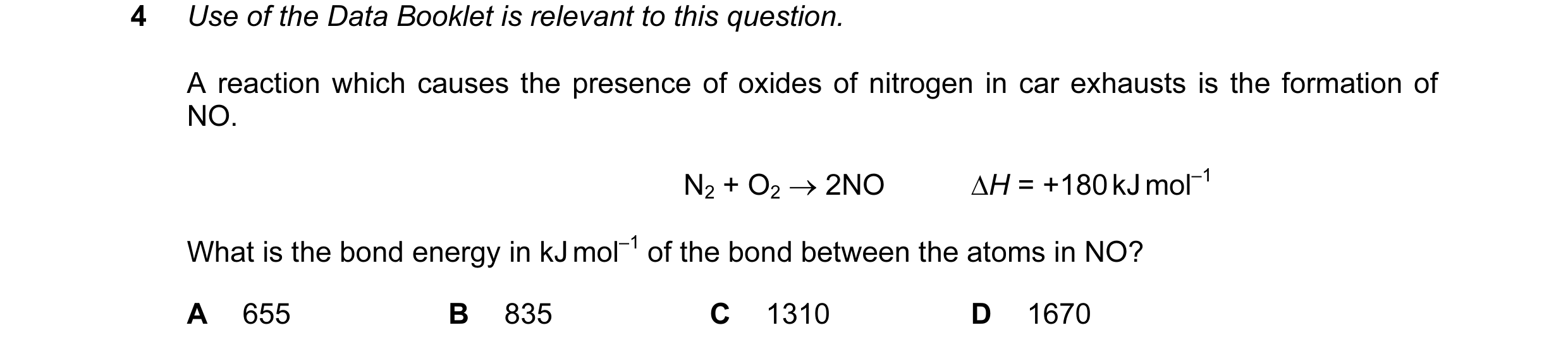
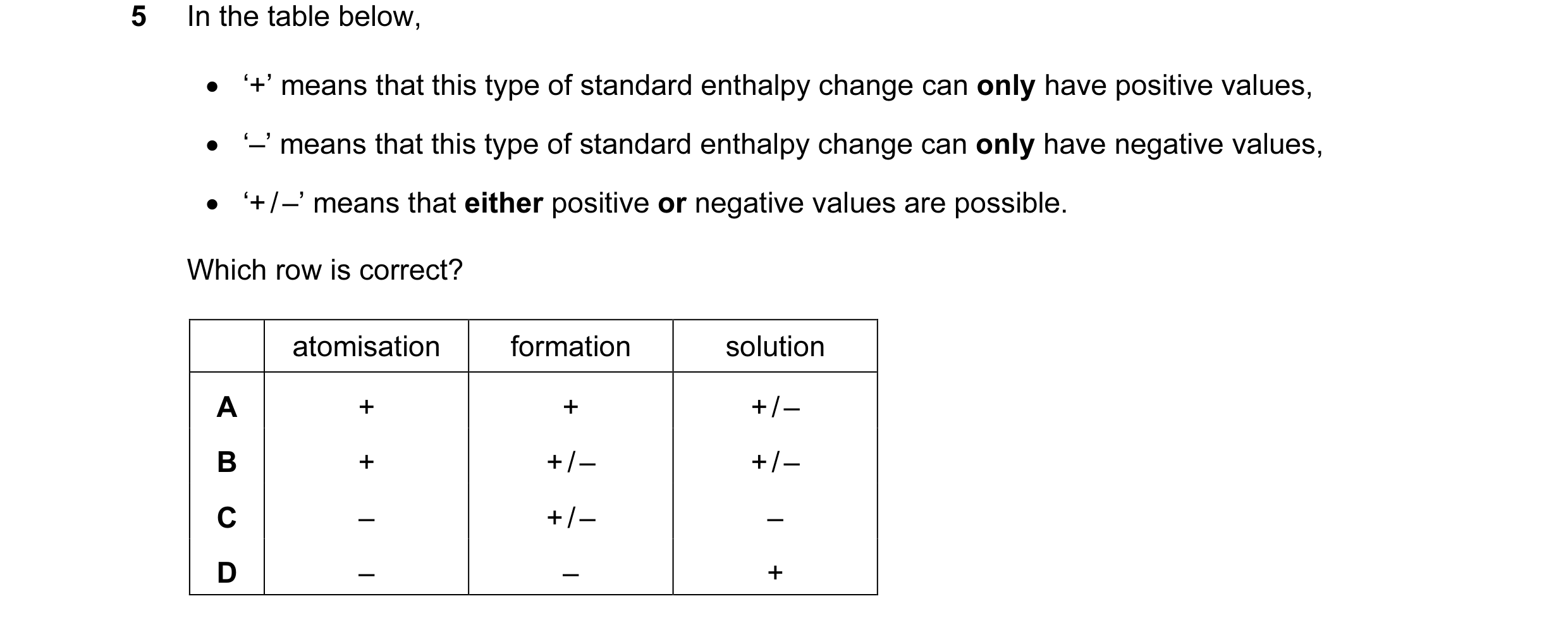
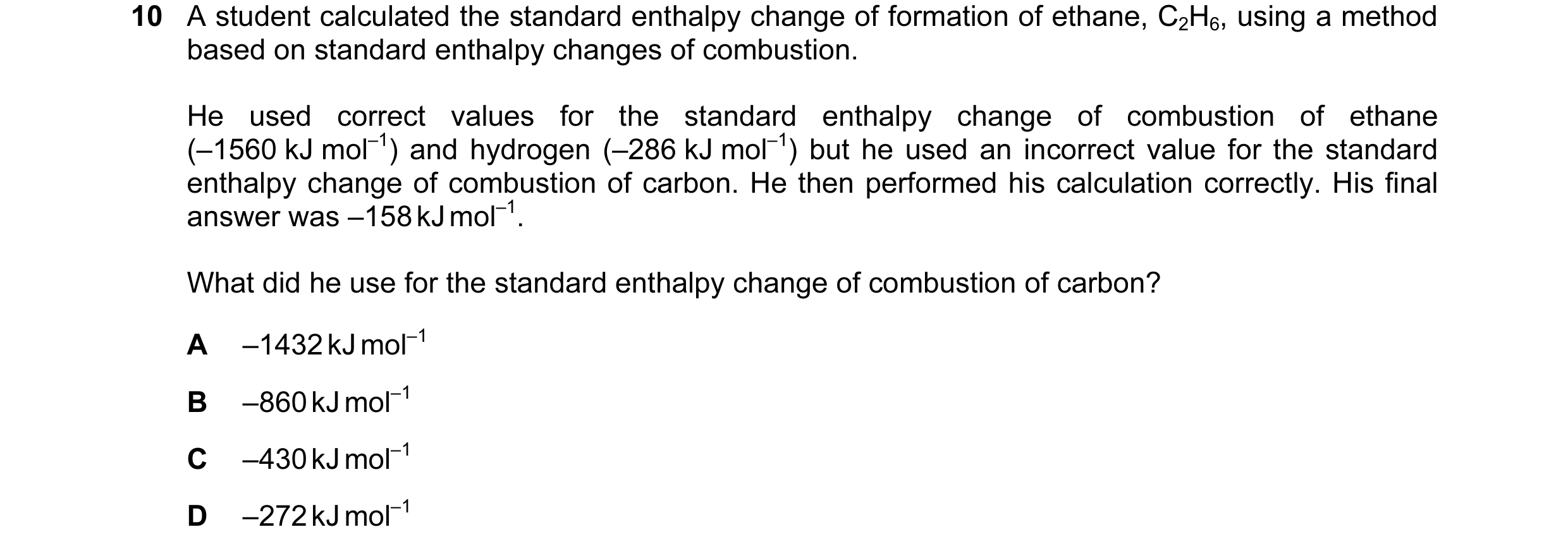 15 / 67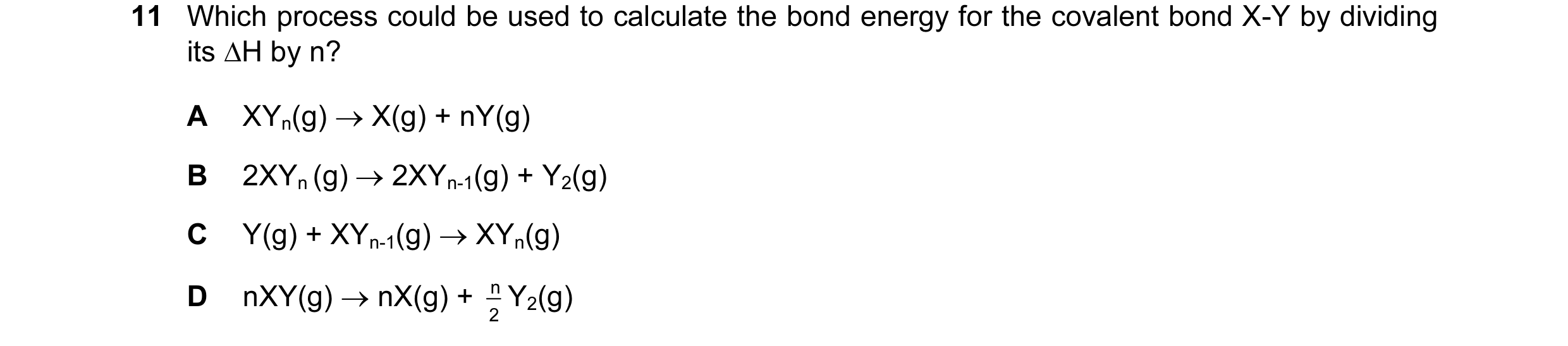
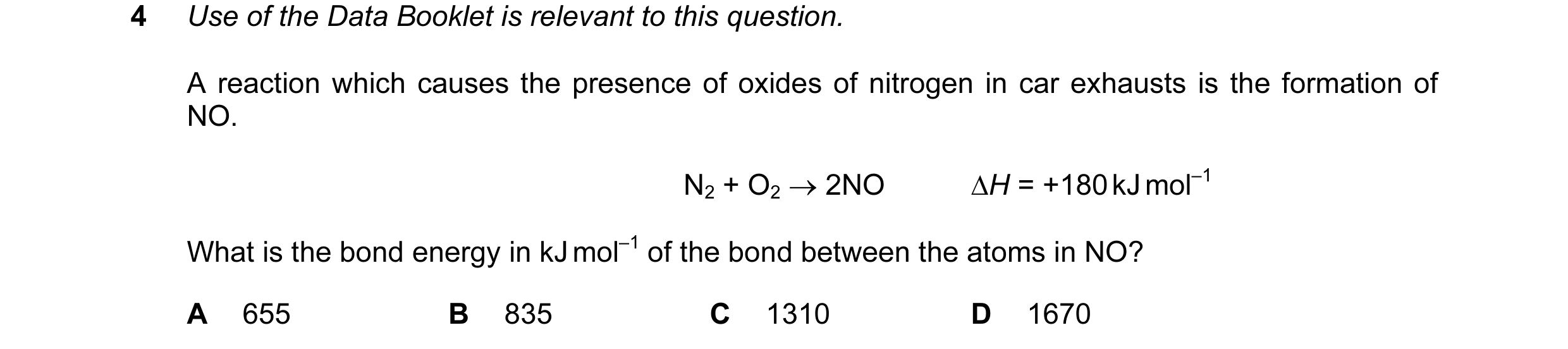
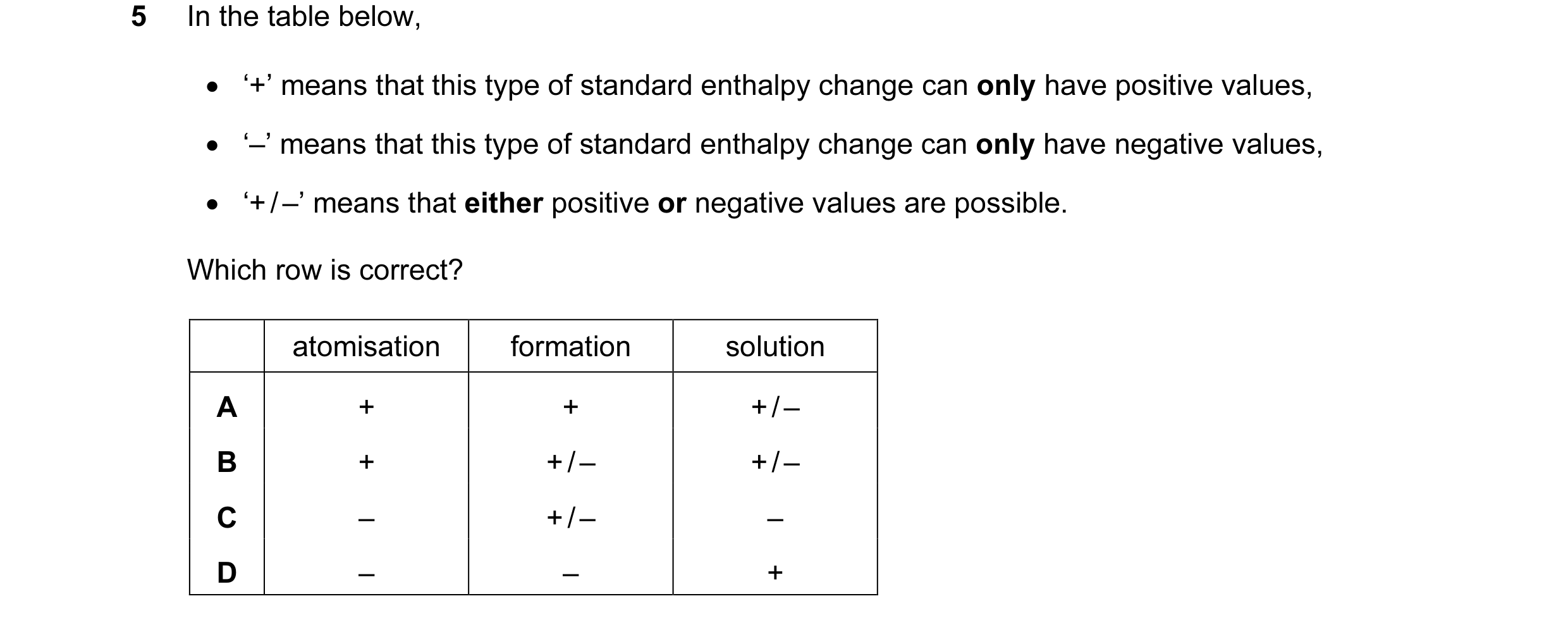
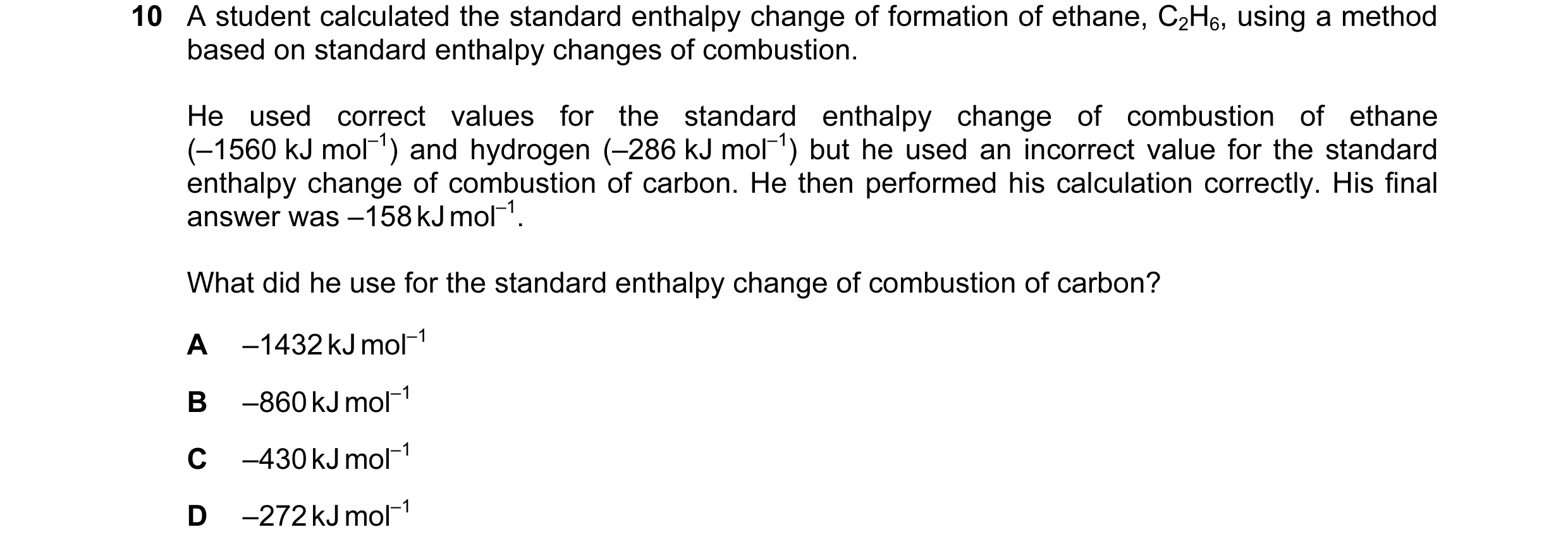 16 / 67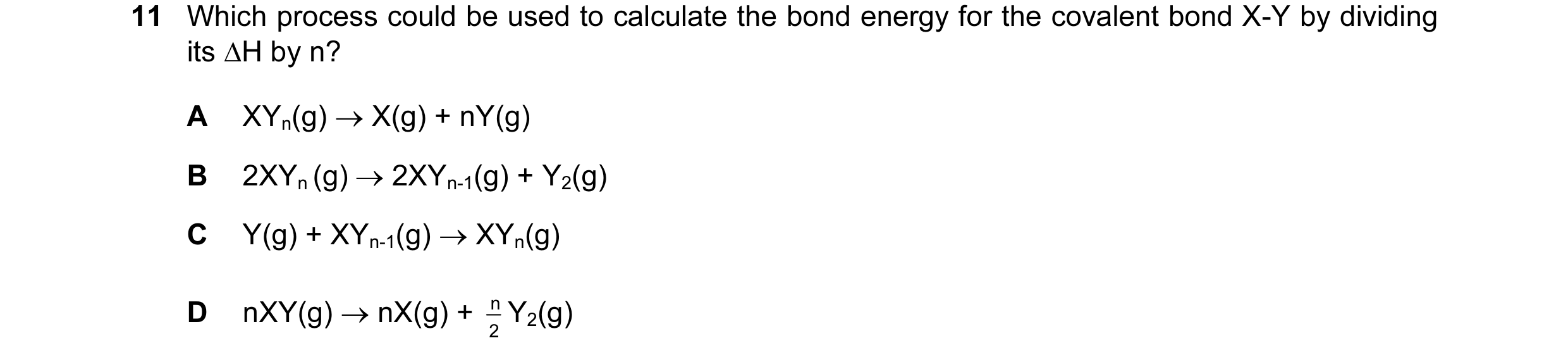
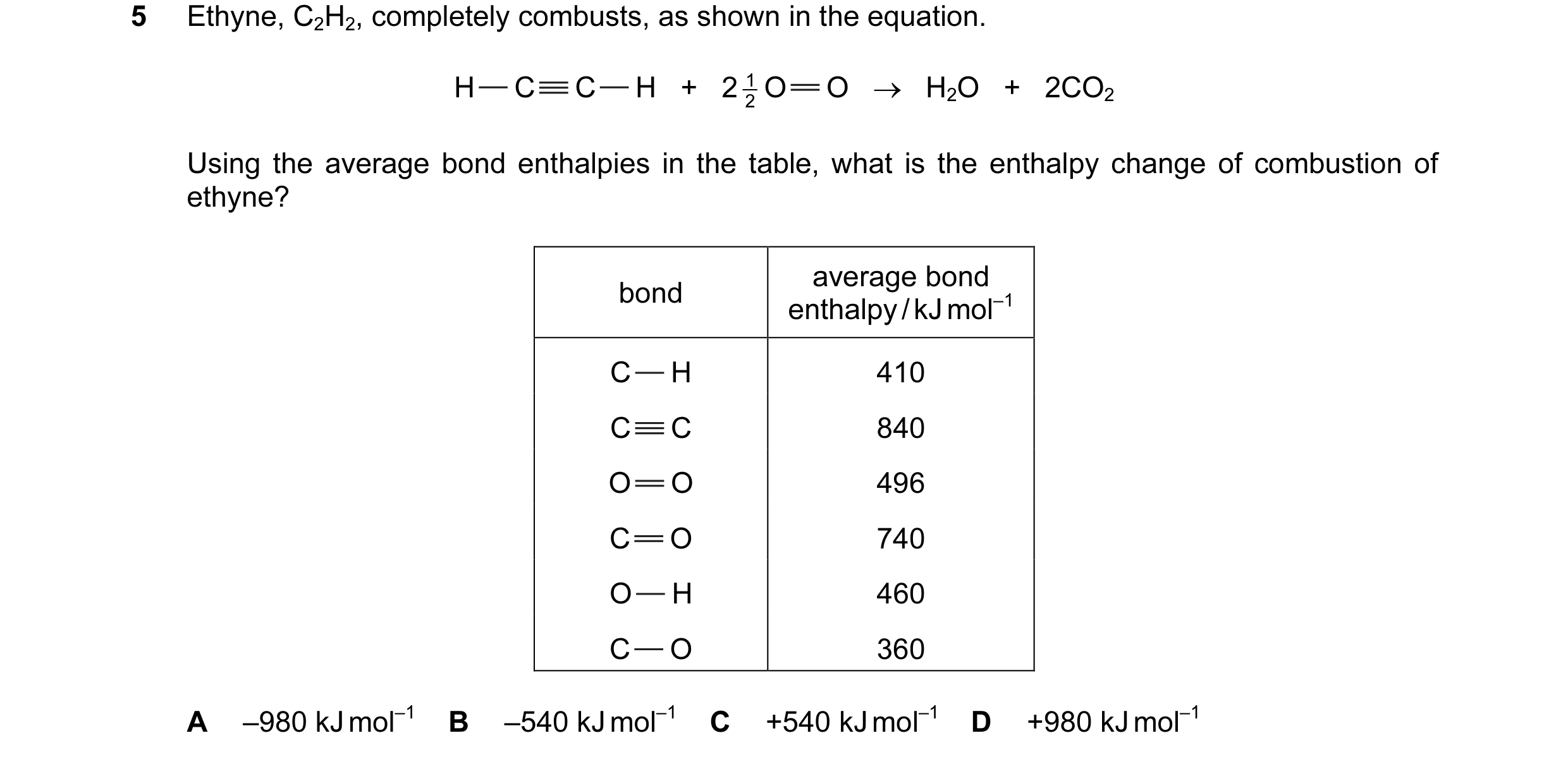
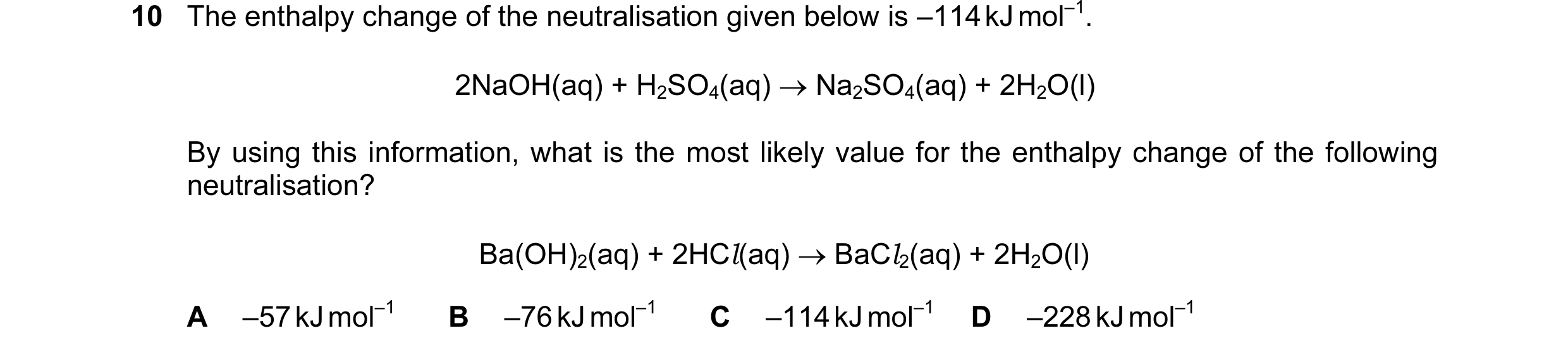 17 / 67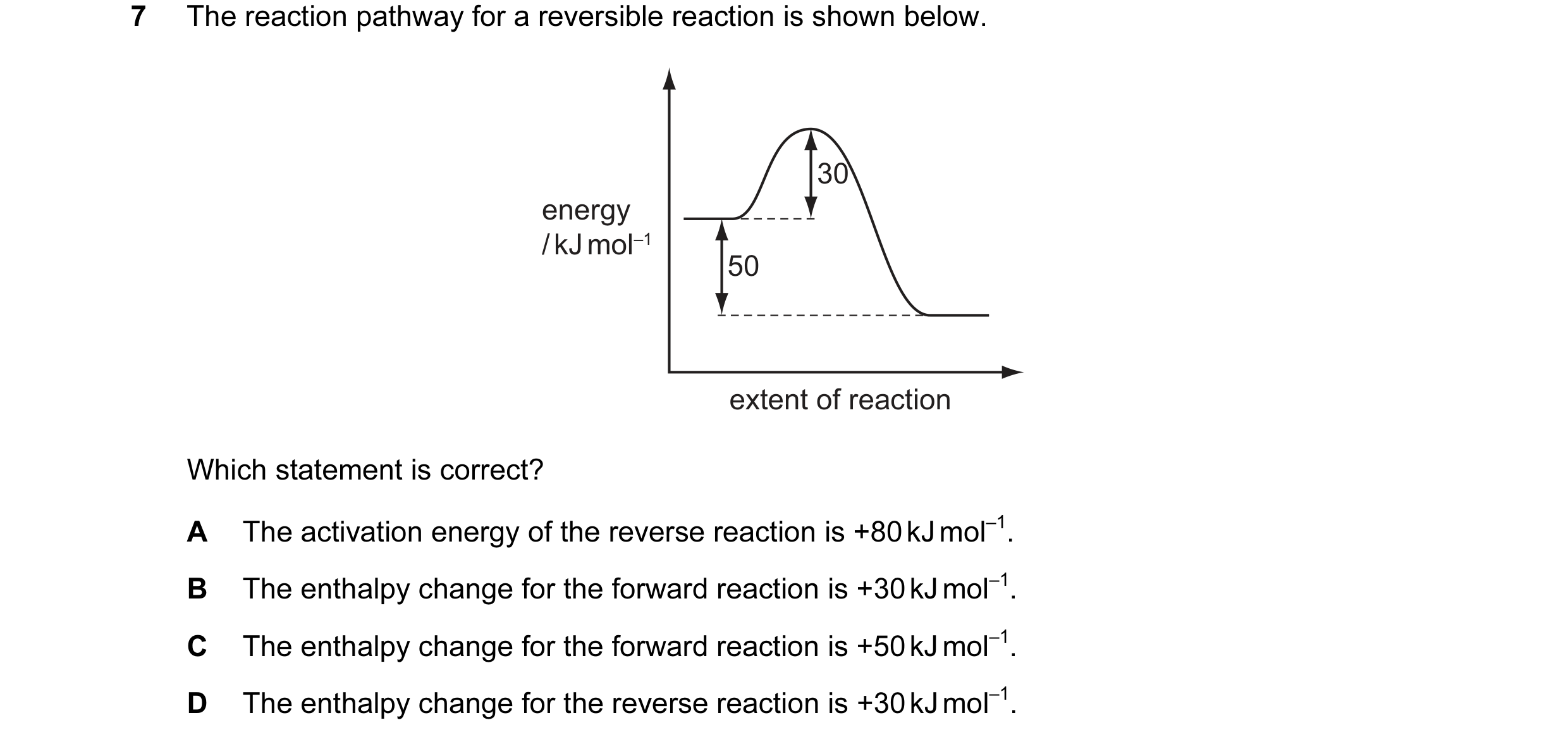
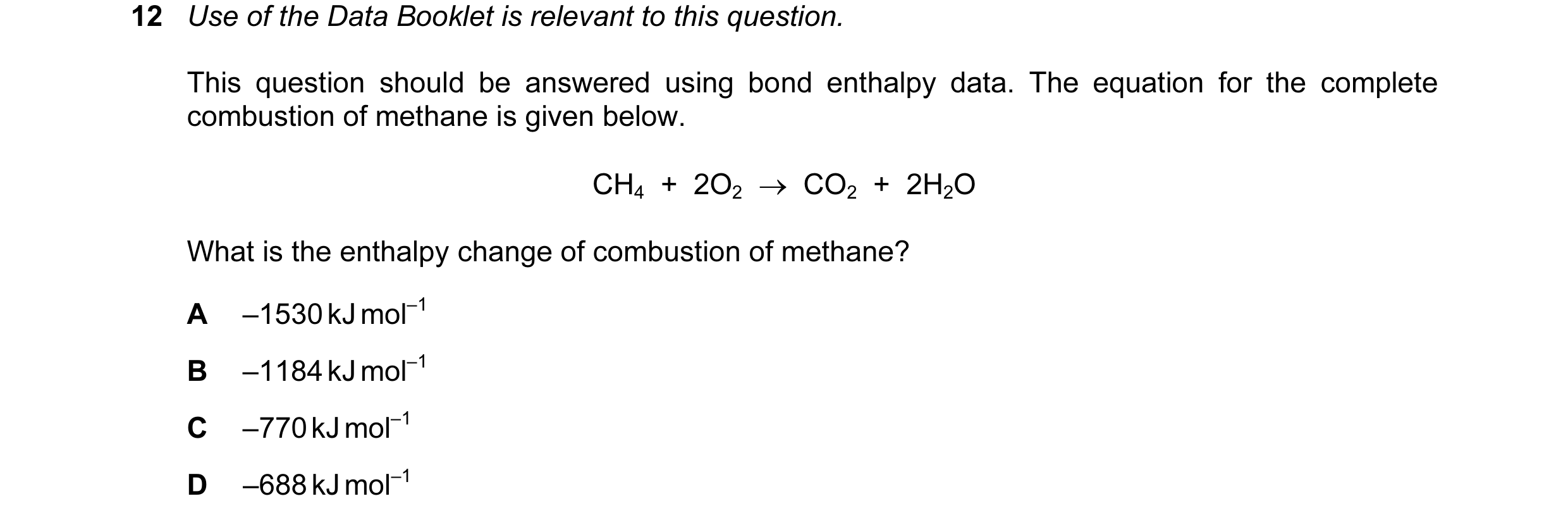
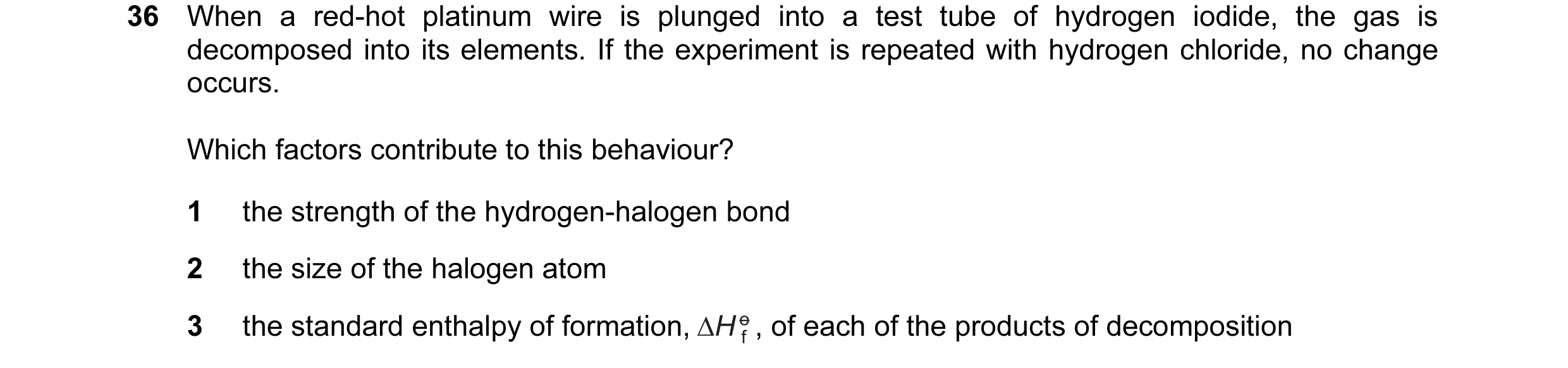
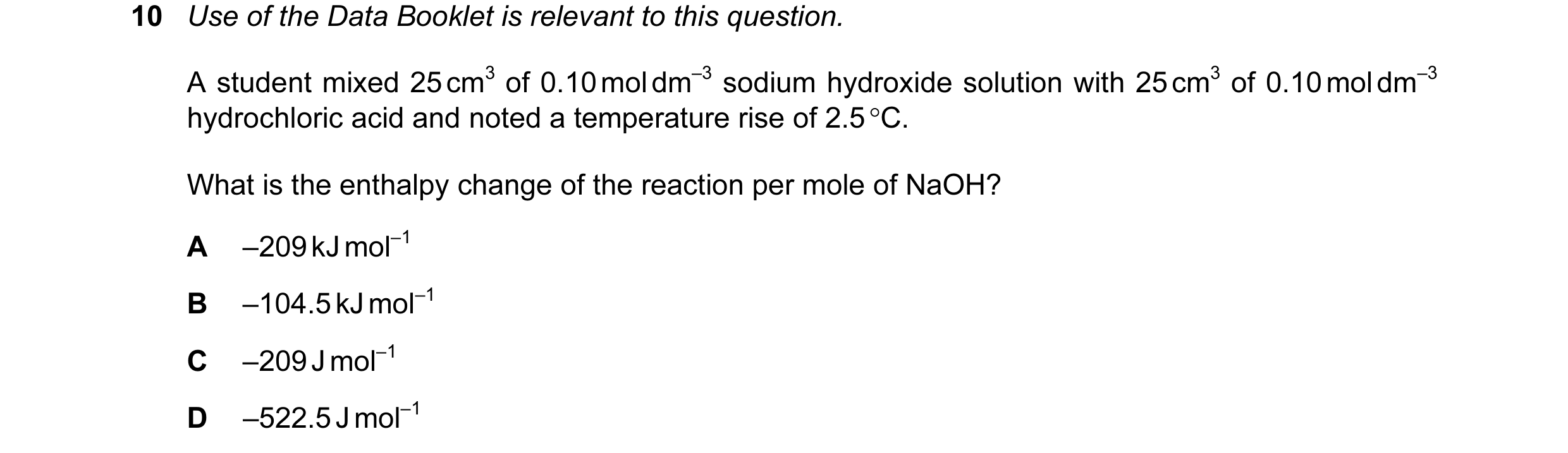 18 / 67
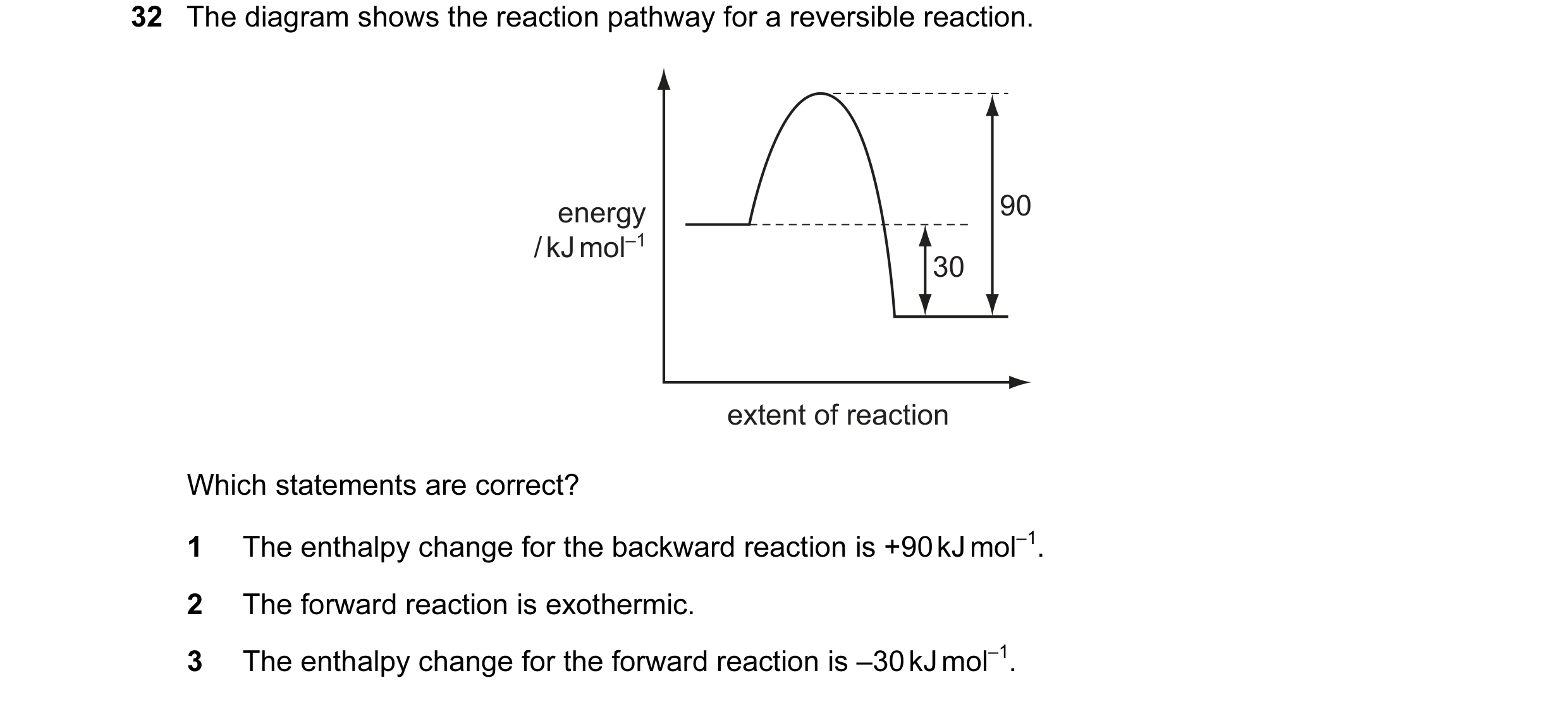
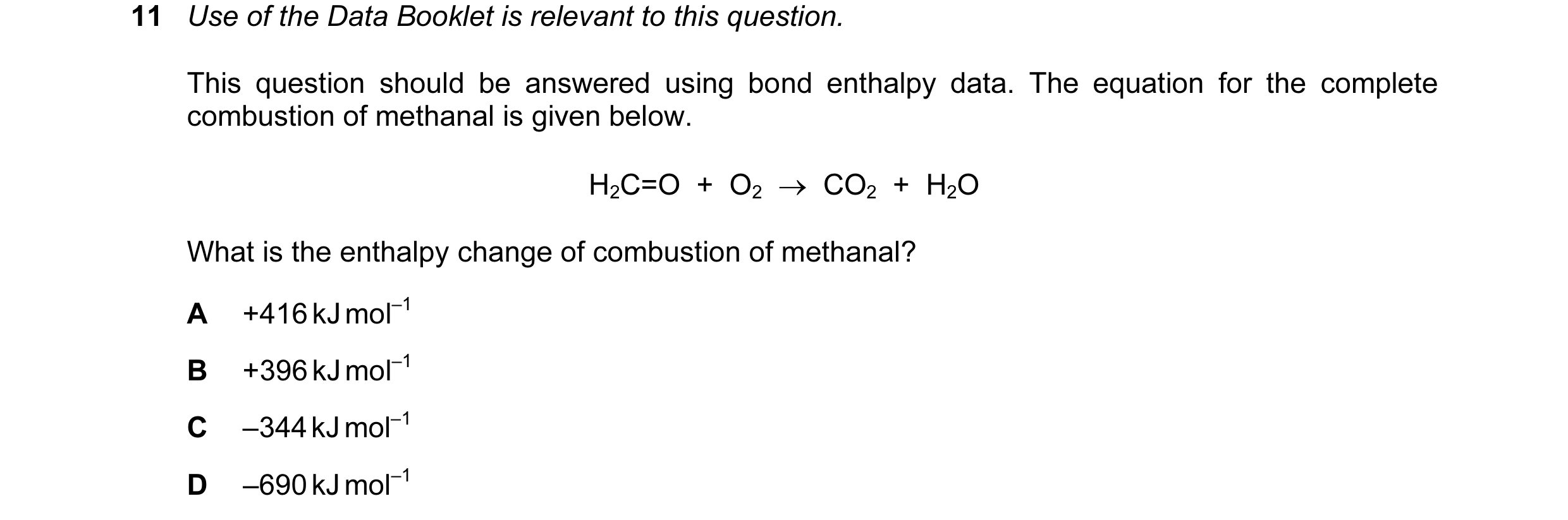 19 / 67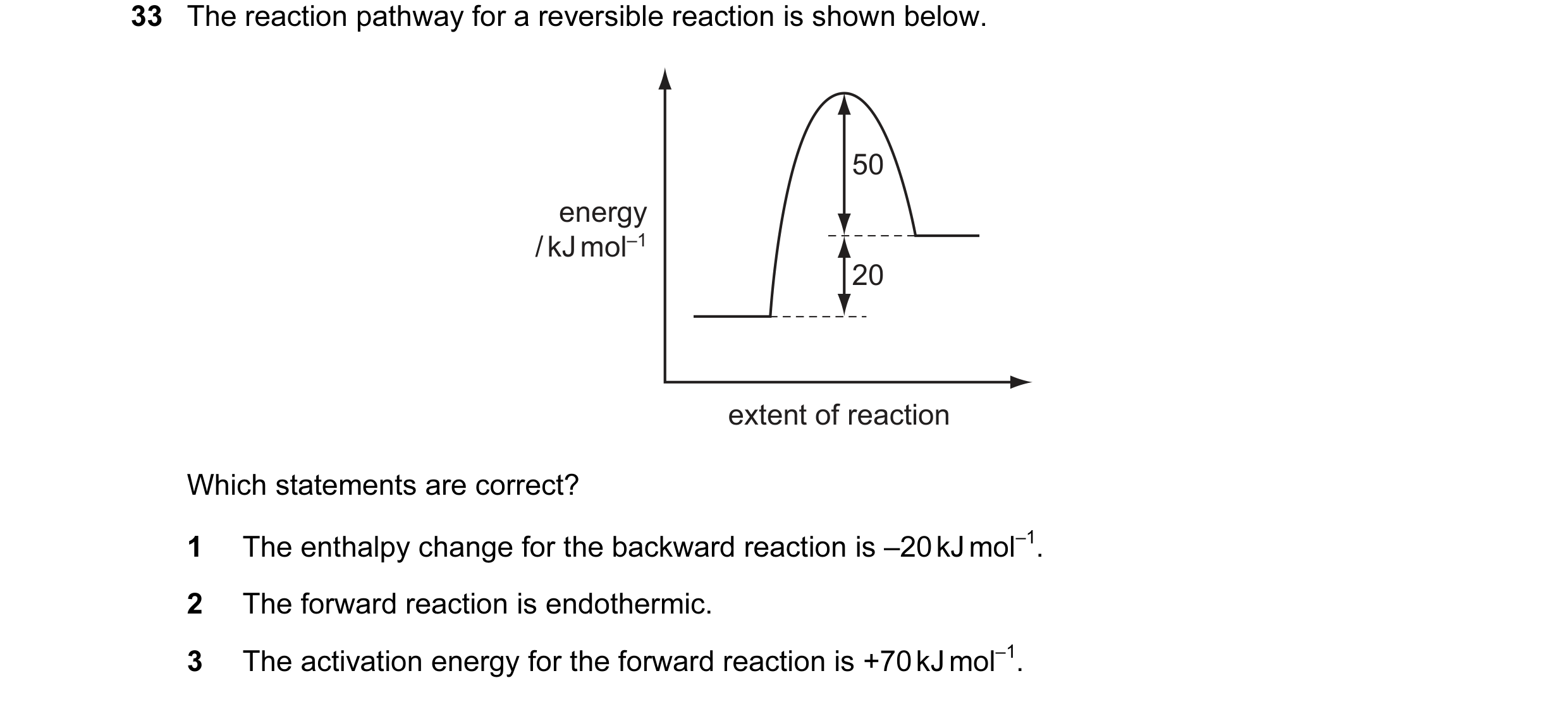
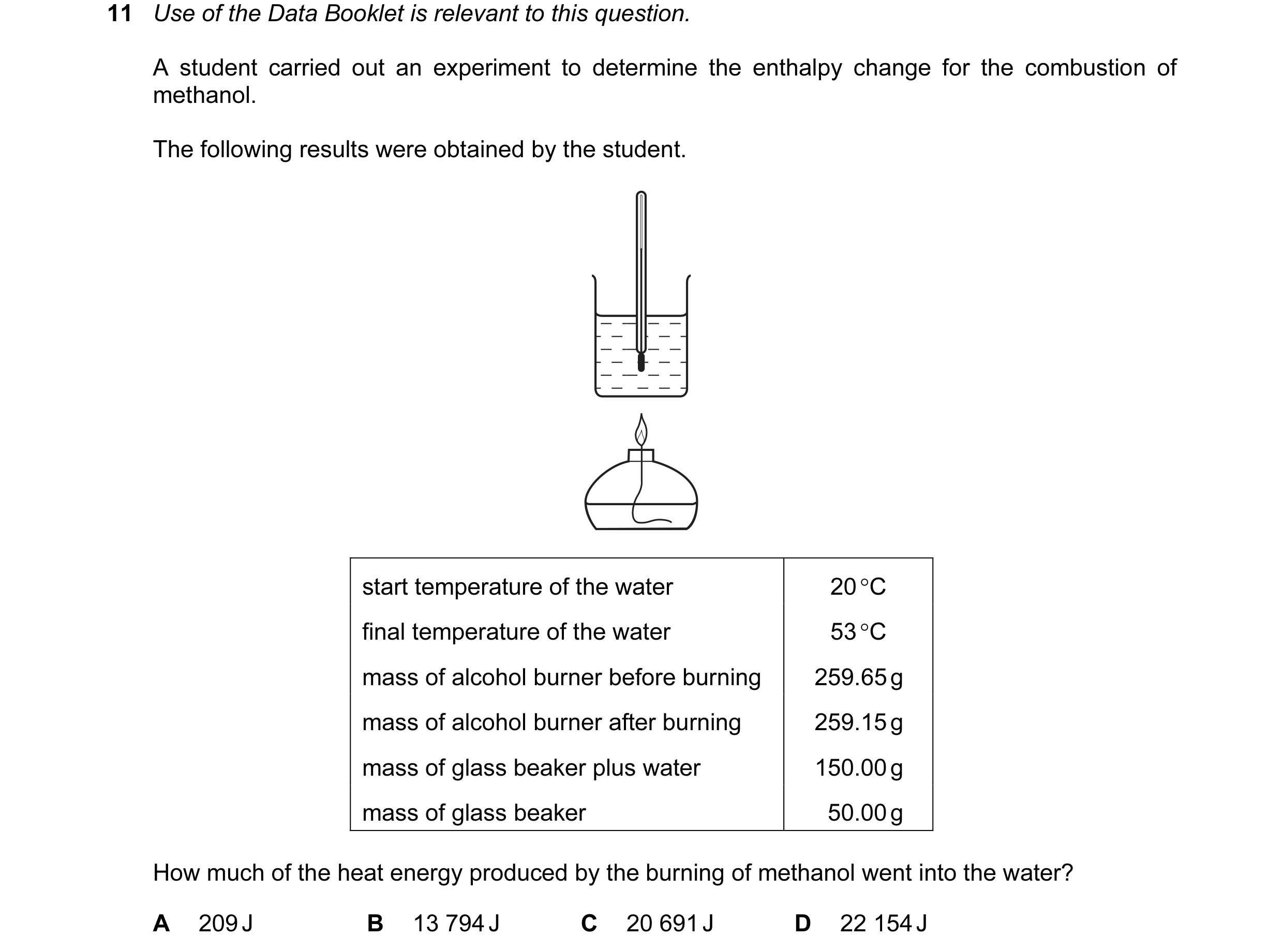 20 / 67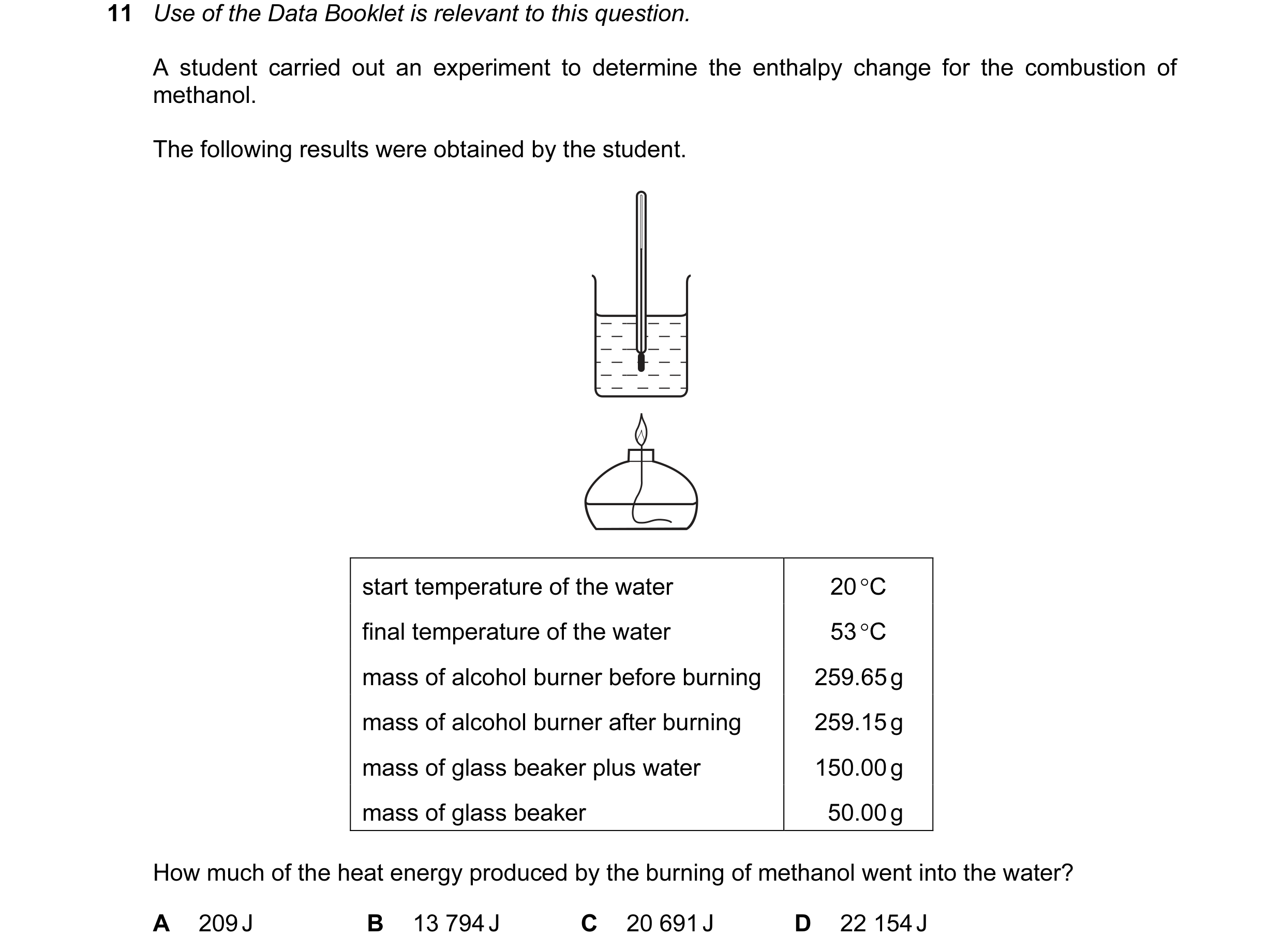
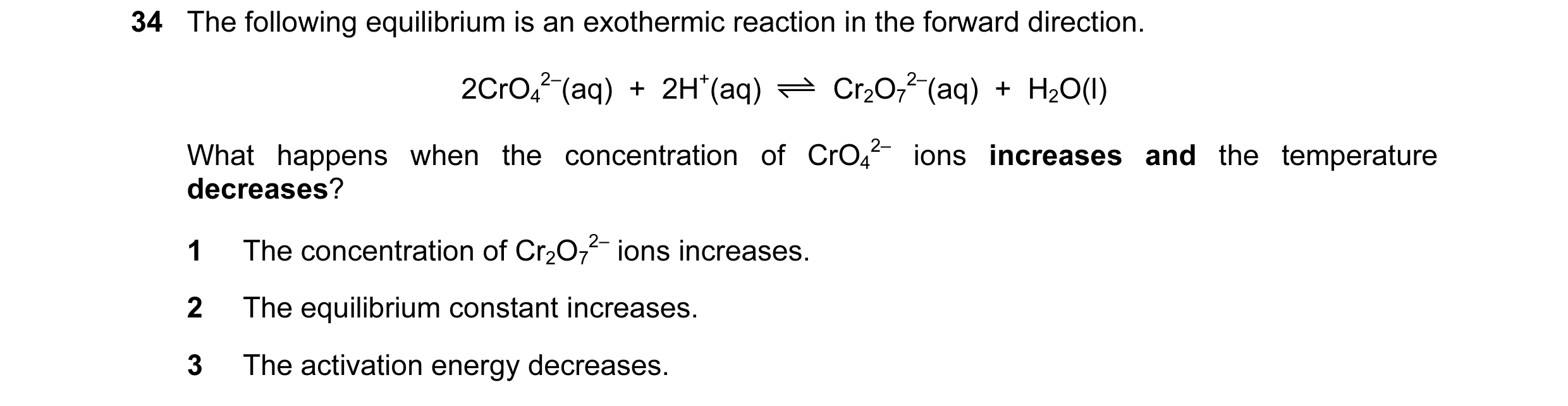
 21 / 67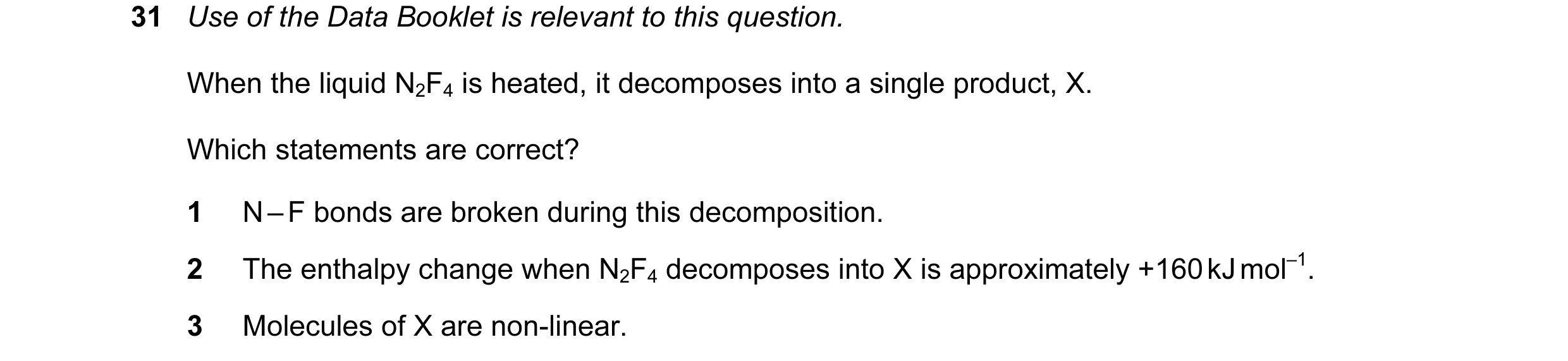
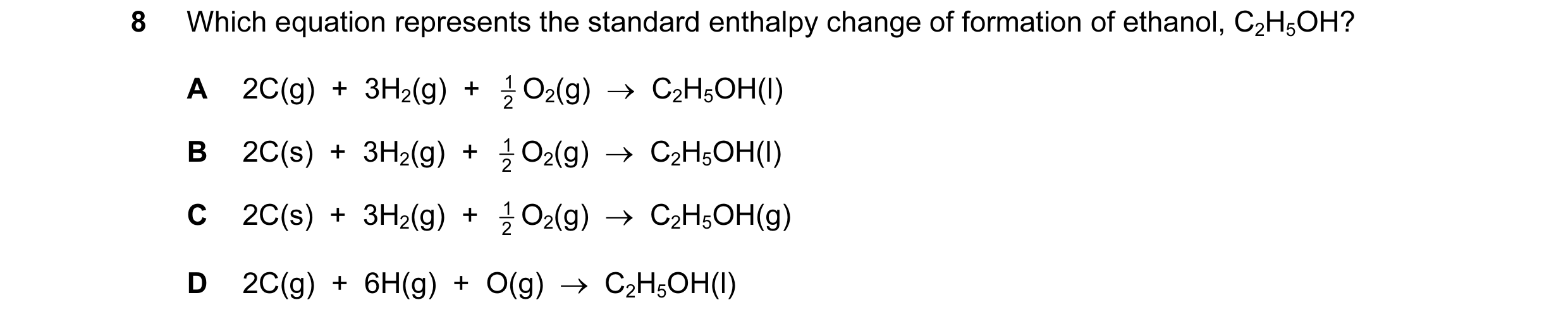
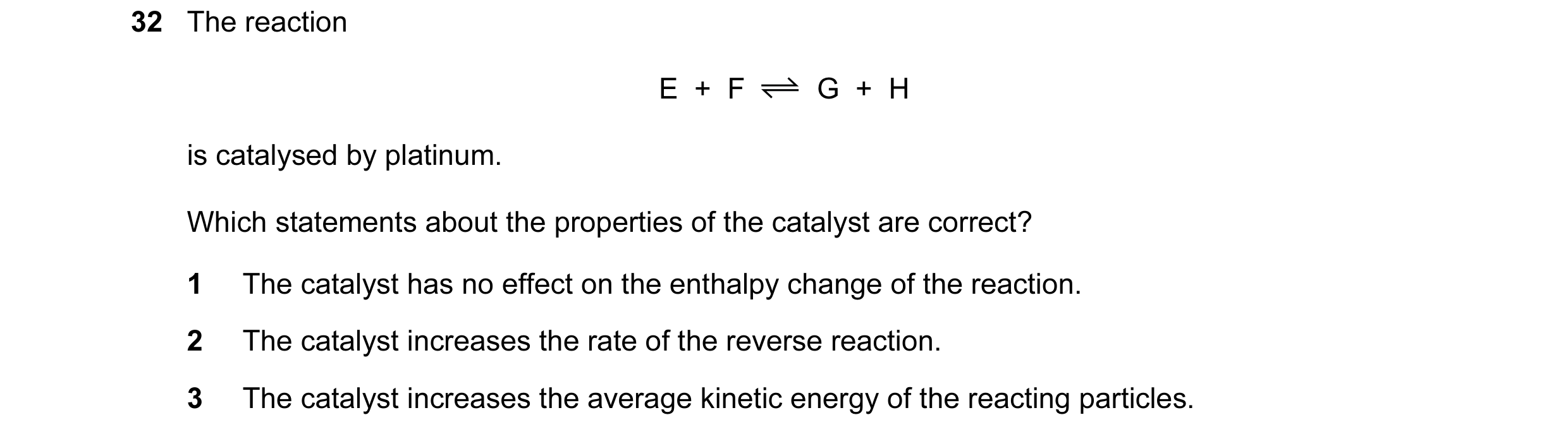
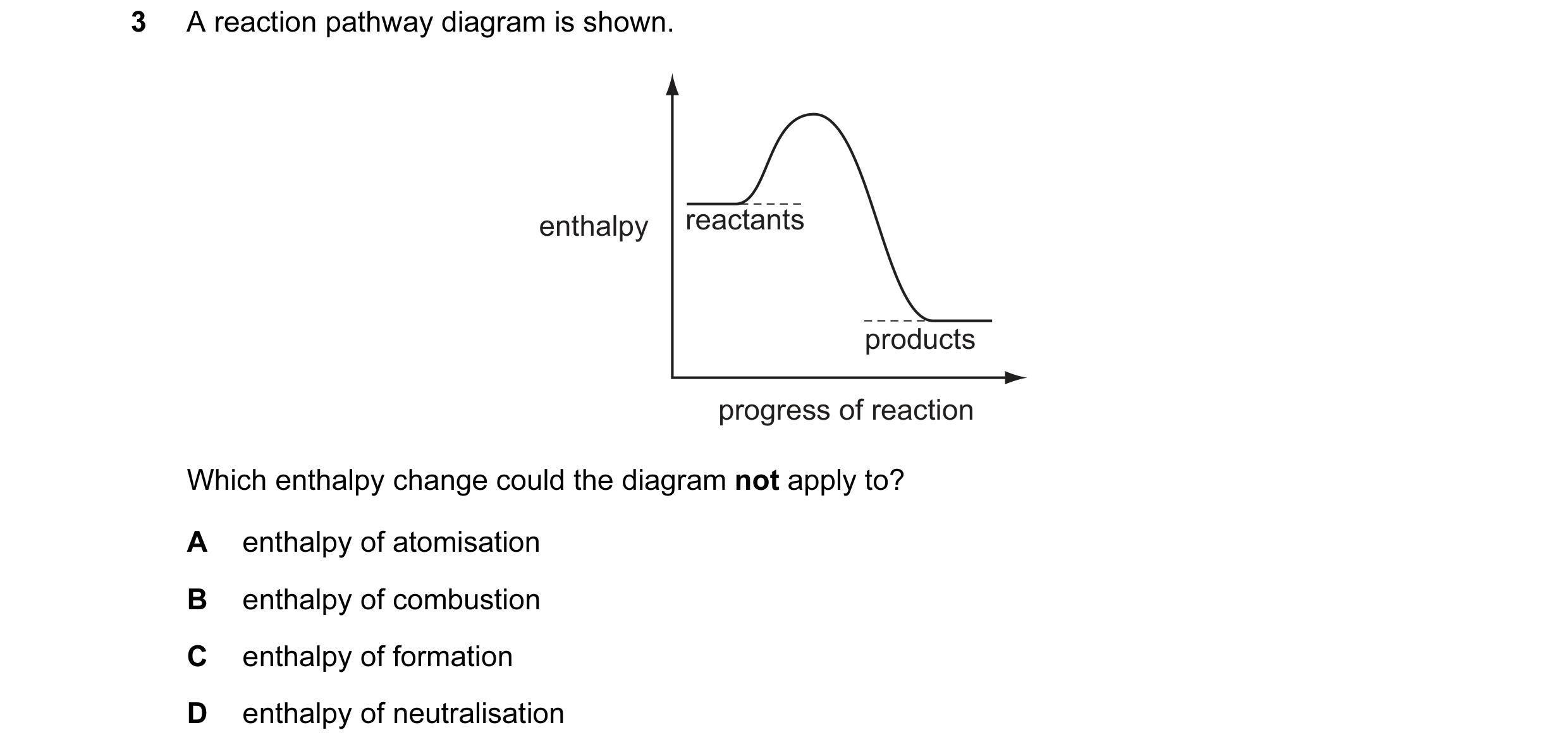 22 / 67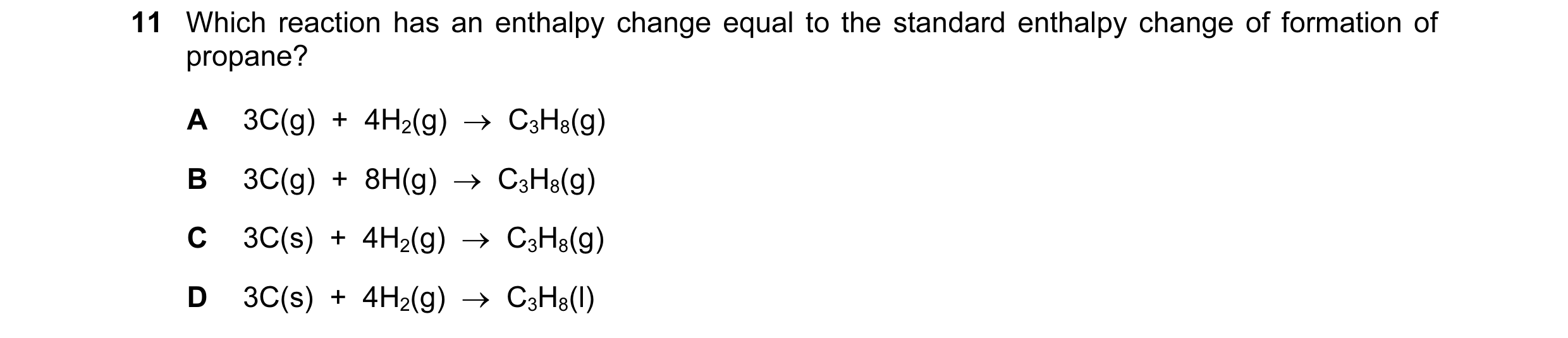
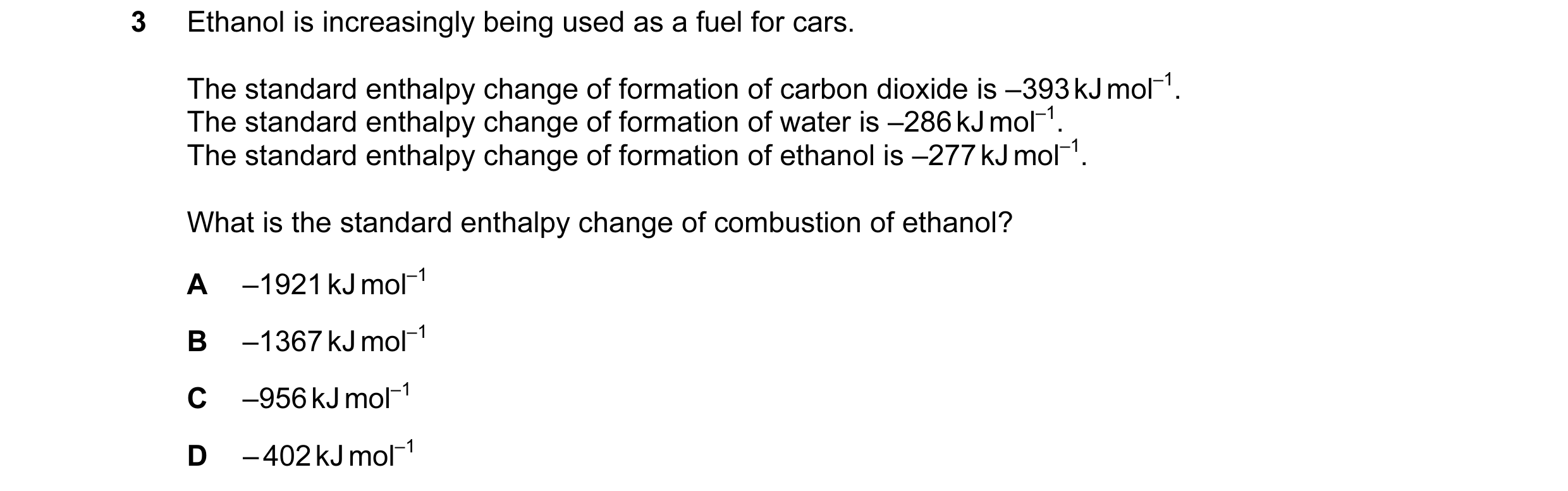
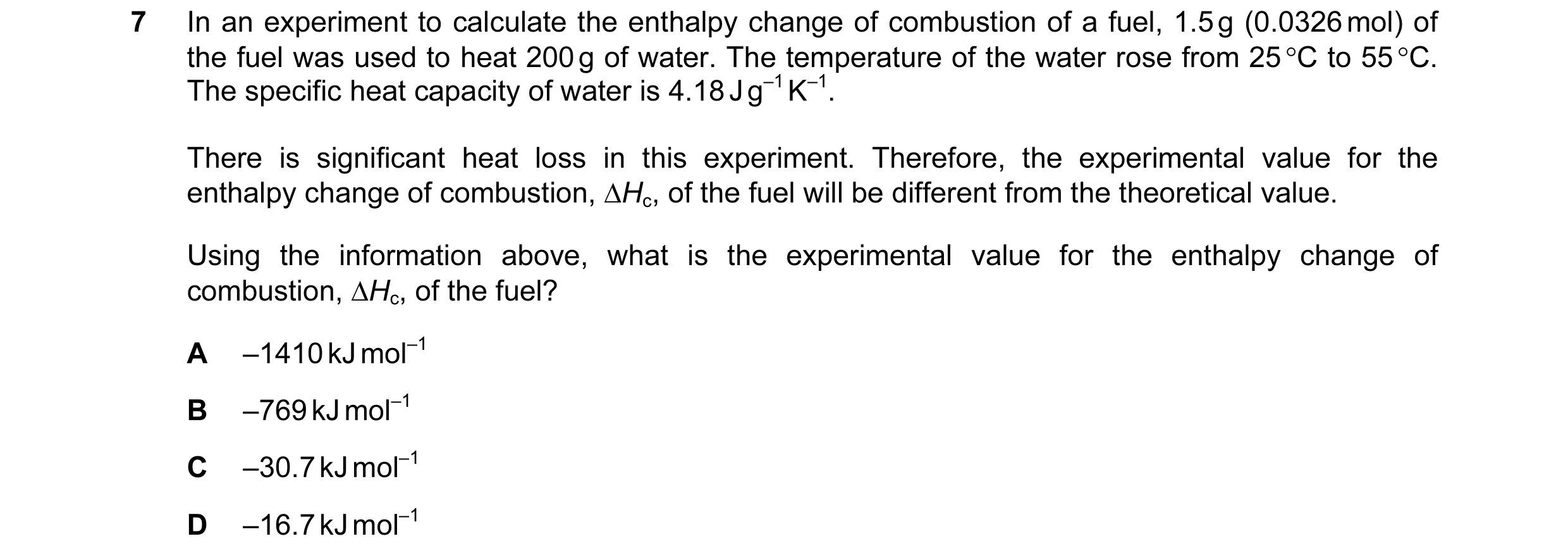
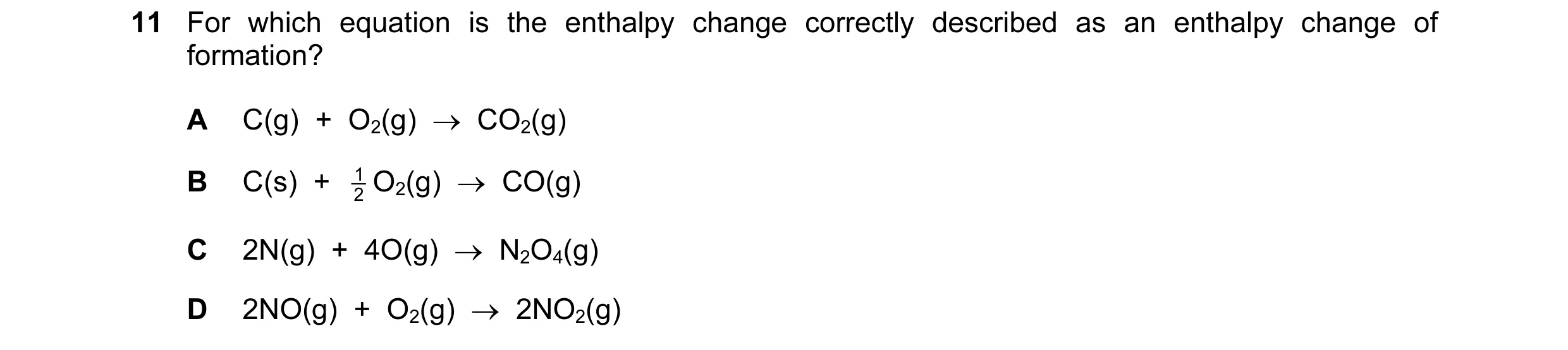 23 / 67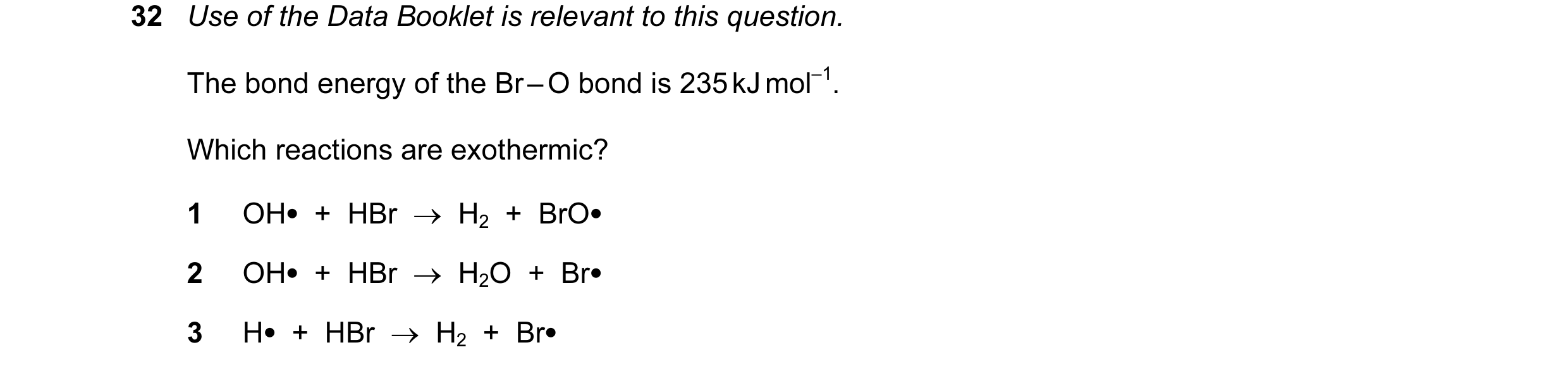
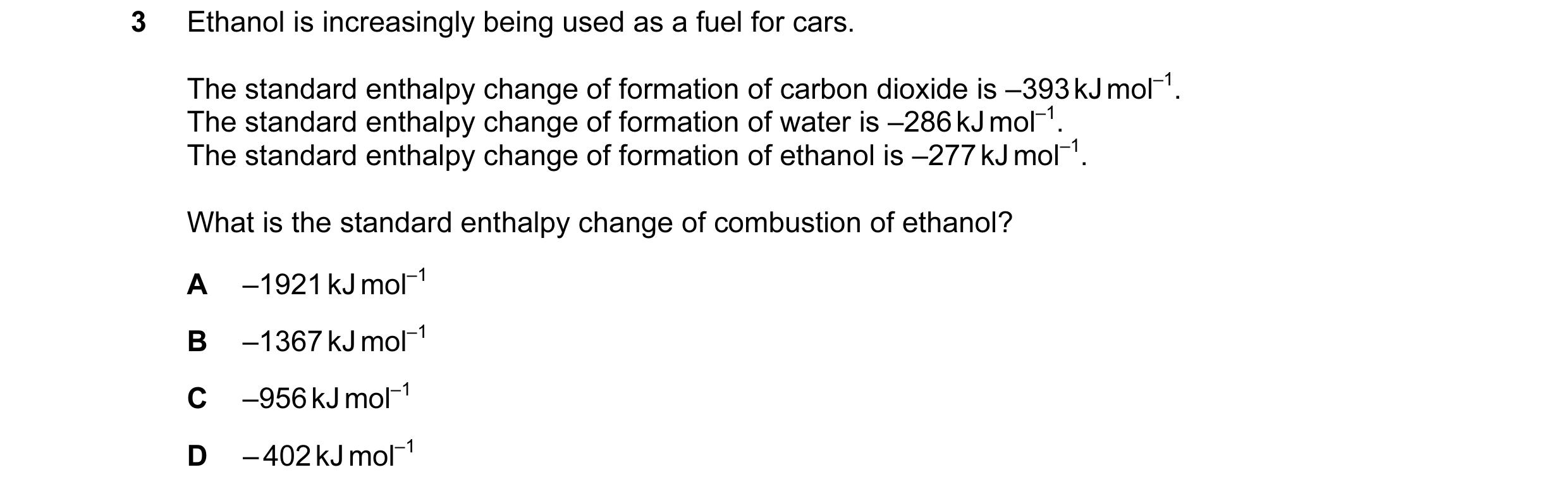
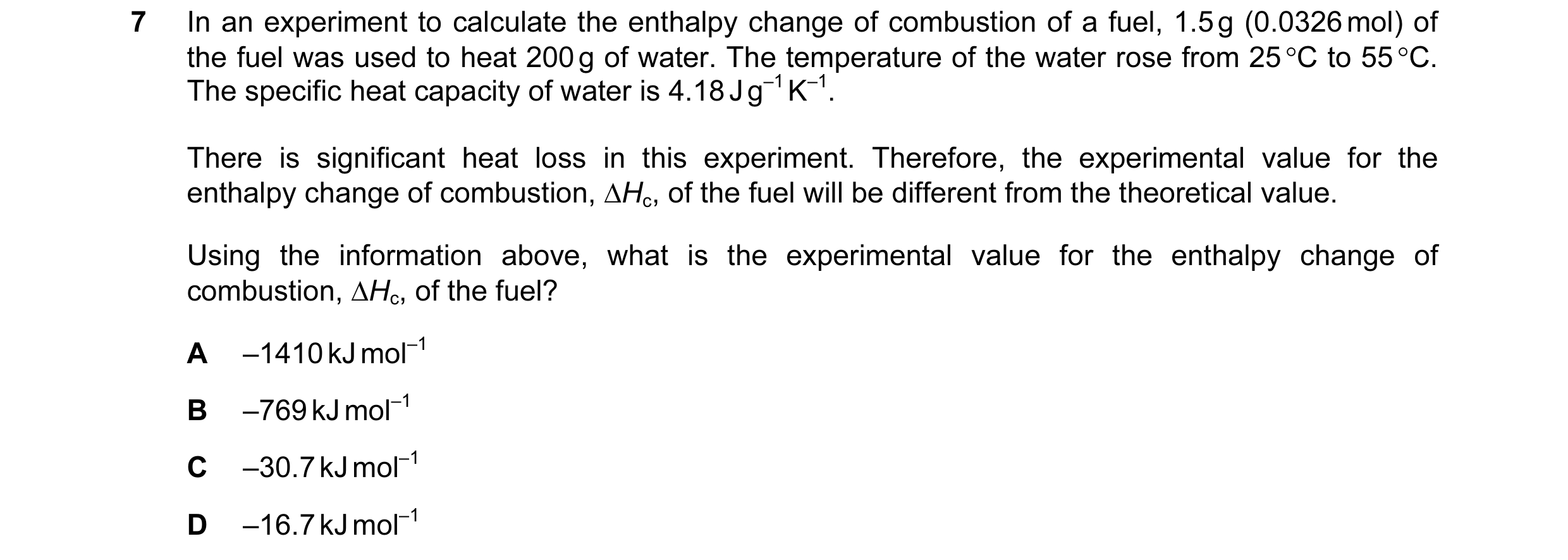
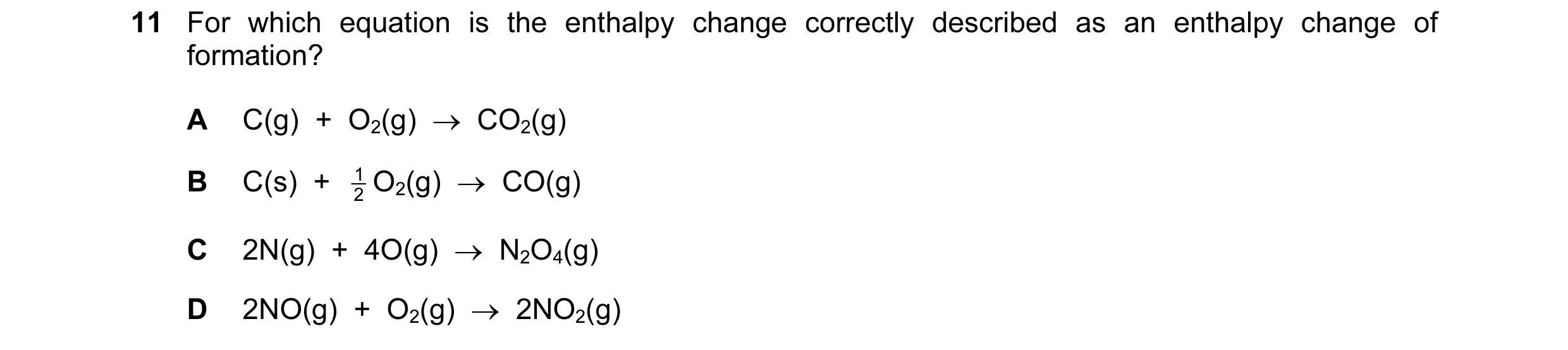 24 / 67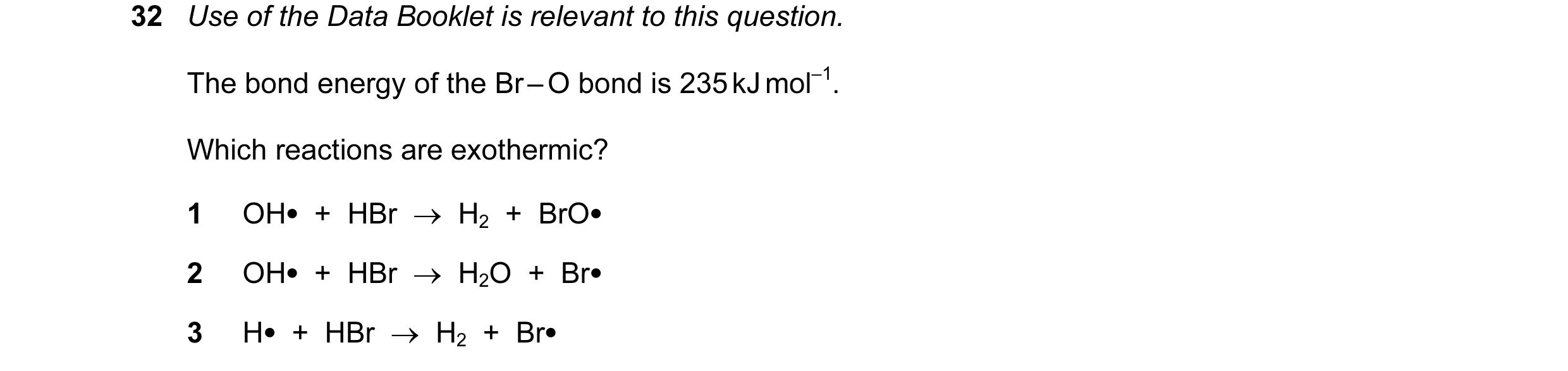
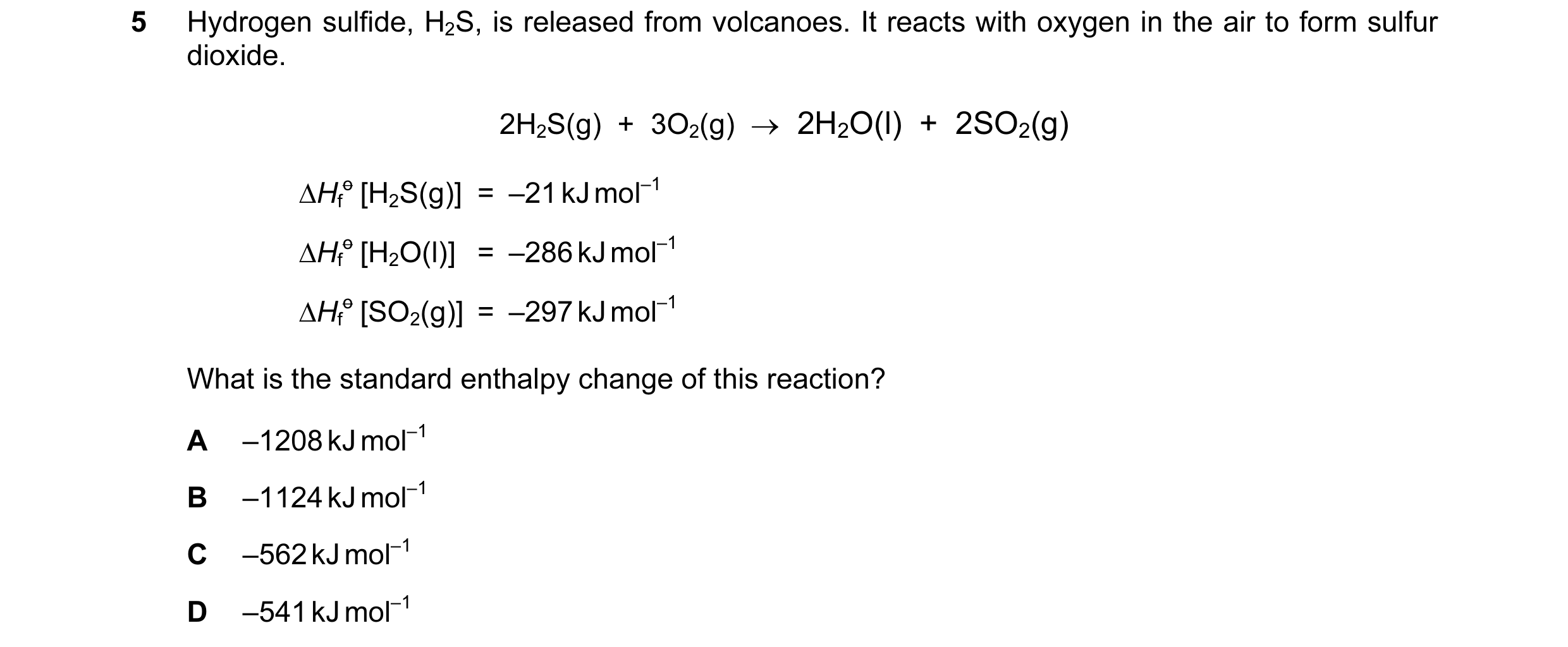
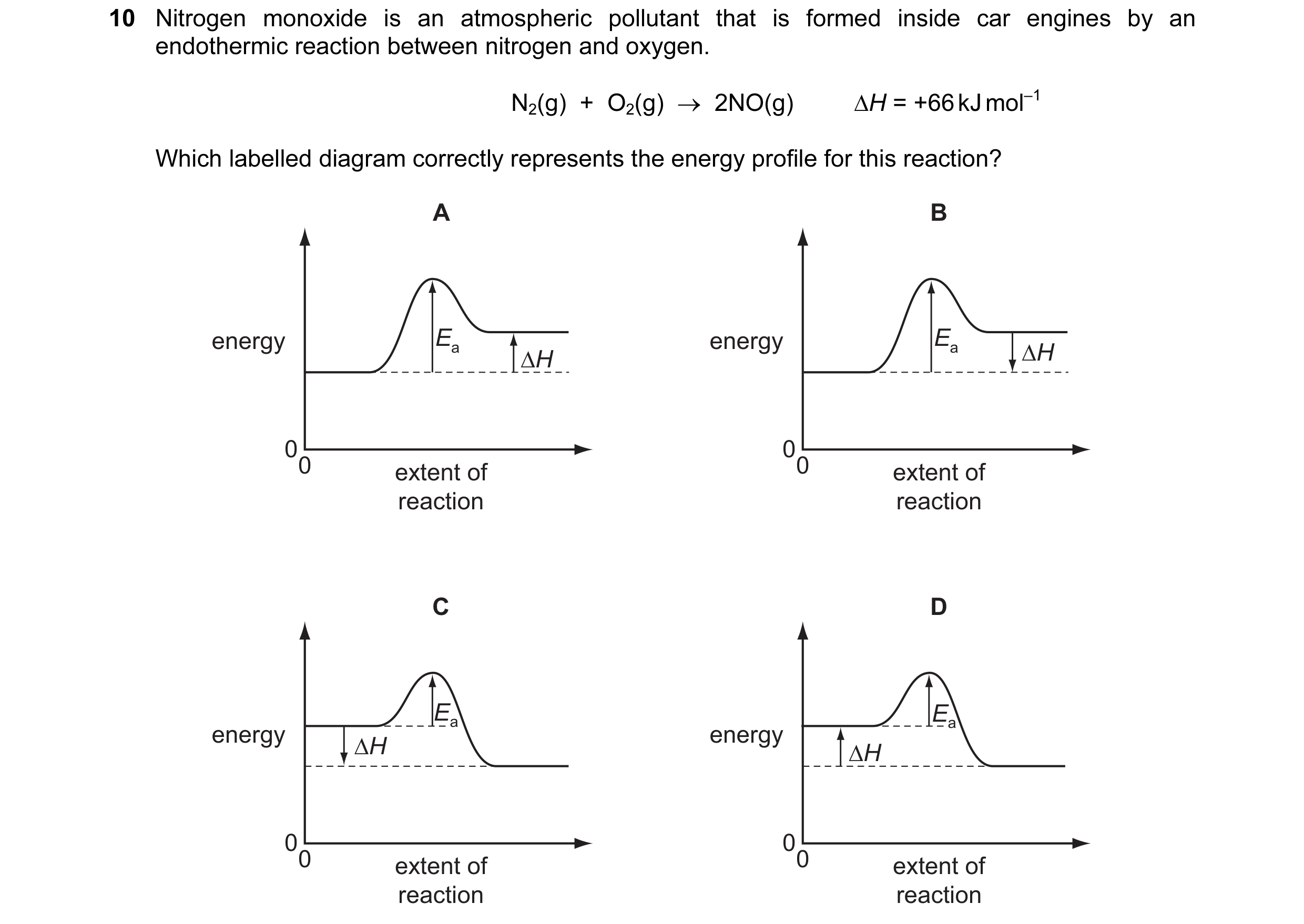 25 / 67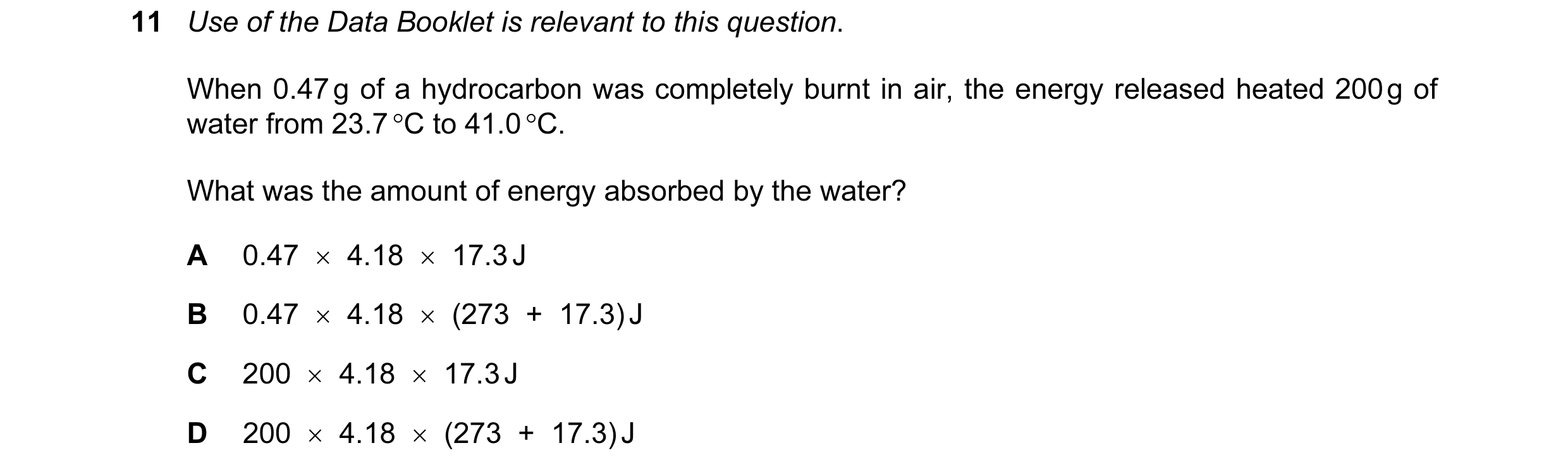
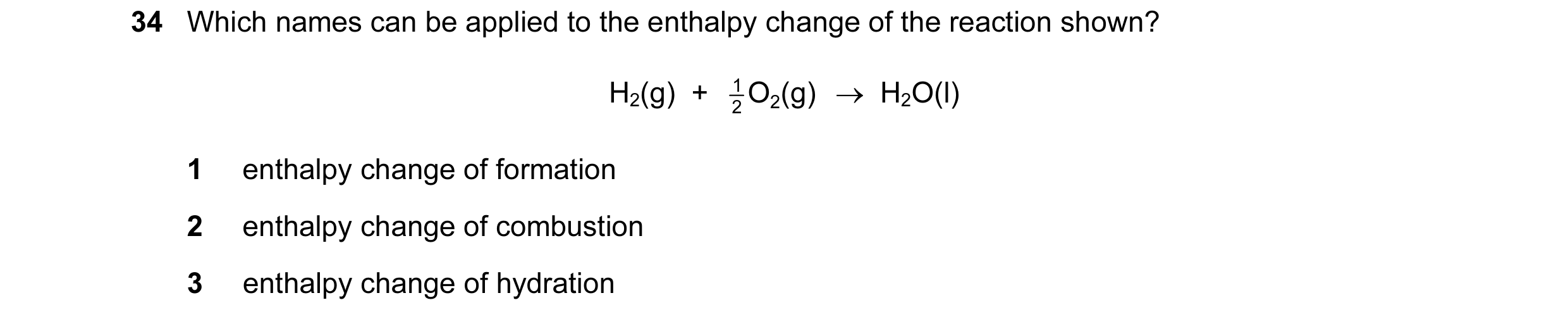
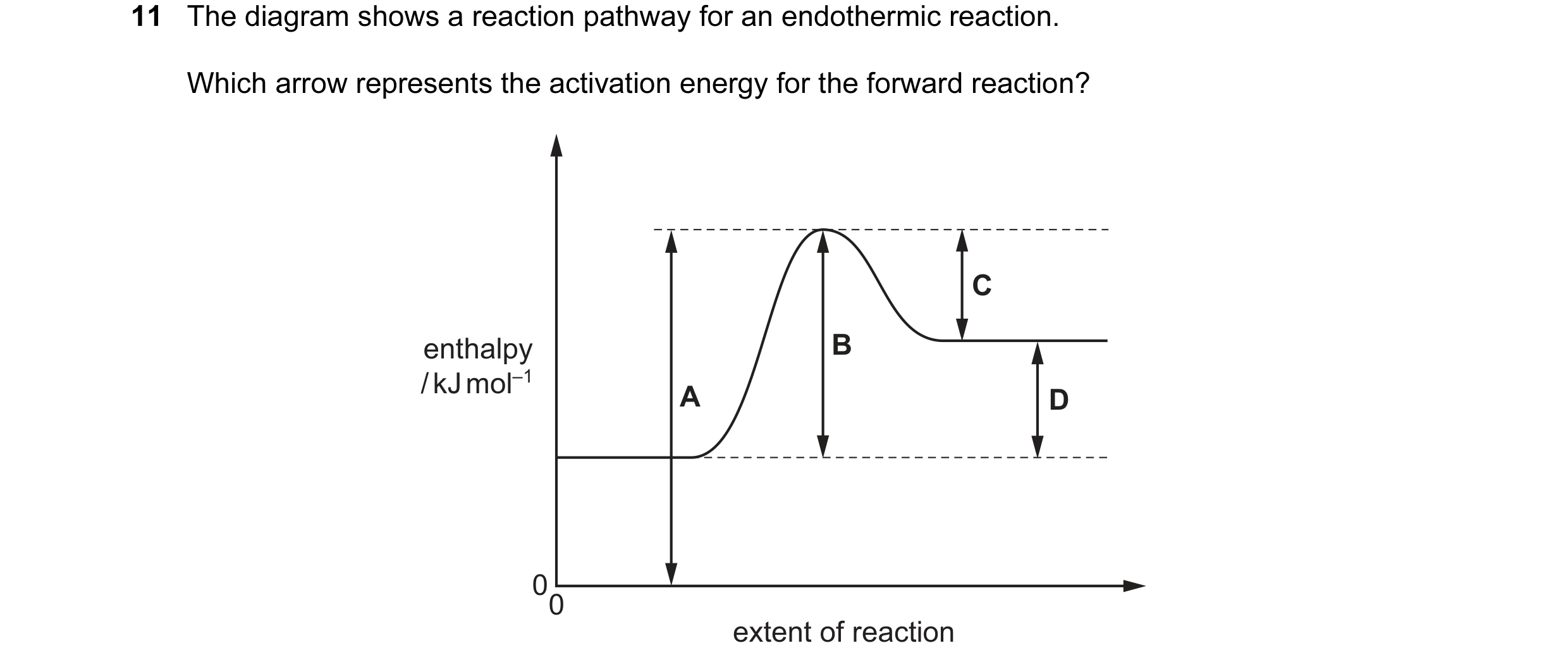
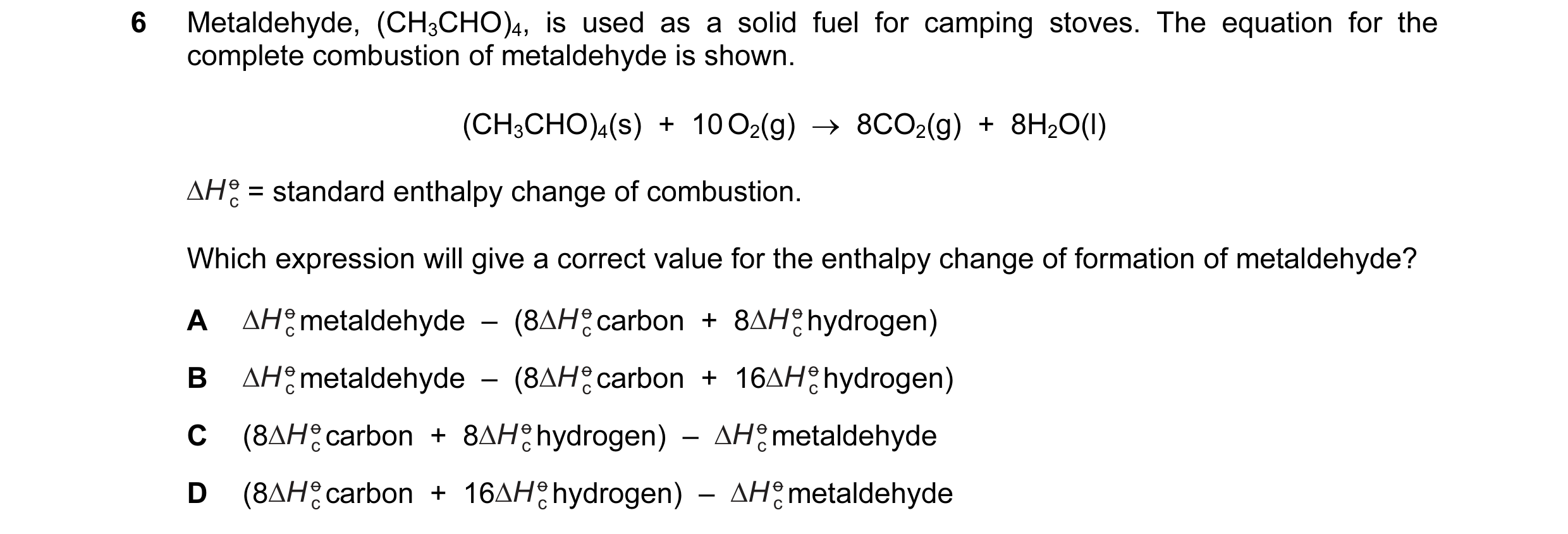 26 / 67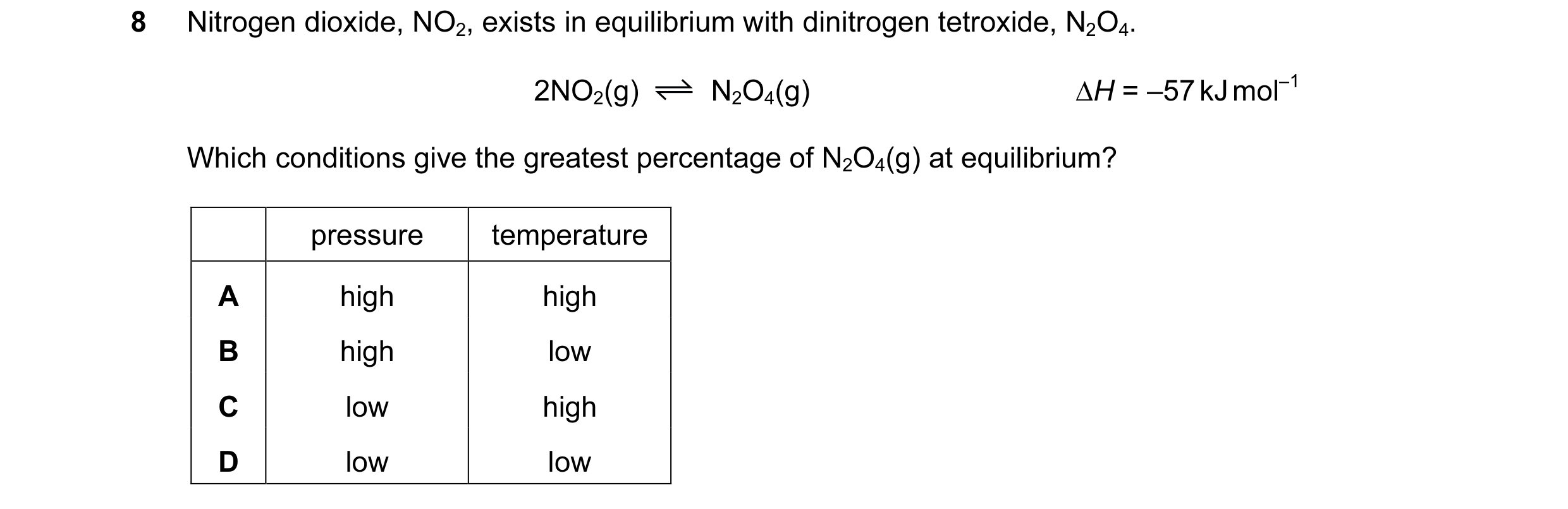

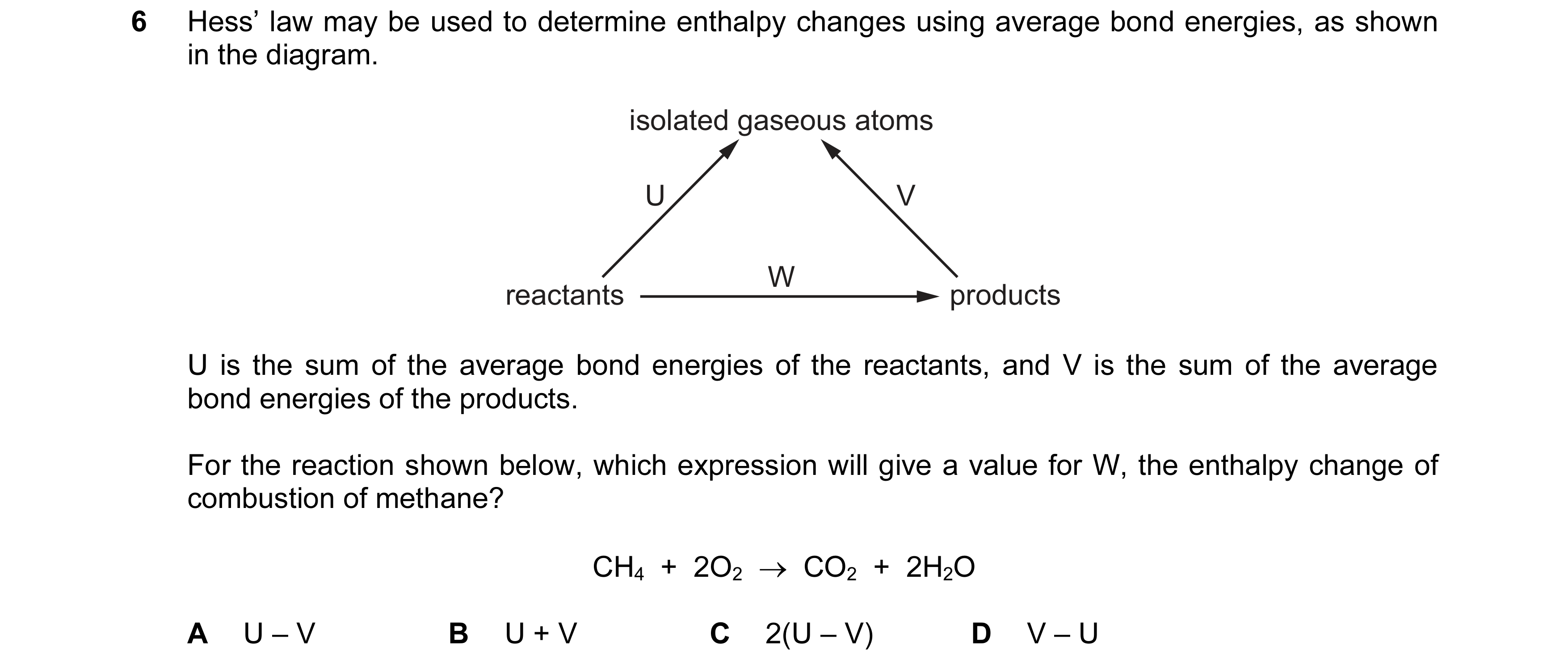 27 / 67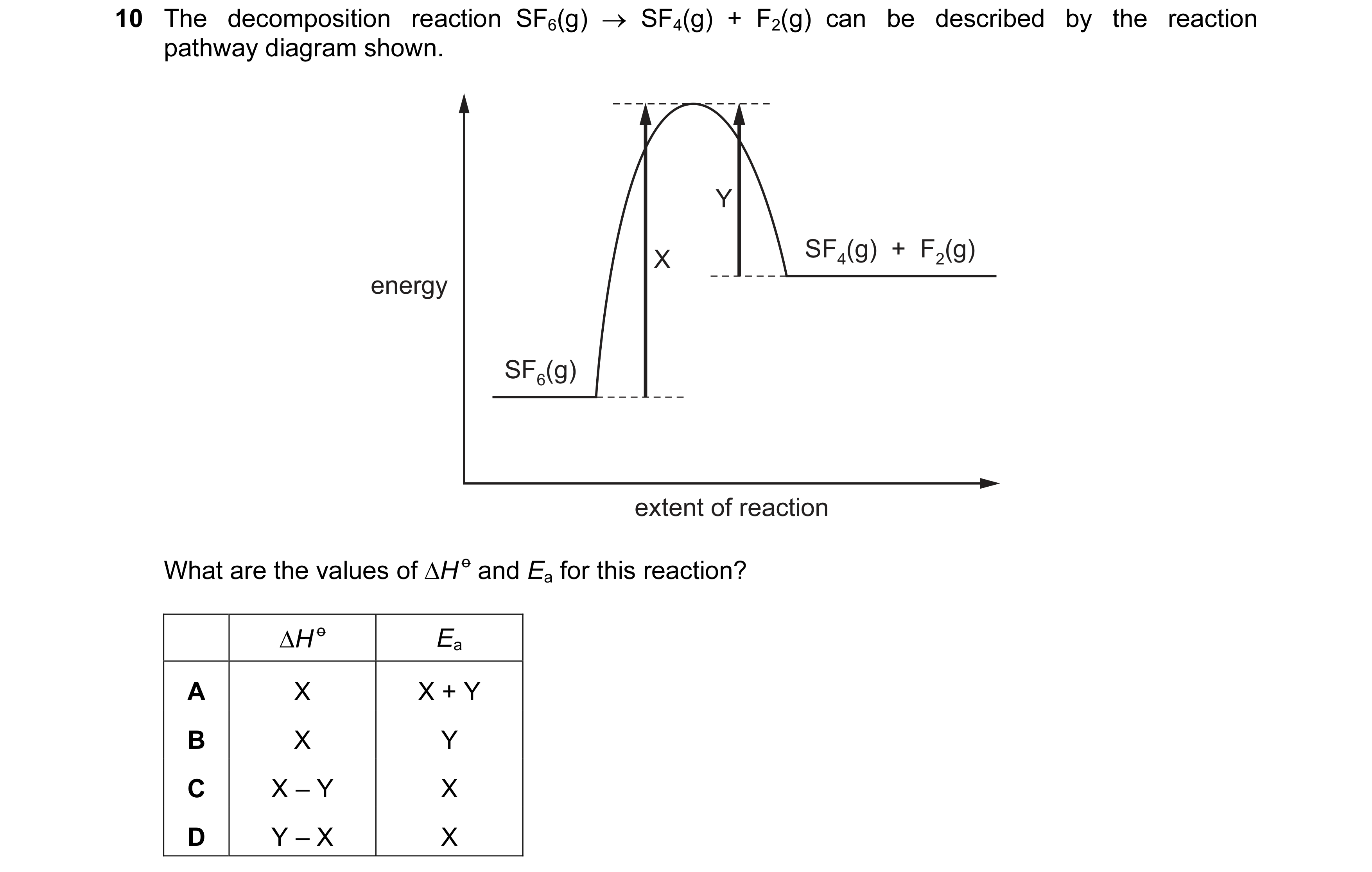
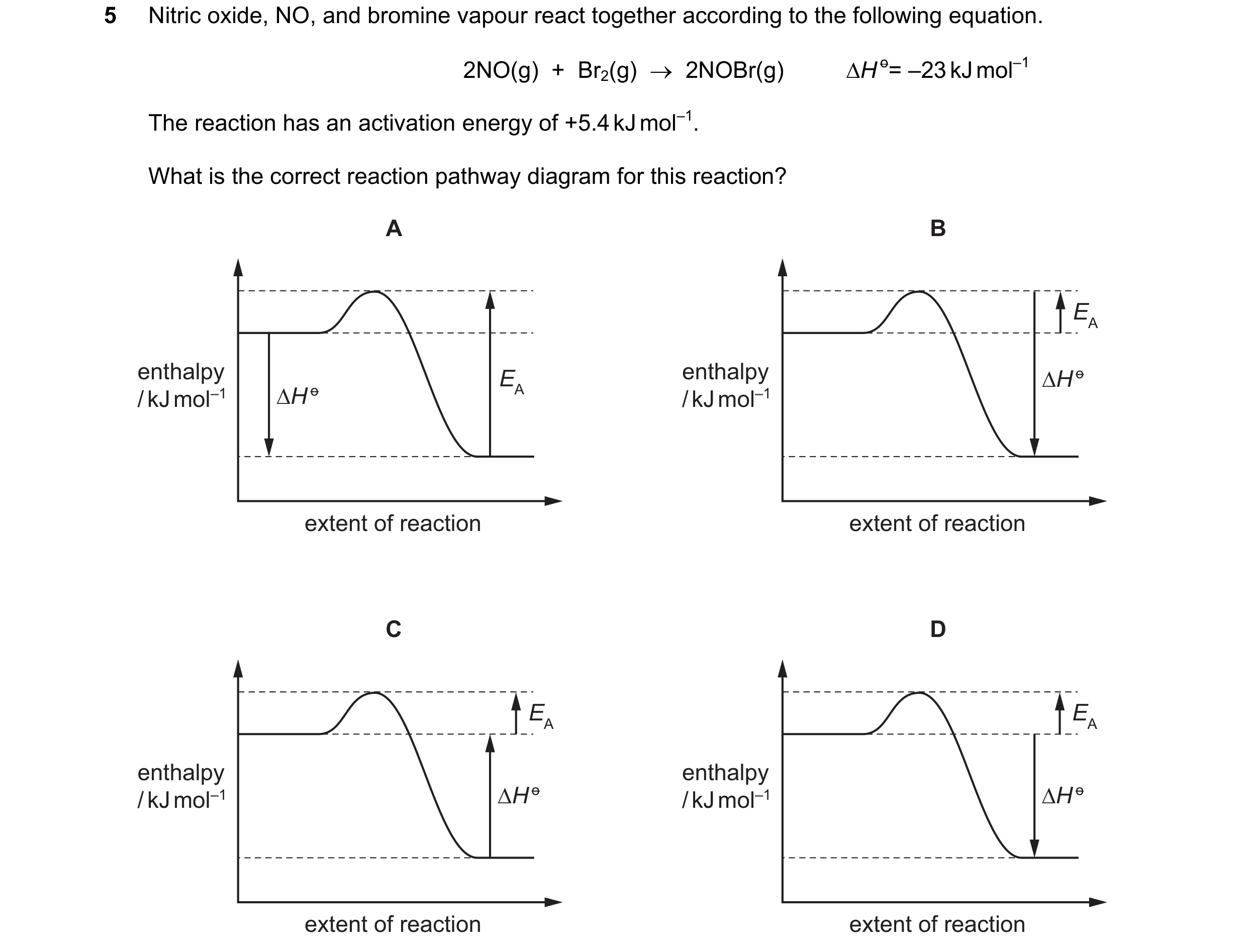 28 / 67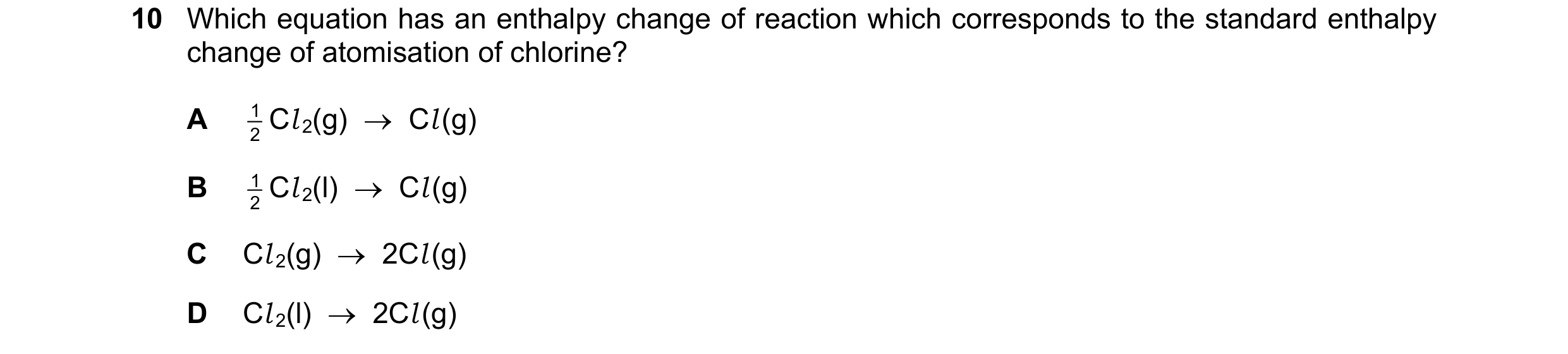
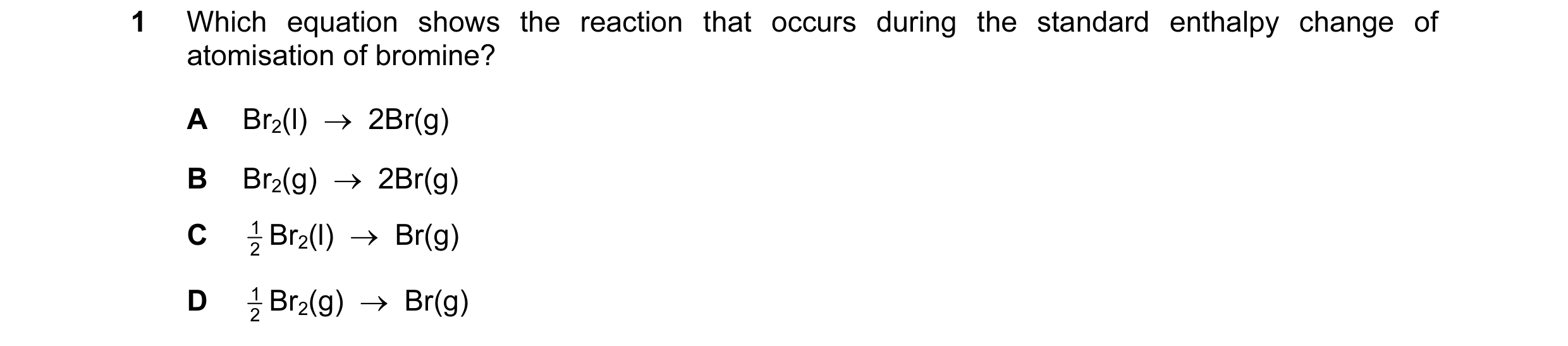
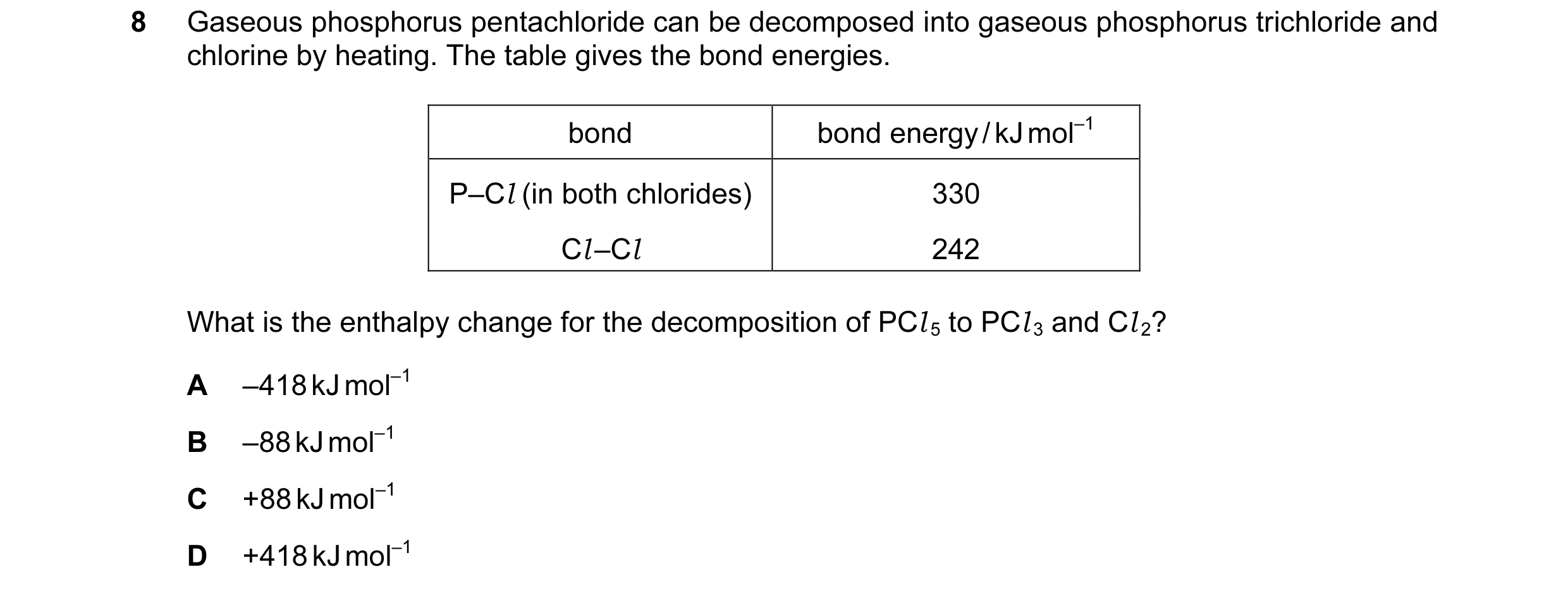
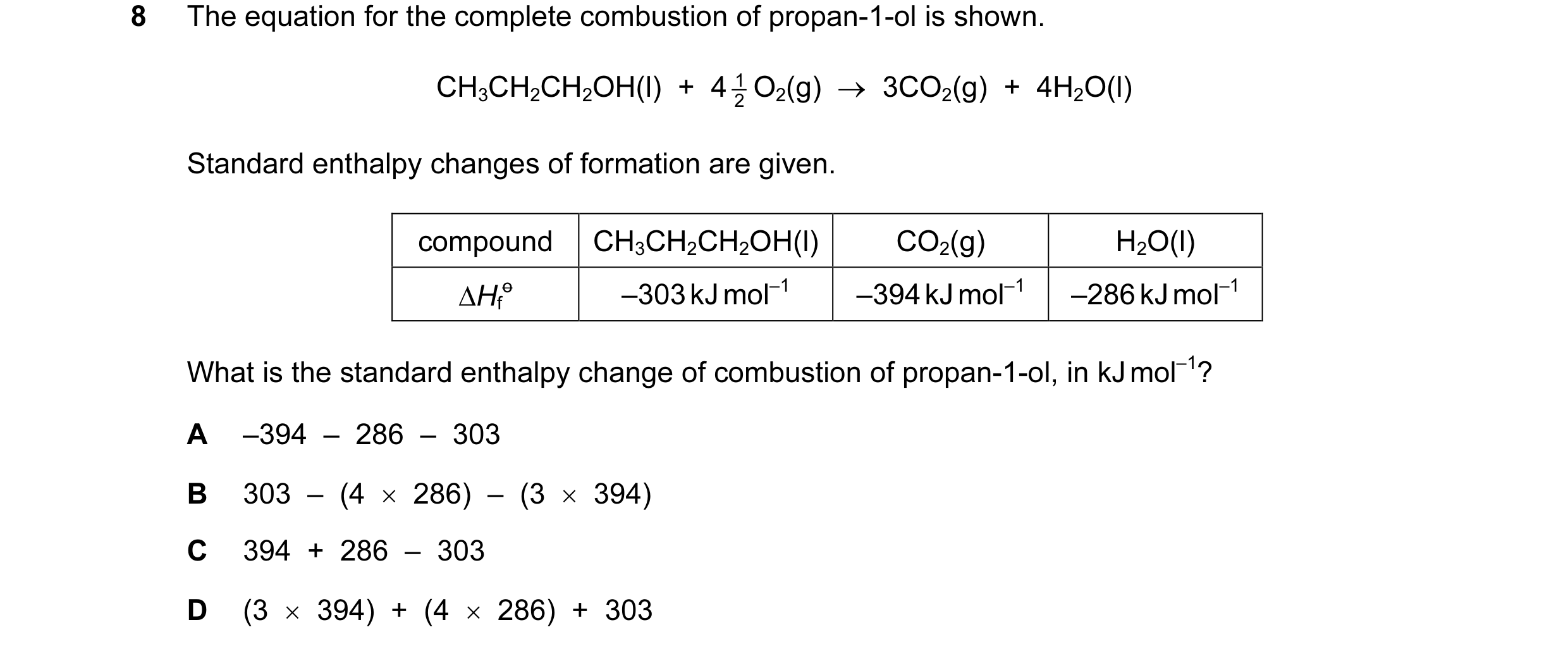 29 / 67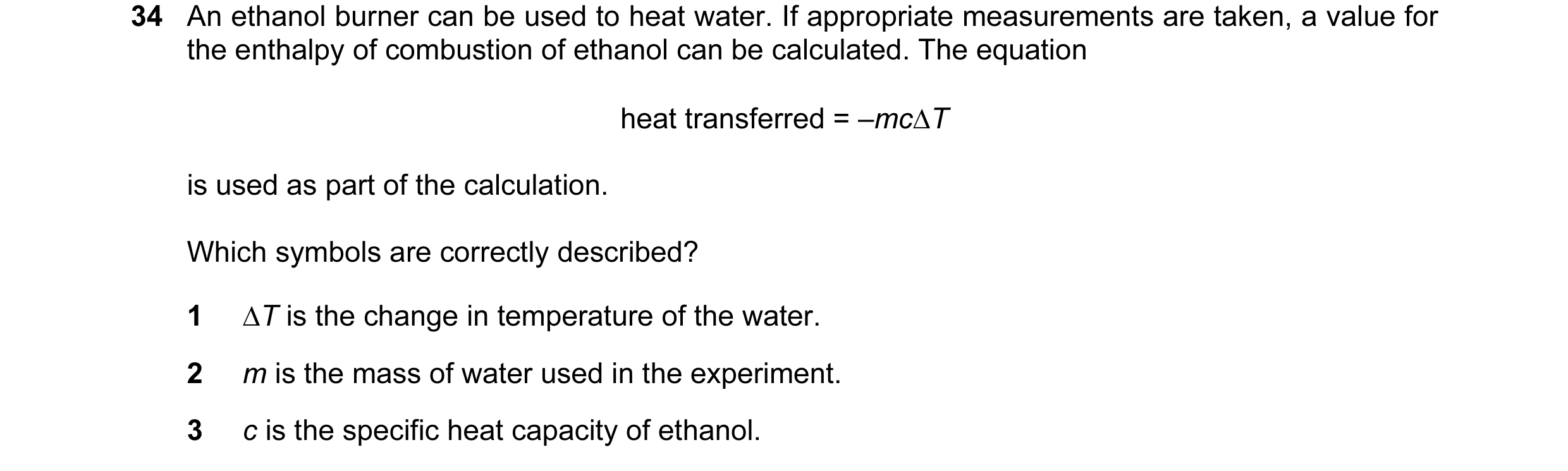
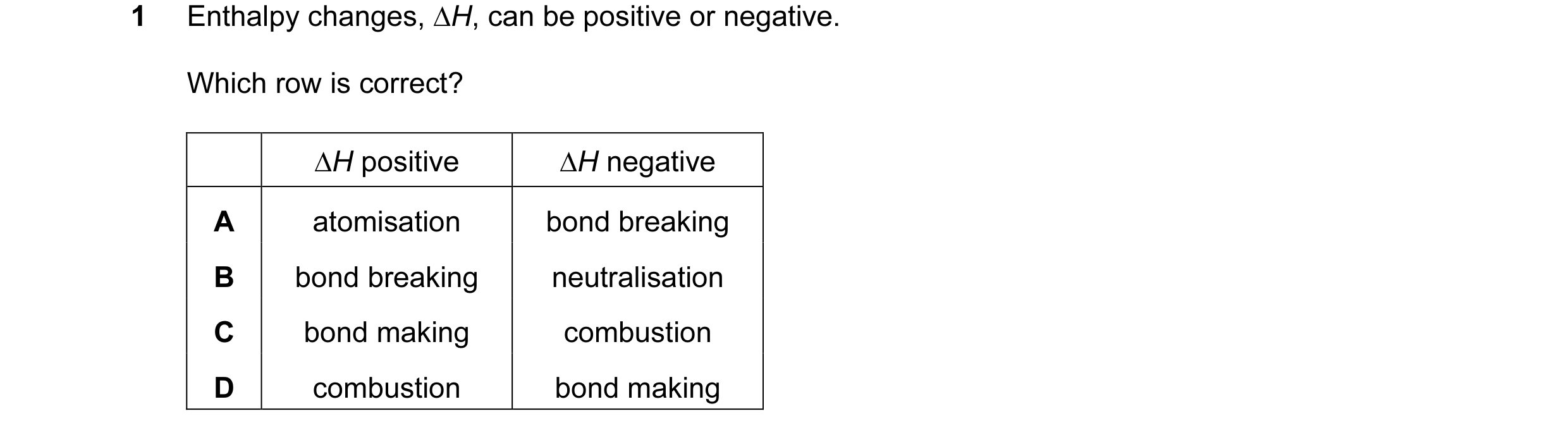
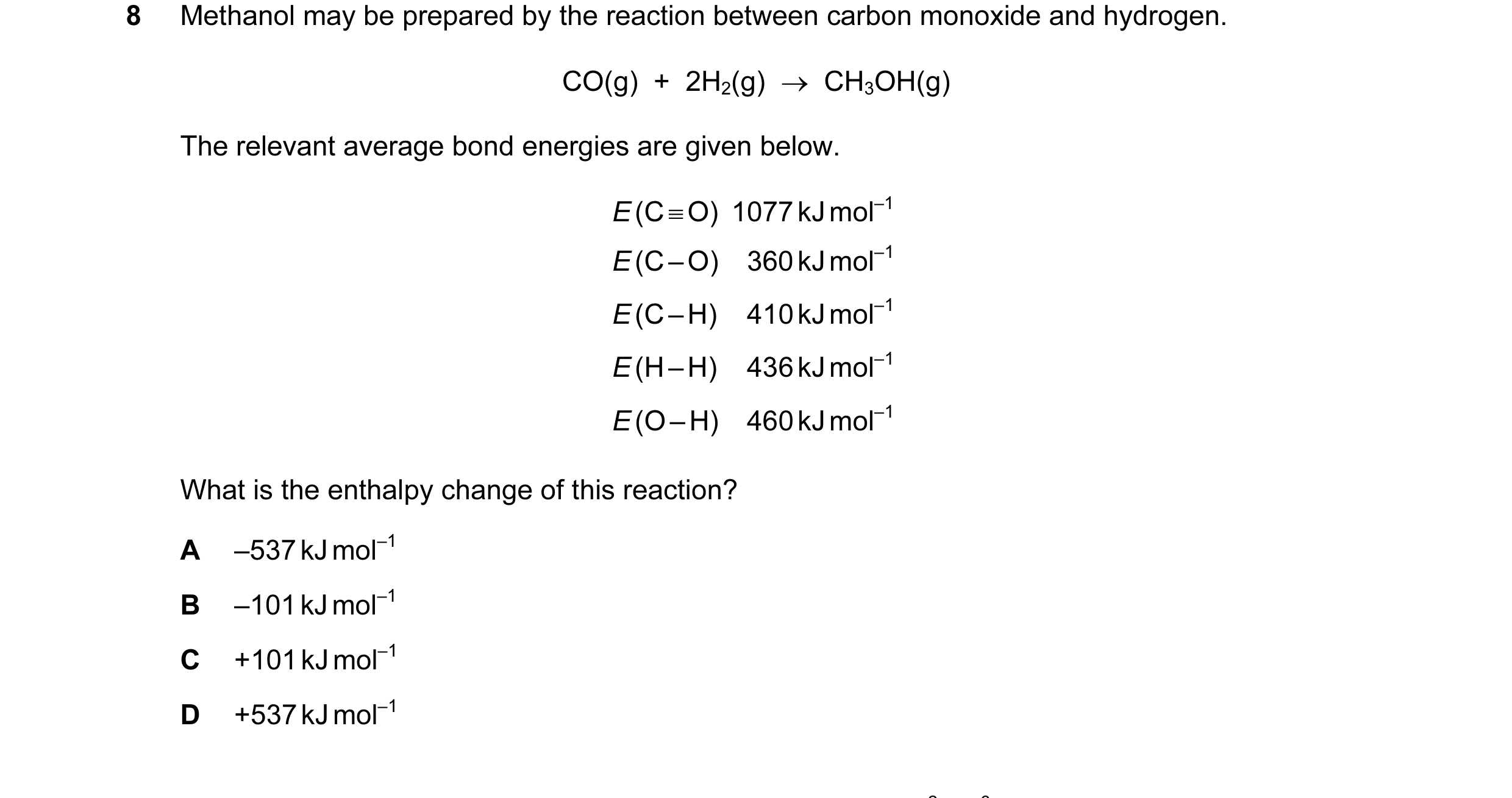
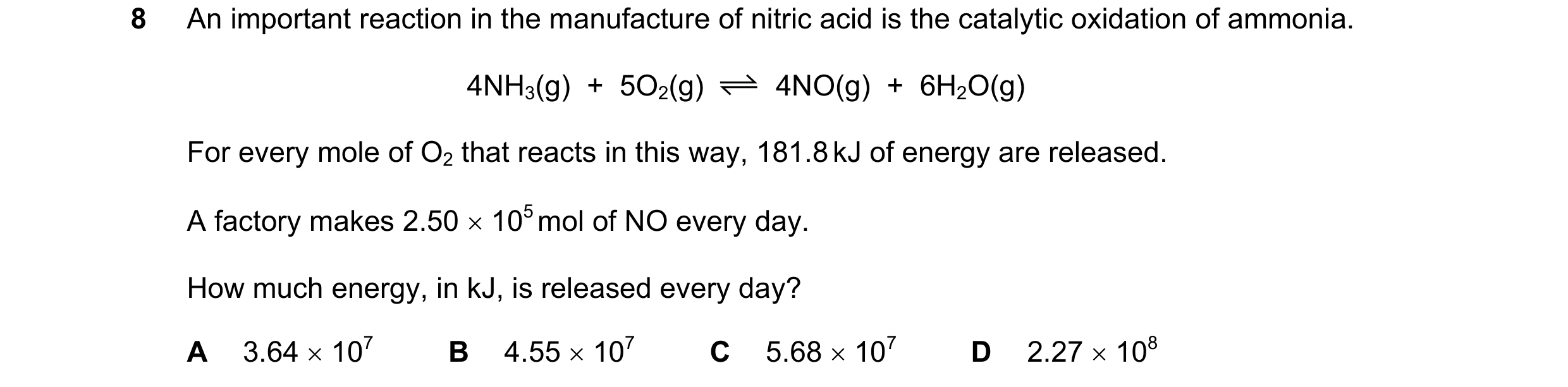 30 / 67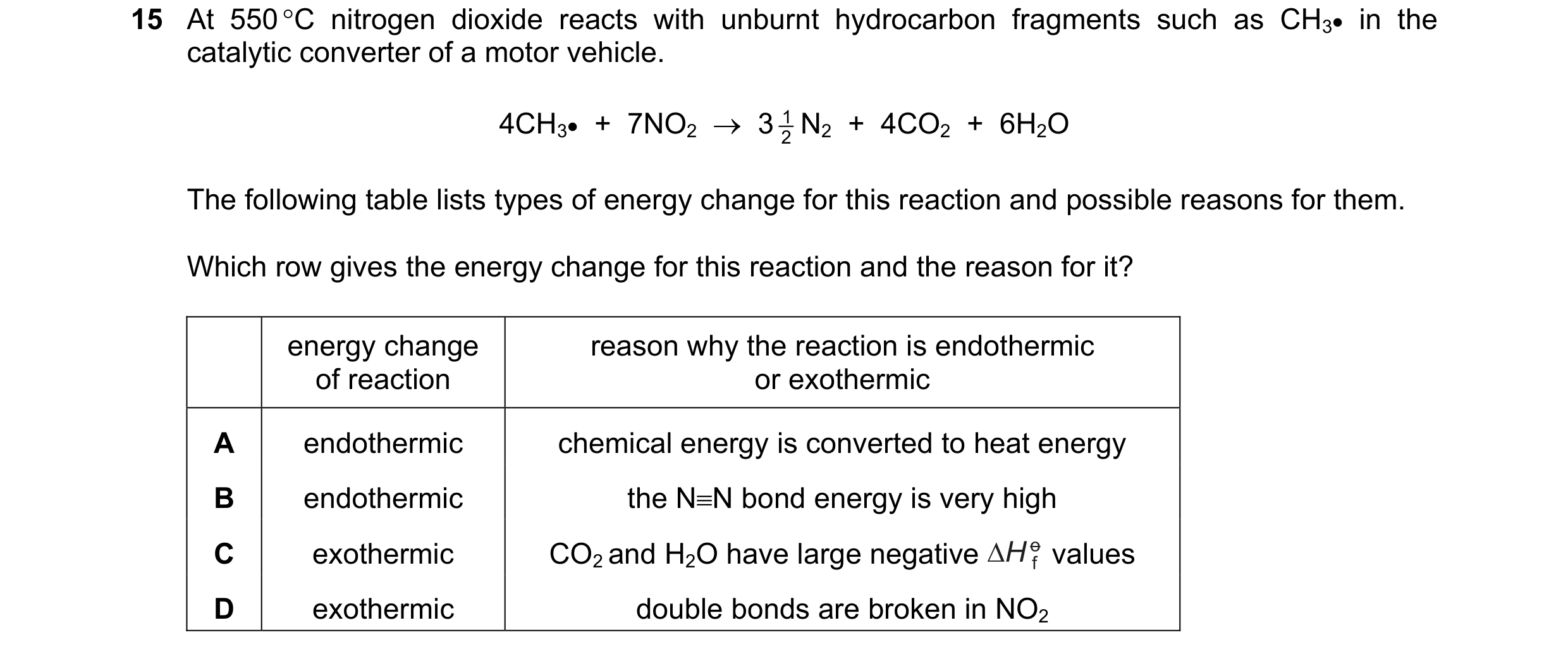

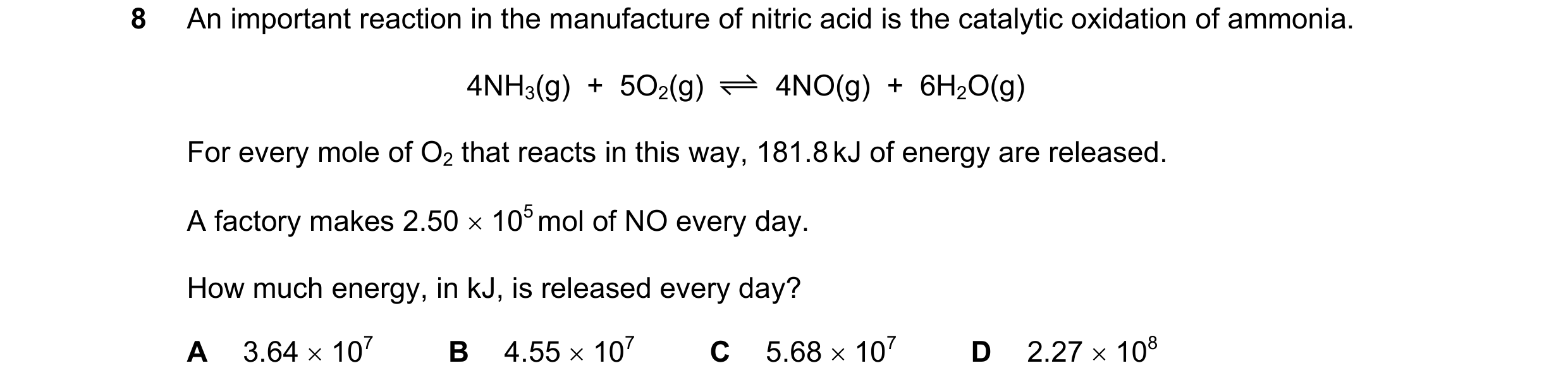
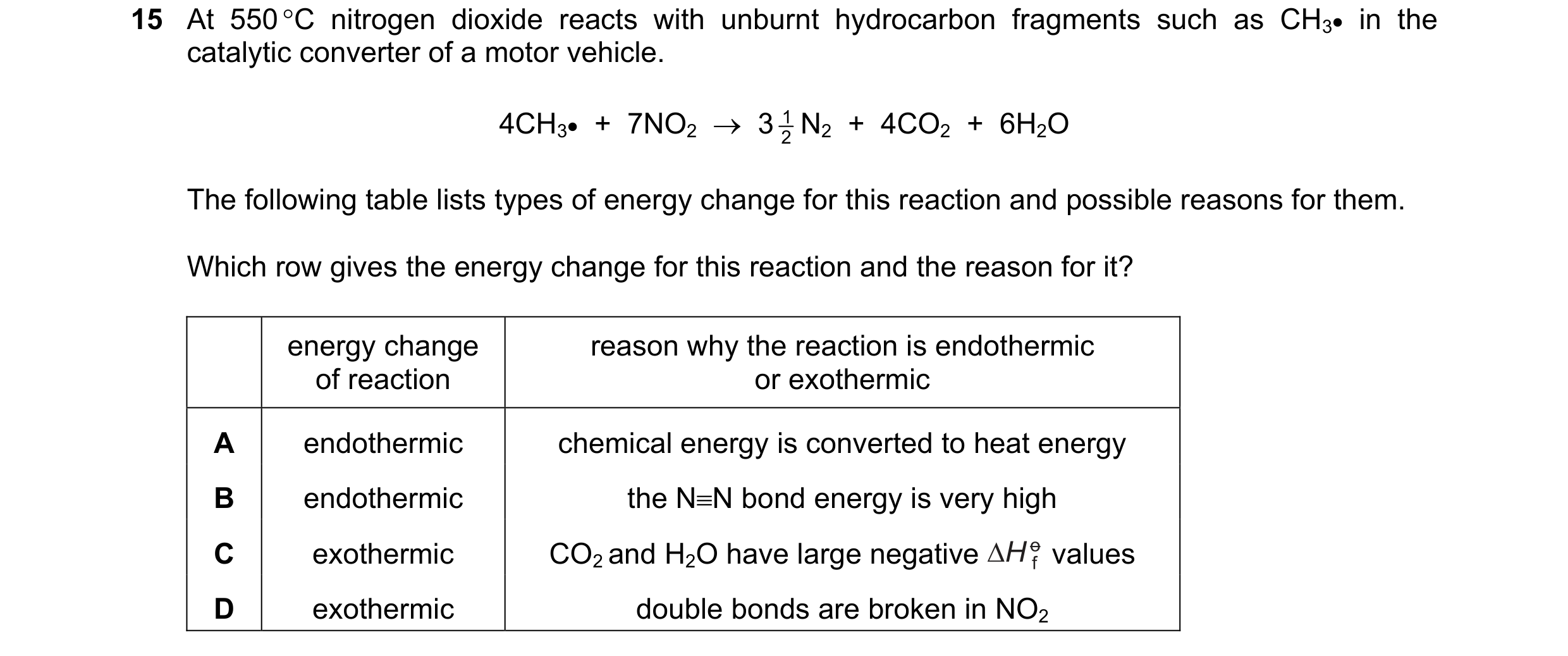 31 / 67
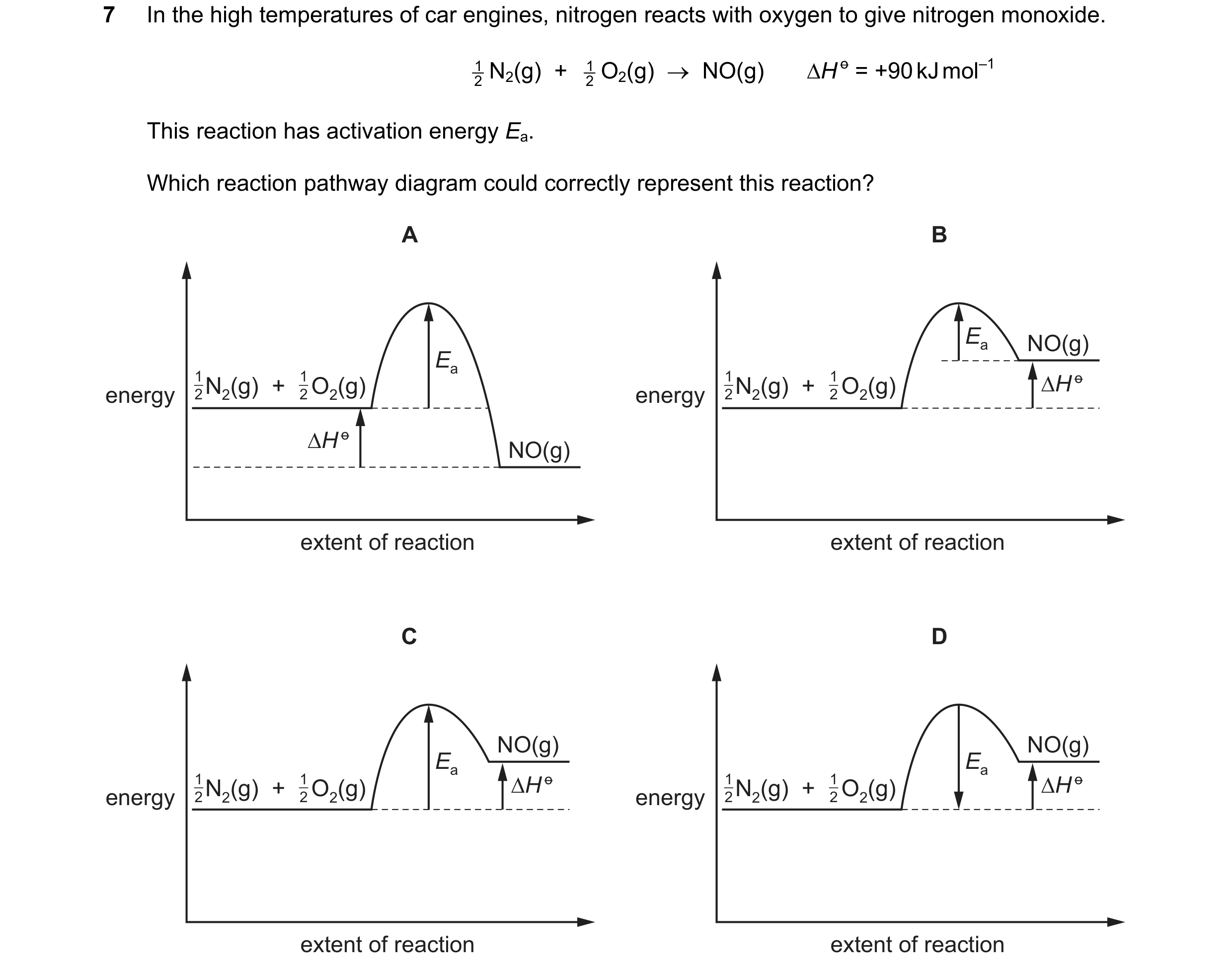
 32 / 67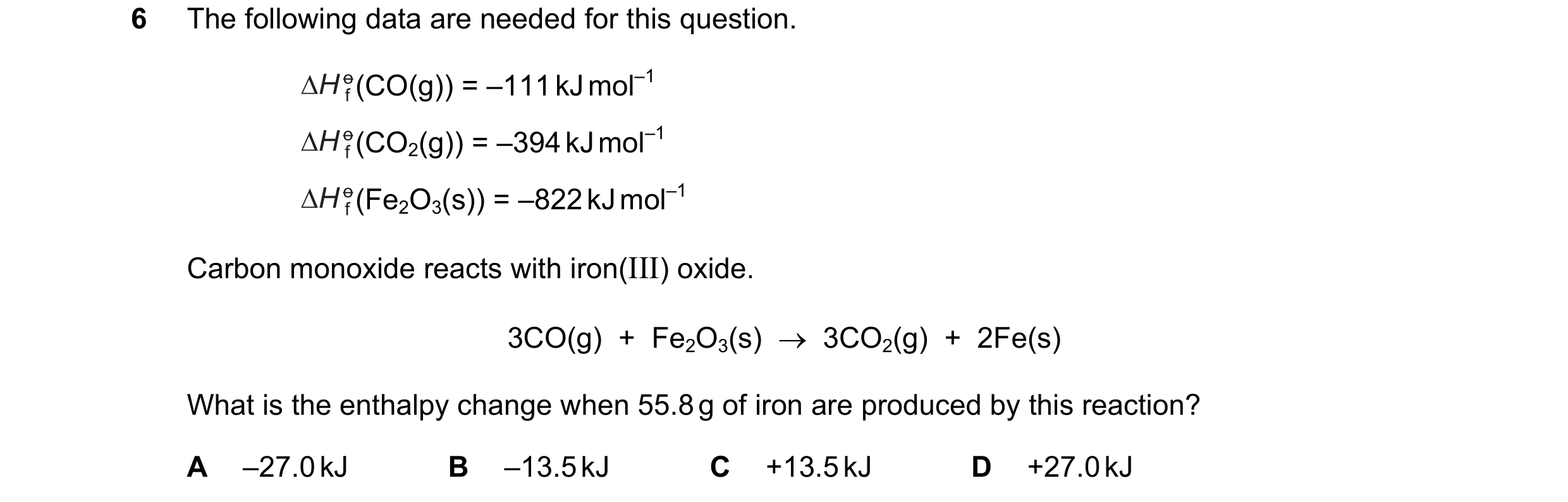
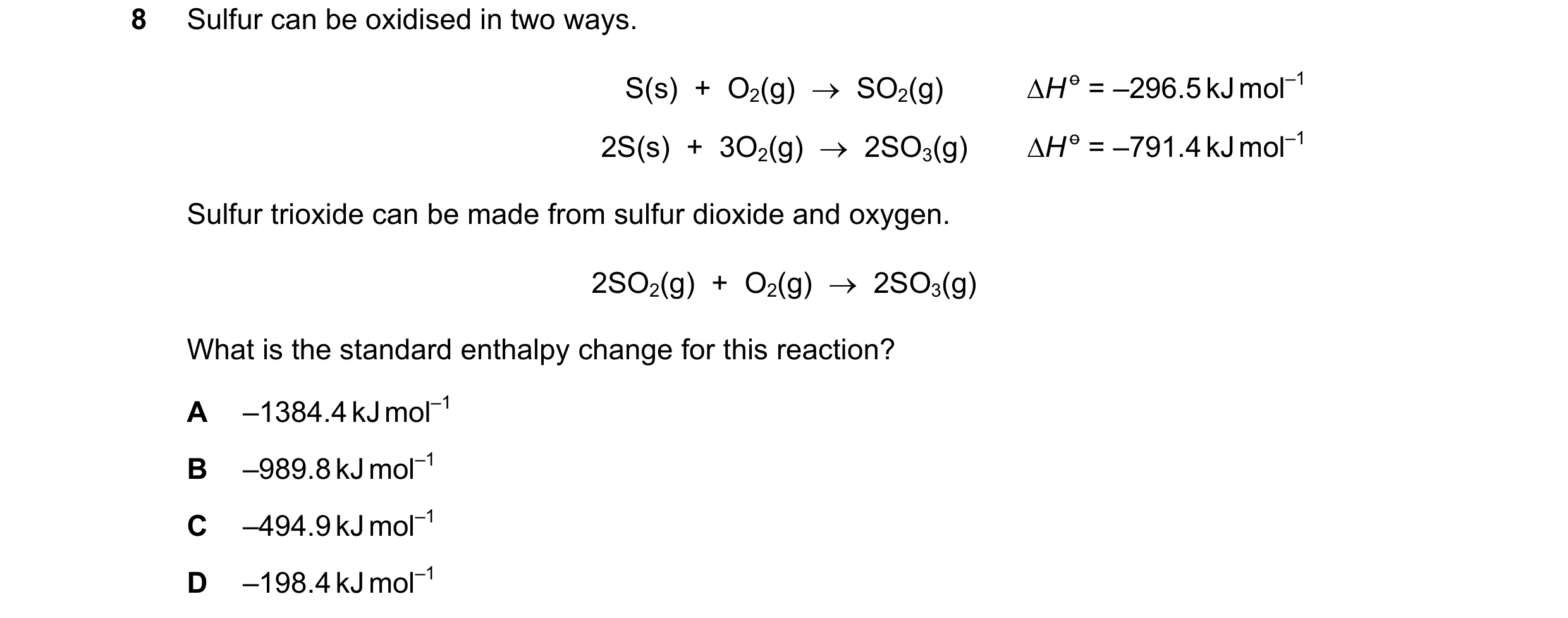


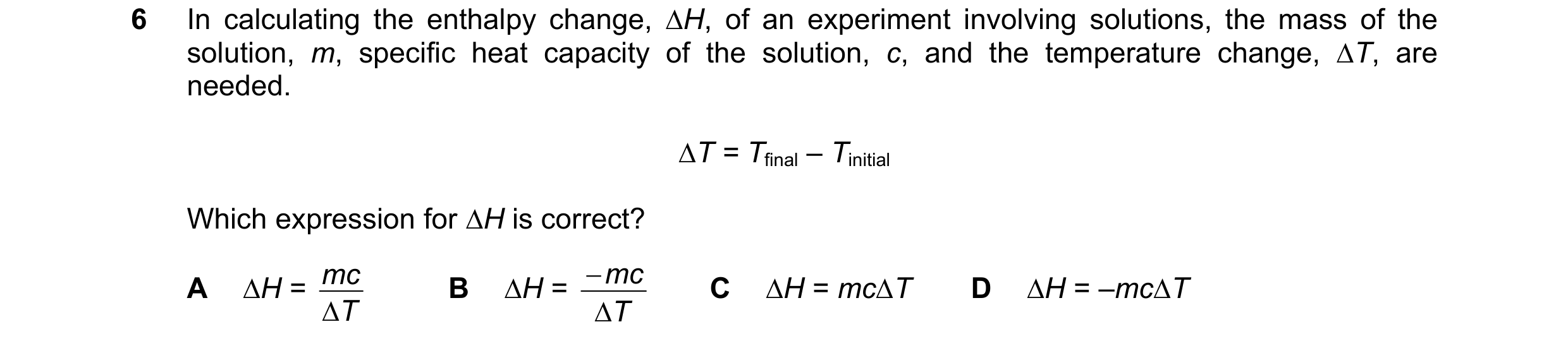 33 / 67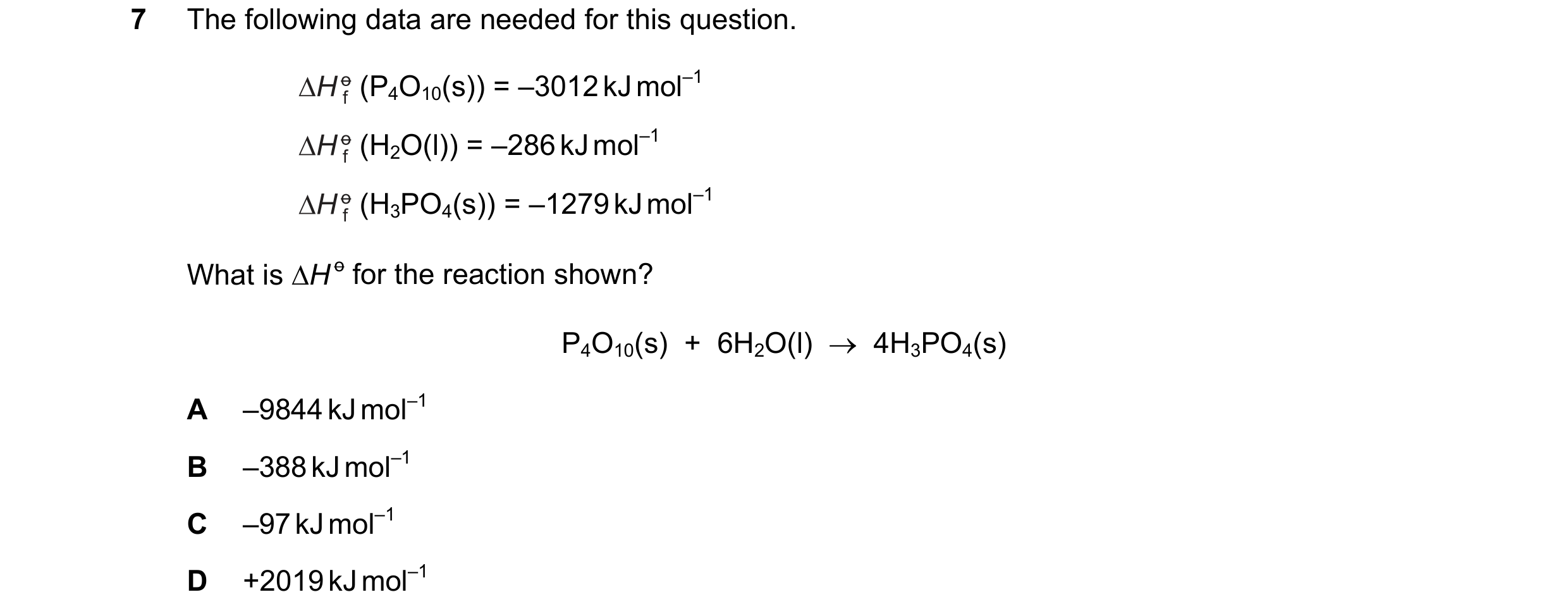
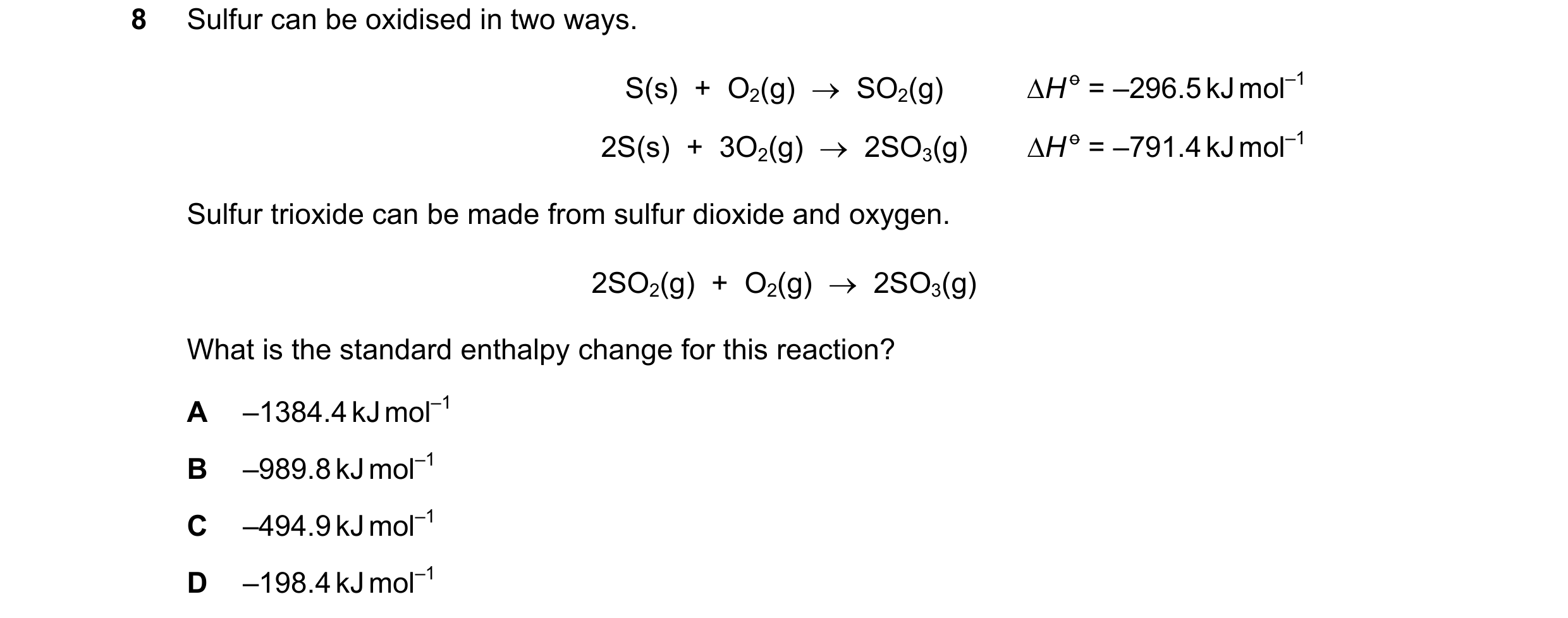

 34 / 67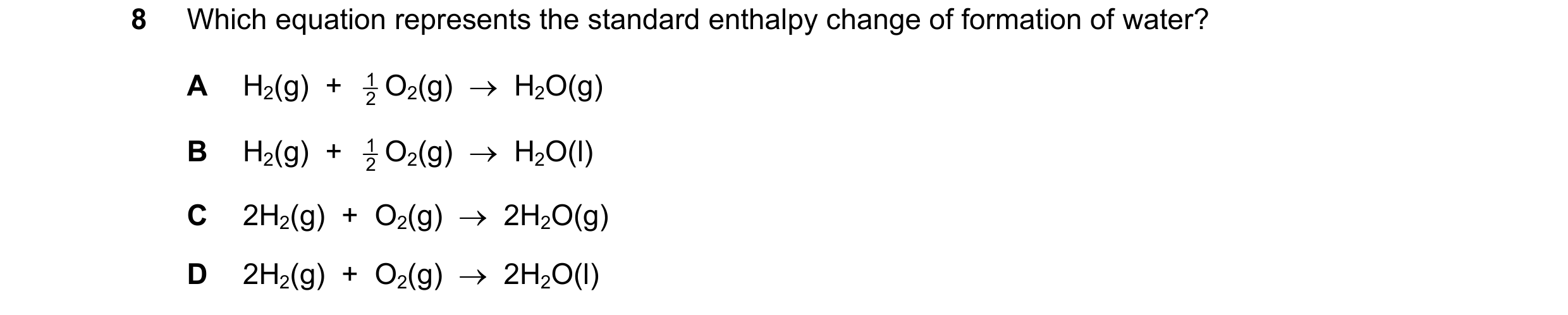
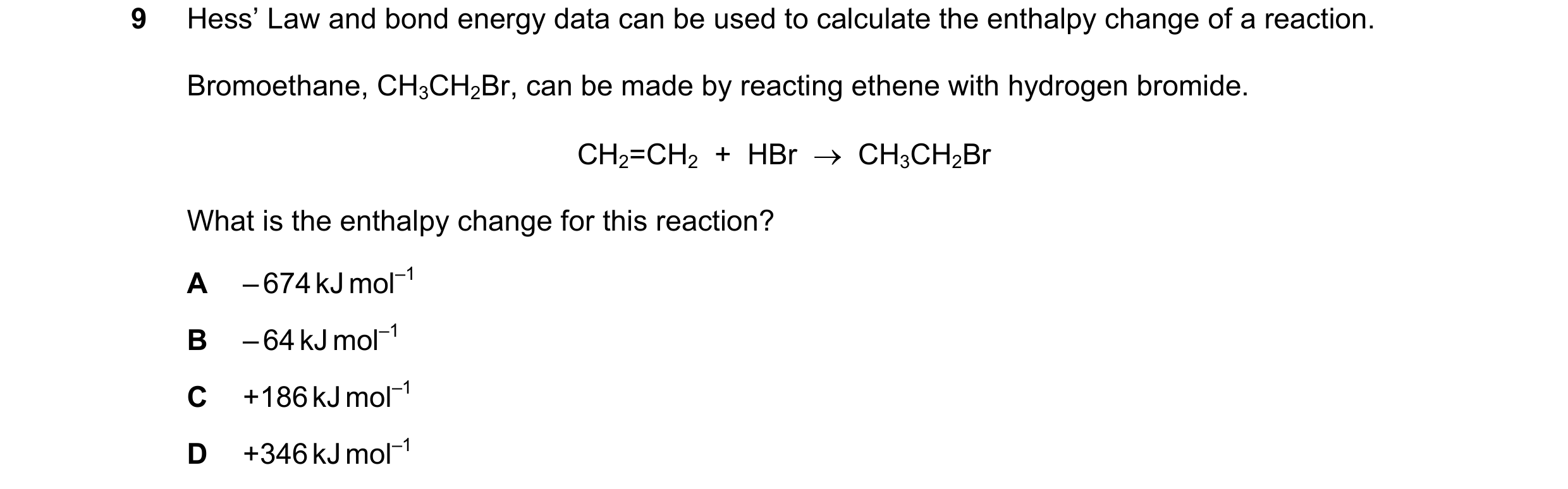
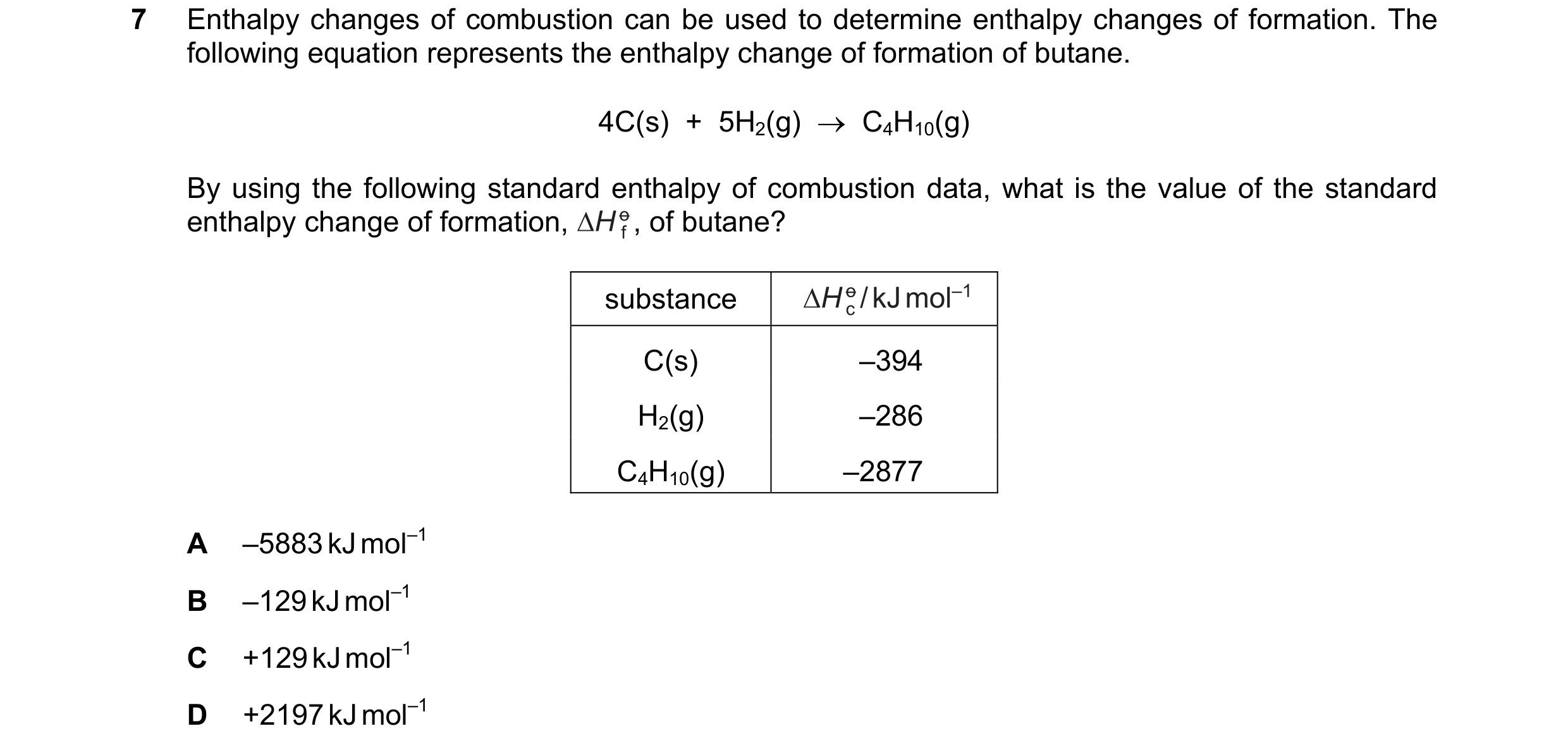
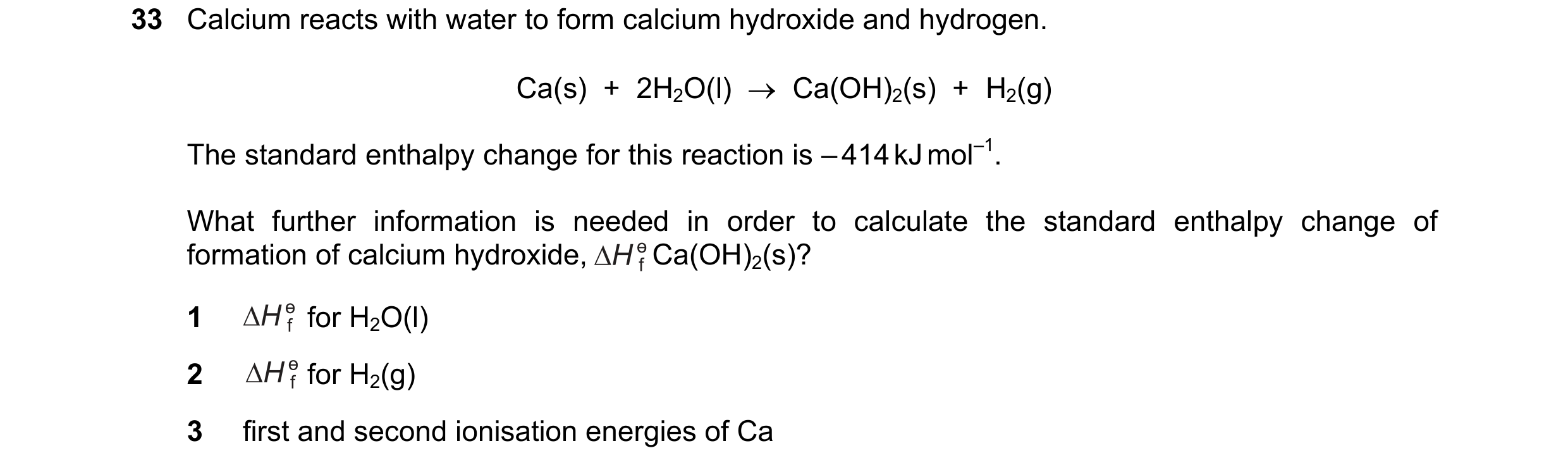 35 / 67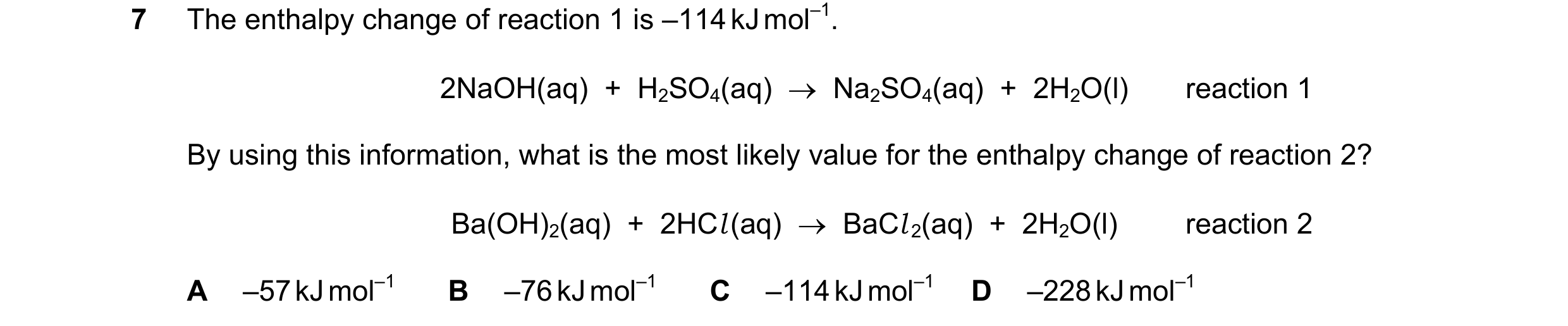

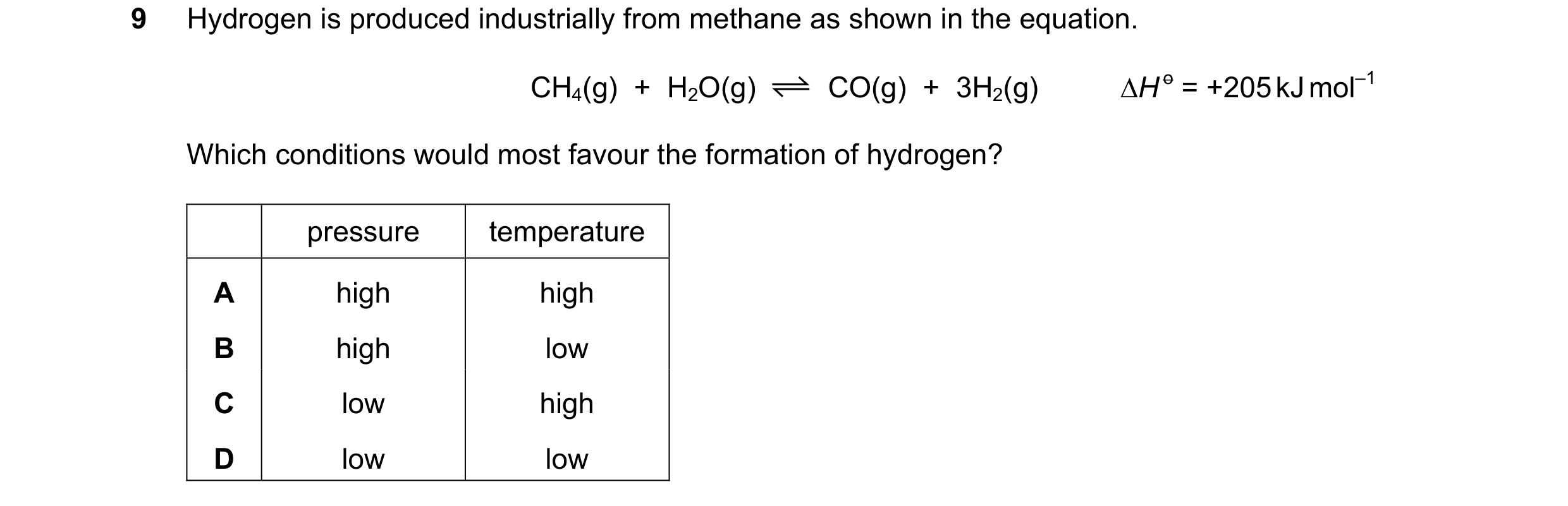
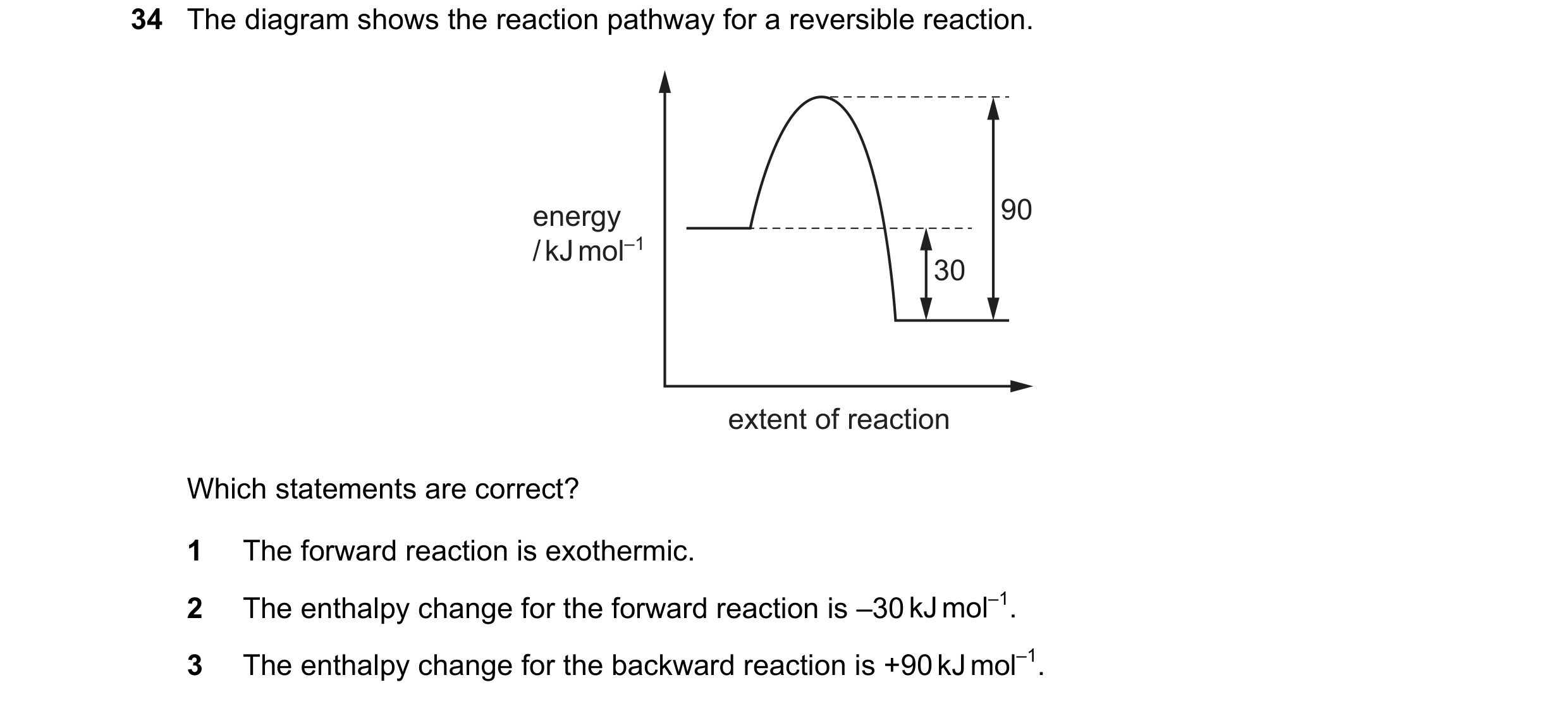 36 / 67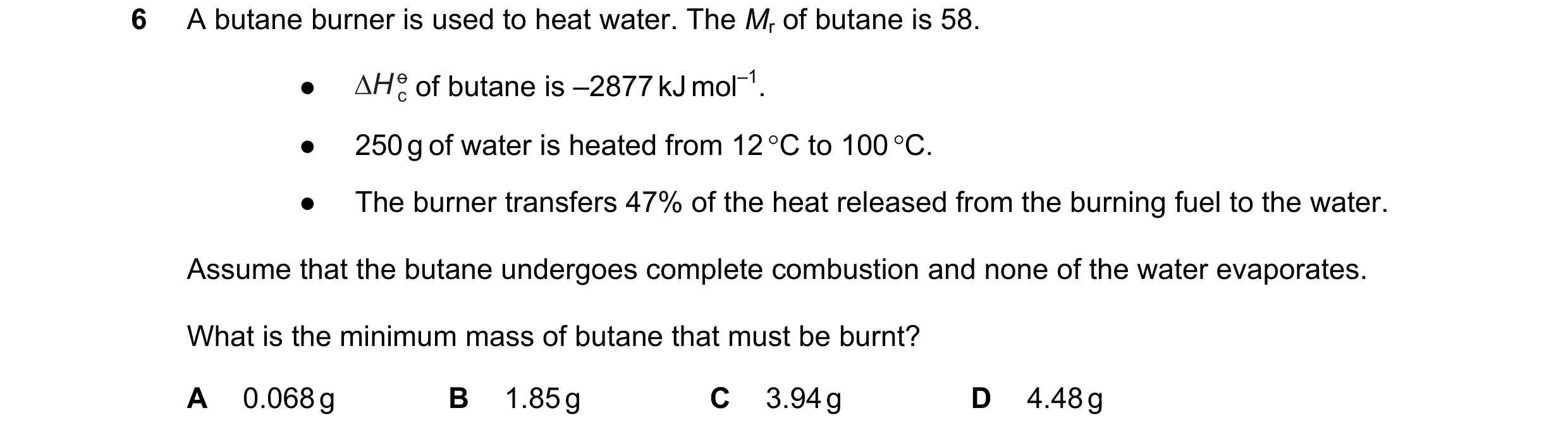


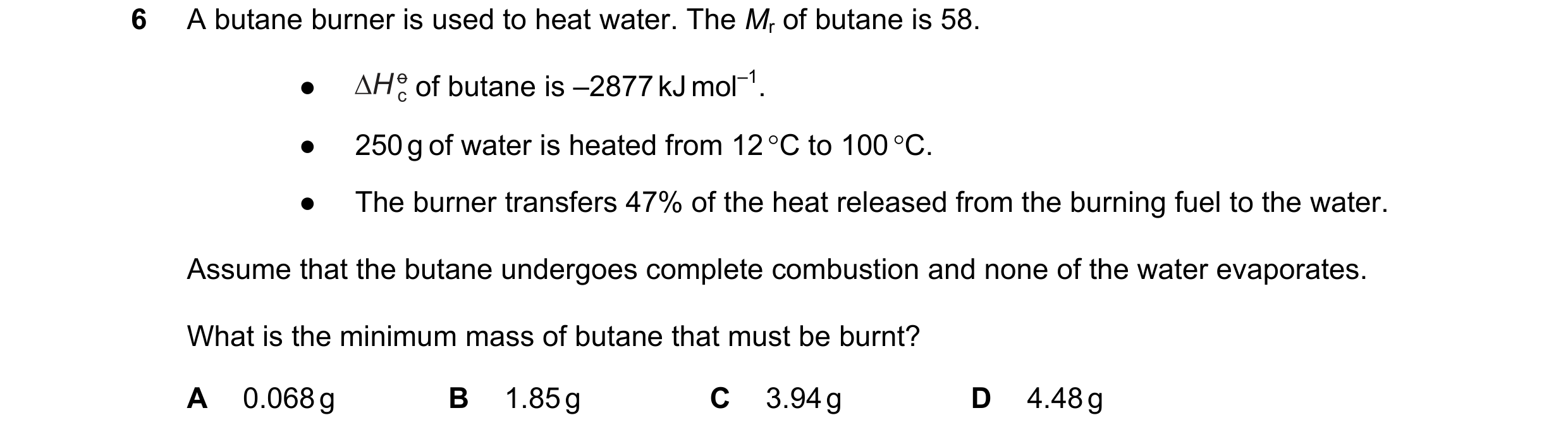
 37 / 67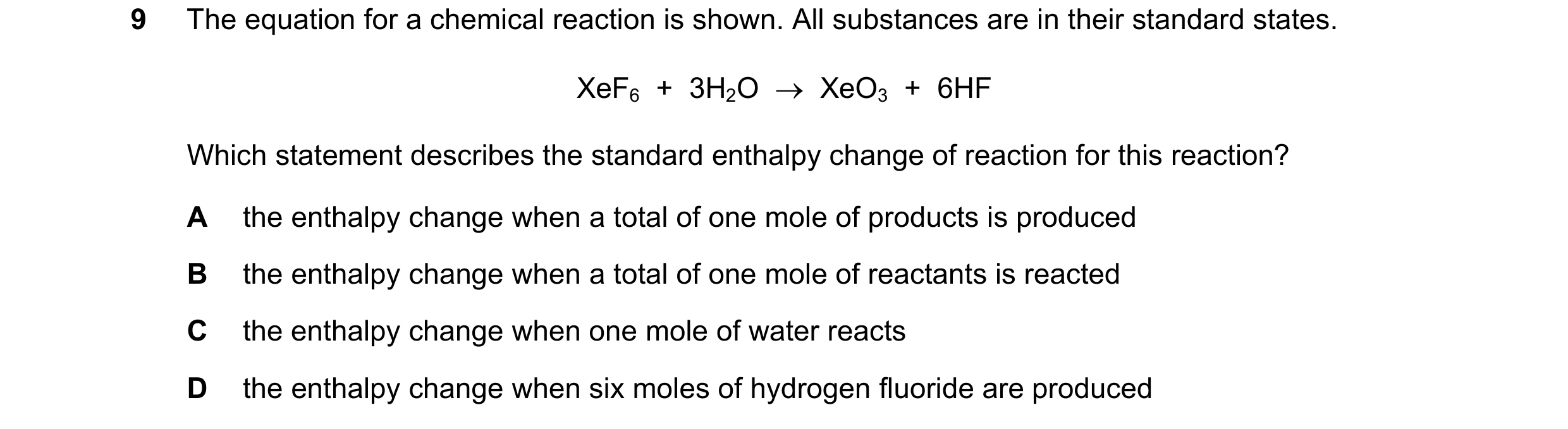
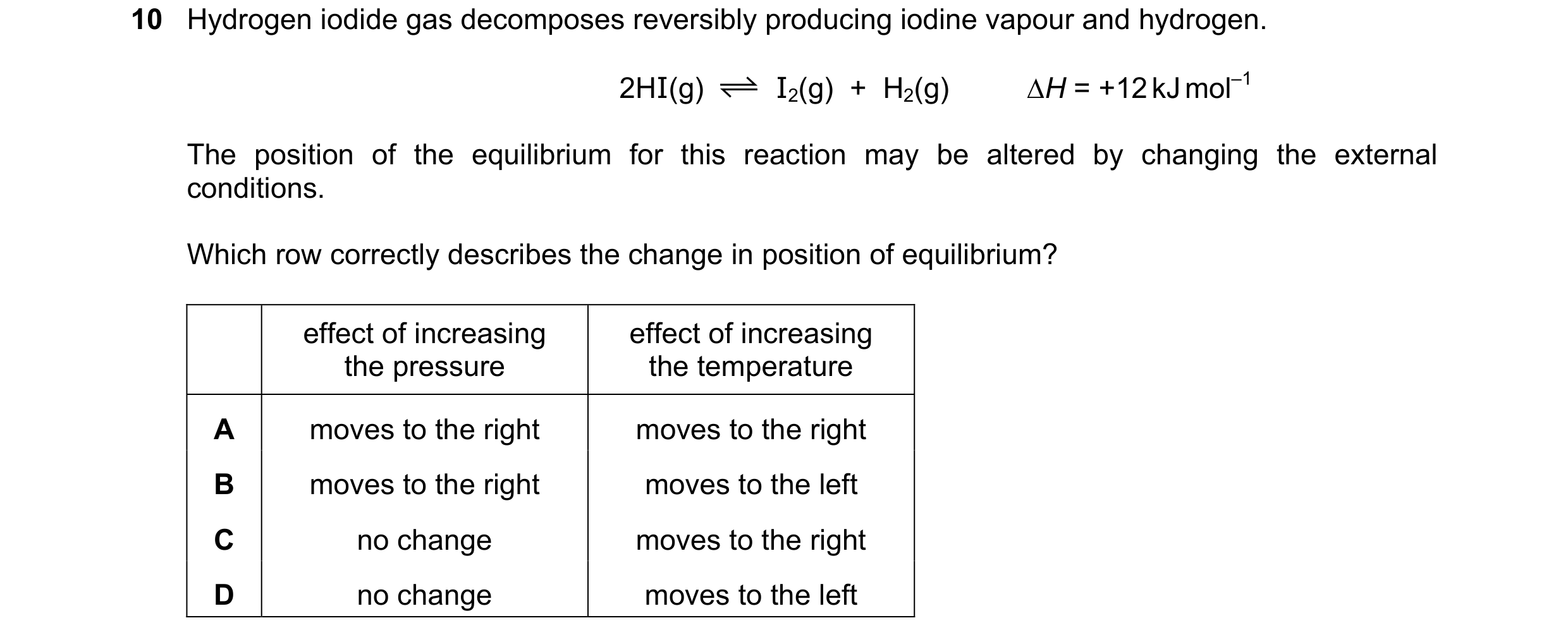
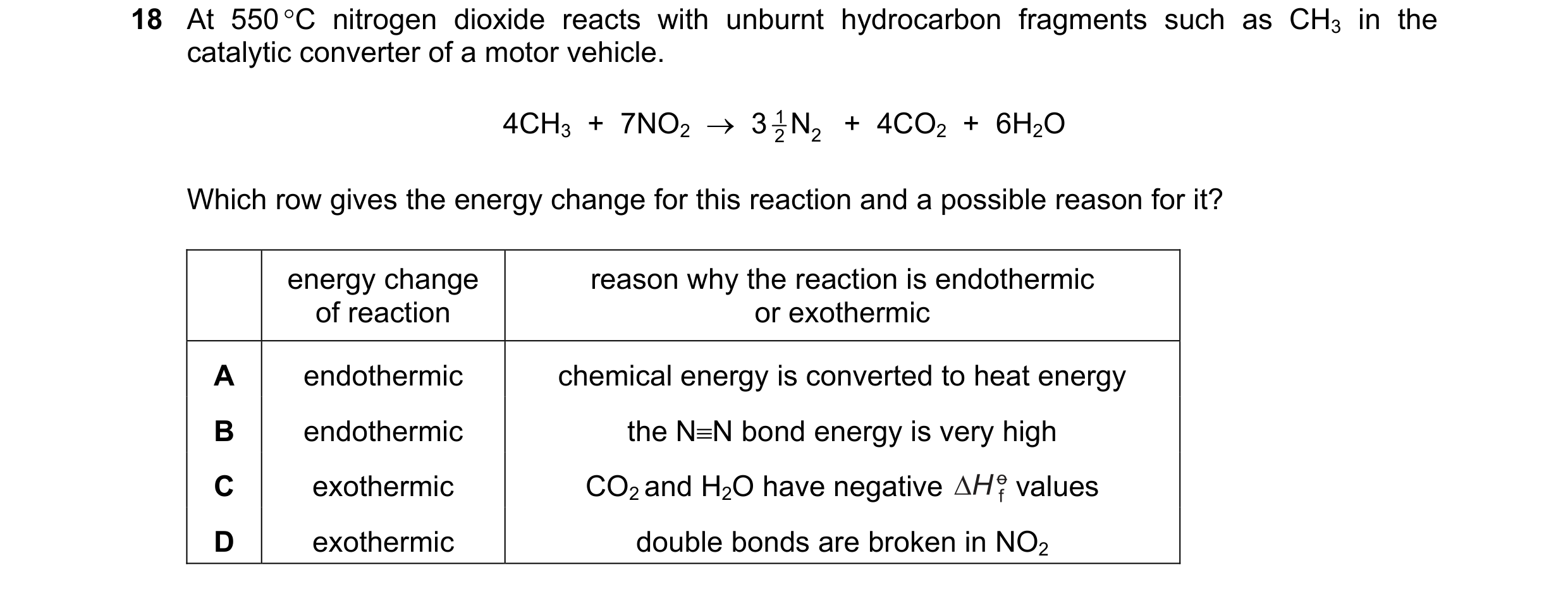
 38 / 67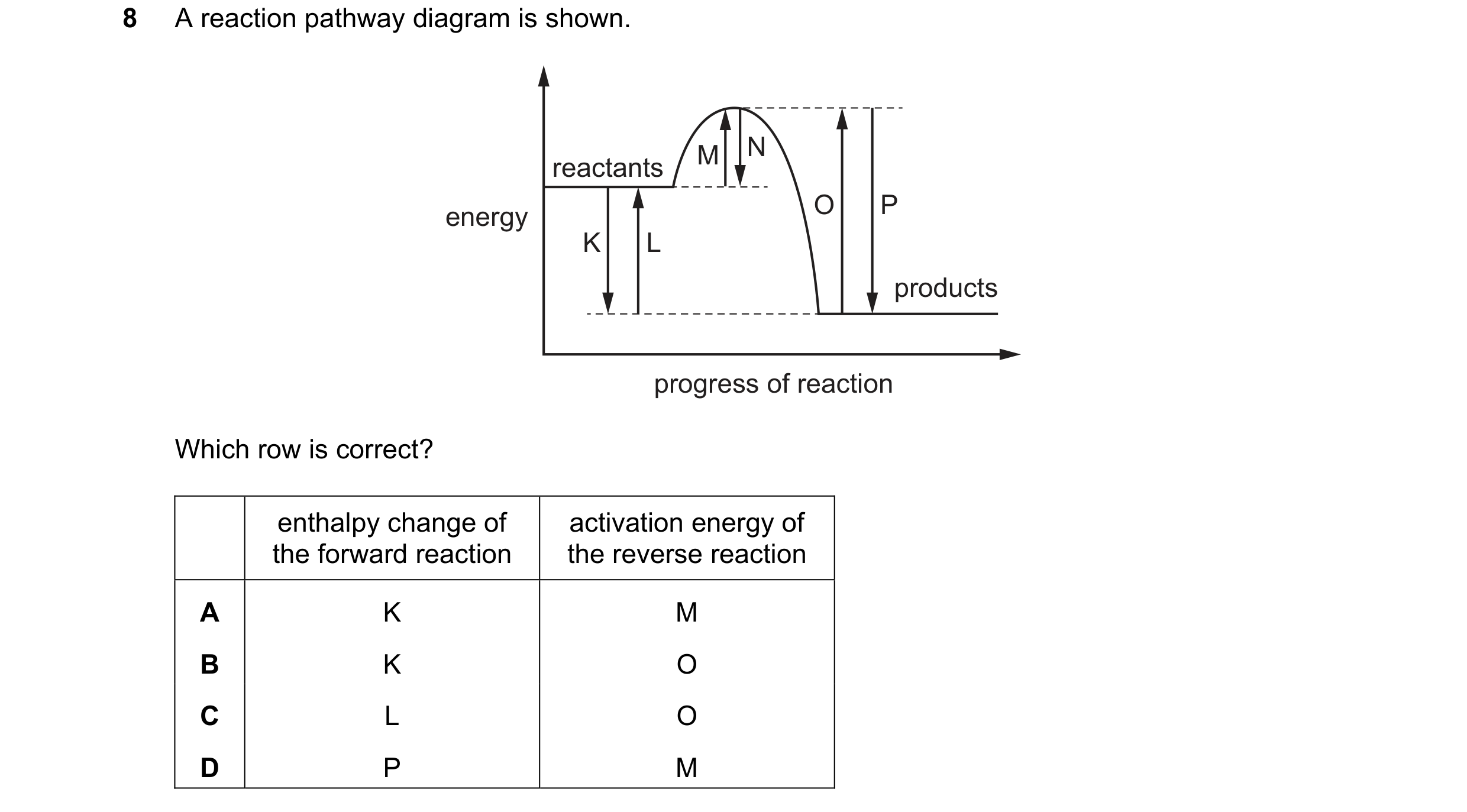
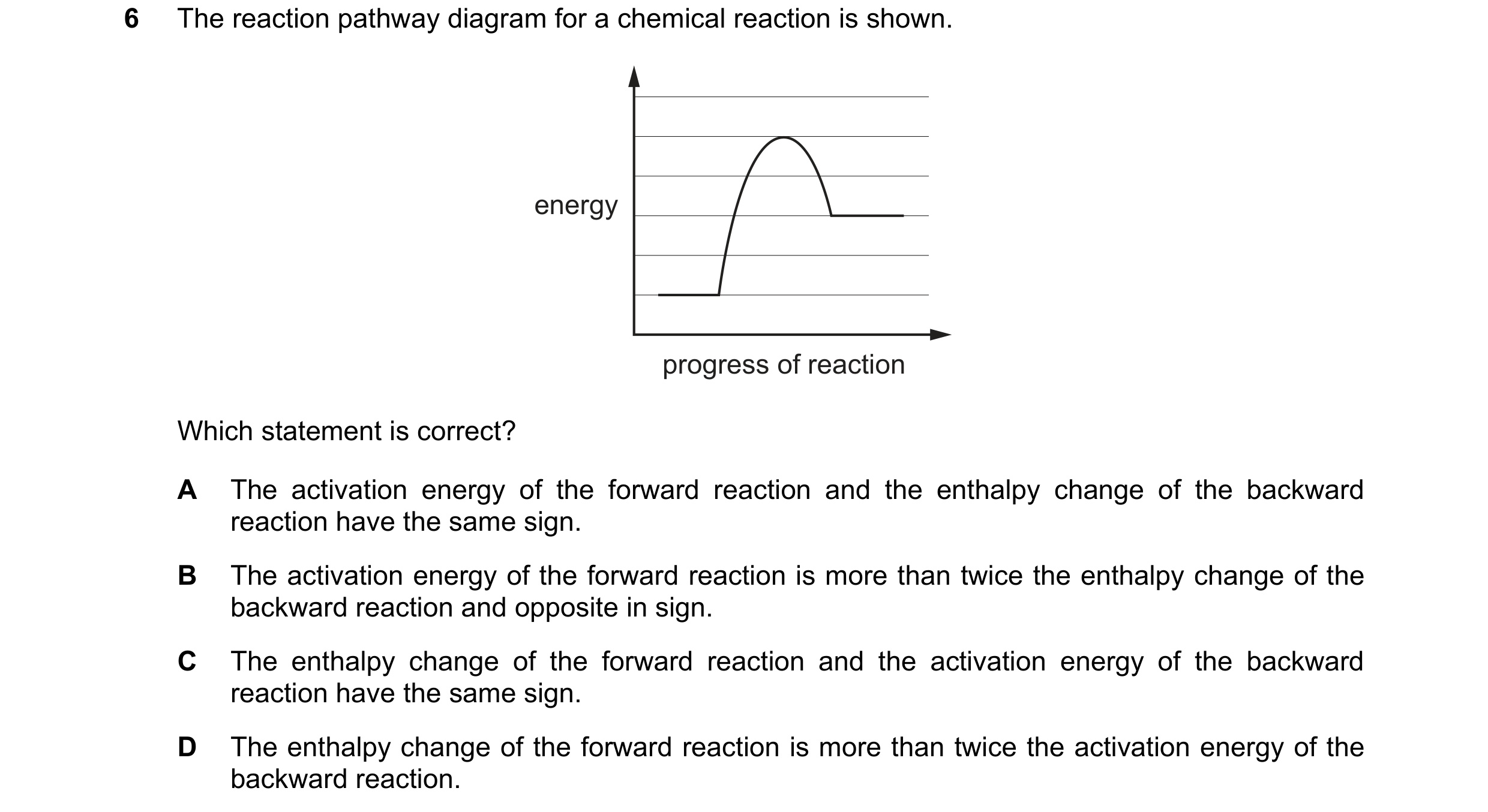 39 / 67

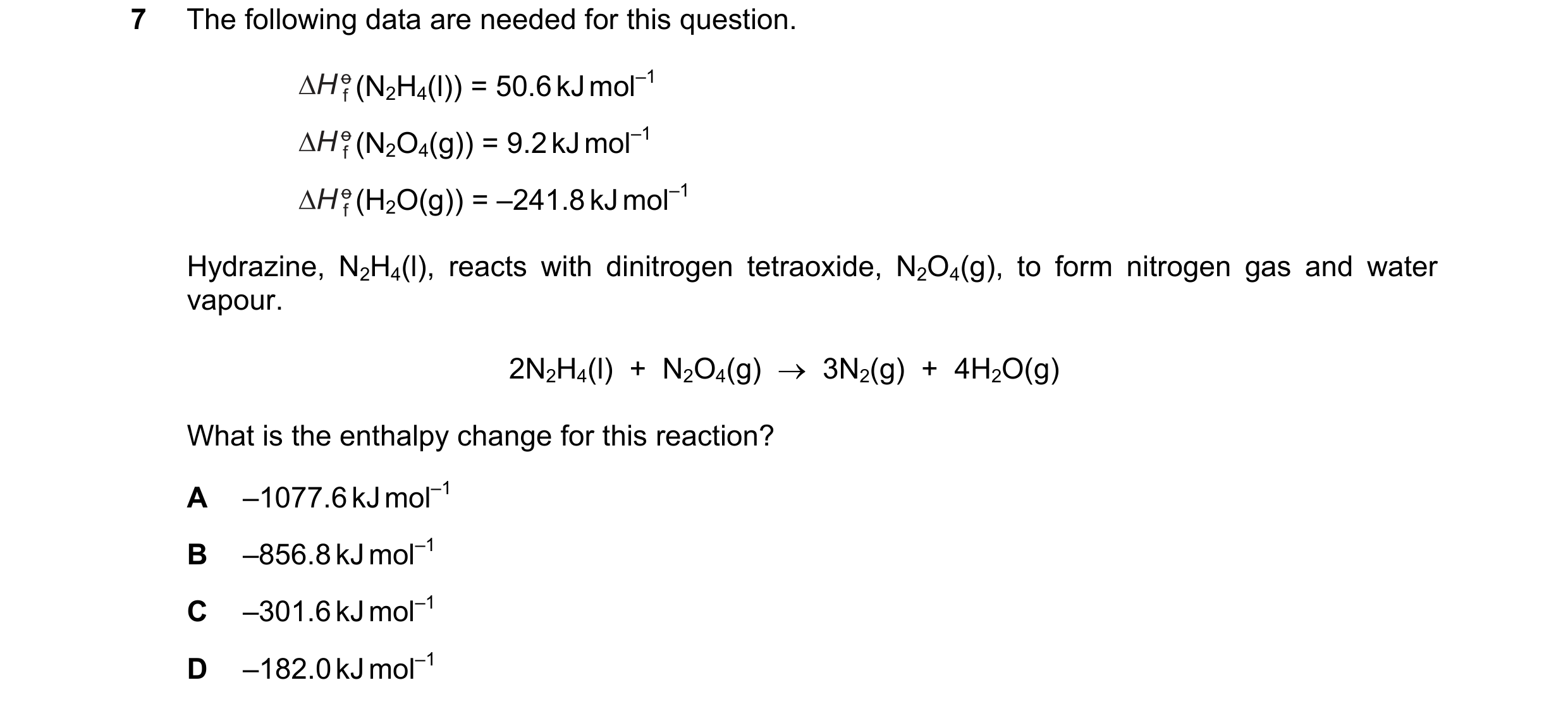
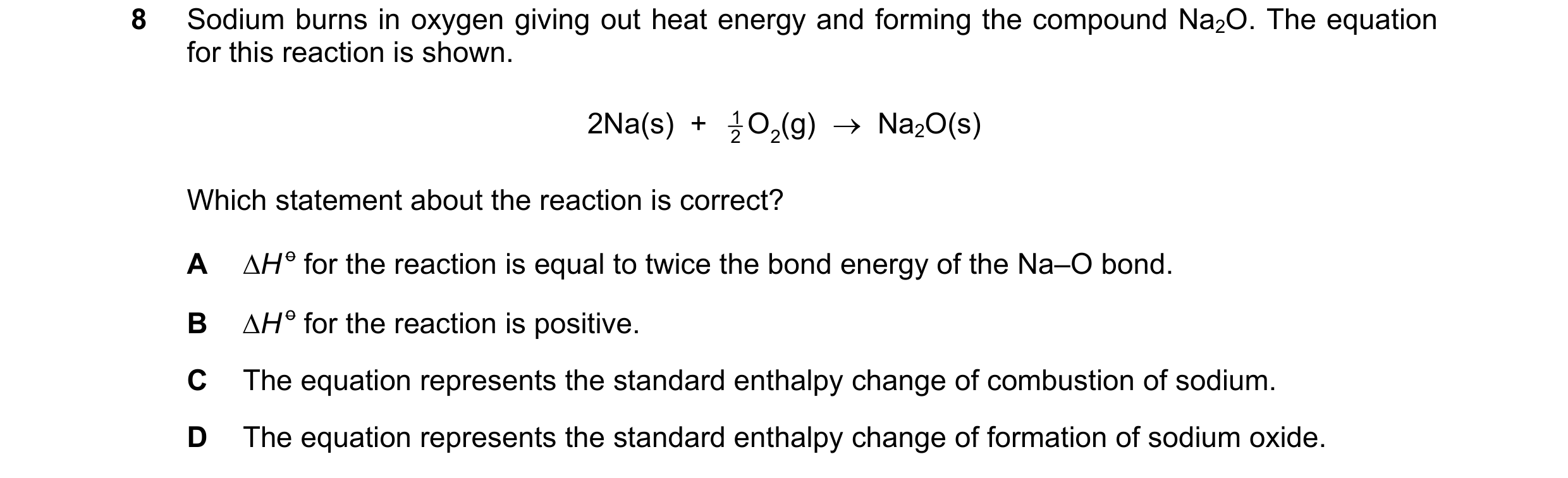 40 / 67

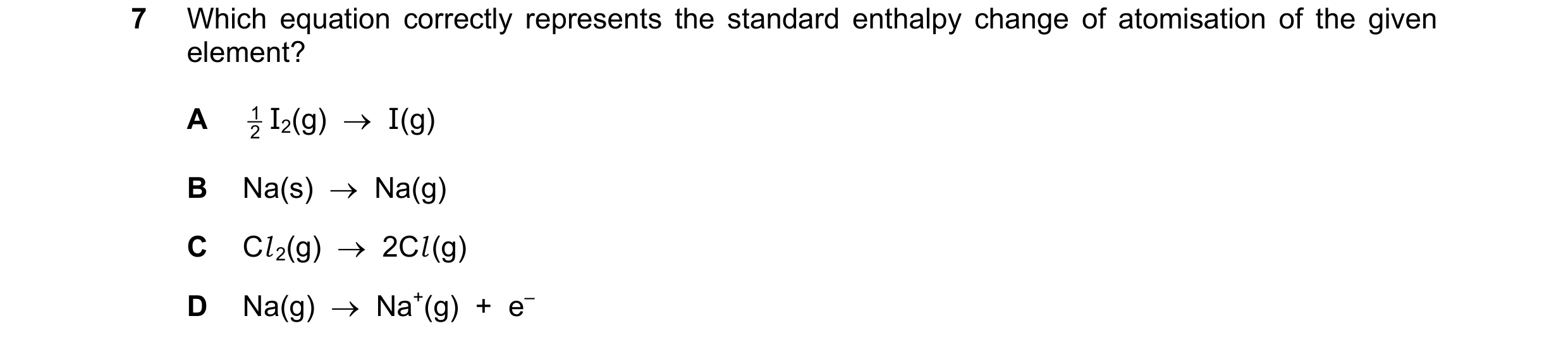
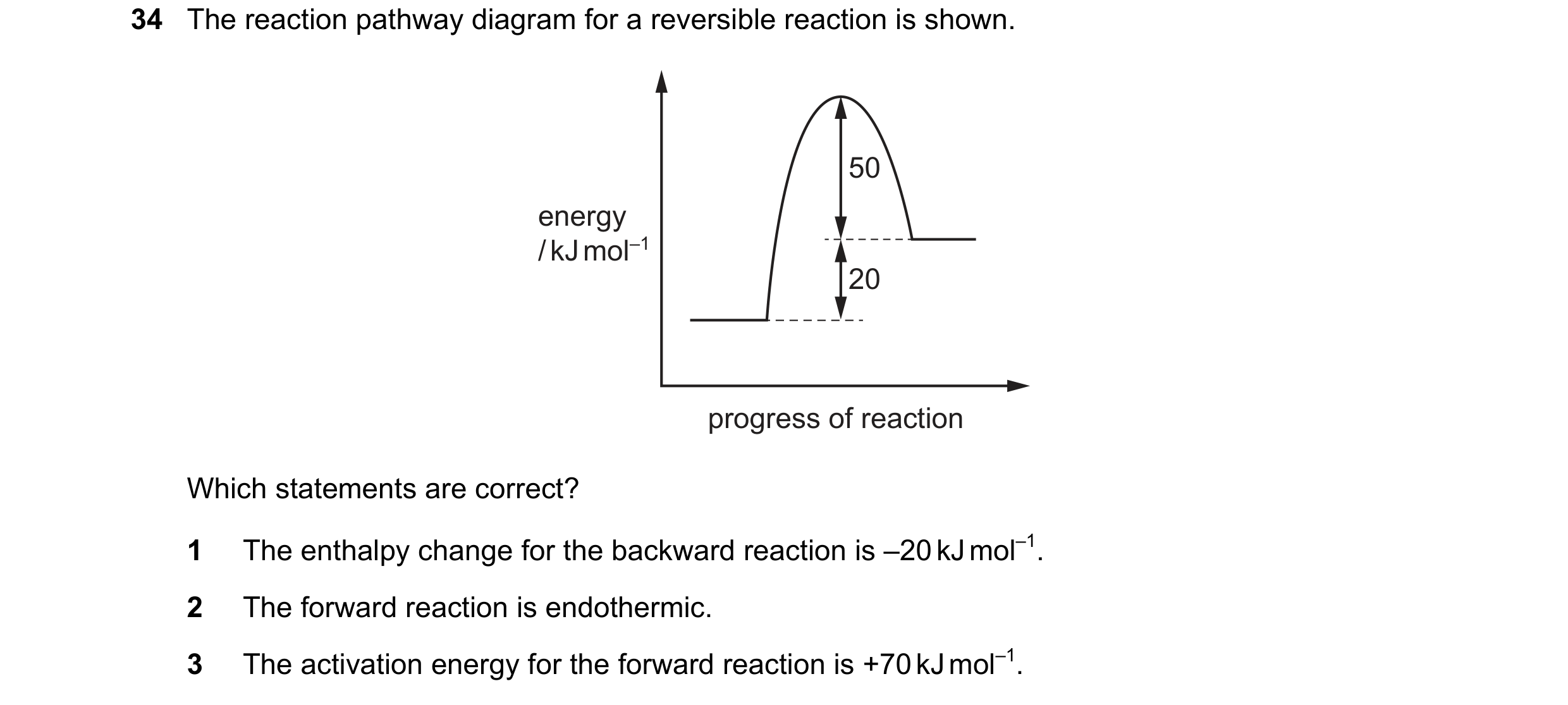 41 / 67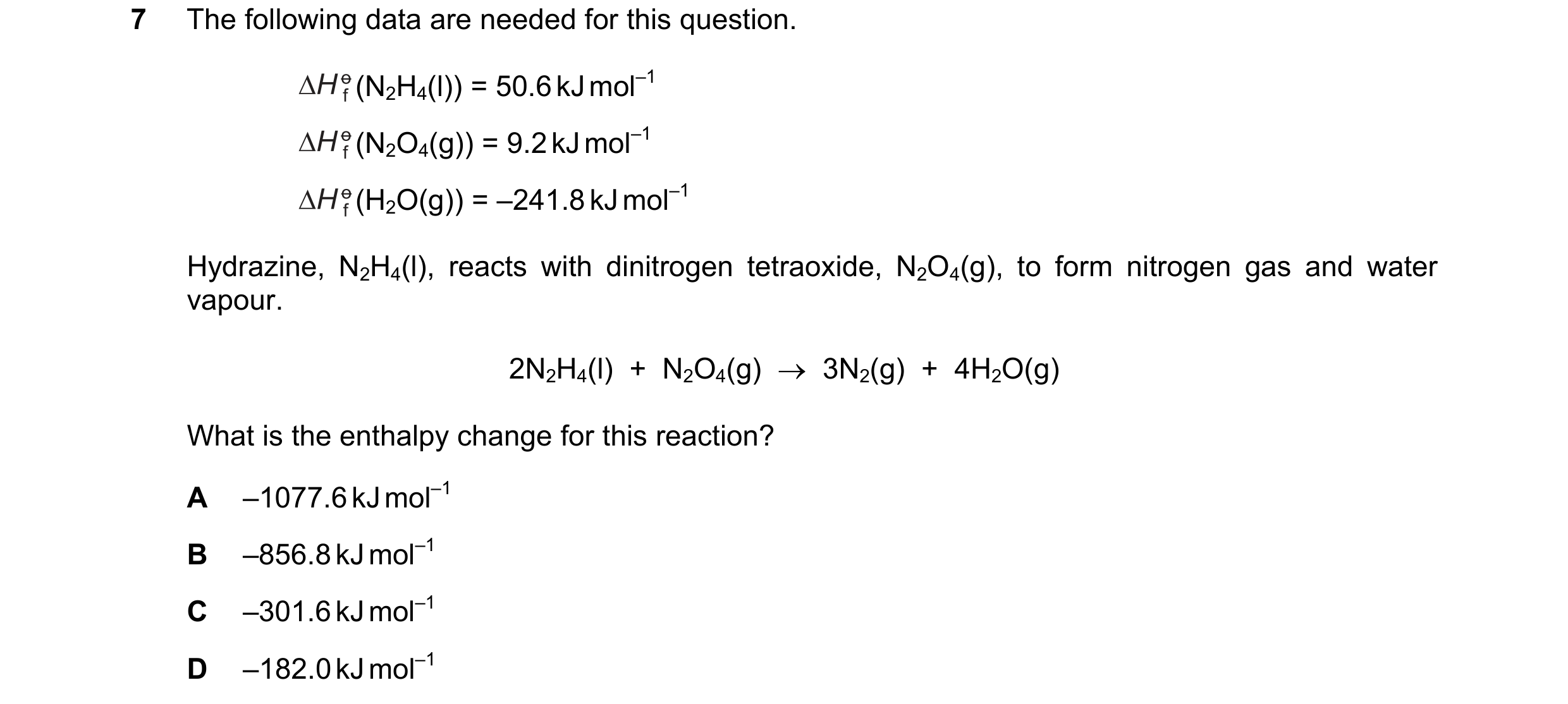
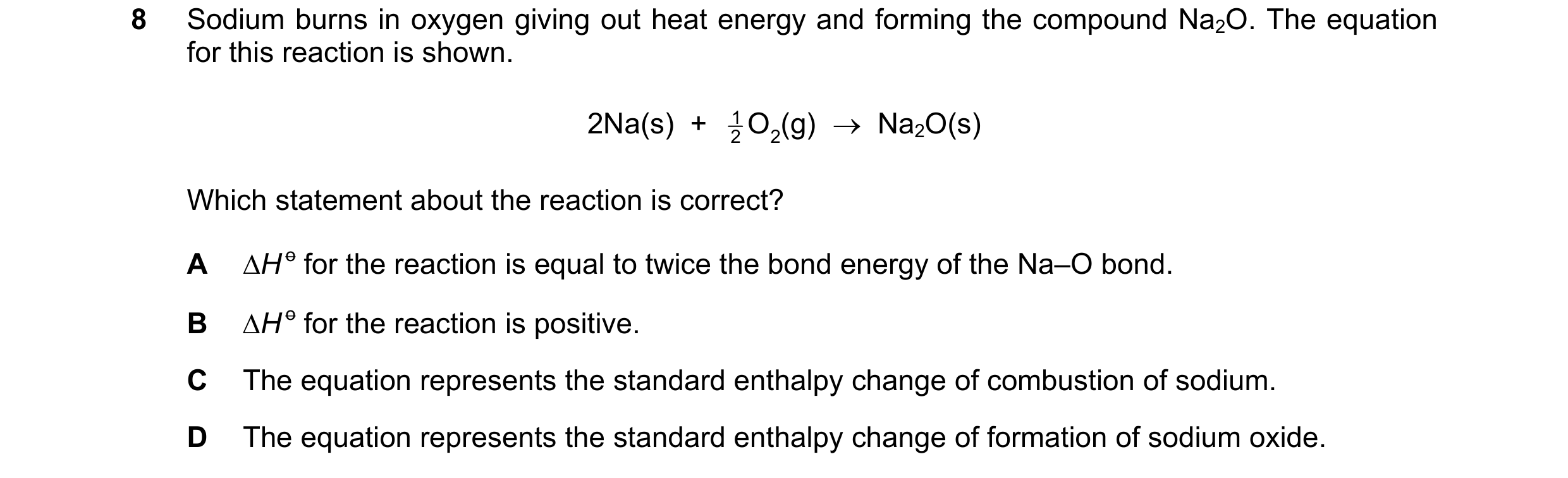
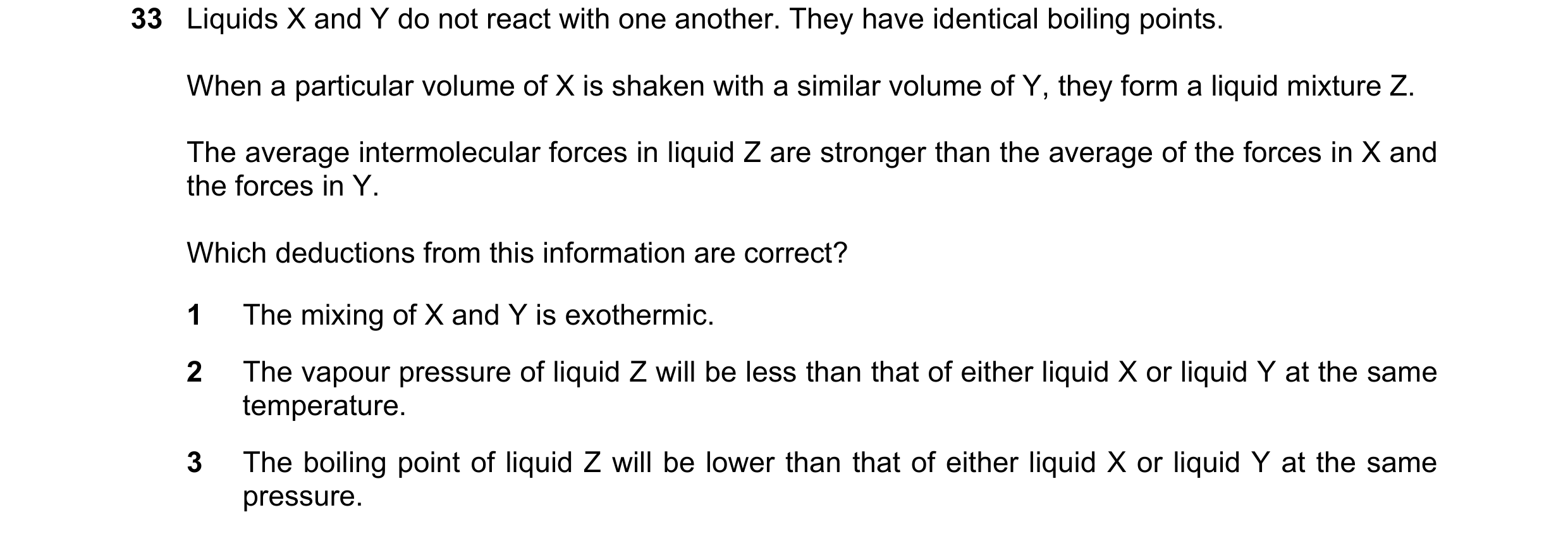
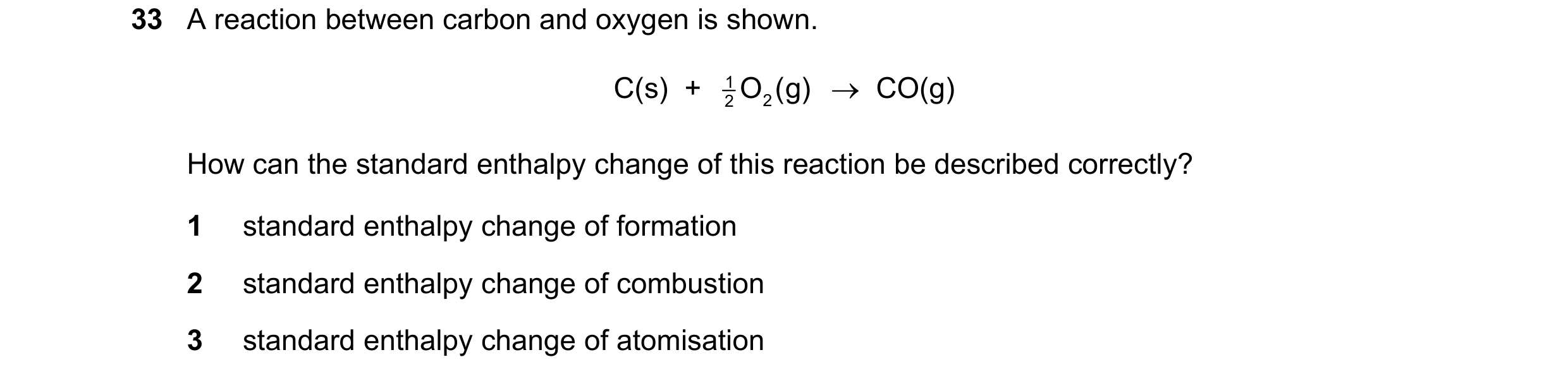 42 / 67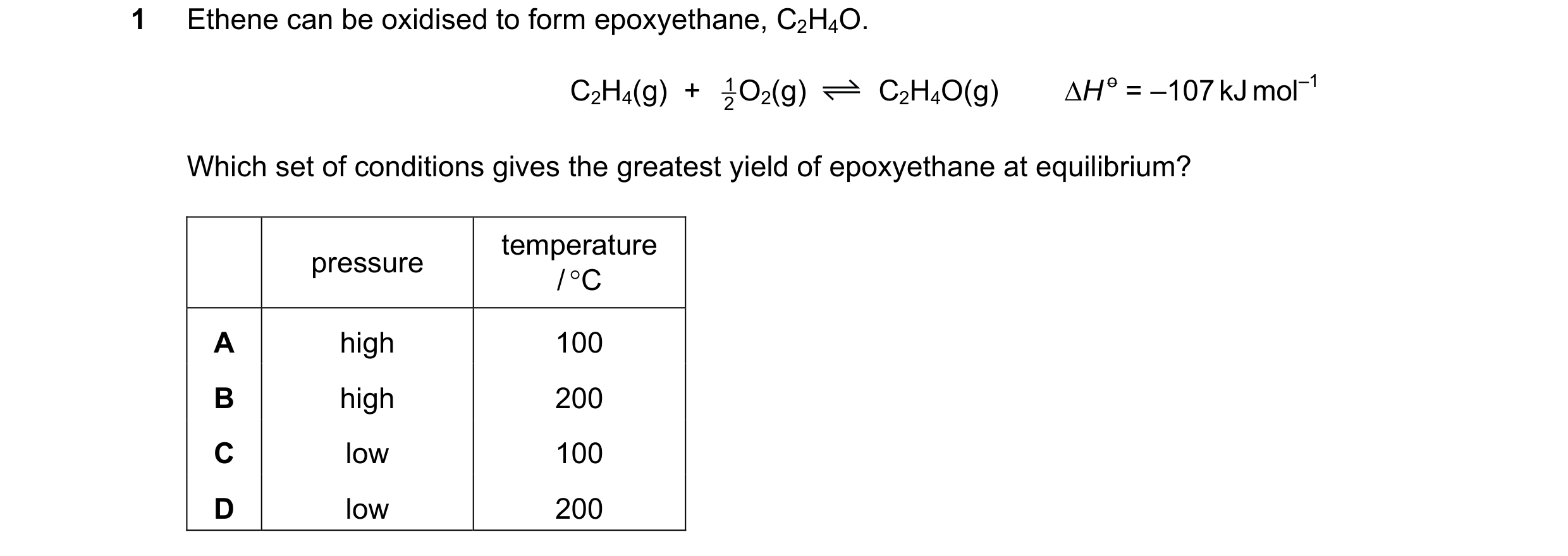
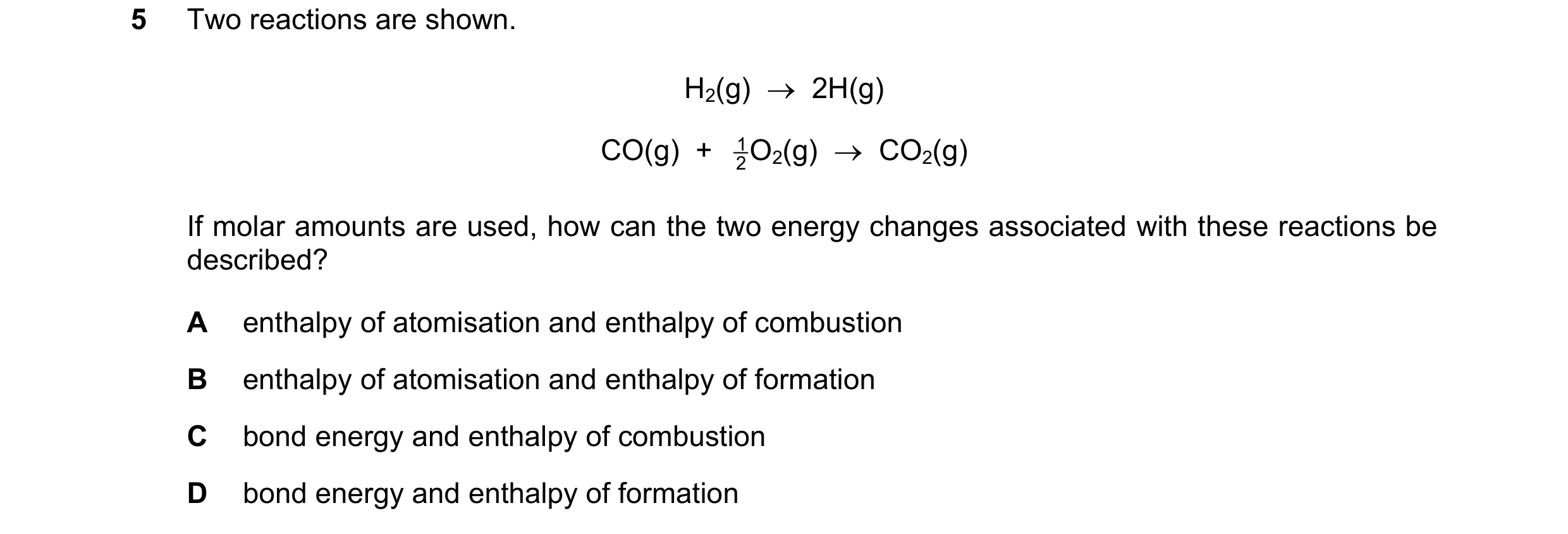

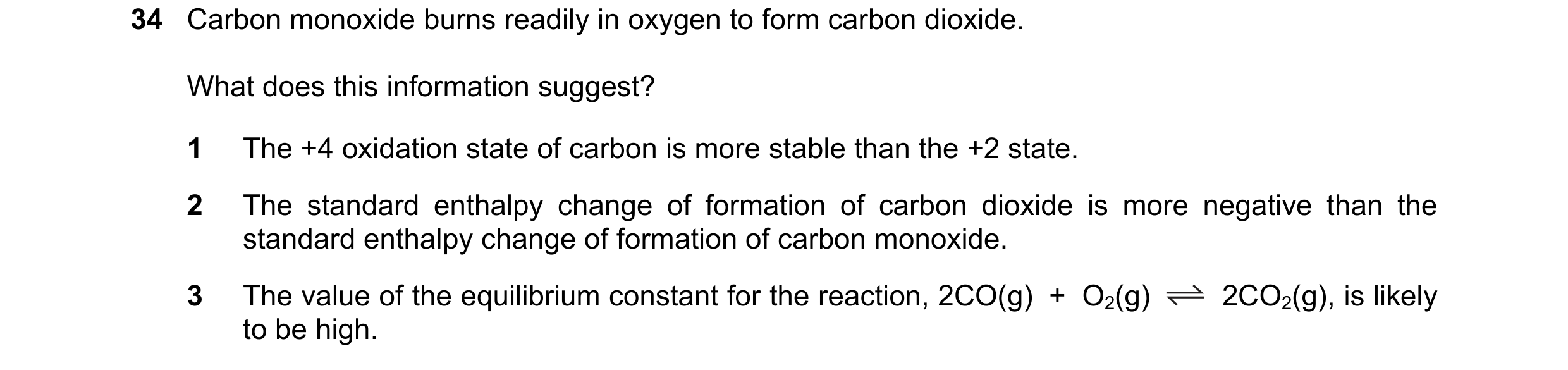 43 / 67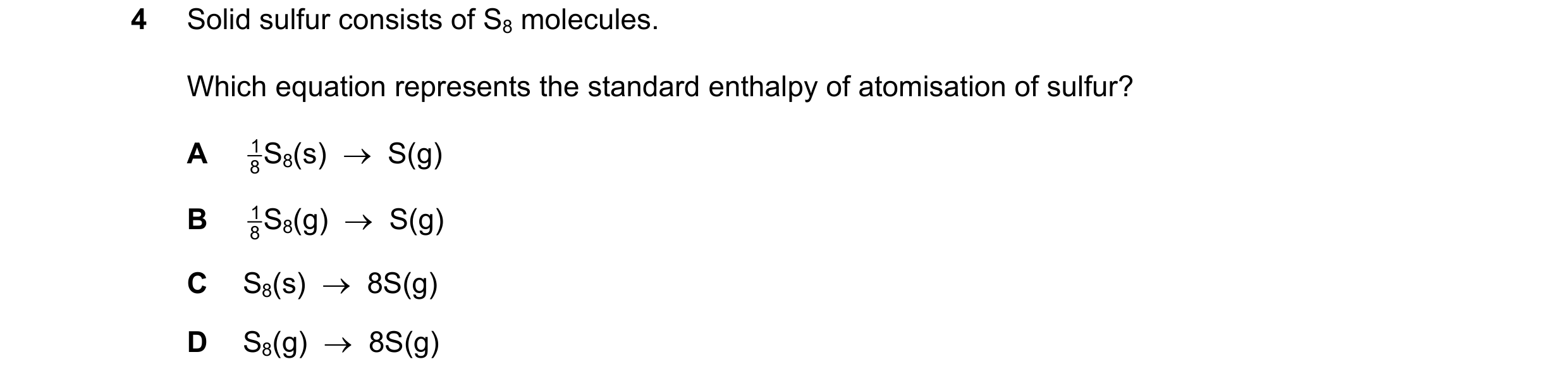
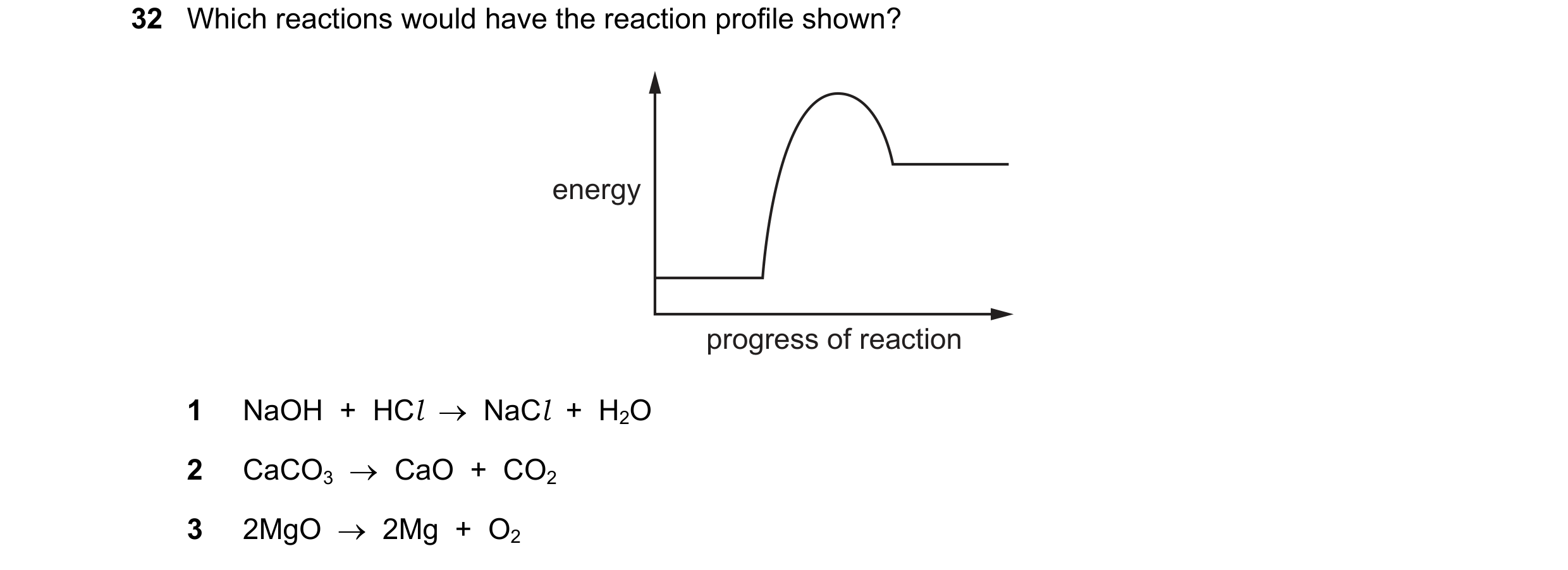
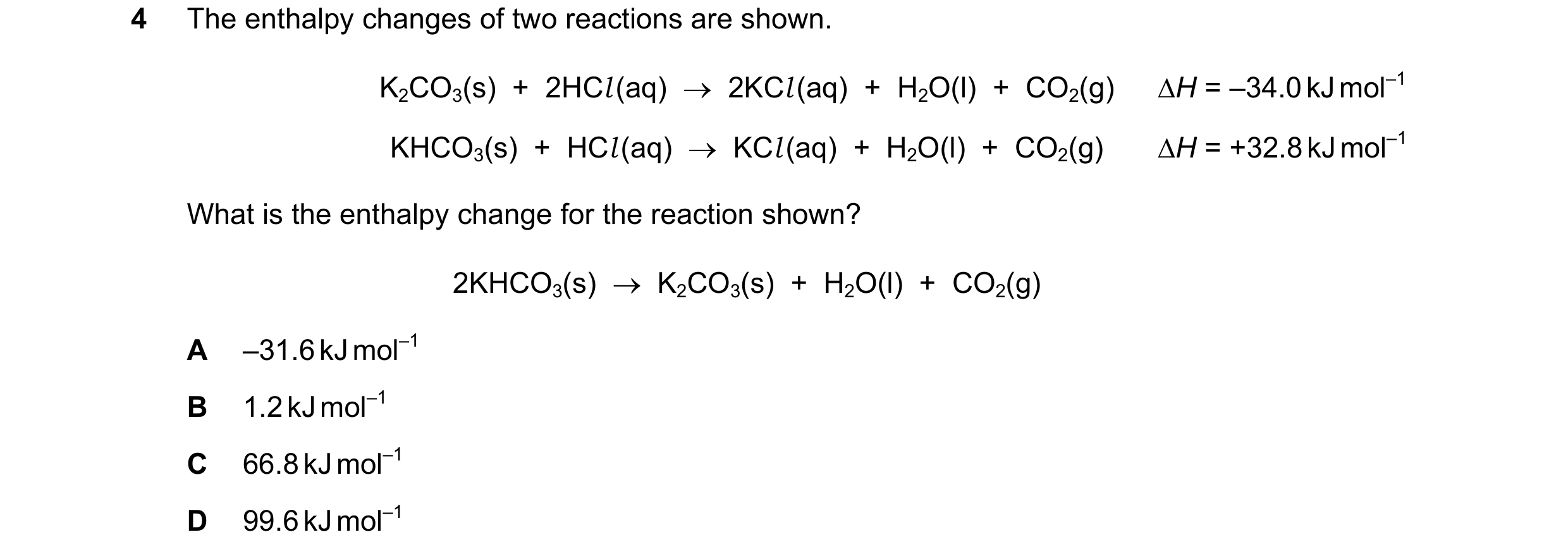
 44 / 67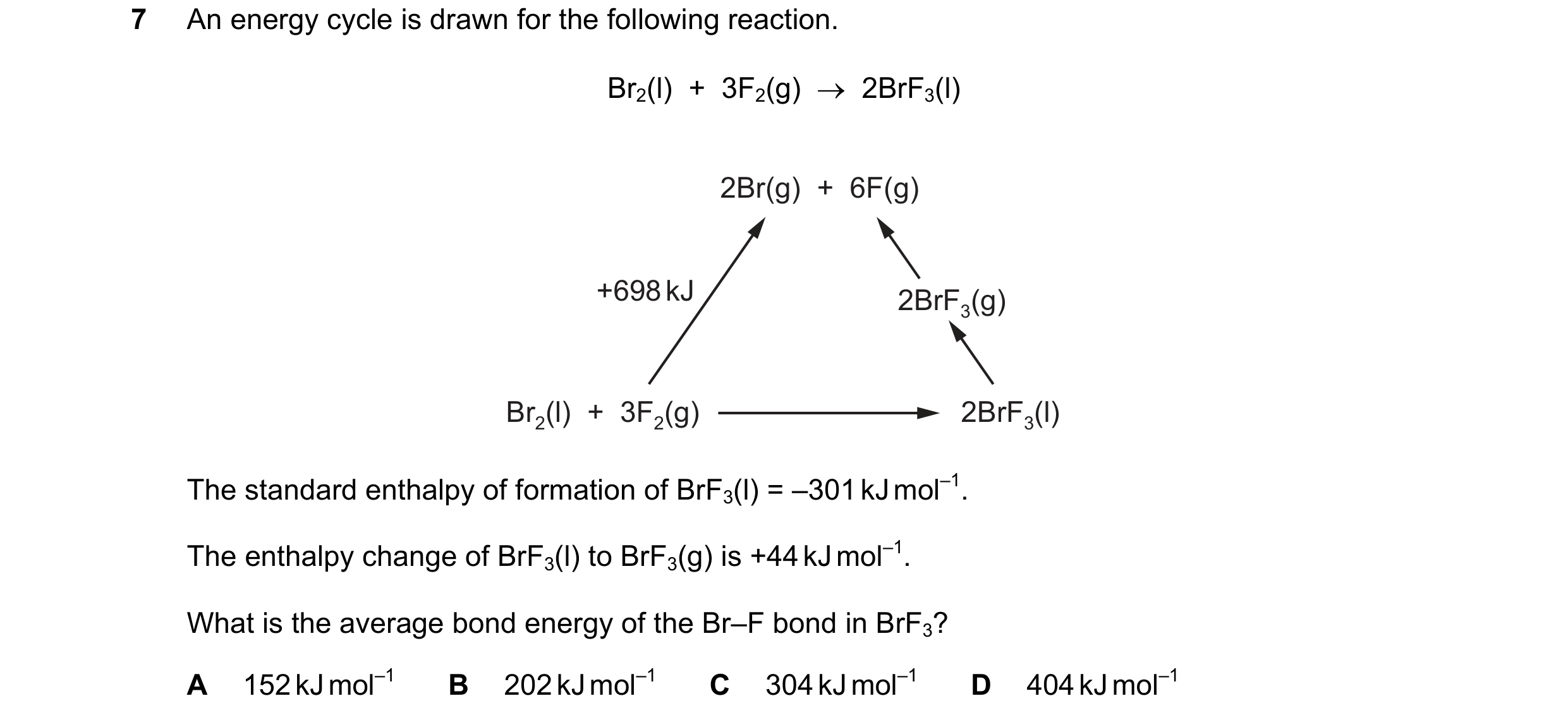
![Question 159: Nitrogen forms a number of oxides. Their enthalpies of formation are given. [NO(g)] = +90 kJ mol–1 [N2O(g)] = +82 kJ mol–1 [NO2(g)] = +33 k…](https://img.pastlit.com/crops/d557025c-59a9-447a-9c12-f004d99155f1/q31.png)
 45 / 67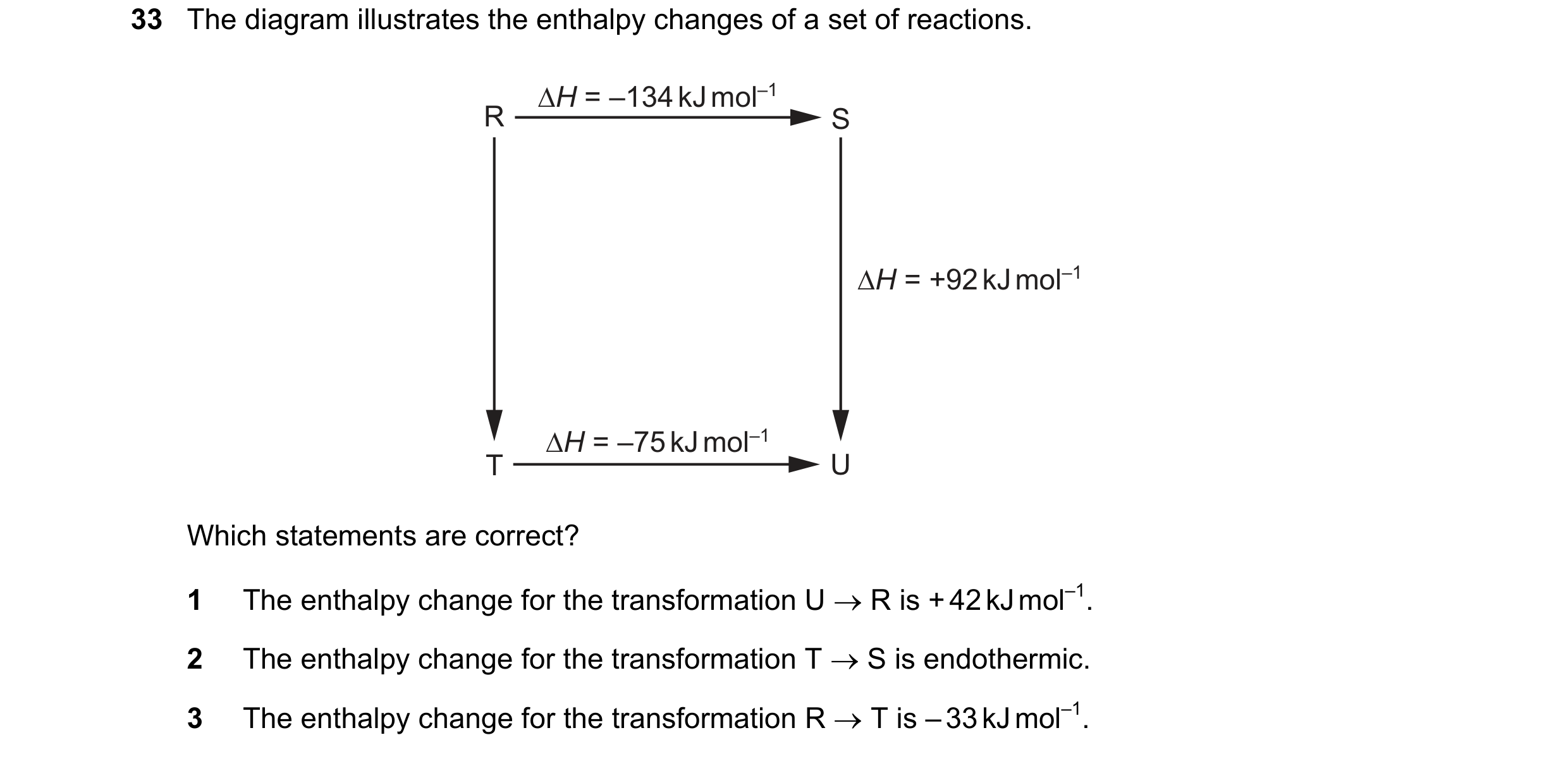

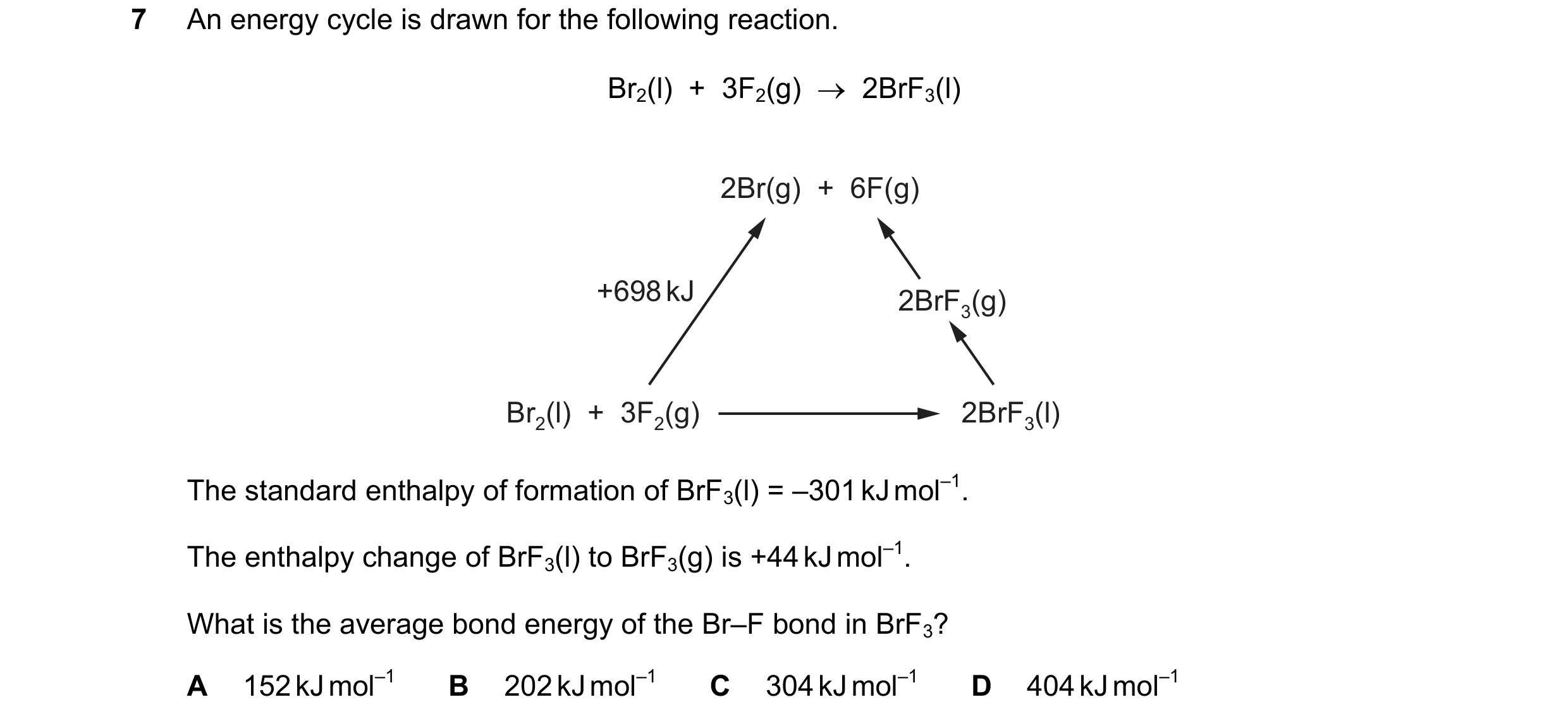 46 / 67
![Question 164: Nitrogen forms a number of oxides. Their enthalpies of formation are given. [NO(g)] = +90 kJ mol–1 [N2O(g)] = +82 kJ mol–1 [NO2(g)] = +33 k…](https://img.pastlit.com/crops/1a6b7faf-29a3-45e6-8a4f-170464a7f20d/q31.png)

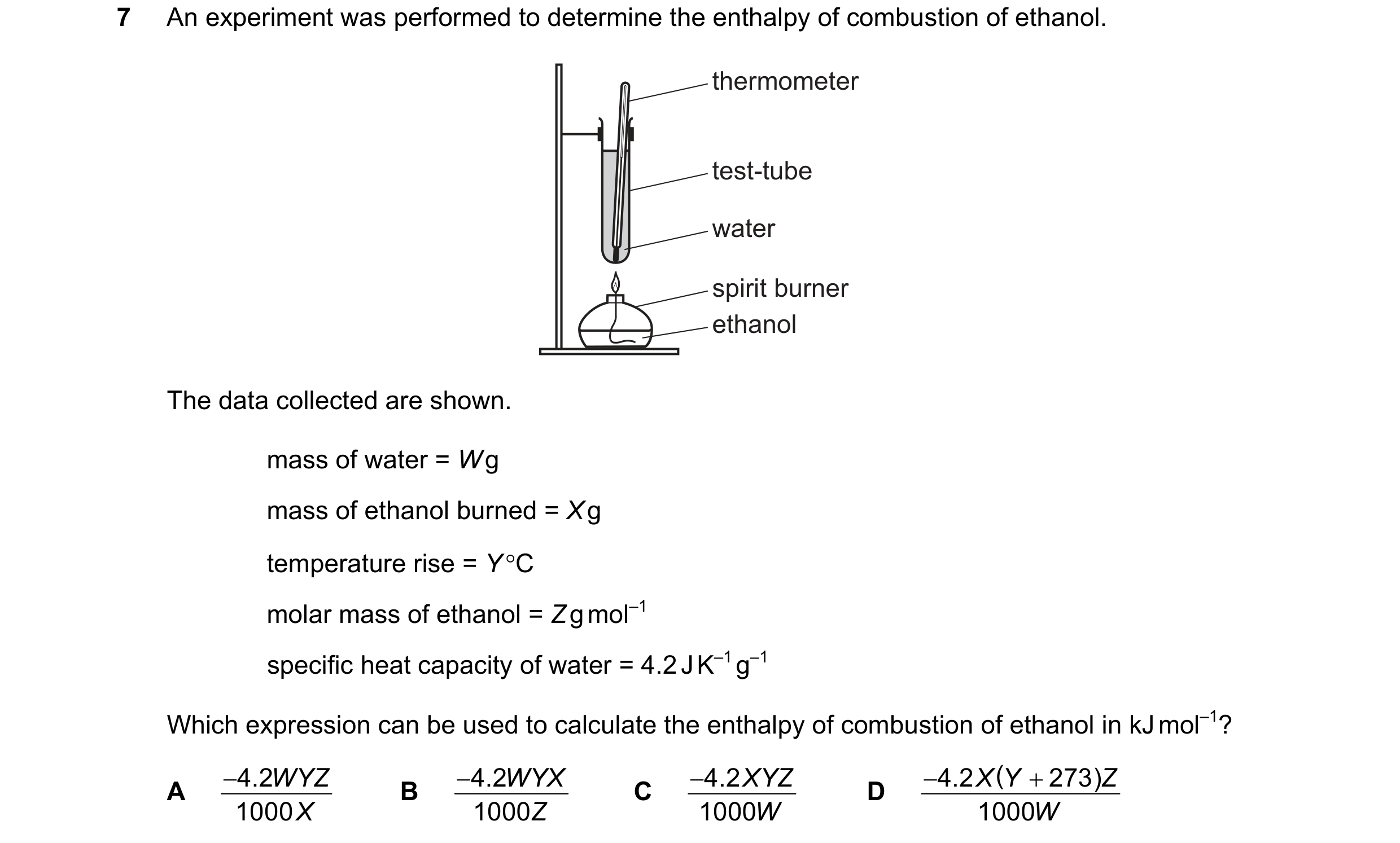 47 / 67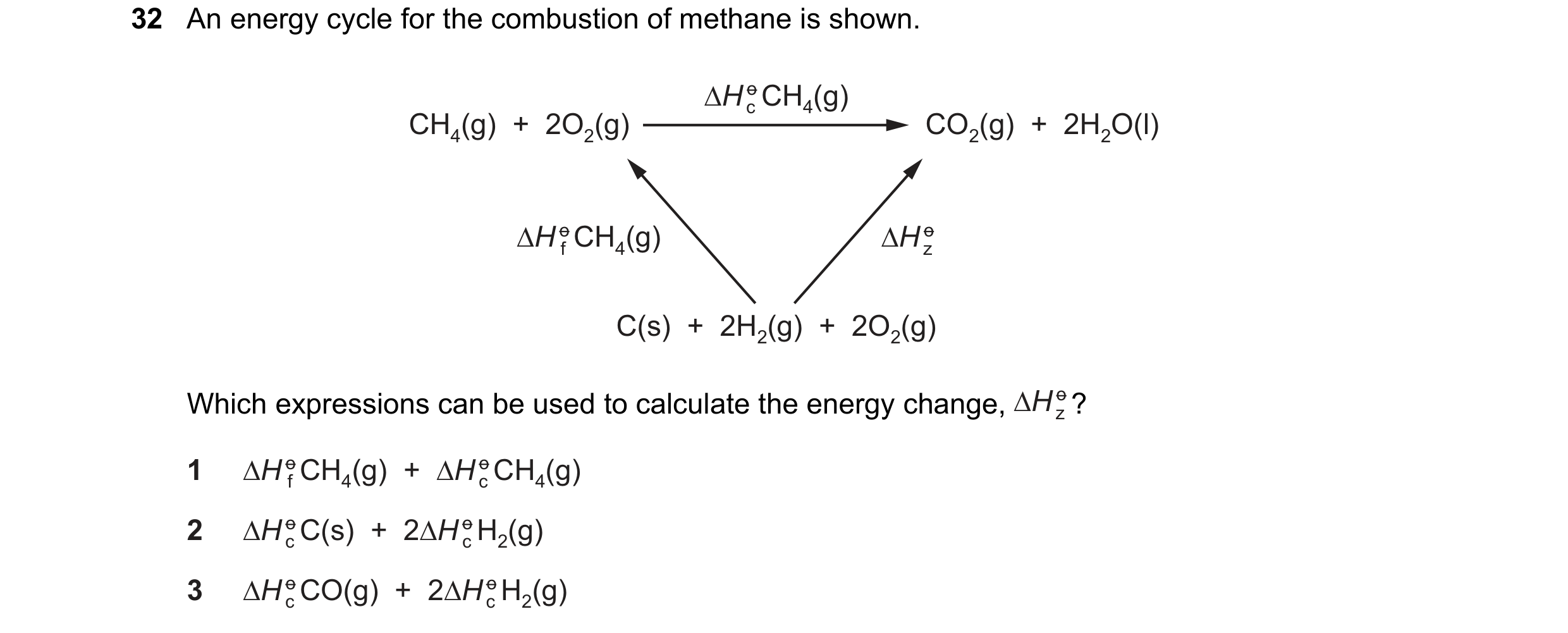
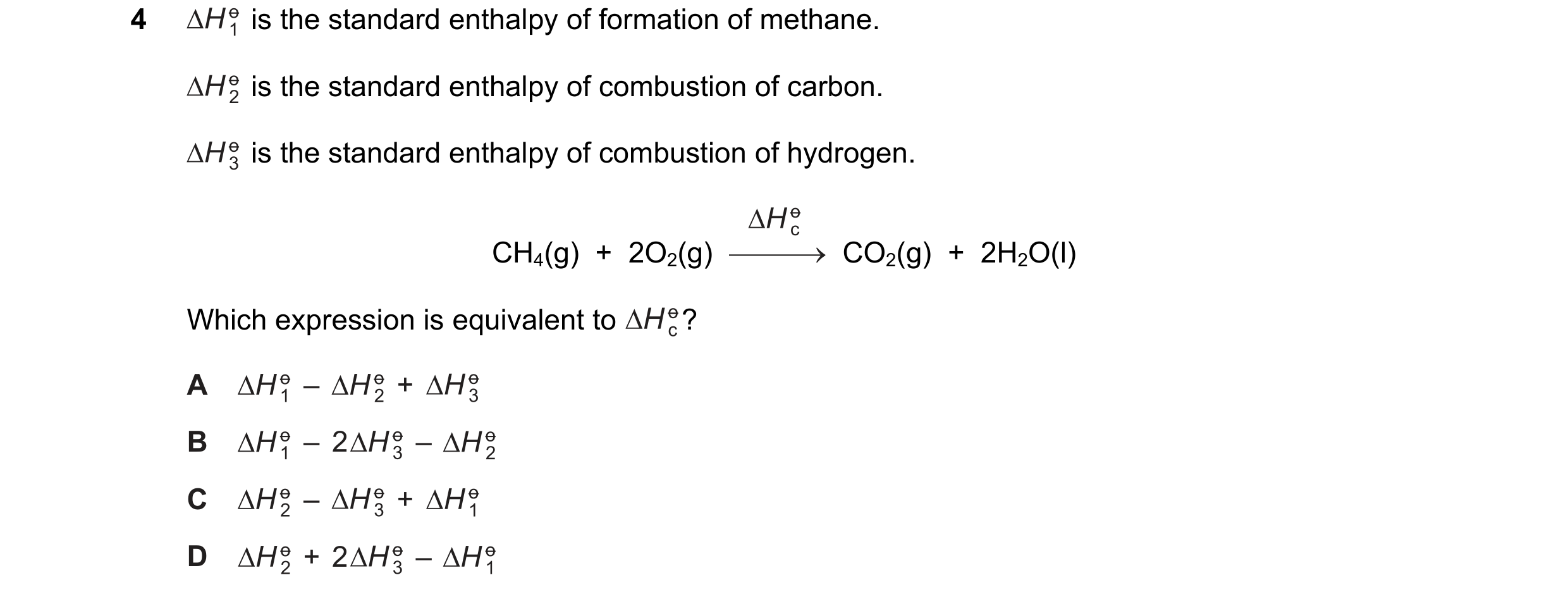
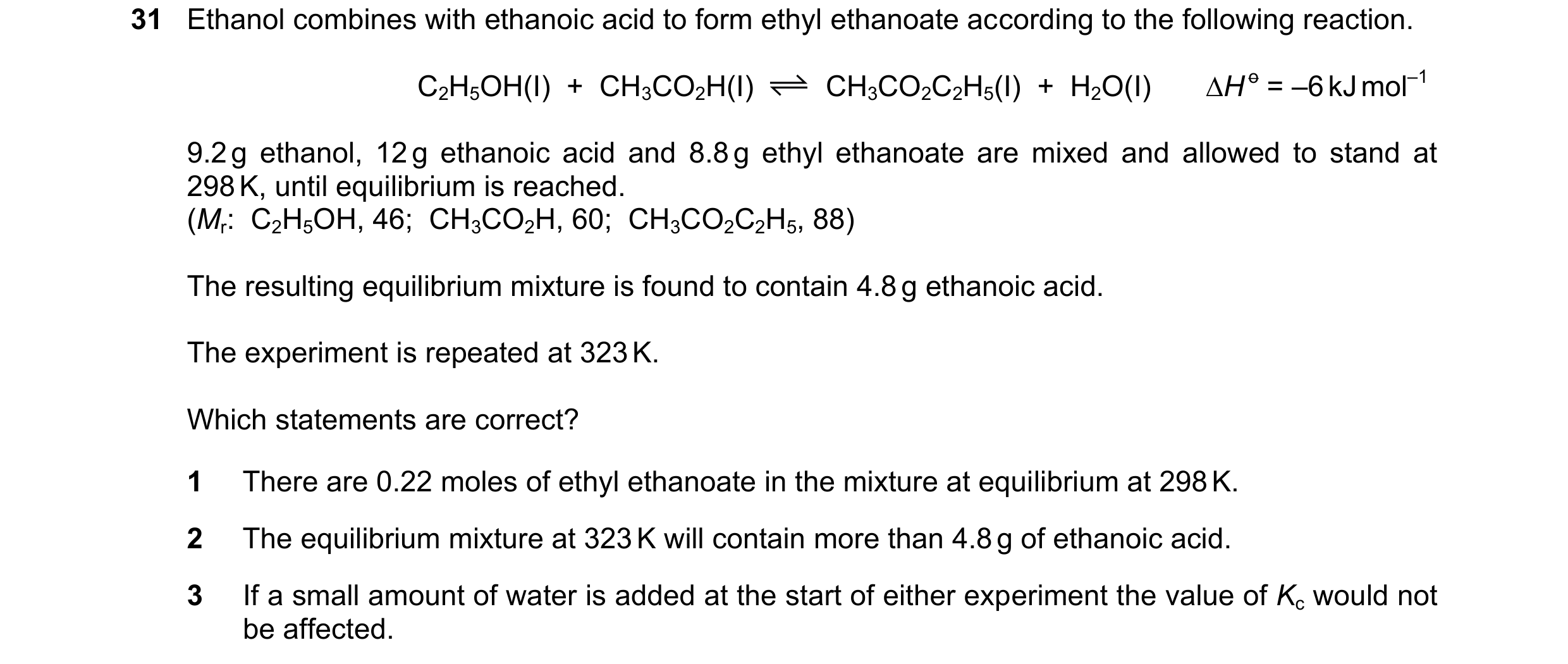 48 / 67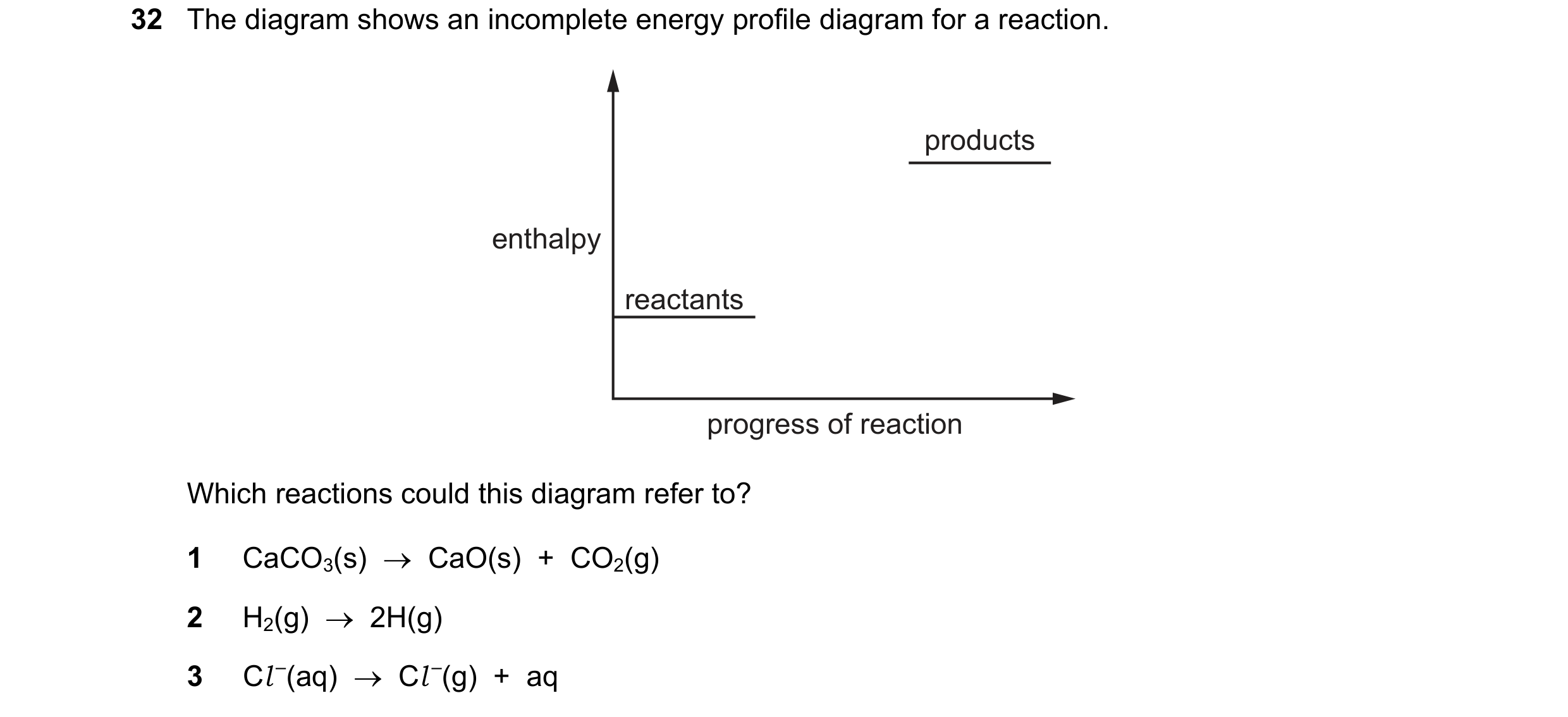

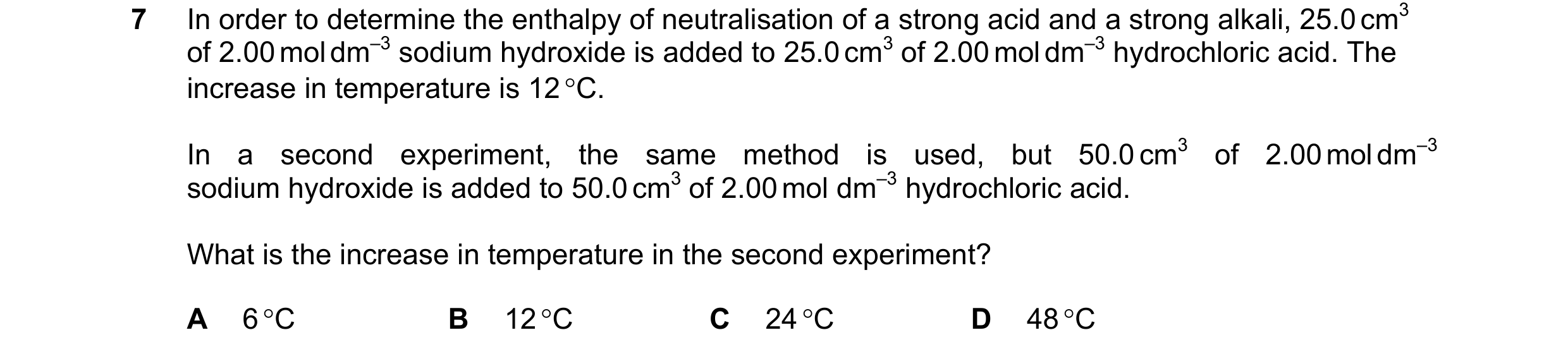
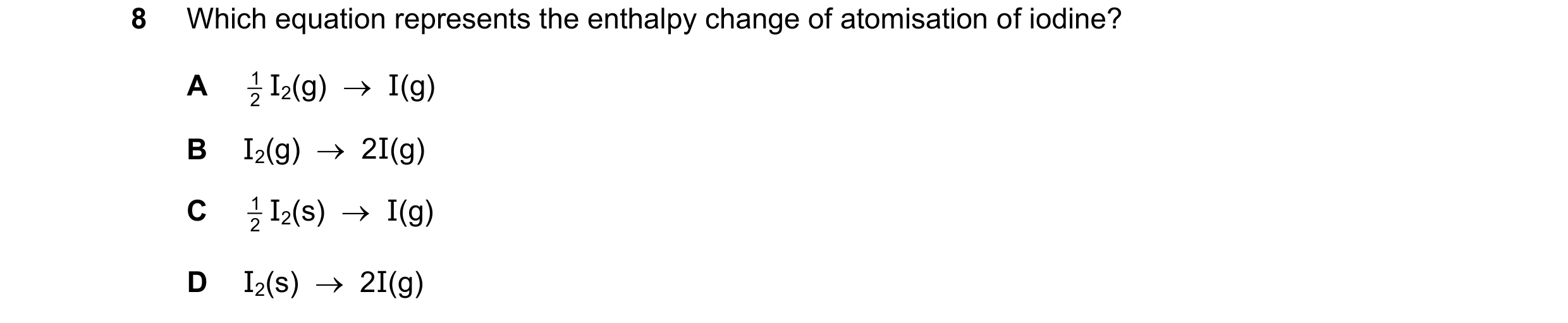 49 / 67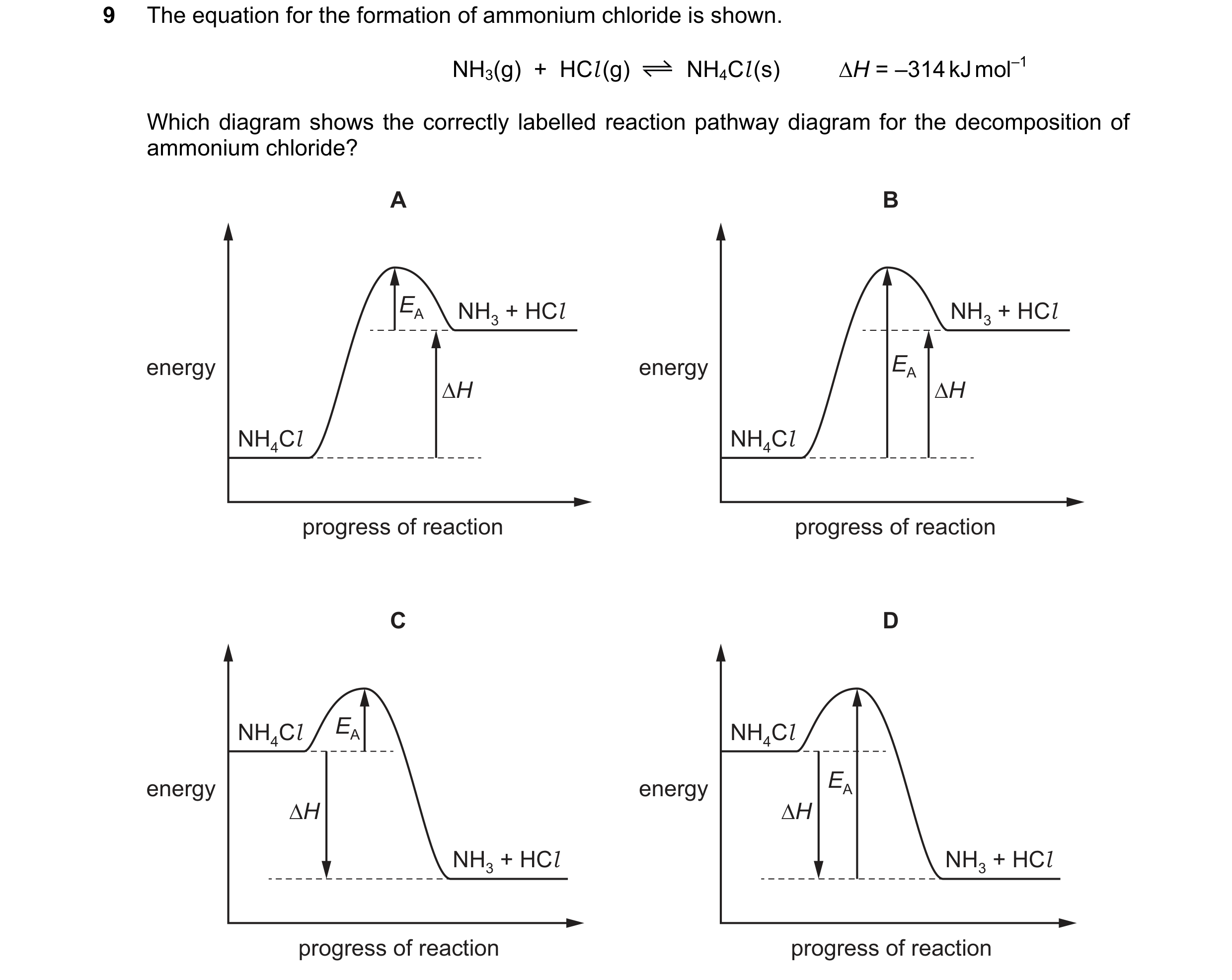

 50 / 67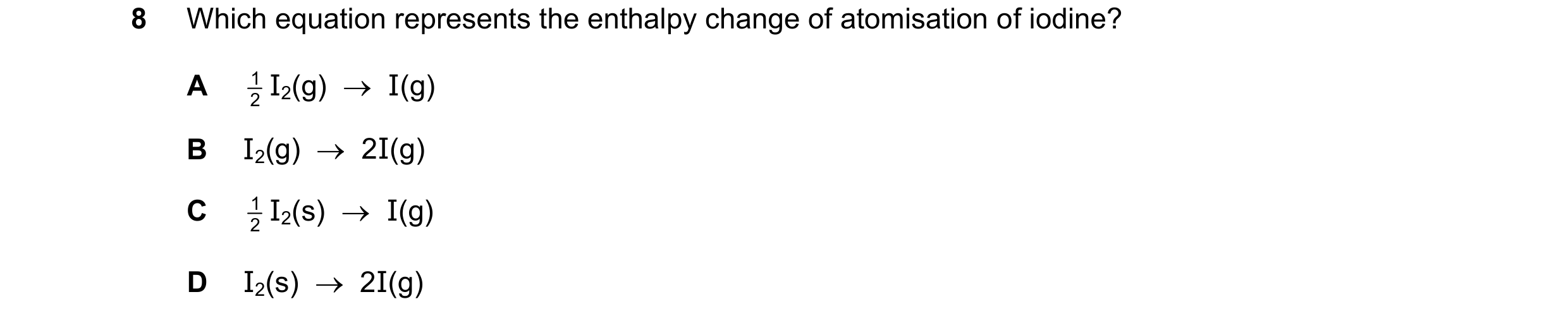
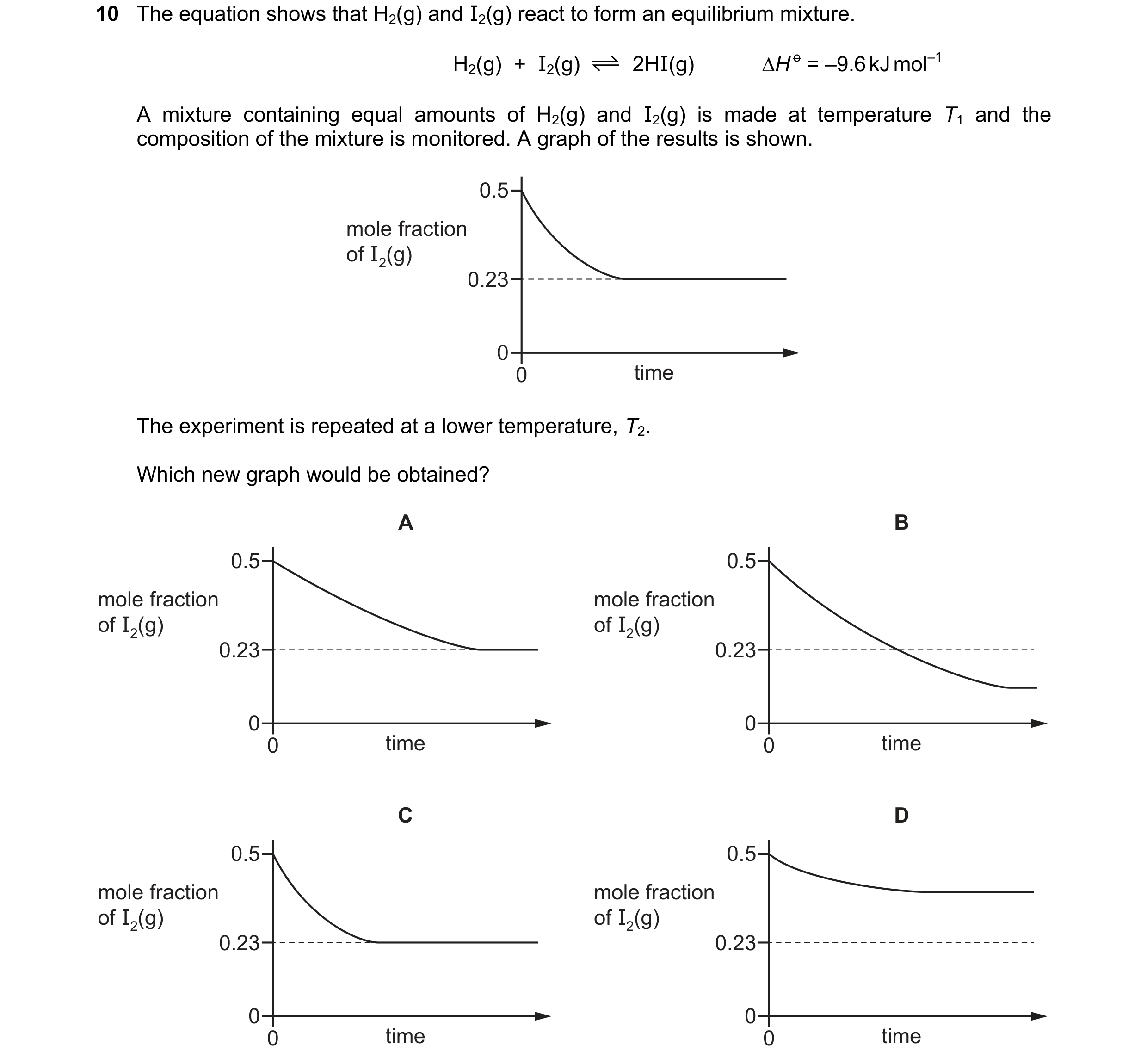 51 / 67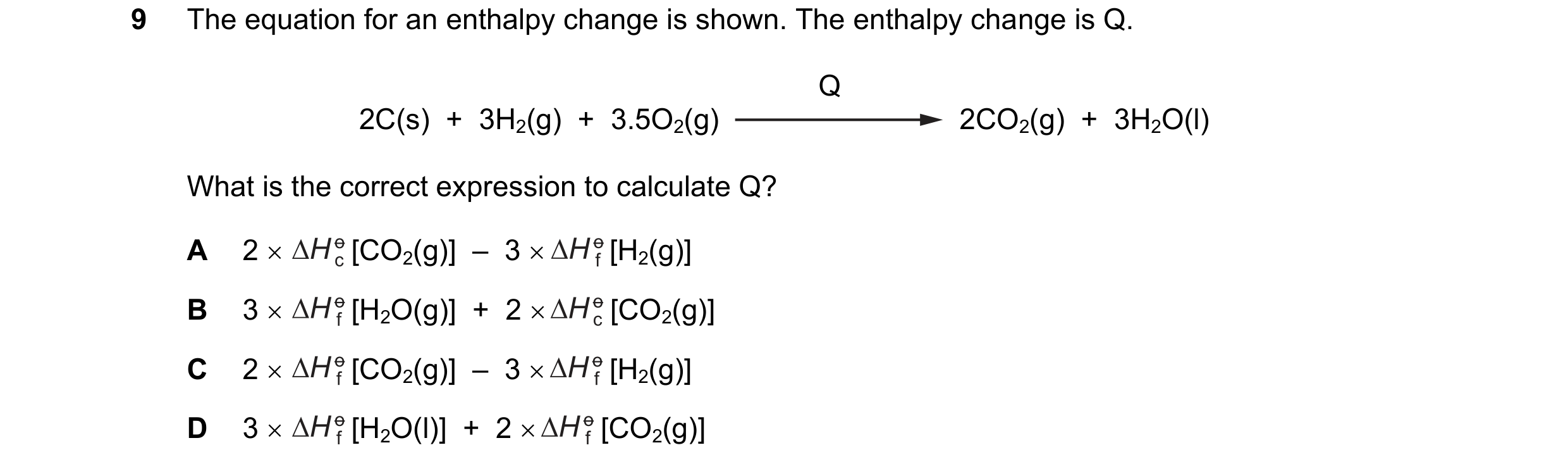
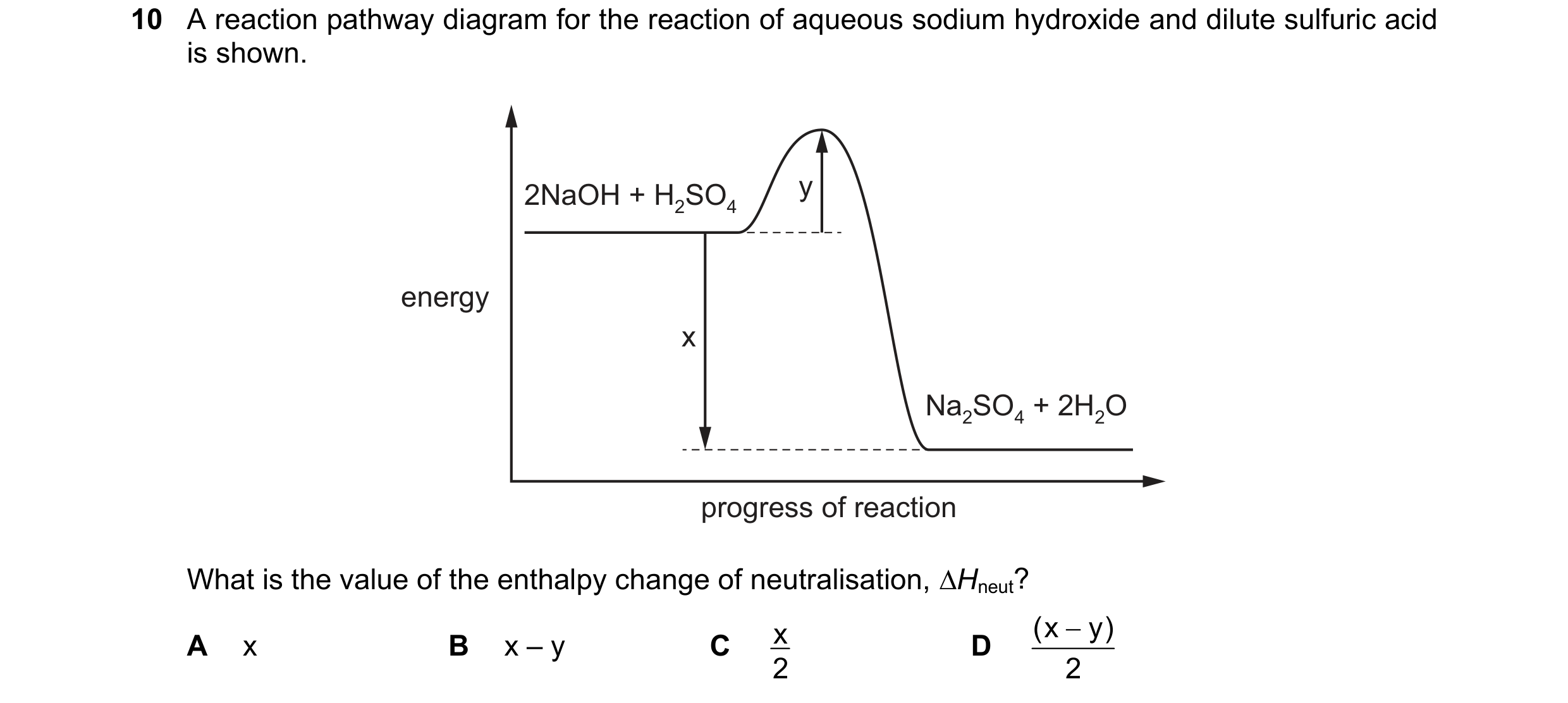
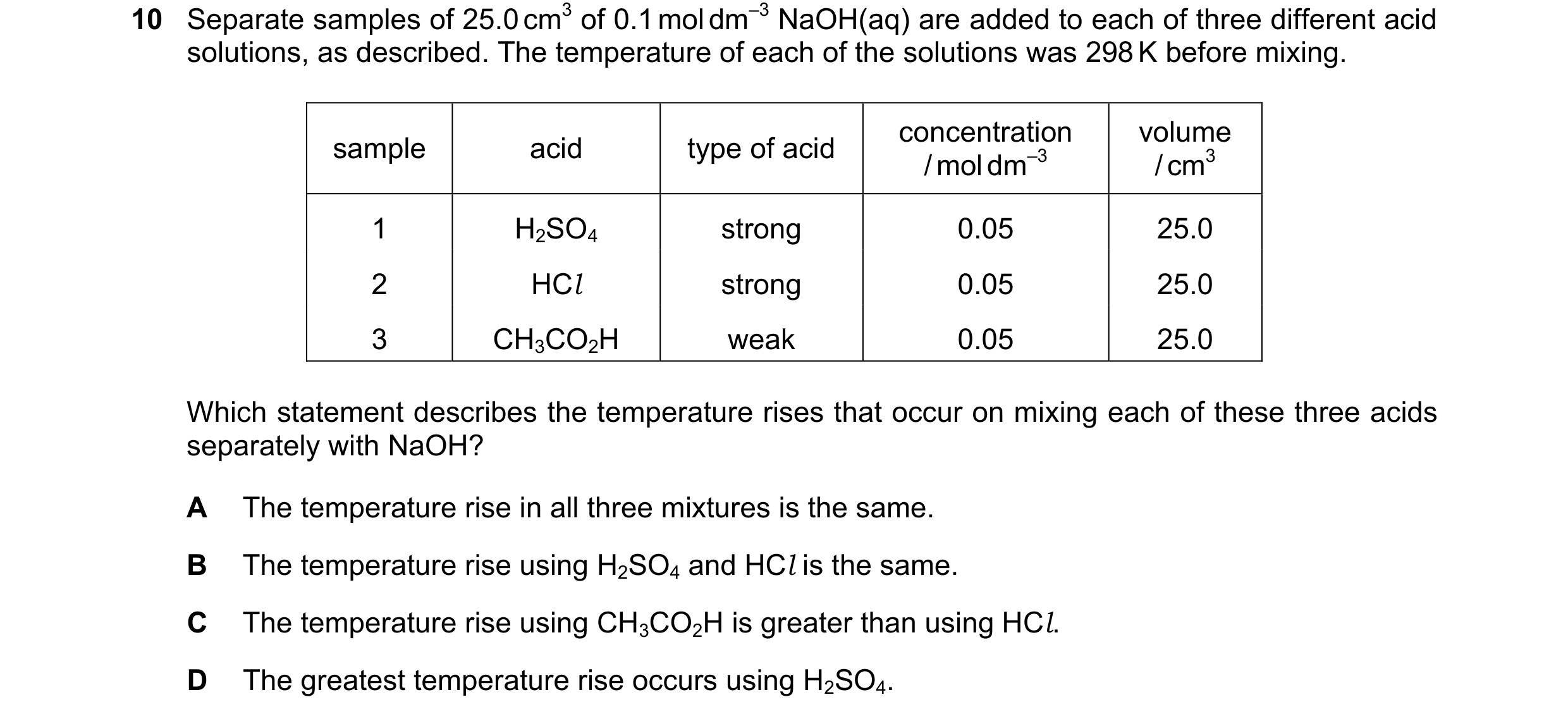 52 / 67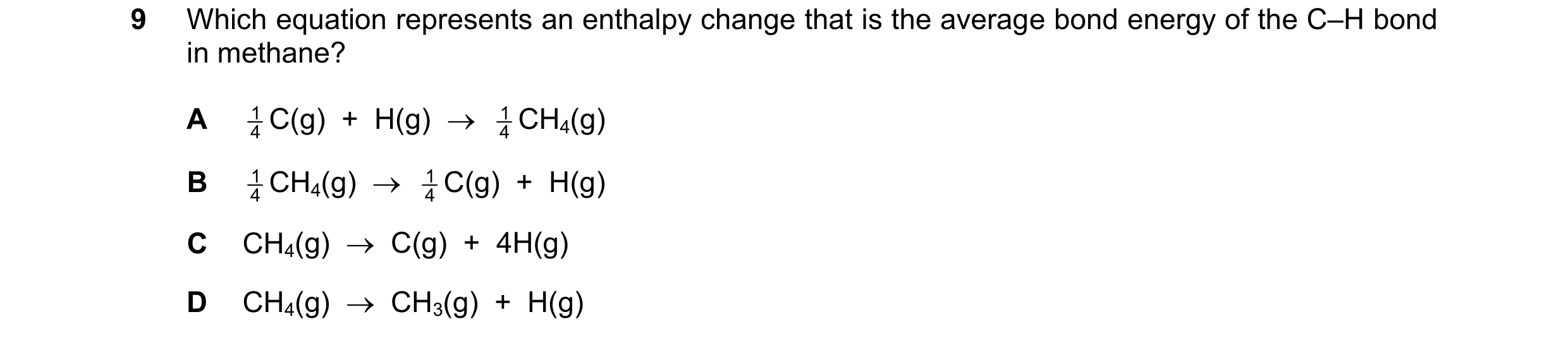
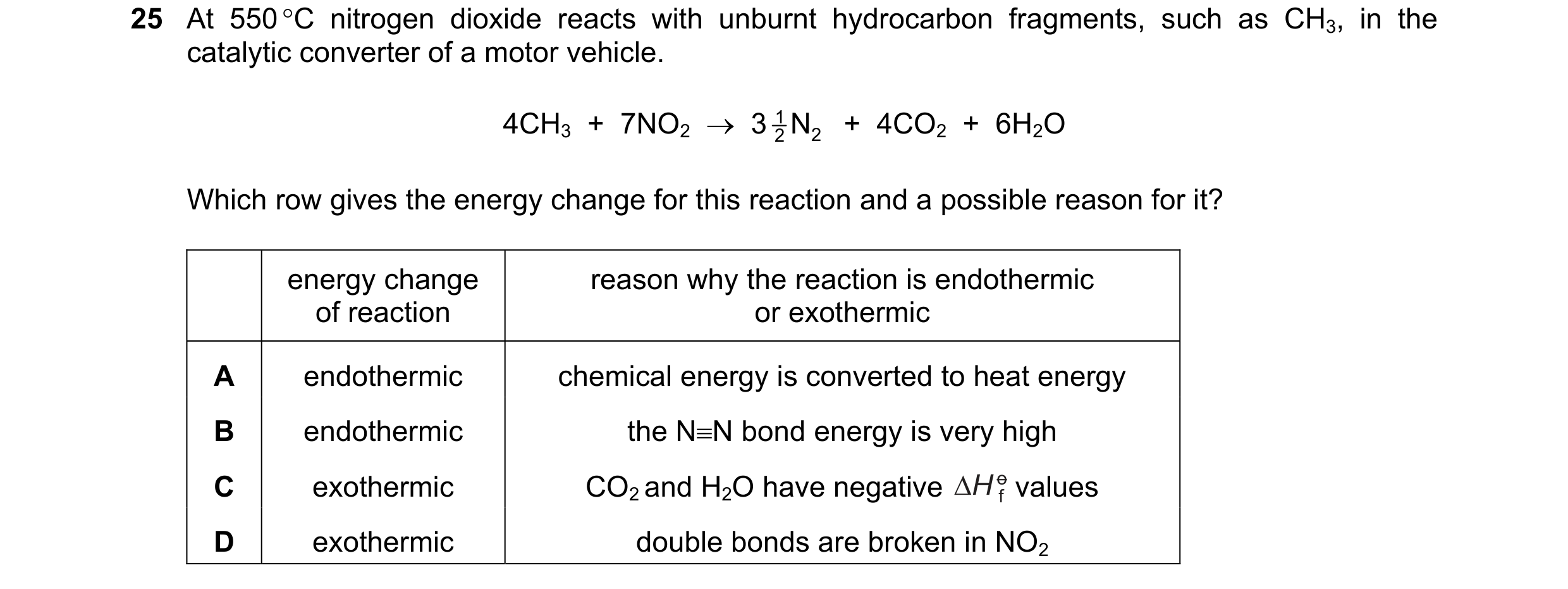
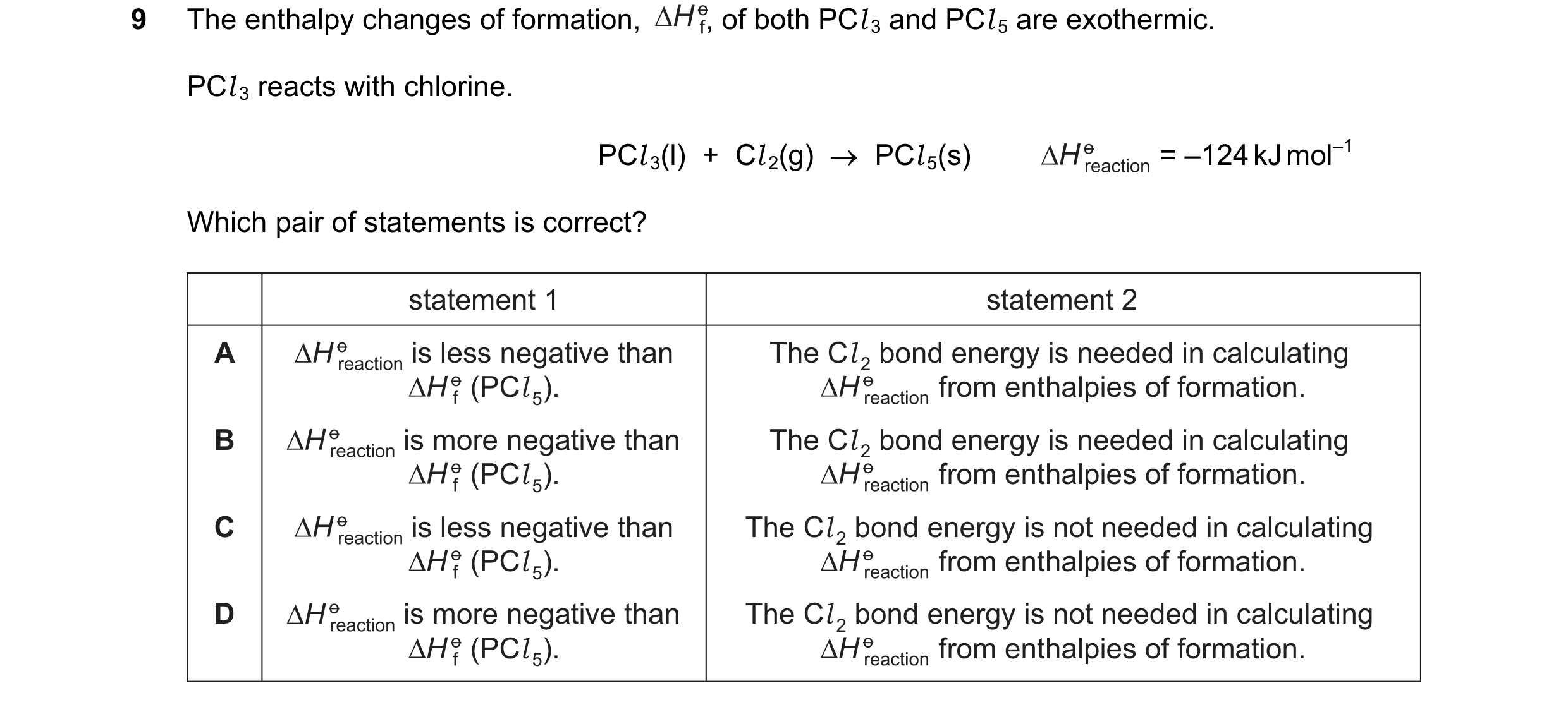 53 / 67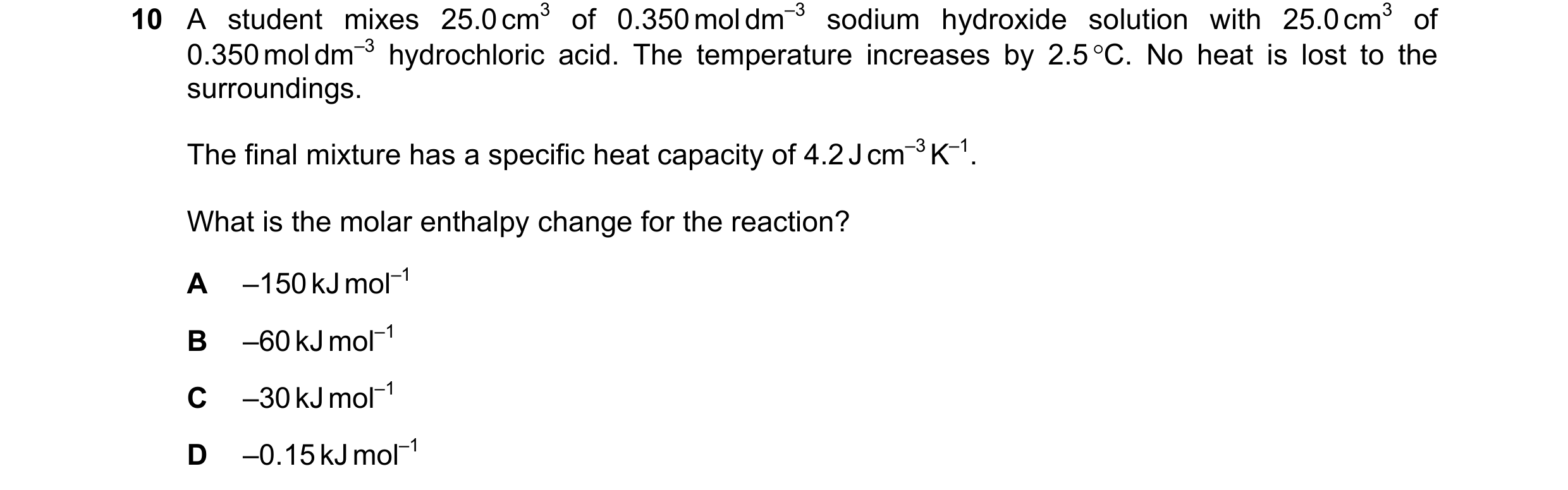
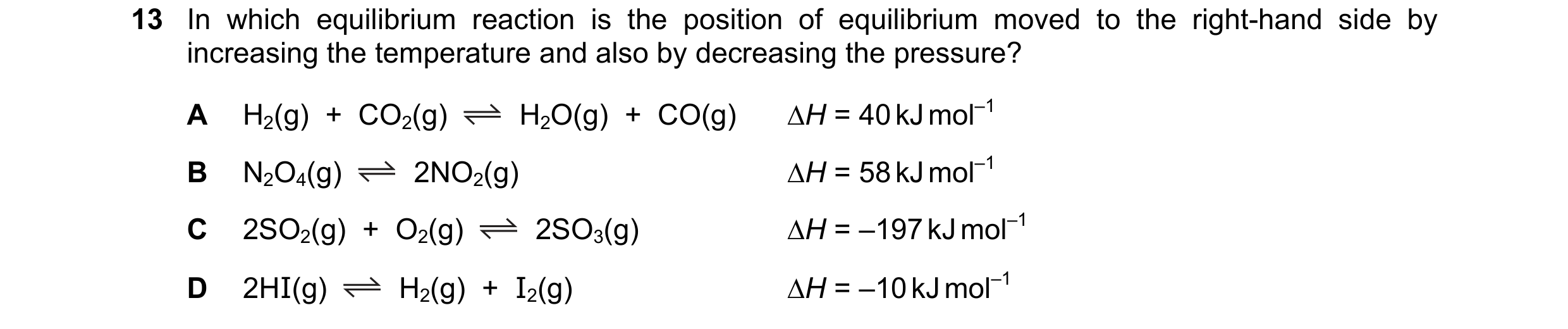
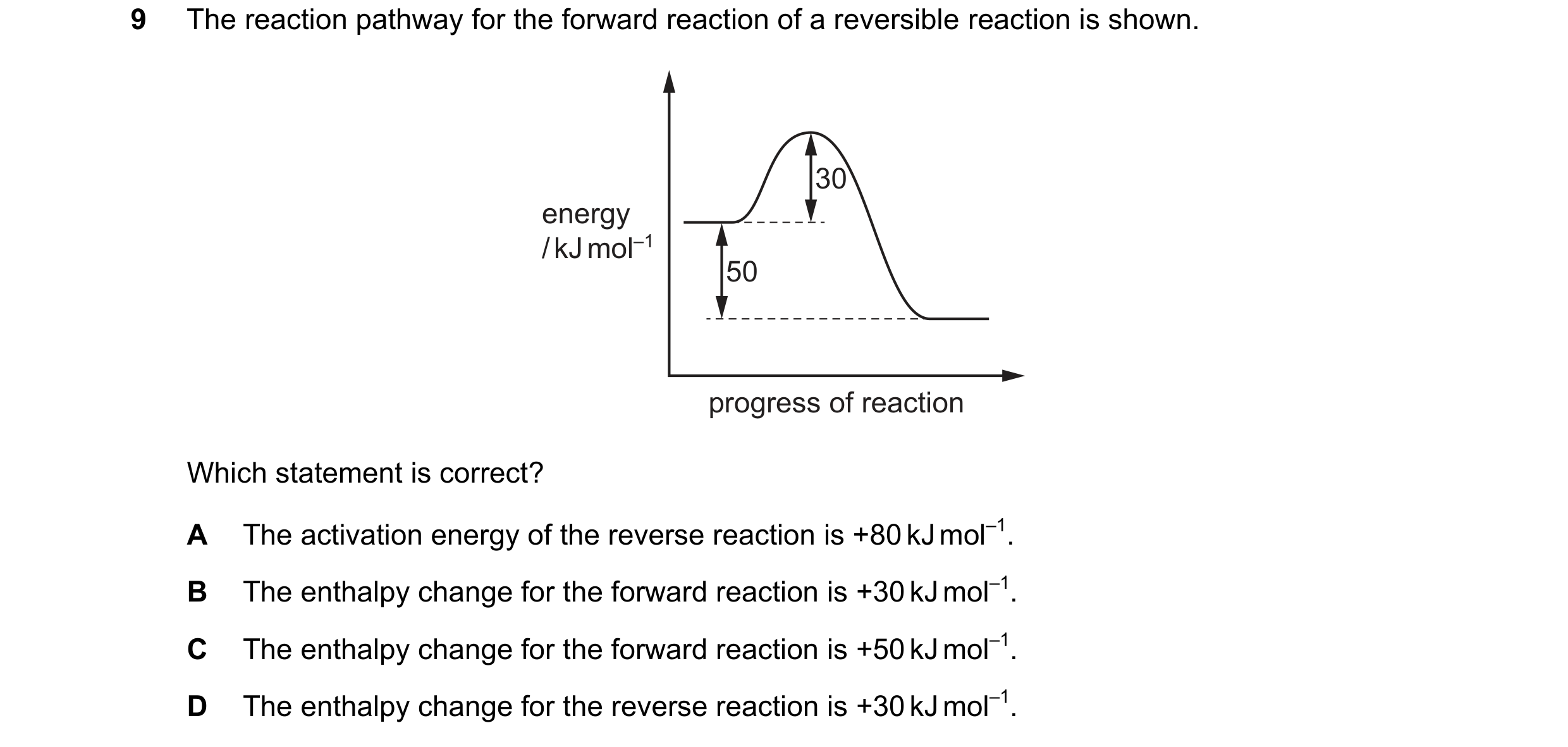 54 / 67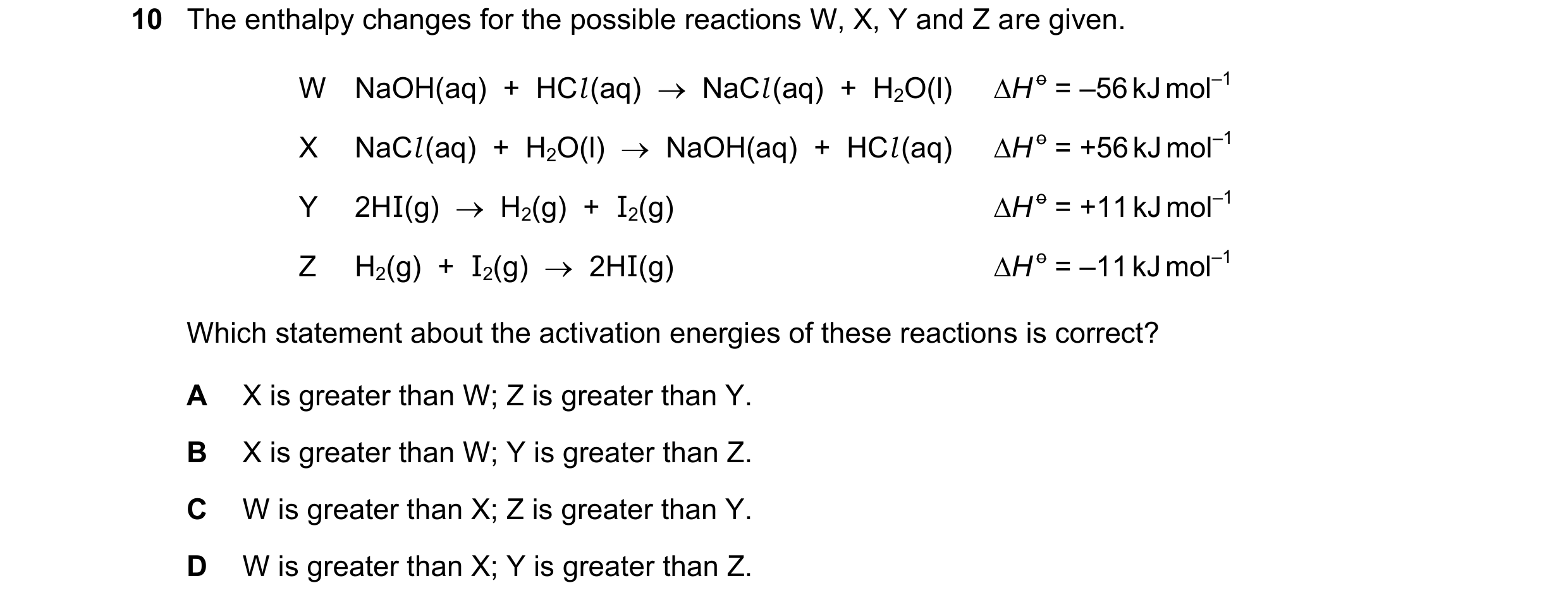
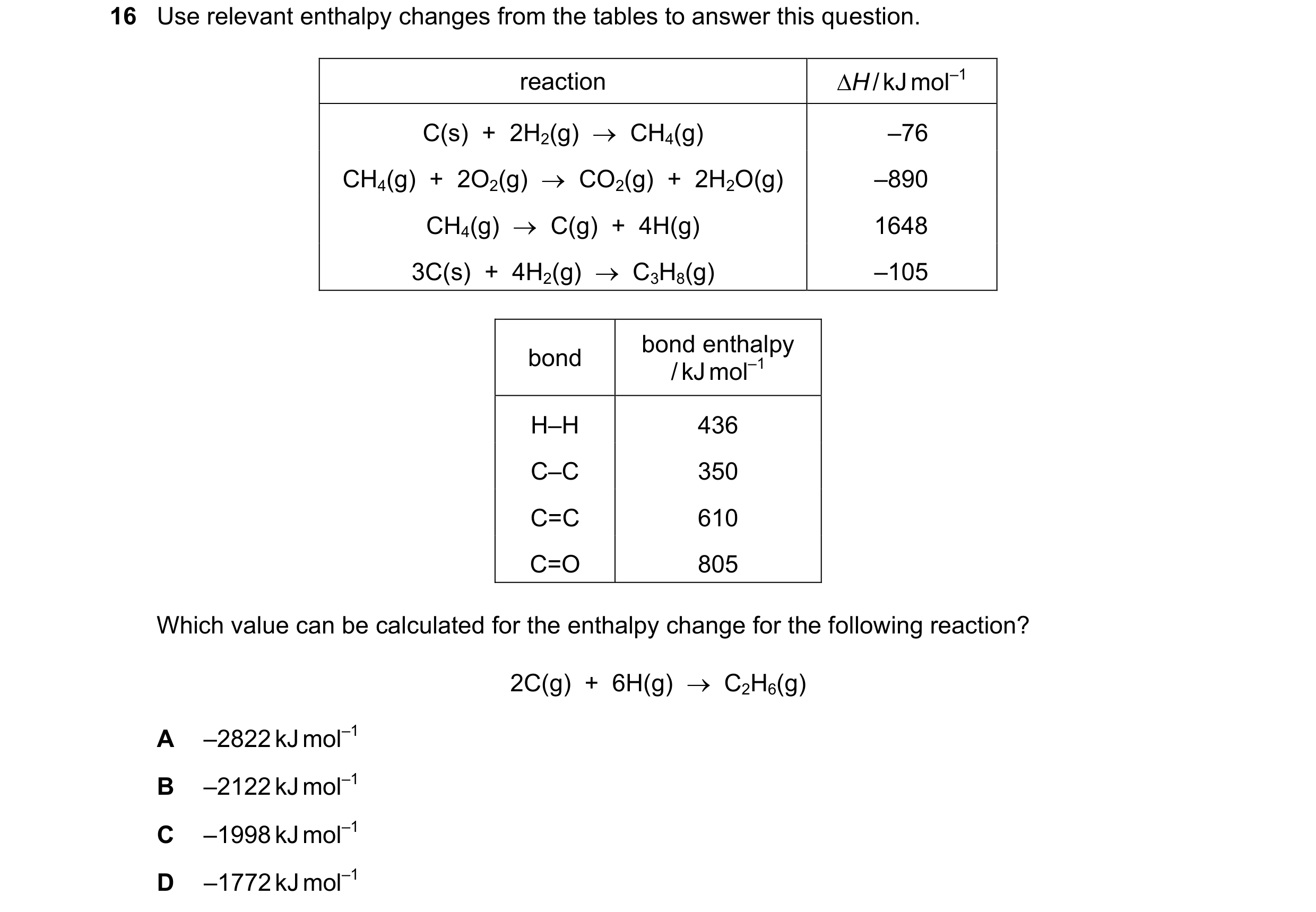 55 / 67
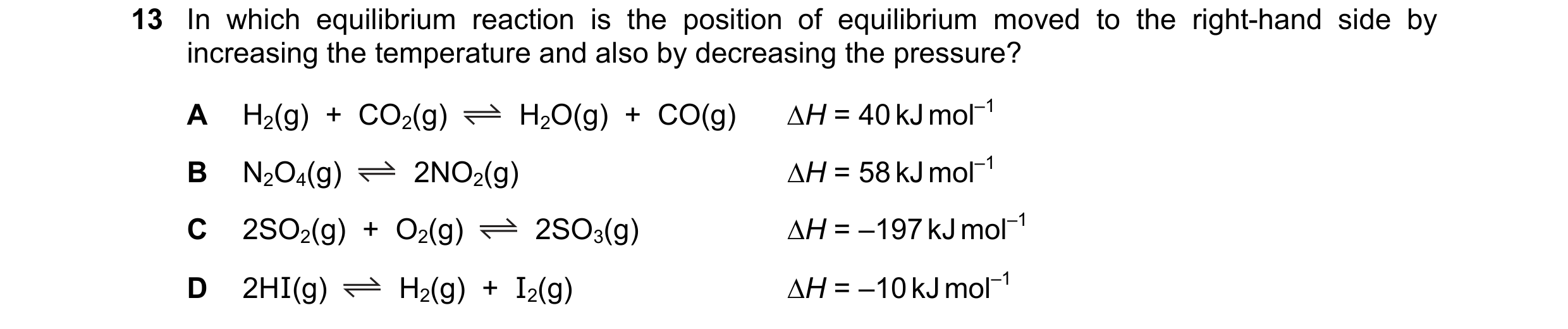
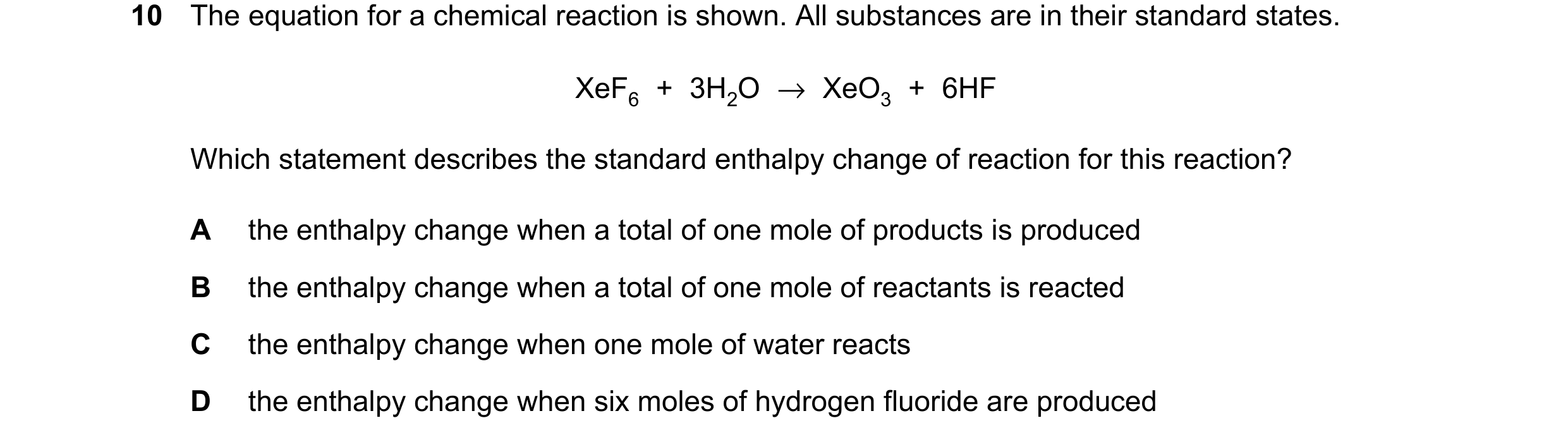
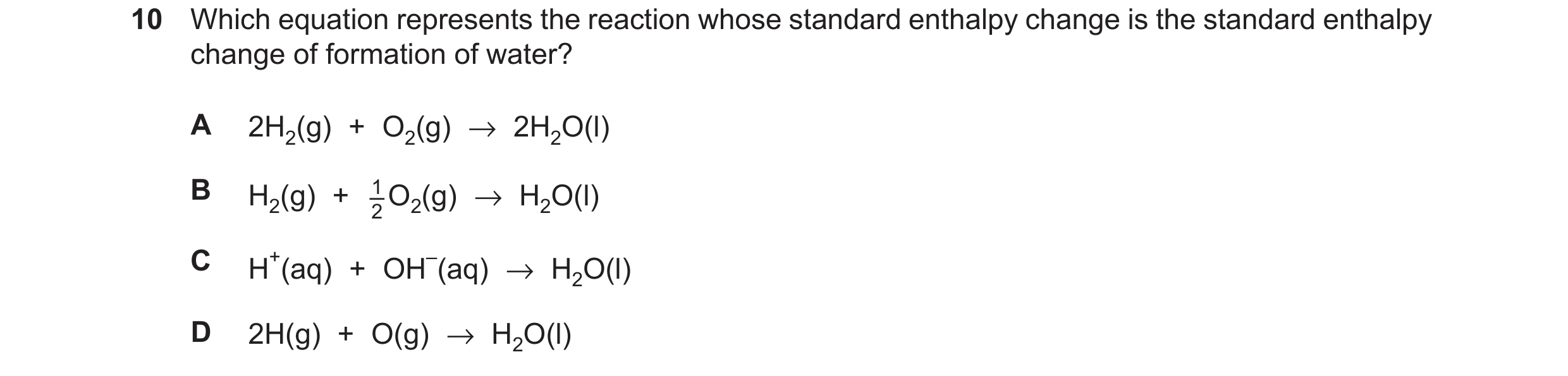
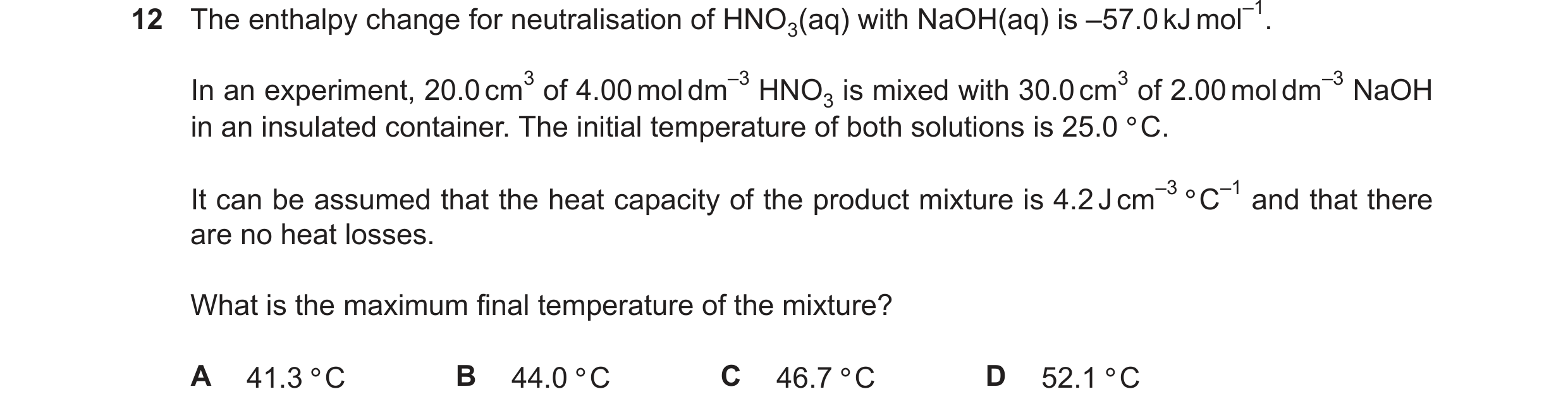 56 / 67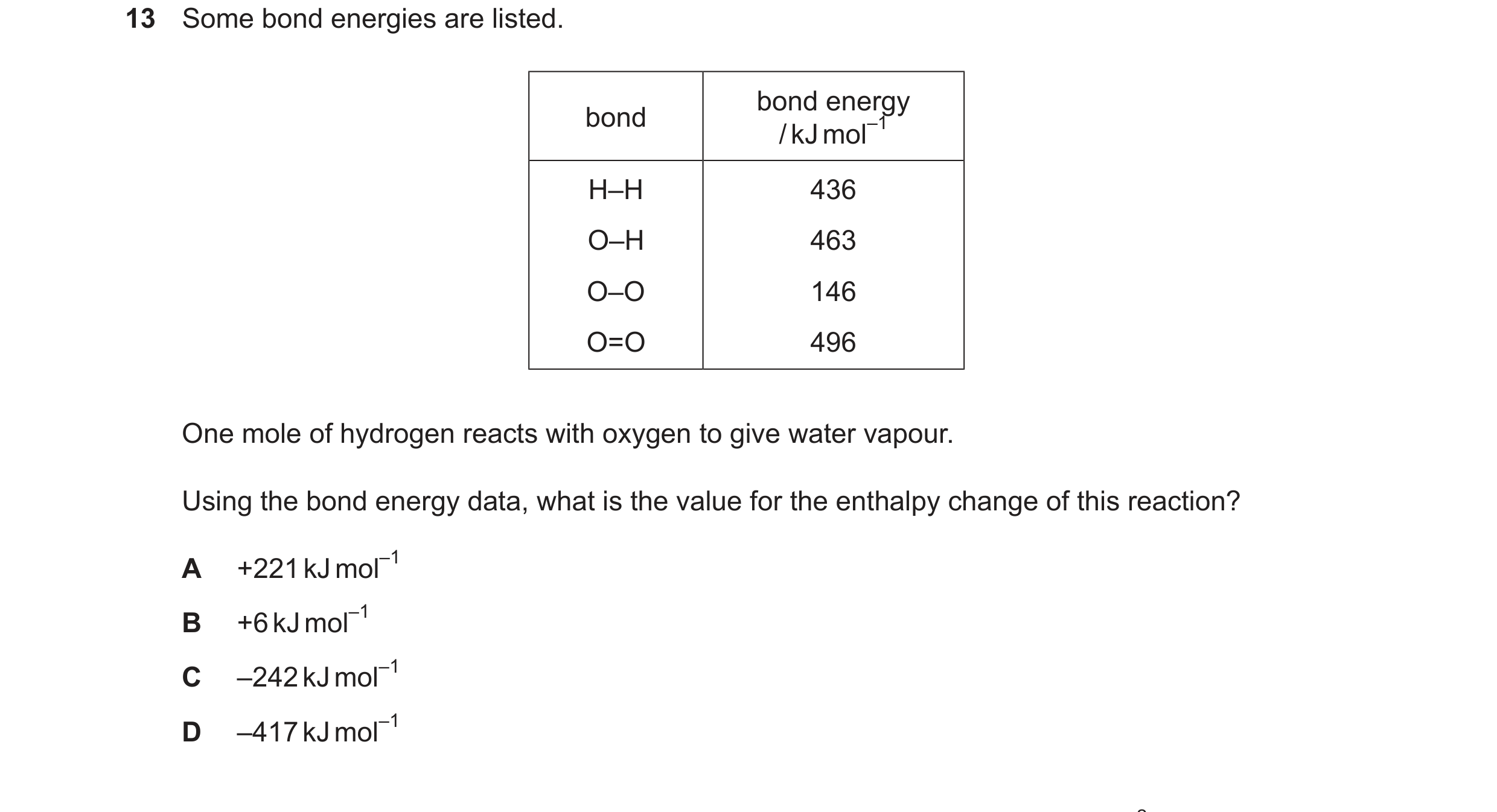

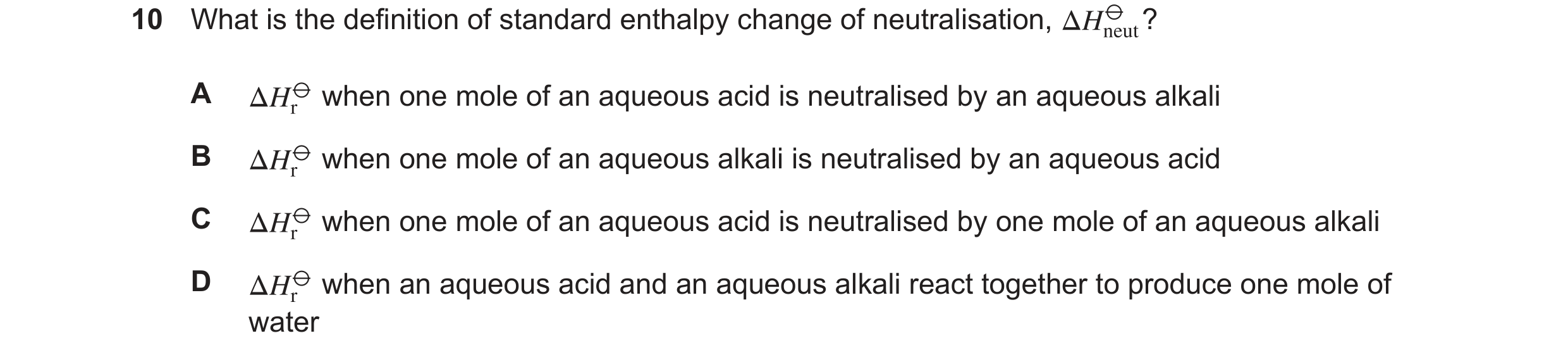
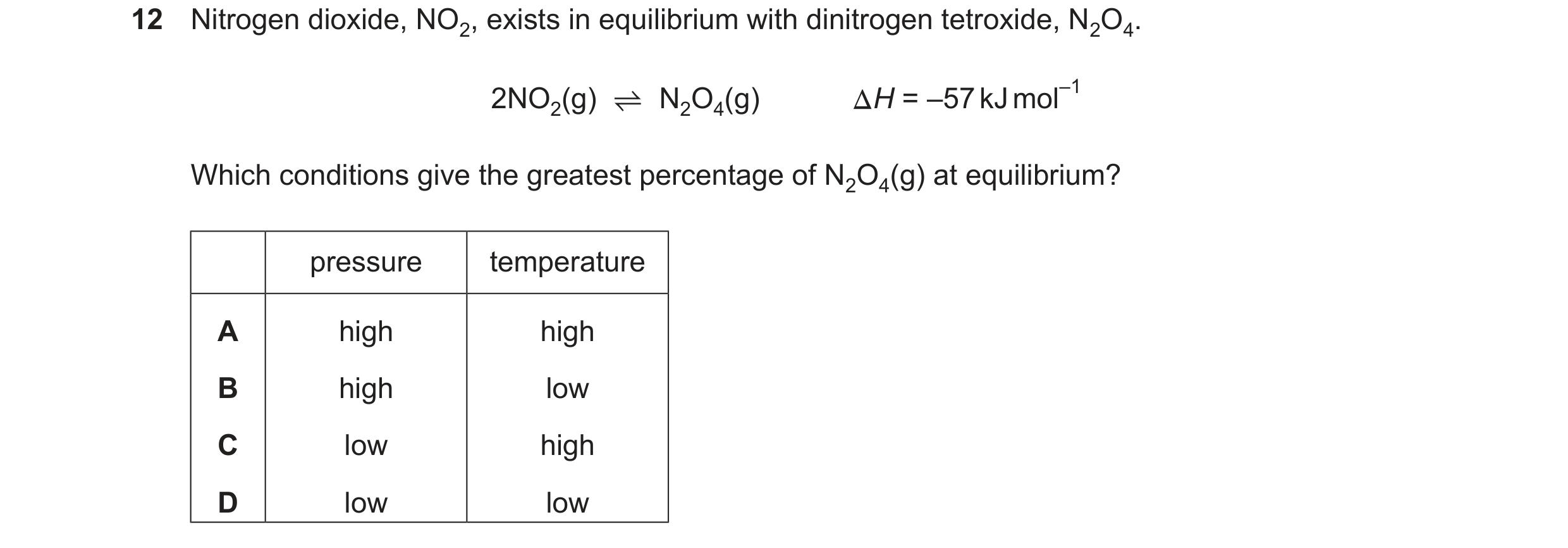 57 / 67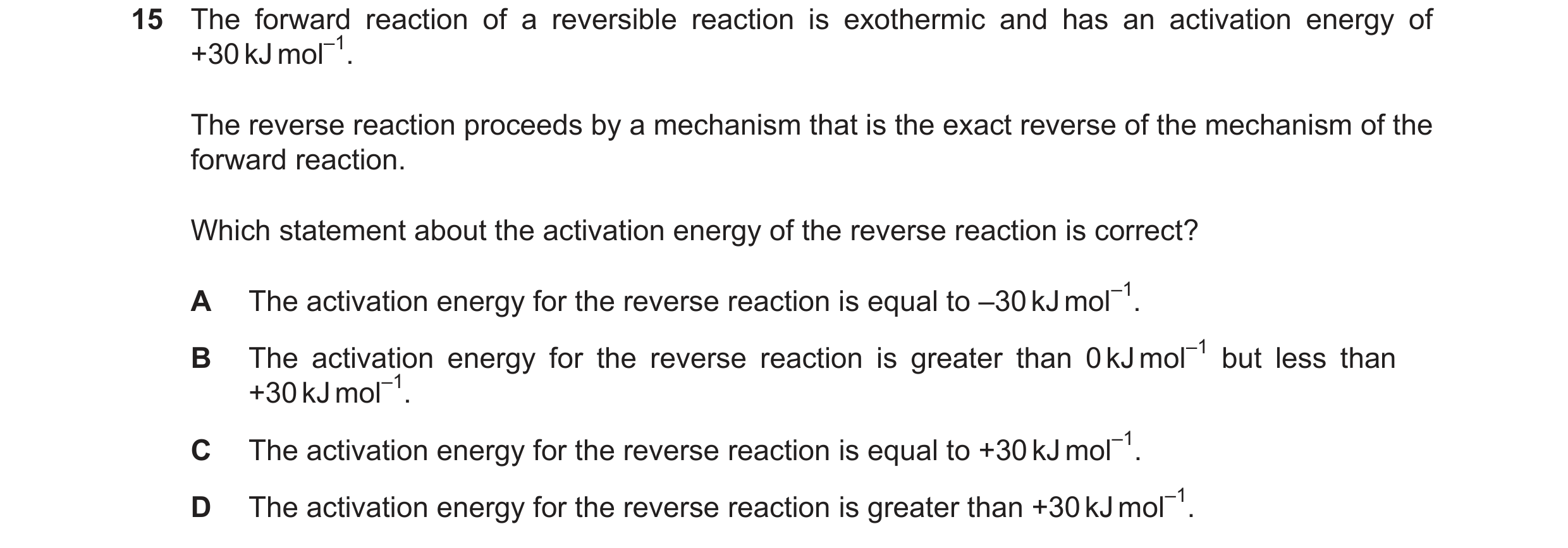

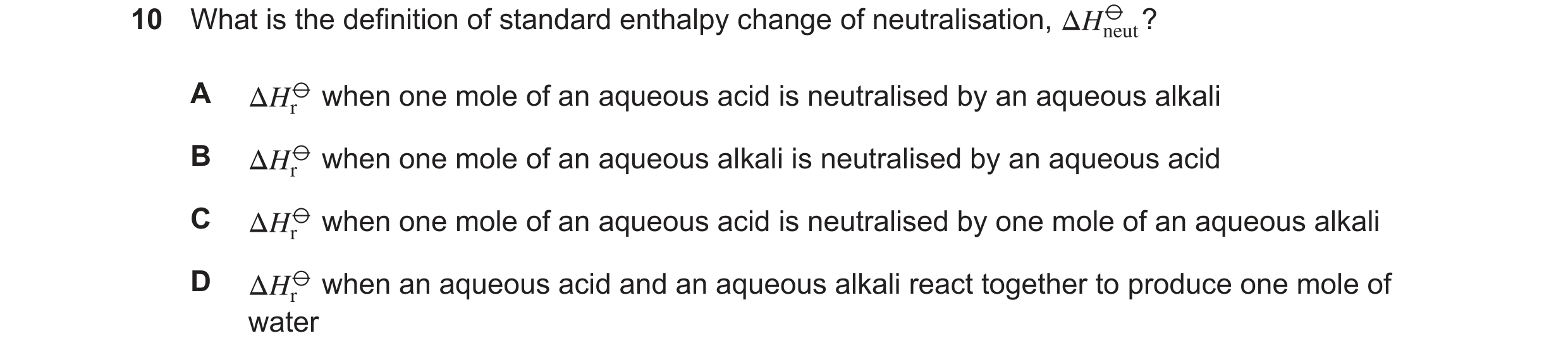
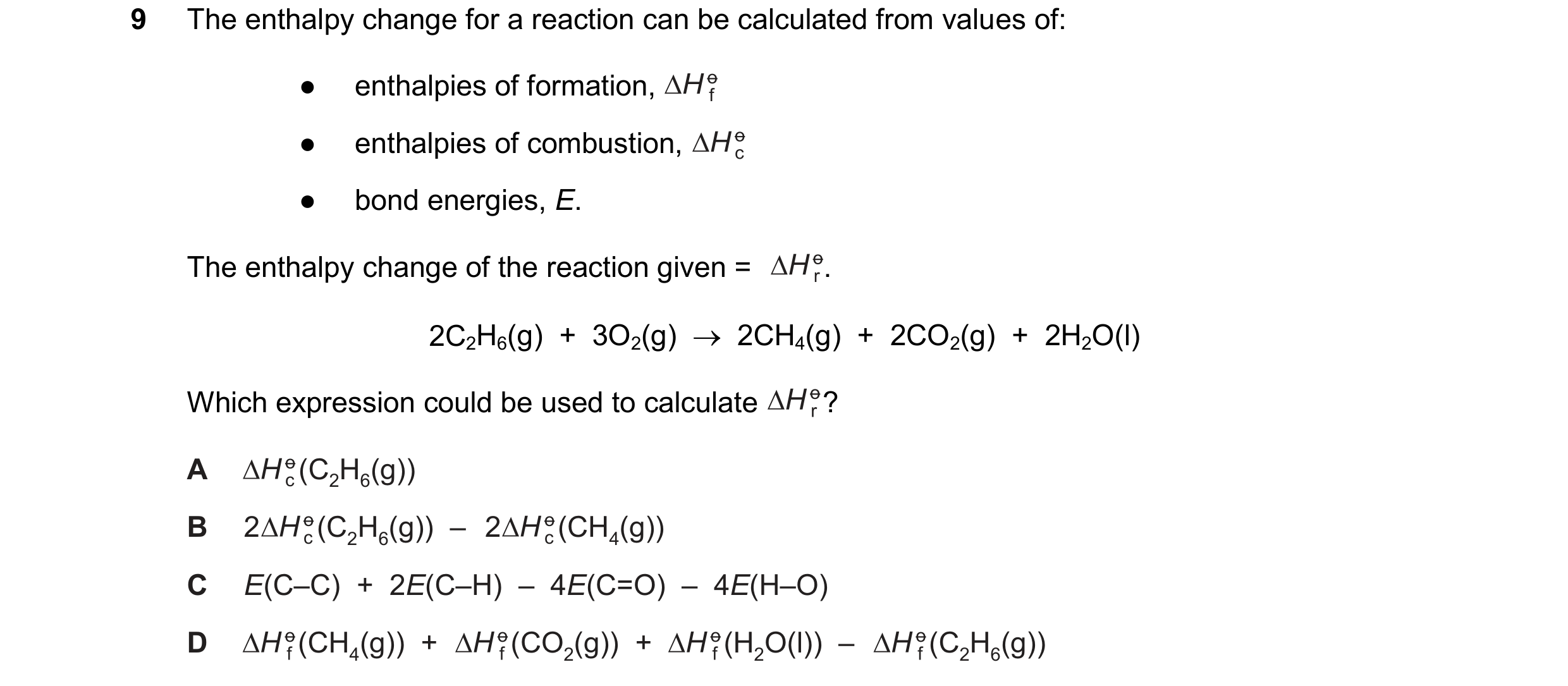 58 / 67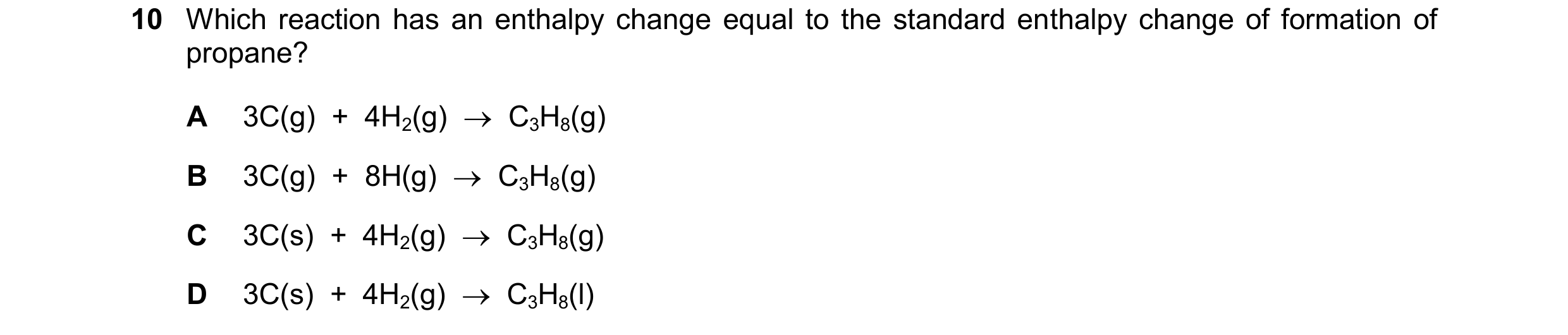
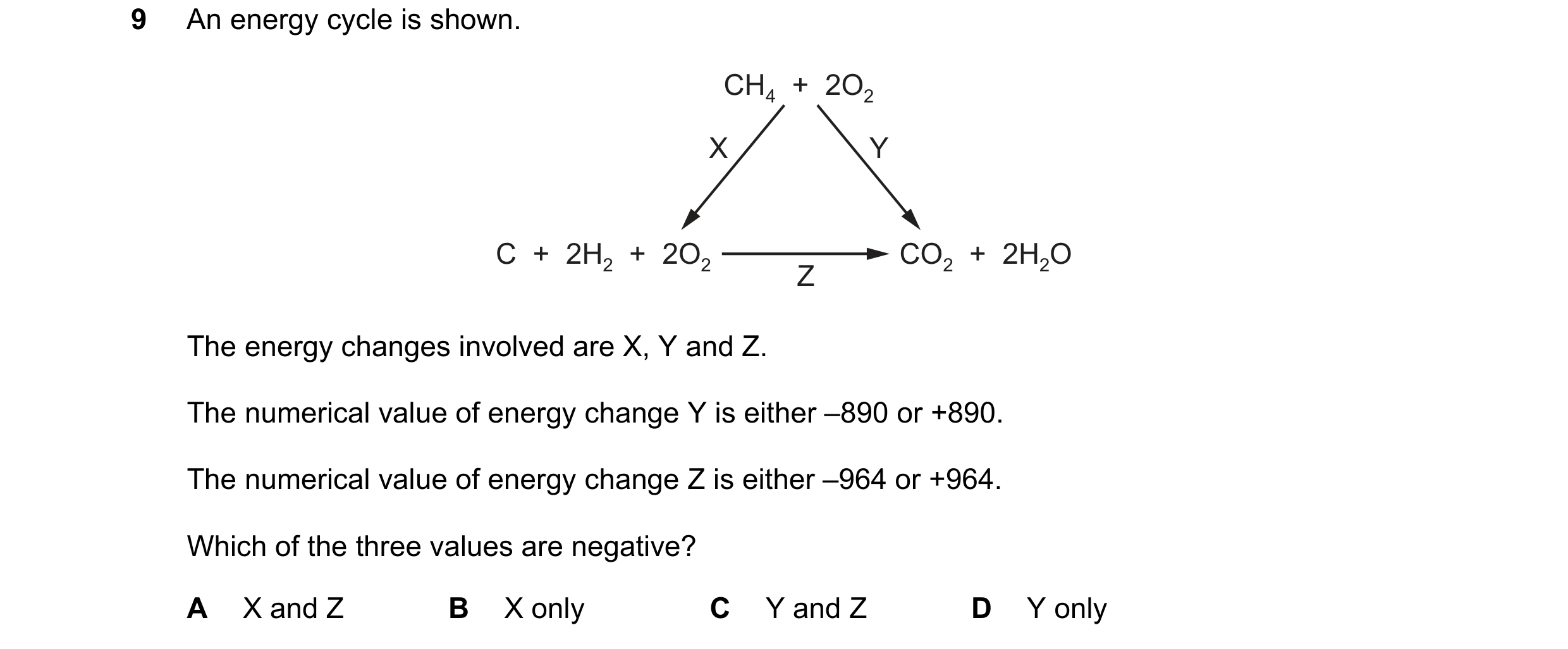
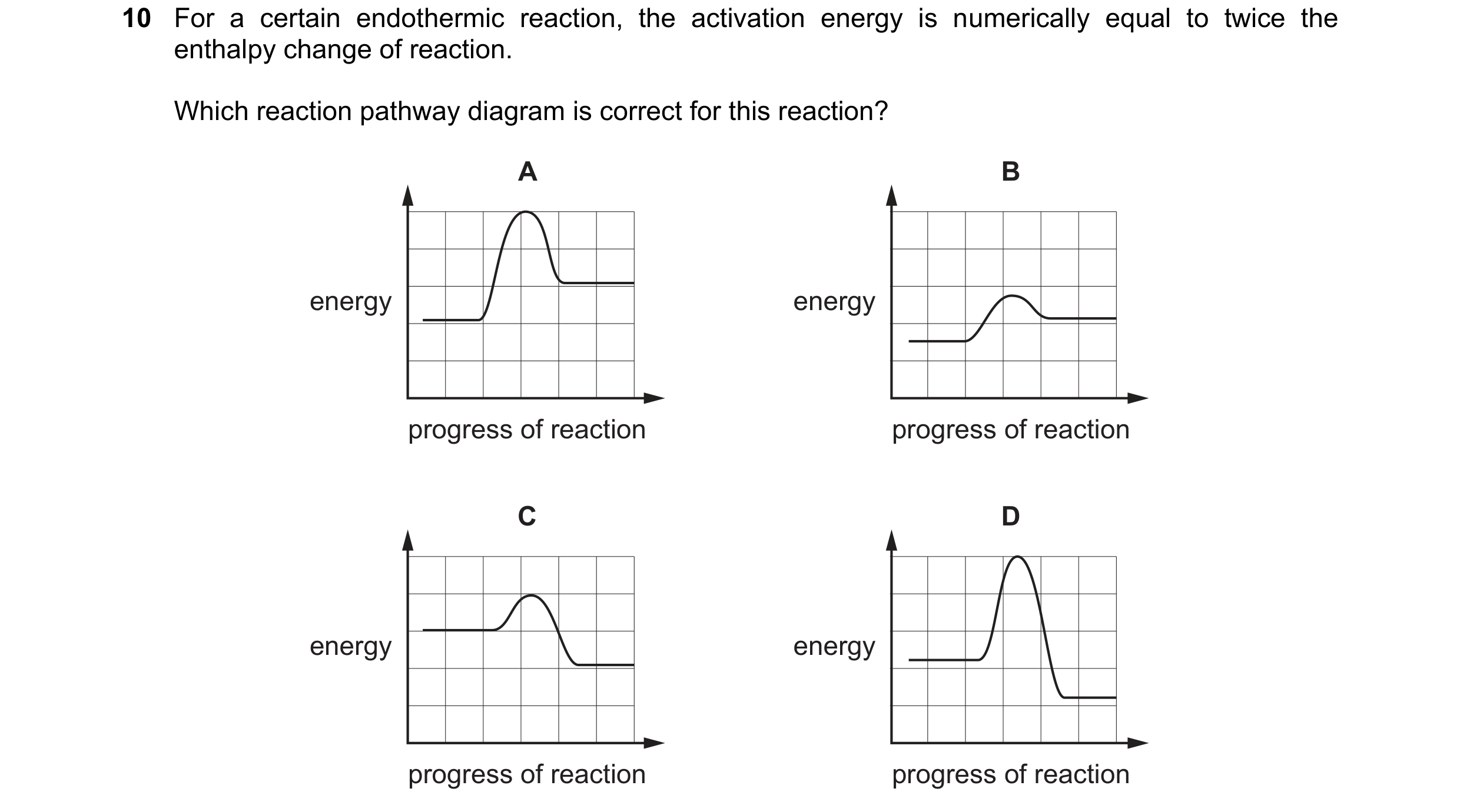 59 / 67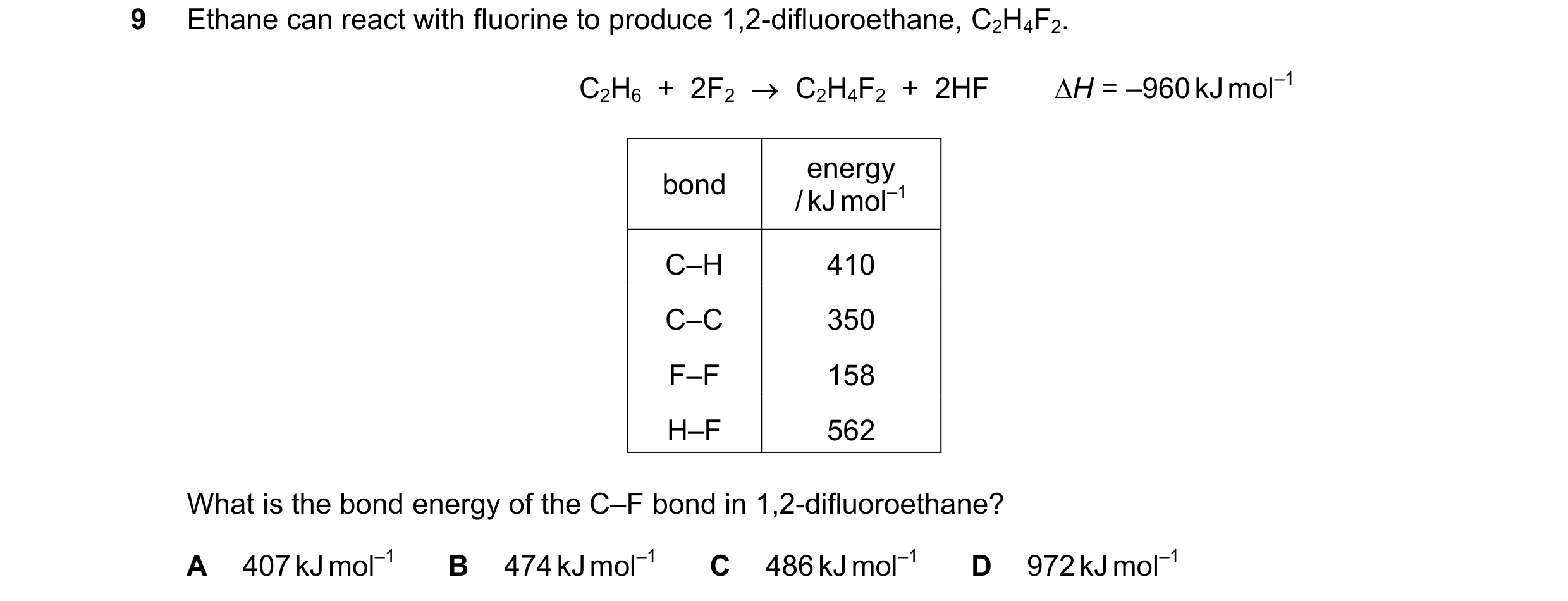
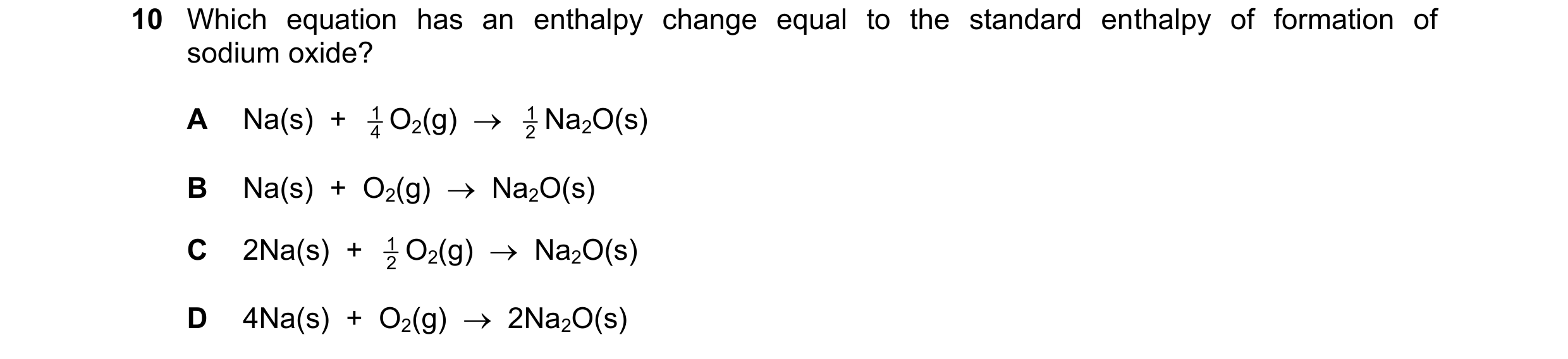
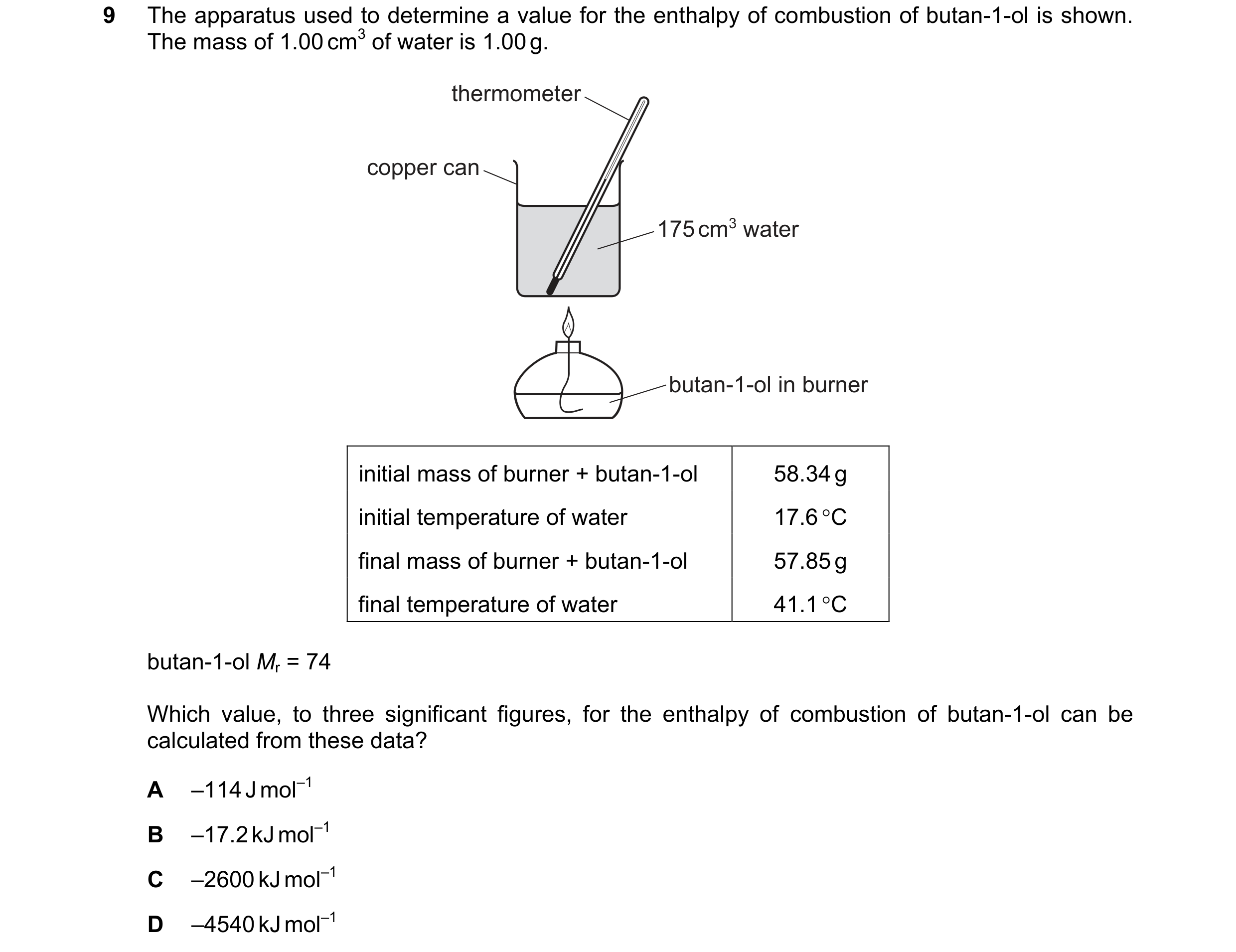 60 / 67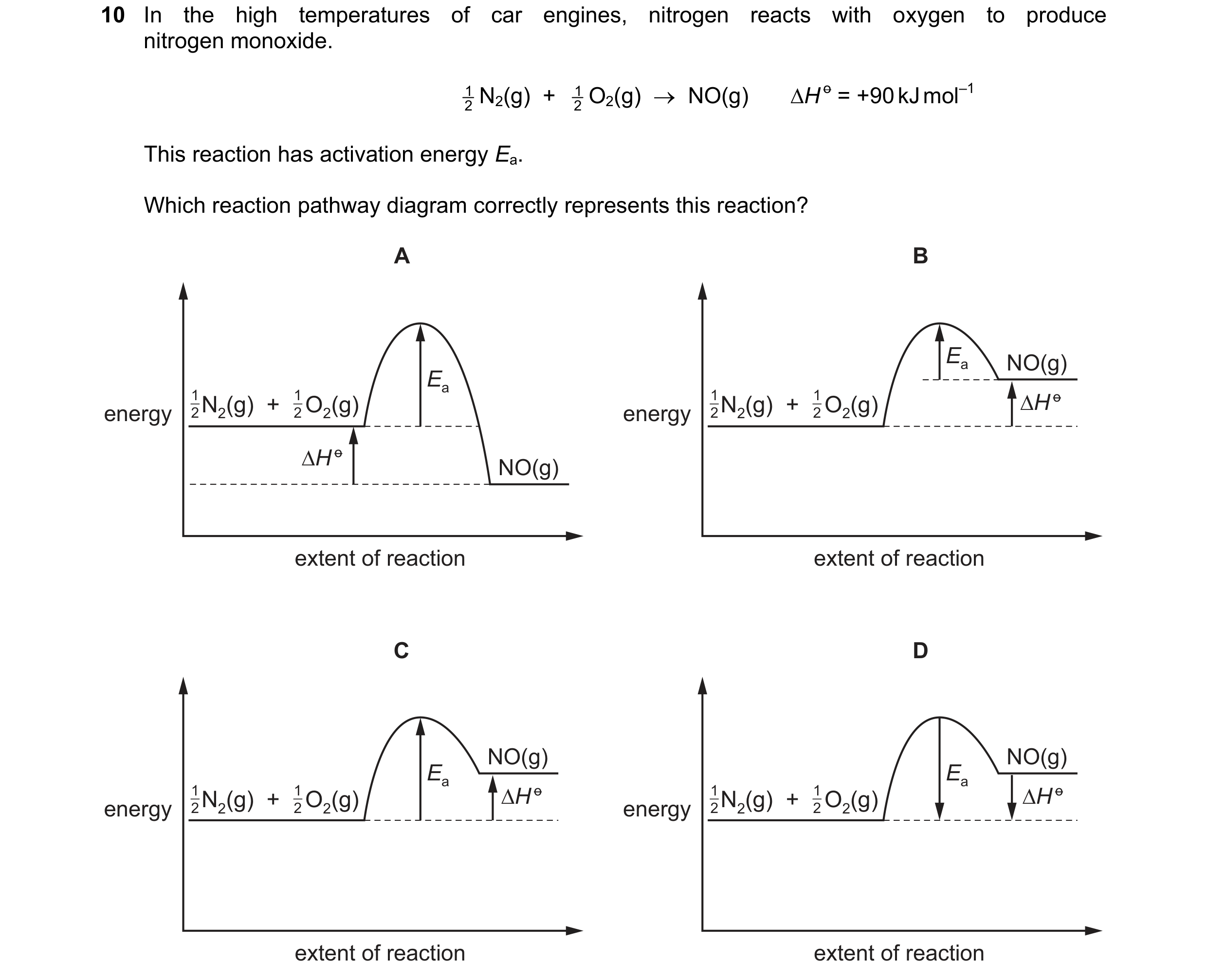
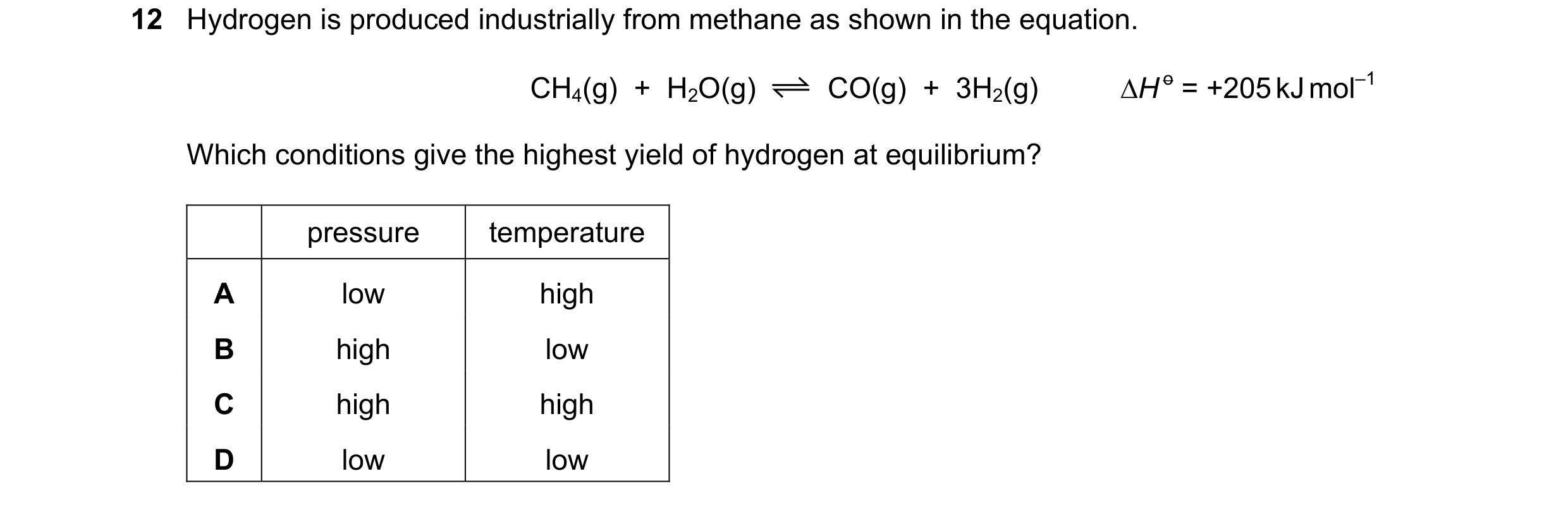 61 / 67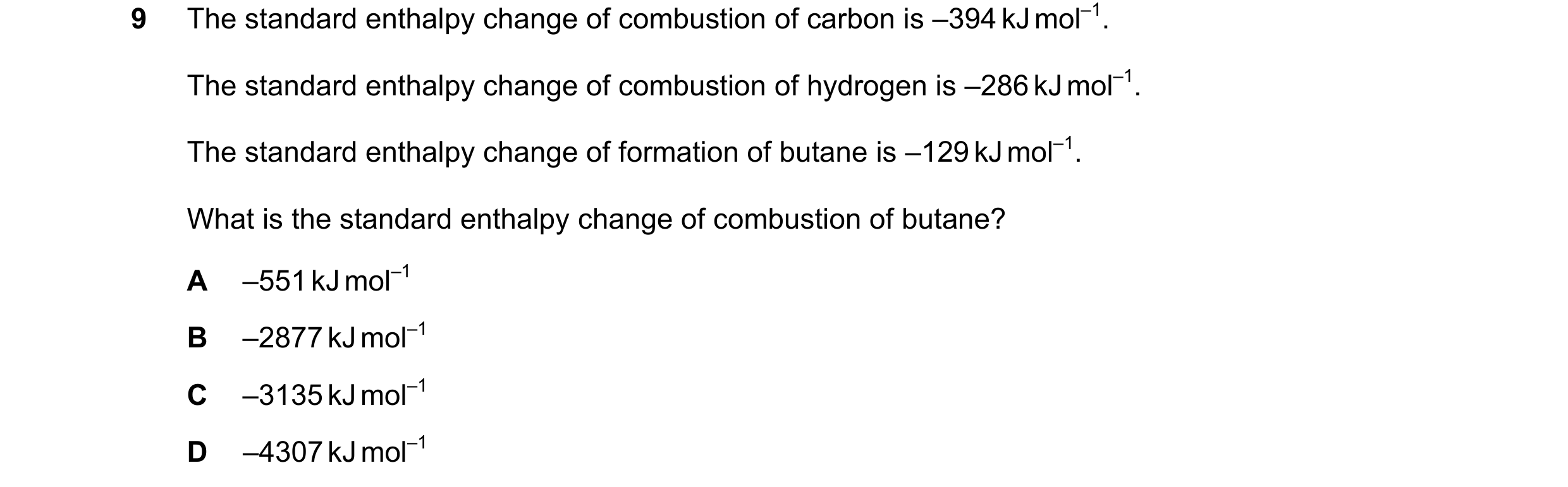
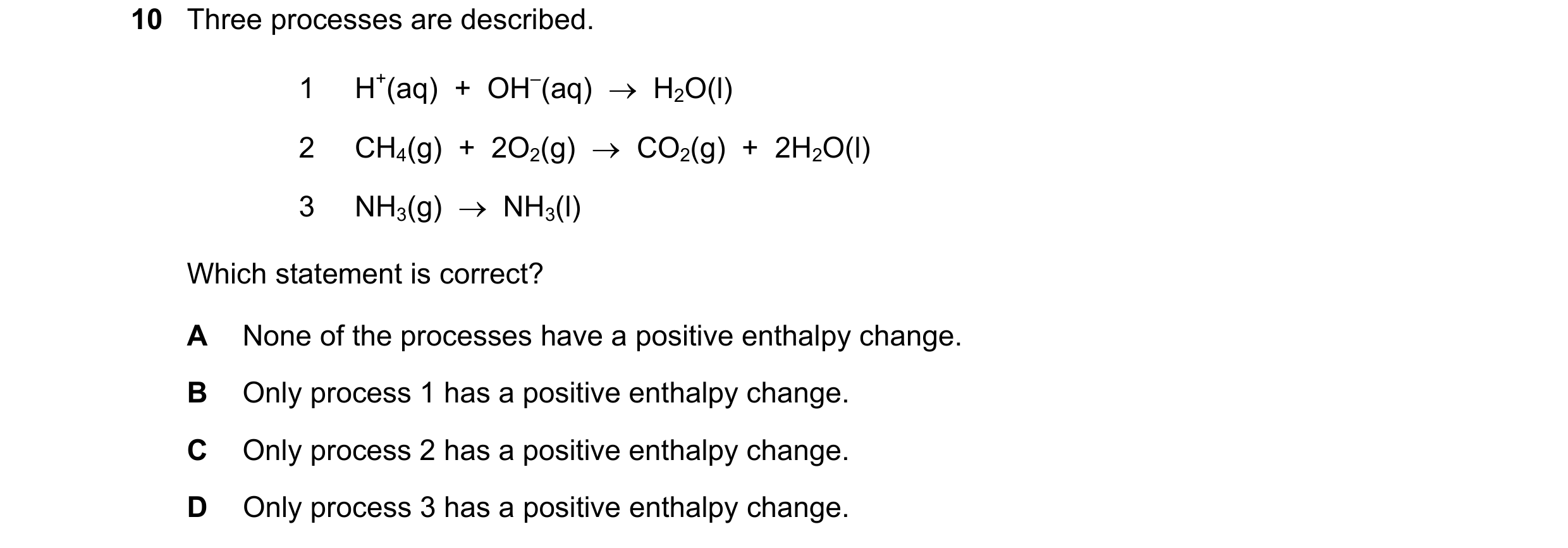
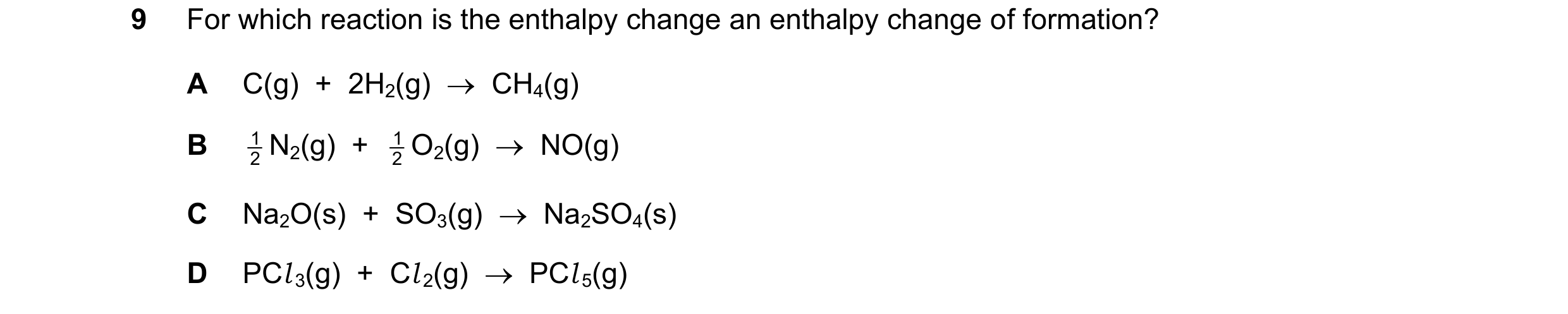
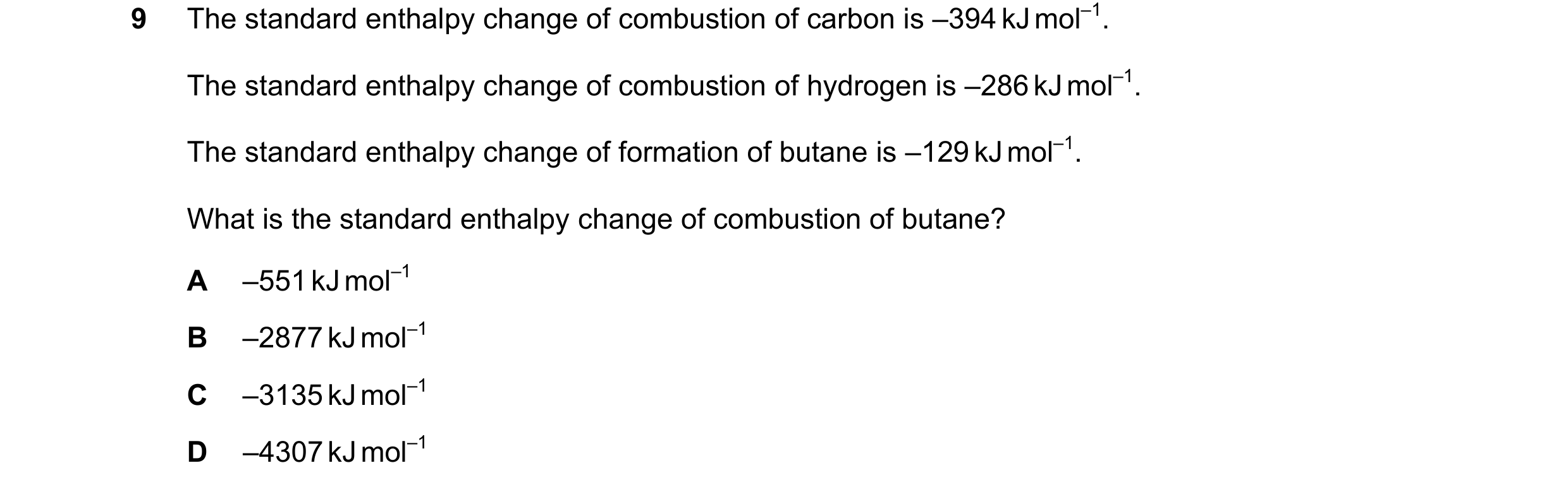 62 / 67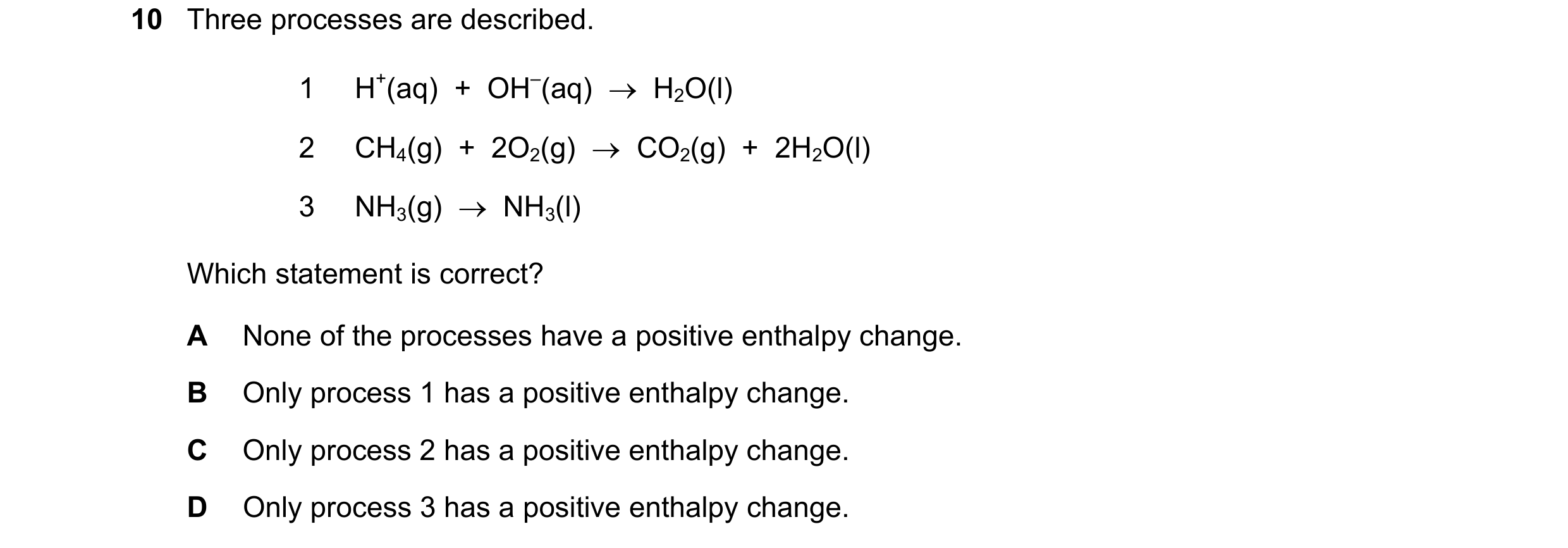
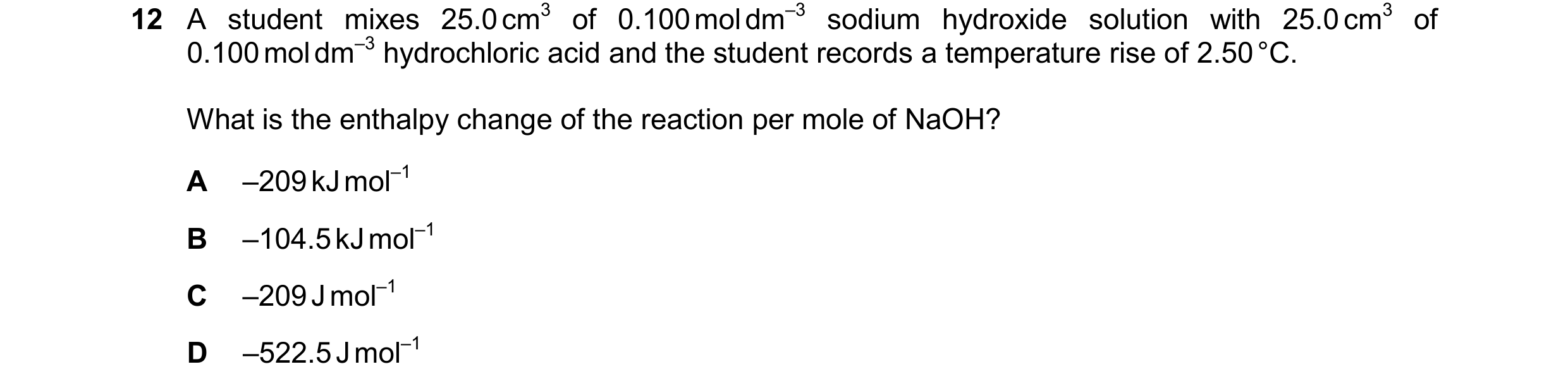
 63 / 67
 64 / 67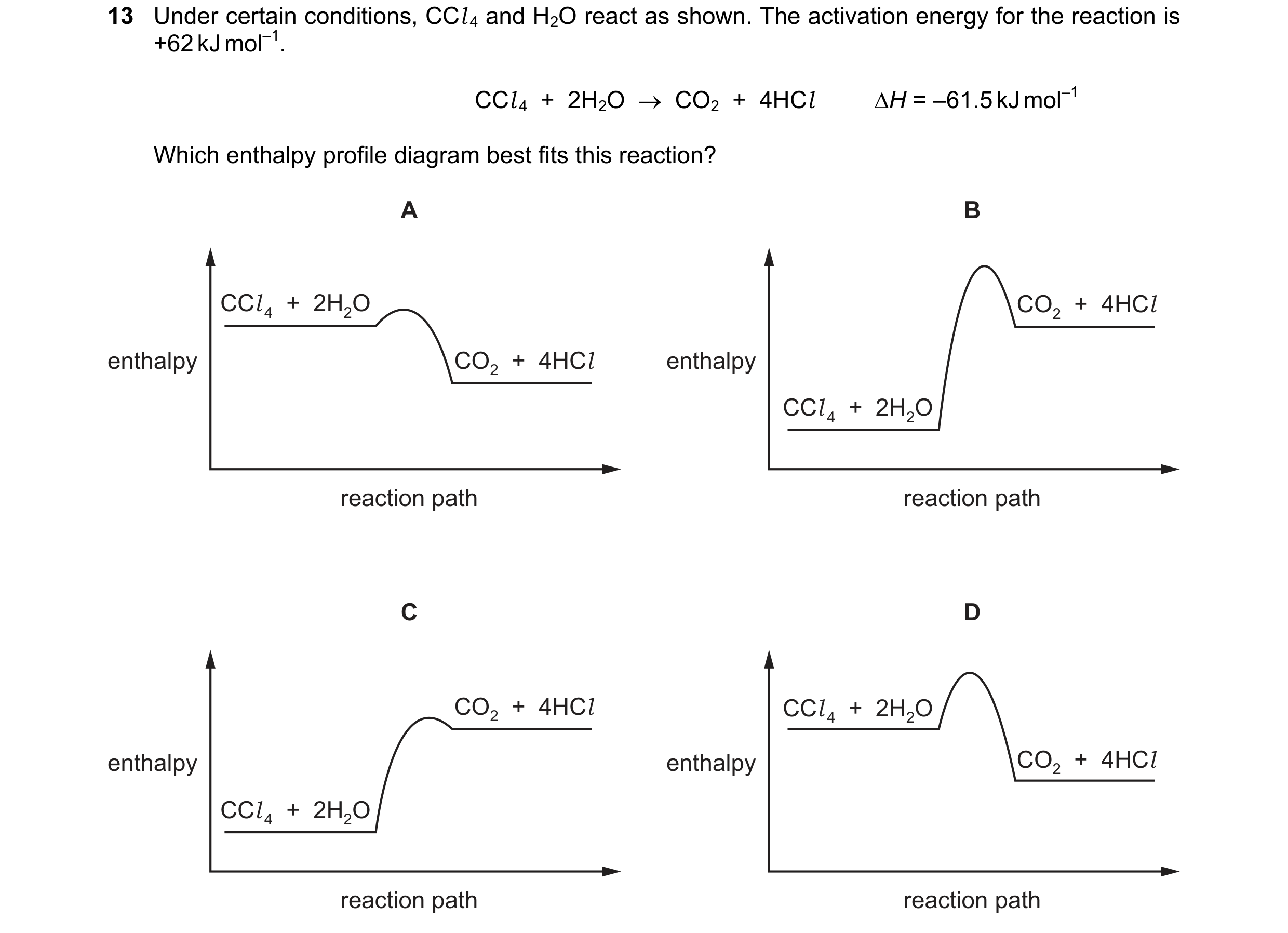
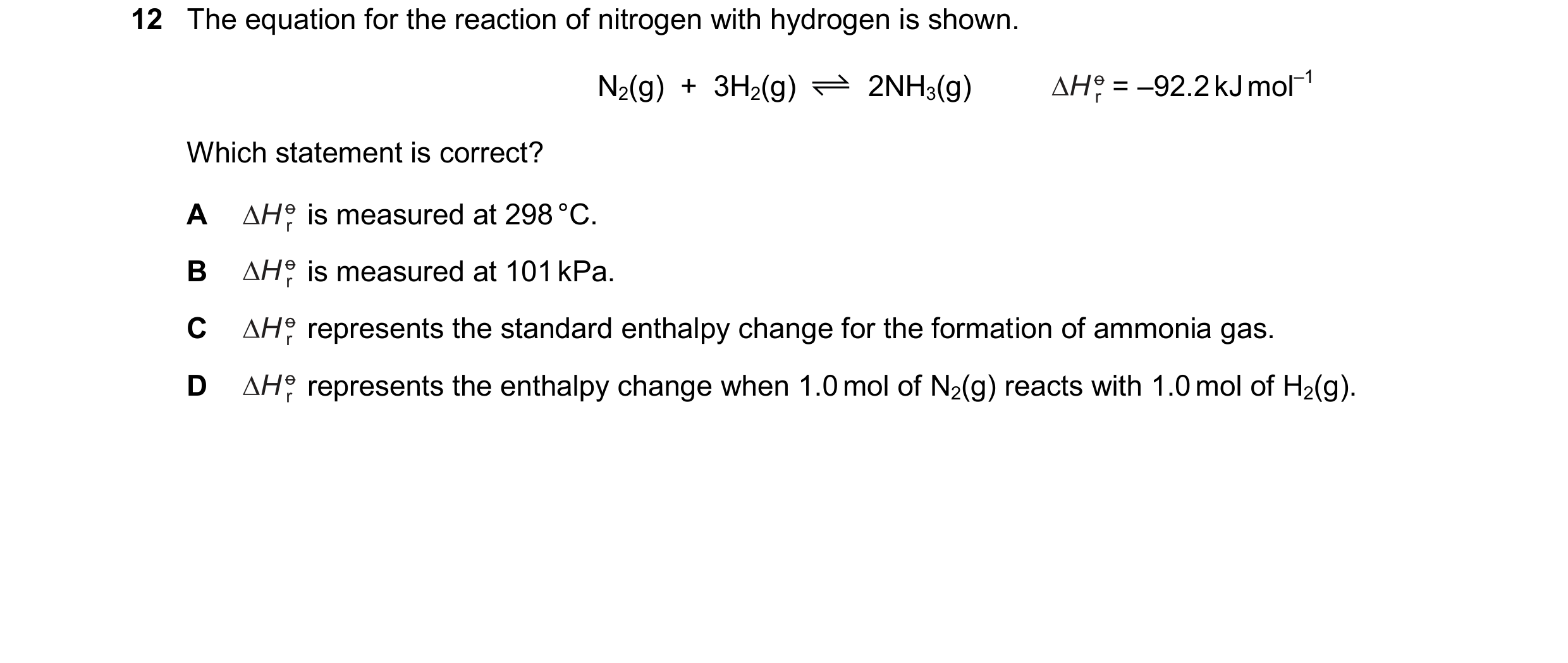 65 / 67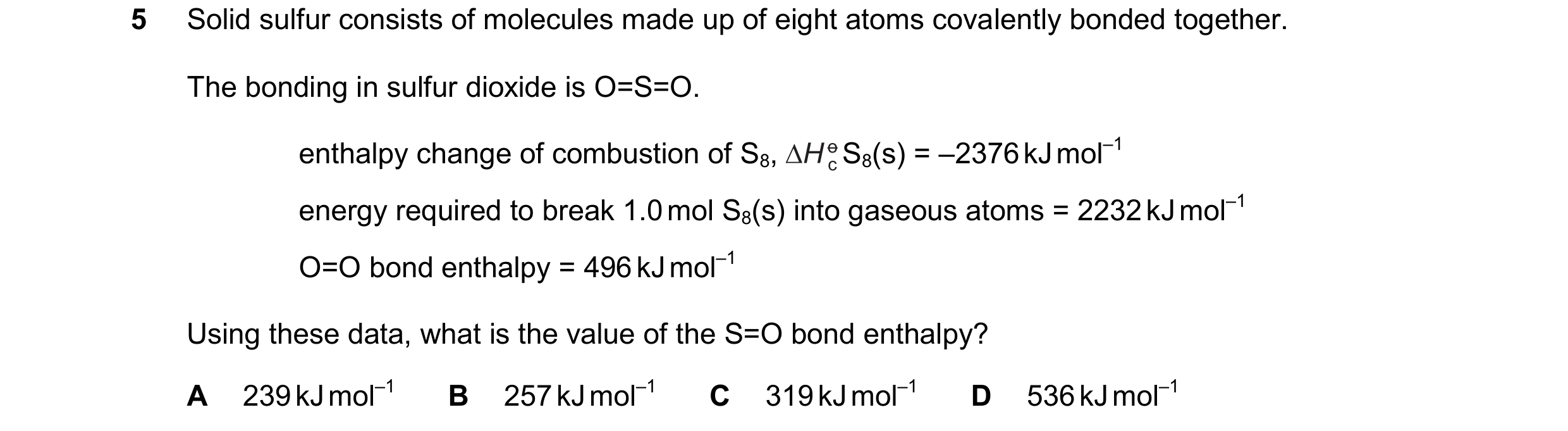
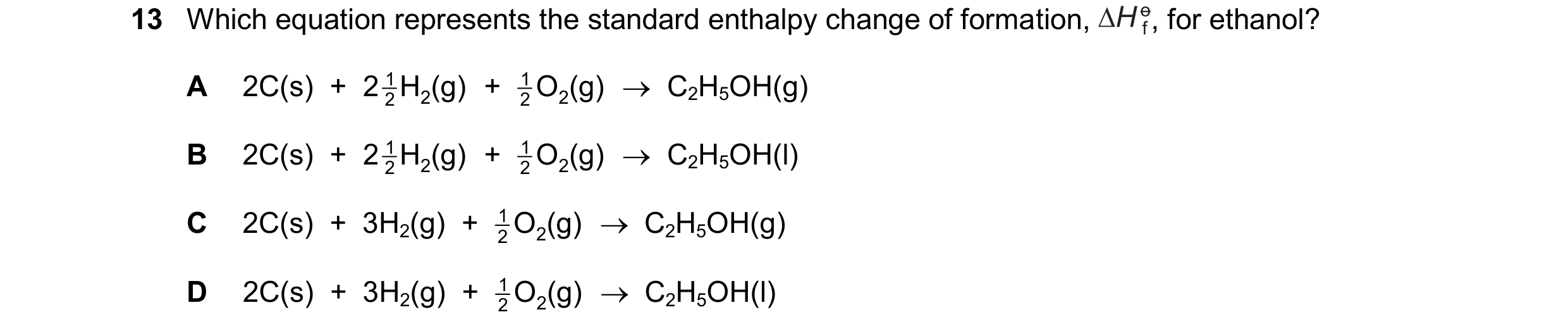
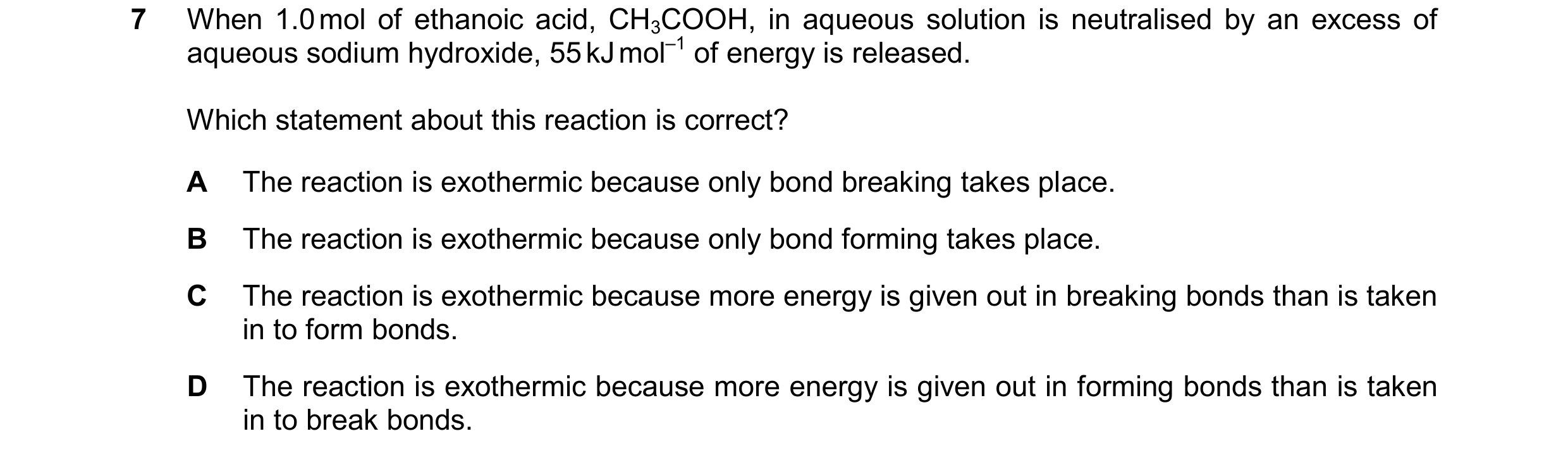
 66 / 67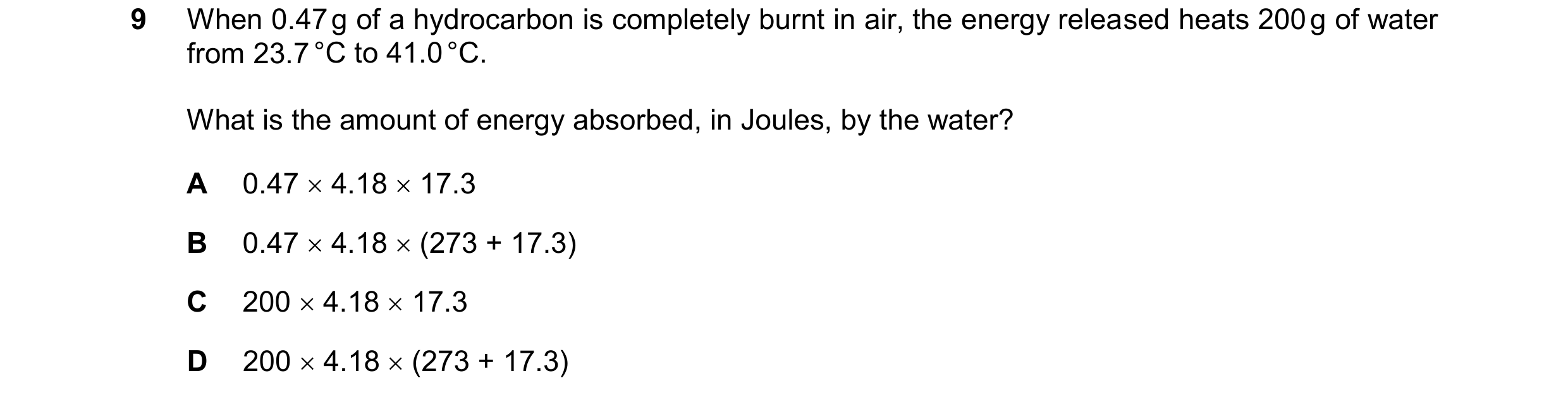
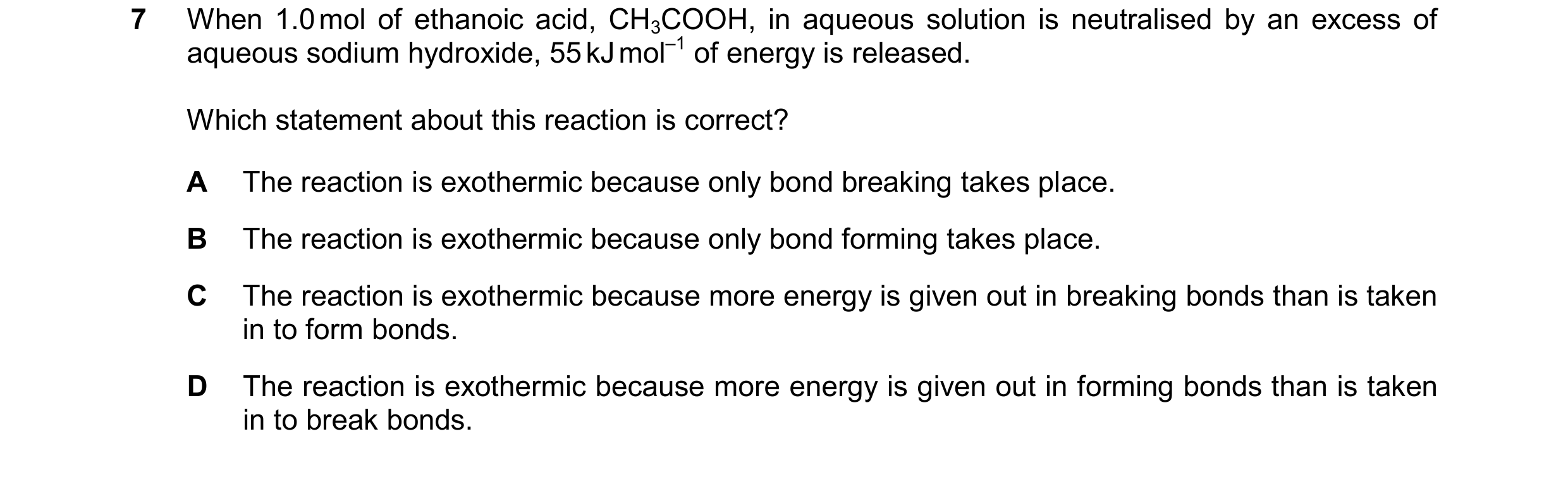
 67 / 67