Cambridge A Level Chemistry 9701 — 2014 May/June Paper 1 · Variant 3
9701/13/M/J/14 · 40 questions · 40 marks · ≈45 min
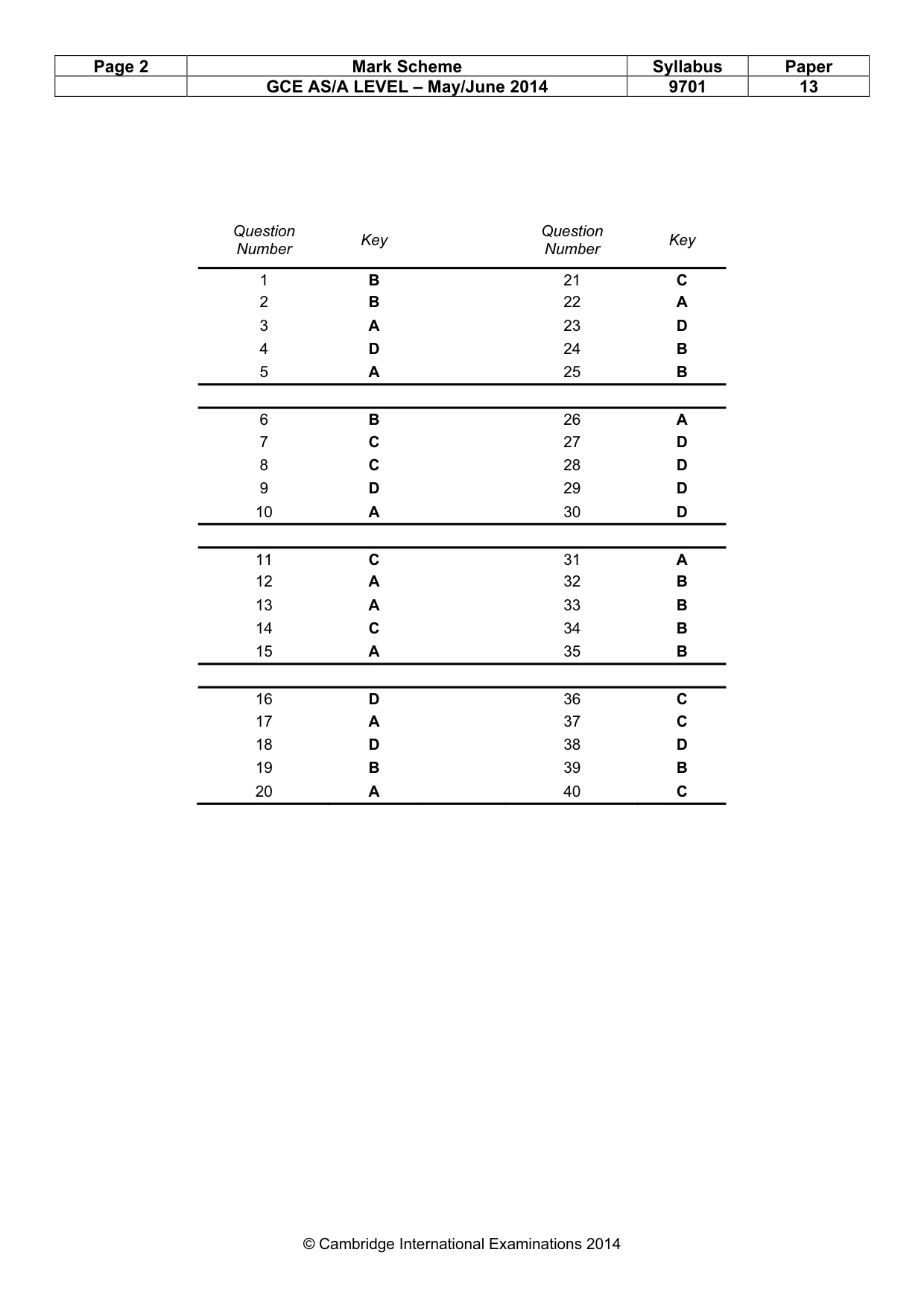
The question paper and its mark scheme, free to read here and free to download. This is Cambridge’s own paper, exactly as it was sat.
Question paper16 pages

Mark scheme2 pages
Answers below. Sit the paper first if you are practising.
Questions as text
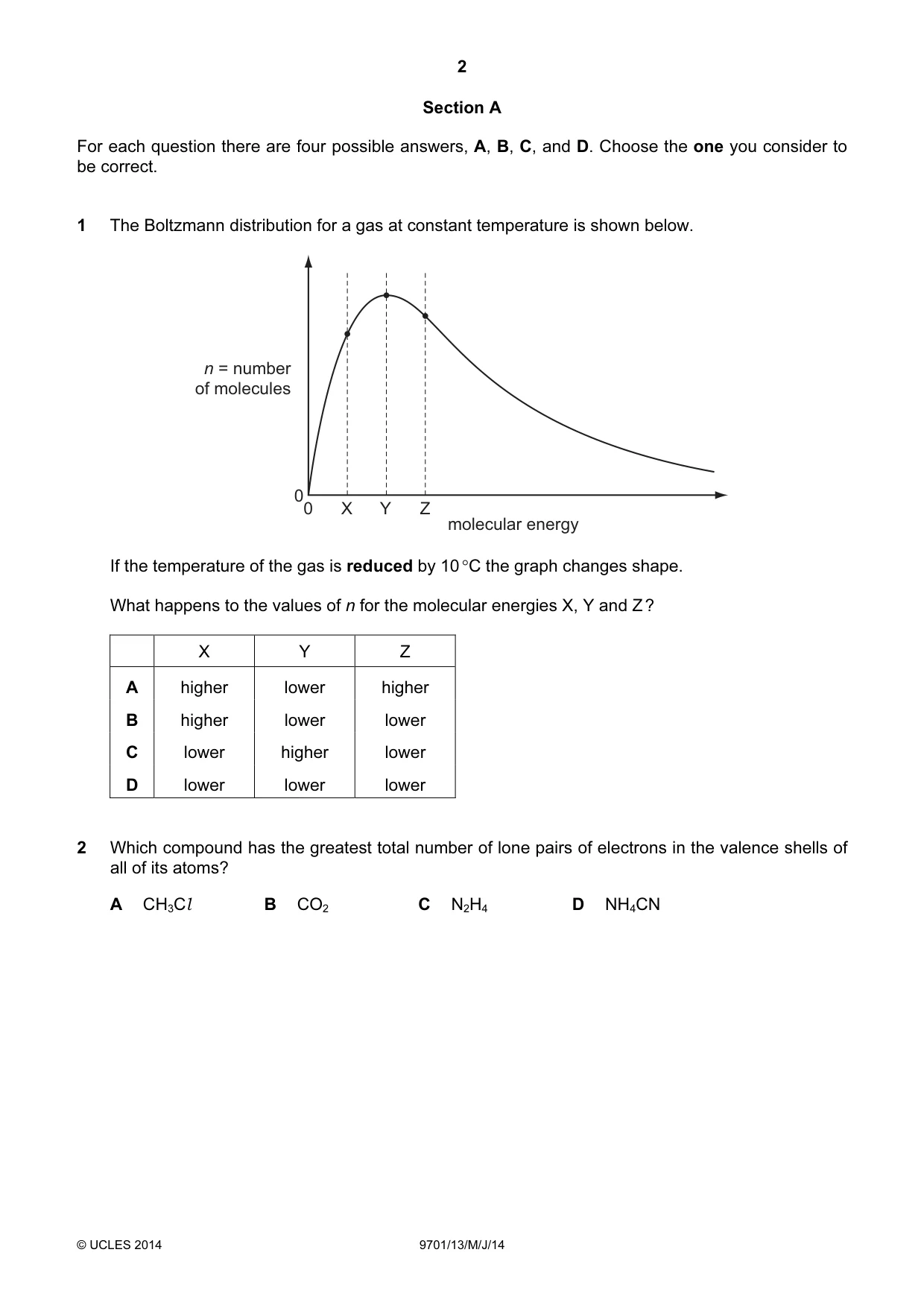
Q1 · The Boltzmann distribution for a gas at constant temperature is shown below
1 The Boltzmann distribution for a gas at constant temperature is shown below. n = number of molecules 0 0 X Y Z molecular energy If the temperature of the gas is reduced by 10 °C the graph changes shape. What happens to the values of n for the molecular energies X, Y and Z ? X Y Z A higher lower higher B higher lower lower C lower higher lower D lower lower lower
Mark scheme: B
More questions on Effect of temperature on reaction rates and the concept of activation energy
Q2 · Which compound has the greatest total number of lone pairs of electrons in the valence…
2 Which compound has the greatest total number of lone pairs of electrons in the valence shells of all of its atoms? A CH3Cl B CO2 C N2H4 D NH4CN
Mark scheme: B
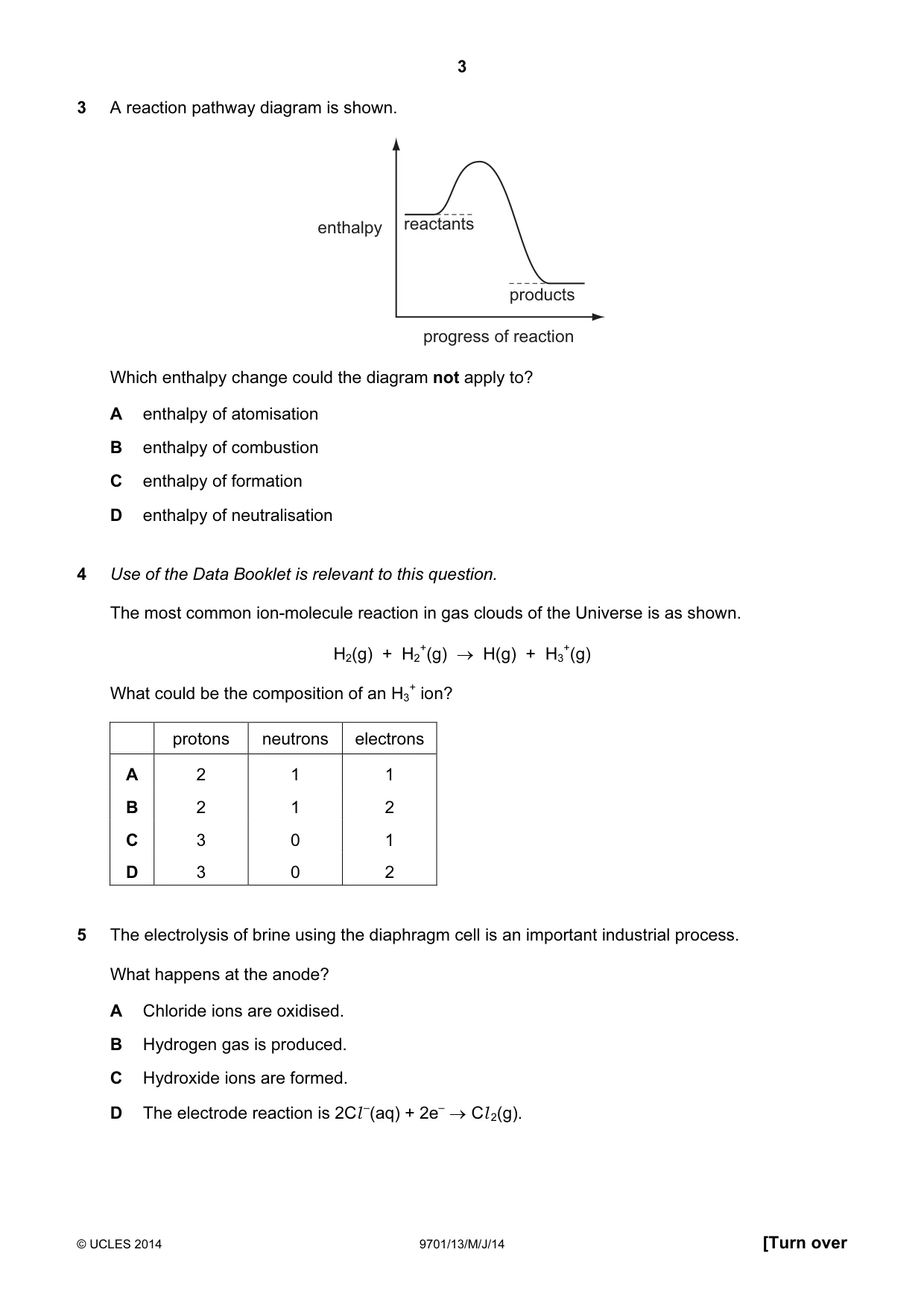
Q3 · A reaction pathway diagram is shown
3 A reaction pathway diagram is shown. enthalpy reactants products progress of reaction Which enthalpy change could the diagram not apply to? A enthalpy of atomisation B enthalpy of combustion C enthalpy of formation D enthalpy of neutralisation
Mark scheme: A
Q4 · Use of the Data Booklet is relevant to this question
4 Use of the Data Booklet is relevant to this question. The most common ion-molecule reaction in gas clouds of the Universe is as shown. H2(g) + H2 +(g) → H(g) + H3 +(g) What could be the composition of an H3 + ion? protons neutrons electrons A 2 1 1 B 2 1 2 C 3 0 1 D 3 0 2
Mark scheme: D
Q5 · The electrolysis of brine using the diaphragm cell is an important industrial process
5 The electrolysis of brine using the diaphragm cell is an important industrial process. What happens at the anode? A Chloride ions are oxidised. B Hydrogen gas is produced. C Hydroxide ions are formed. D The electrode reaction is 2Cl –(aq) + 2e– → Cl 2(g).
Mark scheme: A
Q6 · Hydrazine, N2H4, is used as a rocket fuel because it reacts with oxygen as shown…
6 Hydrazine, N2H4, is used as a rocket fuel because it reacts with oxygen as shown, producing ‘environmentally friendly’ gases. N2H4(l) + O2(g) → N2(g) + 2H2O(g) ∆H = –534 kJ mol–1 Despite its use as a rocket fuel, hydrazine does not burn spontaneously in oxygen. Which statement explains why hydrazine does not burn spontaneously? A Hydrazine is a liquid. B The activation energy is too high. C The N N bond is very strong. D The reaction is exothermic.
Mark scheme: B
More questions on Effect of temperature on reaction rates and the concept of activation energy
Q7 · A 10.0 cm3 bubble of an ideal gas is formed on the sea bed where it is at a pressure of…
7 A 10.0 cm3 bubble of an ideal gas is formed on the sea bed where it is at a pressure of 2020 kPa. Just below the sea surface the pressure is 101 kPa and the temperature is the same as the sea bed. What is the volume of the bubble when it rises to just below the sea surface? A 10.0 cm3 B 20.2 cm3 C 200 cm3 D 2 020 000 cm3
Mark scheme: C
More questions on The gaseous state: ideal and real gases and pV = nRT
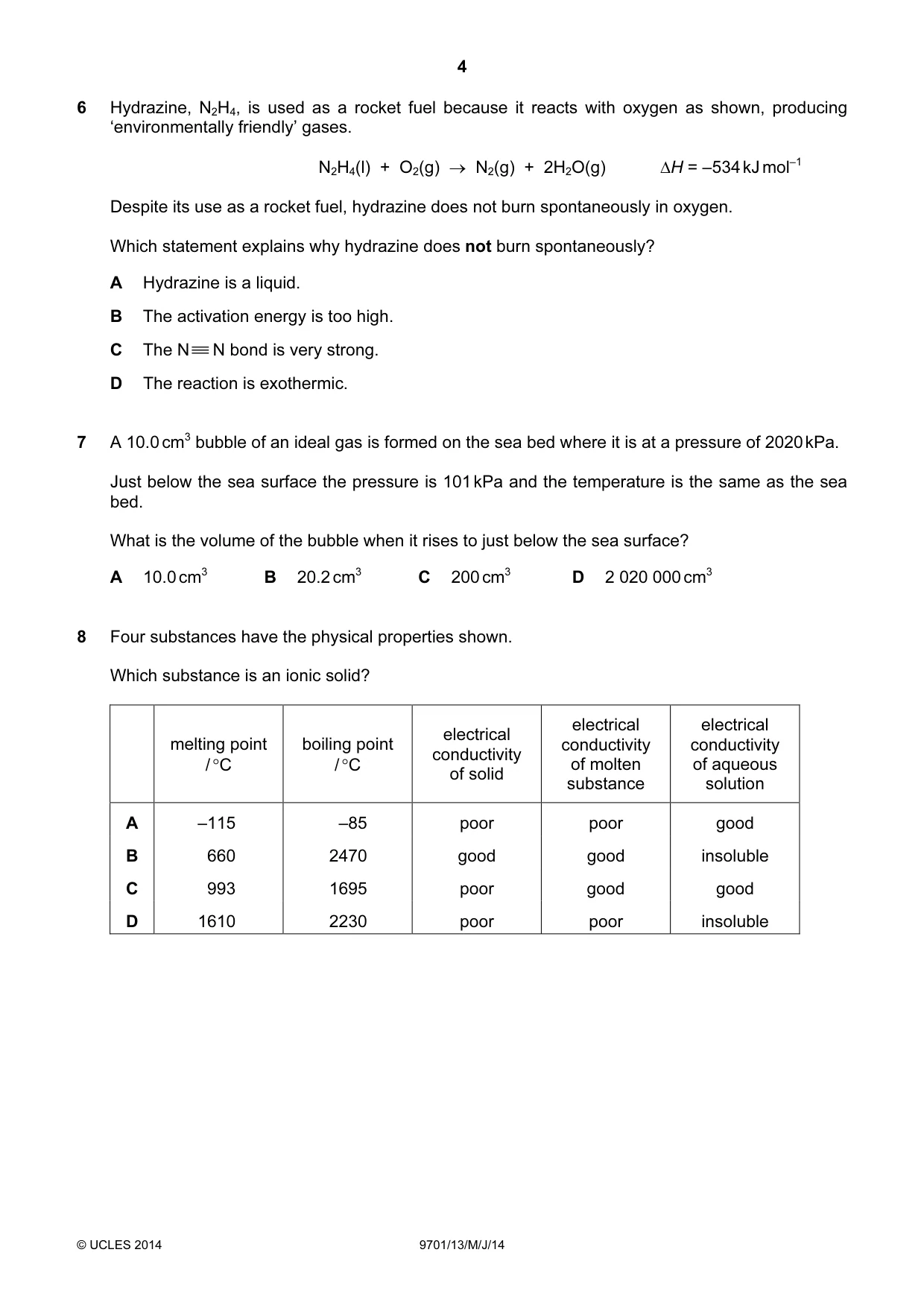
Q8 · Four substances have the physical properties shown
8 Four substances have the physical properties shown. Which substance is an ionic solid? electrical electrical electrical melting point boiling point conductivity conductivity conductivity / °C / °C of molten of aqueous of solid substance solution A –115 –85 poor poor good B 660 2470 good good insoluble C 993 1695 poor good good D 1610 2230 poor poor insoluble
Mark scheme: C
Q9 · The enthalpy change of formation of Mn(NO3)2(s) is –696 kJ mol–1
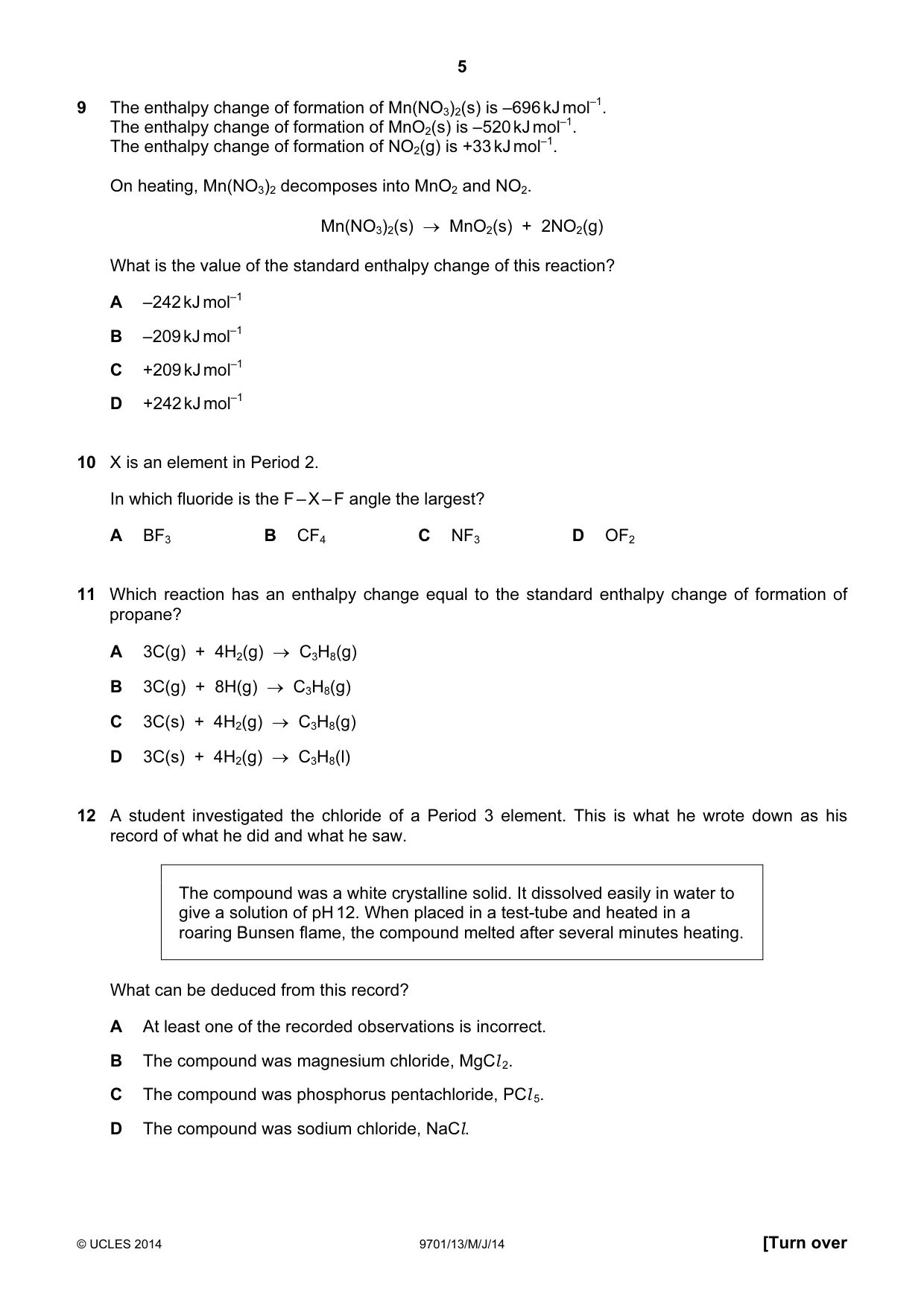
9 The enthalpy change of formation of Mn(NO3)2(s) is –696 kJ mol–1. The enthalpy change of formation of MnO2(s) is –520 kJ mol–1. The enthalpy change of formation of NO2(g) is +33 kJ mol–1. On heating, Mn(NO3)2 decomposes into MnO2 and NO2. Mn(NO3)2(s) → MnO2(s) + 2NO2(g) What is the value of the standard enthalpy change of this reaction? A –242 kJ mol–1 B –209 kJ mol–1 C +209 kJ mol–1 D +242 kJ mol–1
Mark scheme: D
Q10 · X is an element in Period 2
10 X is an element in Period 2. In which fluoride is the F – X – F angle the largest? A BF3 B CF4 C NF3 D OF2
Mark scheme: A
Q11 · Which reaction has an enthalpy change equal to the standard enthalpy change of formation…
11 Which reaction has an enthalpy change equal to the standard enthalpy change of formation of propane? A 3C(g) + 4H2(g) → C3H8(g) B 3C(g) + 8H(g) → C3H8(g) C 3C(s) + 4H2(g) → C3H8(g) D 3C(s) + 4H2(g) → C3H8(l)
Mark scheme: C
Q12 · A student investigated the chloride of a Period 3 element
12 A student investigated the chloride of a Period 3 element. This is what he wrote down as his record of what he did and what he saw. The compound was a white crystalline solid. It dissolved easily in water to give a solution of pH 12. When placed in a test-tube and heated in a roaring Bunsen flame, the compound melted after several minutes heating. What can be deduced from this record? A At least one of the recorded observations is incorrect. B The compound was magnesium chloride, MgCl 2. C The compound was phosphorus pentachloride, PCl 5. D The compound was sodium chloride, NaCl.
Mark scheme: A
More questions on Periodicity of chemical properties of the elements in Period 3
Q13 · Use of the Data Booklet is relevant to this question
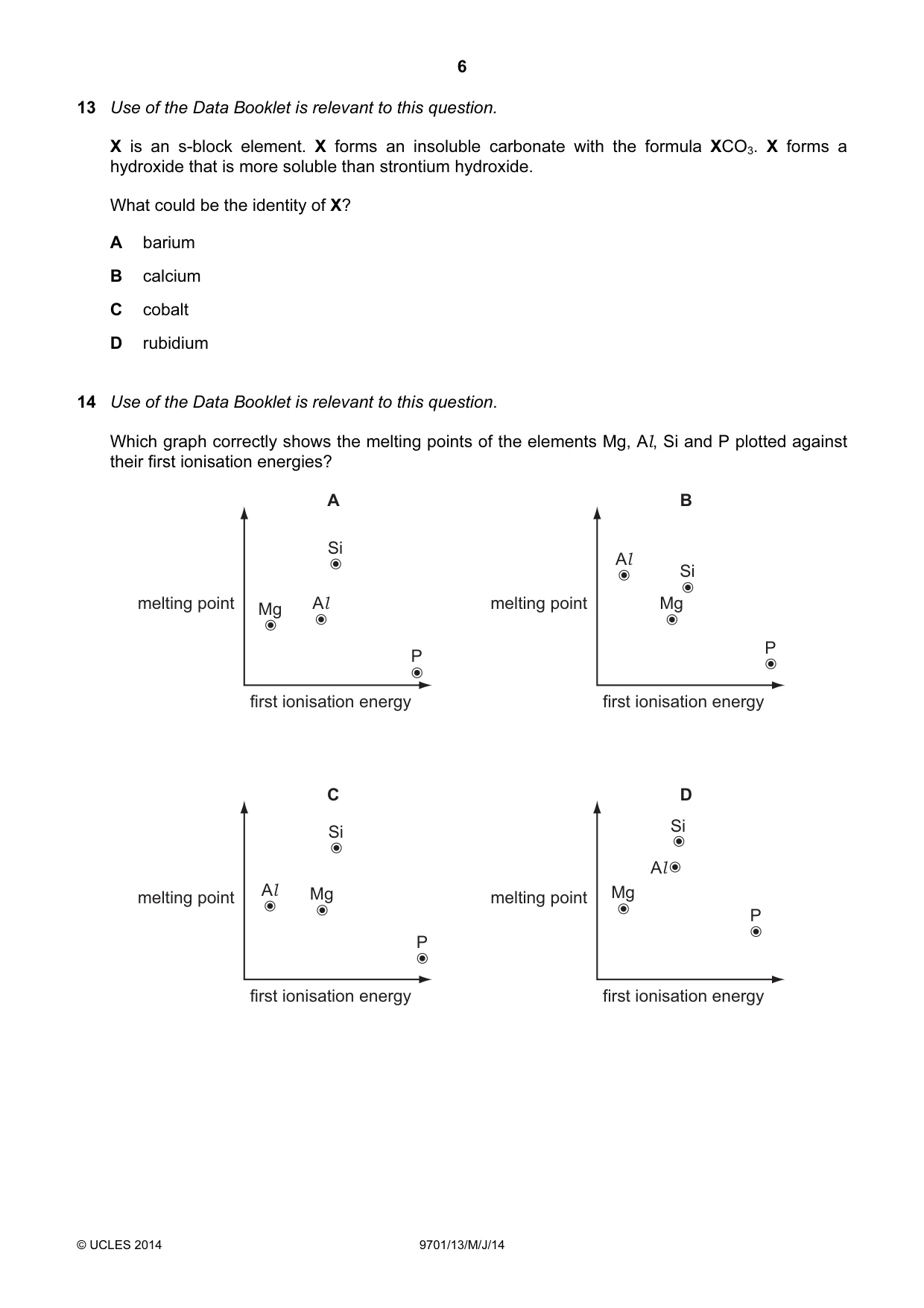
13 Use of the Data Booklet is relevant to this question. X is an s-block element. X forms an insoluble carbonate with the formula XCO3. X forms a hydroxide that is more soluble than strontium hydroxide. What could be the identity of X? A barium B calcium C cobalt D rubidium
Mark scheme: A
Q14 · Use of the Data Booklet is relevant to this question
14 Use of the Data Booklet is relevant to this question. Which graph correctly shows the melting points of the elements Mg, Al, Si and P plotted against their first ionisation energies? A B Si Al Si melting point Mg Al melting point Mg P P first ionisation energy first ionisation energy C D Si Si Al Al Mg Mg melting point melting point P P first ionisation energy first ionisation energy
Mark scheme: C
More questions on Periodicity of physical properties of the elements in Period 3
Q15 · Which substance will not be a product of the thermal decomposition of hydrated magnesium…
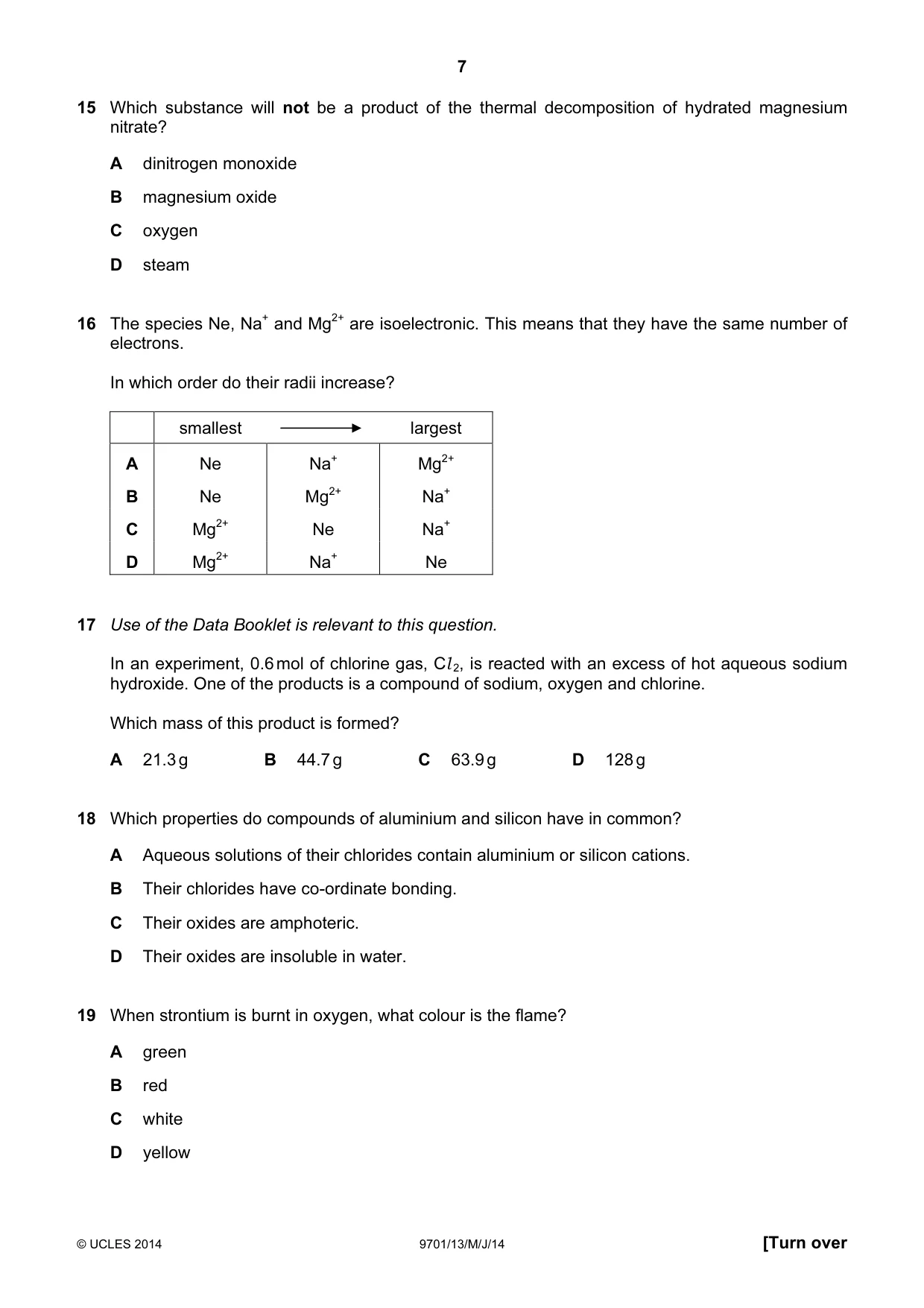
15 Which substance will not be a product of the thermal decomposition of hydrated magnesium nitrate? A dinitrogen monoxide B magnesium oxide C oxygen D steam
Mark scheme: A
Q16 · The species Ne, Na+ and Mg2+ are isoelectronic
16 The species Ne, Na+ and Mg2+ are isoelectronic. This means that they have the same number of electrons. In which order do their radii increase? smallest largest A Ne Na+ Mg2+ B Ne Mg2+ Na+ C Mg2+ Ne Na+ D Mg2+ Na+ Ne
Mark scheme: D
Q17 · Use of the Data Booklet is relevant to this question
17 Use of the Data Booklet is relevant to this question. In an experiment, 0.6 mol of chlorine gas, Cl 2, is reacted with an excess of hot aqueous sodium hydroxide. One of the products is a compound of sodium, oxygen and chlorine. Which mass of this product is formed? A 21.3 g B 44.7 g C 63.9 g D 128 g
Mark scheme: A
Q18 · Which properties do compounds of aluminium and silicon have in common?
18 Which properties do compounds of aluminium and silicon have in common? A Aqueous solutions of their chlorides contain aluminium or silicon cations. B Their chlorides have co-ordinate bonding. C Their oxides are amphoteric. D Their oxides are insoluble in water.
Mark scheme: D
More questions on Periodicity of chemical properties of the elements in Period 3
Q19 · When strontium is burnt in oxygen, what colour is the flame?
19 When strontium is burnt in oxygen, what colour is the flame? A green B red C white D yellow
Mark scheme: B
Q20 · Diesters can be made from diacids such as propane-1,3-dioic acid, HO2CCH2CO2H
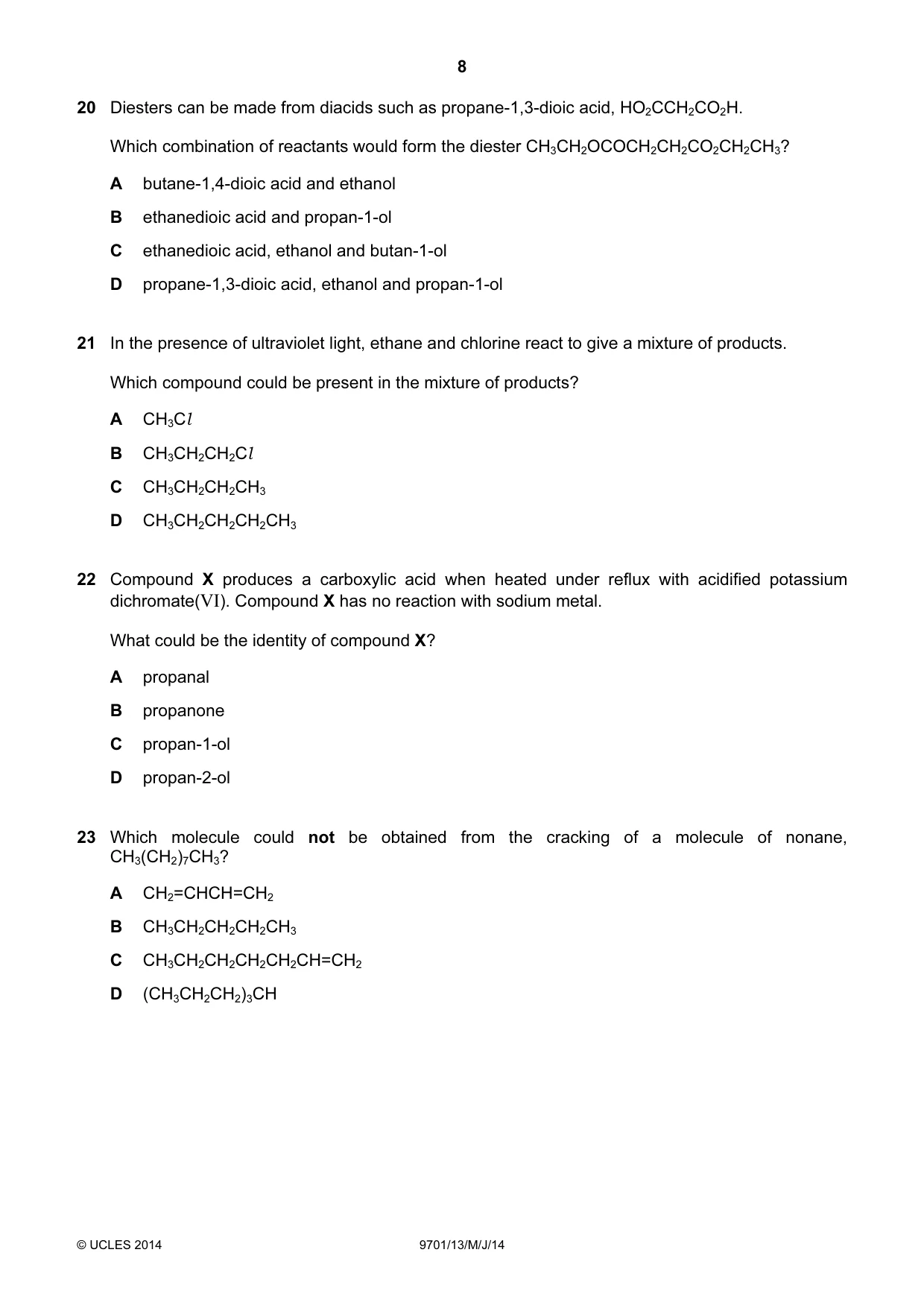
20 Diesters can be made from diacids such as propane-1,3-dioic acid, HO2CCH2CO2H. Which combination of reactants would form the diester CH3CH2OCOCH2CH2CO2CH2CH3? A butane-1,4-dioic acid and ethanol B ethanedioic acid and propan-1-ol C ethanedioic acid, ethanol and butan-1-ol D propane-1,3-dioic acid, ethanol and propan-1-ol
Mark scheme: A
Q21 · In the presence of ultraviolet light, ethane and chlorine react to give a mixture of…
21 In the presence of ultraviolet light, ethane and chlorine react to give a mixture of products. Which compound could be present in the mixture of products? A CH3Cl B CH3CH2CH2Cl C CH3CH2CH2CH3 D CH3CH2CH2CH2CH3
Mark scheme: C
Q22 · Compound X produces a carboxylic acid when heated under reflux with acidified potassium…
22 Compound X produces a carboxylic acid when heated under reflux with acidified potassium dichromate(VI). Compound X has no reaction with sodium metal. What could be the identity of compound X? A propanal B propanone C propan-1-ol D propan-2-ol
Mark scheme: A
Q23 · Which molecule could not be obtained from the cracking of a molecule of nonane…
23 Which molecule could not be obtained from the cracking of a molecule of nonane, CH3(CH2)7CH3? A CH2=CHCH=CH2 B CH3CH2CH2CH2CH3 C CH3CH2CH2CH2CH2CH=CH2 D (CH3CH2CH2)3CH
Mark scheme: D
Q24 · A student investigates four different fuels
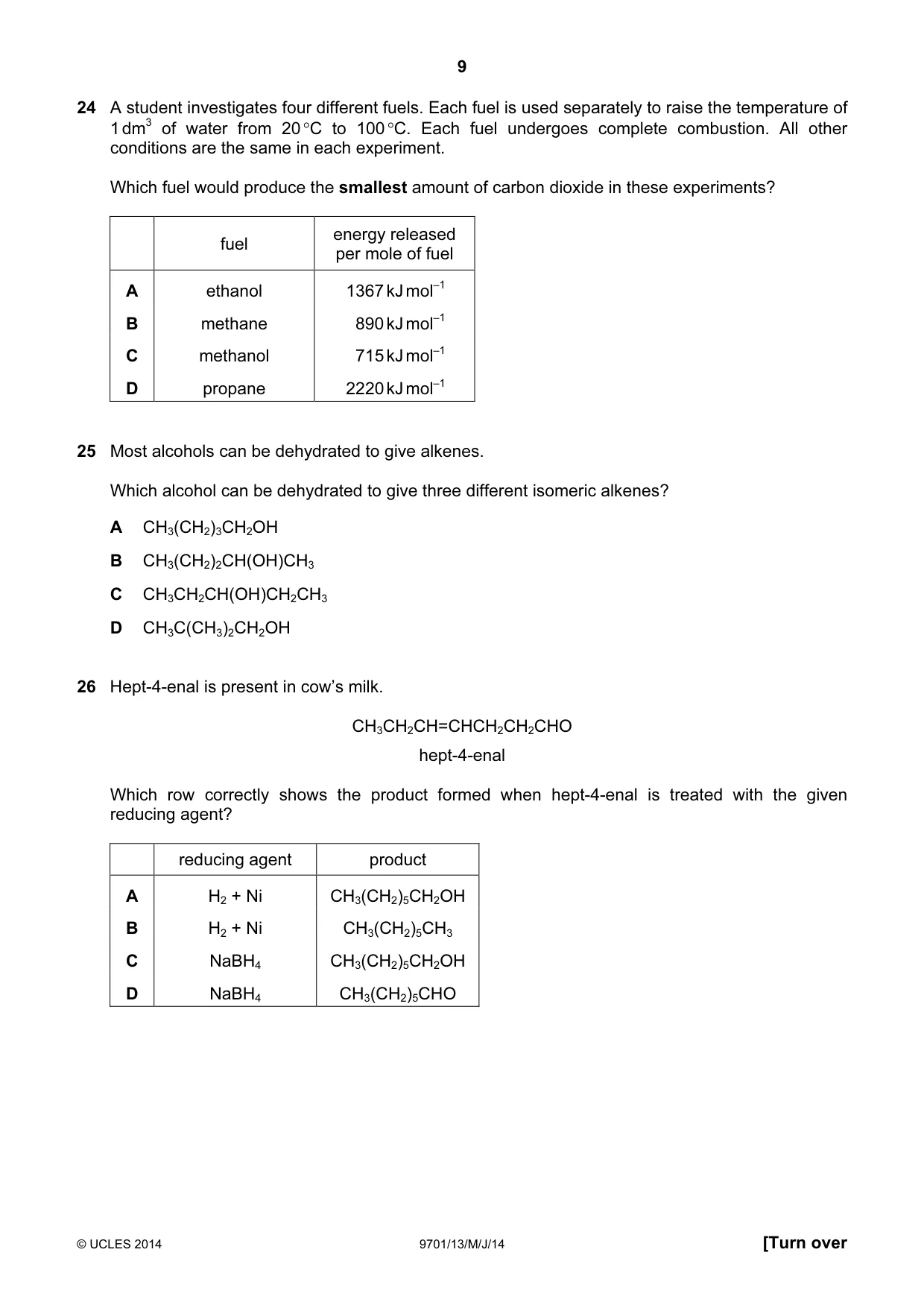
24 A student investigates four different fuels. Each fuel is used separately to raise the temperature of 1 dm3 of water from 20 °C to 100 °C. Each fuel undergoes complete combustion. All other conditions are the same in each experiment. Which fuel would produce the smallest amount of carbon dioxide in these experiments? energy released fuel per mole of fuel A ethanol 1367 kJ mol–1 B methane 890 kJ mol–1 C methanol 715 kJ mol–1 D propane 2220 kJ mol–1
Mark scheme: B
Q25 · Most alcohols can be dehydrated to give alkenes
25 Most alcohols can be dehydrated to give alkenes. Which alcohol can be dehydrated to give three different isomeric alkenes? A CH3(CH2)3CH2OH B CH3(CH2)2CH(OH)CH3 C CH3CH2CH(OH)CH2CH3 D CH3C(CH3)2CH2OH
Mark scheme: B
Q26 · Hept-4-enal is present in cow’s milk
26 Hept-4-enal is present in cow’s milk. CH3CH2CH=CHCH2CH2CHO hept-4-enal Which row correctly shows the product formed when hept-4-enal is treated with the given reducing agent? reducing agent product A H2 + Ni CH3(CH2)5CH2OH B H2 + Ni CH3(CH2)5CH3 C NaBH4 CH3(CH2)5CH2OH D NaBH4 CH3(CH2)5CHO
Mark scheme: A
Q27 · The naturally-occurring molecule shown below can be made by the addition of four…
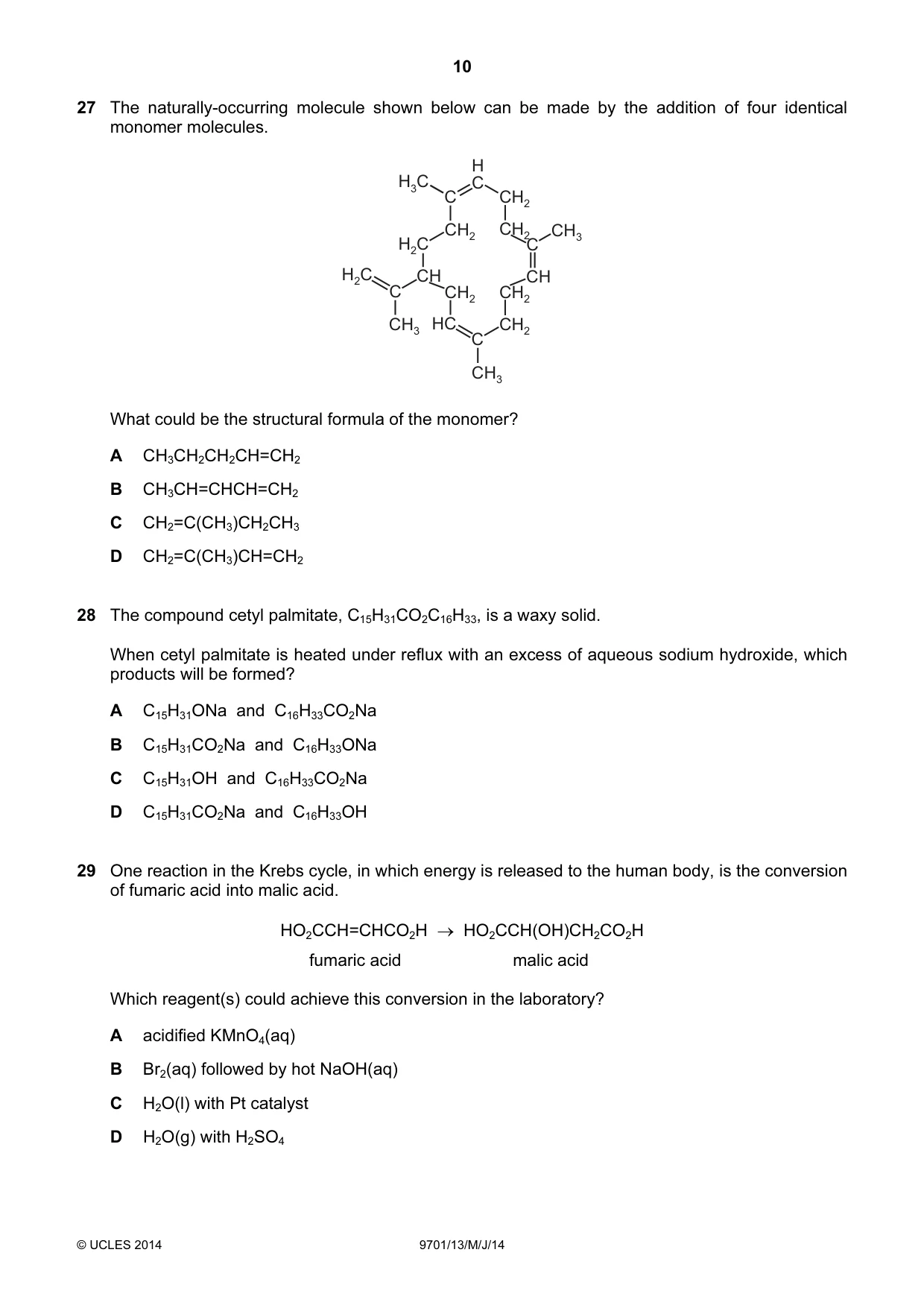
27 The naturally-occurring molecule shown below can be made by the addition of four identical monomer molecules. H H3C C C CH2 CH2 CH2 CH3 H2C C H2C CH CH C CH2 CH2 CH3 HC CH2 C CH3 What could be the structural formula of the monomer? A CH3CH2CH2CH=CH2 B CH3CH=CHCH=CH2 C CH2=C(CH3)CH2CH3 D CH2=C(CH3)CH=CH2
Mark scheme: D
Q28 · The compound cetyl palmitate, C15H31CO2C16H33, is a waxy solid
28 The compound cetyl palmitate, C15H31CO2C16H33, is a waxy solid. When cetyl palmitate is heated under reflux with an excess of aqueous sodium hydroxide, which products will be formed? A C15H31ONa and C16H33CO2Na B C15H31CO2Na and C16H33ONa C C15H31OH and C16H33CO2Na D C15H31CO2Na and C16H33OH
Mark scheme: D
Q29 · One reaction in the Krebs cycle, in which energy is released to the human body, is the…
29 One reaction in the Krebs cycle, in which energy is released to the human body, is the conversion of fumaric acid into malic acid. HO2CCH=CHCO2H → HO2CCH(OH)CH2CO2H fumaric acid malic acid Which reagent(s) could achieve this conversion in the laboratory? A acidified KMnO4(aq) B Br2(aq) followed by hot NaOH(aq) C H2O(l) with Pt catalyst D H2O(g) with H2SO4
Mark scheme: D
Q30 · The free radical substitution reaction between methane and chlorine involves initiation…
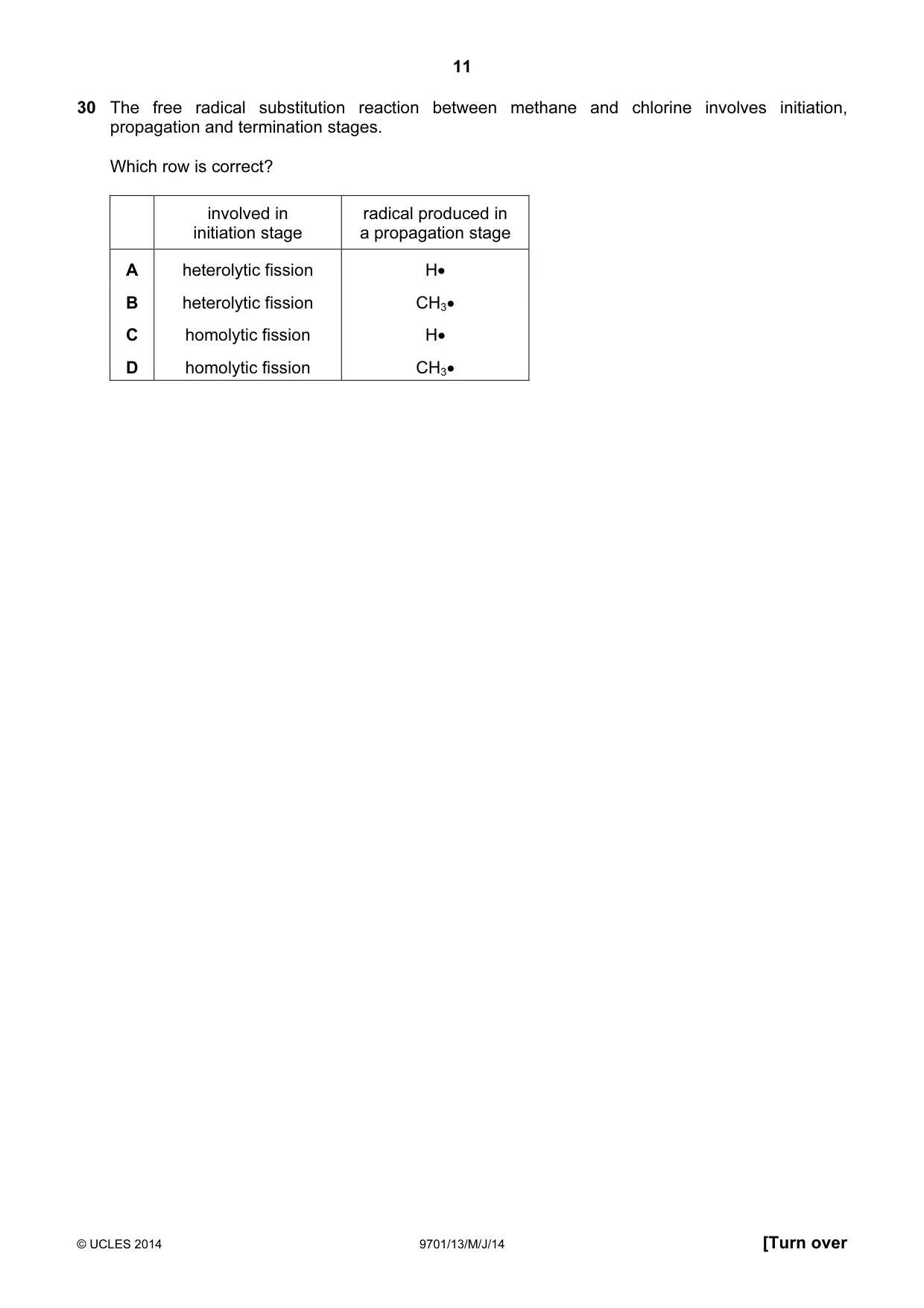
30 The free radical substitution reaction between methane and chlorine involves initiation, propagation and termination stages. Which row is correct? involved in radical produced in initiation stage a propagation stage A heterolytic fission H• B heterolytic fission CH3• C homolytic fission H• D homolytic fission CH3•
Mark scheme: D
Q31 · In 2011 an international group of scientists agreed to add two new elements to the…
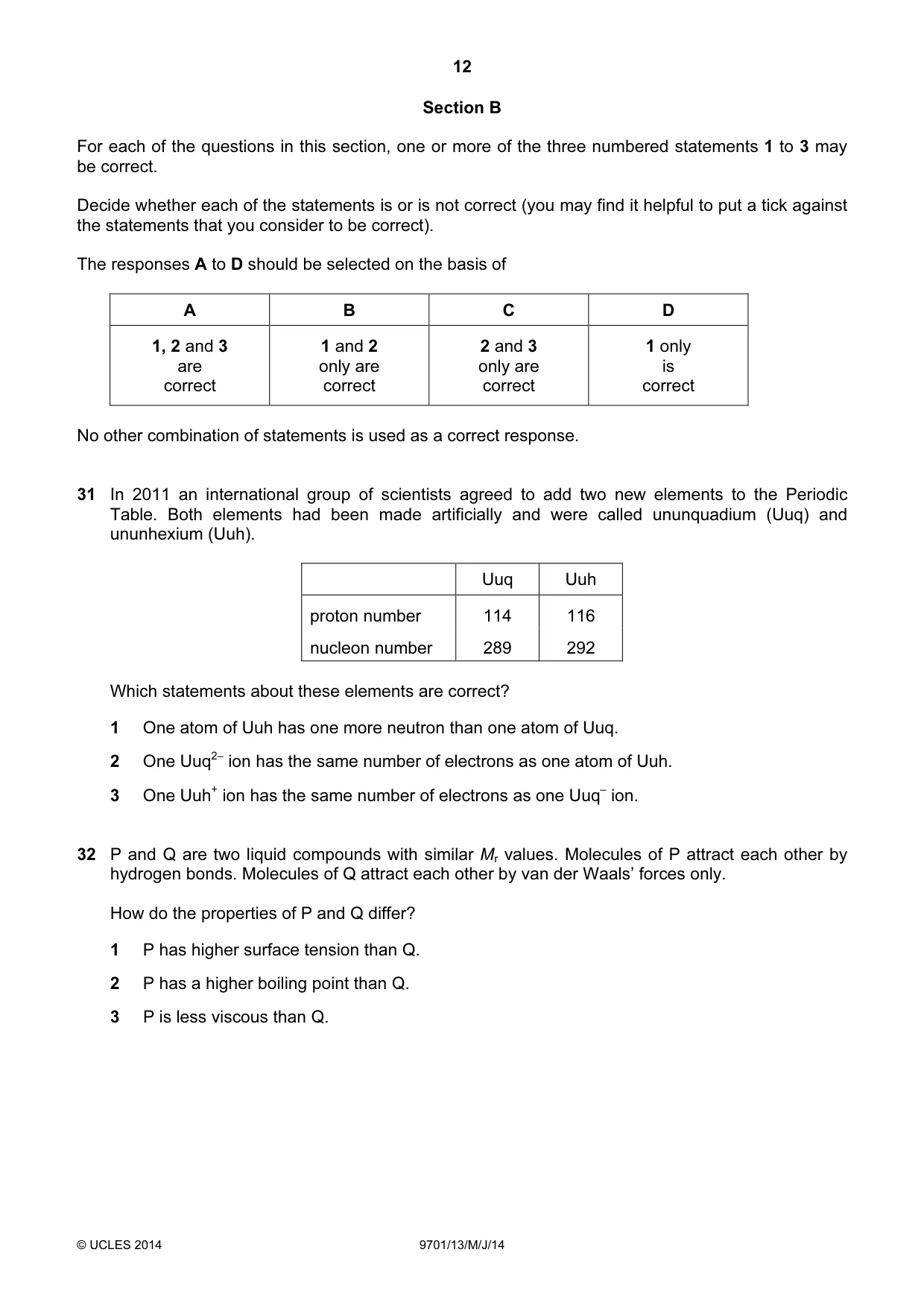
31 In 2011 an international group of scientists agreed to add two new elements to the Periodic Table. Both elements had been made artificially and were called ununquadium (Uuq) and ununhexium (Uuh). Uuq Uuh proton number 114 116 nucleon number 289 292 Which statements about these elements are correct? 1 One atom of Uuh has one more neutron than one atom of Uuq. 2 One Uuq2– ion has the same number of electrons as one atom of Uuh. 3 One Uuh+ ion has the same number of electrons as one Uuq– ion.
Mark scheme: A
Q32 · P and Q are two liquid compounds with similar Mr values
32 P and Q are two liquid compounds with similar Mr values. Molecules of P attract each other by hydrogen bonds. Molecules of Q attract each other by van der Waals’ forces only. How do the properties of P and Q differ? 1 P has higher surface tension than Q. 2 P has a higher boiling point than Q. 3 P is less viscous than Q.
Mark scheme: B
More questions on Intermolecular forces, electronegativity and bond properties
Q33 · Many crude oils contain H2S
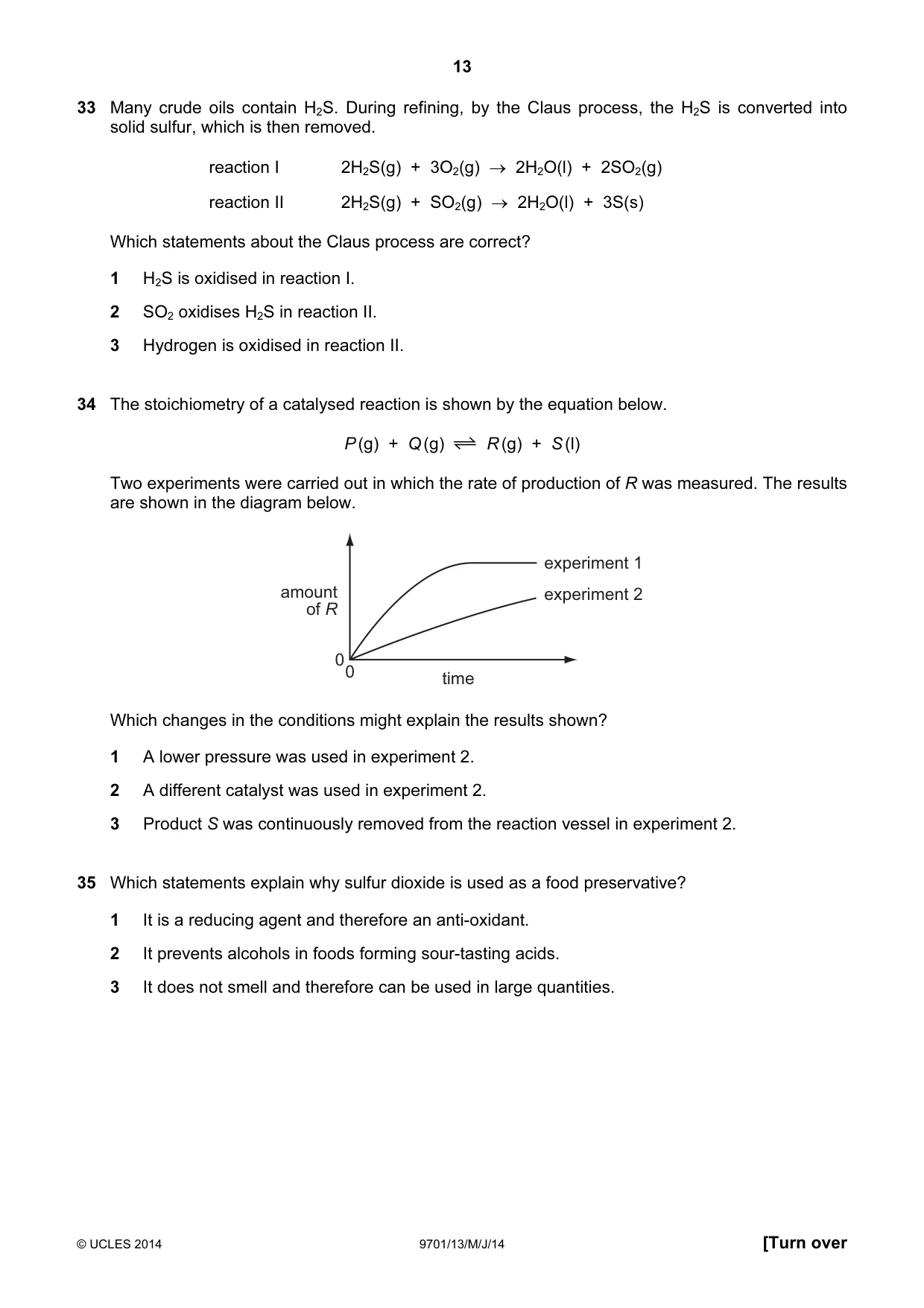
33 Many crude oils contain H2S. During refining, by the Claus process, the H2S is converted into solid sulfur, which is then removed. reaction I 2H2S(g) + 3O2(g) → 2H2O(l) + 2SO2(g) reaction II 2H2S(g) + SO2(g) → 2H2O(l) + 3S(s) Which statements about the Claus process are correct? 1 H2S is oxidised in reaction I. 2 SO2 oxidises H2S in reaction II. 3 Hydrogen is oxidised in reaction II.
Mark scheme: B
Q34 · The stoichiometry of a catalysed reaction is shown by the equation below
34 The stoichiometry of a catalysed reaction is shown by the equation below. P (g) + Q (g) R (g) + S (l) Two experiments were carried out in which the rate of production of R was measured. The results are shown in the diagram below. experiment 1 amount experiment 2 of R 00 time Which changes in the conditions might explain the results shown? 1 A lower pressure was used in experiment 2. 2 A different catalyst was used in experiment 2. 3 Product S was continuously removed from the reaction vessel in experiment 2.
Mark scheme: B
Q35 · Which statements explain why sulfur dioxide is used as a food preservative?
35 Which statements explain why sulfur dioxide is used as a food preservative? 1 It is a reducing agent and therefore an anti-oxidant. 2 It prevents alcohols in foods forming sour-tasting acids. 3 It does not smell and therefore can be used in large quantities.
Mark scheme: B
Q36 · The intermolecular forces between iodine molecules are instantaneous dipole-induced…
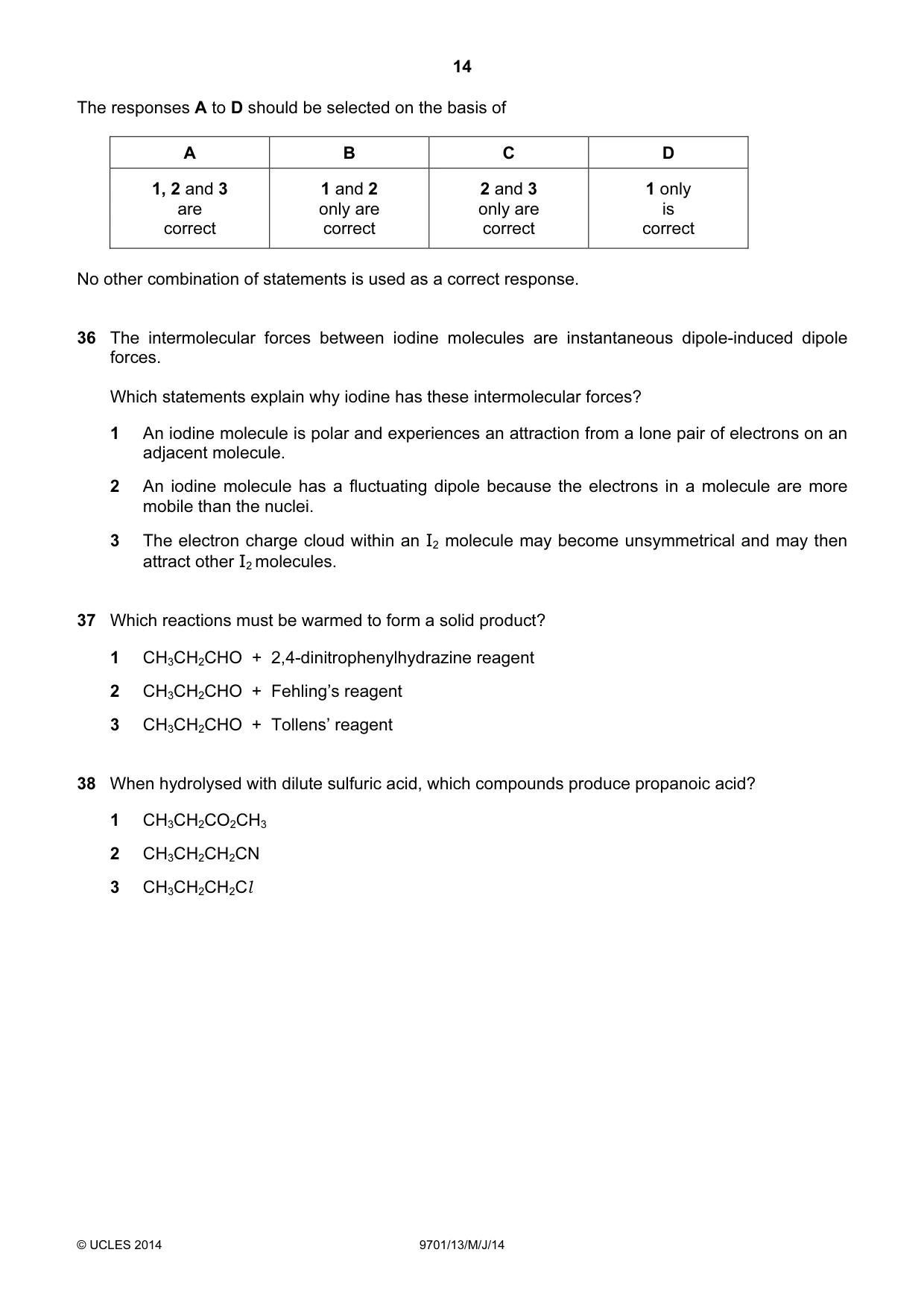
36 The intermolecular forces between iodine molecules are instantaneous dipole-induced dipole forces. Which statements explain why iodine has these intermolecular forces? 1 An iodine molecule is polar and experiences an attraction from a lone pair of electrons on an adjacent molecule. 2 An iodine molecule has a fluctuating dipole because the electrons in a molecule are more mobile than the nuclei. 3 The electron charge cloud within an I2 molecule may become unsymmetrical and may then attract other I2 molecules.
Mark scheme: C
More questions on Intermolecular forces, electronegativity and bond properties
Q37 · Which reactions must be warmed to form a solid product?
37 Which reactions must be warmed to form a solid product? 1 CH3CH2CHO + 2,4-dinitrophenylhydrazine reagent 2 CH3CH2CHO + Fehling’s reagent 3 CH3CH2CHO + Tollens’ reagent
Mark scheme: C
Q38 · When hydrolysed with dilute sulfuric acid, which compounds produce propanoic acid?
38 When hydrolysed with dilute sulfuric acid, which compounds produce propanoic acid? 1 CH3CH2CO2CH3 2 CH3CH2CH2CN 3 CH3CH2CH2Cl
Mark scheme: D
Q39 · Propane-1,2,3-triol is the raw material for many important industrial chemical processes
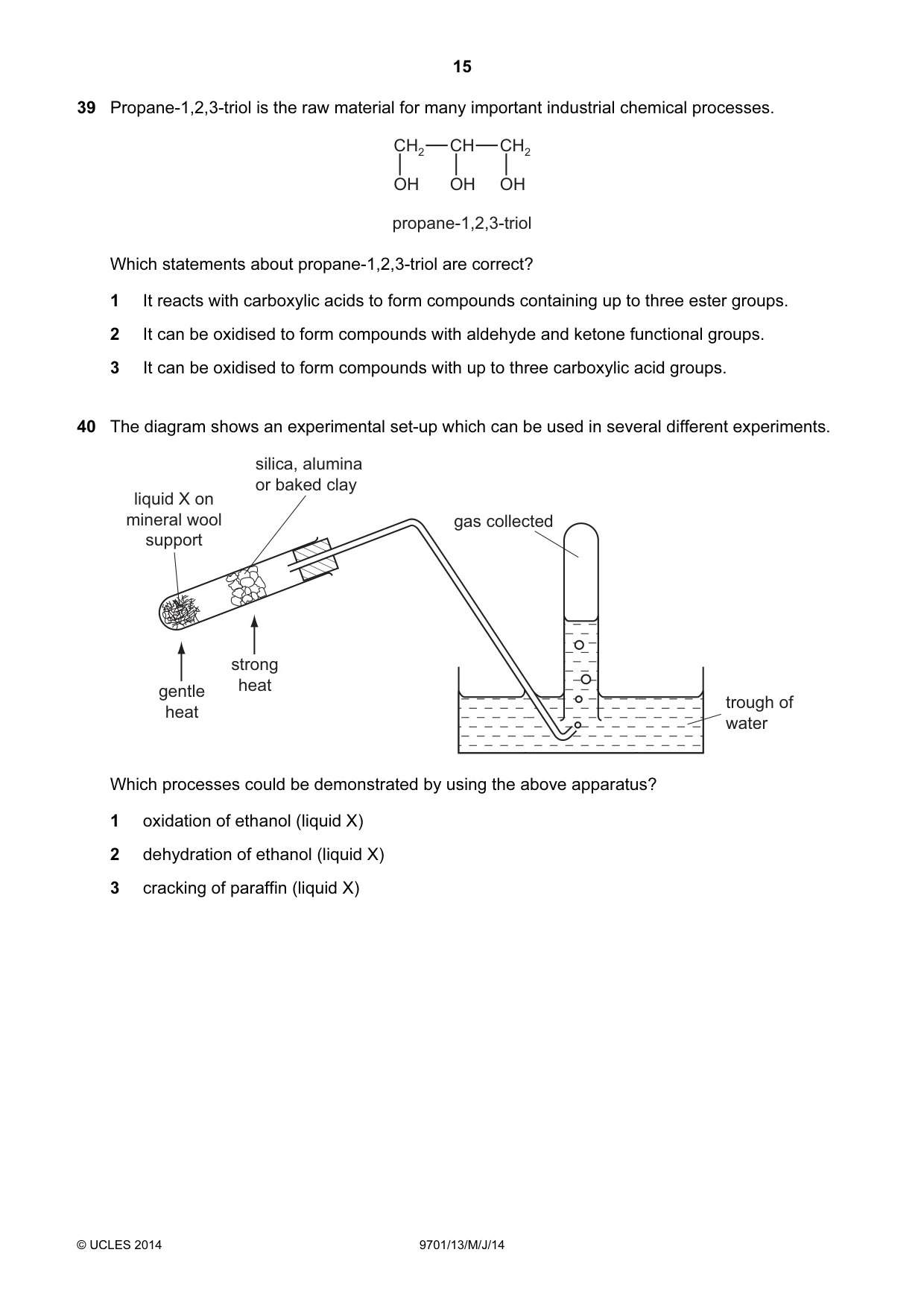
39 Propane-1,2,3-triol is the raw material for many important industrial chemical processes. CH2 CH CH2 OH OH OH propane-1,2,3-triol Which statements about propane-1,2,3-triol are correct? 1 It reacts with carboxylic acids to form compounds containing up to three ester groups. 2 It can be oxidised to form compounds with aldehyde and ketone functional groups. 3 It can be oxidised to form compounds with up to three carboxylic acid groups.
Mark scheme: B
Q40 · The diagram shows an experimental set-up which can be used in several different…
40 The diagram shows an experimental set-up which can be used in several different experiments. silica, alumina or baked clay liquid X on mineral wool gas collected support strong gentle heat trough of heat water Which processes could be demonstrated by using the above apparatus? 1 oxidation of ethanol (liquid X) 2 dehydration of ethanol (liquid X) 3 cracking of paraffin (liquid X)
Mark scheme: C
What was in this paper
The subtopics covered by these 40 questions, and how many questions each got. Open one in a new tab to see every Cambridge question on it.
4Alkanes4Aldehydes and ketones3Similarities and trends in the properties of the Group 2 metals, magnesium to barium, and their compounds3Effect of temperature on reaction rates and the concept of activation energy2Enthalpy change, ΔH2Esters2Intermolecular forces, electronegativity and bond properties2Nitrogen and sulfur2Particles in the atom and atomic radius2Periodicity of chemical properties of the elements in Period 32Addition polymerisation1Bonding and structure1Carboxylic acids1Dot-and-cross diagrams1Electrolysis1Hess’s law1Isotopes1Periodicity of physical properties of the elements in Period 31Rate of reaction1Shapes of molecules1The gaseous state: ideal and real gases and pV = nRT1The reactions of chlorine1What you needed in this session
Cambridge’s own grade thresholds for 2014 May/June, Paper 1 · Variant 3. A higher threshold means an easier paper — the bar moves with how the cohort did.