Questions as text
Q1 · Compound X on reaction with hot concentrated sulphuric acid gave a mixture of three… 9701/11 Oct/Nov 2005
24 Compound X on reaction with hot concentrated sulphuric acid gave a mixture of three alkenes. What could X be? A butan-2-ol B propan-2-ol C 2-methylbutan-2-ol D 2-methylpropan-2-ol
1 marks
Answer: A
This question in 9701/11 Oct/Nov 2005
Q2 · A new industrial preparation of ethyl ethanoate has been developed using cheap sources of… 9701/11 May/June 2006
20 A new industrial preparation of ethyl ethanoate has been developed using cheap sources of ethanol. Cu catalyst Cu catalyst CH3CH2OH CH3CHO CH3CH(OH)OCH2CH3 – H2 + CH3CH2OH Cu catalyst – H2 CH3CO2CH2CH3 Which process is involved at some stage in this reaction sequence? A disproportionation B electrophilic addition C nucleophilic addition D reduction
1 marks
Answer: C
This question in 9701/11 May/June 2006
Q3 · Which reagent could detect the presence of alcohol in a petrol consisting mainly of a… 9701/11 May/June 2006
26 Which reagent could detect the presence of alcohol in a petrol consisting mainly of a mixture of alkanes and alkenes? A Na B Br2 (in CCl4) C KMnO4(aq) D 2,4-dinitrophenylhydrazine
1 marks
Answer: A
This question in 9701/11 May/June 2006
Q4 · Which alcohol may be oxidised to a product which reacts with 2,4-dinitrophenylhydrazine… 9701/11 May/June 2006
27 Which alcohol may be oxidised to a product which reacts with 2,4-dinitrophenylhydrazine reagent but not with Fehling’s reagent? A butan-1-ol B butan-2-ol C 2-methylpropan-1-ol D 2-methylpropan-2-ol
1 marks
Answer: B
This question in 9701/11 May/June 2006
Q5 · Which compound • is unaffected by hot alkaline potassium manganate(VII); • gives hydrogen… 9701/11 Oct/Nov 2006
27 Which compound • is unaffected by hot alkaline potassium manganate(VII); • gives hydrogen when treated with sodium? A (CH3)2CHCOCH3 B (CH3)3COH C CH3CH2CH(OH)CH3 D CH3CO2CH(CH3)2
1 marks
Answer: B
This question in 9701/11 Oct/Nov 2006
Q6 · Which compounds are able to react with concentrated sulphuric acid to give a product that… 9701/11 Oct/Nov 2006
39 Which compounds are able to react with concentrated sulphuric acid to give a product that will decolourise acidic potassium manganate(VII)? 1 (CH3)3COH 2 CH3CH2CH(OH)CH3 3 CH3CO2H
1 marks
Answer: B
This question in 9701/11 Oct/Nov 2006
Q7 · Hydrogen bonding can occur between molecules of methanal, HCHO, and molecules of liquid Y 9701/11 Oct/Nov 2007
5 Hydrogen bonding can occur between molecules of methanal, HCHO, and molecules of liquid Y. What could liquid Y be? A CH3OH B CH3CHO C CH3COCH3 D CH3CO2CH3
1 marks
Answer: A
This question in 9701/11 Oct/Nov 2007
Q8 · Which reaction will distinguish between a primary and a secondary alcohol? 9701/11 Oct/Nov 2007
27 Which reaction will distinguish between a primary and a secondary alcohol? A warming with H+ / MnO − 4 B warming with H+ / Cr2O 2 − 7 C dehydration, followed by reaction with Br2(aq) D oxidation, followed by reaction with Fehling’s (or Tollens’) reagent
1 marks
Answer: D
This question in 9701/11 Oct/Nov 2007
Q9 · Hept-4-enal is present in cow’s milk 9701/11 Oct/Nov 2007
28 Hept-4-enal is present in cow’s milk. CH3CH2CH=CHCH2CH2CHO hept-4-enal What is formed when hept-4-enal is reduced with either hydrogen and a nickel catalyst or sodium borohydride? A with H2 / Ni CH3(CH2)5CH2OH B with H2 / Ni CH3(CH2)5CH3 C with NaBH4 CH3(CH2)5CH2OH D with NaBH4 CH3(CH2)5CHO
1 marks
Answer: A
This question in 9701/11 Oct/Nov 2007
Q10 · Which structures show a primary alcohol that cannot be dehydrated to form an alkene? 9701/11 Oct/Nov 2007
38 Which structures show a primary alcohol that cannot be dehydrated to form an alkene? 1 CH3OH 2 CH3CH2OH 3 CH3CH(OH)CH3
1 marks
Answer: D
This question in 9701/11 Oct/Nov 2007
Q11 · Mevalonic acid, 3,5-dihydroxy-3-methylpentanoic acid, is involved in cholesterol… 9701/11 May/June 2008
24 Mevalonic acid, 3,5-dihydroxy-3-methylpentanoic acid, is involved in cholesterol formation in the body. It is an oil that occurs as a mixture of the two interchanging molecules shown in the diagram. HO CH3 HO CH3 C C I CH2 CH2 CH2 CH2 II CH2 C CH2OH CO2H O O What names are used to describe the pair of interchanging reactions I and II? A condensation and addition B dehydrogenation and hydrogenation C esterification and hydrolysis D neutralisation and acidification
1 marks
Answer: C
This question in 9701/11 May/June 2008
Q12 · An alcohol of molecular formula C4H10O2 contains two OH groups and has an unbranched… 9701/11 May/June 2008
26 An alcohol of molecular formula C4H10O2 contains two OH groups and has an unbranched carbon atom chain. On reaction with an excess of hot MnO / H+ this alcohol is converted into a compound of − 4 molecular formula C4H6O4. To which two carbon atoms in the chain of the alcohol are the two OH groups attached? A 1st and 2nd B 1st and 3rd C 1st and 4th D 2nd and 3rd
1 marks
Answer: C
This question in 9701/11 May/June 2008
Q13 · Compound X • has the molecular formula C10H14O; • is unreactive towards mild oxidising… 9701/11 May/June 2008
27 Compound X • has the molecular formula C10H14O; • is unreactive towards mild oxidising agents. What is the structure of the compound formed by dehydration of X? A B CH2 CH2 CH CH2 CH2 CH CH CH3 C D CH3 CH3 CH CH CH2 C CH CH3
1 marks
Answer: D
This question in 9701/11 May/June 2008
Q14 · Compound X, C6H12O, is oxidised by acidified sodium dichromate(VI) to compound Y 9701/11 May/June 2008
30 Compound X, C6H12O, is oxidised by acidified sodium dichromate(VI) to compound Y. Compound Y reacts with ethanol in the presence of a little concentrated sulphuric acid to give liquid Z. What is the formula of Z? A CH3(CH2)2CH=CHCO2H B CH3(CH2)4CH2COCH2CH3 C CH3(CH2)4CO2CH2CH3 D CH3CH2CO2(CH2)4CH3
1 marks
Answer: C
This question in 9701/11 May/June 2008
Q15 · For complete combustion, 1 mol of an organic compound X was found to require 2.5 mol of… 9701/11 May/June 2008
31 For complete combustion, 1 mol of an organic compound X was found to require 2.5 mol of molecular oxygen. Which compounds could be X? 1 C2H5OH 2 C2H2 3 CH3CHO
1 marks
Answer: C
This question in 9701/11 May/June 2008
Q16 · Sorbitol is a naturally-occurring compound with a sweet taste 9701/11 Oct/Nov 2008
20 Sorbitol is a naturally-occurring compound with a sweet taste. It is often used as a substitute for sucrose by the food industry. The diagram shows its structure. H H C O H H C O H H O C H H C O H H C O H H C O H H How many chiral centres are present in sorbitol? A 1 B 2 C 3 D 4
1 marks
Answer: D
This question in 9701/11 Oct/Nov 2008
Q17 · The compound ‘leaf alcohol’ is partly responsible for the smell of new-mown grass 9701/11 Oct/Nov 2008
21 The compound ‘leaf alcohol’ is partly responsible for the smell of new-mown grass. CH3CH2CH=CHCH2CH2OH leaf alcohol Which two compounds will be formed when ‘leaf alcohol’ is oxidised using hot, concentrated manganate(VII) ions? A CH3CO2H and HOCH2CH2CH2CO2H B CH3CO2H and HO2CCH2CH2CO2H C CH3CH2CO2H and HO2CCH2CO2H D CH3CH2CO2H and HOCH2CH2CO2H
1 marks
Answer: C
This question in 9701/11 Oct/Nov 2008
Q18 · The functional group in a primary alcohol is –CH2OH 9701/11 Oct/Nov 2008
25 The functional group in a primary alcohol is –CH2OH. Which reagent reacts with a primary alcohol, under suitable conditions, to give an organic product with the same number of oxygen atoms as the alcohol? A Al2O3 B CH3CO2H C HBr D Na
1 marks
Answer: D
This question in 9701/11 Oct/Nov 2008
Q19 · The structure of the antioxidant vitamin C is shown in the diagram 9701/11 Oct/Nov 2008
40 The structure of the antioxidant vitamin C is shown in the diagram. HO OH C C O C CHCH(OH)CH2OH O On the basis of this structure, which properties is vitamin C likely to have? 1 It is soluble in water. 2 It decolourises aqueous bromine rapidly. 3 It reduces Fehling’s reagent.
1 marks
Answer: B
This question in 9701/11 Oct/Nov 2008
Q20 · Which reaction would not give propene as one product? 9701/11 May/June 2009
25 Which reaction would not give propene as one product? A adding an excess of concentrated sulfuric acid to propan-1-ol B adding warm aqueous sodium hydroxide to 2-bromopropane C adding warm ethanolic sodium hydroxide to 1-bromopropane D passing propan-2-ol vapour over heated aluminium oxide
1 marks
Answer: B
This question in 9701/11 May/June 2009
Q21 · Glycol, used in anti-freeze, has the formula HOCH2CH2OH 9701/11 May/June 2009
26 Glycol, used in anti-freeze, has the formula HOCH2CH2OH. It can be oxidised to give a number of products. What is the molecular formula of an oxidation product of glycol that will not react with sodium? A C2H2O2 B C2H2O3 C C2H2O4 D C2H4O2
1 marks
Answer: A
This question in 9701/11 May/June 2009
Q22 · 2-Methylbuta-1,3-diene, CH2=C(CH3)–CH=CH2, is used as a monomer in the manufacture of… 9701/11 May/June 2009
29 2-Methylbuta-1,3-diene, CH2=C(CH3)–CH=CH2, is used as a monomer in the manufacture of synthetic rubbers. Which compound would not produce this monomer on treatment with concentrated sulfuric acid at 170 °C? A (CH3)2C(OH)CH(OH)CH3 B HOCH2CH(CH3)CH2CH2OH C HOCH2CH(CH3)CH(OH)CH3 D HOCH2C(CH3)(OH)CH2CH3
1 marks
Answer: D
This question in 9701/11 May/June 2009
Q23 · Geraniol is one of several compounds produced by the scent glands of honey bees to help… 9701/11 May/June 2009
38 Geraniol is one of several compounds produced by the scent glands of honey bees to help them mark nectar-bearing flowers and locate the entrances to their hives. OH geraniol Which reactions will geraniol undergo? 1 reaction with hot concentrated acidic KMnO4 to give propanone 2 addition of halogens 3 reaction with aqueous NaHCO3 to give CO2
1 marks
Answer: B
This question in 9701/11 May/June 2009
Q24 · The following diagram represents the structure of a possible polymer 9701/11 Oct/Nov 2009
23 The following diagram represents the structure of a possible polymer. OH OH OH OH OH OH C C C C C C H H H H H H By which method might this polymer be made? A polymerise ethene followed by hydration B polymerise ethene followed by oxidation with cold acidified KMnO4 C polymerise 1,2-dichloroethene followed by hydrolysis D polymerise 1,2-dichloroethene followed by oxidation with cold acidified KMnO4
1 marks
Answer: C
This question in 9701/11 Oct/Nov 2009
Q25 · The diagram shows an experiment 9701/11 Oct/Nov 2009
39 The diagram shows an experiment. silica, alumina or baked clay liquid X on mineral wool gas collected support strong gentle heat trough of heat water Which processes could be demonstrated by using the above apparatus? 1 the oxidation of ethanol (the liquid X) 2 the dehydration of ethanol (the liquid X) 3 the cracking of paraffin (the liquid X)
1 marks
Answer: C
This question in 9701/11 Oct/Nov 2009
Q26 · A compound has a relative molecular mass of 88 and its molecule contains only four carbon… 9701/11 Oct/Nov 2009
40 A compound has a relative molecular mass of 88 and its molecule contains only four carbon atoms. What could this compound be? 1 a saturated non-cyclic diol 2 a secondary alcohol containing an aldehyde group 3 a primary alcohol containing a ketone group
1 marks
Answer: C
This question in 9701/11 Oct/Nov 2009
Q27 · What will react differently with the two isomeric alcohols, (CH3)3CCH2OH and… 9701/11 May/June 2010
22 What will react differently with the two isomeric alcohols, (CH3)3CCH2OH and (CH3)2CHCH2CH2OH? A acidified aqueous potassium manganate(VII) B concentrated sulfuric acid C phosphorus pentachloride D sodium
1 marks
Answer: B
This question in 9701/11 May/June 2010
Q28 · What is formed when propanone is refluxed with a solution of NaBH4? 9701/11 May/June 2010
24 What is formed when propanone is refluxed with a solution of NaBH4? A propanal B propan-1-ol C propan-2-ol D propane
1 marks
Answer: C
This question in 9701/11 May/June 2010
Q29 · Which isomer of C4H10O forms three alkenes on dehydration? 9701/11 May/June 2010
29 Which isomer of C4H10O forms three alkenes on dehydration? A butan-1-ol B butan-2-ol C 2-methylpropan-1-ol D 2-methylpropan-2-ol
1 marks
Answer: B
This question in 9701/11 May/June 2010
Q30 · What will react differently with the two isomeric alcohols, (CH3)3CCH2OH and… 9701/12 May/June 2010
21 What will react differently with the two isomeric alcohols, (CH3)3CCH2OH and (CH3)2CHCH2CH2OH? A acidified aqueous potassium manganate(VII) B concentrated sulfuric acid C phosphorus pentachloride D sodium
1 marks
Answer: B
This question in 9701/12 May/June 2010
Q31 · Which isomer of C4H10O forms three alkenes on dehydration? 9701/12 May/June 2010
27 Which isomer of C4H10O forms three alkenes on dehydration? A butan-1-ol B butan-2-ol C 2-methylpropan-1-ol D 2-methylpropan-2-ol
1 marks
Answer: B
This question in 9701/12 May/June 2010
Q32 · The diagram shows some laboratory apparatus 9701/12 May/June 2010
40 The diagram shows some laboratory apparatus. water heat Which preparations could this apparatus be used for? 1 bromoethane, from ethanol, sodium bromide and concentrated sulfuric acid 2 ethanal, from ethanol, sodium dichromate(VI) and sulfuric acid 3 1,2-dibromoethane, from bromine and ethene
1 marks
Answer: B
This question in 9701/12 May/June 2010
Q33 · What will react differently with the two isomeric alcohols, (CH3)3CCH2OH and… 9701/13 May/June 2010
21 What will react differently with the two isomeric alcohols, (CH3)3CCH2OH and (CH3)2CHCH2CH2OH? A acidified aqueous potassium manganate(VII) B concentrated sulfuric acid C phosphorus pentachloride D sodium
1 marks
Answer: B
This question in 9701/13 May/June 2010
Q34 · Which isomer of C4H10O forms three alkenes on dehydration? 9701/13 May/June 2010
30 Which isomer of C4H10O forms three alkenes on dehydration? A butan-1-ol B butan-2-ol C 2-methylpropan-1-ol D 2-methylpropan-2-ol
1 marks
Answer: B
This question in 9701/13 May/June 2010
Q35 · A compound Y has all of the properties below 9701/11 Oct/Nov 2010
22 A compound Y has all of the properties below. • It is a liquid at 25 °C. • It mixes completely with water. • It reacts with aqueous sodium hydroxide. What could Y be? A ethanoic acid B ethanol C ethene D ethyl ethanoate
1 marks
Answer: A
This question in 9701/11 Oct/Nov 2010
Q36 · Which alcohol gives only one possible oxidation product when warmed with dilute acidified… 9701/11 Oct/Nov 2010
24 Which alcohol gives only one possible oxidation product when warmed with dilute acidified potassium dichromate(VI)? A butan-1-ol B butan-2-ol C 2-methylpropan-1-ol D 2-methylpropan-2-ol
1 marks
Answer: B
This question in 9701/11 Oct/Nov 2010
Q37 · The diagram shows the structure of the naturally-occurring molecule cholesterol 9701/11 Oct/Nov 2010
37 The diagram shows the structure of the naturally-occurring molecule cholesterol. H3C CH3 H CH3 H H H HO cholesterol Which statements about cholesterol are correct? 1 The molecule contains a secondary alcohol group. 2 The molecule contains two π bonds. 3 All carbon atoms in the four rings lie in the same plane.
1 marks
Answer: D
This question in 9701/11 Oct/Nov 2010
Q38 · Which sequence of reagents may be used in the laboratory to convert propan-1-ol into… 9701/12 Oct/Nov 2010
23 Which sequence of reagents may be used in the laboratory to convert propan-1-ol into 2-bromopropane? A concentrated sulfuric acid, followed by bromine B concentrated sulfuric acid, followed by hydrogen bromide C ethanolic sodium hydroxide, followed by bromine D ethanolic sodium hydroxide, followed by hydrogen bromide
1 marks
Answer: B
This question in 9701/12 Oct/Nov 2010
Q39 · Part of the structure of strobilurin, a fungicide, is shown 9701/12 Oct/Nov 2010
27 Part of the structure of strobilurin, a fungicide, is shown. R and R' are inert groups. O OCH3 R' R If strobilurin is first warmed with aqueous sulfuric acid, and its product then treated with hydrogen in the presence of a palladium catalyst, what could be the structure of the final product? A B O OH HO OCH3 R' R' R R C D OH O OH OH OH R' R' R R OH
1 marks
Answer: A
This question in 9701/12 Oct/Nov 2010
Q40 · The diagram shows a compound present in smoke from burning garden waste 9701/12 Oct/Nov 2010
37 The diagram shows a compound present in smoke from burning garden waste. H H H C C C O H Which reagents would undergo a colour change on reaction with this compound? 1 aqueous bromine 2 Fehling’s reagent 3 warm acidified K2Cr2O7
1 marks
Answer: A
This question in 9701/12 Oct/Nov 2010
Q41 · Use of the Data Booklet is relevant for this question 9701/12 Oct/Nov 2010
39 Use of the Data Booklet is relevant for this question. In an organic synthesis, a 62 % yield of product is achieved. Which of these conversions are consistent with this information? 1 74.00g of butan-2-ol → 44.64 g of butanone 2 74.00g of butan-1-ol → 54.56 g of butanoic acid 3 74.00g of 2-methylpropan-1-ol → 54.56 g of 2-methylpropanoic acid
1 marks
Answer: A
This question in 9701/12 Oct/Nov 2010
Q42 · A compound Y has all of the properties below 9701/13 Oct/Nov 2010
20 A compound Y has all of the properties below. • It is a liquid at 25 °C. • It mixes completely with water. • It reacts with aqueous sodium hydroxide. What could Y be? A ethanoic acid B ethanol C ethene D ethyl ethanoate
1 marks
Answer: A
This question in 9701/13 Oct/Nov 2010
Q43 · Compound X reacts with ethanoic acid in the presence of an H+ catalyst to produce the… 9701/13 Oct/Nov 2010
22 Compound X reacts with ethanoic acid in the presence of an H+ catalyst to produce the compound below. O H H O H3C C C C O C CH3 H H What is the molecular formula of compound X? A C2H6O2 B C2H6O3 C C4H8O D C4H8O2
1 marks
Answer: D
This question in 9701/13 Oct/Nov 2010
Q44 · Which alcohol gives only one possible oxidation product when warmed with dilute acidified… 9701/13 Oct/Nov 2010
25 Which alcohol gives only one possible oxidation product when warmed with dilute acidified potassium dichromate(VI)? A butan-1-ol B butan-2-ol C 2-methylpropan-1-ol D 2-methylpropan-2-ol
1 marks
Answer: B
This question in 9701/13 Oct/Nov 2010
Q45 · Lactic acid occurs naturally, for example in sour milk 9701/13 Oct/Nov 2010
26 Lactic acid occurs naturally, for example in sour milk. H H O O H C C C H H O H lactic acid What is a property of lactic acid? A It decolourises aqueous bromine rapidly. B It is insoluble in water. C It reduces Fehling’s reagent. D Two molecules react with each other in the presence of a strong acid.
1 marks
Answer: D
This question in 9701/13 Oct/Nov 2010
Q46 · The diagram shows the structure of the naturally-occurring molecule cholesterol 9701/13 Oct/Nov 2010
36 The diagram shows the structure of the naturally-occurring molecule cholesterol. H3C CH3 H CH3 H H H HO cholesterol Which statements about cholesterol are correct? 1 The molecule contains a secondary alcohol group. 2 The molecule contains two π bonds. 3 All carbon atoms in the four rings lie in the same plane.
1 marks
Answer: D
This question in 9701/13 Oct/Nov 2010
Q47 · An organic compound decolourises aqueous bromine and reacts with sodium to produce… 9701/13 Oct/Nov 2010
38 An organic compound decolourises aqueous bromine and reacts with sodium to produce hydrogen. Which molecular formula could represent this compound? 1 C3H6O 2 C3H4O2 3 C3H8O
1 marks
Answer: B
This question in 9701/13 Oct/Nov 2010
Q48 · In the reaction pathway below, an alkane is converted into a carboxylic acid through… 9701/11 May/June 2011
19 In the reaction pathway below, an alkane is converted into a carboxylic acid through several stages. stage 1 stage 2 stage 3 C10H22 C2H4 C2H5OH CH3CO2H catalytic hydration Which processes occur at stage 1 and at stage 3? stage 1 stage 3 A condensation combustion B cracking dehydration C cracking oxidation D dehydration combustion
1 marks
Answer: C
This question in 9701/11 May/June 2011
Q49 · Pentanol, C5H11OH, has four structural isomers that are primary alcohols 9701/11 May/June 2011
23 Pentanol, C5H11OH, has four structural isomers that are primary alcohols. How many of these primary alcohols contain a chiral carbon atom? A 0 B 1 C 2 D 3
1 marks
Answer: B
This question in 9701/11 May/June 2011
Q50 · Which isomer of C6H13OH gives the greatest number of different alkenes when it is… 9701/11 May/June 2011
25 Which isomer of C6H13OH gives the greatest number of different alkenes when it is dehydrated? A B CH3 CH3 CH CH CH2OH CH3 CH2 CH2 CH CH2 CH3 CH3 OH C D CH3 CH3 CH3 CH2 C CH2 CH3 CH3 C CH2 CH2OH OH CH3
1 marks
Answer: B
This question in 9701/11 May/June 2011
Q51 · A compound Y is treated with warm acidified potassium dichromate(VI) 9701/11 May/June 2011
28 A compound Y is treated with warm acidified potassium dichromate(VI). The resulting organic product gives an orange precipitate with 2,4-dinitrophenylhydrazine reagent but does not give a silver mirror with Tollens’ reagent. What is Y? A butan-1-ol B butan-2-ol C butanal D 2-methylpropan-2-ol
1 marks
Answer: B
This question in 9701/11 May/June 2011
Q52 · The functional group in a primary alcohol is –CH2OH 9701/11 May/June 2011
30 The functional group in a primary alcohol is –CH2OH. Which reagent reacts with a primary alcohol, under suitable conditions, to give an organic product with the same number of oxygen atoms as the alcohol? A Al 2O3 B CH3CO2H C HBr D Na
1 marks
Answer: D
This question in 9701/11 May/June 2011
Q53 · Sorbitol is an artificial sweetener used to sweeten chocolate which is suitable for… 9701/11 May/June 2011
40 Sorbitol is an artificial sweetener used to sweeten chocolate which is suitable for diabetics. OH H C H H C OH HO C H H C OH H C OH H C H OH sorbitol Which functional groups can be produced when this molecule is subjected to oxidation under suitable conditions? 1 aldehyde 2 carboxylic acid 3 ketone
1 marks
Answer: A
This question in 9701/11 May/June 2011
Q54 · Which reaction will give 2-chloropropane in the best yield? 9701/12 May/June 2011
22 Which reaction will give 2-chloropropane in the best yield? A propane gas with chlorine gas in the presence of ultraviolet light B propan-2-ol with dilute NaCl (aq) C propan-2-ol with SOCl 2 D propene with dilute HCl (aq)
1 marks
Answer: C
This question in 9701/12 May/June 2011
Q55 · Which reaction would not give ethanoic acid as a product? 9701/12 May/June 2011
30 Which reaction would not give ethanoic acid as a product? A heating ethanenitrile under reflux with dilute sodium hydroxide B heating ethanenitrile under reflux with dilute sulfuric acid C heating ethanal under reflux with acidified sodium dichromate(VI) D heating ethanol under reflux with acidified sodium dichromate(VI)
1 marks
Answer: A
This question in 9701/12 May/June 2011
Q56 · A compound Y is treated with warm acidified potassium dichromate(VI) 9701/13 May/June 2011
23 A compound Y is treated with warm acidified potassium dichromate(VI). The resulting organic product gives an orange precipitate with 2,4-dinitrophenylhydrazine reagent but does not give a silver mirror with Tollens’ reagent. What is Y? A butan-1-ol B butan-2-ol C butanal D 2-methylpropan-2-ol
1 marks
Answer: B
This question in 9701/13 May/June 2011
Q57 · Pentanol, C5H11OH, has four structural isomers that are primary alcohols 9701/13 May/June 2011
25 Pentanol, C5H11OH, has four structural isomers that are primary alcohols. How many of these primary alcohols contain a chiral carbon atom? A 0 B 1 C 2 D 3
1 marks
Answer: B
This question in 9701/13 May/June 2011
Q58 · Which isomer of C6H13OH gives the greatest number of different alkenes when it is… 9701/13 May/June 2011
26 Which isomer of C6H13OH gives the greatest number of different alkenes when it is dehydrated? A B CH3 CH3 CH CH CH2OH CH3 CH2 CH2 CH CH2 CH3 CH3 OH C D CH3 CH3 CH3 CH2 C CH2 CH3 CH3 C CH2 CH2OH OH CH3
1 marks
Answer: B
This question in 9701/13 May/June 2011
Q59 · The functional group in a primary alcohol is –CH2OH 9701/13 May/June 2011
29 The functional group in a primary alcohol is –CH2OH. Which reagent reacts with a primary alcohol, under suitable conditions, to give an organic product with the same number of oxygen atoms as the alcohol? A Al 2O3 B CH3CO2H C HBr D Na
1 marks
Answer: D
This question in 9701/13 May/June 2011
Q60 · This question should be answered by considering the reactions of KMnO4 with different… 9701/11 Oct/Nov 2011
20 This question should be answered by considering the reactions of KMnO4 with different functional groups under the stated conditions. The diagram shows the structure of the naturally-occurring molecule cholesterol. H3C CH3 H CH3 H H H HO cholesterol Separate oxidation reactions are carried out using different conditions. ● cold, dilute acidified KMnO4 ● hot, concentrated acidified KMnO4 Which statements about the products formed are correct? cold, dilute acidified KMnO4: hot, concentrated acidified KMnO4: number of hydroxy groups number of 6-membered rings present remaining A 1 2 B 1 3 C 3 2 D 3 3
1 marks
Answer: C
This question in 9701/11 Oct/Nov 2011
Q61 · Use of the Data Booklet is relevant to this question 9701/11 Oct/Nov 2011
25 Use of the Data Booklet is relevant to this question. 2.76 g of ethanol were mixed with an excess of aqueous acidified potassium dichromate(VI). The reaction mixture was then boiled under reflux for one hour. The organic product was then collected by distillation. The yield of product was 75.0 %. What mass of product was collected? A 1.98 g B 2.07 g C 2.70 g D 4.80 g
1 marks
Answer: C
This question in 9701/11 Oct/Nov 2011
Q62 · Energy is released in the human body by the oxidation of glucose in a complex sequence of… 9701/11 Oct/Nov 2011
26 Energy is released in the human body by the oxidation of glucose in a complex sequence of reactions. Part of this sequence is the Krebs cycle. One reaction in the Krebs cycle is the conversion of fumaric acid into malic acid. HO2CCH=CHCO2H → HO2CCH(OH)CH2CO2H fumaric acid malic acid Which reagents could achieve this transformation in the laboratory? A acidified KMnO4 B Br2(aq) followed by hot NaOH(aq) C H2O with Pt catalyst D steam with H2SO4
1 marks
Answer: D
This question in 9701/11 Oct/Nov 2011
Q63 · Which pair of substances could react to give the ester CH3CH2CO2CH3? 9701/11 Oct/Nov 2011
30 Which pair of substances could react to give the ester CH3CH2CO2CH3? A ethanol and ethanoic acid B methanol and ethanoic acid C methanol and propanoic acid D propan-1-ol and methanoic acid
1 marks
Answer: C
This question in 9701/11 Oct/Nov 2011
Q64 · DHA is a colourless liquid which reacts with protein in skin to cause it to darken 9701/11 Oct/Nov 2011
38 DHA is a colourless liquid which reacts with protein in skin to cause it to darken. It has the structure shown. O HOCH2CCH2OH DHA Which observations would be made when testing this substance? 1 Hydrogen is produced when sodium is added. 2 A coloured precipitate is produced when 2,4-dinitrophenylhydrazine reagent is added. 3 A silver precipitate is produced when Tollens’ reagent is added.
1 marks
Answer: B
This question in 9701/11 Oct/Nov 2011
Q65 · The use of sucrose in food processing depends in part on osmotic pressure, symbol Π 9701/12 Oct/Nov 2011
9 The use of sucrose in food processing depends in part on osmotic pressure, symbol Π. In dilute solution, Π varies with concentration in a similar way to gas behaviour. The equation Π V = nRT can be used, where n is the number of moles of solute molecules contained in volume V at temperature T. The number of moles of solvent molecules should be ignored. Under aqueous acidic conditions sucrose is hydrolysed. C12H22O11 + H2O → CH2OH(CHOH)4CHO + CH2OH(CHOH)3COCH2OH sucrose glucose fructose What can be deduced from this hydrolysis equation? the osmotic pressure glucose and fructose are A decreases optical isomers B decreases structural isomers C increases optical isomers D increases structural isomers
1 marks
This question in 9701/12 Oct/Nov 2011
Q66 · Buta-1,3-diene is currently obtained from fossil fuel sources 9701/12 Oct/Nov 2011
21 Buta-1,3-diene is currently obtained from fossil fuel sources. In future it may be obtained from ethanol, which can be produced from non-food agricultural crops. The sequence of reactions is as follows. step 1 step 2 step 3 CH3CH2OH CH3CHO CH3CH(OH)CH2CHO CH2=CHCH=CH2 buta-1,3-diene Which term could be used to describe step 1? A condensation B dehydration C dehydrogenation D hydrogenation
1 marks
This question in 9701/12 Oct/Nov 2011
Q67 · Use of the Data Booklet is relevant to this question 9701/12 Oct/Nov 2011
26 Use of the Data Booklet is relevant to this question. 2.30 g of ethanol were mixed with aqueous acidified potassium dichromate(VI). The desired product was collected by immediate distillation under gentle warming. The yield of product was 70.0 %. What mass of product was collected? A 1.54 g B 1.61 g C 2.10 g D 3.14 g
1 marks
This question in 9701/12 Oct/Nov 2011
Q68 · Which reagent could best be used to distinguish between cyclohexene and cyclohexanol? 9701/12 Oct/Nov 2011
28 Which reagent could best be used to distinguish between cyclohexene and cyclohexanol? A Ag(NH3)2 + in H2O B Br2 in CCl 4 C 2,4-dinitrophenylhydrazine in CH3OH D NaBH4 in CH3OH
1 marks
This question in 9701/12 Oct/Nov 2011
Q69 · Compound X has molecular formula C4H10O 9701/12 Oct/Nov 2011
37 Compound X has molecular formula C4H10O. Separate samples of X are tested with three different reagents. Which results could not be obtained? 2,4-dinitrophenylhydrazine warm acidified potassium Tollens’ reagent reagent dichromate(VI) solution 1 silver mirror forms orange precipitate forms colour changes from orange to green 2 no change no change no change 3 no change no change colour changes from orange to green
1 marks
This question in 9701/12 Oct/Nov 2011
Q70 · Y and Z are two widely-used selective weed killers 9701/13 Oct/Nov 2011
21 Y and Z are two widely-used selective weed killers. OCH2CO2H OCH2CH2OH CH3 Cl Cl Cl Y Z Which reagent will distinguish Y from Z? A acidified AgNO3(aq) B Fehling’s solution C Na D Na2CO3(aq)
1 marks
Answer: D
This question in 9701/13 Oct/Nov 2011
Q71 · In the general formula of which class of compound, is the ratio of hydrogen atoms to… 9701/13 Oct/Nov 2011
23 In the general formula of which class of compound, is the ratio of hydrogen atoms to carbon atoms the highest? A alcohols B aldehydes C carboxylic acids D halogenoalkanes
1 marks
Answer: A
This question in 9701/13 Oct/Nov 2011
Q72 · Use of the Data Booklet is relevant to this question 9701/13 Oct/Nov 2011
25 Use of the Data Booklet is relevant to this question. 2.76 g of ethanol were mixed with an excess of aqueous acidified potassium dichromate(VI). The reaction mixture was then boiled under reflux for one hour. The organic product was then collected by distillation. The yield of product was 75.0 %. What mass of product was collected? A 1.98 g B 2.07 g C 2.70 g D 4.80 g
1 marks
Answer: C
This question in 9701/13 Oct/Nov 2011
Q73 · Energy is released in the human body by the oxidation of glucose in a complex sequence of… 9701/13 Oct/Nov 2011
27 Energy is released in the human body by the oxidation of glucose in a complex sequence of reactions. Part of this sequence is the Krebs cycle. One reaction in the Krebs cycle is the conversion of fumaric acid into malic acid. HO2CCH=CHCO2H → HO2CCH(OH)CH2CO2H fumaric acid malic acid Which reagents could achieve this transformation in the laboratory? A acidified KMnO4 B Br2(aq) followed by hot NaOH(aq) C H2O with Pt catalyst D steam with H2SO4
1 marks
Answer: D
This question in 9701/13 Oct/Nov 2011
Q74 · Geraniol is a constituent of some perfumes 9701/13 Oct/Nov 2011
30 Geraniol is a constituent of some perfumes. OH geraniol Which statement about geraniol is not correct? A Geraniol causes hot acidified potassium dichromate(VI) to change colour from orange to green. B Geraniol decolourises bromine water. C There are three methyl groups and three methylene (CH2) groups in geraniol. D There are two pairs of cis-trans isomers of geraniol.
1 marks
Answer: D
This question in 9701/13 Oct/Nov 2011
Q75 · DHA is a colourless liquid which reacts with protein in skin to cause it to darken 9701/13 Oct/Nov 2011
40 DHA is a colourless liquid which reacts with protein in skin to cause it to darken. It has the structure shown. O HOCH2CCH2OH DHA Which observations would be made when testing this substance? 1 Hydrogen is produced when sodium is added. 2 A coloured precipitate is produced when 2,4-dinitrophenylhydrazine reagent is added. 3 A silver precipitate is produced when Tollens’ reagent is added.
1 marks
Answer: B
This question in 9701/13 Oct/Nov 2011
Q76 · Fumaric acid can be converted into oxaloacetic acid by a two-step process involving the… 9701/11 May/June 2012
20 Fumaric acid can be converted into oxaloacetic acid by a two-step process involving the intermediate Q. step 1 step 2 HO2CCH=CHCO2H Q HO2CCOCH2CO2H fumaric acid oxaloacetic acid Each of these steps can be achieved in the laboratory by a single reagent. What could be the intermediate Q and the reagent for step 2? Q reagent for step 2 A HO2CCHBrCH2CO2H warm acidified KMnO4 B HO2CCHBrCH(OH)CO2H warm NaOH(aq) C HO2CCH(OH)CH2CO2H Fehling’s solution D HO2CCH(OH)CH2CO2H warm acidified K2Cr2O7
1 marks
Answer: D
This question in 9701/11 May/June 2012
Q77 · An organic compound J reacts with sodium to produce an organic ion with a charge of –3 9701/11 May/June 2012
21 An organic compound J reacts with sodium to produce an organic ion with a charge of –3. J reacts with NaOH(aq) to produce an organic ion with a charge of –1. What could be the structural formula of J? A HO2CCH(OH)CH2CO2H B HO2CCH(OH)CH2CHO C HOCH2CH(OH)CH2CO2H D HOCH2COCH2CHO
1 marks
Answer: C
This question in 9701/11 May/June 2012
Q78 · Compound C is used in textile and leather processing 9701/11 May/June 2012
23 Compound C is used in textile and leather processing. O O C CH2 compound C H2C C O O Which starting material(s), on gentle heating with a few drops of concentrated sulfuric acid, generates compound C? A CH3COOH only B HOCH2COOH only C CH3COOCH2COOH only D CH3COOH mixed with HOCH2COOH
1 marks
Answer: B
This question in 9701/11 May/June 2012
Q79 · CH3COCH2CH2OH CH3COCH2CHO CH3CH(OH)CH2CH3 CH3CH2CH2CHO W X Y Z Which of these compounds… 9701/11 May/June 2012
26 CH3COCH2CH2OH CH3COCH2CHO CH3CH(OH)CH2CH3 CH3CH2CH2CHO W X Y Z Which of these compounds can be oxidised by acidified dichromate(VI) solution and also gives a positive response to Tollens’ reagent? A W and X only B W and Y only C X and Z only D Y and Z only
1 marks
Answer: C
This question in 9701/11 May/June 2012
Q80 · A number of alcohols with the formula C4H10O are separately oxidised 9701/11 May/June 2012
38 A number of alcohols with the formula C4H10O are separately oxidised. Using 70 g of the alcohols a 62 % yield of organic product is achieved. What mass of product could be obtained? 1 42.2 g of butanone 2 51.6 g of butanoic acid 3 51.6 g of 2-methyl propanoic acid
1 marks
Answer: A
This question in 9701/11 May/June 2012
Q81 · The compound cis-hex-3-enal is responsible for the characteristic smell of cut grass 9701/11 May/June 2012
39 The compound cis-hex-3-enal is responsible for the characteristic smell of cut grass. The human nose is particularly sensitive to this compound, being able to detect 0.25 parts per billion in air. O cis-hex-3-enal Which reagents will react with cis-hex-3-enal? 1 sodium 2 sodium borohydride 3 Fehling’s reagent
1 marks
Answer: C
This question in 9701/11 May/June 2012
Q82 · Which diagram gives the skeletal formula of 2-chloropentan-3-ol? 9701/12 May/June 2012
21 Which diagram gives the skeletal formula of 2-chloropentan-3-ol? A B C D Cl Cl OH Cl Cl OH OH OH
1 marks
Answer: A
This question in 9701/12 May/June 2012
Q83 · Complete combustion of compound X gives carbon dioxide and water only 9701/12 May/June 2012
26 Complete combustion of compound X gives carbon dioxide and water only. A sample of X is mixed with aqueous potassium(V) dichromate and boiled under reflux for one hour. The mixture is then distilled and the only organic substance present is collected. The organic substance collected reacts with sodium to give hydrogen, but does not react with 2,4-dinitrophenylhydrazine reagent and does not react with ethanol in the presence of concentrated sulfuric acid to give an ester. What can be deduced from this information? A X is a carboxylic acid. B X is a ketone. C X is an alcohol. D X is an alkane.
1 marks
Answer: C
This question in 9701/12 May/June 2012
Q84 · A common industrial solvent is a mixture of propanone, CH3COCH3, and pentyl ethanoate… 9701/12 May/June 2012
29 A common industrial solvent is a mixture of propanone, CH3COCH3, and pentyl ethanoate CH3CO2(CH2)4CH3. Which reagent would have no reaction with this industrial solvent? A HCl (aq) B HCN(aq) with a little KCN C Na(s) D NaBH4
1 marks
Answer: C
This question in 9701/12 May/June 2012
Q85 · An organic compound will decolorise dilute acidified aqueous potassium manganate(VII) on… 9701/12 May/June 2012
30 An organic compound will decolorise dilute acidified aqueous potassium manganate(VII) on warming, but will not decolorise bromine water. What could the organic compound be? A butane B ethanol C ethene D ethanoic acid
1 marks
Answer: B
This question in 9701/12 May/June 2012
Q86 · The compound shown is a hormone produced during pregnancy to suppress ovulation 9701/12 May/June 2012
40 The compound shown is a hormone produced during pregnancy to suppress ovulation. CH3 C O CH3 CH3 HO Which reagents would give positive results with this compound? 1 aqueous bromine 2 2,4-dinitrophenylhydrazine 3 Fehling’s reagent
1 marks
Answer: B
This question in 9701/12 May/June 2012
Q87 · Fumaric acid can be converted into oxaloacetic acid by a two-step process involving the… 9701/13 May/June 2012
19 Fumaric acid can be converted into oxaloacetic acid by a two-step process involving the intermediate Q. step 1 step 2 HO2CCH=CHCO2H Q HO2CCOCH2CO2H fumaric acid oxaloacetic acid Each of these steps can be achieved in the laboratory by a single reagent. What could be the intermediate Q and the reagent for step 2? Q reagent for step 2 A HO2CCHBrCH2CO2H warm acidified KMnO4 B HO2CCHBrCH(OH)CO2H warm NaOH(aq) C HO2CCH(OH)CH2CO2H Fehling’s solution D HO2CCH(OH)CH2CO2H warm acidified K2Cr2O7
1 marks
Answer: D
This question in 9701/13 May/June 2012
Q88 · An organic compound J reacts with sodium to produce an organic ion with a charge of –3 9701/13 May/June 2012
21 An organic compound J reacts with sodium to produce an organic ion with a charge of –3. J reacts with NaOH(aq) to produce an organic ion with a charge of –1. What could be the structural formula of J? A HO2CCH(OH)CH2CO2H B HO2CCH(OH)CH2CHO C HOCH2CH(OH)CH2CO2H D HOCH2COCH2CHO
1 marks
Answer: C
This question in 9701/13 May/June 2012
Q89 · CH3COCH2CH2OH CH3COCH2CHO CH3CH(OH)CH2CH3 CH3CH2CH2CHO W X Y Z Which of these compounds… 9701/13 May/June 2012
25 CH3COCH2CH2OH CH3COCH2CHO CH3CH(OH)CH2CH3 CH3CH2CH2CHO W X Y Z Which of these compounds can be oxidised by acidified dichromate(VI) solution and also gives a positive response to Tollens’ reagent? A W and X only B W and Y only C X and Z only D Y and Z only
1 marks
Answer: C
This question in 9701/13 May/June 2012
Q90 · A number of alcohols with the formula C4H10O are separately oxidised 9701/13 May/June 2012
37 A number of alcohols with the formula C4H10O are separately oxidised. Using 70 g of the alcohols a 62 % yield of organic product is achieved. What mass of product could be obtained? 1 42.2 g of butanone 2 51.6 g of butanoic acid 3 51.6 g of 2-methyl propanoic acid
1 marks
Answer: A
This question in 9701/13 May/June 2012
Q91 · The compound cis-hex-3-enal is responsible for the characteristic smell of cut grass 9701/13 May/June 2012
40 The compound cis-hex-3-enal is responsible for the characteristic smell of cut grass. The human nose is particularly sensitive to this compound, being able to detect 0.25 parts per billion in air. O cis-hex-3-enal Which reagents will react with cis-hex-3-enal? 1 sodium 2 sodium borohydride 3 Fehling’s reagent
1 marks
Answer: C
This question in 9701/13 May/June 2012
Q92 · Menthol is an important compound extracted from the peppermint plant 9701/11 Oct/Nov 2012
22 Menthol is an important compound extracted from the peppermint plant. CH3 OH H3C CH3 menthol How many chiral centres are there in one molecule of menthol? A 1 B 2 C 3 D 4
1 marks
Answer: C
This question in 9701/11 Oct/Nov 2012
Q93 · But-2-ene-1,4-diol is converted in two steps through an intermediate X into… 9701/11 Oct/Nov 2012
24 But-2-ene-1,4-diol is converted in two steps through an intermediate X into ketobutanedioic acid. hot acidified KMnO4 HOCH2CH=CHCH2OH X HO2CCOCH2CO2H step 1 step 2 but-2-ene-1,4-diol ketobutanedioic acid What could be the reagent for step 1 and the intermediate X? reagent for step 1 X A cold acidified KMnO4 HOCH2CH2CH(OH)CH2OH B hot acidified KMnO4 OHCCH(OH)CH2CHO C steam and concentrated H2SO4 HOCH2CH(OH)CH2CH2OH D warm acidified K2Cr2O7 HO2CCH=CHCO2H
1 marks
Answer: C
This question in 9701/11 Oct/Nov 2012
Q94 · Which reagent reacts with ethanol and also reacts with ethanoic acid? 9701/11 Oct/Nov 2012
27 Which reagent reacts with ethanol and also reacts with ethanoic acid? A acidified potassium dichromate(VI) B sodium C sodium carbonate D sodium hydroxide
1 marks
Answer: B
This question in 9701/11 Oct/Nov 2012
Q95 · Chloroethane can be formed from bromoethane in two steps 9701/11 Oct/Nov 2012
38 Chloroethane can be formed from bromoethane in two steps. step X step Y C2H5Br C2H5OH C2H5Cl Which statements about these steps are correct? 1 Step X involves nucleophilic substitution. 2 Hot aqueous sodium hydroxide is the reagent in step X. 3 Hot aqueous sodium chloride is the reagent in step Y.
1 marks
Answer: B
This question in 9701/11 Oct/Nov 2012
Q96 · Menthol is an important compound extracted from the peppermint plant 9701/12 Oct/Nov 2012
22 Menthol is an important compound extracted from the peppermint plant. CH3 OH H3C CH3 menthol How many chiral centres are there in one molecule of menthol? A 1 B 2 C 3 D 4
1 marks
Answer: C
This question in 9701/12 Oct/Nov 2012
Q97 · Which reagent reacts with ethanol and also reacts with ethanoic acid? 9701/12 Oct/Nov 2012
27 Which reagent reacts with ethanol and also reacts with ethanoic acid? A acidified potassium dichromate(VI) B sodium C sodium carbonate D sodium hydroxide
1 marks
Answer: B
This question in 9701/12 Oct/Nov 2012
Q98 · Which reagents and conditions will convert propane into 1-chloropropane? 9701/12 Oct/Nov 2012
37 Which reagents and conditions will convert propane into 1-chloropropane? 1 Cl 2 and sunlight 2 conc. HCl, reflux 3 PCl 5
1 marks
Answer: D
This question in 9701/12 Oct/Nov 2012
Q99 · Chloroethane can be formed from bromoethane in two steps 9701/12 Oct/Nov 2012
38 Chloroethane can be formed from bromoethane in two steps. step X step Y C2H5Br C2H5OH C2H5Cl Which statements about these steps are correct? 1 Step X involves nucleophilic substitution. 2 Hot aqueous sodium hydroxide is the reagent in step X. 3 Hot aqueous sodium chloride is the reagent in step Y.
1 marks
Answer: B
This question in 9701/12 Oct/Nov 2012
Q100 · Bees use 2-methylbutyl ethanoate as an ‘alarm’ pheromone to alert other bees 9701/13 Oct/Nov 2012
23 Bees use 2-methylbutyl ethanoate as an ‘alarm’ pheromone to alert other bees. H O H C C H H H H H O C C C C H H H H H C H H 2-methylbutyl ethanoate Which starting materials would be required to synthesise 2-methylbutyl ethanoate? A CH3CH2OH and CH3CH2CH(CH3)CO2H B CH3CO2H and CH3CH2CH(CH3)CH2OH C CH3CH2OH and CH3CH2CH(CH3)CH2CO2H D CH3CO2H and CH3CH2CH(CH3)CH2CO2H
1 marks
Answer: B
This question in 9701/13 Oct/Nov 2012
Q101 · Complete combustion of compound X produces carbon dioxide and water only 9701/13 Oct/Nov 2012
24 Complete combustion of compound X produces carbon dioxide and water only. X produces steamy fumes with PCl5. X does not give any visible product with 2,4-dinitrophenylhydrazine reagent. What can be deduced with certainty from this information? A X is a carboxylic acid. B X is a hydrocarbon. C X is an alcohol. D X is not an aldehyde.
1 marks
Answer: D
This question in 9701/13 Oct/Nov 2012
Q102 · Use of the Data Booklet is relevant to this question 9701/13 Oct/Nov 2012
25 Use of the Data Booklet is relevant to this question. 2.30 g of ethanol were mixed with aqueous acidified potassium dichromate(VI) and the desired organic product was collected by immediate distillation under gentle warming. The yield of product was 70.0 %. What mass of product was collected? A 1.54 g B 1.61 g C 2.10 g D 2.20 g
1 marks
Answer: A
This question in 9701/13 Oct/Nov 2012
Q103 · What is the skeletal formula of 2-methylpentan-1-ol? 9701/13 Oct/Nov 2012
29 What is the skeletal formula of 2-methylpentan-1-ol? A B C D OH OH OH OH
1 marks
Answer: C
This question in 9701/13 Oct/Nov 2012
Q104 · Chloroethane can be formed from bromoethane in two steps 9701/13 Oct/Nov 2012
37 Chloroethane can be formed from bromoethane in two steps. step X step Y C2H5Br C2H5OH C2H5Cl Which statements about these steps are correct? 1 Hot aqueous sodium hydroxide is the reagent in step X. 2 SOCl 2 is the reagent in step Y. 3 Step X is a substitution reaction.
1 marks
Answer: A
This question in 9701/13 Oct/Nov 2012
Q105 · A sun protection cream contains the following ester as its active ingredient 9701/11 May/June 2013
39 A sun protection cream contains the following ester as its active ingredient. CH2CH3 CH3O CH CHCO2CH2CH CH2CH2CH2CH3 Which substances are present in the products of its hydrolysis by aqueous sodium hydroxide? 1 CH3CH2CH2CH2CH(CH2CH3)CH2OH 2 CH3O CH CHCO2 –Na+ 3 CH3O CO2 –Na+
1 marks
Answer: B
This question in 9701/11 May/June 2013
Q106 · The compound hex-3-en-1-ol, P, has a strong ‘leafy’ smell of newly cut grass and is used… 9701/12 May/June 2013
20 The compound hex-3-en-1-ol, P, has a strong ‘leafy’ smell of newly cut grass and is used in perfumery. CH3CH2CH=CHCH2CH2OH P What is produced when P is treated with an excess of hot concentrated acidified KMnO4? A CH3CH2CH(OH)CH(OH)CH2CH2OH B CH3CH2CH=CHCH2CO2H C CH3CH2CHO and OCHCH2CH2OH D CH3CH2CO2H and HO2CCH2CO2H
1 marks
Answer: D
This question in 9701/12 May/June 2013
Q107 · The compound shown is menthol, a naturally-occurring alcohol found in peppermint oil 9701/12 May/June 2013
25 The compound shown is menthol, a naturally-occurring alcohol found in peppermint oil. OH menthol When menthol is heated with concentrated sulfuric acid it reacts. The products that form include compound T. What could be the structure of compound T? A B C D O
1 marks
Answer: D
This question in 9701/12 May/June 2013
Q108 · Use of the Data Booklet is relevant to this question 9701/12 May/June 2013
26 Use of the Data Booklet is relevant to this question. Which volume of oxygen measured at room temperature and pressure is needed for complete combustion of 0.1 mol of propan-1-ol? A 10.8 dm3 B 12.0 dm3 C 21.6 dm3 D 24.0 dm3
1 marks
Answer: A
This question in 9701/12 May/June 2013
Q109 · How many of the following compounds produce a carboxylic acid on heating under reflux… 9701/12 May/June 2013
28 How many of the following compounds produce a carboxylic acid on heating under reflux with hot acidified K2Cr2O7? CH3CH2CHO CH3COCH3 CH3CH2CH2OH CH3CHOHCH3 A 1 B 2 C 3 D 4
1 marks
Answer: B
This question in 9701/12 May/June 2013
Q110 · What can be produced when an aqueous solution of butan-2-ol is oxidised under suitable… 9701/12 May/June 2013
38 What can be produced when an aqueous solution of butan-2-ol is oxidised under suitable conditions? 1 butanone 2 butanoic acid 3 butanal
1 marks
Answer: D
This question in 9701/12 May/June 2013
Q111 · Which compound gives an organic product with a lower boiling point when it is heated… 9701/13 May/June 2013
26 Which compound gives an organic product with a lower boiling point when it is heated under reflux with an excess of acidified potassium dichromate(VI)? A 2-methylbutan-1-ol B 2-methylbutan-2-ol C pentan-1-ol D pentan-2-ol
1 marks
Answer: D
This question in 9701/13 May/June 2013
Q112 · Use of the Data Booklet is relevant to this question 9701/13 May/June 2013
27 Use of the Data Booklet is relevant to this question. Which volume of oxygen, at room temperature and pressure, is needed for complete combustion of 0.1 mol of ethanol? A 7.2 dm3 B 8.4 dm3 C 14.4 dm3 D 16.8 dm3
1 marks
Answer: A
This question in 9701/13 May/June 2013
Q113 · A liquid X is known to be either a single organic compound or a mixture of organic… 9701/13 May/June 2013
39 A liquid X is known to be either a single organic compound or a mixture of organic compounds. When treated with sodium, X gives off hydrogen gas. When treated with 2,4-dinitrophenylhydrazine reagent, X gives orange crystals. Which deductions about X can definitely be made? 1 At least one component of X is a carbonyl compound. 2 Only one of the components of X is a carbonyl compound. 3 At least one component of X is an alcohol.
1 marks
Answer: D
This question in 9701/13 May/June 2013
Q114 · What are the only structures formed when butan-2-ol is heated with concentrated H2SO4? 9701/11 Oct/Nov 2013
25 What are the only structures formed when butan-2-ol is heated with concentrated H2SO4? CH3CH2 H CH3 H A C C C C H H H CH3 CH3 CH3 CH3 H H H B C C C C C C H H H CH3 CH3CH2 H H H H H C C C C C CH3CH2 H CH3 CH3 CH3 H CH3CH2 H H H D C C C C C C CH3 H H H CH3 CH3
1 marks
Answer: B
This question in 9701/11 Oct/Nov 2013
Q115 · Primary alcohols can be oxidised to aldehydes using either acidified potassium… 9701/11 Oct/Nov 2013
27 Primary alcohols can be oxidised to aldehydes using either acidified potassium dichromate(VI) or acidified potassium manganate(VII). Both these oxidising agents change colour as they are reduced. What is the colour of each oxidising agent before and after it has reacted? acidified potassium dichromate(VI) acidified potassium manganate(VII) before after before after A green orange purple colourless B orange green colourless purple C orange green purple colourless D purple colourless orange green
1 marks
Answer: C
This question in 9701/11 Oct/Nov 2013
Q116 · An organic compound Y, molecular formula C6H14O, may be oxidised to compound Z, molecular… 9701/11 Oct/Nov 2013
38 An organic compound Y, molecular formula C6H14O, may be oxidised to compound Z, molecular formula C6H12O2. What could be the structural formula of Y? 1 CH3CH2CH(CH2OH)CH2CH3 2 (CH3)3CCH2CH2OH 3 CH3CH2CH(CH3)CH2CH2OH
1 marks
Answer: A
This question in 9701/11 Oct/Nov 2013
Q117 · Which reactions can be used to make an alcohol in the laboratory? 9701/11 Oct/Nov 2013
39 Which reactions can be used to make an alcohol in the laboratory? 1 hydrolysis of a bromoalkane with NaOH(aq) 2 reduction of a ketone with NaBH4 3 reduction of an aldehyde with NaBH4
1 marks
Answer: A
This question in 9701/11 Oct/Nov 2013
Q118 · The compound ‘leaf alcohol’ is partly responsible for the smell of new-mown grass 9701/12 Oct/Nov 2013
22 The compound ‘leaf alcohol’ is partly responsible for the smell of new-mown grass. CH3CH2CH=CHCH2CH2OH leaf alcohol What will be formed when ‘leaf alcohol’ is oxidised using an excess of hot, acidified K2Cr2O7(aq)? A CH3CH2CH(OH)CH(OH)CH2CO2H B CH3CH2COCOCH2CO2H C CH3CH2CH=CHCH2CO2H D CH3CH2CO2H and HO2CCH2CO2H
1 marks
Answer: C
This question in 9701/12 Oct/Nov 2013
Q119 · What are the only structures formed when butan-2-ol is heated with concentrated H2SO4? 9701/12 Oct/Nov 2013
25 What are the only structures formed when butan-2-ol is heated with concentrated H2SO4? CH3CH2 H CH3 H A C C C C H H H CH3 CH3 CH3 CH3 H H H B C C C C C C H H H CH3 CH3CH2 H H H H H C C C C C CH3CH2 H CH3 CH3 CH3 H CH3CH2 H H H D C C C C C C CH3 H H H CH3 CH3
1 marks
Answer: B
This question in 9701/12 Oct/Nov 2013
Q120 · Primary alcohols can be oxidised to aldehydes using either acidified potassium… 9701/12 Oct/Nov 2013
27 Primary alcohols can be oxidised to aldehydes using either acidified potassium dichromate(VI) or acidified potassium manganate(VII). Both these oxidising agents change colour as they are reduced. What is the colour of each oxidising agent before and after it has reacted? acidified potassium dichromate(VI) acidified potassium manganate(VII) before after before after A green orange purple colourless B orange green colourless purple C orange green purple colourless D purple colourless orange green
1 marks
Answer: C
This question in 9701/12 Oct/Nov 2013
Q121 · An organic compound Y, molecular formula C6H14O, may be oxidised to compound Z, molecular… 9701/12 Oct/Nov 2013
38 An organic compound Y, molecular formula C6H14O, may be oxidised to compound Z, molecular formula C6H12O2. What could be the structural formula of Y? 1 CH3CH2CH(CH2OH)CH2CH3 2 (CH3)3CCH2CH2OH 3 CH3CH2CH(CH3)CH2CH2OH
1 marks
Answer: A
This question in 9701/12 Oct/Nov 2013
Q122 · Which diagram gives the skeletal formula of 2-bromopentan-4-ol? 9701/13 Oct/Nov 2013
20 Which diagram gives the skeletal formula of 2-bromopentan-4-ol? A B C D OH Br Br Br OH OH Br OH
1 marks
Answer: A
This question in 9701/13 Oct/Nov 2013
Q123 · An alcohol with molecular formula CnH2n+1OH has a chiral carbon atom but does not react… 9701/13 Oct/Nov 2013
27 An alcohol with molecular formula CnH2n+1OH has a chiral carbon atom but does not react with hot, acidified K2Cr2O7. What is the smallest possible value for n ? A 5 B 6 C 7 D 8
1 marks
Answer: C
This question in 9701/13 Oct/Nov 2013
Q124 · Compound X reacts with ethanoic acid in the presence of an H+ catalyst to produce the… 9701/13 Oct/Nov 2013
28 Compound X reacts with ethanoic acid in the presence of an H+ catalyst to produce the compound below. O H H O H3C C C C O C CH3 H H What is the molecular formula of compound X? A C2H6O2 B C2H6O3 C C4H8O D C4H8O2
1 marks
Answer: D
This question in 9701/13 Oct/Nov 2013
Q125 · The ester C2H5CO2CH2CH2CH3 can be made in a school or college laboratory by a sequence of… 9701/13 Oct/Nov 2013
39 The ester C2H5CO2CH2CH2CH3 can be made in a school or college laboratory by a sequence of reactions using compound X as the only organic material. What might be the identity of compound X? 1 CH3CH2CH2OH 2 CH3CH2CHO 3 CH3COCH3
1 marks
Answer: B
This question in 9701/13 Oct/Nov 2013
Q126 · Hydroxyethanal, HOCH2CHO, is heated under reflux with an excess of acidified potassium… 9701/11 May/June 2014
21 Hydroxyethanal, HOCH2CHO, is heated under reflux with an excess of acidified potassium dichromate(VI) until no further oxidation takes place. What is the skeletal formula of the organic product? A B C D O O OH O HO HO OH OH OH OH O O O O
1 marks
Answer: B
This question in 9701/11 May/June 2014
Q127 · An ester with an odour of banana has the following formula 9701/11 May/June 2014
22 An ester with an odour of banana has the following formula. CH3CO2CH2CHCH2CH3 CH3 Which pair of reactants, under suitable conditions, will produce this ester? A CH3CH2CHCH2CO2H + CH3OH CH3 B CH3CH2CHCO2H + CH3CH2OH CH3 C CH3CO2H + CH3CH2CHCH2OH CH3 D CH3CO2H + CH3CHCH2CH2OH CH3
1 marks
Answer: C
This question in 9701/11 May/June 2014
Q128 · Compound X has the molecular formula C4H10O2 9701/11 May/June 2014
28 Compound X has the molecular formula C4H10O2. X has an unbranched carbon chain and contains two OH groups. On reaction with an excess of hot, acidified, aqueous manganate(VII) ions, X is converted into a compound of molecular formula C4H6O4. To which two carbon atoms in the chain of X are the two OH groups attached? A 1st and 2nd B 1st and 3rd C 1st and 4th D 2nd and 3rd
1 marks
Answer: C
This question in 9701/11 May/June 2014
Q129 · The compound pentan-1,4-diol has two OH groups per molecule and can be oxidised 9701/11 May/June 2014
39 The compound pentan-1,4-diol has two OH groups per molecule and can be oxidised. Which statements about pentan-1,4-diol or its oxidation products are correct? 1 When one mole of pentan-1,4-diol reacts with an excess of sodium metal, one mole of hydrogen molecules is produced. 2 At least one of the possible oxidation products of pentan-1,4-diol will react with 2,4-dinitrophenylhydrazine reagent. 3 Dehydration of pentan-1,4-diol could produce a compound with empirical formula C5H8.
1 marks
Answer: A
This question in 9701/11 May/June 2014
Q130 · Which alcohol has a chiral centre and can be oxidised to a ketone? 9701/12 May/June 2014
22 Which alcohol has a chiral centre and can be oxidised to a ketone? A pentan-2-ol B pentan-3-ol C 3-methylhexan-1-ol D 3-methylhexan-3-ol
1 marks
Answer: A
This question in 9701/12 May/June 2014
Q131 · Which alcohols cannot be dehydrated to form alkenes? 9701/12 May/June 2014
37 Which alcohols cannot be dehydrated to form alkenes? 1 CH3OH 2 (CH3)3COH 3 CH3CH2OH
1 marks
Answer: D
This question in 9701/12 May/June 2014
Q132 · Menthol is a naturally-occurring alcohol found in peppermint oil 9701/12 May/June 2014
38 Menthol is a naturally-occurring alcohol found in peppermint oil. OH menthol Which reagents will react with menthol? 1 aqueous bromine 2 sodium metal 3 aqueous acidified manganate(VII)
1 marks
Answer: C
This question in 9701/12 May/June 2014
Q133 · Compound X produces a carboxylic acid when heated under reflux with acidified potassium… 9701/13 May/June 2014
22 Compound X produces a carboxylic acid when heated under reflux with acidified potassium dichromate(VI). Compound X has no reaction with sodium metal. What could be the identity of compound X? A propanal B propanone C propan-1-ol D propan-2-ol
1 marks
Answer: A
This question in 9701/13 May/June 2014
Q134 · Most alcohols can be dehydrated to give alkenes 9701/13 May/June 2014
25 Most alcohols can be dehydrated to give alkenes. Which alcohol can be dehydrated to give three different isomeric alkenes? A CH3(CH2)3CH2OH B CH3(CH2)2CH(OH)CH3 C CH3CH2CH(OH)CH2CH3 D CH3C(CH3)2CH2OH
1 marks
Answer: B
This question in 9701/13 May/June 2014
Q135 · One reaction in the Krebs cycle, in which energy is released to the human body, is the… 9701/13 May/June 2014
29 One reaction in the Krebs cycle, in which energy is released to the human body, is the conversion of fumaric acid into malic acid. HO2CCH=CHCO2H → HO2CCH(OH)CH2CO2H fumaric acid malic acid Which reagent(s) could achieve this conversion in the laboratory? A acidified KMnO4(aq) B Br2(aq) followed by hot NaOH(aq) C H2O(l) with Pt catalyst D H2O(g) with H2SO4
1 marks
Answer: D
This question in 9701/13 May/June 2014
Q136 · Propane-1,2,3-triol is the raw material for many important industrial chemical processes 9701/13 May/June 2014
39 Propane-1,2,3-triol is the raw material for many important industrial chemical processes. CH2 CH CH2 OH OH OH propane-1,2,3-triol Which statements about propane-1,2,3-triol are correct? 1 It reacts with carboxylic acids to form compounds containing up to three ester groups. 2 It can be oxidised to form compounds with aldehyde and ketone functional groups. 3 It can be oxidised to form compounds with up to three carboxylic acid groups.
1 marks
Answer: B
This question in 9701/13 May/June 2014
Q137 · The diagram shows an experimental set-up which can be used in several different… 9701/13 May/June 2014
40 The diagram shows an experimental set-up which can be used in several different experiments. silica, alumina or baked clay liquid X on mineral wool gas collected support strong gentle heat trough of heat water Which processes could be demonstrated by using the above apparatus? 1 oxidation of ethanol (liquid X) 2 dehydration of ethanol (liquid X) 3 cracking of paraffin (liquid X)
1 marks
Answer: C
This question in 9701/13 May/June 2014
Q138 · Considering only structural isomers, what is the number of alcohols of each type with the… 9701/11 Oct/Nov 2014
23 Considering only structural isomers, what is the number of alcohols of each type with the formula C5H12O? primary secondary tertiary A 3 3 2 B 4 2 2 C 4 3 1 D 5 2 1
1 marks
Answer: C
This question in 9701/11 Oct/Nov 2014
Q139 · Lactic acid, CH3CH(OH)CO2H, causes pain when it builds up in muscles 9701/11 Oct/Nov 2014
24 Lactic acid, CH3CH(OH)CO2H, causes pain when it builds up in muscles. Which reagent reacts with both of the –OH groups in lactic acid? A acidified potassium dichromate(VI) B ethanol C sodium D sodium hydroxide
1 marks
Answer: C
This question in 9701/11 Oct/Nov 2014
Q140 · Considering only structural isomers, what is the number of alcohols of each type with the… 9701/12 Oct/Nov 2014
23 Considering only structural isomers, what is the number of alcohols of each type with the formula C5H12O? primary secondary tertiary A 3 3 2 B 4 2 2 C 4 3 1 D 5 2 1
1 marks
Answer: C
This question in 9701/12 Oct/Nov 2014
Q141 · Lactic acid, CH3CH(OH)CO2H, causes pain when it builds up in muscles 9701/12 Oct/Nov 2014
24 Lactic acid, CH3CH(OH)CO2H, causes pain when it builds up in muscles. Which reagent reacts with both of the –OH groups in lactic acid? A acidified potassium dichromate(VI) B ethanol C sodium D sodium hydroxide
1 marks
Answer: C
This question in 9701/12 Oct/Nov 2014
Q142 · For which mixtures of reagents are the colour changes described correctly? 9701/12 Oct/Nov 2014
39 For which mixtures of reagents are the colour changes described correctly? reagents colour change 1 pentanal + hot, acidified potassium dichromate(VI) orange to green 2 pentan-2-one + warm Fehling’s reagent no change 3 cyclohexane + cold, acidified potassium manganate(VII) purple to colourless
1 marks
Answer: B
This question in 9701/12 Oct/Nov 2014
Q143 · Pentaerythritol is used as an intermediate in the manufacture of paint 9701/13 Oct/Nov 2014
22 Pentaerythritol is used as an intermediate in the manufacture of paint. HOCH2 CH2OH C HOCH2 CH2OH pentaerythritol Which statement about pentaerythritol is correct? A It can be dehydrated by concentrated sulfuric acid to form an alkene. B Its empirical formula and its molecular formula are different. C It does not react with acidified potassium manganate(VII). D One mole of it gives two moles of hydrogen gas on reaction with an excess of sodium.
1 marks
Answer: D
This question in 9701/13 Oct/Nov 2014
Q144 · Which reactions have a coloured organic product? 9701/13 Oct/Nov 2014
39 Which reactions have a coloured organic product? 1 ethanal + 2,4-dinitrophenylhydrazine reagent 2 ethanol + acidified potassium dichromate(VI) 3 ethene + cold dilute acidified potassium manganate(VII)
1 marks
Answer: D
This question in 9701/13 Oct/Nov 2014
Q145 · Which reagent will give a different observation with compounds P and Q? 9701/11 May/June 2015
20 Which reagent will give a different observation with compounds P and Q? HOCH2CH(OH)CHO HOCH2COCH2OH P Q A Br2(aq) B hot acidified KMnO4 C silver nitrate in ammonia solution D warm acidified K2Cr2O7
1 marks
Answer: C
This question in 9701/11 May/June 2015
Q146 · 2-bromopropane reacts with a hot concentrated solution of sodium hydroxide in ethanol 9701/11 May/June 2015
25 2-bromopropane reacts with a hot concentrated solution of sodium hydroxide in ethanol. Which substance is the major product of this reaction? A propan-1-ol B propan-2-ol C 2-hydroxypropene D propene
1 marks
Answer: D
This question in 9701/11 May/June 2015
Q147 · Which alcohol will react with an acidified solution of potassium dichromate(VI) to… 9701/12 May/June 2015
20 Which alcohol will react with an acidified solution of potassium dichromate(VI) to produce a ketone containing six carbon atoms? A 2,2-dimethylbutan-1-ol B 2-methylpentan-3-ol C 3,3-dimethylpentan-2-ol D 3-methylpentan-3-ol
1 marks
Answer: B
This question in 9701/12 May/June 2015
Q148 · Which reaction would not give propene? 9701/12 May/June 2015
24 Which reaction would not give propene? A adding excess hot concentrated sulfuric acid to propan-1-ol B adding warm aqueous sodium hydroxide to 2-bromopropane C adding warm ethanolic sodium hydroxide to 1-bromopropane D passing propan-2-ol vapour over heated aluminium oxide
1 marks
Answer: B
This question in 9701/12 May/June 2015
Q149 · The diagram shows the structure of compound X 9701/12 May/June 2015
27 The diagram shows the structure of compound X. O O X What is the product of the reaction between compound X and an excess of NaBH4? A B C D OH OH OH OH O O O OH
1 marks
Answer: A
This question in 9701/12 May/June 2015
Q150 · Which statements about 2-methylbutan-1-ol are correct? 9701/12 May/June 2015
38 Which statements about 2-methylbutan-1-ol are correct? 1 It can give HCl (g) on reaction with PCl 5. 2 It can be oxidised to give an aldehyde. 3 It exists in two optically active forms.
1 marks
Answer: A
This question in 9701/12 May/June 2015
Q151 · The compounds below are all produced by plants 9701/12 Oct/Nov 2015
26 The compounds below are all produced by plants. Each compound is warmed with acidified potassium dichromate(VI). Which compound will give a different observation to the other three? A B C D OH OH OH OH
1 marks
This question in 9701/12 Oct/Nov 2015
Q152 · Menthol and menthone are both found in peppermint oil 9701/12 Oct/Nov 2015
28 Menthol and menthone are both found in peppermint oil. OH O menthol menthone Which statement about these compounds is correct? A Both compounds can undergo mild oxidation. B Both compounds will give an orange precipitate with 2,4-dinitrophenylhydrazine reagent. C Menthol can be formed from menthone by reaction with NaBH4. D Menthone gives a positive test when warmed with Tollens’ reagent.
1 marks
This question in 9701/12 Oct/Nov 2015
Q153 · What is the skeletal formula of 2-methylpentan-1-ol? 9701/12 Oct/Nov 2015
29 What is the skeletal formula of 2-methylpentan-1-ol? A B C D OH OH OH OH
1 marks
This question in 9701/12 Oct/Nov 2015
Q154 · Compound Q is obtained by adding H2O across the double bond in compound P 9701/12 Oct/Nov 2015
37 Compound Q is obtained by adding H2O across the double bond in compound P. OH P Q Which statements about these two compounds are correct? 1 P shows cis-trans isomerism. 2 Q contains two chiral centres. 3 Q is a tertiary alcohol.
1 marks
This question in 9701/12 Oct/Nov 2015
Q155 · Which compounds, on heating with excess concentrated sulfuric acid, produce only one… 9701/12 Oct/Nov 2015
39 Which compounds, on heating with excess concentrated sulfuric acid, produce only one product with molecular formula C7H10? 1 2 3 OH OH OH OH OH OH
1 marks
This question in 9701/12 Oct/Nov 2015
Q156 · But-2-ene-1,4-diol is converted in two steps through an intermediate X into… 9701/12 Feb/March 2016
23 But-2-ene-1,4-diol is converted in two steps through an intermediate X into oxobutanedioic acid. step 1 step 2 HOCH2CH=CHCH2OH X HO2CCOCH2CO2H hot, acidified KMnO4 but-2-ene-1,4-diol oxobutanedioic acid What could be the reagent for step 1 and what is the intermediate X? reagent for step 1 X A cold, acidified KMnO4 HOCH2CH2CH(OH)CH2OH B hot, acidified K2Cr2O7 HO2CCH=CHCO2H C steam and concentrated H2SO4 HOCH2CH(OH)CH2CH2OH D warm, acidified K2Cr2O7 OHCCH(OH)CH2CHO
1 marks
Answer: C
This question in 9701/12 Feb/March 2016
Q157 · Which row correctly shows a primary, a secondary and a tertiary alcohol? 9701/12 Feb/March 2016
26 Which row correctly shows a primary, a secondary and a tertiary alcohol? primary secondary tertiary CH2OH CH2OH CH2OH A CH2 CHOH CHOH CH3 CH3 CH2OH CH2OH CH3 CH3 B CH3 C H CH3 C OH CH3 C H CH3 CH3 CH2OH CH2OH CH2OH CH2OH C CH3 C H CH3 C CH2OH CH3 C CH2OH H H CH2OH H CH3 CH3 D CH3 C OH CH3 C OH CH3 C OH H H CH3
1 marks
Answer: D
This question in 9701/12 Feb/March 2016
Q158 · The fragrance compounds of perfumes are often dissolved in solvent Y, which has a… 9701/12 Feb/March 2016
27 The fragrance compounds of perfumes are often dissolved in solvent Y, which has a molecular formula C7H12O4. It is made by reacting propane-1,2-diol with ethanoic acid in the presence of an acid catalyst. H CH3 HO C C OH H H propane-1,2-diol What is the structure of solvent Y? A B O H CH3 O O H CH3 O C O C C C C C C C H3C H H O CH3 H3C O H H O CH3 C D O H CH3 O O H CH3 O C C C O C C O C C O C H3C O H H CH3 H3C H H CH3
1 marks
Answer: D
This question in 9701/12 Feb/March 2016
Q159 · An unknown organic compound Z reacts with sodium to give a combustible gas as one product 9701/12 Feb/March 2016
39 An unknown organic compound Z reacts with sodium to give a combustible gas as one product. Z does not give a yellow precipitate with alkaline aqueous iodine. What is a possible identity of Z? 1 ethanoic acid 2 pentan-3-ol 3 propan-1-ol
1 marks
Answer: A
This question in 9701/12 Feb/March 2016
Q160 · Compound X has the molecular formula C3H6O3 9701/12 Feb/March 2016
40 Compound X has the molecular formula C3H6O3. Heating X under reflux with acidified K2Cr2O7 forms HO2CCOCO2H. Reacting X with NaBH4 forms HOCH2CH(OH)CH2OH. What is a possible structural formula for X? 1 HOCH2CH2CO2H 2 HOCH2CH(OH)CHO 3 HOCH2COCH2OH
1 marks
Answer: C
This question in 9701/12 Feb/March 2016
Q161 · Alcohol Y gives product Z after mild oxidation 9701/11 May/June 2016
24 Alcohol Y gives product Z after mild oxidation. Z gives a positive result with Tollens’ reagent and with 2,4-dinitrophenylhydrazine reagent. What could be the identity of alcohol Y? A butan-1-ol B butan-2-ol C butan-2,3-diol D 2-methylbutan-2-ol
1 marks
Answer: A
This question in 9701/11 May/June 2016
Q162 · Malic acid is found in apples 9701/11 May/June 2016
26 Malic acid is found in apples. OH H C CH2CO2H CO2H malic acid Which reagent will react with all three –OH groups present in the malic acid molecule? A ethanol in the presence of concentrated sulfuric acid B potassium hydroxide C sodium D sodium carbonate
1 marks
Answer: C
This question in 9701/11 May/June 2016
Q163 · Which volume of oxygen, at room temperature and pressure, is needed for complete… 9701/13 May/June 2016
26 Which volume of oxygen, at room temperature and pressure, is needed for complete combustion of 1.0 mol of methylpropan-1-ol? A 108 dm3 B 144 dm3 C 156 dm3 D 288 dm3
1 marks
Answer: B
This question in 9701/13 May/June 2016
Q164 · An unknown organic compound reacts with sodium to give a combustible gas as one product… 9701/13 May/June 2016
27 An unknown organic compound reacts with sodium to give a combustible gas as one product but does not give a yellow precipitate with alkaline aqueous iodine. What is a possible identity of the unknown organic compound? A propanal B propan-1-ol C propan-2-ol D propanone
1 marks
Answer: B
This question in 9701/13 May/June 2016
Q165 · X, Y and Z are three isomeric alcohols 9701/11 Oct/Nov 2016
25 X, Y and Z are three isomeric alcohols. X CH3CH2CH2CH2CH2OH Y CH3CH2CH(OH)CH2CH3 Z (CH3)2C(OH)CH2CH3 Two or more of these alcohols react with mild oxidising agents. One of these alcohols, when dehydrated, will give a pair of cis-trans isomers with molecular formula C5H10. Which row is correct? reacts with mild gives cis-trans oxidising reagents isomers A X, Y and Z Y only B X, Y and Z Z only C X and Y only Y only D X and Y only Z only
1 marks
Answer: C
This question in 9701/11 Oct/Nov 2016
Q166 · Which reaction would not give ethanoic acid? 9701/11 Oct/Nov 2016
28 Which reaction would not give ethanoic acid? A heating ethanenitrile under reflux with dilute sodium hydroxide B heating ethanenitrile under reflux with dilute sulfuric acid C heating ethanal under reflux with acidified sodium dichromate(VI) D heating ethanol under reflux with acidified sodium dichromate(VI)
1 marks
Answer: A
This question in 9701/11 Oct/Nov 2016
Q167 · A solvent, X, used in printing inks has a molecular formula C6H10O4 9701/11 Oct/Nov 2016
30 A solvent, X, used in printing inks has a molecular formula C6H10O4. It may be made by reacting ethane-1,2-diol with ethanoic acid in the presence of an acid catalyst. H H HO C C OH H H ethane-1,2-diol What is the structure of solvent X? A B H H O O H H O HO C C O C C O C C O C H H CH3 H3C H H CH3 C D O H H O O H H O C C C C C C C O C H3C O H H O CH3 H3C O H H CH3
1 marks
Answer: B
This question in 9701/11 Oct/Nov 2016
Q168 · Bromoethane reacts with NaOH in different ways depending on the solvent used 9701/11 Oct/Nov 2016
38 Bromoethane reacts with NaOH in different ways depending on the solvent used. Which statements about these reactions are correct? solvent used main organic product 1 water ethane-1,2-diol 2 ethanol ethene 3 water ethanol
1 marks
Answer: C
This question in 9701/11 Oct/Nov 2016
Q169 · Several structural isomers of C3H6O3 are listed below 9701/11 Oct/Nov 2016
39 Several structural isomers of C3H6O3 are listed below. HOCH2COCH2OH HOCH2CH(OH)CHO HOCH2CH2CO2H CH3CH(OH)CO2H Which statements about these structural isomers are correct? 1 One mole of each reacts with two moles of sodium. 2 Only one of the isomers contains a tertiary alcohol group. 3 They all contain a primary alcohol group.
1 marks
Answer: D
This question in 9701/11 Oct/Nov 2016
Q170 · X, Y and Z are three isomeric alcohols 9701/13 Oct/Nov 2016
25 X, Y and Z are three isomeric alcohols. X CH3CH2CH2CH2CH2OH Y CH3CH2CH(OH)CH2CH3 Z (CH3)2C(OH)CH2CH3 Two or more of these alcohols react with mild oxidising agents. One of these alcohols, when dehydrated, will give a pair of cis-trans isomers with molecular formula C5H10. Which row is correct? reacts with mild gives cis-trans oxidising reagents isomers A X, Y and Z Y only B X, Y and Z Z only C X and Y only Y only D X and Y only Z only
1 marks
Answer: C
This question in 9701/13 Oct/Nov 2016
Q171 · Which reaction would not give ethanoic acid? 9701/13 Oct/Nov 2016
28 Which reaction would not give ethanoic acid? A heating ethanenitrile under reflux with dilute sodium hydroxide B heating ethanenitrile under reflux with dilute sulfuric acid C heating ethanal under reflux with acidified sodium dichromate(VI) D heating ethanol under reflux with acidified sodium dichromate(VI)
1 marks
Answer: A
This question in 9701/13 Oct/Nov 2016
Q172 · A solvent, X, used in printing inks has a molecular formula C6H10O4 9701/13 Oct/Nov 2016
30 A solvent, X, used in printing inks has a molecular formula C6H10O4. It may be made by reacting ethane-1,2-diol with ethanoic acid in the presence of an acid catalyst. H H HO C C OH H H ethane-1,2-diol What is the structure of solvent X? A B H H O O H H O HO C C O C C O C C O C H H CH3 H3C H H CH3 C D O H H O O H H O C C C C C C C O C H3C O H H O CH3 H3C O H H CH3
1 marks
Answer: B
This question in 9701/13 Oct/Nov 2016
Q173 · Bromoethane reacts with NaOH in different ways depending on the solvent used 9701/13 Oct/Nov 2016
38 Bromoethane reacts with NaOH in different ways depending on the solvent used. Which statements about these reactions are correct? solvent used main organic product 1 water ethane-1,2-diol 2 ethanol ethene 3 water ethanol
1 marks
Answer: C
This question in 9701/13 Oct/Nov 2016
Q174 · Several structural isomers of C3H6O3 are listed below 9701/13 Oct/Nov 2016
39 Several structural isomers of C3H6O3 are listed below. HOCH2COCH2OH HOCH2CH(OH)CHO HOCH2CH2CO2H CH3CH(OH)CO2H Which statements about these structural isomers are correct? 1 One mole of each reacts with two moles of sodium. 2 Only one of the isomers contains a tertiary alcohol group. 3 They all contain a primary alcohol group.
1 marks
Answer: D
This question in 9701/13 Oct/Nov 2016
Q175 · A sample of 2.76 g of ethanol was mixed with an excess of aqueous acidified potassium… 9701/12 May/June 2017
24 A sample of 2.76 g of ethanol was mixed with an excess of aqueous acidified potassium dichromate(VI). The reaction mixture was then boiled under reflux for one hour. The required organic product was then collected by distillation. The yield of product was 75.0%. Which mass of product was collected? A 1.26 g B 1.98 g C 2.07 g D 2.70 g
1 marks
Answer: D
This question in 9701/12 May/June 2017
Q176 · Compound X is a single, pure, optical isomer 9701/12 May/June 2017
25 Compound X is a single, pure, optical isomer. X is heated with an excess of concentrated H2SO4. Only one organic product is formed. What could X be? A B C D OH OH CH2OH HO
1 marks
Answer: D
This question in 9701/12 May/June 2017
Q177 · Which compounds contain a chiral centre? 9701/12 May/June 2017
37 Which compounds contain a chiral centre? 1 2-hydroxybutanoic acid 2 3-hydroxybutanoic acid 3 4-hydroxybutanoic acid
1 marks
Answer: B
This question in 9701/12 May/June 2017
Q178 · An organic compound, X, has the following skeletal formula 9701/12 May/June 2017
39 An organic compound, X, has the following skeletal formula. OH X Which statements about X are correct? 1 X is a primary alcohol. 2 X will dehydrate to give a single alkene. 3 X will undergo a substitution reaction with chloride ions.
1 marks
Answer: A
This question in 9701/12 May/June 2017
Q179 · Carboxylic acids may be prepared by several different methods 9701/13 May/June 2017
23 Carboxylic acids may be prepared by several different methods. In which reaction would propanoic acid be formed? A adding ammonium propanoate to dilute sulfuric acid B heating ethyl propanoate with aqueous sodium hydroxide C heating propan-2-ol with acidified potassium manganate(VII) under reflux D heating propyl ethanoate with dilute sulfuric acid
1 marks
Answer: A
This question in 9701/13 May/June 2017
Q180 · The diagram represents the structure of a polymer 9701/13 May/June 2017
24 The diagram represents the structure of a polymer. OH OH OH OH OH OH C C C C C C H H H H H H By which method might this polymer be made? A polymerise ethene followed by hydration B polymerise ethene followed by oxidation with cold, acidified KMnO4 C polymerise 1,2-dichloroethene followed by hydrolysis D polymerise 1,2-dichloroethene followed by oxidation with cold, acidified KMnO4
1 marks
Answer: C
This question in 9701/13 May/June 2017
Q181 · Which statement about butan-1-ol, butan-2-ol, and 2-methylbutan-2-ol is not correct? 9701/13 May/June 2017
26 Which statement about butan-1-ol, butan-2-ol, and 2-methylbutan-2-ol is not correct? A They all react with methanoic acid to form an ester. B They all react with sodium. C They can all be dehydrated to form an alkene. D They can all be oxidised to a carbonyl compound.
1 marks
Answer: D
This question in 9701/13 May/June 2017
Q182 · Citric acid can be converted into tricarballylic acid in two stages 9701/11 Oct/Nov 2017
25 Citric acid can be converted into tricarballylic acid in two stages. An intermediate, Q, is formed. CH2 CO2H CH2 CO2H stage 1 stage 2 HO C CO2H Q CH CO2H CH2 CO2H CH2 CO2H citric acid tricarballylic acid Which reagents are needed for each stage? stage 1 stage 2 A concentrated H2SO4 H2(g) and Ni B concentrated H2SO4 LiAl H4 C LiAl H4 H2SO4(aq) D NaOH(aq) H2(g) and Ni
1 marks
Answer: A
This question in 9701/11 Oct/Nov 2017
Q183 · Ethene is reacted with steam in the presence of concentrated H3PO4 9701/11 Oct/Nov 2017
29 Ethene is reacted with steam in the presence of concentrated H3PO4. The product of this reaction is added to acidified potassium dichromate(VI) and heated under reflux for one hour. The final organic product is collected and labelled X. But-2-ene is treated with hot, concentrated, acidified potassium manganate(VII). The final organic product is collected and labelled Y. Which statement is correct? A One molecule of X has more carbon atoms than one molecule of Y. B One molecule of Y has more carbon atoms than one molecule of X. C X and Y have different functional groups. D X is the same compound as Y.
1 marks
Answer: D
This question in 9701/11 Oct/Nov 2017
Q184 · 2,3-dimethylpent-2-ene, (CH3)2C=C(CH3)CH2CH3, is treated with cold, dilute KMnO4 9701/12 Oct/Nov 2017
24 2,3-dimethylpent-2-ene, (CH3)2C=C(CH3)CH2CH3, is treated with cold, dilute KMnO4. The product of this reaction is treated with an excess of concentrated H2SO4 at 180 °C, giving a mixture of isomeric hydrocarbons with molecular formula C7H12. What is the name of one of the isomeric hydrocarbons? A 2,3-dimethylpenta-1,2-diene B cis-2,3-dimethylpenta-1,3-diene C 2,3-dimethylpenta-1,4-diene D 3,4-dimethylpenta-1,3-diene
1 marks
Answer: B
This question in 9701/12 Oct/Nov 2017
Q185 · When compound X is warmed with dilute, acidified potassium dichromate(VI) there is no… 9701/12 Oct/Nov 2017
27 When compound X is warmed with dilute, acidified potassium dichromate(VI) there is no colour change. X does not give an orange precipitate with 2,4-dinitrophenylhydrazine reagent. What could X be? A butan-2-ol B ethanal C methylpropan-2-ol D propanone
1 marks
Answer: C
This question in 9701/12 Oct/Nov 2017
Q186 · What are the only structures formed when butan-2-ol is heated with concentrated H2SO4? 9701/12 Oct/Nov 2017
28 What are the only structures formed when butan-2-ol is heated with concentrated H2SO4? CH3CH2 H CH3 H A C C C C H H H CH3 CH3 CH3 CH3 H H H B C C C C C C H H H CH3 CH3CH2 H H H H H C C C C C CH3CH2 H CH3 CH3 CH3 H CH3CH2 H H H D C C C C C C CH3 H H H CH3 CH3
1 marks
Answer: B
This question in 9701/12 Oct/Nov 2017
Q187 · An ester with an odour of banana has the following formula 9701/12 Oct/Nov 2017
30 An ester with an odour of banana has the following formula. CH3CO2CH2CHCH2CH3 CH3 Which pair of reactants, under suitable conditions, will produce this ester? A CH3CH2CHCH2CO2H + CH3OH CH3 B CH3CH2CHCO2H + CH3CH2OH CH3 C CH3CO2H + CH3CH2CHCH2OH CH3 D CH3CO2H + CH3CHCH2CH2OH CH3
1 marks
Answer: C
This question in 9701/12 Oct/Nov 2017
Q188 · Bromoethane is heated under reflux with concentrated aqueous NaOH 9701/12 Oct/Nov 2017
38 Bromoethane is heated under reflux with concentrated aqueous NaOH. Which statements are correct? 1 The major product is a primary alcohol. 2 The major reaction is hydrolysis by an SN2 mechanism. 3 The major product would be the same if the NaOH is dissolved in ethanol.
1 marks
Answer: B
This question in 9701/12 Oct/Nov 2017
Q189 · Citric acid can be converted into tricarballylic acid in two stages 9701/13 Oct/Nov 2017
25 Citric acid can be converted into tricarballylic acid in two stages. An intermediate, Q, is formed. CH2 CO2H CH2 CO2H stage 1 stage 2 HO C CO2H Q CH CO2H CH2 CO2H CH2 CO2H citric acid tricarballylic acid Which reagents are needed for each stage? stage 1 stage 2 A concentrated H2SO4 H2(g) and Ni B concentrated H2SO4 LiAl H4 C LiAl H4 H2SO4(aq) D NaOH(aq) H2(g) and Ni
1 marks
Answer: A
This question in 9701/13 Oct/Nov 2017
Q190 · Ethene is reacted with steam in the presence of concentrated H3PO4 9701/13 Oct/Nov 2017
29 Ethene is reacted with steam in the presence of concentrated H3PO4. The product of this reaction is added to acidified potassium dichromate(VI) and heated under reflux for one hour. The final organic product is collected and labelled X. But-2-ene is treated with hot, concentrated, acidified potassium manganate(VII). The final organic product is collected and labelled Y. Which statement is correct? A One molecule of X has more carbon atoms than one molecule of Y. B One molecule of Y has more carbon atoms than one molecule of X. C X and Y have different functional groups. D X is the same compound as Y.
1 marks
Answer: D
This question in 9701/13 Oct/Nov 2017
Q191 · Compound X can be converted into compound Y in a single step 9701/12 Feb/March 2018
22 Compound X can be converted into compound Y in a single step. OH X O O Y What could be the identity of X? A B C D
1 marks
Answer: A
This question in 9701/12 Feb/March 2018
Q192 · Structural isomerism and stereoisomerism should be considered when answering this question 9701/12 Feb/March 2018
24 Structural isomerism and stereoisomerism should be considered when answering this question. The molecular formula of compound X is C5H12O. Compound X: ● reacts with alkaline aqueous iodine ● can be dehydrated to form two alkenes only. What could be the identity of compound X? A CH3CH2CH(CH3)CH2OH B CH3CH2CH(OH)CH2CH3 C (CH3)2CHCH(OH)CH3 D CH3CH2CH2CH(OH)CH3
1 marks
Answer: C
This question in 9701/12 Feb/March 2018
Q193 · Which volume of hydrogen, measured under room conditions, is produced when 0.160 g of… 9701/12 Feb/March 2018
25 Which volume of hydrogen, measured under room conditions, is produced when 0.160 g of methanol reacts with an excess of sodium? A 60 cm3 B 120 cm3 C 240 cm3 D 480 cm3
1 marks
Answer: A
This question in 9701/12 Feb/March 2018
Q194 · Compound X produces a carboxylic acid when heated under reflux with acidified potassium… 9701/12 Feb/March 2018
26 Compound X produces a carboxylic acid when heated under reflux with acidified potassium dichromate(VI). Compound X does not react with sodium metal. What could be the identity of compound X? A propanal B propanone C propan-1-ol D propan-2-ol
1 marks
Answer: A
This question in 9701/12 Feb/March 2018
Q195 · How many structural isomers with the molecular formula C4H10O give infra-red absorptions… 9701/12 Feb/March 2018
30 How many structural isomers with the molecular formula C4H10O give infra-red absorptions both at approximately 1200 cm–1 and at approximately 3400 cm–1? A 2 B 4 C 6 D 7
1 marks
Answer: B
This question in 9701/12 Feb/March 2018
Q196 · Which pair of alcohols are isomers of each other? 9701/11 May/June 2018
21 Which pair of alcohols are isomers of each other? A butan-1-ol and 2,2-dimethylpropan-1-ol B butan-2-ol and 2-methylpropan-2-ol C pentan-1-ol and 2-methylpropan-2-ol D propan-2-ol and 2-methylpropan-2-ol
1 marks
Answer: B
This question in 9701/11 May/June 2018
Q197 · Which alcohol can be dehydrated to give two products which are structural isomers of each… 9701/11 May/June 2018
23 Which alcohol can be dehydrated to give two products which are structural isomers of each other? A B C D H H H H H H CH3 H H H H CH3 H C C C C OH H C C C OH H C C C OH H C C OH H H H H H H H H CH3 H H CH3
1 marks
Answer: B
This question in 9701/11 May/June 2018
Q198 · Which reagent could detect the presence of alcohol in a mixture consisting mainly of… 9701/11 May/June 2018
24 Which reagent could detect the presence of alcohol in a mixture consisting mainly of alkanes and alkenes? A Na B Br2 (in CCl 4) C KMnO4(aq) D 2,4-dinitrophenylhydrazine
1 marks
Answer: A
This question in 9701/11 May/June 2018
Q199 · Maleic acid is used in the food industry and for stabilising drugs 9701/12 May/June 2018
22 Maleic acid is used in the food industry and for stabilising drugs. It is the cis-isomer of butenedioic acid and has the structural formula HO2CCH=CHCO2H. What is the product formed from the reaction of maleic acid with cold, dilute, acidified manganate(VII) ions? A HO2CCH(OH)CH(OH)CO2H B HO2CCO2H C HO2CCH2CH(OH)CO2H D HO2CCOCOCO2H
1 marks
Answer: A
This question in 9701/12 May/June 2018
Q200 · Which alcohol will react with an acidified solution of potassium dichromate(VI) to… 9701/12 May/June 2018
26 Which alcohol will react with an acidified solution of potassium dichromate(VI) to produce a ketone containing six carbon atoms? A 2,2-dimethylbutan-1-ol B 2-methylpentan-3-ol C 3,3-dimethylpentan-2-ol D 3-methylpentan-3-ol
1 marks
Answer: B
This question in 9701/12 May/June 2018
Q201 · For complete combustion, 1 mol of an organic compound X requires 2.5 mol of O2 9701/12 May/June 2018
31 For complete combustion, 1 mol of an organic compound X requires 2.5 mol of O2. Which compounds could be X? 1 C2H5OH 2 C2H2 3 CH3CHO
1 marks
Answer: C
This question in 9701/12 May/June 2018
Q202 · Which pairs of compounds may be distinguished from each other by testing with alkaline… 9701/12 May/June 2018
38 Which pairs of compounds may be distinguished from each other by testing with alkaline aqueous iodine? 1 ethane-1,2-diol and ethanol 2 propan-2-ol and methylpropan-2-ol 3 ethanol and butan-2-ol
1 marks
Answer: B
This question in 9701/12 May/June 2018
Q203 · The diagram shows an experimental set-up which can be used in several different… 9701/12 May/June 2018
39 The diagram shows an experimental set-up which can be used in several different experiments. silica, alumina or baked clay liquid X on mineral wool gas collected support strong gentle heat trough of heat water Which processes could be demonstrated by using the above apparatus? 1 oxidation of ethanol (liquid X) 2 dehydration of ethanol (liquid X) 3 cracking of paraffin (liquid X)
1 marks
Answer: C
This question in 9701/12 May/June 2018
Q204 · Which compound is a secondary alcohol that can be dehydrated to form an alkene with Mr =… 9701/13 May/June 2018
25 Which compound is a secondary alcohol that can be dehydrated to form an alkene with Mr = 70? A B C D OH OH OH OH
1 marks
Answer: B
This question in 9701/13 May/June 2018
Q205 · When 0.0075 mol of alcohol X are completely burnt in excess oxygen and the gases produced… 9701/13 May/June 2018
26 When 0.0075 mol of alcohol X are completely burnt in excess oxygen and the gases produced are passed through an excess of limewater (calcium hydroxide solution), 3.0 g of calcium carbonate are produced. When X is warmed with acidified potassium dichromate(VI) there is a colour change from orange to green. What could be the identity of X? A CH3CH(OH)CH2CH3 B (CH3)3COH C CH3CH2CH2OH D CH3CH(OH)CH3
1 marks
Answer: A
This question in 9701/13 May/June 2018
Q206 · Considering only structural isomers, what is the number of alcohols of each type with the… 9701/13 May/June 2018
27 Considering only structural isomers, what is the number of alcohols of each type with the formula C5H12O? primary secondary tertiary A 3 3 2 B 4 2 2 C 4 3 1 D 5 2 1
1 marks
Answer: C
This question in 9701/13 May/June 2018
Q207 · X has the molecular formula C5H12O 9701/11 Oct/Nov 2018
21 X has the molecular formula C5H12O. X has a branched carbon skeleton and a secondary alcohol functional group. How many structural isomers fit this description of X? A 1 B 2 C 3 D 4
1 marks
Answer: A
This question in 9701/11 Oct/Nov 2018
Q208 · Sodium reacts with 1 mol of compound Y to produce 1 mol of H2(g) 9701/11 Oct/Nov 2018
26 Sodium reacts with 1 mol of compound Y to produce 1 mol of H2(g). Which compound could Y be? A CH3CH2CH2CH2OH B (CH3)3COH C CH3CH2CH2CO2H D CH3CH(OH)CO2H
1 marks
Answer: D
This question in 9701/11 Oct/Nov 2018
Q209 · Ethanedioic acid, HO2CCO2H, is reduced using an excess of lithium aluminium hydride, LiAl… 9701/11 Oct/Nov 2018
28 Ethanedioic acid, HO2CCO2H, is reduced using an excess of lithium aluminium hydride, LiAl H4. What is the organic product of the reaction? A ethanol B ethane-1,2-diol C ethanedial, OHCCHO D methane
1 marks
Answer: B
This question in 9701/11 Oct/Nov 2018
Q210 · The reactions of four organic compounds are given in the table 9701/12 Oct/Nov 2018
26 The reactions of four organic compounds are given in the table. Which compound could be propan-2-ol? reagent / observations when oxidised with Cr2O7 2– / H+, gives when added to ethanoic acid, and a an organic product with a boiling point few drops of conc. H2SO4, gives a greater than the original compound sweet-smelling compound A no no B no yes C yes no D yes yes
1 marks
Answer: B
This question in 9701/12 Oct/Nov 2018
Q211 · The infra-red spectrum of compound L is shown 9701/12 Oct/Nov 2018
30 The infra-red spectrum of compound L is shown. 100 transmittance % 50 0 4000 3000 2000 1500 1000 500 wavenumber / cm–1 What could be the structure of L? A HOCH2COCH2OH B HOCH2CH(OH)CHO C HOCH2CH(OH)CH2OH D HOCH2CH2COOH
1 marks
Answer: C
This question in 9701/12 Oct/Nov 2018
Q212 · X has the molecular formula C5H12O 9701/13 Oct/Nov 2018
21 X has the molecular formula C5H12O. X has a branched carbon skeleton and a secondary alcohol functional group. How many structural isomers fit this description of X? A 1 B 2 C 3 D 4
1 marks
Answer: A
This question in 9701/13 Oct/Nov 2018
Q213 · An organic molecule W contains 3 carbon atoms 9701/13 Oct/Nov 2018
24 An organic molecule W contains 3 carbon atoms. It requires 4.5 molecules of oxygen for complete combustion. What could W be? A propane B propanoic acid C propanone D propan-1-ol
1 marks
Answer: D
This question in 9701/13 Oct/Nov 2018
Q214 · Sodium reacts with 1 mol of compound Y to produce 1 mol of H2(g) 9701/13 Oct/Nov 2018
26 Sodium reacts with 1 mol of compound Y to produce 1 mol of H2(g). Which compound could Y be? A CH3CH2CH2CH2OH B (CH3)3COH C CH3CH2CH2CO2H D CH3CH(OH)CO2H
1 marks
Answer: D
This question in 9701/13 Oct/Nov 2018
Q215 · Ethanedioic acid, HO2CCO2H, is reduced using an excess of lithium aluminium hydride, LiAl… 9701/13 Oct/Nov 2018
28 Ethanedioic acid, HO2CCO2H, is reduced using an excess of lithium aluminium hydride, LiAl H4. What is the organic product of the reaction? A ethanol B ethane-1,2-diol C ethanedial, OHCCHO D methane
1 marks
Answer: B
This question in 9701/13 Oct/Nov 2018
Q216 · Menthol is a naturally occurring alcohol 9701/12 Feb/March 2019
26 Menthol is a naturally occurring alcohol. menthol OH When menthol is heated with concentrated sulfuric acid it reacts. The products formed include compound T. What could be the structure of compound T? A B C D O
1 marks
Answer: D
This question in 9701/12 Feb/March 2019
Q217 · Structural isomerism only should be considered when answering this question 9701/12 Feb/March 2019
27 Structural isomerism only should be considered when answering this question. All the isomeric alcohols with the molecular formula C5H12O are added separately to warm alkaline aqueous iodine. How many of the isomers give a yellow precipitate? A 0 B 1 C 2 D 3
1 marks
Answer: C
This question in 9701/12 Feb/March 2019
Q218 · When compound X is heated with Cr2O7 2– / H+, a colour change from orange to green is… 9701/12 Feb/March 2019
28 When compound X is heated with Cr2O7 2– / H+, a colour change from orange to green is observed. Two tests are carried out on the organic product of this reaction. test result Tollens’ reagent no change 2,4-dinitrophenylhydrazine orange precipitate What could be compound X? A B C D O O OH OH H O
1 marks
Answer: D
This question in 9701/12 Feb/March 2019
Q219 · 1 mole of each of the following four compounds is reacted separately with: ● an excess of… 9701/12 Feb/March 2019
29 1 mole of each of the following four compounds is reacted separately with: ● an excess of sodium ● an excess of sodium carbonate. Which compound produces the same volume of gas with each of the two reagents? A B C D OH O O O OH OH H HO HO HO HO O
1 marks
Answer: D
This question in 9701/12 Feb/March 2019
Q220 · The diagram shows the structure of cholesterol 9701/12 Feb/March 2019
37 The diagram shows the structure of cholesterol. cholesterol CH3 CH3 CH3 HO Which statements about cholesterol are correct? 1 The molecule contains a secondary alcohol group. 2 The molecule contains two π bonds. 3 All carbon atoms in the four rings lie in the same plane.
1 marks
Answer: D
This question in 9701/12 Feb/March 2019
Q221 · Structural isomerism and stereoisomerism should be considered when answering this question 9701/11 May/June 2019
26 Structural isomerism and stereoisomerism should be considered when answering this question. 3-methylhexan-3-ol reacts with hot, concentrated sulfuric acid to form several isomeric compounds with the molecular formula C7H14. 3-methylhexan-3-ol HO How many isomeric compounds could be formed in this reaction? A 3 B 4 C 5 D 6
1 marks
Answer: C
This question in 9701/11 May/June 2019
Q222 · An organic compound T undergoes the following reactions 9701/11 May/June 2019
27 An organic compound T undergoes the following reactions. ● T is oxidised by hot, acidified potassium manganate(VII). ● T reacts with sodium to give hydrogen. What could be compound T? A CH3CH2CH(OH)CH3 B CH3CH2CH2CHO C (CH3)3COH D CH3CH2COCH3
1 marks
Answer: A
This question in 9701/11 May/June 2019
Q223 · Compound Y ● reacts with alkaline aqueous iodine to form a yellow precipitate ● changes… 9701/11 May/June 2019
38 Compound Y ● reacts with alkaline aqueous iodine to form a yellow precipitate ● changes the colour of warm, acidified potassium dichromate(VI) solution. What could be compound Y? OH 1 O 2 H 3 O
1 marks
Answer: B
This question in 9701/11 May/June 2019
Q224 · 3-methylbut-1-ene can undergo different types of reaction 9701/12 May/June 2019
20 3-methylbut-1-ene can undergo different types of reaction. Cl 1 2 Cl Which row correctly identifies the reaction types? reaction 1 reaction 2 A oxidation electrophilic addition B oxidation nucleophilic addition C reduction electrophilic addition D reduction nucleophilic addition
1 marks
Answer: C
This question in 9701/12 May/June 2019
Q225 · Alcohol W cannot be made by reducing a carboxylic acid with LiAl H4 9701/12 May/June 2019
24 Alcohol W cannot be made by reducing a carboxylic acid with LiAl H4. Alcohol W gives only one product when dehydrated with concentrated sulfuric acid. What could be the identity of W? A butan-1-ol B butan-2-ol C propan-1-ol D propan-2-ol
1 marks
Answer: D
This question in 9701/12 May/June 2019
Q226 · The diagram shows the infra-red spectrum of Q 9701/12 May/June 2019
30 The diagram shows the infra-red spectrum of Q. 100 transmittance 50 0 4000 3000 2000 1500 1000 500 wavenumber / cm–1 What could be Q? A butan-1-ol B butanoic acid C butanone D 3-hydroxybutanal Section B
1 marks
Answer: C
This question in 9701/12 May/June 2019
Q227 · Water is added to a sample of 2,3-dibromohexane 9701/13 May/June 2019
24 Water is added to a sample of 2,3-dibromohexane. Some of the 2,3-dibromohexane undergoes complete hydrolysis and some of it undergoes partial hydrolysis. What is not present in the mixture of products? A CH3CH(OH)CHBrCH2CH2CH3 B CH3CH(OH)CH(OH)CH2CH2CH3 C CH3CH2CH(OH)CH(OH)CH2CH3 D CH3CH2CH2CH(OH)CHBrCH3
1 marks
Answer: C
This question in 9701/13 May/June 2019
Q228 · Structural isomerism and stereoisomerism should be considered when answering this question 9701/13 May/June 2019
26 Structural isomerism and stereoisomerism should be considered when answering this question. Which isomer of C6H13OH gives the greatest number of different alkenes when it is dehydrated? A B CH3 CH3 CH CH CH2OH CH3 CH2 CH2 CH CH2 CH3 CH3 OH C D CH3 CH3 CH3 CH2 C CH2 CH3 CH3 C CH2 CH2OH OH CH3
1 marks
Answer: B
This question in 9701/13 May/June 2019
Q229 · Ethanal, CH3CHO, ethanol, C2H5OH, and methoxymethane, CH3OCH3, are three organic compounds 9701/11 Oct/Nov 2019
5 Ethanal, CH3CHO, ethanol, C2H5OH, and methoxymethane, CH3OCH3, are three organic compounds. Which compound has the highest boiling point and what is the interaction that causes this boiling point to be the highest? highest boiling point interaction A methoxymethane permanent dipole-dipole forces B ethanal hydrogen bonds C ethanol hydrogen bonds D ethanal permanent dipole-dipole forces
1 marks
Answer: C
This question in 9701/11 Oct/Nov 2019
Q230 · Alcohol X is oxidised to form compound Y 9701/11 Oct/Nov 2019
25 Alcohol X is oxidised to form compound Y. The composition of Y is 54.54% carbon, 36.36% oxygen and 9.10% hydrogen. The Mr of Y is 88.0. What could be the structure of alcohol X? A CH3CH2CH(OH)CH3 B CH3CH2CH2CH2CH2OH C CH3CH2CH2CH2OH D CH3CH2CH(OH)CH2CH3
1 marks
Answer: C
This question in 9701/11 Oct/Nov 2019
Q231 · When CH2(OH)CH=CHCO2H is warmed with a little concentrated sulfuric acid, a cyclic… 9701/11 Oct/Nov 2019
29 When CH2(OH)CH=CHCO2H is warmed with a little concentrated sulfuric acid, a cyclic compound is formed. What is the skeletal formula of the cyclic compound? A B C D O O O O O O O O O
1 marks
Answer: C
This question in 9701/11 Oct/Nov 2019
Q232 · Which compounds, on heating with an excess of concentrated sulfuric acid, produce only… 9701/11 Oct/Nov 2019
38 Which compounds, on heating with an excess of concentrated sulfuric acid, produce only one product with molecular formula C7H10? 1 2 3 OH OH OH OH OH OH
1 marks
Answer: B
This question in 9701/11 Oct/Nov 2019
Q233 · Propan-1-ol can be reacted with acidified potassium dichromate(VI) to form propanoic… 9701/12 Oct/Nov 2019
24 Propan-1-ol can be reacted with acidified potassium dichromate(VI) to form propanoic acid, reaction 1, or propanal, reaction 2. O O reaction 1 reaction 2 CH3CH2COH CH3CH2CH2OH CH3CH2CH propan-1-ol How can the reaction be carried out to ensure that reaction 2 occurs rather than reaction 1? A An excess of acidified potassium dichromate(VI) is used. B An excess of concentrated sulfuric acid is added. C The reaction mixture is distilled immediately after mixing. D The reaction mixture is heated under reflux.
1 marks
Answer: C
This question in 9701/12 Oct/Nov 2019
Q234 · What is the smallest amount of oxygen molecules needed for the complete combustion of… 9701/12 Oct/Nov 2019
25 What is the smallest amount of oxygen molecules needed for the complete combustion of 40.0 g of methanol? A 1.88 moles B 2.50 moles C 3.75 moles D 5.00 moles
1 marks
Answer: A
This question in 9701/12 Oct/Nov 2019
Q235 · The diagram shows the structure of Y 9701/12 Oct/Nov 2019
27 The diagram shows the structure of Y. H H H H C C C C C H H O H O H Two suggestions are made about Y. 1 Y can be oxidised by hot, acidified dichromate(VI) ions. 2 One mole of Y gives one mole of tri-iodomethane when it reacts with an excess of alkaline aqueous iodine. Which suggestions are correct? A both 1 and 2 B 1 only C 2 only D neither 1 nor 2
1 marks
Answer: D
This question in 9701/12 Oct/Nov 2019
Q236 · Esters can be prepared by the reaction of a carboxylic acid with an alcohol in the… 9701/12 Oct/Nov 2019
28 Esters can be prepared by the reaction of a carboxylic acid with an alcohol in the presence of concentrated sulfuric acid. Which row gives the correct names of the reagents that would be suitable to prepare ester Z? Z O O alcohol carboxylic acid A butan-1-ol methyl propanoic acid B propan-1-ol butanoic acid C propan-2-ol butanoic acid D propan-2-ol propanoic acid
1 marks
Answer: C
This question in 9701/12 Oct/Nov 2019
Q237 · Compound Q can be hydrolysed by HCl (aq) 9701/12 Oct/Nov 2019
29 Compound Q can be hydrolysed by HCl (aq). The two products of this hydrolysis have the same empirical formula. What could Q be? A CH3CO2CH2CH2OH B CH3CO2CH2CH2CO2H C CH3CH2CO2CH2CH2CH3 D CH3CH2CH(OH)CH(OH)CH2CH3
1 marks
Answer: B
This question in 9701/12 Oct/Nov 2019
Q238 · Substance T was analysed and found to contain 62.07% carbon, 10.34% hydrogen and 27.59%… 9701/12 Oct/Nov 2019
30 Substance T was analysed and found to contain 62.07% carbon, 10.34% hydrogen and 27.59% oxygen. The infra-red spectrum of substance T is shown. 100 transmittance / % 50 0 4000 3000 2000 1500 1000 500 wavenumber / cm–1 Which substance could be T? A B C D HO O O HO OH OH OH
1 marks
Answer: A
This question in 9701/12 Oct/Nov 2019
Q239 · Each of the compounds below is treated separately with an excess of NaBH4 9701/12 Oct/Nov 2019
40 Each of the compounds below is treated separately with an excess of NaBH4. The product of each reaction is then heated with an excess of concentrated H2SO4. Which compounds give only one final product with the molecular formula C7H10? 1 2 3 O O O O H O H O H
1 marks
Answer: C
This question in 9701/12 Oct/Nov 2019
Q240 · Ethanal, CH3CHO, ethanol, C2H5OH, and methoxymethane, CH3OCH3, are three organic compounds 9701/13 Oct/Nov 2019
5 Ethanal, CH3CHO, ethanol, C2H5OH, and methoxymethane, CH3OCH3, are three organic compounds. Which compound has the highest boiling point and what is the interaction that causes this boiling point to be the highest? highest boiling point interaction A methoxymethane permanent dipole-dipole forces B ethanal hydrogen bonds C ethanol hydrogen bonds D ethanal permanent dipole-dipole forces
1 marks
Answer: C
This question in 9701/13 Oct/Nov 2019
Q241 · Alcohol X is oxidised to form compound Y 9701/13 Oct/Nov 2019
25 Alcohol X is oxidised to form compound Y. The composition of Y is 54.54% carbon, 36.36% oxygen and 9.10% hydrogen. The Mr of Y is 88.0. What could be the structure of alcohol X? A CH3CH2CH(OH)CH3 B CH3CH2CH2CH2CH2OH C CH3CH2CH2CH2OH D CH3CH2CH(OH)CH2CH3
1 marks
Answer: C
This question in 9701/13 Oct/Nov 2019
Q242 · The diagram shows the structure of compound Z 9701/13 Oct/Nov 2019
26 The diagram shows the structure of compound Z. Z O O What is the product of the reaction between compound Z and an excess of NaBH4? A B C D OH OH OH OH O O O OH
1 marks
Answer: A
This question in 9701/13 Oct/Nov 2019
Q243 · Tartaric acid, HO2CCH(OH)CH(OH)CO2H, is found in many plants 9701/13 Oct/Nov 2019
28 Tartaric acid, HO2CCH(OH)CH(OH)CO2H, is found in many plants. A sample of tartaric acid reacts with an excess of LiAl H4 to form the organic product J. What happens when NaOH(aq) is added to separate samples of tartaric acid and J? A Both tartaric acid and J react. B Only tartaric acid reacts. C Only J reacts. D Neither tartaric acid nor J react.
1 marks
Answer: B
This question in 9701/13 Oct/Nov 2019
Q244 · When CH2(OH)CH=CHCO2H is warmed with a little concentrated sulfuric acid, a cyclic… 9701/13 Oct/Nov 2019
29 When CH2(OH)CH=CHCO2H is warmed with a little concentrated sulfuric acid, a cyclic compound is formed. What is the skeletal formula of the cyclic compound? A B C D O O O O O O O O O
1 marks
Answer: C
This question in 9701/13 Oct/Nov 2019
Q245 · An excess of dry HBr is warmed with compound Y 9701/12 Feb/March 2020
26 An excess of dry HBr is warmed with compound Y. Y OH What is the major product of the reaction? A B C D Br HO HO Br Br Br Br Br Br Br Br
1 marks
Answer: C
This question in 9701/12 Feb/March 2020
Q246 · Which reaction would produce propanoic acid as one of its products? 9701/12 Feb/March 2020
27 Which reaction would produce propanoic acid as one of its products? A heating (CH3)2C=CHCH2CH3 with concentrated, acidified KMnO4 B heating CH3CH2CO2CH2CH2CH3 with NaOH(aq) C heating CH3CH2OH with acidified K2Cr2O7 under reflux D reacting CH3CHO with HCN then heating the organic product with H2SO4(aq)
1 marks
Answer: A
This question in 9701/12 Feb/March 2020
Q247 · Compound X is treated with an excess of lithium aluminium hydride 9701/12 Feb/March 2020
28 Compound X is treated with an excess of lithium aluminium hydride. The reaction is allowed to go to completion. X O O OH What is the structure of the organic product? A B O O O H OH C D HO HO O OH OH
1 marks
Answer: D
This question in 9701/12 Feb/March 2020
Q248 · What is the skeletal formula of the compound formed when CH3CH=CHCH2OH is heated, under… 9701/12 Feb/March 2020
29 What is the skeletal formula of the compound formed when CH3CH=CHCH2OH is heated, under reflux, with K2Cr2O7 / H+? A B C D O O OH O OH O OH OH OH OH
1 marks
Answer: B
This question in 9701/12 Feb/March 2020
Q249 · Which compounds will produce a yellow precipitate with alkaline aqueous iodine? 9701/12 Feb/March 2020
38 Which compounds will produce a yellow precipitate with alkaline aqueous iodine? 1 2 3 OH OH HO O OH OH
1 marks
Answer: C
This question in 9701/12 Feb/March 2020
Q250 · An alcohol has the molecular formula C5H12O 9701/11 May/June 2020
25 An alcohol has the molecular formula C5H12O. It has several isomers. Which isomer forms a yellow precipitate with alkaline aqueous iodine? A 2,2-dimethylpropan-1-ol B 2-methylbutan-2-ol C 3-methylbutan-2-ol D pentan-3-ol
1 marks
Answer: C
This question in 9701/11 May/June 2020
Q251 · When the apparatus is set up as shown, an orange precipitate forms in test-tube Z 9701/11 May/June 2020
38 When the apparatus is set up as shown, an orange precipitate forms in test-tube Z. Y Z air compound Q + acidified potassium 2,4-dinitrophenylhydrazine dichromate(VI) reagent warm What could compound Q be? 1 CH3CH2CH2OH 2 CH3CH(OH)CH3 3 (CH3)3COH
1 marks
Answer: B
This question in 9701/11 May/June 2020
Q252 · Compound X is shown 9701/12 May/June 2020
20 Compound X is shown. compound X CO2H OH X is treated separately with NaOH(aq) and LiAl H4 to give Y and Z. CO2H NaOH(aq) LiAl H4 Y Z OH What are Y and Z? Y Z CO2Na CH2OH A OH OH CO2Na CO2H B OH OH CO2Na CH2OH C ONa OH CO2Na CO2H D ONa OH
1 marks
Answer: A
This question in 9701/12 May/June 2020
Q253 · Which reagent could be used to distinguish between propane-1,2-diol and ethane-1,2-diol? 9701/12 May/June 2020
24 Which reagent could be used to distinguish between propane-1,2-diol and ethane-1,2-diol? A alkaline aqueous iodine B aqueous acidified dichromate(VI) C ethanol and a few drops of concentrated sulfuric acid D sodium metal
1 marks
Answer: A
This question in 9701/12 May/June 2020
Q254 · Compound X has the structure shown 9701/12 May/June 2020
37 Compound X has the structure shown. compound X OH O Which statements about compound X are correct? 1 X will decolourise cold, acidified KMnO4(aq). 2 X gives an orange precipitate with 2,4-DNPH reagent. 3 X does not react with Tollens’ reagent.
1 marks
Answer: C
This question in 9701/12 May/June 2020
Q255 · Which alcohols cannot be dehydrated to form alkenes? 9701/12 May/June 2020
39 Which alcohols cannot be dehydrated to form alkenes? 1 CH3OH 2 (CH3)3COH 3 CH3CH(OH)CH3
1 marks
Answer: D
This question in 9701/12 May/June 2020
Q256 · Ester P has the following structural formula 9701/13 May/June 2020
21 Ester P has the following structural formula. ester P O CH3C OCH2CH2CH(CH3)2 Which compounds are produced when P is hydrolysed using dilute hydrochloric acid? A CH3COCl and (CH3)2CHCH2CH2OH B CH3CH2OH and (CH3)2CHCH2CO2H C CH3CO2H and (CH3)2CHCH2CO2H D CH3CO2H and (CH3)2CHCH2CH2OH
1 marks
Answer: D
This question in 9701/13 May/June 2020
Q257 · There are many non-cyclic alcohols that cannot be oxidised by warm acidified MnO4 – ions 9701/13 May/June 2020
22 There are many non-cyclic alcohols that cannot be oxidised by warm acidified MnO4 – ions. Alcohol X is the member of this set of alcohols with the lowest molecular mass. How many moles of oxygen are required for the complete combustion of 1.0 mol of alcohol X? A 3.5 mol B 4.5 mol C 6.0 mol D 6.5 mol
1 marks
Answer: C
This question in 9701/13 May/June 2020
Q258 · Which reagent reacts with both of the –OH groups in lactic acid, CH3CH(OH)CO2H? 9701/13 May/June 2020
26 Which reagent reacts with both of the –OH groups in lactic acid, CH3CH(OH)CO2H? A acidified potassium dichromate(VI) B ethanol C sodium D sodium hydroxide
1 marks
Answer: C
This question in 9701/13 May/June 2020
Q259 · Structural and stereoisomerism should be considered when answering this question 9701/11 Oct/Nov 2020
20 Structural and stereoisomerism should be considered when answering this question. Compounds X, Y and Z are shown. X Y Z HO HO Cl H H Cl Cl OH How many other isomers of C3H7Cl O are there that are alcohols? A 2 B 3 C 4 D 5
1 marks
Answer: D
This question in 9701/11 Oct/Nov 2020
Q260 · An alcohol with the molecular formula C5H12O decolourises warm acidified potassium… 9701/11 Oct/Nov 2020
26 An alcohol with the molecular formula C5H12O decolourises warm acidified potassium manganate(VII). The alcohol also gives a yellow precipitate with alkaline aqueous iodine. What could be the identity of the alcohol? A 2-methylbutan-2-ol B 3-methylbutan-2-ol C pentan-1-ol D pentan-3-ol
1 marks
Answer: B
This question in 9701/11 Oct/Nov 2020
Q261 · Carvone is found in spearmint oil 9701/11 Oct/Nov 2020
28 Carvone is found in spearmint oil. carvone O Which product is formed when carvone is reacted with NaBH4? A B C D OH O O OH
1 marks
Answer: A
This question in 9701/11 Oct/Nov 2020
Q262 · The skeletal formula of compound X is shown 9701/11 Oct/Nov 2020
30 The skeletal formula of compound X is shown. compound X HO What is the molecular formula of compound X? A C10H18O B C10H20O C C11H22O D C11H24O Section B
1 marks
Answer: A
This question in 9701/11 Oct/Nov 2020
Q263 · Three reactions of primary alcohols are listed 9701/11 Oct/Nov 2020
39 Three reactions of primary alcohols are listed. Which reactions give water as one of the products? 1 reaction with ethanoic acid 2 reaction with concentrated HBr 3 passing the alcohol vapour over heated Al 2O3
1 marks
Answer: A
This question in 9701/11 Oct/Nov 2020
Q264 · What is the correct name for the compound shown? 9701/12 Oct/Nov 2020
21 What is the correct name for the compound shown? HO A 1,2,2-trimethylbutan-3-ol B 2-ethyl-2-methylbutan-2-ol C 3,3-dimethylpentan-2-ol D 4-hydroxy-3,3-dimethylpentane
1 marks
Answer: C
This question in 9701/12 Oct/Nov 2020
Q265 · Ethanol can be converted into ethene in a single reaction 9701/12 Oct/Nov 2020
24 Ethanol can be converted into ethene in a single reaction. Ethanol can be converted into bromoethane in a single reaction. Under standard laboratory conditions, is a catalyst used in these reactions? ethanol to ethene ethanol to bromoethane A yes yes B yes no C no yes D no no
1 marks
Answer: B
This question in 9701/12 Oct/Nov 2020
Q266 · Which alcohol will give a yellow precipitate when warmed with alkaline aqueous iodine? 9701/12 Oct/Nov 2020
26 Which alcohol will give a yellow precipitate when warmed with alkaline aqueous iodine? A (CH3)2CHCH2OH B (CH3)3COH C CH3CH2C(OH)(CH3)2 D CH3CH(OH)CH2CH3
1 marks
Answer: D
This question in 9701/12 Oct/Nov 2020
Q267 · Structural and stereoisomerism should be considered when answering this question 9701/13 Oct/Nov 2020
20 Structural and stereoisomerism should be considered when answering this question. Compounds X, Y and Z are shown. X Y Z HO HO Cl H H Cl Cl OH How many other isomers of C3H7Cl O are there that are alcohols? A 2 B 3 C 4 D 5
1 marks
Answer: D
This question in 9701/13 Oct/Nov 2020
Q268 · An alcohol with the molecular formula C5H12O decolourises warm acidified potassium… 9701/13 Oct/Nov 2020
26 An alcohol with the molecular formula C5H12O decolourises warm acidified potassium manganate(VII). The alcohol also gives a yellow precipitate with alkaline aqueous iodine. What could be the identity of the alcohol? A 2-methylbutan-2-ol B 3-methylbutan-2-ol C pentan-1-ol D pentan-3-ol
1 marks
Answer: B
This question in 9701/13 Oct/Nov 2020
Q269 · Carvone is found in spearmint oil 9701/13 Oct/Nov 2020
28 Carvone is found in spearmint oil. carvone O Which product is formed when carvone is reacted with NaBH4? A B C D OH O O OH
1 marks
Answer: A
This question in 9701/13 Oct/Nov 2020
Q270 · Three reactions of primary alcohols are listed 9701/13 Oct/Nov 2020
39 Three reactions of primary alcohols are listed. Which reactions give water as one of the products? 1 reaction with ethanoic acid 2 reaction with concentrated HBr 3 passing the alcohol vapour over heated Al 2O3
1 marks
Answer: A
This question in 9701/13 Oct/Nov 2020
Q271 · How many tertiary alcohols have the molecular formula C6H14O? 9701/12 Feb/March 2021
21 How many tertiary alcohols have the molecular formula C6H14O? A 1 B 2 C 3 D 4
1 marks
Answer: C
This question in 9701/12 Feb/March 2021
Q272 · Which compound produces a ketone when refluxed with an acidified solution of potassium… 9701/12 Feb/March 2021
24 Which compound produces a ketone when refluxed with an acidified solution of potassium dichromate(VI)? A pentan-1-ol B 2-methylbutan-1-ol C 2-methylbutan-2-ol D 3-methylbutan-2-ol
1 marks
Answer: D
This question in 9701/12 Feb/March 2021
Q273 · An excess of P reacts with Q, in the presence of concentrated sulfuric acid, to form R 9701/12 Feb/March 2021
38 An excess of P reacts with Q, in the presence of concentrated sulfuric acid, to form R. Effervescence is seen when a piece of sodium is added to pure R. The structure of P is shown. P O OH OH Which organic compounds could be compound Q? O 1 OH 2 OH 3 O
1 marks
Answer: B
This question in 9701/12 Feb/March 2021
Q274 · When an organic compound is oxidised, any oxygen atom gained by the organic molecule is… 9701/11 May/June 2021
25 When an organic compound is oxidised, any oxygen atom gained by the organic molecule is considered to be from a water molecule also producing 2H+ + 2e–. Any hydrogen atom lost may be considered to be lost as H+ + e–. These changes can be represented by the following two equations. H2O [O] + 2H+ + 2e– [H] H+ + e– Compound X is oxidised by heating under reflux with hot, acidified potassium dichromate(VI) for one hour. The half-equation for the reduction reaction is shown. Cr2O7 2– + 14H+ + 6e– 2Cr3+ + 7H2O Under these conditions, one mole of potassium dichromate(VI) oxidises three moles of X. What could X be? A propanal B propan-1-ol C propan-1,2-diol D propan-1,3-diol
1 marks
Answer: A
This question in 9701/11 May/June 2021
Q275 · The table describes four reactions of propene 9701/11 May/June 2021
29 The table describes four reactions of propene. Which row is correct? name of main reagent used organic product A aqueous bromine 2-bromopropane B cold acidified aqueous potassium manganate(VII) propane-1,3-diol C hydrogen chloride 2-chloropropane D steam propan-1-ol
1 marks
Answer: C
This question in 9701/11 May/June 2021
Q276 · Which pairs of compounds may be distinguished by testing with alkaline aqueous iodine? 9701/11 May/June 2021
38 Which pairs of compounds may be distinguished by testing with alkaline aqueous iodine? 1 butanal and butanone 2 pentan-2-one and pentan-3-ol 3 propanone and propan-2-ol
1 marks
Answer: B
This question in 9701/11 May/June 2021
Q277 · Propanoic acid is reacted with an excess of lithium aluminium hydride 9701/11 May/June 2021
40 Propanoic acid is reacted with an excess of lithium aluminium hydride. The organic product of this reaction is reacted with ethanoic acid in the presence of concentrated sulfuric acid, forming product X. What are major commercial uses of X? 1 fuel 2 solvent 3 flavouring
1 marks
Answer: C
This question in 9701/11 May/June 2021
Q278 · Compound X can be converted into compound Y in a single step 9701/12 May/June 2021
22 Compound X can be converted into compound Y in a single step. compound Y OH X O O What could be the identity of X? A B C D
1 marks
Answer: A
This question in 9701/12 May/June 2021
Q279 · Alcohol X reacts with concentrated sulfuric acid to produce a mixture of products 9701/12 May/June 2021
26 Alcohol X reacts with concentrated sulfuric acid to produce a mixture of products. Two of the products are structural isomers of each other. What could be X? A hexan-2-ol B pentan-1-ol C pentan-3-ol D propan-2-ol
1 marks
Answer: A
This question in 9701/12 May/June 2021
Q280 · Which reaction will form a strong organic base? 9701/12 May/June 2021
27 Which reaction will form a strong organic base? A ethanol and acidified sodium dichromate B ethanol and hot aluminium oxide C ethanol and sodium D ethanol and hydrogen chloride
1 marks
Answer: C
This question in 9701/12 May/June 2021
Q281 · Cortisone is a synthetic hormone 9701/12 May/June 2021
37 Cortisone is a synthetic hormone. cortisone OH O HO OH H H H O Which classes of alcohol does this molecule contain? 1 primary alcohol 2 secondary alcohol 3 tertiary alcohol
1 marks
Answer: A
This question in 9701/12 May/June 2021
Q282 · Which alcohols can be oxidised to form an organic compound which will give coloured… 9701/12 May/June 2021
39 Which alcohols can be oxidised to form an organic compound which will give coloured precipitates with both 2,4-dinitrophenylhydrazine reagent and alkaline aqueous iodine? OH 1 OH O 2 3 OH
1 marks
Answer: C
This question in 9701/12 May/June 2021
Q283 · Two reactions are shown 9701/13 May/June 2021
25 Two reactions are shown. Only one product is identified in each reaction. ethanol + acidified Cr2O7 2– ethanal ethanol + sodium sodium ethoxide Which statement about these reactions is correct? A The formations of both ethanal and sodium ethoxide are redox reactions. B The formations of both ethanal and sodium ethoxide result in colour changes. C The formation of ethanal is catalysed by potassium dichromate. D The formation of sodium ethoxide is a dehydration reaction.
1 marks
Answer: A
This question in 9701/13 May/June 2021
Q284 · Two reactions are shown 9701/13 May/June 2021
29 Two reactions are shown. LiAl H4 (CH3)2CHCO2H alcohol P hydrolysis CH3CO2CH(CH3)2 alcohol Q + acid R To which classes of alcohol do P and Q belong? P Q A primary primary B primary secondary C secondary primary D secondary secondary
1 marks
Answer: B
This question in 9701/13 May/June 2021
Q285 · Bromoethane reacts with NaOH in different ways depending on the solvent used 9701/13 May/June 2021
38 Bromoethane reacts with NaOH in different ways depending on the solvent used. Which rows about these reactions are correct? solvent used organic product 1 water ethan-1,2-diol 2 ethanol ethene 3 water ethanol
1 marks
Answer: C
This question in 9701/13 May/June 2021
Q286 · When an organic compound, Q, is treated with phosphorus pentachloride, fumes of hydrogen… 9701/11 Oct/Nov 2021
24 When an organic compound, Q, is treated with phosphorus pentachloride, fumes of hydrogen chloride are evolved. When Q is warmed with acidified aqueous potassium dichromate(VI), the solution turns green. What is Q? A CH3CH2CHO B CH3CH2CO2H C CH3CH(OH)CH3 D (CH3)3COH
1 marks
Answer: C
This question in 9701/11 Oct/Nov 2021
Q287 · Alcohol Y gives a yellow precipitate with alkaline aqueous iodine 9701/11 Oct/Nov 2021
25 Alcohol Y gives a yellow precipitate with alkaline aqueous iodine. It can be oxidised to give a mixture of products including substance Z. Substance Z gives a red-brown precipitate with Fehling’s solution. Which alcohol could be Y? A CH3CH(OH)CH(CH3)CH2OH B CH3C(OH)(CH3)CH2CH2OH C CH3CH(OH)CH2CH(OH)CH3 D CH2(OH)CH2CH(OH)CH2CH3
1 marks
Answer: A
This question in 9701/11 Oct/Nov 2021
Q288 · Reduction of compound R with LiAl H4 gives the compound 4-methylpentane-2,3-diol 9701/11 Oct/Nov 2021
27 Reduction of compound R with LiAl H4 gives the compound 4-methylpentane-2,3-diol. What could be the identity of compound R? A B C D O O O O O O O O
1 marks
Answer: A
This question in 9701/11 Oct/Nov 2021
Q289 · The infra-red spectra of three organic compounds are shown 9701/11 Oct/Nov 2021
30 The infra-red spectra of three organic compounds are shown. 100 transmittance / % spectrum 1 50 0 4000 3000 2000 1500 1000 500 wavenumber / cm–1 100 transmittance / % spectrum 2 50 0 4000 3000 2000 1500 1000 500 wavenumber / cm–1 100 transmittance / % spectrum 3 50 0 4000 3000 2000 1500 1000 500 wavenumber / cm–1 What could the three compounds be? spectrum 1 spectrum 2 spectrum 3 A propanoic acid propanone propan-2-ol B propanone propanoic acid propan-2-ol C propanone propan-2-ol propanoic acid D propan-2-ol propanoic acid propanone
1 marks
Answer: B
This question in 9701/11 Oct/Nov 2021
Q290 · Which reactions of propan-1-ol have water as one of the products? 9701/11 Oct/Nov 2021
40 Which reactions of propan-1-ol have water as one of the products? 1 passing propan-1-ol vapour over hot Al 2O3 2 mixing propan-1-ol with warm ethanoic acid and a few drops of concentrated sulfuric acid 3 warming propan-1-ol with HBr
1 marks
Answer: A
This question in 9701/11 Oct/Nov 2021
Q291 · Compound P is heated under reflux with an excess of acidified potassium dichromate(VI) to… 9701/12 Oct/Nov 2021
26 Compound P is heated under reflux with an excess of acidified potassium dichromate(VI) to form compound Q. Compound Q has a lower boiling point than compound P. What could be compound P? A 2-methylbutan-1-ol B 2-methylbutan-2-ol C pentan-1-ol D pentan-2-ol
1 marks
Answer: D
This question in 9701/12 Oct/Nov 2021
Q292 · Structural and stereoisomerism should be taken into account when answering this question 9701/12 Oct/Nov 2021
27 Structural and stereoisomerism should be taken into account when answering this question. An organic compound, X, is dehydrated by heating with concentrated phosphoric(V) acid. Only two organic products are formed. What could be X? A B C D OH OH OH OH OH
1 marks
Answer: A
This question in 9701/12 Oct/Nov 2021
Q293 · Which compound produces a precipitate with 2,4-dinitrophenylhydrazine reagent and also… 9701/12 Oct/Nov 2021
28 Which compound produces a precipitate with 2,4-dinitrophenylhydrazine reagent and also with alkaline aqueous iodine? A butan-2-ol B butanal C butanone D pentan-3-one
1 marks
Answer: C
This question in 9701/12 Oct/Nov 2021
Q294 · When an organic compound, Q, is treated with phosphorus pentachloride, fumes of hydrogen… 9701/13 Oct/Nov 2021
24 When an organic compound, Q, is treated with phosphorus pentachloride, fumes of hydrogen chloride are evolved. When Q is warmed with acidified aqueous potassium dichromate(VI), the solution turns green. What is Q? A CH3CH2CHO B CH3CH2CO2H C CH3CH(OH)CH3 D (CH3)3COH
1 marks
Answer: C
This question in 9701/13 Oct/Nov 2021
Q295 · Alcohol Y gives a yellow precipitate with alkaline aqueous iodine 9701/13 Oct/Nov 2021
25 Alcohol Y gives a yellow precipitate with alkaline aqueous iodine. It can be oxidised to give a mixture of products including substance Z. Substance Z gives a red-brown precipitate with Fehling’s solution. Which alcohol could be Y? A CH3CH(OH)CH(CH3)CH2OH B CH3C(OH)(CH3)CH2CH2OH C CH3CH(OH)CH2CH(OH)CH3 D CH2(OH)CH2CH(OH)CH2CH3
1 marks
Answer: A
This question in 9701/13 Oct/Nov 2021
Q296 · Reduction of compound R with LiAl H4 gives the compound 4-methylpentane-2,3-diol 9701/13 Oct/Nov 2021
27 Reduction of compound R with LiAl H4 gives the compound 4-methylpentane-2,3-diol. What could be the identity of compound R? A B C D O O O O O O O O
1 marks
Answer: A
This question in 9701/13 Oct/Nov 2021
Q297 · The infra-red spectra of three organic compounds are shown 9701/13 Oct/Nov 2021
30 The infra-red spectra of three organic compounds are shown. 100 transmittance / % spectrum 1 50 0 4000 3000 2000 1500 1000 500 wavenumber / cm–1 100 transmittance / % spectrum 2 50 0 4000 3000 2000 1500 1000 500 wavenumber / cm–1 100 transmittance / % spectrum 3 50 0 4000 3000 2000 1500 1000 500 wavenumber / cm–1 What could the three compounds be? spectrum 1 spectrum 2 spectrum 3 A propanoic acid propanone propan-2-ol B propanone propanoic acid propan-2-ol C propanone propan-2-ol propanoic acid D propan-2-ol propanoic acid propanone
1 marks
Answer: B
This question in 9701/13 Oct/Nov 2021
Q298 · Which reactions of propan-1-ol have water as one of the products? 9701/13 Oct/Nov 2021
40 Which reactions of propan-1-ol have water as one of the products? 1 passing propan-1-ol vapour over hot Al 2O3 2 mixing propan-1-ol with warm ethanoic acid and a few drops of concentrated sulfuric acid 3 warming propan-1-ol with HBr
1 marks
Answer: A
This question in 9701/13 Oct/Nov 2021
Q299 · 17.6 g of pentan-1-ol is completely combusted 9701/11 May/June 2022
33 17.6 g of pentan-1-ol is completely combusted. Which volume of gaseous products is formed when measured at s.t.p.? A 22.4 dm3 B 24.0 dm3 C 49.3 dm3 D 52.8 dm3
1 marks
Answer: A
This question in 9701/11 May/June 2022
Q300 · Crotyl alcohol, CH3CH=CHCH2OH, is a colourless liquid which is used as a solvent 9701/11 May/June 2022
34 Crotyl alcohol, CH3CH=CHCH2OH, is a colourless liquid which is used as a solvent. Crotyl alcohol will react separately with Br2, K2Cr2O7 / H+, conc. KMnO4 / H+ and PCl 5 under suitable conditions. Which row is correct? reactant conditions main product A Br2 room temperature CH3CH=CHCH2Br B K2Cr2O7 / H+ heat under reflux CH3CH=CHCHO C conc. KMnO4 / H+ heat under reflux CH3CH=CHCO2H D PCl 5 room temperature CH3CH=CHCH2Cl
1 marks
Answer: D
This question in 9701/11 May/June 2022
Q301 · The skeletal formulae of two organic compounds are shown 9701/11 May/June 2022
35 The skeletal formulae of two organic compounds are shown. Which reagents can be used to distinguish these two compounds? 1 alkaline I2(aq) 2 acidified K2Cr2O7 3 2,4-dinitrophenylhydrazine (2,4-DNPH reagent) A 1, 2 and 3 B 1 and 3 only C 2 and 3 only D 2 only
1 marks
Answer: B
This question in 9701/11 May/June 2022
Q302 · Which compound produces butan-2-ol and ethanoic acid on hydrolysis? 9701/11 May/June 2022
37 Which compound produces butan-2-ol and ethanoic acid on hydrolysis? A CH3CO2CH(CH3)2 B CH3CO2CH(CH3)CH2CH3 C CH3CH(CH3)CO2CH2CH3 D CH3CH2CO2CH(CH3)CH2CH3
1 marks
Answer: B
This question in 9701/11 May/June 2022
Q303 · Two 1 g samples of Y are reacted separately and completely with sodium and with sodium… 9701/11 May/June 2022
38 Two 1 g samples of Y are reacted separately and completely with sodium and with sodium carbonate. The volumes of the gases produced are collected and measured. relative volumes of gases with Na with Na2CO3 Y 2 1 What could Y be? A CH3CH(OH)CH2OH B CH3CH(OH)CO2H C CH3COCH2OH D CH3COCO2H
1 marks
Answer: B
This question in 9701/11 May/June 2022
Q304 · Primary alcohols can be oxidised to aldehydes using either acidified potassium… 9701/12 May/June 2022
33 Primary alcohols can be oxidised to aldehydes using either acidified potassium dichromate(VI) or acidified potassium manganate(VII). The reaction mixtures change colour as the oxidising agent is reduced. What are the colour changes seen? acidified potassium dichromate(VI) acidified potassium manganate(VII) before after before after A green orange purple colourless B orange green colourless purple C orange green purple colourless D purple colourless orange green
1 marks
Answer: C
This question in 9701/12 May/June 2022
Q305 · Which reaction has a product that gives a yellow precipitate when treated with alkaline… 9701/12 May/June 2022
34 Which reaction has a product that gives a yellow precipitate when treated with alkaline I2(aq)? A 2-chloropropane is warmed with a dilute aqueous solution of sodium hydroxide. B Ethanal is heated under reflux with acidified potassium dichromate(VI). C Methyl ethanoate is heated under reflux with dilute sulfuric acid. D Propanal is reacted with NaBH4, followed by dilute sulfuric acid.
1 marks
Answer: A
This question in 9701/12 May/June 2022
Q306 · The skeletal formula of M is shown 9701/12 May/June 2022
35 The skeletal formula of M is shown. M O OH HO O M is reacted with an excess of LiAl H4. Dilute acid is then added. What is the molecular formula of the final organic product? A C5H6O5 B C5H10O4 C C5H10O3 D C5H12O3
1 marks
Answer: D
This question in 9701/12 May/June 2022
Q307 · Three organic compounds are listed 9701/12 May/June 2022
40 Three organic compounds are listed. 1 ethanal 2 propan-1-ol 3 propan-2-ol Which compounds will have a mass spectrum that contains a fragment peak at m / e = 43? A 1 only B 1 and 2 only C 2 and 3 only D 1, 2 and 3
1 marks
Answer: D
This question in 9701/12 May/June 2022
Q308 · The diagram shows the structural formula of mevalonic acid 9701/13 May/June 2022
28 The diagram shows the structural formula of mevalonic acid. mevalonic acid H OH H H HO2C C C C C OH H CH3 H H Which reagent and conditions will react with mevalonic acid to produce an organic compound without a chiral carbon atom? A heat under reflux with CH3OH / H+ B heat under reflux with Cr2O7 2– / H+ C Na at room temperature D PCl 5 at room temperature
1 marks
Answer: B
This question in 9701/13 May/June 2022
Q309 · An ester is shown 9701/13 May/June 2022
37 An ester is shown. H H H O H C H H C C C H H H O C C H H H C H H Which two compounds react to form this ester? A 2-methylpropan-1-ol and propanoic acid B 2-methylpropan-2-ol and propanoic acid C propan-1-ol and 2-methylpropanoic acid D 2-methylpropan-2-ol and ethanoic acid
1 marks
Answer: B
This question in 9701/13 May/June 2022
Q310 · Which pair of alcohols are isomers of each other? 9701/11 Oct/Nov 2022
26 Which pair of alcohols are isomers of each other? A butan-1-ol and 2,2-dimethylpropan-1-ol B butan-2-ol and 2-methylpropan-2-ol C pentan-1-ol and 2-methylpropan-2-ol D propan-2-ol and 2-methylpropan-2-ol
1 marks
Answer: B
This question in 9701/11 Oct/Nov 2022
Q311 · How many chiral carbon atoms are there in one molecule of 2,2,4,5-tetramethylhexan-3-ol? 9701/11 Oct/Nov 2022
27 How many chiral carbon atoms are there in one molecule of 2,2,4,5-tetramethylhexan-3-ol? A 1 B 2 C 3 D 4
1 marks
Answer: B
This question in 9701/11 Oct/Nov 2022
Q312 · An alcohol, X, reacts with a dicarboxylic acid, Y, to form a double ester, Z 9701/11 Oct/Nov 2022
32 An alcohol, X, reacts with a dicarboxylic acid, Y, to form a double ester, Z. The diagram shows the structure of the ester. Z O O O O Which row about the reactants forming ester Z is correct? the class of the shape of alcohol X the ring in Y A secondary non-planar B secondary planar C tertiary non-planar D tertiary planar
1 marks
Answer: A
This question in 9701/11 Oct/Nov 2022
Q313 · W reacts with alkaline I2(aq) to form a yellow precipitate and CH3CH2CO2 – ions 9701/11 Oct/Nov 2022
33 W reacts with alkaline I2(aq) to form a yellow precipitate and CH3CH2CO2 – ions. Which row identifies W and the yellow precipitate? identity of identity of W yellow precipitate A butanone CHI3 B butanone CH3I C propanone CHI3 D propanone CH3I
1 marks
Answer: A
This question in 9701/11 Oct/Nov 2022
Q314 · Cis-but-2-ene reacts with cold dilute acidified potassium manganate(VII) solution to give… 9701/12 Oct/Nov 2022
30 cis-but-2-ene reacts with cold dilute acidified potassium manganate(VII) solution to give product X. cis-but-2-ene reacts with hot concentrated acidified potassium manganate(VII) solution to give product Y. Which row describing the reactions of X and Y is correct? when sodium metal is added to when sodium hydroxide solution is separate samples of X and Y added to separate samples of X and Y A both X and Y will react neither X nor Y will react B both X and Y will react only one of X and Y will react C only one of X and Y will react neither X nor Y will react D only one of X and Y will react only one of X and Y will react
1 marks
Answer: B
This question in 9701/12 Oct/Nov 2022
Q315 · 1.0 mol of an organic compound, J, requires 6.0 mol of oxygen for complete combustion 9701/12 Oct/Nov 2022
33 1.0 mol of an organic compound, J, requires 6.0 mol of oxygen for complete combustion. 1.0 mol of J reacts with sodium, producing 0.50 mol of a gas that gives a ‘pop’ with a lighted splint. J reacts with an excess of hot acidified potassium manganate(VII) to produce an organic compound which gives an orange-red precipitate with 2,4-DNPH reagent. Which compound is J? A but-1-ene B butan-2-ol C propan-2-ol D 2-methylpropan-2-ol
1 marks
Answer: B
This question in 9701/12 Oct/Nov 2022
Q316 · Structural isomerism and stereoisomerism should be considered when answering this question 9701/12 Oct/Nov 2022
34 Structural isomerism and stereoisomerism should be considered when answering this question. 3-methylhexan-3-ol reacts with hot concentrated sulfuric acid to form several isomeric compounds with the molecular formula C7H14. 3-methylhexan-3-ol HO How many isomeric compounds could be formed in this reaction? A 3 B 4 C 5 D 6
1 marks
Answer: C
This question in 9701/12 Oct/Nov 2022
Q317 · The table shows a student’s predictions for the reactions of three compounds 9701/12 Oct/Nov 2022
35 The table shows a student’s predictions for the reactions of three compounds.
alkaline Fehling’s Tollens’
compound
I,(aq) reagent reagent
key
1 \Z J J J / = reaction occurs
X = no reaction
2
3
Which rows show the correct predictions?
A 1,2and 3 B 1tand2only C 1and3only D = 2and3only
1 marks
Answer: A
This question in 9701/12 Oct/Nov 2022
Q318 · Which pair of alcohols are isomers of each other? 9701/13 Oct/Nov 2022
26 Which pair of alcohols are isomers of each other? A butan-1-ol and 2,2-dimethylpropan-1-ol B butan-2-ol and 2-methylpropan-2-ol C pentan-1-ol and 2-methylpropan-2-ol D propan-2-ol and 2-methylpropan-2-ol
1 marks
Answer: B
This question in 9701/13 Oct/Nov 2022
Q319 · How many chiral carbon atoms are there in one molecule of 2,2,4,5-tetramethylhexan-3-ol? 9701/13 Oct/Nov 2022
27 How many chiral carbon atoms are there in one molecule of 2,2,4,5-tetramethylhexan-3-ol? A 1 B 2 C 3 D 4
1 marks
Answer: B
This question in 9701/13 Oct/Nov 2022
Q320 · An alcohol, X, reacts with a dicarboxylic acid, Y, to form a double ester, Z 9701/13 Oct/Nov 2022
32 An alcohol, X, reacts with a dicarboxylic acid, Y, to form a double ester, Z. The diagram shows the structure of the ester. Z O O O O Which row about the reactants forming ester Z is correct? the class of the shape of alcohol X the ring in Y A secondary non-planar B secondary planar C tertiary non-planar D tertiary planar
1 marks
Answer: A
This question in 9701/13 Oct/Nov 2022
Q321 · When illudin S is heated under reflux with an excess of acidified potassium… 9701/12 Feb/March 2023
28 When illudin S is heated under reflux with an excess of acidified potassium dichromate(VI), compound M is formed. illudin S OH compound M OH HO O What is the molecular formula of compound M? A C15H16O4 B C15H16O5 C C15H18O4 D C15H18O5
1 marks
Answer: B
This question in 9701/12 Feb/March 2023
Q322 · Which compound is a secondary alcohol that can be dehydrated to form an alkene with Mr =… 9701/13 May/June 2023
28 Which compound is a secondary alcohol that can be dehydrated to form an alkene with Mr = 70? A B C D A B C D OH OH OH OH
1 marks
Answer: B
This question in 9701/13 May/June 2023
Q323 · The conversion of propan-1-ol into propan-2-ol can be completed in a two-stage synthesis 9701/13 May/June 2023
29 The conversion of propan-1-ol into propan-2-ol can be completed in a two-stage synthesis.
The first stage is to heat the propan-1-ol with concentrated sulfuric acid.
Which reagent would be needed to complete the second stage?
A
B
Cc
D
cold dilute acidified manganate(VII) ions
hot concentrated acidified manganate(VII) ions
steam with phosphoric acid
aqueous sodium hydroxide
1 marks
Answer: C
This question in 9701/13 May/June 2023
Q324 · An unsaturated carboxylic acid reacts with alcohol X to form an ester 9701/13 May/June 2023
37 An unsaturated carboxylic acid reacts with alcohol X to form an ester. The structure of the ester is shown. 2 2 Which geometrical isomer is shown in this ester and to which class of alcohol does X belong? geometrical isomer class of alcohol X A cis secondary B cis tertiary C trans secondary D trans tertiary
1 marks
Answer: A
This question in 9701/13 May/June 2023
Q325 · Which two-step process converts cyclohexanol into cyclohexane-1 ,2-diol? 9701/13 May/June 2023
38 Which two-step process converts cyclohexanol into cyclohexane-1 ,2-diol?
cyclohexanol cyclohexane-1 ,2-diol
OH OH
OH
step 1 step 2
heat strongly with Al,O, add cold dilute KMnO, and H,SO,
heat strongly with Al,O,, heat with steam and H,SO,
add cold dilute KMnO, and H,SO,
reflux with ethanolic NaOH
reflux with ethanolic NaOH heat with steam and H,SO,
1 marks
Answer: A
This question in 9701/13 May/June 2023
Q326 · Alcohol X gives a yellow precipitate with alkaline I2(aq) 9701/11 Oct/Nov 2023
33 Alcohol X gives a yellow precipitate with alkaline I2(aq). What is the structure of X? A B C D OH CH2OH OH OH
1 marks
Answer: D
This question in 9701/11 Oct/Nov 2023
Q327 · When ethanol reacts with sodium metal, ethoxide ions, CH3CH2O−, are produced 9701/11 Oct/Nov 2023
34 When ethanol reacts with sodium metal, ethoxide ions, CH3CH2O−, are produced. When water reacts with sodium metal, OH−ions are produced. Which statement about these reactions and the ethoxide ion is correct? A At the same temperature, the rate of reaction between sodium and ethanol is greater than that between sodium and water. B CH3CH2O−is a stronger base than OH−due to the electron-donating effect of the ethyl group. C The negative charge on the oxygen in an ethoxide ion is delocalised. D It is easier to deprotonate ethanol as it is more acidic than water.
1 marks
Answer: B
This question in 9701/11 Oct/Nov 2023
Q328 · Menthol is a naturally occurring alcohol 9701/11 Oct/Nov 2023
35 Menthol is a naturally occurring alcohol. menthol OH When menthol is heated with concentrated sulfuric acid it reacts. The products formed include compound T. What is the structure of compound T? A B C D O
1 marks
Answer: D
This question in 9701/11 Oct/Nov 2023
Q329 · Propanoic acid can be used to make propene by a two-stage synthesis 9701/12 Oct/Nov 2023
33 Propanoic acid can be used to make propene by a two-stage synthesis. Which row shows suitable reagents for this synthesis? reagent for first stage reagent for second stage A LiAlH4 conc. H2SO4 B LiAlH4 NaOH in ethanol C NaBH4 conc. H2SO4 D NaBH4 NaOH in ethanol
1 marks
Answer: A
This question in 9701/12 Oct/Nov 2023
Q330 · Which alcohol reacts with alkaline I2(aq) to produce ethanoate ions? 9701/12 Oct/Nov 2023
34 Which alcohol reacts with alkaline I2(aq) to produce ethanoate ions? A ethanol B methylpropan-2-ol C propan-2-ol D butan-2-ol
1 marks
Answer: C
This question in 9701/12 Oct/Nov 2023
Q331 · Alcohol X gives a yellow precipitate with alkaline I2(aq) 9701/13 Oct/Nov 2023
33 Alcohol X gives a yellow precipitate with alkaline I2(aq). What is the structure of X? A B C D OH CH2OH OH OH
1 marks
Answer: D
This question in 9701/13 Oct/Nov 2023
Q332 · When ethanol reacts with sodium metal, ethoxide ions, CH3CH2O−, are produced 9701/13 Oct/Nov 2023
34 When ethanol reacts with sodium metal, ethoxide ions, CH3CH2O−, are produced. When water reacts with sodium metal, OH−ions are produced. Which statement about these reactions and the ethoxide ion is correct? A At the same temperature, the rate of reaction between sodium and ethanol is greater than that between sodium and water. B CH3CH2O−is a stronger base than OH−due to the electron-donating effect of the ethyl group. C The negative charge on the oxygen in an ethoxide ion is delocalised. D It is easier to deprotonate ethanol as it is more acidic than water.
1 marks
Answer: B
This question in 9701/13 Oct/Nov 2023
Q333 · Menthol is a naturally occurring alcohol 9701/13 Oct/Nov 2023
35 Menthol is a naturally occurring alcohol. menthol OH When menthol is heated with concentrated sulfuric acid it reacts. The products formed include compound T. What is the structure of compound T? A B C D O
1 marks
Answer: D
This question in 9701/13 Oct/Nov 2023
Q334 · The infrared spectrum of compound L is shown 9701/13 Oct/Nov 2023
39 The infrared spectrum of compound L is shown. 100 transmittance % 50 0 4000 3000 2000 1500 1000 500 wavenumber / cm–1 bond functional groups containing the bond characteristic infrared absorption range (in wavenumbers) / cm–1 C–O hydroxy, ester 1040–1300 C=C aromatic compound, alkene 1500–1680 C=O amide 1640–1690 carbonyl, carboxyl 1670–1740 ester 1710–1750 C≡N nitrile 2200–2250 C–H alkane 2850–2950 N–H amine, amide 3300–3500 O–H carboxyl 2500–3000 hydroxy 3200–3600 What is the structure of L? A HOCH2COCH2OH B HOCH2CH(OH)CHO C HOCH2CH(OH)CH2OH D HOCH2CH2COOH
1 marks
Answer: C
This question in 9701/13 Oct/Nov 2023
Q335 · In the mass spectrum of compound J, the ratio of the height of the M +1 ion peak to the… 9701/13 Oct/Nov 2023
40 In the mass spectrum of compound J, the ratio of the height of the M +1 ion peak to the height of the M + ion peak is 4:91. Compound J forms a carboxylic acid when heated with acidified K2Cr2O7. What is compound J? A butanal B butanone C propan-1-ol D propanenitrile
1 marks
Answer: A
This question in 9701/13 Oct/Nov 2023
Q336 · A sequence of reactions takes place 9701/12 Feb/March 2024
28 A sequence of reactions takes place. The major product is compound Z. concentrated LiAl H4 H2SO4 propanoic acid compound X compound Y pass vapour with steam over H3PO4 compound Z What is compound Z? A propanone B propene C propan-1-ol D propan-2-ol
1 marks
Answer: D
This question in 9701/12 Feb/March 2024
Q337 · X is an organic compound containing the elements carbon, hydrogen and oxygen only 9701/12 Feb/March 2024
31 X is an organic compound containing the elements carbon, hydrogen and oxygen only. The table shows the observations made from three chemical tests carried out on X. reagent added observation Na(s) effervescence Na2CO3(s) effervescence hot H+ / Cr2O7 2–(aq) remains orange What is a possible structure of X? A B C D OH O O O HO O OH OH OH OH
1 marks
Answer: D
This question in 9701/12 Feb/March 2024
Q338 · How many moles of oxygen gas are needed for the complete combustion of 1 mol of (CH3)3COH? 9701/12 Feb/March 2024
32 How many moles of oxygen gas are needed for the complete combustion of 1 mol of (CH3)3COH? A 6 B 6.5 C 12 D 13
1 marks
Answer: A
This question in 9701/12 Feb/March 2024
Q339 · In which pair will each compound give a different visible result with alkaline I2(aq)? 9701/12 Feb/March 2024
33 In which pair will each compound give a different visible result with alkaline I2(aq)? A CH3CH2OH and CH3CHO B CH3CHO and CH3COCH3 C CH3COOH and C2H5COC2H5 D CH3CH2OH and C2H5CHO
1 marks
Answer: D
This question in 9701/12 Feb/March 2024
Q340 · A molecule of geraniol is shown 9701/11 May/June 2024
29 A molecule of geraniol is shown. geraniol OH What is formed when geraniol is reacted with an excess of cold dilute acidified MnO4 –? A B O OH OH HO HO HO HO OH OH O O C D O + O + O O OH OH O OH OH
1 marks
Answer: A
This question in 9701/11 May/June 2024
Q341 · Compound X is a single, pure, optical isomer 9701/11 May/June 2024
32 Compound X is a single, pure, optical isomer. Compound X is heated with an excess of concentrated H2SO4. Only one organic product is formed. What is compound X? A B C D OH OH CH2OH HO
1 marks
Answer: D
This question in 9701/11 May/June 2024
Q342 · Which reagents could be used to form 2-bromobutane from butan-1-ol? 9701/11 May/June 2024
33 Which reagents could be used to form 2-bromobutane from butan-1-ol? A bromine and ultraviolet light B concentrated sulfuric acid with potassium bromide, under reflux C concentrated sulfuric acid followed by bromine D concentrated sulfuric acid followed by hydrogen bromide
1 marks
Answer: D
This question in 9701/11 May/June 2024
Q343 · Compound Y: ● changes the colour of acidified K2Cr2O7 from orange to green ● has no… 9701/11 May/June 2024
35 Compound Y: ● changes the colour of acidified K2Cr2O7 from orange to green ● has no effect on Fehling’s reagent ● produces an orange precipitate with 2,4-dinitrophenylhydrazine reagent. What is compound Y? A B C D CH3CCH2C H CH3CCH2CCH3 CH3CCH2CH2OH HOCH2CH2CH2CH2OH O O O O O
1 marks
Answer: C
This question in 9701/11 May/June 2024
Q344 · P is a carboxylic acid with molecular formula C5H10O2 9701/11 May/June 2024
37 P is a carboxylic acid with molecular formula C5H10O2. Carboxylic acid P reacts with an excess of LiAl H4 to form compound Q. Which pairs of molecules could be carboxylic acid P and compound Q? carboxylic acid P compound Q 1 CH3(CH2)3COOH CH3(CH2)3OH 2 CH3(CH2)3COOH CH3(CH2)3CHO 3 (CH3)3CCOOH (CH3)3CCH2OH A 1 and 2 B 1 and 3 C 2 and 3 D 3 only
1 marks
Answer: D
This question in 9701/11 May/June 2024
Q345 · Compound X can be oxidised to compound Y 9701/12 May/June 2024
27 Compound X can be oxidised to compound Y. Compound Y gives a yellow precipitate with alkaline I2(aq). What is compound X? A butan-1-ol B butan-2-ol C methylpropan-1-ol D methylpropan-2-ol
1 marks
Answer: B
This question in 9701/12 May/June 2024
Q346 · Which reaction will distinguish between propan-1-ol and propan-2-ol? 9701/12 May/June 2024
31 Which reaction will distinguish between propan-1-ol and propan-2-ol? A warming with acidified KMnO4 B warming with acidified K2Cr2O7 C dehydration, followed by reaction with Br2(aq) D mild oxidation, followed by reaction with Fehling’s reagent
1 marks
Answer: D
This question in 9701/12 May/June 2024
Q347 · Compound X reacts with acidified K2Cr2O7 to form compound Y 9701/12 May/June 2024
40 Compound X reacts with acidified K2Cr2O7 to form compound Y. The infrared spectrum of compound Y is shown. 100 transmittance 50 0 4000 3000 2000 1500 1000 500 wavenumber / cm–1 characteristic infrared absorption range bond functional groups containing the bond (in wavenumbers) / cm–1 C–O hydroxy, ester 1040–1300 C=C aromatic compound, alkene 1500–1680 C=O amide 1640–1690 carbonyl, carboxyl 1670–1740 ester 1710–1750 C≡N nitrile 2200–2250 C–H alkane 2850–2950 N–H amine, amide 3300–3500 O–H carboxyl 2500–3000 hydroxy 3200–3600 What is the identity of compound X? A propan-1-ol B propan-2-ol C propanone D propanoic acid
1 marks
Answer: A
This question in 9701/12 May/June 2024
Q348 · Four different alcohols are treated with alkaline I2(aq) 9701/13 May/June 2024
32 Four different alcohols are treated with alkaline I2(aq). Which row is correct? name of alcohol formulae of products A butan-2-ol CH3COO– and CH3CI3 B propan-1-ol CH3COO– and CHI3 C propan-2-ol CH3COO– and CHI3 D butan-2-ol CH3CH2COO– and CH3I
1 marks
Answer: C
This question in 9701/13 May/June 2024
Q349 · The Mr of compound X is 88 9701/13 May/June 2024
33 The Mr of compound X is 88. Compound X is heated under reflux with an excess of acidified potassium dichromate(VI) to produce compound Y. Compound Y reacts with compound X under suitable conditions to produce compound Z. The Mr of compound Z is 172. What is compound X? A CH3CH2CHOHCH2CH3 B (CH3)2COHCH2CH3 C (CH3)2CHCHOHCH3 D (CH3)3CCH2OH
1 marks
Answer: D
This question in 9701/13 May/June 2024
Q350 · Which substance reacts with ethanoic acid to give the organic product with the highest Mr? 9701/13 May/June 2024
35 Which substance reacts with ethanoic acid to give the organic product with the highest Mr? A lithium aluminium hydride B magnesium C potassium carbonate D propan-2-ol
1 marks
Answer: B
This question in 9701/13 May/June 2024
Q351 · Ethene reacts with steam in the presence of sulfuric acid 9701/11 Oct/Nov 2024
25 Ethene reacts with steam in the presence of sulfuric acid. C2H4 + H2O CH3CH2OH Which type of reaction is this? A acid–base B addition C hydrolysis D substitution
1 marks
Answer: B
This question in 9701/11 Oct/Nov 2024
Q352 · Compound Z has the molecular formula C4H8O2 9701/11 Oct/Nov 2024
26 Compound Z has the molecular formula C4H8O2. Compound Z reacts with propan-1-ol in the presence of concentrated H2SO4. The diagram shows the skeletal formulae of three compounds, S, T and U. S T U O O O O O O What are the possible skeletal formulae of the products of the reaction between compound Z and propan-1-ol? A S and T B U only C S and U D T only
1 marks
Answer: D
This question in 9701/11 Oct/Nov 2024
Q353 · Which alcohol gives only one possible oxidation product when warmed with dilute acidified… 9701/11 Oct/Nov 2024
35 Which alcohol gives only one possible oxidation product when warmed with dilute acidified potassium dichromate(VI)? A butan-1-ol B butan-2-ol C 2-methylpropan-1-ol D 2-methylpropan-2-ol
1 marks
Answer: B
This question in 9701/11 Oct/Nov 2024
Q354 · The diagram shows three reactions of ethanal 9701/11 Oct/Nov 2024
37 The diagram shows three reactions of ethanal. In each case, an excess of ethanal is used. solid 2 alkaline I2(aq) heat acidified K2Cr2O7 ethanal Fehling’s solution solution 1 solid 3 heat CH3CHO boil Observations are made after each of the three reactions. What are the colours of solution 1 and solids 2 and 3? solution 1 solid 2 solid 3 A green yellow silver mirror B green yellow red C orange red silver mirror D orange red red
1 marks
Answer: B
This question in 9701/11 Oct/Nov 2024
Q355 · (CH3)3CCN reacts to form alcohol Y via the reaction sequence shown 9701/11 Oct/Nov 2024
38 (CH3)3CCN reacts to form alcohol Y via the reaction sequence shown. H+(aq) LiAl H4 (CH3)3CCN X alcohol Y reaction 1 reaction 2 Which row names the molecule X and the class of alcohol Y? name of molecule X class of alcohol Y A 2,2-dimethylbutanoic acid primary B 3,3-dimethylbutanoic acid tertiary C dimethylpropanoic acid primary D dimethylpropanoic acid tertiary
1 marks
Answer: C
This question in 9701/11 Oct/Nov 2024
Q356 · The diagram shows a synthetic route to produce 1-methylcyclohexanol 9701/12 Oct/Nov 2024
29 The diagram shows a synthetic route to produce 1-methylcyclohexanol. CH3 CH3 OH HBr product heat X reagent Y What is reagent Y? A aqueous NaOH B cold dilute KMnO4 C ethanolic NaOH D hot concentrated KMnO4
1 marks
Answer: A
This question in 9701/12 Oct/Nov 2024
Q357 · The table shows three sets of reagents and reaction conditions 9701/12 Oct/Nov 2024
31 The table shows three sets of reagents and reaction conditions. reagents reaction conditions 1 CH2C(CH3)CH3 and HCl (g) room temperature 2 CH3C(CH3)(OH)CH3 and SOCl 2 room temperature 3 CH3CH(CH3)CH3 and Cl 2 the presence of ultraviolet light Which sets of reagents and conditions can be used to produce 2-chloro-2-methylpropane as one of the organic products? A 1, 2 and 3 B 1 and 2 only C 1 and 3 only D 2 and 3 only
1 marks
Answer: A
This question in 9701/12 Oct/Nov 2024
Q358 · What are the only structures formed when butan-2-ol is heated with concentrated H2SO4? 9701/12 Oct/Nov 2024
32 What are the only structures formed when butan-2-ol is heated with concentrated H2SO4? CH3CH2 H CH3 H A C C C C H H H CH3 CH3 CH3 CH3 H H H B C C C C C C H H H CH3 CH3CH2 H H H H H C C C C C CH3CH2 H CH3 CH3 CH3 H CH3CH2 H H H D C C C C C C CH3 H H H CH3 CH3
1 marks
Answer: B
This question in 9701/12 Oct/Nov 2024
Q359 · C2H5COOCH3 is reacted with aqueous acid 9701/12 Oct/Nov 2024
36 C2H5COOCH3 is reacted with aqueous acid. The products from this reaction are reacted with LiAl H4 to form two molecules Y and Z. What are the identities of molecules Y and Z? A both molecules are C2H5OH B CH3OH and CH3CHOHCH3 C CH3OH and C2H5OH D CH3OH and C2H5CH2OH
1 marks
Answer: D
This question in 9701/12 Oct/Nov 2024
Q360 · Compound Z has the molecular formula C4H8O2 9701/13 Oct/Nov 2024
26 Compound Z has the molecular formula C4H8O2. Compound Z reacts with propan-1-ol in the presence of concentrated H2SO4. The diagram shows the skeletal formulae of three compounds, S, T and U. S T U O O O O O O What are the possible skeletal formulae of the products of the reaction between compound Z and propan-1-ol? A S and T B U only C S and U D T only
1 marks
Answer: D
This question in 9701/13 Oct/Nov 2024
Q361 · Compound Y reacts with alkaline I2(aq) 9701/13 Oct/Nov 2024
34 Compound Y reacts with alkaline I2(aq). When the products of this reaction are acidified, a dicarboxylic acid is produced. The formula of the dicarboxylic acid is HOOC–R–COOH where R consists of one or more CH2 groups. Which compound is Y? A pentan-1,4-diol B pentan-1,5-diol C pentan-2,3-diol D pentan-2,4-diol
1 marks
Answer: D
This question in 9701/13 Oct/Nov 2024
Q362 · Which alcohol gives only one possible oxidation product when warmed with dilute acidified… 9701/13 Oct/Nov 2024
35 Which alcohol gives only one possible oxidation product when warmed with dilute acidified potassium dichromate(VI)? A butan-1-ol B butan-2-ol C 2-methylpropan-1-ol D 2-methylpropan-2-ol
1 marks
Answer: B
This question in 9701/13 Oct/Nov 2024
Q363 · (CH3)3CCN reacts to form alcohol Y via the reaction sequence shown 9701/13 Oct/Nov 2024
38 (CH3)3CCN reacts to form alcohol Y via the reaction sequence shown. H+(aq) LiAl H4 (CH3)3CCN X alcohol Y reaction 1 reaction 2 Which row names the molecule X and the class of alcohol Y? name of molecule X class of alcohol Y A 2,2-dimethylbutanoic acid primary B 3,3-dimethylbutanoic acid tertiary C dimethylpropanoic acid primary D dimethylpropanoic acid tertiary
1 marks
Answer: C
This question in 9701/13 Oct/Nov 2024
Q364 · Reagent X is added separately to 2-methylbutan-1-ol and 3-methylbutan-2-ol 9701/12 Feb/March 2025
31 Reagent X is added separately to 2-methylbutan-1-ol and 3-methylbutan-2-ol. The visible results are different. What is reagent X? A Na(s) B alkaline I2(aq) C PCl 5 D acidified KMnO4
1 marks
Answer: B
This question in 9701/12 Feb/March 2025
Q365 · Propan-2-ol can be converted into 2-chloropropane using reagent M followed by reagent N 9701/12 Feb/March 2025
33 Propan-2-ol can be converted into 2-chloropropane using reagent M followed by reagent N. Which row is correct? reagent M reagent N A concentrated NaOH Cl 2 B concentrated H2SO4 Cl 2 C concentrated H3PO4 HCl D concentrated NaOH HCl
1 marks
Answer: C
This question in 9701/12 Feb/March 2025
Q366 · Complete combustion of compound T produces carbon dioxide and water only 9701/11 May/June 2025
26 Complete combustion of compound T produces carbon dioxide and water only. Compound T produces steamy fumes with PCl5. Compound T does not give any visible product with 2,4-dinitrophenylhydrazine reagent. What can be deduced with certainty from this information? A Compound T is a carboxylic acid. B Compound T is a hydrocarbon. C Compound T is an alcohol. D Compound T is not an aldehyde.
1 marks
Answer: D
This question in 9701/11 May/June 2025
Q367 · An organic compound J reacts with an excess of sodium to produce an organic ion with a… 9701/11 May/June 2025
28 An organic compound J reacts with an excess of sodium to produce an organic ion with a charge of –3. J reacts with an excess of NaOH(aq) to produce an organic ion with a charge of –1. What is the structural formula of J? A HOCH2CH(OH)CH2CO2H B HO2CCH(OH)CH2CHO C HO2CCH(OH)CH2CO2H D HOCH2COCH2CHO
1 marks
Answer: A
This question in 9701/11 May/June 2025
Q368 · Considering only structural isomers, what is the number of alcohols of each type with the… 9701/11 May/June 2025
31 Considering only structural isomers, what is the number of alcohols of each type with the formula C5H12O? primary secondary tertiary A 3 3 2 B 4 2 2 C 4 3 1 D 5 2 1
1 marks
Answer: C
This question in 9701/11 May/June 2025
Q369 · The structure of the testosterone molecule is shown 9701/11 May/June 2025
38 The structure of the testosterone molecule is shown. O CH3 OH CH3 C2 C1 Which statements are correct? 1 Carbon atoms C1 and C2 can be oxidised with acidified K2Cr2O7. 2 There are fewer than 27 hydrogen atoms in one testosterone molecule. 3 There are six chiral carbon atoms in one testosterone molecule. A 1 only B 2 and 3 C 2 only D 3 only
1 marks
Answer: D
This question in 9701/11 May/June 2025
Q370 · Which compound cannot be oxidised by acidified potassium dichromate(VI) solution but does… 9701/12 May/June 2025
30 Which compound cannot be oxidised by acidified potassium dichromate(VI) solution but does react with sodium metal? A (CH3)3COH B CH3COCH2CH3 C CH3CH2CH2CH2OH D CH3CH2CH(OH)CH3
1 marks
Answer: A
This question in 9701/12 May/June 2025
Q371 · Four reagents are listed 9701/12 May/June 2025
32 Four reagents are listed. 1 aqueous KCl 2 dilute HCl 3 liquid SOCl 2 4 solid PCl 5 Which reagents, when added to ethanol, will rapidly produce a gas that turns blue litmus red? A 1 and 2 B 1 and 3 C 2 and 4 D 3 and 4
1 marks
Answer: D
This question in 9701/12 May/June 2025
Q372 · Propan-1-ol, C3H7OH, is dehydrated by passing its vapour over hot aluminium oxide to give… 9701/12 May/June 2025
36 Propan-1-ol, C3H7OH, is dehydrated by passing its vapour over hot aluminium oxide to give a hydrocarbon. Which structural formula represents the product obtained when the hydrocarbon reacts with bromine? A B H H H H Br H H C C C Br H C C C H H H H H H H C D H H Br H Br Br H C C C Br H C C C H H H H H H H
1 marks
Answer: D
This question in 9701/12 May/June 2025
Q373 · An alcohol, U, is reacted with hot acidified K2Cr2O7 solution 9701/14 May/June 2025
26 An alcohol, U, is reacted with hot acidified K2Cr2O7 solution. The organic product of the reaction contains 58.8% C, 9.8% H and 31.4% O by mass. What is the identity of alcohol U? A 2-methylbutan-2-ol B 3-methylbutan-2-ol C pentan-1-ol D propan-1-ol
1 marks
Answer: C
This question in 9701/14 May/June 2025
Q374 · Which row shows a primary, a secondary and a tertiary alcohol? 9701/14 May/June 2025
27 Which row shows a primary, a secondary and a tertiary alcohol? primary secondary tertiary CH2OH CH2OH CH2OH A CH2 CHOH CHOH CH3 CH3 CH2OH CH2OH CH3 CH3 B CH3 C H CH3 C OH CH3 C H CH3 CH3 CH2OH CH2OH CH2OH CH2OH C CH3 C H CH3 C CH2OH CH3 C CH2OH H H CH2OH H CH3 CH3 D CH3 C OH CH3 C OH CH3 C OH H H CH3
1 marks
Answer: D
This question in 9701/14 May/June 2025
Q375 · The balanced equation for the reaction of X with an excess of acidified K2Cr2O7 is shown 9701/11 Oct/Nov 2025
33 The balanced equation for the reaction of X with an excess of acidified K2Cr2O7 is shown. X + 3[O] Y + H2O Compound Y is the only organic product of the reaction. Which compound is X? HO C H H C H A OH C OH H H HO C H H C H B H2C C OH OH H H O C H C H C CH CH3 C O H O O HO C H C H D C C O H H
1 marks
Answer: A
This question in 9701/11 Oct/Nov 2025
Q376 · Pent-2-ene is reacted with cold, dilute, acidified manganate(VII) ions 9701/12 Oct/Nov 2025
28 Pent-2-ene is reacted with cold, dilute, acidified manganate(VII) ions. What is the major product? A CH3CH2CH(OH)CH(OH)CH3 B CH3CH2COCOCH3 C a mixture of CH3CH2CH(OH)CH2CH3 and CH3CH2CH2CH(OH)CH3 D CH3CH2COOH and CH3COOH
1 marks
Answer: A
This question in 9701/12 Oct/Nov 2025
Q377 · Which reaction mixture produces a primary alcohol as the major product? 9701/12 Oct/Nov 2025
32 Which reaction mixture produces a primary alcohol as the major product? A propanone with NaBH4 B propene with steam in the presence of H3PO4 C butanoic acid with LiAl H4 D ethene with hot concentrated acidified KMnO4
1 marks
Answer: C
This question in 9701/12 Oct/Nov 2025
Q378 · HOCH2CHO is heated under reflux with an excess of acidified K2Cr2O7 until there is no… 9701/12 Oct/Nov 2025
33 HOCH2CHO is heated under reflux with an excess of acidified K2Cr2O7 until there is no further reaction. What is the final product of this reaction? A HOOCCHO B HOCH2COOH C HOOCCOOH D HOOCCH2COOH
1 marks
Answer: C
This question in 9701/12 Oct/Nov 2025
Q379 · The structure of a naturally occurring compound, Q, is shown 9701/12 Oct/Nov 2025
35 The structure of a naturally occurring compound, Q, is shown. compound Q O O OH HO O Compound Q is heated under reflux with an excess of acidified KMnO4. Organic product R is formed. Which row is correct? results of tests with compound Q results of tests with organic product R A orange precipitate with 2,4-DNPH yellow precipitate with alkaline I2(aq) and no reaction with alkaline I2(aq) and no reaction with Fehling’s reagent B red precipitate with Fehling’s reagent orange precipitate with 2,4-DNPH and no reaction with alkaline I2(aq) and no reaction with alkaline I2(aq) C yellow precipitate with alkaline I2(aq) no reaction with alkaline I2(aq) and orange precipitate with 2,4-DNPH and no reaction with Fehling’s reagent D yellow precipitate with alkaline I2(aq) yellow precipitate with alkaline I2(aq) and red precipitate with Fehling’s reagent and orange precipitate with 2,4-DNPH
1 marks
Answer: B
This question in 9701/12 Oct/Nov 2025
Q380 · 1,4-dibromobutane reacts with an excess of ethanolic sodium hydroxide until no further… 9701/13 Oct/Nov 2025
31 1,4-dibromobutane reacts with an excess of ethanolic sodium hydroxide until no further reaction takes place. What is the relative formula mass of the major organic product? A 54 B 56 C 74 D 90
1 marks
Answer: A
This question in 9701/13 Oct/Nov 2025
Q381 · The balanced equation for the reaction of X with an excess of acidified K2Cr2O7 is shown 9701/13 Oct/Nov 2025
33 The balanced equation for the reaction of X with an excess of acidified K2Cr2O7 is shown. X + 3[O] Y + H2O Compound Y is the only organic product of the reaction. Which compound is X? HO C H H C H A OH C OH H H HO C H H C H B H2C C OH OH H H O C H C H C CH CH3 C O H O O HO C H C H D C C O H H
1 marks
Answer: A
This question in 9701/13 Oct/Nov 2025
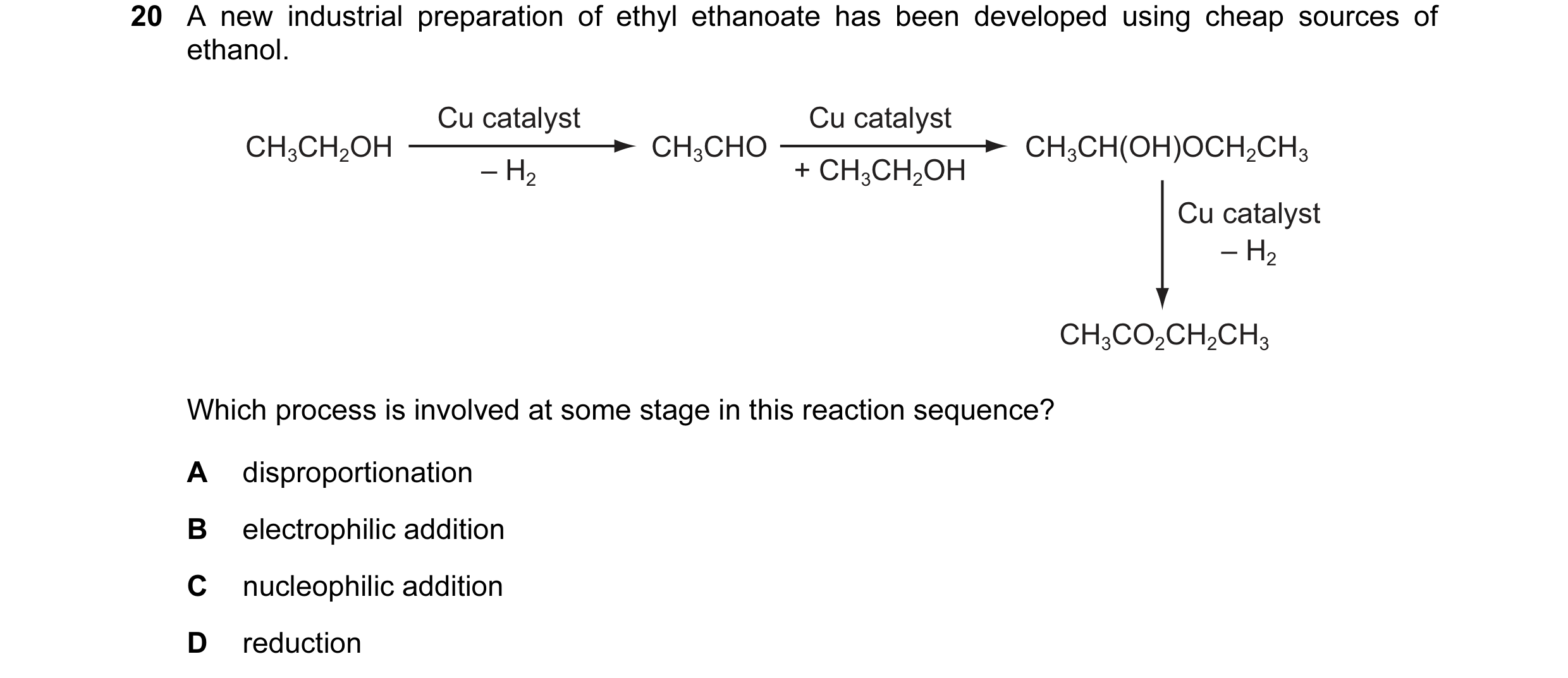
 1 / 107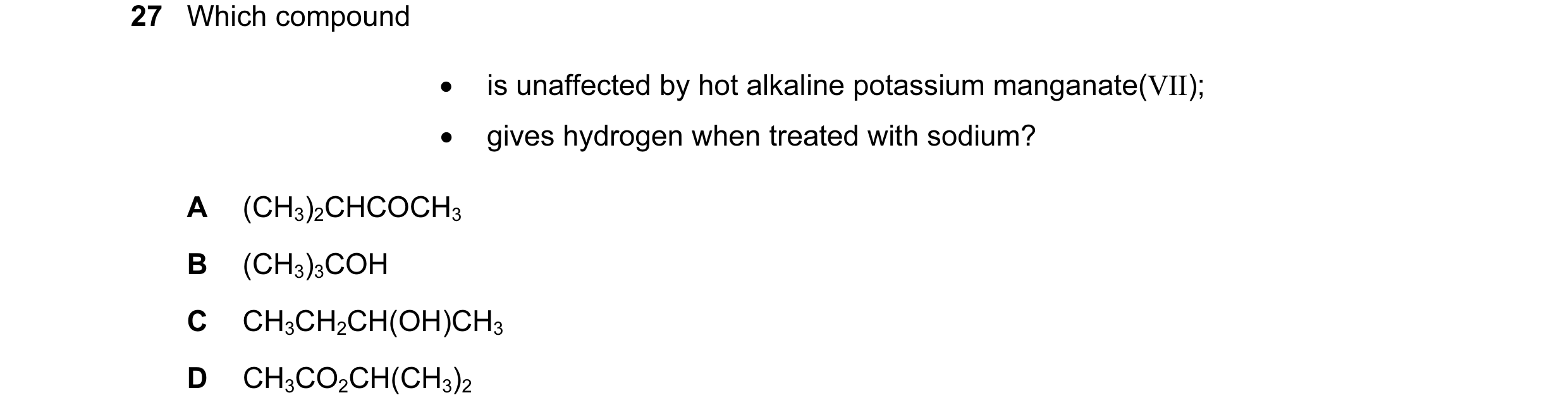

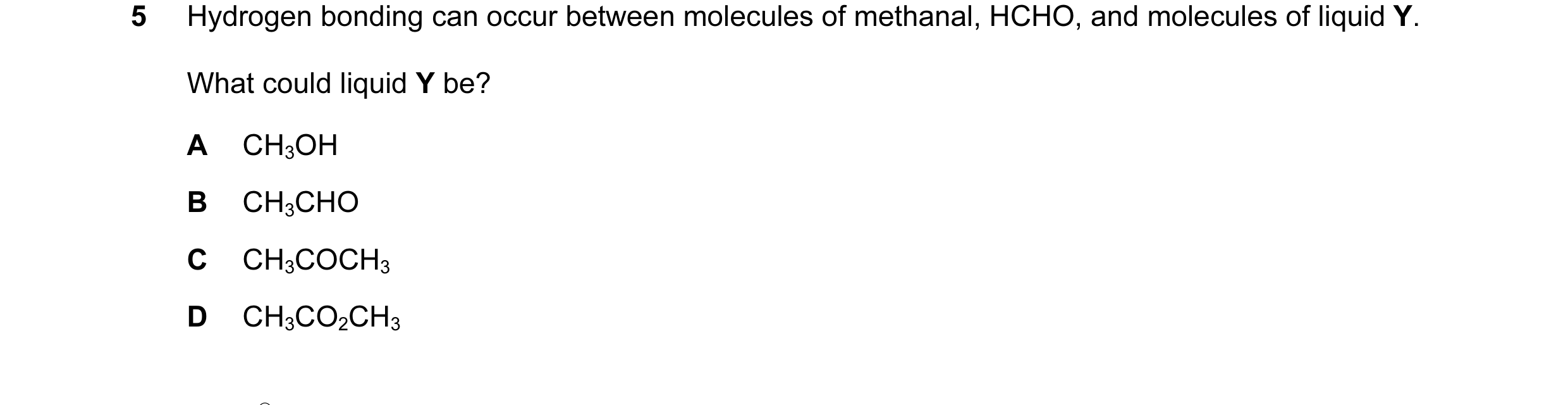

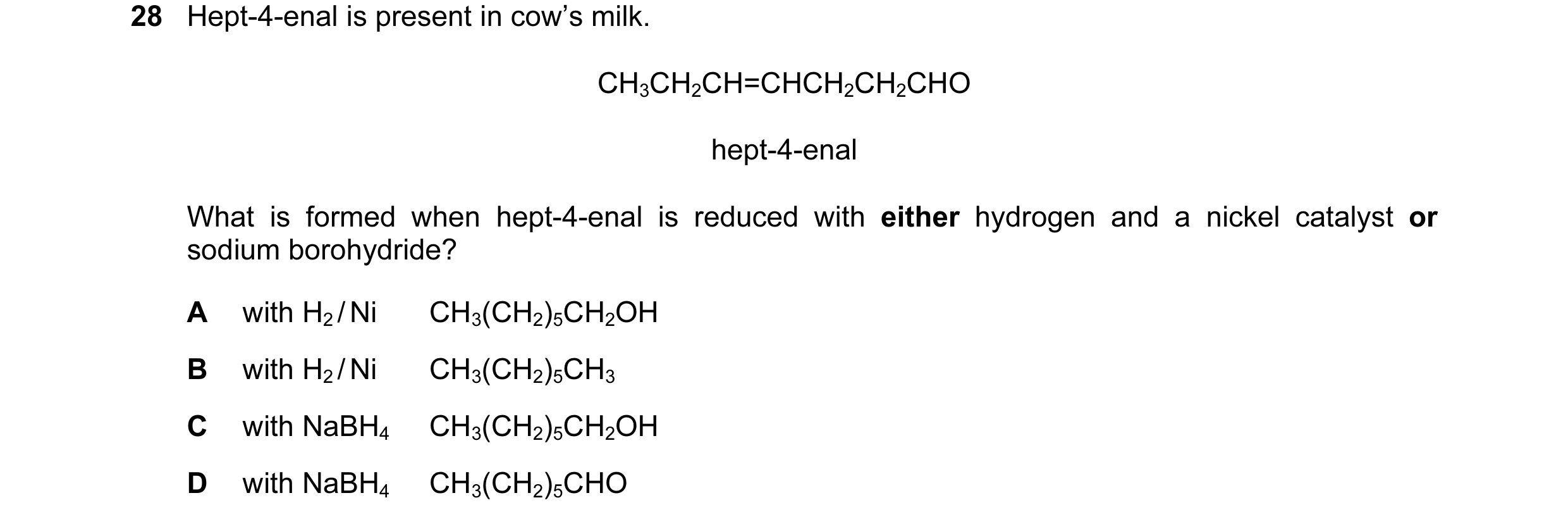 2 / 107
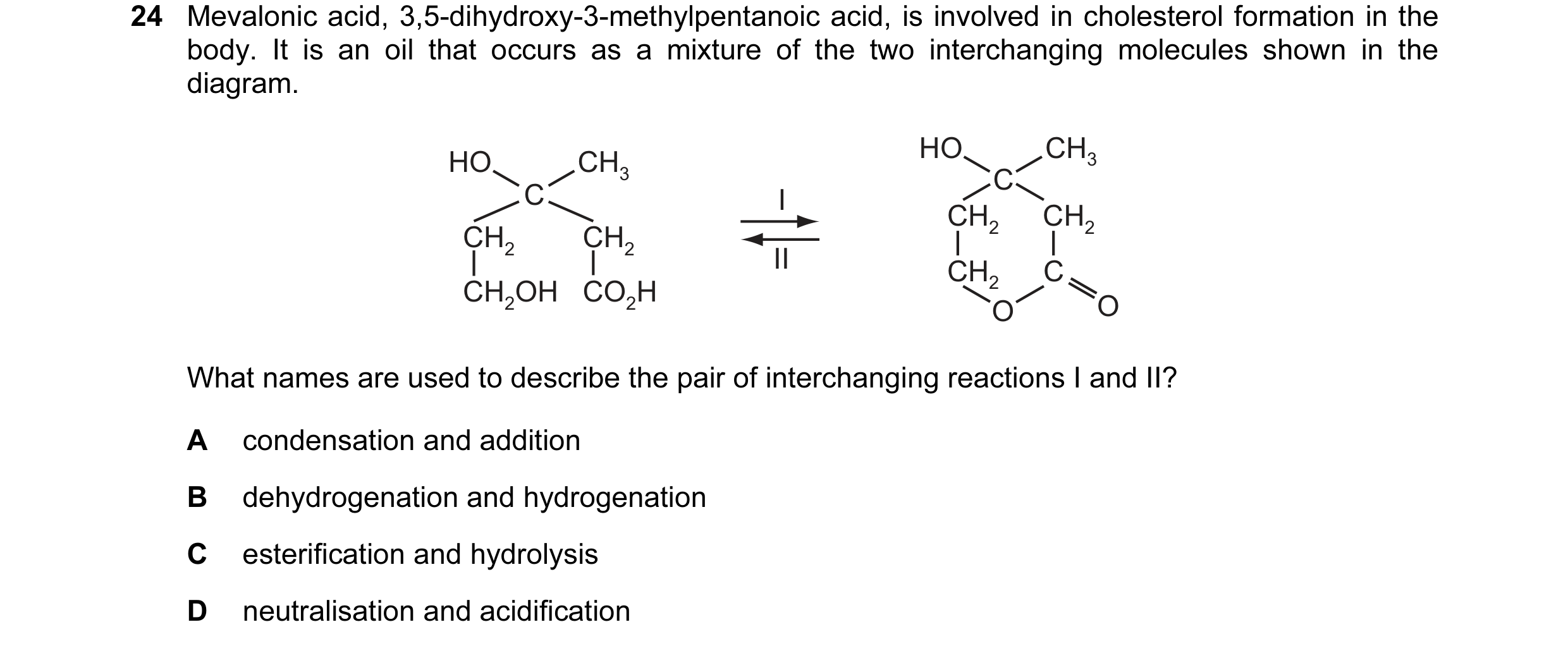
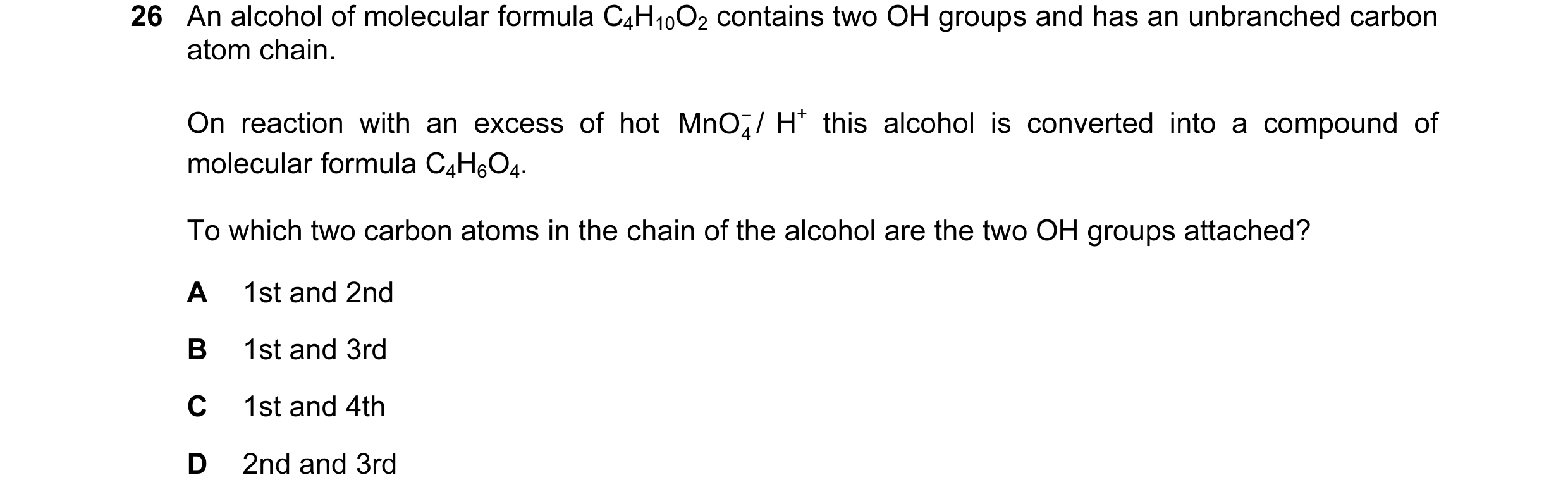
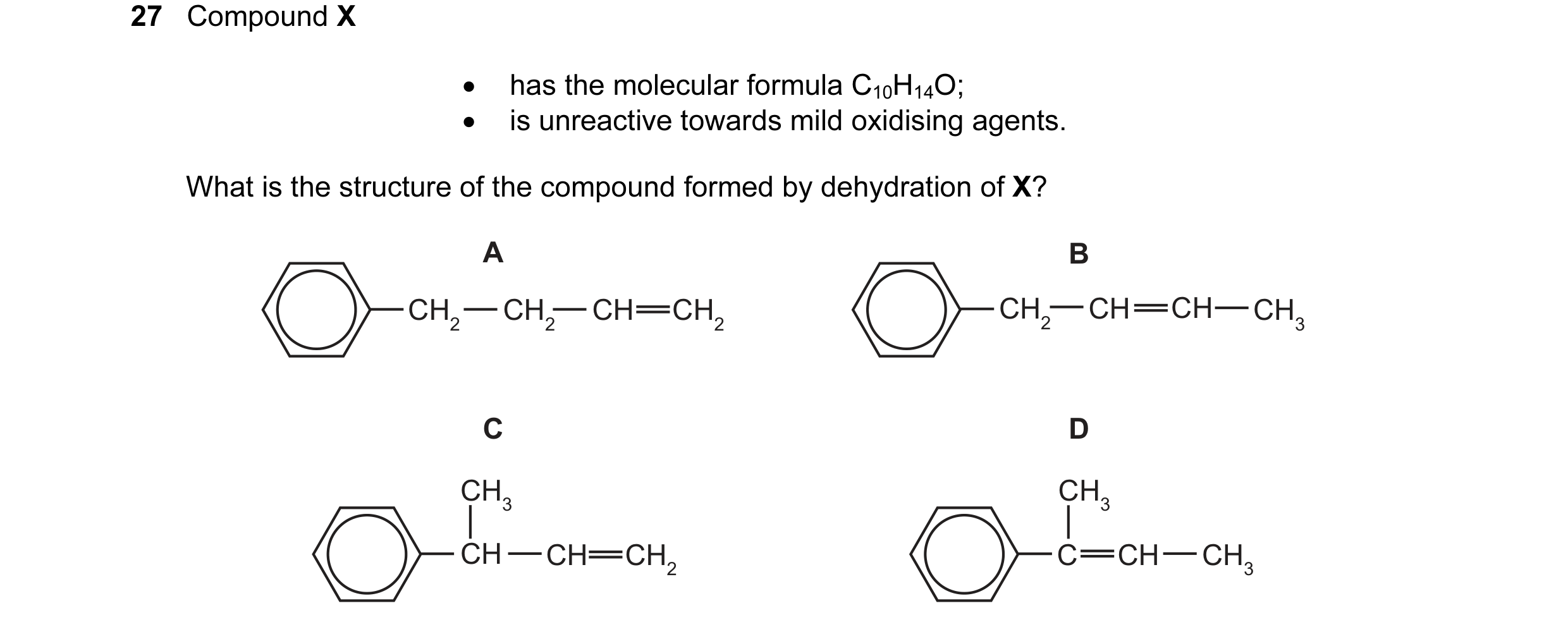 3 / 107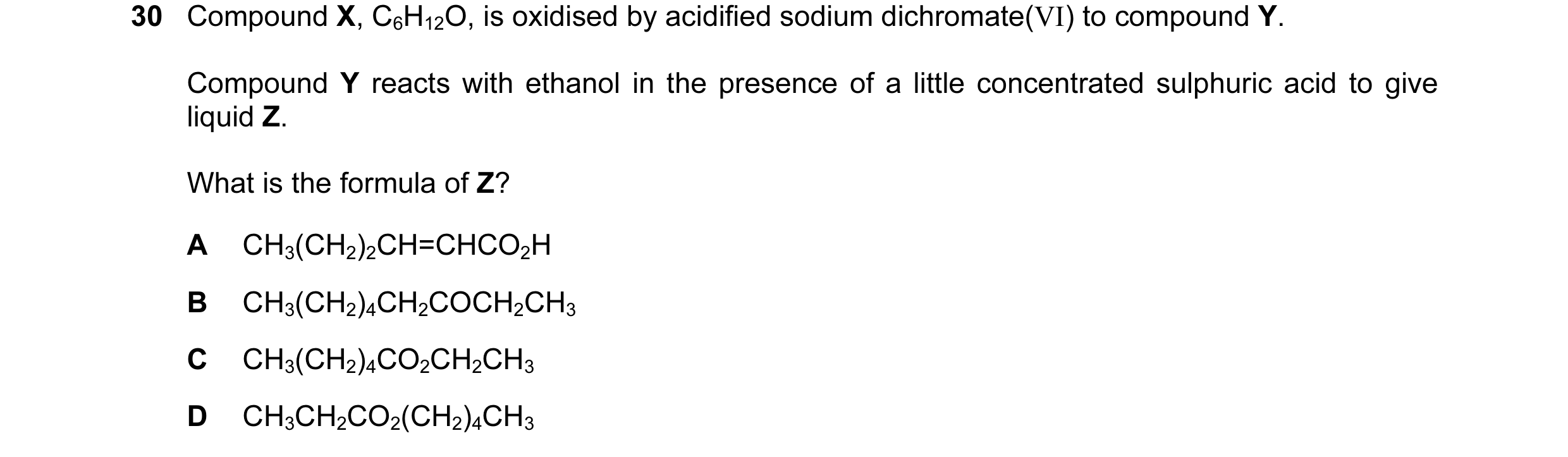
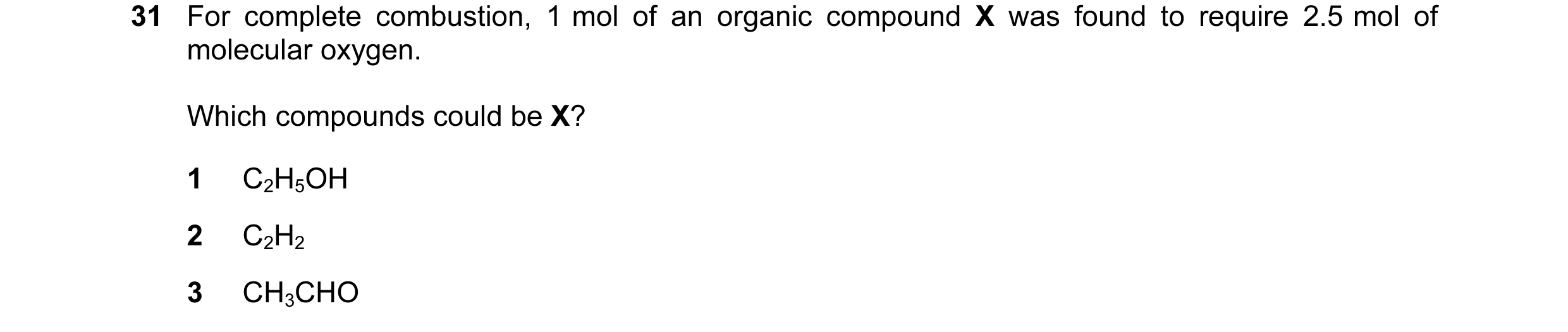
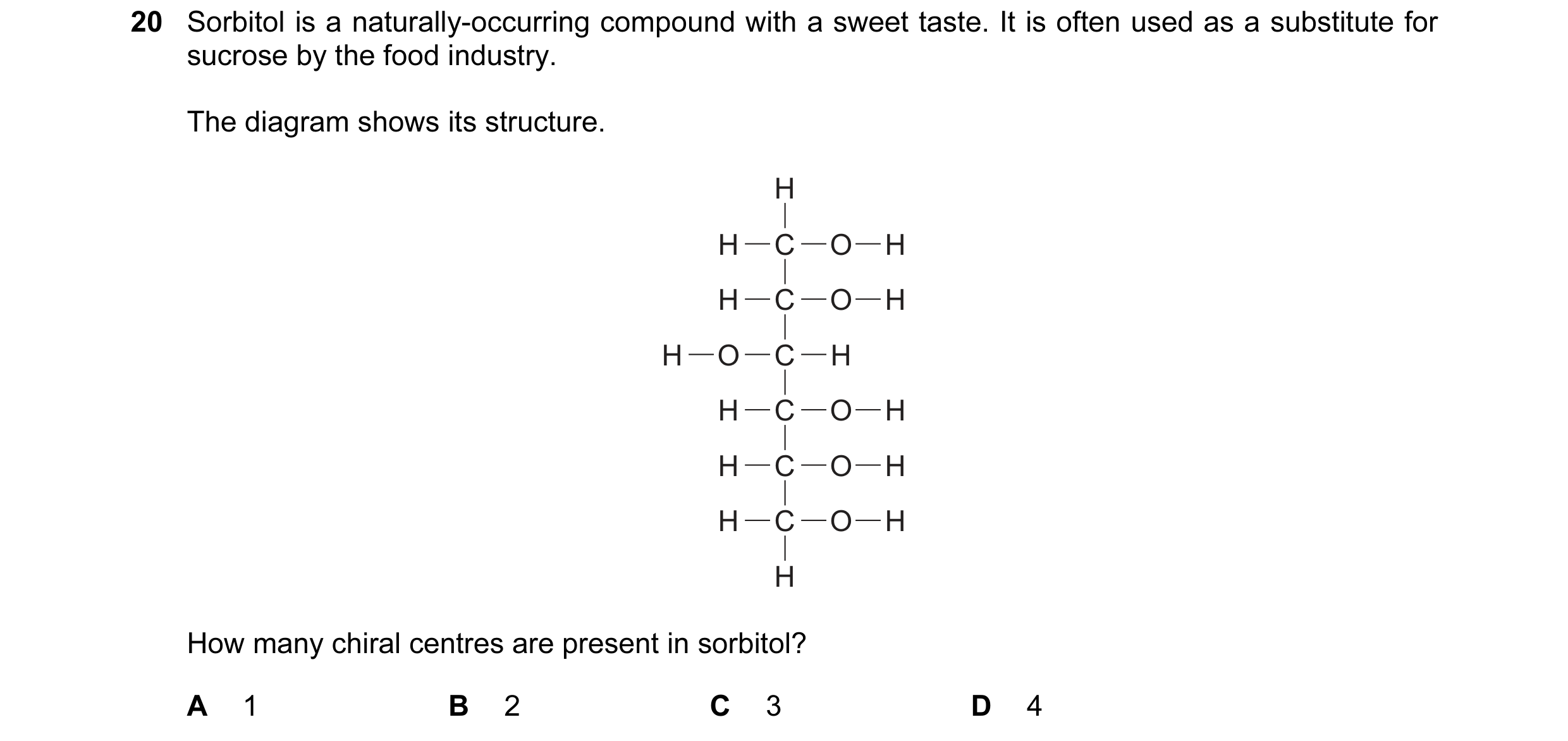
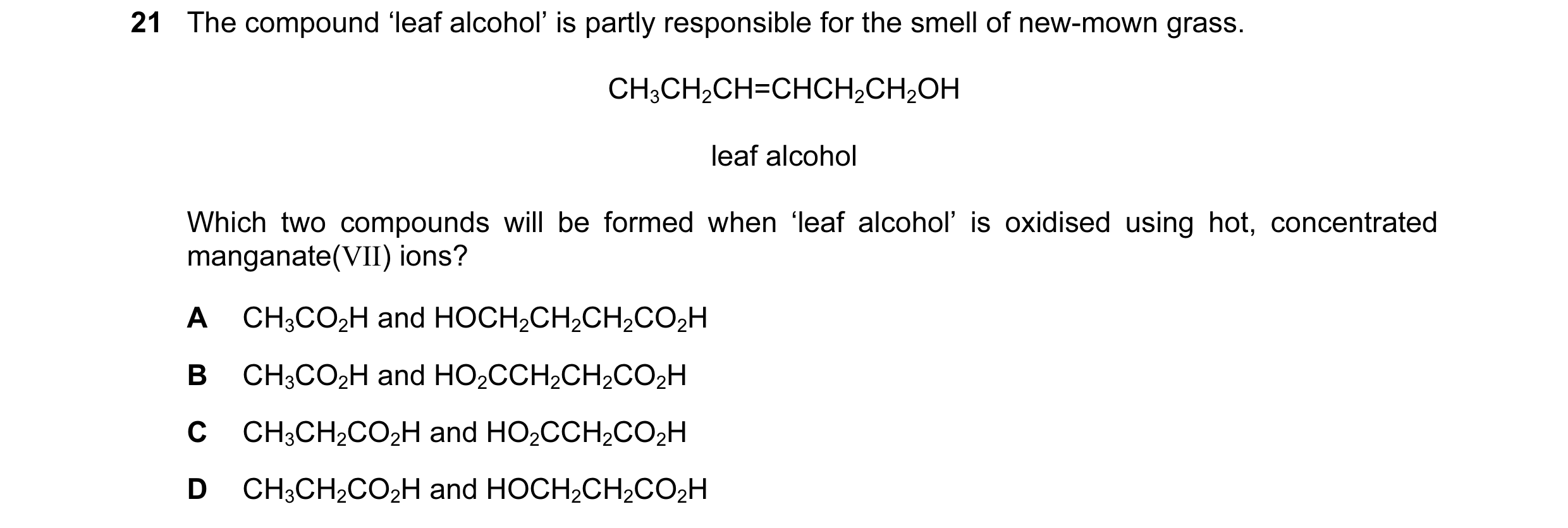 4 / 107
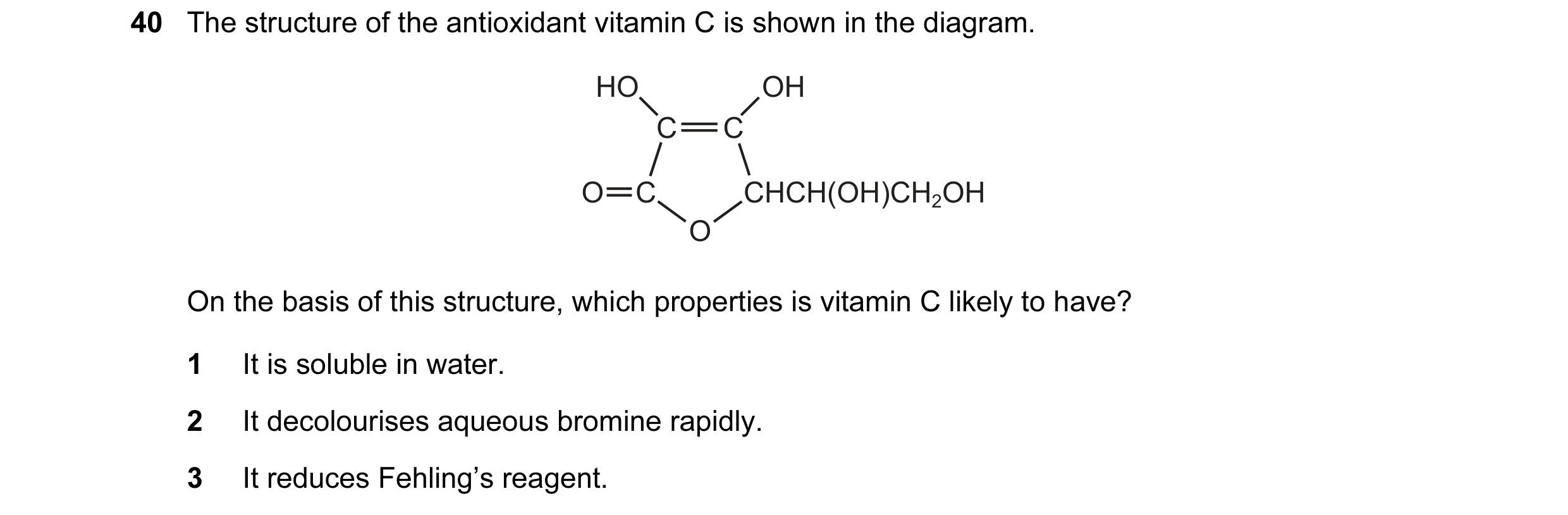


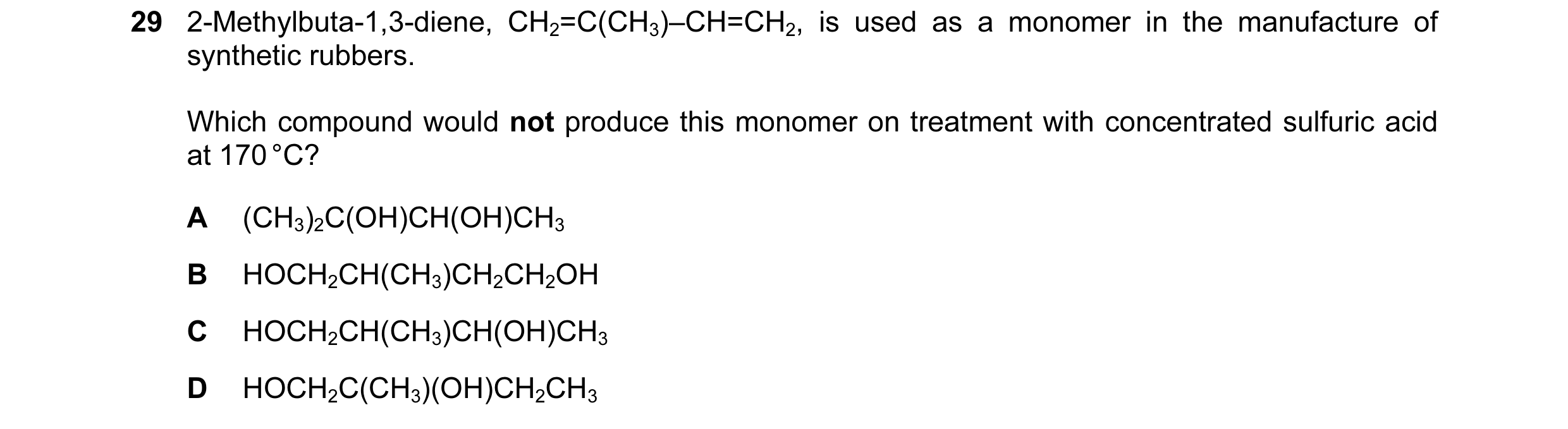 5 / 107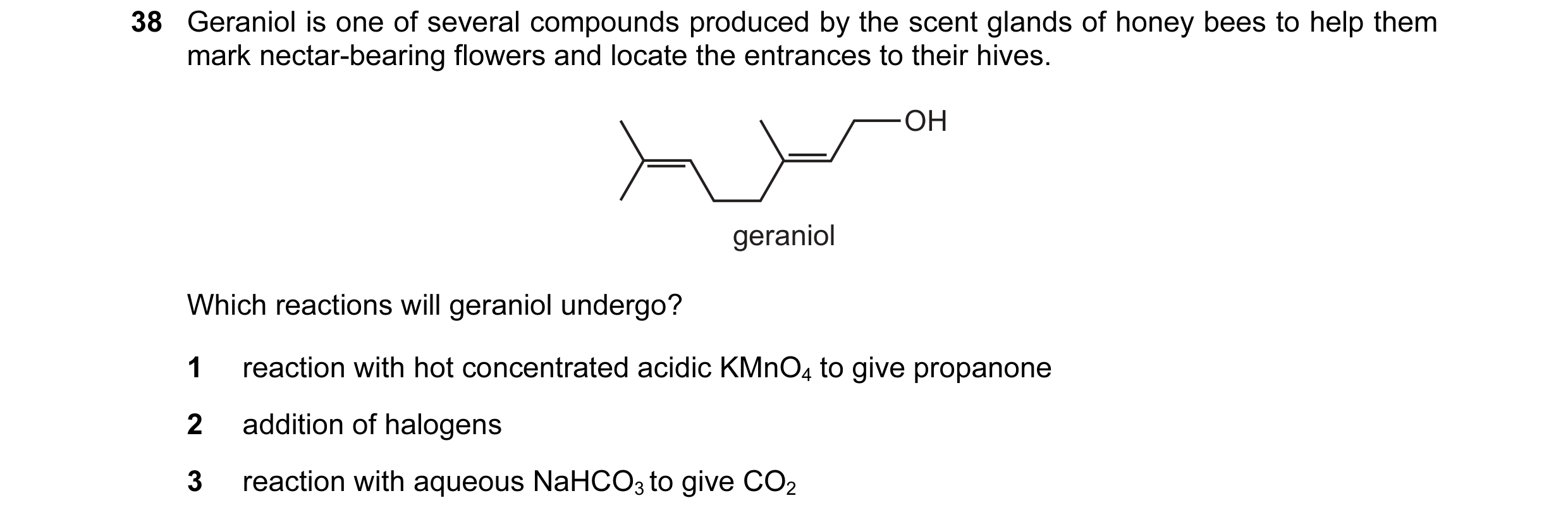
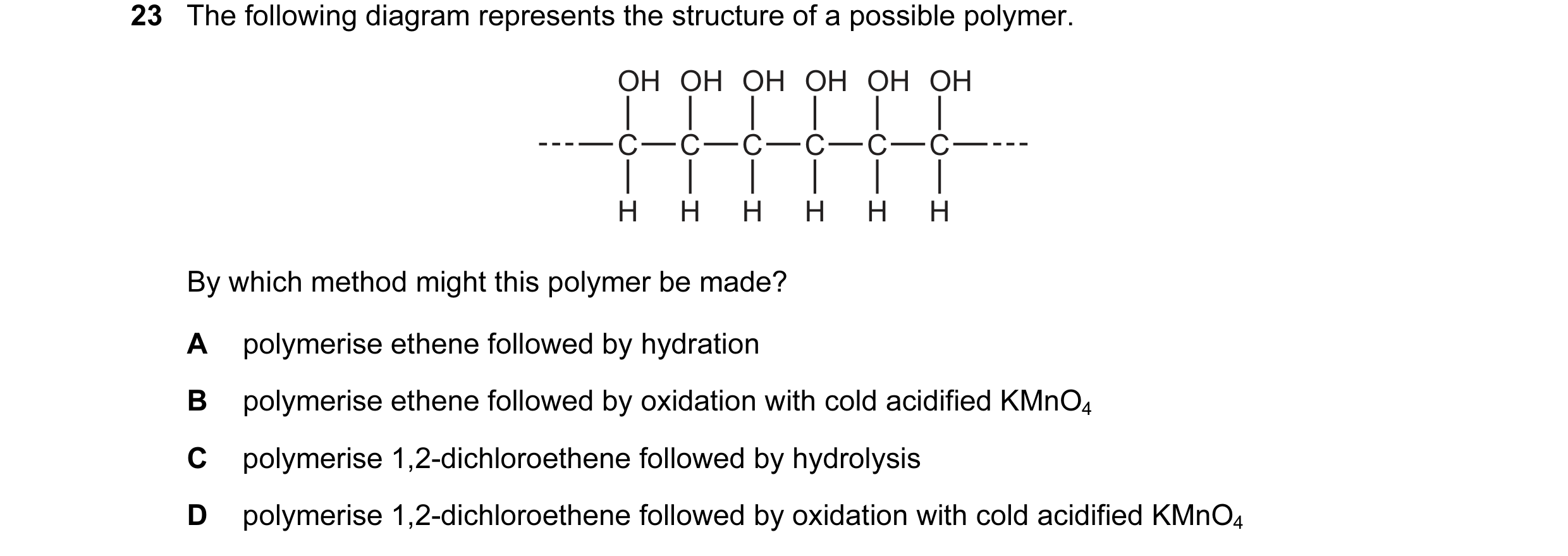
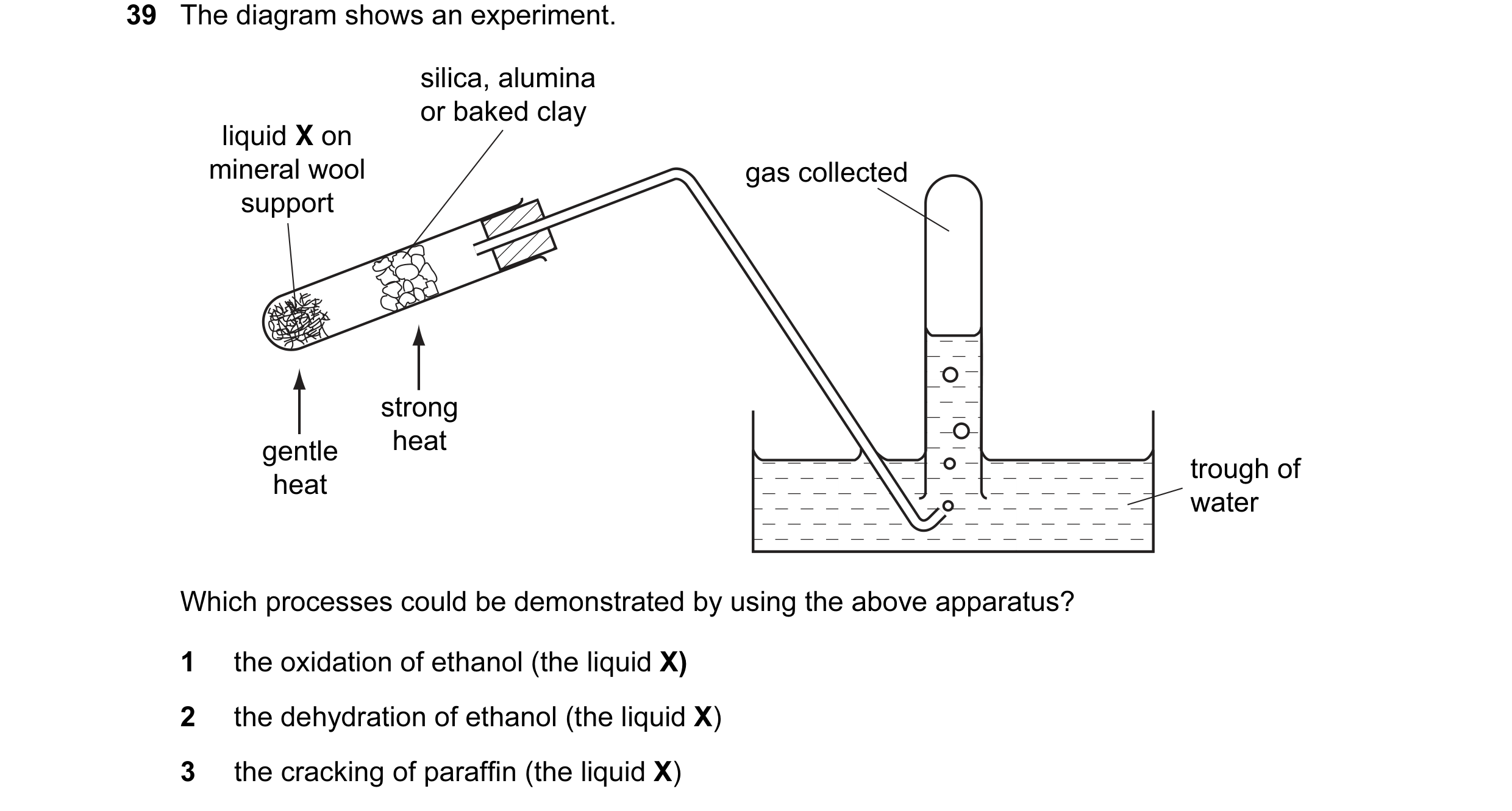 6 / 107


 7 / 107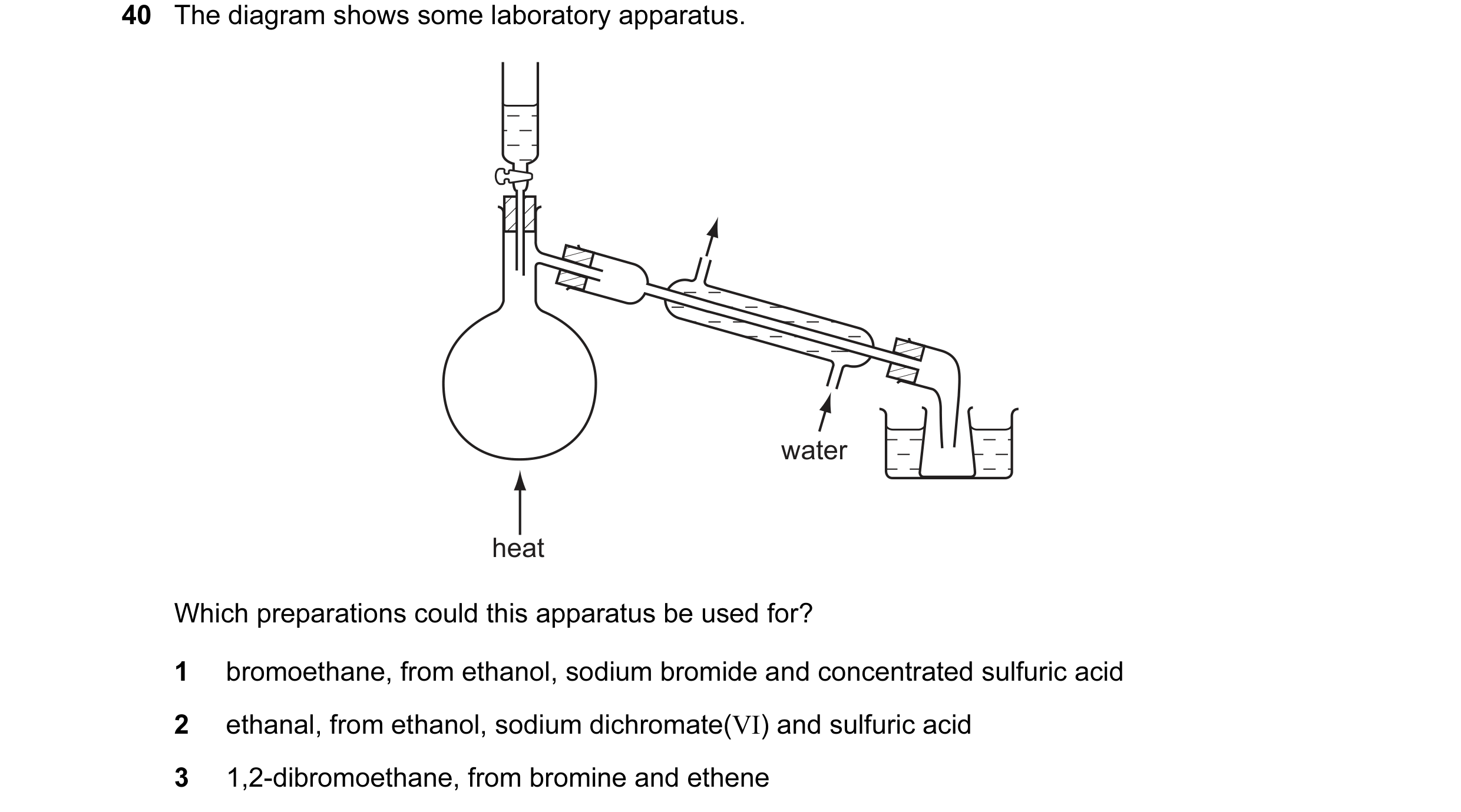

 8 / 107
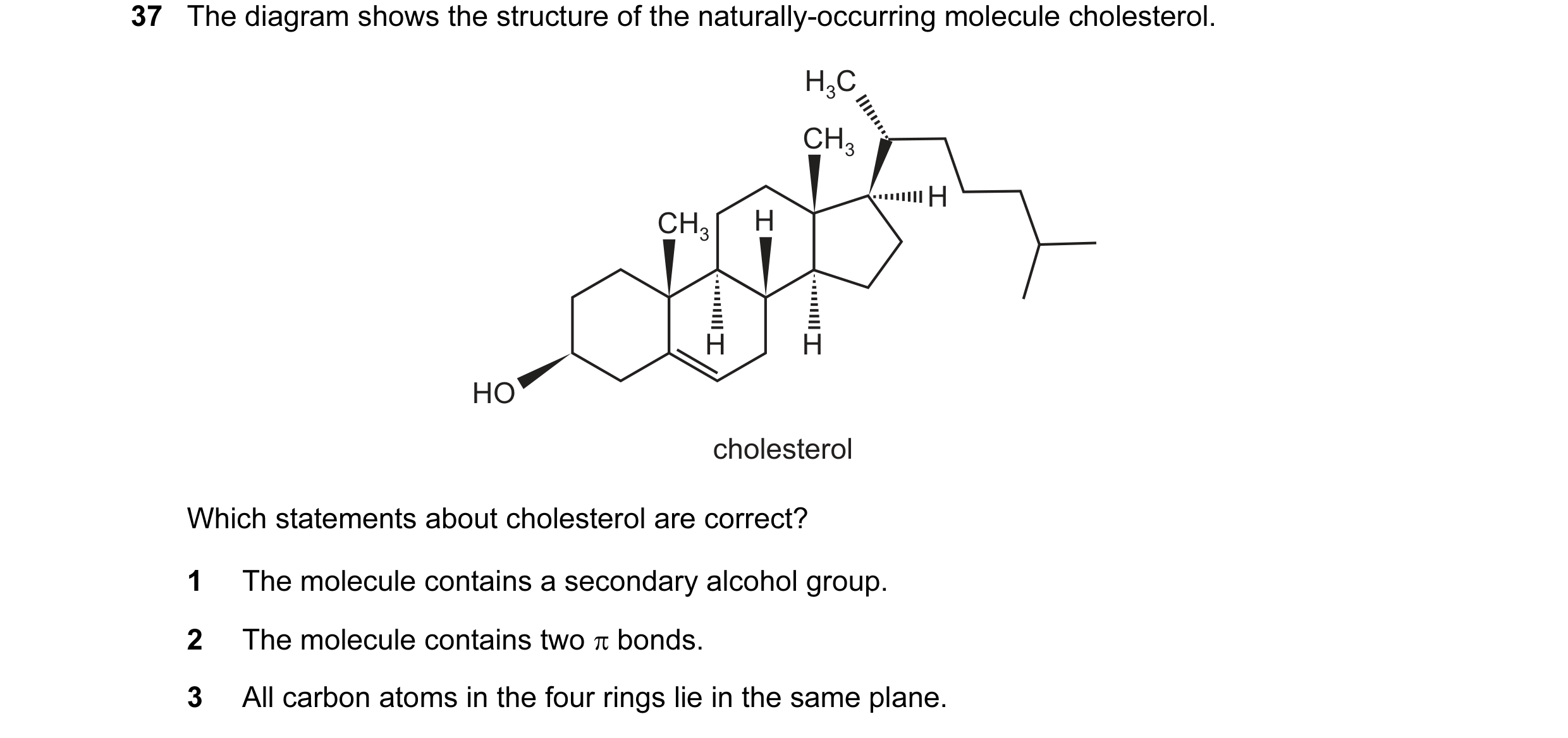
 9 / 107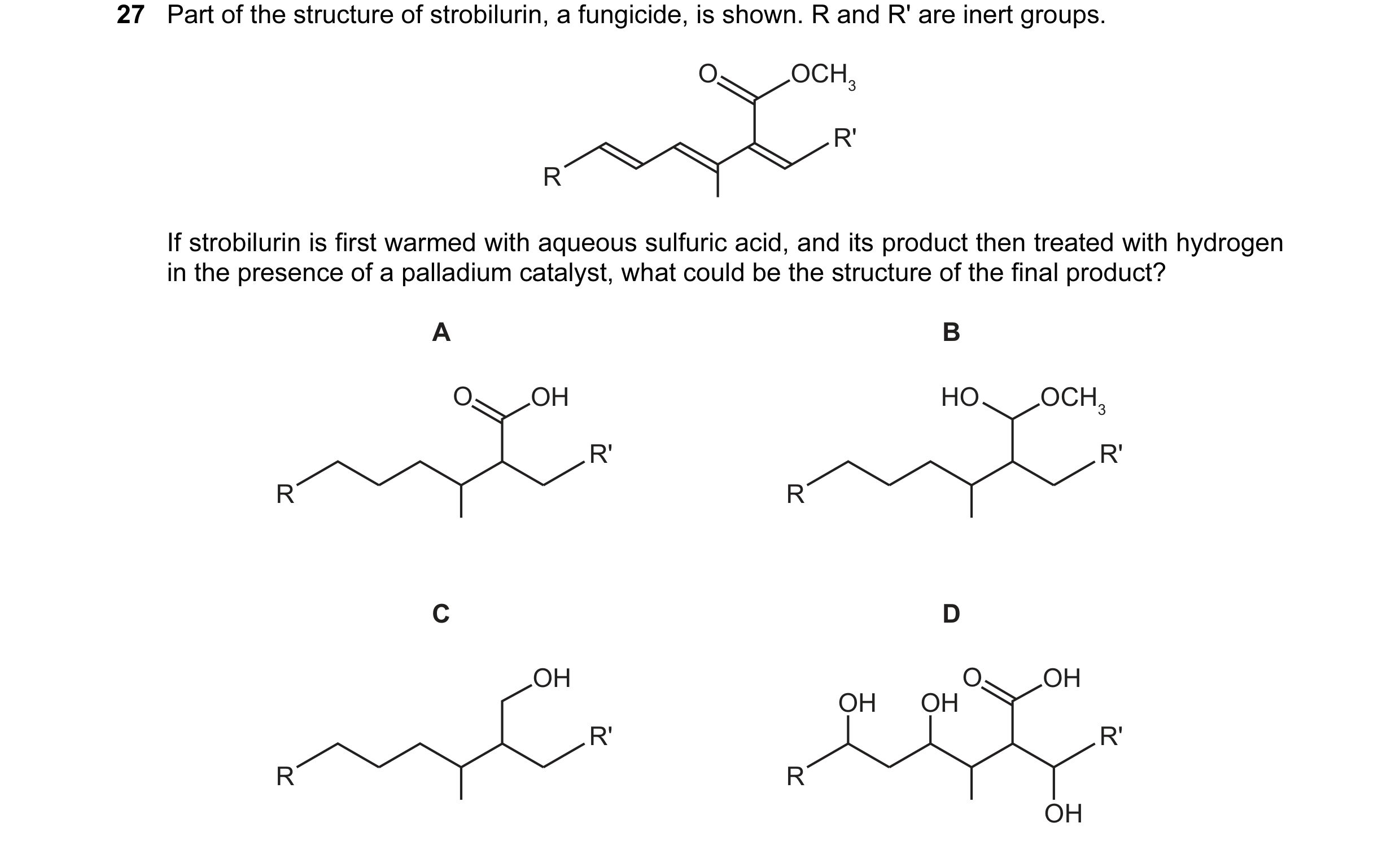
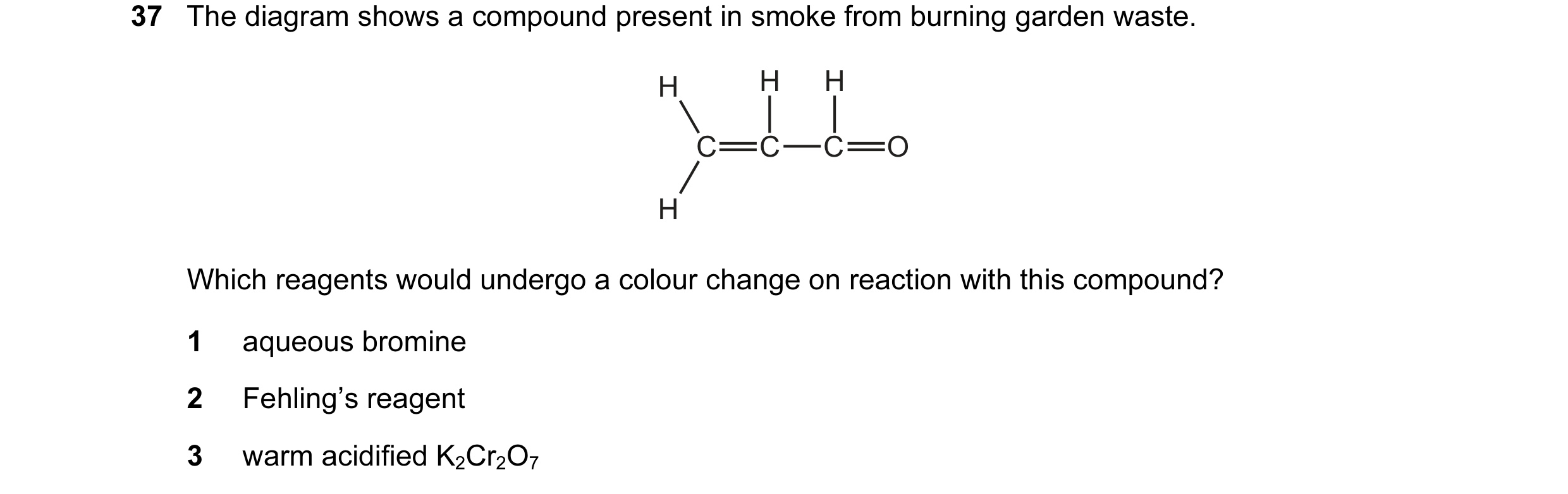
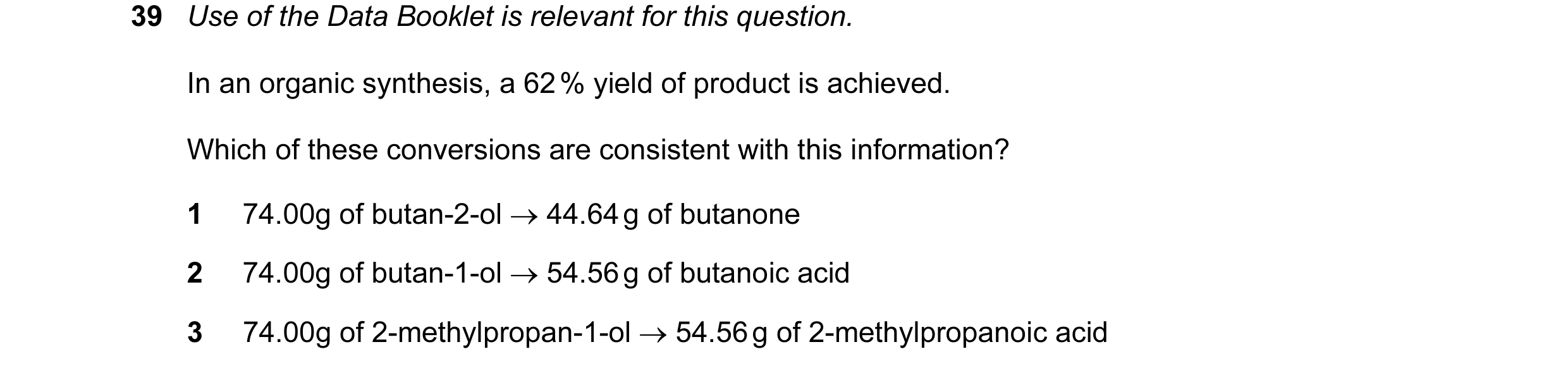 10 / 107
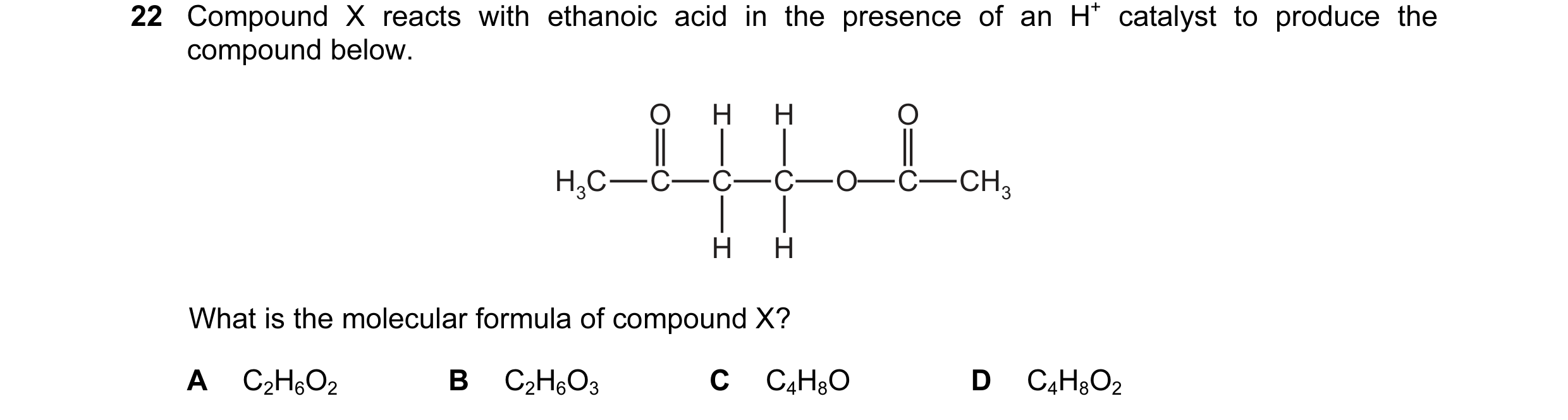
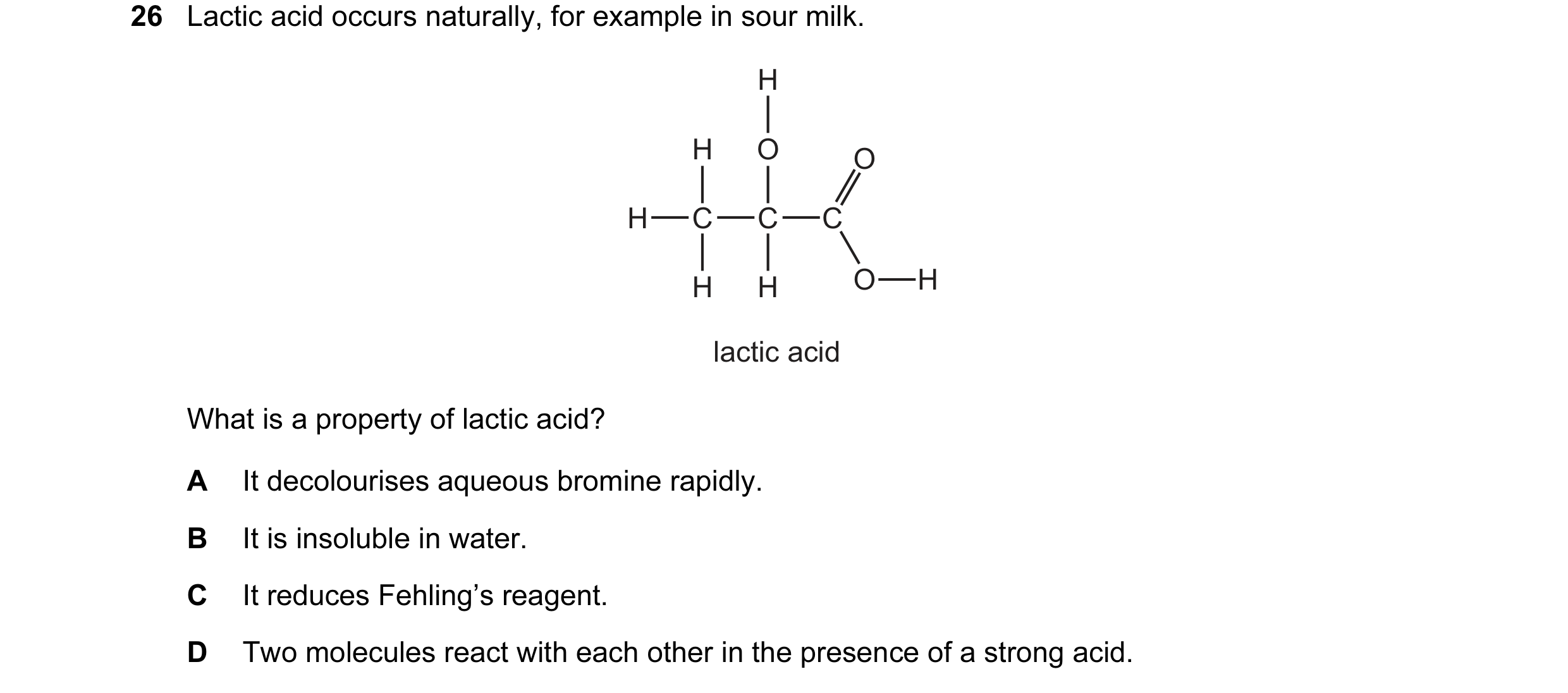 11 / 107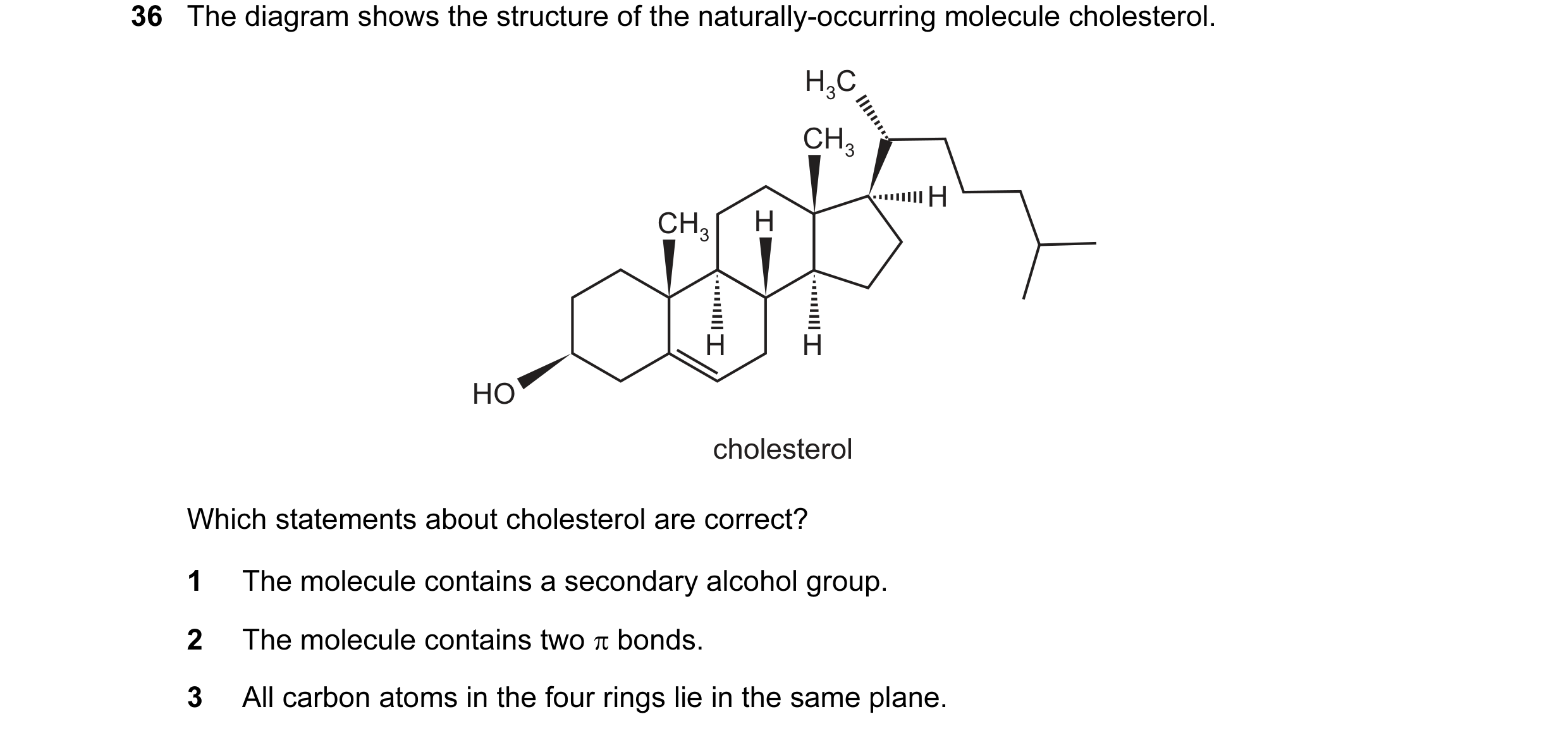
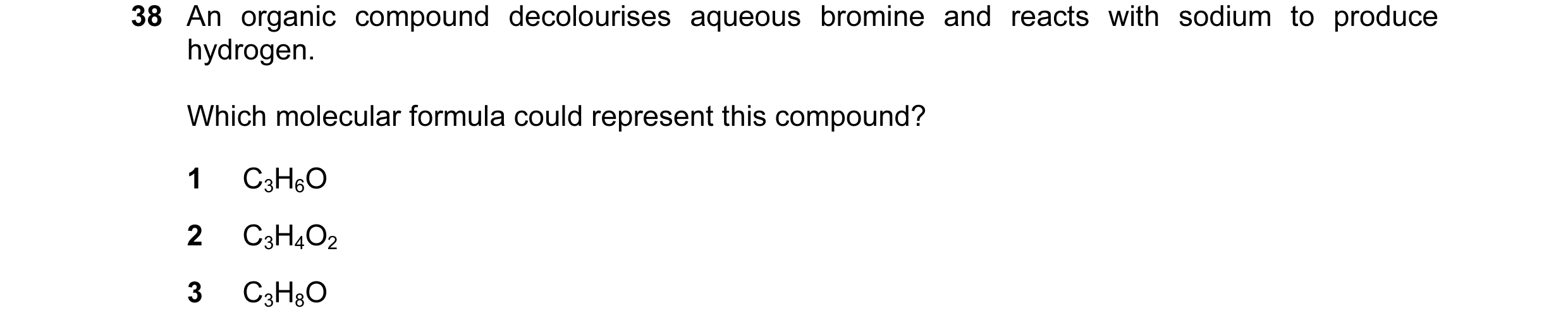
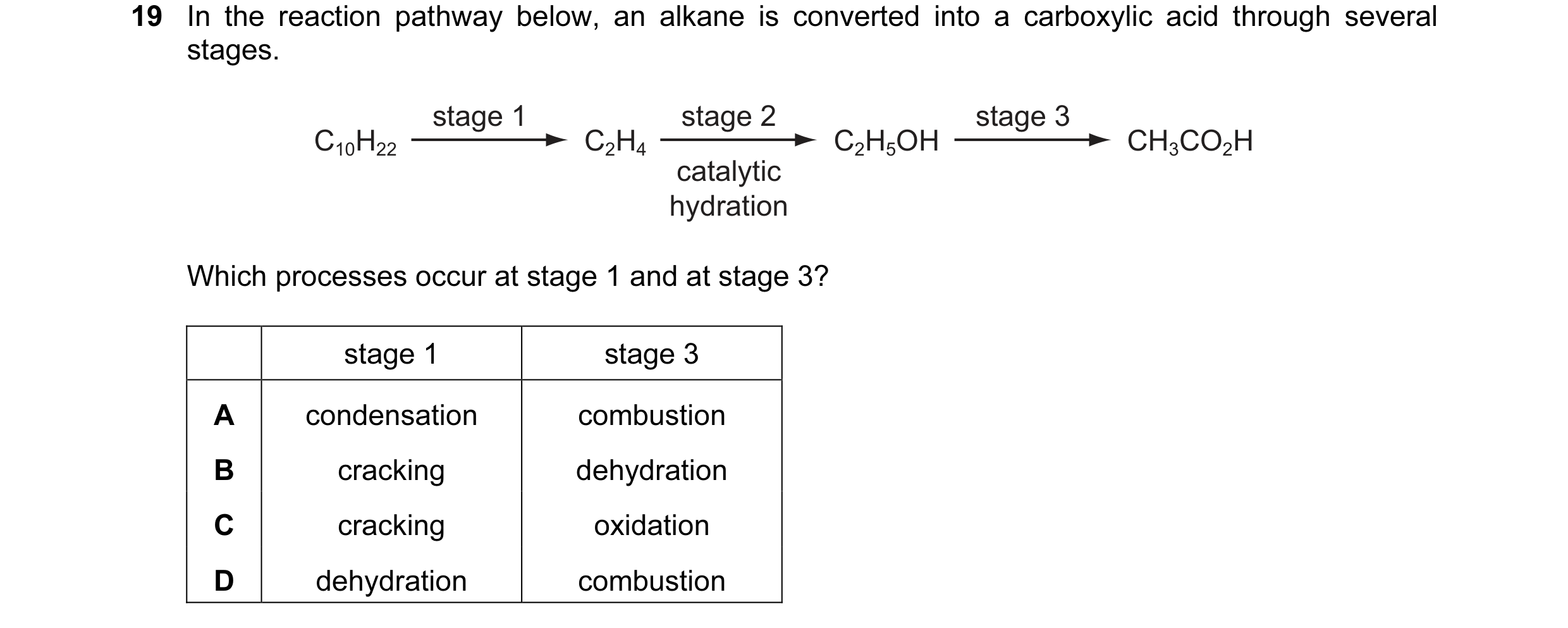
 12 / 107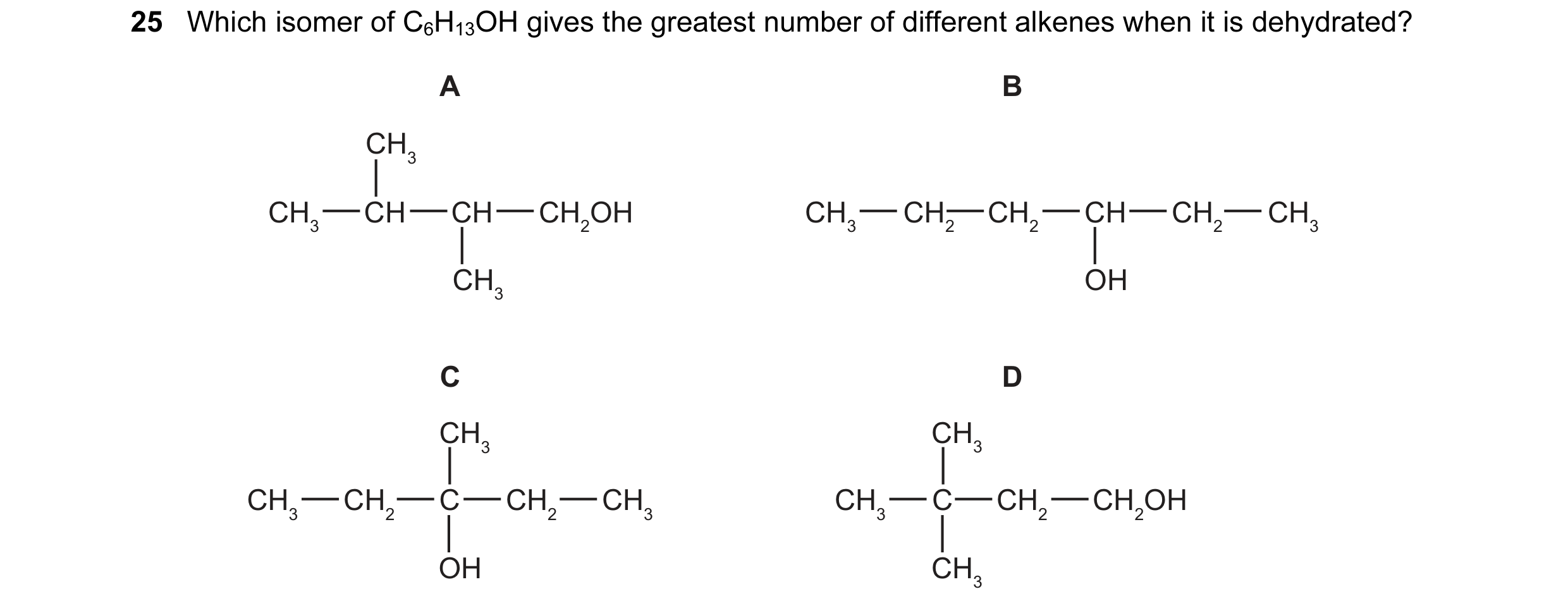
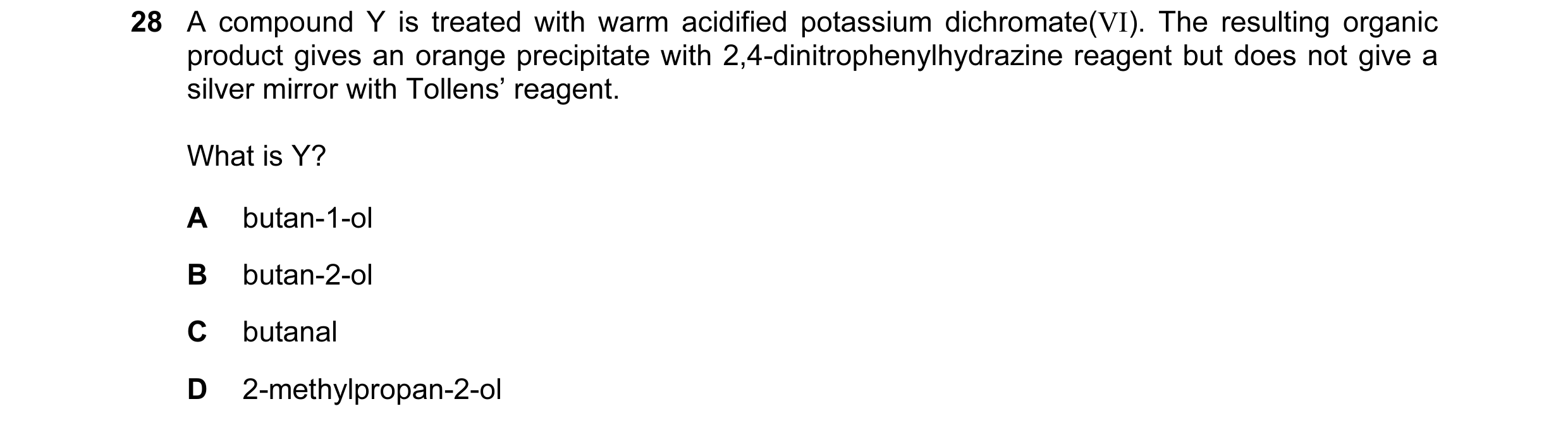
 13 / 107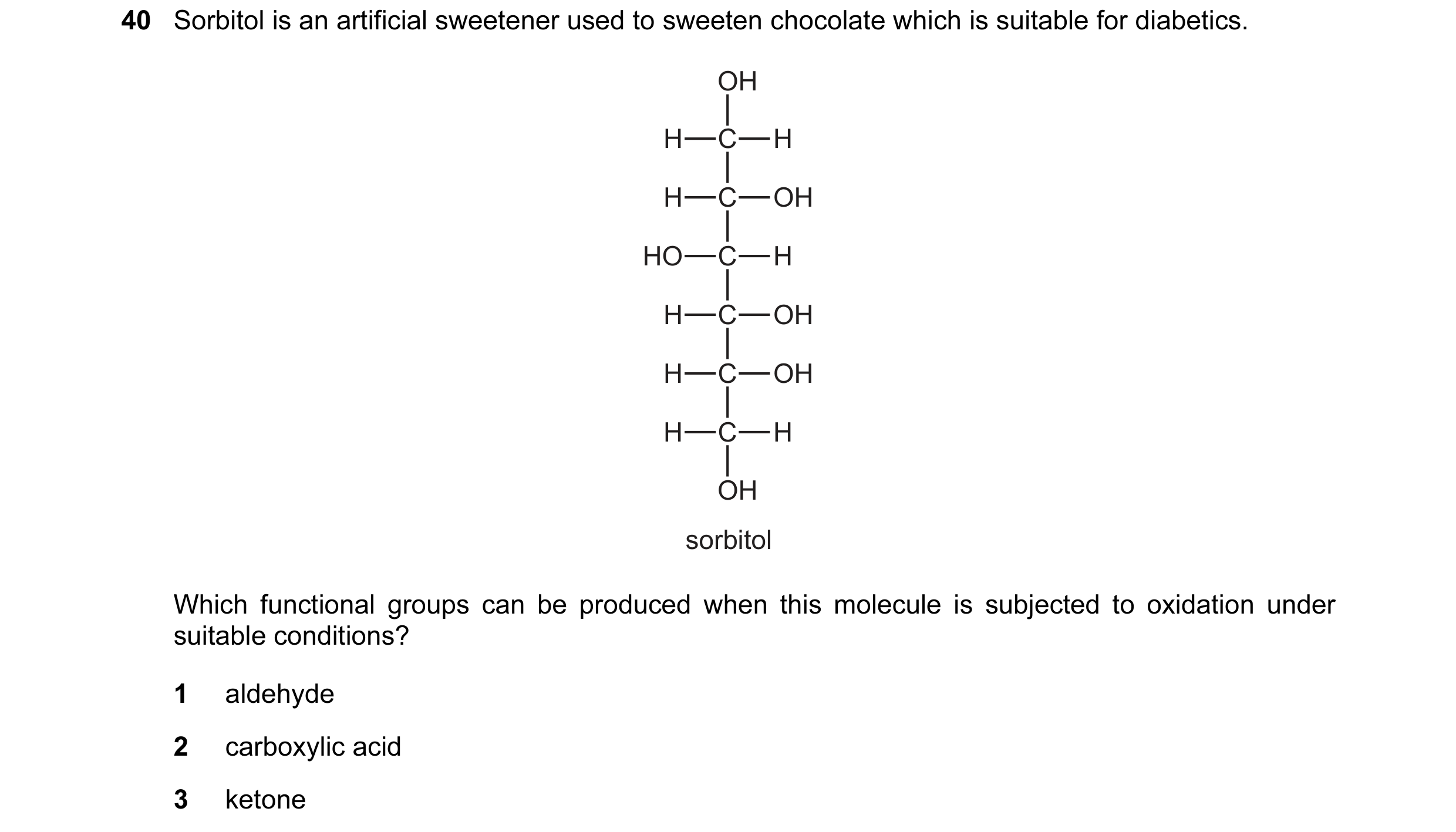


 14 / 107
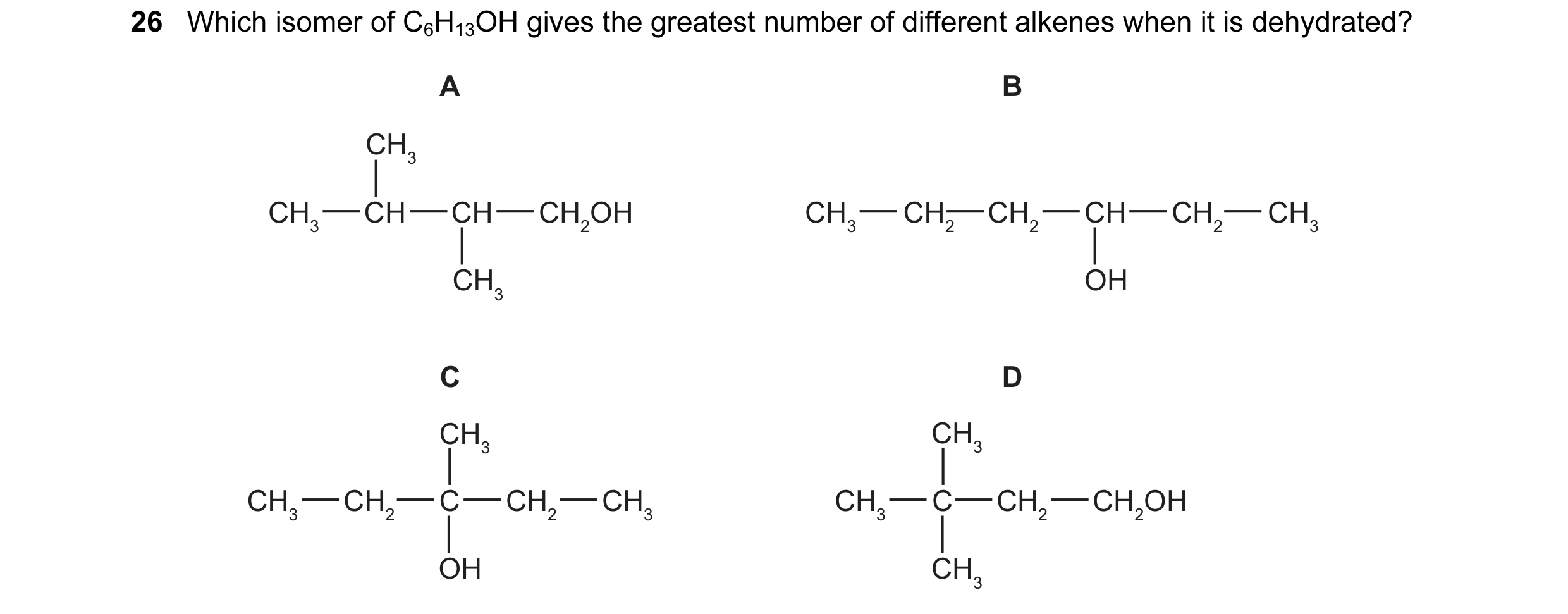
 15 / 107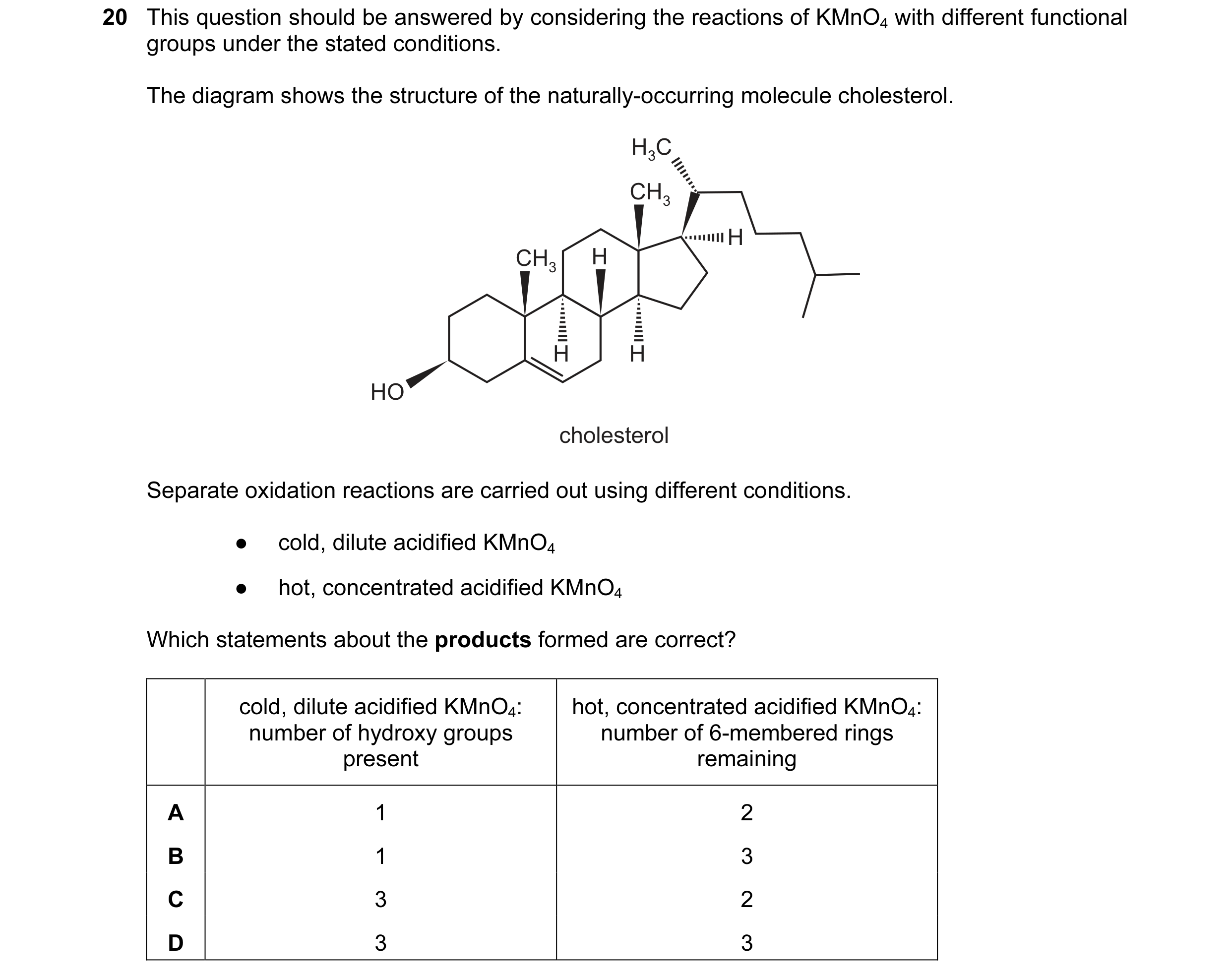
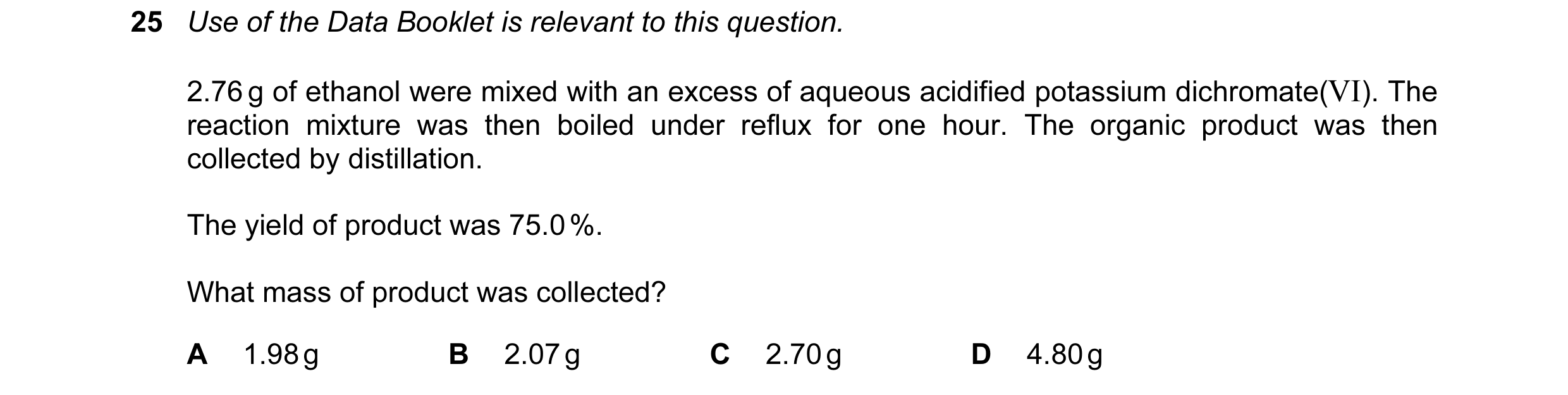 16 / 107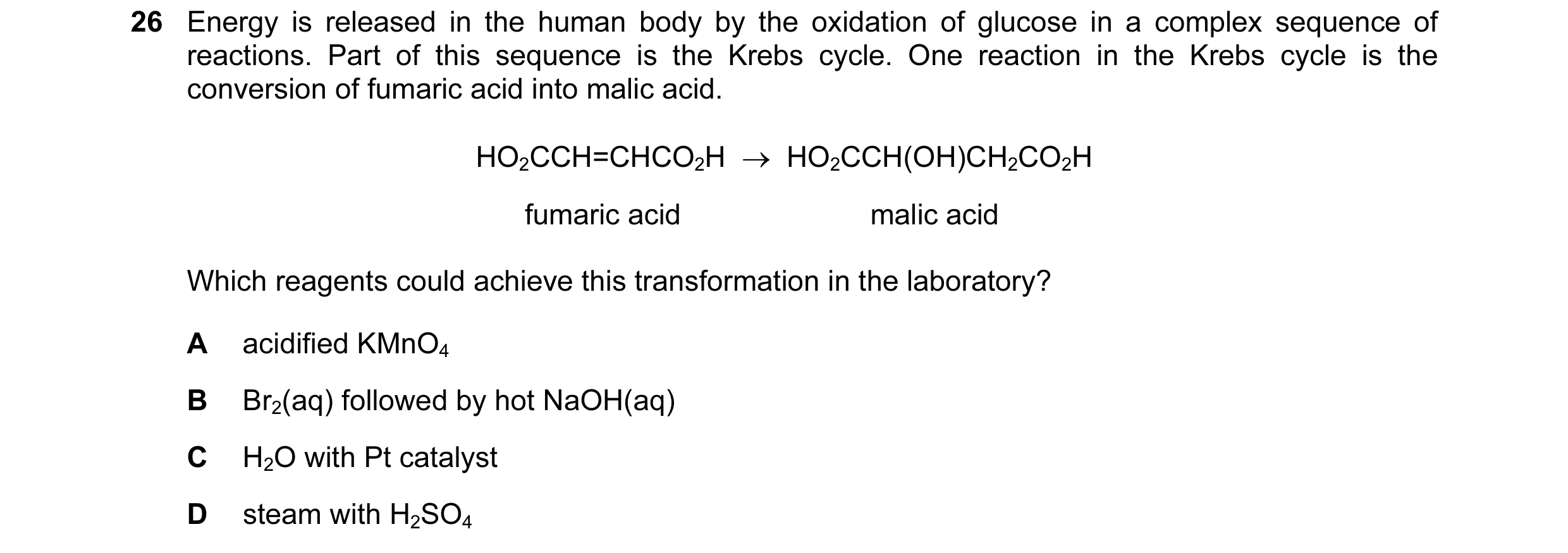

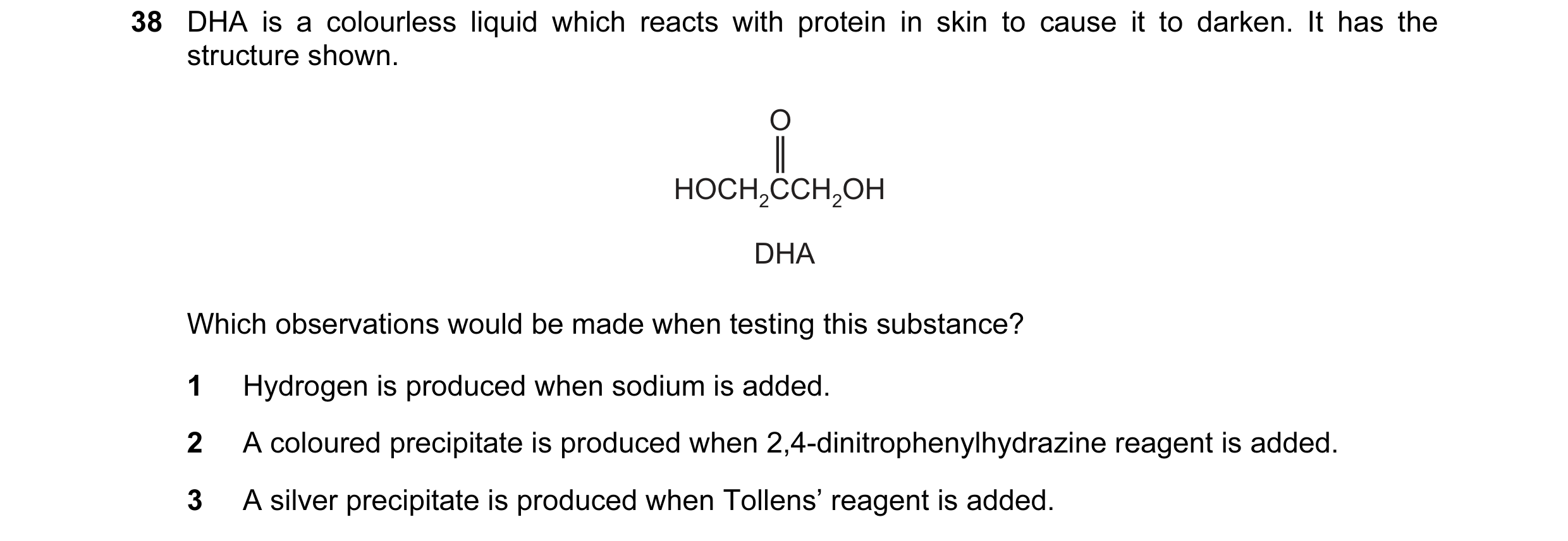 17 / 107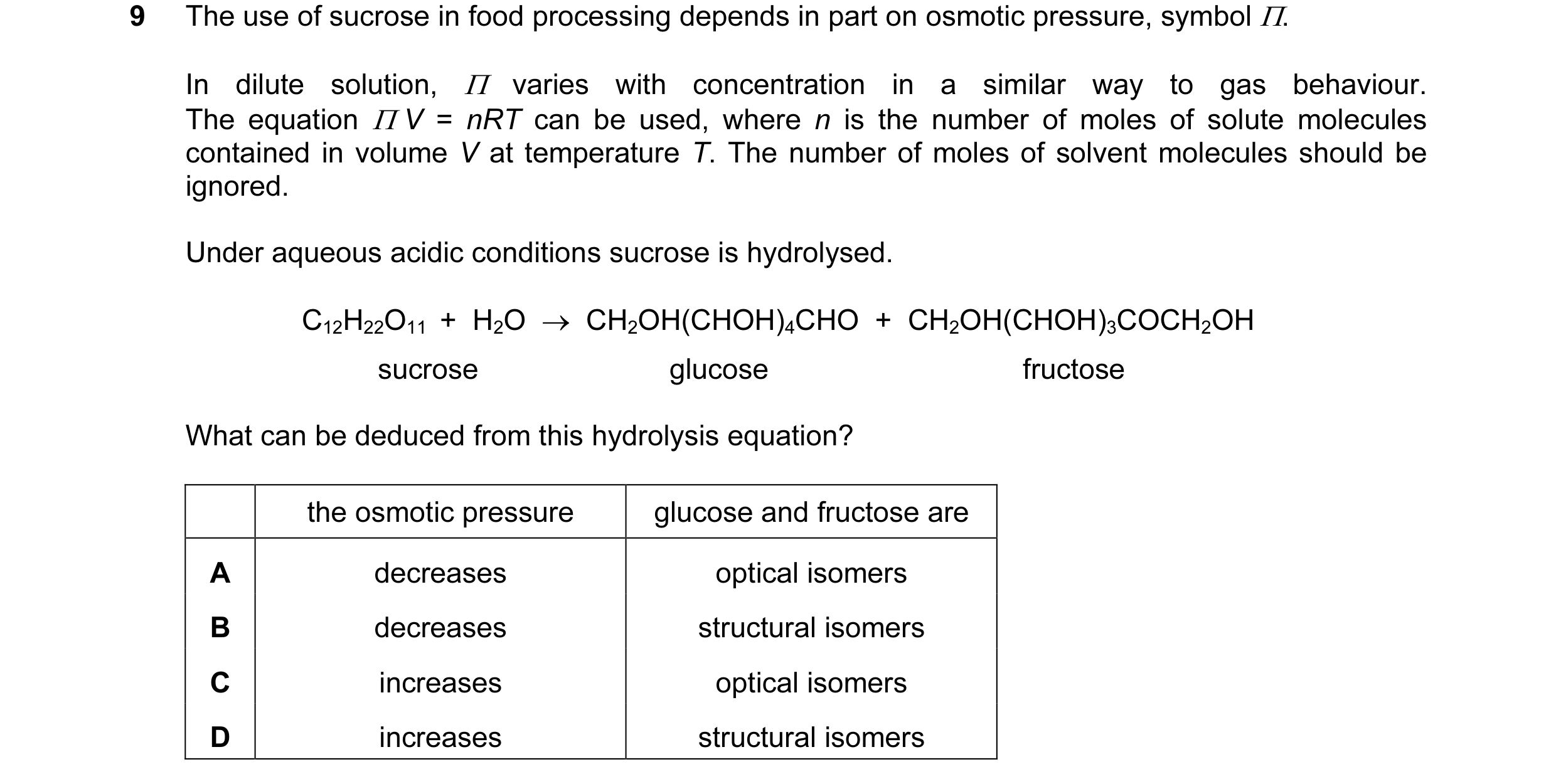
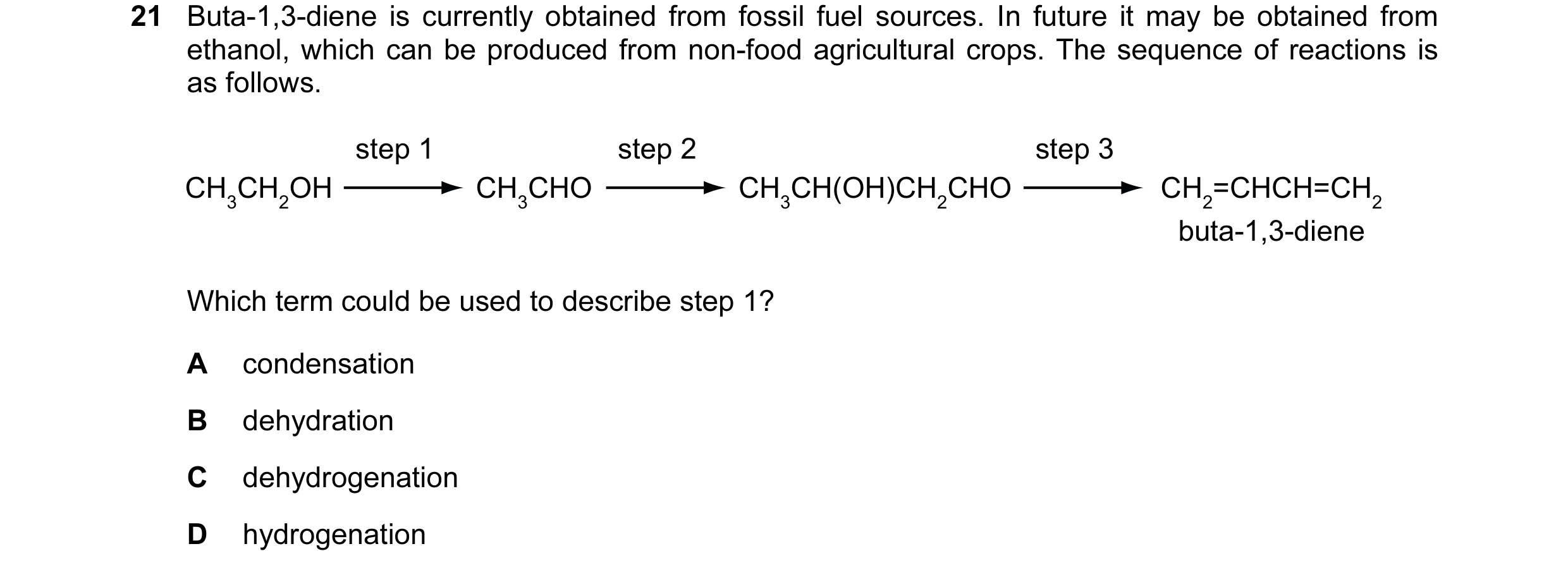
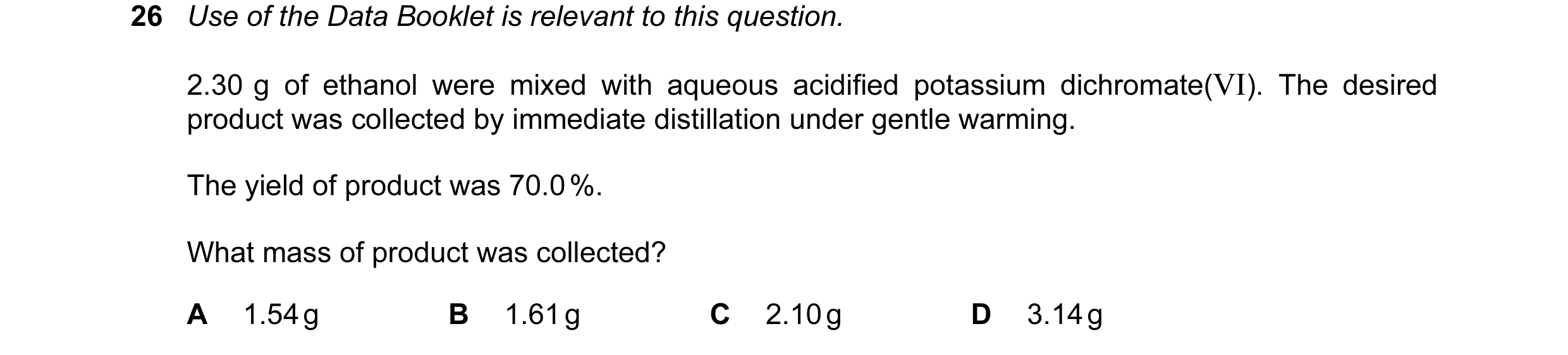
 18 / 107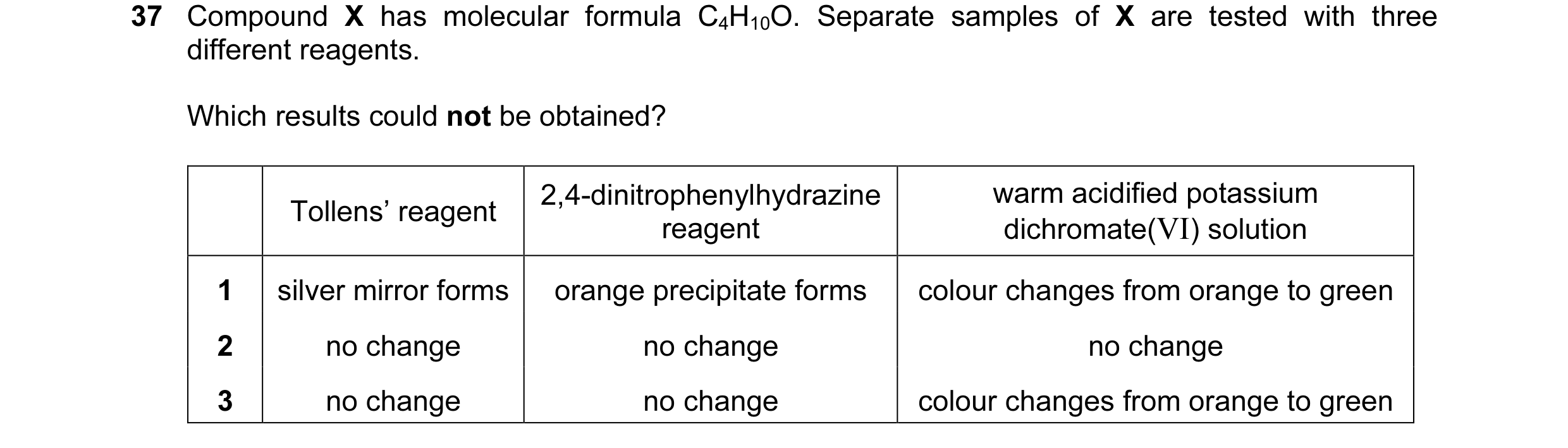
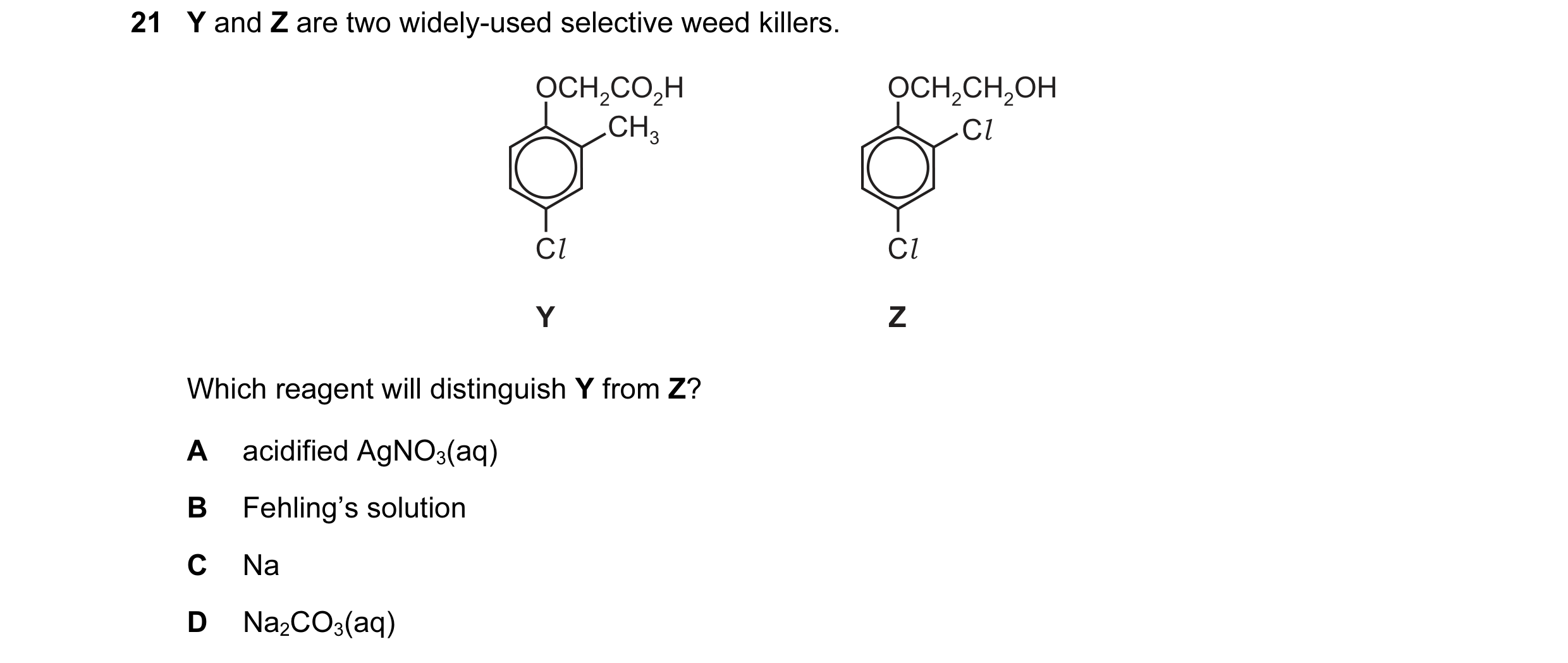
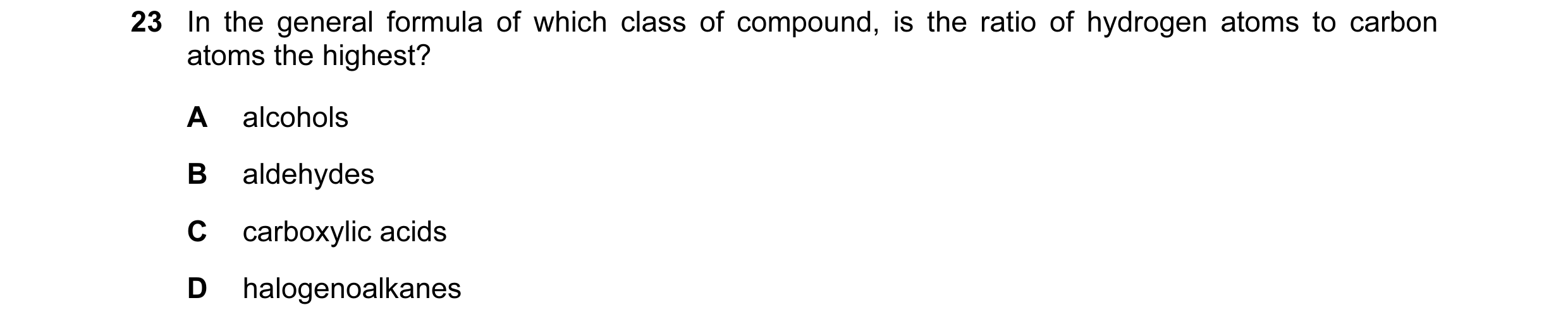
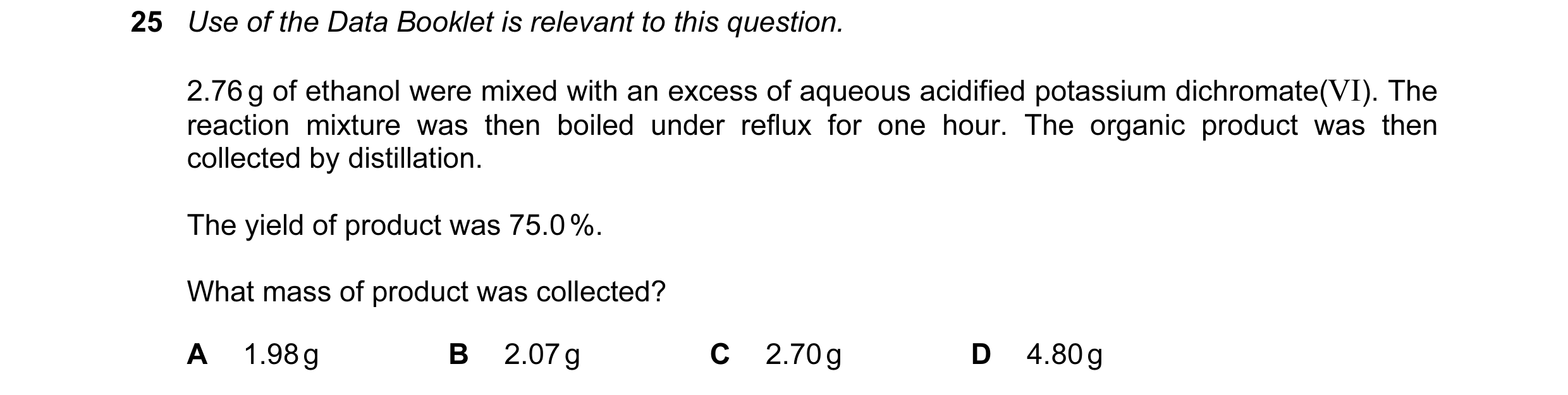 19 / 107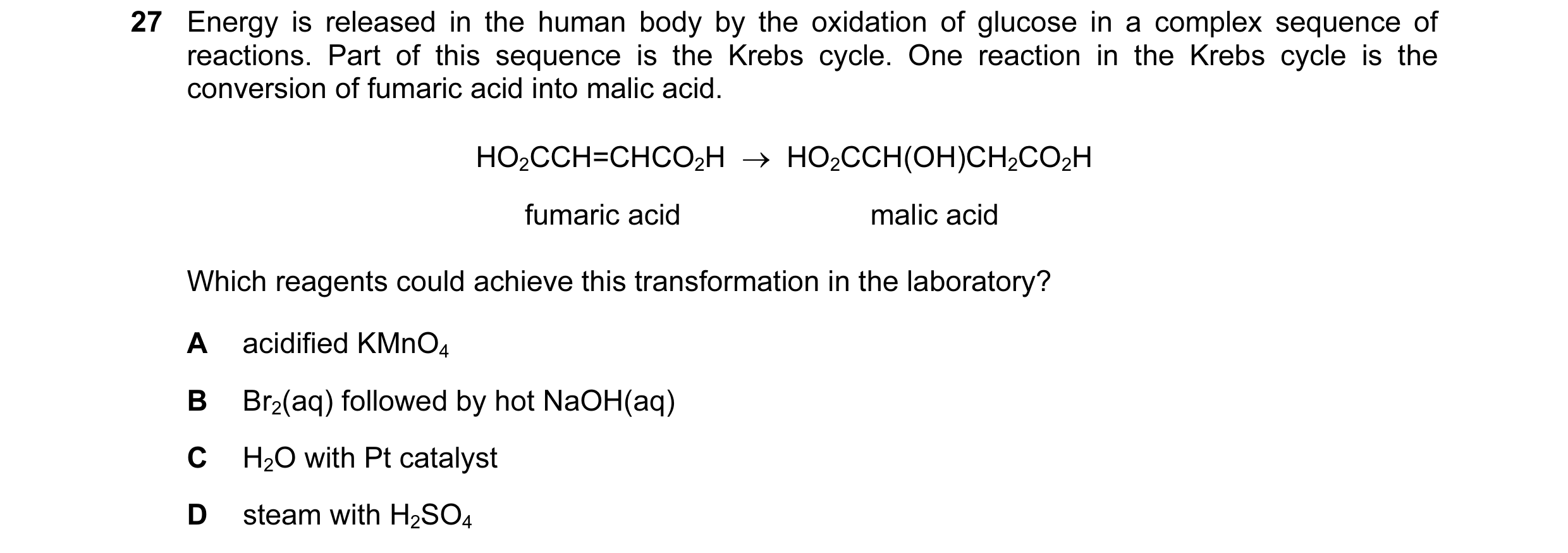
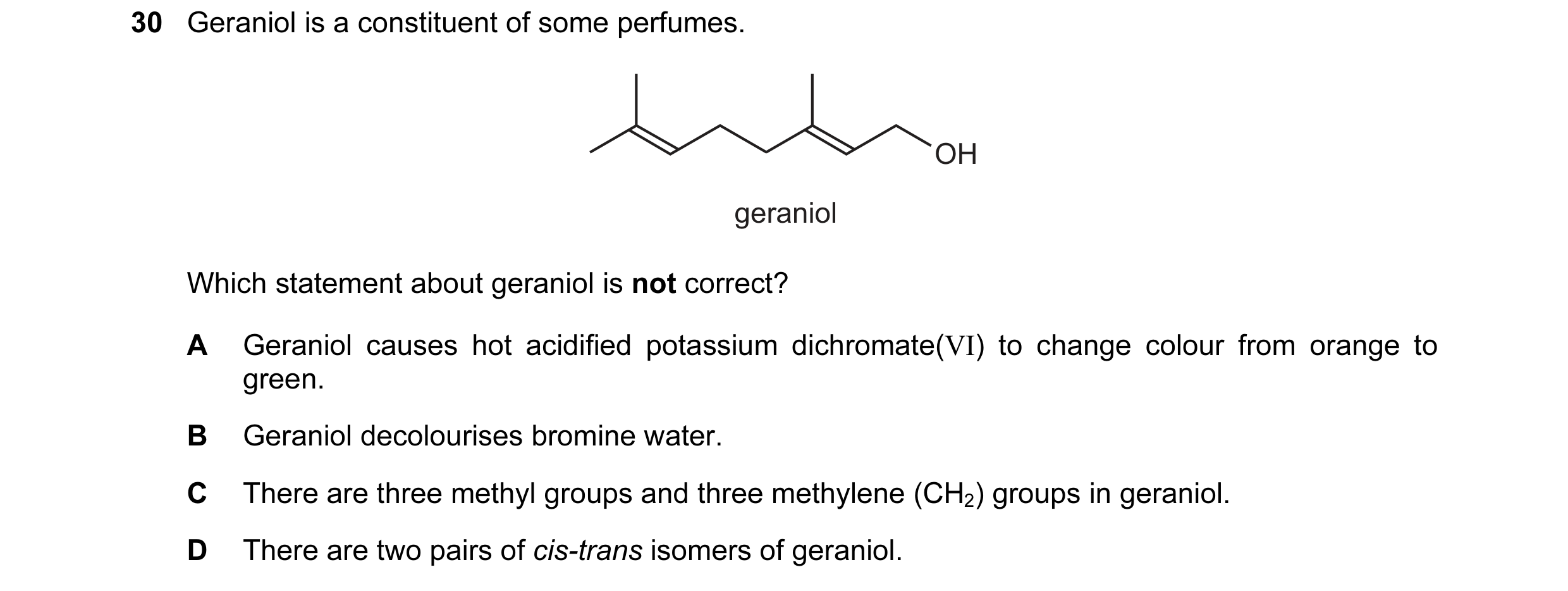
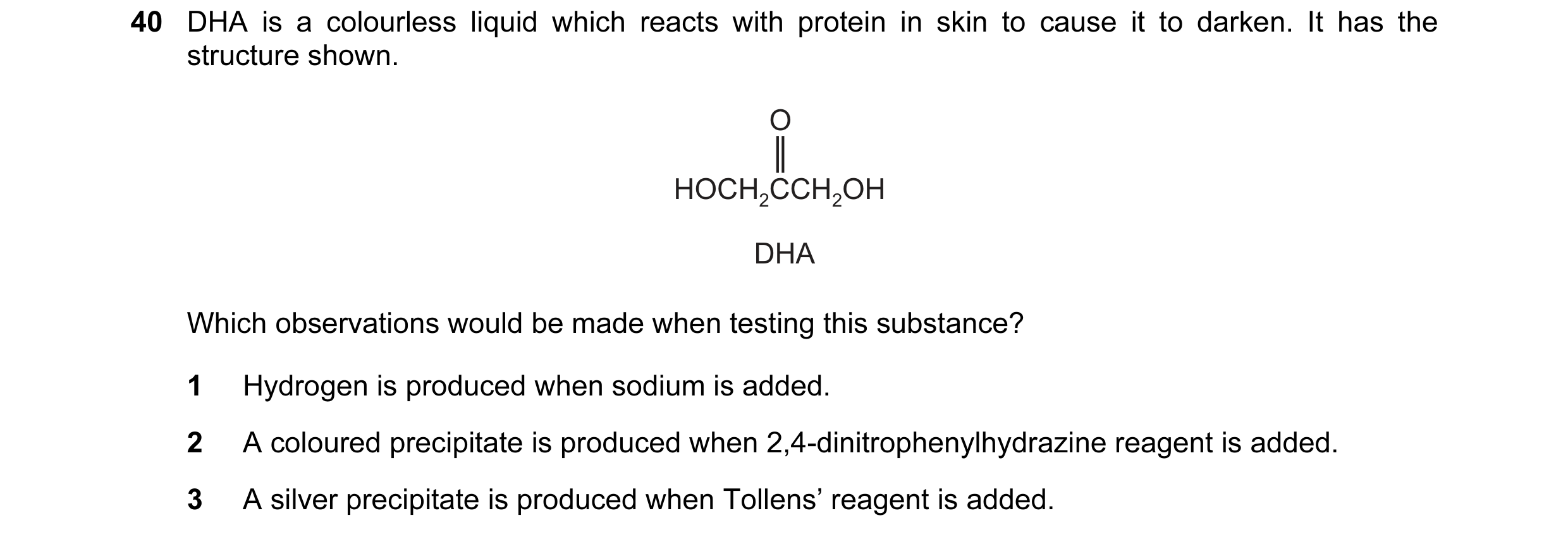 20 / 107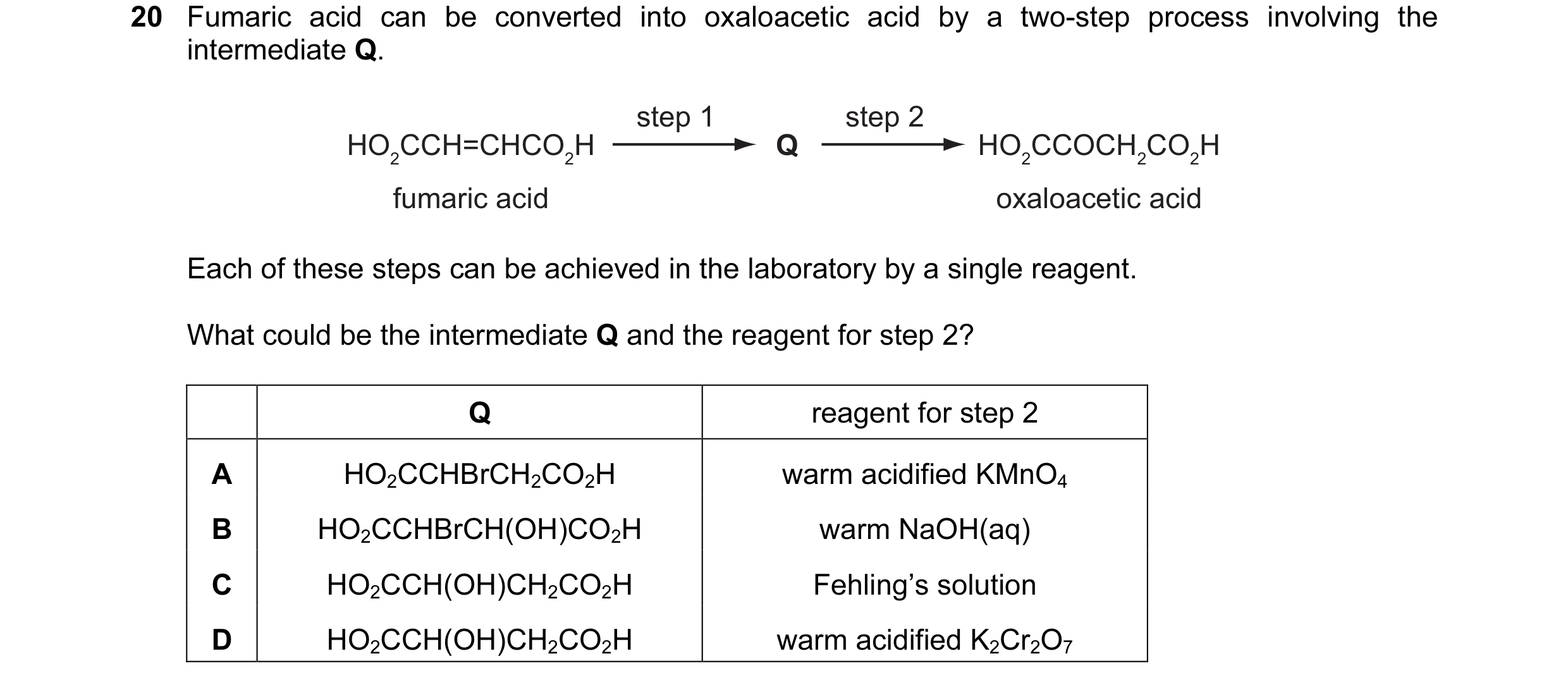
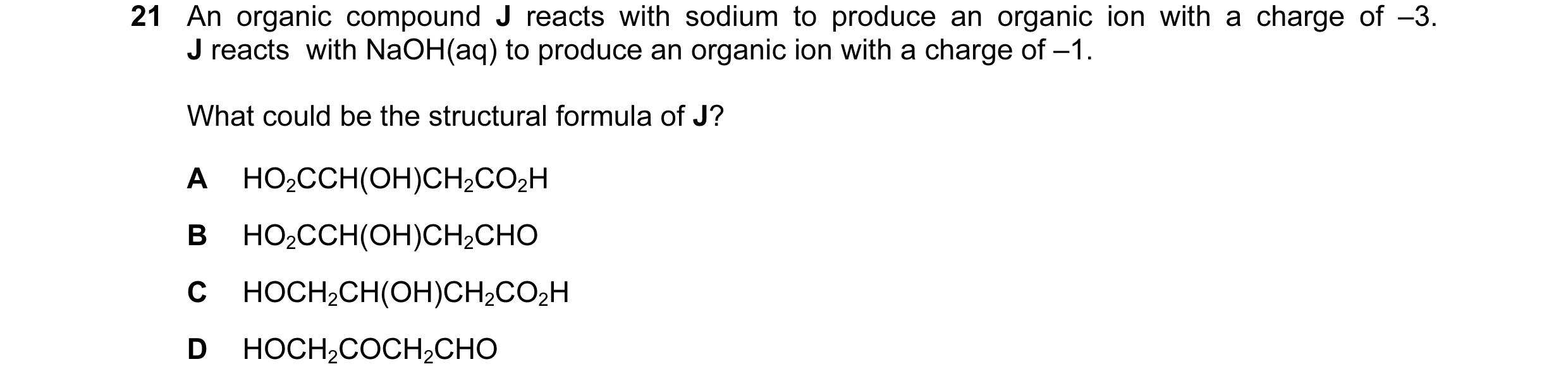
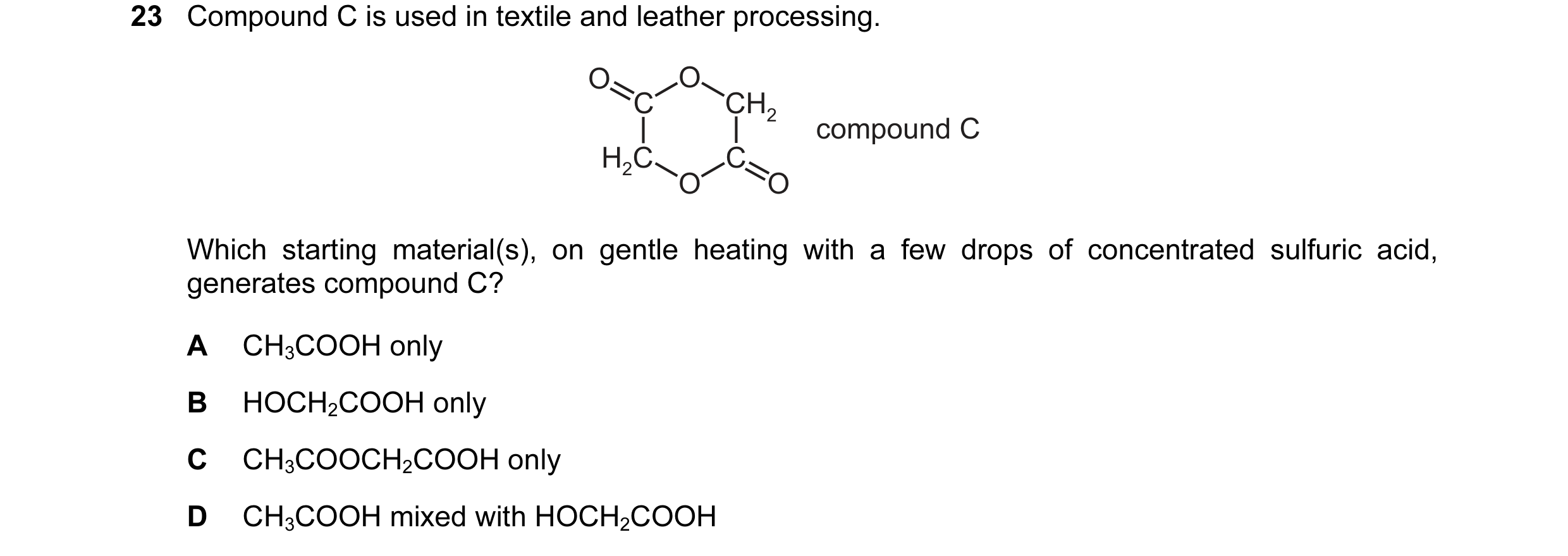
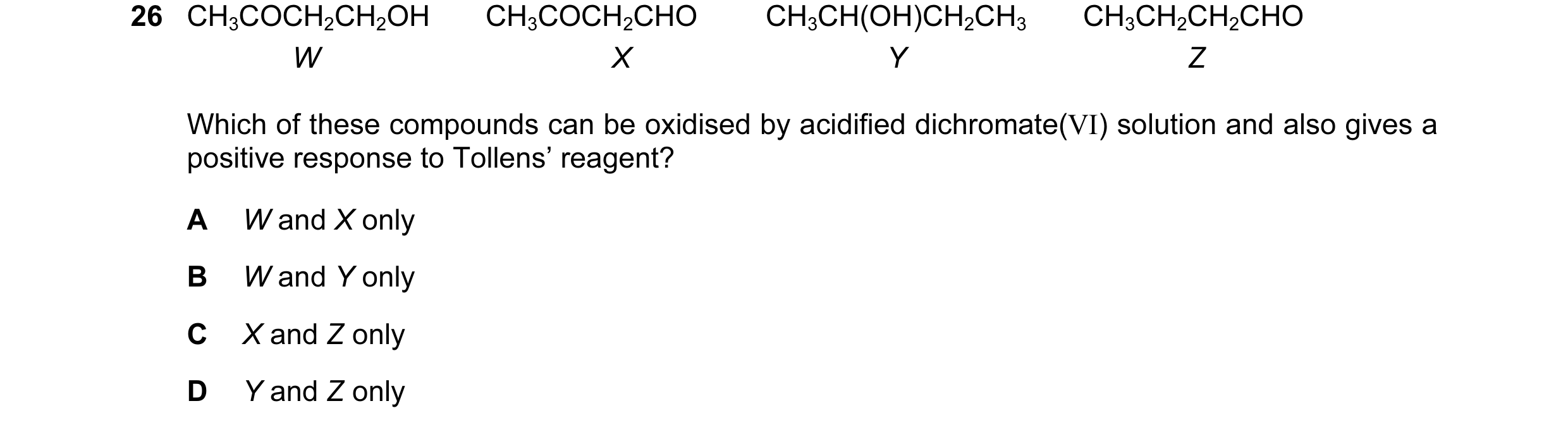 21 / 107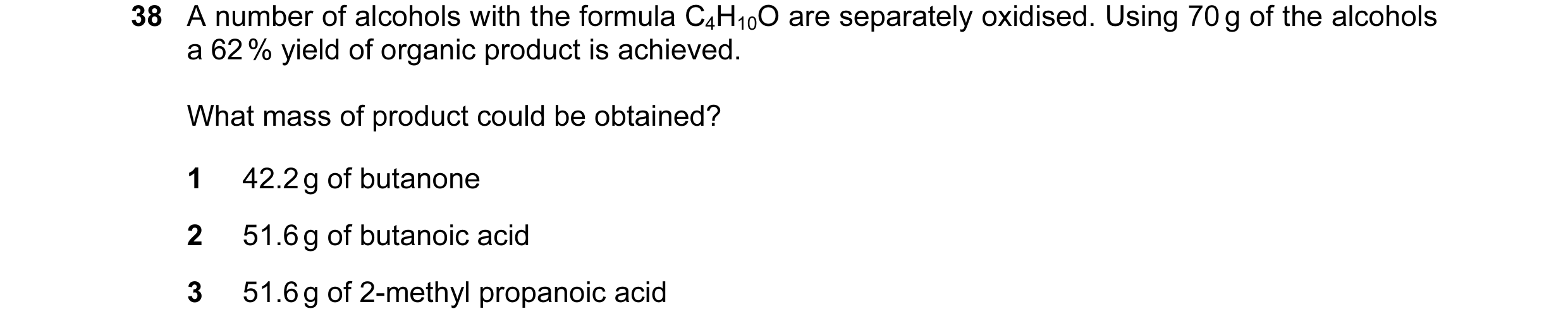
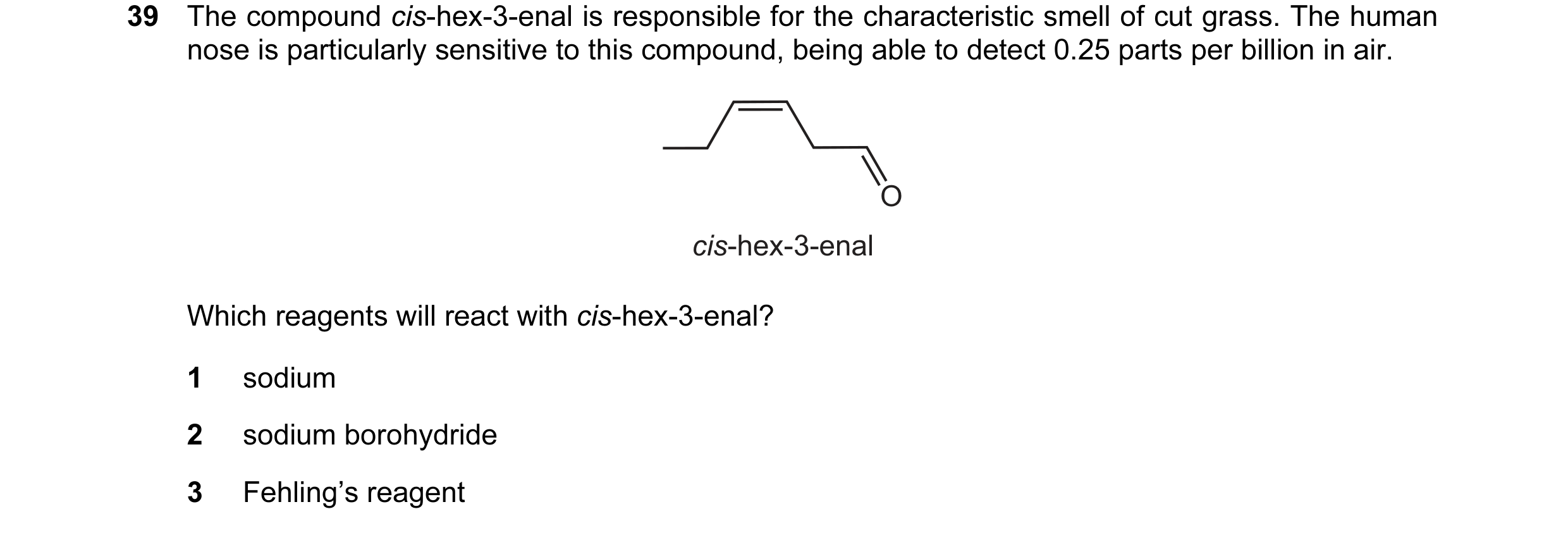

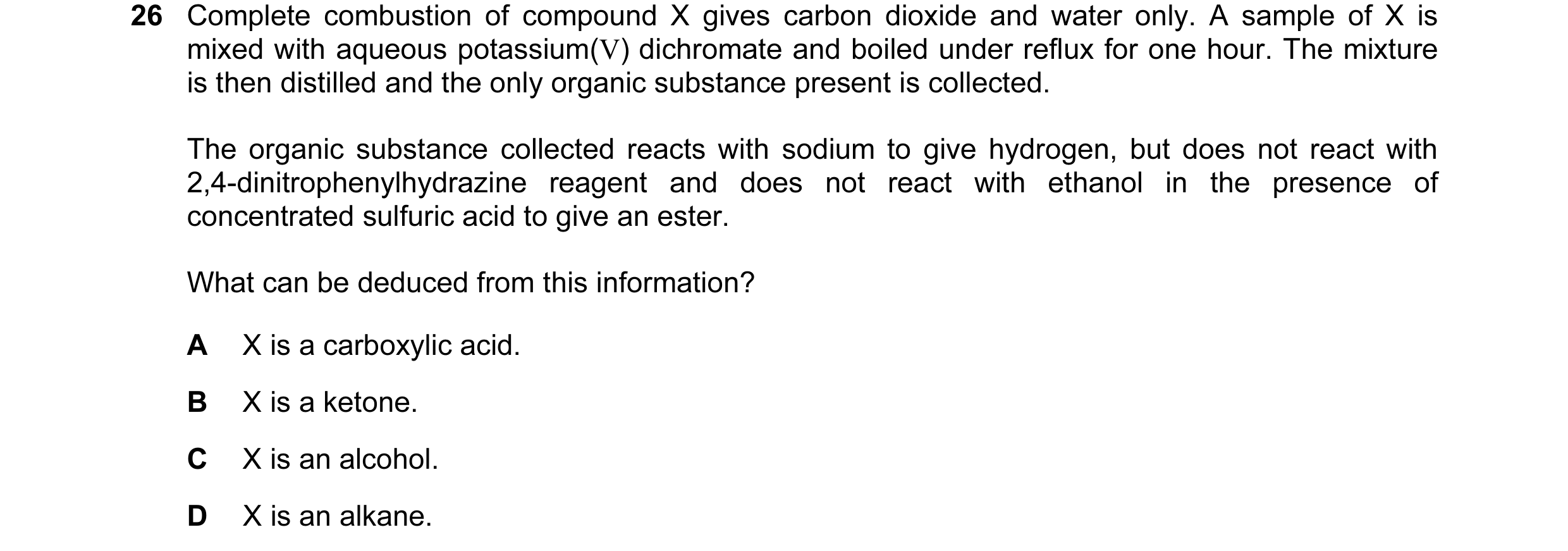 22 / 107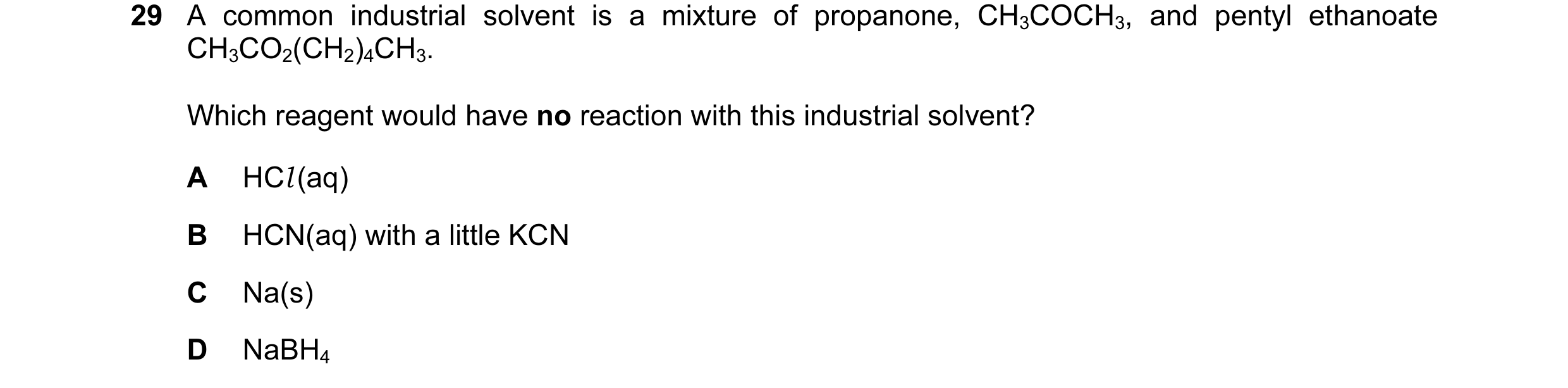
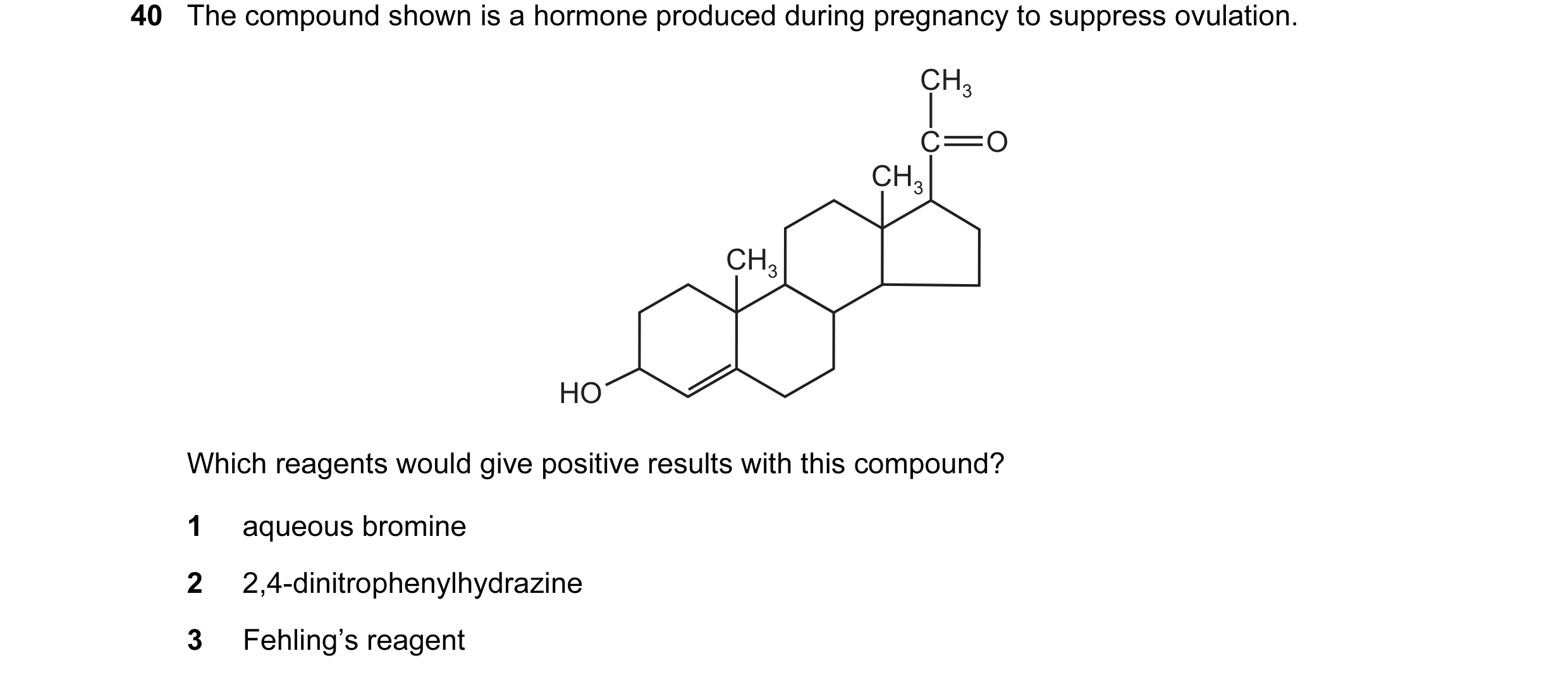 23 / 107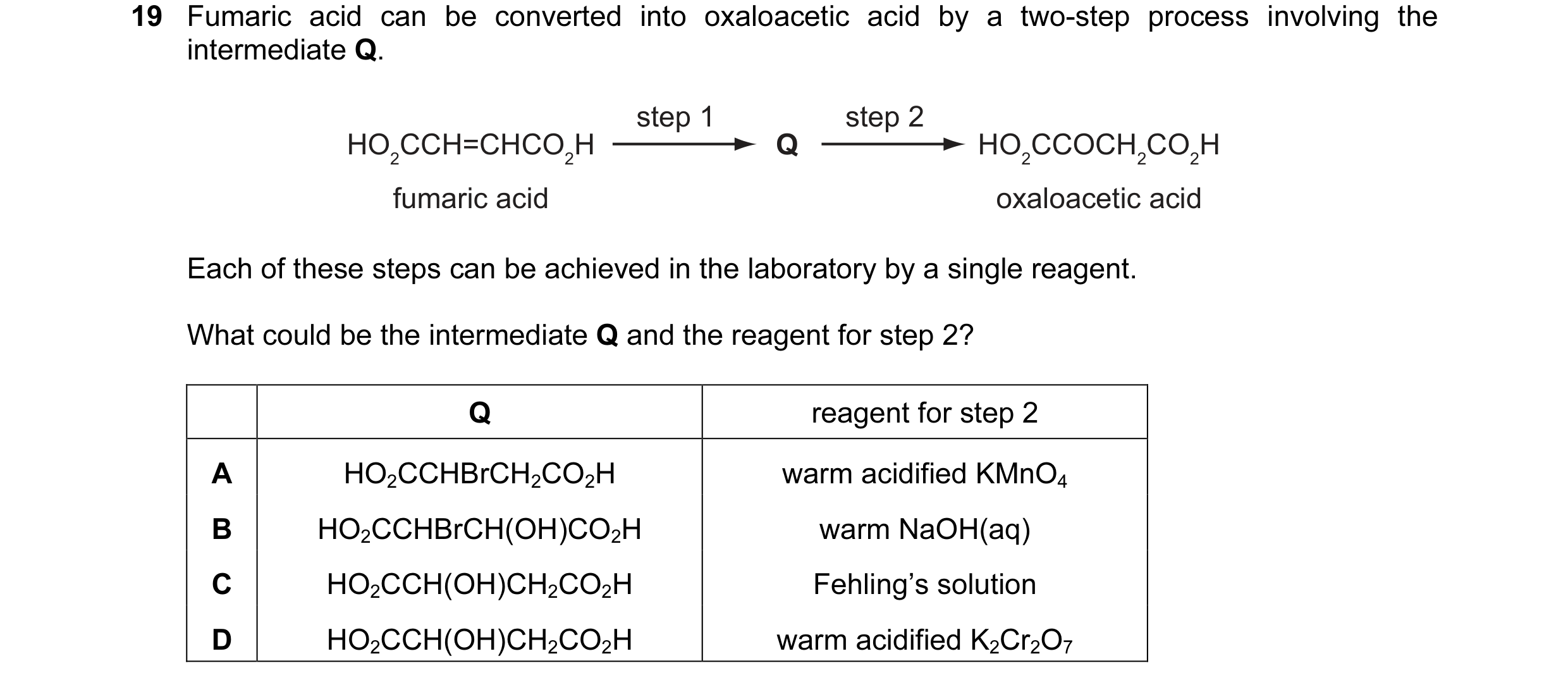
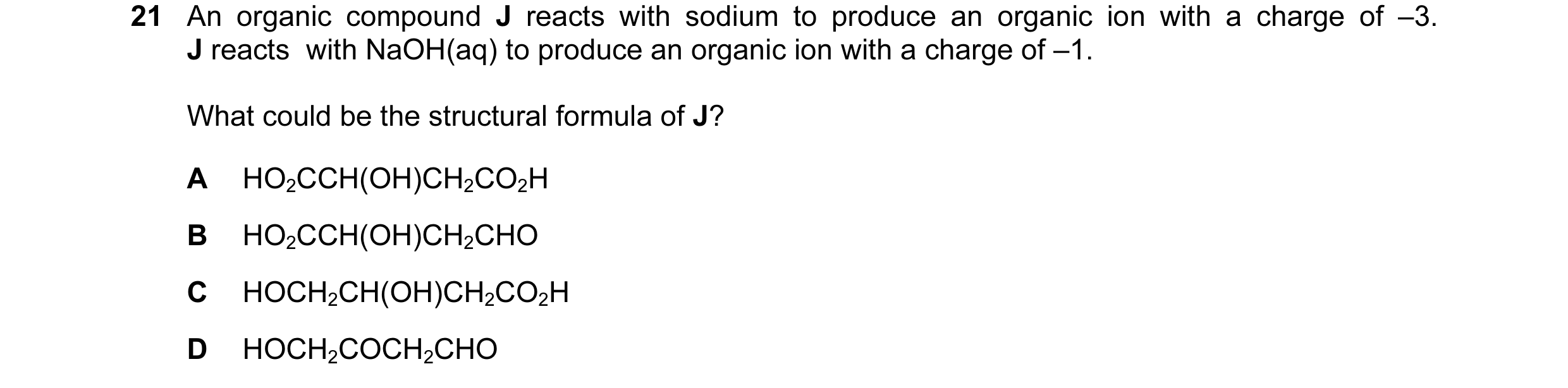
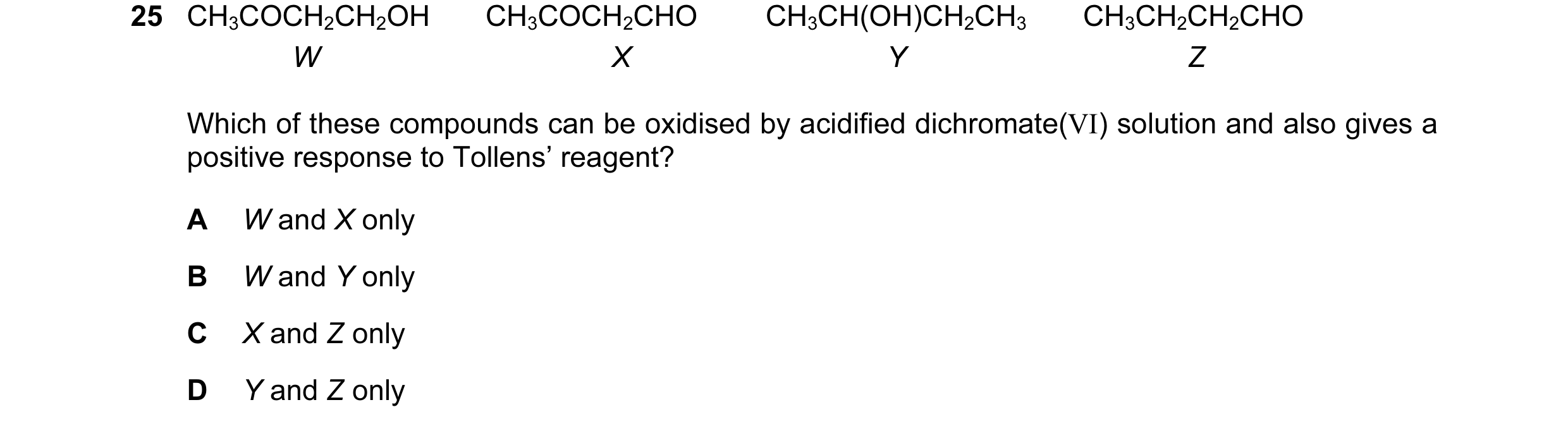
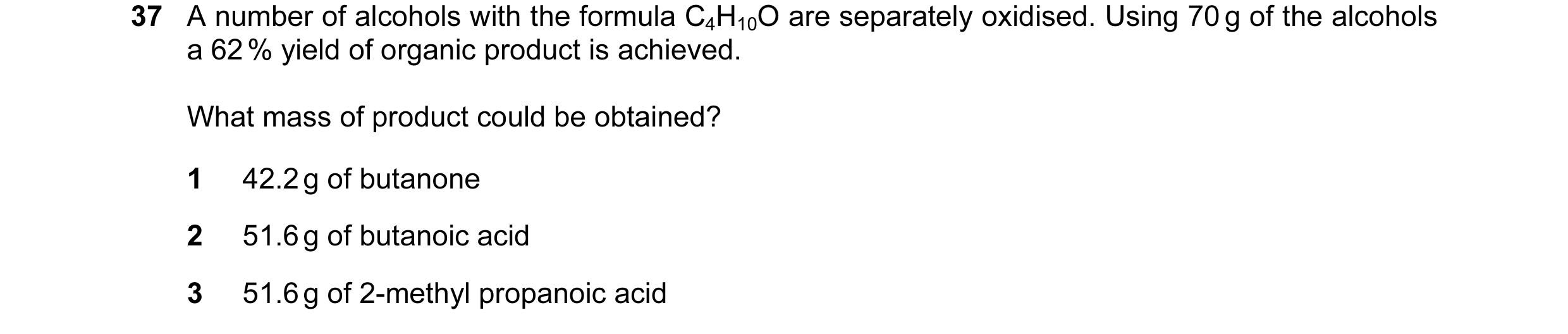 24 / 107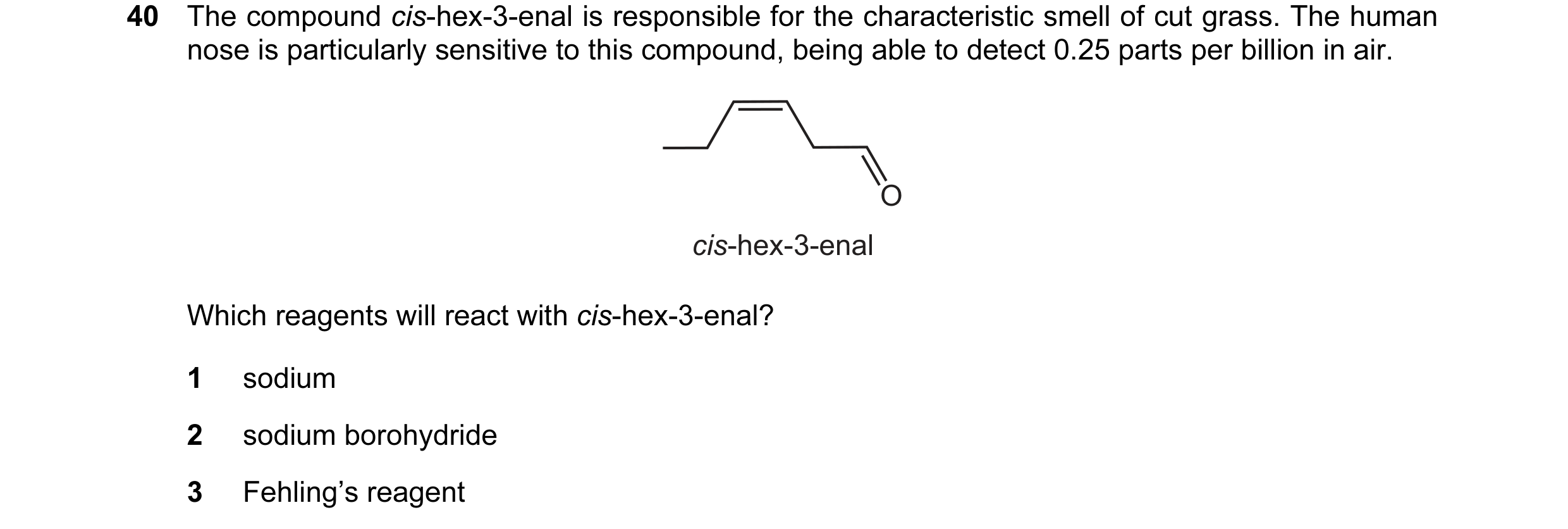
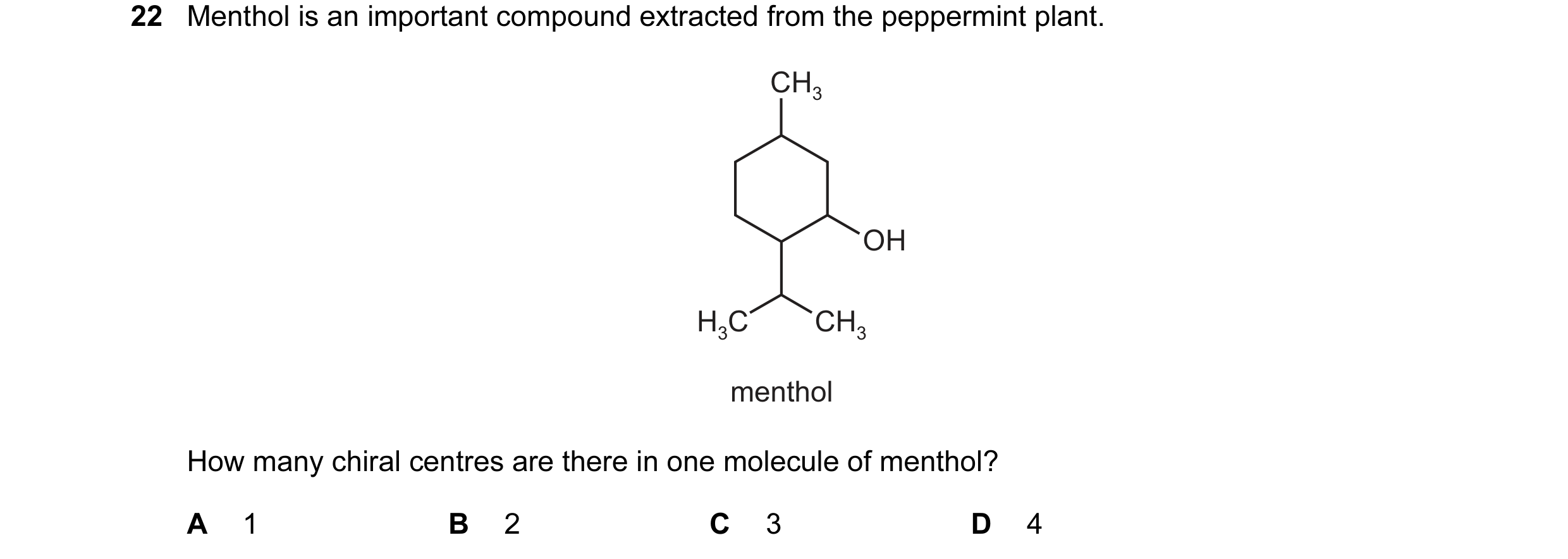
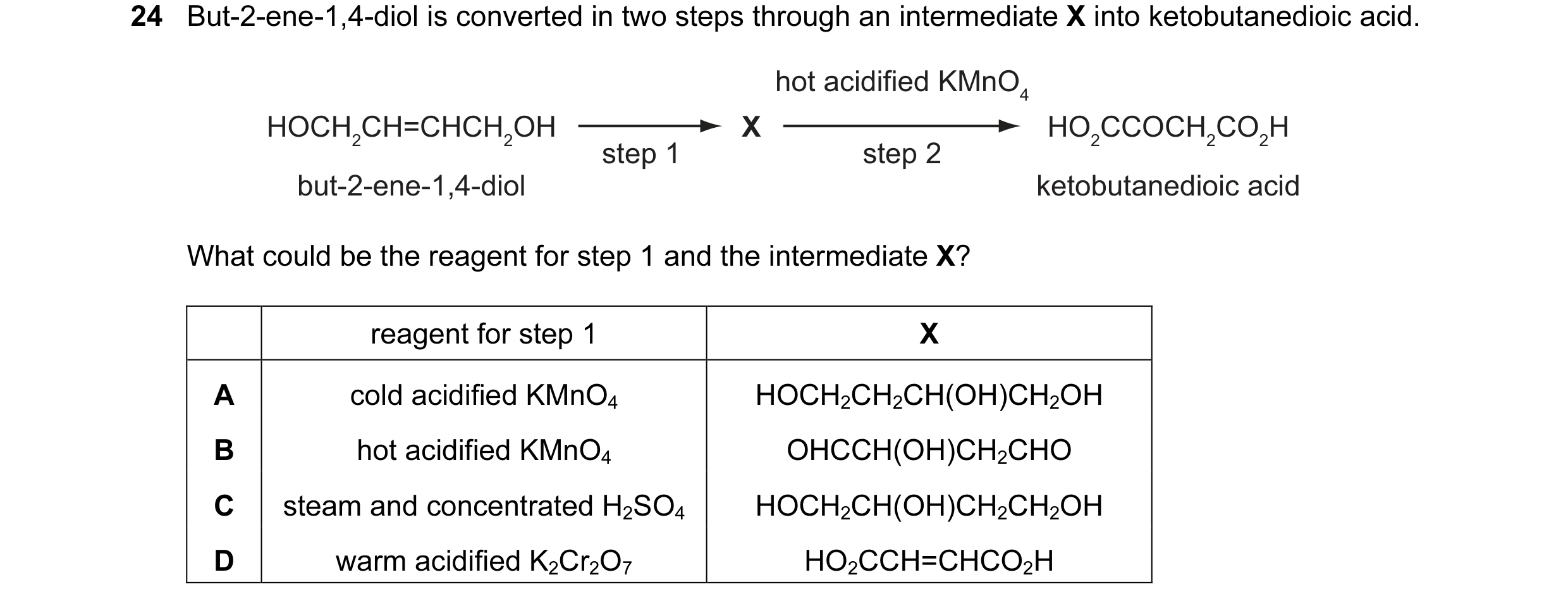
 25 / 107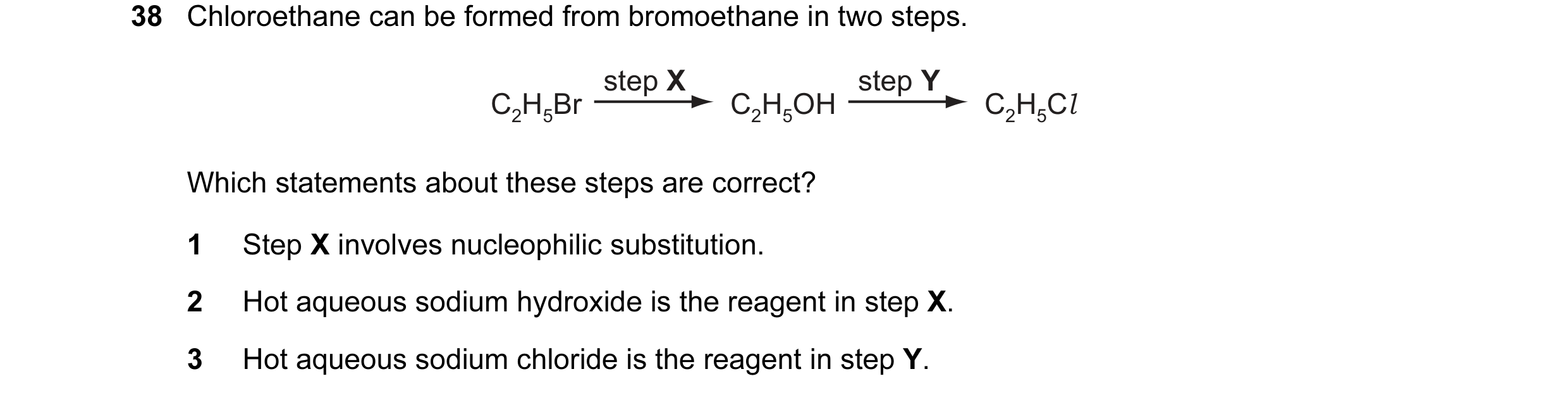
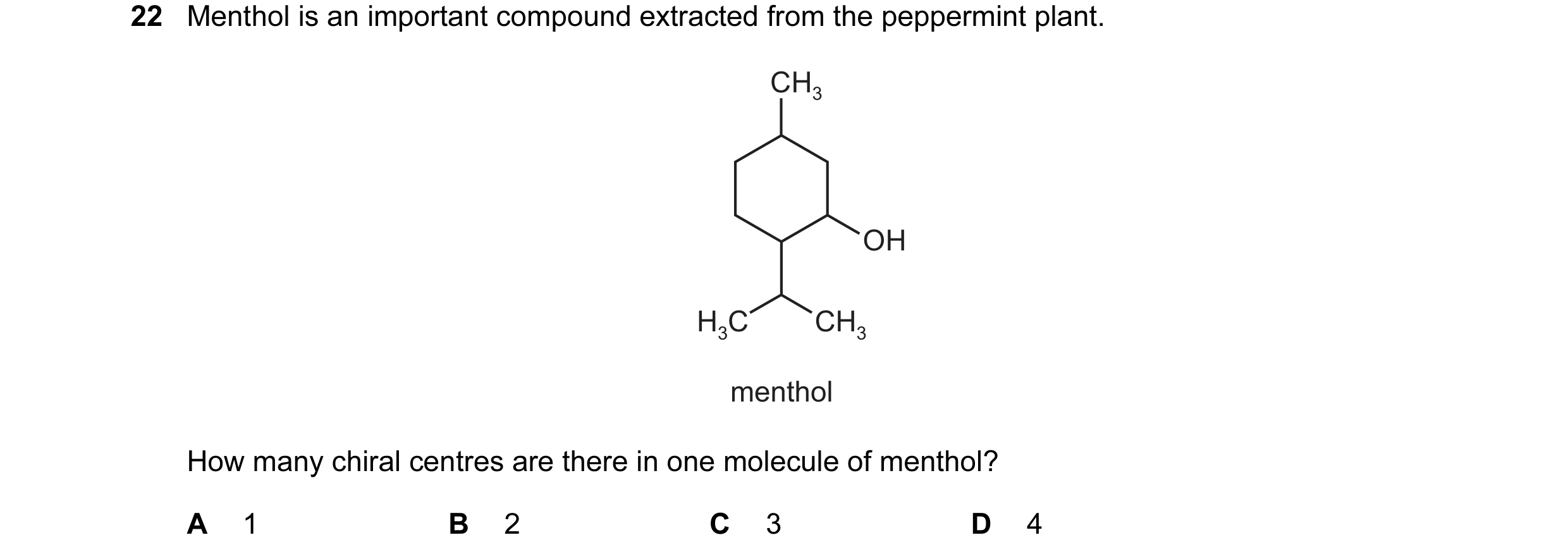


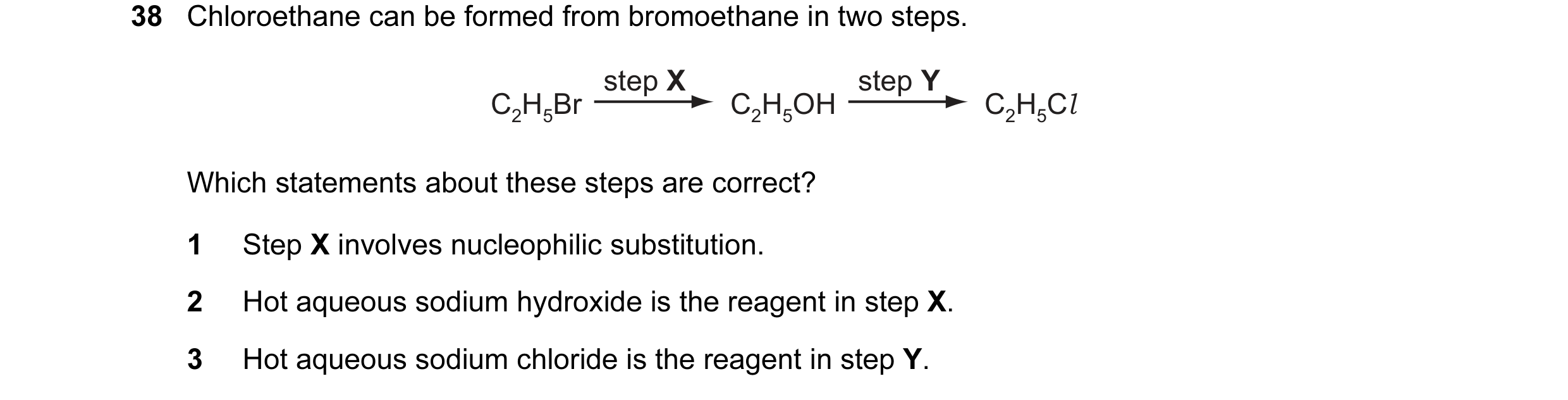 26 / 107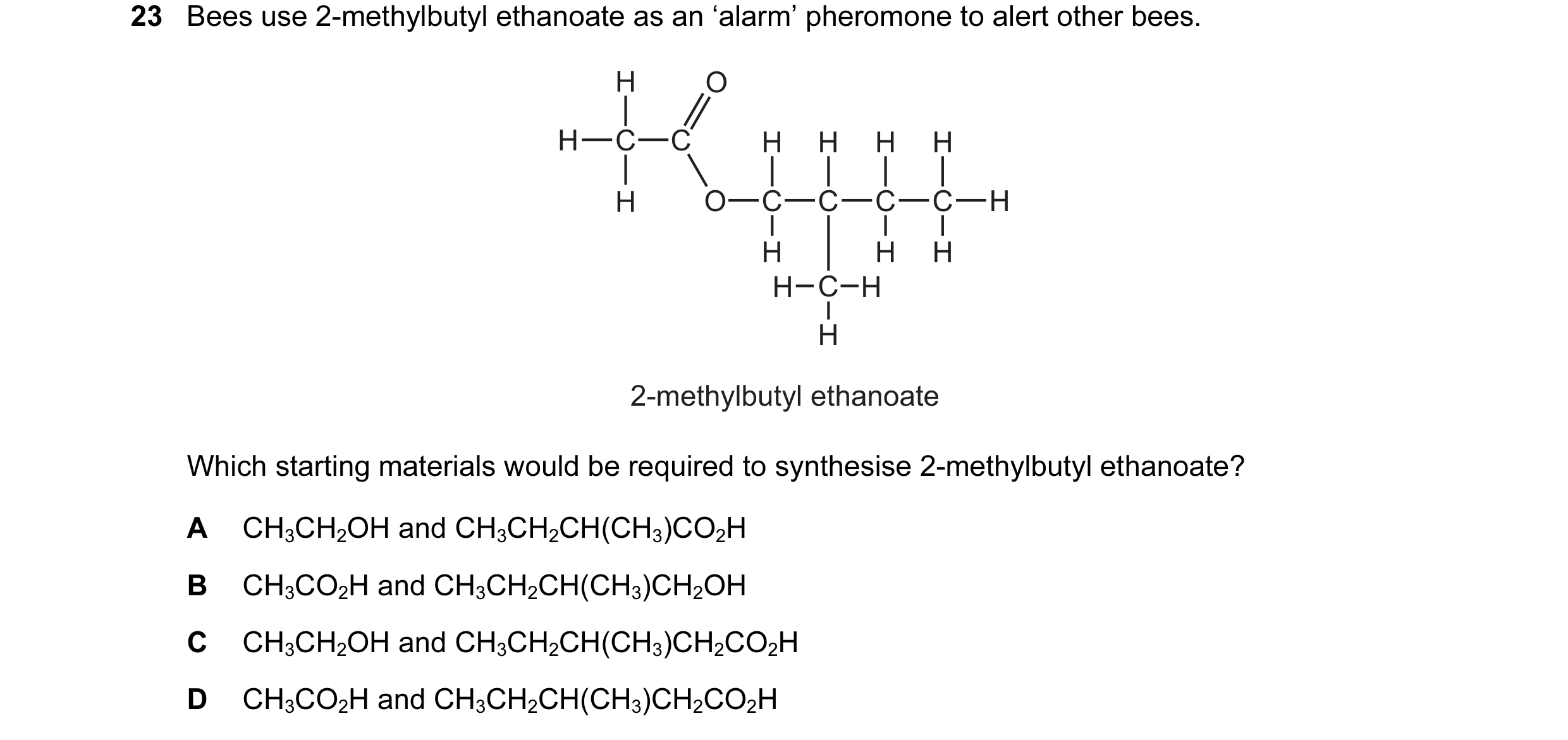
 27 / 107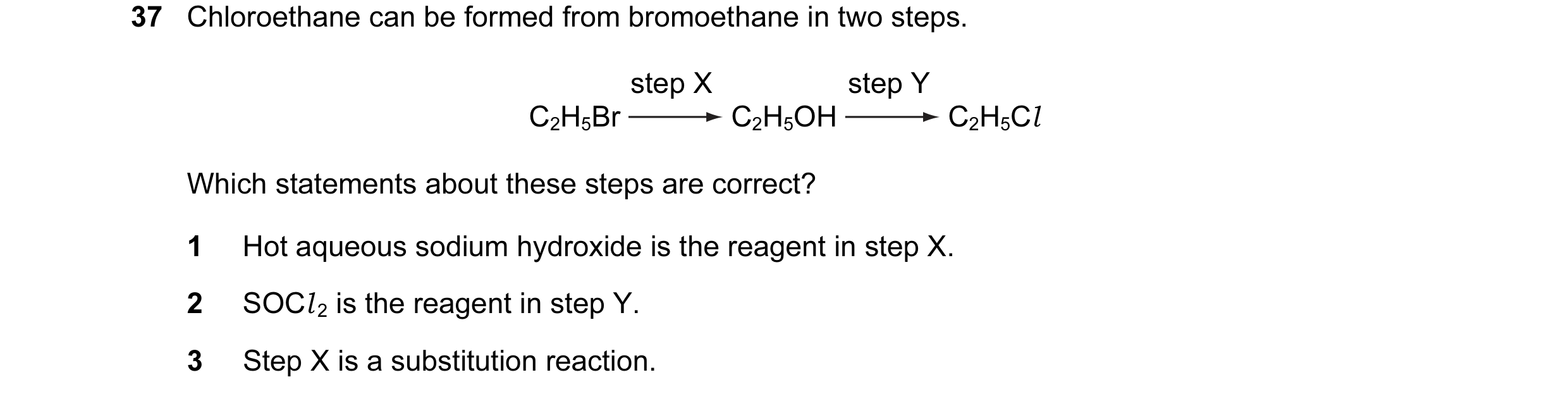
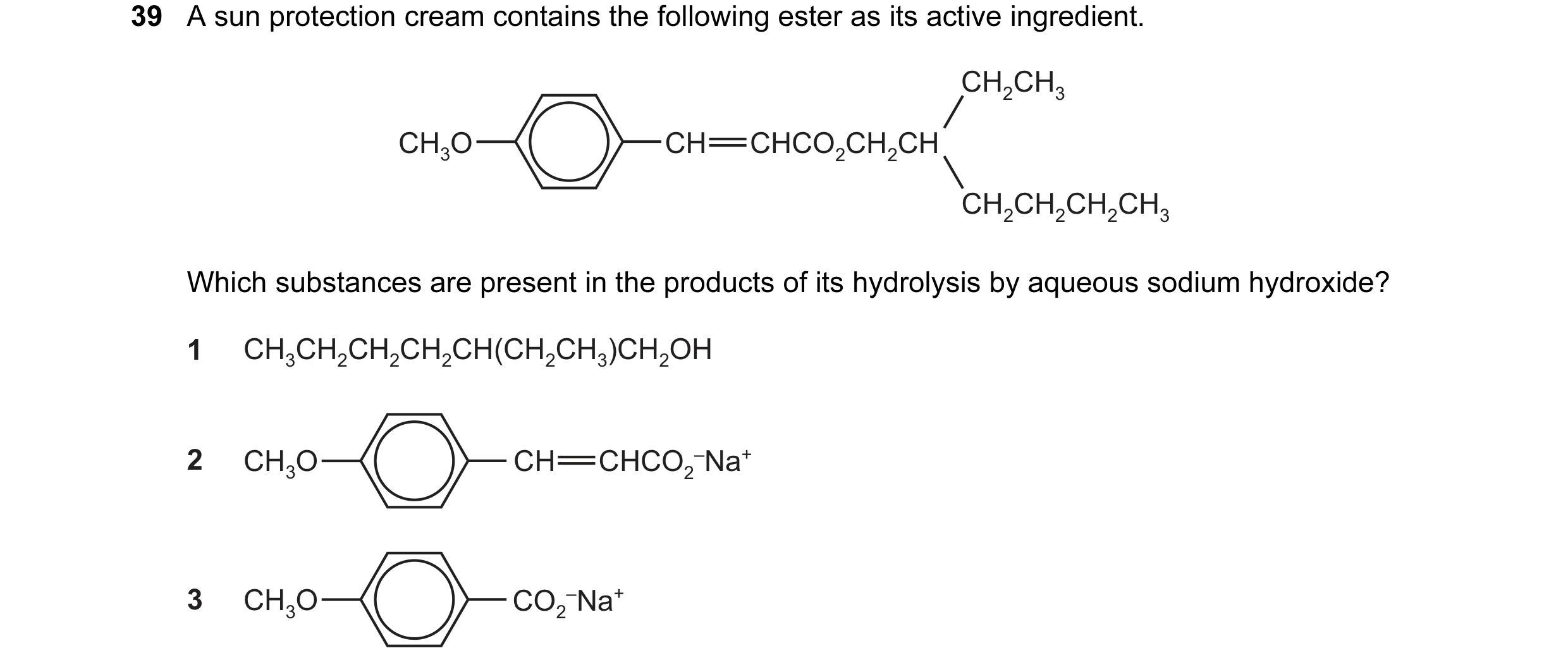
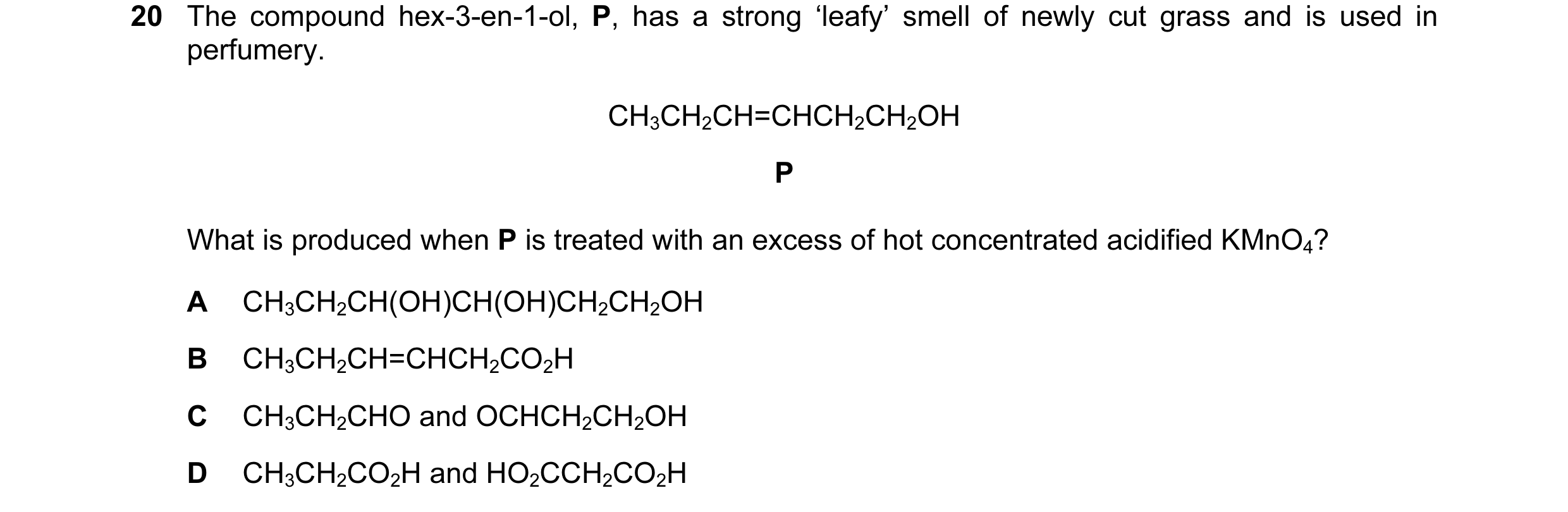 28 / 107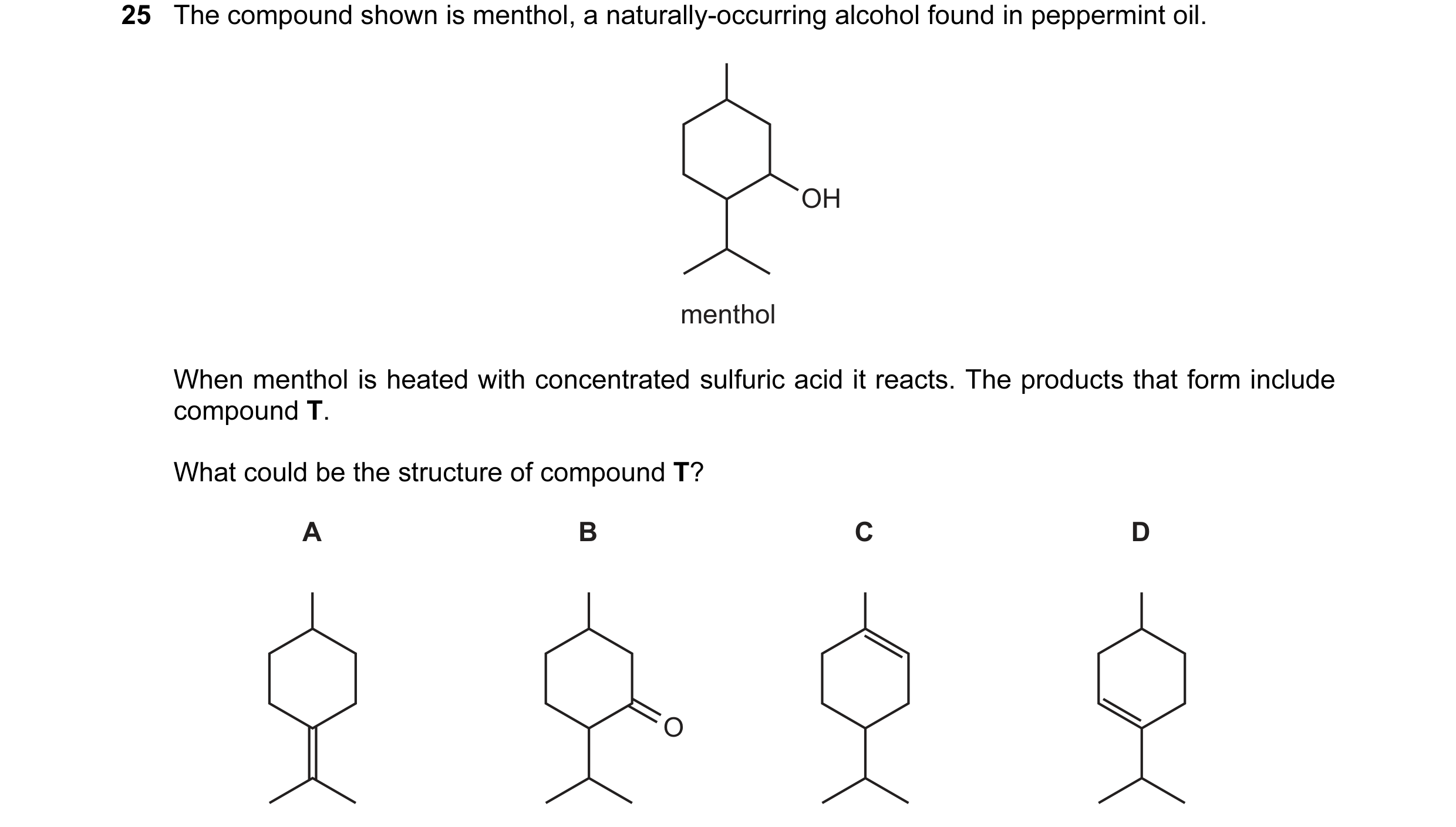

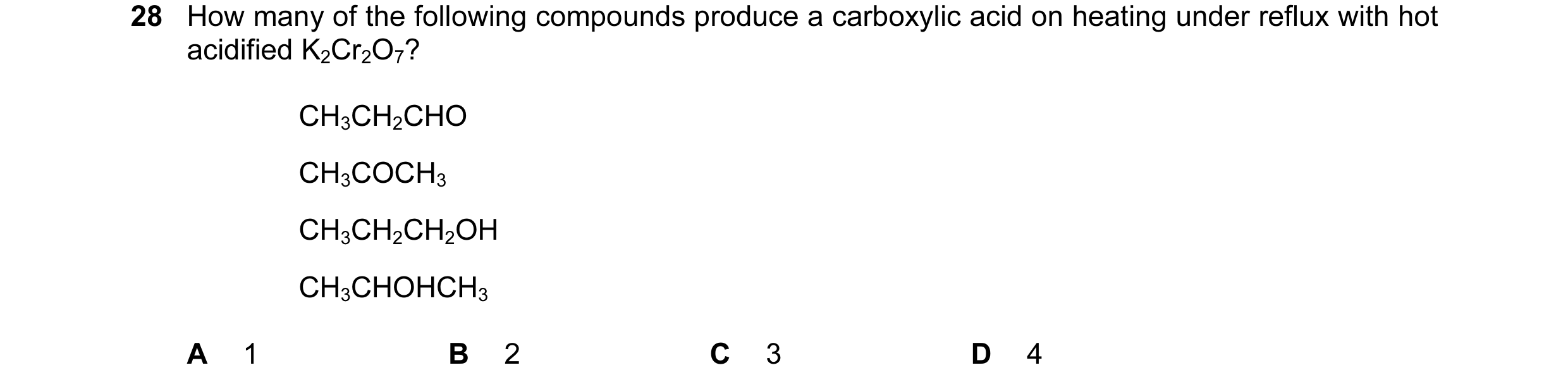
 29 / 107

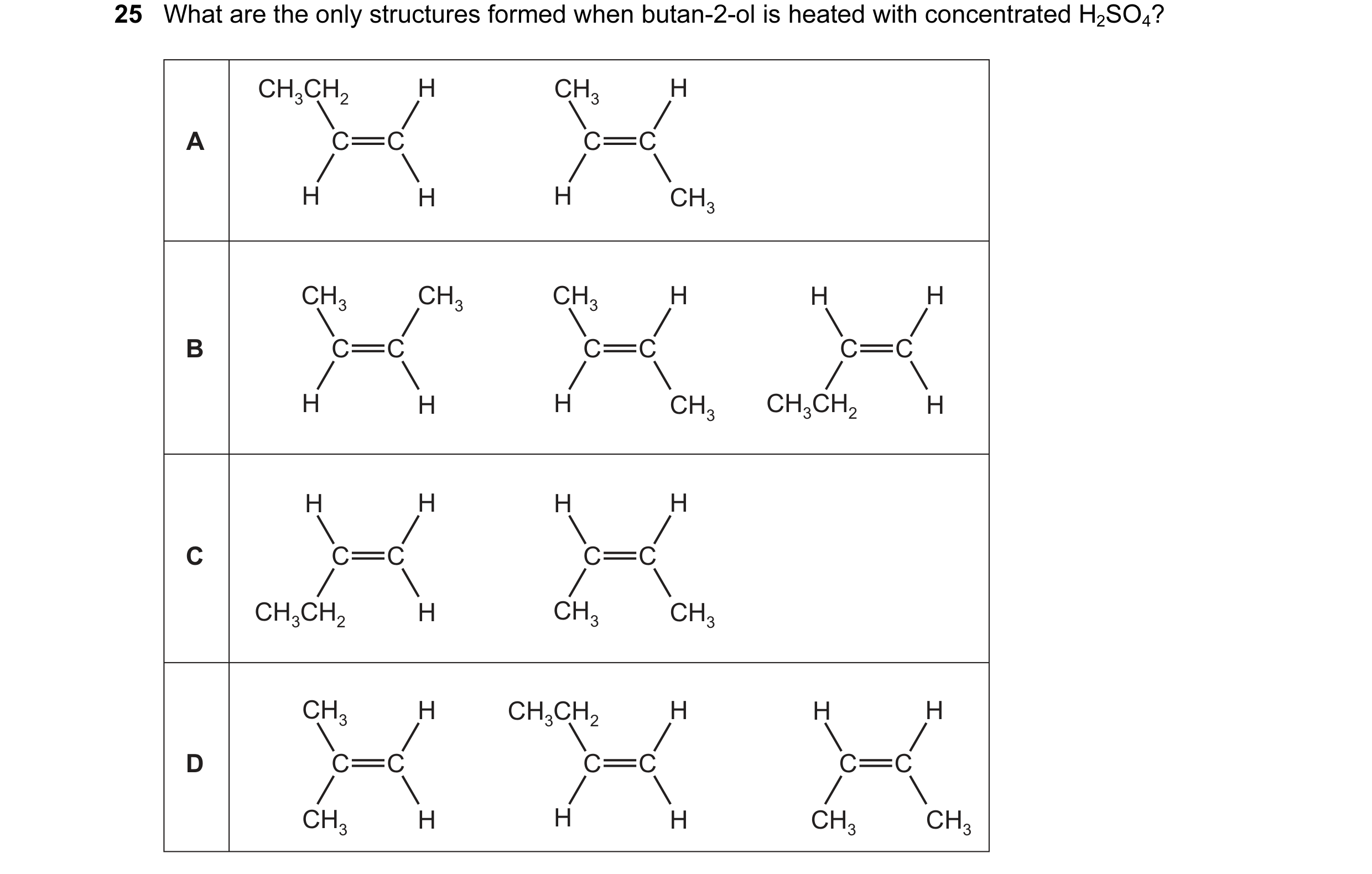 30 / 107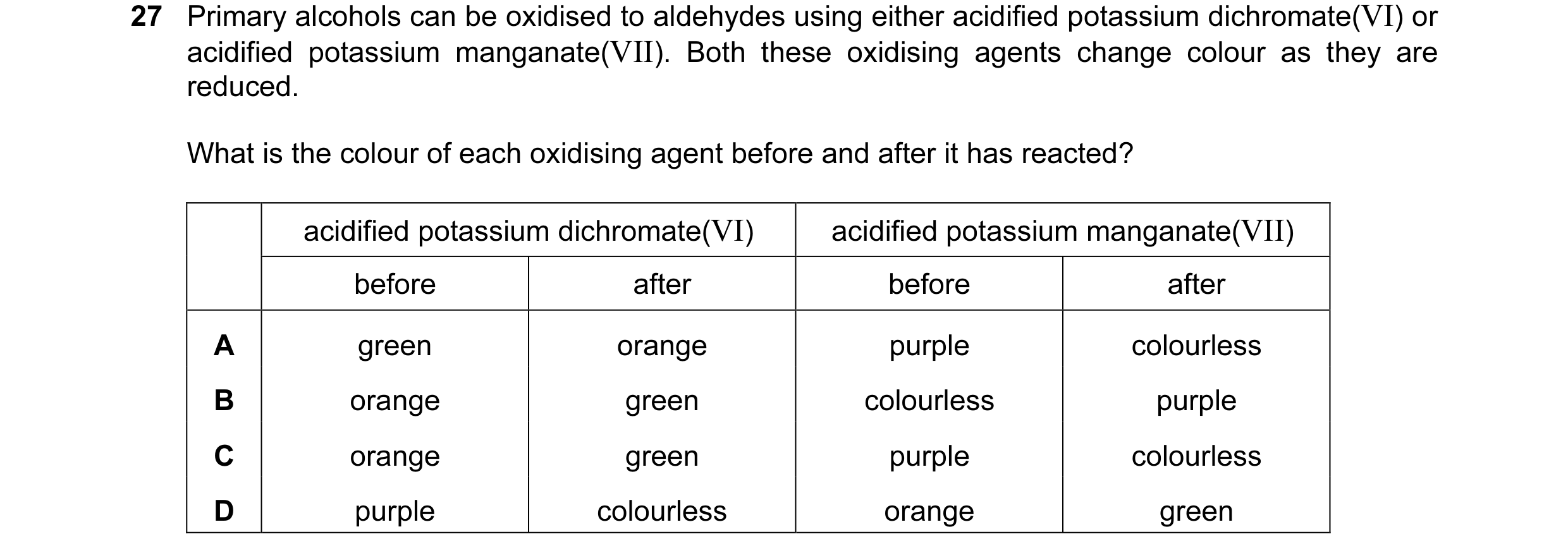
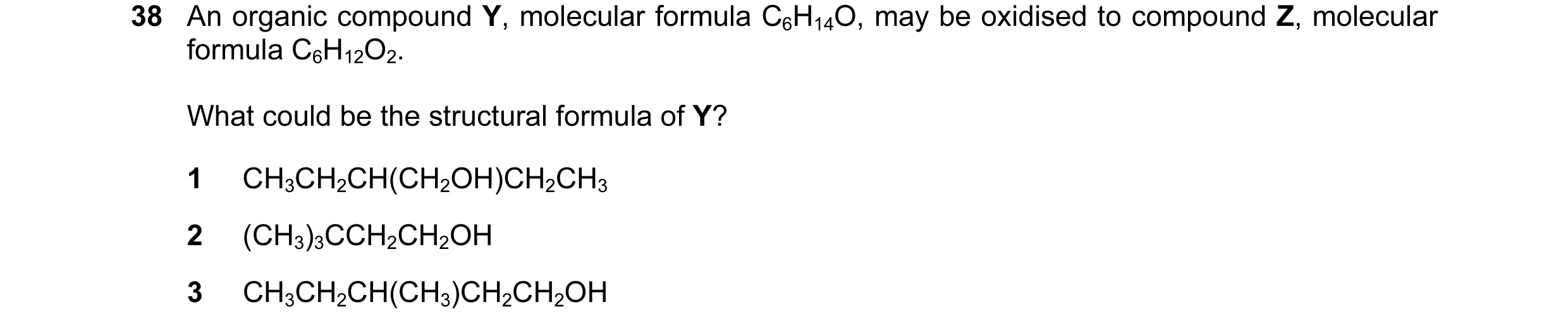

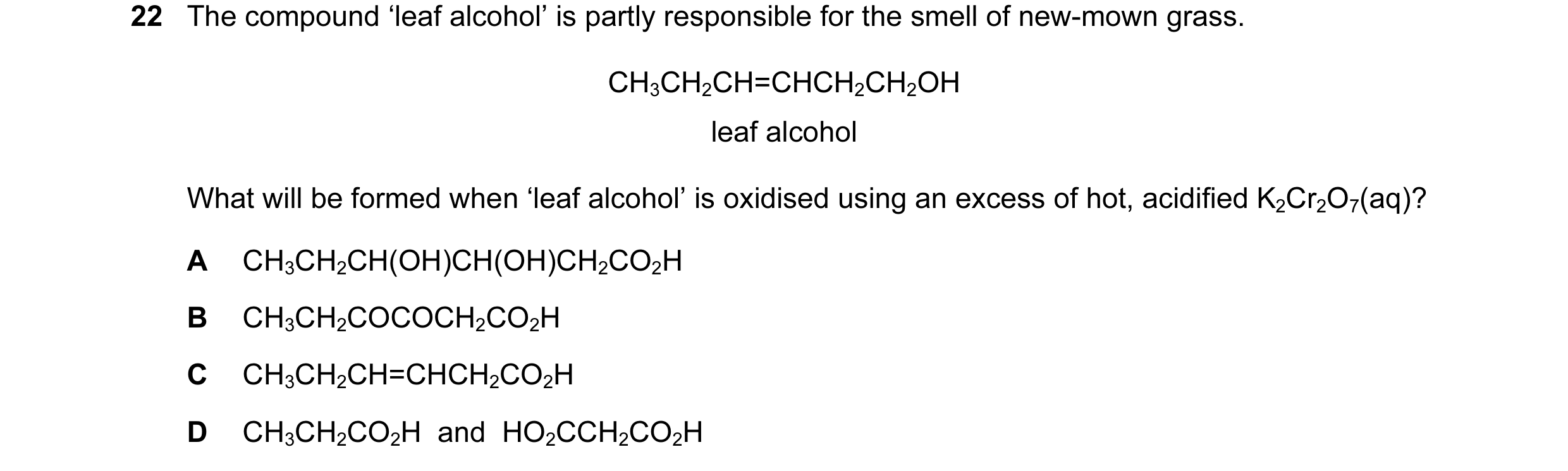 31 / 107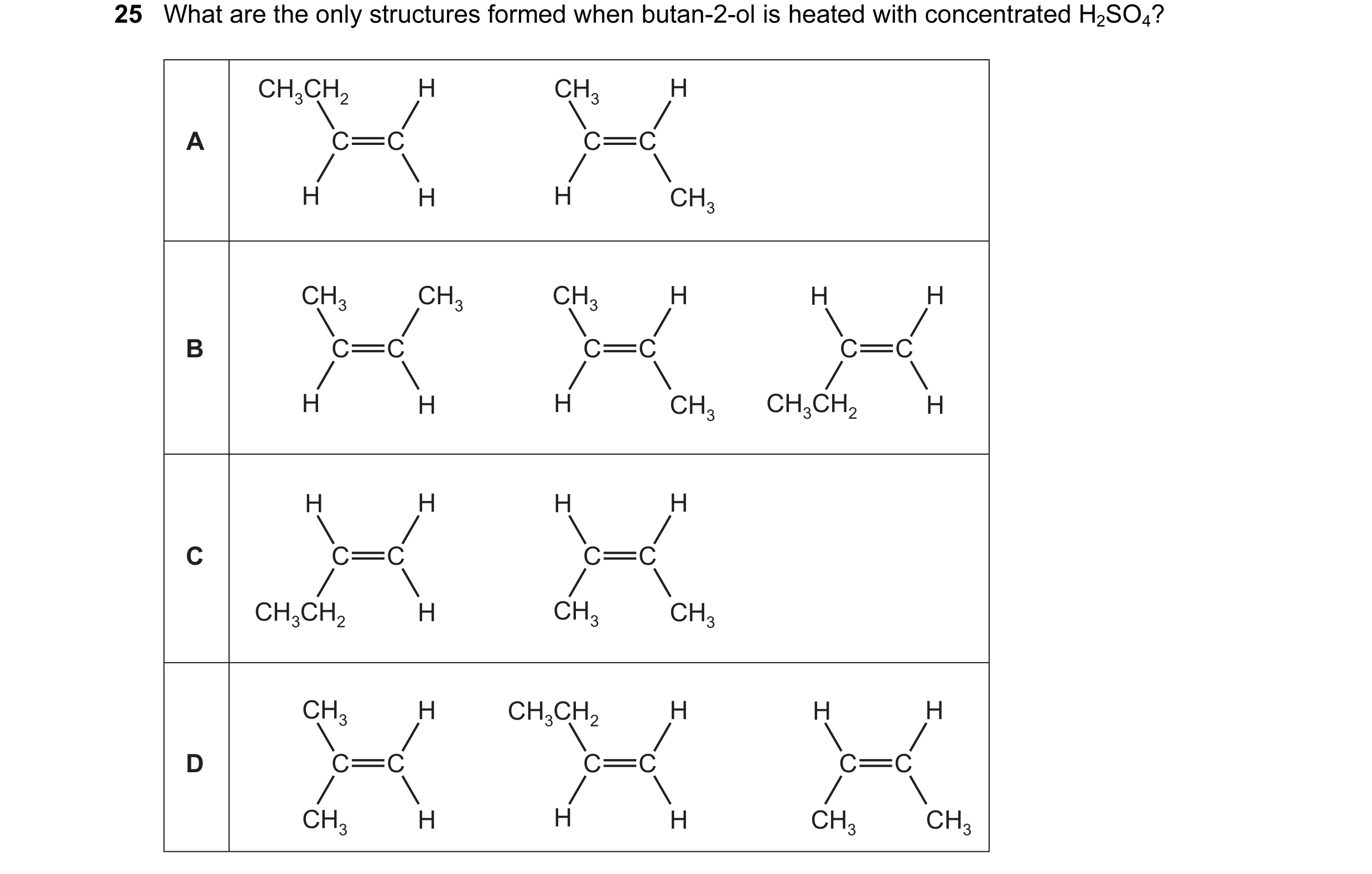
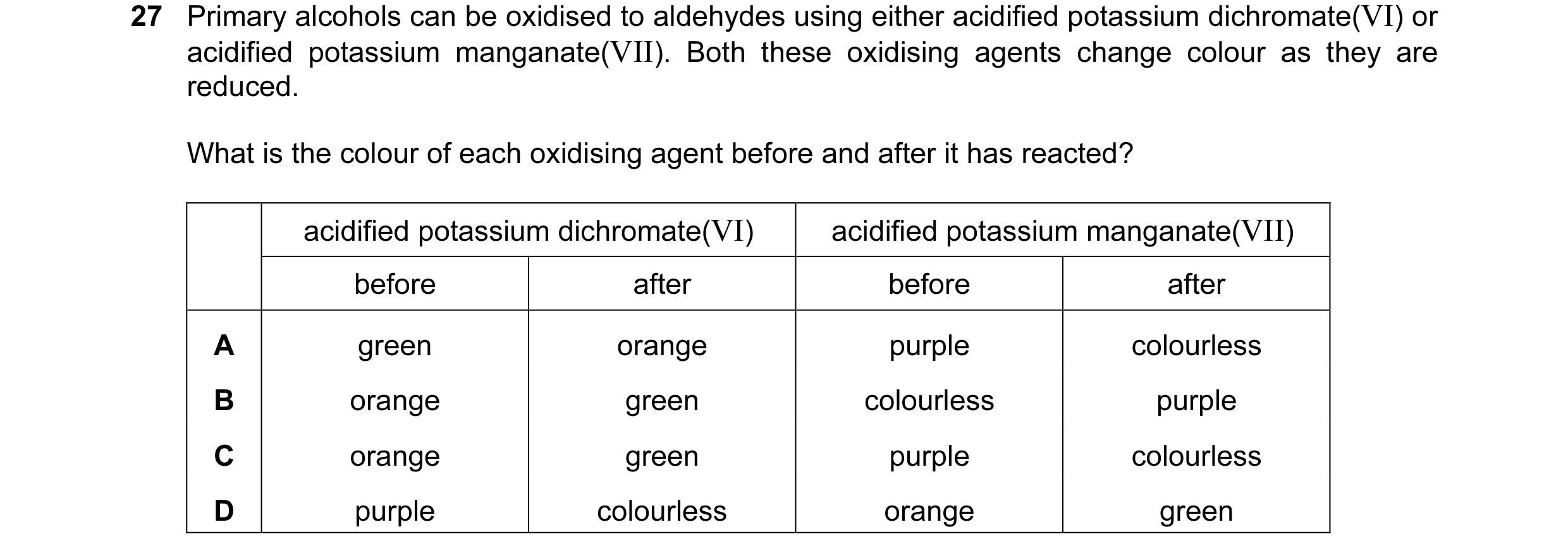
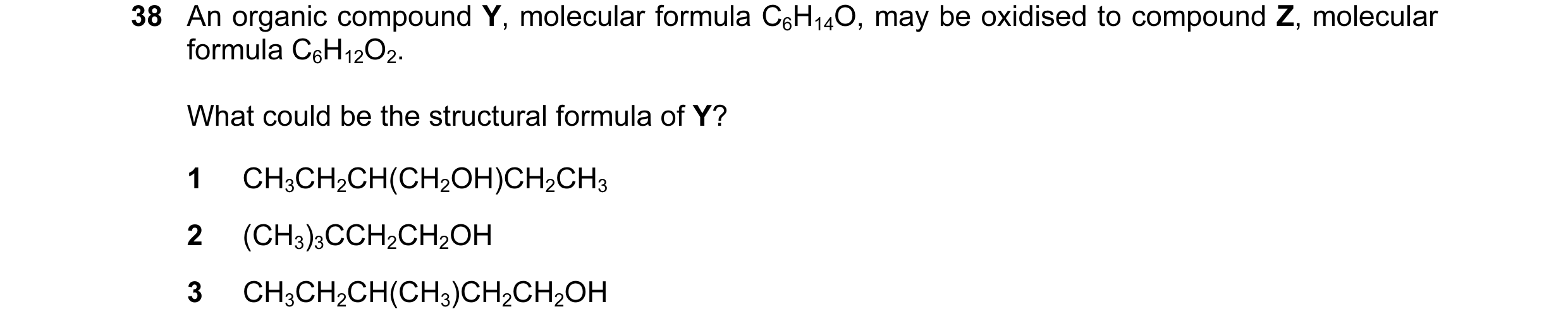 32 / 107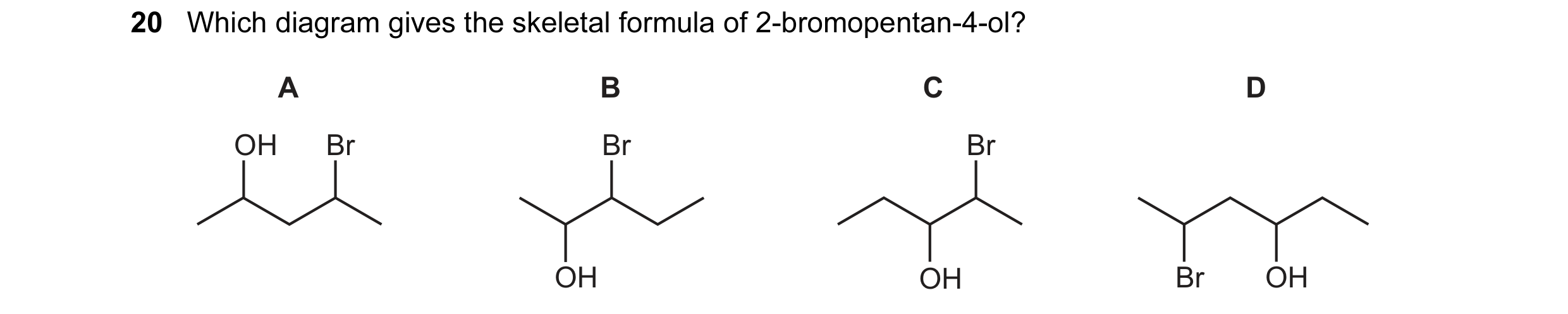

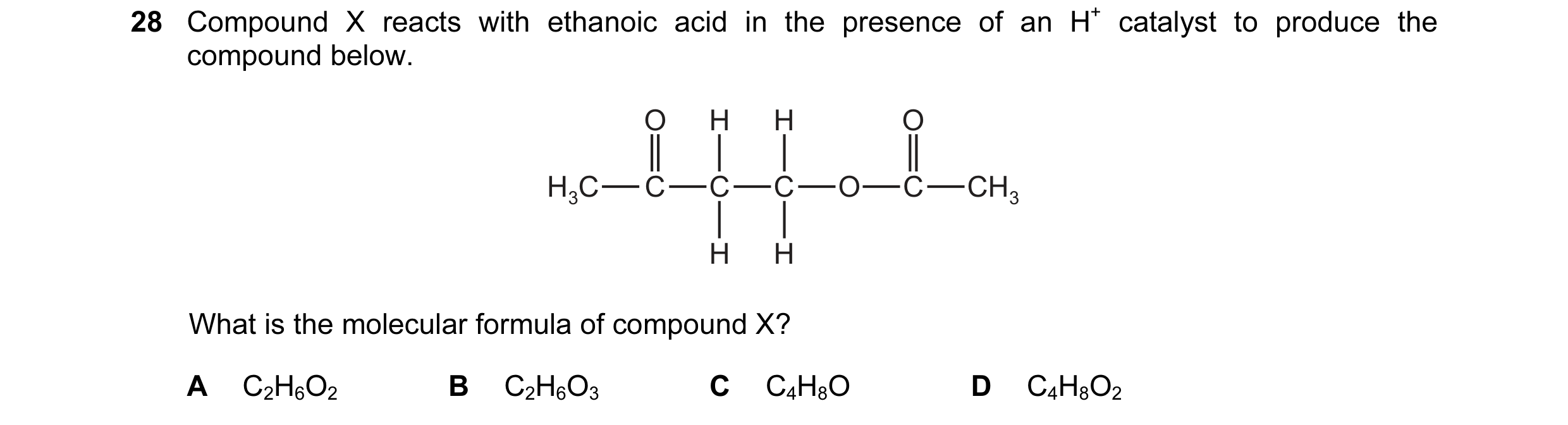
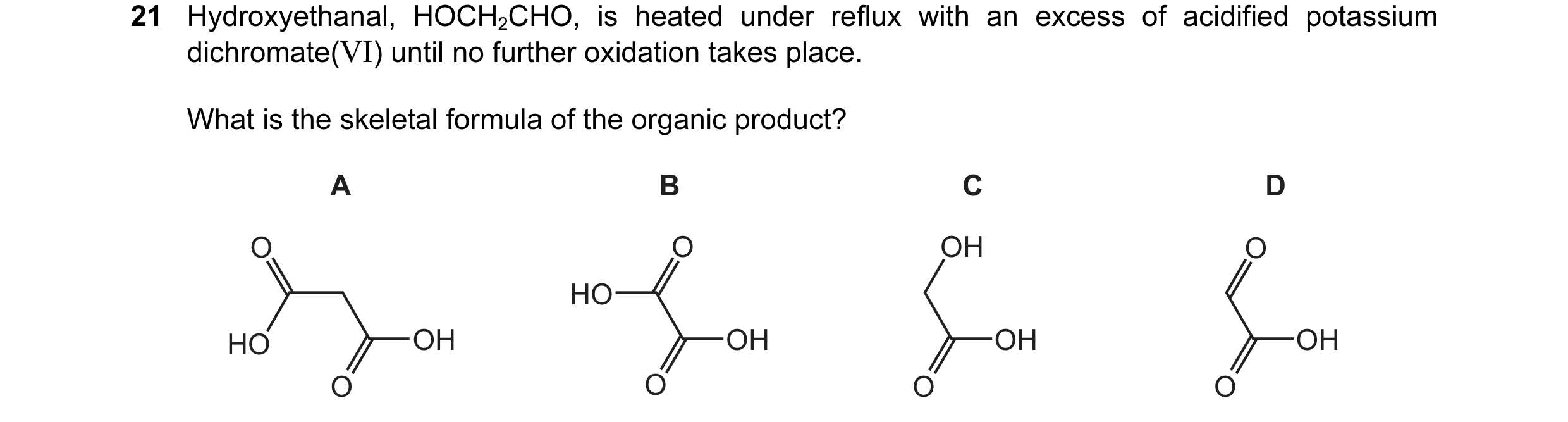 33 / 107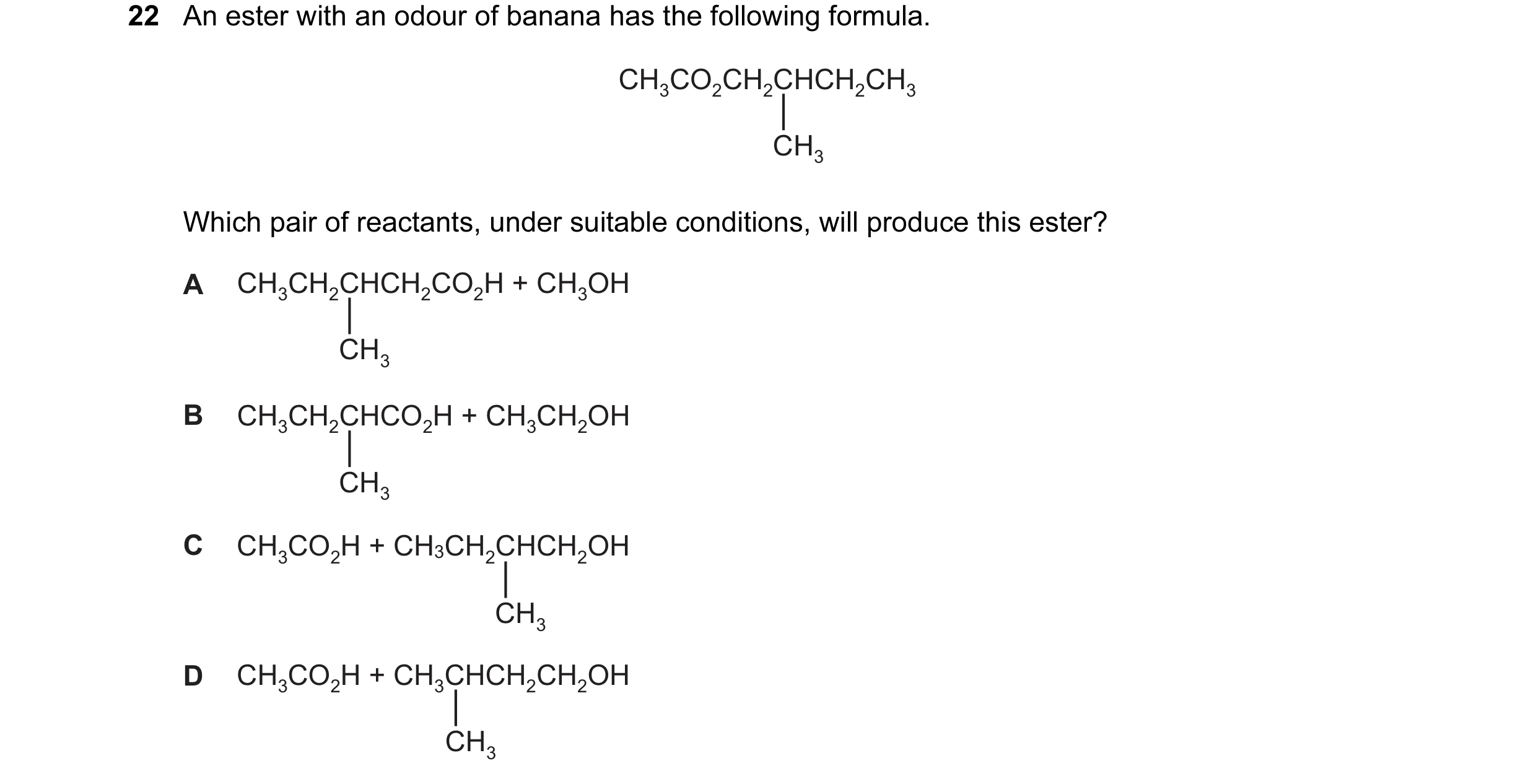
 34 / 107
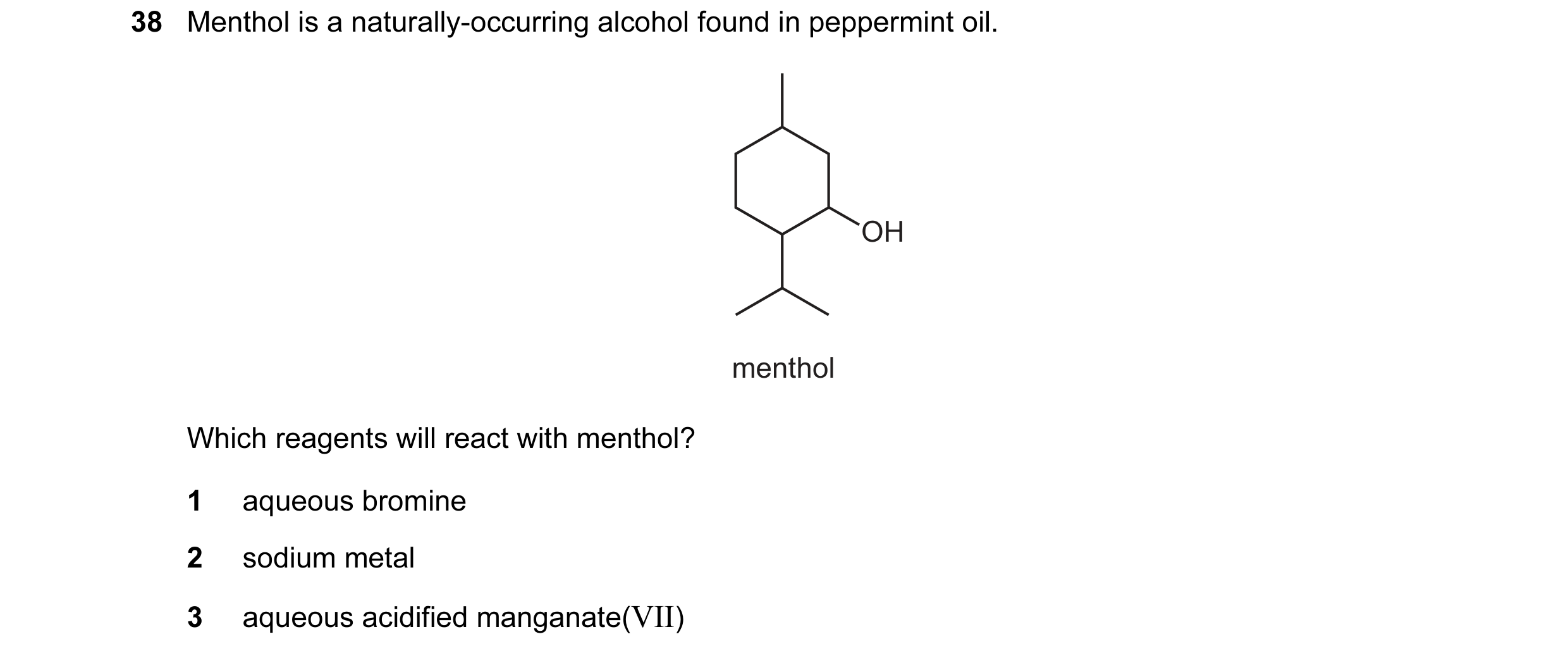
 35 / 107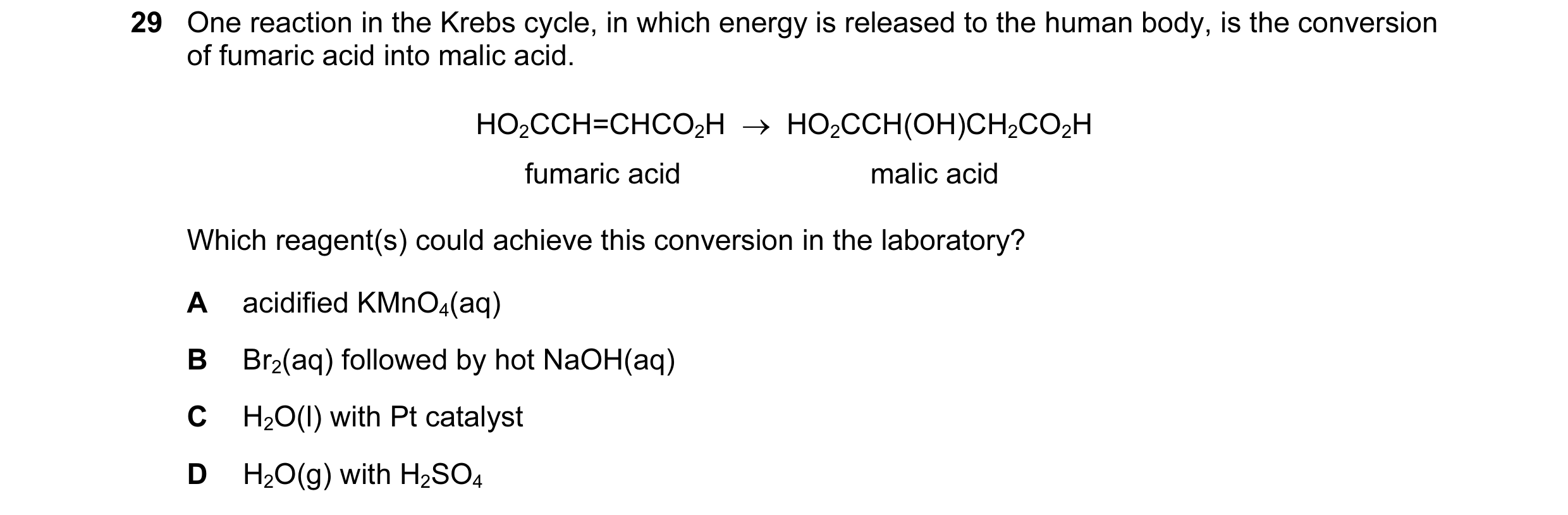
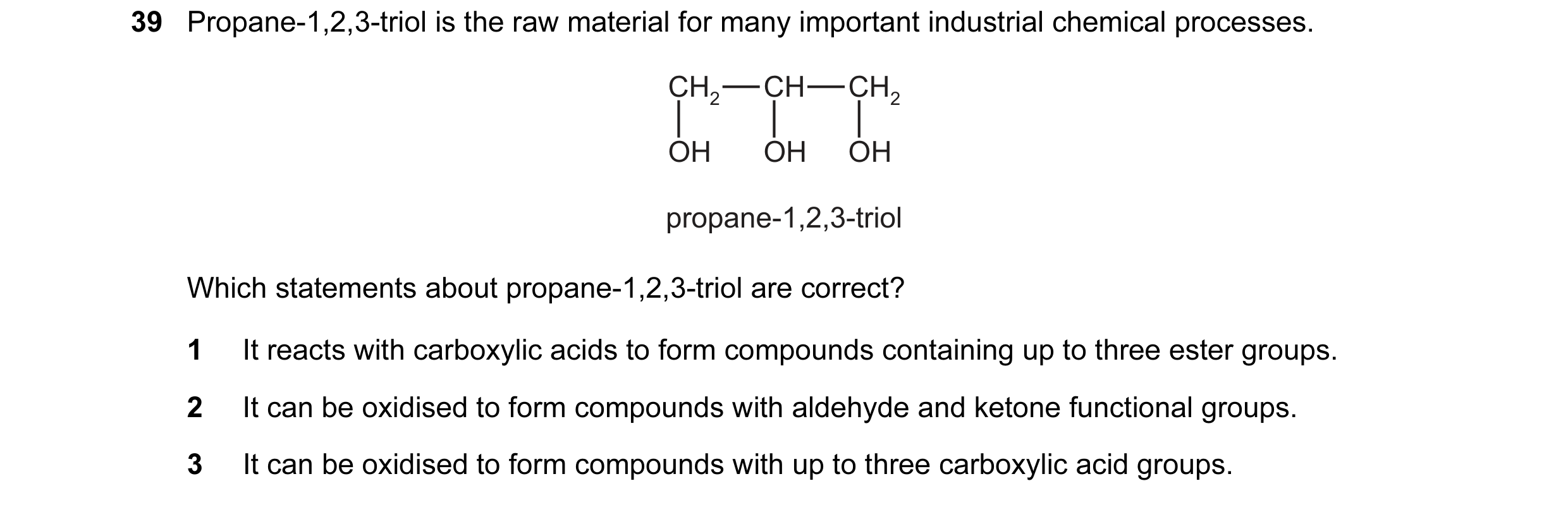
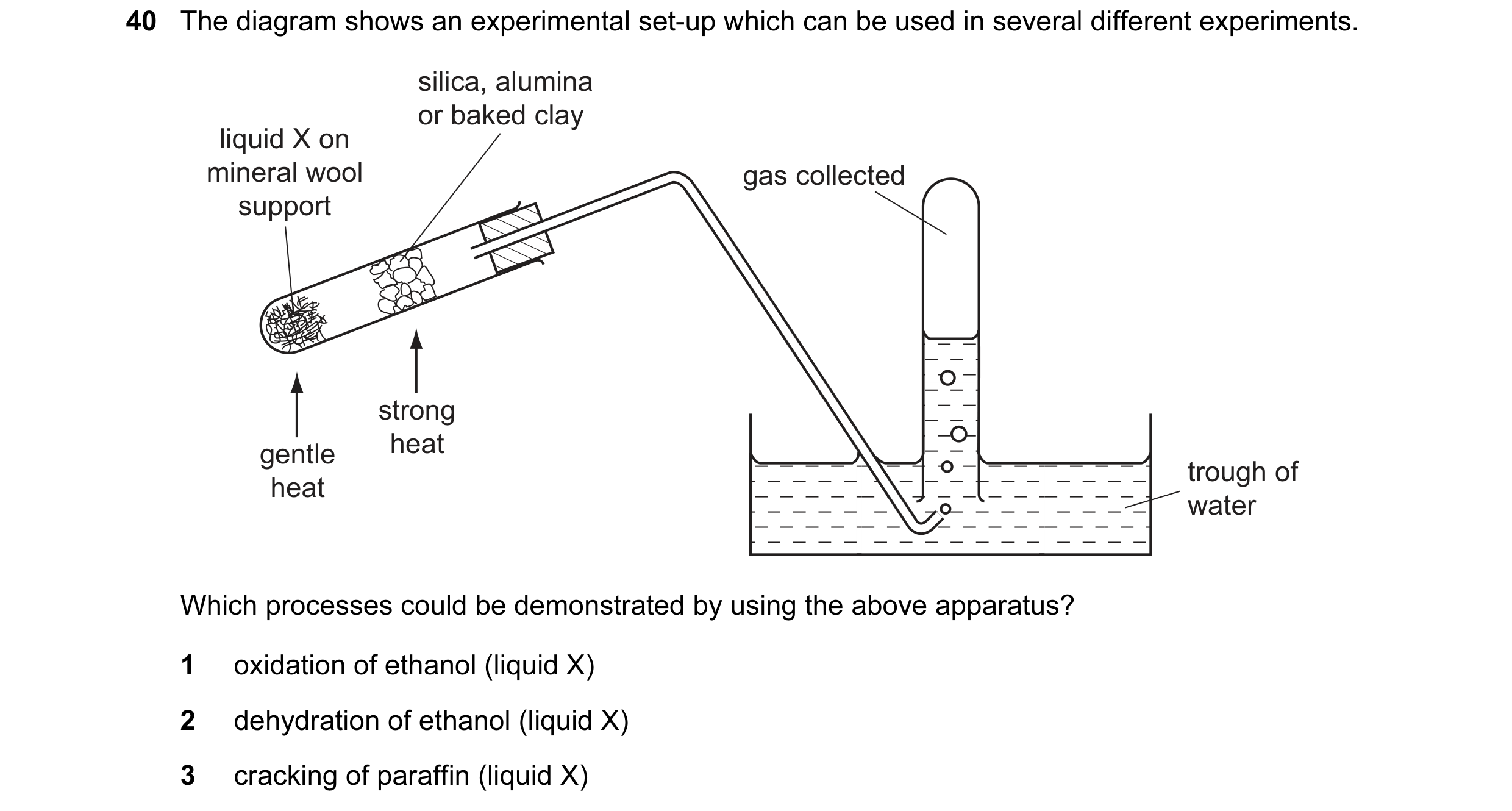 36 / 107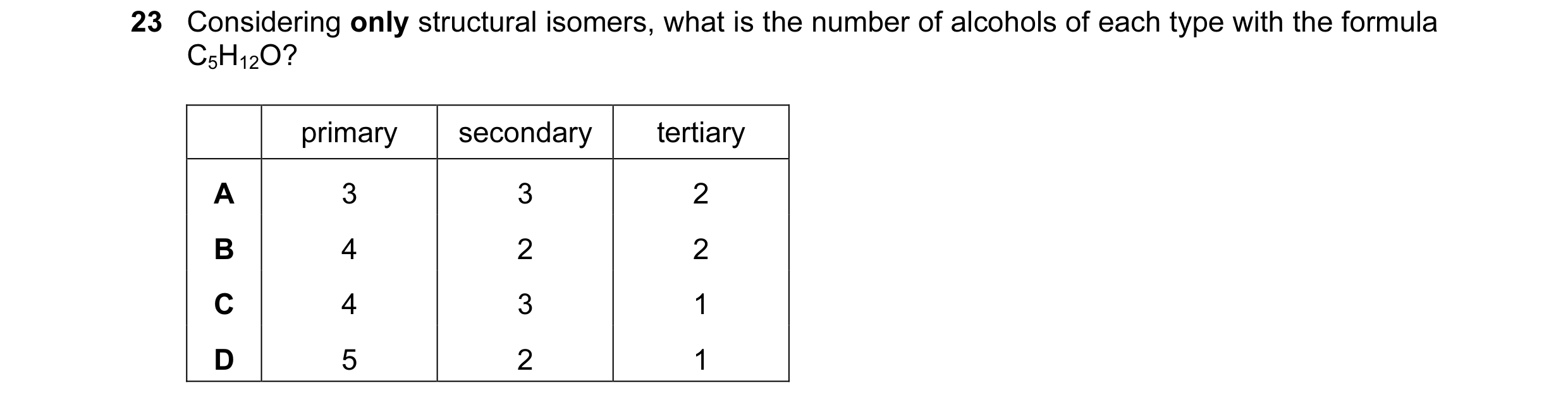
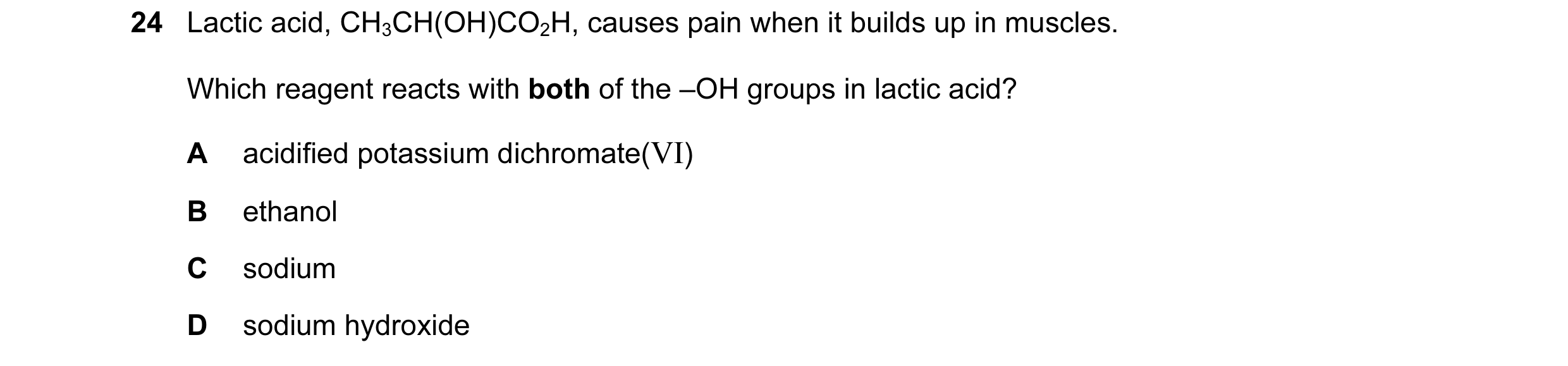
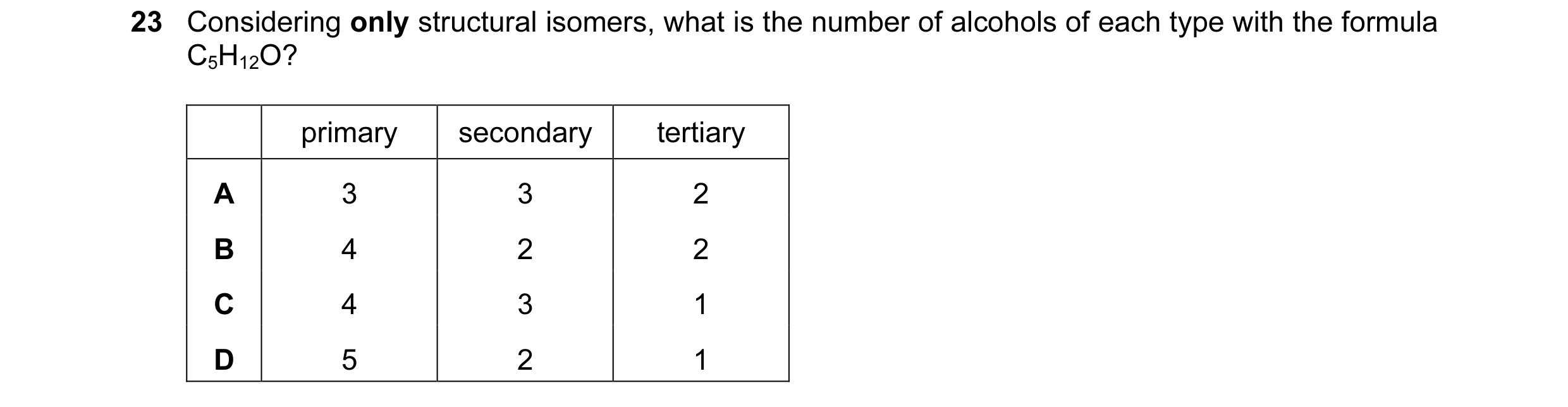
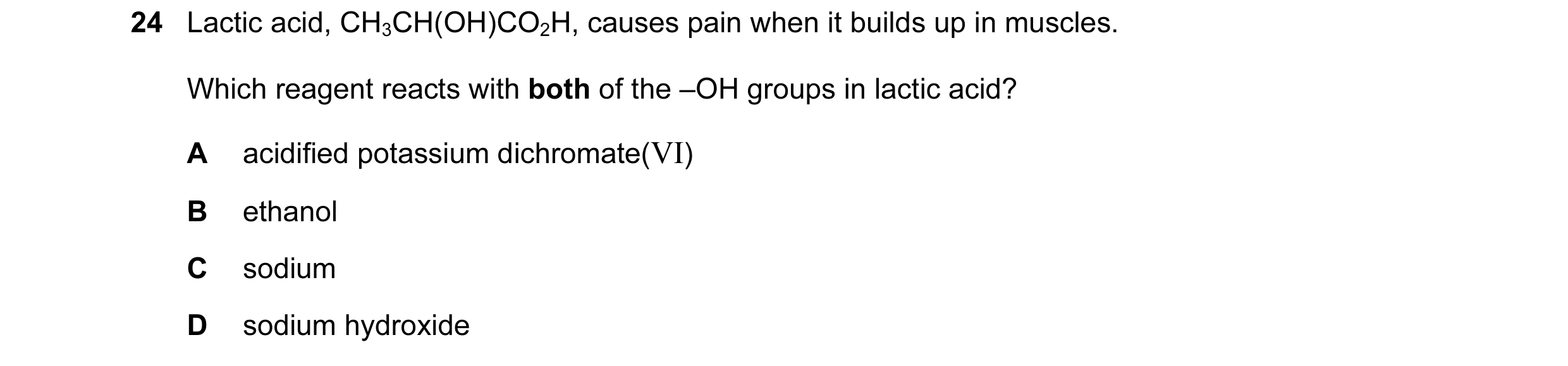
 37 / 107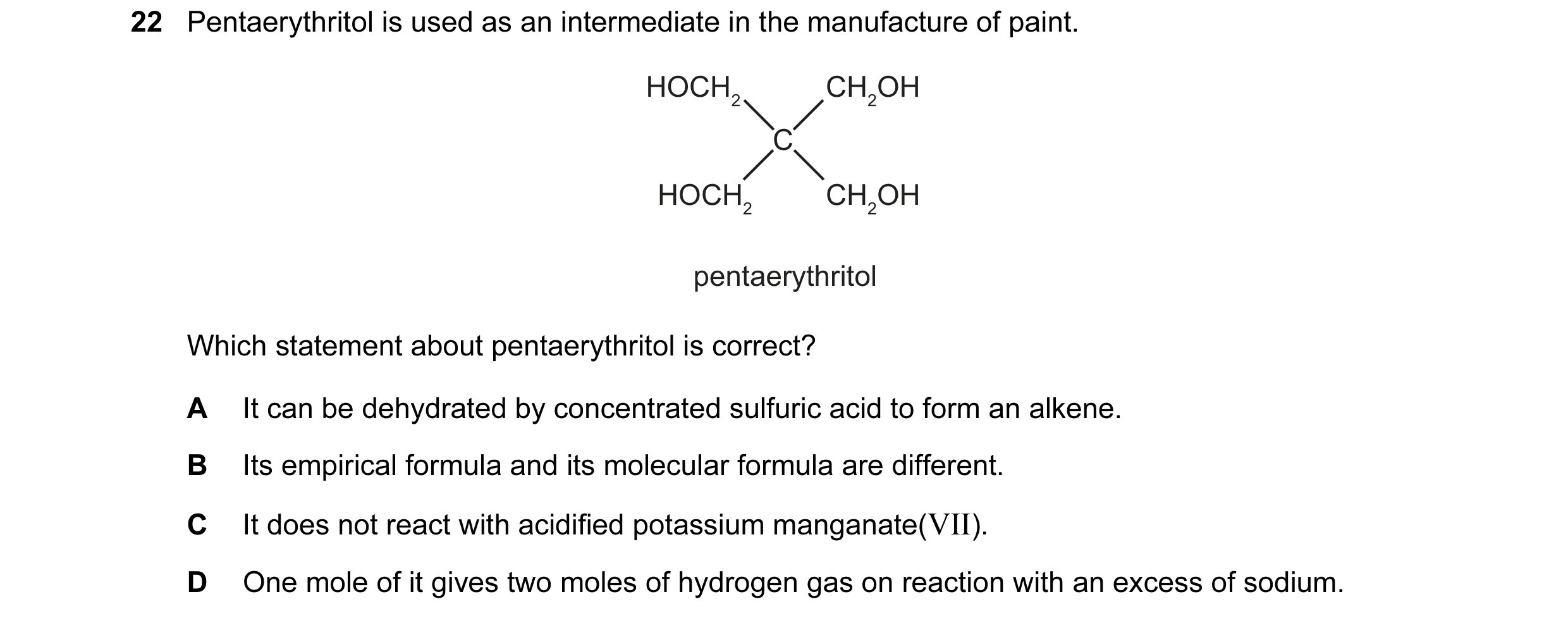

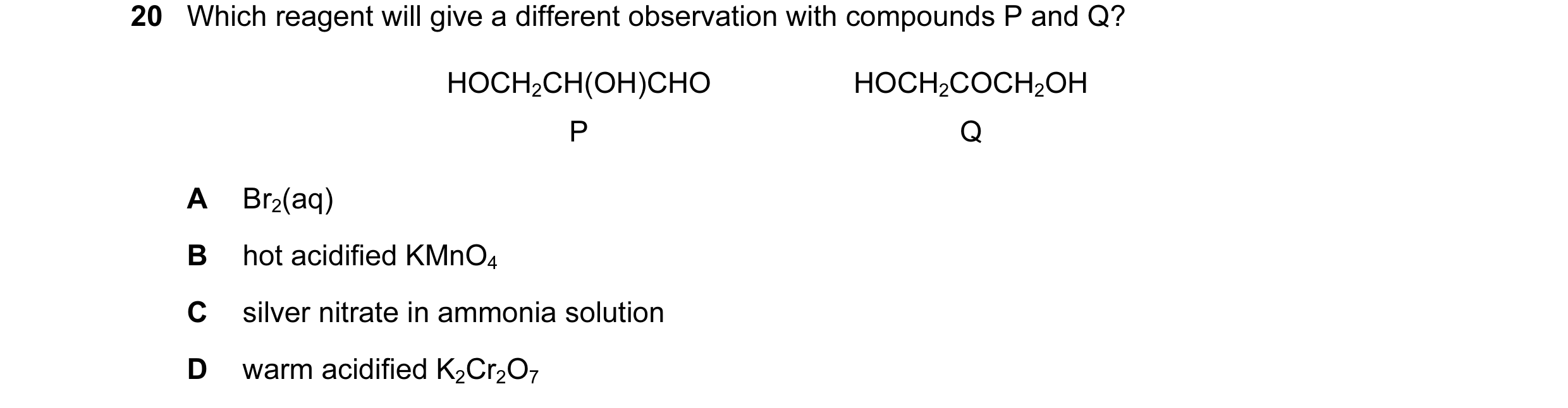
 38 / 107
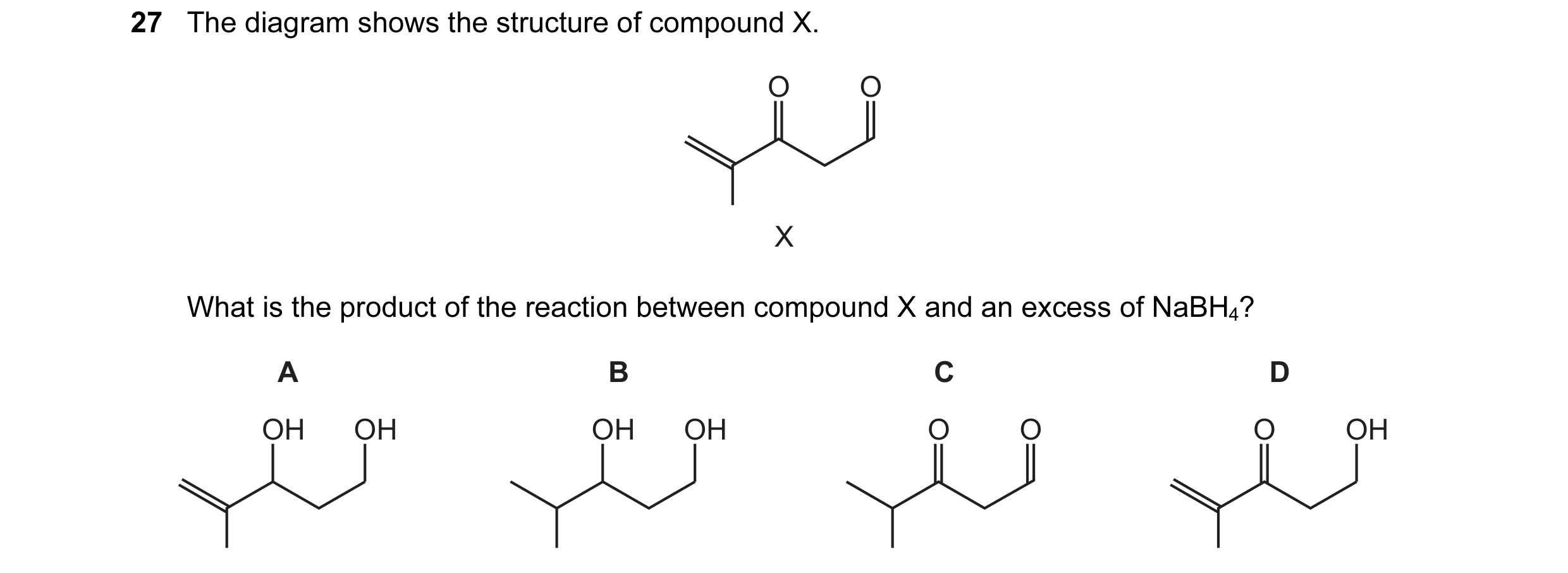

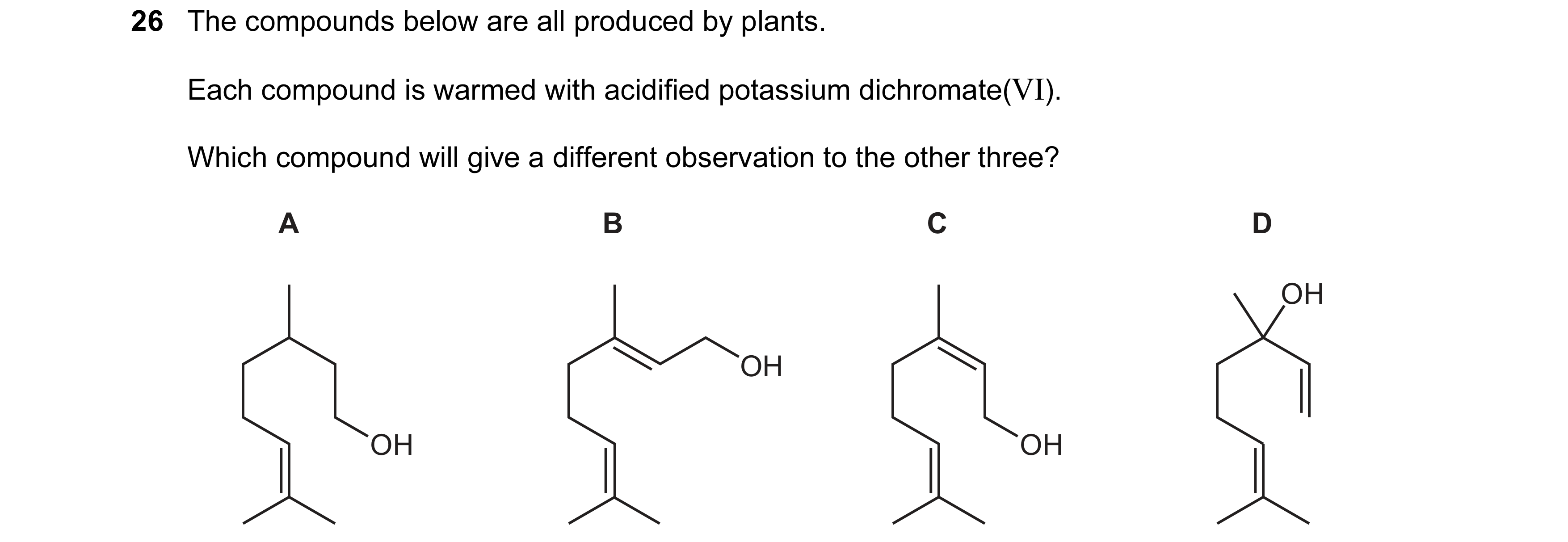 39 / 107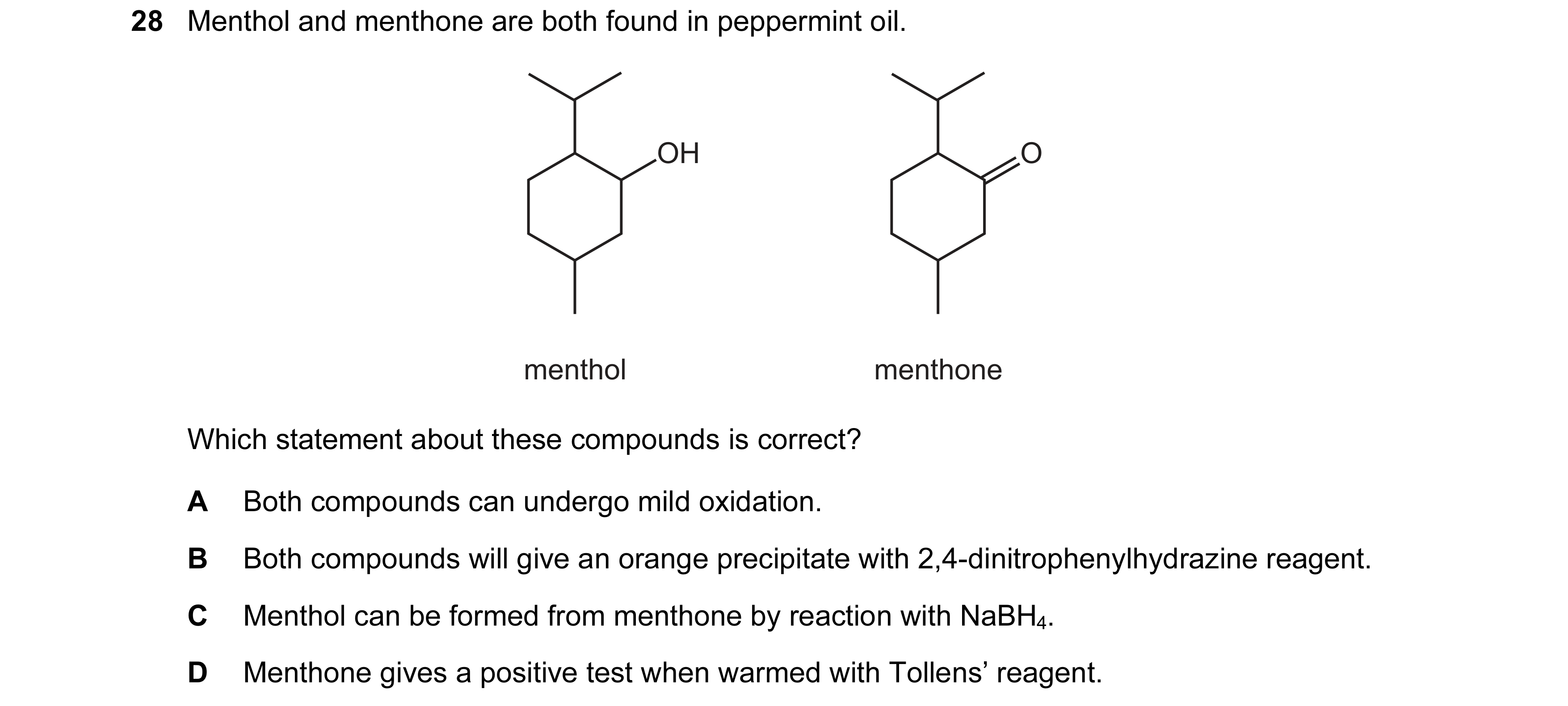

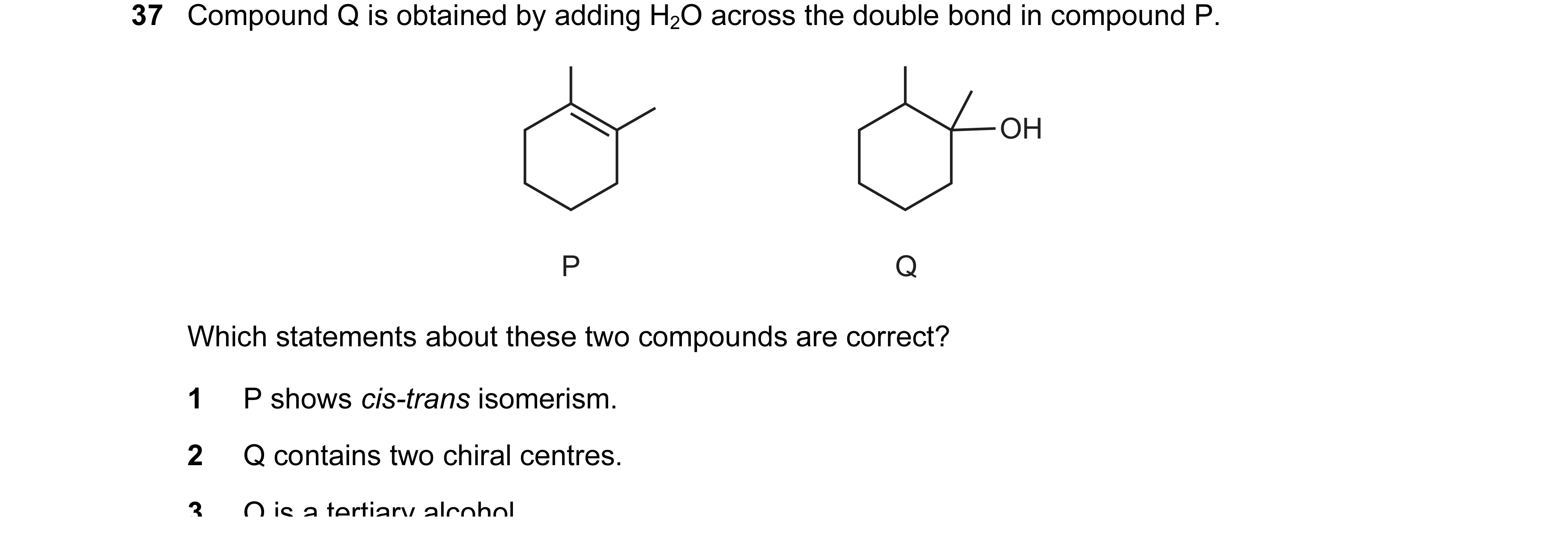
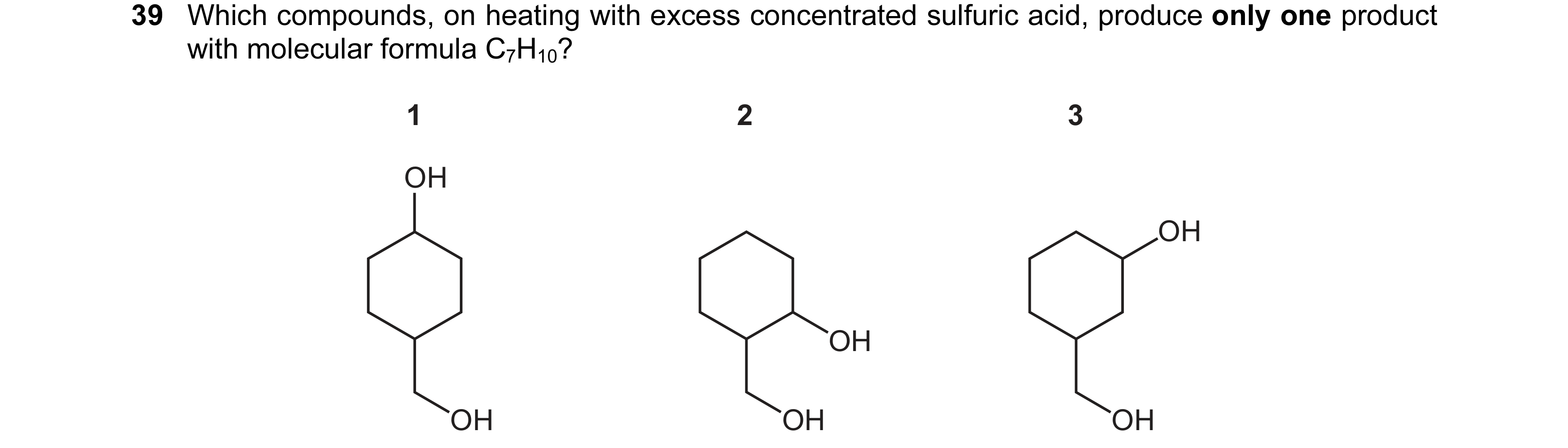 40 / 107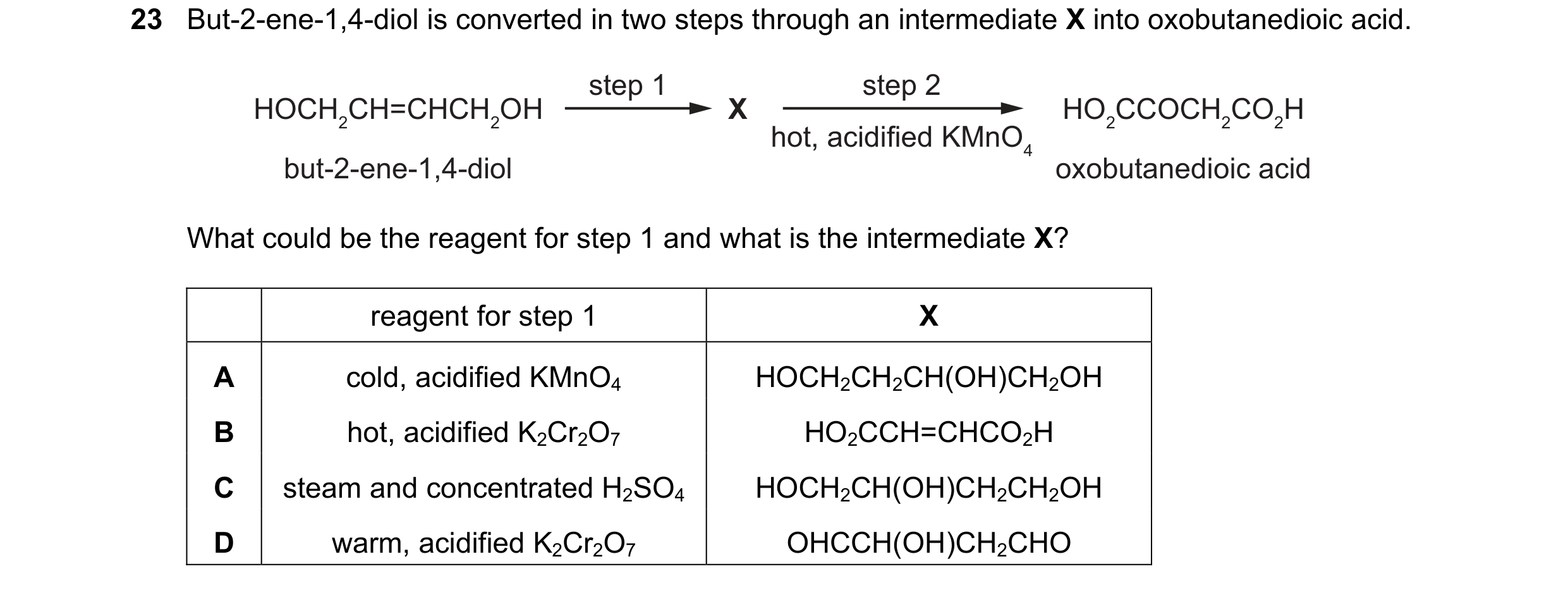
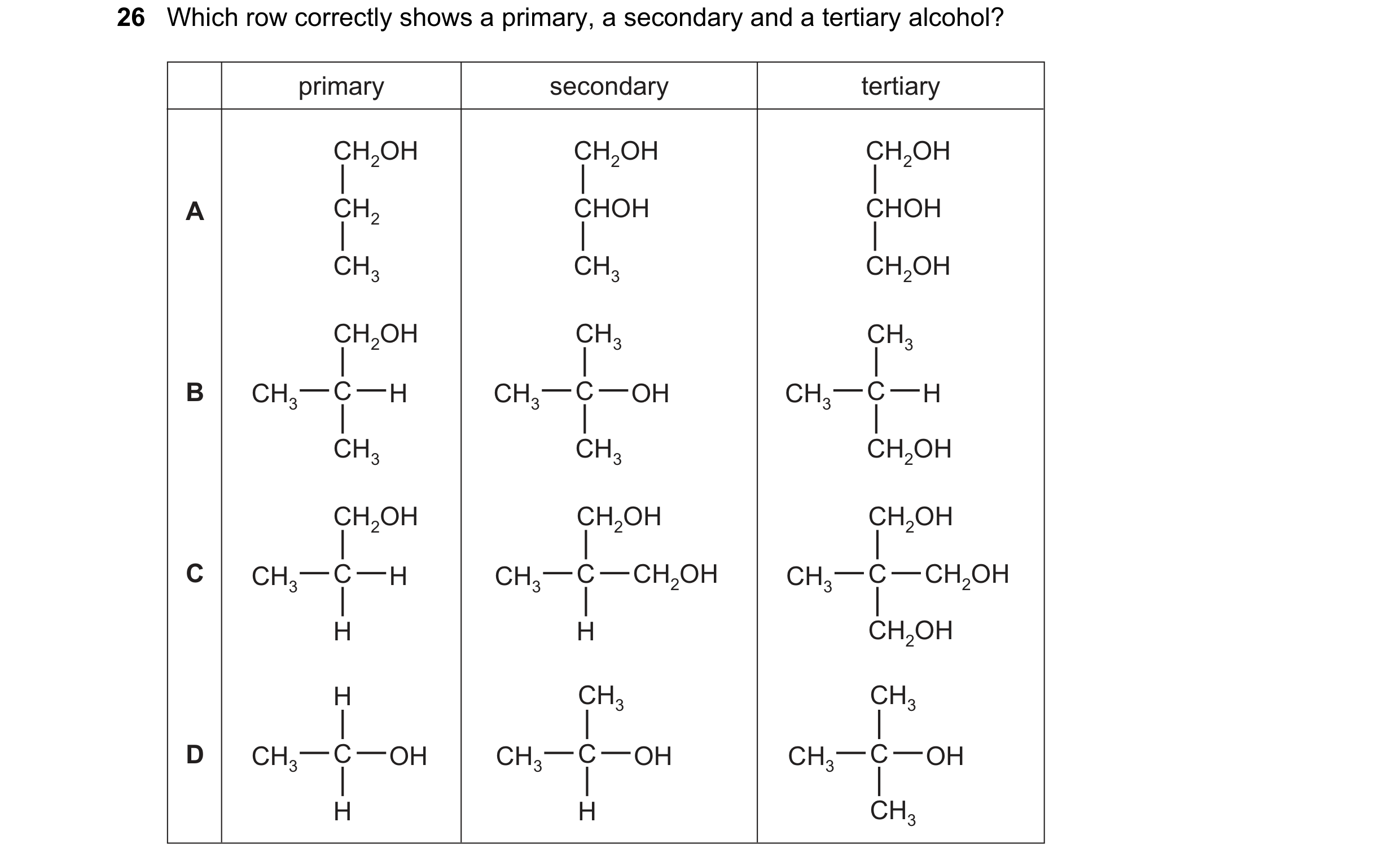 41 / 107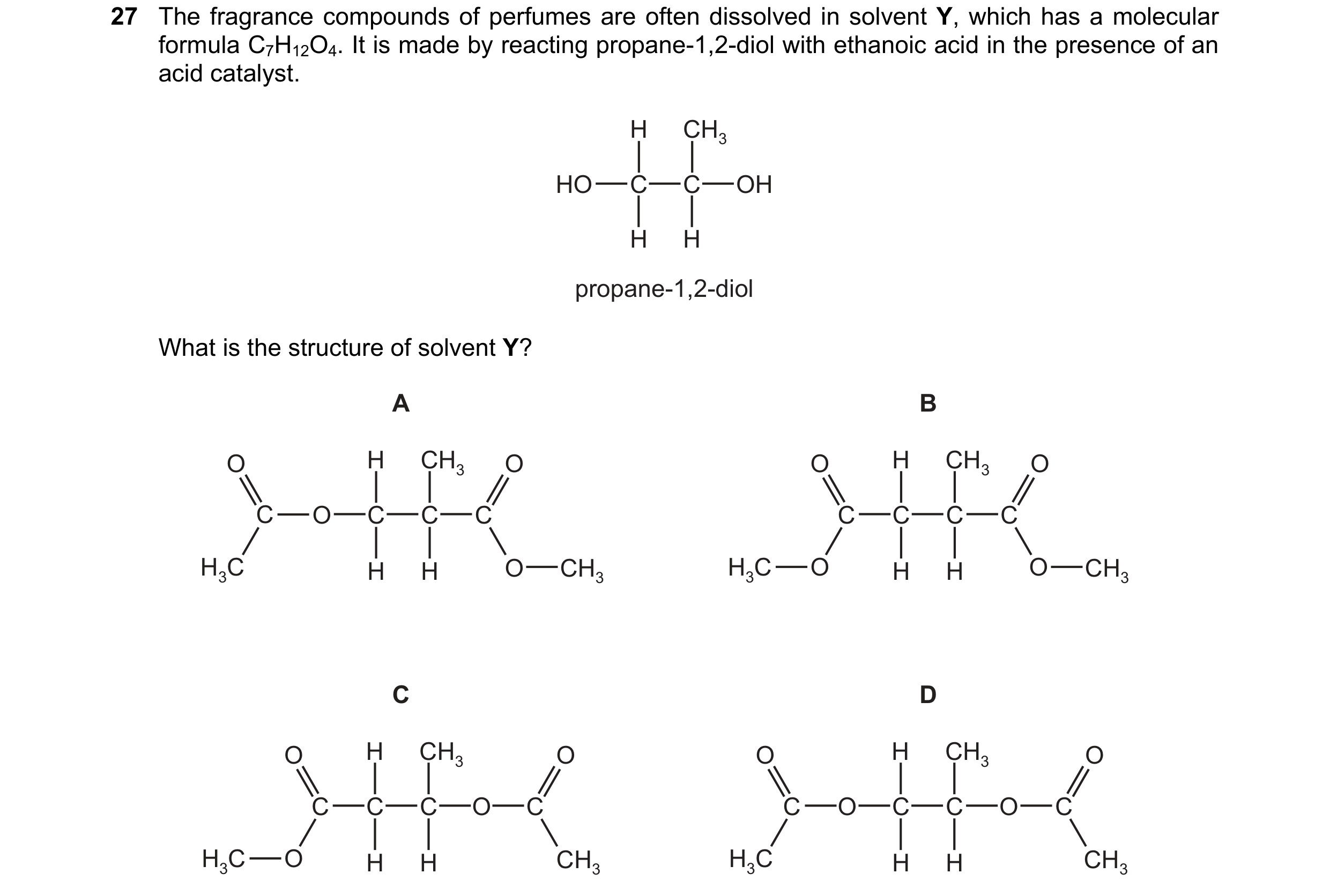
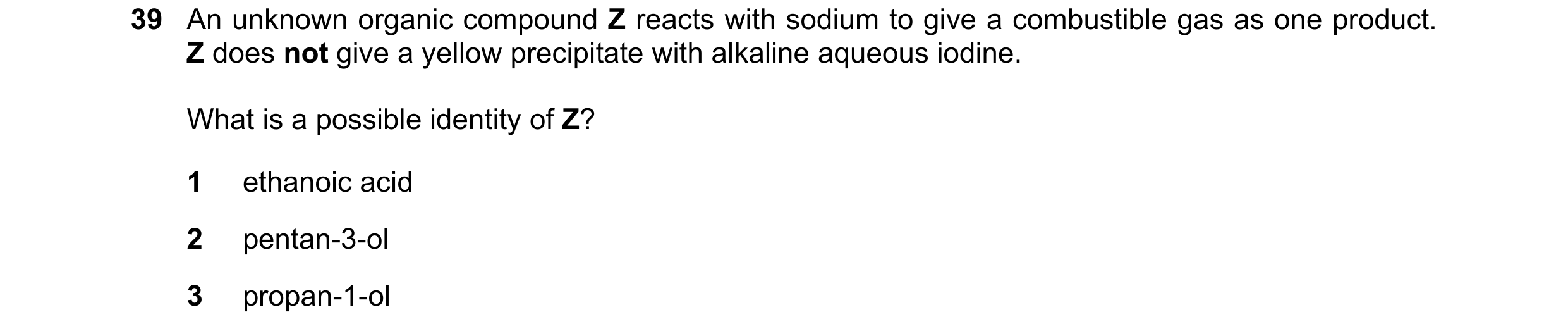
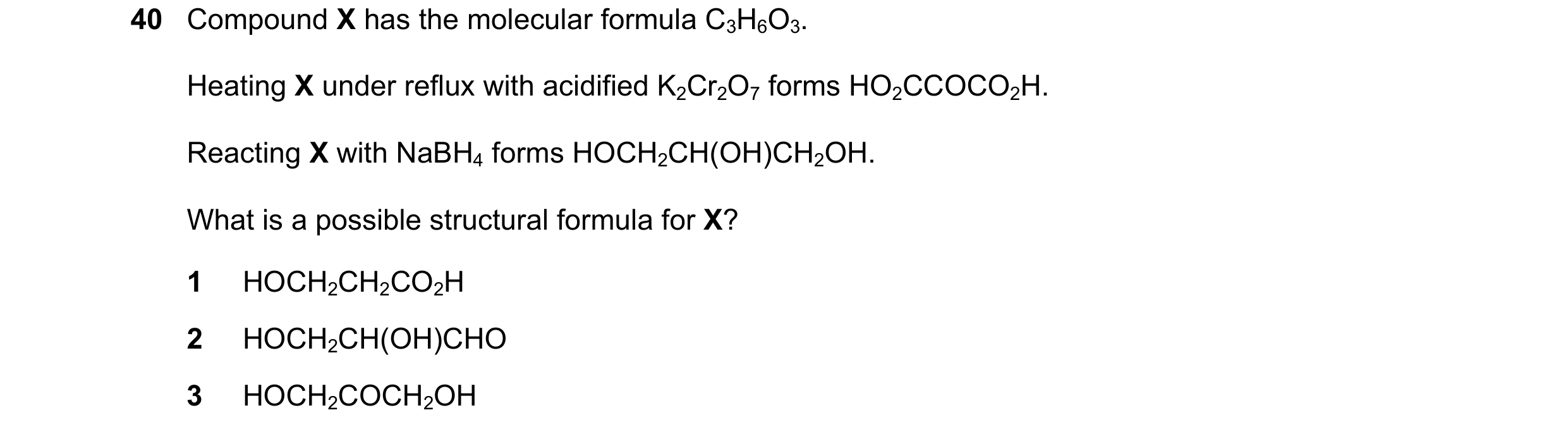 42 / 107
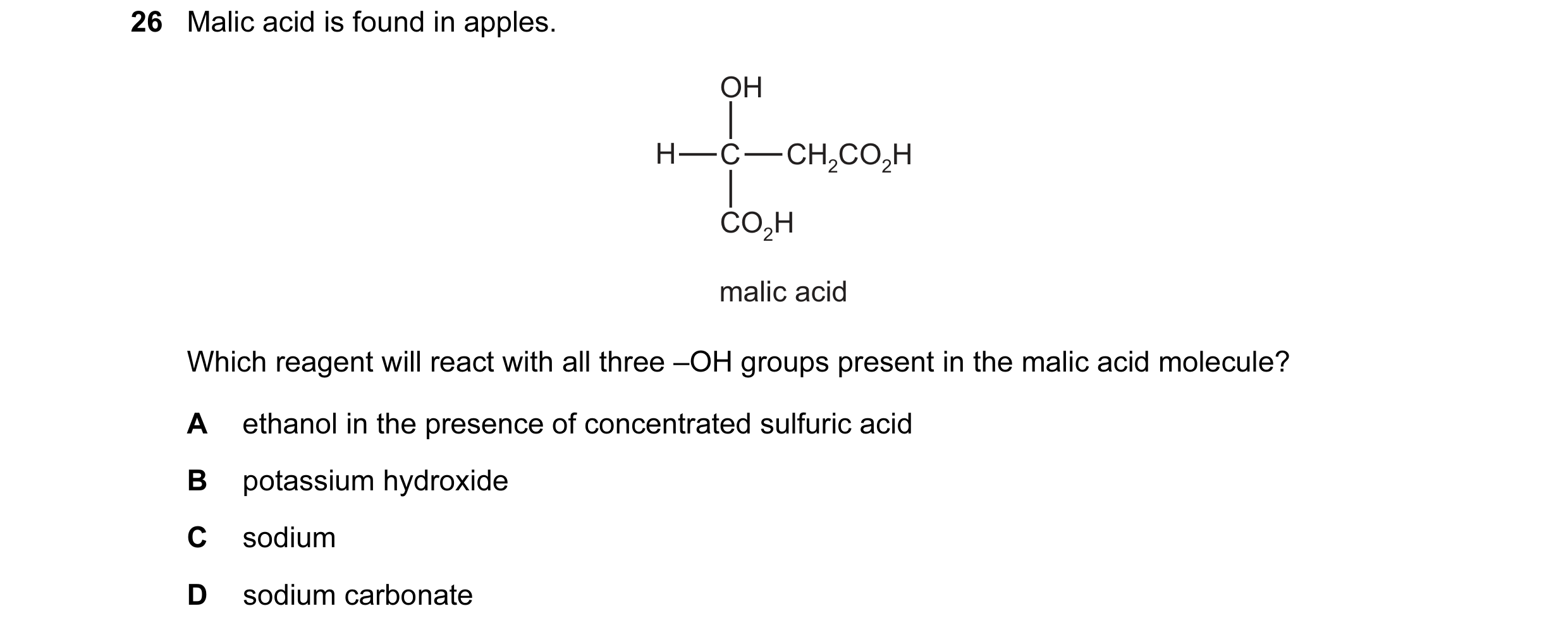

 43 / 107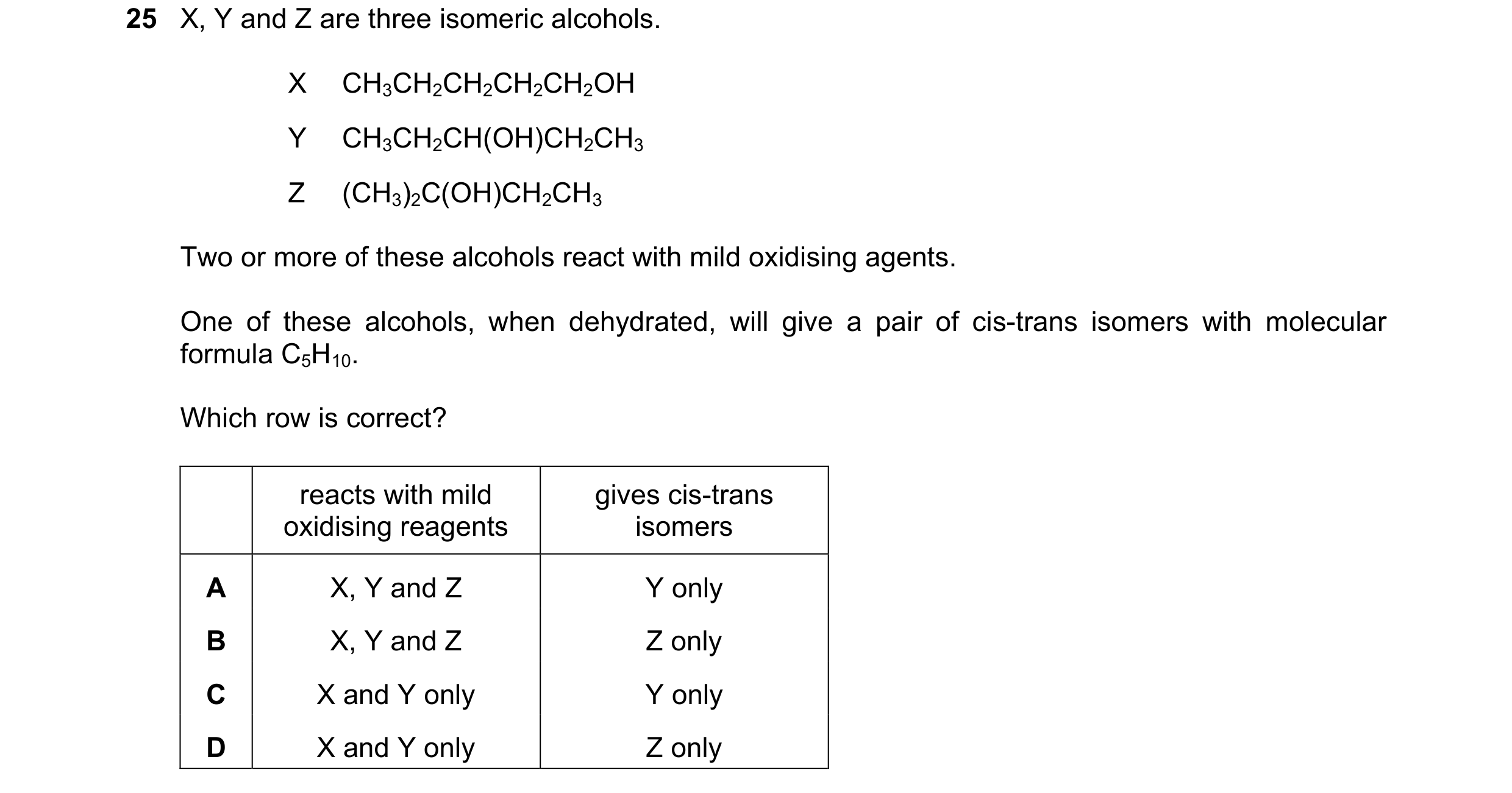

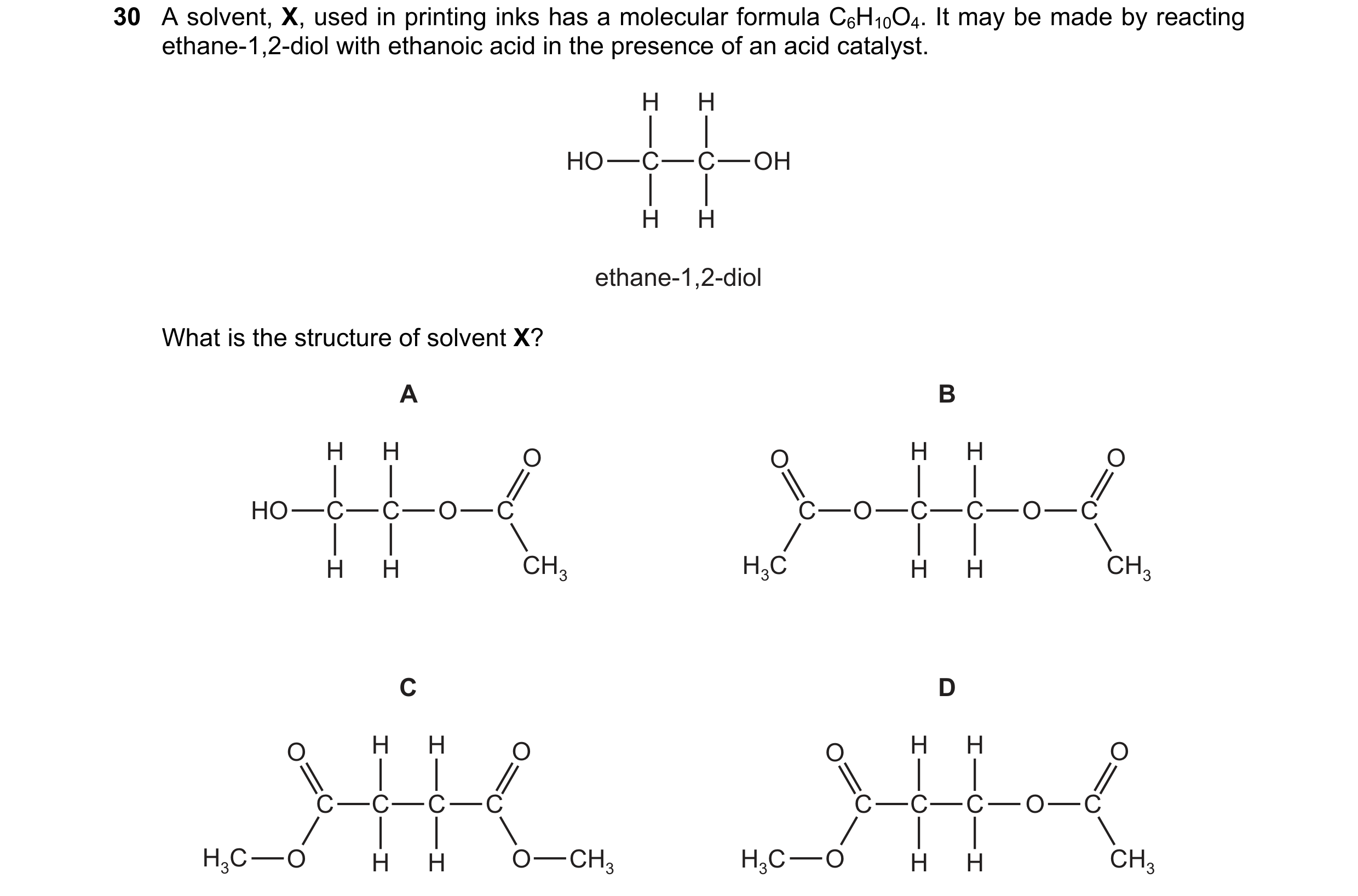 44 / 107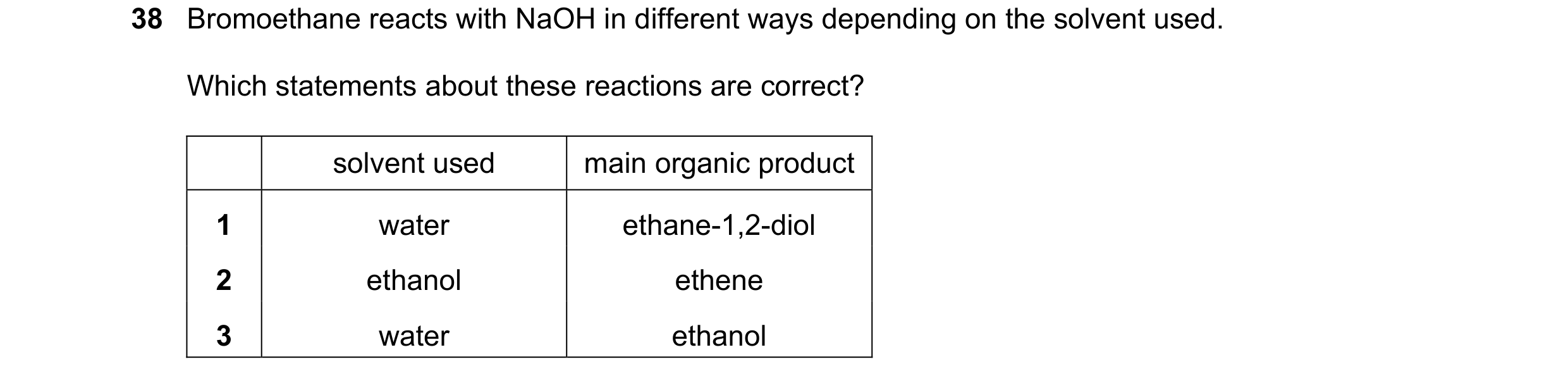
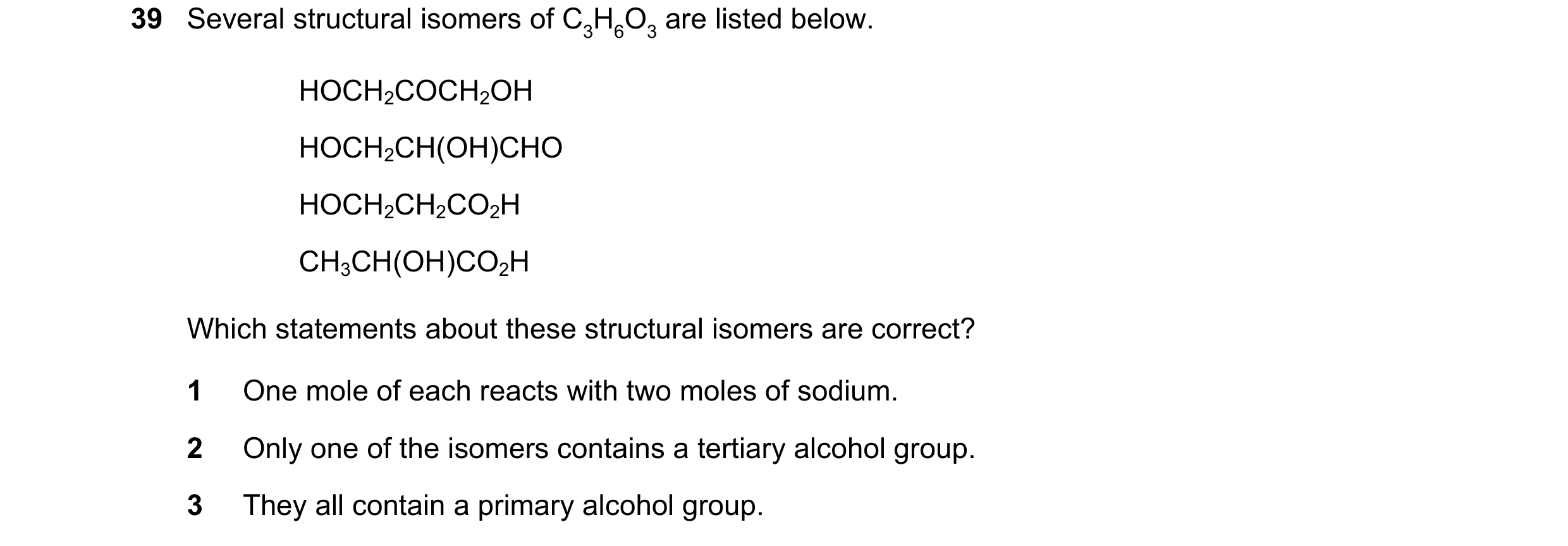
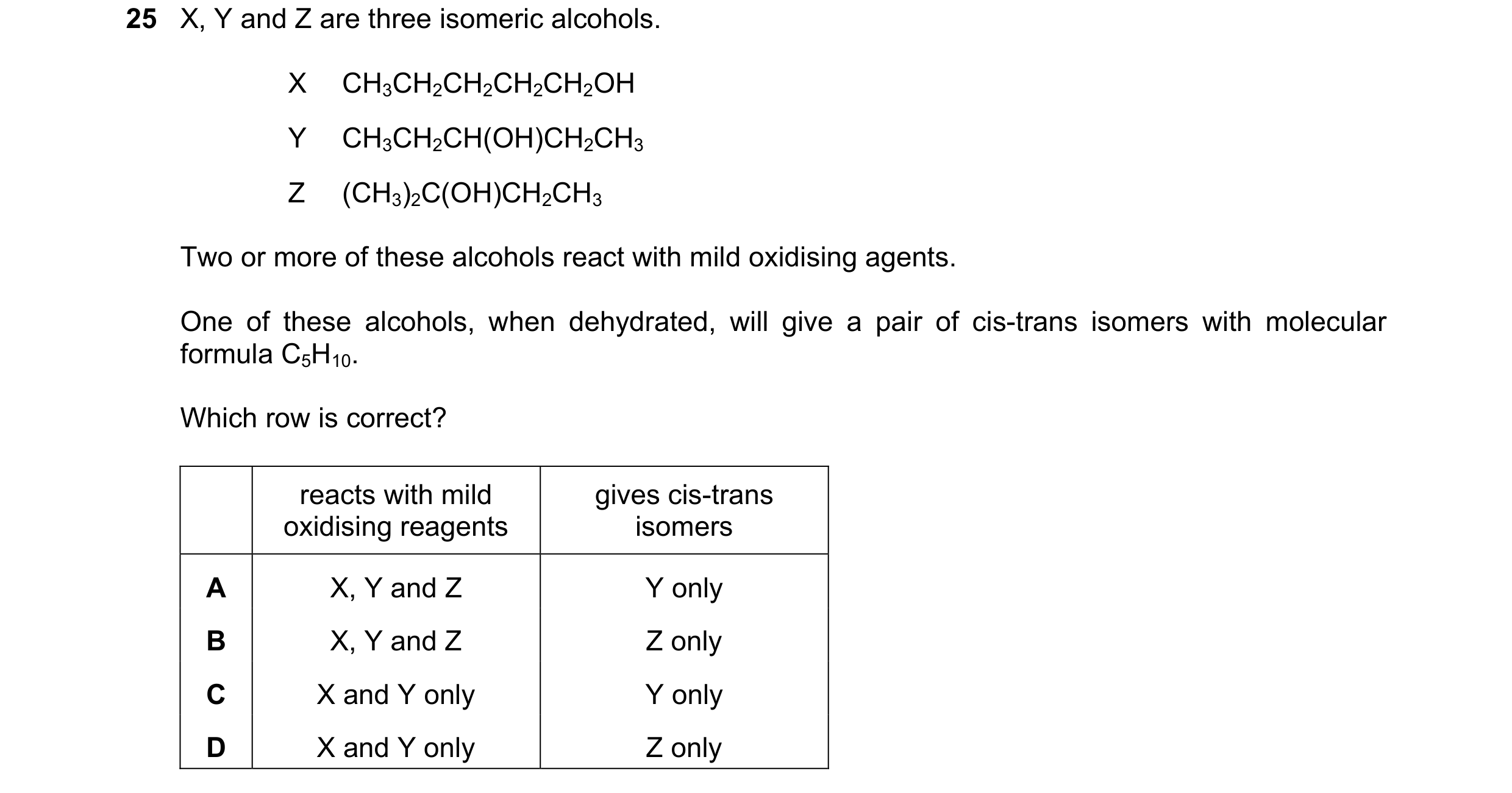
 45 / 107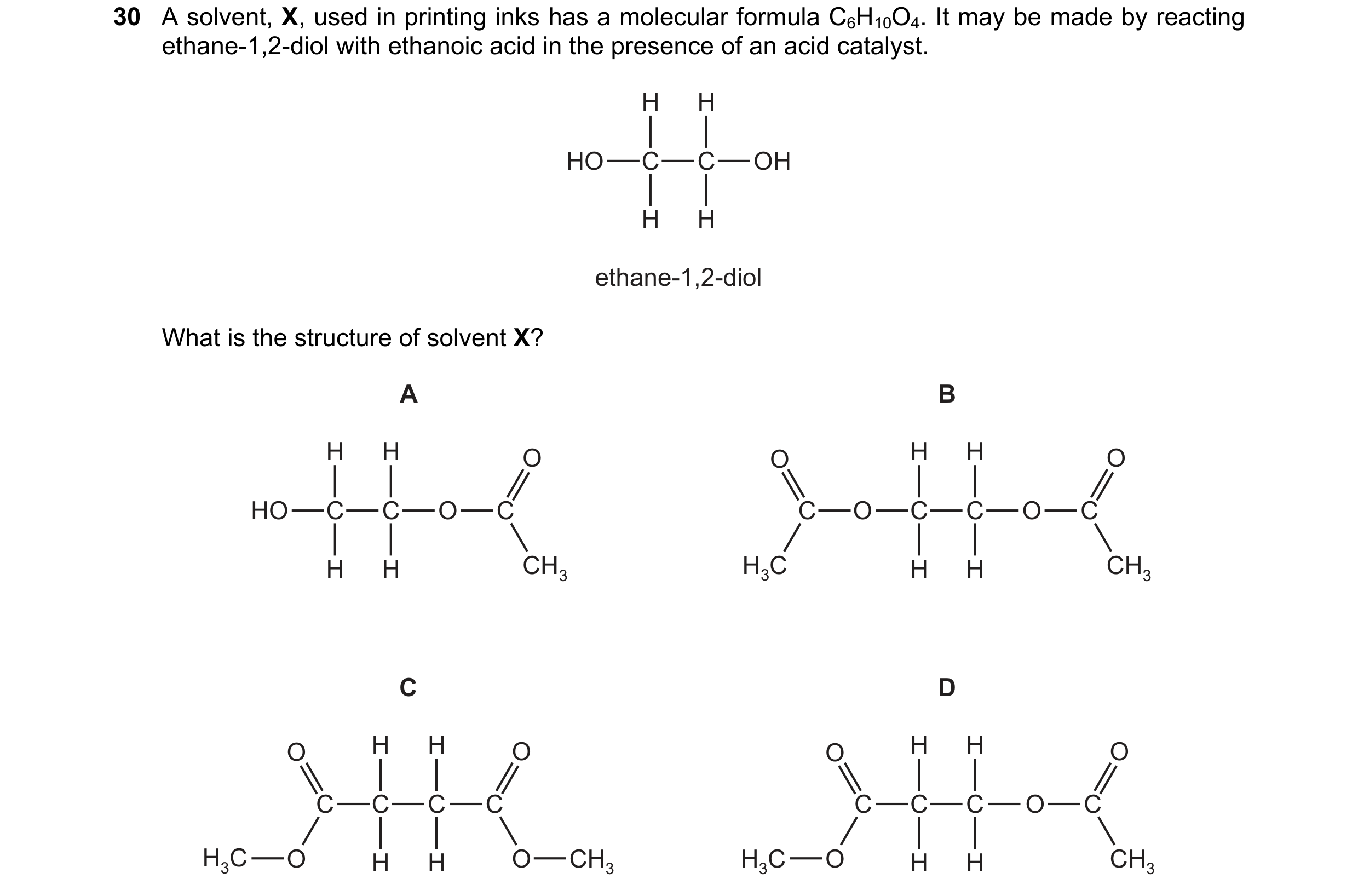
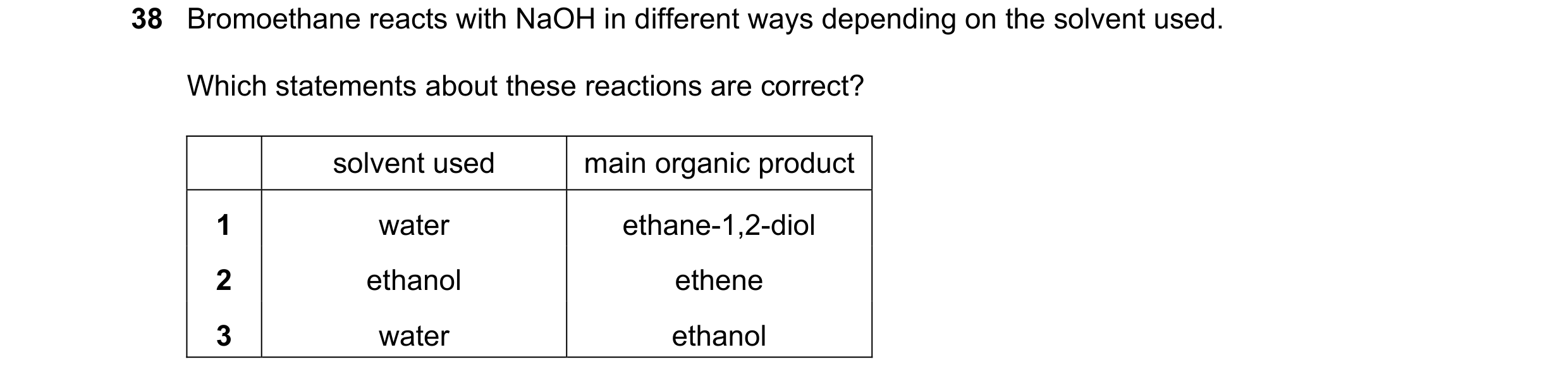
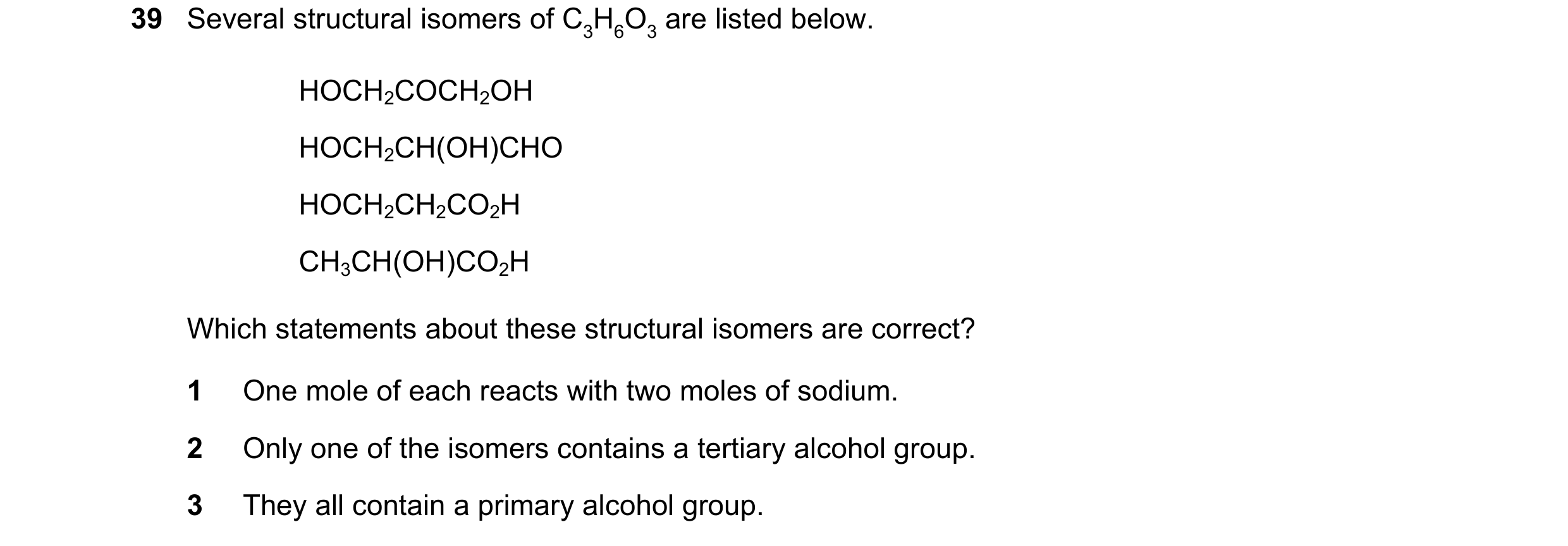 46 / 107
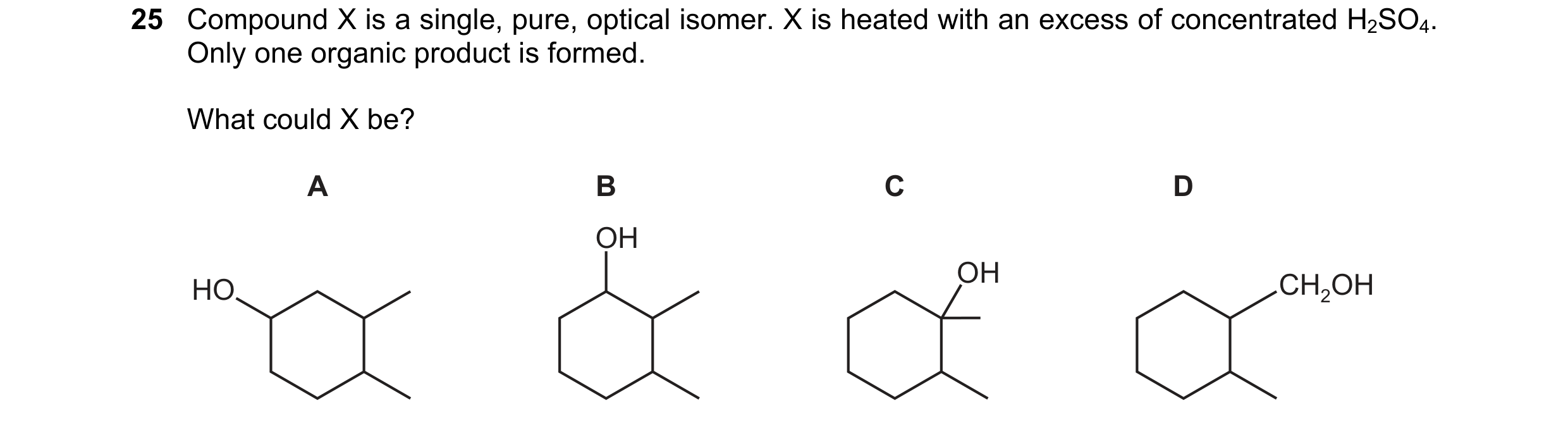

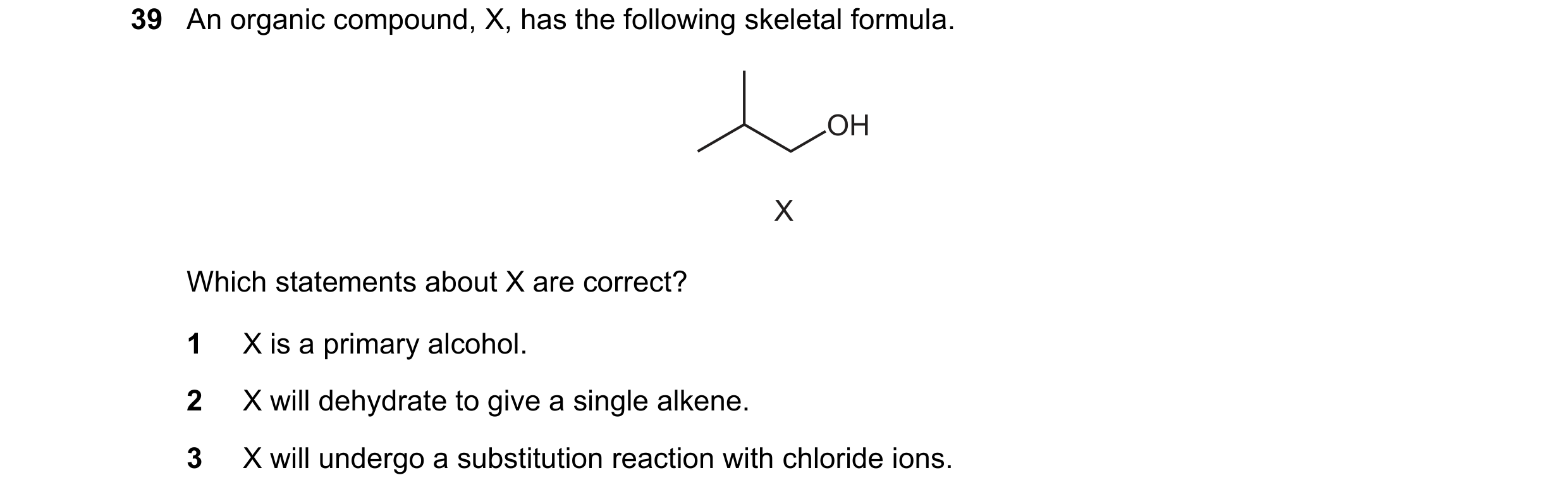
 47 / 107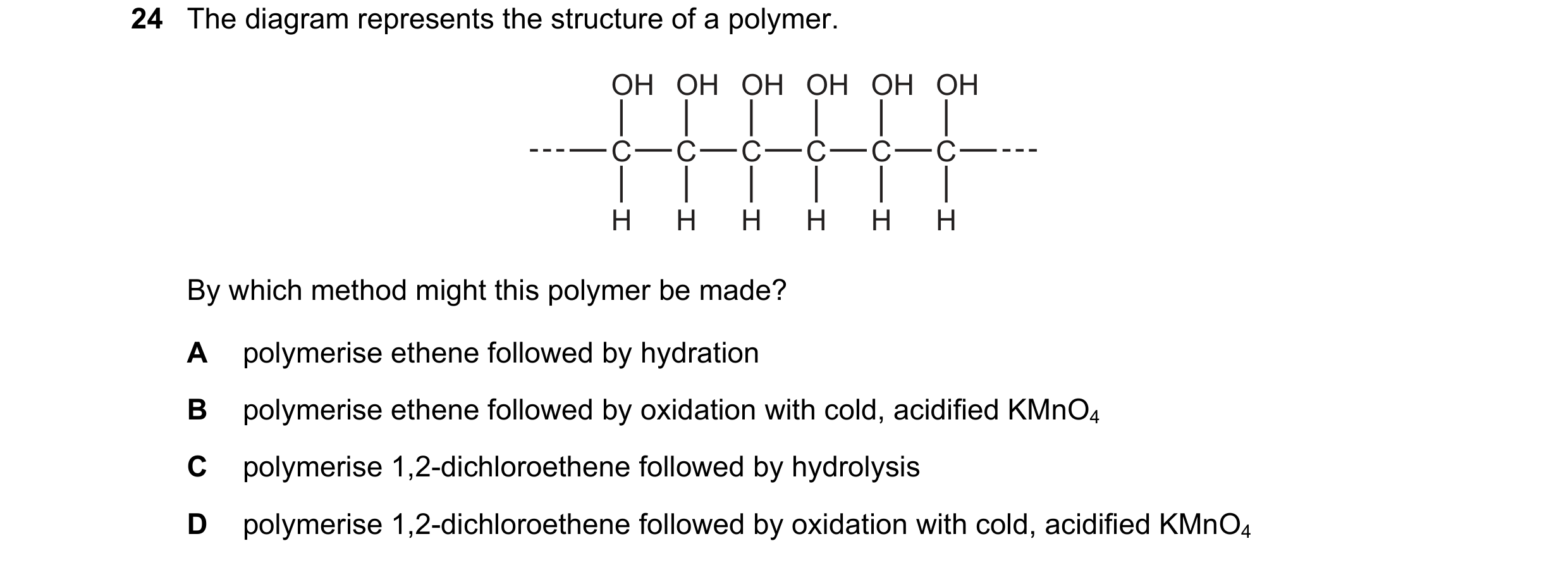

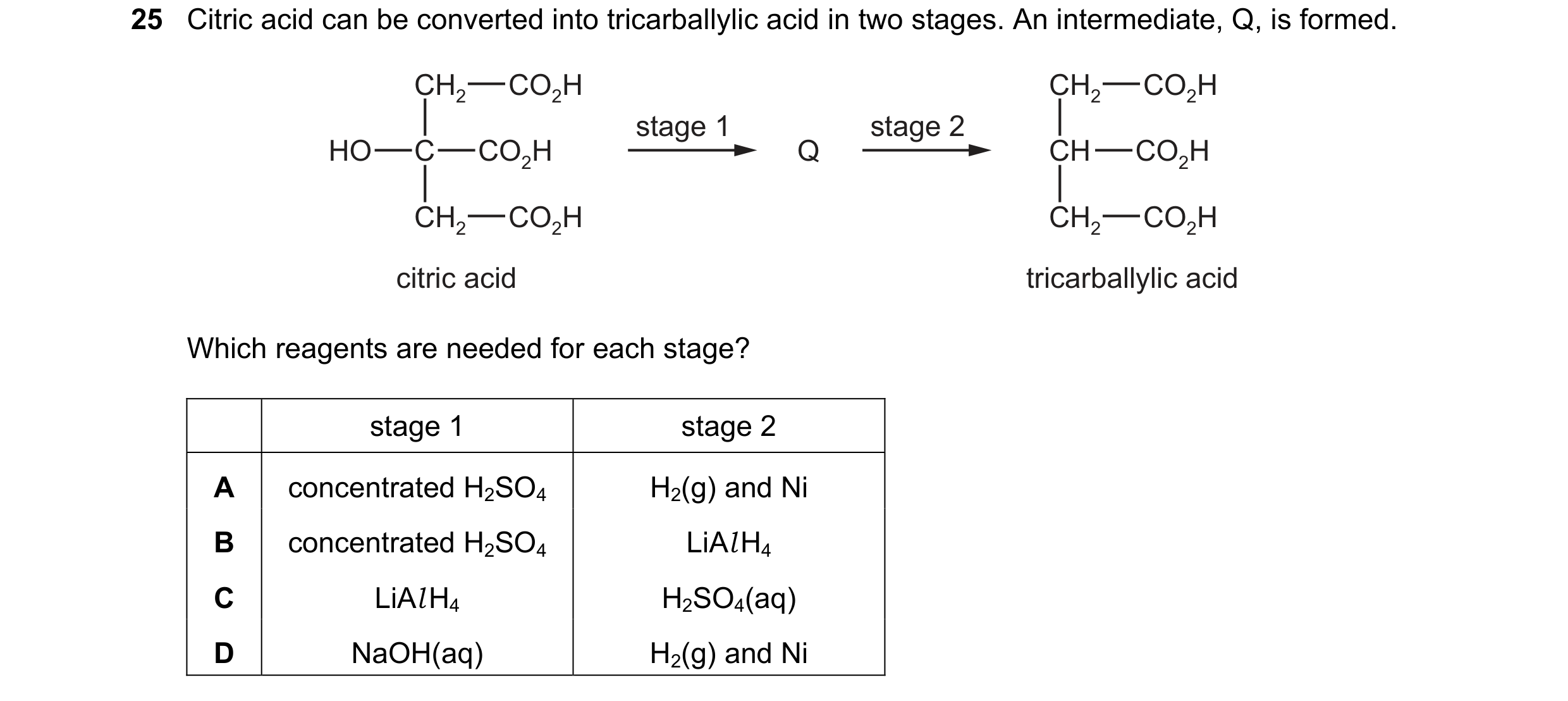
 48 / 107
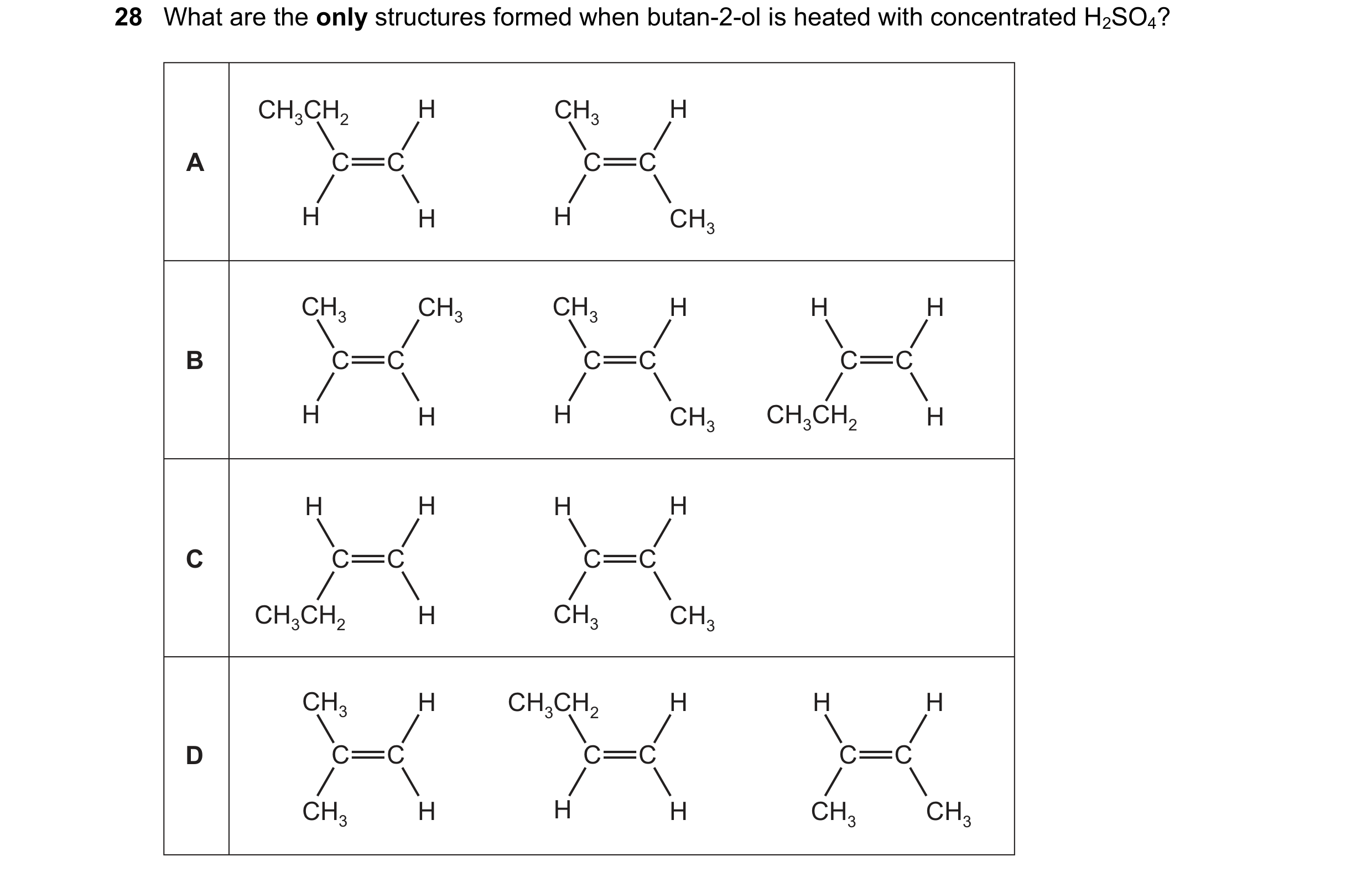 49 / 107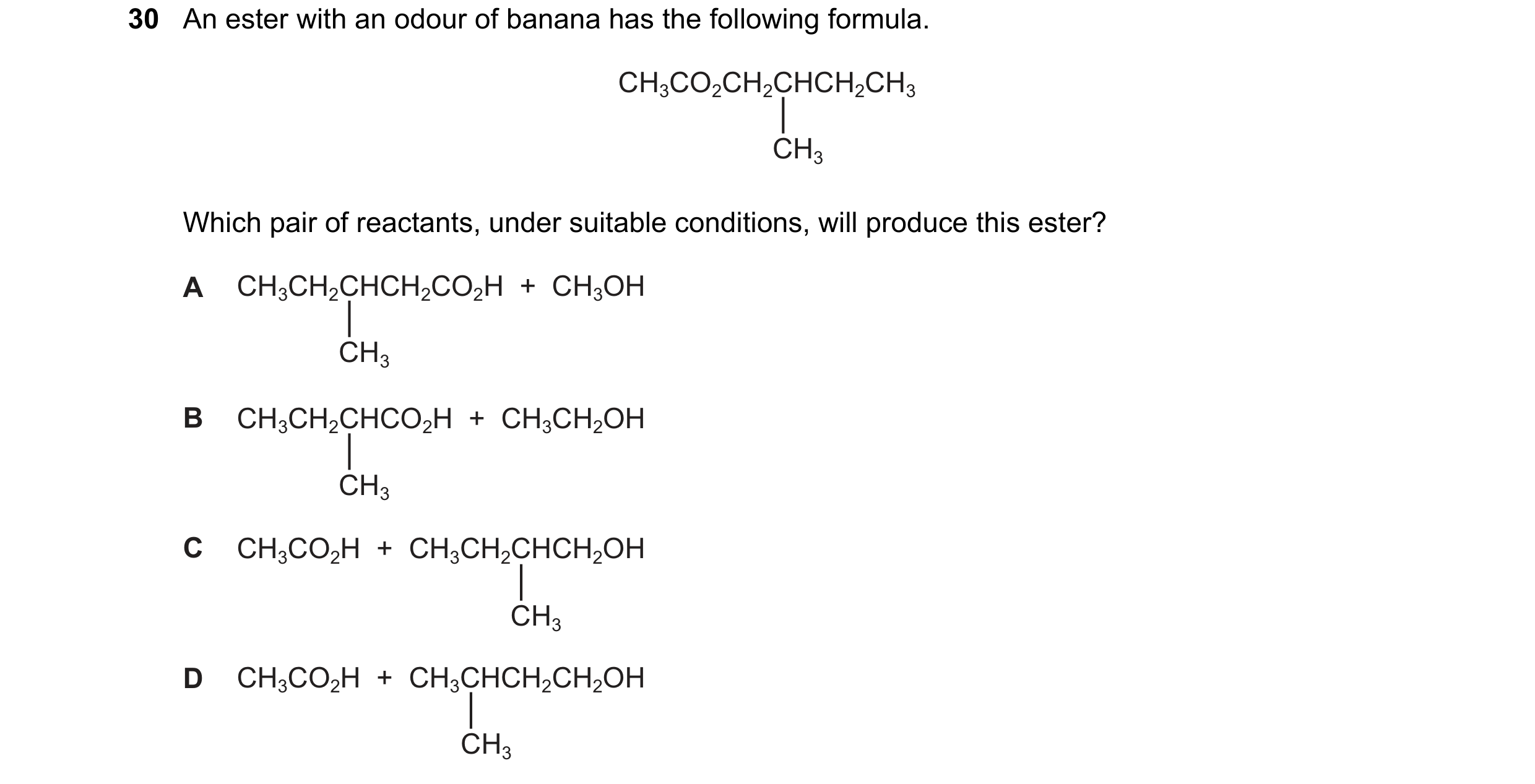

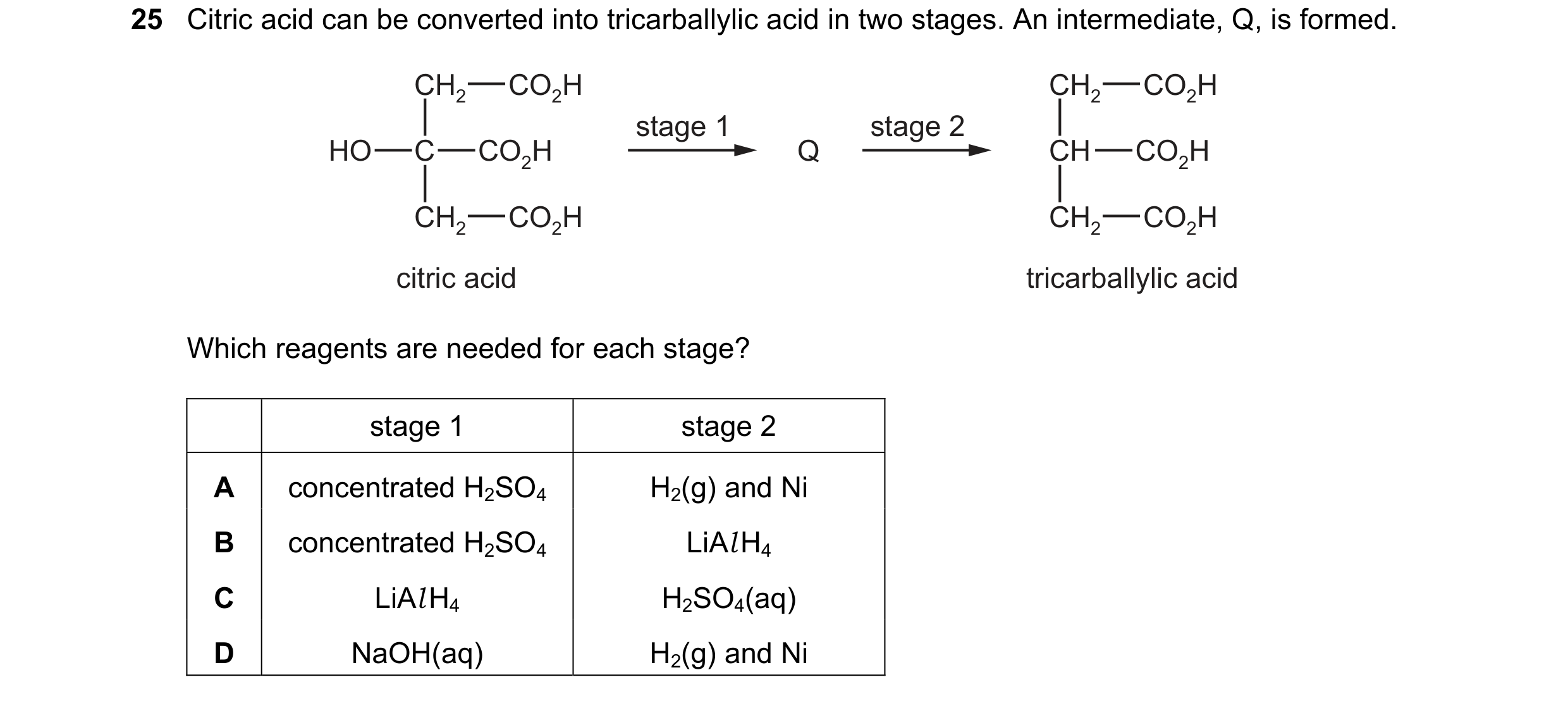 50 / 107
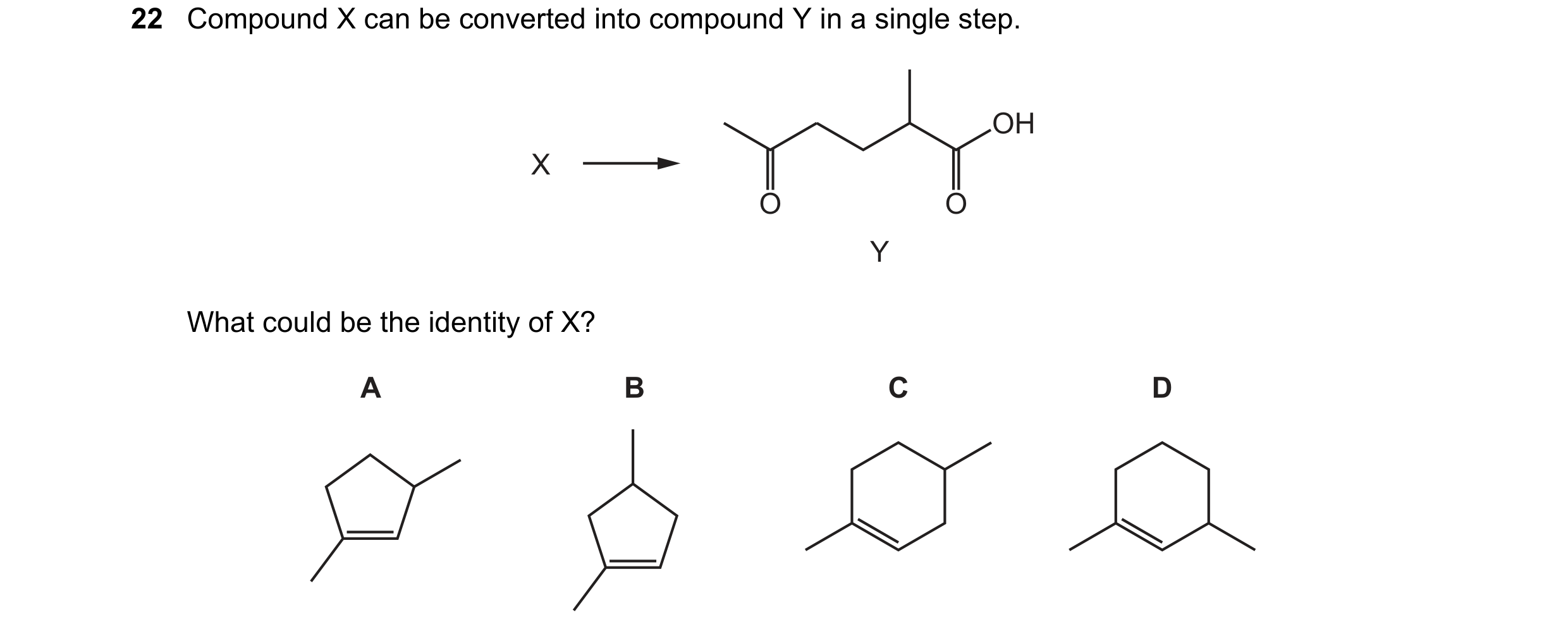
 51 / 107


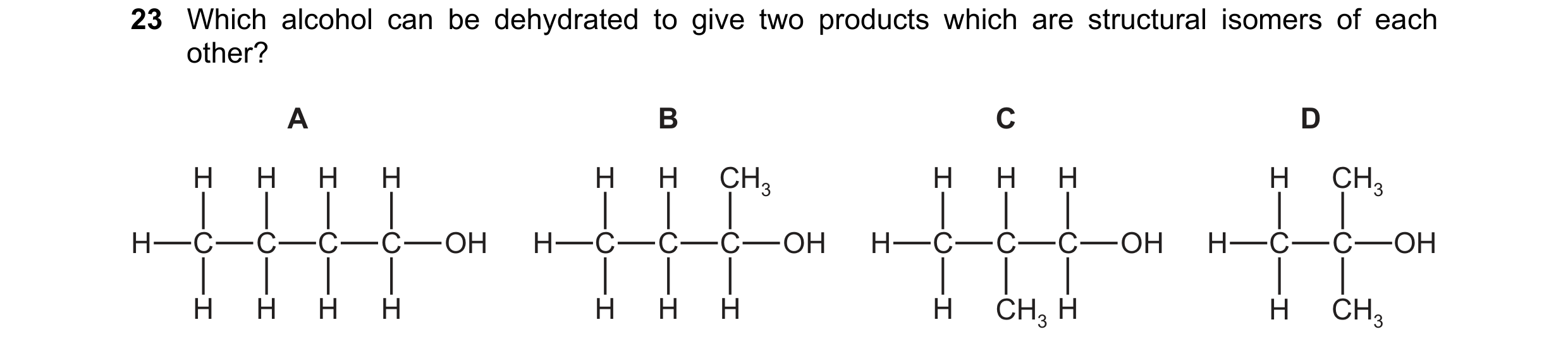
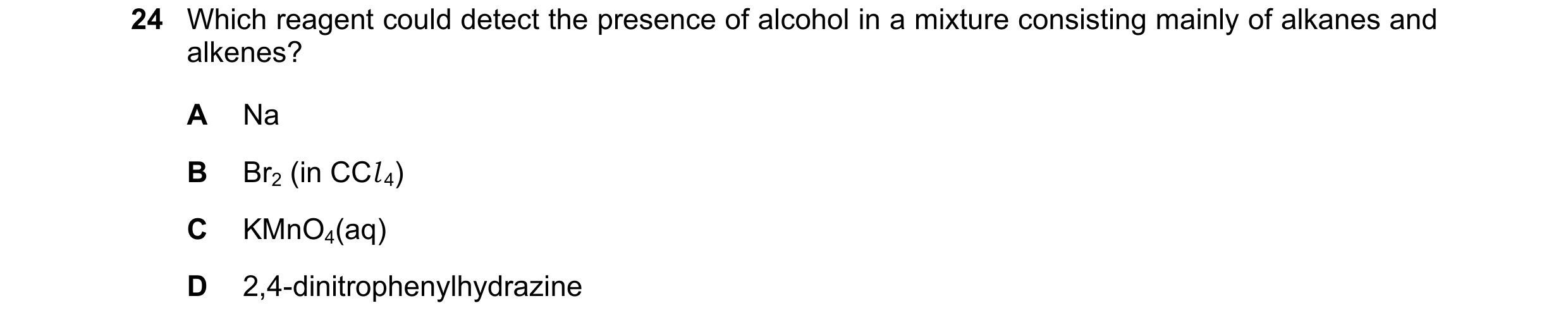
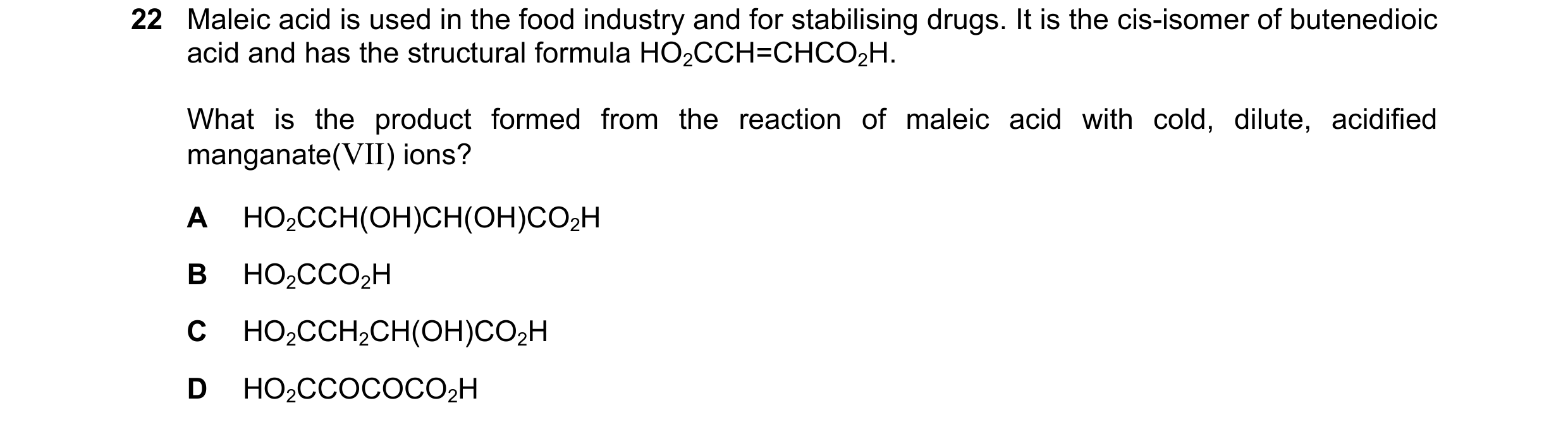 52 / 107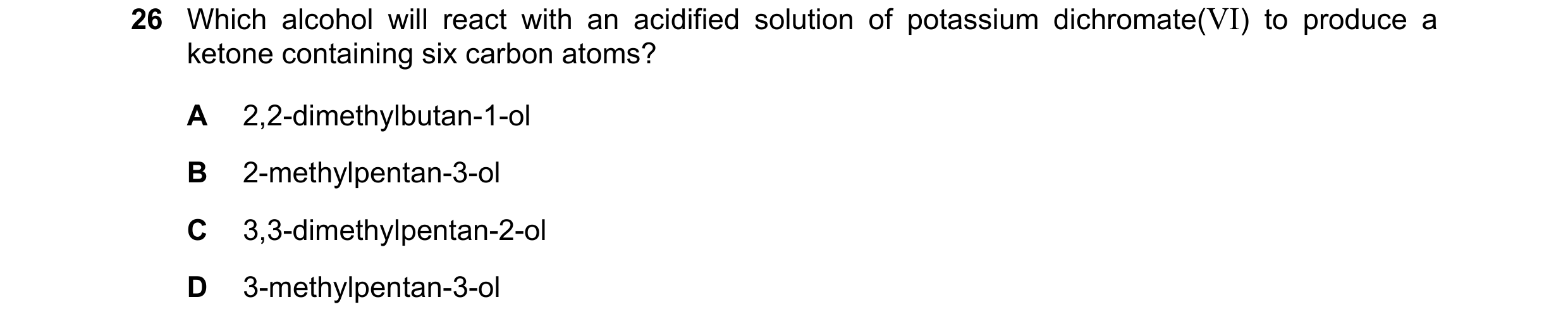


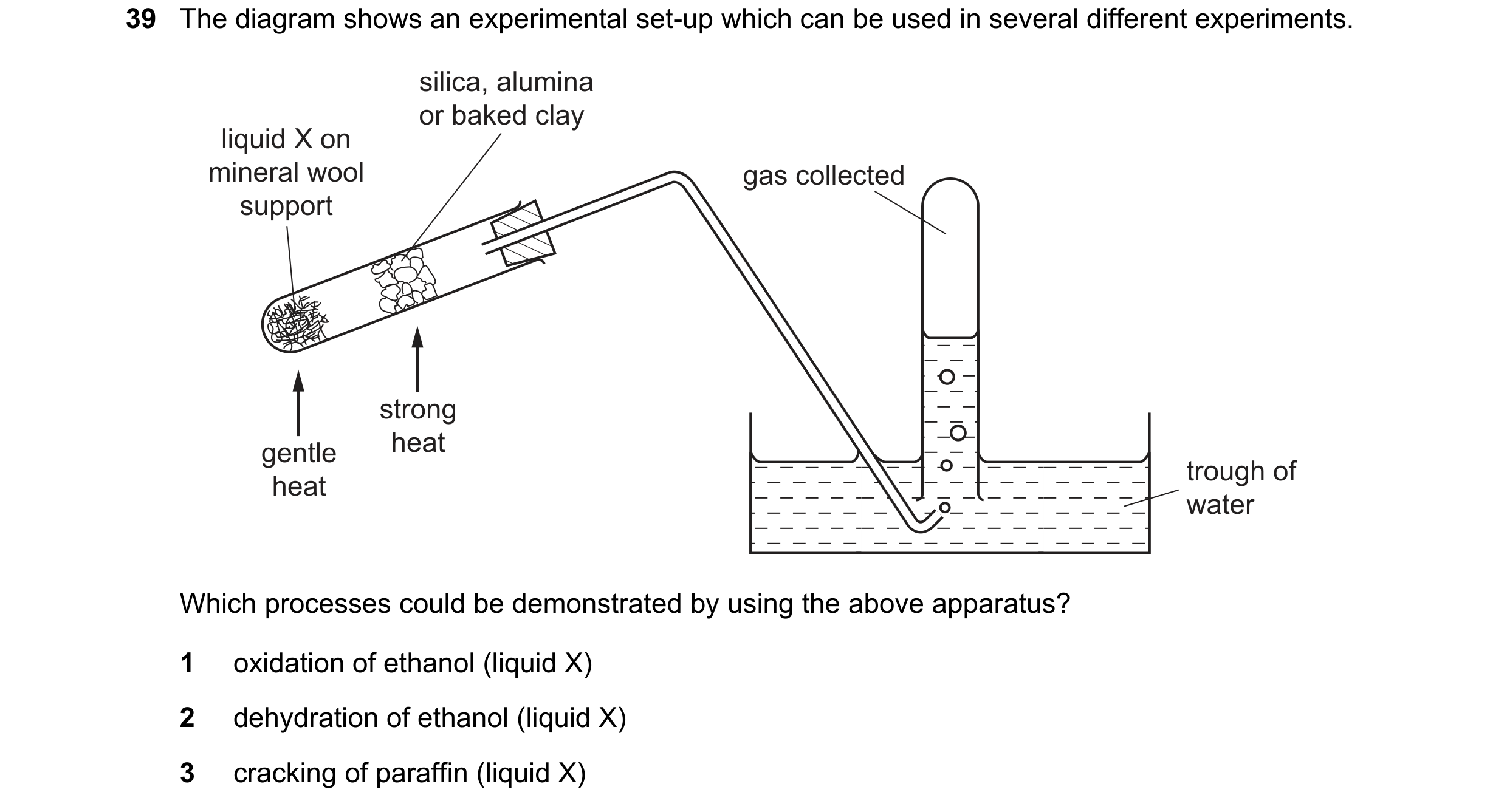
 53 / 107
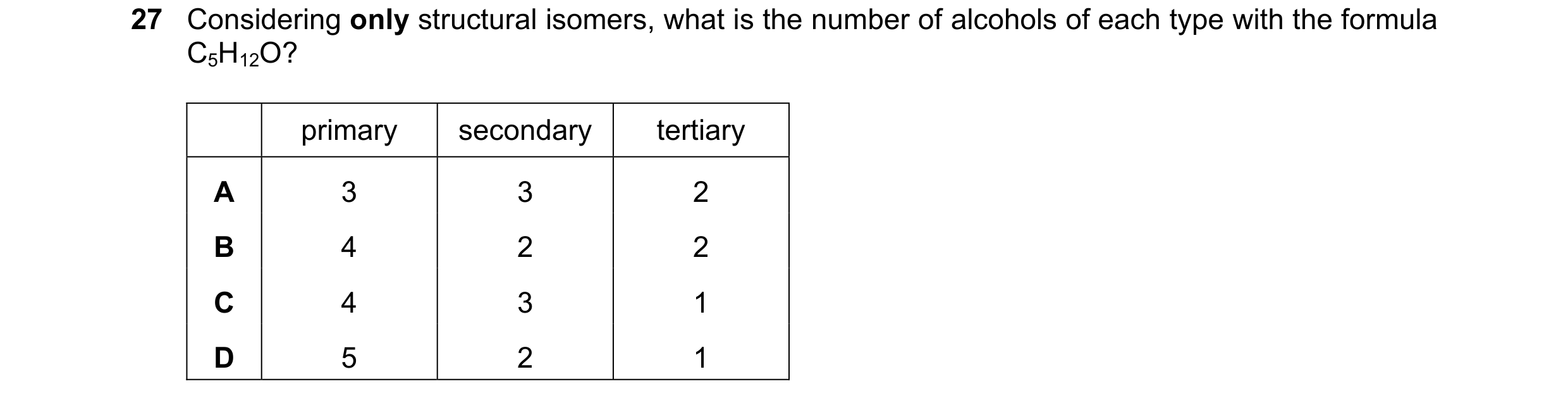

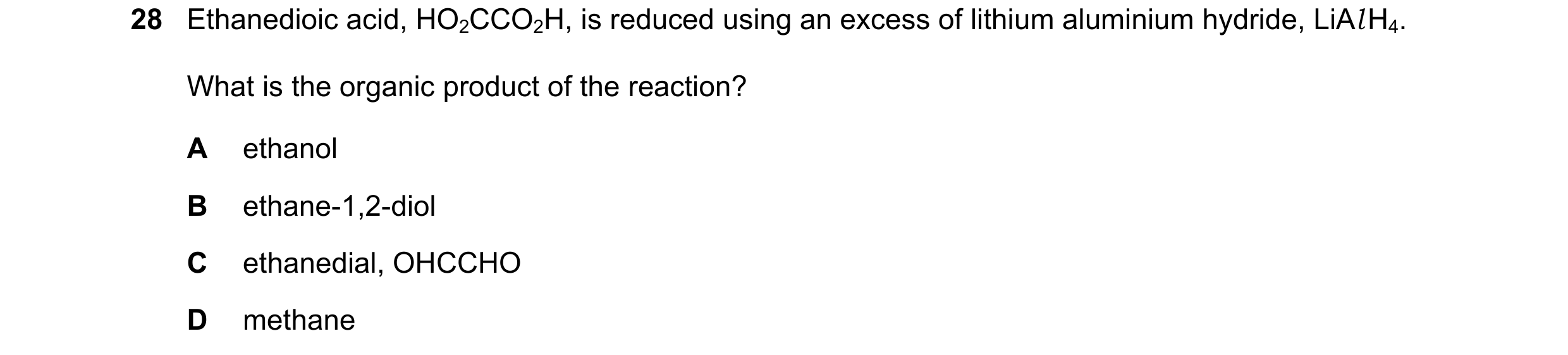 54 / 107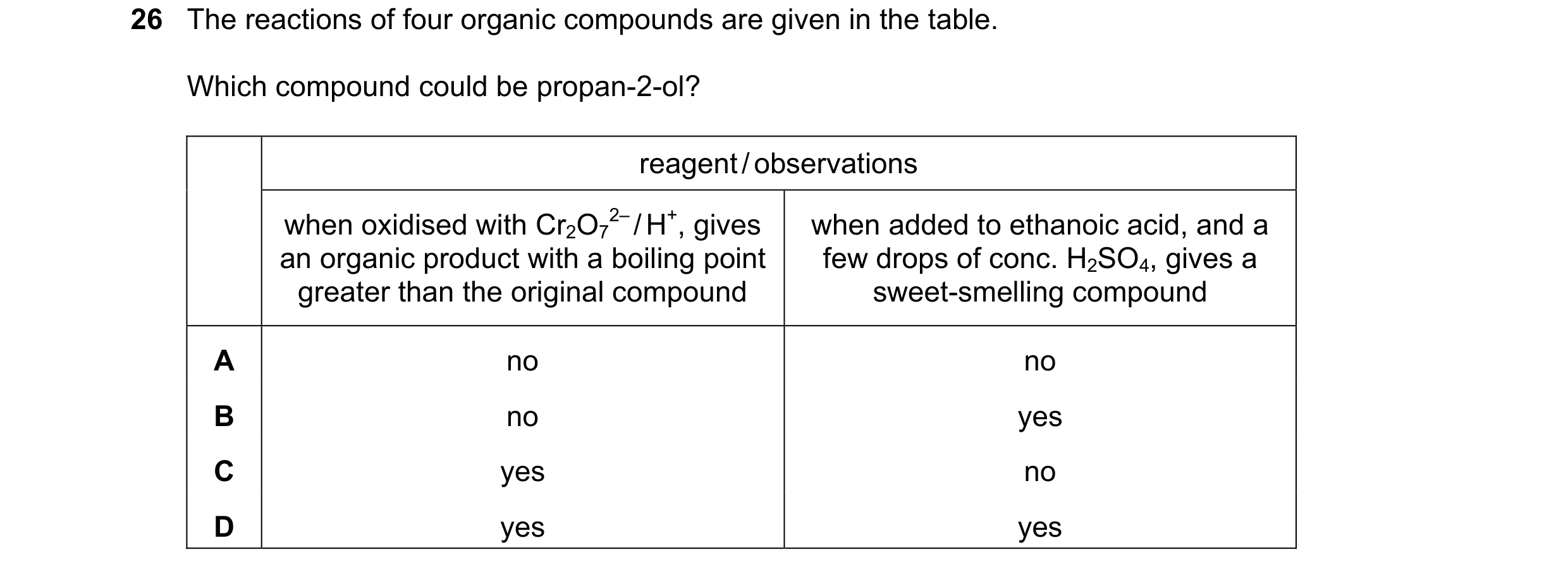
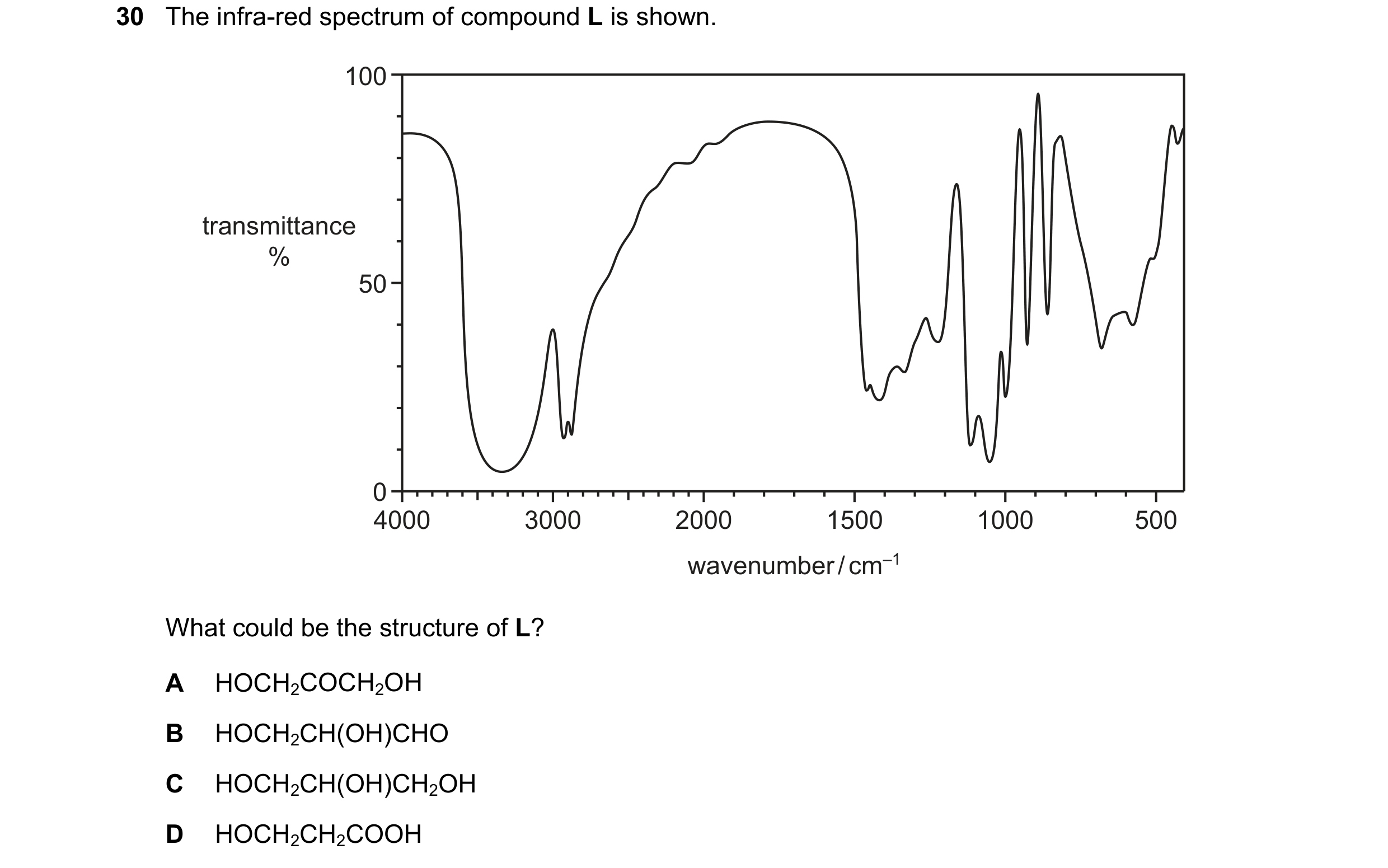
 55 / 107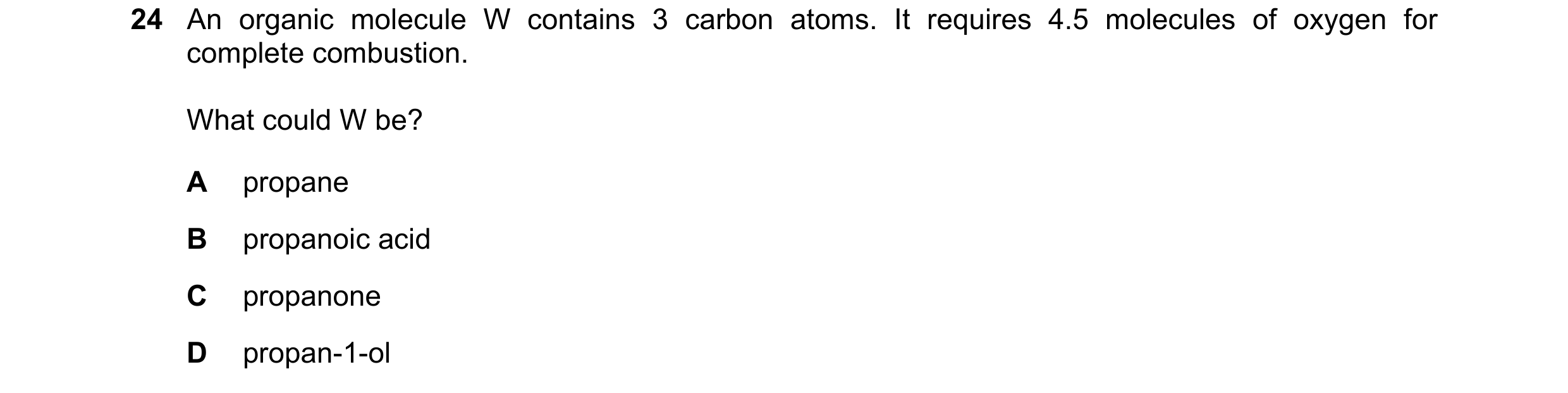
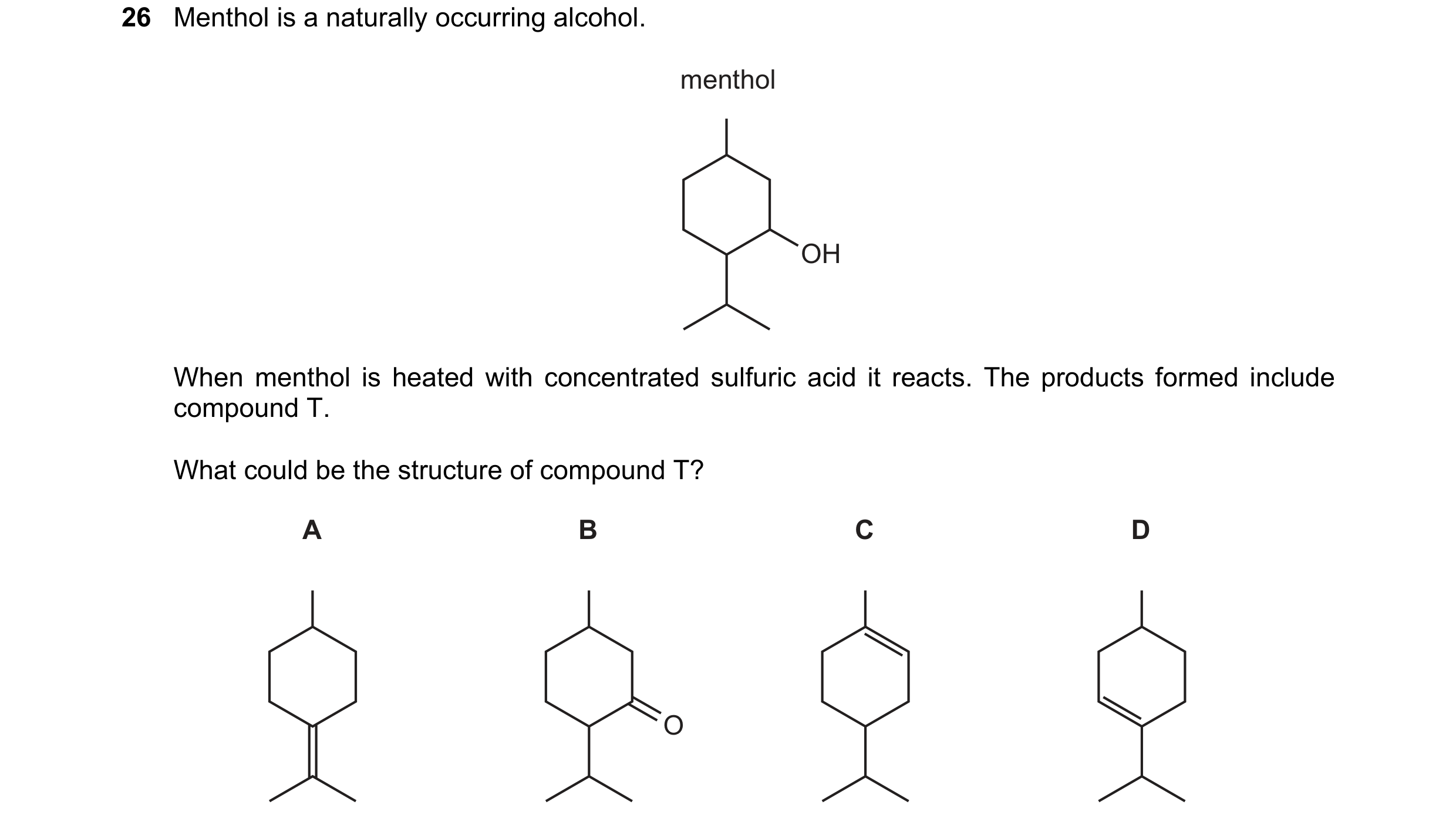 56 / 107
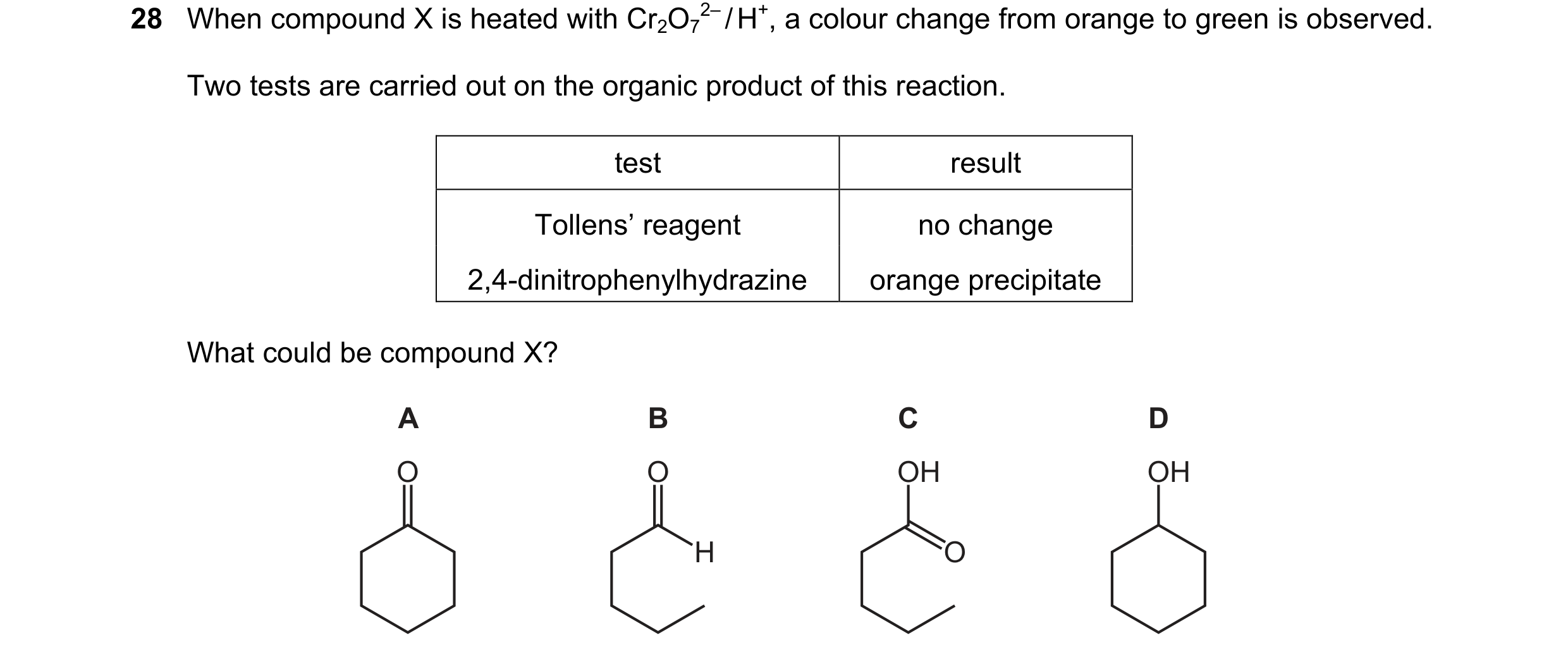
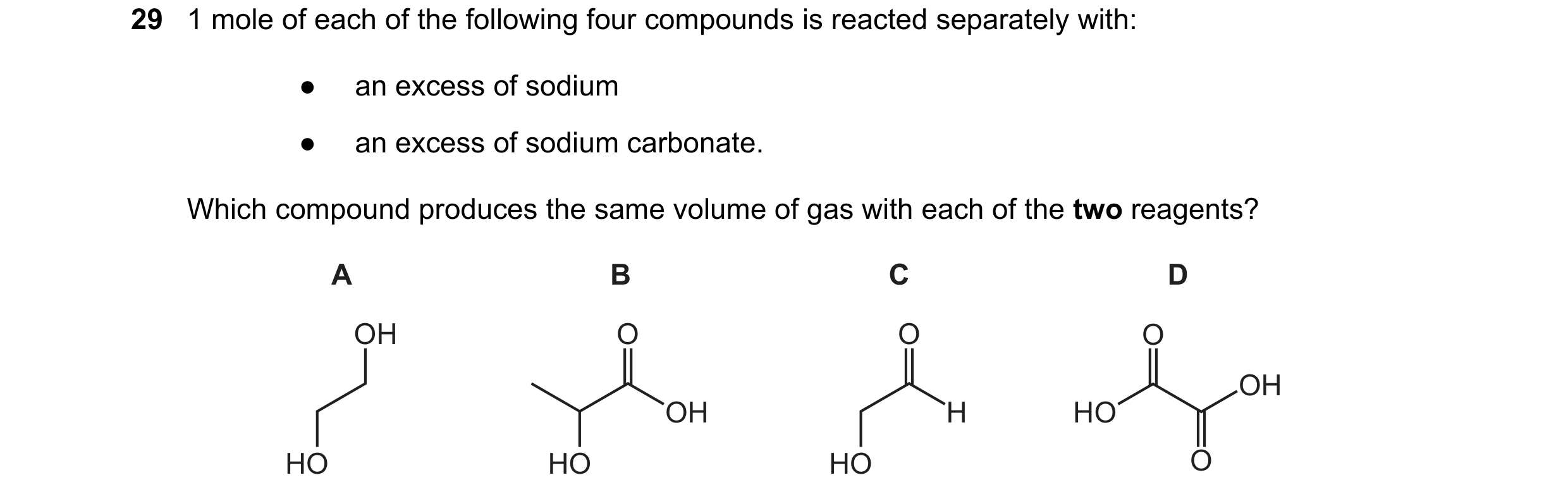 57 / 107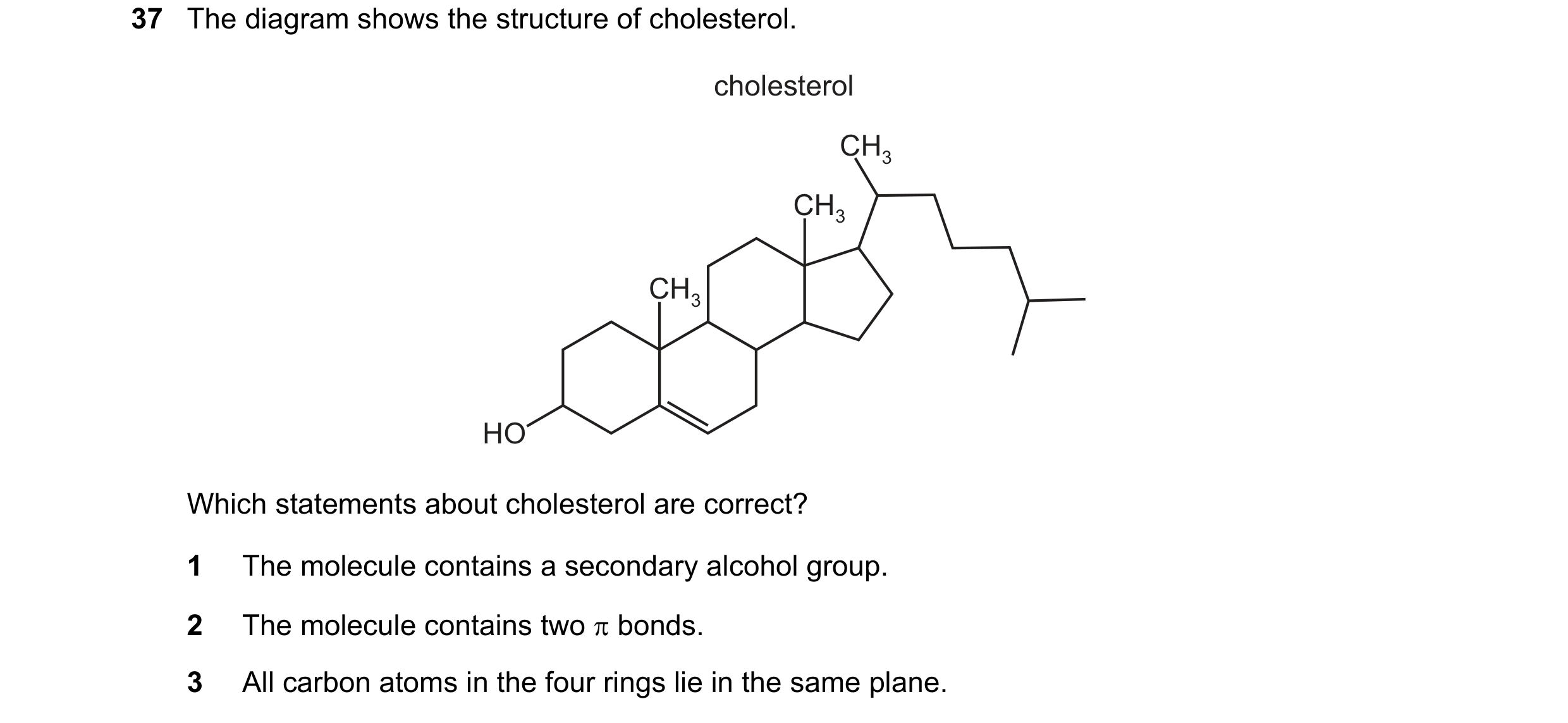
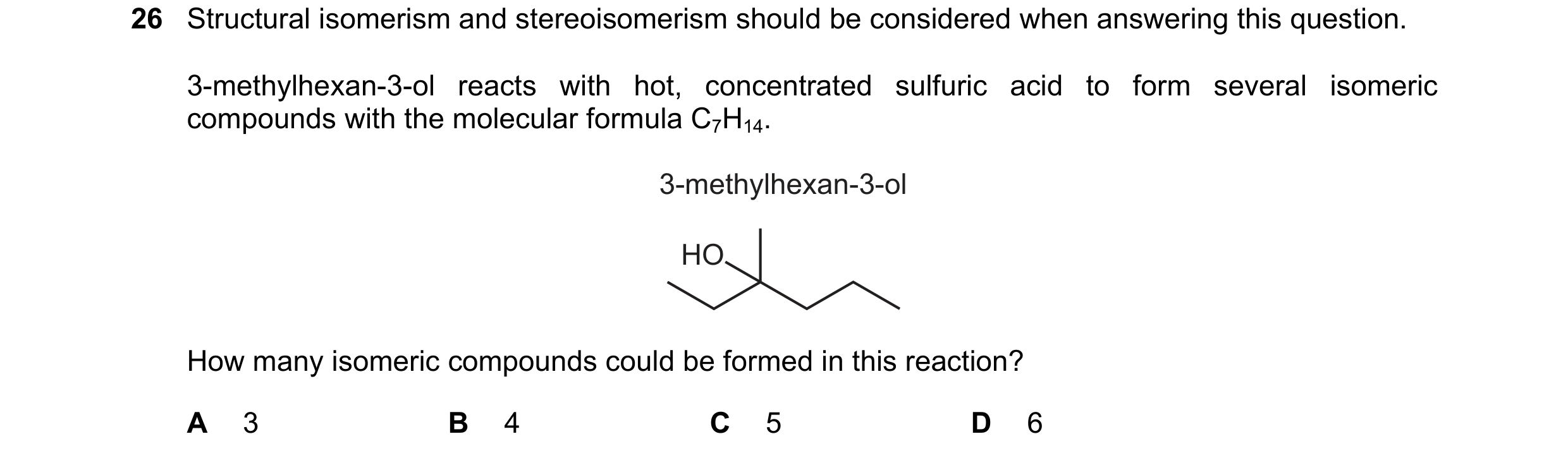
 58 / 107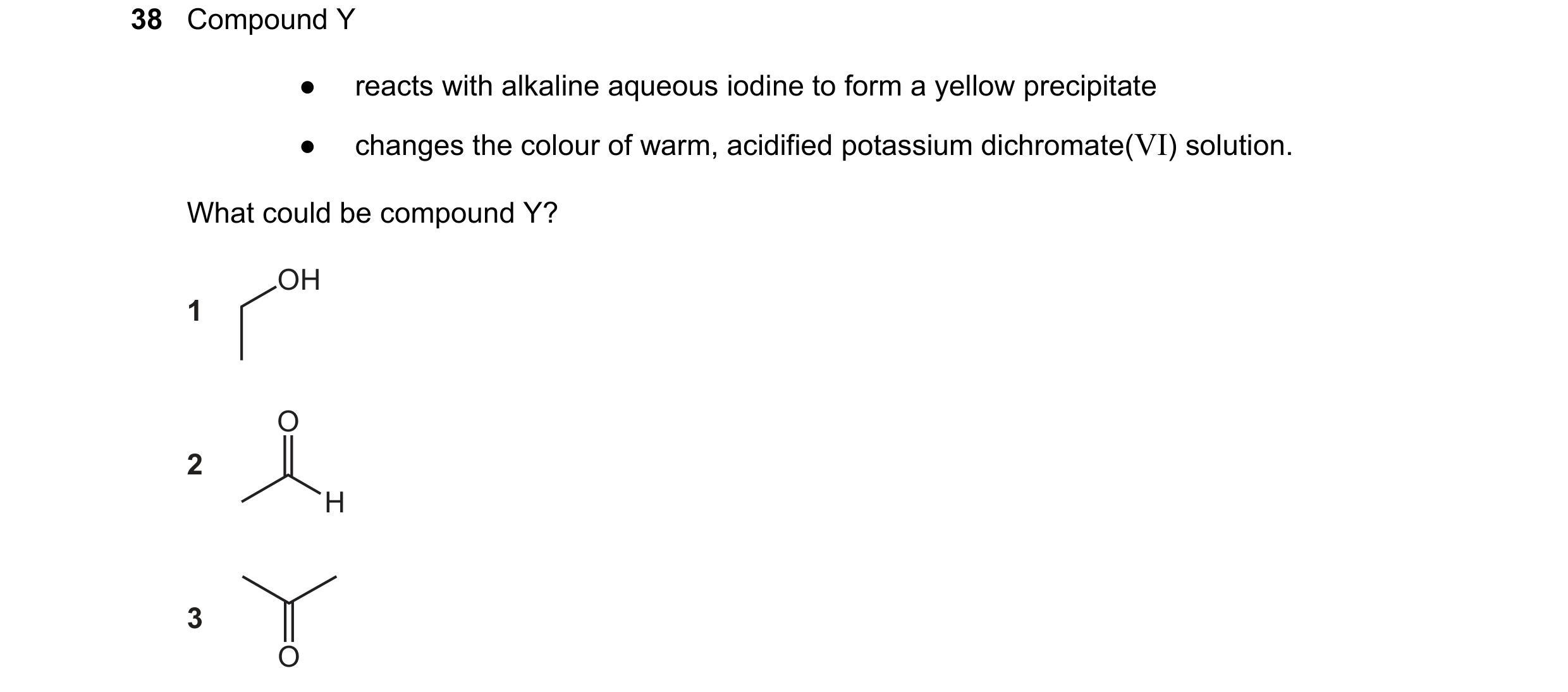
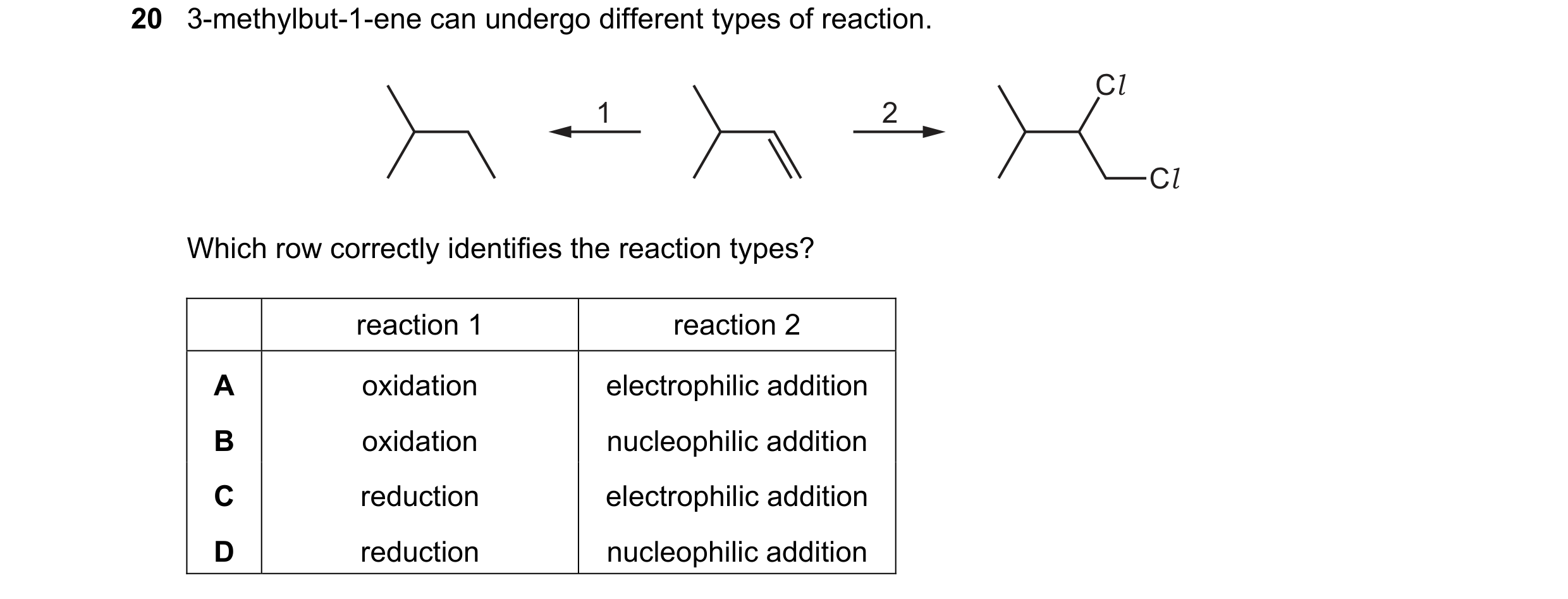
 59 / 107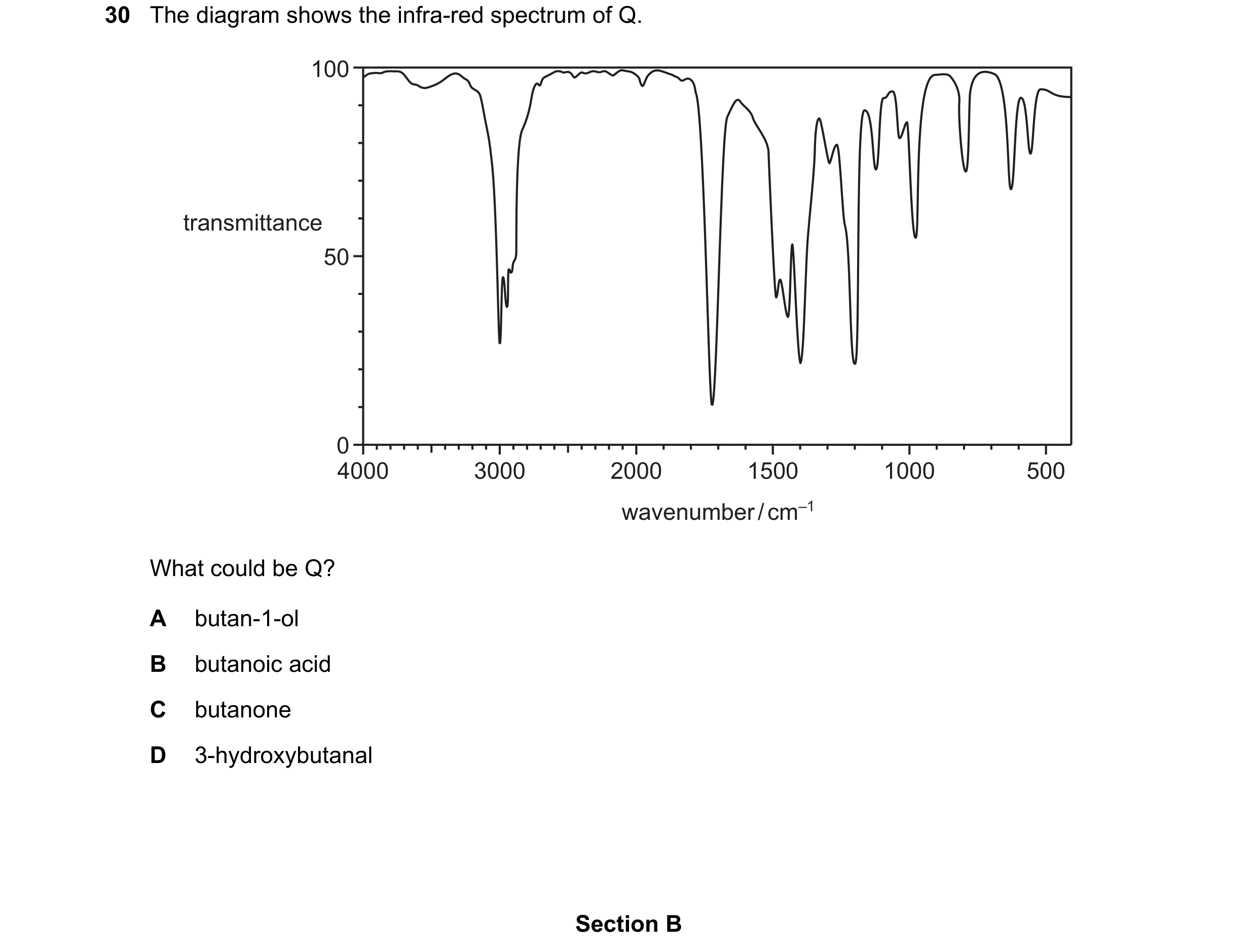
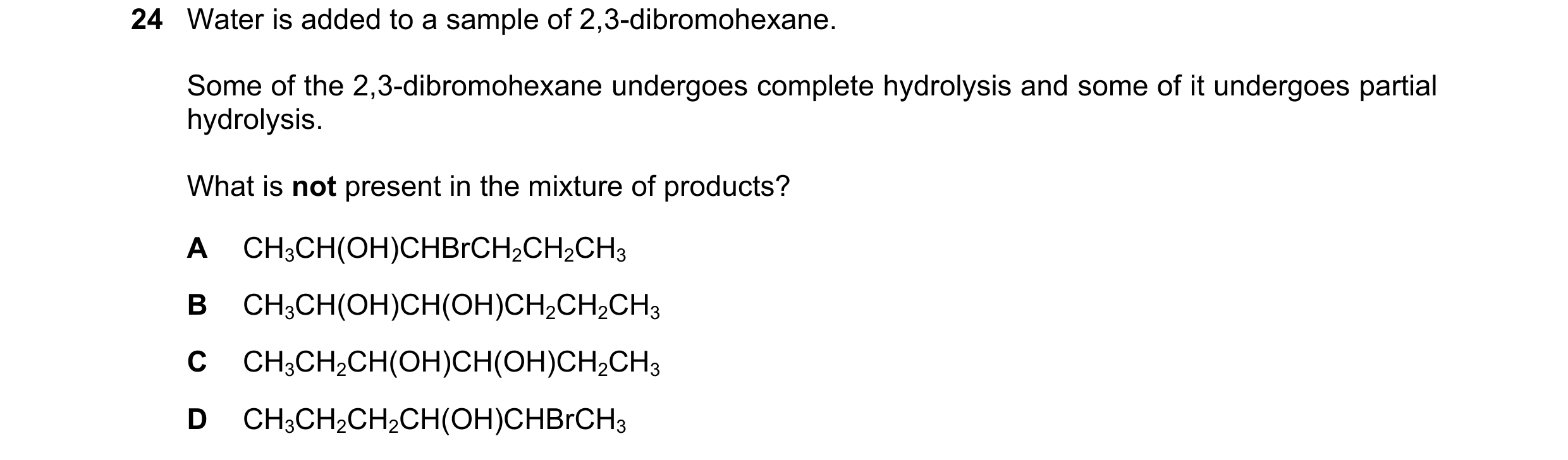 60 / 107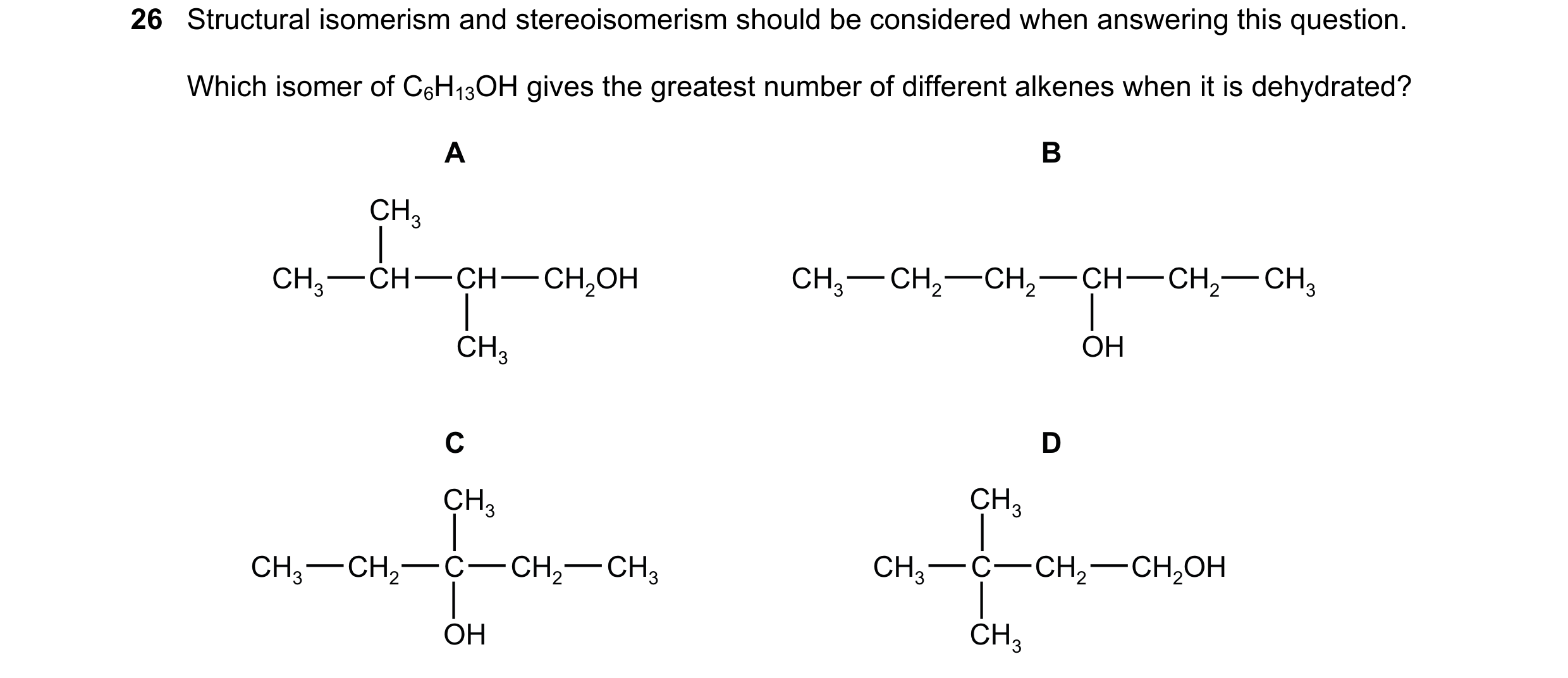
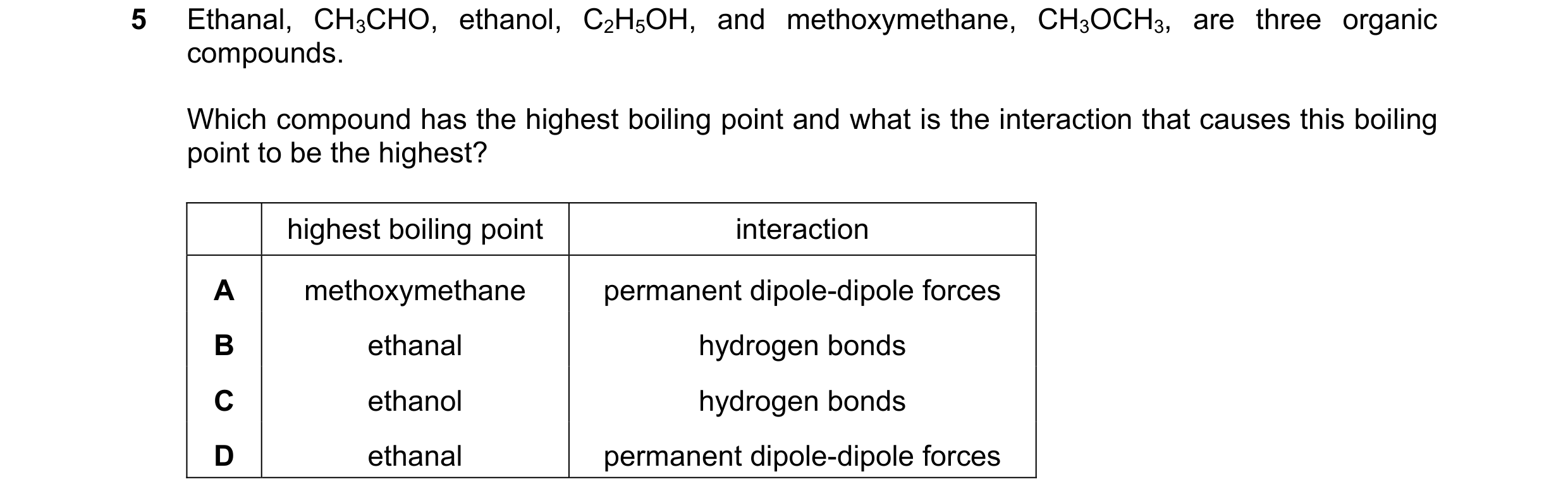
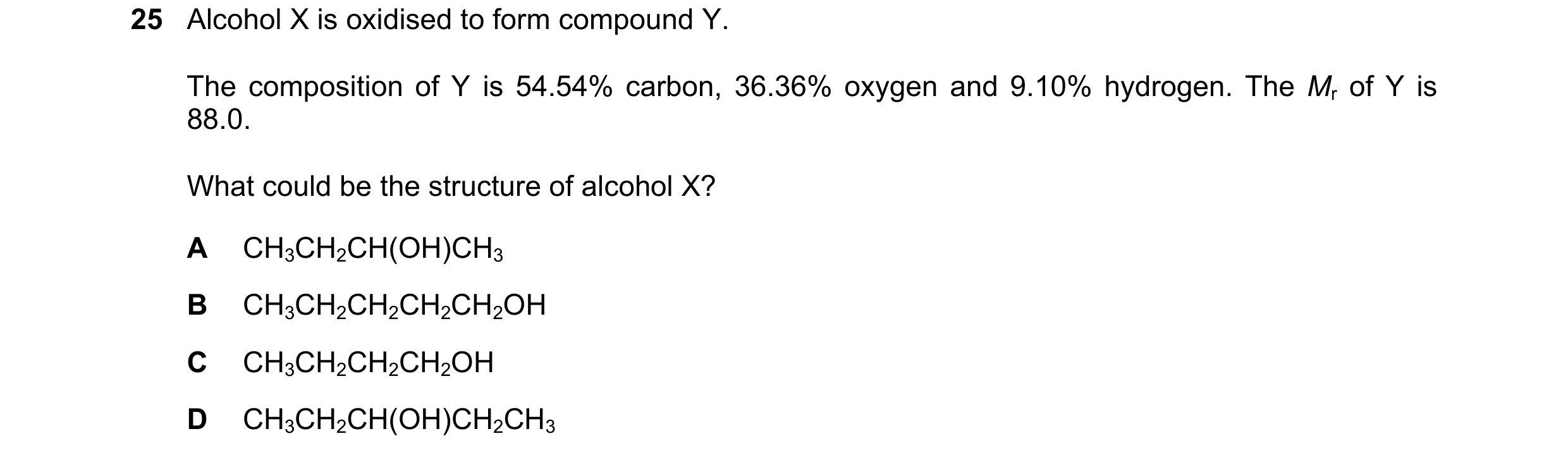
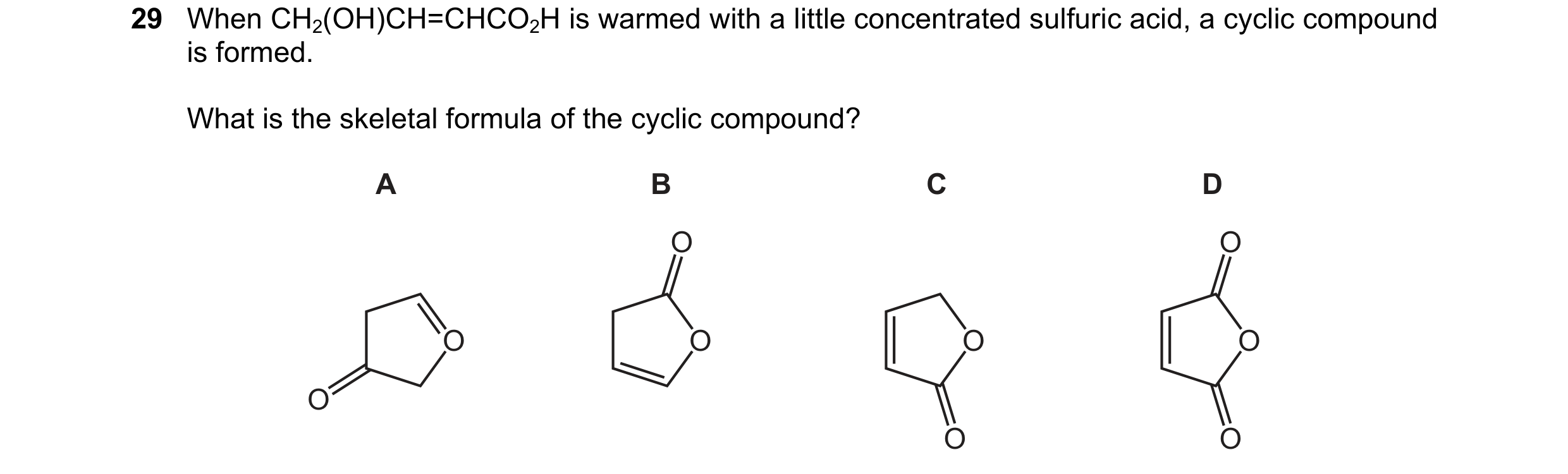 61 / 107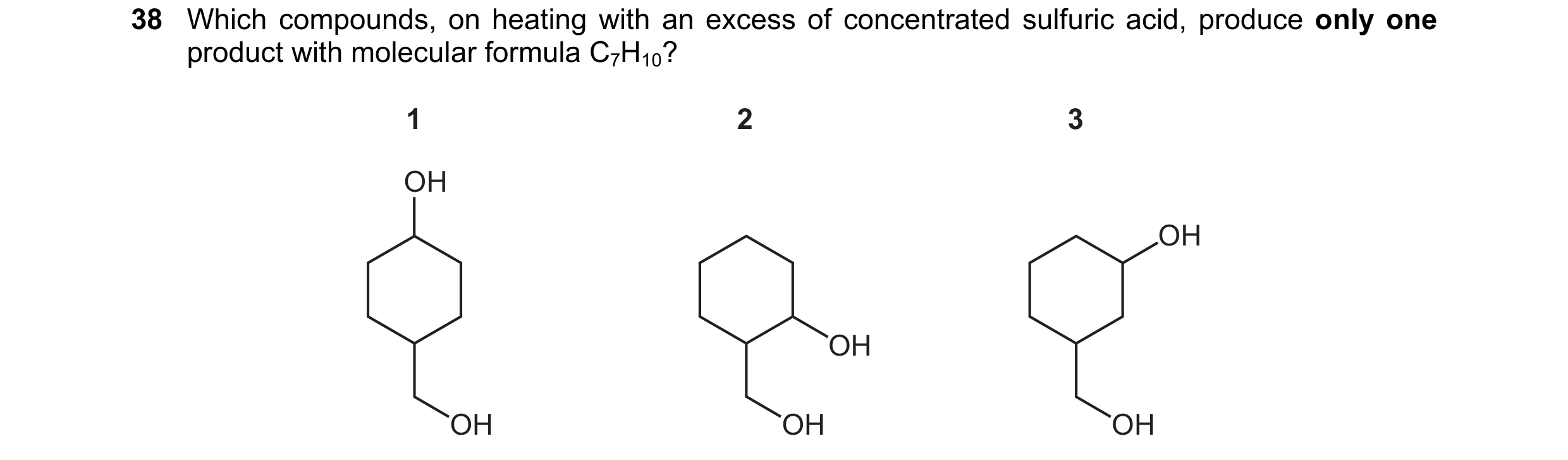
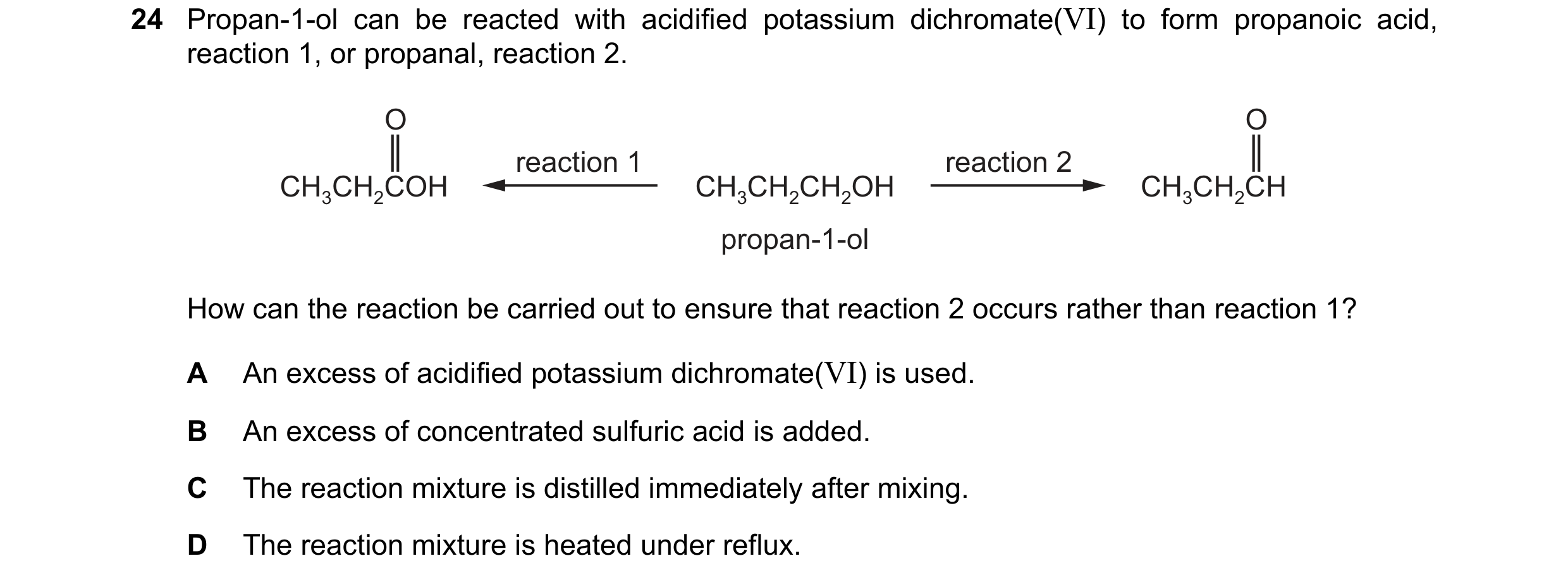

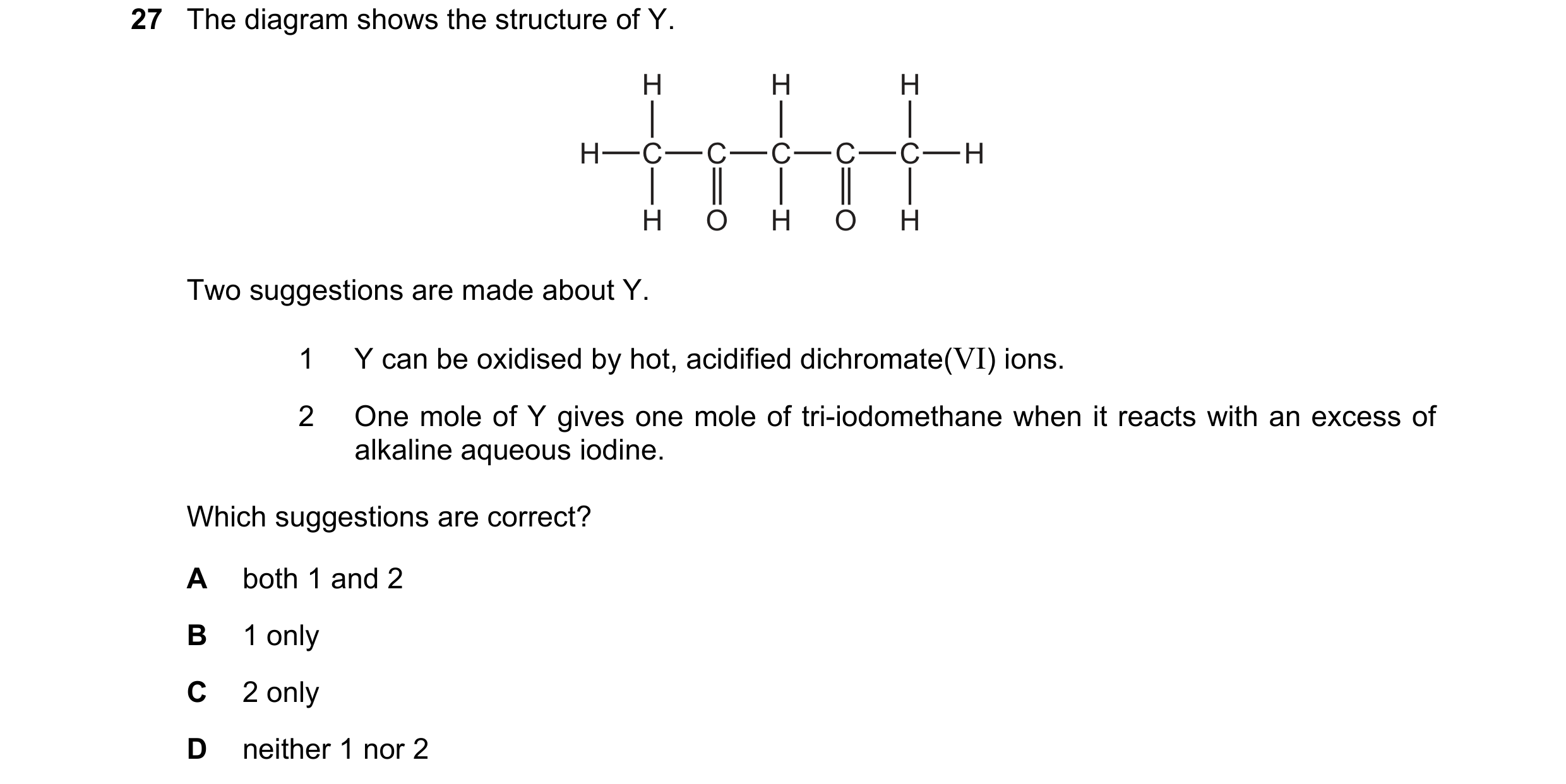 62 / 107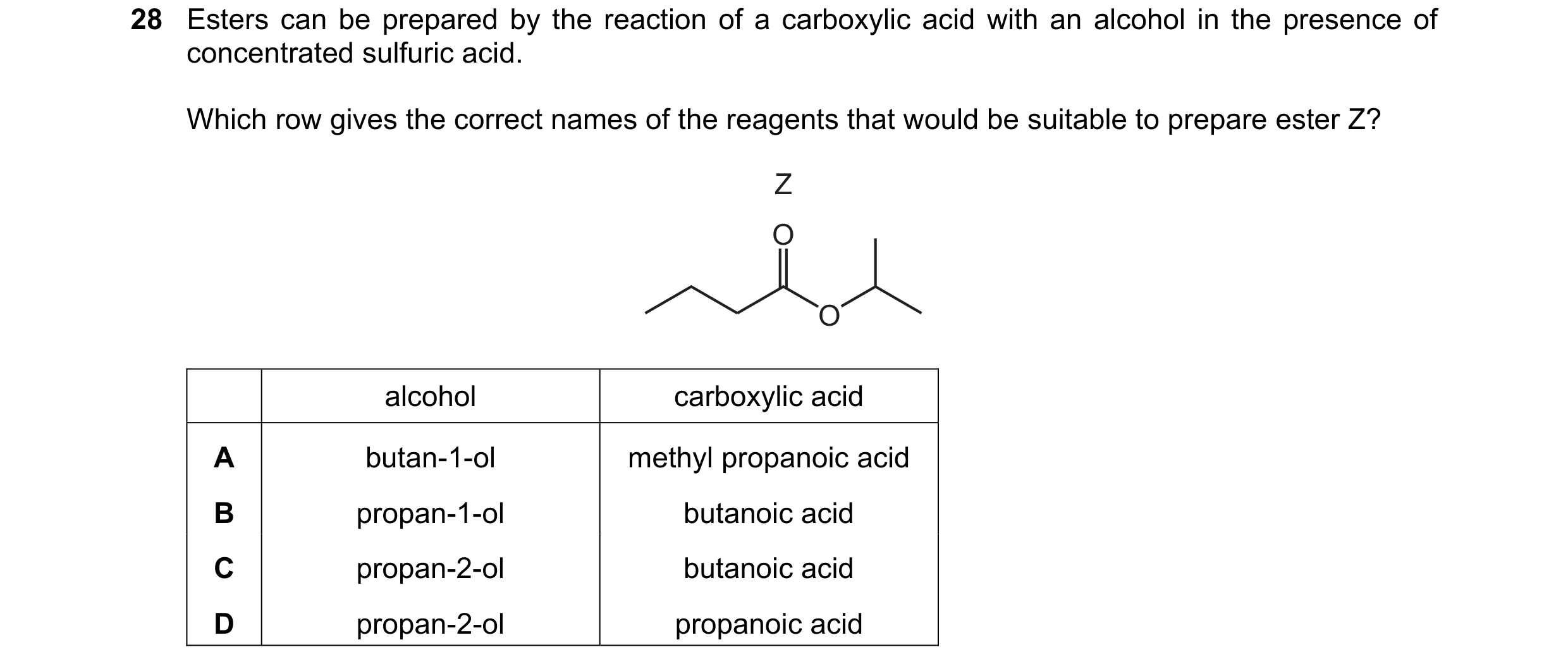
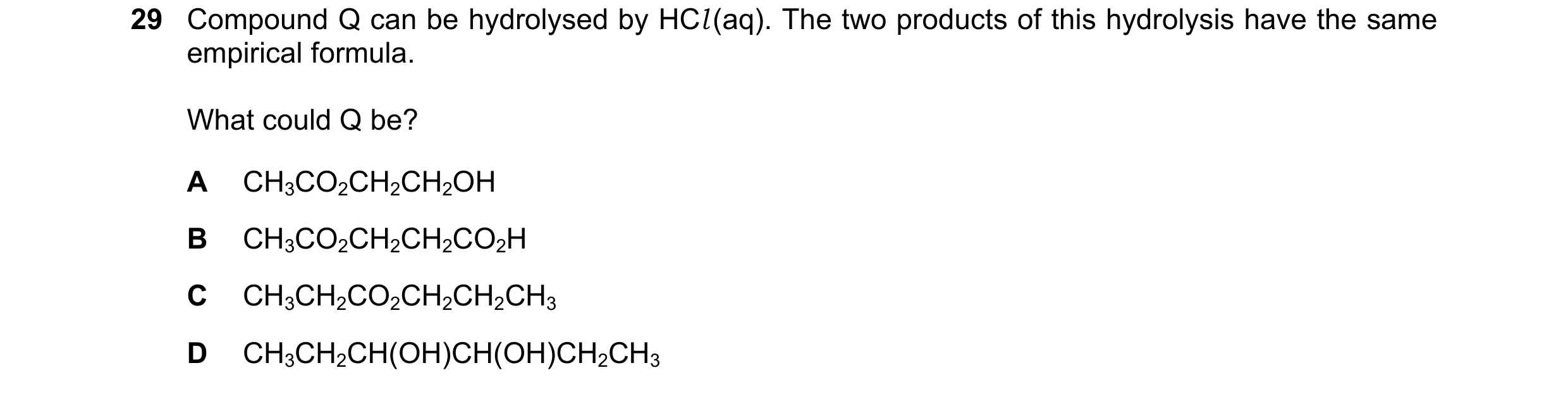
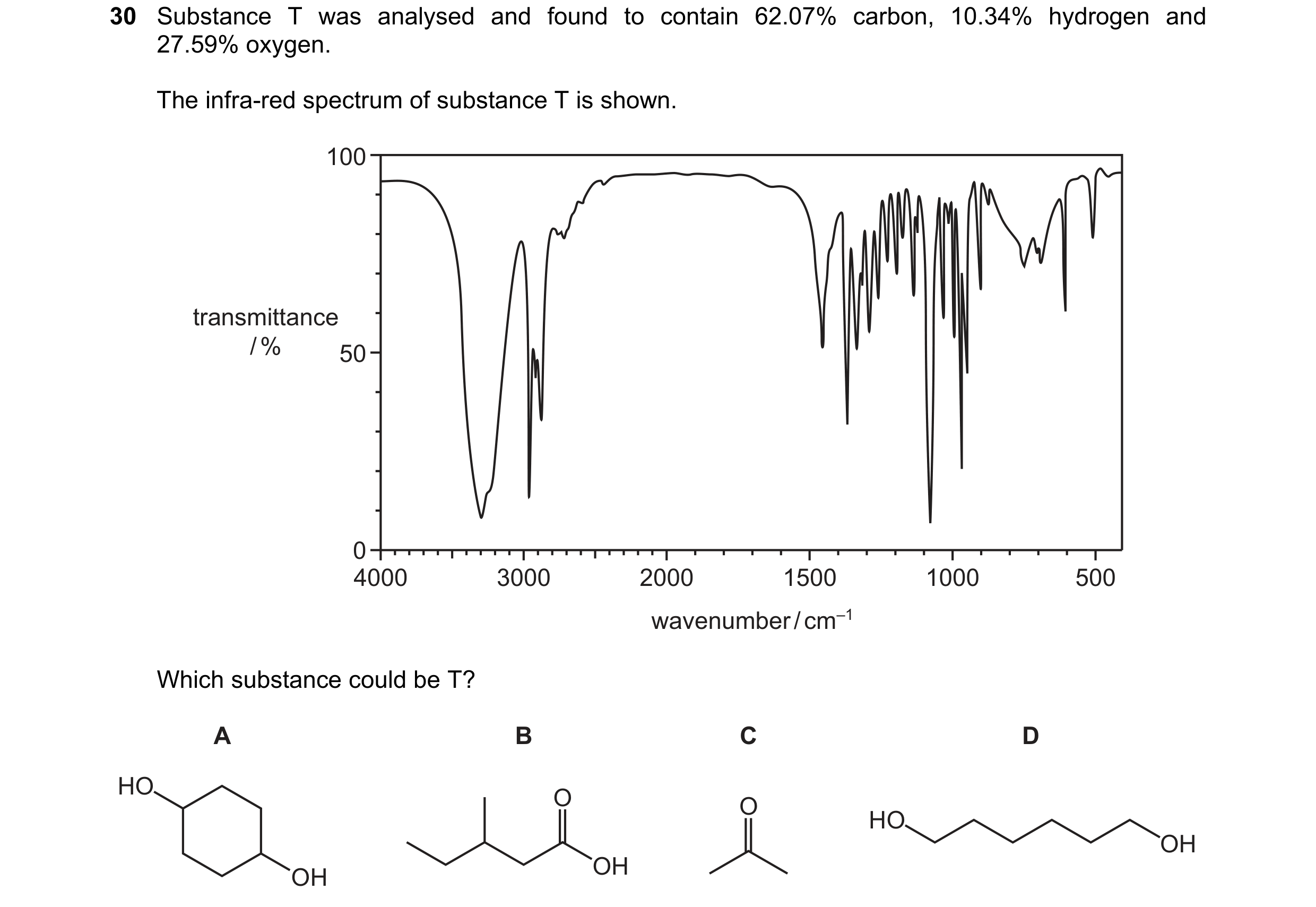 63 / 107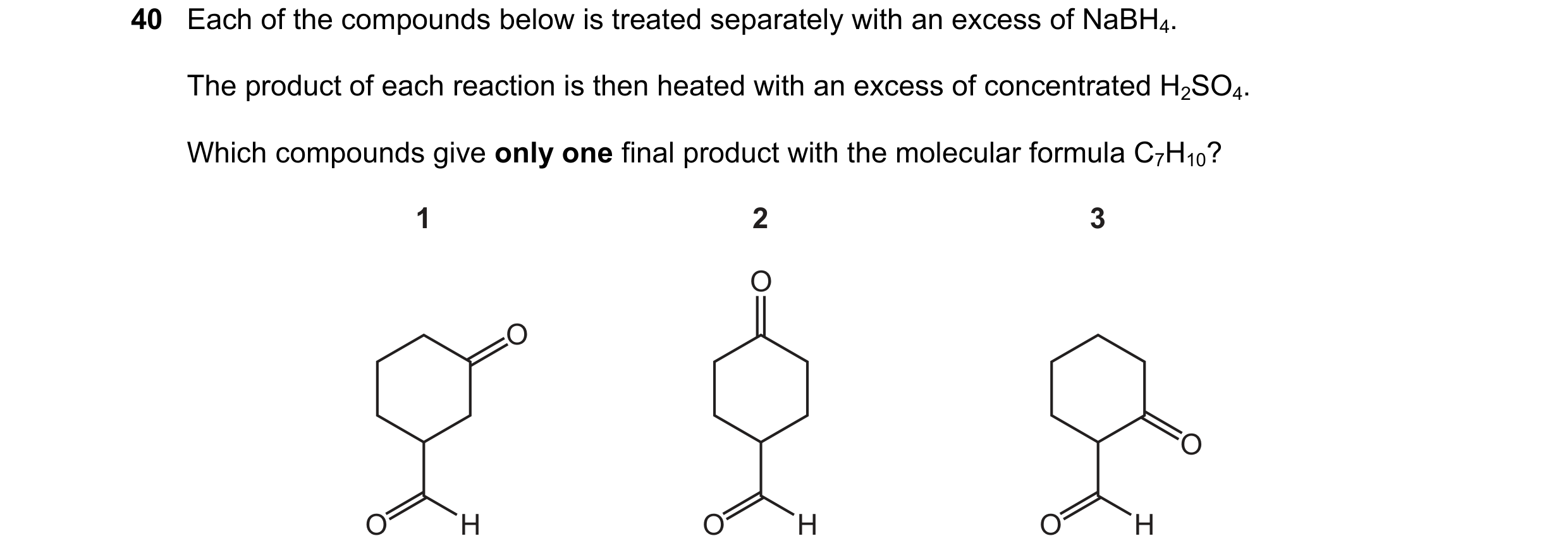
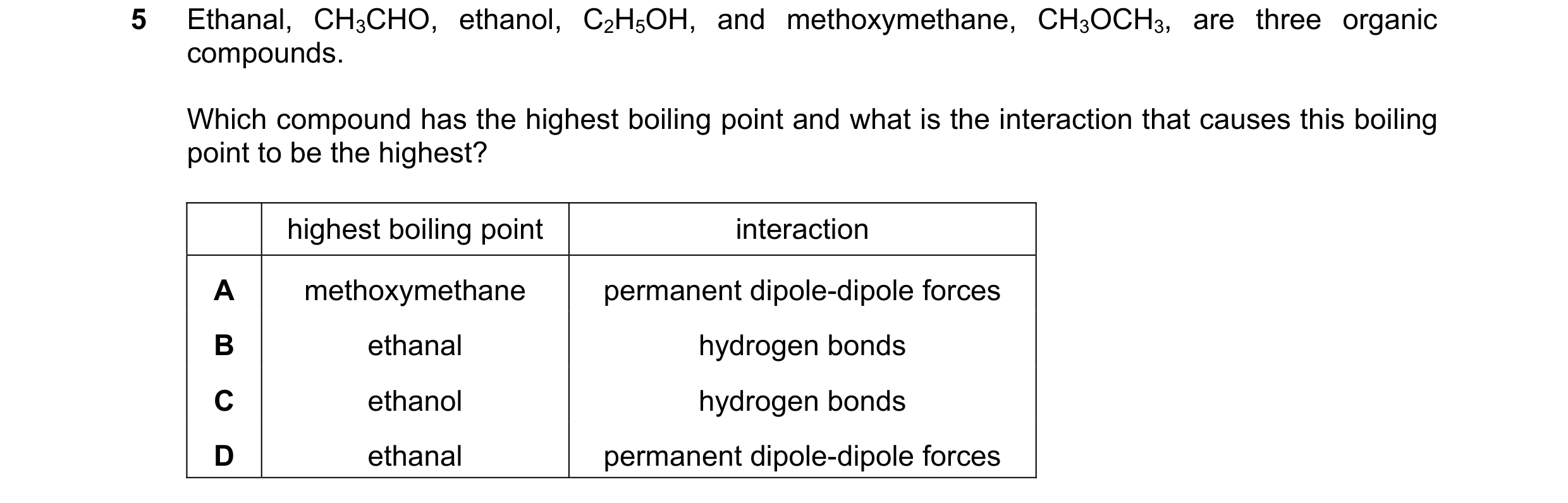
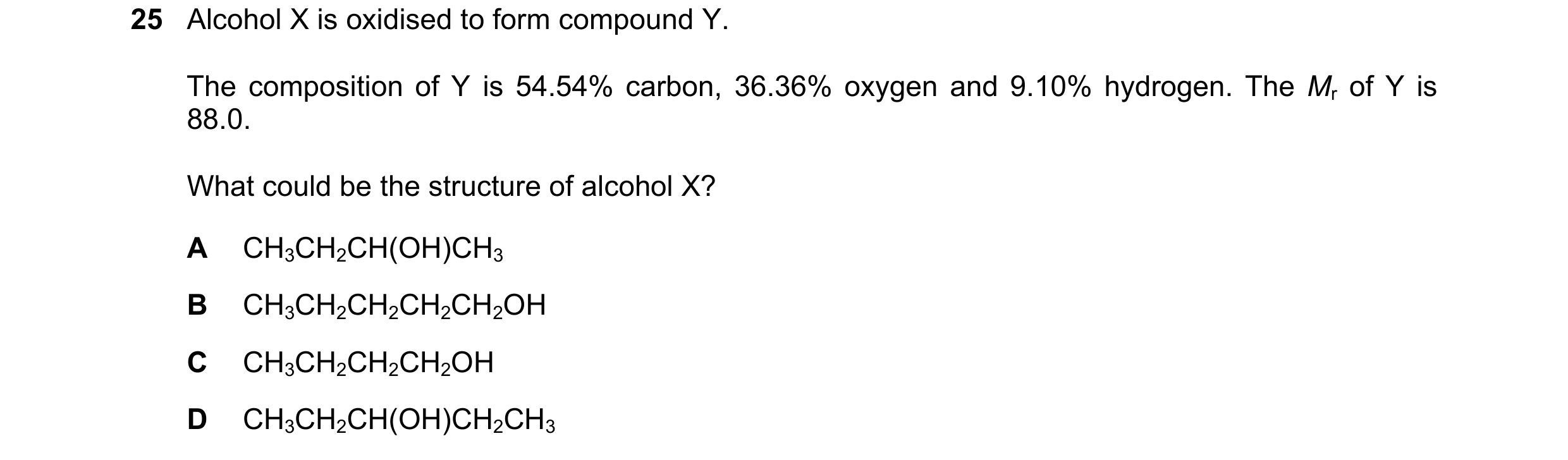
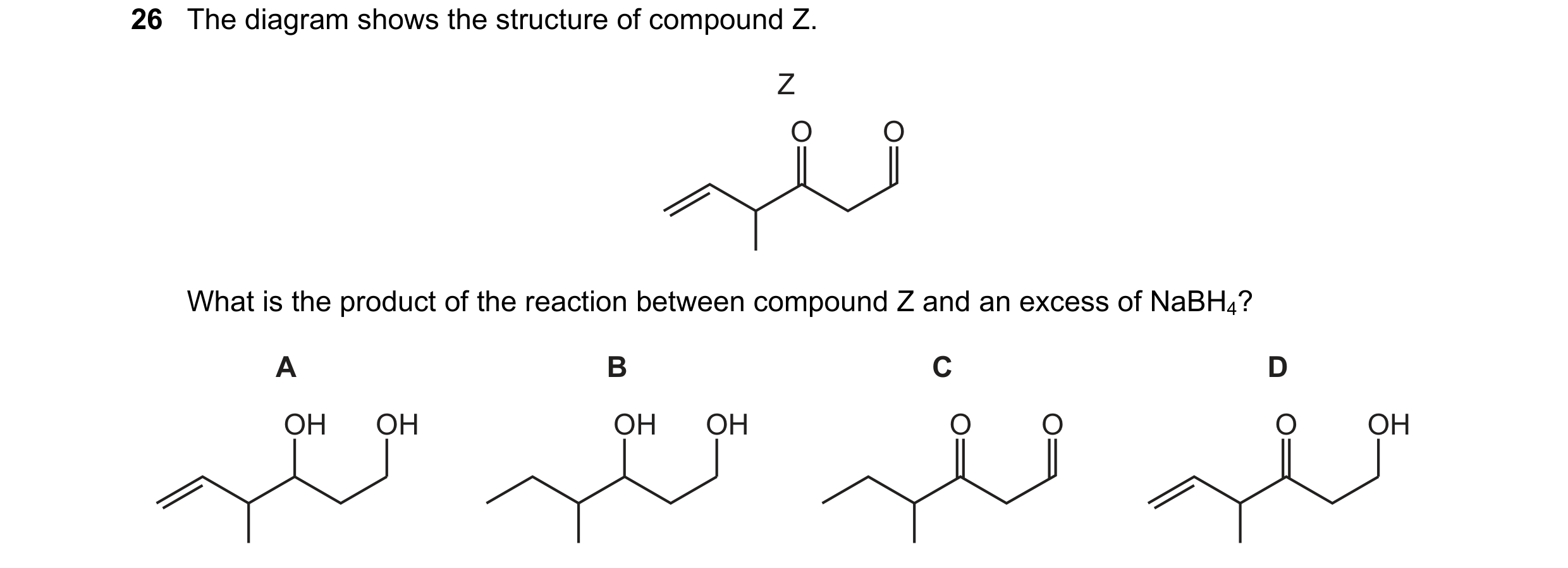 64 / 107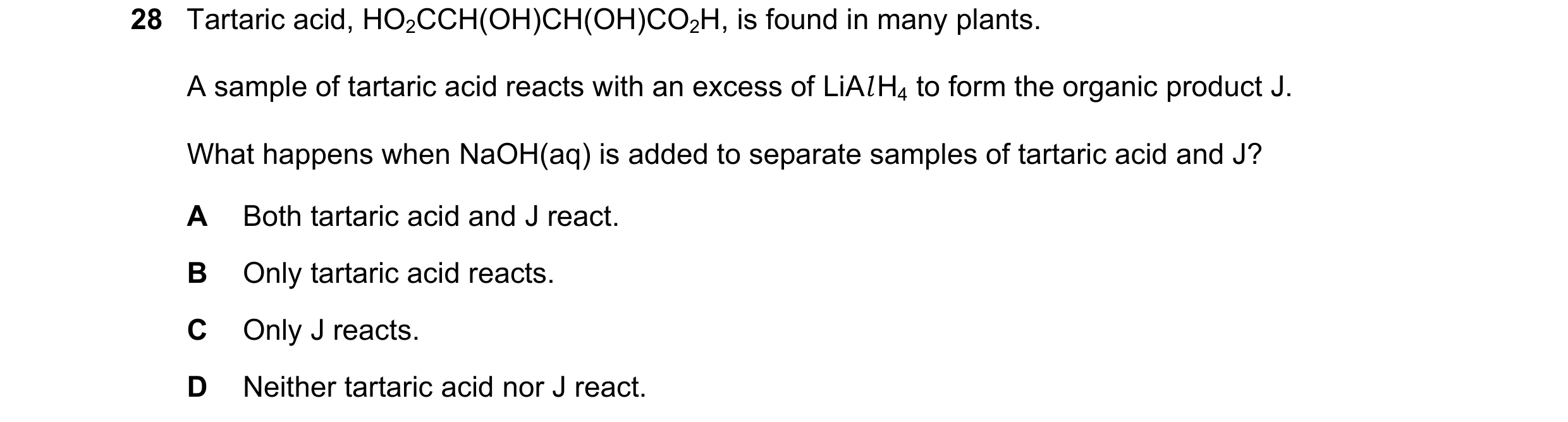
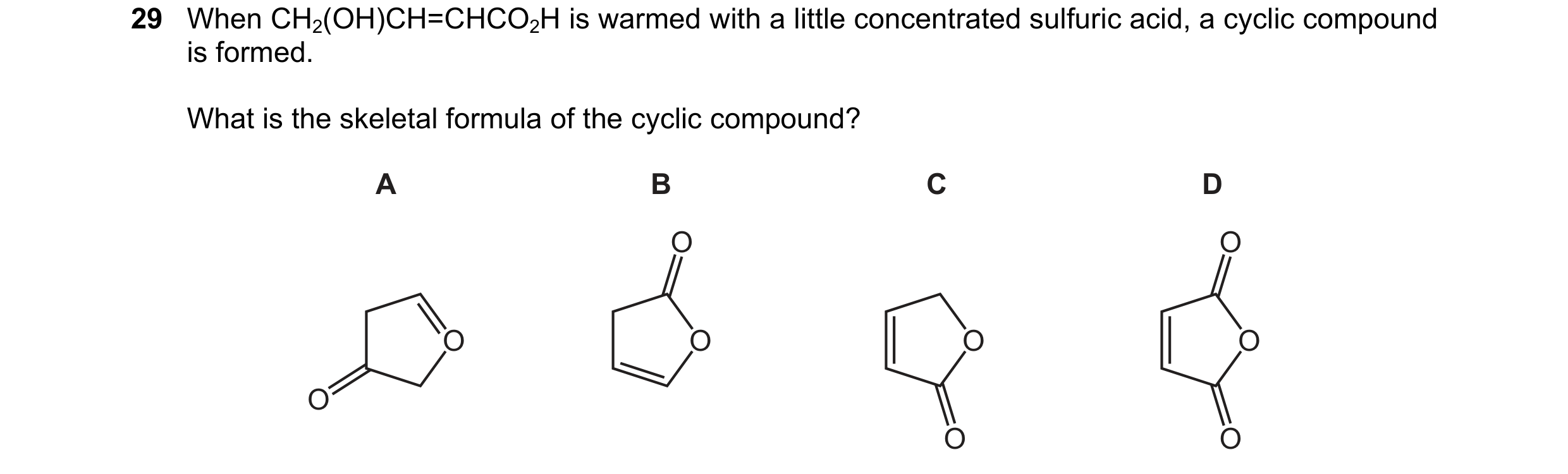
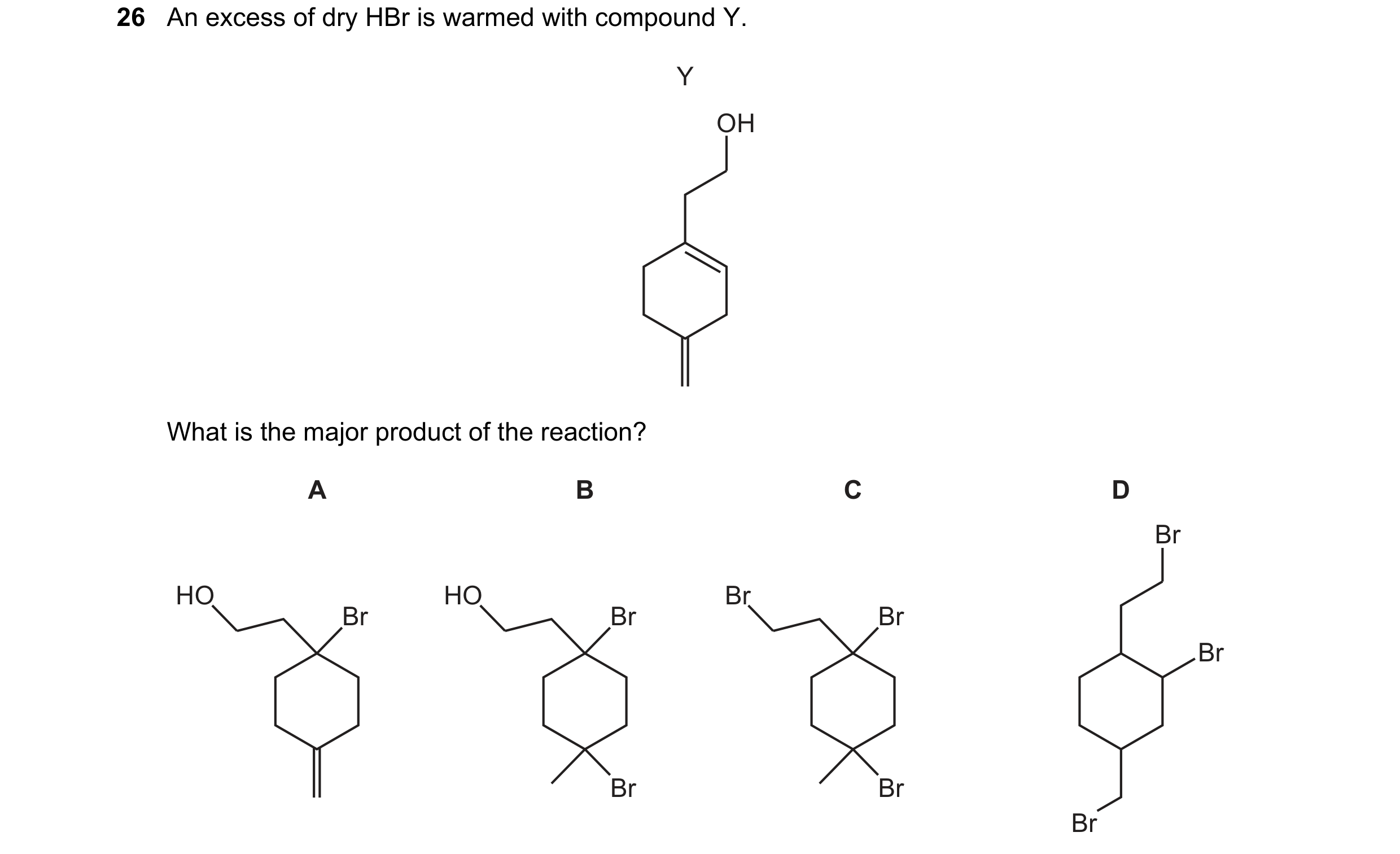 65 / 107
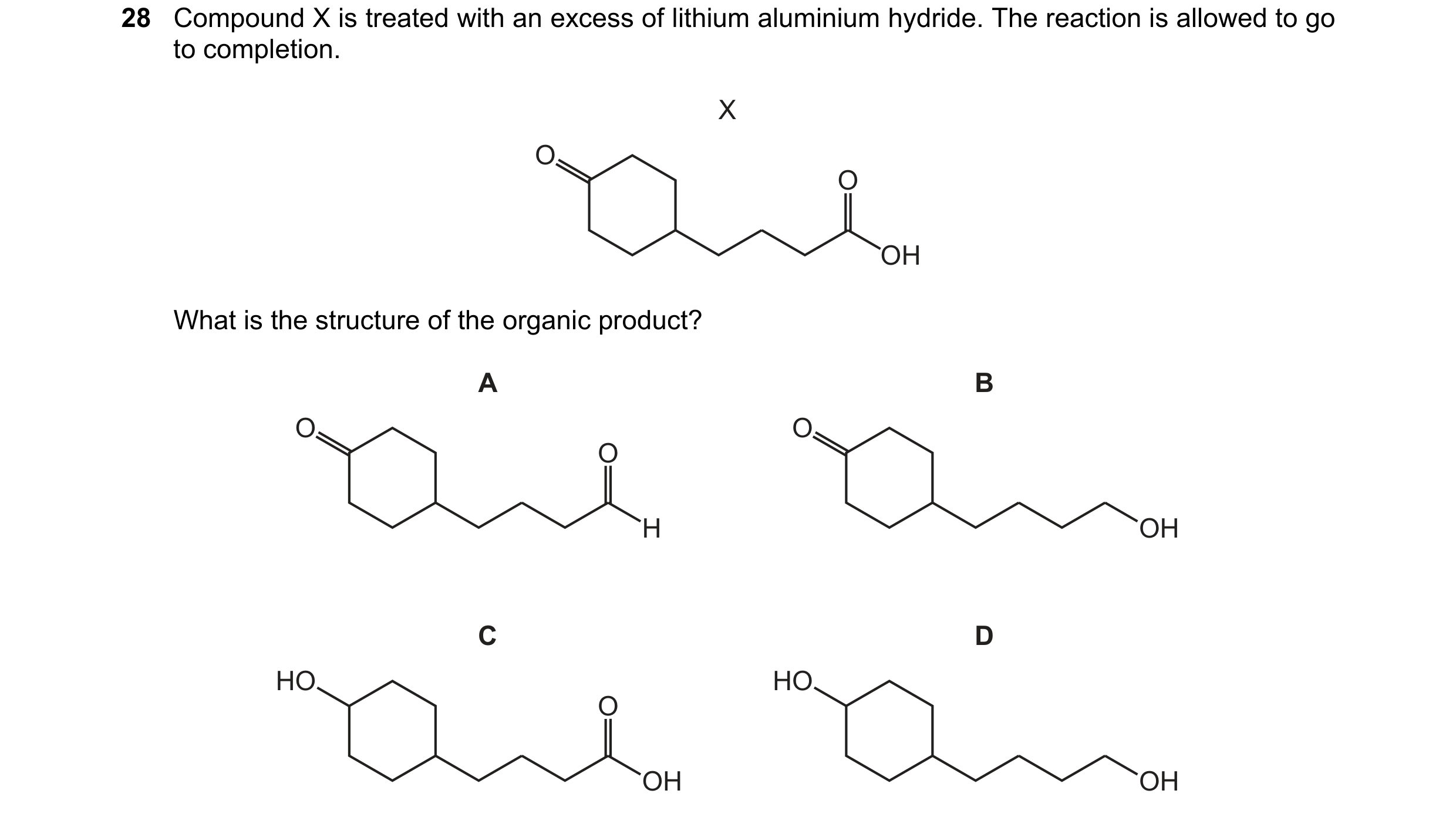
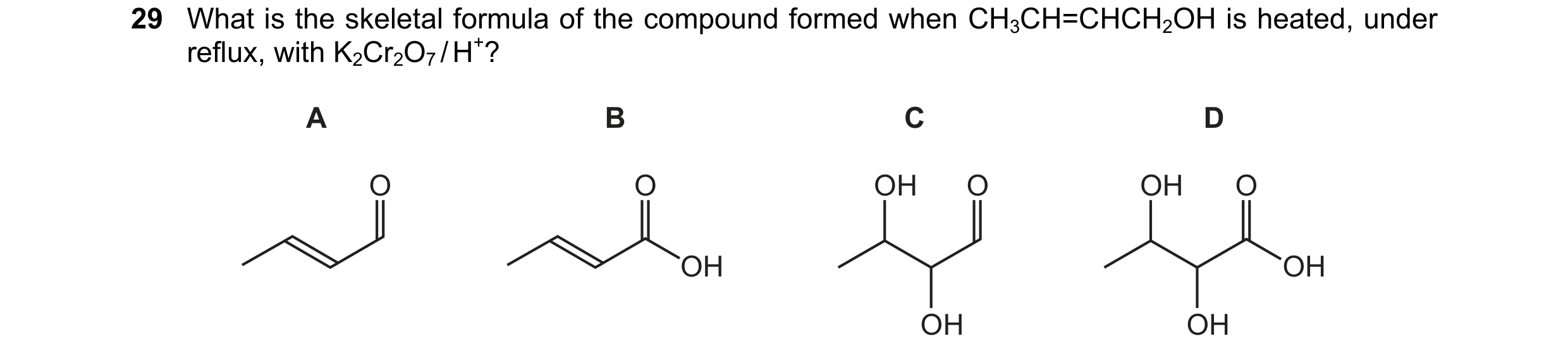
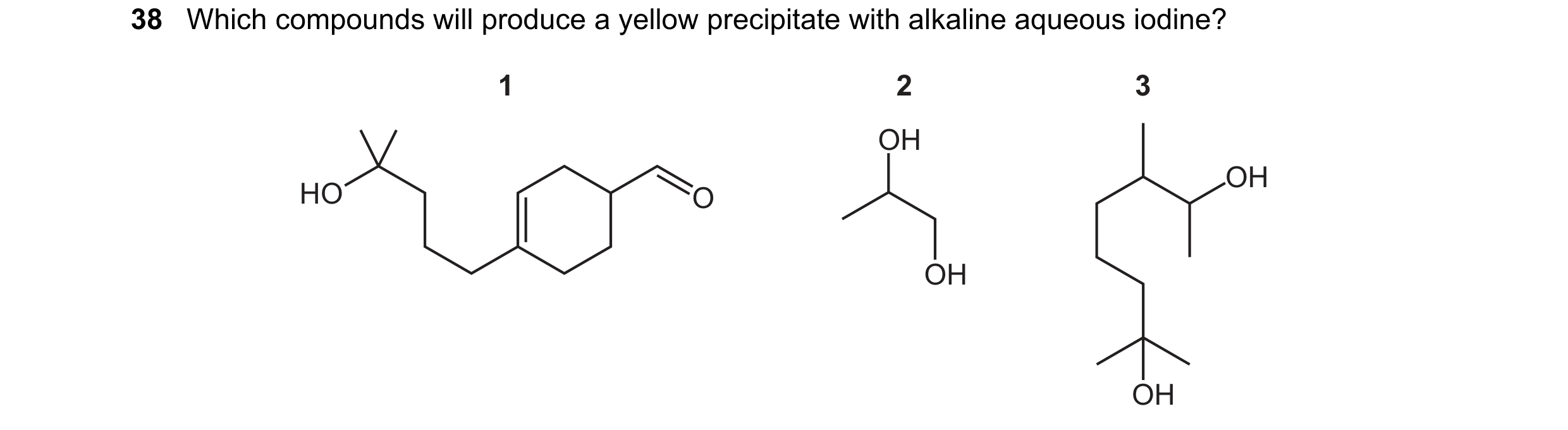 66 / 107
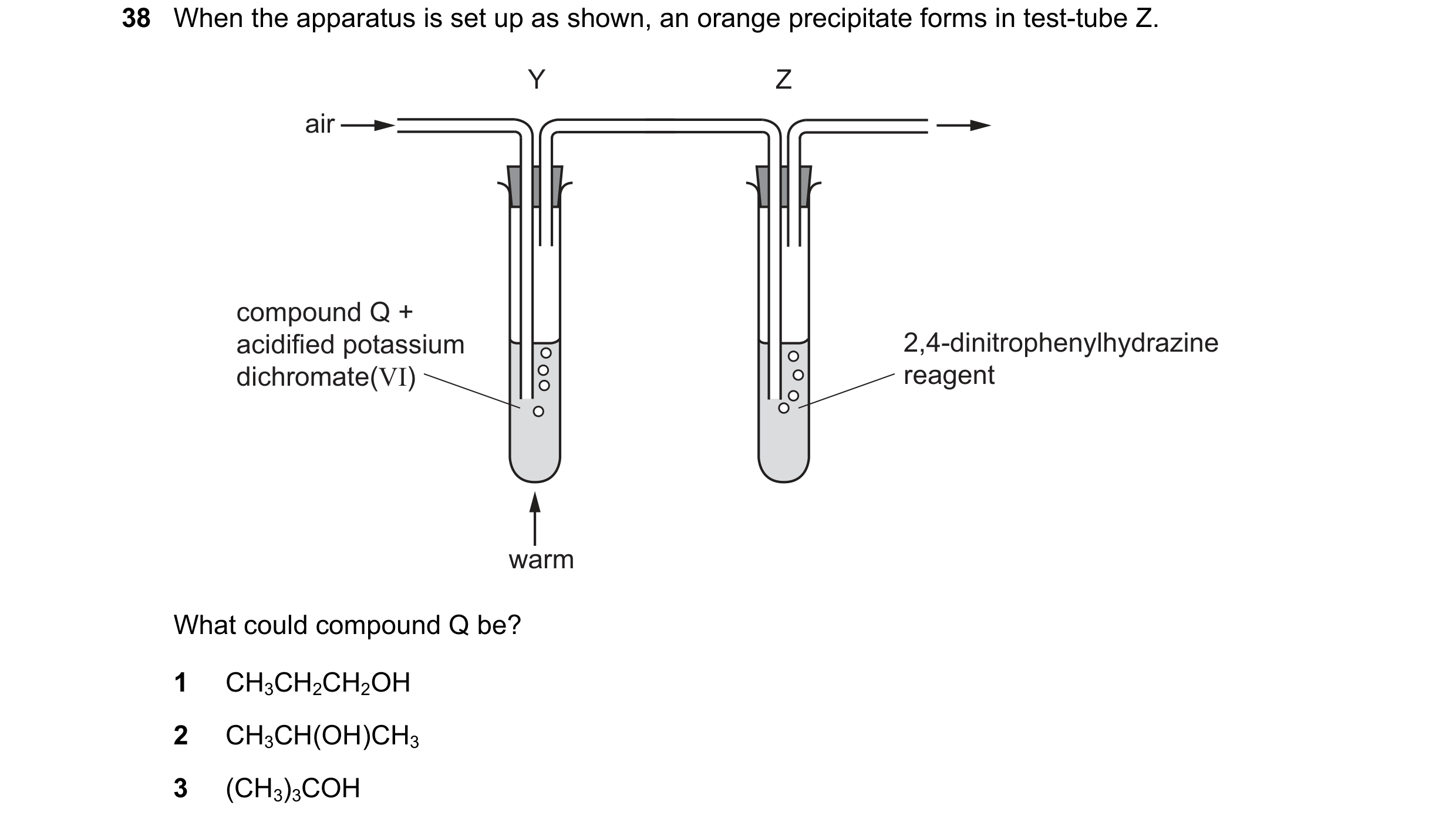 67 / 107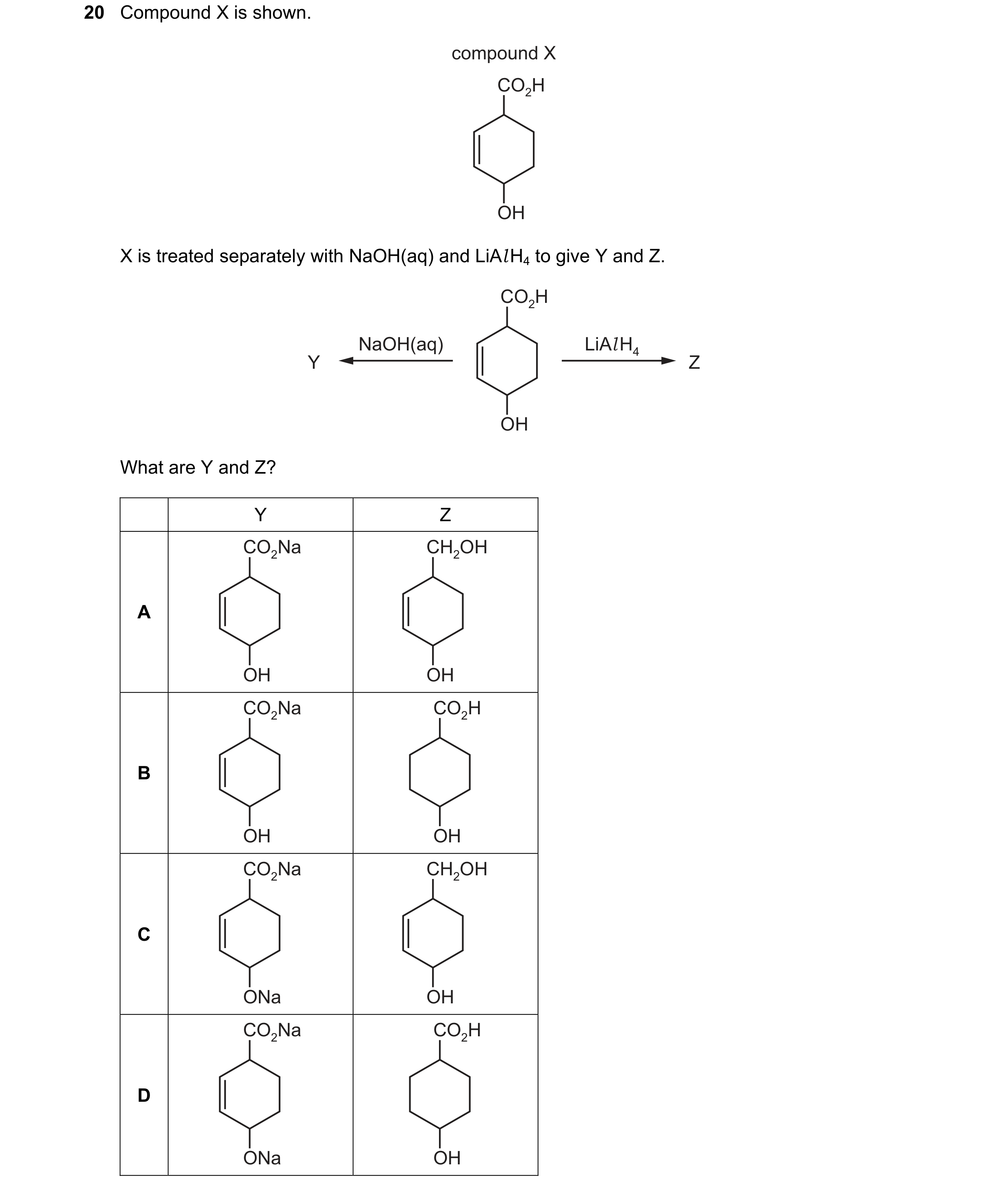
 68 / 107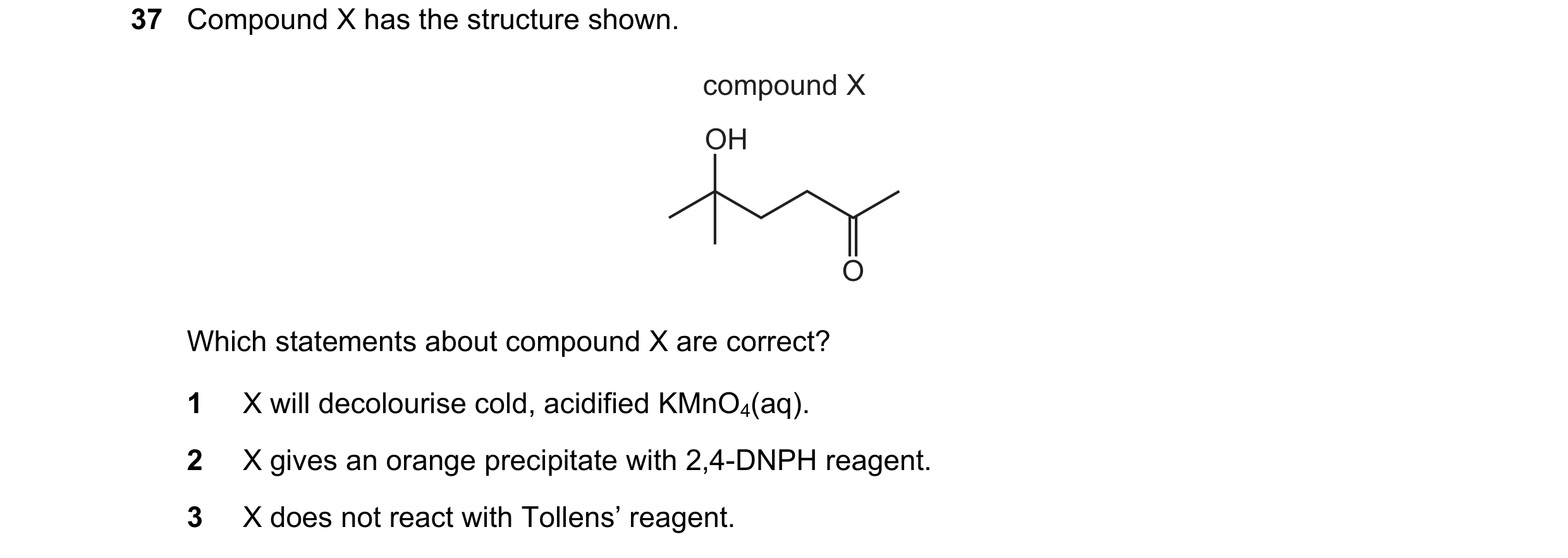

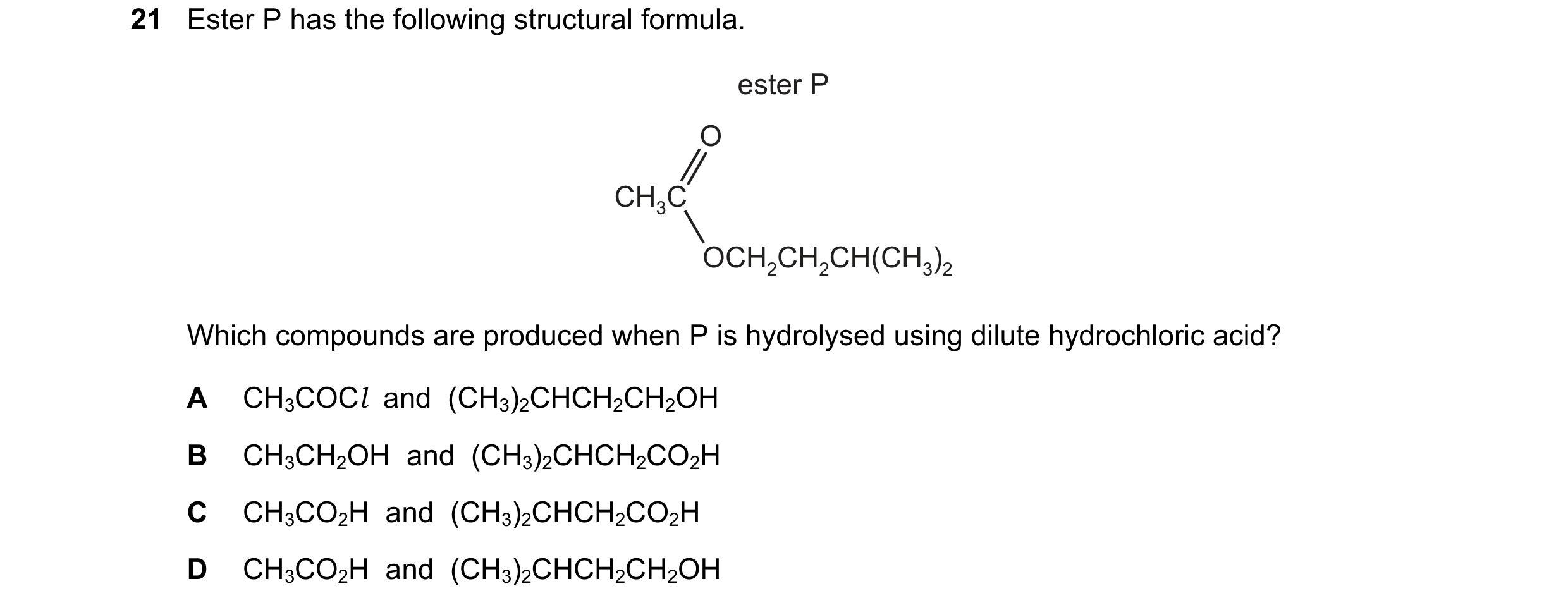

 69 / 107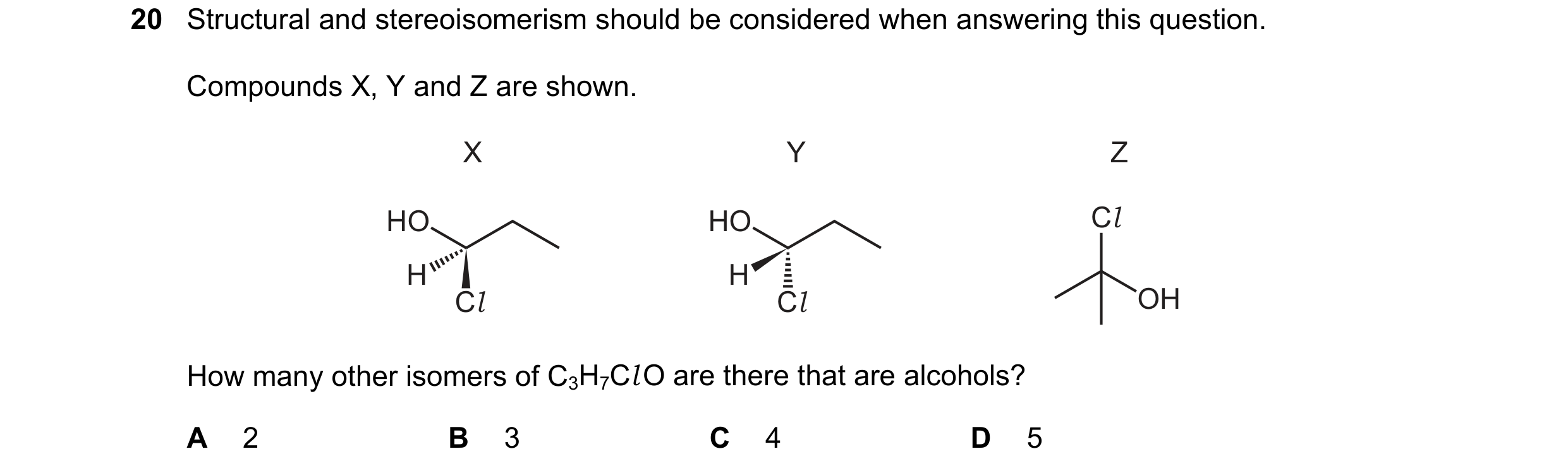
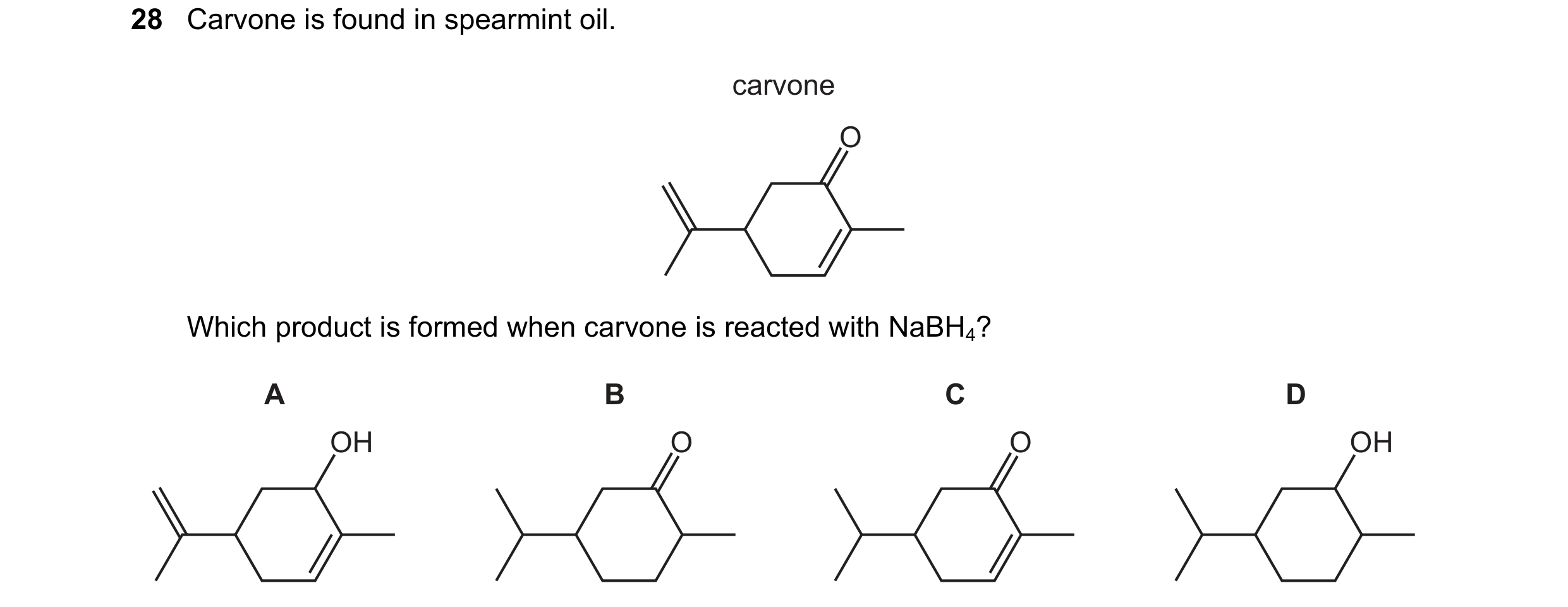
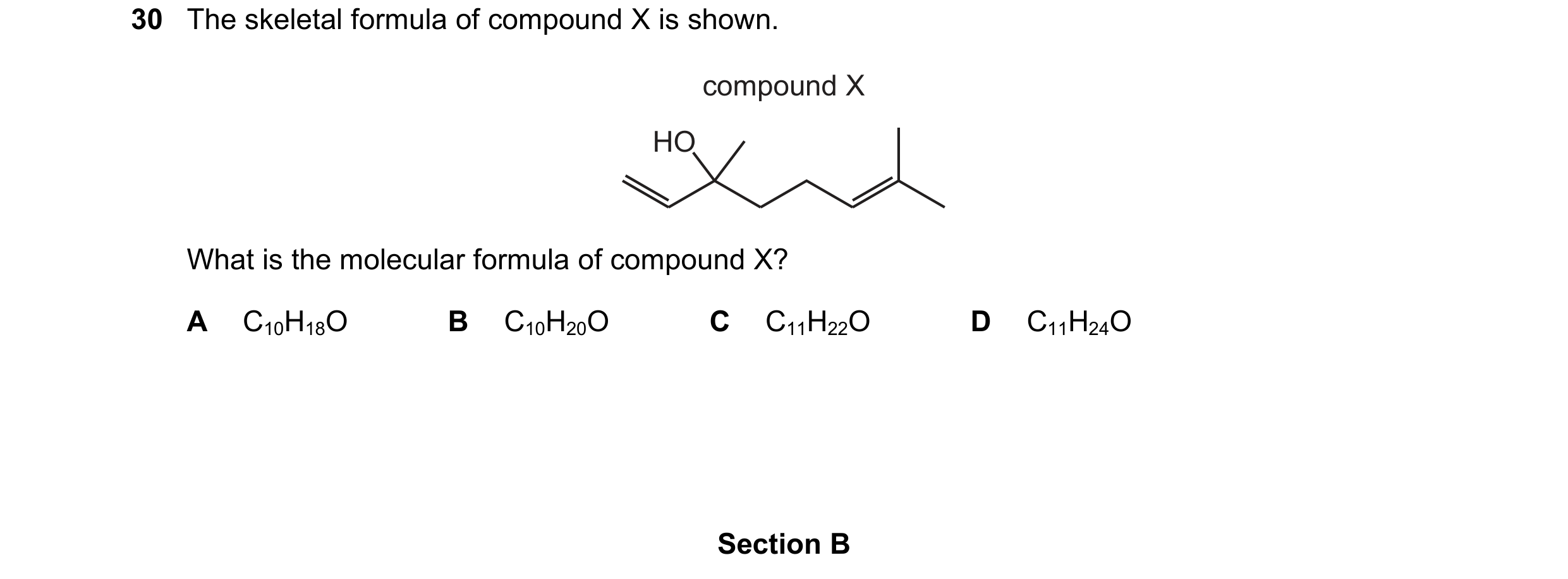 70 / 107
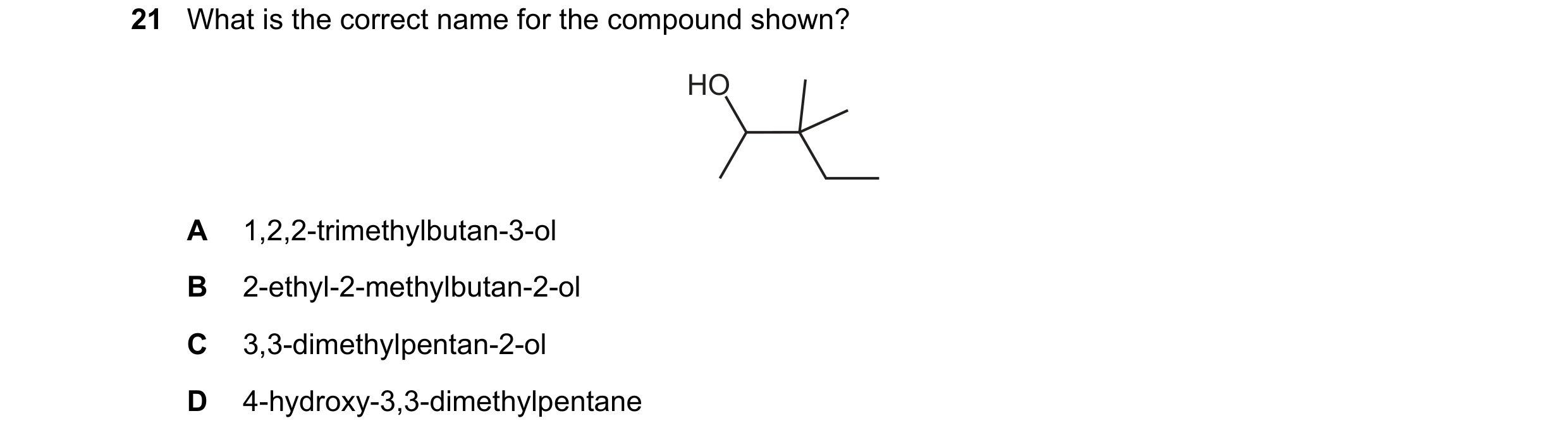
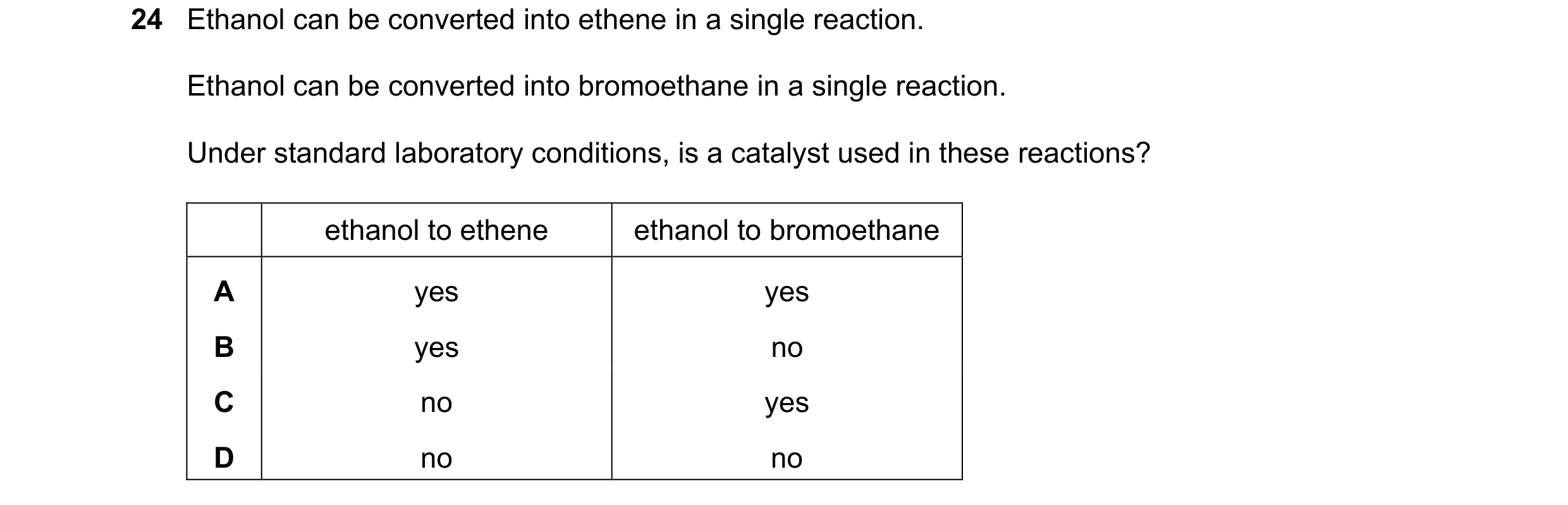

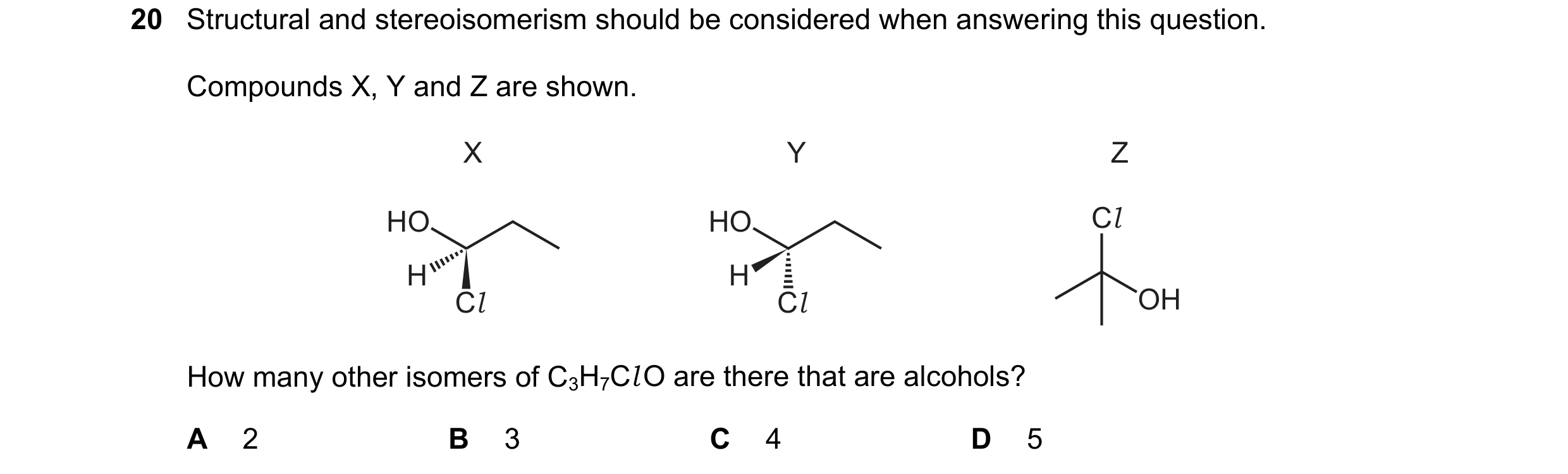 71 / 107
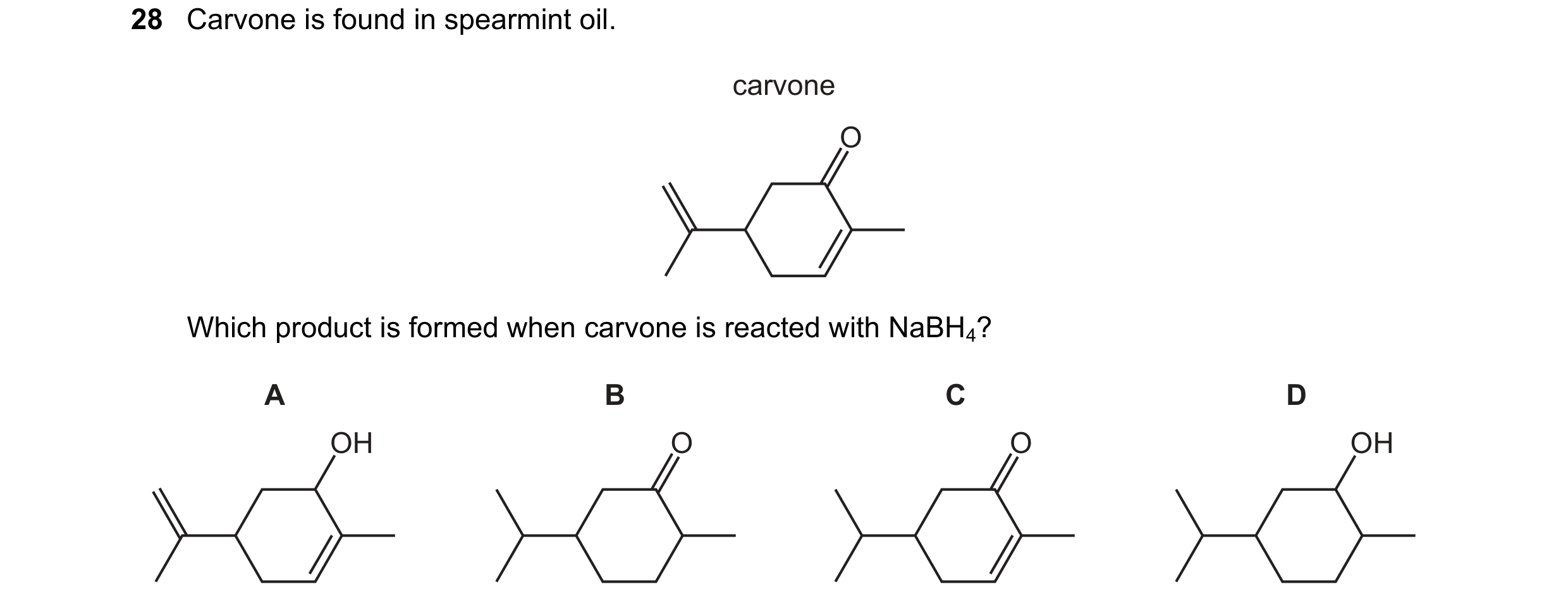


 72 / 107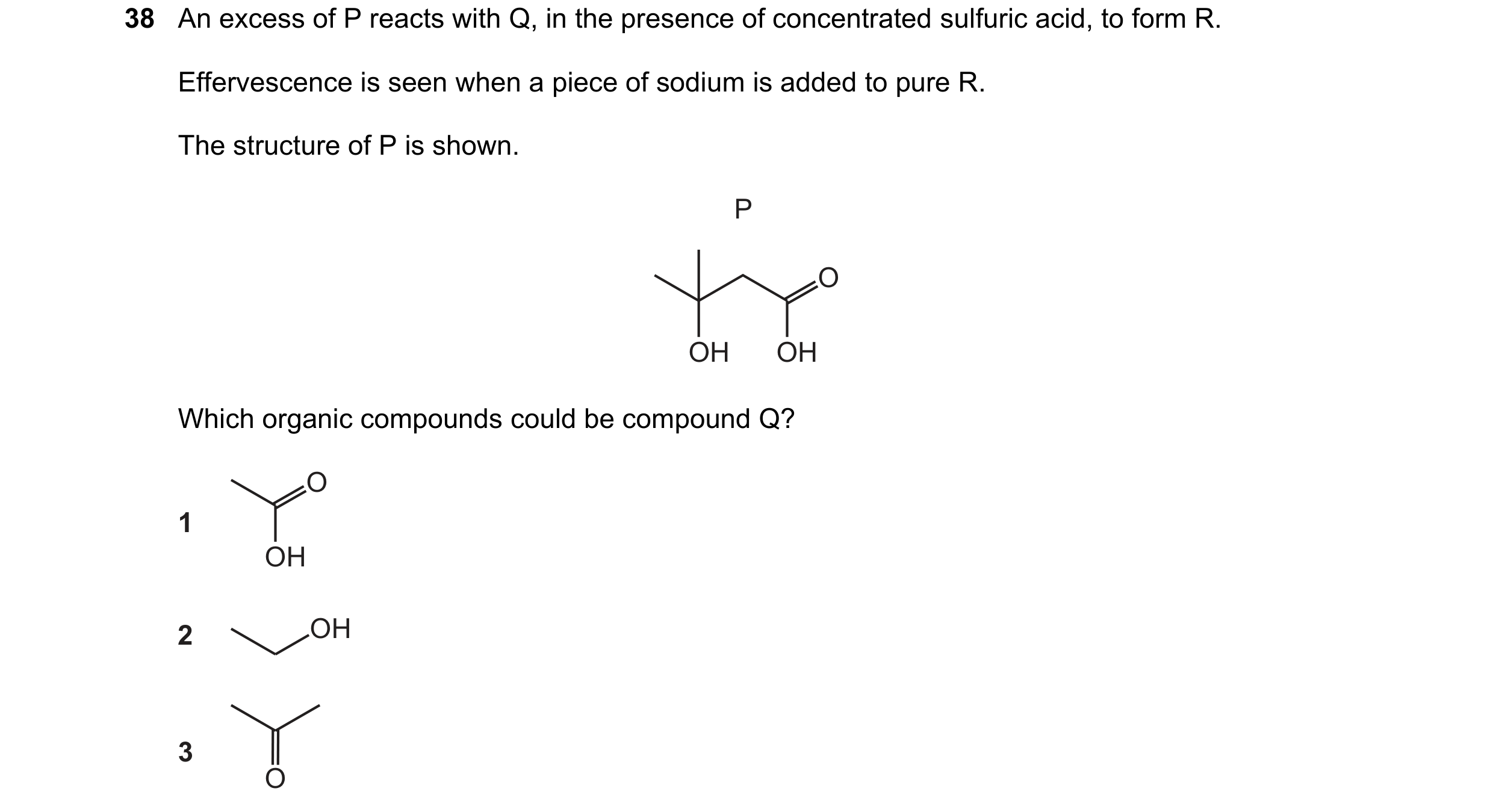
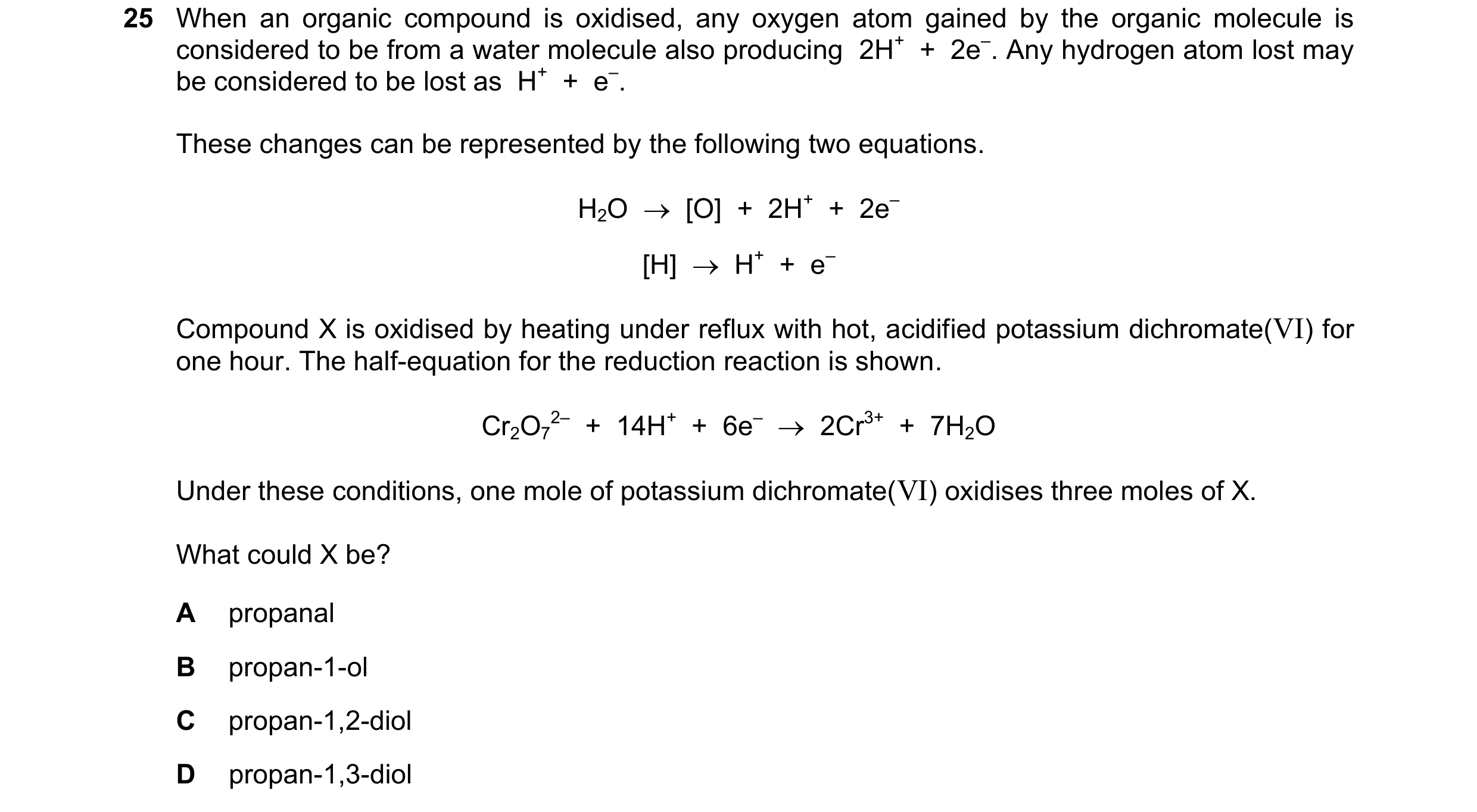 73 / 107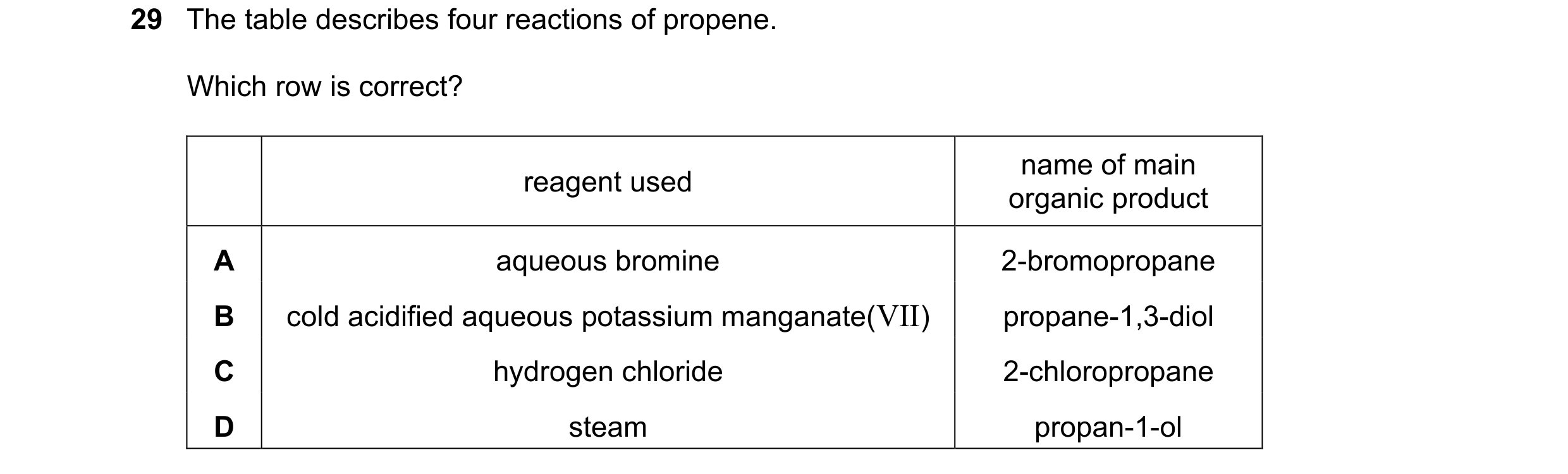

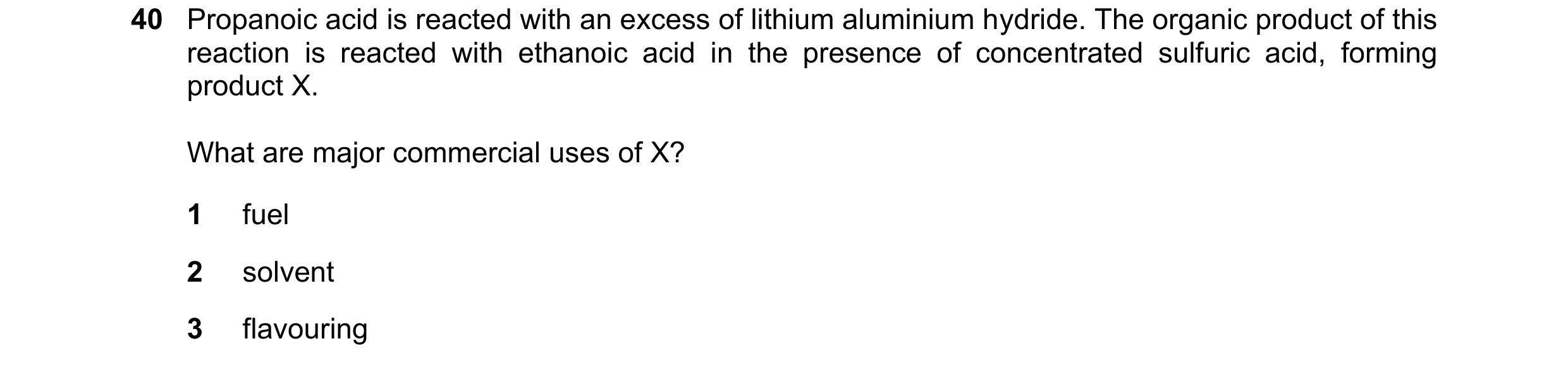
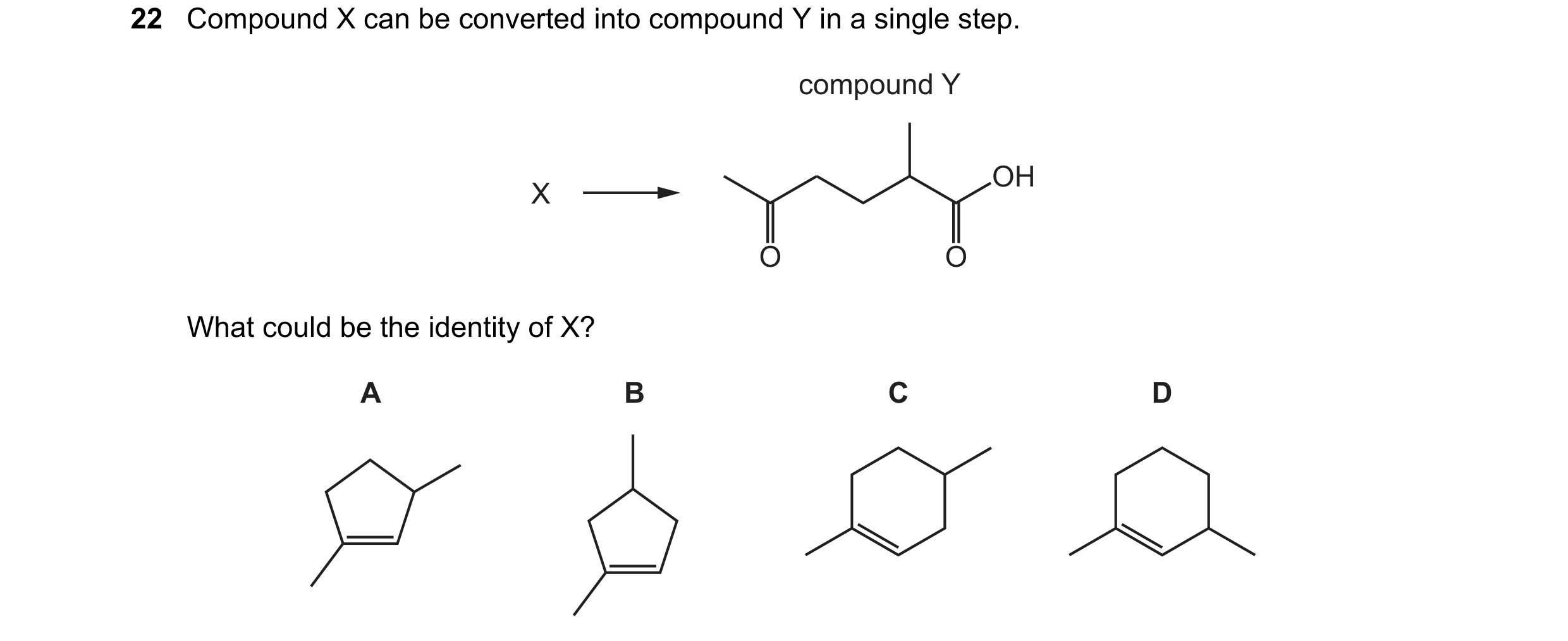 74 / 107

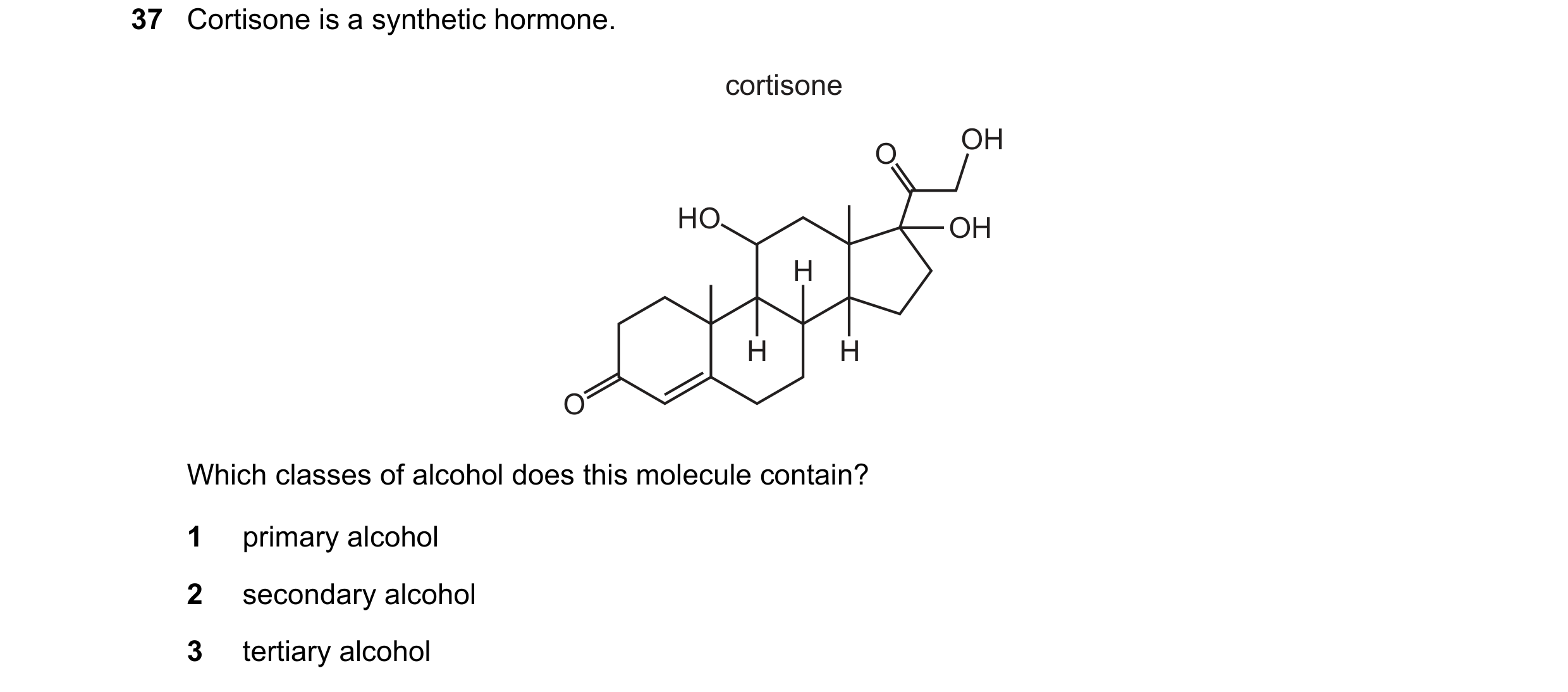
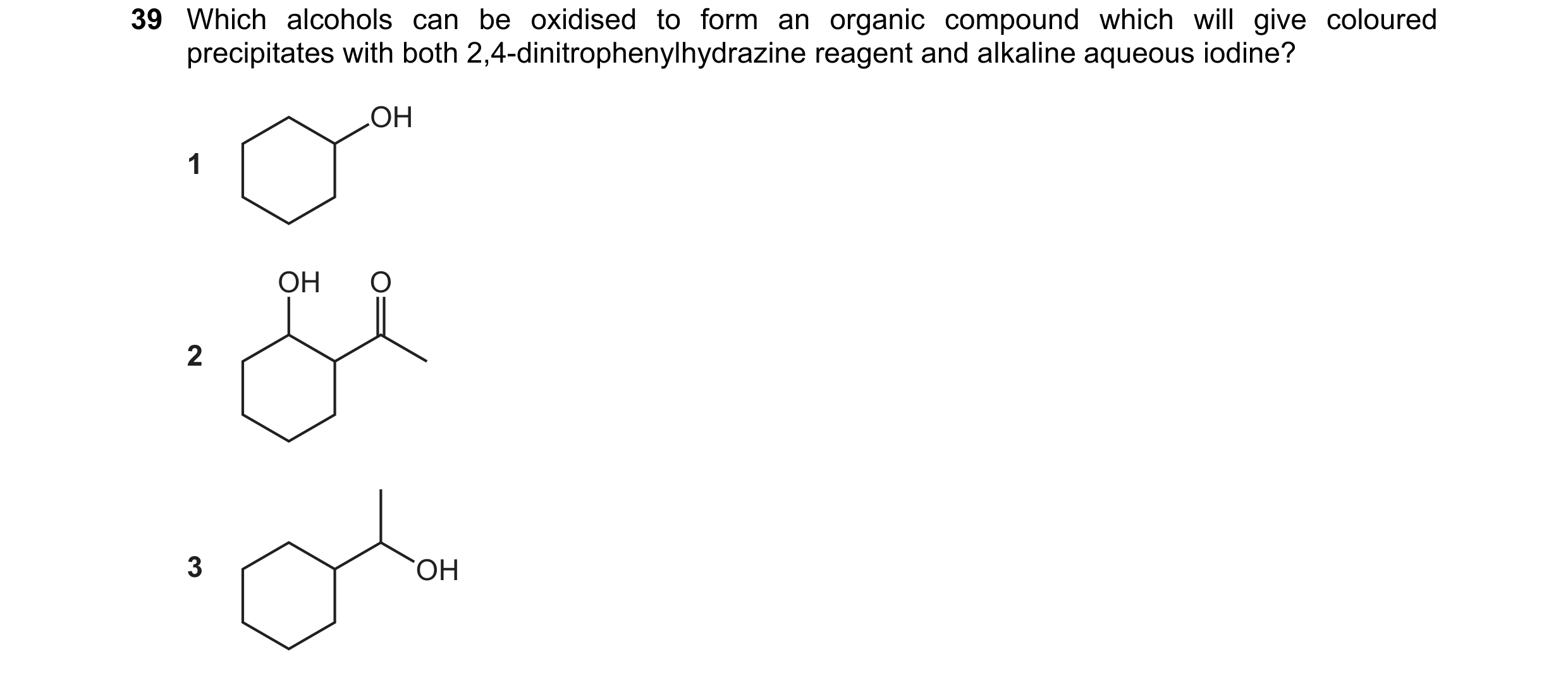 75 / 107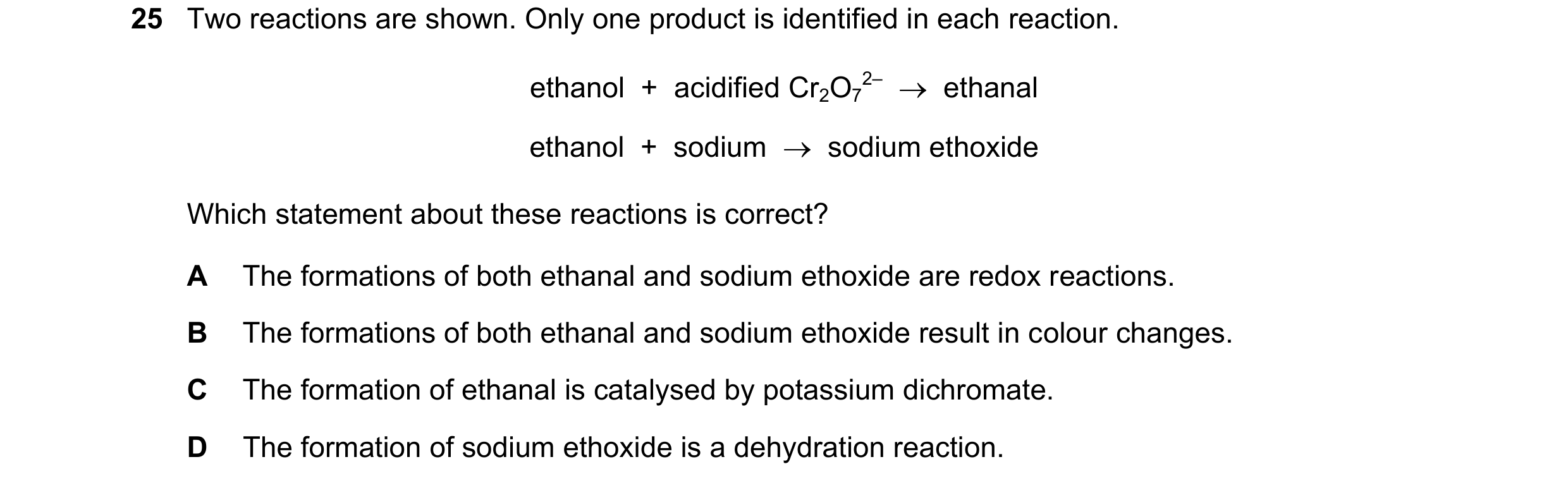
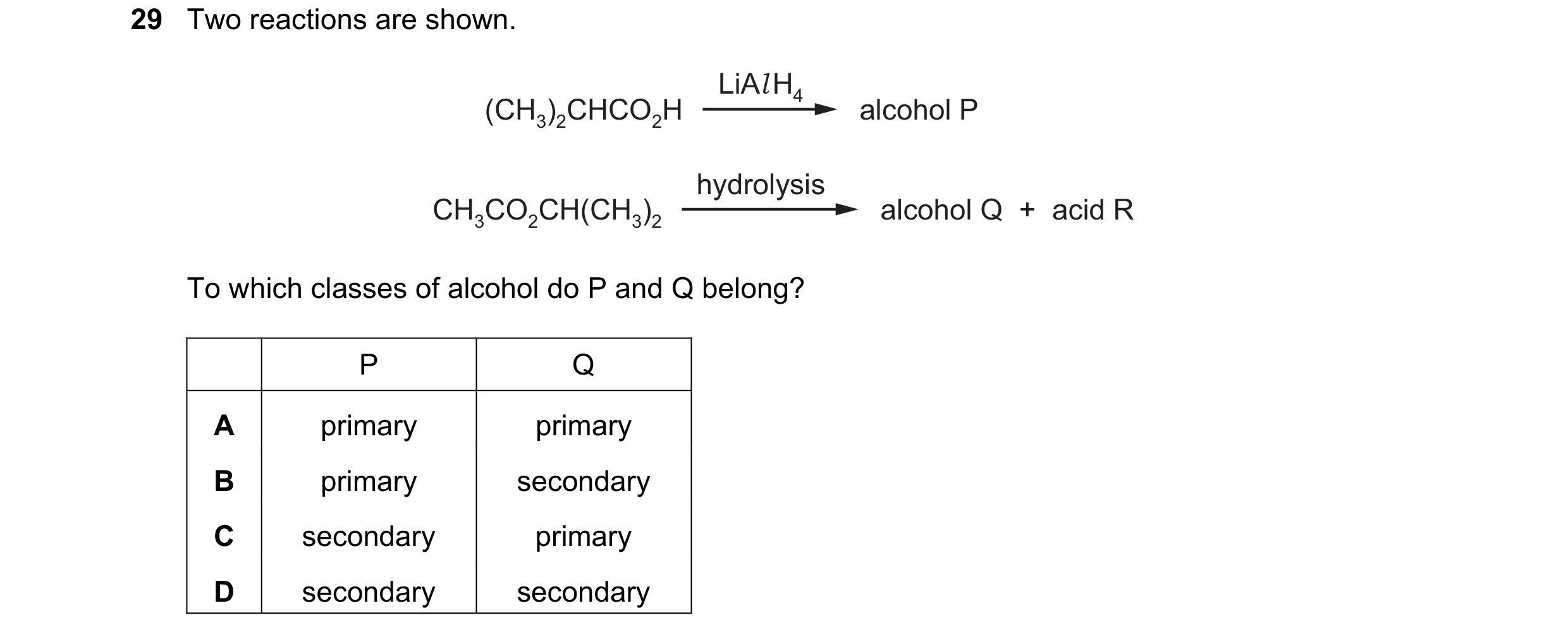
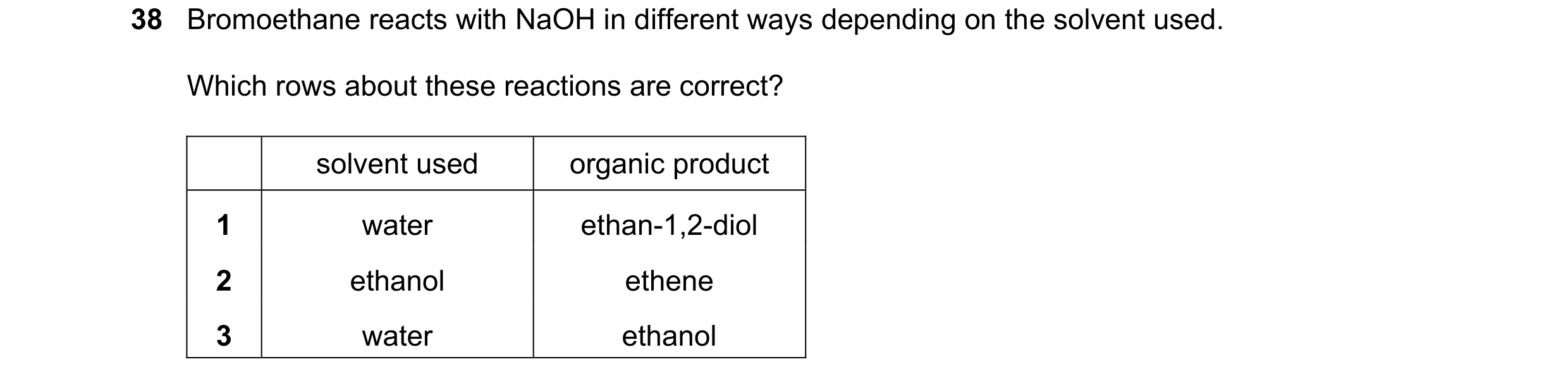
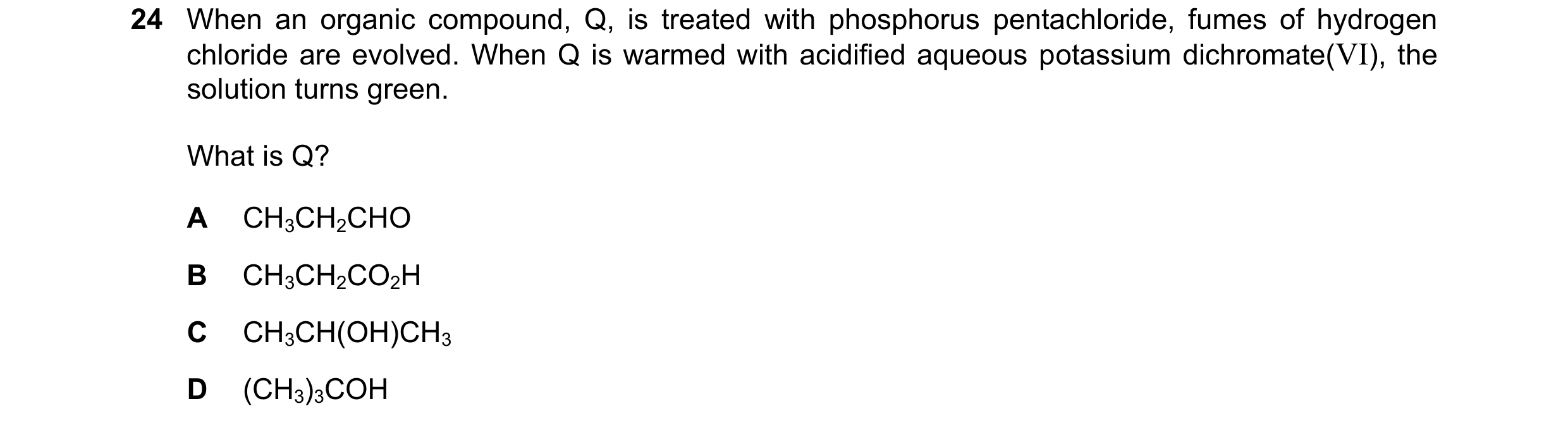 76 / 107
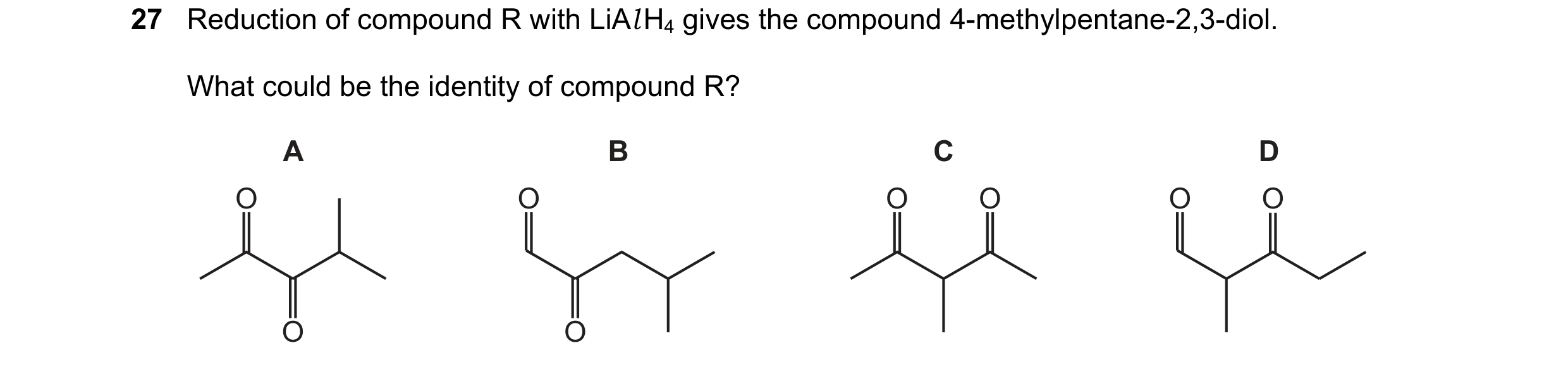 77 / 107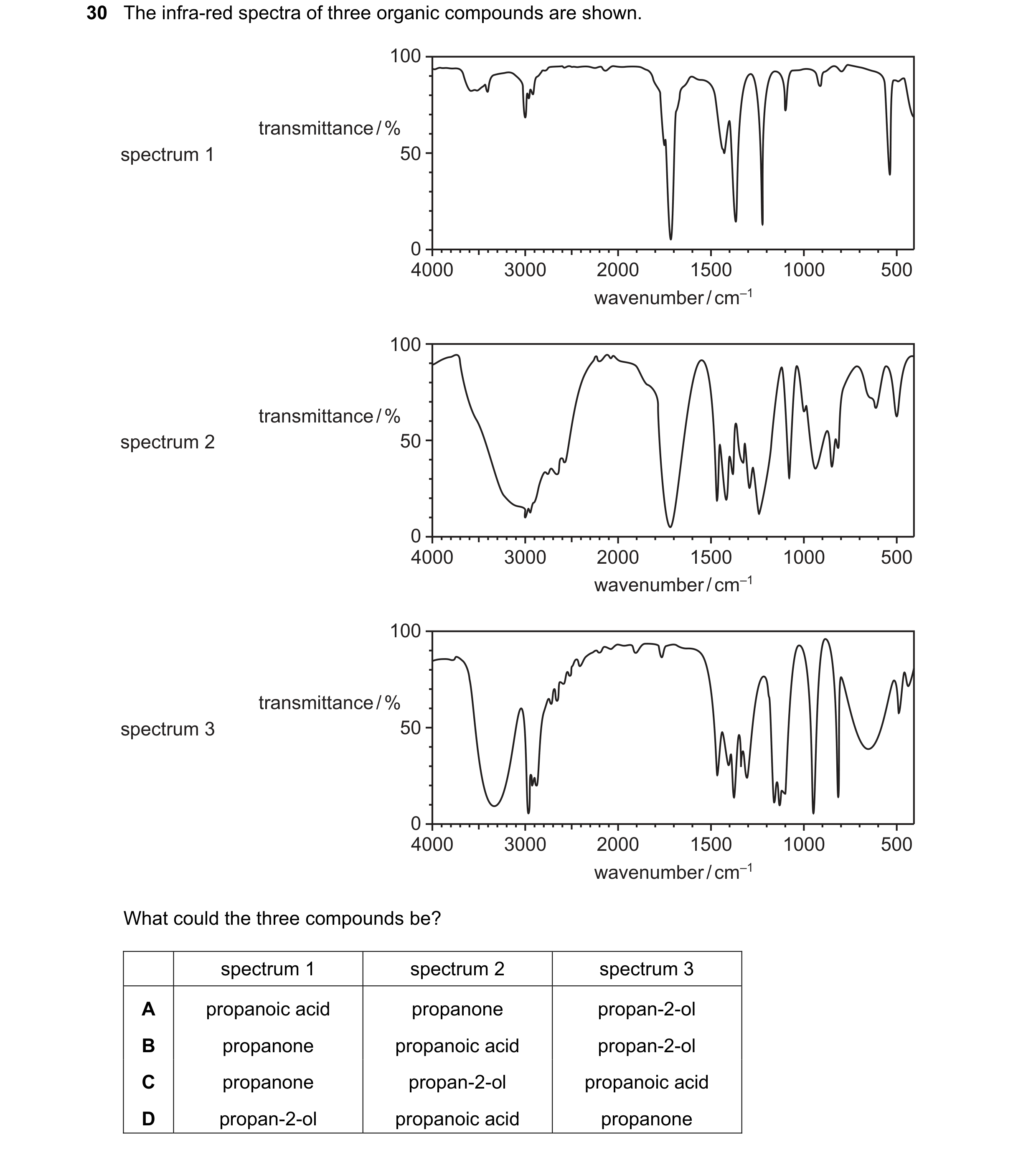
 78 / 107
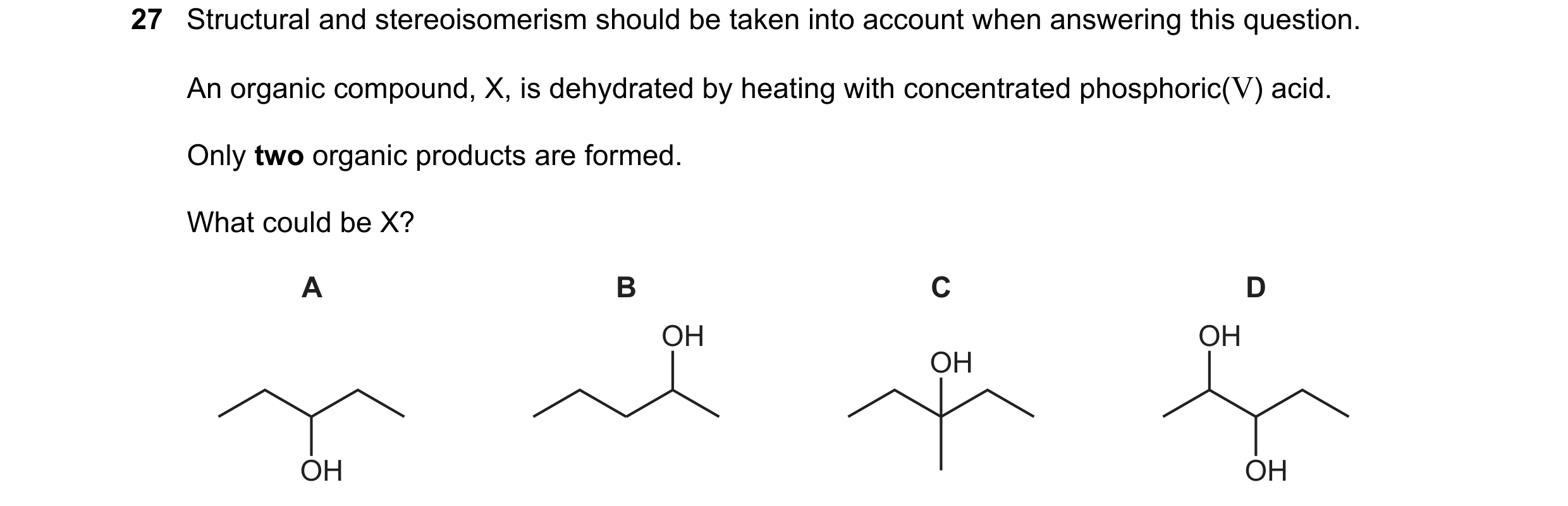
 79 / 107
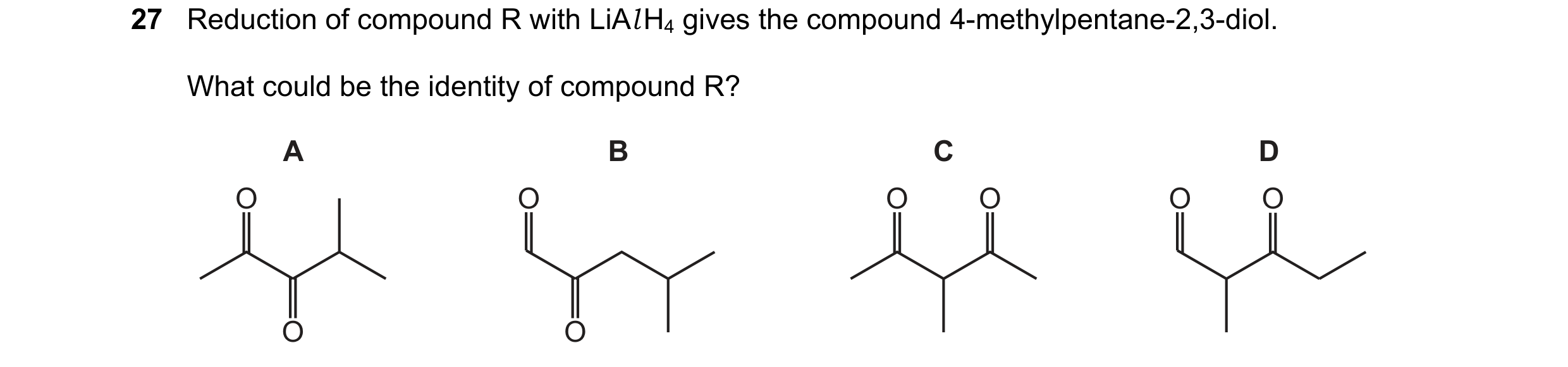 80 / 107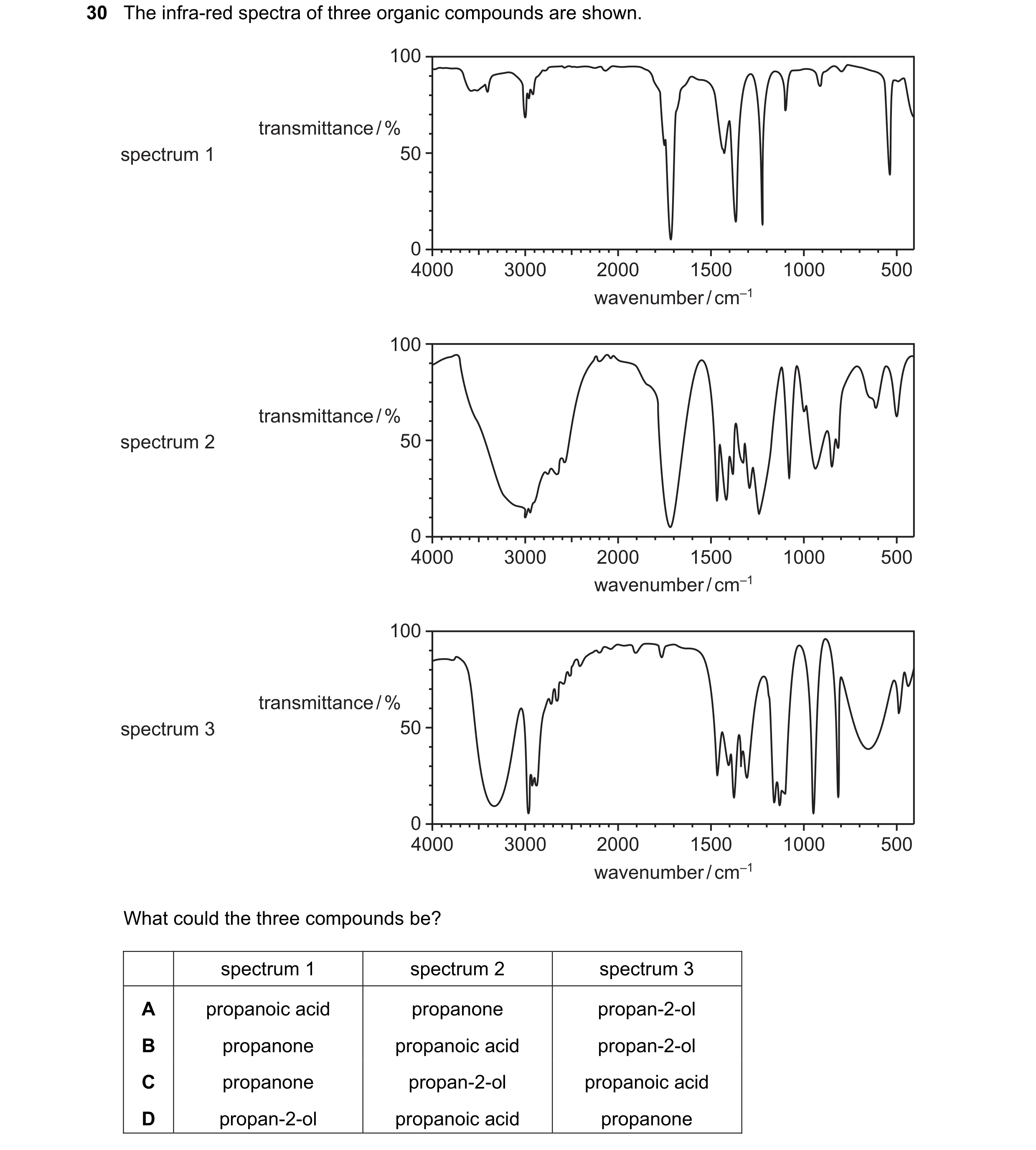

 81 / 107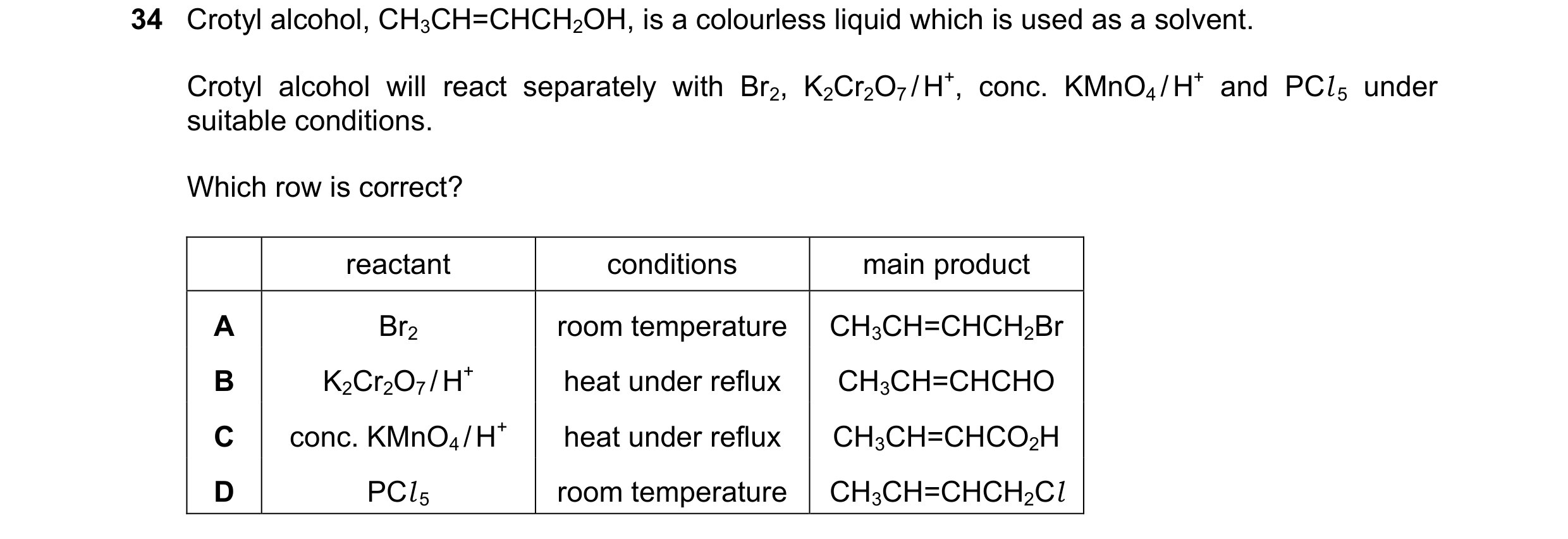
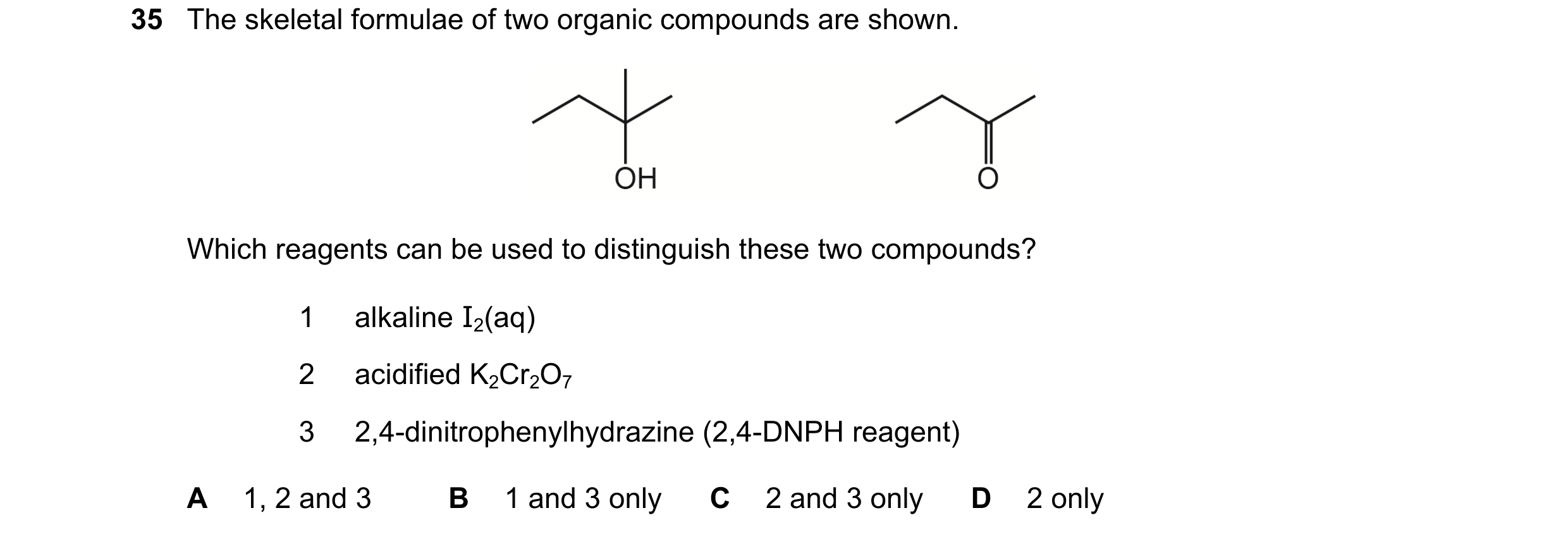

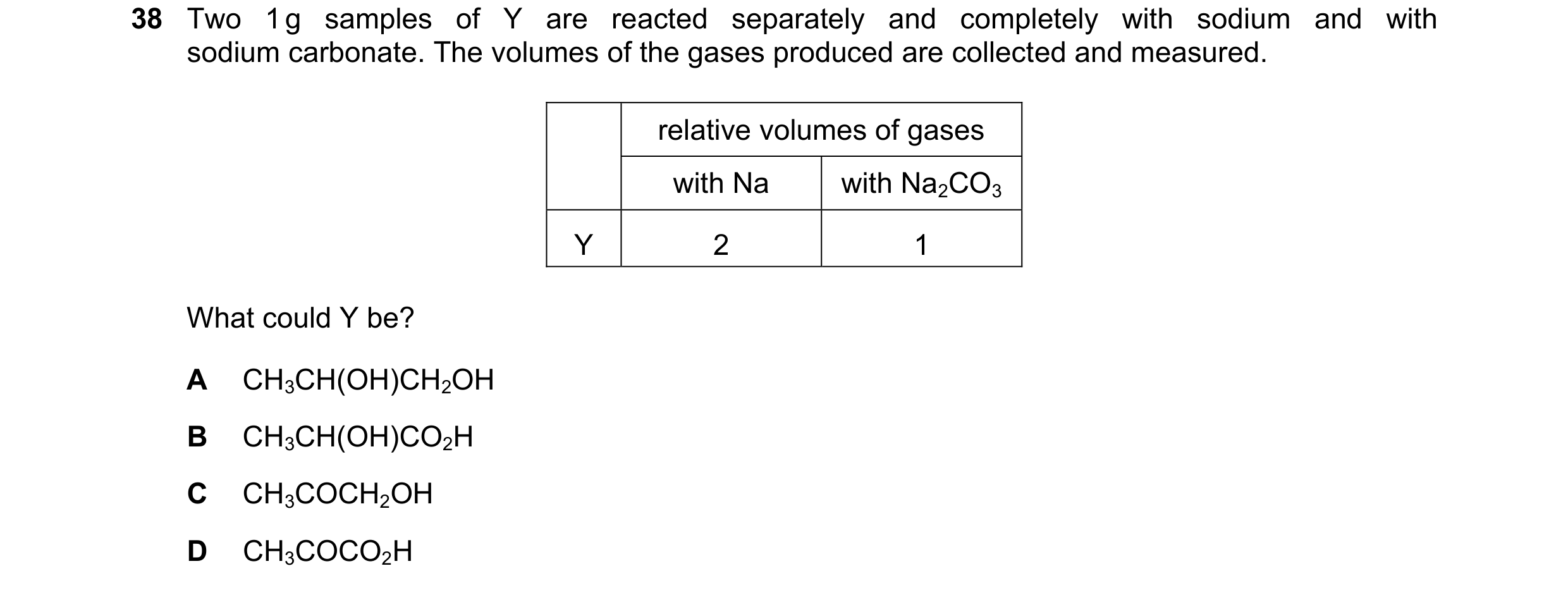 82 / 107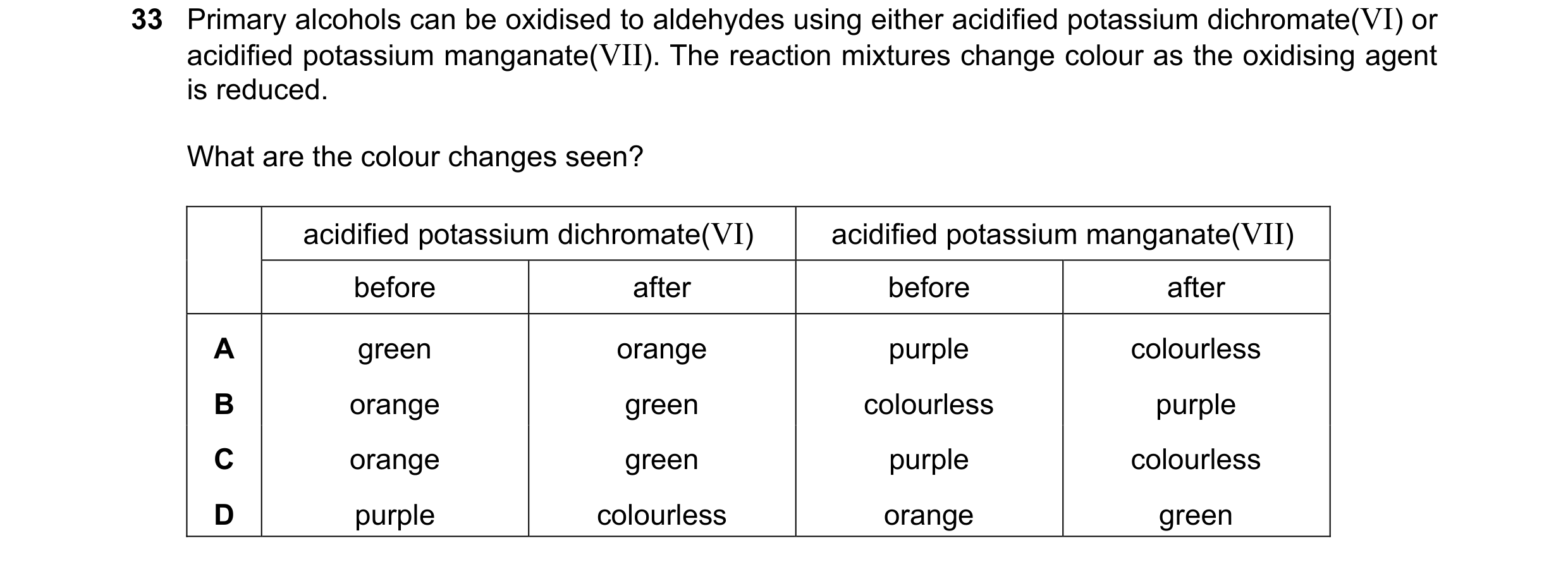

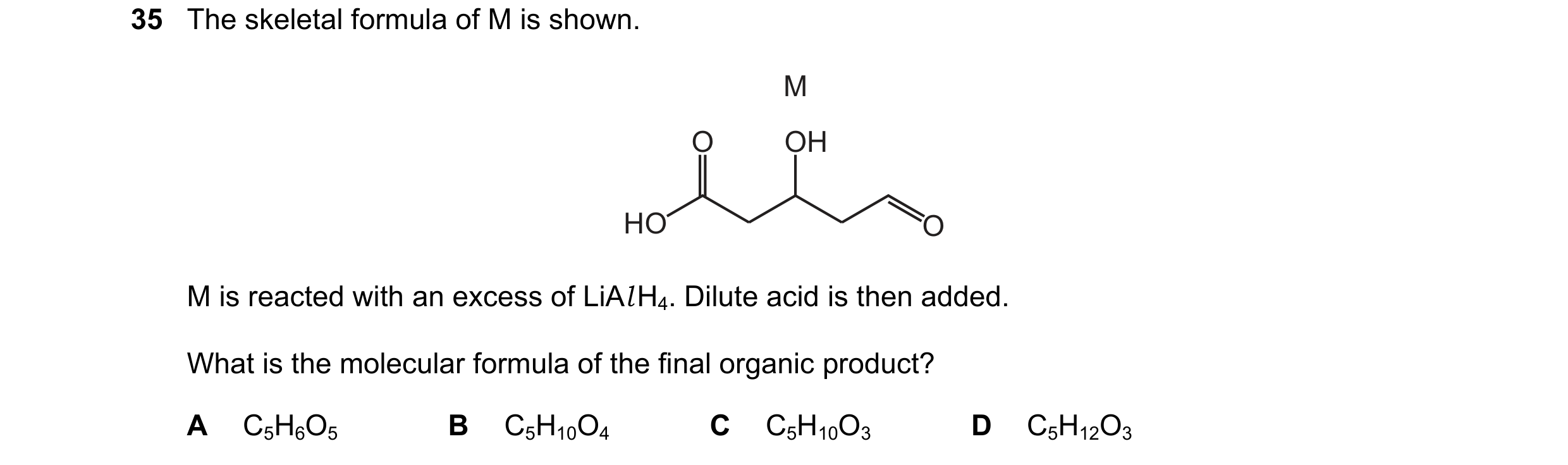
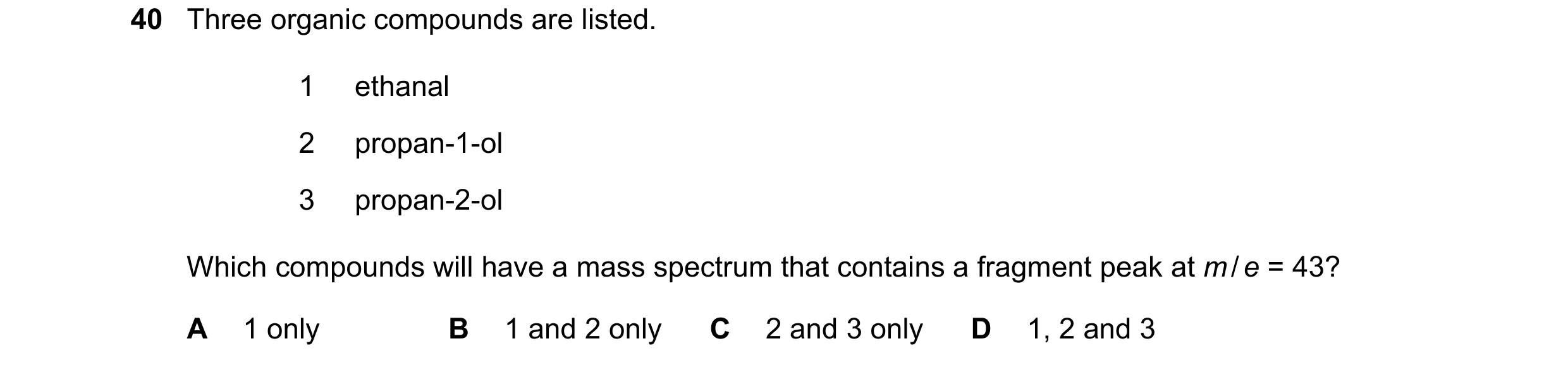 83 / 107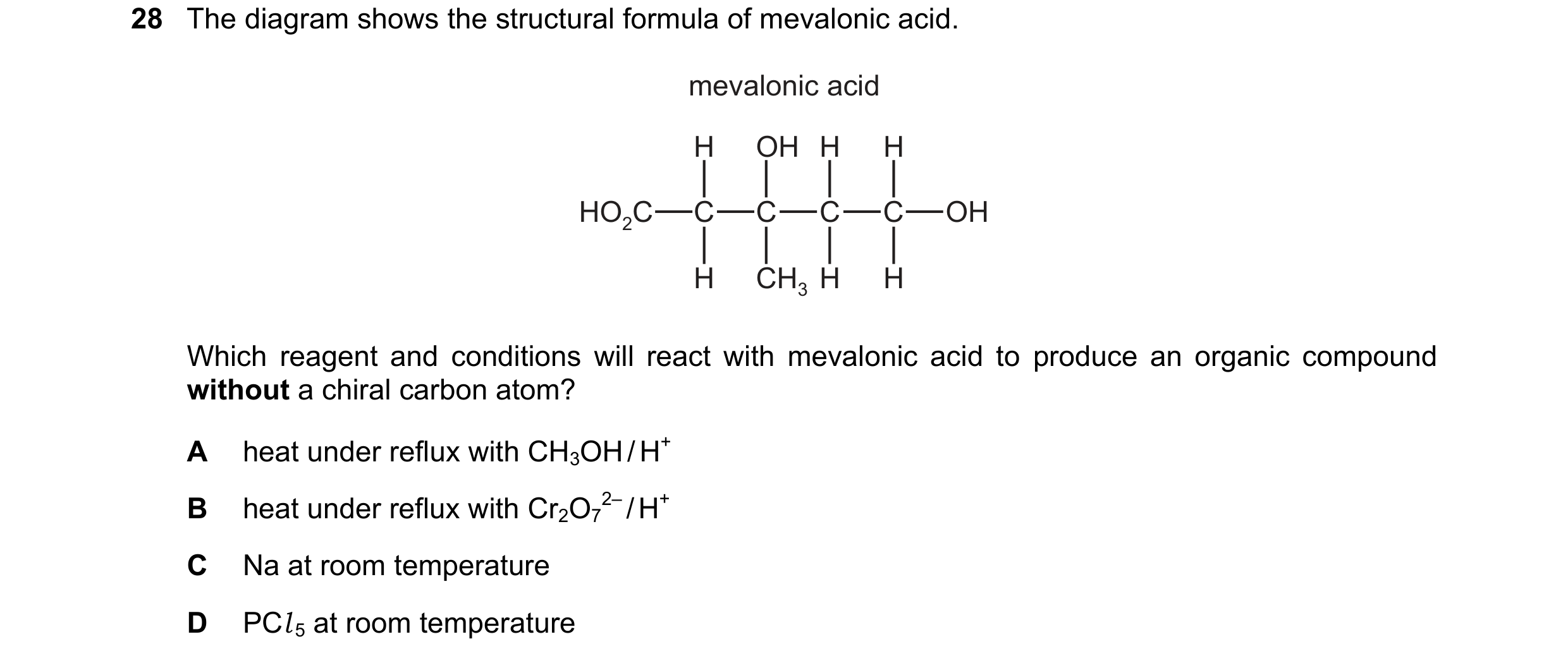
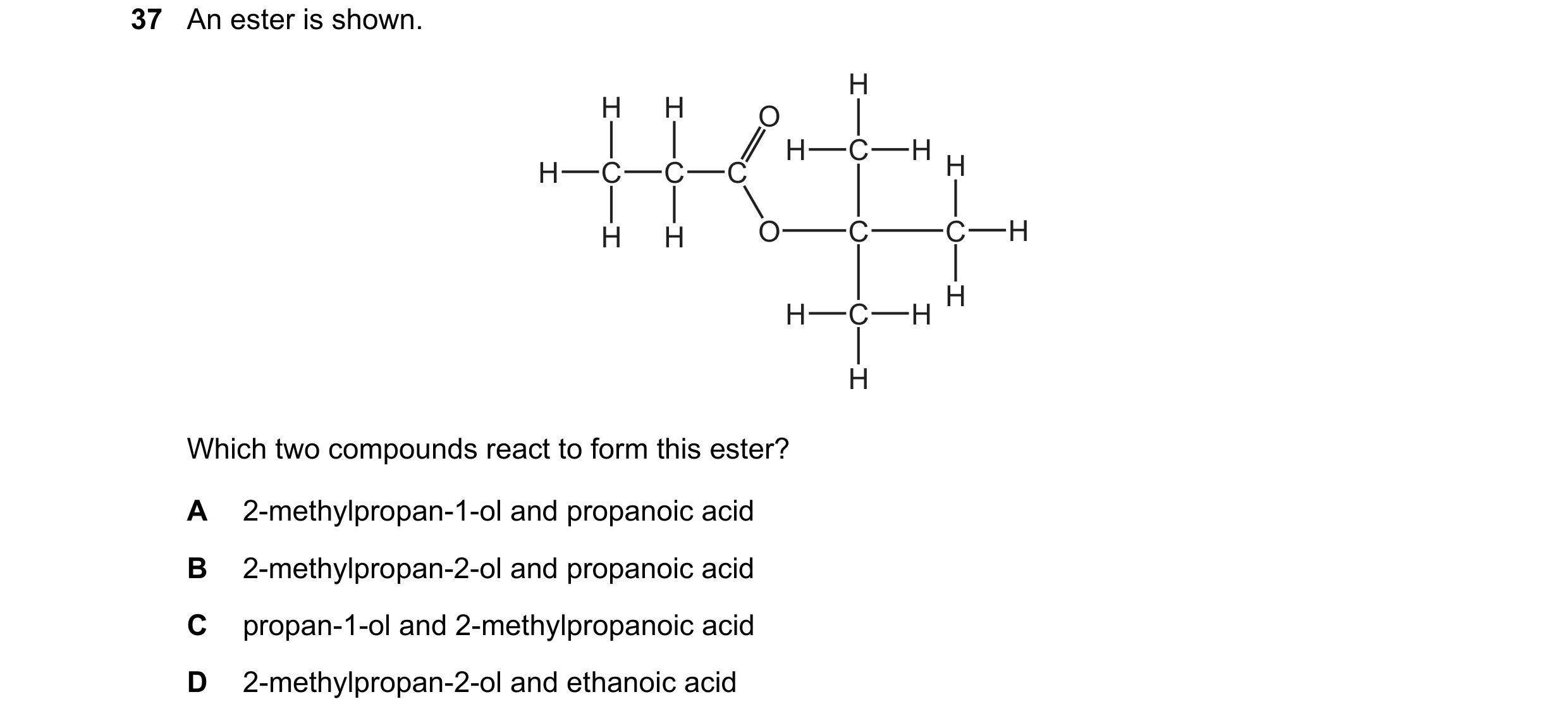

 84 / 107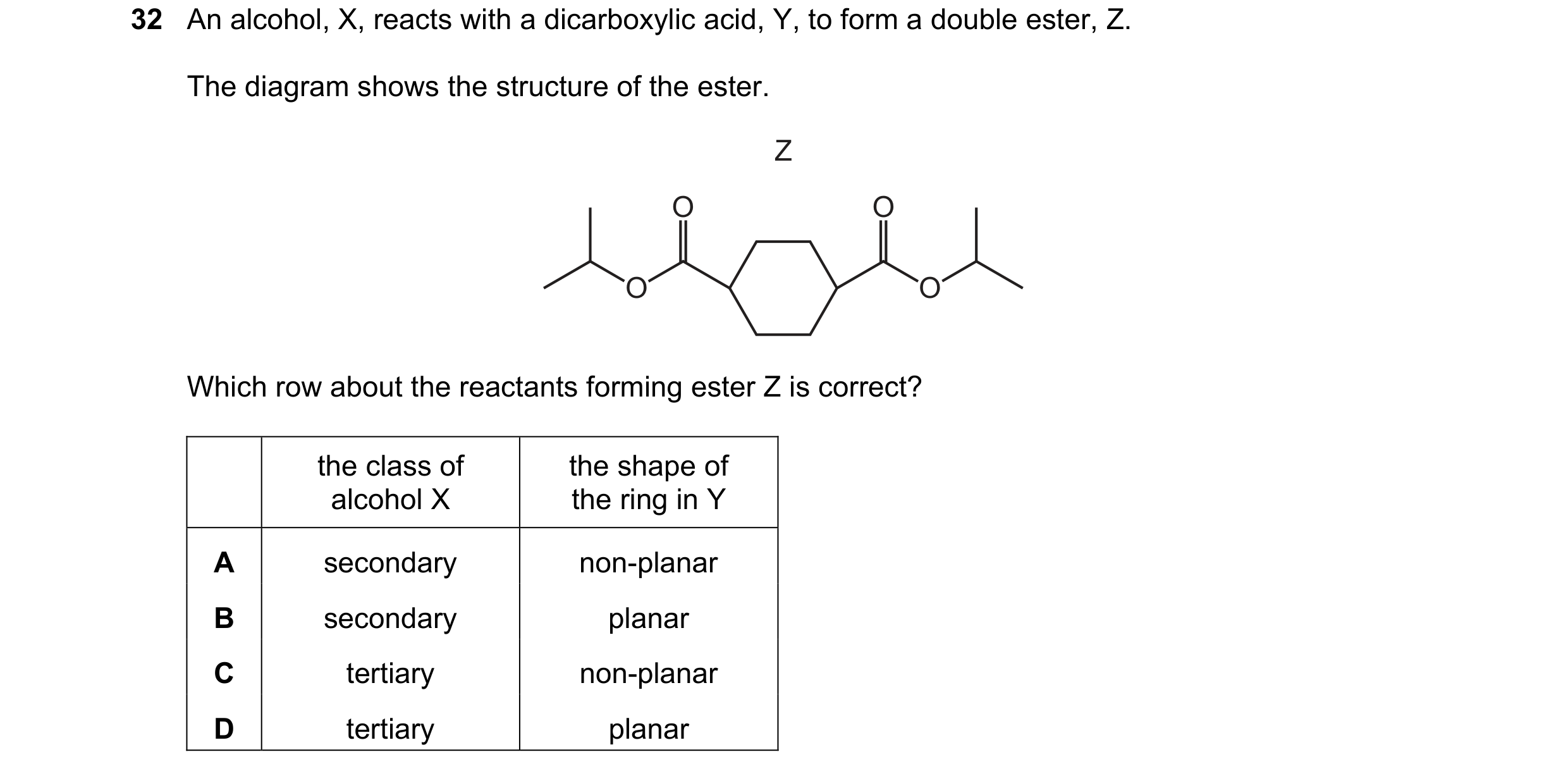
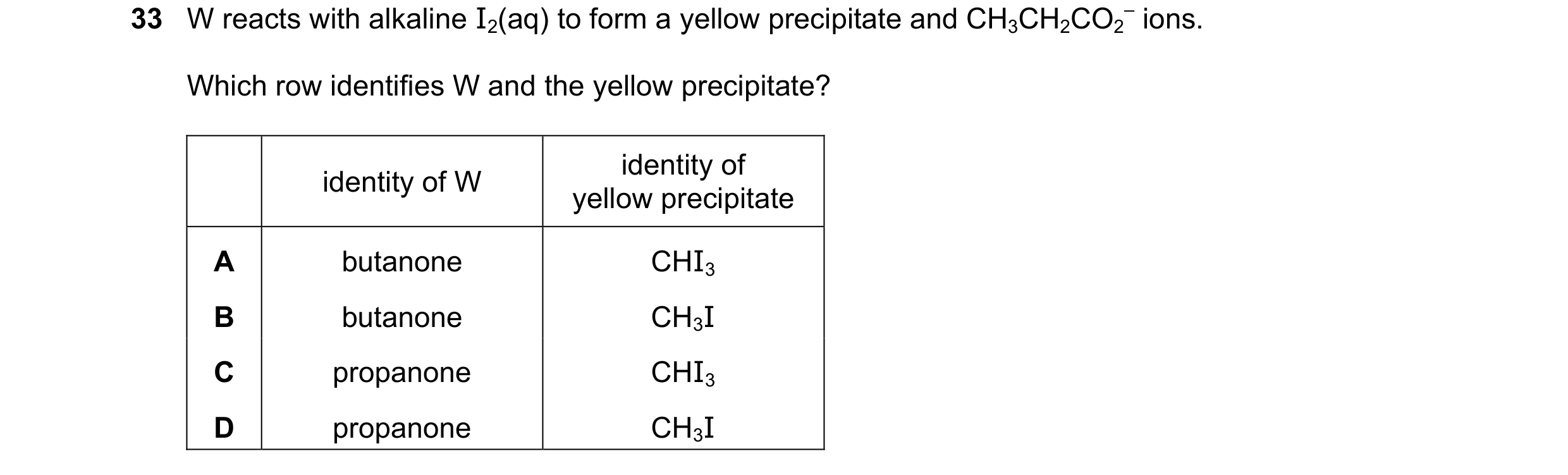
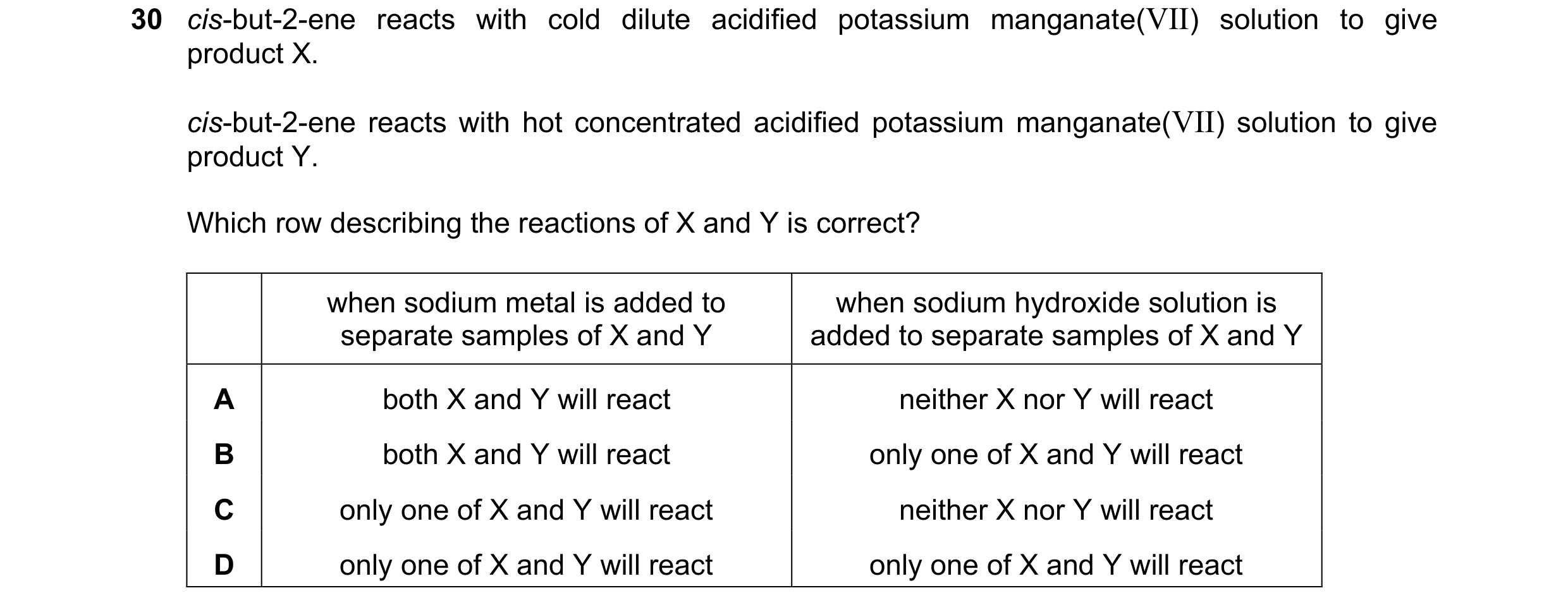 85 / 107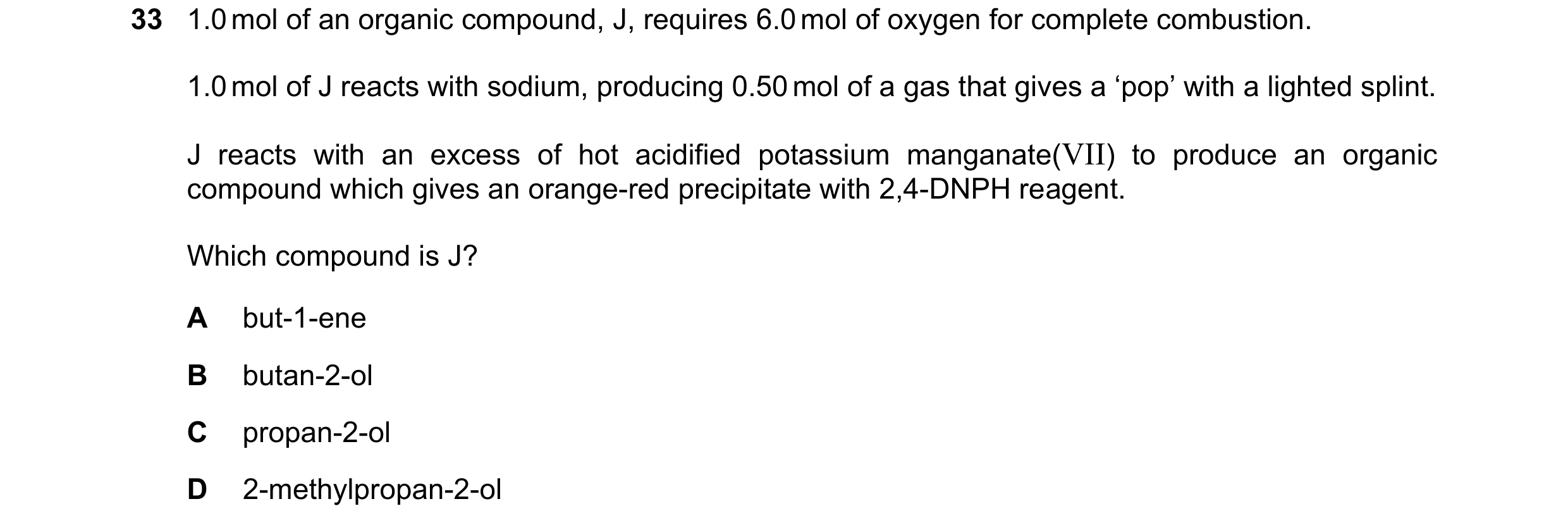
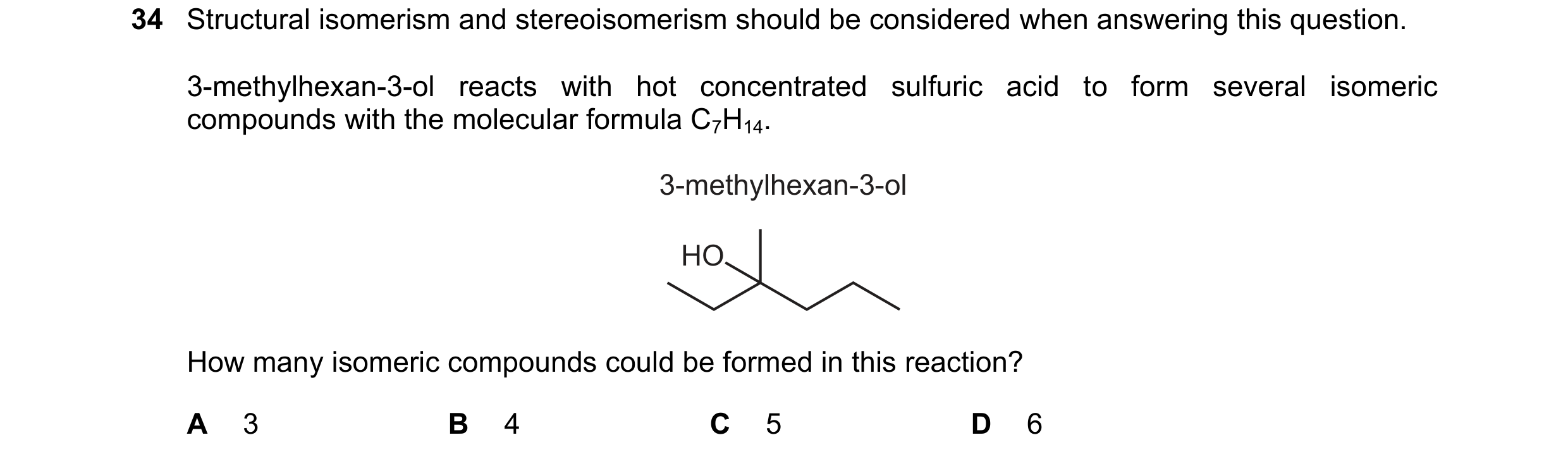
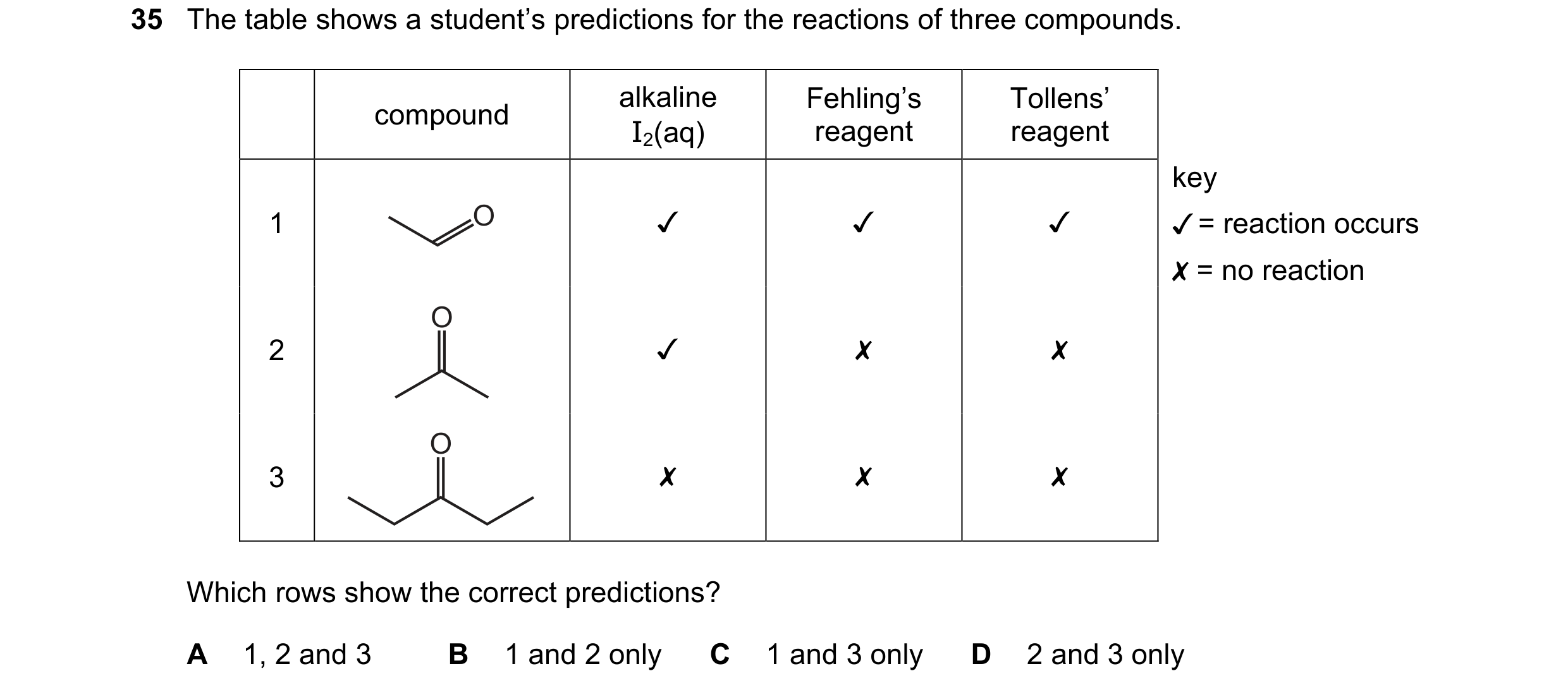
 86 / 107
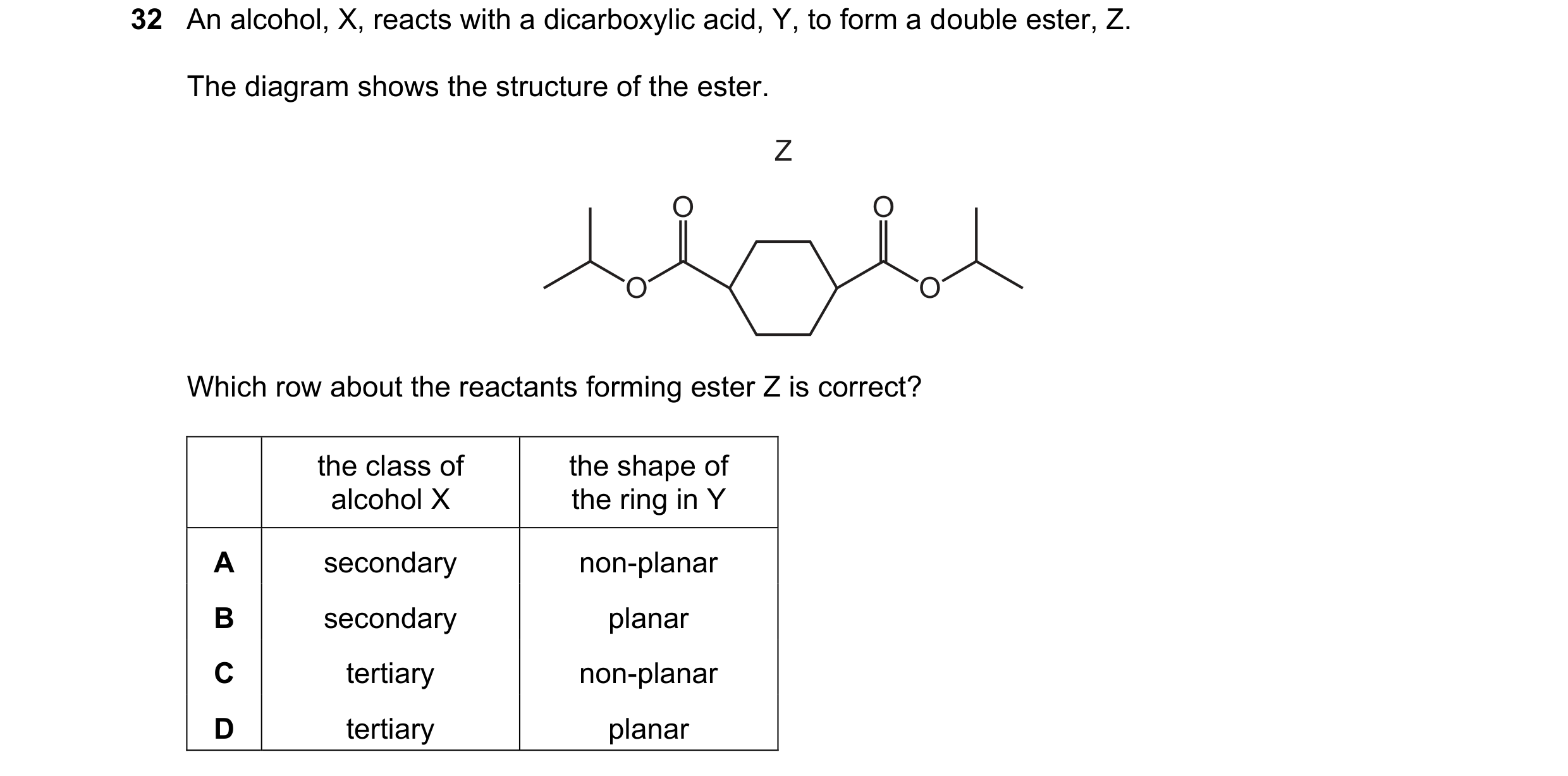
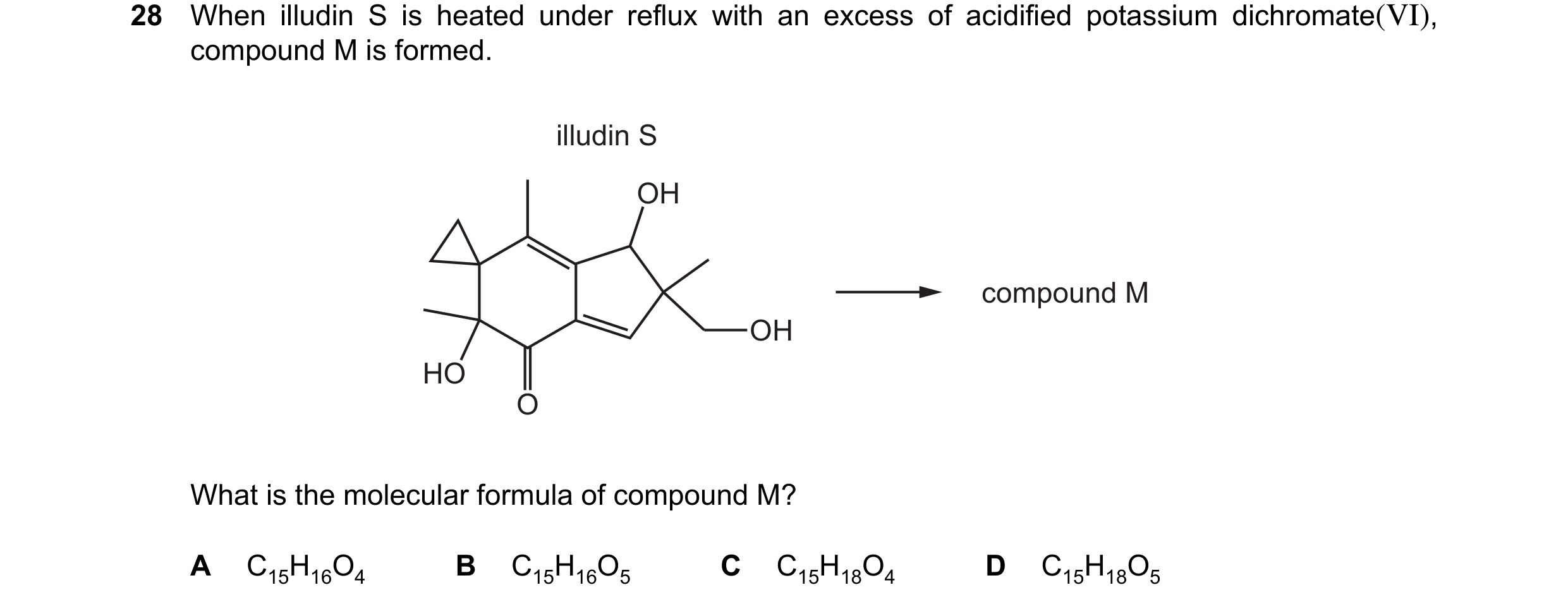
 87 / 107
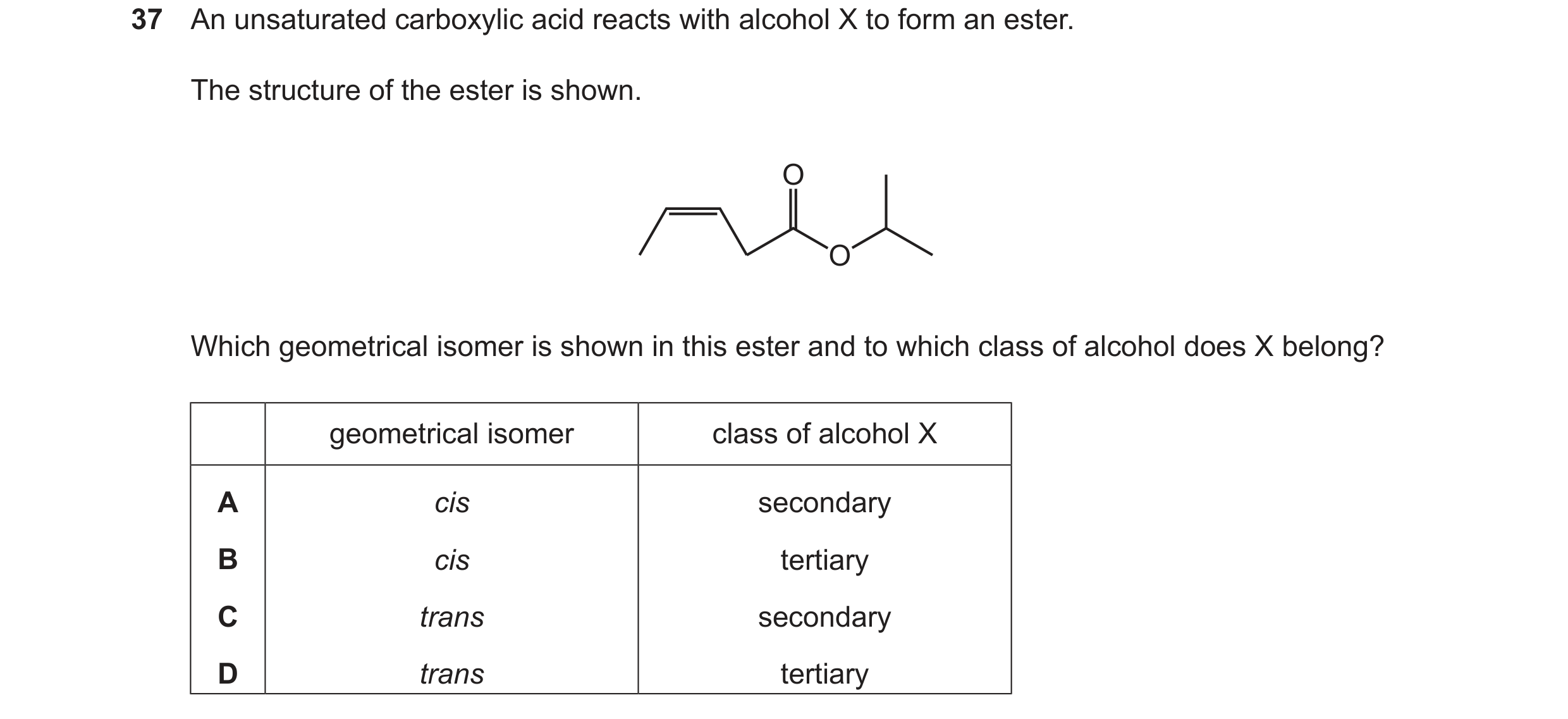
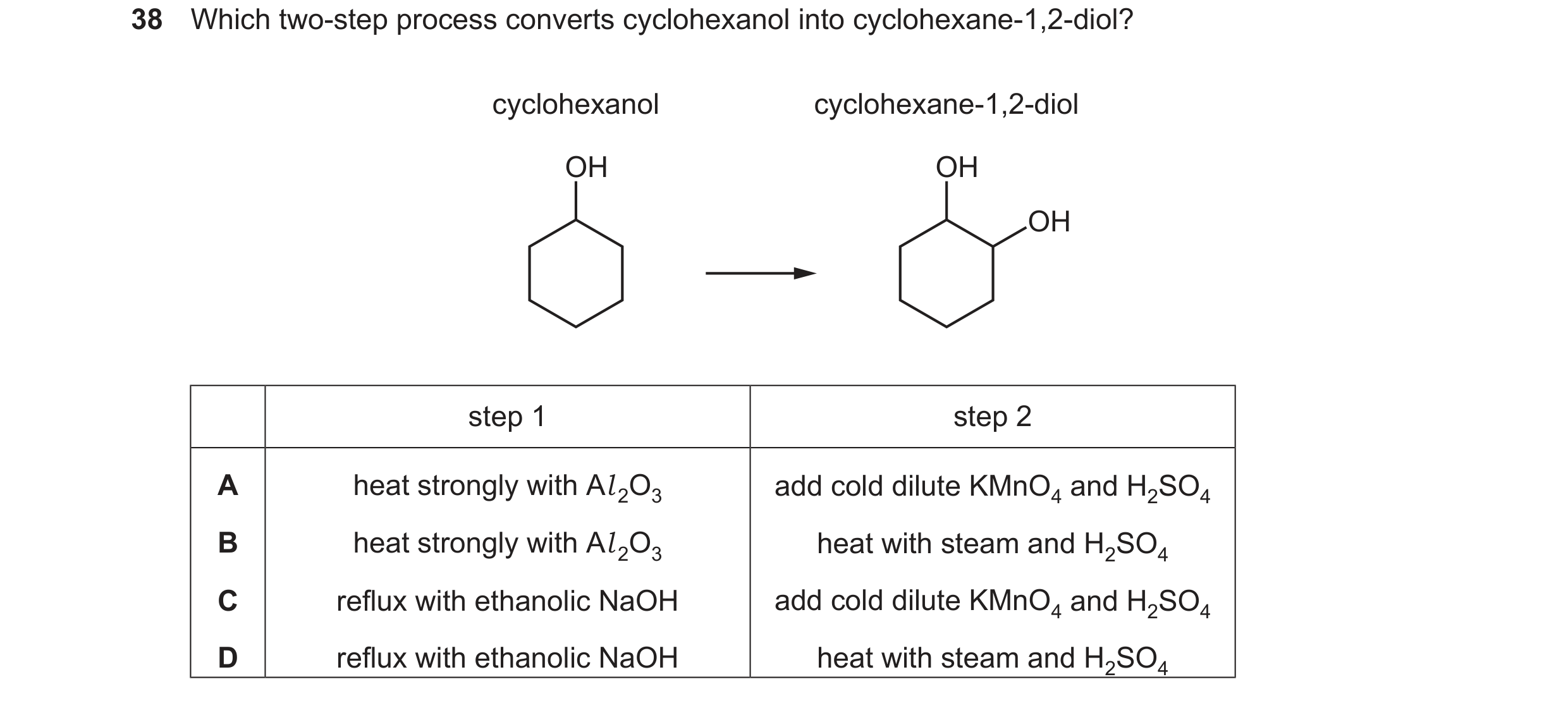 88 / 107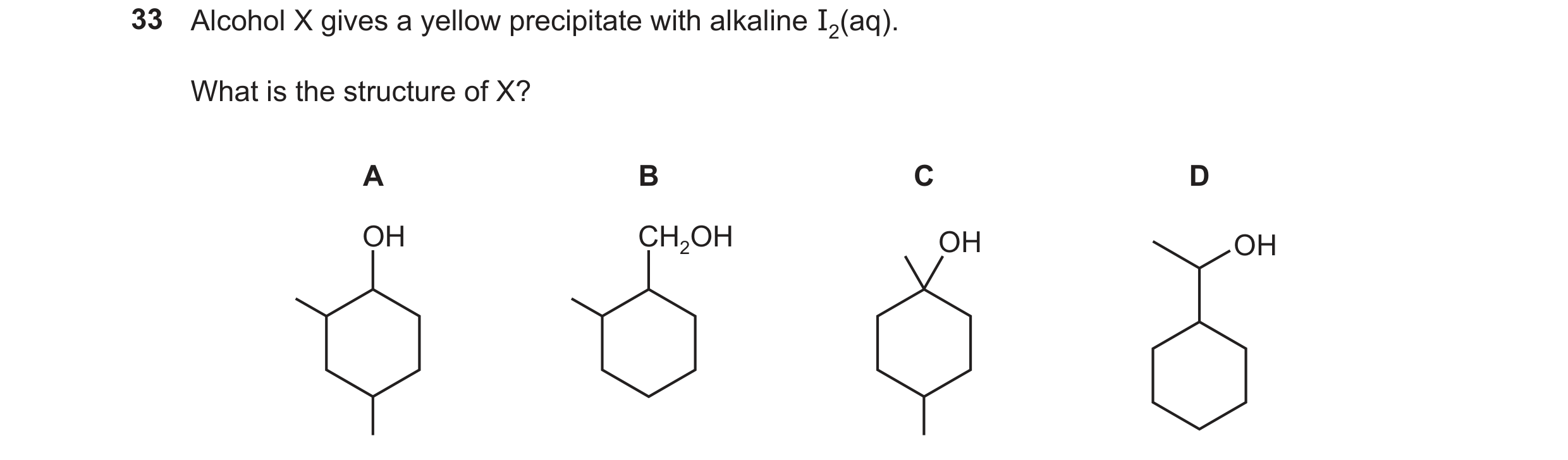
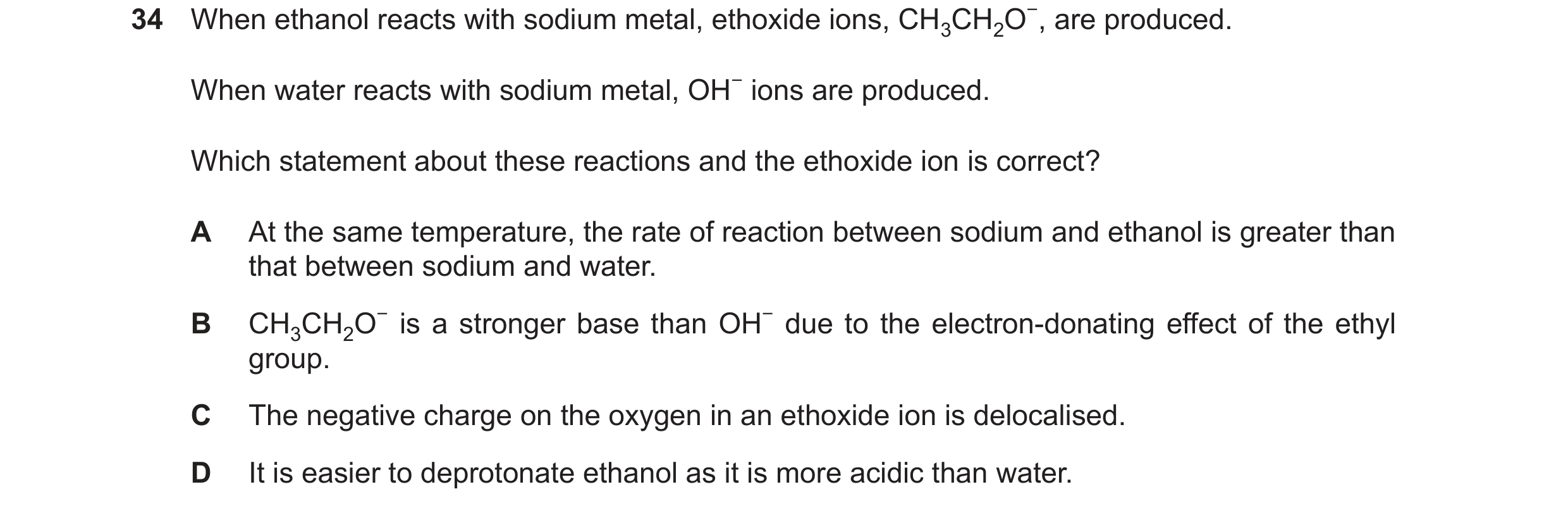
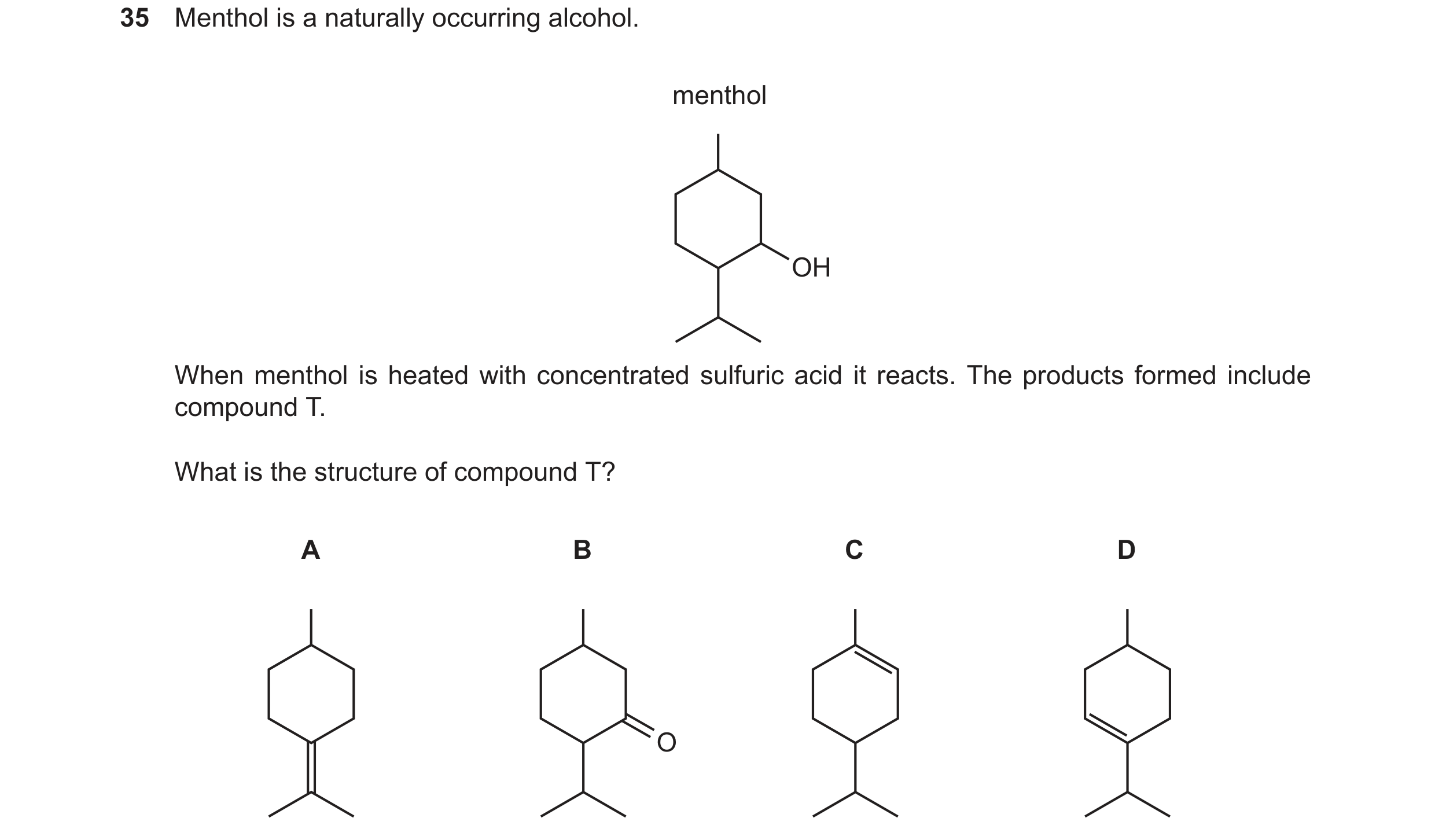 89 / 107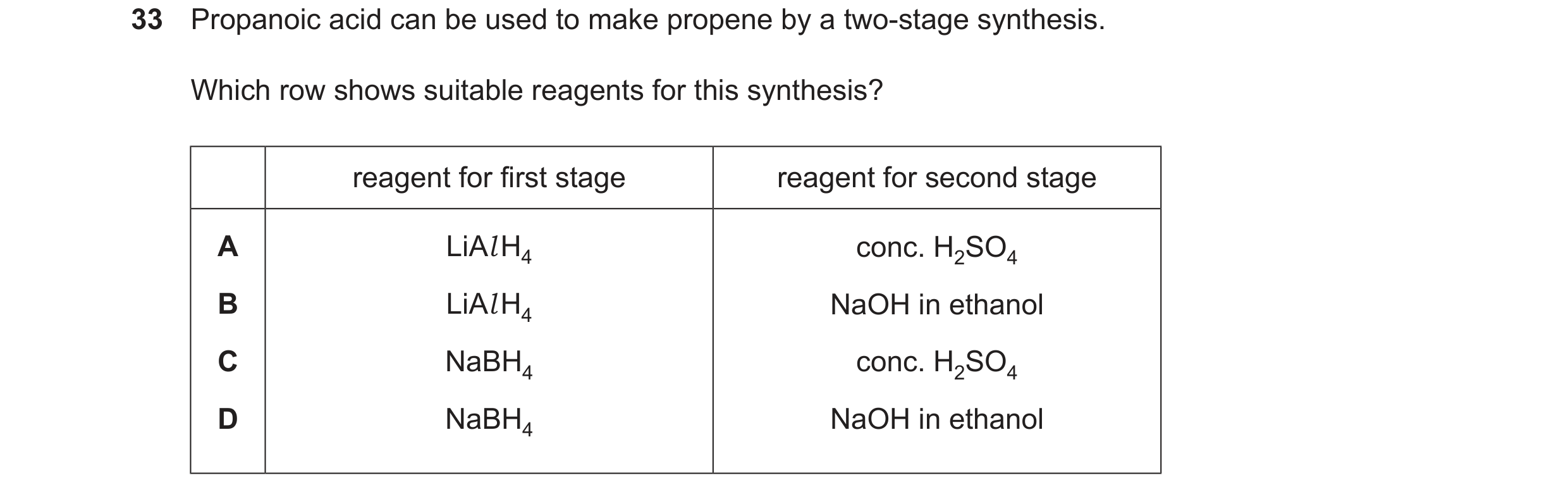

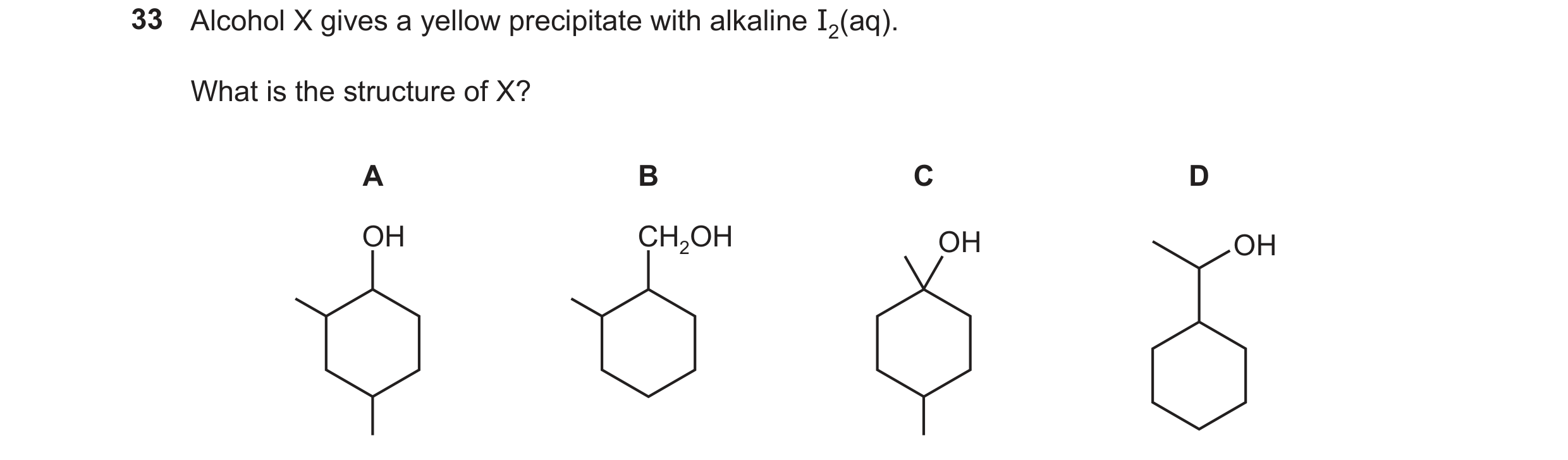
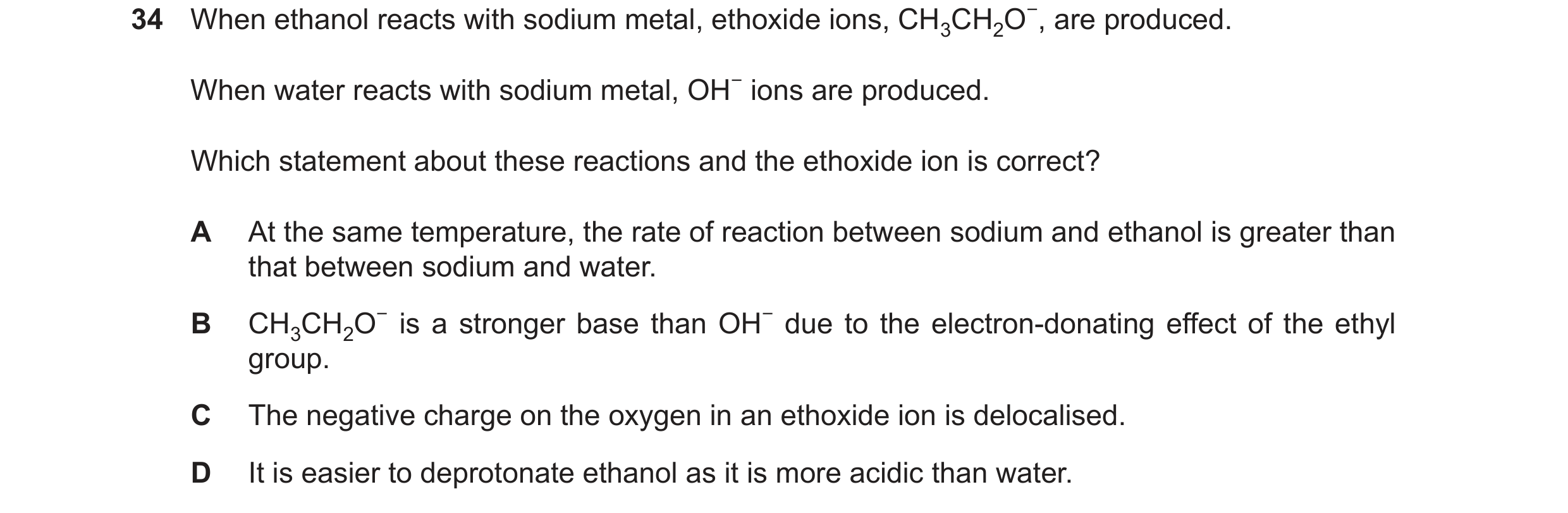 90 / 107
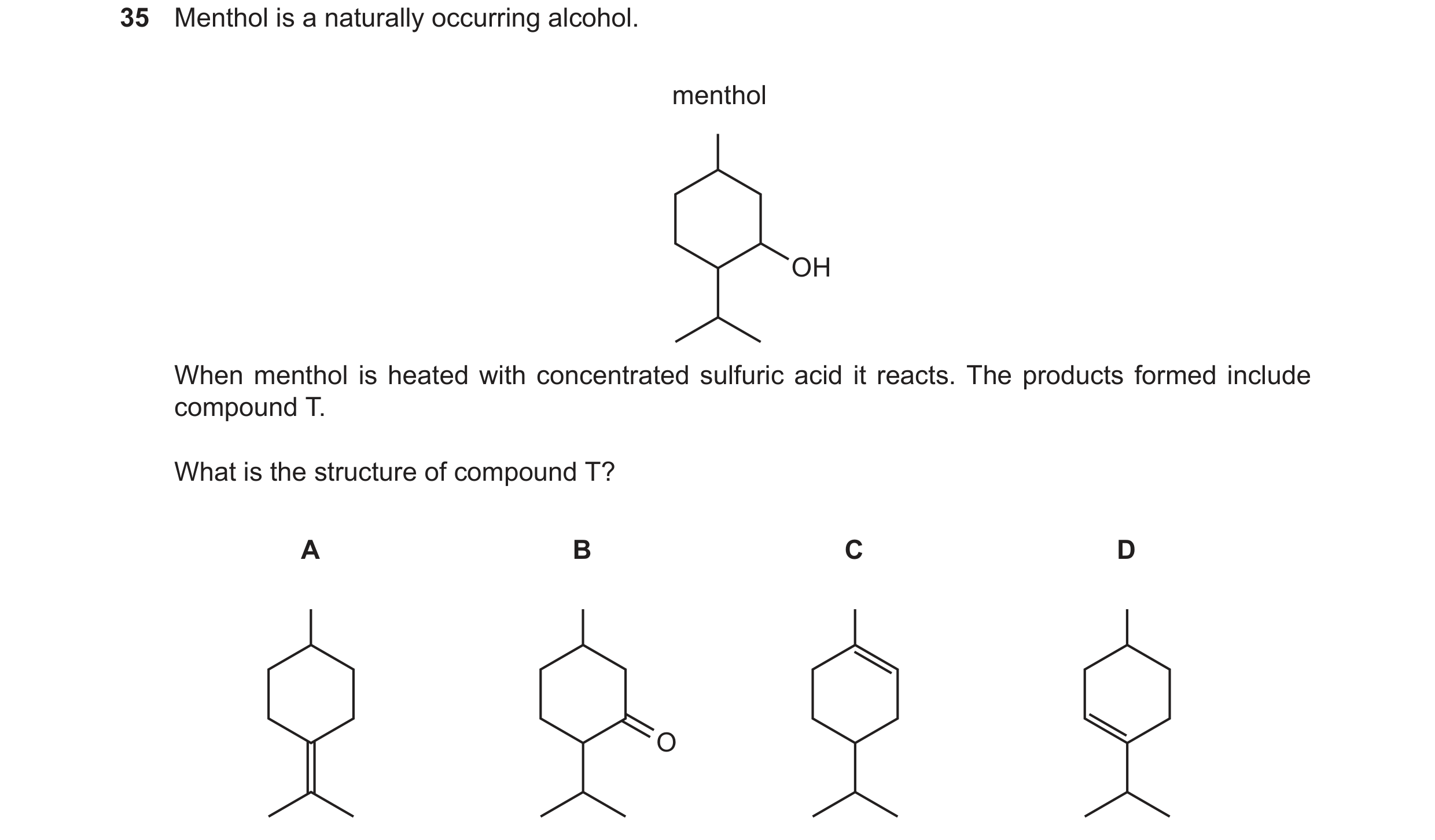 91 / 107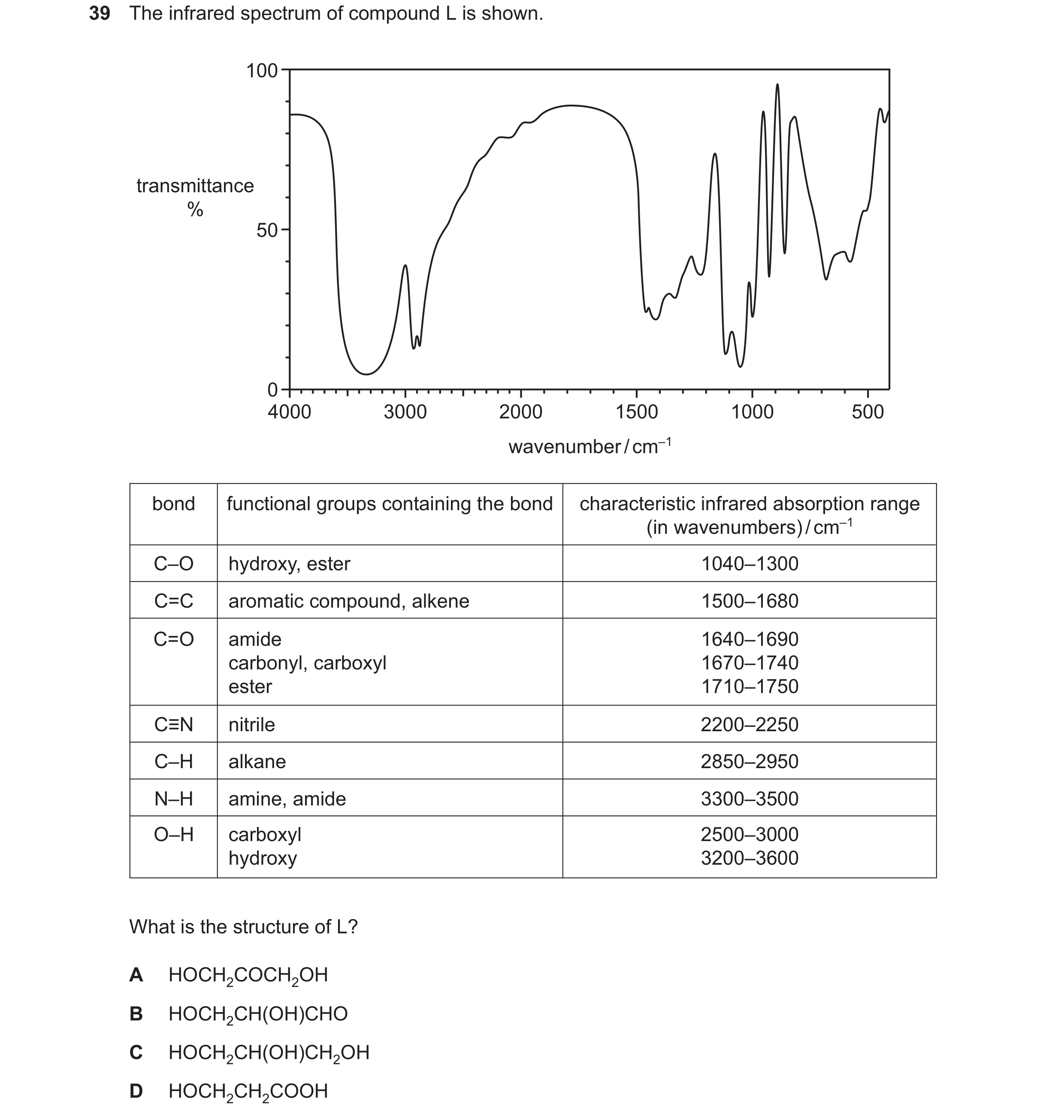
 92 / 107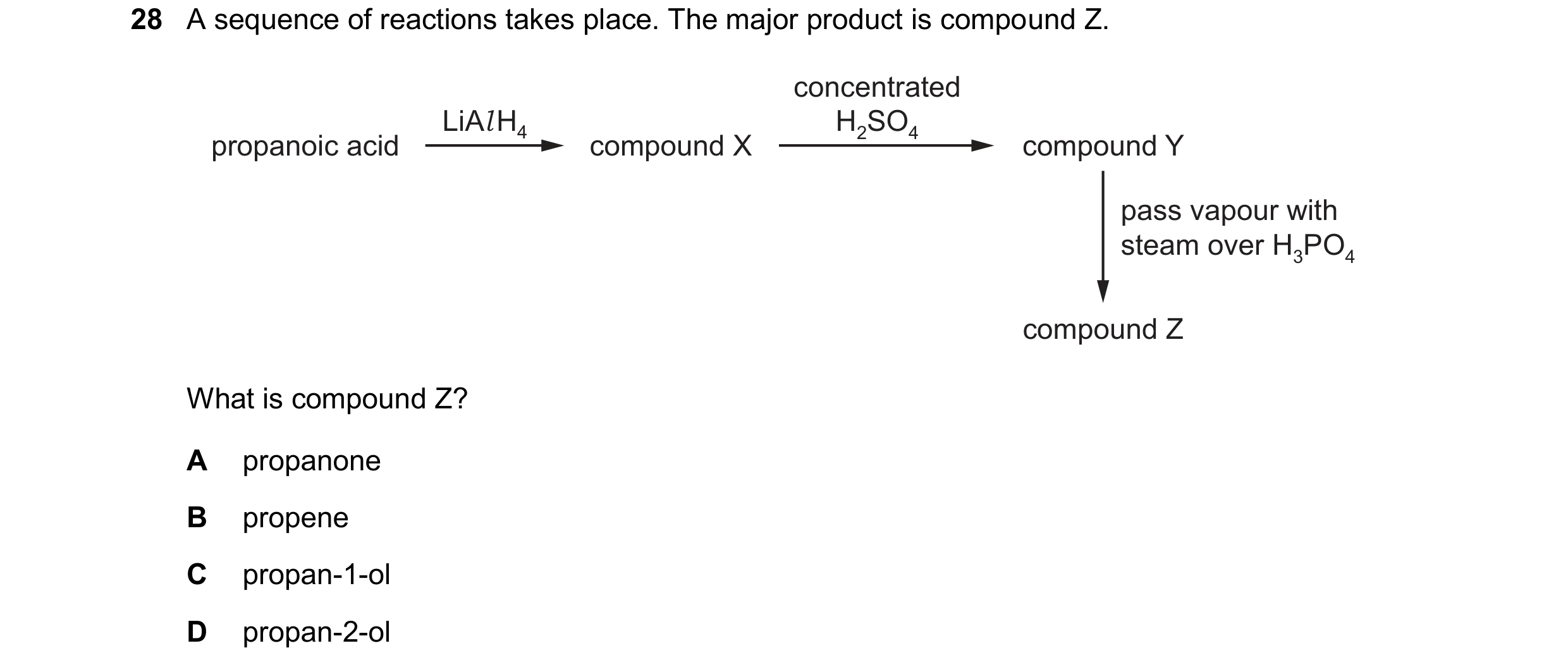
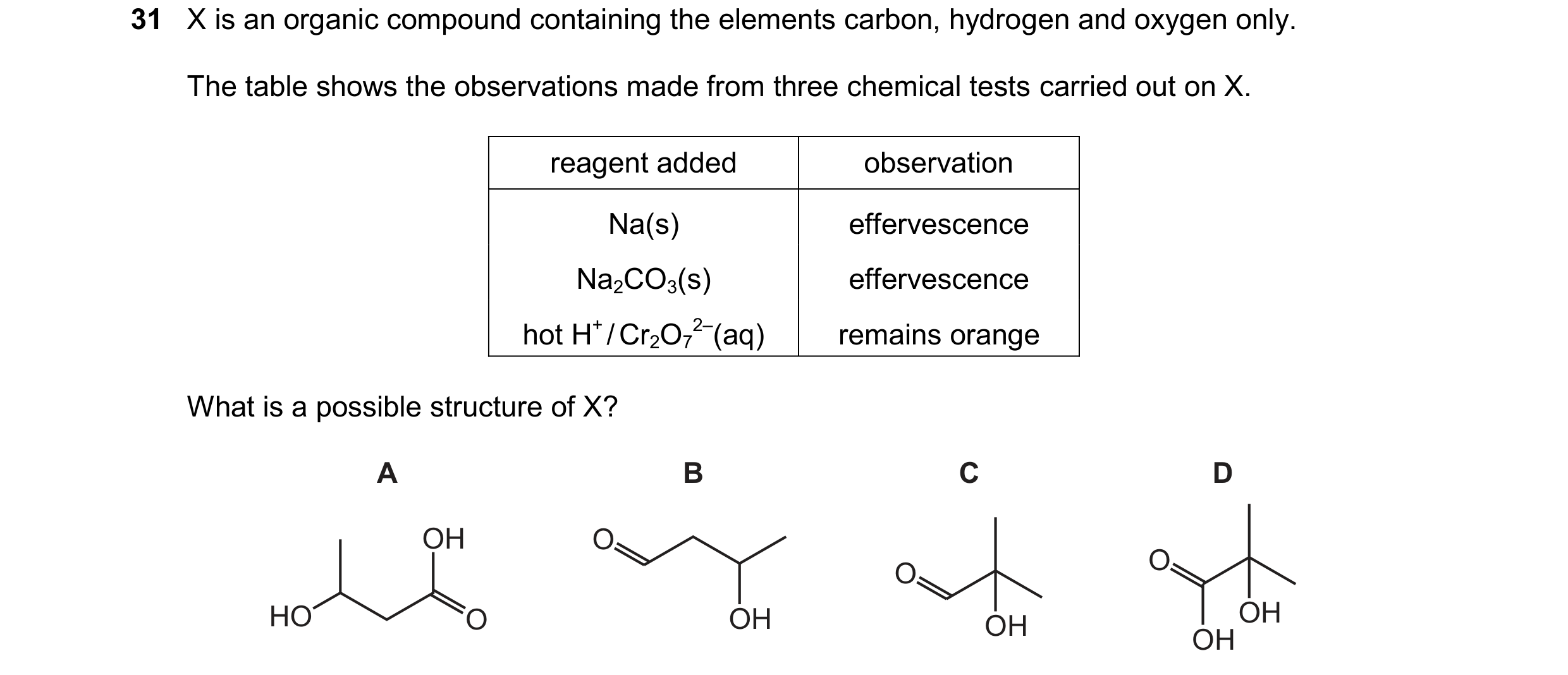

 93 / 107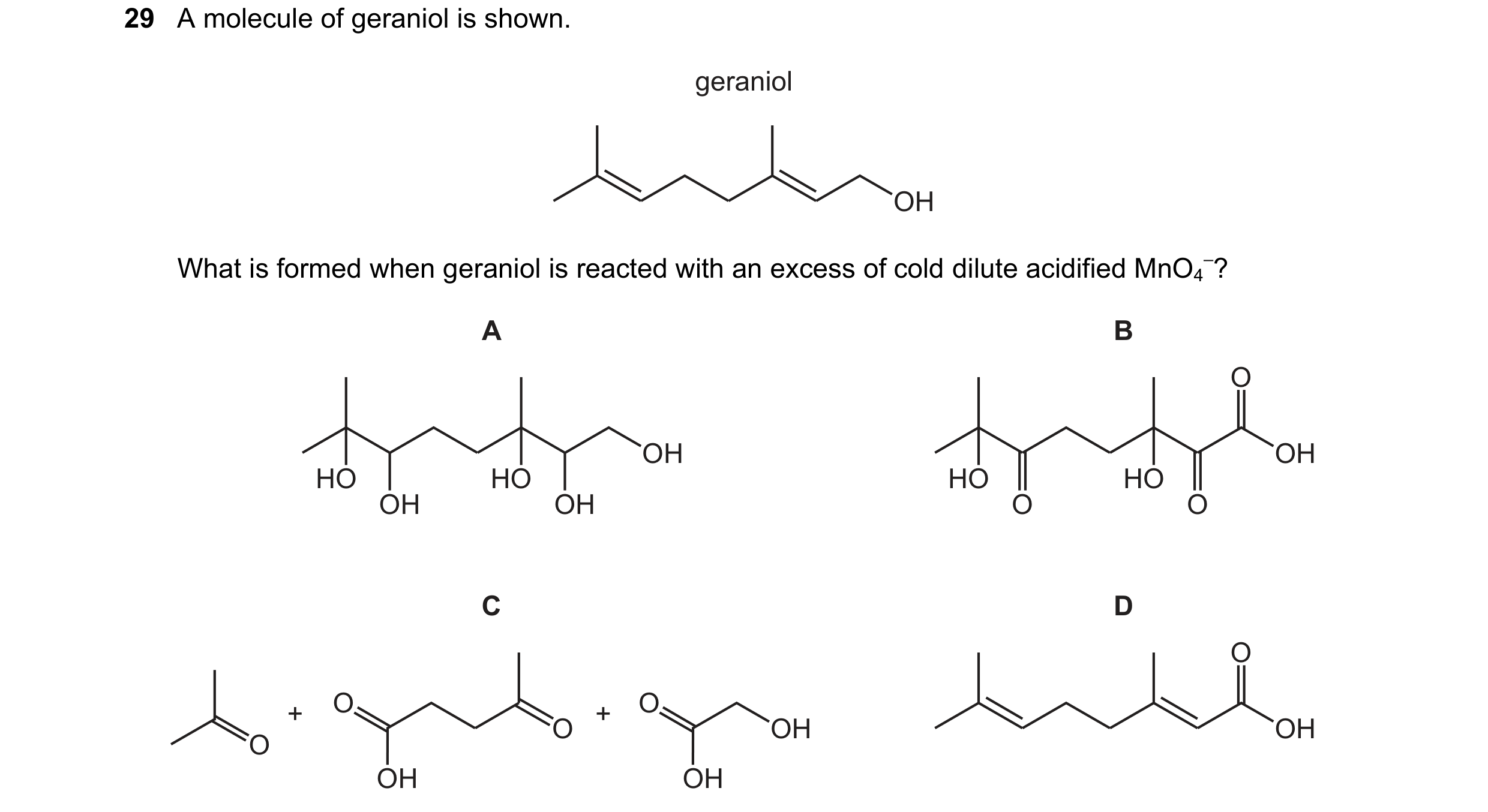
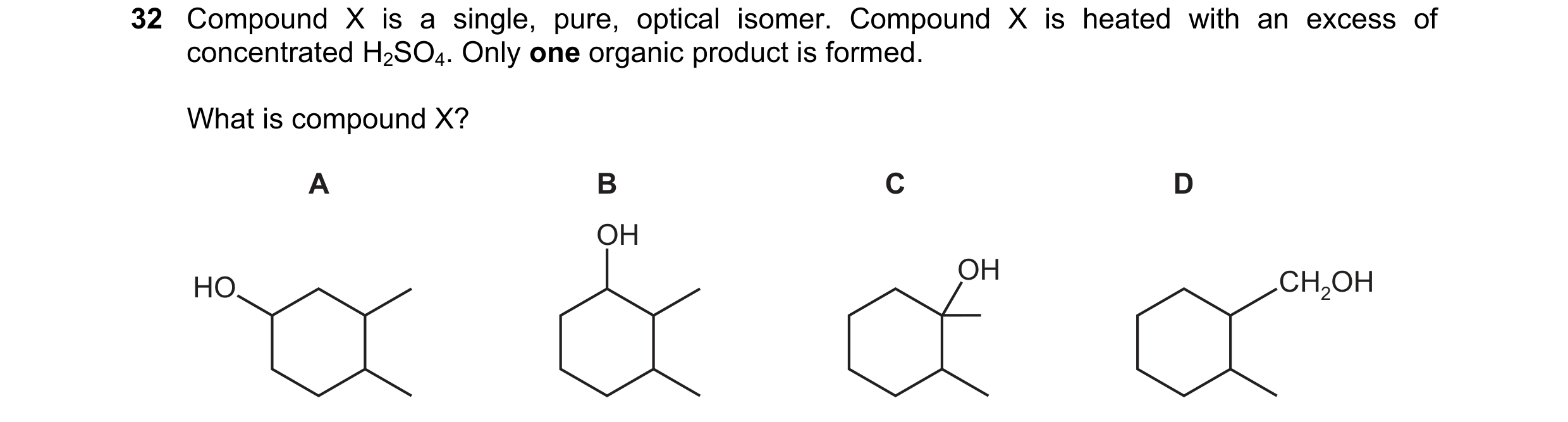

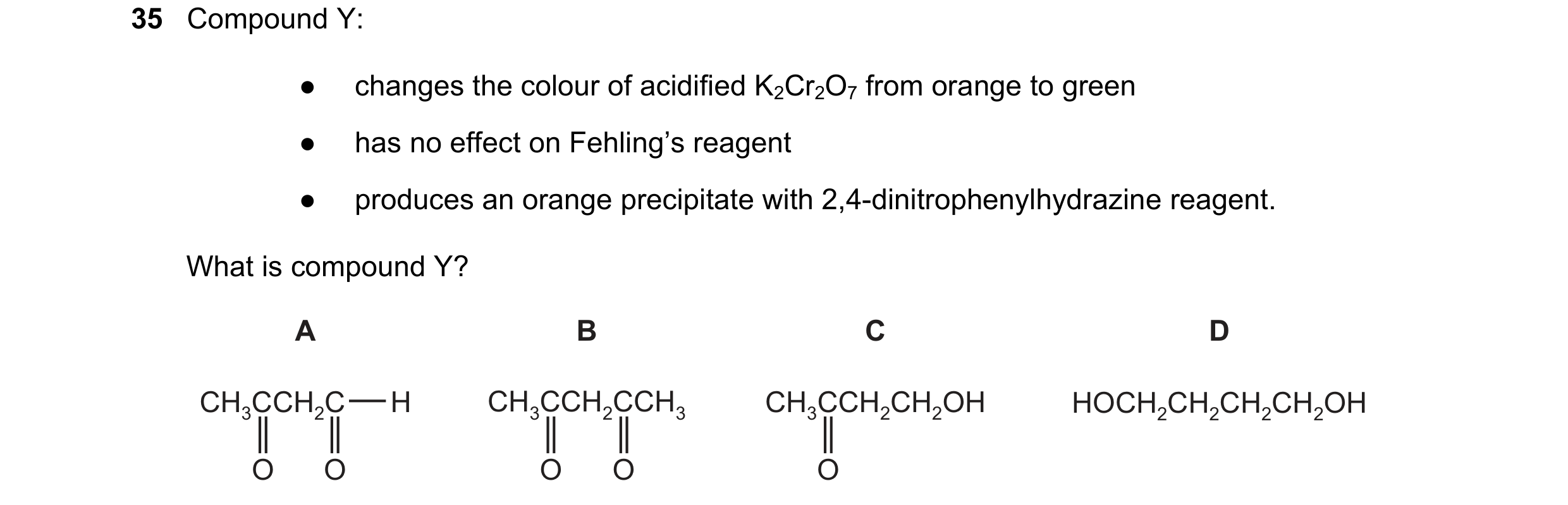 94 / 107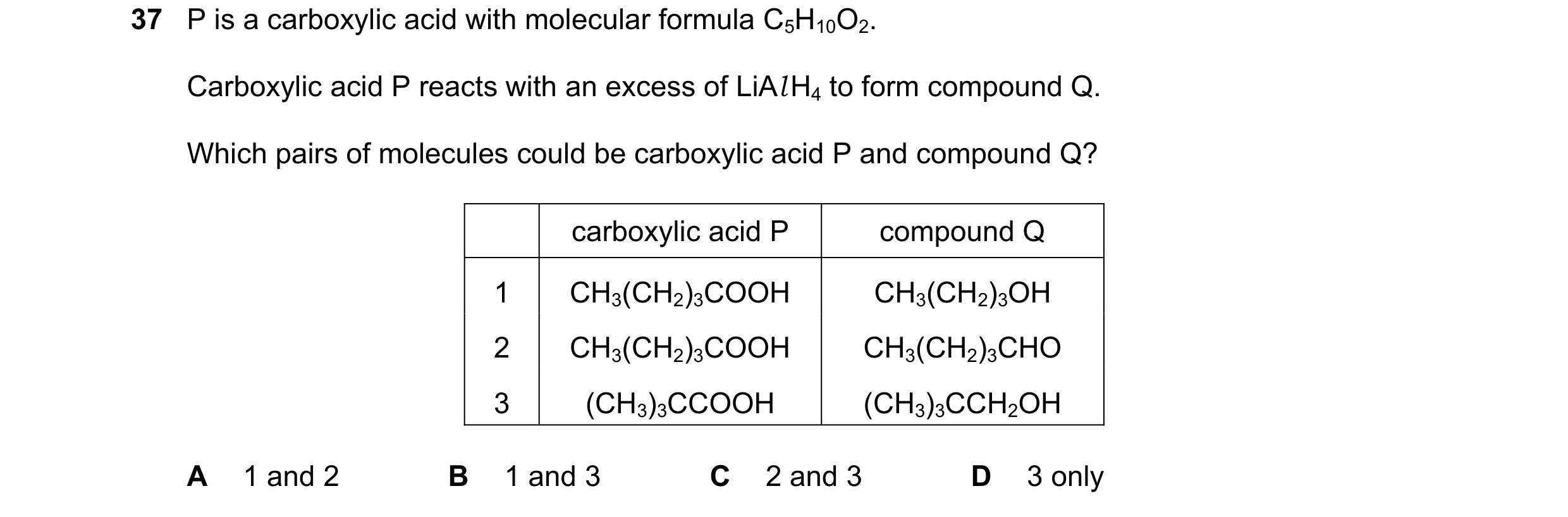
 95 / 107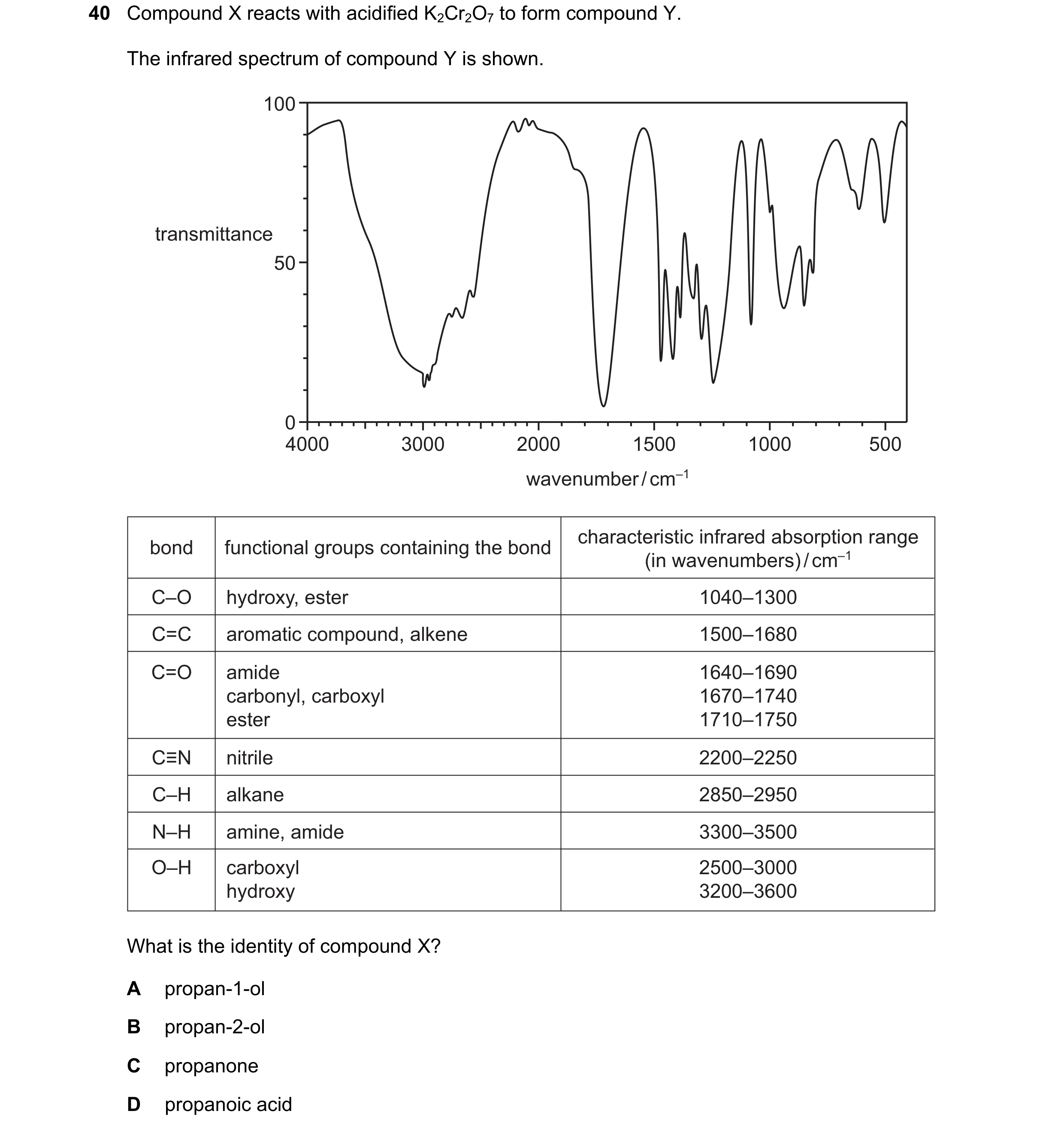
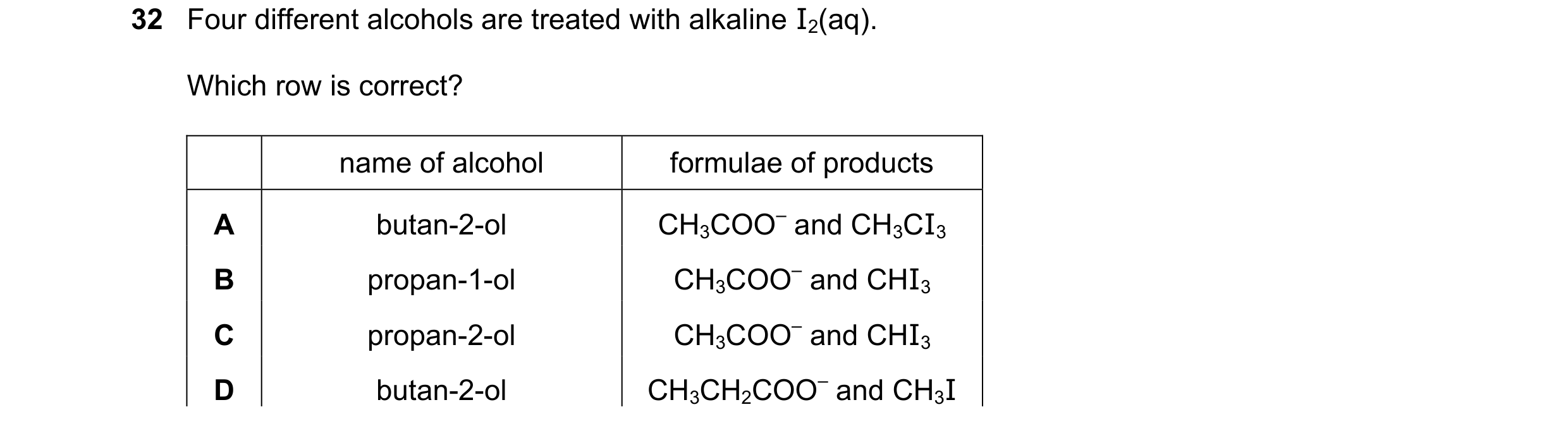 96 / 107

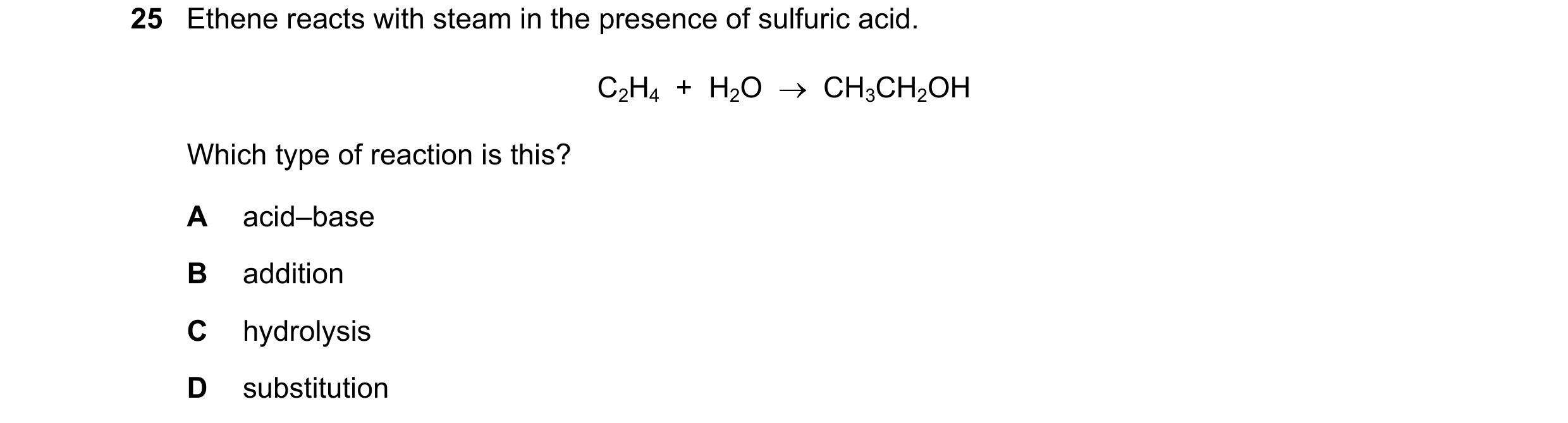
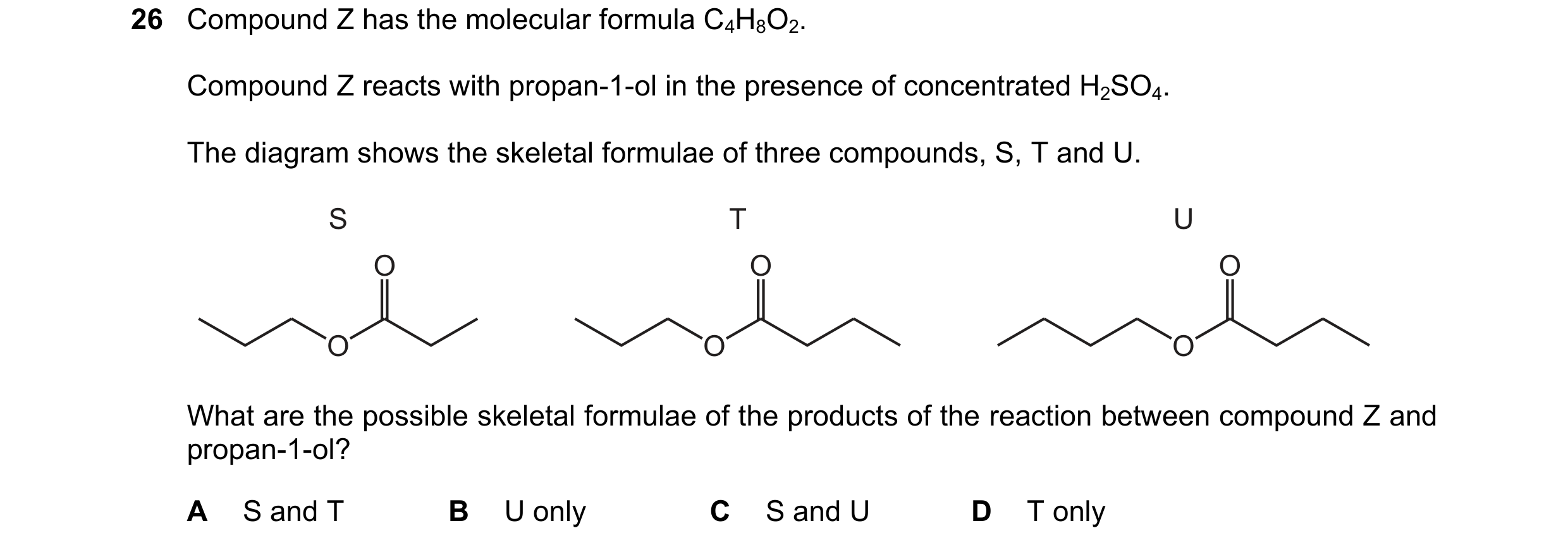 97 / 107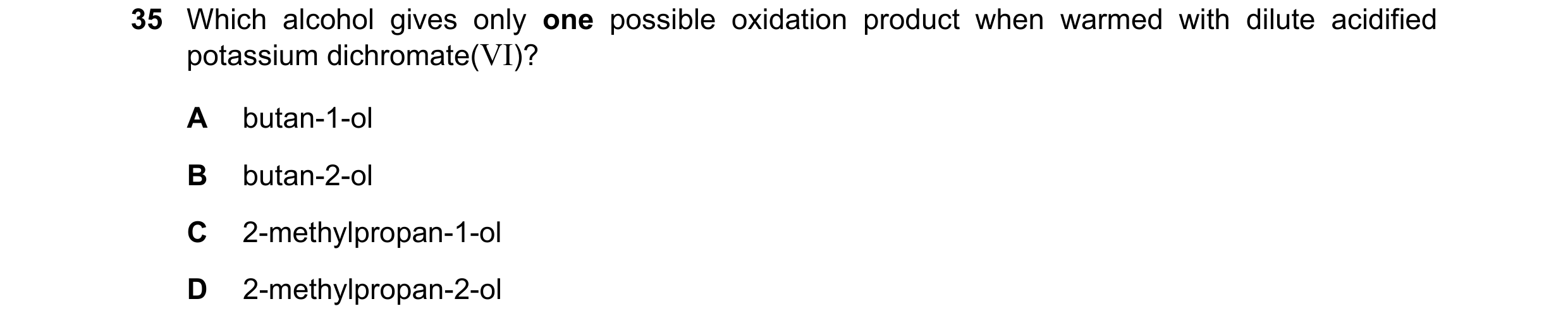
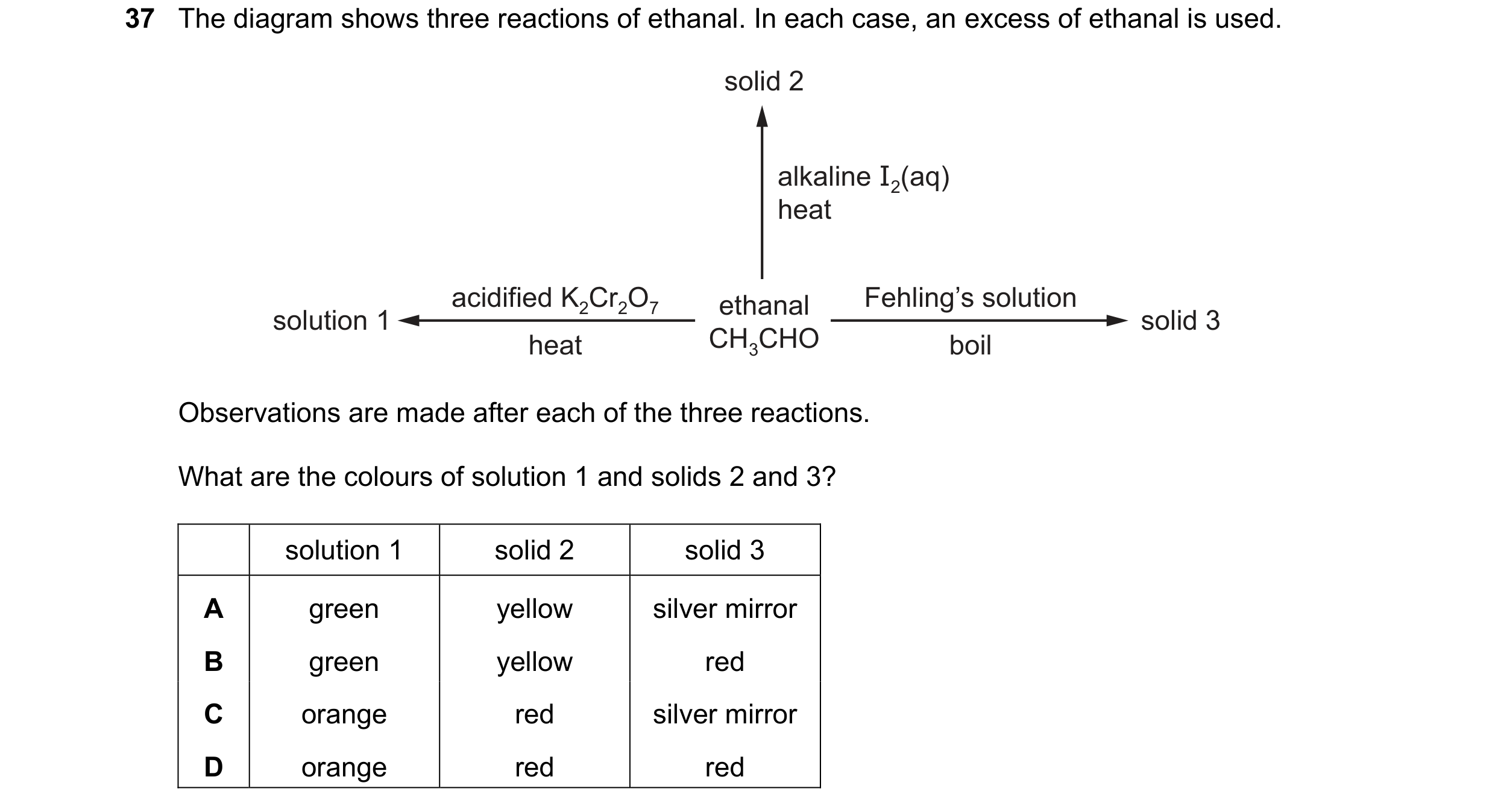
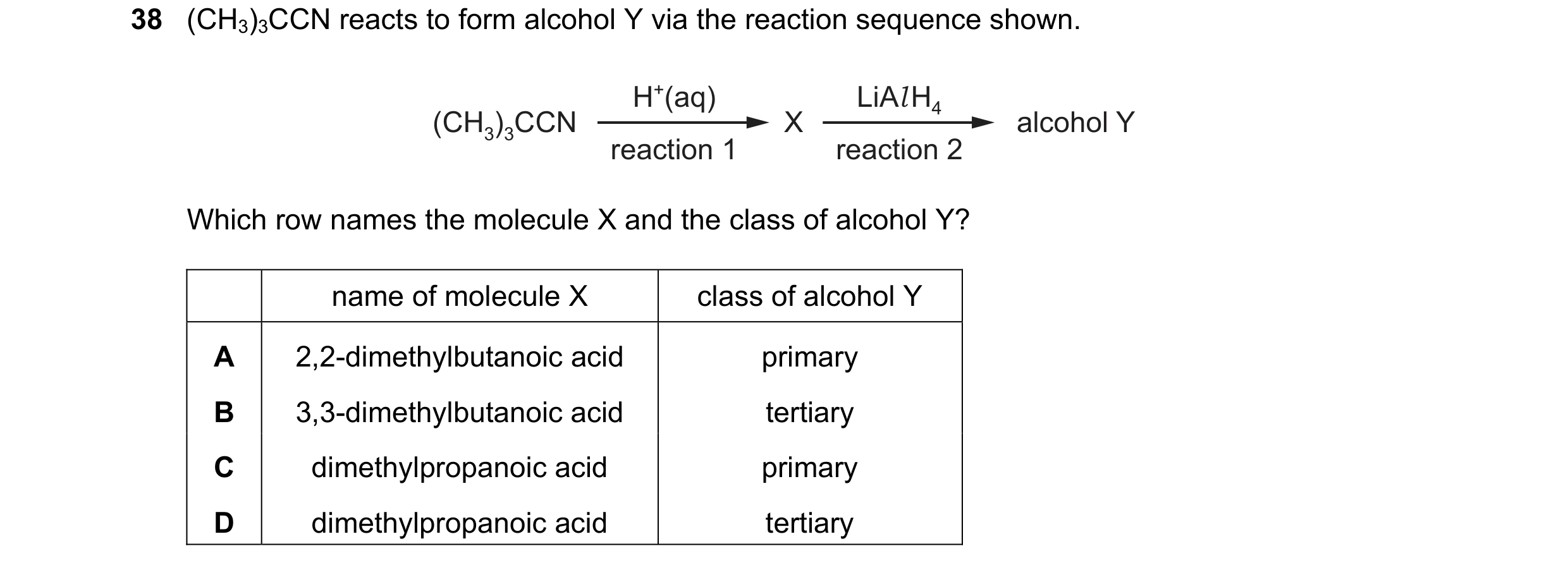 98 / 107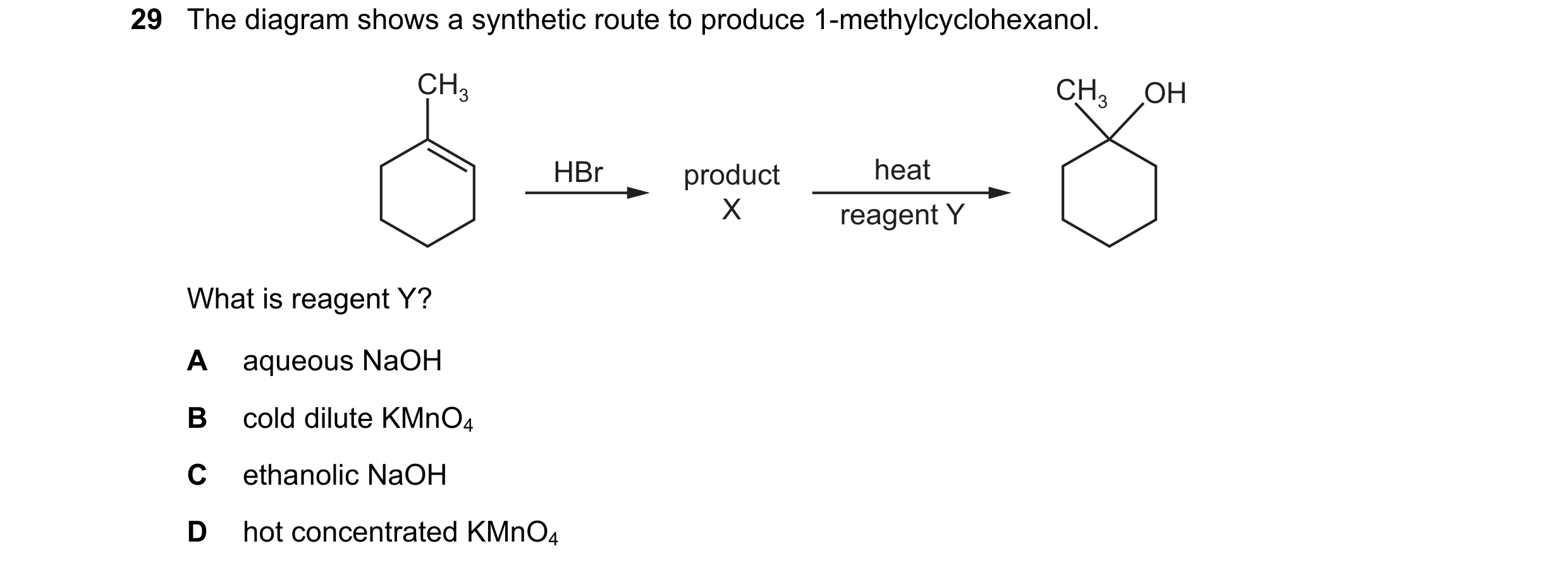
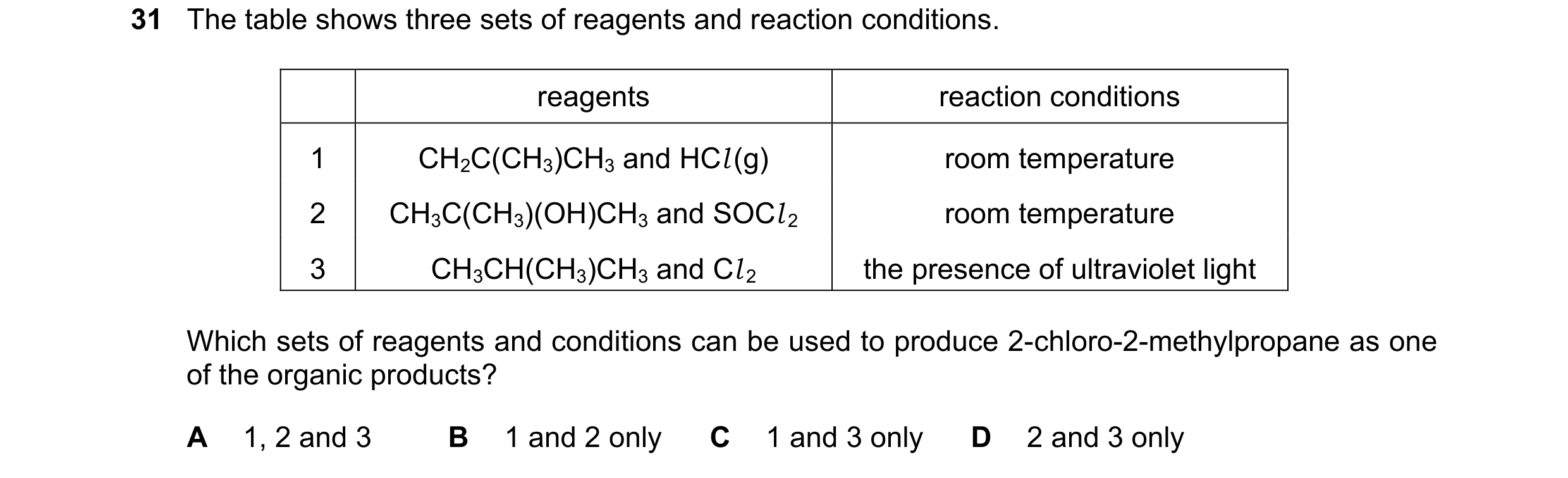
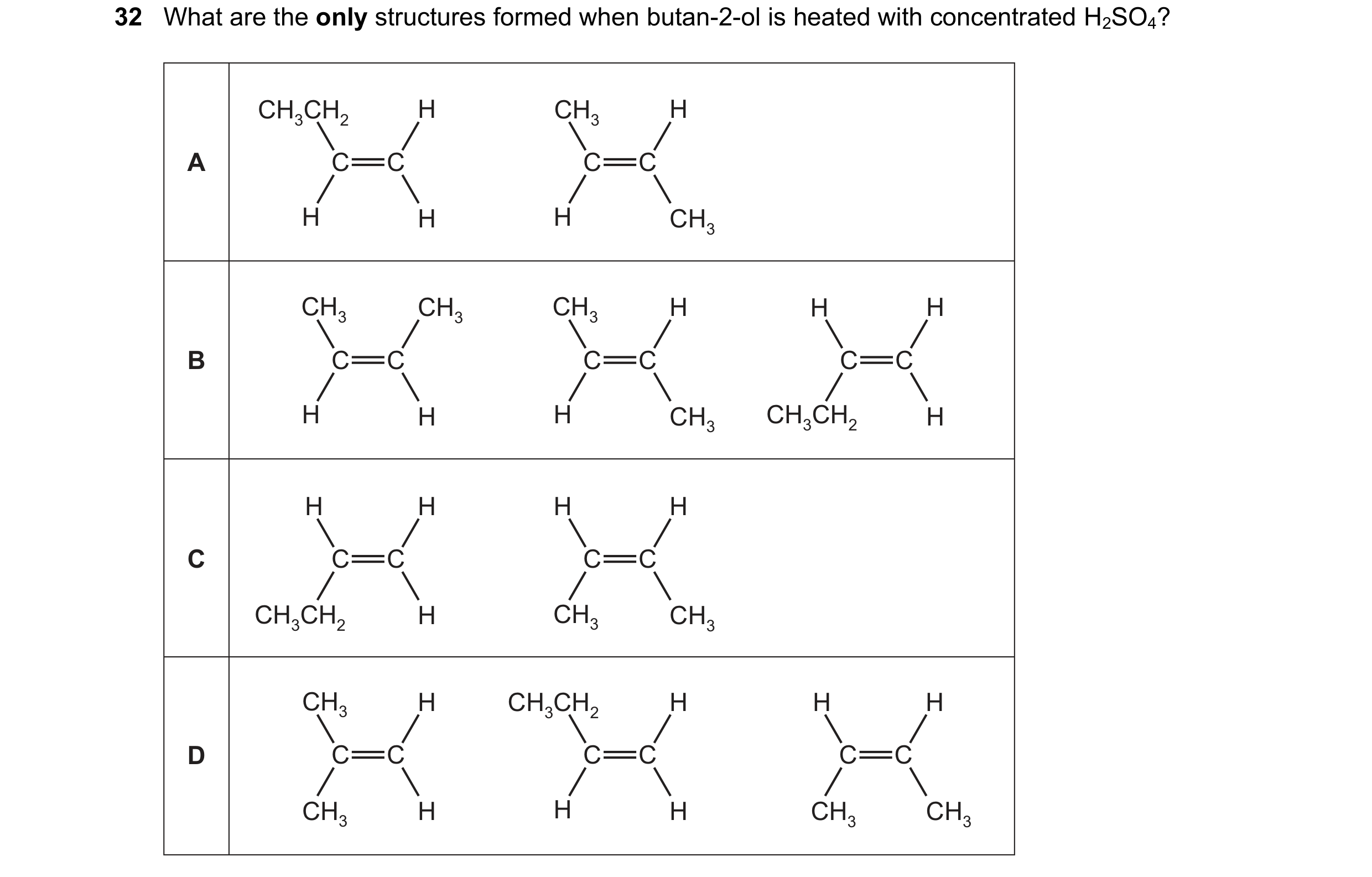 99 / 107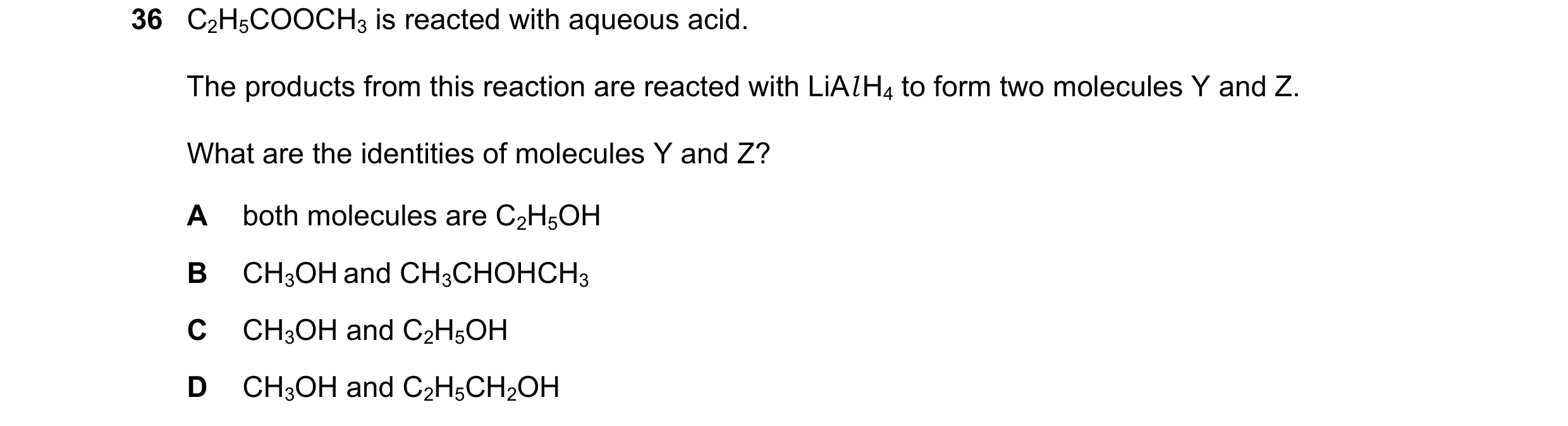
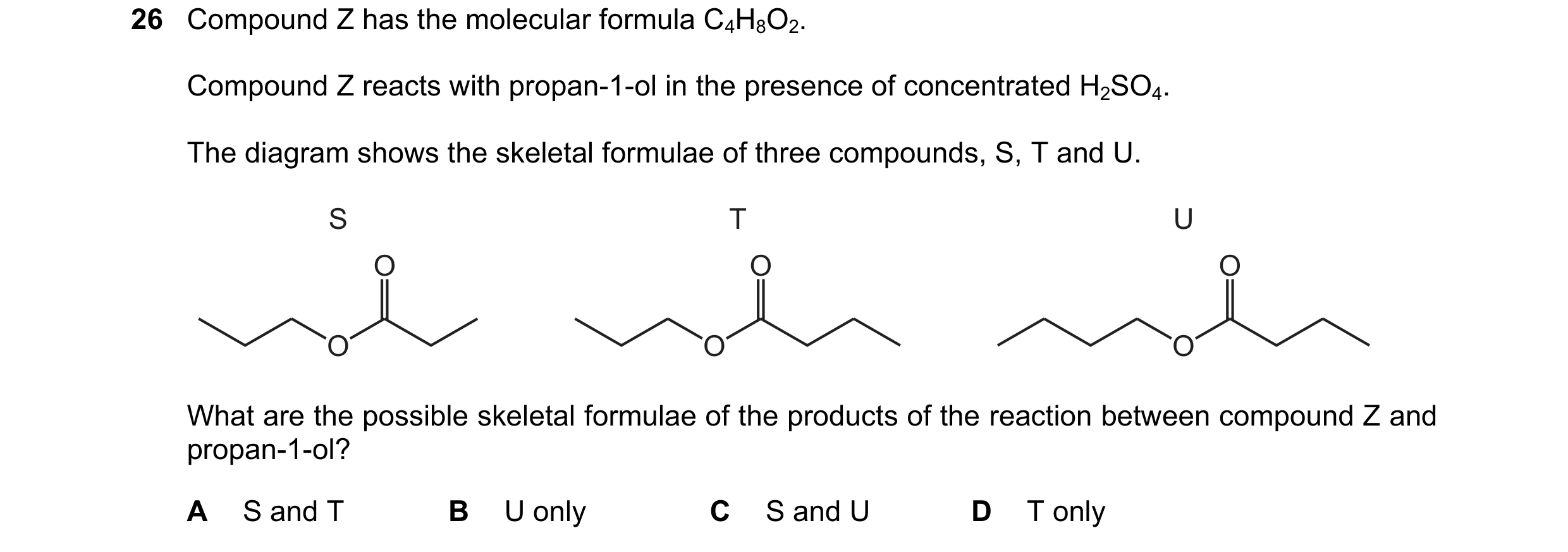
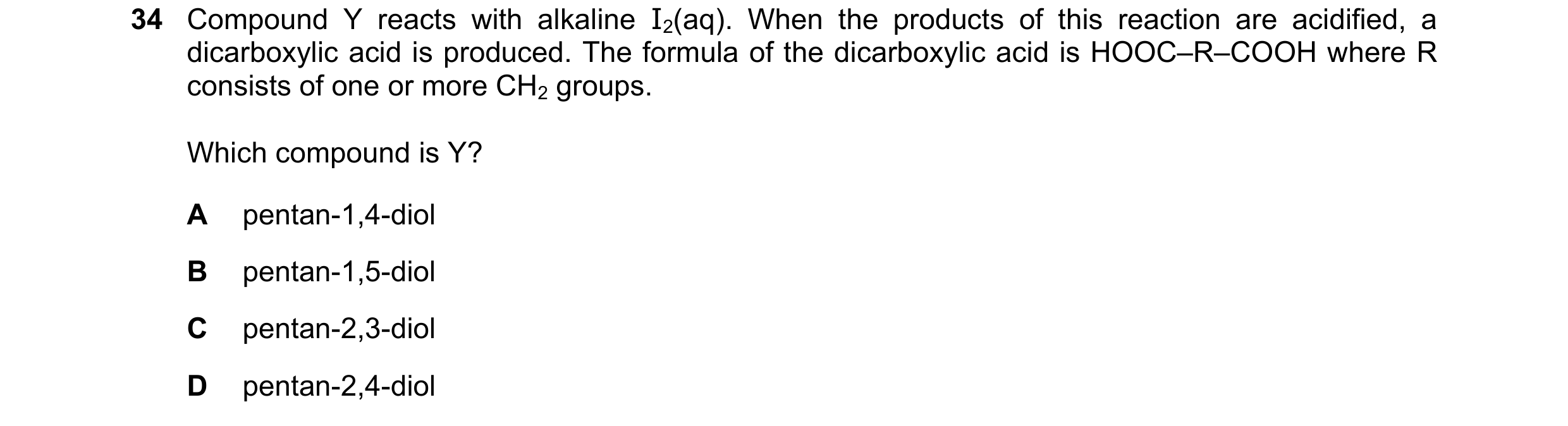
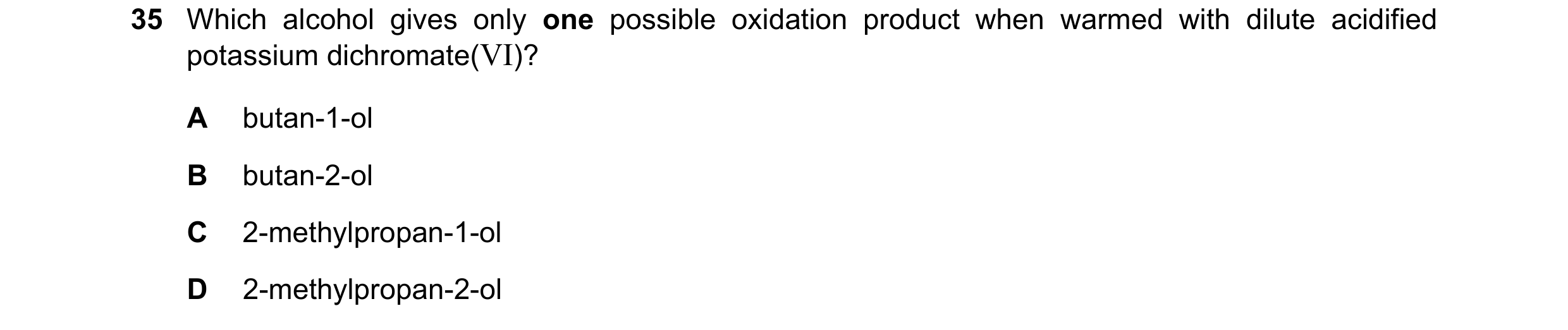 100 / 107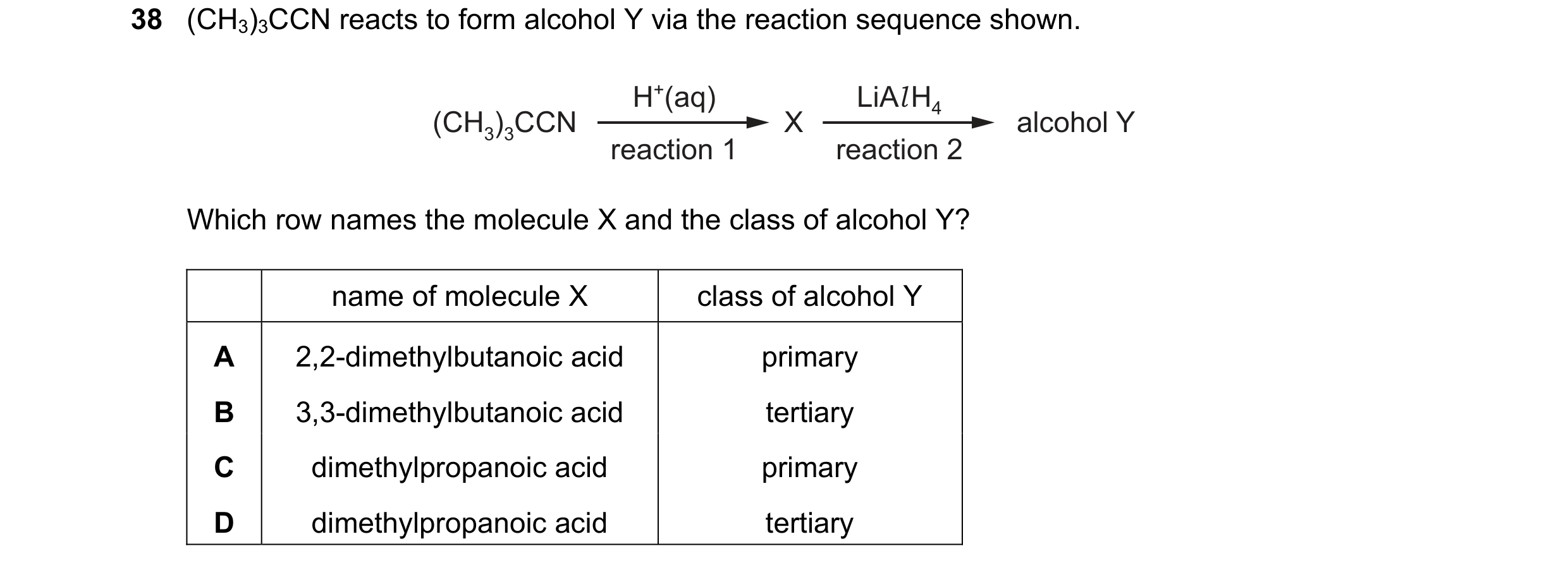
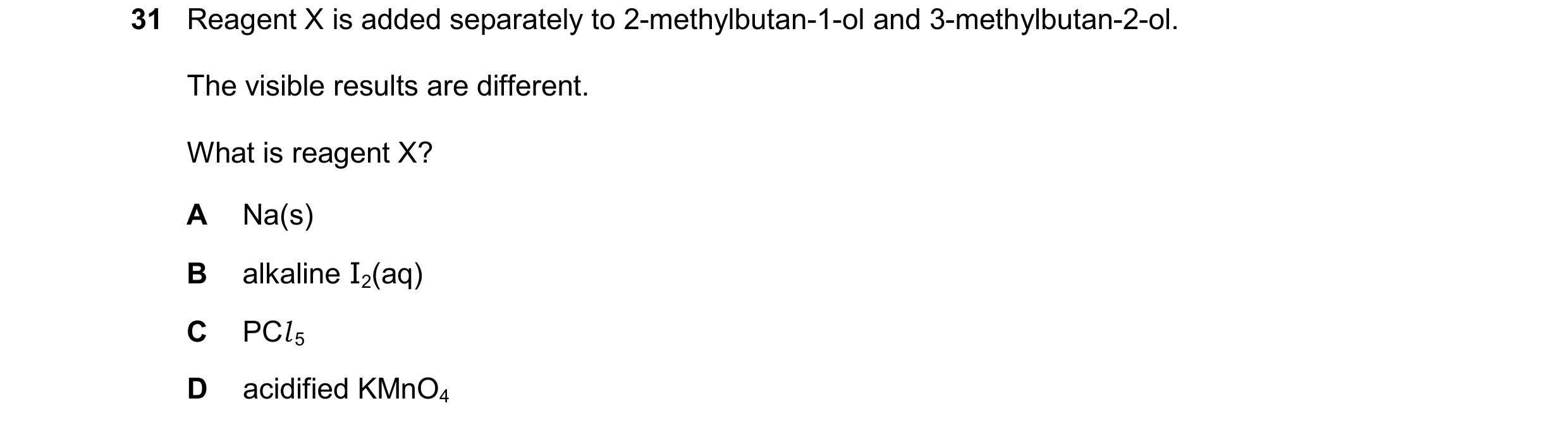
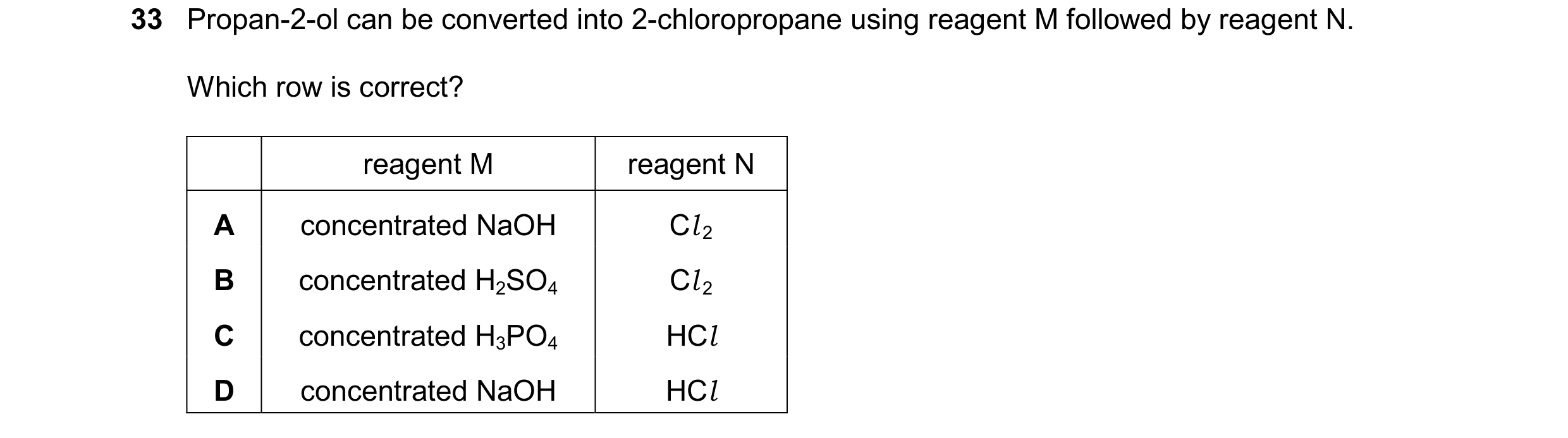
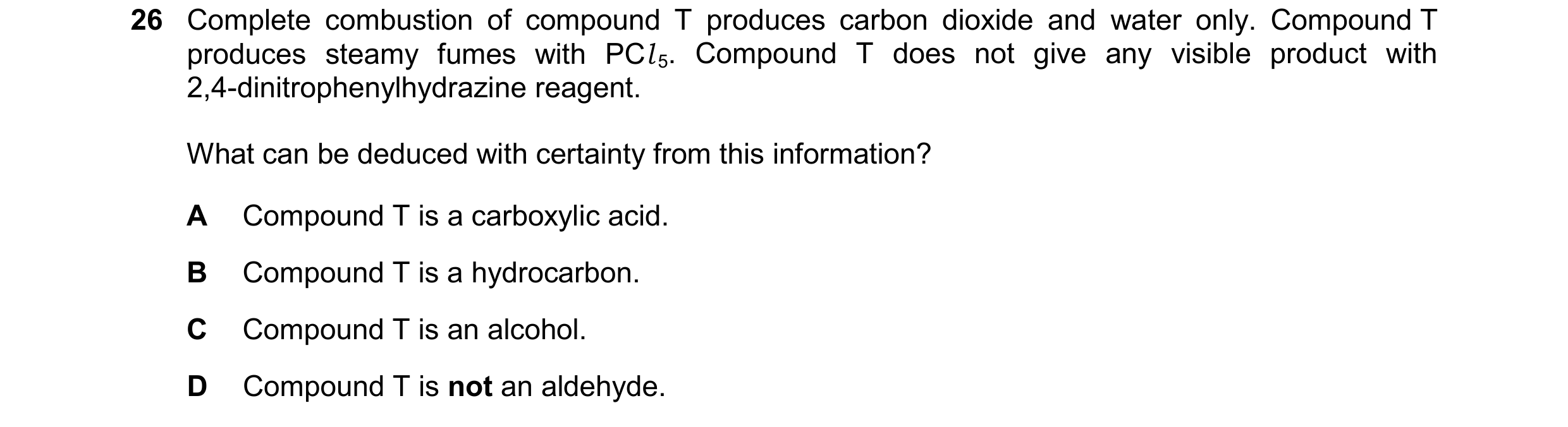 101 / 107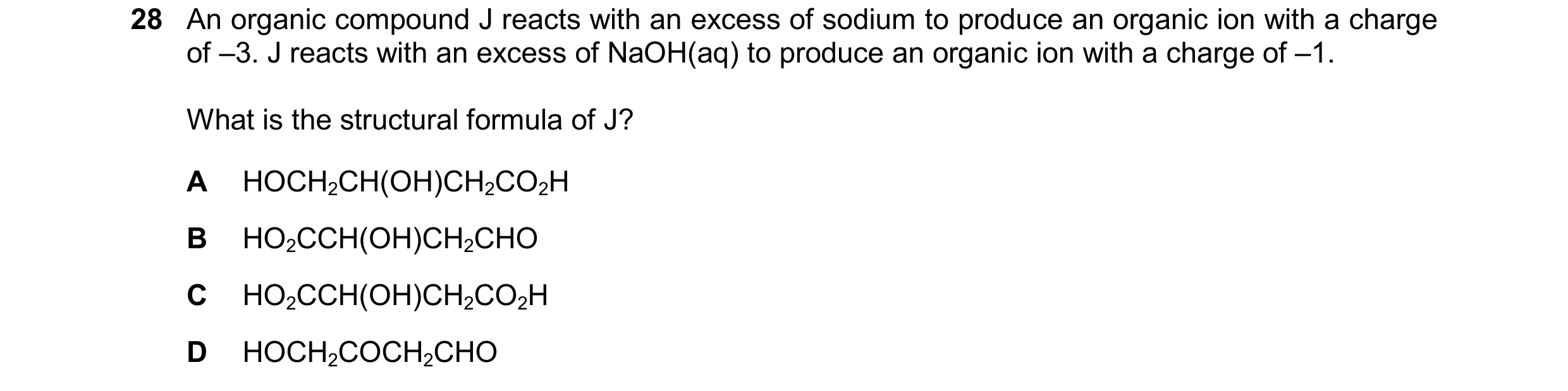
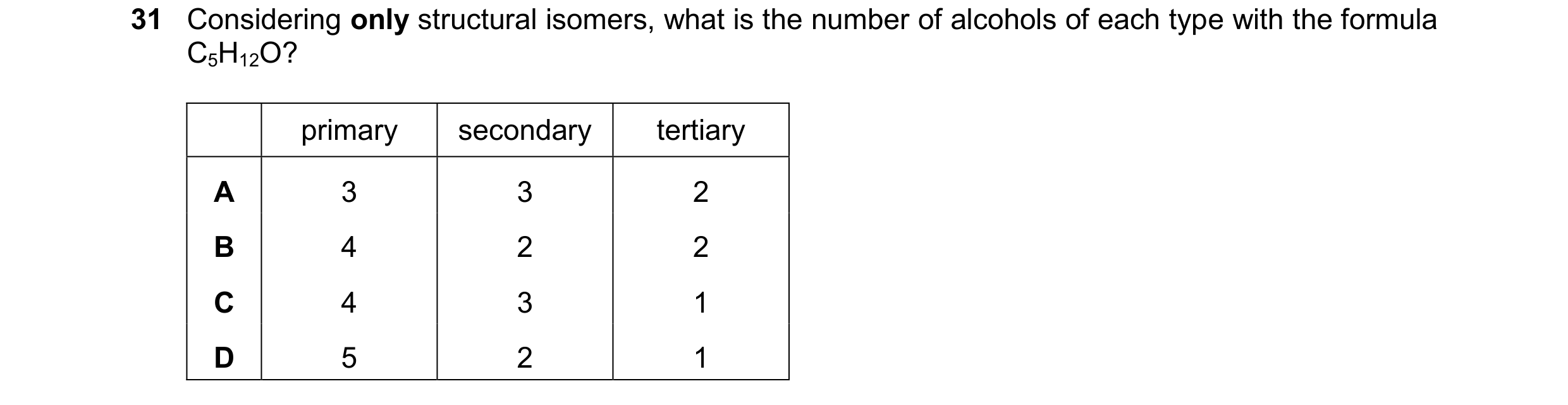
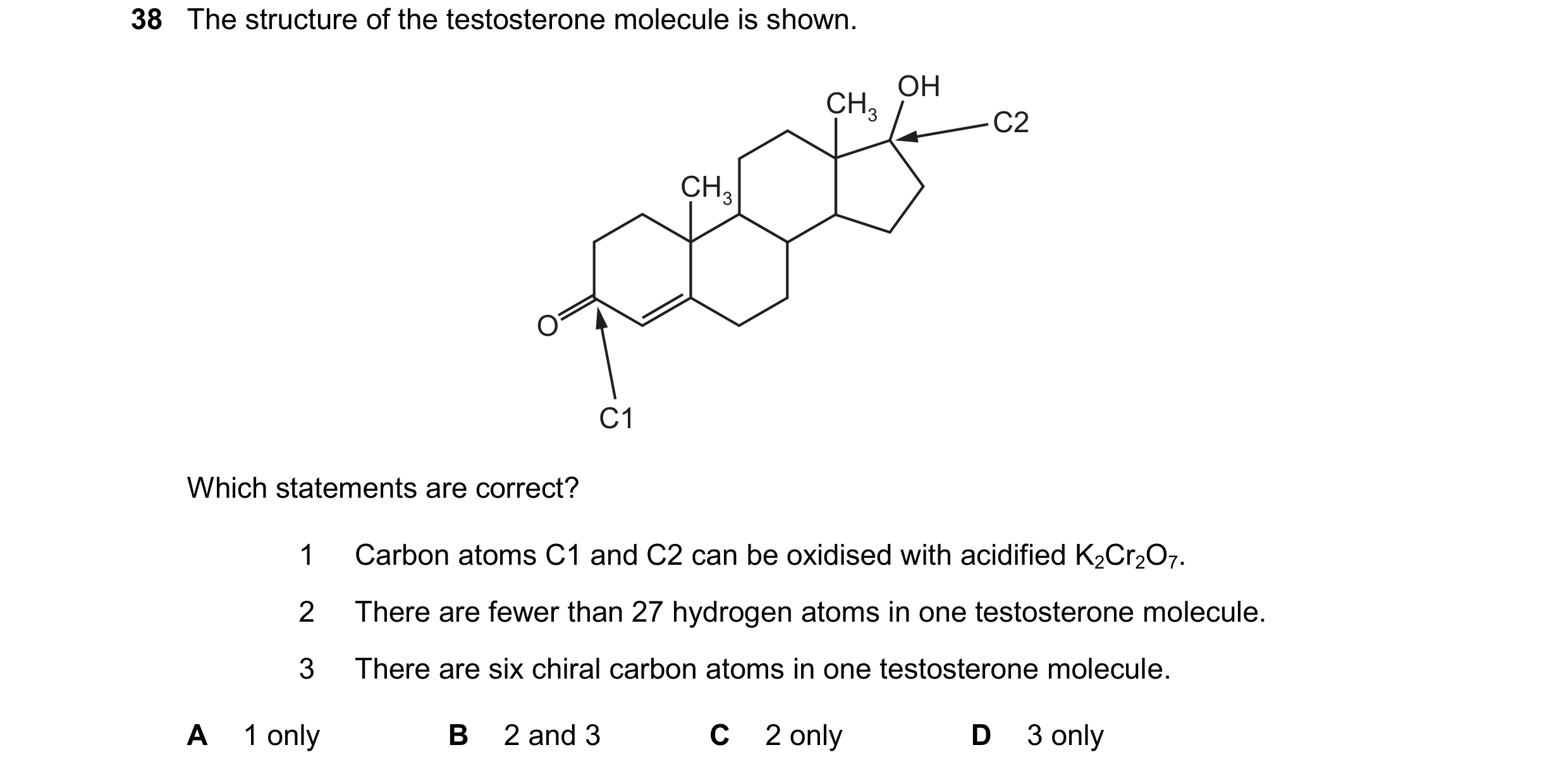
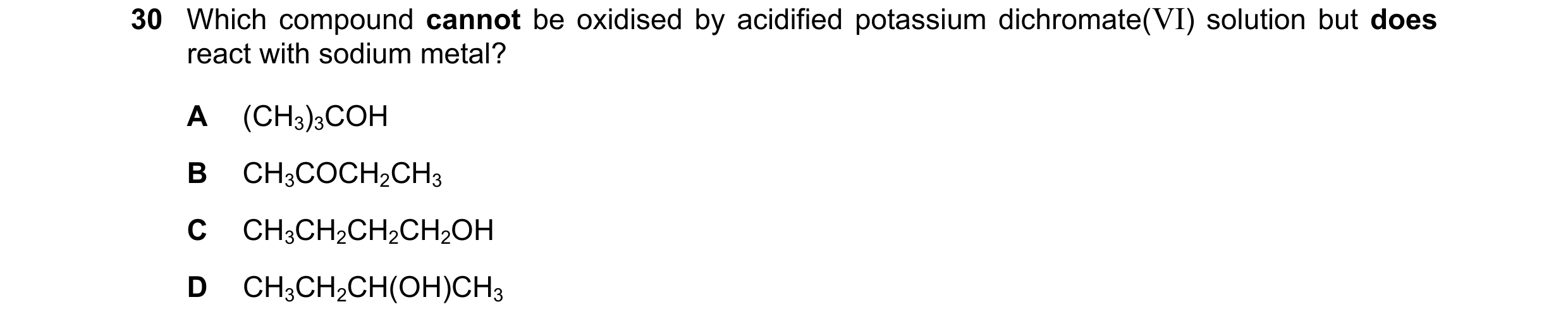 102 / 107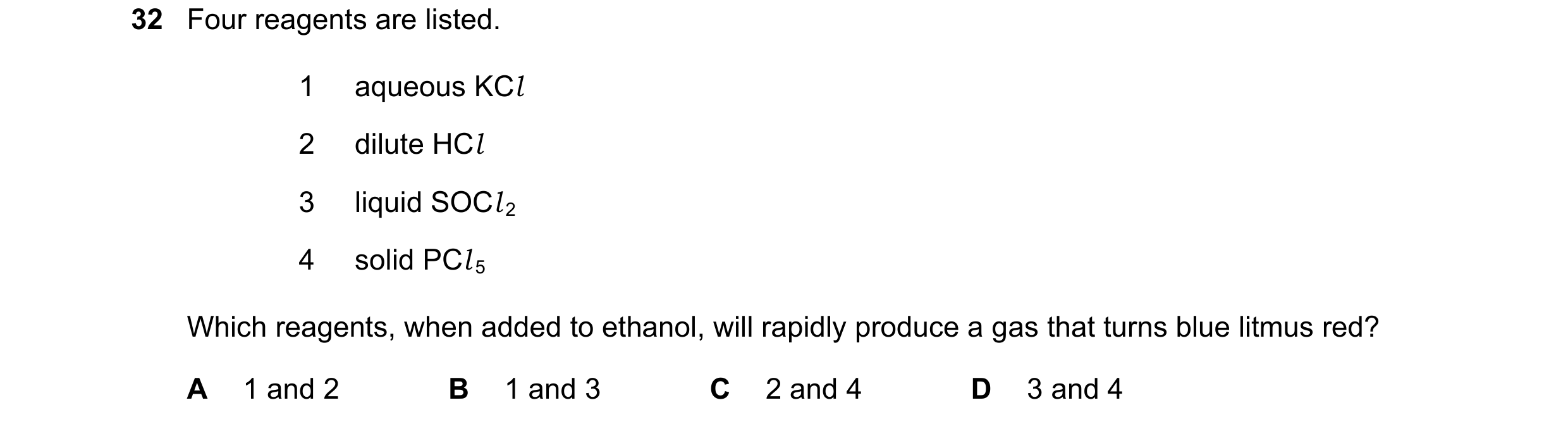
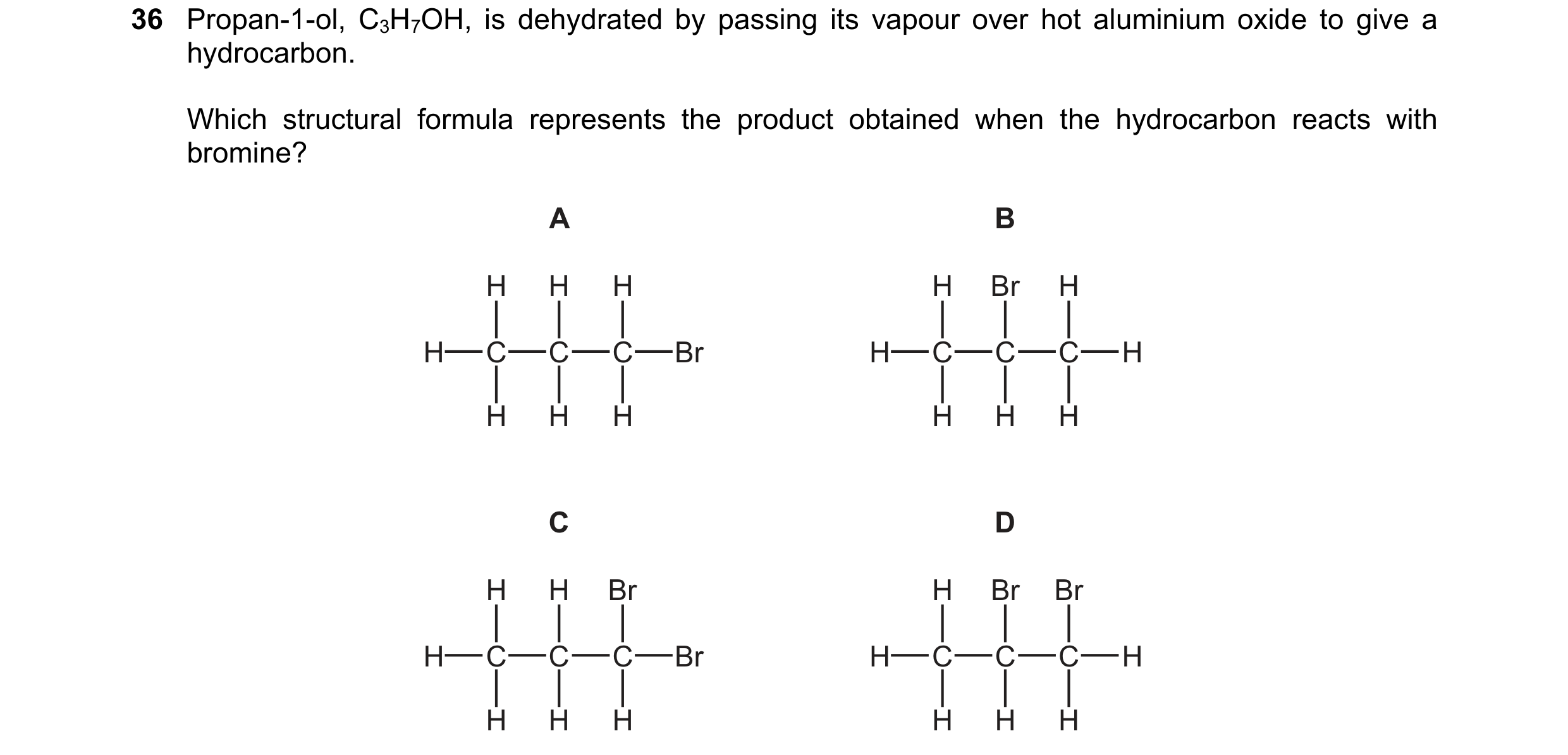
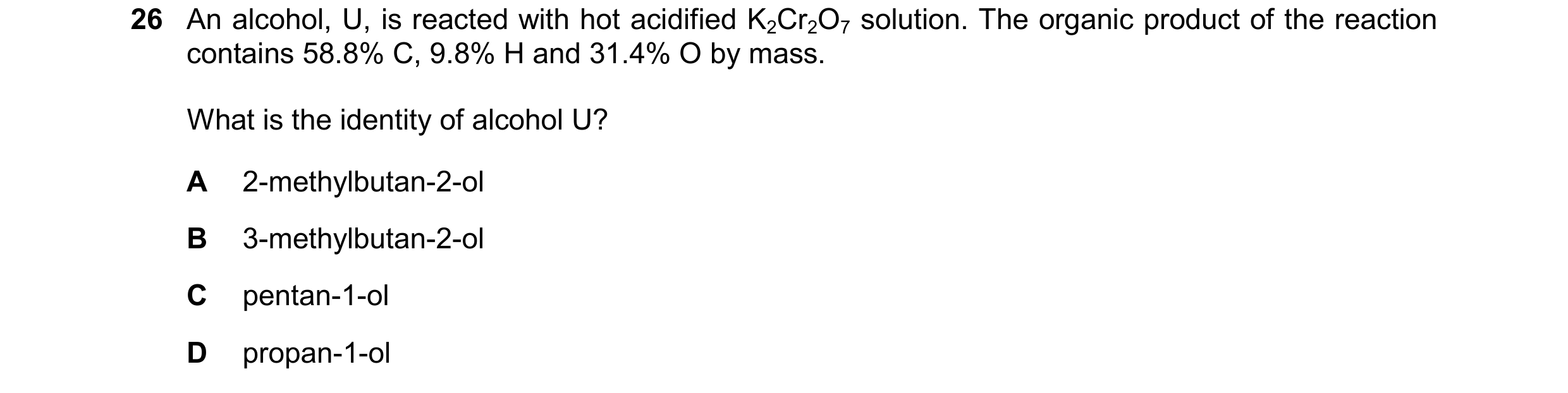 103 / 107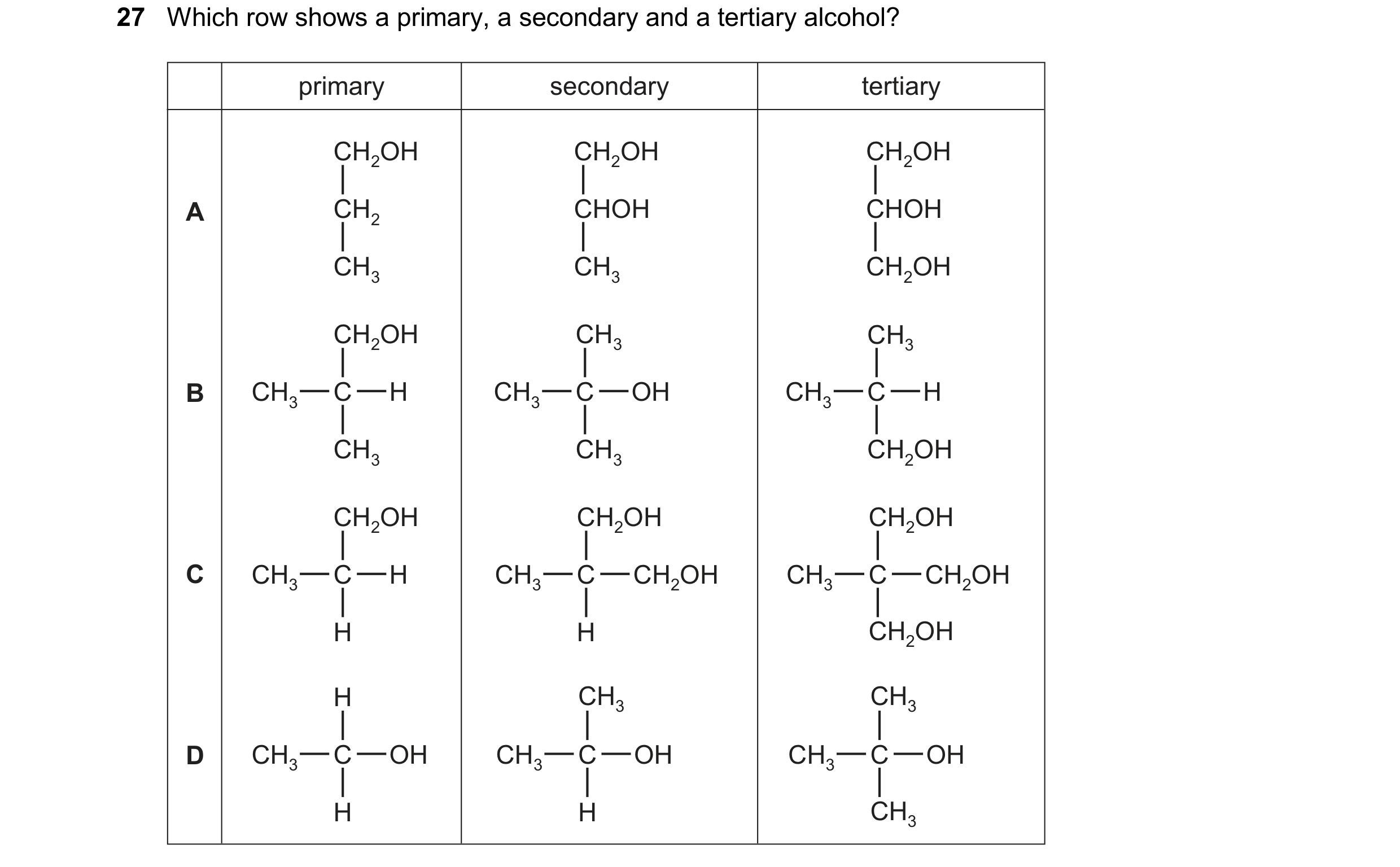
![Question 375: The balanced equation for the reaction of X with an excess of acidified K2Cr2O7 is shown. X + 3[O] Y + H2O Compound Y is the only o…](https://img.pastlit.com/crops/beb7006e-5ca2-41df-be4e-c70e84cd00cd/q33.png) 104 / 107
104 / 107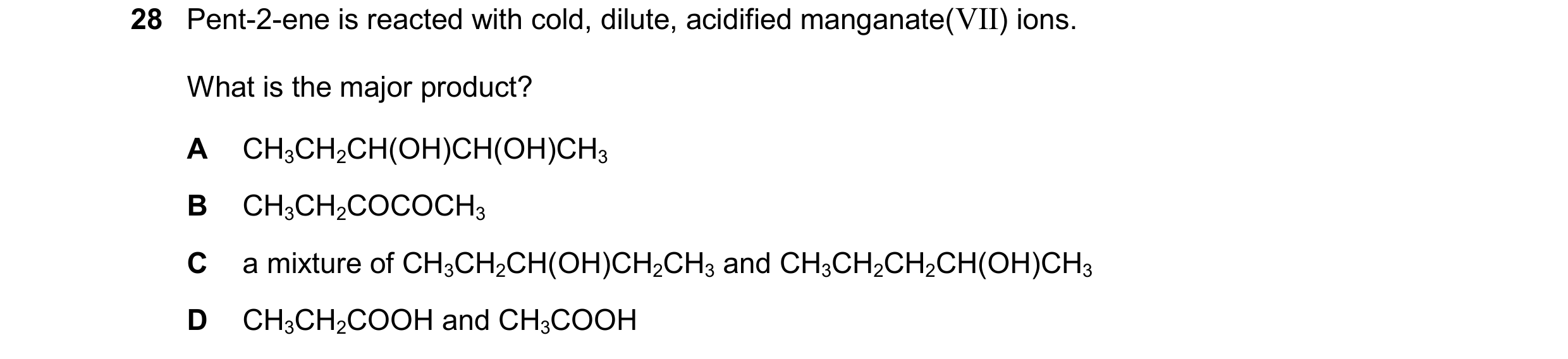

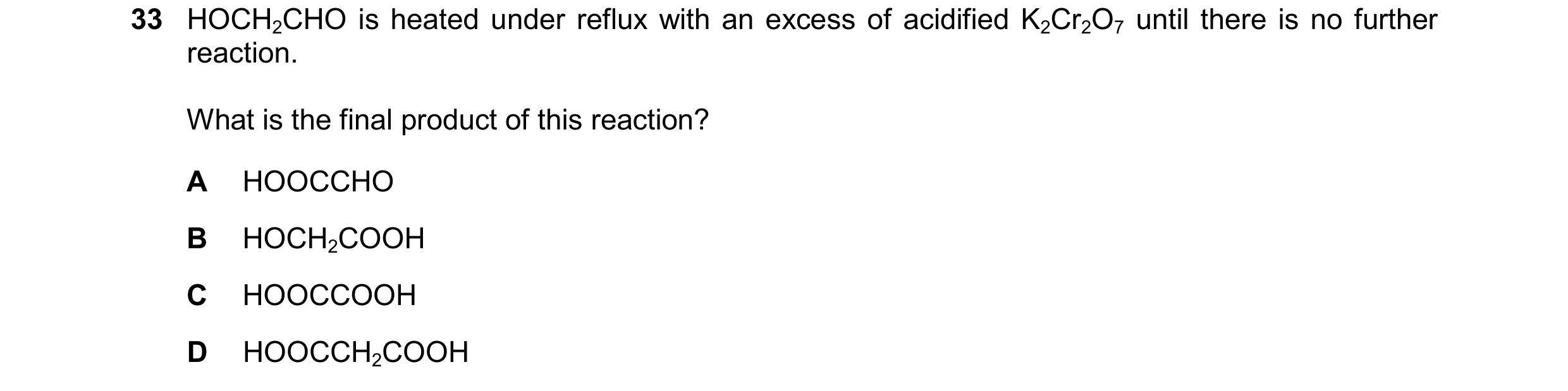 105 / 107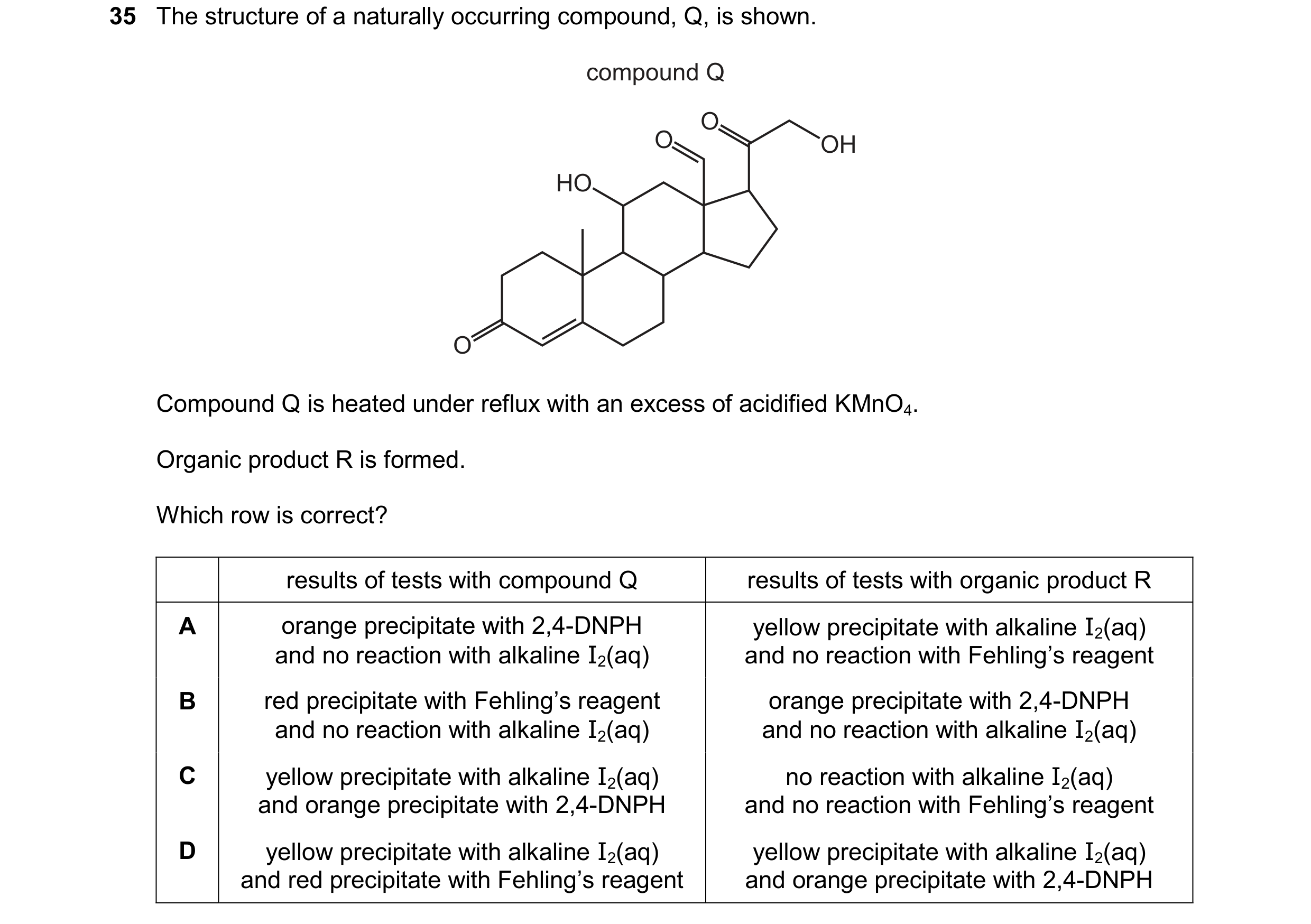
 106 / 107
![Question 381: The balanced equation for the reaction of X with an excess of acidified K2Cr2O7 is shown. X + 3[O] Y + H2O Compound Y is the only o…](https://img.pastlit.com/crops/69b992e3-5e04-4423-b778-66d8ca290214/q33.png) 107 / 107
107 / 107