Questions as text
Q1 · Α-particles, β-particles and γ-rays are known as ionising radiations 0625/31 Oct/Nov 2006
11 (a) α-particles, β-particles and γ-rays are known as ionising radiations. For Examiner’s (i) Describe what happens when gases are ionised by ionising radiations. Use … … … (ii) Suggest why α-particles are considered better ionisers of gas than β-particles. … … [3] (b) (i) Suggest two practical applications of radioactive isotopes. 1. … 2. … (ii) For one of the applications that you have suggested, describe how it works, or draw a labelled diagram to illustrate it in use. … … … [4]
7 marks
Mark scheme: 11 (a) (i) atoms interact with by particle/photon not radiation B1 electron(s) removed to form ions B1 (ii) much greater mass or size/slower speed/more ion pairs/cm/larger charge B1 [3] (b) (i) any 2 correct B2 (ii) e.g. foil thickness described/outline diagram B1 foil too thick less reading/notes on diagram to show method B1 other examples will occur, must have two clear points: e.g. 1. gamma rays aimed at cancer (not just radiation) focused on tumour e.g. 2. fission of heavy nucleus (accept named nuclide) leads to more fissions/chain reaction [4] [Total: 7]
This question in 0625/31 Oct/Nov 2006
Question 2 0625/31 Oct/Nov 2007
Use 11 Fig. 11.1 shows an experiment to test the absorption of β-particles by thin sheets of aluminium. Ten sheets are available, each 0.5 mm thick. β-particle source detector counter sheets of aluminium Fig. 11.1 (a) Describe how the experiment is carried out, stating the readings that should be taken. … … … … … [4] (b) State the results that you would expect to obtain. … … … … [2] [Total: 6]
6 marks
Mark scheme: 11 (a) detector, no source, no aluminium, take count OR take background B1 no aluminium, take count B1 aluminium, take count B1 subtract background/reading 1 from results B1 (b) count decreases as thickness of aluminium increases B1 6-10 sheets/several sheets/few mm, count reduced to background count/β-particles stopped B1 [Total: 6]
This question in 0625/31 Oct/Nov 2007
Q3 · A certain element is known to exist as two different isotopes 0625/31 May/June 2010
10 A certain element is known to exist as two different isotopes. For Examiner’s (a) State one thing that is the same for atoms of both isotopes. Use … [1] (b) State one thing that is different between atoms of these two isotopes. … [1] (c) An atom of one of these isotopes is unstable and decays into a different element by emitting a -particle. (i) State one thing about the atom that remains the same during this decay. … [1] (ii) State one thing about the atom that changes as a result of this decay. … [1] [Total: 4]
4 marks
Mark scheme: 10 (a) proton number OR atomic number OR (number of) protons / electrons OR position in periodic table OR chemical properties B1 (b) mass (number) OR nucleon number OR (number of) neutrons / nucleons OR (number of) protons plus (number of) neutrons B1 (c) (i) mass (number) OR nucleon number OR (number of) nucleons OR (number of) protons plus (number of) neutrons B1 (ii) proton number OR atomic number OR (number of) neutrons OR (number of) protons / neutrons / electrons OR position in periodic table OR chemical properties OR a neutron changes into a proton B1 [4]
This question in 0625/31 May/June 2010
Q4 · A radium source emits , and radiations 0625/32 May/June 2010
11 A radium source emits , and radiations. Fig. 11.1 illustrates what happens to these For radiations when they pass through a magnetic field. The left hand beam is actually deviated Examiner’s a great deal less than shown on Fig. 11.1. Use radioactive source Fig. 11.1 (a) On Fig. 11.1, label the three radiations by writing in the boxes provided. [2] (b) State the direction of the magnetic field that gives the deflections shown in Fig. 11.1. … [2] [Total: 4]
4 marks
Mark scheme: 11 (a) γ straight up B1 α to left AND β to right B1 (b) into or out of paper C1 into paper A1 [4]
This question in 0625/32 May/June 2010
Q5 · A radium source emits , and radiations 0625/33 May/June 2010
11 A radium source emits , and radiations. Fig. 11.1 illustrates what happens to these For radiations when they pass through a magnetic field. The left hand beam is actually deviated Examiner’s a great deal less than shown on Fig. 11.1. Use radioactive source Fig. 11.1 (a) On Fig. 11.1, label the three radiations by writing in the boxes provided. [2] (b) State the direction of the magnetic field that gives the deflections shown in Fig. 11.1. … [2] [Total: 4]
4 marks
Mark scheme: 11 (a) γ straight up B1 α to left AND β to right B1 (b) into or out of paper C1 into paper A1 [4]
This question in 0625/33 May/June 2010
Q6 · Emissions from a radioactive source pass through a hole in a lead screen and into a… 0625/31 Oct/Nov 2010
10 Emissions from a radioactive source pass through a hole in a lead screen and into a magnetic field, as shown in Fig. 10.1. radioactive A magnetic field source into paper B lead screen C 3 cm Fig. 10.1 Radiation detectors are placed at A, B and C. They give the following readings: A B C 32 counts / min 543 counts / min 396 counts / min The radioactive source is then completely removed, and the readings become: A B C 33 counts / min 30 counts / min 31 counts / min (a) Explain why there are still counts being recorded at A, B and C, even when the radioactive source has been removed, and give the reason for them being slightly different. … … … … [2] (b) From the data given, deduce the type of emission being detected, if any, at A, at B and at C when the radiation source is present. State the reasons for your answers. detector at A … … … [2] detector at B … … … [3] detector at C … … … [3] [Total: 10]
10 marks
Mark scheme: 10 (a) idea of background radiation M1 random/different at different times NOT places A1 (b) A nothing OR background M1 reading doesn’t change (when source removed) A1 B gamma OR γ M1 gamma undeflected (by magnetic field) A1 uncharged/neutral OR electromagnetic radiation A1 C beta OR β B1 deflection is big/more deflection than alpha B1 low mass/much smaller than alpha B1 OR beta OR β B1 negative B1 deflects according to left-hand rule B1 [Total: 10]
This question in 0625/31 Oct/Nov 2010
Q7 · A radioactive source is placed near a radiation detector connected to a counter, as shown… 0625/33 Oct/Nov 2010
11 A radioactive source is placed near a radiation detector connected to a counter, as shown in Fig. 11.1. radioactive radiation counter source detector Fig. 11.1 (a) The count rate, measured over three successive minutes, gives values of 720 counts / minute 691 counts / minute 739 counts / minute. Explain why a variation like this is to be expected in such an experiment. … … [1] (b) The radiation detector and counter are left untouched. The radioactive source is put in its lead container and returned to the metal security cupboard. Once this has been done, a further measurement is taken over one minute. This gives a reading of 33 counts / minute. (i) State the name used for the radioactivity being detected during this minute. … (ii) Suggest two possible sources for this radioactivity. 1. … 2. … [3] [Total: 4]
4 marks
Mark scheme: 11 (a) radioactivity is random/cannot be predicted B1 (b) (i) background B1 (ii) radiation from surroundings/something specific in lab ) radiation from soil/rocks (accept example)/14C/Sun/ ) any 2 B1+B1 Earth/space/cosmic radiation/radon ) [Total: 4]
This question in 0625/33 Oct/Nov 2010
Q8 · Six different nuclides have nucleon and proton numbers as follows: nuclide nucleon number… 0625/31 May/June 2011
6 (a) Six different nuclides have nucleon and proton numbers as follows: nuclide nucleon number proton number A 214 84 B 214 85 C 211 84 D 211 86 E 210 82 F 210 83 State which two nuclides are isotopes of the same element. … and … [1] (b) Thorium-232 has a half-life of 1.4 × 10¹⁰ years. At a particular instant, the activity of a sample of thorium-232 is 120 Bq. (i) Calculate the time taken for the activity of this sample to fall to 15 Bq. time taken … [1] (ii) Explain why, when the activity has become 15 Bq, much of the sample will no longer be thorium-232. … … … [1] (iii) The sample of thorium-232 is used in an experiment in a laboratory. Explain why its activity may be regarded as constant. … … … [1] [Total: 4]
4 marks
Mark scheme: 6 (a) A and C B1 (b) (i) 4.2 × 10¹⁰ years B1 (ii) idea of decay OR changes proton/neutron/nucleon number OR change into another nuclide/isotope/element/type of atom OR emits α/β particle (ignore γ / radiation) B1 (iii) idea of insignificant change in activity during stated time up to 5 × 10⁹ years OR experiment time insignificant c.f. 1.4 × 10¹⁰ years OR long half life OR long time to decay B1 [4] IGCSE – May/June 2011 0625 31
This question in 0625/31 May/June 2011
Q9 · An atom consists of a nucleus made up of protons and neutrons, surrounded by orbiting… 0625/32 May/June 2011
11 (a) An atom consists of a nucleus made up of protons and neutrons, surrounded by orbiting electrons. (i) Which of these particles has a positive charge? … [1] (ii) Which two of these particles have almost equal mass? … and … [1] 107 (b) A silver nucleus is denoted by Ag. State the number of protons and the number of neutrons 47 in this nucleus. number of protons = … number of neutrons = … [2] (c) The graph in Fig. 11.1 shows part of the decay curve of a radioactive nuclide. The count rate is plotted against time. 300 count rate counts / s 200 100 0 0 5 10 15 20 25 30 time / hours Fig. 11.1 (i) Use the graph to find the half-life of this nuclide. half-life = … [1] (ii) Plot two more points on Fig. 11.1 at times greater than 10 hours. Use a dot in a circle to indicate each point. [2] [Total: 7]
7 marks
Mark scheme: 11 (a) (i) proton B1 (ii) proton and neutron B1 (b) number of protons = 47 B1 number of neutrons = 60 B1 (c) (i) 8 hrs +/– 0.25 hrs B1 (ii) first point plotted is half the count-rate of a point on the curve, and 8 hours after that point (ecf from (c)(i) ) B1 second point plotted same as above or with respect to first point plotted B1 possible points include: 16 hrs, 80 counts/s 24 hrs, 40 counts/s 13.5 hrs, 100 counts/s 21.5 hrs, 50 counts/s 16.5 hrs, 75 counts/s [7]
This question in 0625/32 May/June 2011
Q10 · An atom consists of a nucleus made up of protons and neutrons, surrounded by orbiting… 0625/33 May/June 2011
11 (a) An atom consists of a nucleus made up of protons and neutrons, surrounded by orbiting electrons. (i) Which of these particles has a positive charge? … [1] (ii) Which two of these particles have almost equal mass? … and … [1] 107 (b) A silver nucleus is denoted by Ag. State the number of protons and the number of neutrons 47 in this nucleus. number of protons = … number of neutrons = … [2] (c) The graph in Fig. 11.1 shows part of the decay curve of a radioactive nuclide. The count rate is plotted against time. 300 count rate counts / s 200 100 0 0 5 10 15 20 25 30 time / hours Fig. 11.1 (i) Use the graph to find the half-life of this nuclide. half-life = … [1] (ii) Plot two more points on Fig. 11.1 at times greater than 10 hours. Use a dot in a circle to indicate each point. [2] [Total: 7]
7 marks
Mark scheme: 11 (a) (i) proton B1 (ii) proton and neutron B1 (b) number of protons = 47 B1 number of neutrons = 60 B1 (c) (i) 8 hrs +/– 0.25 hrs B1 (ii) first point plotted is half the count-rate of a point on the curve, and 8 hours after that point (ecf from (c)(i) ) B1 second point plotted same as above or with respect to first point plotted B1 possible points include: 16 hrs, 80 counts/s 24 hrs, 40 counts/s 13.5 hrs, 100 counts/s 21.5 hrs, 50 counts/s 16.5 hrs, 75 counts/s [7]
This question in 0625/33 May/June 2011
Q11 · In a laboratory’s secure radioactivity cupboard are two unlabelled radioactive sources 0625/33 Oct/Nov 2011
11 (a) In a laboratory’s secure radioactivity cupboard are two unlabelled radioactive sources. A scientist knows that one is an alpha-emitter and the other is a beta-emitter, but is not sure which is which. A radiation detector, a magnet and some paper are available. Briefly describe two different experimental tests, using this equipment, which would allow the scientist to identify which is the alpha-emitter and which is the beta-emitter. test outcome for alpha outcome for beta [4] (b) Radioactive carbon-14 (14 C) decays by emitting β-particles. 6 (i) What are the values of the proton and nucleon numbers of carbon-14? proton number … nucleon number … [2] (ii) Carbon-14 is absorbed by living organisms. When the organism dies, no more carbon-14 is absorbed. The carbon-14 already absorbed decays with a half-life of 5730 years. Recent human skeletons have an activity of 64 units, but a human skeleton dug up by an archaeologist has an activity of 8 units. Determine the age of this ancient skeleton. age = … [2]
8 marks
Mark scheme: 11 (a) idea of absorption by paper e.g. put between source and detector M1 α is absorbed, β is not A1 idea of deflection in magnetic field e.g. magnet near source M1 β is deflected much more/opposite direction A1 (b) (i) 6 B1 14 B1 (ii) 3 half-lives C1 17 190 / 17 200 / 17 000 / 1.7 × 10⁴ years A1 [8]
This question in 0625/33 Oct/Nov 2011
Q12 · Complete the following statements 0625/31 May/June 2013
11 (a) Complete the following statements. For Examiner’s (i) An α-particle consists of … . Use (ii) A β-particle consists of … . [3] (b) As α-particles and β-particles pass through a gas, molecules of the gas become ionised. Explain what is meant by the ionisation of a gas molecule. … … [1] (c) Fig. 11.1 shows a beam of α-particles and a beam of β-particles in a vacuum. The beams are about to enter a region in which a very strong magnetic field is acting. The direction of the magnetic field is into the page. _-particles `-particles uniform magnetic field Fig. 11.1 (i) Suggest why the paths of the particles in the magnetic field are curved. … [1] (ii) Sketch the paths of both types of particle in the magnetic field. [3] [Total: 8]
8 marks
Mark scheme: 11 (a) (i) 2 protons B1 2 neutrons B1 (ii) a (fast moving) electron B1 (b) electron/electrons removed from/gained by the molecule B1 (c) (i) force because particle is charged OR the force on the particles is perpendicular to their paths OR direction of force changes as direction of motion changes B1 (ii) α-particle curve up the page in at least half of width of field B1 β-particle curve opposite to α-particle curve OR down page if α line has no B1 curvature anywhere smaller radius of β path clear B1 [Total 8]
This question in 0625/31 May/June 2013
Q13 · There are two stable, naturally occurring isotopes of hydrogen 0625/32 May/June 2013
10 There are two stable, naturally occurring isotopes of hydrogen. For Examiner’s Common hydrogen (hydrogen-1) has a proton number of 1 and a nucleon number of 1. Use Hydrogen-2 (deuterium) has a nucleon number of 2. There is also a radioactive isotope of hydrogen called tritium (hydrogen-3), with a nucleon number of 3. (a) Complete the table for neutral atoms of these isotopes. hydrogen-1 hydrogen-2 hydrogen-3 (deuterium) (tritium) number of protons number of neutrons number of electrons [3] (b) Two samples of tritium are stored in aluminium containers of different thickness. Sample 1 is in a container of thickness 0.5 mm and radiation can be detected coming through the container. Sample 2 is in a container of thickness 5 mm and no radiation comes through. (i) State the type of radiation coming through the container of Sample 1. … [1] (ii) Explain your answer to (b)(i). … … … … [2] (c) Under conditions of extremely high temperature and pressure, as in the interior of the Sun, hydrogen nuclei can join together. (i) Name this process. … [1] (ii) State whether energy is released, absorbed or neither released nor absorbed during this reaction. … [1] (d) When a nucleus of a certain isotope of uranium is bombarded by a suitable neutron, it For splits into two smaller nuclei and energy is released. Examiner’s Use Name this process. … [1] [Total: 9] Turn over for Question 11
9 marks
Mark scheme: 10 (a) hydrogen-1 deuterium tritium no.of protons 1 1 1 no. of 0 1 2 neutrons no. of 1 1 1 electrons proton line correct B1 neutron line correct, do not accept blank for 0 B1 electron line correct B1 [3] (b) ignore any reference to background radiation throughout this part (i) beta / fast moving electrons B1 [1] (ii) any two from: beta stopped by 5 mm/thick Al / beta not stopped by 0.5 mm/thin Al B1 alpha stopped by 0.5mm/thin Al accept stopped by paper B1 [2] gamma not stopped by 5 mm or more/thick Al ignore any reference to range in air (c) (i) fusion / thermonuclear (reaction) B1 [1] (ii) (energy) released B1 [1] (d) fission B1 [1] [Total: 9] IGCSE – May/June 2013 0625 32
This question in 0625/32 May/June 2013
Q14 · Strontium-90 is a radioactive isotope that emits β-particles as it decays 0625/32 Oct/Nov 2013
11 Strontium-90 is a radioactive isotope that emits β-particles as it decays. The nuclear equation For below shows this decay. Examiner’s Use 90 a 0 38Sr b X + –1e (a) Calculate (i) the value of a, a = … (ii) the value of b. b = … [2] (b) (i) Tick the element from the list below that is produced by this decay. element proton number place one tick in this column selenium 34 bromine 35 krypton 36 rubidium 37 strontium 38 yttrium 39 zirconium 40 niobium 41 molybdenum 42 [1] a (ii) The isotope X is also radioactive and undergoes β-decay. b State the name of the element that is produced by this decay. … [1] Question 11 continues on the next page. (c) Three nuclei are represented as For 83 209 84 Examiner’s 42X 83Y 42Z Use State and explain which nuclei are isotopes of the same element. … … … … [2] [Total: 6]
6 marks
Mark scheme: 11 (a) (i) 90 B1 (ii) 39 B1 [2] (b) (i) tick corresponds to candidate’s (a)(ii) B1 [1] (ii) zirconium c.a.o. B1 [1] (c) X (and) Z (are isotopes of same element) M1 same proton number A1 [2] [Total: 6]
This question in 0625/32 Oct/Nov 2013
Q15 · In a laboratory at a nuclear power station, a radiation detector is connected to a… 0625/33 Oct/Nov 2013
11 In a laboratory at a nuclear power station, a radiation detector is connected to a computer. For The readings recorded are displayed on the computer screen. Examiner’s Use The detector is switched on. Ten minutes later, at time t = 10 minutes, a small sample of radioactive material is removed from a nuclear reactor and placed near to the detector. Readings are recorded for a further 40 minutes. Fig. 11.1 shows the display. 90 80 count-rate 70 counts / minute 60 50 40 30 20 10 0 0 10 20 30 40 50 time t / minutes Fig. 11.1 (a) Use Fig. 11.1 to determine the background count-rate in the laboratory. background count-rate = … [1] (b) Use Fig. 11.1 to determine the count-rate due to the radioactive sample (i) at t = 10 minutes, count-rate due to sample = … (ii) at t = 19 minutes. count-rate due to sample = … [2] (c) Use the values obtained in (b) to estimate the half-life of the radioactive sample. For Examiner’s Use half-life = … [2] [Total: 5]
5 marks
Mark scheme: 11 (a) 12 counts / min B1 [1] (b) (i) 72 counts / min (e.c.f. from 11(a)) B1 (ii) 9 counts / min (note: if background not subtracted, (i) 84 and (ii) 21 gains 1 compensatory mark) B1 [2] (c) 9/72 or 1/8 or 3 (half-lives) or (e.c.f.) 21/84 or 1/4 or 2 (half-lives) C1 3.0 minutes or 4.5 minutes (i.e. background not subtracted but otherwise correct) A1 [2] [Total: 5]
This question in 0625/33 Oct/Nov 2013
Q16 · Complete the table below for the three types of radiation 0625/31 May/June 2014
11 (a) Complete the table below for the three types of radiation. radiation nature charge stopped by electromagnetic γ radiation β negative α thick paper [3] (b) An isotope of strontium is represented in nuclide notation as 9038Sr. For a neutral atom of this isotope, state (i) the proton number, … (ii) the nucleon number, … (iii) the number of neutrons, … (iv) the number of electrons. … [3] (c) A sample of a radioactive material is placed near a radiation detector. A count-rate of 4800 counts / s is detected from the sample. After 36 hours the count-rate has fallen to 600 counts / s. Calculate how many more hours must pass for the count-rate to become 150 counts / s. number of hours = … [3] [Total: 9]
9 marks
Mark scheme: 11 (a) γ: none / zero / 0 / neutral AND 2 cm (or more) of lead / thick lead / 50 cm (or more) of concrete B1 β: particle / electron AND any named metal / glass / concrete OR 1 m of air B1 α: particle / helium nucleus / 2 protons + 2 neutrons / 42 He / 42 α AND positive OR + OR +2 B1 IGCSE – May/June 2014 0625 31 (b) (i) 38 (ii) 90 (iii) 52 (iv) 38 B3 (c) 36 hours = 3 half-lives OR halving in steps from 4800 to 600 seen C1 half-life = 12 hours OR 3 half-lives OR 2 / 3 of 36 C1 (further time to reduce to 150 Bq =) 24 (hours) A1 [Total: 9]
This question in 0625/31 May/June 2014
Q17 · A beam of radiation that contains α-particles, β-particles and γ-rays 0625/32 May/June 2014
11 Fig. 11.1 shows a beam of radiation that contains α-particles, β-particles and γ-rays. The beam enters a very strong electric field between charged plates in a vacuum. plate at positive voltage beam of radiation plate at negative voltage Fig. 11.1 (a) Indicate the deflection, if any, of the α-particles, β-particles and γ-rays, by placing one tick in each column of the table. possible deflection α-particles β-particles γ-rays no deflection towards positive plate towards negative plate out of the paper into the paper [3] (b) The radiation is said to be ionising. Explain what this means. … … [1] (c) α-particles are more strongly ionising and have a shorter range in air than γ-rays. Use your knowledge of the nature of these radiations to explain these differences. … … … … [3] [Total: 7]
7 marks
Mark scheme: 11 (a) γ not deflected NOT extra(s) in γ column B1 α towards –ve or +ve AND β opposite NOT extra(s) in α or β column B1 α towards –ve AND β towards +ve NOT extra(s) in α or β column B1 (b) atoms / molecules (condone particles) lose / gain electrons OR become charged NOT α or β particles lose / gain electrons OR become charged B1 (c) maximum three points (to include at least one explanation) from: maximum two points from: • α is charged / is a helium ion (is scored if 3rd explanation bullet point scored) • γ is not charged • α has mass • γ does not have mass • α has large size • γ has negligible / no size • γ is electromagnetic (wave) / photon • α travels more slowly (than γ, but NOT more slowly than speed of light unless next bullet point is also scored ) • γ travels at the speed of light / faster (than α) any explanation (maximum three) e.g.: • α makes frequent collisions (with air molecules) so range short • γ has few (successful) collisions (with electrons) so not very ionising / range long • α more ionising because it has greater charge • γ has no charge so less ionising • α loses some energy with each collision so range short • γ loses energy in single rare collision so takes longer distance before losing all energy • γ faster so travels further before energy is lost • different methods of ionisation make α more ionising B3 [Total: 7]
This question in 0625/32 May/June 2014
Q18 · A technician sets up a radiation detector in a university laboratory, for use in some… 0625/31 Oct/Nov 2014
9 A technician sets up a radiation detector in a university laboratory, for use in some experiments. Even before the radioactive source for the experiment is brought into the laboratory, the detector registers a low count rate. (a) Suggest what causes this count rate. … [1] (b) A radioactive source that emits α-particles is placed on the laboratory bench and the source is gradually moved closer to the detector. At first, the detector continues to register a low count rate sometimes slightly less than the count rate registered without the source. The count rate suddenly increases to a very high value when the source is very close to the detector. Explain these changes in the count rate. … … … … … [3] (c) In a second experiment, α-particles pass between two parallel, horizontal metal plates in a vacuum. They then continue to the detector as shown in Fig. 9.1. metal plate _-particles source detector metal plate Fig. 9.1 A positive charge is established on the upper plate and a negative charge on the lower plate. (i) On Fig. 9.1, sketch the new path of the α-particles. [2] (ii) State what happens to the count rate registered by the detector. … … [1] [Total: 7]
7 marks
Mark scheme: 9 (a) background (radiation) OR a specific source of background radiation e.g. rocks / building materials / radon gas / cosmic rays B1 (b) any three from: low count rate due to background radiation only slightly less reading due to random nature of radioactivity very high reading due to α-particles OR emission from source sudden increase of count rate at limit of range of α-particles B3 (c) (i) downward curve B1 (ii) (count rate) decreases / background only B1 deviation starts at start of plates B1 [Total: 7]
This question in 0625/31 Oct/Nov 2014
Q19 · A technician sets up a radiation detector in a university laboratory for use in a class… 0625/32 Oct/Nov 2014
10 (a) A technician sets up a radiation detector in a university laboratory for use in a class experiment. (i) A radioactive source that emits β-particles is placed on the laboratory bench, 10 cm from the detector. A small count rate is registered. 1. State the name of the particle, found in an atom, that is identical to a β-particle. … [1] 2. The technician sets up the same equipment in the same way every year. He notices that the count rate registered by the detector every year is slightly smaller than it was the previous year. Suggest why this is so. … … … [2] (ii) In a second experiment, the same equipment is set up but a radioactive source that emits α-particles is placed 10 cm from the detector. The same number of particles are emitted every second from this source as were emitted from the β-source in (i). Explain why the count rate obtained is much lower. … … … [2] (b) In another experiment, β-particles pass between two parallel, horizontal metal plates in a vacuum. They then continue to the detector as shown in Fig. 10.1. metal plate `–particles source detector metal plate Fig. 10.1 A very high p.d. is connected between the plates, with the lower plate positive. On Fig. 10.1, sketch the new path of the β-particles. [2] [Total: 7]
7 marks
Mark scheme: 10 (a) (i) 1. electron B1 2. sensible mention of decay (of source) NOT decay of something inappropriate B1 half-life mentioned sensibly OR activity decreases OR fewer (radioactive/unstable) atoms / nuclei present B1 (ii) α-particles range < 10 cm OR short owtte B1 α more ionising (than β) OR have more mass / charge / size / collisions OR shorter range than β OR reading is background radiation B1 (b) no part of electron path from R to L (note: no mark for this point, but must be present for subsequent marks to be awarded) M0 curve starts at end of plates AND curve up and only up OR down and only down OR 3 or more curves, all up or all down B1 deflection down AND only down B1 [Total: 7]
This question in 0625/32 Oct/Nov 2014
Q20 · A technician sets up a radiation detector in a university laboratory, for use in some… 0625/33 Oct/Nov 2014
10 A technician sets up a radiation detector in a university laboratory, for use in some experiments. Even before the radioactive source for the experiments is brought into the laboratory, the detector registers a small count rate due to background radiation. (a) Suggest one source of this background radiation. … … [1] (b) The radioactive source emits γ-rays. It is placed on the laboratory bench close to the detector. (i) State what γ-rays are. … … … [2] (ii) A lead sheet of thickness 10 mm is positioned between the detector and the radioactive source. State and explain what happens to the count rate on the detector. … … … [2] (c) In a second experiment, γ-rays pass through air to the detector, as shown in Fig. 10.1. a-rays detector source Fig. 10.1 One end of a bar magnet is brought close to the path of the γ-rays. (i) Tick one box to indicate the effect on the path of the γ-rays. [1] deflected into the page deflected out of the page deflected downwards deflected upwards no deflection (ii) Explain your answer to (i). … … [1] [Total: 7]
7 marks
Mark scheme: 10 (a) any one specific source of background radiation e.g. rocks, ground, building materials, radon, radiation from space, Sun, cosmic rays, nuclear waste B1 (b) (i) electromagnetic radiation OR photons B1 (very) high frequency OR (very) short wavelength or high energy B1 (ii) (count rate) decreases B1 (count rate decreases but) not completely absorbed (by lead) OR only some γ-rays detected B1 (c) (i) no deflection (last / fifth box ticked) B1 (ii) (γ-rays) are uncharged / neutral (IGNORE not affected by magnetic fields) B1 [Total: 7]
This question in 0625/33 Oct/Nov 2014
Q21 · State the nature of γ-rays 0625/31 May/June 2015
11 (a) State the nature of γ-rays. … … [1] (b) A beam of α-particles and β-particles passes, in a vacuum, between the poles of a strong magnet. Compare the deflections of the paths of the two types of particle. … … … [2] (c) A beam of β-particles passes, in a vacuum, through the electric field between a pair of oppositely charged metal plates. Describe the path of the particles. … … … [2] (d) The nuclear equation shows the decay of an isotope of polonium. A Po 206 Pb + 4 X Z 82 2 (i) State the nature of X. … … [1] (ii) Calculate the values of A and Z. A = … Z = … [1] [Total: 7]
7 marks
Mark scheme: 11 (a) electromagnetic (waves / radiation / rays / spectrum) B1 OR (high energy) photons (b) α and β deflected in opposite directions B1 any 1 from: B1 • β deflected more (than α) • deflections perpendicular to field direction and to paths of particle • paths (of particles) are curves / circular / arcs (c) curved path B1 (deflected/attracted) towards positively charged plate B1 OR in opposite direction to field (d) (i) α-particle OR helium nucleus OR 2 protons + 2 neutrons B1 (ii) A = 210 Z = 84 B1 [Total: 7]
This question in 0625/31 May/June 2015
Q22 · State the nature of an α-particle 0625/32 May/June 2015
10 (a) State the nature of an α-particle. … … [1] (b) Describe how an electric field between two charged plates could be used to determine whether a beam of particles consists of α- or β-particles. … … … [2] (c) Describe the path of γ-rays in a magnetic field. … … [1] (d) State what is meant by the term isotopes. Use the terms proton number and nucleon number in your explanation. … … … … … [3] [Total: 7]
7 marks
Mark scheme: 10 (a) 2 protons and 2 neutrons OR helium nucleus B1 (b) α in direction of field OR α towards negative (plate) OR β in opposite direction to field OR β towards positive (plate) OR α and β deflected in opposite directions C1 α in direction of field OR α towards negative (plate) AND β in opposite direction to field OR β towards positive (plate) A1 (c) not deflected B1 (d) versions owtte of same element owtte B1 (isotopes of same element have) same proton number/number of protons/atomic number/Z B1 (isotopes of same element have) different nucleon numbers/ number of neutrons/mass number/A B1
This question in 0625/32 May/June 2015
Q23 · An underground water pipe has cracked and water is leaking into the surrounding ground 0625/33 May/June 2015
11 (a) An underground water pipe has cracked and water is leaking into the surrounding ground. Fig. 11.1 shows a technician locating the position of the leak. technician ground surface water that leaked metal water pipe into ground crack in water pipe Fig. 11.1 A radioactive isotope is introduced into the water supply and the water that leaks from the crack is radioactive. The technician tries to locate an area above the pipe where the radioactive count rate is higher than in the surrounding area. (i) State and explain the type of radiation that must be emitted by the isotope for the leak to be detected. … … … [2] (ii) The half-life of the isotope used is 6.0 hours. Explain why an isotope with this half-life is suitable. … … … … [2] (b) Caesium-133 is a stable isotope of the element caesium, but caesium-135 is radioactive. A nucleus of caesium-133 contains 78 neutrons and a nucleus of caesium-135 contains 80 neutrons. Put one tick in each row of the table to indicate how the number of particles in a neutral atom of caesium-133 compares with the number of particles in a neutral atom of caesium-135. The first row has been completed already. particles in caesium-133 2 more than 1 more than equal to 1 fewer than 2 fewer than caesium-135 caesium-135 caesium-135 caesium-135 caesium-135 number of ✓neutrons number of protons number of nucleons number of electrons [2] [Total: 6]
6 marks
Mark scheme: 11 (a) (i) gamma emitter used B1 can penetrate ground to surface/for several metres B1 (ii) long enough to find leak B1 short enough to disappear quickly B1 (b) proton number and electron number: tick for both in box 3, equal B1 nucleon number: tick in box 5, 2 fewer B1 [Total: 6]
This question in 0625/33 May/June 2015
Q24 · State, in terms of the particles in each nucleus, how the nuclei of two isotopes of the… 0625/31 Oct/Nov 2015
11 (a) State, in terms of the particles in each nucleus, how the nuclei of two isotopes of the same element are different. … [1] (b) Fig. 11.1 shows a graph of nucleon number against proton number. The nucleus 21 2 Bi is 8 3 plotted on the graph at the cross marked P. 213 P 212 nucleon 211 number 210 209 208 79 80 81 82 83 84 proton number Fig. 11.1 (i) On Fig. 11.1, 1. plot a cross labelled Q for the nucleus formed when the 21 2 Bi nucleus emits an 8 3 α-particle, 2. plot a cross labelled R for the nucleus formed when the 21 2 Bi nucleus emits a 8 3 β-particle. [4] (ii) The half-life for the decay of 21 2 Bi is 60 minutes. 8 3 A sample of 21 2 Bi is placed at a fixed distance from a detector. The initial measurement 8 3 of the count rate from the sample of 21 2 Bi is 2400 counts per minute. 8 3 Calculate the count rate from the sample 5.0 hours later. count-rate = … [2] [Total: 7]
7 marks
Mark scheme: 11 (a) different number of neutrons (in the nucleus) OR different neutron number B1 (b) (i) 1 letter Q at nucleon number = 208 B1 proton number = 81 B1 2 letter R at nucleon number = 212 B1 proton number = 84 B1 (ii) evidence of dividing original number by 2 C1 75 (counts) / min OR 1.25 (counts) / s OR 4500 (counts) / hr A1 [Total: 7]
This question in 0625/31 Oct/Nov 2015
Q25 · The counter of a radiation detector placed close to a radioactive source gives a count… 0625/32 Oct/Nov 2015
11 (a) The counter of a radiation detector placed close to a radioactive source gives a count rate of 1600 counts / s. The half-life of the source is 1 week. Ignoring background radiation, calculate the count rate (i) 1 week after the first measurement, count rate = … [1] (ii) 3 weeks after the first measurement. count rate = … [1] (b) Fig. 11.1 shows the arrangement for an experiment to investigate the shielding of radioactive sources. position of thick card 5 mm steel 20 cm lead samples A B C D E 20 cm air Fig. 11.1 (not to scale) Samples containing three different radioactive sources are placed, one at a time, in the position shown. The table shows the count rates when a radiation detector is placed at the positions A to E. Complete the table to indicate whether α-particles, β-particles or γ-rays are emitted from each sample. A B C D E type of radiation emitted sample 1 high high high high low sample 2 high high low 0 0 sample 3 high 0 0 0 0 [3] (c) State which type of radiation, α, β or γ, is the most strongly ionising. … [1]
6 marks
Mark scheme: 11 (a) (i) 800 counts / s B1 (ii) ¼ of (i) B1 (b) sample 1 γ B1 sample 2 β NOT γ as extra B1 sample 3 α NOT extras B1 (c) α B1 [Total: 6]
This question in 0625/32 Oct/Nov 2015
Q26 · Uranium-238 and uranium-234 are radioactive isotopes of the element uranium 0625/33 Oct/Nov 2015
11 Uranium-238 and uranium-234 are radioactive isotopes of the element uranium. A uranium-238 nucleus is different from a uranium-234 nucleus but both decay by the emission of an α-particle. (a) (i) In terms of the particles in each, state how a nucleus of uranium-238 differs from a nucleus of uranium-234. … … [2] (ii) Although the two nuclei are different, they are both nuclei of uranium. State a property that makes these isotopes the same element. … … [1] (b) When α-particles pass through air, they are more strongly ionising than β-particles. Suggest two reasons why this is so. … … [2] (c) In an experiment, α-particles are allowed to strike a thin gold foil in a vacuum. Almost all the α-particles pass straight through the gold undeflected. Only a very small number of α-particles are deflected from their original path. This result reveals certain features of the atoms of the gold. State what is shown about atoms by the fact that (i) most α-particles pass straight through the gold undeflected, … … [1] (ii) some α-particles are deflected back the way they came. … … [1] [Total: 7]
7 marks
Mark scheme: 11 (a) (i) number of / more neutrons B1 4 more neutrons B1 (ii) same number of protons / proton number / atomic number / chemical reactions / number of electrons (in neutral atom) B1 (b) any two lines from: larger charge slower moving more massive greater volume / more chance of collision more energy B2 (c) (i) atom is mostly empty space OR nucleus very small OR mass concentrated at centre / nucleus OR greater distance between nuclei B1 (ii) charge concentrated at centre / nucleus B1 [Total: 7]
This question in 0625/33 Oct/Nov 2015
Q27 · Waves from different regions of the electromagnetic spectrum have different uses 0625/32 Feb/March 2016
9 Waves from different regions of the electromagnetic spectrum have different uses. (a) Draw one line from each type of electromagnetic wave to its use. household lights microwaves television remote control loudspeaker infra-red waves satellite communications security check of suitcases [2] (b) Many years ago, some shoe shops used X-ray machines to make images of feet, as shown in Fig. 9.1. Fig. 9.1 Explain the risk to health of using these X-ray machines. … … … … [2] [Total: 4]
4 marks
Mark scheme: 9 (a) line from microwaves to satellite communications B1 line from infra-red waves to TV remote control B1 (b) any two from: B2 • X-rays may cause mutation of DNA / cells • X-rays are ionising • idea of unnecessary exposure • (sales assistants) exposed to large dose of X-rays [Total: 4]
This question in 0625/32 Feb/March 2016
Q28 · Three types of ionising radiation are alpha, beta and gamma 0625/32 Feb/March 2016
12 Three types of ionising radiation are alpha, beta and gamma. (a) Draw one straight line from each type of radiation to a property of that radiation. type of radiation property of radiation has a negative charge alpha α has a long half-life beta β is stopped by paper gamma γ is electromagnetic radiation [3] 210 (b) Polonium-210 has the nuclide notation 84Po. For one neutral atom of polonium-210, (i) determine the number of protons, … [1] (ii) determine the number of neutrons. … [1] (c) Fig. 12.1 shows a decay curve for polonium-210. 18000 16000 14000 count rate / 12000 counts per second 10000 8000 6000 4000 2000 0 0 20 40 60 80 100 time / weeks Fig. 12.1 Use the graph to determine the half-life of polonium-210. half-life = … weeks [2] [Total: 7]
7 marks
Mark scheme: 12 (a) line from alpha to stopped by paper B1 line from beta to negative charge B1 line from gamma to e.m. radiation B1 (b) (i) 84 B1 (ii) 126 B1 (c) evidence of line from 8000 or idea of halving e.g. 8000 and 4000 C1 20 ± 1.0 (weeks) A1 [Total: 7]
This question in 0625/32 Feb/March 2016
Q29 · Two radioactive sources are used by a teacher 0625/31 May/June 2016
12 Two radioactive sources are used by a teacher. One source emits only alpha particles and the other source emits only beta particles. (a) Suggest how the sources can be identified. … … … … … [2] (b) The teacher also has a source that emits gamma rays. State two ways in which gamma rays are different from alpha particles. 1. … 2. … [2] (c) State an effect of ionising radiation on living things. … [1] [Total: 5]
5 marks
Mark scheme: 12(a) idea of paper between source and detector OR measuring range (in air) OR pass through an electric or magnetic field B1 alpha stopped by paper OR larger range in air for beta OR identify deflection when in field B1 12(b) any two from: gamma travel at the speed of light gamma rays have no charge gamma rays have no mass gamma is a wave OR part of the electromagnetic spectrum gamma less ionising greater penetration not deflected by electric or magnetic fields B2 12(c) damages cells / tissues / DNA OR causes (cell) mutations OR radiation sickness B1 Total: 5
This question in 0625/31 May/June 2016
Q30 · The regions of the electromagnetic spectrum 0625/32 May/June 2016
6 Fig. 6.1 shows the regions of the electromagnetic spectrum. Two regions have not been named. gamma ultraviolet visible infra-red radio rays rays light waves waves Fig. 6.1 (a) Complete Fig. 6.1 by labelling the two regions that have not been named. [2] (b) On Fig. 6.1, circle the region with the longest wavelength. [1] (c) (i) Suggest a use for gamma radiation. … … [1] (ii) Suggest a use for ultraviolet radiation. … … [1] [Total: 5]
5 marks
Mark scheme: 6(a) X-rays microwaves B1 B1 6(b) radio waves B1 6(c) any one from: cancer detection / treatment, sterilising (hospital equipment / dressings), gamma-ray photography / scanning, preserving food, detecting cracks in metal structures, locating leaks from underground pipes any one from: detecting forgeries, suntan beds, hardening dental fillings, astronomy, security pens, treating jaundice, locating blood / body fluids B1 B1 Total: 5
This question in 0625/32 May/June 2016
Q31 · A radioactive nucleus decays by the emission of a β-particle 0625/32 May/June 2016
12 (a) A radioactive nucleus decays by the emission of a β-particle. State what a β-particle is and give its charge. … … [2] (b) The graph in Fig. 12.1 shows how the count rate from a sample of a radioactive substance varies with time. 4000 count rate 3500 counts / min 3000 2500 2000 1500 1000 500 0 0 4 8 12 16 20 24 28 32 36 40 time / days Fig. 12.1 Use the graph to find the half-life. Show your working on the graph. half-life = … days [2] (c) Following an accident, the soil around a nuclear power station is contaminated by caesium-137, which is radioactive. A sample of this soil containing caesium-137 has a count rate of 180 counts / min. Caesium-137 has a half-life of 30 years and decays by β-emission. (i) Calculate the count rate from the caesium-137 in the sample after 60 years. count rate = … counts / min [2] (ii) Suggest why people do not want to live near the power station, even after it has closed. … … … … [2] [Total: 8]
8 marks
Mark scheme: 12(a) (fast moving) electron negative (charge) B1 B1 12(b) line from count rate of 2000 8 (days) C1 A1 12(c)(i) 180 ÷ 4 45 (counts / min) C1 A1 12(c)(ii) any two from: radiation mutates DNA / damages (living) cells radioactive material still present (in soil / reactor core / after many years) negative public perception of nuclear power radioactive waste on site contains isotopes with long half-lives B2 Total: 8
This question in 0625/32 May/June 2016
Q32 · The regions of the electromagnetic spectrum 0625/33 May/June 2016
6 Fig. 6.1 shows the regions of the electromagnetic spectrum. Two regions have not been named. gamma ultraviolet visible infra-red radio rays rays light waves waves Fig. 6.1 (a) Complete Fig. 6.1 by labelling the two regions that have not been named. [2] (b) On Fig. 6.1, circle the region with the longest wavelength. [1] (c) (i) Suggest a use for gamma radiation. … … [1] (ii) Suggest a use for ultraviolet radiation. … … [1] [Total: 5]
5 marks
Mark scheme: 6(a) X-rays microwaves B1 B1 6(b) radio waves B1 6(c) any one from: cancer detection / treatment, sterilising (hospital equipment / dressings), gamma-ray photography / scanning, preserving food, detecting cracks in metal structures, locating leaks from underground pipes any one from: detecting forgeries, suntan beds, hardening dental fillings, astronomy, security pens, treating jaundice, locating blood / body fluids B1 B1 Total: 5
This question in 0625/33 May/June 2016
Q33 · A radioactive nucleus decays by the emission of a β-particle 0625/33 May/June 2016
12 (a) A radioactive nucleus decays by the emission of a β-particle. State what a β-particle is and give its charge. … … [2] (b) The graph in Fig. 12.1 shows how the count rate from a sample of a radioactive substance varies with time. 4000 count rate 3500 counts / min 3000 2500 2000 1500 1000 500 0 0 4 8 12 16 20 24 28 32 36 40 time / days Fig. 12.1 Use the graph to find the half-life. Show your working on the graph. half-life = … days [2] (c) Following an accident, the soil around a nuclear power station is contaminated by caesium-137, which is radioactive. A sample of this soil containing caesium-137 has a count rate of 180 counts / min. Caesium-137 has a half-life of 30 years and decays by β-emission. (i) Calculate the count rate from the caesium-137 in the sample after 60 years. count rate = … counts / min [2] (ii) Suggest why people do not want to live near the power station, even after it has closed. … … … … [2] [Total: 8]
8 marks
Mark scheme: 12(a) (fast moving) electron negative (charge) B1 B1 12(b) line from count rate of 2000 8 (days) C1 A1 12(c)(i) 180 ÷ 4 45 (counts / min) C1 A1 12(c)(ii) any two from: radiation mutates DNA / damages (living) cells radioactive material still present (in soil / reactor core / after many years) negative public perception of nuclear power radioactive waste on site contains isotopes with long half-lives B2 Total: 8
This question in 0625/33 May/June 2016
Q34 · This question is about atoms 0625/33 Oct/Nov 2016
10 This question is about atoms. (a) Complete the sentences below with the correct type of particle in each case. • In a neutral atom, the nucleus is surrounded by negative … . • The nucleus is made up of positive … and neutral … . [2] (b) Explain the meaning of the term isotope. … … … [1] (c) α-particles, β-particles and γ-rays may be emitted from radioactive nuclei. Complete the table. Place one tick (✓) in each column. negatively charged most ionising most penetrating α-particle β-particle γ-rays [3] [Total: 6]
6 marks
Mark scheme: 10(a) electrons B1 protons AND neutrons B1 10(b) same number of protons OR proton number AND different number of nucleons OR neutrons/nucleon number B1 10(c) alpha – most ionising B1 beta – carries a negative charge B1 gamma – most penetrating B1 Total: 6
This question in 0625/33 Oct/Nov 2016
Q35 · Nuclear power stations produce a useful form of energy 0625/32 Feb/March 2017
4 Nuclear power stations produce a useful form of energy. Fig. 4.1 shows part of a nuclear reactor. control rod steam to drive turbines concrete casing fuel rod cold water from turbines pump Fig. 4.1 (a) State the name of the process that releases energy in the nuclear reactor. … [1] (b) Suggest a suitable radioactive material used for the fuel rods. … [1] (c) Below are four statements that describe the operation of a nuclear power station. They are not in the correct order. J The generator produces electricity. K The energy is used to boil water. L The nuclei split, releasing energy. M The steam drives a turbine. Place the statements in the correct order. [3] (d) The nuclear reactor is contained in a very thick concrete casing. Suggest why. … … [2] (e) Suggest one advantage and one disadvantage of a nuclear power station compared with a wind turbine. advantage … … disadvantage … … [2] (f) Wind turbines use a renewable source of energy. State the name of another renewable source of energy. … [1] [Total: 10]
10 marks
Mark scheme: 4(a) fission B1 4(b) plutonium OR uranium B1 4(c) L in first box B1 K and M in second and third boxes respectively B1 J in fourth box B1 4(d) dangerous to humans / ionising radiation B1 (concrete) prevents leaks / absorbs radioactivity B1 Question Answer Marks 4(e) no polluting gases / saves fossil fuels / does not need wind to operate owtte B1 waste products difficult to deal with / last long time B1 4(f) wind OR wave / tidal OR solar OR wood OR biofuel OR HEP OR geothermal OR hydroelectric B1 Total: 10
This question in 0625/32 Feb/March 2017
Q36 · Iodine-131 is a radioactive isotope of iodine 0625/31 May/June 2017
8 Iodine-131 is a radioactive isotope of iodine. Iodine-131 decays by the emission of a β-particle and a γ-ray. (a) A nucleus of iodine-131 can be represented as 13153I Determine the number of neutrons in a nucleus of iodine-131. number of neutrons … [1] (b) β-particles and γ-rays are ionising radiations. Explain the meaning of ionising radiations. … … [1] (c) Fig. 8.1 shows a decay curve for iodine-131. 32 000 count rate counts / minute 28 000 24 000 20 000 16 000 12 000 8000 4000 0 0 4 8 12 16 20 24 28 32 36 40 time / days Fig. 8.1 Use information from Fig. 8.1 to determine the half-life of iodine-131. Show clearly how you used the graph. half-life = … days [3] (d) A different radioactive substance has a half-life of 120 hours. Calculate the time for it to decay to 25% of its original amount. time = … hours [2] [Total: 7]
7 marks
Mark scheme: 8(a) 78 B1 8(b) (radiations that ) remove electrons OR break molecules B1 8(c) pair of count-rate values used C1 clear indication of use of graph, expect two vertical lines or two clear indications on axes using their values C1 8 days (± 1 day) A1 8(d) 2 half-lives C1 240 hours A1 Total: 7
This question in 0625/31 May/June 2017
Q37 · The particles in an atom of the element lithium 0625/32 May/June 2017
12 Fig. 12.1 represents the particles in an atom of the element lithium. neutron X Fig. 12.1 (not to scale) (a) (i) State the name of particle X. … [1] (ii) State the charge of particle X. … [1] (iii) Tick one box in Fig. 12.2 that correctly represents an isotope of lithium. Fig. 12.2 [1] (b) A sample of lithium contains 1.00 mg of a radioactive isotope of lithium. Calculate the mass of the isotope that remains after 2 half-lives. mass = … mg [2] [Total: 5]
5 marks
Mark scheme: 12(a) proton B1 positive or +1 B1 12(a)(ii) tick in third box B1 12(b) idea of mass being halved, e.g. 0.5 C1 0.25 (mg) A1 Total: 5
This question in 0625/32 May/June 2017
Q38 · A nuclear power station generates electricity 0625/33 May/June 2017
5 A nuclear power station generates electricity. (a) The main stages in the operation of a nuclear power station are listed below. They are not in the correct order. A the turbine turns a generator B fission produces thermal energy C water in the boiler becomes hot D steam turns a turbine E nuclei split apart in the reactor F electromagnetic induction produces the output energy G steam is produced Complete the flow chart to describe how a nuclear power station works. Insert the missing letters in the empty boxes. E C D [3] (b) Some people are opposed to the use of nuclear power stations. Give two disadvantages of using nuclear power stations. 1. … … 2. … … [2] (c) One use of electricity is to turn an electric motor. The efficiency of an electric motor is always less than 100 %. State the meaning of the term efficiency. … … [2] [Total: 7]
7 marks
Mark scheme: 5(a) B between E and C B1 G between C and D B1 A followed by F in last two boxes B1 5(b) any 2 from: risk of radioactive material escaping into environment products of nuclear fission are radioactive many isotopes produced have long half-lives reactors can be used to produce material for nuclear weapons B2 5(c) useful energy output compared to total energy input B2 Total: 7
This question in 0625/33 May/June 2017
Q39 · A scientist has a sample of a radioactive substance 0625/33 May/June 2017
12 (a) A scientist has a sample of a radioactive substance. Suggest how he can determine whether the sample is emitting α-particles and whether it is emitting β-particles. … … … … … … … … … … [4] (b) The table lists the charge and location of particles in an atom. Complete the table by stating the charge and the location for each type of particle in an atom. particle charge location electron negative neutron proton in the nucleus [3] [Total: 7]
7 marks
Mark scheme: 12(a) Any 4 from: type of detector named e.g. Geiger counter place absorber between sample and detector and measure count rate uses paper to absorb/stop alpha particles if count rate or radiation decreases/is stopped/is absorbed returns to background sample is emitting alpha particles OR if count rate remains unchanged sample is emitting beta particles uses aluminium to absorb/stop alpha particles if count rate or radiation decreases/is stopped/is absorbed returns to background sample is emitting beta particles B4 12(b) particle charge location electron negative outside/orbiting nucleus neutron neutral/zero in the nucleus proton positive in the nucleus B3 Total: 7
This question in 0625/33 May/June 2017
Q40 · A nucleus of polonium-210 can be represented as 21084Po 0625/31 Oct/Nov 2017
11 A nucleus of polonium-210 can be represented as 21084Po. (a) (i) State the number of protons in a nucleus of polonium-210 … [1] (ii) State the number of neutrons in a nucleus of polonium-210 … [1] (iii) State the number of electrons in a neutral atom of polonium-210 … [1] (b) Polonium-210 is radioactive. When polonium-210 decays it emits alpha radiation. Name two other types of radiation emitted when radioactive elements decay. … and … [1] (c) Polonium-210 has a half-life of 138 days. A sample of polonium-210 has a mass of 0.4 g. Calculate the time for the sample to decay until only 0.1 g of polonium-210 remains. time = … days [3] [Total: 7]
7 marks
Mark scheme: 11(a)(i) 84 B1 11(a)(ii) 126 B1 11(a)(iii) 84 B1 11(b) beta and gamma OR gamma and beta B1 11(c) 0.4 ÷ 2 = 0.2 C1 AND 0.2 ÷ 2 = 0.1 or 2 × 138 C1 276 (days) A1
This question in 0625/31 Oct/Nov 2017
Q41 · A scientist needs to reduce the risks when working with radioactive sources 0625/31 Oct/Nov 2017
12 A scientist needs to reduce the risks when working with radioactive sources. (a) Explain why radioactive sources can be dangerous. … … … [2] (b) Describe how to reduce the risks when working with radioactive sources. … … … … [2] [Total: 4]
4 marks
Mark scheme: 12(a)(i) (They) emit ionising radiation B1 (which) damage DNA/cells/cause tumours/cancers B1 12(a)(ii) Any 2 from: reduce exposure time B2 keep source at distance use of suitable shielding monitor exposure to radiation
This question in 0625/31 Oct/Nov 2017
Q42 · This question is about radioactive materials 0625/33 Oct/Nov 2017
12 This question is about radioactive materials. (a) State the name of the electromagnetic radiation emitted by some nuclei when they decay. … [1] (b) Describe the composition and the penetrating ability of an α-particle. composition … … penetrating ability … … [2] (c) Americium-241 is a radioactive isotope. It has a half-life of 400 years. A sample contains americium-241. Calculate the percentage of americium-241 that remains in the sample after 800 years have passed. percentage remaining = … % [2] [Total: 5]
5 marks
Mark scheme: 12(a) Gamma B1 12(b) 1 helium nuclei OR nuclide notation OR 2p, 2n B1 2 low / few cm of air / stopped by paper B1 12(c) 2 half-life indicated B1 25 (%) B1
This question in 0625/33 Oct/Nov 2017
Q43 · A partially-labelled diagram of the electromagnetic spectrum 0625/31 May/June 2018
9 Fig. 9.1 shows a partially-labelled diagram of the electromagnetic spectrum. A B gamma ray ultraviolet visible infra-red radio Fig. 9.1 (a) (i) On Fig. 9.1, add the names of the missing radiations at A and at B. [2] (ii) Indicate the radiation that has the lowest frequency. On Fig. 9.1, draw a ring around the radiation. [1] (b) State two safety precautions when handling sources that emit gamma radiation. 1 … 2 … [2] [Total: 5]
5 marks
Mark scheme: 9(a)(i) X-rays between gamma rays and ultraviolet 1 microwaves between infra-red and radio 1 9(a)(ii) ring drawn around radio on Fig.9.1 1 9(b) any two from: lead/metal apron (use long) tongs limit (time of) exposure point source away (from you) owtte 2
This question in 0625/31 May/June 2018
Q44 · Radioactive decay may include the emission of: α-radiation β-radiation γ-radiation (a)… 0625/31 May/June 2018
12 Radioactive decay may include the emission of: α-radiation β-radiation γ-radiation (a) (i) From the list, state the type of radiation which has the greatest ionising effect. … [1] (ii) From the list, state the type of radiation which has the lowest penetrating ability. … [1] (b) In a factory, rollers press aluminium metal to make thin foil sheets. An automatic system for controlling the thickness of the foil uses a radioactive source. The automatic system changes the gap between the top and bottom roller. Fig. 12.1 shows the equipment. radioactive thin rollers source aluminium radiation foil radiation detector roller controller counter Fig. 12.1 (i) Use your ideas about the properties of radiation to suggest and explain the type of radiation used. type of radiation … explanation … … … … [2] (ii) The aluminium foil passing the radiation detector is too thin. Describe how this fault affects the reading on the counter. … [1] (iii) Suggest how the fault in (b)(ii) is corrected. State what happens to the rollers. … [1] (iv) The source used is strontium-90. A nucleus of strontium-90 can be described as 9038 Sr. State the number of protons in a nucleus of strontium-90. … [1] [Total: 7]
7 marks
Mark scheme: 12(a)(i) 1 12(a)(ii) α or alpha 1 12(b)(i) beta or β 1 beta emission would be affected by the thickness of the metal owtte 1 12(b)(ii) (counter) reading higher 1 12(b)(iii) rollers move apart/provide less force/pressure owtte 1 12(b)(iv) 38 1
This question in 0625/31 May/June 2018
Q45 · Nuclear fission is used in nuclear power stations to release thermal energy 0625/32 May/June 2018
6 Nuclear fission is used in nuclear power stations to release thermal energy. (a) Describe how the thermal energy is used to generate electricity. … … … … … … [3] (b) Describe two environmental problems that are due to using nuclear power stations. 1. … … 2. … … [2] [Total: 5]
5 marks
Mark scheme: 6(a) (thermal energy is used) to produce steam 1 steam turns a turbine 1 (turbine) turns a generator 1 6(b) any two from: radioactive material/waste produced problems storing waste long half-life of waste/fission products (accidental) leak of nuclear/radioactive material 2
This question in 0625/32 May/June 2018
Q46 · The nuclide notation AZ X describes the nucleus of one type of atom 0625/32 May/June 2018
12 (a) The nuclide notation AZ X describes the nucleus of one type of atom. Draw a line from each symbol to the correct description for that symbol. symbol description number of neutrons A element symbol Z proton number nucleon number X number of atoms [3] (b) (i) One radioactive isotope has a half-life of 6.0 years. A sample of this isotope has a mass of 12 mg. Calculate the mass of this isotope that remains in the sample after 18 years. mass remaining = … mg [3] (ii) The sample decays by emitting a β-particle. Describe the nature of a β-particle. … … [2] (iii) Describe how the nucleus of the isotope changes due to the emission of a β-particle. … … [1] [Total: 9]
9 marks
Mark scheme: 12(a) 1 mark for each correct line. 2 or more lines from any section loses the mark. 3 12(b)(i) 18 / 6 or 3 half lives seen or implied 1 1 / 8 or division by 8 1 1.5 (mg) 1 12(b)(ii) any two from: high energy/fast-moving electron/negatively charged particle about 2000 times smaller than a proton/neutron 2 12(b)(iii) any one from: new element formed neutron becomes/turns into a proton Z/proton number increases by one neutron number decreases by one 1
This question in 0625/32 May/June 2018
Q47 · A diagram to represent a helium atom, and an incomplete key 0625/33 May/June 2018
12 (a) Fig. 12.1 shows a diagram to represent a helium atom, and an incomplete key. key proton … … … Fig. 12.1 Complete the key in Fig. 12.1. State the name of each particle. [2] (b) The table in Fig. 12.2 compares two isotopes of helium. 32He 52He number of protons number of neutrons Fig. 12.2 For each isotope, write the number of protons and the number of neutrons in the correct places in the table. [2] (c) The nucleus of the helium atom in (a) is the same as an α-particle. (i) Describe the penetrating ability of α-particles. … … [1] (ii) Explain why it is dangerous to swallow a source that emits α-particles. … … … … [2] [Total: 7]
7 marks
Mark scheme: 12(a) neutron 1 electron 1 12(b) upper row: 2 in both 1 lower row: 1 in left box AND 3 in right box 1 12(c)(i) weak(ly) penetrating 1 12(c)(ii) Any two from: absorbed over a short distance large mass high charge highly ionising cause cell mutation/damage DNA (high risk) of developing cancer 2
This question in 0625/33 May/June 2018
Q48 · This notation represents the nucleus of a neutral atom of carbon-14 0625/31 Oct/Nov 2018
12 This notation represents the nucleus of a neutral atom of carbon-14. 146C (a) State the number of: 1. protons in the nucleus of an atom of carbon-14 … [1] 2. electrons orbiting the nucleus of an atom of carbon-14 … [1] 3. neutrons in the nucleus of an atom of carbon-14. … [1] (b) Carbon-14 is an isotope of carbon. Carbon-12 is another isotope of carbon. Compare the nucleus of carbon-14 with the nucleus of carbon-12. State the similarities and differences. … … … … … [3] (c) Scientists use carbon-14 to estimate the age of wood that is very old. A very old sample of wood contains 1.0 × 10⁸ carbon-14 atoms. When the sample was new, it contained 8.0 × 10⁸ carbon-14 atoms. The half-life of carbon-14 is 5 700 years. Estimate the age of the sample of wood. age of wood = … years [3]
9 marks
Mark scheme: 12(a) 1. 6 B1 2. 6 B1 3. 8 B1 12(b) Any three from: (nucleus has) same number protons or same atomic / proton number same charge different mass different nucleon number different number of neutrons B3 12(c) idea of 3 half-lives Or 8.0 → 4.0 → 2.0 → 1.0 C1 5700 × 3 C1 17 100 (years) A1
This question in 0625/31 Oct/Nov 2018
Q49 · Draw a line from each part of the atom to its description 0625/32 Oct/Nov 2018
12 (a) Draw a line from each part of the atom to its description. part of the atom description is an electromagnetic wave nucleus is the centre of the atom electron has no electric charge neutron orbits the centre of an atom [3] (b) Tritium is an isotope of hydrogen. It can be represented by 3 H. 1 (i) Explain the meaning of the term isotope. … … … [2] (ii) Fig. 12.1 shows how the activity of a sample of tritium varies with time. 18 000 16 000 count rate counts / min 14 000 12 000 10 000 8000 6000 4000 2000 0 0 10 20 30 40 50 60 time / years Fig. 12.1 Use Fig. 12.1 to calculate the half-life of tritium. Show clearly how you used the graph. half-life = … years [3] [Total: 8]
8 marks
Mark scheme: 12(a) line from ‘nucleus’ to ‘is the centre of an atom’ B1 line from ‘electrons’ to ‘orbit around centre of an atom’ B1 line from ‘neutrons’ to ‘has no electric charge’ B1 12(b)(i) any 2 from: different forms of same element same number of protons different number of neutrons / nucleons B2 12(b)(ii) value from graph selected e.g. 16 000 C1 half the original value selected or stated e.g. 8000 C1 12.3 or 12.4 (years) A1
This question in 0625/32 Oct/Nov 2018
Q50 · A nuclear power station uses uranium to generate thermal energy 0625/33 Oct/Nov 2018
12 A nuclear power station uses uranium to generate thermal energy. (a) The fuel for the power station is an isotope of uranium. Explain the meaning of the term isotope. … … … [2] (b) When the nucleus of a uranium atom decays, it releases a β-particle. Describe the relative ionising effect, and the relative penetrating ability, of a β-particle. relative ionising effect … … relative penetrating ability … … [2] (c) A sample of rock includes some uranium-239. The half-life of uranium-239 is 23 minutes. Determine the fraction of the uranium-239 that remains after 46 minutes. fraction remaining = … [2] [Total: 6]
6 marks
Mark scheme: 12(a) (forms of the same element that have) same number of protons / proton number / atomic number B1 different number of neutrons / nucleon number B1 12(b) less (ionising) than alpha particle OR more (ionising) than gamma B1 more (penetrating) than alpha OR less (penetrating) than gamma B1 12(c) indication of two half-lives C1 ¼ OR 0.25 OR 25% A1
This question in 0625/33 Oct/Nov 2018
Q51 · Astatine-210 is a radioactive material 0625/32 Feb/March 2019
12 Astatine-210 is a radioactive material. The nucleus of astatine can be represented by the symbol shown. 21085At (a) Complete the table to describe the nucleus of astatine-210. type of particle number of particles charge on particle neutron positive [4] (b) Astatine-210 has a half-life of 8 hours. (i) The count rate of a sample of astatine-210 is measured over 24 hours. On Fig. 12.1, sketch a line to show how the count rate changes over the 24 hours. count rate 0 8 16 24 time / hours Fig. 12.1 [2] (ii) The mass of a sample of astatine-210 is 0.500 kg. Calculate how long it takes for 0.375 kg of the sample to decay. decay time = … hours [3] [Total: 9]
9 marks
Mark scheme: 12(a) (neutron) – 125 – neutral B2 proton(s) – 85 – (positive) B2 12(b)(i) curve of negative gradient, gradient decreasing B1 curve with negative gradient starts on y axis B1 12(b)(ii) 0.125 (kg) (remaining) C1 two half-lives indicated C1 16 hours A1
This question in 0625/32 Feb/March 2019
Q52 · Use words from the box to complete the sentences about the charges in an atom 0625/31 May/June 2019
12 (a) Use words from the box to complete the sentences about the charges in an atom. Words can be used once, more than once or not at all. negative neutral positive The charge on the nucleus of an atom is … The charge on a proton is … The charge on electrons orbiting the nucleus is … [3] (b) A nucleus of radium-226 has the nuclide notation shown. 226 88Ra (i) Determine the number of protons in a nucleus of radium-226. … [1] (ii) Determine the number of neutrons in a nucleus of radium-226. … [1] (iii) Radium has another isotope, radium-223. Write the nuclide notation for radium-223 in the space. [1] (c) Radium-226 has a half-life of 1600 years. A sample contains 8.0 mg of radium-226. Calculate the time for the sample to decay until only 1.0 mg of radium-226 remains. time = … years [2] [Total: 8]
8 marks
Mark scheme: 12(a) positive B1 positive B1 negative B1 12(b)(i) 88 B1 12(b)(ii) 138 B1 12(b)(iii) 223 88Ra B1 12(c) 3 half lives (until 1.0 mg remains) C1 (3 × 1600) = 4800 (years) A1
This question in 0625/31 May/June 2019
Q53 · Radioactive emission is a random process 0625/32 May/June 2019
12 (a) Radioactive emission is a random process. Explain the meaning of the word random. … … [1] (b) The table compares three types of radioactive emission. emission relative ionising ability relative penetrating ability alpha beta gamma Table 12.1 Complete the table by choosing words from the box. high low medium [3] (c) A radioactive substance decays by emitting an α-particle. 4 An α-particle can be represented as α. 2 Draw a labelled diagram showing the composition of an α-particle. [3] [Total: 7]
7 marks
Mark scheme: 12(a)(i) unpredictable owtte B1 12(b) From top to bottom of table alpha: HIGH LOW B1 beta: MEDIUM MEDIUM B1 gamma: LOW HIGH B1 12(c) protons B1 neutrons B1 2 of each drawn/labelled AND no electrons B1
This question in 0625/32 May/June 2019
Q54 · Table 11.1 includes information about the properties of three types of naturally… 0625/33 May/June 2019
11 (a) Table 11.1 includes information about the properties of three types of naturally occurring, nuclear radiation. Table 11.1 type of radiation charge mass (atomic mass units) nature 0 0 electromagnetic wave α (alpha) +2 helium-4 nucleus 1/2000 Complete the table. [4] (b) The graph shows the decay curve for a radioactive substance. 10000 count rate counts /minute 9000 8000 7000 6000 5000 4000 3000 2000 1000 0 0 20 40 60 80 time / minutes Use the graph to determine the half-life of the radioactive substance. half-life = … minutes [3] [Total: 7]
7 marks
Mark scheme: 11(a) 1 mark for each correct column (type of radiation): gamma in top box beta in bottom box B1 charge: –1 (in bottom box) B1 mass: 4 ( in middle box) B1 nature: electron (in bottom box) B1 11(b) line on graph from 4500 to curve OR from 8000 and 4000 C1 line on graph from curve to 23 minutes OR from curve to 4 minutes AND 27 minutes C1 23(minutes) A1
This question in 0625/33 May/June 2019
Q55 · A teacher carries out two experiments at the same time 0625/31 Oct/Nov 2019
12 A teacher carries out two experiments at the same time. (a) In the first experiment the count rate for a sample of a radioactive isotope is measured every 30 seconds for 6 minutes. The results are shown in Table 12.1. Table 12.1 count rate time / minutes counts / second 0.0 1246 0.5 1036 1.0 941 1.5 810 2.0 686 2.5 621 3.0 550 3.5 468 4.0 421 4.5 368 5.0 318 5.5 280 6.0 242 Estimate the half-life of the radioactive isotope. Use the information in the table. half-life = … minutes [1] (b) In the second experiment the teacher repeats the procedure with another sample of the same radioactive isotope. The mass of the second sample is greater than that of the first sample. Suggest a value for the count rate for this sample at the start of the experiment. count rate = … counts / second [1] (c) One type of particle emitted during radioactive decay is an α-particle (alpha particle). Describe: (i) the nature of an α-particle … [1] (ii) the ionising ability of an α-particle … [1] (iii) the penetrating ability of an α-particle. … [1] [Total: 5]
5 marks
Mark scheme: 12(a) 2.5 (minutes) B1 12(b) any answer above 1246 (counts/s), e.g. 1247 B1 12(c) 1. helium nucleus OR 2 protons AND 2 neutrons B1 2. strongly (ionising) B1 3. weakly (penetrating) B1
This question in 0625/31 Oct/Nov 2019
Q56 · A radioactive substance decays by emitting an α-particle 0625/32 Oct/Nov 2019
12 A radioactive substance decays by emitting an α-particle. (a) The nuclide notation for an α-particle is 4 2 α (i) State the term given to the number 4, written in the nuclide notation. … [1] (ii) State the term given to the number 2, written in the nuclide notation. … [1] (b) Fig. 12.1 shows the decay curve for a radioactive material. 1000 count rate counts / min 800 600 400 200 0 0 2 4 6 8 10 time / minutes Fig. 12.1 (i) Use information from the graph in Fig. 12.1 to determine the half-life of the material. Clearly show how you used the graph to obtain your answer. half-life = … minutes [3] (ii) Another radioactive material with the same half-life has an initial count rate of 600 counts / min. On Fig. 12.1 sketch the decay curve for this material. [1] [Total: 6]
6 marks
Mark scheme: 12(a)(i) nucleon number OR mass number B1 12(a)(ii) proton number OR atomic number B1 12(b)(i) selected count rate halved B1 two pairs of co-ordinates clearly indicated B1 (half-life =) 4 (minutes) B1 12(b)(ii) shallower curve drawn B1
This question in 0625/32 Oct/Nov 2019
Q57 · The nuclide notation for three isotopes of an element 0625/33 Oct/Nov 2019
12 Fig. 12.1 shows the nuclide notation for three isotopes of an element. 1 2 3 X Y Z 1 1 1 Fig. 12.1 (a) (i) Describe how the nuclide notation shows that each isotope is of the same element. … … [1] (ii) Describe how the nuclide notation shows the differences between the isotopes. … … [1] (b) Radioactive sources emit radiation when they decay. State the names of three types of radioactive emission. 1 … 2 … 3 … [2] (c) Radioactive emissions have differing characteristics. One characteristic is their ionising effect. Complete the statement about ionisation, using words from the box. The words can be used once, more than once or not at all. electrons negatively neutrons positively neutrally protons When atoms are ionised, … may be removed, leaving … charged atoms (ions), or … may be gained, forming … charged atoms (ions). [4] (d) Polonium-210 has a half-life of 140 days. A sample of polonium-210 has 8.0 × 10¹⁰ atoms. Calculate the number of polonium-210 atoms remaining in the sample after 280 days. number of atoms = … [2] [Total: 10]
10 marks
Mark scheme: 12(a)(i) same proton number OR same number of protons OR same atomic number OR same Z B1 12(a)(ii) different nucleon number OR different number of neutrons OR different mass number OR different A B1 12(b) alpha, beta and gamma OR symbols B2 12(c) top line: electrons – positive(ly) bottom line: electrons – negative(ly) B2 B2 12(d) two half-lives indicated 2.0 × 10¹⁰ (atoms remain) C1 A1
This question in 0625/33 Oct/Nov 2019
Q58 · A nucleus of americium-241 has the nuclide notation shown 0625/32 Feb/March 2020
12 A nucleus of americium-241 has the nuclide notation shown. 24195Am (a) (i) Determine the number of neutrons in a nucleus of americium-241. number of neutrons = … [1] (ii) Determine the charge on a nucleus of americium-241. charge = … [2] (b) Americium-241 decays by emitting α-particles. Put a tick in the box next to each correct statement. α-particles are electromagnetic waves. α-particles are fast-moving electrons. α-particles are helium nuclei. α-particles are stopped by a sheet of paper. α-particles can pass through 3 cm of aluminium. [2] (c) Americium-241 has a half-life of 432 years. A sample contains 16 mg of americium-241. Calculate the time it takes until only 4.0 mg of americium-241 are left in the sample. time = … years [2] [Total: 7]
7 marks
Mark scheme: 12(a)(i) 146 B1 12(a)(ii) positive B1 95 B1 12(b) tick in 3rd box B1 tick in 4th box B1 12(c) idea of 2 half-lives C1 (432 × 2) = 864 (years) A1
This question in 0625/32 Feb/March 2020
Q59 · Radioactive sources emit α-(alpha), β-(beta) and γ-(gamma) radiations 0625/31 May/June 2020
12 Radioactive sources emit α-(alpha), β-(beta) and γ-(gamma) radiations. (a) State which of these types of radiation can pass through paper. … [1] (b) Barium-137 is a radioactive isotope. The nuclide notation for barium-137 is 13756Ba Determine the number of neutrons in a nucleus of barium-137. number of neutrons = … [1] (c) An isotope of barium-137 has a half-life of 3 minutes. A radioactive source contains 36 mg of this isotope. Calculate the mass of the isotope that remains in the source after 9 minutes. mass of the isotope remaining = … mg [3] [Total: 5]
5 marks
Mark scheme: 12(a) beta / β AND gamma / γ B1 12(b) (137 – 56 =) 81 B1 12(c) idea of three half-lives C1 36 ÷ 8 C1 4.5 (mg) A1
This question in 0625/31 May/June 2020
Q60 · Carbon-14 is a radioactive isotope of carbon 0625/32 May/June 2020
12 (a) Carbon-14 is a radioactive isotope of carbon. An atom of carbon-14 has 6 protons in its nucleus. Another isotope of carbon is carbon-12. (i) Determine the number of protons in a carbon-12 nucleus. … [1] (ii) Determine the number of neutrons in a carbon-14 nucleus. … [1] (iii) Determine the number of electrons orbiting the nucleus of a single carbon-14 atom. … [1] (b) Carbon-14 decays by emitting a β-particle. State what happens to a nucleus of carbon-14 when it emits a β-particle. … [1] (c) People working with radioactive sources need to take safety precautions. (i) A shielding material can absorb ionising radiation and reduce the damage to living tissue. State a suitable material that will absorb all types of naturally occurring nuclear radiation. … [1] (ii) Apart from using shielding, state how a person can reduce the amount of ionising radiation they absorb when they handle samples of radioactive substances. … [1] [Total: 6]
6 marks
Mark scheme: 12(a)(i) 6 B1 12(a)(ii) 8 B1 12(a)(iii) 6 B1 12(b) changes to a different element / gains a proton B1 12(c)(i) lead B1 12(c)(ii) any one from: minimise time for handling maximise distance from source use of shielding prevent contamination B1
This question in 0625/32 May/June 2020
Q61 · The particles in a neutral lithium atom 0625/31 Oct/Nov 2020
11 (a) Fig. 11.1 represents the particles in a neutral lithium atom. orbits Fig. 11.1 Use the information in Fig. 11.1 about the lithium atom to answer (a)(i), (a)(ii) and (a)(iii). (i) Determine the number of electrons. … [1] (ii) Determine the value of the nucleon number. … [1] (iii) Determine the number of neutrons. … [1] (b) The count rate of a radioactive sample is 2400 counts per minute at 10 am on one day. The half-life of the sample is two days. Predict the count rate at 10 am four days later. count rate = … counts per minute [3] [Total: 6]
6 marks
Mark scheme: 11(a)(i) 3 (electrons) B1 11(a)(ii) 7 (is the nucleon number) B1 11(a)(iii) 4 (neutrons) B1 Question Answer Marks 11(b) (four days is) 2 half-lives C1 activity is 2400 ÷ 4 C1 600 (counts / minute) A1
This question in 0625/31 Oct/Nov 2020
Q62 · A teacher is investigating radioactivity 0625/32 Oct/Nov 2020
12 A teacher is investigating radioactivity. The teacher measures the background radiation in the laboratory. (a) State one source of background radiation. … [1] (b) A teacher measures the count rate of a radioactive isotope. Fig. 12.1 shows the graph of her results. 400 count rate counts / min 300 200 100 0 0 10 20 30 40 time / min Fig. 12.1 (i) Determine the half-life of the radioactive isotope. Use information from Fig. 12.1. Show on Fig. 12.1 how you obtained your value. half-life = … minutes [3] (ii) The radioactive isotope emits γ-radiation. Describe one method of safely storing the radioactive isotope. … … [1] [Total: 5]
5 marks
Mark scheme: 12(a) rocks, buildings, (natural) radon, air, cosmic rays, sun, food, drink B1 12(b)(i) evidence of using graph C1 TWO pairs of coordinates seen C1 7.5 (min) A1 12(b)(ii) Use a lead(-lined) box / container B1
This question in 0625/32 Oct/Nov 2020
Q63 · The structure of four atoms P, Q, R and S 0625/33 Oct/Nov 2020
11 (a) Fig. 11.1 represents the structure of four atoms P, Q, R and S. Key + proton + electron + + + + + + + neutron P Q R S Fig. 11.1 State which two atoms are isotopes of the same element and explain your answer. … and … explanation … … [2] (b) Radiographers use X-ray machines in hospitals. X-rays can cause damage to living things. (i) State an example of the damage that may be caused by X-rays. … [1] (ii) State and explain how radiographers can be protected from damage caused by X-rays. … … … [2] (c) A radioactive source is placed near to a detector, as shown in Fig. 11.2. The meter shows a reading of 239 counts per second. meter detector radioactive source 239 Fig. 11.2 A sheet of paper is placed between the detector and the radioactive source. The meter shows a reading of 240 counts per second. The sheet of paper is removed and a thin sheet of aluminium is placed between the detector and the radioactive source. The meter shows a reading of 3 counts per second. (i) Deduce the type of radiation emitted by the radioactive source. … [1] (ii) The radioactive source is removed. The meter shows a reading of 3 counts per second. State why the meter does not show a reading of zero counts per second. … [1] [Total: 7]
7 marks
Mark scheme: 11(a) P AND R B1 same number of protons B1 11(b)(i) alters genes / DNA OR kills cells OR (cell) mutations OR cancer B1 11(b)(ii) stand behind a screen / wear a lead apron B1 screen / apron absorbs X-rays OR X-rays cannot penetrate screen / apron B1 11(c)(i) beta / β B1 11(c)(ii) background (radiation) B1
This question in 0625/33 Oct/Nov 2020
Q64 · Carbon-12 is a stable isotope of carbon 0625/32 Feb/March 2021
11 Carbon-12 is a stable isotope of carbon. Its nuclide notation is shown in Fig. 11.1. Carbon-14 is an unstable isotope of carbon. Its nuclide notation is shown in Fig. 11.2. 12C 14C 6 6 Fig. 11.1 Fig. 11.2 (a) Determine the numbers of electrons, protons and neutrons in an atom of carbon-12 and the numbers of electrons, protons and neutrons in an atom of carbon-14. Complete Table 11.1. Table 11.1 carbon-12 carbon-14 number of electrons number of protons number of neutrons [3] (b) Fig. 11.3 shows the decay curve for a sample of carbon-14. 18 000 count rate 16 000 counts / s 14 000 12 000 10 000 8 000 6 000 4 000 2 000 0 0 5000 10 000 15 000 20 000 25 000 time / years Fig. 11.3 Use the graph to determine the half-life of carbon-14. half-life = … years [2] [Total: 5]
5 marks
Mark scheme: 11(a) carbon-12 carbon-14 number of electrons 6 6 B1 number of protons 6 6 B1 number of neutrons 6 8 B1 3 11(b) any indication on graph of line from 8000 C1 5600 (years) A1
This question in 0625/32 Feb/March 2021
Q65 · Table 12.1 describes four nuclides 0625/31 May/June 2021
12 (a) Table 12.1 describes four nuclides. Table 12.1 name of nuclide plutonium-238 thorium-234 uranium-235 uranium-238 238 234 235 238 nuclide notation Pu Th U U 94 90 92 92 (i) State which two nuclides have the same number of protons. … [1] (ii) State which two nuclides have the same number of nucleons. … [1] (iii) State which one of the four nuclides has the most electrons orbiting when it is in a neutral atom. … [1] (b) Thorium-234 has a half-life of 24 days. A sample of radioactive material contains 40 mg of thorium-234. Calculate the mass of thorium-234 remaining after 72 days. mass of thorium-234 remaining = … mg [3] [Total: 6]
6 marks
Mark scheme: 12(a)(i) uranium-235 AND uranium-238 B1 12(a)(ii) plutonium(-238) AND uranium-238 B1 12(a)(iii) plutonium(-238) B1 12(b) idea of 3 half-lives OR 72 ÷ 24 B1 40 ÷ 8 C1 5(.0) (mg) A1
This question in 0625/31 May/June 2021
Q66 · The nuclide notation describes the nucleus of an atom 0625/32 May/June 2021
11 (a) The nuclide notation describes the nucleus of an atom. ZX Draw a line from each symbol to the correct description of the symbol. symbol description half-life value A neutron number nucleon number Z type of radiation proton number [2] (b) The activity of a sample of a radioactive nuclide is measured in June of each year. In June 2004 the activity was 80 000 counts / s. In June 2014 the activity was 20 000 counts / s. (i) Show that the half-life of the nuclide is 5 years. [3] (ii) Determine the year when the activity of the sample was 10 000 counts / s. year = … [2] [Total: 7]
7 marks
Mark scheme: 11(a) line from Z to bottom box: proton number B1 11(b)(i) (from June 2004 to June 2014 =) 10 (years) B1 (decrease in activity from) 80 000 (Bq) to 20 000 (Bq) takes 2 half-lives B1 10 ÷ 2 = (5 years) B1 11(b)(ii) (decrease in activity from) 20 000 (Bq) to 10 000 (Bq) is one half-life C1 so half the time difference = 5 years OR 2019 A1
This question in 0625/32 May/June 2021
Q67 · A nucleus of nitrogen-13 has the nuclide notation: 7N 0625/33 May/June 2021
11 (a) A nucleus of nitrogen-13 has the nuclide notation: 7N. Determine: (i) the number of protons in one nucleus of nitrogen-13 … [1] (ii) the number of neutrons in one nucleus of nitrogen-13 … [1] (iii) the number of electrons in one neutral atom of nitrogen-13. … [1] (b) Fig. 11.1 shows a counter measuring the radioactivity of a sample of nitrogen-13. counter sample of nitrogen-13 Fig. 11.1 The counter shows the count rate in counts per minute. Table 11.1 shows the count rate every 5 minutes. Table 11.1 count rate due to nitrogen-13 time / min counts / min 0 300 5 212 10 150 15 106 20 75 25 53 Calculate the half-life of nitrogen-13 using information from Table 11.1. half-life of nitrogen-13 = … min [2] [Total: 5]
5 marks
Mark scheme: 11(a)(i) 7 B1 11(a)(ii) 6 B1 11(a)(iii) 7 B1 11(b) using a pair of values e.g. 300 and 150 OR 212 and 106 etc. C1 (difference in time is) 10 (min) A1
This question in 0625/33 May/June 2021
Q68 · Α (alpha)‑particles, β (beta)‑particles and γ (gamma)‑rays have different characteristics 0625/31 Oct/Nov 2021
11 (a) α (alpha)‑particles, β (beta)‑particles and γ (gamma)‑rays have different characteristics. Complete Table 11.1 by indicating the correct type of radiation for each characteristic. The first one is done for you. Table 11.1 type of radiation characteristic α‑particles β‑particles γ‑rays (alpha‑particles) (beta‑particles) (gamma‑rays) largest mass ✓ most ionising most penetrating negatively charged greatest speed [3] (b) A sample of radioactive material contains 80 mg of sodium‑24. The half‑life of sodium‑24 is 15 hours. Calculate the mass of sodium‑24 remaining in the sample after 45 hours. mass remaining = … mg [3] [Total: 6]
6 marks
Mark scheme: 11(a) property type of radiation α-particles β-particles γ-rays largest mass most ionising most penetrating negatively charged greatest speed B3 11(b) idea of 3 half-lives OR 45 ÷ 15 C1 80 ÷ 8 OR 80 × ½ × ½ × ½ C1 10 (mg) A1
This question in 0625/31 Oct/Nov 2021
Q69 · State which radioactive emission is: (i) the most penetrating … [1] (ii) the most ionising 0625/32 Oct/Nov 2021
12 (a) State which radioactive emission is: (i) the most penetrating … [1] (ii) the most ionising. … [1] (b) Explain the meaning of the term isotope. … … [2] (c) The isotope iodine-131 is used in hospitals. A sample of iodine-131 is prepared for use. The half-life of iodine-131 is 8 days. Determine the fraction of iodine-131 remaining in the sample after 16 days. fraction remaining = … [2] [Total: 6]
6 marks
Mark scheme: 12(a)(i) gamma OR B1 12(a)(ii) alpha OR B1 12(b) same atomic number / Z / number of protons B1 different nucleon number / A / number of neutrons B1 12(c) idea of 2 half-lives C1 1 / 4 A1
This question in 0625/32 Oct/Nov 2021
Q70 · Information about the nature and charge of three types of radioactive emission 0625/33 Oct/Nov 2021
11 (a) Table 11.1 gives information about the nature and charge of three types of radioactive emission. The table is incomplete. Table 11.1 type of radioactive nature charge emission α (alpha) helium nucleus β (beta) negative γ (gamma) Complete Table 11.1. [4] (b) (i) State which radioactive emission is the most ionising. … [1] (ii) State which radioactive emission is the most penetrating. … [1] (c) Californium-241 is a radioactive isotope. A scientist measures the count rate from a sample of californium-241 as it decays. Table 11.2 shows the results. Table 11.2 time / min count rate counts / s 0 800 2 560 4 400 6 280 8 200 10 140 12 100 14 (i) Determine the half-life of californium-241. half-life of californium-241 = … min [2] (ii) Predict the count rate of this sample of californium-241 at time = 14 min. count rate = … counts / s [1] [Total: 9]
9 marks
Mark scheme: 11(a) type of radioactive emission nature charge alpha (α) helium nucleus positive/+ B1 type of radioactive emission nature charge beta (β) electron negative B1 type of radioactive emission nature charge gamma (γ) (electromagnetic/em) wave no charge/neutral B2 11(b)(i) alpha / α B1 11(b)(ii) gamma / γ B1 11(c)(i) selects a count rate value and another count rate that is half this value e.g. 800 AND 400, OR 560 AND 280 C1 4 (min) A1 11(c)(ii) 70 (counts / s) B1
This question in 0625/33 Oct/Nov 2021
Q71 · Some properties of three different types of radiation 0625/32 Feb/March 2022
12 (a) Table 12.1 gives some properties of three different types of radiation. Table 12.1 type of radiation nature relative charge ionising ability electromagnetic gamma (γ) 0 low wave beta (β) –1 (minus one) medium alpha (α) helium nucleus (i) Complete Table 12.1 by writing the missing property in each of the empty boxes. [3] (ii) State which type of radiation, alpha, beta or gamma, is the most penetrating. … [1] (b) An isotope of beryllium, Be, has the nuclide notation: 94Be. Fig. 12.1 shows a diagram of one atom of this isotope. electron X Y Fig. 12.1 (not to scale) Complete the labelling of Fig. 12.1. State the names for X and for Y. X … Y … [2] [Total: 6]
6 marks
Mark scheme: 12(a)(i) (1st column:) electron B1 (2nd column:) plus two OR +2 B1 (3rd column:) high B1 12(a)(ii) gamma OR γ B1 12(b) (X is a ) proton(s) B1 (Y is a ) neutron(s) B1
This question in 0625/32 Feb/March 2022
Q72 · A teacher determines the types of emission from a radioactive source 0625/31 May/June 2022
11 A teacher determines the types of emission from a radioactive source. He uses different materials to absorb the emissions. Fig. 11.1 shows the equipment. 2 cm radioactive source 000000 detector counter material being tested Fig. 11.1 (not to scale) The teacher places a material between the radioactive source and the detector. The counter shows the count rate for the emission that reaches the detector. The teacher records the count rate. He repeats the experiment for different materials. Table 11.1 shows the results. Table 11.1 material being tested count rate counts / s air (no object in gap) 480 thin sheet of paper 481 2 mm sheet of aluminium 479 10 mm block of lead 120 (a) State whether the source emits α (alpha)-particles. Use information from Table 11.1 to give a reason for your answer. … … … [2] (b) State whether the source emits γ (gamma)-rays. Use information from Table 11.1 to give a reason for your answer. … … … [2] [Total: 4]
4 marks
Mark scheme: 11(a) alpha (particles) not emitted M1 any one from idea that count rate for paper is similar to count rate for air OR if alpha emitted count rate for paper would decrease/be less (than 480) A1 11(b) gamma (rays) emitted M1 any one from idea that count rate for (10 mm) lead is less (than count rate for (2 mm) aluminium/air/paper owtte) OR (most/some of) gamma (rays) are absorbed by lead A1
This question in 0625/31 May/June 2022
Q73 · An isotope of americium has 95 protons and 146 neutrons in its nucleus 0625/32 May/June 2022
11 (a) An isotope of americium has 95 protons and 146 neutrons in its nucleus. Write the nuclide notation for the nucleus of this isotope. The chemical symbol for americium is Am. [2] (b) Fig. 11.1 shows how the count rate of a sample of americium changes with time. 18 000 16 000 count rate counts / min 14 000 12 000 10 000 8000 6000 4000 2000 0 0 100 200 300 400 500 600 700 800 900 1000 1100 1200 1300 time / years Fig. 11.1 Determine the half-life of the americium in the sample. Use information from Fig. 11.1. half-life = … years [2] [Total: 4]
4 marks
Mark scheme: 11(a) 241 95(Am) B1 11(b) 430 (years) A2 (decrease in activity from ) 16 000 (counts/min) to 8000 (counts/min) (C1)
This question in 0625/32 May/June 2022
Q74 · State the names of three types of radioactive emission 0625/33 May/June 2022
10 (a) State the names of three types of radioactive emission. 1. … 2. … 3. … [3] (b) In nuclide notation, 3517Cl represents one nuclide of chlorine. For one neutral atom of 3517Cl, state: (i) the nucleon number … [1] (ii) the proton number … [1] (iii) the number of neutrons. … [1] (c) Complete the sentence: In a neutral atom, the number of protons is equal to the number of … . [1] [Total: 7]
7 marks
Mark scheme: 10(a) B1 beta/ B1 gamma/ B1 10(b)(i) 35 B1 10(b)(ii) 17 B1 10(b)(iii) 18 B1 10(c) electrons B1
This question in 0625/33 May/June 2022
Q75 · Α (alpha)-particles, β (beta)-particles and γ (gamma)-rays have different characteristics 0625/31 Oct/Nov 2022
10 (a) α (alpha)-particles, β (beta)-particles and γ (gamma)-rays have different characteristics. Complete Table 10.1 by indicating with a tick (3) the correct type of radiation for each characteristic. The first row is done for you. Table 10.1 characteristic type of radiation α (alpha)-particles β (beta)-particles γ (gamma)-rays electromagnetic wave 3 least ionising least penetrating a helium nucleus negatively charged [3] (b) The nucleus of an isotope of plutonium has 94 protons and 147 neutrons. The chemical symbol for plutonium is Pu. Write the nuclide notation that describes this nucleus. [2] (c) A sample contains 8.0 × 10¹² atoms of a radioactive isotope of plutonium. The half-life of this isotope of plutonium is 14 years. Calculate the number of atoms of this isotope of plutonium remaining in the sample after 28 years. number of atoms of plutonium remaining = … [3] [Total: 8]
8 marks
Mark scheme: 10(a) 4 correct ticks for 3 marks B3 2 or 3 correct ticks for 2 marks 1 correct tick for 1 mark characteristic type of radiation (alpha)-particles (beta)-particles (gamma)-rays electromagnetic wave (✓) least ionising ✓ least penetrating ✓ a helium nucleus ✓ negatively charged ✓ 10(b) 241 B1 (Pu) 94 B1 10(c) 2(.0) 1012 (atoms) A3 1 1 C2 8(.0) ( 1012) / 4 OR 8(.0) ( 1012) 2 2 28 years = 2 half-lives OR 28 years / 14 = 2 (half-lives) C1
This question in 0625/31 Oct/Nov 2022
Q76 · An atom of carbon-14 0625/32 Oct/Nov 2022
11 Fig. 11.1 represents an atom of carbon-14. proton X Y Fig. 11.1 (a) (i) State the name of the particle labelled X. … [1] (ii) State the name of the particle labelled Y. … [1] (iii) State the nucleon number of carbon-14. … [1] (b) Carbon-14 decays by emitting a β (beta)-particle. State the nature of a β (beta)-particle. … [1] (c) Scientists find an ancient wooden spoon. They find that the spoon contains 2000 atoms of carbon-14. When the spoon was made, it contained 16 000 atoms of carbon-14. The half-life of carbon-14 is 5800 years. Calculate the age of the ancient spoon. age of spoon = … years [2] [Total: 6]
6 marks
Mark scheme: 11(a)(i) neutron B1 11(a)(ii) electron B1 11(a)(iii) 14 B1 11(b) electron B1 11(c) 17 400 A2 16000 – 8000 – 4000 – 2000 OR 3 half lives (C1)
This question in 0625/32 Oct/Nov 2022
Q77 · The security and waiting areas at an airport 0625/33 Oct/Nov 2022
8 Fig. 8.1 shows the security and waiting areas at an airport. SECURITY AREA WAITING AREA Fig. 8.1 (a) Fig. 8.1 shows several situations in which regions of the electromagnetic (EM) spectrum are being used. Table 8.1 gives three of these situations. State the name of the region of the EM spectrum which is being used in each situation. Table 8.1 situation region of EM spectrum 1 girl listening to radio 2 boy using mobile phone 3 security guard checking bags [3] (b) All waves can be reflected, refracted and diffracted. State two other properties of waves in the electromagnetic spectrum. property 1 … property 2 … [2] (c) State two safety precautions for working with sources that emit γ (gamma)-radiation. 1. … 2. … [2] [Total: 7]
7 marks
Mark scheme: 8(a) radio waves B1 microwaves B1 X-rays OR (visible) light B1 8(b) any two from the following: B2 travel through a vacuum travel at same speed / 3 108 (m / s) transverse 8(c) any two from the following: B2 limit exposure time use tongs / distance / remote working lead shield / gloves / apron wear dosimeter owtte
This question in 0625/33 Oct/Nov 2022
Q78 · State which radioactive emission: (i) is the most penetrating … [1] (ii) is the most… 0625/33 Oct/Nov 2022
10 (a) State which radioactive emission: (i) is the most penetrating … [1] (ii) is the most ionising … [1] (iii) has a positive charge. … [1] (b) Iodine-131 is a radioactive isotope that is commonly used in medicine. The nuclide notation for a nucleus of iodine-131 is: 131 53I (i) Determine the number of protons in one nucleus of iodine-131. … [1] (ii) Determine the number of neutrons in one nucleus of iodine-131. … [1] (c) Radioactive iodine-131 has a half-life of 8 days. The activity of a sample of iodine-131 is 1600 counts / s. Calculate the activity of this sample after 24 days. activity = … counts / s [2] [Total: 7]
7 marks
Mark scheme: 10(a)(i) gamma / B1 10(a)(ii) alpha / B1 10(a)(iii) alpha / B1 10(b)(i) 53 B1 10(b)(ii) 78 B1 10(c) 200 (counts / s) A2 1600 – 800 – 400 – 200 OR idea of 3 half lives (C1)
This question in 0625/33 Oct/Nov 2022
Q79 · Americium-241 is a radioactive nuclide 0625/32 Feb/March 2023
11 Americium-241 is a radioactive nuclide. The nuclide notation for a nucleus of americium-241 is 241 Am 95 (a) Determine the number of: protons in one nucleus of americium-241, … [1] neutrons in one nucleus of americium-241. … [1] (b) Americium-241 has a half-life of 430 years. A radioactive source contains 12 mg of americium-241. Calculate the mass of americium-241 that remains in the source after 860 years. mass of americium-241 remaining = … mg [3] [Total: 5]
5 marks
Mark scheme: 11(a) 95 B1 146 B1 11(b) (amount remaining =) 3(.0) (mg) A3 (amount remaining =) 12 ½ ½ OR 12 1/4 (C2) 860 years is 2 half-lives (C1)
This question in 0625/32 Feb/March 2023
Q80 · Two rays of light striking a thin converging lens 0625/31 May/June 2023
7 Fig. 7.1 represents two rays of light striking a thin converging lens. The rays are both parallel to the principal axis. F2 and F1 are the focal points of the lens. principal axis F2 F1 screen Fig. 7.1 (a) On Fig. 7.1, continue the path of each ray beyond the lens as far as the screen. [2] (b) Visible light is a region of the electromagnetic spectrum. State one region of the electromagnetic spectrum which has waves of longer wavelength than waves of visible light. … [1] (c) Gamma rays are another region of the electromagnetic spectrum. (i) Describe one use of gamma rays. … [1] (ii) Describe one harmful effect on people of excessive exposure to gamma rays. … [1] [Total: 5]
5 marks
Mark scheme: 7(a) both rays refracted toward principal axis B1 both rays meet at F1 B1 7(b) infrared (rays / waves) OR microwaves OR radio (waves) B1 7(c)(i) any one from: sterilising food / water sterilising (medical) equipment detection of cancer treatment of cancer space telescopes B1 7(c)(ii) mutation (of cells / DNA) OR damage to cells / DNA B1
This question in 0625/31 May/June 2023
Q81 · All the particles in an atom which is a radioactive isotope of carbon 0625/31 May/June 2023
11 Fig. 11.1 represents all the particles in an atom which is a radioactive isotope of carbon. nucleus Fig. 11.1 (not to scale) (a) Table 11.1 gives information about the particles shown in Fig. 11.1. Using the information in Fig. 11.1, write in the empty boxes to complete Table 11.1. Table 11.1 name of number of position of relative charge of particle particles particle particle electron neutron in the nucleus 6 +1 (plus one) [4] (b) A museum displays an item made of ancient wood. When the wood was new, the item contained 8.00 mg of the isotope shown in Fig. 11.1. The item now contains 2.00 mg of the isotope. The half-life of the isotope is 5700 years. Calculate the age of the wood in the item. age of wood = … years [3] [Total: 7]
7 marks
Mark scheme: 11(a) name of particle number of particles position of particle relative charge of particle electron 6 orbiting / outside (nucleus) –1 OR minus one neutron 8 in the nucleus 0 OR zero OR none OR neutral proton 6 (in the) nucleus +1 (plus one) 1 mark for each correct column 11(b) (2 5700 =) 11 400 (years) A3 (change in mass takes place over / decay takes) 2 half-lives (C2) 8(.00) → 4(.00) → 2.(00) OR 8(.00) ½ ½ = 2.(00) (C1)
This question in 0625/31 May/June 2023
Q82 · Iodine-131 is a radioactive isotope of the element iodine 0625/32 May/June 2023
10 Iodine-131 is a radioactive isotope of the element iodine. Fig. 10.1 shows the nuclide notation for a nucleus of iodine-131. 131 I 53 Fig. 10.1 (a) (i) Determine the number of protons in one nucleus of iodine-131. number of protons = … [1] (ii) Determine the number of neutrons in one nucleus of iodine-131. number of neutrons = … [1] (b) When a nucleus of iodine-131 decays, it emits a beta (β)-particle and a gamma (γ) ray. State the nature of a beta-particle and a gamma ray. A beta-particle is … A gamma ray is … [2] (c) A sample contains 1.6 mg of iodine-131. The half-life of iodine-131 is 8.0 days. Calculate the mass of iodine-131 remaining in the sample after 24.0 days. mass of iodine-131 remaining = … mg [3] [Total: 7]
7 marks
Mark scheme: 10(a)(i) 53 B1 10(a)(ii) (131 – 53 =) 78 B1 10(b) (negatively charged) electron B1 electromagnetic (wave / ray) B1 10(c) 0.2(0) (mg) A3 1.6 ½ ½ ½ OR 1.6 ÷ 8 OR 1.6, 0.8, 0.4 (C2) 24(.0) ÷ 8(.0) OR idea of 3 half-lives (C1)
This question in 0625/32 May/June 2023
Q83 · An atom of beryllium 0625/33 May/June 2023
9 Fig. 9.1 represents an atom of beryllium. The labels A, B and C indicate three types of particle. A B C Fig. 9.1 (a) (i) Complete Table 9.1. Name each type of particle and state the sign of its charge. One row is done for you. Table 9.1 type of particle name sign of charge A B C proton positive (+) [3] (ii) There are several different isotopes of beryllium. State what is meant by the term isotope. … … [2] (b) Fig. 9.2 shows sources of background radiation that affect people. rocks and buildings region radon gas D (in the air) food and drink Fig. 9.2 Suggest the source of background radiation in region D. … [1] (c) The nuclide notation for an atom of radon is: 22286Rn (i) State the number of protons in this atom of radon. … [1] (ii) State the number of particles in the nucleus of this atom of radon. … [1] [Total: 8]
8 marks
Mark scheme: 9(a)(i) type of particle name sign of charge A electron negative / – B neutron neutral / no charge / zero / 0 C proton positive (+) 4 correct – 3 marks 3 or 2 correct – 2 marks 1 correct – 1 mark B3 9(a)(ii) same number of protons / proton number / atomic number / Z B1 different number of neutrons / nucleon number / mass (number) / A B1 9(b) cosmic (radiation) B1 9(c)(i) 86 B1 9(c)(ii) 222 B1
This question in 0625/33 May/June 2023
Q84 · A nucleus of an isotope of actinium contains 89 protons and 136 neutrons 0625/31 Oct/Nov 2023
10 A nucleus of an isotope of actinium contains 89 protons and 136 neutrons. The chemical symbol for actinium is Ac. (a) (i) Complete the nuclide notation for this isotope of actinium. … … Ac [1] (ii) State the number of electrons orbiting the nucleus of a neutral atom of this isotope. number of electrons = … [1] (b) A sample contains 8.0 mg of this isotope of actinium. The isotope of actinium has a half-life of 10.0 days. The graph in Fig. 10.1 shows the original mass of the actinium in the sample and its mass after 10 days. On Fig. 10.1, plot two more points for the mass remaining after 20 days and 30 days. Draw the decay curve for the sample over 30 days. 10 8 6 mass of isotope remaining / mg 4 2 0 0 5 10 15 20 25 30 time / days Fig. 10.1 [3] [Total: 5]
5 marks
Mark scheme: 10(a)(i) (nucleon number =) 225 B1 (Ac) (proton number =) 89 10(a)(ii) (number of electrons =) 89 B1 10(b) point at (20, 2.0) plotted correctly B1 point at (30, 1.0) plotted correctly B1 points joined by a (smooth) curve to about 30 days B1
This question in 0625/31 Oct/Nov 2023
Q85 · All the particles in a beryllium atom 0625/32 Oct/Nov 2023
11 Fig. 11.1 represents all the particles in a beryllium atom. Key electrons protons … Fig. 11.1 (not to scale) (a) (i) The symbol for the element beryllium is Be. Give the nuclide notation for the isotope shown in Fig. 11.1. … … Be [1] (ii) The key for Fig. 11.1 gives the names of two types of particle. One label is missing. Complete the key by adding the name of the third type of particle shown in Fig. 11.1. [1] (b) Fig. 11.2 shows four different particle diagrams, A, B, C and D. A B C D Fig. 11.2 (i) State which diagrams show an isotope of beryllium. … [1] (ii) State which diagram shows a positive ion. … [1] (c) A scientist uses a detector and counter to measure the count rate due to radiation emitted from a radioactive source. The first measurement is 400 counts / min. The scientist takes another measurement 6 hours later. This measurement is 50 counts / min. Calculate the half‑life of the radioactive source. half‑life = … h [2] [Total: 6]
6 marks
Mark scheme: 11(a)(i) 94Be B1 11(a)(ii) neutron(s) B1 11(b)(i) A and B and D B1 11(b)(ii) A B1 11(c) 2 (h) A2 3 half lives (C1)
This question in 0625/32 Oct/Nov 2023
Q86 · All the particles in a lithium atom 0625/33 Oct/Nov 2023
10 (a) Fig. 10.1 represents all the particles in a lithium atom. Key electron proton neutron Fig. 10.1 (not to scale) (i) State the proton number (atomic number) of the lithium atom in Fig. 10.1. … [1] (ii) Determine the nucleon number (mass number) of the lithium atom in Fig. 10.1. nucleon number = … [1] (iii) Describe how a lithium atom changes to form a positive ion. … [1] (b) The half-life of iodine-131 is 8 days. A sample contains 80 mg of iodine-131. Calculate the time taken to decay until 10 mg of iodine-131 remain in the sample. time taken = … days [2] [Total: 5]
5 marks
Mark scheme: 10(a)(i) 3 B1 10(a)(ii) 7 B1 10(a)(iii) lose electron(s) B1 10(b) 24 (days) A2 3 half lives (C1)
This question in 0625/33 Oct/Nov 2023
Q87 · An atom of carbon 0625/32 Feb/March 2024
10 (a) Fig. 10.1 represents an atom of carbon. neutron … … Fig. 10.1 (not to scale) Complete the labels for the particles in Fig. 10.1. On each dotted line, write the name of the particle. [2] (b) An atom of lithium has the nuclide notation: 7 3 Li Draw a clearly labelled diagram to represent one atom of lithium. [3] (c) An isotope of carbon has a half-life of 5700 years. A sample contains 120 mg of this isotope. Calculate the time taken for this isotope of carbon to decay from 120 mg to 15 mg. time taken = … years [2] [Total: 7]
7 marks
Mark scheme: 10(a) electron B1 proton B1 10(b) any three from: B3 3 protons (in nucleus) 4 neutrons (in nucleus) 3 electrons outside nucleus nucleus labelled electron orbits seen 10(c) (5700 3 =) 17 100 (years) A2 (from 120 mg to 15 mg takes) 3 half-lives (C1)
This question in 0625/32 Feb/March 2024
Q88 · A nucleus of strontium-90 is represented using nuclide notation as shown 0625/31 May/June 2024
10 A nucleus of strontium-90 is represented using nuclide notation as shown. 90 38 Sr (a) (i) Calculate the number of neutrons in one nucleus of strontium-90. number of neutrons = … [2] (ii) Determine the number of electrons in one atom of strontium-90. number of electrons = … [1] (b) Strontium-90 decays by emitting β-particles (beta-particles). Describe the nature of β-particles. … [1] (c) Strontium-90 decays with a half-life of 29 years. A sample contains 16 mg of strontium-90. Calculate the time taken for the strontium-90 to decay until only 2.0 mg of strontium-90 remains in the sample. time = … years [2] [Total: 6]
6 marks
Mark scheme: 10(a)(i) (number of neutrons =) 52 A2 nucleon number – proton number = number of neutrons OR 90 – 38 (C1) 10(a)(ii) 38 B1 10(b) (beta-particles are fast-moving / negatively charged) electrons B1 10(c) (29 3 =) 87 years A2 idea of 3 half-lives OR 16 ÷ 23 (= 2) (C1)
This question in 0625/31 May/June 2024
Q89 · U-235 and U-238 are isotopes of uranium 0625/32 May/June 2024
10 (a) U-235 and U-238 are isotopes of uranium. Fig. 10.1 shows the nuclide notation for U-235 and for U-238. 235 238 92U 92U Fig. 10.1 (i) Compare the number of protons in one nucleus of U-235 with the number of protons in one nucleus of U-238. … … [1] (ii) Compare the number of neutrons in one nucleus of U-235 with the number of neutrons in one nucleus of U-238. … … [1] (b) A sample contains another isotope of uranium. The half-life of this isotope is 24 minutes. Calculate the time taken for the mass of this isotope in the sample to decay from 16.0 mg to 4.0 mg. time taken = … minutes [3] [Total: 5]
5 marks
Mark scheme: 10(a)(i) both have 92 (protons) OR same (number of protons) B1 10(a)(ii) U-235 has (3) fewer neutrons OR U-238 has (3) more neutrons OR U-235 has 143 and U-238 has 146 neutrons B1 10(b) (2 24 =) 48 (minutes) A3 (change in mass takes place over / decay takes) 2 half-lives (C2) 16 8(.0) 4(.0) OR 16 ½ ½ (= 4(.0)) (C1)
This question in 0625/32 May/June 2024
Q90 · The nuclide notation for an atom of protactinium‑234 is: 23491Pa (i) State the number of… 0625/33 May/June 2024
10 (a) The nuclide notation for an atom of protactinium‑234 is: 23491Pa (i) State the number of protons in an atom of protactinium‑234. … [1] (ii) State the number of nucleons in an atom of protactinium‑234. … [1] (b) Three forms of the element protactinium are: protactinium‑234, protactinium‑230 and protactinium‑233. State the name given to these different forms of the same element. … [1] (c) A teacher demonstrates radioactive decay by using a sample of protactinium‑234m. (i) The sample emits beta (β)‑particles. State the nature of a beta (β)‑particle. … [1] (ii) The teacher obtains data for a decay curve. Fig. 10.1 shows the decay curve for the sample of protactinium‑234m. 1000 900 count rate count / s 800 700 600 500 400 300 200 100 0 0 50 100 150 200 250 300 350 time / s Fig. 10.1 Calculate the half‑life of protactinium‑234m using the information in Fig. 10.1. Clearly show your working on the graph or in the space provided. half‑life = … s [3] (iii) Suggest a reason why the half‑life of protactinium‑234m makes it suitable for this demonstration in a lesson. … … [1] [Total: 8]
8 marks
Mark scheme: 10(a)(i) 91 B1 10(a)(ii) 234 B1 10(b) isotopes B1 10(c)(i) electron B1 10(c)(ii) range 65–75 (s) A3 range 55–85 (s) (C2) 2 associated values (e.g. 900 and 450 or 800 and 400 etc) seen / indicated (C1) small half-life / time in a lesson to collect enough data for a decay curve owtte B1
This question in 0625/33 May/June 2024
Q91 · Name three types of nuclear emission from radioactive sources 0625/32 Oct/Nov 2024
10 (a) (i) Name three types of nuclear emission from radioactive sources. 1 … 2 … 3 … [2] (ii) State the type of nuclear emission which has a relative charge of +2. … [1] (iii) State the type of nuclear emission which is part of the electromagnetic spectrum. … [1] (b) The isotope technetium-99m decays to technetium-99. (i) The half-life of technetium-99m is 6 hours. Determine the fraction of technetium-99m remaining in a sample after 18 hours. fraction remaining = … [2] (ii) The nuclide notation for technetium-99 is: 99 43Tc Complete the table below to show the number of each type of particle in a neutral atom of technetium-99. type of particle number electron neutron proton [2] [Total: 8]
8 marks
Mark scheme: 10(a)(i) / alpha B2 / beta / gamma 10(a)(ii) / alpha B1 10(a)(iii) / gamma B1 10(b)(i) 1 / 8 OR 0.125 A2 idea of 3 half-lives e.g. 6 + 6 + 6 (C1) 10(b)(ii) B2 type of particle number electron 43 neutron 56 proton 43
This question in 0625/32 Oct/Nov 2024
Q92 · State how a neutral atom becomes a positive ion 0625/33 Oct/Nov 2024
10 (a) (i) State how a neutral atom becomes a positive ion. … [1] (ii) State the type of nuclear emission which is the most ionising. … [1] (b) Isotopes of copper (Cu) include: Cu - 63 and Cu - 65. Explain what is meant by ‘isotopes of copper’. … … [2] (c) A teacher provides the data in Table 10.1 about the decay of a radioactive sample. Table 10.1 count rate time / s counts / s 0 300 22 200 44 150 66 100 88 75 Use the information in Table 10.1 to determine the half-life of the radioactive sample. half-life = … s [2] (d) Describe how to store radioactive materials safely. … … [1] [Total: 7]
7 marks
Mark scheme: 10(a)(i) lose an electron / negative charge B1 10(a)(ii) alpha / (particle) B1 10(b) same number of protons B1 different number of neutrons B1 10(c) 44 (s) A2 pair of time values for count rates of 300 and 150 or 200 and 100 or 150 and 75 (C1) 10(d) lead container OR lead safe B1
This question in 0625/33 Oct/Nov 2024
Q93 · Information about the particles in an atom 0625/32 Feb/March 2025
11 (a) Table 11.1 gives information about the particles in an atom. Table 11.1 name of particle relative charge location in the atom proton +1 in the nucleus neutron electron orbiting the nucleus Complete the table by writing the correct information in the three empty spaces. [3] (b) State the relative charge on an alpha particle. … [1] (c) Compare the penetrating abilities of alpha particles, beta particles and gamma rays. … … … … [2] [Total: 6]
6 marks
Mark scheme: 11(a) B3 name of particle relative charge location in the atom proton +1 in the nucleus neutron 0 OR zero in the nucleus electron –1 OR minus 1 orbiting the nucleus B1 B1 B1 11(b) +2 OR plus two B1 11(c) any two from: B2 gamma (rays) most / more penetrating alpha (particles) least / less penetrating beta are between alpha and gamma
This question in 0625/32 Feb/March 2025
Q94 · Table 10.1 describes four nuclides 0625/31 May/June 2025
10 (a) Table 10.1 describes four nuclides. Table 10.1 americium-241 plutonium-239 plutonium-241 uranium-238 nuclide 241 239 241 238 Am Pu Pu U notation 95 94 94 92 (i) Determine which two nuclides have the same number of nucleons. … [1] (ii) Determine which nuclide has the largest number of neutrons. … [2] (b) Plutonium-241 has a half-life of 14 years. A sample of radioactive material contains 72 mg of plutonium-241. Calculate the mass of plutonium-241 remaining in the sample after 42 years. mass of plutonium-241 remaining = … mg [3] [Total: 6]
6 marks
Mark scheme: 10(a)(i) plutonium-241 AND americium(-241) B1 10(a)(ii) plutonium-241 OR 24194Pu OR Pu-241 A2 (Am =) 241 − 95 OR 146 OR (Pu-239 =) 239 − 94 OR 145 C1 OR (Pu-241 =) 241 − 94 OR 147 OR (U =) 238 − 92 OR 146 10(b) 9(.0) (mg) A3 72 ½ ½ ½ OR 72 {1÷8} C2 idea that 42 years = 3 half-lives C1
This question in 0625/31 May/June 2025
Q95 · Radon-222 is a radioactive gas that emits alpha (α) particles 0625/32 May/June 2025
10 (a) Radon-222 is a radioactive gas that emits alpha (α) particles. 222 The nuclide notation for radon-222 is 86Rn. (i) State the number of protons in one nucleus of radon-222. number of protons = … [1] (ii) Determine the number of neutrons in one nucleus of radon-222. number of neutrons = … [1] (b) A sample containing 60 mg of radon-222 decays to 7.5 mg in 11.5 days. Calculate the half-life of radon-222. half-life = … days [3] (c) Radon gas is one source of background radiation. Name two other sources that make a significant contribution to background radiation. 1 … 2 … [2] [Total: 7]
7 marks
Mark scheme: 10(a)(i) 86 B1 10(a)(ii) 136 B1 10(b) 3.8 (days) A3 11.5 ÷ 3 C2 3 half-lives C1 10(c) any two from: B2 • rocks • buildings • food • drink • cosmic (rays)
This question in 0625/32 May/June 2025
Q96 · Radon-222 is a radioactive gas that emits alpha (α) particles 0625/33 May/June 2025
10 (a) Radon-222 is a radioactive gas that emits alpha (α) particles. 222 The nuclide notation for radon-222 is 86Rn. (i) State the number of protons in one nucleus of radon-222. number of protons = … [1] (ii) Determine the number of neutrons in one nucleus of radon-222. number of neutrons = … [1] (b) A sample containing 60 mg of radon-222 decays to 7.5 mg in 11.5 days. Calculate the half-life of radon-222. half-life = … days [3] (c) Radon gas is one source of background radiation. Name two other sources that make a significant contribution to background radiation. 1 … 2 … [2] [Total: 7]
7 marks
Mark scheme: 10(a)(i) 86 B1 10(a)(ii) 136 B1 10(b) 3.8 (days) A3 11.5 ÷ 3 C2 3 half-lives C1 10(c) any two from: B2 • rocks • buildings • food • drink • cosmic (rays)
This question in 0625/33 May/June 2025
Q97 · Radium is a radioactive element with the chemical symbol Ra 0625/31 Oct/Nov 2025
10 Radium is a radioactive element with the chemical symbol Ra. The proton number for radium is 88. Radium-223 is an isotope of radium that has a nucleon number of 223. (a) Write the nuclide notation for radium-223. [2] (b) Determine the number of neutrons in one nucleus of radium-223. number of neutrons = … [1] (c) The half-life of radium-223 is 11 days. A sample contains 32 mg of radium-223. Calculate the time taken for the mass of radium-223 in the sample to decay from 32 mg to 4 mg. number of days = … [3] [Total: 6]
6 marks
Mark scheme: 10(a) 223 B1 Ra 88 B1 10(b) (number of neutrons = 223 – 88 = ) 135 B1 10(c) (3 11 =) 33 (days) A3 (change in mass takes place over / decay takes) 3 half-lives (C2) 32 16 8(.0) 4(.0) OR 32 ½ ½ ½ OR 32 1/8 (C1)
This question in 0625/31 Oct/Nov 2025
Q98 · Unstable nuclei emit ionising radiation when they decay 0625/32 Oct/Nov 2025
9 Unstable nuclei emit ionising radiation when they decay. (a) Draw one line from each type of ionising radiation to its nature. type of ionising radiation nature electromagnetic alpha (α) wave beta (β) helium nucleus gamma (γ) electron [2] (b) Iodine-131 is an unstable isotope of iodine. (i) State the meaning of the term isotope. … … [2] (ii) Fig. 9.1 shows the decay curve for a sample of iodine-131. 240 count rate 210 counts / s 180 150 120 90 60 30 0 0 4 8 12 16 20 24 28 32 36 40 time / days Fig. 9.1 Determine the half-life of iodine-131. Show your working clearly. half-life = … days [3] [Total: 7]
7 marks
Mark scheme: 9(a) B2 9(b)(i) (atoms with) same number of protons / proton number / atomic number / Z B1 different number of neutrons / nucleon number / mass number / A B1 9(b)(ii) 8 (days) A3 matching pair of x coordinates C2 suitable pair of y coordinates C1
This question in 0625/32 Oct/Nov 2025
Q99 · Information about particles in an atom 0625/33 Oct/Nov 2025
9 (a) Table 9.1 shows information about particles in an atom. Complete the table. Table 9.1 particle charge on particle location of particle positive neutron in the nucleus negative [3] (b) Fig. 9.1 represents three types of emission P, Q and R from a radioactive nucleus. The diagram shows whether each emission can penetrate paper and aluminium. P Q R thin sheet 5 mm of of paper aluminium Fig. 9.1 Identify the types of emission labelled P, Q and R. Type P is … Type Q is … Type R is … [3] (c) State two precautions for storing radioactive materials safely. 1 … 2 … [2] [Total: 8]
8 marks
Mark scheme: 9(a) B1 proton B1 inside the nucleus neutral / zero / 0 B1 electron outside the nucleus 9(b) P – / beta (particle) B1 Q – / alpha (particle) B1 R – / gamma (ray) B1 9(c) any two from: B2 • use a lead (lined) box / container or concrete room • idea of remote / area location / away from main building • locked room / secure area • radiation sign on door / in place • only remove / use for short time owtte
This question in 0625/33 Oct/Nov 2025
 1 / 97
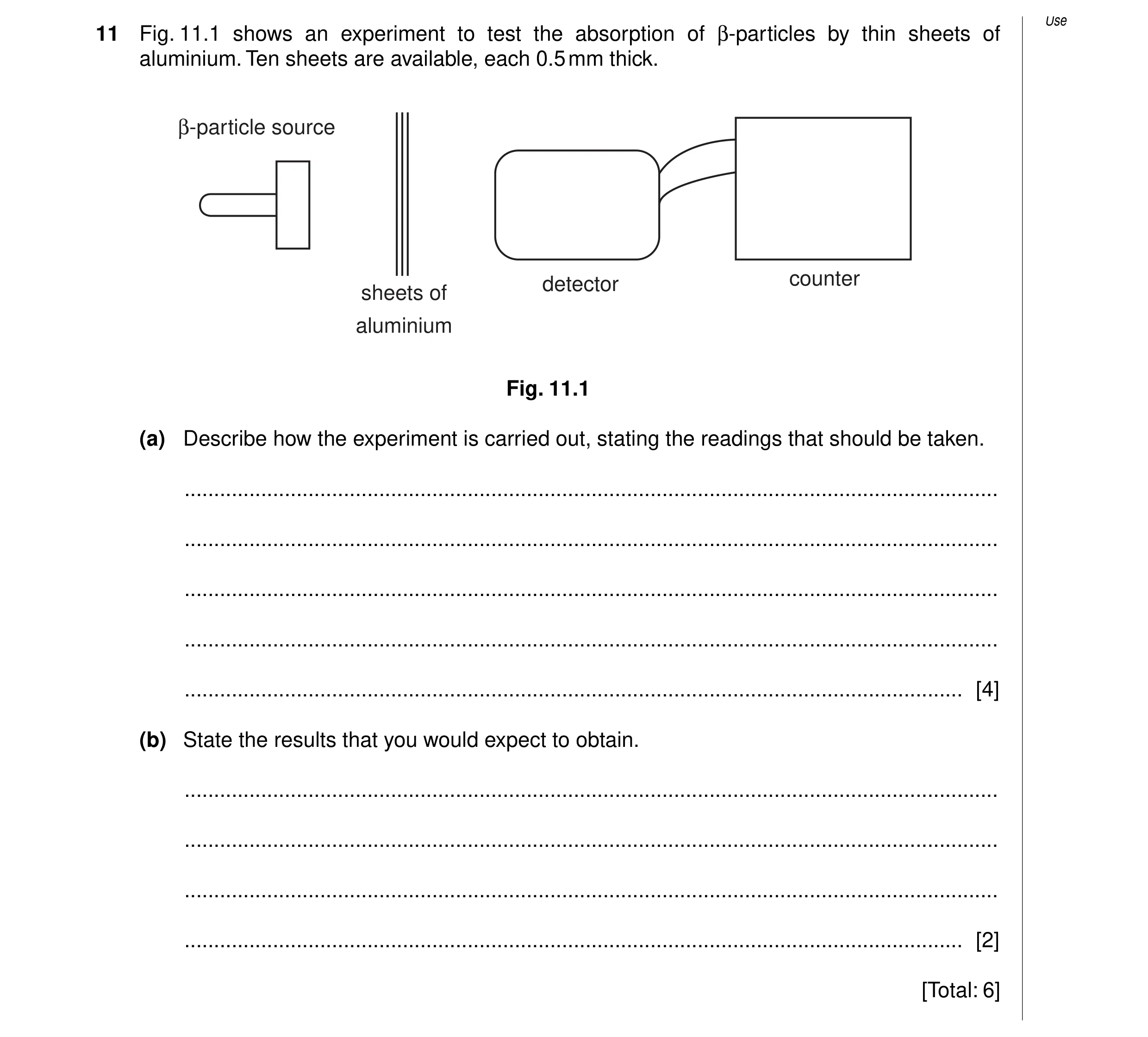 2 / 97
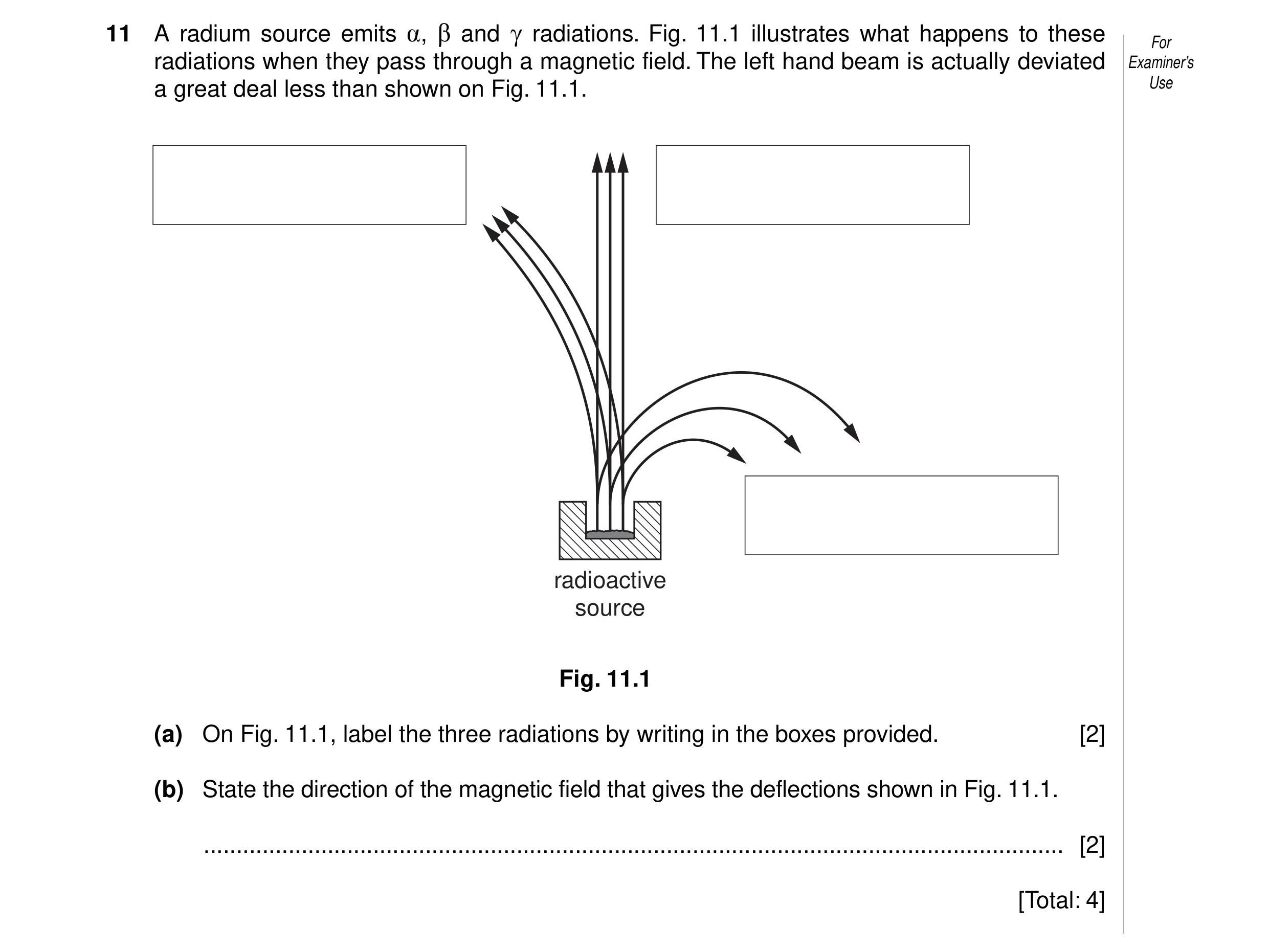 3 / 97
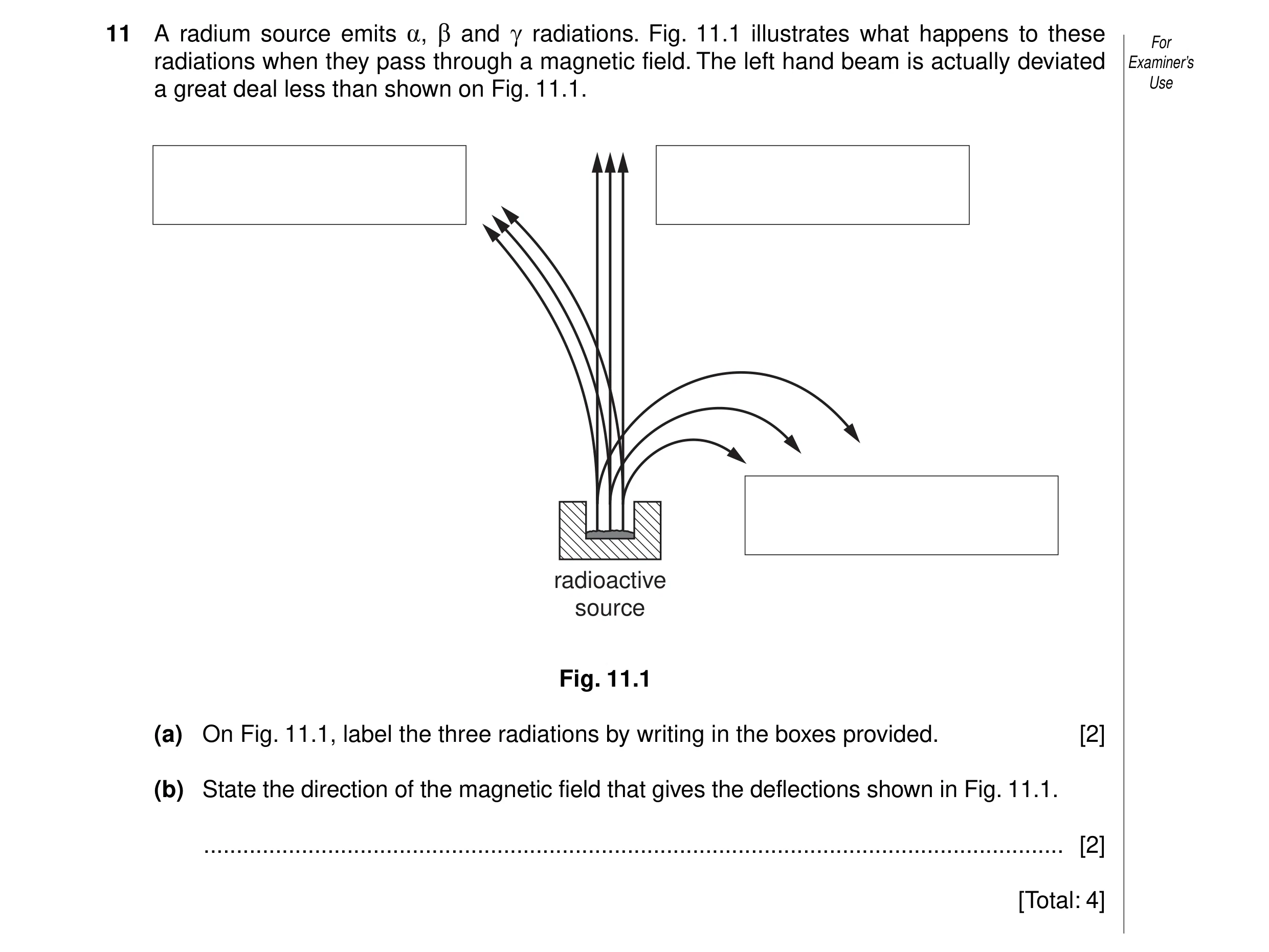 4 / 97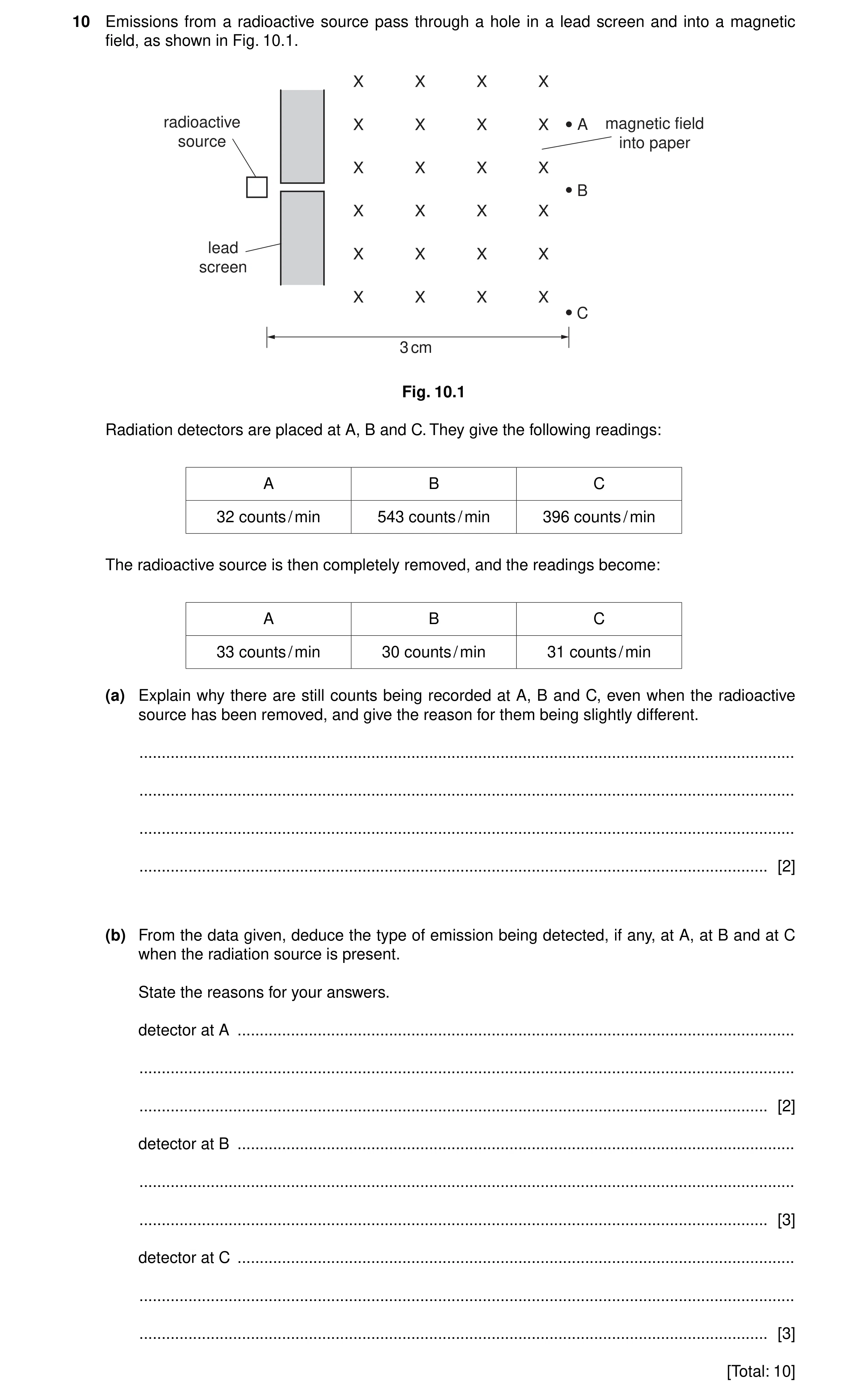
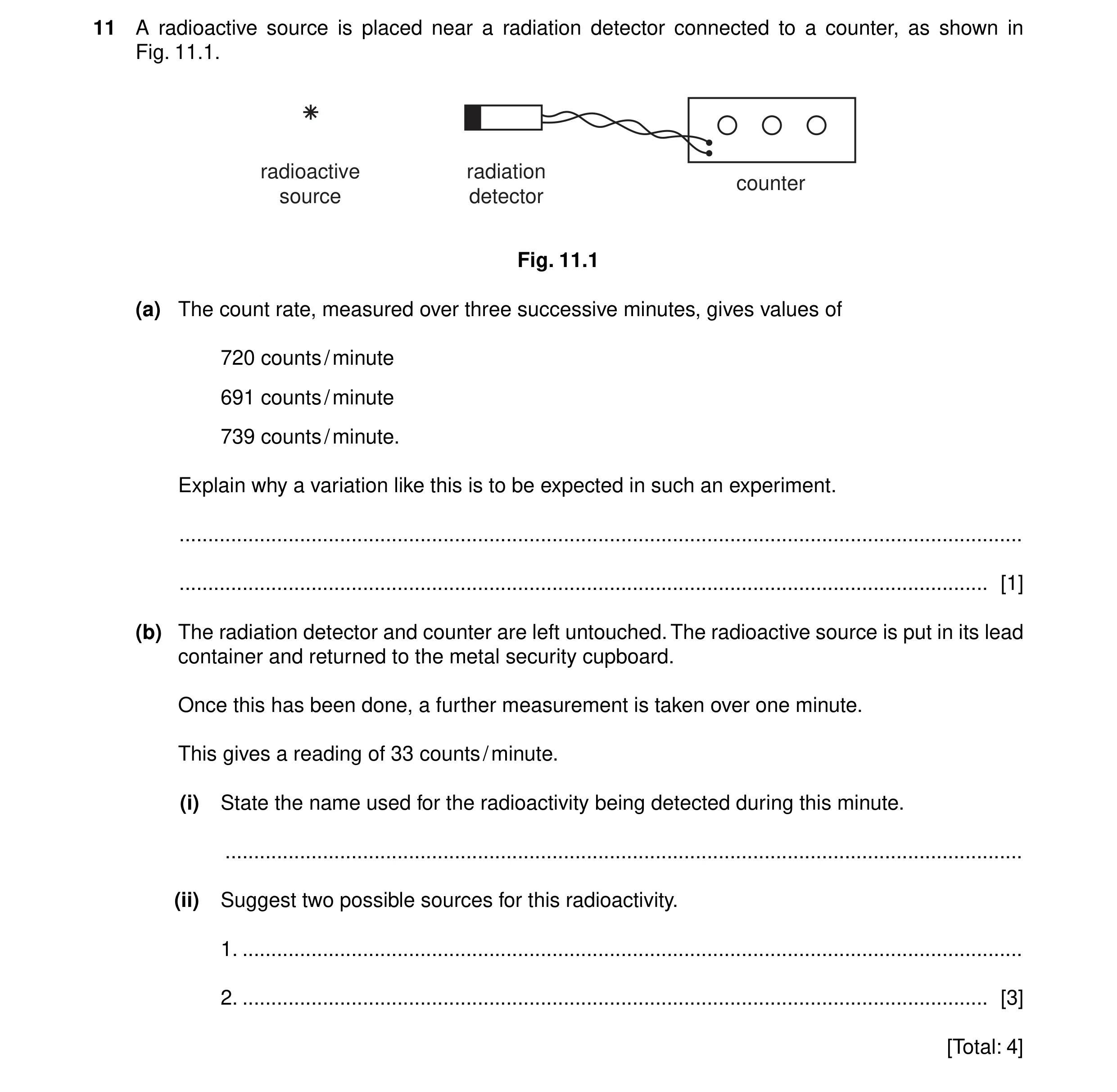 6 / 97
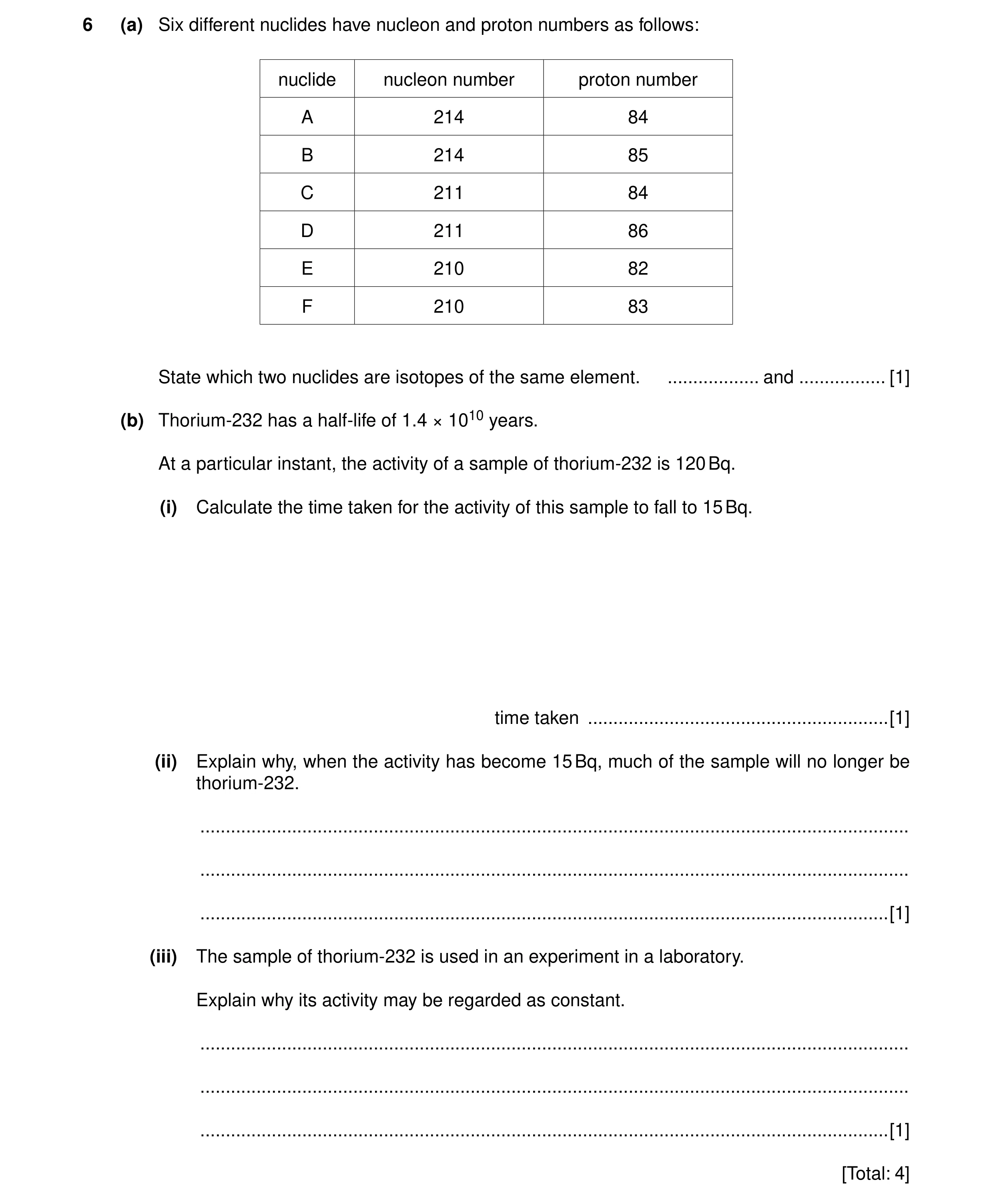 7 / 97
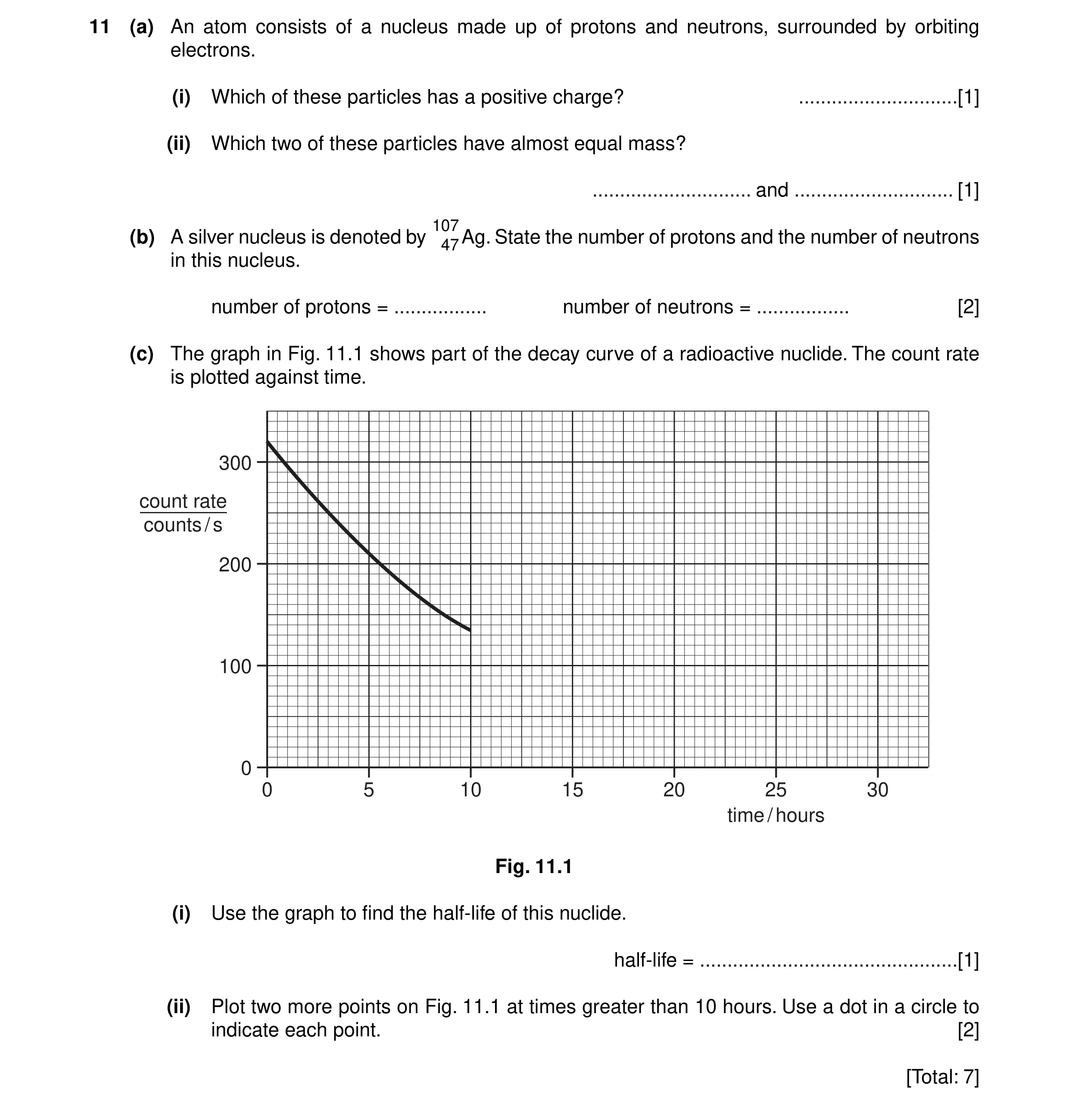 8 / 97
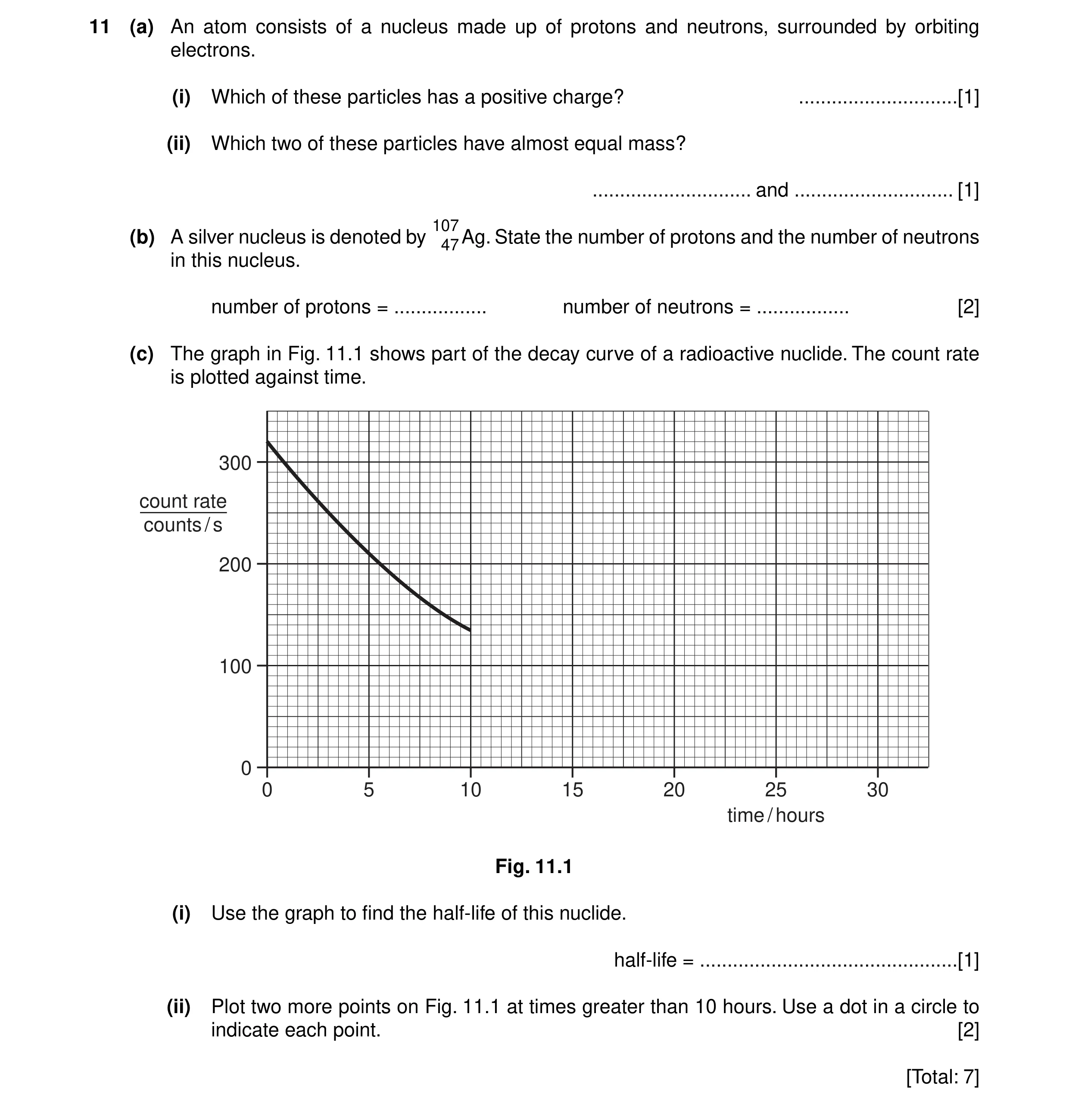 9 / 97
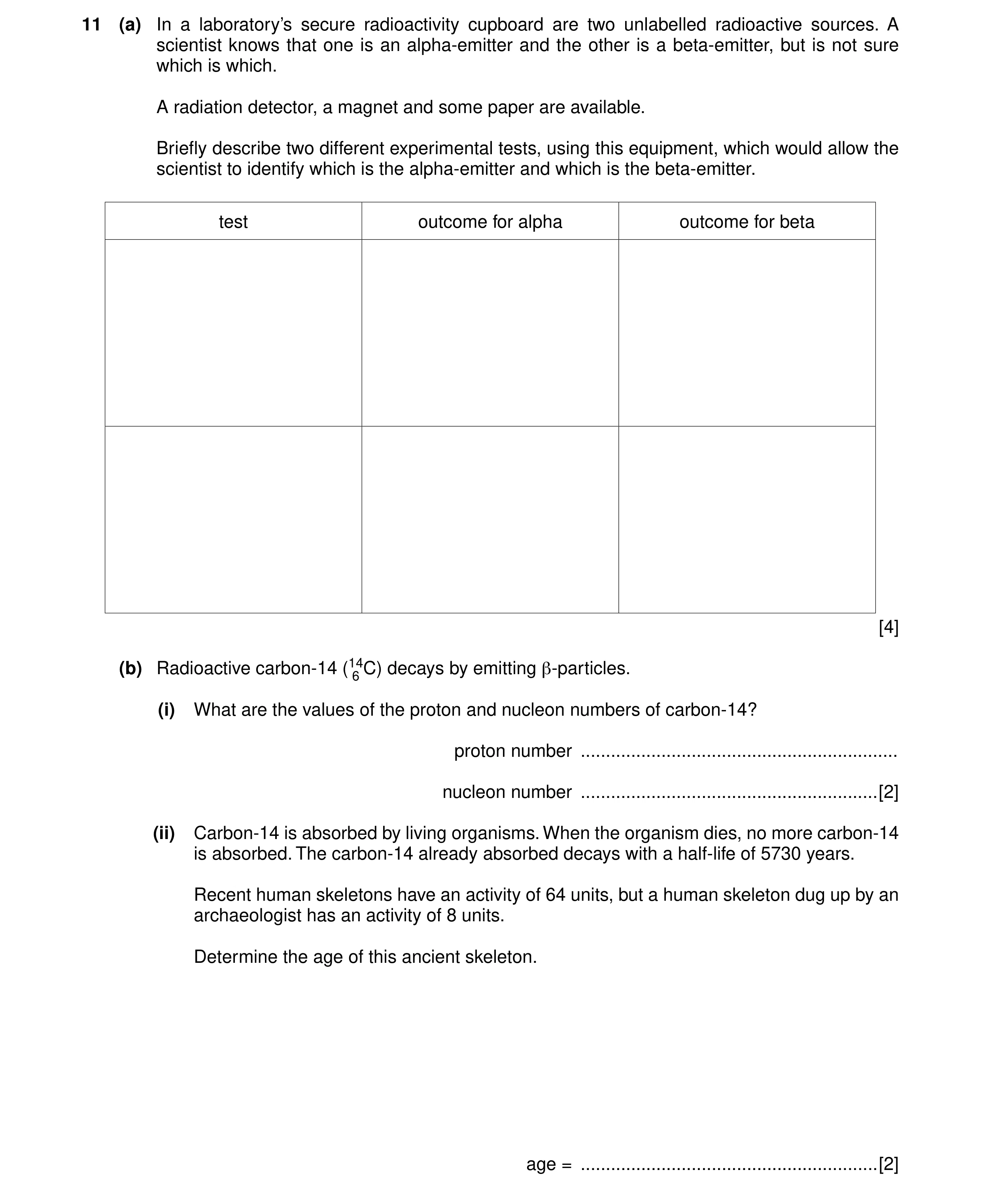 10 / 97
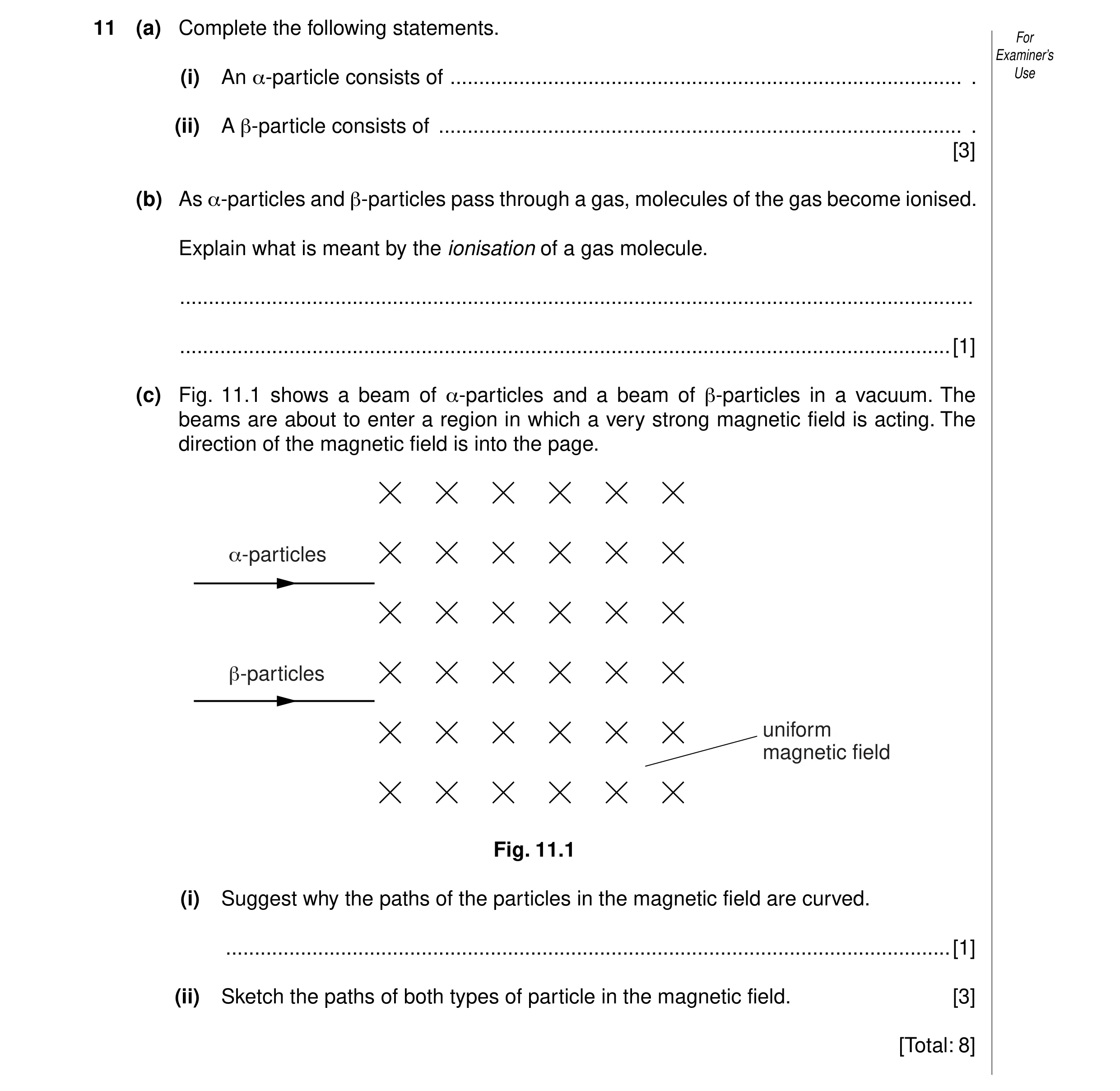 11 / 97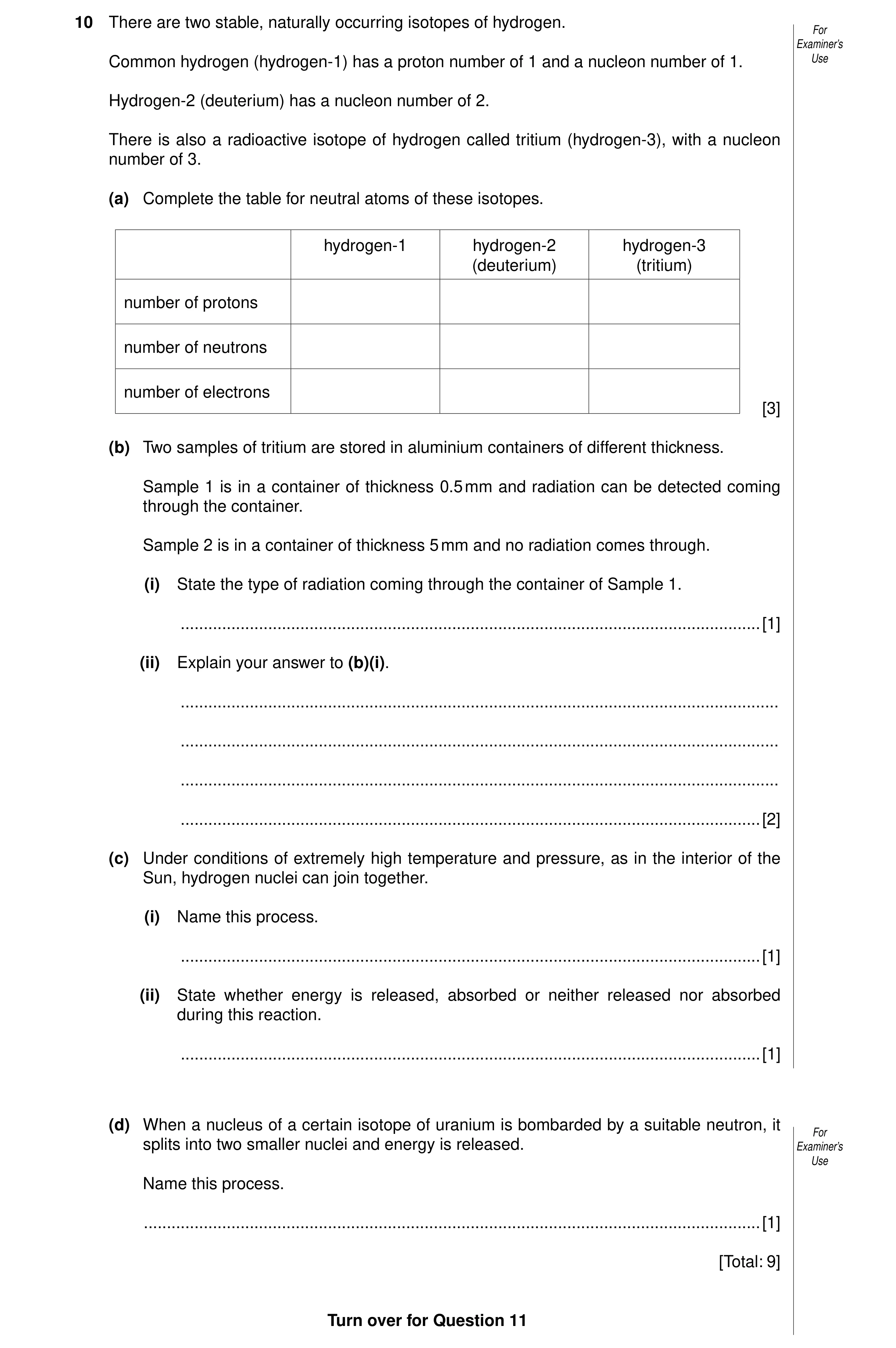
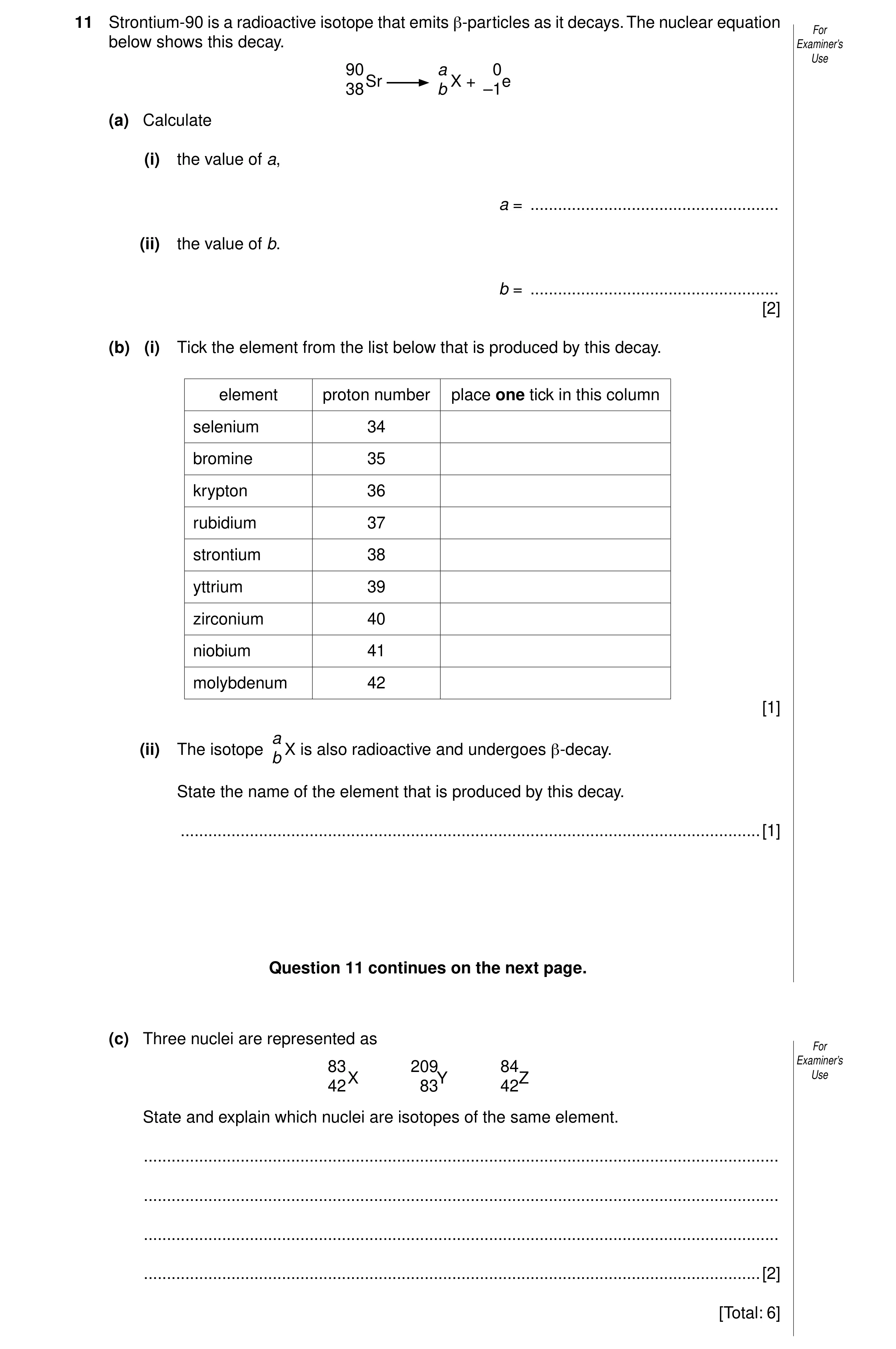
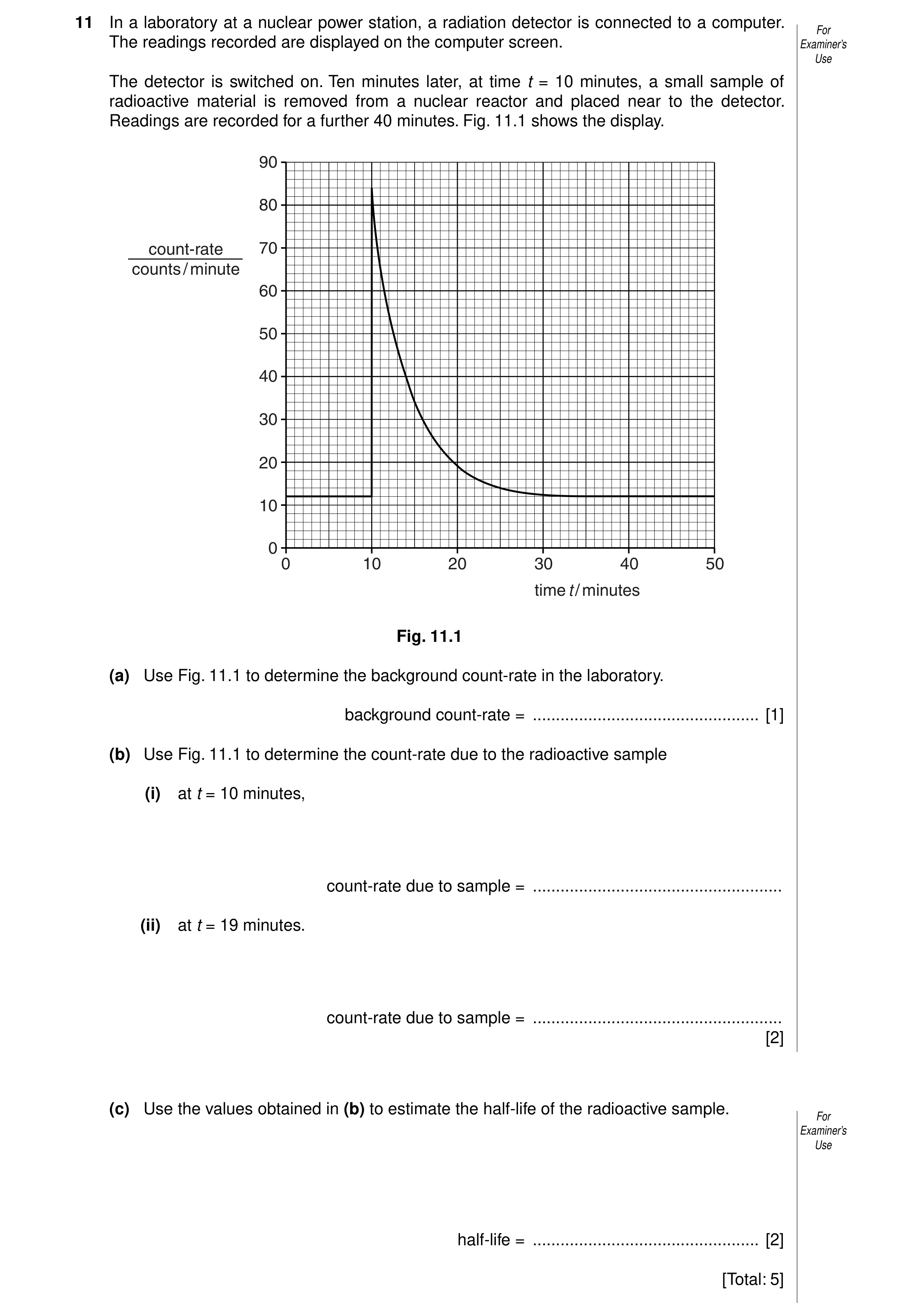
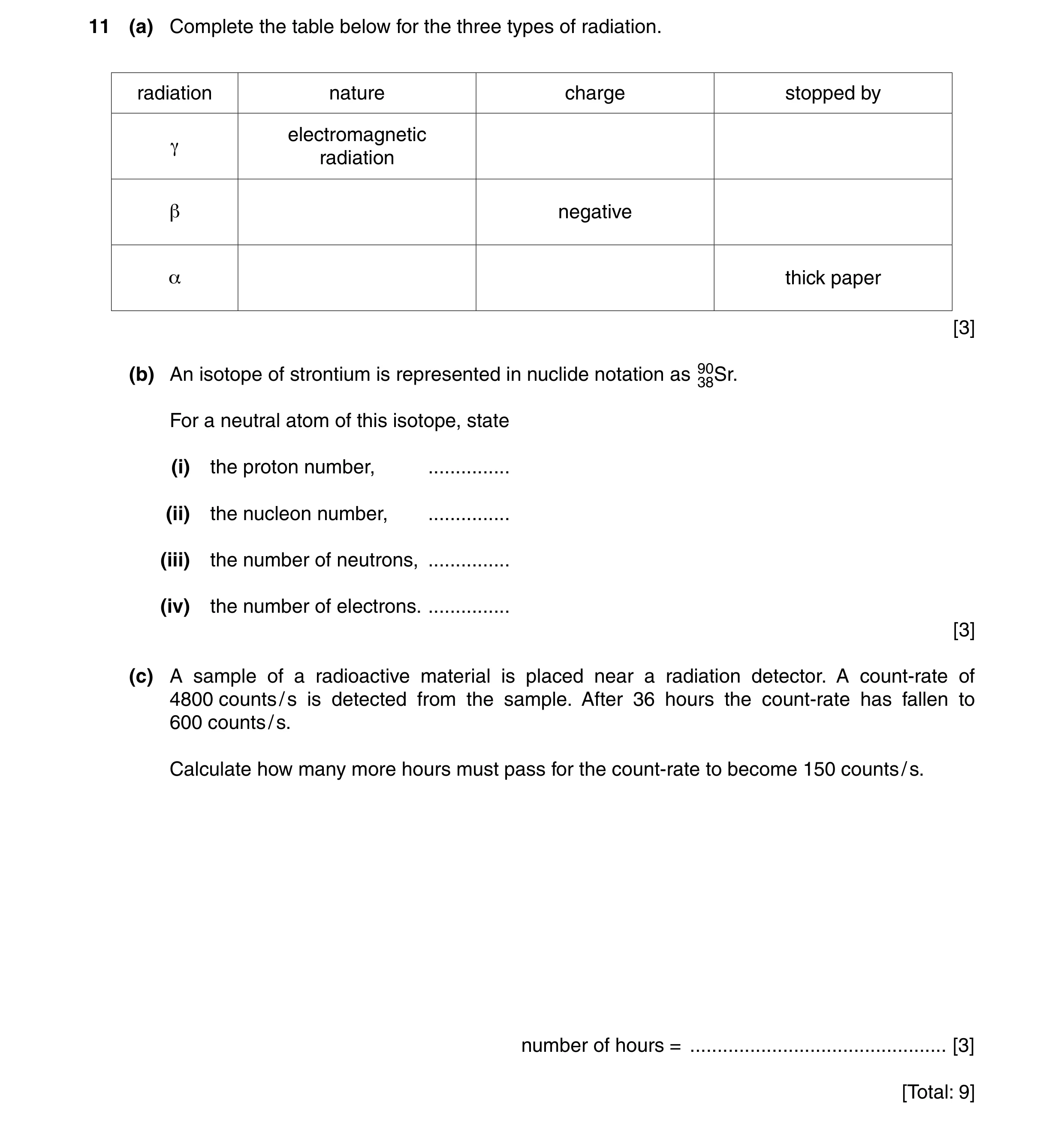 16 / 97
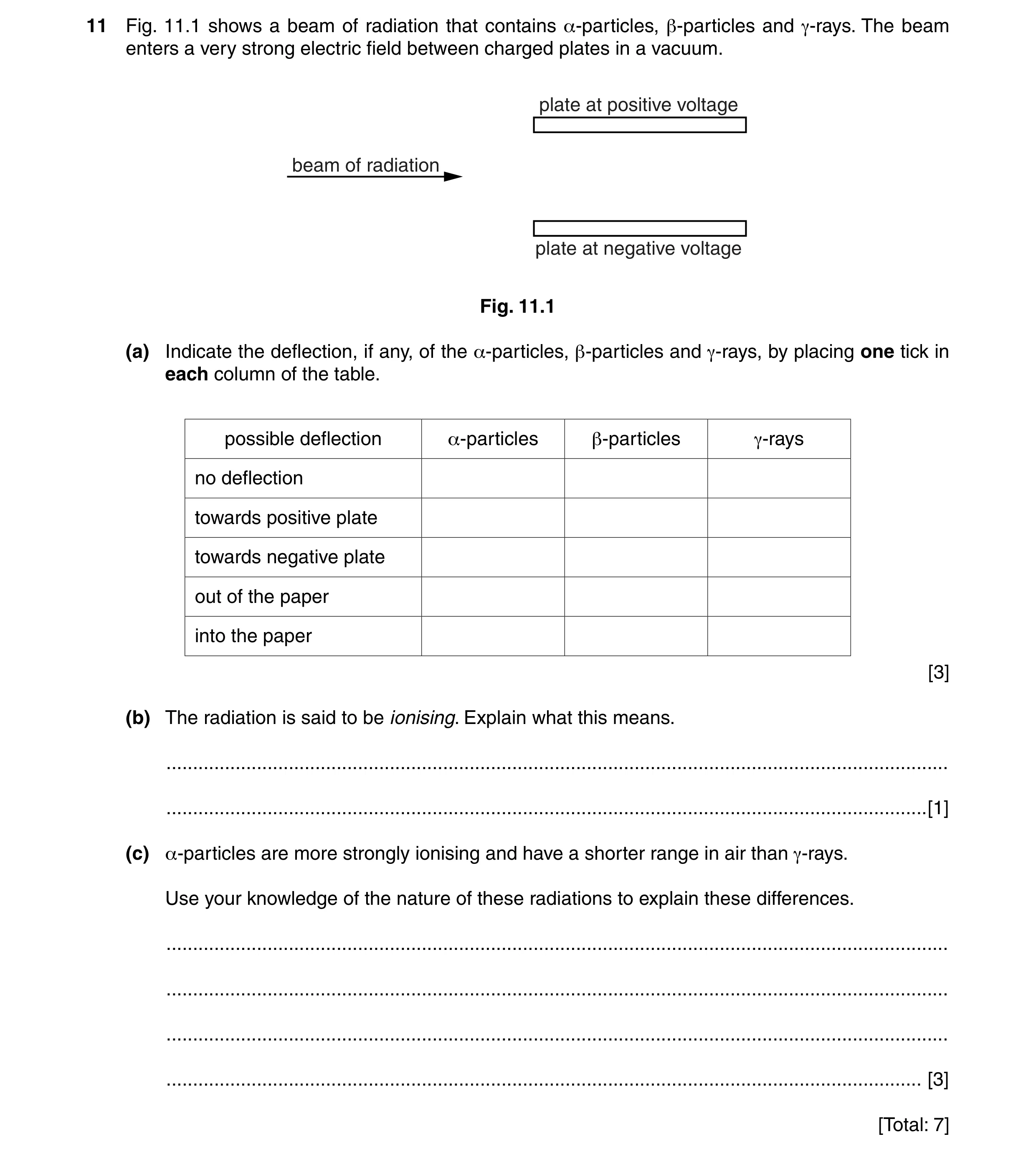 17 / 97
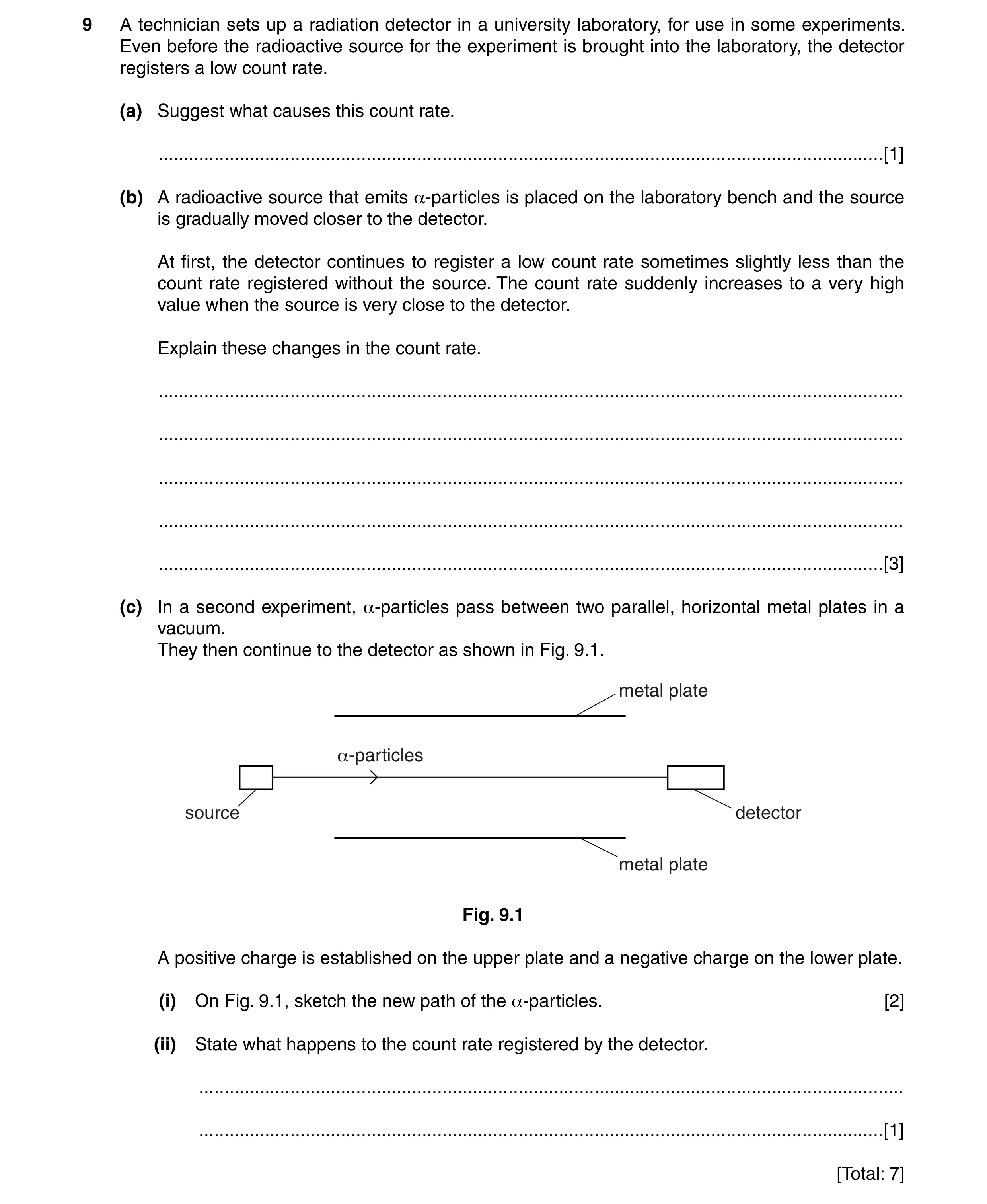 18 / 97
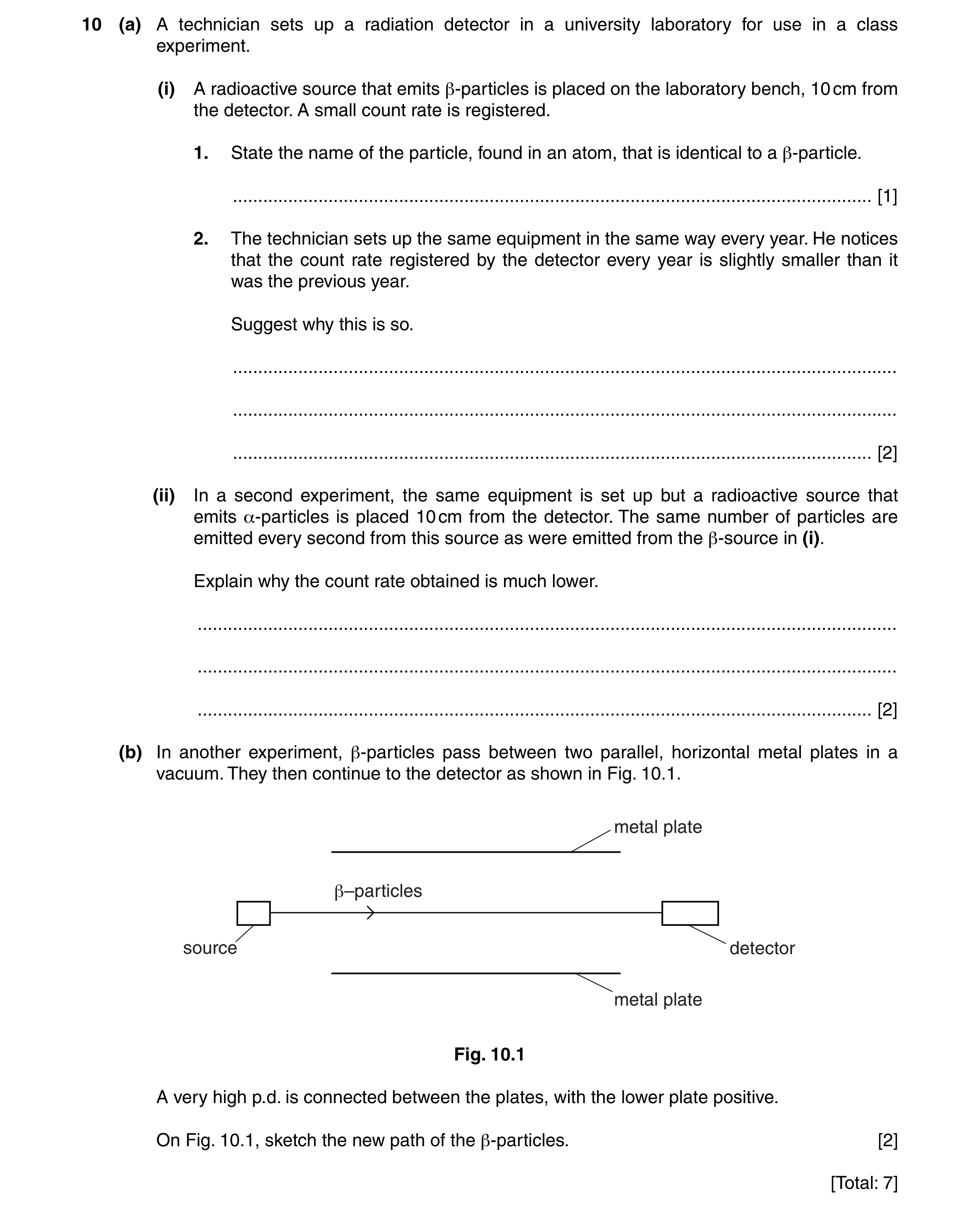 19 / 97
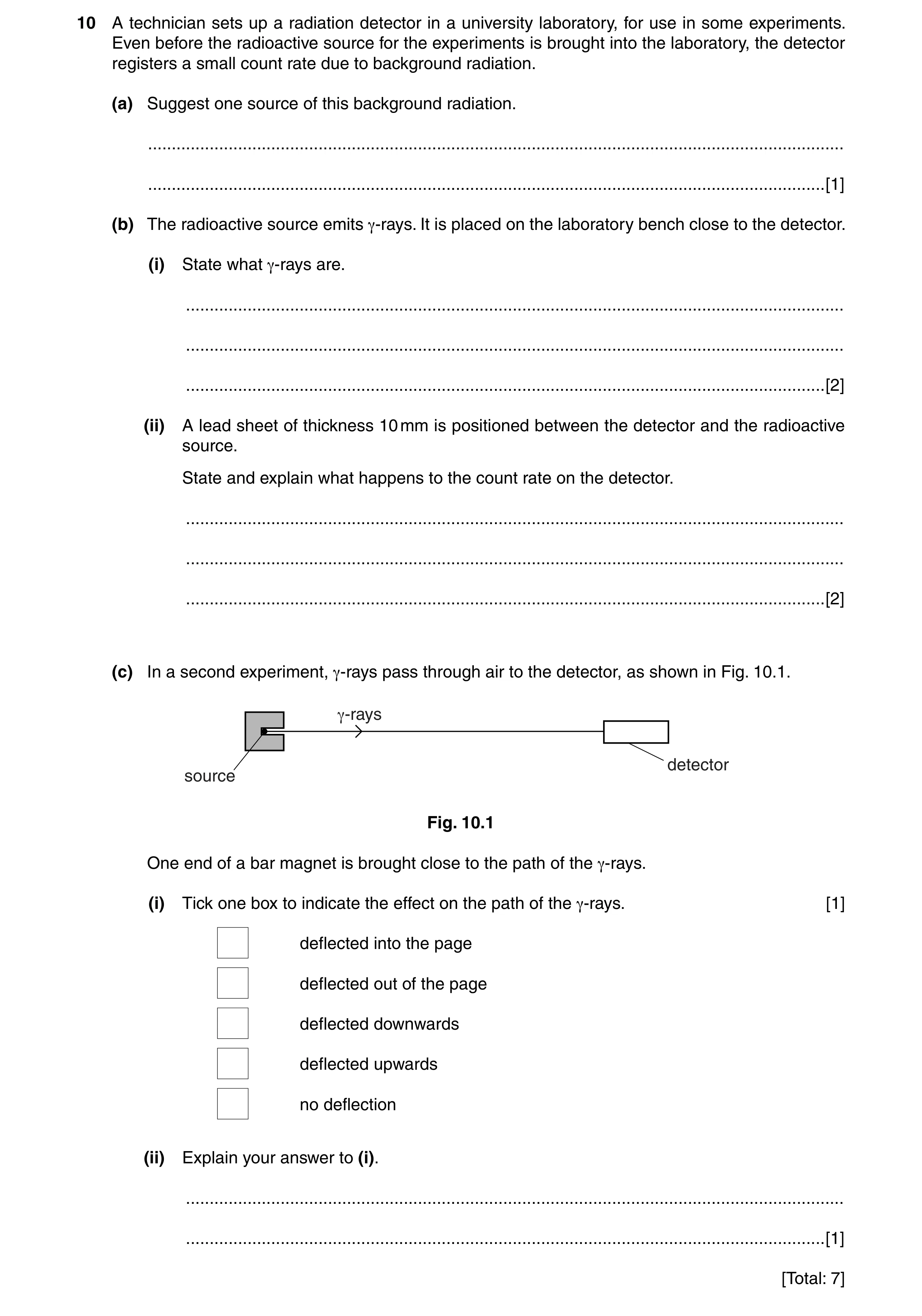 20 / 97
 21 / 97
 22 / 97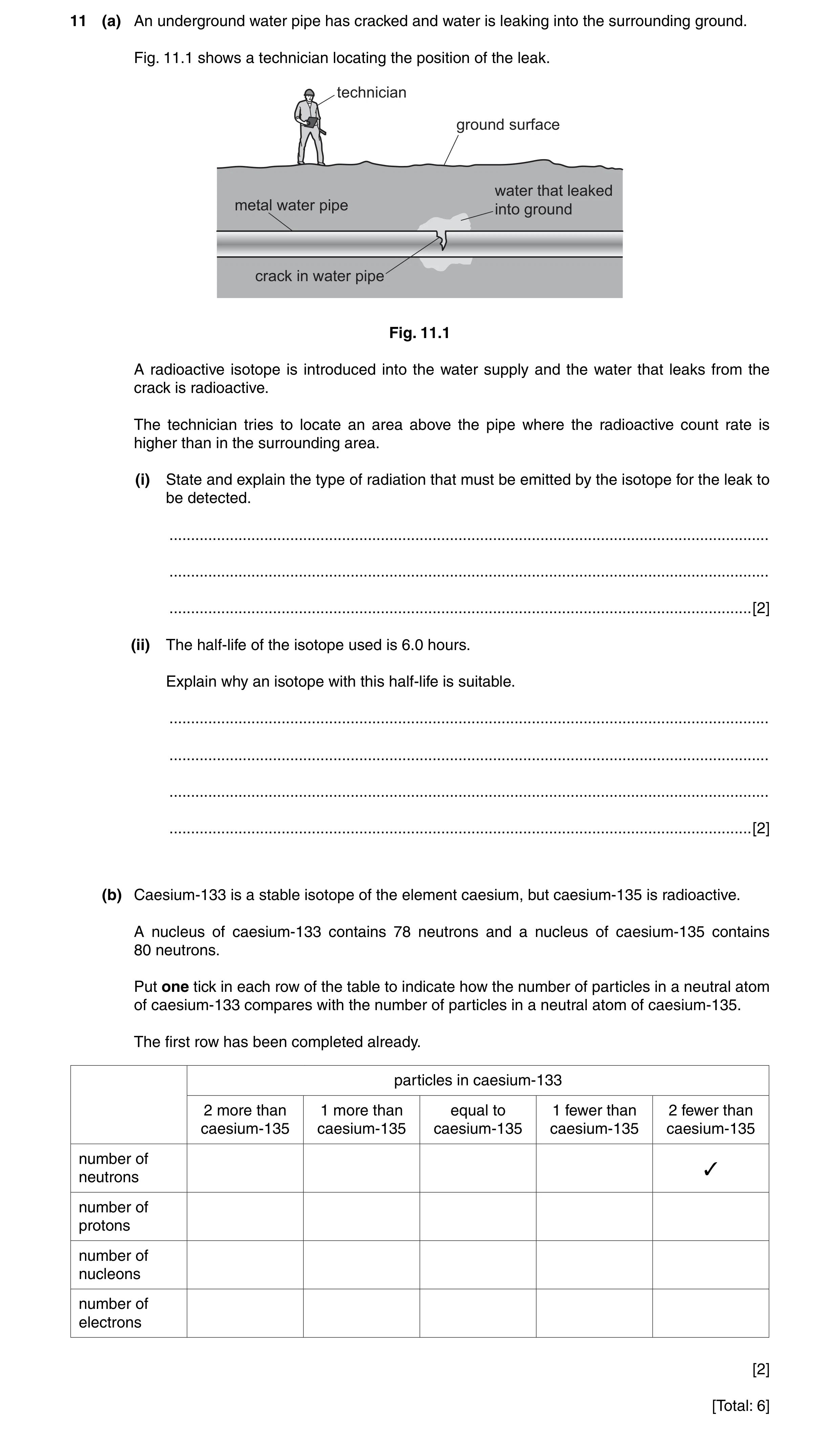
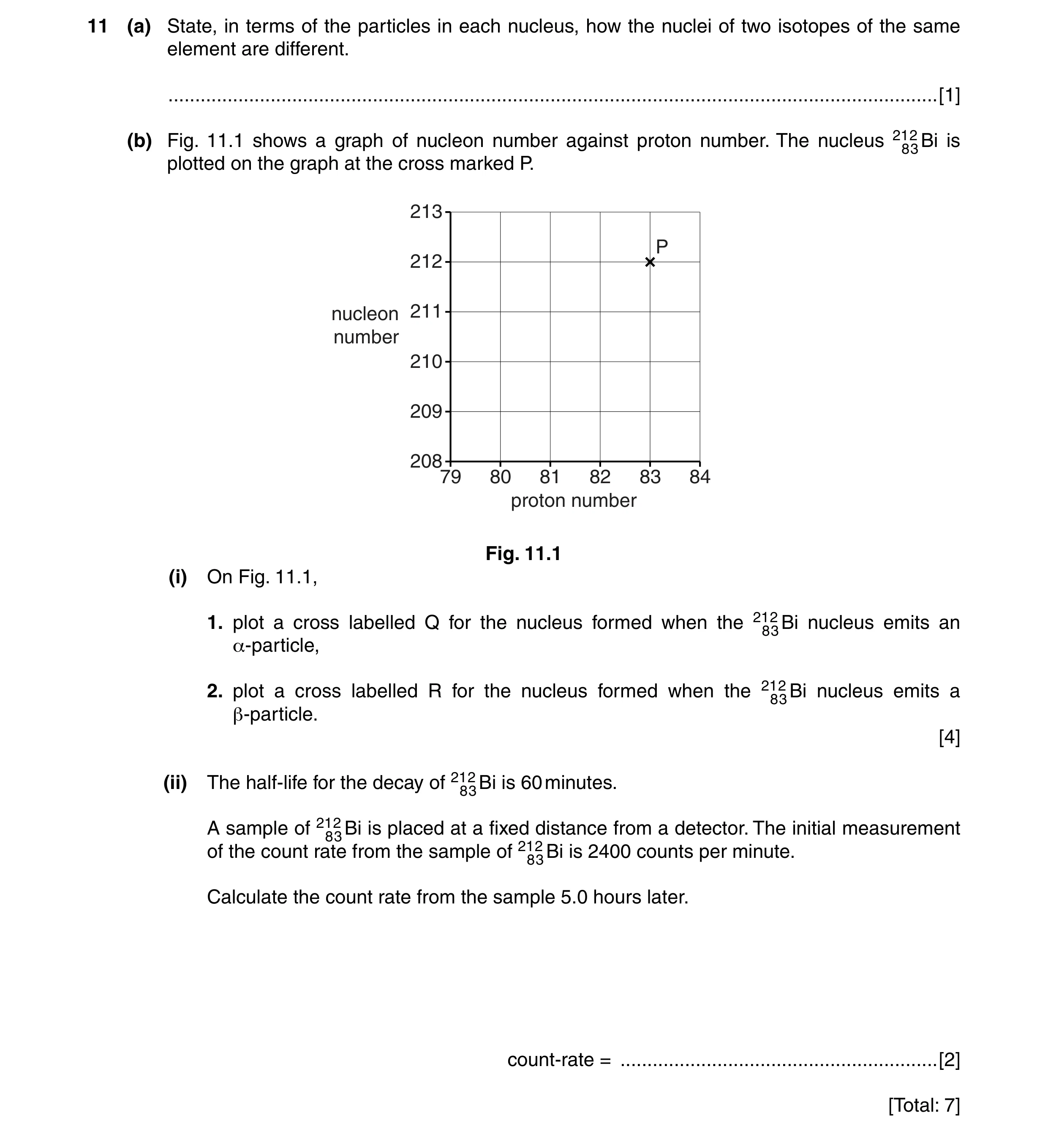 24 / 97
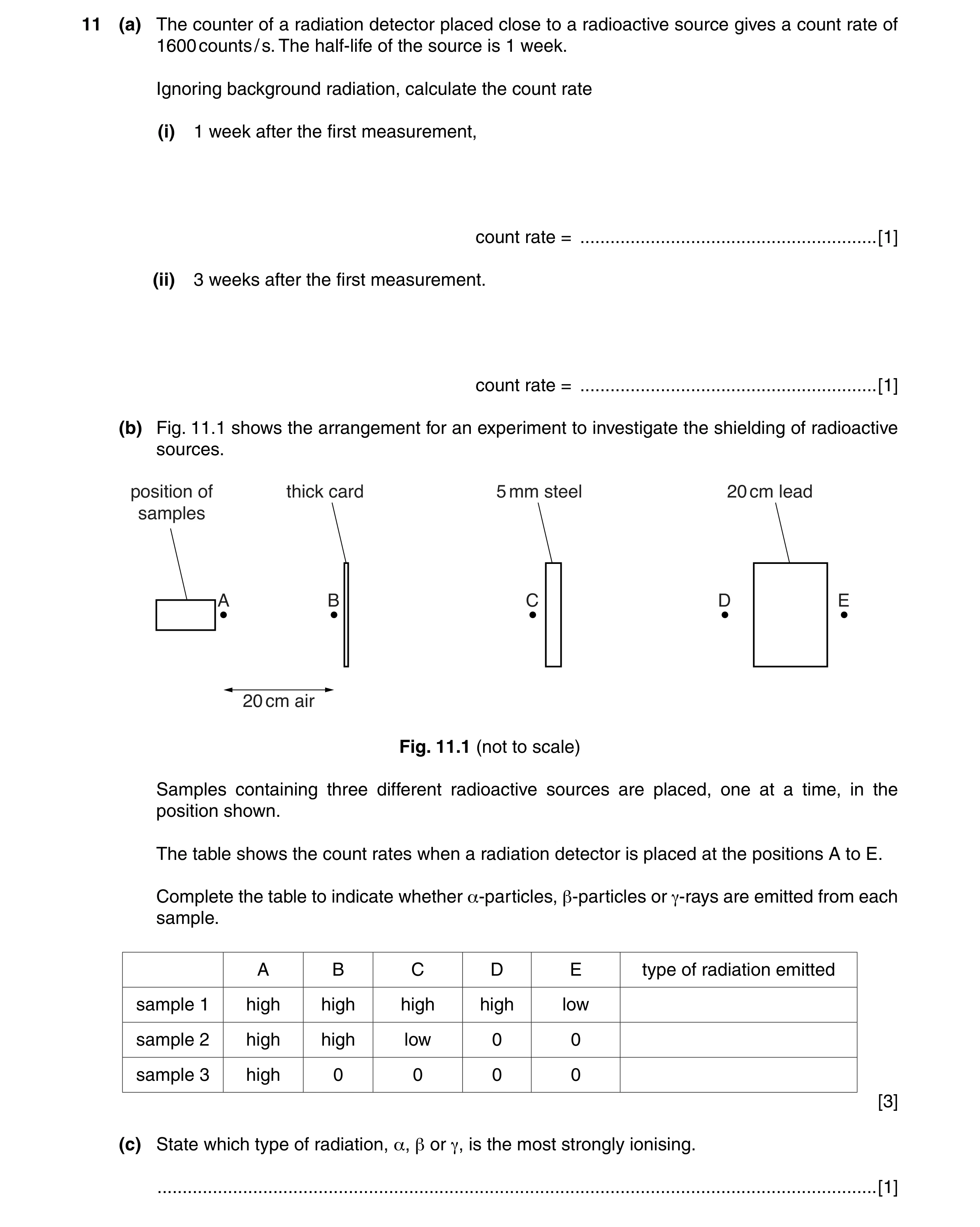 25 / 97
 26 / 97
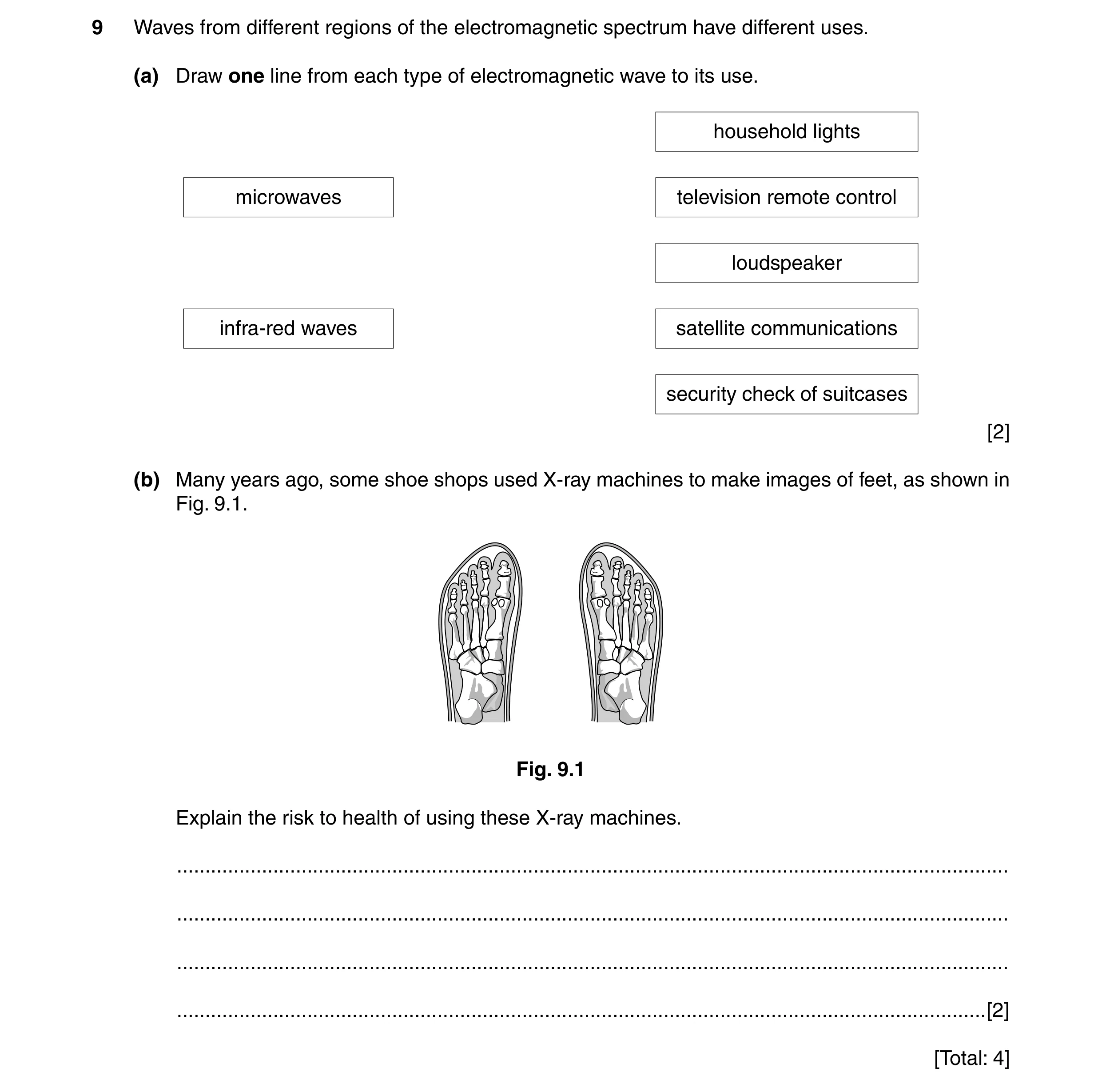 27 / 97
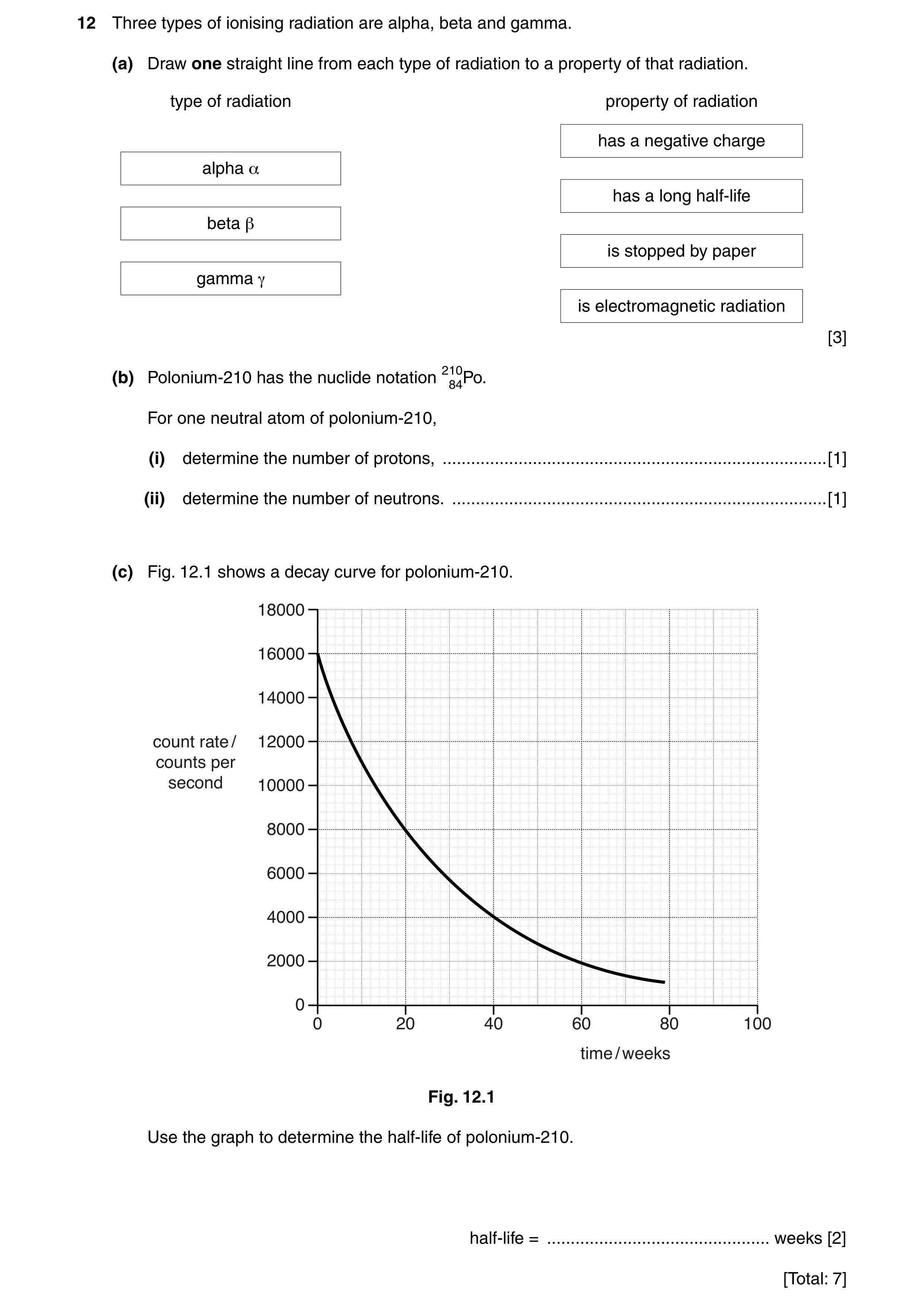 28 / 97
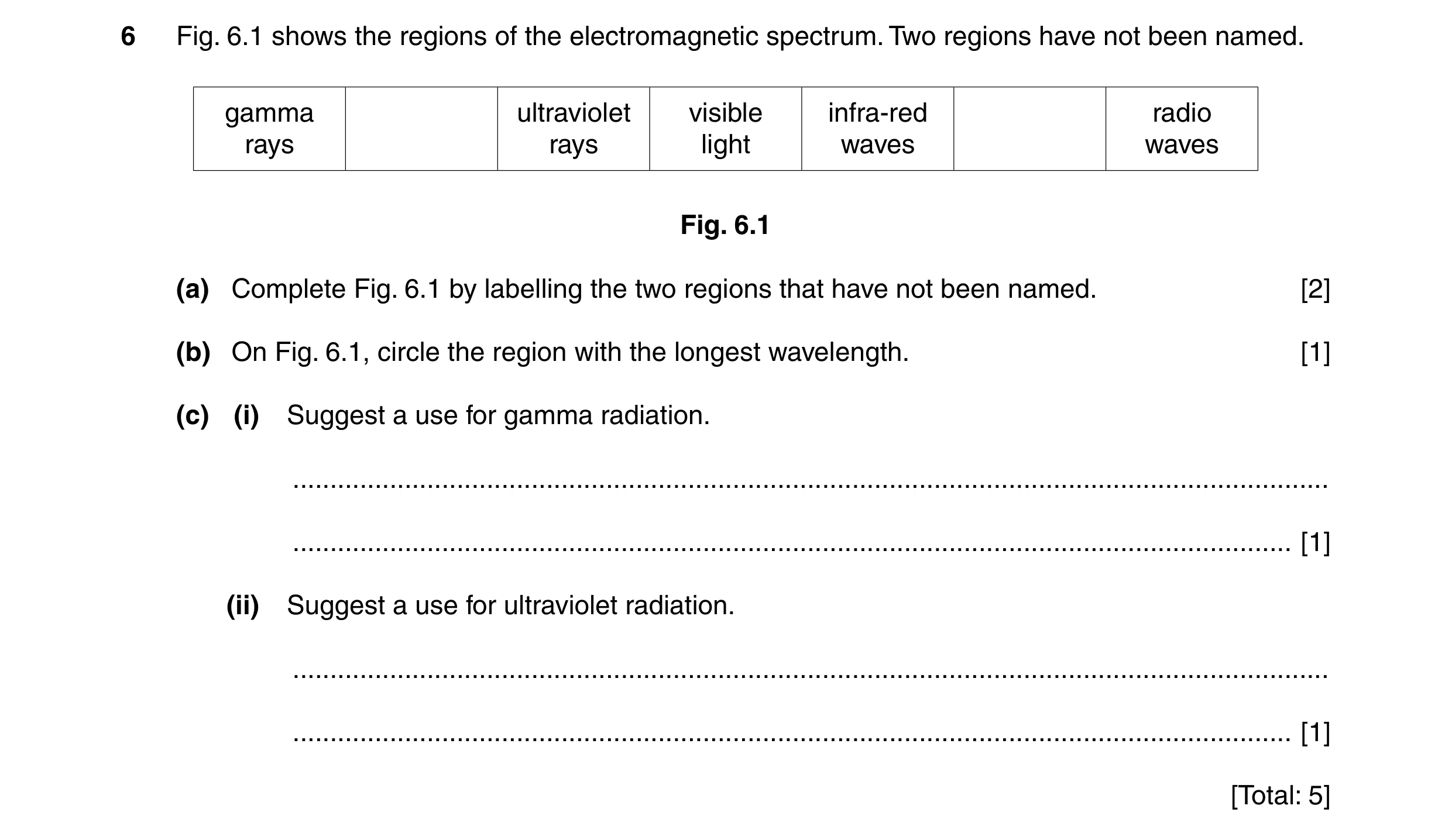 29 / 97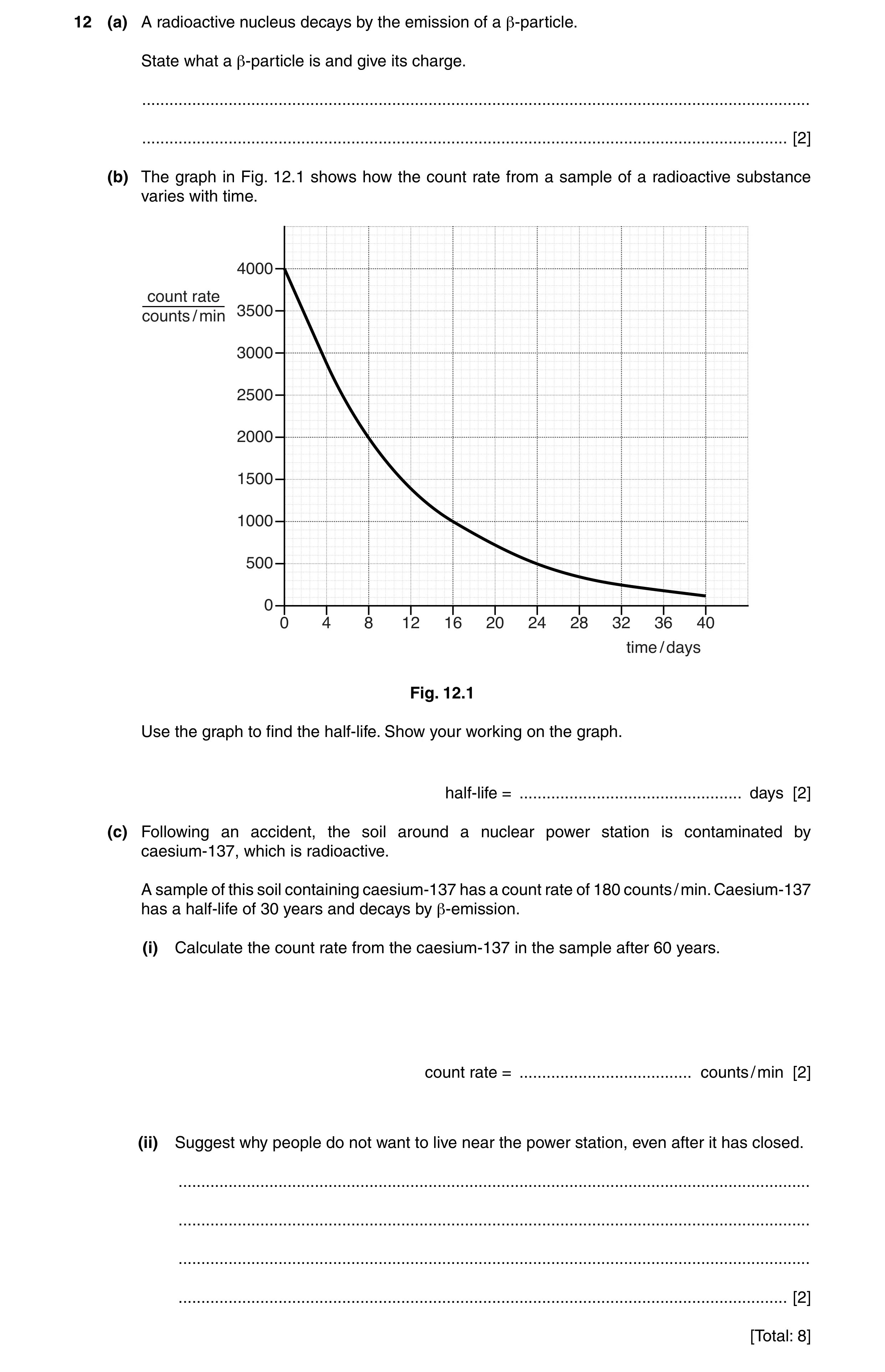
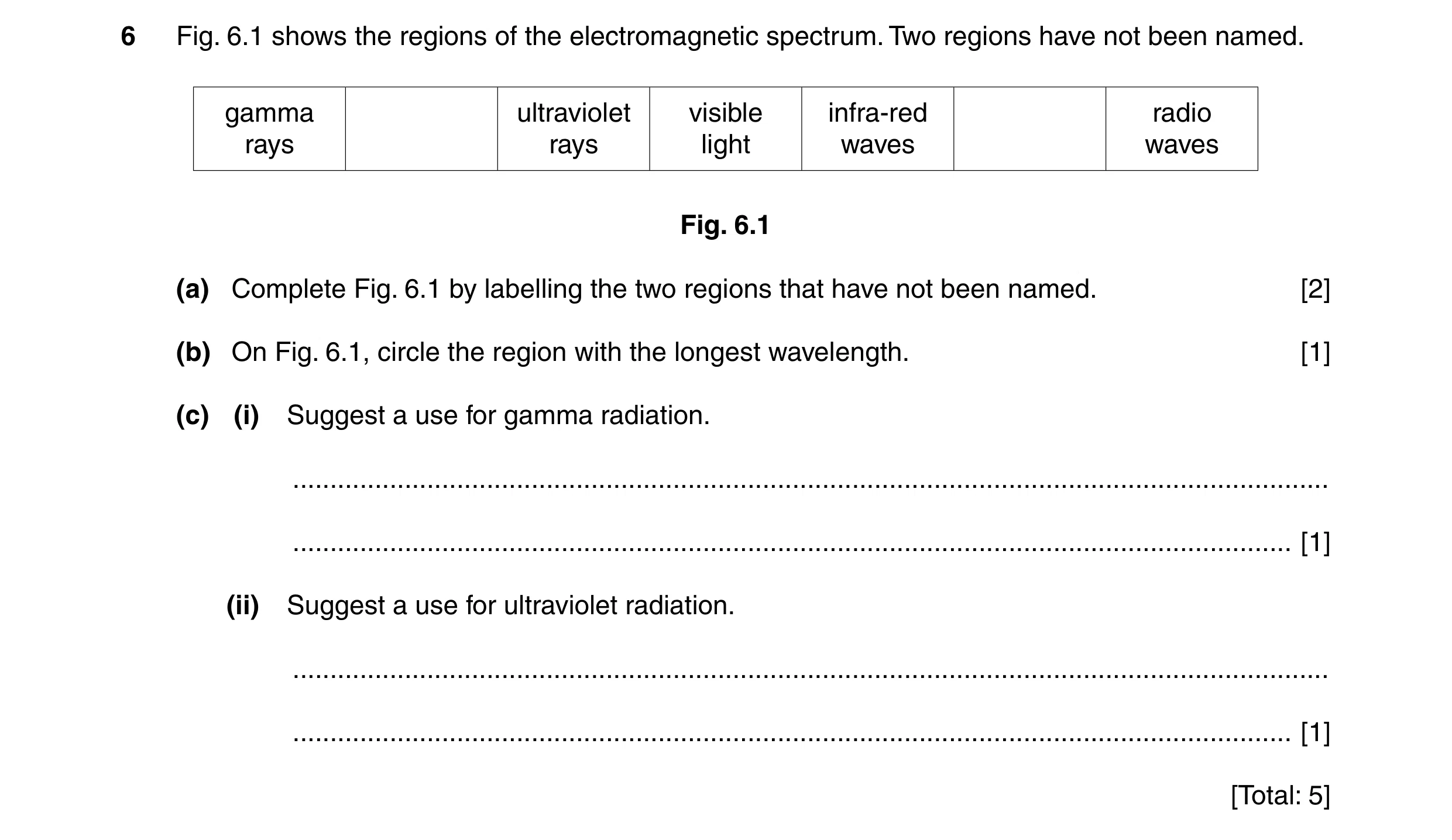 31 / 97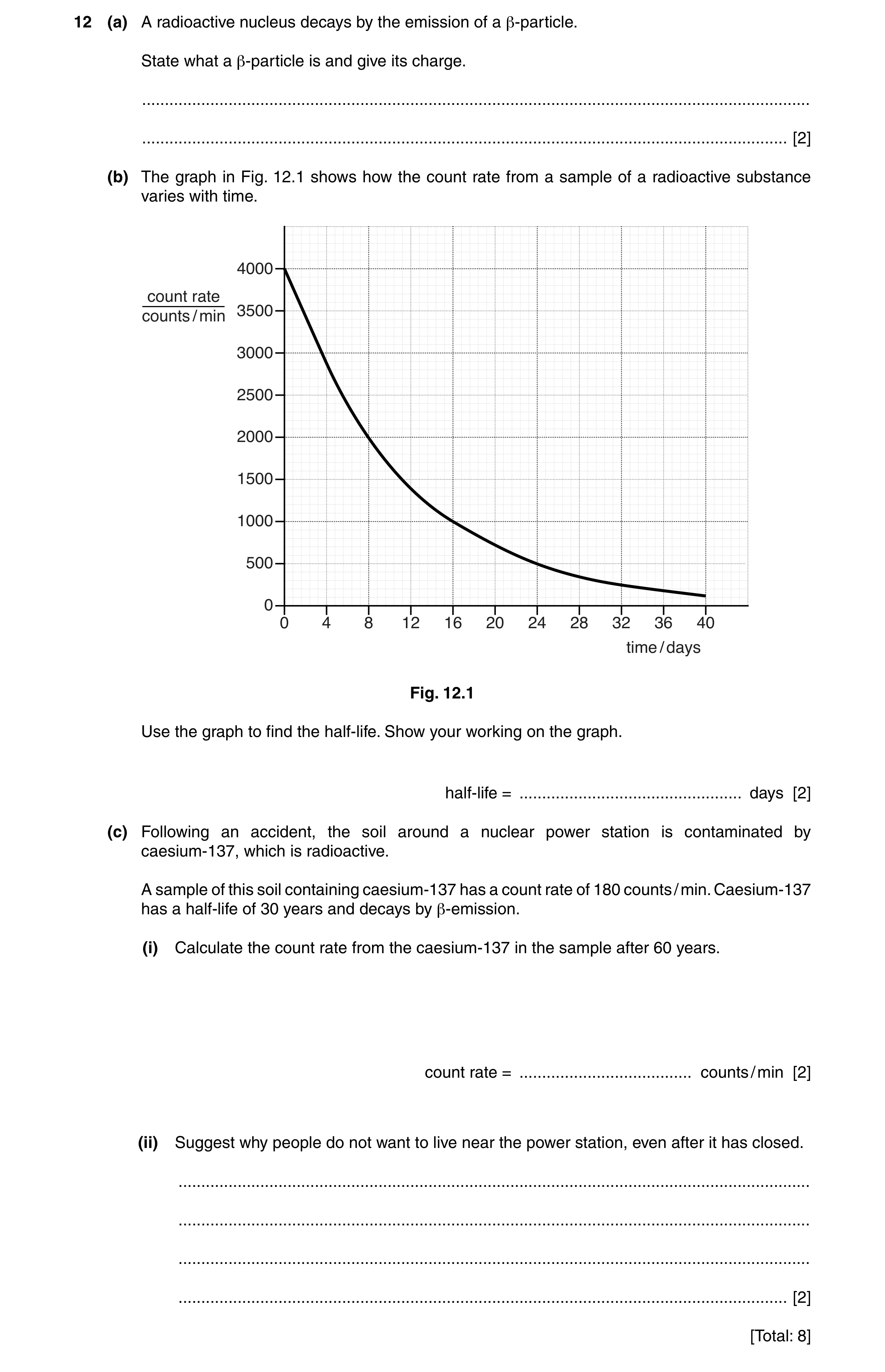
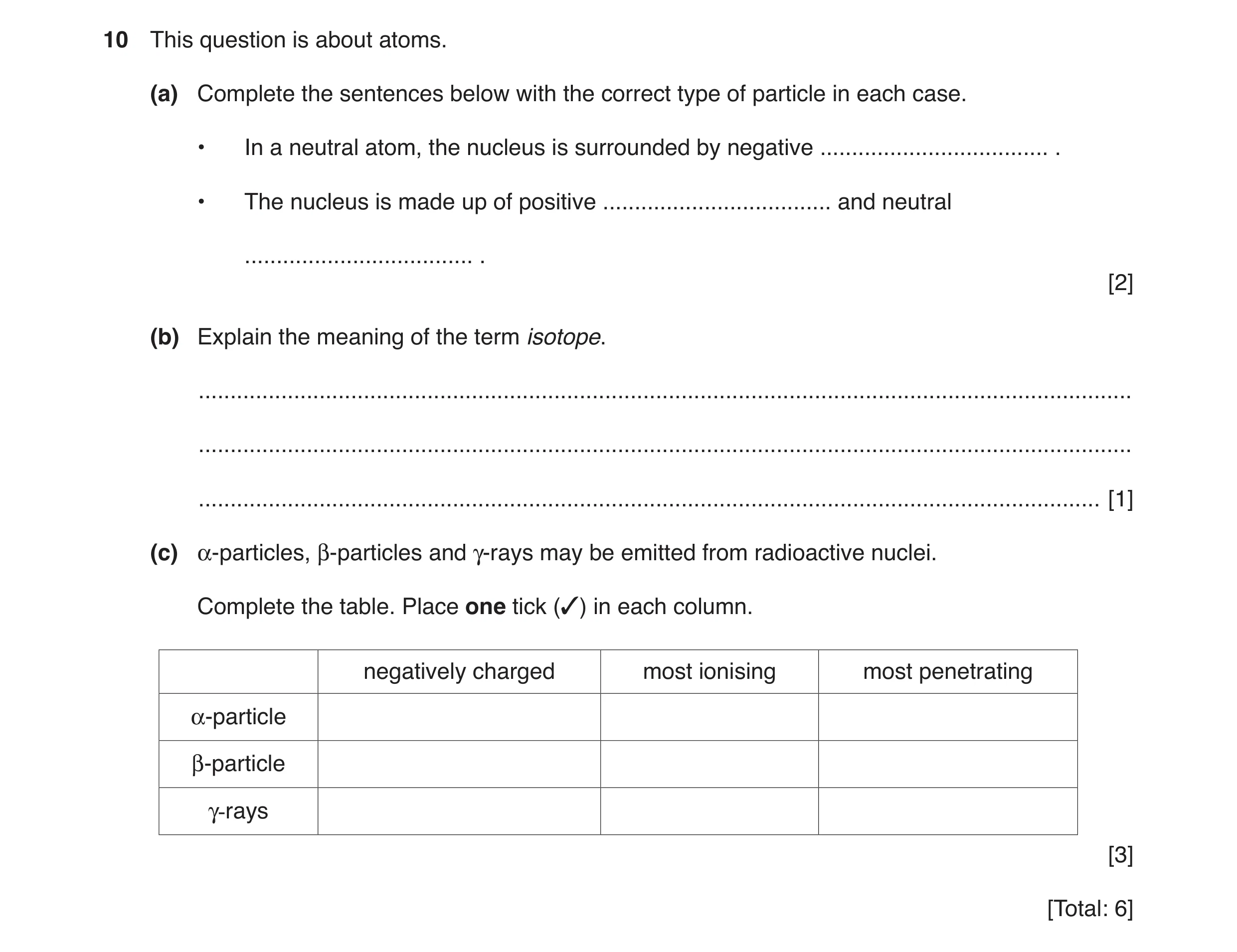 33 / 97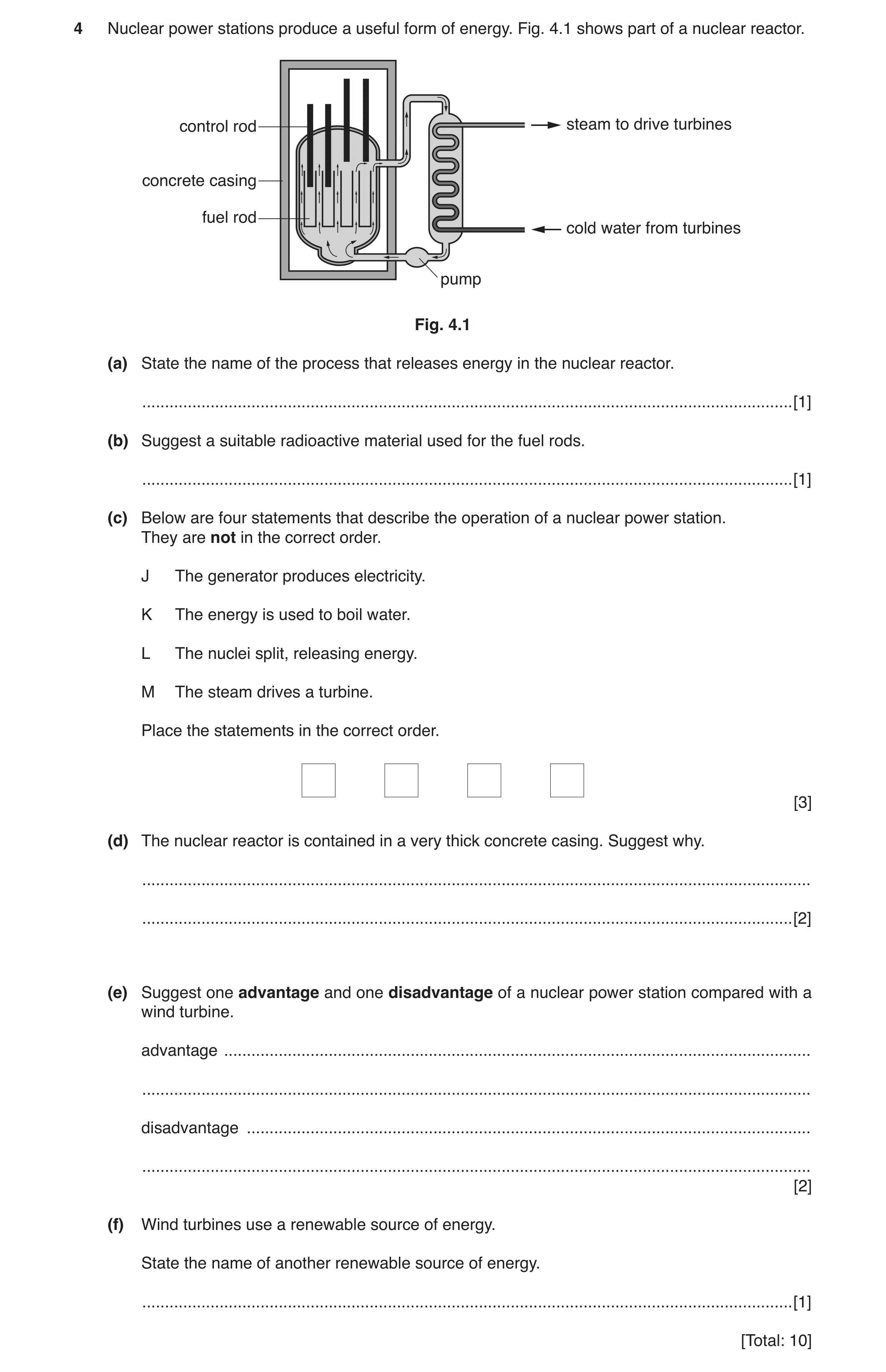
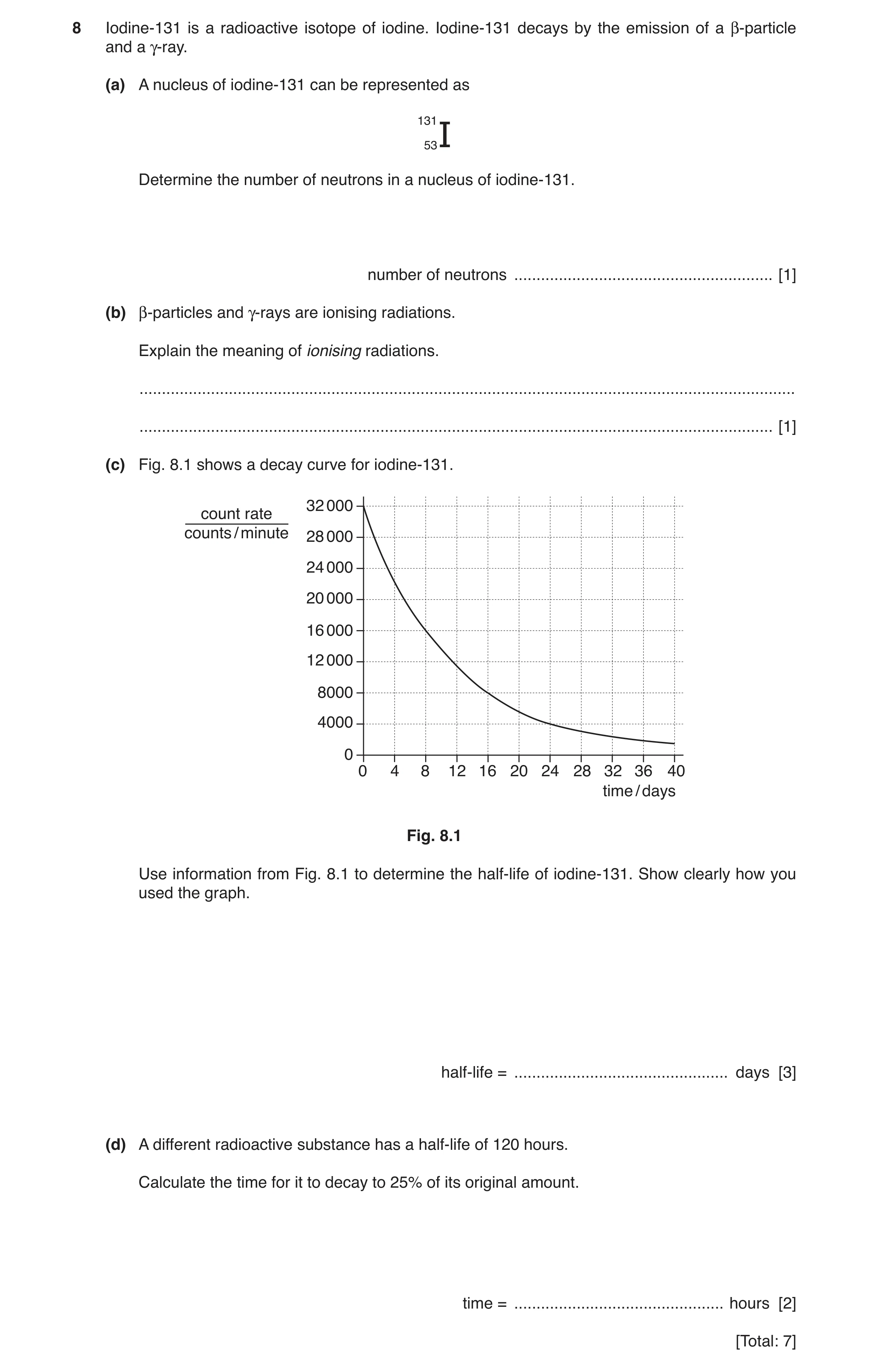
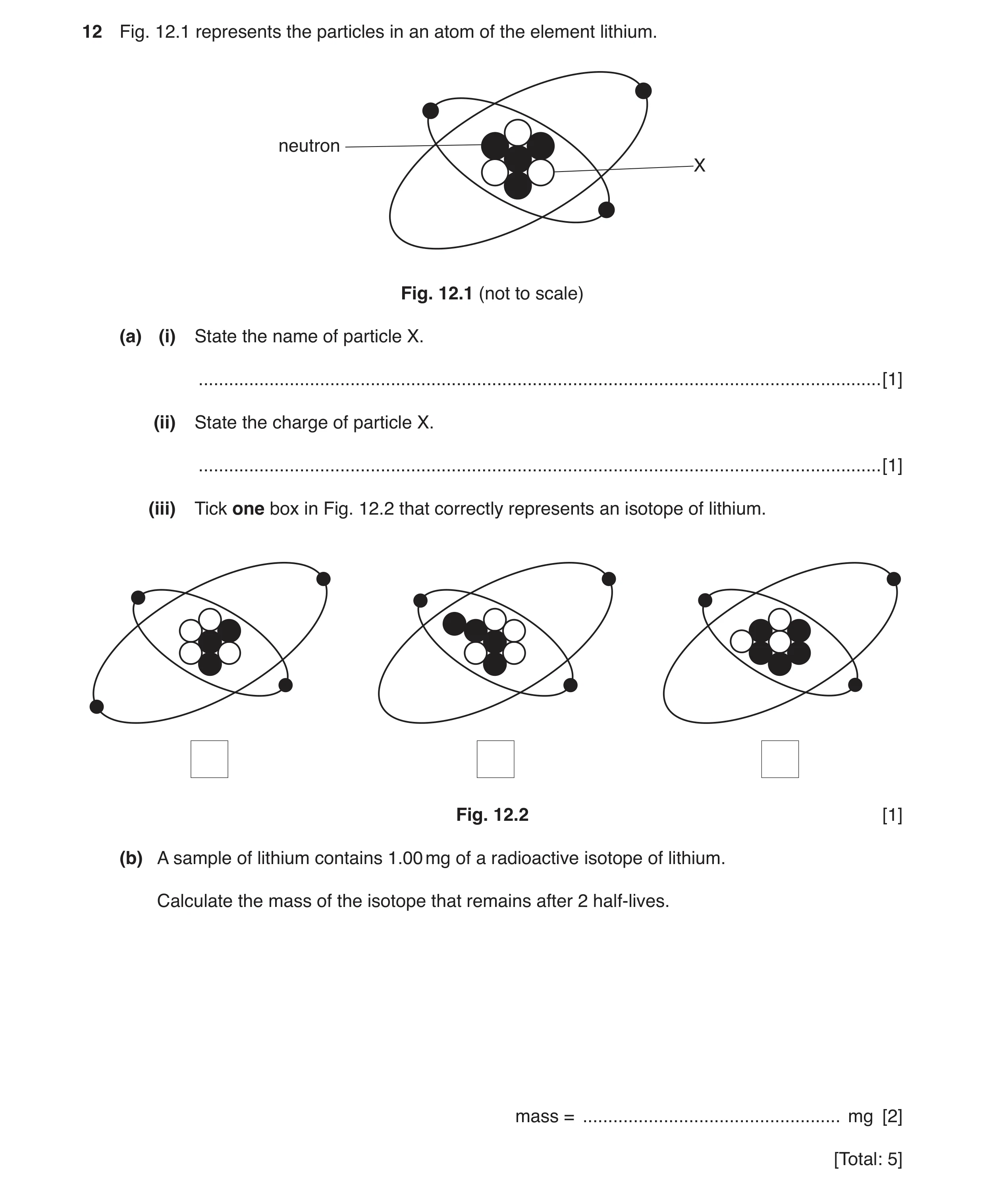 36 / 97
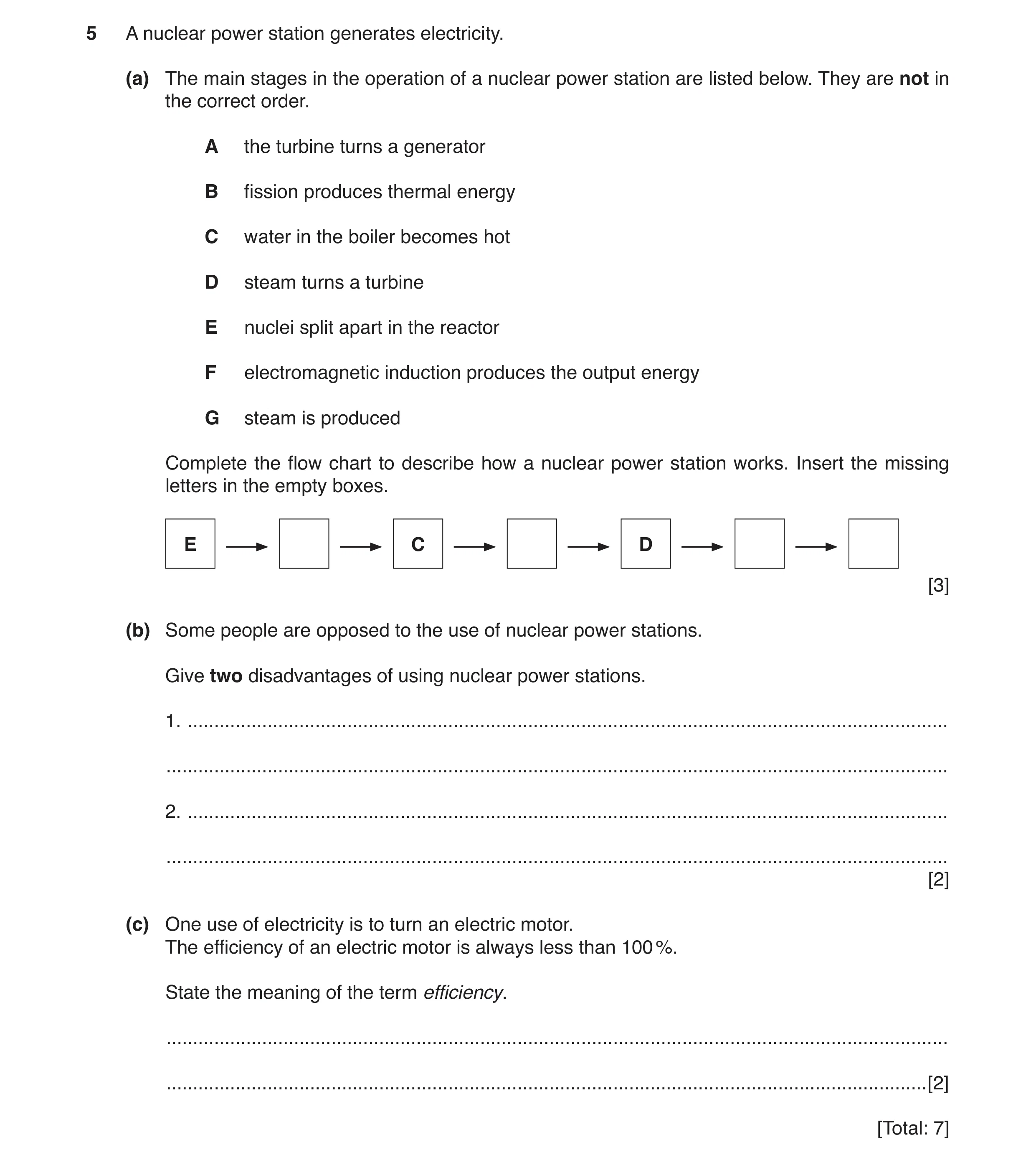 37 / 97
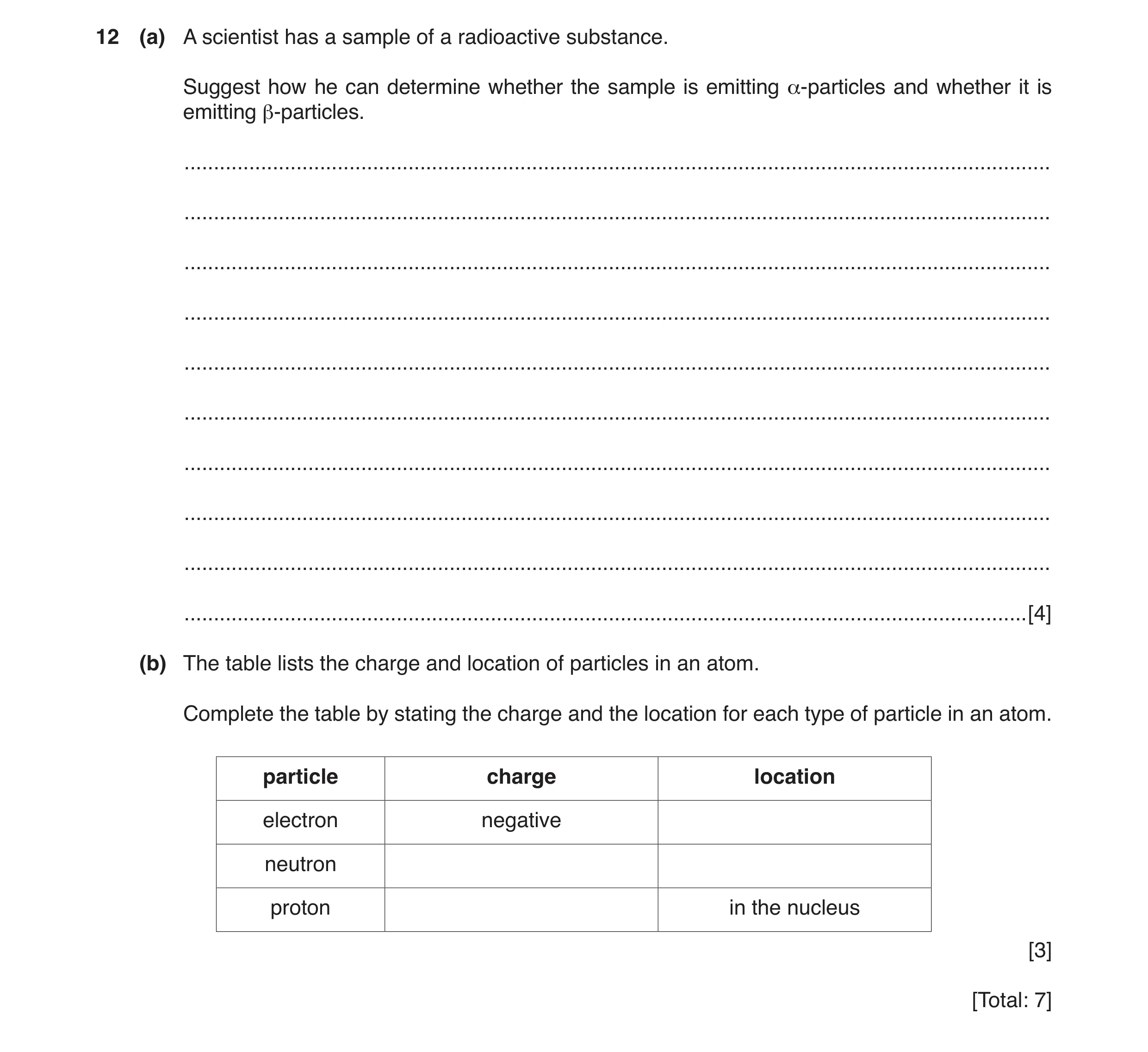 38 / 97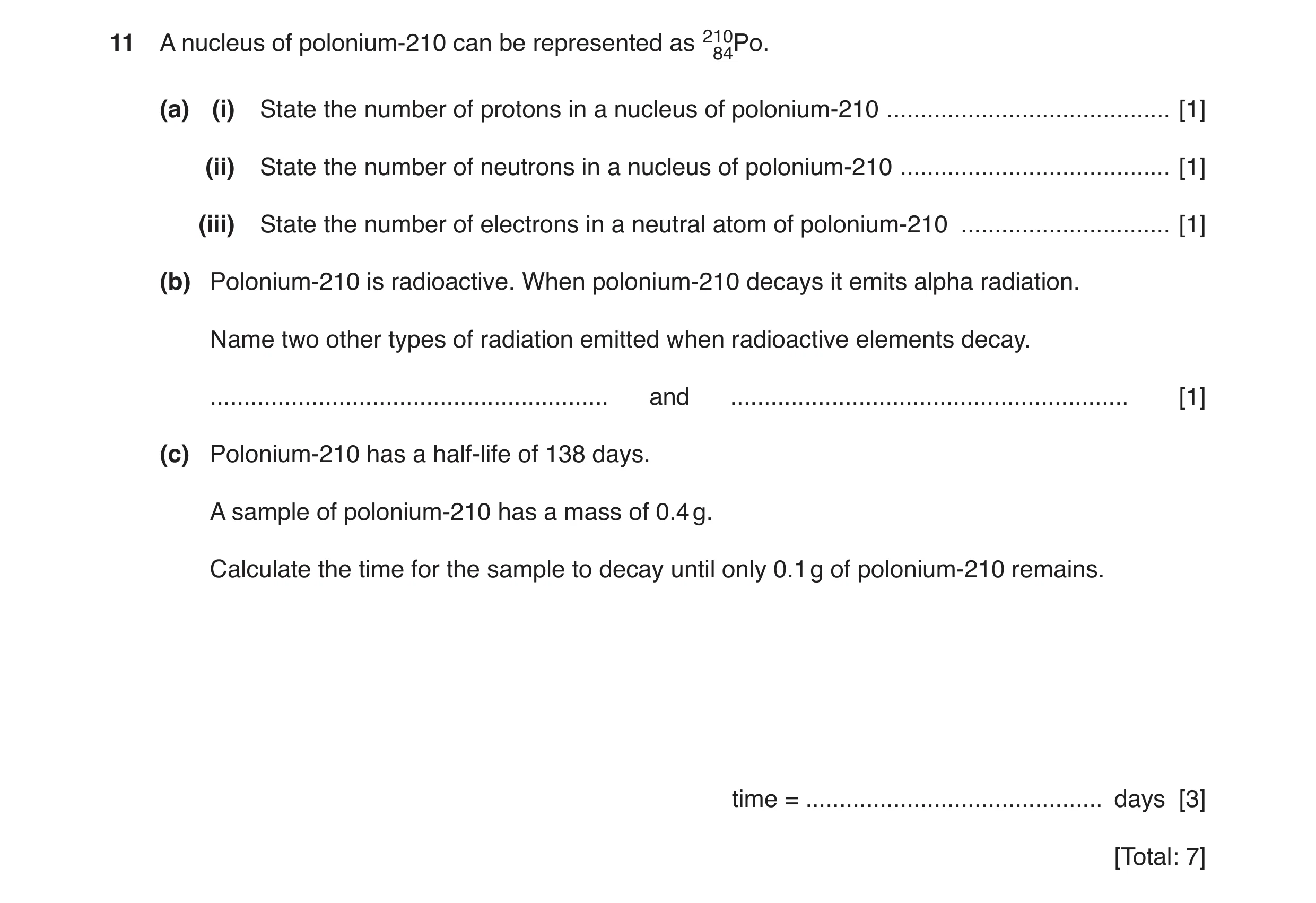
 39 / 97
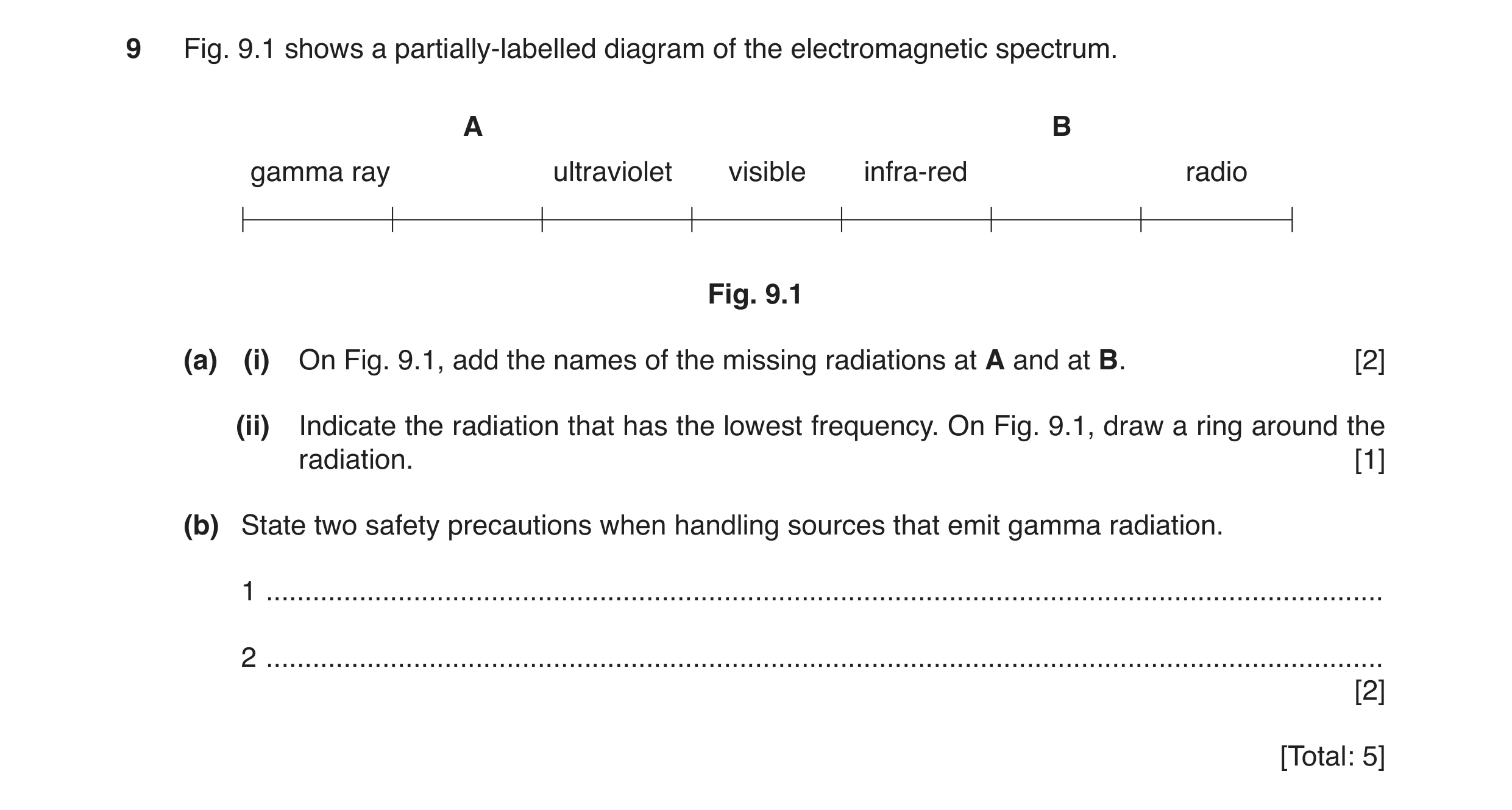 40 / 97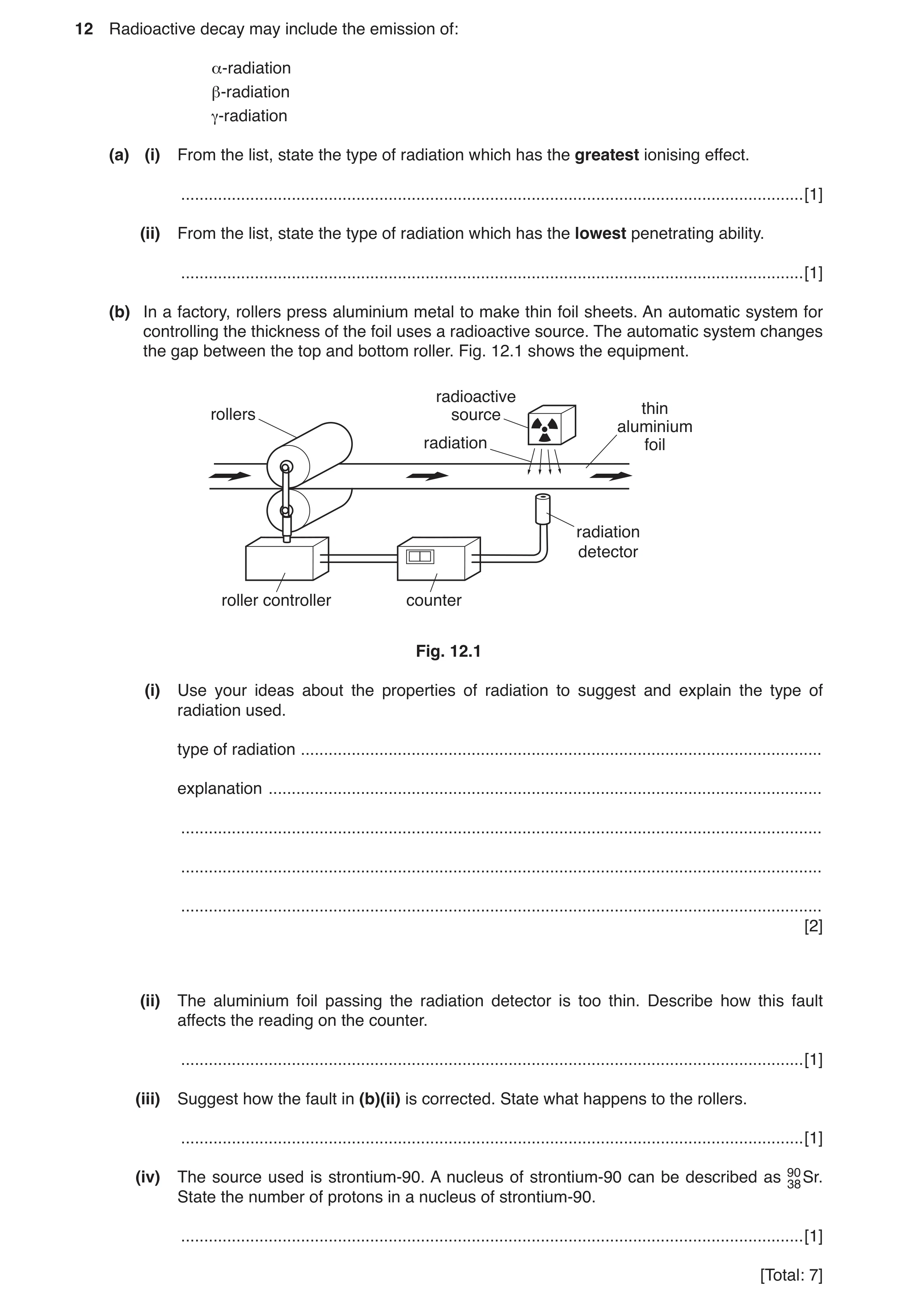
 42 / 97
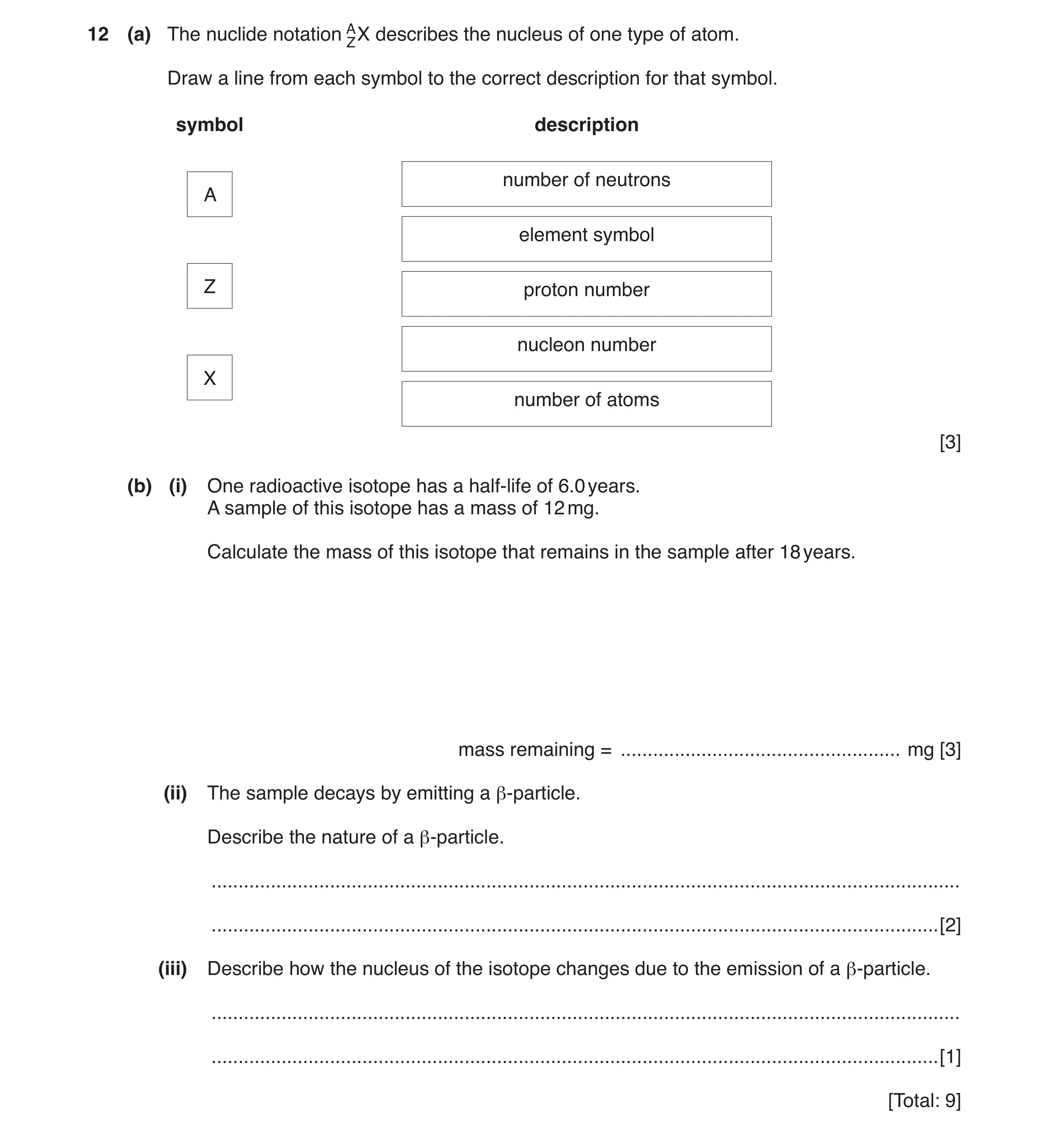 43 / 97
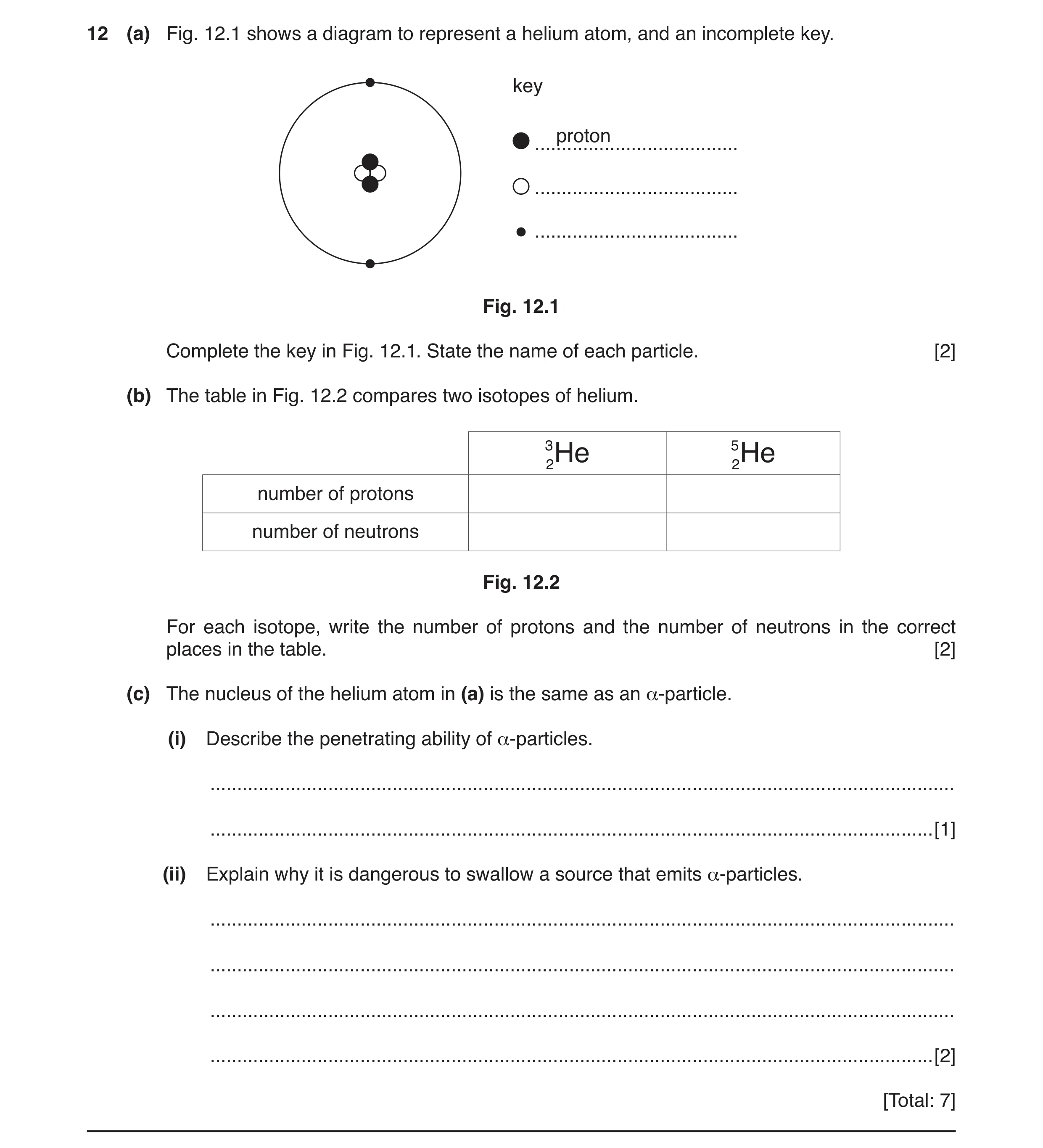 44 / 97
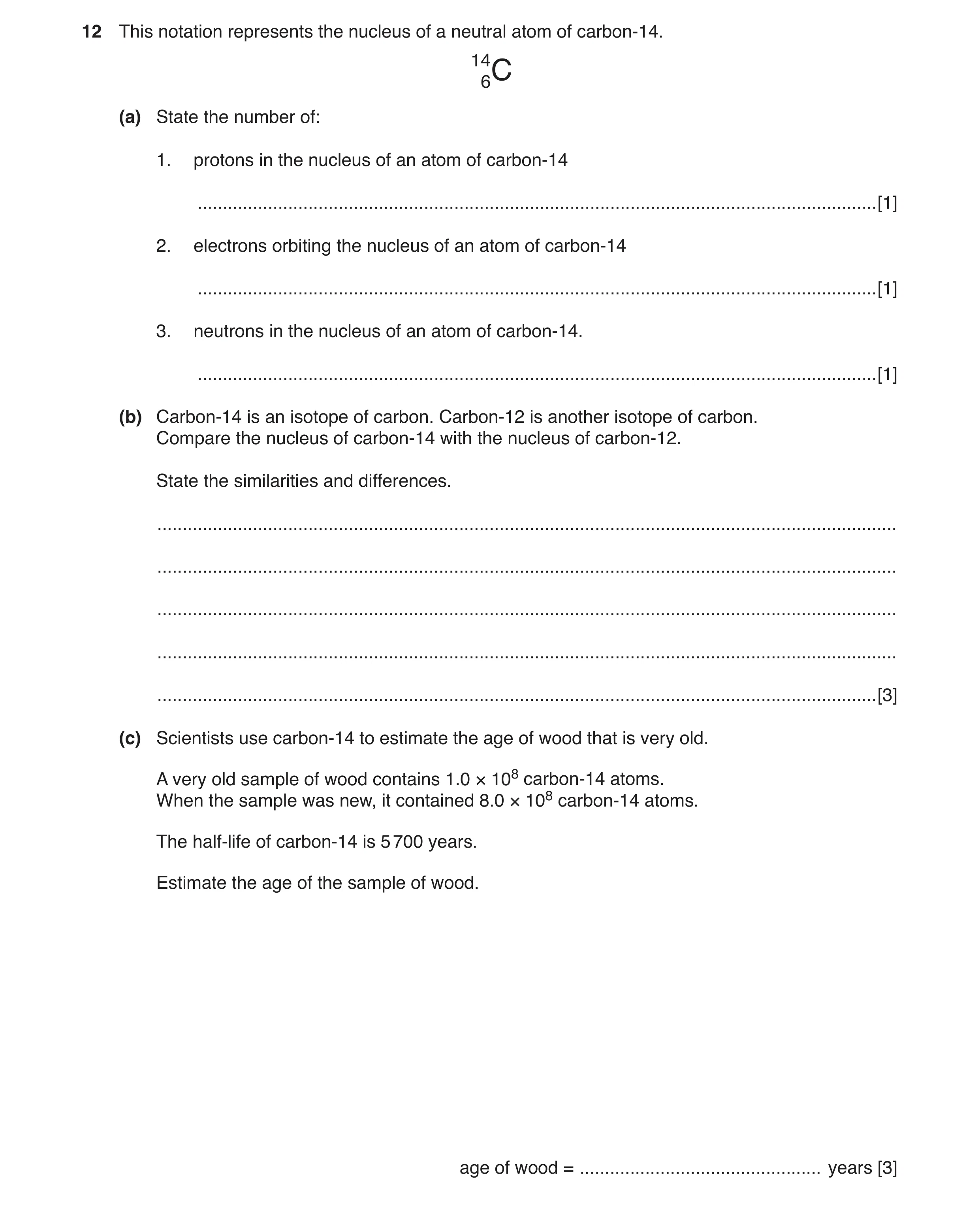 45 / 97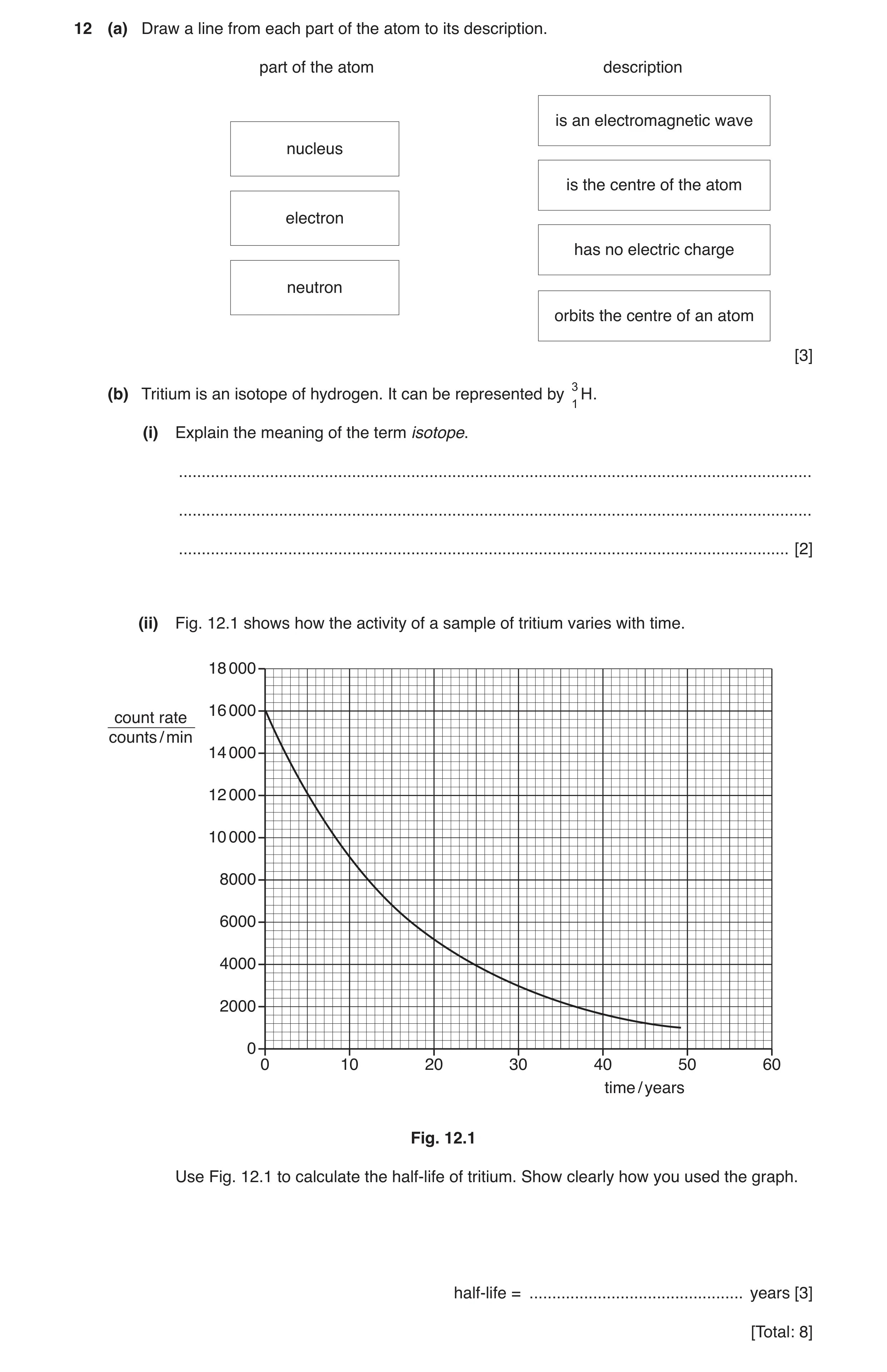
 47 / 97
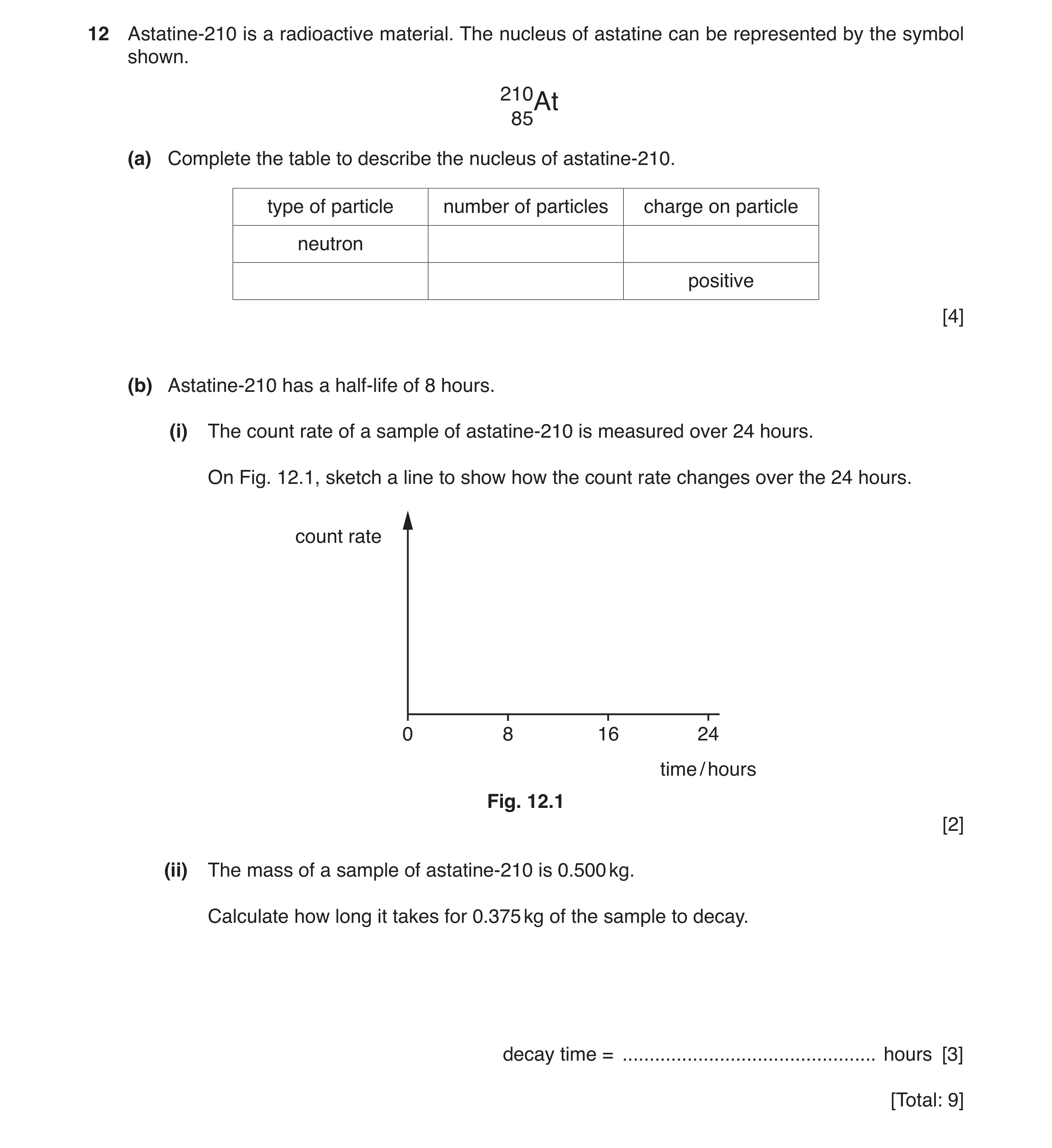 48 / 97
 49 / 97
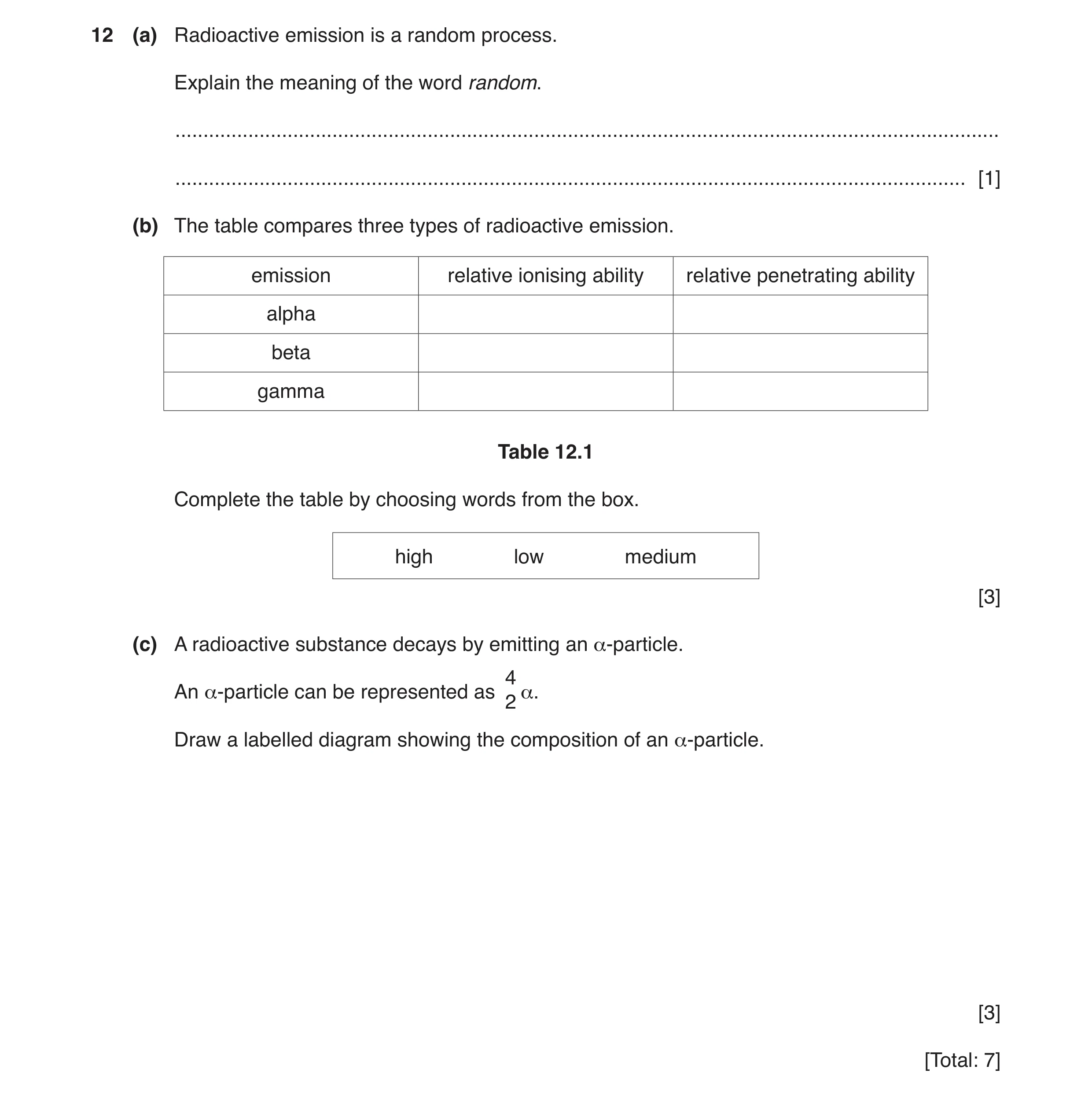 50 / 97
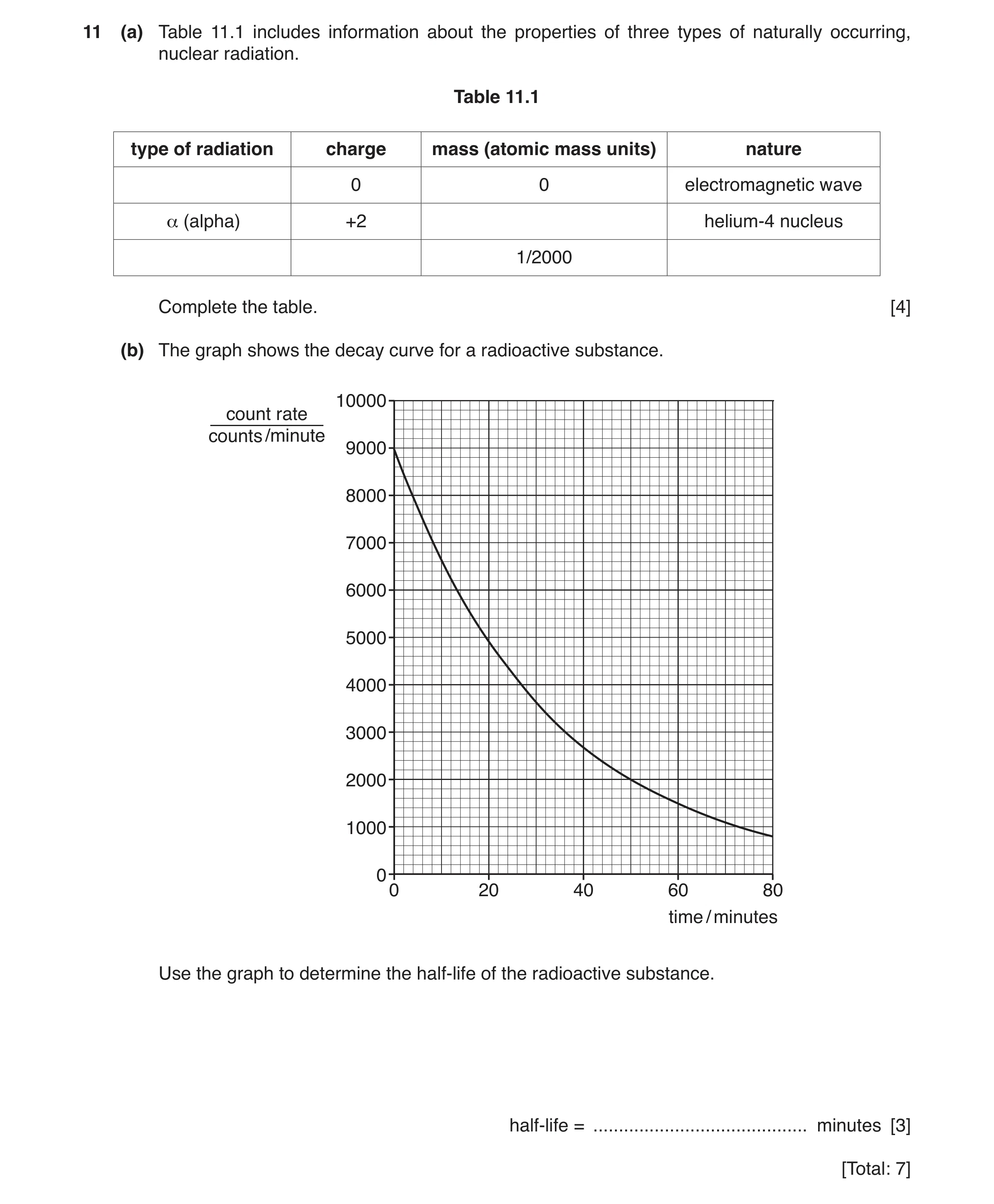 51 / 97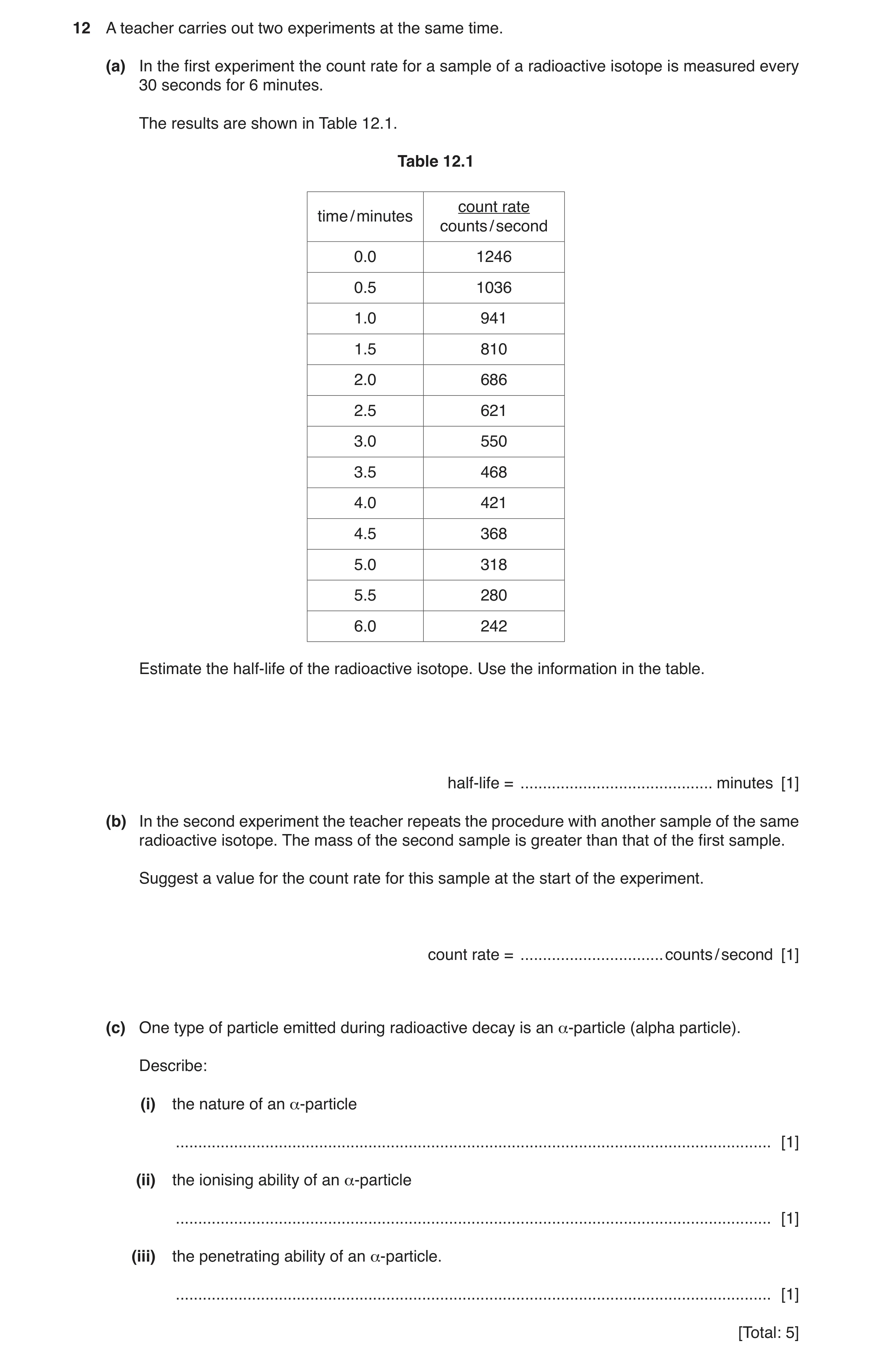
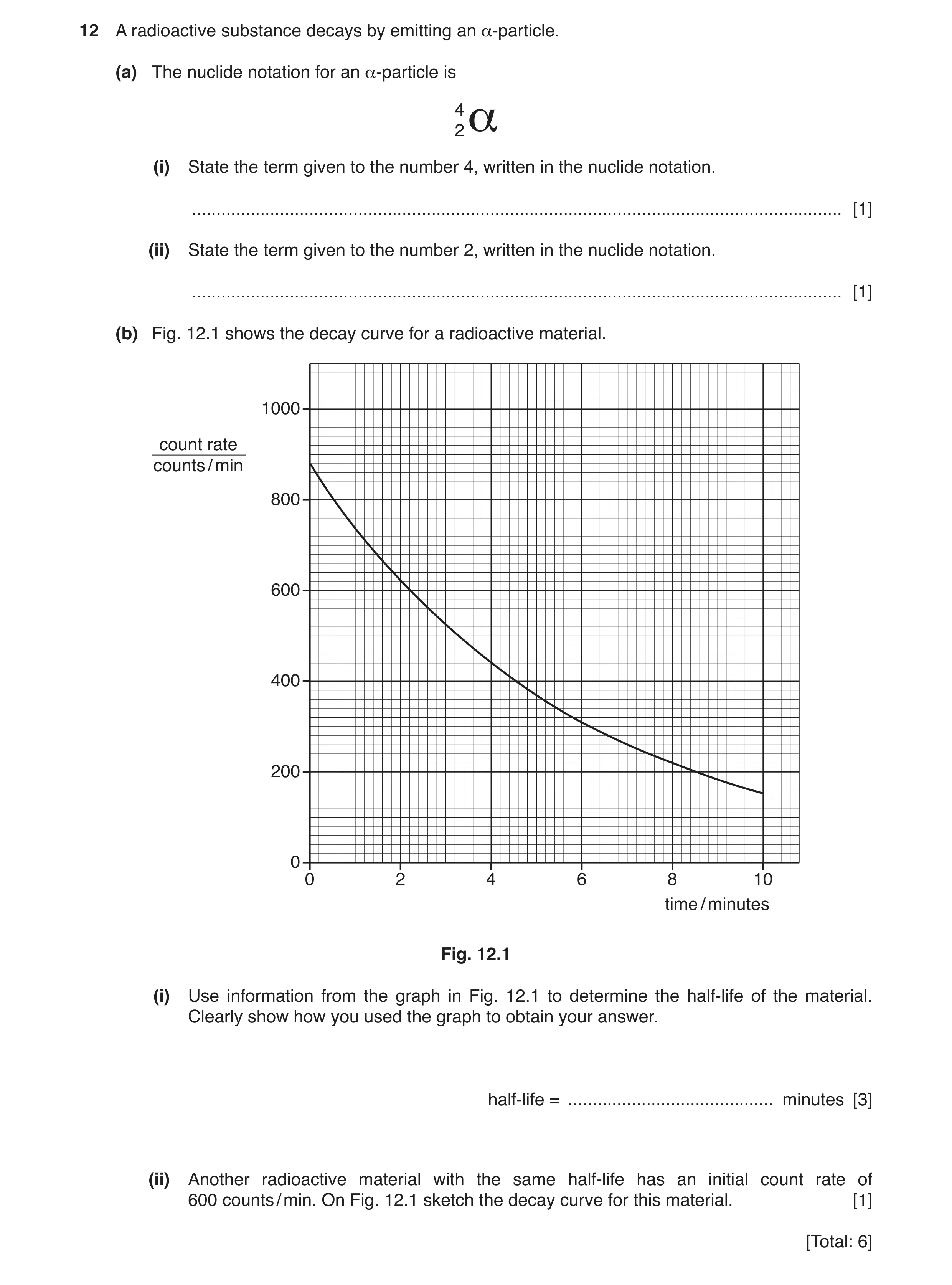 54 / 97
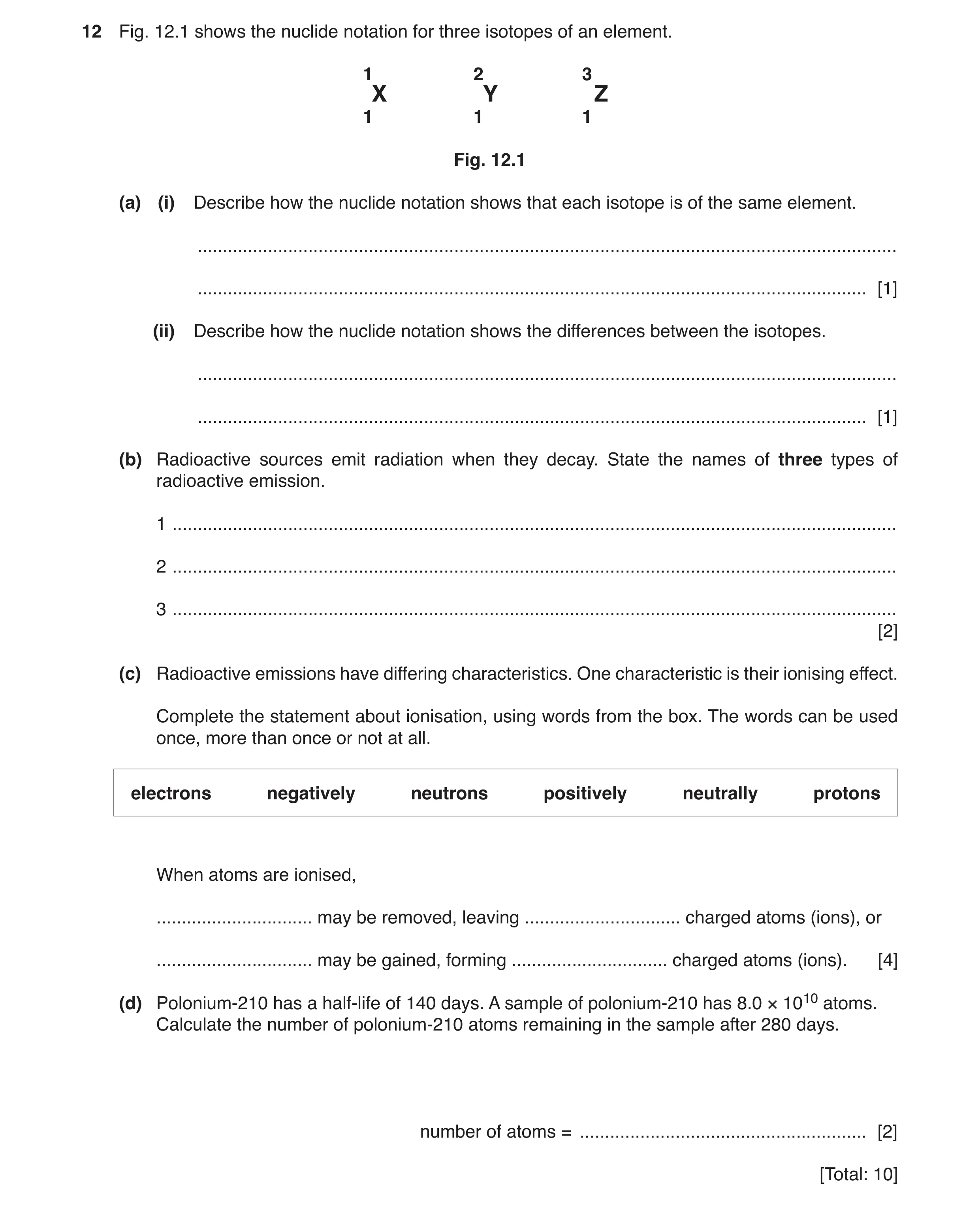 55 / 97
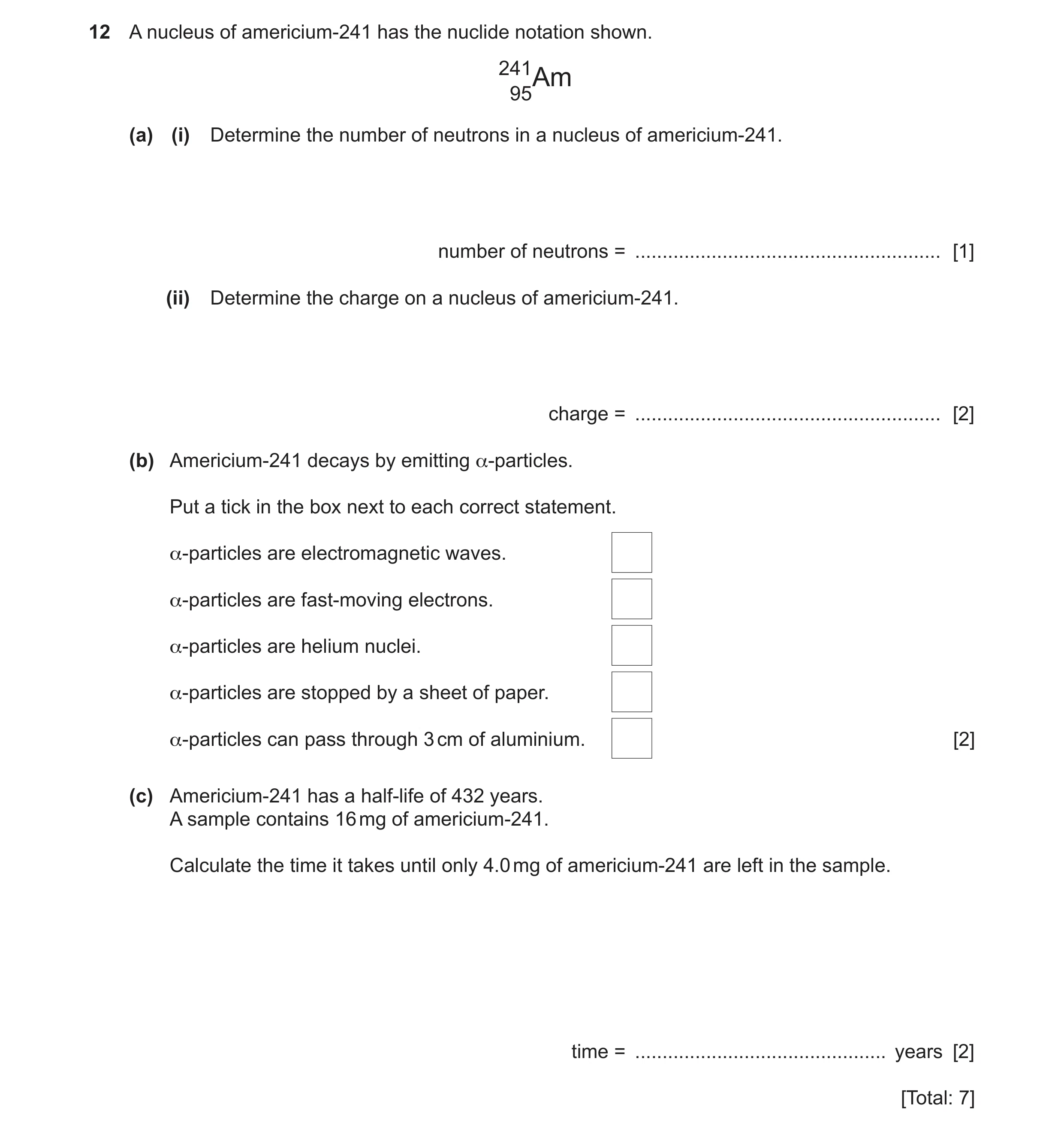 56 / 97
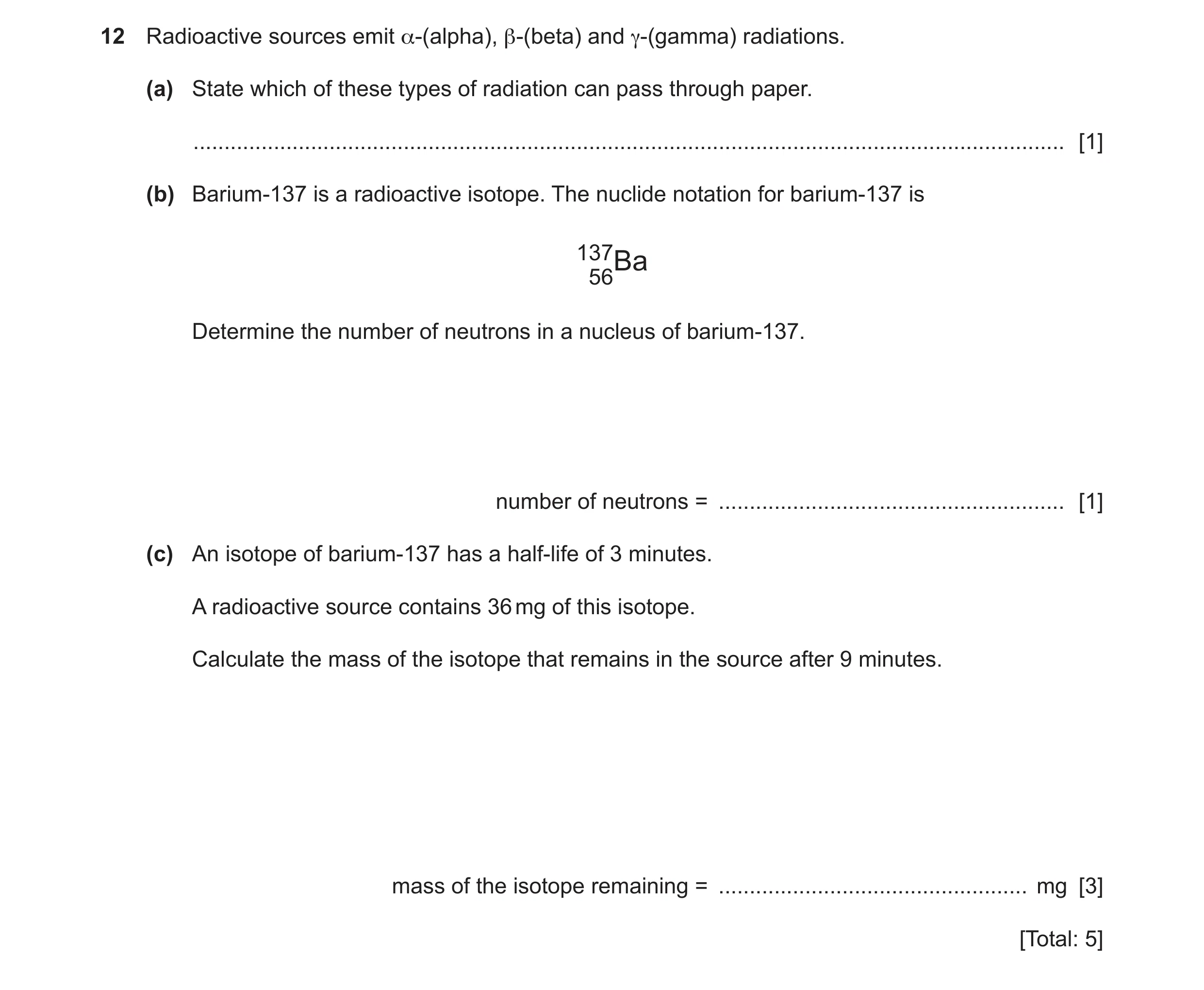 57 / 97
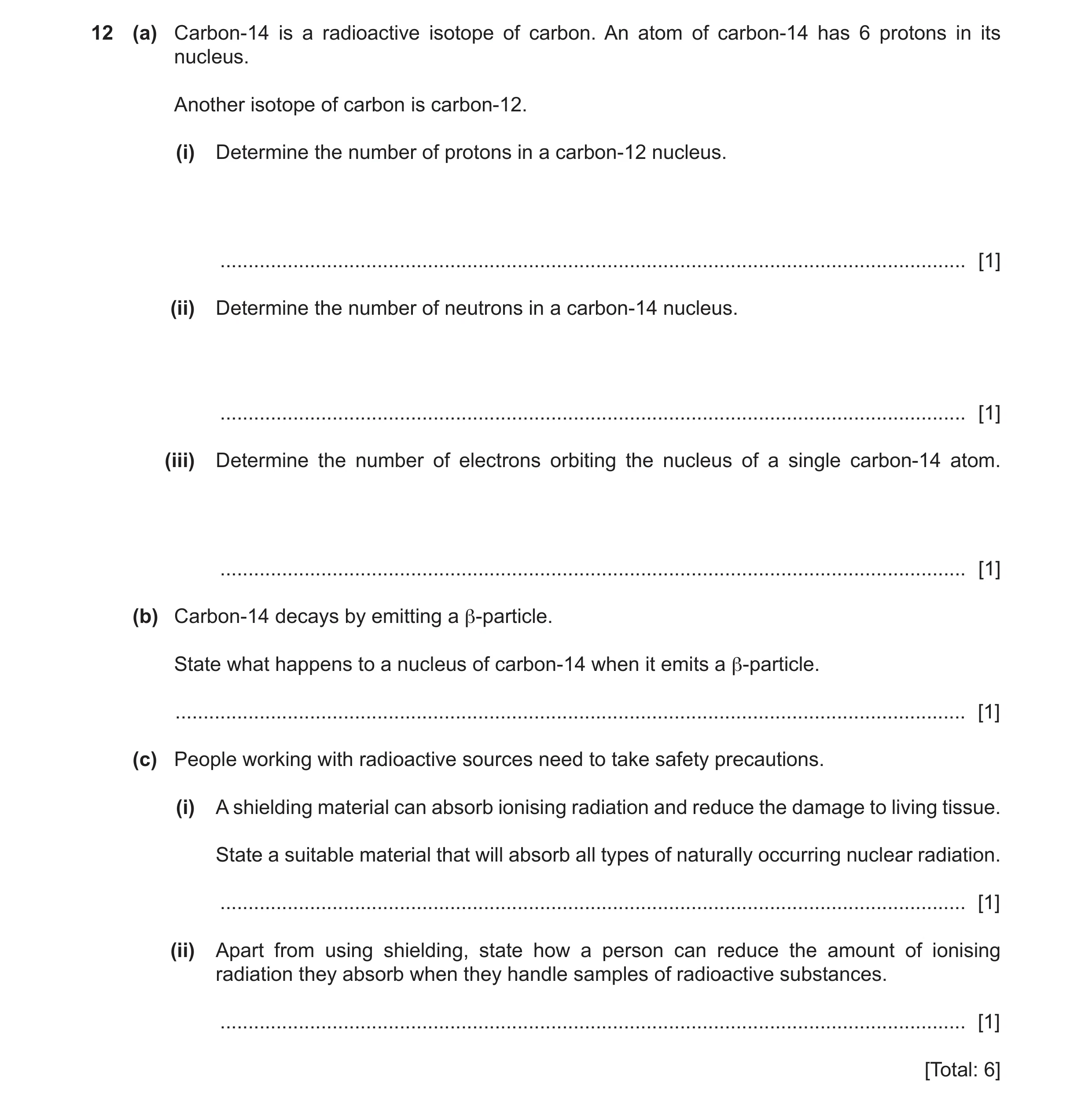 58 / 97
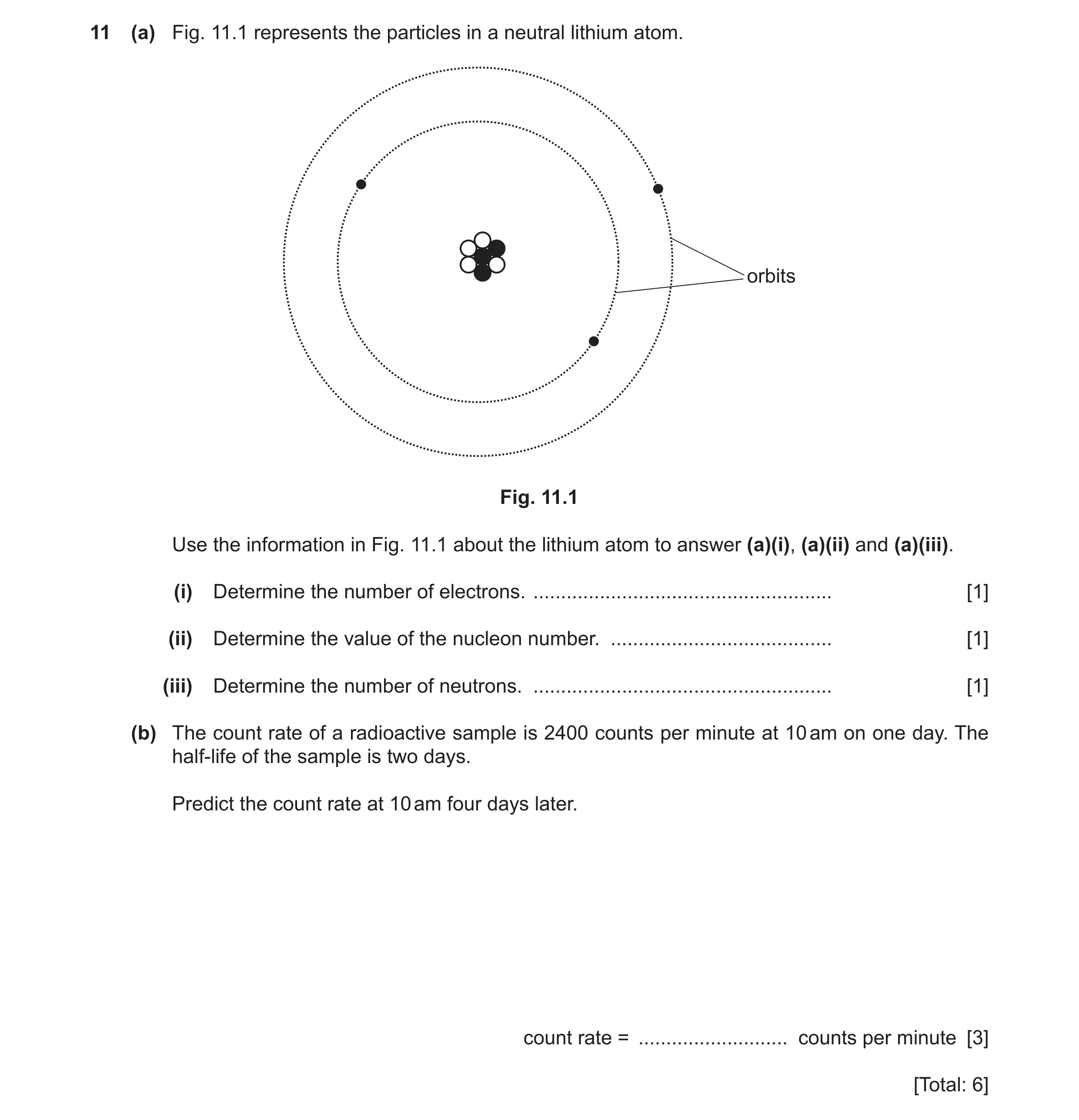 59 / 97
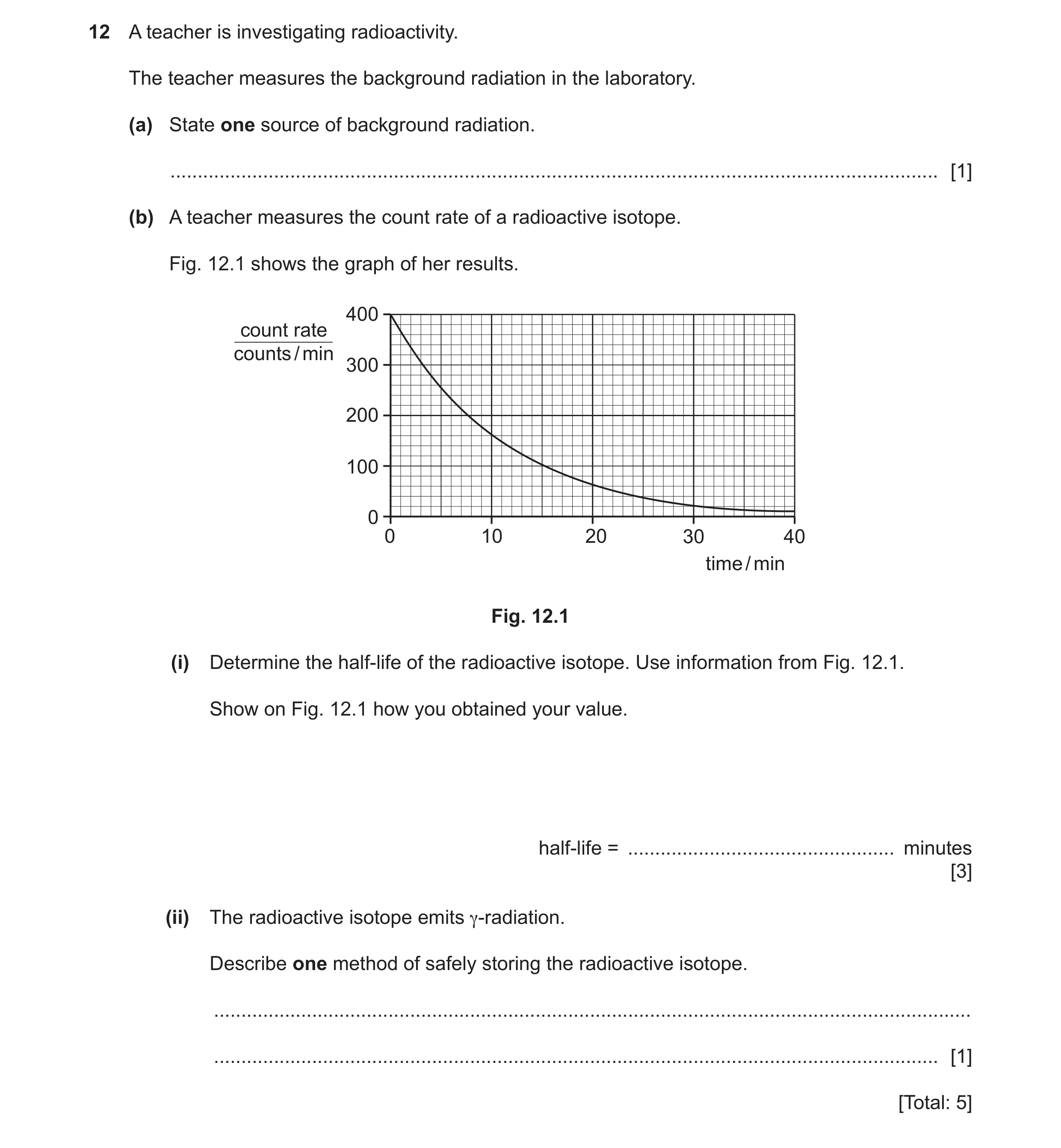 60 / 97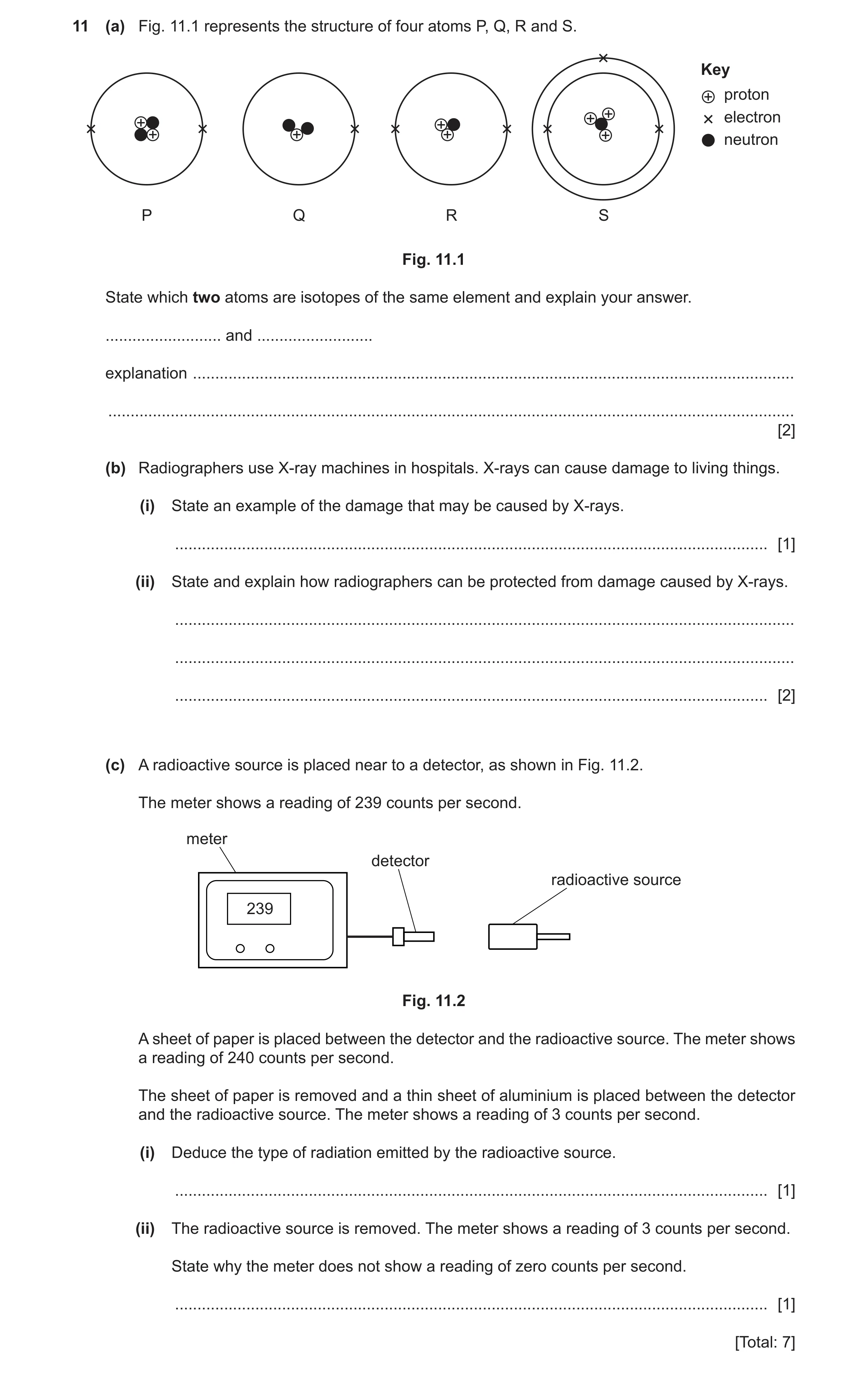
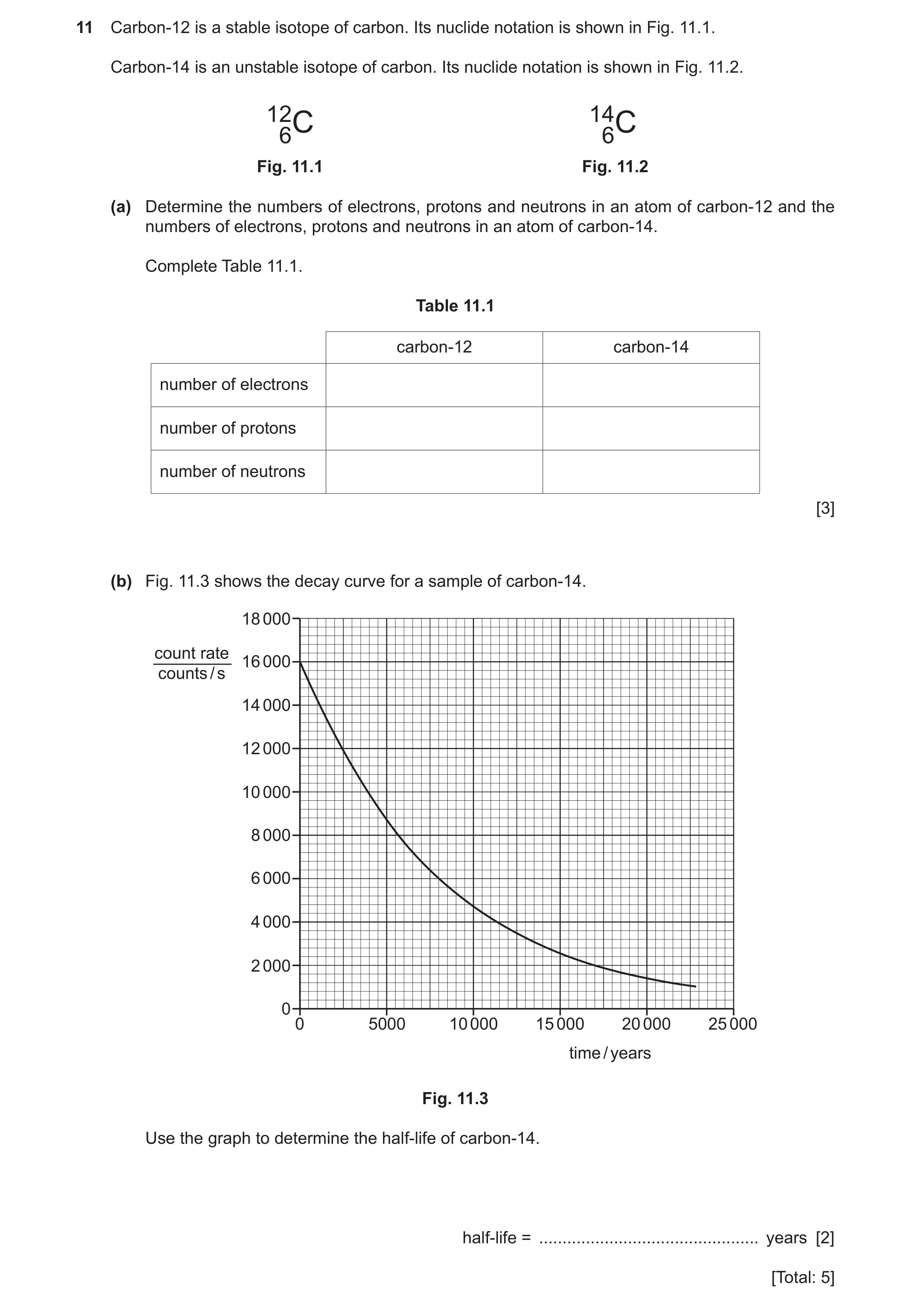 62 / 97
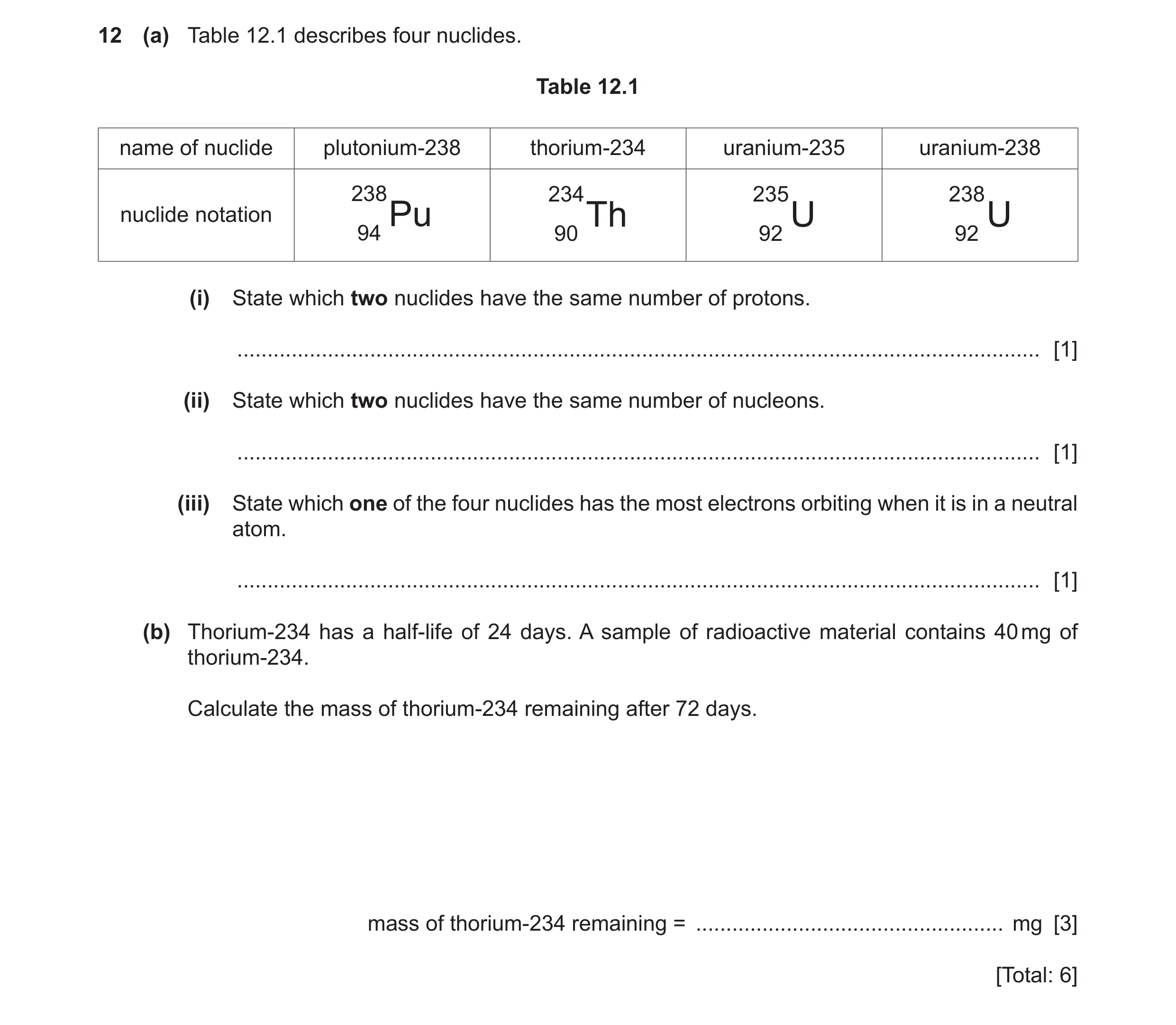 63 / 97
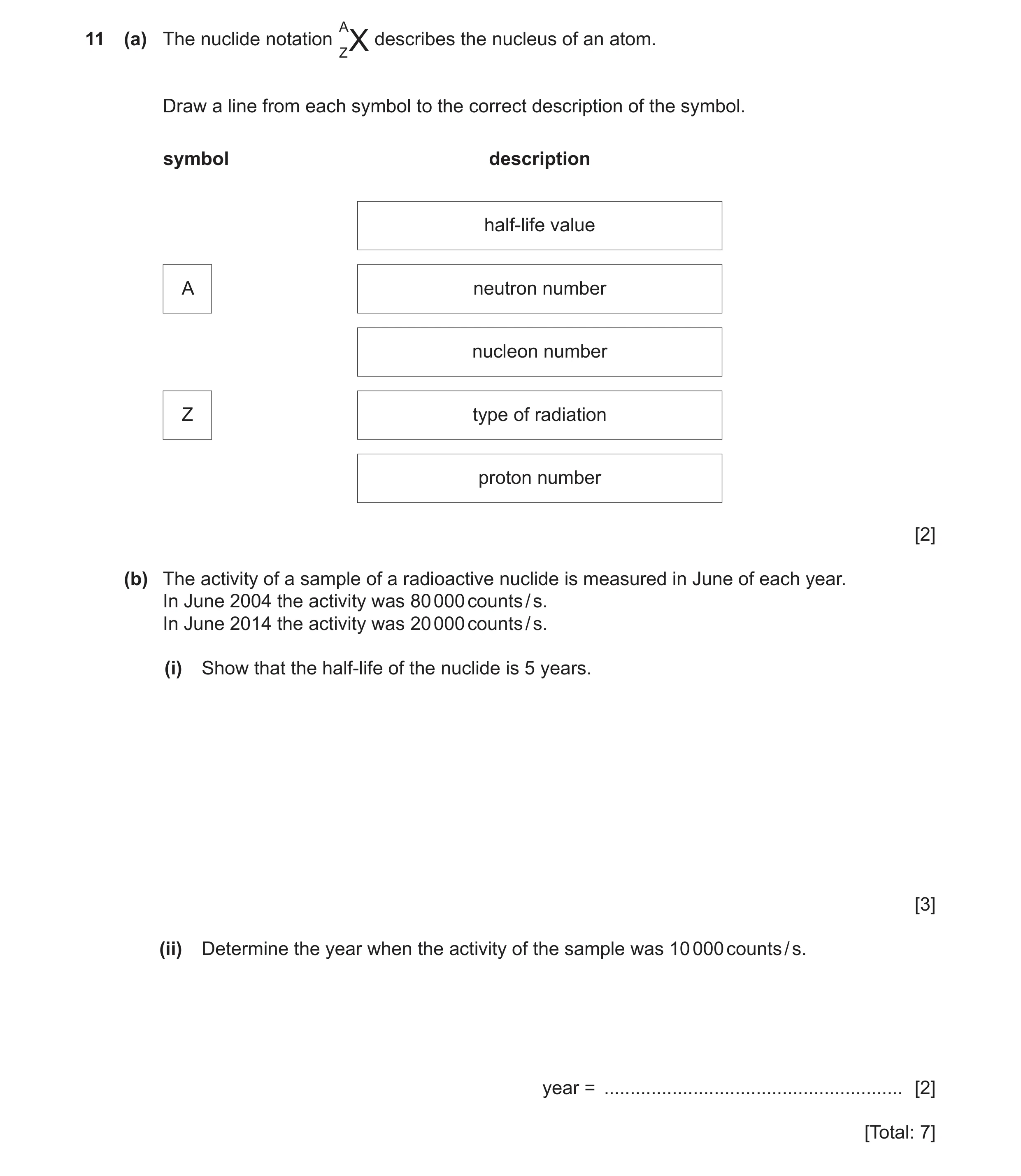 64 / 97
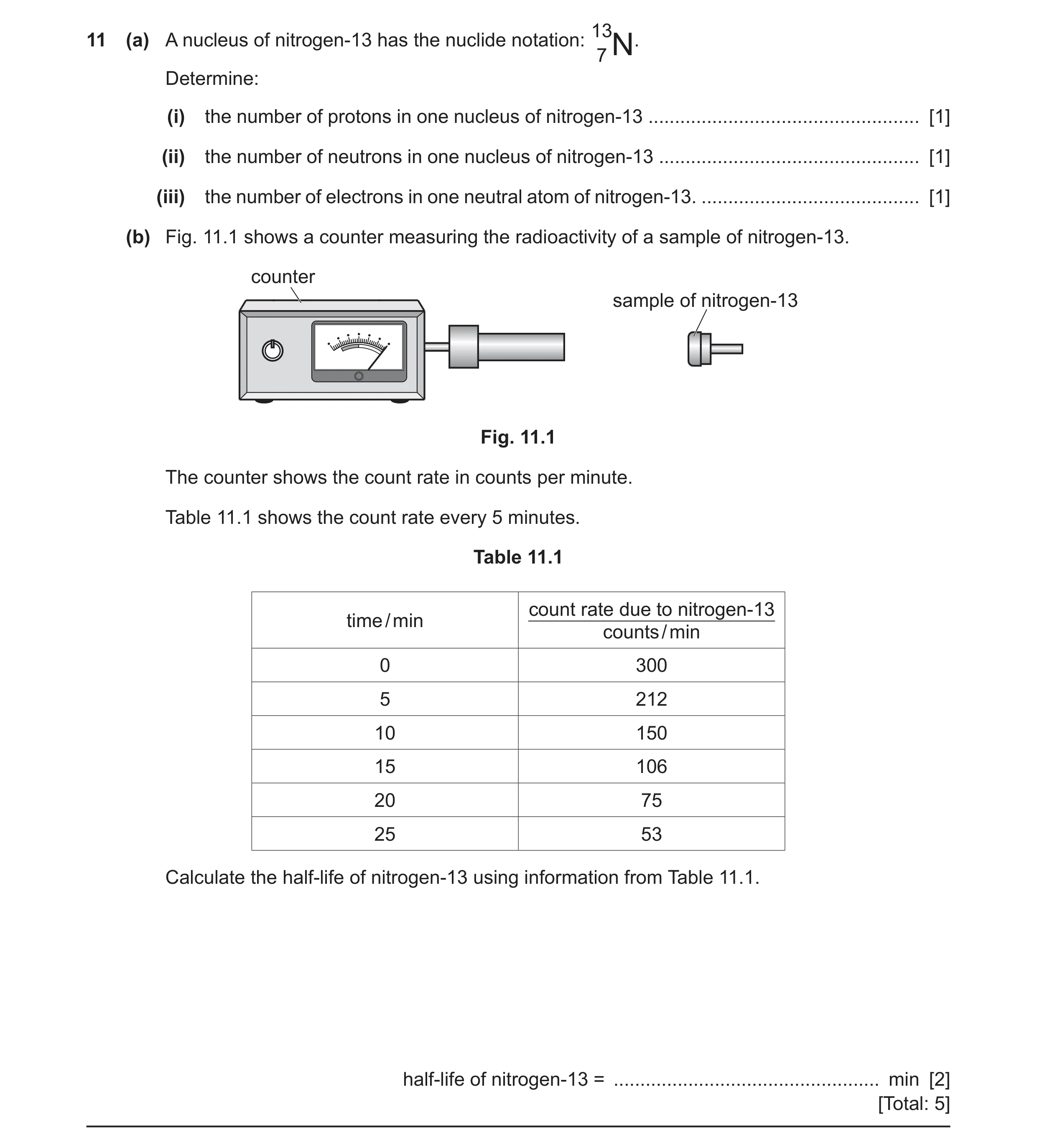 65 / 97
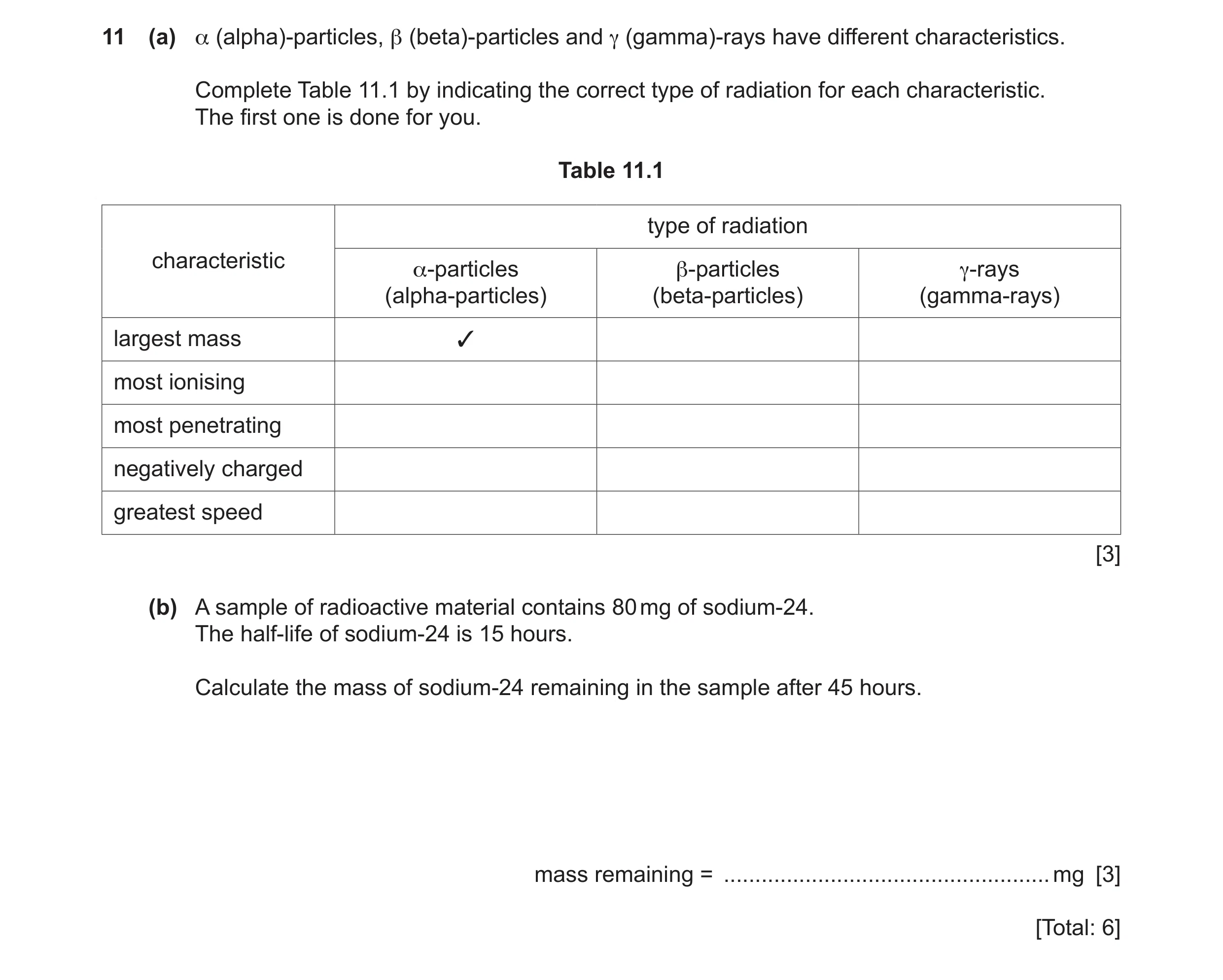 66 / 97
 67 / 97
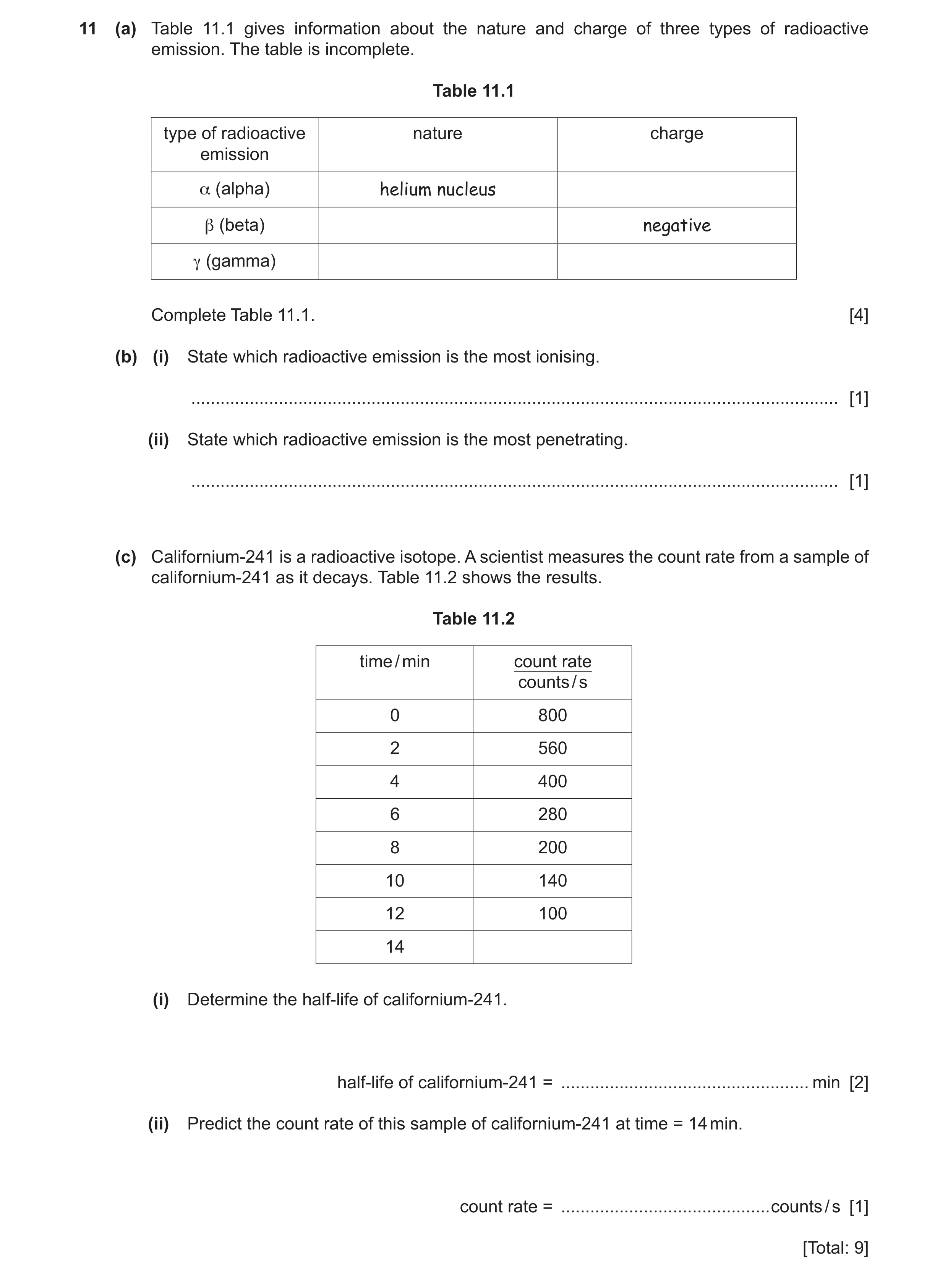 68 / 97
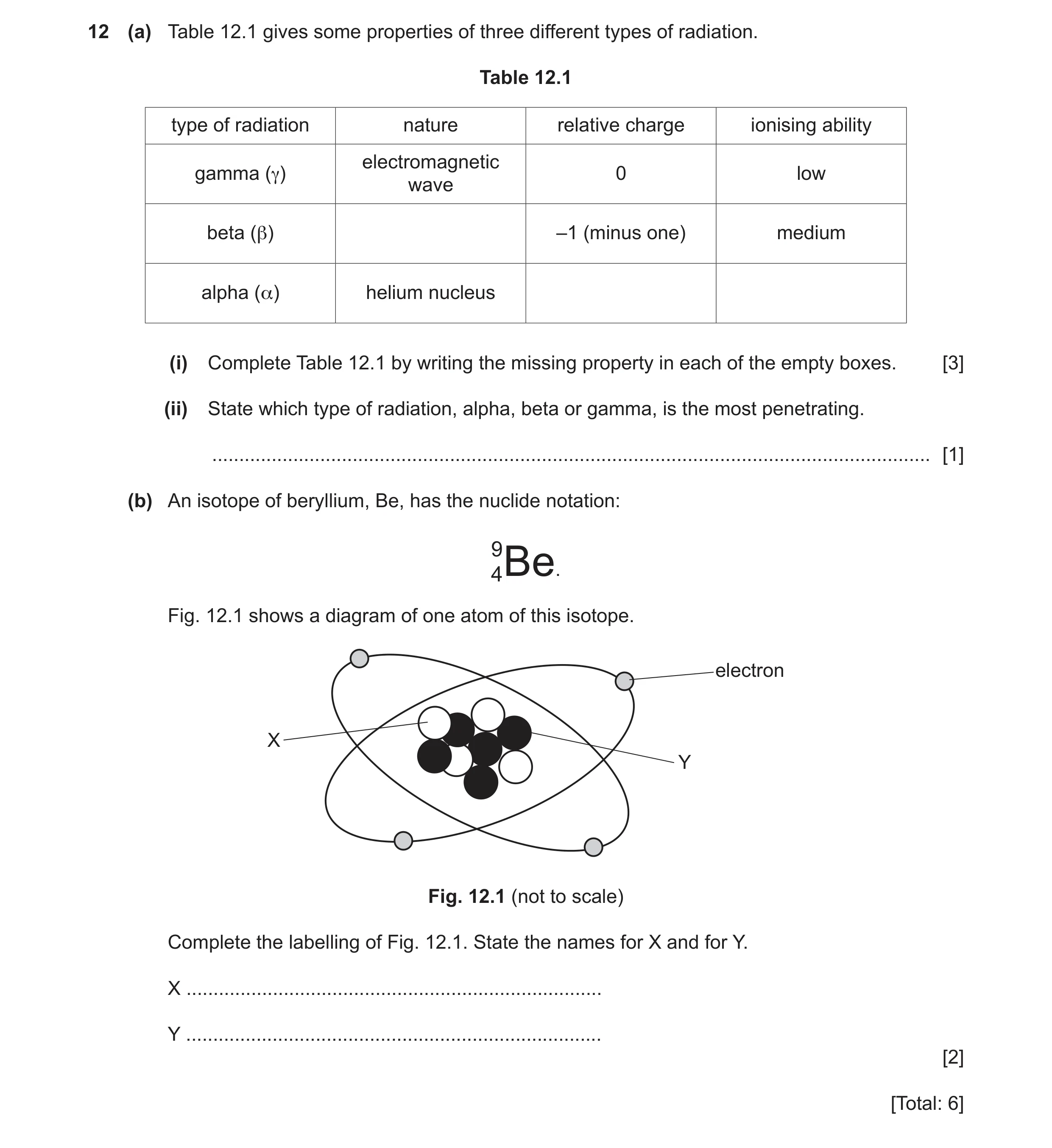 69 / 97
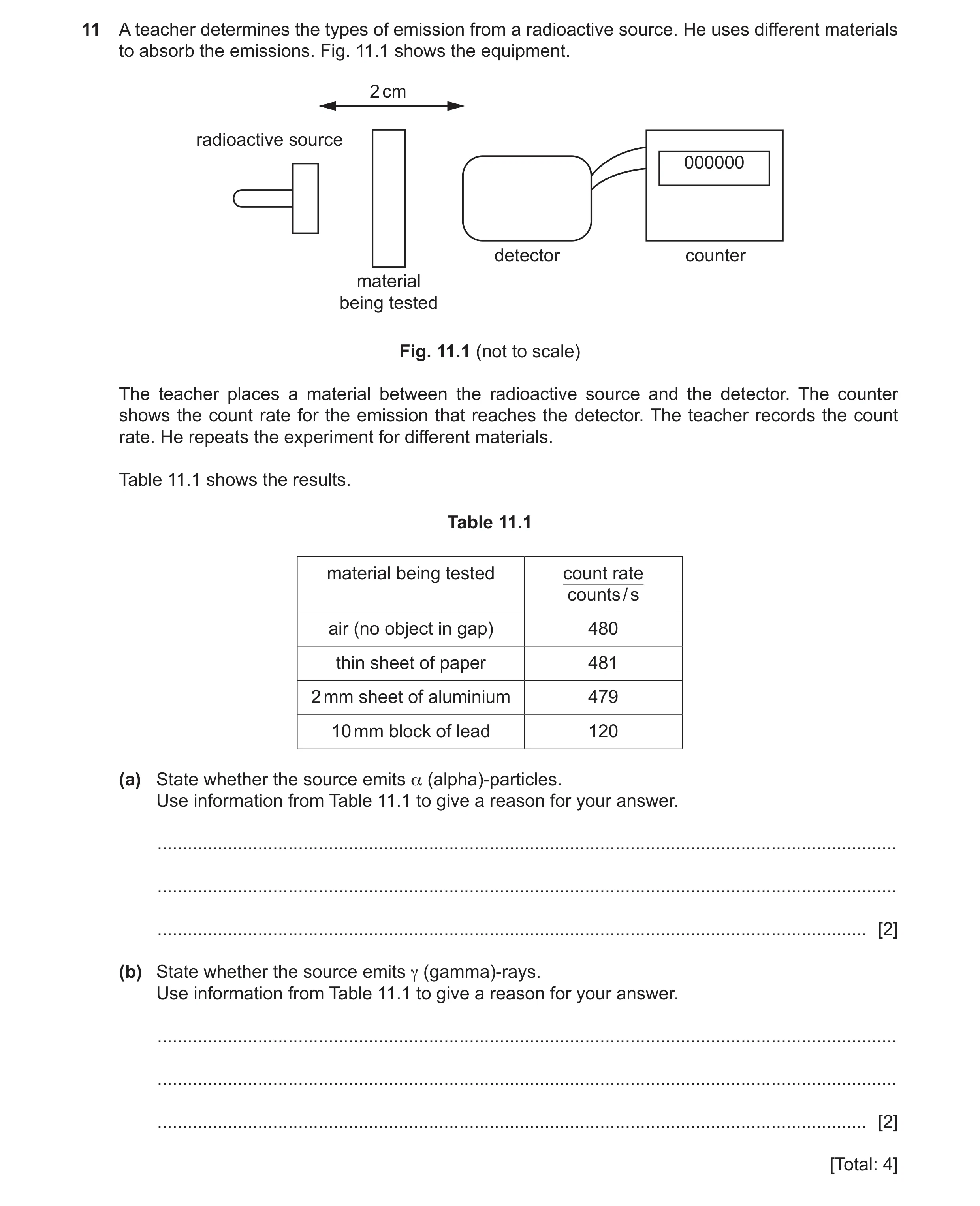 70 / 97
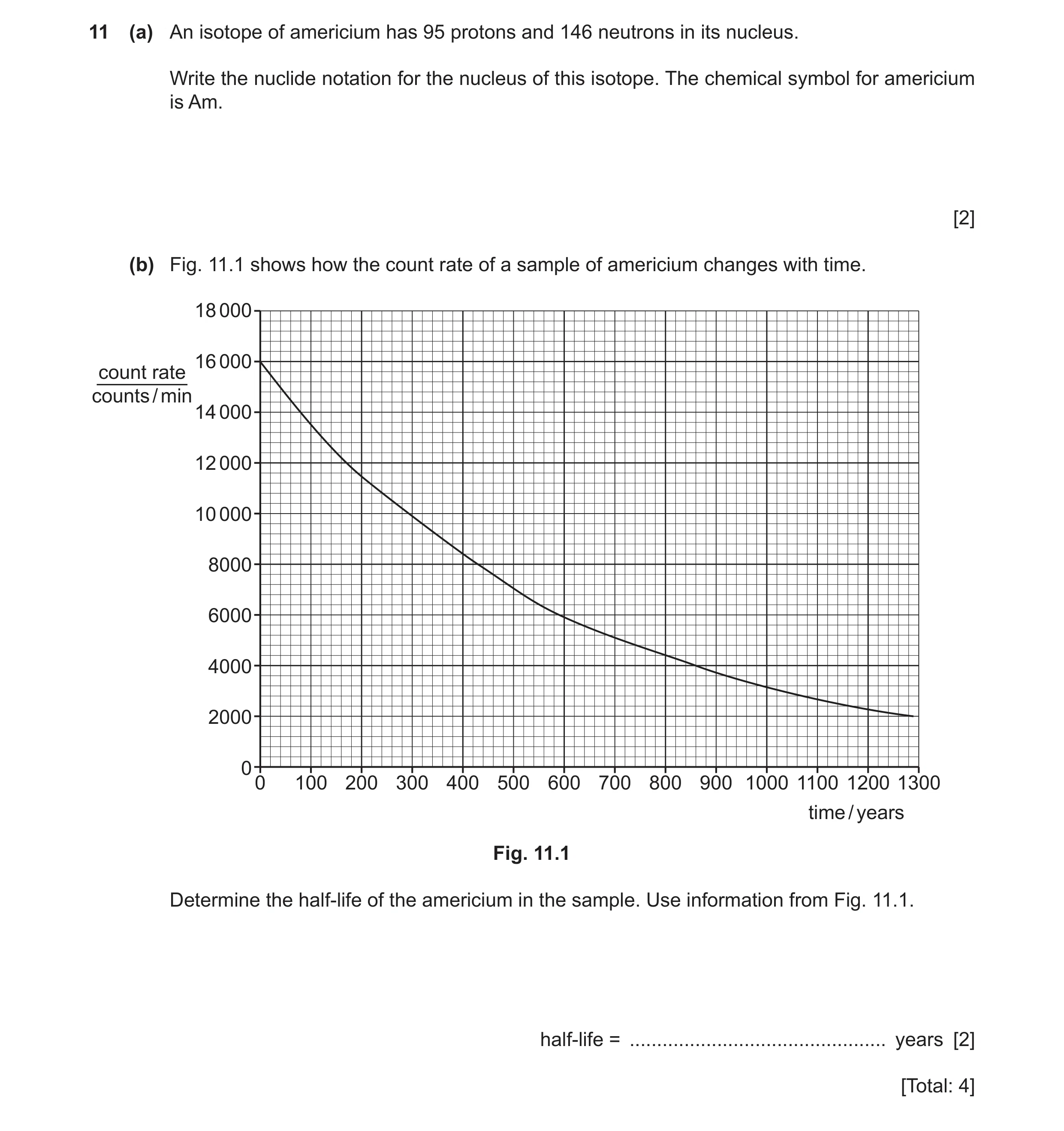 71 / 97
 72 / 97
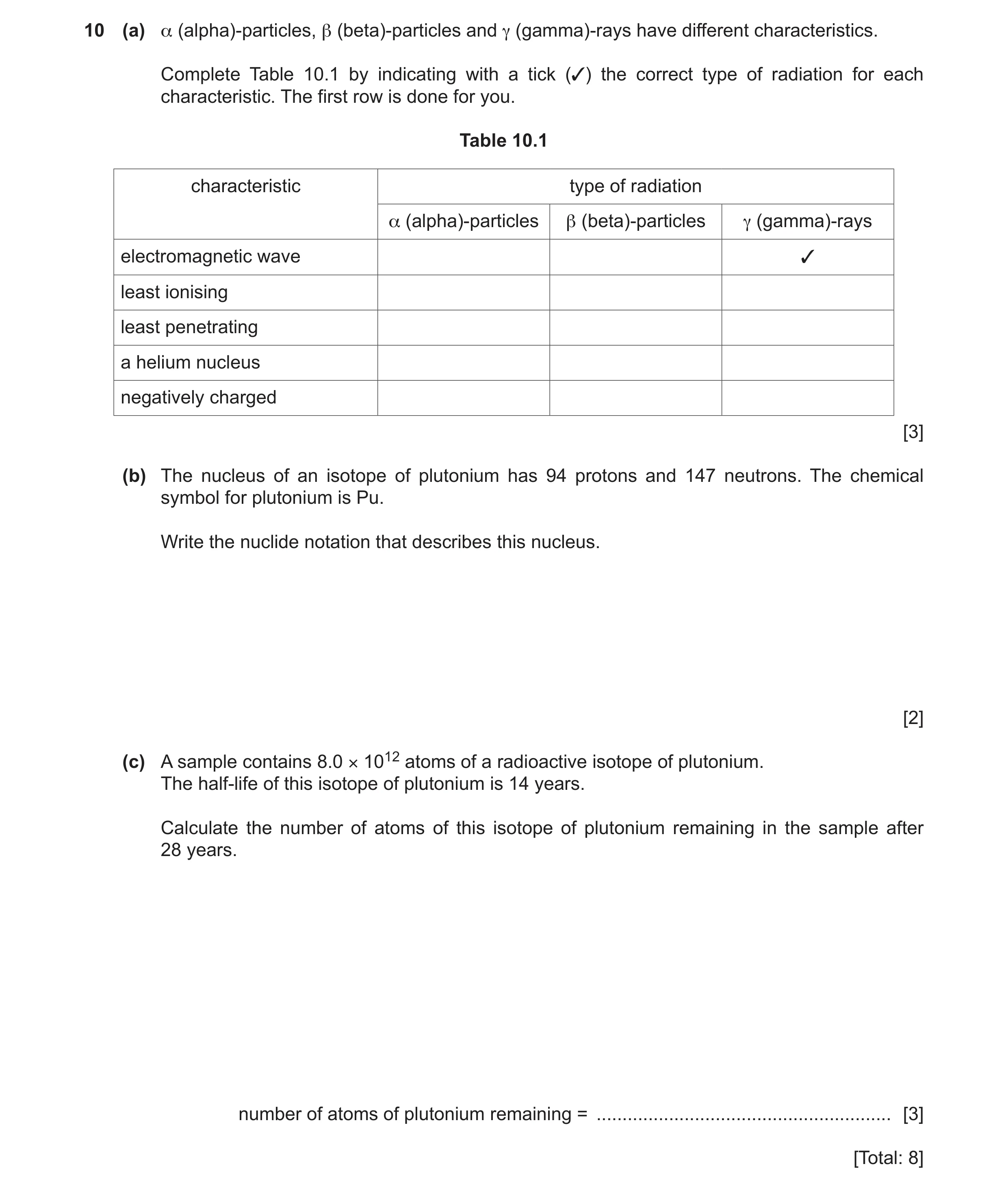 73 / 97
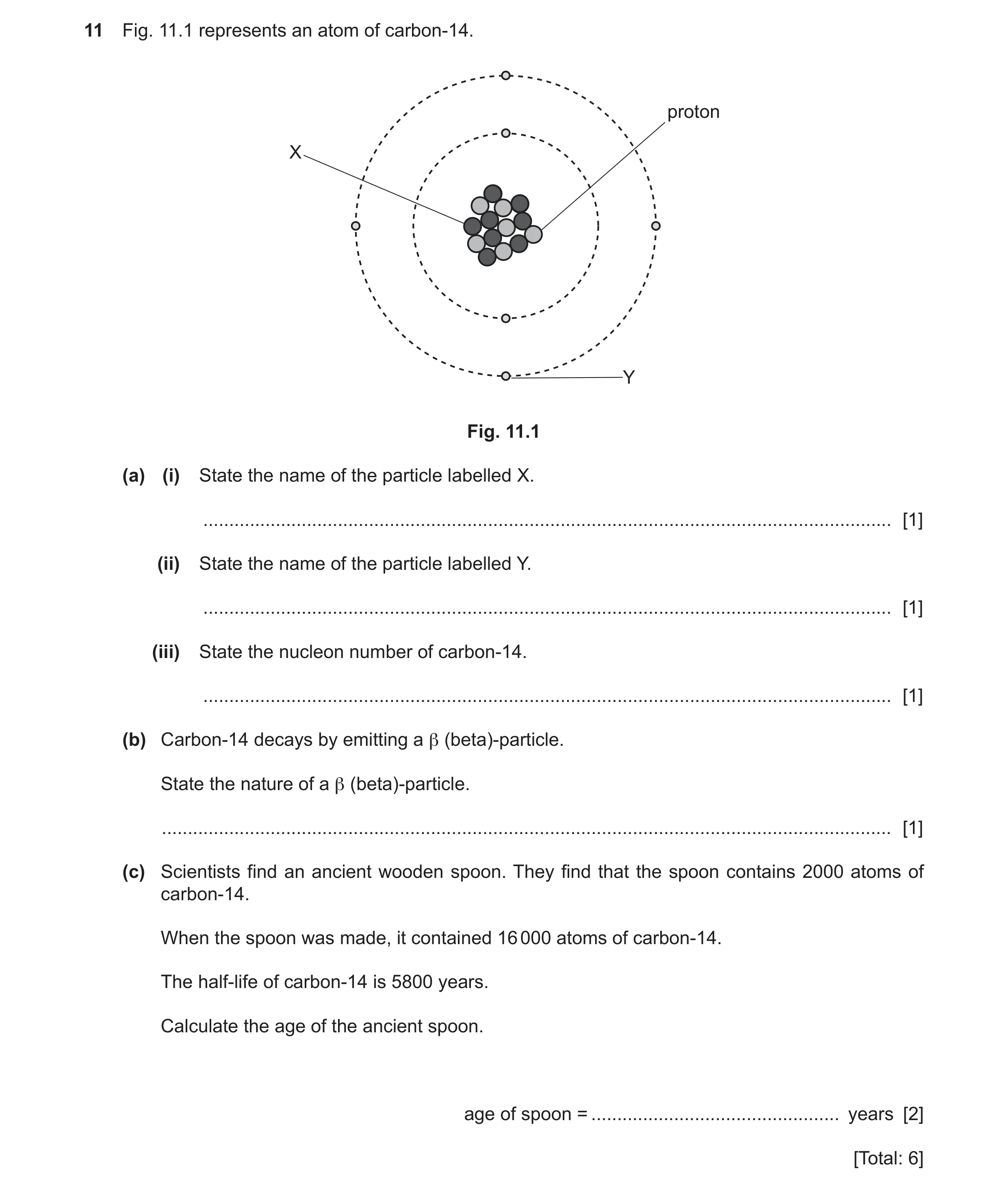 74 / 97
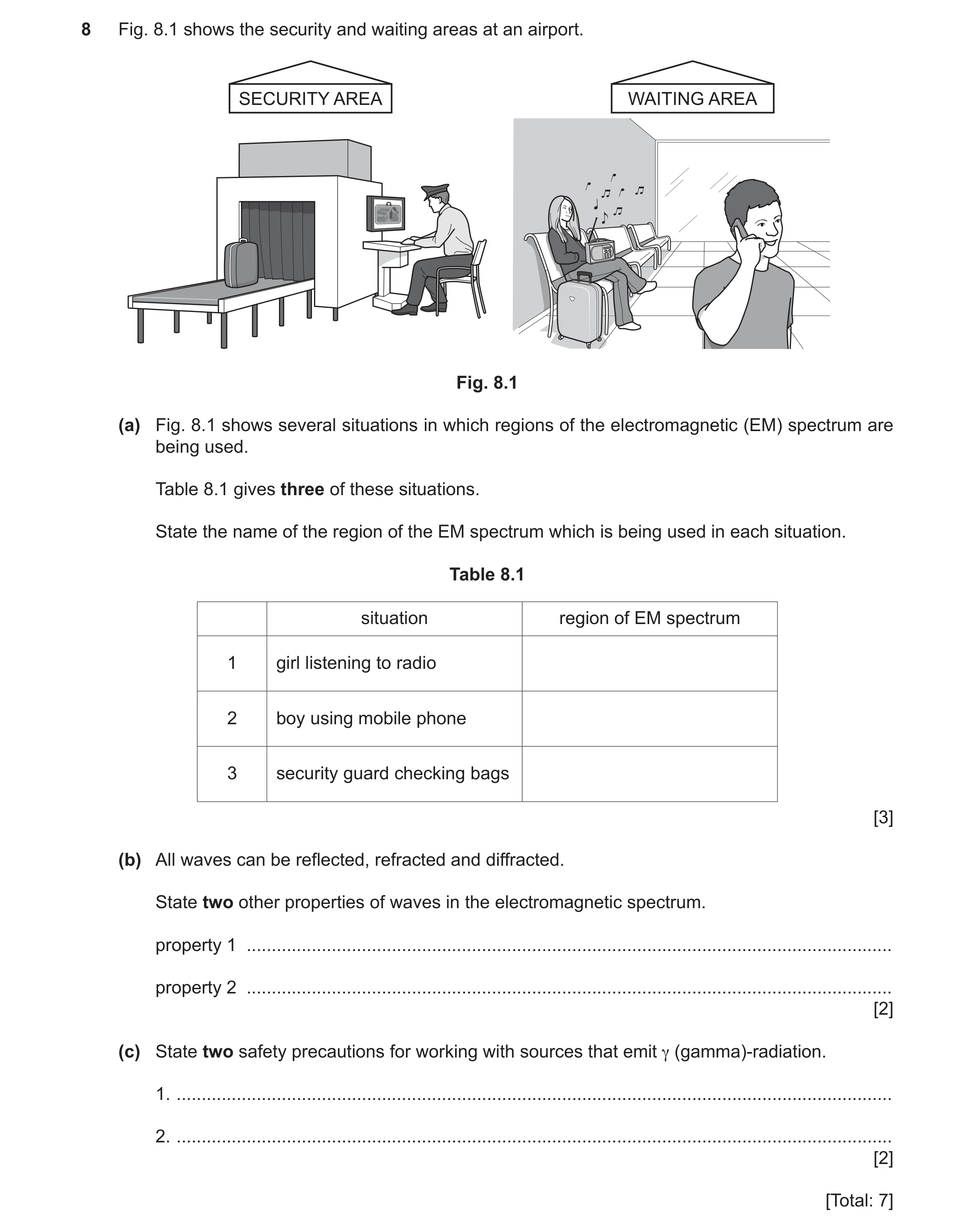 75 / 97
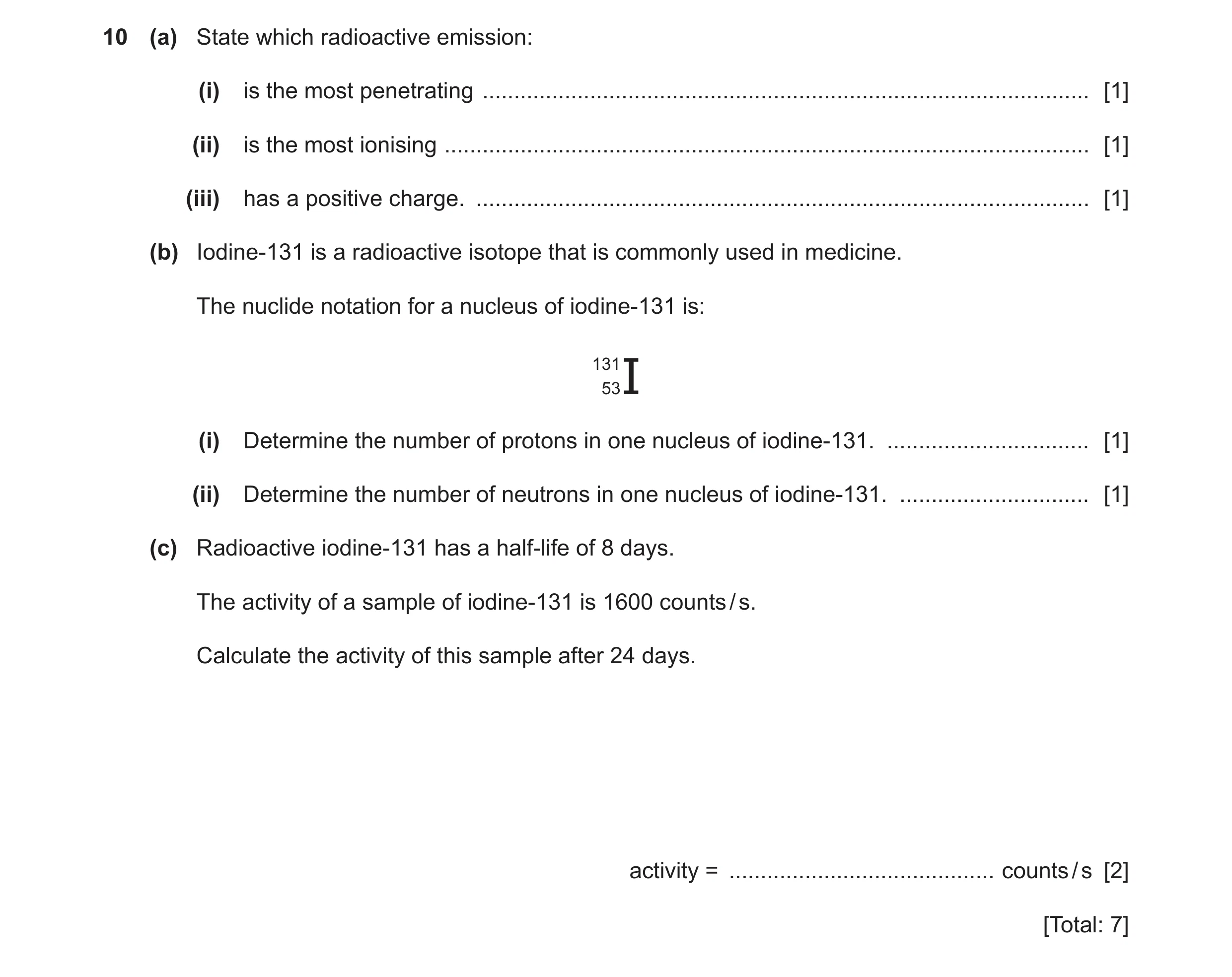 76 / 97
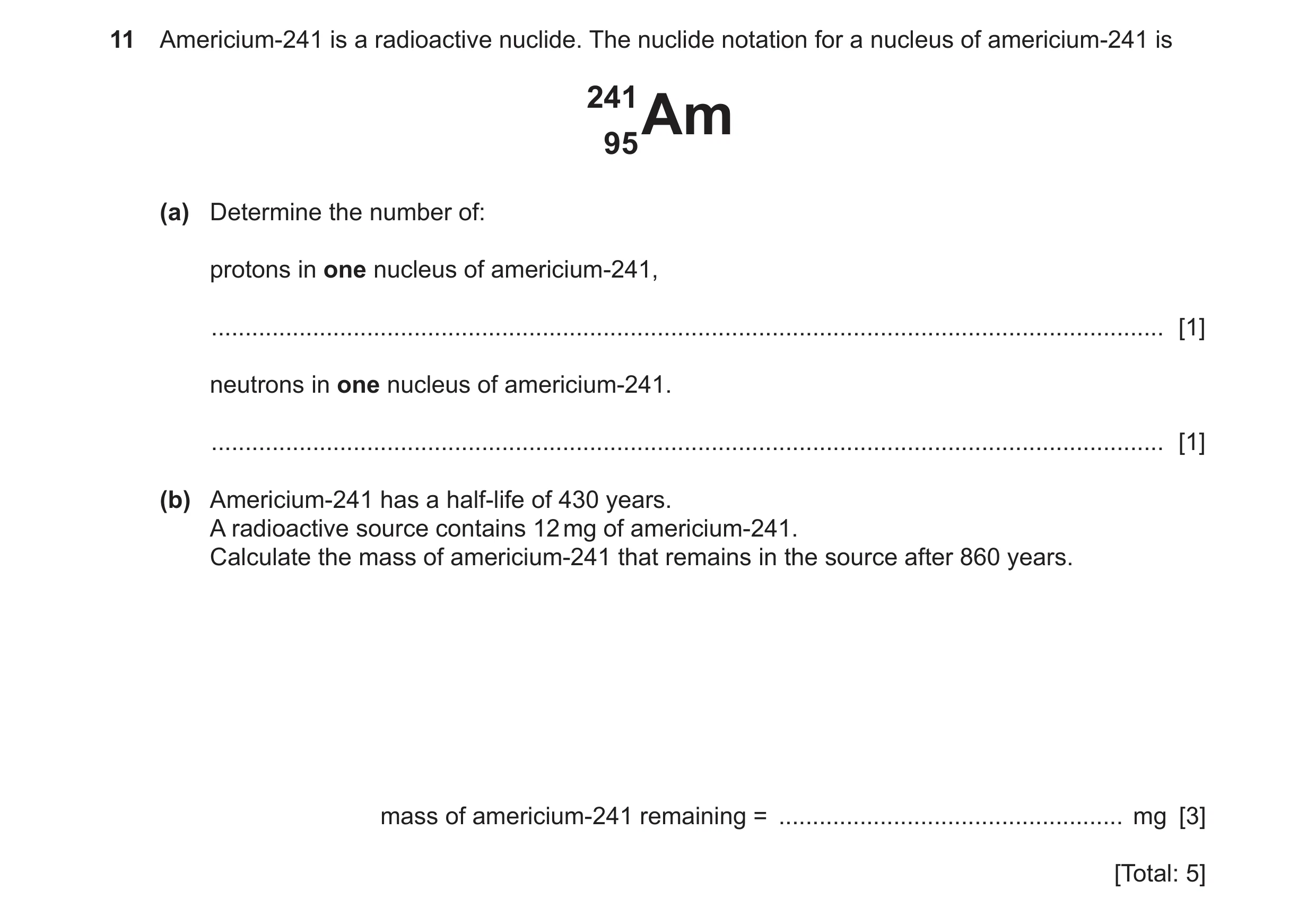 77 / 97
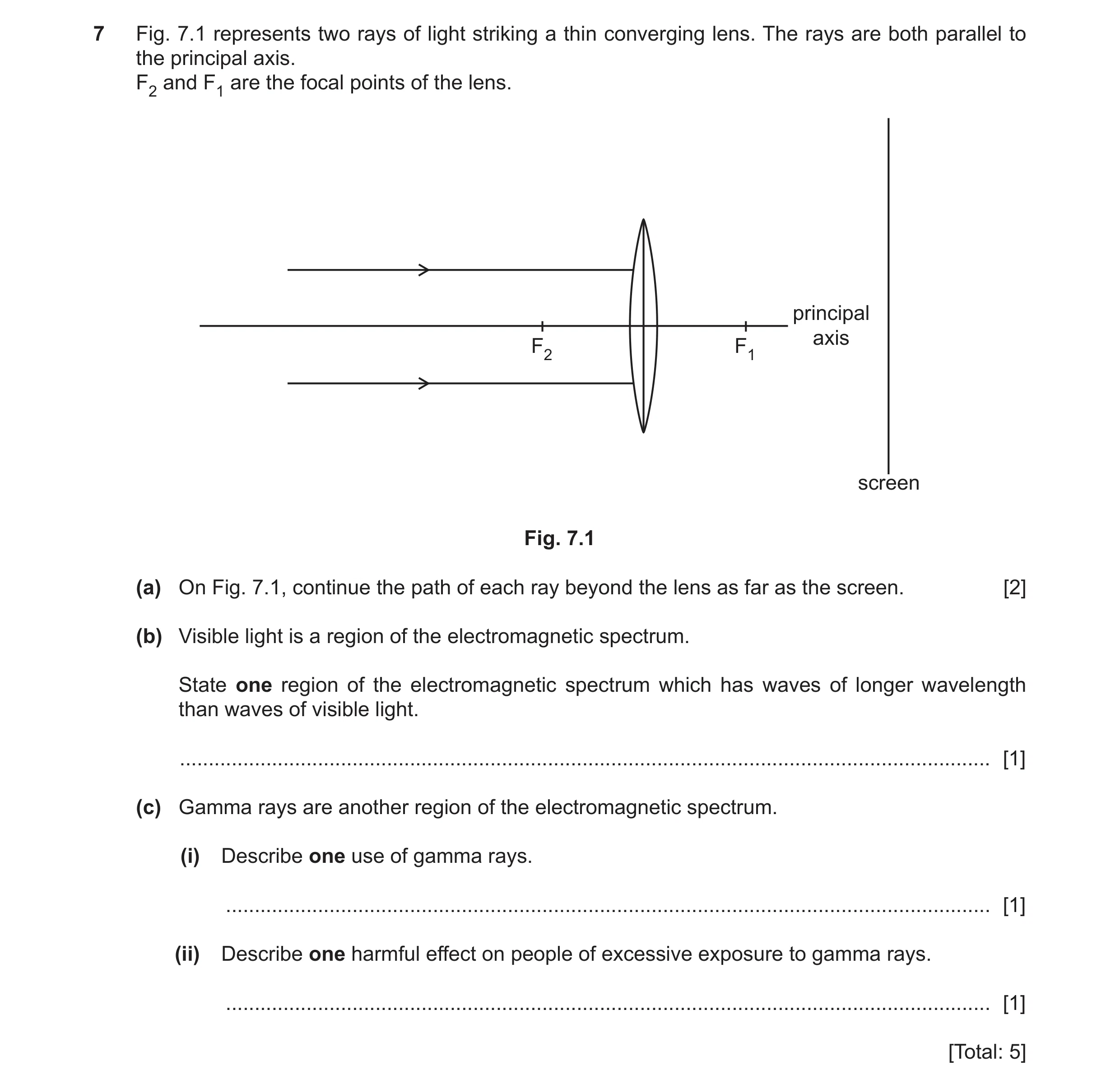 78 / 97
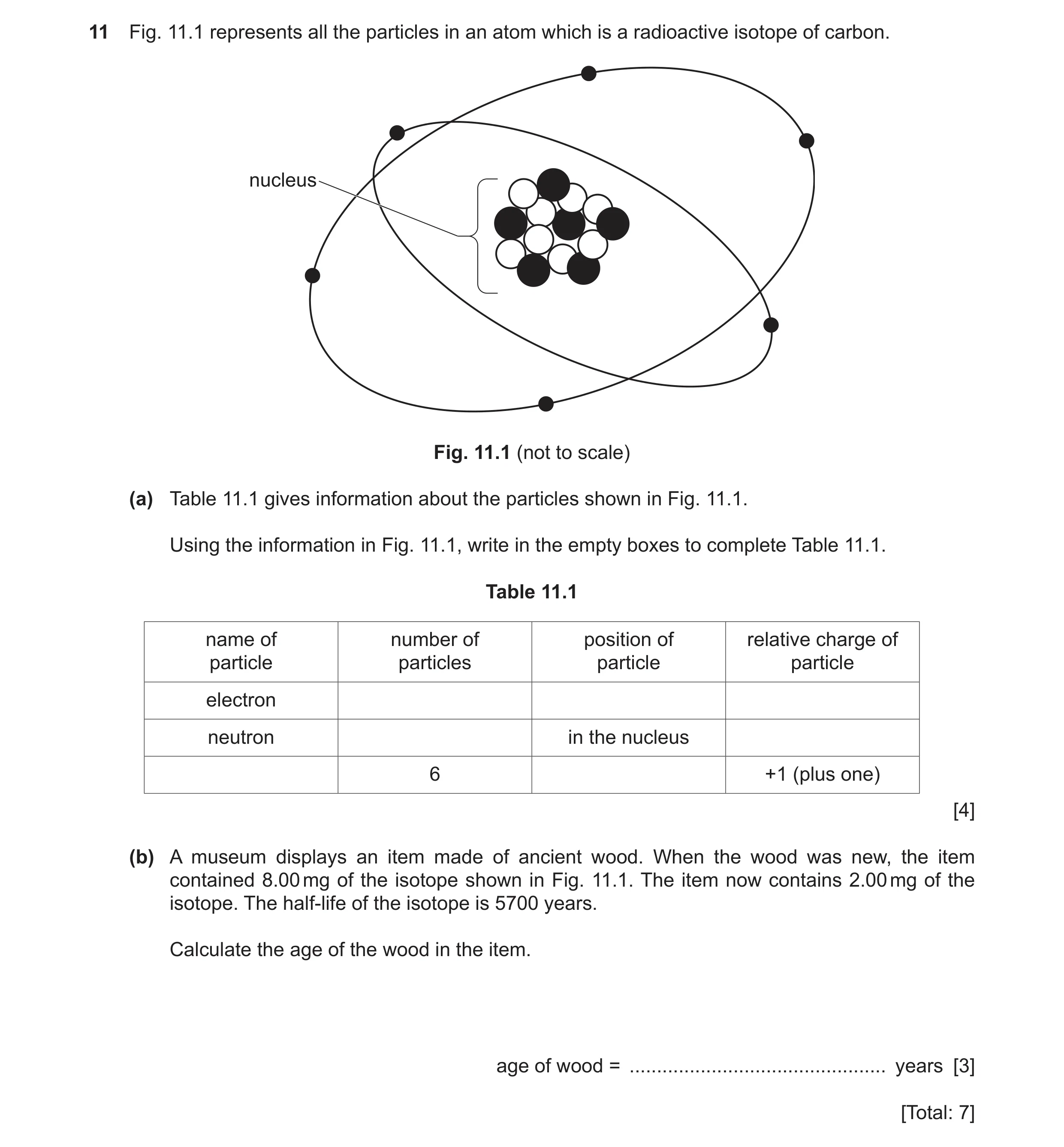 79 / 97
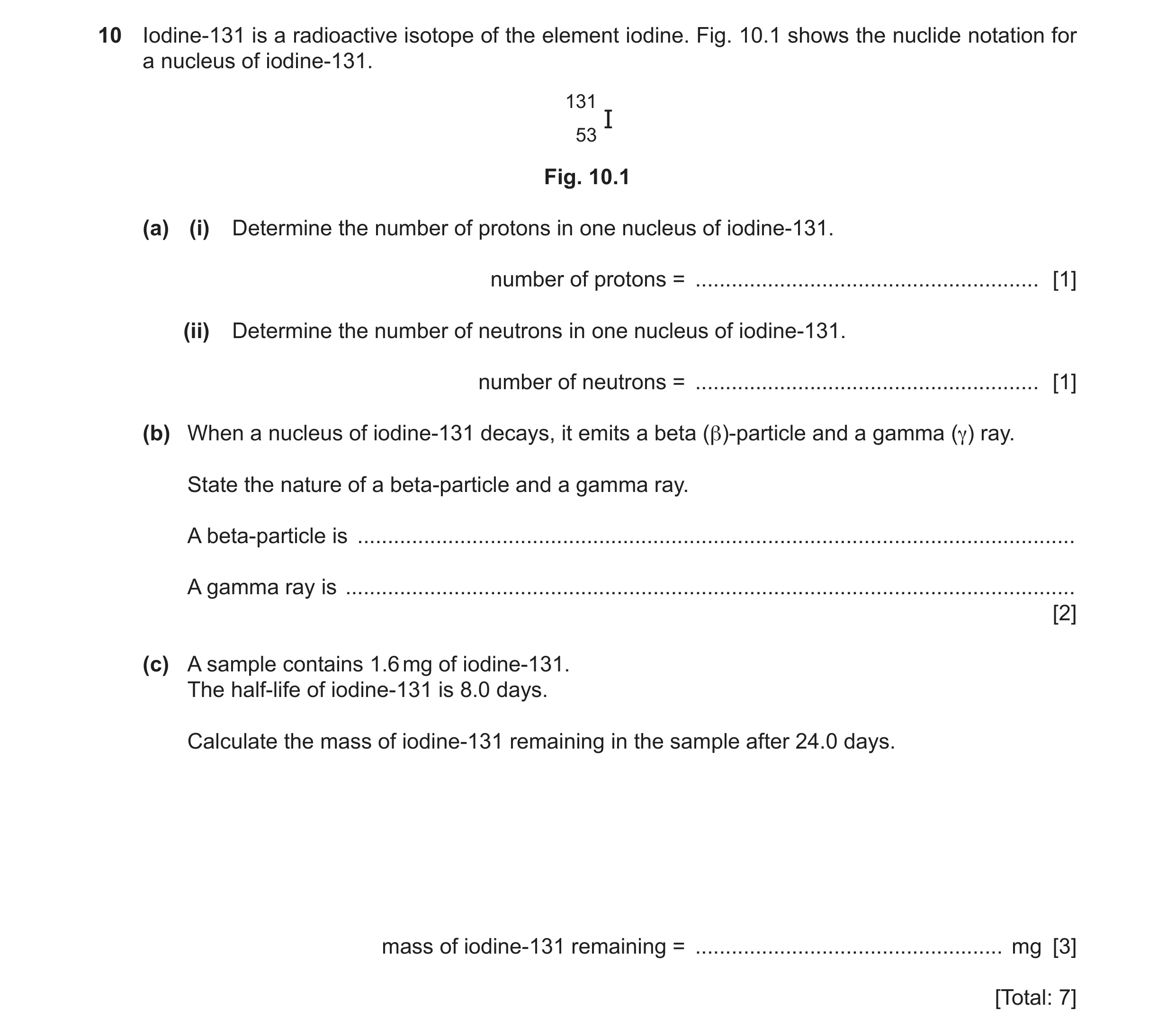 80 / 97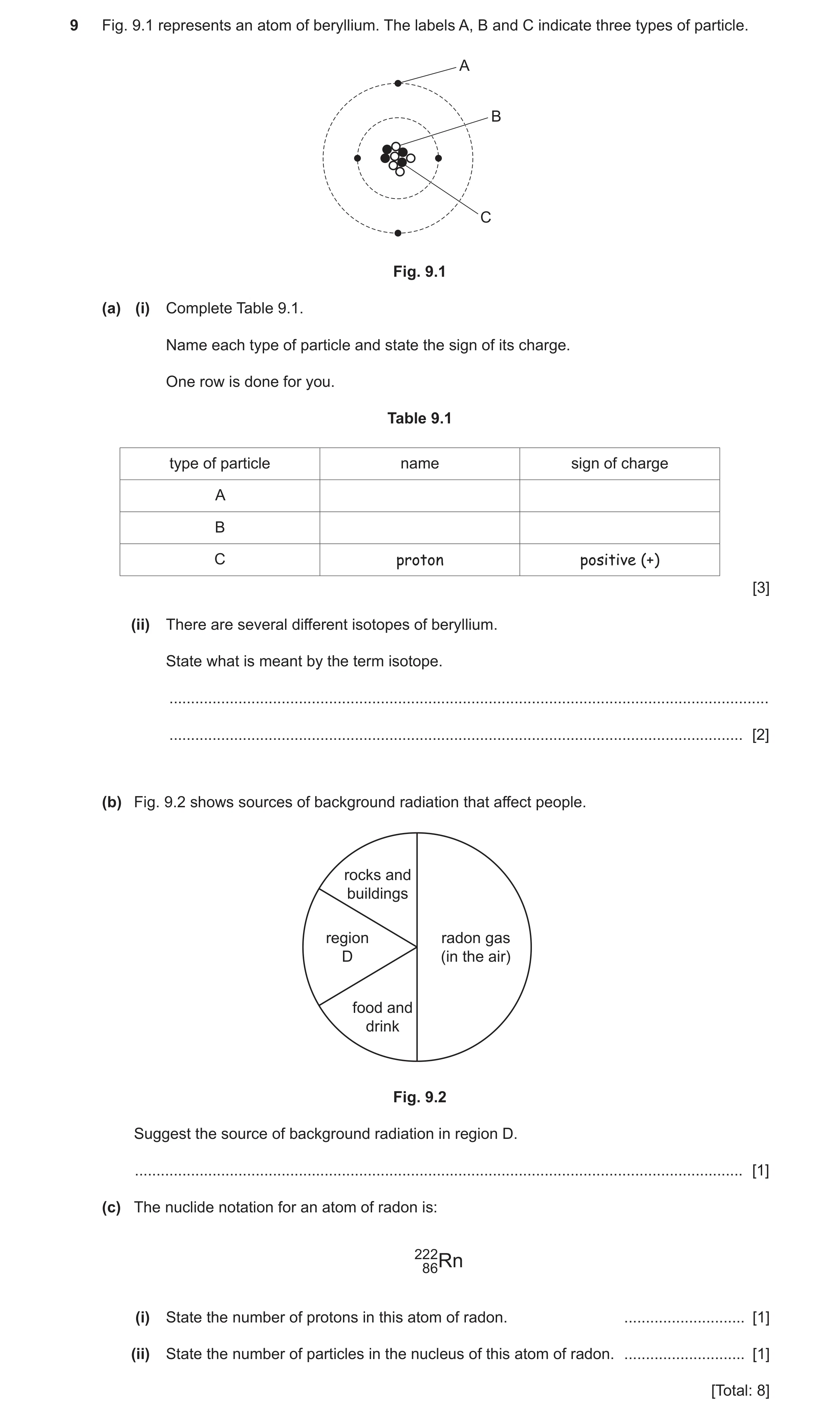
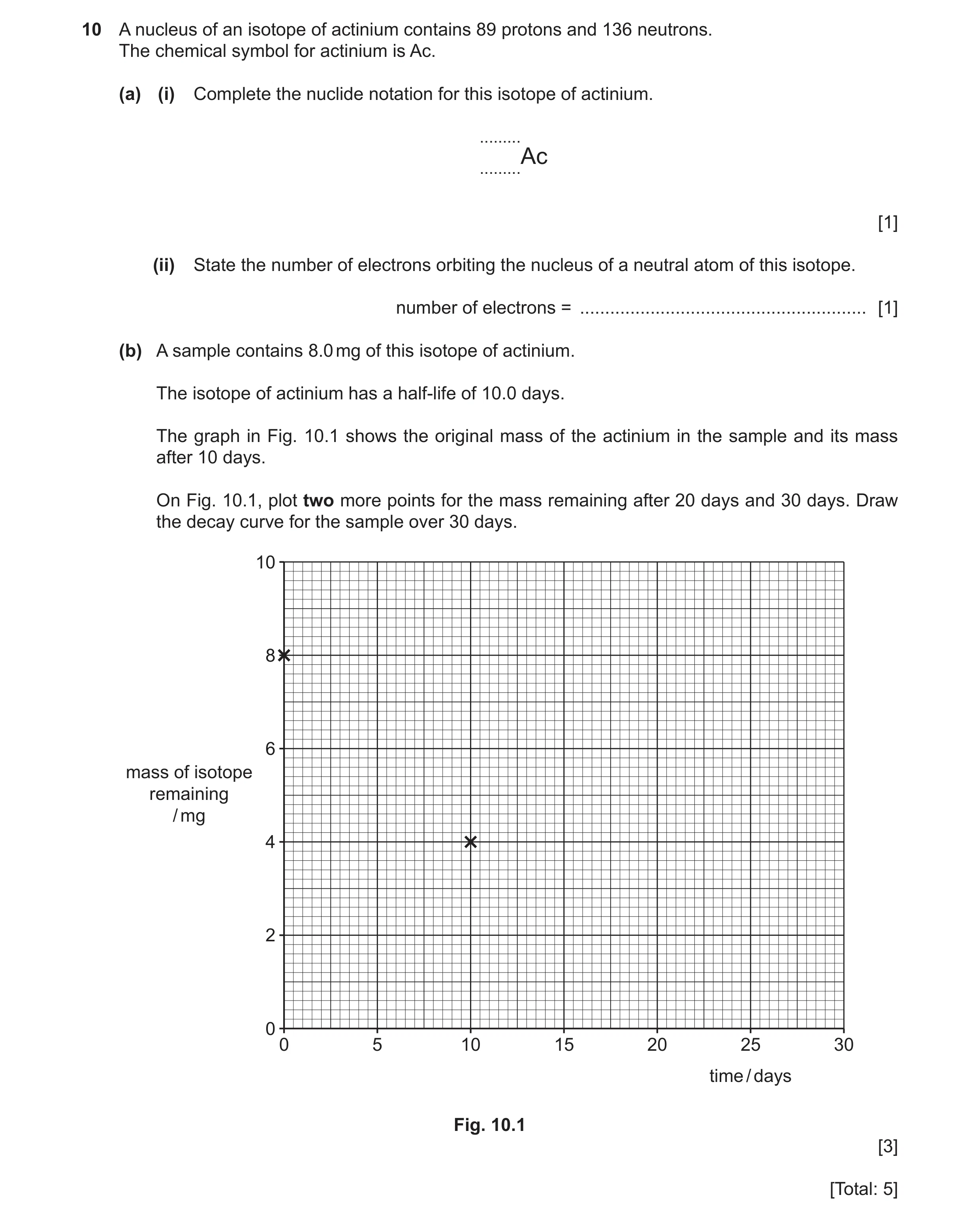 82 / 97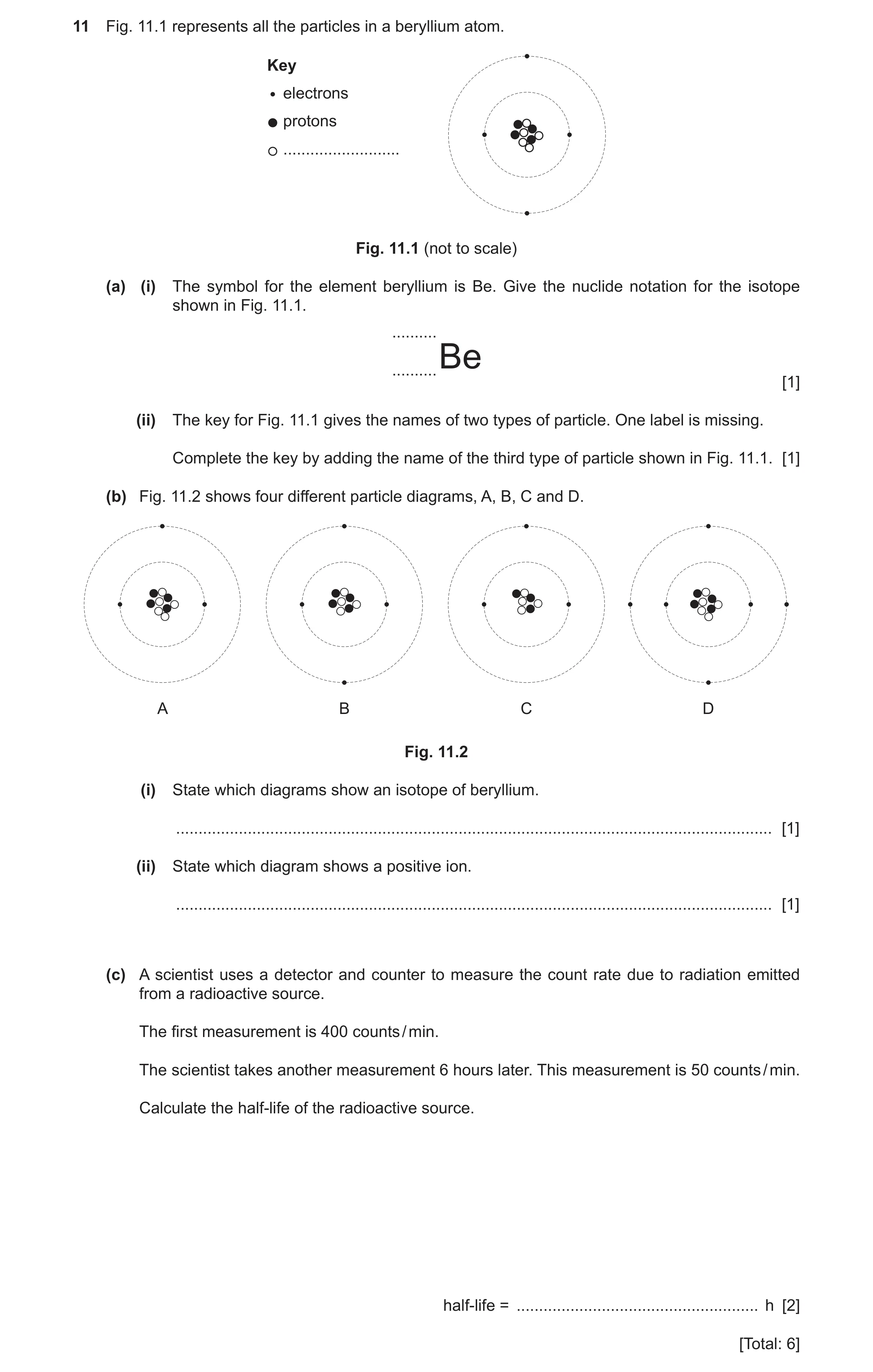
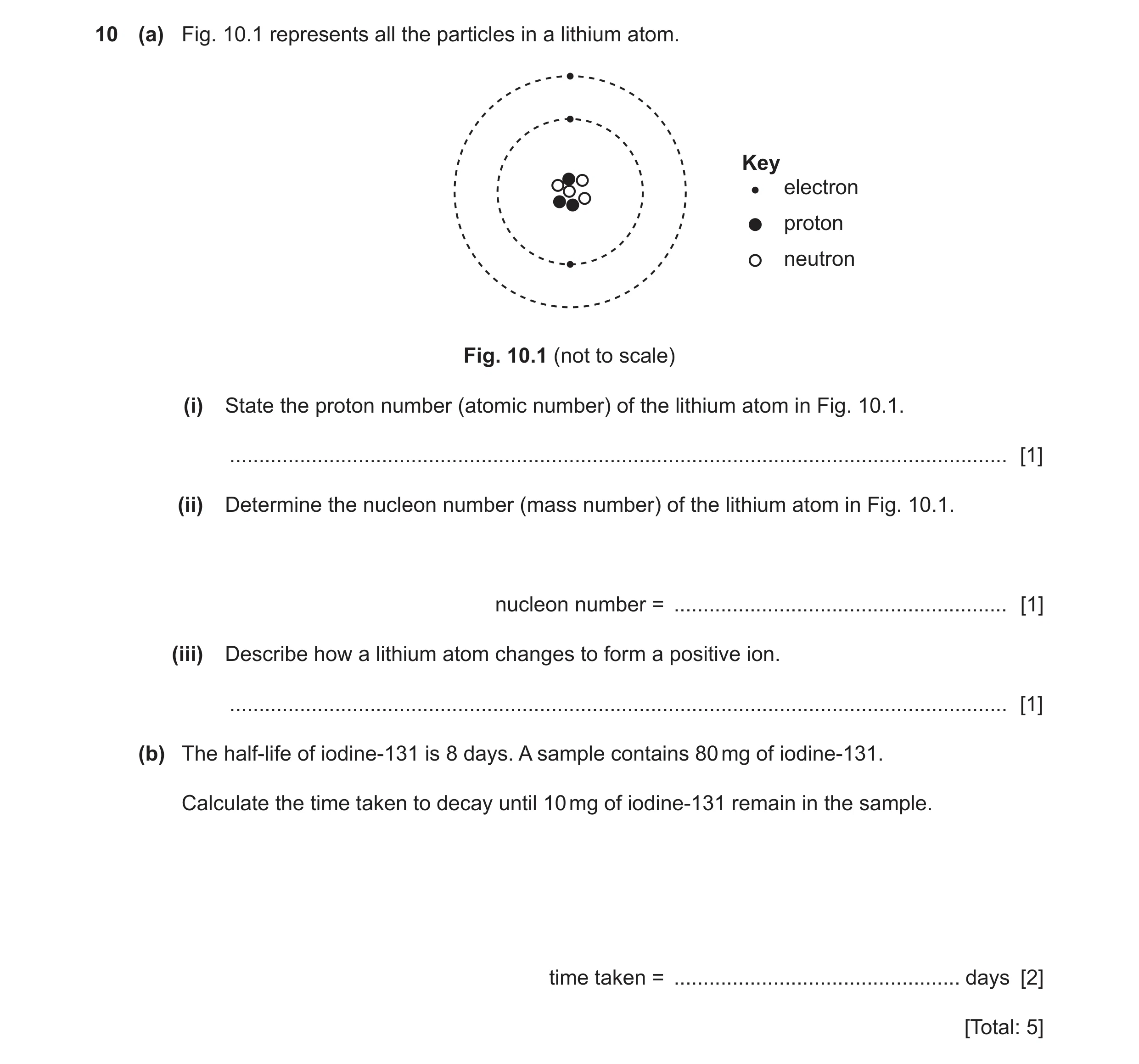 84 / 97
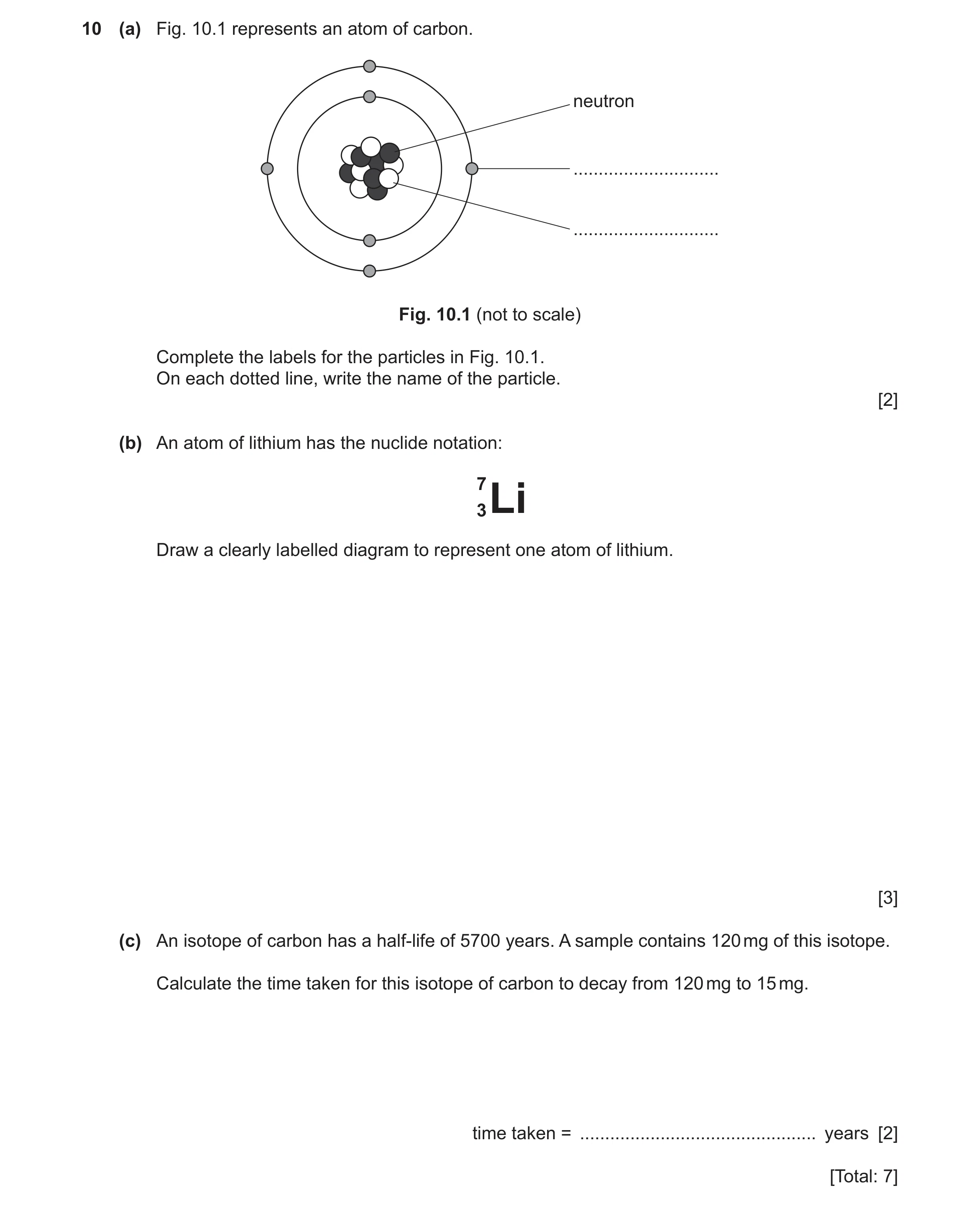 85 / 97
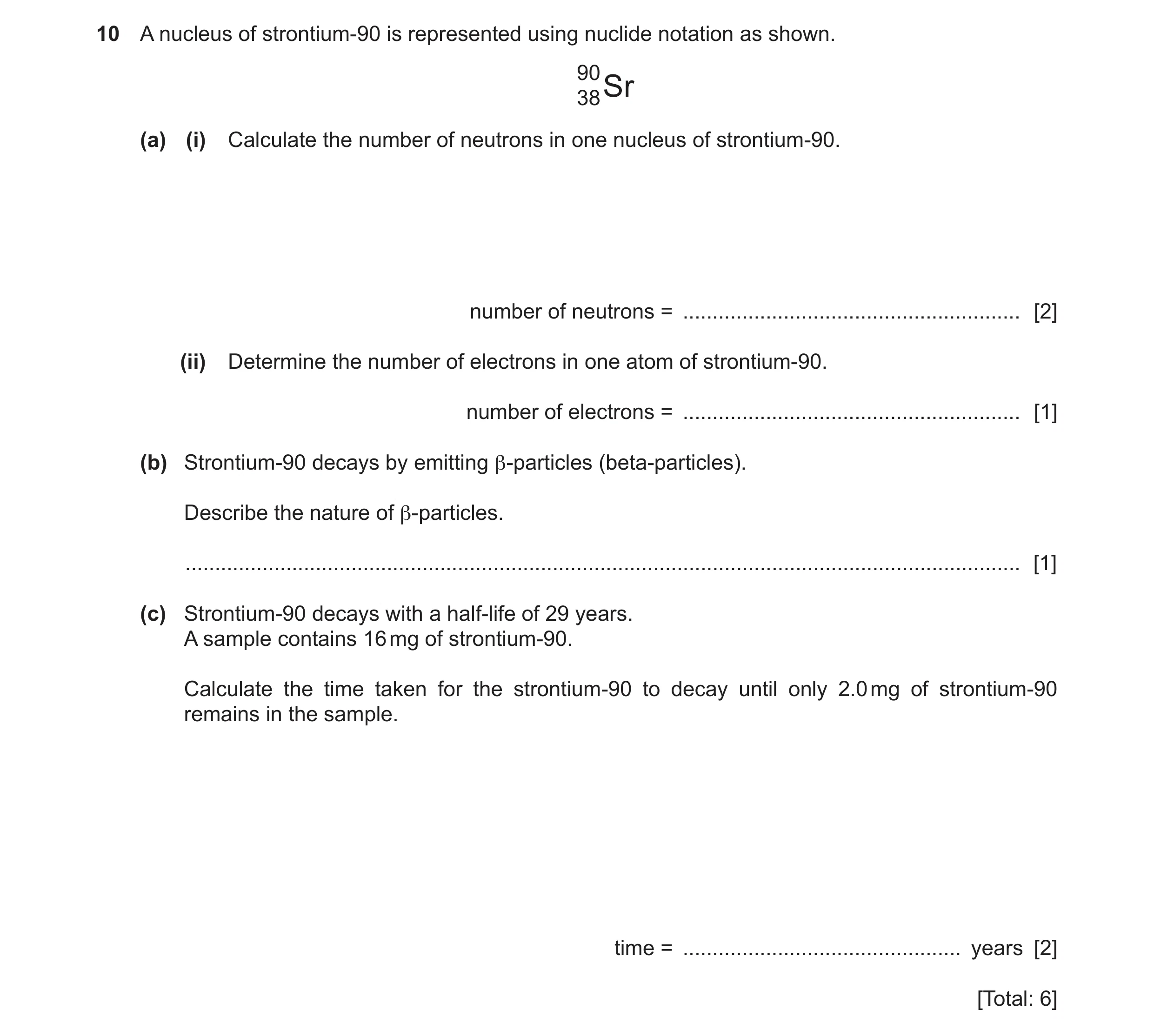 86 / 97
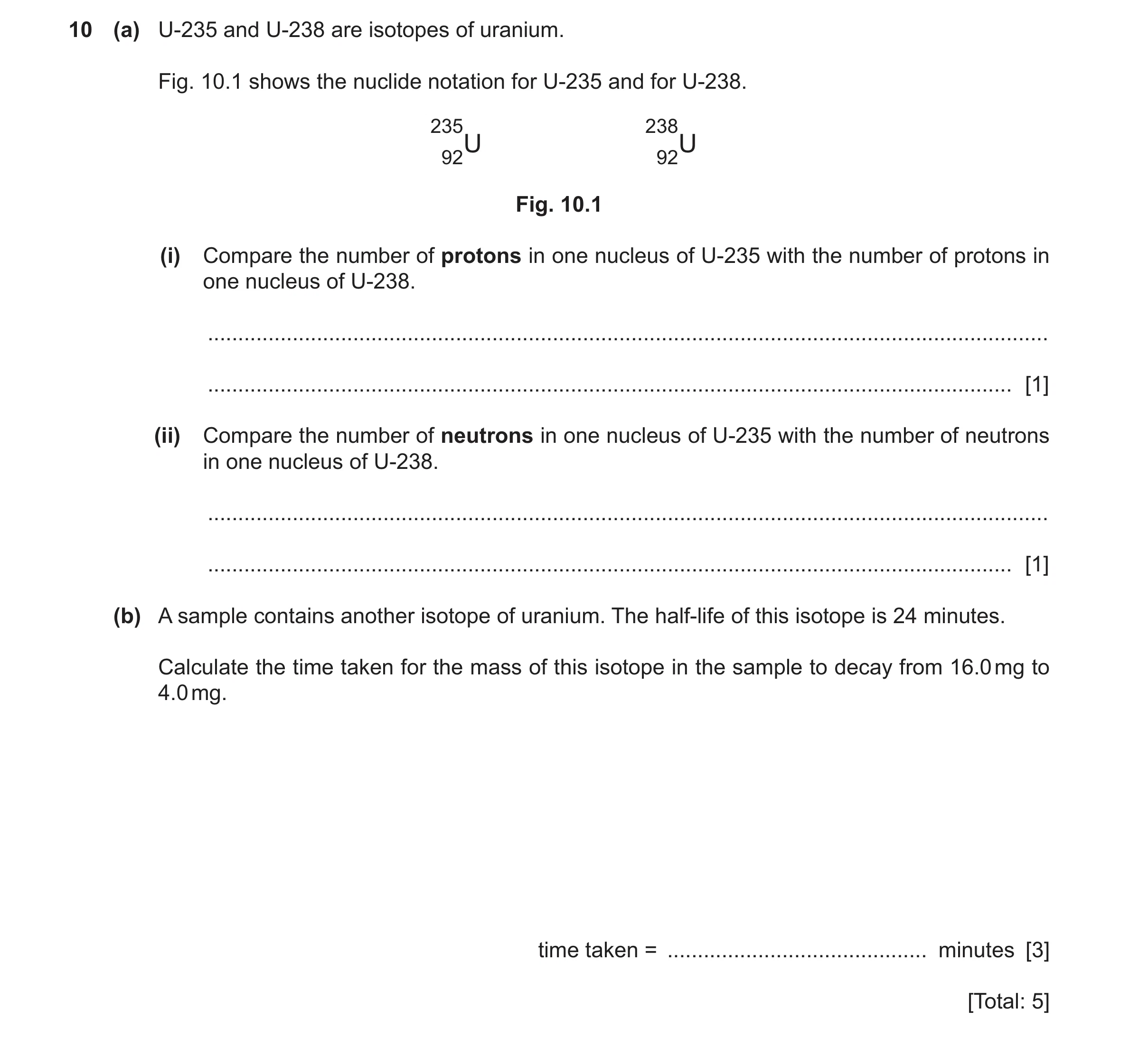 87 / 97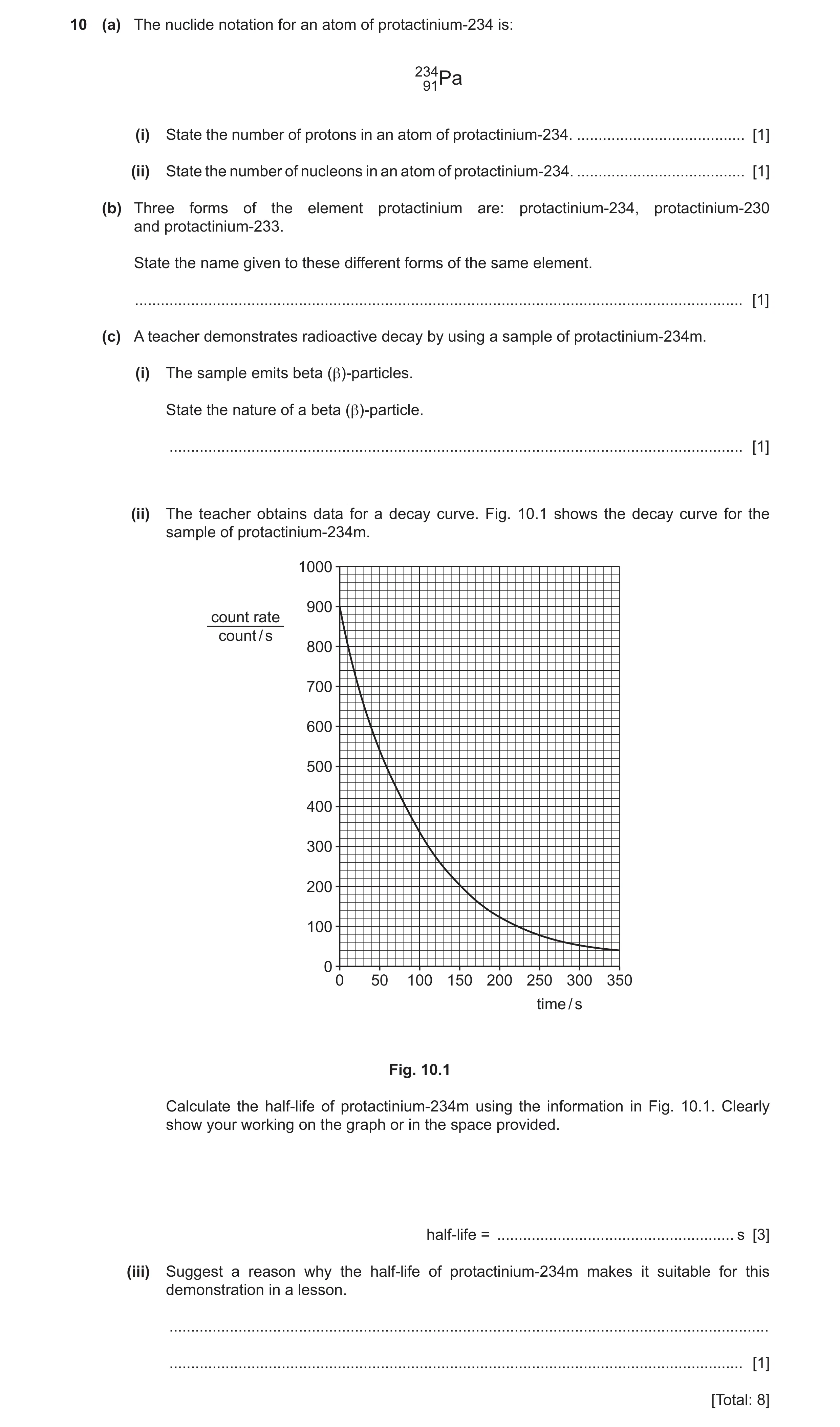
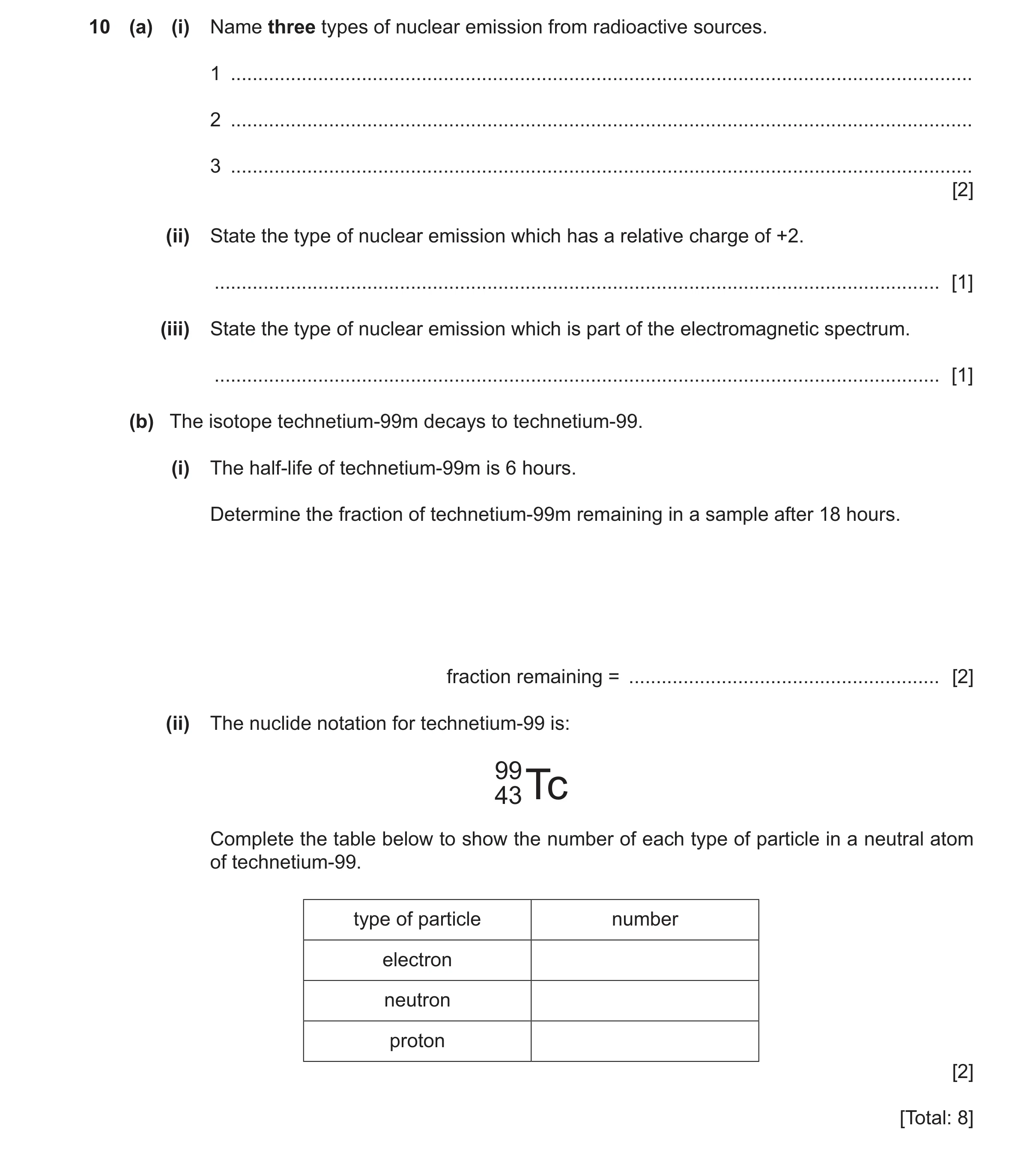 89 / 97
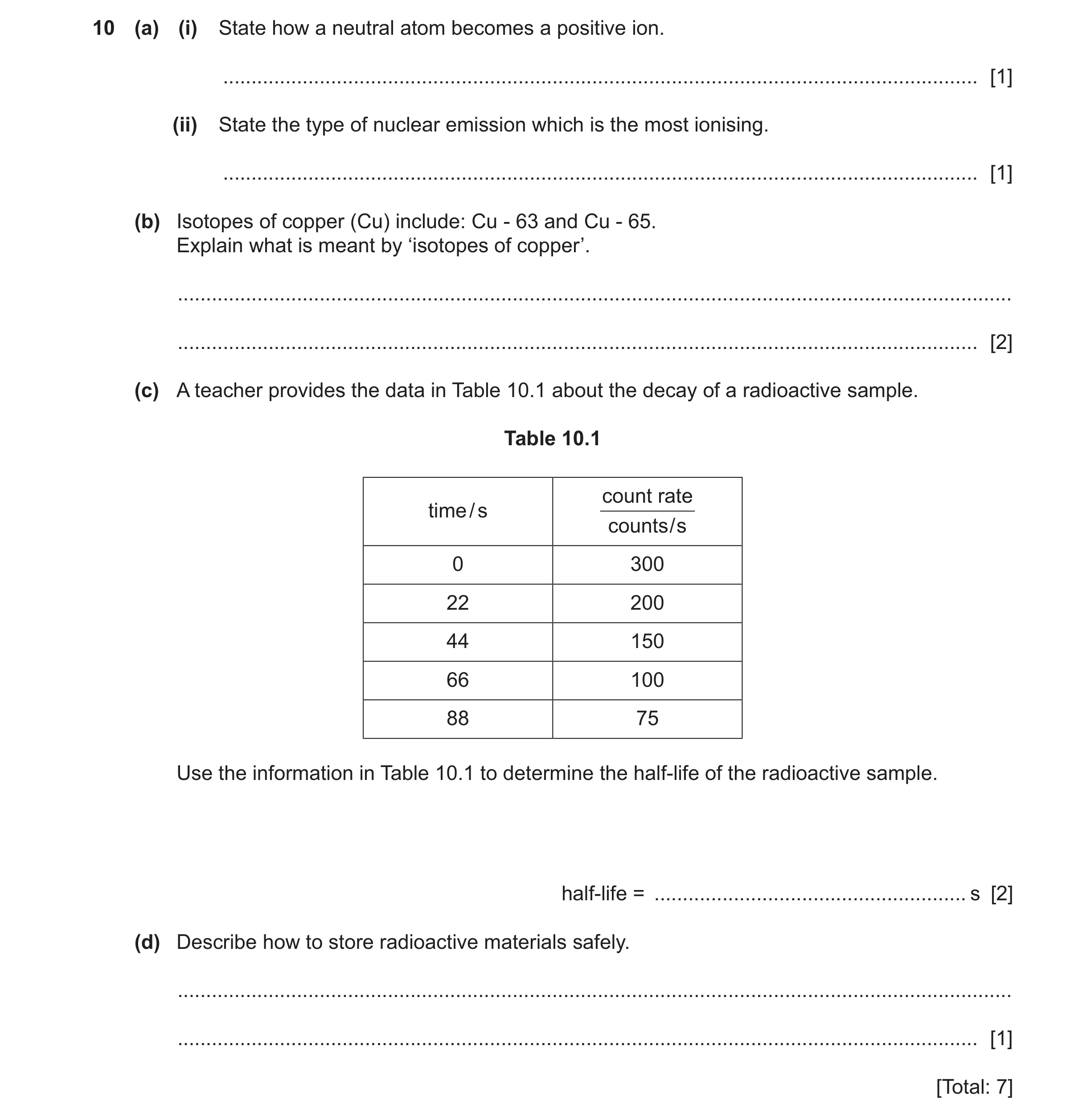 90 / 97
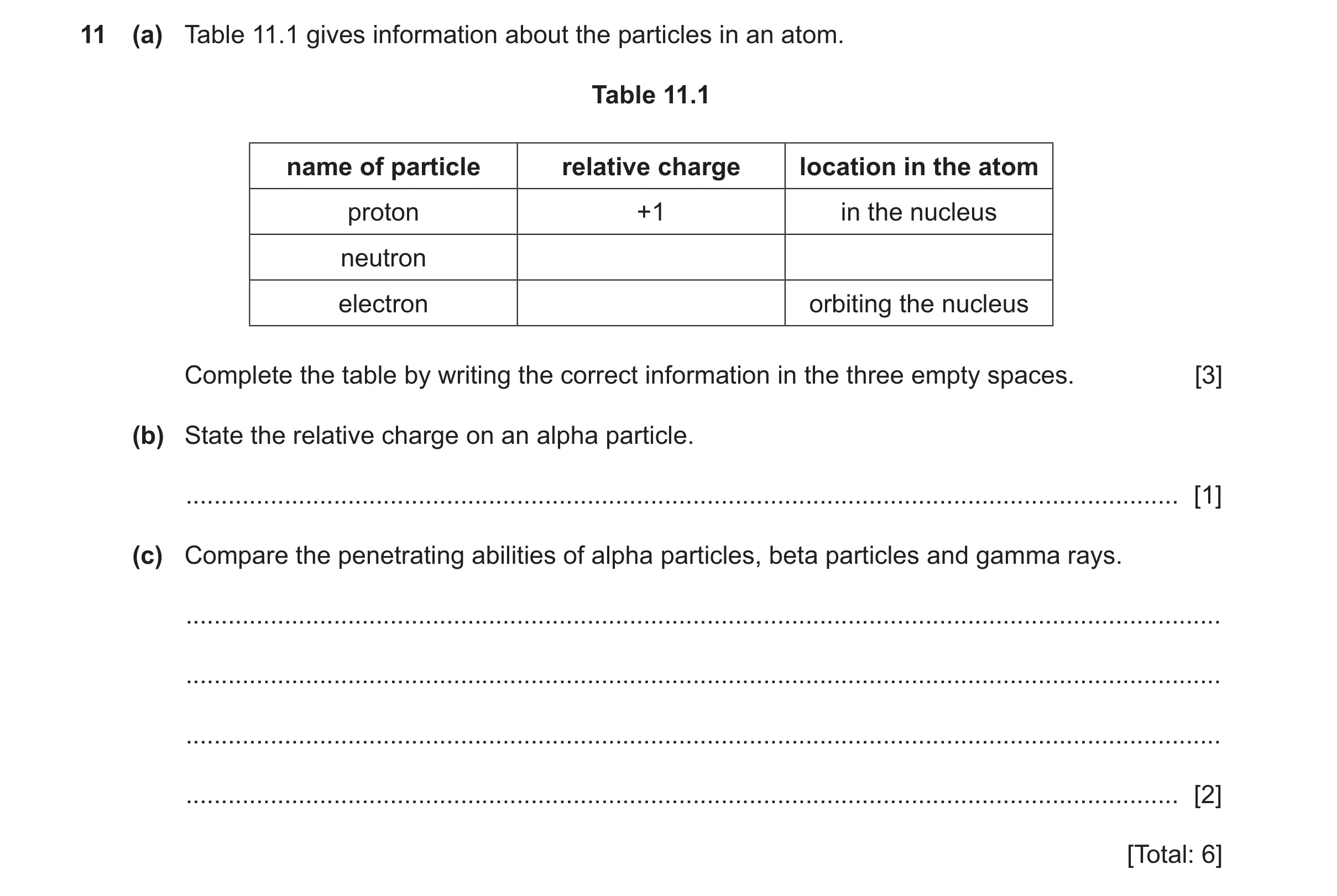 91 / 97
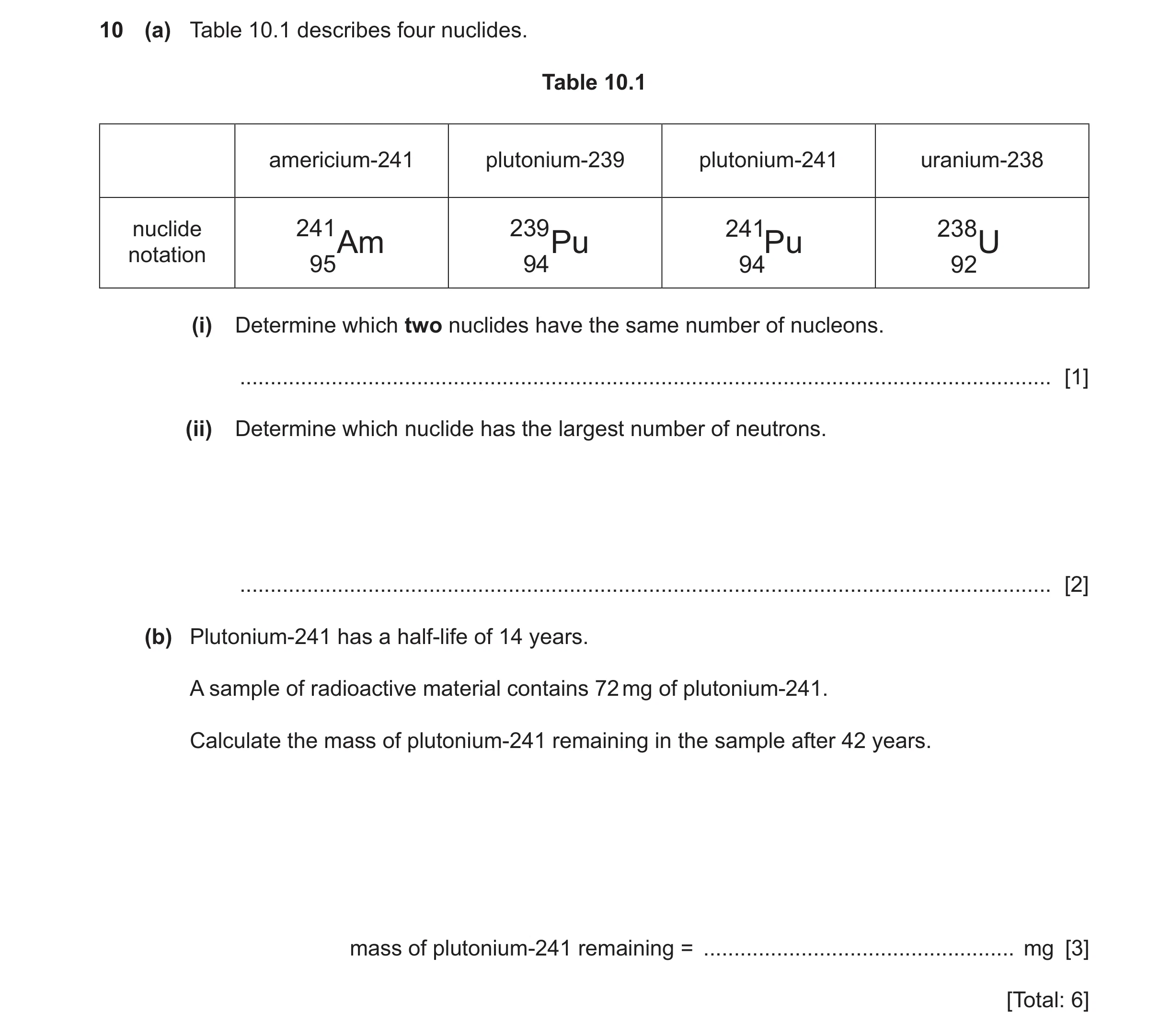 92 / 97
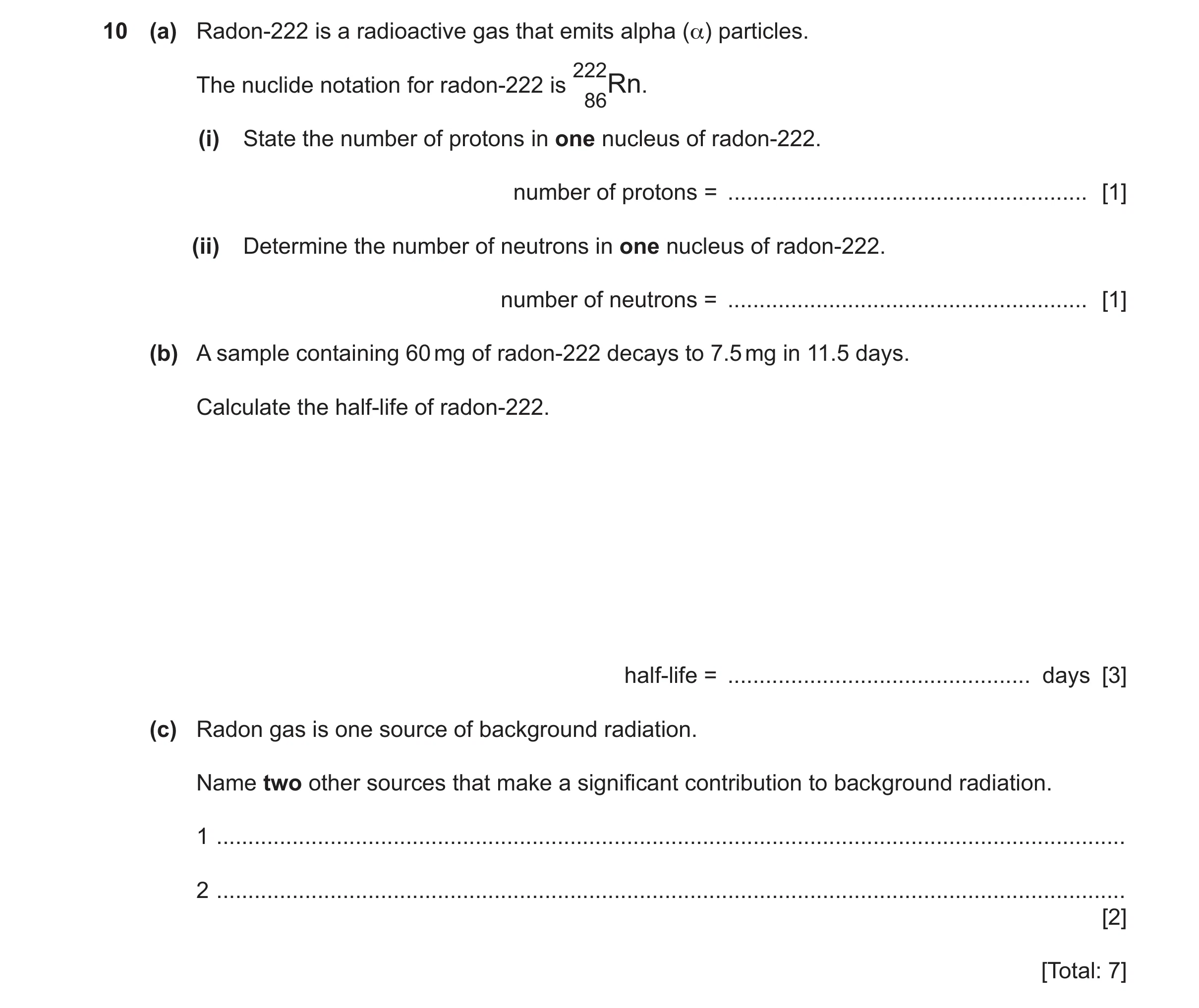 93 / 97
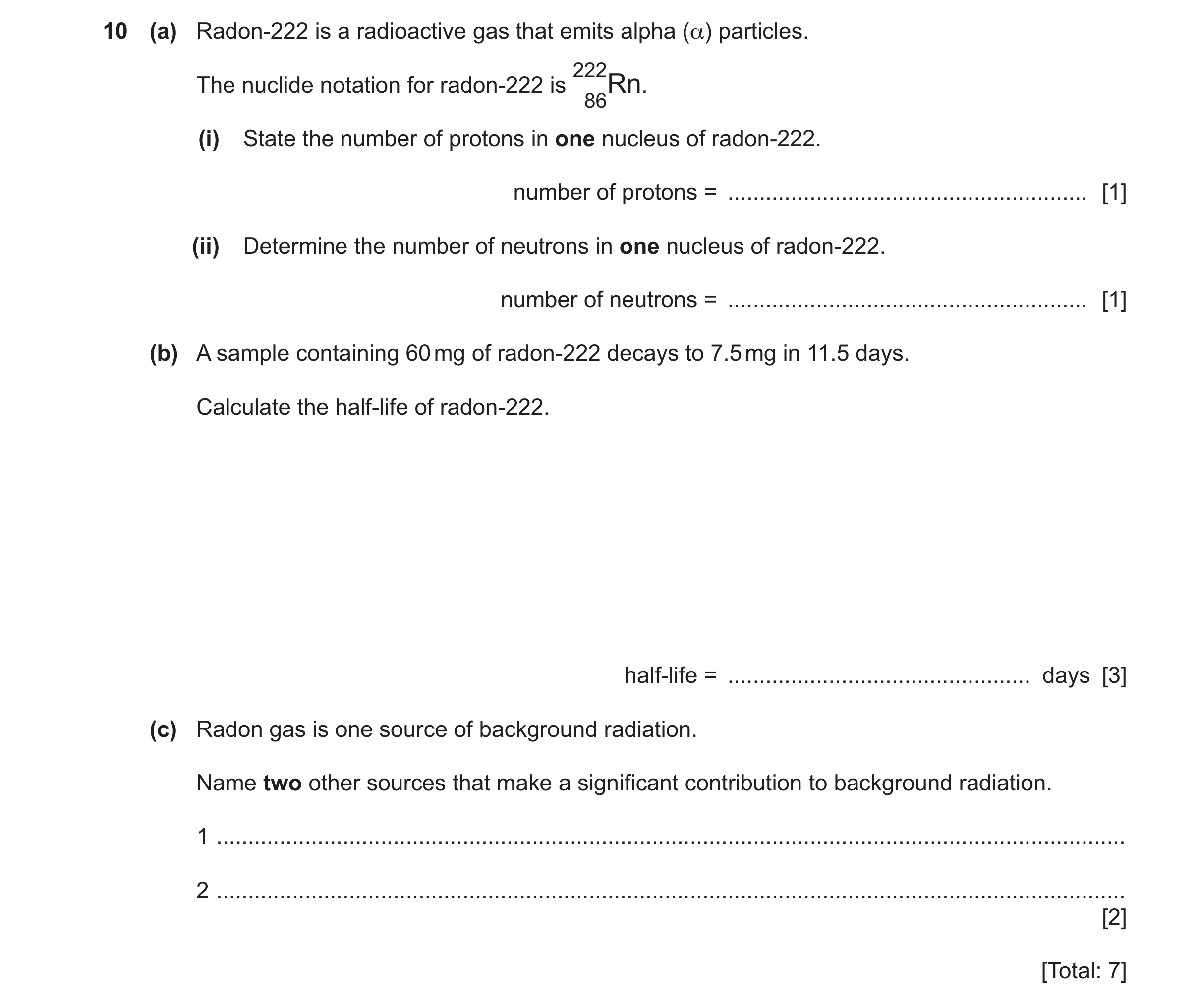 94 / 97
 95 / 97
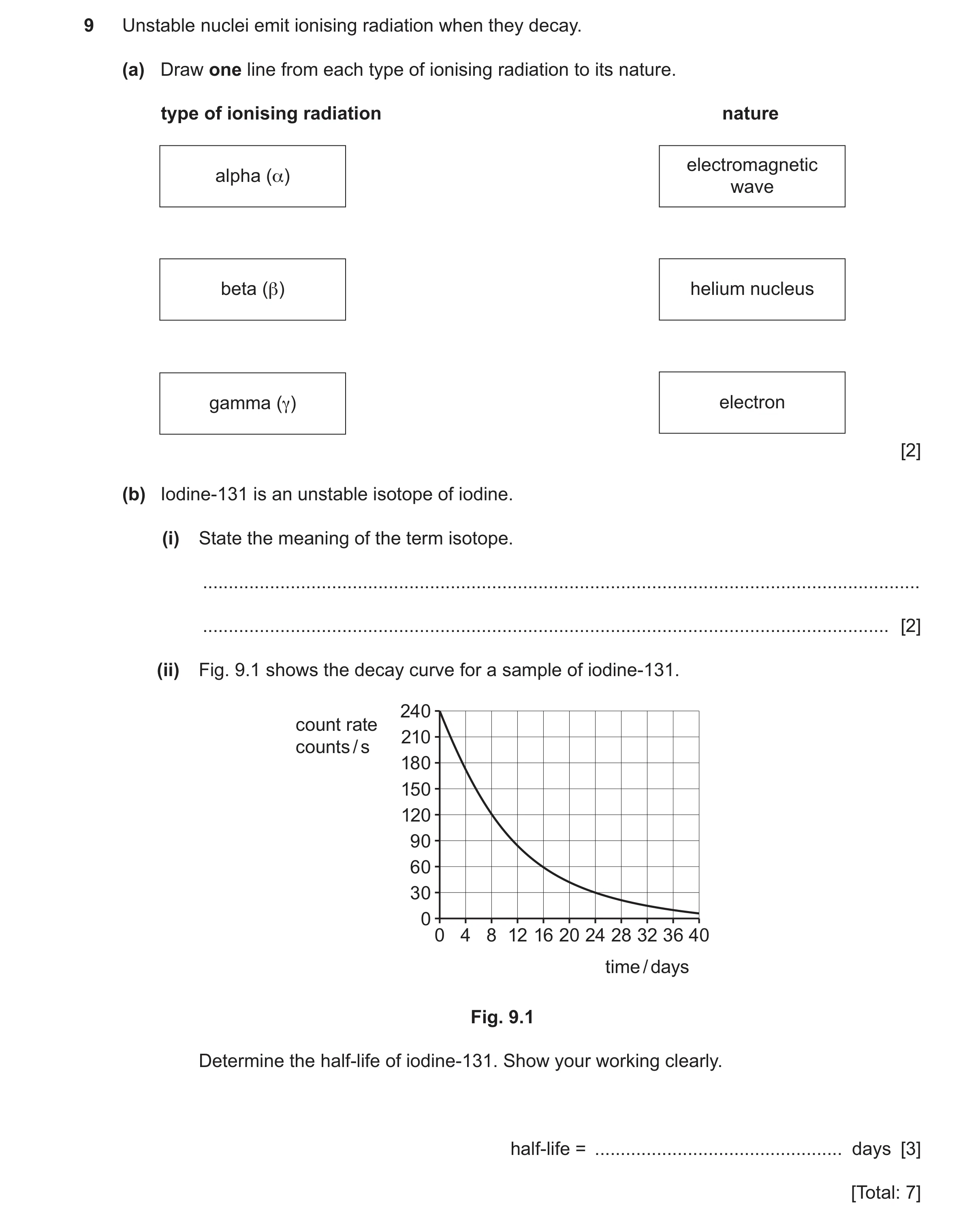 96 / 97
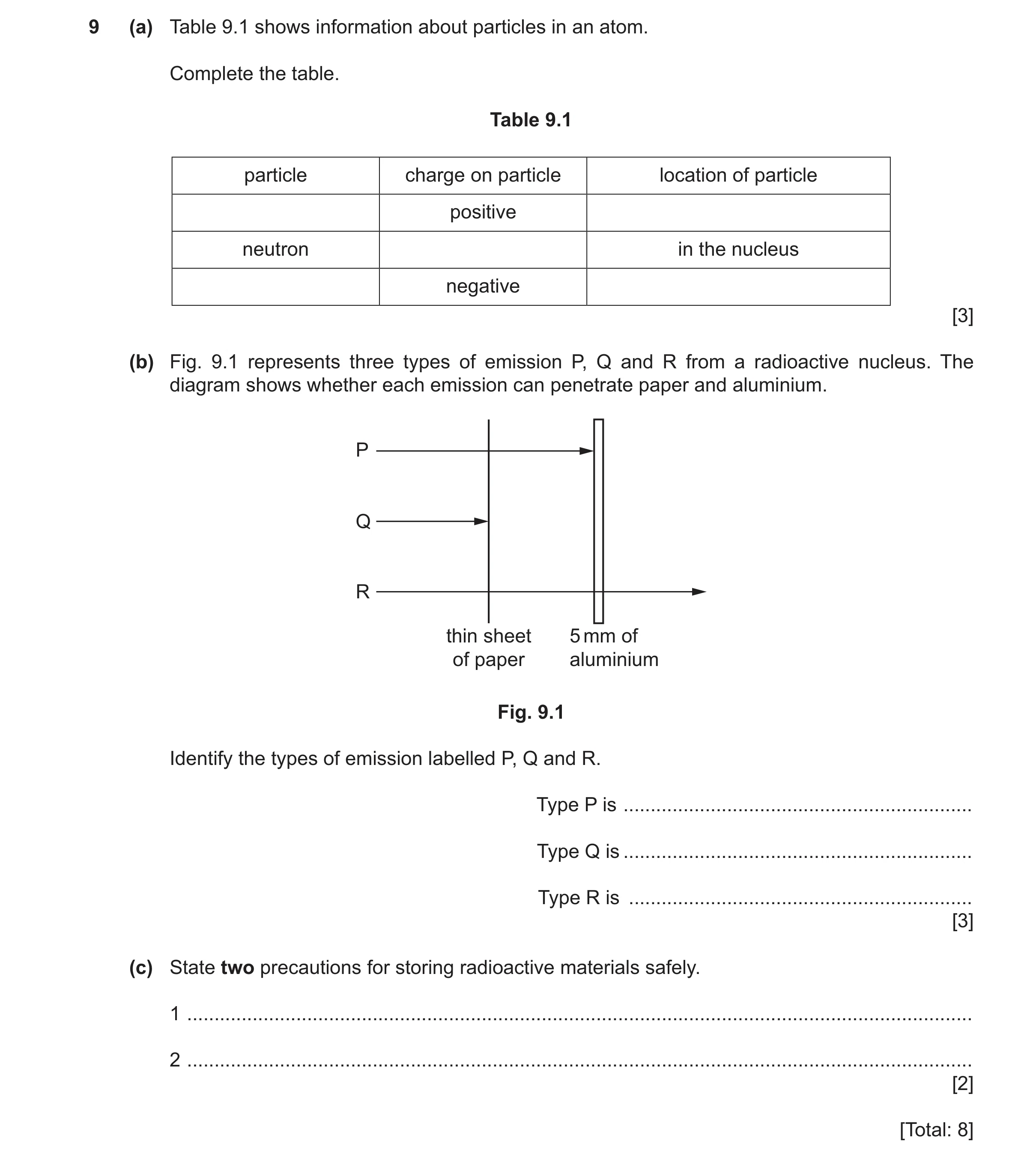 97 / 97
 7
7 6
6 4
4 4
4 4
4 10
10 4
4 4
4 7
7 7
7 8
8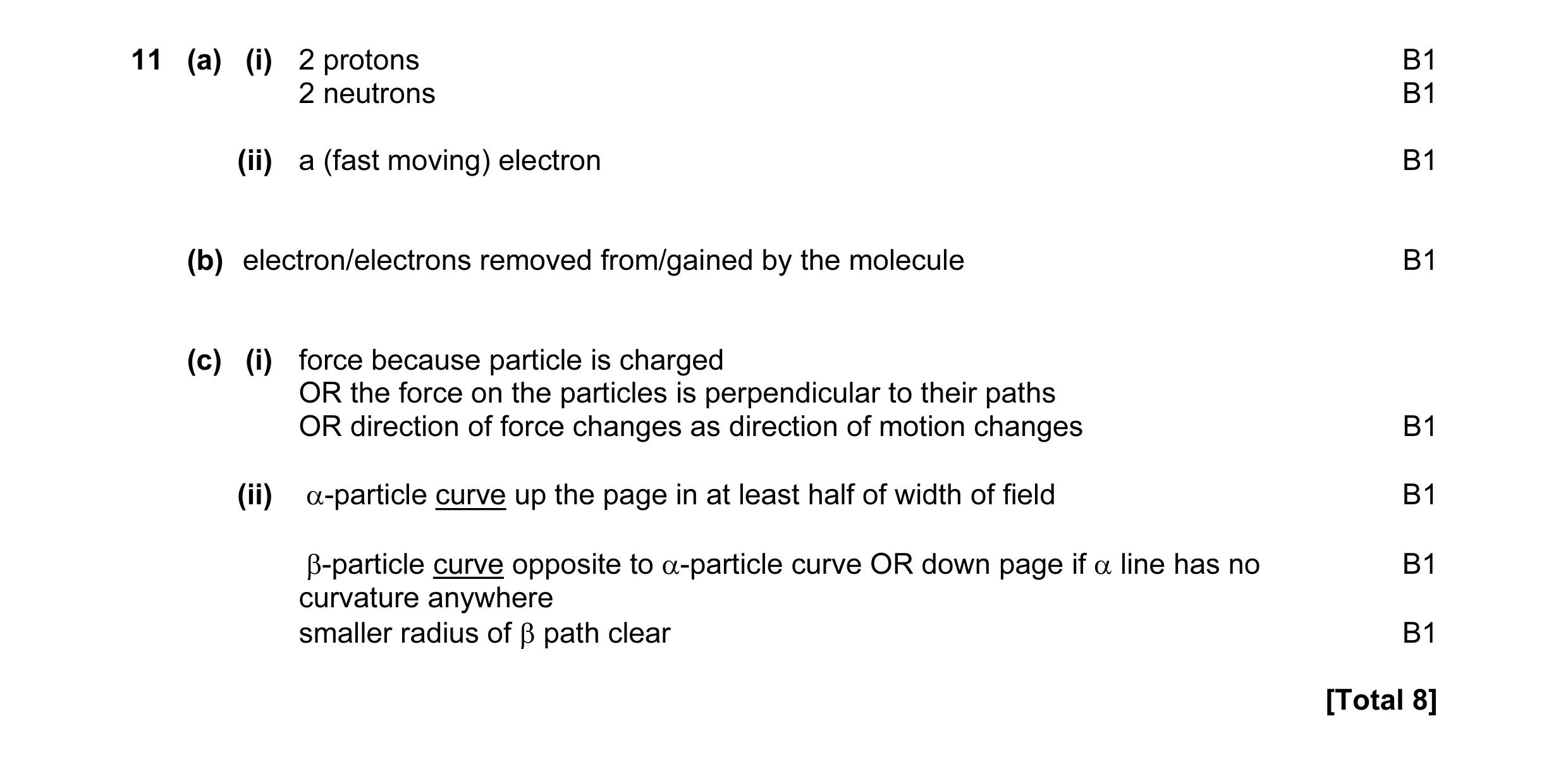 8
8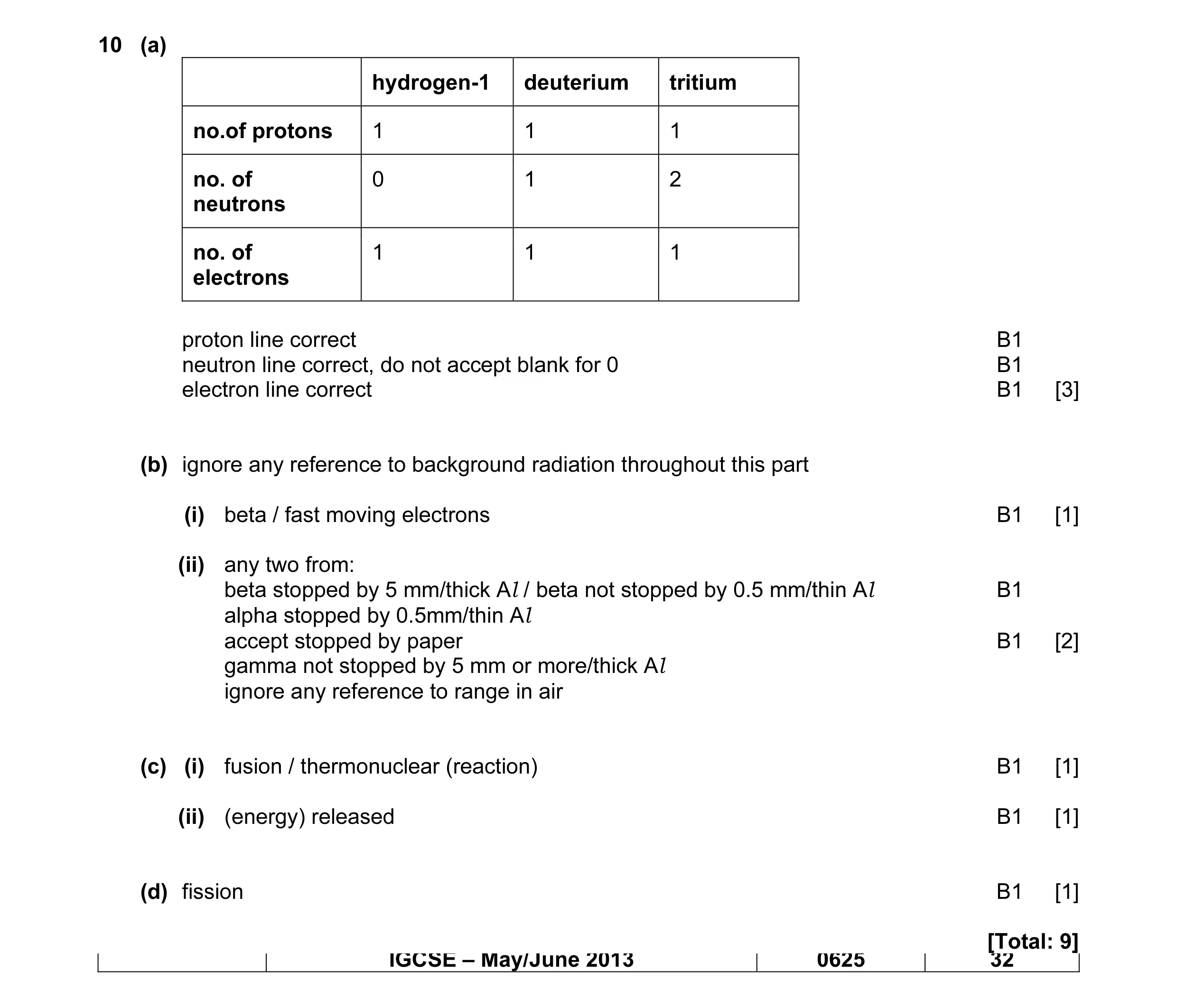 9
9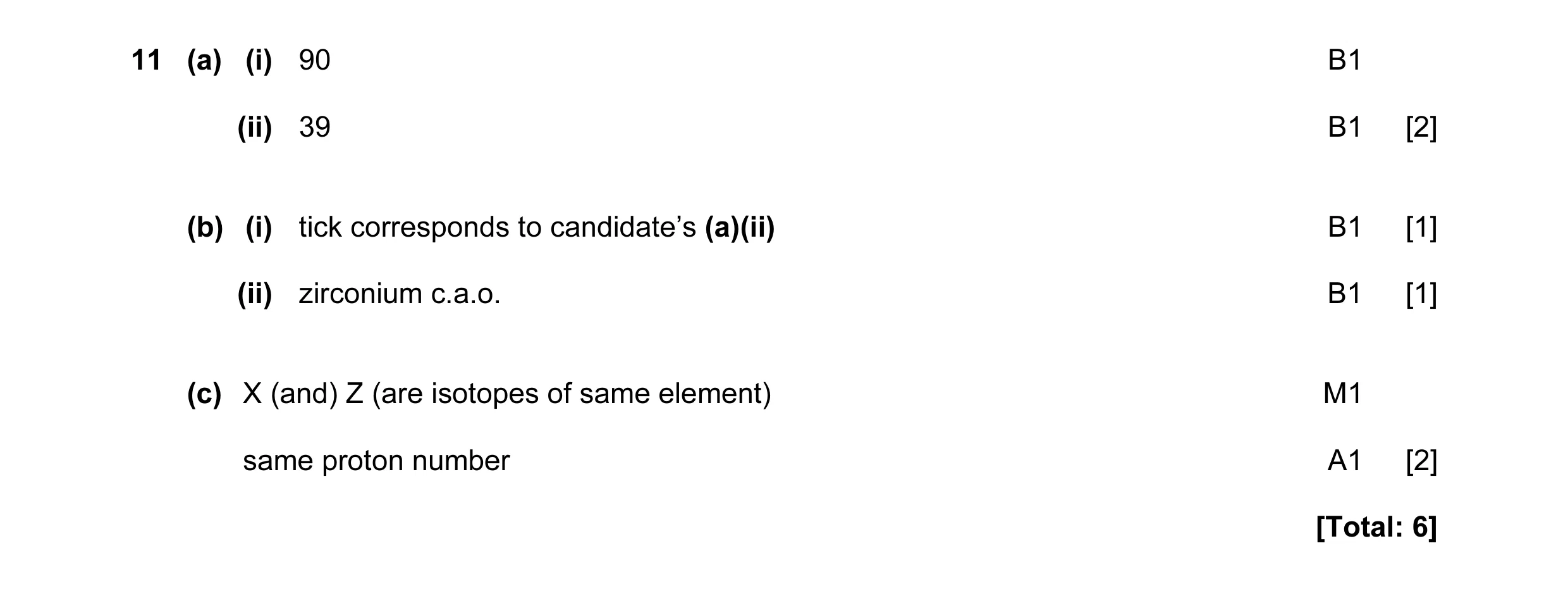 6
6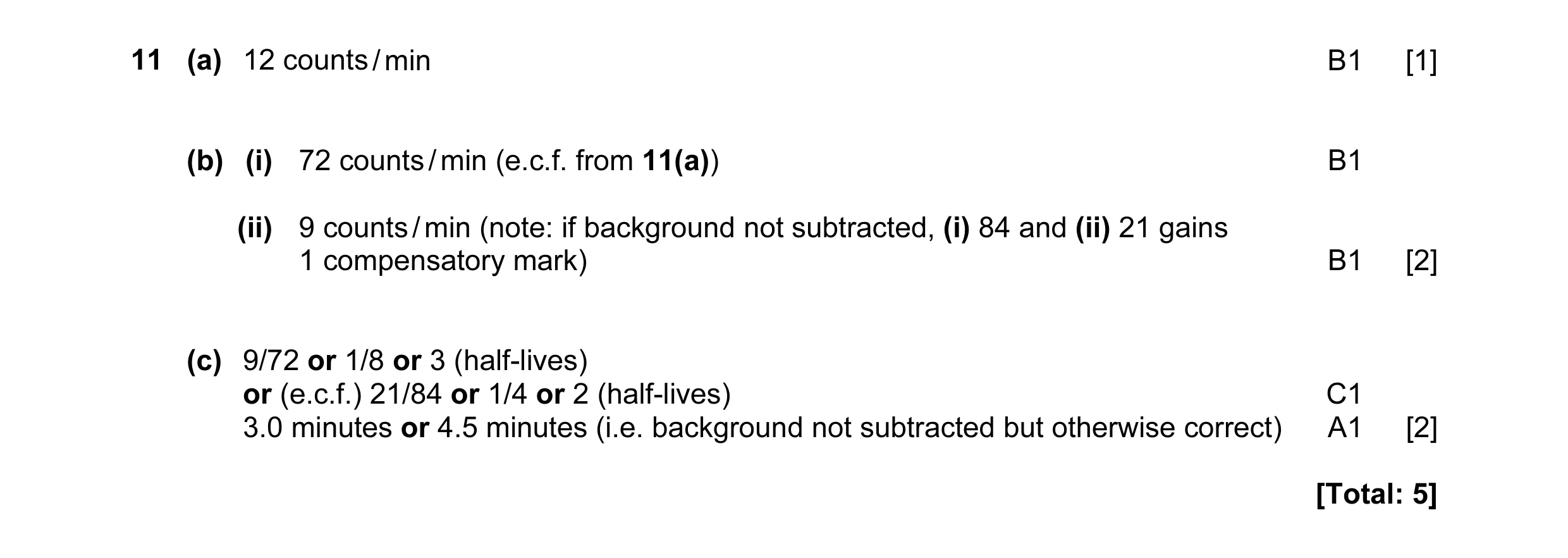 5
5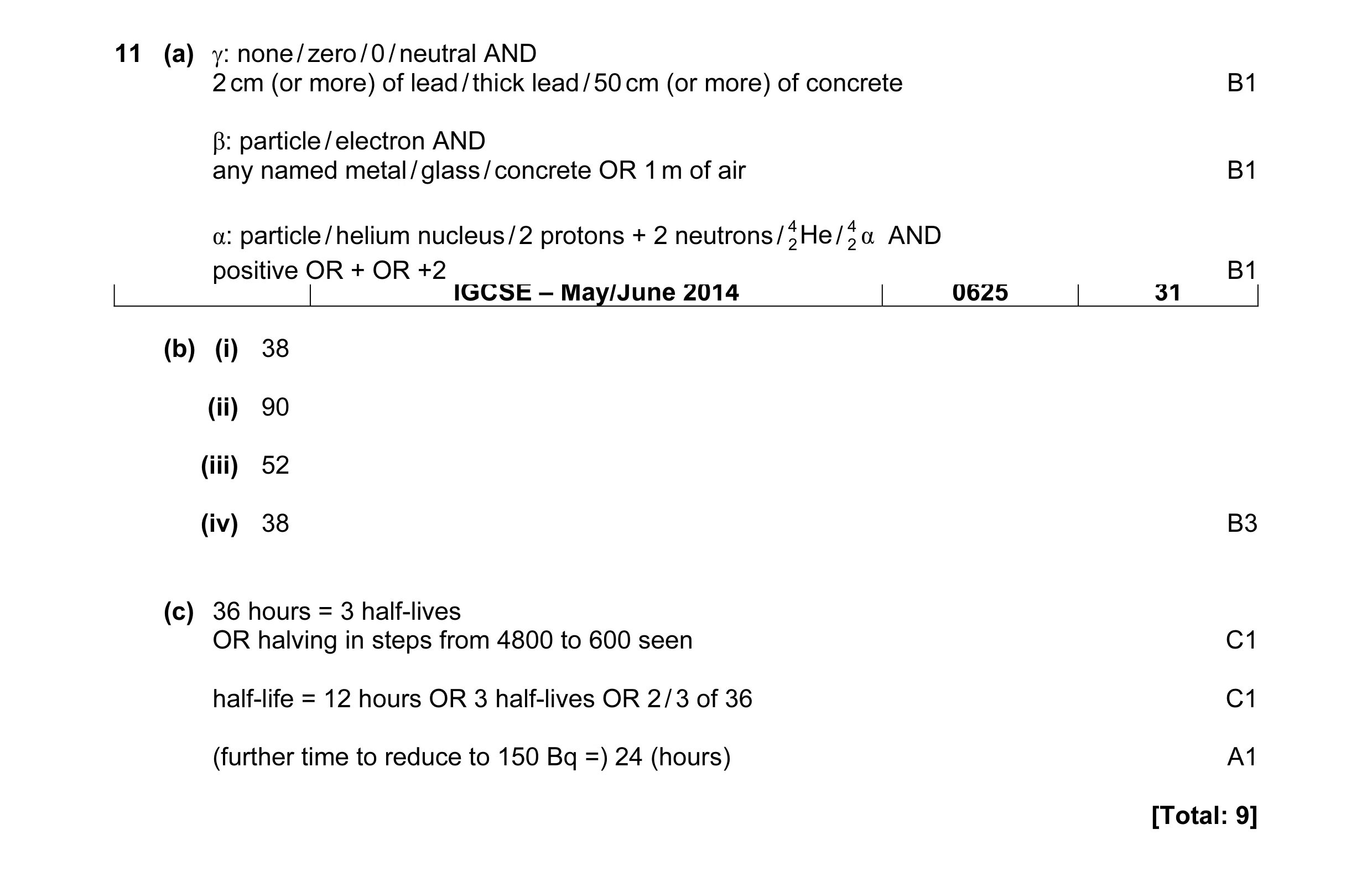 9
9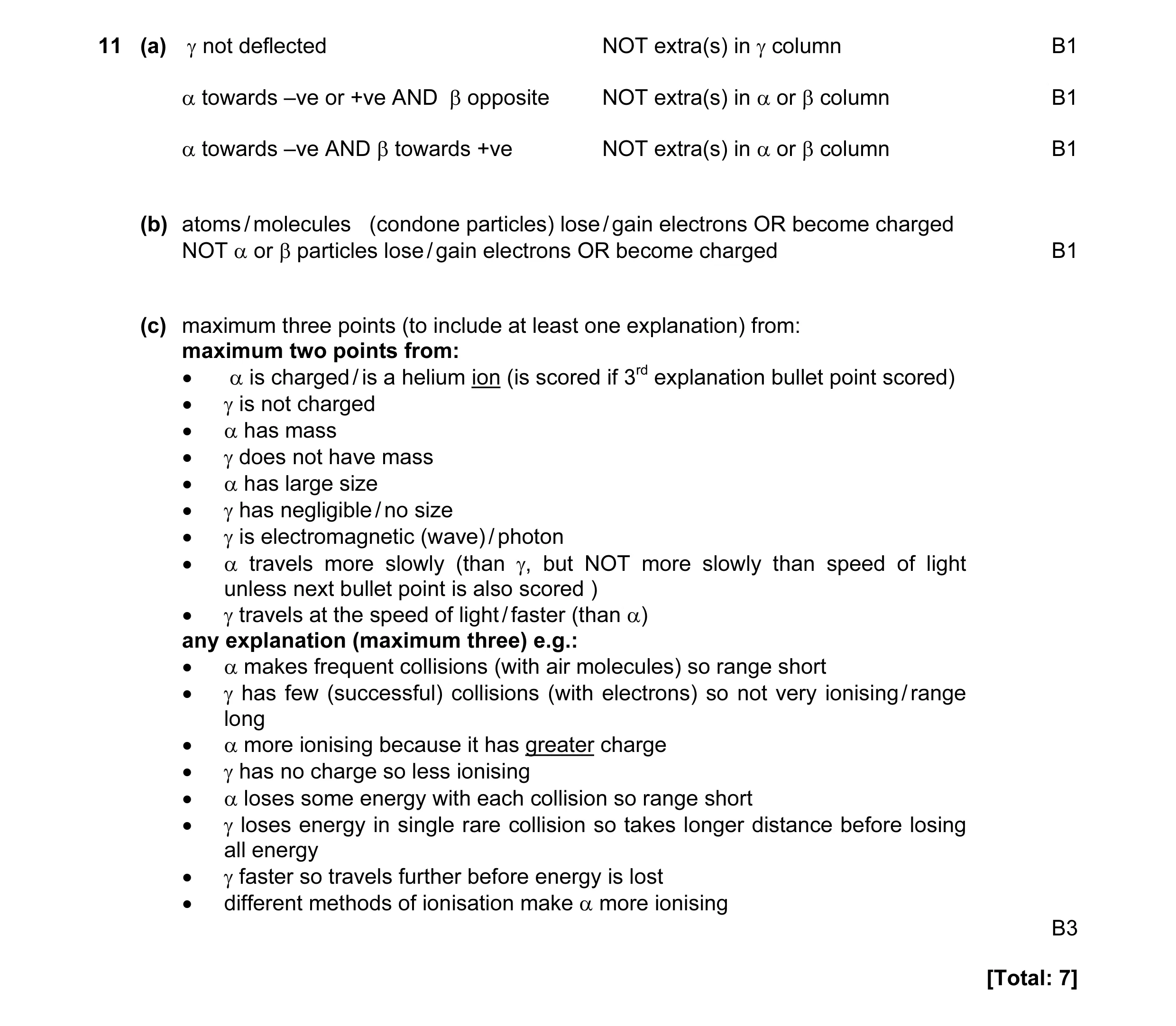 7
7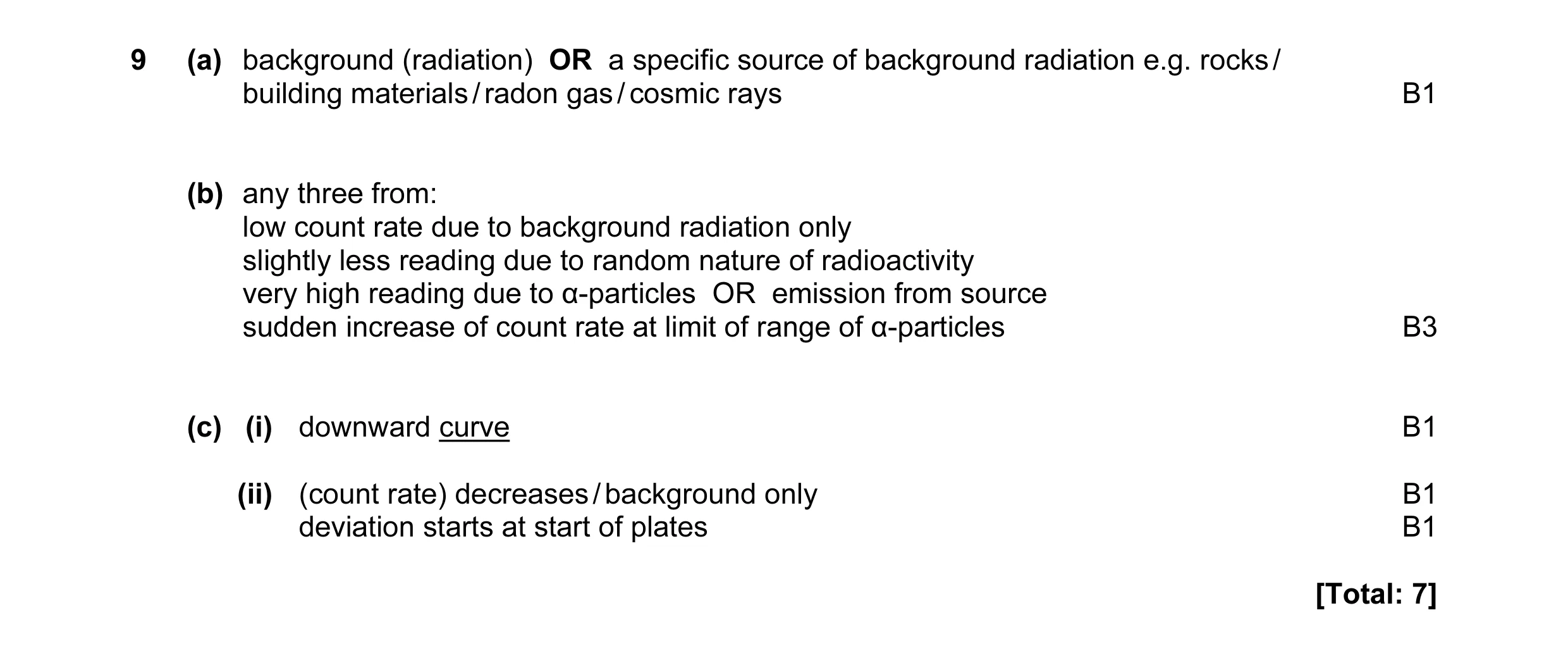 7
7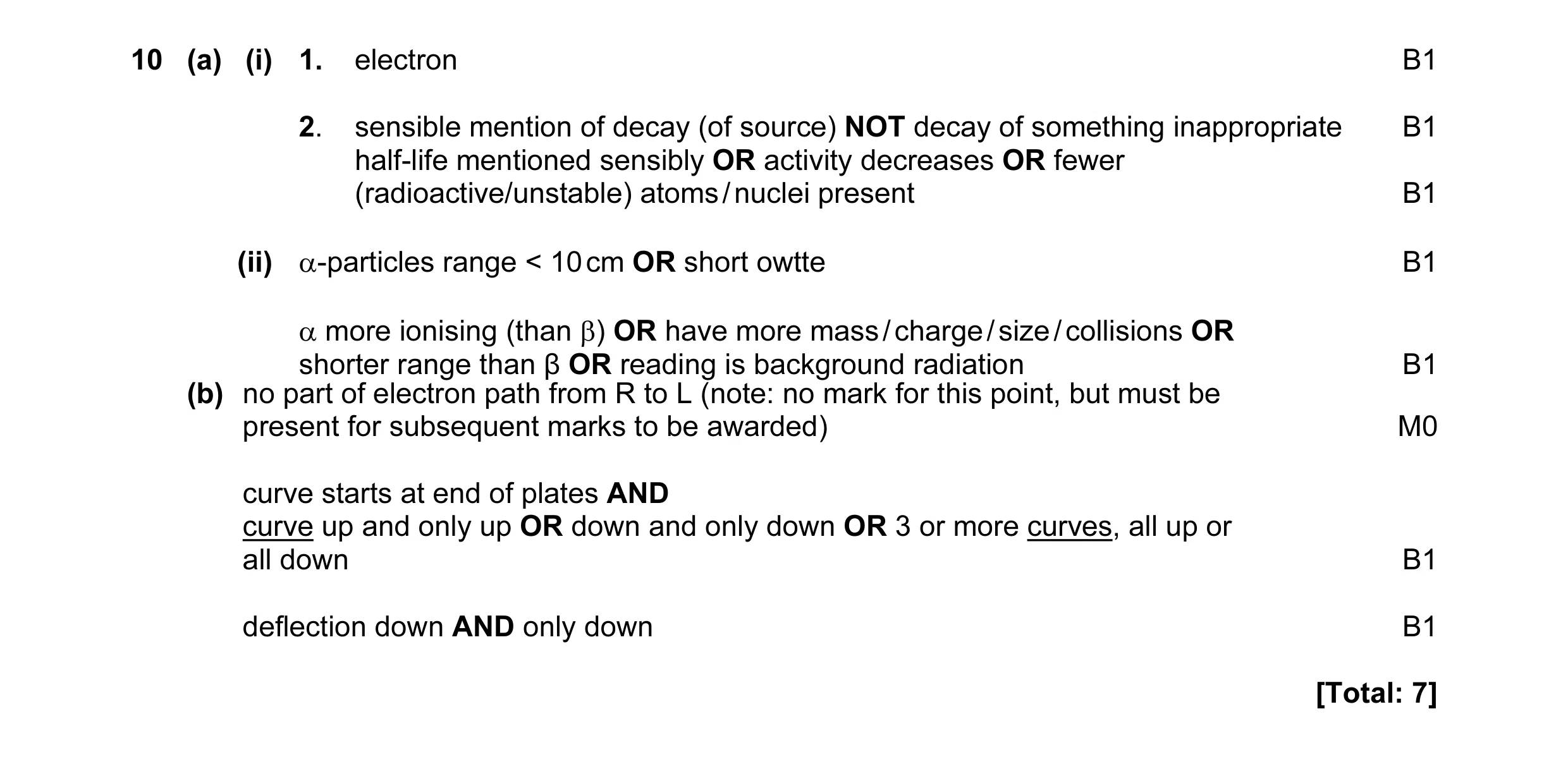 7
7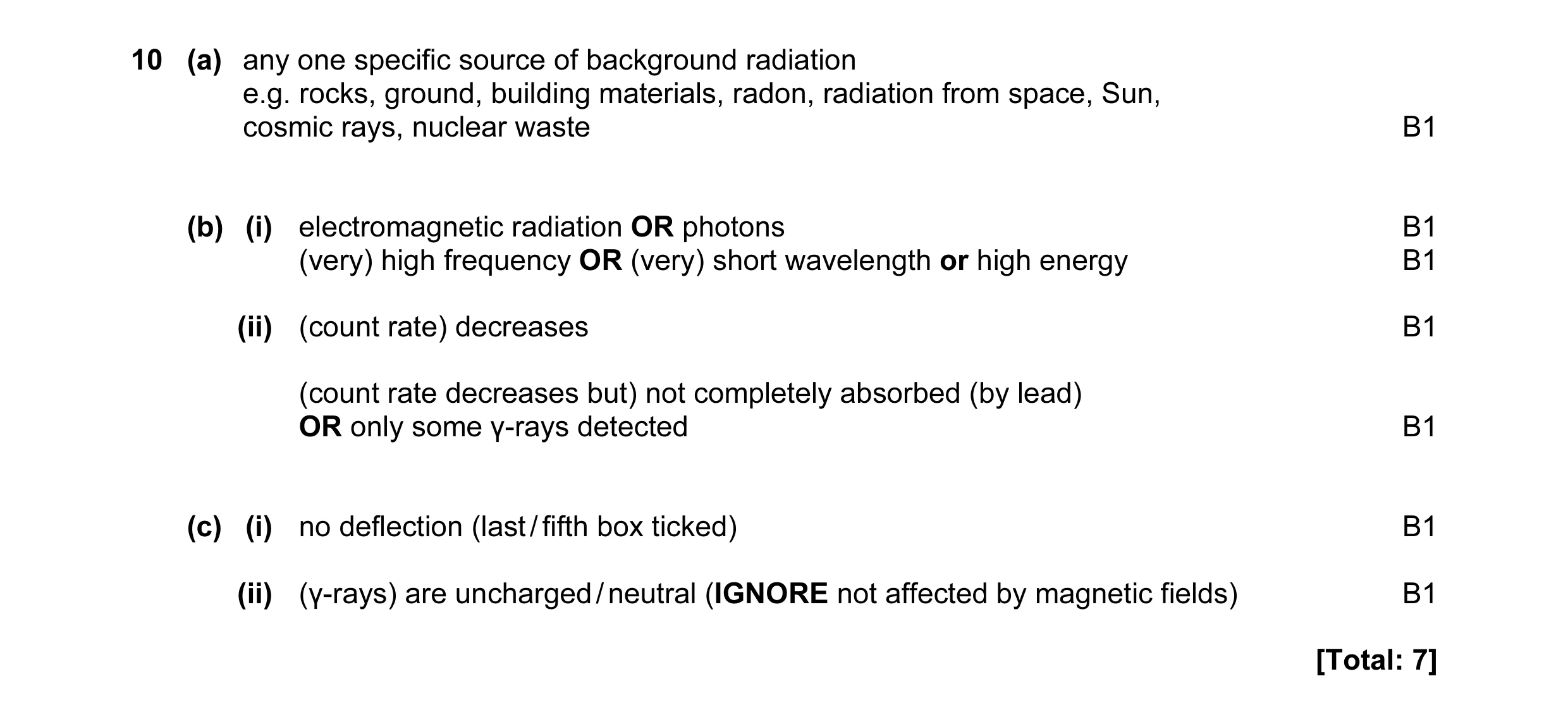 7
7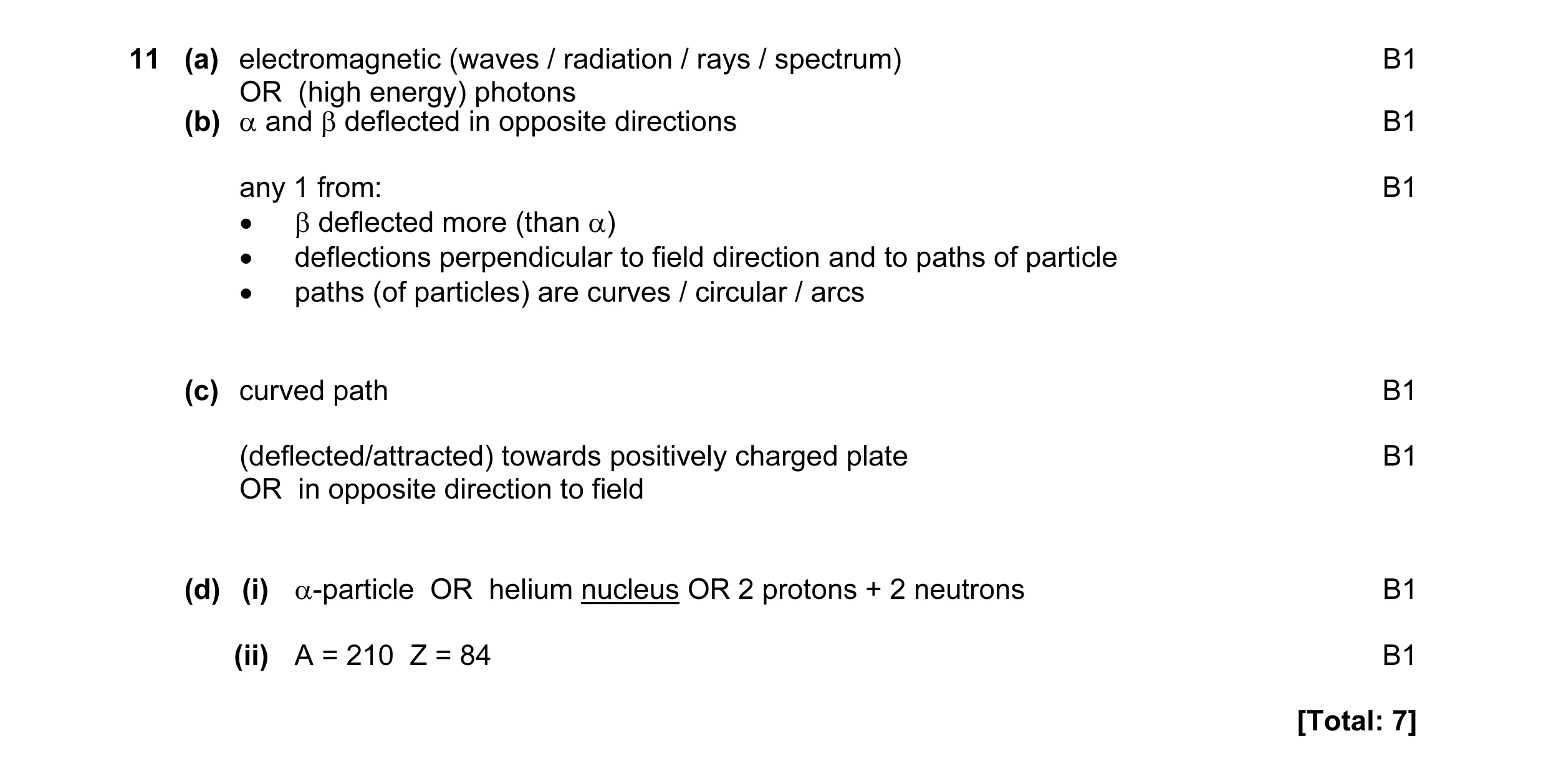 7
7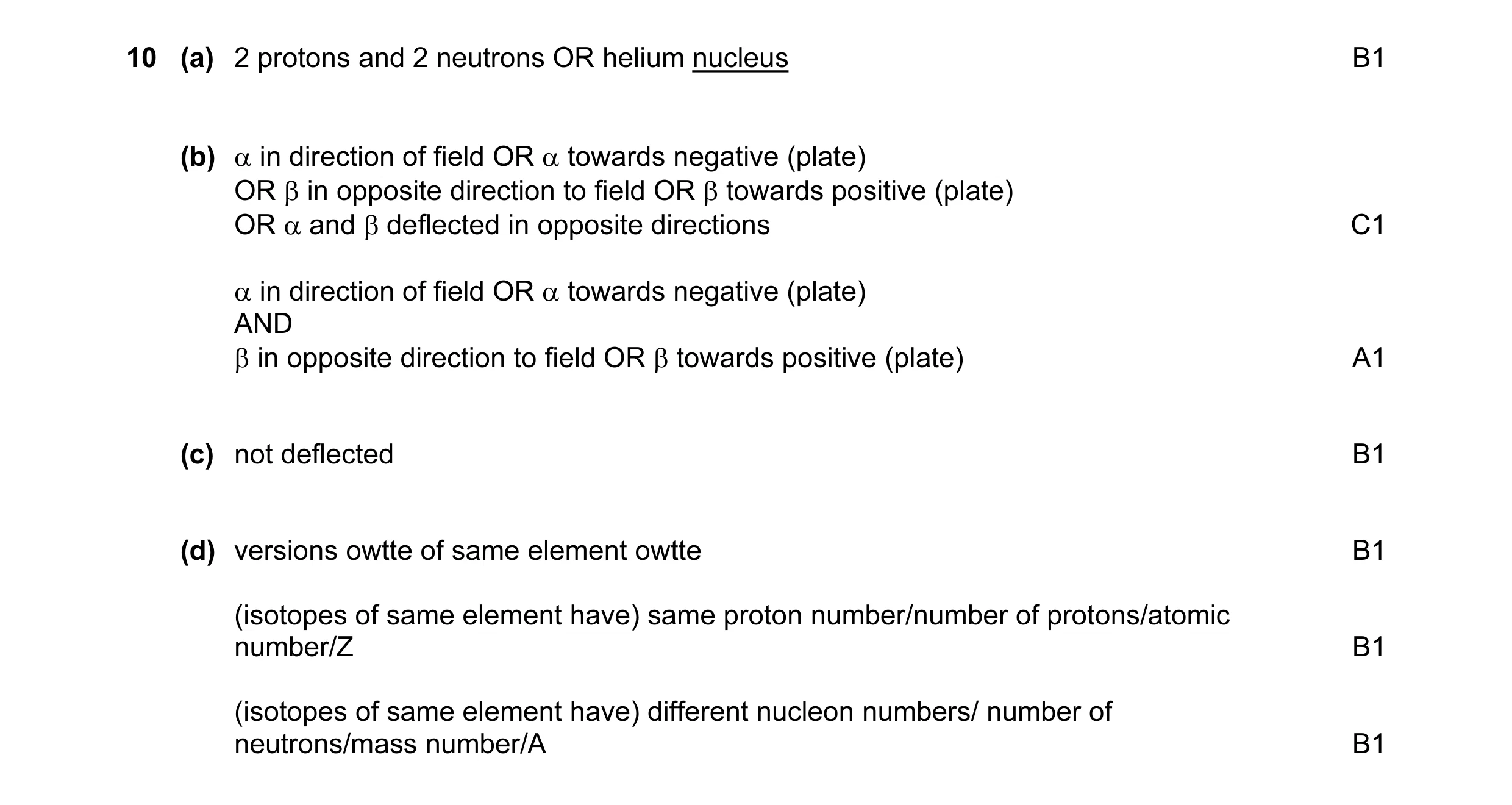 7
7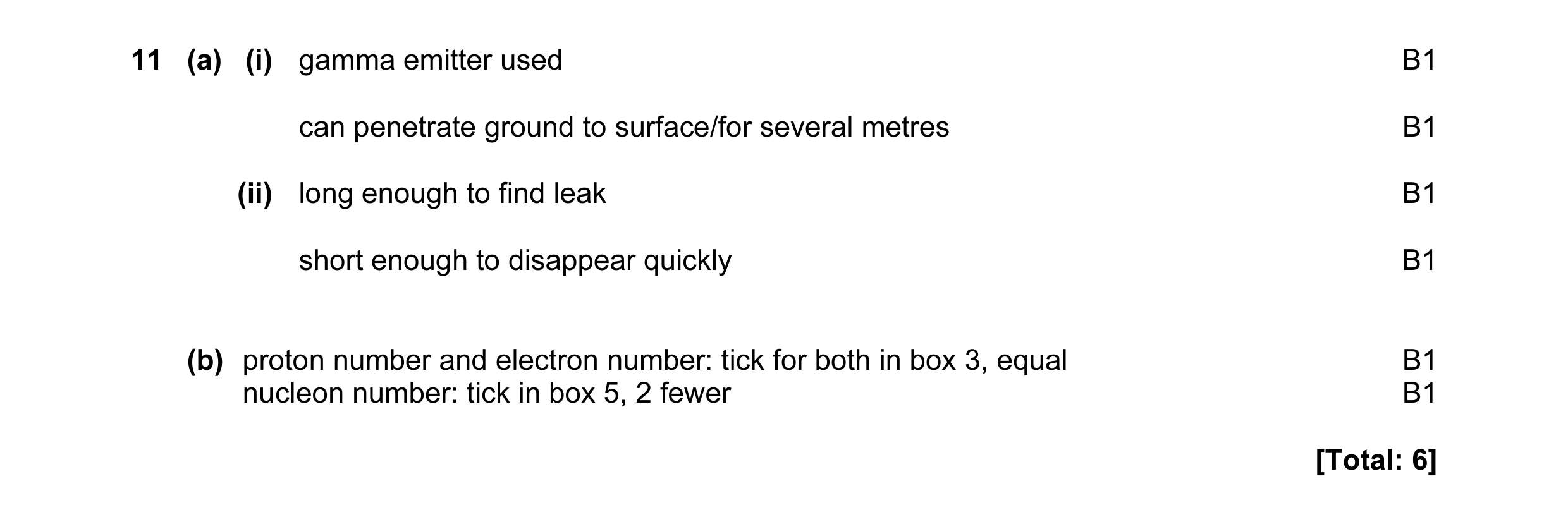 6
6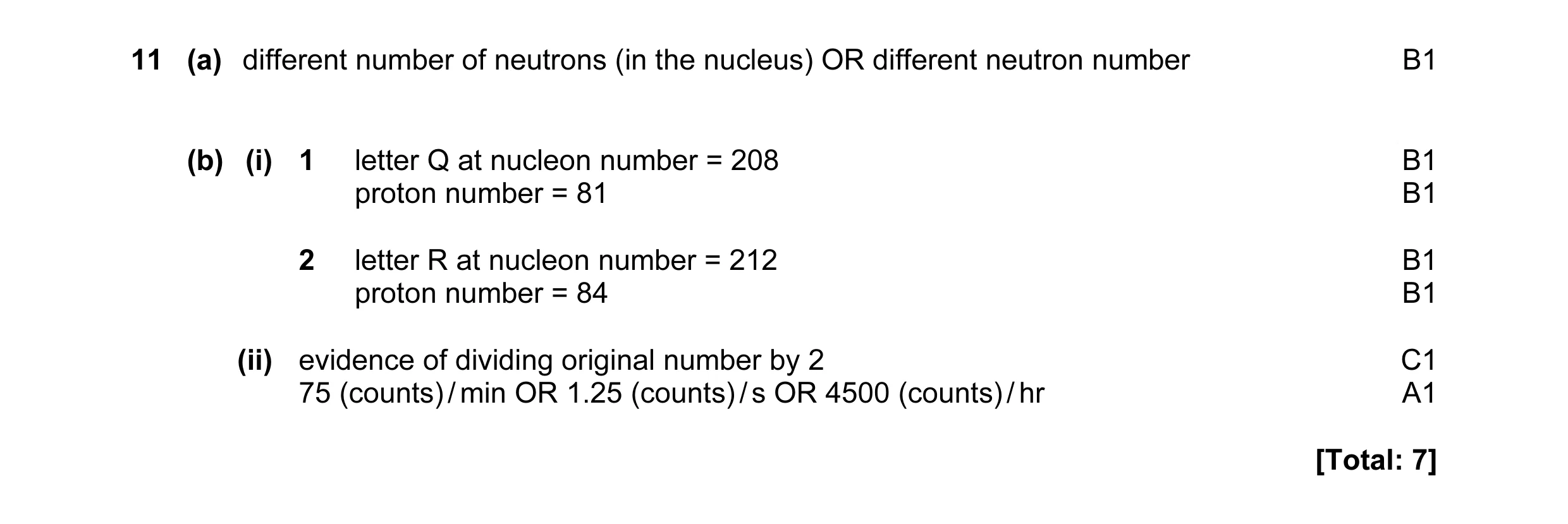 7
7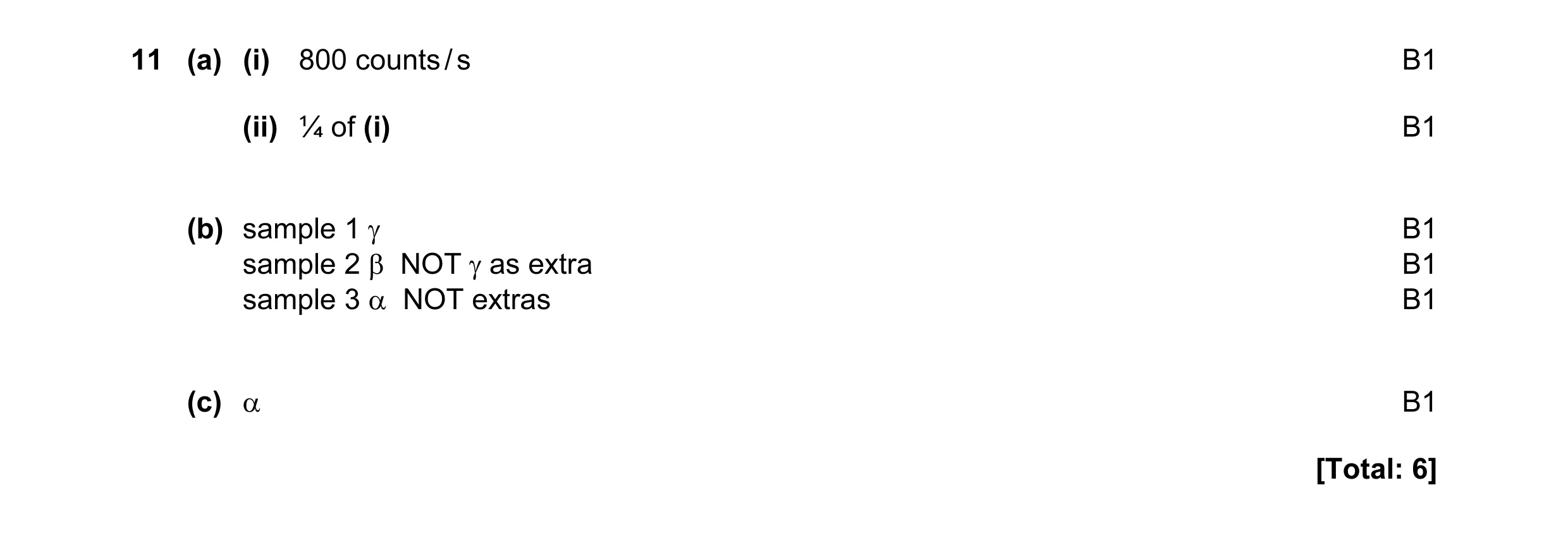 6
6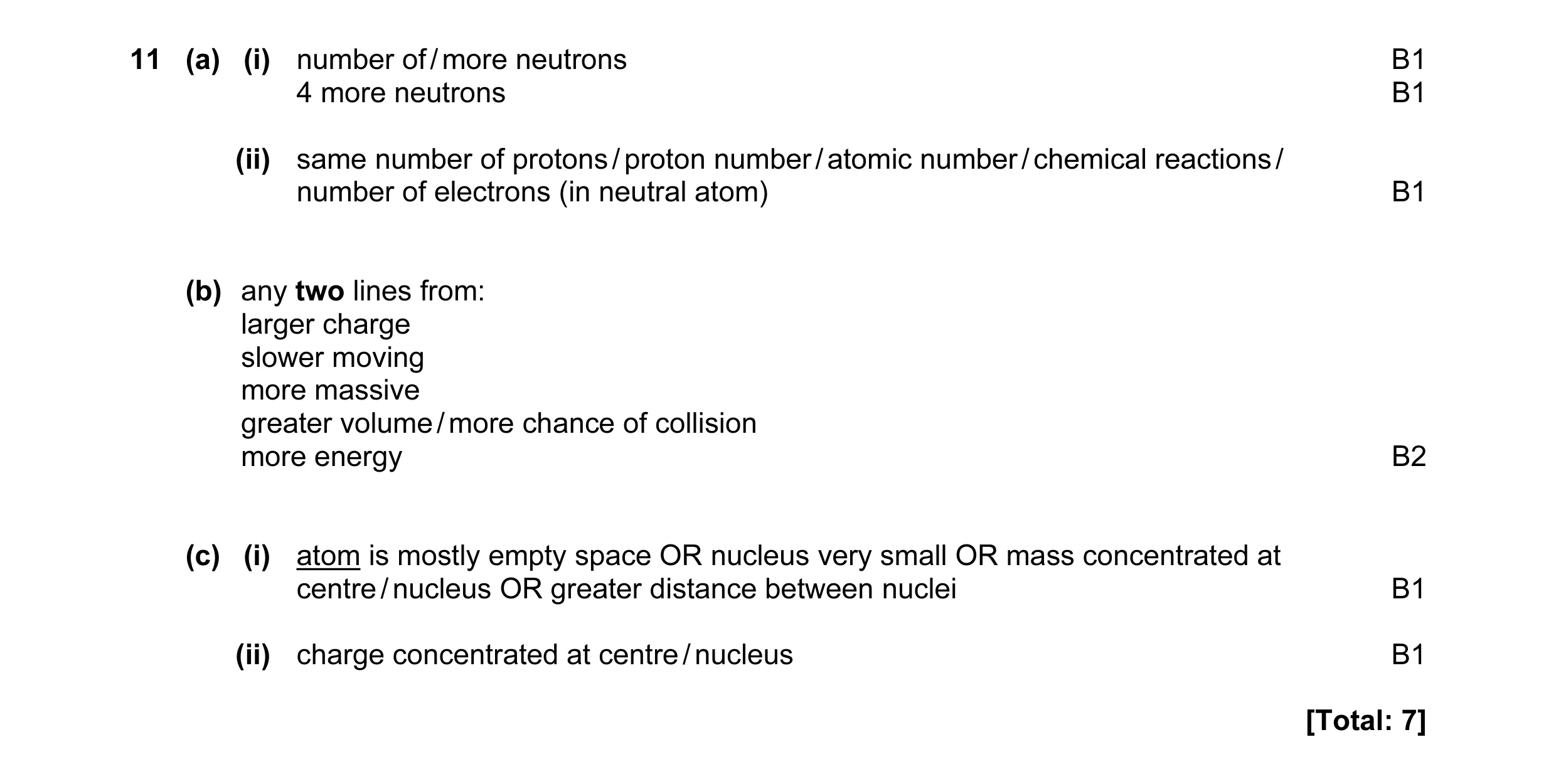 7
7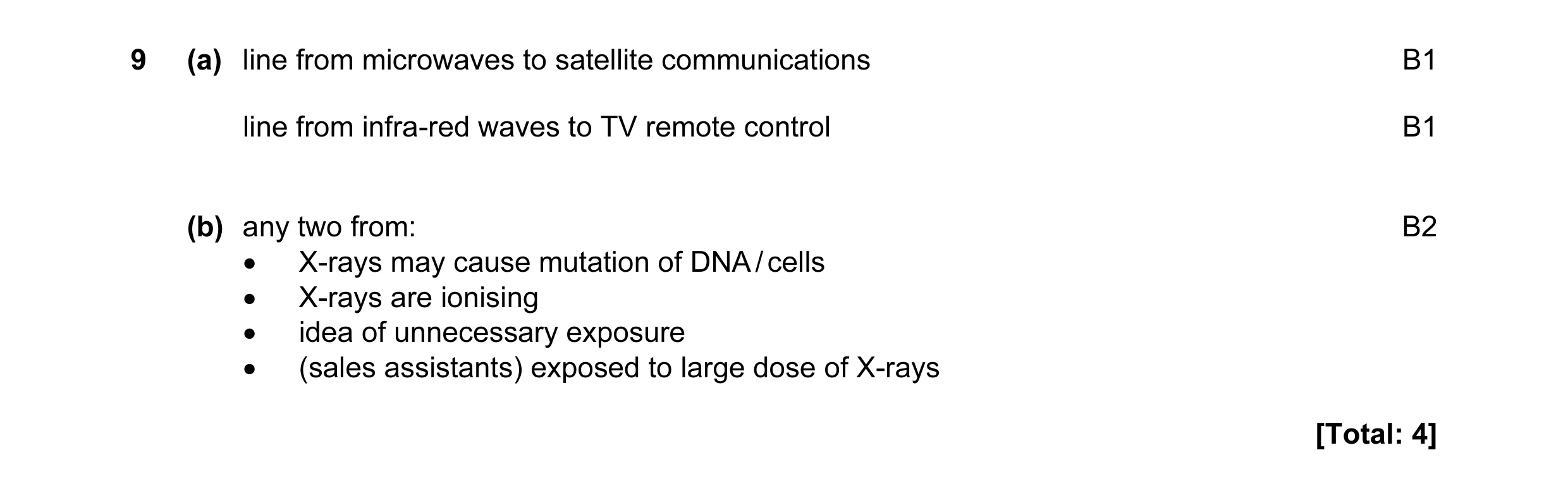 4
4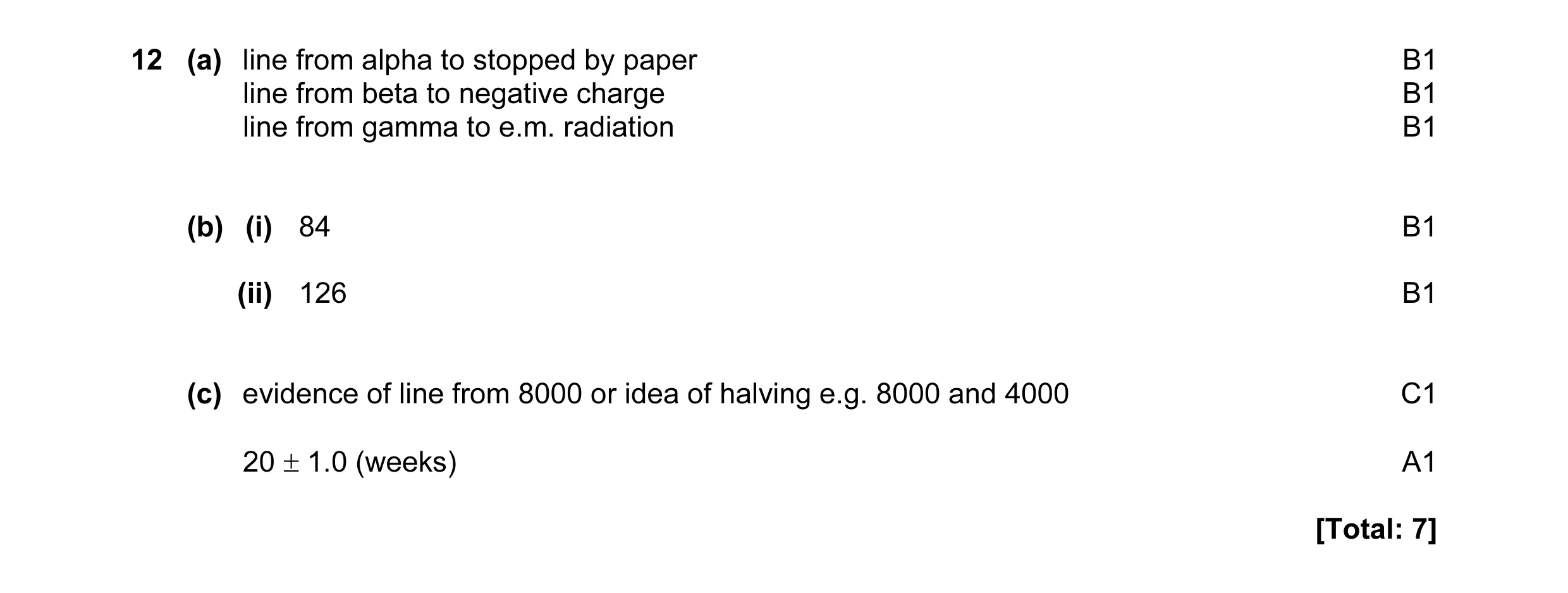 7
7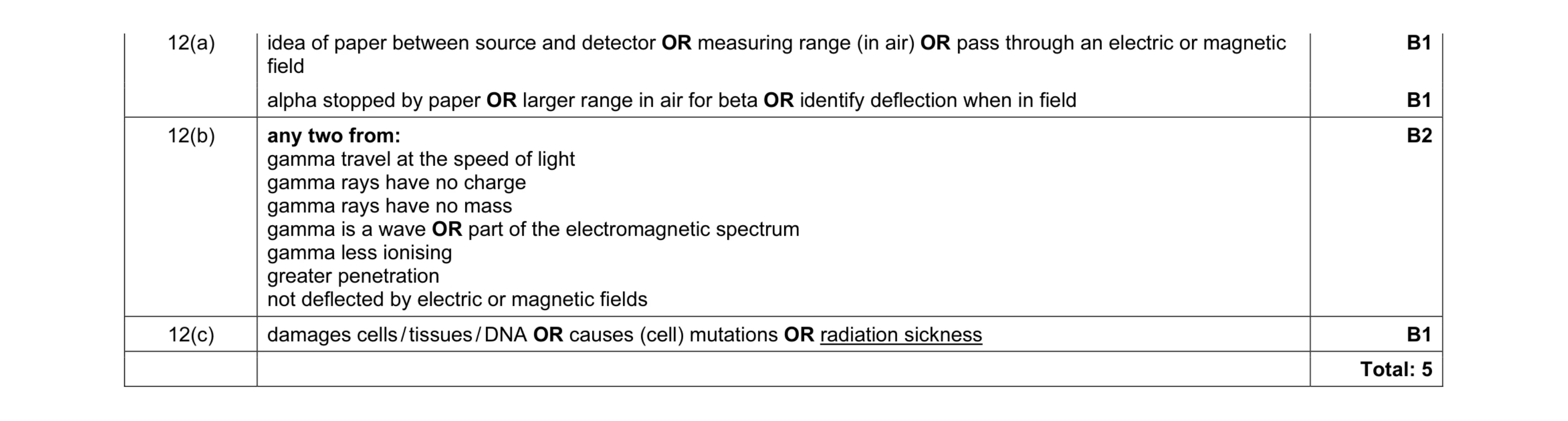 5
5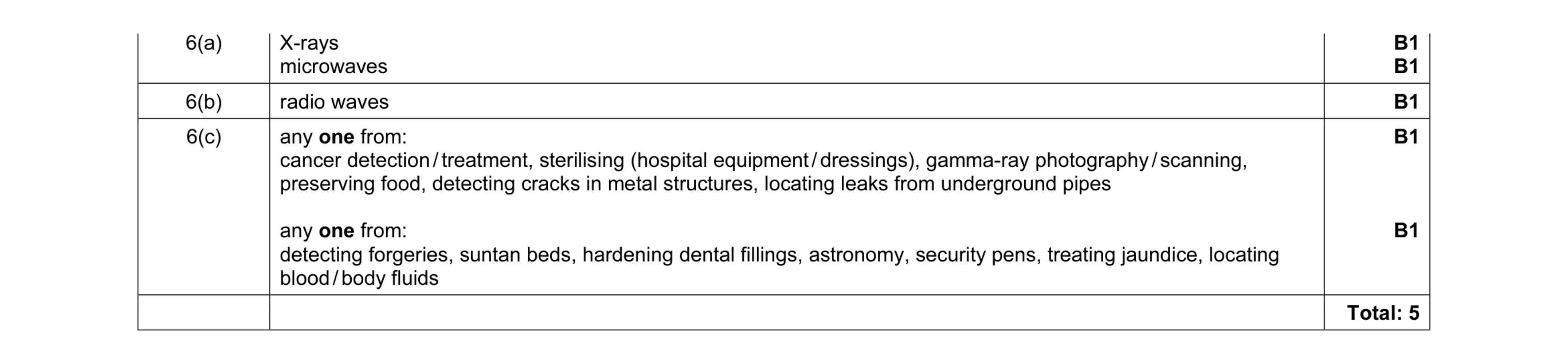 5
5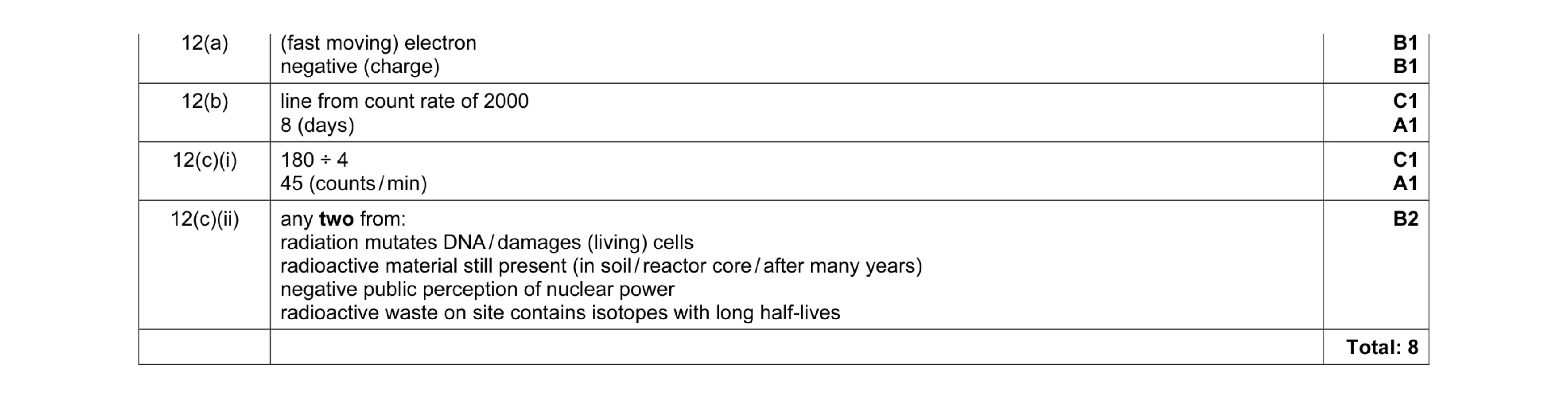 8
8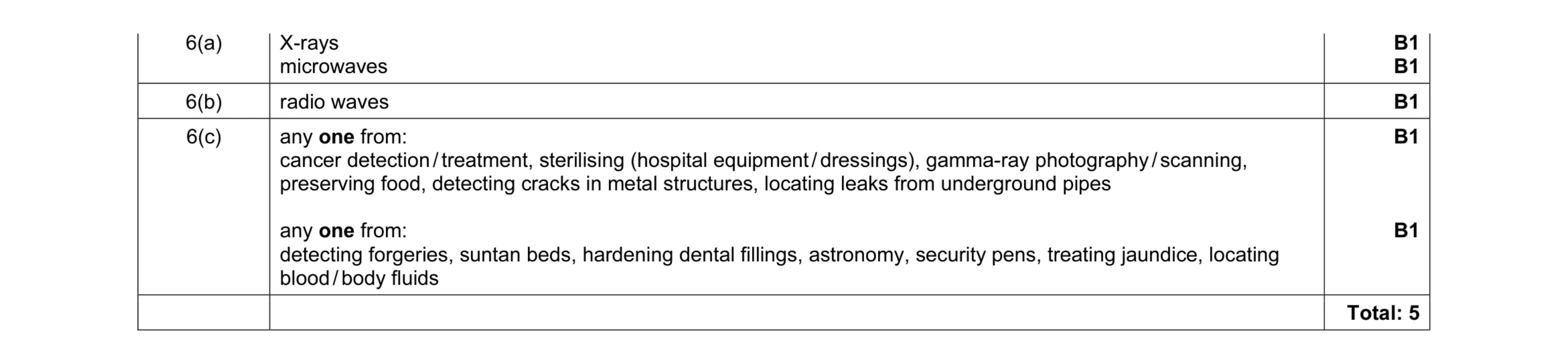 5
5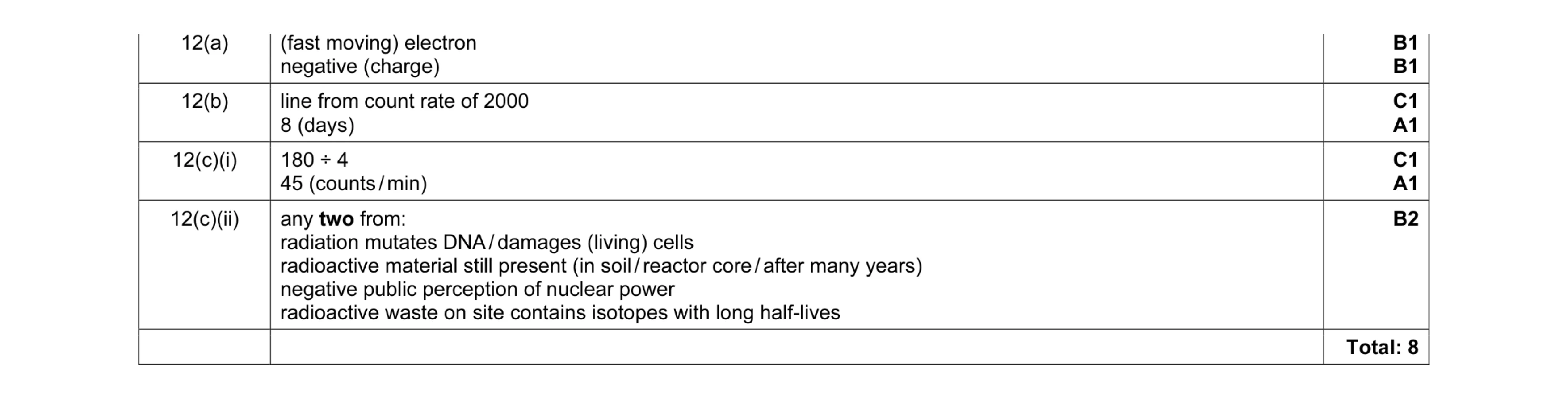 8
8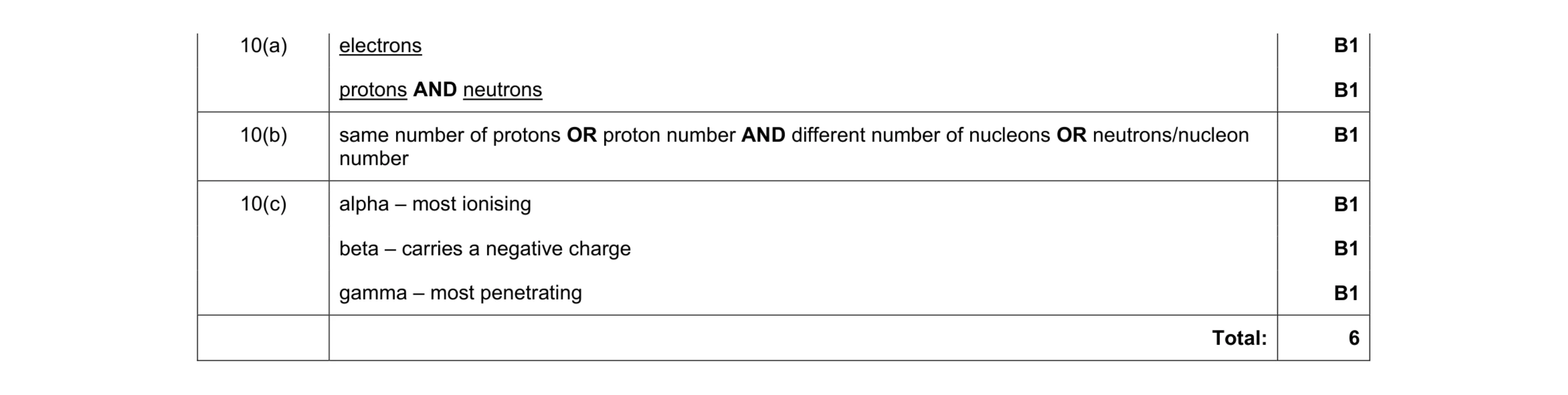 6
6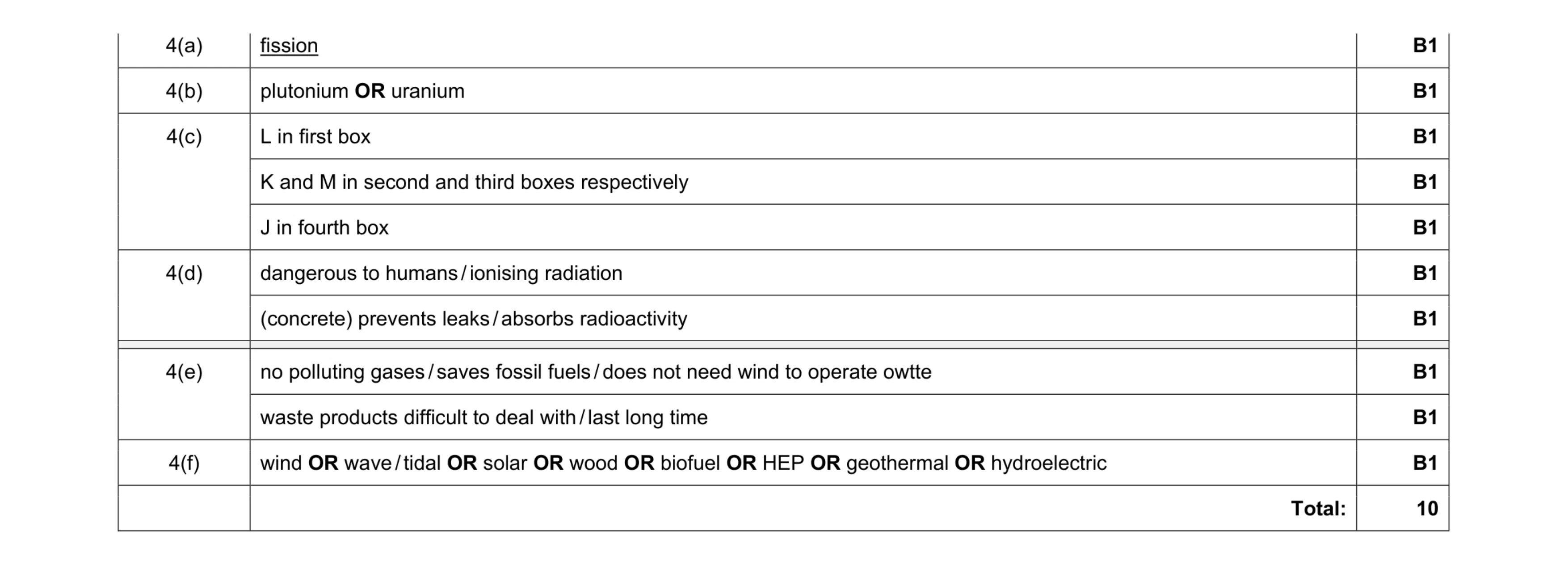 10
10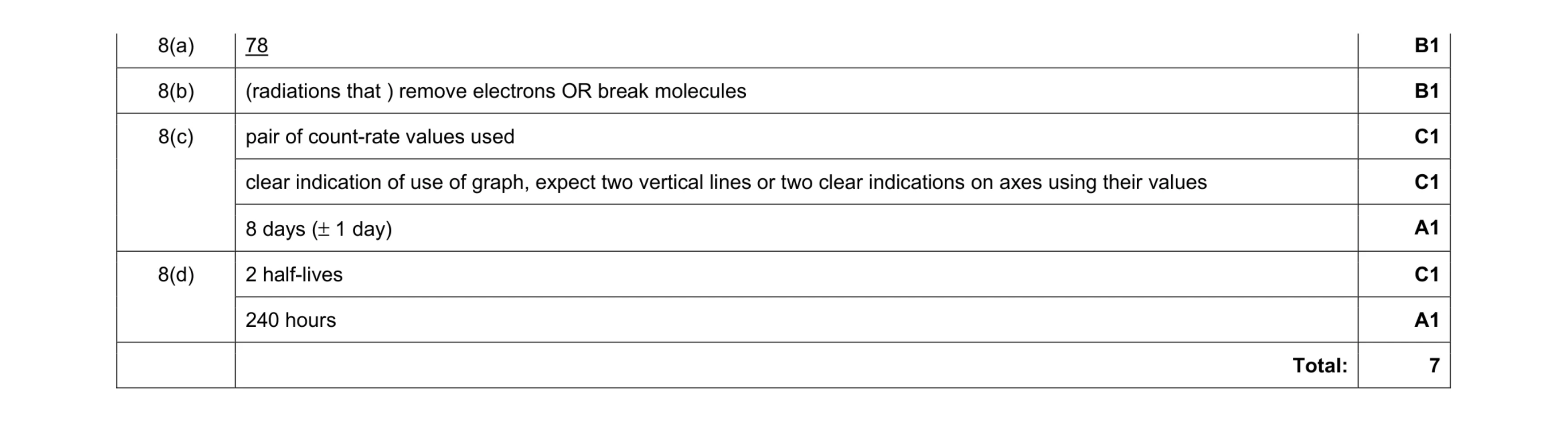 7
7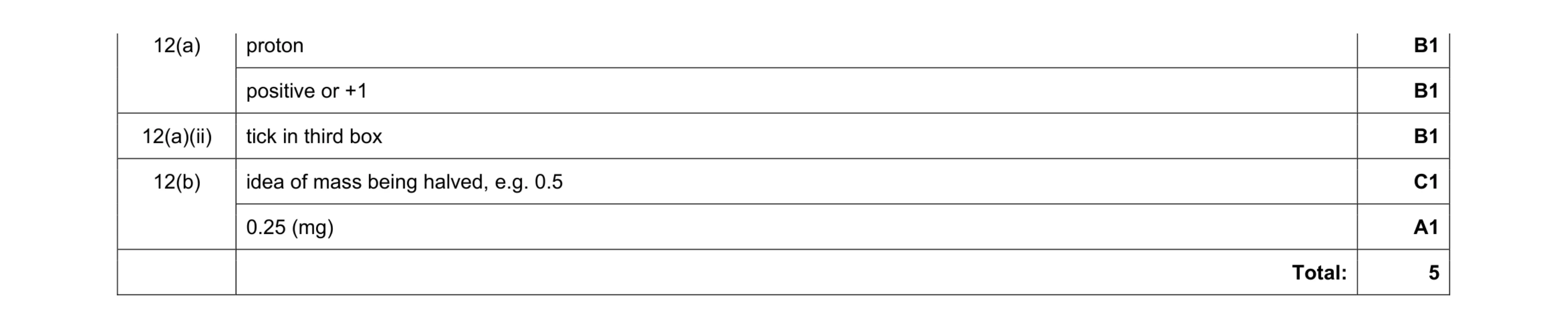 5
5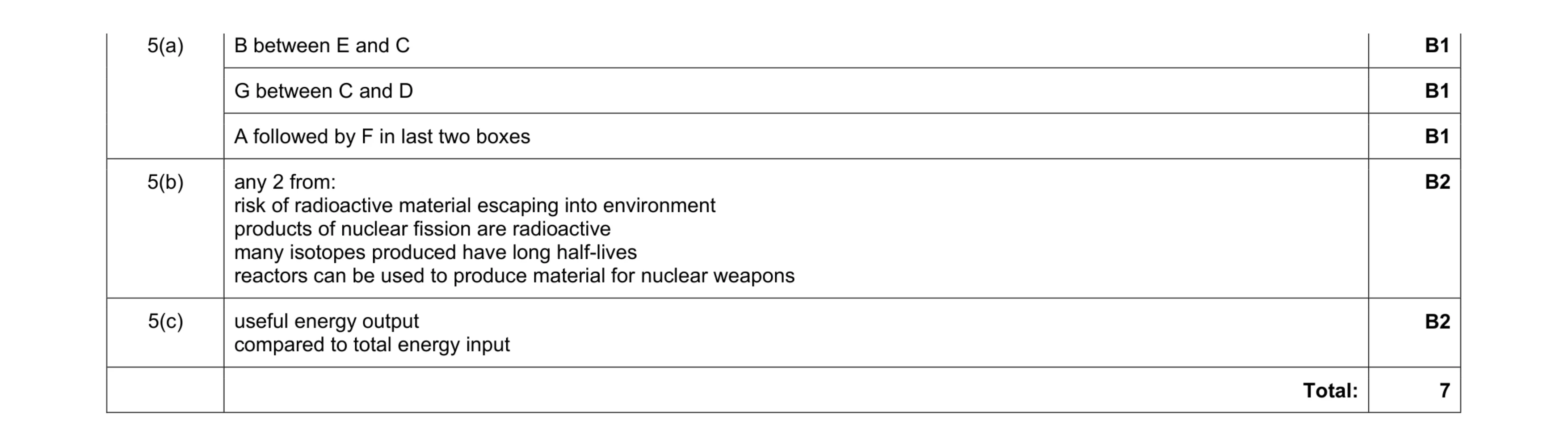 7
7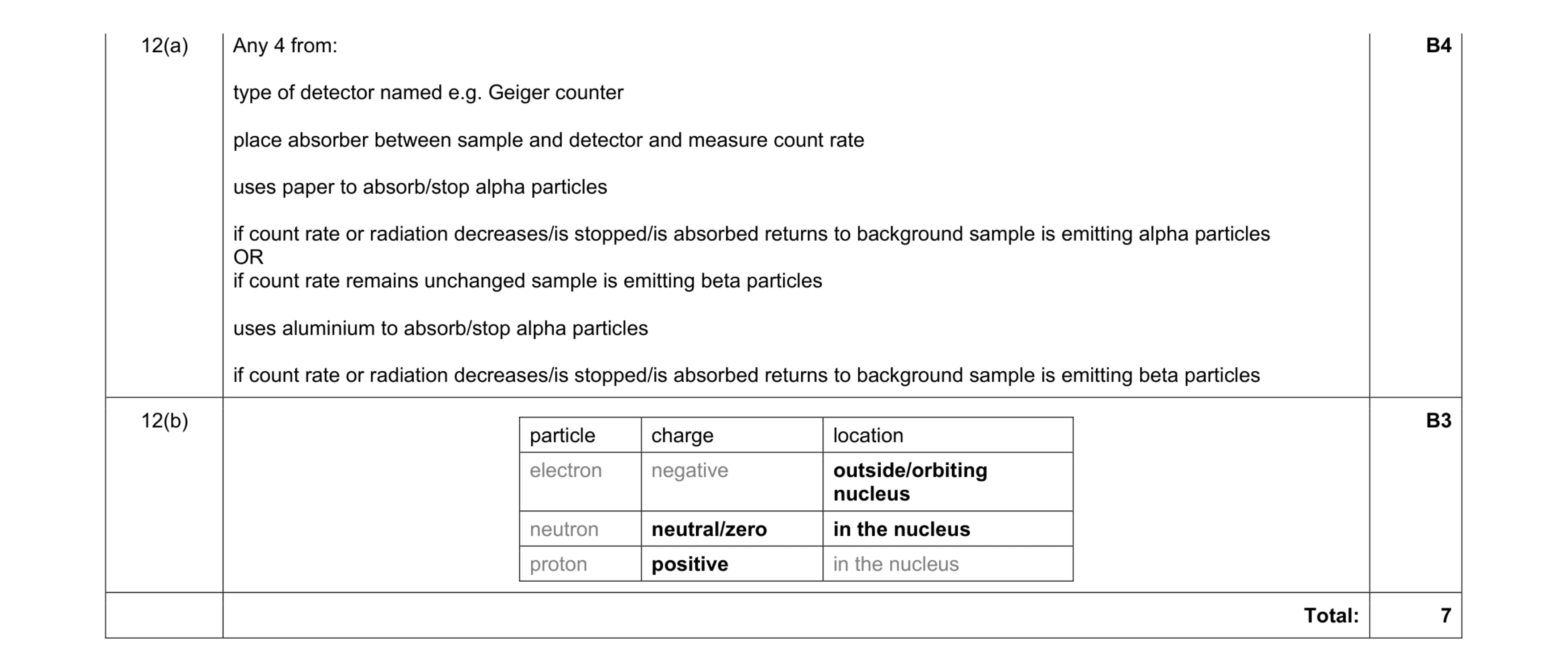 7
7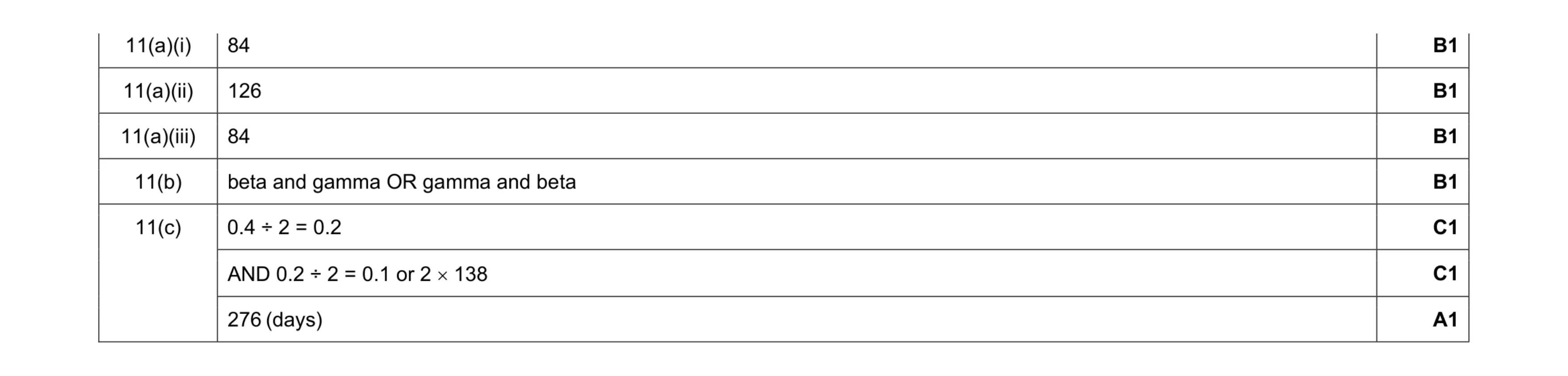 7
7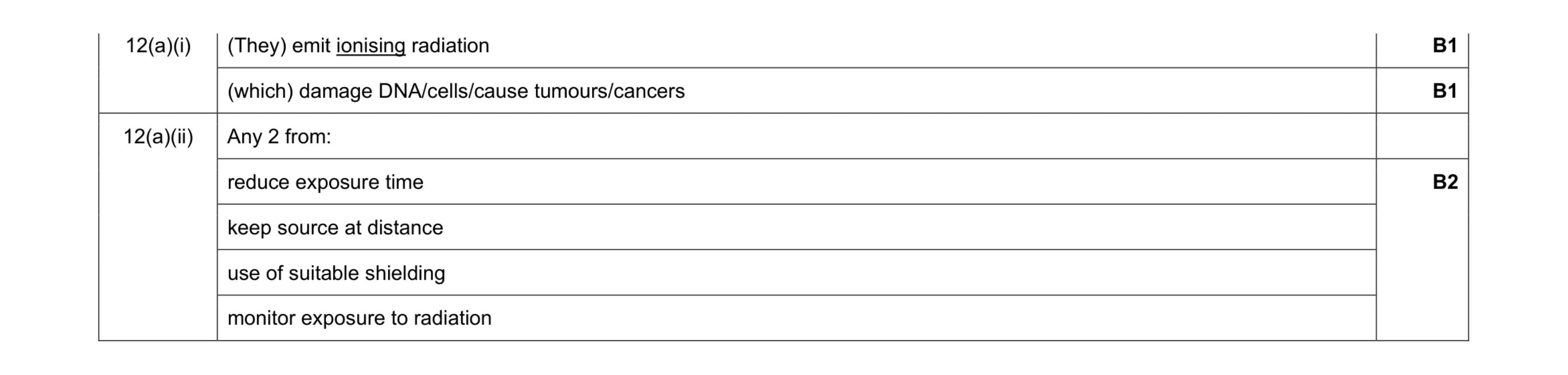 4
4 5
5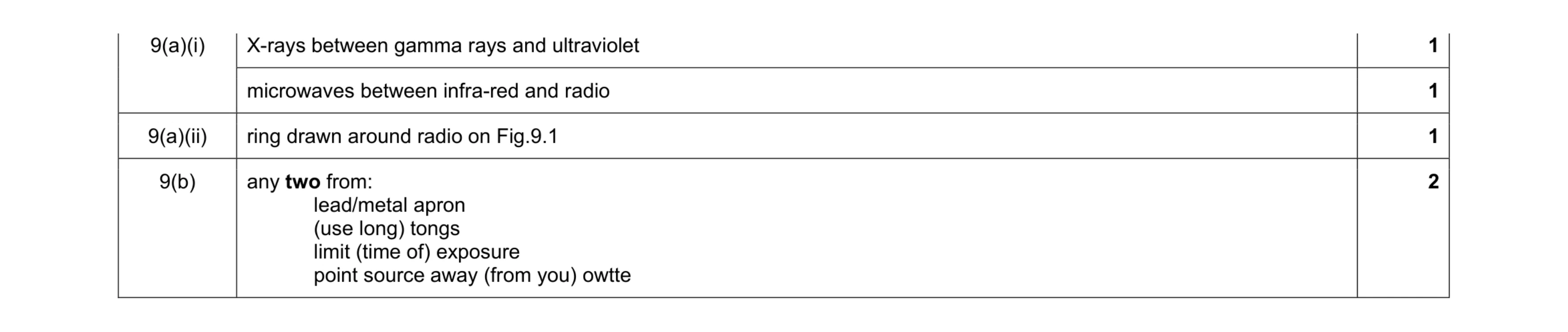 5
5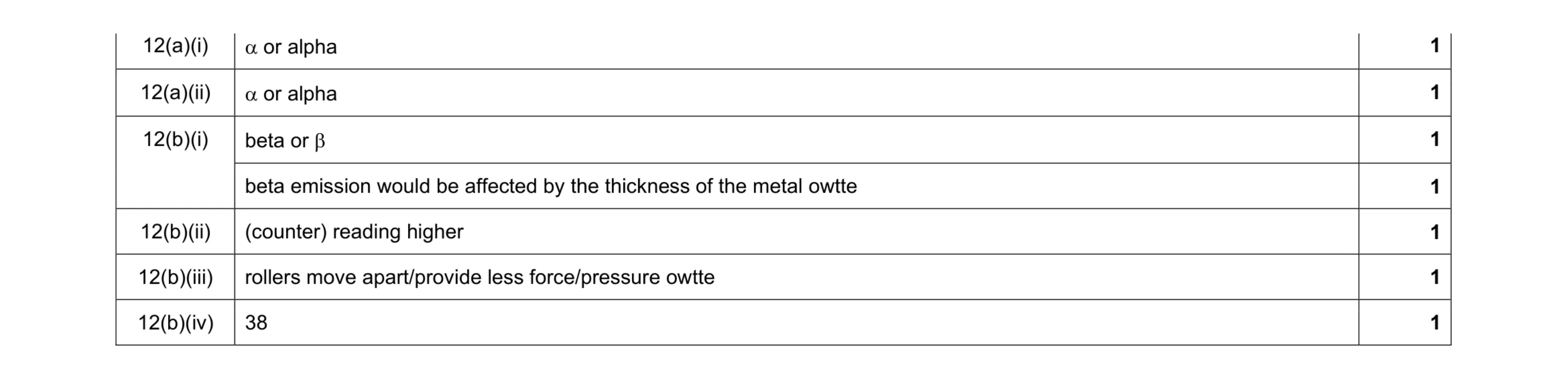 7
7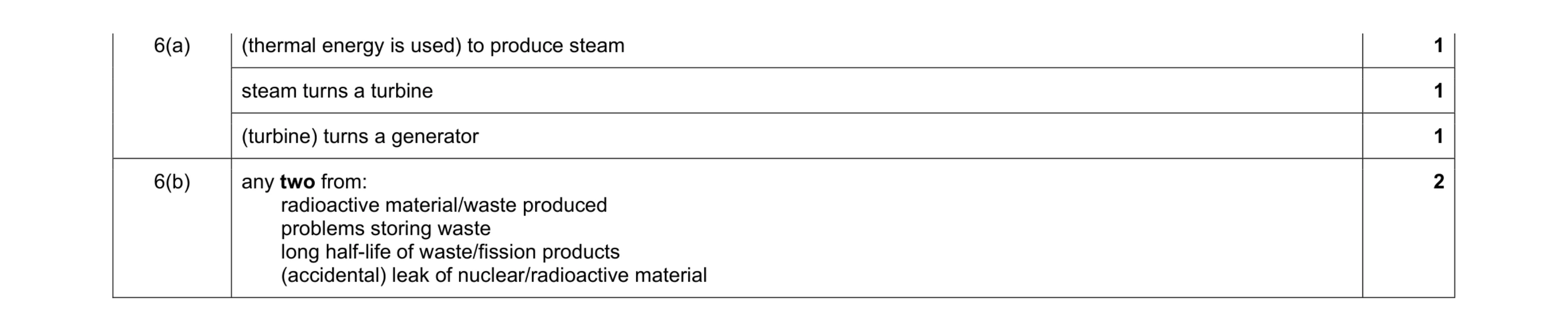 5
5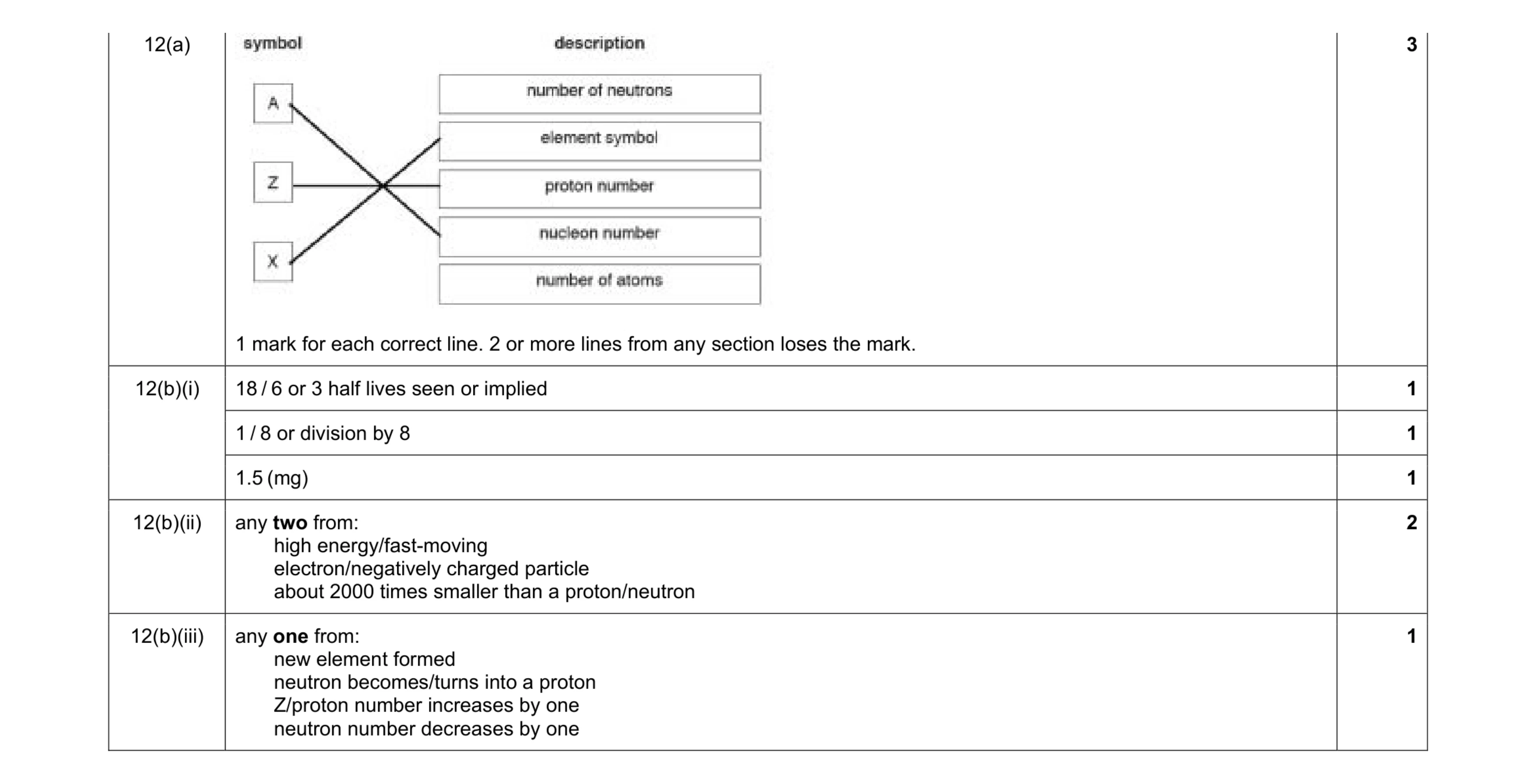 9
9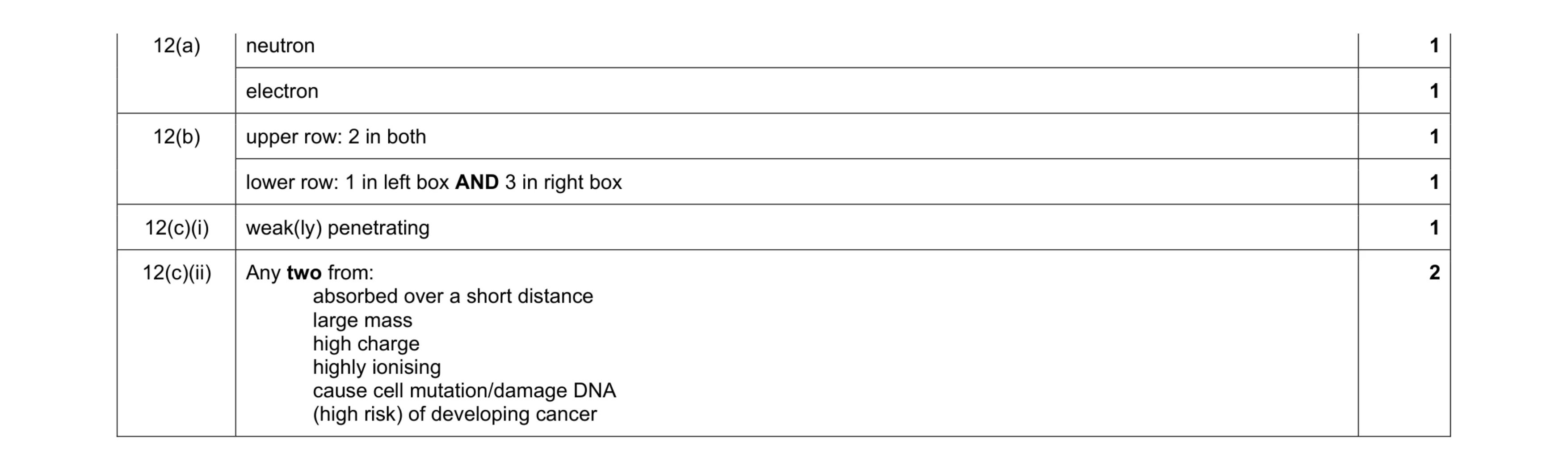 7
7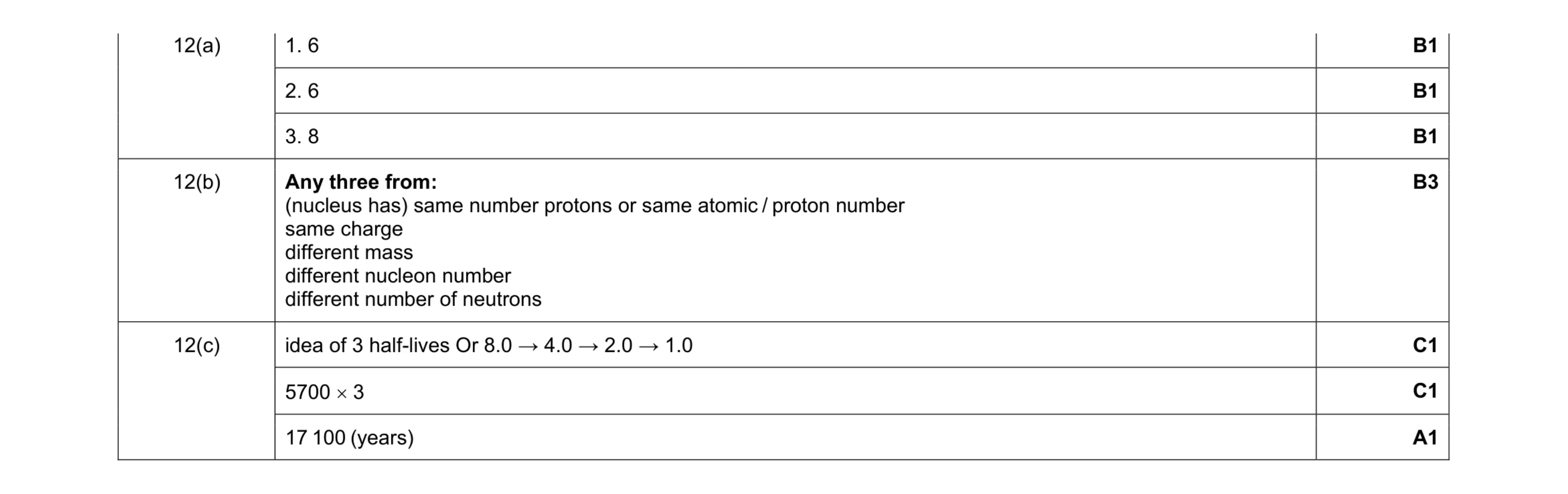 9
9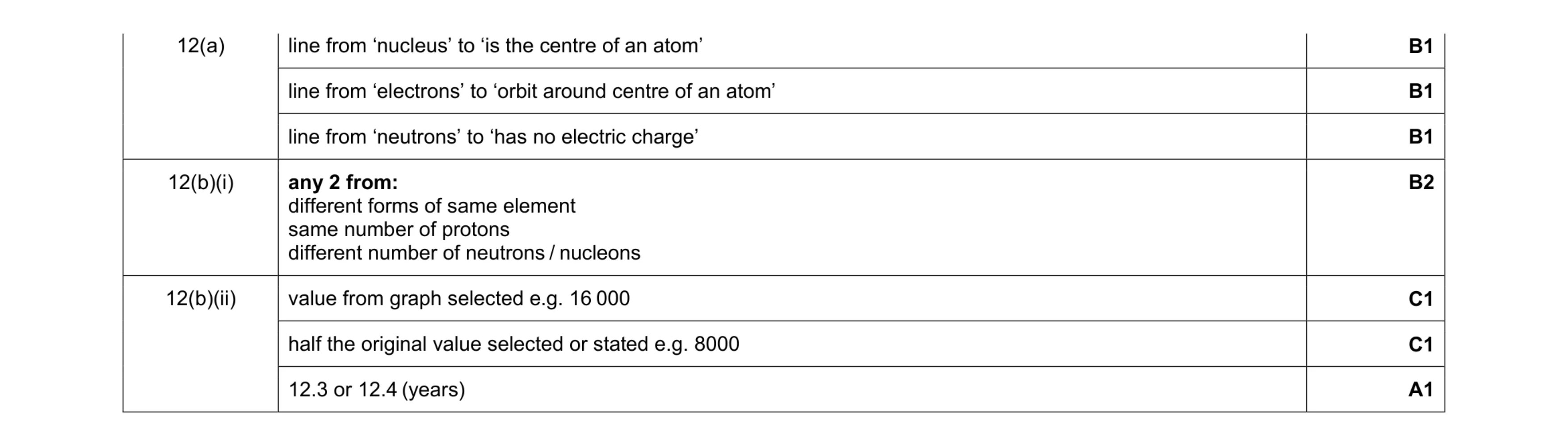 8
8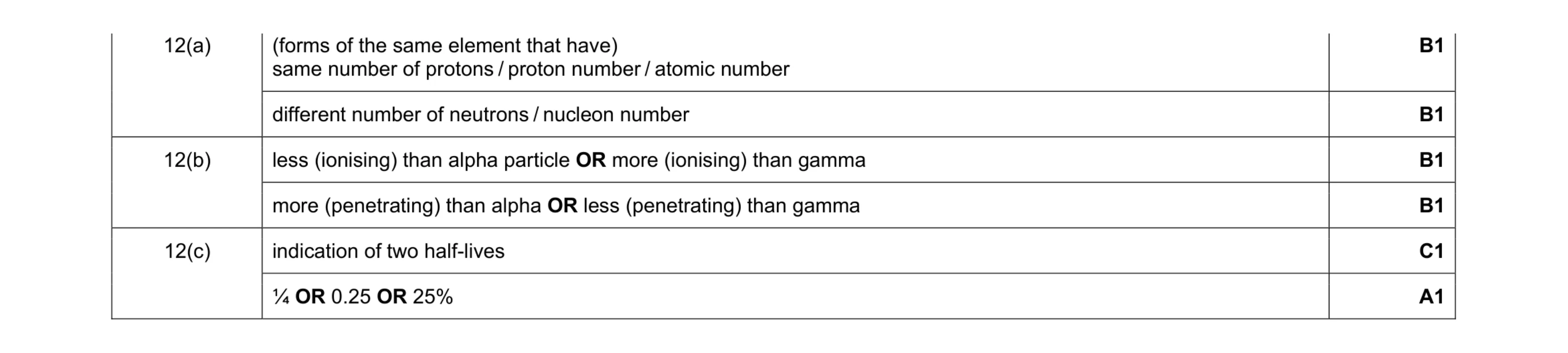 6
6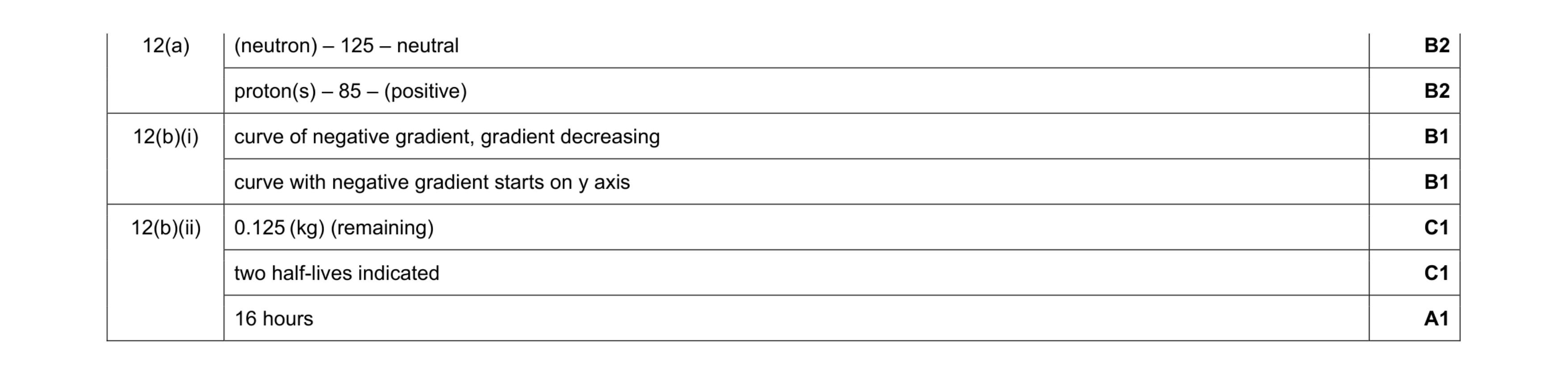 9
9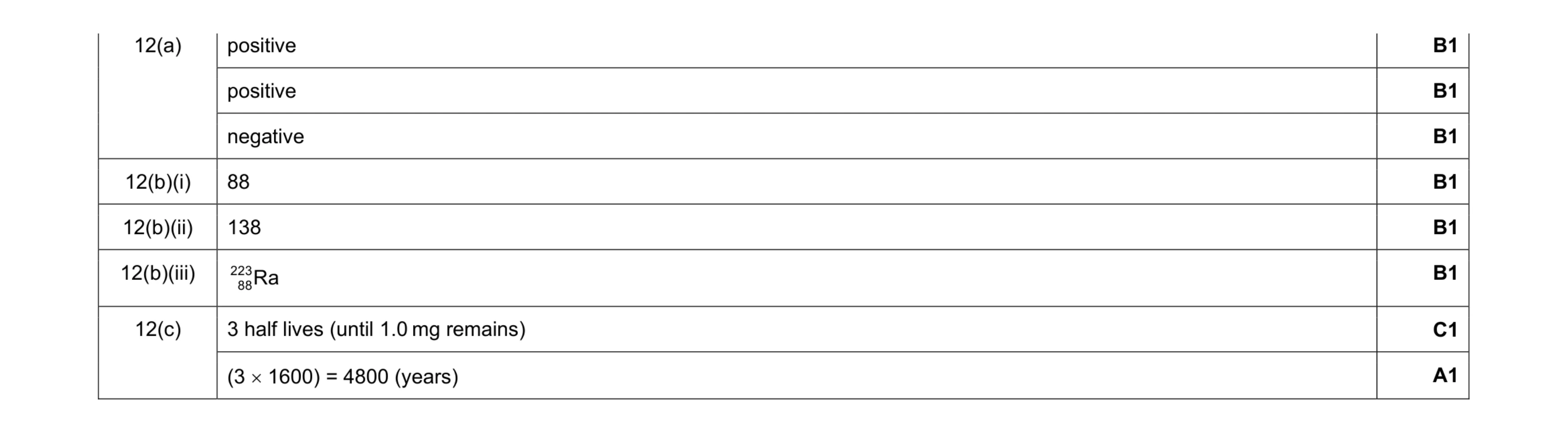 8
8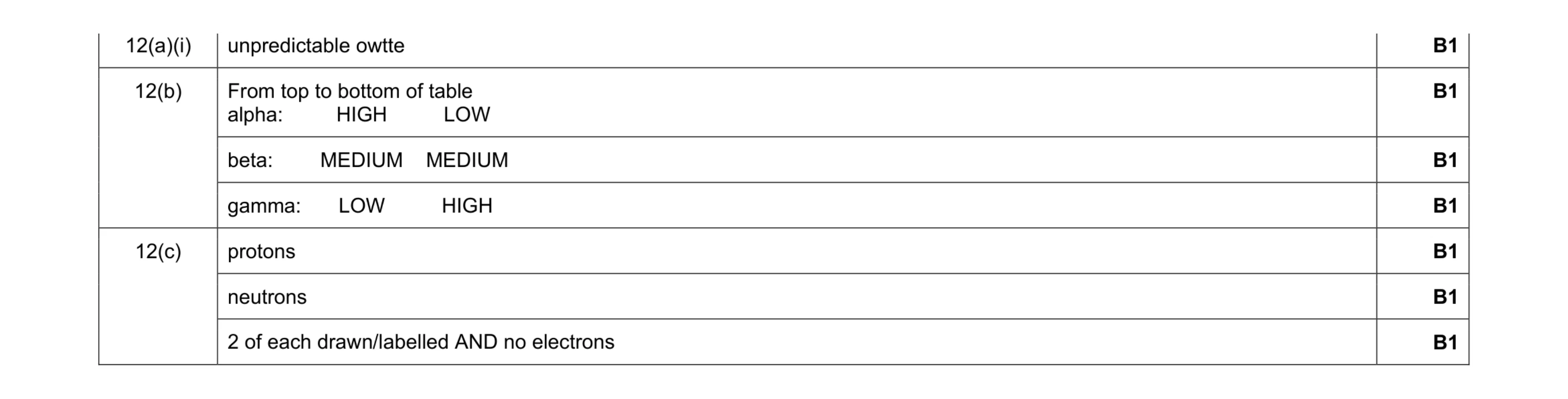 7
7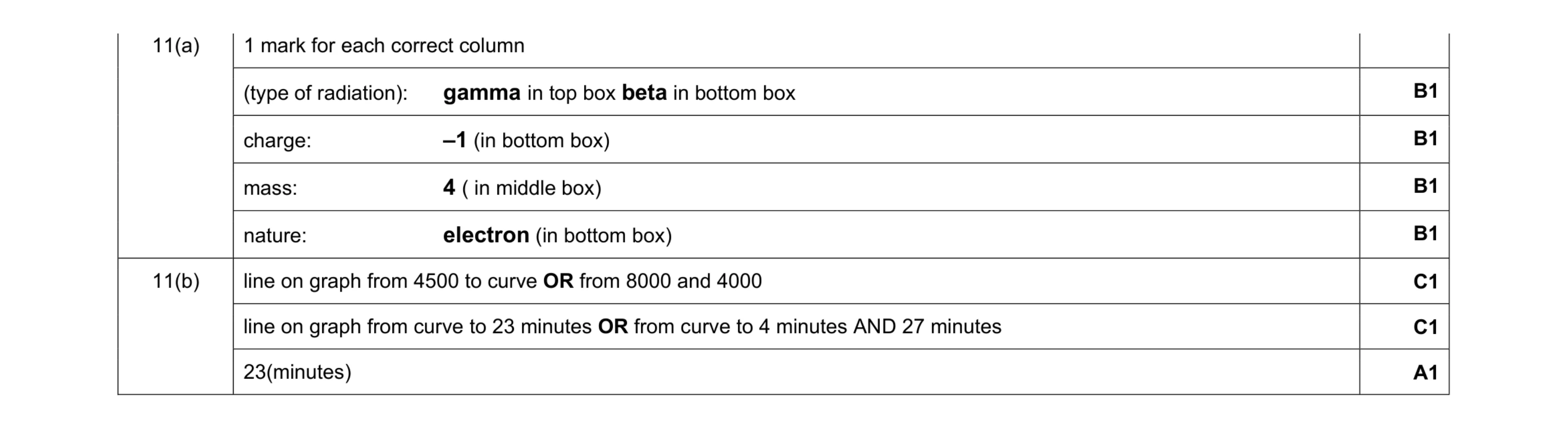 7
7 5
5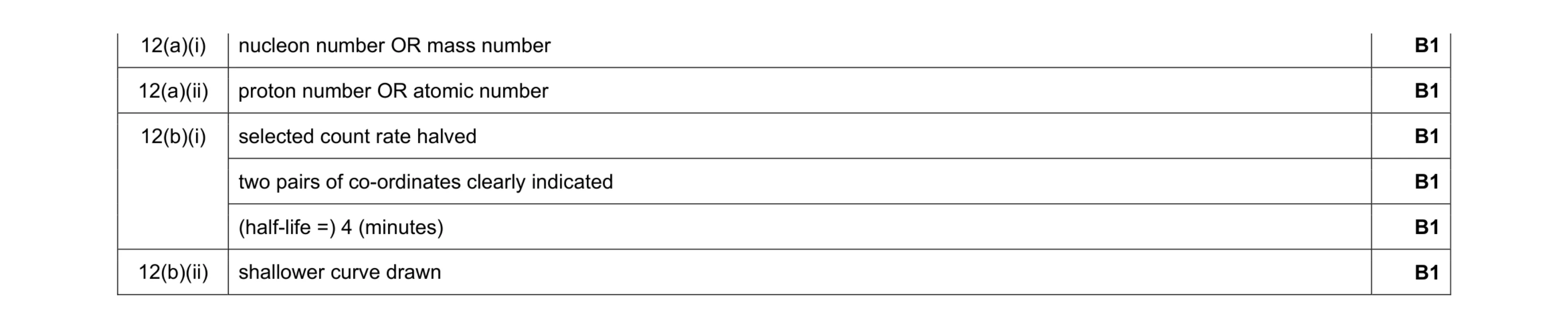 6
6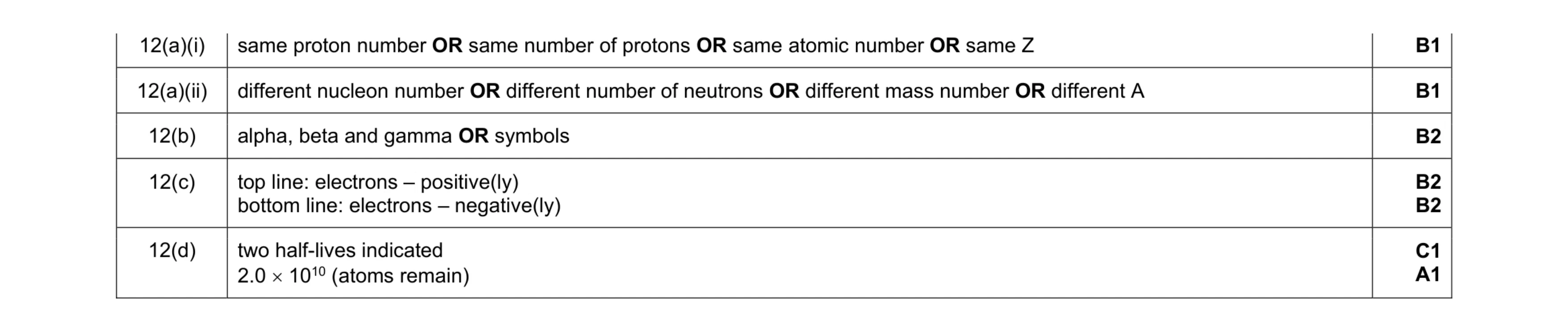 10
10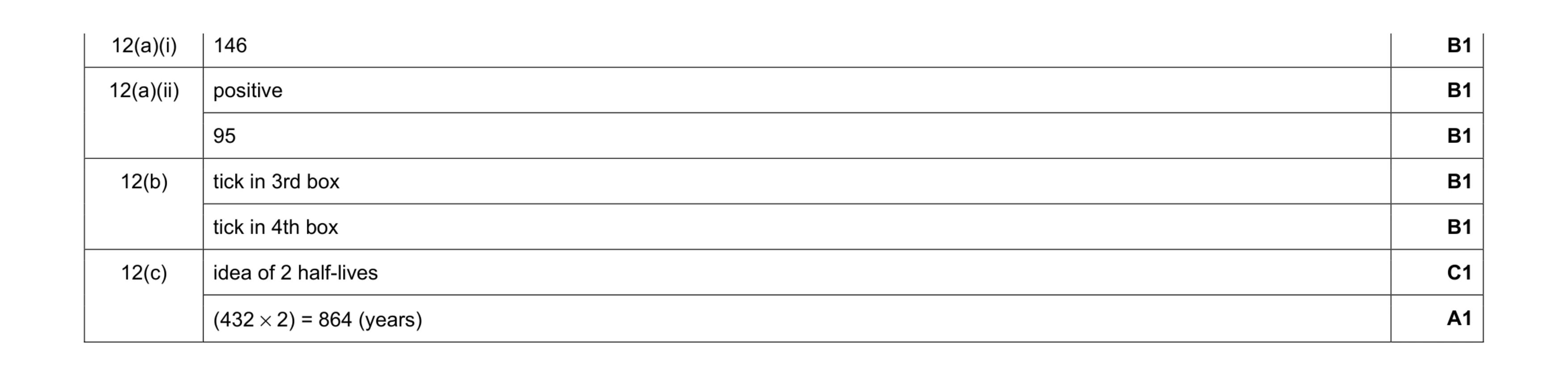 7
7 5
5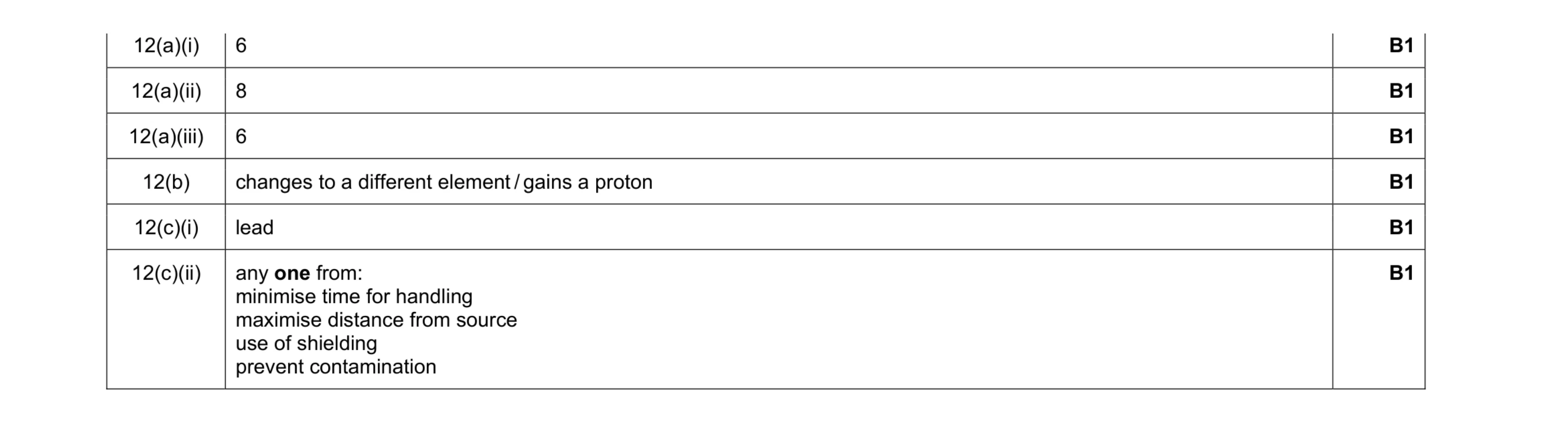 6
6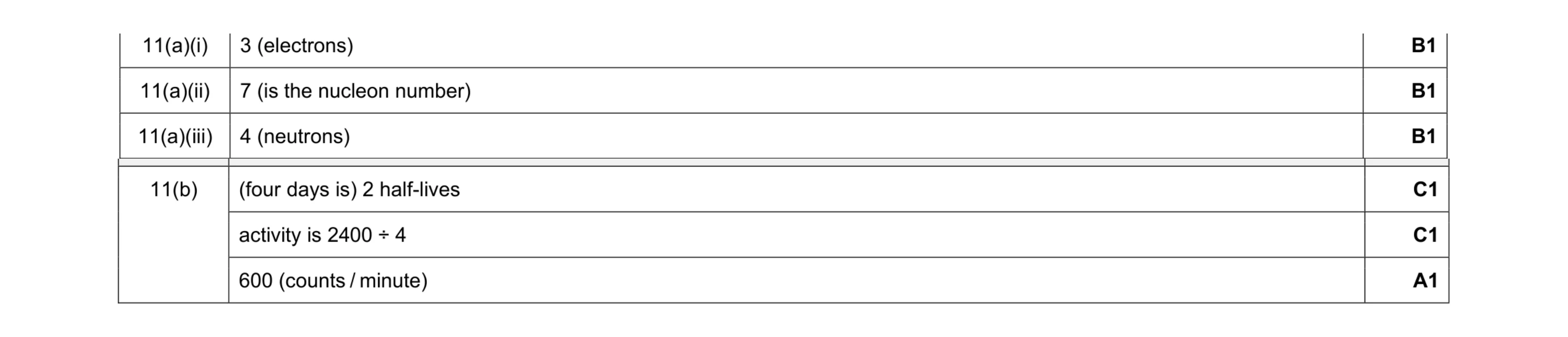 6
6 5
5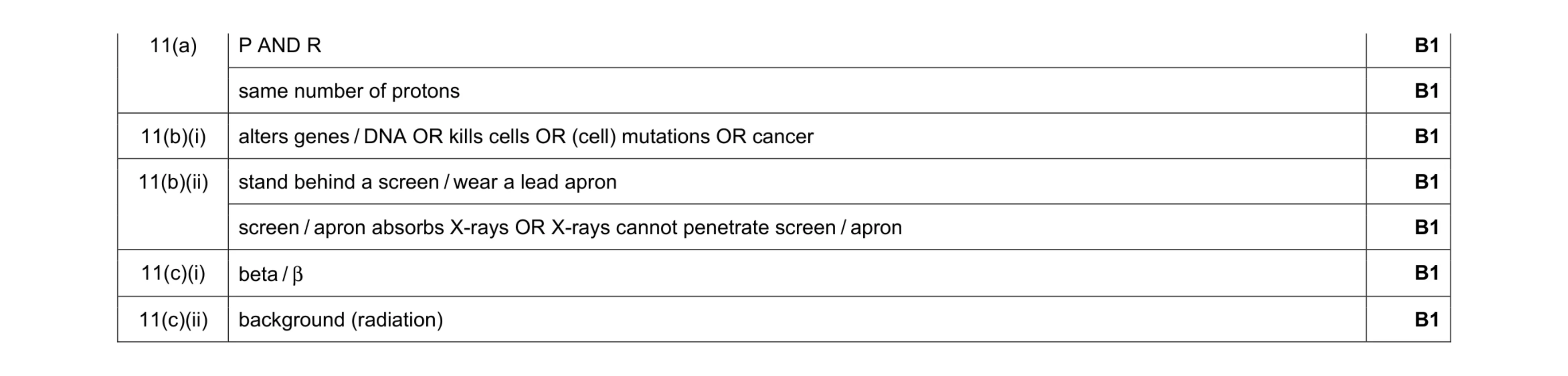 7
7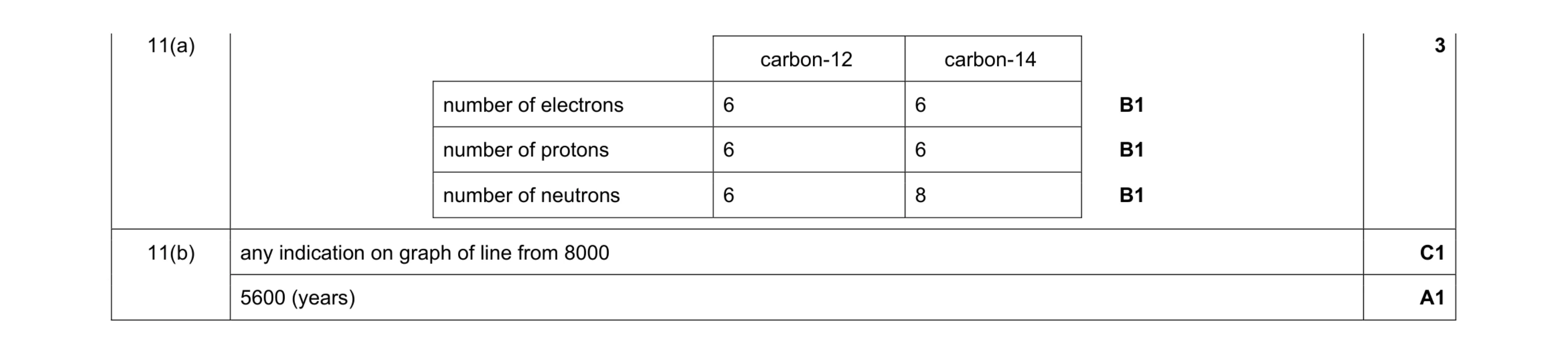 5
5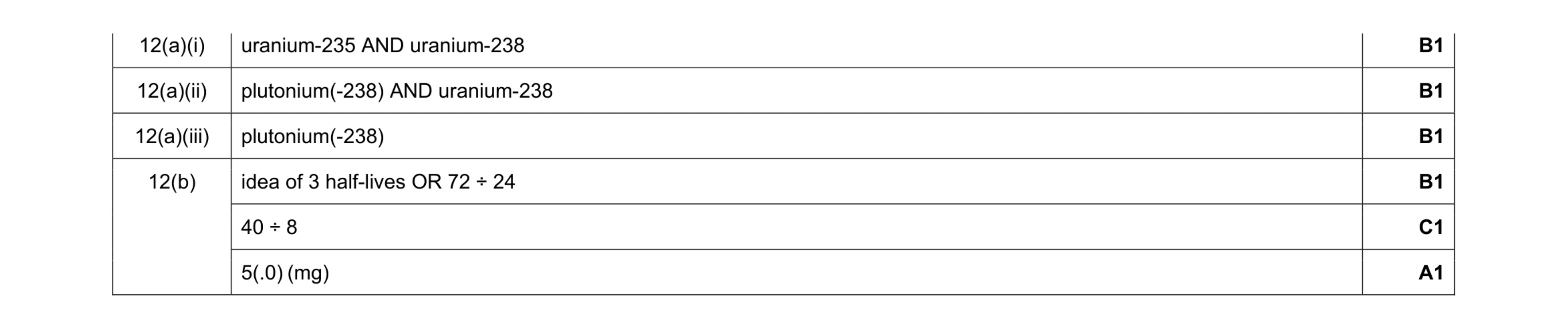 6
6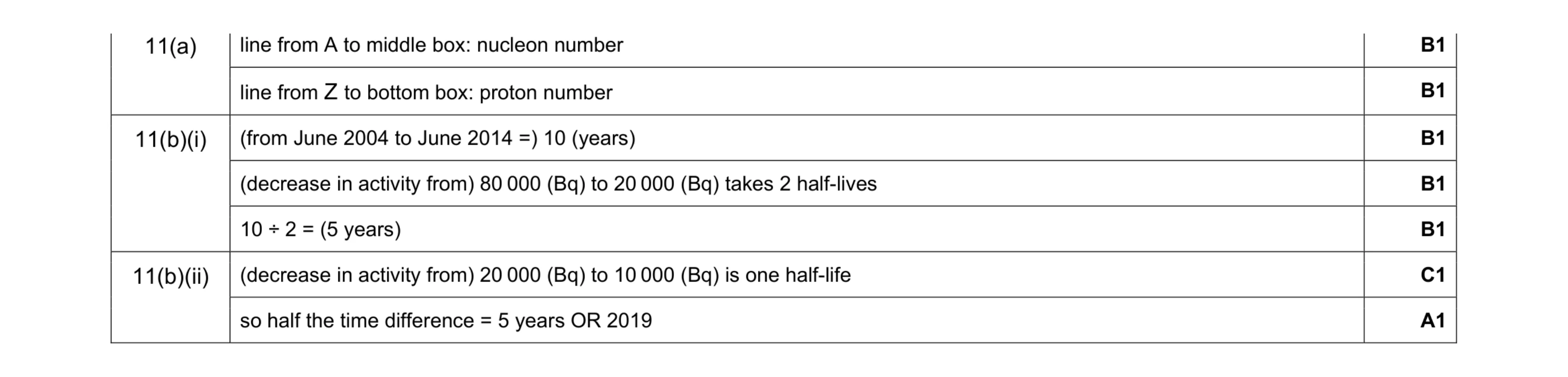 7
7 5
5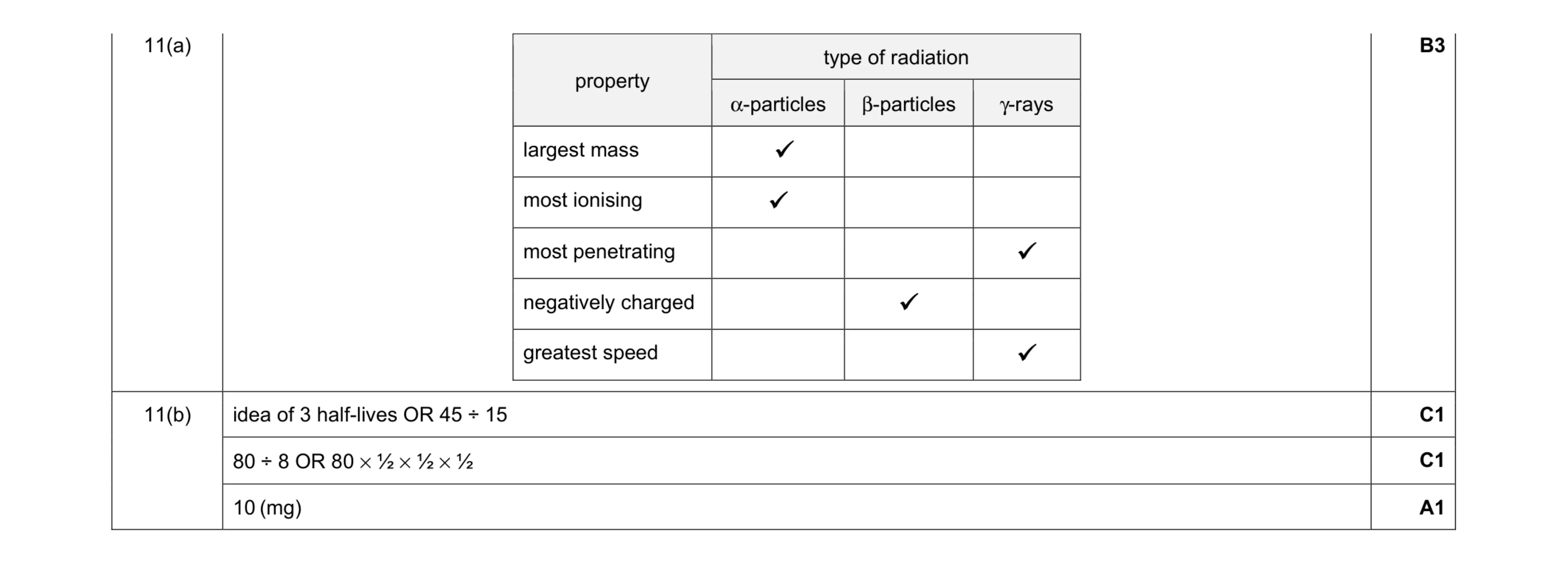 6
6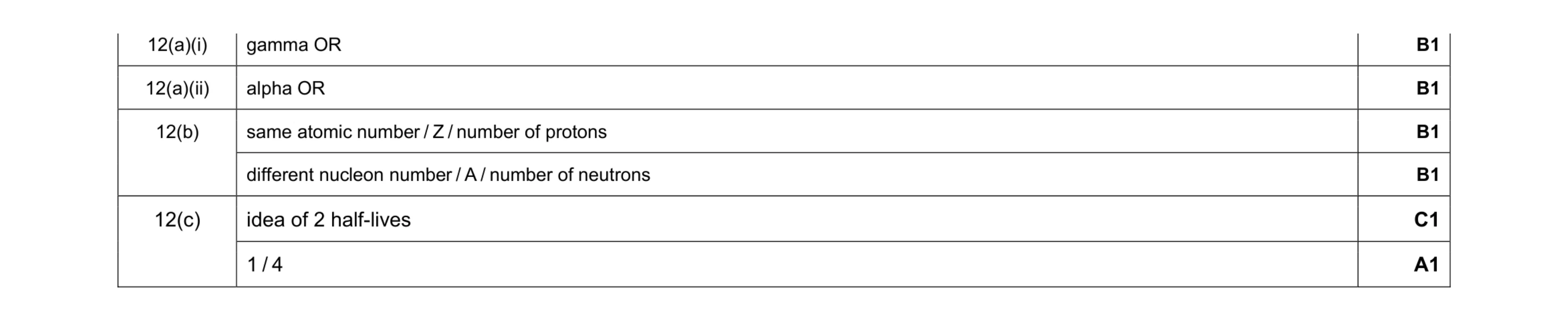 6
6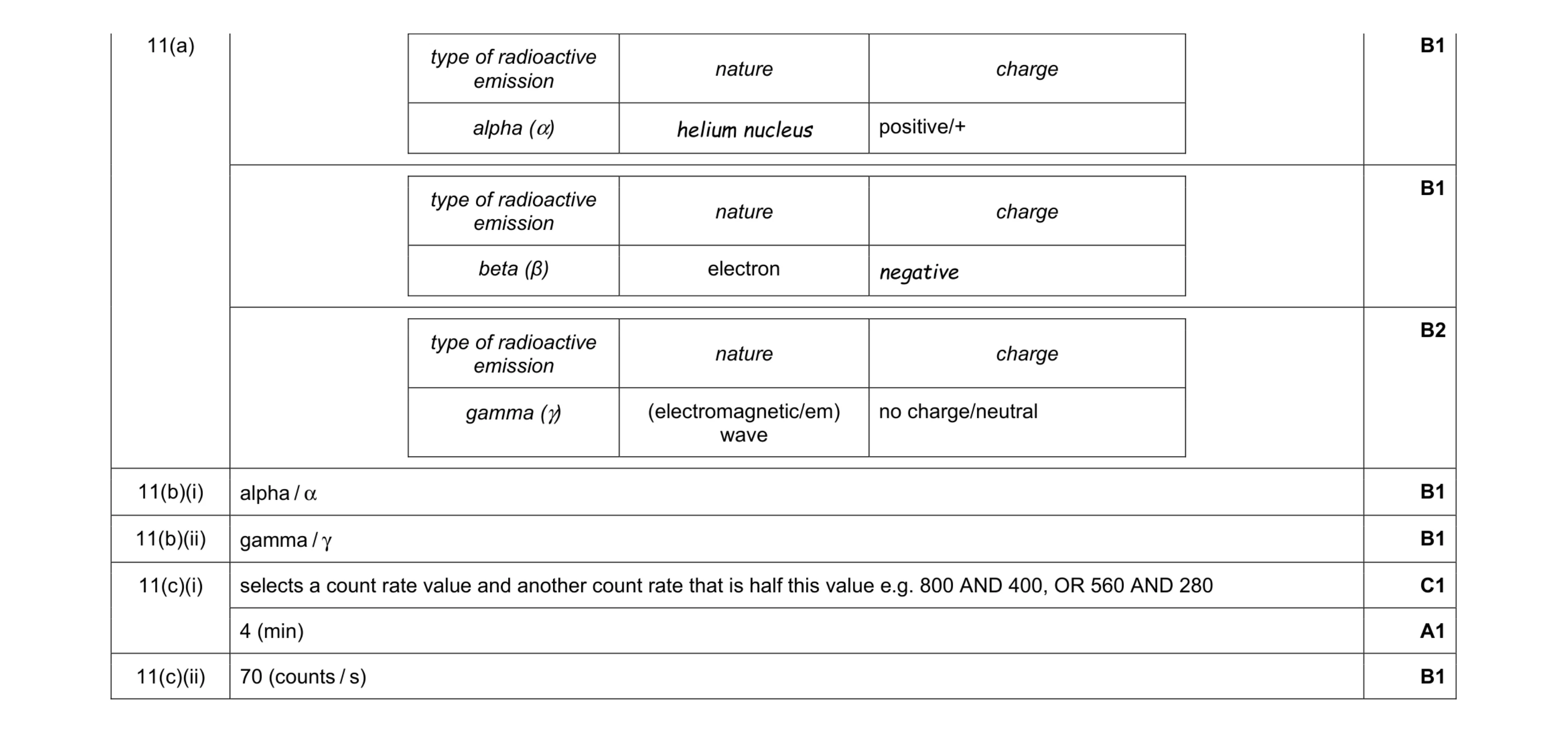 9
9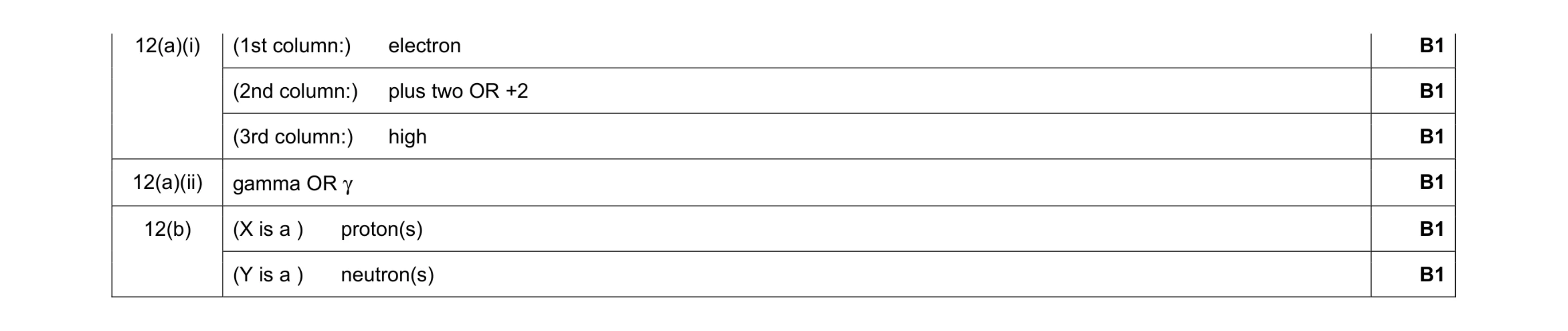 6
6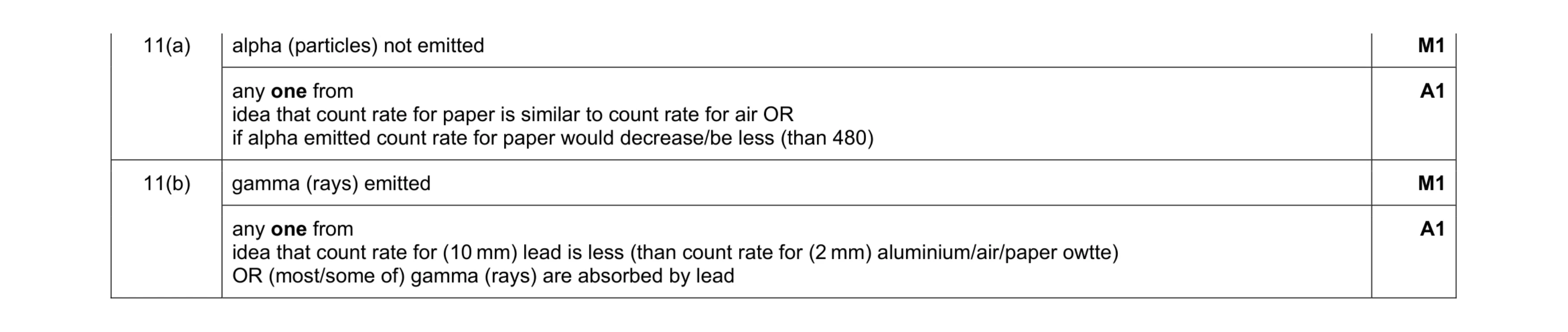 4
4 4
4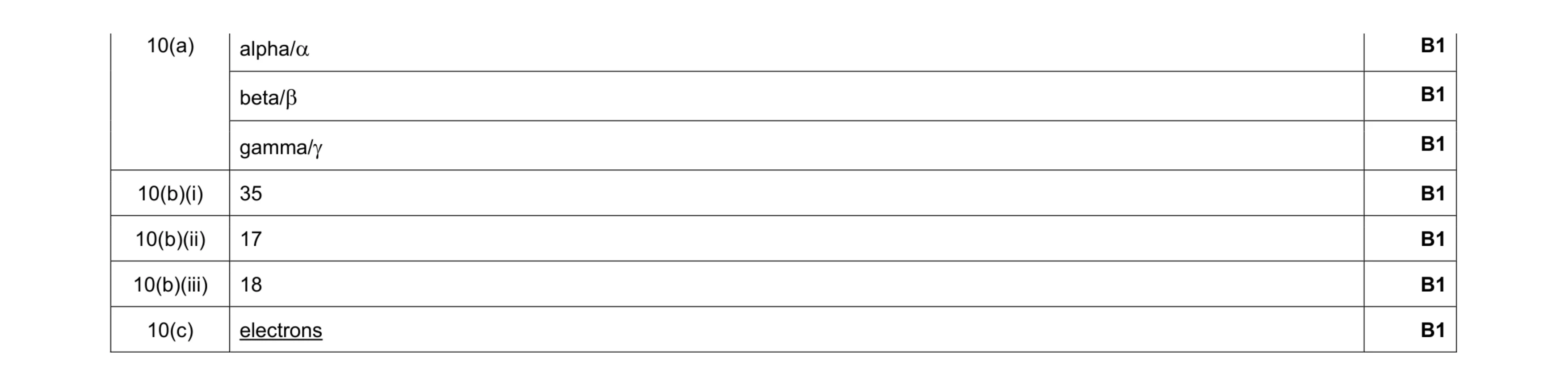 7
7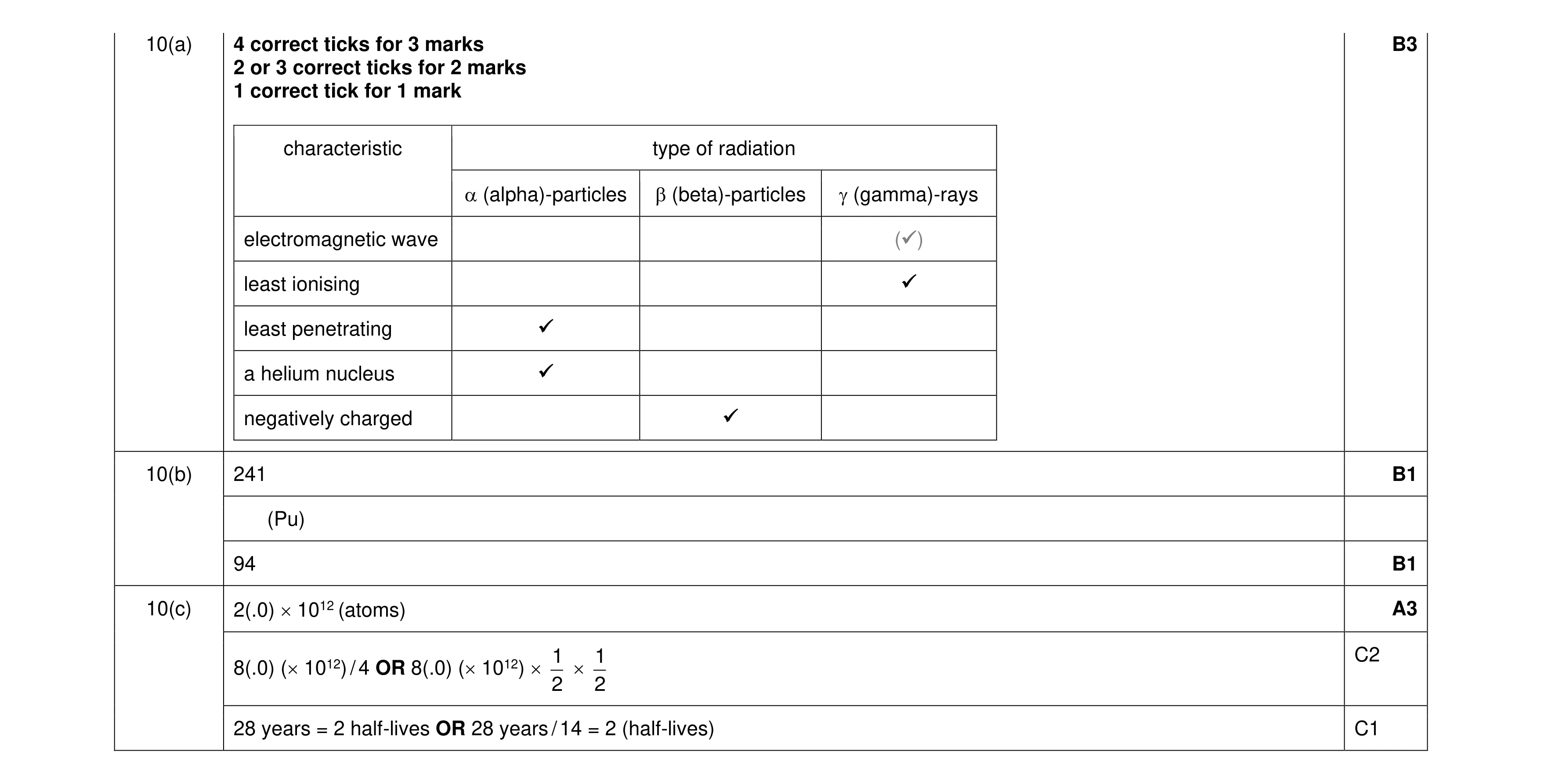 8
8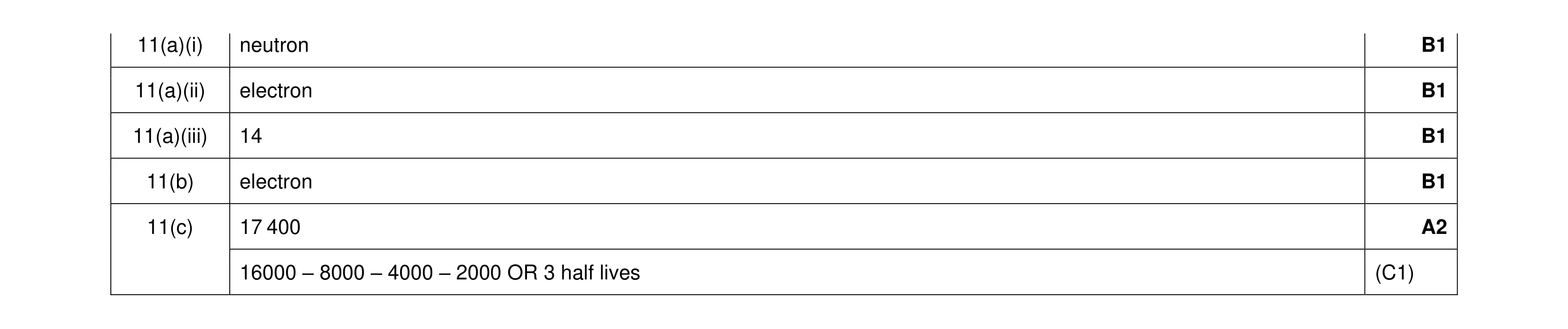 6
6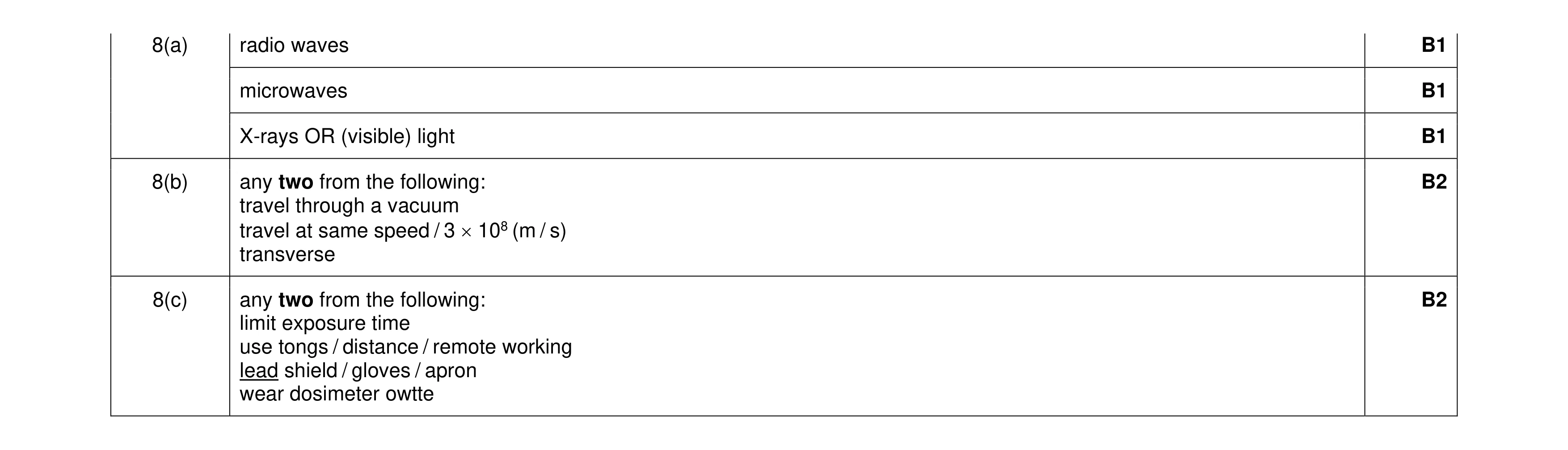 7
7 7
7 5
5 5
5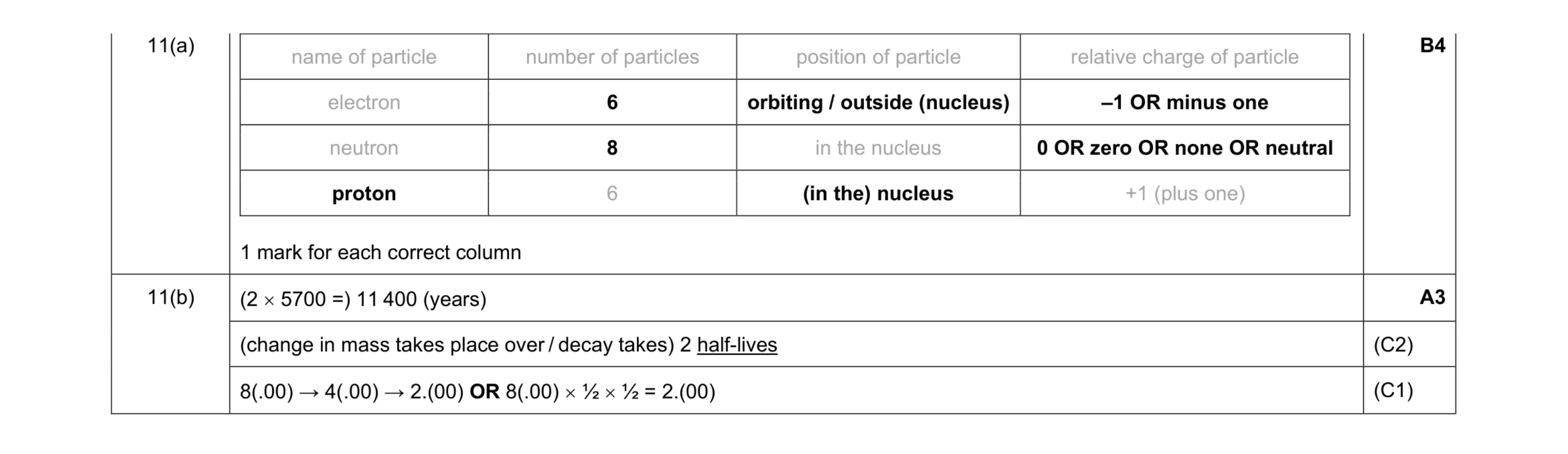 7
7 7
7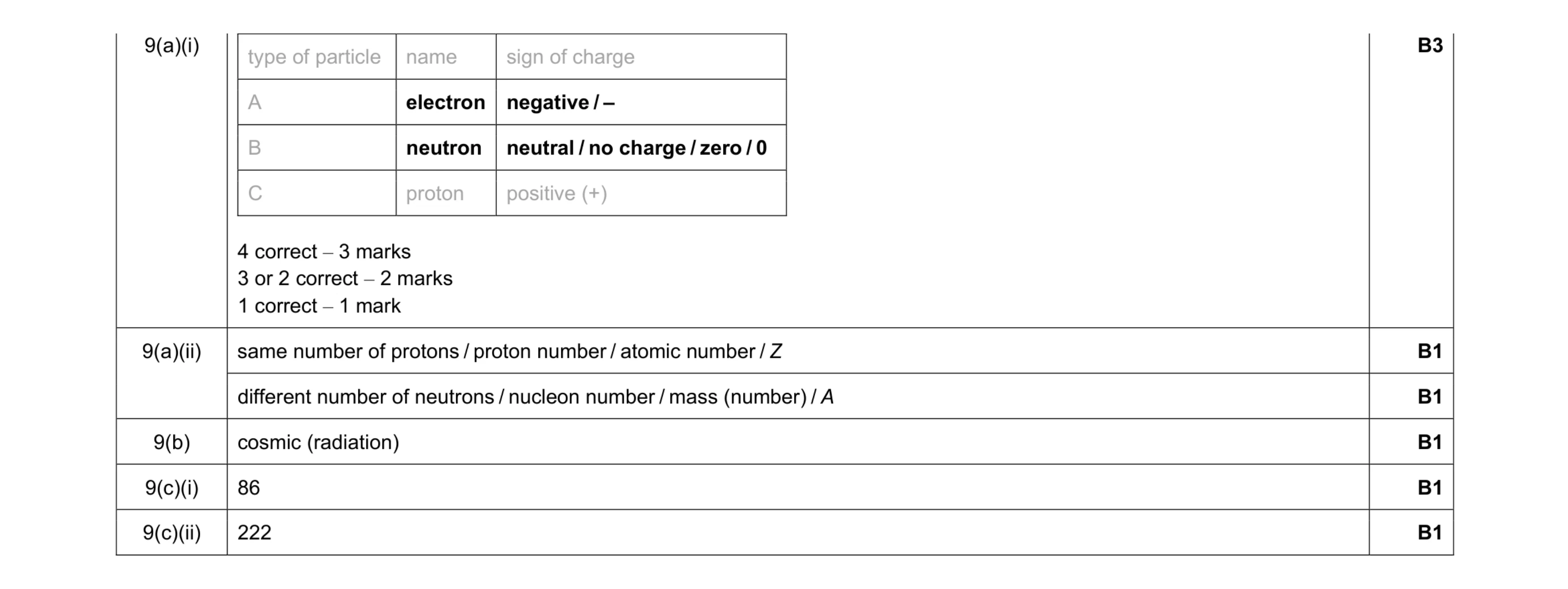 8
8 5
5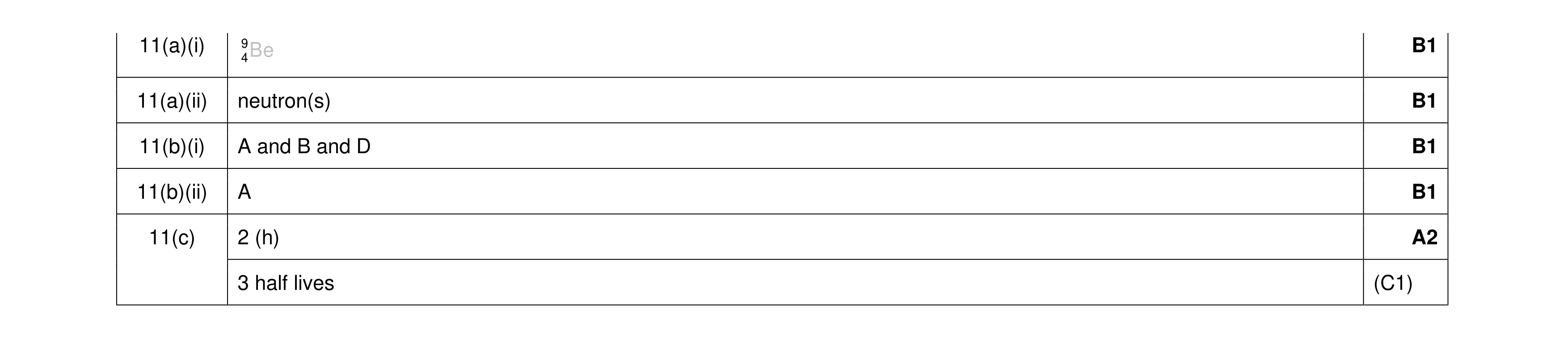 6
6 5
5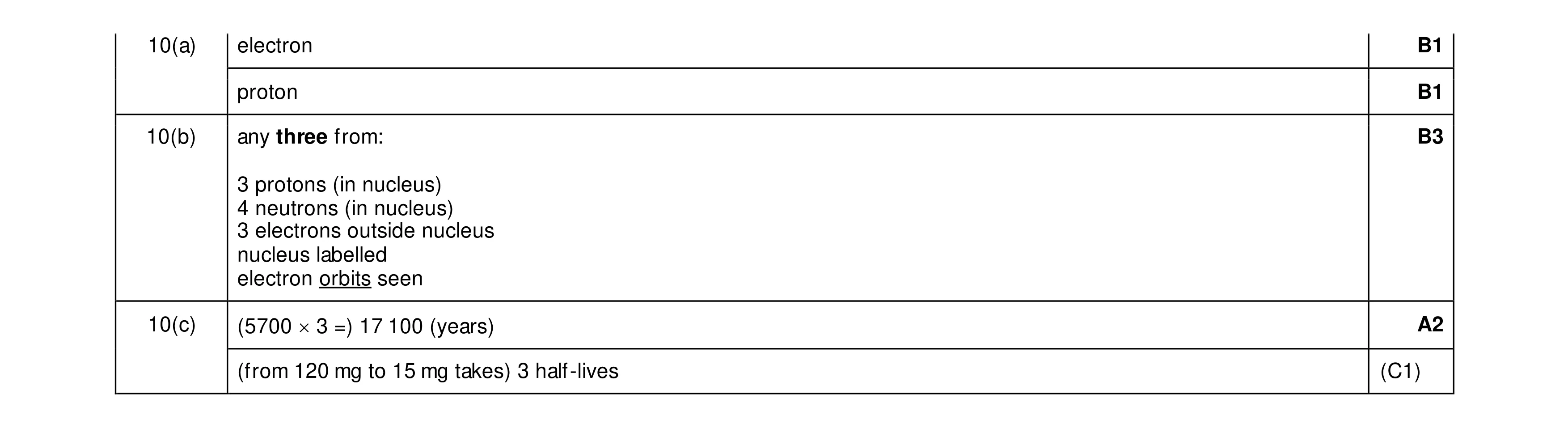 7
7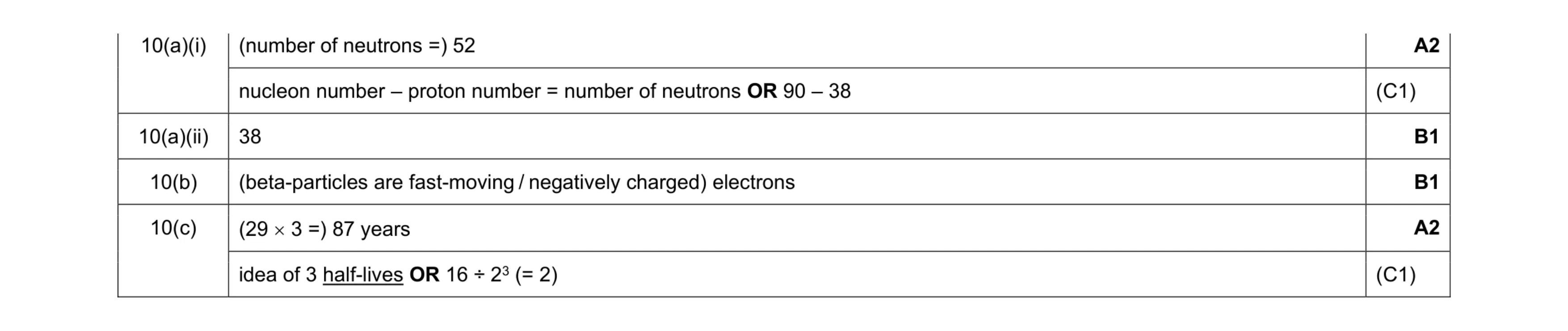 6
6 5
5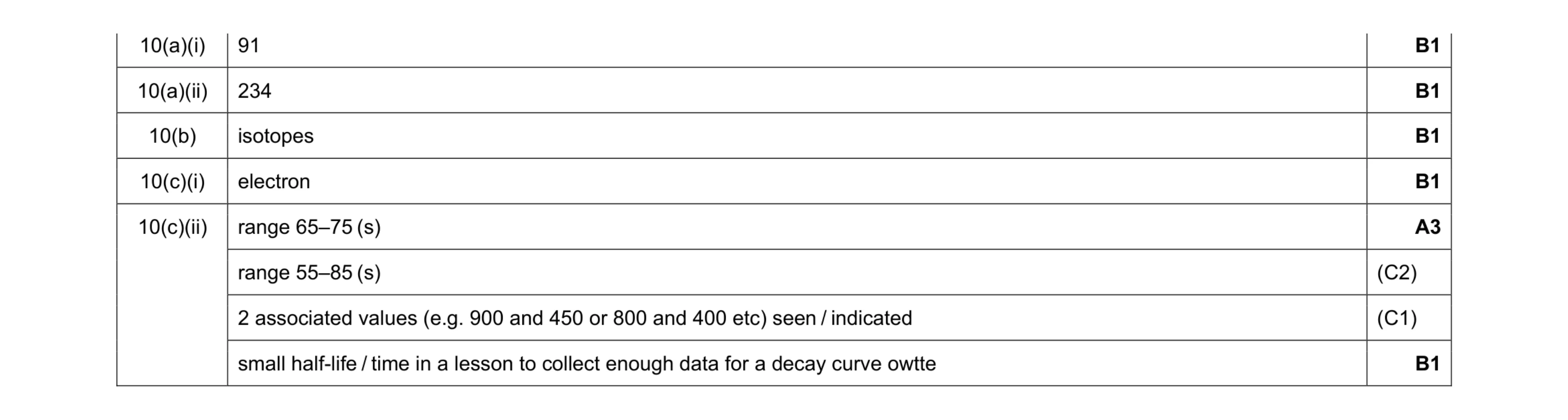 8
8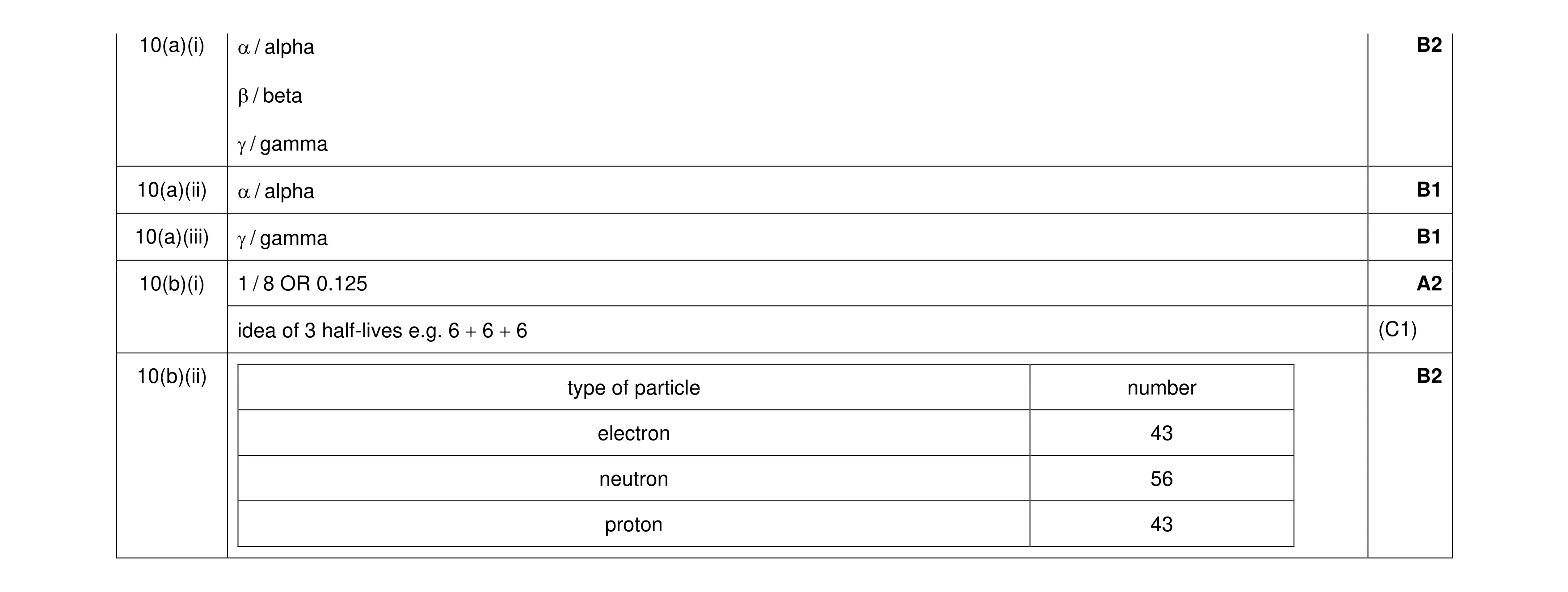 8
8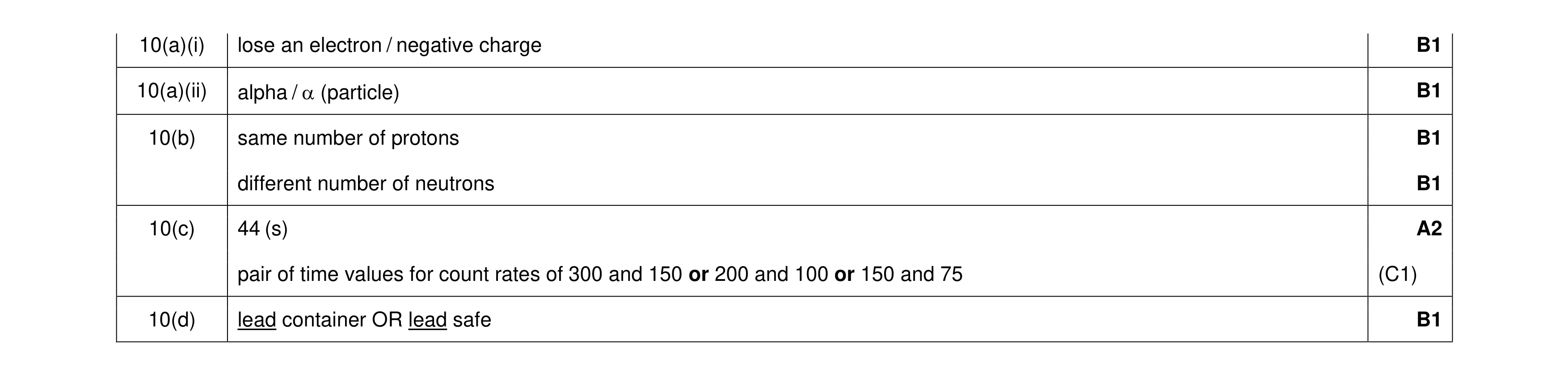 7
7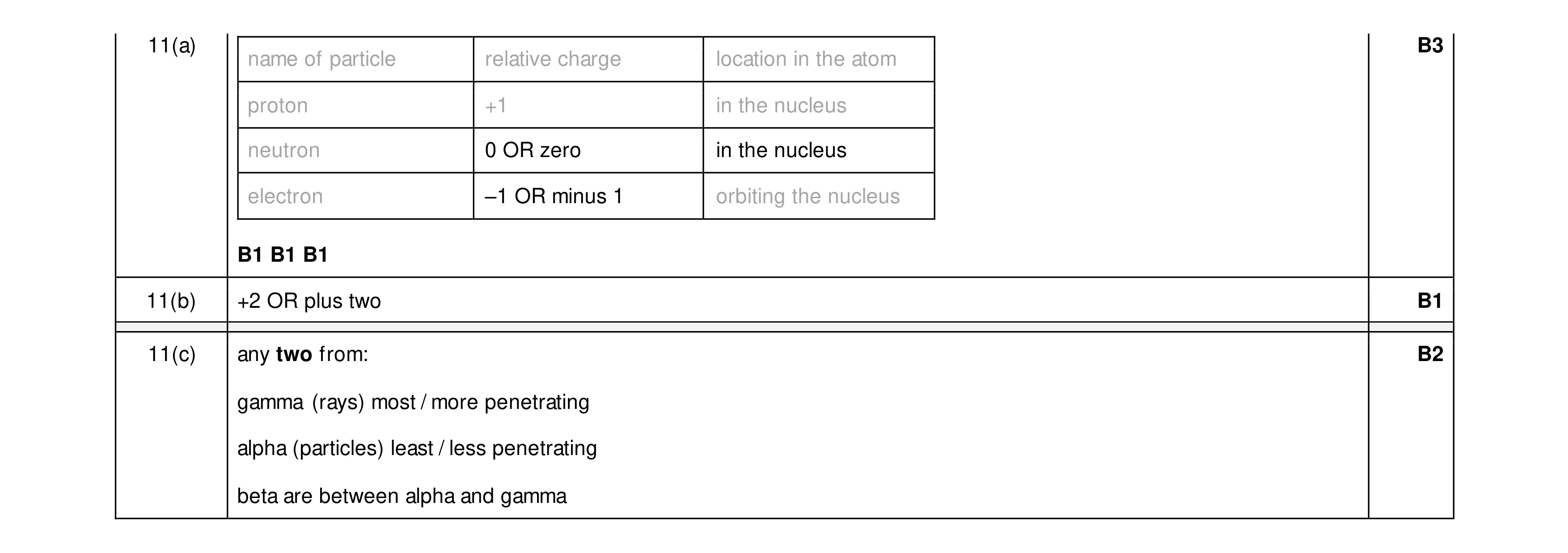 6
6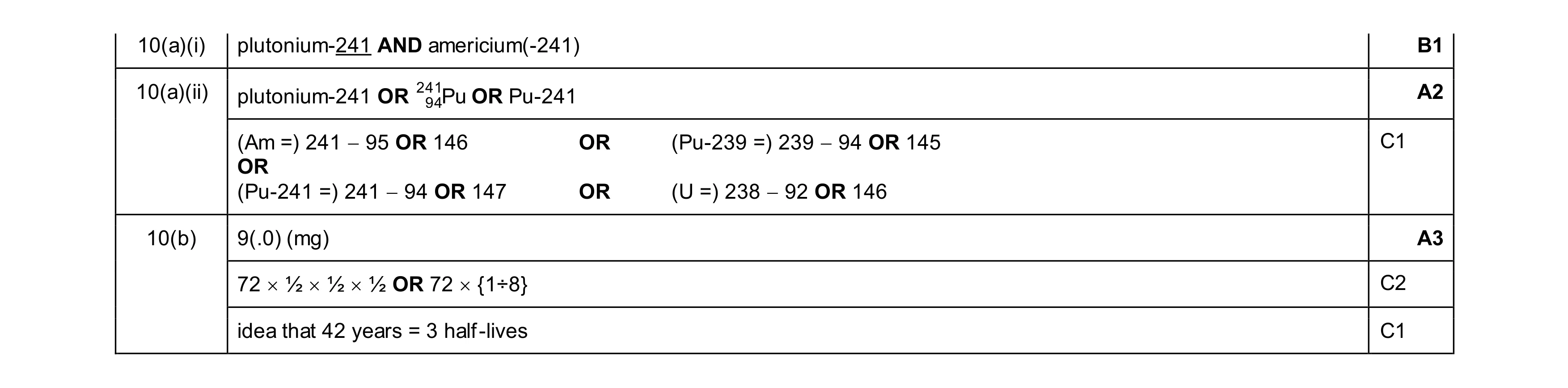 6
6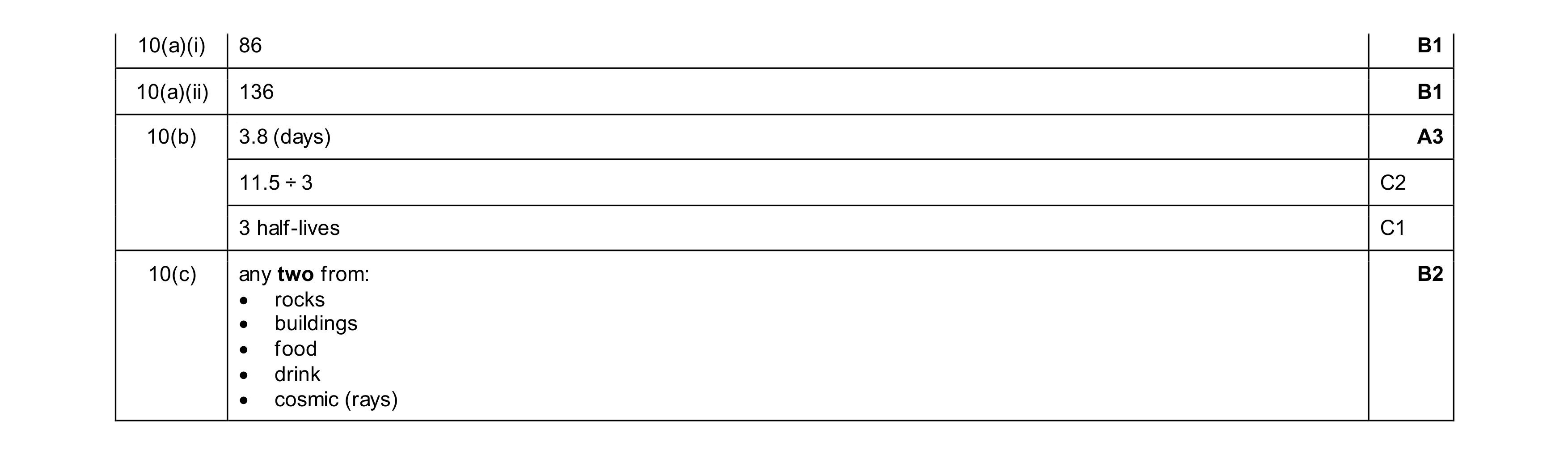 7
7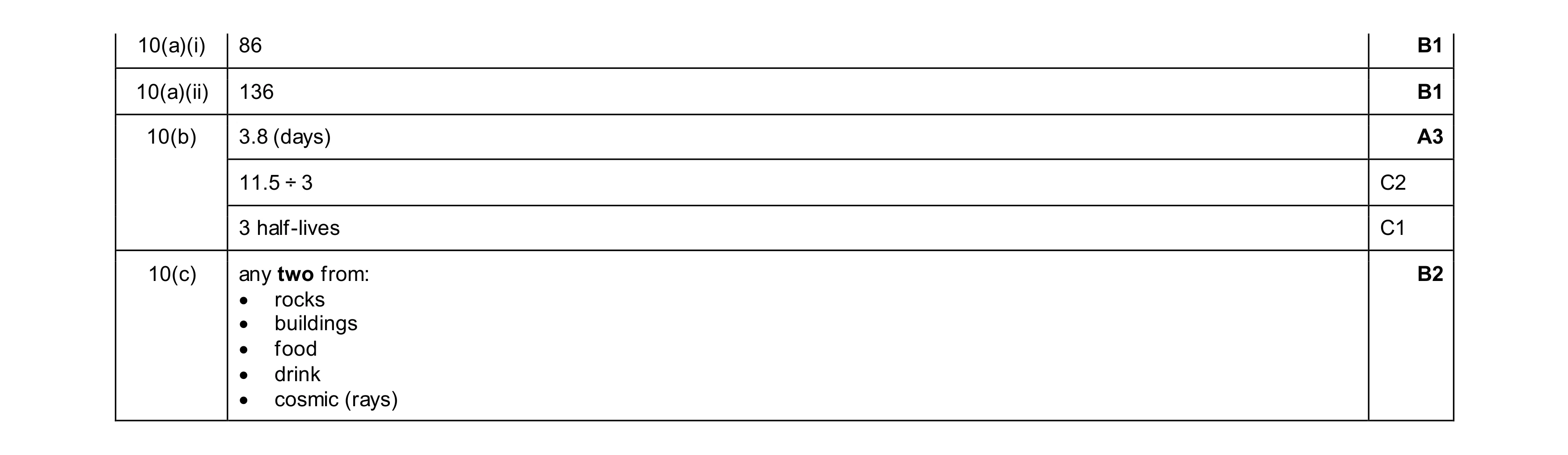 7
7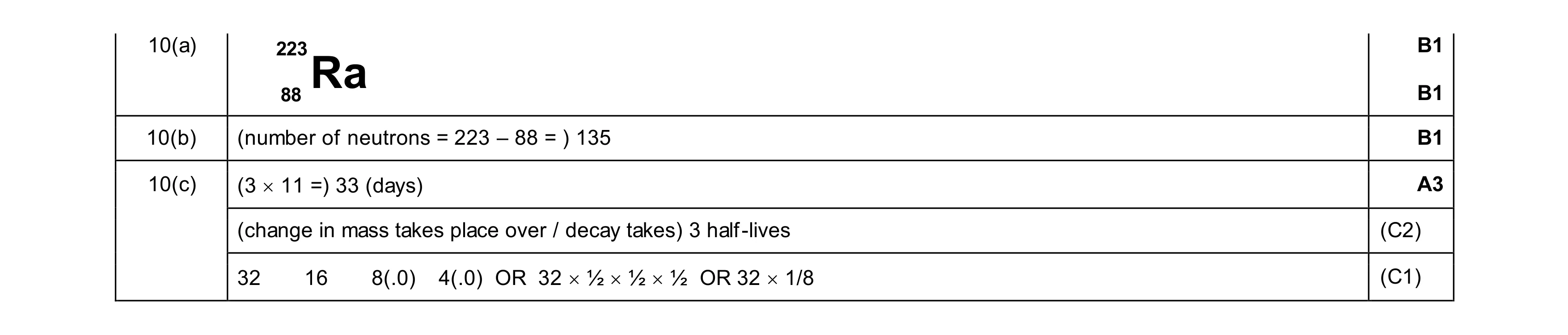 6
6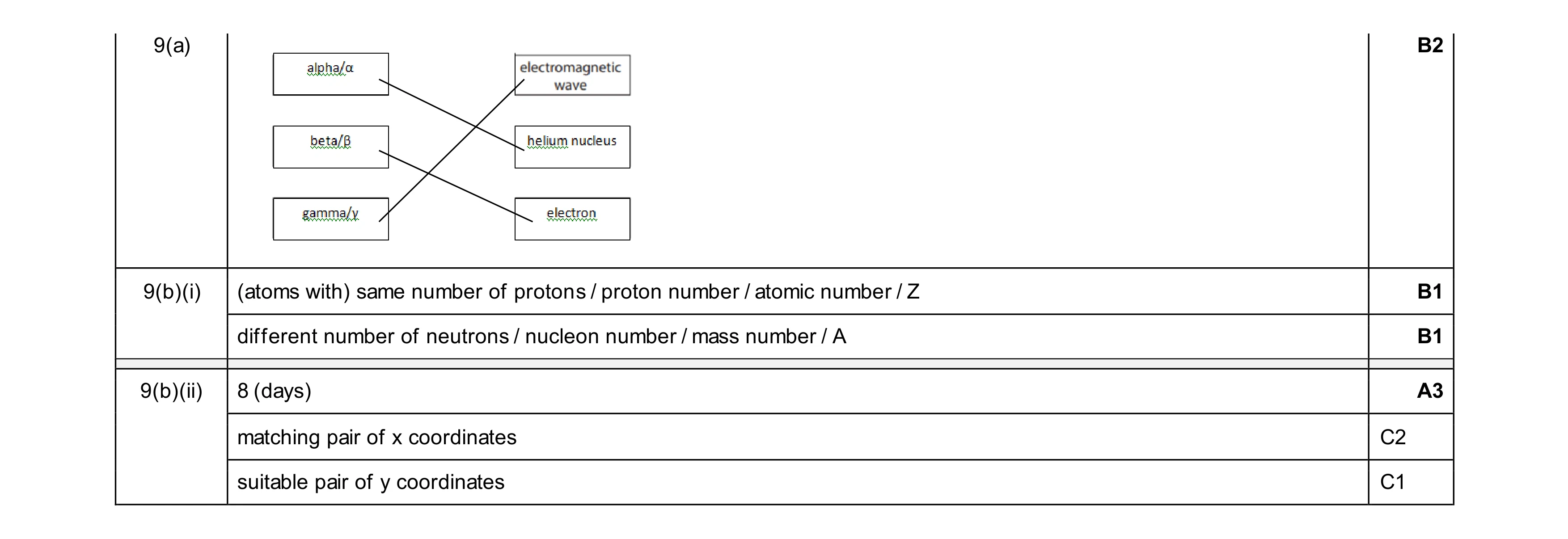 7
7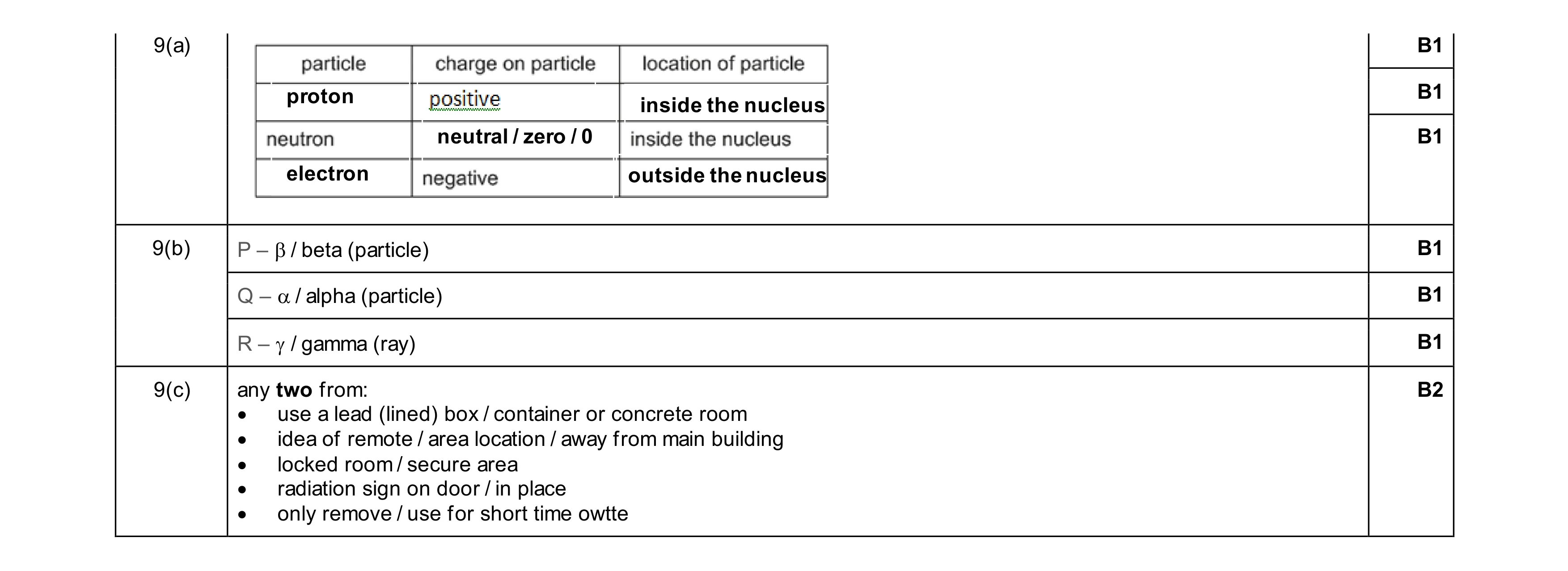 8
8