Cambridge IGCSE Physics 0625 — 2020 Feb/March Paper 3 · Variant 2
0625/32/F/M/20 · 12 questions · 80 marks · ≈90 min
The question paper and its mark scheme, free to read here and free to download. This is Cambridge’s own paper, exactly as it was sat.
Question paper16 pages
Mark scheme11 pages
Answers below. Sit the paper first if you are practising.
Questions as text
Q1 · A student places 8 similar coins in a pile, as shown in Fig
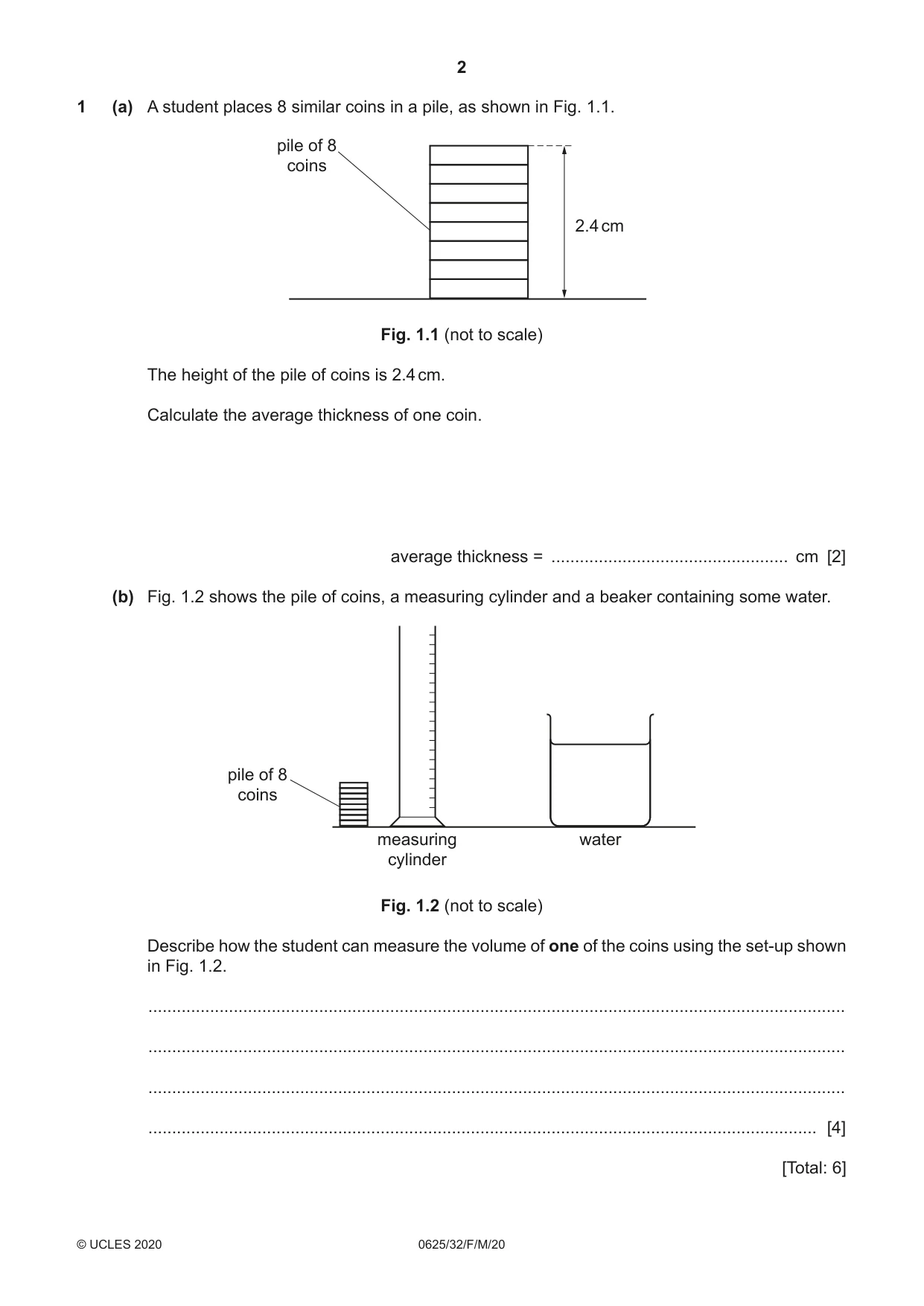
1 (a) A student places 8 similar coins in a pile, as shown in Fig. 1.1. pile of 8 coins 2.4 cm Fig. 1.1 (not to scale) The height of the pile of coins is 2.4 cm. Calculate the average thickness of one coin. average thickness = .................................................. cm [2] (b) Fig. 1.2 shows the pile of coins, a measuring cylinder and a beaker containing some water. pile of 8 coins measuring water cylinder Fig. 1.2 (not to scale) Describe how the student can measure the volume of one of the coins using the set-up shown in Fig. 1.2. ................................................................................................................................................... ................................................................................................................................................... ................................................................................................................................................... ............................................................................................................................................. [4] [Total: 6]
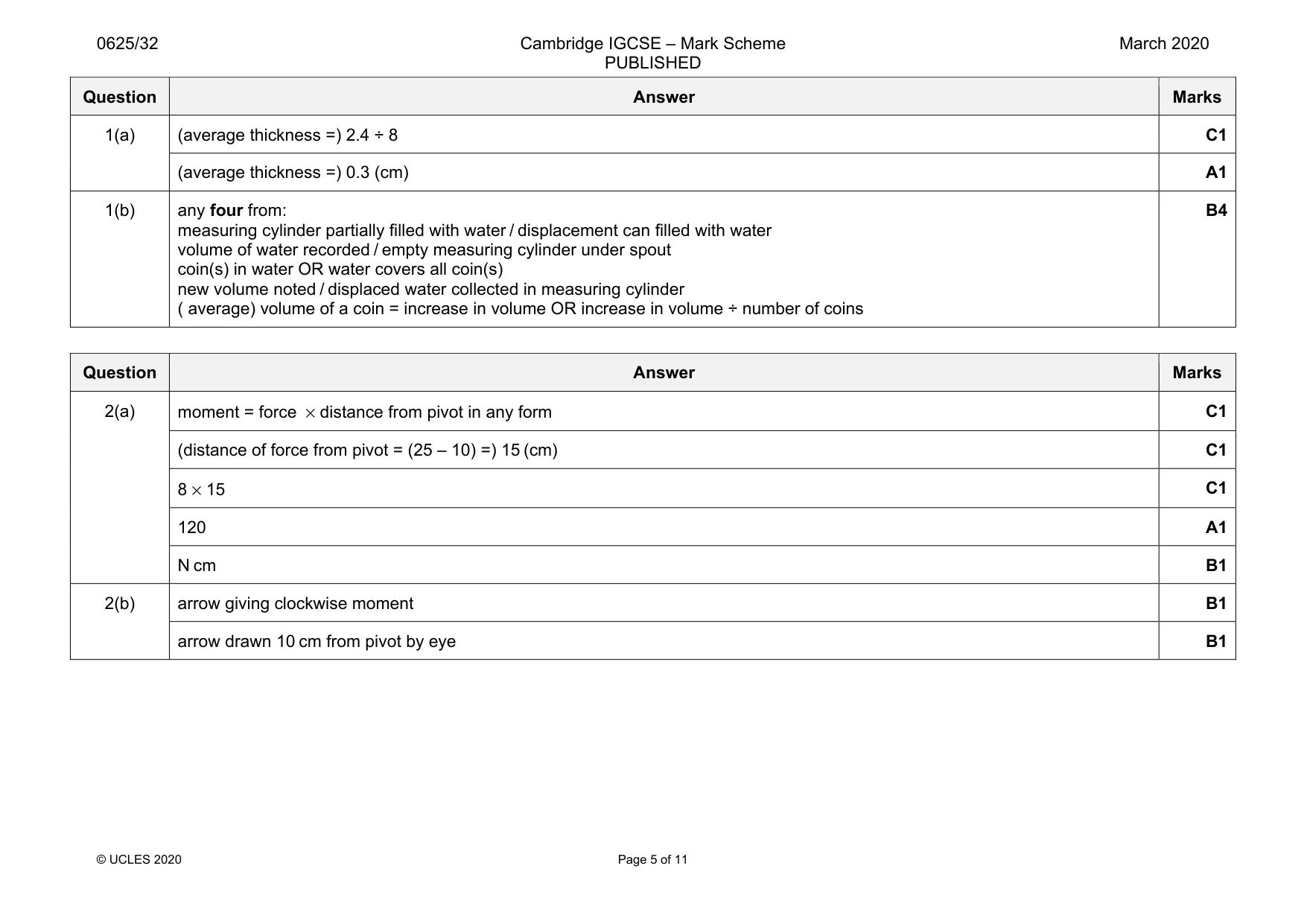
Mark scheme: 1(a) (average thickness =) 2.4 ÷ 8 C1 (average thickness =) 0.3 (cm) A1 1(b) any four from: measuring cylinder partially filled with water / displacement can filled with water volume of water recorded / empty measuring cylinder under spout coin(s) in water OR water covers all coin(s) new volume noted / displaced water collected in measuring cylinder ( average) volume of a coin = increase in volume OR increase in volume ÷ number of coins B4
More questions on Physical quantities and measurement techniques
Q2 · A 50 cm rule is balanced at its mid-point
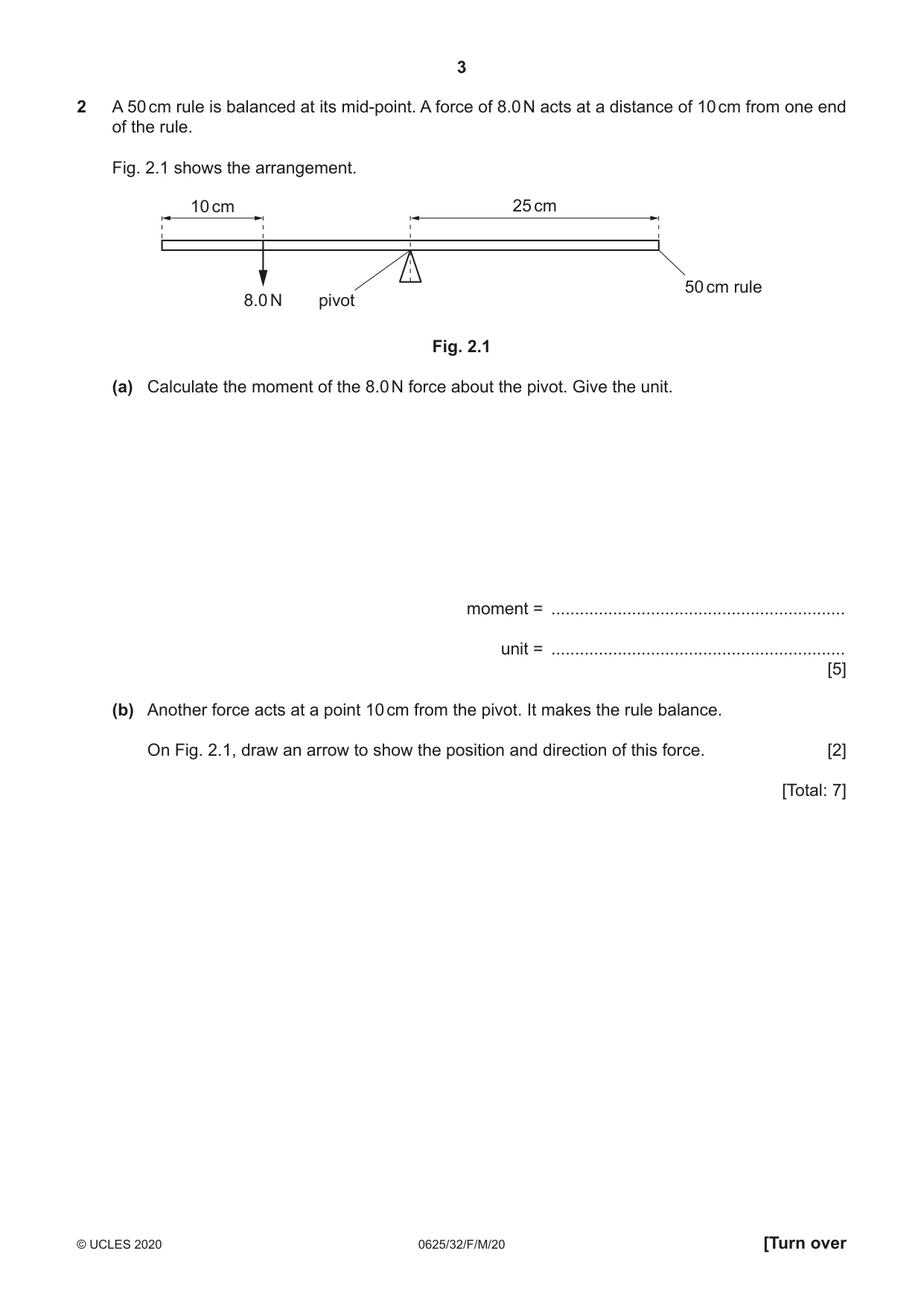
2 A 50 cm rule is balanced at its mid-point. A force of 8.0 N acts at a distance of 10 cm from one end of the rule. Fig. 2.1 shows the arrangement. 10 cm 25 cm 50 cm rule 8.0 N pivot Fig. 2.1 (a) Calculate the moment of the 8.0 N force about the pivot. Give the unit. moment = .............................................................. unit = .............................................................. [5] (b) Another force acts at a point 10 cm from the pivot. It makes the rule balance. On Fig. 2.1, draw an arrow to show the position and direction of this force. [2] [Total: 7]
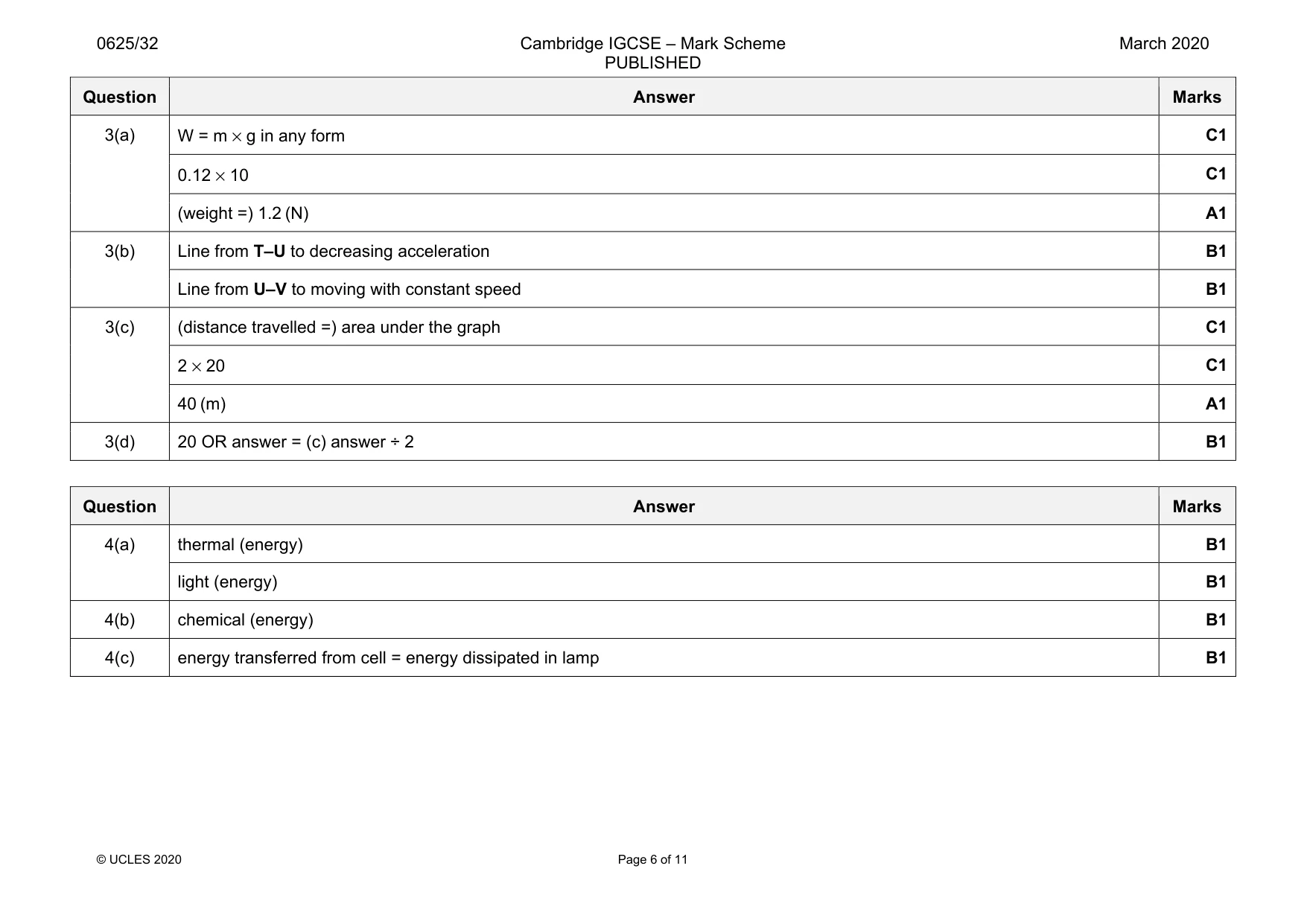
Mark scheme: 2(a) moment = force × distance from pivot in any form C1 (distance of force from pivot = (25 – 10) =) 15 (cm) C1 8 × 15 C1 120 A1 N cm B1 2(b) arrow giving clockwise moment B1 arrow drawn 10 cm from pivot by eye B1
Q3 · A student drops a ball from a high window
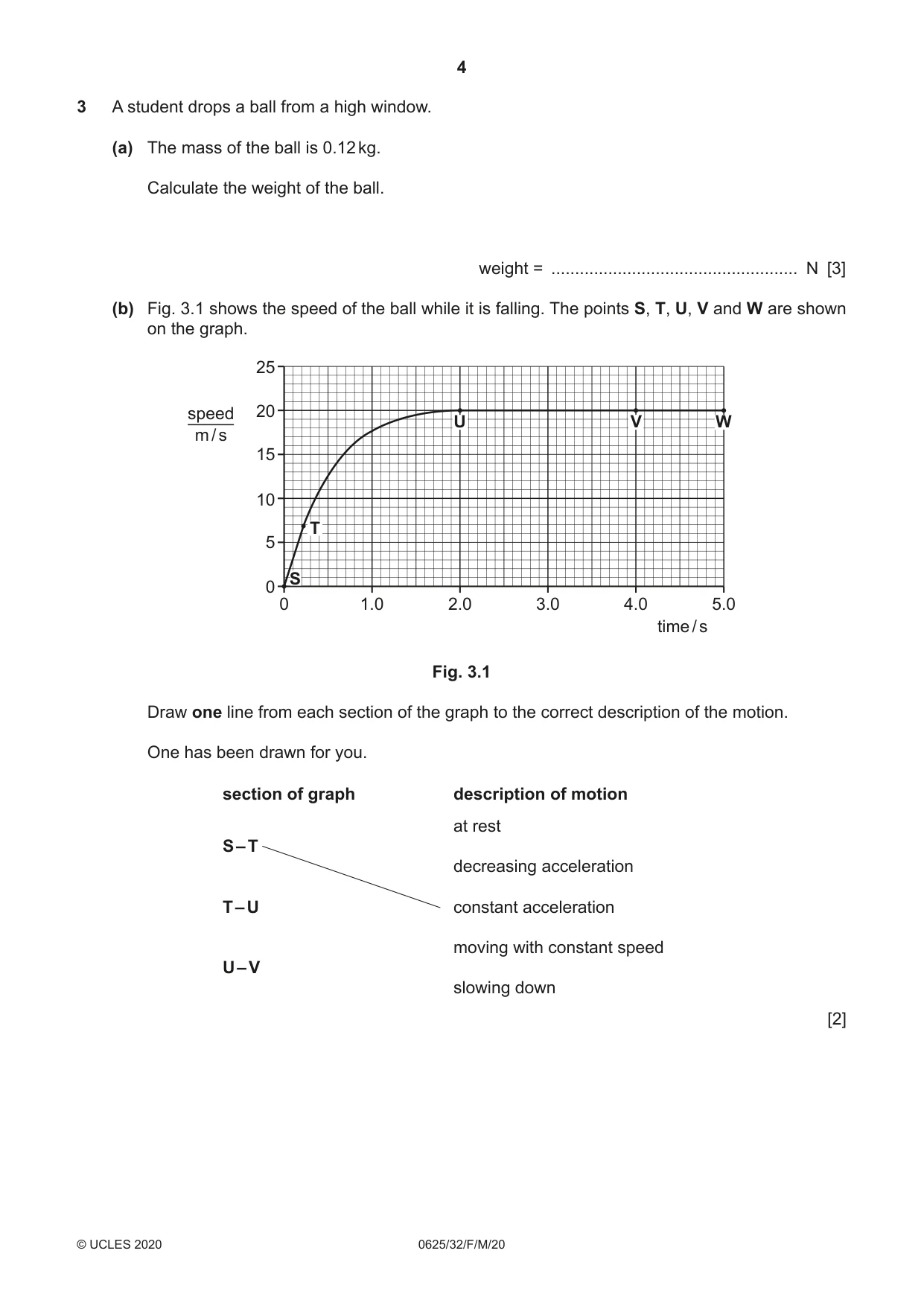
3 A student drops a ball from a high window. (a) The mass of the ball is 0.12 kg. Calculate the weight of the ball. weight = .................................................... N [3] (b) Fig. 3.1 shows the speed of the ball while it is falling. The points S, T, U, V and W are shown on the graph. 25 speed 20 U V W m / s 15 10 T 5 S 0 0 1.0 2.0 3.0 4.0 5.0 time / s Fig. 3.1 Draw one line from each section of the graph to the correct description of the motion. One has been drawn for you. section of graph description of motion at rest S – T decreasing acceleration T – U constant acceleration moving with constant speed U – V slowing down [2] (c) Determine the distance fallen by the ball in section U – V of the graph. distance = .................................................... m [3] (d) State the distance fallen by the ball in section V – W of the graph. distance = .................................................... m [1] [Total: 9]
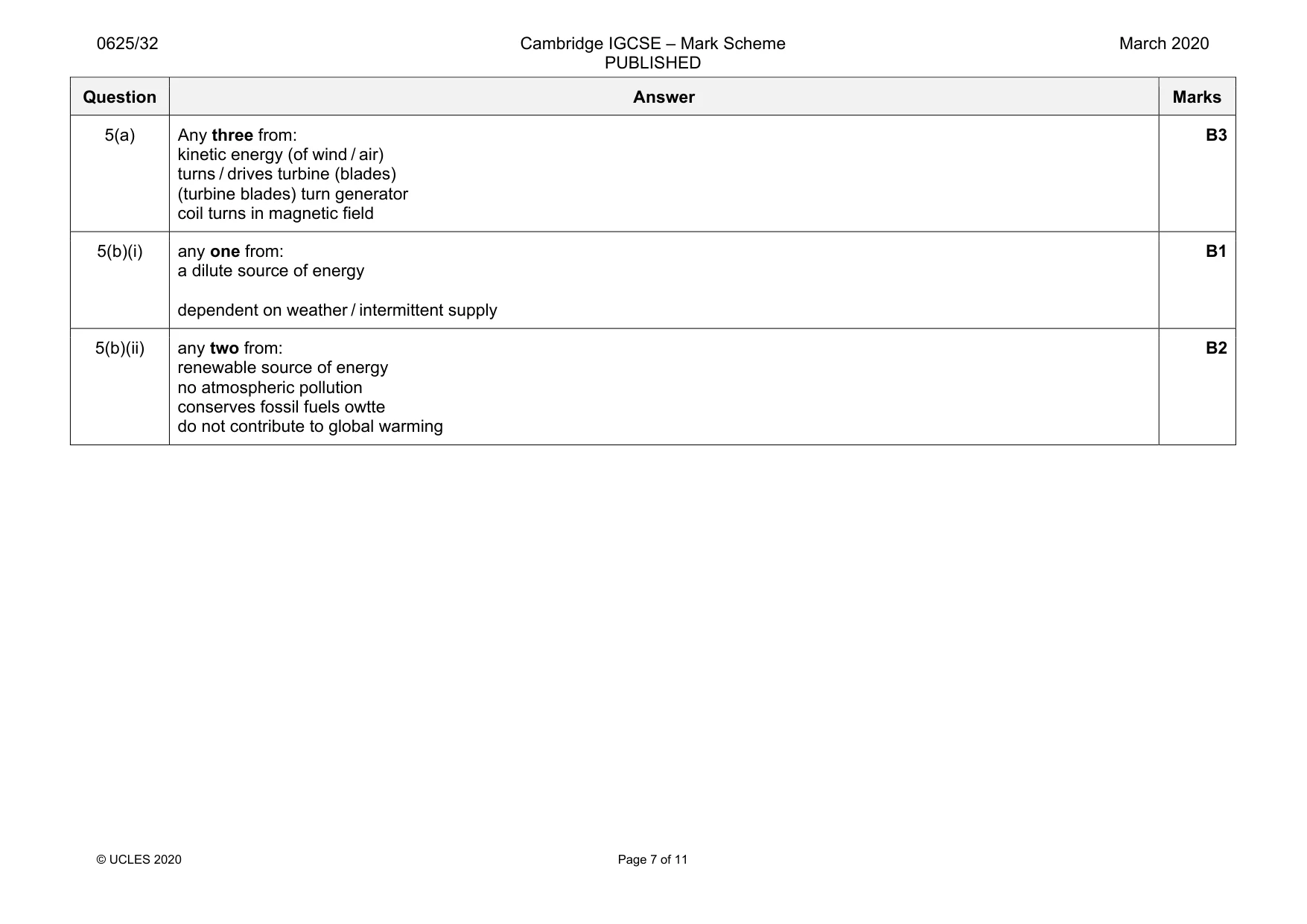
Mark scheme: 3(a) W = m × g in any form C1 0.12 × 10 C1 (weight =) 1.2 (N) A1 3(b) Line from T–U to decreasing acceleration B1 Line from U–V to moving with constant speed B1 3(c) (distance travelled =) area under the graph C1 2 × 20 C1 40 (m) A1 3(d) 20 OR answer = (c) answer ÷ 2 B1
Question 4
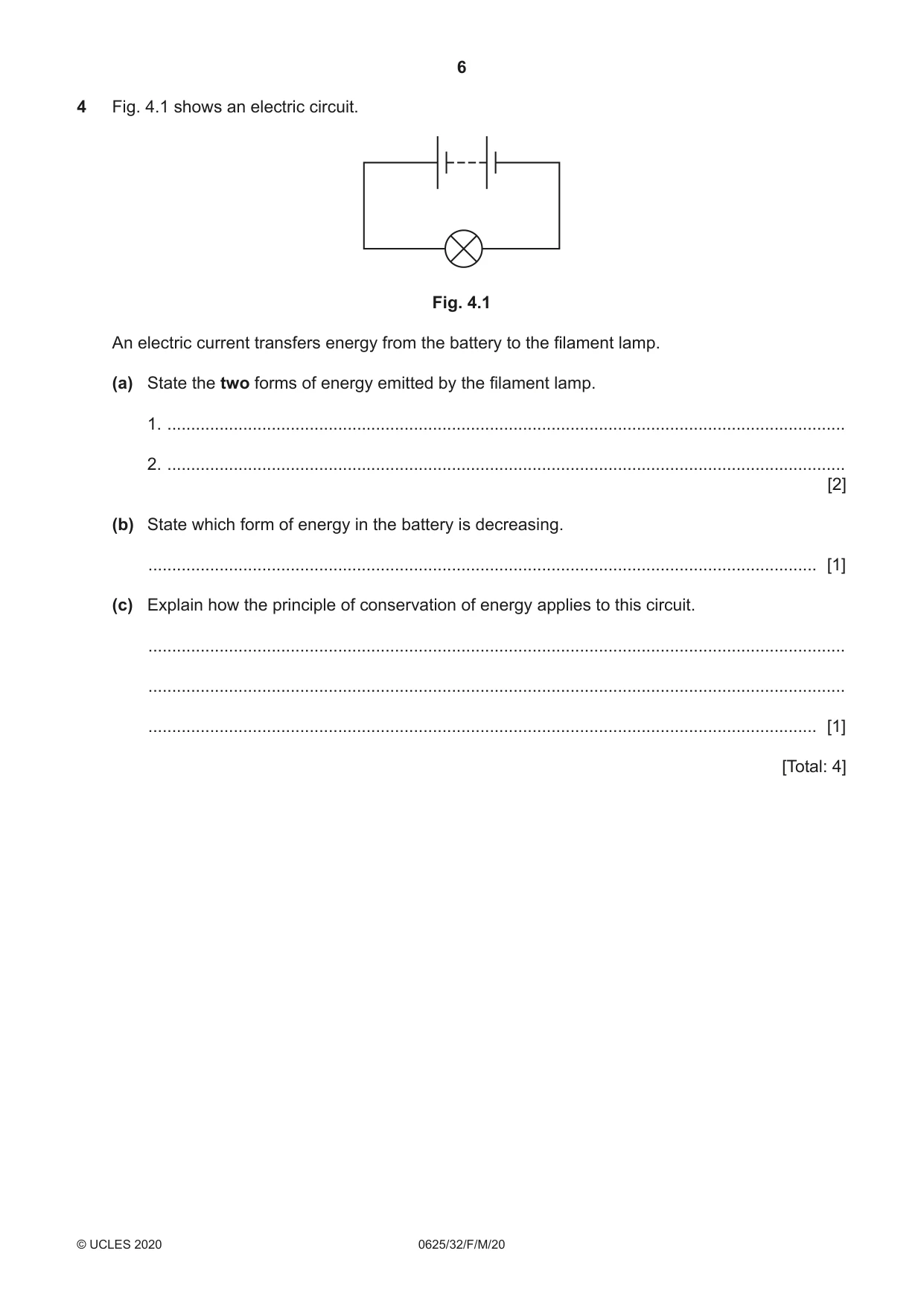
4 Fig. 4.1 shows an electric circuit. Fig. 4.1 An electric current transfers energy from the battery to the filament lamp. (a) State the two forms of energy emitted by the filament lamp. 1. ............................................................................................................................................... 2. ............................................................................................................................................... [2] (b) State which form of energy in the battery is decreasing. ............................................................................................................................................. [1] (c) Explain how the principle of conservation of energy applies to this circuit. ................................................................................................................................................... ................................................................................................................................................... ............................................................................................................................................. [1] [Total: 4]
Mark scheme: 4(a) thermal (energy) B1 light (energy) B1 4(b) chemical (energy) B1 4(c) energy transferred from cell = energy dissipated in lamp B1
Question 5
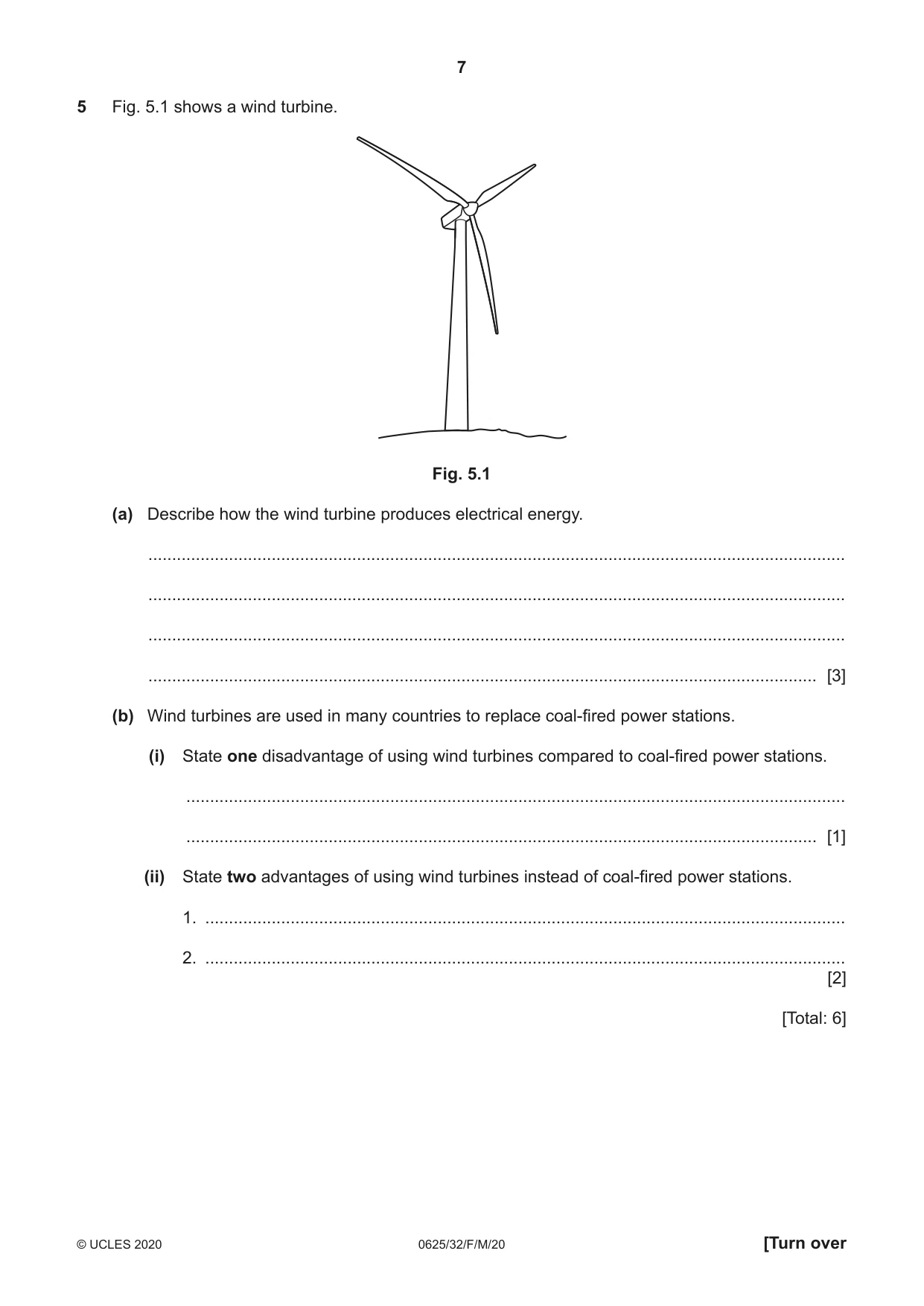
5 Fig. 5.1 shows a wind turbine. Fig. 5.1 (a) Describe how the wind turbine produces electrical energy. ................................................................................................................................................... ................................................................................................................................................... ................................................................................................................................................... ............................................................................................................................................. [3] (b) Wind turbines are used in many countries to replace coal-fired power stations. (i) State one disadvantage of using wind turbines compared to coal-fired power stations. ........................................................................................................................................... ..................................................................................................................................... [1] (ii) State two advantages of using wind turbines instead of coal-fired power stations. 1. ....................................................................................................................................... 2. ....................................................................................................................................... [2] [Total: 6]
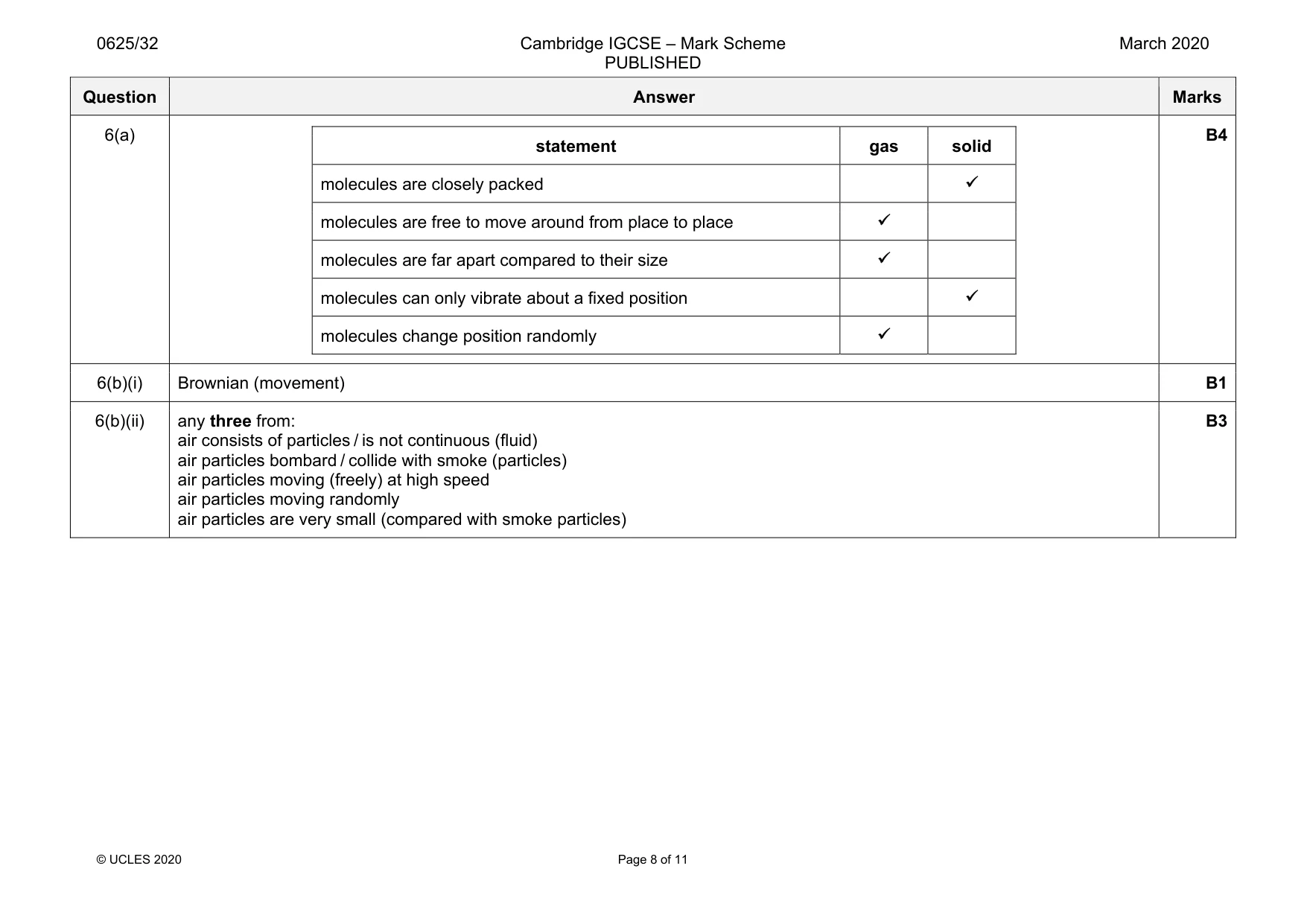
Mark scheme: 5(a) Any three from: kinetic energy (of wind / air) turns / drives turbine (blades) (turbine blades) turn generator coil turns in magnetic field B3 5(b)(i) any one from: a dilute source of energy dependent on weather / intermittent supply B1 5(b)(ii) any two from: renewable source of energy no atmospheric pollution conserves fossil fuels owtte do not contribute to global warming B2
Q6 · A list of statements about molecules in gases and solids
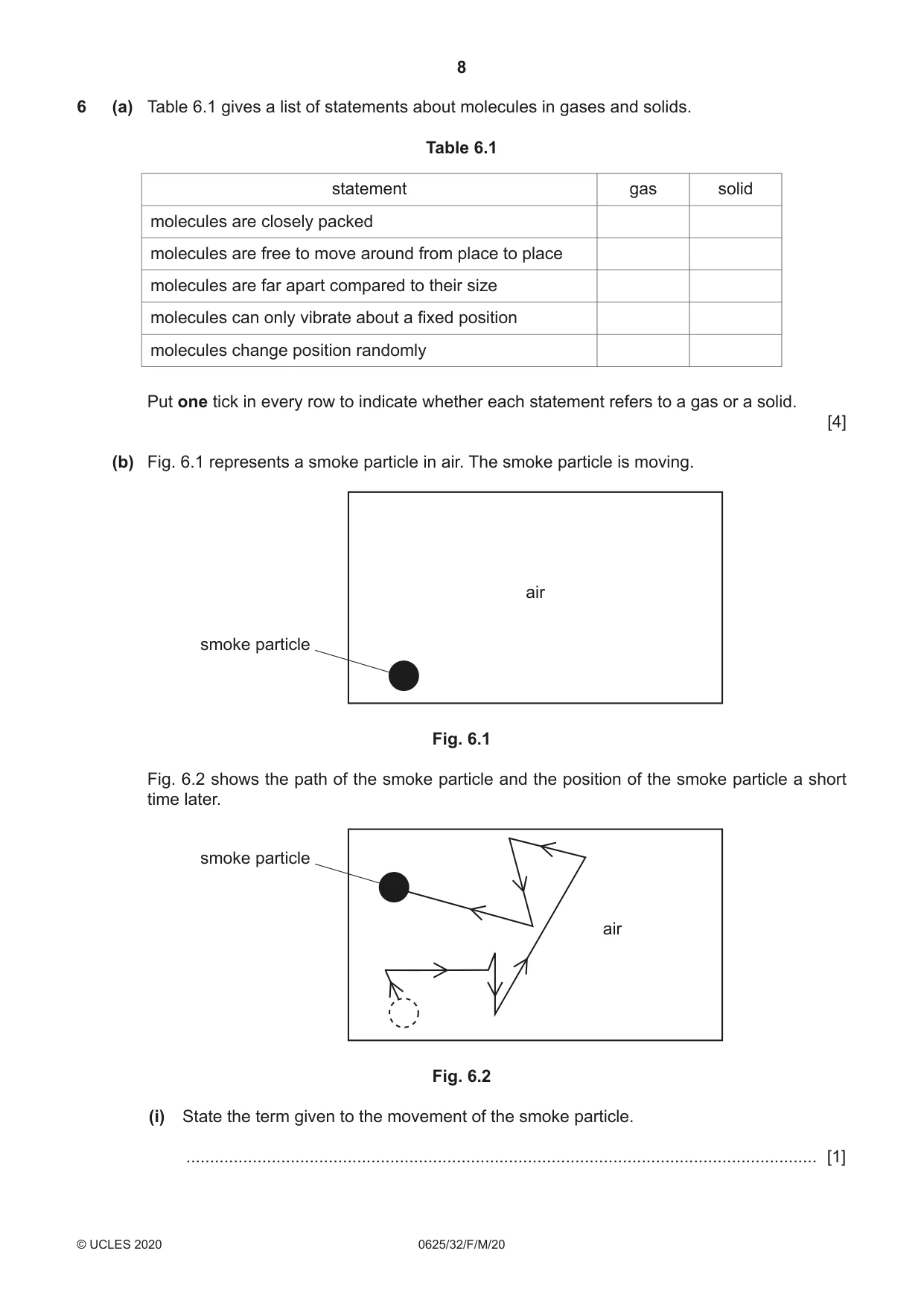
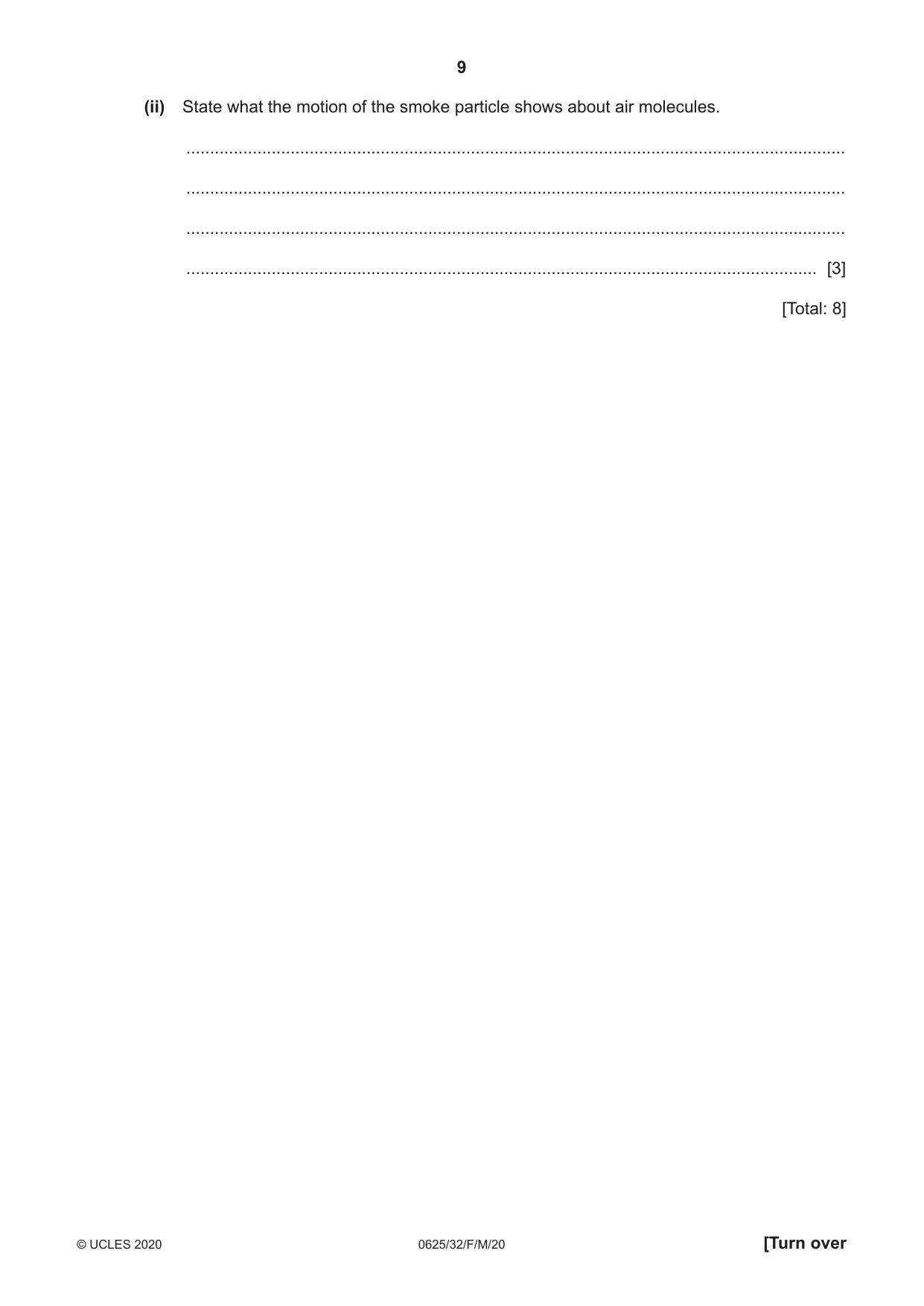
6 (a) Table 6.1 gives a list of statements about molecules in gases and solids. Table 6.1 statement gas solid molecules are closely packed molecules are free to move around from place to place molecules are far apart compared to their size molecules can only vibrate about a fixed position molecules change position randomly Put one tick in every row to indicate whether each statement refers to a gas or a solid. [4] (b) Fig. 6.1 represents a smoke particle in air. The smoke particle is moving. air smoke particle Fig. 6.1 Fig. 6.2 shows the path of the smoke particle and the position of the smoke particle a short time later. smoke particle air Fig. 6.2 (i) State the term given to the movement of the smoke particle. ..................................................................................................................................... [1] (ii) State what the motion of the smoke particle shows about air molecules. ........................................................................................................................................... ........................................................................................................................................... ........................................................................................................................................... ..................................................................................................................................... [3] [Total: 8]
Mark scheme: 6(a) statement gas solid molecules are closely packed molecules are free to move around from place to place molecules are far apart compared to their size molecules can only vibrate about a fixed position molecules change position randomly B4 6(b)(i) Brownian (movement) B1 6(b)(ii) any three from: air consists of particles / is not continuous (fluid) air particles bombard / collide with smoke (particles) air particles moving (freely) at high speed air particles moving randomly air particles are very small (compared with smoke particles) B3
Q7 · Equal volumes of steel, oil and hydrogen are heated from 20 °C to 60 °C
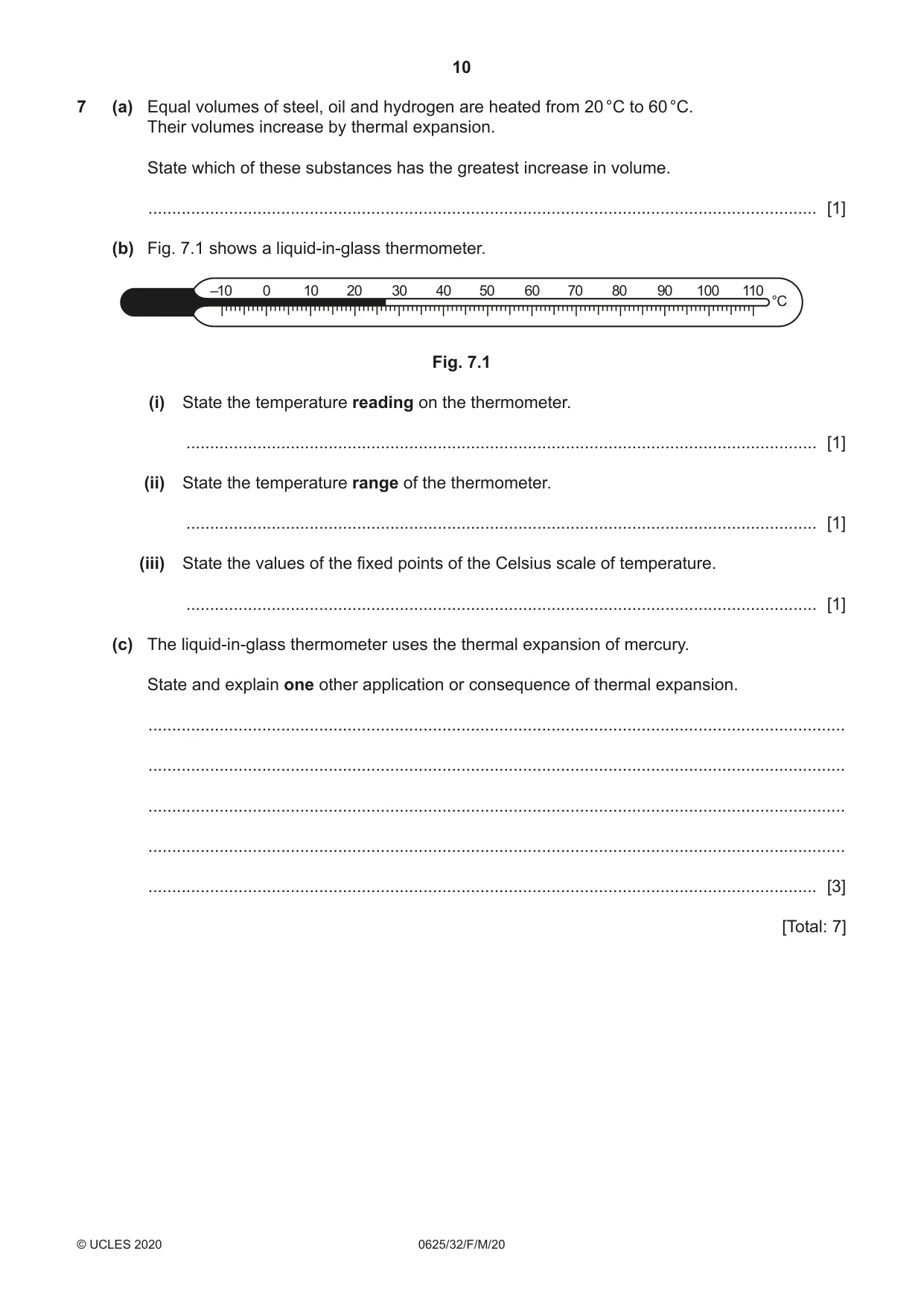
7 (a) Equal volumes of steel, oil and hydrogen are heated from 20 °C to 60 °C. Their volumes increase by thermal expansion. State which of these substances has the greatest increase in volume. ............................................................................................................................................. [1] (b) Fig. 7.1 shows a liquid-in-glass thermometer. –10 0 10 20 30 40 50 60 70 80 90 100 110 °C Fig. 7.1 (i) State the temperature reading on the thermometer. ..................................................................................................................................... [1] (ii) State the temperature range of the thermometer. ..................................................................................................................................... [1] (iii) State the values of the fixed points of the Celsius scale of temperature. ..................................................................................................................................... [1] (c) The liquid-in-glass thermometer uses the thermal expansion of mercury. State and explain one other application or consequence of thermal expansion. ................................................................................................................................................... ................................................................................................................................................... ................................................................................................................................................... ................................................................................................................................................... ............................................................................................................................................. [3] [Total: 7]
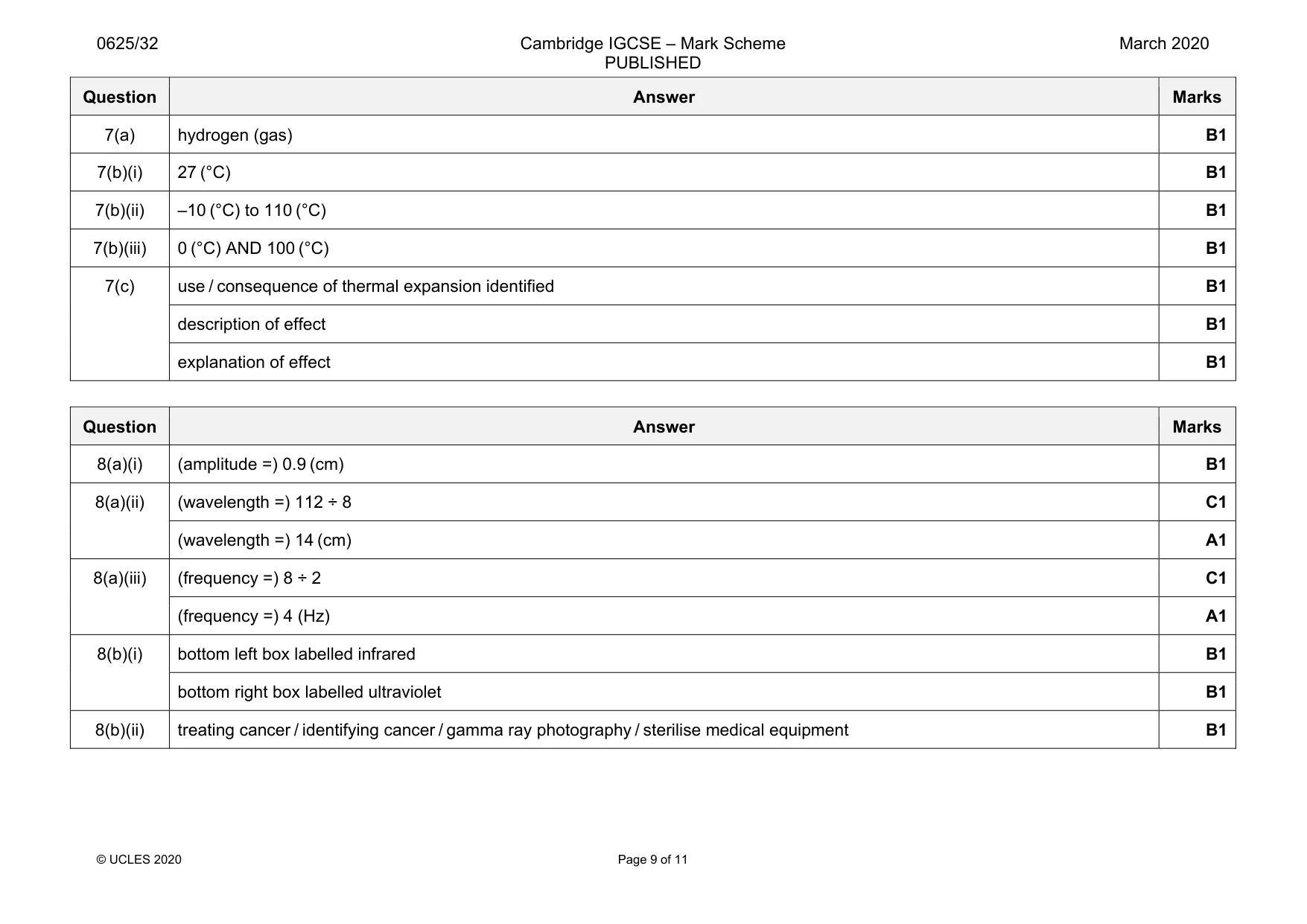
Mark scheme: 7(a) hydrogen (gas) B1 7(b)(i) 27 (°C) B1 7(b)(ii) –10 (°C) to 110 (°C) B1 7(b)(iii) 0 (°C) AND 100 (°C) B1 7(c) use / consequence of thermal expansion identified B1 description of effect B1 explanation of effect B1
Q8 · A travelling wave at an instant in time
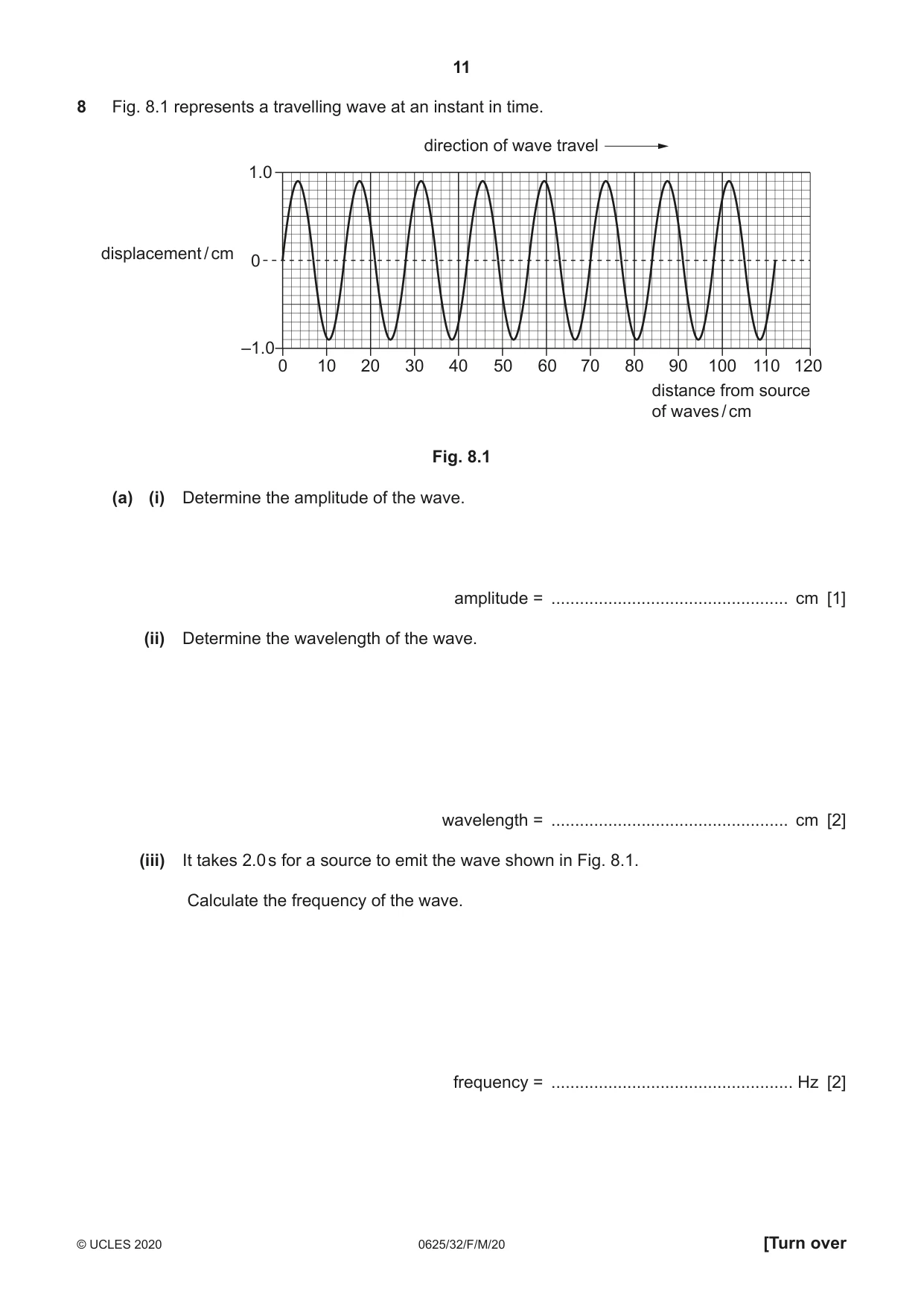
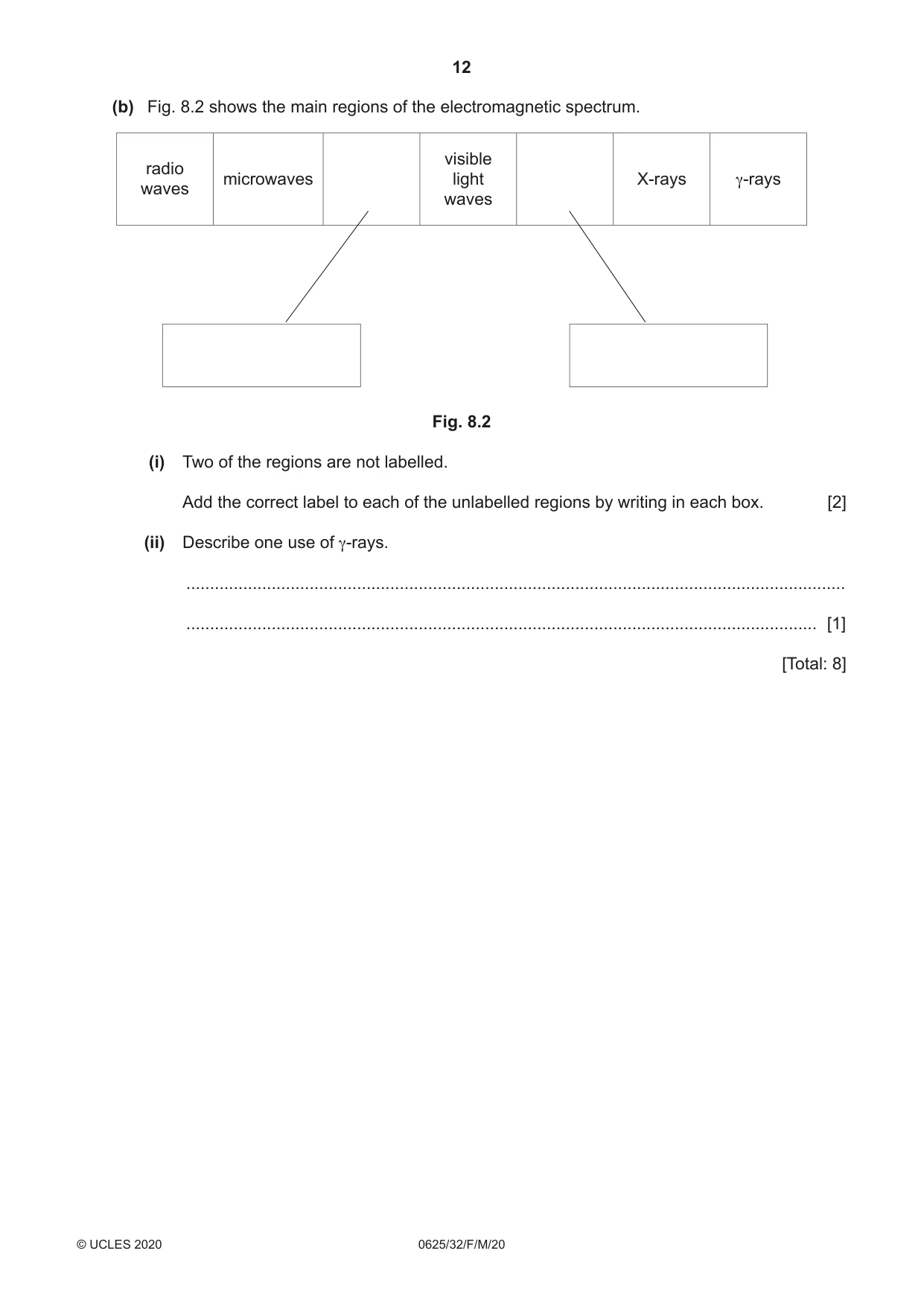
8 Fig. 8.1 represents a travelling wave at an instant in time. direction of wave travel 1.0 displacement / cm 0 –1.0 0 10 20 30 40 50 60 70 80 90 100 110 120 distance from source of waves / cm Fig. 8.1 (a) (i) Determine the amplitude of the wave. amplitude = .................................................. cm [1] (ii) Determine the wavelength of the wave. wavelength = .................................................. cm [2] (iii) It takes 2.0 s for a source to emit the wave shown in Fig. 8.1. Calculate the frequency of the wave. frequency = ................................................... Hz [2] (b) Fig. 8.2 shows the main regions of the electromagnetic spectrum. visible radio microwaves light X-rays γ-rays waves waves Fig. 8.2 (i) Two of the regions are not labelled. Add the correct label to each of the unlabelled regions by writing in each box. [2] (ii) Describe one use of γ-rays. ........................................................................................................................................... ..................................................................................................................................... [1] [Total: 8]
Mark scheme: 8(a)(i) (amplitude =) 0.9 (cm) B1 8(a)(ii) (wavelength =) 112 ÷ 8 C1 (wavelength =) 14 (cm) A1 8(a)(iii) (frequency =) 8 ÷ 2 C1 (frequency =) 4 (Hz) A1 8(b)(i) bottom left box labelled infrared B1 bottom right box labelled ultraviolet B1 8(b)(ii) treating cancer / identifying cancer / gamma ray photography / sterilise medical equipment B1
Q9 · Two rays of light X and Y leaving an object O
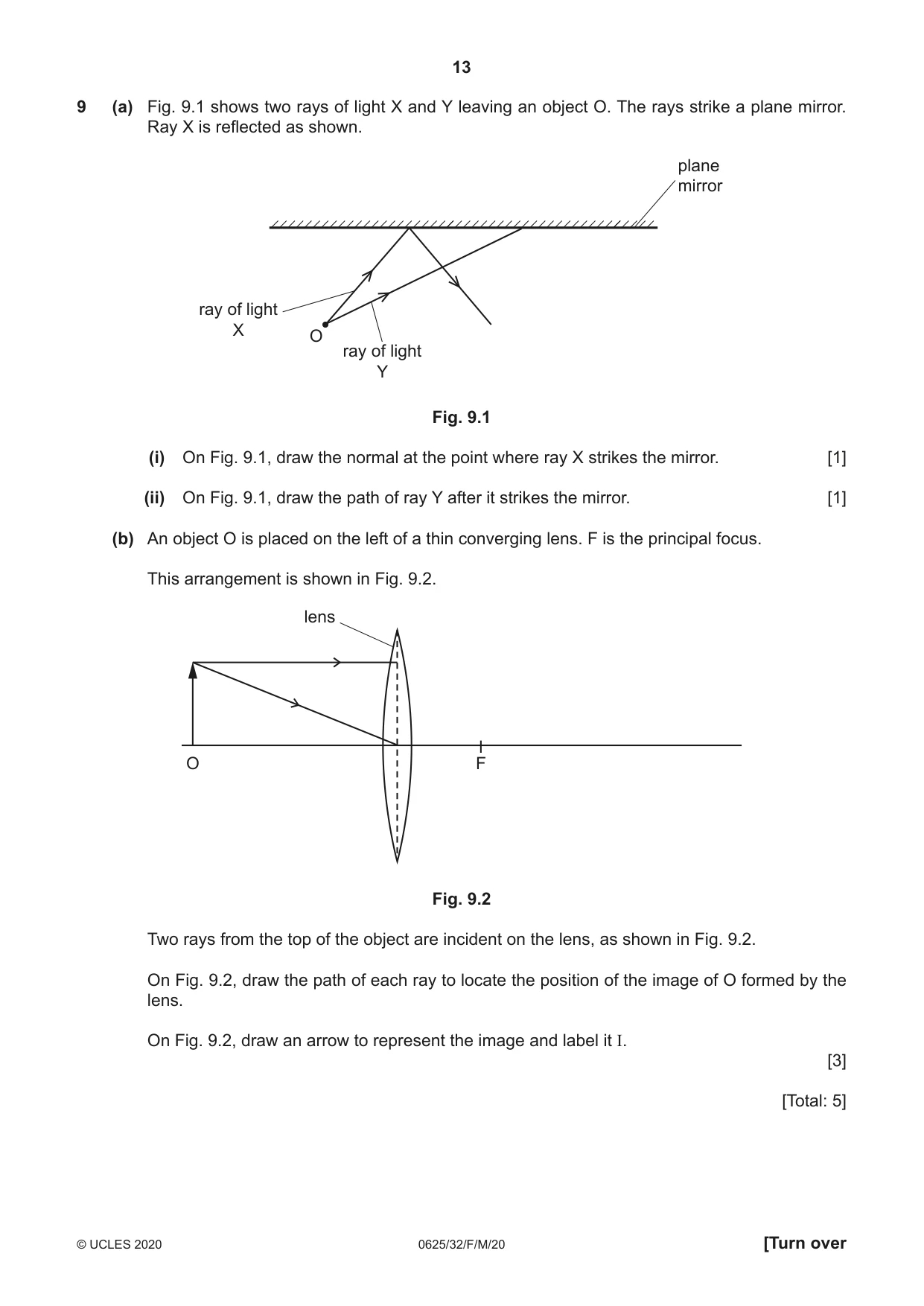
9 (a) Fig. 9.1 shows two rays of light X and Y leaving an object O. The rays strike a plane mirror. Ray X is reflected as shown. plane mirror ray of light X O ray of light Y Fig. 9.1 (i) On Fig. 9.1, draw the normal at the point where ray X strikes the mirror. [1] (ii) On Fig. 9.1, draw the path of ray Y after it strikes the mirror. [1] (b) An object O is placed on the left of a thin converging lens. F is the principal focus. This arrangement is shown in Fig. 9.2. lens O F Fig. 9.2 Two rays from the top of the object are incident on the lens, as shown in Fig. 9.2. On Fig. 9.2, draw the path of each ray to locate the position of the image of O formed by the lens. On Fig. 9.2, draw an arrow to represent the image and label it I. [3] [Total: 5]
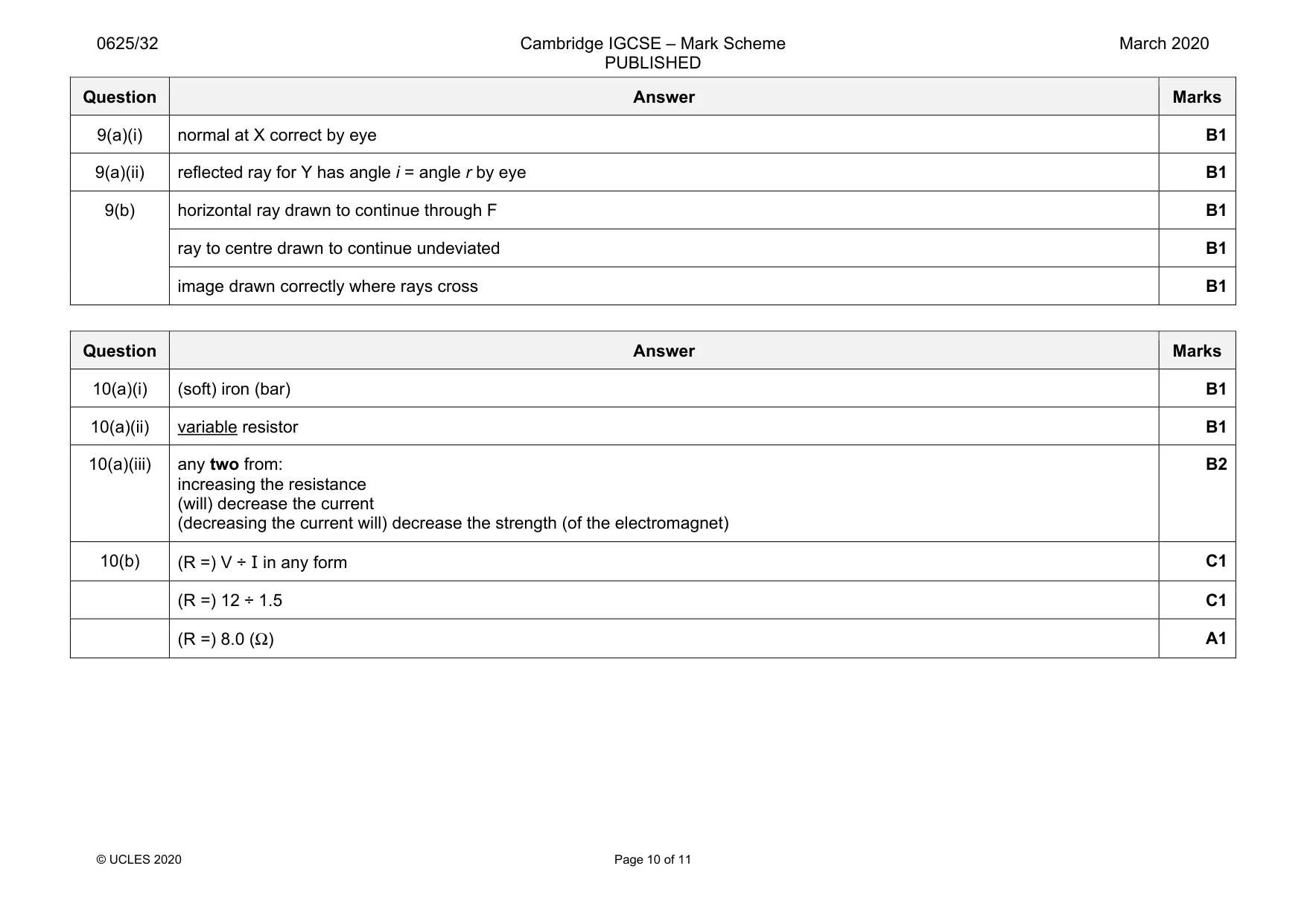
Mark scheme: 9(a)(i) normal at X correct by eye B1 9(a)(ii) reflected ray for Y has angle i = angle r by eye B1 9(b) horizontal ray drawn to continue through F B1 ray to centre drawn to continue undeviated B1 image drawn correctly where rays cross B1
Q10 · An arrangement for making an electromagnet
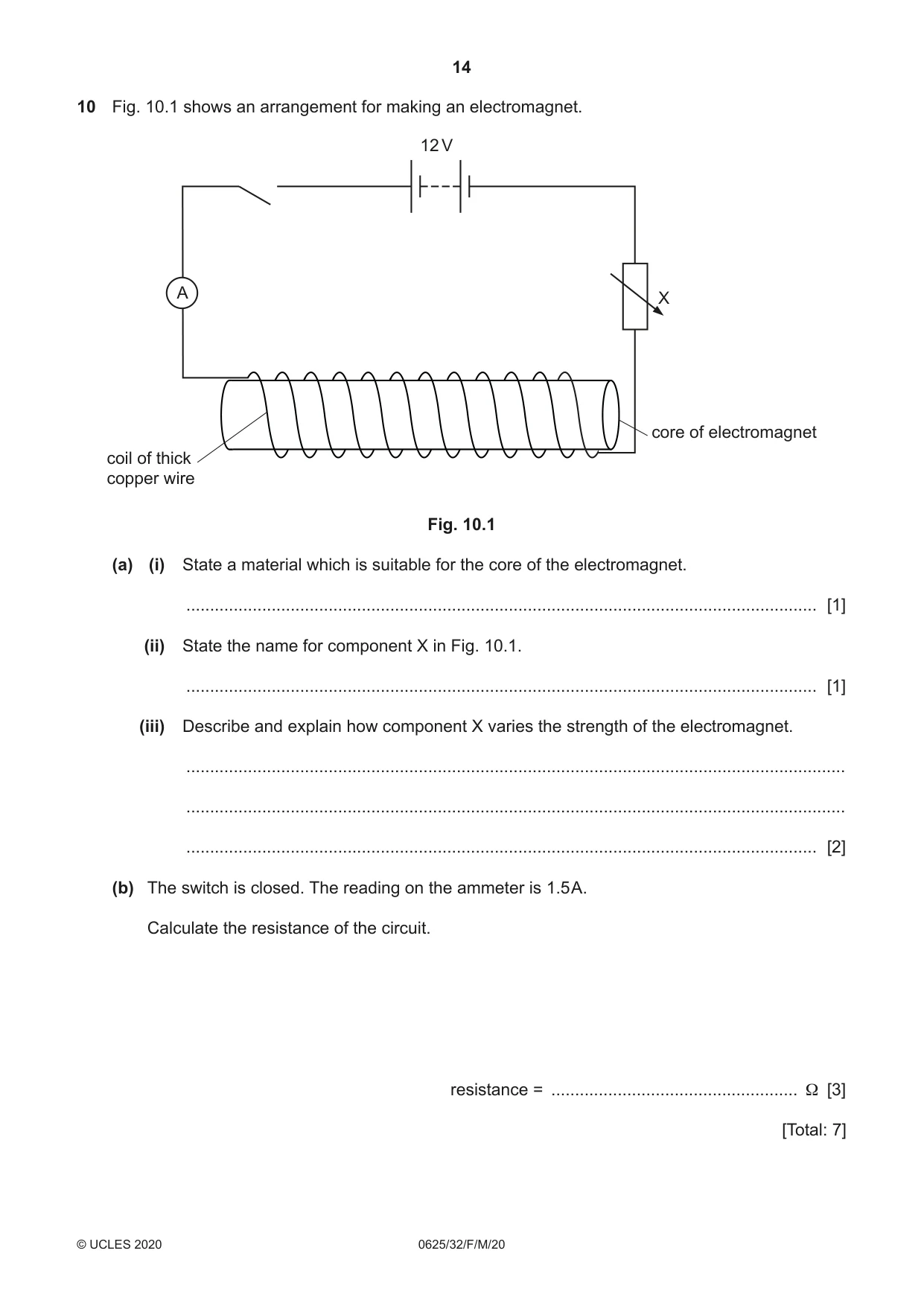
10 Fig. 10.1 shows an arrangement for making an electromagnet. 12 V A X core of electromagnet coil of thick copper wire Fig. 10.1 (a) (i) State a material which is suitable for the core of the electromagnet. ..................................................................................................................................... [1] (ii) State the name for component X in Fig. 10.1. ..................................................................................................................................... [1] (iii) Describe and explain how component X varies the strength of the electromagnet. ........................................................................................................................................... ........................................................................................................................................... ..................................................................................................................................... [2] (b) The switch is closed. The reading on the ammeter is 1.5 A. Calculate the resistance of the circuit. resistance = .................................................... Ω [3] [Total: 7]
Mark scheme: 10(a)(i) (soft) iron (bar) B1 10(a)(ii) variable resistor B1 10(a)(iii) any two from: increasing the resistance (will) decrease the current (decreasing the current will) decrease the strength (of the electromagnet) B2 10(b) (R =) V ÷ I in any form C1 (R =) 12 ÷ 1.5 C1 (R =) 8.0 (Ω) A1
Question 11
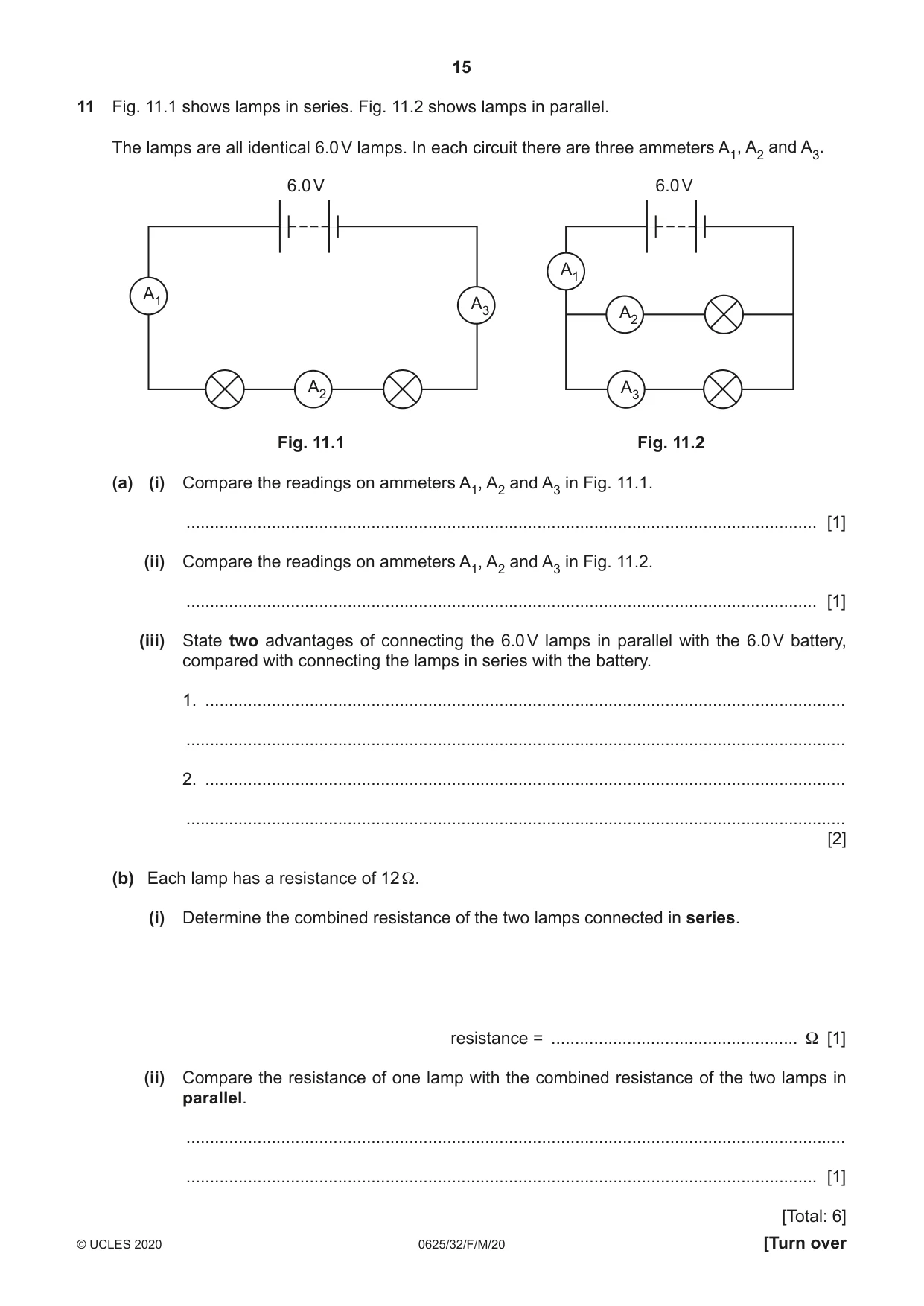
11 Fig. 11.1 shows lamps in series. Fig. 11.2 shows lamps in parallel. The lamps are all identical 6.0 V lamps. In each circuit there are three ammeters A1, A2 and A3. 6.0 V 6.0 V A1 A1 A3 A2 A2 A3 Fig. 11.1 Fig. 11.2 (a) (i) Compare the readings on ammeters A1, A2 and A3 in Fig. 11.1. ..................................................................................................................................... [1] (ii) Compare the readings on ammeters A1, A2 and A3 in Fig. 11.2. ..................................................................................................................................... [1] (iii) State two advantages of connecting the 6.0 V lamps in parallel with the 6.0 V battery, compared with connecting the lamps in series with the battery. 1. ....................................................................................................................................... ........................................................................................................................................... 2. ....................................................................................................................................... ........................................................................................................................................... [2] (b) Each lamp has a resistance of 12 Ω. (i) Determine the combined resistance of the two lamps connected in series. resistance = .................................................... Ω [1] (ii) Compare the resistance of one lamp with the combined resistance of the two lamps in parallel. ........................................................................................................................................... ..................................................................................................................................... [1] [Total: 6]
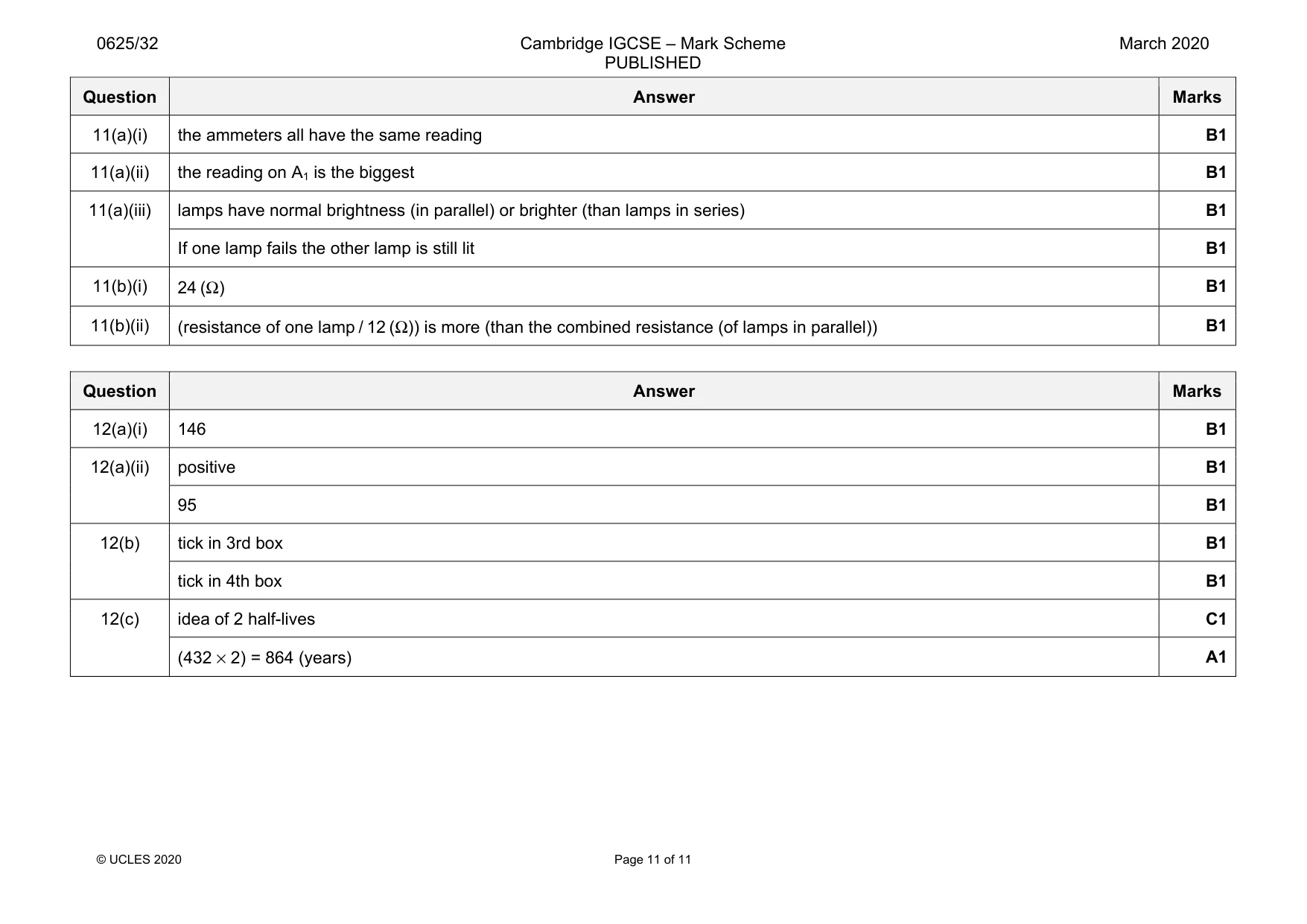
Mark scheme: 11(a)(i) the ammeters all have the same reading B1 11(a)(ii) the reading on A1 is the biggest B1 11(a)(iii) lamps have normal brightness (in parallel) or brighter (than lamps in series) B1 If one lamp fails the other lamp is still lit B1 11(b)(i) 24 (Ω) B1 11(b)(ii) (resistance of one lamp / 12 (Ω)) is more (than the combined resistance (of lamps in parallel)) B1
Q12 · A nucleus of americium-241 has the nuclide notation shown
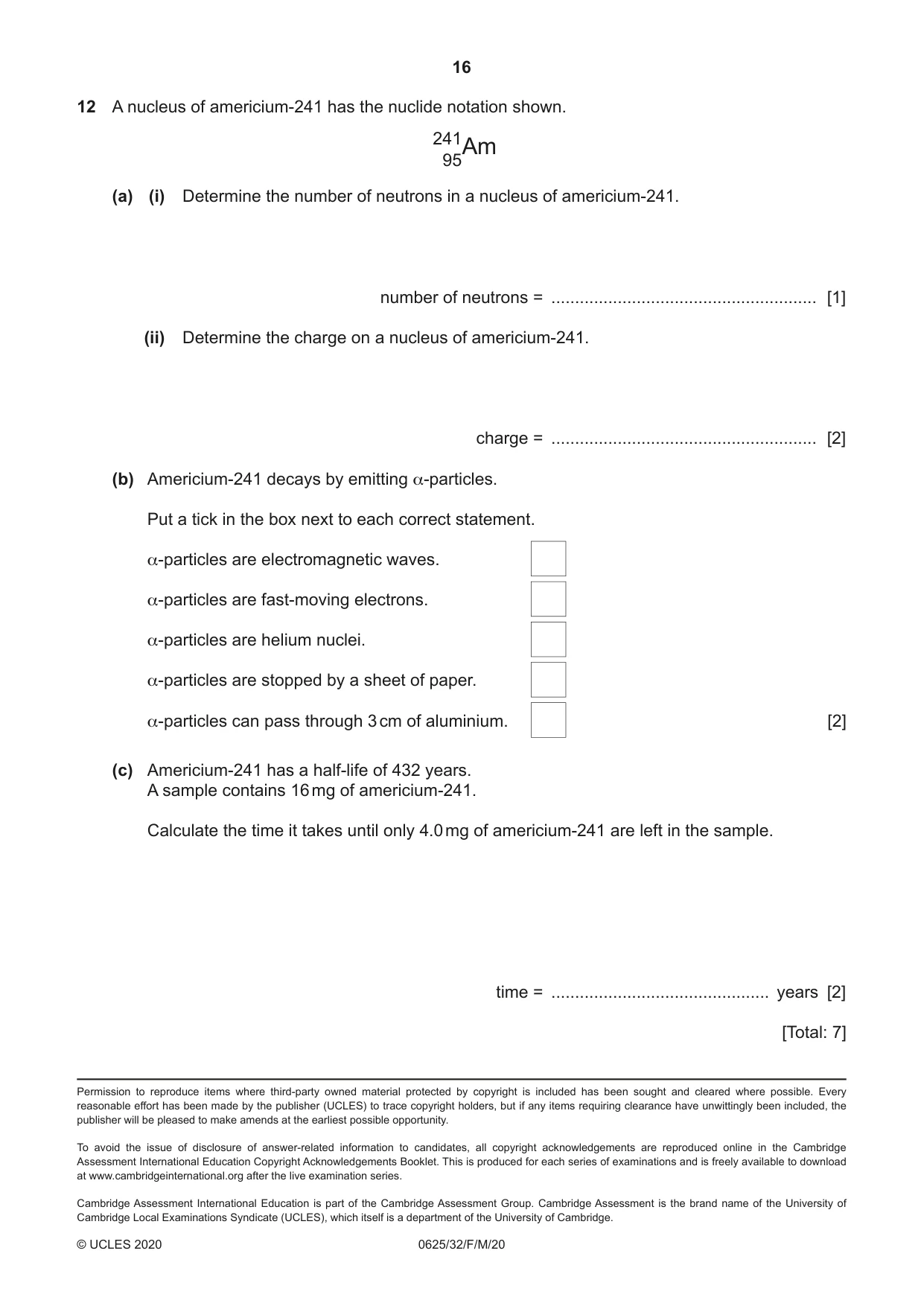
12 A nucleus of americium-241 has the nuclide notation shown. 24195Am (a) (i) Determine the number of neutrons in a nucleus of americium-241. number of neutrons = ........................................................ [1] (ii) Determine the charge on a nucleus of americium-241. charge = ........................................................ [2] (b) Americium-241 decays by emitting α-particles. Put a tick in the box next to each correct statement. α-particles are electromagnetic waves. α-particles are fast-moving electrons. α-particles are helium nuclei. α-particles are stopped by a sheet of paper. α-particles can pass through 3 cm of aluminium. [2] (c) Americium-241 has a half-life of 432 years. A sample contains 16 mg of americium-241. Calculate the time it takes until only 4.0 mg of americium-241 are left in the sample. time = .............................................. years [2] [Total: 7]
Mark scheme: 12(a)(i) 146 B1 12(a)(ii) positive B1 95 B1 12(b) tick in 3rd box B1 tick in 4th box B1 12(c) idea of 2 half-lives C1 (432 × 2) = 864 (years) A1
What was in this paper
The subtopics covered by these 12 questions, and how many questions each got. Open one in a new tab to see every Cambridge question on it.
What you needed in this session
Cambridge’s own grade thresholds for 2020 Feb/March, Paper 3 · Variant 2. A higher threshold means an easier paper — the bar moves with how the cohort did.