Cambridge IGCSE Physics 0625 — 2022 Feb/March Paper 3 · Variant 2
0625/32/F/M/22 · 12 questions · 80 marks · ≈90 min
The question paper and its mark scheme, free to read here and free to download. This is Cambridge’s own paper, exactly as it was sat.
Question paper16 pages
Mark scheme15 pages
Answers below. Sit the paper first if you are practising.
Questions as text
Q1 · Some masses on a mass hanger attached to an elastic band
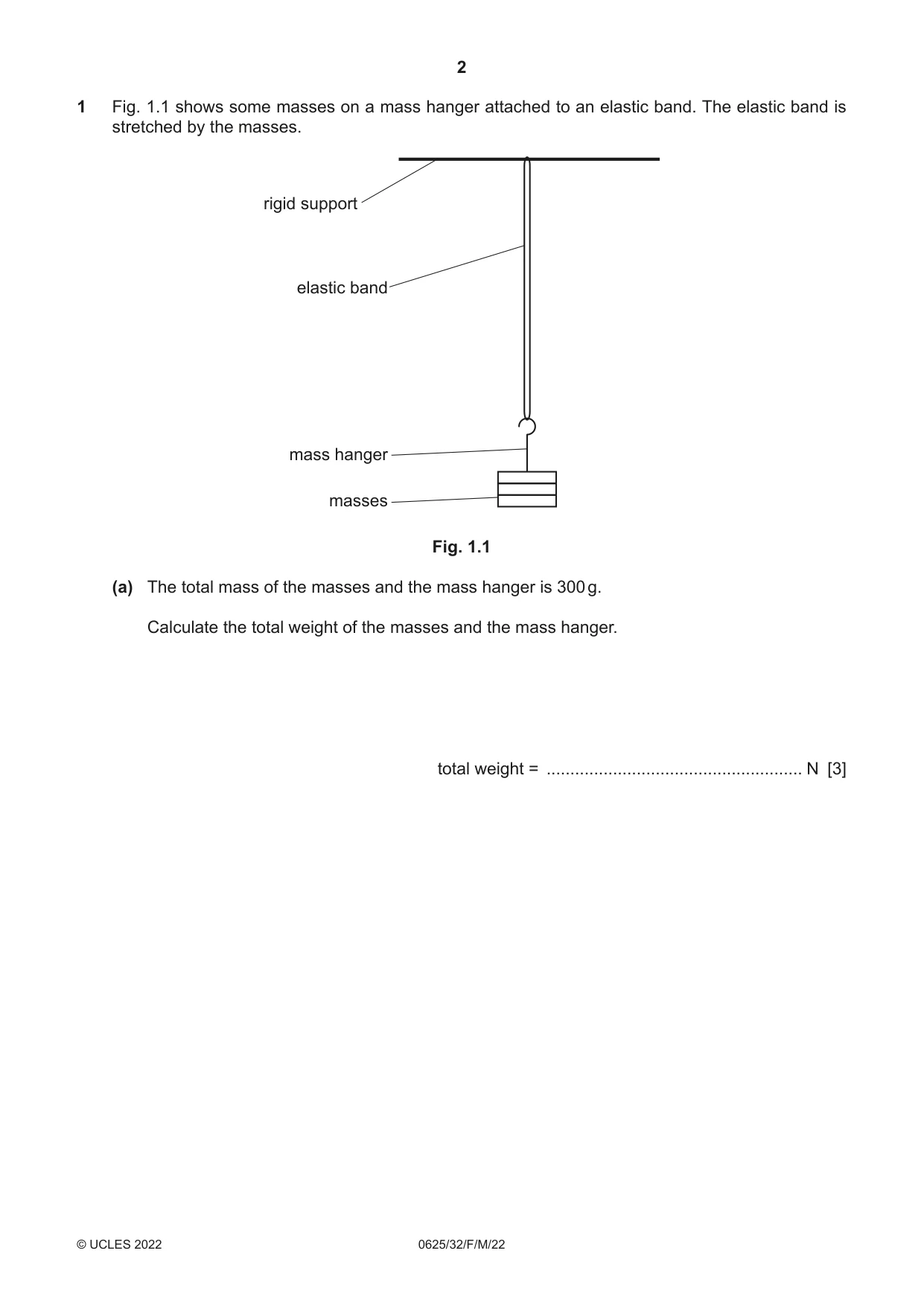
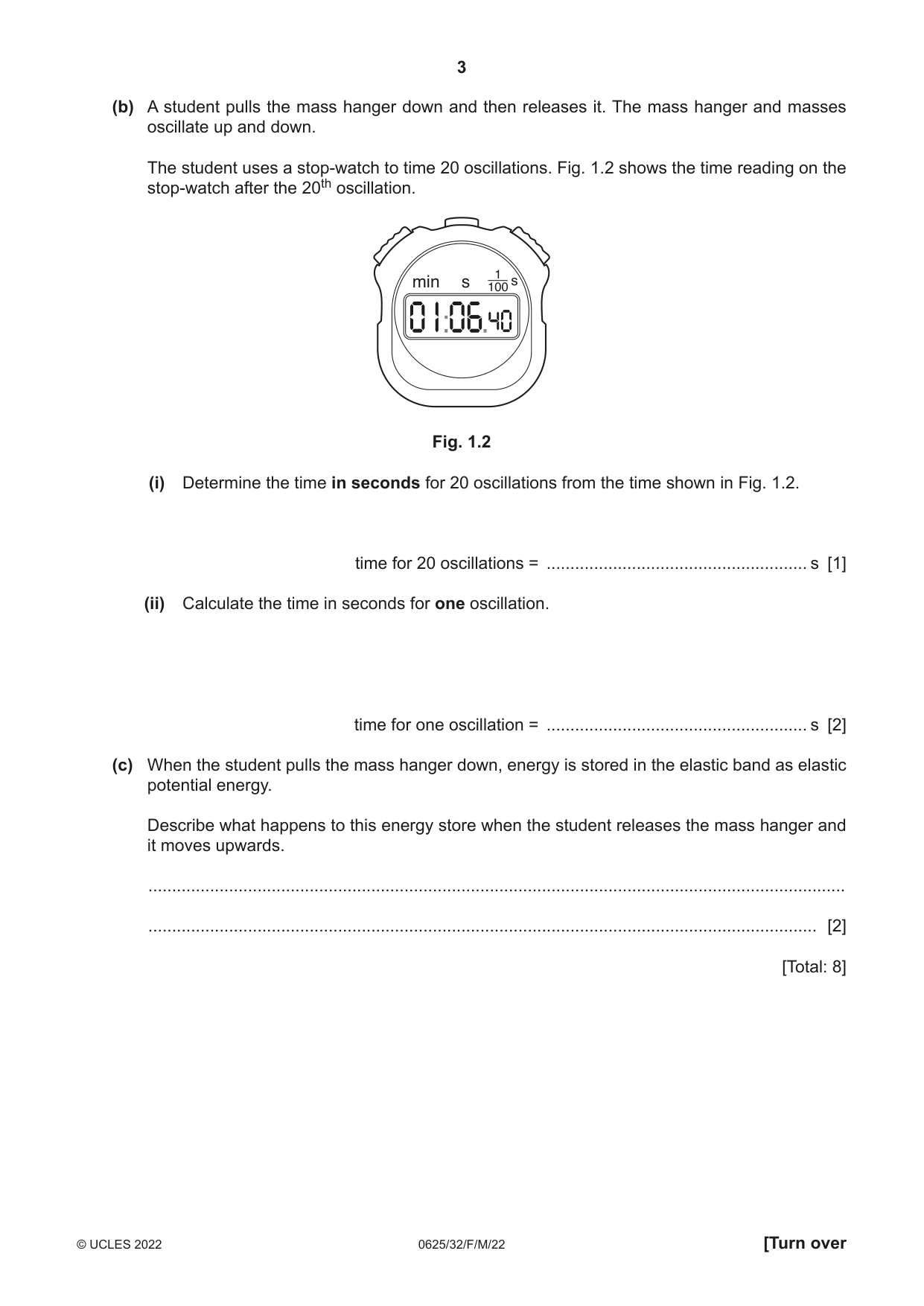
1 Fig. 1.1 shows some masses on a mass hanger attached to an elastic band. The elastic band is stretched by the masses. rigid support elastic band mass hanger masses Fig. 1.1 (a) The total mass of the masses and the mass hanger is 300 g. Calculate the total weight of the masses and the mass hanger. total weight = ...................................................... N [3] (b) A student pulls the mass hanger down and then releases it. The mass hanger and masses oscillate up and down. The student uses a stop-watch to time 20 oscillations. Fig. 1.2 shows the time reading on the stop-watch after the 20th oscillation. s min s 1001 Fig. 1.2 (i) Determine the time in seconds for 20 oscillations from the time shown in Fig. 1.2. time for 20 oscillations = ....................................................... s [1] (ii) Calculate the time in seconds for one oscillation. time for one oscillation = ....................................................... s [2] (c) When the student pulls the mass hanger down, energy is stored in the elastic band as elastic potential energy. Describe what happens to this energy store when the student releases the mass hanger and it moves upwards. ................................................................................................................................................... ............................................................................................................................................. [2] [Total: 8]
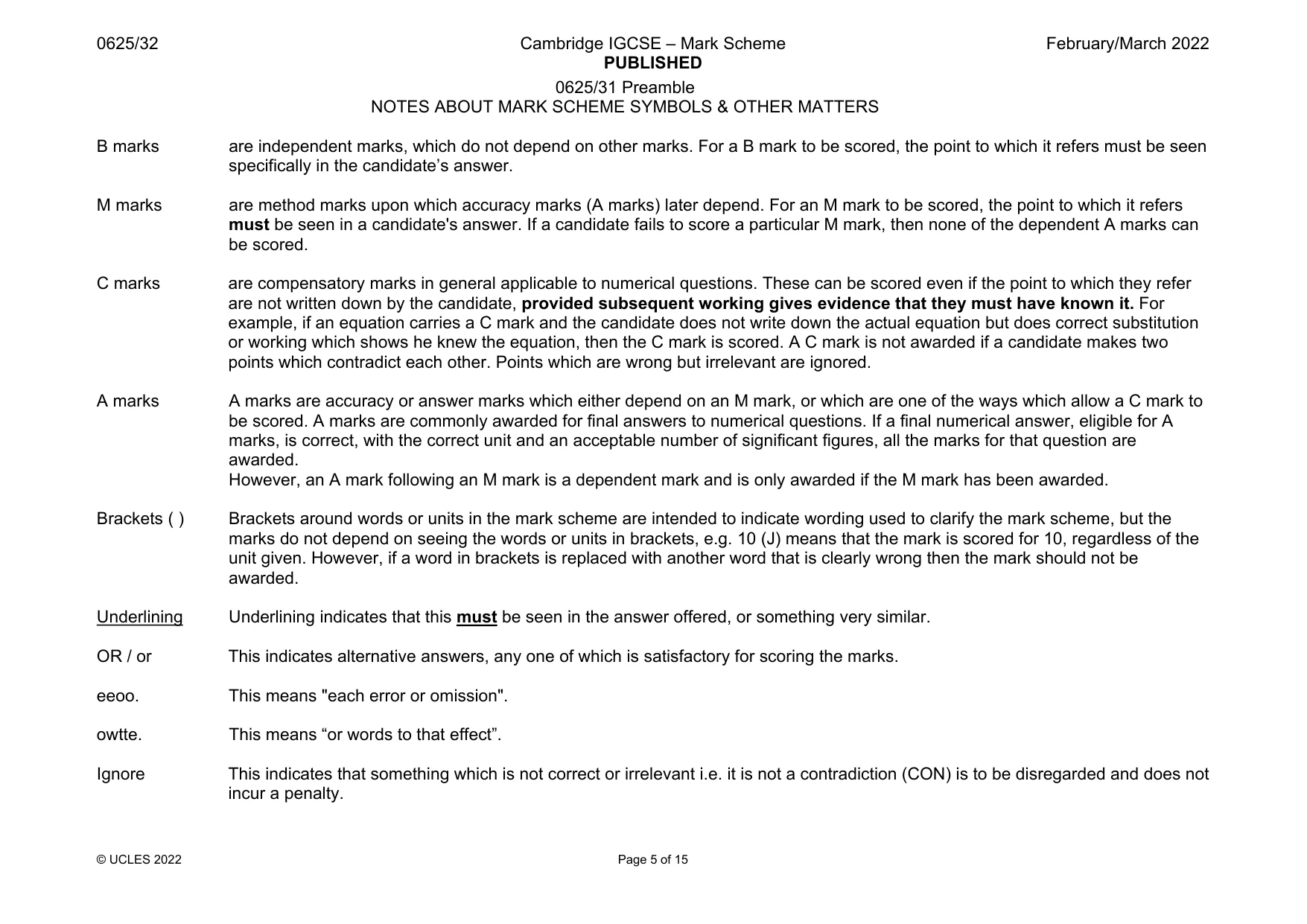
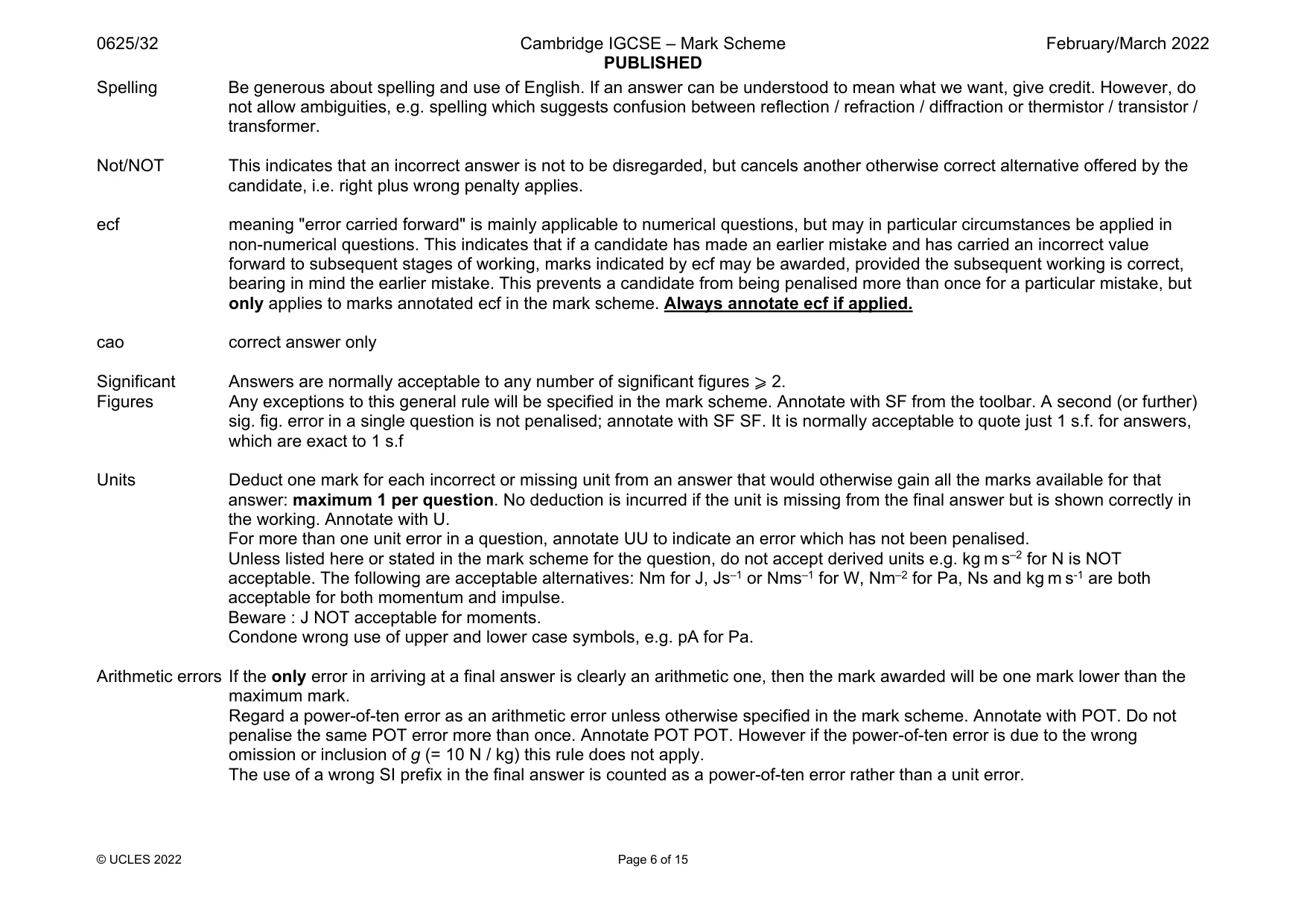
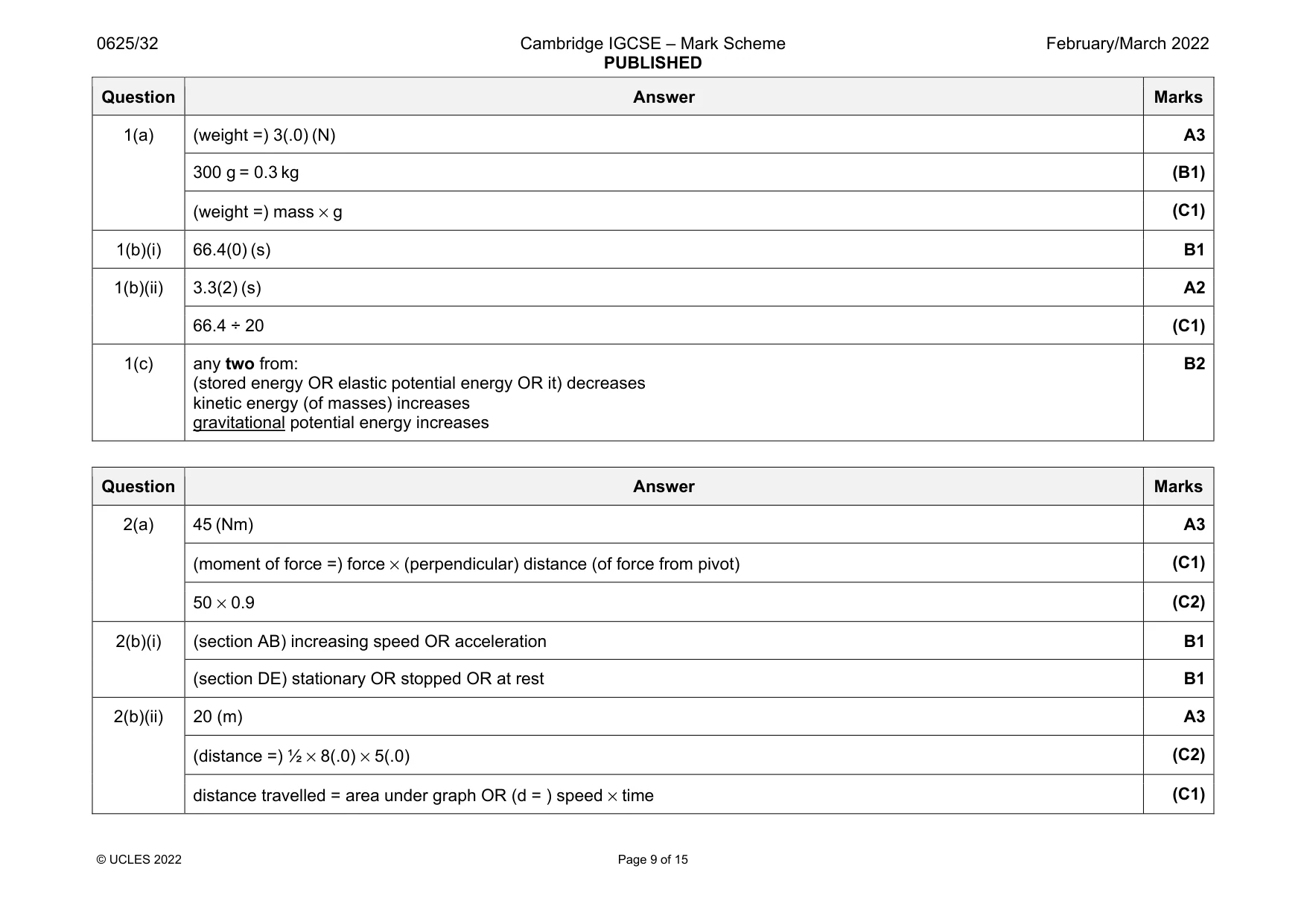
Mark scheme: 1(a) (weight =) 3(.0) (N) A3 300 g = 0.3 kg (B1) (weight =) mass × g (C1) 1(b)(i) 66.4(0) (s) B1 1(b)(ii) 3.3(2) (s) A2 66.4 ÷ 20 (C1) 1(c) any two from: (stored energy OR elastic potential energy OR it) decreases kinetic energy (of masses) increases gravitational potential energy increases B2
Q2 · A student is doing some physical exercise
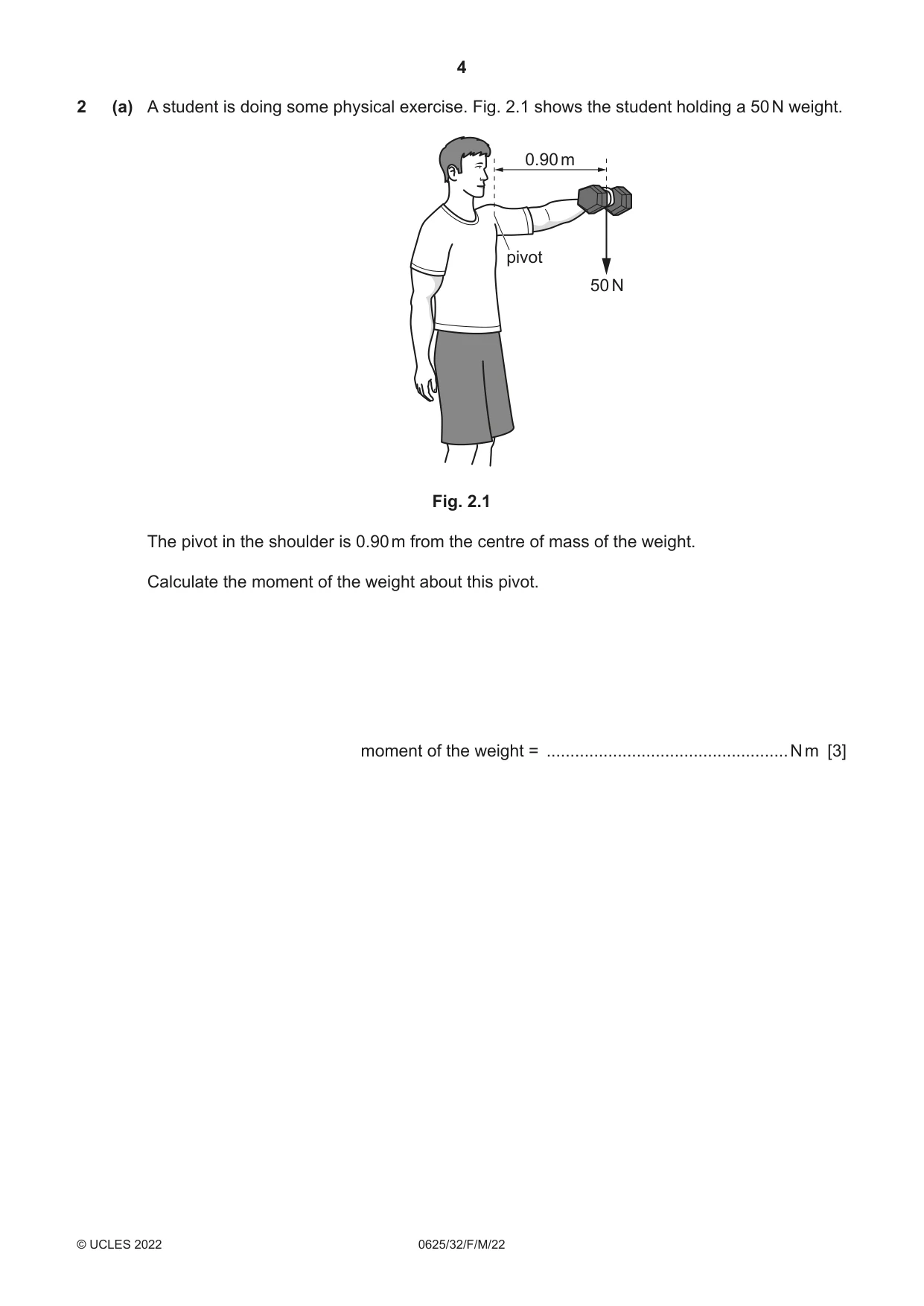
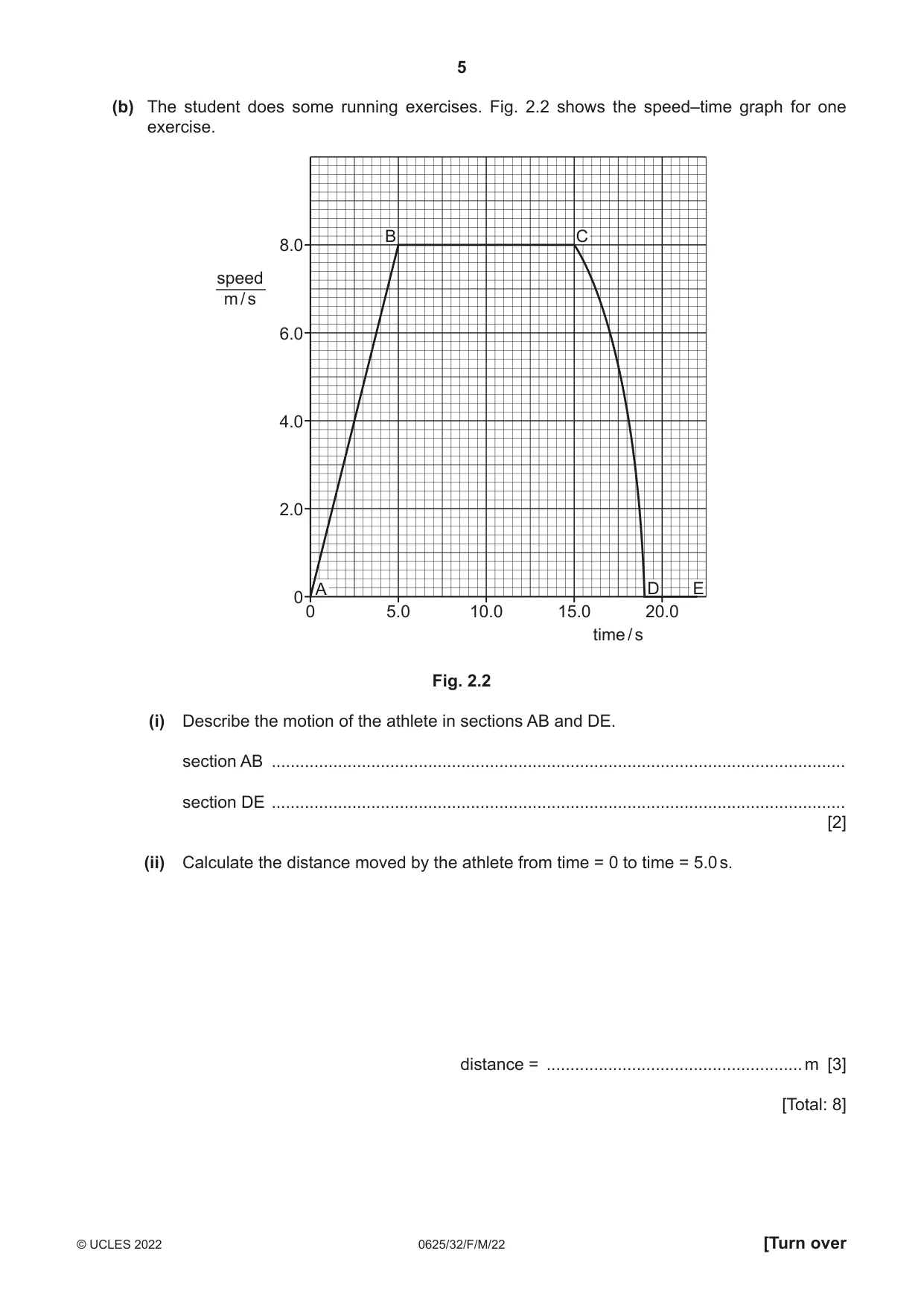
2 (a) A student is doing some physical exercise. Fig. 2.1 shows the student holding a 50 N weight. 0.90 m pivot 50 N Fig. 2.1 The pivot in the shoulder is 0.90 m from the centre of mass of the weight. Calculate the moment of the weight about this pivot. moment of the weight = ................................................... N m [3] (b) The student does some running exercises. Fig. 2.2 shows the speed–time graph for one exercise. B CC 8.0 speed m / s 6.0 4.0 2.0 AA D E 0 D 0 5.0 10.0 15.0 20.0 time / s Fig. 2.2 (i) Describe the motion of the athlete in sections AB and DE. section AB ......................................................................................................................... section DE ......................................................................................................................... [2] (ii) Calculate the distance moved by the athlete from time = 0 to time = 5.0 s. distance = ...................................................... m [3] [Total: 8]
Mark scheme: 2(a) 45 (Nm) A3 (moment of force =) force × (perpendicular) distance (of force from pivot) (C1) 50 × 0.9 (C2) 2(b)(i) (section AB) increasing speed OR acceleration B1 (section DE) stationary OR stopped OR at rest B1 2(b)(ii) 20 (m) A3 (distance =) ½ × 8(.0) × 5(.0) (C2) distance travelled = area under graph OR (d = ) speed × time (C1)
Q3 · A metal block and its dimensions
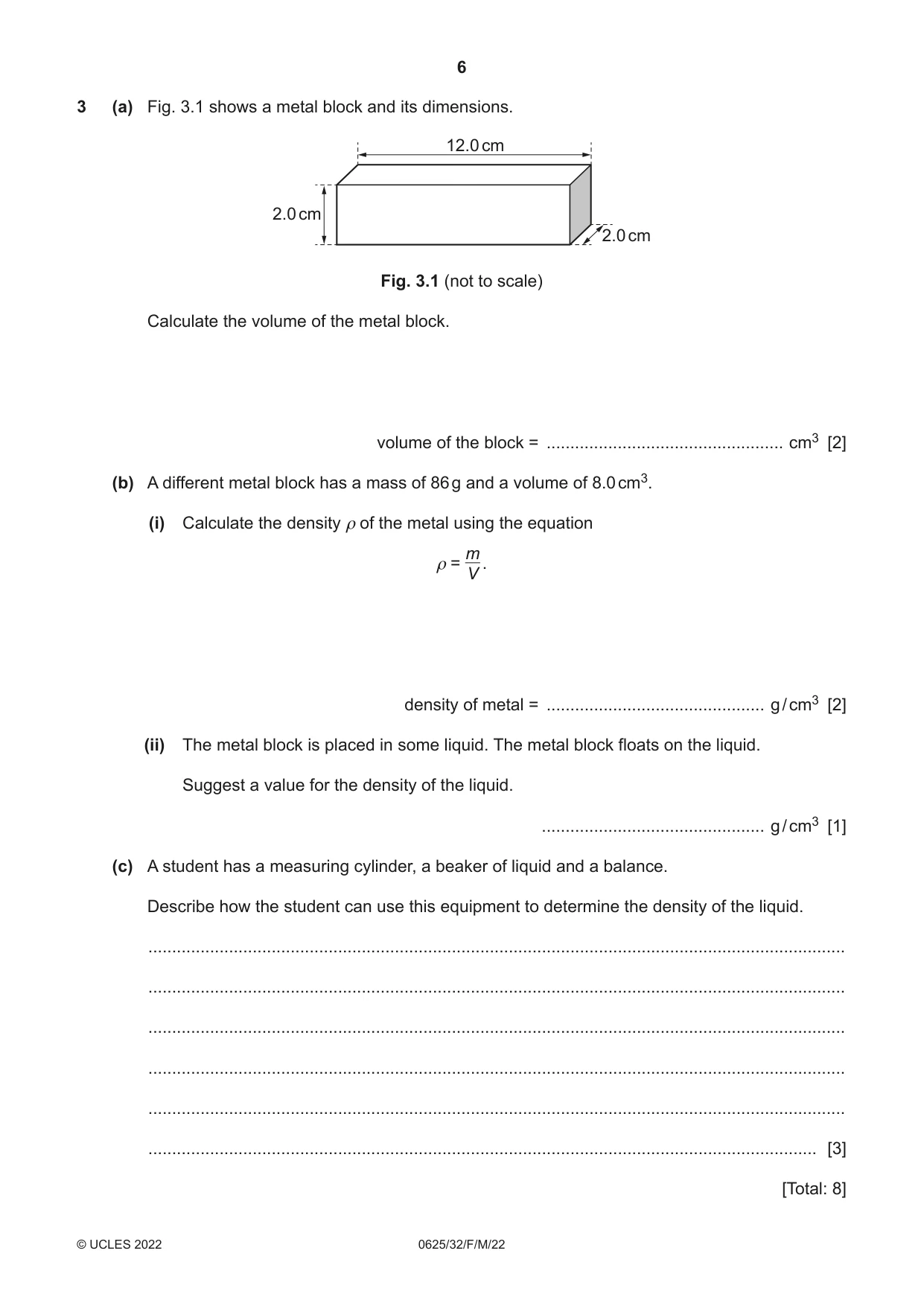
3 (a) Fig. 3.1 shows a metal block and its dimensions. 12.0 cm 2.0 cm 2.0 cm Fig. 3.1 (not to scale) Calculate the volume of the metal block. volume of the block = .................................................. cm3 [2] (b) A different metal block has a mass of 86 g and a volume of 8.0 cm3. (i) Calculate the density ρ of the metal using the equation m ρ = . V density of metal = .............................................. g / cm3 [2] (ii) The metal block is placed in some liquid. The metal block floats on the liquid. Suggest a value for the density of the liquid. ............................................... g / cm3 [1] (c) A student has a measuring cylinder, a beaker of liquid and a balance. Describe how the student can use this equipment to determine the density of the liquid. ................................................................................................................................................... ................................................................................................................................................... ................................................................................................................................................... ................................................................................................................................................... ................................................................................................................................................... ............................................................................................................................................. [3] [Total: 8]
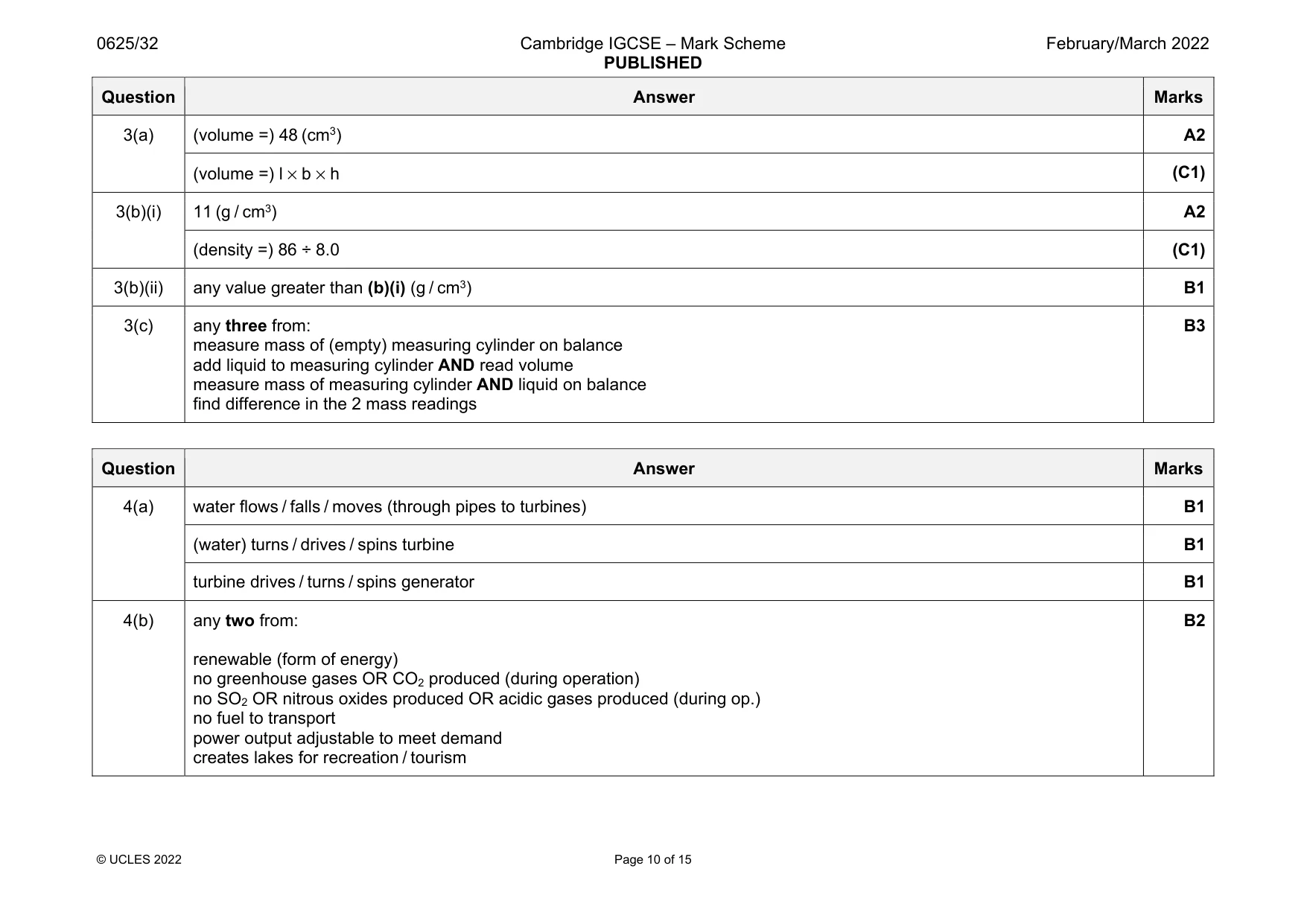
Mark scheme: 3(a) (volume =) 48 (cm3) A2 (volume =) l × b × h (C1) 3(b)(i) 11 (g / cm3) A2 (density =) 86 ÷ 8.0 (C1) 3(b)(ii) any value greater than (b)(i) (g / cm3) B1 3(c) any three from: measure mass of (empty) measuring cylinder on balance add liquid to measuring cylinder AND read volume measure mass of measuring cylinder AND liquid on balance find difference in the 2 mass readings B3
Q4 · Coal-fired power stations provide electricity for homes and industry
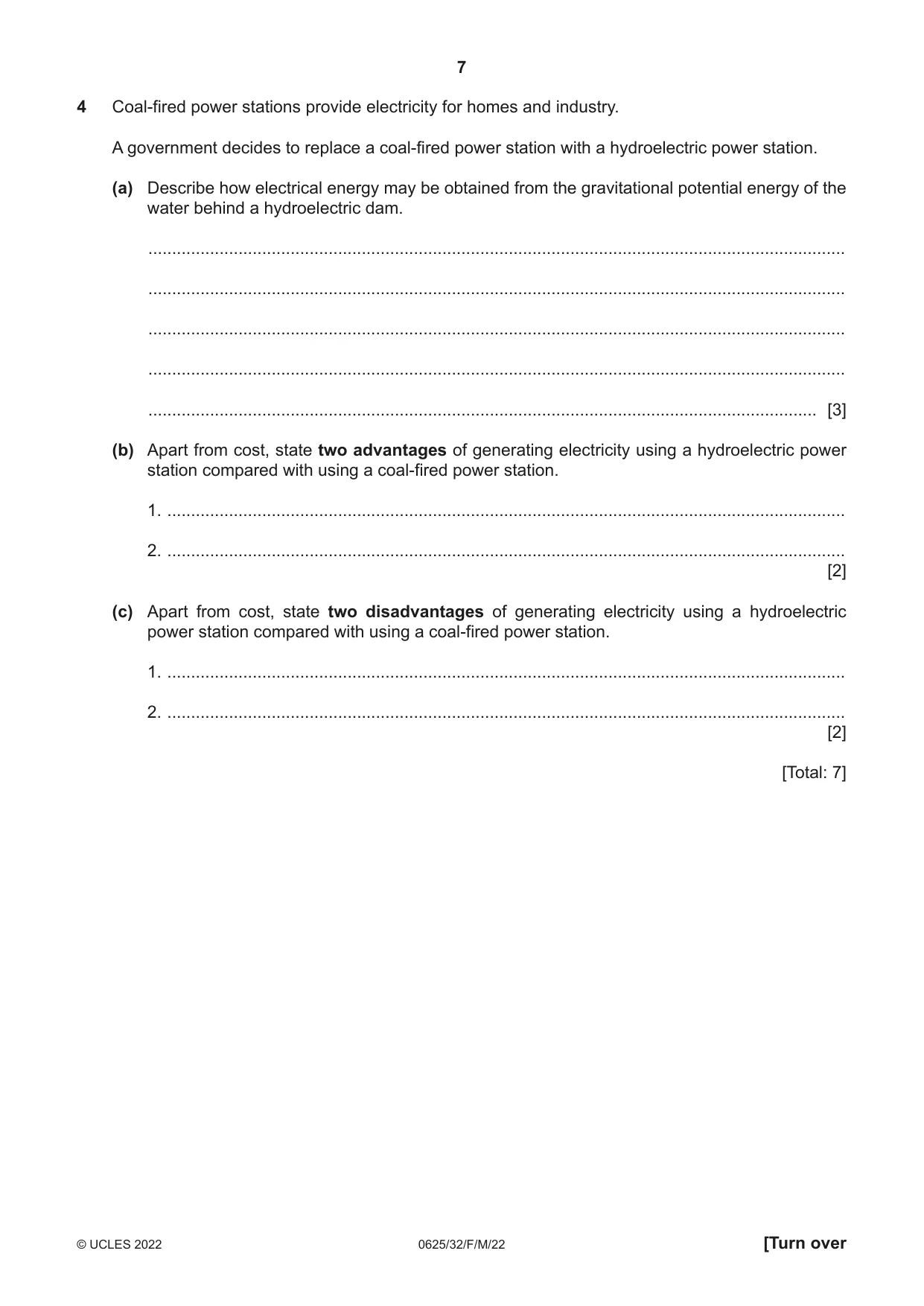
4 Coal-fired power stations provide electricity for homes and industry. A government decides to replace a coal-fired power station with a hydroelectric power station. (a) Describe how electrical energy may be obtained from the gravitational potential energy of the water behind a hydroelectric dam. ................................................................................................................................................... ................................................................................................................................................... ................................................................................................................................................... ................................................................................................................................................... ............................................................................................................................................. [3] (b) Apart from cost, state two advantages of generating electricity using a hydroelectric power station compared with using a coal-fired power station. 1. ............................................................................................................................................... 2. ............................................................................................................................................... [2] (c) Apart from cost, state two disadvantages of generating electricity using a hydroelectric power station compared with using a coal-fired power station. 1. ............................................................................................................................................... 2. ............................................................................................................................................... [2] [Total: 7]
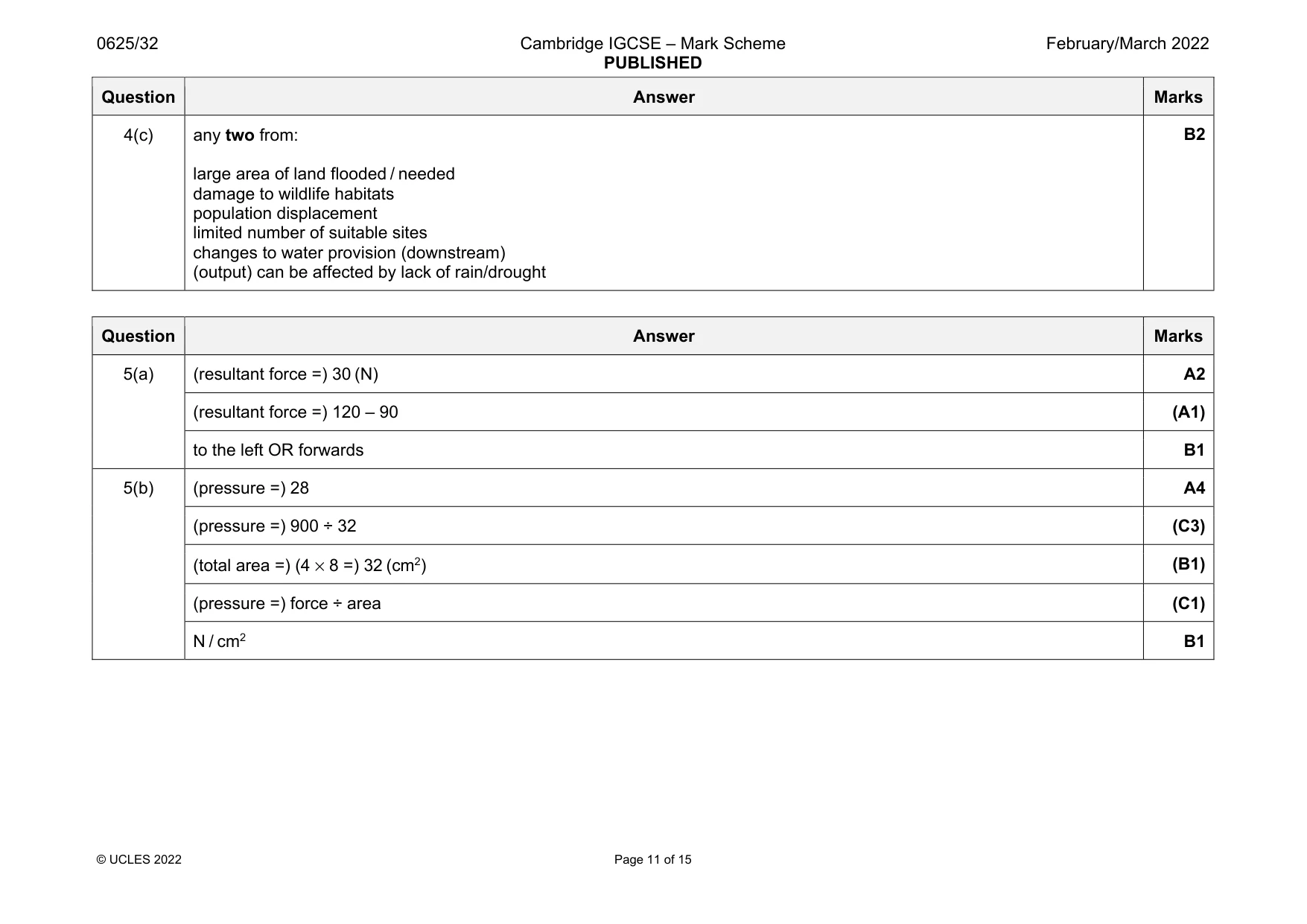
Mark scheme: 4(a) water flows / falls / moves (through pipes to turbines) B1 (water) turns / drives / spins turbine B1 turbine drives / turns / spins generator B1 4(b) any two from: renewable (form of energy) no greenhouse gases OR CO2 produced (during operation) no SO2 OR nitrous oxides produced OR acidic gases produced (during op.) no fuel to transport power output adjustable to meet demand creates lakes for recreation / tourism B2 Question Answer Marks 4(c) any two from: large area of land flooded / needed damage to wildlife habitats population displacement limited number of suitable sites changes to water provision (downstream) (output) can be affected by lack of rain/drought B2
Q5 · A woman starts to push a trolley across the floor
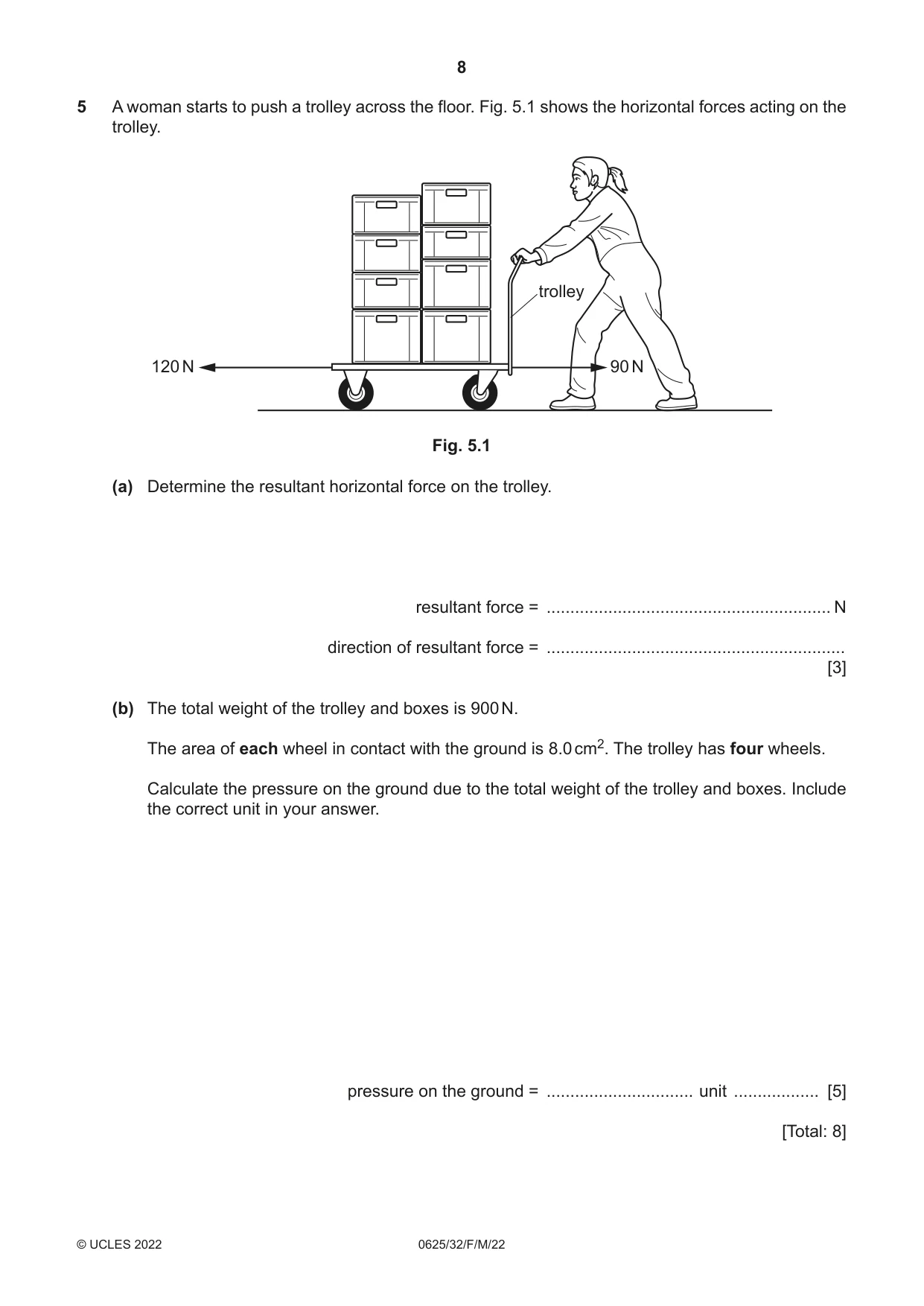
5 A woman starts to push a trolley across the floor. Fig. 5.1 shows the horizontal forces acting on the trolley. trolley 120 N 90 N Fig. 5.1 (a) Determine the resultant horizontal force on the trolley. resultant force = ............................................................ N direction of resultant force = ............................................................... [3] (b) The total weight of the trolley and boxes is 900 N. The area of each wheel in contact with the ground is 8.0 cm2. The trolley has four wheels. Calculate the pressure on the ground due to the total weight of the trolley and boxes. Include the correct unit in your answer. pressure on the ground = ............................... unit .................. [5] [Total: 8]
Mark scheme: 5(a) (resultant force =) 30 (N) A2 (resultant force =) 120 – 90 (A1) to the left OR forwards B1 5(b) (pressure =) 28 A4 (pressure =) 900 ÷ 32 (C3) (total area =) (4 × 8 =) 32 (cm2) (B1) (pressure =) force ÷ area (C1) N / cm2 B1
Q6 · Gas particles in a container
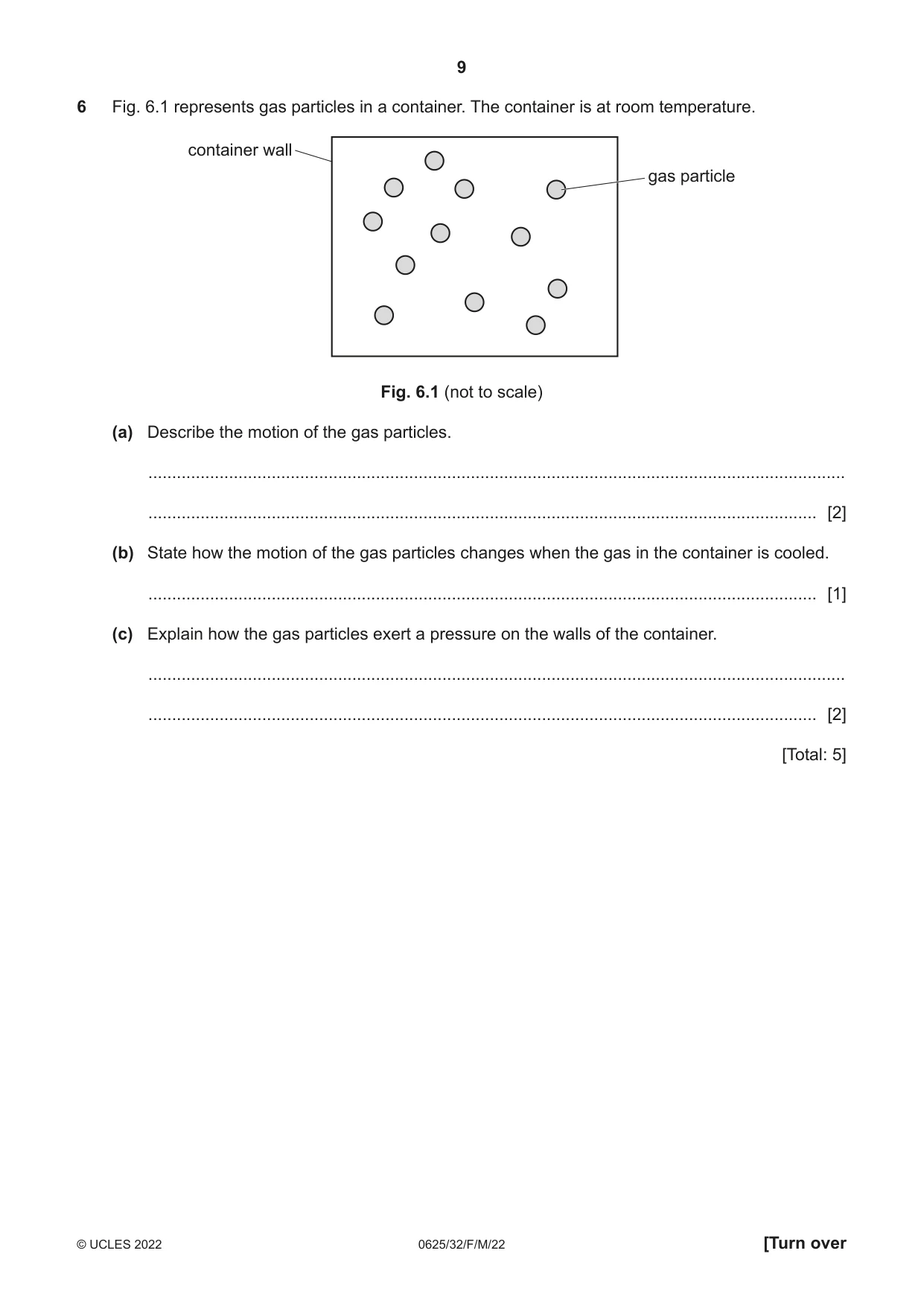
6 Fig. 6.1 represents gas particles in a container. The container is at room temperature. container wall gas particle Fig. 6.1 (not to scale) (a) Describe the motion of the gas particles. ................................................................................................................................................... ............................................................................................................................................. [2] (b) State how the motion of the gas particles changes when the gas in the container is cooled. ............................................................................................................................................. [1] (c) Explain how the gas particles exert a pressure on the walls of the container. ................................................................................................................................................... ............................................................................................................................................. [2] [Total: 5]
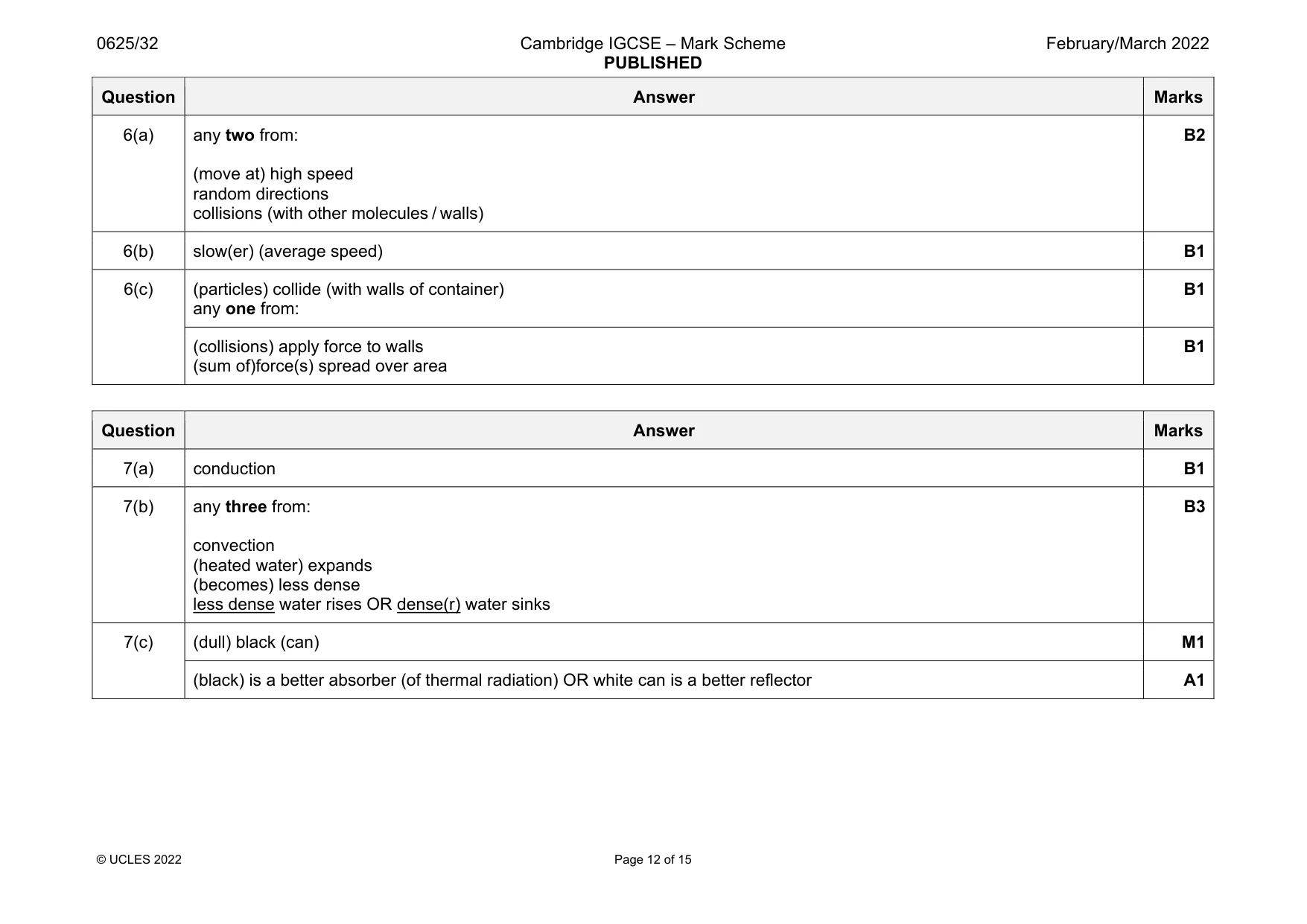
Mark scheme: 6(a) any two from: (move at) high speed random directions collisions (with other molecules / walls) B2 6(b) slow(er) (average speed) B1 6(c) (particles) collide (with walls of container) any one from: B1 (collisions) apply force to walls (sum of)force(s) spread over area B1
Q7 · State the name for the transfer of thermal energy through a metal
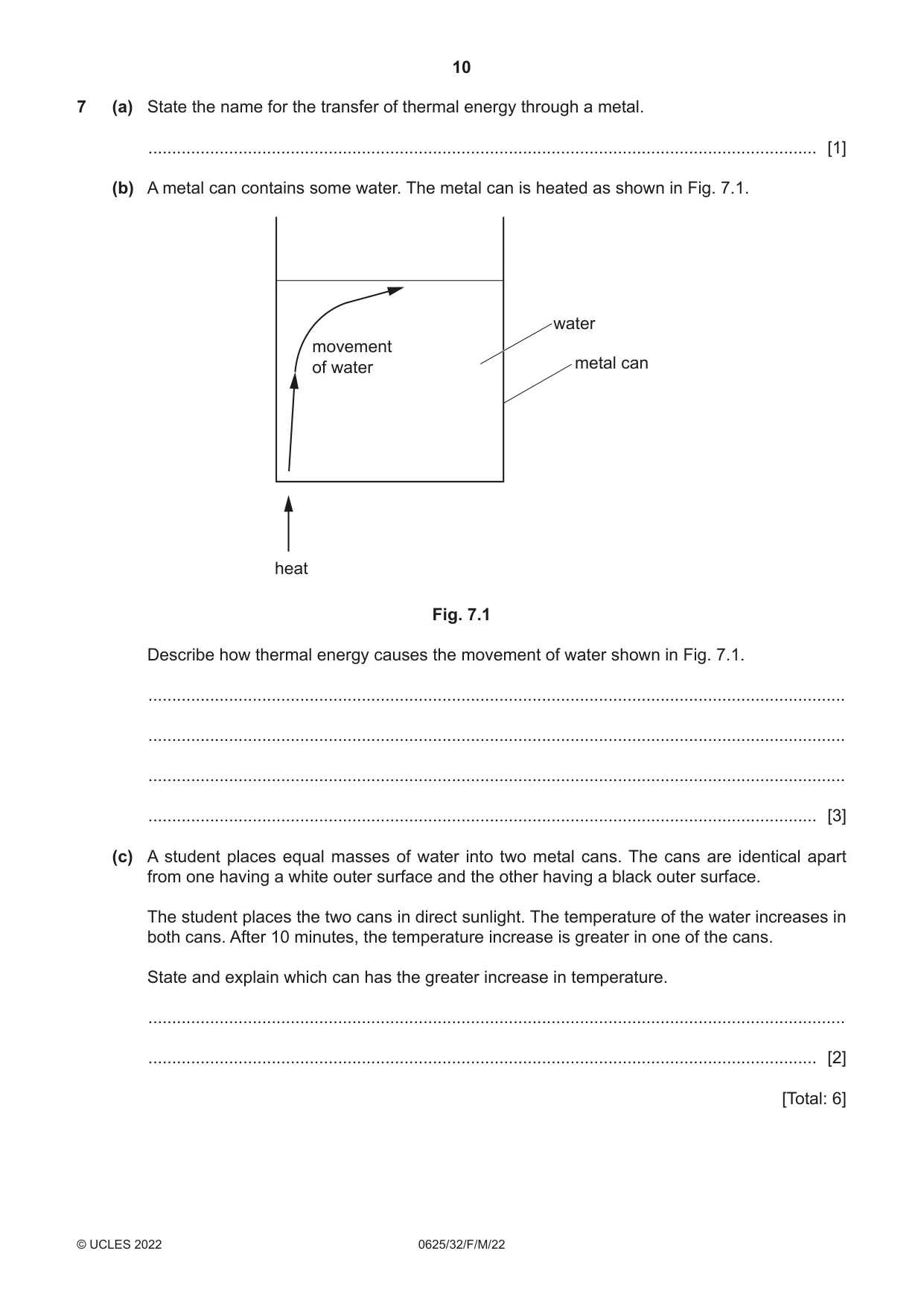
7 (a) State the name for the transfer of thermal energy through a metal. ............................................................................................................................................. [1] (b) A metal can contains some water. The metal can is heated as shown in Fig. 7.1. water movement of water metal can heat Fig. 7.1 Describe how thermal energy causes the movement of water shown in Fig. 7.1. ................................................................................................................................................... ................................................................................................................................................... ................................................................................................................................................... ............................................................................................................................................. [3] (c) A student places equal masses of water into two metal cans. The cans are identical apart from one having a white outer surface and the other having a black outer surface. The student places the two cans in direct sunlight. The temperature of the water increases in both cans. After 10 minutes, the temperature increase is greater in one of the cans. State and explain which can has the greater increase in temperature. ................................................................................................................................................... ............................................................................................................................................. [2] [Total: 6]
Mark scheme: 7(a) conduction B1 7(b) any three from: convection (heated water) expands (becomes) less dense less dense water rises OR dense(r) water sinks B3 7(c) (dull) black (can) M1 (black) is a better absorber (of thermal radiation) OR white can is a better reflector A1
Q8 · A student uses a tank of water to observe waves on the surface of the water
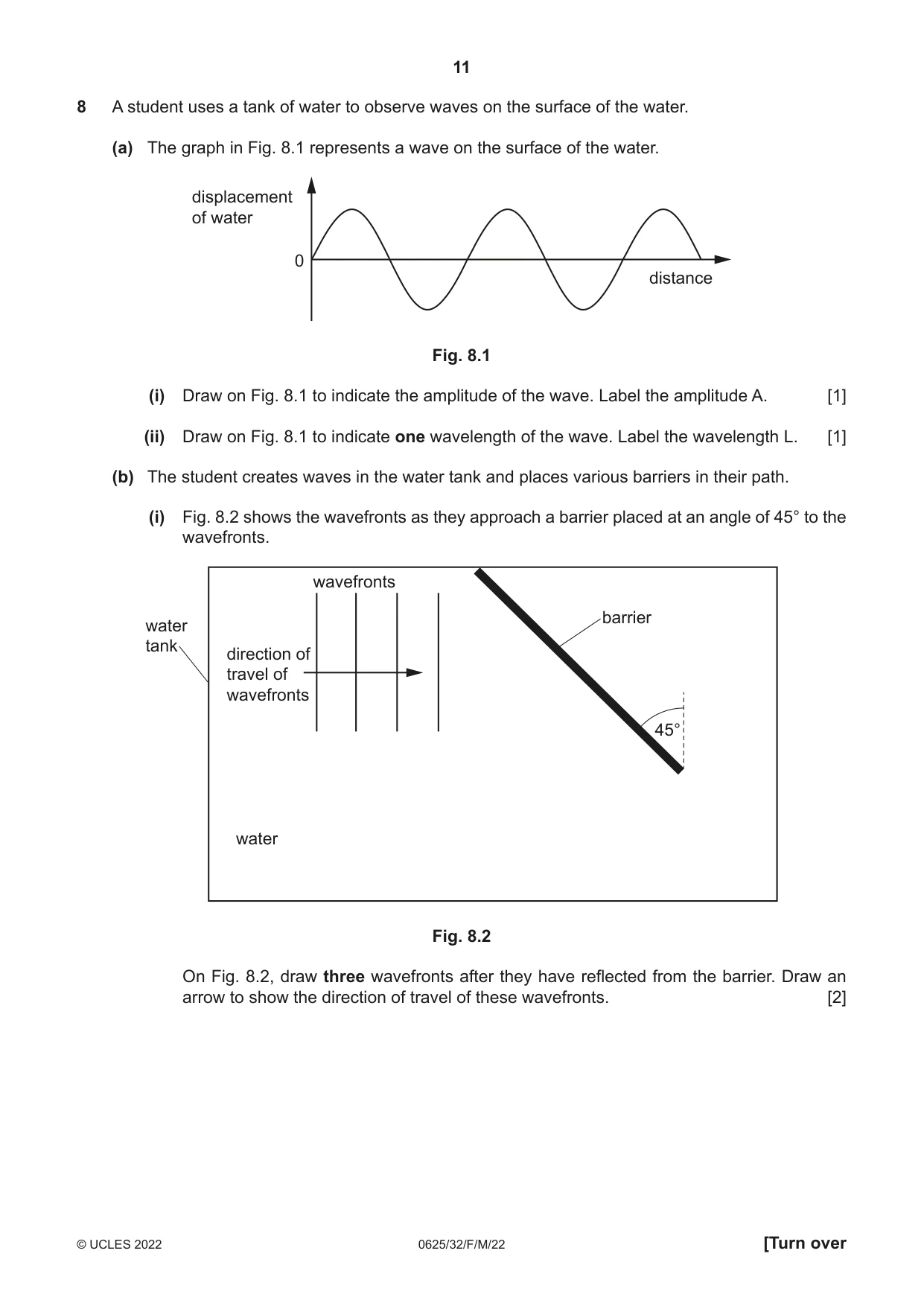
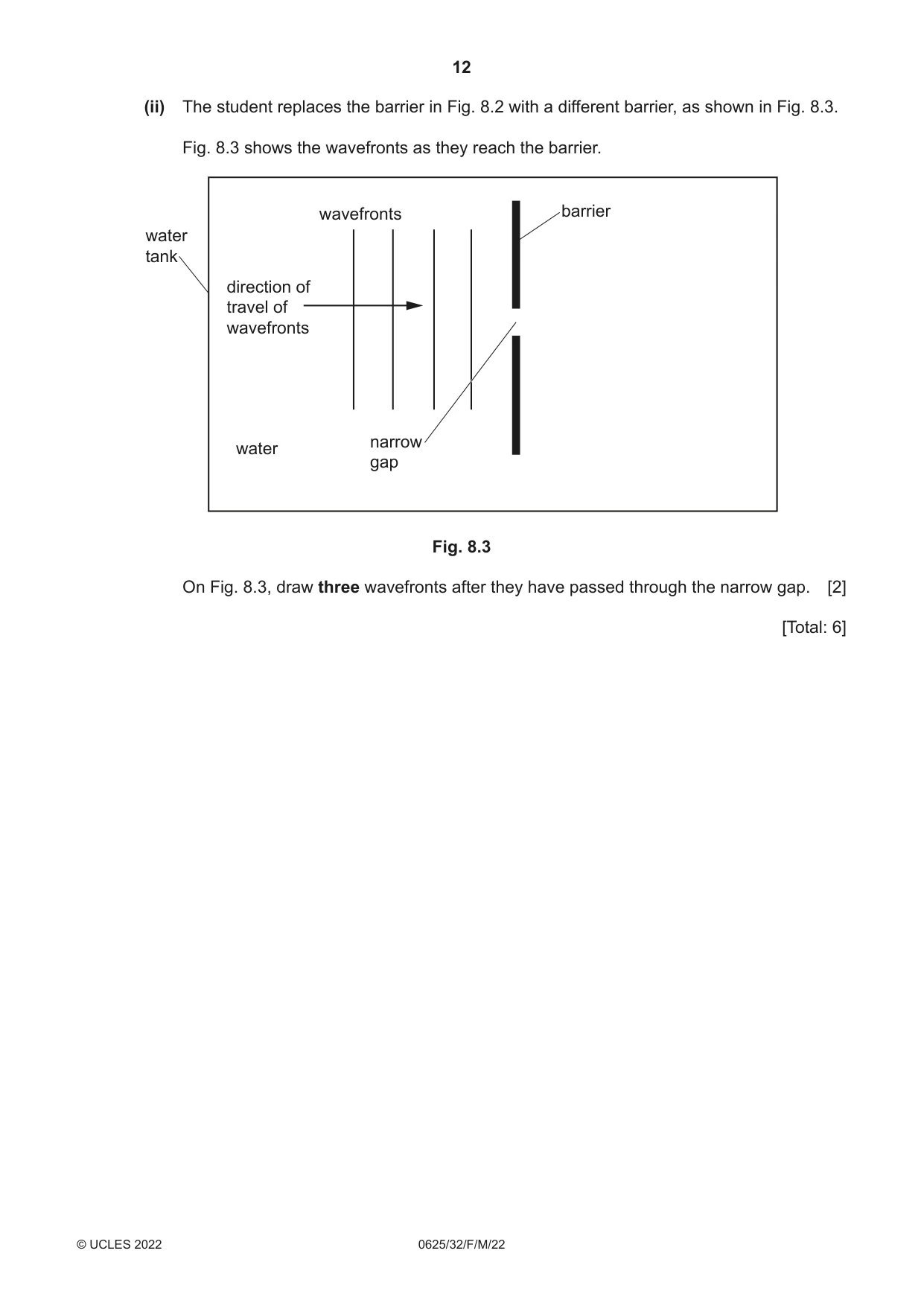
8 A student uses a tank of water to observe waves on the surface of the water. (a) The graph in Fig. 8.1 represents a wave on the surface of the water. displacement of water 0 distance Fig. 8.1 (i) Draw on Fig. 8.1 to indicate the amplitude of the wave. Label the amplitude A. [1] (ii) Draw on Fig. 8.1 to indicate one wavelength of the wave. Label the wavelength L. [1] (b) The student creates waves in the water tank and places various barriers in their path. (i) Fig. 8.2 shows the wavefronts as they approach a barrier placed at an angle of 45° to the wavefronts. wavefronts barrier water tank direction of travel of wavefronts 45° water Fig. 8.2 On Fig. 8.2, draw three wavefronts after they have reflected from the barrier. Draw an arrow to show the direction of travel of these wavefronts. [2] (ii) The student replaces the barrier in Fig. 8.2 with a different barrier, as shown in Fig. 8.3. Fig. 8.3 shows the wavefronts as they reach the barrier. wavefronts barrier water tank direction of travel of wavefronts narrow water gap Fig. 8.3 On Fig. 8.3, draw three wavefronts after they have passed through the narrow gap. [2] [Total: 6]
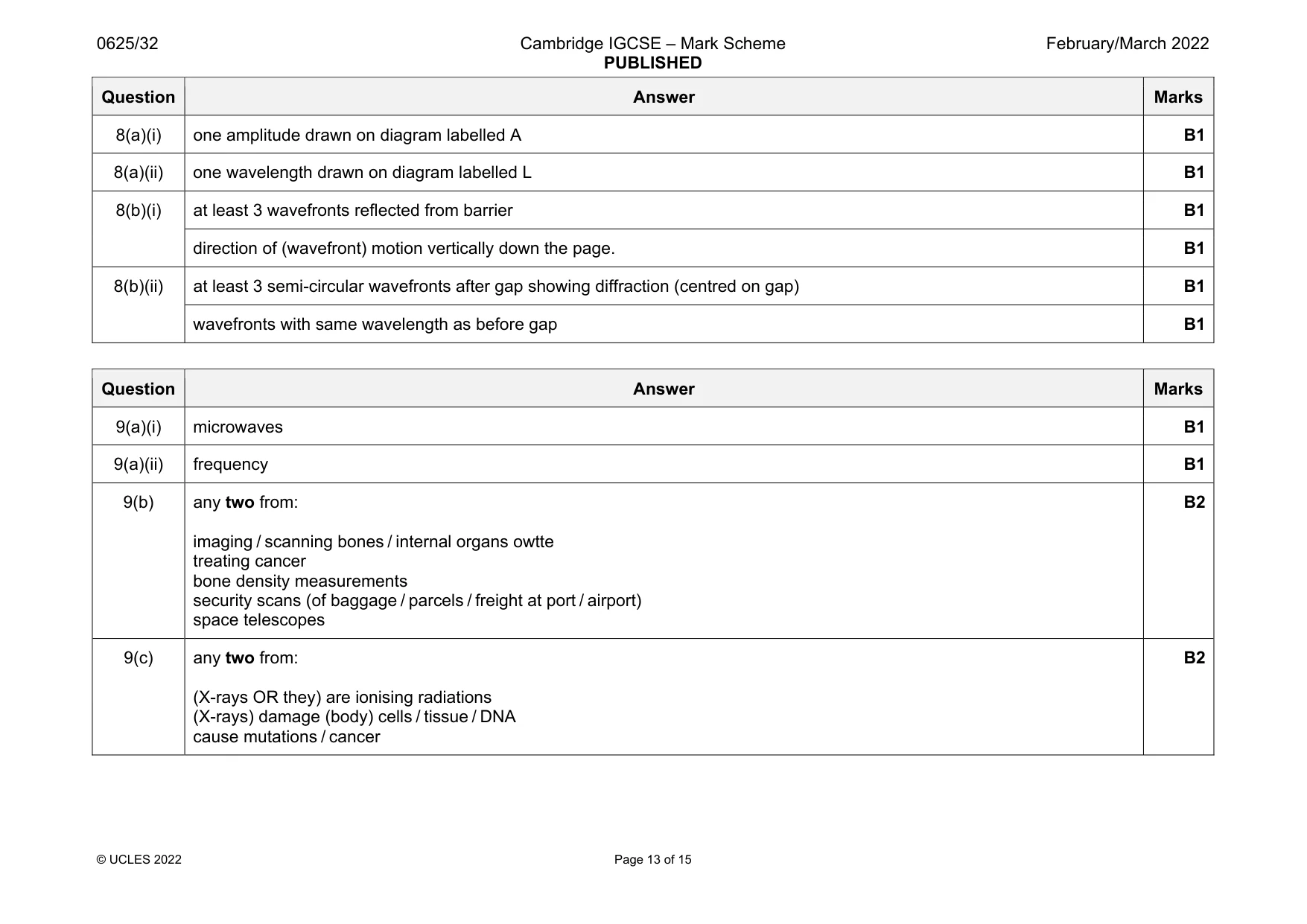
Mark scheme: 8(a)(i) one amplitude drawn on diagram labelled A B1 8(a)(ii) one wavelength drawn on diagram labelled L B1 8(b)(i) at least 3 wavefronts reflected from barrier B1 direction of (wavefront) motion vertically down the page. B1 8(b)(ii) at least 3 semi-circular wavefronts after gap showing diffraction (centred on gap) B1 wavefronts with same wavelength as before gap B1
Q9 · The regions of the electromagnetic spectrum
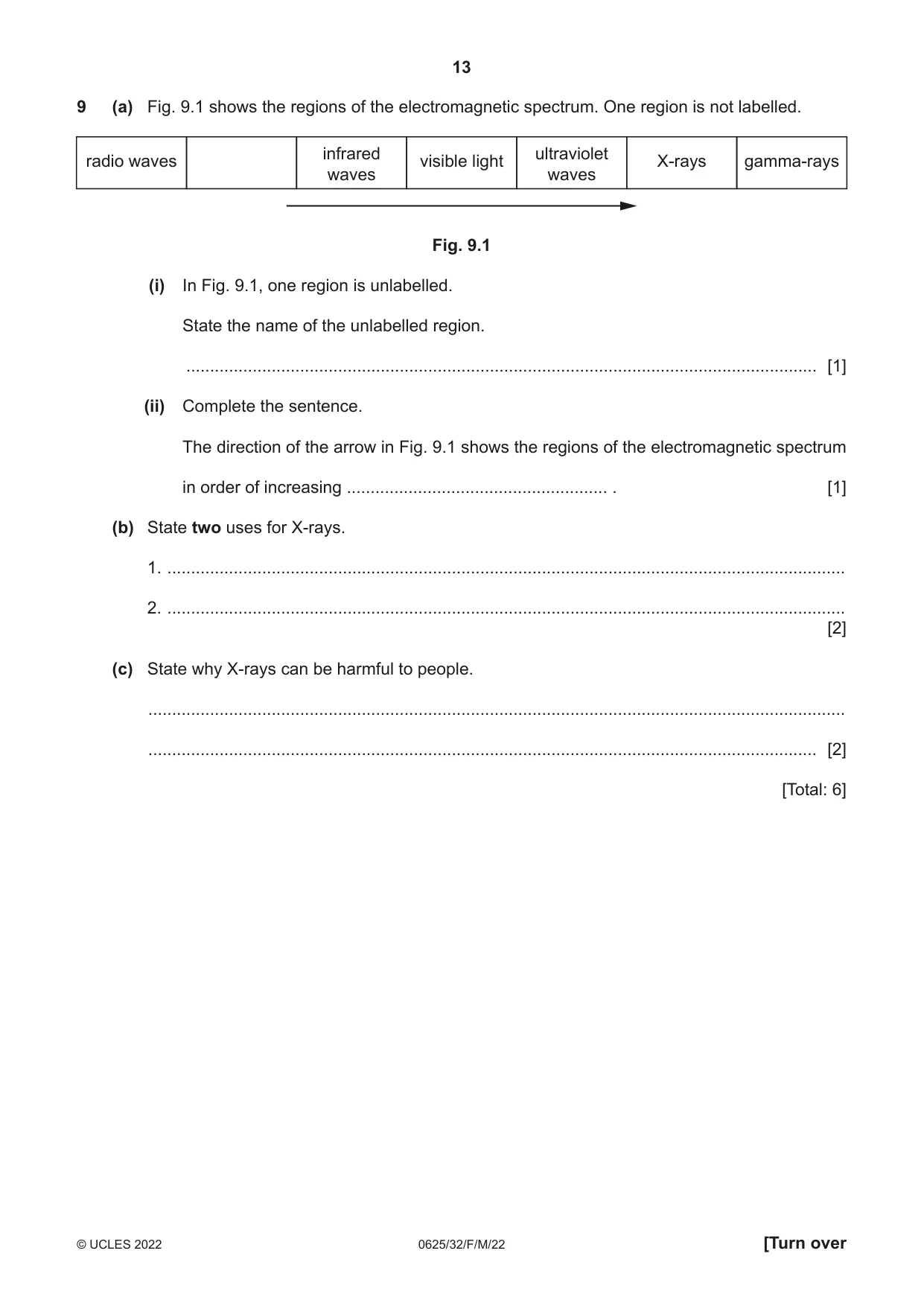
9 (a) Fig. 9.1 shows the regions of the electromagnetic spectrum. One region is not labelled. infrared ultraviolet radio waves visible light X-rays gamma-rays waves waves Fig. 9.1 (i) In Fig. 9.1, one region is unlabelled. State the name of the unlabelled region. ..................................................................................................................................... [1] (ii) Complete the sentence. The direction of the arrow in Fig. 9.1 shows the regions of the electromagnetic spectrum in order of increasing ....................................................... . [1] (b) State two uses for X-rays. 1. ............................................................................................................................................... 2. ............................................................................................................................................... [2] (c) State why X-rays can be harmful to people. ................................................................................................................................................... ............................................................................................................................................. [2] [Total: 6]
Mark scheme: 9(a)(i) microwaves B1 9(a)(ii) frequency B1 9(b) any two from: imaging / scanning bones / internal organs owtte treating cancer bone density measurements security scans (of baggage / parcels / freight at port / airport) space telescopes B2 9(c) any two from: (X-rays OR they) are ionising radiations (X-rays) damage (body) cells / tissue / DNA cause mutations / cancer B2
Q10 · A student connects the circuit shown in Fig
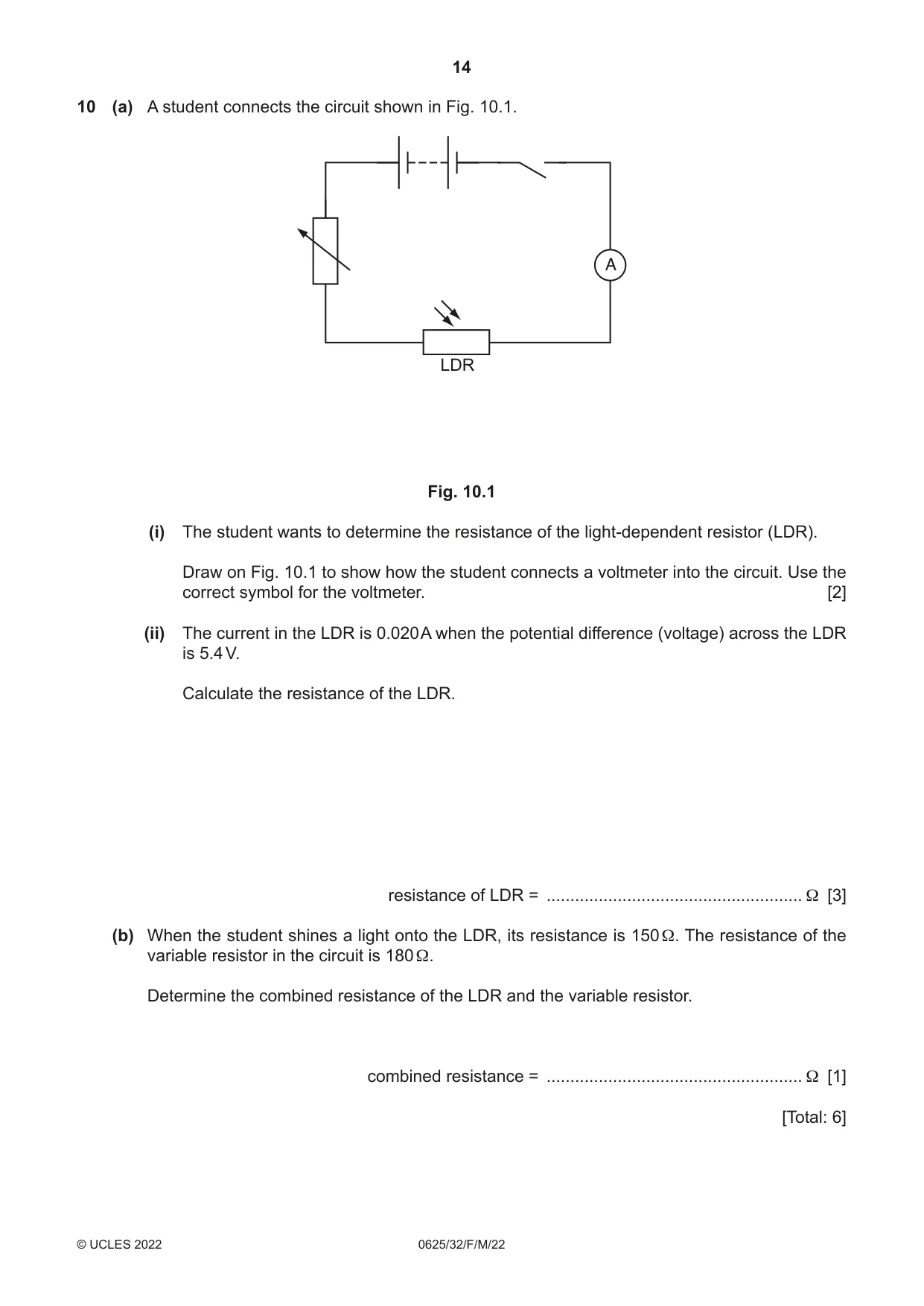
10 (a) A student connects the circuit shown in Fig. 10.1. A LDR Fig. 10.1 (i) The student wants to determine the resistance of the light-dependent resistor (LDR). Draw on Fig. 10.1 to show how the student connects a voltmeter into the circuit. Use the correct symbol for the voltmeter. [2] (ii) The current in the LDR is 0.020 A when the potential difference (voltage) across the LDR is 5.4 V. Calculate the resistance of the LDR. resistance of LDR = ...................................................... Ω [3] (b) When the student shines a light onto the LDR, its resistance is 150 Ω. The resistance of the variable resistor in the circuit is 180 Ω. Determine the combined resistance of the LDR and the variable resistor. combined resistance = ...................................................... Ω [1] [Total: 6]
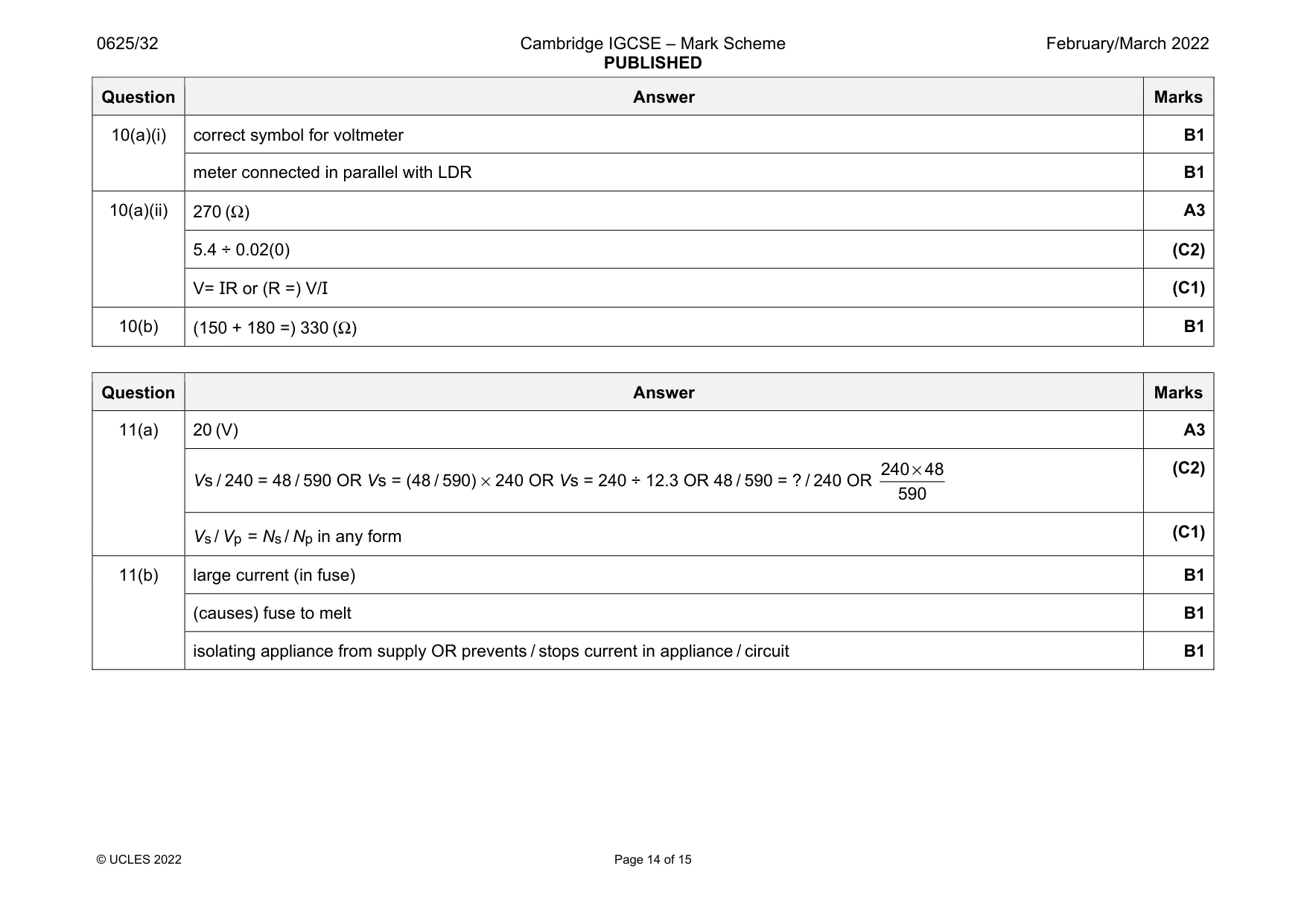
Mark scheme: 10(a)(i) correct symbol for voltmeter B1 meter connected in parallel with LDR B1 10(a)(ii) 270 (Ω) A3 5.4 ÷ 0.02(0) (C2) V= IR or (R =) V/I (C1) 10(b) (150 + 180 =) 330 (Ω) B1
Q11 · A battery charger for a laptop computer includes a transformer
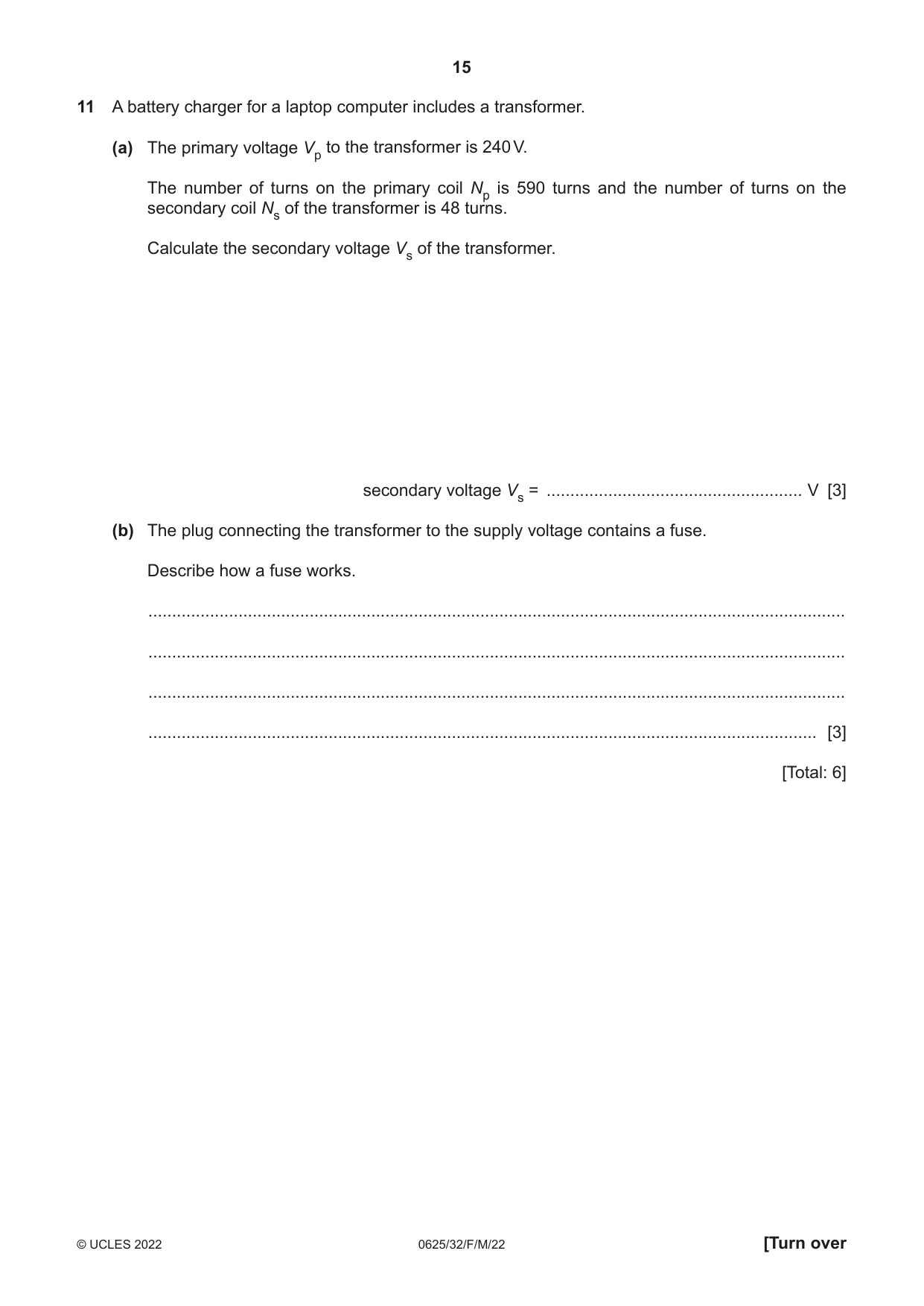
11 A battery charger for a laptop computer includes a transformer. (a) The primary voltage Vp to the transformer is 240 V. The number of turns on the primary coil Np is 590 turns and the number of turns on the secondary coil Ns of the transformer is 48 turns. Calculate the secondary voltage Vs of the transformer. secondary voltage Vs = ...................................................... V [3] (b) The plug connecting the transformer to the supply voltage contains a fuse. Describe how a fuse works. ................................................................................................................................................... ................................................................................................................................................... ................................................................................................................................................... ............................................................................................................................................. [3] [Total: 6]
Mark scheme: 11(a) 20 (V) A3 Vs / 240 = 48 / 590 OR Vs = (48 / 590) × 240 OR Vs = 240 ÷ 12.3 OR 48 / 590 = ? / 240 OR 240 48 590 × (C2) Vs / Vp = Ns / Np in any form (C1) 11(b) large current (in fuse) B1 (causes) fuse to melt B1 isolating appliance from supply OR prevents / stops current in appliance / circuit B1
Q12 · Some properties of three different types of radiation
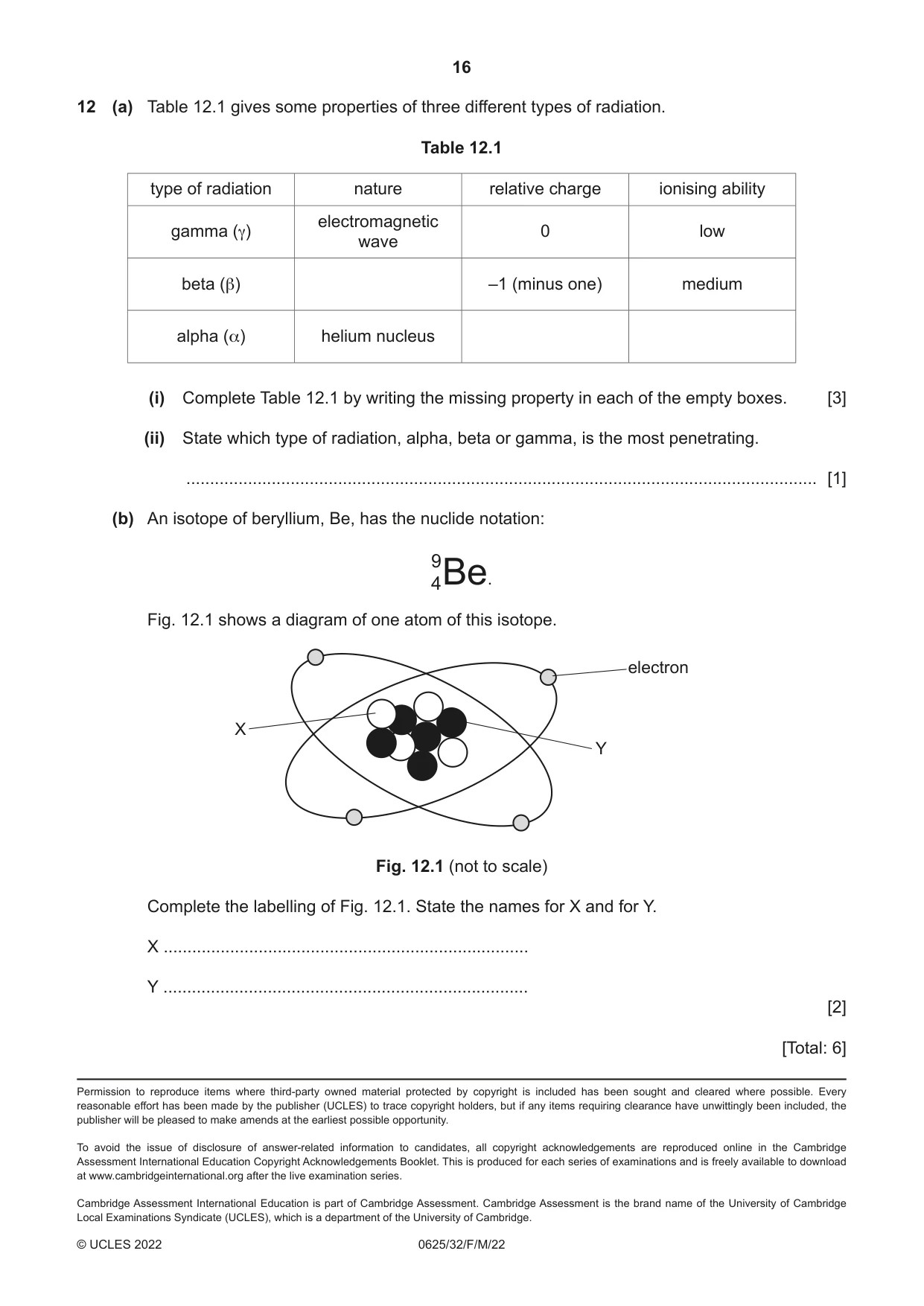
12 (a) Table 12.1 gives some properties of three different types of radiation. Table 12.1 type of radiation nature relative charge ionising ability electromagnetic gamma (γ) 0 low wave beta (β) –1 (minus one) medium alpha (α) helium nucleus (i) Complete Table 12.1 by writing the missing property in each of the empty boxes. [3] (ii) State which type of radiation, alpha, beta or gamma, is the most penetrating. ..................................................................................................................................... [1] (b) An isotope of beryllium, Be, has the nuclide notation: 94Be. Fig. 12.1 shows a diagram of one atom of this isotope. electron X Y Fig. 12.1 (not to scale) Complete the labelling of Fig. 12.1. State the names for X and for Y. X ............................................................................. Y ............................................................................. [2] [Total: 6]
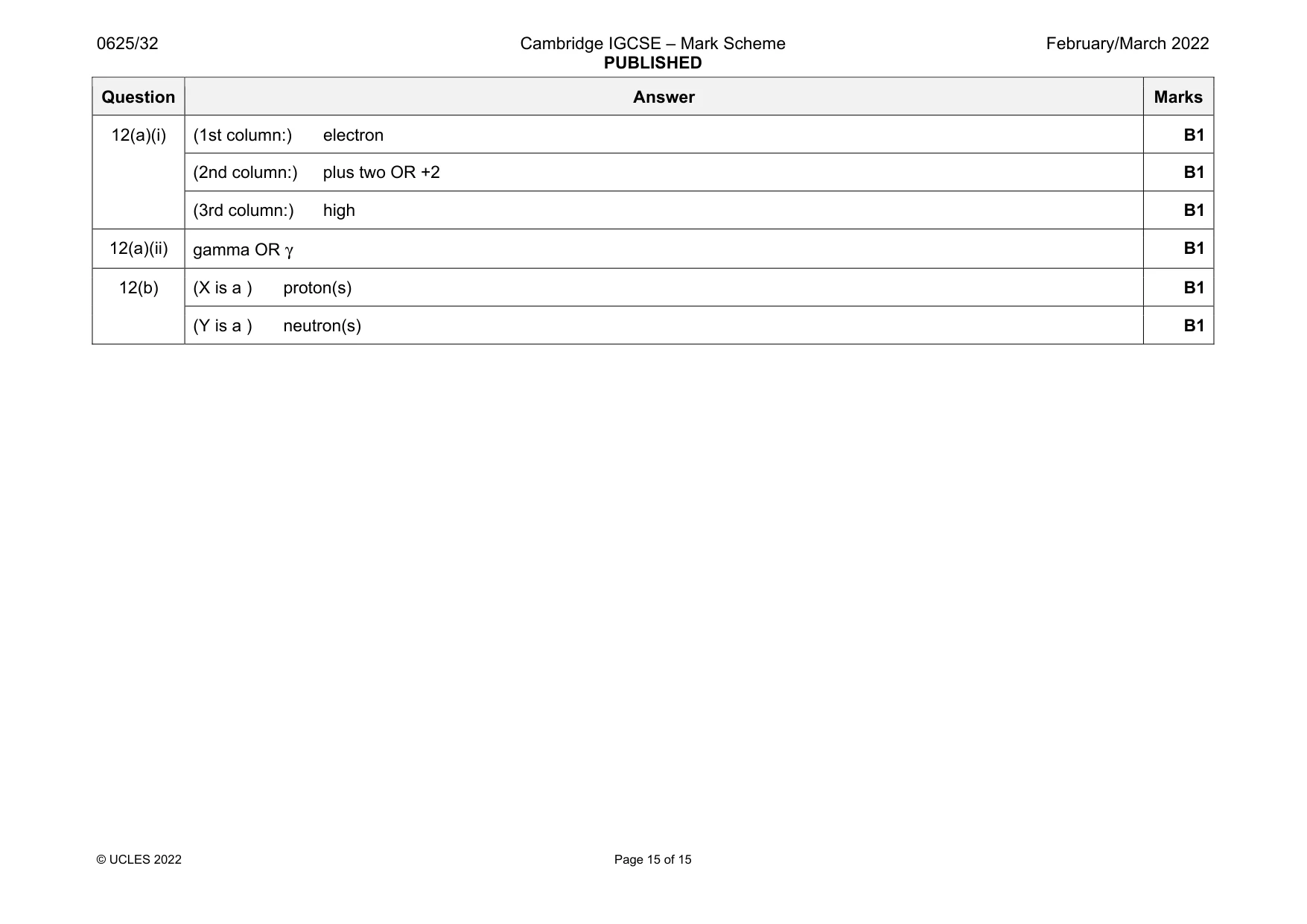
Mark scheme: 12(a)(i) (1st column:) electron B1 (2nd column:) plus two OR +2 B1 (3rd column:) high B1 12(a)(ii) gamma OR γ B1 12(b) (X is a ) proton(s) B1 (Y is a ) neutron(s) B1
What was in this paper
The subtopics covered by these 12 questions, and how many questions each got. Open one in a new tab to see every Cambridge question on it.
What you needed in this session
Cambridge’s own grade thresholds for 2022 Feb/March, Paper 3 · Variant 2. A higher threshold means an easier paper — the bar moves with how the cohort did.