Cambridge IGCSE Physics 0625 — 2024 Oct/Nov Paper 3 · Variant 2
0625/32/O/N/24 · 11 questions · 80 marks · ≈90 min
The question paper and its mark scheme, free to read here and free to download. This is Cambridge’s own paper, exactly as it was sat.
Question paper20 pages
Mark scheme15 pages
Answers below. Sit the paper first if you are practising.
Questions as text
Q1 · The distance–time graph for a student’s journey
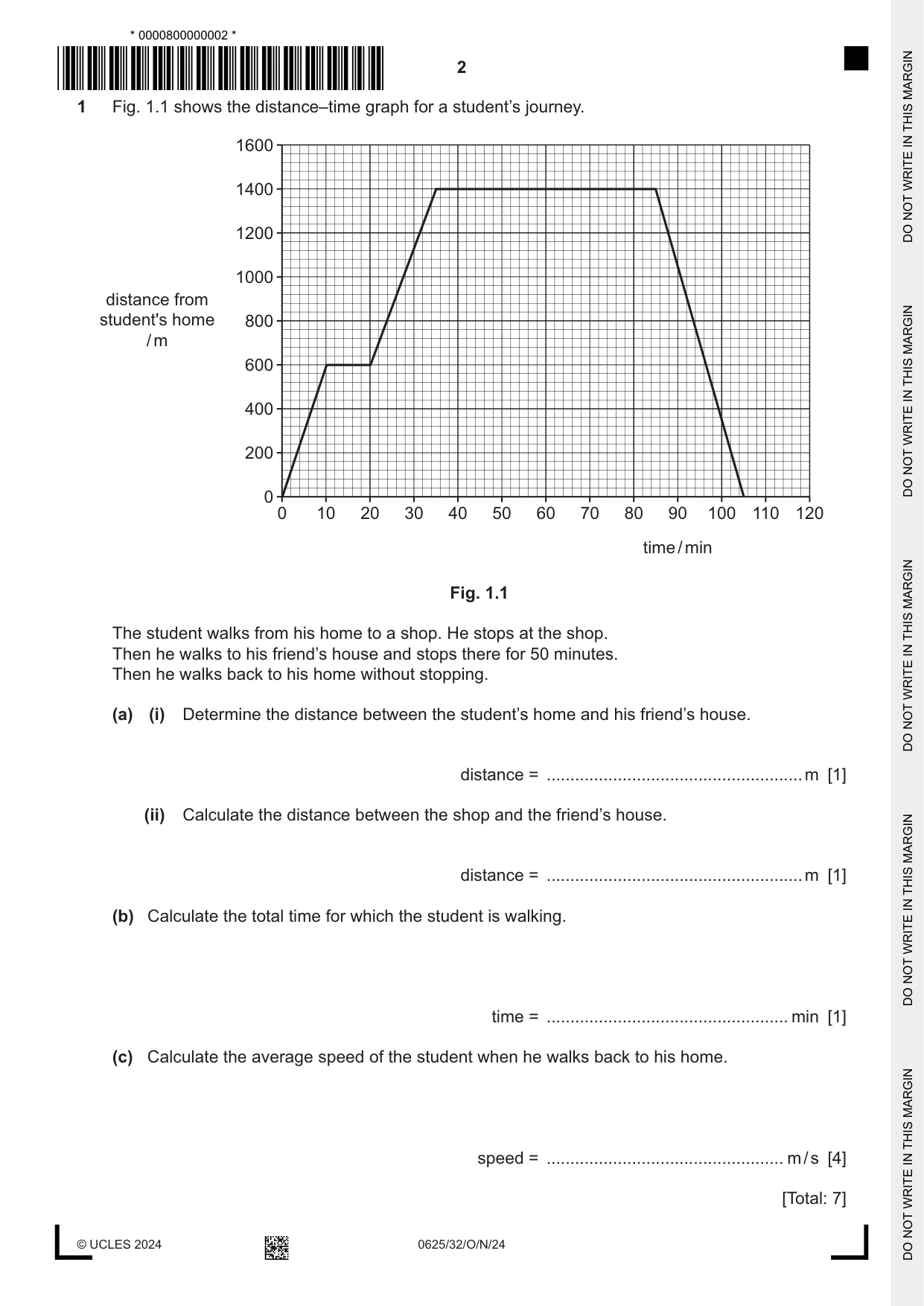
1 Fig. 1.1 shows the distance–time graph for a student’s journey. 1600 1400 1200 1000 distance from student's home 800 / m 600 400 200 0 0 10 20 30 40 50 60 70 80 90 100 110 120 time / min Fig. 1.1 The student walks from his home to a shop. He stops at the shop. Then he walks to his friend’s house and stops there for 50 minutes. Then he walks back to his home without stopping. (a) (i) Determine the distance between the student’s home and his friend’s house. distance = ...................................................... m [1] (ii) Calculate the distance between the shop and the friend’s house. distance = ...................................................... m [1] (b) Calculate the total time for which the student is walking. time = ................................................... min [1] (c) Calculate the average speed of the student when he walks back to his home. speed = .................................................. m / s [4] [Total: 7]
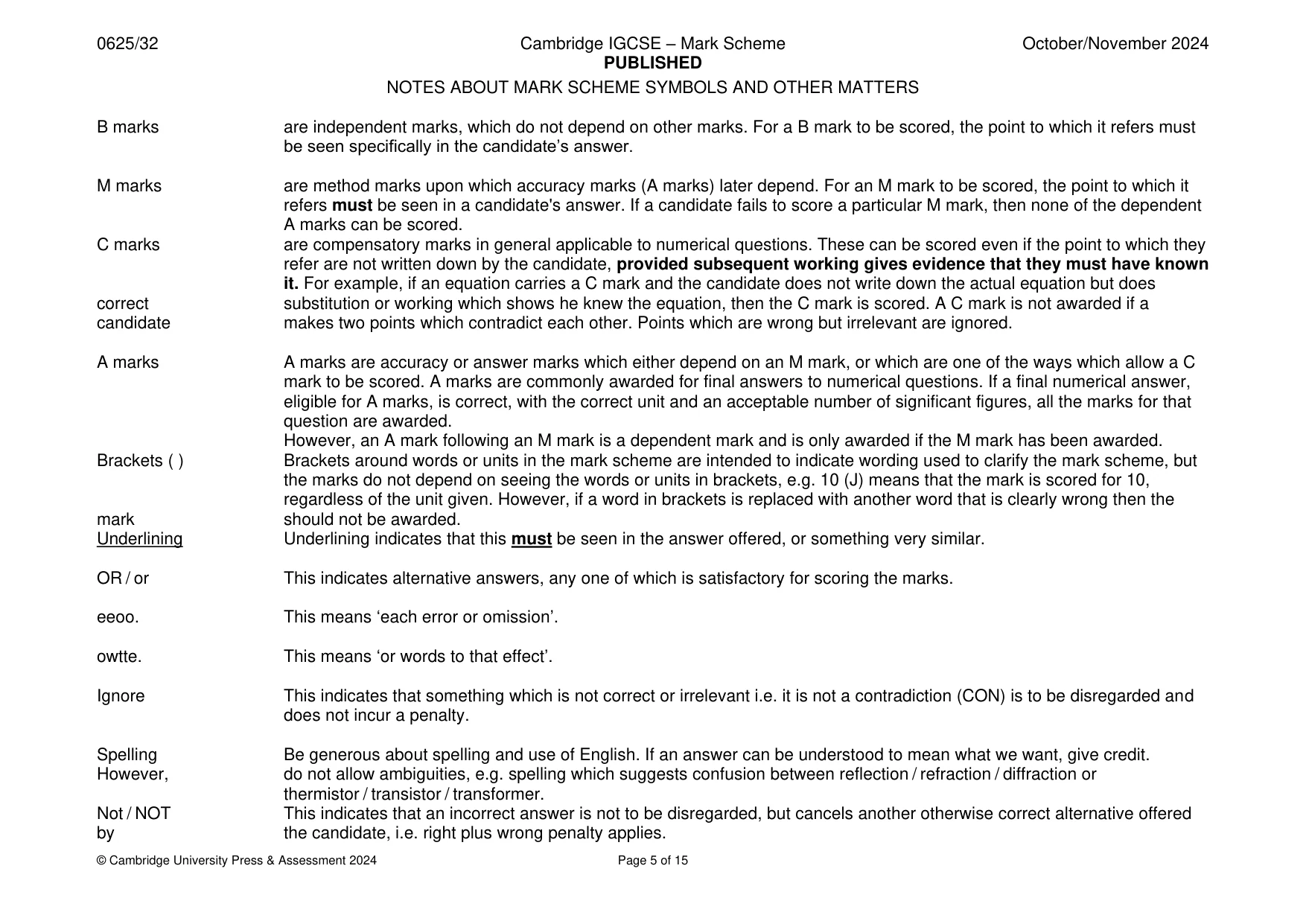
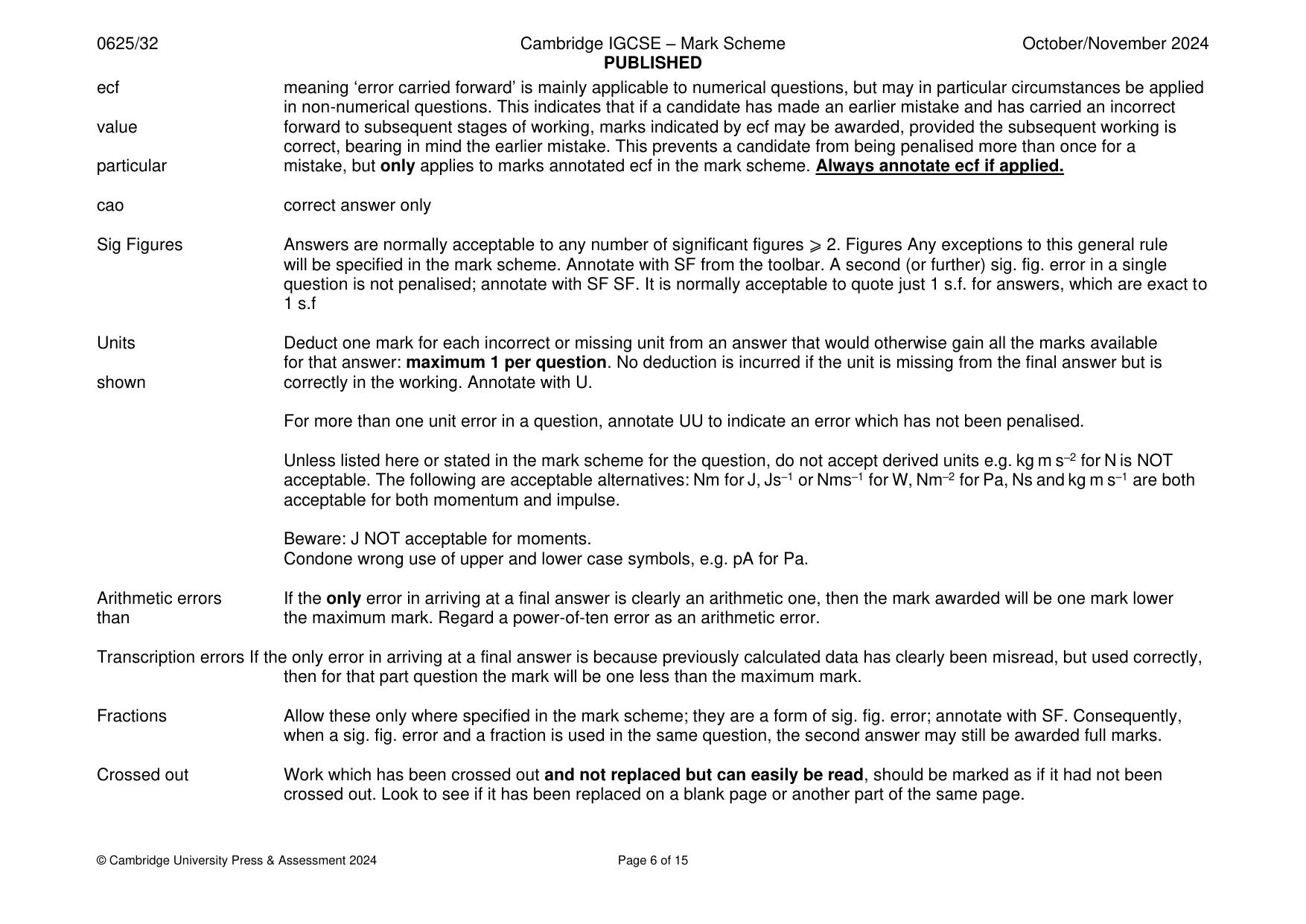
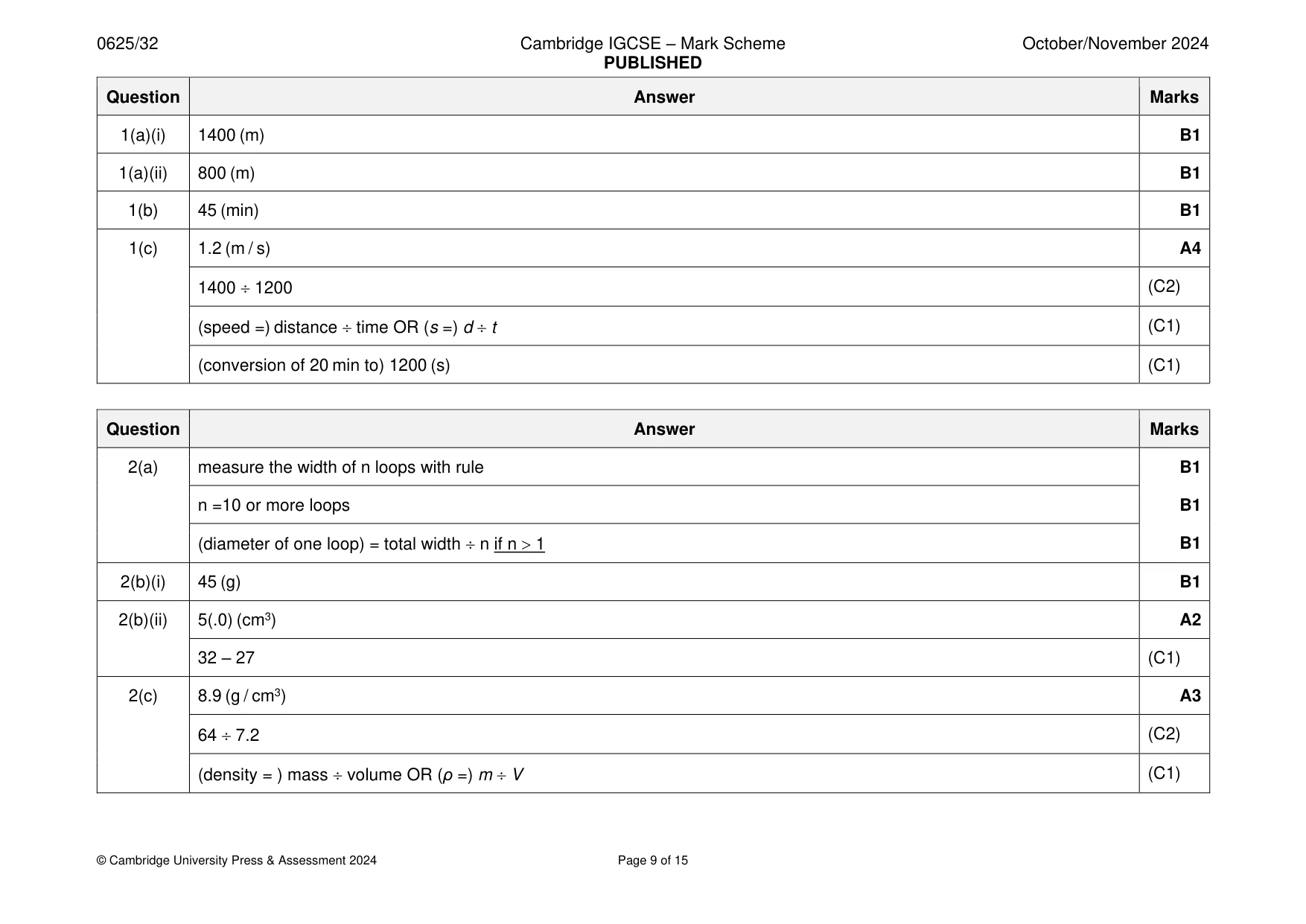
Mark scheme: Question Answer Marks 1(a)(i) 1400 (m) B1 1(a)(ii) 800 (m) B1 1(b) 45 (min) B1 1(c) 1.2 (m / s) A4 1400 1200 (C2) (speed =) distance time OR (s =) d t (C1) (conversion of 20 min to) 1200 (s) (C1)
Q2 · A student wants to measure the diameter of a wire
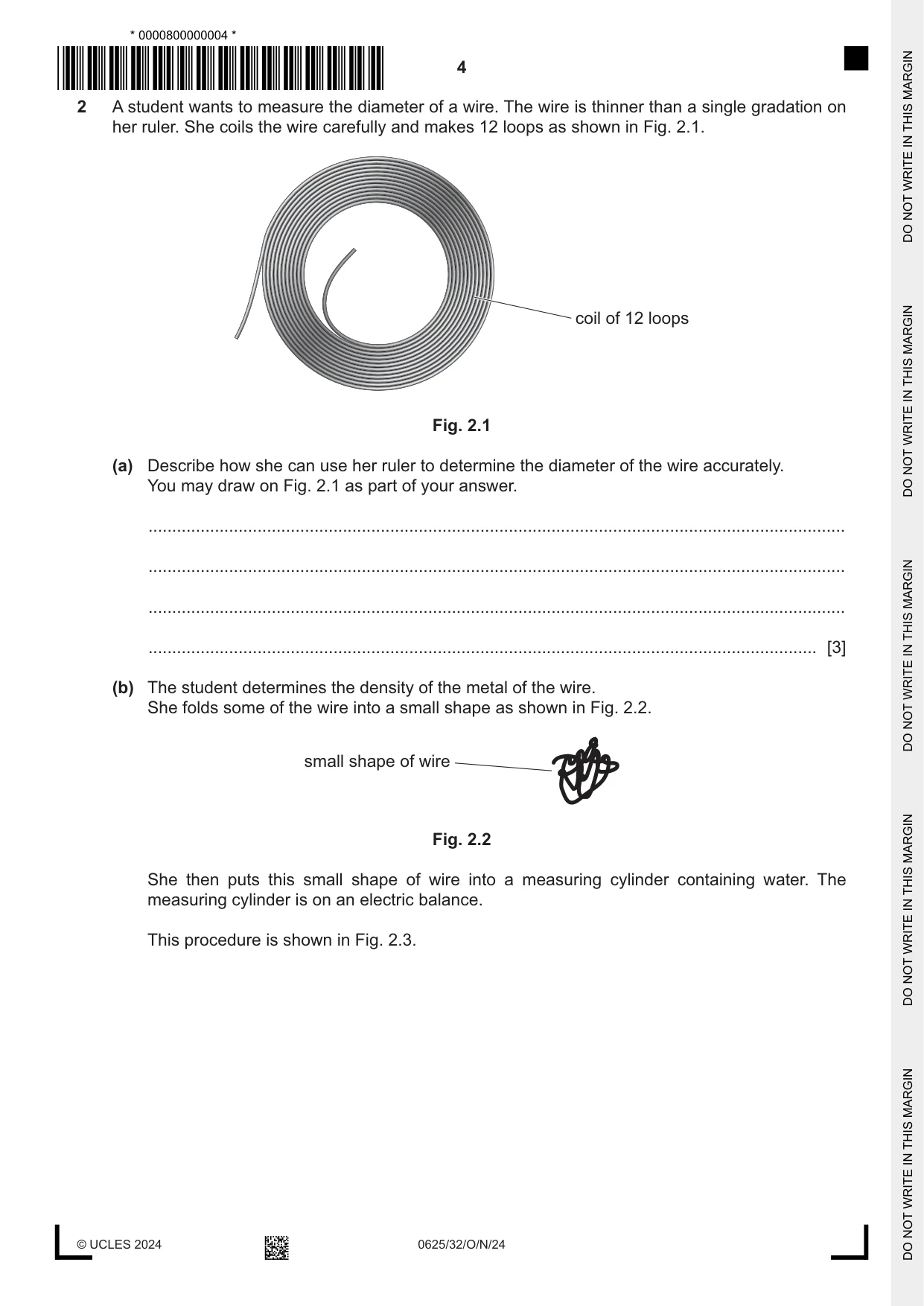
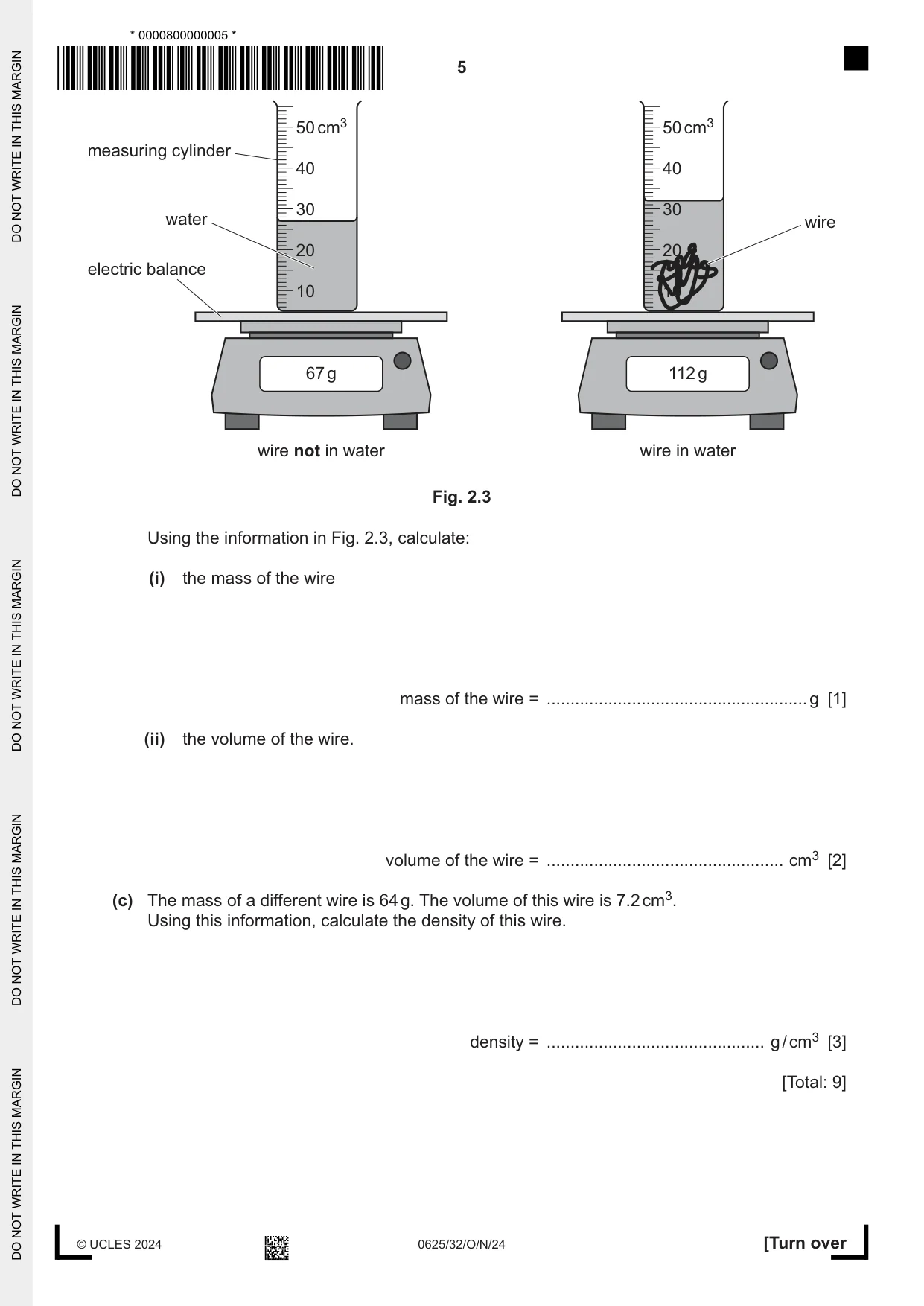
2 A student wants to measure the diameter of a wire. The wire is thinner than a single gradation on her ruler. She coils the wire carefully and makes 12 loops as shown in Fig. 2.1. coil of 12 loops Fig. 2.1 (a) Describe how she can use her ruler to determine the diameter of the wire accurately. You may draw on Fig. 2.1 as part of your answer. ................................................................................................................................................... ................................................................................................................................................... ................................................................................................................................................... ............................................................................................................................................. [3] (b) The student determines the density of the metal of the wire. She folds some of the wire into a small shape as shown in Fig. 2.2. small shape of wire Fig. 2.2 She then puts this small shape of wire into a measuring cylinder containing water. The measuring cylinder is on an electric balance. This procedure is shown in Fig. 2.3. 50 cm3 50 cm3 measuring cylinder 40 40 30 30 water wire 20 20 electric balance 10 10 67 g 112 g wire not in water wire in water Fig. 2.3 Using the information in Fig. 2.3, calculate: (i) the mass of the wire mass of the wire = ....................................................... g [1] (ii) the volume of the wire. volume of the wire = .................................................. cm3 [2] (c) The mass of a different wire is 64 g. The volume of this wire is 7.2 cm3. Using this information, calculate the density of this wire. density = .............................................. g / cm3 [3] [Total: 9]
Mark scheme: 2(a) measure the width of n loops with rule B1 n =10 or more loops B1 (diameter of one loop) = total width n if n 1 B1 2(b)(i) 45 (g) B1 2(b)(ii) 5(.0) (cm3) A2 32 – 27 (C1) 2(c) 8.9 (g / cm3) A3 64 7.2 (C2) (density = ) mass volume OR (ρ =) m V (C1)
Q3 · A car has a fault
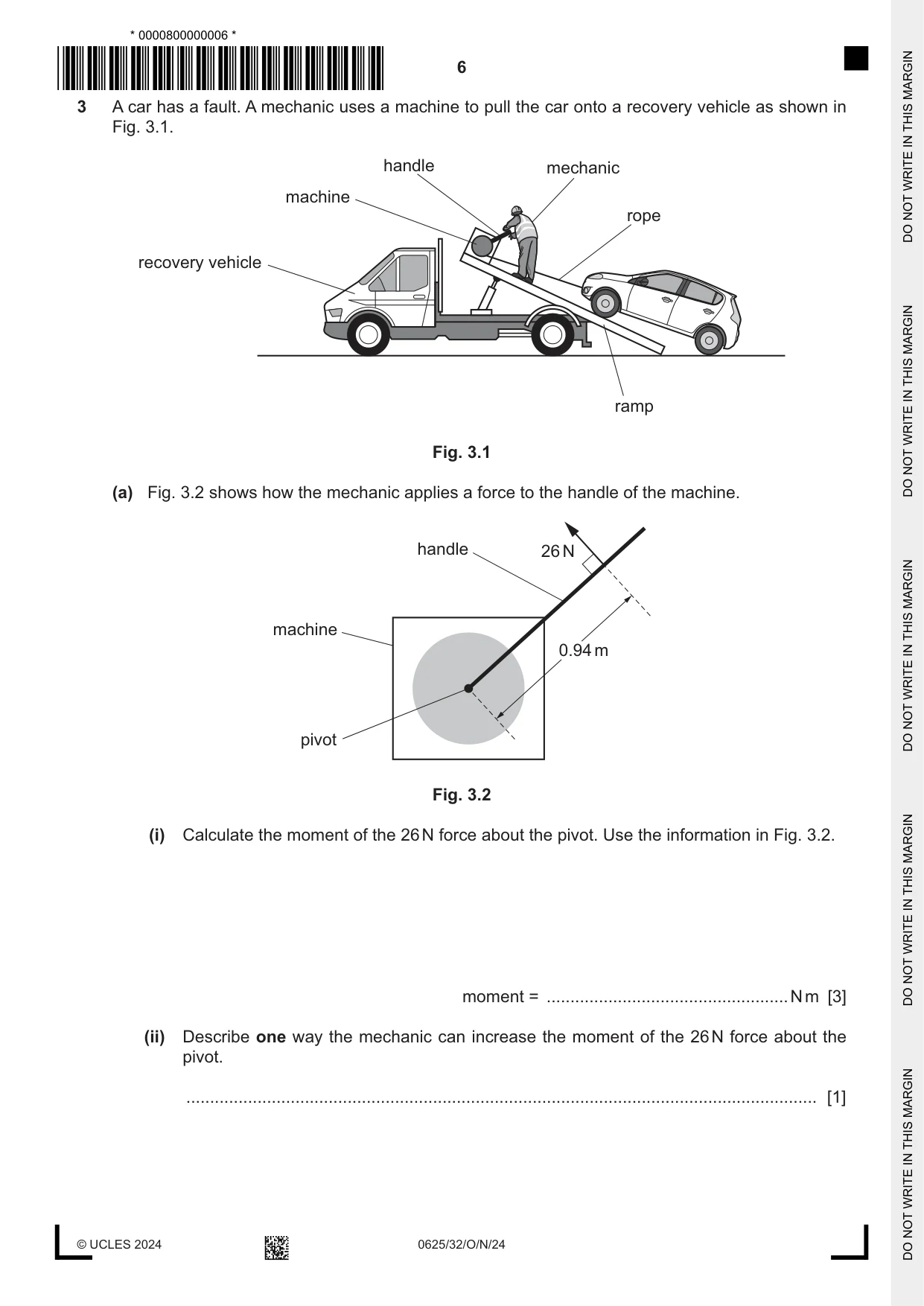
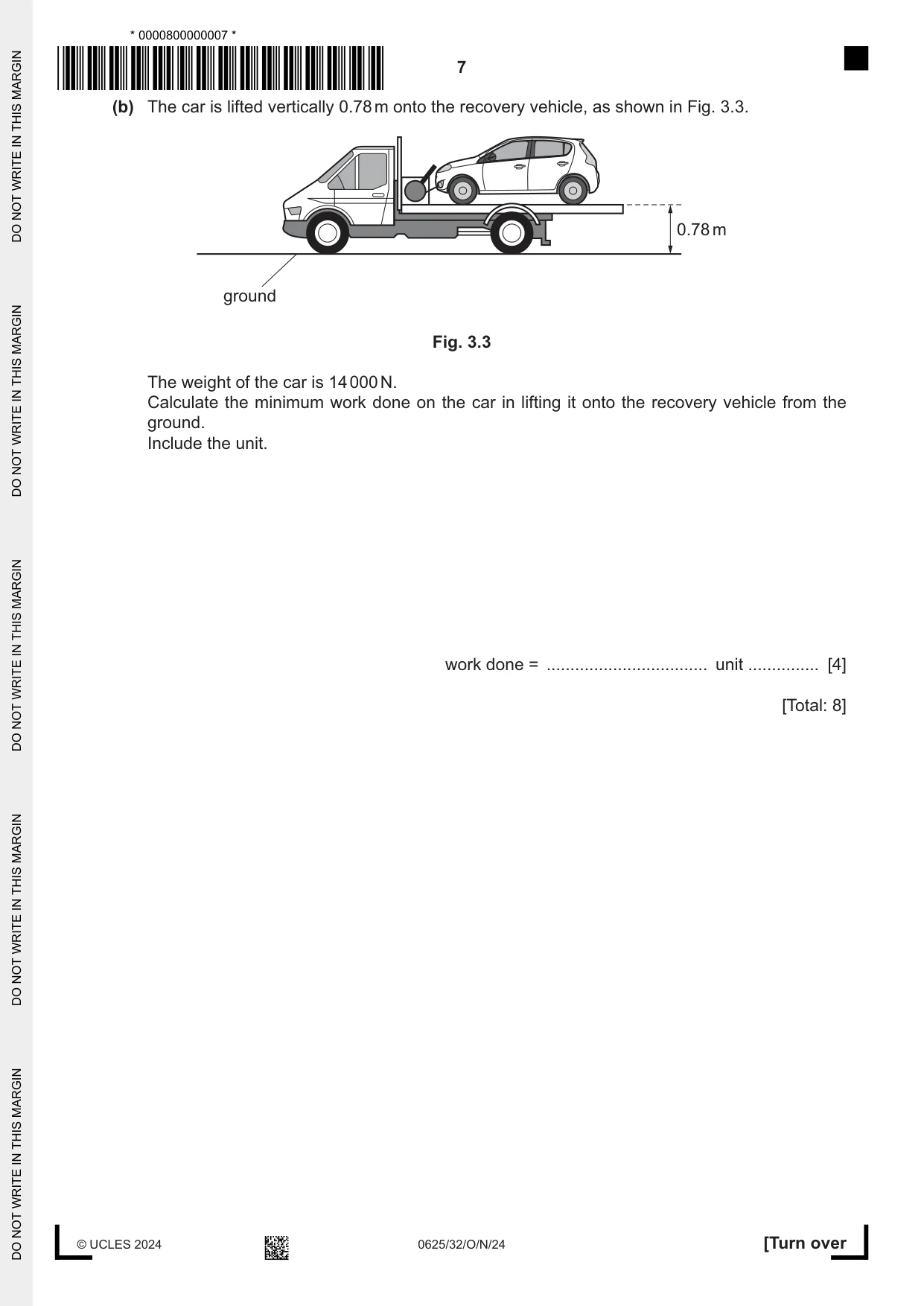
3 A car has a fault. A mechanic uses a machine to pull the car onto a recovery vehicle as shown in Fig. 3.1. handle mechanic machine rope recovery vehicle ramp Fig. 3.1 (a) Fig. 3.2 shows how the mechanic applies a force to the handle of the machine. handle 26 N machine 0.94 m pivot Fig. 3.2 (i) Calculate the moment of the 26 N force about the pivot. Use the information in Fig. 3.2. moment = ................................................... N m [3] (ii) Describe one way the mechanic can increase the moment of the 26 N force about the pivot. ..................................................................................................................................... [1] (b) The car is lifted vertically 0.78 m onto the recovery vehicle, as shown in Fig. 3.3. 0.78 m ground Fig. 3.3 The weight of the car is 14 000 N. Calculate the minimum work done on the car in lifting it onto the recovery vehicle from the ground. Include the unit. work done = .................................. unit ............... [4] [Total: 8]
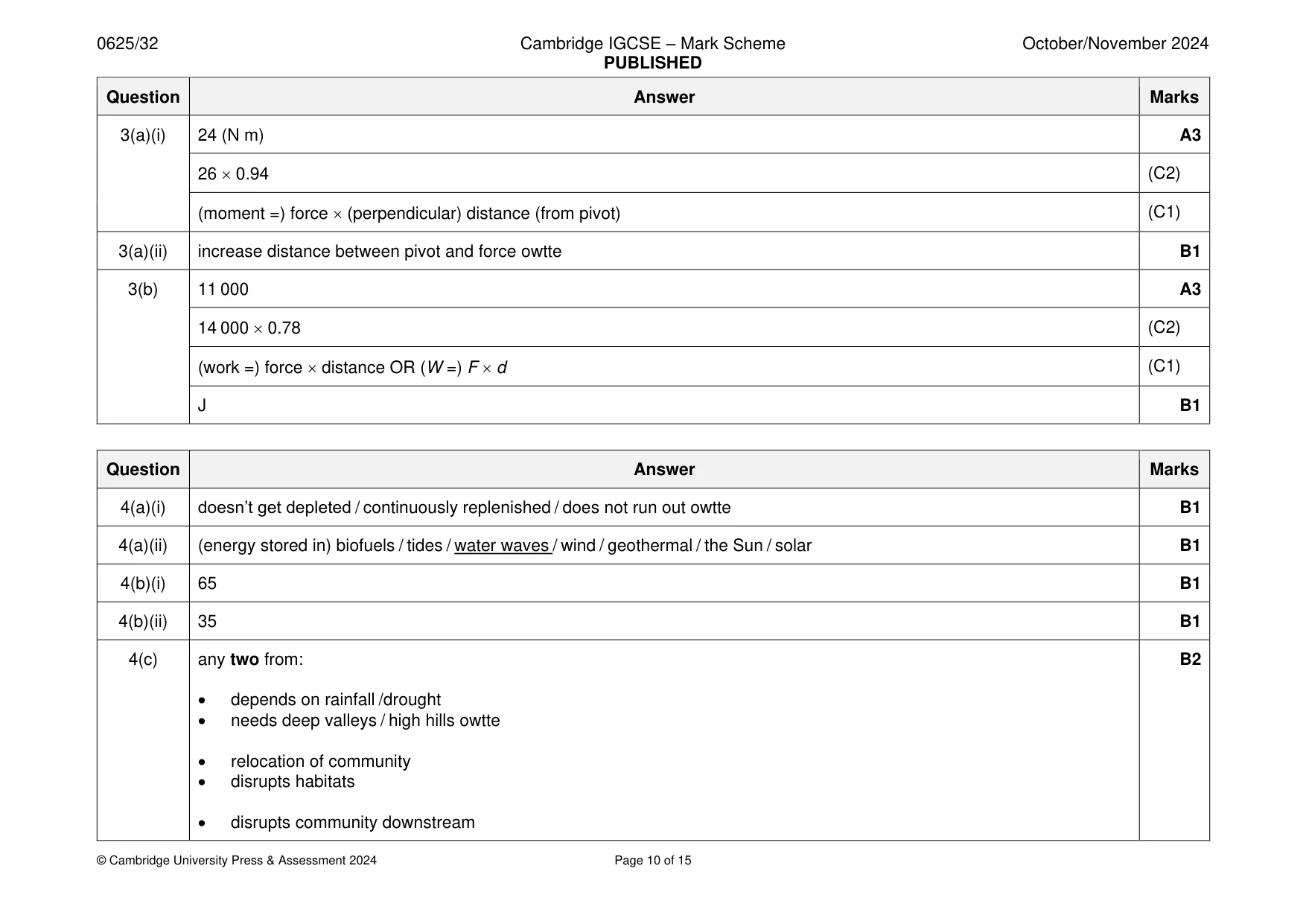
Mark scheme: 3(a)(i) 24 (N m) A3 26 0.94 (C2) (moment =) force (perpendicular) distance (from pivot) (C1) 3(a)(ii) increase distance between pivot and force owtte B1 3(b) 11 000 A3 14 000 0.78 (C2) (work =) force distance OR (W =) F d (C1) J B1
Q4 · Energy stored in the water behind hydroelectric dams is an example of a renewable energy…
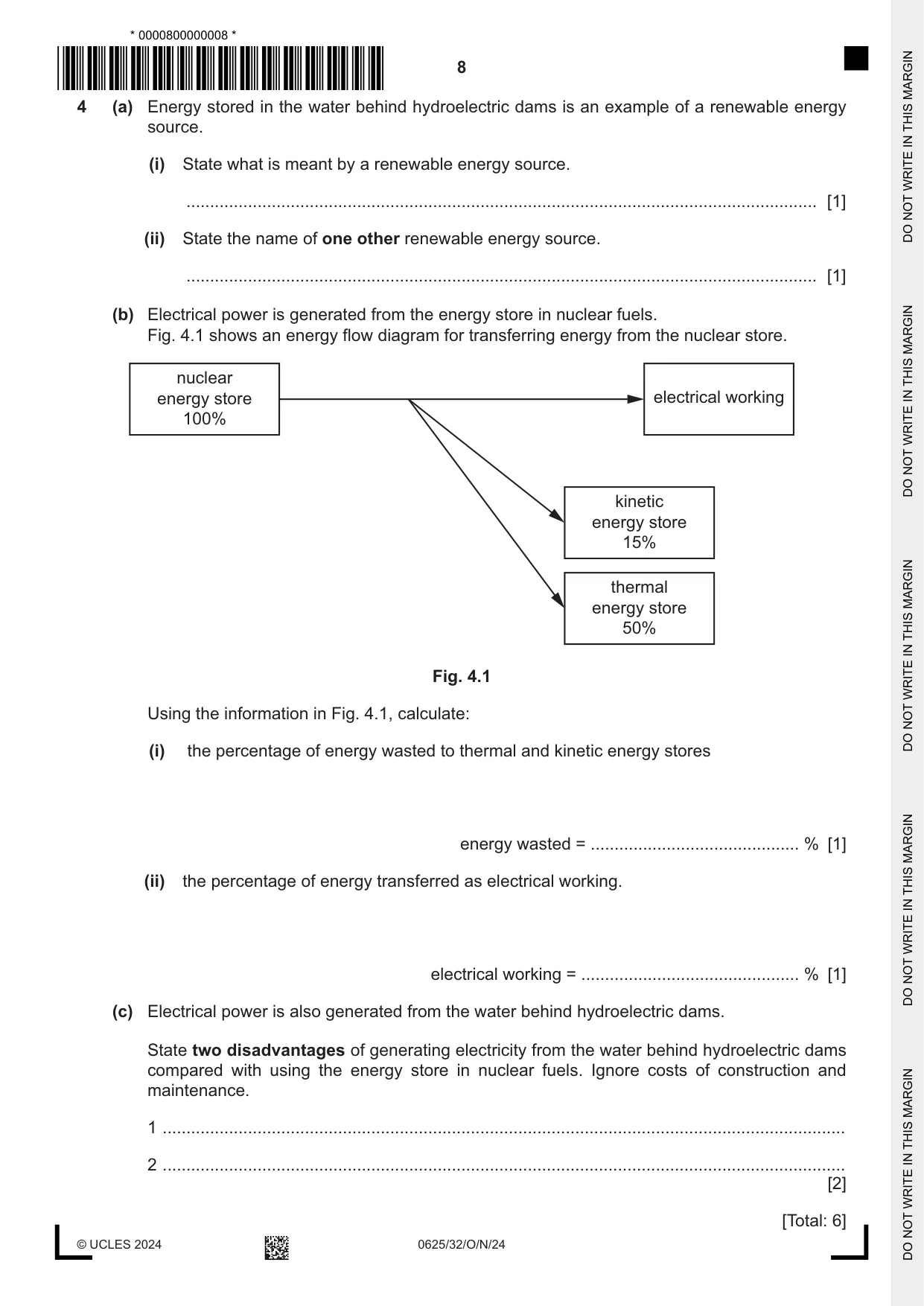
4 (a) Energy stored in the water behind hydroelectric dams is an example of a renewable energy source. (i) State what is meant by a renewable energy source. ..................................................................................................................................... [1] (ii) State the name of one other renewable energy source. ..................................................................................................................................... [1] (b) Electrical power is generated from the energy store in nuclear fuels. Fig. 4.1 shows an energy flow diagram for transferring energy from the nuclear store. nuclear energy store electrical working 100% kinetic energy store 15% thermal energy store 50% Fig. 4.1 Using the information in Fig. 4.1, calculate: (i) the percentage of energy wasted to thermal and kinetic energy stores energy wasted = ............................................ % [1] (ii) the percentage of energy transferred as electrical working. electrical working = .............................................. % [1] (c) Electrical power is also generated from the water behind hydroelectric dams. State two disadvantages of generating electricity from the water behind hydroelectric dams compared with using the energy store in nuclear fuels. Ignore costs of construction and maintenance. 1 ................................................................................................................................................ 2 ................................................................................................................................................ [2] [Total: 6]
Mark scheme: 4(a)(i) doesn’t get depleted / continuously replenished / does not run out owtte B1 4(a)(ii) (energy stored in) biofuels / tides / water waves / wind / geothermal / the Sun / solar B1 4(b)(i) 65 B1 4(b)(ii) 35 B1 4(c) any two from: B2 • depends on rainfall /drought • needs deep valleys / high hills owtte • relocation of community • disrupts habitats • disrupts community downstream
Q5 · A sealed glass bottle contains air
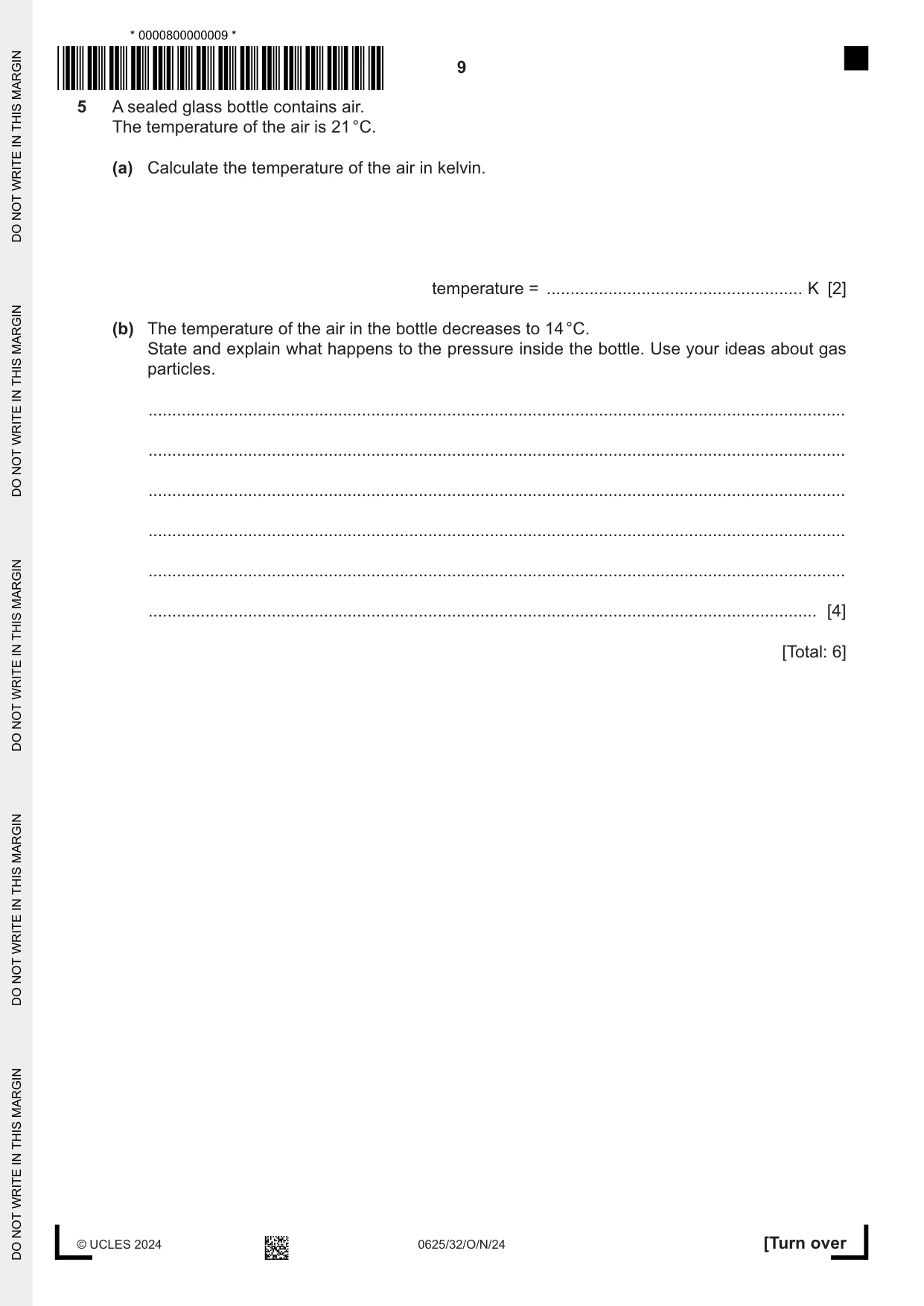
5 A sealed glass bottle contains air. The temperature of the air is 21 °C. (a) Calculate the temperature of the air in kelvin. temperature = ...................................................... K [2] (b) The temperature of the air in the bottle decreases to 14 °C. State and explain what happens to the pressure inside the bottle. Use your ideas about gas particles. ................................................................................................................................................... ................................................................................................................................................... ................................................................................................................................................... ................................................................................................................................................... ................................................................................................................................................... ............................................................................................................................................. [4] [Total: 6]
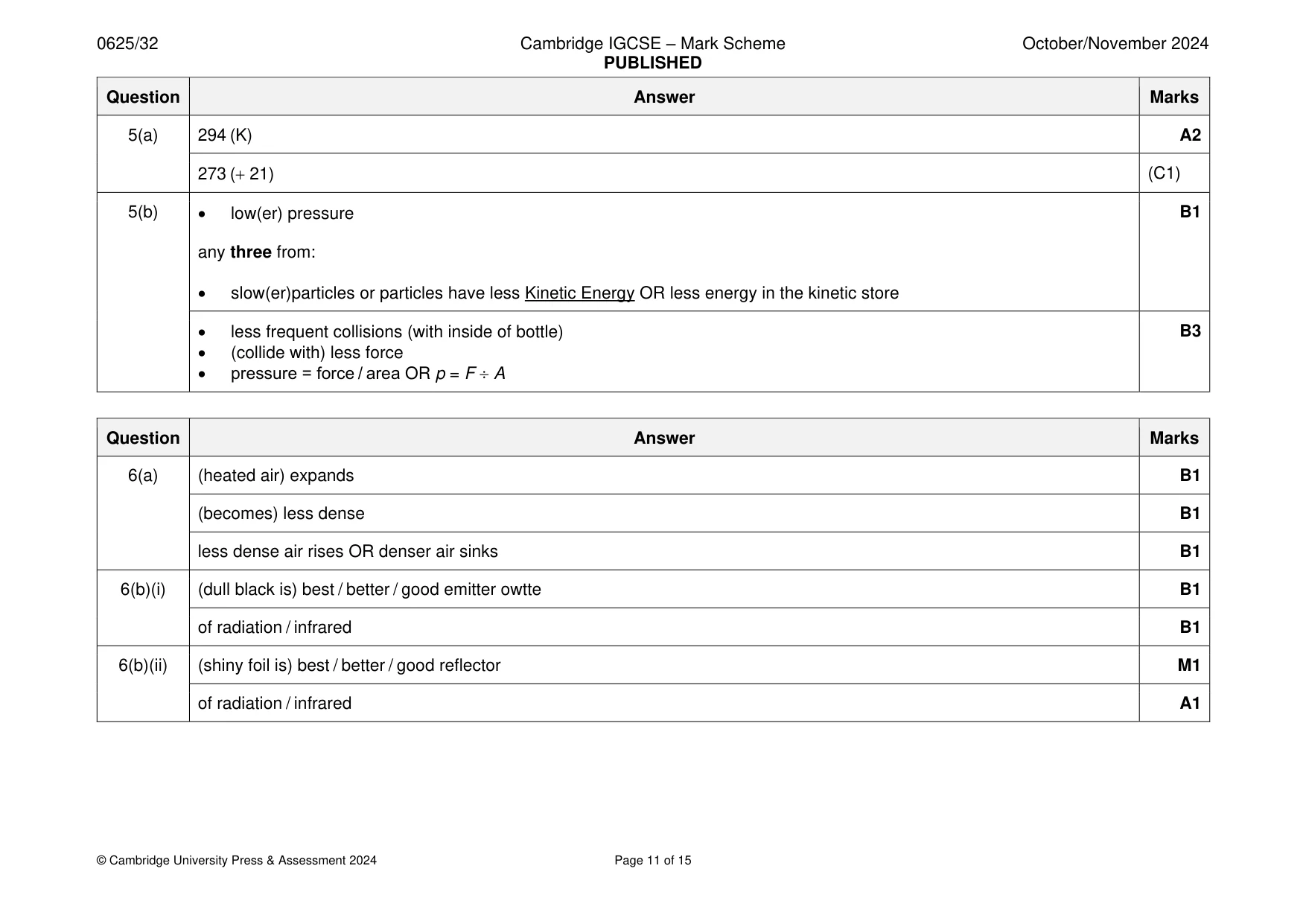
Mark scheme: 5(a) 294 (K) A2 273 (+ 21) (C1) 5(b) • low(er) pressure B1 any three from: • slow(er)particles or particles have less Kinetic Energy OR less energy in the kinetic store • less frequent collisions (with inside of bottle) B3 • (collide with) less force • pressure = force / area OR p = F A
Q6 · A wood burner in a cabin
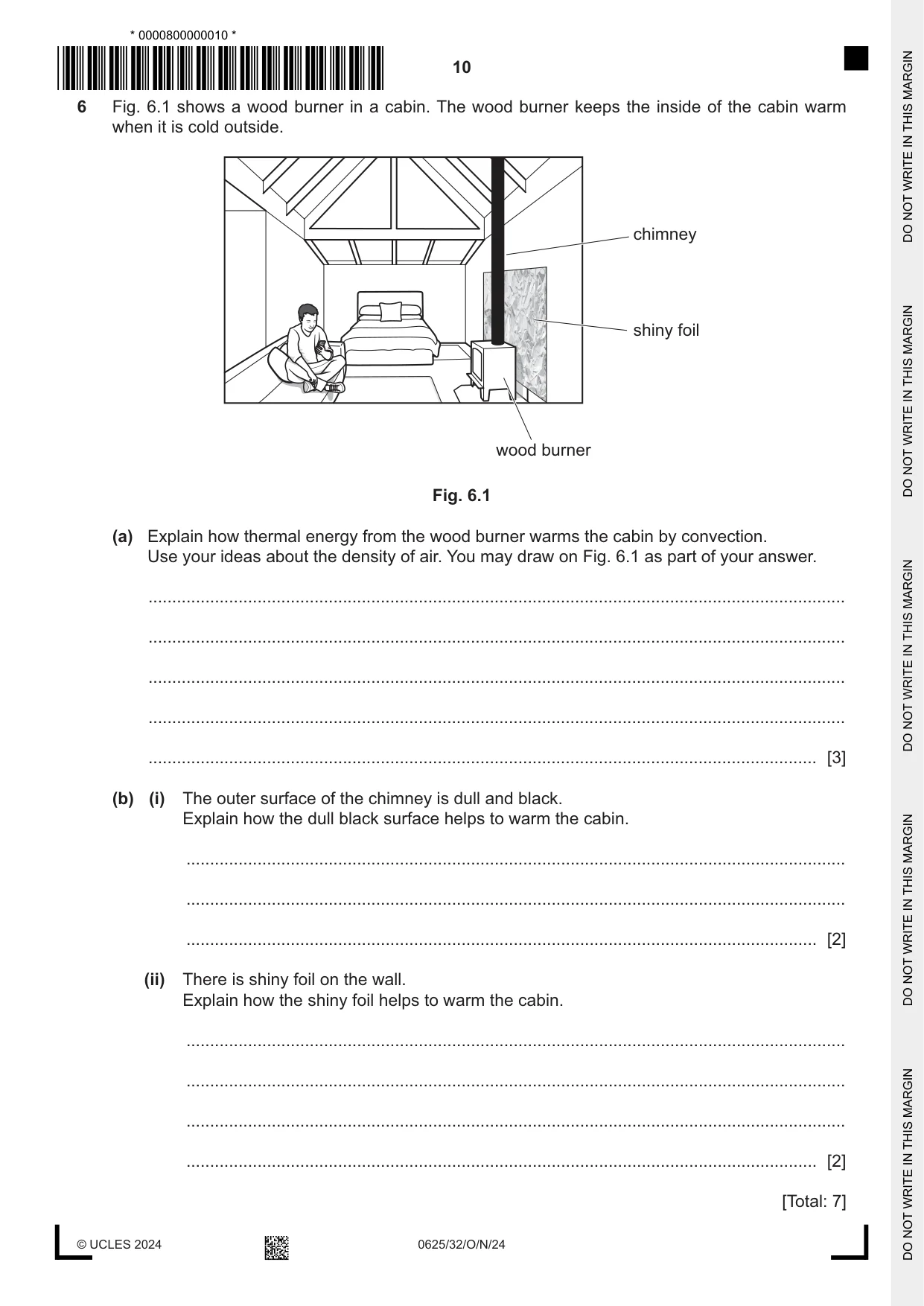
6 Fig. 6.1 shows a wood burner in a cabin. The wood burner keeps the inside of the cabin warm when it is cold outside. chimney shiny foil wood burner Fig. 6.1 (a) Explain how thermal energy from the wood burner warms the cabin by convection. Use your ideas about the density of air. You may draw on Fig. 6.1 as part of your answer. ................................................................................................................................................... ................................................................................................................................................... ................................................................................................................................................... ................................................................................................................................................... ............................................................................................................................................. [3] (b) (i) The outer surface of the chimney is dull and black. Explain how the dull black surface helps to warm the cabin. ........................................................................................................................................... ........................................................................................................................................... ..................................................................................................................................... [2] (ii) There is shiny foil on the wall. Explain how the shiny foil helps to warm the cabin. ........................................................................................................................................... ........................................................................................................................................... ........................................................................................................................................... ..................................................................................................................................... [2] [Total: 7]
Mark scheme: 6(a) (heated air) expands B1 (becomes) less dense B1 less dense air rises OR denser air sinks B1 6(b)(i) (dull black is) best / better / good emitter owtte B1 of radiation / infrared B1 6(b)(ii) (shiny foil is) best / better / good reflector M1 of radiation / infrared A1
Q7 · The direction of vibration in a type of wave is parallel to the direction in which the…
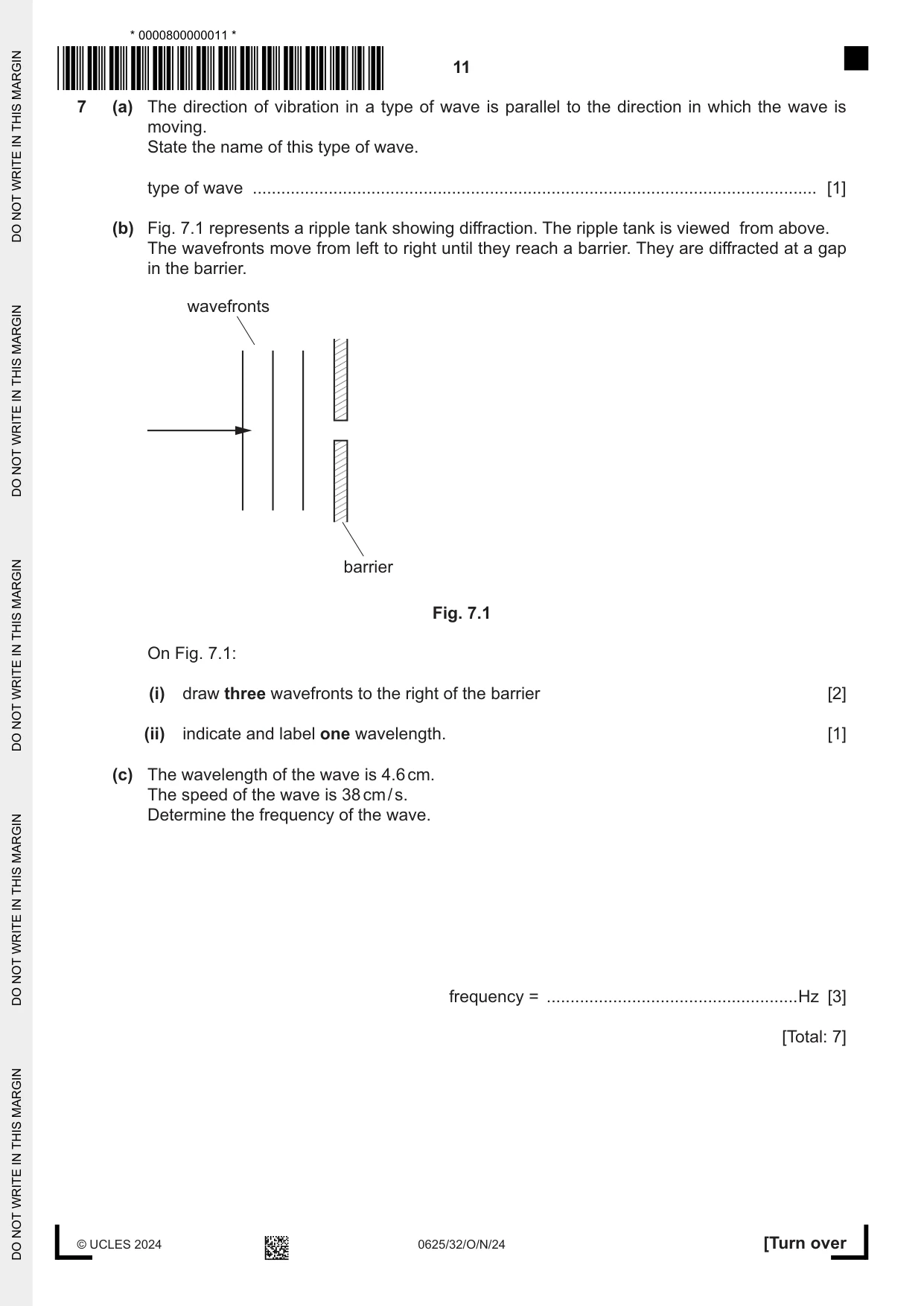
7 (a) The direction of vibration in a type of wave is parallel to the direction in which the wave is moving. State the name of this type of wave. type of wave ....................................................................................................................... [1] (b) Fig. 7.1 represents a ripple tank showing diffraction. The ripple tank is viewed from above. The wavefronts move from left to right until they reach a barrier. They are diffracted at a gap in the barrier. wavefronts barrier Fig. 7.1 On Fig. 7.1: (i) draw three wavefronts to the right of the barrier [2] (ii) indicate and label one wavelength. [1] (c) The wavelength of the wave is 4.6 cm. The speed of the wave is 38 cm / s. Determine the frequency of the wave. frequency = .....................................................Hz [3] [Total: 7]
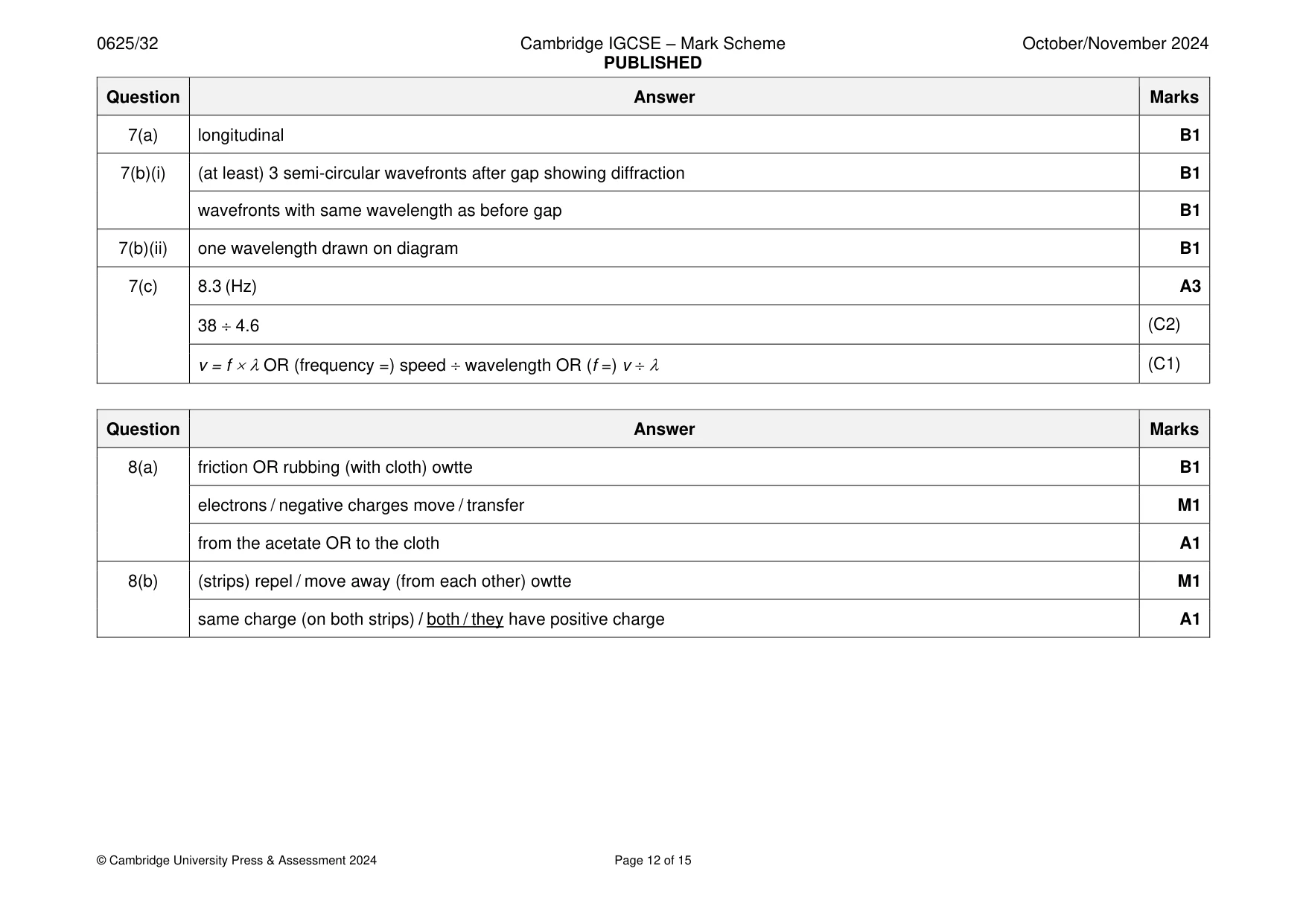
Mark scheme: 7(a) longitudinal B1 7(b)(i) (at least) 3 semi-circular wavefronts after gap showing diffraction B1 wavefronts with same wavelength as before gap B1 7(b)(ii) one wavelength drawn on diagram B1 7(c) 8.3 (Hz) A3 38 4.6 (C2) v = f OR (frequency =) speed wavelength OR (f =) v (C1)
Q8 · Charges on an acetate strip and on a dry cloth
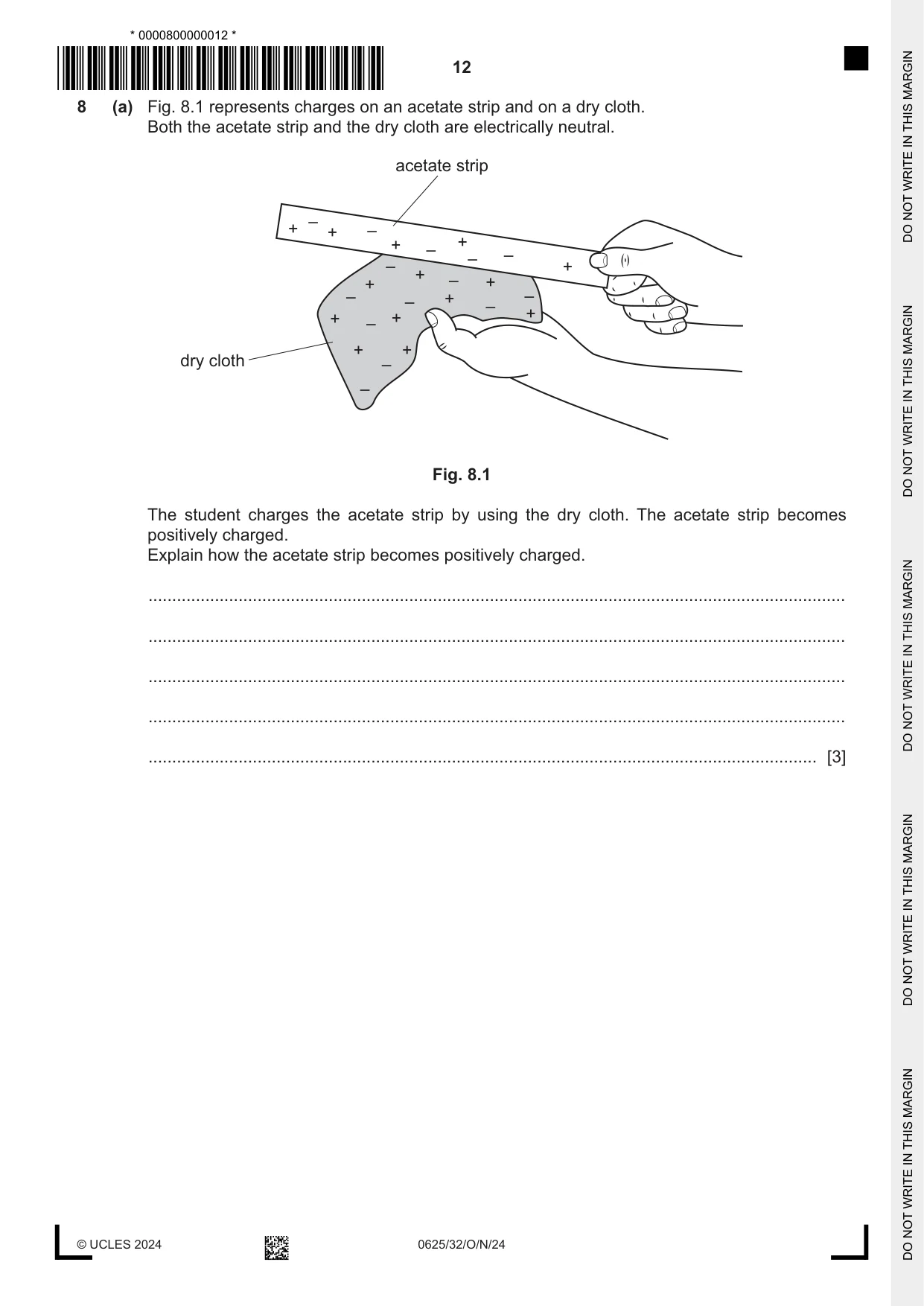
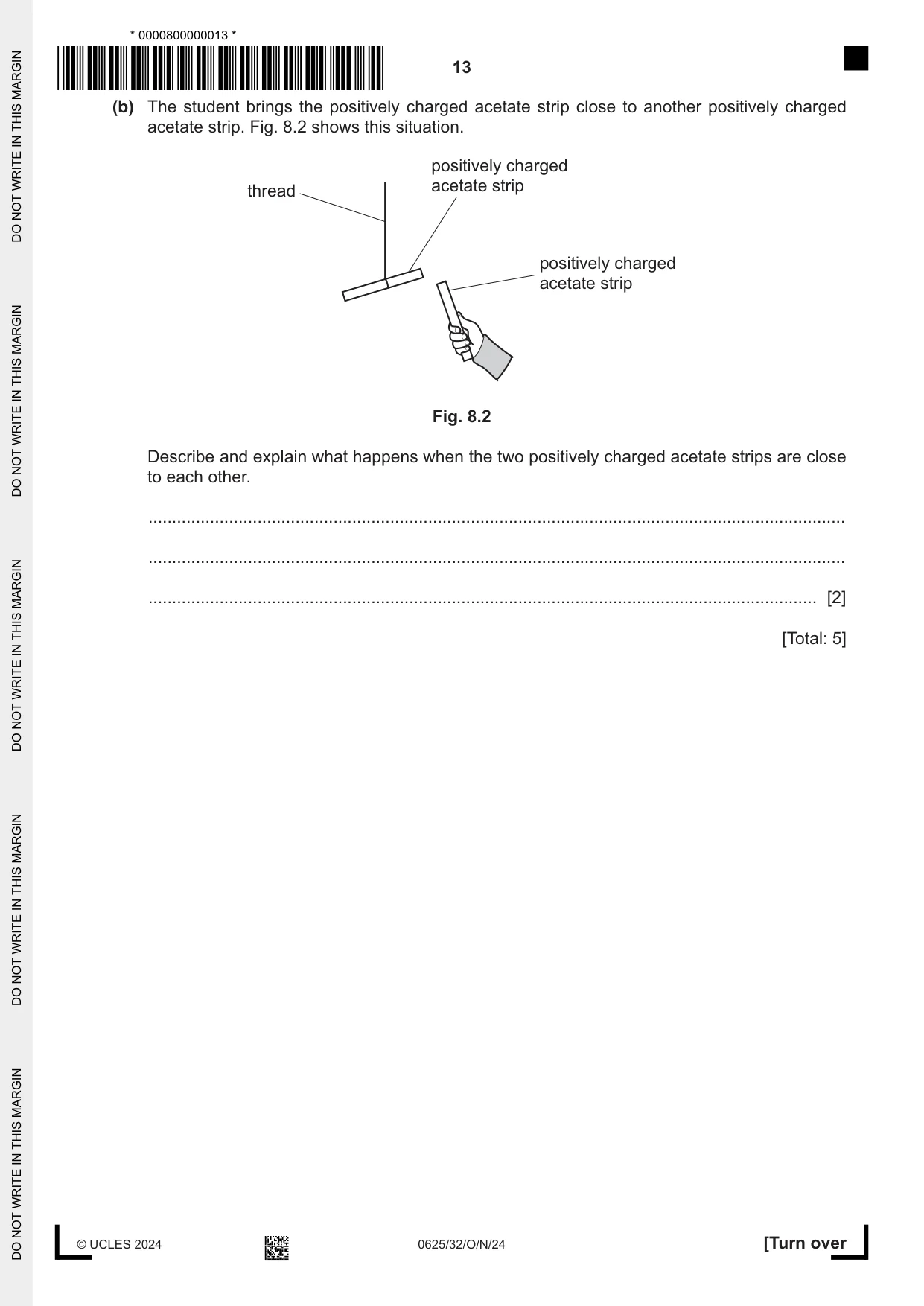
8 (a) Fig. 8.1 represents charges on an acetate strip and on a dry cloth. Both the acetate strip and the dry cloth are electrically neutral. acetate strip – + + – + – + – – – + + – + + – – + – – + + – + + + dry cloth – – Fig. 8.1 The student charges the acetate strip by using the dry cloth. The acetate strip becomes positively charged. Explain how the acetate strip becomes positively charged. ................................................................................................................................................... ................................................................................................................................................... ................................................................................................................................................... ................................................................................................................................................... ............................................................................................................................................. [3] (b) The student brings the positively charged acetate strip close to another positively charged acetate strip. Fig. 8.2 shows this situation. positively charged acetate strip thread positively charged acetate strip Fig. 8.2 Describe and explain what happens when the two positively charged acetate strips are close to each other. ................................................................................................................................................... ................................................................................................................................................... ............................................................................................................................................. [2] [Total: 5]
Mark scheme: 8(a) friction OR rubbing (with cloth) owtte B1 electrons / negative charges move / transfer M1 from the acetate OR to the cloth A1 8(b) (strips) repel / move away (from each other) owtte M1 same charge (on both strips) / both / they have positive charge A1
Q9 · Part of a d.c
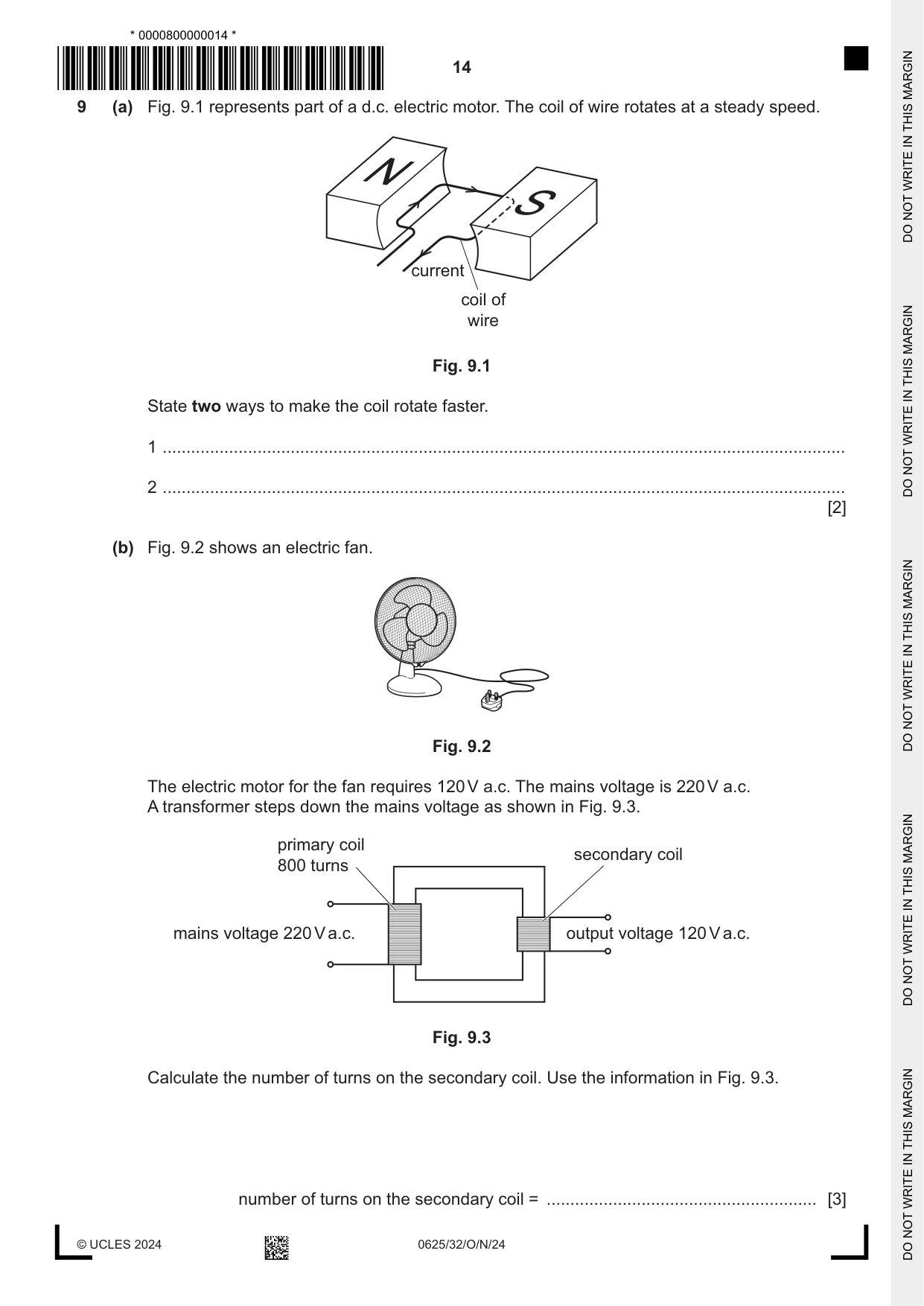
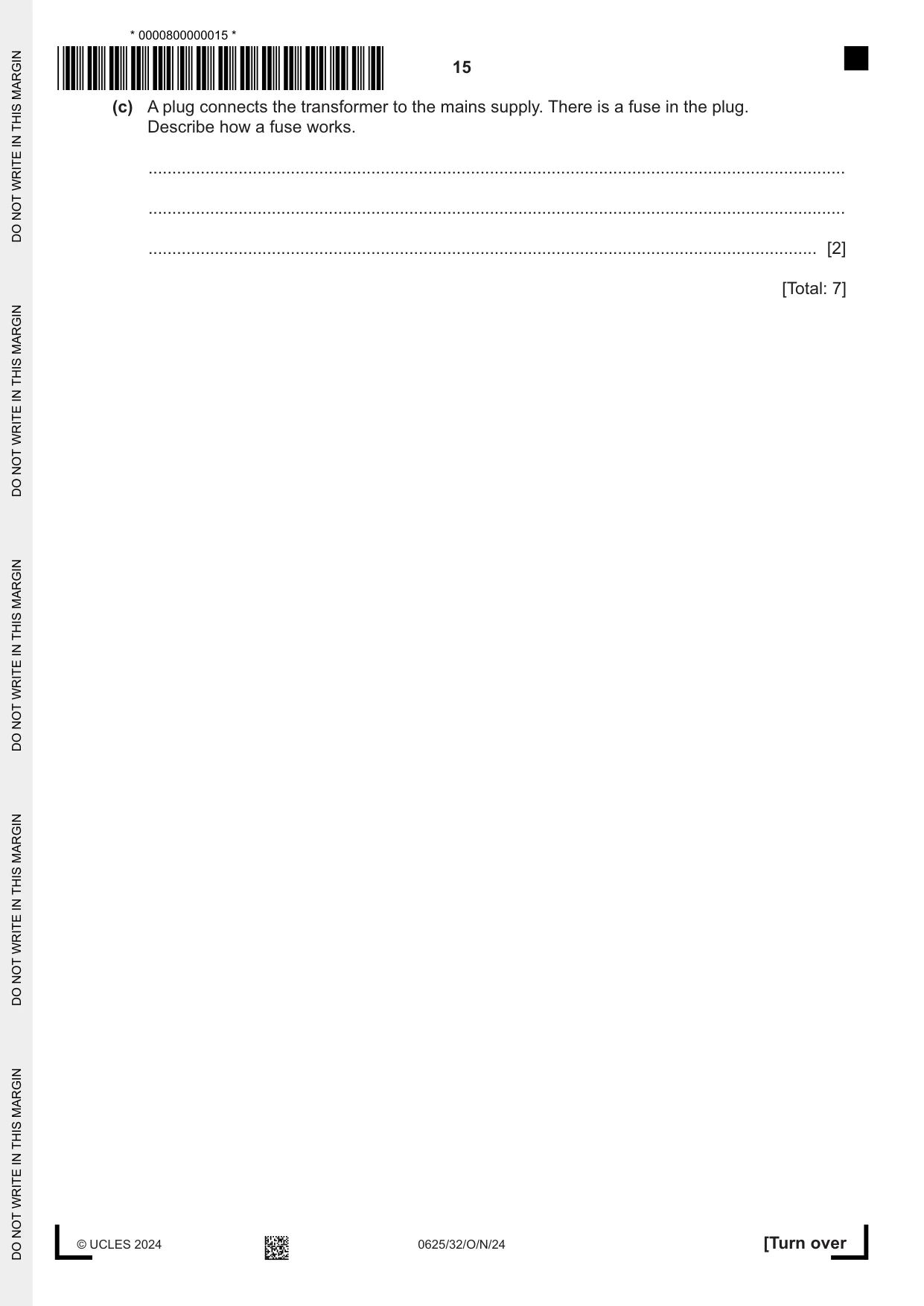
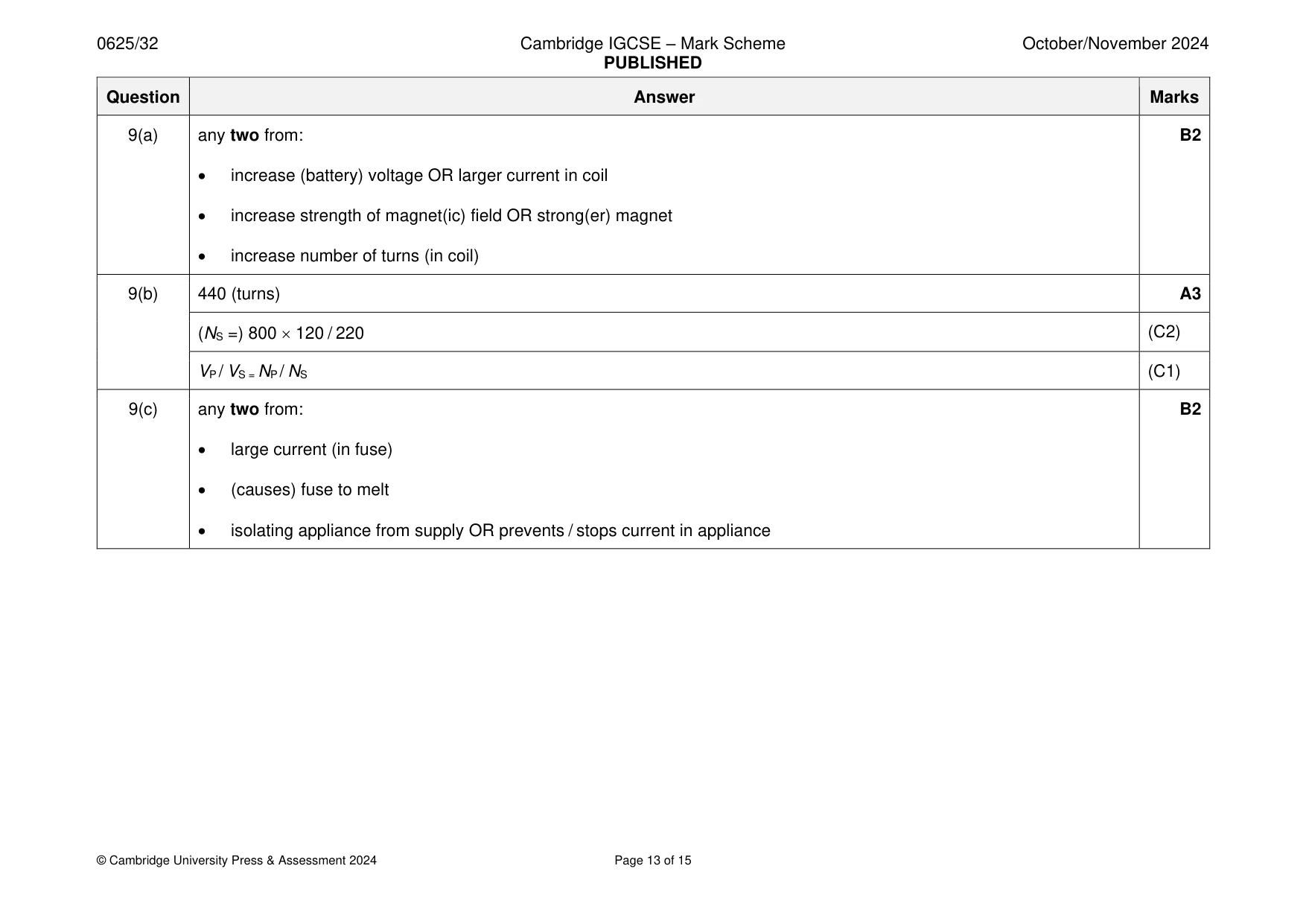
9 (a) Fig. 9.1 represents part of a d.c. electric motor. The coil of wire rotates at a steady speed. current coil of wire Fig. 9.1 State two ways to make the coil rotate faster. 1 ................................................................................................................................................ 2 ................................................................................................................................................ [2] (b) Fig. 9.2 shows an electric fan. Fig. 9.2 The electric motor for the fan requires 120 V a.c. The mains voltage is 220 V a.c. A transformer steps down the mains voltage as shown in Fig. 9.3. primary coil secondary coil 800 turns mains voltage 220 V a.c. output voltage 120 V a.c. Fig. 9.3 Calculate the number of turns on the secondary coil. Use the information in Fig. 9.3. number of turns on the secondary coil = ......................................................... [3] (c) A plug connects the transformer to the mains supply. There is a fuse in the plug. Describe how a fuse works. ................................................................................................................................................... ................................................................................................................................................... ............................................................................................................................................. [2] [Total: 7]
Mark scheme: 9(a) any two from: B2 • increase (battery) voltage OR larger current in coil • increase strength of magnet(ic) field OR strong(er) magnet • increase number of turns (in coil) 9(b) 440 (turns) A3 (NS =) 800 120 / 220 (C2) VP / VS = NP / NS (C1) 9(c) any two from: B2 • large current (in fuse) • (causes) fuse to melt • isolating appliance from supply OR prevents / stops current in appliance
Q10 · Name three types of nuclear emission from radioactive sources
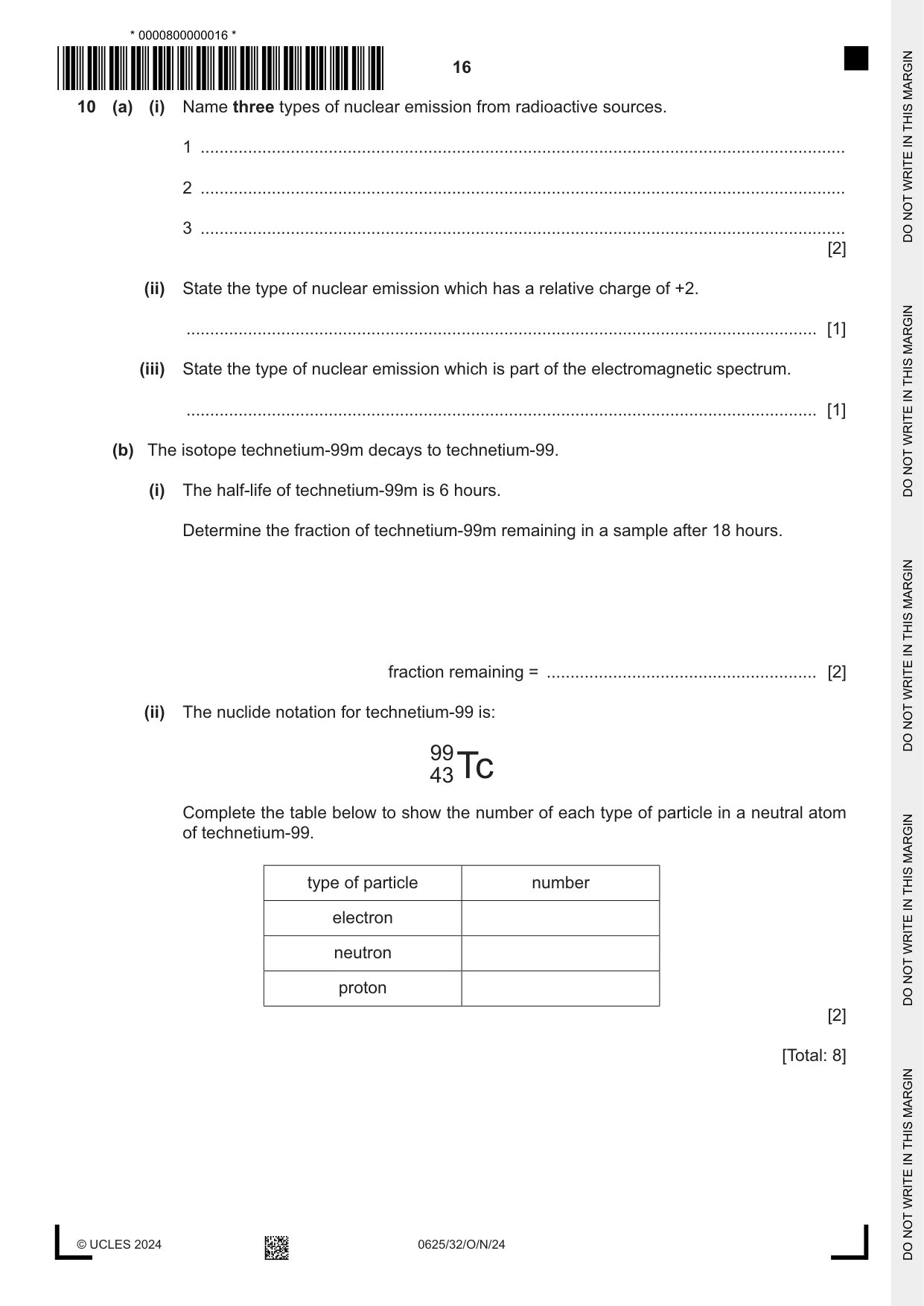
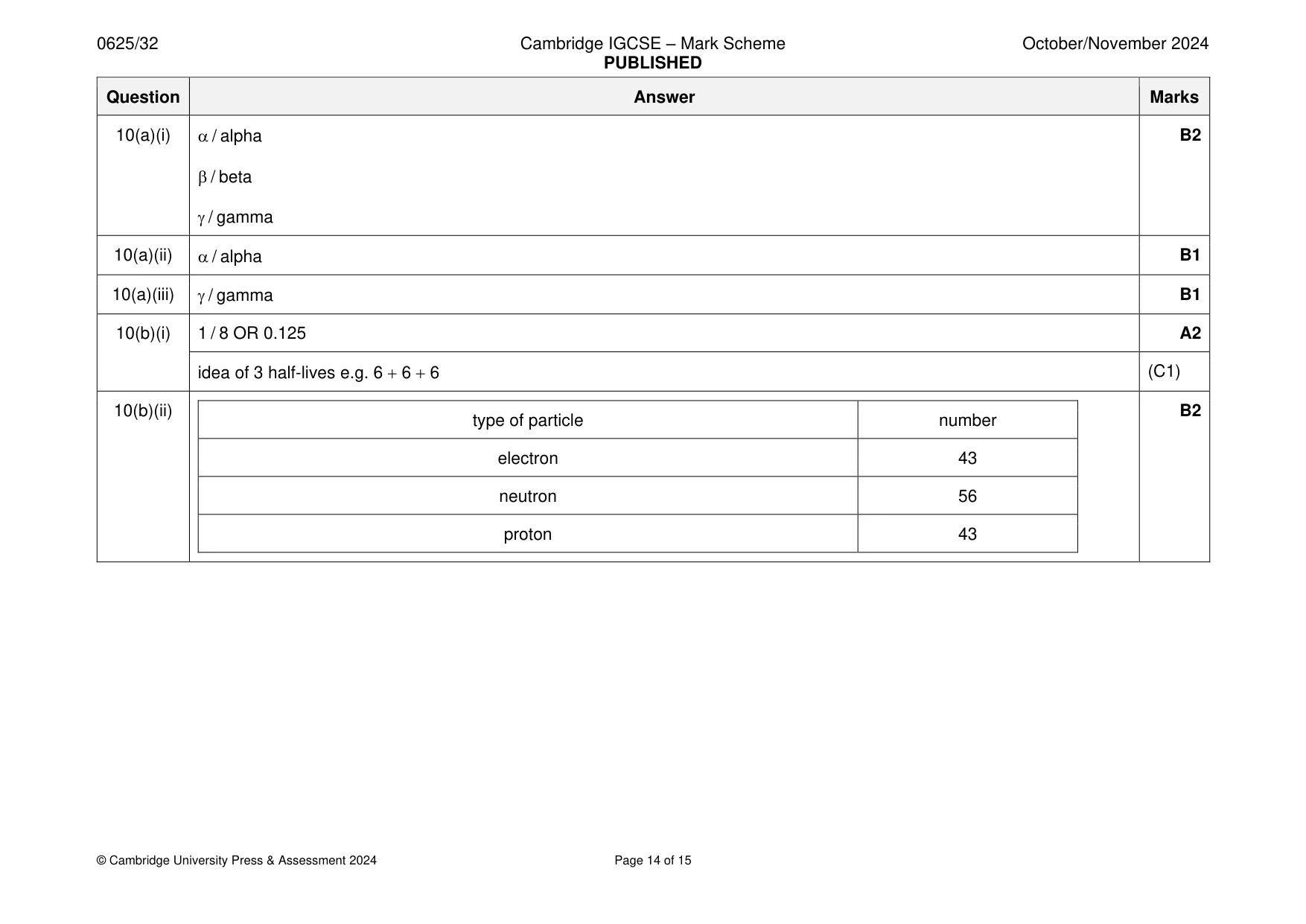
10 (a) (i) Name three types of nuclear emission from radioactive sources. 1 ........................................................................................................................................ 2 ........................................................................................................................................ 3 ........................................................................................................................................ [2] (ii) State the type of nuclear emission which has a relative charge of +2. ..................................................................................................................................... [1] (iii) State the type of nuclear emission which is part of the electromagnetic spectrum. ..................................................................................................................................... [1] (b) The isotope technetium-99m decays to technetium-99. (i) The half-life of technetium-99m is 6 hours. Determine the fraction of technetium-99m remaining in a sample after 18 hours. fraction remaining = ......................................................... [2] (ii) The nuclide notation for technetium-99 is: 99 43Tc Complete the table below to show the number of each type of particle in a neutral atom of technetium-99. type of particle number electron neutron proton [2] [Total: 8]
Mark scheme: 10(a)(i) / alpha B2 / beta / gamma 10(a)(ii) / alpha B1 10(a)(iii) / gamma B1 10(b)(i) 1 / 8 OR 0.125 A2 idea of 3 half-lives e.g. 6 + 6 + 6 (C1) 10(b)(ii) B2 type of particle number electron 43 neutron 56 proton 43
Q11 · Part of the Solar System
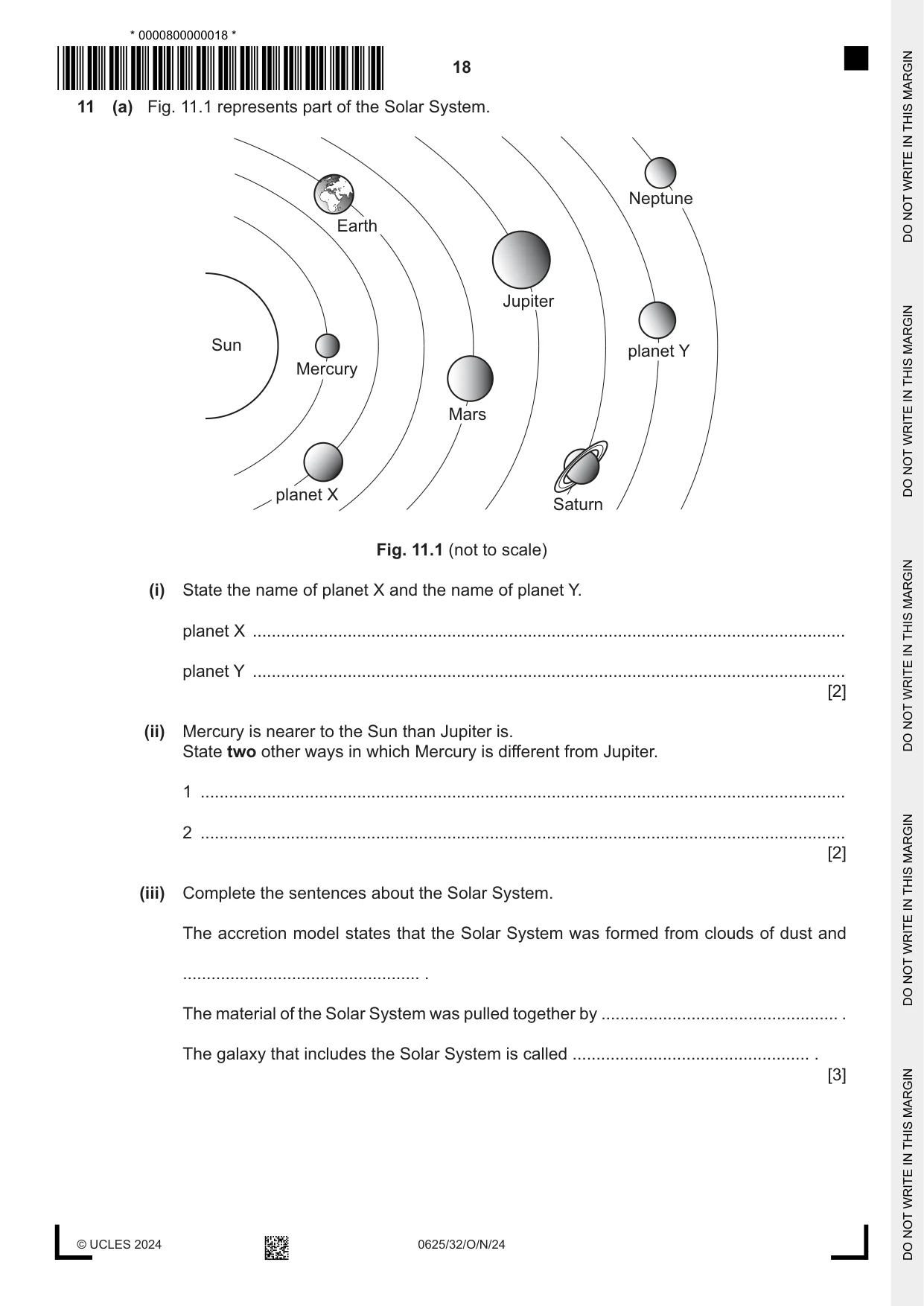
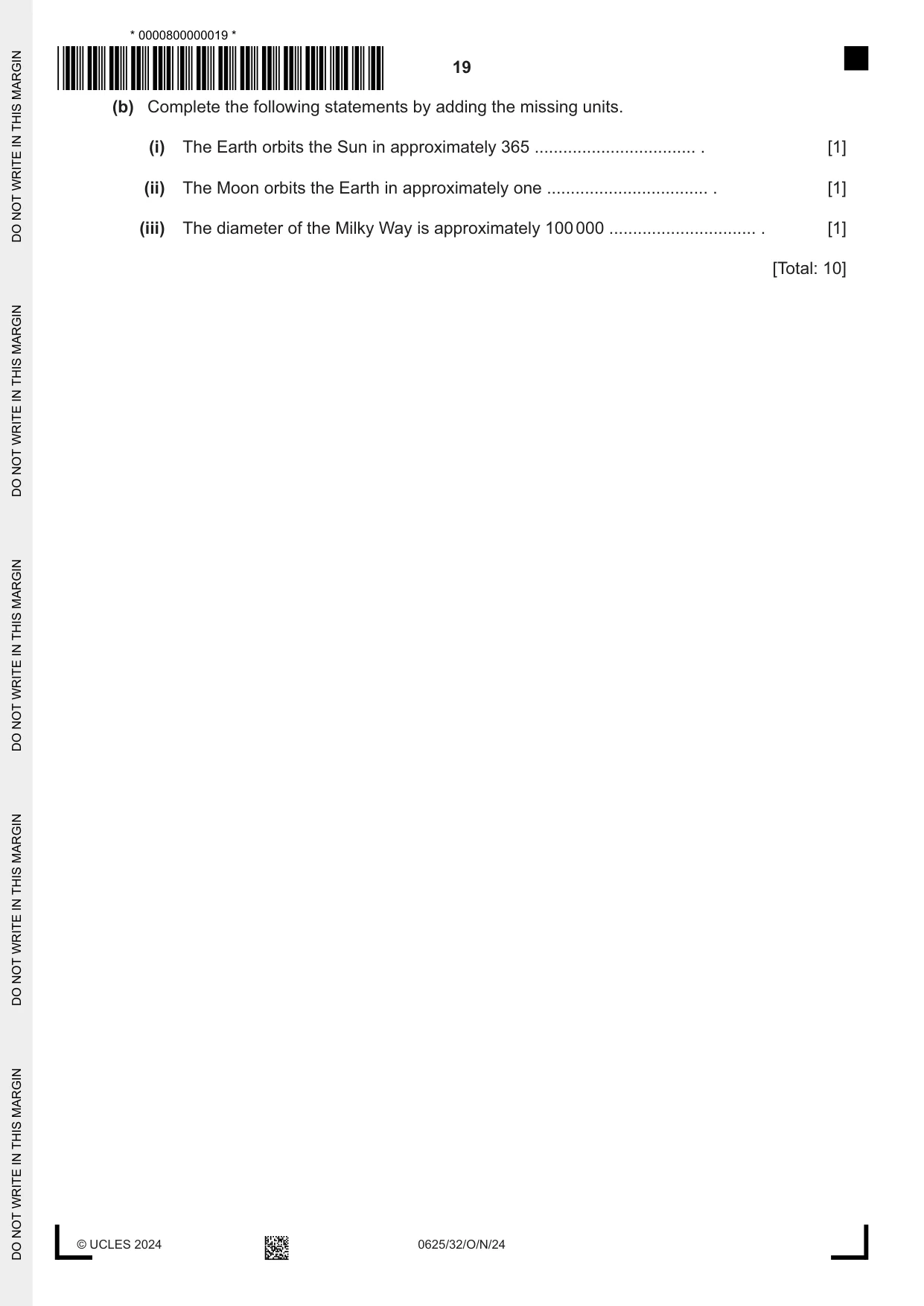
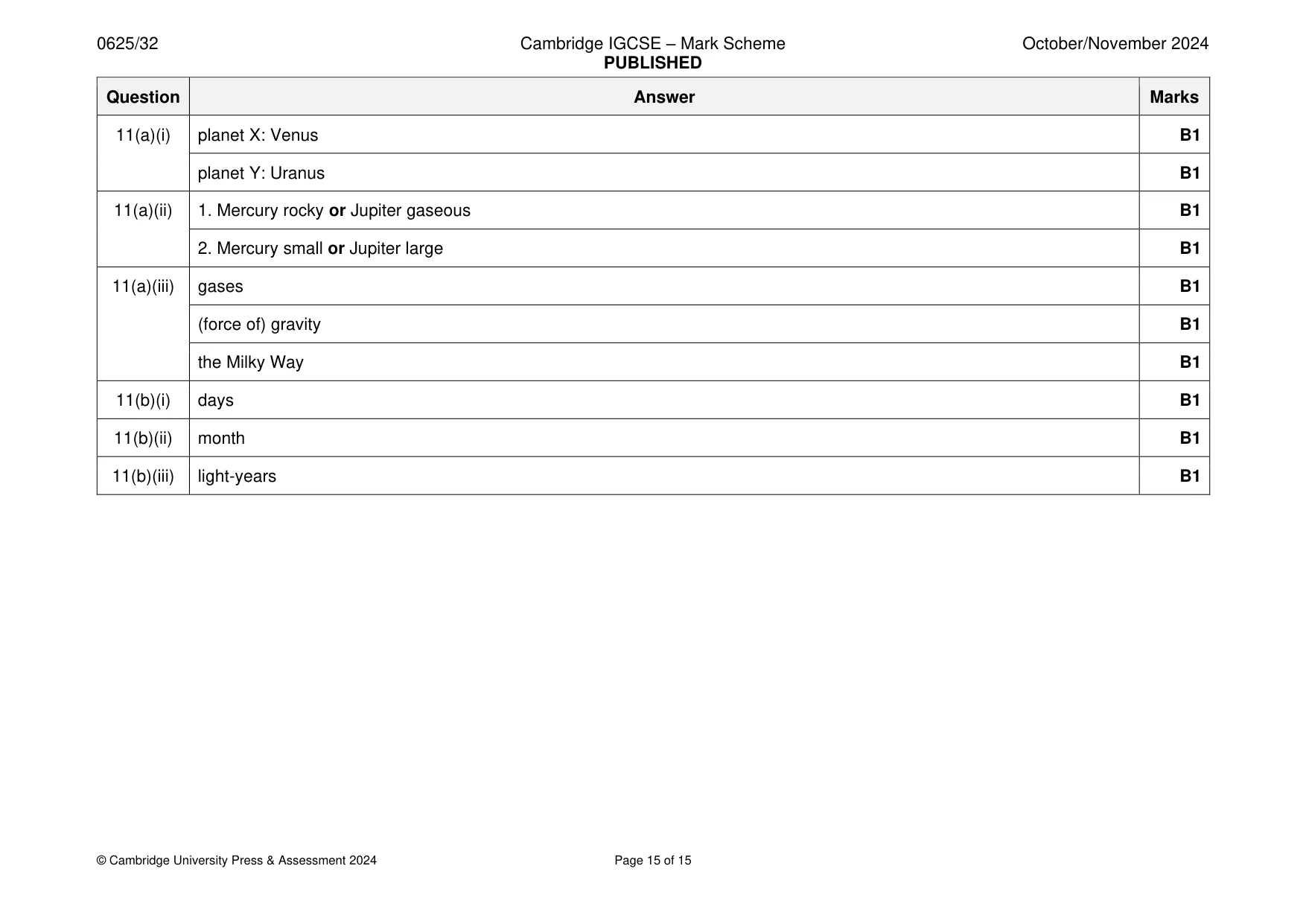
11 (a) Fig. 11.1 represents part of the Solar System. Neptune Earth Jupiter Sun planet Y Mercury Mars planet X Saturn Fig. 11.1 (not to scale) (i) State the name of planet X and the name of planet Y. planet X ............................................................................................................................. planet Y ............................................................................................................................. [2] (ii) Mercury is nearer to the Sun than Jupiter is. State two other ways in which Mercury is different from Jupiter. 1 ........................................................................................................................................ 2 ........................................................................................................................................ [2] (iii) Complete the sentences about the Solar System. The accretion model states that the Solar System was formed from clouds of dust and .................................................. . The material of the Solar System was pulled together by .................................................. . The galaxy that includes the Solar System is called .................................................. . [3] (b) Complete the following statements by adding the missing units. (i) The Earth orbits the Sun in approximately 365 .................................. . [1] (ii) The Moon orbits the Earth in approximately one .................................. . [1] (iii) The diameter of the Milky Way is approximately 100 000 ............................... . [1] [Total: 10]
Mark scheme: 11(a)(i) planet X: Venus B1 planet Y: Uranus B1 11(a)(ii) 1. Mercury rocky or Jupiter gaseous B1 2. Mercury small or Jupiter large B1 11(a)(iii) gases B1 (force of) gravity B1 the Milky Way B1 11(b)(i) days B1 11(b)(ii) month B1 11(b)(iii) light-years B1
What was in this paper
The subtopics covered by these 11 questions, and how many questions each got. Open one in a new tab to see every Cambridge question on it.
What you needed in this session
Cambridge’s own grade thresholds for 2024 Oct/Nov, Paper 3 · Variant 2. A higher threshold means an easier paper — the bar moves with how the cohort did.