Cambridge IGCSE Physics 0625 — 2015 Oct/Nov Paper 3 · Variant 2
0625/32/O/N/15 · 11 questions · 80 marks · ≈90 min
The question paper and its mark scheme, free to read here and free to download. This is Cambridge’s own paper, exactly as it was sat.
Question paper20 pages

Mark scheme7 pages
Answers below. Sit the paper first if you are practising.
Questions as text
Q1 · A comet, travelling in space, enters the atmosphere of a planet
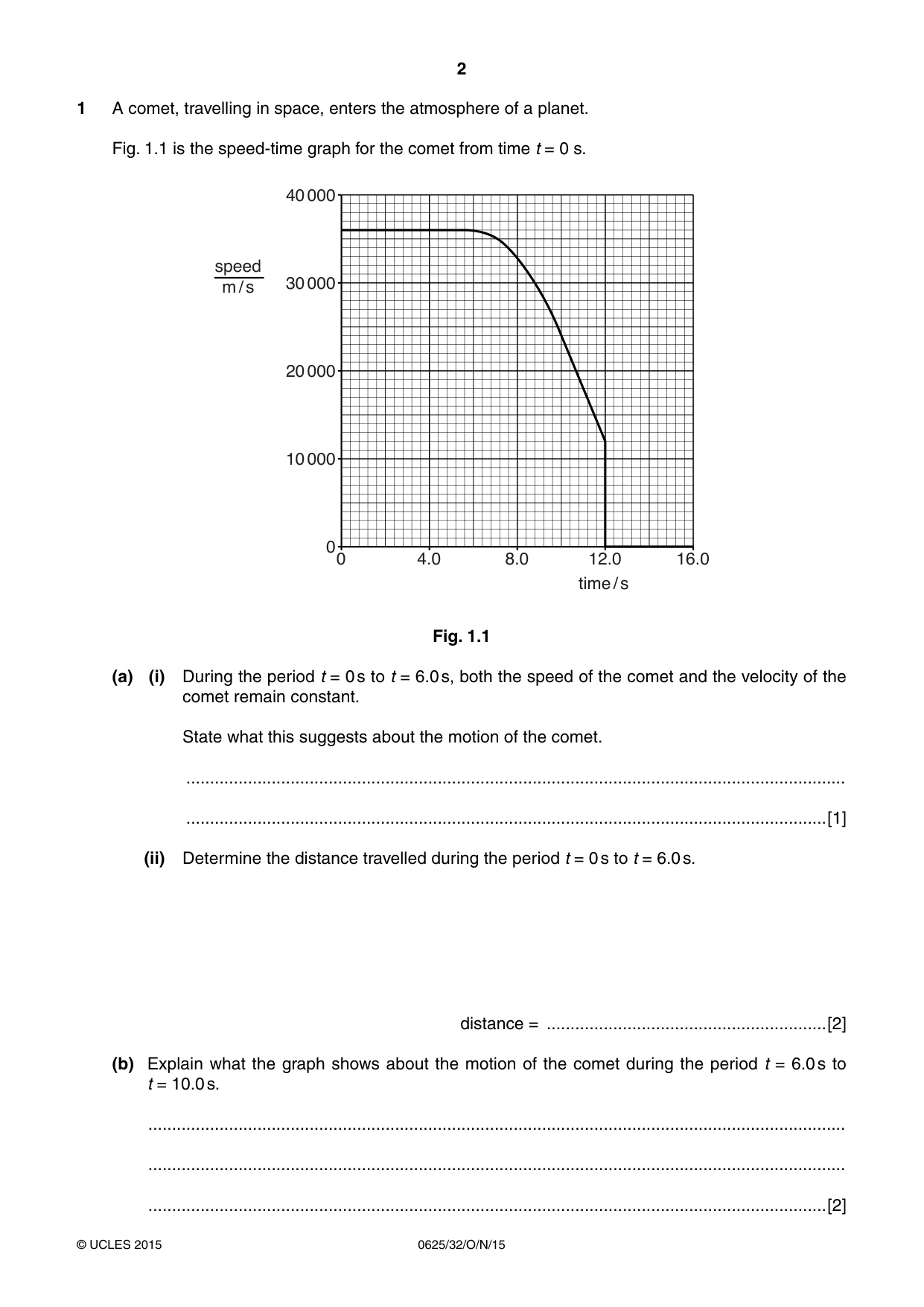
1 A comet, travelling in space, enters the atmosphere of a planet. Fig. 1.1 is the speed-time graph for the comet from time t = 0 s. 40 000 speed m / s 30 000 20 000 10 000 0 0 4.0 8.0 12.0 16.0 time / s Fig. 1.1 (a) (i) During the period t = 0 s to t = 6.0 s, both the speed of the comet and the velocity of the comet remain constant. State what this suggests about the motion of the comet. ........................................................................................................................................... .......................................................................................................................................[1] (ii) Determine the distance travelled during the period t = 0 s to t = 6.0 s. distance = ...........................................................[2] (b) Explain what the graph shows about the motion of the comet during the period t = 6.0 s to t = 10.0 s. ................................................................................................................................................... ................................................................................................................................................... ...............................................................................................................................................[2] (c) Determine the acceleration of the comet at t = 11.0 s. acceleration = ...........................................................[2] (d) Suggest what happens to the comet at t = 12.0 s. ................................................................................................................................................... ...............................................................................................................................................[1] [Total: 8]
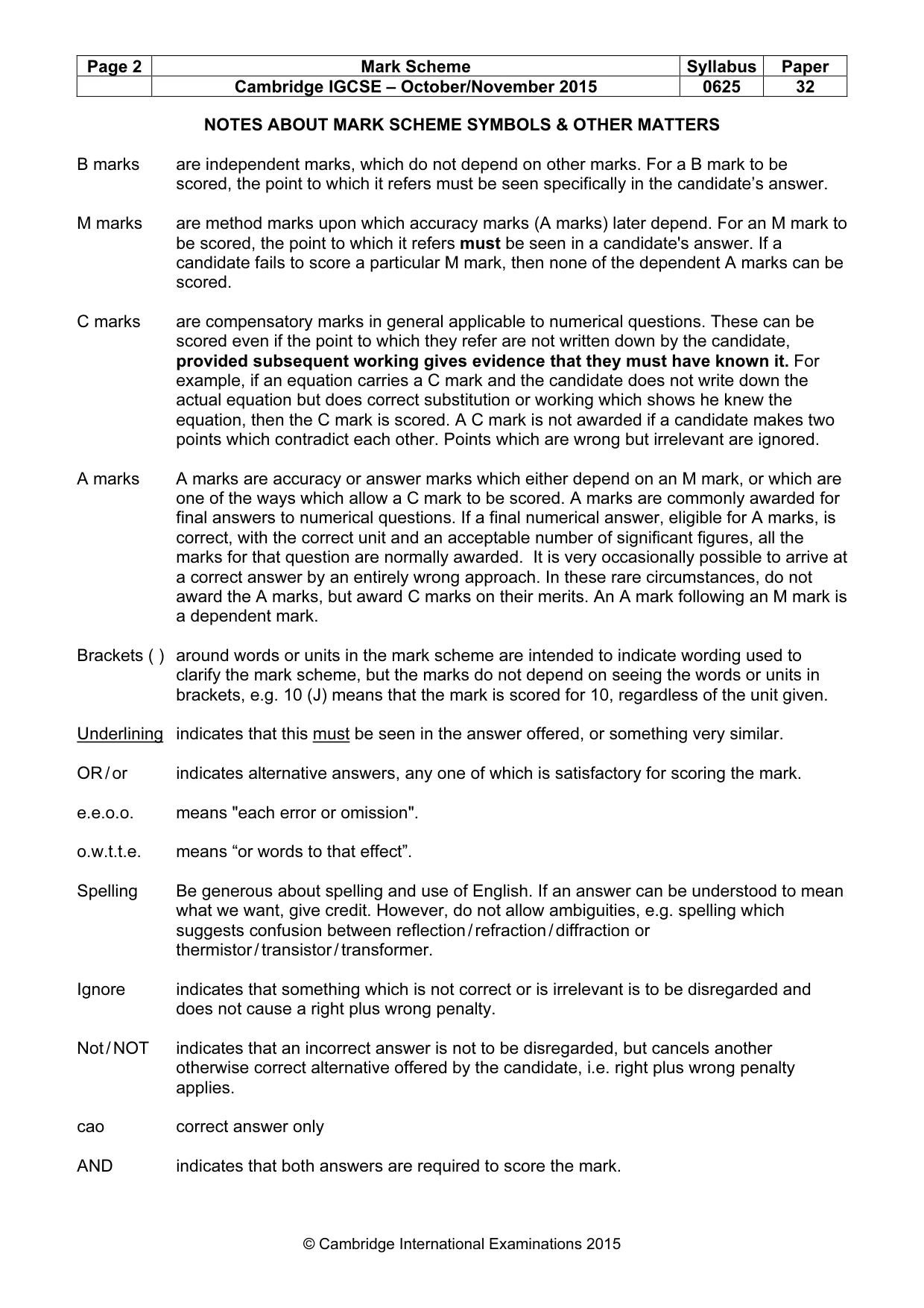
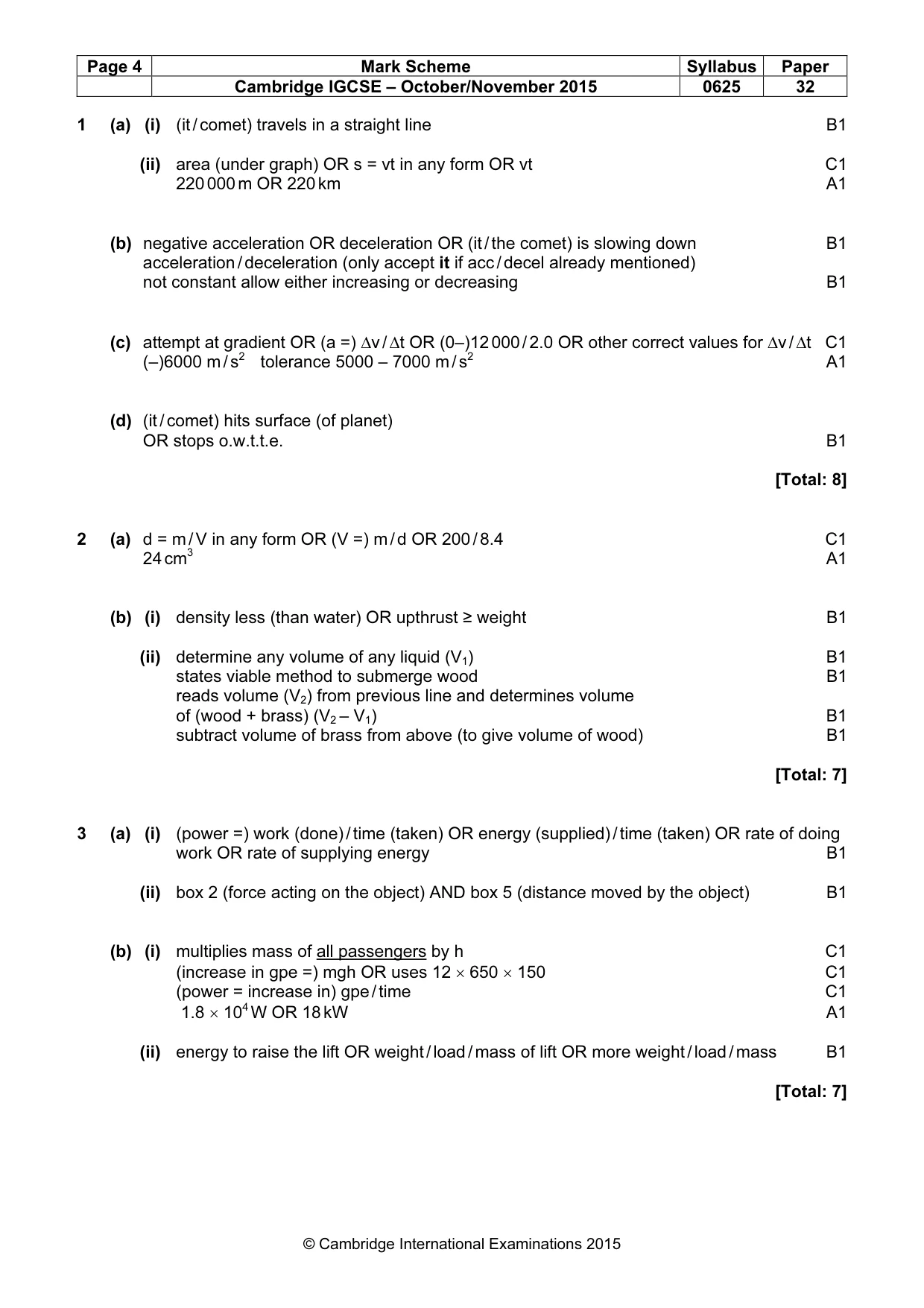
Mark scheme: 1 (a) (i) (it / comet) travels in a straight line B1 (ii) area (under graph) OR s = vt in any form OR vt C1 220 000 m OR 220 km A1 (b) negative acceleration OR deceleration OR (it / the comet) is slowing down B1 acceleration / deceleration (only accept it if acc / decel already mentioned) not constant allow either increasing or decreasing B1 (c) attempt at gradient OR (a =) ∆v / ∆t OR (0–)12 000 / 2.0 OR other correct values for ∆v / ∆t C1 (–)6000 m / s2 tolerance 5000 – 7000 m / s2 A1 (d) (it / comet) hits surface (of planet) OR stops o.w.t.t.e. B1 [Total: 8]
Q2 · A student wishes to find the volume of a piece of wood of irregular shape
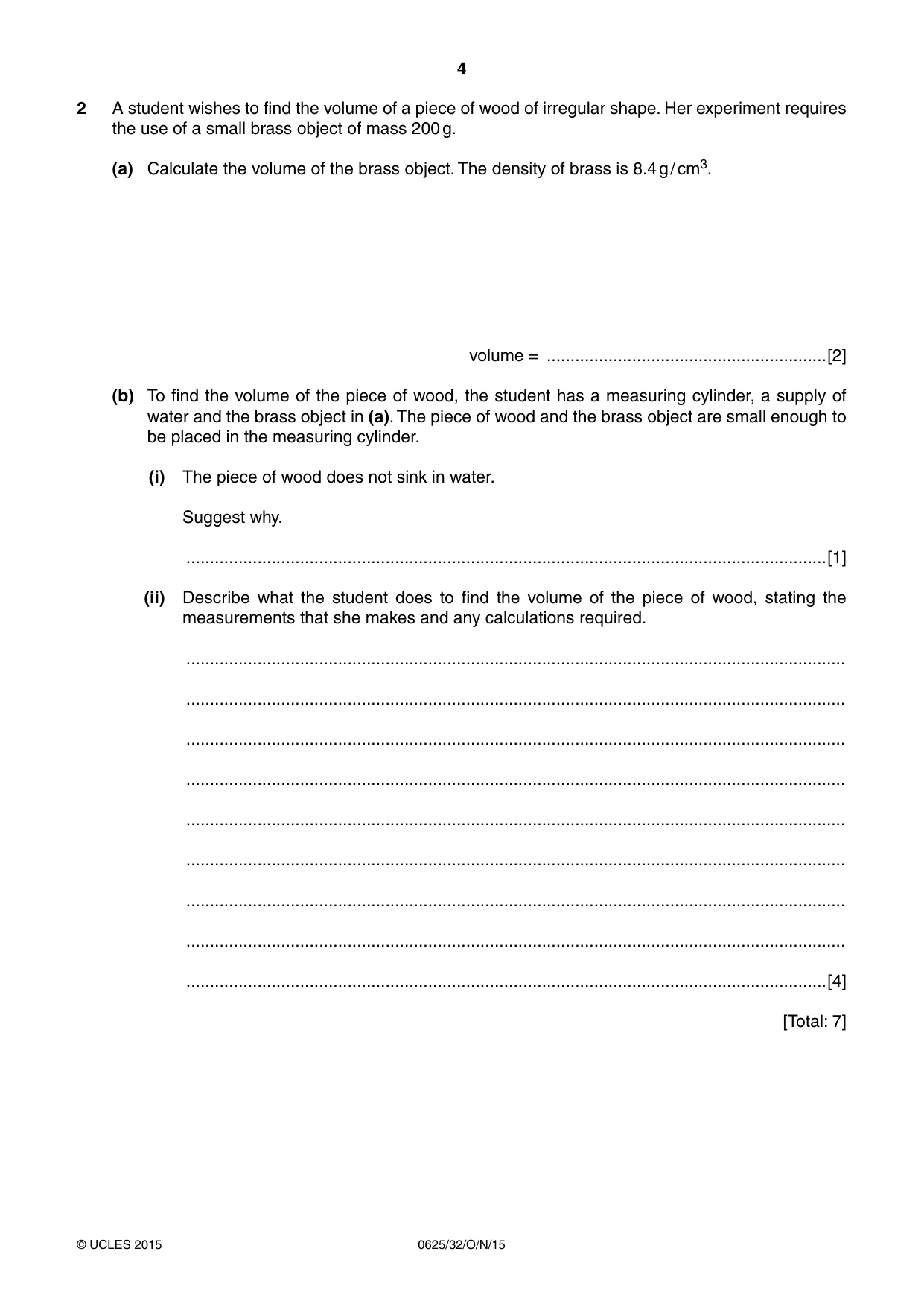
2 A student wishes to find the volume of a piece of wood of irregular shape. Her experiment requires the use of a small brass object of mass 200 g. (a) Calculate the volume of the brass object. The density of brass is 8.4 g / cm3. volume = ...........................................................[2] (b) To find the volume of the piece of wood, the student has a measuring cylinder, a supply of water and the brass object in (a). The piece of wood and the brass object are small enough to be placed in the measuring cylinder. (i) The piece of wood does not sink in water. Suggest why. .......................................................................................................................................[1] (ii) Describe what the student does to find the volume of the piece of wood, stating the measurements that she makes and any calculations required. ........................................................................................................................................... ........................................................................................................................................... ........................................................................................................................................... ........................................................................................................................................... ........................................................................................................................................... ........................................................................................................................................... ........................................................................................................................................... ........................................................................................................................................... .......................................................................................................................................[4] [Total: 7]
Mark scheme: 2 (a) d = m / V in any form OR (V =) m / d OR 200 / 8.4 C1 24 cm3 A1 (b) (i) density less (than water) OR upthrust ≥ weight B1 (ii) determine any volume of any liquid (V1) B1 states viable method to submerge wood B1 reads volume (V2) from previous line and determines volume of (wood + brass) (V2 – V1) B1 subtract volume of brass from above (to give volume of wood) B1 [Total: 7]
Question 3
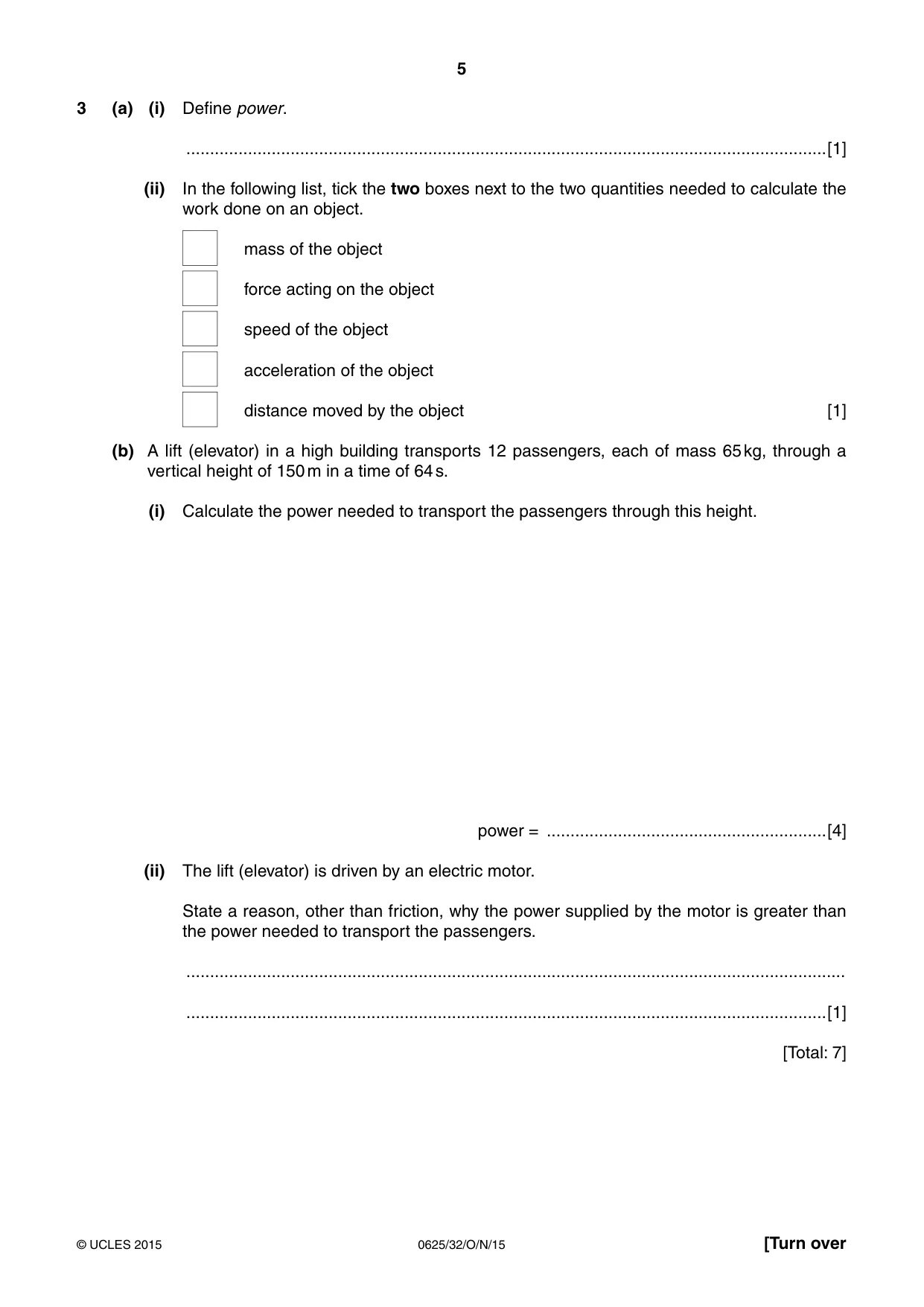
3 (a) (i) Define power. .......................................................................................................................................[1] (ii) In the following list, tick the two boxes next to the two quantities needed to calculate the work done on an object. mass of the object force acting on the object speed of the object acceleration of the object distance moved by the object [1] (b) A lift (elevator) in a high building transports 12 passengers, each of mass 65 kg, through a vertical height of 150 m in a time of 64 s. (i) Calculate the power needed to transport the passengers through this height. power = ...........................................................[4] (ii) The lift (elevator) is driven by an electric motor. State a reason, other than friction, why the power supplied by the motor is greater than the power needed to transport the passengers. ........................................................................................................................................... .......................................................................................................................................[1] [Total: 7]
Mark scheme: 3 (a) (i) (power =) work (done) / time (taken) OR energy (supplied) / time (taken) OR rate of doing work OR rate of supplying energy B1 (ii) box 2 (force acting on the object) AND box 5 (distance moved by the object) B1 (b) (i) multiplies mass of all passengers by h C1 (increase in gpe =) mgh OR uses 12 × 650 × 150 C1 (power = increase in) gpe / time C1 1.8 × 10⁴ W OR 18 kW A1 (ii) energy to raise the lift OR weight / load / mass of lift OR more weight / load / mass B1 [Total: 7]
Q4 · A top view of a tourist vehicle in a game park and two elephants pushing against the…
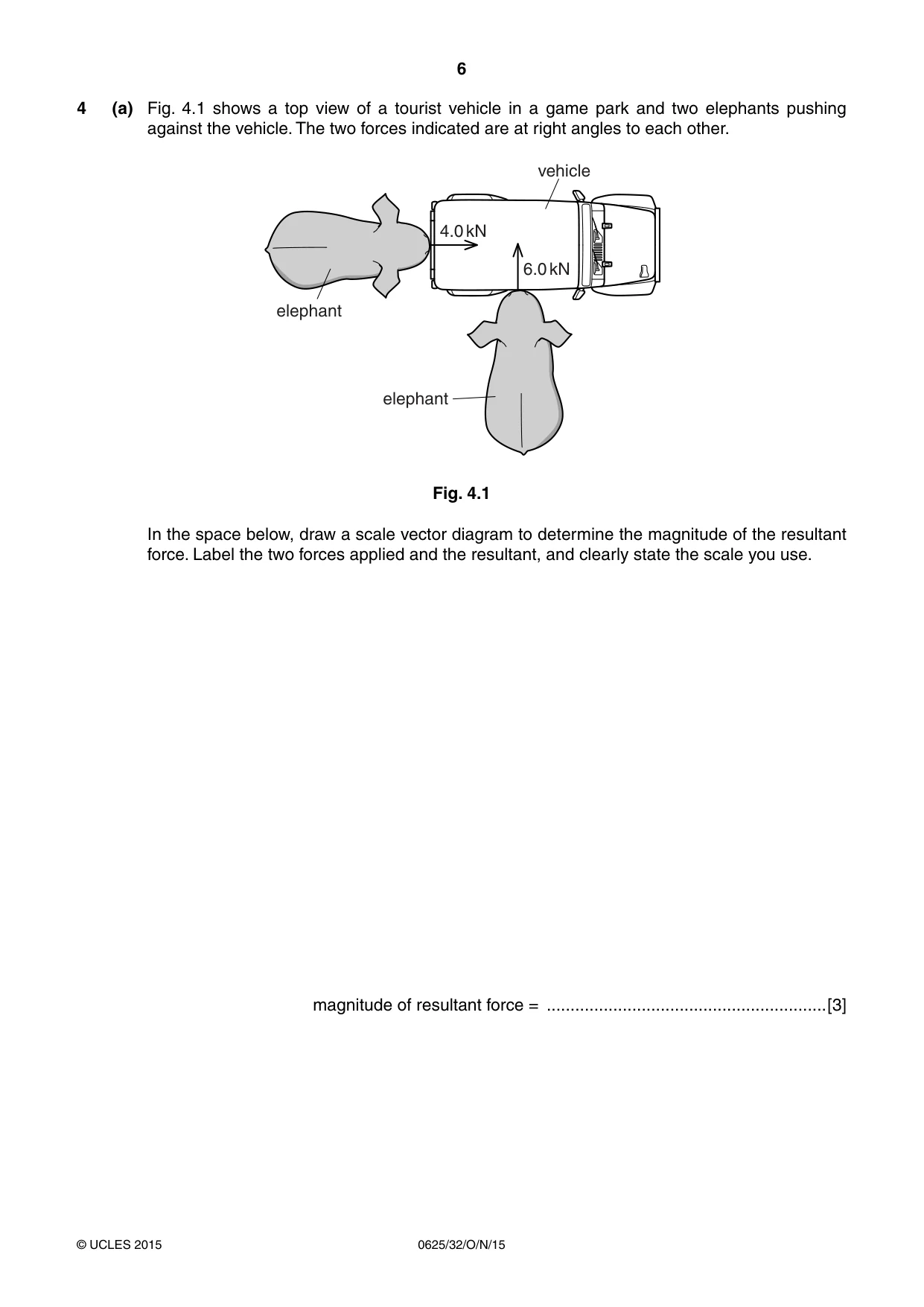
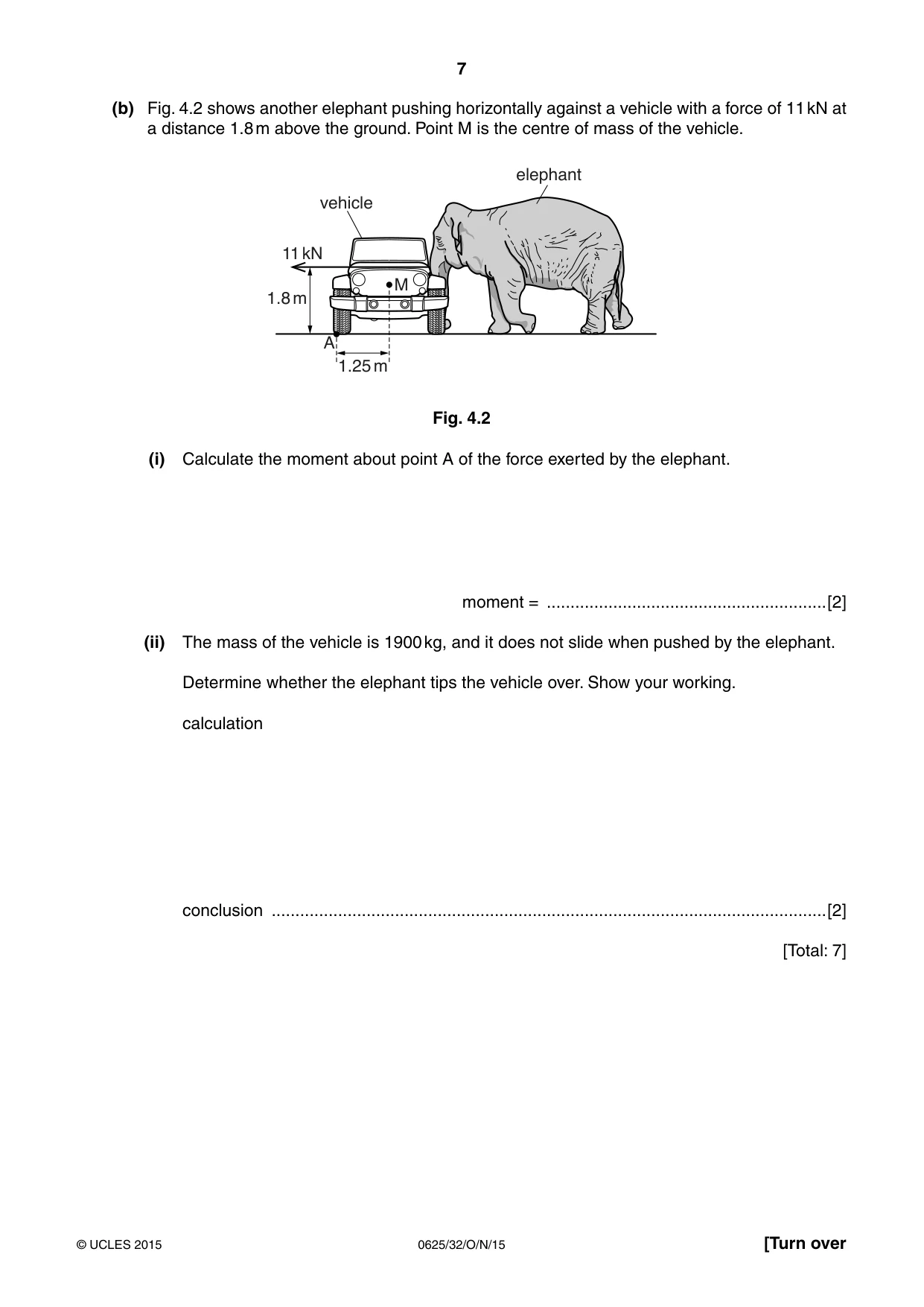
4 (a) Fig. 4.1 shows a top view of a tourist vehicle in a game park and two elephants pushing against the vehicle. The two forces indicated are at right angles to each other. vehicle 4.0 kN 6.0 kN elephant elephant Fig. 4.1 In the space below, draw a scale vector diagram to determine the magnitude of the resultant force. Label the two forces applied and the resultant, and clearly state the scale you use. magnitude of resultant force = ...........................................................[3] (b) Fig. 4.2 shows another elephant pushing horizontally against a vehicle with a force of 11 kN at a distance 1.8 m above the ground. Point M is the centre of mass of the vehicle. elephant vehicle 11 kN M 1.8 m A 1.25 m Fig. 4.2 (i) Calculate the moment about point A of the force exerted by the elephant. moment = ...........................................................[2] (ii) The mass of the vehicle is 1900 kg, and it does not slide when pushed by the elephant. Determine whether the elephant tips the vehicle over. Show your working. calculation conclusion .....................................................................................................................[2] [Total: 7]
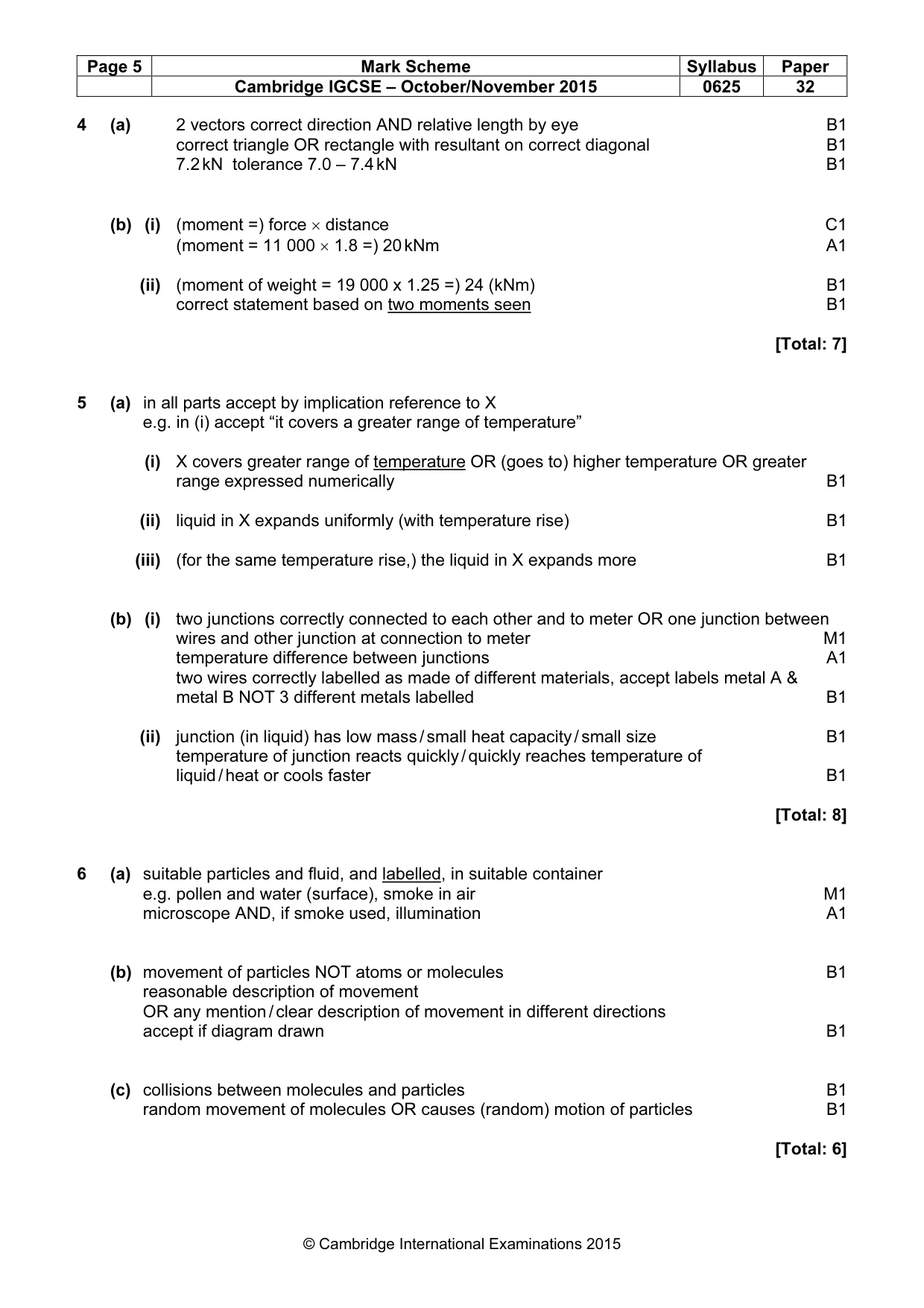
Mark scheme: 4 (a) 2 vectors correct direction AND relative length by eye B1 correct triangle OR rectangle with resultant on correct diagonal B1 7.2 kN tolerance 7.0 – 7.4 kN B1 (b) (i) (moment =) force × distance C1 (moment = 11 000 × 1.8 =) 20 kNm A1 (ii) (moment of weight = 19 000 x 1.25 =) 24 (kNm) B1 correct statement based on two moments seen B1 [Total: 7]
Q5 · X and Y are liquid-in-glass thermometers
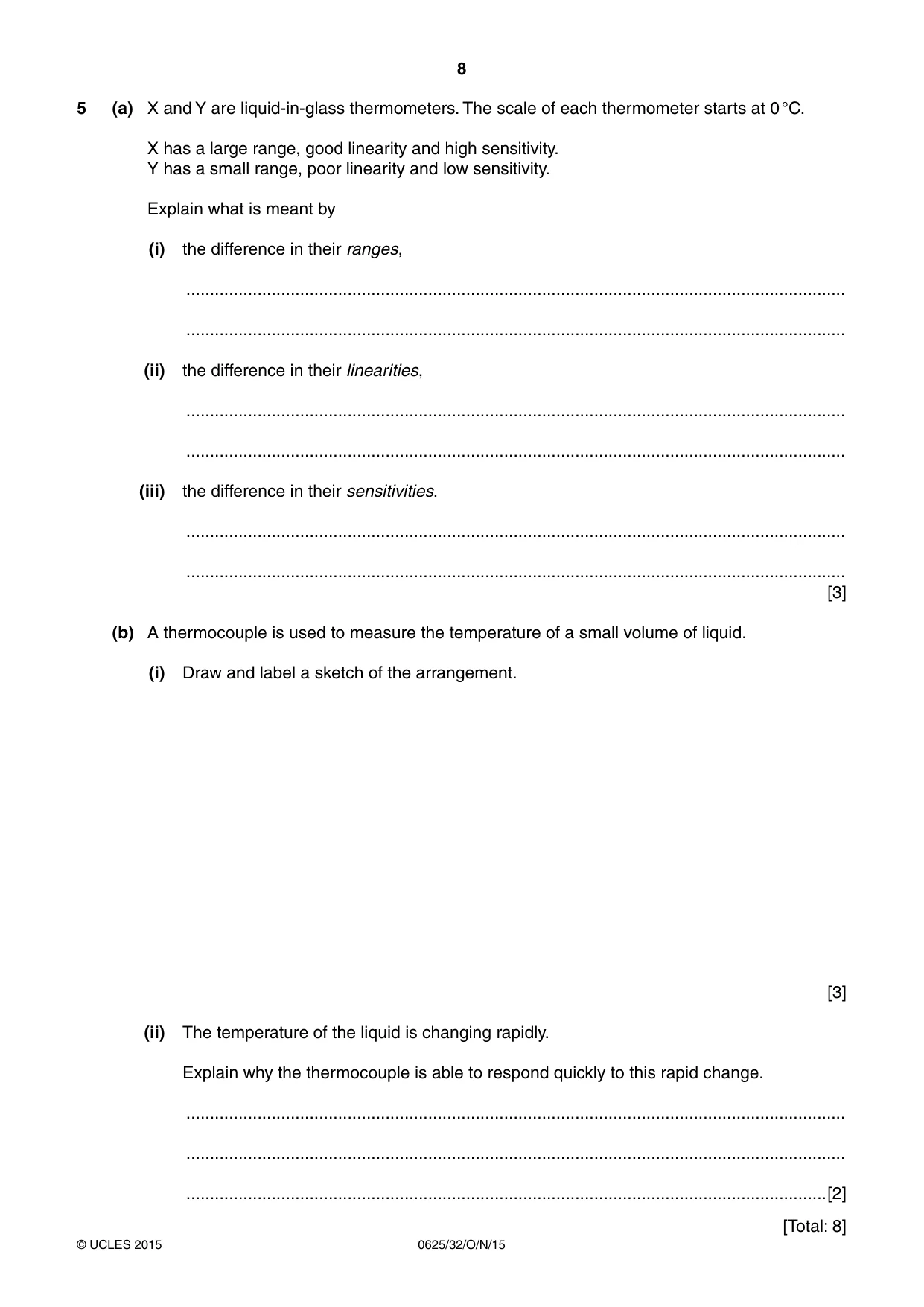
5 (a) X and Y are liquid-in-glass thermometers. The scale of each thermometer starts at 0 °C. X has a large range, good linearity and high sensitivity. Y has a small range, poor linearity and low sensitivity. Explain what is meant by (i) the difference in their ranges, ........................................................................................................................................... ........................................................................................................................................... (ii) the difference in their linearities, ........................................................................................................................................... ........................................................................................................................................... (iii) the difference in their sensitivities. ........................................................................................................................................... ........................................................................................................................................... [3] (b) A thermocouple is used to measure the temperature of a small volume of liquid. (i) Draw and label a sketch of the arrangement. [3] (ii) The temperature of the liquid is changing rapidly. Explain why the thermocouple is able to respond quickly to this rapid change. ........................................................................................................................................... ........................................................................................................................................... .......................................................................................................................................[2] [Total: 8]
Mark scheme: 5 (a) in all parts accept by implication reference to X e.g. in (i) accept “it covers a greater range of temperature” (i) X covers greater range of temperature OR (goes to) higher temperature OR greater range expressed numerically B1 (ii) liquid in X expands uniformly (with temperature rise) B1 (iii) (for the same temperature rise,) the liquid in X expands more B1 (b) (i) two junctions correctly connected to each other and to meter OR one junction between wires and other junction at connection to meter M1 temperature difference between junctions A1 two wires correctly labelled as made of different materials, accept labels metal A & metal B NOT 3 different metals labelled B1 (ii) junction (in liquid) has low mass / small heat capacity / small size B1 temperature of junction reacts quickly / quickly reaches temperature of liquid / heat or cools faster B1 [Total: 8]
Q6 · In the space below, draw a simple labelled diagram of the apparatus used to demonstrate…
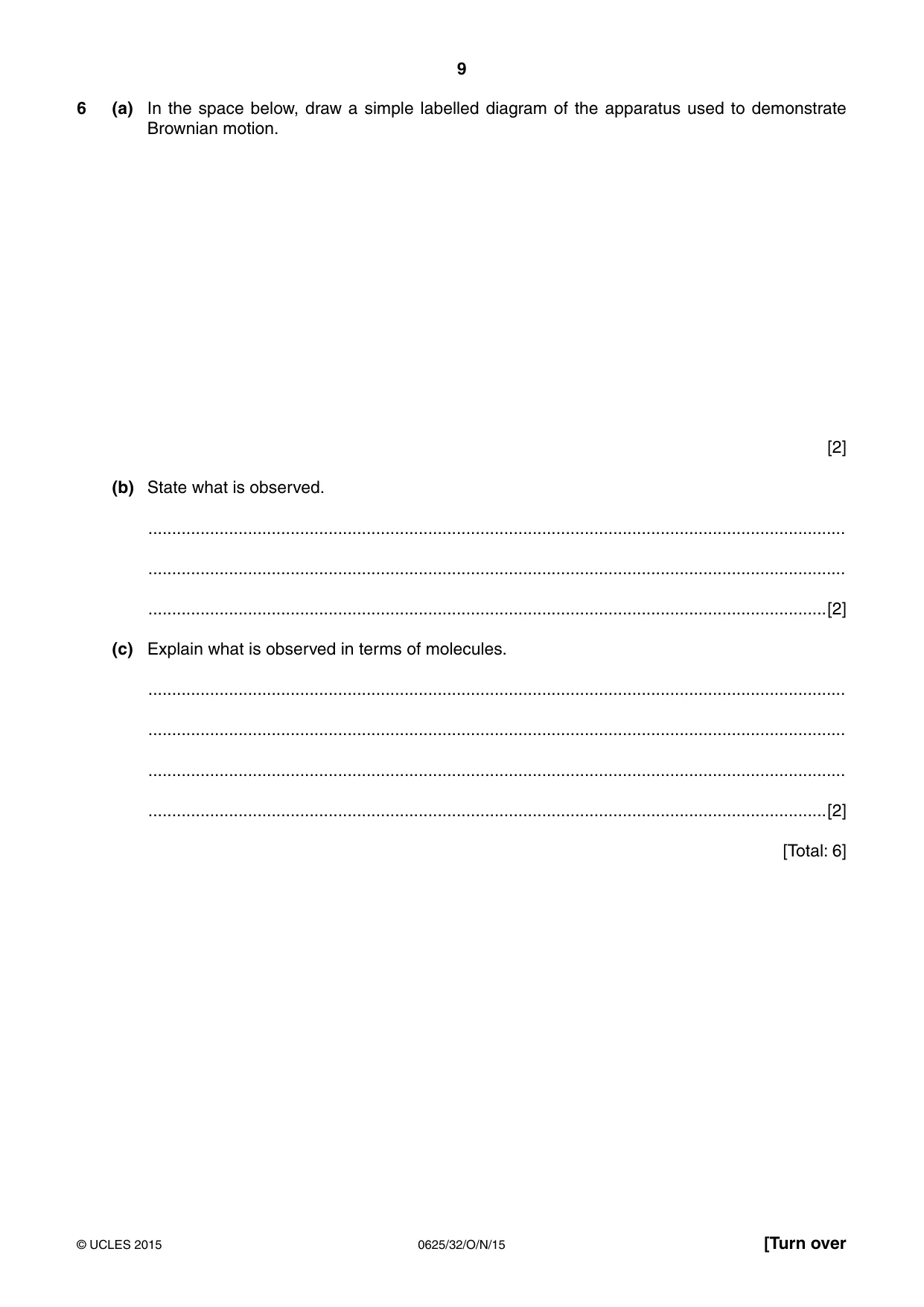
6 (a) In the space below, draw a simple labelled diagram of the apparatus used to demonstrate Brownian motion. [2] (b) State what is observed. ................................................................................................................................................... ................................................................................................................................................... ...............................................................................................................................................[2] (c) Explain what is observed in terms of molecules. ................................................................................................................................................... ................................................................................................................................................... ................................................................................................................................................... ...............................................................................................................................................[2] [Total: 6]
Mark scheme: 6 (a) suitable particles and fluid, and labelled, in suitable container e.g. pollen and water (surface), smoke in air M1 microscope AND, if smoke used, illumination A1 (b) movement of particles NOT atoms or molecules B1 reasonable description of movement OR any mention / clear description of movement in different directions accept if diagram drawn B1 (c) collisions between molecules and particles B1 random movement of molecules OR causes (random) motion of particles B1 [Total: 6]
Q7 · Sound from a loudspeaker is travelling in air towards a solid wall
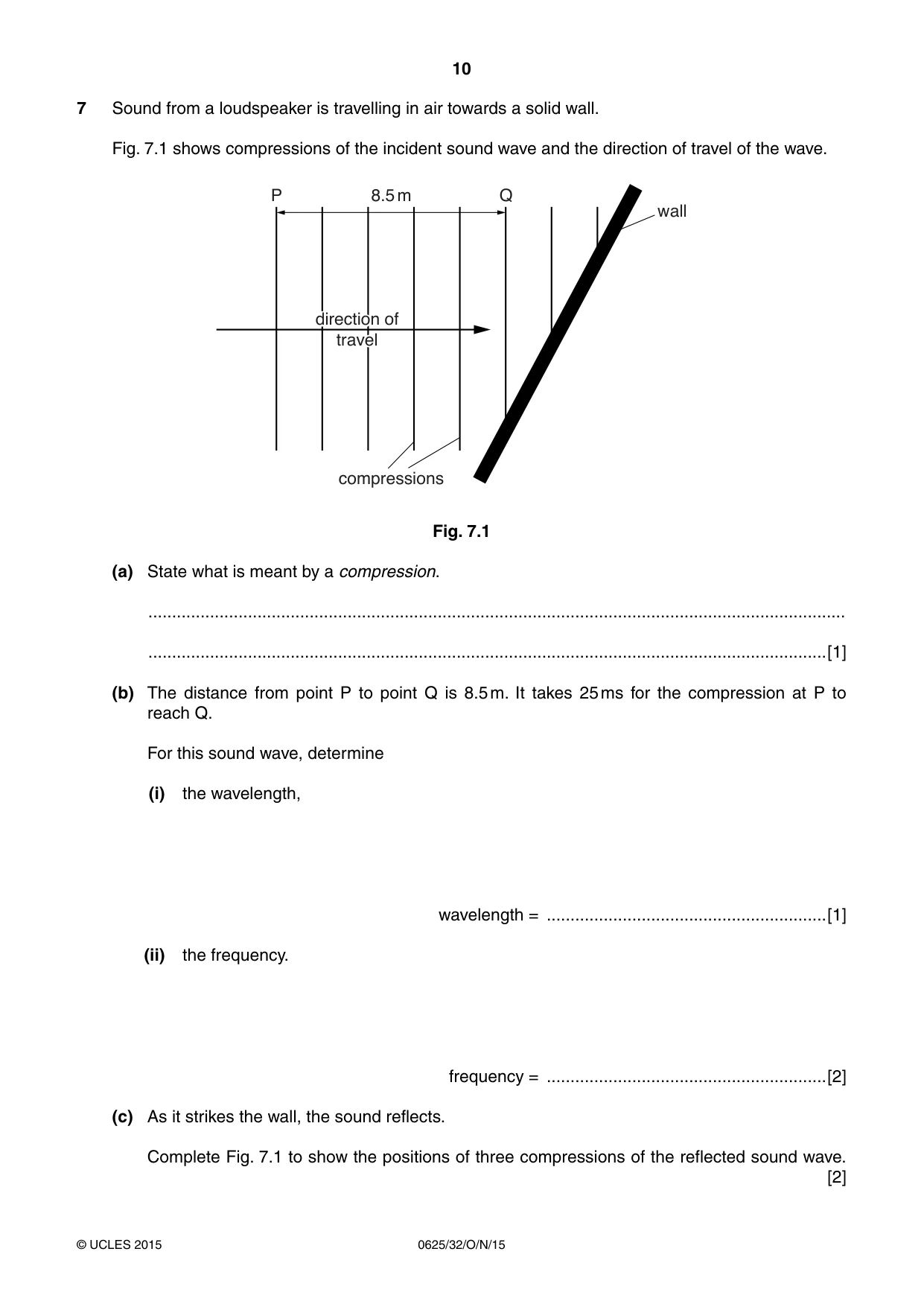
7 Sound from a loudspeaker is travelling in air towards a solid wall. Fig. 7.1 shows compressions of the incident sound wave and the direction of travel of the wave. P 8.5 m Q wall direction of travel compressions Fig. 7.1 (a) State what is meant by a compression. ................................................................................................................................................... ...............................................................................................................................................[1] (b) The distance from point P to point Q is 8.5 m. It takes 25 ms for the compression at P to reach Q. For this sound wave, determine (i) the wavelength, wavelength = ...........................................................[1] (ii) the frequency. frequency = ...........................................................[2] (c) As it strikes the wall, the sound reflects. Complete Fig. 7.1 to show the positions of three compressions of the reflected sound wave. [2] (d) The loudspeaker is immersed in water, where it continues to produce sound of the same frequency. State and explain how the wavelength of the sound wave in water compares with the wavelength determined in (b)(i). ................................................................................................................................................... ................................................................................................................................................... ...............................................................................................................................................[2] [Total: 8]
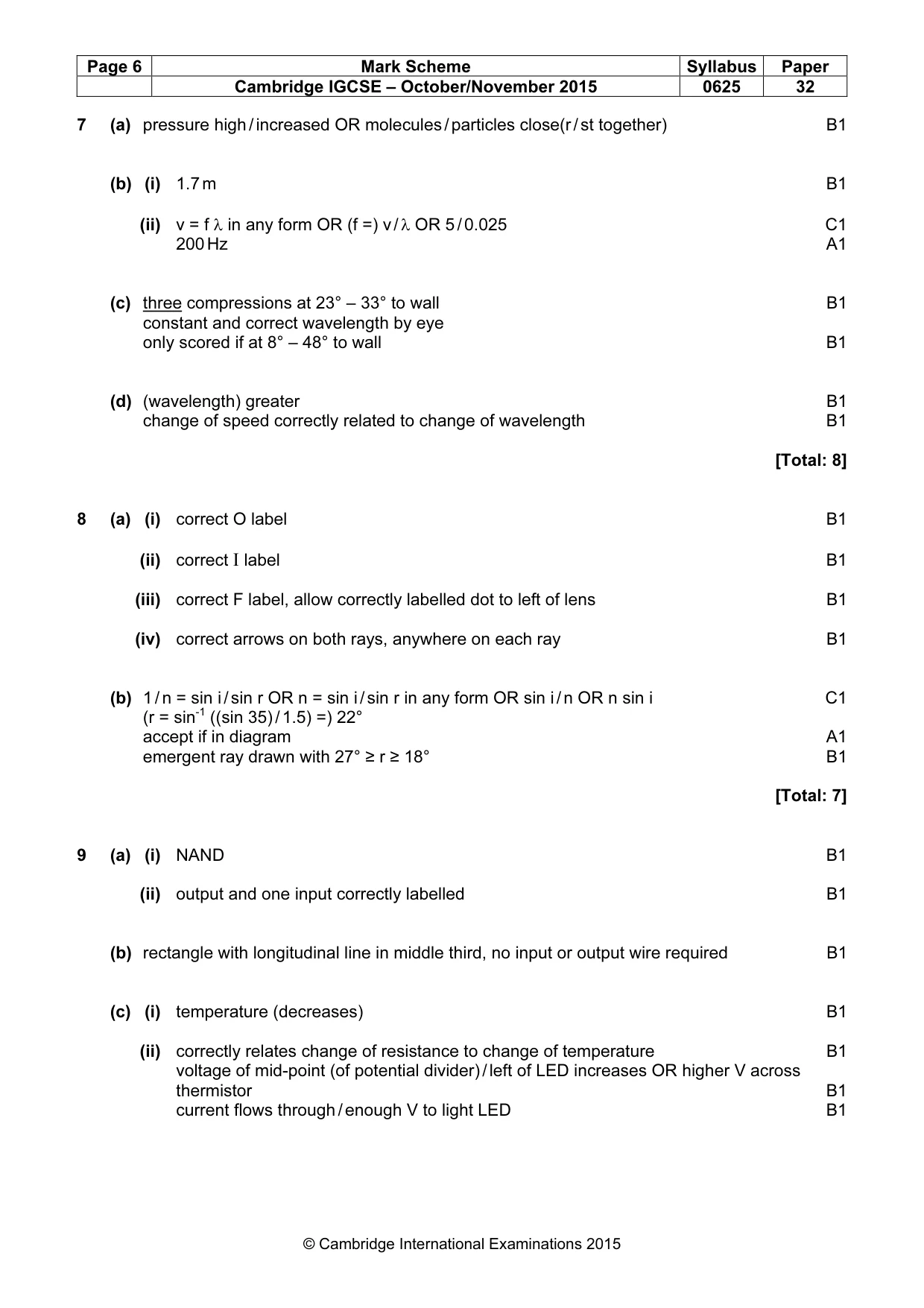
Mark scheme: 7 (a) pressure high / increased OR molecules / particles close(r / st together) B1 (b) (i) 1.7 m B1 (ii) v = f λ in any form OR (f =) v / λ OR 5 / 0.025 C1 200 Hz A1 (c) three compressions at 23° – 33° to wall B1 constant and correct wavelength by eye only scored if at 8° – 48° to wall B1 (d) (wavelength) greater B1 change of speed correctly related to change of wavelength B1 [Total: 8]
Q8 · A ray diagram of a convex lens being used as a magnifying glass to produce a virtual image
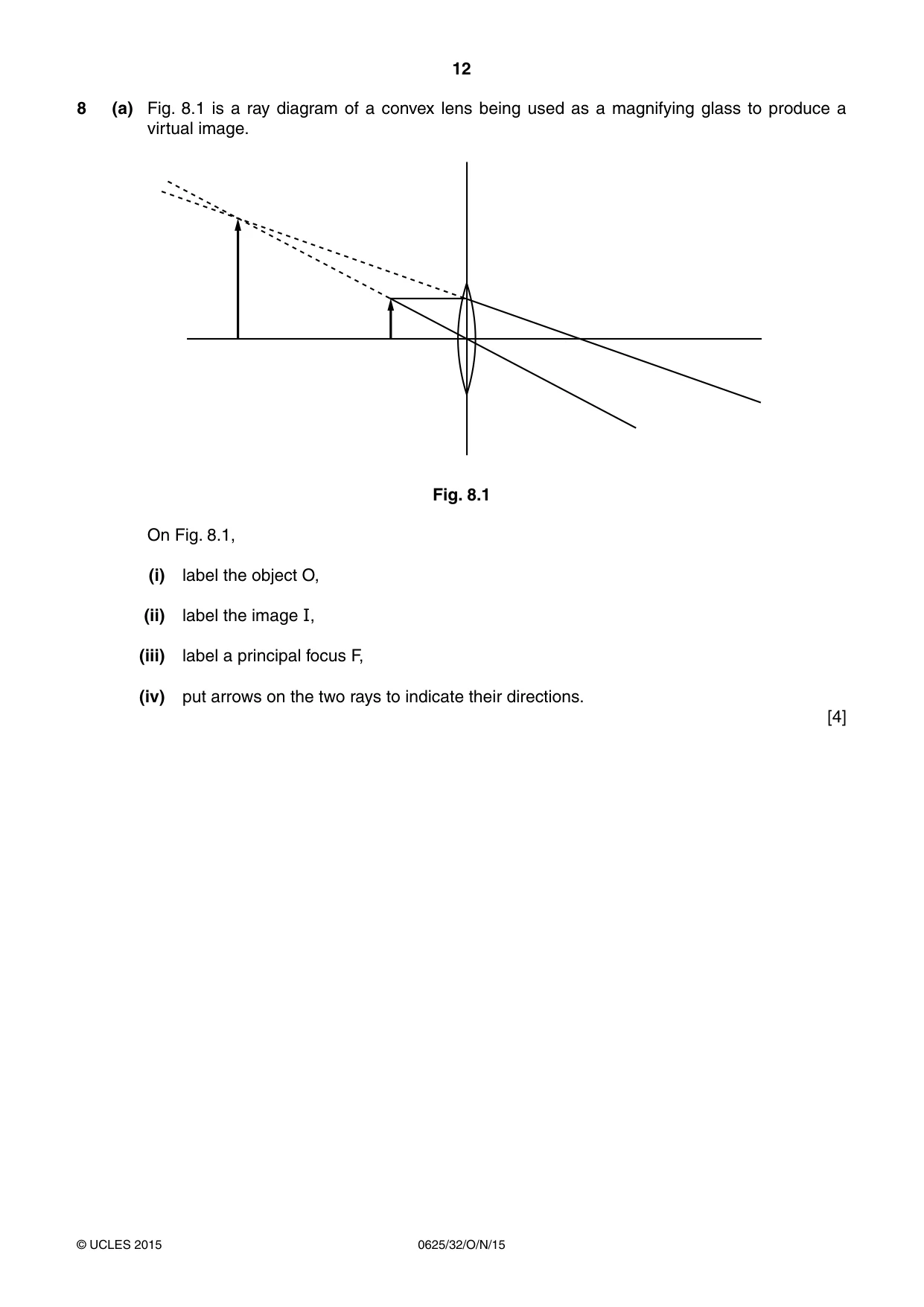
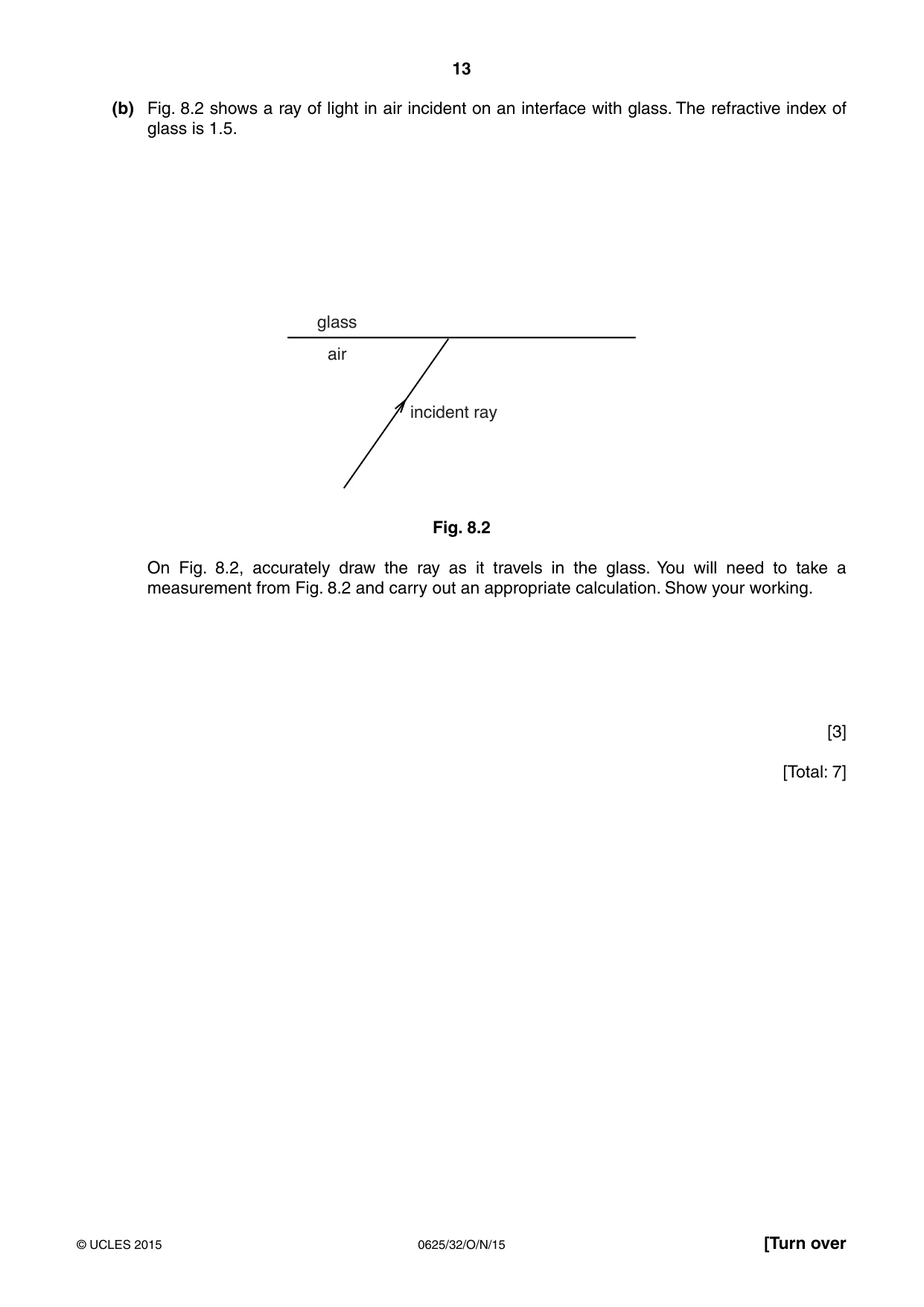
8 (a) Fig. 8.1 is a ray diagram of a convex lens being used as a magnifying glass to produce a virtual image. Fig. 8.1 On Fig. 8.1, (i) label the object O, (ii) label the image I, (iii) label a principal focus F, (iv) put arrows on the two rays to indicate their directions. [4] (b) Fig. 8.2 shows a ray of light in air incident on an interface with glass. The refractive index of glass is 1.5. glass air incident ray Fig. 8.2 On Fig. 8.2, accurately draw the ray as it travels in the glass. You will need to take a measurement from Fig. 8.2 and carry out an appropriate calculation. Show your working. [3] [Total: 7]
Mark scheme: 8 (a) (i) correct O label B1 (ii) correct I label B1 (iii) correct F label, allow correctly labelled dot to left of lens B1 (iv) correct arrows on both rays, anywhere on each ray B1 (b) 1 / n = sin i / sin r OR n = sin i / sin r in any form OR sin i / n OR n sin i C1 (r = sin-1 ((sin 35) / 1.5) =) 22° accept if in diagram A1 emergent ray drawn with 27° ≥ r ≥ 18° B1 [Total: 7]
Q9 · The symbol for a logic gate
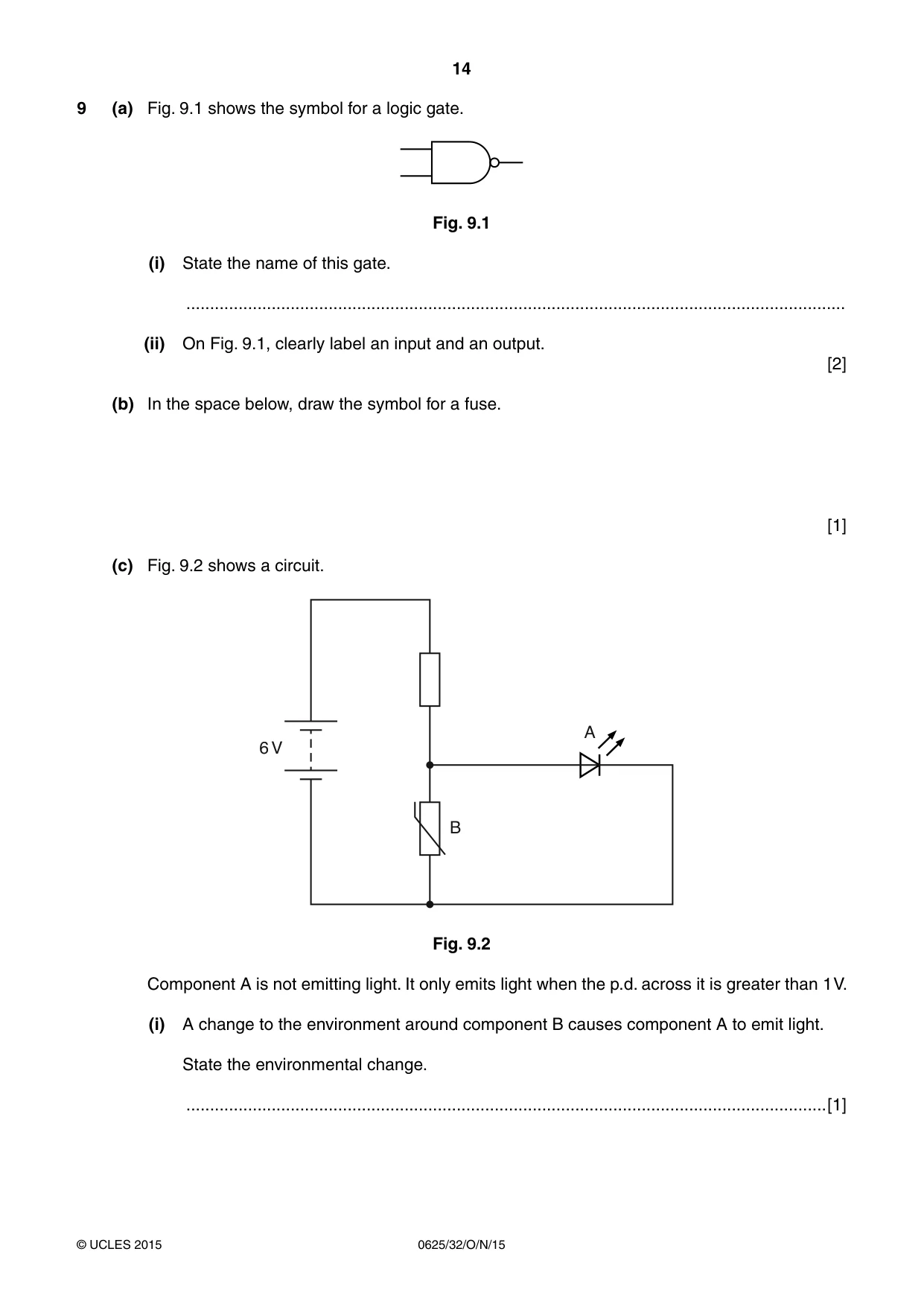
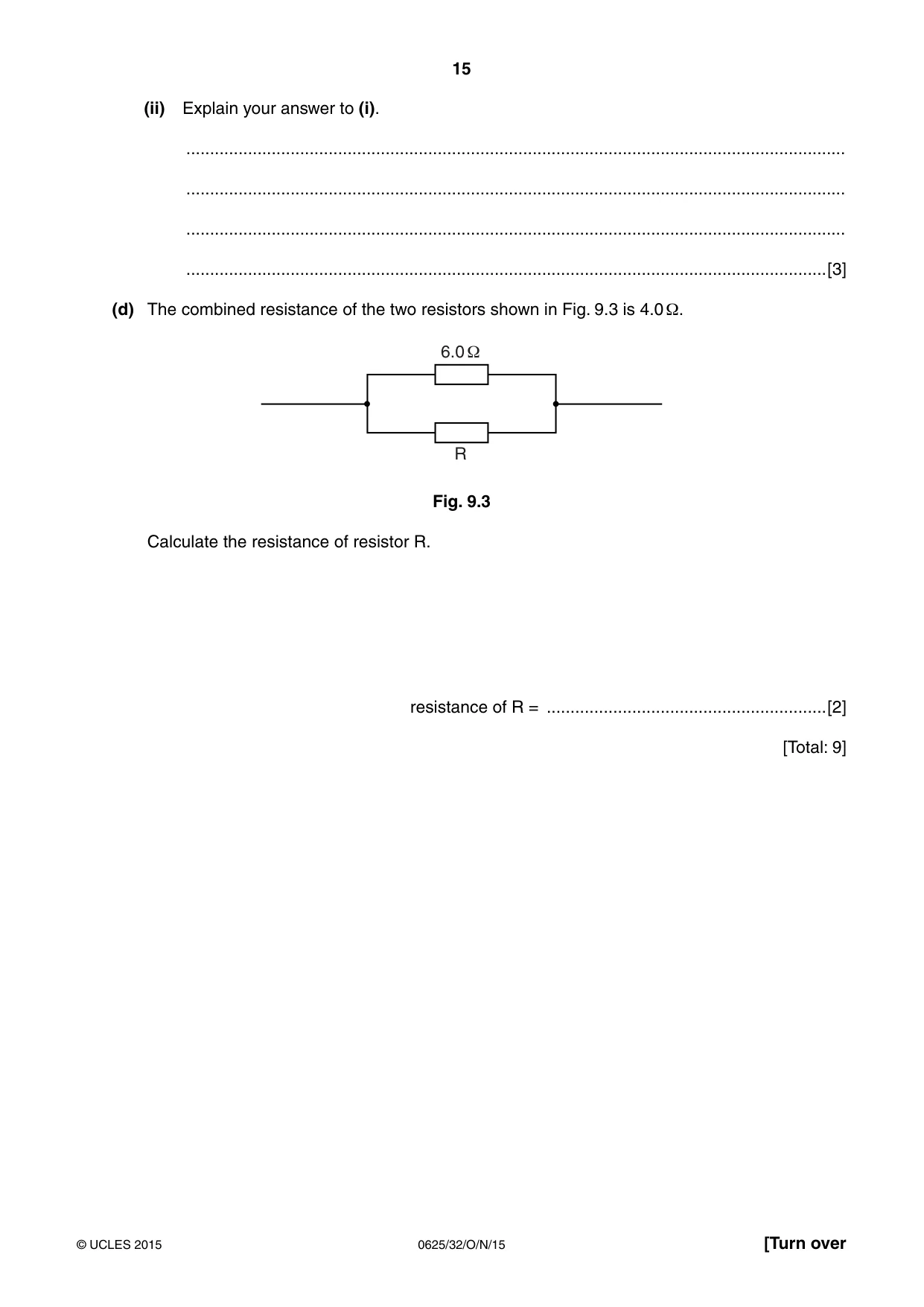
9 (a) Fig. 9.1 shows the symbol for a logic gate. Fig. 9.1 (i) State the name of this gate. ........................................................................................................................................... (ii) On Fig. 9.1, clearly label an input and an output. [2] (b) In the space below, draw the symbol for a fuse. [1] (c) Fig. 9.2 shows a circuit. A 6 V B Fig. 9.2 Component A is not emitting light. It only emits light when the p.d. across it is greater than 1 V. (i) A change to the environment around component B causes component A to emit light. State the environmental change. .......................................................................................................................................[1] (ii) Explain your answer to (i). ........................................................................................................................................... ........................................................................................................................................... ........................................................................................................................................... .......................................................................................................................................[3] (d) The combined resistance of the two resistors shown in Fig. 9.3 is 4.0 Ω. 6.0 1 R Fig. 9.3 Calculate the resistance of resistor R. resistance of R = ...........................................................[2] [Total: 9]
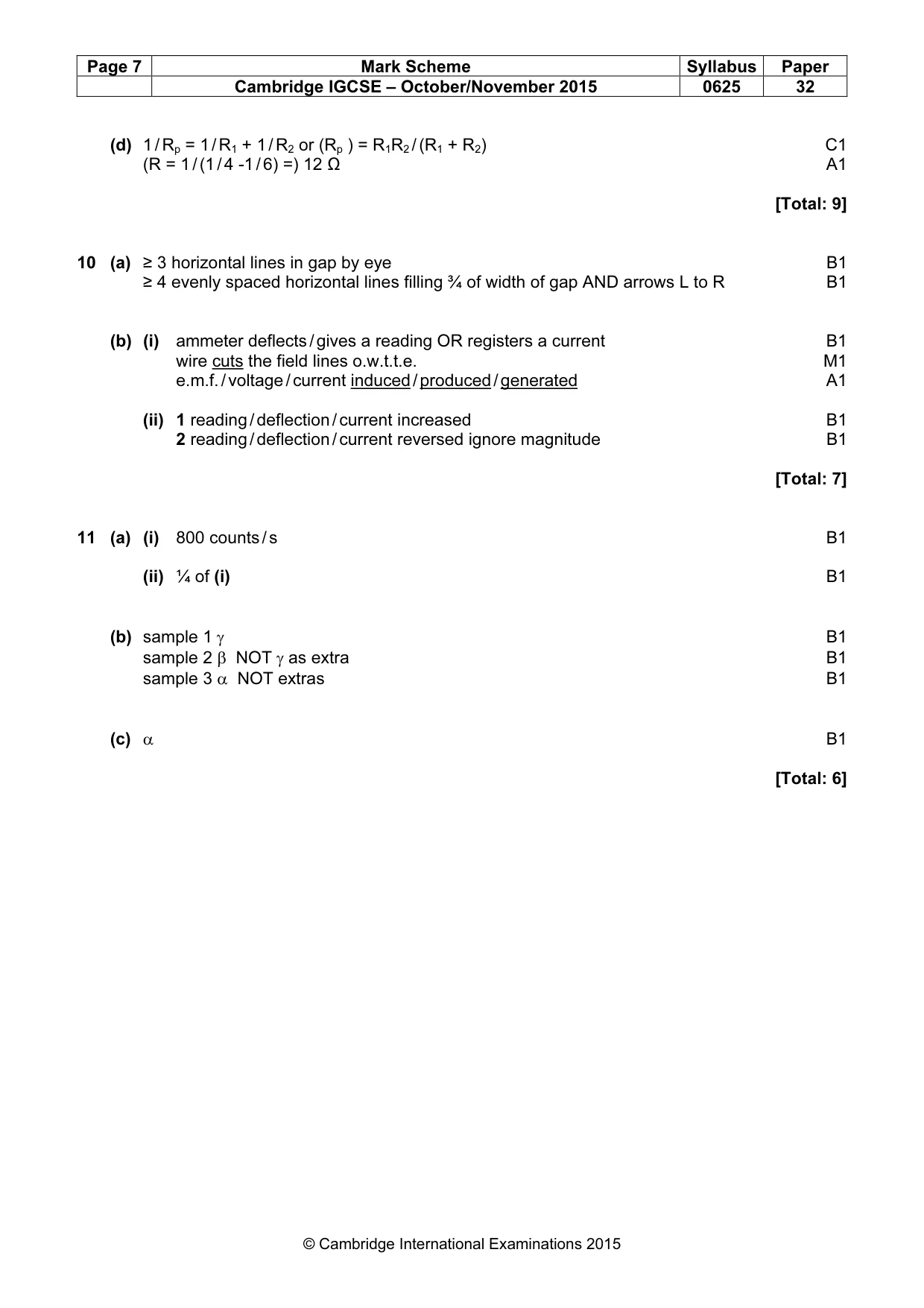
Mark scheme: 9 (a) (i) NAND B1 (ii) output and one input correctly labelled B1 (b) rectangle with longitudinal line in middle third, no input or output wire required B1 (c) (i) temperature (decreases) B1 (ii) correctly relates change of resistance to change of temperature B1 voltage of mid-point (of potential divider) / left of LED increases OR higher V across thermistor B1 current flows through / enough V to light LED B1 (d) 1 / Rp = 1 / R1 + 1 / R2 or (Rp ) = R1R2 / (R1 + R2) C1 (R = 1 / (1 / 4 -1 / 6) =) 12 Ω A1 [Total: 9]
Q10 · The gap between the N-pole and the S-pole of a magnet
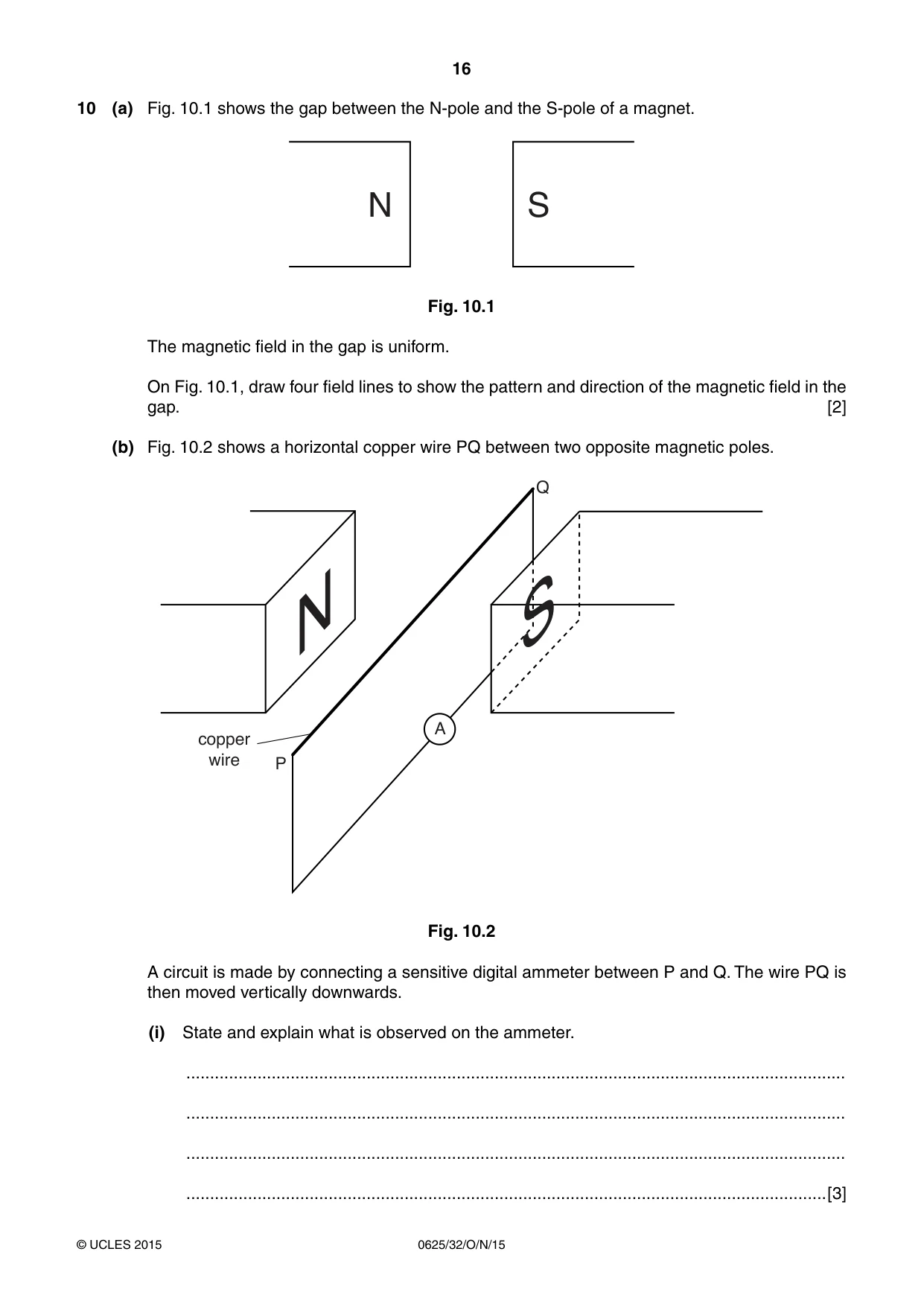
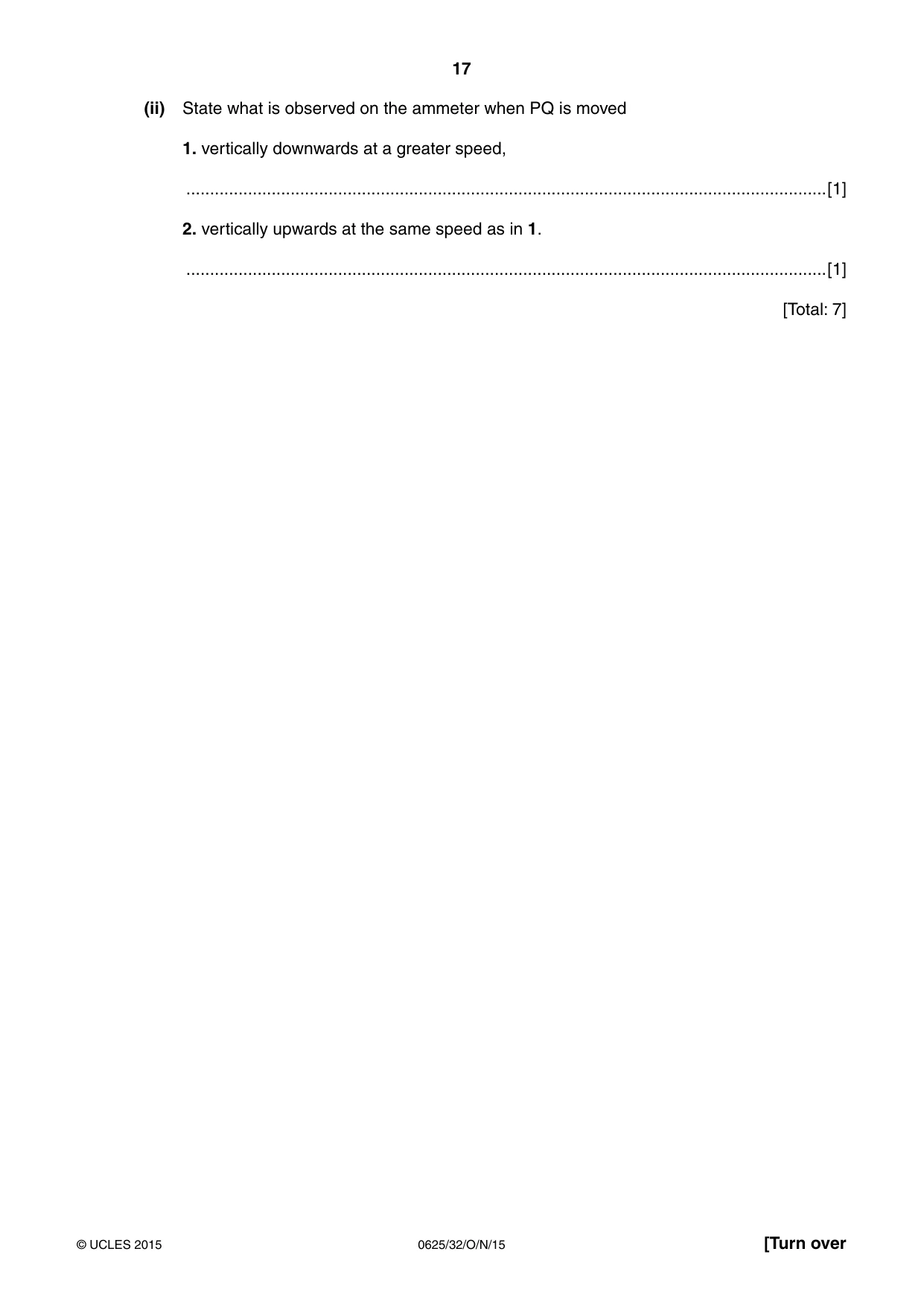
10 (a) Fig. 10.1 shows the gap between the N-pole and the S-pole of a magnet. N S Fig. 10.1 The magnetic field in the gap is uniform. On Fig. 10.1, draw four field lines to show the pattern and direction of the magnetic field in the gap. [2] (b) Fig. 10.2 shows a horizontal copper wire PQ between two opposite magnetic poles. Q N S A copper wire P Fig. 10.2 A circuit is made by connecting a sensitive digital ammeter between P and Q. The wire PQ is then moved vertically downwards. (i) State and explain what is observed on the ammeter. ........................................................................................................................................... ........................................................................................................................................... ........................................................................................................................................... .......................................................................................................................................[3] (ii) State what is observed on the ammeter when PQ is moved 1. vertically downwards at a greater speed, .......................................................................................................................................[1] 2. vertically upwards at the same speed as in 1. .......................................................................................................................................[1] [Total: 7]
Mark scheme: 10 (a) ≥ 3 horizontal lines in gap by eye B1 ≥ 4 evenly spaced horizontal lines filling ¾ of width of gap AND arrows L to R B1 (b) (i) ammeter deflects / gives a reading OR registers a current B1 wire cuts the field lines o.w.t.t.e. M1 e.m.f. / voltage / current induced / produced / generated A1 (ii) 1 reading / deflection / current increased B1 2 reading / deflection / current reversed ignore magnitude B1 [Total: 7]
Q11 · The counter of a radiation detector placed close to a radioactive source gives a count…
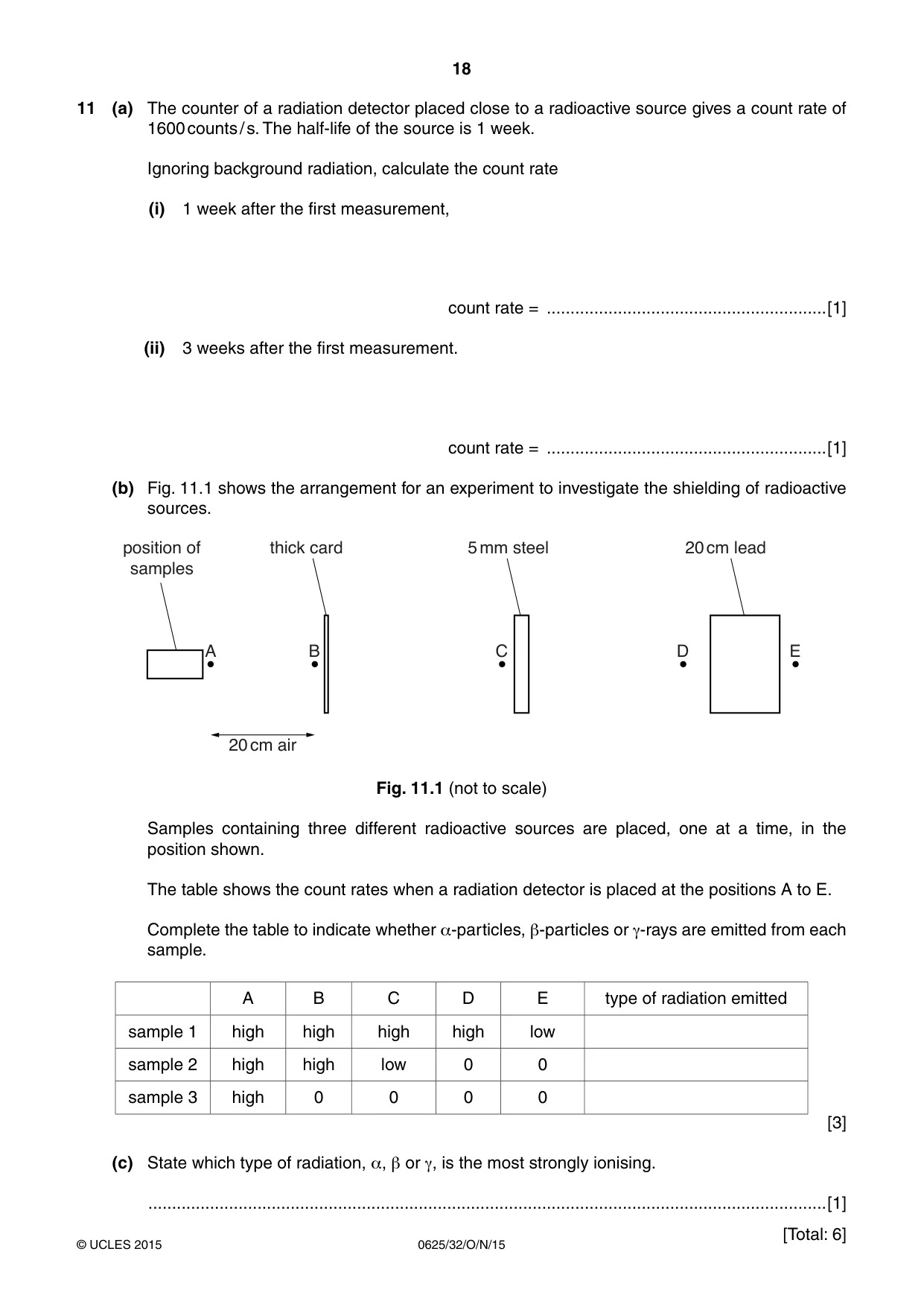
11 (a) The counter of a radiation detector placed close to a radioactive source gives a count rate of 1600 counts / s. The half-life of the source is 1 week. Ignoring background radiation, calculate the count rate (i) 1 week after the first measurement, count rate = ...........................................................[1] (ii) 3 weeks after the first measurement. count rate = ...........................................................[1] (b) Fig. 11.1 shows the arrangement for an experiment to investigate the shielding of radioactive sources. position of thick card 5 mm steel 20 cm lead samples A B C D E 20 cm air Fig. 11.1 (not to scale) Samples containing three different radioactive sources are placed, one at a time, in the position shown. The table shows the count rates when a radiation detector is placed at the positions A to E. Complete the table to indicate whether α-particles, β-particles or γ-rays are emitted from each sample. A B C D E type of radiation emitted sample 1 high high high high low sample 2 high high low 0 0 sample 3 high 0 0 0 0 [3] (c) State which type of radiation, α, β or γ, is the most strongly ionising. ...............................................................................................................................................[1]
Mark scheme: 11 (a) (i) 800 counts / s B1 (ii) ¼ of (i) B1 (b) sample 1 γ B1 sample 2 β NOT γ as extra B1 sample 3 α NOT extras B1 (c) α B1 [Total: 6]
What was in this paper
The subtopics covered by these 11 questions, and how many questions each got. Open one in a new tab to see every Cambridge question on it.
What you needed in this session
Cambridge’s own grade thresholds for 2015 Oct/Nov, Paper 3 · Variant 2. A higher threshold means an easier paper — the bar moves with how the cohort did.