Cambridge IGCSE Physics 0625 — 2020 May/June Paper 3 · Variant 2
0625/32/M/J/20 · 12 questions · 80 marks · ≈90 min
The question paper and its mark scheme, free to read here and free to download. This is Cambridge’s own paper, exactly as it was sat.
Question paper16 pages
Mark scheme10 pages
Answers below. Sit the paper first if you are practising.
Questions as text
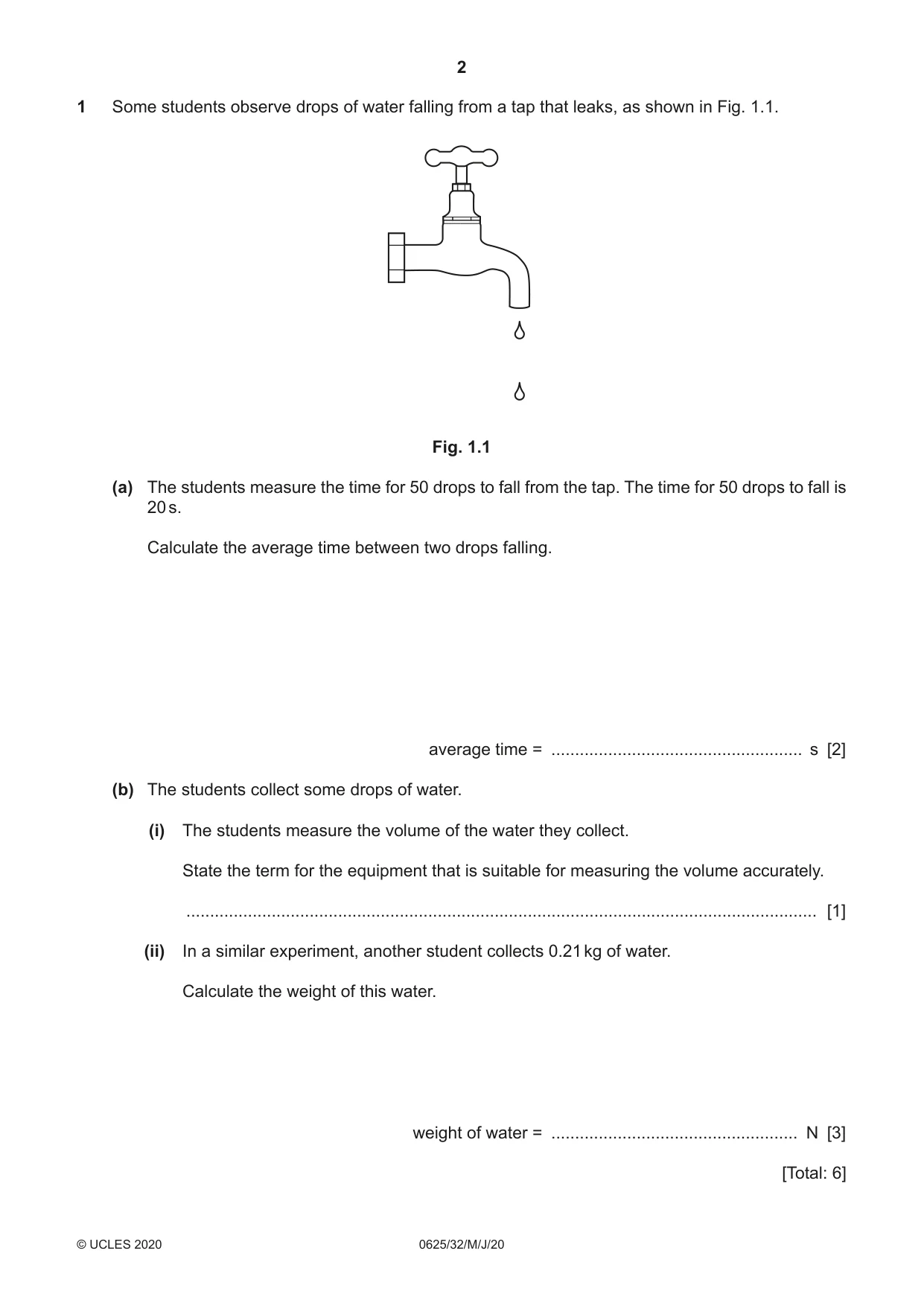
Q1 · Some students observe drops of water falling from a tap that leaks, as shown in Fig
1 Some students observe drops of water falling from a tap that leaks, as shown in Fig. 1.1. Fig. 1.1 (a) The students measure the time for 50 drops to fall from the tap. The time for 50 drops to fall is 20 s. Calculate the average time between two drops falling. average time = ..................................................... s [2] (b) The students collect some drops of water. (i) The students measure the volume of the water they collect. State the term for the equipment that is suitable for measuring the volume accurately. ..................................................................................................................................... [1] (ii) In a similar experiment, another student collects 0.21 kg of water. Calculate the weight of this water. weight of water = .................................................... N [3] [Total: 6]
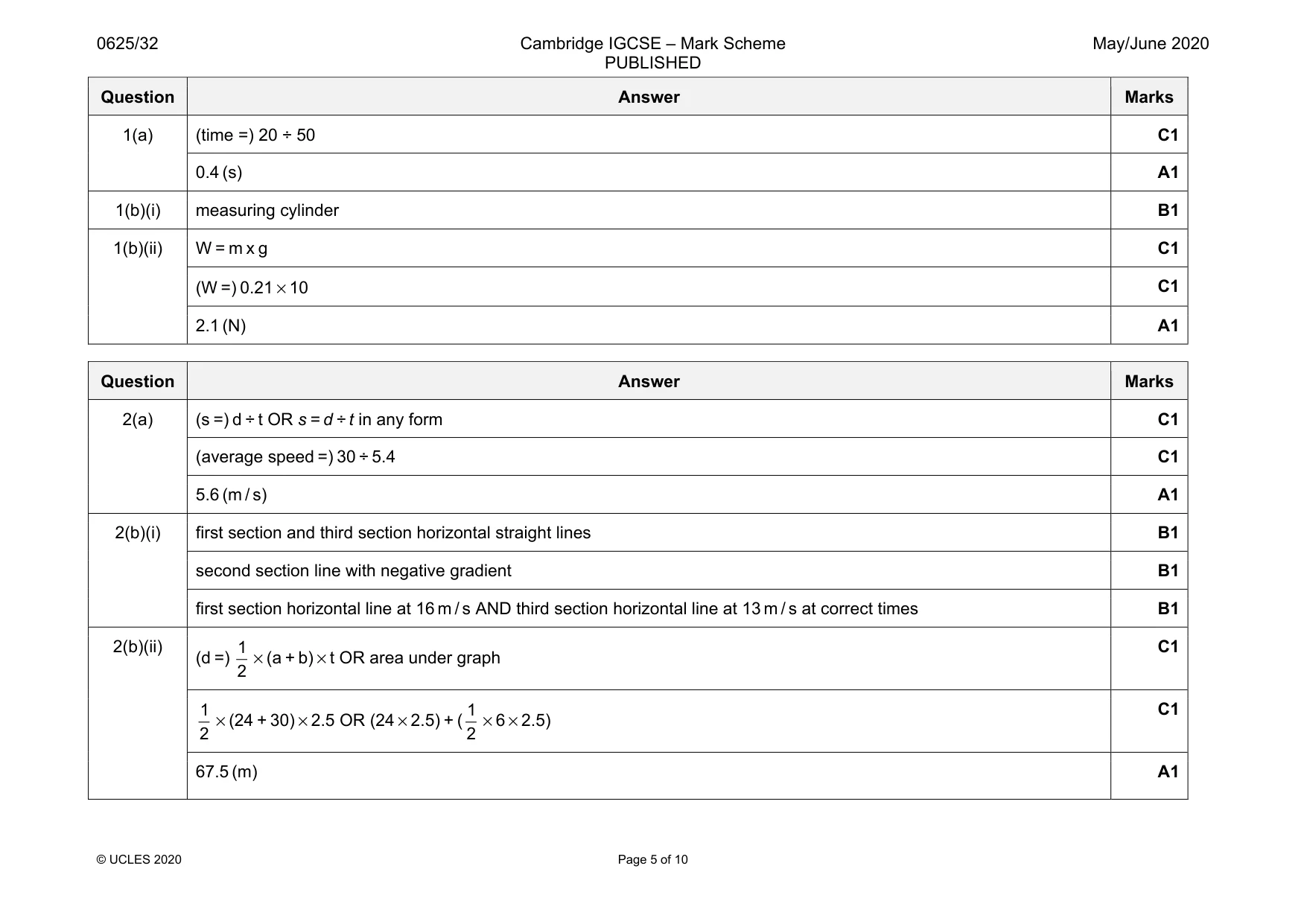
Mark scheme: 1(a) (time =) 20 ÷ 50 C1 0.4 (s) A1 1(b)(i) measuring cylinder B1 1(b)(ii) W = m x g C1 (W =) 0.21 × 10 C1 2.1 (N) A1
Q2 · Some students determine the speed of a car on a road
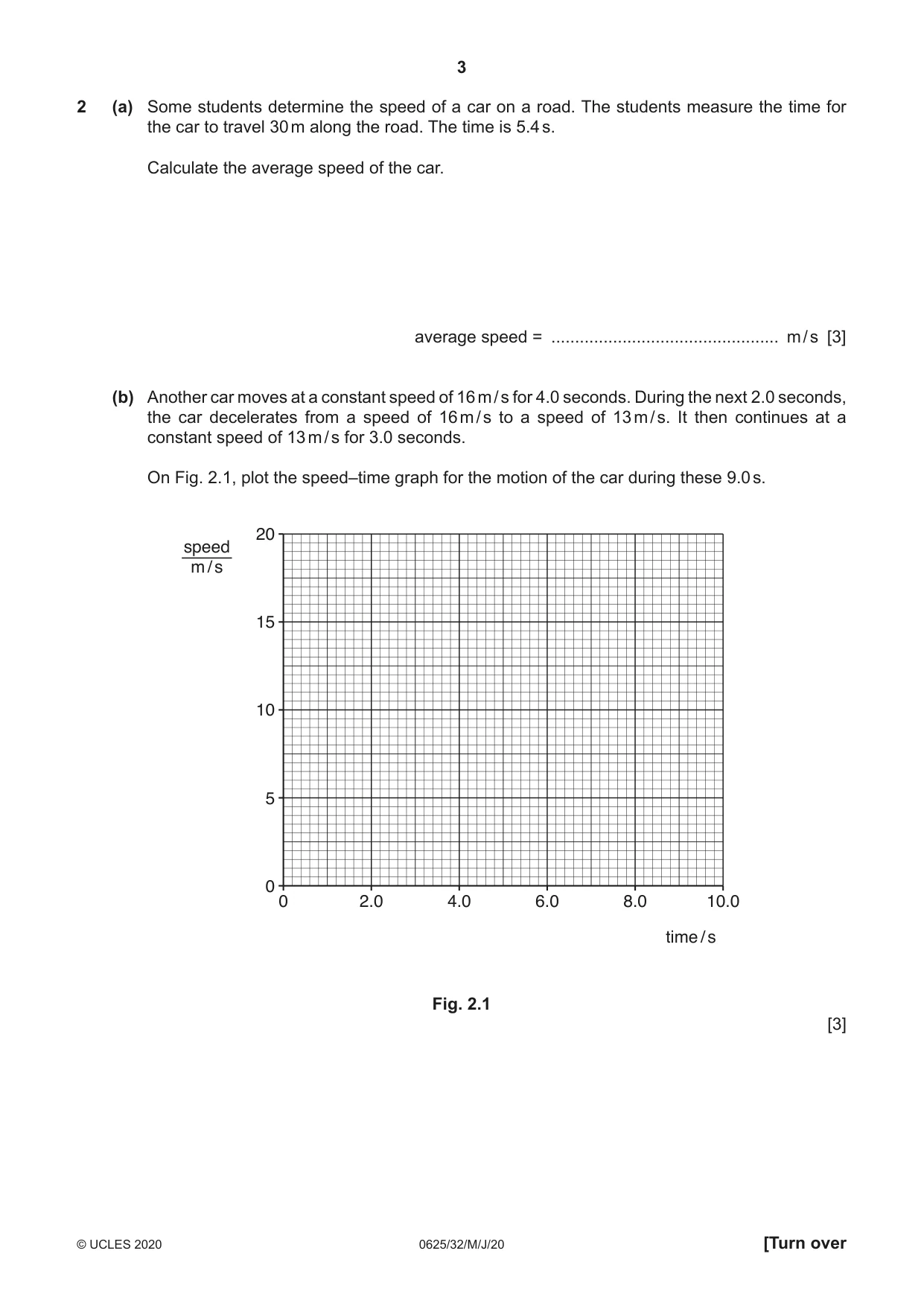
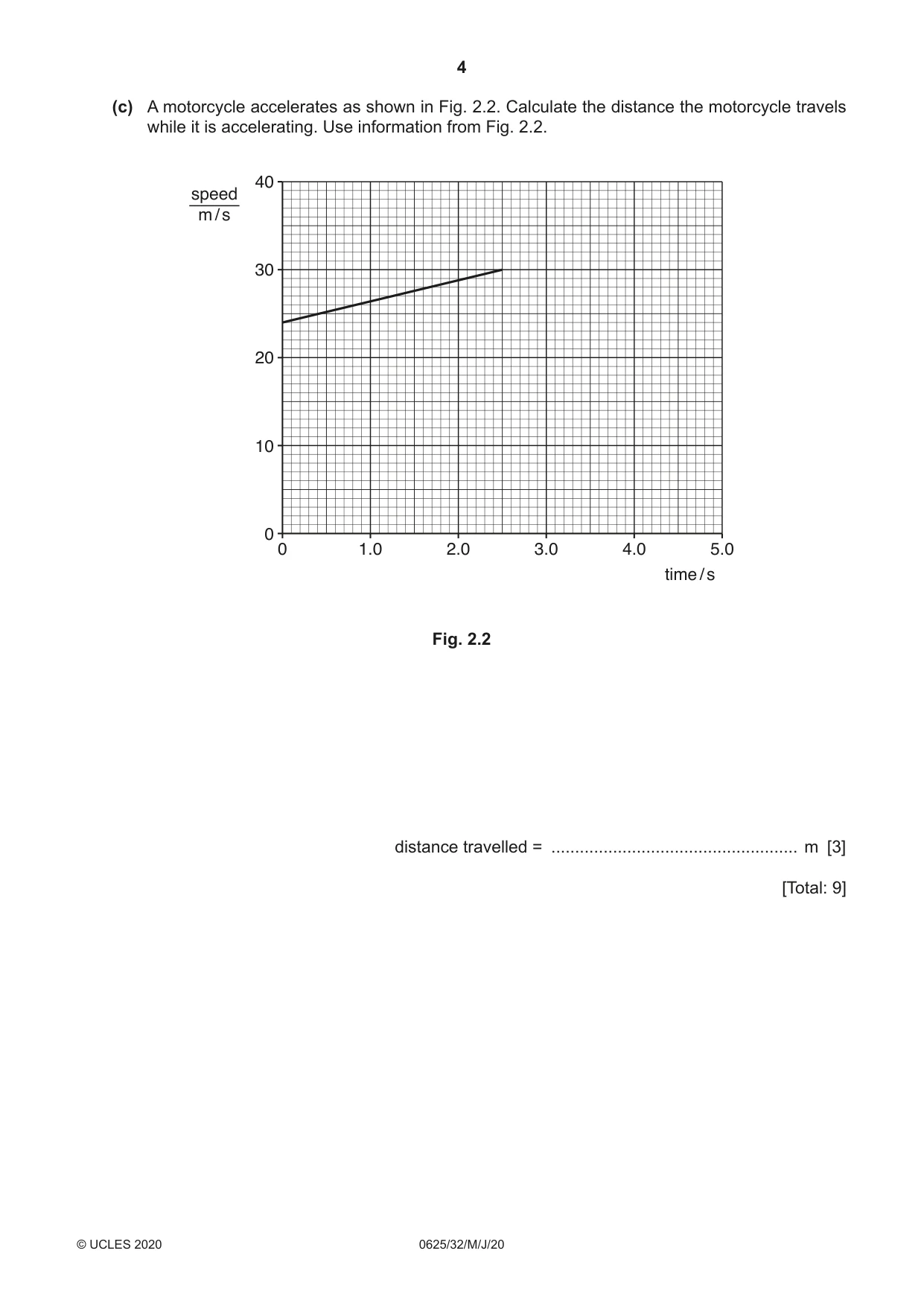
2 (a) Some students determine the speed of a car on a road. The students measure the time for the car to travel 30 m along the road. The time is 5.4 s. Calculate the average speed of the car. average speed = ................................................ m / s [3] (b) Another car moves at a constant speed of 16 m / s for 4.0 seconds. During the next 2.0 seconds, the car decelerates from a speed of 16 m / s to a speed of 13 m / s. It then continues at a constant speed of 13 m / s for 3.0 seconds. On Fig. 2.1, plot the speed–time graph for the motion of the car during these 9.0 s. 20 speed m / s 15 10 5 0 0 2.0 4.0 6.0 8.0 10.0 time / s Fig. 2.1 [3] (c) A motorcycle accelerates as shown in Fig. 2.2. Calculate the distance the motorcycle travels while it is accelerating. Use information from Fig. 2.2. 40 speed m / s 30 20 10 0 0 1.0 2.0 3.0 4.0 5.0 time / s Fig. 2.2 distance travelled = .................................................... m [3] [Total: 9]
Mark scheme: 2(a) (s =) d ÷ t OR s = d ÷ t in any form C1 (average speed =) 30 ÷ 5.4 C1 5.6 (m / s) A1 2(b)(i) first section and third section horizontal straight lines B1 second section line with negative gradient B1 first section horizontal line at 16 m / s AND third section horizontal line at 13 m / s at correct times B1 2(b)(ii) (d =) 1 2 × (a + b) × t OR area under graph C1 1 2 × (24 + 30) × 2.5 OR (24 × 2.5) + ( 1 2 × 6 × 2.5) C1 67.5 (m) A1
Q3 · An archer pulling the string of a bow
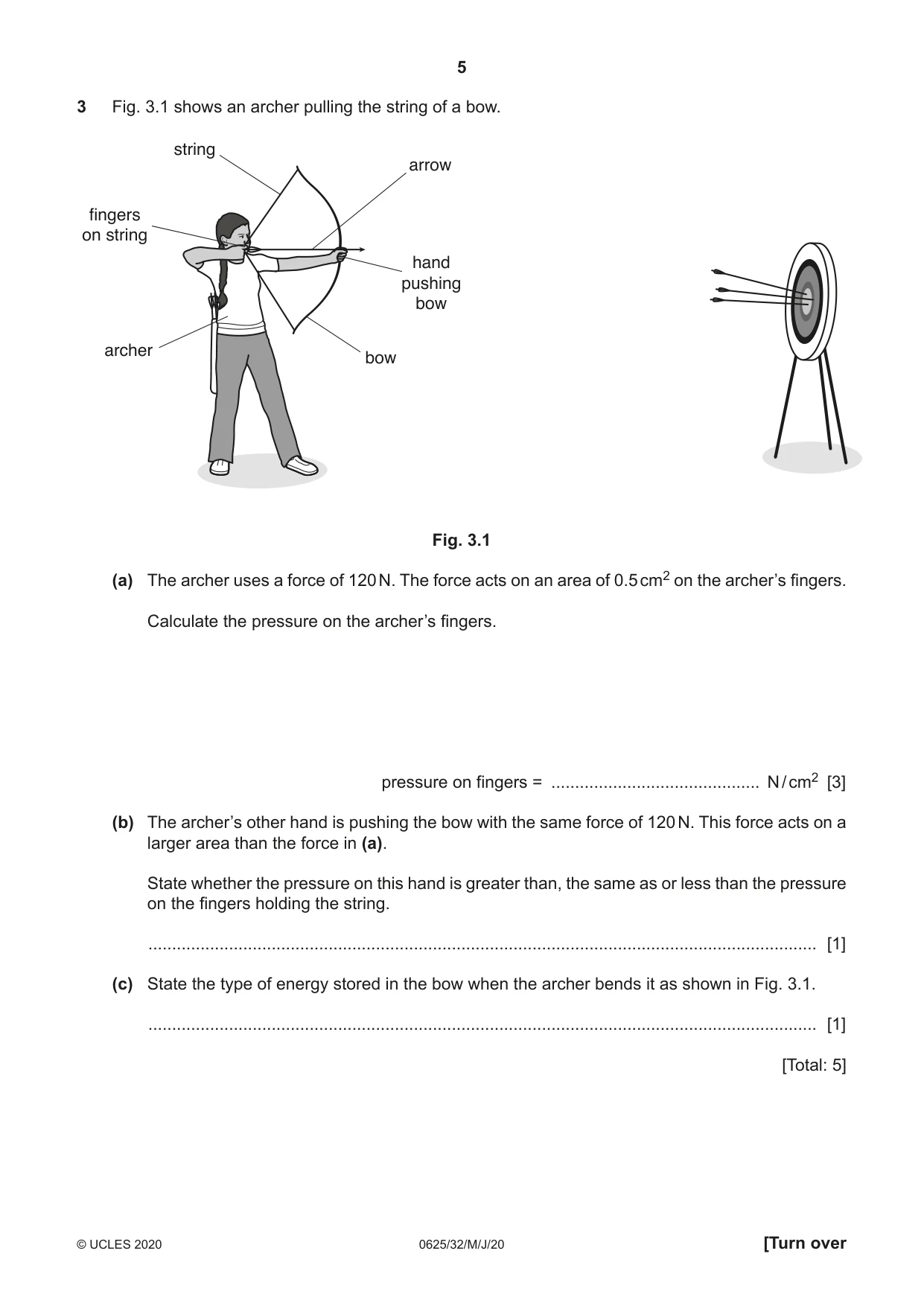
3 Fig. 3.1 shows an archer pulling the string of a bow. string arrow fingers on string hand pushing bow archer bow Fig. 3.1 (a) The archer uses a force of 120 N. The force acts on an area of 0.5 cm2 on the archer’s fingers. Calculate the pressure on the archer’s fingers. pressure on fingers = ............................................ N / cm2 [3] (b) The archer’s other hand is pushing the bow with the same force of 120 N. This force acts on a larger area than the force in (a). State whether the pressure on this hand is greater than, the same as or less than the pressure on the fingers holding the string. ............................................................................................................................................. [1] (c) State the type of energy stored in the bow when the archer bends it as shown in Fig. 3.1. ............................................................................................................................................. [1] [Total: 5]
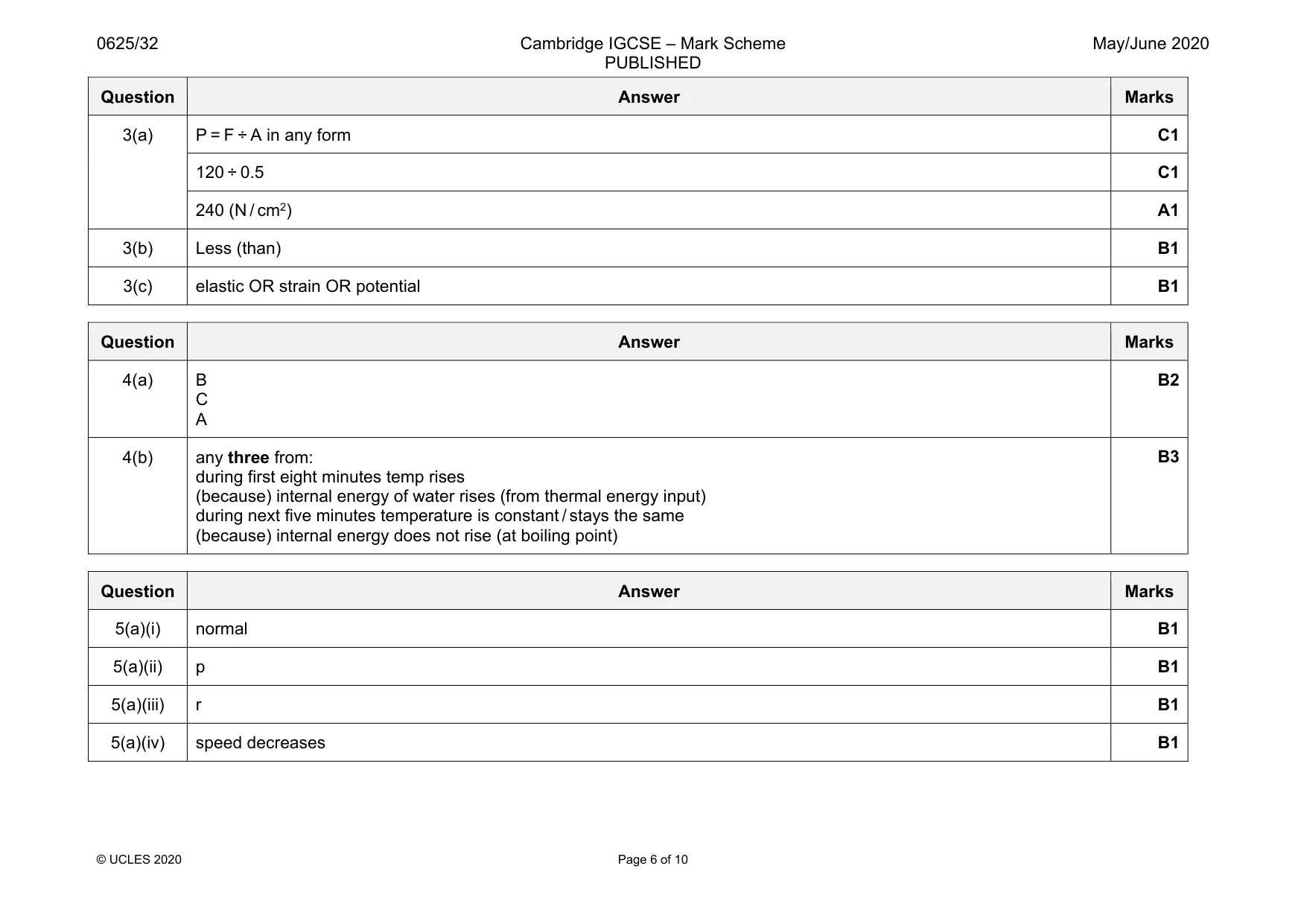
Mark scheme: 3(a) P = F ÷ A in any form C1 120 ÷ 0.5 C1 240 (N / cm2) A1 3(b) Less (than) B1 3(c) elastic OR strain OR potential B1
Q4 · Match each description with the correct state of matter in Table 4.1
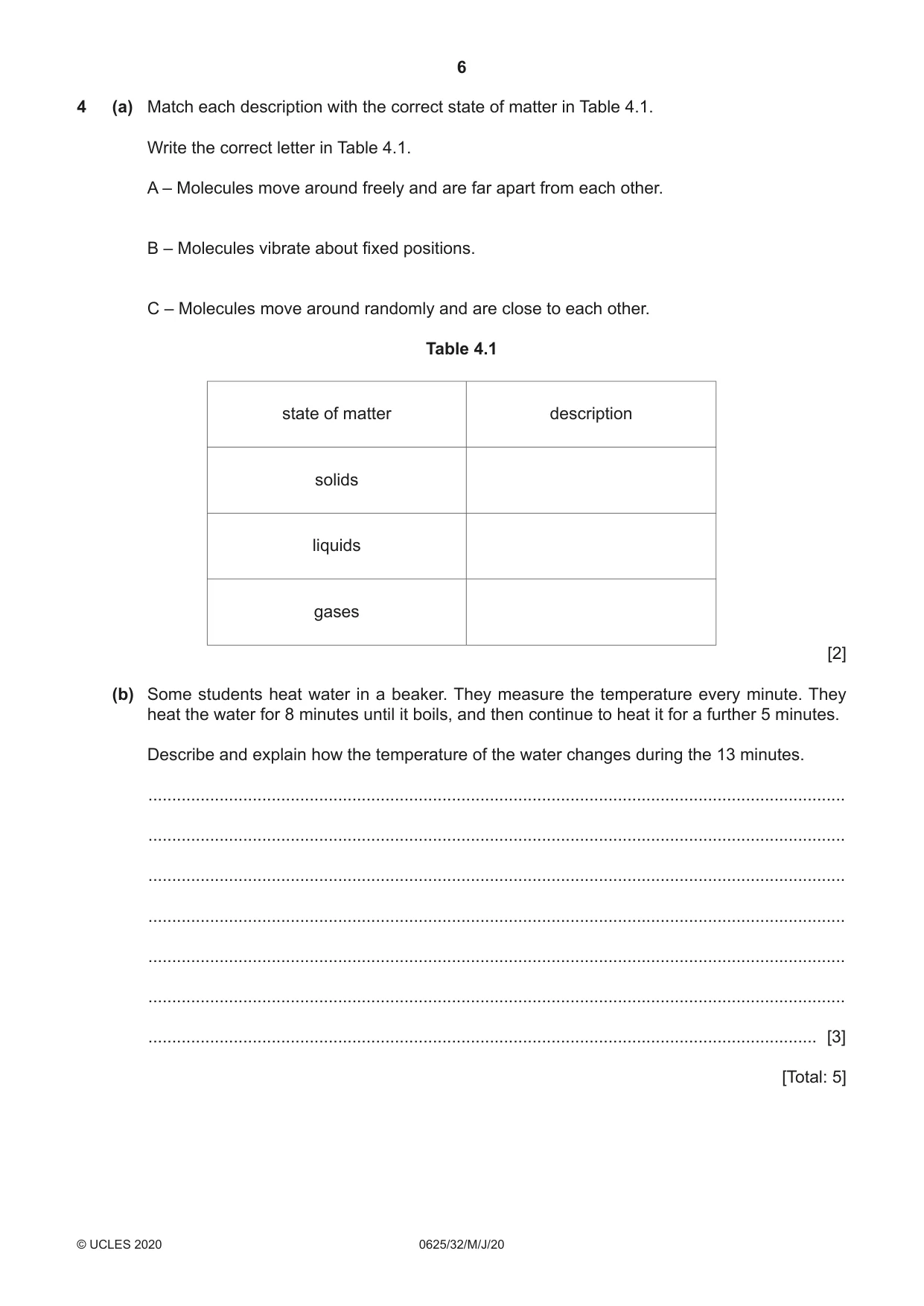
4 (a) Match each description with the correct state of matter in Table 4.1. Write the correct letter in Table 4.1. A – Molecules move around freely and are far apart from each other. B – Molecules vibrate about fixed positions. C – Molecules move around randomly and are close to each other. Table 4.1 state of matter description solids liquids gases [2] (b) Some students heat water in a beaker. They measure the temperature every minute. They heat the water for 8 minutes until it boils, and then continue to heat it for a further 5 minutes. Describe and explain how the temperature of the water changes during the 13 minutes. ................................................................................................................................................... ................................................................................................................................................... ................................................................................................................................................... ................................................................................................................................................... ................................................................................................................................................... ................................................................................................................................................... ............................................................................................................................................. [3] [Total: 5]
Mark scheme: 4(a) B C A B2 4(b) any three from: during first eight minutes temp rises (because) internal energy of water rises (from thermal energy input) during next five minutes temperature is constant / stays the same (because) internal energy does not rise (at boiling point) B3
Q5 · A ray of red light passing through a semicircular glass block
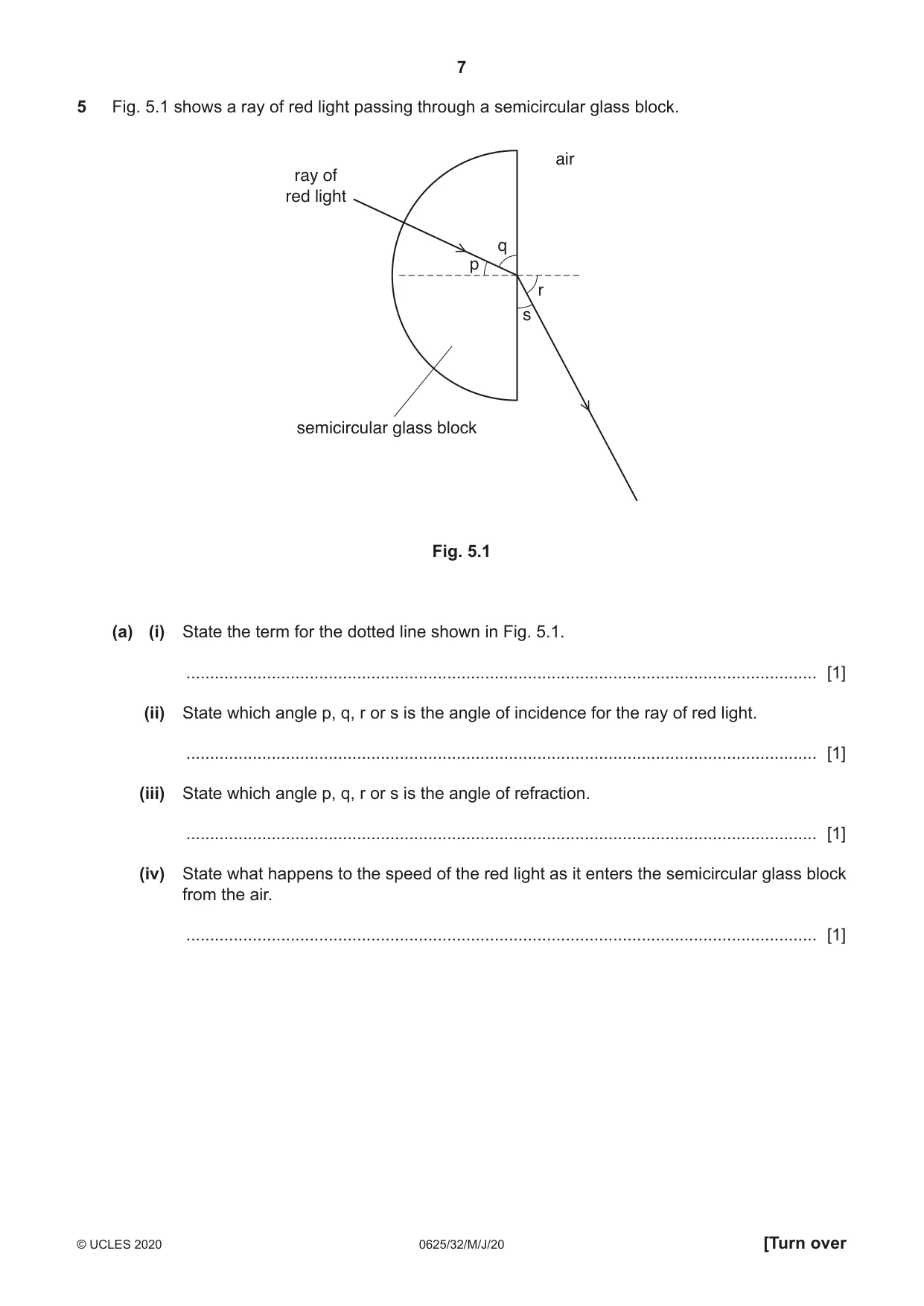
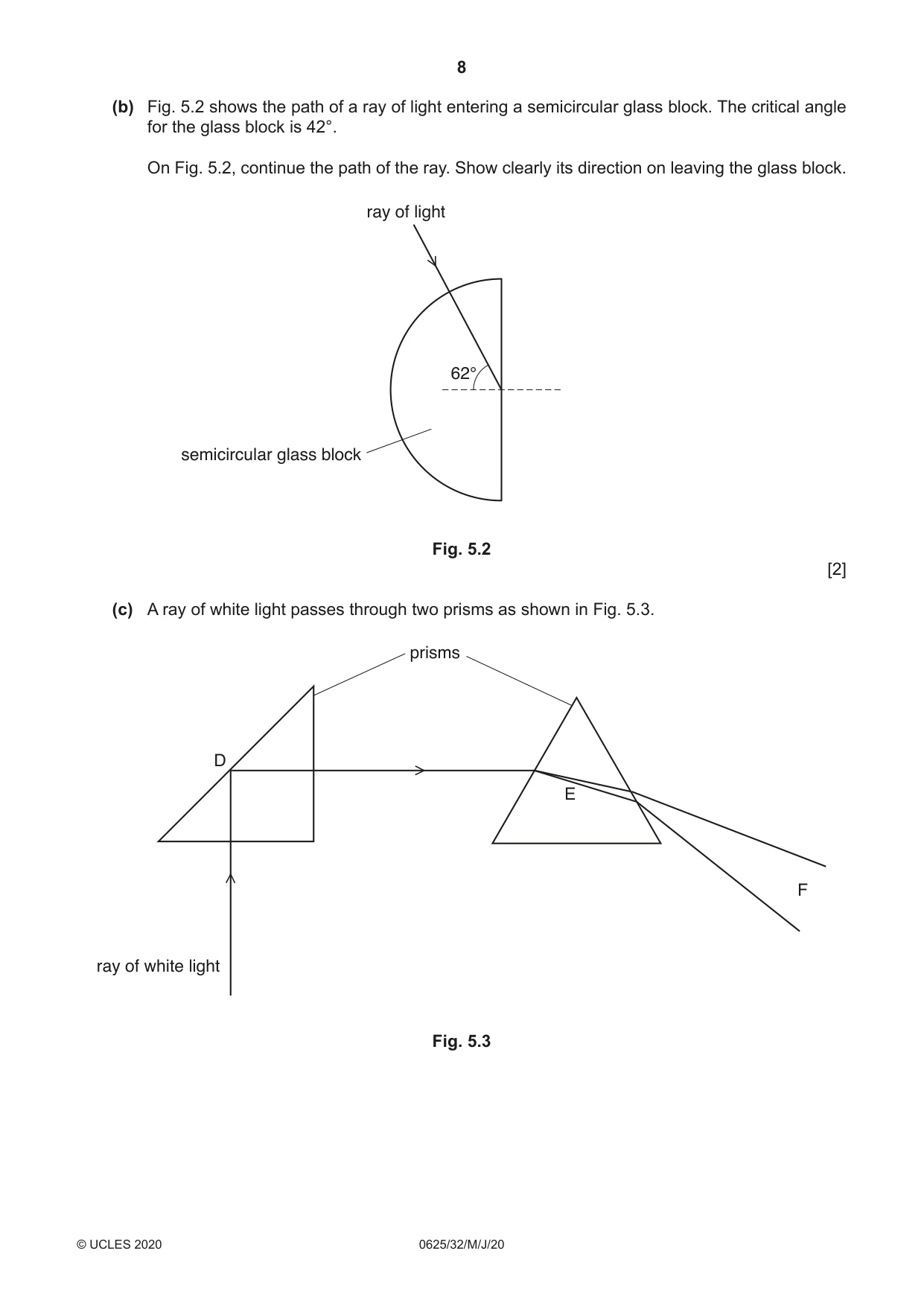
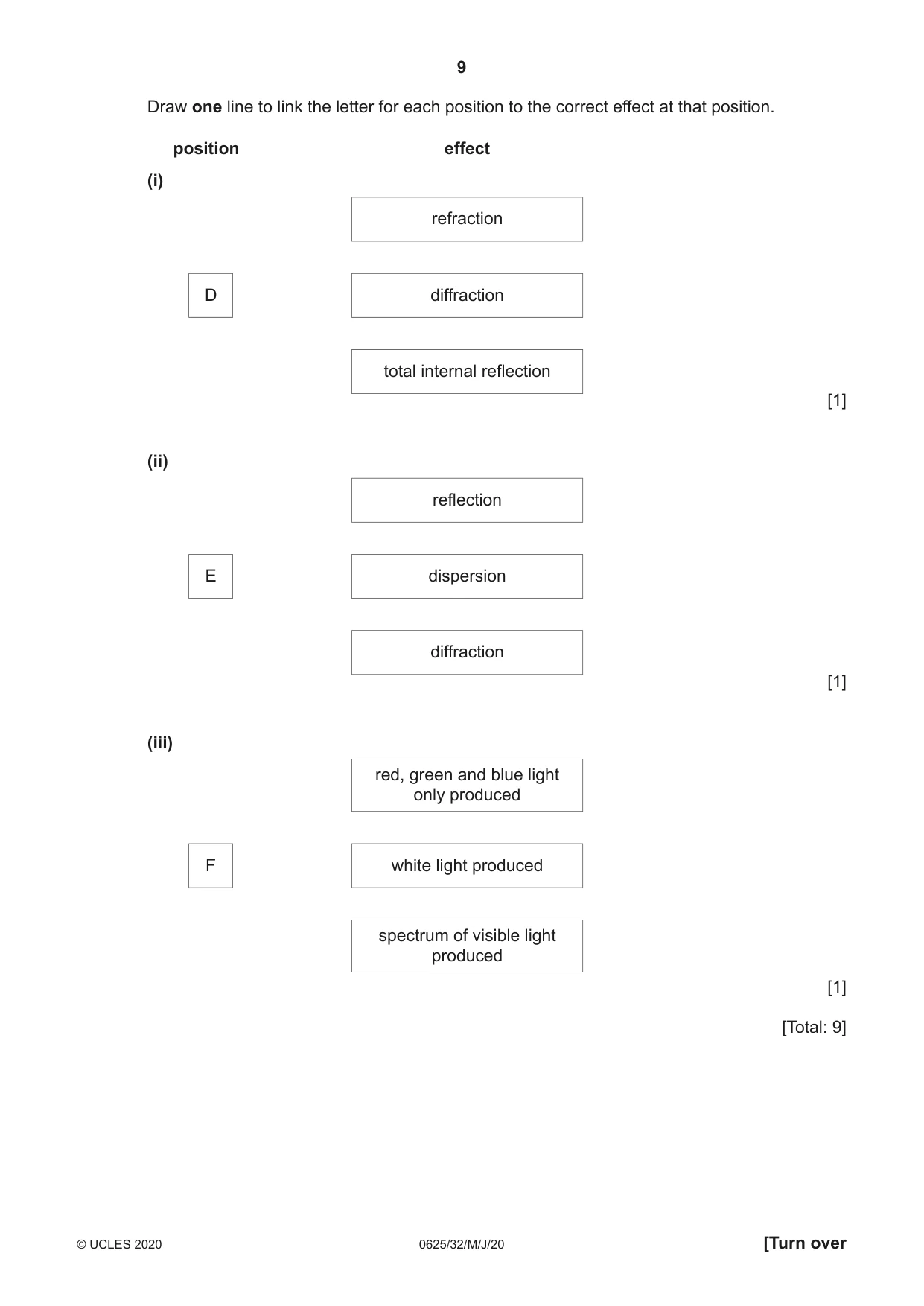
5 Fig. 5.1 shows a ray of red light passing through a semicircular glass block. air ray of red light q p r s semicircular glass block Fig. 5.1 (a) (i) State the term for the dotted line shown in Fig. 5.1. ..................................................................................................................................... [1] (ii) State which angle p, q, r or s is the angle of incidence for the ray of red light. ..................................................................................................................................... [1] (iii) State which angle p, q, r or s is the angle of refraction. ..................................................................................................................................... [1] (iv) State what happens to the speed of the red light as it enters the semicircular glass block from the air. ..................................................................................................................................... [1] (b) Fig. 5.2 shows the path of a ray of light entering a semicircular glass block. The critical angle for the glass block is 42°. On Fig. 5.2, continue the path of the ray. Show clearly its direction on leaving the glass block. ray of light 62° semicircular glass block Fig. 5.2 [2] (c) A ray of white light passes through two prisms as shown in Fig. 5.3. prisms D E F ray of white light Fig. 5.3 Draw one line to link the letter for each position to the correct effect at that position. position effect (i) refraction D diffraction total internal reflection [1] (ii) reflection E dispersion diffraction [1] (iii) red, green and blue light only produced F white light produced spectrum of visible light produced [1] [Total: 9]
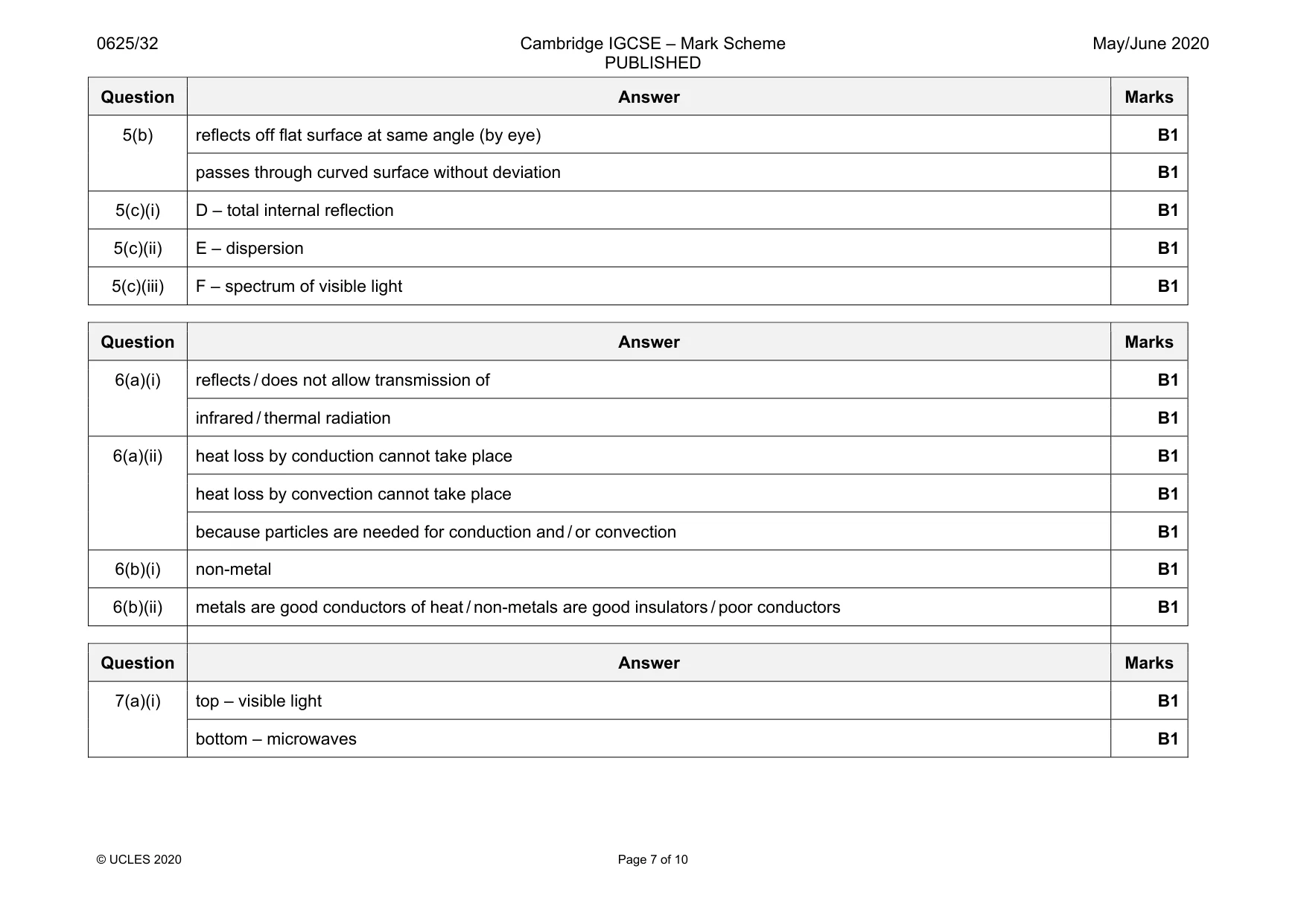
Mark scheme: 5(a)(i) normal B1 5(a)(ii) p B1 5(a)(iii) r B1 5(a)(iv) speed decreases B1 Question Answer Marks 5(b) reflects off flat surface at same angle (by eye) B1 passes through curved surface without deviation B1 5(c)(i) D – total internal reflection B1 5(c)(ii) E – dispersion B1 5(c)(iii) F – spectrum of visible light B1
Q6 · A hot liquid in a vacuum flask
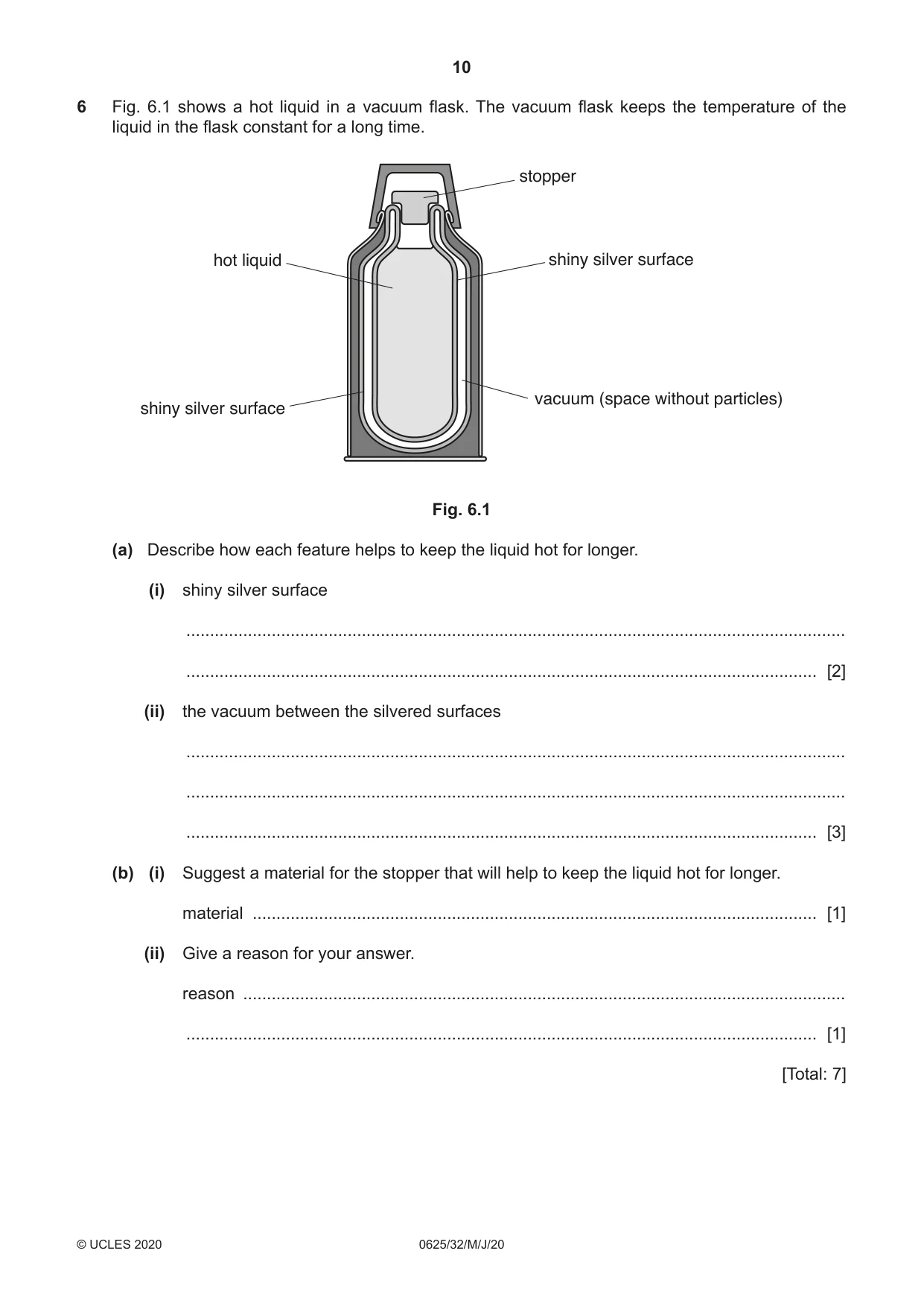
6 Fig. 6.1 shows a hot liquid in a vacuum flask. The vacuum flask keeps the temperature of the liquid in the flask constant for a long time. stopper hot liquid shiny silver surface vacuum (space without particles) shiny silver surface Fig. 6.1 (a) Describe how each feature helps to keep the liquid hot for longer. (i) shiny silver surface ........................................................................................................................................... ..................................................................................................................................... [2] (ii) the vacuum between the silvered surfaces ........................................................................................................................................... ........................................................................................................................................... ..................................................................................................................................... [3] (b) (i) Suggest a material for the stopper that will help to keep the liquid hot for longer. material ....................................................................................................................... [1] (ii) Give a reason for your answer. reason ............................................................................................................................... ..................................................................................................................................... [1] [Total: 7]
Mark scheme: 6(a)(i) reflects / does not allow transmission of B1 infrared / thermal radiation B1 6(a)(ii) heat loss by conduction cannot take place B1 heat loss by convection cannot take place B1 because particles are needed for conduction and / or convection B1 6(b)(i) non-metal B1 6(b)(ii) metals are good conductors of heat / non-metals are good insulators / poor conductors B1
Q7 · A diagram of the main regions of the electromagnetic spectrum
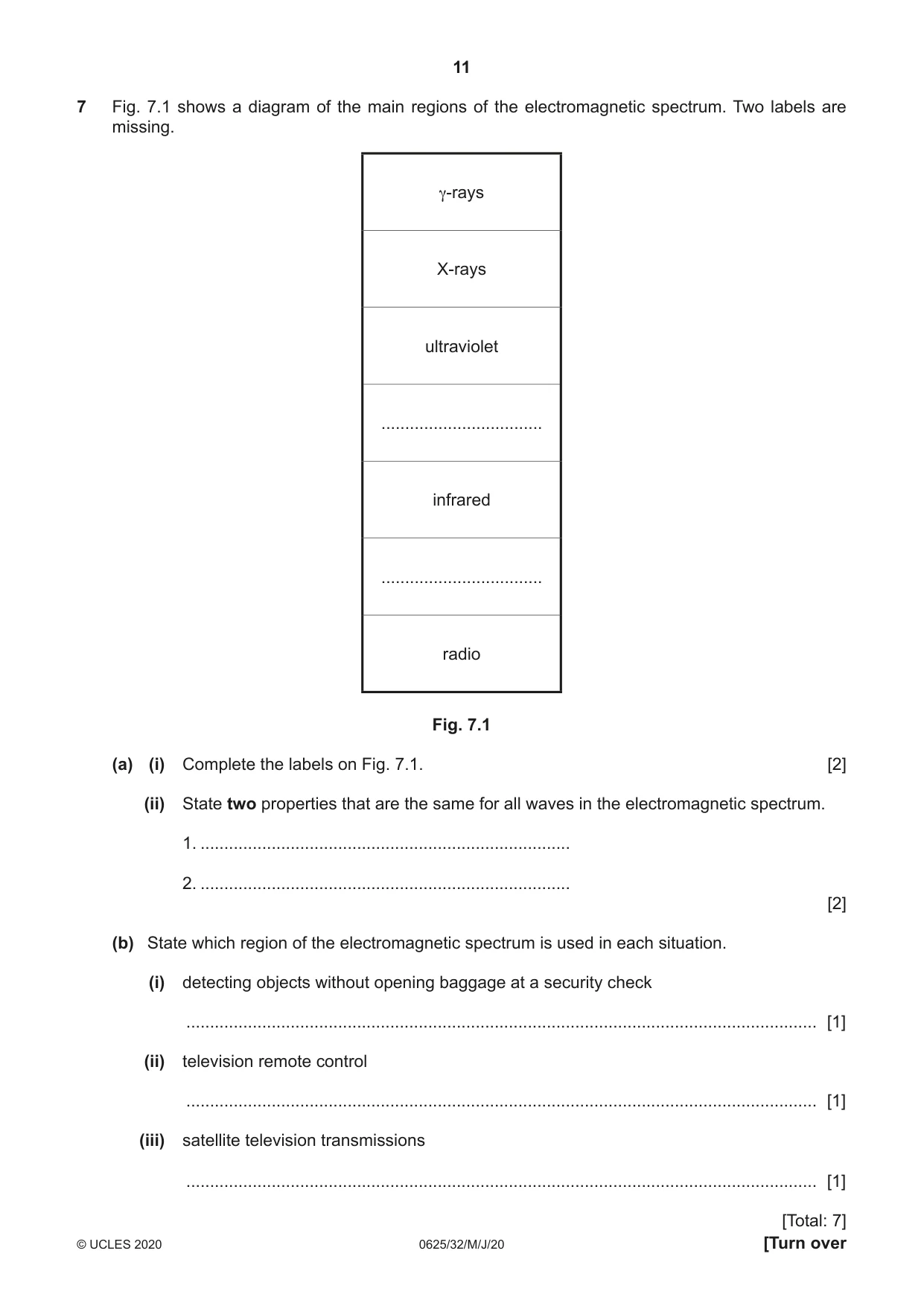
7 Fig. 7.1 shows a diagram of the main regions of the electromagnetic spectrum. Two labels are missing. γ-rays X-rays ultraviolet .................................. infrared .................................. radio Fig. 7.1 (a) (i) Complete the labels on Fig. 7.1. [2] (ii) State two properties that are the same for all waves in the electromagnetic spectrum. 1. .............................................................................. 2. .............................................................................. [2] (b) State which region of the electromagnetic spectrum is used in each situation. (i) detecting objects without opening baggage at a security check ..................................................................................................................................... [1] (ii) television remote control ..................................................................................................................................... [1] (iii) satellite television transmissions ..................................................................................................................................... [1] [Total: 7]
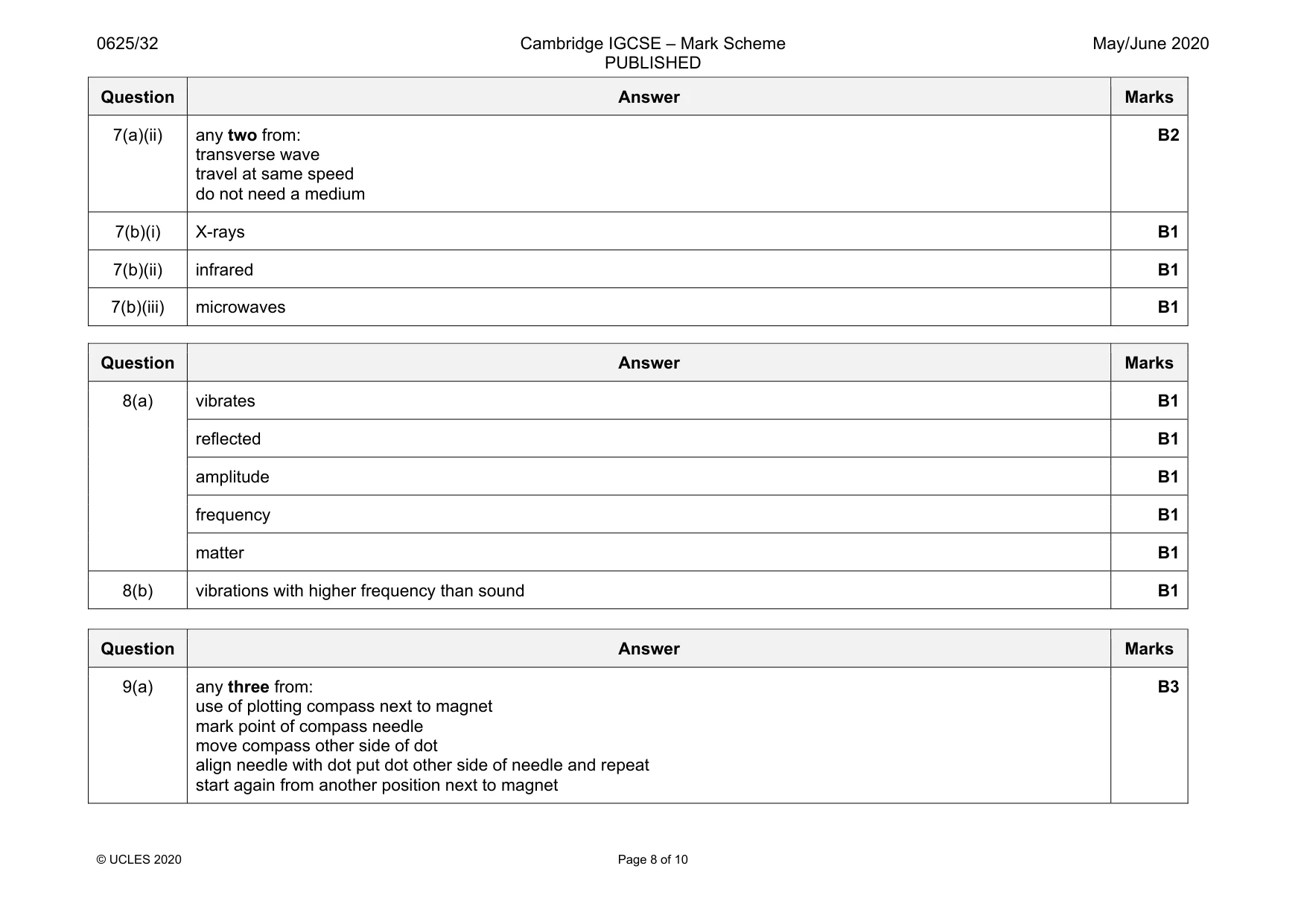
Mark scheme: 7(a)(i) top – visible light B1 bottom – microwaves B1 Question Answer Marks 7(a)(ii) any two from: transverse wave travel at same speed do not need a medium B2 7(b)(i) X-rays B1 7(b)(ii) infrared B1 7(b)(iii) microwaves B1
Q8 · Sound travels as a wave
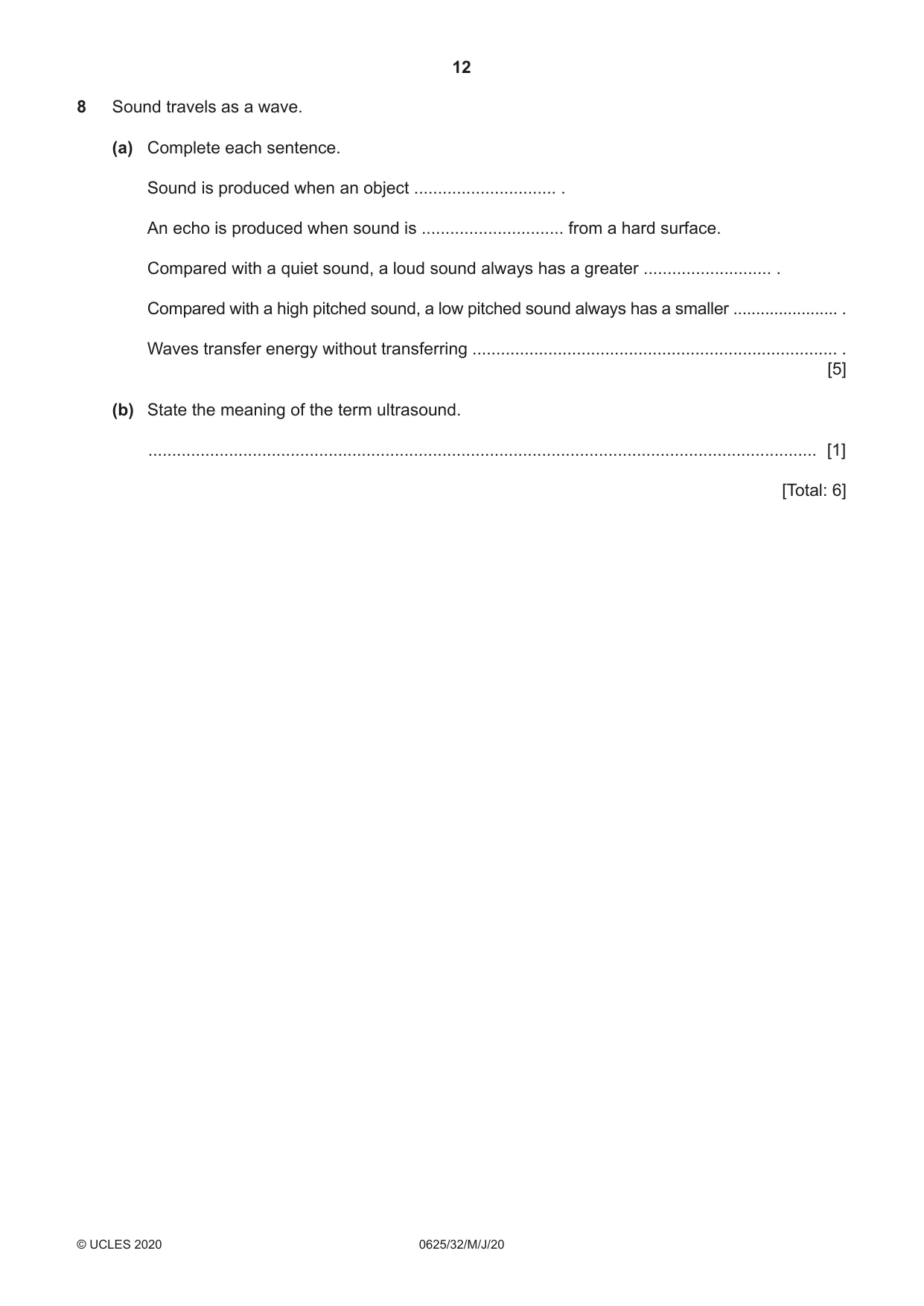
8 Sound travels as a wave. (a) Complete each sentence. Sound is produced when an object .............................. . An echo is produced when sound is .............................. from a hard surface. Compared with a quiet sound, a loud sound always has a greater ........................... . Compared with a high pitched sound, a low pitched sound always has a smaller ....................... . Waves transfer energy without transferring ............................................................................. . [5] (b) State the meaning of the term ultrasound. ............................................................................................................................................. [1] [Total: 6]
Mark scheme: 8(a) vibrates B1 reflected B1 amplitude B1 frequency B1 matter B1 8(b) vibrations with higher frequency than sound B1
Q9 · Some students plot the magnetic field lines around a bar magnet
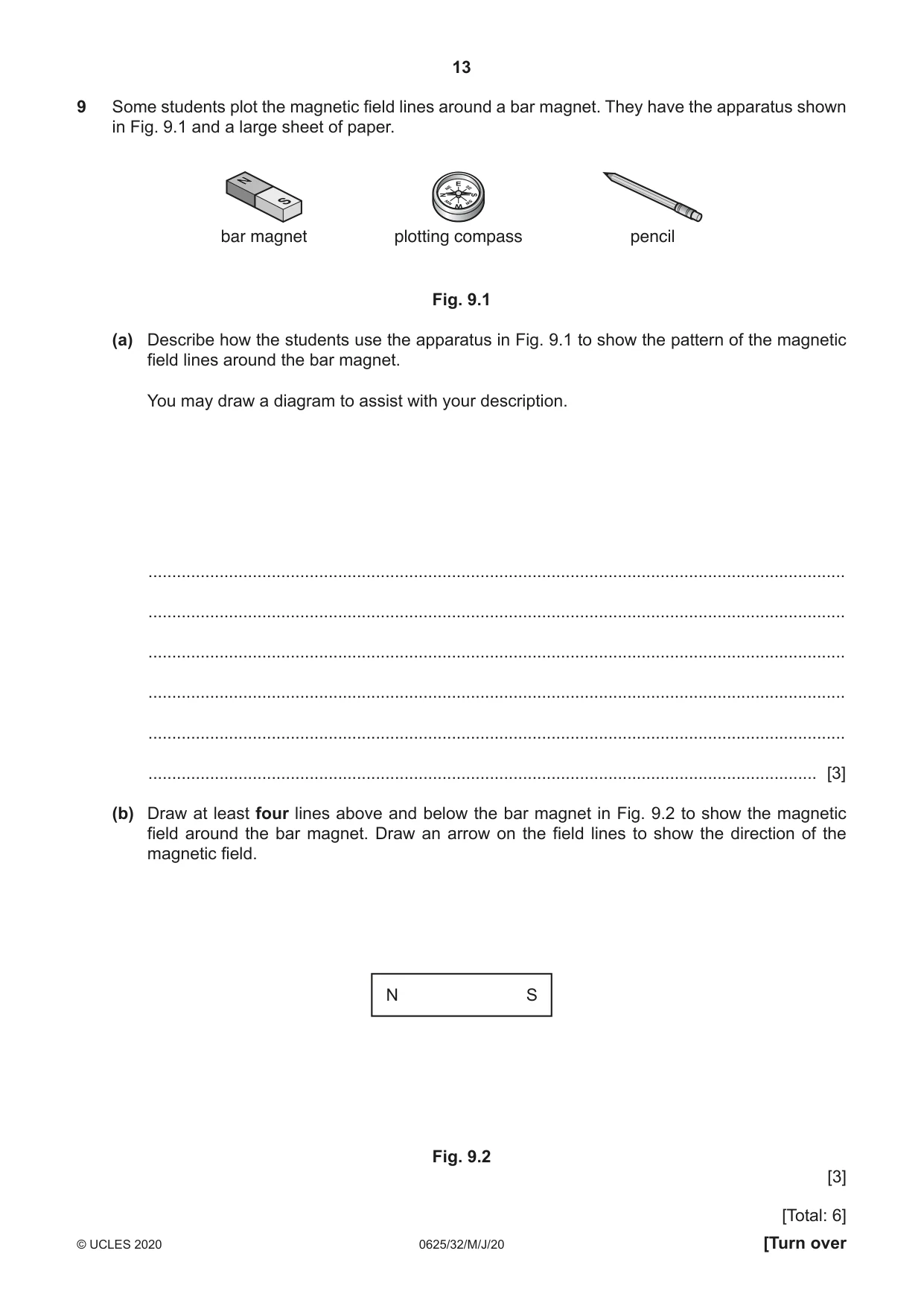
9 Some students plot the magnetic field lines around a bar magnet. They have the apparatus shown in Fig. 9.1 and a large sheet of paper. bar magnet plotting compass pencil Fig. 9.1 (a) Describe how the students use the apparatus in Fig. 9.1 to show the pattern of the magnetic field lines around the bar magnet. You may draw a diagram to assist with your description. ................................................................................................................................................... ................................................................................................................................................... ................................................................................................................................................... ................................................................................................................................................... ................................................................................................................................................... ............................................................................................................................................. [3] (b) Draw at least four lines above and below the bar magnet in Fig. 9.2 to show the magnetic field around the bar magnet. Draw an arrow on the field lines to show the direction of the magnetic field. N S Fig. 9.2 [3] [Total: 6]
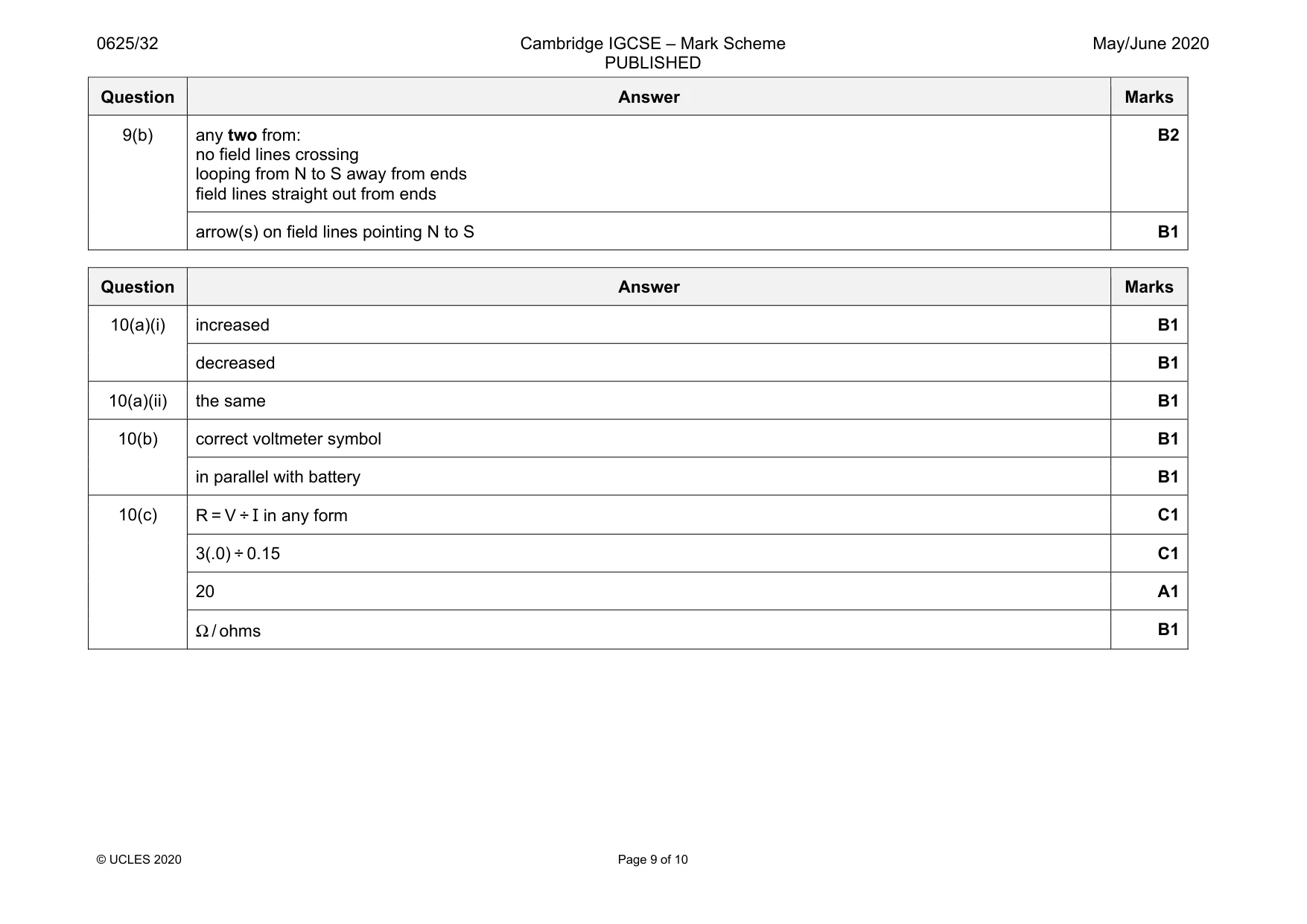
Mark scheme: 9(a) any three from: use of plotting compass next to magnet mark point of compass needle move compass other side of dot align needle with dot put dot other side of needle and repeat start again from another position next to magnet Question Answer Marks 9(b) any two from: no field lines crossing looping from N to S away from ends field lines straight out from ends B2 arrow(s) on field lines pointing N to S B1
Q10 · A student connects three identical lamps J, K and L in a circuit, as shown in Fig
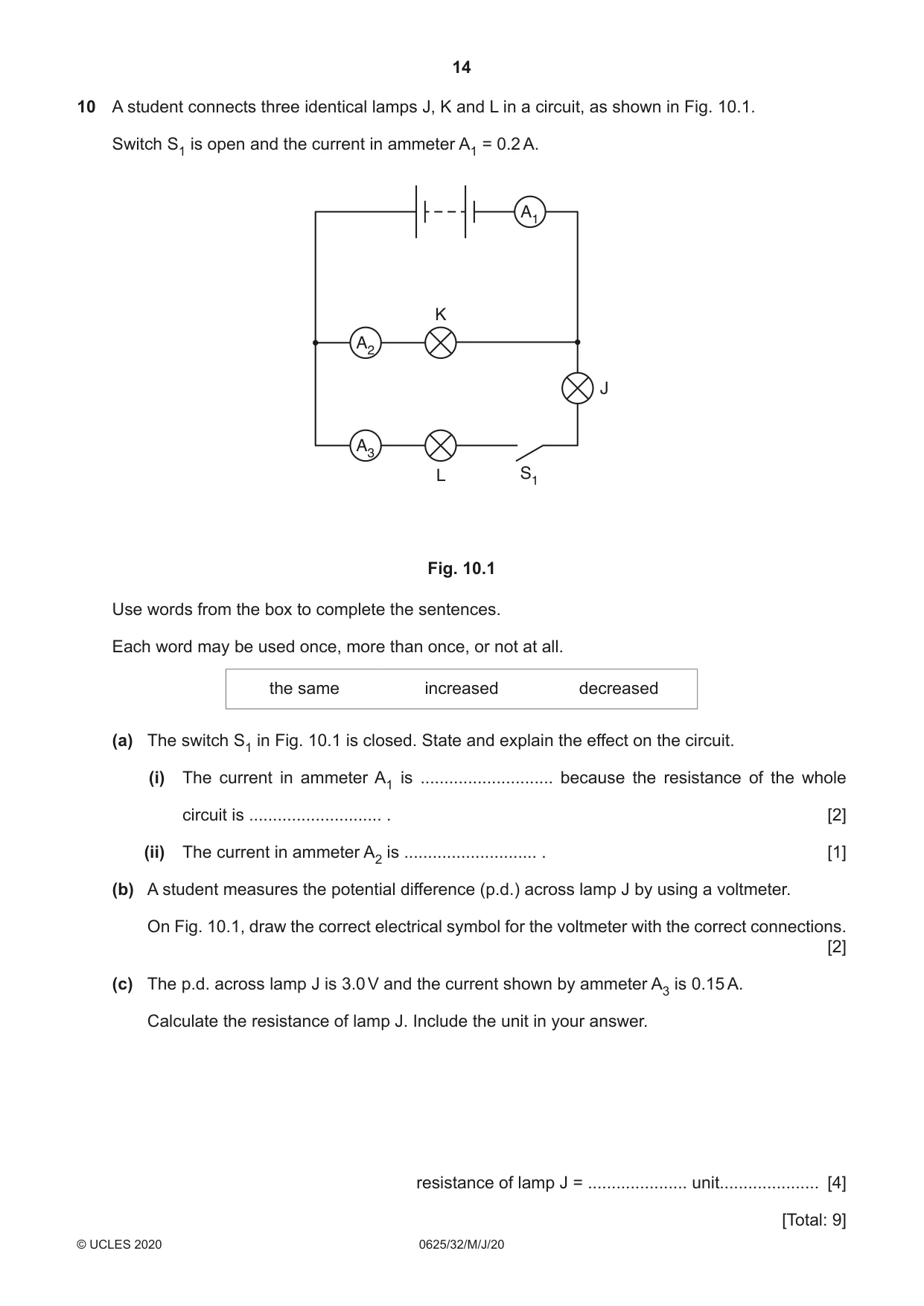
10 A student connects three identical lamps J, K and L in a circuit, as shown in Fig. 10.1. Switch S1 is open and the current in ammeter A1 = 0.2 A. A1 K A2 J A3 L S1 Fig. 10.1 Use words from the box to complete the sentences. Each word may be used once, more than once, or not at all. the same increased decreased (a) The switch S1 in Fig. 10.1 is closed. State and explain the effect on the circuit. (i) The current in ammeter A1 is ............................ because the resistance of the whole circuit is ............................ . [2] (ii) The current in ammeter A2 is ............................ . [1] (b) A student measures the potential difference (p.d.) across lamp J by using a voltmeter. On Fig. 10.1, draw the correct electrical symbol for the voltmeter with the correct connections. [2] (c) The p.d. across lamp J is 3.0 V and the current shown by ammeter A3 is 0.15 A. Calculate the resistance of lamp J. Include the unit in your answer. resistance of lamp J = ..................... unit..................... [4] [Total: 9]
Mark scheme: 10(a)(i) increased B1 decreased B1 10(a)(ii) the same B1 10(b) correct voltmeter symbol B1 in parallel with battery B1 10(c) R = V ÷ I in any form C1 3(.0) ÷ 0.15 C1 20 A1 Ω / ohms B1
Q11 · A model train uses an electric motor
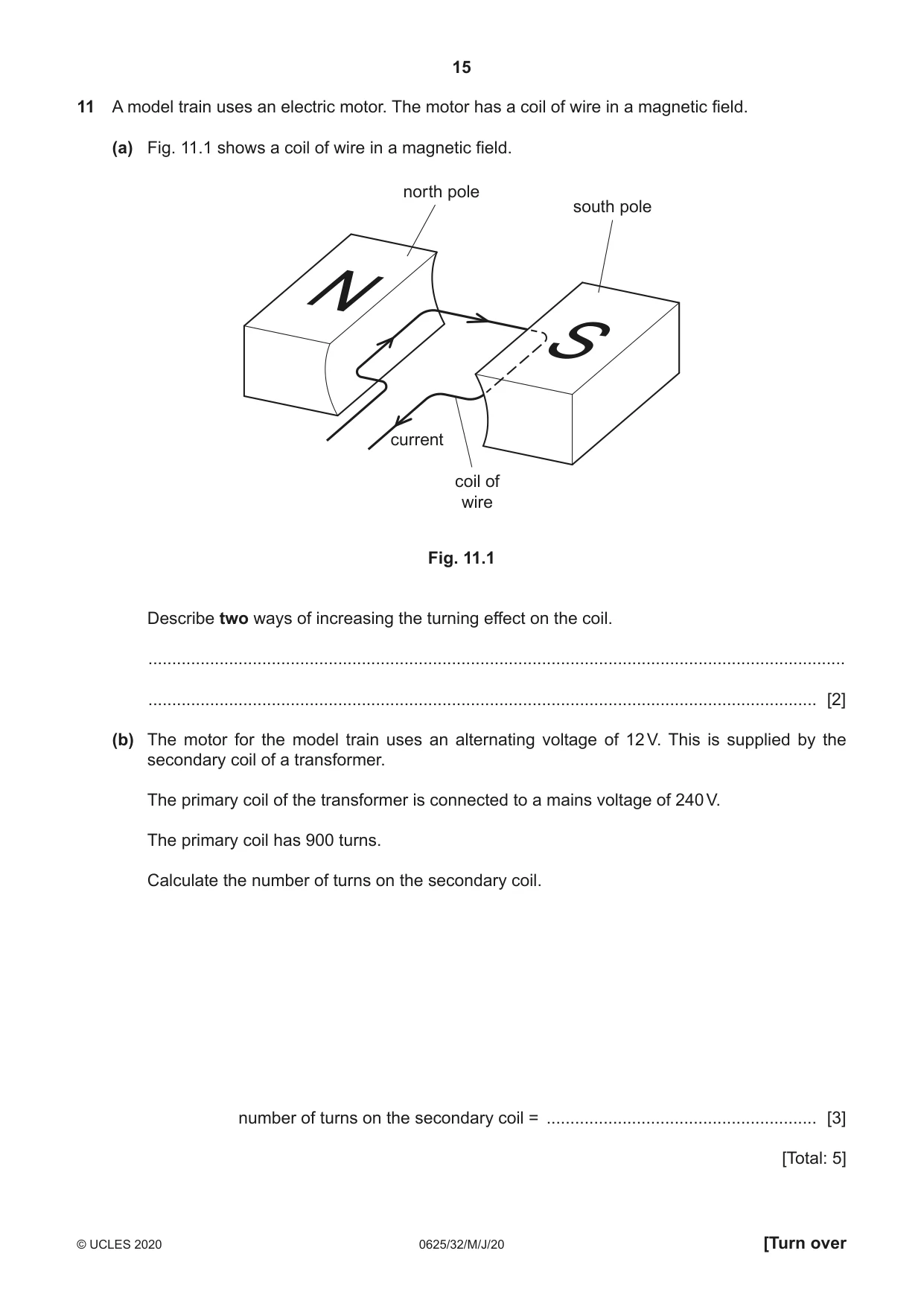
11 A model train uses an electric motor. The motor has a coil of wire in a magnetic field. (a) Fig. 11.1 shows a coil of wire in a magnetic field. north pole south pole N S current coil of wire Fig. 11.1 Describe two ways of increasing the turning effect on the coil. ................................................................................................................................................... ............................................................................................................................................. [2] (b) The motor for the model train uses an alternating voltage of 12 V. This is supplied by the secondary coil of a transformer. The primary coil of the transformer is connected to a mains voltage of 240 V. The primary coil has 900 turns. Calculate the number of turns on the secondary coil. number of turns on the secondary coil = ......................................................... [3] [Total: 5]
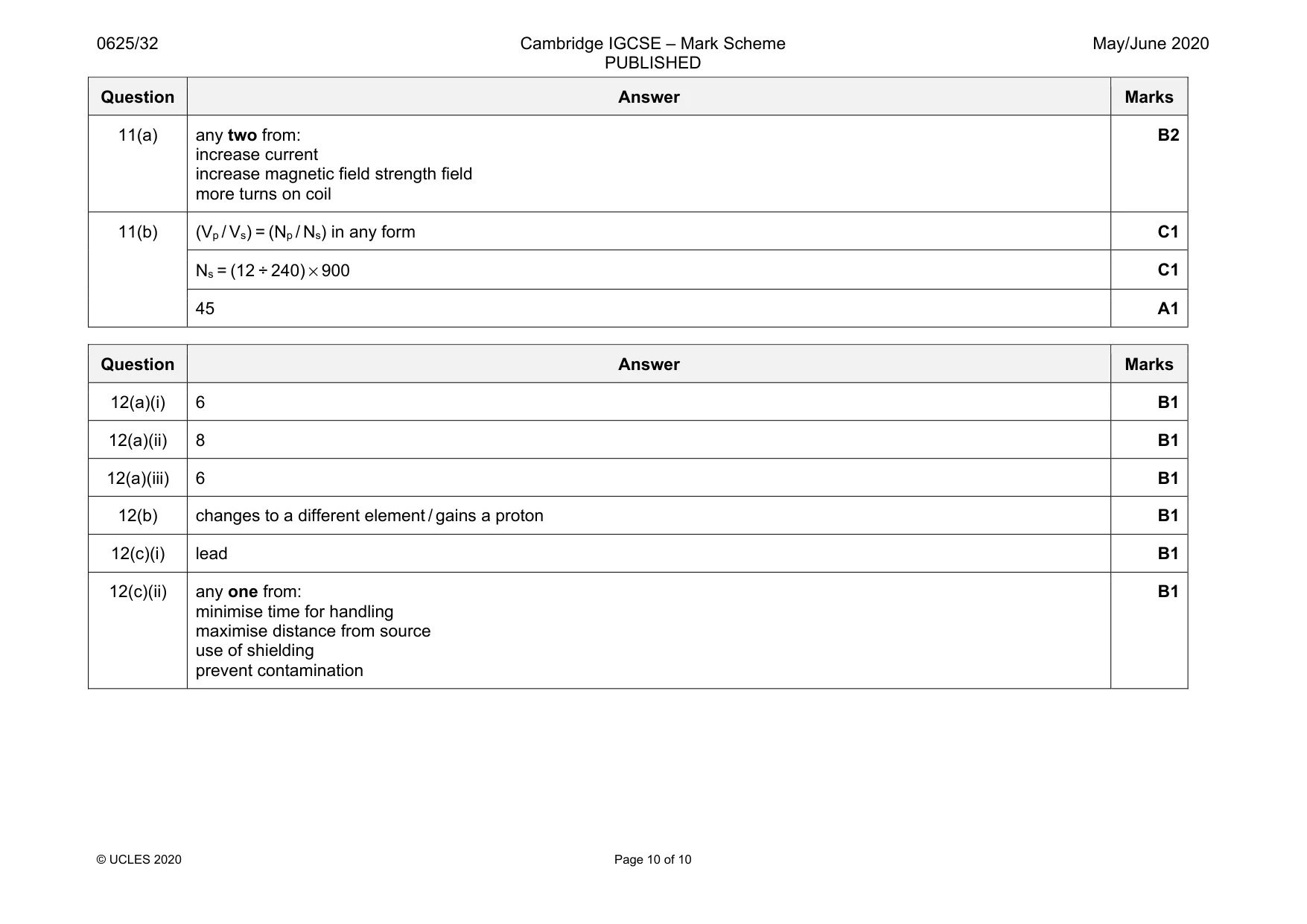
Mark scheme: 11(a) any two from: increase current increase magnetic field strength field more turns on coil B2 11(b) (Vp / Vs) = (Np / Ns) in any form C1 Ns = (12 ÷ 240) × 900 C1 45 A1
Q12 · Carbon-14 is a radioactive isotope of carbon
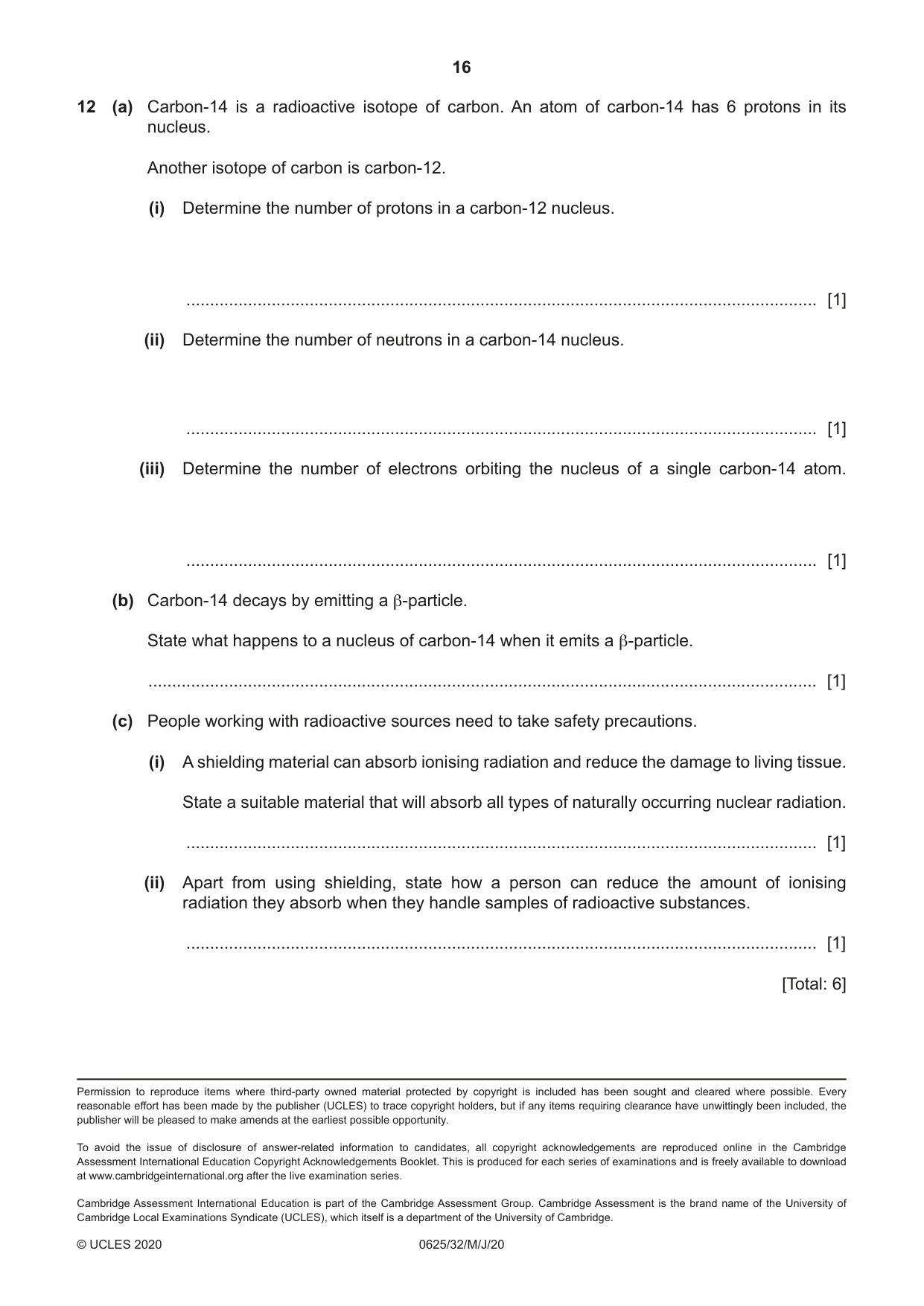
12 (a) Carbon-14 is a radioactive isotope of carbon. An atom of carbon-14 has 6 protons in its nucleus. Another isotope of carbon is carbon-12. (i) Determine the number of protons in a carbon-12 nucleus. ..................................................................................................................................... [1] (ii) Determine the number of neutrons in a carbon-14 nucleus. ..................................................................................................................................... [1] (iii) Determine the number of electrons orbiting the nucleus of a single carbon-14 atom. ..................................................................................................................................... [1] (b) Carbon-14 decays by emitting a β-particle. State what happens to a nucleus of carbon-14 when it emits a β-particle. ............................................................................................................................................. [1] (c) People working with radioactive sources need to take safety precautions. (i) A shielding material can absorb ionising radiation and reduce the damage to living tissue. State a suitable material that will absorb all types of naturally occurring nuclear radiation. ..................................................................................................................................... [1] (ii) Apart from using shielding, state how a person can reduce the amount of ionising radiation they absorb when they handle samples of radioactive substances. ..................................................................................................................................... [1] [Total: 6]
Mark scheme: 12(a)(i) 6 B1 12(a)(ii) 8 B1 12(a)(iii) 6 B1 12(b) changes to a different element / gains a proton B1 12(c)(i) lead B1 12(c)(ii) any one from: minimise time for handling maximise distance from source use of shielding prevent contamination B1
What was in this paper
The subtopics covered by these 12 questions, and how many questions each got. Open one in a new tab to see every Cambridge question on it.