Cambridge IGCSE Physics 0625 — 2014 Oct/Nov Paper 3 · Variant 3
0625/33/O/N/14 · 9 questions · 80 marks · ≈90 min
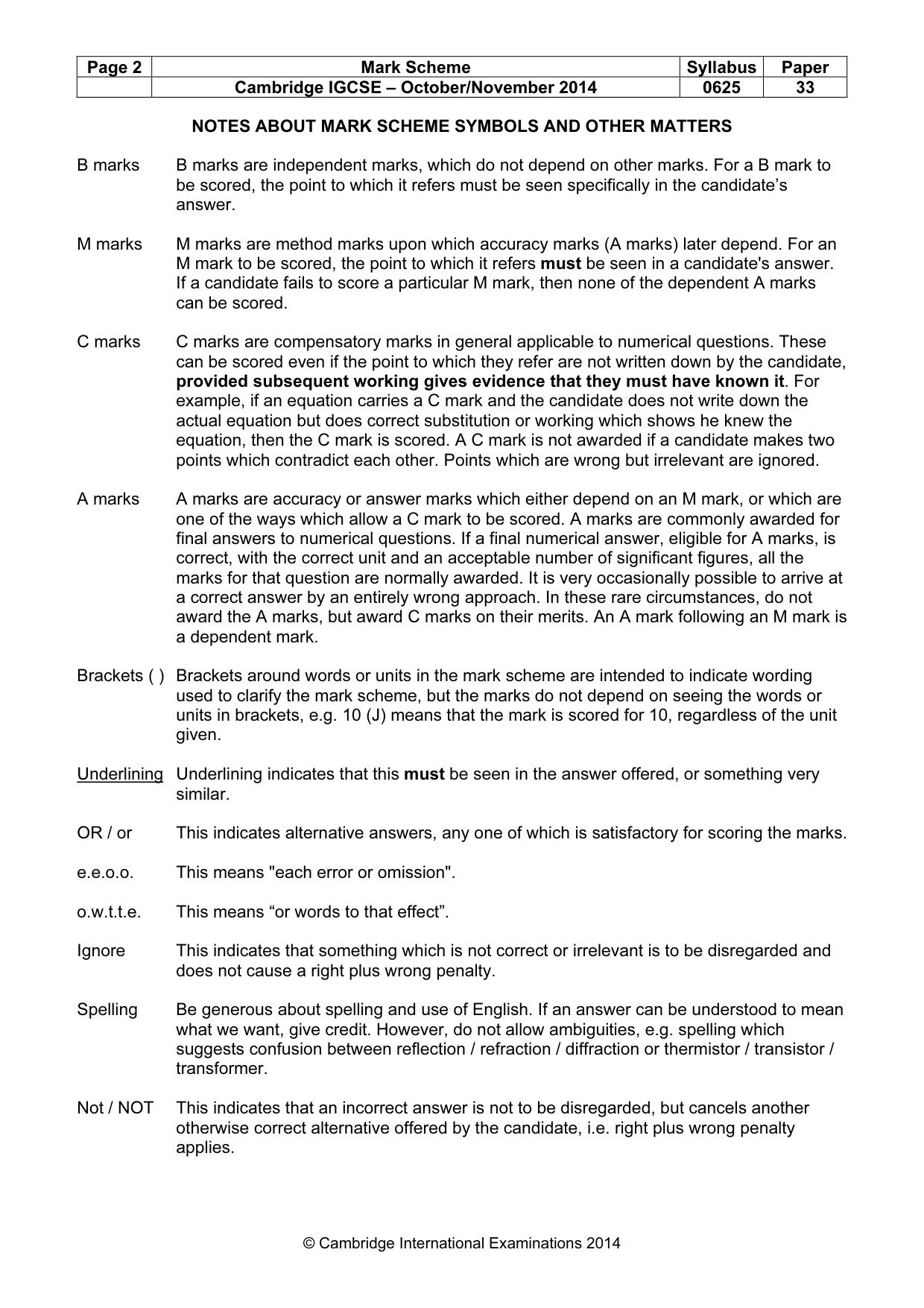
The question paper and its mark scheme, free to read here and free to download. This is Cambridge’s own paper, exactly as it was sat.
Question paper20 pages
Mark scheme7 pages
Answers below. Sit the paper first if you are practising.
Questions as text
Q1 · A free-fall parachutist jumps from a helium balloon, but does not open his parachute for…
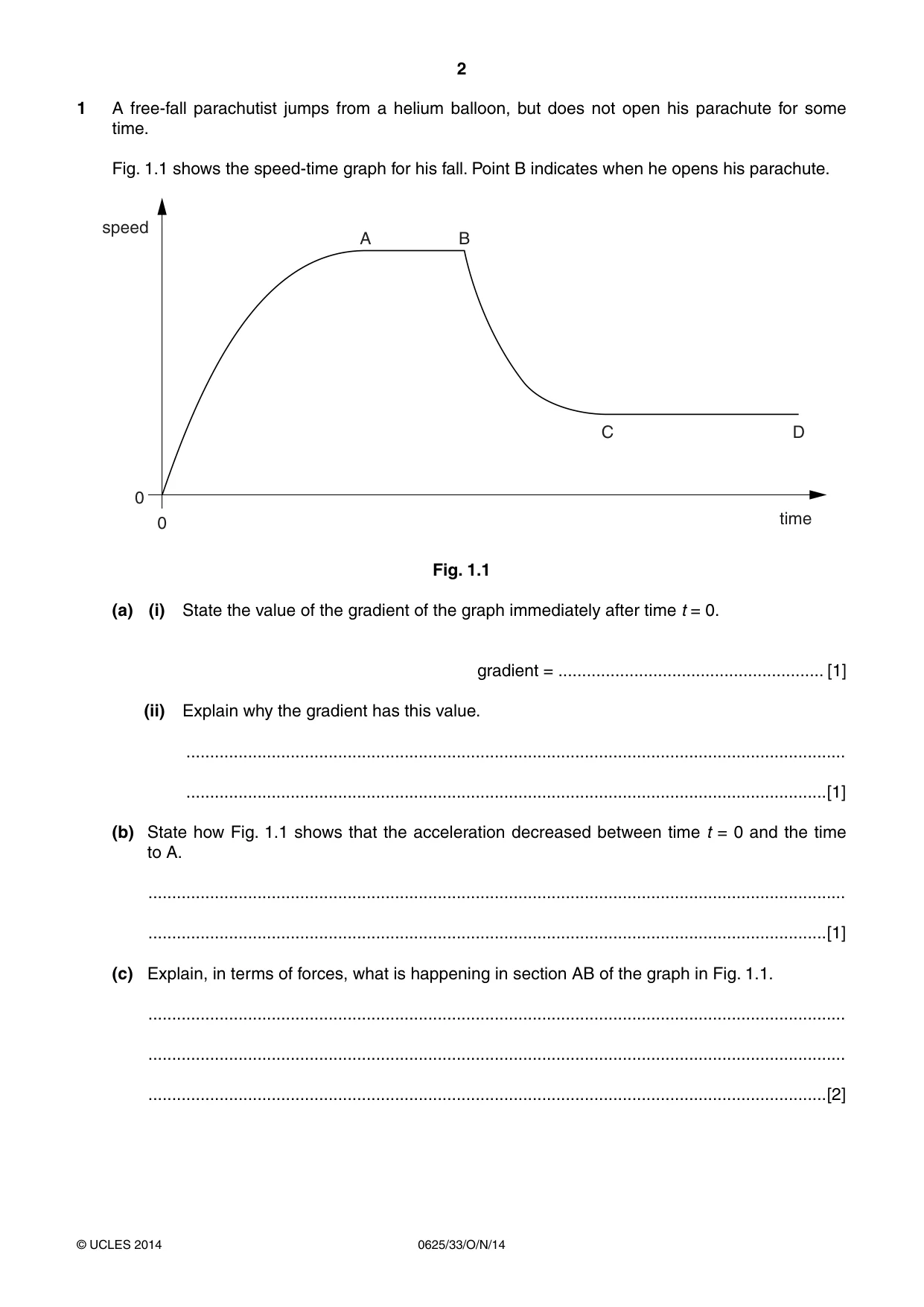
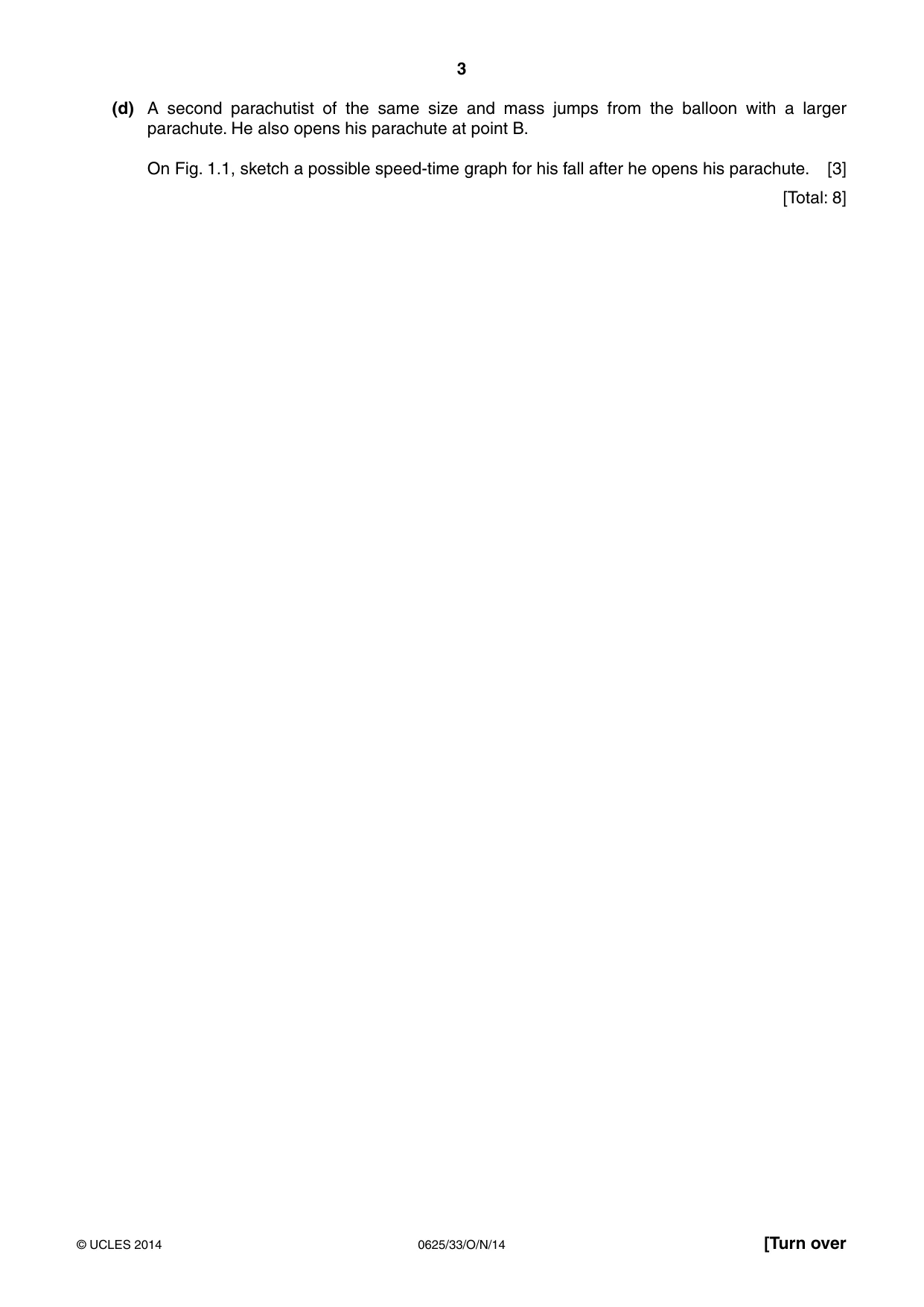
1 A free-fall parachutist jumps from a helium balloon, but does not open his parachute for some time. Fig. 1.1 shows the speed-time graph for his fall. Point B indicates when he opens his parachute. speed A B C D 0 0 time Fig. 1.1 (a) (i) State the value of the gradient of the graph immediately after time t = 0. gradient = ........................................................ [1] (ii) Explain why the gradient has this value. ........................................................................................................................................... .......................................................................................................................................[1] (b) State how Fig. 1.1 shows that the acceleration decreased between time t = 0 and the time to A. ................................................................................................................................................... ...............................................................................................................................................[1] (c) Explain, in terms of forces, what is happening in section AB of the graph in Fig. 1.1. ................................................................................................................................................... ................................................................................................................................................... ...............................................................................................................................................[2] (d) A second parachutist of the same size and mass jumps from the balloon with a larger parachute. He also opens his parachute at point B. On Fig. 1.1, sketch a possible speed-time graph for his fall after he opens his parachute. [3] [Total: 8]
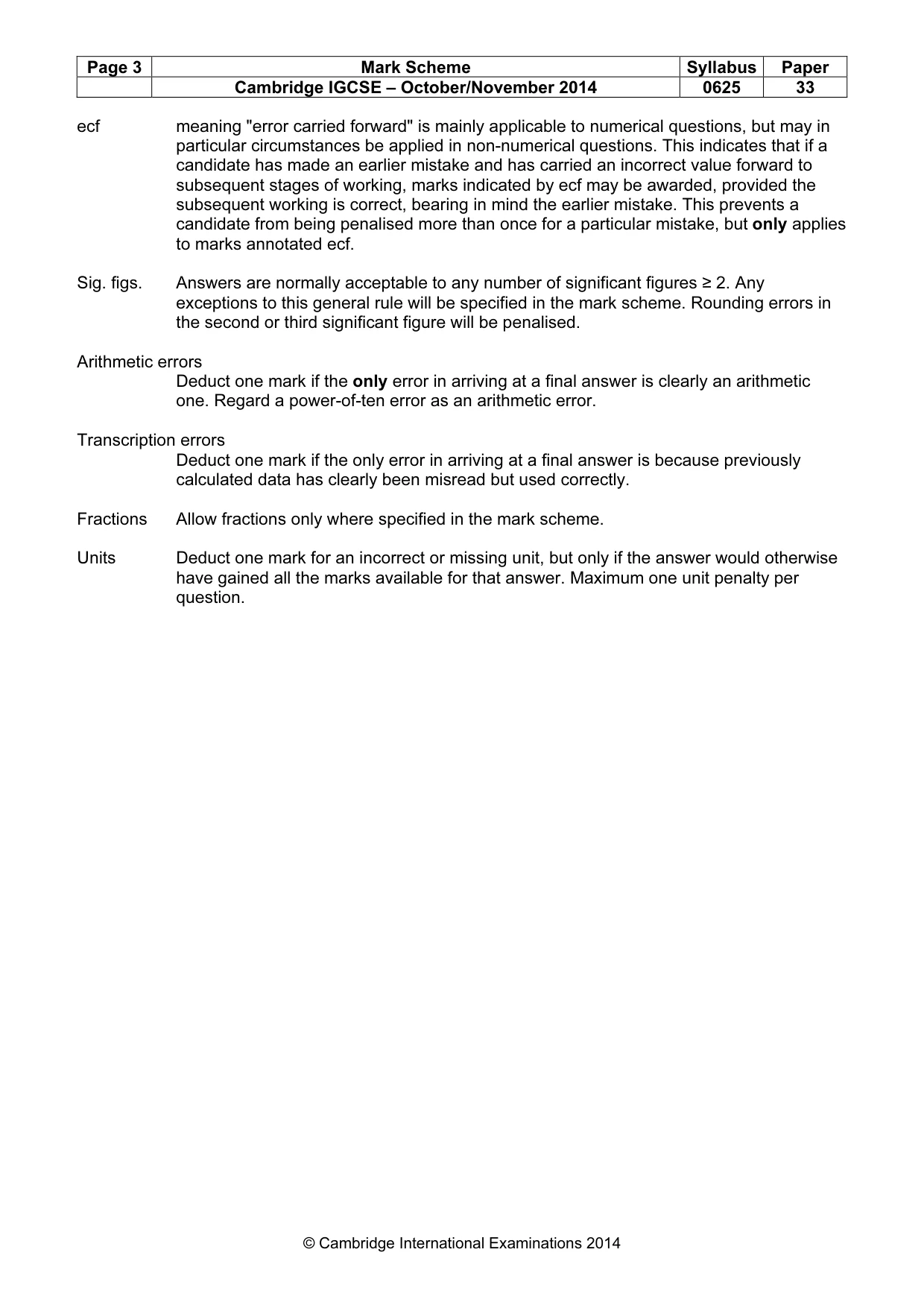
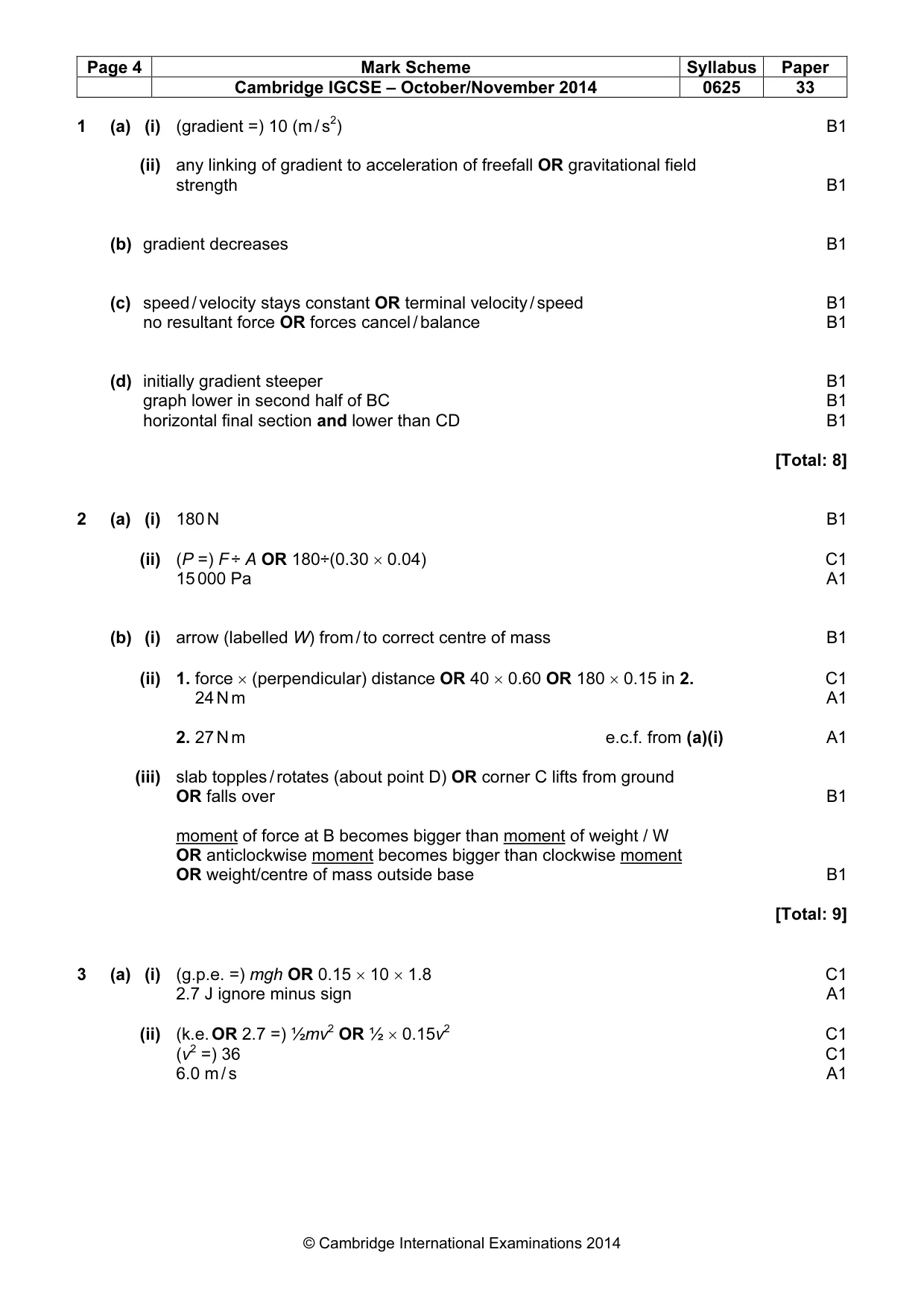
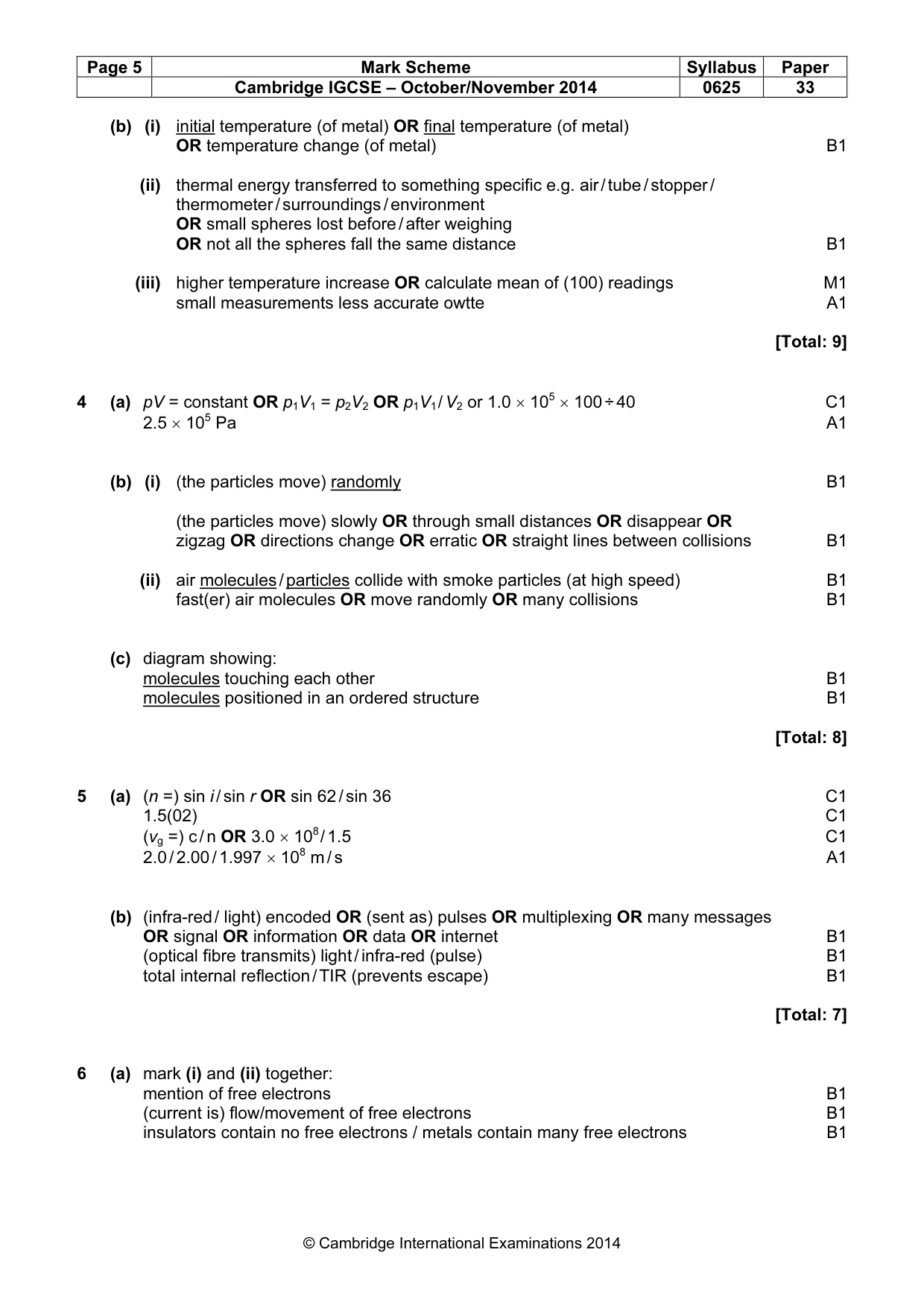
Mark scheme: 1 (a) (i) (gradient =) 10 (m / s2) B1 (ii) any linking of gradient to acceleration of freefall OR gravitational field strength B1 (b) gradient decreases B1 (c) speed / velocity stays constant OR terminal velocity / speed B1 no resultant force OR forces cancel / balance B1 (d) initially gradient steeper B1 graph lower in second half of BC B1 horizontal final section and lower than CD B1 [Total: 8]
Q2 · A uniform, rectangular slab of concrete ABCD standing upright on the ground
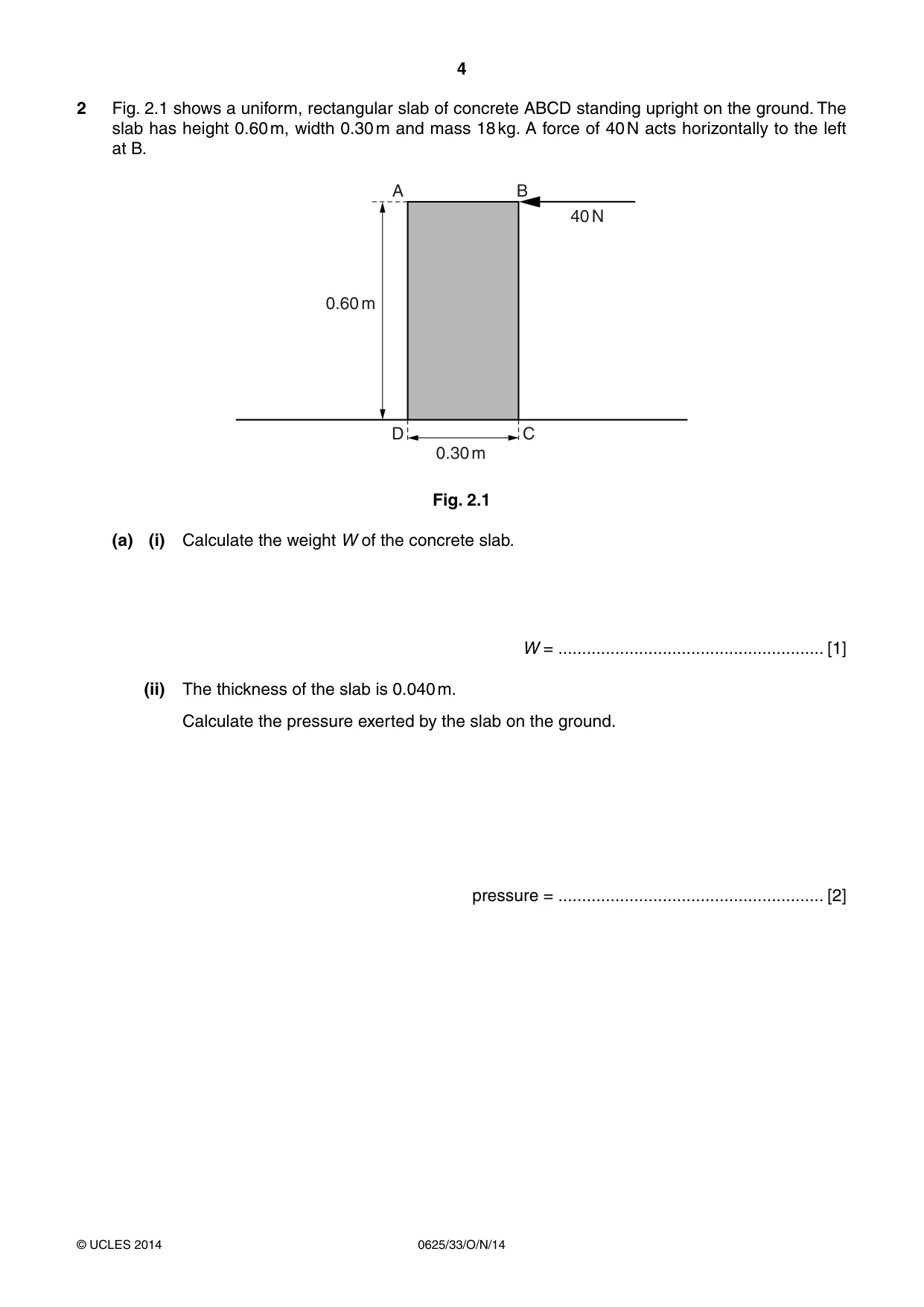
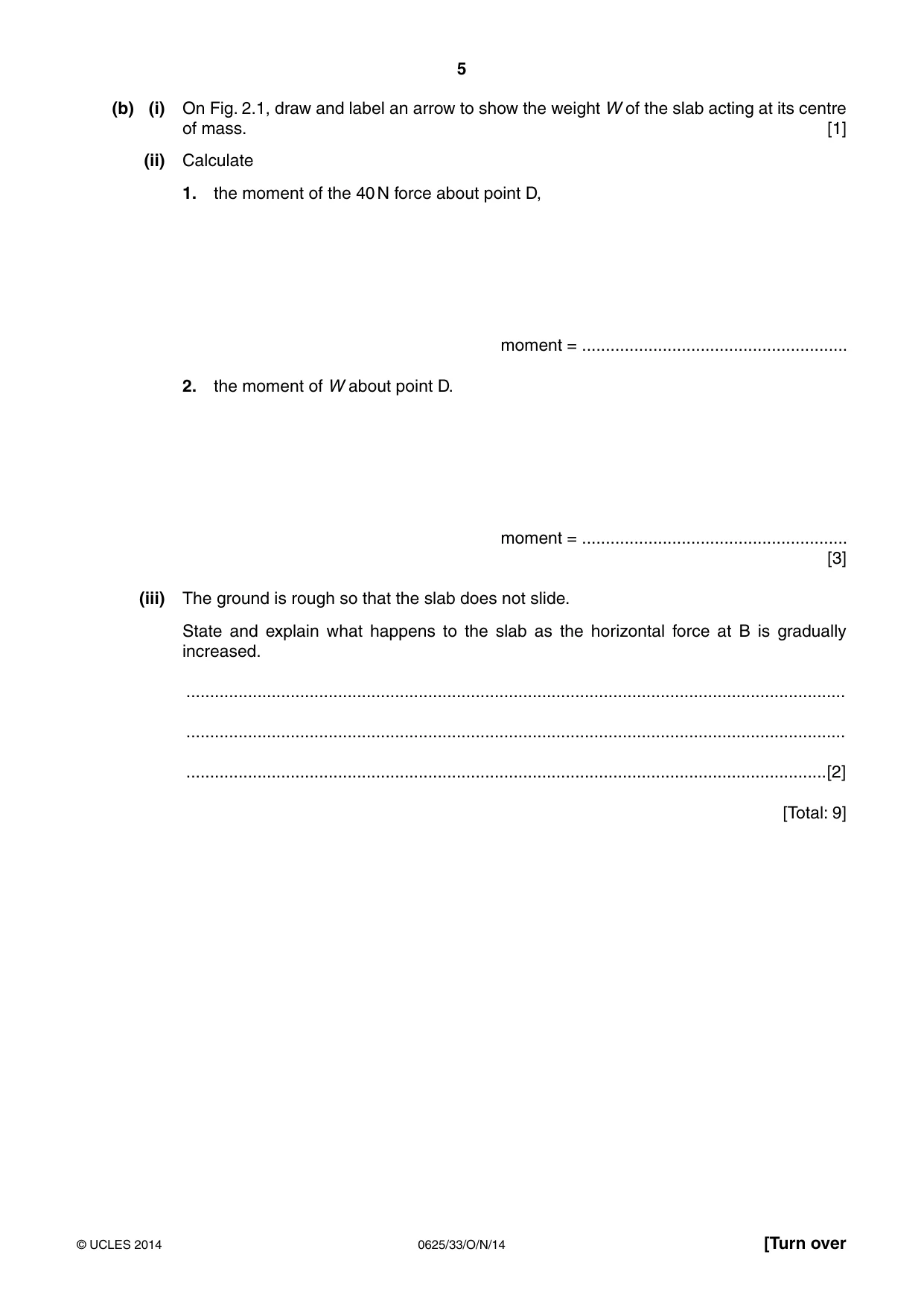
2 Fig. 2.1 shows a uniform, rectangular slab of concrete ABCD standing upright on the ground. The slab has height 0.60 m, width 0.30 m and mass 18 kg. A force of 40 N acts horizontally to the left at B. A B 40 N 0.60 m D C 0.30 m Fig. 2.1 (a) (i) Calculate the weight W of the concrete slab. W = ........................................................ [1] (ii) The thickness of the slab is 0.040 m. Calculate the pressure exerted by the slab on the ground. pressure = ........................................................ [2] (b) (i) On Fig. 2.1, draw and label an arrow to show the weight W of the slab acting at its centre of mass. [1] (ii) Calculate 1. the moment of the 40 N force about point D, moment = ........................................................ 2. the moment of W about point D. moment = ........................................................ [3] (iii) The ground is rough so that the slab does not slide. State and explain what happens to the slab as the horizontal force at B is gradually increased. ........................................................................................................................................... ........................................................................................................................................... .......................................................................................................................................[2] [Total: 9]
Mark scheme: 2 (a) (i) 180 N B1 (ii) (P =) F ÷ A OR 180÷(0.30 × 0.04) C1 15 000 Pa A1 (b) (i) arrow (labelled W) from / to correct centre of mass B1 (ii) 1. force × (perpendicular) distance OR 40 × 0.60 OR 180 × 0.15 in 2. C1 24 N m A1 2. 27 N m e.c.f. from (a)(i) A1 (iii) slab topples / rotates (about point D) OR corner C lifts from ground OR falls over B1 moment of force at B becomes bigger than moment of weight / W OR anticlockwise moment becomes bigger than clockwise moment OR weight/centre of mass outside base B1 [Total: 9]
Q3 · A long, plastic tube, sealed at both ends
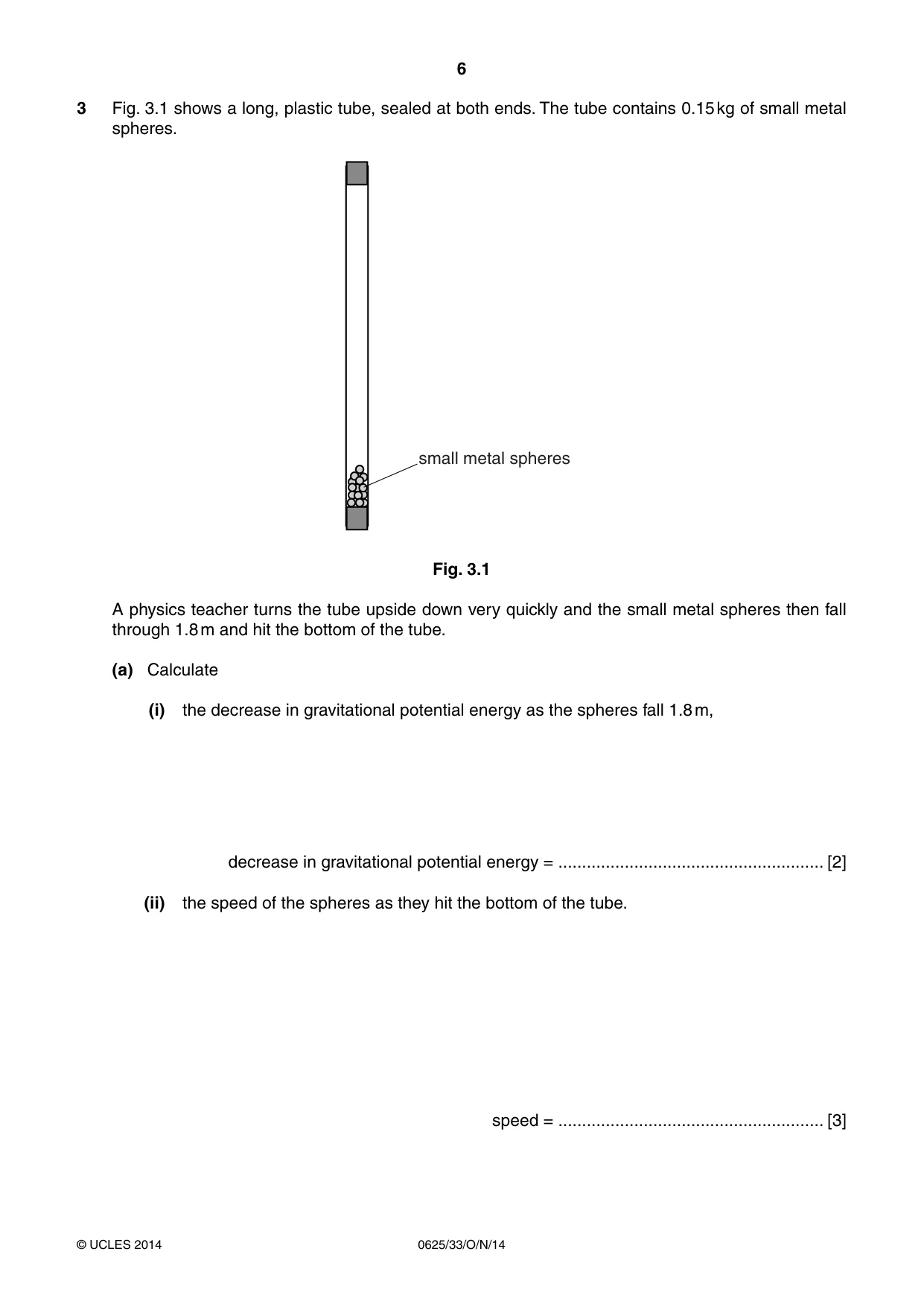
3 Fig. 3.1 shows a long, plastic tube, sealed at both ends. The tube contains 0.15 kg of small metal spheres. small metal spheres Fig. 3.1 A physics teacher turns the tube upside down very quickly and the small metal spheres then fall through 1.8 m and hit the bottom of the tube. (a) Calculate (i) the decrease in gravitational potential energy as the spheres fall 1.8 m, decrease in gravitational potential energy = ........................................................ [2] (ii) the speed of the spheres as they hit the bottom of the tube. speed = ........................................................ [3] (b) The gravitational potential energy of the spheres is eventually transformed to thermal energy in the metal spheres. The physics teacher explains that this procedure can be used to determine the specific heat capacity of the metal. (i) State one other measurement that must be made in order for the specific heat capacity of the metal to be determined. ........................................................................................................................................... .......................................................................................................................................[1] (ii) Suggest a source of inaccuracy in determining the specific heat capacity using this experiment. ........................................................................................................................................... .......................................................................................................................................[1] (iii) The teacher turns the tube upside down and lets the spheres fall to the bottom 100 times within a short period of time. Explain why turning the tube upside down 100 times, instead of just once, produces a more accurate value of the specific heat capacity. ........................................................................................................................................... ........................................................................................................................................... .......................................................................................................................................[2] [Total: 9]
Mark scheme: 3 (a) (i) (g.p.e. =) mgh OR 0.15 × 10 × 1.8 C1 2.7 J ignore minus sign A1 (ii) (k.e. OR 2.7 =) ½mv2 OR ½ × 0.15v2 C1 (v2 =) 36 C1 6.0 m / s A1 (b) (i) initial temperature (of metal) OR final temperature (of metal) OR temperature change (of metal) B1 (ii) thermal energy transferred to something specific e.g. air / tube / stopper / thermometer / surroundings / environment OR small spheres lost before / after weighing OR not all the spheres fall the same distance B1 (iii) higher temperature increase OR calculate mean of (100) readings M1 small measurements less accurate owtte A1 [Total: 9] 5
Q4 · A syringe containing 100 cm3 of air at atmospheric pressure
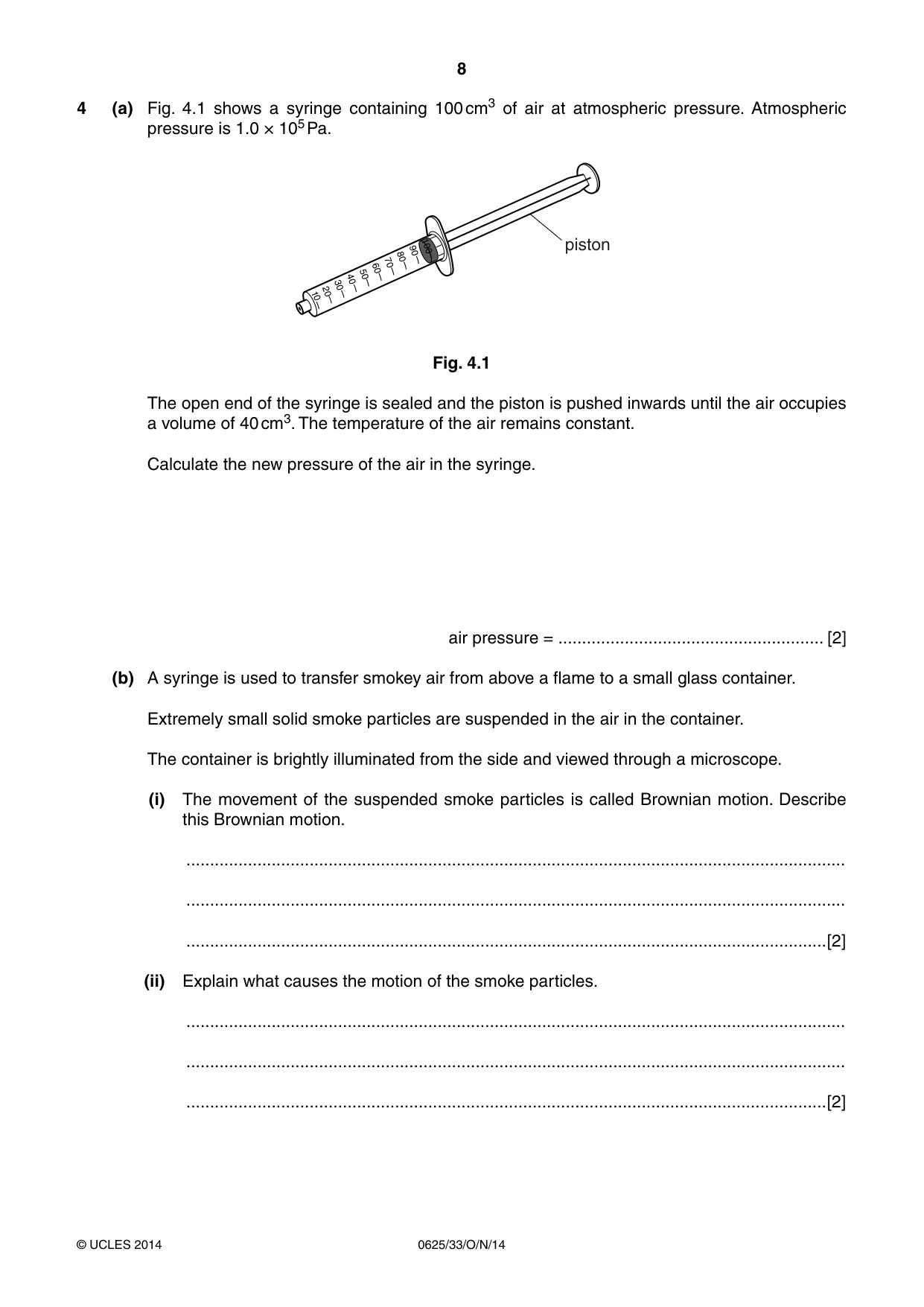
4 (a) Fig. 4.1 shows a syringe containing 100 cm3 of air at atmospheric pressure. Atmospheric pressure is 1.0 × 10⁵ Pa. piston Fig. 4.1 The open end of the syringe is sealed and the piston is pushed inwards until the air occupies a volume of 40 cm3. The temperature of the air remains constant. Calculate the new pressure of the air in the syringe. air pressure = ........................................................ [2] (b) A syringe is used to transfer smokey air from above a flame to a small glass container. Extremely small solid smoke particles are suspended in the air in the container. The container is brightly illuminated from the side and viewed through a microscope. (i) The movement of the suspended smoke particles is called Brownian motion. Describe this Brownian motion. ........................................................................................................................................... ........................................................................................................................................... .......................................................................................................................................[2] (ii) Explain what causes the motion of the smoke particles. ........................................................................................................................................... ........................................................................................................................................... .......................................................................................................................................[2] (c) In the space below, sketch a diagram to represent the molecular structure of a solid. Show the molecules as small circles of equal sizes. [2] [Total: 8]
Mark scheme: 4 (a) pV = constant OR p1V1 = p2V2 OR p1V1 / V2 or 1.0 × 105 × 100 ÷ 40 C1 2.5 × 10⁵ Pa A1 (b) (i) (the particles move) randomly B1 (the particles move) slowly OR through small distances OR disappear OR zigzag OR directions change OR erratic OR straight lines between collisions B1 (ii) air molecules / particles collide with smoke particles (at high speed) B1 fast(er) air molecules OR move randomly OR many collisions B1 (c) diagram showing: molecules touching each other B1 molecules positioned in an ordered structure B1 [Total: 8]
Q5 · Light enters a glass fibre from air at an angle of incidence of 62 °
5 Light enters a glass fibre from air at an angle of incidence of 62 °. The angle of refraction in the glass is 36 °. (a) The speed of light in air is 3.0 × 10⁸ m / s. Determine the speed of light in the glass fibre. speed = ........................................................ [4] (b) Describe how glass fibres are used in communications technology. ................................................................................................................................................... ................................................................................................................................................... ................................................................................................................................................... ...............................................................................................................................................[3] [Total: 7]
Mark scheme: 5 (a) (n =) sin i / sin r OR sin 62 / sin 36 C1 1.5(02) C1 (vg =) c / n OR 3.0 × 10⁸ / 1.5 C1 2.0 / 2.00 / 1.997 × 10⁸ m / s A1 (b) (infra-red / light) encoded OR (sent as) pulses OR multiplexing OR many messages OR signal OR information OR data OR internet B1 (optical fibre transmits) light / infra-red (pulse) B1 total internal reflection / TIR (prevents escape) B1 [Total: 7]
Q7 · Underline the most appropriate value below for the speed of sound in water
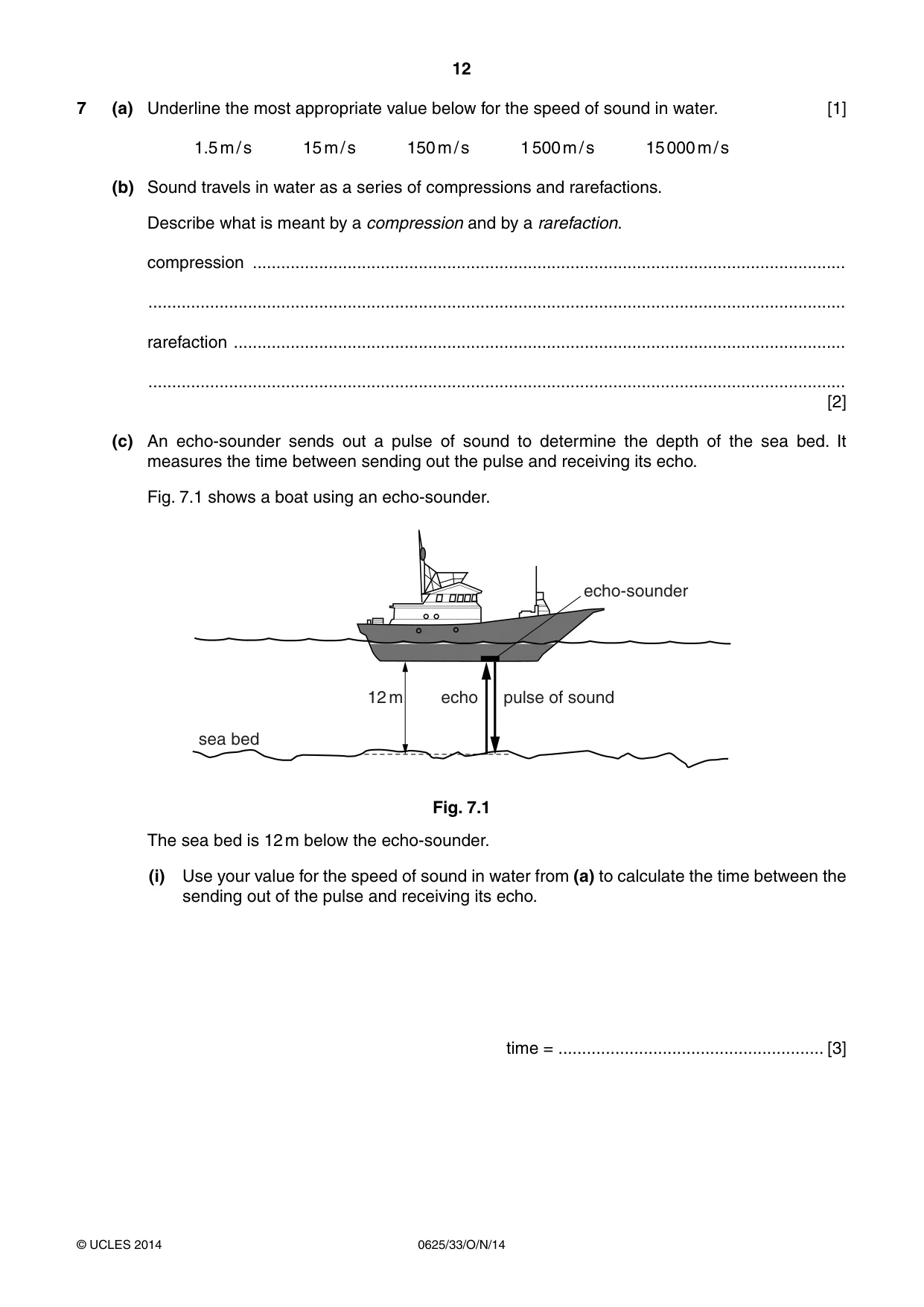
7 (a) Underline the most appropriate value below for the speed of sound in water. [1] 1.5 m / s 15 m / s 150 m / s 1 500 m / s 15 000 m / s (b) Sound travels in water as a series of compressions and rarefactions. Describe what is meant by a compression and by a rarefaction. compression ............................................................................................................................. ................................................................................................................................................... rarefaction ................................................................................................................................. ................................................................................................................................................... [2] (c) An echo-sounder sends out a pulse of sound to determine the depth of the sea bed. It measures the time between sending out the pulse and receiving its echo. Fig. 7.1 shows a boat using an echo-sounder. echo-sounder 12 m echo pulse of sound sea bed Fig. 7.1 The sea bed is 12 m below the echo-sounder. (i) Use your value for the speed of sound in water from (a) to calculate the time between the sending out of the pulse and receiving its echo. time = ........................................................ [3] (ii) The boat passes over a region of the sea bed of the same depth, where the reflection of sound waves is weaker. State whether there is an increase, a decrease or no change in the amplitude and pitch of the reflected wave. amplitude ........................................................................................................................... pitch ................................................................................................................................... [2] [Total: 8]
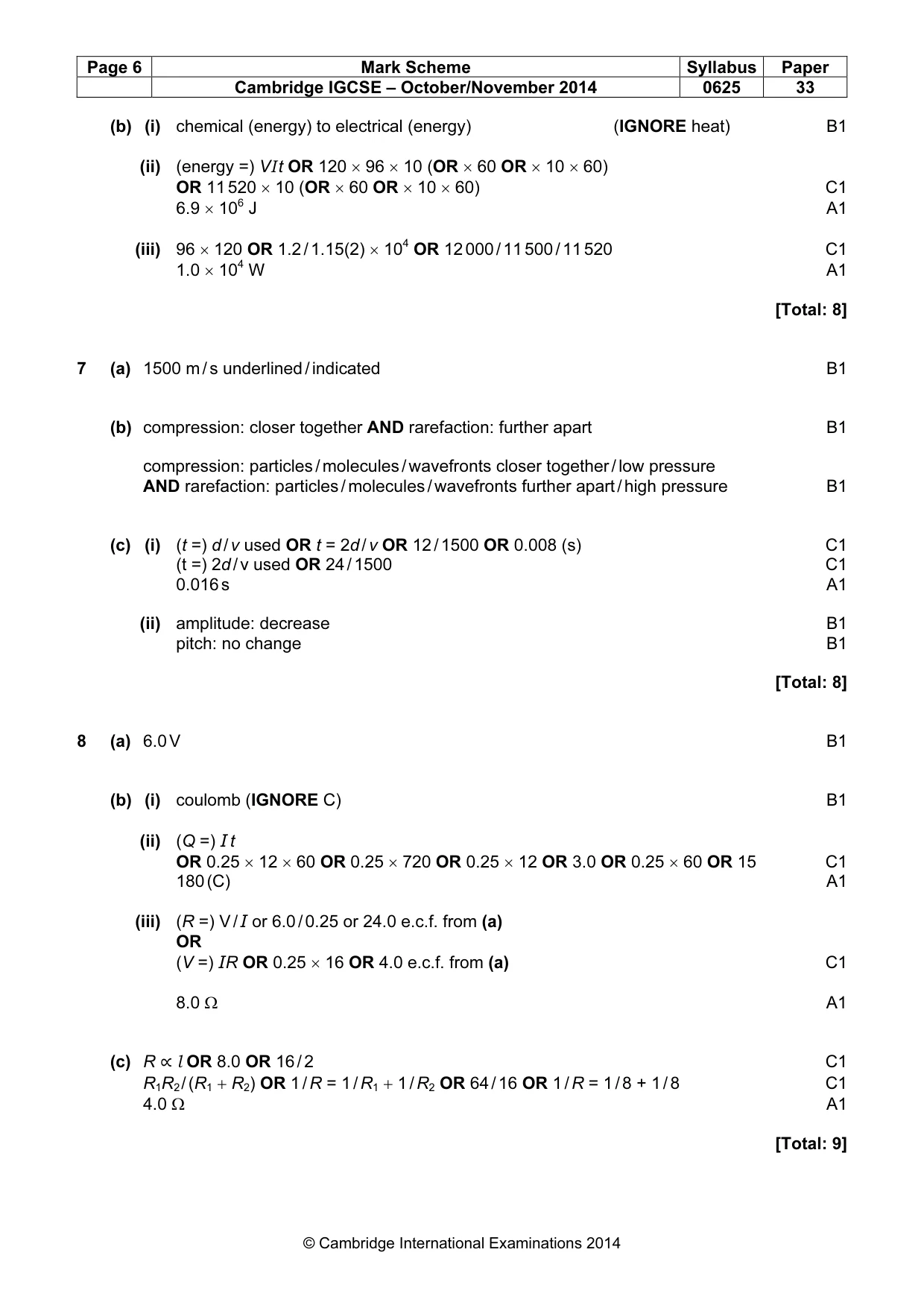
Mark scheme: 7 (a) 1500 m / s underlined / indicated B1 (b) compression: closer together AND rarefaction: further apart B1 compression: particles / molecules / wavefronts closer together / low pressure AND rarefaction: particles / molecules / wavefronts further apart / high pressure B1 (c) (i) (t =) d / v used OR t = 2d / v OR 12 / 1500 OR 0.008 (s) C1 (t =) 2d / v used OR 24 / 1500 C1 0.016 s A1 (ii) amplitude: decrease B1 pitch: no change B1 [Total: 8]
Q8 · A student sets up a circuit containing three identical cells
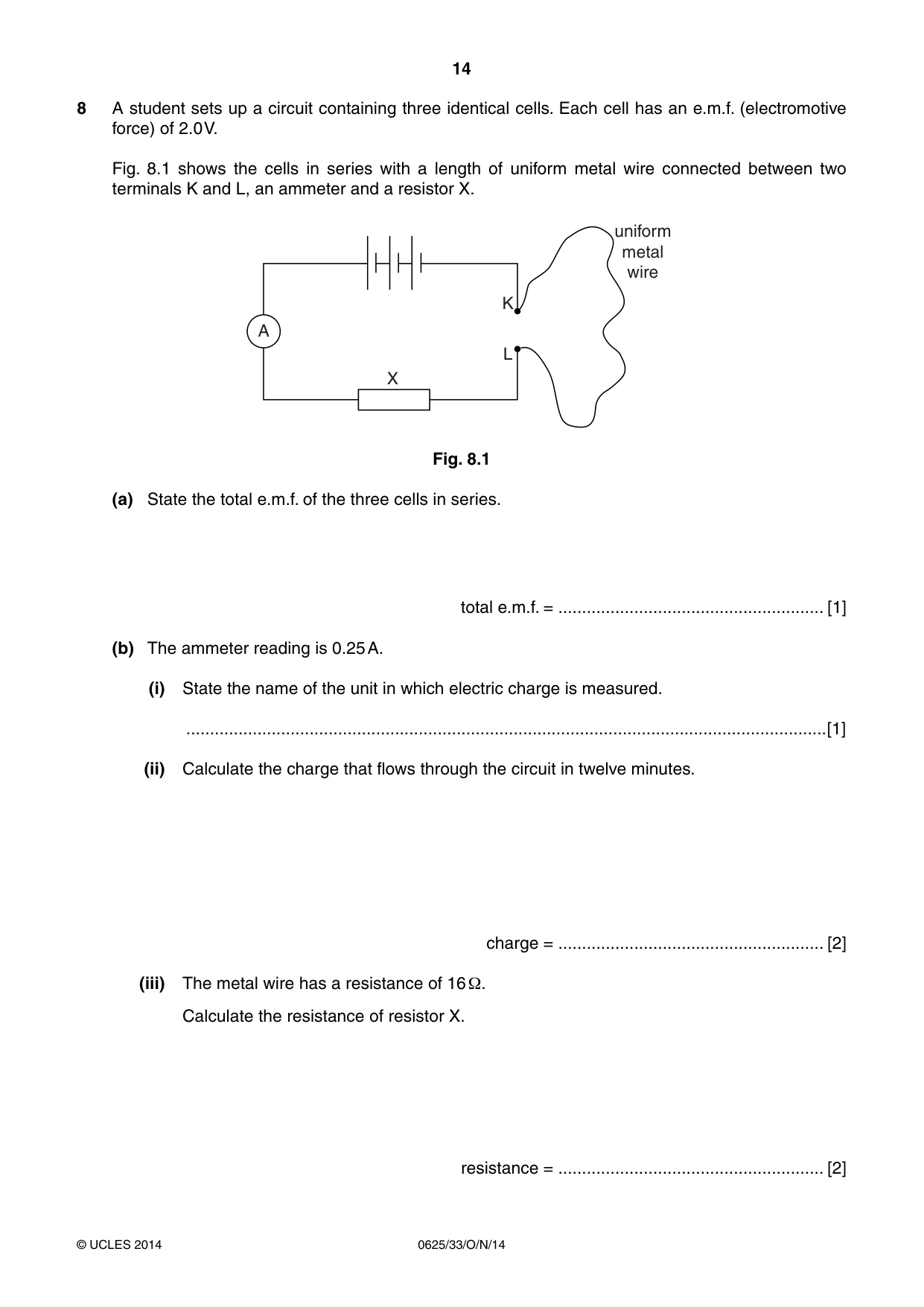
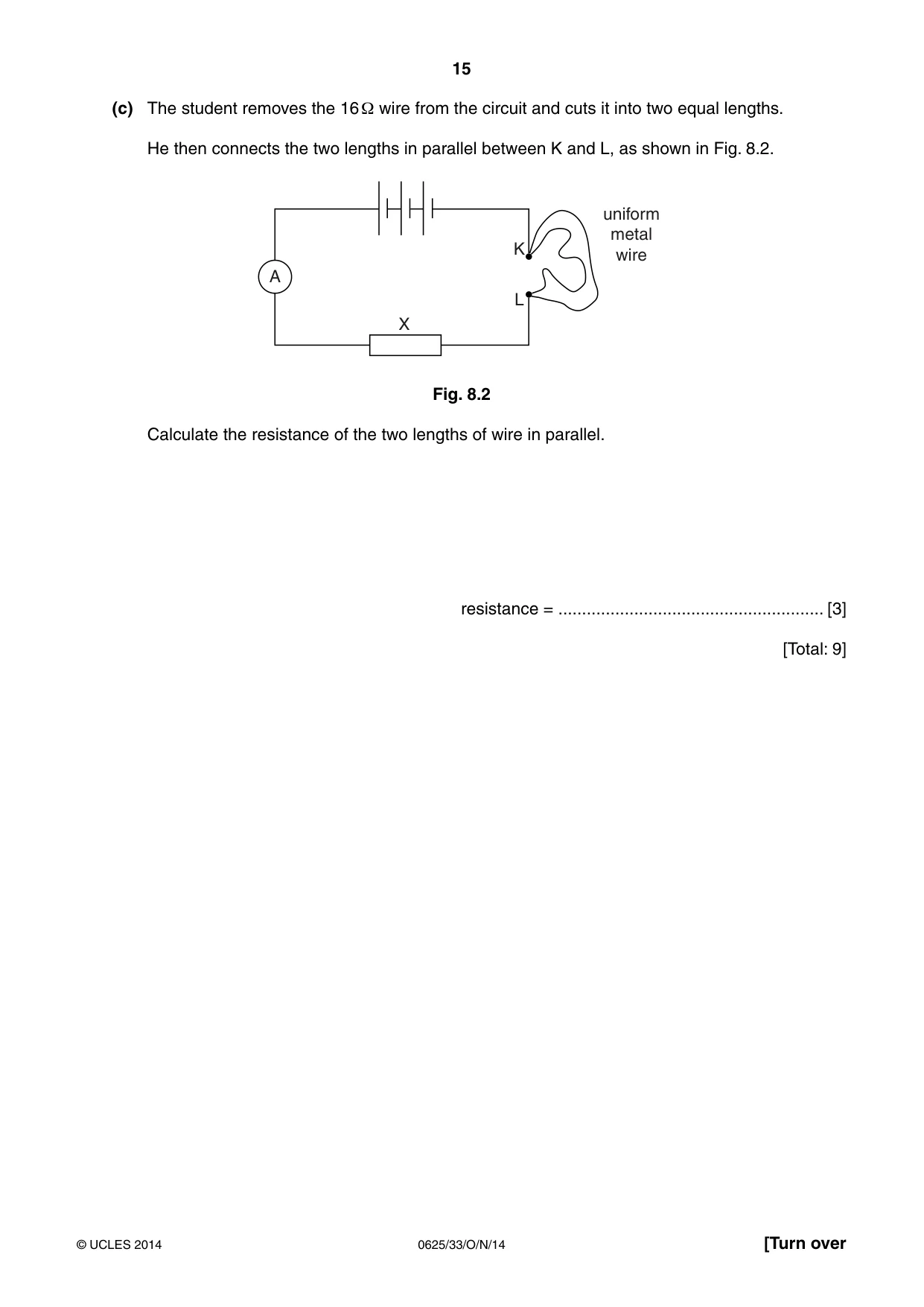
8 A student sets up a circuit containing three identical cells. Each cell has an e.m.f. (electromotive force) of 2.0 V. Fig. 8.1 shows the cells in series with a length of uniform metal wire connected between two terminals K and L, an ammeter and a resistor X. uniform metal wire K A L X Fig. 8.1 (a) State the total e.m.f. of the three cells in series. total e.m.f. = ........................................................ [1] (b) The ammeter reading is 0.25 A. (i) State the name of the unit in which electric charge is measured. .......................................................................................................................................[1] (ii) Calculate the charge that flows through the circuit in twelve minutes. charge = ........................................................ [2] (iii) The metal wire has a resistance of 16 Ω. Calculate the resistance of resistor X. resistance = ........................................................ [2] (c) The student removes the 16 Ω wire from the circuit and cuts it into two equal lengths. He then connects the two lengths in parallel between K and L, as shown in Fig. 8.2. uniform metal K wire A L X Fig. 8.2 Calculate the resistance of the two lengths of wire in parallel. resistance = ........................................................ [3] [Total: 9]
Mark scheme: 8 (a) 6.0 V B1 (b) (i) coulomb (IGNORE C) B1 (ii) (Q =) I t OR 0.25 × 12 × 60 OR 0.25 × 720 OR 0.25 × 12 OR 3.0 OR 0.25 × 60 OR 15 C1 180 (C) A1 (iii) (R =) V / I or 6.0 / 0.25 or 24.0 e.c.f. from (a) OR (V =) IR OR 0.25 × 16 OR 4.0 e.c.f. from (a) C1 8.0 Ω A1 (c) R ∝ l OR 8.0 OR 16 / 2 C1 R1R2 / (R1 + R2) OR 1 / R = 1 / R1 + 1 / R2 OR 64 / 16 OR 1 / R = 1 / 8 + 1 / 8 C1 4.0 Ω A1 [Total: 9]
Q9 · A circuit contains a battery, a variable resistor and a solenoid
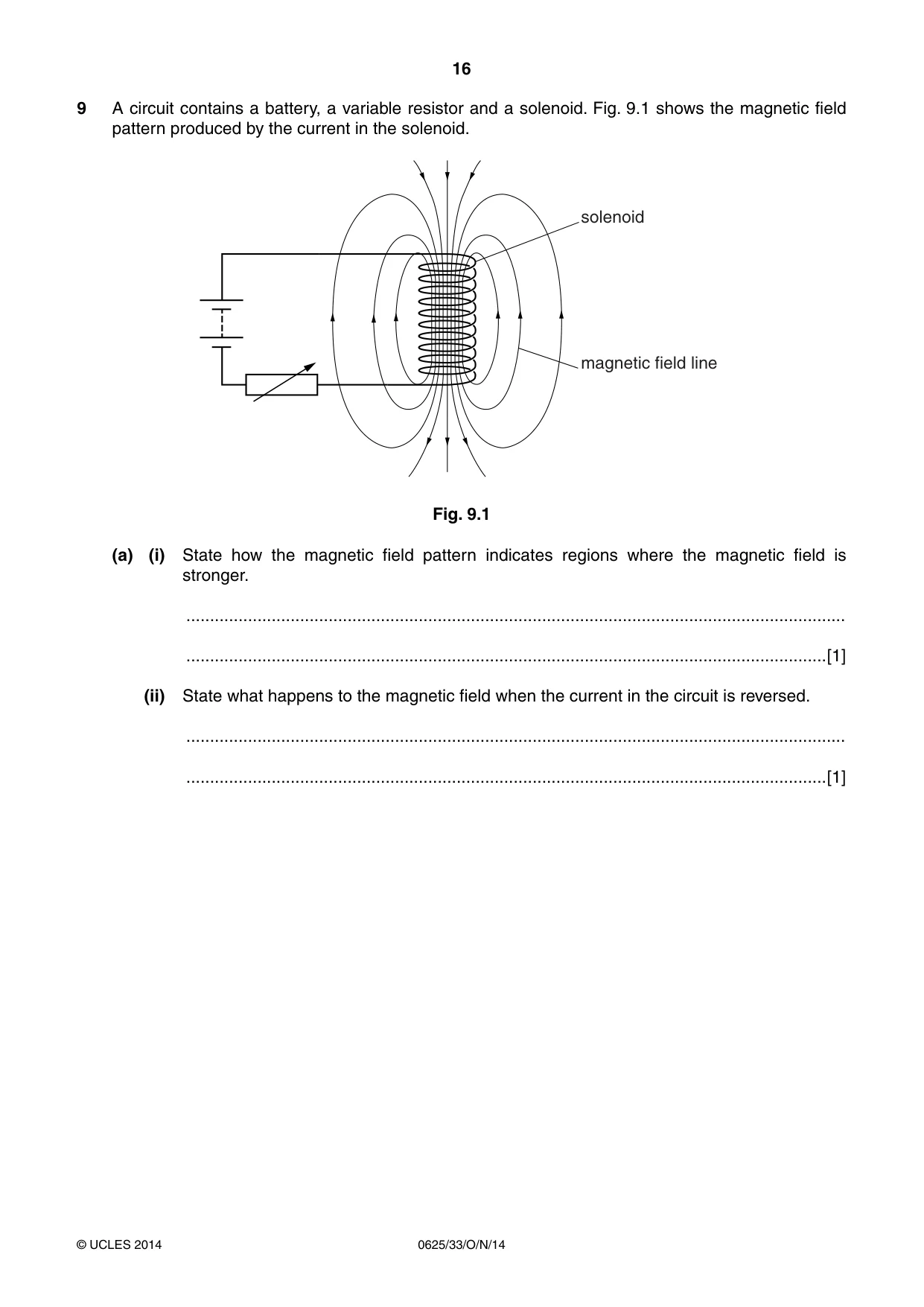
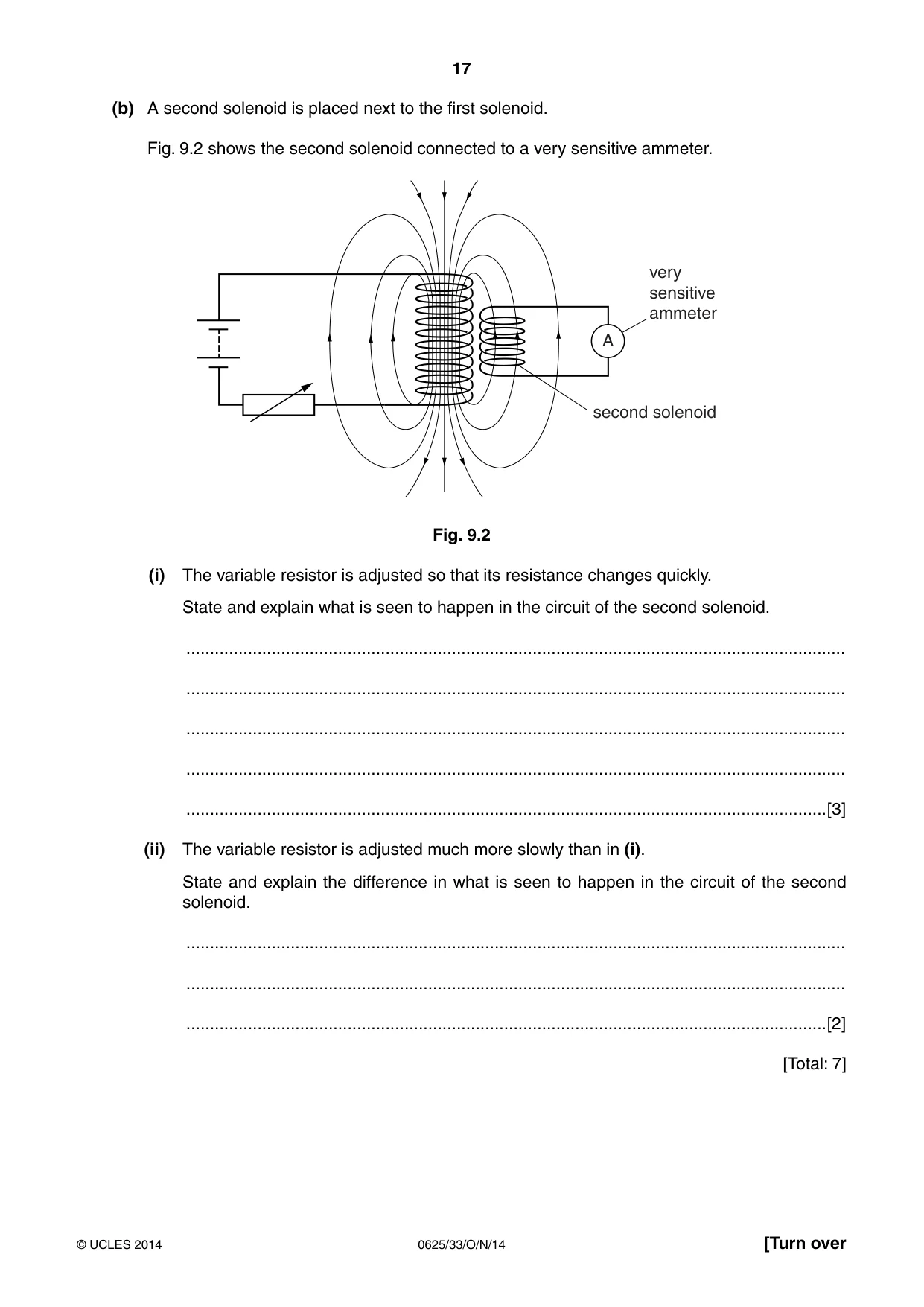
9 A circuit contains a battery, a variable resistor and a solenoid. Fig. 9.1 shows the magnetic field pattern produced by the current in the solenoid. solenoid magnetic field line Fig. 9.1 (a) (i) State how the magnetic field pattern indicates regions where the magnetic field is stronger. ........................................................................................................................................... .......................................................................................................................................[1] (ii) State what happens to the magnetic field when the current in the circuit is reversed. ........................................................................................................................................... .......................................................................................................................................[1] (b) A second solenoid is placed next to the first solenoid. Fig. 9.2 shows the second solenoid connected to a very sensitive ammeter. very sensitive ammeter A second solenoid Fig. 9.2 (i) The variable resistor is adjusted so that its resistance changes quickly. State and explain what is seen to happen in the circuit of the second solenoid. ........................................................................................................................................... ........................................................................................................................................... ........................................................................................................................................... ........................................................................................................................................... .......................................................................................................................................[3] (ii) The variable resistor is adjusted much more slowly than in (i). State and explain the difference in what is seen to happen in the circuit of the second solenoid. ........................................................................................................................................... ........................................................................................................................................... .......................................................................................................................................[2] [Total: 7]
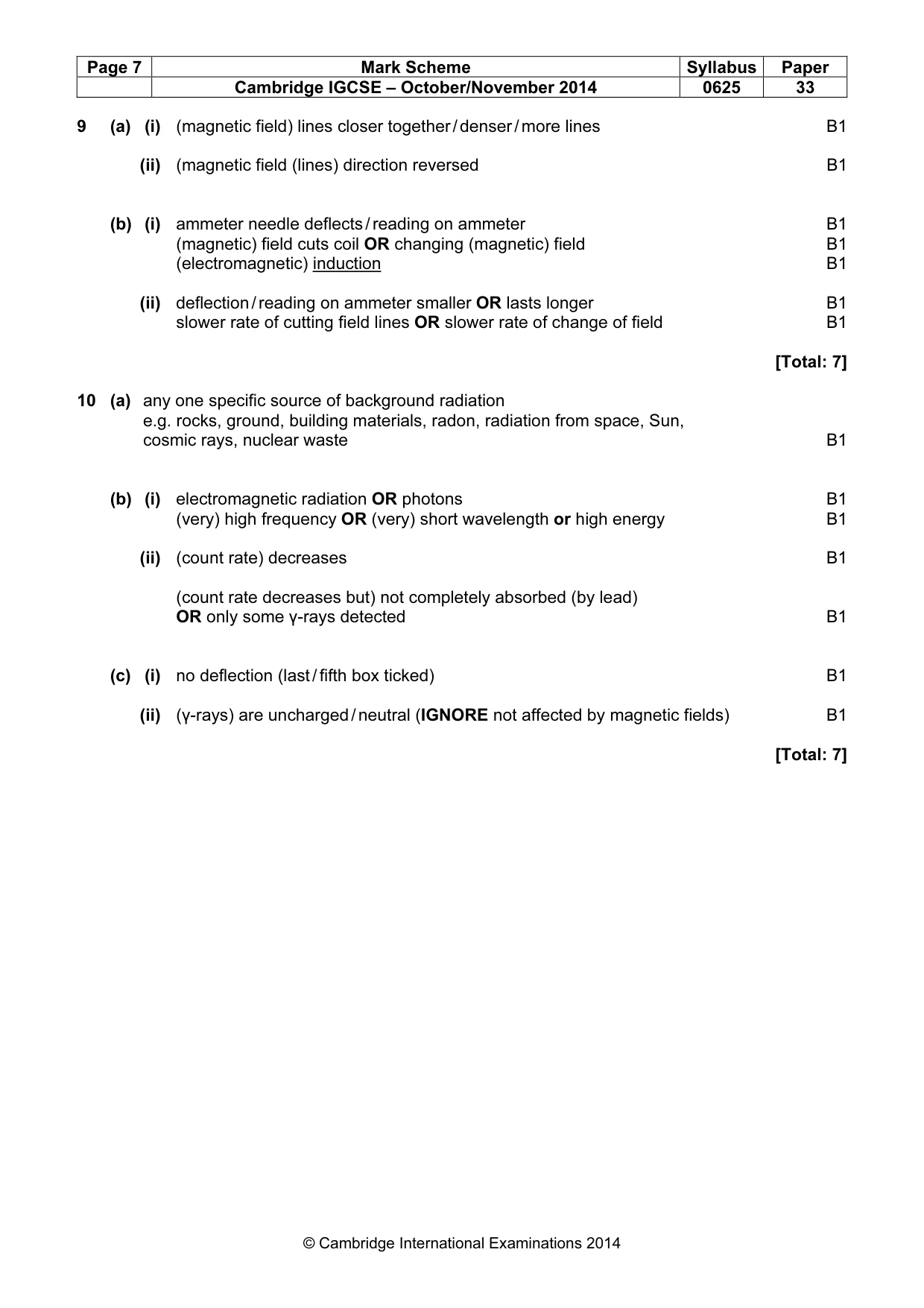
Mark scheme: 9 (a) (i) (magnetic field) lines closer together / denser / more lines B1 (ii) (magnetic field (lines) direction reversed B1 (b) (i) ammeter needle deflects / reading on ammeter B1 (magnetic) field cuts coil OR changing (magnetic) field B1 (electromagnetic) induction B1 (ii) deflection / reading on ammeter smaller OR lasts longer B1 slower rate of cutting field lines OR slower rate of change of field B1 [Total: 7]
Q10 · A technician sets up a radiation detector in a university laboratory, for use in some…
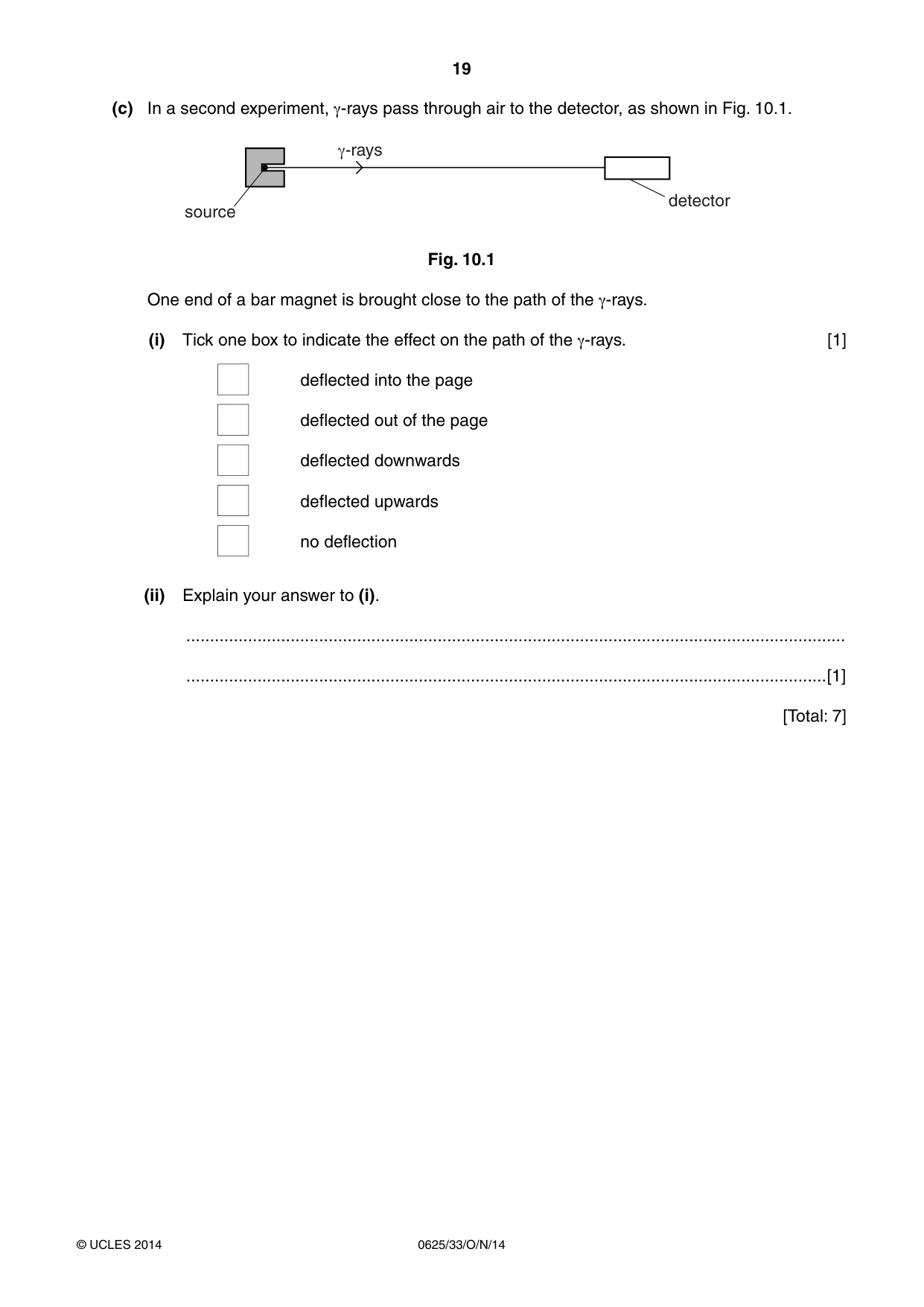
10 A technician sets up a radiation detector in a university laboratory, for use in some experiments. Even before the radioactive source for the experiments is brought into the laboratory, the detector registers a small count rate due to background radiation. (a) Suggest one source of this background radiation. ................................................................................................................................................... ...............................................................................................................................................[1] (b) The radioactive source emits γ-rays. It is placed on the laboratory bench close to the detector. (i) State what γ-rays are. ........................................................................................................................................... ........................................................................................................................................... .......................................................................................................................................[2] (ii) A lead sheet of thickness 10 mm is positioned between the detector and the radioactive source. State and explain what happens to the count rate on the detector. ........................................................................................................................................... ........................................................................................................................................... .......................................................................................................................................[2] (c) In a second experiment, γ-rays pass through air to the detector, as shown in Fig. 10.1. a-rays detector source Fig. 10.1 One end of a bar magnet is brought close to the path of the γ-rays. (i) Tick one box to indicate the effect on the path of the γ-rays. [1] deflected into the page deflected out of the page deflected downwards deflected upwards no deflection (ii) Explain your answer to (i). ........................................................................................................................................... .......................................................................................................................................[1] [Total: 7]
Mark scheme: 10 (a) any one specific source of background radiation e.g. rocks, ground, building materials, radon, radiation from space, Sun, cosmic rays, nuclear waste B1 (b) (i) electromagnetic radiation OR photons B1 (very) high frequency OR (very) short wavelength or high energy B1 (ii) (count rate) decreases B1 (count rate decreases but) not completely absorbed (by lead) OR only some γ-rays detected B1 (c) (i) no deflection (last / fifth box ticked) B1 (ii) (γ-rays) are uncharged / neutral (IGNORE not affected by magnetic fields) B1 [Total: 7]
What was in this paper
The subtopics covered by these 9 questions, and how many questions each got. Open one in a new tab to see every Cambridge question on it.
What you needed in this session
Cambridge’s own grade thresholds for 2014 Oct/Nov, Paper 3 · Variant 3. A higher threshold means an easier paper — the bar moves with how the cohort did.