Cambridge IGCSE Physics 0625 — 2018 Oct/Nov Paper 3 · Variant 3
0625/33/O/N/18 · 12 questions · 80 marks · ≈90 min
The question paper and its mark scheme, free to read here and free to download. This is Cambridge’s own paper, exactly as it was sat.
Question paper16 pages
Mark scheme12 pages
Answers below. Sit the paper first if you are practising.
Questions as text
Q1 · A large tank containing water
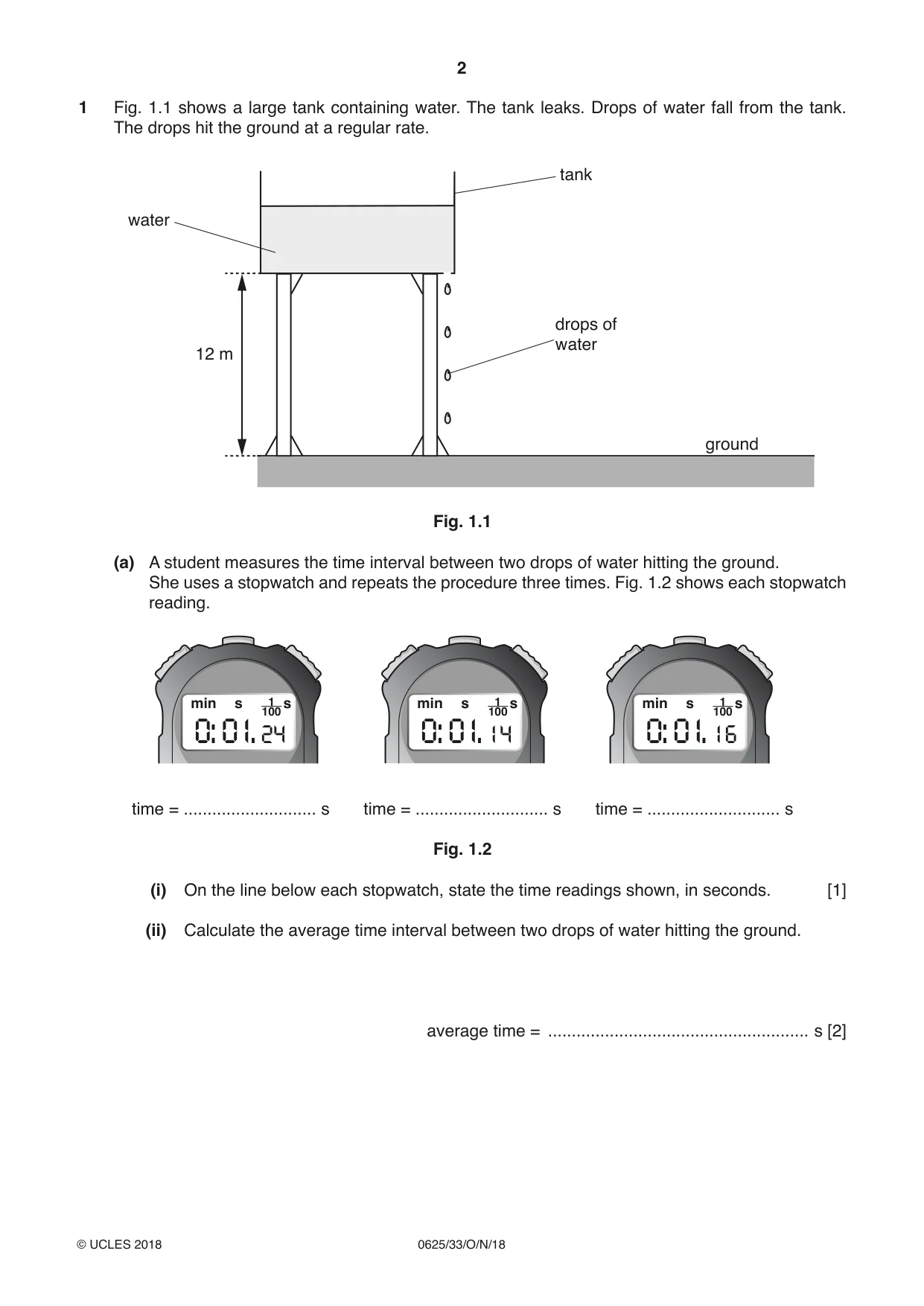
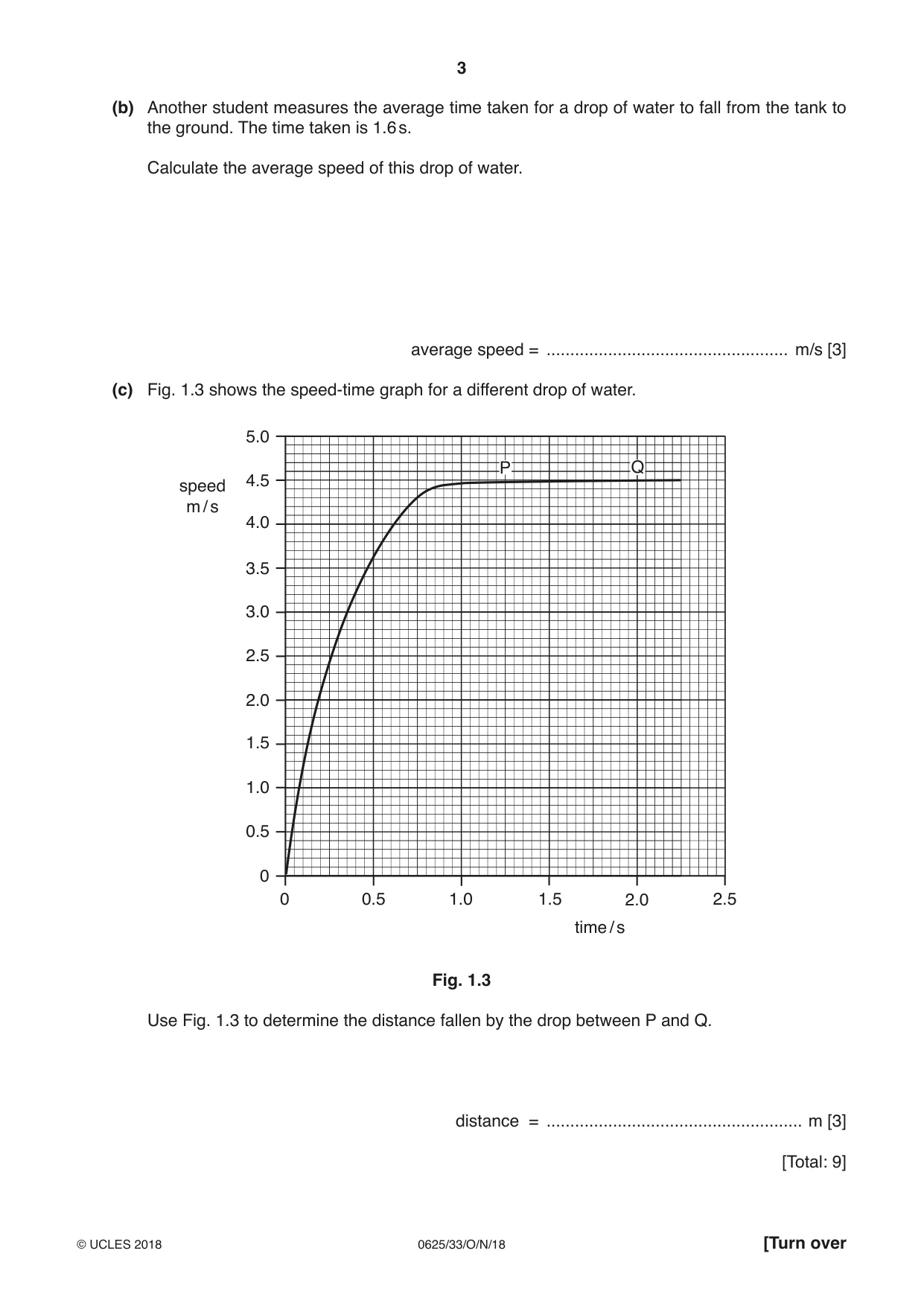
1 Fig. 1.1 shows a large tank containing water. The tank leaks. Drops of water fall from the tank. The drops hit the ground at a regular rate. tank water drops of water 12 m ground Fig. 1.1 (a) A student measures the time interval between two drops of water hitting the ground. She uses a stopwatch and repeats the procedure three times. Fig. 1.2 shows each stopwatch reading. min s 1 s min s 1 s min s 1 s 100 100 100 . . . 0. 01. 24 0. 01. 14 0. 01. 16 time = ............................ s time = ............................ s time = ............................ s Fig. 1.2 (i) On the line below each stopwatch, state the time readings shown, in seconds. [1] (ii) Calculate the average time interval between two drops of water hitting the ground. average time = ....................................................... s [2] (b) Another student measures the average time taken for a drop of water to fall from the tank to the ground. The time taken is 1.6 s. Calculate the average speed of this drop of water. average speed = ................................................... m/s [3] (c) Fig. 1.3 shows the speed-time graph for a different drop of water. 5.0 P Q 4.5 speed m / s 4.0 3.5 3.0 2.5 2.0 1.5 1.0 0.5 0 0 0.5 1.0 1.5 2.0 2.5 time / s Fig. 1.3 Use Fig. 1.3 to determine the distance fallen by the drop between P and Q. distance = ...................................................... m [3] [Total: 9]
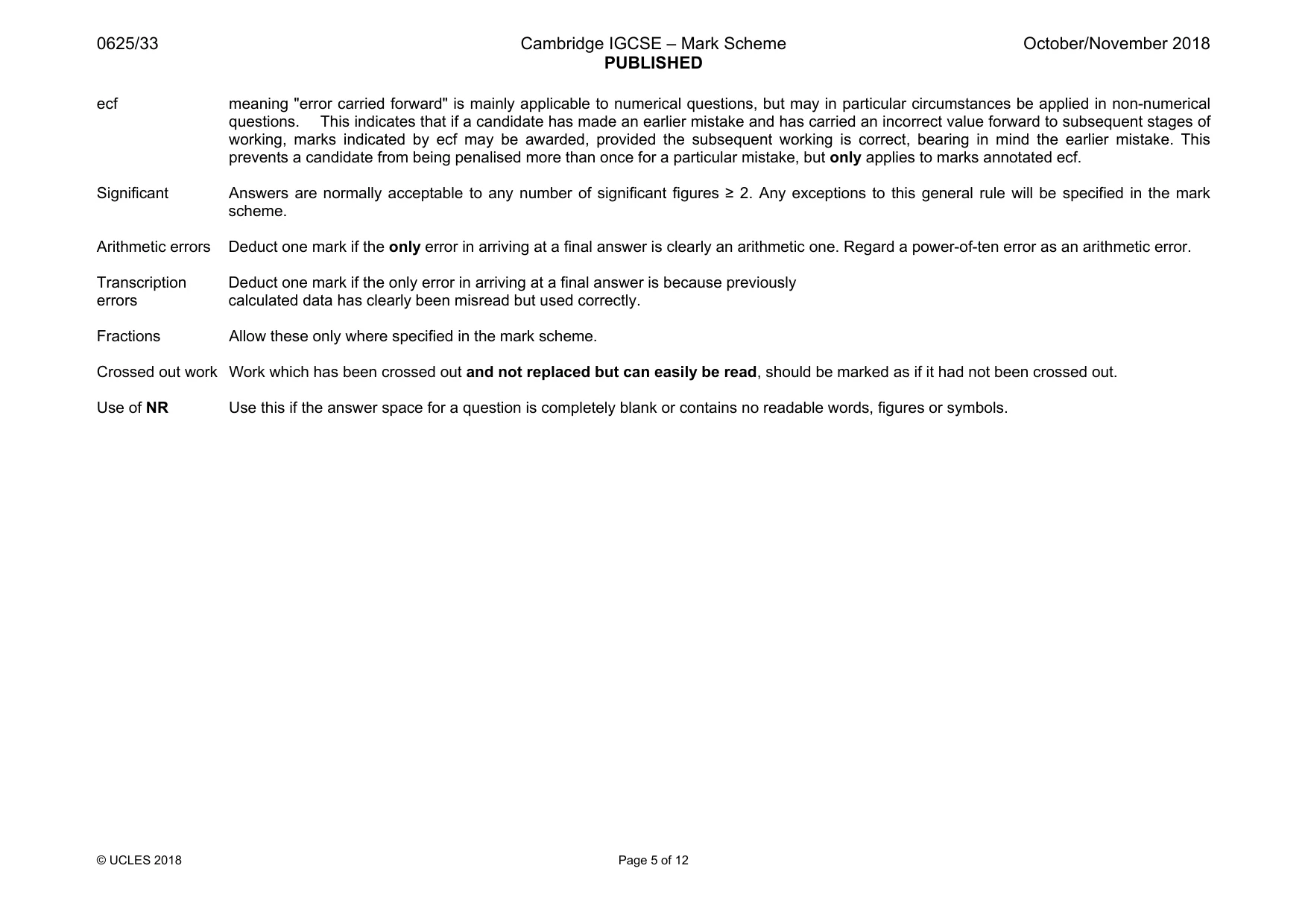
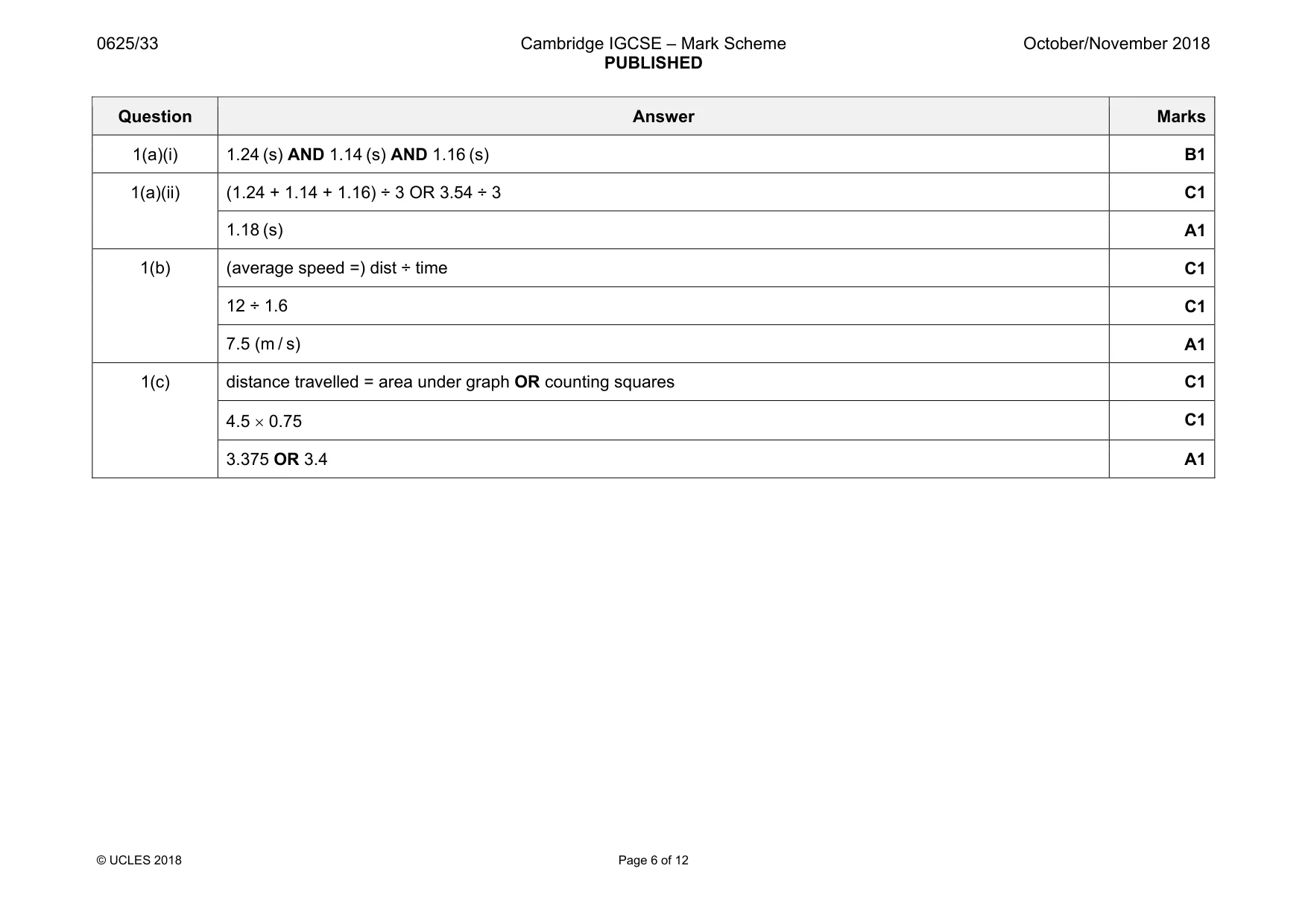
Mark scheme: 1(a)(i) 1.24 (s) AND 1.14 (s) AND 1.16 (s) B1 1(a)(ii) (1.24 + 1.14 + 1.16) ÷ 3 OR 3.54 ÷ 3 C1 1.18 (s) A1 1(b) (average speed =) dist ÷ time C1 12 ÷ 1.6 C1 7.5 (m / s) A1 1(c) distance travelled = area under graph OR counting squares C1 4.5 × 0.75 C1 3.375 OR 3.4 A1
More questions on Physical quantities and measurement techniques
Q2 · A student has a piece of metal that has an irregular shape
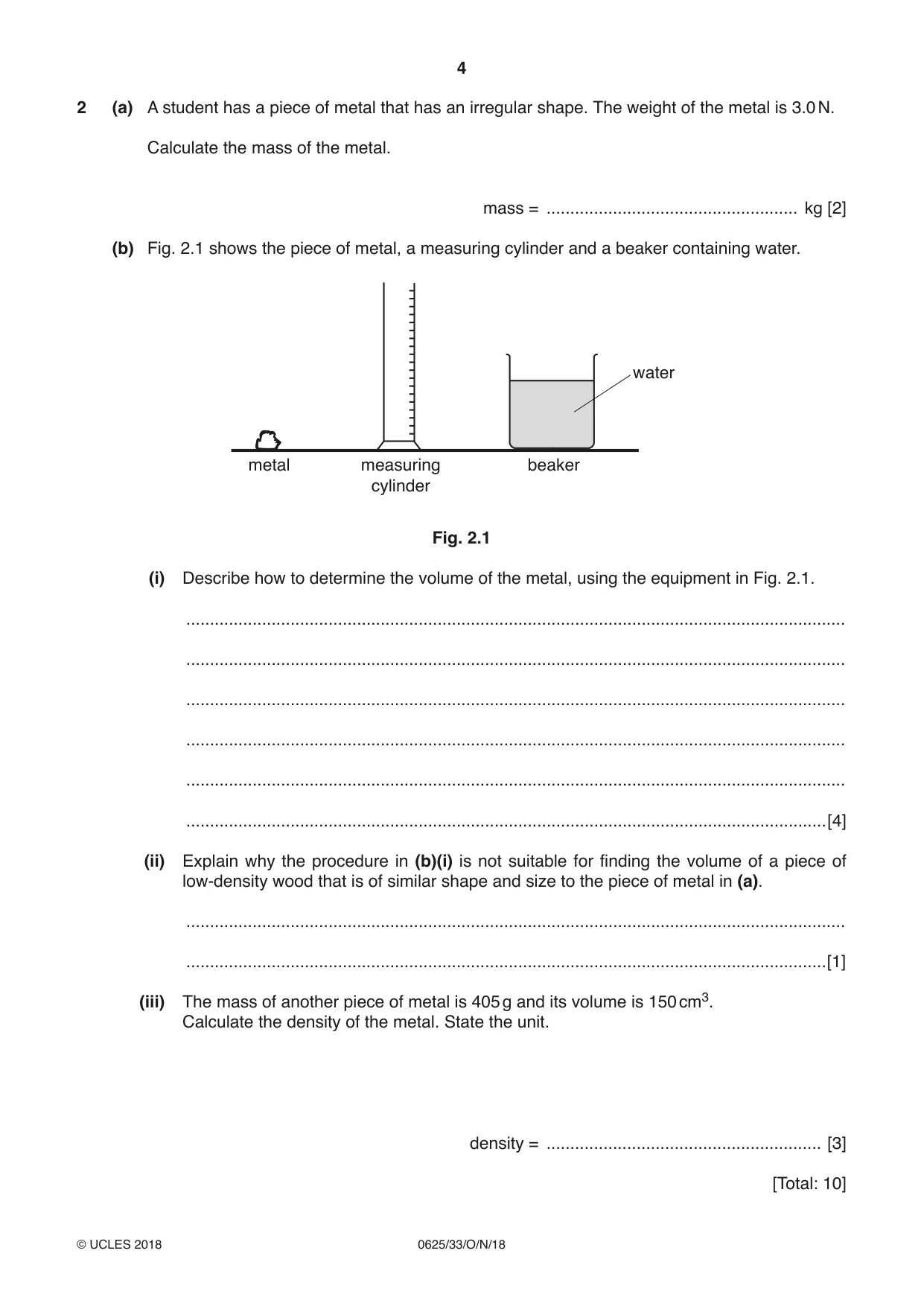
2 (a) A student has a piece of metal that has an irregular shape. The weight of the metal is 3.0 N. Calculate the mass of the metal. mass = ..................................................... kg [2] (b) Fig. 2.1 shows the piece of metal, a measuring cylinder and a beaker containing water. water metal measuring beaker cylinder Fig. 2.1 (i) Describe how to determine the volume of the metal, using the equipment in Fig. 2.1. ........................................................................................................................................... ........................................................................................................................................... ........................................................................................................................................... ........................................................................................................................................... ........................................................................................................................................... .......................................................................................................................................[4] (ii) Explain why the procedure in (b)(i) is not suitable for finding the volume of a piece of low-density wood that is of similar shape and size to the piece of metal in (a). ........................................................................................................................................... .......................................................................................................................................[1] (iii) The mass of another piece of metal is 405 g and its volume is 150 cm3. Calculate the density of the metal. State the unit. density = .......................................................... [3] [Total: 10]
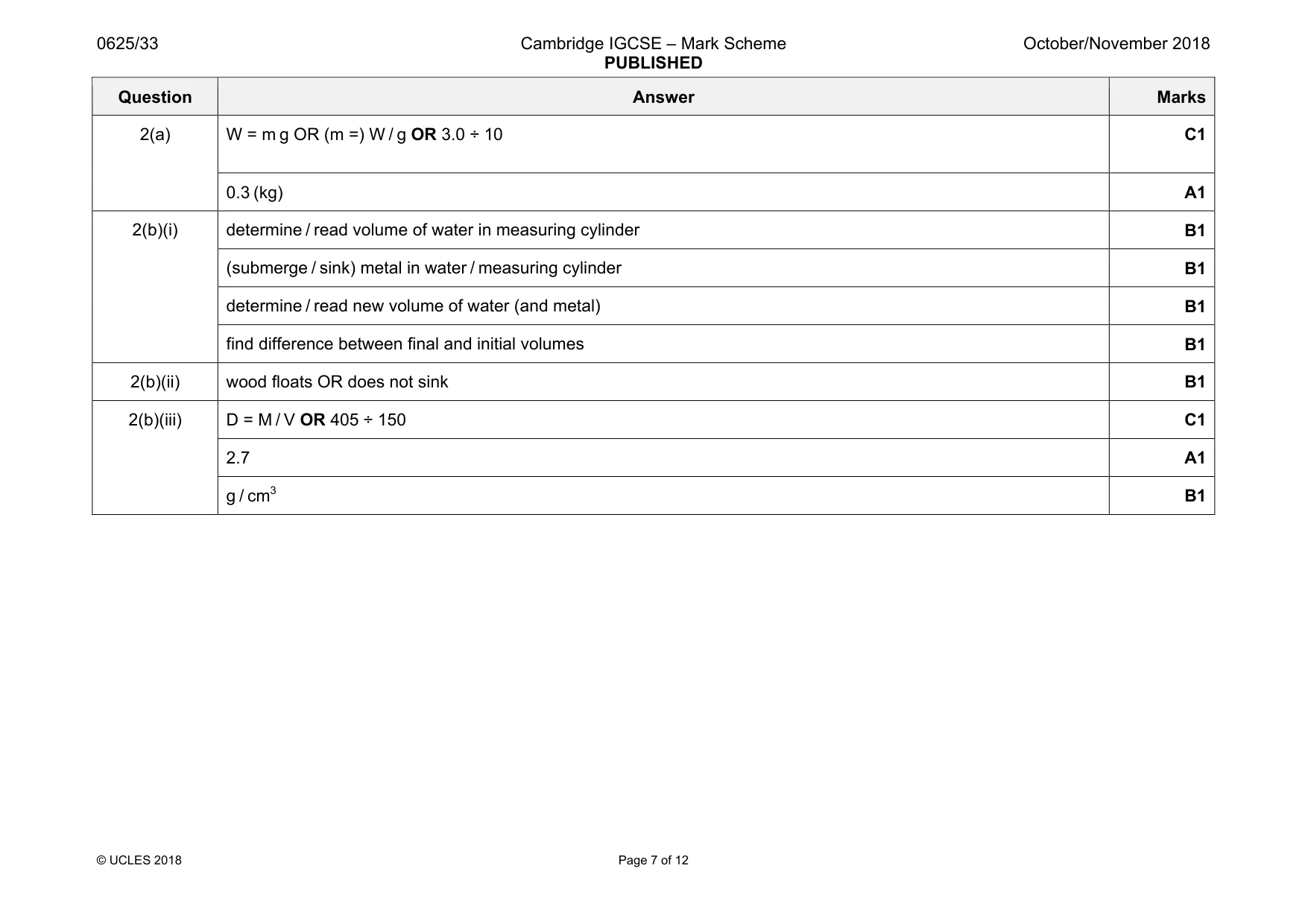
Mark scheme: 2(a) W = m g OR (m =) W / g OR 3.0 ÷ 10 C1 0.3 (kg) A1 2(b)(i) determine / read volume of water in measuring cylinder B1 (submerge / sink) metal in water / measuring cylinder B1 determine / read new volume of water (and metal) B1 find difference between final and initial volumes B1 2(b)(ii) wood floats OR does not sink B1 2(b)(iii) D = M / V OR 405 ÷ 150 C1 2.7 A1 g / cm3 B1
Q3 · Devices that generate electricity
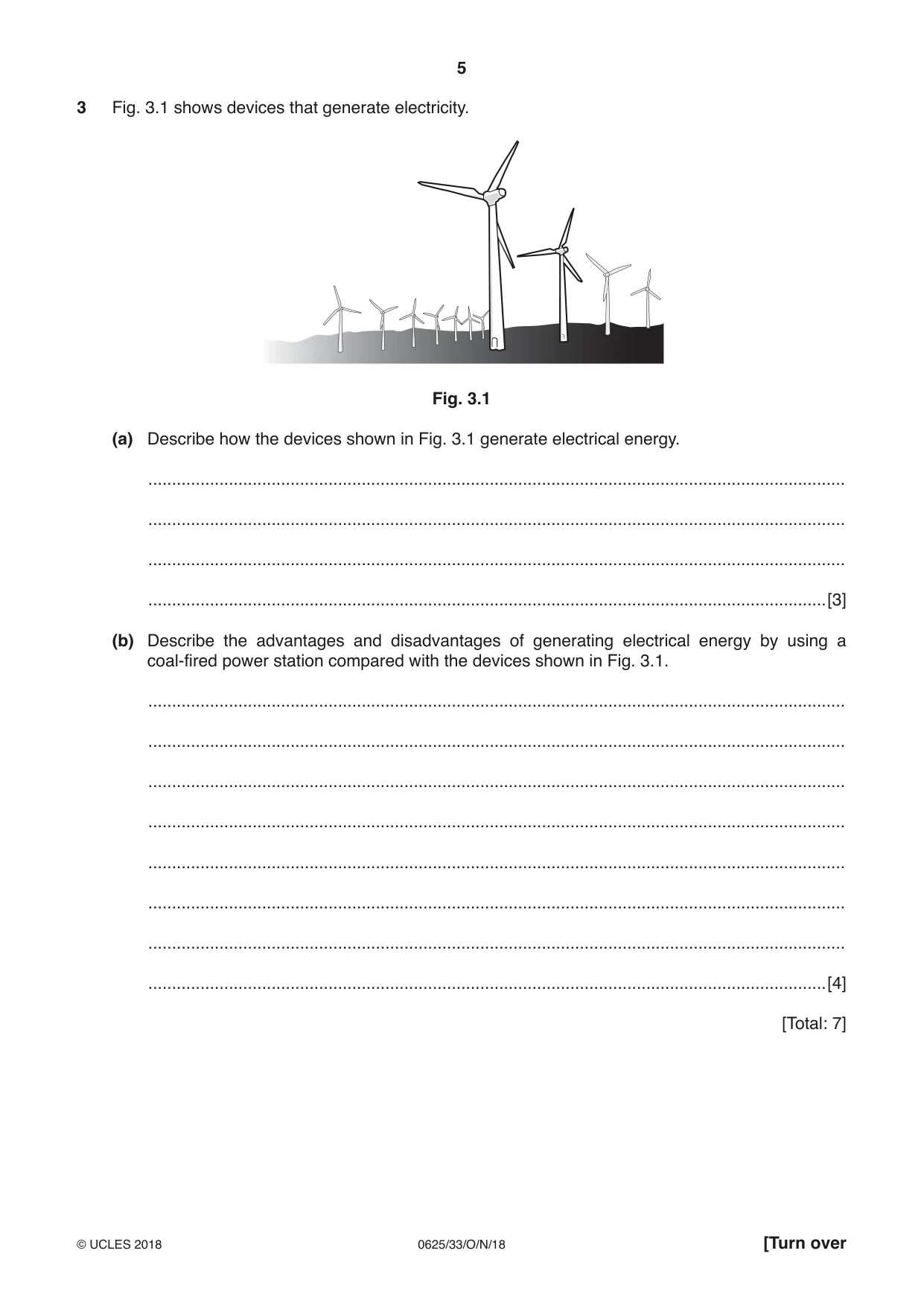
3 Fig. 3.1 shows devices that generate electricity. Fig. 3.1 (a) Describe how the devices shown in Fig. 3.1 generate electrical energy. ................................................................................................................................................... ................................................................................................................................................... ................................................................................................................................................... ...............................................................................................................................................[3] (b) Describe the advantages and disadvantages of generating electrical energy by using a coal-fired power station compared with the devices shown in Fig. 3.1. ................................................................................................................................................... ................................................................................................................................................... ................................................................................................................................................... ................................................................................................................................................... ................................................................................................................................................... ................................................................................................................................................... ................................................................................................................................................... ...............................................................................................................................................[4] [Total: 7]
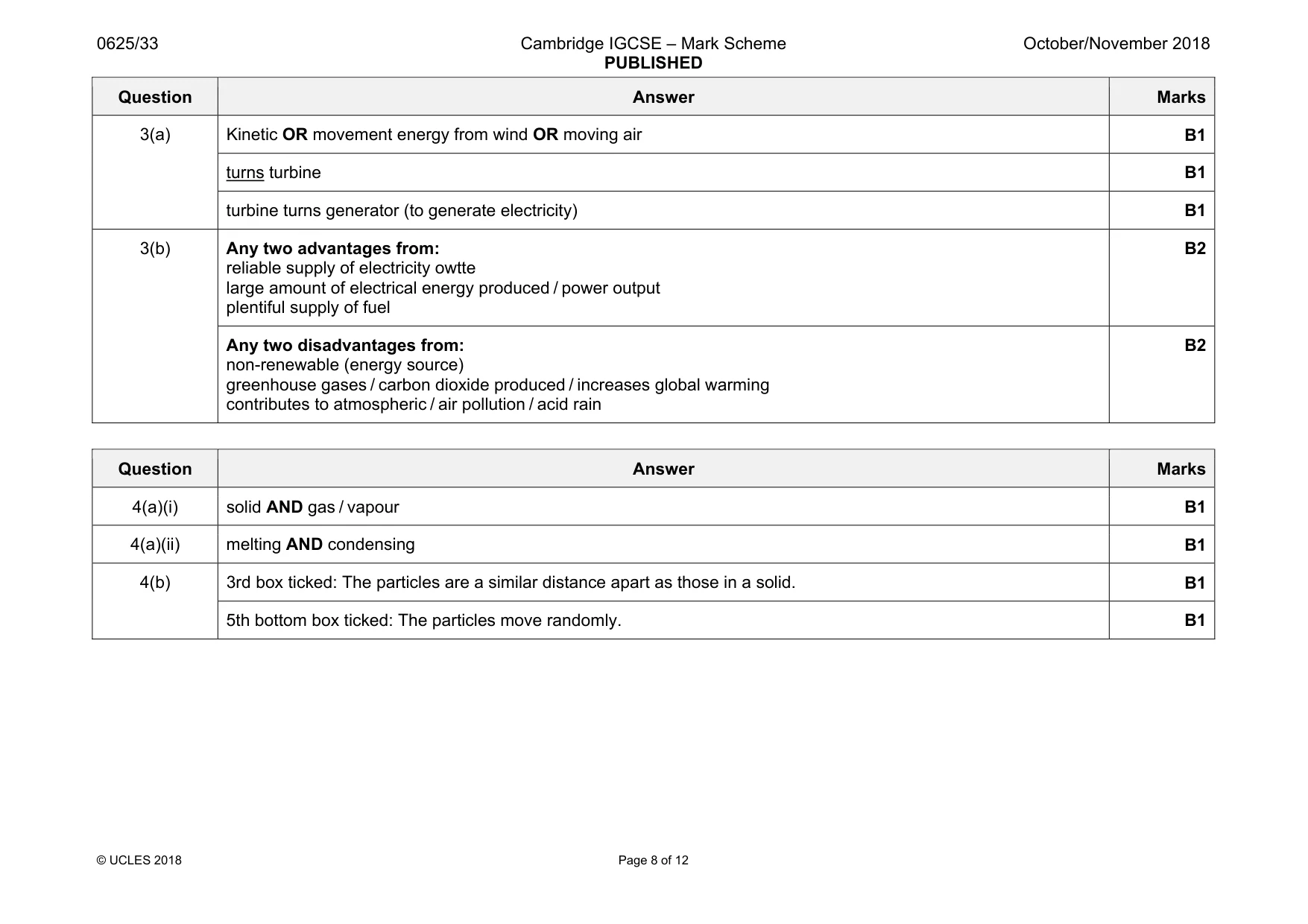
Mark scheme: 3(a) Kinetic OR movement energy from wind OR moving air B1 turns turbine B1 turbine turns generator (to generate electricity) B1 3(b) Any two advantages from: reliable supply of electricity owtte large amount of electrical energy produced / power output plentiful supply of fuel B2 Any two disadvantages from: non-renewable (energy source) greenhouse gases / carbon dioxide produced / increases global warming contributes to atmospheric / air pollution / acid rain B2
Question 4
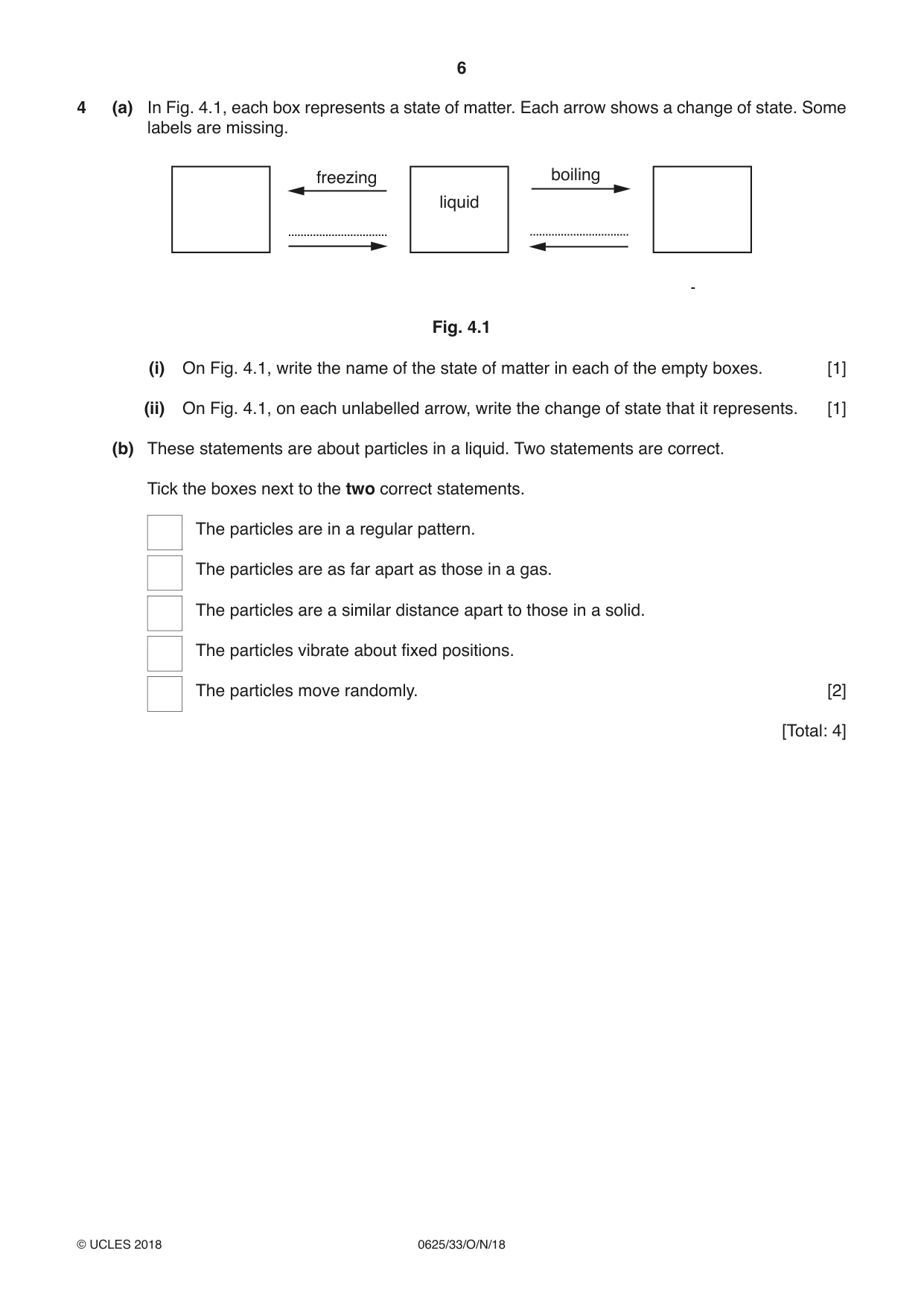
4 (a) In Fig. 4.1, each box represents a state of matter. Each arrow shows a change of state. Some labels are missing. freezing boiling liquid Fig. 4.1 (i) On Fig. 4.1, write the name of the state of matter in each of the empty boxes. [1] (ii) On Fig. 4.1, on each unlabelled arrow, write the change of state that it represents. [1] (b) These statements are about particles in a liquid. Two statements are correct. Tick the boxes next to the two correct statements. The particles are in a regular pattern. The particles are as far apart as those in a gas. The particles are a similar distance apart to those in a solid. The particles vibrate about fixed positions. The particles move randomly. [2] [Total: 4]
Mark scheme: 4(a)(i) solid AND gas / vapour B1 4(a)(ii) melting AND condensing B1 4(b) 3rd box ticked: The particles are a similar distance apart as those in a solid. B1 5th bottom box ticked: The particles move randomly. B1
Question 5
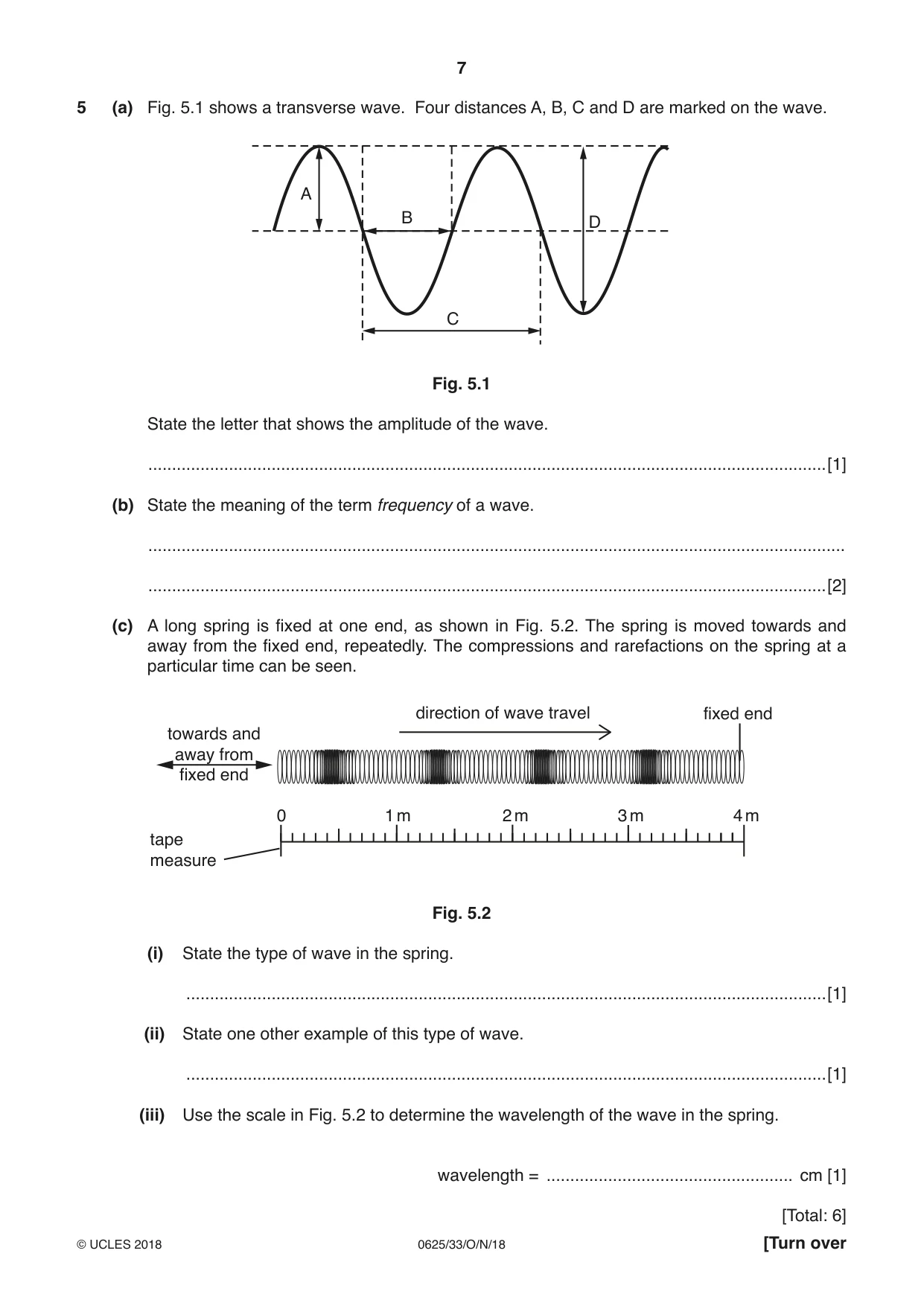
5 (a) Fig. 5.1 shows a transverse wave. Four distances A, B, C and D are marked on the wave. A B D C Fig. 5.1 State the letter that shows the amplitude of the wave. ...............................................................................................................................................[1] (b) State the meaning of the term frequency of a wave. ................................................................................................................................................... ...............................................................................................................................................[2] (c) A long spring is fixed at one end, as shown in Fig. 5.2. The spring is moved towards and away from the fixed end, repeatedly. The compressions and rarefactions on the spring at a particular time can be seen. direction of wave travel fixed end towards and away from fixed end 0 1 m 2 m 3 m 4 m tape measure Fig. 5.2 (i) State the type of wave in the spring. .......................................................................................................................................[1] (ii) State one other example of this type of wave. .......................................................................................................................................[1] (iii) Use the scale in Fig. 5.2 to determine the wavelength of the wave in the spring. wavelength = .................................................... cm [1] [Total: 6]
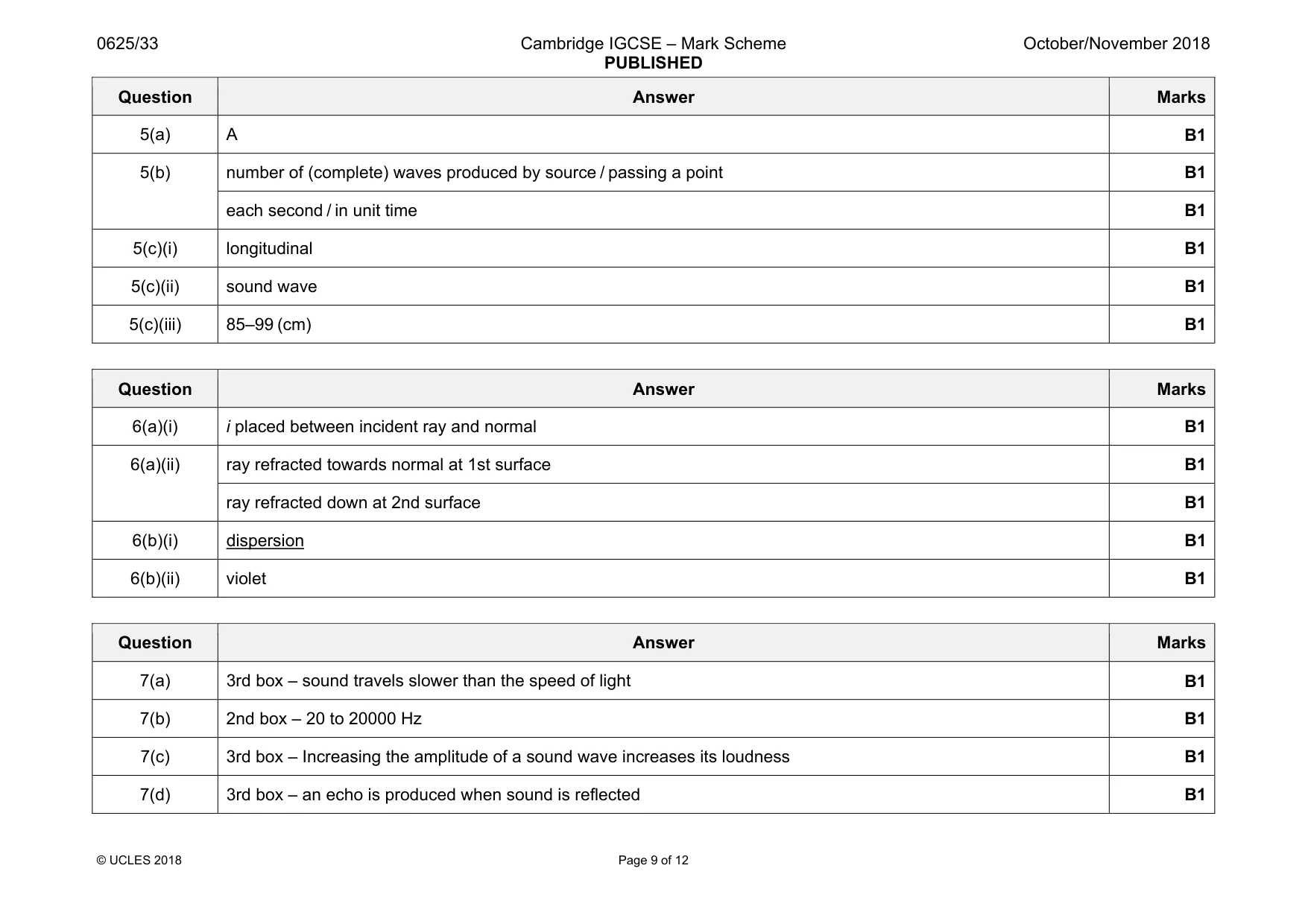
Mark scheme: 5(a) A B1 5(b) number of (complete) waves produced by source / passing a point B1 each second / in unit time B1 5(c)(i) longitudinal B1 5(c)(ii) sound wave B1 5(c)(iii) 85–99 (cm) B1
Q6 · A ray of green light hitting a glass prism
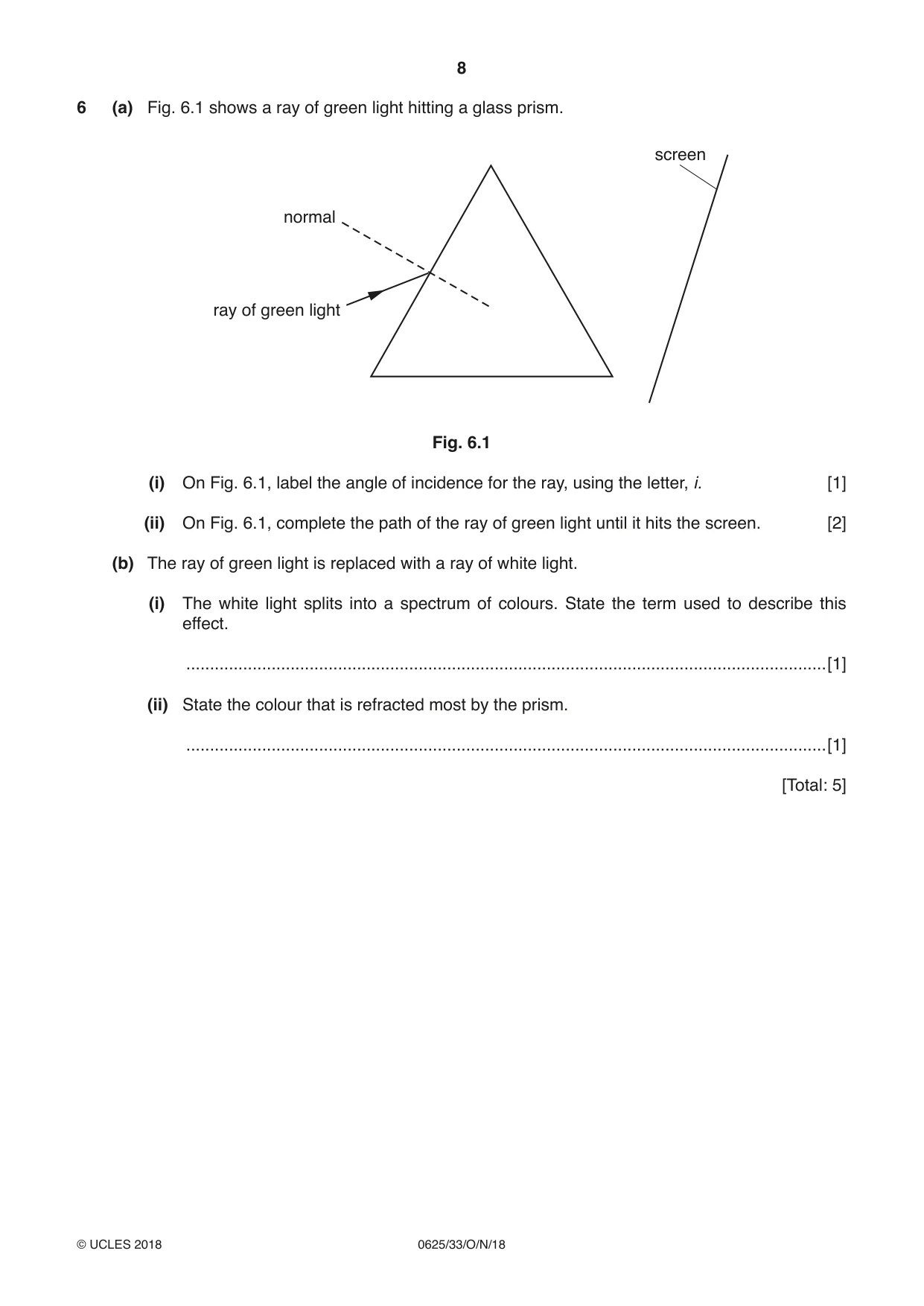
6 (a) Fig. 6.1 shows a ray of green light hitting a glass prism. screen normal ray of green light Fig. 6.1 (i) On Fig. 6.1, label the angle of incidence for the ray, using the letter, i. [1] (ii) On Fig. 6.1, complete the path of the ray of green light until it hits the screen. [2] (b) The ray of green light is replaced with a ray of white light. (i) The white light splits into a spectrum of colours. State the term used to describe this effect. .......................................................................................................................................[1] (ii) State the colour that is refracted most by the prism. .......................................................................................................................................[1] [Total: 5]
Mark scheme: 6(a)(i) i placed between incident ray and normal B1 6(a)(ii) ray refracted towards normal at 1st surface B1 ray refracted down at 2nd surface B1 6(b)(i) dispersion B1 6(b)(ii) violet B1
Q7 · Some students make statements about sound
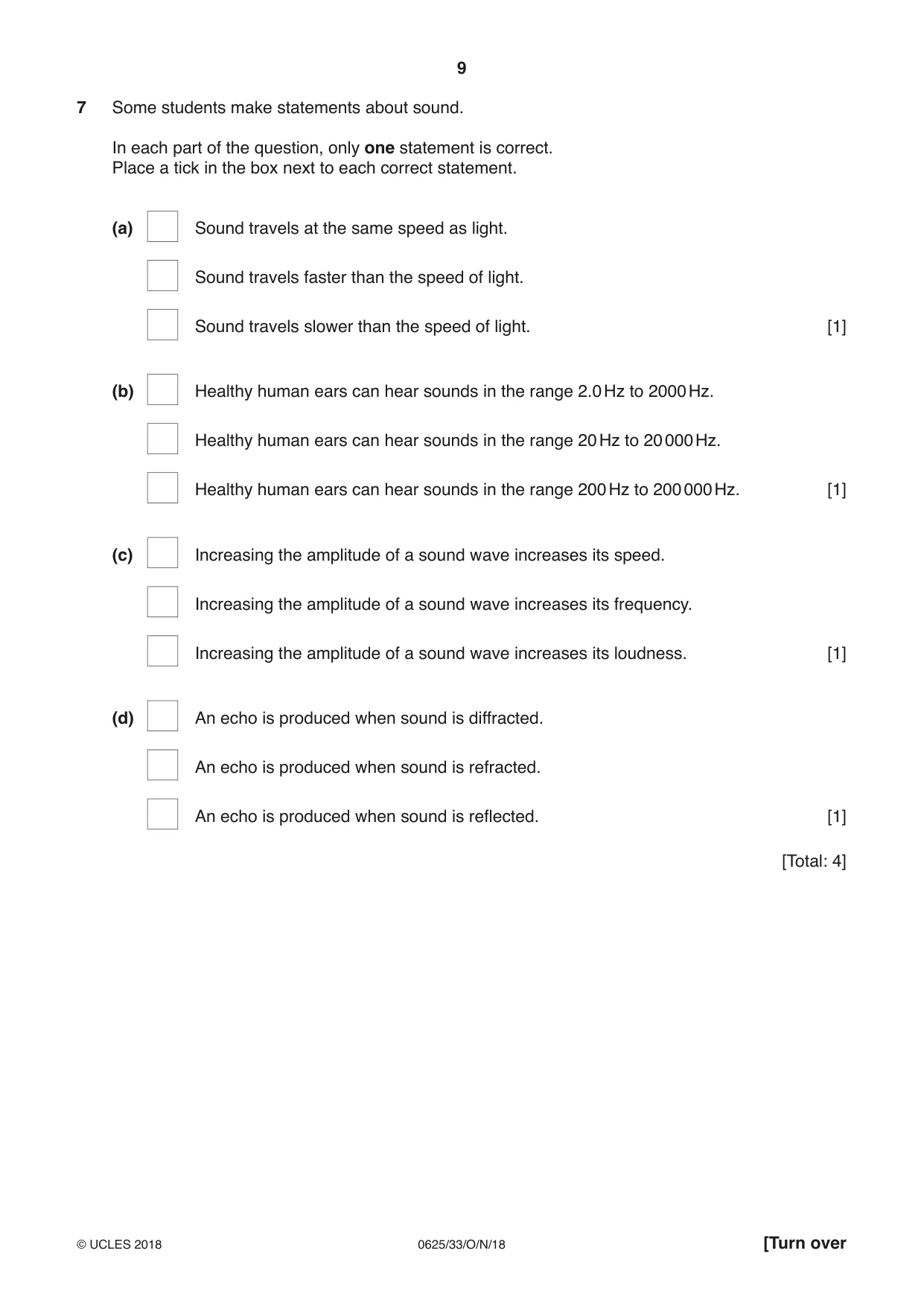
7 Some students make statements about sound. In each part of the question, only one statement is correct. Place a tick in the box next to each correct statement. (a) Sound travels at the same speed as light. Sound travels faster than the speed of light. Sound travels slower than the speed of light. [1] (b) Healthy human ears can hear sounds in the range 2.0 Hz to 2000 Hz. Healthy human ears can hear sounds in the range 20 Hz to 20 000 Hz. Healthy human ears can hear sounds in the range 200 Hz to 200 000 Hz. [1] (c) Increasing the amplitude of a sound wave increases its speed. Increasing the amplitude of a sound wave increases its frequency. Increasing the amplitude of a sound wave increases its loudness. [1] (d) An echo is produced when sound is diffracted. An echo is produced when sound is refracted. An echo is produced when sound is reflected. [1] [Total: 4]
Mark scheme: 7(a) 3rd box – sound travels slower than the speed of light B1 7(b) 2nd box – 20 to 20000 Hz B1 7(c) 3rd box – Increasing the amplitude of a sound wave increases its loudness B1 7(d) 3rd box – an echo is produced when sound is reflected B1
Q8 · A sheet of paper
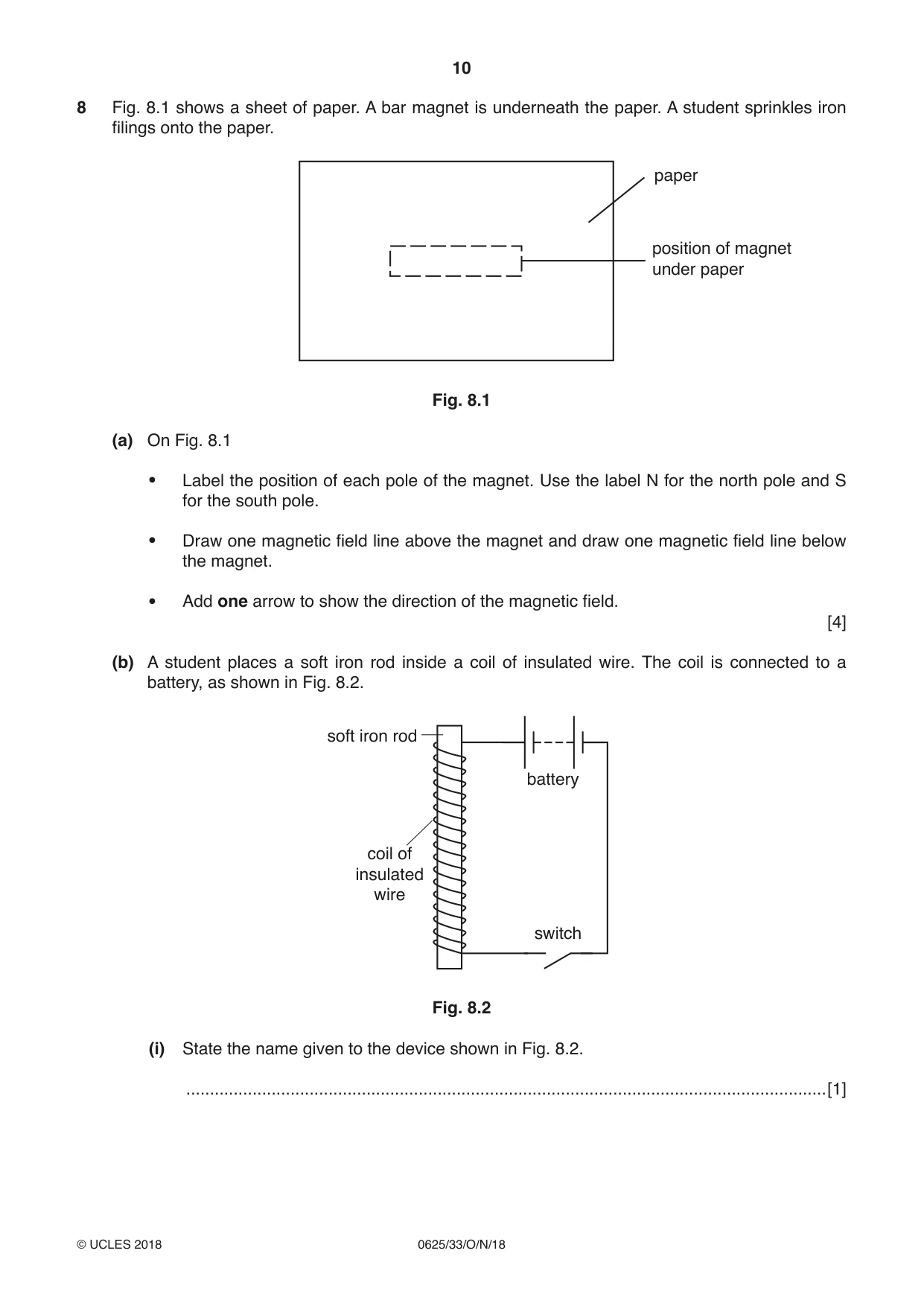
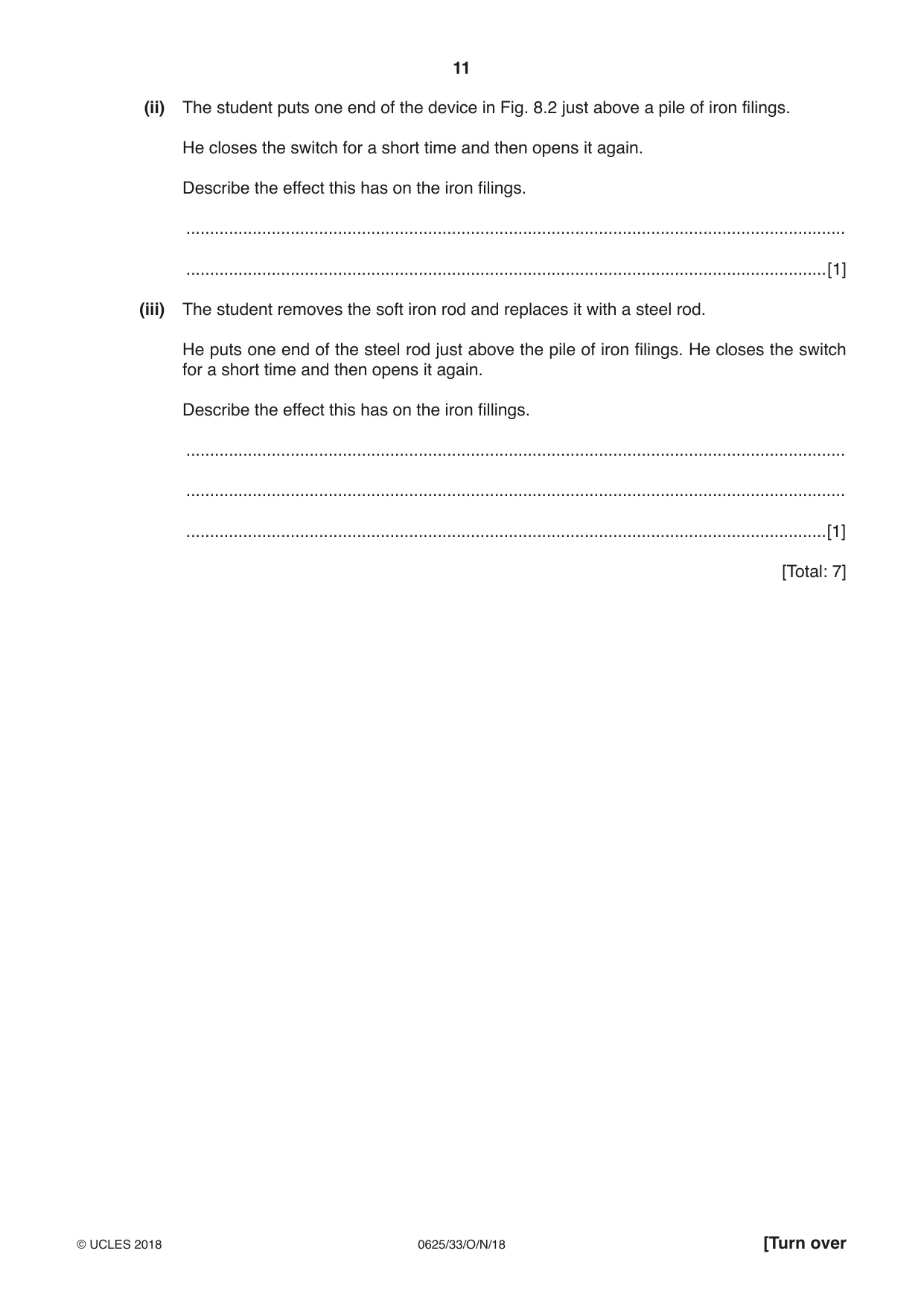
8 Fig. 8.1 shows a sheet of paper. A bar magnet is underneath the paper. A student sprinkles iron filings onto the paper. paper position of magnet under paper Fig. 8.1 (a) On Fig. 8.1 Label the position of each pole of the magnet. Use the label N for the north pole and S • for the south pole. Draw one magnetic field line above the magnet and draw one magnetic field line below • the magnet. Add one arrow to show the direction of the magnetic field. • [4] (b) A student places a soft iron rod inside a coil of insulated wire. The coil is connected to a battery, as shown in Fig. 8.2. soft iron rod battery coil of insulated wire switch Fig. 8.2 (i) State the name given to the device shown in Fig. 8.2. .......................................................................................................................................[1] (ii) The student puts one end of the device in Fig. 8.2 just above a pile of iron filings. He closes the switch for a short time and then opens it again. Describe the effect this has on the iron filings. ........................................................................................................................................... .......................................................................................................................................[1] (iii) The student removes the soft iron rod and replaces it with a steel rod. He puts one end of the steel rod just above the pile of iron filings. He closes the switch for a short time and then opens it again. Describe the effect this has on the iron fillings. ........................................................................................................................................... ........................................................................................................................................... .......................................................................................................................................[1] [Total: 7]
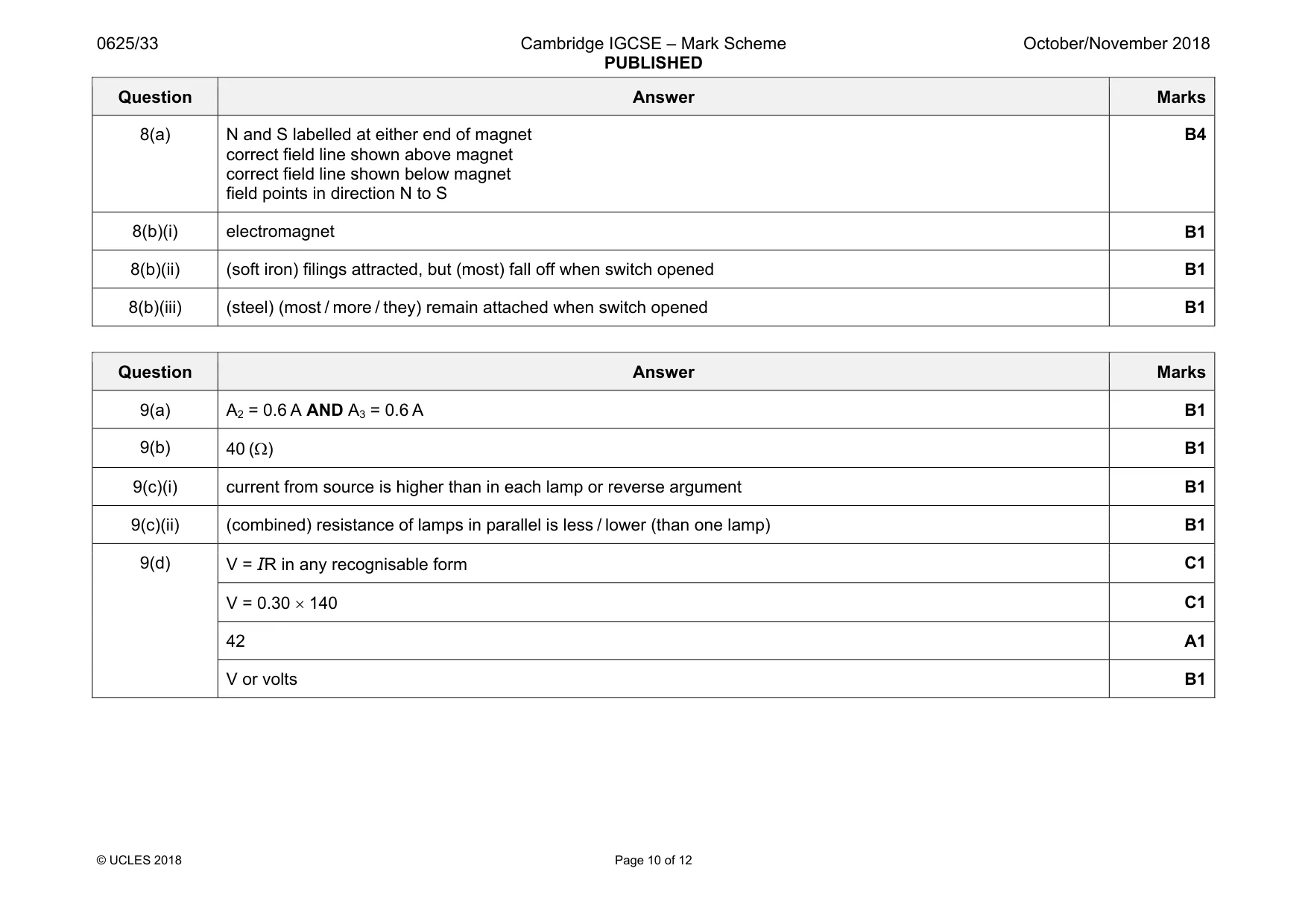
Mark scheme: 8(a) N and S labelled at either end of magnet correct field line shown above magnet correct field line shown below magnet field points in direction N to S B4 8(b)(i) electromagnet B1 8(b)(ii) (soft iron) filings attracted, but (most) fall off when switch opened B1 8(b)(iii) (steel) (most / more / they) remain attached when switch opened B1
Q9 · A circuit with two lamps and three ammeters connected in series to a power supply
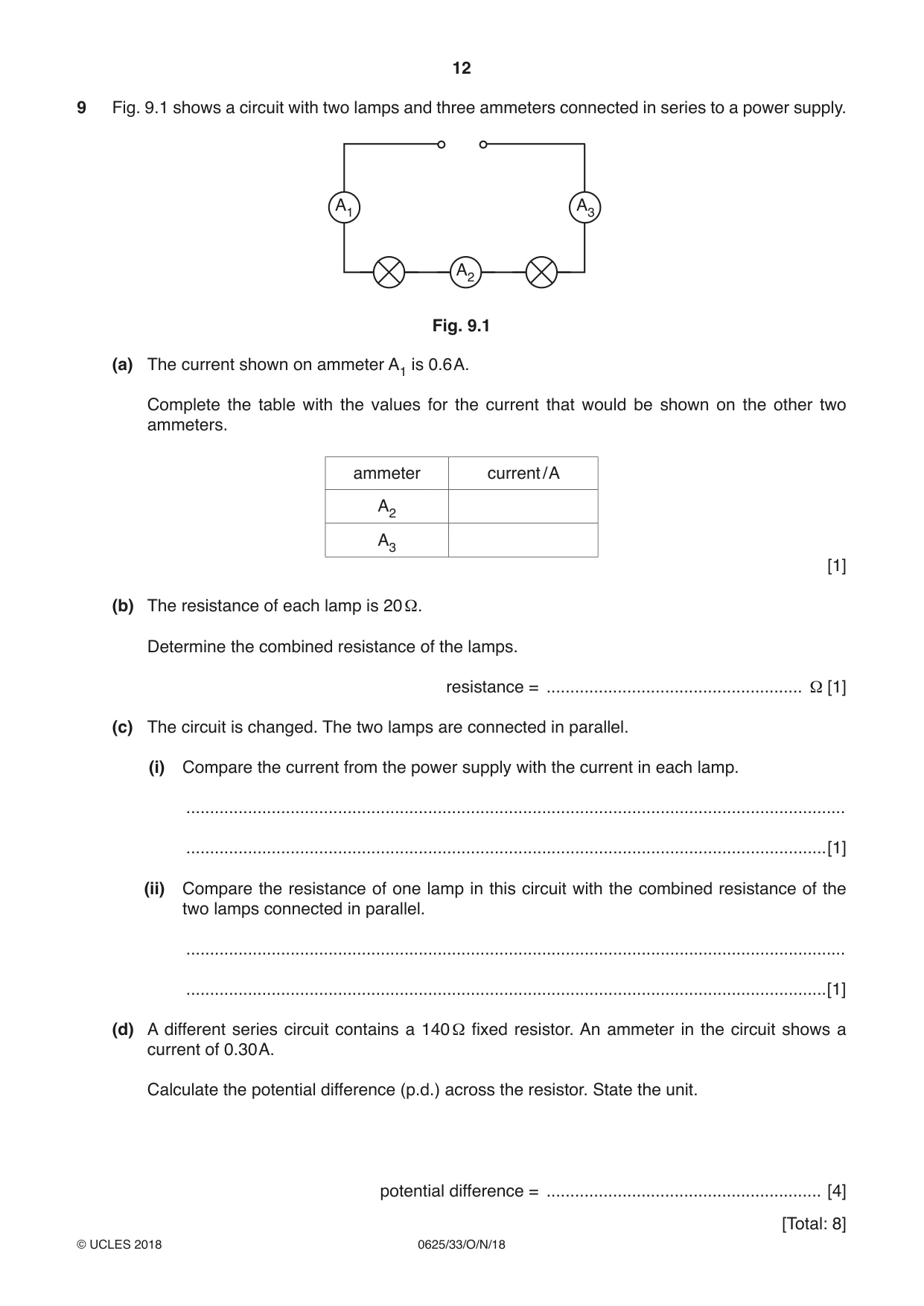
9 Fig. 9.1 shows a circuit with two lamps and three ammeters connected in series to a power supply. A1 A3 A2 Fig. 9.1 (a) The current shown on ammeter A1 is 0.6 A. Complete the table with the values for the current that would be shown on the other two ammeters. ammeter current / A A2 A3 [1] (b) The resistance of each lamp is 20 Ω. Determine the combined resistance of the lamps. resistance = ...................................................... Ω [1] (c) The circuit is changed. The two lamps are connected in parallel. (i) Compare the current from the power supply with the current in each lamp. ........................................................................................................................................... .......................................................................................................................................[1] (ii) Compare the resistance of one lamp in this circuit with the combined resistance of the two lamps connected in parallel. ........................................................................................................................................... .......................................................................................................................................[1] (d) A different series circuit contains a 140 Ω fixed resistor. An ammeter in the circuit shows a current of 0.30 A. Calculate the potential difference (p.d.) across the resistor. State the unit. potential difference = .......................................................... [4] [Total: 8]
Mark scheme: 9(a) A2 = 0.6 A AND A3 = 0.6 A B1 9(b) 40 (Ω) B1 9(c)(i) current from source is higher than in each lamp or reverse argument B1 9(c)(ii) (combined) resistance of lamps in parallel is less / lower (than one lamp) B1 9(d) V = IR in any recognisable form C1 V = 0.30 × 140 C1 42 A1 V or volts B1
Q10 · State the name of the component represented by the symbol
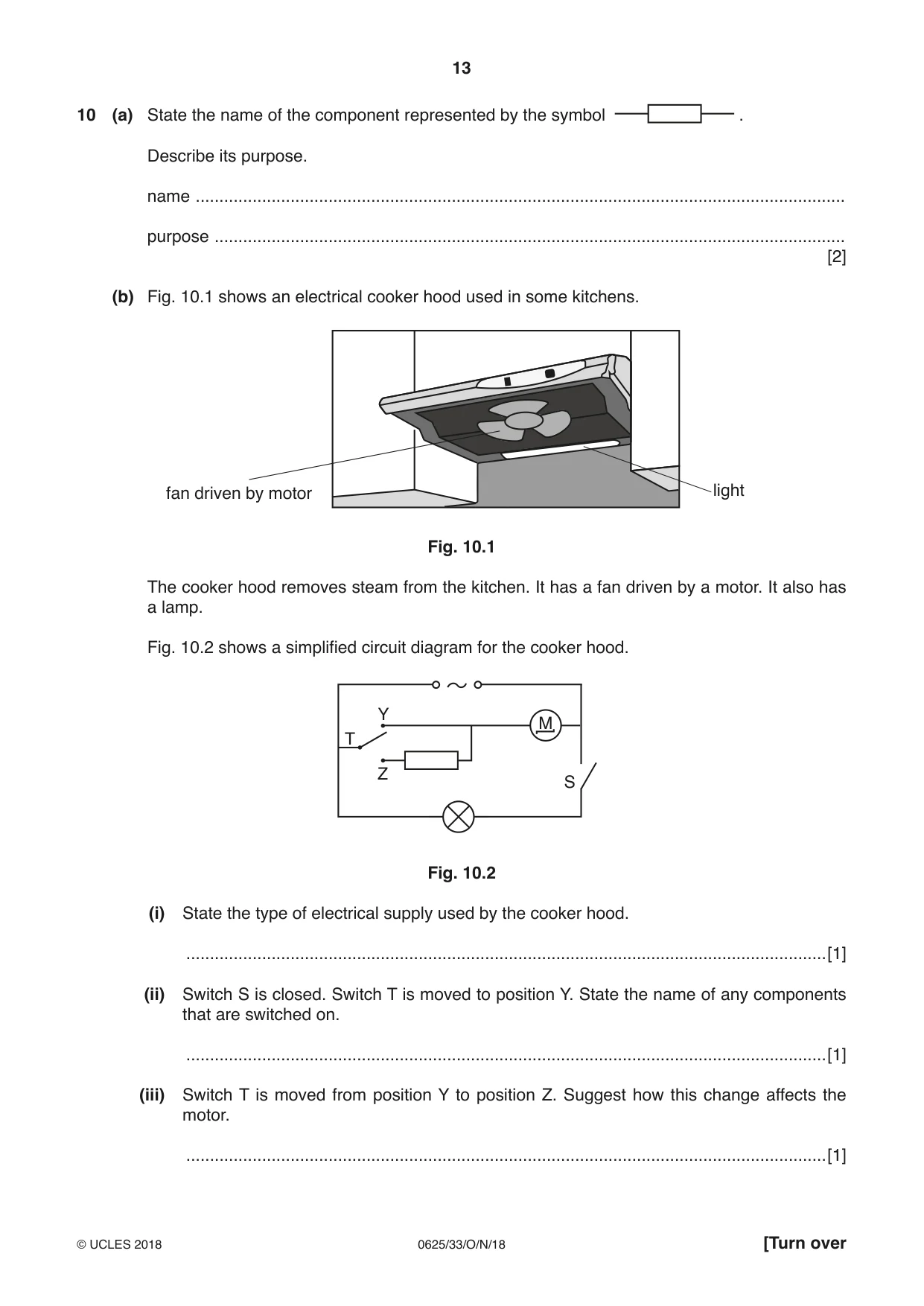
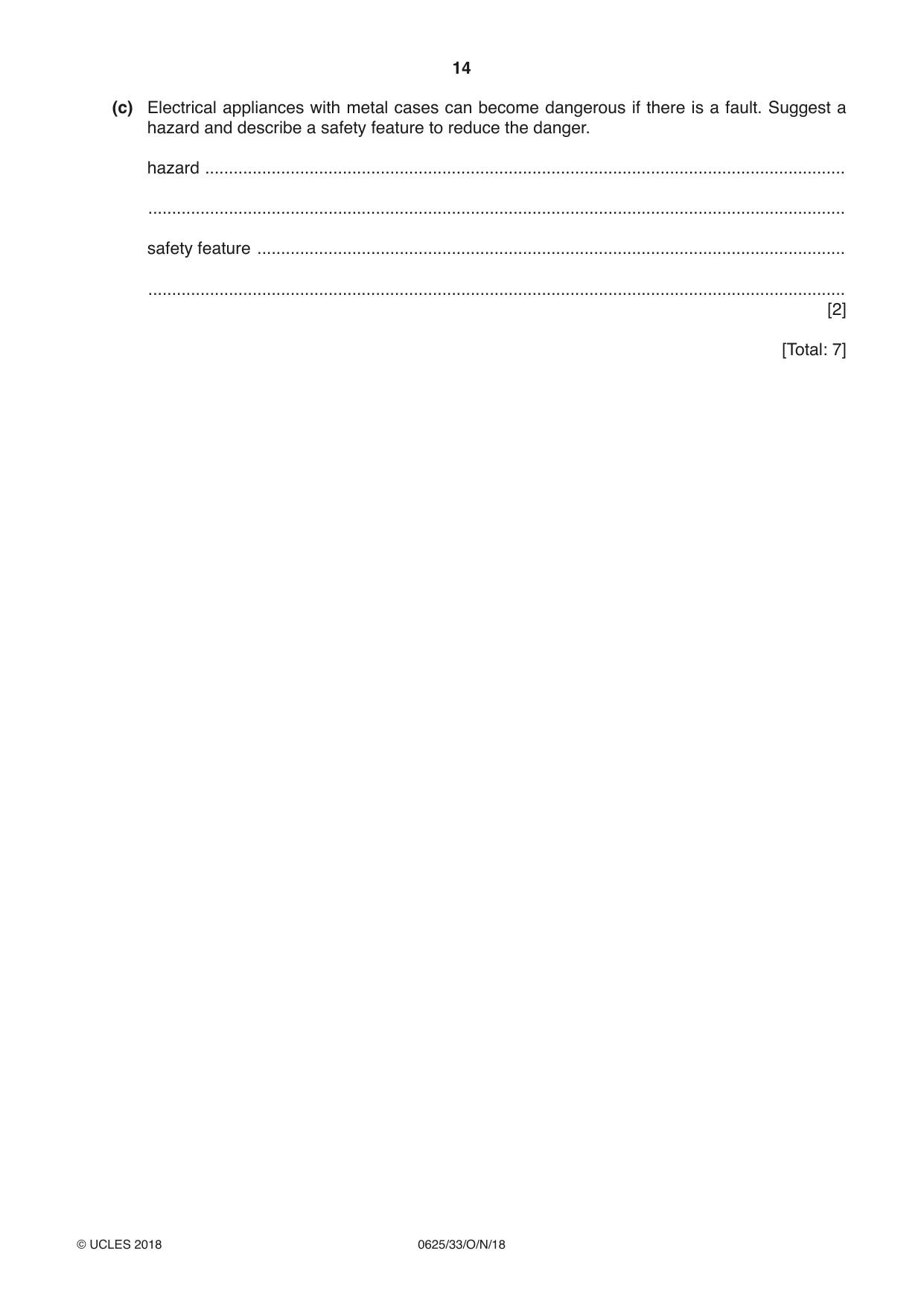
10 (a) State the name of the component represented by the symbol . Describe its purpose. name ......................................................................................................................................... purpose ..................................................................................................................................... [2] (b) Fig. 10.1 shows an electrical cooker hood used in some kitchens. fan driven by motor light Fig. 10.1 The cooker hood removes steam from the kitchen. It has a fan driven by a motor. It also has a lamp. Fig. 10.2 shows a simplified circuit diagram for the cooker hood. Y M T Z S Fig. 10.2 (i) State the type of electrical supply used by the cooker hood. .......................................................................................................................................[1] (ii) Switch S is closed. Switch T is moved to position Y. State the name of any components that are switched on. .......................................................................................................................................[1] (iii) Switch T is moved from position Y to position Z. Suggest how this change affects the motor. .......................................................................................................................................[1] (c) Electrical appliances with metal cases can become dangerous if there is a fault. Suggest a hazard and describe a safety feature to reduce the danger. hazard ....................................................................................................................................... ................................................................................................................................................... safety feature ............................................................................................................................ ................................................................................................................................................... [2] [Total: 7]
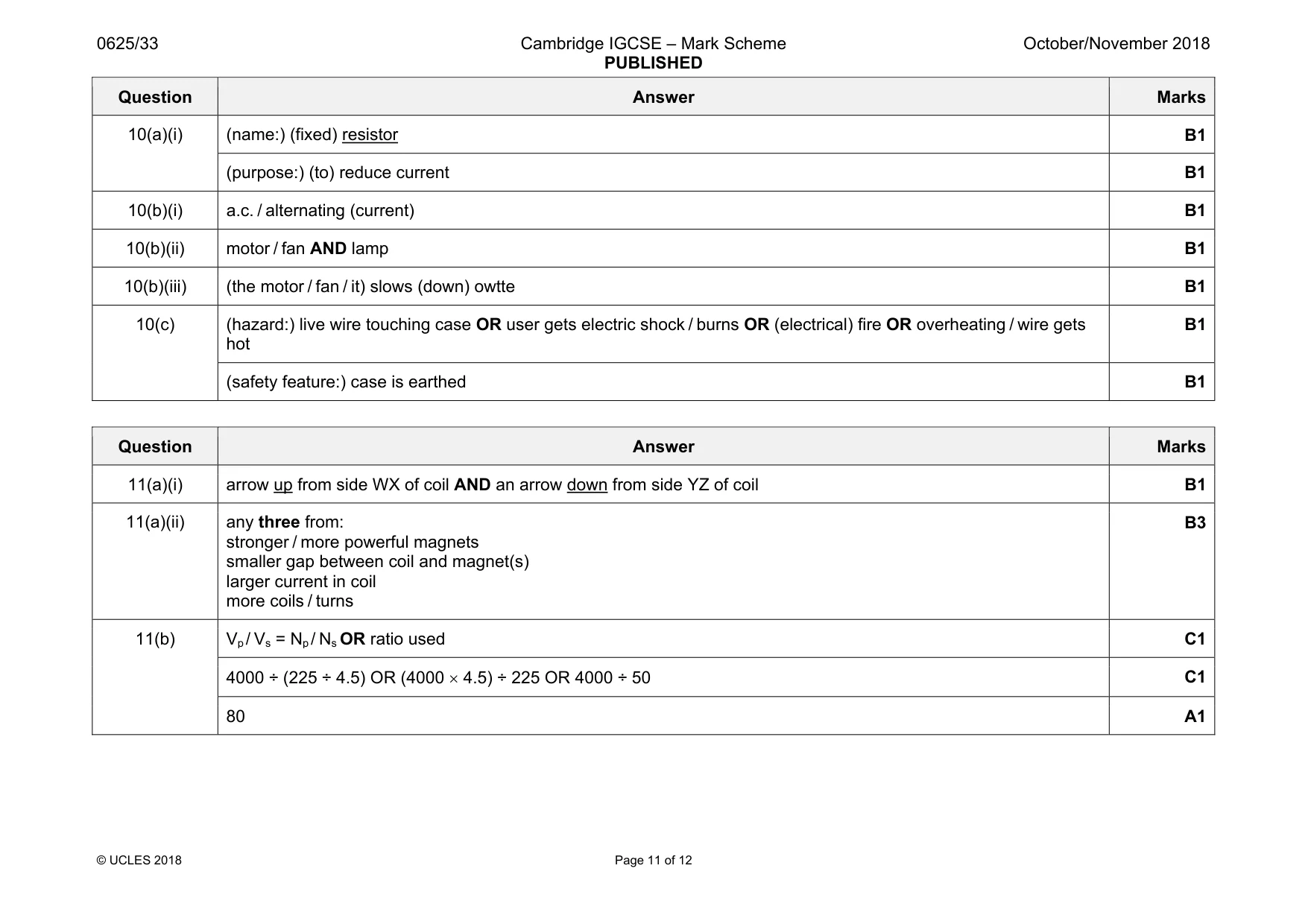
Mark scheme: 10(a)(i) (name:) (fixed) resistor B1 (purpose:) (to) reduce current B1 10(b)(i) a.c. / alternating (current) B1 10(b)(ii) motor / fan AND lamp B1 10(b)(iii) (the motor / fan / it) slows (down) owtte B1 10(c) (hazard:) live wire touching case OR user gets electric shock / burns OR (electrical) fire OR overheating / wire gets hot B1 (safety feature:) case is earthed B1
Q11 · A simple electric motor
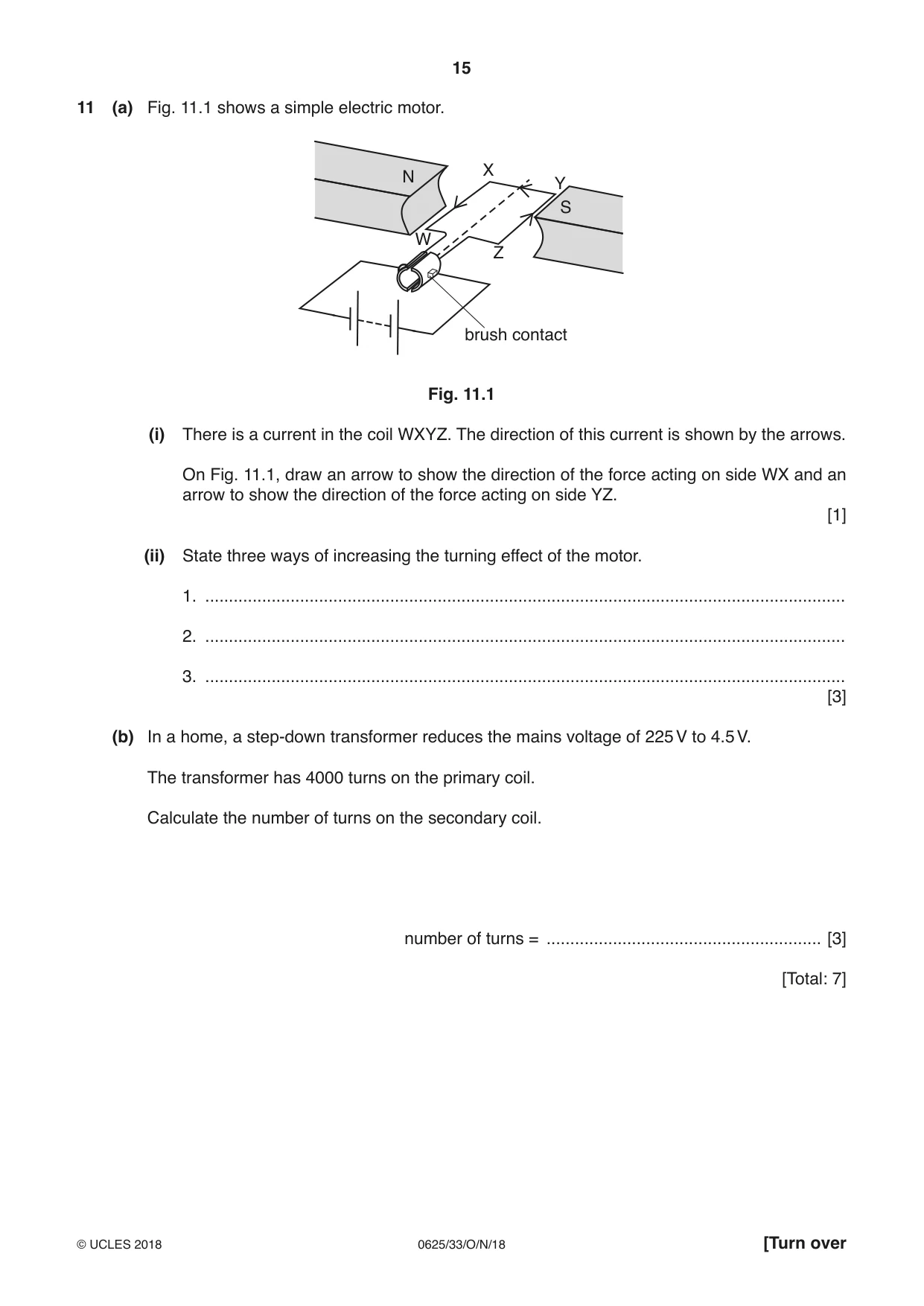
11 (a) Fig. 11.1 shows a simple electric motor. X N Y S W Z brush contact Fig. 11.1 (i) There is a current in the coil WXYZ. The direction of this current is shown by the arrows. On Fig. 11.1, draw an arrow to show the direction of the force acting on side WX and an arrow to show the direction of the force acting on side YZ. [1] (ii) State three ways of increasing the turning effect of the motor. 1. ....................................................................................................................................... 2. ....................................................................................................................................... 3. ....................................................................................................................................... [3] (b) In a home, a step-down transformer reduces the mains voltage of 225 V to 4.5 V. The transformer has 4000 turns on the primary coil. Calculate the number of turns on the secondary coil. number of turns = .......................................................... [3] [Total: 7]
Mark scheme: 11(a)(i) arrow up from side WX of coil AND an arrow down from side YZ of coil B1 11(a)(ii) any three from: stronger / more powerful magnets smaller gap between coil and magnet(s) larger current in coil more coils / turns B3 11(b) Vp/ Vs = Np / Ns OR ratio used C1 4000 ÷ (225 ÷ 4.5) OR (4000 × 4.5) ÷ 225 OR 4000 ÷ 50 C1 80 A1
Q12 · A nuclear power station uses uranium to generate thermal energy
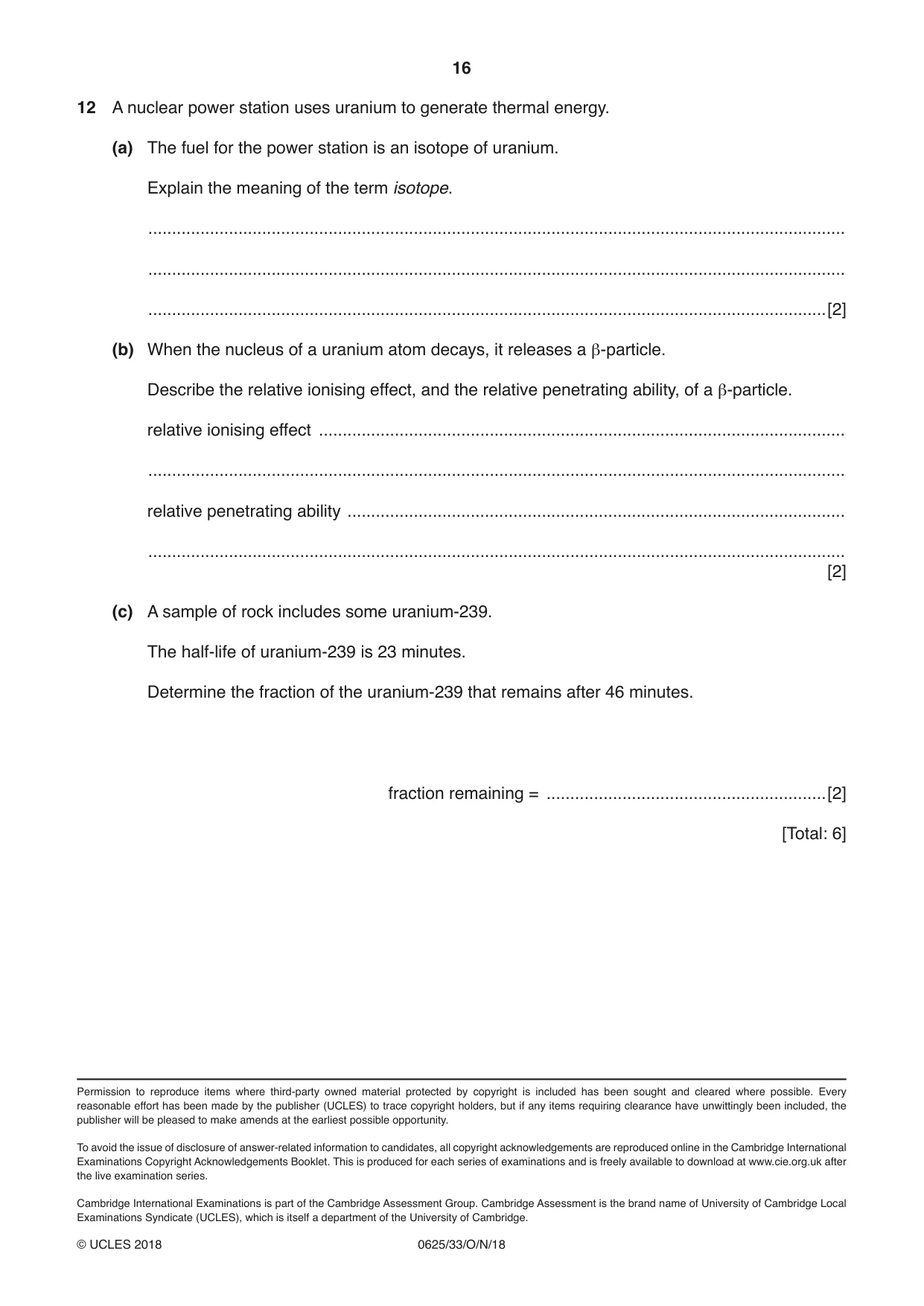
12 A nuclear power station uses uranium to generate thermal energy. (a) The fuel for the power station is an isotope of uranium. Explain the meaning of the term isotope. ................................................................................................................................................... ................................................................................................................................................... ...............................................................................................................................................[2] (b) When the nucleus of a uranium atom decays, it releases a β-particle. Describe the relative ionising effect, and the relative penetrating ability, of a β-particle. relative ionising effect ............................................................................................................... ................................................................................................................................................... relative penetrating ability ......................................................................................................... ................................................................................................................................................... [2] (c) A sample of rock includes some uranium-239. The half-life of uranium-239 is 23 minutes. Determine the fraction of the uranium-239 that remains after 46 minutes. fraction remaining = ...........................................................[2] [Total: 6]
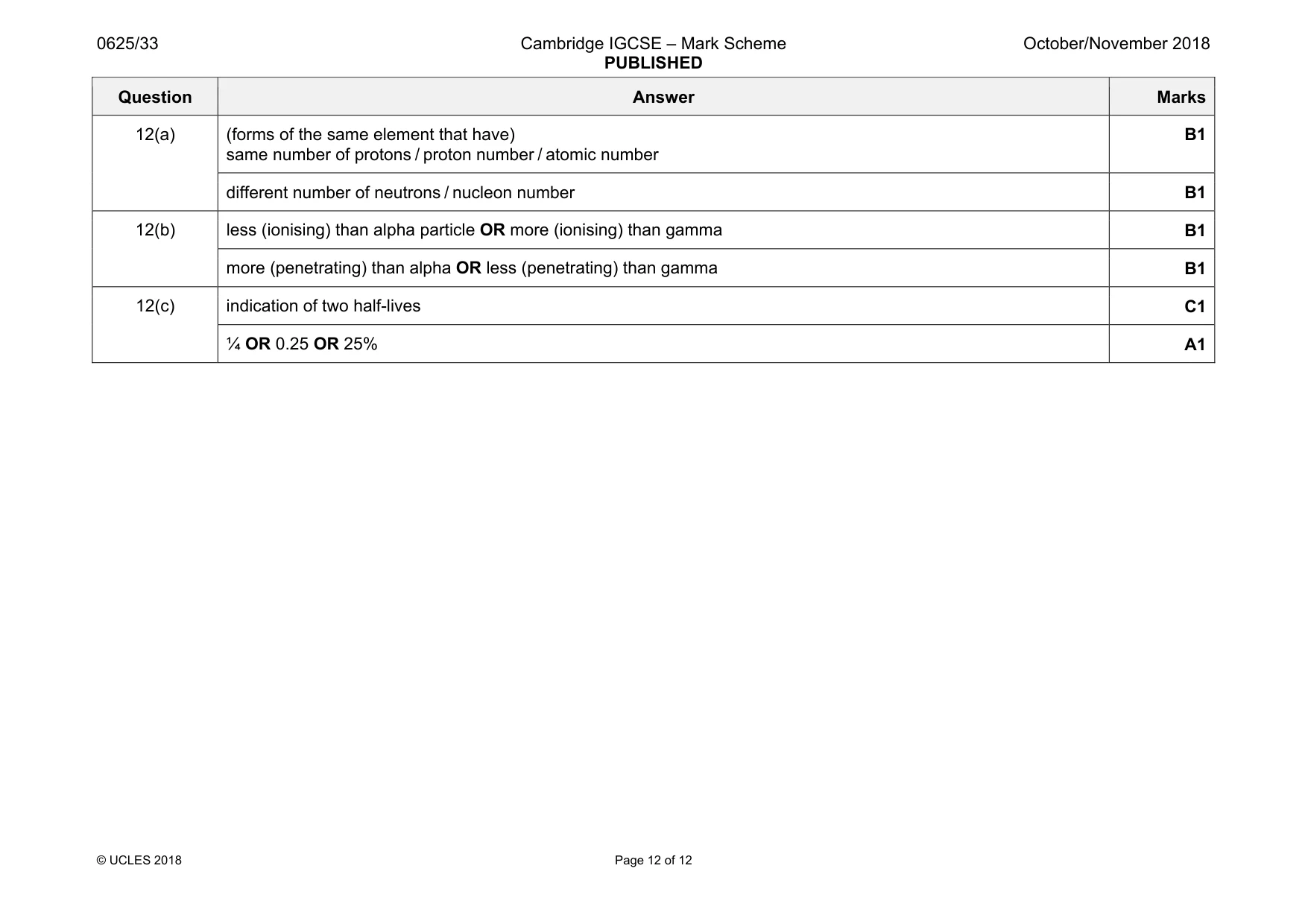
Mark scheme: 12(a) (forms of the same element that have) same number of protons / proton number / atomic number B1 different number of neutrons / nucleon number B1 12(b) less (ionising) than alpha particle OR more (ionising) than gamma B1 more (penetrating) than alpha OR less (penetrating) than gamma B1 12(c) indication of two half-lives C1 ¼ OR 0.25 OR 25% A1
What was in this paper
The subtopics covered by these 12 questions, and how many questions each got. Open one in a new tab to see every Cambridge question on it.
What you needed in this session
Cambridge’s own grade thresholds for 2018 Oct/Nov, Paper 3 · Variant 3. A higher threshold means an easier paper — the bar moves with how the cohort did.