Cambridge IGCSE Physics 0625 — 2024 May/June Paper 3 · Variant 3
0625/33/M/J/24 · 11 questions · 80 marks · ≈90 min
The question paper and its mark scheme, free to read here and free to download. This is Cambridge’s own paper, exactly as it was sat.
Question paper16 pages

Mark scheme12 pages
Answers below. Sit the paper first if you are practising.
Questions as text
Q1 · A girl is cycling along a straight horizontal road
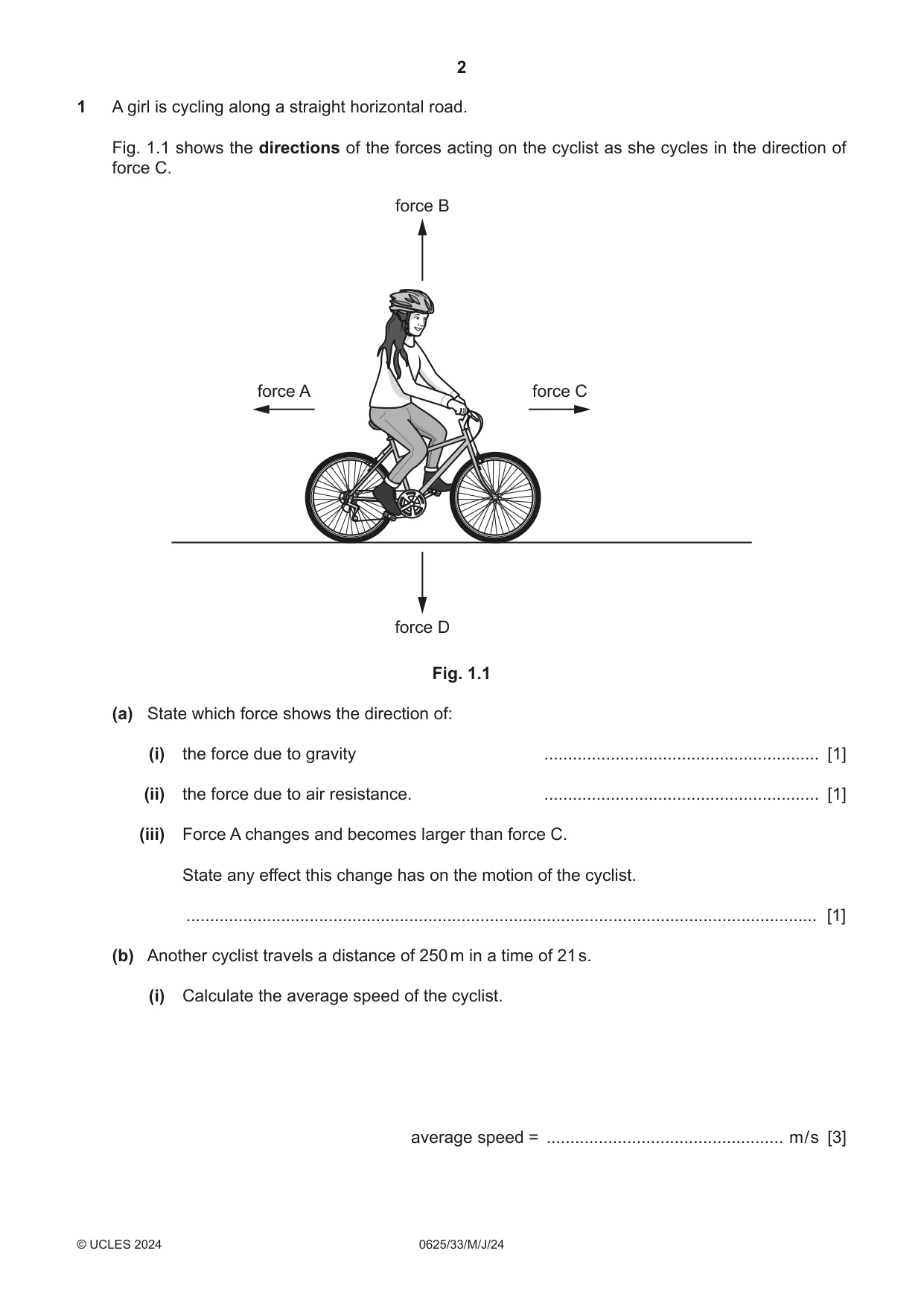
1 A girl is cycling along a straight horizontal road. Fig. 1.1 shows the directions of the forces acting on the cyclist as she cycles in the direction of force C. force B force A force C force D Fig. 1.1 (a) State which force shows the direction of: (i) the force due to gravity .......................................................... [1] (ii) the force due to air resistance. .......................................................... [1] (iii) Force A changes and becomes larger than force C. State any effect this change has on the motion of the cyclist. ..................................................................................................................................... [1] (b) Another cyclist travels a distance of 250 m in a time of 21 s. (i) Calculate the average speed of the cyclist. average speed = .................................................. m/s [3] (ii) The cyclist exerts a force of 36 N to move the cycle forwards. Calculate the work done by this force when the cyclist travels 250 m. Include the unit. work done = ............................... unit ............... [4] [Total: 10]
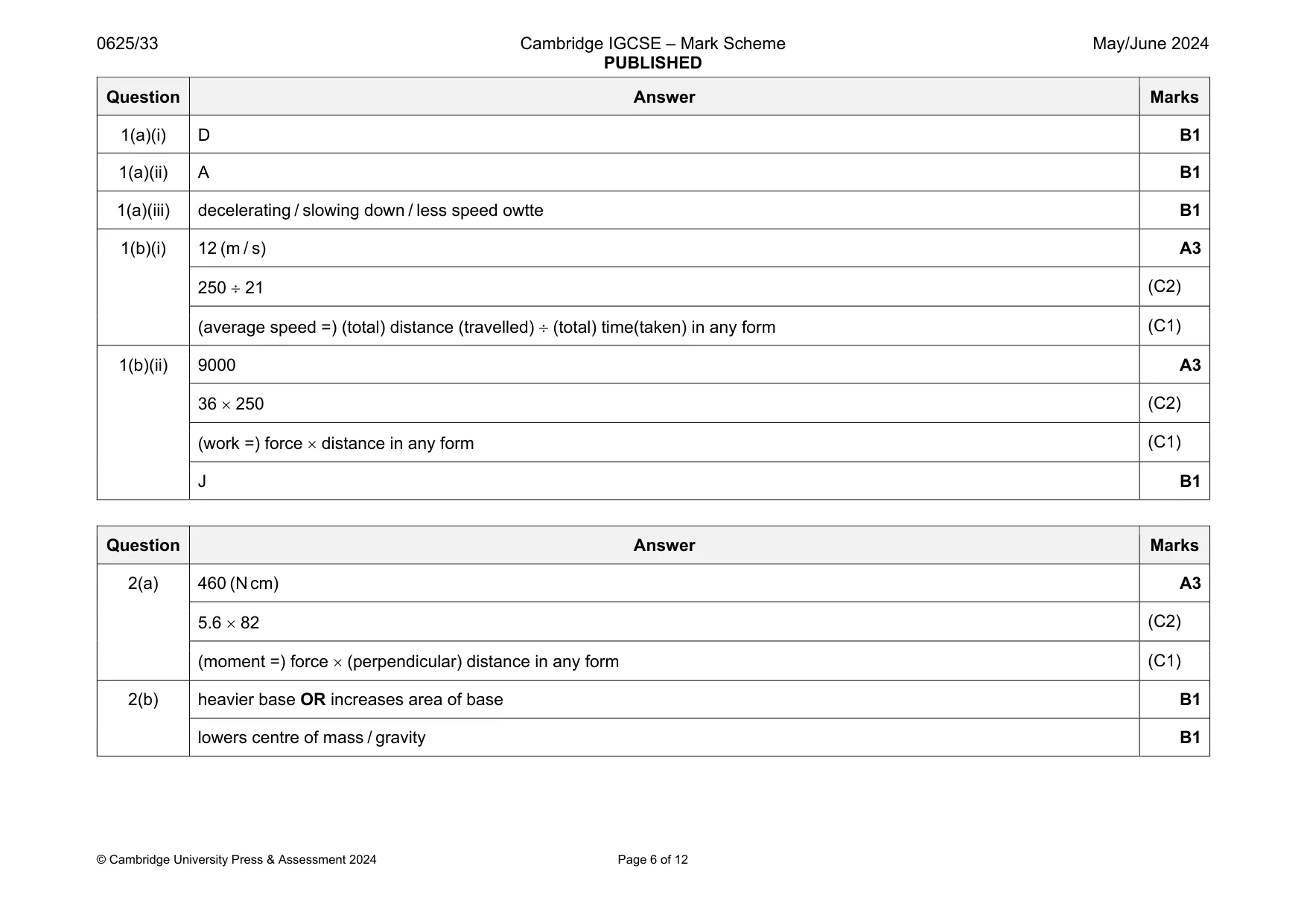
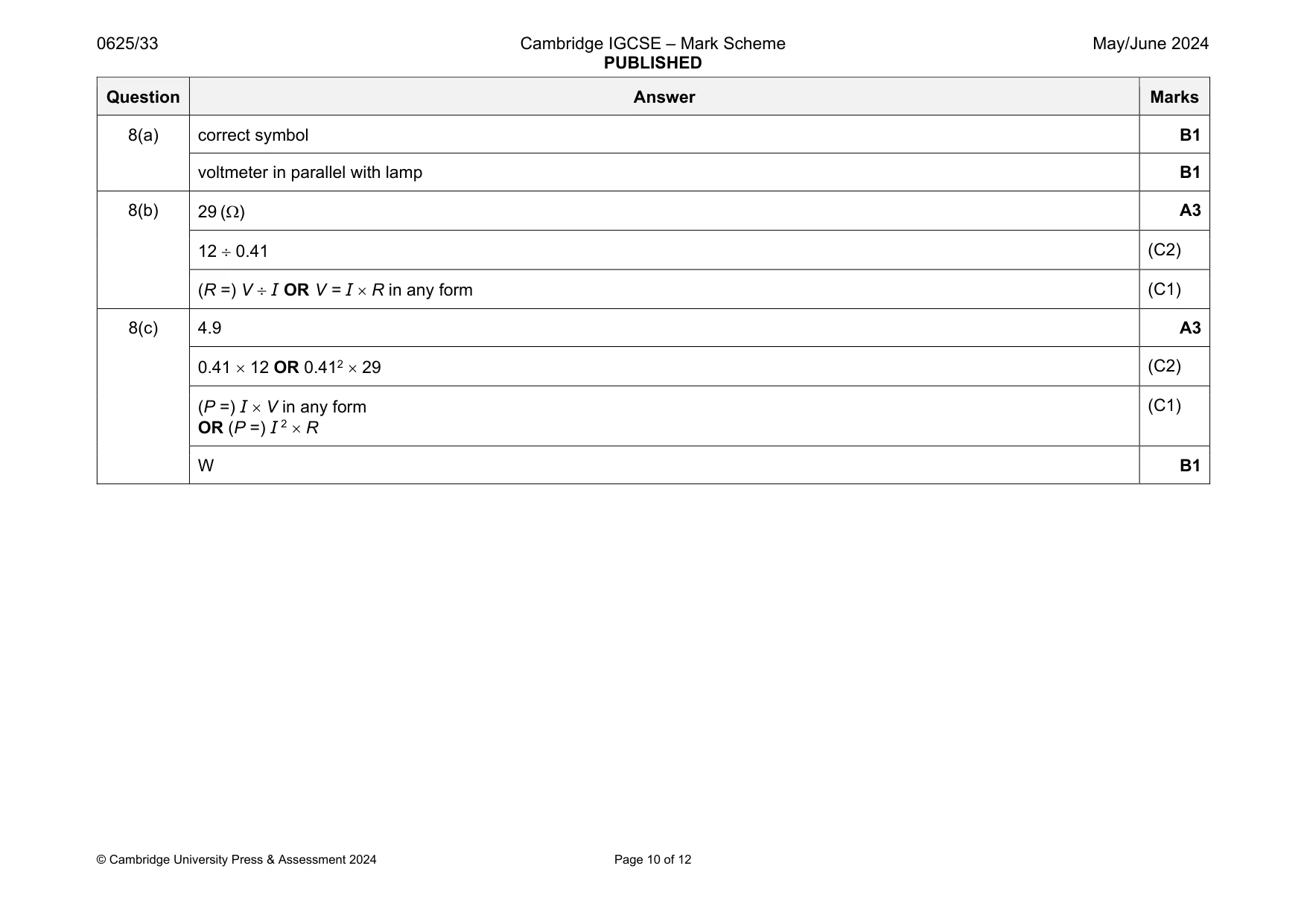
Mark scheme: 1(a)(i) D B1 1(a)(ii) A B1 1(a)(iii) decelerating / slowing down / less speed owtte B1 1(b)(i) 12 (m / s) A3 250 21 (C2) (average speed =) (total) distance (travelled) (total) time(taken) in any form (C1) 1(b)(ii) 9000 A3 36 250 (C2) (work =) force distance in any form (C1) J B1
Q2 · A road sign on the ground
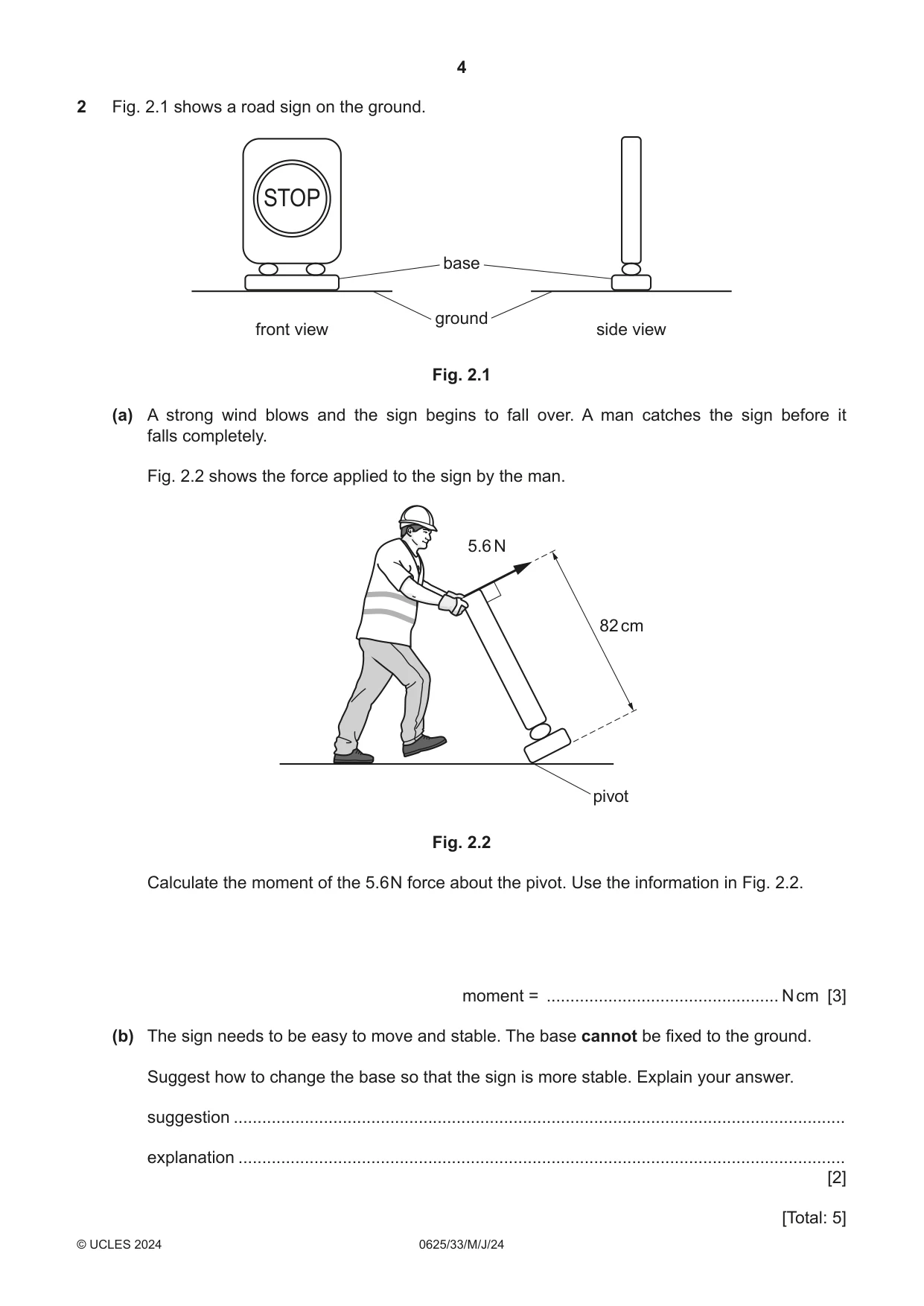
2 Fig. 2.1 shows a road sign on the ground. STOP base ground front view side view Fig. 2.1 (a) A strong wind blows and the sign begins to fall over. A man catches the sign before it falls completely. Fig. 2.2 shows the force applied to the sign by the man. 5.6 N 82 cm pivot Fig. 2.2 Calculate the moment of the 5.6 N force about the pivot. Use the information in Fig. 2.2. moment = ................................................. N cm [3] (b) The sign needs to be easy to move and stable. The base cannot be fixed to the ground. Suggest how to change the base so that the sign is more stable. Explain your answer. suggestion ................................................................................................................................. explanation ................................................................................................................................ [2] [Total: 5]
Mark scheme: 2(a) 460 (N cm) A3 5.6 82 (C2) (moment =) force (perpendicular) distance in any form (C1) 2(b) heavier base OR increases area of base B1 lowers centre of mass / gravity B1
Q3 · A hydroelectric power station transmitting electrical energy to homes and factories far…
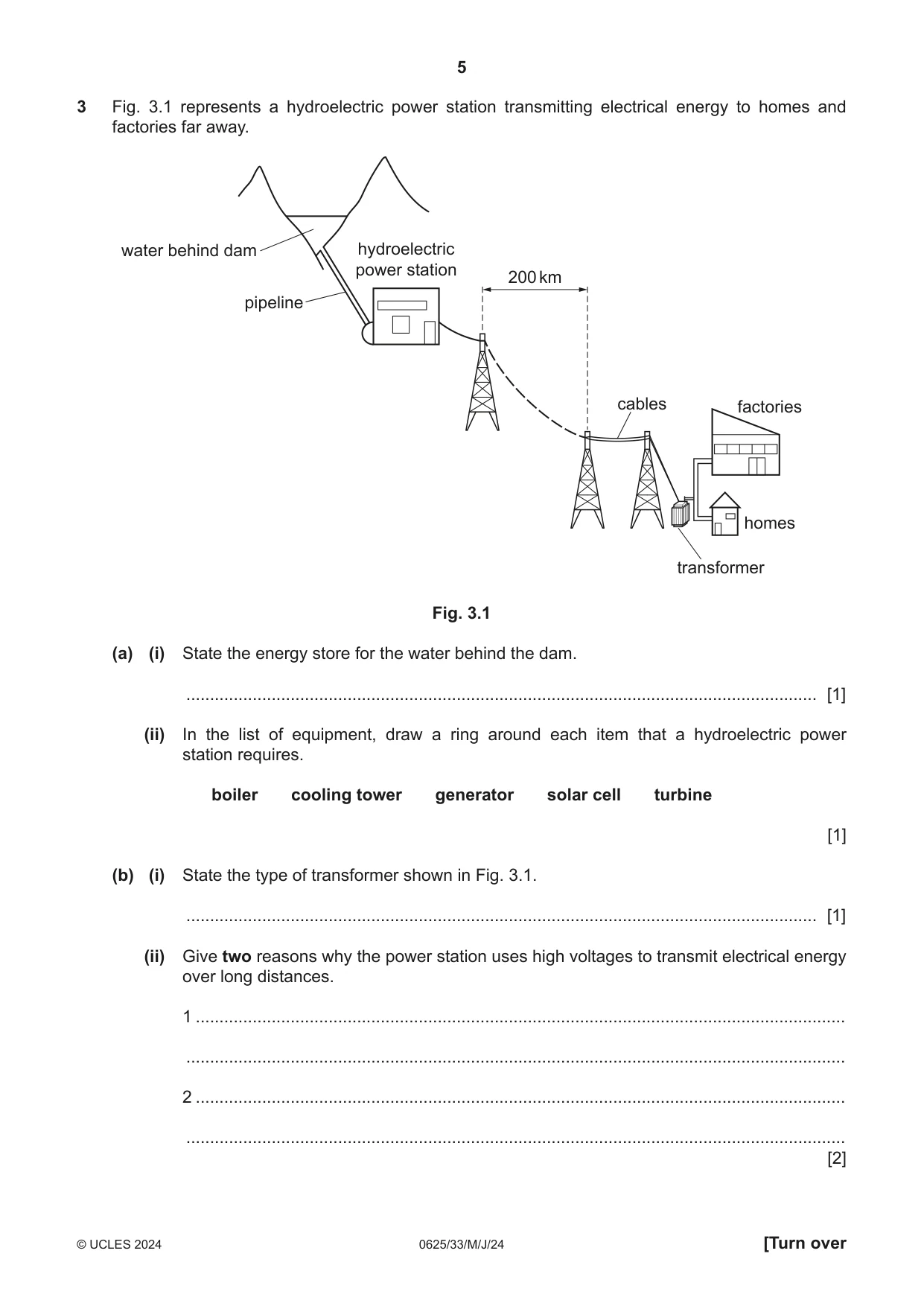
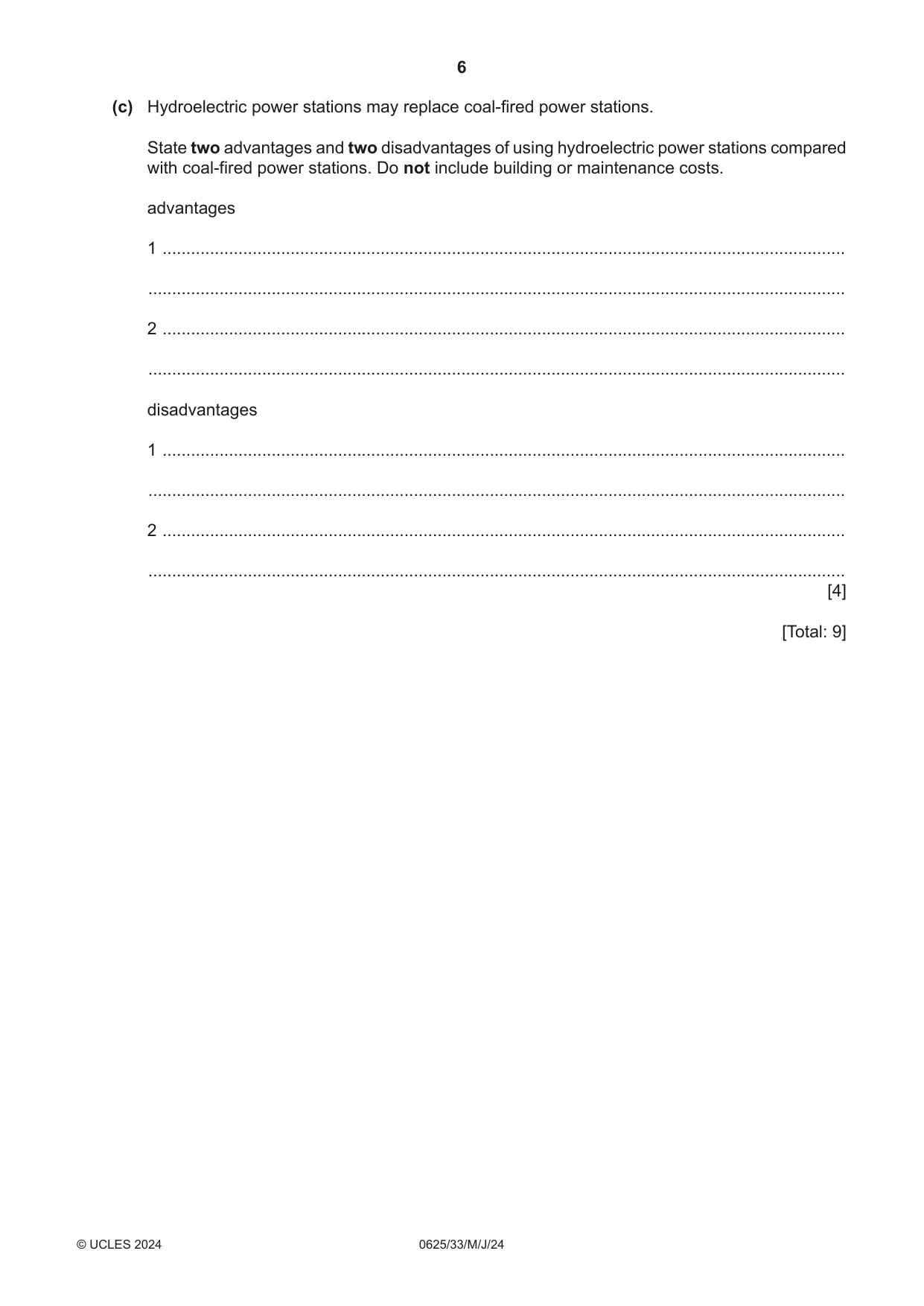
3 Fig. 3.1 represents a hydroelectric power station transmitting electrical energy to homes and factories far away. water behind dam hydroelectric power station 200 km pipeline cables factories homes transformer Fig. 3.1 (a) (i) State the energy store for the water behind the dam. ..................................................................................................................................... [1] (ii) In the list of equipment, draw a ring around each item that a hydroelectric power station requires. boiler cooling tower generator solar cell turbine [1] (b) (i) State the type of transformer shown in Fig. 3.1. ..................................................................................................................................... [1] (ii) Give two reasons why the power station uses high voltages to transmit electrical energy over long distances. 1 ......................................................................................................................................... ........................................................................................................................................... 2 ......................................................................................................................................... ........................................................................................................................................... [2] (c) Hydroelectric power stations may replace coal‑fired power stations. State two advantages and two disadvantages of using hydroelectric power stations compared with coal‑fired power stations. Do not include building or maintenance costs. advantages 1 ................................................................................................................................................ ................................................................................................................................................... 2 ................................................................................................................................................ ................................................................................................................................................... disadvantages 1 ................................................................................................................................................ ................................................................................................................................................... 2 ................................................................................................................................................ ................................................................................................................................................... [4] [Total: 9]
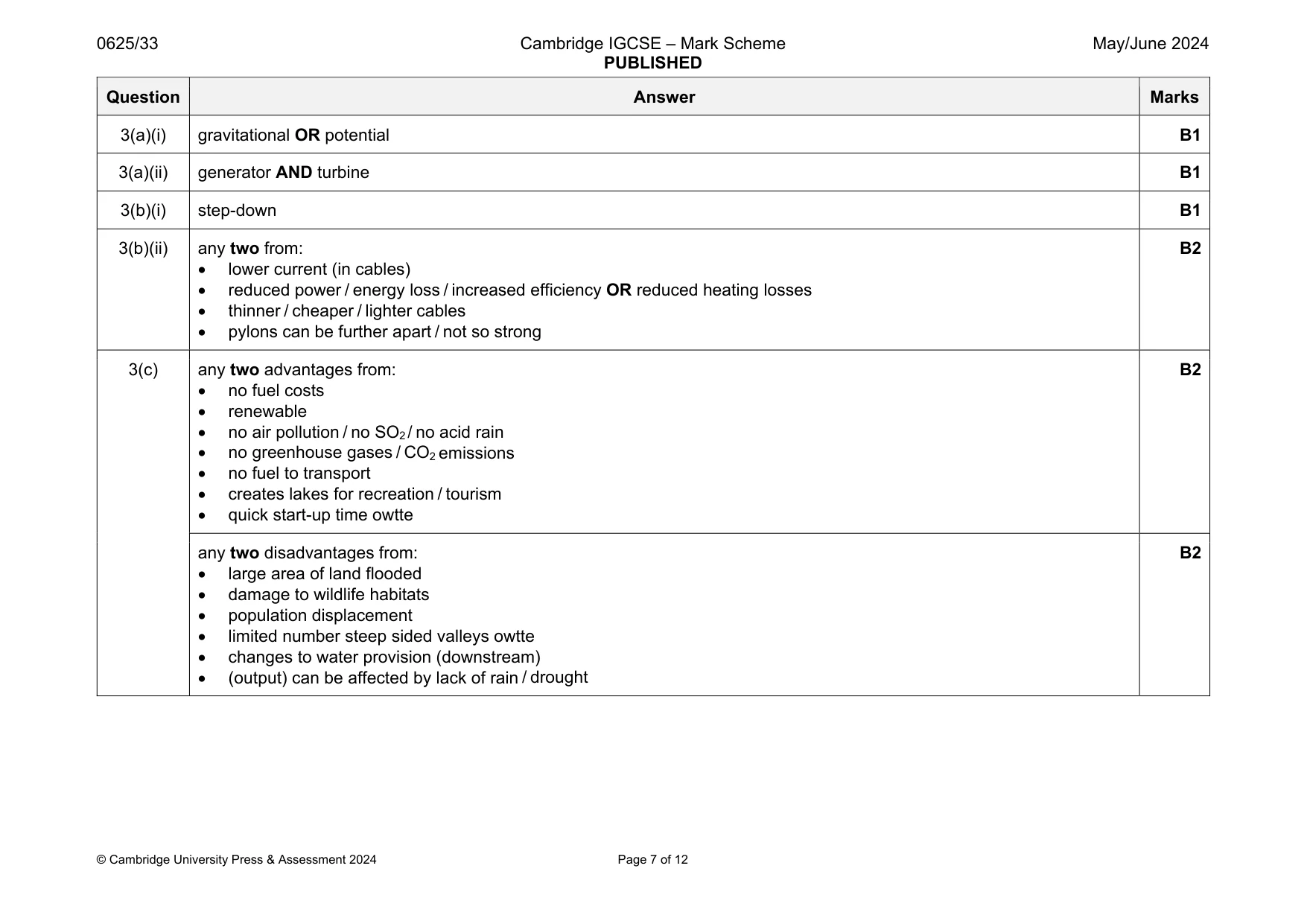
Mark scheme: 3(a)(i) gravitational OR potential B1 3(a)(ii) generator AND turbine B1 3(b)(i) step-down B1 3(b)(ii) any two from: lower current (in cables) reduced power / energy loss / increased efficiency OR reduced heating losses thinner / cheaper / lighter cables pylons can be further apart / not so strong B2 3(c) any two advantages from: no fuel costs renewable no air pollution / no SO2 / no acid rain no greenhouse gases / CO2 emissions no fuel to transport creates lakes for recreation / tourism quick start-up time owtte B2 any two disadvantages from: large area of land flooded damage to wildlife habitats population displacement limited number steep sided valleys owtte changes to water provision (downstream) (output) can be affected by lack of rain / drought B2
Q4 · The arrangement of particles in a solid
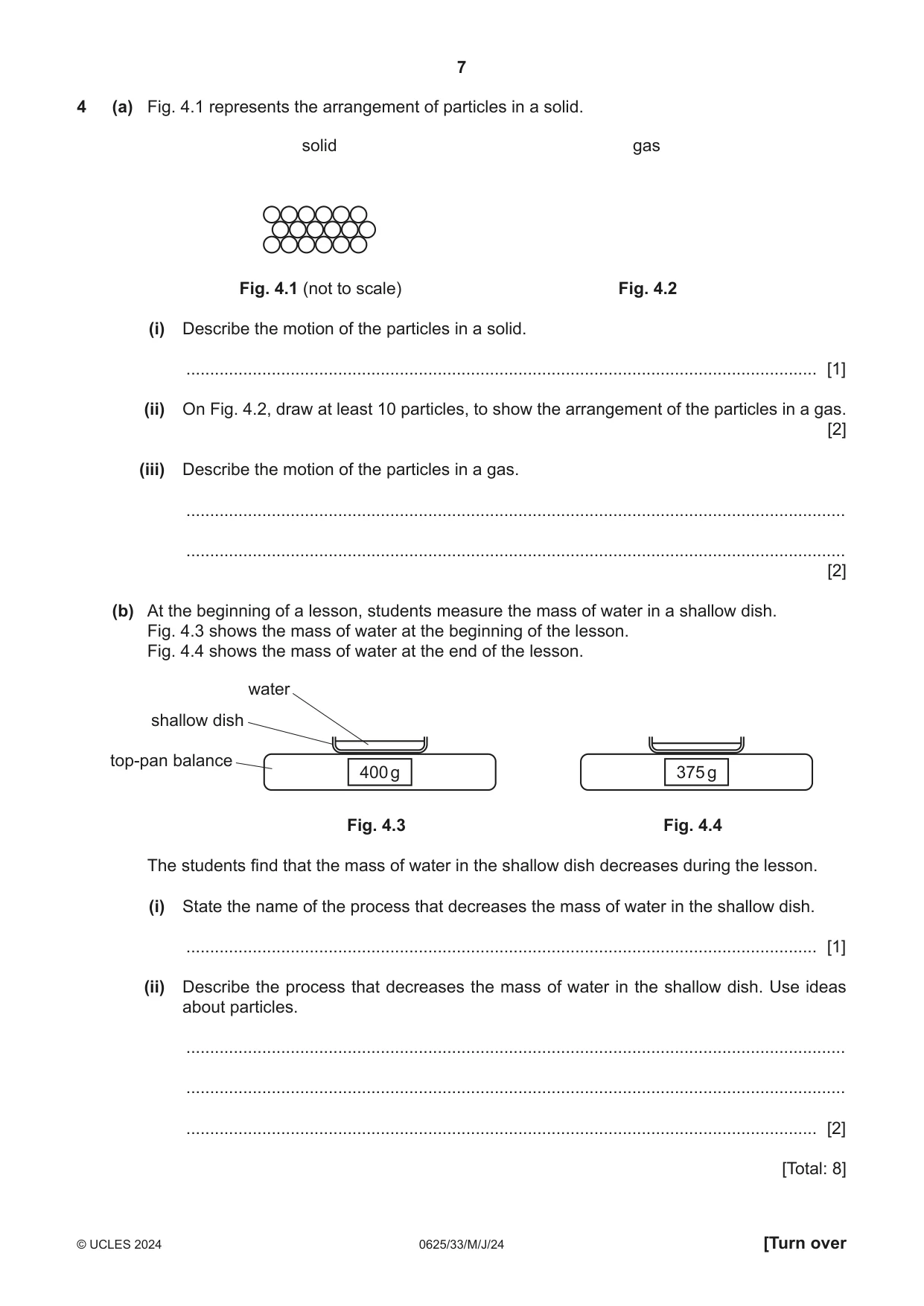
4 (a) Fig. 4.1 represents the arrangement of particles in a solid. solid gas Fig. 4.1 (not to scale) Fig. 4.2 (i) Describe the motion of the particles in a solid. ..................................................................................................................................... [1] (ii) On Fig. 4.2, draw at least 10 particles, to show the arrangement of the particles in a gas. [2] (iii) Describe the motion of the particles in a gas. ........................................................................................................................................... ........................................................................................................................................... [2] (b) At the beginning of a lesson, students measure the mass of water in a shallow dish. Fig. 4.3 shows the mass of water at the beginning of the lesson. Fig. 4.4 shows the mass of water at the end of the lesson. water shallow dish top-pan balance 400 g 375 g Fig. 4.3 Fig. 4.4 The students find that the mass of water in the shallow dish decreases during the lesson. (i) State the name of the process that decreases the mass of water in the shallow dish. ..................................................................................................................................... [1] (ii) Describe the process that decreases the mass of water in the shallow dish. Use ideas about particles. ........................................................................................................................................... ........................................................................................................................................... ..................................................................................................................................... [2] [Total: 8]
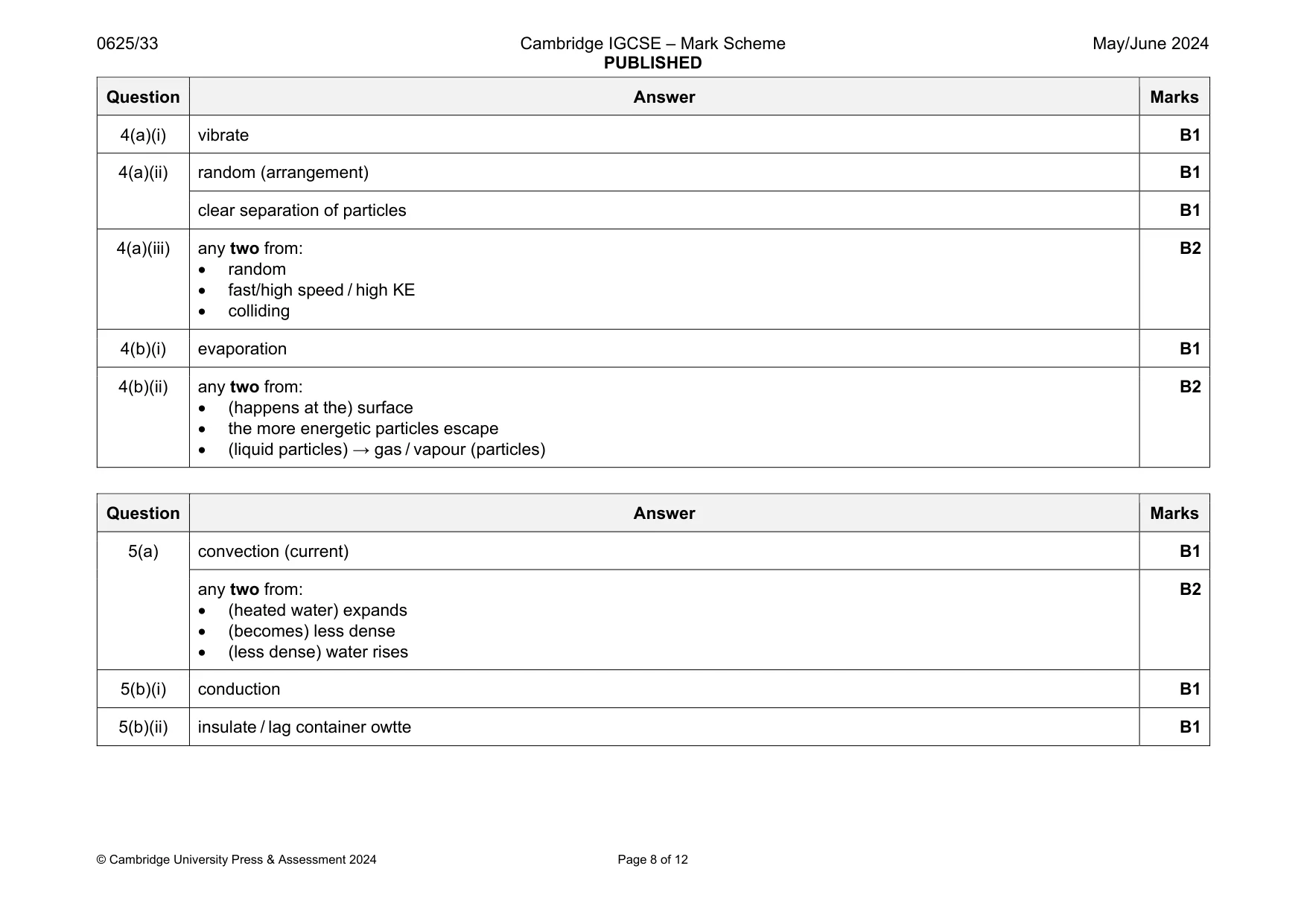
Mark scheme: 4(a)(i) vibrate B1 4(a)(ii) random (arrangement) B1 clear separation of particles B1 4(a)(iii) any two from: random fast/high speed / high KE colliding B2 4(b)(i) evaporation B1 4(b)(ii) any two from: (happens at the) surface the more energetic particles escape (liquid particles) → gas / vapour (particles) B2
Q5 · An arrangement for heating water
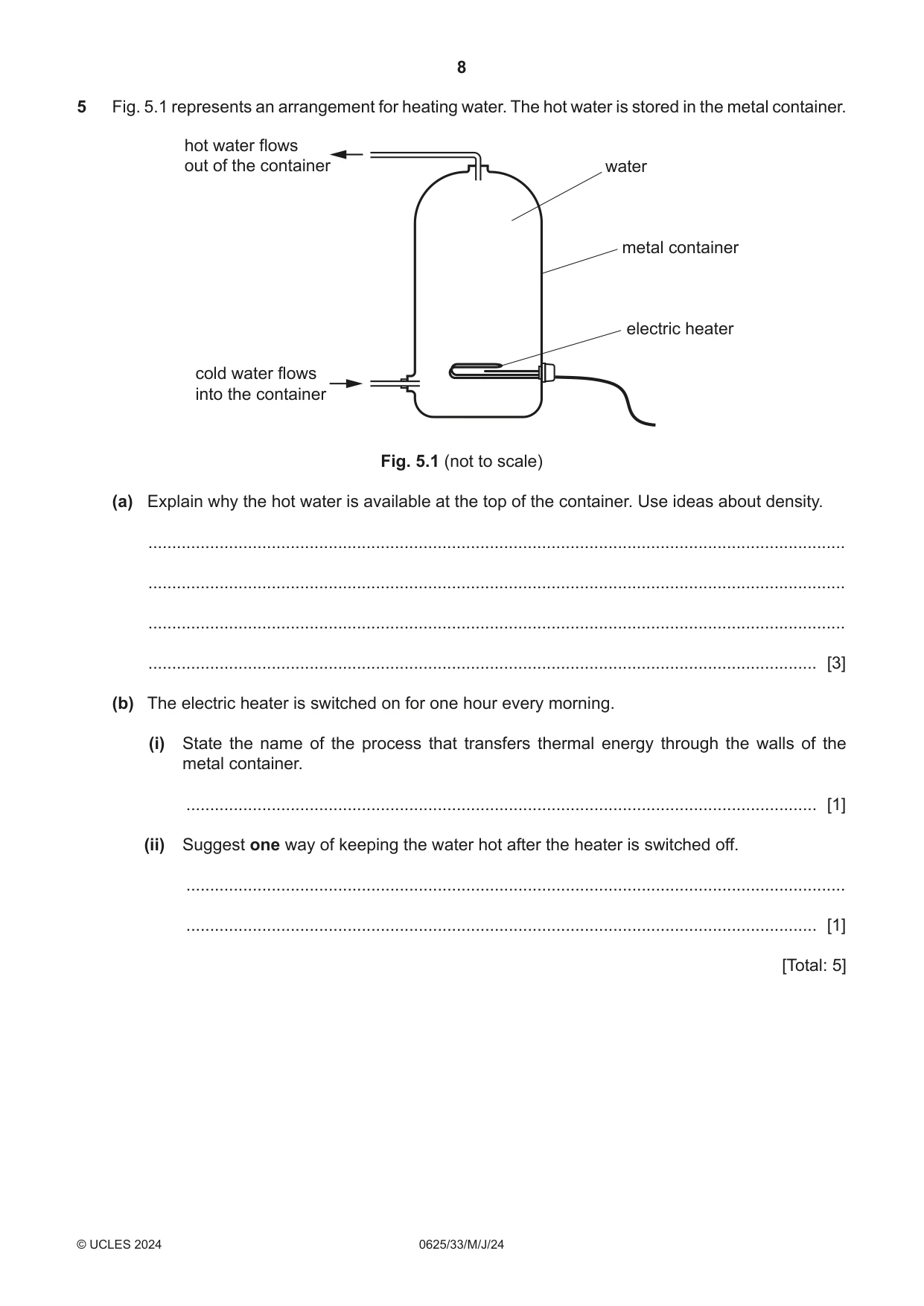
5 Fig. 5.1 represents an arrangement for heating water. The hot water is stored in the metal container. hot water flows out of the container water metal container electric heater cold water flows into the container Fig. 5.1 (not to scale) (a) Explain why the hot water is available at the top of the container. Use ideas about density. ................................................................................................................................................... ................................................................................................................................................... ................................................................................................................................................... ............................................................................................................................................. [3] (b) The electric heater is switched on for one hour every morning. (i) State the name of the process that transfers thermal energy through the walls of the metal container. ..................................................................................................................................... [1] (ii) Suggest one way of keeping the water hot after the heater is switched off. ........................................................................................................................................... ..................................................................................................................................... [1] [Total: 5]
Mark scheme: 5(a) convection (current) B1 any two from: (heated water) expands (becomes) less dense (less dense) water rises B2 5(b)(i) conduction B1 5(b)(ii) insulate / lag container owtte B1
Q6 · State the name of the type of wave in which the direction of vibration is at right angles…
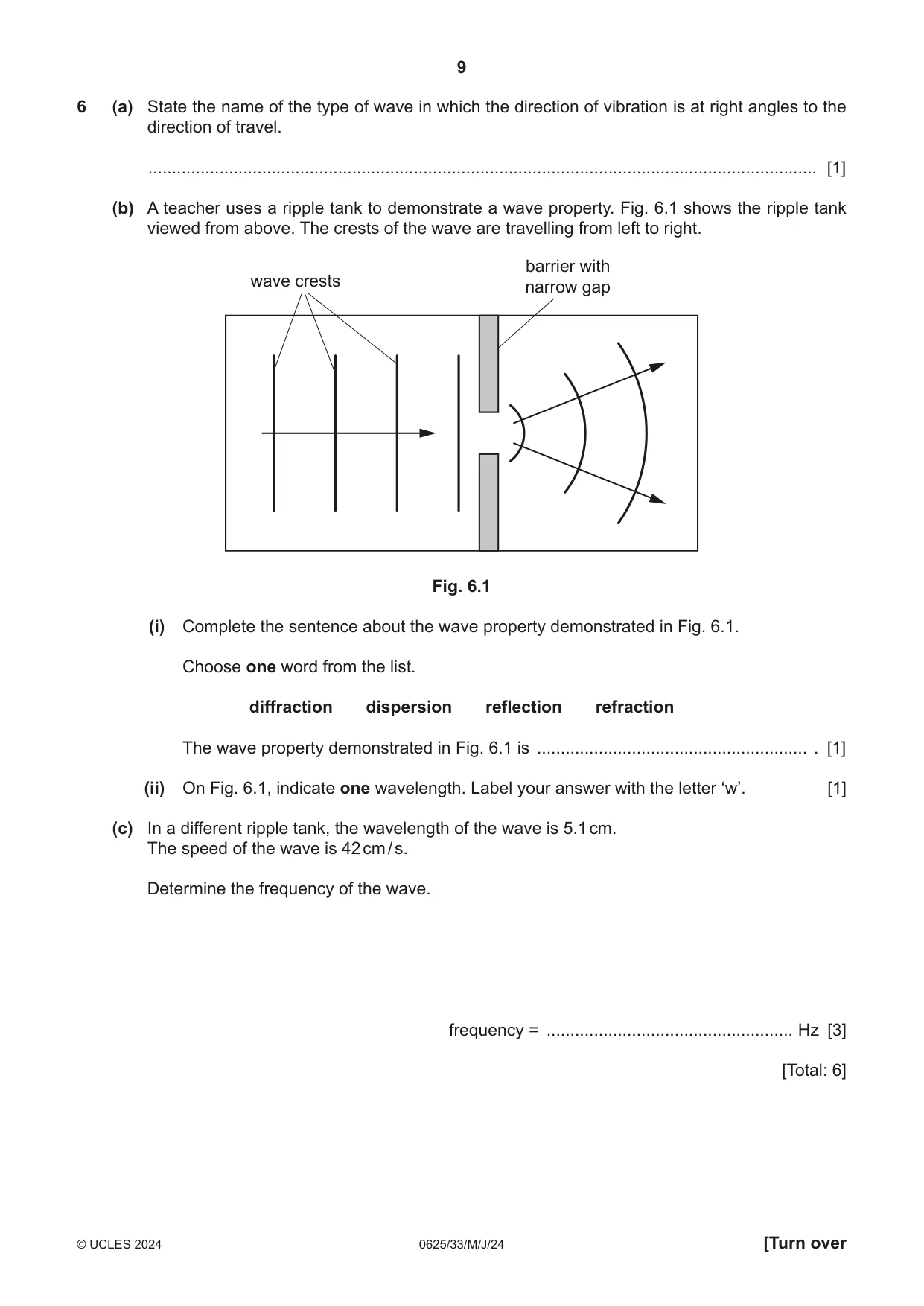
6 (a) State the name of the type of wave in which the direction of vibration is at right angles to the direction of travel. ............................................................................................................................................. [1] (b) A teacher uses a ripple tank to demonstrate a wave property. Fig. 6.1 shows the ripple tank viewed from above. The crests of the wave are travelling from left to right. barrier with wave crests narrow gap Fig. 6.1 (i) Complete the sentence about the wave property demonstrated in Fig. 6.1. Choose one word from the list. diffraction dispersion reflection refraction The wave property demonstrated in Fig. 6.1 is ......................................................... . [1] (ii) On Fig. 6.1, indicate one wavelength. Label your answer with the letter ‘w’. [1] (c) In a different ripple tank, the wavelength of the wave is 5.1 cm. The speed of the wave is 42 cm / s. Determine the frequency of the wave. frequency = .................................................... Hz [3] [Total: 6]
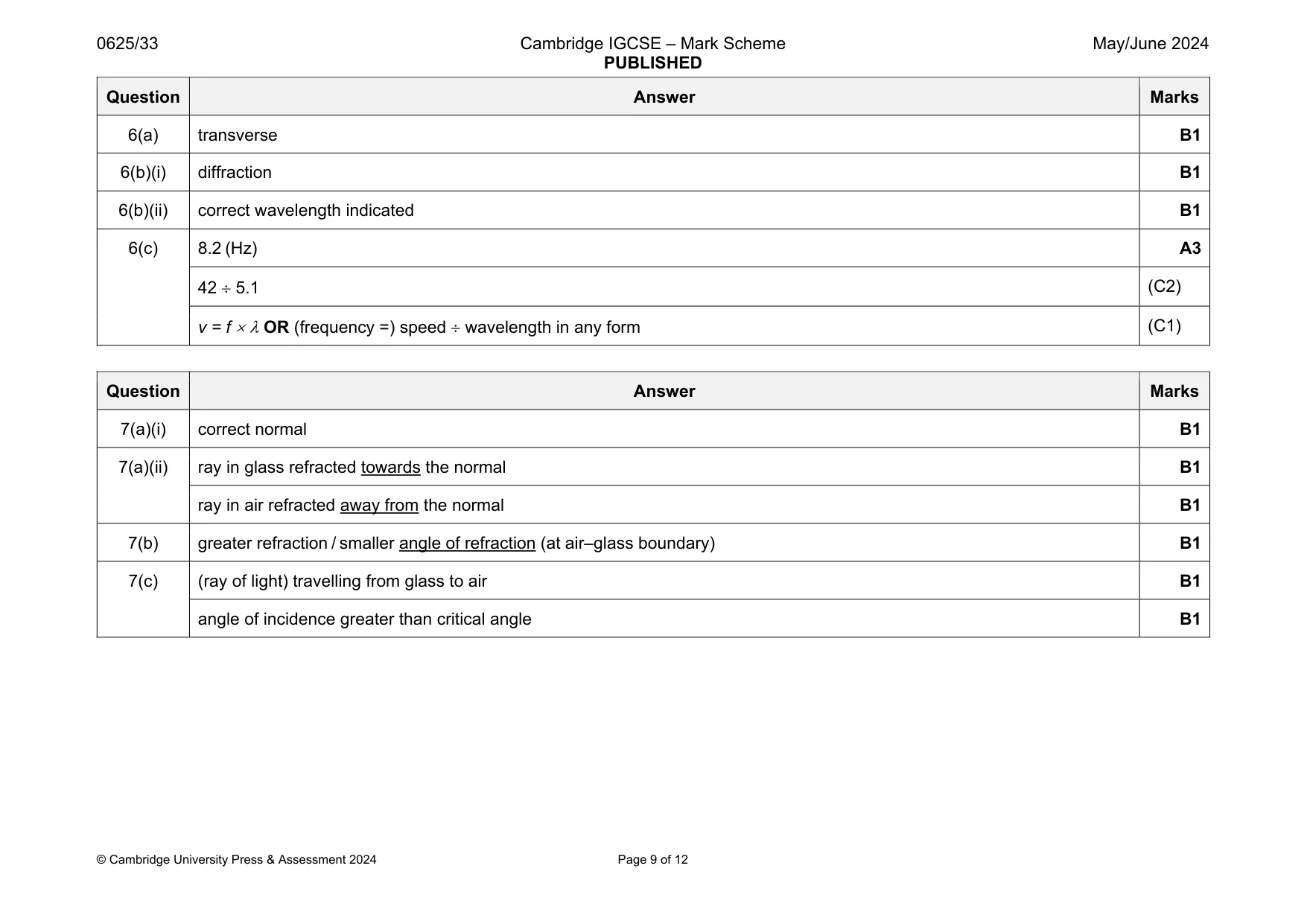
Mark scheme: 6(a) transverse B1 6(b)(i) diffraction B1 6(b)(ii) correct wavelength indicated B1 6(c) 8.2 (Hz) A3 42 5.1 (C2) v = f OR (frequency =) speed wavelength in any form (C1)
Q7 · A ray of red light incident on a glass prism at point P
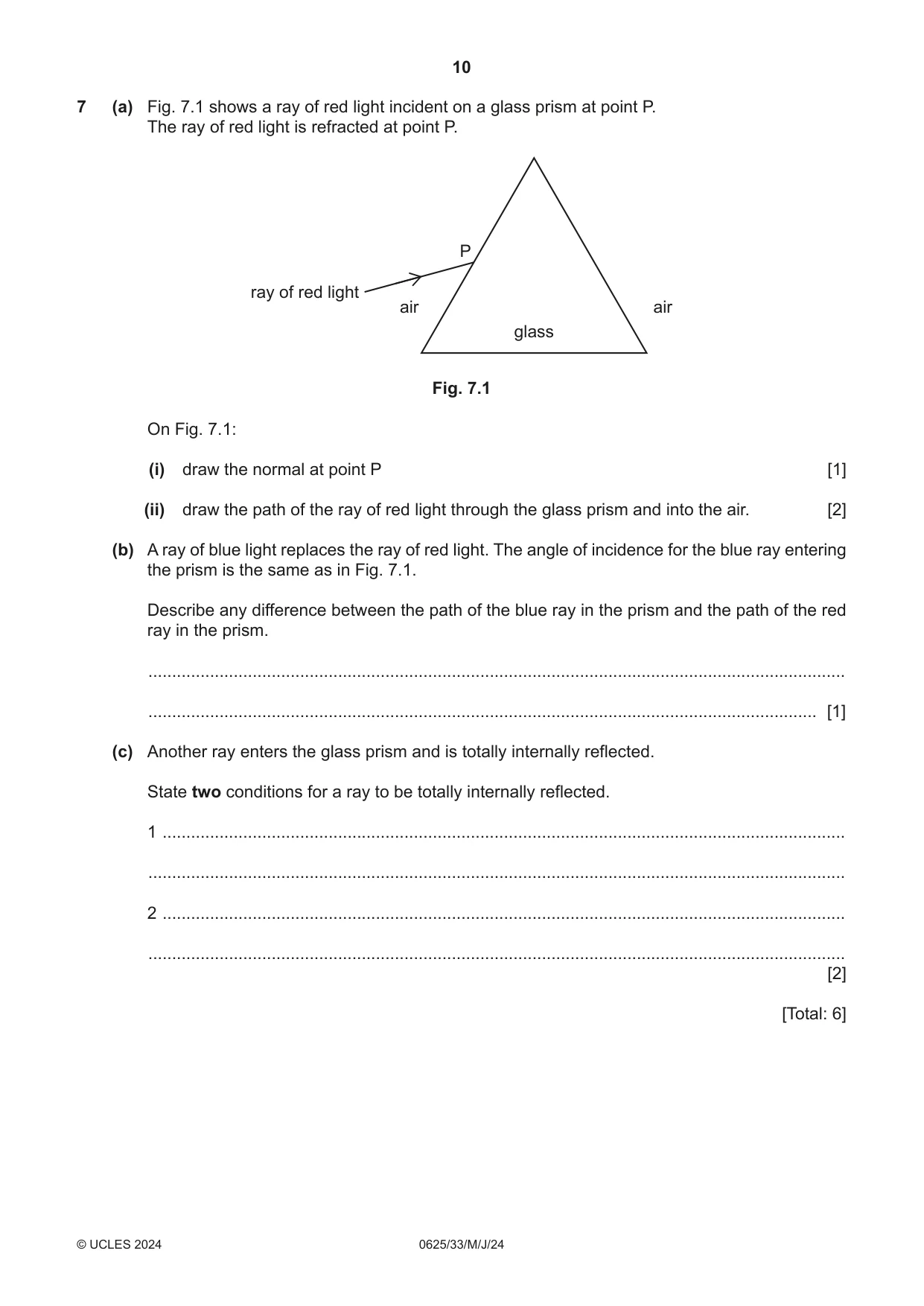
7 (a) Fig. 7.1 shows a ray of red light incident on a glass prism at point P. The ray of red light is refracted at point P. P ray of red light air air glass Fig. 7.1 On Fig. 7.1: (i) draw the normal at point P [1] (ii) draw the path of the ray of red light through the glass prism and into the air. [2] (b) A ray of blue light replaces the ray of red light. The angle of incidence for the blue ray entering the prism is the same as in Fig. 7.1. Describe any difference between the path of the blue ray in the prism and the path of the red ray in the prism. ................................................................................................................................................... ............................................................................................................................................. [1] (c) Another ray enters the glass prism and is totally internally reflected. State two conditions for a ray to be totally internally reflected. 1 ................................................................................................................................................ ................................................................................................................................................... 2 ................................................................................................................................................ ................................................................................................................................................... [2] [Total: 6]
Mark scheme: 7(a)(i) correct normal B1 7(a)(ii) ray in glass refracted towards the normal B1 ray in air refracted away from the normal B1 7(b) greater refraction / smaller angle of refraction (at air–glass boundary) B1 7(c) (ray of light) travelling from glass to air B1 angle of incidence greater than critical angle B1
Q8 · Part of a circuit for measuring the resistance of a lamp
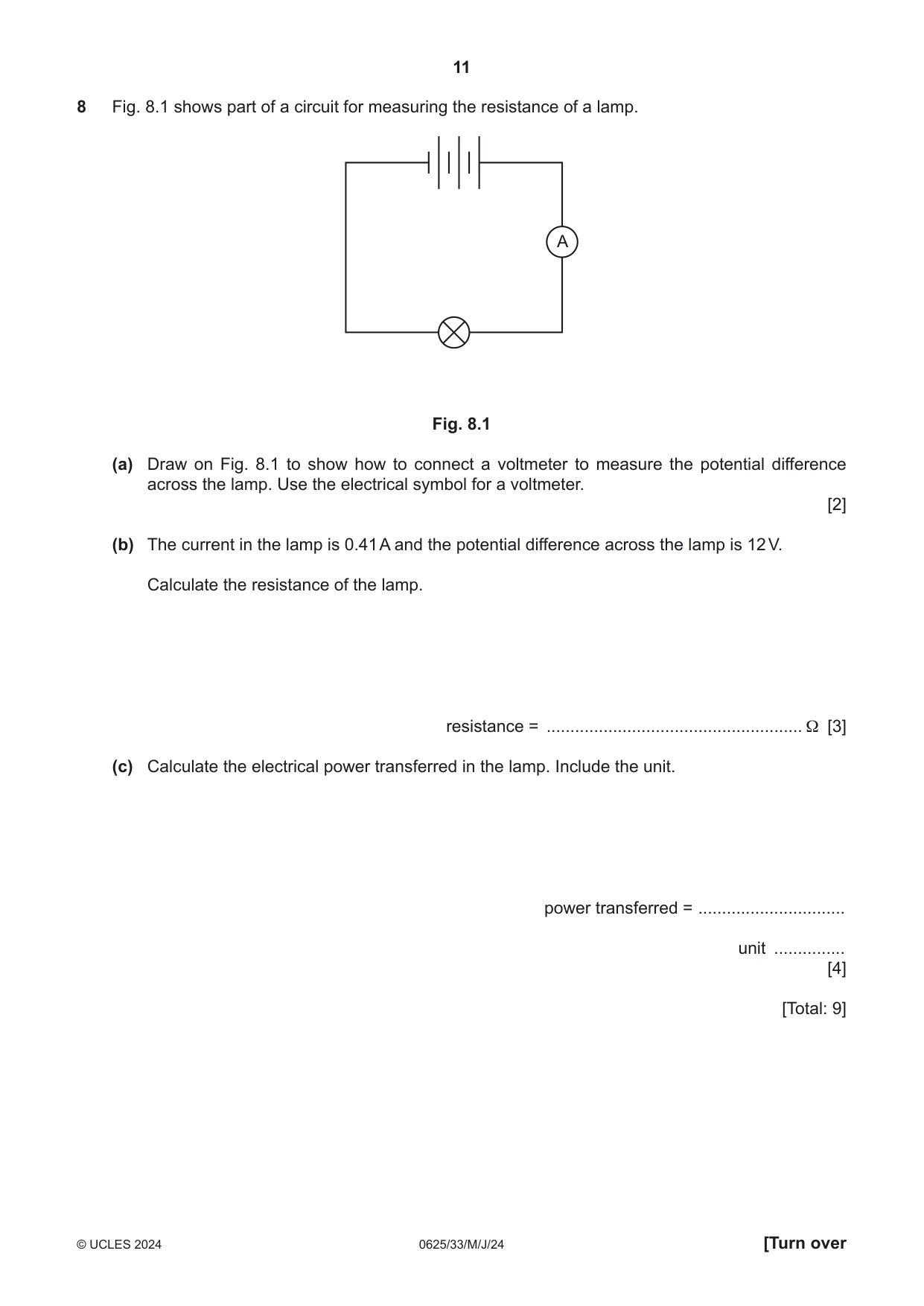
8 Fig. 8.1 shows part of a circuit for measuring the resistance of a lamp. A Fig. 8.1 (a) Draw on Fig. 8.1 to show how to connect a voltmeter to measure the potential difference across the lamp. Use the electrical symbol for a voltmeter. [2] (b) The current in the lamp is 0.41 A and the potential difference across the lamp is 12 V. Calculate the resistance of the lamp. resistance = ...................................................... Ω [3] (c) Calculate the electrical power transferred in the lamp. Include the unit. power transferred = ............................... unit ............... [4] [Total: 9]
Mark scheme: 8(a) correct symbol B1 voltmeter in parallel with lamp B1 8(b) 29 () A3 12 0.41 (C2) (R =) V I OR V = I R in any form (C1) 8(c) 4.9 A3 0.41 12 OR 0.412 29 (C2) (P =) I V in any form OR (P =) I 2 R (C1) W B1
Q9 · Three devices: a compass, a transformer and an electromagnet
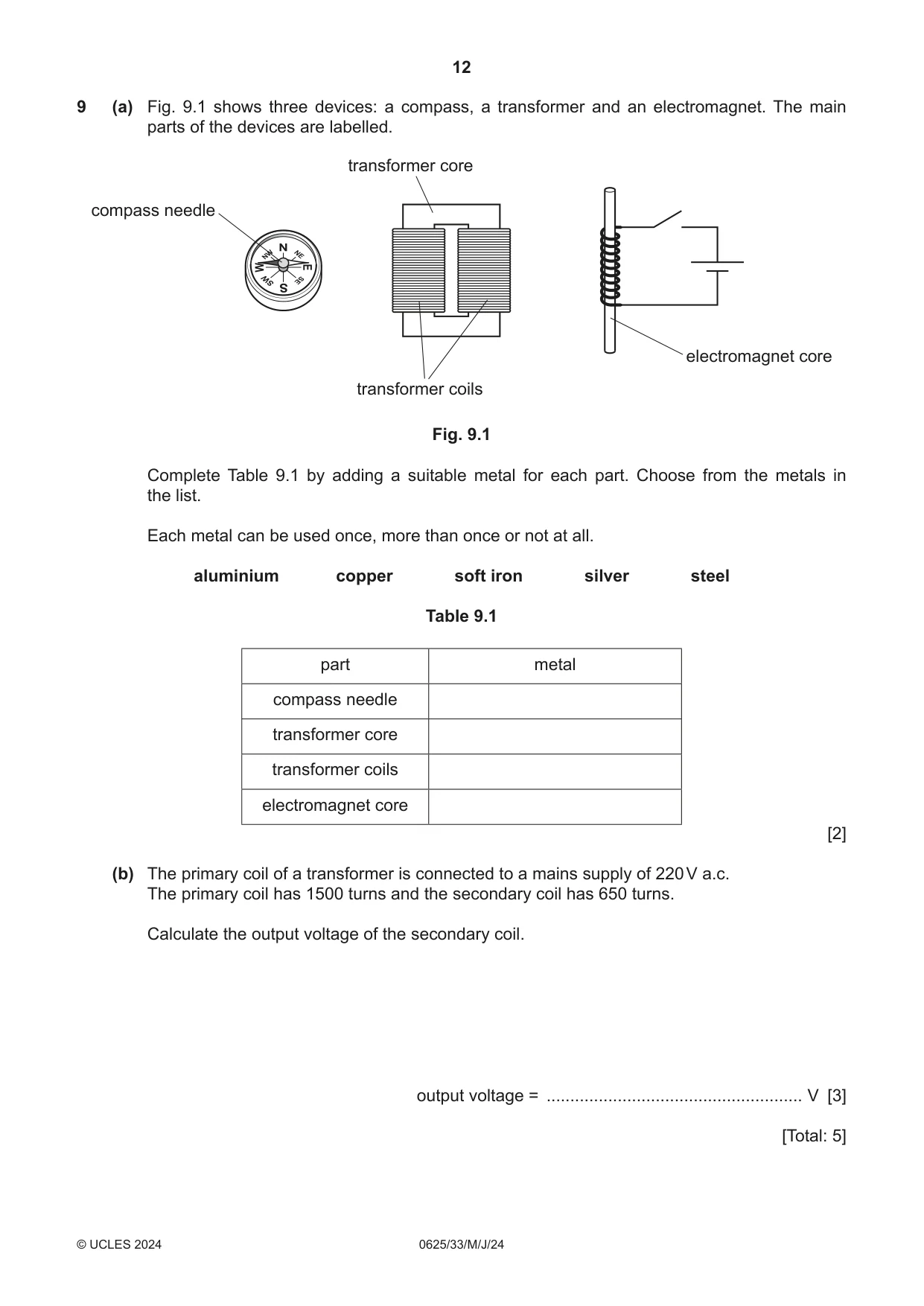
9 (a) Fig. 9.1 shows three devices: a compass, a transformer and an electromagnet. The main parts of the devices are labelled. transformer core compass needle electromagnet core transformer coils Fig. 9.1 Complete Table 9.1 by adding a suitable metal for each part. Choose from the metals in the list. Each metal can be used once, more than once or not at all. aluminium copper soft iron silver steel Table 9.1 part metal compass needle transformer core transformer coils electromagnet core [2] (b) The primary coil of a transformer is connected to a mains supply of 220 V a.c. The primary coil has 1500 turns and the secondary coil has 650 turns. Calculate the output voltage of the secondary coil. output voltage = ...................................................... V [3] [Total: 5]
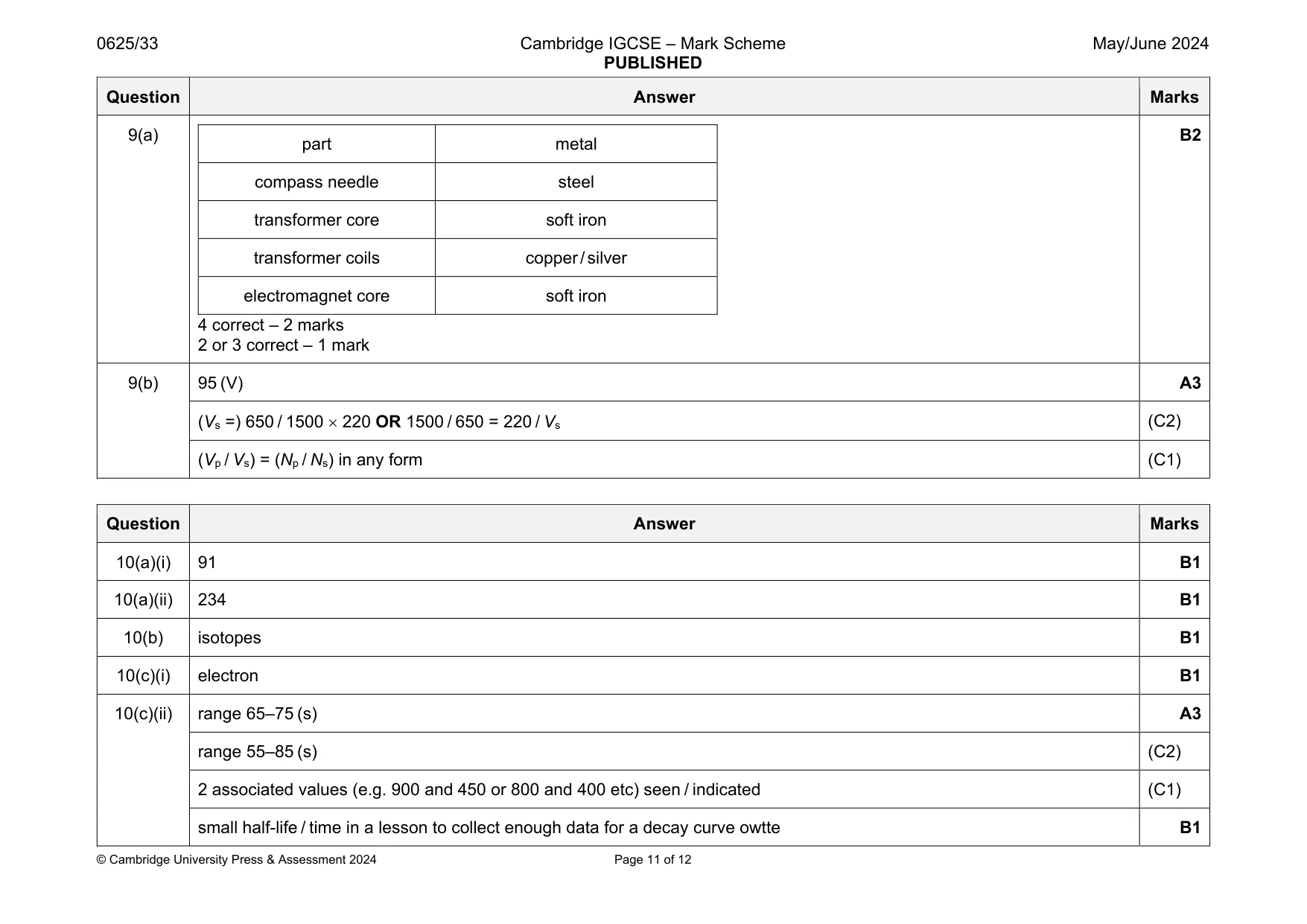
Mark scheme: 9(a) part metal compass needle steel transformer core soft iron transformer coils copper / silver electromagnet core soft iron 4 correct – 2 marks 2 or 3 correct – 1 mark B2 9(b) 95 (V) A3 (Vs =) 650 / 1500 220 OR 1500 / 650 = 220 / Vs (C2) (Vp / Vs) = (Np / Ns) in any form (C1)
Q10 · The nuclide notation for an atom of protactinium‑234 is: 23491Pa (i) State the number of…
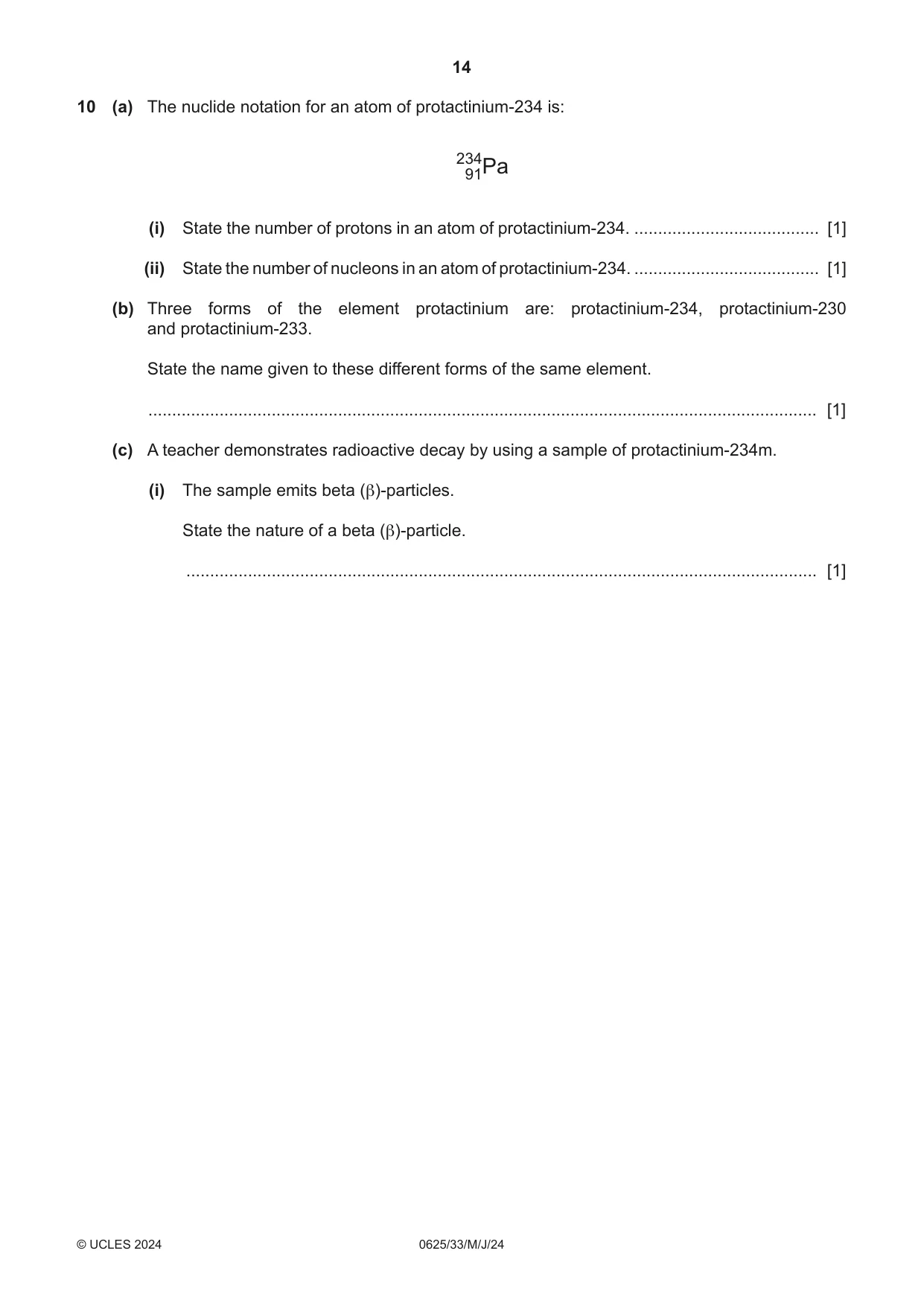
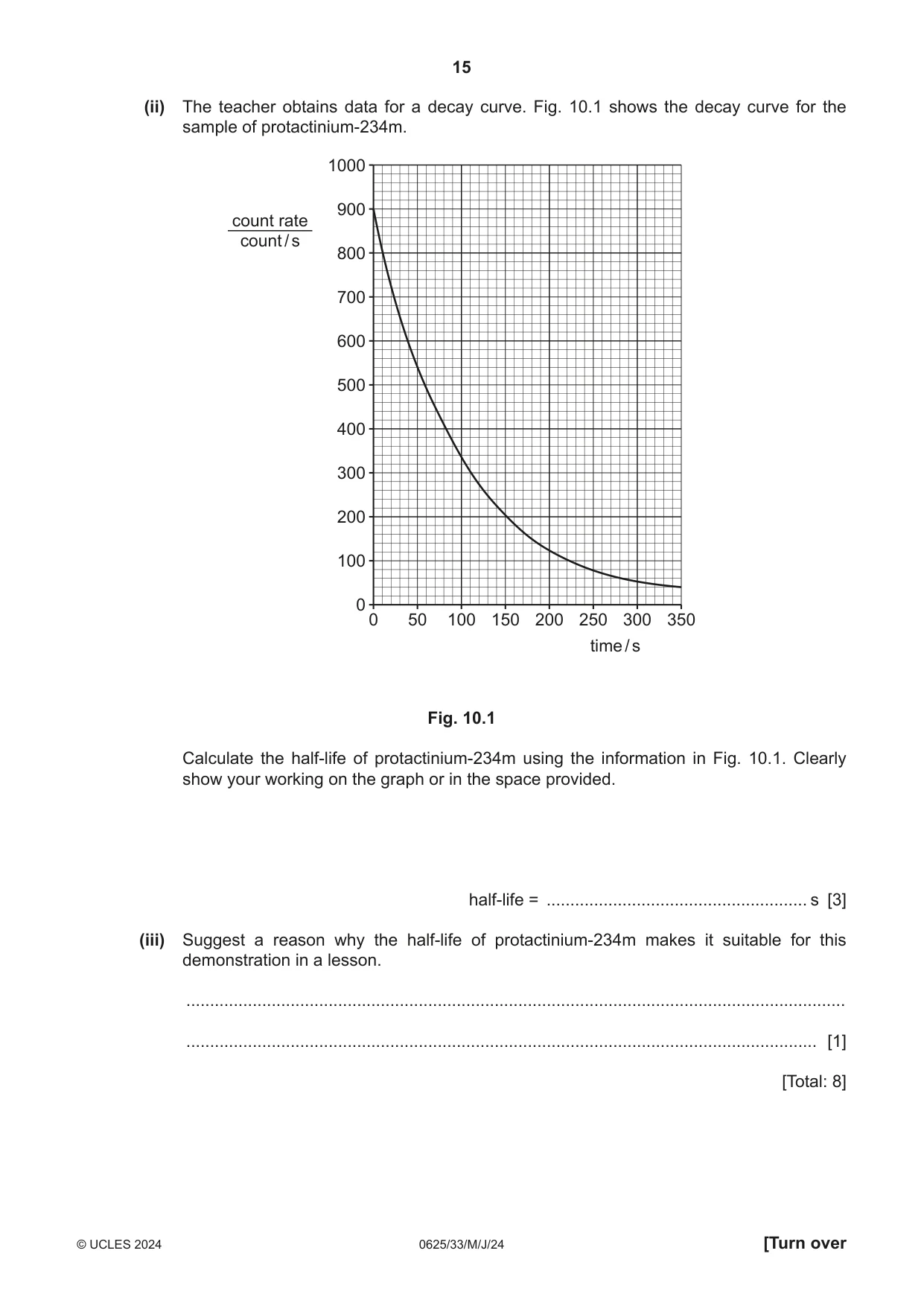
10 (a) The nuclide notation for an atom of protactinium‑234 is: 23491Pa (i) State the number of protons in an atom of protactinium‑234. ....................................... [1] (ii) State the number of nucleons in an atom of protactinium‑234. ....................................... [1] (b) Three forms of the element protactinium are: protactinium‑234, protactinium‑230 and protactinium‑233. State the name given to these different forms of the same element. ............................................................................................................................................. [1] (c) A teacher demonstrates radioactive decay by using a sample of protactinium‑234m. (i) The sample emits beta (β)‑particles. State the nature of a beta (β)‑particle. ..................................................................................................................................... [1] (ii) The teacher obtains data for a decay curve. Fig. 10.1 shows the decay curve for the sample of protactinium‑234m. 1000 900 count rate count / s 800 700 600 500 400 300 200 100 0 0 50 100 150 200 250 300 350 time / s Fig. 10.1 Calculate the half‑life of protactinium‑234m using the information in Fig. 10.1. Clearly show your working on the graph or in the space provided. half‑life = ....................................................... s [3] (iii) Suggest a reason why the half‑life of protactinium‑234m makes it suitable for this demonstration in a lesson. ........................................................................................................................................... ..................................................................................................................................... [1] [Total: 8]
Mark scheme: 10(a)(i) 91 B1 10(a)(ii) 234 B1 10(b) isotopes B1 10(c)(i) electron B1 10(c)(ii) range 65–75 (s) A3 range 55–85 (s) (C2) 2 associated values (e.g. 900 and 450 or 800 and 400 etc) seen / indicated (C1) small half-life / time in a lesson to collect enough data for a decay curve owtte B1
Q11 · The Solar System contains a number of objects
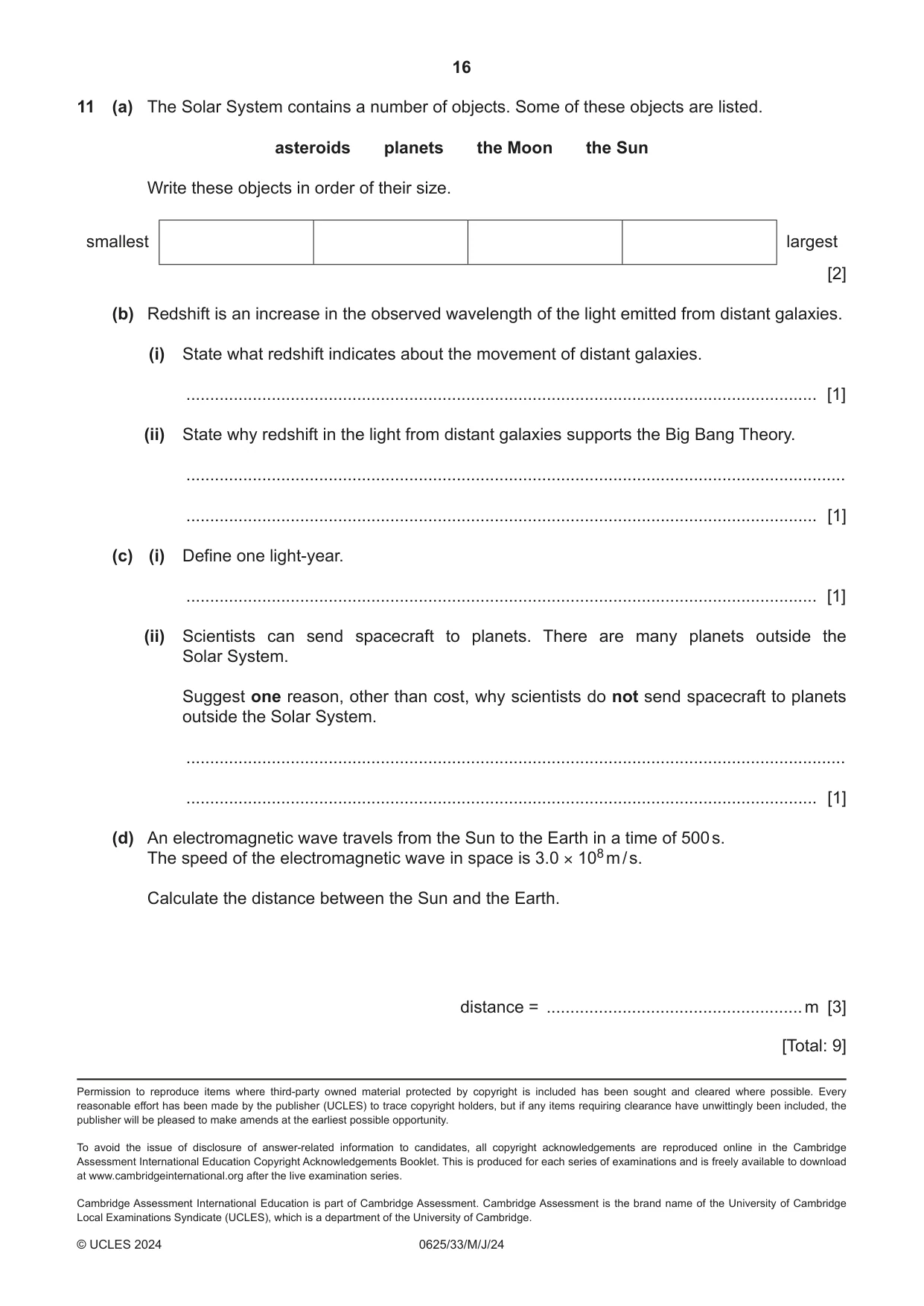
11 (a) The Solar System contains a number of objects. Some of these objects are listed. asteroids planets the Moon the Sun Write these objects in order of their size. smallest largest [2] (b) Redshift is an increase in the observed wavelength of the light emitted from distant galaxies. (i) State what redshift indicates about the movement of distant galaxies. ..................................................................................................................................... [1] (ii) State why redshift in the light from distant galaxies supports the Big Bang Theory. ........................................................................................................................................... ..................................................................................................................................... [1] (c) (i) Define one light‑year. ..................................................................................................................................... [1] (ii) Scientists can send spacecraft to planets. There are many planets outside the Solar System. Suggest one reason, other than cost, why scientists do not send spacecraft to planets outside the Solar System. ........................................................................................................................................... ..................................................................................................................................... [1] (d) An electromagnetic wave travels from the Sun to the Earth in a time of 500 s. The speed of the electromagnetic wave in space is 3.0 × 10⁸ m / s. Calculate the distance between the Sun and the Earth. distance = ...................................................... m [3] [Total: 9]
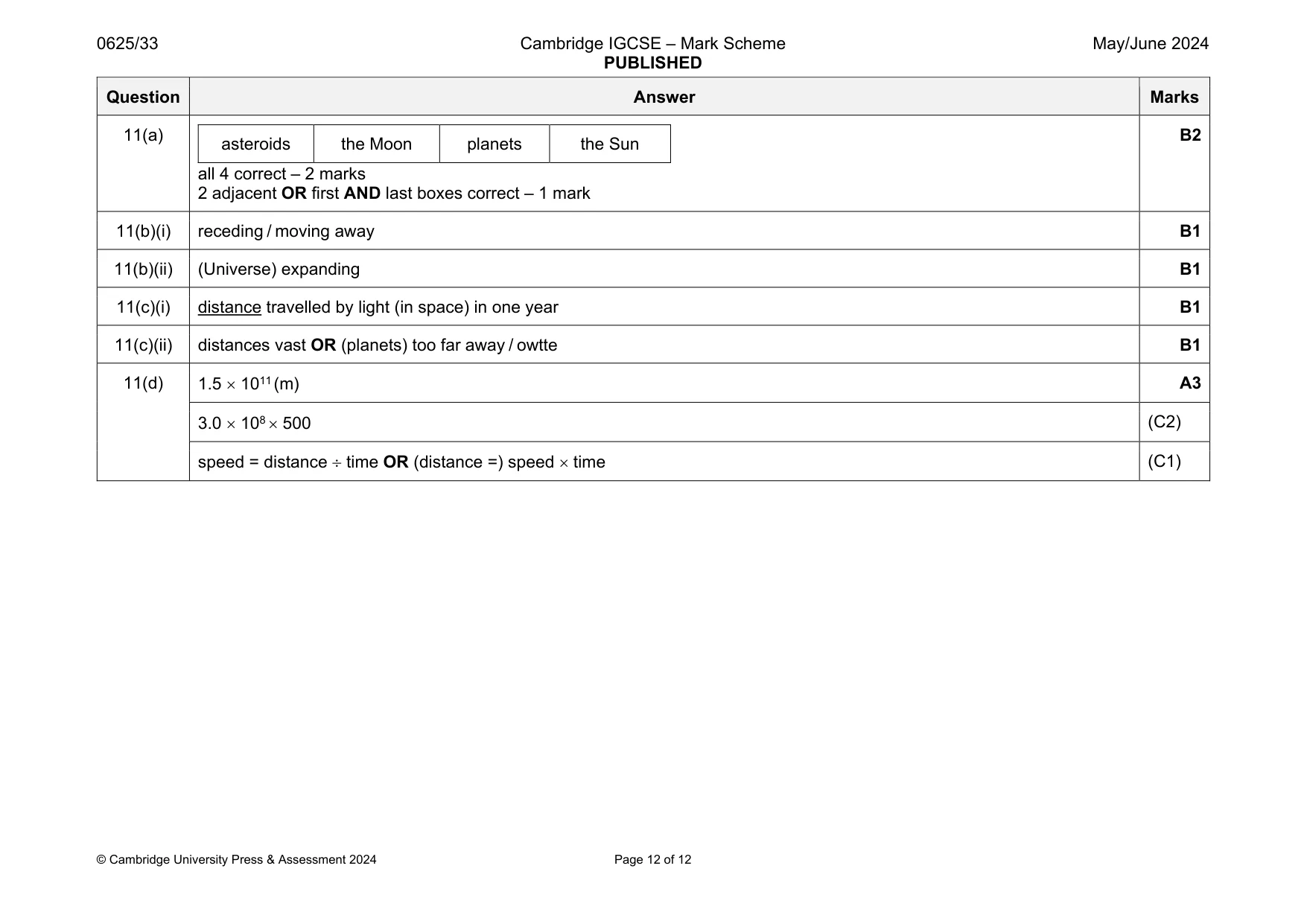
Mark scheme: 11(a) asteroids the Moon planets the Sun all 4 correct – 2 marks 2 adjacent OR first AND last boxes correct – 1 mark B2 11(b)(i) receding / moving away B1 11(b)(ii) (Universe) expanding B1 11(c)(i) distance travelled by light (in space) in one year B1 11(c)(ii) distances vast OR (planets) too far away / owtte B1 11(d) 1.5 1011 (m) A3 3.0 108 500 (C2) speed = distance time OR (distance =) speed time (C1)
What was in this paper
The subtopics covered by these 11 questions, and how many questions each got. Open one in a new tab to see every Cambridge question on it.
What you needed in this session
Cambridge’s own grade thresholds for 2024 May/June, Paper 3 · Variant 3. A higher threshold means an easier paper — the bar moves with how the cohort did.