Cambridge IGCSE Physics 0625 — 2021 May/June Paper 3 · Variant 1
0625/31/M/J/21 · 12 questions · 80 marks · ≈90 min
The question paper and its mark scheme, free to read here and free to download. This is Cambridge’s own paper, exactly as it was sat.
Question paper16 pages
Mark scheme11 pages
Answers below. Sit the paper first if you are practising.
Questions as text
Q1 · A speed–time graph for a car
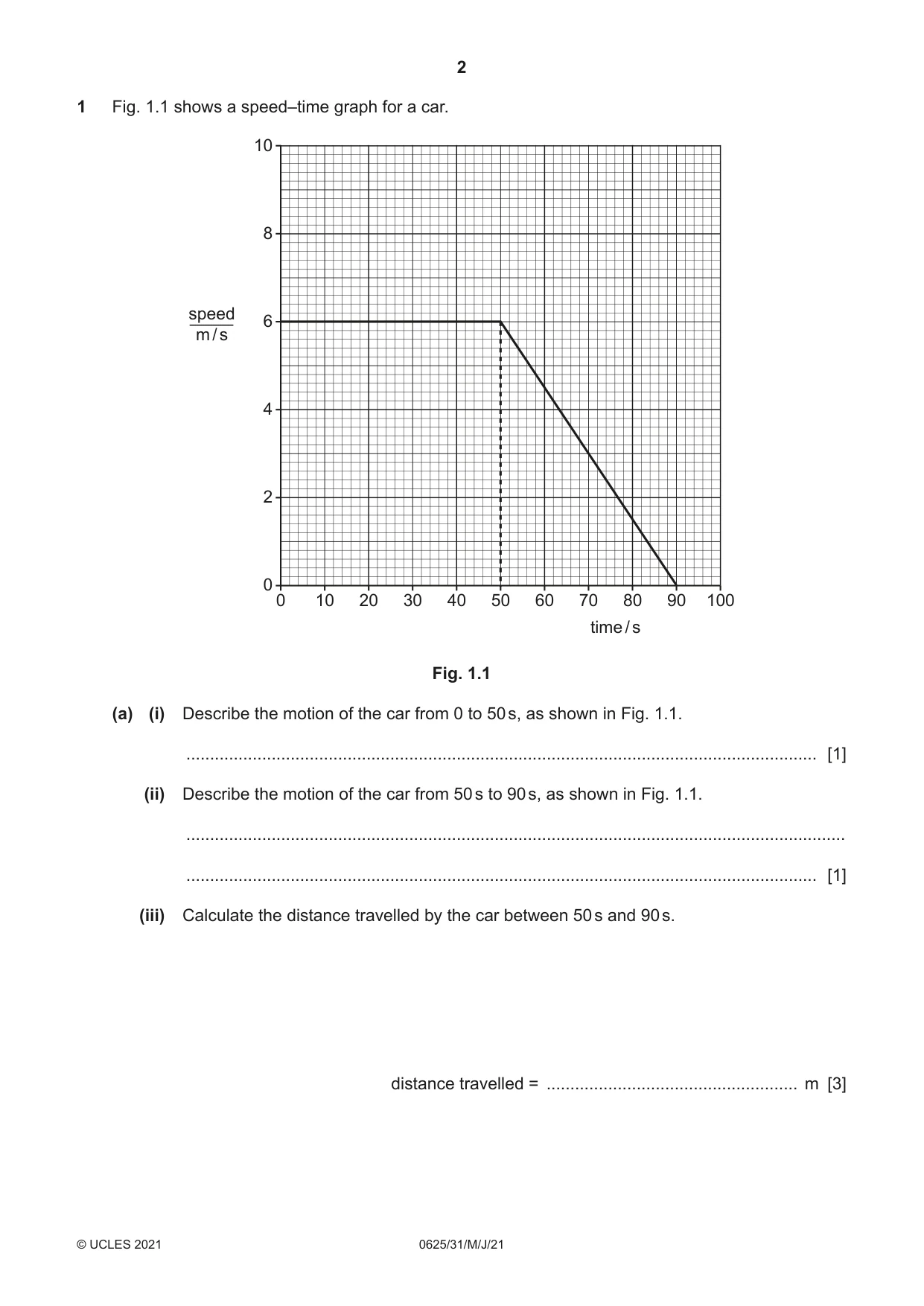
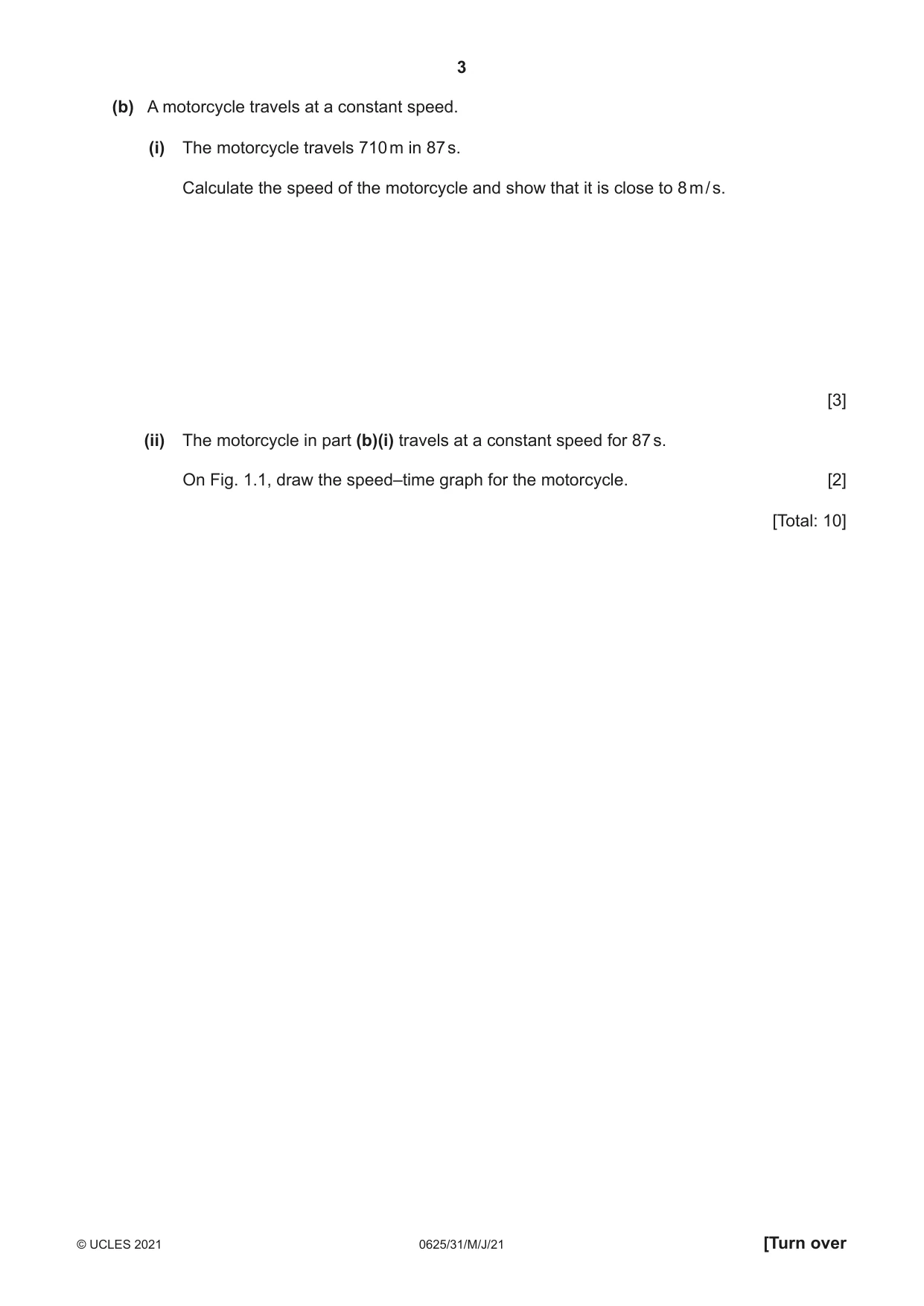
1 Fig. 1.1 shows a speed–time graph for a car. 10 8 speed 6 m / s 4 2 0 0 10 20 30 40 50 60 70 80 90 100 time / s Fig. 1.1 (a) (i) Describe the motion of the car from 0 to 50 s, as shown in Fig. 1.1. ..................................................................................................................................... [1] (ii) Describe the motion of the car from 50 s to 90 s, as shown in Fig. 1.1. ........................................................................................................................................... ..................................................................................................................................... [1] (iii) Calculate the distance travelled by the car between 50 s and 90 s. distance travelled = ..................................................... m [3] (b) A motorcycle travels at a constant speed. (i) The motorcycle travels 710 m in 87 s. Calculate the speed of the motorcycle and show that it is close to 8 m / s. [3] (ii) The motorcycle in part (b)(i) travels at a constant speed for 87 s. On Fig. 1.1, draw the speed–time graph for the motorcycle. [2] [Total: 10]
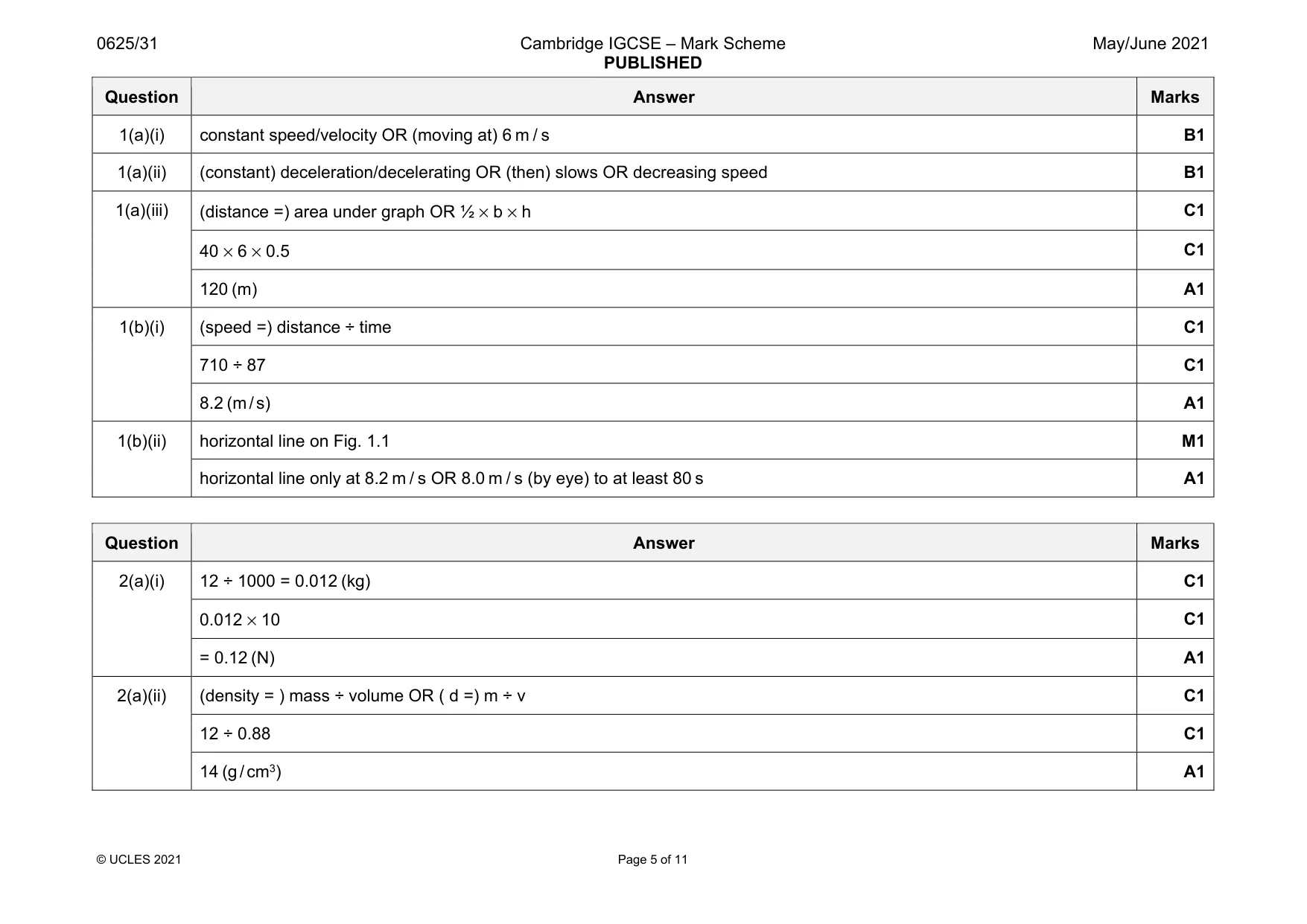
Mark scheme: 1(a)(i) constant speed/velocity OR (moving at) 6 m / s B1 1(a)(ii) (constant) deceleration/decelerating OR (then) slows OR decreasing speed B1 1(a)(iii) (distance =) area under graph OR ½ × b × h C1 40 × 6 × 0.5 C1 120 (m) A1 1(b)(i) (speed =) distance ÷ time C1 710 ÷ 87 C1 8.2 (m / s) A1 1(b)(ii) horizontal line on Fig. 1.1 M1 horizontal line only at 8.2 m / s OR 8.0 m / s (by eye) to at least 80 s A1
Q2 · A liquid-in-glass thermometer contains mercury
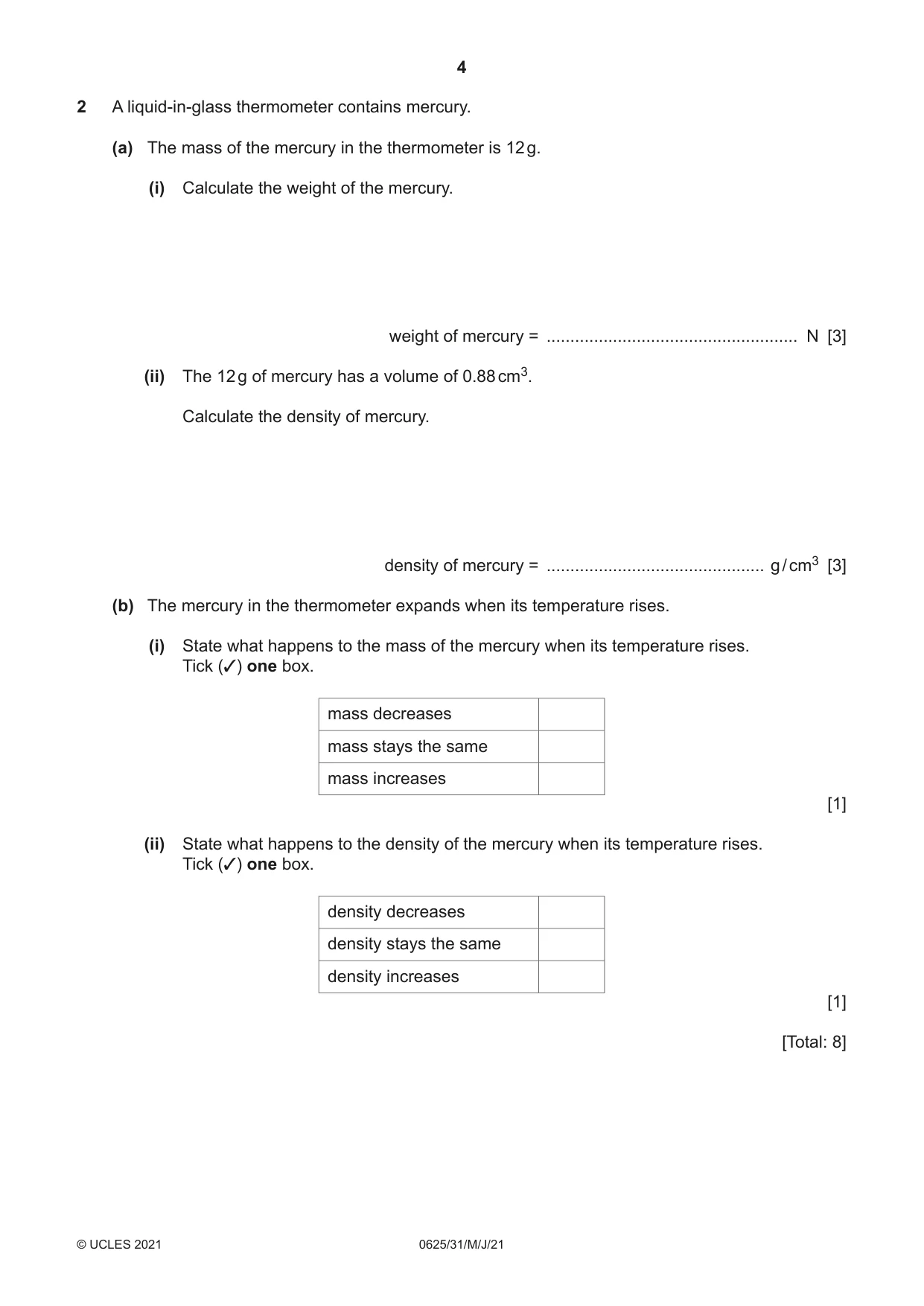
2 A liquid-in-glass thermometer contains mercury. (a) The mass of the mercury in the thermometer is 12 g. (i) Calculate the weight of the mercury. weight of mercury = ..................................................... N [3] (ii) The 12 g of mercury has a volume of 0.88 cm3. Calculate the density of mercury. density of mercury = .............................................. g / cm3 [3] (b) The mercury in the thermometer expands when its temperature rises. (i) State what happens to the mass of the mercury when its temperature rises. Tick (3) one box. mass decreases mass stays the same mass increases [1] (ii) State what happens to the density of the mercury when its temperature rises. Tick (3) one box. density decreases density stays the same density increases [1] [Total: 8]
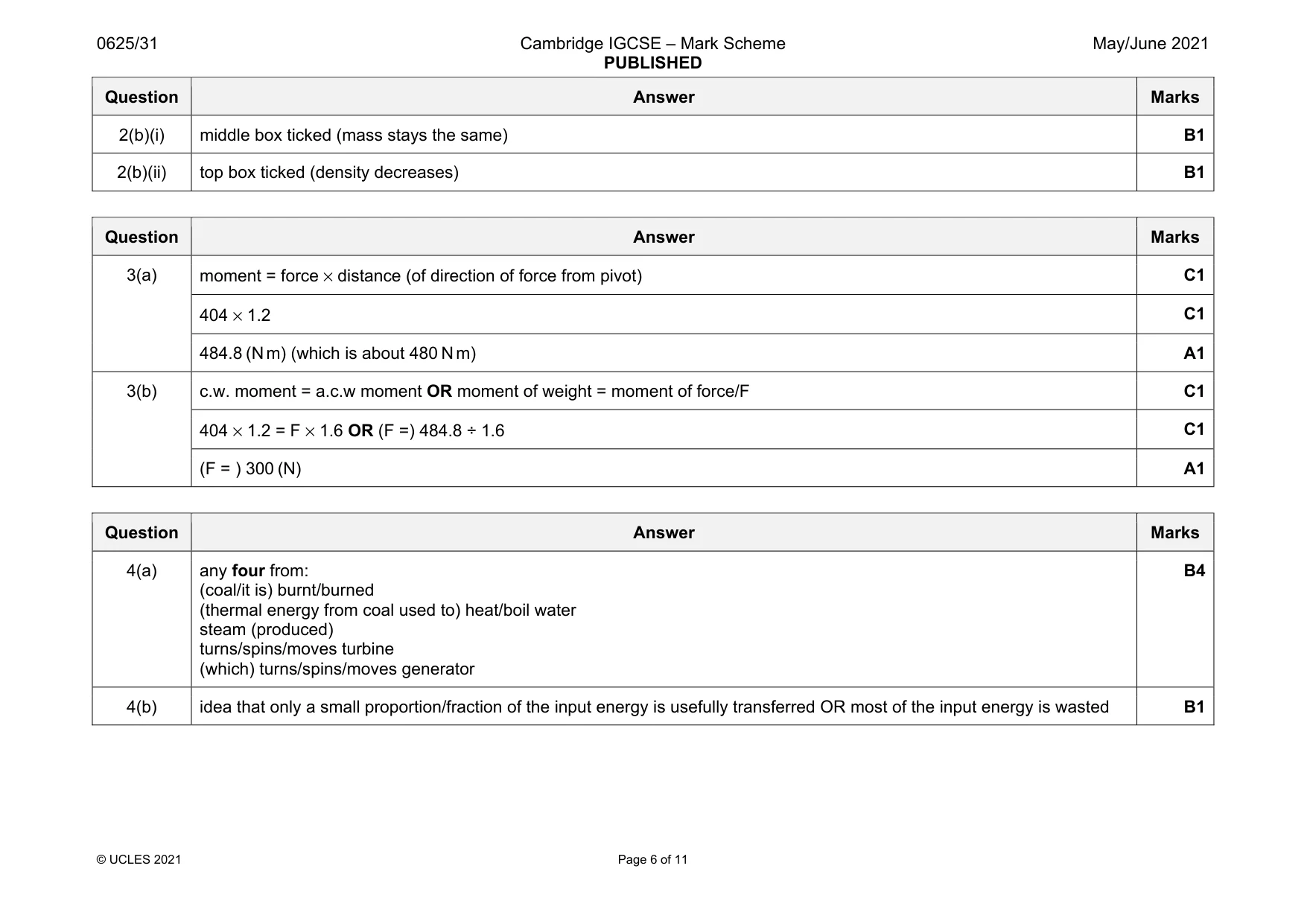
Mark scheme: 2(a)(i) 12 ÷ 1000 = 0.012 (kg) C1 0.012 × 10 C1 = 0.12 (N) A1 2(a)(ii) (density = ) mass ÷ volume OR ( d =) m ÷ v C1 12 ÷ 0.88 C1 14 (g / cm3) A1 Question Answer Marks 2(b)(i) middle box ticked (mass stays the same) B1 2(b)(ii) top box ticked (density decreases) B1
Q3 · A plank balances horizontally on a log of wood, which acts as a pivot
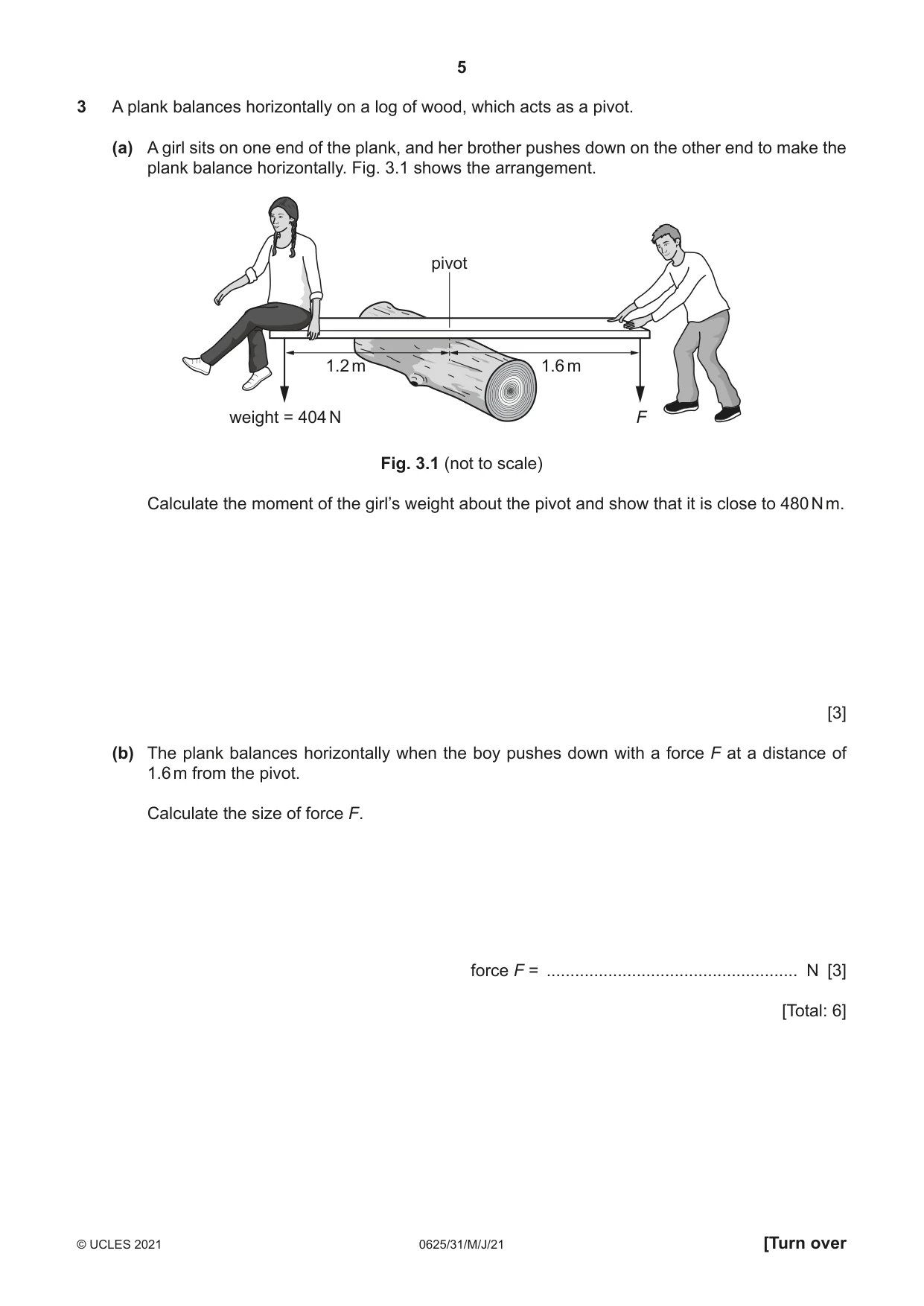
3 A plank balances horizontally on a log of wood, which acts as a pivot. (a) A girl sits on one end of the plank, and her brother pushes down on the other end to make the plank balance horizontally. Fig. 3.1 shows the arrangement. pivot 1.2 m 1.6 m weight = 404 N F Fig. 3.1 (not to scale) Calculate the moment of the girl’s weight about the pivot and show that it is close to 480 N m. [3] (b) The plank balances horizontally when the boy pushes down with a force F at a distance of 1.6 m from the pivot. Calculate the size of force F. force F = ..................................................... N [3] [Total: 6]
Mark scheme: 3(a) moment = force × distance (of direction of force from pivot) C1 404 × 1.2 C1 484.8 (N m) (which is about 480 N m) A1 3(b) c.w. moment = a.c.w moment OR moment of weight = moment of force/F C1 404 × 1.2 = F × 1.6 OR (F =) 484.8 ÷ 1.6 C1 (F = ) 300 (N) A1
Q4 · A country needs to build new power stations to provide electricity for homes and industry
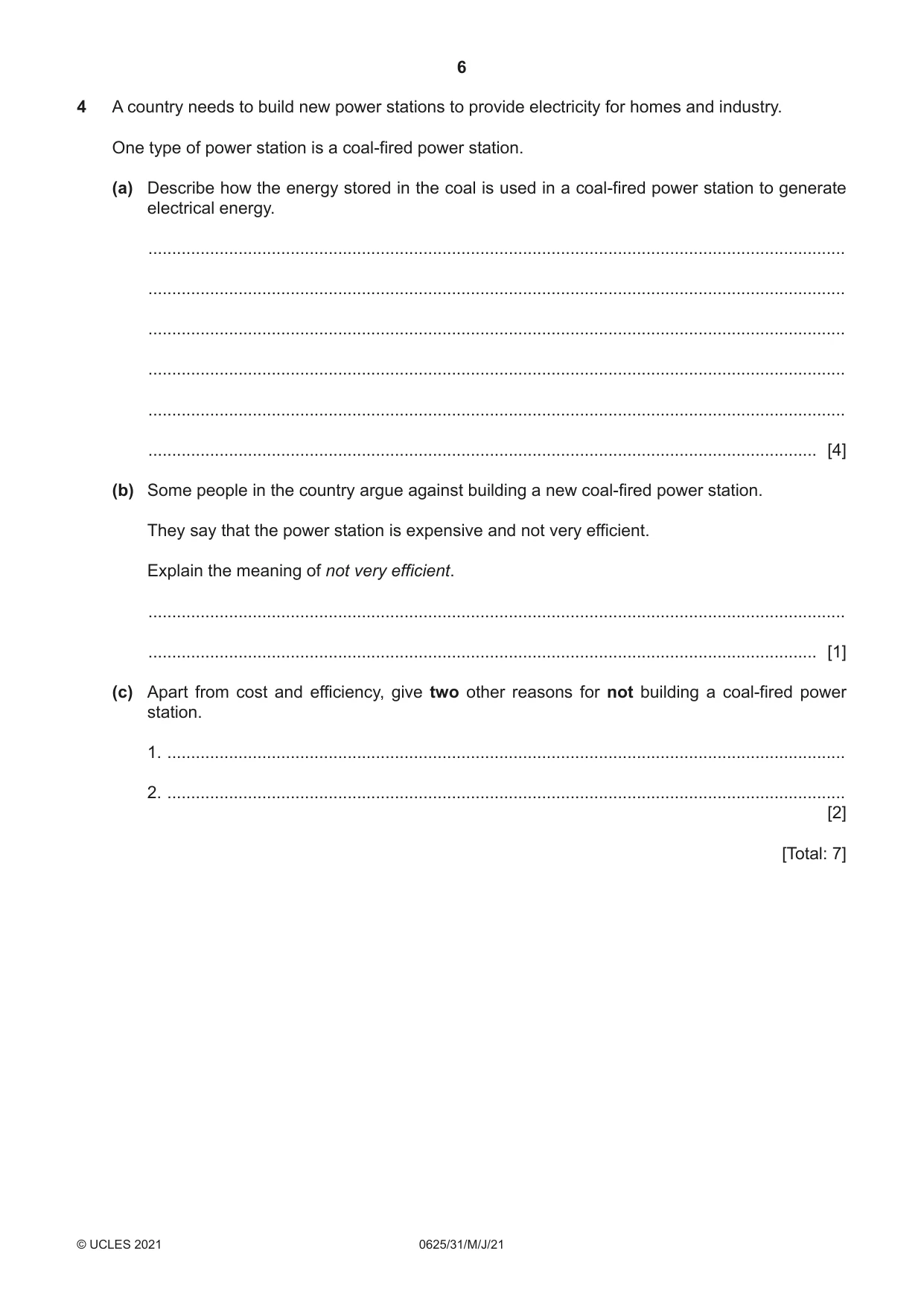
4 A country needs to build new power stations to provide electricity for homes and industry. One type of power station is a coal-fired power station. (a) Describe how the energy stored in the coal is used in a coal-fired power station to generate electrical energy. ................................................................................................................................................... ................................................................................................................................................... ................................................................................................................................................... ................................................................................................................................................... ................................................................................................................................................... ............................................................................................................................................. [4] (b) Some people in the country argue against building a new coal-fired power station. They say that the power station is expensive and not very efficient. Explain the meaning of not very efficient. ................................................................................................................................................... ............................................................................................................................................. [1] (c) Apart from cost and efficiency, give two other reasons for not building a coal-fired power station. 1. ............................................................................................................................................... 2. ............................................................................................................................................... [2] [Total: 7]
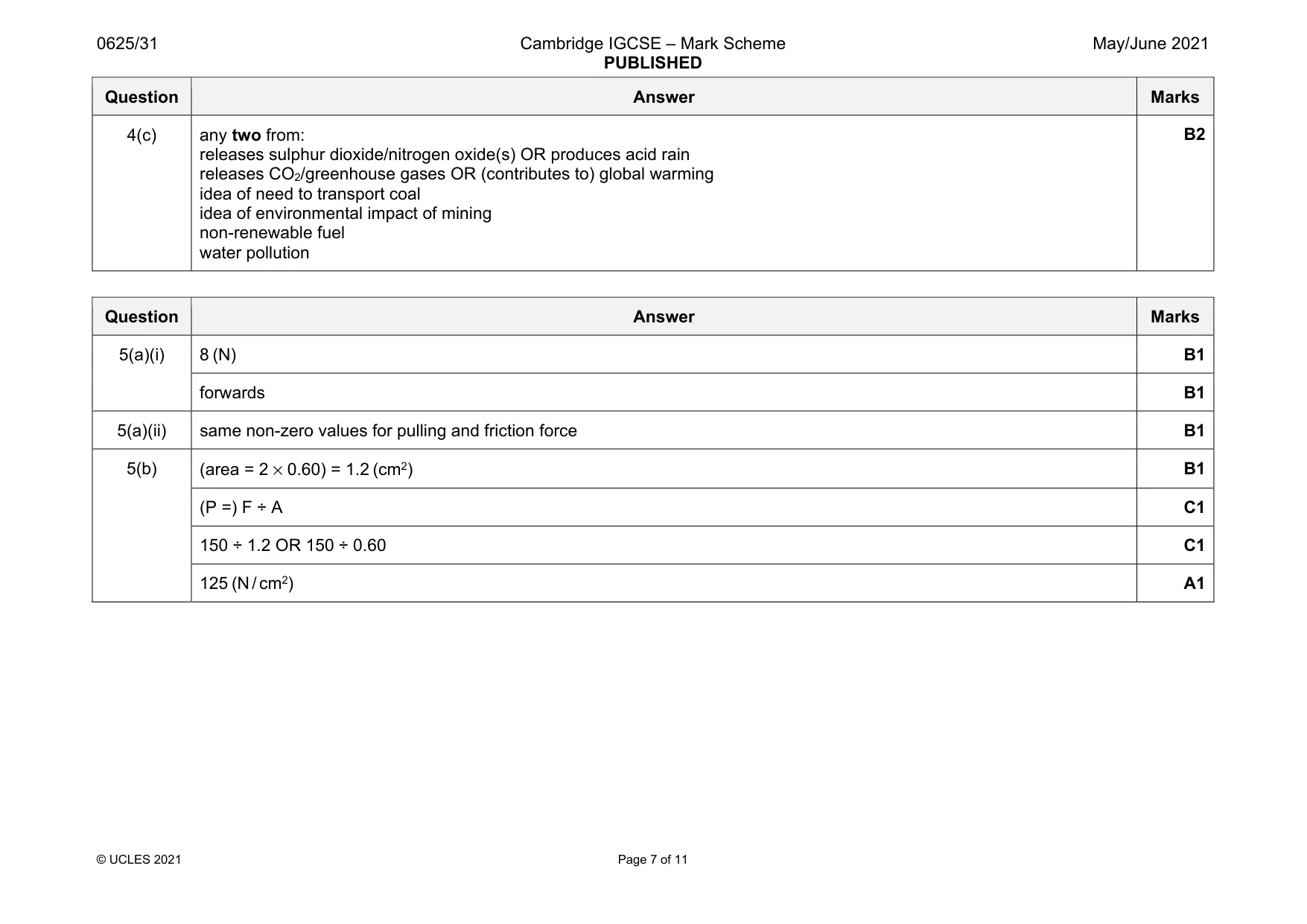
Mark scheme: 4(a) any four from: (coal/it is) burnt/burned (thermal energy from coal used to) heat/boil water steam (produced) turns/spins/moves turbine (which) turns/spins/moves generator 4(b) idea that only a small proportion/fraction of the input energy is usefully transferred OR most of the input energy is wasted B1 Question Answer Marks 4(c) any two from: releases sulphur dioxide/nitrogen oxide(s) OR produces acid rain releases CO2/greenhouse gases OR (contributes to) global warming idea of need to transport coal idea of environmental impact of mining non-renewable fuel water pollution B2
Q5 · A man starts pulling his suitcase across the floor
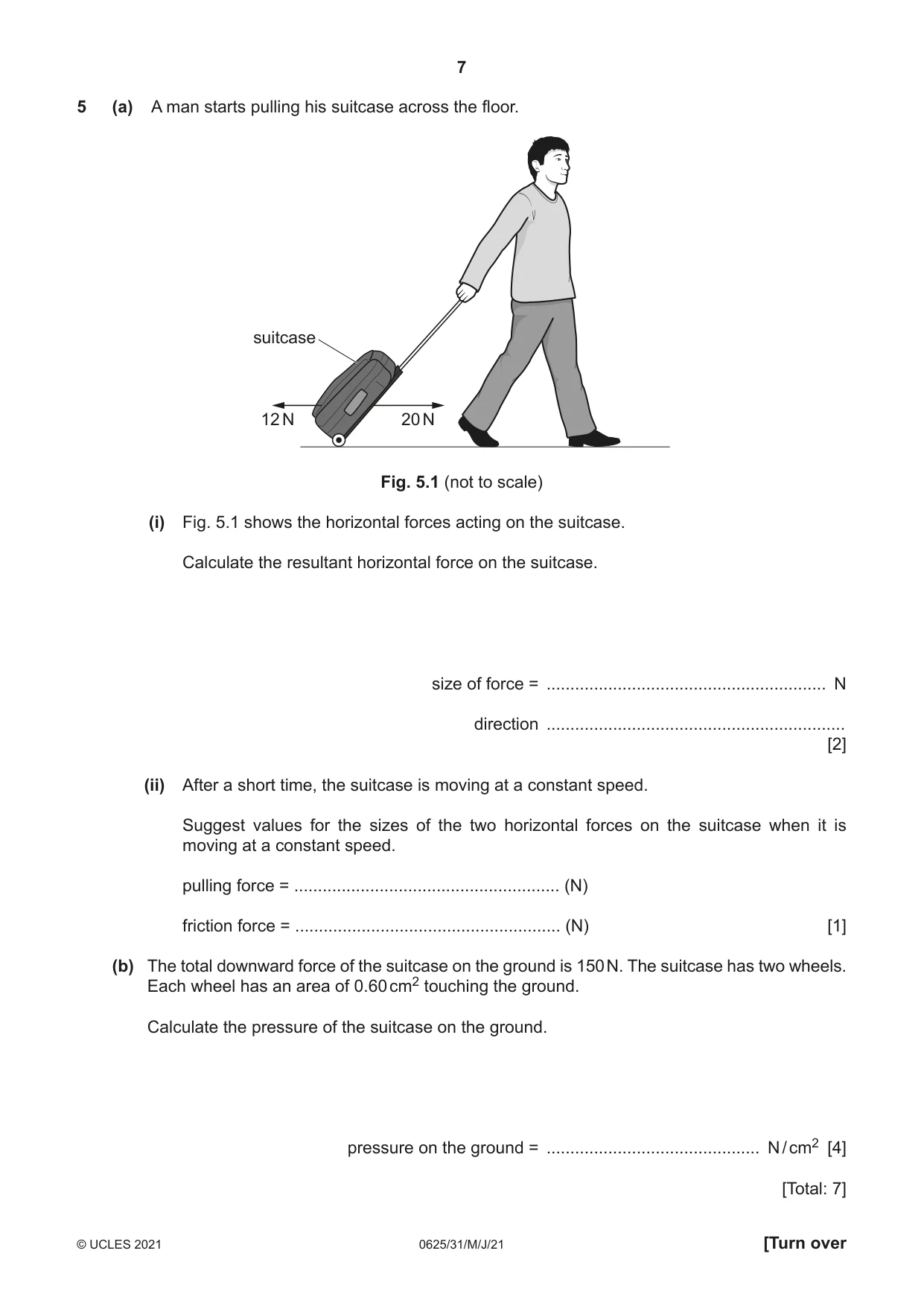
5 (a) A man starts pulling his suitcase across the floor. suitcase 12 N 20 N Fig. 5.1 (not to scale) (i) Fig. 5.1 shows the horizontal forces acting on the suitcase. Calculate the resultant horizontal force on the suitcase. size of force = ........................................................... N direction ............................................................... [2] (ii) After a short time, the suitcase is moving at a constant speed. Suggest values for the sizes of the two horizontal forces on the suitcase when it is moving at a constant speed. pulling force = ........................................................ (N) friction force = ........................................................ (N) [1] (b) The total downward force of the suitcase on the ground is 150 N. The suitcase has two wheels. Each wheel has an area of 0.60 cm2 touching the ground. Calculate the pressure of the suitcase on the ground. pressure on the ground = ............................................. N / cm2 [4] [Total: 7]
Mark scheme: 5(a)(i) 8 (N) B1 forwards B1 5(a)(ii) same non-zero values for pulling and friction force B1 5(b) (area = 2 × 0.60) = 1.2 (cm2) B1 (P =) F ÷ A C1 150 ÷ 1.2 OR 150 ÷ 0.60 C1 125 (N / cm2) A1
Question 6
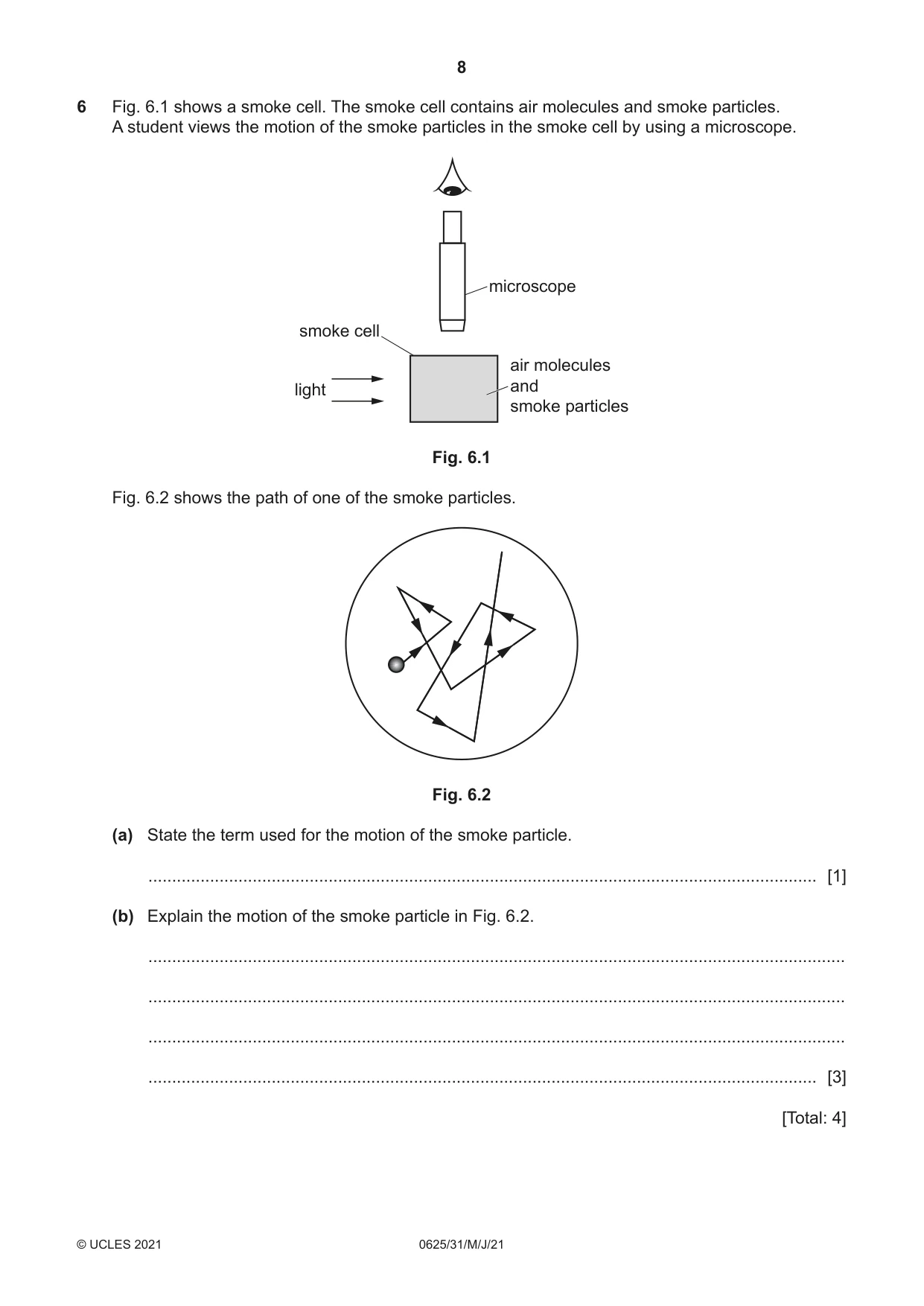
6 Fig. 6.1 shows a smoke cell. The smoke cell contains air molecules and smoke particles. A student views the motion of the smoke particles in the smoke cell by using a microscope. microscope smoke cell air molecules light and smoke particles Fig. 6.1 Fig. 6.2 shows the path of one of the smoke particles. Fig. 6.2 (a) State the term used for the motion of the smoke particle. ............................................................................................................................................. [1] (b) Explain the motion of the smoke particle in Fig. 6.2. ................................................................................................................................................... ................................................................................................................................................... ................................................................................................................................................... ............................................................................................................................................. [3] [Total: 4]
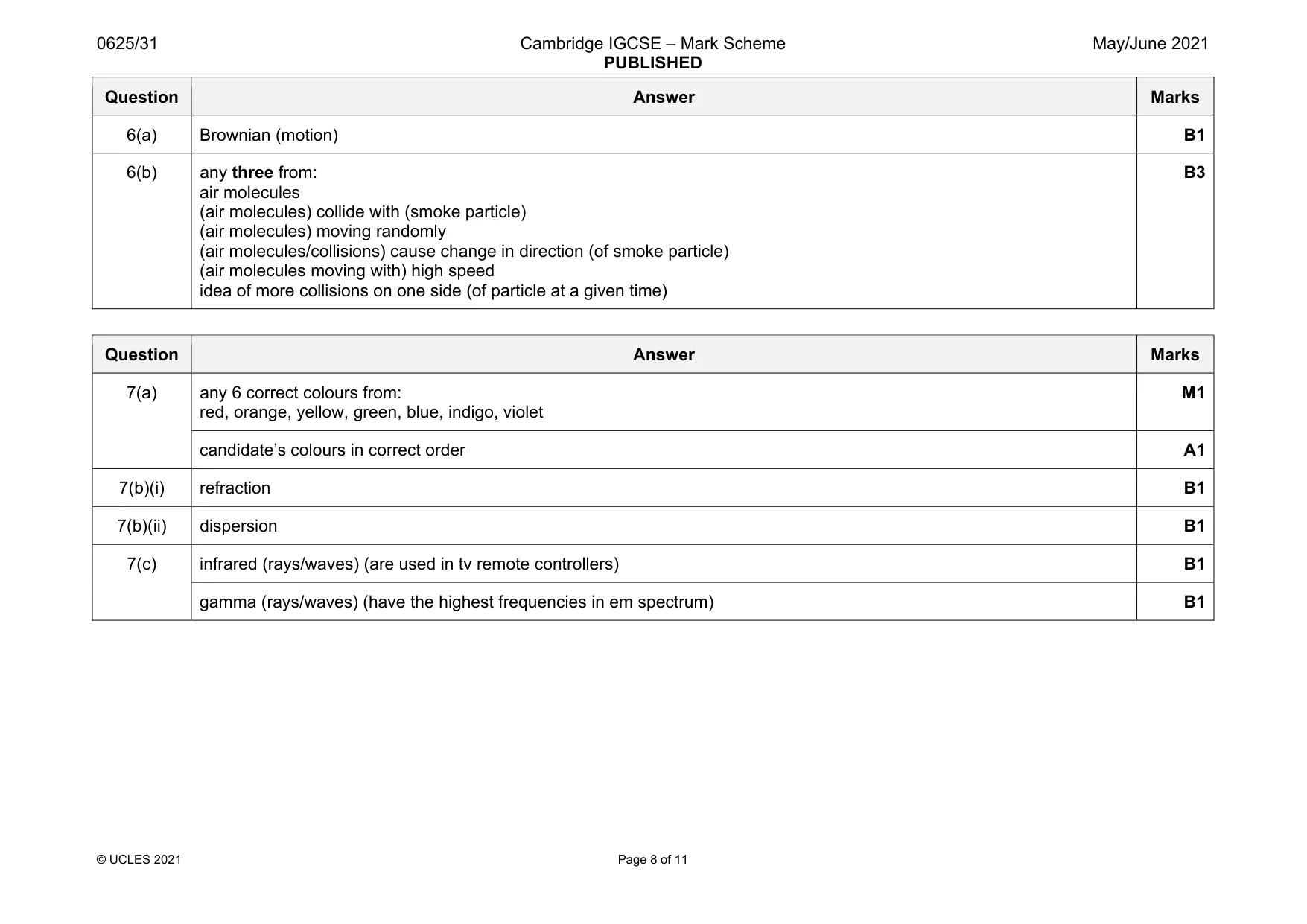
Mark scheme: 6(a) Brownian (motion) B1 6(b) any three from: air molecules (air molecules) collide with (smoke particle) (air molecules) moving randomly (air molecules/collisions) cause change in direction (of smoke particle) (air molecules moving with) high speed idea of more collisions on one side (of particle at a given time) B3
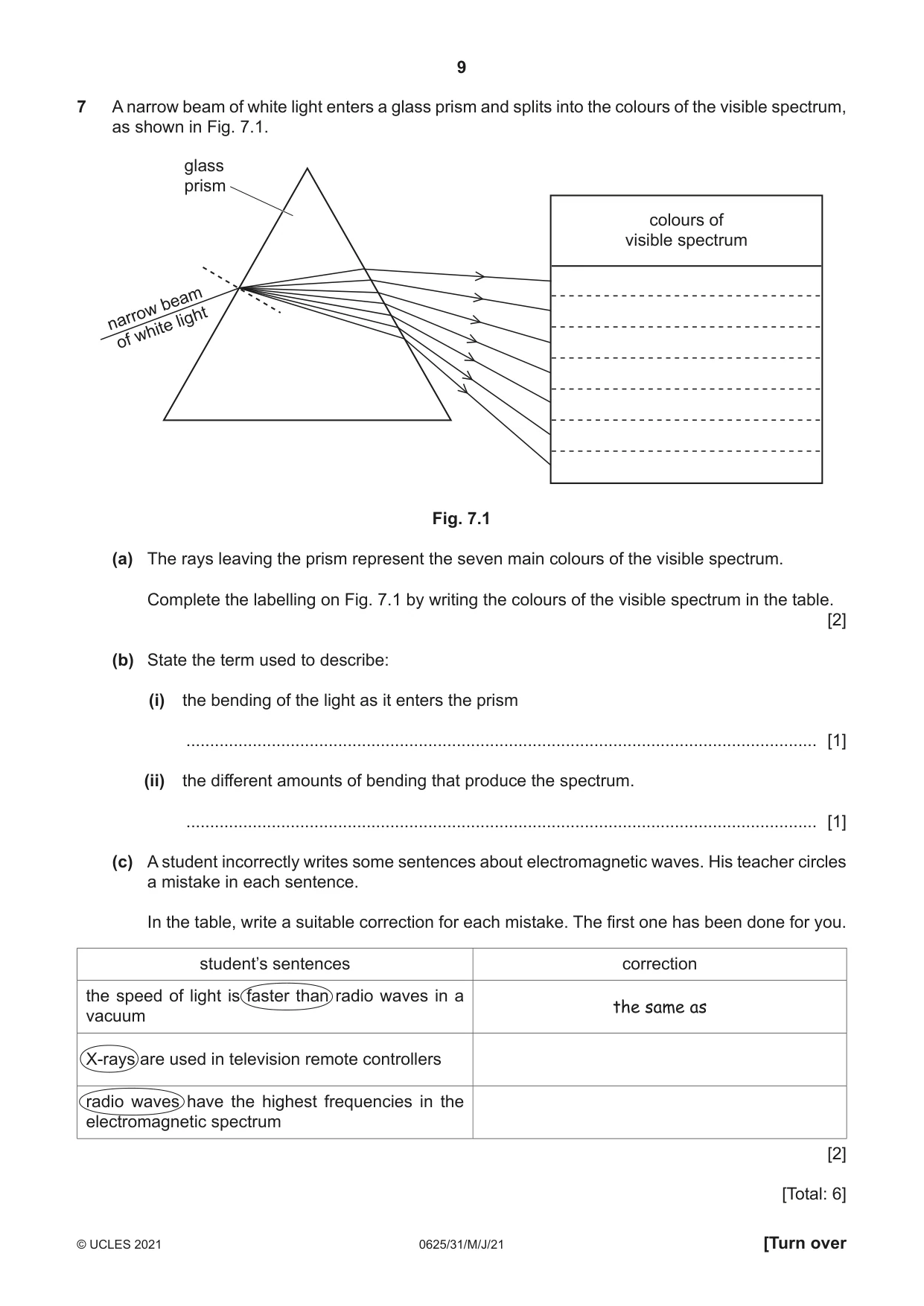
Q7 · A narrow beam of white light enters a glass prism and splits into the colours of the…
7 A narrow beam of white light enters a glass prism and splits into the colours of the visible spectrum, as shown in Fig. 7.1. glass prism colours of visible spectrum beam narrow light white of Fig. 7.1 (a) The rays leaving the prism represent the seven main colours of the visible spectrum. Complete the labelling on Fig. 7.1 by writing the colours of the visible spectrum in the table. [2] (b) State the term used to describe: (i) the bending of the light as it enters the prism ..................................................................................................................................... [1] (ii) the different amounts of bending that produce the spectrum. ..................................................................................................................................... [1] (c) A student incorrectly writes some sentences about electromagnetic waves. His teacher circles a mistake in each sentence. In the table, write a suitable correction for each mistake. The first one has been done for you. student’s sentences correction the speed of light is faster than radio waves in a the same as vacuum X-rays are used in television remote controllers radio waves have the highest frequencies in the electromagnetic spectrum [2] [Total: 6]
Mark scheme: 7(a) any 6 correct colours from: red, orange, yellow, green, blue, indigo, violet M1 candidate’s colours in correct order A1 7(b)(i) refraction B1 7(b)(ii) dispersion B1 7(c) infrared (rays/waves) (are used in tv remote controllers) B1 gamma (rays/waves) (have the highest frequencies in em spectrum) B1
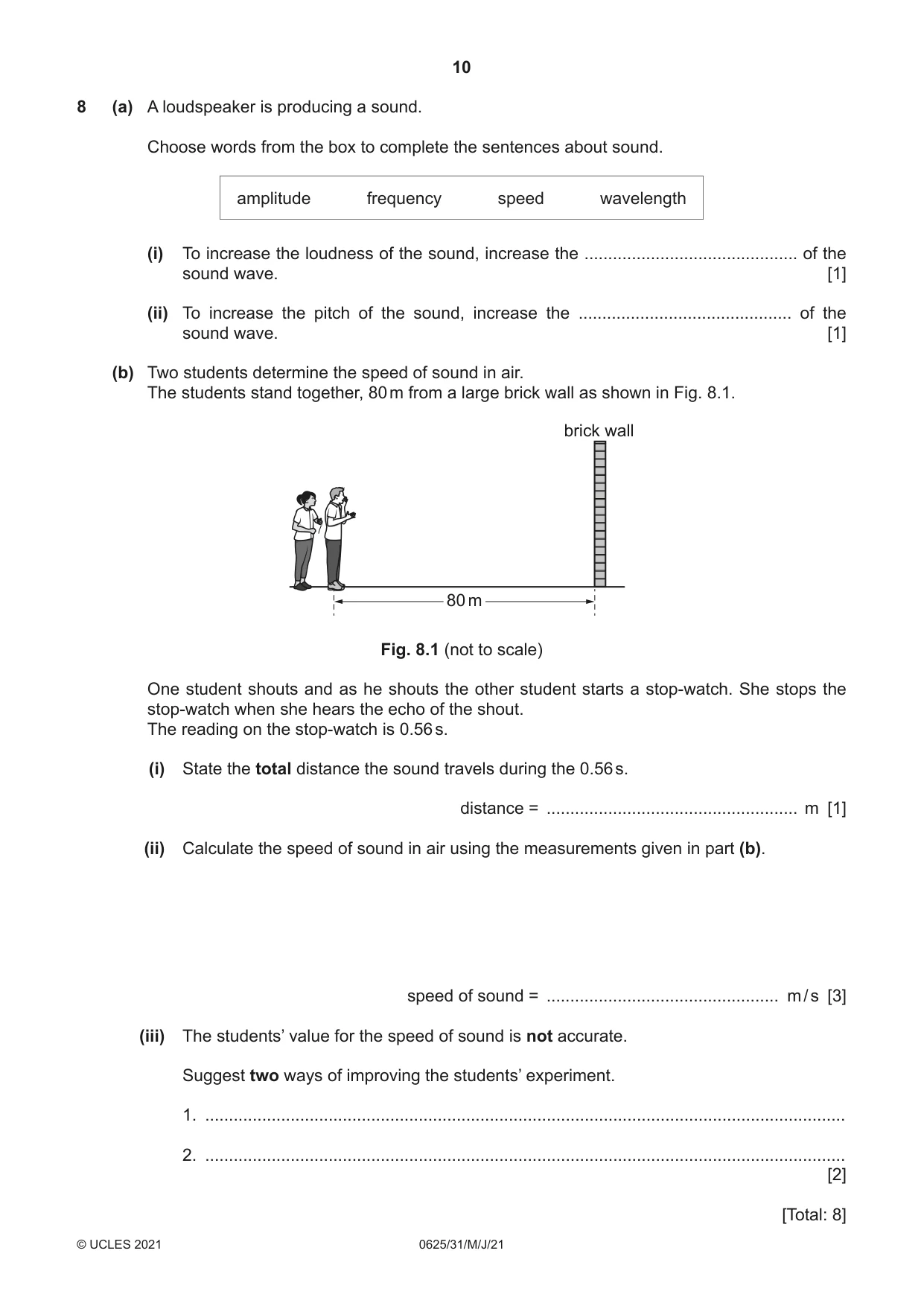
Q8 · A loudspeaker is producing a sound
8 (a) A loudspeaker is producing a sound. Choose words from the box to complete the sentences about sound. amplitude frequency speed wavelength (i) To increase the loudness of the sound, increase the ............................................. of the sound wave. [1] (ii) To increase the pitch of the sound, increase the ............................................. of the sound wave. [1] (b) Two students determine the speed of sound in air. The students stand together, 80 m from a large brick wall as shown in Fig. 8.1. brick wall 80 m Fig. 8.1 (not to scale) One student shouts and as he shouts the other student starts a stop-watch. She stops the stop-watch when she hears the echo of the shout. The reading on the stop-watch is 0.56 s. (i) State the total distance the sound travels during the 0.56 s. distance = ..................................................... m [1] (ii) Calculate the speed of sound in air using the measurements given in part (b). speed of sound = ................................................. m / s [3] (iii) The students’ value for the speed of sound is not accurate. Suggest two ways of improving the students’ experiment. 1. ....................................................................................................................................... 2. ....................................................................................................................................... [2] [Total: 8]
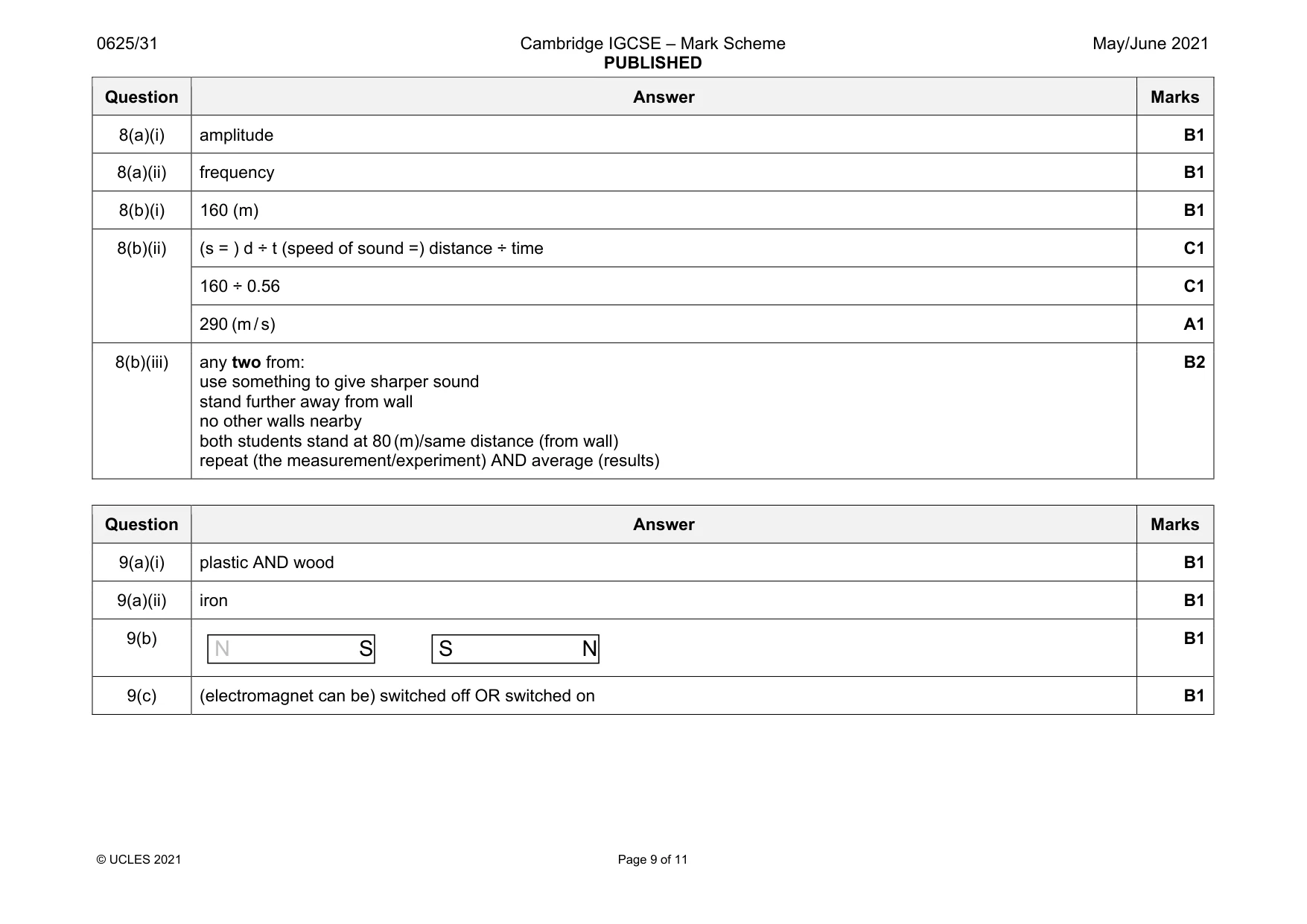
Mark scheme: 8(a)(i) amplitude B1 8(a)(ii) frequency B1 8(b)(i) 160 (m) B1 8(b)(ii) (s = ) d ÷ t (speed of sound =) distance ÷ time C1 160 ÷ 0.56 C1 290 (m / s) A1 8(b)(iii) any two from: use something to give sharper sound stand further away from wall no other walls nearby both students stand at 80 (m)/same distance (from wall) repeat (the measurement/experiment) AND average (results) B2
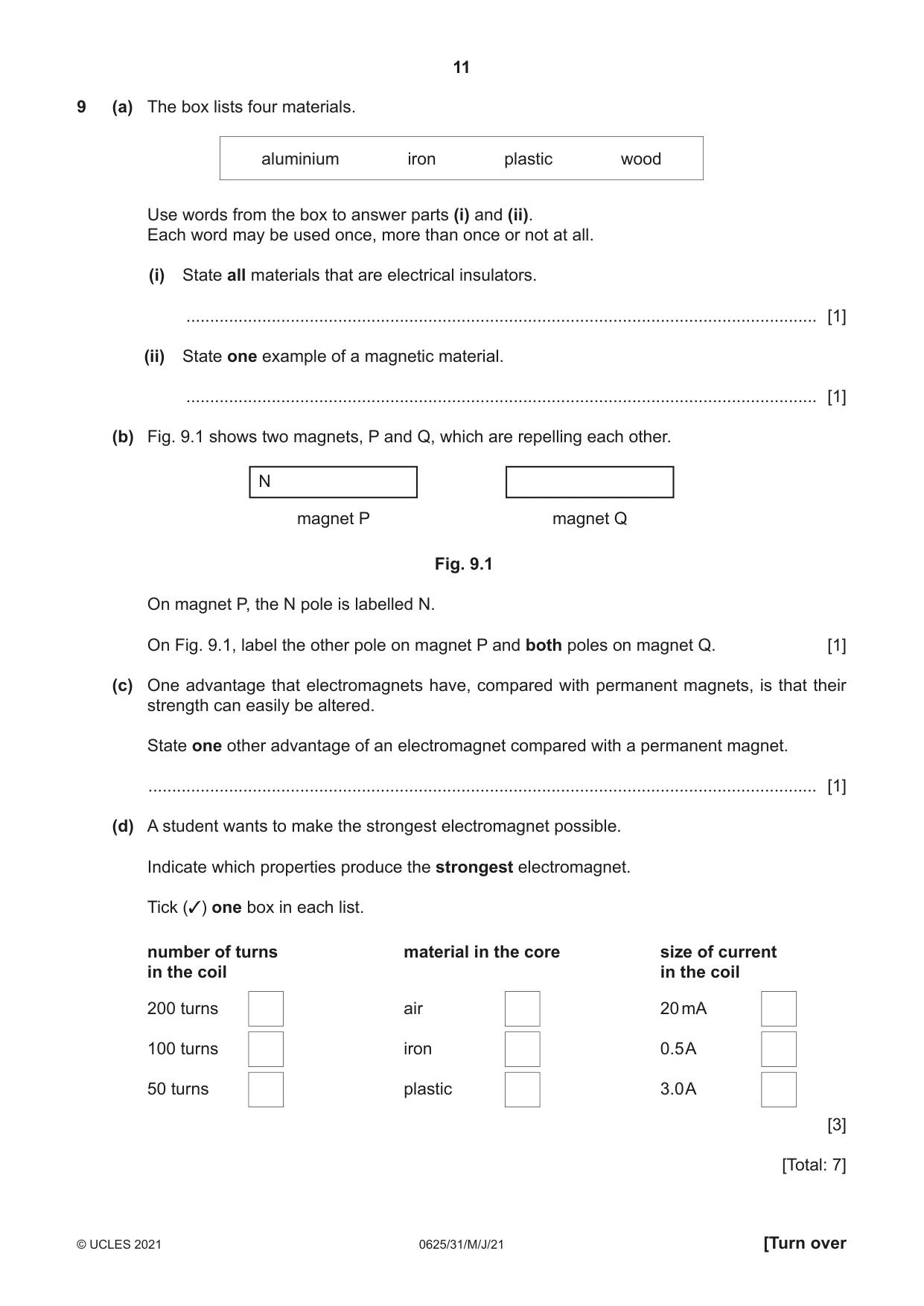
Q9 · The box lists four materials
9 (a) The box lists four materials. aluminium iron plastic wood Use words from the box to answer parts (i) and (ii). Each word may be used once, more than once or not at all. (i) State all materials that are electrical insulators. ..................................................................................................................................... [1] (ii) State one example of a magnetic material. ..................................................................................................................................... [1] (b) Fig. 9.1 shows two magnets, P and Q, which are repelling each other. N magnet P magnet Q Fig. 9.1 On magnet P, the N pole is labelled N. On Fig. 9.1, label the other pole on magnet P and both poles on magnet Q. [1] (c) One advantage that electromagnets have, compared with permanent magnets, is that their strength can easily be altered. State one other advantage of an electromagnet compared with a permanent magnet. ............................................................................................................................................. [1] (d) A student wants to make the strongest electromagnet possible. Indicate which properties produce the strongest electromagnet. Tick (3) one box in each list. number of turns material in the core size of current in the coil in the coil 200 turns air 20 mA 100 turns iron 0.5 A 50 turns plastic 3.0 A [3] [Total: 7]
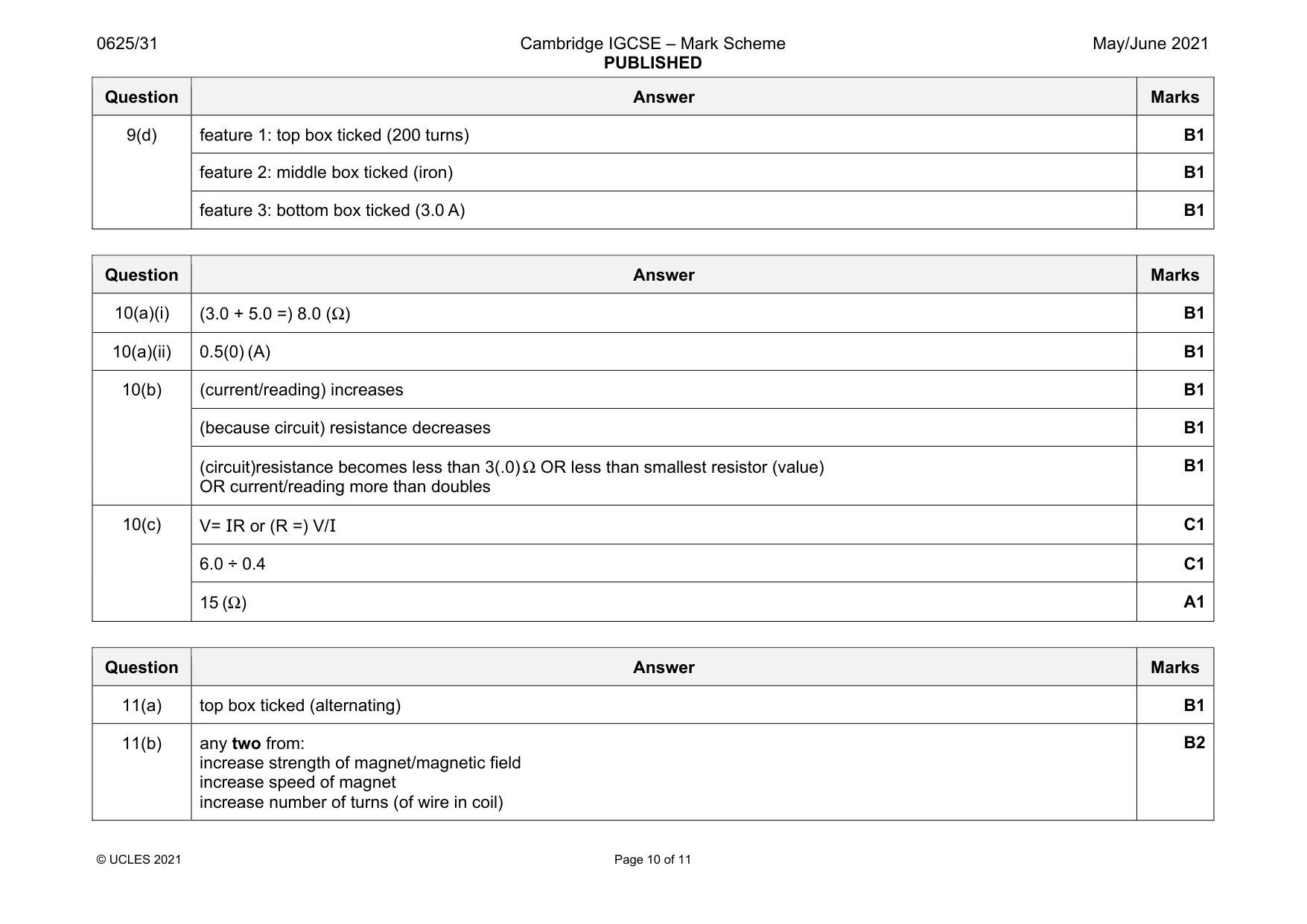
Mark scheme: 9(a)(i) plastic AND wood B1 9(a)(ii) iron B1 9(b) B1 9(c) (electromagnet can be) switched off OR switched on B1 N S S N Question Answer Marks 9(d) feature 1: top box ticked (200 turns) B1 feature 2: middle box ticked (iron) B1 feature 3: bottom box ticked (3.0 A) B1
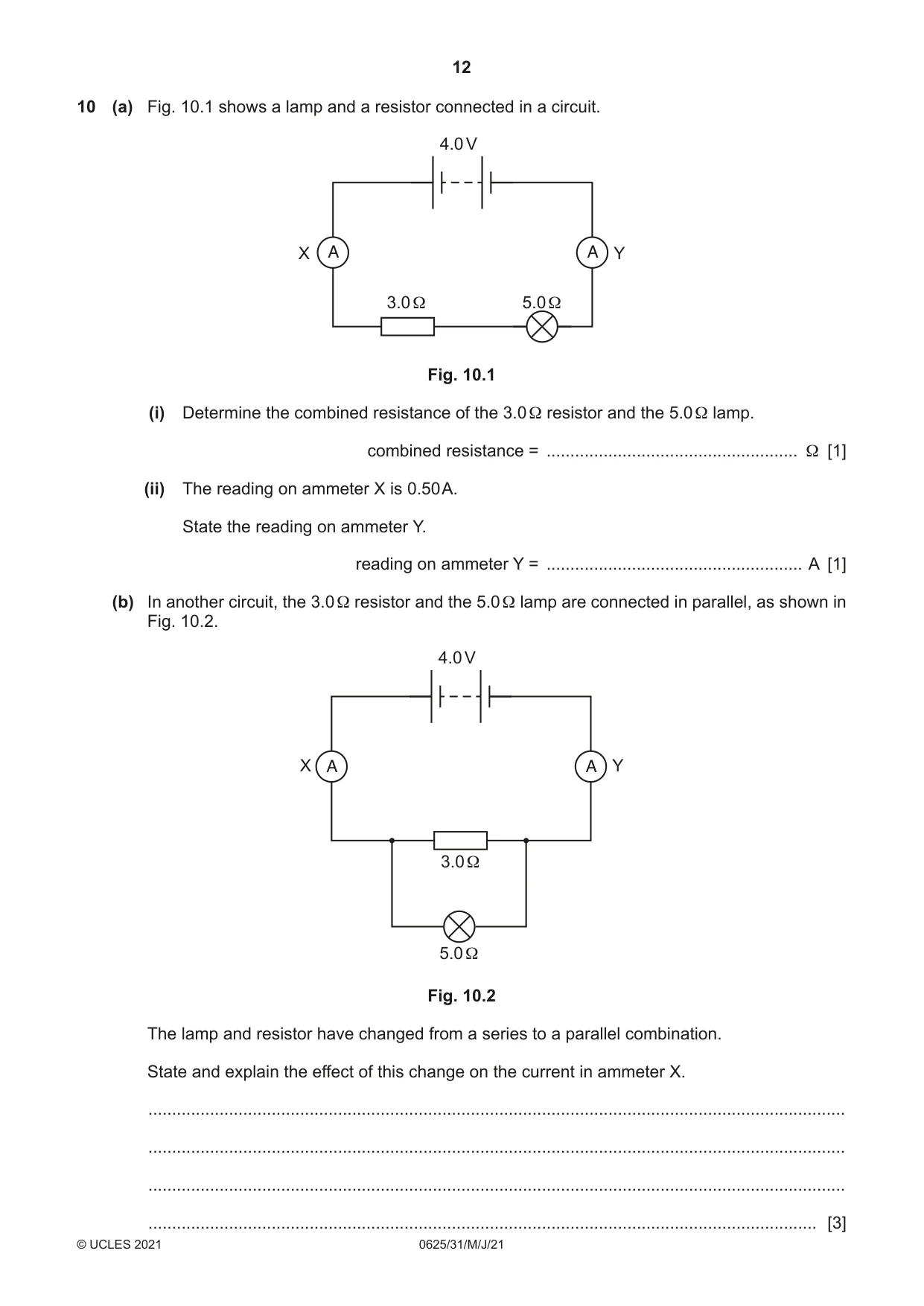
Q10 · A lamp and a resistor connected in a circuit
10 (a) Fig. 10.1 shows a lamp and a resistor connected in a circuit. 4.0 V X A A Y 3.0Ω 5.0Ω Fig. 10.1 (i) Determine the combined resistance of the 3.0 Ω resistor and the 5.0 Ω lamp. combined resistance = ..................................................... Ω [1] (ii) The reading on ammeter X is 0.50 A. State the reading on ammeter Y. reading on ammeter Y = ...................................................... A [1] (b) In another circuit, the 3.0 Ω resistor and the 5.0 Ω lamp are connected in parallel, as shown in Fig. 10.2. 4.0 V X A A Y 3.0Ω 5.0Ω Fig. 10.2 The lamp and resistor have changed from a series to a parallel combination. State and explain the effect of this change on the current in ammeter X. ................................................................................................................................................... ................................................................................................................................................... ................................................................................................................................................... ............................................................................................................................................. [3] (c) The current in a different lamp is 0.40 A when the potential difference (p.d.) across the lamp is 6.0 V. Calculate the resistance of the lamp. resistance of lamp = ..................................................... Ω [3] [Total: 8]
Mark scheme: 10(a)(i) (3.0 + 5.0 =) 8.0 (Ω) B1 10(a)(ii) 0.5(0) (A) B1 10(b) (current/reading) increases B1 (because circuit) resistance decreases B1 (circuit)resistance becomes less than 3(.0) Ω OR less than smallest resistor (value) OR current/reading more than doubles B1 10(c) V= IR or (R =) V/I C1 6.0 ÷ 0.4 C1 15 (Ω) A1
Q11 · A student uses a coil and a magnet on a spring to generate an electromotive force…
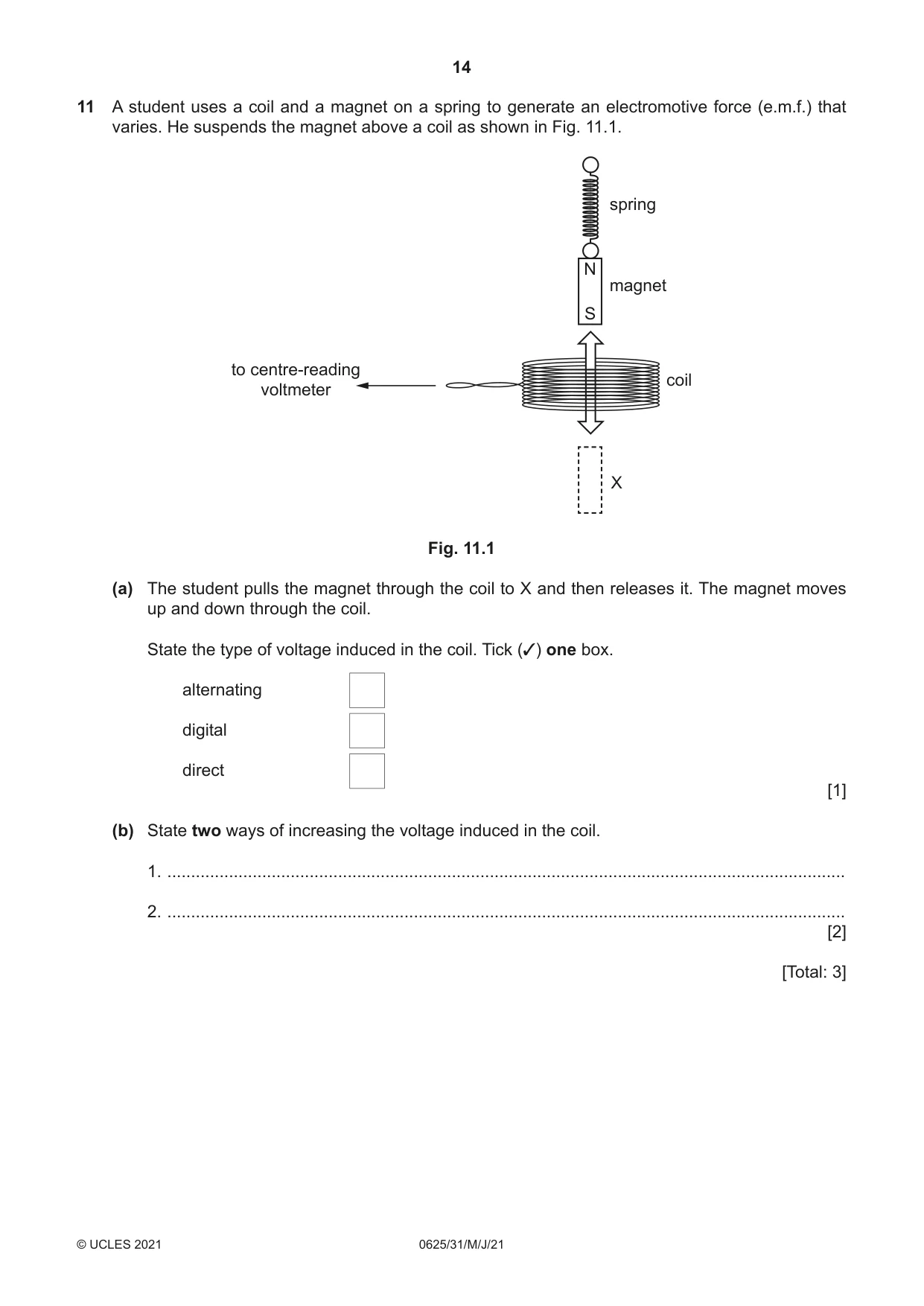
11 A student uses a coil and a magnet on a spring to generate an electromotive force (e.m.f.) that varies. He suspends the magnet above a coil as shown in Fig. 11.1. spring N magnet S to centre-reading coil voltmeter X Fig. 11.1 (a) The student pulls the magnet through the coil to X and then releases it. The magnet moves up and down through the coil. State the type of voltage induced in the coil. Tick (3) one box. alternating digital direct [1] (b) State two ways of increasing the voltage induced in the coil. 1. ............................................................................................................................................... 2. ............................................................................................................................................... [2] [Total: 3]
Mark scheme: 11(a) top box ticked (alternating) B1 11(b) any two from: increase strength of magnet/magnetic field increase speed of magnet increase number of turns (of wire in coil) B2
Q12 · Table 12.1 describes four nuclides
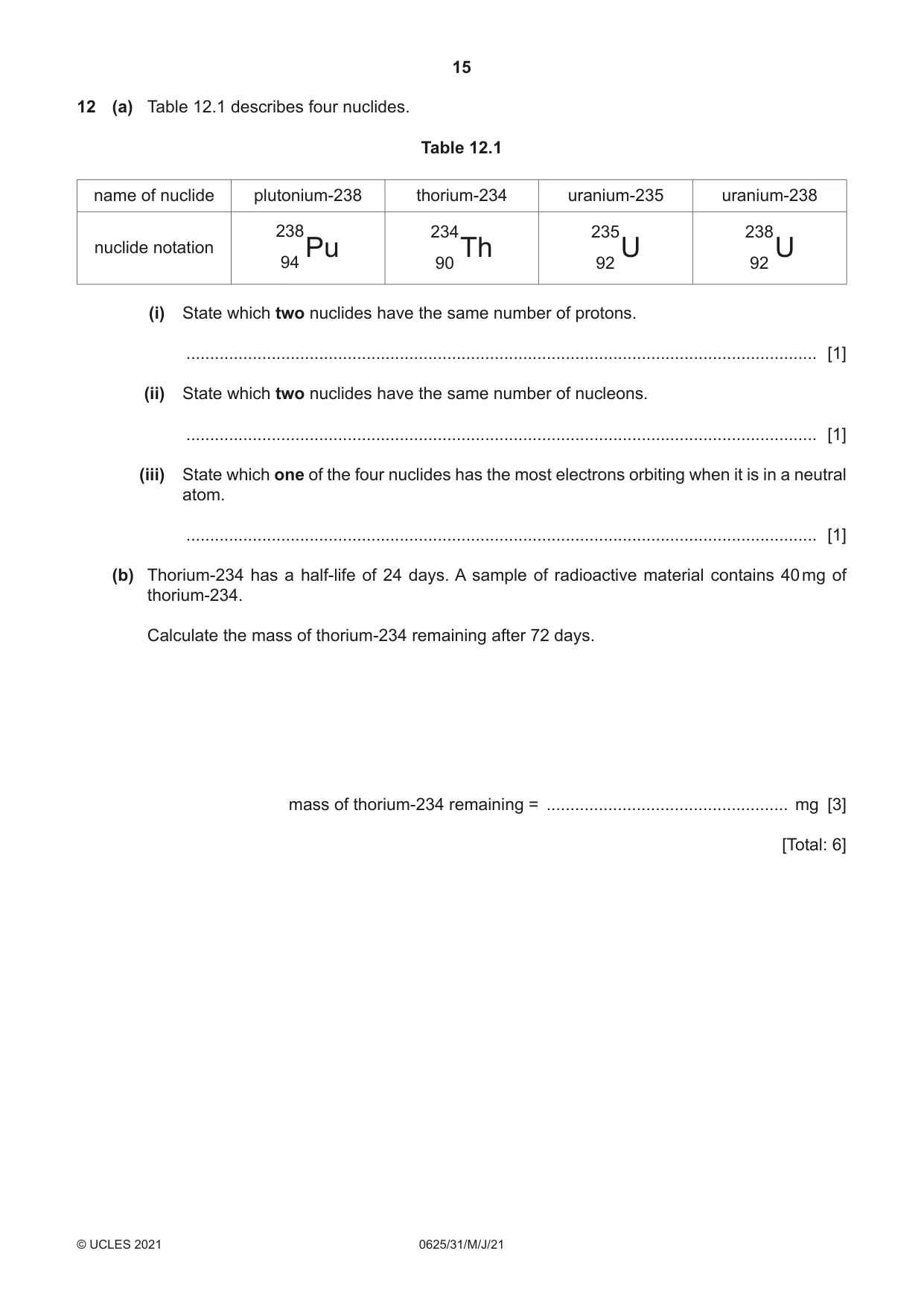
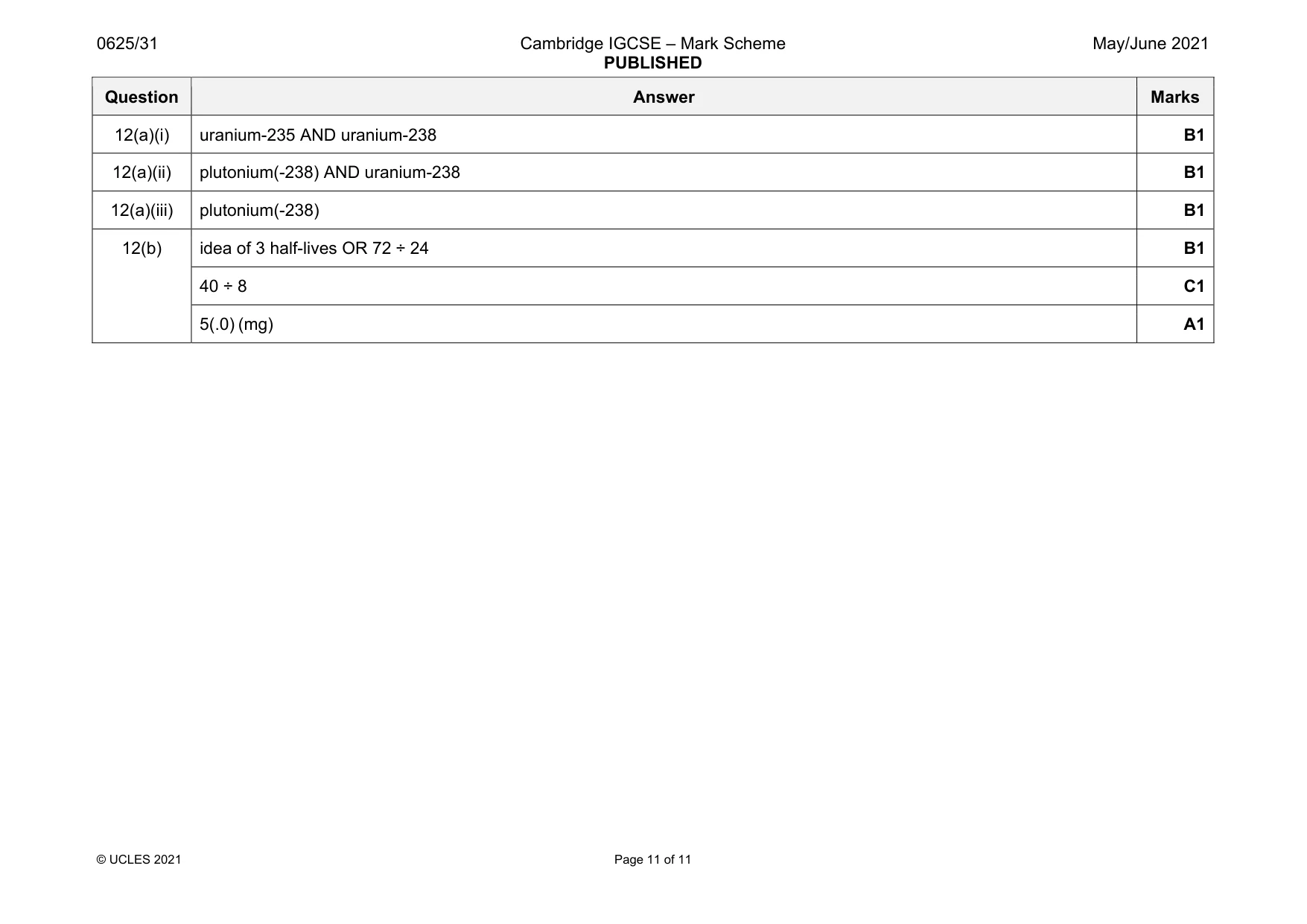
12 (a) Table 12.1 describes four nuclides. Table 12.1 name of nuclide plutonium-238 thorium-234 uranium-235 uranium-238 238 234 235 238 nuclide notation Pu Th U U 94 90 92 92 (i) State which two nuclides have the same number of protons. ..................................................................................................................................... [1] (ii) State which two nuclides have the same number of nucleons. ..................................................................................................................................... [1] (iii) State which one of the four nuclides has the most electrons orbiting when it is in a neutral atom. ..................................................................................................................................... [1] (b) Thorium-234 has a half-life of 24 days. A sample of radioactive material contains 40 mg of thorium-234. Calculate the mass of thorium-234 remaining after 72 days. mass of thorium-234 remaining = ................................................... mg [3] [Total: 6]
Mark scheme: 12(a)(i) uranium-235 AND uranium-238 B1 12(a)(ii) plutonium(-238) AND uranium-238 B1 12(a)(iii) plutonium(-238) B1 12(b) idea of 3 half-lives OR 72 ÷ 24 B1 40 ÷ 8 C1 5(.0) (mg) A1
What was in this paper
The subtopics covered by these 12 questions, and how many questions each got. Open one in a new tab to see every Cambridge question on it.
What you needed in this session
Cambridge’s own grade thresholds for 2021 May/June, Paper 3 · Variant 1. A higher threshold means an easier paper — the bar moves with how the cohort did.