Cambridge IGCSE Physics 0625 — 2016 May/June Paper 3 · Variant 1
0625/31/M/J/16 · 12 questions · 80 marks · ≈90 min
The question paper and its mark scheme, free to read here and free to download. This is Cambridge’s own paper, exactly as it was sat.
Question paper20 pages

Mark scheme10 pages
Answers below. Sit the paper first if you are practising.
Questions as text
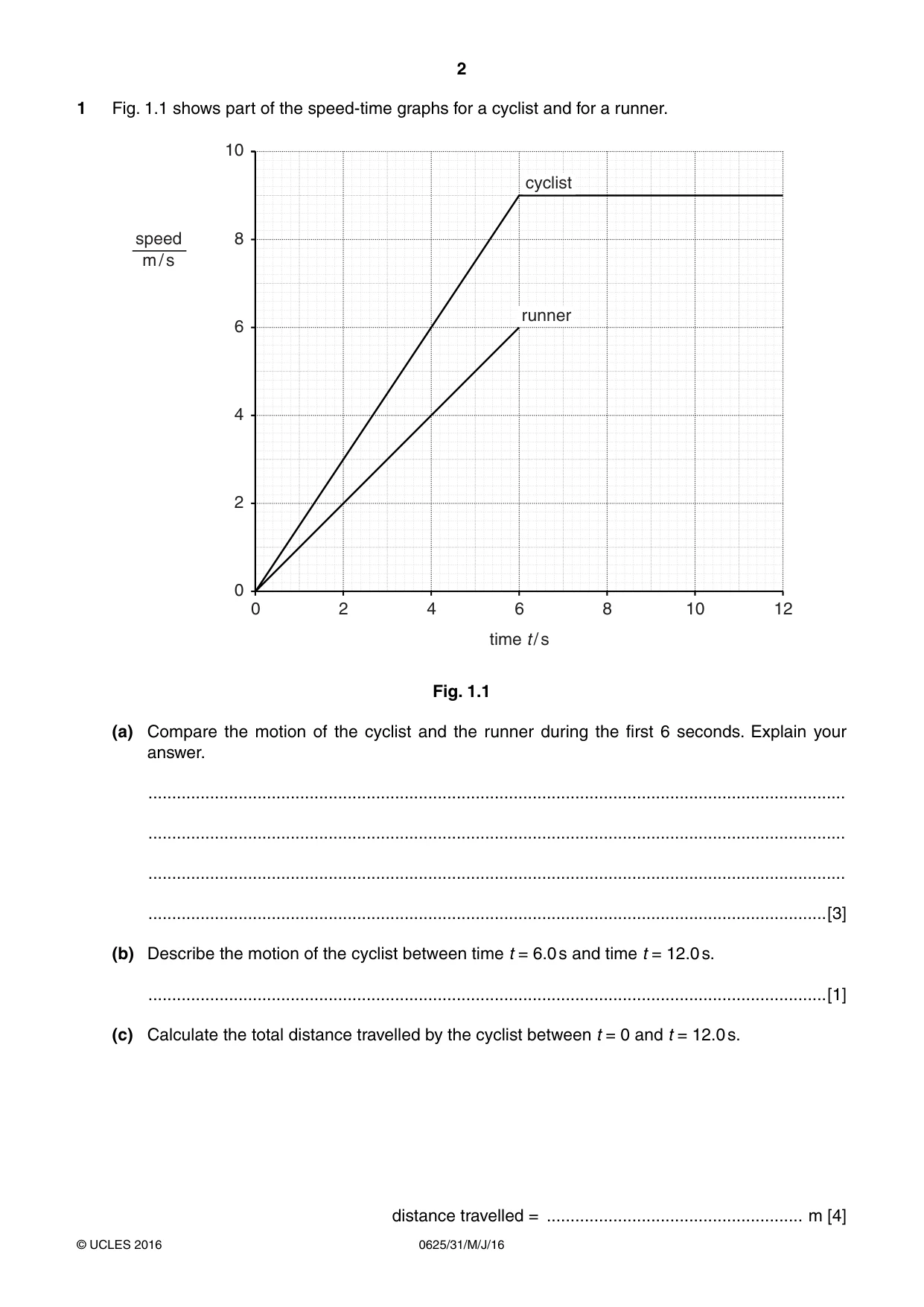
Q1 · Part of the speed-time graphs for a cyclist and for a runner
1 Fig. 1.1 shows part of the speed-time graphs for a cyclist and for a runner. 10 cyclist speed 8 P / V runner 6 4 2 0 0 2 4 6 8 10 12 time W / s Fig. 1.1 (a) Compare the motion of the cyclist and the runner during the first 6 seconds. Explain your answer. ................................................................................................................................................... ................................................................................................................................................... ................................................................................................................................................... ...............................................................................................................................................[3] (b) Describe the motion of the cyclist between time t = 6.0 s and time t = 12.0 s. ...............................................................................................................................................[1] (c) Calculate the total distance travelled by the cyclist between t = 0 and t = 12.0 s. distance travelled = ...................................................... m [4] (d) After the first 6.0 seconds, the runner moves at constant speed for 4.0 seconds. He then slows down uniformly and stops in a further 2.0 seconds. On Fig. 1.1, complete the graph for the runner’s motion. [2] [Total: 10]
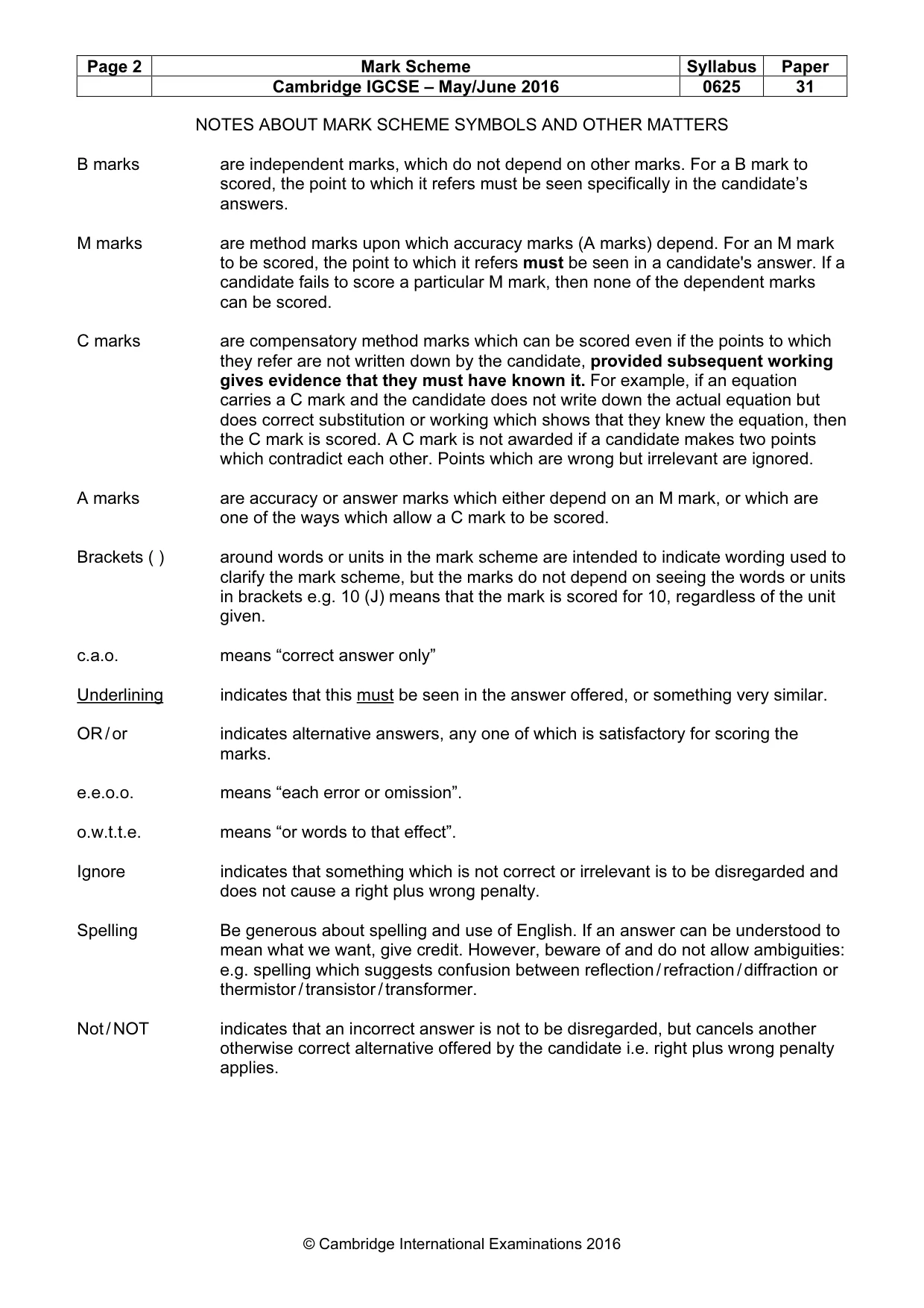
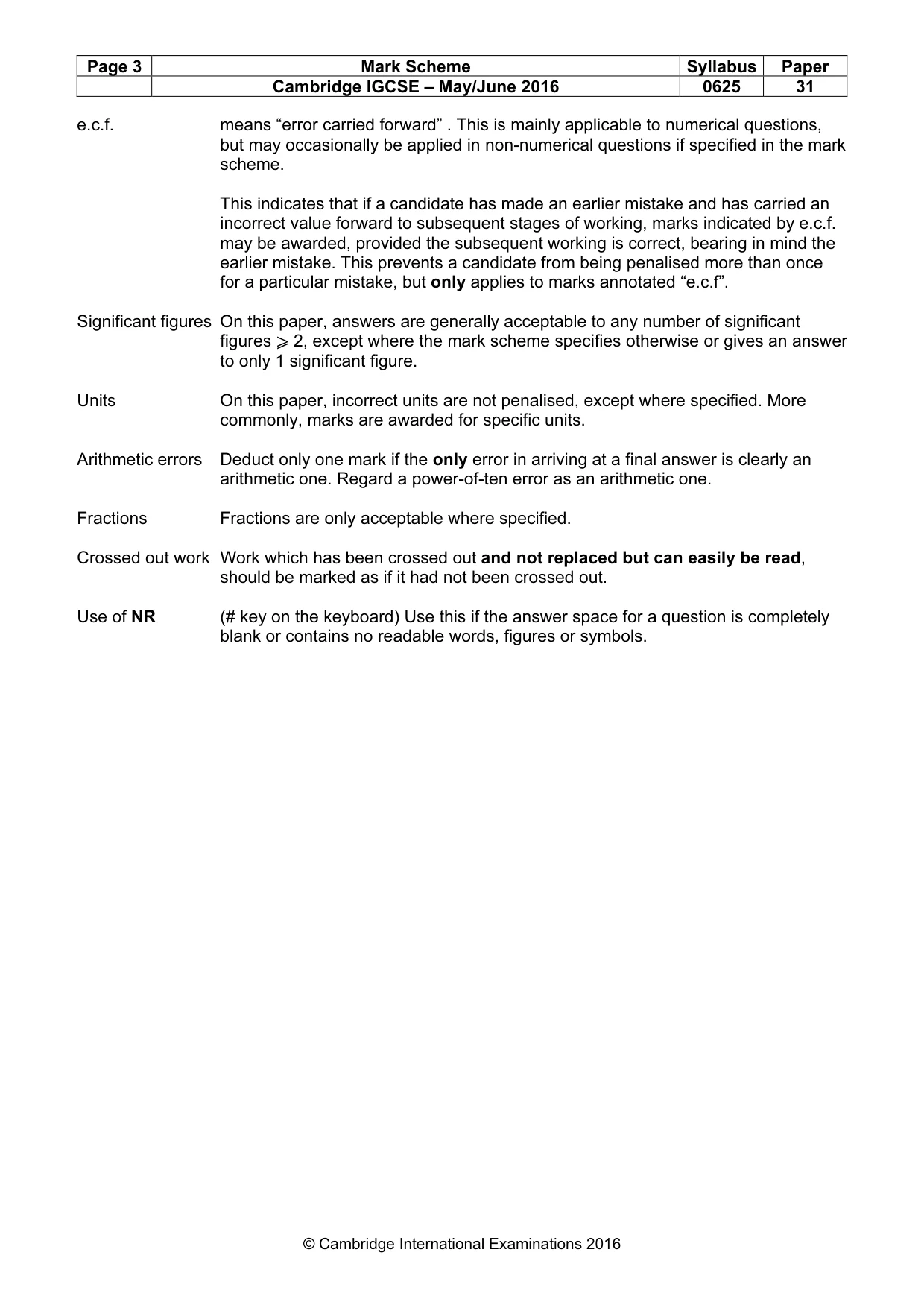
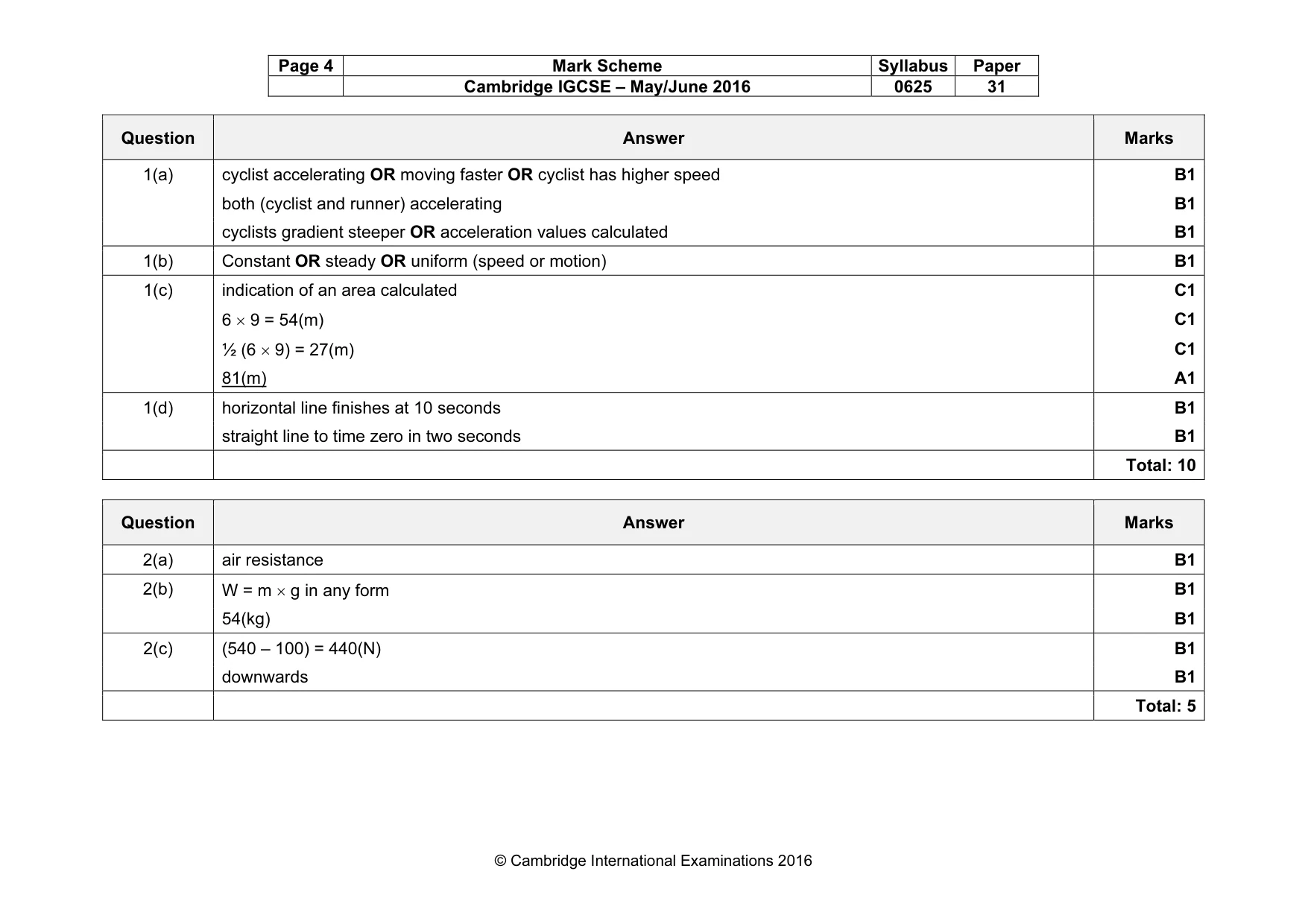
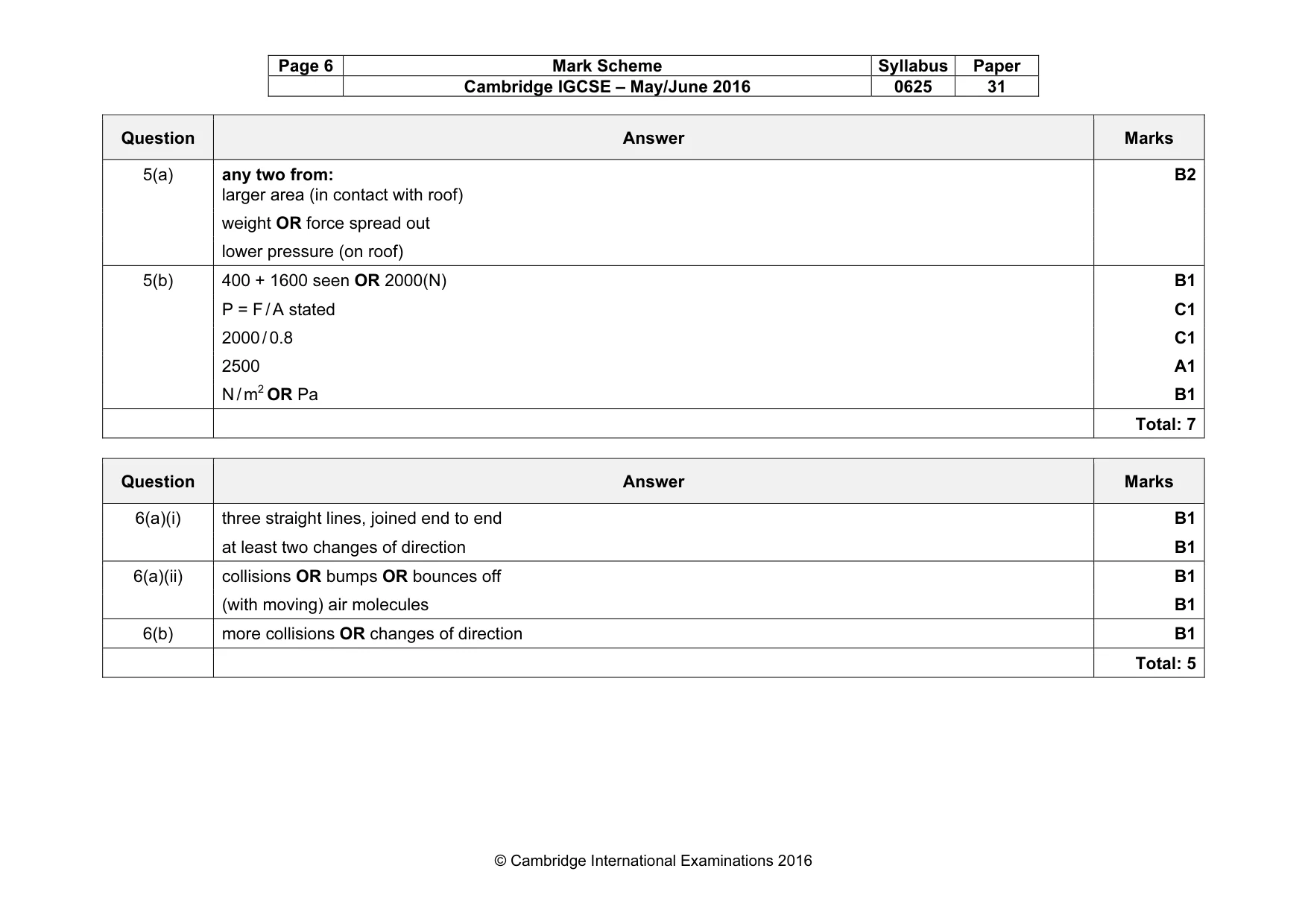
Mark scheme: 1(a) cyclist accelerating OR moving faster OR cyclist has higher speed B1 both (cyclist and runner) accelerating B1 cyclists gradient steeper OR acceleration values calculated B1 1(b) Constant OR steady OR uniform (speed or motion) B1 1(c) indication of an area calculated C1 6 × 9 = 54(m) C1 ½ (6 × 9) = 27(m) C1 81(m) A1 1(d) horizontal line finishes at 10 seconds B1 straight line to time zero in two seconds B1 Total: 10
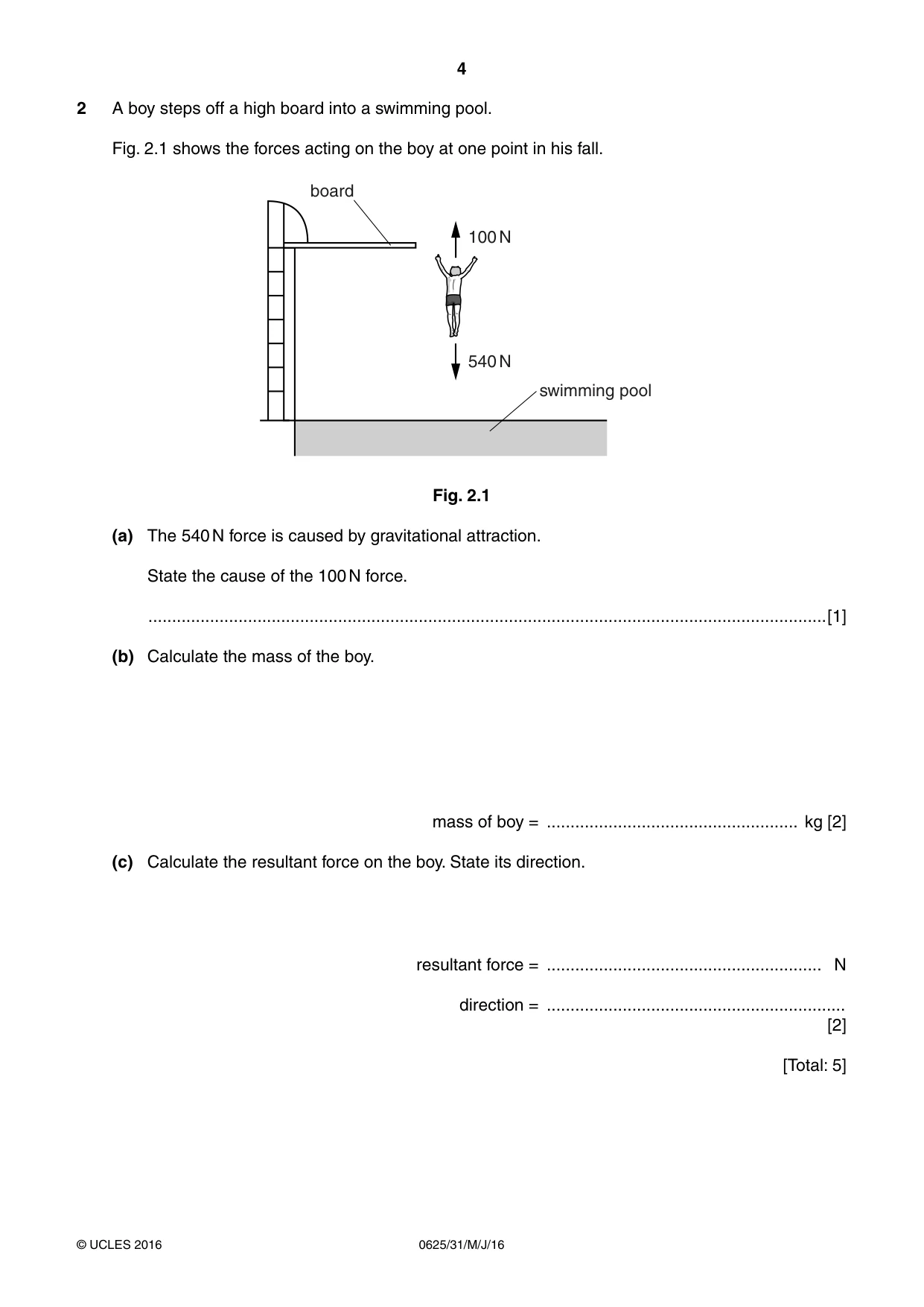
Q2 · A boy steps off a high board into a swimming pool
2 A boy steps off a high board into a swimming pool. Fig. 2.1 shows the forces acting on the boy at one point in his fall. board 100 N 540 N swimming pool Fig. 2.1 (a) The 540 N force is caused by gravitational attraction. State the cause of the 100 N force. ...............................................................................................................................................[1] (b) Calculate the mass of the boy. mass of boy = ..................................................... kg [2] (c) Calculate the resultant force on the boy. State its direction. resultant force = .......................................................... N direction = ............................................................... [2] [Total: 5]
Mark scheme: 2(a) air resistance B1 2(b) W = m × g in any form B1 54(kg) B1 2(c) (540 – 100) = 440(N) B1 downwards B1 Total: 5
Question 3
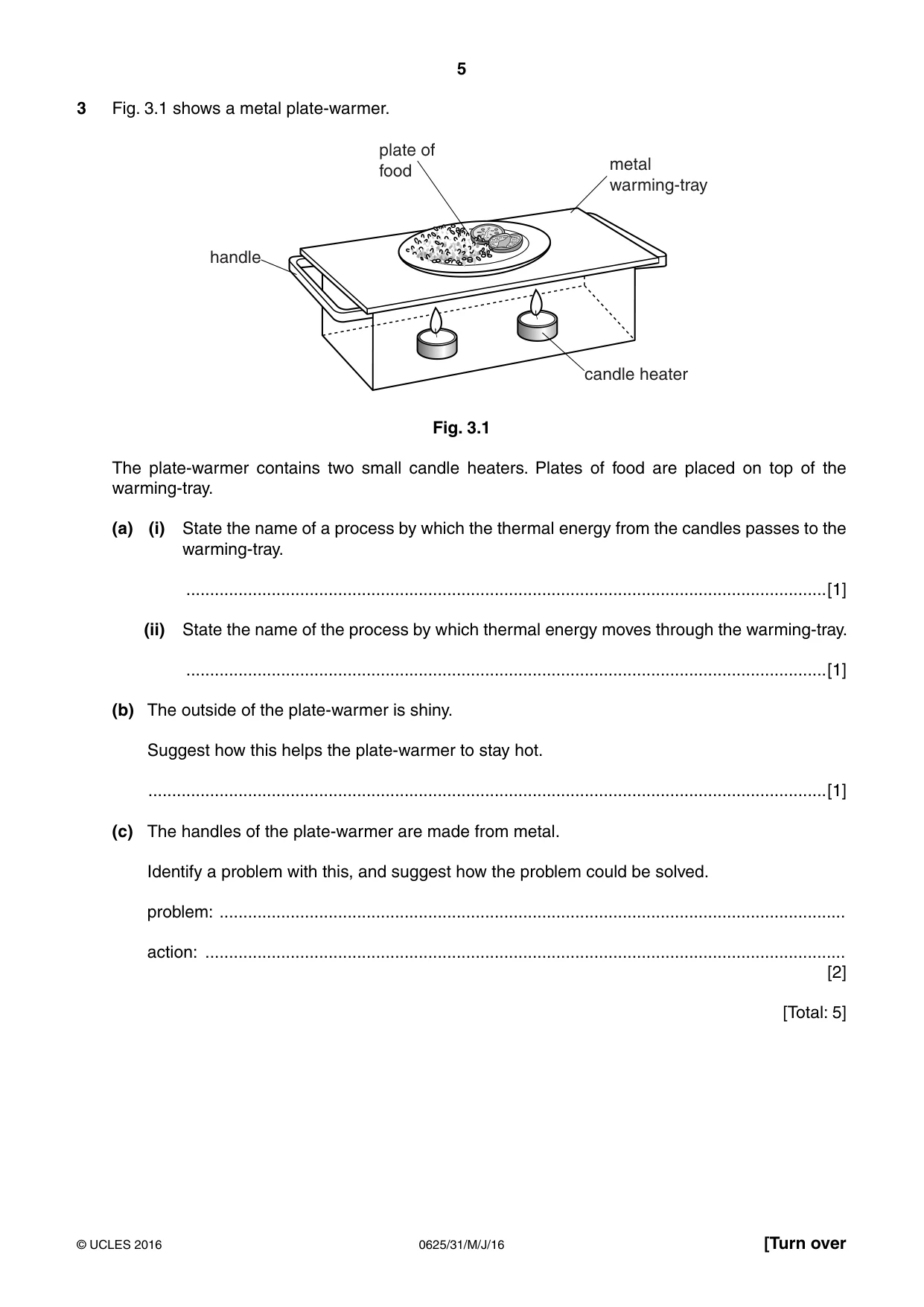
3 Fig. 3.1 shows a metal plate-warmer. plate of metal food warming-tray handle candle heater Fig. 3.1 The plate-warmer contains two small candle heaters. Plates of food are placed on top of the warming-tray. (a) (i) State the name of a process by which the thermal energy from the candles passes to the warming-tray. .......................................................................................................................................[1] (ii) State the name of the process by which thermal energy moves through the warming-tray. .......................................................................................................................................[1] (b) The outside of the plate-warmer is shiny. Suggest how this helps the plate-warmer to stay hot. ...............................................................................................................................................[1] (c) The handles of the plate-warmer are made from metal. Identify a problem with this, and suggest how the problem could be solved. problem: .................................................................................................................................... action: ....................................................................................................................................... [2] [Total: 5]
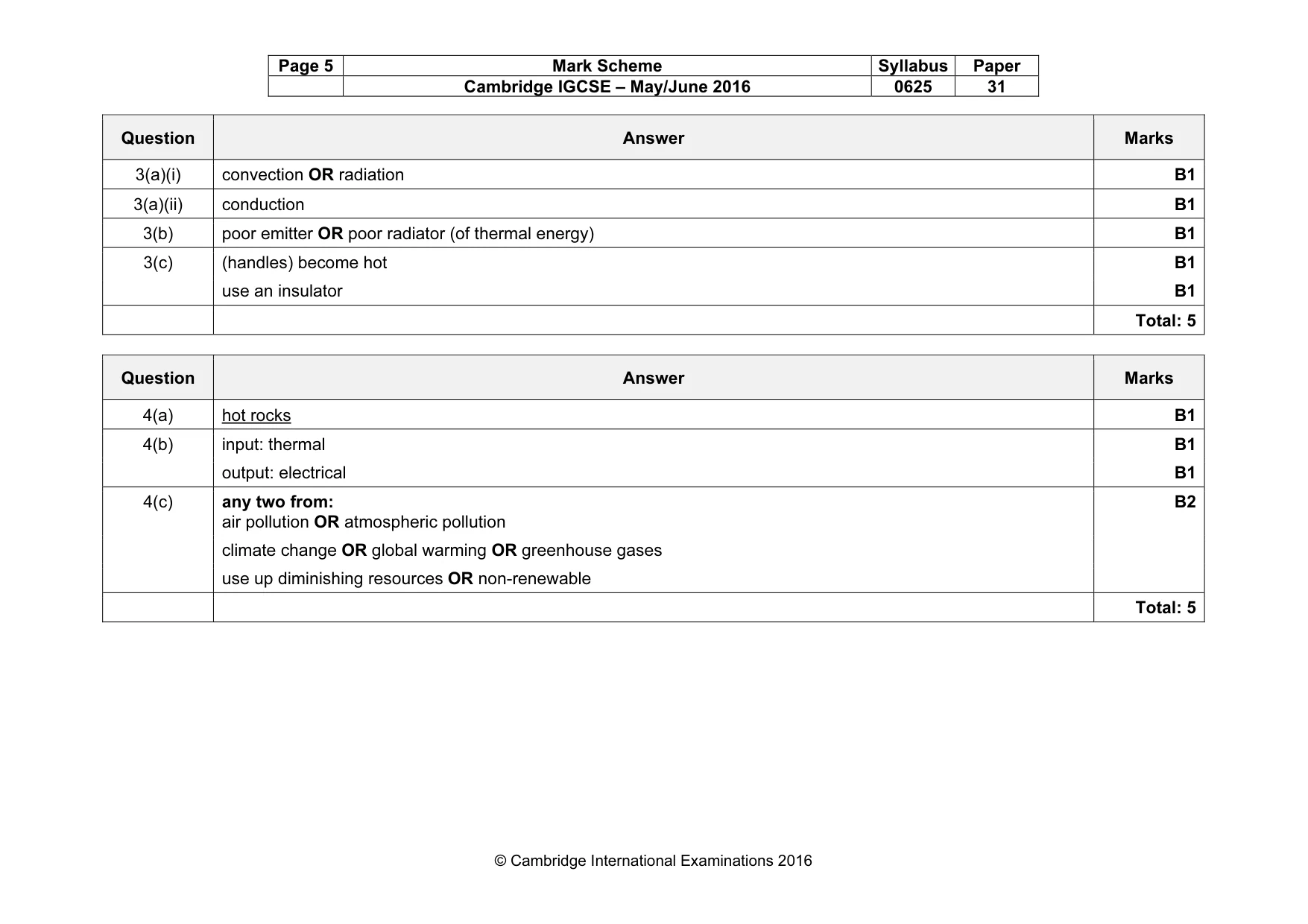
Mark scheme: 3(a)(i) convection OR radiation B1 3(a)(ii) conduction B1 3(b) poor emitter OR poor radiator (of thermal energy) B1 3(c) (handles) become hot B1 use an insulator B1 Total: 5
Q4 · A simplified diagram of a geothermal power station
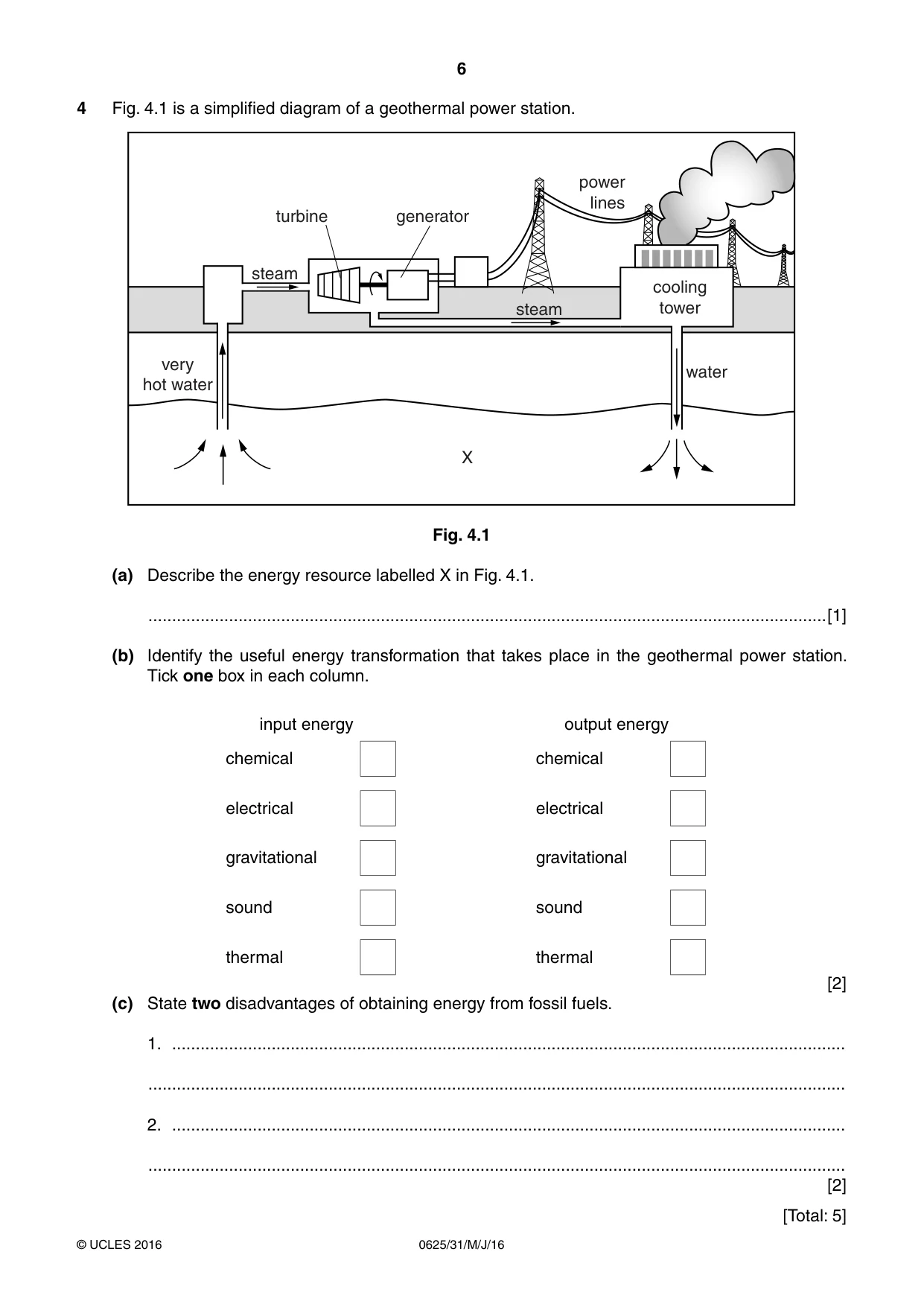
4 Fig. 4.1 is a simplified diagram of a geothermal power station. power lines turbine generator steam cooling steam tower very water hot water X Fig. 4.1 (a) Describe the energy resource labelled X in Fig. 4.1. ...............................................................................................................................................[1] (b) Identify the useful energy transformation that takes place in the geothermal power station. Tick one box in each column. input energy output energy chemical chemical electrical electrical gravitational gravitational sound sound thermal thermal [2] (c) State two disadvantages of obtaining energy from fossil fuels. 1. .............................................................................................................................................. ................................................................................................................................................... 2. .............................................................................................................................................. ................................................................................................................................................... [2] [Total: 5]
Mark scheme: 4(a) hot rocks B1 4(b) input: thermal B1 output: electrical B1 4(c) any two from: air pollution OR atmospheric pollution B2 climate change OR global warming OR greenhouse gases use up diminishing resources OR non-renewable Total: 5
Q5 · Two men repairing a weak roof using a crawler-board
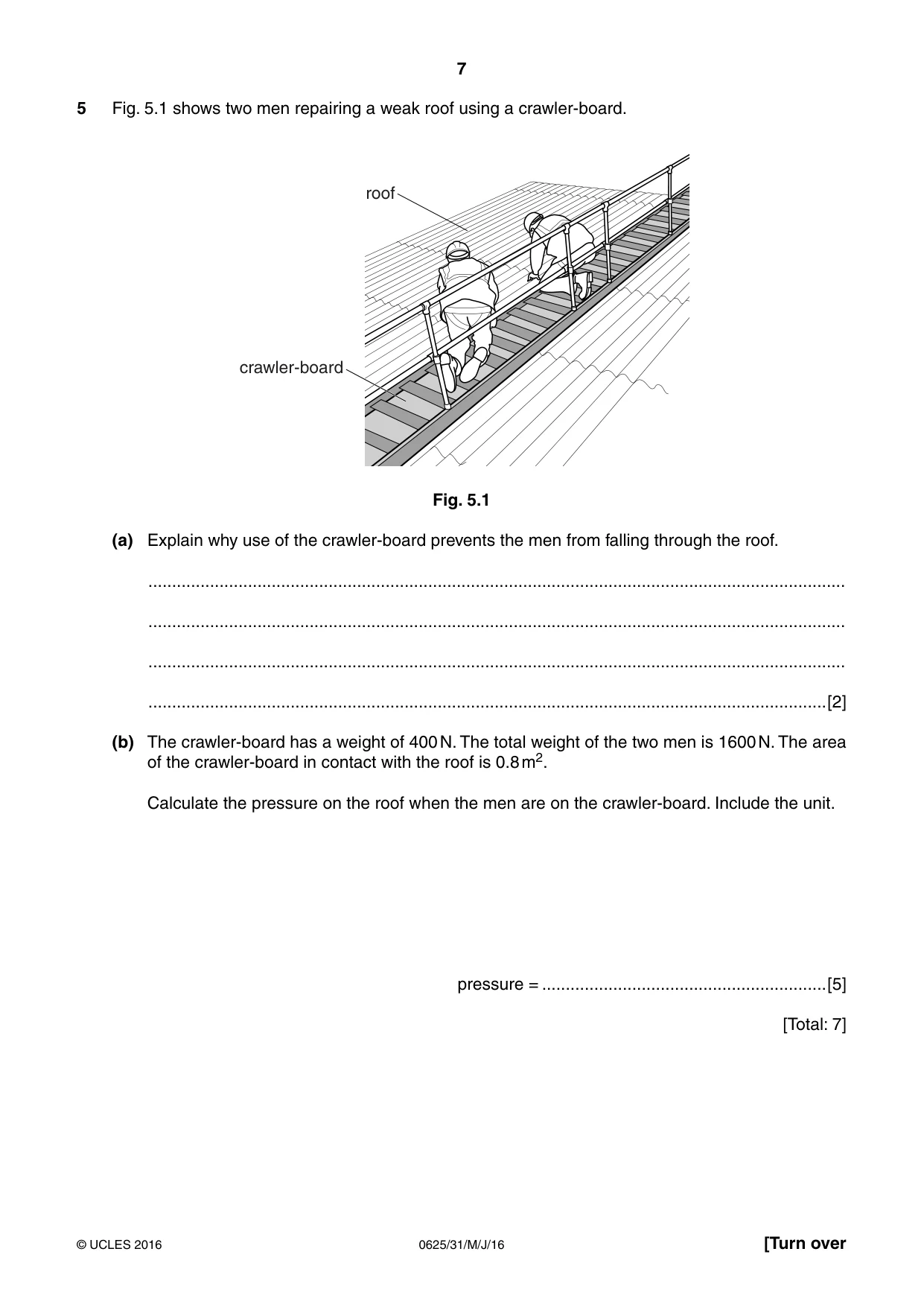
5 Fig. 5.1 shows two men repairing a weak roof using a crawler-board. roof crawler-board Fig. 5.1 (a) Explain why use of the crawler-board prevents the men from falling through the roof. ................................................................................................................................................... ................................................................................................................................................... ................................................................................................................................................... ...............................................................................................................................................[2] (b) The crawler-board has a weight of 400 N. The total weight of the two men is 1600 N. The area of the crawler-board in contact with the roof is 0.8 m2. Calculate the pressure on the roof when the men are on the crawler-board. Include the unit. pressure = ............................................................[5] [Total: 7]
Mark scheme: 5(a) any two from: larger area (in contact with roof) B2 weight OR force spread out lower pressure (on roof) 5(b) 400 + 1600 seen OR 2000(N) B1 P = F / A stated C1 2000 / 0.8 C1 2500 A1 N / m2 OR Pa B1 Total: 7
Q6 · An experiment to observe the motion of smoke particles in air
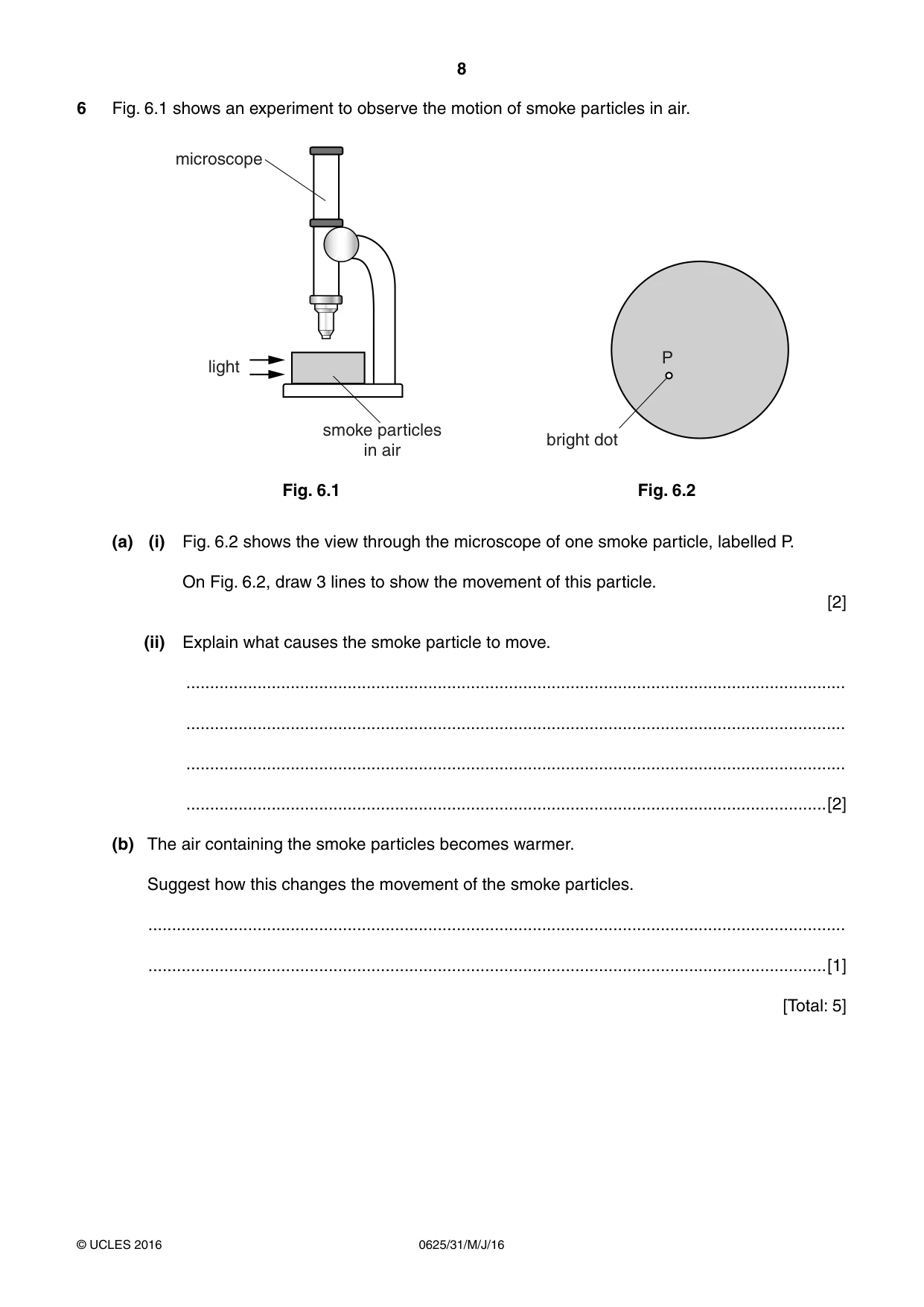
6 Fig. 6.1 shows an experiment to observe the motion of smoke particles in air. microscope P light smoke particles bright dot in air Fig. 6.1 Fig. 6.2 (a) (i) Fig. 6.2 shows the view through the microscope of one smoke particle, labelled P. On Fig. 6.2, draw 3 lines to show the movement of this particle. [2] (ii) Explain what causes the smoke particle to move. ........................................................................................................................................... ........................................................................................................................................... ........................................................................................................................................... .......................................................................................................................................[2] (b) The air containing the smoke particles becomes warmer. Suggest how this changes the movement of the smoke particles. ................................................................................................................................................... ...............................................................................................................................................[1] [Total: 5]
Mark scheme: 6(a)(i) three straight lines, joined end to end B1 at least two changes of direction B1 6(a)(ii) collisions OR bumps OR bounces off B1 (with moving) air molecules B1 6(b) more collisions OR changes of direction B1 Total: 5
Q7 · Equipment used to demonstrate thermal expansion
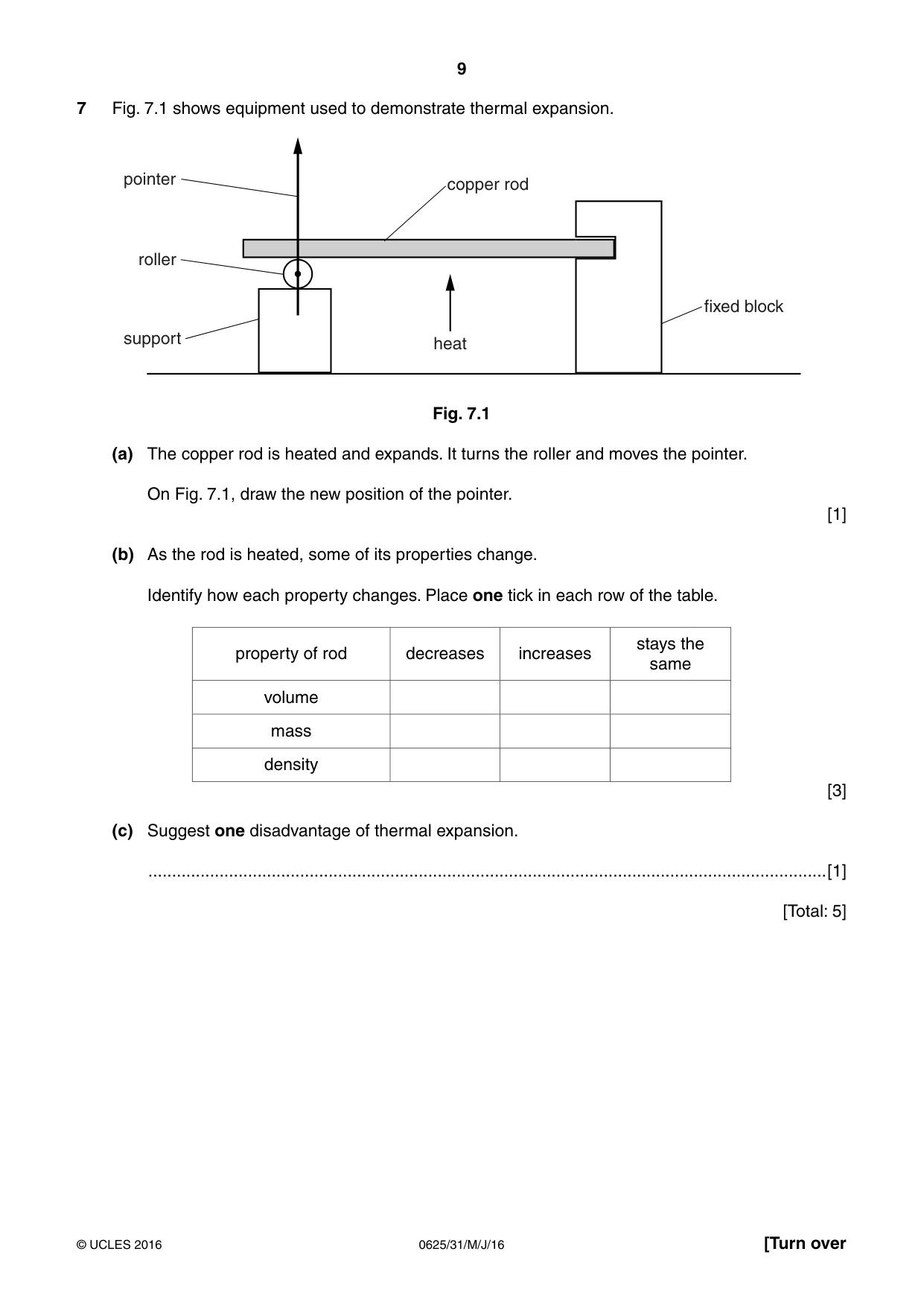
7 Fig. 7.1 shows equipment used to demonstrate thermal expansion. pointer copper rod roller fixed block support heat Fig. 7.1 (a) The copper rod is heated and expands. It turns the roller and moves the pointer. On Fig. 7.1, draw the new position of the pointer. [1] (b) As the rod is heated, some of its properties change. Identify how each property changes. Place one tick in each row of the table. stays the property of rod decreases increases same volume mass density [3] (c) Suggest one disadvantage of thermal expansion. ...............................................................................................................................................[1] [Total: 5]
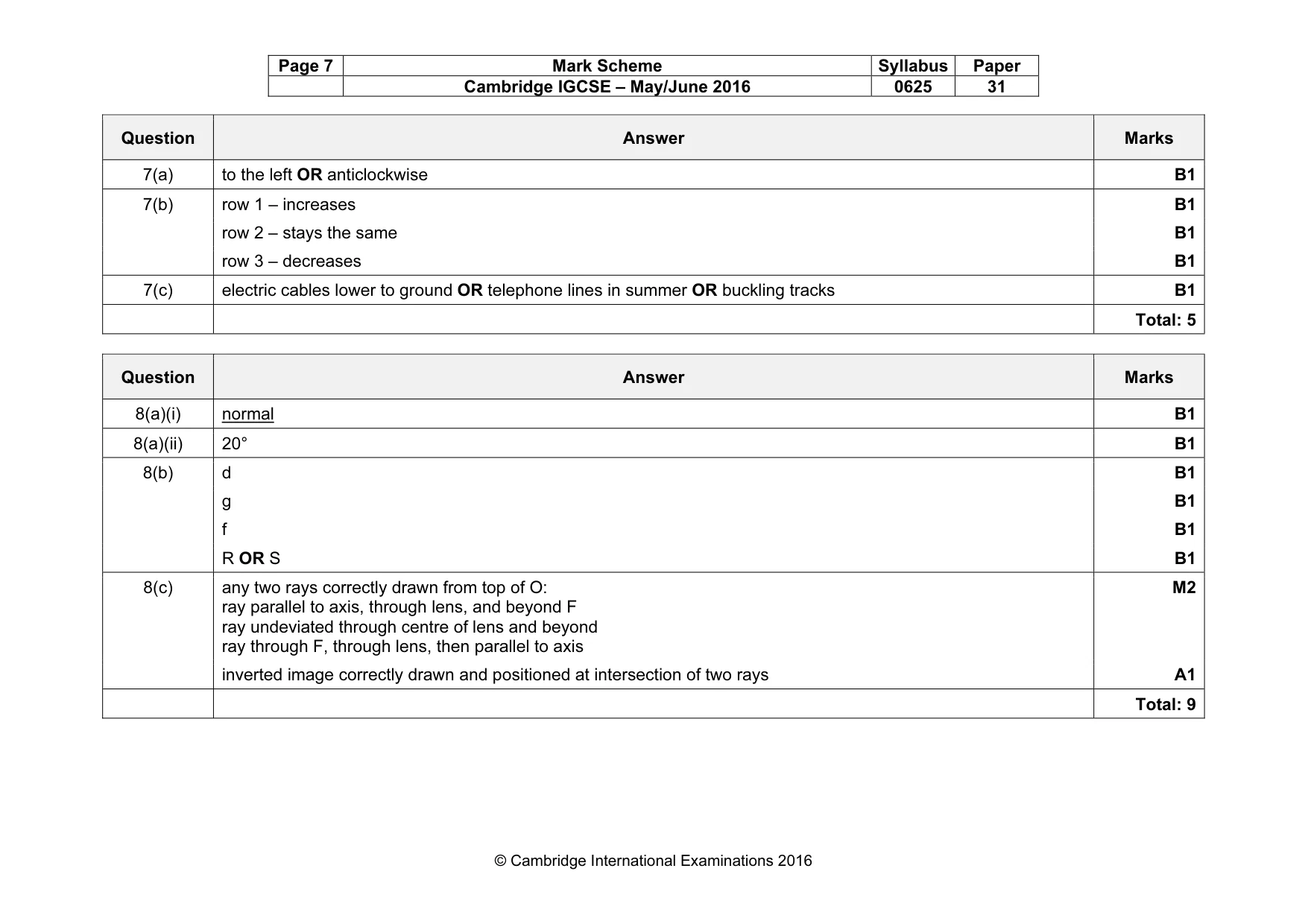
Mark scheme: 7(a) to the left OR anticlockwise B1 7(b) row 1 – increases B1 row 2 – stays the same B1 row 3 – decreases B1 7(c) electric cables lower to ground OR telephone lines in summer OR buckling tracks B1 Total: 5
Q8 · A student directs a ray of light towards a plane mirror, as shown in Fig
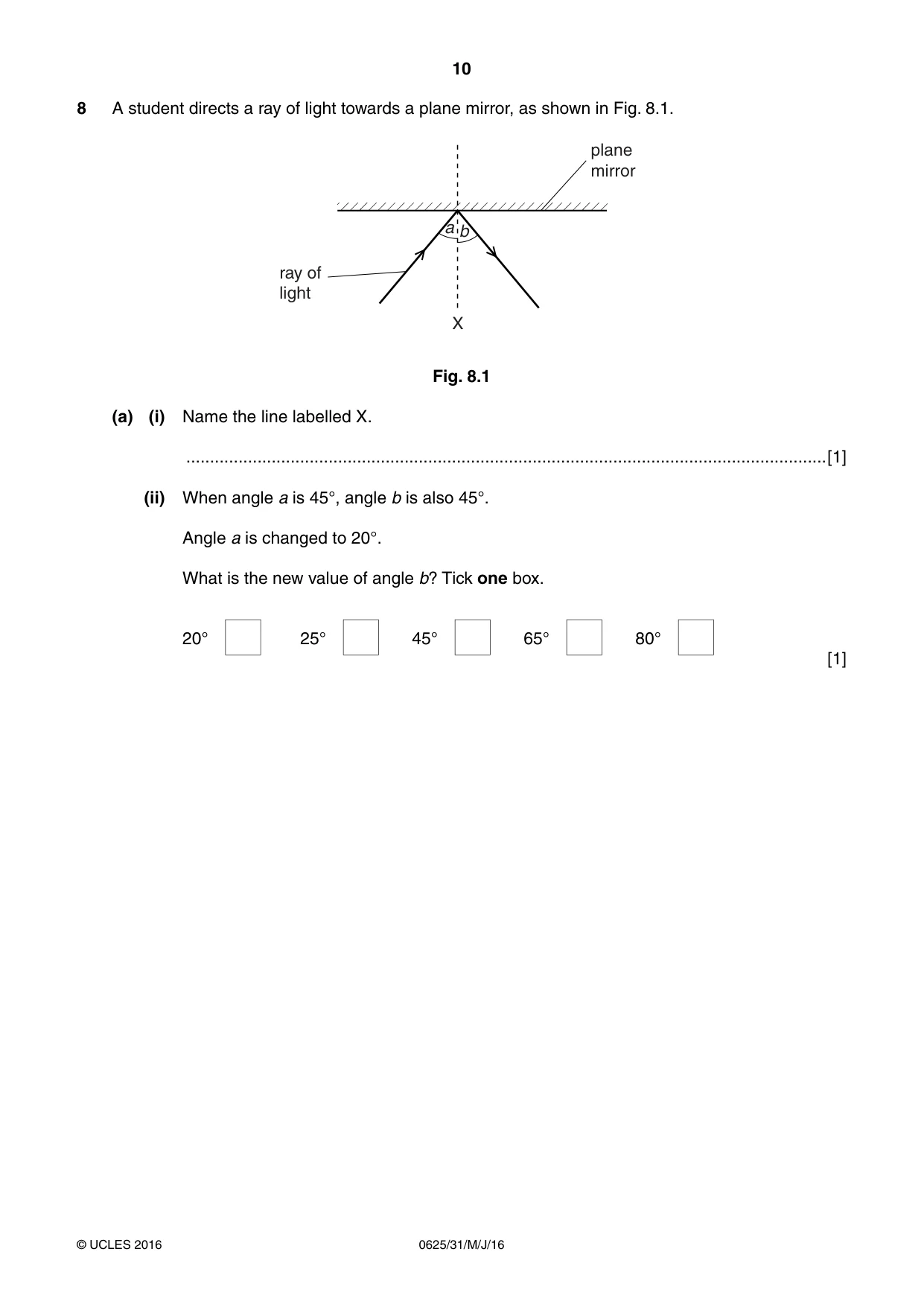
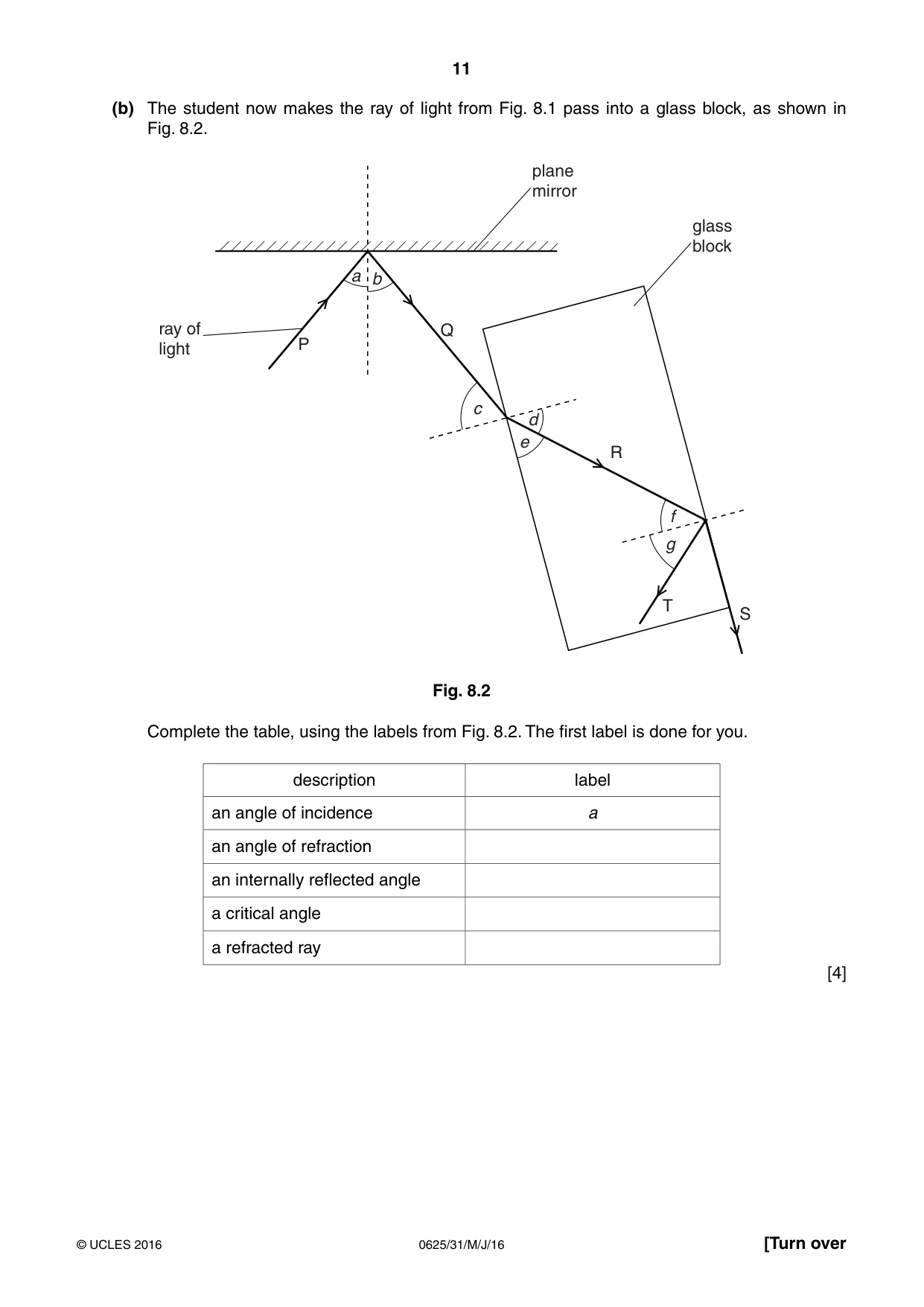
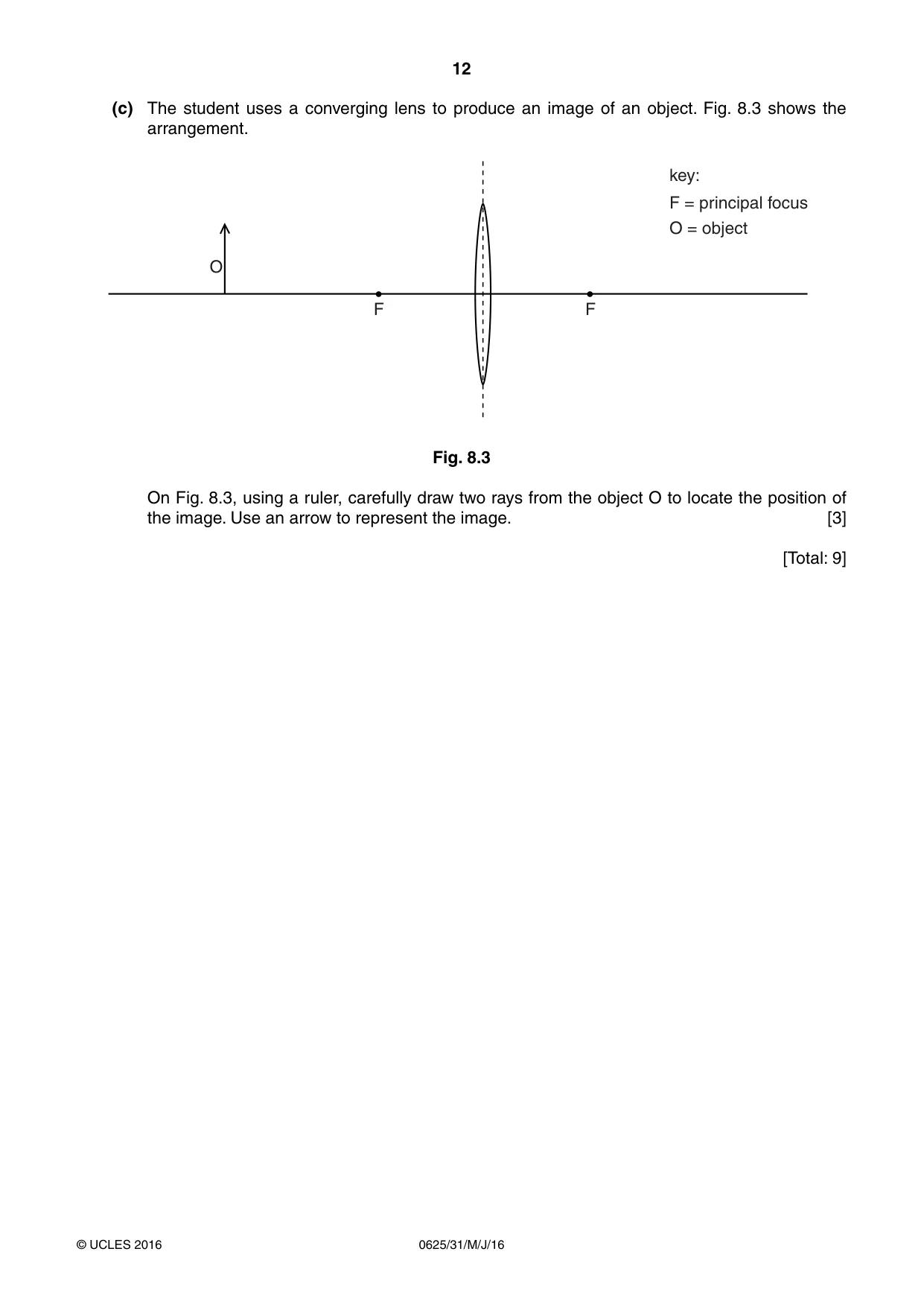
8 A student directs a ray of light towards a plane mirror, as shown in Fig. 8.1. plane mirror D E ray of light ; Fig. 8.1 (a) (i) Name the line labelled X. .......................................................................................................................................[1] (ii) When angle a is 45°, angle b is also 45°. Angle a is changed to 20°. What is the new value of angle b? Tick one box. 20° 25° 45° 65° 80° [1] (b) The student now makes the ray of light from Fig. 8.1 pass into a glass block, as shown in Fig. 8.2. plane mirror glass block D E ray of 4 light 3 F G H 5 I J 7 6 Fig. 8.2 Complete the table, using the labels from Fig. 8.2. The first label is done for you. description label an angle of incidence a an angle of refraction an internally reflected angle a critical angle a refracted ray [4] (c) The student uses a converging lens to produce an image of an object. Fig. 8.3 shows the arrangement. key: F = principal focus O = object O F F Fig. 8.3 On Fig. 8.3, using a ruler, carefully draw two rays from the object O to locate the position of the image. Use an arrow to represent the image. [3] [Total: 9]
Mark scheme: 8(a)(i) normal B1 8(a)(ii) 20° B1 8(b) d B1 g B1 f B1 R OR S B1 8(c) any two rays correctly drawn from top of O: ray parallel to axis, through lens, and beyond F ray undeviated through centre of lens and beyond ray through F, through lens, then parallel to axis M2 inverted image correctly drawn and positioned at intersection of two rays A1 Total: 9
Q9 · The regions of the electromagnetic spectrum
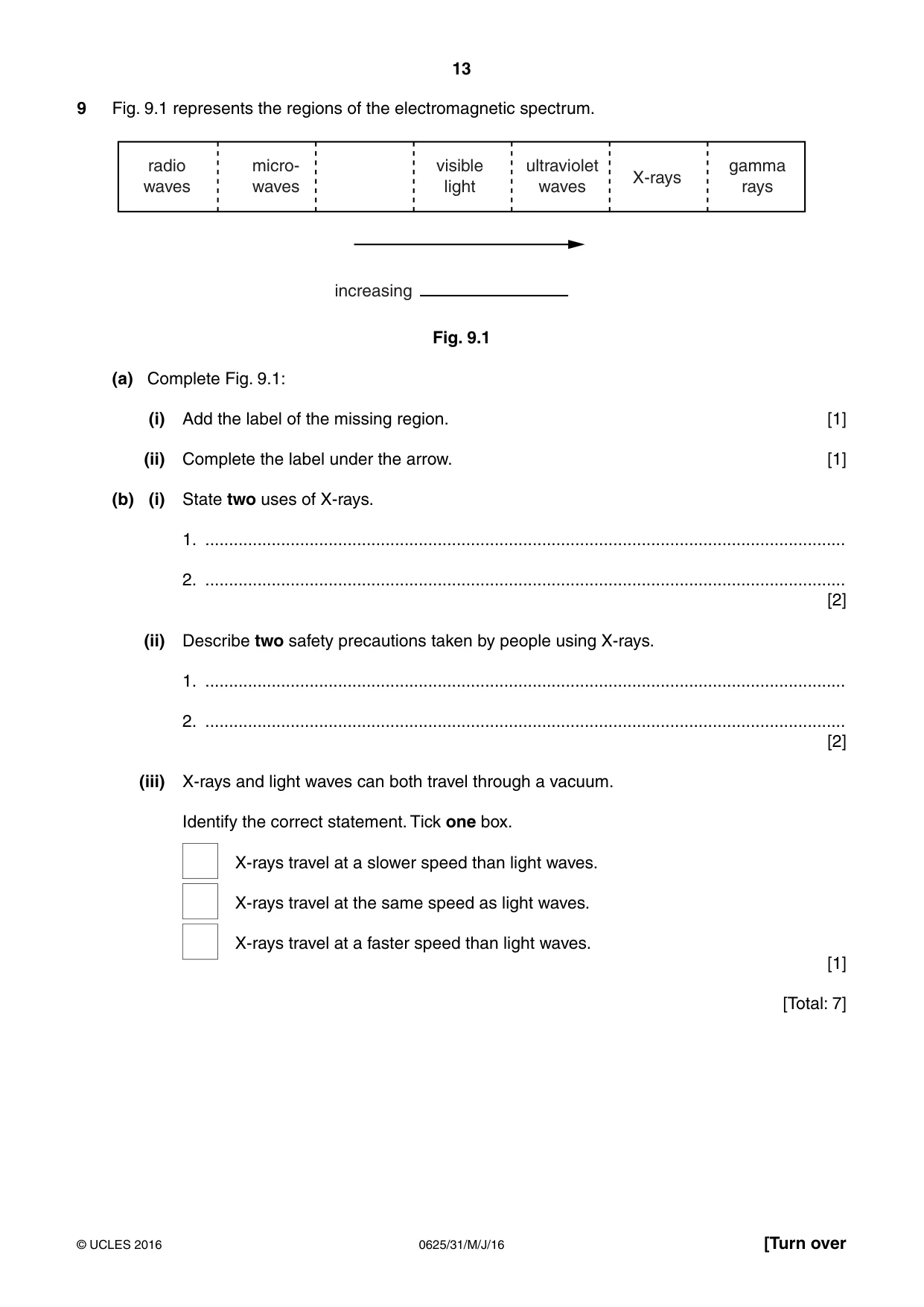
9 Fig. 9.1 represents the regions of the electromagnetic spectrum. radio micro- visible ultraviolet gamma X-rays waves waves light waves rays increasing Fig. 9.1 (a) Complete Fig. 9.1: (i) Add the label of the missing region. [1] (ii) Complete the label under the arrow. [1] (b) (i) State two uses of X-rays. 1. ....................................................................................................................................... 2. ....................................................................................................................................... [2] (ii) Describe two safety precautions taken by people using X-rays. 1. ....................................................................................................................................... 2. ....................................................................................................................................... [2] (iii) X-rays and light waves can both travel through a vacuum. Identify the correct statement. Tick one box. X-rays travel at a slower speed than light waves. X-rays travel at the same speed as light waves. X-rays travel at a faster speed than light waves. [1] [Total: 7]
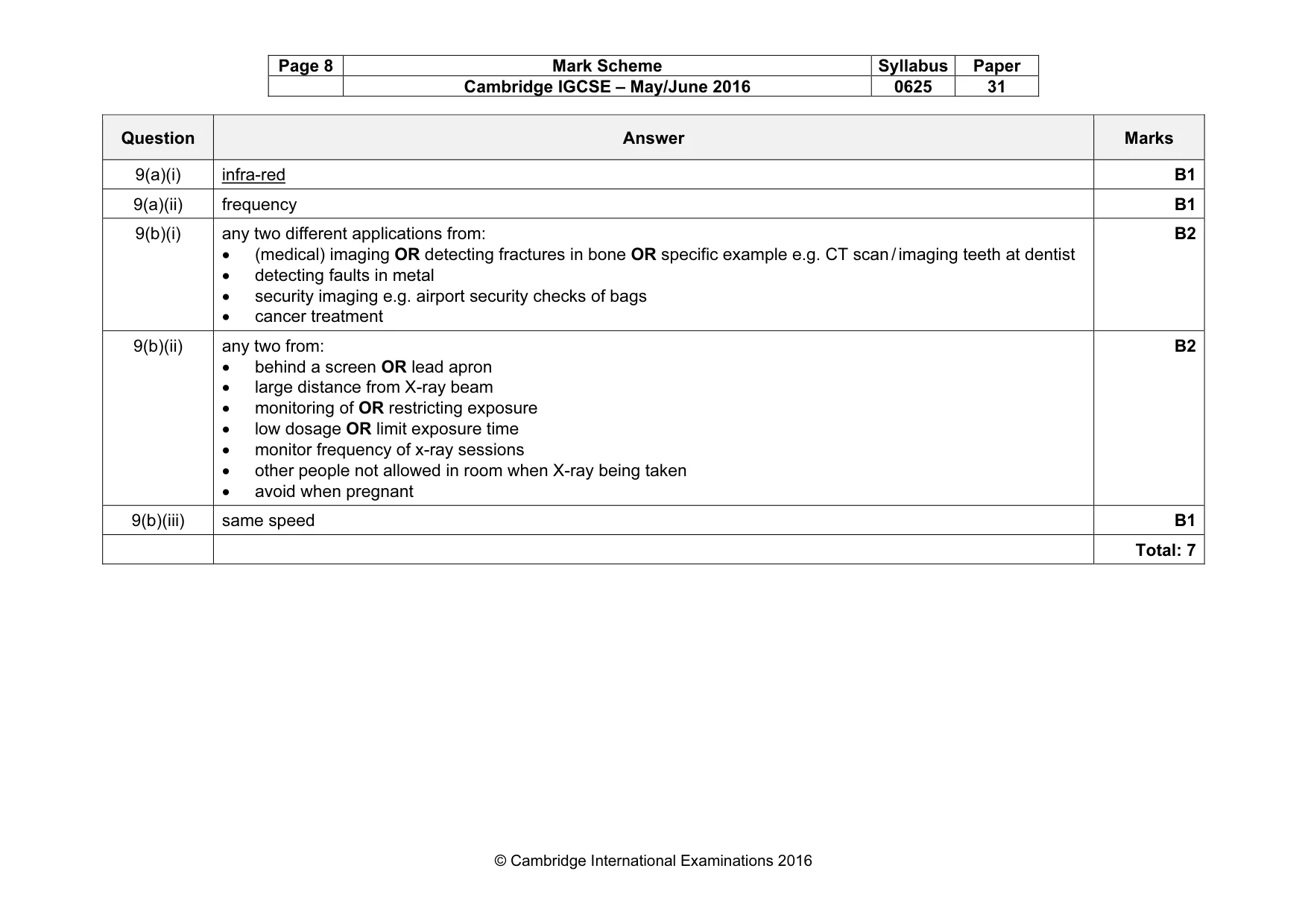
Mark scheme: 9(a)(i) infra-red B1 9(a)(ii) frequency B1 9(b)(i) any two different applications from: • (medical) imaging OR detecting fractures in bone OR specific example e.g. CT scan / imaging teeth at dentist • detecting faults in metal • security imaging e.g. airport security checks of bags • cancer treatment B2 9(b)(ii) any two from: • behind a screen OR lead apron • large distance from X-ray beam • monitoring of OR restricting exposure • low dosage OR limit exposure time • monitor frequency of x-ray sessions • other people not allowed in room when X-ray being taken • avoid when pregnant B2 9(b)(iii) same speed B1 Total: 7
Q10 · A student makes the circuit shown in Fig
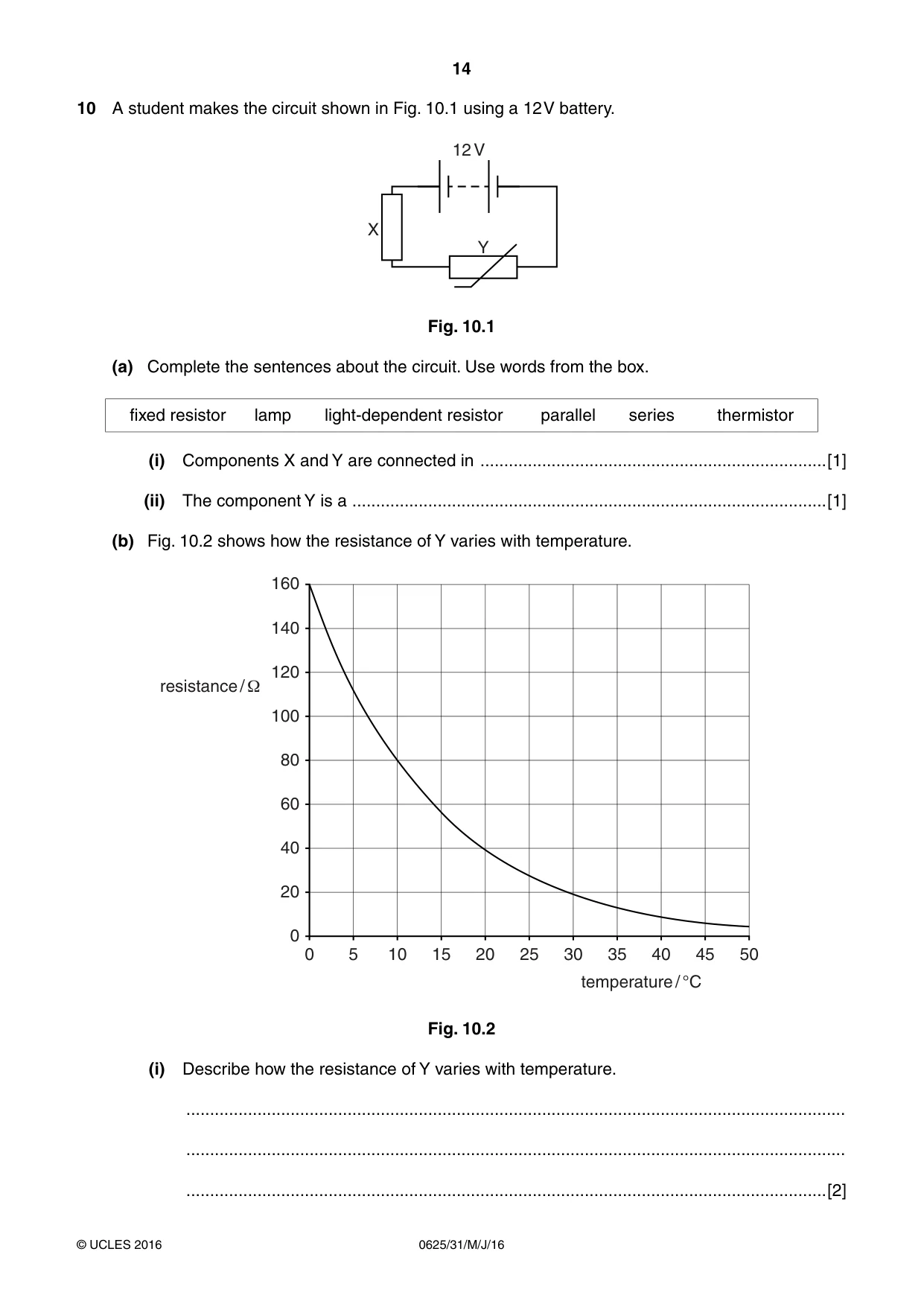
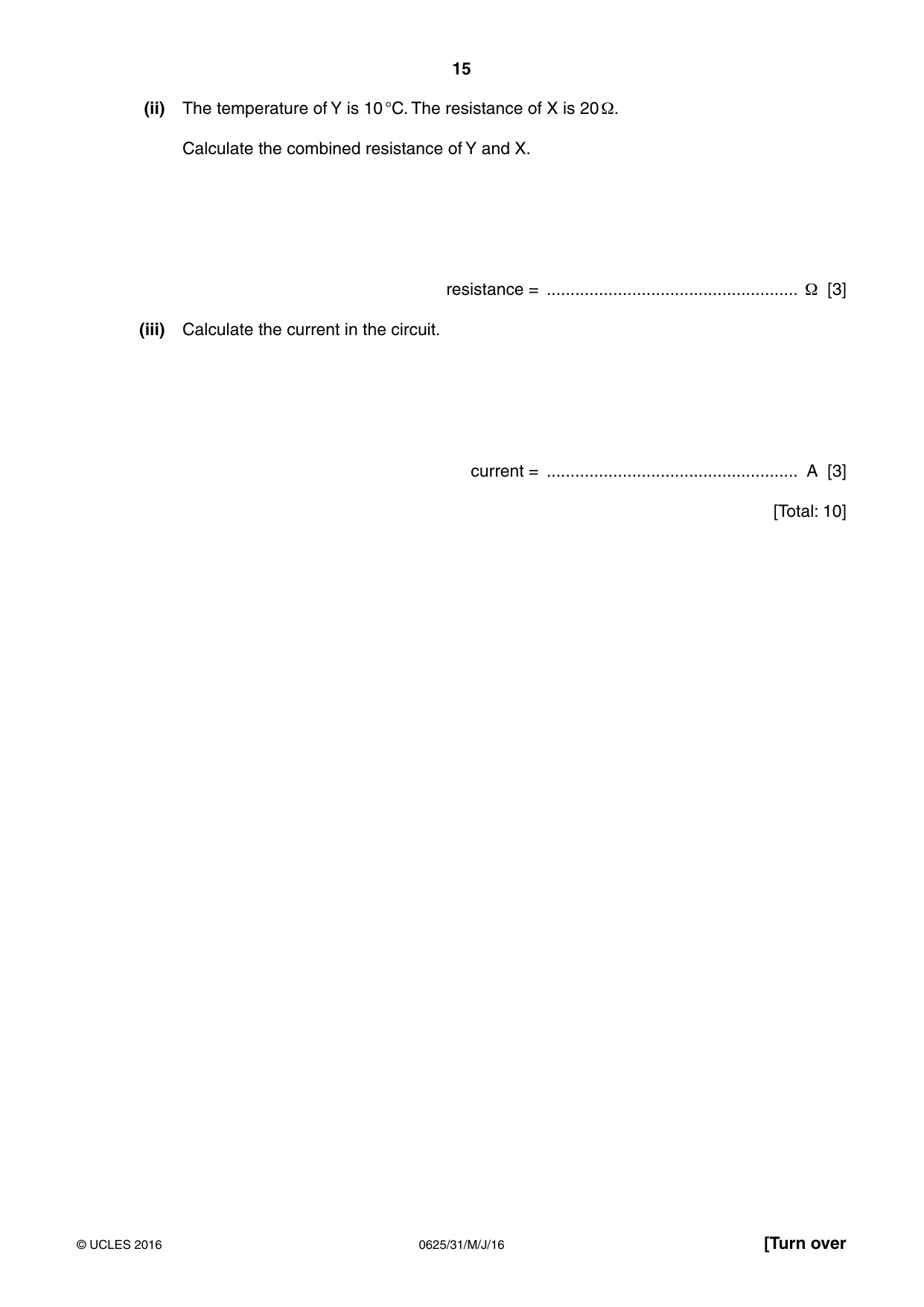
10 A student makes the circuit shown in Fig. 10.1 using a 12 V battery. 12 V X Y Fig. 10.1 (a) Complete the sentences about the circuit. Use words from the box. fixed resistor lamp light-dependent resistor parallel series thermistor (i) Components X and Y are connected in .........................................................................[1] (ii) The component Y is a ....................................................................................................[1] (b) Fig. 10.2 shows how the resistance of Y varies with temperature. 160 140 120 resistance / 1 100 80 60 40 20 0 0 5 10 15 20 25 30 35 40 45 50 temperature / °C Fig. 10.2 (i) Describe how the resistance of Y varies with temperature. ........................................................................................................................................... ........................................................................................................................................... .......................................................................................................................................[2] (ii) The temperature of Y is 10 °C. The resistance of X is 20 Ω. Calculate the combined resistance of Y and X. resistance = ..................................................... Ω [3] (iii) Calculate the current in the circuit. current = ..................................................... A [3] [Total: 10]
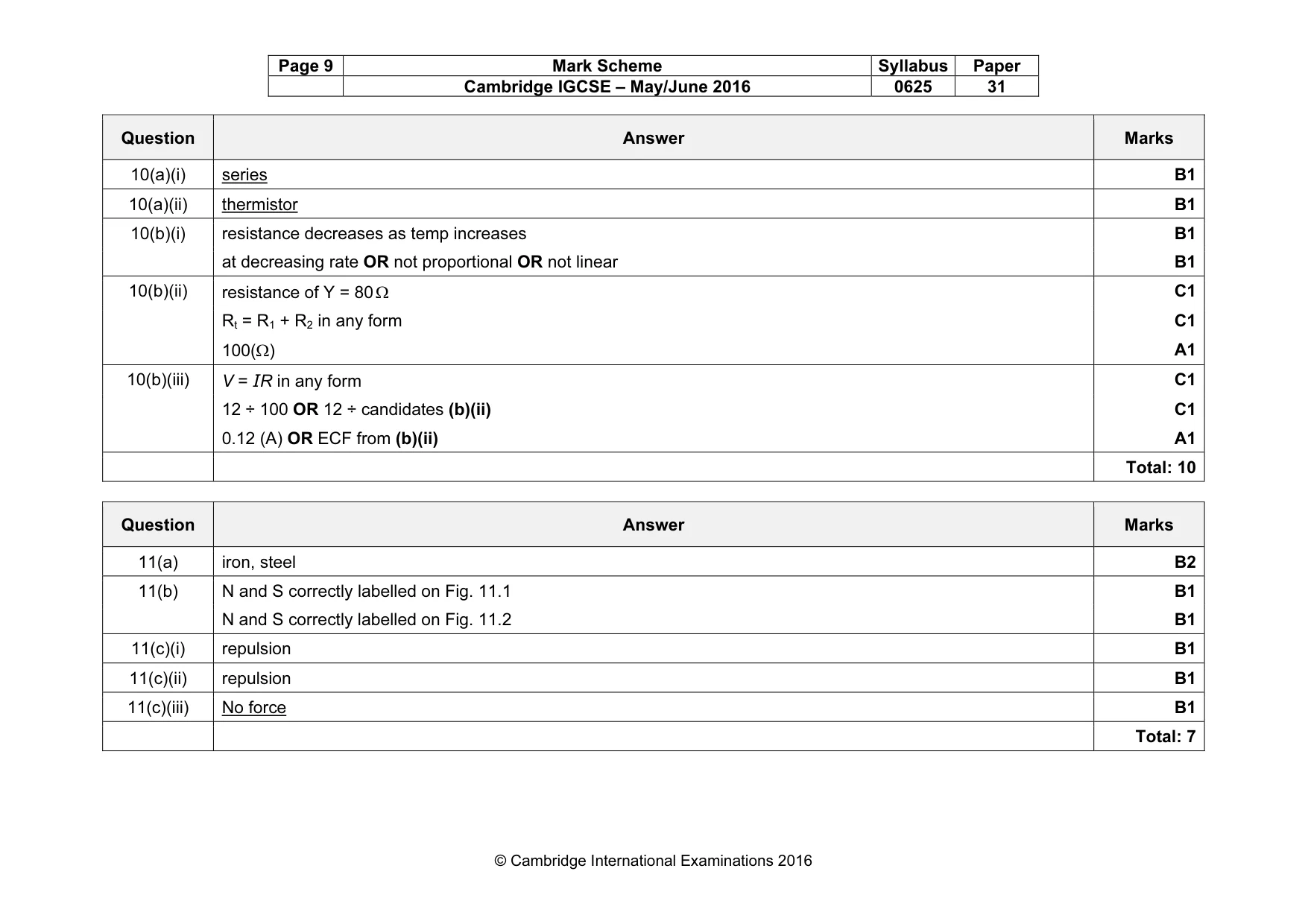
Mark scheme: 10(a)(i) series B1 10(a)(ii) thermistor B1 10(b)(i) resistance decreases as temp increases B1 at decreasing rate OR not proportional OR not linear B1 10(b)(ii) resistance of Y = 80 Ω C1 Rt = R1 + R2 in any form C1 100(Ω) A1 10(b)(iii) V = IR in any form C1 12 ÷ 100 OR 12 ÷ candidates (b)(ii) C1 0.12 (A) OR ECF from (b)(ii) A1 Total: 10
Q11 · Put a ring around the names of the metals which are attracted to magnets
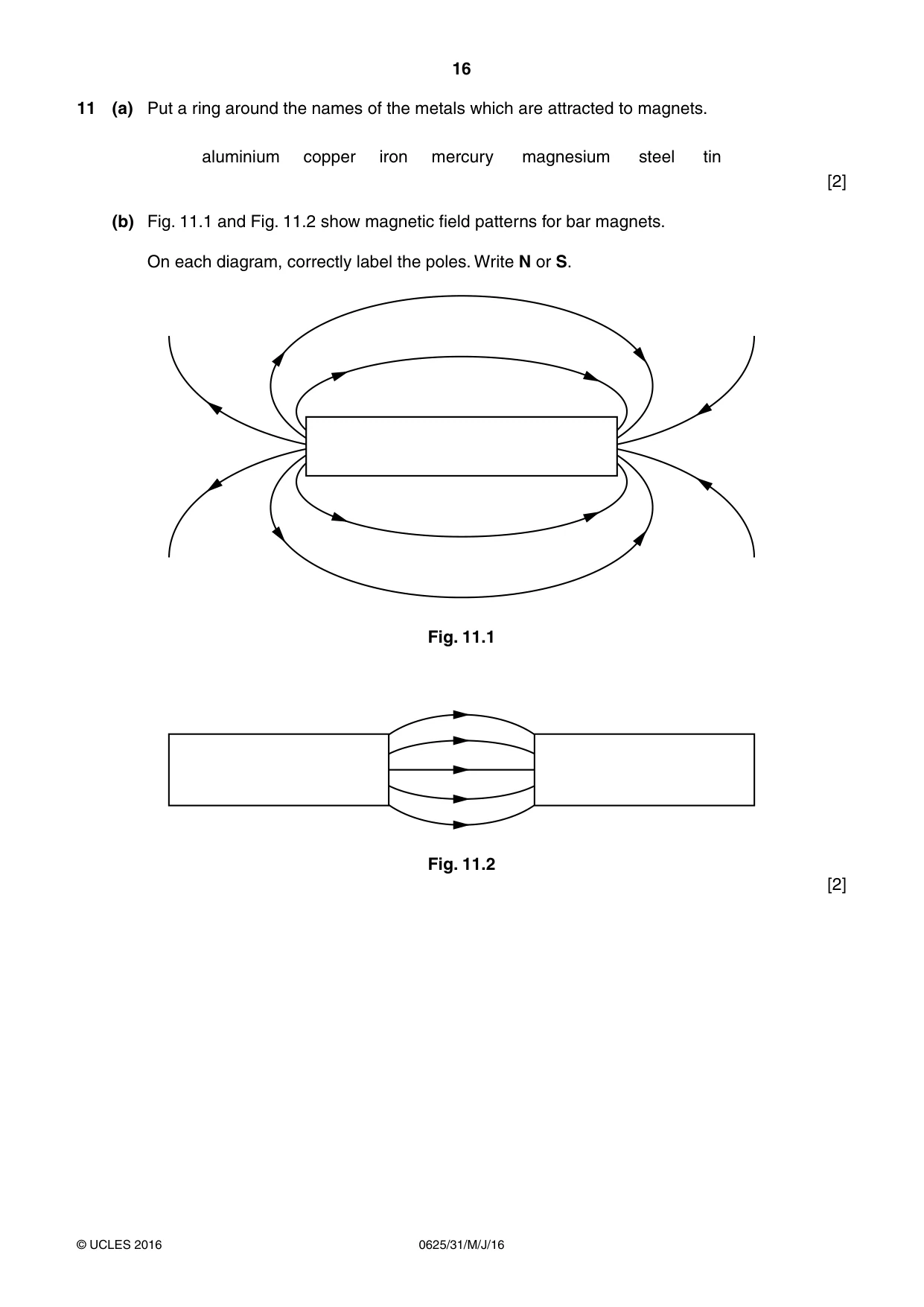
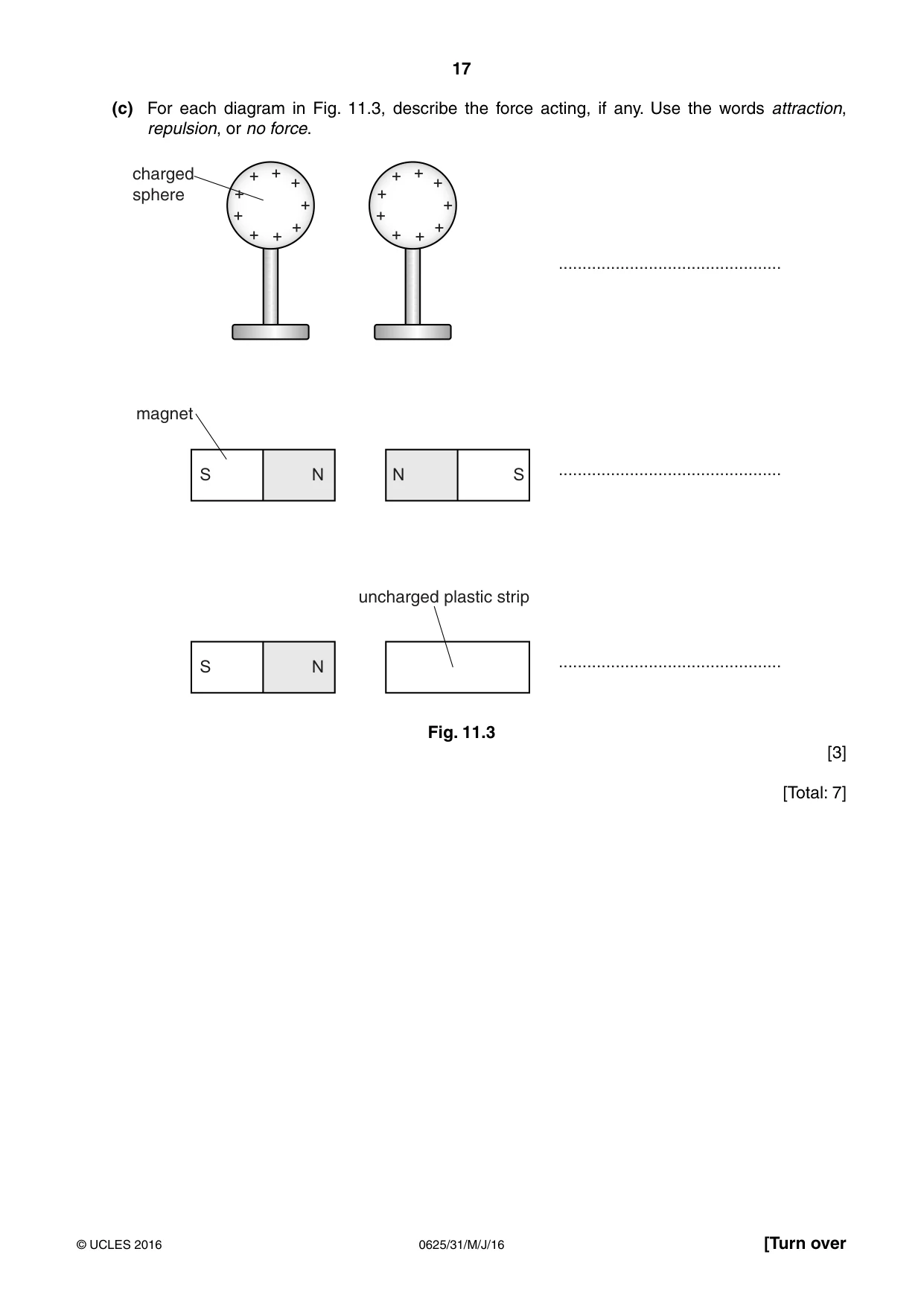
11 (a) Put a ring around the names of the metals which are attracted to magnets. aluminium copper iron mercury magnesium steel tin [2] (b) Fig. 11.1 and Fig. 11.2 show magnetic field patterns for bar magnets. On each diagram, correctly label the poles. Write N or S. Fig. 11.1 Fig. 11.2 [2] (c) For each diagram in Fig. 11.3, describe the force acting, if any. Use the words attraction, repulsion, or no force. charged + + + + + + sphere + + + + + + + + + + + + ............................................... magnet S N N S ............................................... uncharged plastic strip S N ............................................... Fig. 11.3 [3] [Total: 7]
Mark scheme: 11(a) iron, steel B2 11(b) N and S correctly labelled on Fig. 11.1 B1 N and S correctly labelled on Fig. 11.2 B1 11(c)(i) repulsion B1 11(c)(ii) repulsion B1 11(c)(iii) No force B1 Total: 7
Q12 · Two radioactive sources are used by a teacher
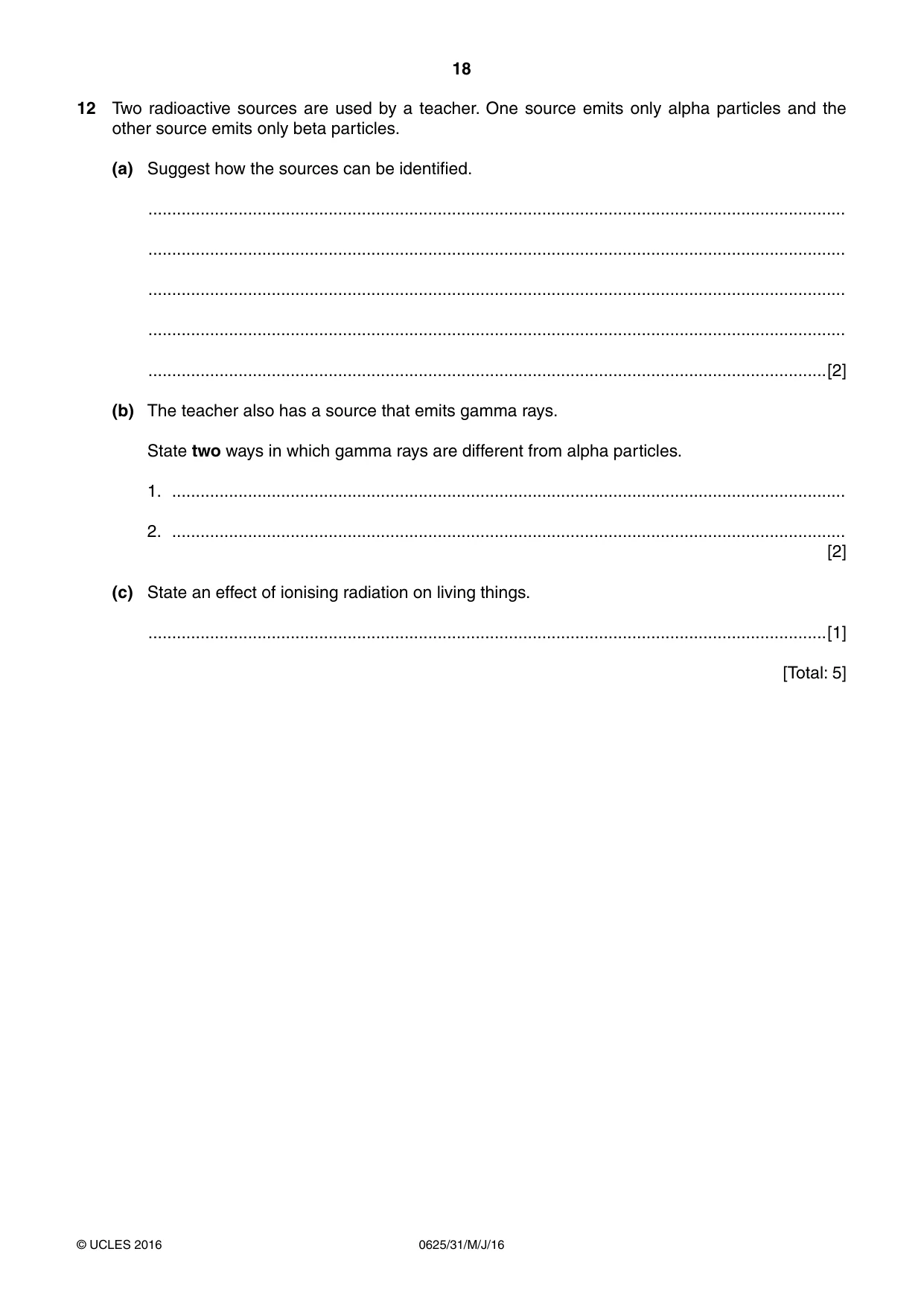
12 Two radioactive sources are used by a teacher. One source emits only alpha particles and the other source emits only beta particles. (a) Suggest how the sources can be identified. ................................................................................................................................................... ................................................................................................................................................... ................................................................................................................................................... ................................................................................................................................................... ...............................................................................................................................................[2] (b) The teacher also has a source that emits gamma rays. State two ways in which gamma rays are different from alpha particles. 1. .............................................................................................................................................. 2. .............................................................................................................................................. [2] (c) State an effect of ionising radiation on living things. ...............................................................................................................................................[1] [Total: 5]
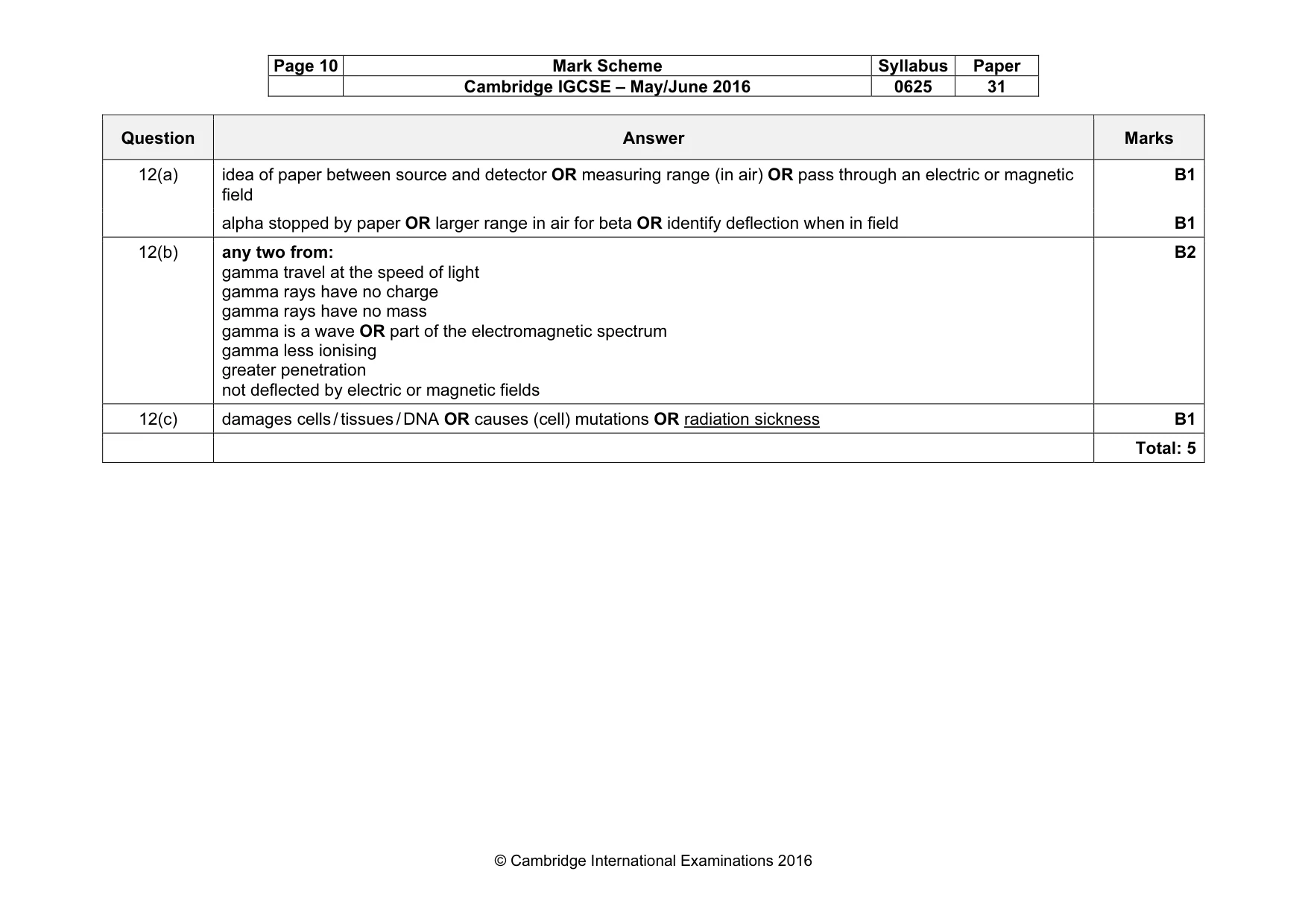
Mark scheme: 12(a) idea of paper between source and detector OR measuring range (in air) OR pass through an electric or magnetic field B1 alpha stopped by paper OR larger range in air for beta OR identify deflection when in field B1 12(b) any two from: gamma travel at the speed of light gamma rays have no charge gamma rays have no mass gamma is a wave OR part of the electromagnetic spectrum gamma less ionising greater penetration not deflected by electric or magnetic fields B2 12(c) damages cells / tissues / DNA OR causes (cell) mutations OR radiation sickness B1 Total: 5
What was in this paper
The subtopics covered by these 12 questions, and how many questions each got. Open one in a new tab to see every Cambridge question on it.
What you needed in this session
Cambridge’s own grade thresholds for 2016 May/June, Paper 3 · Variant 1. A higher threshold means an easier paper — the bar moves with how the cohort did.