Cambridge IGCSE Physics 0625 — 2019 Oct/Nov Paper 3 · Variant 2
0625/32/O/N/19 · 12 questions · 80 marks · ≈90 min
The question paper and its mark scheme, free to read here and free to download. This is Cambridge’s own paper, exactly as it was sat.
Question paper20 pages
Mark scheme11 pages
Answers below. Sit the paper first if you are practising.
Questions as text
Q1 · A water tank that is leaking
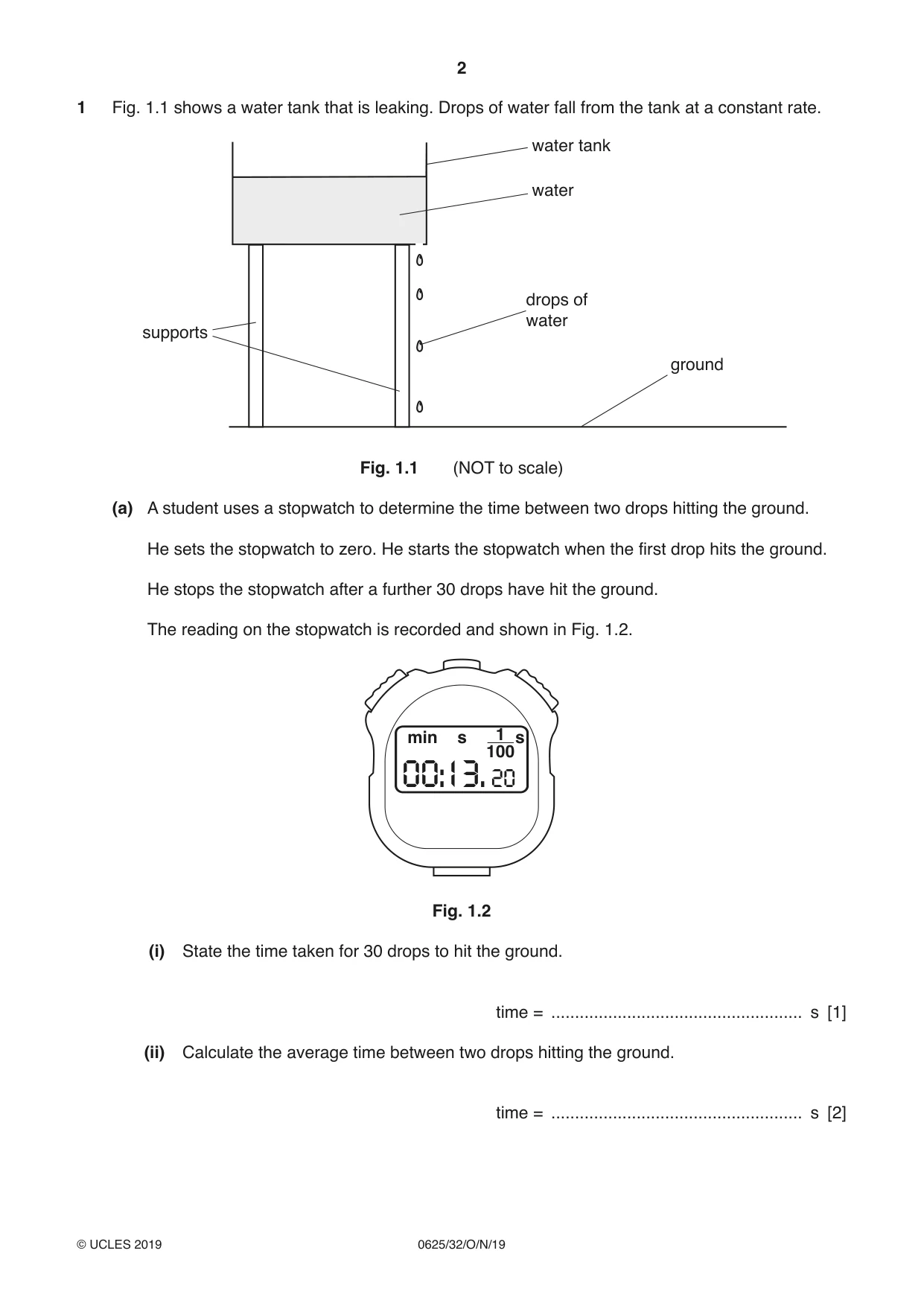
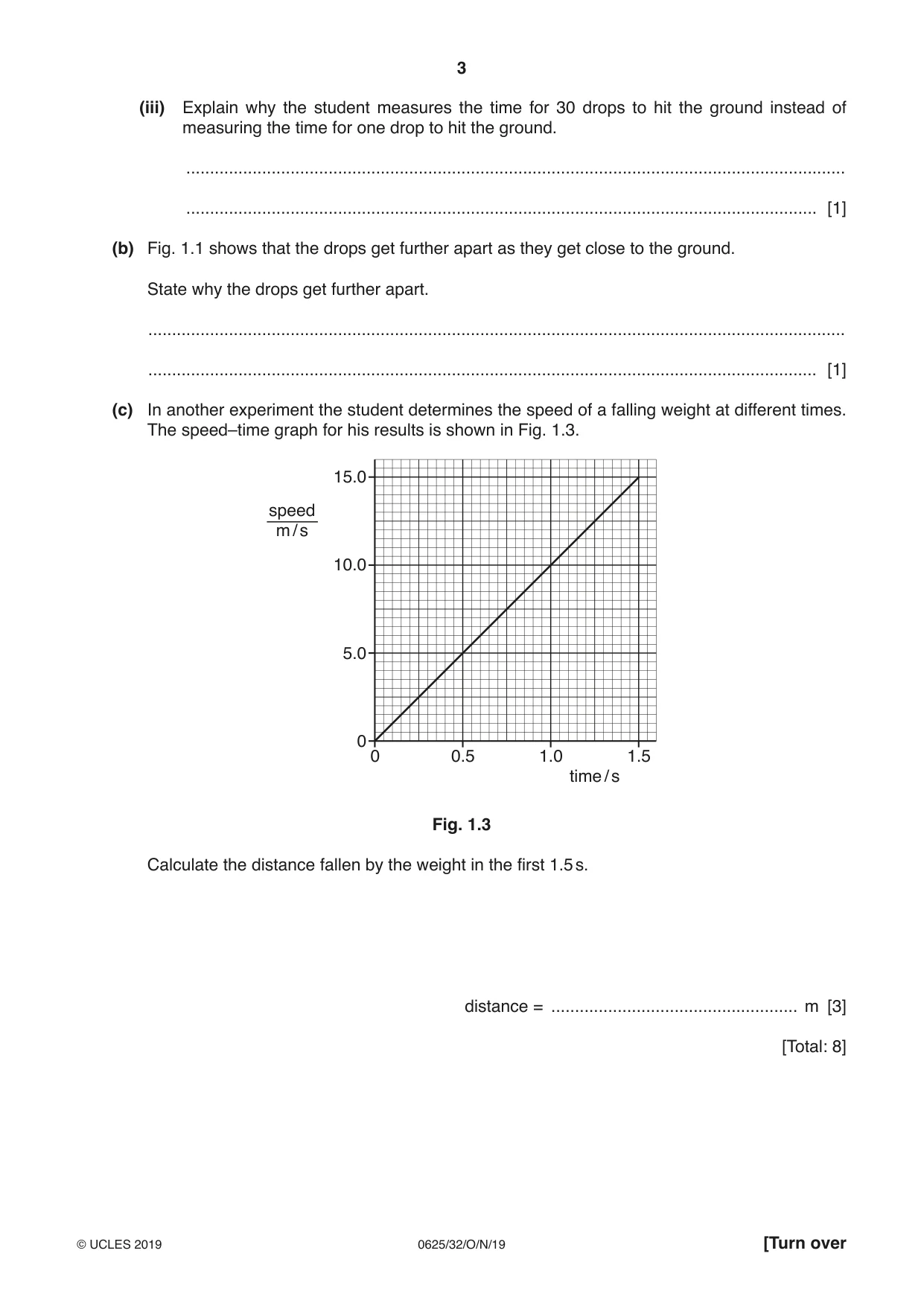
1 Fig. 1.1 shows a water tank that is leaking. Drops of water fall from the tank at a constant rate. water tank water drops of water supports ground Fig. 1.1 (NOT to scale) (a) A student uses a stopwatch to determine the time between two drops hitting the ground. He sets the stopwatch to zero. He starts the stopwatch when the first drop hits the ground. He stops the stopwatch after a further 30 drops have hit the ground. The reading on the stopwatch is recorded and shown in Fig. 1.2. min s 1 s 100 00:13. 20 Fig. 1.2 (i) State the time taken for 30 drops to hit the ground. time = ..................................................... s [1] (ii) Calculate the average time between two drops hitting the ground. time = ..................................................... s [2] (iii) Explain why the student measures the time for 30 drops to hit the ground instead of measuring the time for one drop to hit the ground. ........................................................................................................................................... ..................................................................................................................................... [1] (b) Fig. 1.1 shows that the drops get further apart as they get close to the ground. State why the drops get further apart. ................................................................................................................................................... ............................................................................................................................................. [1] (c) In another experiment the student determines the speed of a falling weight at different times. The speed–time graph for his results is shown in Fig. 1.3. 15.0 speed m / s 10.0 5.0 0 0 0.5 1.0 1.5 time / s Fig. 1.3 Calculate the distance fallen by the weight in the first 1.5 s. distance = .................................................... m [3] [Total: 8]
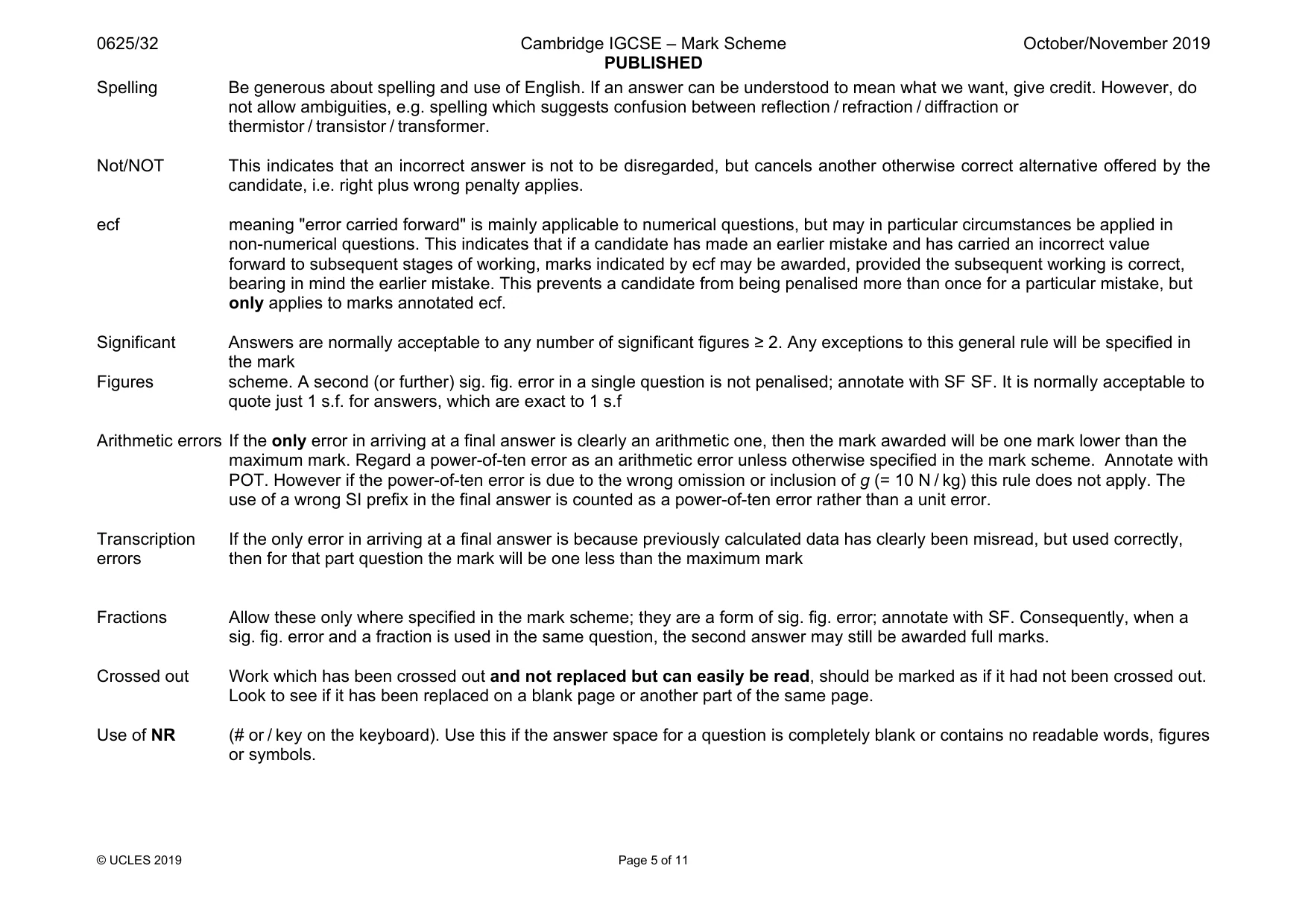
Mark scheme: 1(a)(i) 13.2(0) (s) B1 1(a)(ii) 13.2 ÷ 30 C1 0.44 (s) A1 1(a)(iii) reduces the effects of (timing / reaction time) errors owtte B1 1(b) Drops are accelerating OR moving with increasing speed B1 1(c) distance = area under graph OR ½ × b × h C1 0.5 × 1.5 × 15 C1 11.25 (m) A1
More questions on Physical quantities and measurement techniques
Q2 · A student has an irregularly shaped piece of metal, a beaker of water and a measuring…
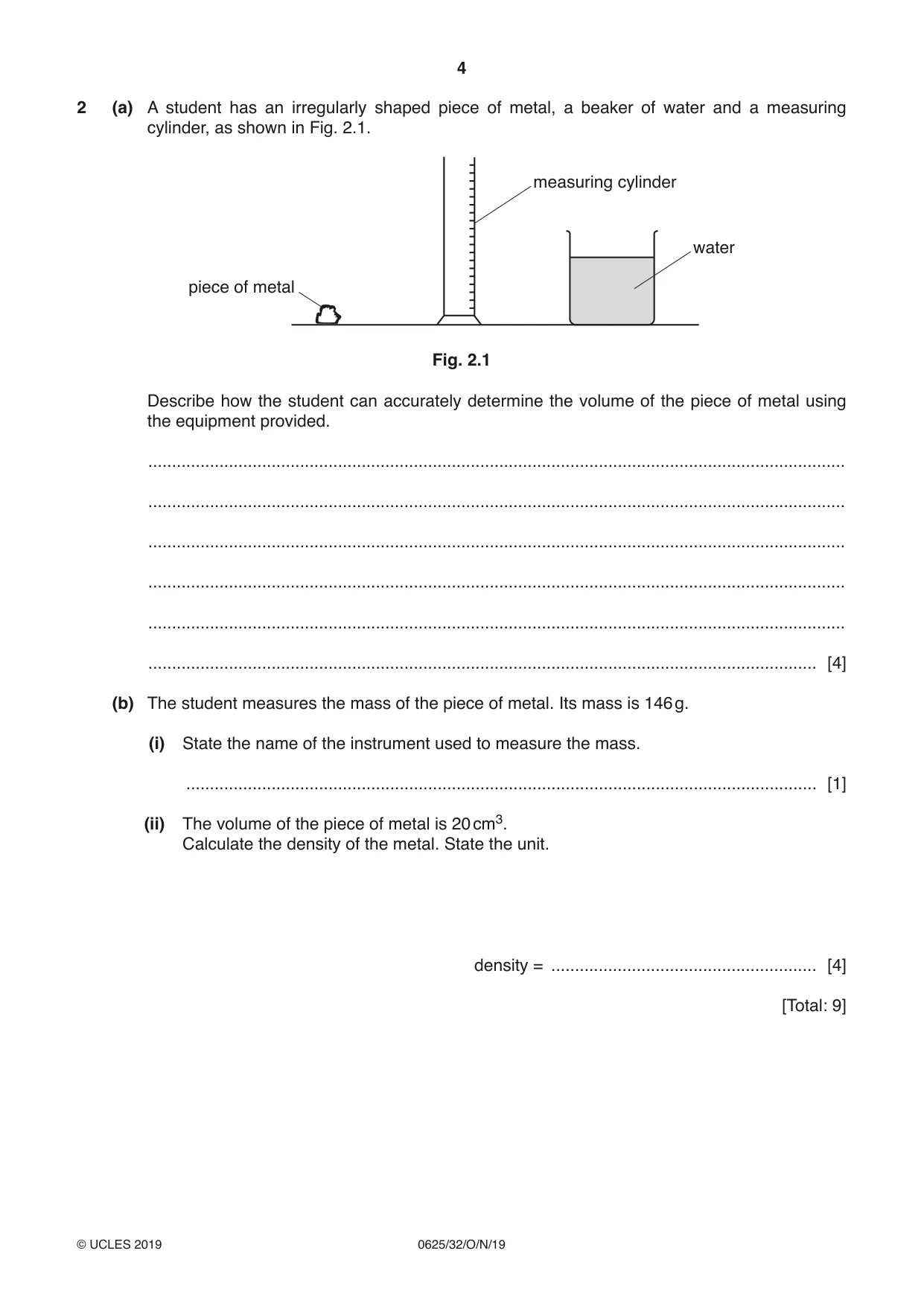
2 (a) A student has an irregularly shaped piece of metal, a beaker of water and a measuring cylinder, as shown in Fig. 2.1. measuring cylinder water piece of metal Fig. 2.1 Describe how the student can accurately determine the volume of the piece of metal using the equipment provided. ................................................................................................................................................... ................................................................................................................................................... ................................................................................................................................................... ................................................................................................................................................... ................................................................................................................................................... ............................................................................................................................................. [4] (b) The student measures the mass of the piece of metal. Its mass is 146 g. (i) State the name of the instrument used to measure the mass. ..................................................................................................................................... [1] (ii) The volume of the piece of metal is 20 cm3. Calculate the density of the metal. State the unit. density = ........................................................ [4] [Total: 9]
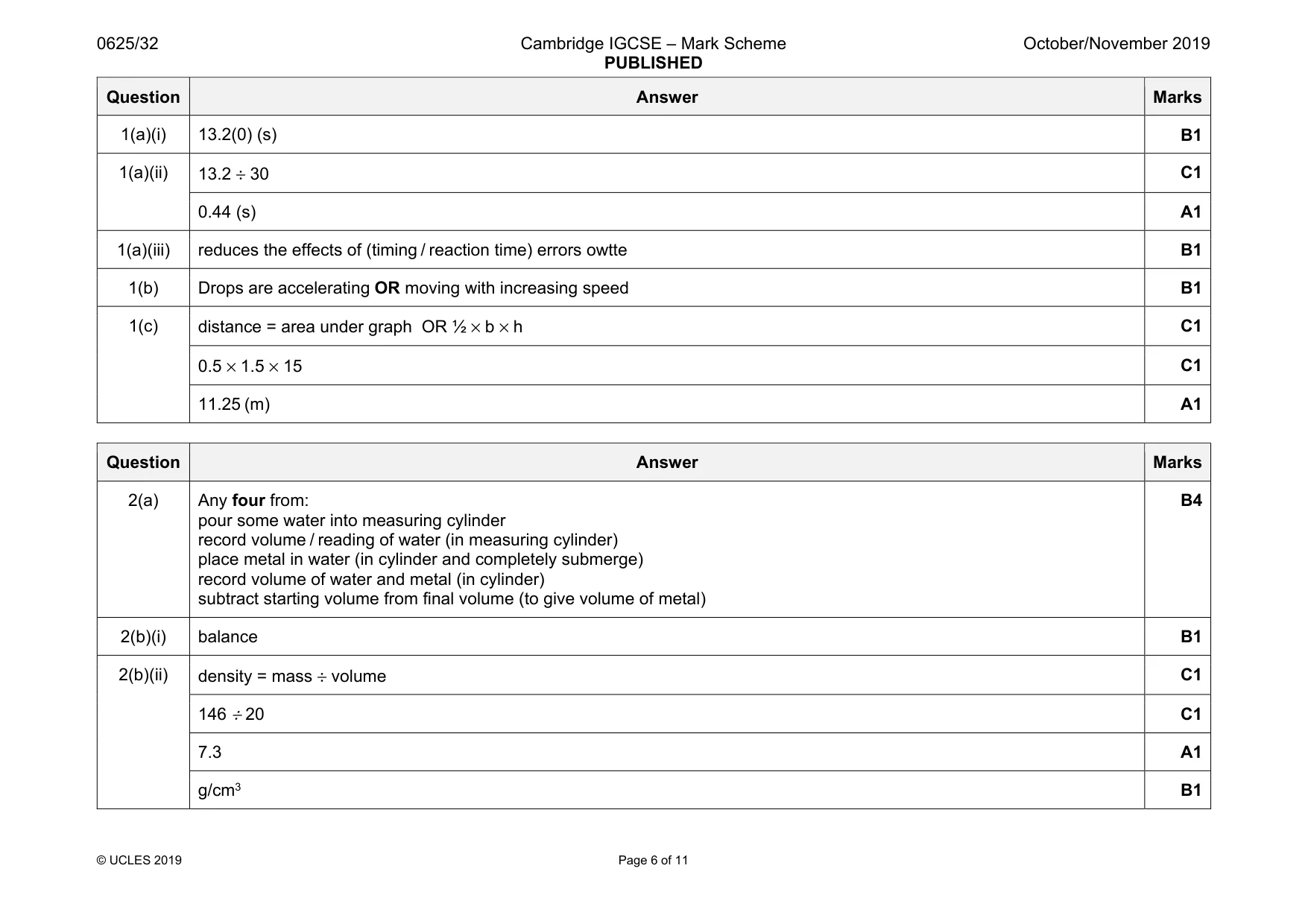
Mark scheme: 2(a) Any four from: pour some water into measuring cylinder record volume / reading of water (in measuring cylinder) place metal in water (in cylinder and completely submerge) record volume of water and metal (in cylinder) subtract starting volume from final volume (to give volume of metal) B4 2(b)(i) balance B1 2(b)(ii) density = mass ÷ volume C1 146 ÷ 20 C1 7.3 A1 g/cm3 B1
Q3 · The horizontal forces acting on a swimmer
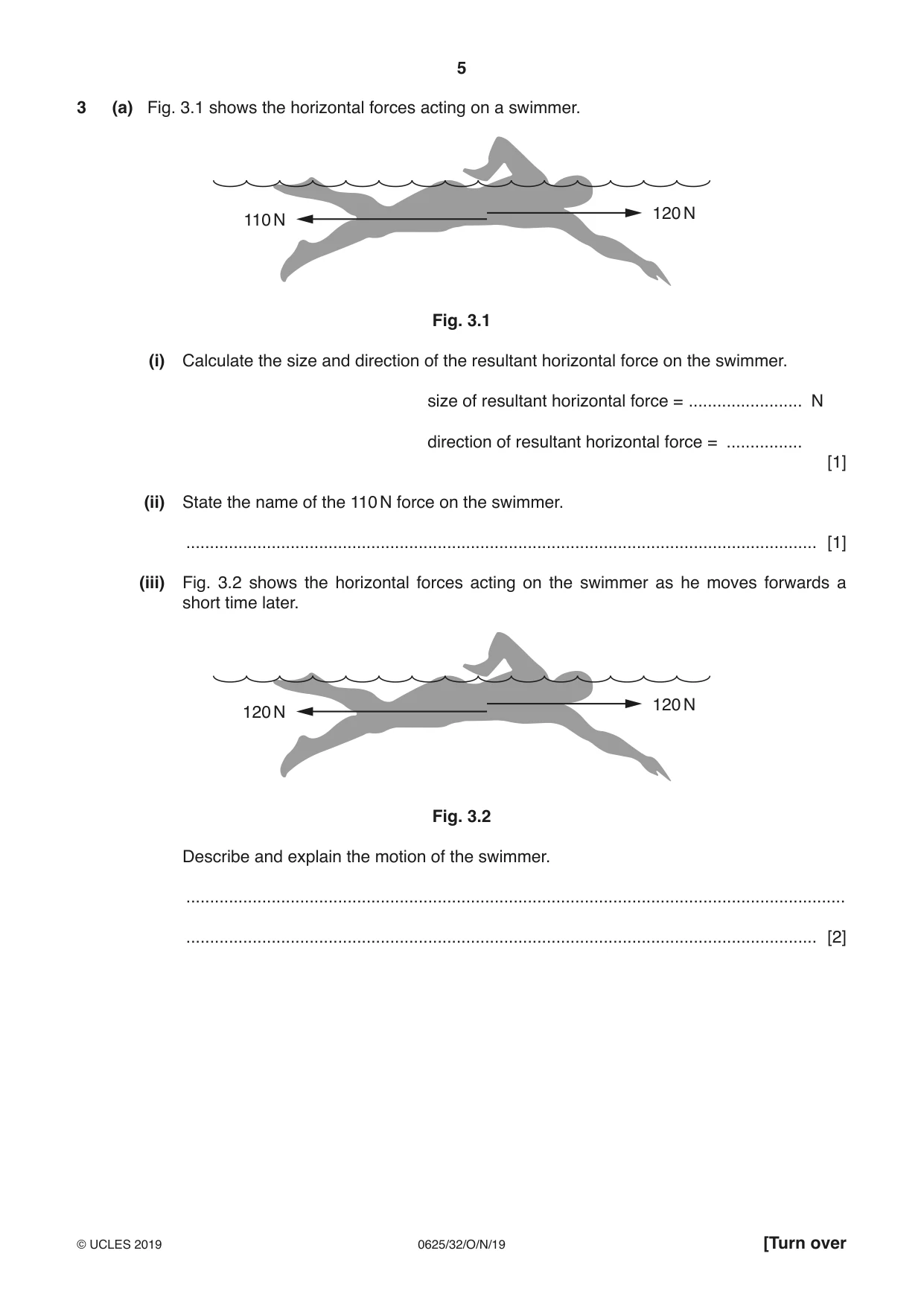
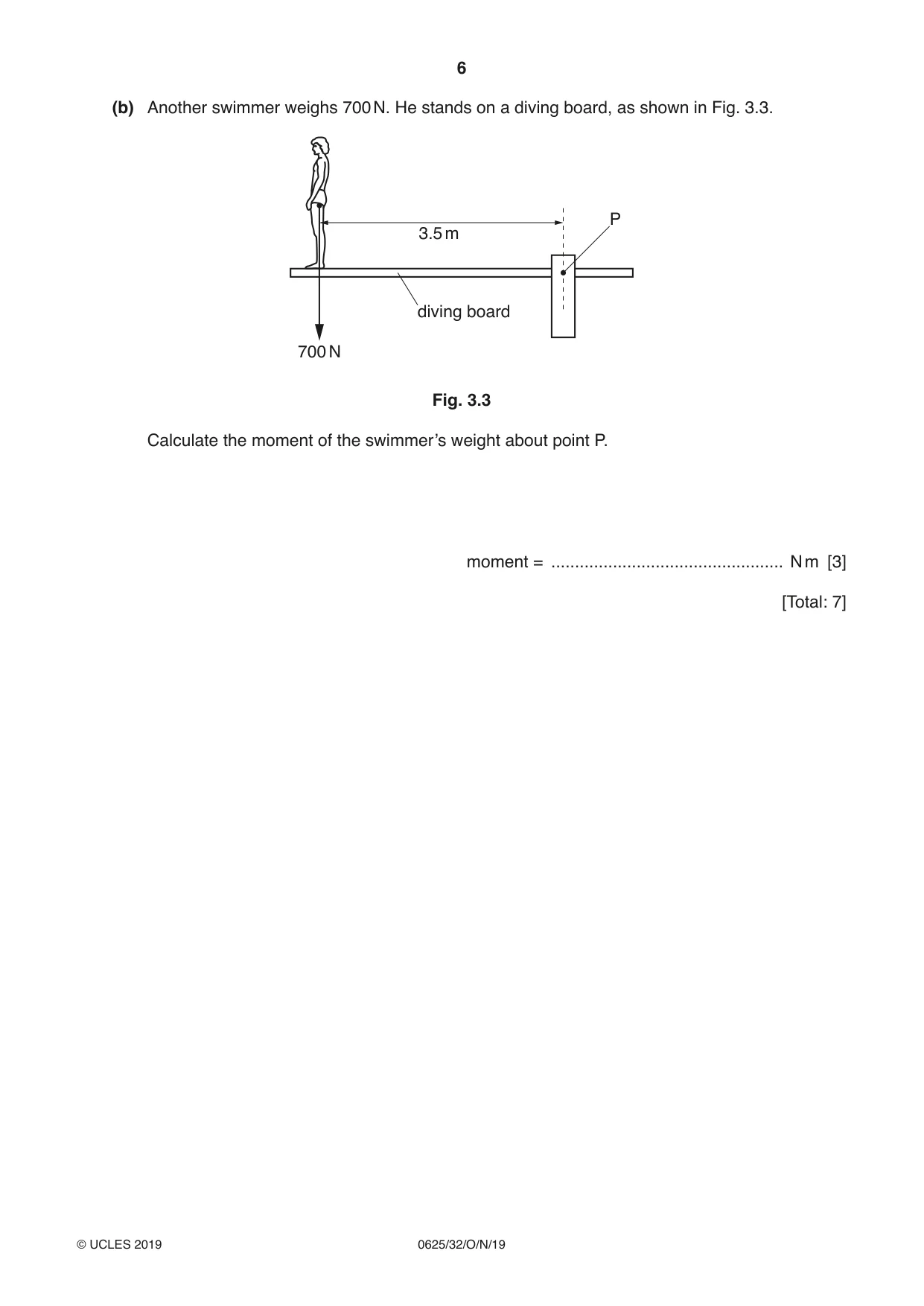
3 (a) Fig. 3.1 shows the horizontal forces acting on a swimmer. 120 N 110 N Fig. 3.1 (i) Calculate the size and direction of the resultant horizontal force on the swimmer. size of resultant horizontal force = ........................ N direction of resultant horizontal force = ................ [1] (ii) State the name of the 110 N force on the swimmer. ..................................................................................................................................... [1] (iii) Fig. 3.2 shows the horizontal forces acting on the swimmer as he moves forwards a short time later. 120 N 120 N Fig. 3.2 Describe and explain the motion of the swimmer. ........................................................................................................................................... ..................................................................................................................................... [2] (b) Another swimmer weighs 700 N. He stands on a diving board, as shown in Fig. 3.3. P 3.5 m diving board 700 N Fig. 3.3 Calculate the moment of the swimmer’s weight about point P. moment = ................................................. N m [3] [Total: 7]
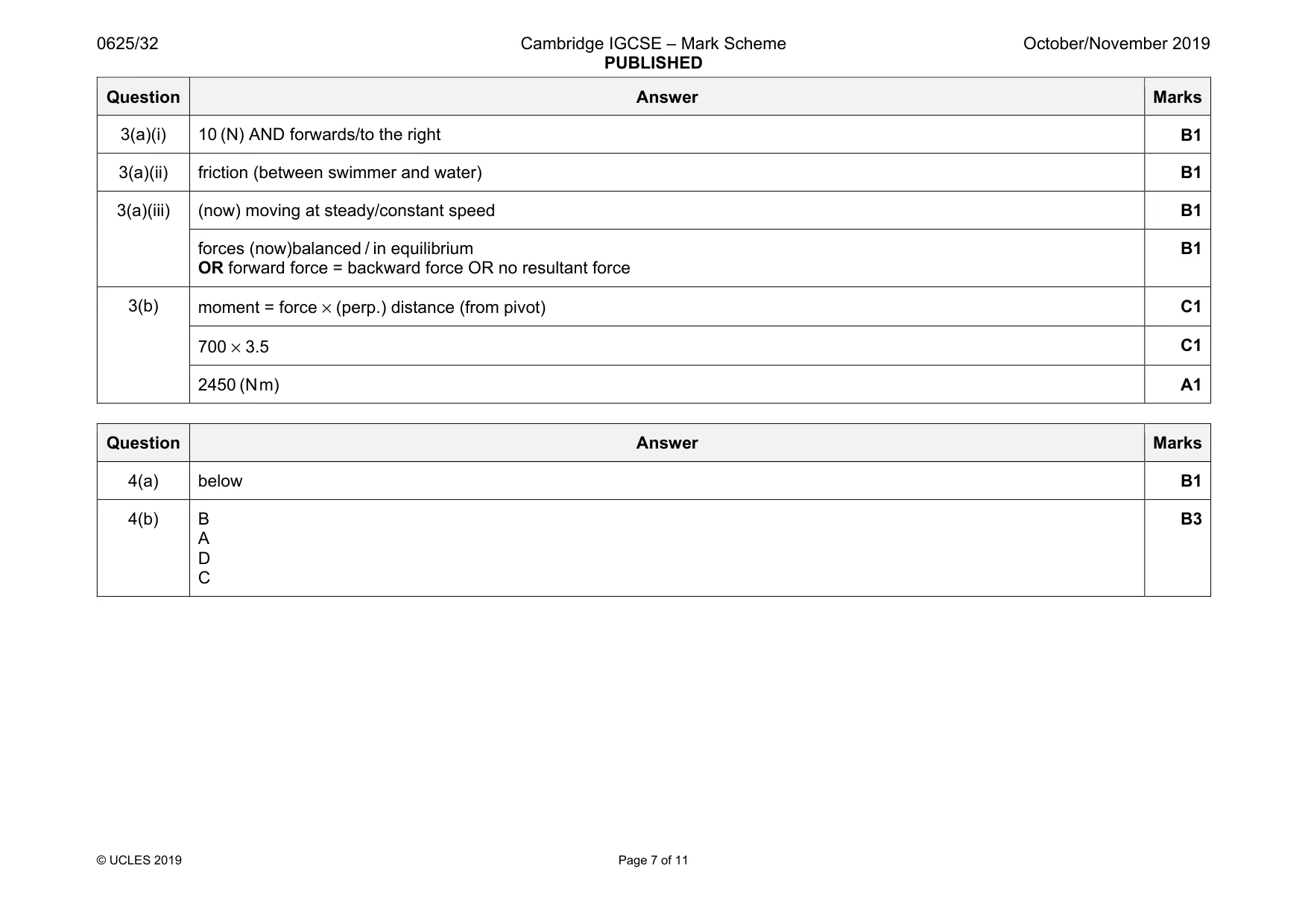
Mark scheme: 3(a)(i) 10 (N) AND forwards/to the right B1 3(a)(ii) friction (between swimmer and water) B1 3(a)(iii) (now) moving at steady/constant speed B1 forces (now)balanced / in equilibrium OR forward force = backward force OR no resultant force B1 3(b) moment = force × (perp.) distance (from pivot) C1 700 × 3.5 C1 2450 (N m) A1
Q4 · A metal triangle suspended from a thread
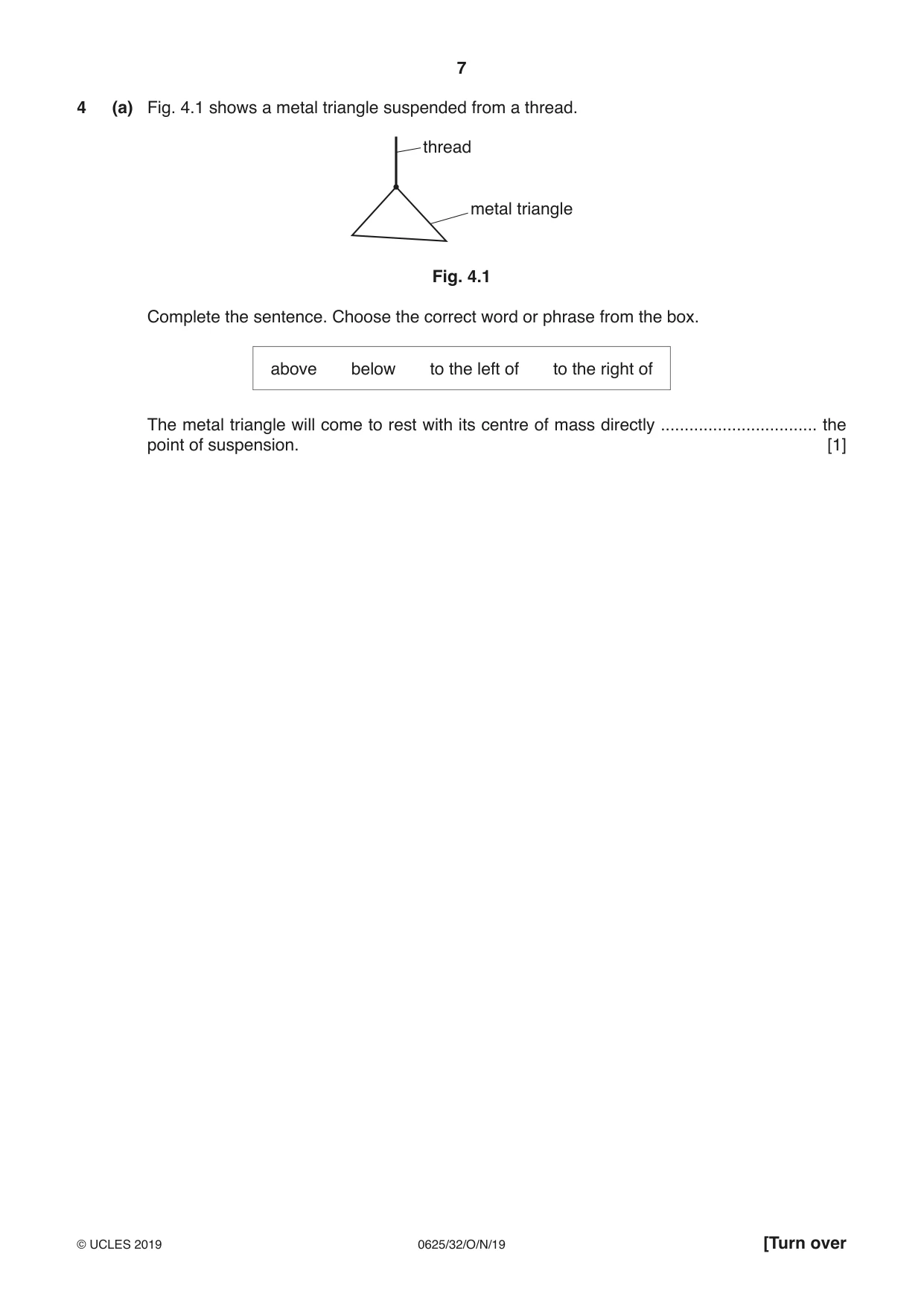
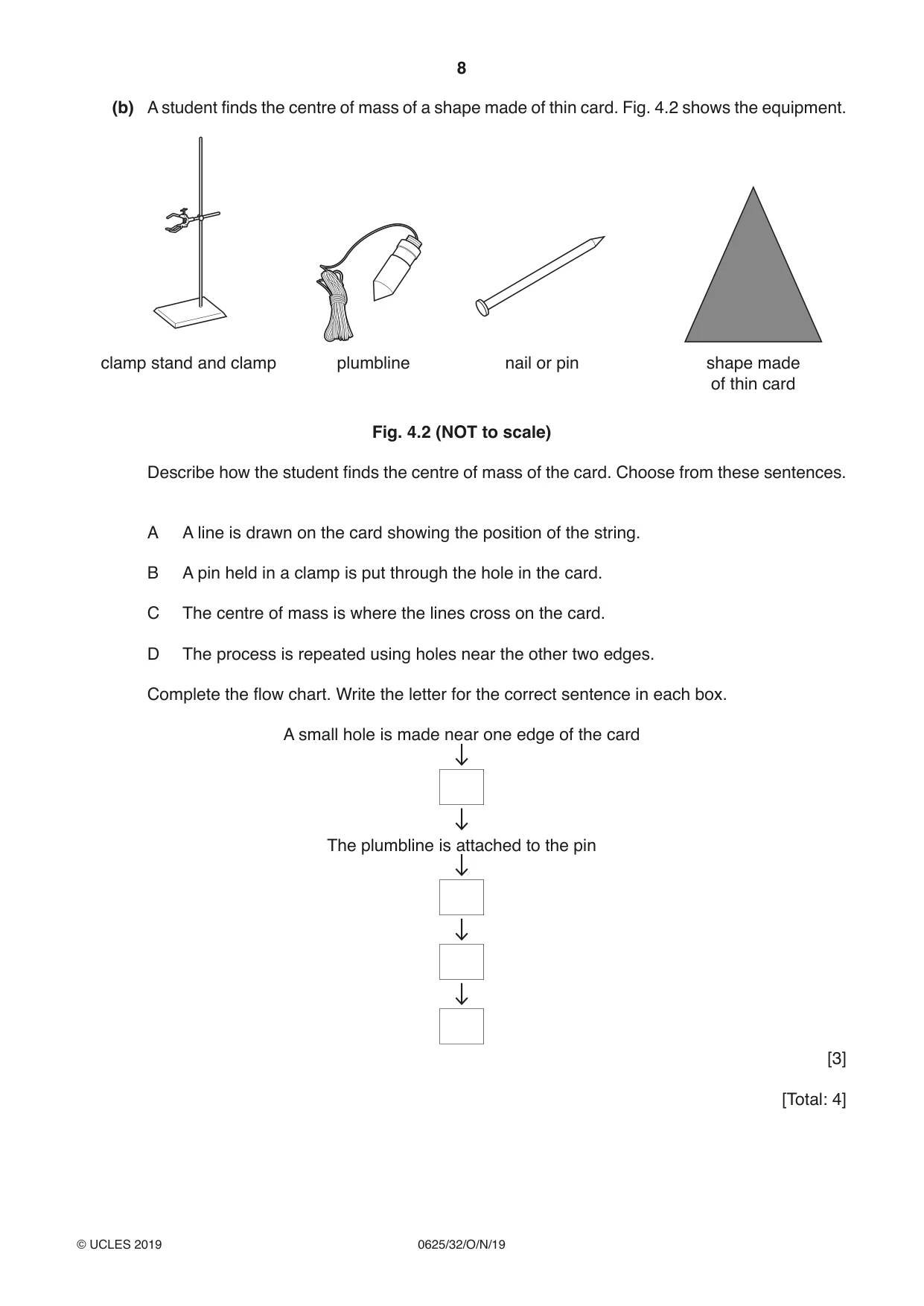
4 (a) Fig. 4.1 shows a metal triangle suspended from a thread. thread metal triangle Fig. 4.1 Complete the sentence. Choose the correct word or phrase from the box. above below to the left of to the right of The metal triangle will come to rest with its centre of mass directly ................................. the point of suspension. [1] (b) A student finds the centre of mass of a shape made of thin card. Fig. 4.2 shows the equipment. clamp stand and clamp plumbline nail or pin shape made of thin card Fig. 4.2 (NOT to scale) Describe how the student finds the centre of mass of the card. Choose from these sentences. A A line is drawn on the card showing the position of the string. B A pin held in a clamp is put through the hole in the card. C The centre of mass is where the lines cross on the card. D The process is repeated using holes near the other two edges. Complete the flow chart. Write the letter for the correct sentence in each box. A small hole is made near one edge of the card The plumbline is attached to the pin [3] [Total: 4]
Mark scheme: 4(a) below B1 4(b) B A D C B3
Q5 · Energy sources used to generate electricity are shown in the box
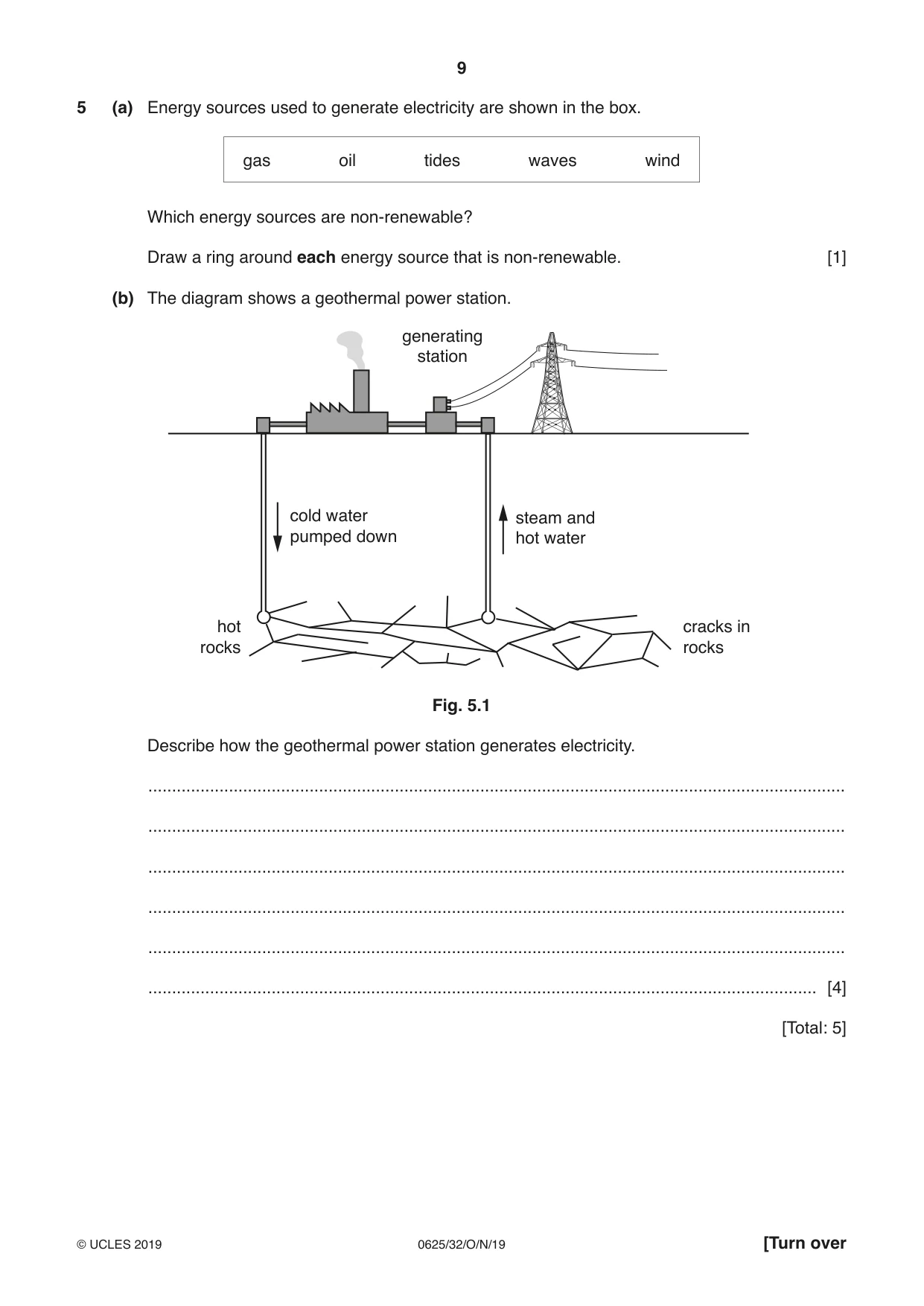
5 (a) Energy sources used to generate electricity are shown in the box. gas oil tides waves wind Which energy sources are non-renewable? Draw a ring around each energy source that is non-renewable. [1] (b) The diagram shows a geothermal power station. generating station cold water steam and pumped down hot water hot cracks in rocks rocks Fig. 5.1 Describe how the geothermal power station generates electricity. ................................................................................................................................................... ................................................................................................................................................... ................................................................................................................................................... ................................................................................................................................................... ................................................................................................................................................... ............................................................................................................................................. [4] [Total: 5]
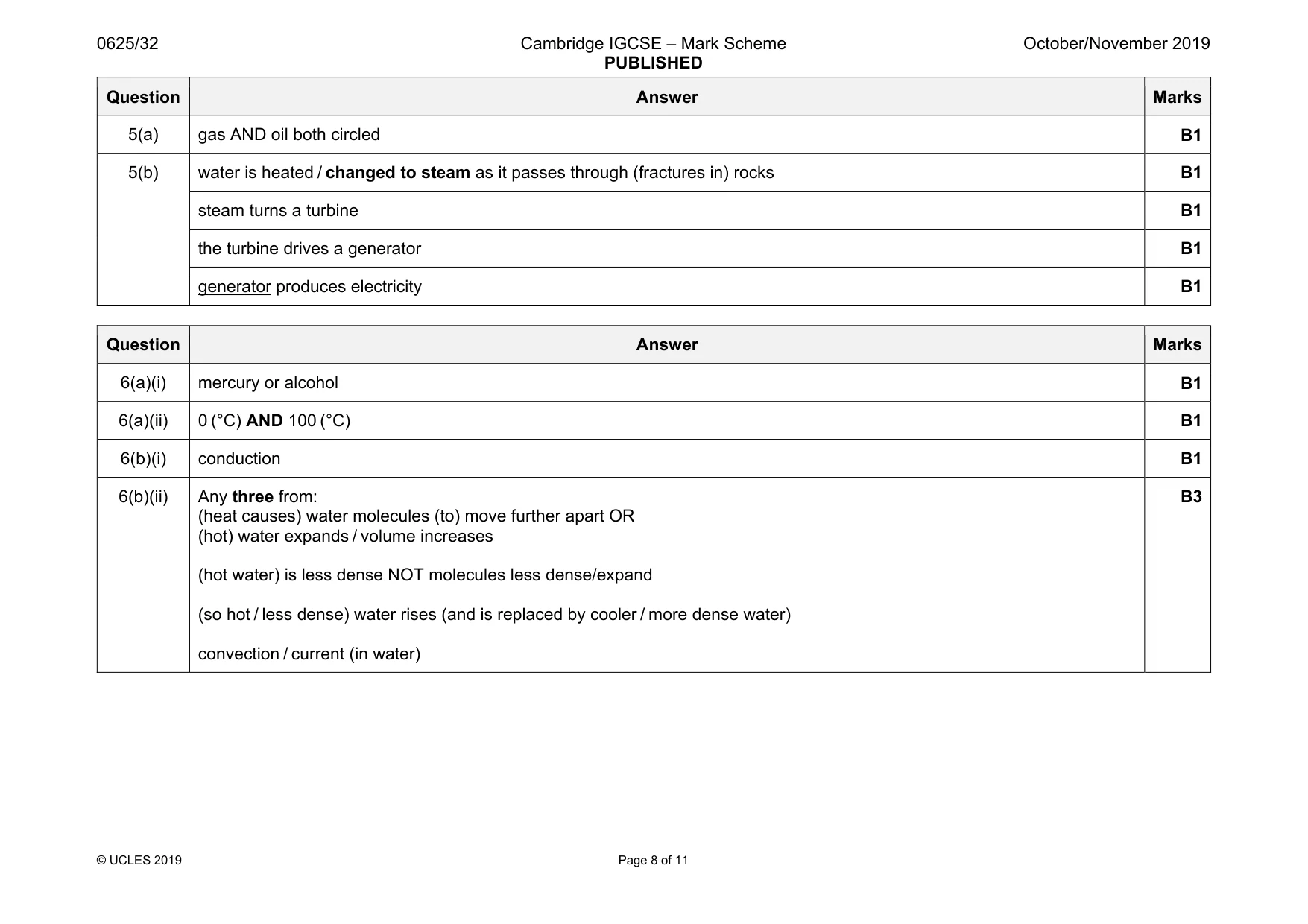
Mark scheme: 5(a) gas AND oil both circled B1 5(b) water is heated / changed to steam as it passes through (fractures in) rocks B1 steam turns a turbine B1 the turbine drives a generator B1 generator produces electricity B1
Question 6
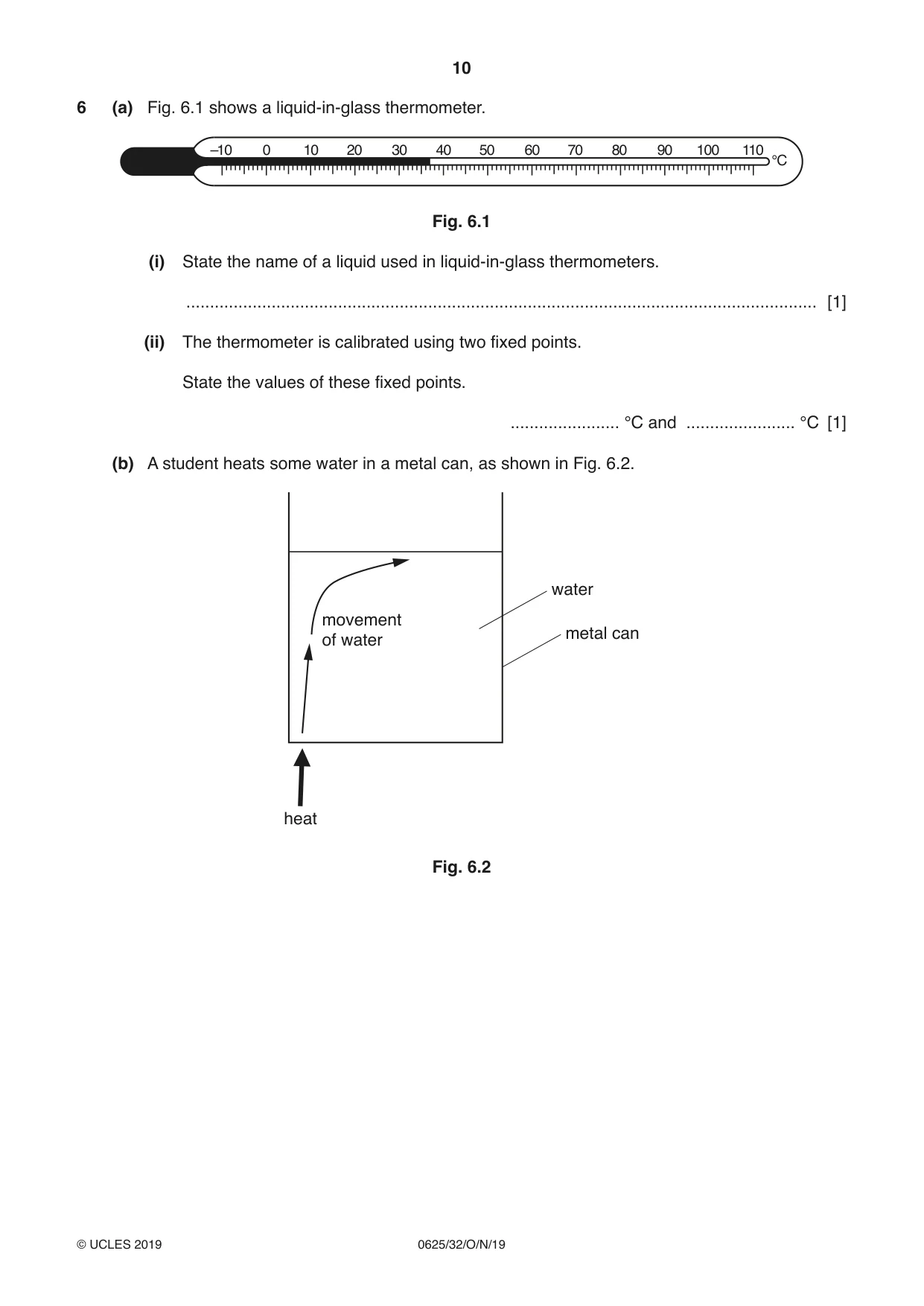
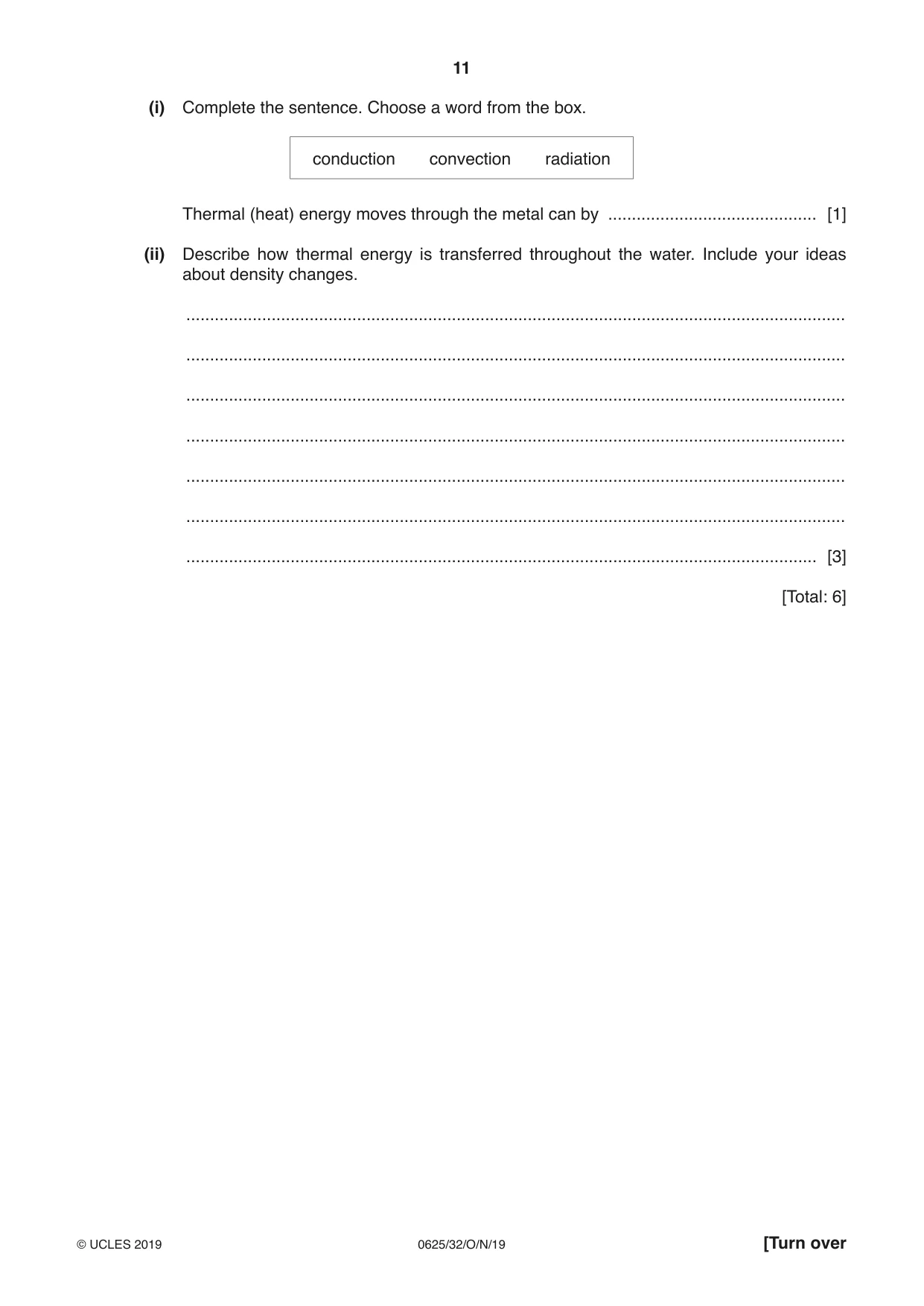
6 (a) Fig. 6.1 shows a liquid-in-glass thermometer. –10 0 10 20 30 40 50 60 70 80 90 100 110 °C Fig. 6.1 (i) State the name of a liquid used in liquid-in-glass thermometers. ..................................................................................................................................... [1] (ii) The thermometer is calibrated using two fixed points. State the values of these fixed points. ....................... °C and ....................... °C [1] (b) A student heats some water in a metal can, as shown in Fig. 6.2. water movement metal can of water heat Fig. 6.2 (i) Complete the sentence. Choose a word from the box. conduction convection radiation Thermal (heat) energy moves through the metal can by ............................................ [1] (ii) Describe how thermal energy is transferred throughout the water. Include your ideas about density changes. ........................................................................................................................................... ........................................................................................................................................... ........................................................................................................................................... ........................................................................................................................................... ........................................................................................................................................... ........................................................................................................................................... ..................................................................................................................................... [3] [Total: 6]
Mark scheme: 6(a)(i) mercury or alcohol B1 6(a)(ii) 0 (°C) AND 100 (°C) B1 6(b)(i) conduction B1 6(b)(ii) Any three from: (heat causes) water molecules (to) move further apart OR (hot) water expands / volume increases (hot water) is less dense NOT molecules less dense/expand (so hot / less dense) water rises (and is replaced by cooler / more dense water) convection / current (in water) B3
Q7 · All matter is made up of atoms and molecules
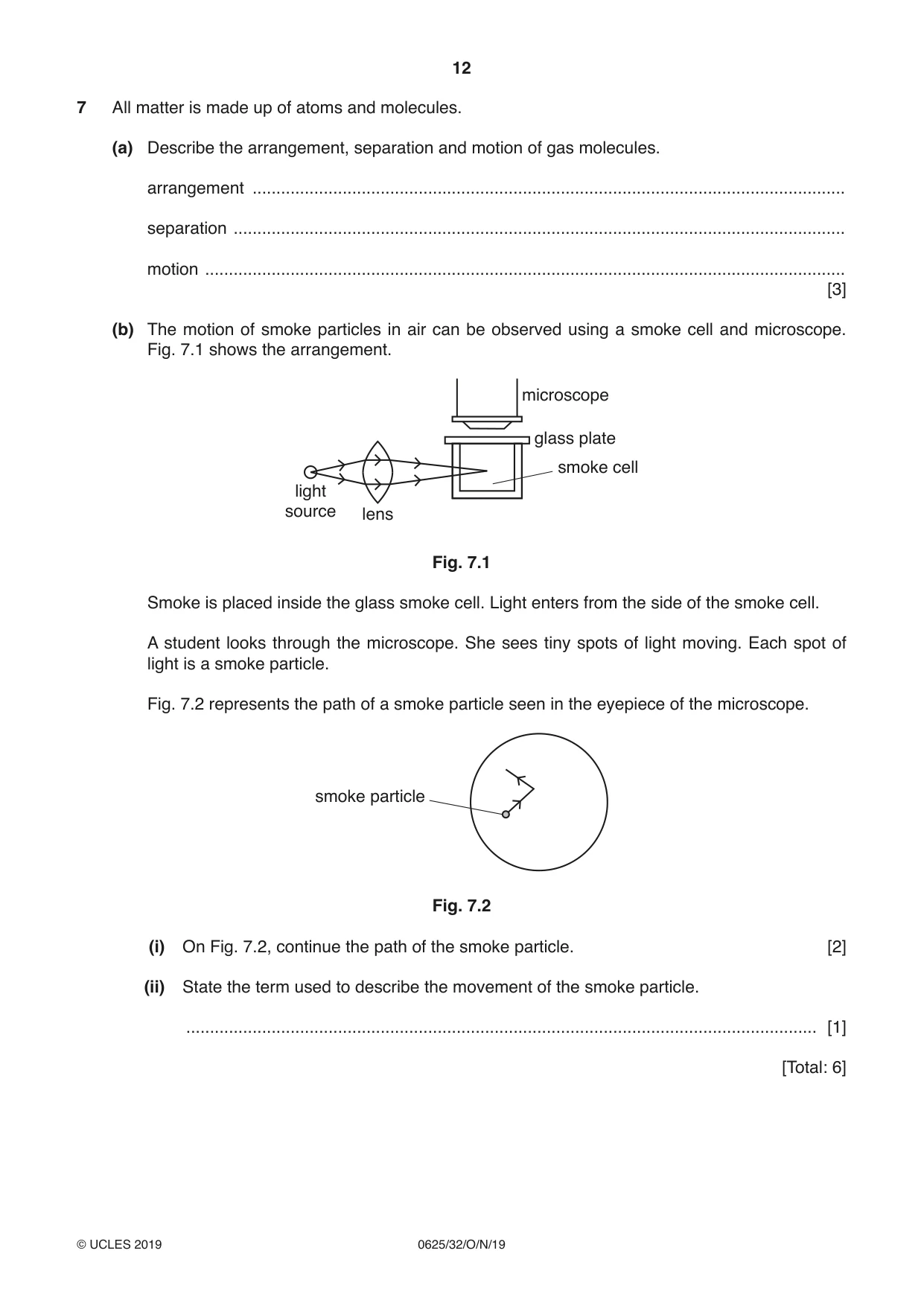
7 All matter is made up of atoms and molecules. (a) Describe the arrangement, separation and motion of gas molecules. arrangement ............................................................................................................................. separation ................................................................................................................................. motion ....................................................................................................................................... [3] (b) The motion of smoke particles in air can be observed using a smoke cell and microscope. Fig. 7.1 shows the arrangement. microscope glass plate smoke cell light source lens Fig. 7.1 Smoke is placed inside the glass smoke cell. Light enters from the side of the smoke cell. A student looks through the microscope. She sees tiny spots of light moving. Each spot of light is a smoke particle. Fig. 7.2 represents the path of a smoke particle seen in the eyepiece of the microscope. smoke particle Fig. 7.2 (i) On Fig. 7.2, continue the path of the smoke particle. [2] (ii) State the term used to describe the movement of the smoke particle. ..................................................................................................................................... [1] [Total: 6]
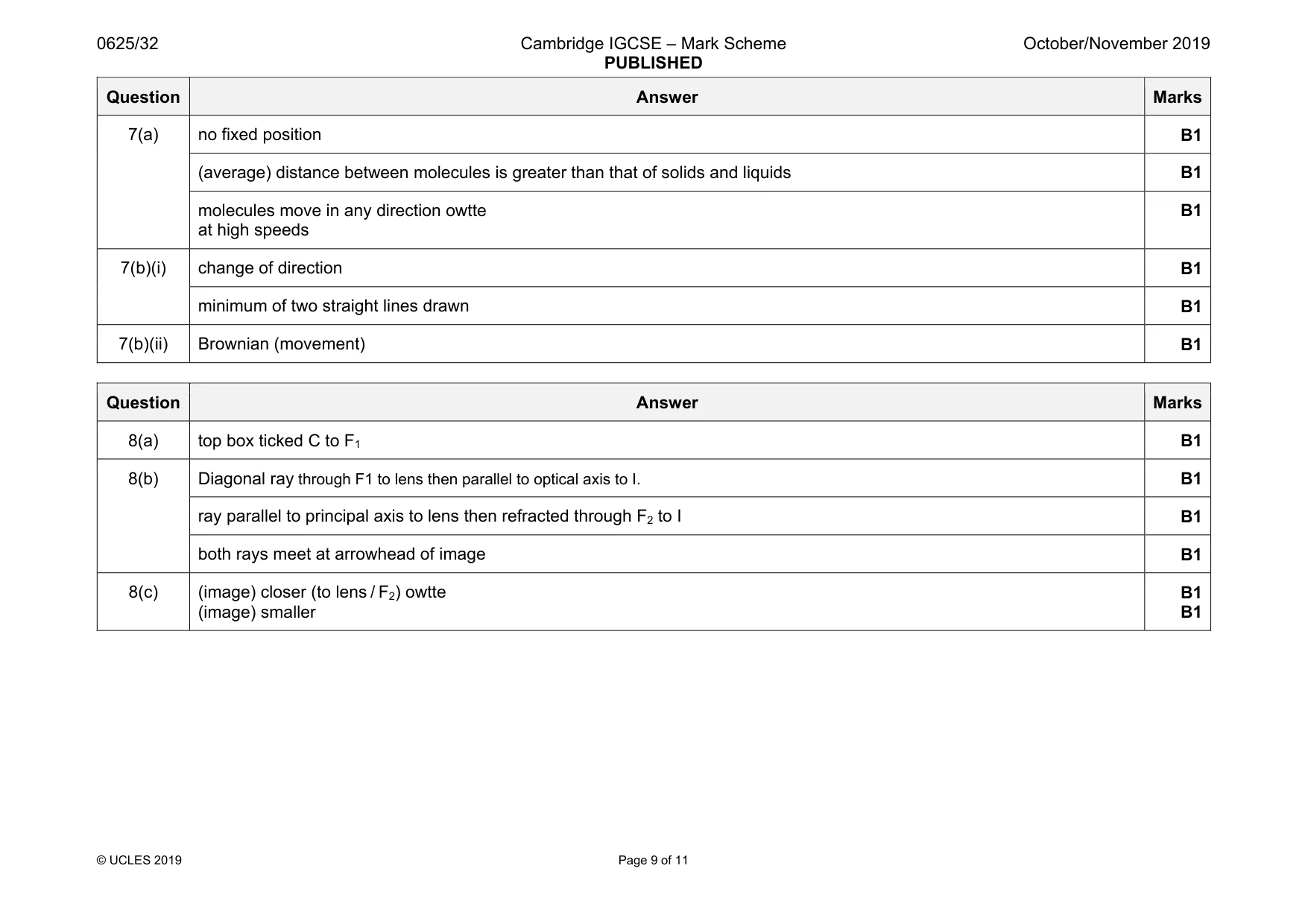
Mark scheme: 7(a) no fixed position B1 (average) distance between molecules is greater than that of solids and liquids B1 molecules move in any direction owtte at high speeds B1 7(b)(i) change of direction B1 minimum of two straight lines drawn B1 7(b)(ii) Brownian (movement) B1
Q8 · A partially completed ray diagram
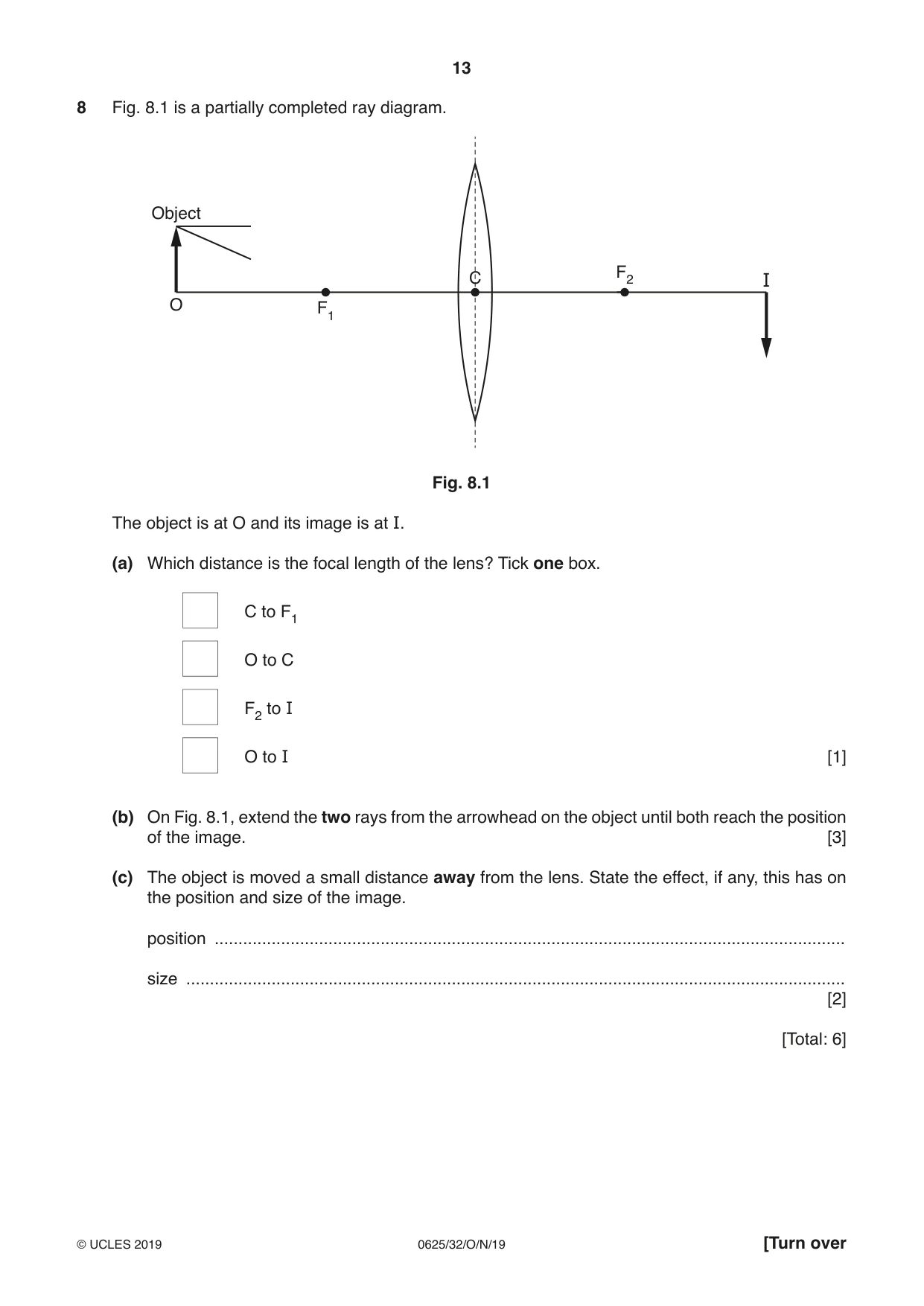
8 Fig. 8.1 is a partially completed ray diagram. Object C F2 I O F1 Fig. 8.1 The object is at O and its image is at I. (a) Which distance is the focal length of the lens? Tick one box. C to F1 O to C F2 to I O to I [1] (b) On Fig. 8.1, extend the two rays from the arrowhead on the object until both reach the position of the image. [3] (c) The object is moved a small distance away from the lens. State the effect, if any, this has on the position and size of the image. position ..................................................................................................................................... size ........................................................................................................................................... [2] [Total: 6]
Mark scheme: 8(a) top box ticked C to F1 B1 8(b) Diagonal ray through F1 to lens then parallel to optical axis to I. B1 ray parallel to principal axis to lens then refracted through F2 to I B1 both rays meet at arrowhead of image B1 8(c) (image) closer (to lens / F2) owtte (image) smaller B1 B1
Q9 · A boat race starts on the sea, but close to land
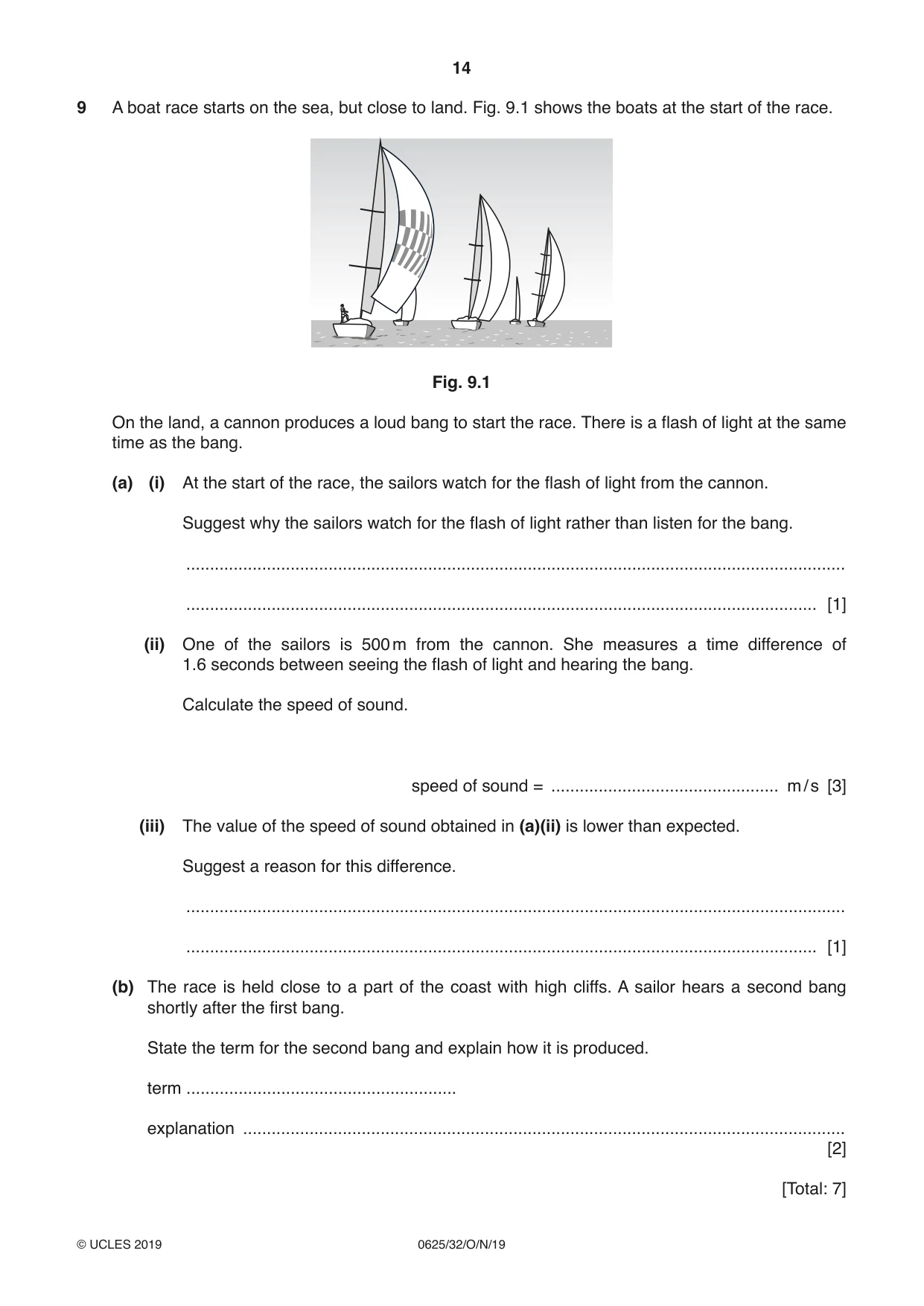
9 A boat race starts on the sea, but close to land. Fig. 9.1 shows the boats at the start of the race. Fig. 9.1 On the land, a cannon produces a loud bang to start the race. There is a flash of light at the same time as the bang. (a) (i) At the start of the race, the sailors watch for the flash of light from the cannon. Suggest why the sailors watch for the flash of light rather than listen for the bang. ........................................................................................................................................... ..................................................................................................................................... [1] (ii) One of the sailors is 500 m from the cannon. She measures a time difference of 1.6 seconds between seeing the flash of light and hearing the bang. Calculate the speed of sound. speed of sound = ................................................ m / s [3] (iii) The value of the speed of sound obtained in (a)(ii) is lower than expected. Suggest a reason for this difference. ........................................................................................................................................... ..................................................................................................................................... [1] (b) The race is held close to a part of the coast with high cliffs. A sailor hears a second bang shortly after the first bang. State the term for the second bang and explain how it is produced. term ......................................................... explanation ............................................................................................................................... [2] [Total: 7]
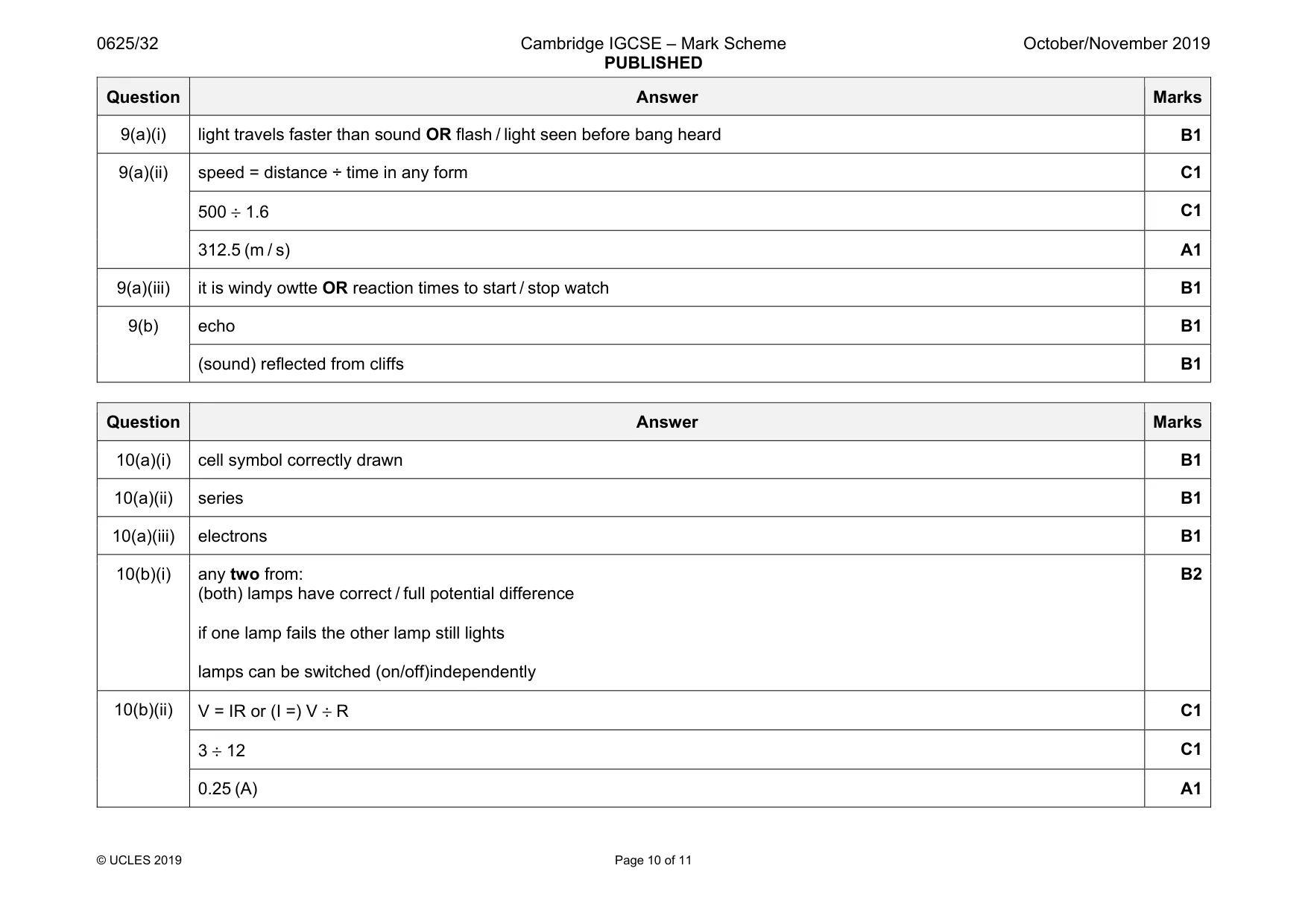
Mark scheme: 9(a)(i) light travels faster than sound OR flash / light seen before bang heard B1 9(a)(ii) speed = distance ÷ time in any form C1 500 ÷ 1.6 C1 312.5 (m / s) A1 9(a)(iii) it is windy owtte OR reaction times to start / stop watch B1 9(b) echo B1 (sound) reflected from cliffs B1
Q10 · A circuit is made from two lamps, a cell and a switch, as shown in Fig
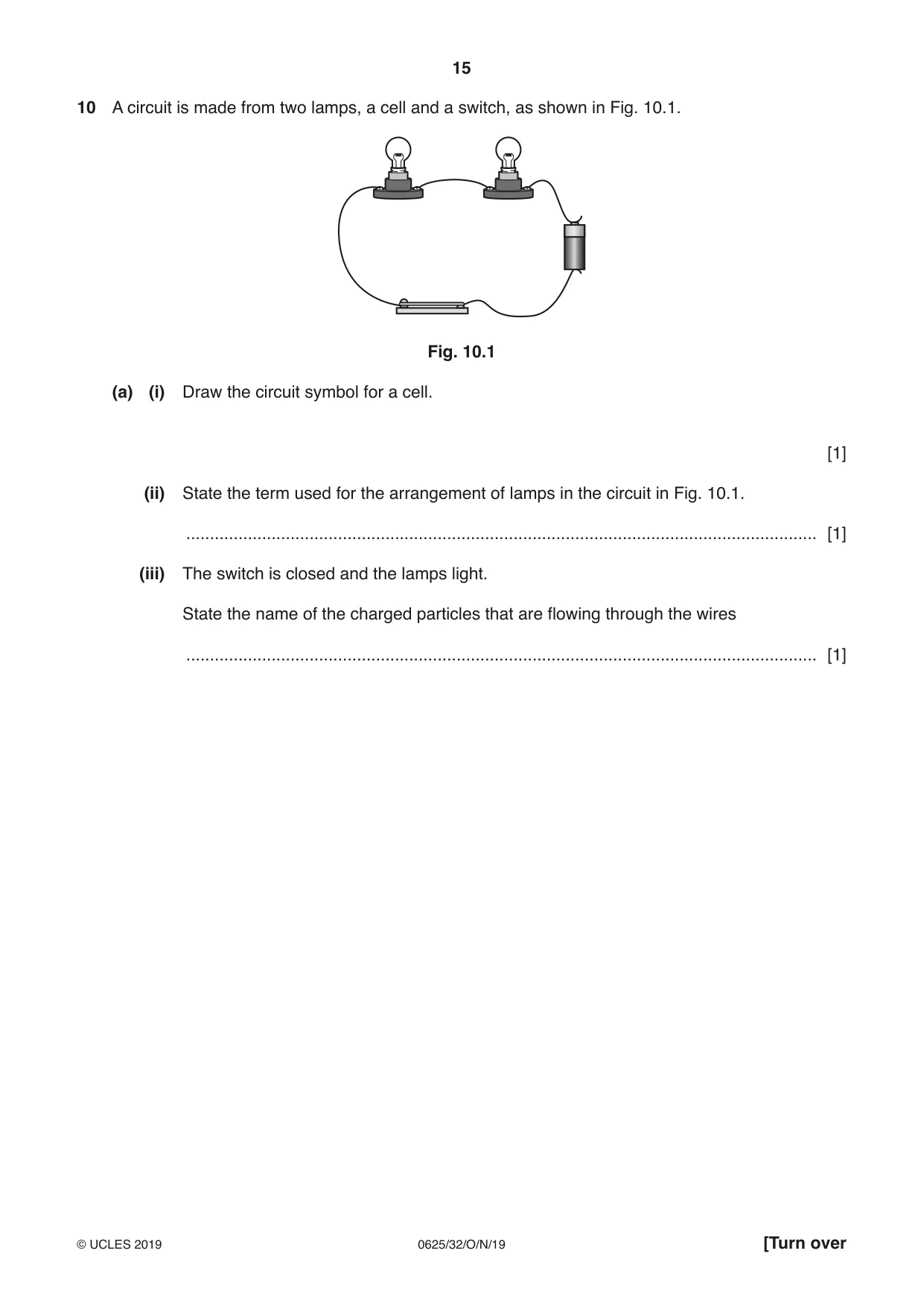
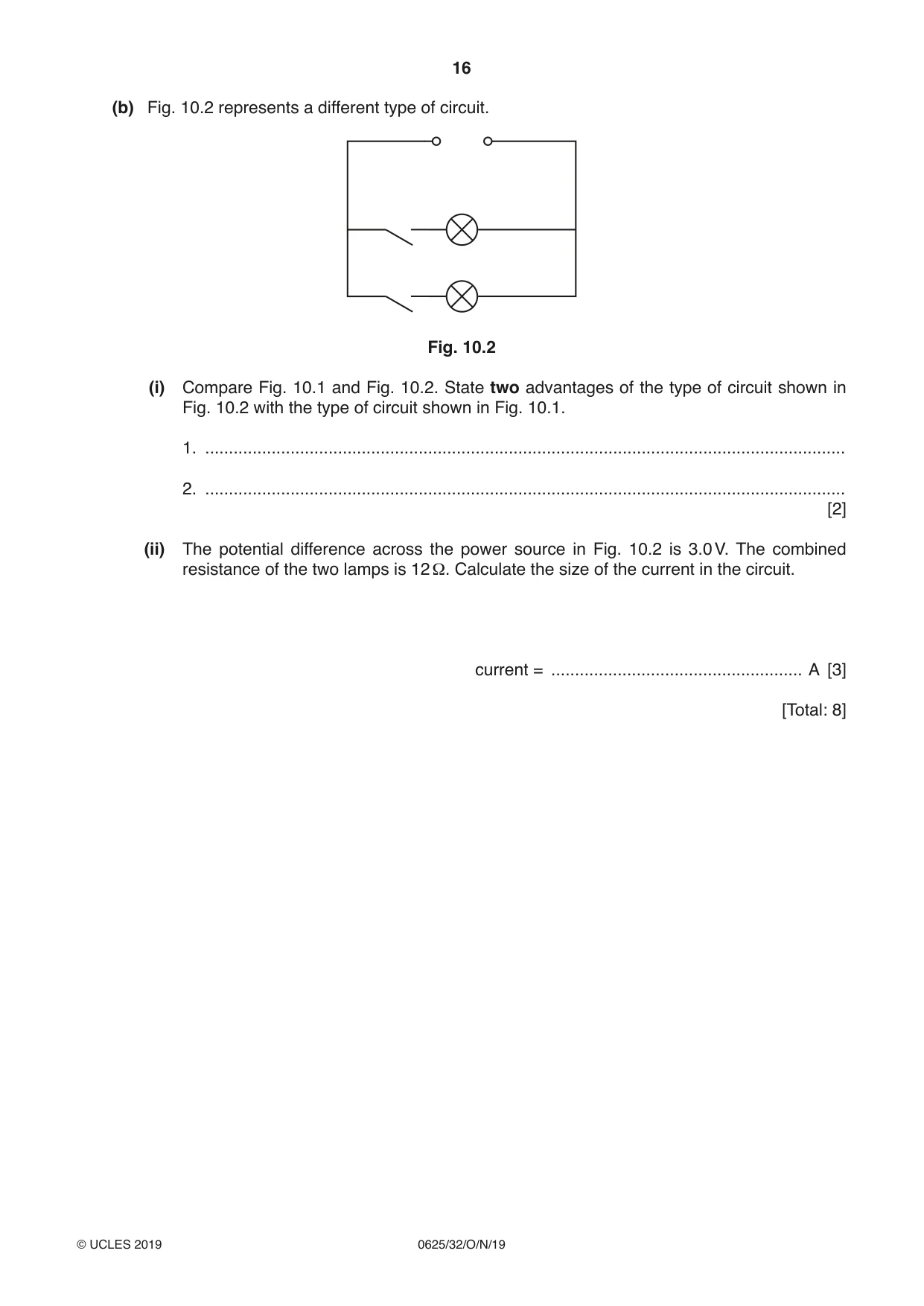
10 A circuit is made from two lamps, a cell and a switch, as shown in Fig. 10.1. Fig. 10.1 (a) (i) Draw the circuit symbol for a cell. [1] (ii) State the term used for the arrangement of lamps in the circuit in Fig. 10.1. ..................................................................................................................................... [1] (iii) The switch is closed and the lamps light. State the name of the charged particles that are flowing through the wires ..................................................................................................................................... [1] (b) Fig. 10.2 represents a different type of circuit. Fig. 10.2 (i) Compare Fig. 10.1 and Fig. 10.2. State two advantages of the type of circuit shown in Fig. 10.2 with the type of circuit shown in Fig. 10.1. 1. ....................................................................................................................................... 2. ....................................................................................................................................... [2] (ii) The potential difference across the power source in Fig. 10.2 is 3.0 V. The combined resistance of the two lamps is 12 Ω. Calculate the size of the current in the circuit. current = ..................................................... A [3] [Total: 8]
Mark scheme: 10(a)(i) cell symbol correctly drawn B1 10(a)(ii) series B1 10(a)(iii) electrons B1 10(b)(i) any two from: (both) lamps have correct / full potential difference if one lamp fails the other lamp still lights lamps can be switched (on/off)independently B2 10(b)(ii) V = IR or (I =) V ÷ R C1 3 ÷ 12 C1 0.25 (A) A1
Q11 · Identify which of the following metals can be permanently magnetised
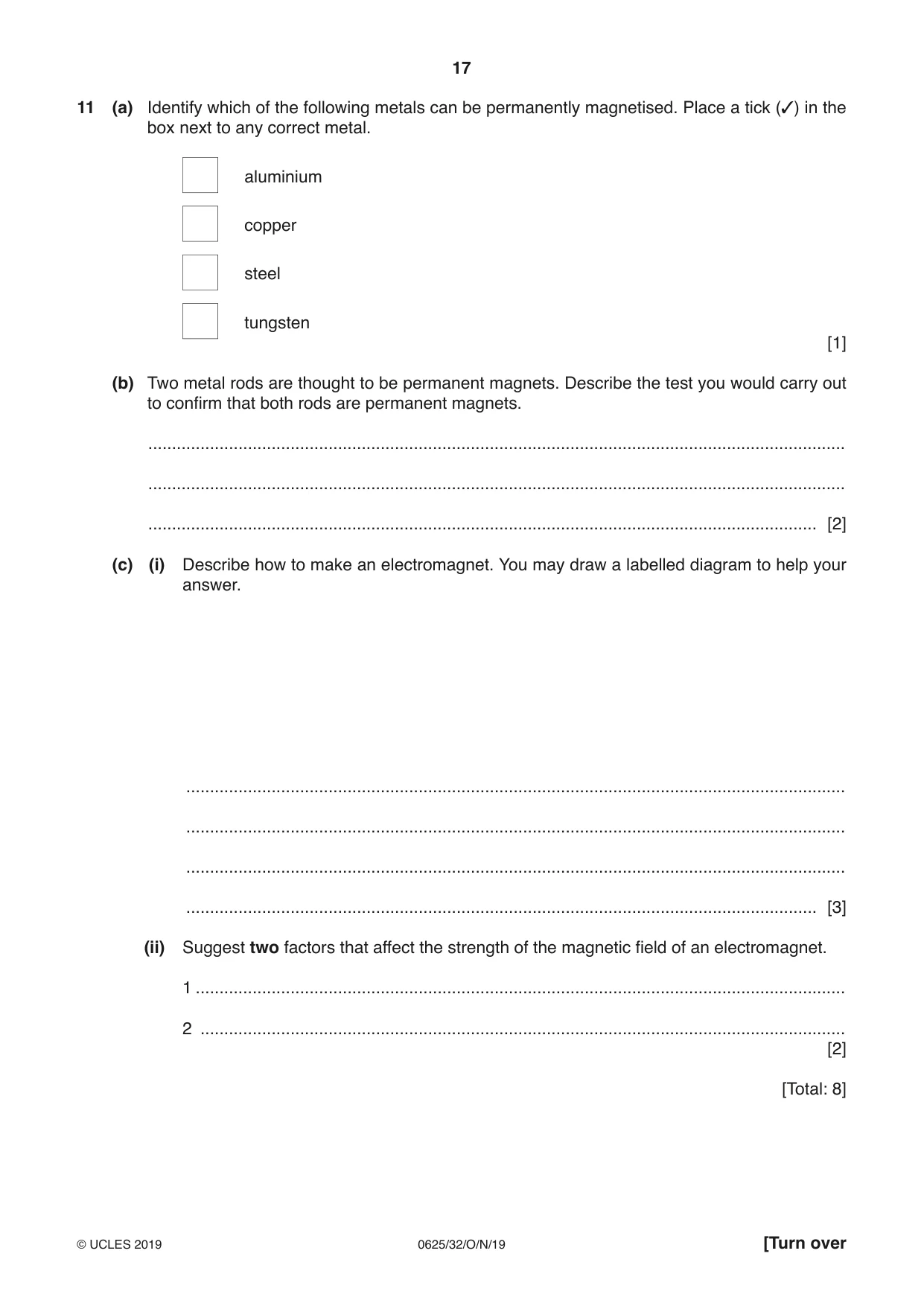
11 (a) Identify which of the following metals can be permanently magnetised. Place a tick (3) in the box next to any correct metal. aluminium copper steel tungsten [1] (b) Two metal rods are thought to be permanent magnets. Describe the test you would carry out to confirm that both rods are permanent magnets. ................................................................................................................................................... ................................................................................................................................................... ............................................................................................................................................. [2] (c) (i) Describe how to make an electromagnet. You may draw a labelled diagram to help your answer. ........................................................................................................................................... ........................................................................................................................................... ........................................................................................................................................... ..................................................................................................................................... [3] (ii) Suggest two factors that affect the strength of the magnetic field of an electromagnet. 1 ......................................................................................................................................... 2 ........................................................................................................................................ [2] [Total: 8]
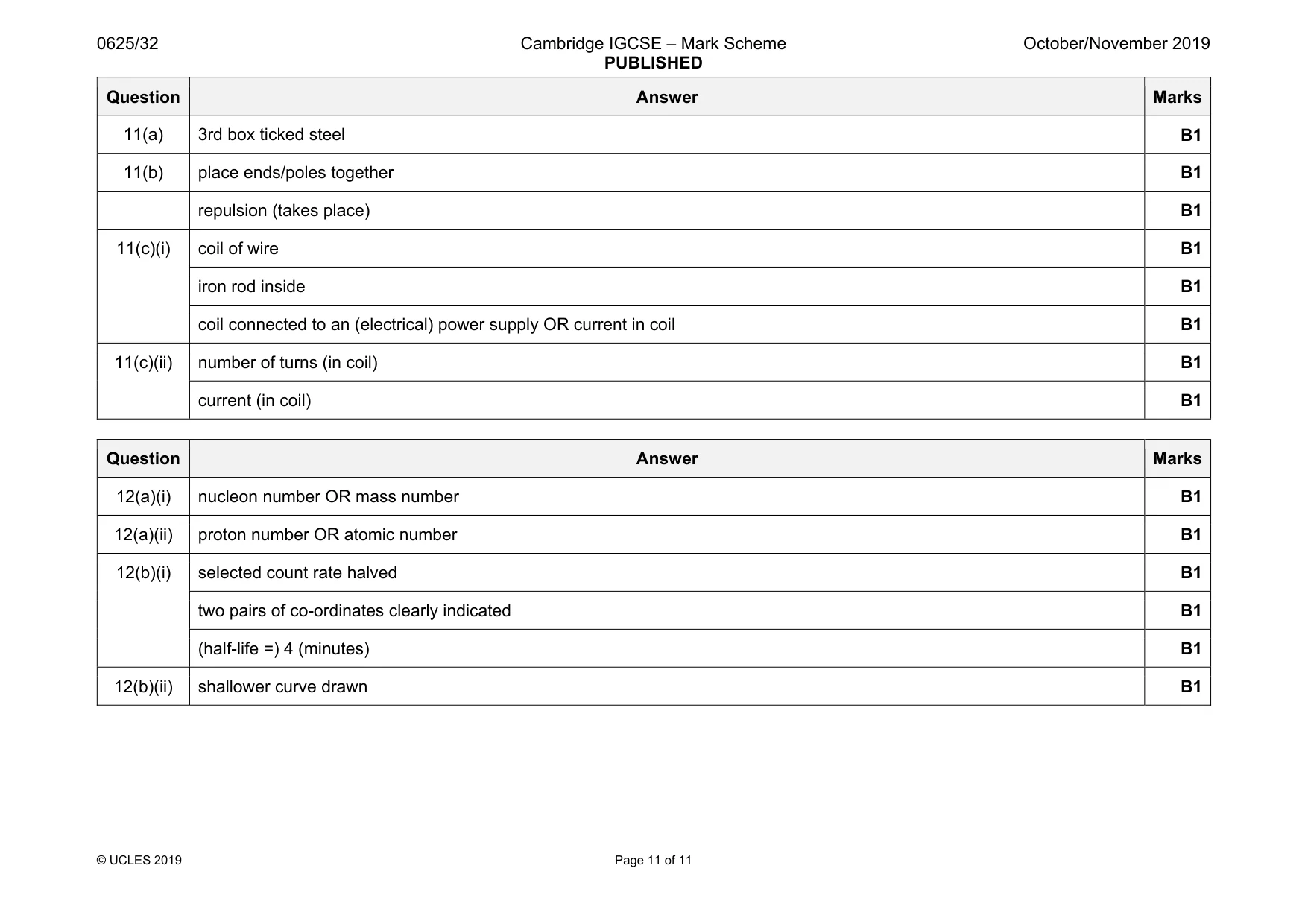
Mark scheme: 11(a) 3rd box ticked steel B1 11(b) place ends/poles together B1 repulsion (takes place) B1 11(c)(i) coil of wire B1 iron rod inside B1 coil connected to an (electrical) power supply OR current in coil B1 11(c)(ii) number of turns (in coil) B1 current (in coil) B1
Q12 · A radioactive substance decays by emitting an α-particle
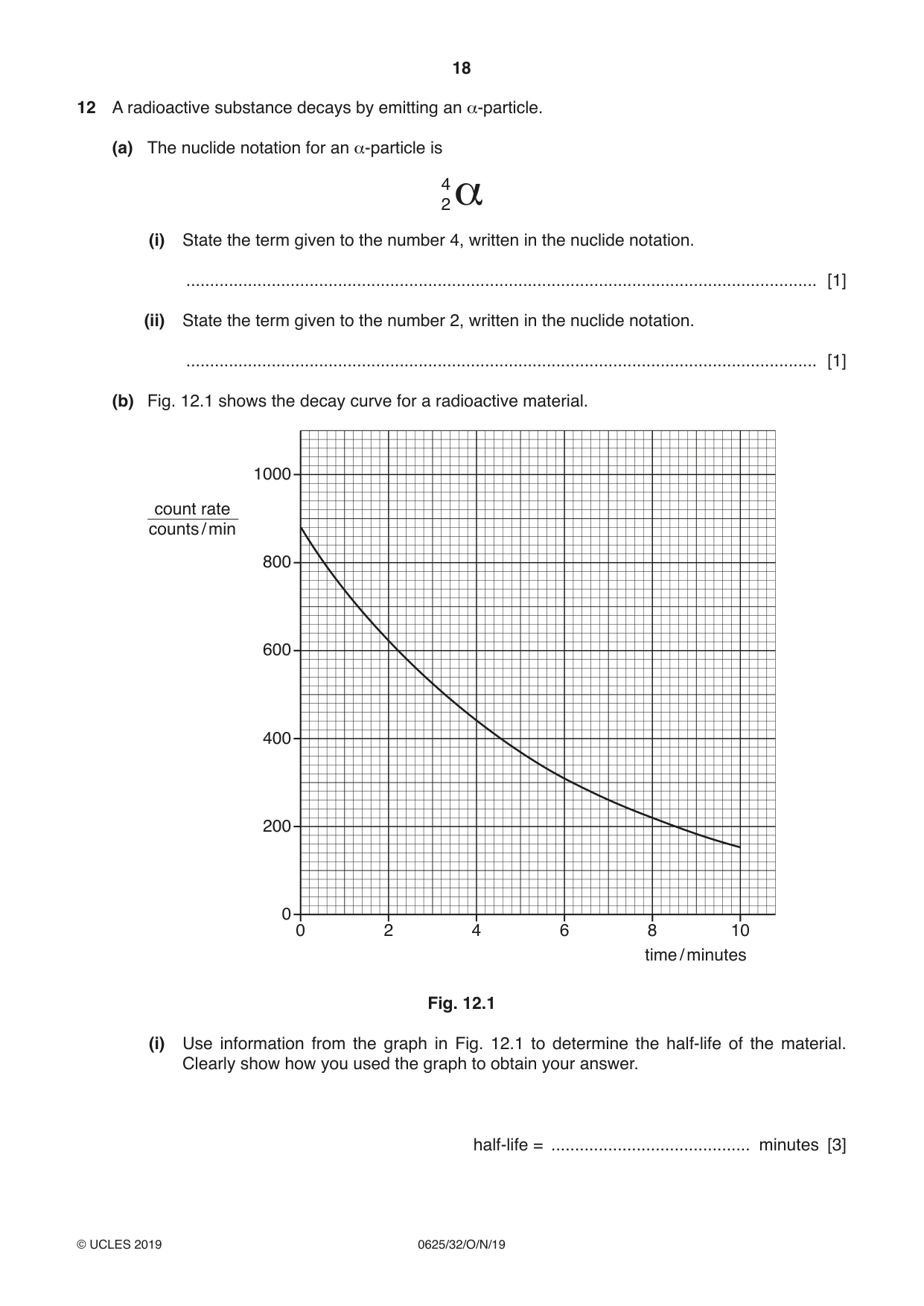
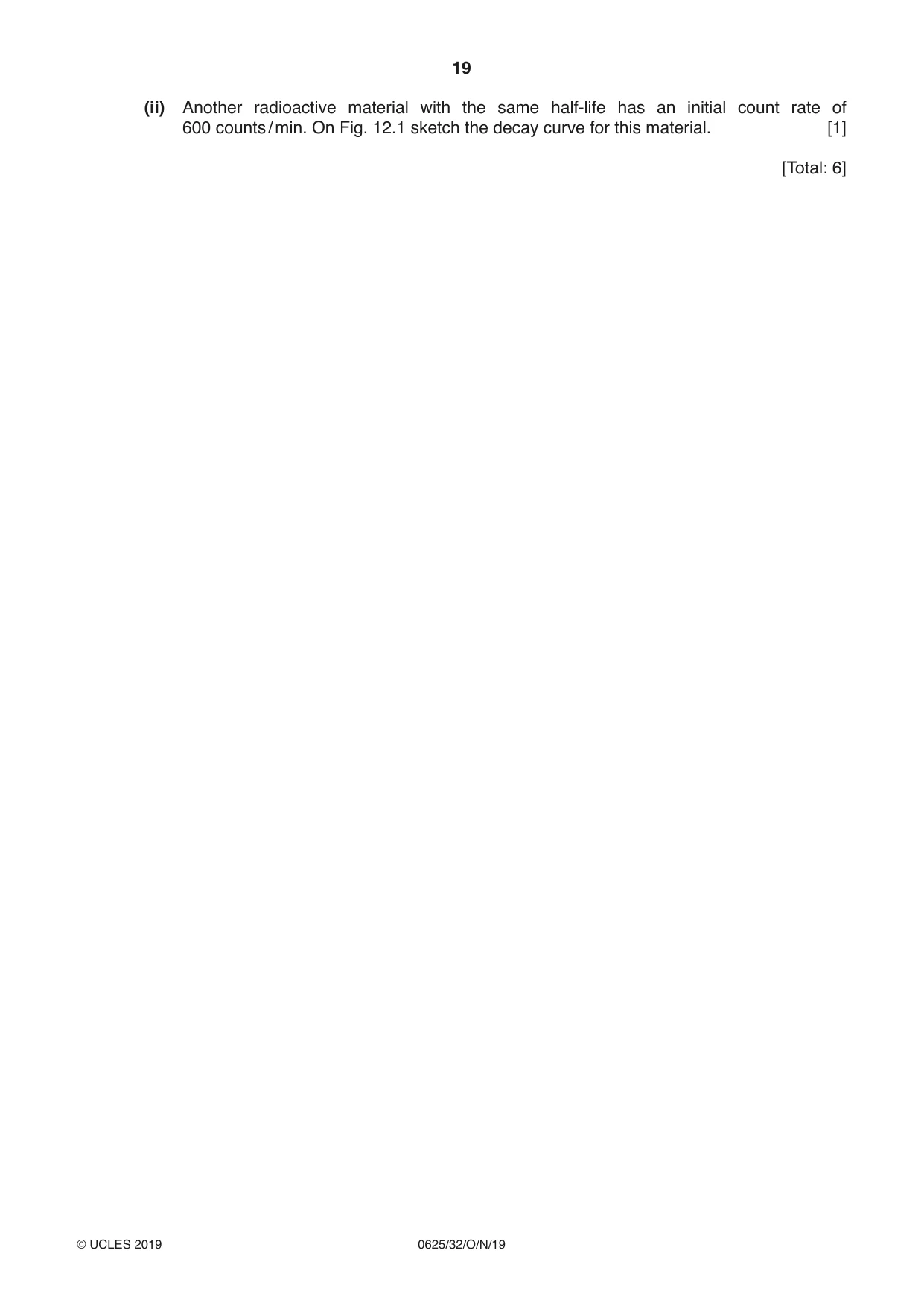
12 A radioactive substance decays by emitting an α-particle. (a) The nuclide notation for an α-particle is 4 2 α (i) State the term given to the number 4, written in the nuclide notation. ..................................................................................................................................... [1] (ii) State the term given to the number 2, written in the nuclide notation. ..................................................................................................................................... [1] (b) Fig. 12.1 shows the decay curve for a radioactive material. 1000 count rate counts / min 800 600 400 200 0 0 2 4 6 8 10 time / minutes Fig. 12.1 (i) Use information from the graph in Fig. 12.1 to determine the half-life of the material. Clearly show how you used the graph to obtain your answer. half-life = .......................................... minutes [3] (ii) Another radioactive material with the same half-life has an initial count rate of 600 counts / min. On Fig. 12.1 sketch the decay curve for this material. [1] [Total: 6]
Mark scheme: 12(a)(i) nucleon number OR mass number B1 12(a)(ii) proton number OR atomic number B1 12(b)(i) selected count rate halved B1 two pairs of co-ordinates clearly indicated B1 (half-life =) 4 (minutes) B1 12(b)(ii) shallower curve drawn B1
What was in this paper
The subtopics covered by these 12 questions, and how many questions each got. Open one in a new tab to see every Cambridge question on it.
What you needed in this session
Cambridge’s own grade thresholds for 2019 Oct/Nov, Paper 3 · Variant 2. A higher threshold means an easier paper — the bar moves with how the cohort did.