Questions as text
Q1 · A power station uses nuclear fission to obtain energy 0625/11 May/June 2005
10 A power station uses nuclear fission to obtain energy. In this process, nuclear energy is first changed into A chemical energy. B electrical energy. C gravitational energy. D internal energy.
1 marks
Answer: D
This question in 0625/11 May/June 2005
Q2 · Which type of radiation has the greatest ionising effect? 0625/11 May/June 2005
38 Which type of radiation has the greatest ionising effect? A α-particles B β-particles C γ-rays D all have the same ionising effect
1 marks
Answer: A
This question in 0625/11 May/June 2005
Q3 · A powder contains 400 mg of a radioactive material that emits α-particles 0625/11 May/June 2005
39 A powder contains 400 mg of a radioactive material that emits α-particles. The half-life of the material is 5 days. What mass of that material remains after 10 days? A 0 mg B 40 mg C 100 mg D 200 mg
1 marks
Answer: C
This question in 0625/11 May/June 2005
Q4 · A radioactive source emits radiation that can pass through a sheet of paper but not… 0625/11 Oct/Nov 2005
38 A radioactive source emits radiation that can pass through a sheet of paper but not through thick aluminium. paper thick aluminium (all the radiation (none of the radiation passes through) passes through) radiation What does this show about the radiation? A It is α-particles. B It is β-particles. C It is γ-rays. D It is a mixture of α-particles and γ-rays.
1 marks
Answer: B
This question in 0625/11 Oct/Nov 2005
Q5 · An unstable nucleus has 145 neutrons and 92 protons 0625/11 Oct/Nov 2005
39 An unstable nucleus has 145 neutrons and 92 protons. It emits a β-particle. How many neutrons and protons does the nucleus have after emitting the β-particle? neutrons protons A 144 92 B 144 93 C 145 91 D 145 93
1 marks
Answer: B
This question in 0625/11 Oct/Nov 2005
Q6 · The diagram shows five atoms in a radioactive substance 0625/11 May/June 2006
38 The diagram shows five atoms in a radioactive substance. The atoms each give out an α-particle. 1st particle atom 1 atom atom 2 5 atom atom 4 3 2nd particle Atom 1 is the first to give out a particle. Atom 3 is the second to give out a particle. Which atom will give out the next particle? A atom 2 B atom 4 C atom 5 D impossible to tell
1 marks
Answer: D
This question in 0625/11 May/June 2006
Q7 · A Geiger counter detects radiation from radioactive sources 0625/11 May/June 2006
39 A Geiger counter detects radiation from radioactive sources. A radioactive source is inside a thick aluminium container as shown. radioactive source 2 m Geiger counter thick aluminium container Which type of radiation from this source is being detected? A α-particles B β-particles C γ-rays D radio waves
1 marks
Answer: C
This question in 0625/11 May/June 2006
Q8 · What are the most penetrating and the least penetrating types of radiation? 0625/11 May/June 2007
38 What are the most penetrating and the least penetrating types of radiation? most penetrating least penetrating A α-particles β-particles B β-particles α-particles C γ-rays α-particles D γ-rays β-particles
1 marks
Answer: C
This question in 0625/11 May/June 2007
Q9 · The half-life of a radioactive substance is 5 hours 0625/11 May/June 2007
39 The half-life of a radioactive substance is 5 hours. A sample is tested and found to contain 0.48 g of the substance. How much of the substance was present in the sample 20 hours before the sample was tested? A 0.03 g B 0.12 g C 1.92 g D 7.68 g
1 marks
Answer: D
This question in 0625/11 May/June 2007
Q10 · A sheet of paper is placed between a radioactive source and a detector 0625/11 Oct/Nov 2007
38 A sheet of paper is placed between a radioactive source and a detector. radioactive detector source sheet of paper Which types of radiation can pass through the paper? A α-particles and β-particles only B α-particles and γ-rays only C β-particles and γ-rays only D α-particles, β-particles and γ-rays
1 marks
Answer: C
This question in 0625/11 Oct/Nov 2007
Q11 · A sample of radioactive isotope is decaying 0625/11 Oct/Nov 2007
39 A sample of radioactive isotope is decaying. The nuclei of which atoms will decay first? A impossible to know, because radioactive decay is random B impossible to know, unless the age of the material is known C atoms near the centre, because they are surrounded by more atoms D atoms near the surface, because the radiation can escape more easily
1 marks
Answer: A
This question in 0625/11 Oct/Nov 2007
Q12 · What is a β-particle and from which part of a radioactive atom is it emitted? 0625/11 May/June 2008
38 What is a β-particle and from which part of a radioactive atom is it emitted? β-particle emitted from A electron nucleus B electron outer orbits C helium nucleus nucleus D helium nucleus outer orbits
1 marks
Answer: A
This question in 0625/11 May/June 2008
Q13 · A sample of radioactive uranium has mass 1 g 0625/11 May/June 2008
39 A sample of radioactive uranium has mass 1 g. Another sample of the same material has mass 2 g. Which property is the same for both samples? A the amount of radiation emitted per second B the half-life C the number of uranium atoms D the volume
1 marks
Answer: B
This question in 0625/11 May/June 2008
Q14 · The diagram shows an experiment to monitor the radiation from a radioactive gas 0625/11 Oct/Nov 2008
38 The diagram shows an experiment to monitor the radiation from a radioactive gas. The counter readings are corrected for background radiation. counter 000.0 radioactive gas The table shows how the counter reading varies with time. time / seconds 0 20 40 60 80 100 120 140 160 180 counter reading / 140 105 82 61 44 36 27 20 15 10 counts per minute What is the half-life of the gas? A between 20 and 40 seconds B between 40 and 60 seconds C between 60 and 140 seconds D between 140 and 180 seconds
1 marks
Answer: B
This question in 0625/11 Oct/Nov 2008
Q15 · Which material is commonly used as a lining for a box for storing radioactive samples? 0625/11 Oct/Nov 2008
39 Which material is commonly used as a lining for a box for storing radioactive samples? A aluminium B copper C lead D uranium
1 marks
Answer: C
This question in 0625/11 Oct/Nov 2008
Q16 · A uranium 238 U nucleus emits an α-particle 0625/11 Oct/Nov 2008
40 A uranium 238 U nucleus emits an α-particle. 92 What are the new nucleon and proton numbers? nucleon number proton number A 238 88 B 236 90 C 234 92 D 234 90
1 marks
Answer: D
This question in 0625/11 Oct/Nov 2008
Q17 · A radioactive nucleus contains 138 neutrons 0625/11 May/June 2009
38 A radioactive nucleus contains 138 neutrons. The nucleus emits an α-particle. How many neutrons are in the nucleus after it has emitted the α-particle? A 134 B 136 C 138 D 139
1 marks
Answer: B
This question in 0625/11 May/June 2009
Q18 · The graph shows the decay curve for one particular radioactive nuclide 0625/11 May/June 2009
39 The graph shows the decay curve for one particular radioactive nuclide. 2500 count rate counts / min 2000 1500 1000 500 0 0 1 2 3 4 5 time / days What is the half-life of this nuclide? A 1.0 day B 1.5 days C 2.0 days D 2.5 days
1 marks
Answer: C
This question in 0625/11 May/June 2009
Q19 · 16 N is the symbol for a particular nuclide of nitrogen 0625/11 May/June 2009
40 16 N is the symbol for a particular nuclide of nitrogen. 7 How many nucleons does this nuclide contain? A 7 B 9 C 16 D 23
1 marks
Answer: C
This question in 0625/11 May/June 2009
Q20 · Which statement explains the meaning of the half-life of a radioactive substance? 0625/11 Oct/Nov 2009
38 Which statement explains the meaning of the half-life of a radioactive substance? A half the time taken for half the substance to decay B half the time taken for the substance to decay completely C the time taken for half the substance to decay D the time taken for the substance to decay completely
1 marks
Answer: C
This question in 0625/11 Oct/Nov 2009
Q21 · The diagram shows the paths of three different types of radiation, X, Y and Z 0625/11 Oct/Nov 2009
39 The diagram shows the paths of three different types of radiation, X, Y and Z. X Y Z 2 mm of 10 mm lead plastic of aluminium Which row in the table correctly identifies X, Y and Z? X Y Z A α-particles β-particles γ-rays B β-particles α-particles γ-rays C β-particles γ-rays α-particles D γ-rays α-particles β-particles Question 40 is on the next page.
1 marks
Answer: B
This question in 0625/11 Oct/Nov 2009
Q22 · Which statement explains the meaning of the half-life of a radioactive substance? 0625/12 Oct/Nov 2009
39 Which statement explains the meaning of the half-life of a radioactive substance? A half the time taken for half the substance to decay B half the time taken for the substance to decay completely C the time taken for half the substance to decay D the time taken for the substance to decay completely
1 marks
Answer: C
This question in 0625/12 Oct/Nov 2009
Q23 · The diagram shows the paths of three different types of radiation, X, Y and Z 0625/12 Oct/Nov 2009
40 The diagram shows the paths of three different types of radiation, X, Y and Z. X Y Z 2 mm of 10 mm lead plastic of aluminium Which row in the table correctly identifies X, Y and Z? X Y Z A α-particles β-particles γ-rays B β-particles α-particles γ-rays C β-particles γ-rays α-particles D γ-rays α-particles β-particles
1 marks
Answer: B
This question in 0625/12 Oct/Nov 2009
Q24 · Which row describes the properties of α-particles? 0625/11 May/June 2010
38 Which row describes the properties of α-particles? ionizing radiation stopped effect by aluminium? A large no B large yes C small no D small yes
1 marks
Answer: B
This question in 0625/11 May/June 2010
Q25 · A radioactive substance has a half-life of 2 weeks 0625/11 May/June 2010
39 A radioactive substance has a half-life of 2 weeks. At the beginning of an investigation the substance emits 3000 β-particles per minute. How many β-particles will it emit per minute after 6 weeks? A 0 B 375 C 500 D 1500
1 marks
Answer: B
This question in 0625/11 May/June 2010
Q26 · A radioactive substance has a half-life of 2 weeks 0625/12 May/June 2010
37 A radioactive substance has a half-life of 2 weeks. At the beginning of an investigation the substance emits 3000 β-particles per minute. How many β-particles will it emit per minute after 6 weeks? A 0 B 375 C 500 D 1500
1 marks
Answer: B
This question in 0625/12 May/June 2010
Q27 · Which row describes the properties of α-particles? 0625/12 May/June 2010
38 Which row describes the properties of α-particles? ionizing radiation stopped effect by aluminium? A large no B large yes C small no D small yes
1 marks
Answer: B
This question in 0625/12 May/June 2010
Q28 · A radioactive element has a half-life of 70 s 0625/11 Oct/Nov 2010
38 A radioactive element has a half-life of 70 s. The number of emissions per second, N, of a sample of the element is measured at a certain time. What was the number of emissions per second 70 s earlier? A 0 B N / 2 C N D 2N
1 marks
Answer: D
This question in 0625/11 Oct/Nov 2010
Q29 · S is a radioactive source emitting α-particles, β-particles and γ-rays 0625/11 Oct/Nov 2010
39 S is a radioactive source emitting α-particles, β-particles and γ-rays. A detector is placed 5 cm away from S. A thin sheet of paper is placed as shown in the diagram. thin sheet of paper S detector 5 cm Which radiations can be detected? A α-particles and β-particles only B α-particles and γ-rays only C β-particles and γ-rays only D α-particles, β-particles and γ-rays
1 marks
Answer: C
This question in 0625/11 Oct/Nov 2010
Q30 · S is a radioactive source emitting α-particles, β-particles and γ-rays 0625/12 Oct/Nov 2010
39 S is a radioactive source emitting α-particles, β-particles and γ-rays. A detector is placed 5 cm away from S. A thin sheet of paper is placed as shown in the diagram. thin sheet of paper S detector 5 cm Which radiations can be detected? A α-particles and β-particles only B α-particles and γ-rays only C β-particles and γ-rays only D α-particles, β-particles and γ-rays
1 marks
Answer: C
This question in 0625/12 Oct/Nov 2010
Q31 · A radioactive element has a half-life of 70 s 0625/12 Oct/Nov 2010
40 A radioactive element has a half-life of 70 s. The number of emissions per second, N, of a sample of the element is measured at a certain time. What was the number of emissions per second 70 s earlier? A 0 B N / 2 C N D 2N
1 marks
Answer: D
This question in 0625/12 Oct/Nov 2010
Q32 · S is a radioactive source emitting α-particles, β-particles and γ-rays 0625/13 Oct/Nov 2010
38 S is a radioactive source emitting α-particles, β-particles and γ-rays. A detector is placed 5 cm away from S. A thin sheet of paper is placed as shown in the diagram. thin sheet of paper S detector 5 cm Which radiations can be detected? A α-particles and β-particles only B α-particles and γ-rays only C β-particles and γ-rays only D α-particles, β-particles and γ-rays
1 marks
Answer: C
This question in 0625/13 Oct/Nov 2010
Q33 · A radioactive element has a half-life of 70 s 0625/13 Oct/Nov 2010
39 A radioactive element has a half-life of 70 s. The number of emissions per second, N, of a sample of the element is measured at a certain time. What was the number of emissions per second 70 s earlier? A 0 B N / 2 C N D 2N
1 marks
Answer: D
This question in 0625/13 Oct/Nov 2010
Q34 · Which row shows the relative ionising effects and penetrating abilities of α-particles… 0625/11 May/June 2011
38 Which row shows the relative ionising effects and penetrating abilities of α-particles and β-particles? ionising effect penetrating ability A α greater than β α greater than β B α greater than β α less than β C α less than β α greater than β D α less than β α less than β
1 marks
Answer: B
This question in 0625/11 May/June 2011
Q35 · A powder contains 400 mg of a radioactive material that emits α-particles 0625/11 May/June 2011
39 A powder contains 400 mg of a radioactive material that emits α-particles. The half-life of the material is 5 days. What mass of that material remains after 10 days? A 0 mg B 40 mg C 100 mg D 200 mg
1 marks
Answer: C
This question in 0625/11 May/June 2011
Q36 · A powder contains 400 mg of a radioactive material that emits α-particles 0625/12 May/June 2011
37 A powder contains 400 mg of a radioactive material that emits α-particles. The half-life of the material is 5 days. What mass of that material remains after 10 days? A 0 mg B 40 mg C 100 mg D 200 mg
1 marks
Answer: C
This question in 0625/12 May/June 2011
Q37 · Which row shows the relative ionising effects and penetrating abilities of α-particles… 0625/12 May/June 2011
38 Which row shows the relative ionising effects and penetrating abilities of α-particles and β-particles? ionising effect penetrating ability A α greater than β α greater than β B α greater than β α less than β C α less than β α greater than β D α less than β α less than β
1 marks
Answer: B
This question in 0625/12 May/June 2011
Q38 · A powder contains 400 mg of a radioactive material that emits α-particles 0625/13 May/June 2011
37 A powder contains 400 mg of a radioactive material that emits α-particles. The half-life of the material is 5 days. What mass of that material remains after 10 days? A 0 mg B 40 mg C 100 mg D 200 mg
1 marks
Answer: C
This question in 0625/13 May/June 2011
Q39 · Which row shows the relative ionising effects and penetrating abilities of α-particles… 0625/13 May/June 2011
38 Which row shows the relative ionising effects and penetrating abilities of α-particles and β-particles? ionising effect penetrating ability A α greater than β α greater than β B α greater than β α less than β C α less than β α greater than β D α less than β α less than β
1 marks
Answer: B
This question in 0625/13 May/June 2011
Q40 · A power station uses nuclear fission to obtain energy 0625/11 Oct/Nov 2012
9 A power station uses nuclear fission to obtain energy. In this process, nuclear energy is first changed into A chemical energy. B electrical energy. C gravitational energy. D thermal (heat) energy.
1 marks
Answer: D
This question in 0625/11 Oct/Nov 2012
Q41 · How does the ionising effect of α-particles compare with that of β-particles and γ-rays? 0625/11 Oct/Nov 2012
38 How does the ionising effect of α-particles compare with that of β-particles and γ-rays? compared with β-particles compared with γ-rays A α-particles are less strongly ionising α-particles are less strongly ionising B α-particles are less strongly ionising α-particles are more strongly ionising C α-particles are more strongly ionising α-particles are less strongly ionising D α-particles are more strongly ionising α-particles are more strongly ionising
1 marks
Answer: D
This question in 0625/11 Oct/Nov 2012
Q42 · The table shows the count rates obtained from four radioactive sources 0625/11 Oct/Nov 2012
39 The table shows the count rates obtained from four radioactive sources. The measurements were taken at noon on four consecutive days. Which source has the longest half-life? count rate /.counts per second day 1 day 2 day 3 day 4 A 100 48 27 11 B 200 142 99 69 C 300 297 292 290 D 400 202 99 48
1 marks
Answer: C
This question in 0625/11 Oct/Nov 2012
Q43 · How does the ionising effect of α-particles compare with that of β-particles and γ-rays? 0625/12 Oct/Nov 2012
39 How does the ionising effect of α-particles compare with that of β-particles and γ-rays? compared with β-particles compared with γ-rays A α-particles are less strongly ionising α-particles are less strongly ionising B α-particles are less strongly ionising α-particles are more strongly ionising C α-particles are more strongly ionising α-particles are less strongly ionising D α-particles are more strongly ionising α-particles are more strongly ionising
1 marks
Answer: D
This question in 0625/12 Oct/Nov 2012
Q44 · The table shows the count rates obtained from four radioactive sources 0625/12 Oct/Nov 2012
40 The table shows the count rates obtained from four radioactive sources. The measurements were taken at noon on four consecutive days. Which source has the longest half-life? count rate /.counts per second day 1 day 2 day 3 day 4 A 100 48 27 11 B 200 142 99 69 C 300 297 292 290 D 400 202 99 48
1 marks
Answer: C
This question in 0625/12 Oct/Nov 2012
Q45 · A power station uses nuclear fission to obtain energy 0625/13 Oct/Nov 2012
9 A power station uses nuclear fission to obtain energy. In this process, nuclear energy is first changed into A chemical energy. B electrical energy. C gravitational energy. D thermal (heat) energy.
1 marks
Answer: D
This question in 0625/13 Oct/Nov 2012
Q46 · How do the ionising effect and the penetrating ability of α-particles compare with those… 0625/13 Oct/Nov 2012
38 How do the ionising effect and the penetrating ability of α-particles compare with those of β- particles and γ-rays? ionising penetrating effect ability A higher higher B higher lower C lower higher D lower lower
1 marks
Answer: B
This question in 0625/13 Oct/Nov 2012
Q47 · A student is investigating how the radiation from a radioactive source changes with time 0625/13 Oct/Nov 2012
39 A student is investigating how the radiation from a radioactive source changes with time. The table shows the results from the detector. time count-rate / / min counts per min 0 340 2 180 4 100 6 60 8 40 The experiment is repeated by other students, who also measure the count-rate every two minutes. The half-life of the source is known to be exactly two minutes. Why is the measured count-rate always higher than half the previous value? A Radioactive emissions occur randomly with time. B The detector used is very close to the source. C There is background radiation present. D The radioactive source is decaying.
1 marks
Answer: C
This question in 0625/13 Oct/Nov 2012
Q48 · Which of the following is not a charged particle? 0625/13 Oct/Nov 2012
40 Which of the following is not a charged particle? A α-particle B β-particle C neutron D proton
1 marks
Answer: C
This question in 0625/13 Oct/Nov 2012
Q49 · The graph shows how the count rate on a detector due to a radioactive source changes with… 0625/11 May/June 2013
39 The graph shows how the count rate on a detector due to a radioactive source changes with time. 4800 count rate counts per minute 2400 0 0 1 2 3 4 5 time / hours What is the count rate at 5.0 hours? A 960 counts per minute B 600 counts per minute C 150 counts per minute D 0 counts per minute
1 marks
Answer: C
This question in 0625/11 May/June 2013
Q50 · A radiation detector is placed close to a source of β-particles 0625/12 May/June 2013
39 A radiation detector is placed close to a source of β-particles. Aluminium sheets of increasing thickness are placed between the source and the detector. source of β-particles aluminium sheet detector Eventually a sheet which is 2.0 cm thick is used. The reading on the detector decreases, but does not fall to zero. Why does the reading not fall to zero? A Some of the β-particles go round the edges of the sheet. B The detector is too close to the source. C There is always some background radiation. D The sheet can never be thick enough to absorb all the β-particles.
1 marks
Answer: C
This question in 0625/12 May/June 2013
Q51 · The graph shows how the count rate on a detector due to a radioactive source changes with… 0625/13 May/June 2013
40 The graph shows how the count rate on a detector due to a radioactive source changes with time. 4800 count rate counts per minute 2400 0 0 1 2 3 4 5 time / hours What is the count rate at 5.0 hours? A 960 counts per minute B 600 counts per minute C 150 counts per minute D 0 counts per minute
1 marks
Answer: C
This question in 0625/13 May/June 2013
Q52 · A radioactive substance emits a particle from the nucleus of one of its atoms 0625/11 Oct/Nov 2013
39 A radioactive substance emits a particle from the nucleus of one of its atoms. The particle consists of two protons and two neutrons. What is the name of this process? A α-emission B β-emission C γ-emission D nuclear fission
1 marks
Answer: A
This question in 0625/11 Oct/Nov 2013
Q53 · A radioactive substance emits a particle from the nucleus of one of its atoms 0625/12 Oct/Nov 2013
38 A radioactive substance emits a particle from the nucleus of one of its atoms. The particle consists of two protons and two neutrons. What is the name of this process? A α-emission B β-emission C γ-emission D nuclear fission
1 marks
Answer: A
This question in 0625/12 Oct/Nov 2013
Q54 · Why are some radioactive sources stored in boxes made from lead? 0625/13 Oct/Nov 2013
39 Why are some radioactive sources stored in boxes made from lead? A Lead absorbs emissions from the radioactive sources. B Lead decreases the half-life of radioactive sources. C Lead increases the half-life of radioactive sources. D Lead repels emissions from the radioactive sources.
1 marks
Answer: A
This question in 0625/13 Oct/Nov 2013
Q55 · The table shows the results of an experiment to find the half-life of a radioactive… 0625/11 May/June 2014
38 The table shows the results of an experiment to find the half-life of a radioactive substance. count rate from substance time / s counts / second 0 150 60 120 120 95 180 75 240 60 What is the half-life of the substance? A 60 seconds B 120 seconds C 180 seconds D 240 seconds
1 marks
Answer: C
This question in 0625/11 May/June 2014
Q56 · The diagram shows a box used for storing radioactive sources 0625/11 May/June 2014
39 The diagram shows a box used for storing radioactive sources. Which material is best for lining the box to prevent the escape of most radioactive emissions? A aluminium B copper C lead D steel
1 marks
Answer: C
This question in 0625/11 May/June 2014
Q57 · Compared with β-particles and γ-rays, α-particles A are the only type of radiation to… 0625/12 May/June 2014
38 Compared with β-particles and γ-rays, α-particles A are the only type of radiation to carry a charge. B have the greatest ionising effect. C have the greatest penetrating effect. D have the smallest mass.
1 marks
Answer: B
This question in 0625/12 May/June 2014
Q58 · The diagram shows a box used for storing radioactive sources 0625/12 May/June 2014
39 The diagram shows a box used for storing radioactive sources. Which material is best for lining the box to prevent the escape of most radioactive emissions? A aluminium B copper C lead D steel
1 marks
Answer: C
This question in 0625/12 May/June 2014
Q59 · The diagram shows a box used for storing radioactive sources 0625/13 May/June 2014
38 The diagram shows a box used for storing radioactive sources. Which material is best for lining the box to prevent the escape of most radioactive emissions? A aluminium B copper C lead D steel
1 marks
Answer: C
This question in 0625/13 May/June 2014
Q60 · The table shows the results of an experiment to find the half-life of a radioactive… 0625/13 May/June 2014
39 The table shows the results of an experiment to find the half-life of a radioactive substance. count rate from substance time / s counts / second 0 150 60 120 120 95 180 75 240 60 What is the half-life of the substance? A 60 seconds B 120 seconds C 180 seconds D 240 seconds
1 marks
Answer: C
This question in 0625/13 May/June 2014
Q61 · The diagram shows a radioactive source, a thick aluminium sheet and a radiation detector 0625/11 Oct/Nov 2014
38 The diagram shows a radioactive source, a thick aluminium sheet and a radiation detector. radioactive thick aluminium radiation detector source sheet The radiation detector shows a reading greater than the background reading. Which type of radiation is being emitted by the source and detected by the detector? A α-radiation B β-radiation C γ-radiation D infra-red radiation
1 marks
Answer: C
This question in 0625/11 Oct/Nov 2014
Q62 · The count rate from a radioactive isotope is recorded every hour 0625/11 Oct/Nov 2014
39 The count rate from a radioactive isotope is recorded every hour. The count rate is corrected for background radiation. The table shows the readings. time / hours 0 1 2 3 4 5 corrected count rate 800 620 480 370 290 220 counts / s What estimate of the half-life of the isotope can be obtained from the readings in the table? A between 1 and 2 hours B between 2 and 3 hours C between 3 and 4 hours D between 4 and 5 hours
1 marks
Answer: B
This question in 0625/11 Oct/Nov 2014
Q63 · The diagram shows a radioactive source, a thick aluminium sheet and a radiation detector 0625/12 Oct/Nov 2014
37 The diagram shows a radioactive source, a thick aluminium sheet and a radiation detector. radioactive thick aluminium radiation detector source sheet The radiation detector shows a reading greater than the background reading. Which type of radiation is being emitted by the source and detected by the detector? A α-radiation B β-radiation C γ-radiation D infra-red radiation
1 marks
Answer: C
This question in 0625/12 Oct/Nov 2014
Q64 · The count rate from a radioactive isotope is recorded every hour 0625/12 Oct/Nov 2014
38 The count rate from a radioactive isotope is recorded every hour. The count rate is corrected for background radiation. The table shows the readings. time / hours 0 1 2 3 4 5 corrected count rate 800 620 480 370 290 220 counts / s What estimate of the half-life of the isotope can be obtained from the readings in the table? A between 1 and 2 hours B between 2 and 3 hours C between 3 and 4 hours D between 4 and 5 hours
1 marks
Answer: B
This question in 0625/12 Oct/Nov 2014
Q65 · A radioactive source emits three types of radiation R, S and T 0625/13 Oct/Nov 2014
38 A radioactive source emits three types of radiation R, S and T. The diagram shows an experiment set up to study the penetrating properties of R, S and T. R S T paper few mm of few cm aluminium of lead Which types of radiation are R, S and T? R S T A α-particles β-particles γ-rays B α-particles γ-rays β-particles C β-particles α-particles γ-rays D γ-rays β-particles α-particles
1 marks
Answer: B
This question in 0625/13 Oct/Nov 2014
Q66 · The half-life of a radioactive substance is 10 minutes 0625/13 Oct/Nov 2014
39 The half-life of a radioactive substance is 10 minutes. A sample of the radioactive substance contains 2000 nuclei. How many radioactive nuclei were in the sample half an hour earlier? A 250 B 4000 C 6000 D 16 000
1 marks
Answer: D
This question in 0625/13 Oct/Nov 2014
Q67 · Which row shows the relative ionising effects and penetrating abilities of α-particles… 0625/12 Feb/March 2015
38 Which row shows the relative ionising effects and penetrating abilities of α-particles and β-particles? ionising effect penetrating ability A α greater than β α greater than β B α greater than β α less than β C α less than β α greater than β D α less than β α less than β
1 marks
Answer: B
This question in 0625/12 Feb/March 2015
Q68 · A radioactive substance has a half-life of 2 weeks 0625/12 Feb/March 2015
39 A radioactive substance has a half-life of 2 weeks. At the beginning of an investigation, a sample of the substance emits 3000 β-particles per minute. How many β-particles will it emit per minute after 6 weeks? A 0 B 375 C 500 D 1500
1 marks
Answer: B
This question in 0625/12 Feb/March 2015
Q69 · Which row gives the properties of the radiation from radioactive materials? 0625/11 May/June 2015
38 Which row gives the properties of the radiation from radioactive materials? most penetrating radiation most highly ionising radiation A α β B β γ C γ α D γ γ
1 marks
Answer: C
This question in 0625/11 May/June 2015
Q70 · In a laboratory, a detector of ionising radiation records an average background count… 0625/11 May/June 2015
39 In a laboratory, a detector of ionising radiation records an average background count rate of 8 counts per second. detector counts / s A radioactive source is now placed close to the detector. The count rate on the detector rises to 200 counts per second. detector counts / s radioactive source What is the count rate due to radiation from the radioactive source? A 25 counts / s B 192 counts / s C 200 counts / s D 208 counts / s
1 marks
Answer: B
This question in 0625/11 May/June 2015
Q71 · Which source of energy involves the splitting of heavy atoms? 0625/12 May/June 2015
8 Which source of energy involves the splitting of heavy atoms? A chemical energy B geothermal energy C hydroelectric energy D nuclear energy
1 marks
Answer: D
This question in 0625/12 May/June 2015
Q72 · Which statement about α-radiation is correct? 0625/12 May/June 2015
38 Which statement about α-radiation is correct? A It is a stream of fast-moving electrons. B It is a form of electromagnetic radiation. C It is more highly ionising than γ-radiation. D It is more penetrating than β-radiation.
1 marks
Answer: C
This question in 0625/12 May/June 2015
Q73 · A radioactive source produces a count rate on a detector of 1600 counts / s 0625/12 May/June 2015
39 A radioactive source produces a count rate on a detector of 1600 counts / s. After 32 hours the count rate has fallen to 100 counts / s. Both count rates have been corrected for background radiation. What is the half-life of the source? A 2.0 hours B 6.4 hours C 8.0 hours D 16 hours
1 marks
Answer: C
This question in 0625/12 May/June 2015
Q74 · Α, β and γ-radiations are emitted by radioactive substances 0625/13 May/June 2015
38 α, β and γ-radiations are emitted by radioactive substances. Which statement is correct? A α-radiation consists of charged particles and is the most highly ionising radiation. B β-radiation consists of charged particles and is the most penetrating radiation. C β-radiation consists of uncharged particles and is the least highly ionising radiation. D γ-radiation consists of uncharged particles and is the least penetrating radiation.
1 marks
Answer: A
This question in 0625/13 May/June 2015
Q75 · The nucleus of an americium atom contains 146 neutrons and 95 protons 0625/13 May/June 2015
39 The nucleus of an americium atom contains 146 neutrons and 95 protons. It decays by emitting an α-particle. How many neutrons and how many protons remain in the nucleus when this form of americium decays? number of neutrons number of protons remaining remaining A 142 93 B 142 95 C 144 93 D 144 95
1 marks
Answer: C
This question in 0625/13 May/June 2015
Q76 · A uranium 238 U nucleus emits an α-particle 0625/14 May/June 2015
38 A uranium 238 U nucleus emits an α-particle. 92 What are the new nucleon and proton numbers? nucleon number proton number A 238 88 B 236 90 C 234 92 D 234 90
1 marks
Answer: D
This question in 0625/14 May/June 2015
Q77 · Which row shows the nature and the penetrating ability of β-particles? 0625/14 May/June 2015
39 Which row shows the nature and the penetrating ability of β-particles? nature most are stopped by A electron a few mm of aluminium B electron a thin sheet of paper C helium nucleus a few mm of aluminium D helium nucleus a thin sheet of paper
1 marks
Answer: A
This question in 0625/14 May/June 2015
Q78 · A radioactive isotope is placed near a detector 0625/14 May/June 2015
40 A radioactive isotope is placed near a detector. The readings on the detector are corrected for background radiation and recorded every hour. The table shows the corrected readings. time / hours 0 1.0 2.0 3.0 4.0 count rate / counts per second 500 375 280 210 160 What is the half-life of the isotope? A between 0 and 1 hour B between 1 hour and 2 hours C between 2 hours and 3 hours D between 3 hours and 4 hours
1 marks
Answer: C
This question in 0625/14 May/June 2015
Q79 · The nuclide symbol for radioactive polonium is 210 Po 0625/11 Oct/Nov 2015
38 The nuclide symbol for radioactive polonium is 210 Po . 84 A nucleus of this type of polonium emits an α-particle. What is the proton number (atomic number) of the nucleus after it has emitted the α-particle? A 82 B 83 C 84 D 85
1 marks
Answer: A
This question in 0625/11 Oct/Nov 2015
Q80 · A student investigates how the radiation from a radioactive source changes with time 0625/11 Oct/Nov 2015
39 A student investigates how the radiation from a radioactive source changes with time. The table shows the results from the detector used by the student. time / count rate / minutes counts per minute 0 340 2.0 180 4.0 100 6.0 60 8.0 40 The experiment is repeated by many other students, who also measure the count rate every two minutes. The half-life of the source is known to be exactly 2.0 minutes. Why is the measured count rate always greater than half the previous value? A Radioactive emissions occur randomly with time. B The detector used is very close to the source. C There is background radiation present. D The radioactive source is decaying.
1 marks
Answer: C
This question in 0625/11 Oct/Nov 2015
Q81 · Electrical energy may be obtained from nuclear fission 0625/12 Oct/Nov 2015
9 Electrical energy may be obtained from nuclear fission. In which order is the energy transferred in this process? A nuclear fuel → generator → reactor and boiler → turbines B nuclear fuel → generator → turbines → reactor and boiler C nuclear fuel → reactor and boiler → generator → turbines D nuclear fuel → reactor and boiler → turbines → generator
1 marks
Answer: D
This question in 0625/12 Oct/Nov 2015
Q82 · Radioactive carbon-14 decays into nitrogen by emitting a β-particle 0625/12 Oct/Nov 2015
38 Radioactive carbon-14 decays into nitrogen by emitting a β-particle. The equation below represents the decay. 14 C → N 14 7 + β Q 0 P What are the values of P and Q? P Q A 6 1 B 6 –1 C 8 1 D 8 –1
1 marks
Answer: B
This question in 0625/12 Oct/Nov 2015
Q83 · A student investigates how the radiation from a radioactive source changes with time 0625/12 Oct/Nov 2015
39 A student investigates how the radiation from a radioactive source changes with time. The table shows the results from the detector used by the student. time / count rate / minutes counts per minute 0 340 2.0 180 4.0 100 6.0 60 8.0 40 The experiment is repeated by many other students, who also measure the count rate every two minutes. The half-life of the source is known to be exactly 2.0 minutes. Why is the measured count rate always greater than half the previous value? A Radioactive emissions occur randomly with time. B The detector used is very close to the source. C There is background radiation present. D The radioactive source is decaying.
1 marks
Answer: C
This question in 0625/12 Oct/Nov 2015
Q84 · Electrical energy may be obtained from nuclear fission 0625/13 Oct/Nov 2015
9 Electrical energy may be obtained from nuclear fission. In which order is the energy transferred in this process? A nuclear fuel → generator → reactor and boiler → turbines B nuclear fuel → generator → turbines → reactor and boiler C nuclear fuel → reactor and boiler → generator → turbines D nuclear fuel → reactor and boiler → turbines → generator
1 marks
Answer: D
This question in 0625/13 Oct/Nov 2015
Q85 · A radioactive nucleus contains 128 nucleons 0625/13 Oct/Nov 2015
38 A radioactive nucleus contains 128 nucleons. It emits a β-particle. How many nucleons are now in the nucleus? A 124 B 127 C 128 D 129
1 marks
Answer: C
This question in 0625/13 Oct/Nov 2015
Q86 · A student investigates how the radiation from a radioactive source changes with time 0625/13 Oct/Nov 2015
39 A student investigates how the radiation from a radioactive source changes with time. The table shows the results from the detector used by the student. time / count rate / minutes counts per minute 0 340 2.0 180 4.0 100 6.0 60 8.0 40 The experiment is repeated by many other students, who also measure the count rate every two minutes. The half-life of the source is known to be exactly 2.0 minutes. Why is the measured count rate always greater than half the previous value? A Radioactive emissions occur randomly with time. B The detector used is very close to the source. C There is background radiation present. D The radioactive source is decaying.
1 marks
Answer: C
This question in 0625/13 Oct/Nov 2015
Q87 · The nuclide notation for radium-226 is 226 Ra 0625/13 Oct/Nov 2015
40 The nuclide notation for radium-226 is 226 Ra . 88 How many electrons orbit the nucleus of a neutral atom of radium-226? A 0 B 88 C 138 D 226
1 marks
Answer: B
This question in 0625/13 Oct/Nov 2015
Q88 · A scientist carries out an experiment using a sealed source which emits β-particles 0625/12 Feb/March 2016
39 A scientist carries out an experiment using a sealed source which emits β-particles. The range of the β-particles in the air is about 30 cm. Which precaution is the most effective to protect the scientist from the radiation? A handling the source with long tongs B keeping the temperature of the source low C opening all windows in the laboratory D washing his hands before leaving the laboratory
1 marks
Answer: A
This question in 0625/12 Feb/March 2016
Q89 · Which row describes the nature of α-particles and of γ-rays? 0625/12 Feb/March 2016
40 Which row describes the nature of α-particles and of γ-rays? α-particles γ-rays A helium nuclei electromagnetic radiation B helium nuclei electrons C protons electromagnetic radiation D protons electrons
1 marks
Answer: A
This question in 0625/12 Feb/March 2016
Q90 · A radioactive nucleus emits either an α-particle or a β-particle 0625/11 May/June 2016
39 A radioactive nucleus emits either an α-particle or a β-particle. What are the products of these two types of radioactive emission? product after α-emission product after β-emission A a nucleus of a different element a nucleus of a different element B a nucleus of a different element a nucleus of the same element C a nucleus of the same element a nucleus of a different element D a nucleus of the same element a nucleus of the same element
1 marks
Answer: A
This question in 0625/11 May/June 2016
Q91 · A reading is taken every 10 minutes of the number of emissions per second from a… 0625/11 May/June 2016
40 A reading is taken every 10 minutes of the number of emissions per second from a radioactive source. The table shows the readings. number of time / min emissions per second 0 800 10 560 20 400 30 280 40 200 50 140 60 100 What is the half-life of the source? A 10 min B 20 min C 40 min D 60 min
1 marks
Answer: B
This question in 0625/11 May/June 2016
Q92 · Which row describes the nature and a property of all β-particles? 0625/12 May/June 2016
39 Which row describes the nature and a property of all β-particles? nature property A electrons can travel through a vacuum B electrons stopped by a thin sheet of paper C helium nuclei can travel through a vacuum D helium nuclei stopped by a thin sheet of paper
1 marks
Answer: A
This question in 0625/12 May/June 2016
Q93 · The graph shows how the decay rate of a radioactive source changes with time 0625/12 May/June 2016
40 The graph shows how the decay rate of a radioactive source changes with time. 4000 decay rate 3000 decays / s 2000 1000 0 0 2 4 6 8 10 time / days What will be the activity at 8 days? A 0 decays / s B 125 decays / s C 250 decays / s D 500 decays / s
1 marks
Answer: C
This question in 0625/12 May/June 2016
Q94 · Radioactive materials should be handled carefully 0625/13 May/June 2016
39 Radioactive materials should be handled carefully. Which safety precaution does not reduce the risk to people using a radioactive material? A keeping the material a long distance from people B keeping the material at a low temperature C using lead screening between the material and people D using the material for only a short time
1 marks
Answer: B
This question in 0625/13 May/June 2016
Q95 · A sample of a radioactive isotope has an initial rate of emission of 128 counts per… 0625/13 May/June 2016
40 A sample of a radioactive isotope has an initial rate of emission of 128 counts per minute and a half-life of 4 days. How long will it take for the rate of emission to fall to 32 counts per minute? A 2 days B 4 days C 8 days D 12 days
1 marks
Answer: C
This question in 0625/13 May/June 2016
Q96 · Changes in which physical property cannot be used for temperature measurement? 0625/11 Oct/Nov 2016
17 Changes in which physical property cannot be used for temperature measurement? A decay rate of a radioactive source B electrical resistance of a solid C pressure of a gas D volume of a liquid
1 marks
Answer: A
This question in 0625/11 Oct/Nov 2016
Q97 · Radioactive materials may emit α-particles or β-particles 0625/11 Oct/Nov 2016
38 Radioactive materials may emit α-particles or β-particles. Which statement about the effect of these emissions is correct? A Both α-particles and β-particles cause the nucleus to change into that of a different chemical element. B Neither α-particles nor β-particles cause the nucleus to change into that of a different chemical element. C Only α-particles cause the nucleus to change into that of a different chemical element. D Only β-particles cause the nucleus to change into that of a different chemical element.
1 marks
Answer: A
This question in 0625/11 Oct/Nov 2016
Q98 · Radioactive source S emits α-particles, β-particles and γ-rays 0625/11 Oct/Nov 2016
39 Radioactive source S emits α-particles, β-particles and γ-rays. A detector is placed 5 cm away from S. A thin sheet of paper is placed as shown in the diagram. thin sheet of paper S detector 5 cm Which emissions from the source can be detected? A α-particles and β-particles only B α-particles and γ-rays only C β-particles and γ-rays only D α-particles, β-particles and γ-rays
1 marks
Answer: C
This question in 0625/11 Oct/Nov 2016
Q99 · The half-life of a radioactive nuclide is 2.0 hours 0625/11 Oct/Nov 2016
40 The half-life of a radioactive nuclide is 2.0 hours. The decay rate of a sample of this nuclide is measured at 1.0 hour intervals. The table shows the measurements, with one value shown as X. time / decay rate hours decays / s 0 240 1.0 170 2.0 120 3.0 85 4.0 X What is the most likely value of X? A 15 B 42 C 50 D 60
1 marks
Answer: D
This question in 0625/11 Oct/Nov 2016
Q100 · Which is the most effective precaution to reduce the risk when handling, storing or using… 0625/12 Oct/Nov 2016
38 Which is the most effective precaution to reduce the risk when handling, storing or using a radioactive source that emits γ-rays? A Handle the source for the least possible time. B Have a fire extinguisher nearby when using the source. C Store the source at a low temperature. D Wear plastic safety goggles when handling the source.
1 marks
Answer: A
This question in 0625/12 Oct/Nov 2016
Q101 · Radioactive source S emits α-particles, β-particles and γ-rays 0625/12 Oct/Nov 2016
39 Radioactive source S emits α-particles, β-particles and γ-rays. A detector is placed 5 cm away from S. A thin sheet of paper is placed as shown in the diagram. thin sheet of paper S detector 5 cm Which emissions from the source can be detected? A α-particles and β-particles only B α-particles and γ-rays only C β-particles and γ-rays only D α-particles, β-particles and γ-rays
1 marks
Answer: C
This question in 0625/12 Oct/Nov 2016
Q102 · A radioactive source has a half-life of 3.0 days 0625/12 Oct/Nov 2016
40 A radioactive source has a half-life of 3.0 days. It emits radiation at a rate of 1200 particles per minute. At what rate was it emitting radiation 6.0 days earlier? A 300 particles per minute B 2400 particles per minute C 4800 particles per minute D 7200 particles per minute
1 marks
Answer: C
This question in 0625/12 Oct/Nov 2016
Q103 · Radioactive source S emits α-particles, β-particles and γ-rays 0625/13 Oct/Nov 2016
39 Radioactive source S emits α-particles, β-particles and γ-rays. A detector is placed 5 cm away from S. A thin sheet of paper is placed as shown in the diagram. thin sheet of paper S detector 5 cm Which emissions from the source can be detected? A α-particles and β-particles only B α-particles and γ-rays only C β-particles and γ-rays only D α-particles, β-particles and γ-rays
1 marks
Answer: C
This question in 0625/13 Oct/Nov 2016
Q104 · A radioactive material emits α-particles 0625/13 Oct/Nov 2016
40 A radioactive material emits α-particles. The table shows the rate of emission of α-particles from the material at different times. time rate of emission / hours / particles per minute 0.0 160 4.0 40 8.0 What is the half-life of the material and what is the missing value at 8.0 hours? half-life rate of emission at 8.0 hours / hours / particles per minute A 2.0 0 B 2.0 10 C 4.0 0 D 4.0 10
1 marks
Answer: B
This question in 0625/13 Oct/Nov 2016
Q105 · A radioactive substance emits radiation at a rate of 600 emissions per second 0625/12 Feb/March 2017
39 A radioactive substance emits radiation at a rate of 600 emissions per second. Four hours later, it emits radiation at a rate of 300 emissions per second. What is the half-life of the substance and what is the rate of emission after a further four hours? rate of emission after half-life / hours a further four hours / emissions per second A 2 0 B 2 150 C 4 0 D 4 150
1 marks
Answer: D
This question in 0625/12 Feb/March 2017
Q106 · A radioactive source is placed near a detector 0625/12 Feb/March 2017
40 A radioactive source is placed near a detector. The radiation arriving at the detector from the source is measured for 10 minutes with different materials placed between the source and the detector. materials placed here radioactive detector source (Geiger-Müller tube) material between radiation detected source and detector / counts none 5626 sheet of paper 5629 thick sheet of aluminium 2226 thick sheet of lead 255 Which types of radiation are emitted by the source? A α-particles and γ-rays B α-particles only C β-particles and γ-rays D β-particles only
1 marks
Answer: C
This question in 0625/12 Feb/March 2017
Q107 · A hospital doctor is using a source of γ-rays for a medical treatment 0625/11 May/June 2017
39 A hospital doctor is using a source of γ-rays for a medical treatment. Each diagram shows a view from above of the treatment room. Which diagram shows the best way to protect the doctor and staff in the corridor from the γ-rays? A B dense dense source concrete concrete source doctor of γ-rays of γ-rays wooden wooden door door corridor corridor doctor C D dense dense concrete concrete doctor source source of γ-rays wooden of γ-rays door corridor wooden corridor doctor door
1 marks
Answer: D
This question in 0625/11 May/June 2017
Q108 · A sample of radioactive isotope is decaying 0625/11 May/June 2017
40 A sample of radioactive isotope is decaying. The nuclei of which atoms will decay first? A It is impossible to know because radioactive decay is random. B It is impossible to know unless the age of the material is known. C The atoms near the centre will decay first because they are surrounded by more atoms. D The atoms near the surface will decay first because the radiation can escape more easily.
1 marks
Answer: A
This question in 0625/11 May/June 2017
Q109 · A sample of radioactive isotope is decaying 0625/12 May/June 2017
39 A sample of radioactive isotope is decaying. The nuclei of which atoms will decay first? A It is impossible to know because radioactive decay is random. B It is impossible to know unless the age of the material is known. C The atoms near the centre will decay first because they are surrounded by more atoms. D The atoms near the surface will decay first because the radiation can escape more easily.
1 marks
Answer: A
This question in 0625/12 May/June 2017
Q110 · The half-life of a radioactive isotope is 4.0 years 0625/12 May/June 2017
40 The half-life of a radioactive isotope is 4.0 years. A sample of this material contains 24 million radioactive nuclei. How many of these radioactive nuclei remain undecayed after 12 years? A 0.5 million B 2.0 million C 3.0 million D 6.0 million
1 marks
Answer: C
This question in 0625/12 May/June 2017
Q111 · In which power station are atoms of one element changed to atoms of other lighter… 0625/13 May/June 2017
9 In which power station are atoms of one element changed to atoms of other lighter elements? A a coal-fired power station B a hydroelectric power station C a nuclear power station D a solar power station
1 marks
Answer: C
This question in 0625/13 May/June 2017
Q112 · A sample of radioactive isotope is decaying 0625/13 May/June 2017
39 A sample of radioactive isotope is decaying. The nuclei of which atoms will decay first? A It is impossible to know because radioactive decay is random. B It is impossible to know unless the age of the material is known. C The atoms near the centre will decay first because they are surrounded by more atoms. D The atoms near the surface will decay first because the radiation can escape more easily.
1 marks
Answer: A
This question in 0625/13 May/June 2017
Q113 · The diagram shows a decay curve for a radioactive substance 0625/13 May/June 2017
40 The diagram shows a decay curve for a radioactive substance. 50 count rate 45 counts / s 40 35 30 25 20 15 10 5 0 0 time According to the curve shown, what is the background radiation count? A 40 counts / s B 20 counts / s C 5 counts / s D 0 counts / s
1 marks
Answer: C
This question in 0625/13 May/June 2017
Q114 · A radioactive source emits three types of radiation R, S and T 0625/11 Oct/Nov 2017
39 A radioactive source emits three types of radiation R, S and T. The diagram shows an experiment set up to study the penetrating properties of R, S and T. R S T paper few mm of few cm aluminium of lead Which types of radiation are R, S and T? R S T A α-particles β-particles γ-rays B α-particles γ-rays β-particles C β-particles α-particles γ-rays D γ-rays β-particles α-particles
1 marks
Answer: B
This question in 0625/11 Oct/Nov 2017
Q115 · What is meant by the half-life of a radioactive isotope? 0625/11 Oct/Nov 2017
40 What is meant by the half-life of a radioactive isotope? A half of the time taken for all of the original nuclei to decay B the time taken for half of the original nuclei to decay C the time taken for the charges on all the nuclei to halve D the time taken for the mass of each nucleus to halve
1 marks
Answer: B
This question in 0625/11 Oct/Nov 2017
Q116 · A radioactive source emits three types of radiation R, S and T 0625/12 Oct/Nov 2017
39 A radioactive source emits three types of radiation R, S and T. The diagram shows an experiment set up to study the penetrating properties of R, S and T. R S T paper few mm of few cm aluminium of lead Which types of radiation are R, S and T? R S T A α-particles β-particles γ-rays B α-particles γ-rays β-particles C β-particles α-particles γ-rays D γ-rays β-particles α-particles
1 marks
Answer: B
This question in 0625/12 Oct/Nov 2017
Q117 · A radioactive source has a half-life of 0.5 hours 0625/12 Oct/Nov 2017
40 A radioactive source has a half-life of 0.5 hours. A detector near the source shows a reading of 6000 counts per second. Background radiation can be ignored. What is the reading on the detector 1.5 hours later? A 750 counts per second B 1500 counts per second C 2000 counts per second D 3000 counts per second
1 marks
Answer: A
This question in 0625/12 Oct/Nov 2017
Q118 · A radioactive source emits three types of radiation R, S and T 0625/13 Oct/Nov 2017
39 A radioactive source emits three types of radiation R, S and T. The diagram shows an experiment set up to study the penetrating properties of R, S and T. R S T paper few mm of few cm aluminium of lead Which types of radiation are R, S and T? R S T A α-particles β-particles γ-rays B α-particles γ-rays β-particles C β-particles α-particles γ-rays D γ-rays β-particles α-particles
1 marks
Answer: B
This question in 0625/13 Oct/Nov 2017
Q119 · Radioactive iodine-131 emits β-particles and has a half-life of 8 days 0625/13 Oct/Nov 2017
40 Radioactive iodine-131 emits β-particles and has a half-life of 8 days. It decays to produce xenon-131. Which statement about this decay is correct? A After 8 days no more β-particles are emitted. B After 8 days the number of xenon-131 atoms has halved. C After 16 days the iodine-131 has decayed completely. D After 16 days the number of iodine-131 atoms has reduced to one quarter.
1 marks
Answer: D
This question in 0625/13 Oct/Nov 2017
Q120 · Which statement about α-particles and β-particles is correct? 0625/11 May/June 2018
39 Which statement about α-particles and β-particles is correct? A α-particles are less ionising than β-particles. B α-particles are more penetrating than β-particles. C α-particles have greater mass than β-particles. D α-particles have the same charge as β-particles.
1 marks
Answer: C
This question in 0625/11 May/June 2018
Q121 · An explosion in a nuclear reactor spread the isotope caesium-137 across a large area 0625/11 May/June 2018
40 An explosion in a nuclear reactor spread the isotope caesium-137 across a large area. Ninety years after the explosion, the quantity of caesium-137 present will be 12.5% of its original level. What is the half-life of caesium-137? A 11.25 years B 22.5 years C 30.0 years D 45.0 years
1 marks
Answer: C
This question in 0625/11 May/June 2018
Q122 · The table compares the penetrating abilities and ionising effects of α-radiation and of… 0625/12 May/June 2018
39 The table compares the penetrating abilities and ionising effects of α-radiation and of γ-radiation. Which row is correct? least most penetrating ionising A α α B α γ C γ α D γ γ
1 marks
Answer: A
This question in 0625/12 May/June 2018
Q123 · Radioactive materials must be handled in a safe way 0625/12 May/June 2018
40 Radioactive materials must be handled in a safe way. What is not a safety procedure? A Monitor exposure time to radioactive materials. B Store radioactive materials in cardboard boxes. C Use tongs to pick up the radioactive source. D Wear protective clothing.
1 marks
Answer: B
This question in 0625/12 May/June 2018
Q124 · Three sources of background radiation are listed 0625/13 May/June 2018
39 Three sources of background radiation are listed. 1 cosmic rays 2 medical X-rays 3 radioactive emissions from radon gas from the ground Which of these sources are naturally occurring? A 1 and 3 only B 1 only C 2 and 3 only D 2 only
1 marks
Answer: A
This question in 0625/13 May/June 2018
Q125 · The rates of emission from four radioactive sources are measured at 20 minute intervals 0625/13 May/June 2018
40 The rates of emission from four radioactive sources are measured at 20 minute intervals. Each row in the table shows the results for one of the radioactive sources. Which source has the longest half-life? rate of emission / emissions per minute time 0 time 20 min time 40 min A 120 60 30 B 120 110 101 C 240 60 15 D 240 170 122
1 marks
Answer: B
This question in 0625/13 May/June 2018
Q126 · The diagram shows the paths of three different types of radiation X, Y and Z 0625/11 Oct/Nov 2018
39 The diagram shows the paths of three different types of radiation X, Y and Z. X Y Z 2 mm of 10 mm of 50 mm plastic aluminium of lead Which row correctly identifies X, Y and Z? X Y Z A α-particles β-particles γ-rays B β-particles α-particles γ-rays C β-particles γ-rays α-particles D γ-rays α-particles β-particles
1 marks
Answer: B
This question in 0625/11 Oct/Nov 2018
Q127 · A sample of a radioactive isotope emits 9600 α-particles per second 0625/11 Oct/Nov 2018
40 A sample of a radioactive isotope emits 9600 α-particles per second. After 40 hours the rate of emission has fallen to 600 α-particles per second. What is the half-life of this isotope? A 4.0 hours B 8.0 hours C 10 hours D 20 hours
1 marks
Answer: C
This question in 0625/11 Oct/Nov 2018
Q128 · The diagram shows the paths of three different types of radiation X, Y and Z 0625/12 Oct/Nov 2018
39 The diagram shows the paths of three different types of radiation X, Y and Z. X Y Z 2 mm of 10 mm of 50 mm plastic aluminium of lead Which row correctly identifies X, Y and Z? X Y Z A α-particles β-particles γ-rays B β-particles α-particles γ-rays C β-particles γ-rays α-particles D γ-rays α-particles β-particles
1 marks
Answer: B
This question in 0625/12 Oct/Nov 2018
Q129 · Samples of four different radioactive isotopes all emit radiation at the same rate 0625/12 Oct/Nov 2018
40 Samples of four different radioactive isotopes all emit radiation at the same rate. As time passes, the rates of emission decrease for all the samples. Which sample of isotope has the greatest decrease in rate? isotope half-life A americium-241 470 years B iodine-128 25 minutes C thoron-220 54.5 seconds D uranium-237 6.75 days
1 marks
Answer: C
This question in 0625/12 Oct/Nov 2018
Q130 · The diagram shows the paths of three different types of radiation X, Y and Z 0625/13 Oct/Nov 2018
39 The diagram shows the paths of three different types of radiation X, Y and Z. X Y Z 2 mm of 10 mm of 50 mm plastic aluminium of lead Which row correctly identifies X, Y and Z? X Y Z A α-particles β-particles γ-rays B β-particles α-particles γ-rays C β-particles γ-rays α-particles D γ-rays α-particles β-particles
1 marks
Answer: B
This question in 0625/13 Oct/Nov 2018
Q131 · The count rate due to a sample of a radioactive isotope is measured for 80 minutes 0625/13 Oct/Nov 2018
40 The count rate due to a sample of a radioactive isotope is measured for 80 minutes. time count rate / minutes counts / second 0 480 20 380 40 300 60 240 80 190 What is the half-life of the isotope? A 20 minutes B 40 minutes C 60 minutes D 80 minutes
1 marks
Answer: C
This question in 0625/13 Oct/Nov 2018
Q132 · A student measures the level of radiation emitted by a radioactive sample 0625/12 Feb/March 2019
39 A student measures the level of radiation emitted by a radioactive sample. radioactive sample counter detector The table shows the readings she records on the counter over a short period of time. counter reading 106 96 98 100 / counts per minute The sample is removed and the counter then shows a background radiation reading of 4 counts per minute. What is the best estimate for the average count rate due to the radioactive sample? A 96 counts per minute B 98 counts per minute C 100 counts per minute D 104 counts per minute
1 marks
Answer: A
This question in 0625/12 Feb/March 2019
Q133 · Four students are discussing ideas about radioactive decay 0625/12 Feb/March 2019
40 Four students are discussing ideas about radioactive decay. Which student’s statement is correct? A B When a β-particle is When an α-particle is emitted, emitted, the nucleus the nucleus changes to that remains unchanged. of a different element. C D When a γ-ray is emitted, Stable nuclei are dangerous the nucleus changes to because they emit high that of a different element. levels of γ-radiation.
1 marks
Answer: B
This question in 0625/12 Feb/March 2019
Q134 · A student measures the level of radiation emitted from a radioactive substance 0625/11 May/June 2019
39 A student measures the level of radiation emitted from a radioactive substance. He places a detector very close to the substance. He puts different absorbers between the radioactive substance and the detector. radioactive substance counter detector absorber The student’s results are shown. These results are corrected for background radiation. counter reading absorber counts per minute none 95 thin paper 52 few mm of aluminium 52 several cm of lead 12 Which types of radiation are being emitted by the substance? A α-particles and β-particles only B α-particles and γ-rays only C β-particles and γ-rays only D α-particles, β-particles and γ-rays
1 marks
Answer: B
This question in 0625/11 May/June 2019
Q135 · The nuclei of the atoms in a substance are changing randomly and emitting radiation 0625/11 May/June 2019
40 The nuclei of the atoms in a substance are changing randomly and emitting radiation. What is happening to the substance? A It is undergoing electromagnetic induction. B It is undergoing magnetisation. C It is undergoing solidification. D It is undergoing radioactive decay.
1 marks
Answer: D
This question in 0625/11 May/June 2019
Q136 · Which statement explains the meaning of the half-life of a radioactive isotope? 0625/12 May/June 2019
39 Which statement explains the meaning of the half-life of a radioactive isotope? A half the time taken for one nucleus of the isotope to decay B half the time taken for the isotope to decay completely C the time taken for half of the nuclei of the isotope to decay D the time taken for one nucleus of the isotope to split in half
1 marks
Answer: C
This question in 0625/12 May/June 2019
Q137 · The diagram shows a lead-lined box used for storing radioactive sources 0625/12 May/June 2019
40 The diagram shows a lead-lined box used for storing radioactive sources. Why is the inside of the box lined with lead? A It helps the sources to stay radioactive for longer. B It makes the box heavier. C It makes the radioactive sources more stable. D It reduces the amount of radiation that can escape from the box.
1 marks
Answer: D
This question in 0625/12 May/June 2019
Q138 · Which statement about γ-radiation is correct? 0625/13 May/June 2019
39 Which statement about γ-radiation is correct? A It consists of very small charged particles. B It is a form of electromagnetic radiation. C It is less penetrating than β-radiation. D It is more highly ionising than α-radiation.
1 marks
Answer: B
This question in 0625/13 May/June 2019
Q139 · A radioactive element undergoes α-decay 0625/13 May/June 2019
40 A radioactive element undergoes α-decay. Which statement is not correct? A A different element is formed. B Radiation is emitted from the nucleus. C The decay is a random process. D The number of particles in the nucleus stays the same.
1 marks
Answer: D
This question in 0625/13 May/June 2019
Q140 · An isotope of radon is radioactive 0625/11 Oct/Nov 2019
39 An isotope of radon is radioactive. It decays by emitting an α-particle. What happens to the nucleus of a radon atom during the emission of the α-particle? A It becomes the nucleus of a different isotope of radon with fewer neutrons. B It becomes the nucleus of a different isotope of radon with more neutrons. C It becomes the nucleus of an element with a higher proton number. D It becomes the nucleus of an element with a lower proton number.
1 marks
Answer: D
This question in 0625/11 Oct/Nov 2019
Q141 · Why are some radioactive sources stored in boxes made from lead? 0625/11 Oct/Nov 2019
40 Why are some radioactive sources stored in boxes made from lead? A Lead absorbs emissions from the radioactive sources. B Lead decreases the half-life of radioactive sources. C Lead increases the half-life of radioactive sources. D Lead repels emissions from the radioactive sources.
1 marks
Answer: A
This question in 0625/11 Oct/Nov 2019
Q142 · Which type of radiation can be stopped by a sheet of paper? 0625/12 Oct/Nov 2019
39 Which type of radiation can be stopped by a sheet of paper? A α-particles B β-particles C γ-rays D Χ-rays
1 marks
Answer: A
This question in 0625/12 Oct/Nov 2019
Q143 · Why are some radioactive sources stored in boxes made from lead? 0625/12 Oct/Nov 2019
40 Why are some radioactive sources stored in boxes made from lead? A Lead absorbs emissions from the radioactive sources. B Lead decreases the half-life of radioactive sources. C Lead increases the half-life of radioactive sources. D Lead repels emissions from the radioactive sources.
1 marks
Answer: A
This question in 0625/12 Oct/Nov 2019
Q144 · Three types of radiation that can cause ionisation are α-, β- and γ-radiation 0625/13 Oct/Nov 2019
39 Three types of radiation that can cause ionisation are α-, β- and γ-radiation. Which row identifies the least and the most ionising of these radiations? least most ionising ionising A α β B α γ C γ β D γ α
1 marks
Answer: D
This question in 0625/13 Oct/Nov 2019
Q145 · Why are some radioactive sources stored in boxes made from lead? 0625/13 Oct/Nov 2019
40 Why are some radioactive sources stored in boxes made from lead? A Lead absorbs emissions from the radioactive sources. B Lead decreases the half-life of radioactive sources. C Lead increases the half-life of radioactive sources. D Lead repels emissions from the radioactive sources.
1 marks
Answer: A
This question in 0625/13 Oct/Nov 2019
Q146 · A thin sheet of paper is placed between a radioactive source and a radiation detector 0625/11 May/June 2020
39 A thin sheet of paper is placed between a radioactive source and a radiation detector. The count rate falls to a very low reading. paper detector counter source From this result, which type of radiation is the source emitting? A α-particles B β-particles C γ-rays D X-rays
1 marks
Answer: A
This question in 0625/11 May/June 2020
Q147 · In 1986 the Chernobyl nuclear power station in Ukraine suffered a meltdown 0625/11 May/June 2020
40 In 1986 the Chernobyl nuclear power station in Ukraine suffered a meltdown. This caused background radiation in many countries, thousands of kilometres from Chernobyl, to increase. What was transported in the atmosphere to these countries to cause this rise in background radiation? A α-particles B β-particles C γ-rays D radioactive isotopes
1 marks
Answer: D
This question in 0625/11 May/June 2020
Q148 · A thin sheet of paper is placed between a radioactive source and a radiation detector 0625/12 May/June 2020
39 A thin sheet of paper is placed between a radioactive source and a radiation detector. The count rate falls to a very low reading. paper detector counter source From this result, which type of radiation is the source emitting? A α-particles B β-particles C γ-rays D X-rays
1 marks
Answer: A
This question in 0625/12 May/June 2020
Q149 · A radioactive isotope has a half-life of 120 minutes 0625/12 May/June 2020
40 A radioactive isotope has a half-life of 120 minutes. It emits radiation at a rate of 100 particles per second. How long does it take for the rate of emission to fall to 25 particles per second? A 30 minutes B 45 minutes C 90 minutes D 240 minutes
1 marks
Answer: D
This question in 0625/12 May/June 2020
Q150 · A thin sheet of paper is placed between a radioactive source and a radiation detector 0625/13 May/June 2020
39 A thin sheet of paper is placed between a radioactive source and a radiation detector. The count rate falls to a very low reading. paper detector counter source From this result, which type of radiation is the source emitting? A α-particles B β-particles C γ-rays D X-rays
1 marks
Answer: A
This question in 0625/13 May/June 2020
Q151 · Why should all radioactive materials be handled carefully? 0625/13 May/June 2020
40 Why should all radioactive materials be handled carefully? A They all make anything they touch radioactive. B They all catch fire very easily. C They all emit ionising radiation. D They all have long half-lives.
1 marks
Answer: C
This question in 0625/13 May/June 2020
Q152 · A radiation detector records a low reading even when no radioactive source is close 0625/11 Oct/Nov 2020
39 A radiation detector records a low reading even when no radioactive source is close. This is due to background radiation. What does not contribute to this background radiation? A rocks on Earth B cosmic rays from the Sun C satellite TV signals D waste from nuclear power stations
1 marks
Answer: C
This question in 0625/11 Oct/Nov 2020
Q153 · The graph shows the radioactive decay curve of a substance 0625/11 Oct/Nov 2020
40 The graph shows the radioactive decay curve of a substance. 1000 count rate counts / s 750 500 250 0 0 5 10 15 20 25 30 time / years What is the half-life of this substance? A 0.5 years B 5 years C 15 years D 30 years
1 marks
Answer: B
This question in 0625/11 Oct/Nov 2020
Q154 · Three types of radiation are -radiation, -radiation and -radiation 0625/12 Oct/Nov 2020
39 Three types of radiation are -radiation, -radiation and -radiation. Which statement is correct? A -radiation is less ionising than -radiation. B -radiation is less ionising than -radiation. C -radiation produces no ionisation. D -radiation is more ionising than -radiation.
1 marks
Answer: D
This question in 0625/12 Oct/Nov 2020
Q155 · The graph shows the radioactive decay curve of a substance 0625/12 Oct/Nov 2020
40 The graph shows the radioactive decay curve of a substance. 1000 count rate counts / s 750 500 250 0 0 5 10 15 20 25 30 time / years What is the half-life of this substance? A 0.5 years B 5 years C 15 years D 30 years
1 marks
Answer: B
This question in 0625/12 Oct/Nov 2020
Q156 · A radiation detector in a laboratory is measuring background radiation 0625/13 Oct/Nov 2020
39 A radiation detector in a laboratory is measuring background radiation. Which row describes the readings and the cause? readings cause A vary with no pattern background radiation is random B vary with no pattern radiation detectors are unstable C slowly increase during the day background radiation increases as temperature increases D slowly reduce during the day background radiation decreases as temperature increases
1 marks
Answer: A
This question in 0625/13 Oct/Nov 2020
Q157 · The graph shows the radioactive decay curve of a substance 0625/13 Oct/Nov 2020
40 The graph shows the radioactive decay curve of a substance. 1000 count rate counts / s 750 500 250 0 0 5 10 15 20 25 30 time / years What is the half-life of this substance? A 0.5 years B 5 years C 15 years D 30 years
1 marks
Answer: B
This question in 0625/13 Oct/Nov 2020
Q158 · The diagram shows a radioactivity experiment 0625/12 Feb/March 2021
39 The diagram shows a radioactivity experiment. absorber counter source radiation detector When a piece of paper is used as the absorber, the count rate drops to the background count rate. Which radiation is the source emitting? A -radiation only B -radiation only C -radiation only D -radiation, -radiation and -radiation
1 marks
Answer: A
This question in 0625/12 Feb/March 2021
Q159 · The graph shows how the count rate from a radioactive sample changes with time 0625/12 Feb/March 2021
40 The graph shows how the count rate from a radioactive sample changes with time. 600 count rate counts / s 500 400 300 200 100 0 0 50 100 150 200 250 300 350 400 time / s What is the half-life for this sample? A 90 s B 120 s C 200 s D 400 s
1 marks
Answer: B
This question in 0625/12 Feb/March 2021
Q160 · A radioactive atom decays by emission of a -particle 0625/12 May/June 2021
39 A radioactive atom decays by emission of a -particle. Which row is correct? what decays what happens to the atom A the nucleus of the atom it becomes a different element B the nucleus of the atom it becomes a lighter version of the same element C the outer layers of the atom it becomes a different element D the outer layers of the atom it becomes a lighter version of the same element
1 marks
Answer: A
This question in 0625/12 May/June 2021
Q161 · The graph shows the activity of a radioactive source over a period of time 0625/12 May/June 2021
40 The graph shows the activity of a radioactive source over a period of time. 120 activity counts / s 90 60 30 0 0 1 2 3 4 5 time / minutes What is the half-life of the source? A 1.0 minute B 2.0 minutes C 2.5 minutes D 4.0 minutes
1 marks
Answer: B
This question in 0625/12 May/June 2021
Q162 · Some sources of background radiation are natural and others are due to human activity 0625/11 Oct/Nov 2021
38 Some sources of background radiation are natural and others are due to human activity. Which source is natural? A medical X-rays B nuclear weapons testing C radioactive waste from power stations D radon gas from rocks
1 marks
Answer: D
This question in 0625/11 Oct/Nov 2021
Q163 · A radioactive material is placed near a detector 0625/11 Oct/Nov 2021
39 A radioactive material is placed near a detector. The detector shows a count rate of 28 000 counts / min. When a piece of card is put between the material and the counter, the reading decreases to 25 000 counts / min. When an aluminium sheet is put between the material and the counter, the reading remains at 25 000 counts / min. When a sheet of lead is put between the material and the counter, the reading decreases to 19 000 counts / min. What is being emitted by the radioactive material? A , and -radiation B and -radiation only C and -radiation only D and -radiation only
1 marks
Answer: C
This question in 0625/11 Oct/Nov 2021
Q164 · A radioactive isotope has a half-life of 3 years 0625/11 Oct/Nov 2021
40 A radioactive isotope has a half-life of 3 years. A sample gives a count rate of 100 counts / min on a detector. Which calculation is used to predict the count rate after 12 years? A 100 1 2 1 2 1 2 1 2 B 100 1 2 1 2 1 2 C 100 3 12 D 100 12 3 1 2
1 marks
Answer: A
This question in 0625/11 Oct/Nov 2021
Q165 · A sample contains 0.0016 g of a radioactive isotope 0625/12 Oct/Nov 2021
38 A sample contains 0.0016 g of a radioactive isotope. After 4.0 hours the mass of the radioactive isotope in the sample falls to 0.00080 g. What is the half-life of the radioactive isotope? A 2.0 hours B 4.0 hours C 8.0 hours D 16 hours
1 marks
Answer: B
This question in 0625/12 Oct/Nov 2021
Q166 · A sample of a radioactive isotope has a mass of 100 g 0625/12 Oct/Nov 2021
39 A sample of a radioactive isotope has a mass of 100 g. The half-life of the radioactive isotope is 6.0 hours. Which graph shows the decay for this isotope? A B mass of 100 mass of 100 isotope 80 isotope 80 remaining 60 remaining 60 / g 40 / g 40 20 20 0 0 0 1 2 3 4 5 6 7 8 9 101112 0 1 2 3 4 5 6 7 8 9 101112 time / hours time / hours C D mass of 100 mass of 100 isotope 80 isotope 80 remaining 60 remaining 60 / g 40 / g 40 20 20 0 0 0 1 2 3 4 5 6 7 8 9 101112 0 1 2 3 4 5 6 7 8 9 101112 time / hours time / hours
1 marks
Answer: C
This question in 0625/12 Oct/Nov 2021
Q167 · Which statement best describes background radiation? 0625/12 Oct/Nov 2021
40 Which statement best describes background radiation? A any harmful level of radiation B radiation that is only found in space C radiation from natural sources D radiation that is absorbed by rocks
1 marks
Answer: C
This question in 0625/12 Oct/Nov 2021
Q168 · Electrical energy may be obtained from nuclear fission 0625/13 Oct/Nov 2021
8 Electrical energy may be obtained from nuclear fission. In which order is the energy transferred in this process? A nuclear fuel generator reactor and boiler turbines B nuclear fuel generator turbines reactor and boiler C nuclear fuel reactor and boiler generator turbines D nuclear fuel reactor and boiler turbines generator
1 marks
Answer: D
This question in 0625/13 Oct/Nov 2021
Q169 · A very important experiment improved scientists’ understanding of the structure of matter 0625/13 Oct/Nov 2021
37 A very important experiment improved scientists’ understanding of the structure of matter. The experiment involved -particles being fired at a thin, gold foil. What happened? A All the -particles were absorbed by the nuclei of the gold atoms. B All the -particles were unaffected by the gold atoms. C Some of the -particles were attracted by the neutrons in the nuclei of the gold atoms. D Some of the -particles were repelled by the protons in the nuclei of the gold atoms.
1 marks
Answer: D
This question in 0625/13 Oct/Nov 2021
Q170 · The half-life for lead-202 is 52 500 years 0625/13 Oct/Nov 2021
39 The half-life for lead-202 is 52 500 years. A sample of lead-202 produces 800 counts / s. How long will it take for the count rate to drop to 100 counts / s? A 105 000 years B 157 500 years C 210 000 years D 420 000 years
1 marks
Answer: B
This question in 0625/13 Oct/Nov 2021
Q171 · Why is a thick shield made of lead needed to protect people from a source of -rays? 0625/13 Oct/Nov 2021
40 Why is a thick shield made of lead needed to protect people from a source of -rays? A Gamma radiation is strongly ionising and so is not very penetrating. B Gamma radiation is strongly ionising and so is very penetrating. C Gamma radiation is weakly ionising and so is not very penetrating. D Gamma radiation is weakly ionising and so is very penetrating.
1 marks
Answer: D
This question in 0625/13 Oct/Nov 2021
Q172 · The table compares the penetrating abilities and ionising effects of -particles and of… 0625/12 Feb/March 2022
39 The table compares the penetrating abilities and ionising effects of -particles and of -radiation. Which row is correct? least most penetrating ionising A B C D
1 marks
Answer: A
This question in 0625/12 Feb/March 2022
Q173 · When a radioactive isotope is set up close to a counter, a count rate of 38 000 counts /… 0625/12 Feb/March 2022
40 When a radioactive isotope is set up close to a counter, a count rate of 38 000 counts / s is obtained. The table shows the count rate from the isotope over a three-year period. count rate time / years counts / s 0 38 000 1 26 000 2 17 000 3 12 000 What is the half-life of the isotope? A less than 1 year B more than 1 year but less than 2 years C more than 2 years but less than 3 years D more than 3 years
1 marks
Answer: B
This question in 0625/12 Feb/March 2022
Q174 · A radioactive source has a half-life of 0.5 hours 0625/11 May/June 2022
39 A radioactive source has a half-life of 0.5 hours. A detector near the source shows a reading of 6000 counts per second. Background radiation can be ignored. What is the reading on the detector 1.5 hours later? A 750 counts per second B 1500 counts per second C 2000 counts per second D 3000 counts per second
1 marks
Answer: A
This question in 0625/11 May/June 2022
Q175 · Which statement about the radioactive decay of a substance is correct? 0625/11 May/June 2022
40 Which statement about the radioactive decay of a substance is correct? A It cannot be predicted when a particular nucleus will decay. B Placing a radioactive substance inside a lead-lined box prevents it from decaying. C The decay always produces poisonous gases. D The rate of decay increases if the substance is dissolved in water.
1 marks
Answer: A
This question in 0625/11 May/June 2022
Q176 · A radioactive source has a half-life of 0.5 hours 0625/12 May/June 2022
39 A radioactive source has a half-life of 0.5 hours. A detector near the source shows a reading of 6000 counts per second. Background radiation can be ignored. What is the reading on the detector 1.5 hours later? A 750 counts per second B 1500 counts per second C 2000 counts per second D 3000 counts per second
1 marks
Answer: A
This question in 0625/12 May/June 2022
Q177 · Some nuclei are unstable 0625/12 May/June 2022
40 Some nuclei are unstable. They emit radiation and change into nuclei of a different element. What is this process called? A convection B electromagnetic induction C radioactive decay D the motor effect
1 marks
Answer: C
This question in 0625/12 May/June 2022
Q178 · A radioactive source has a half-life of 0.5 hours 0625/13 May/June 2022
39 A radioactive source has a half-life of 0.5 hours. A detector near the source shows a reading of 6000 counts per second. Background radiation can be ignored. What is the reading on the detector 1.5 hours later? A 750 counts per second B 1500 counts per second C 2000 counts per second D 3000 counts per second
1 marks
Answer: A
This question in 0625/13 May/June 2022
Q179 · Which statement explains why radioactive materials need to be handled carefully? 0625/13 May/June 2022
40 Which statement explains why radioactive materials need to be handled carefully? A -rays are part of the electromagnetic spectrum. B Radioactive decay is a random process. C Radioactive materials have a half-life. D The radiation given out is ionising.
1 marks
Answer: D
This question in 0625/13 May/June 2022
Q180 · Everyone is exposed to background radiation 0625/12 Oct/Nov 2022
38 Everyone is exposed to background radiation. What are sources of background radiation? A food and drink only B rocks only C cosmic rays only D food and drink, rocks and cosmic rays
1 marks
Answer: D
This question in 0625/12 Oct/Nov 2022
Q181 · The diagram shows a piece of apparatus used to determine the nature of the emissions from… 0625/12 Oct/Nov 2022
39 The diagram shows a piece of apparatus used to determine the nature of the emissions from a radioactive source. The absorbers can be raised out of or lowered into the path of the radiation from the source to the detector. The apparatus is evacuated. different absorbers detector radioactive source vacuum The table gives a set of results for a particular radioactive source. count rate on detector absorber in use (counts per second) none 350 thin paper 350 1.0 mm aluminium 180 1.0 cm lead 23 Which types of radiation are being emitted by the radioactive source? A α-particles and β-particles B α-particles only C β-particles and γ-rays D β-particles only
1 marks
Answer: C
This question in 0625/12 Oct/Nov 2022
Q182 · The half-life of a sample of radioactive material is 400 years 0625/12 Oct/Nov 2022
40 The half-life of a sample of radioactive material is 400 years. How long will it take until only 4 1 of this sample remains undecayed? A 100 years B 400 years C 800 years D 1600 years
1 marks
Answer: C
This question in 0625/12 Oct/Nov 2022
Q183 · In the processes shown, X and Y are elements 0625/13 Oct/Nov 2022
38 In the processes shown, X and Y are elements. Which process describes -decay? A Atoms of X collide with atoms of Y. B Atoms of X emit atoms of Y. C Atoms of X change into ions of Y. D Atoms of X absorb -particles.
1 marks
Answer: C
This question in 0625/13 Oct/Nov 2022
Q184 · A high-voltage power supply is connected to a metal grid and a wire, as shown 0625/13 Oct/Nov 2022
39 A high-voltage power supply is connected to a metal grid and a wire, as shown.
radioactive source
emitting a-particles
metal grid
high
voltage
observed
When the radioactive source is placed close to the grid, sparks are observed in the position
indicated.
Which statement explains why the sparks are formed?
A a-particles have a long range.
B~ a-particles have no charge.
C_ a-particles have no mass.
D
a-particles are strongly ionising.
1 marks
Answer: D
This question in 0625/13 Oct/Nov 2022
Q185 · A radioactive substance has a half-life of 6 hours 0625/13 Oct/Nov 2022
40 A radioactive substance has a half-life of 6 hours. It has an initial rate of emission of 120 counts per second. How long will it take for this rate of emission to fall to 30 counts per second? A 1.5 hours B 12 hours C 30 hours D 240 hours
1 marks
Answer: B
This question in 0625/13 Oct/Nov 2022
Q186 · What is an artificial source of background radiation? 0625/12 Feb/March 2023
36 What is an artificial source of background radiation? A X-ray machines in hospitals B radon gas from rocks C cosmic rays from the Sun D plants and other living things
1 marks
Answer: A
This question in 0625/12 Feb/March 2023
Q187 · A sample of a radioactive isotope has an initial rate of emission of 128 counts per… 0625/12 Feb/March 2023
37 A sample of a radioactive isotope has an initial rate of emission of 128 counts per minute and a half-life of 4 days. How long will it take for the rate of emission to fall to 32 counts per minute? A 2 days B 4 days C 8 days D 12 days
1 marks
Answer: C
This question in 0625/12 Feb/March 2023
Q188 · Which statement about the random decay of the nuclei in a sample of uranium-238 is… 0625/11 May/June 2023
36 Which statement about the random decay of the nuclei in a sample of uranium-238 is correct? A The probabilities of an alpha-particle, a beta-particle or a gamma ray being emitted from a nucleus in the sample are equal. B The probability of a nucleus in the sample decaying decreases as time passes. C The probability of a nucleus decaying in any ten minute interval is the same for all the nuclei in the sample. D The probability of a nucleus in the sample decaying increases as time passes.
1 marks
Answer: C
This question in 0625/11 May/June 2023
Q189 · The count rate due to a sample of a radioactive isotope is measured for 80 minutes 0625/11 May/June 2023
37 The count rate due to a sample of a radioactive isotope is measured for 80 minutes. time count rate / minutes counts / second 0 480 20 380 40 300 60 240 80 190 What is the half-life of the isotope? A 20 minutes B 40 minutes C 60 minutes D 80 minutes
1 marks
Answer: C
This question in 0625/11 May/June 2023
Q190 · A sample of a radioactive isotope emits 9600 -particles per second 0625/12 May/June 2023
36 A sample of a radioactive isotope emits 9600 -particles per second. After 40 hours the rate of emission has fallen to 600 -particles per second. What is the half-life of this isotope? A 4.0 hours B 8.0 hours C 10 hours D 20 hours
1 marks
Answer: C
This question in 0625/12 May/June 2023
Q191 · Which row states a harmful effect and a beneficial effect of ionising radiation on living… 0625/12 May/June 2023
37 Which row states a harmful effect and a beneficial effect of ionising radiation on living things? harmful effect beneficial effect A kills cancer cells kills cancer cells B kills cancer cells mutates living cells C mutates living cells kills cancer cells D mutates living cells mutates living cells
1 marks
Answer: C
This question in 0625/12 May/June 2023
Q192 · What is a major source of background radiation? 0625/13 May/June 2023
36 What is a major source of background radiation? A cosmic rays B microwaves from mobile (cell) phones C nuclear power stations D visible light from the Sun
1 marks
Answer: A
This question in 0625/13 May/June 2023
Q193 · The graph shows the radioactive decay curve of a substance 0625/13 May/June 2023
37 The graph shows the radioactive decay curve of a substance. 1000 count rate counts / s 750 500 250 0 0 5 10 15 20 25 30 time / years What is the half-life of this substance? A 0.5 years B 5 years C 15 years D 30 years
1 marks
Answer: B
This question in 0625/13 May/June 2023
Q194 · -particles, -particles and -rays are emitted by radioactive nuclei when they decay 0625/11 Oct/Nov 2023
35 -particles, -particles and -rays are emitted by radioactive nuclei when they decay. Which emissions can be deflected by an electric field? A -particles, -particles and -rays B -particles and -particles only C -particles and -rays only D -rays and -particles only
1 marks
Answer: B
This question in 0625/11 Oct/Nov 2023
Q195 · The graph shows the count rate from a radioactive source over a period of time 0625/11 Oct/Nov 2023
36 The graph shows the count rate from a radioactive source over a period of time. 2000 count rate counts / s 1500 1000 500 0 0 1 2 3 time / hours What is the half-life of the source? A 0.5 hour B 1.0 hour C 1.5 hours D 3.0 hours
1 marks
Answer: B
This question in 0625/11 Oct/Nov 2023
Q196 · A scientist carries out an experiment using a sealed source which emits -particles 0625/11 Oct/Nov 2023
37 A scientist carries out an experiment using a sealed source which emits -particles. The range of the -particles in the air is about 30 cm. Which precaution is the most effective to protect the scientist from the radiation? A handling the source with long tongs B keeping the temperature of the source low C opening all windows in the laboratory D washing his hands before leaving the laboratory
1 marks
Answer: A
This question in 0625/11 Oct/Nov 2023
Q197 · Which row correctly describes an example of radioactive decay? 0625/12 Oct/Nov 2023
35 Which row correctly describes an example of radioactive decay? original change or emission nucleus no change of element A stable change of element B unstable change of element C unstable no change of element D unstable no change of element
1 marks
Answer: B
This question in 0625/12 Oct/Nov 2023
Q198 · A detector is used to monitor the emissions from a radioactive source over several days 0625/12 Oct/Nov 2023
36 A detector is used to monitor the emissions from a radioactive source over several days. The table shows the count rate from the source at different times. count rate time / days counts / s 0 250 1 215 2 180 3 148 4 120 5 100 What is the half-life of the source? A between 1 and 2 days B between 2 and 3 days C between 3 and 4 days D between 4 and 5 days
1 marks
Answer: C
This question in 0625/12 Oct/Nov 2023
Q199 · What is the most effective precaution to reduce the risk when handling, storing or using… 0625/12 Oct/Nov 2023
37 What is the most effective precaution to reduce the risk when handling, storing or using a radioactive source that emits -rays? A Handle the source for the least possible time. B Have a fire extinguisher nearby when using the source. C Store the source at a low temperature. D Wear plastic safety goggles when handling the source.
1 marks
Answer: A
This question in 0625/12 Oct/Nov 2023
Q200 · The half-life of carbon-14 is 5700 years 0625/13 Oct/Nov 2023
35 The half-life of carbon-14 is 5700 years. An object containing carbon-14 has a count rate of 100 counts / minute when it is first formed. The graph shows how the count rate decreases over time. Which point on the graph corresponds to a time 11 400 years after the formation of the object? 100 count rate A counts / minute B C D 0 0 time
1 marks
Answer: D
This question in 0625/13 Oct/Nov 2023
Q201 · Which type of radioactive decay causes the nucleus of one element to change into the… 0625/13 Oct/Nov 2023
36 Which type of radioactive decay causes the nucleus of one element to change into the nucleus of
another element?
emission of an emission of a emission of a
alpha-particle beta-particle gamma ray
1 marks
Answer: A
This question in 0625/13 Oct/Nov 2023
Q202 · A scientist needs to use a source of γ-rays as safely as possible 0625/13 Oct/Nov 2023
37 A scientist needs to use a source of γ-rays as safely as possible. Which action will not reduce the total radiation that reaches the scientist? A keeping the distance between the source and the scientist as large as possible B keeping the temperature of the source as low as possible C keeping the time for which the scientist uses the source as small as possible D placing a lead screen between the scientist and the source
1 marks
Answer: B
This question in 0625/13 Oct/Nov 2023
Q203 · Which apparatus is used to measure background radiation? 0625/12 Feb/March 2024
32 Which apparatus is used to measure background radiation? A a counter, a detector and a source B a counter and a detector only C a counter and a source only D a detector and a source only
1 marks
Answer: B
This question in 0625/12 Feb/March 2024
Q204 · Which row correctly identifies the nature of each radioactive emission? 0625/12 Feb/March 2024
33 Which row correctly identifies the nature of each radioactive emission? alpha () beta () gamma () A helium nucleus electromagnetic wave electron B electron helium nucleus electromagnetic wave C helium nucleus electron electromagnetic wave D electromagnetic wave electron helium nucleus
1 marks
Answer: C
This question in 0625/12 Feb/March 2024
Q205 · A nucleus spontaneously emits radiation and becomes a nucleus of a different element 0625/12 Feb/March 2024
34 A nucleus spontaneously emits radiation and becomes a nucleus of a different element. What could the emitted radiation be? A alpha or beta B alpha or gamma C beta or neutron D gamma or neutron
1 marks
Answer: A
This question in 0625/12 Feb/March 2024
Q206 · The diagram shows a lead-lined box used for storing a radioactive source 0625/12 Feb/March 2024
35 The diagram shows a lead-lined box used for storing a radioactive source. Why is the inside of the box lined with lead? A It helps the source to stay radioactive for longer. B It makes the box heavier. C It makes the radioactive source more stable. D It reduces the amount of radiation that can escape from the box.
1 marks
Answer: D
This question in 0625/12 Feb/March 2024
Q207 · An isotope of radon is radioactive 0625/11 May/June 2024
34 An isotope of radon is radioactive. It decays by emitting an -particle. What happens to the nucleus of a radon atom during the emission of the -particle? A It becomes the nucleus of a different isotope of radon with fewer neutrons. B It becomes the nucleus of a different isotope of radon with more neutrons. C It becomes the nucleus of an element with a higher proton number. D It becomes the nucleus of an element with a lower proton number.
1 marks
Answer: D
This question in 0625/11 May/June 2024
Q208 · The nuclide notation of the isotope strontium-90 is 90 Sr 0625/11 May/June 2024
35 The nuclide notation of the isotope strontium-90 is 90 Sr. 38 Which statement is correct? A A nucleus of strontium-90 has 38 neutrons. B A nucleus of strontium-90 has 52 neutrons. C A nucleus of strontium-90 has 90 electrons. D A nucleus of strontium-90 has 90 neutrons.
1 marks
Answer: B
This question in 0625/11 May/June 2024
Q209 · A box is used for storing radioactive sources 0625/11 May/June 2024
36 A box is used for storing radioactive sources. What is the best material to use for lining the box to prevent radiation from escaping? A aluminium B lead C paper D plastic
1 marks
Answer: B
This question in 0625/11 May/June 2024
Q210 · A radiation detector in a laboratory is measuring background radiation 0625/13 May/June 2024
34 A radiation detector in a laboratory is measuring background radiation. Which row describes the readings and the cause? readings cause A vary with no pattern background radiation is random B vary with no pattern radiation detectors are unstable C slowly increase during the day background radiation increases as temperature increases D slowly reduce during the day background radiation decreases as temperature increases
1 marks
Answer: A
This question in 0625/13 May/June 2024
Q211 · The nuclei of the atoms in a substance are changing randomly and emitting radiation 0625/13 May/June 2024
35 The nuclei of the atoms in a substance are changing randomly and emitting radiation. What is happening to the substance? A It is undergoing electromagnetic induction. B It is undergoing magnetisation. C It is undergoing solidification. D It is undergoing radioactive decay.
1 marks
Answer: D
This question in 0625/13 May/June 2024
Q212 · What is the safest way to store a radioactive source? 0625/13 May/June 2024
36 What is the safest way to store a radioactive source? A in a lead-lined box in a metal cabinet B on a shelf away from other radioactive materials C in a glass bottle containing oil D in a fume cupboard
1 marks
Answer: A
This question in 0625/13 May/June 2024
Q213 · The diagram shows five atoms in a radioactive substance 0625/11 Oct/Nov 2024
35 The diagram shows five atoms in a radioactive substance. The atoms each give out an -particle. first particle atom 1 atom atom 2 5 atom atom 4 3 second particle Atom 1 is the first to give out a particle. Atom 3 is the second to give out a particle. Which atom will give out the next particle? A atom 2 B atom 4 C atom 5 D impossible to tell
1 marks
Answer: D
This question in 0625/11 Oct/Nov 2024
Q214 · The diagram shows a radioactive source, a thick aluminium sheet and a radiation detector 0625/11 Oct/Nov 2024
36 The diagram shows a radioactive source, a thick aluminium sheet and a radiation detector. radioactive thick aluminium radiation detector source sheet The radiation detector shows a reading greater than the background reading. Which type of radiation is being emitted by the source and detected by the detector? A -radiation B -radiation C -radiation D infrared radiation
1 marks
Answer: C
This question in 0625/11 Oct/Nov 2024
Q215 · The half-life of the radioactive isotope caesium 137 Cs is 30 years 0625/11 Oct/Nov 2024
37 The half-life of the radioactive isotope caesium 137 Cs is 30 years. 55 Starting with 30 g of the isotope, which mass of the isotope remains after 90 years? A 10.0 g B 7.50 g C 3.75 g D 1.25 g
1 marks
Answer: C
This question in 0625/11 Oct/Nov 2024
Q216 · A student suggests three sources of naturally occurring background radiation 0625/12 Oct/Nov 2024
34 A student suggests three sources of naturally occurring background radiation. 1 cosmic rays 2 medical X-rays 3 radioactive emissions from radon gas from the ground Which suggestions are correct? A 1 and 3 B 1 only C 2 and 3 D 2 only
1 marks
Answer: A
This question in 0625/12 Oct/Nov 2024
Q217 · A student measures the rate at which ionising radiation is emitted from a radioactive… 0625/12 Oct/Nov 2024
35 A student measures the rate at which ionising radiation is emitted from a radioactive substance. He places a detector at different distances from the radioactive source. radioactive source count rate meter detector distance d The table shows how the count rate from the source varies with distance d. distance d / cm 0 2 4 6 count rate / counts per minute 1250 115 0 0 Which type of ionising radiation is being emitted by the substance? A -particles B -particles C -rays D X-rays
1 marks
Answer: A
This question in 0625/12 Oct/Nov 2024
Q218 · Radioactive decay results in the emission of -particles, -particles and -radiation 0625/12 Oct/Nov 2024
36 Radioactive decay results in the emission of -particles, -particles and -radiation. Which types of emission result in a nucleus changing to that of a different element? A -particle emission and -particle emission B -particle emission and -radiation emission C -particle emission and -radiation emission D -radiation emission only
1 marks
Answer: A
This question in 0625/12 Oct/Nov 2024
Q219 · A radioactive isotope has a half-life of 120 minutes 0625/12 Oct/Nov 2024
37 A radioactive isotope has a half-life of 120 minutes. It emits radiation at a rate of 100 particles per second. How long does it take for the rate of emission to fall to 25 particles per second? A 30 minutes B 45 minutes C 90 minutes D 240 minutes
1 marks
Answer: D
This question in 0625/12 Oct/Nov 2024
Q220 · When measuring the emissions from a radioactive rock brought into the laboratory, a… 0625/13 Oct/Nov 2024
34 When measuring the emissions from a radioactive rock brought into the laboratory, a teacher mentions that background radiation must be taken into account. What is this background radiation? A ionising radiation in the laboratory when the radioactive rock is not present B ionising radiation from the radioactive rock brought into the laboratory C infrared radiation from the Sun D infrared radiation from warm objects in the laboratory
1 marks
Answer: A
This question in 0625/13 Oct/Nov 2024
Q221 · How do the ionising effect and the penetrating ability of -particles compare with those… 0625/13 Oct/Nov 2024
35 How do the ionising effect and the penetrating ability of -particles compare with those of -particles and -rays? ionising penetrating effect ability A higher lower B higher higher C lower lower D lower higher
1 marks
Answer: A
This question in 0625/13 Oct/Nov 2024
Q222 · Half-life is … 1 … for the … 2 … a sample of a radioactive isotope to halve 0625/13 Oct/Nov 2024
36 Half-life is … 1 … for the … 2 … a sample of a radioactive isotope to halve. Which words correctly complete gaps 1 and 2? 1 2 A half of the time taken nucleon number of B half of the time taken number of nuclei in C the time taken nucleon number of D the time taken number of nuclei in
1 marks
Answer: D
This question in 0625/13 Oct/Nov 2024
Q223 · Radioactive materials must be handled in a safe way 0625/13 Oct/Nov 2024
37 Radioactive materials must be handled in a safe way. What is not a safety procedure? A storing radioactive materials in cardboard boxes B monitoring exposure time to radioactive materials C using tongs to pick up the radioactive source D wearing protective clothing
1 marks
Answer: A
This question in 0625/13 Oct/Nov 2024
Q224 · In a laboratory, a radiation detector is connected to a counter which shows a reading for… 0625/12 Feb/March 2025
37 In a laboratory, a radiation detector is connected to a counter which shows a reading for the count rate due to background radiation. detector Which unit is count rate measured in? A counts / s B minutes / count C coulombs / minute D amperes / s
1 marks
Answer: A
This question in 0625/12 Feb/March 2025
Q225 · Which statement about alpha, beta and gamma emissions is correct? 0625/12 Feb/March 2025
38 Which statement about alpha, beta and gamma emissions is correct? A Alpha-particles are lighter than beta-particles. B Beta-particles are not deflected by magnetic fields. C Gamma rays are more penetrating than alpha-particles and beta-particles. D Gamma rays are more ionising than alpha-particles and beta-particles.
1 marks
Answer: C
This question in 0625/12 Feb/March 2025
Q226 · What is an effect of ionising nuclear radiation on living things? 0625/12 Feb/March 2025
39 What is an effect of ionising nuclear radiation on living things? A cell mutation B electric shock C internal cooling of body cells D broken bones
1 marks
Answer: A
This question in 0625/12 Feb/March 2025
Q227 · The table shows the contribution to background radiation from the four most common sources 0625/11 May/June 2025
34 The table shows the contribution to background radiation from the four most common sources. percentage of total source background radiation / % radon gas (in the air) 48 rocks and buildings 13 food and drink 10 cosmic rays 11 Which percentage of background radiation comes from all other sources? A 14% B 18% C 21% D 82%
1 marks
Answer: B
This question in 0625/11 May/June 2025
Q228 · The unstable nucleus of an element undergoes radioactive decay 0625/11 May/June 2025
35 The unstable nucleus of an element undergoes radioactive decay. The proton number remains unchanged. Which description of this radioactive decay event is correct? A The nucleus emits an -particle. B The nucleus emits a -particle. C The nucleus emits -radiation. D The nucleus emits an -particle, a -particle and -radiation together.
1 marks
Answer: C
This question in 0625/11 May/June 2025
Q229 · A person exposed to excessive radiation from certain parts of the electromagnetic… 0625/12 May/June 2025
22 A person exposed to excessive radiation from certain parts of the electromagnetic spectrum is likely to suffer cell damage. Which radiations cause cell damage? A gamma rays and ultraviolet B gamma rays only C green light and red light D radio waves and green light
1 marks
Answer: A
This question in 0625/12 May/June 2025
Q230 · Which list only includes sources of naturally occurring background radiation? 0625/12 May/June 2025
35 Which list only includes sources of naturally occurring background radiation? A cosmic rays, radon gas, nuclear power stations B food and drink, mobile phones, cosmic rays C rocks and buildings, food and drink, radon gas D rocks and buildings, mobile phones, nuclear power stations
1 marks
Answer: C
This question in 0625/12 May/June 2025
Q231 · A student compares alpha emissions, beta emissions and gamma emissions 0625/12 May/June 2025
36 A student compares alpha emissions, beta emissions and gamma emissions. Which statement is correct? A Alpha emissions are the most ionising. B Beta emissions are the most penetrating. C Beta emissions are part of the electromagnetic spectrum. D Gamma emissions are streams of charged particles.
1 marks
Answer: A
This question in 0625/12 May/June 2025
Q232 · In school laboratories, radioactive sources are stored in lead-lined boxes 0625/12 May/June 2025
37 In school laboratories, radioactive sources are stored in lead-lined boxes. Why is lead used? A Lead neutralises radiation. B Lead absorbs radiation. C Lead repels radiation. D Lead dissolves radiation.
1 marks
Answer: B
This question in 0625/12 May/June 2025
Q233 · A person exposed to excessive radiation from certain parts of the electromagnetic… 0625/13 May/June 2025
22 A person exposed to excessive radiation from certain parts of the electromagnetic spectrum is likely to suffer cell damage. Which radiations cause cell damage? A gamma rays and ultraviolet B gamma rays only C green light and red light D radio waves and green light
1 marks
Answer: A
This question in 0625/13 May/June 2025
Q234 · Which list only includes sources of naturally occurring background radiation? 0625/13 May/June 2025
35 Which list only includes sources of naturally occurring background radiation? A cosmic rays, radon gas, nuclear power stations B food and drink, mobile phones, cosmic rays C rocks and buildings, food and drink, radon gas D rocks and buildings, mobile phones, nuclear power stations
1 marks
Answer: C
This question in 0625/13 May/June 2025
Q235 · A student compares alpha emissions, beta emissions and gamma emissions 0625/13 May/June 2025
36 A student compares alpha emissions, beta emissions and gamma emissions. Which statement is correct? A Alpha emissions are the most ionising. B Beta emissions are the most penetrating. C Beta emissions are part of the electromagnetic spectrum. D Gamma emissions are streams of charged particles.
1 marks
Answer: A
This question in 0625/13 May/June 2025
Q236 · In school laboratories, radioactive sources are stored in lead-lined boxes 0625/13 May/June 2025
37 In school laboratories, radioactive sources are stored in lead-lined boxes. Why is lead used? A Lead neutralises radiation. B Lead absorbs radiation. C Lead repels radiation. D Lead dissolves radiation.
1 marks
Answer: B
This question in 0625/13 May/June 2025
Q237 · When the count rate from a radioactive source is measured, background radiation is taken… 0625/12 Oct/Nov 2025
35 When the count rate from a radioactive source is measured, background radiation is taken into account. Which option shows only examples of nuclear background radiation? A alpha-particles from radon gas and gamma radiation from space B alpha-particles from radon gas and infrared radiation from the Sun C gamma radiation from the Sun and microwaves from satellites D microwaves from satellites and X-rays from hospitals
1 marks
Answer: A
This question in 0625/12 Oct/Nov 2025
Q238 · Strontium-89 is a radioactive beta-emitter used to treat bone cancers 0625/12 Oct/Nov 2025
36 Strontium-89 is a radioactive beta-emitter used to treat bone cancers. A solution of strontium chloride is injected into patients and accumulates in their bones. Which statement about this treatment is not correct? A Beta radiation is a form of electromagnetic radiation. B Beta-particles are a form of ionising radiation. C The strontium-89 atoms change to atoms of another element when they decay. D Beta-particles are negatively charged.
1 marks
Answer: A
This question in 0625/12 Oct/Nov 2025
Q239 · An isotope of strontium decays by emission 0625/12 Oct/Nov 2025
37 An isotope of strontium decays by emission. It takes 87 hours for its activity to fall to 8 1 of its original value. What is the half-life of the isotope? A 11 hours B 29 hours C 44 hours D 260 hours
1 marks
Answer: B
This question in 0625/12 Oct/Nov 2025
Q240 · Alpha, beta and gamma emissions are compared 0625/13 Oct/Nov 2025
36 Alpha, beta and gamma emissions are compared. Alpha radiation is the … 1 … ionising as it has the … 2 … electric charge. Which words correctly complete the sentence? 1 2 A least largest B least smallest C most largest D most smallest
1 marks
Answer: C
This question in 0625/13 Oct/Nov 2025
Q241 · A student collects data for a new radioactive substance 0625/13 Oct/Nov 2025
37 A student collects data for a new radioactive substance. 800 000 700 000 count rate 600 000 counts / s 500 000 400 000 300 000 200 000 100 000 0 0 500 1000 1500 2000 2500 3000 3500 4000 time / s Using the graph, what is the approximate half-life of the substance? A 1400 s B 2000 s C 100 000 s D 800 000 s
1 marks
Answer: A
This question in 0625/13 Oct/Nov 2025


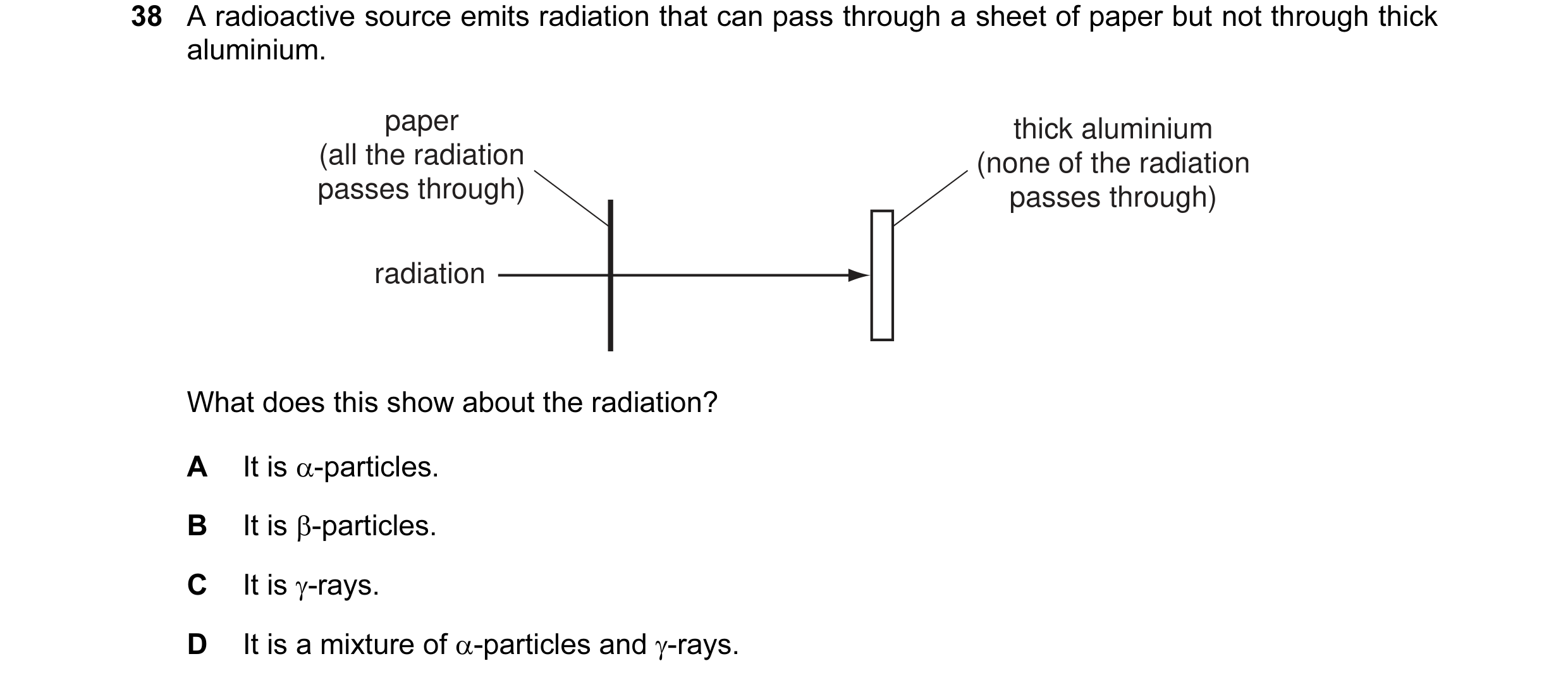
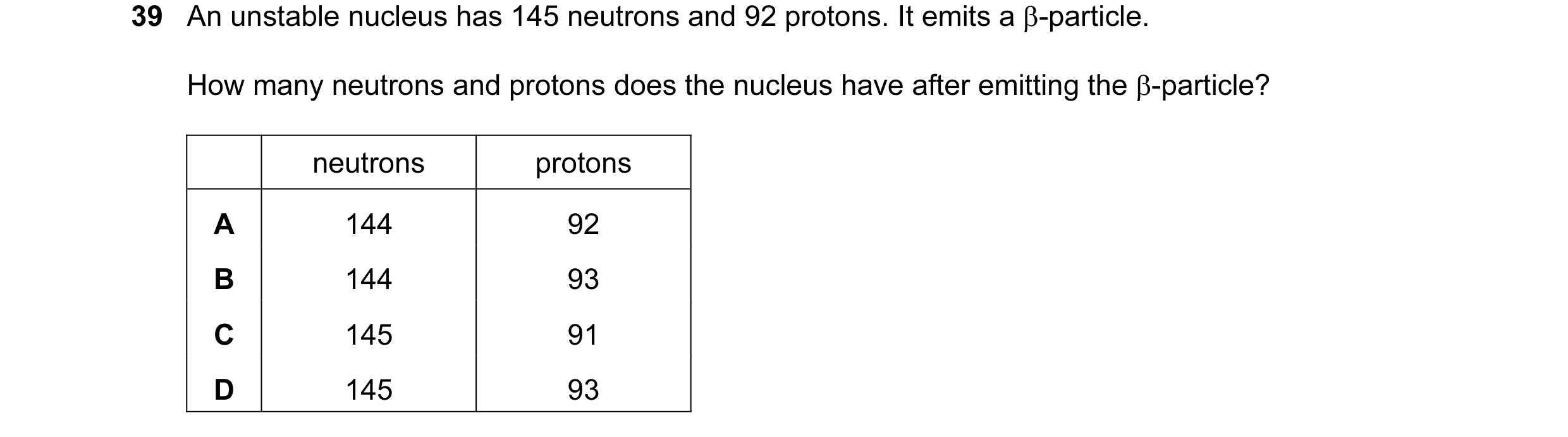 1 / 68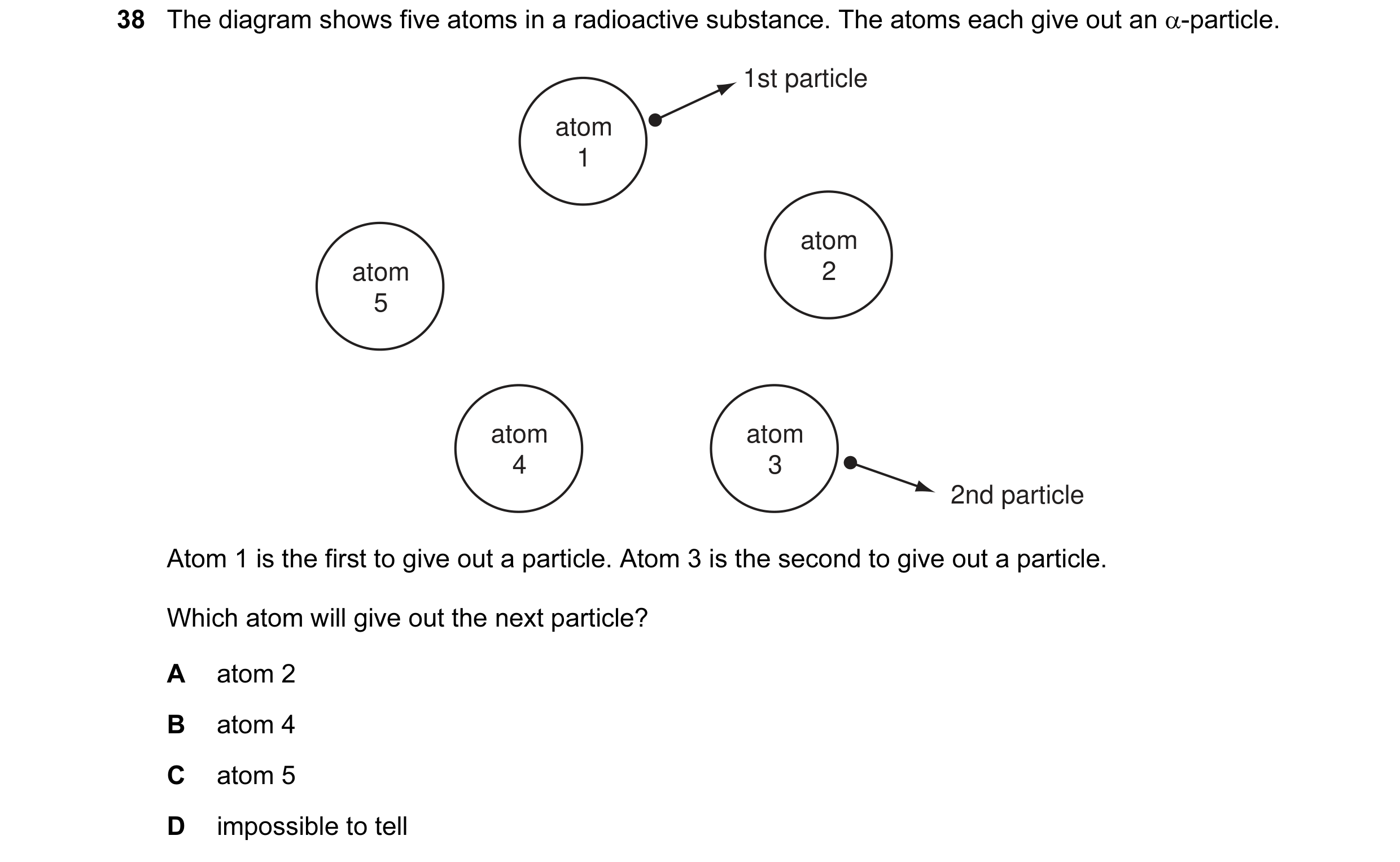
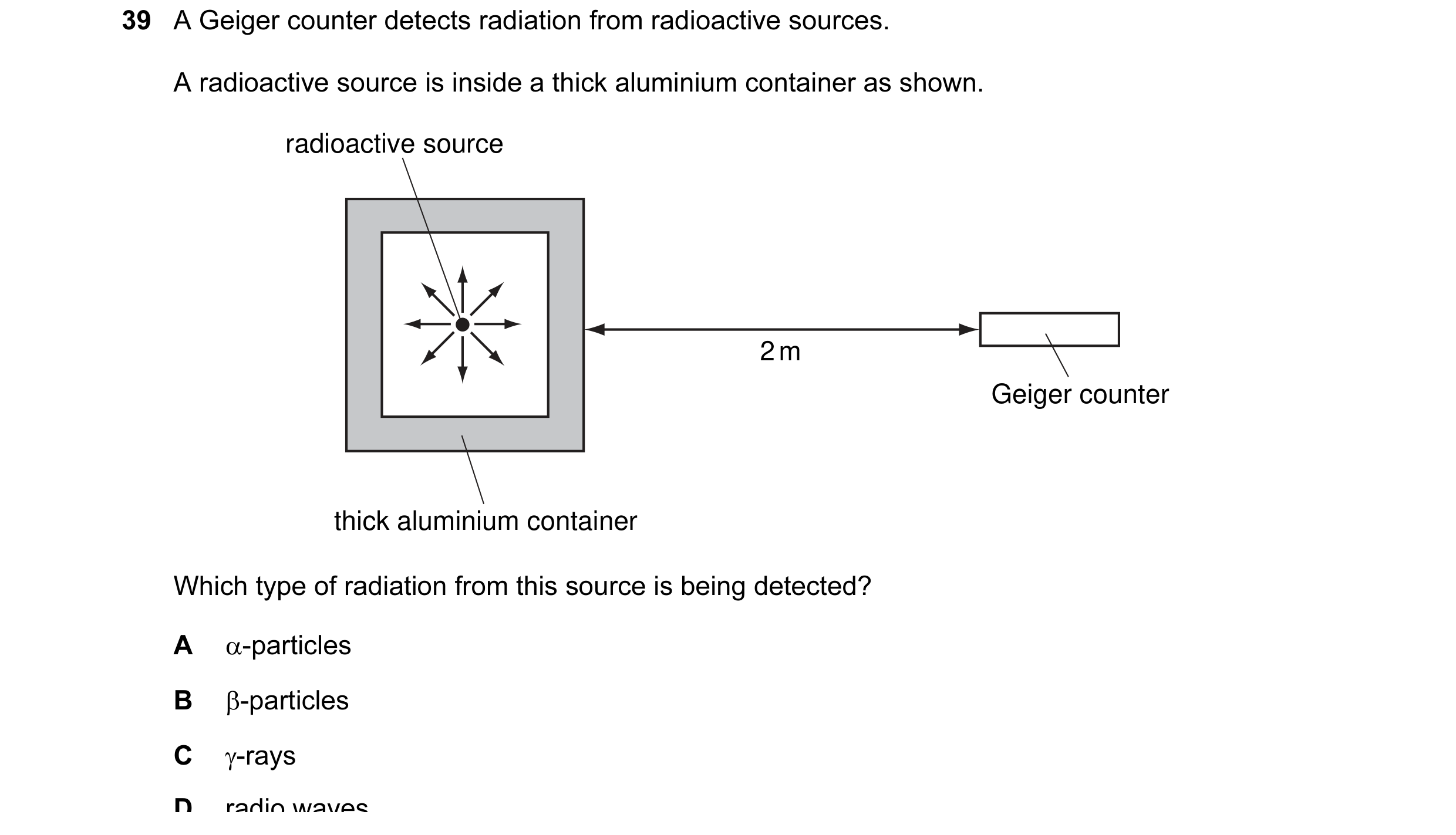 2 / 68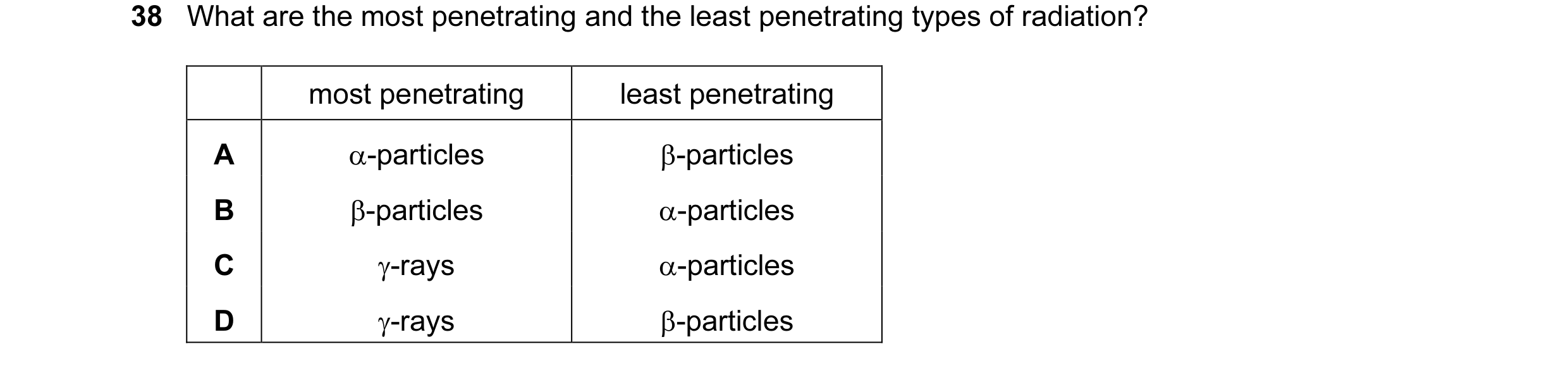

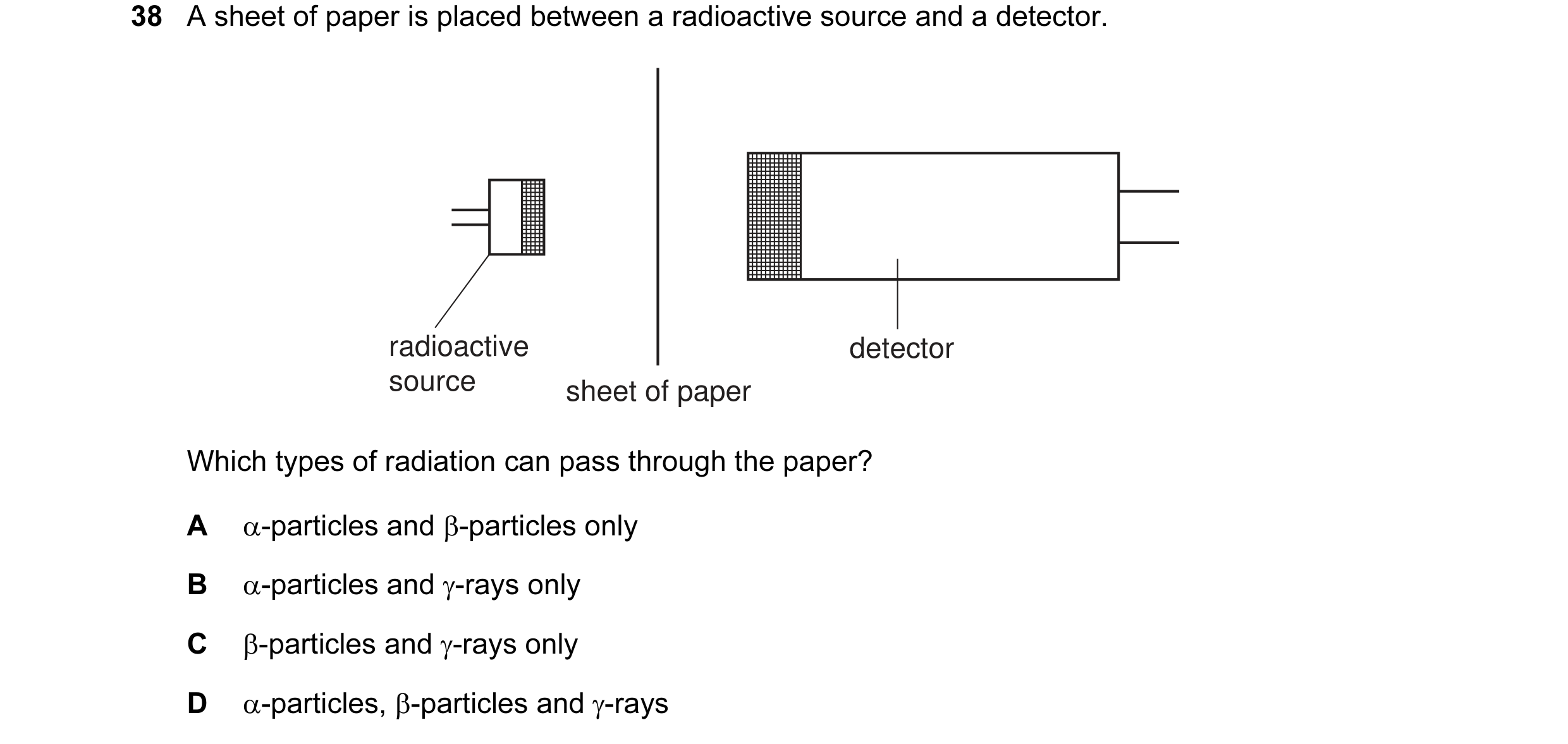
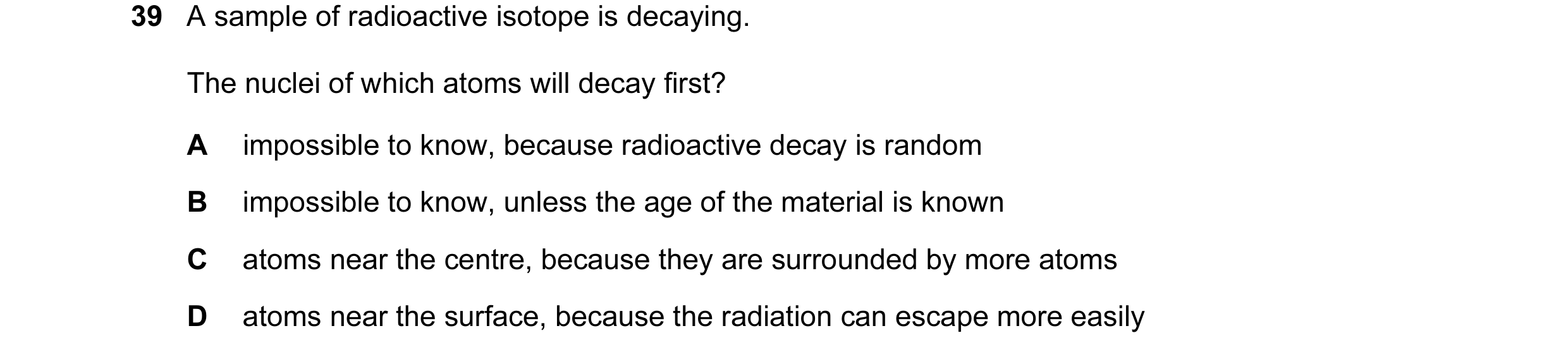
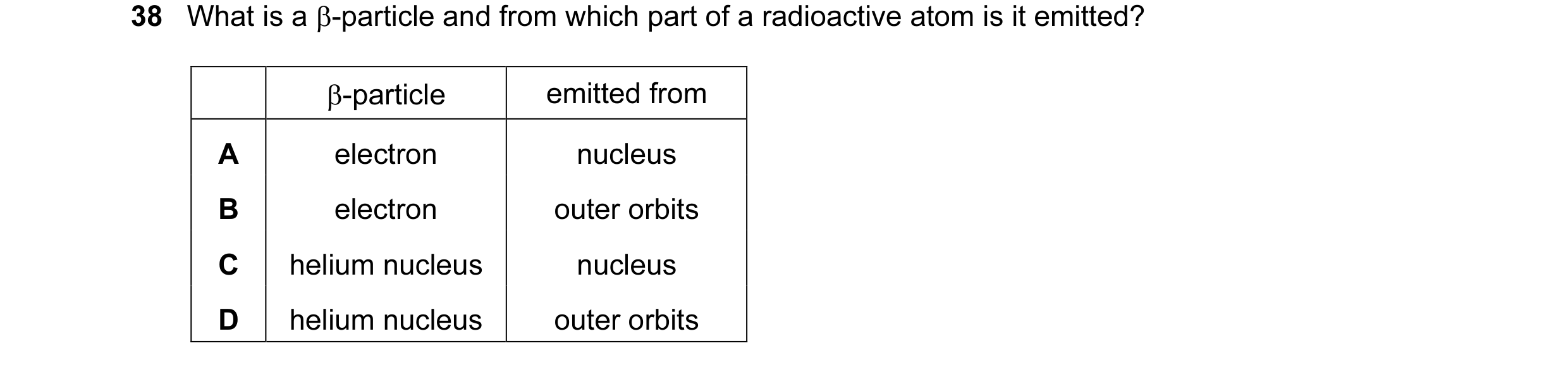 3 / 68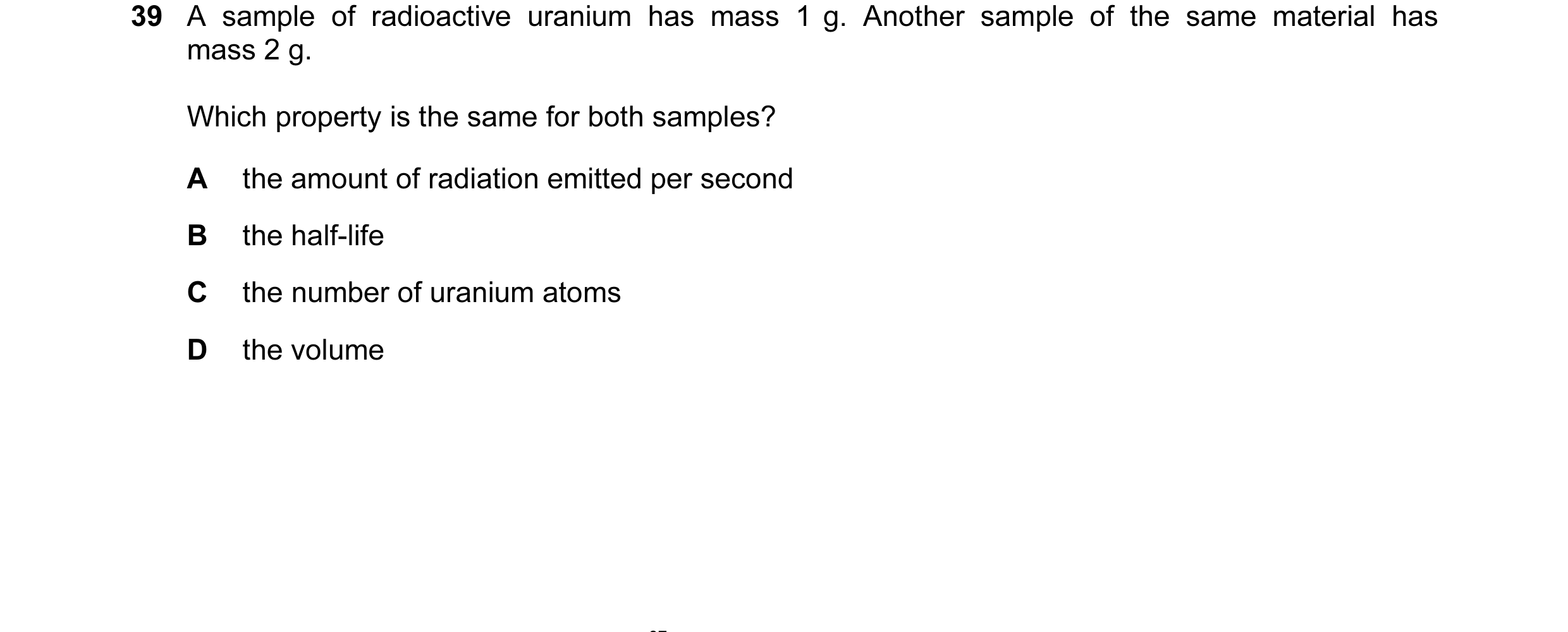
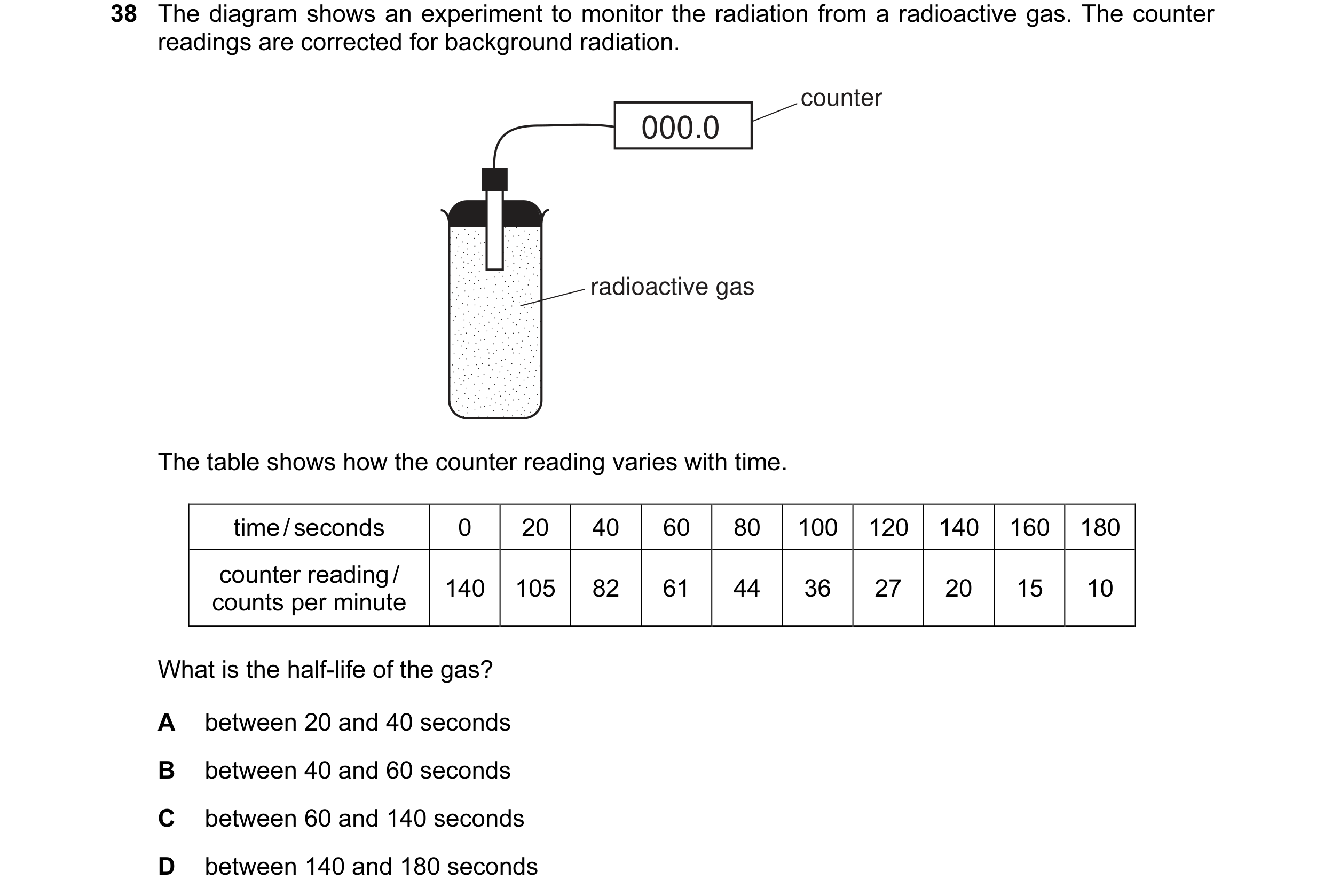
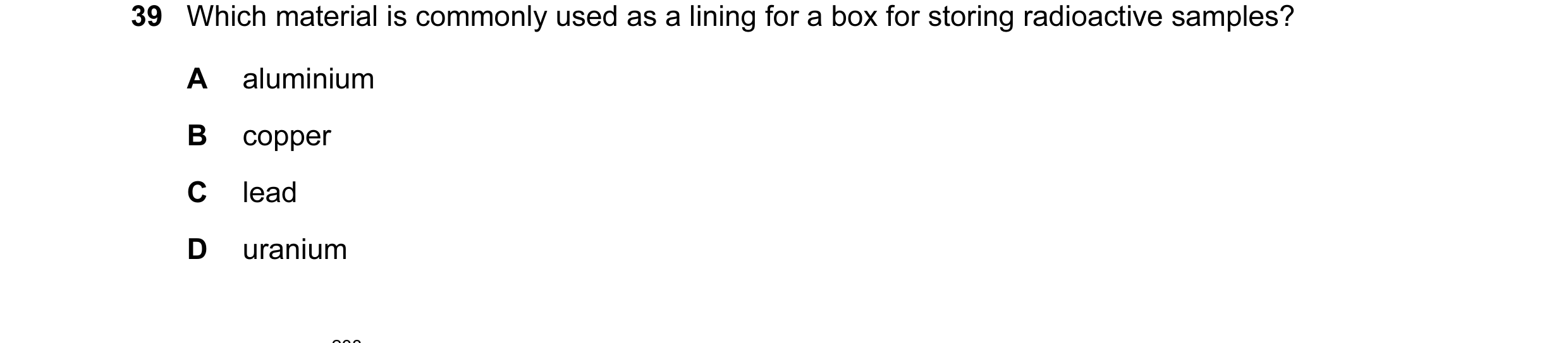 4 / 68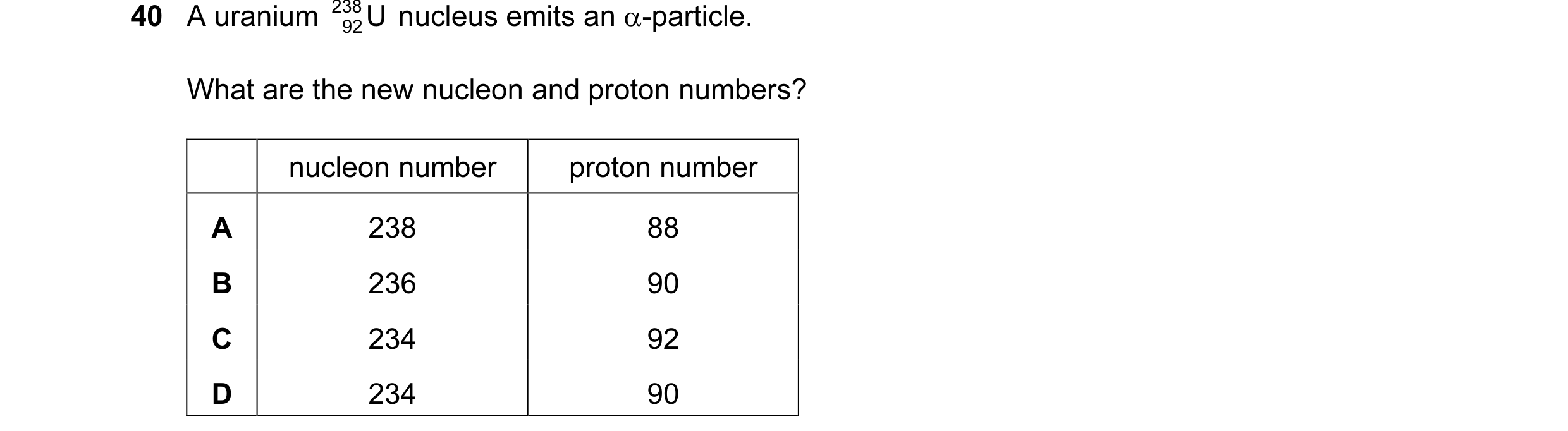

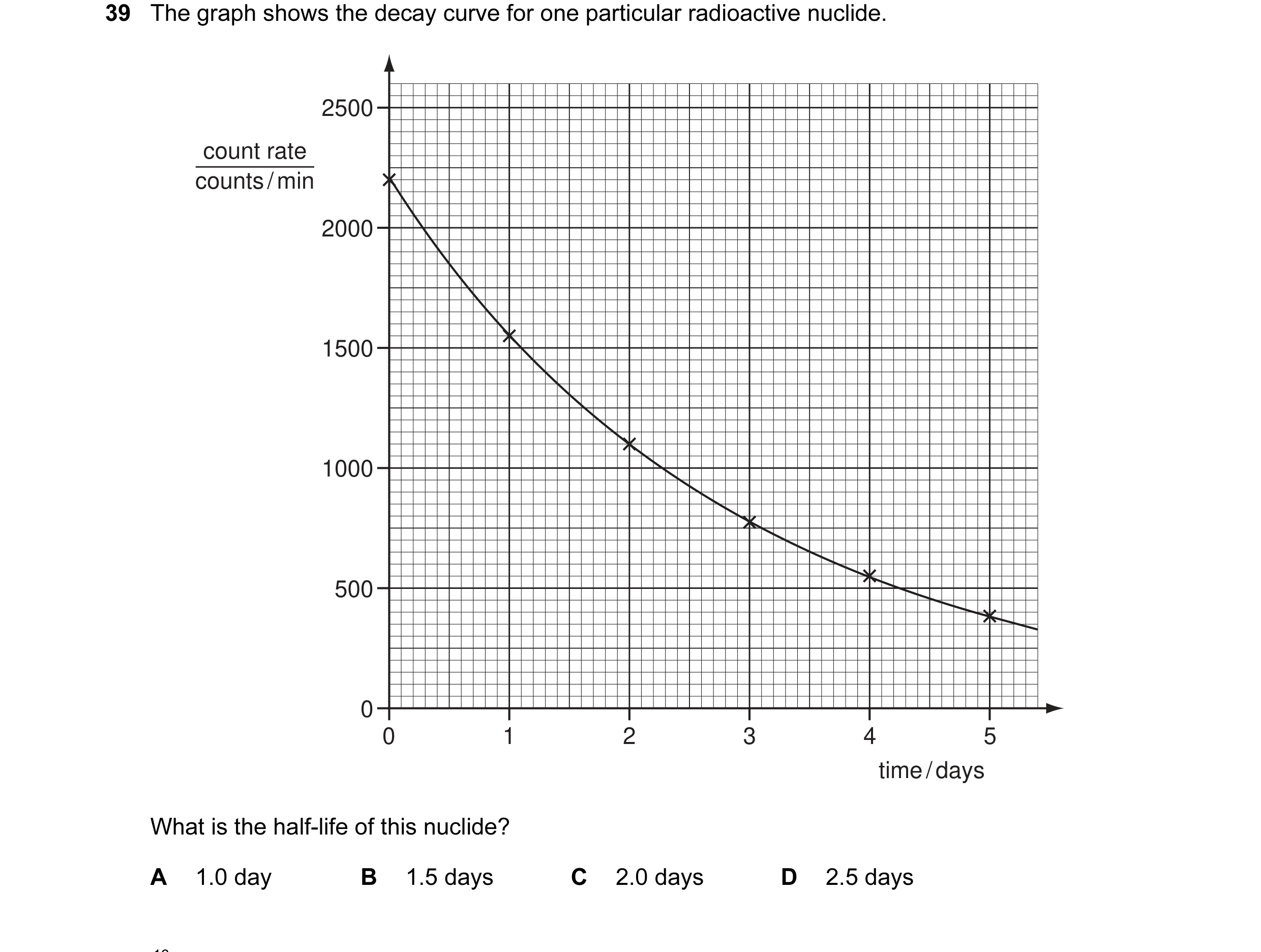
 5 / 68
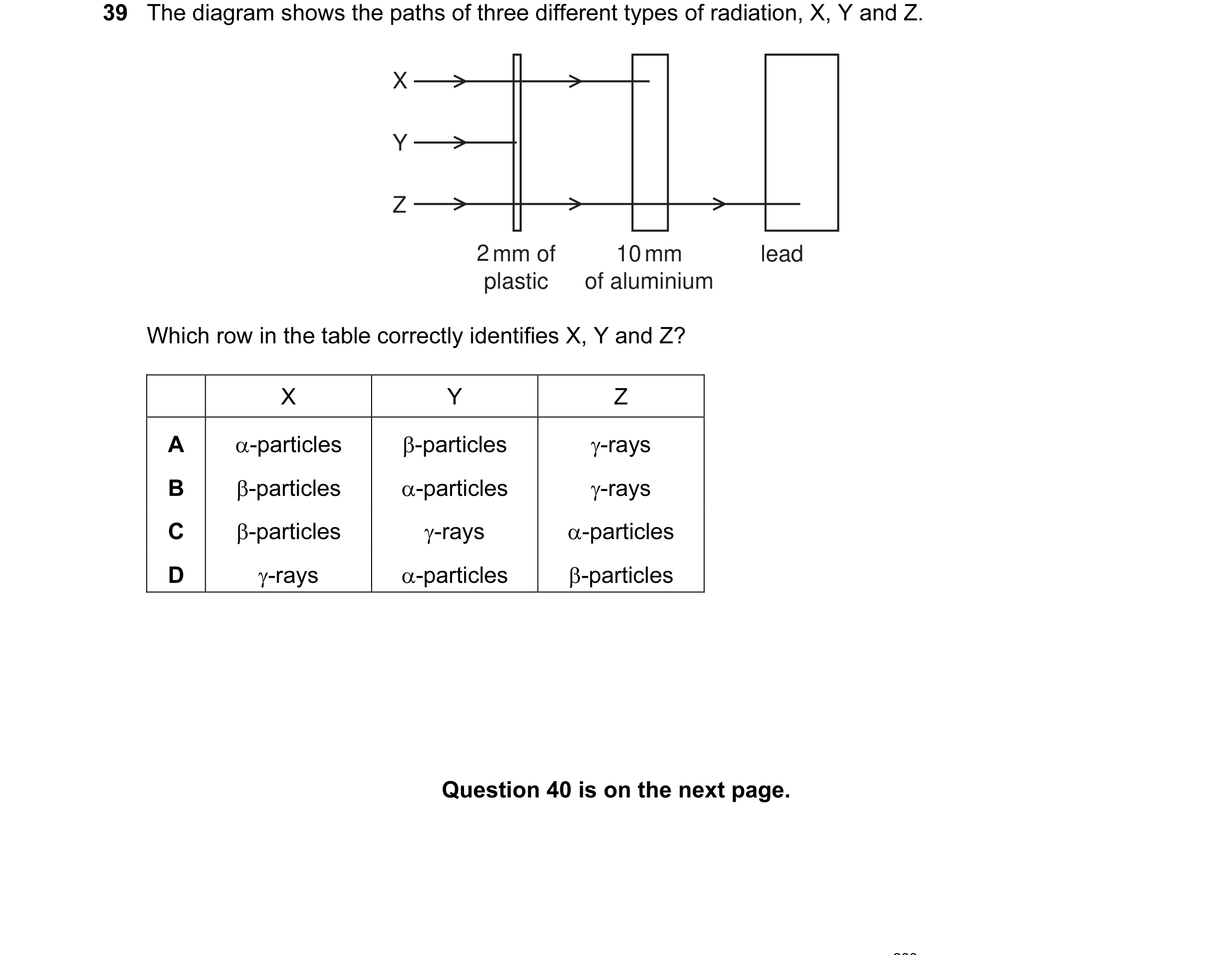
 6 / 68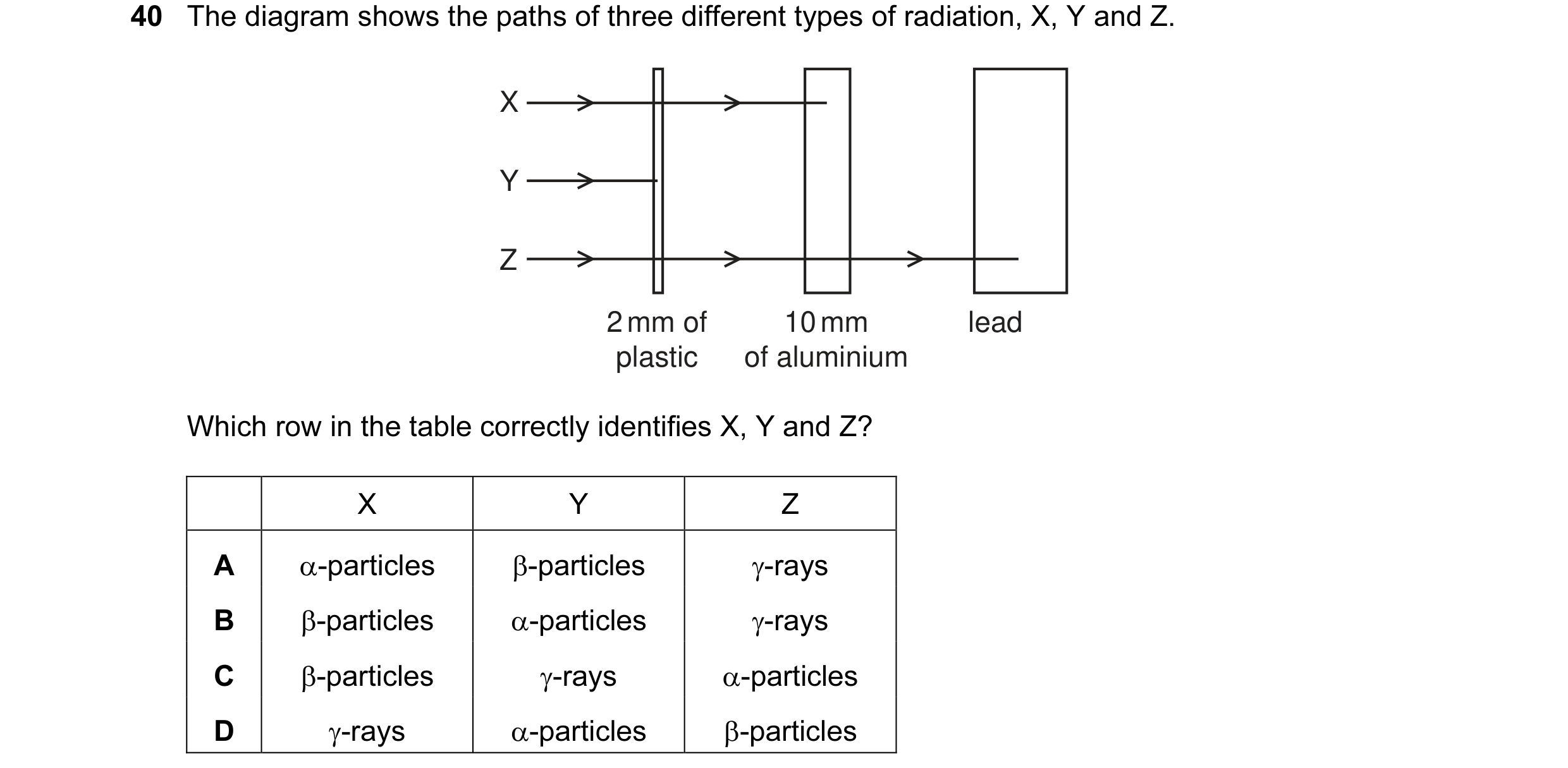
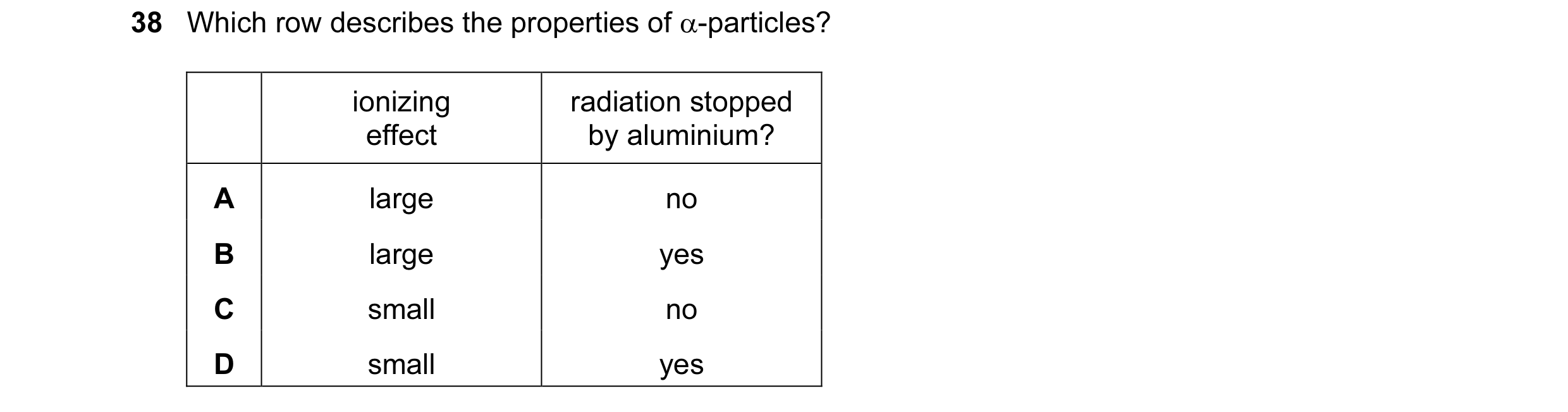


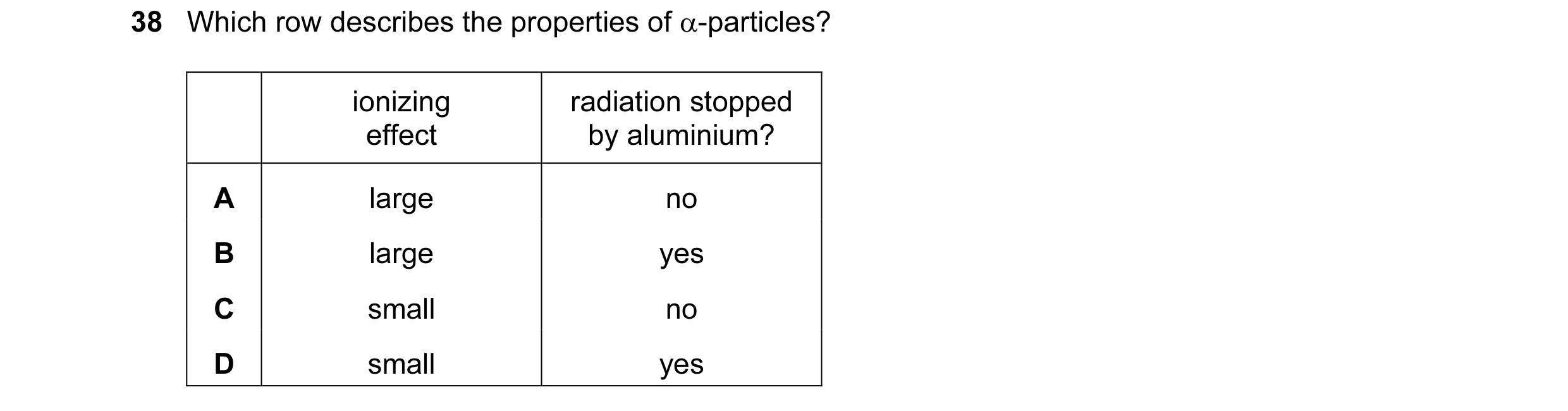 7 / 68
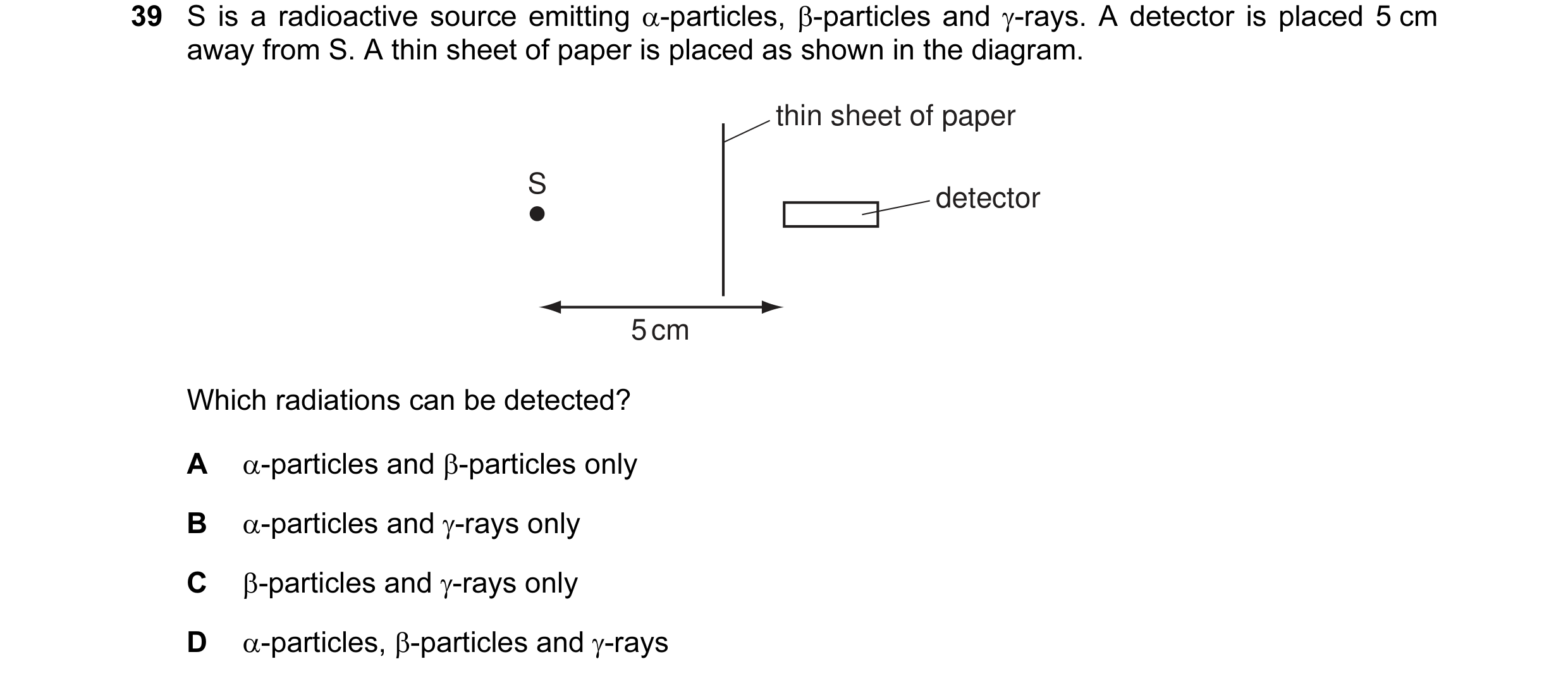
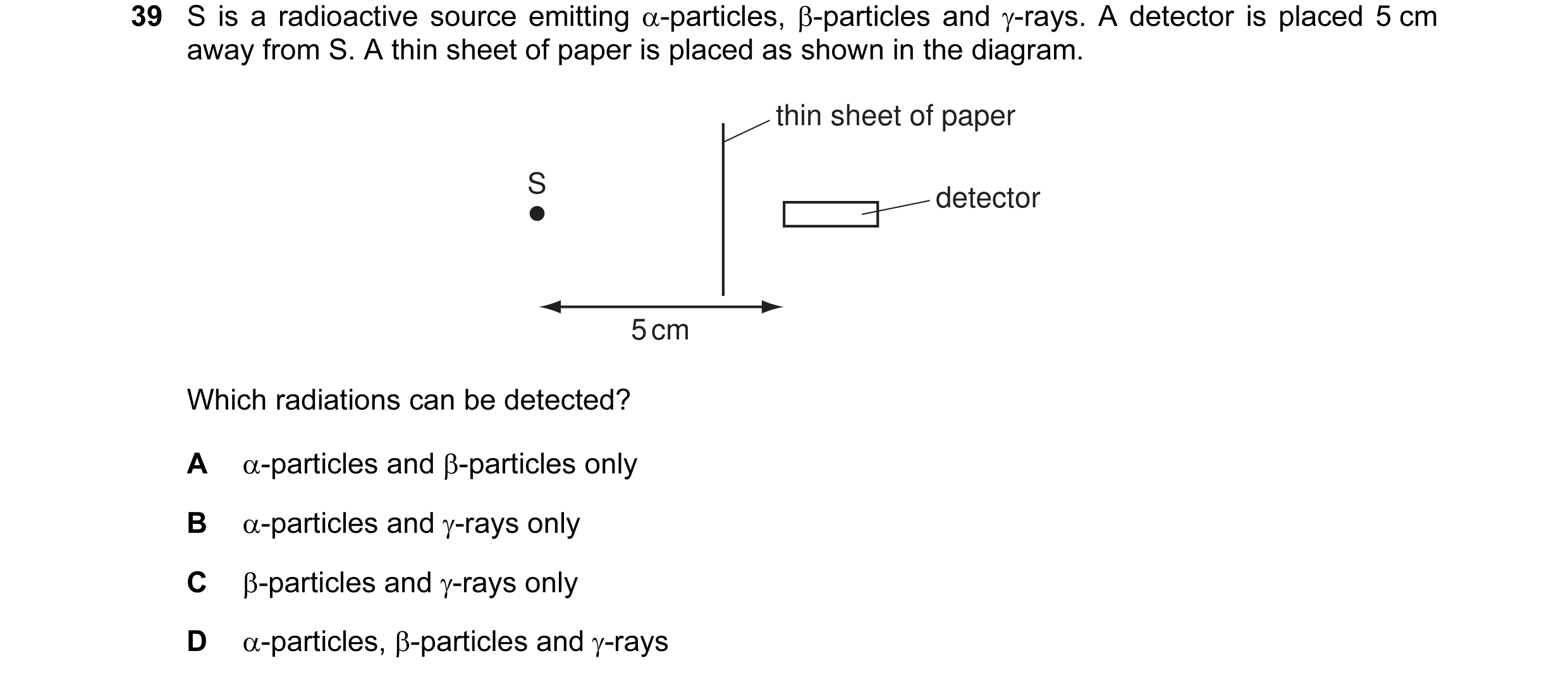
 8 / 68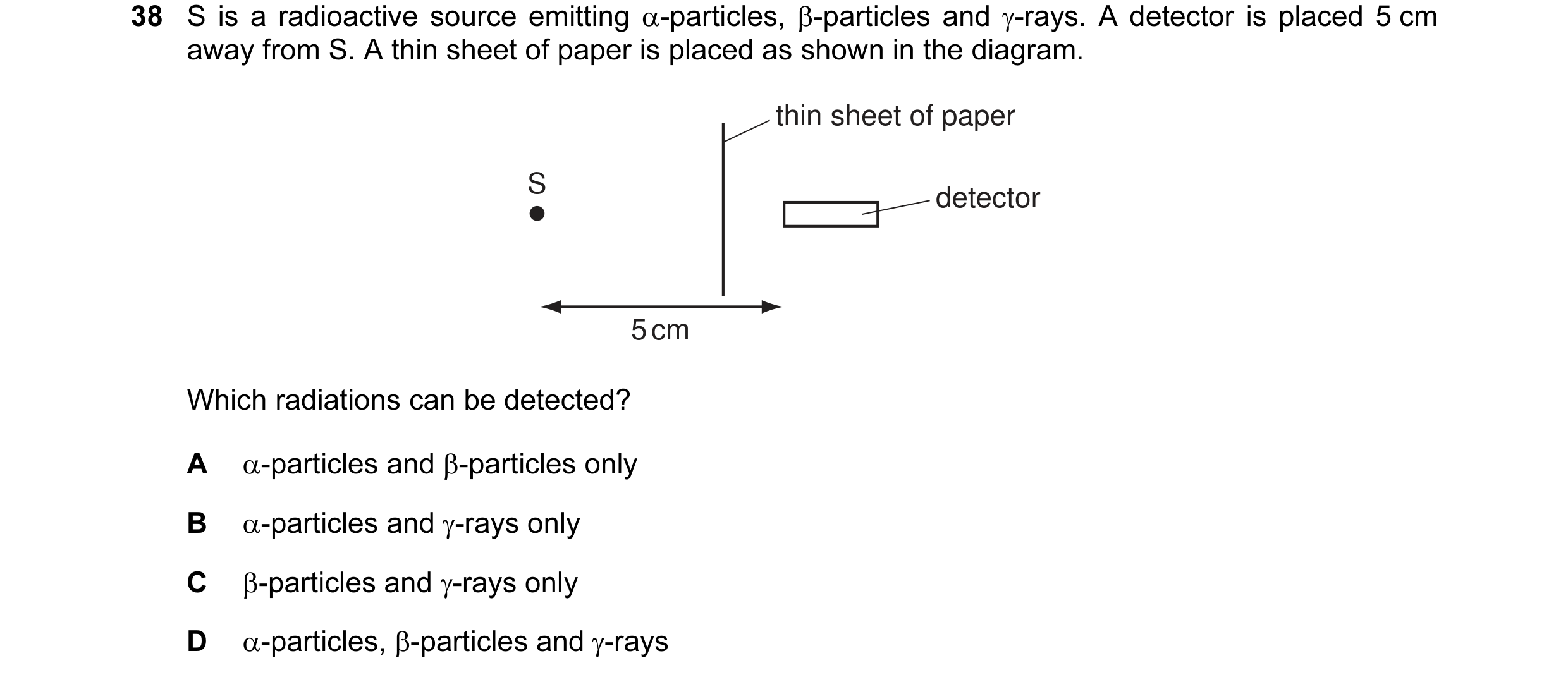

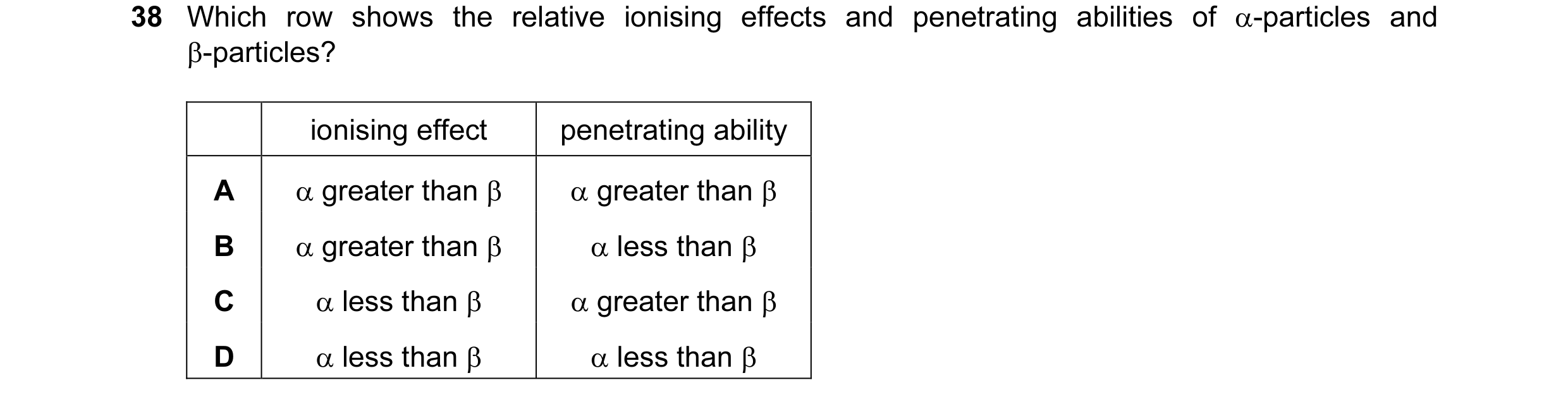

 9 / 68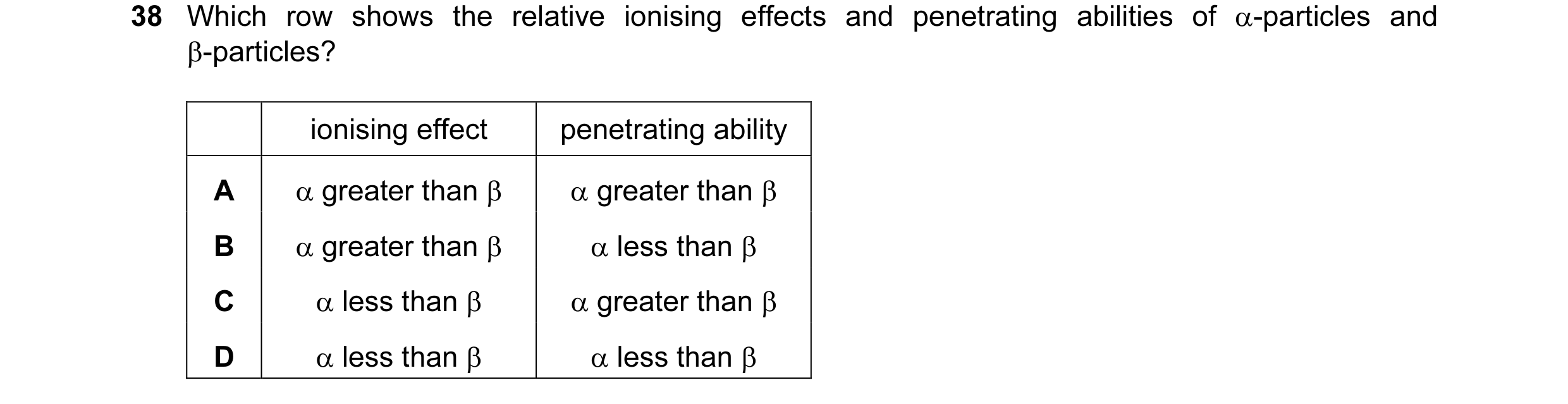

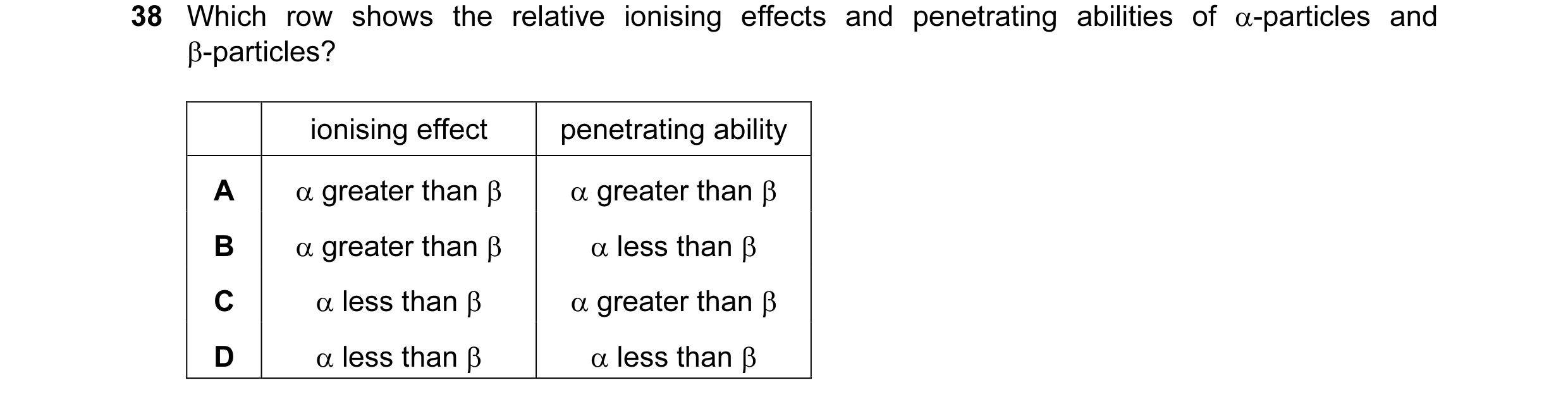
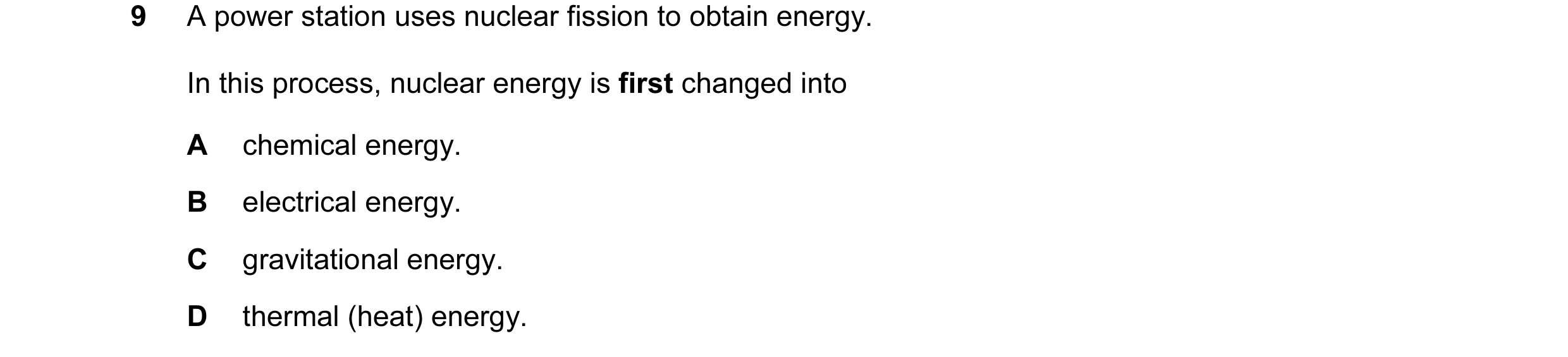
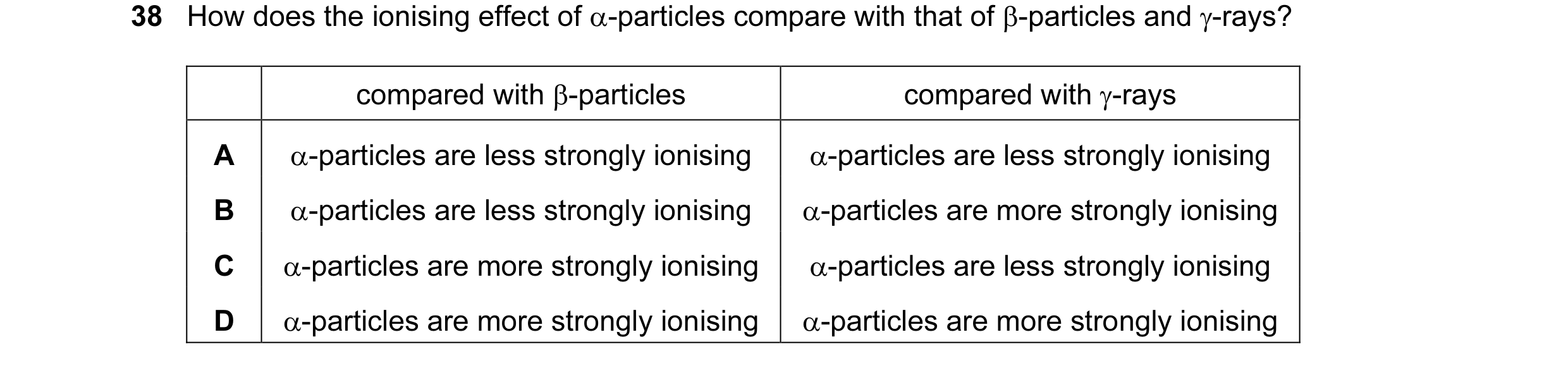 10 / 68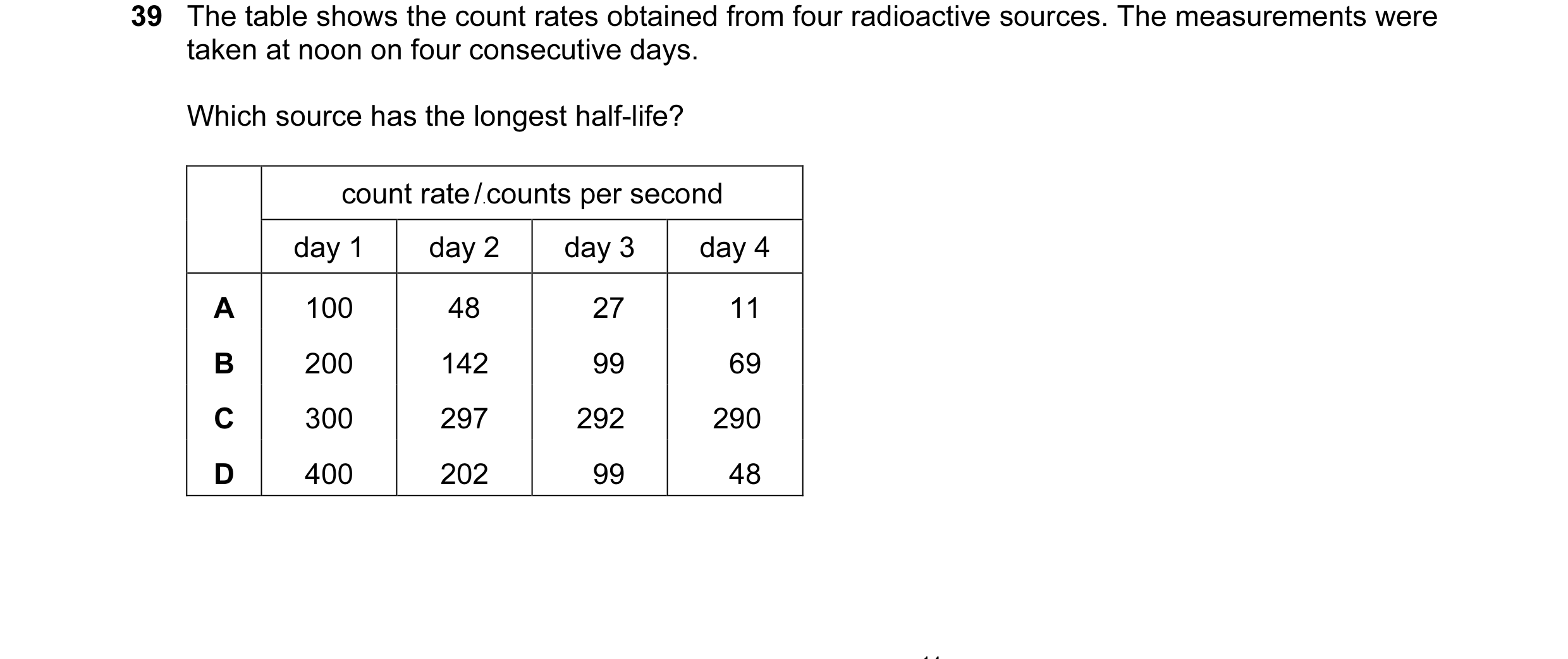
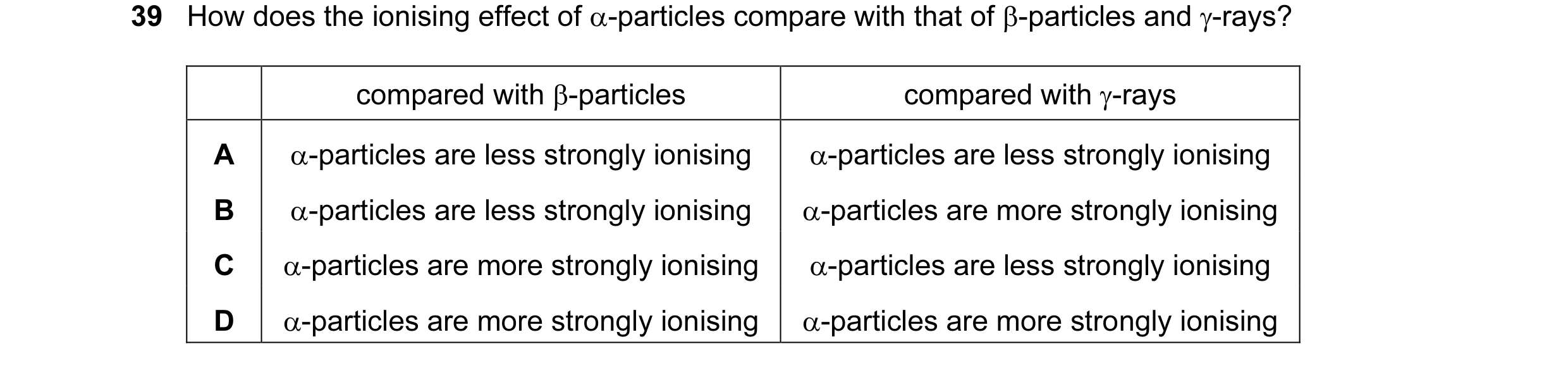
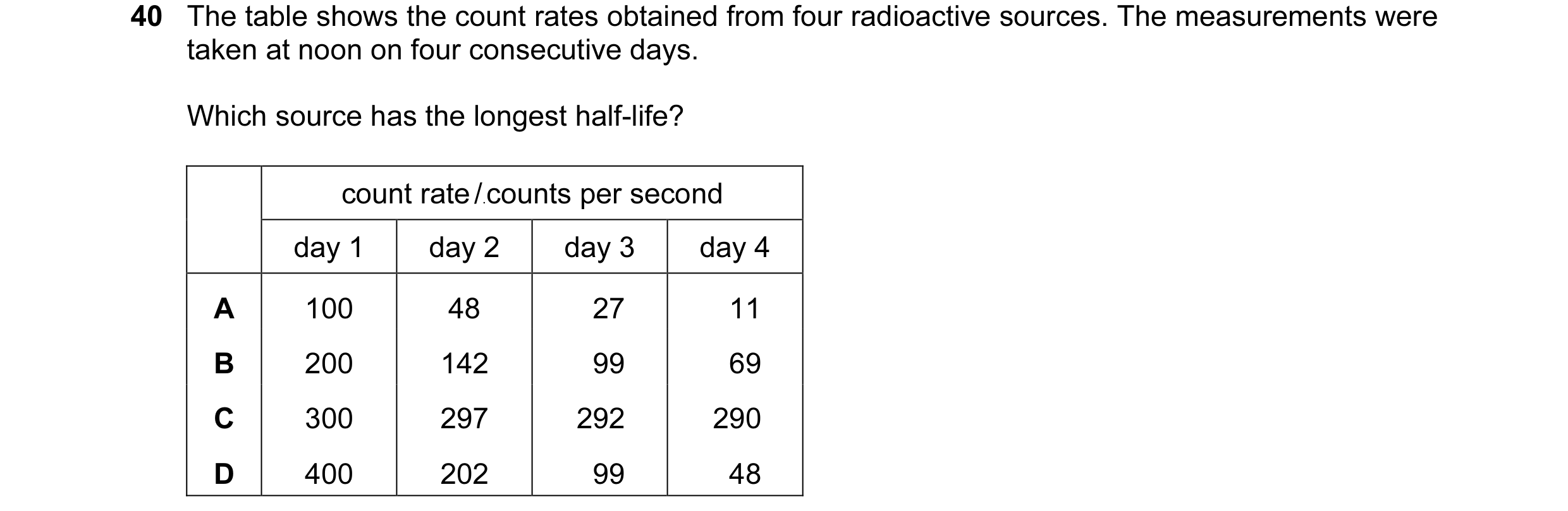
 11 / 68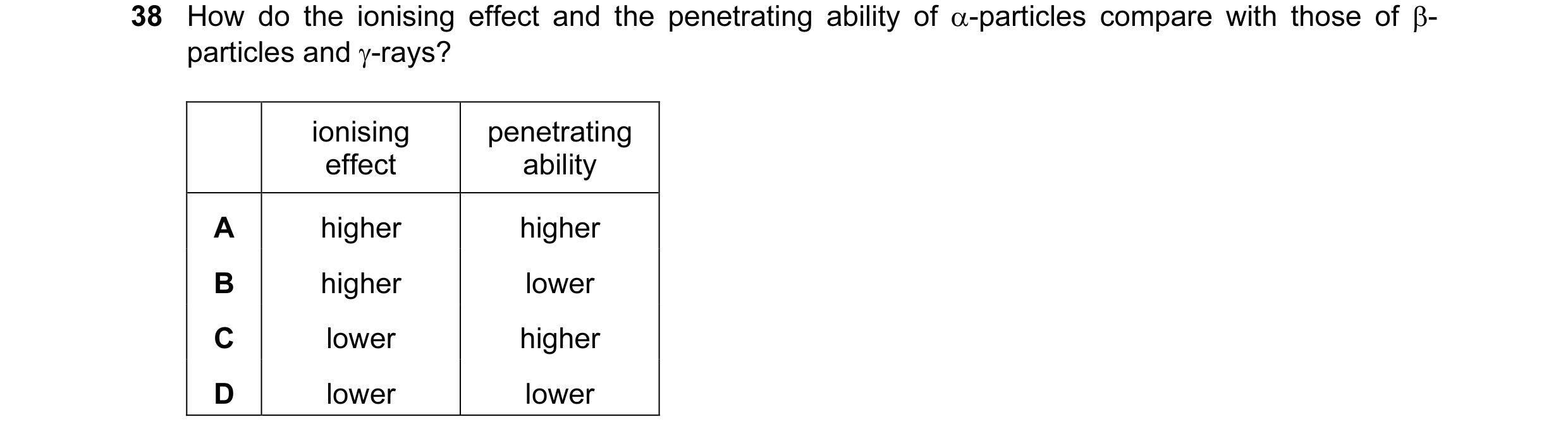
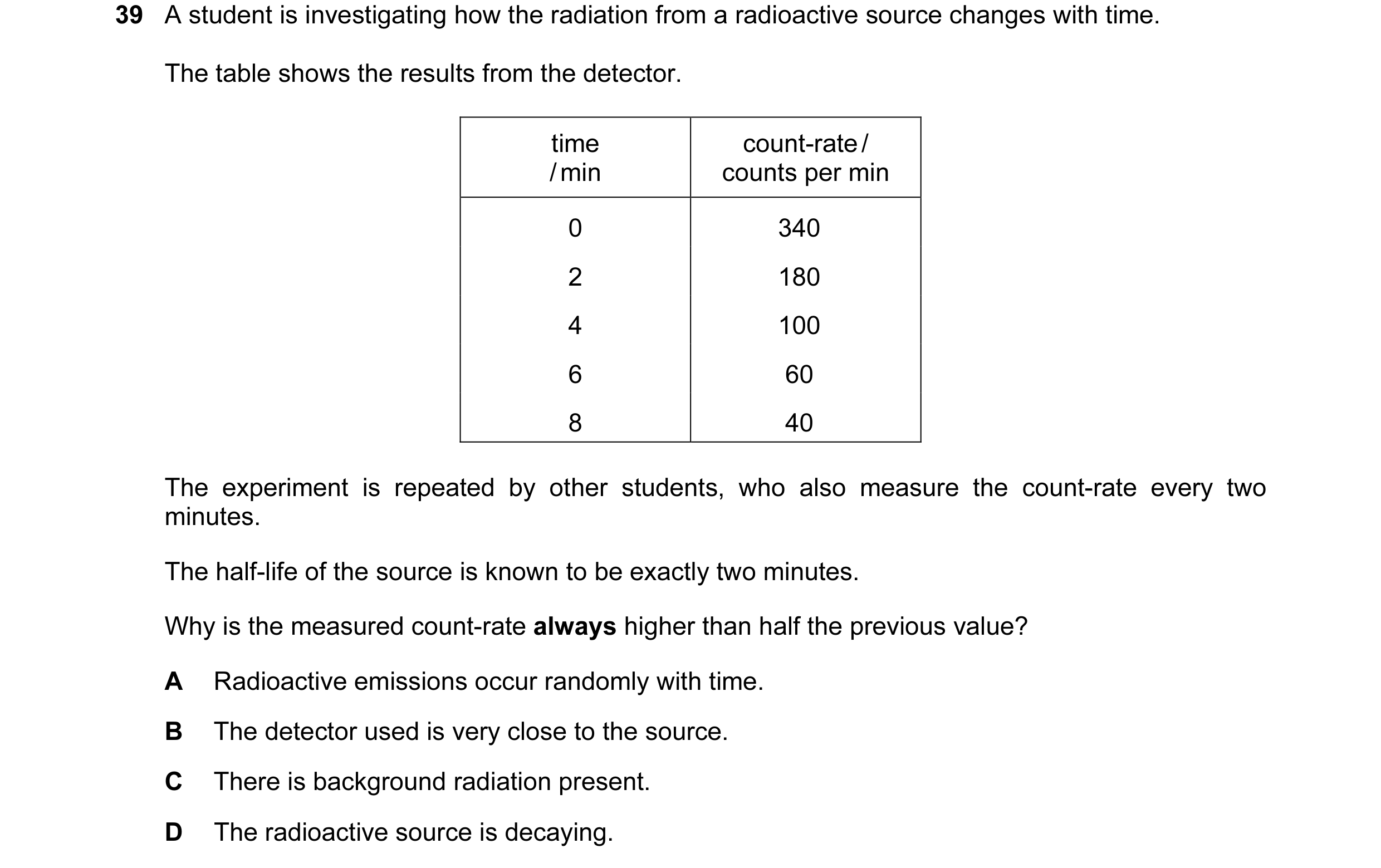
 12 / 68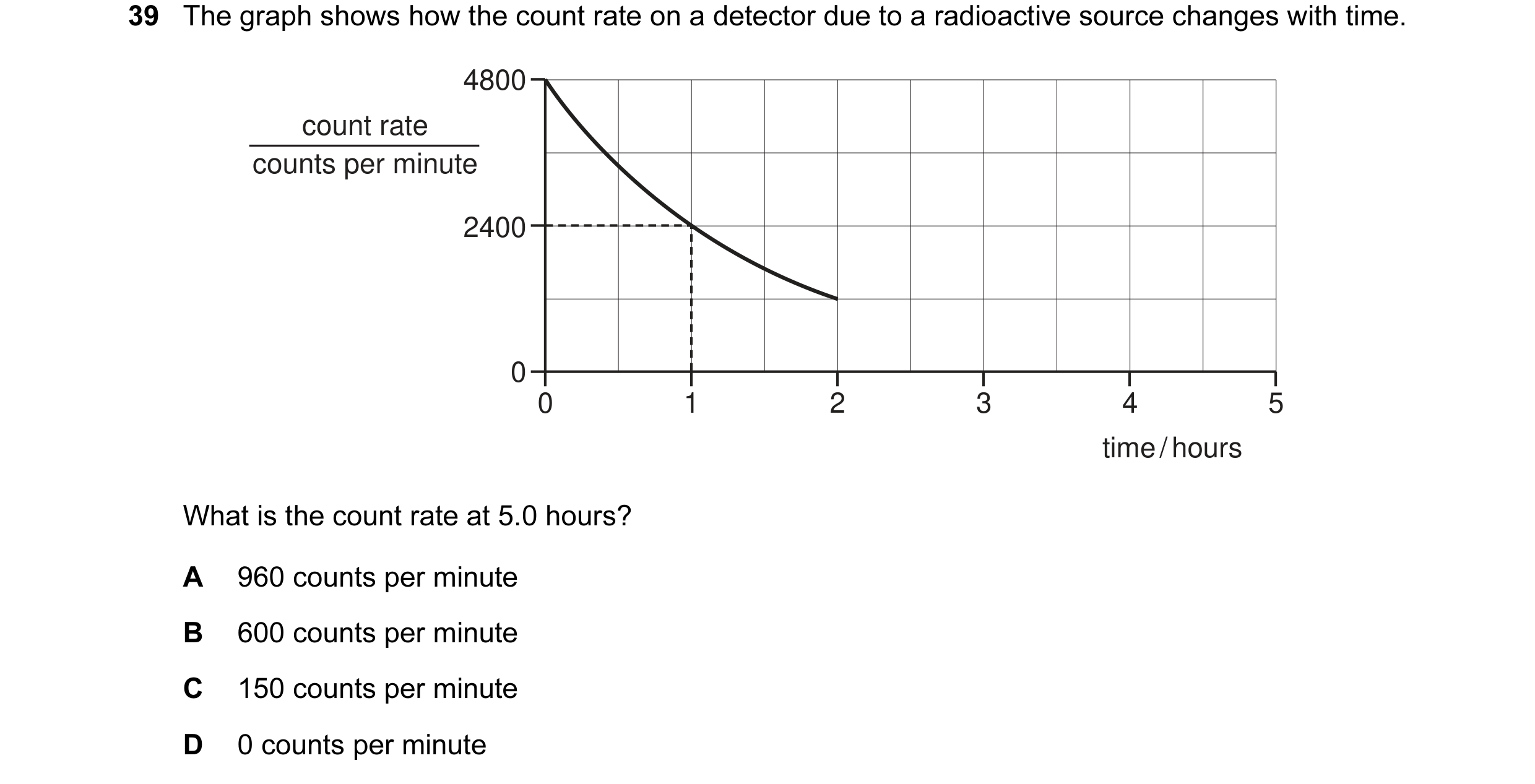
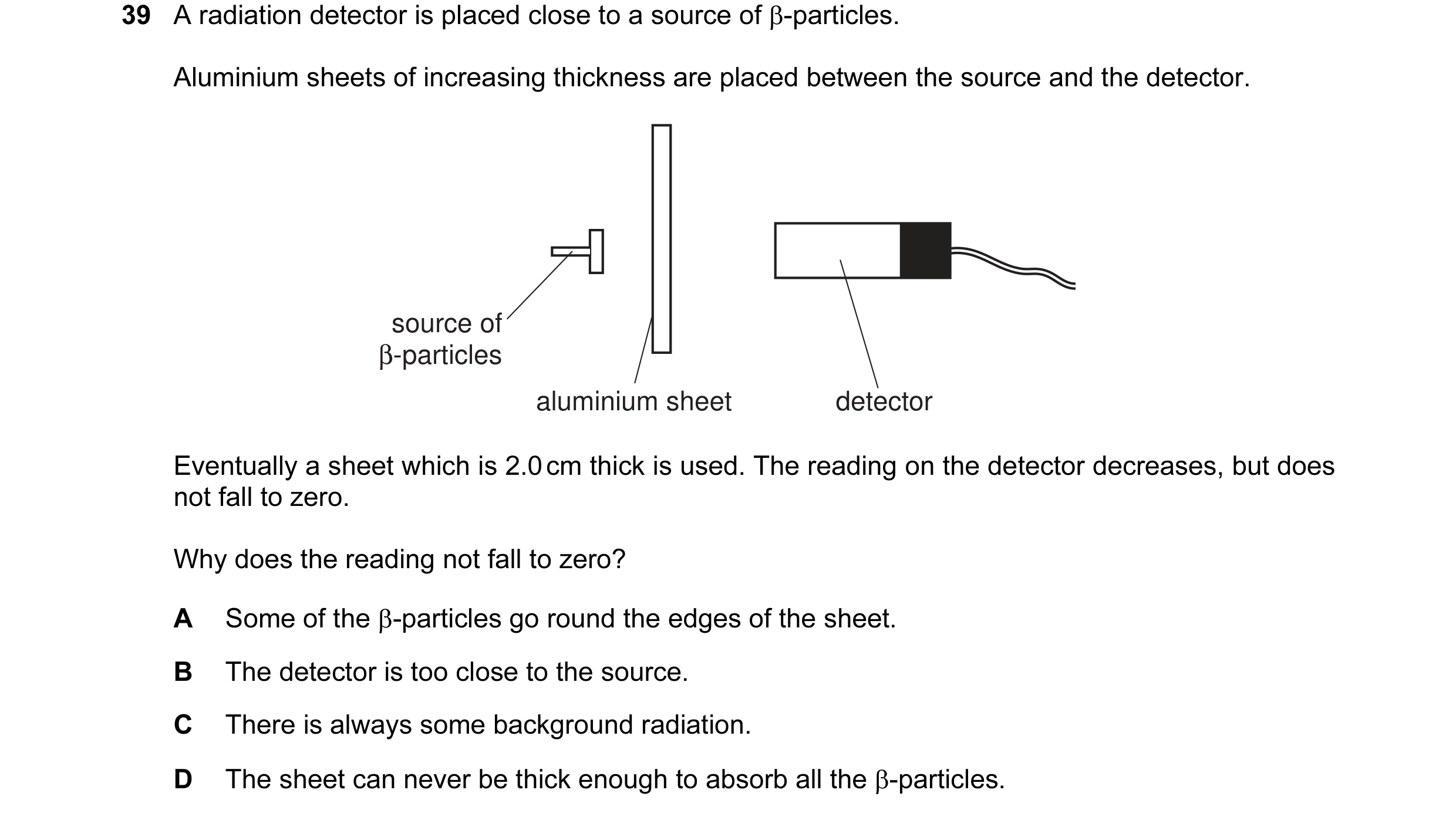 13 / 68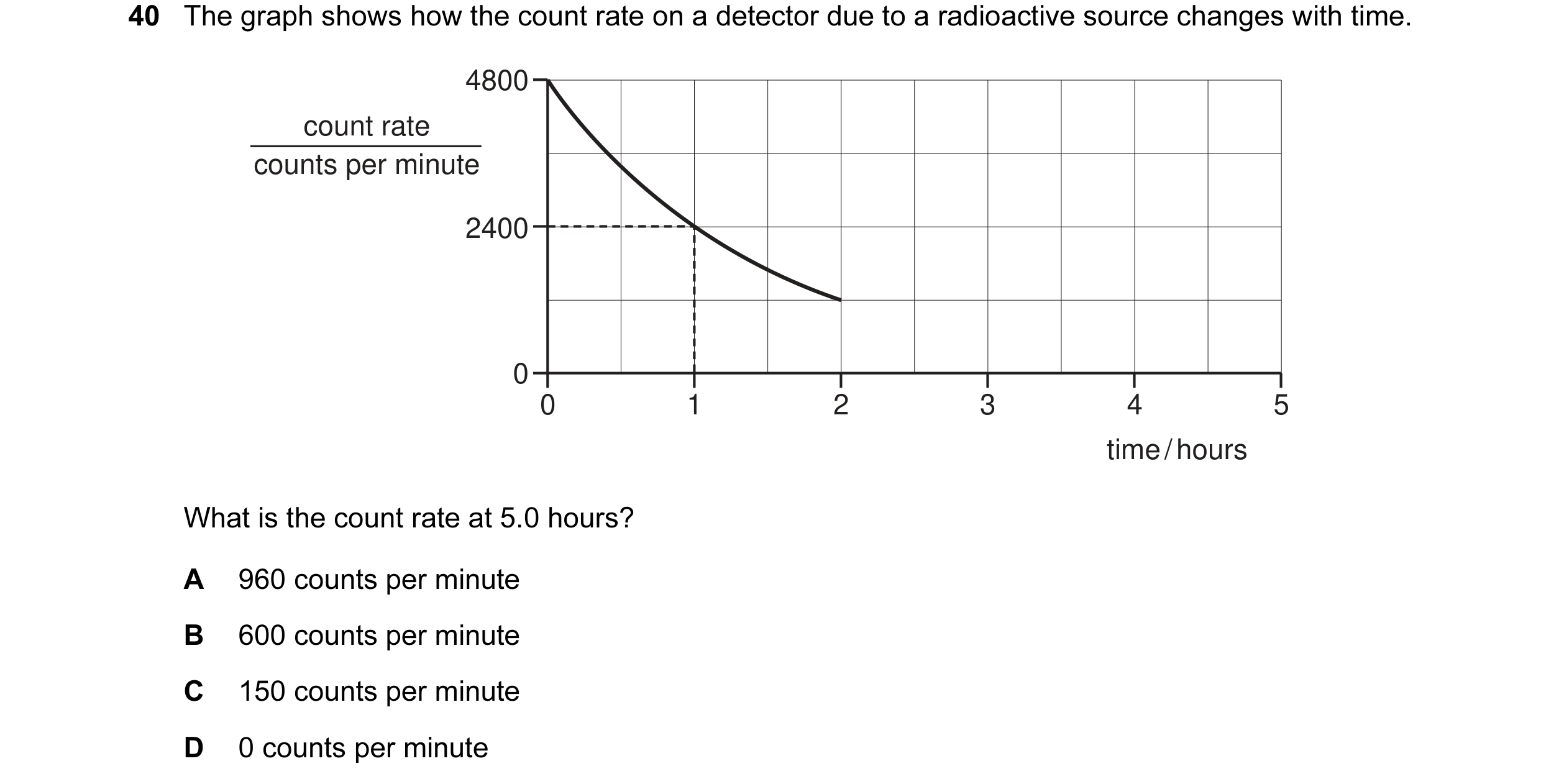
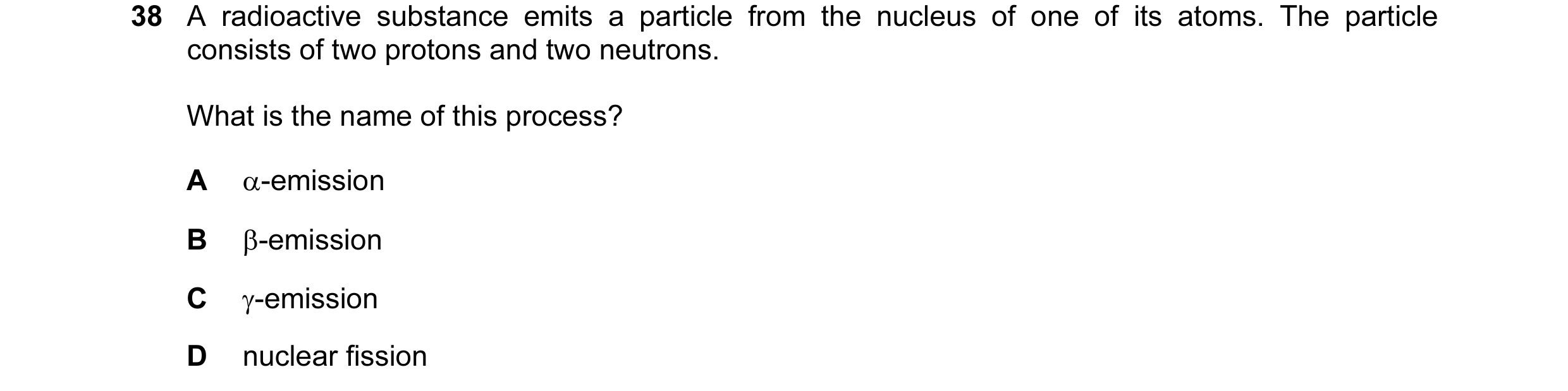 14 / 68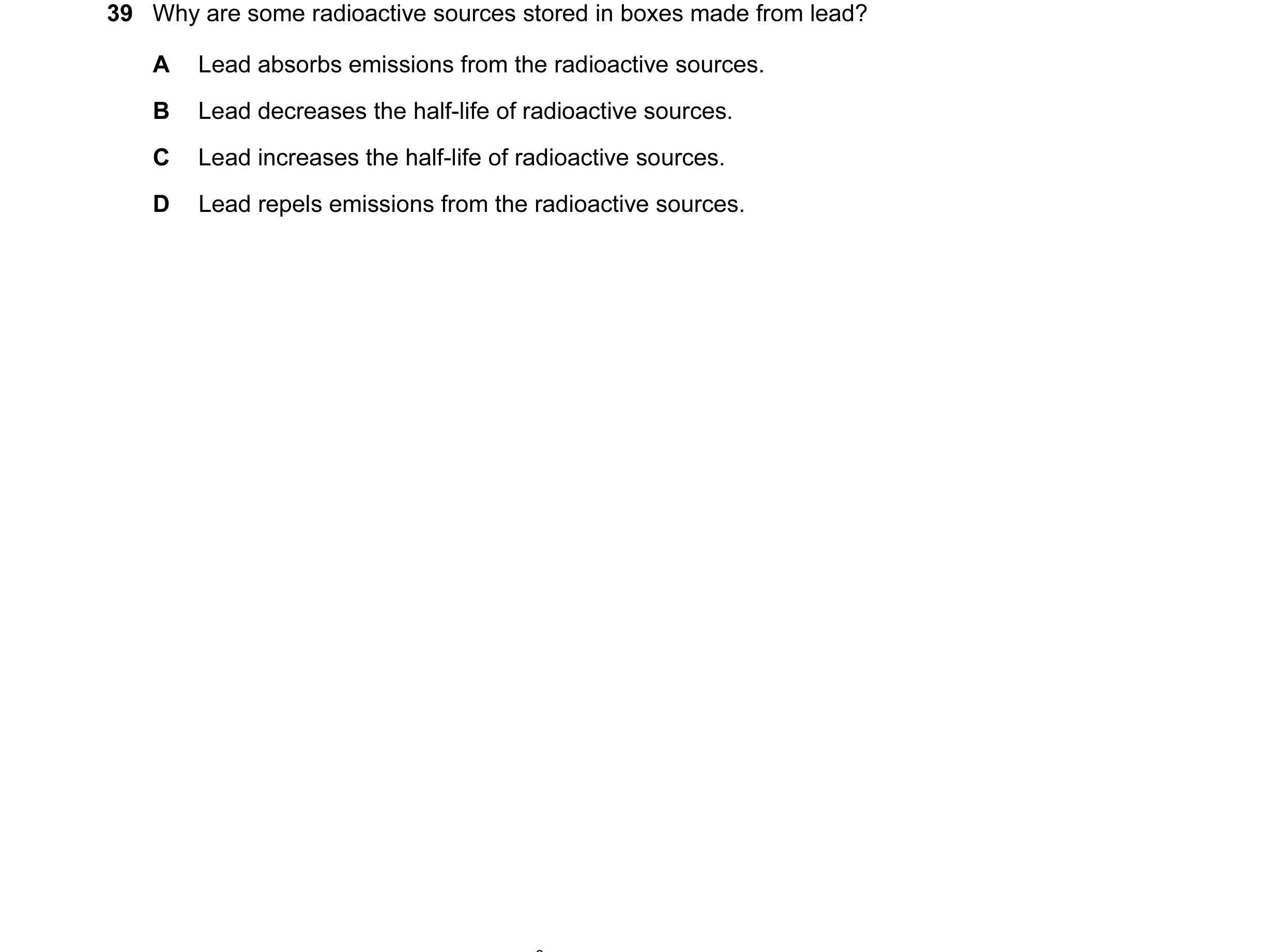
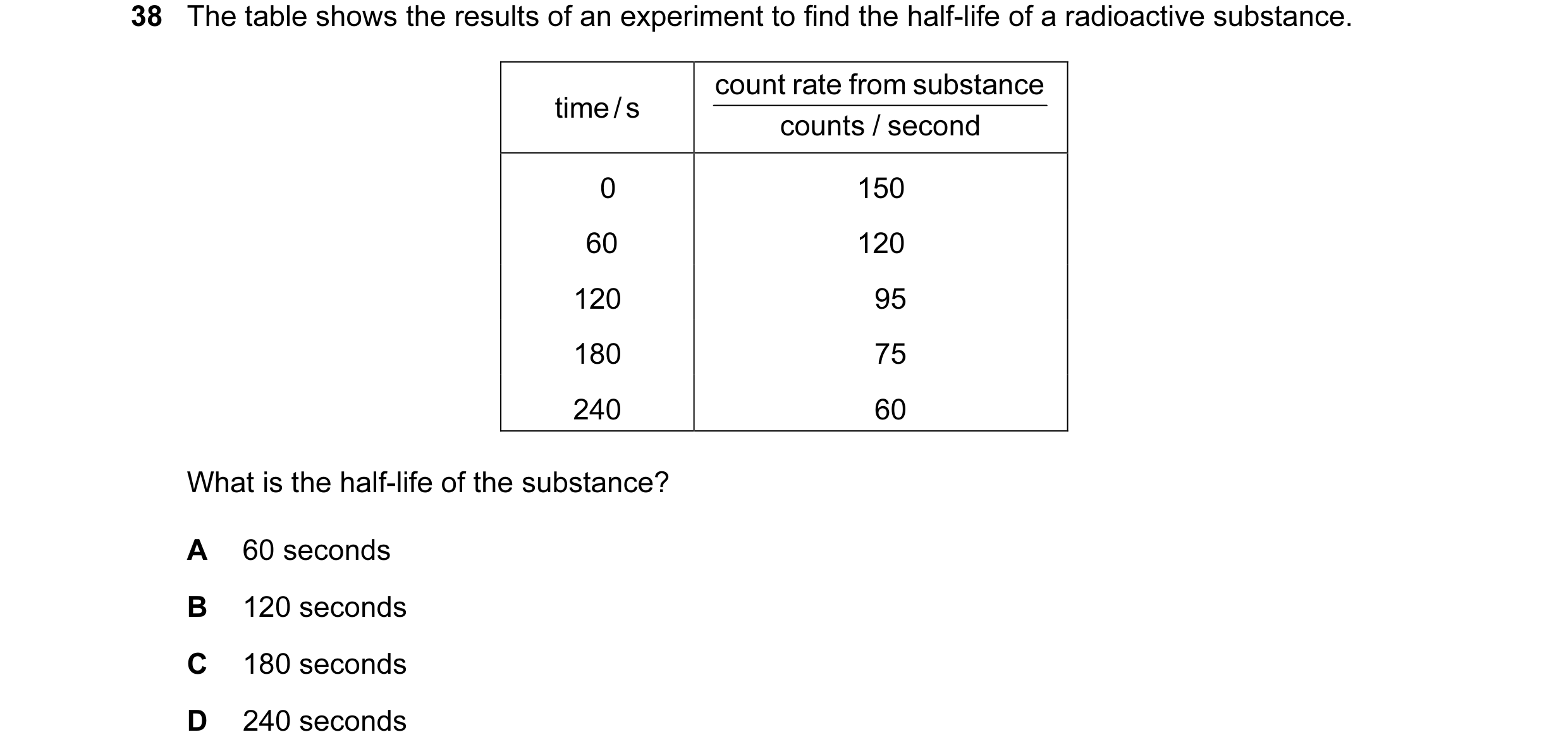 15 / 68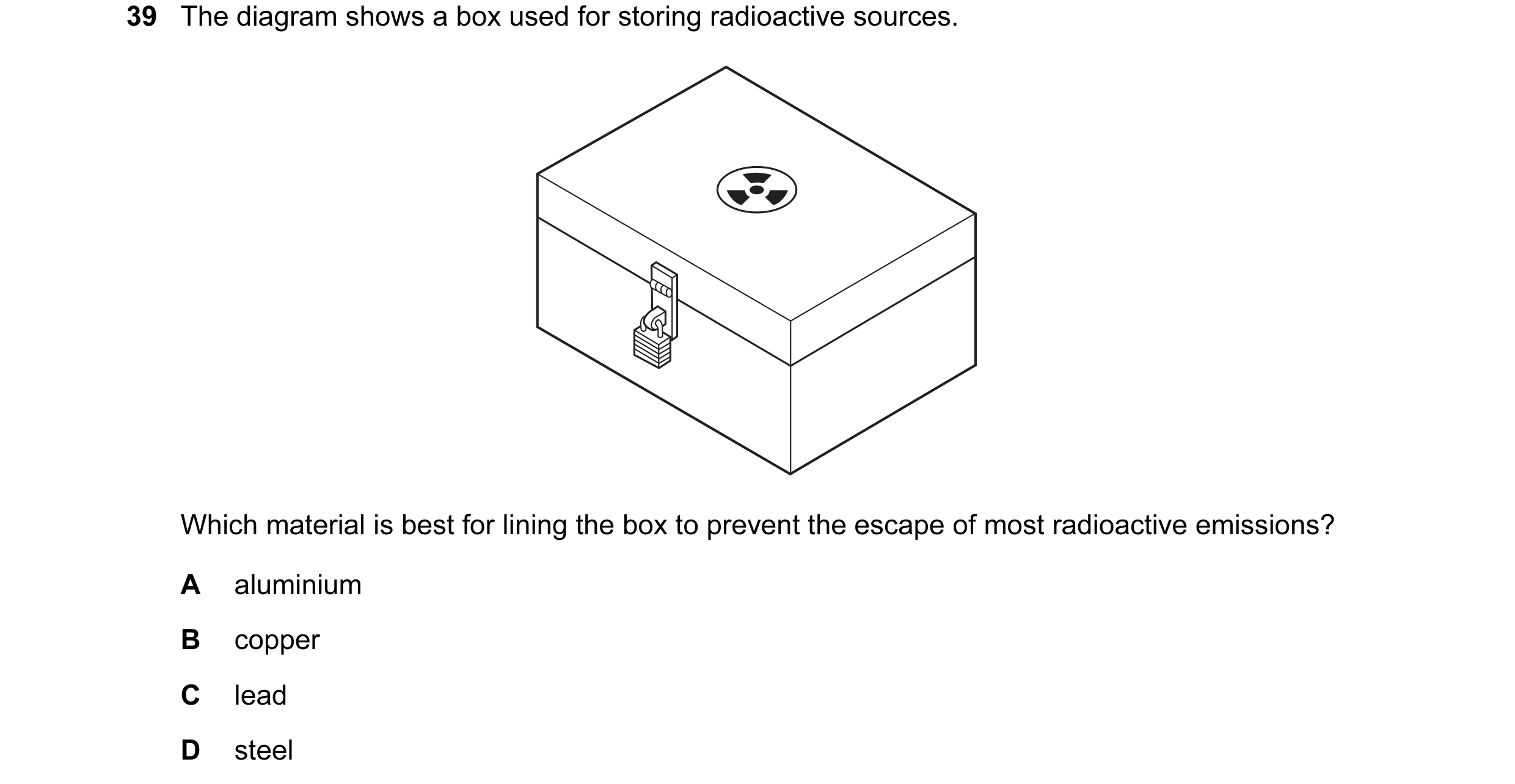

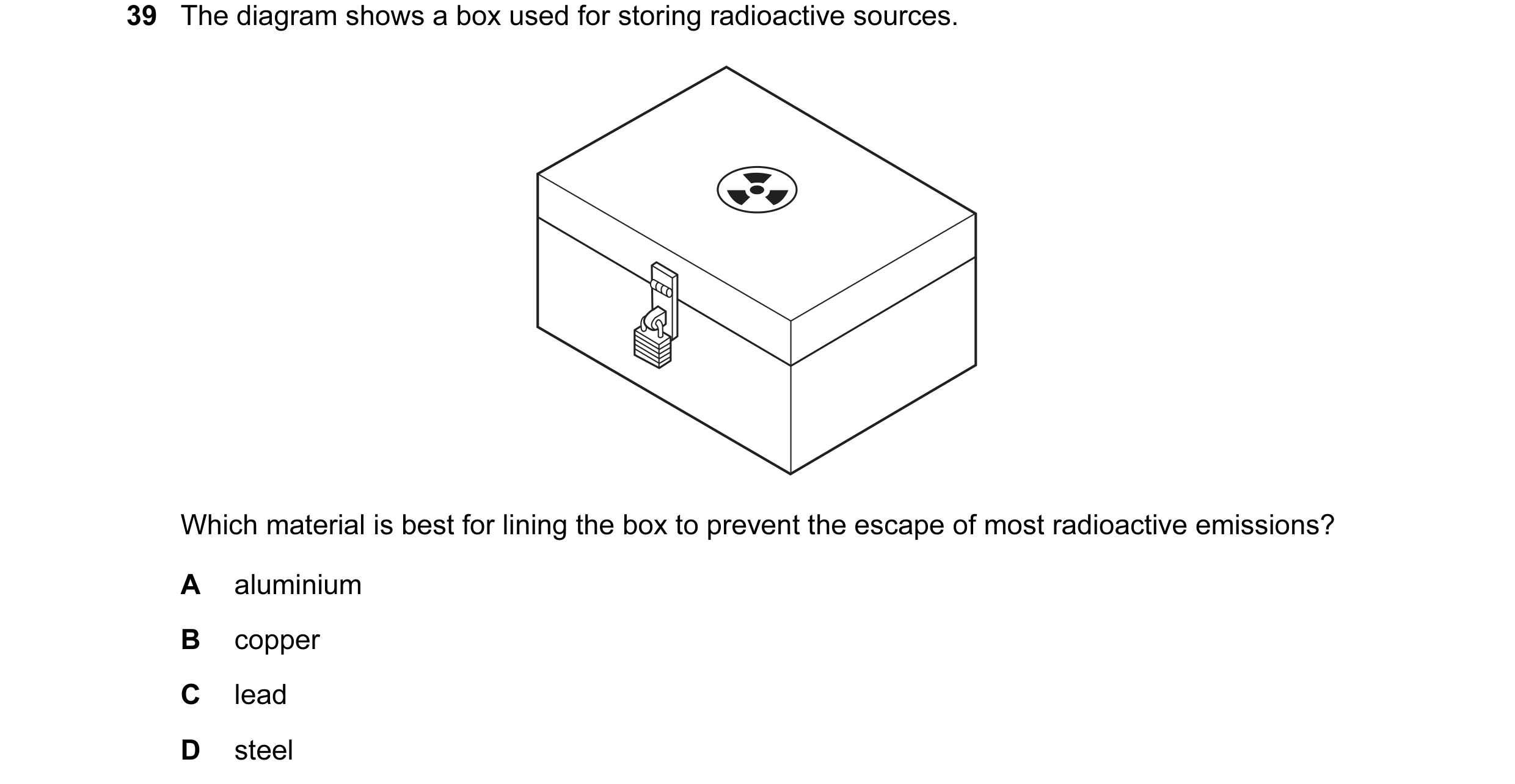 16 / 68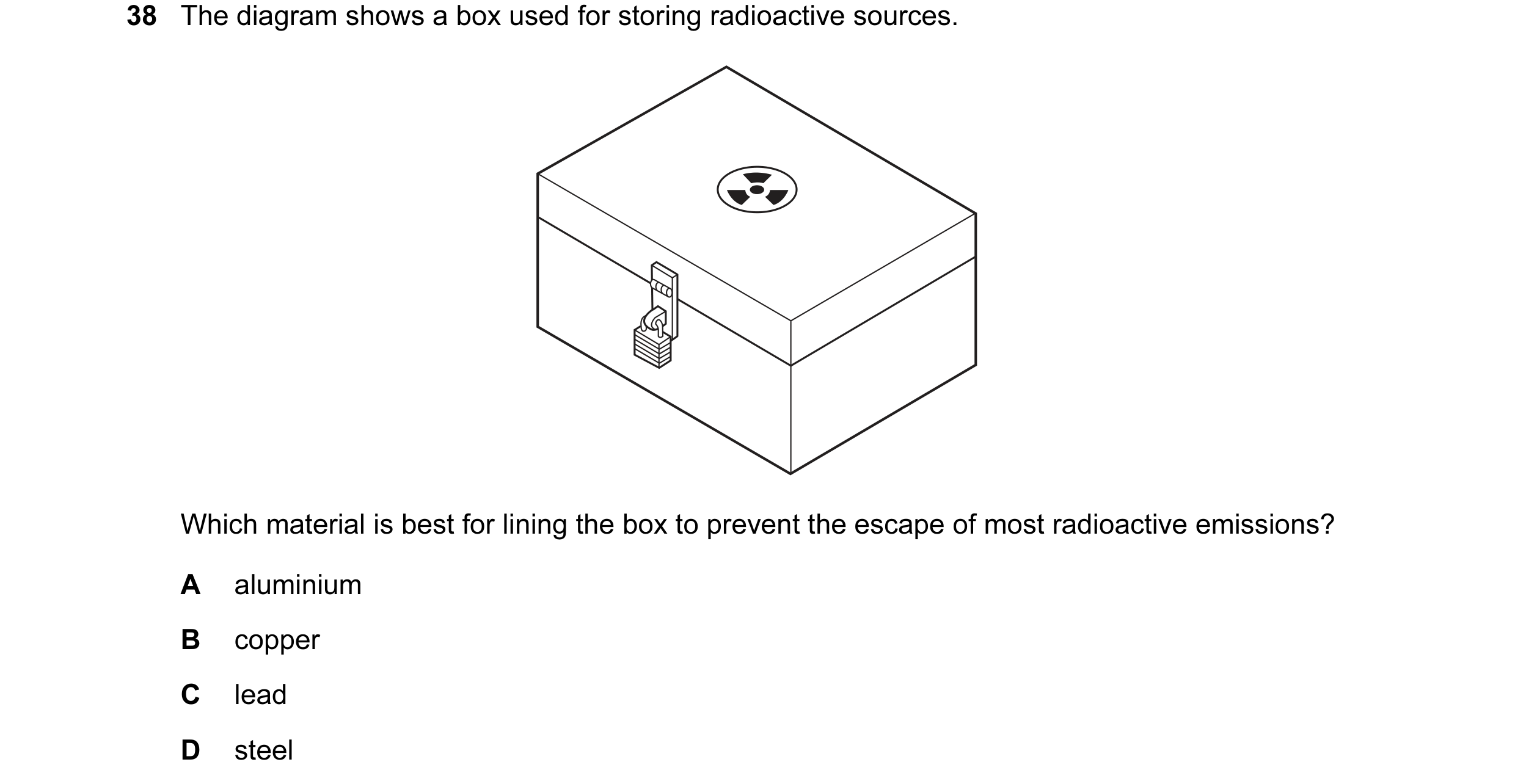
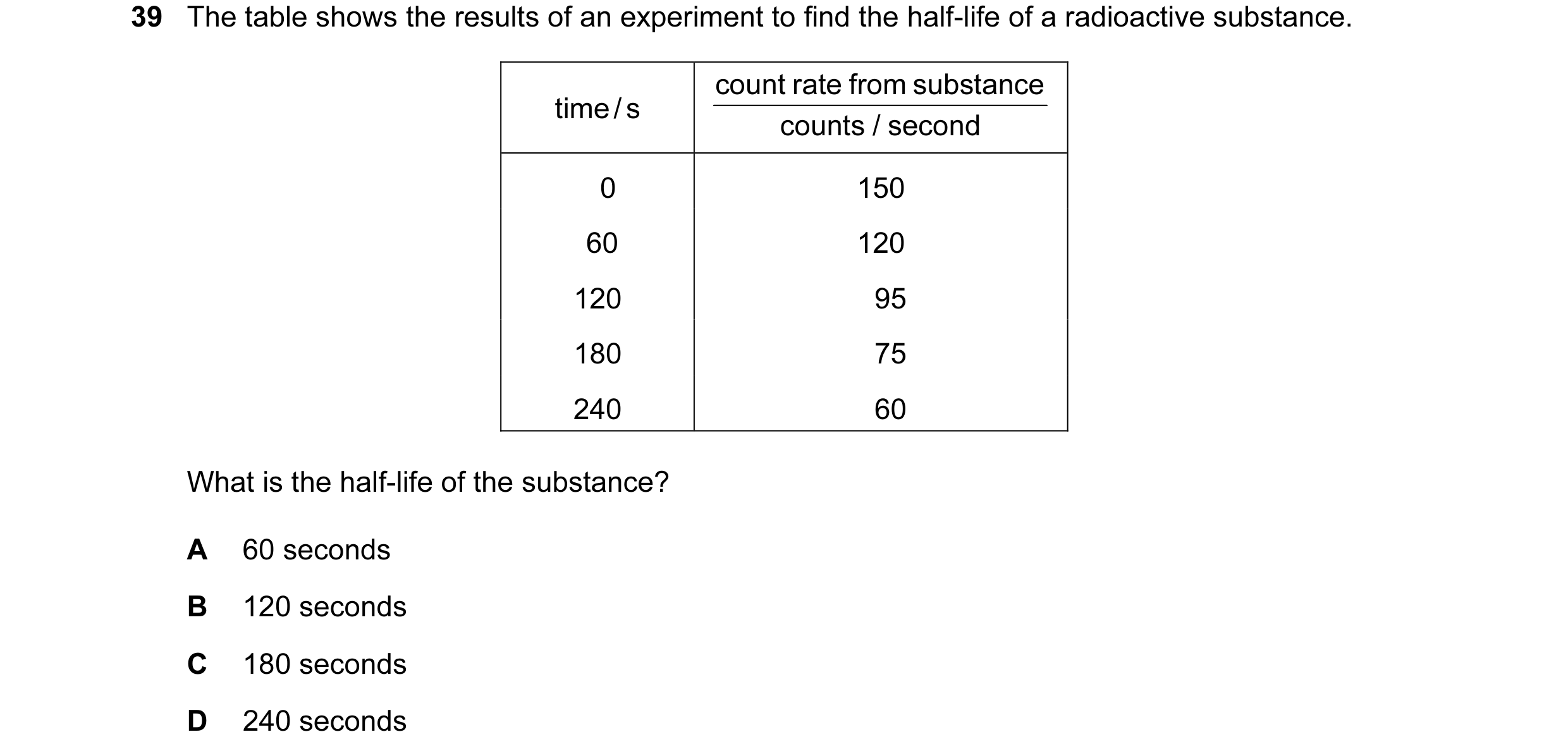 17 / 68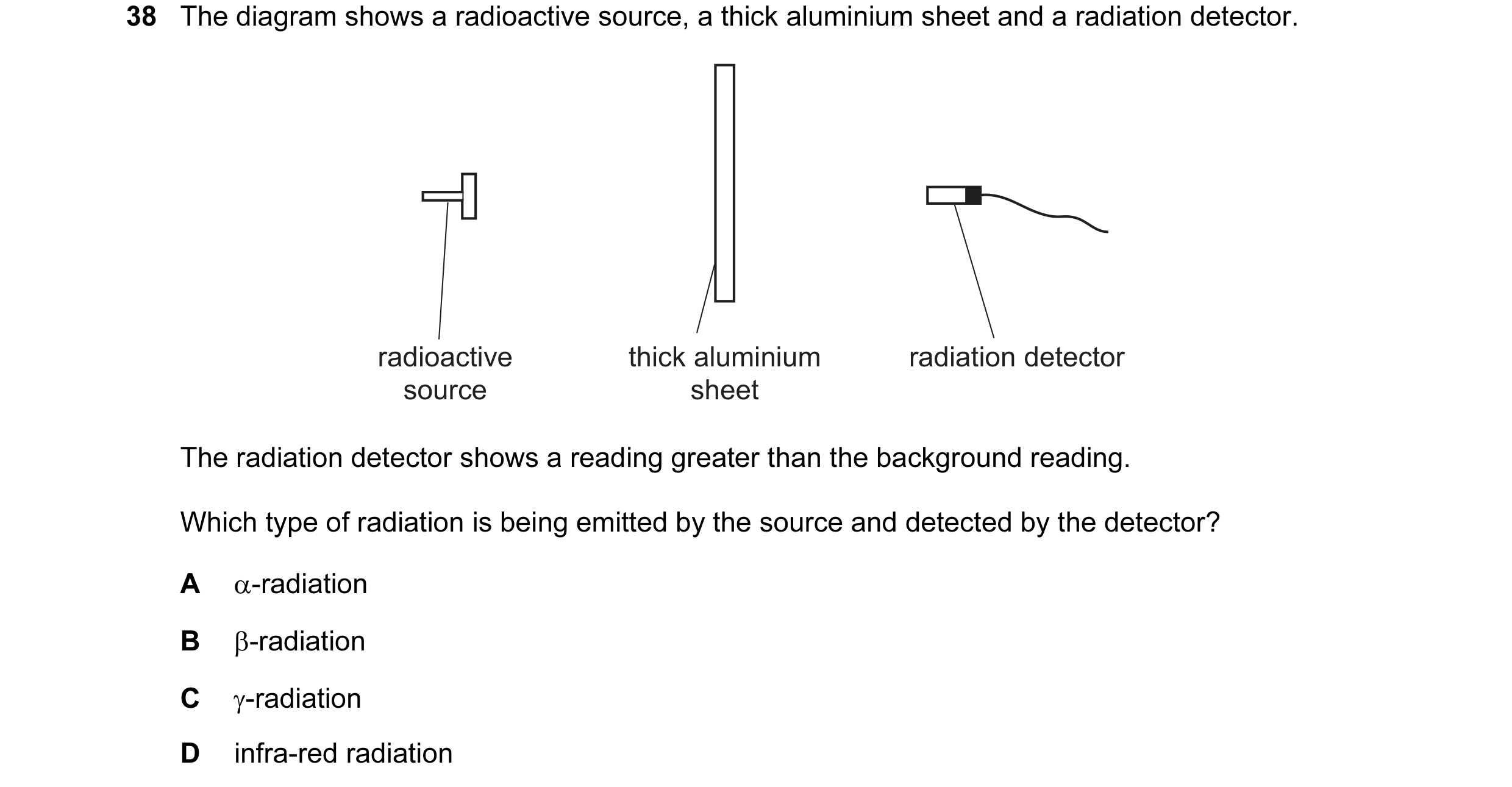
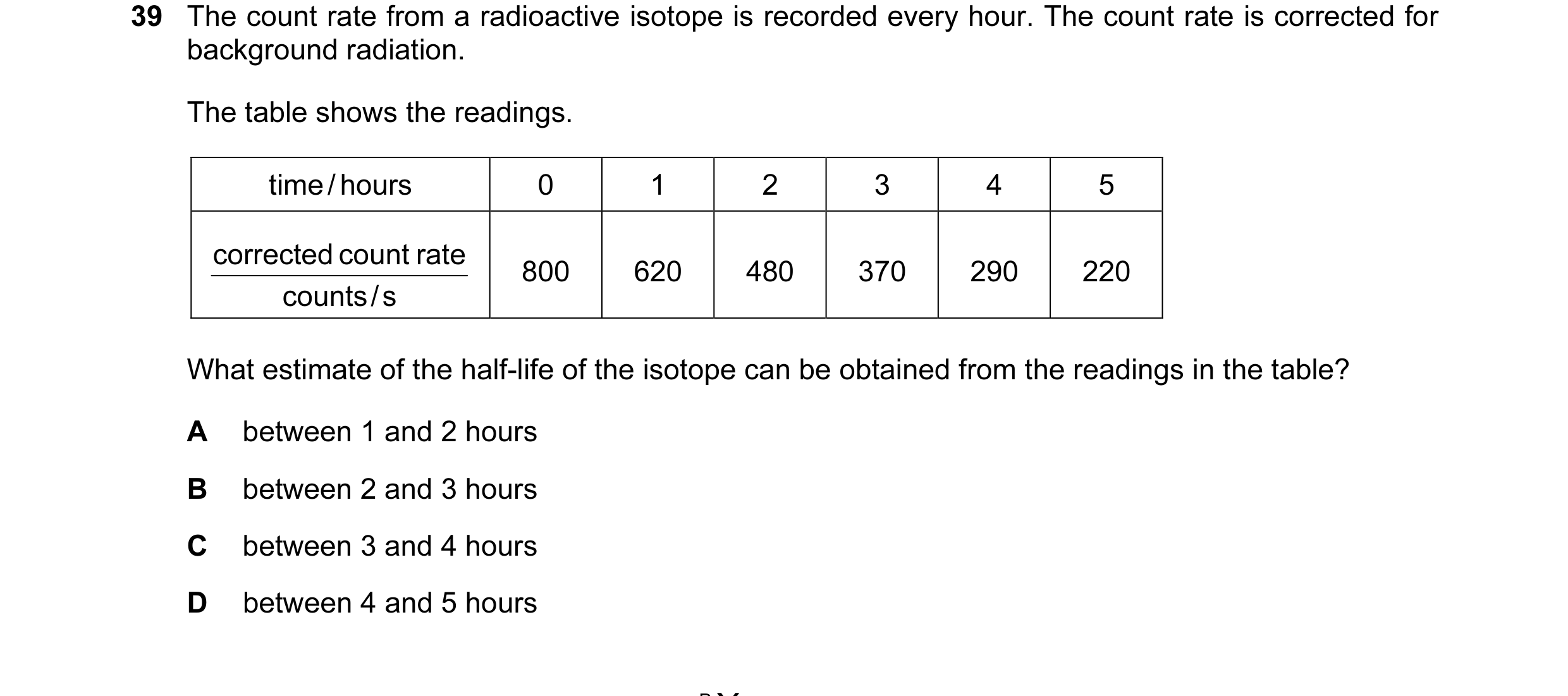 18 / 68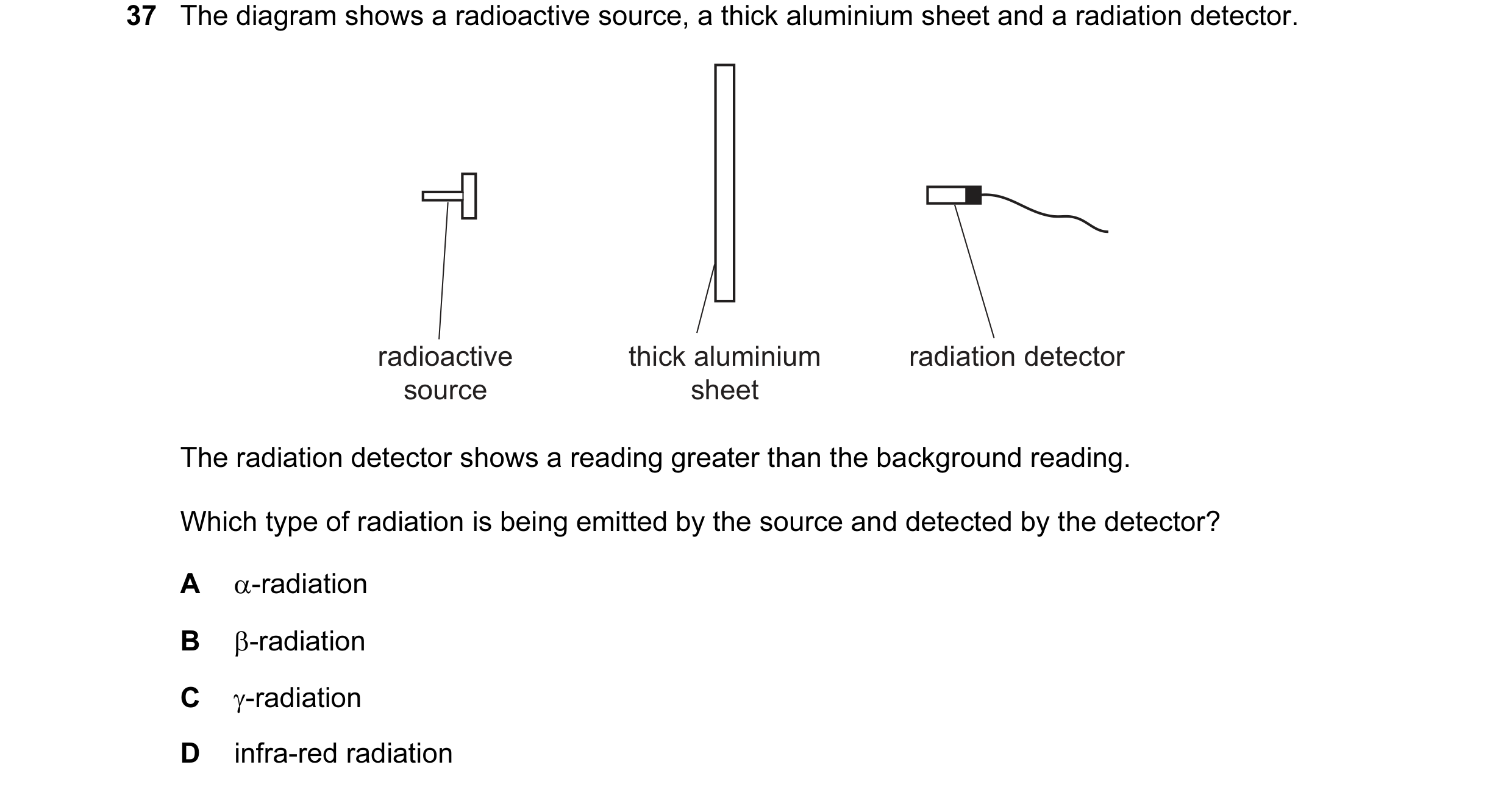
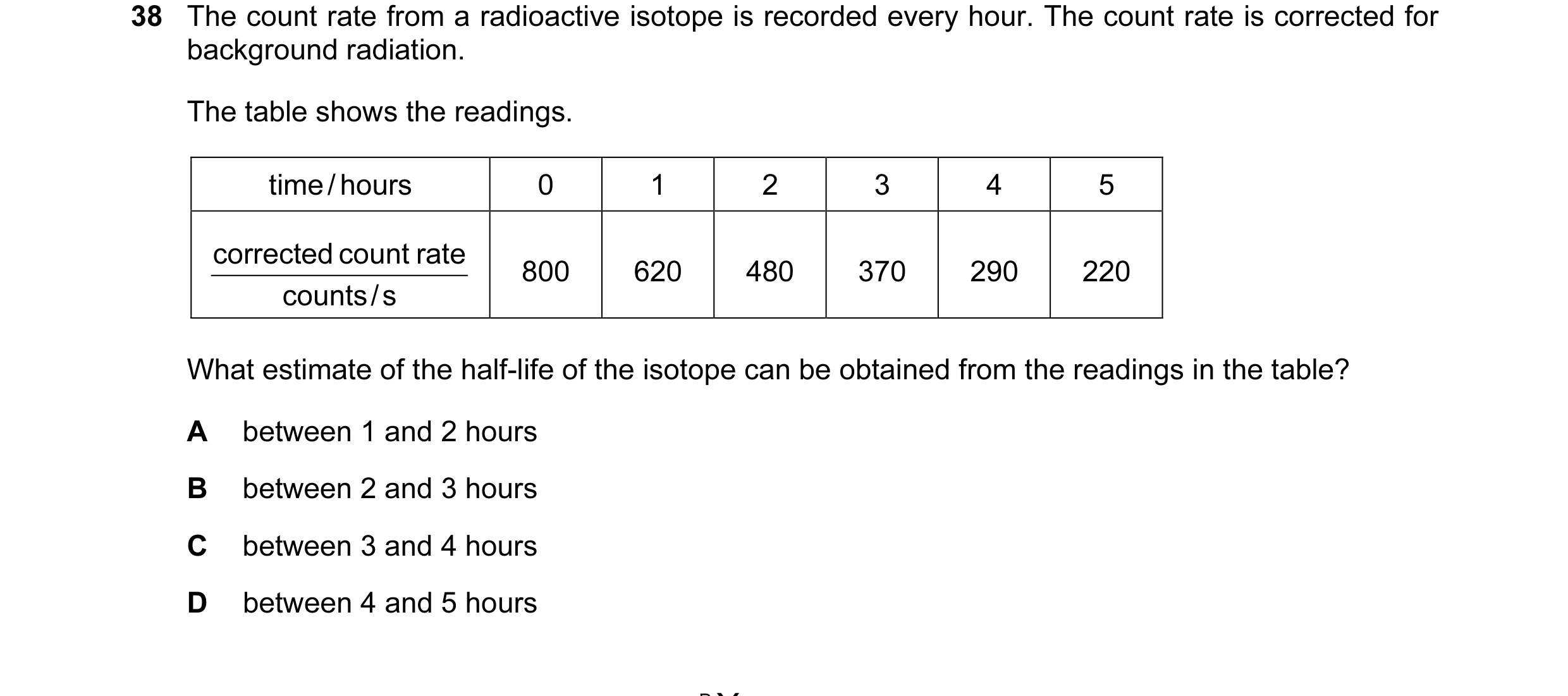 19 / 68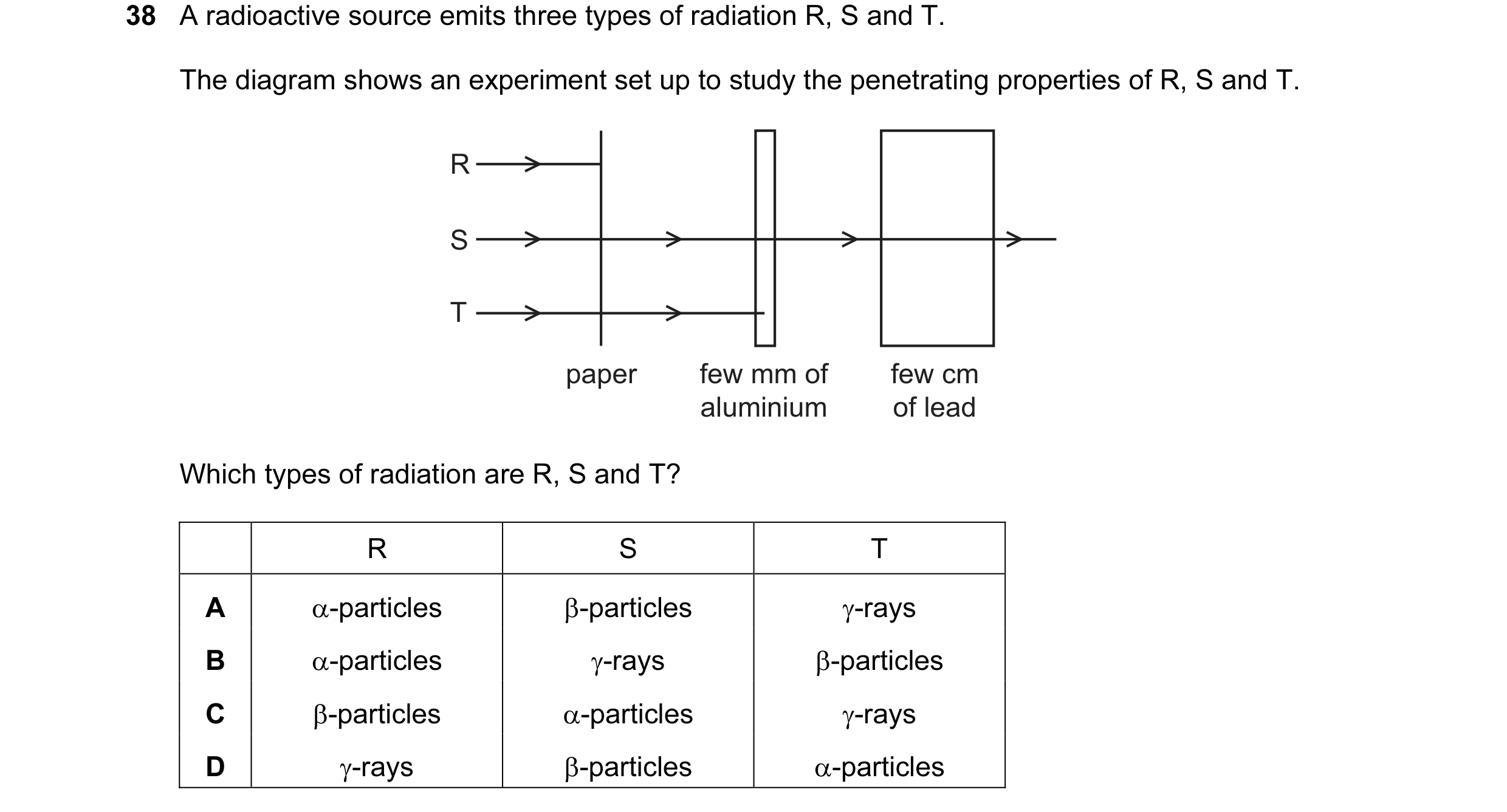

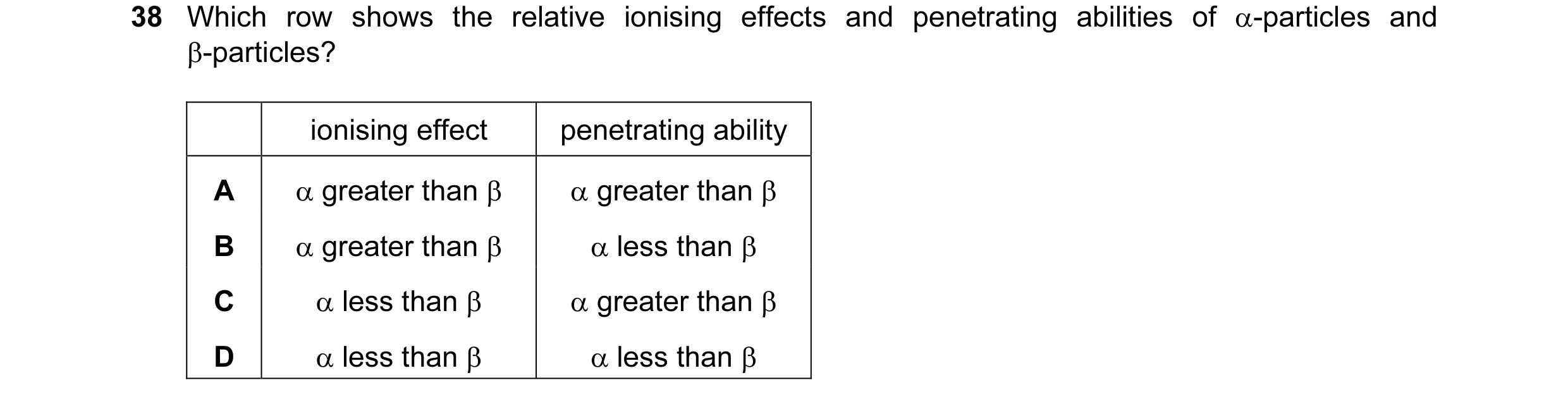
 20 / 68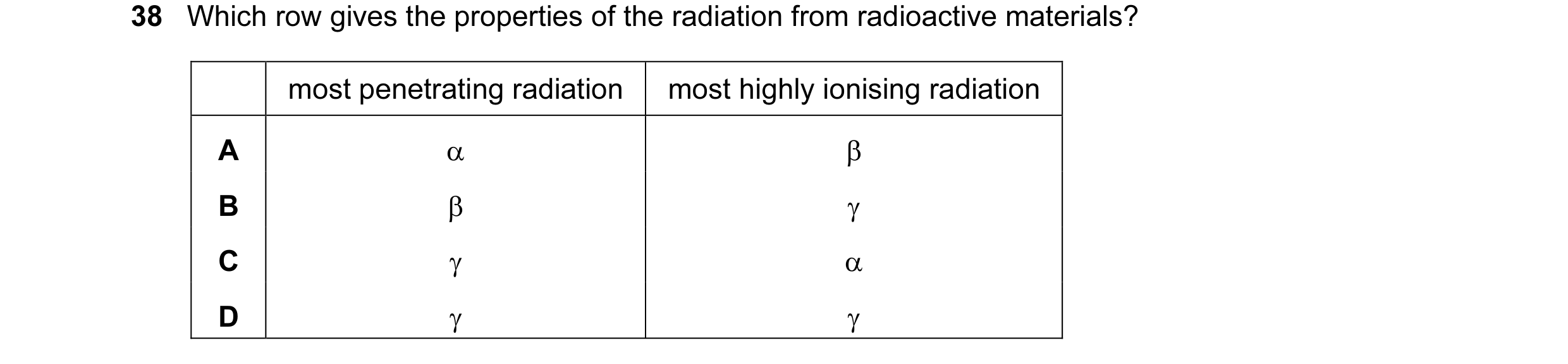
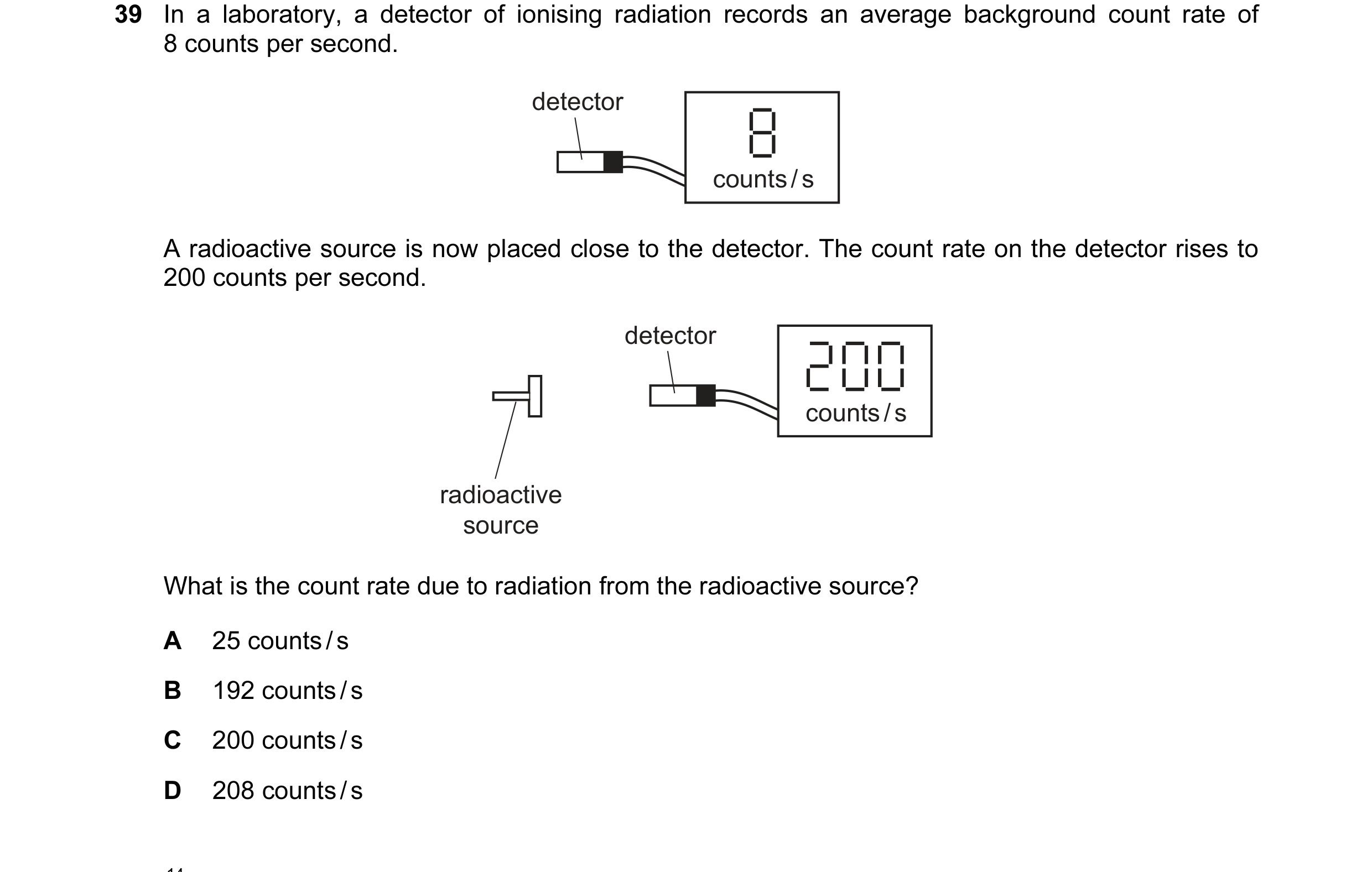

 21 / 68
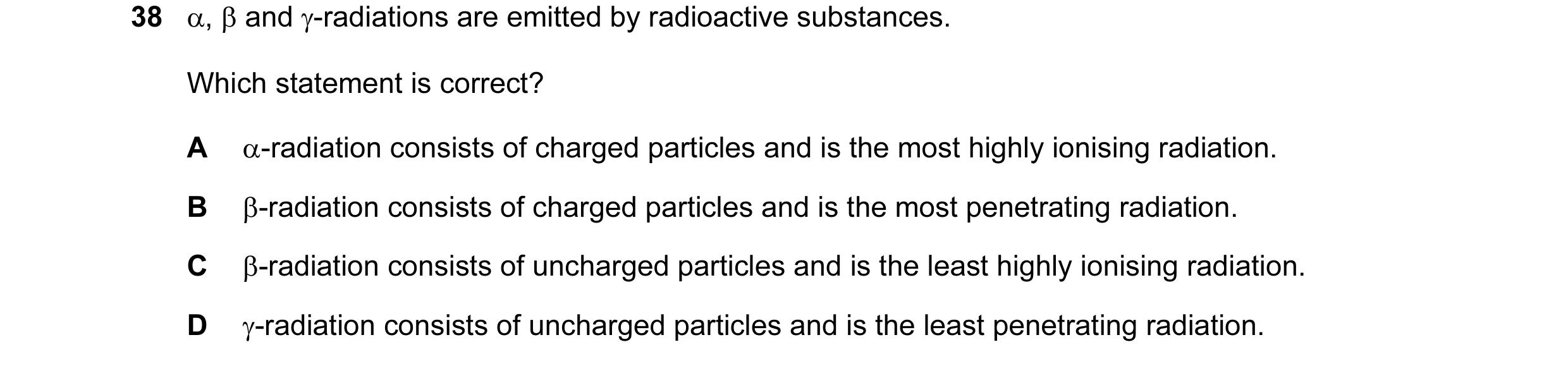
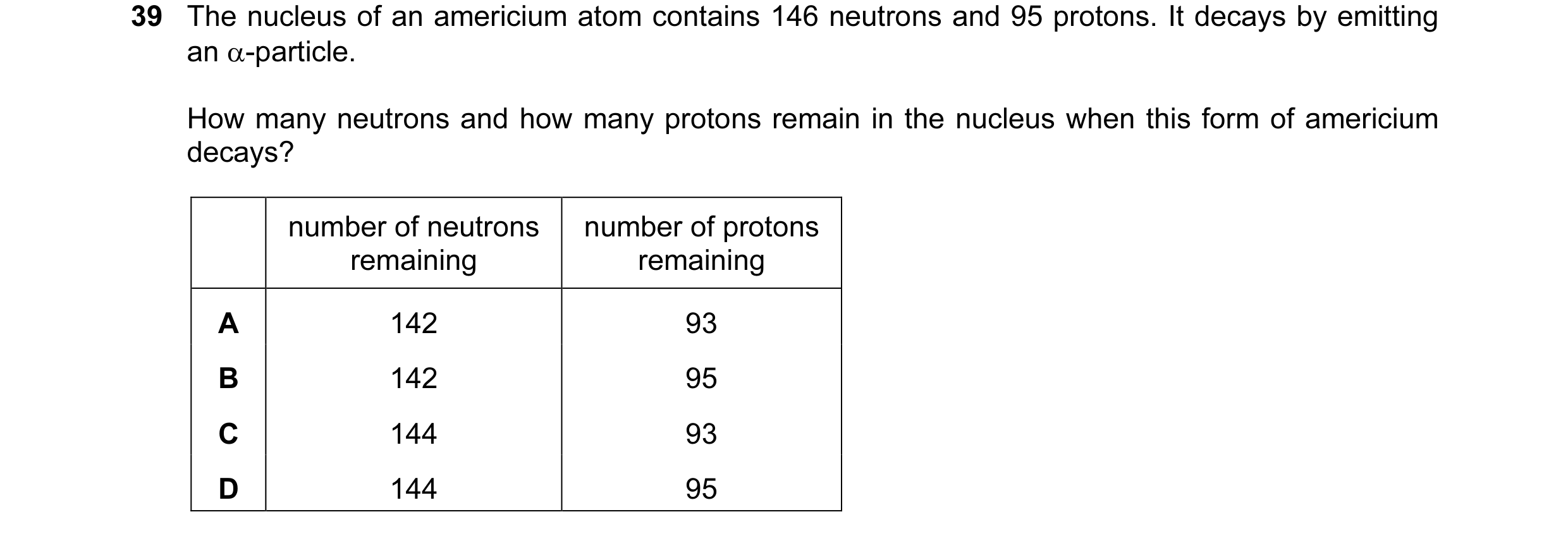
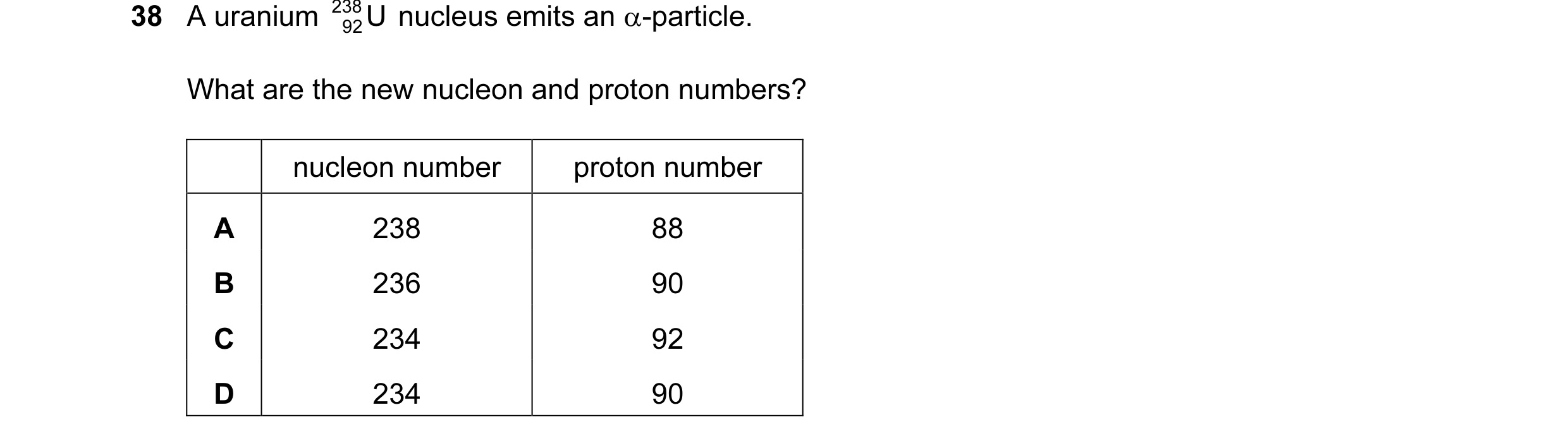
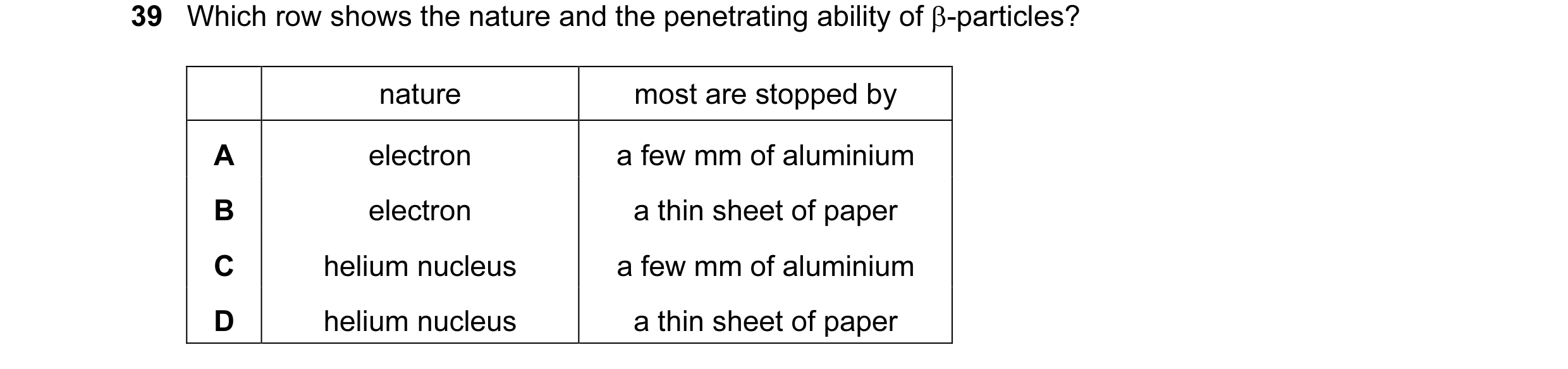 22 / 68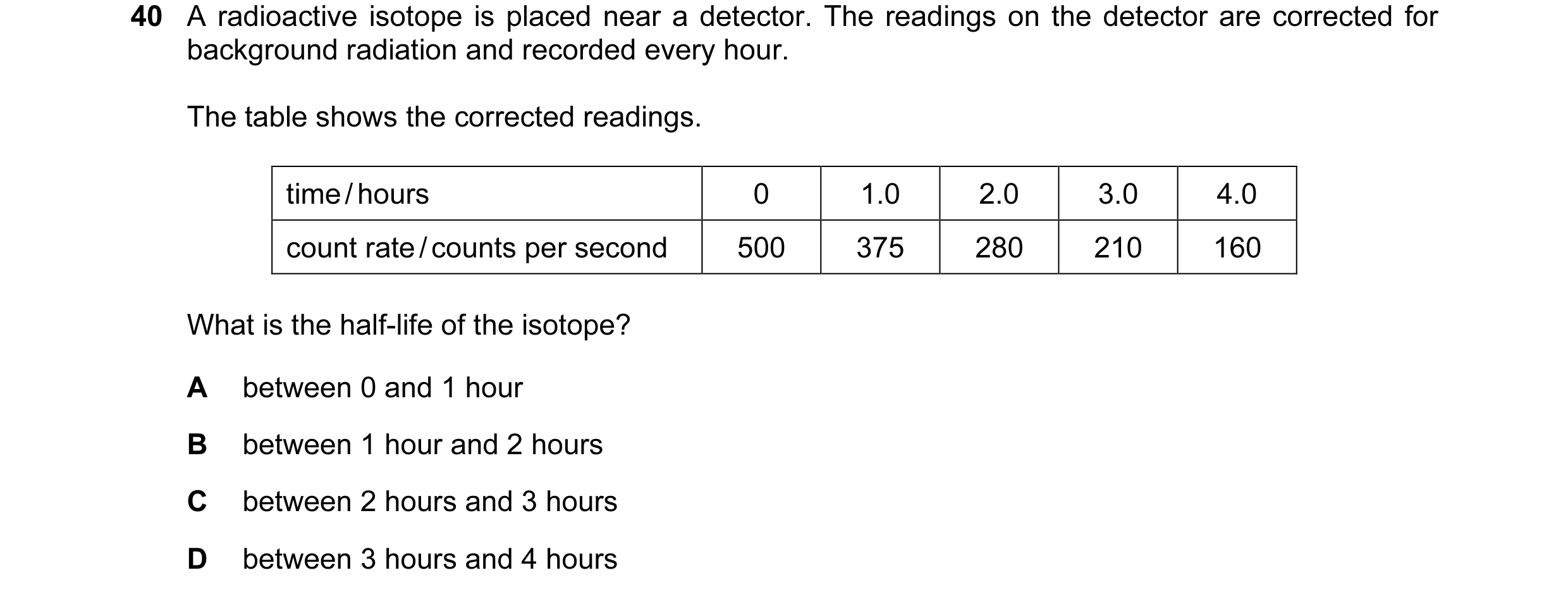

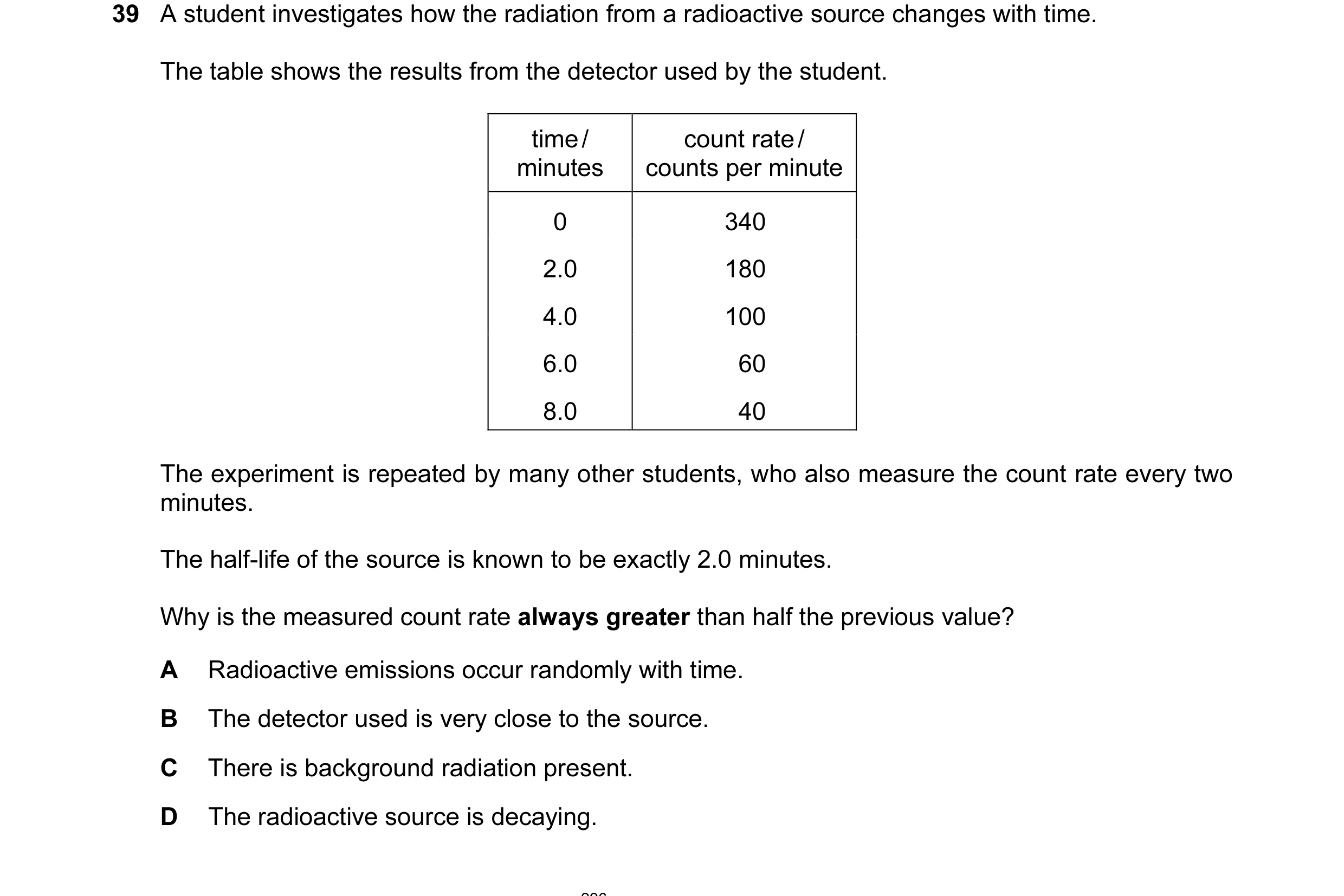 23 / 68
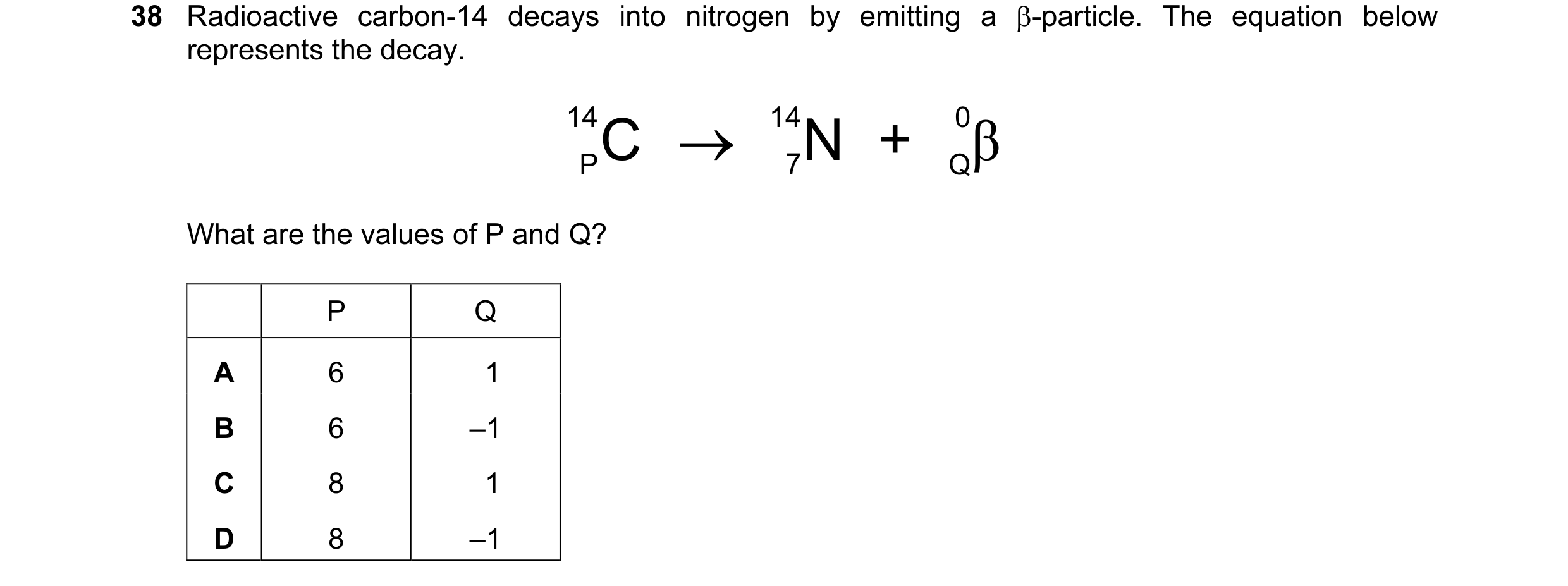
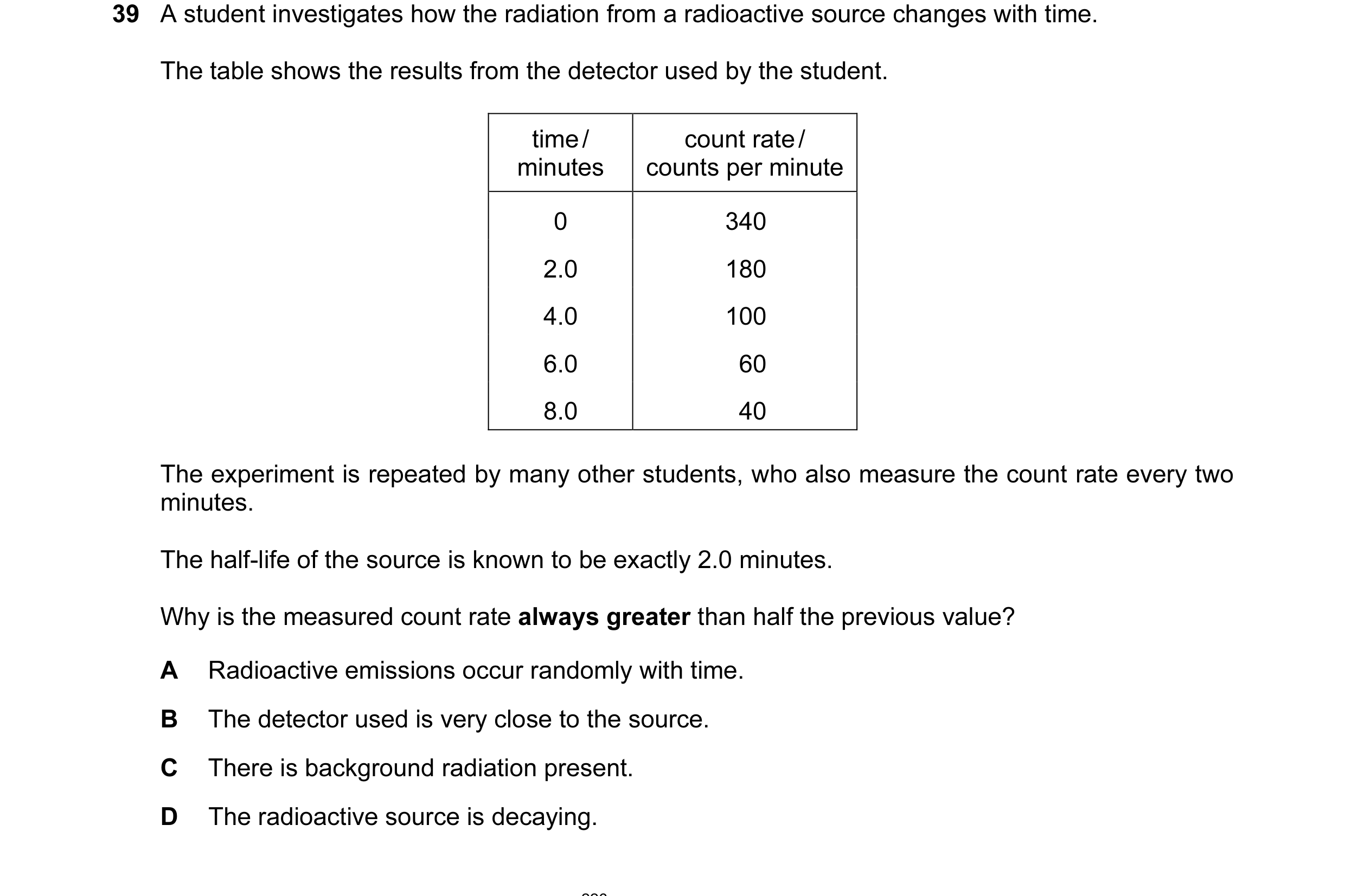 24 / 68

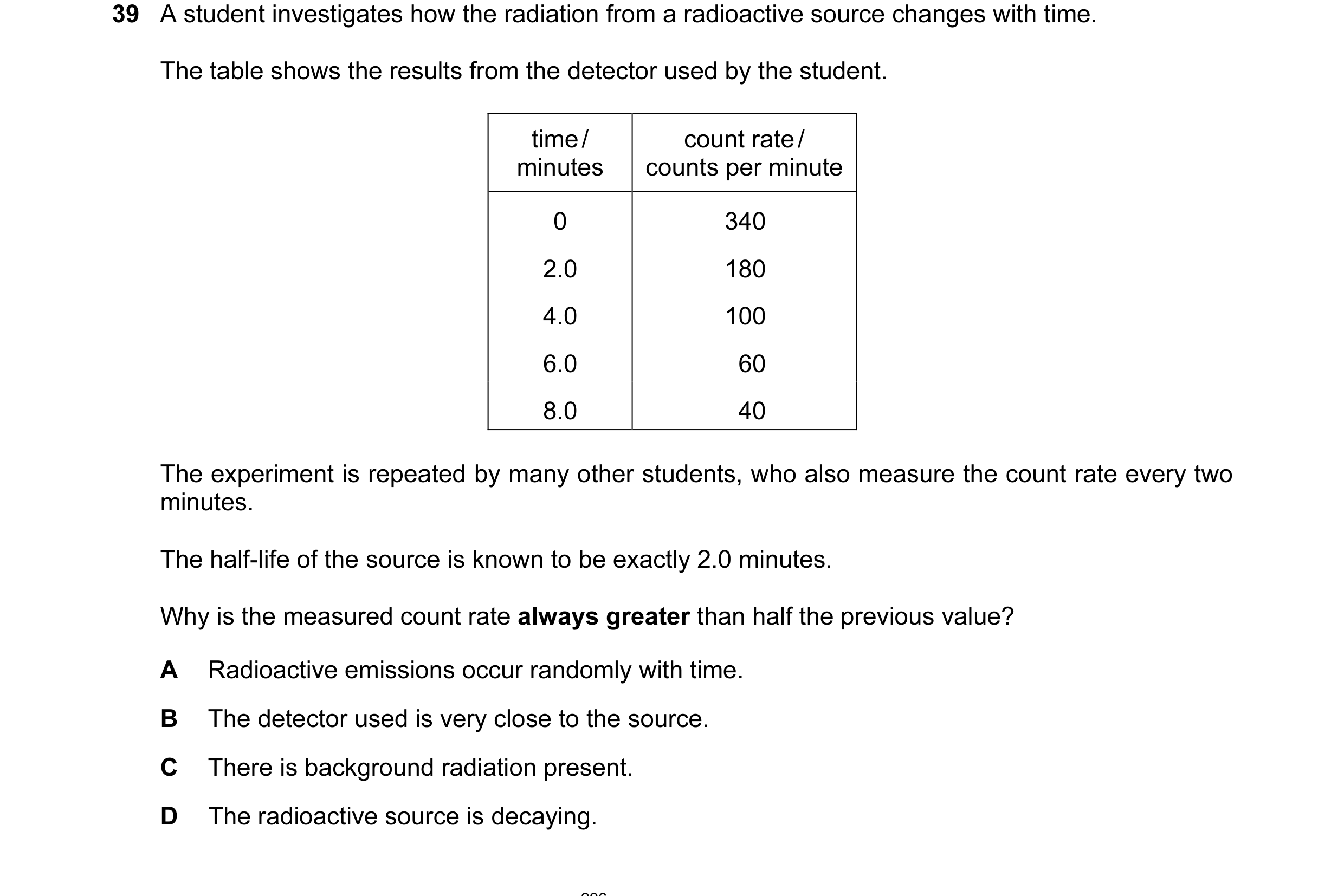
 25 / 68
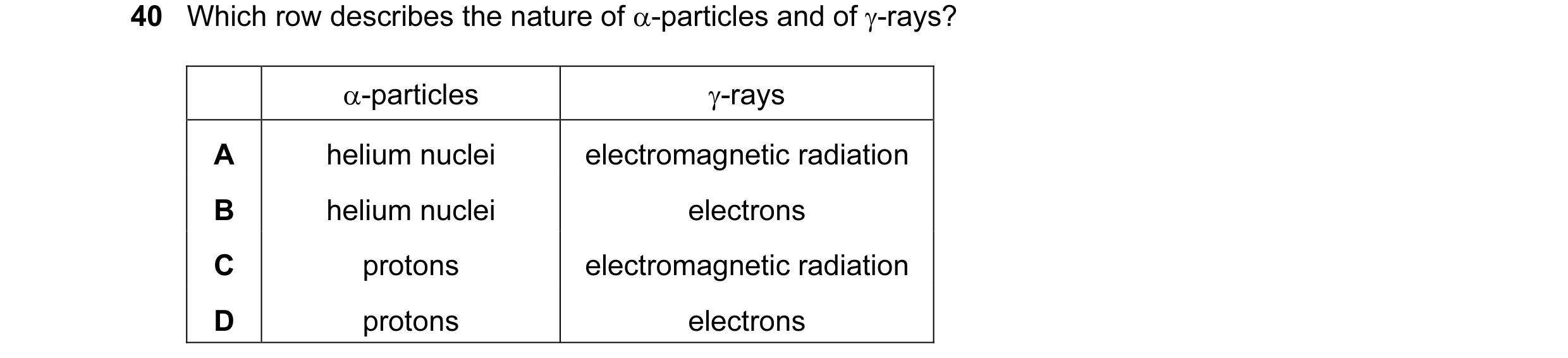
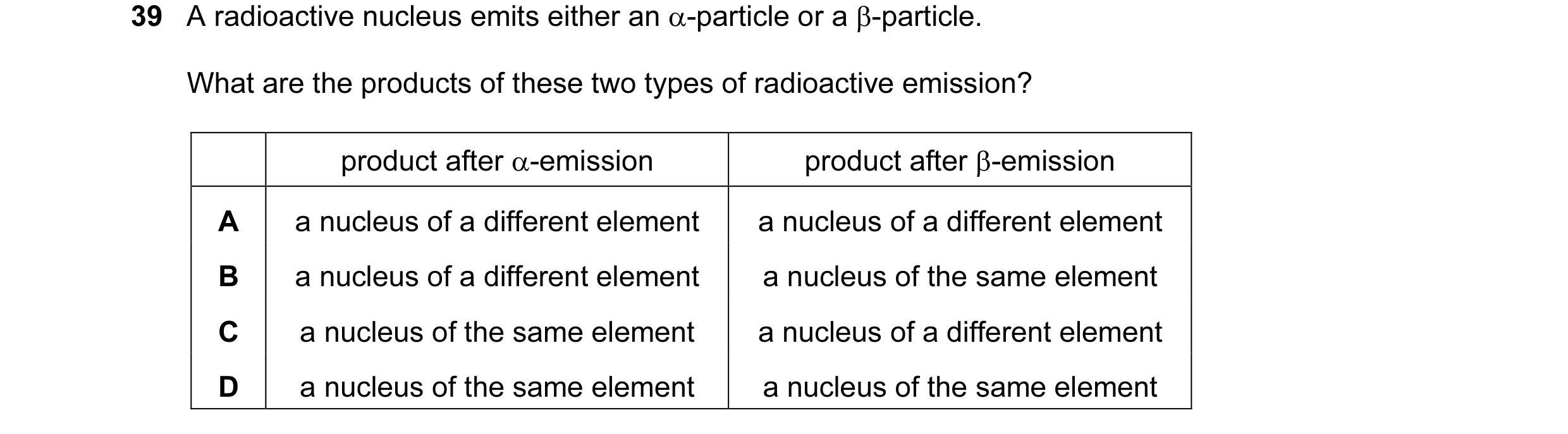
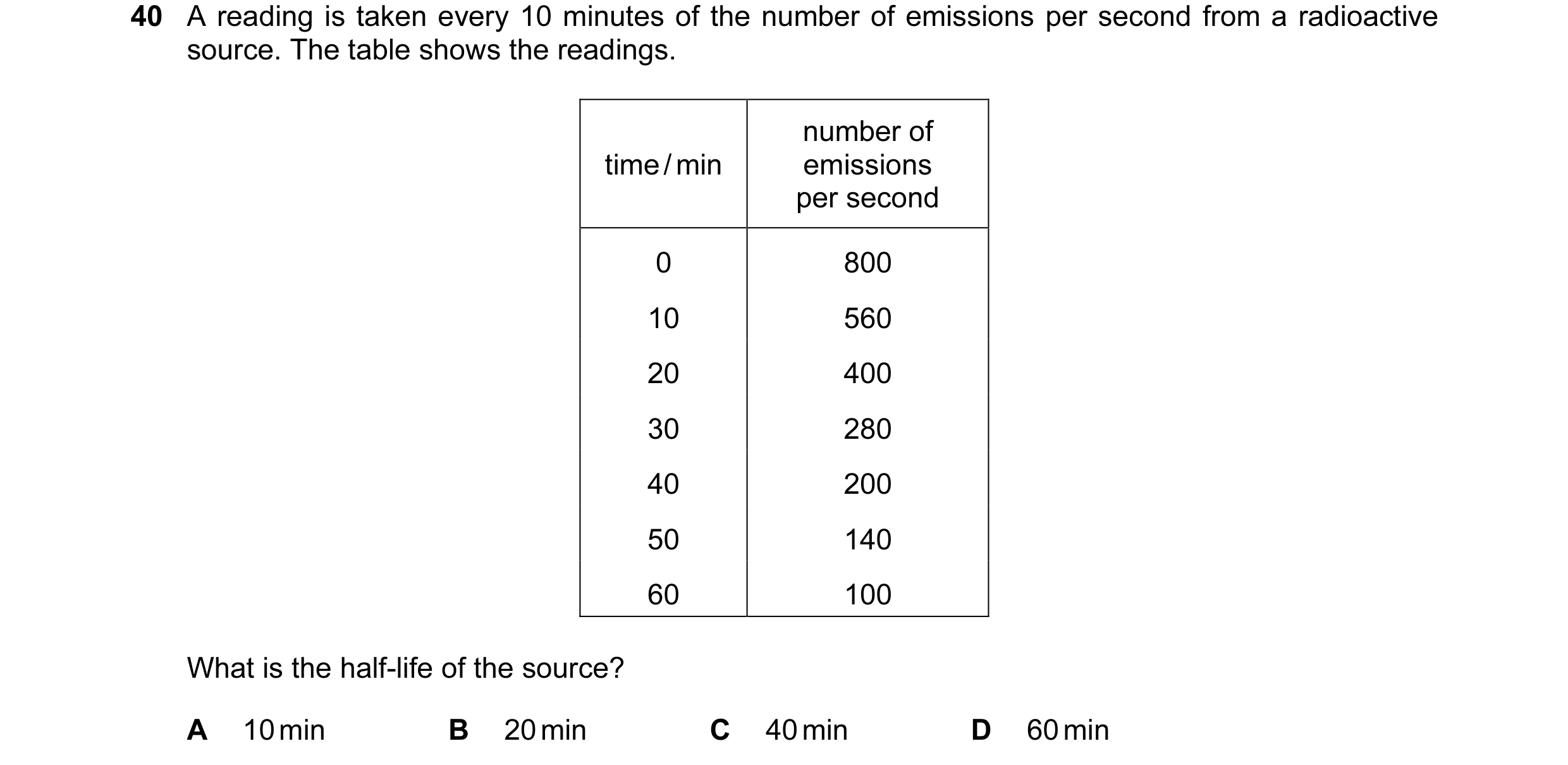 26 / 68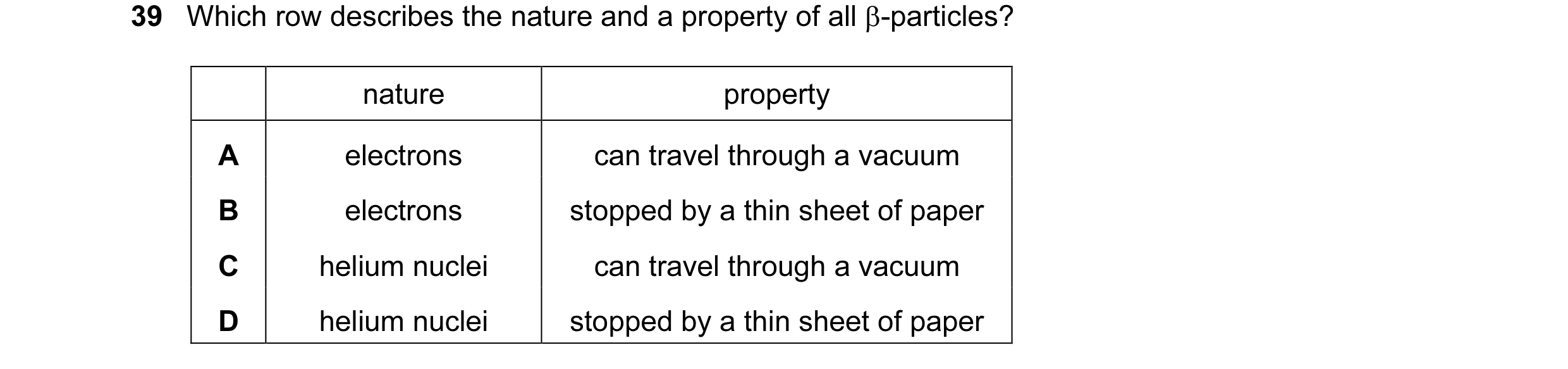
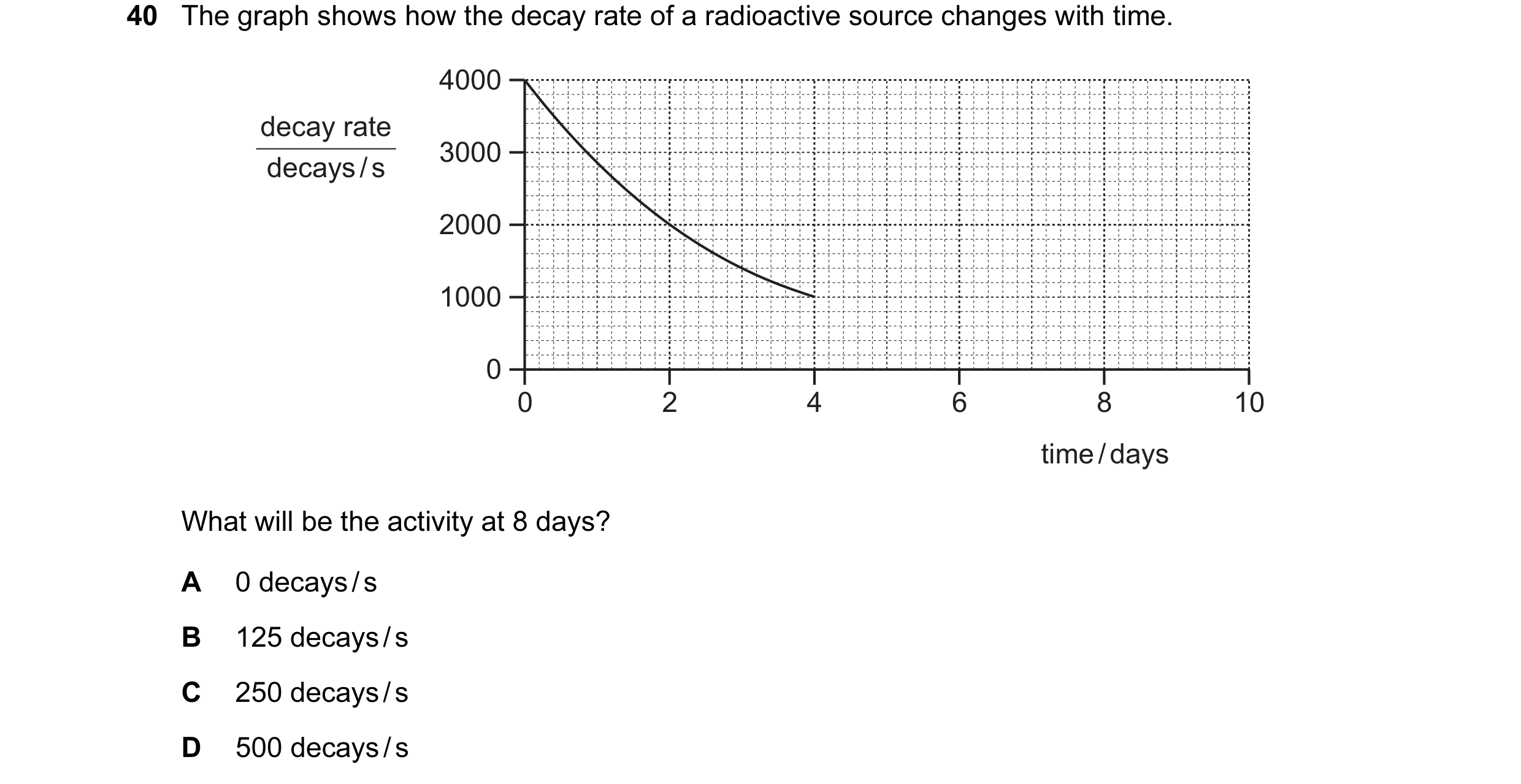

 27 / 68
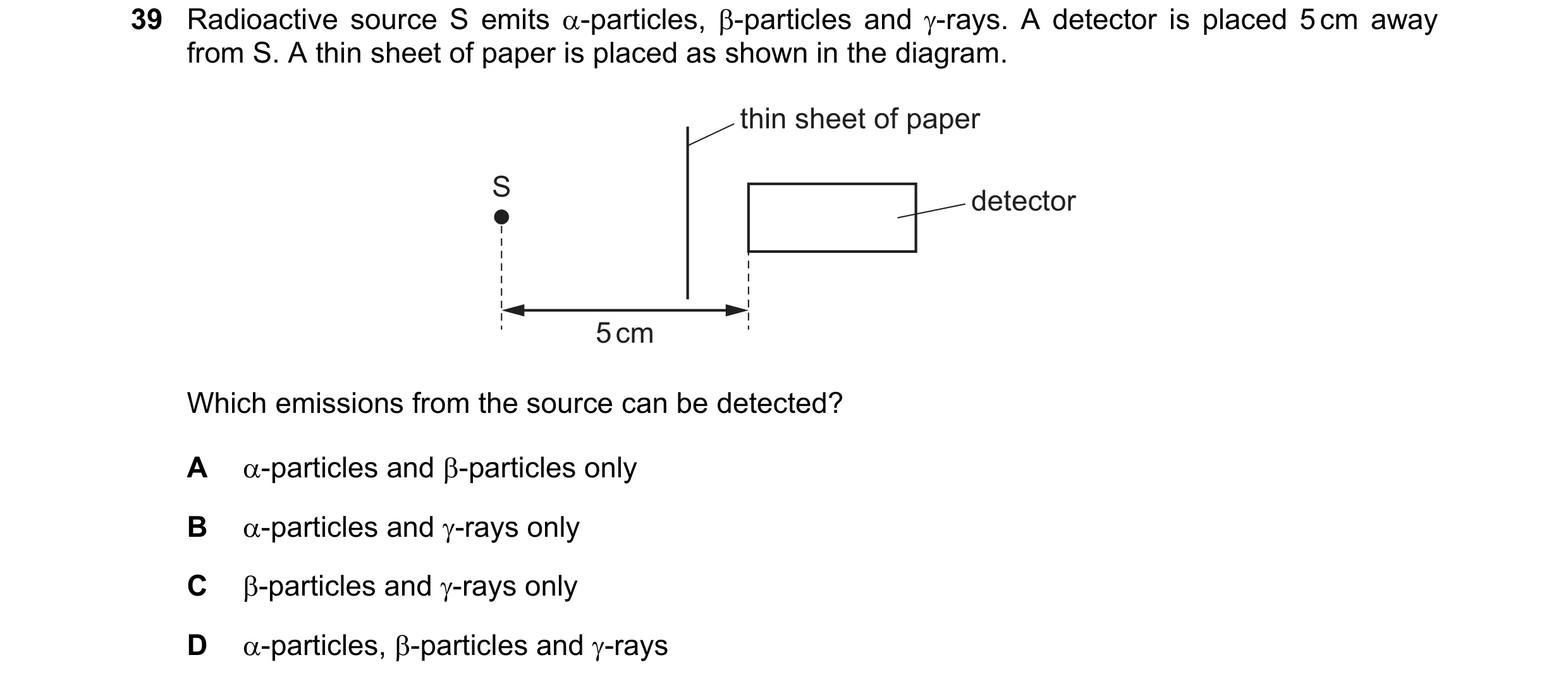
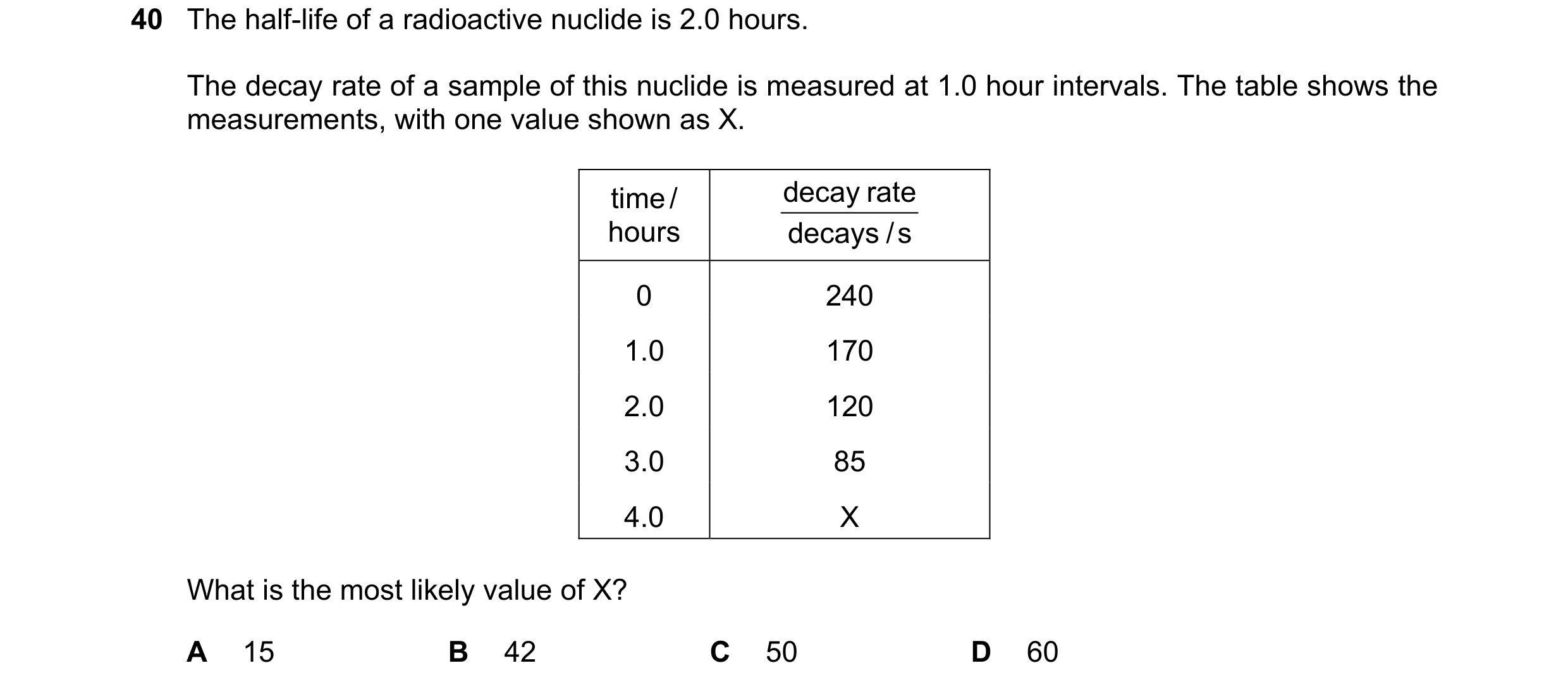 28 / 68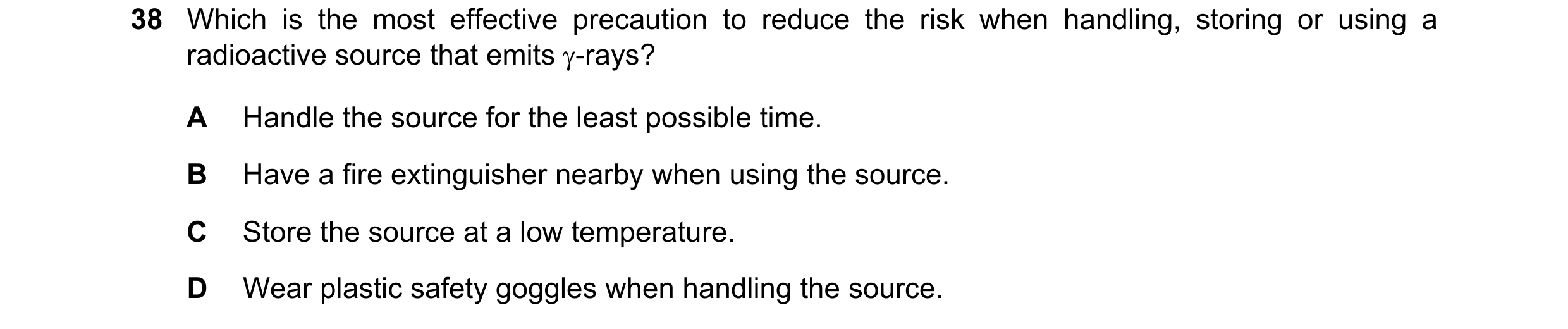
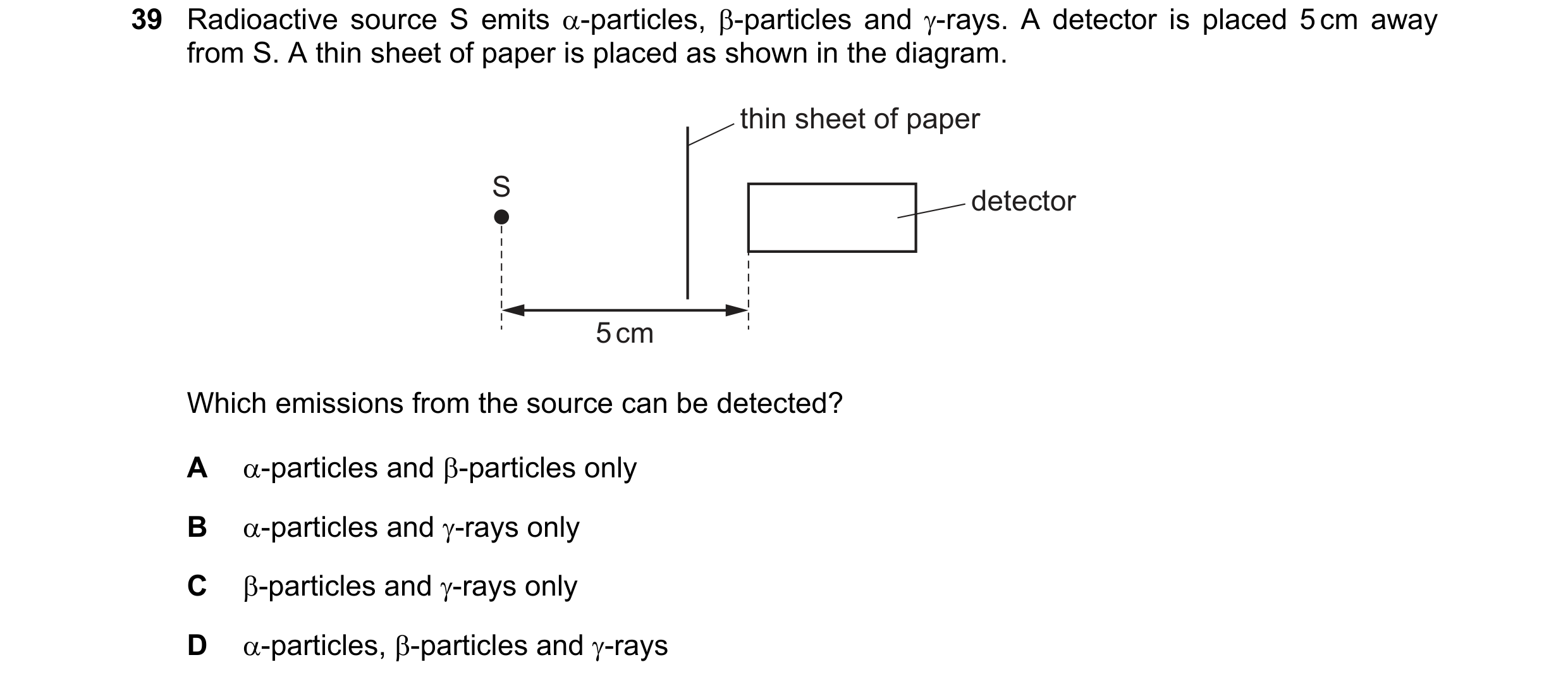
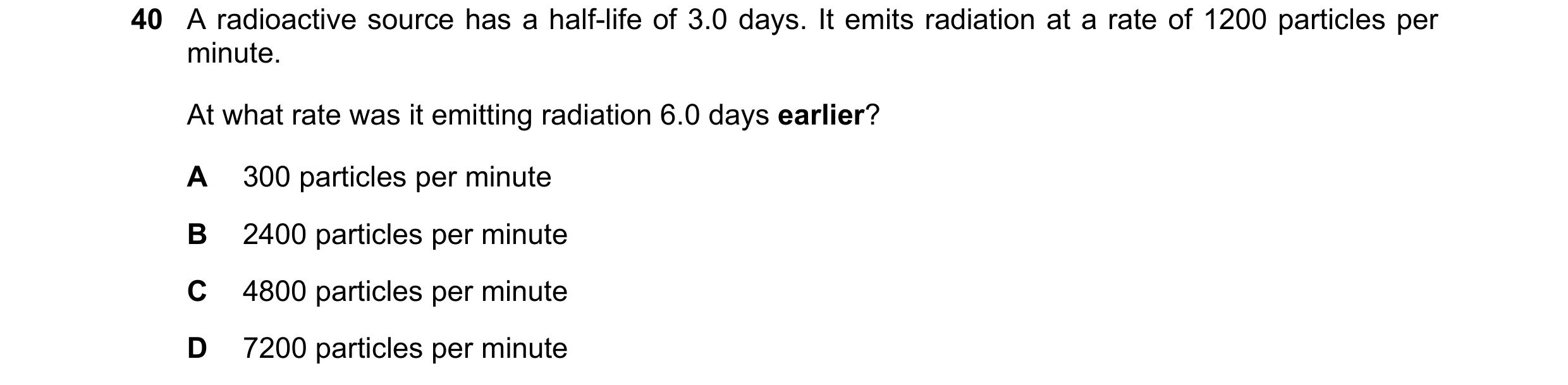
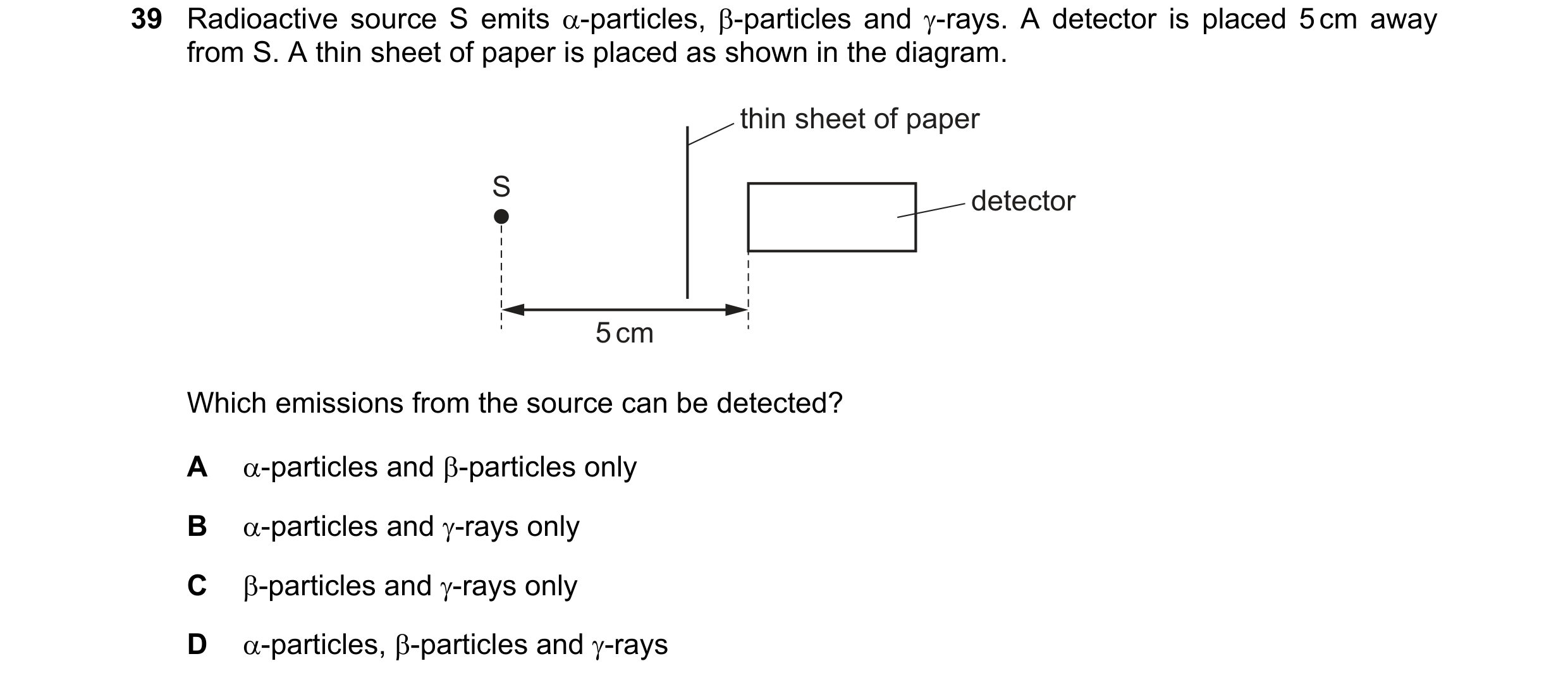 29 / 68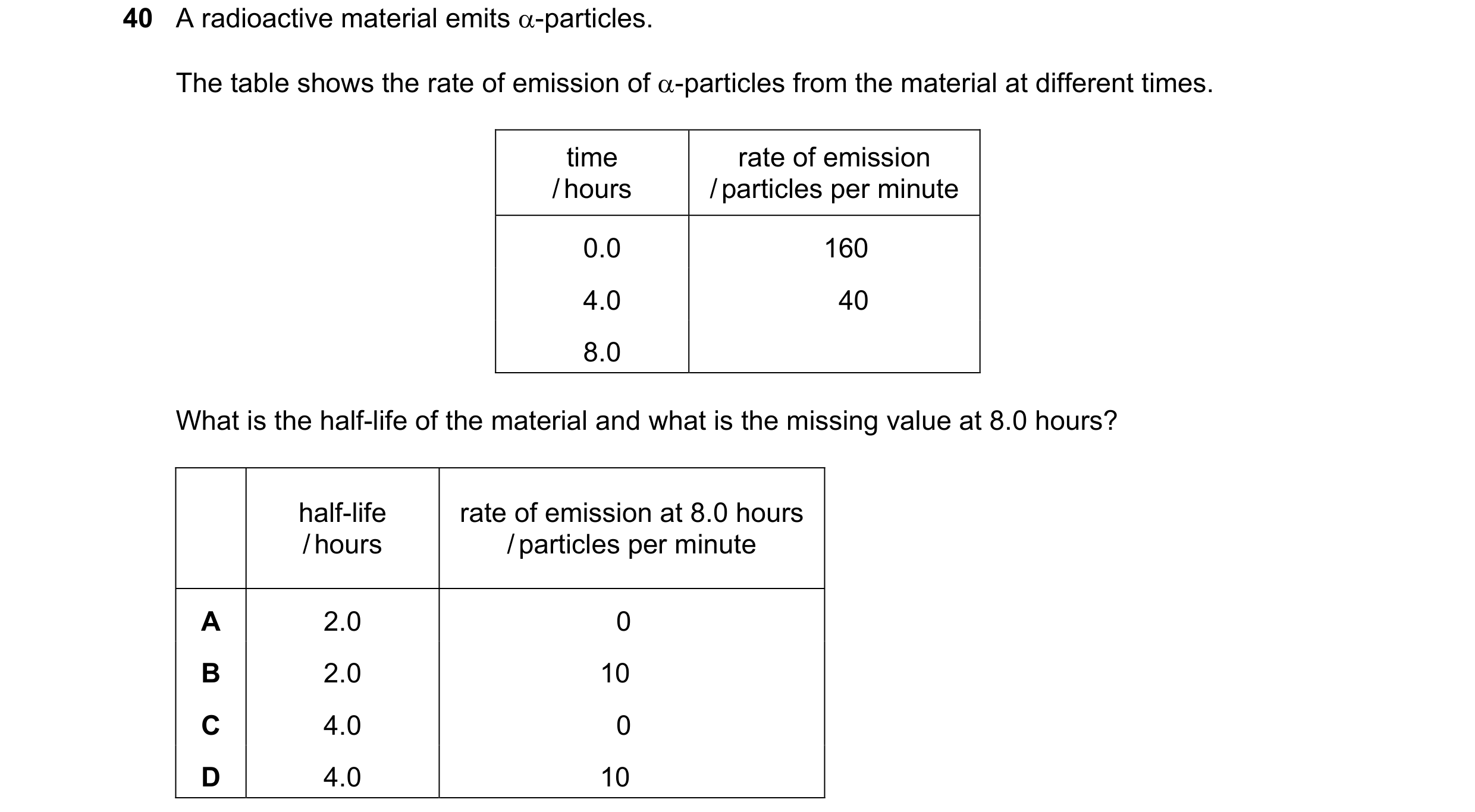
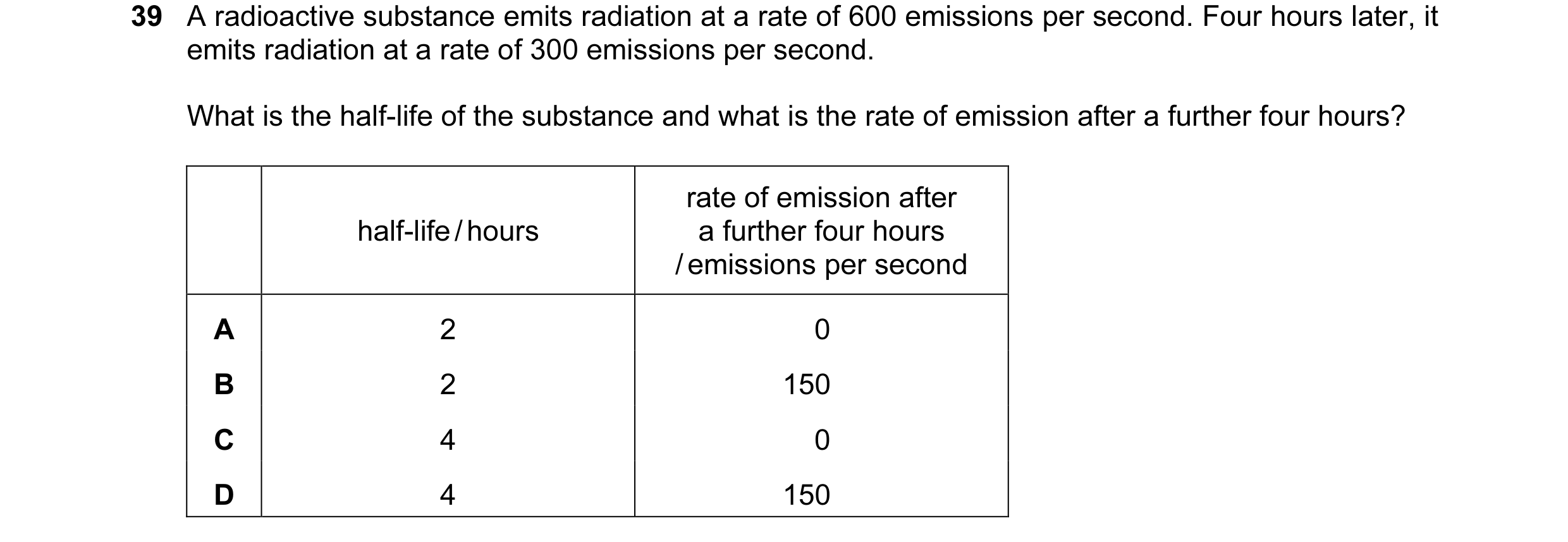 30 / 68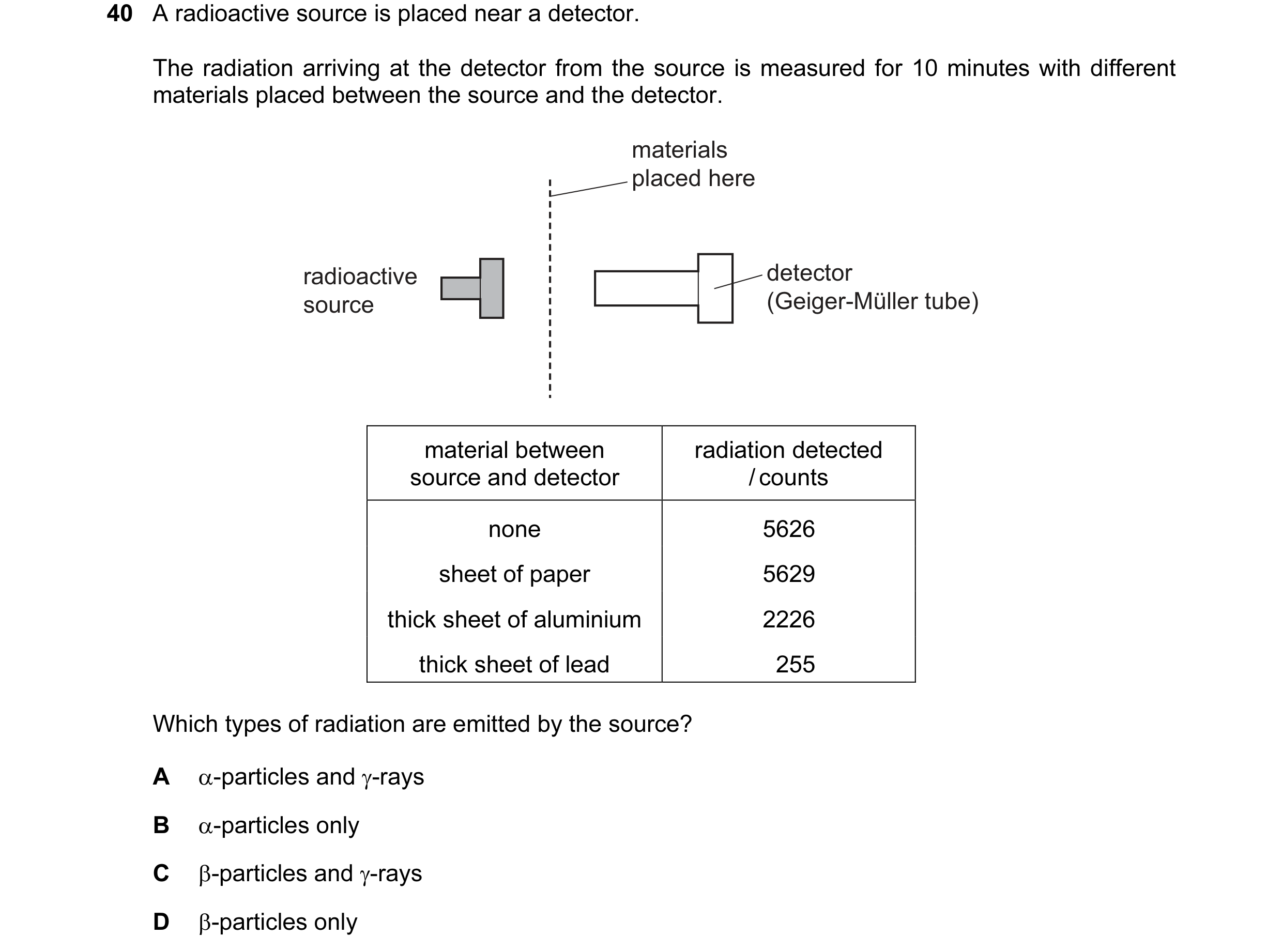
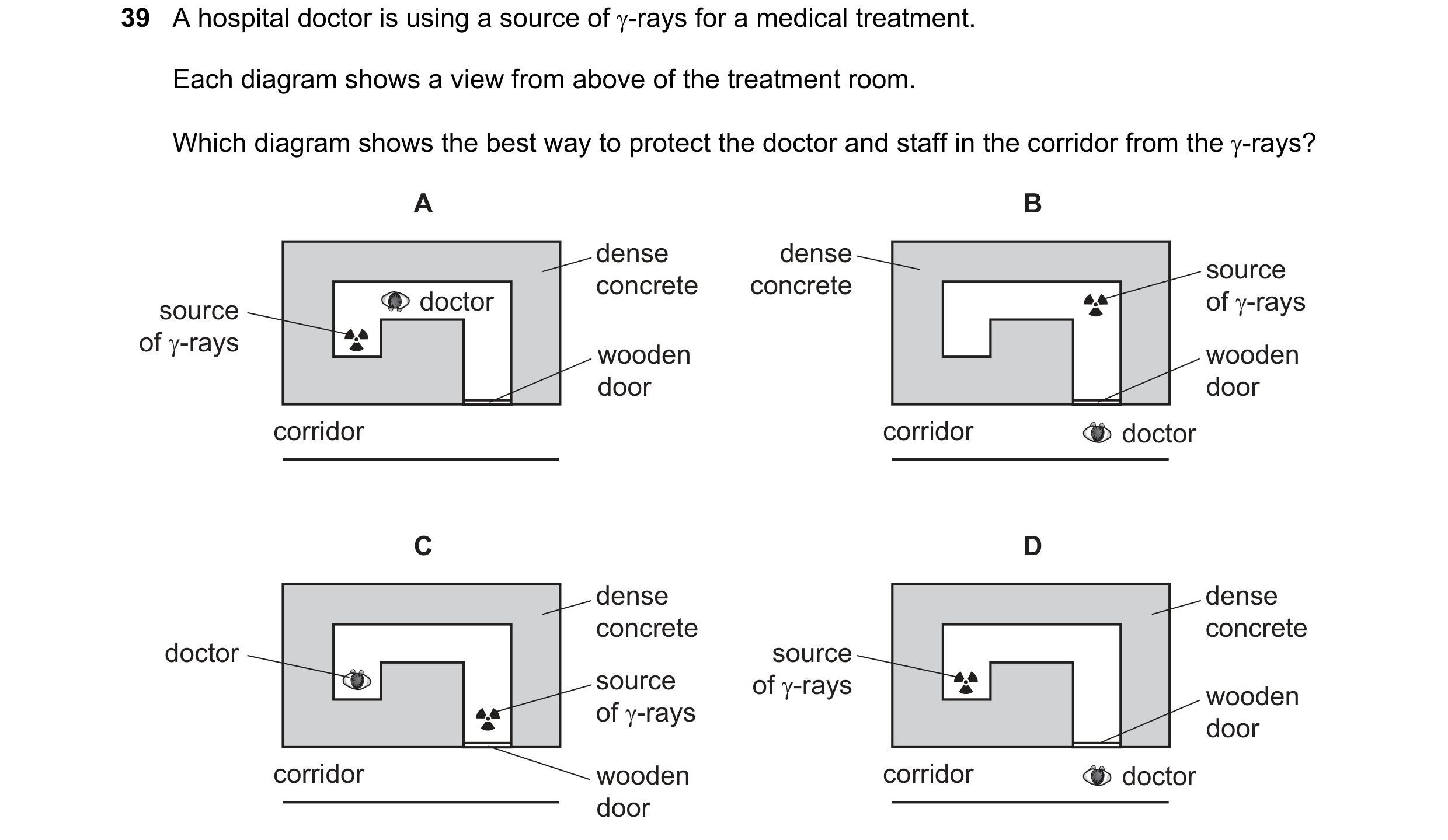 31 / 68

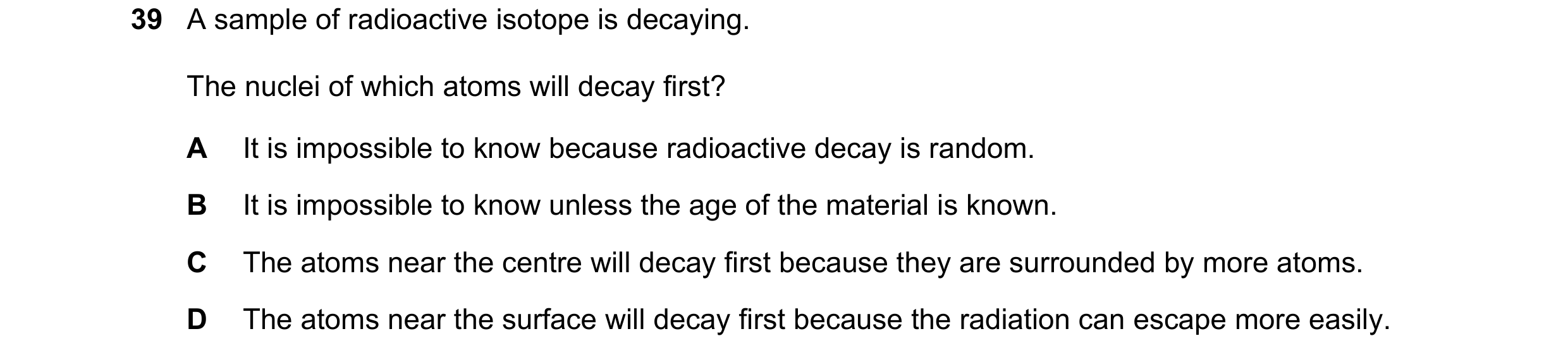 32 / 68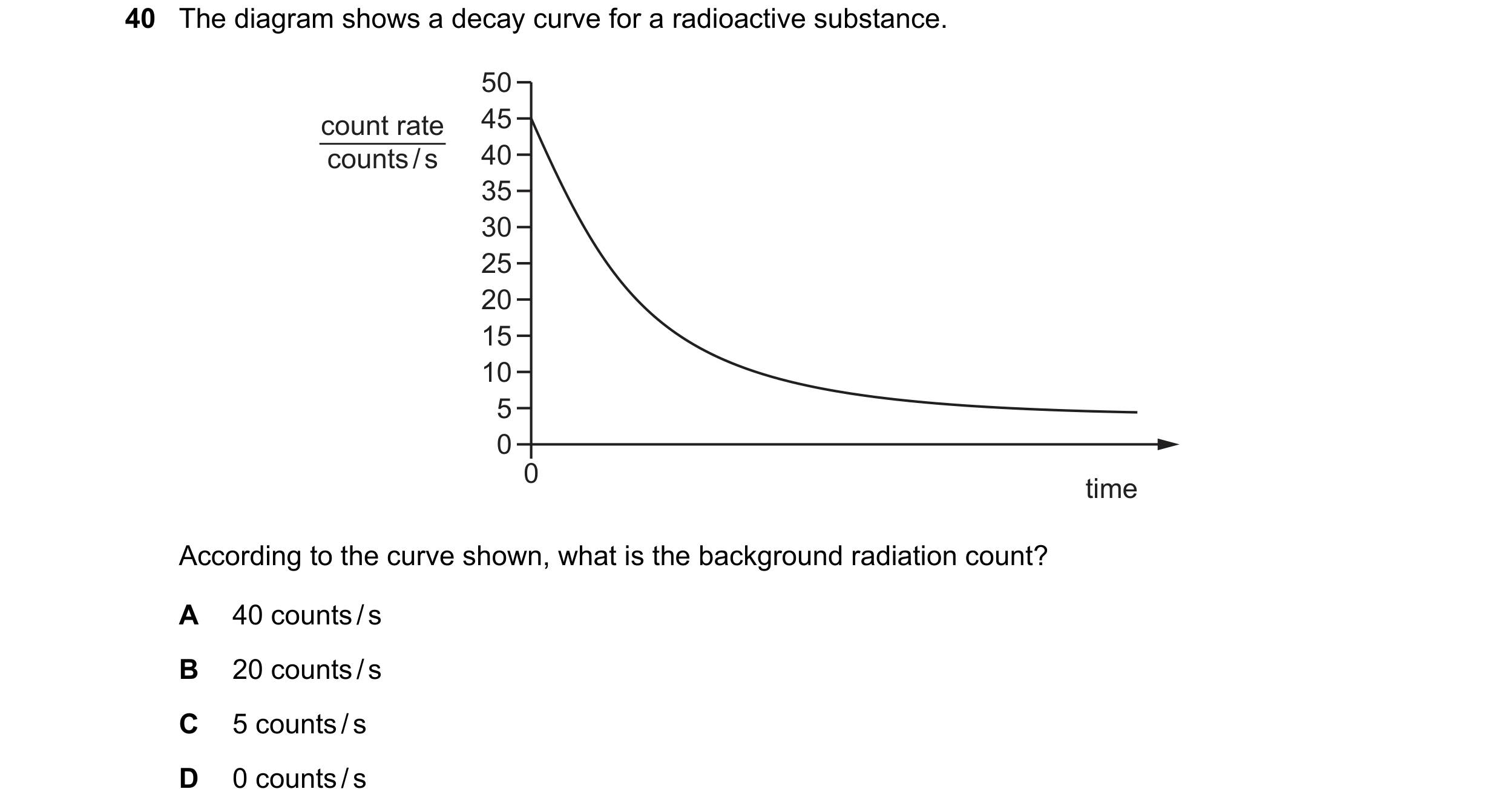
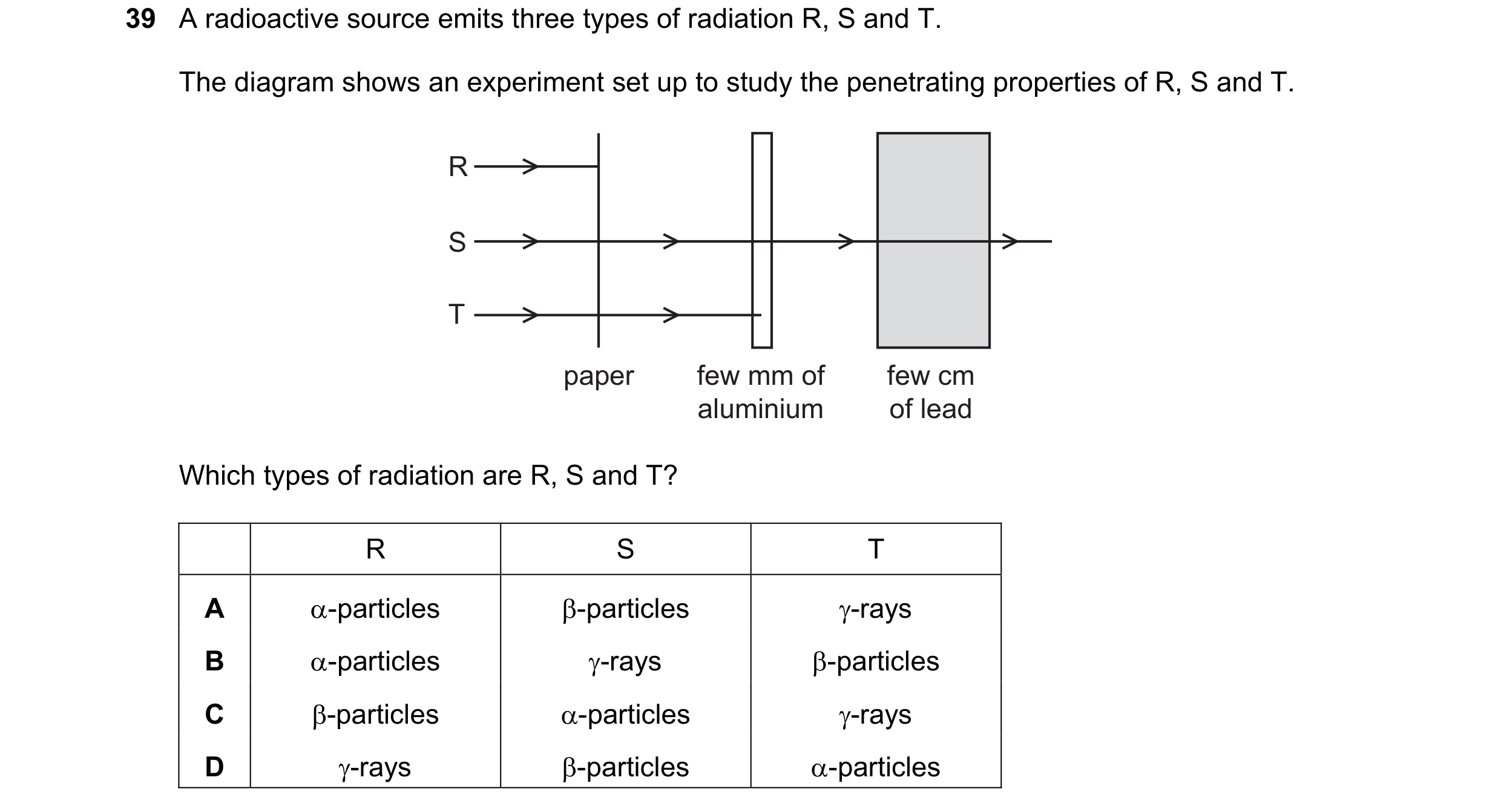
 33 / 68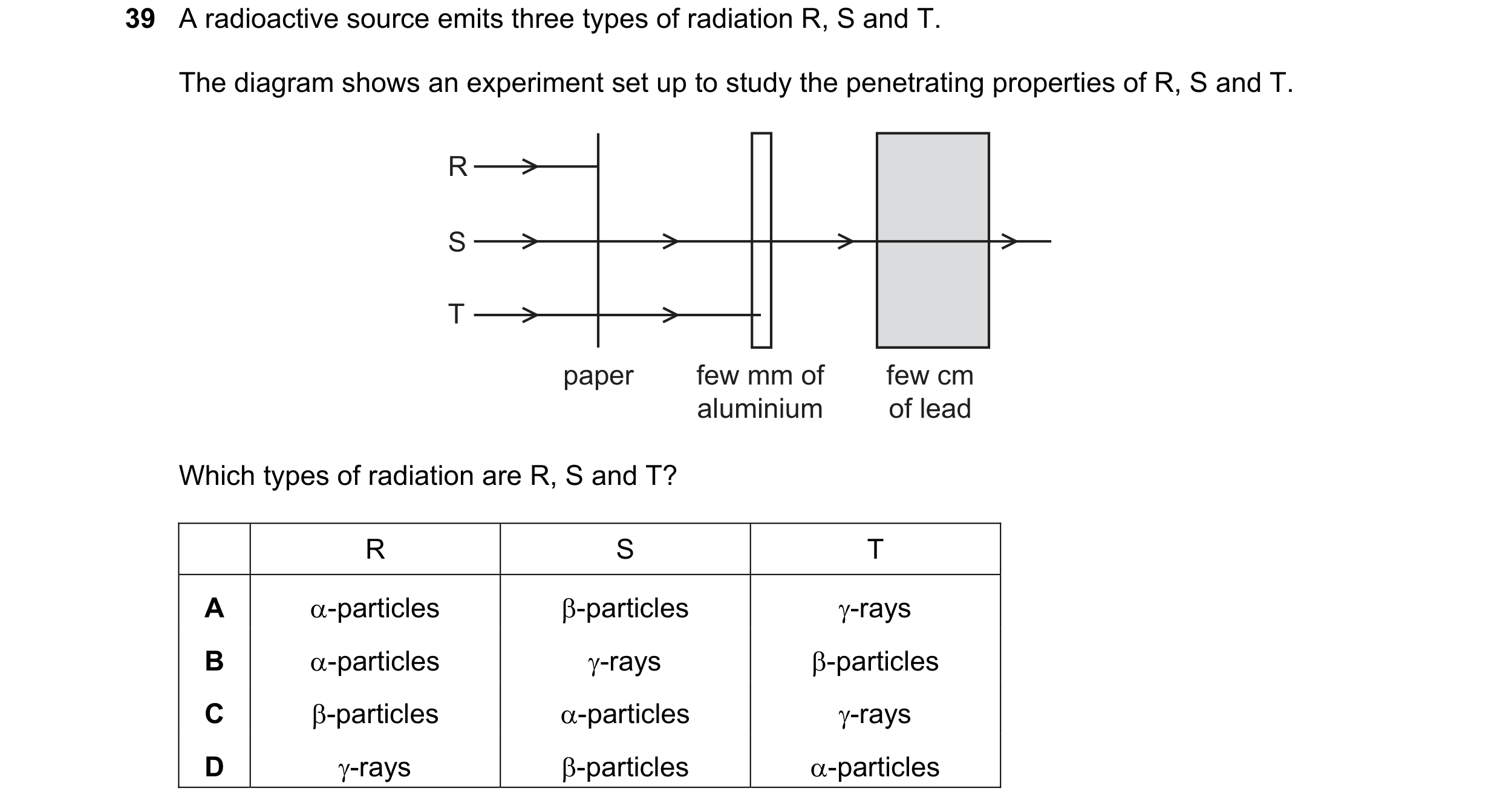
 34 / 68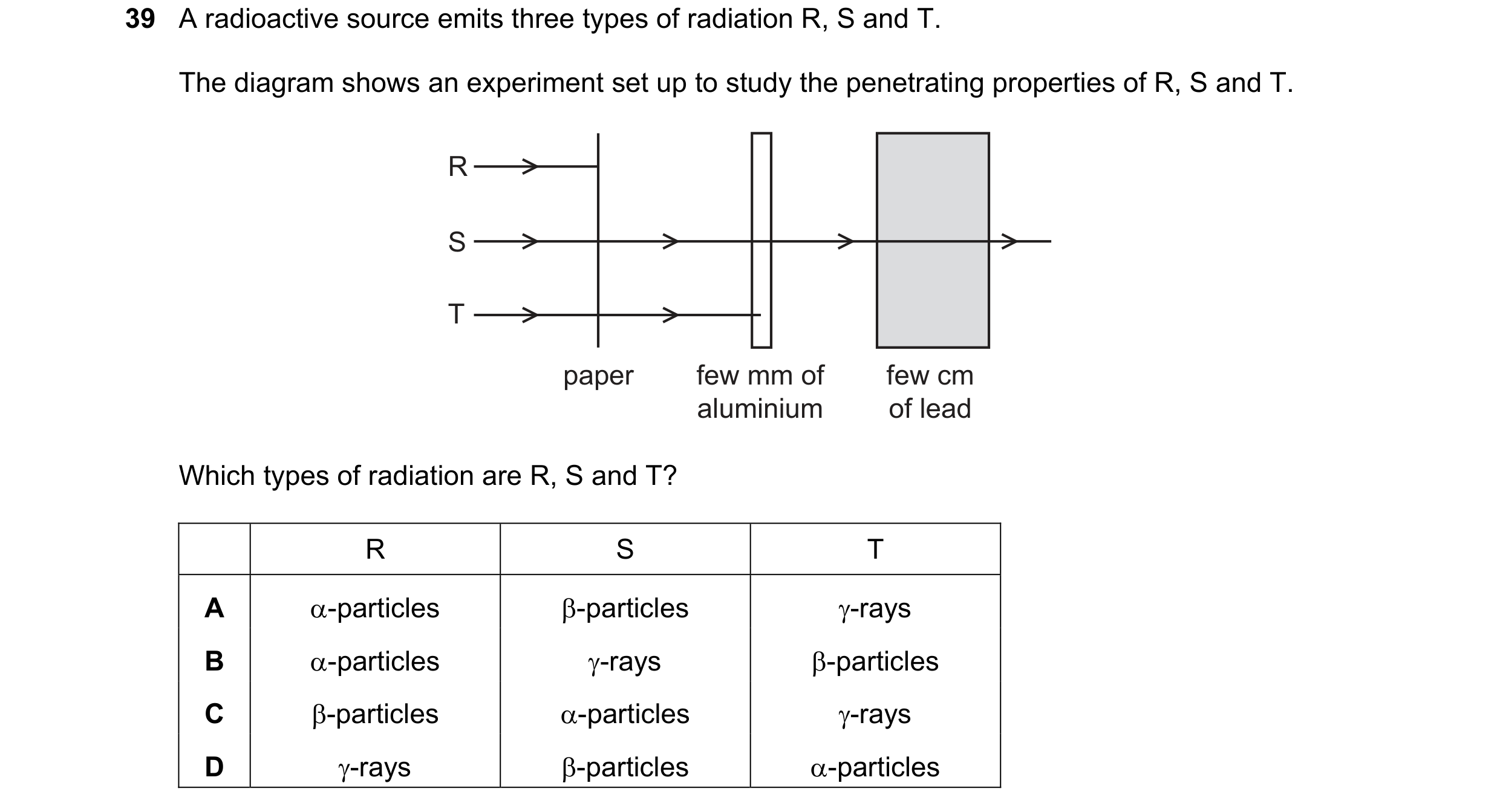

 35 / 68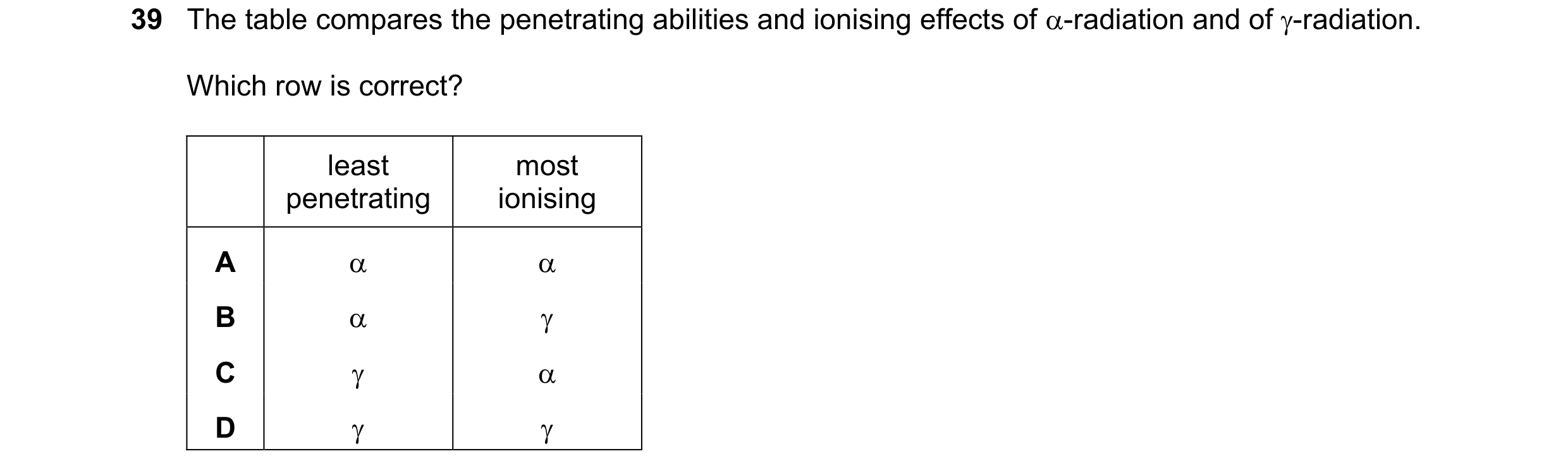
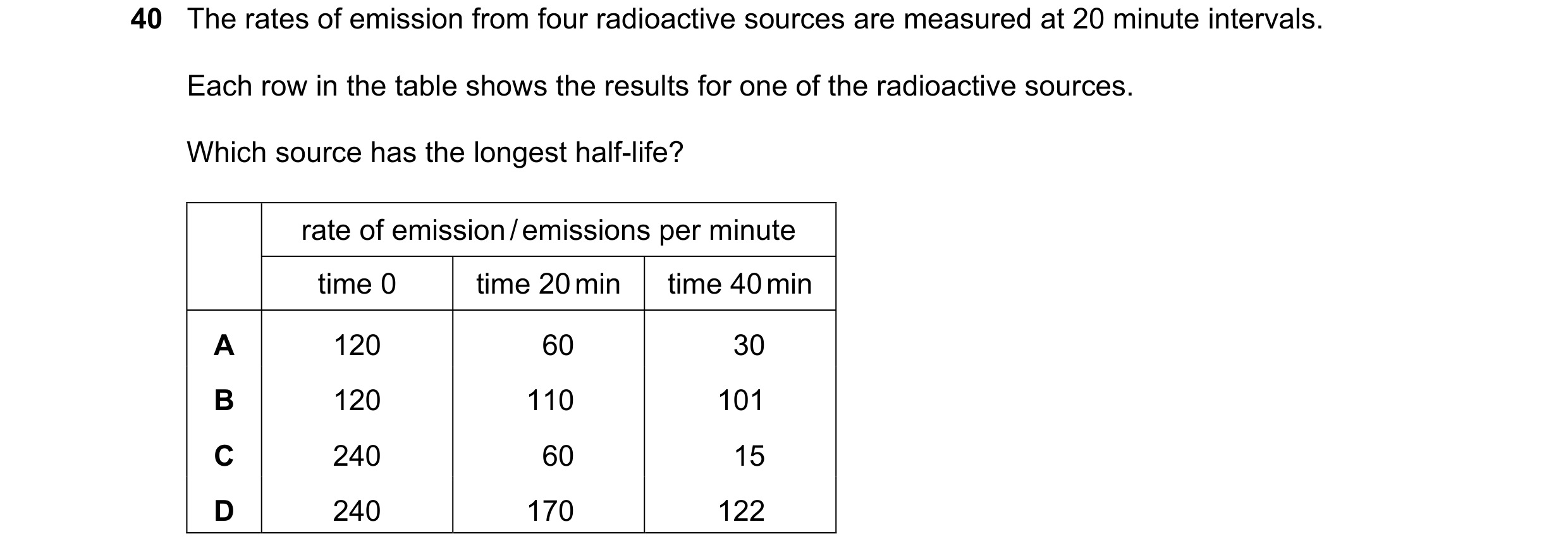 36 / 68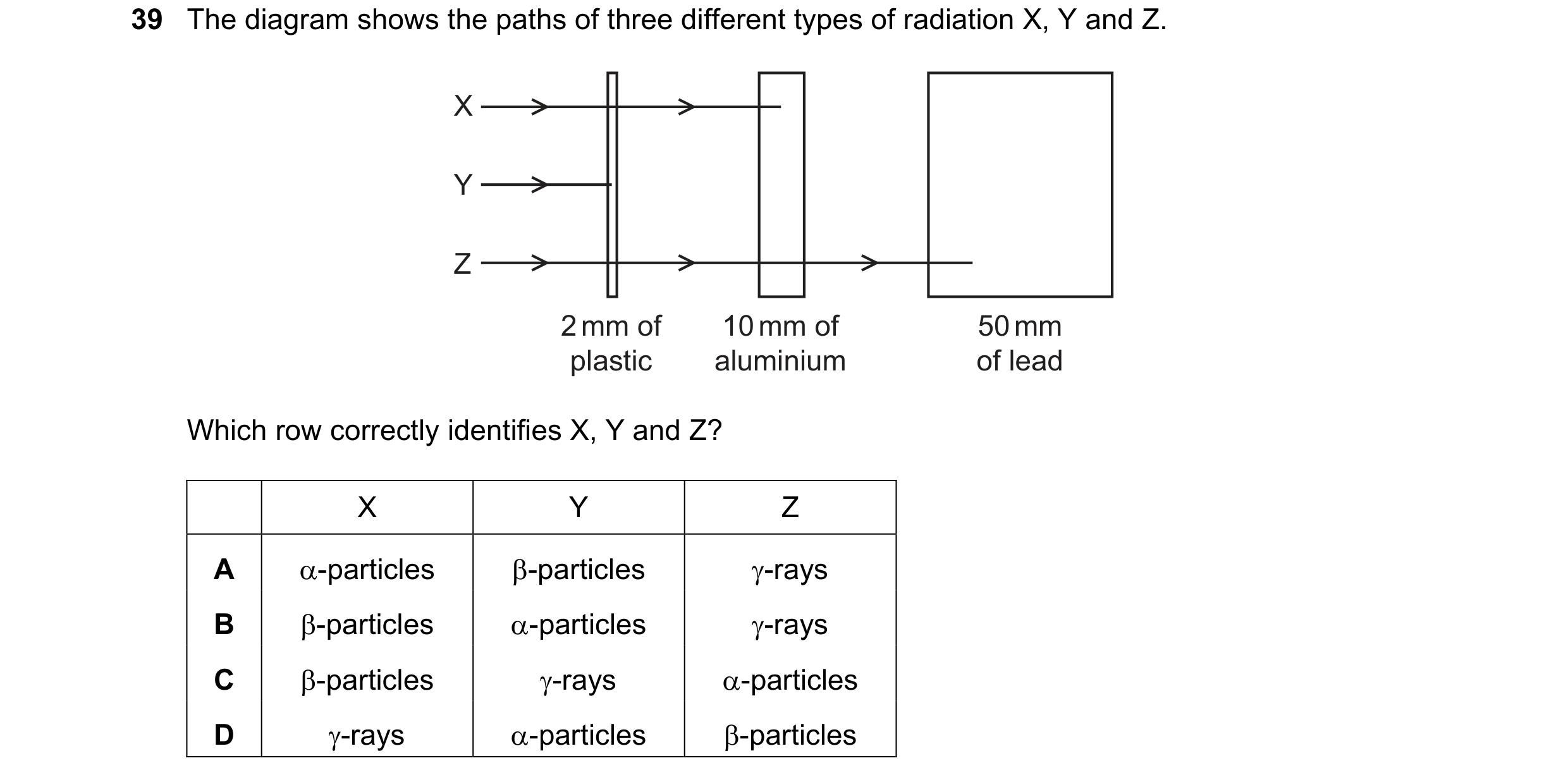

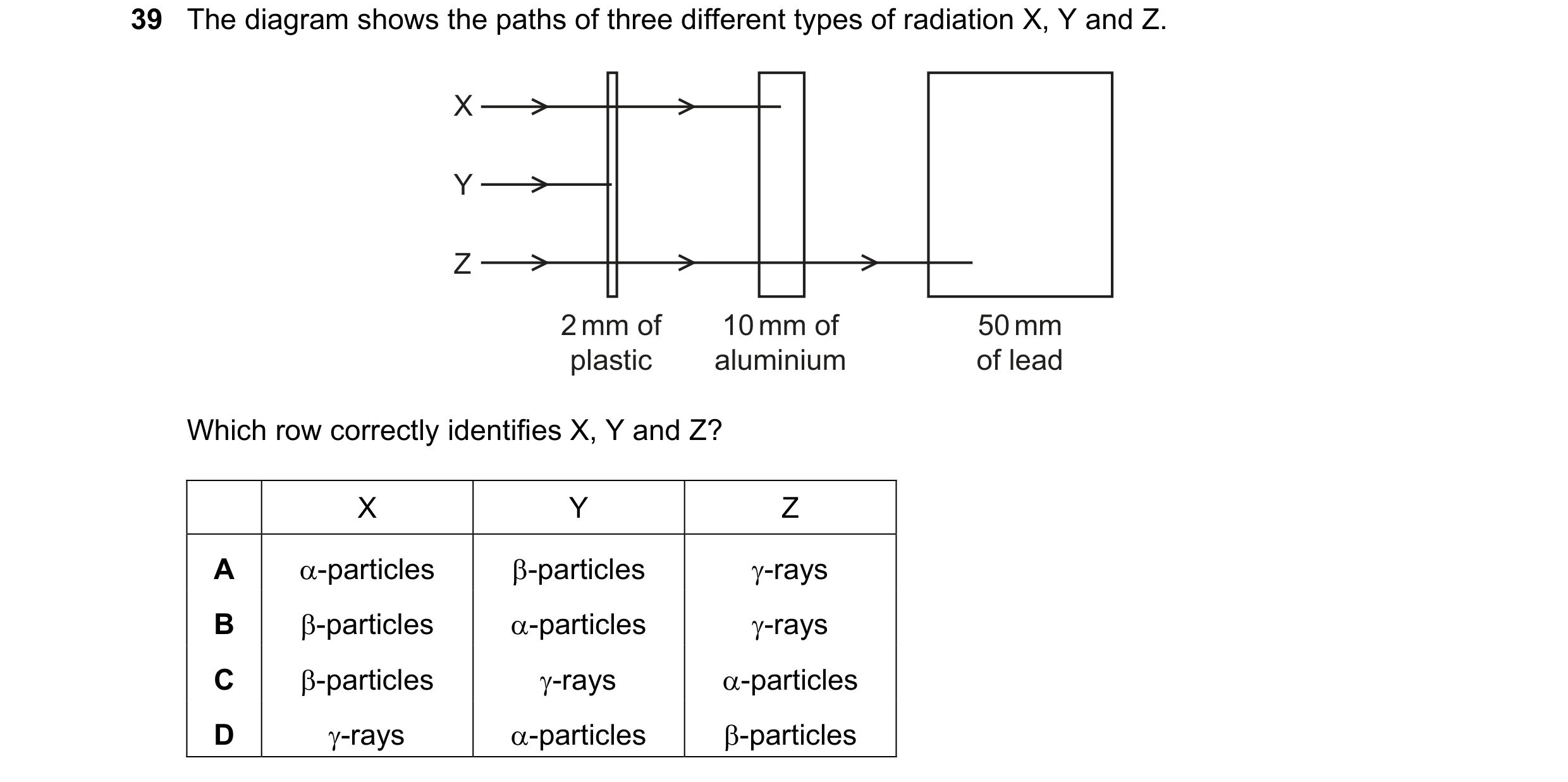 37 / 68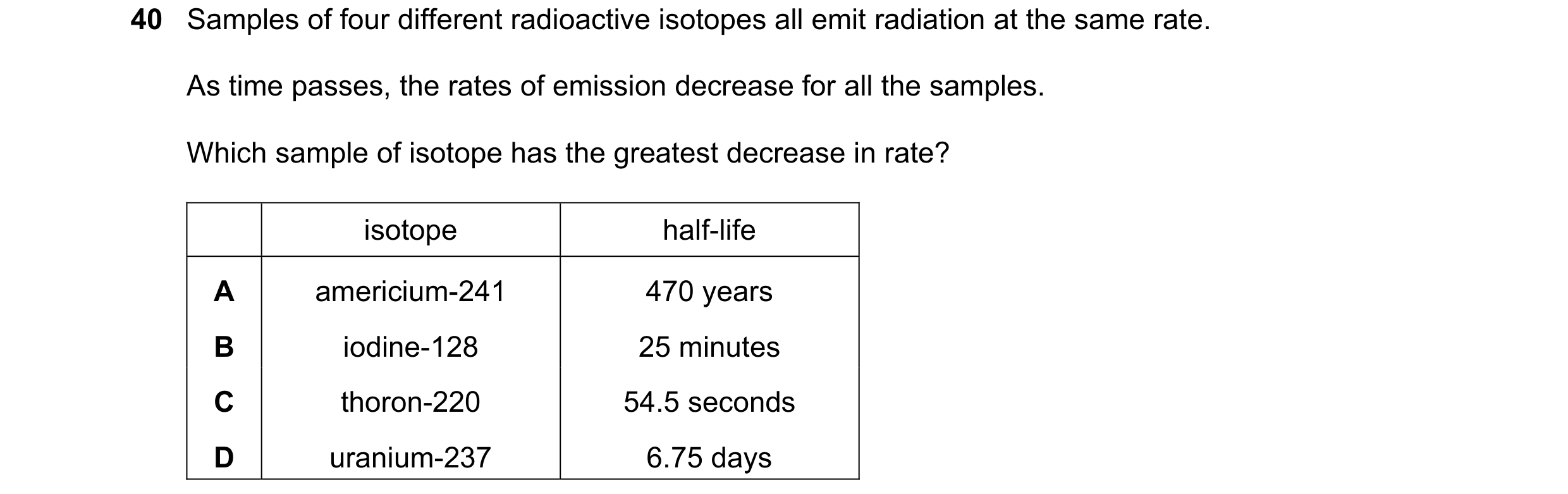
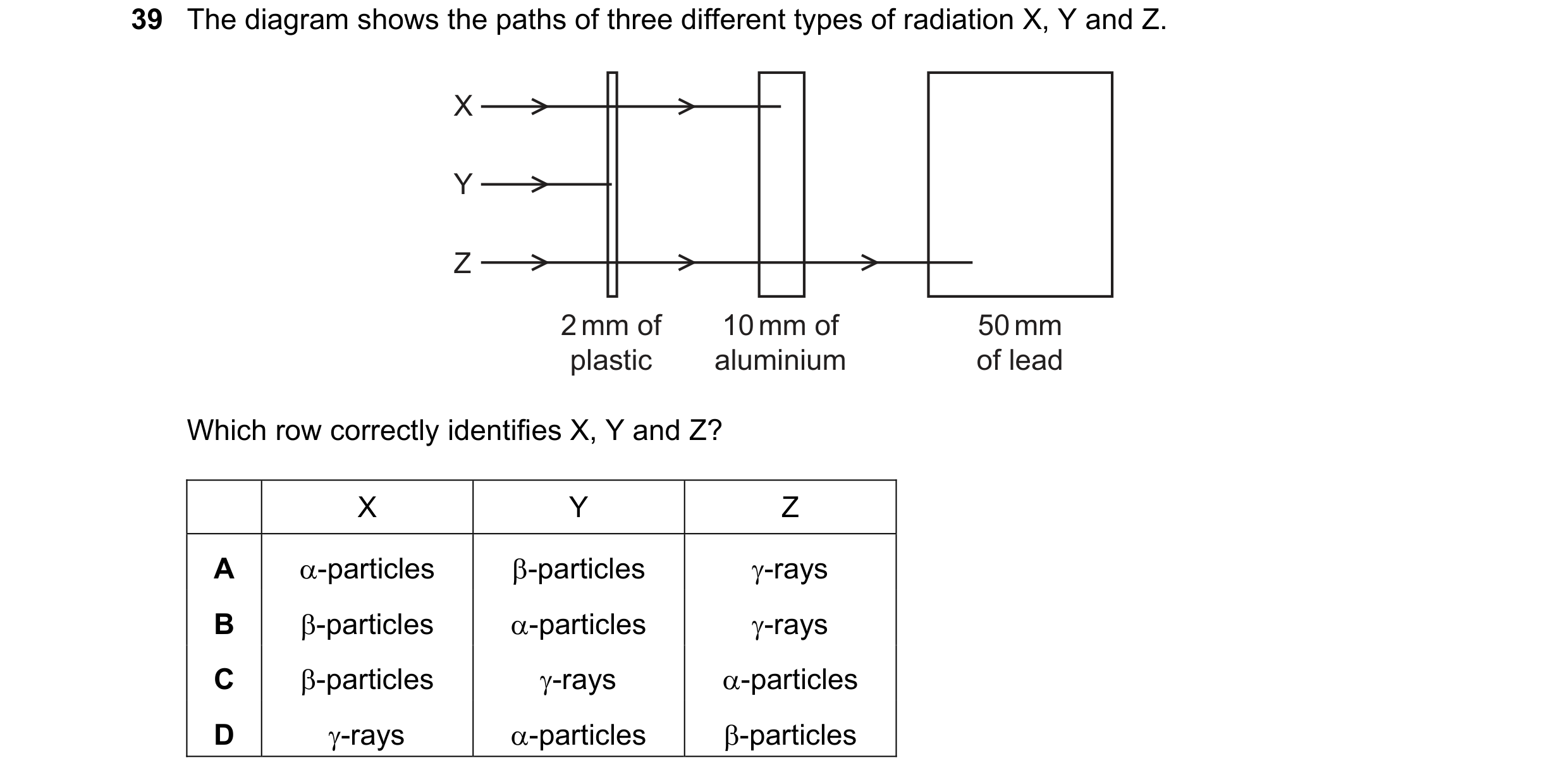
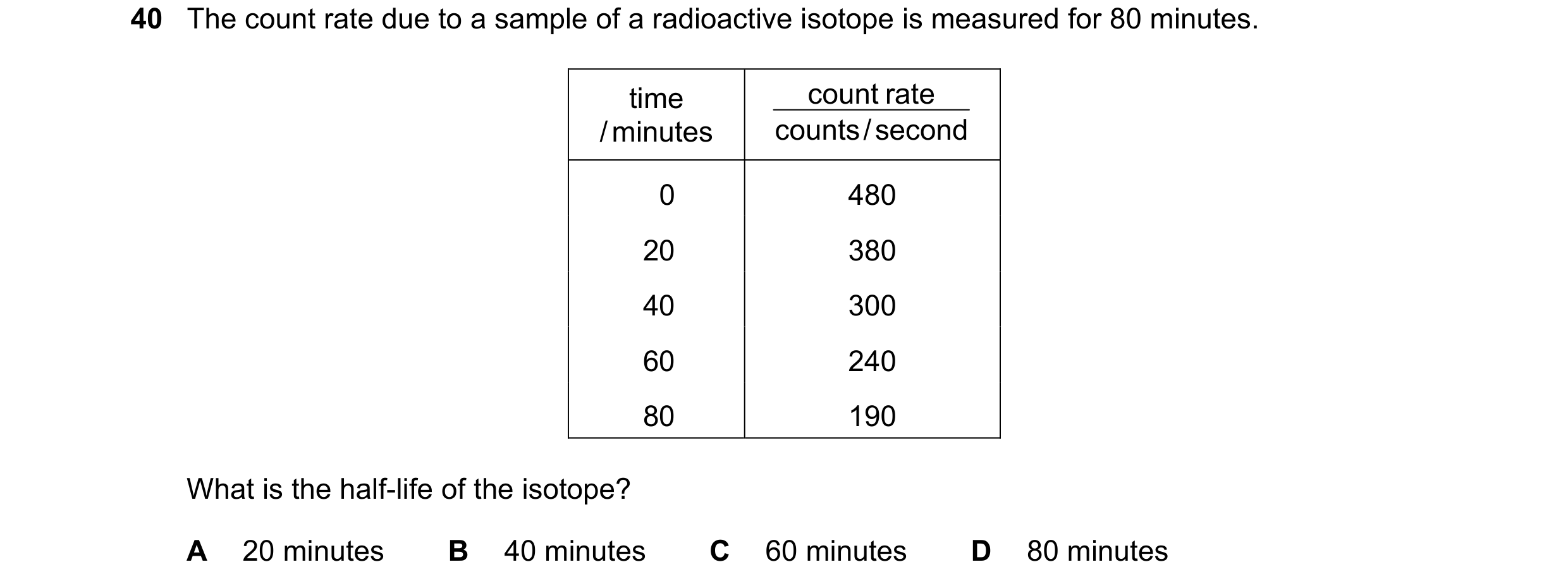 38 / 68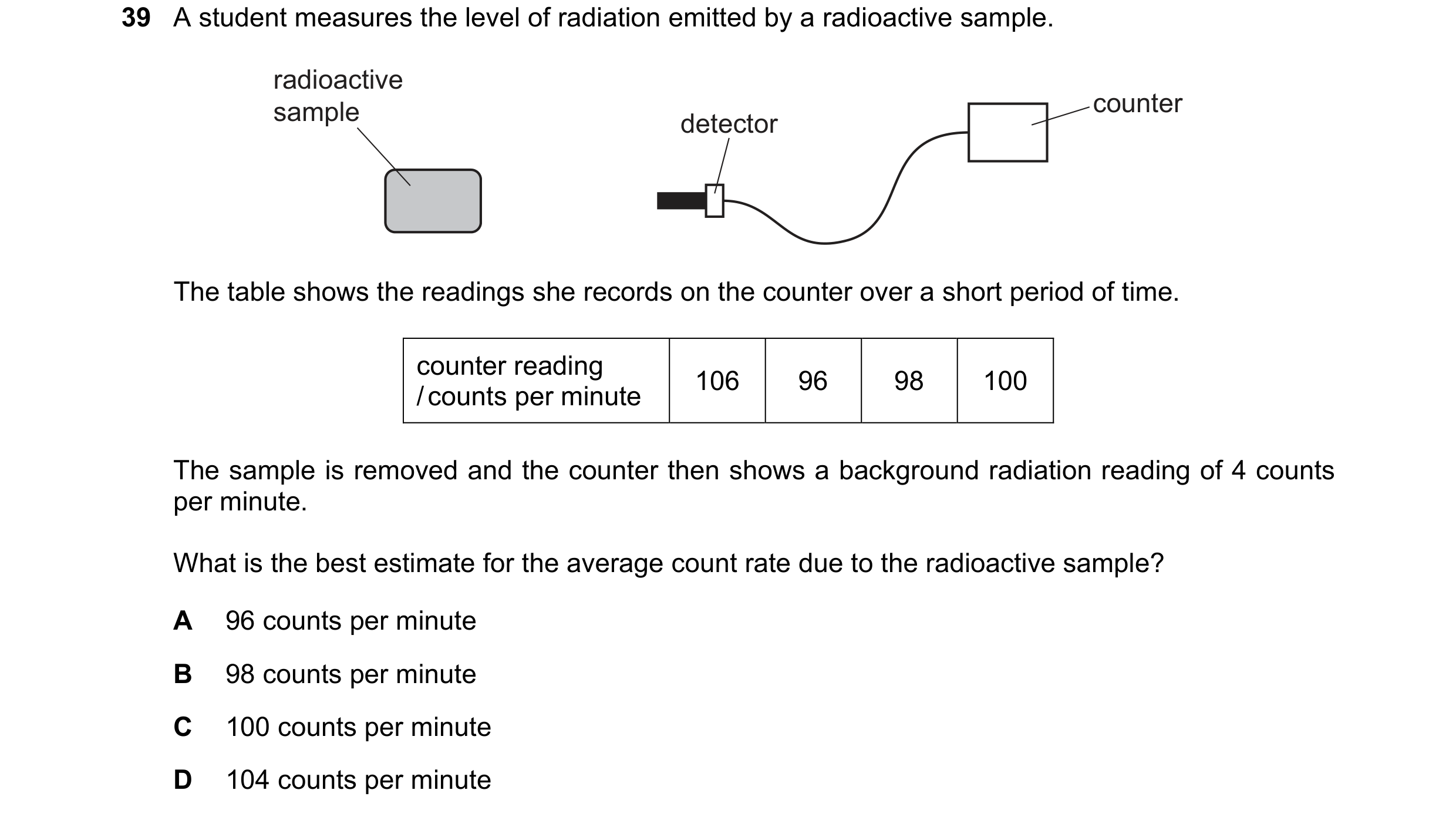
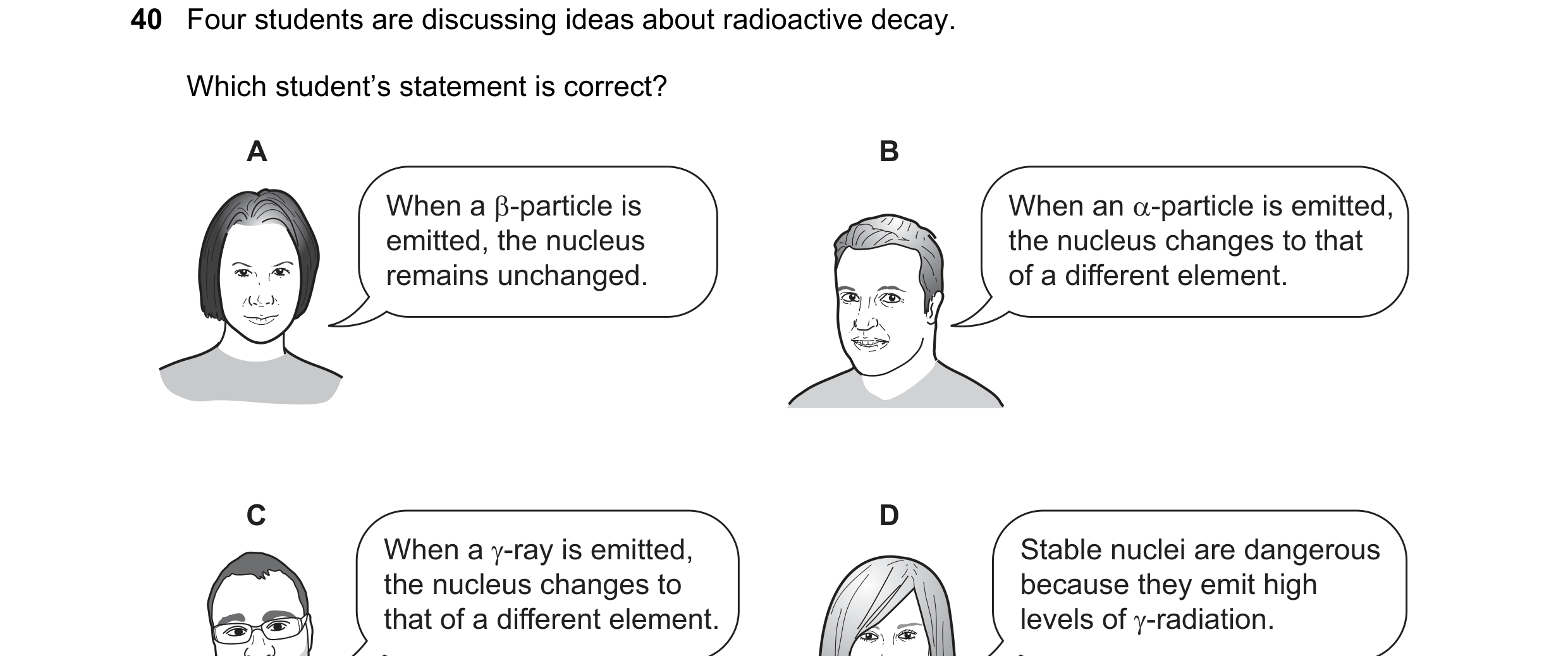 39 / 68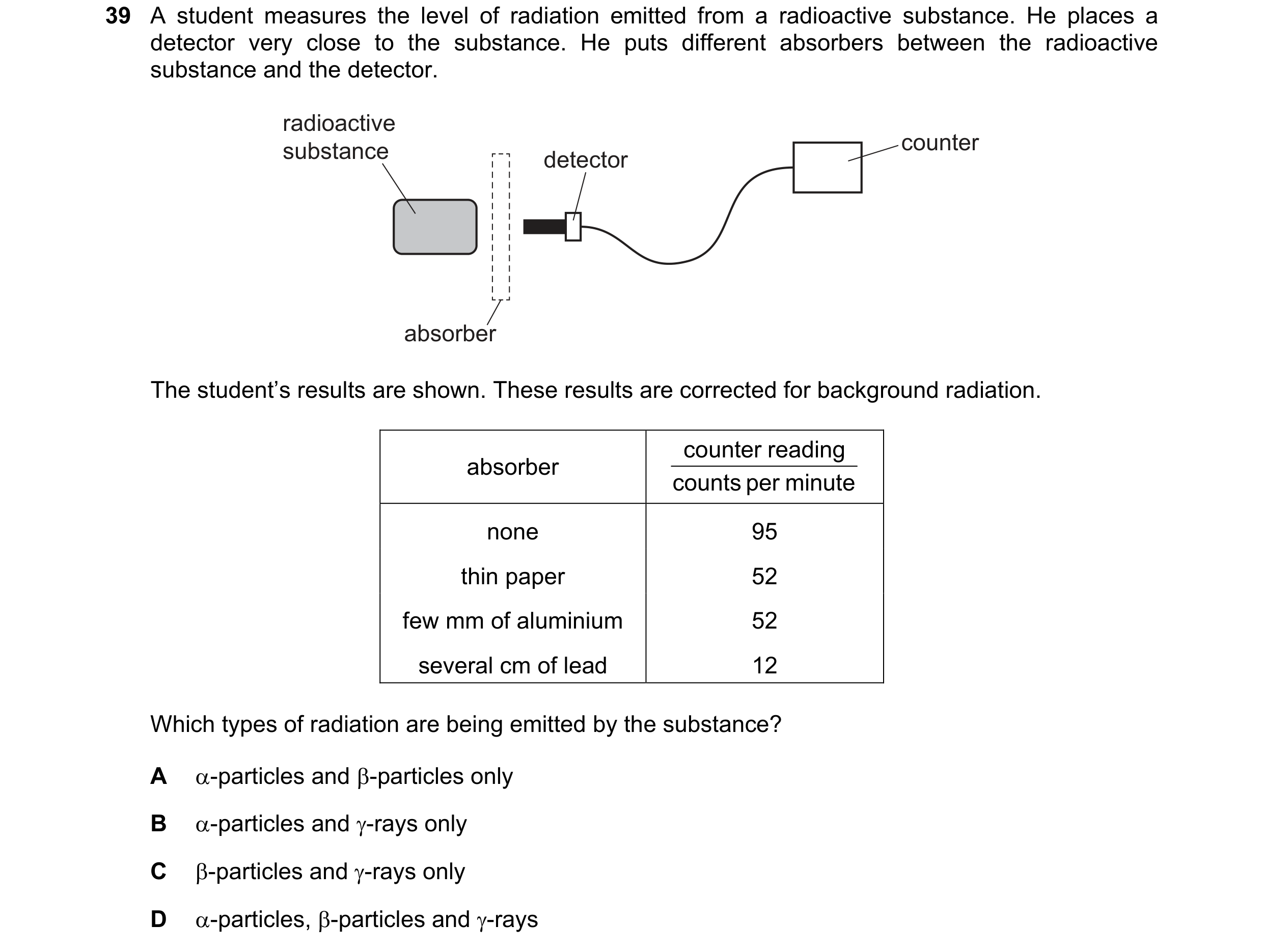
 40 / 68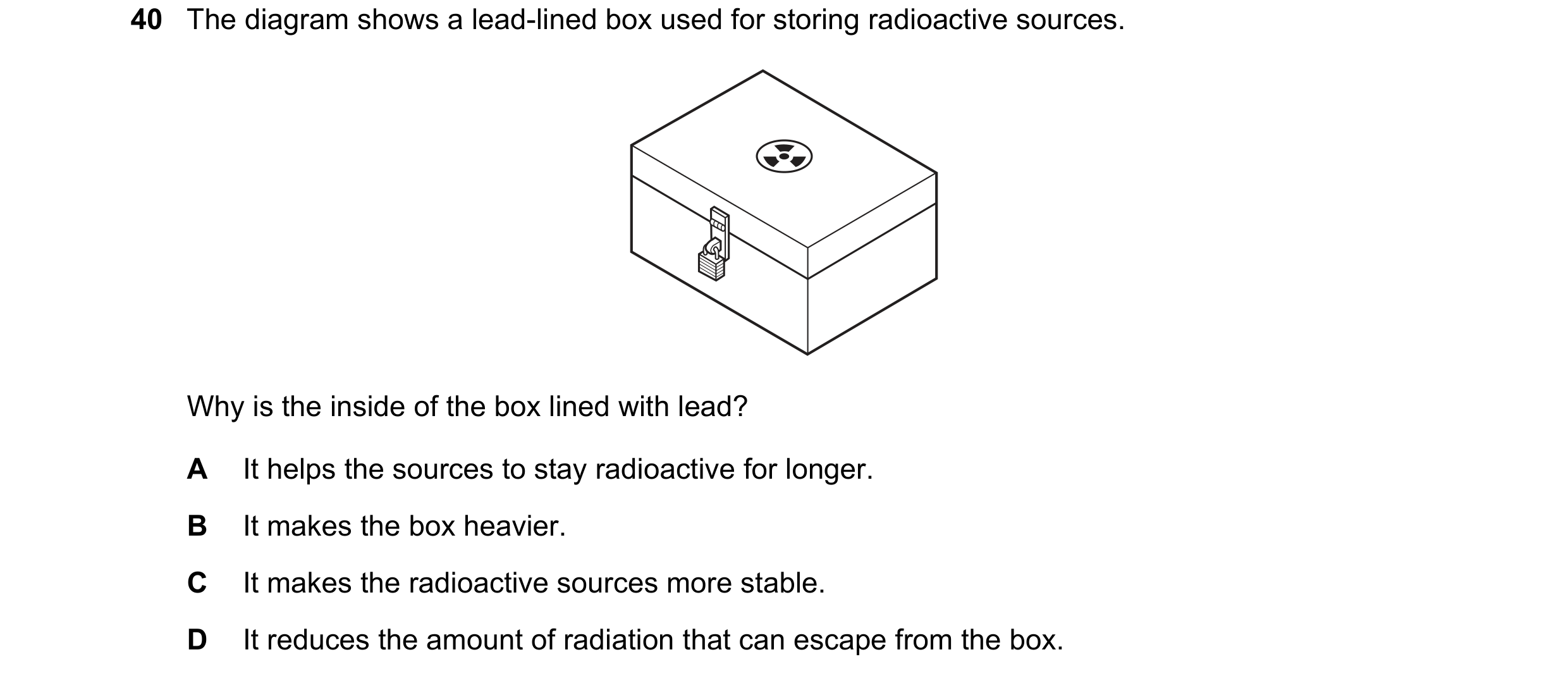

 41 / 68


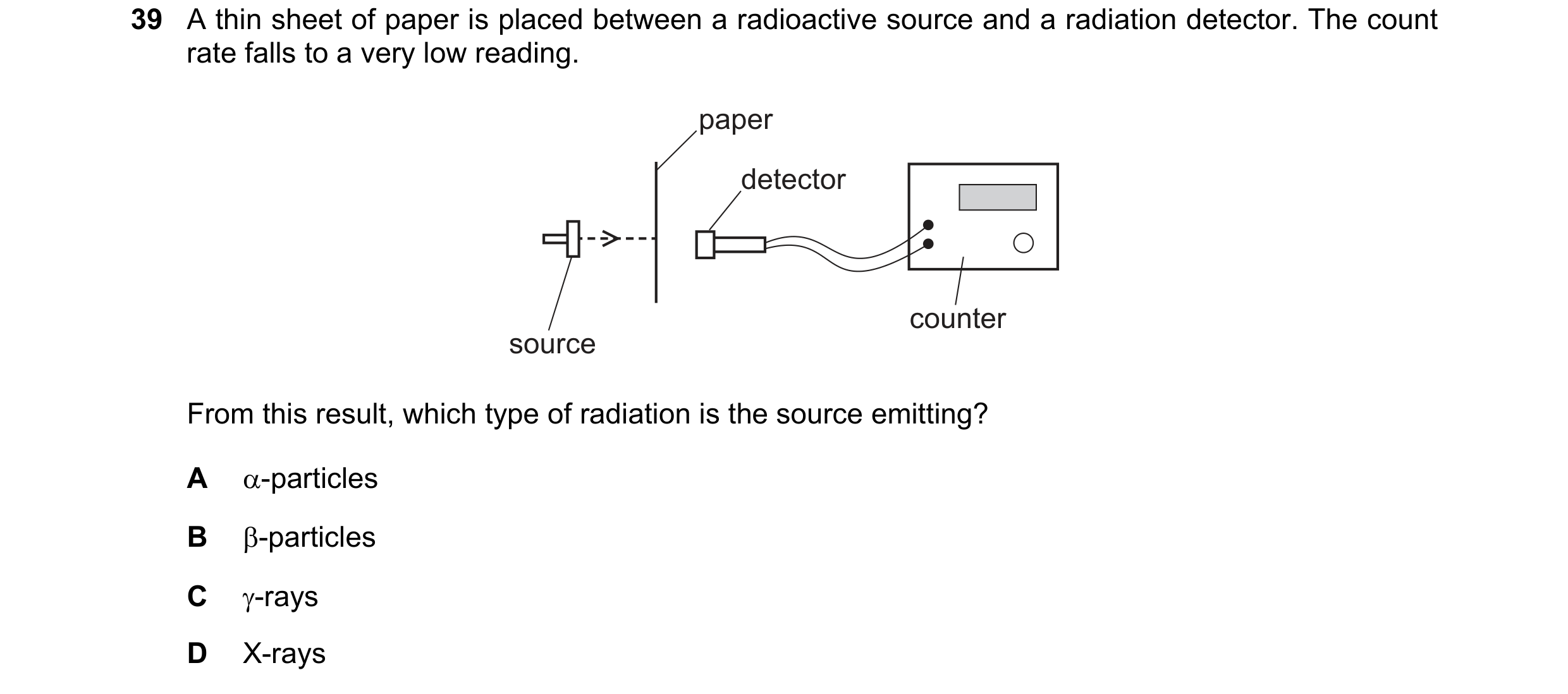 42 / 68
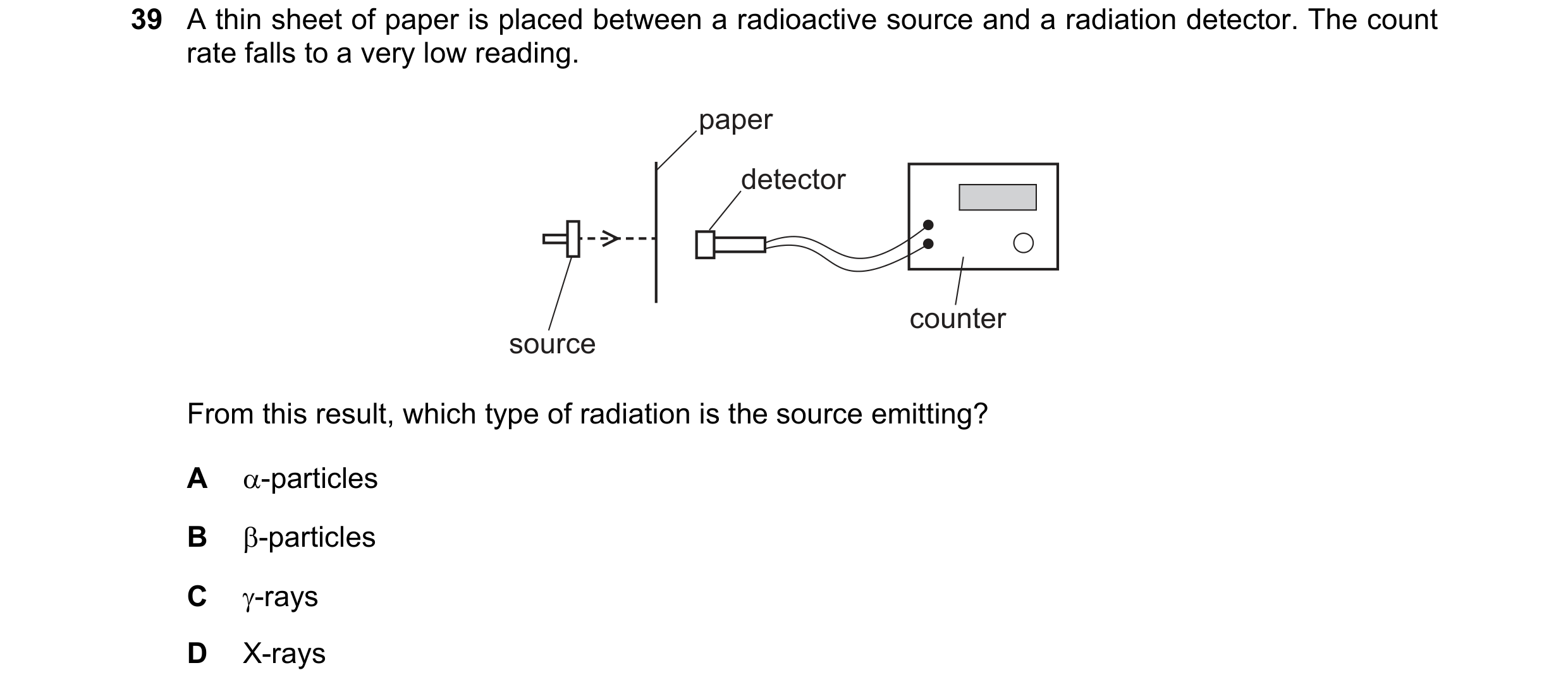
 43 / 68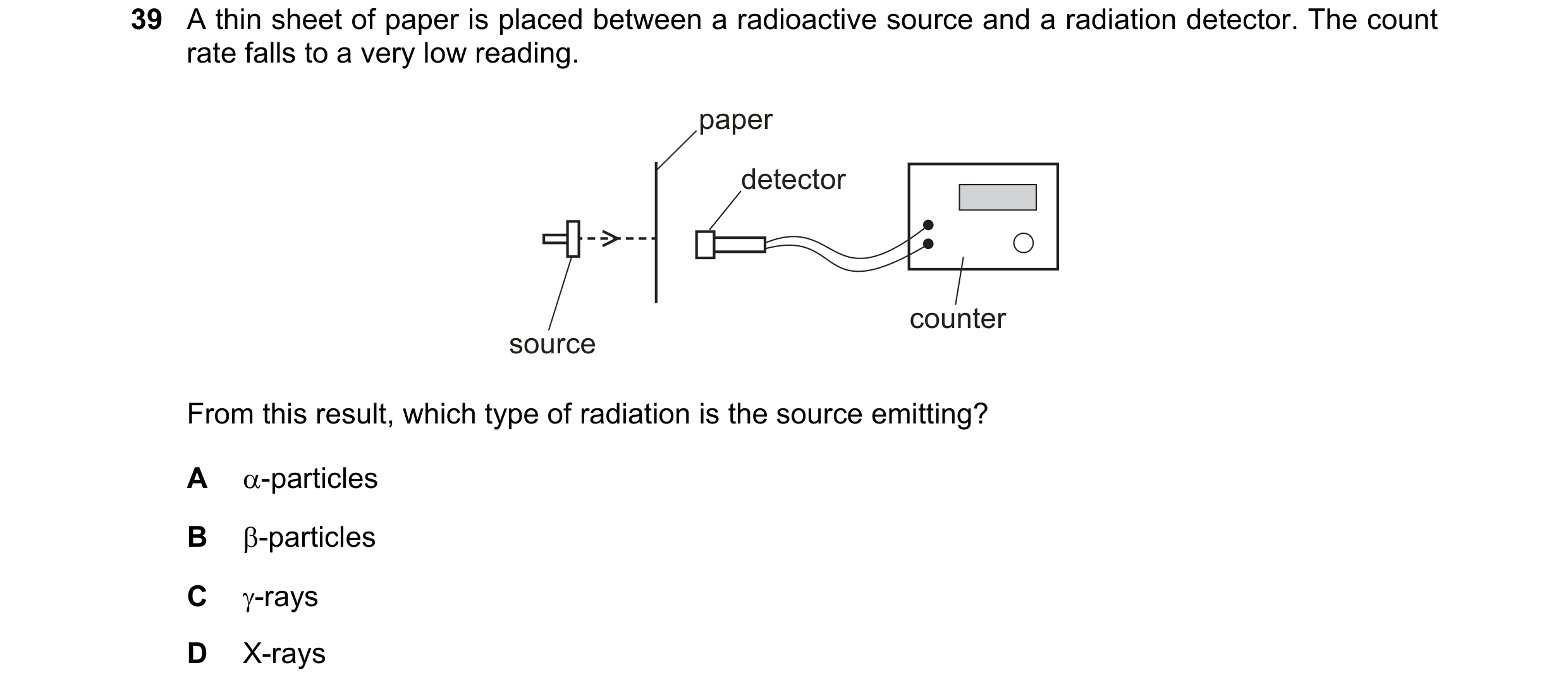

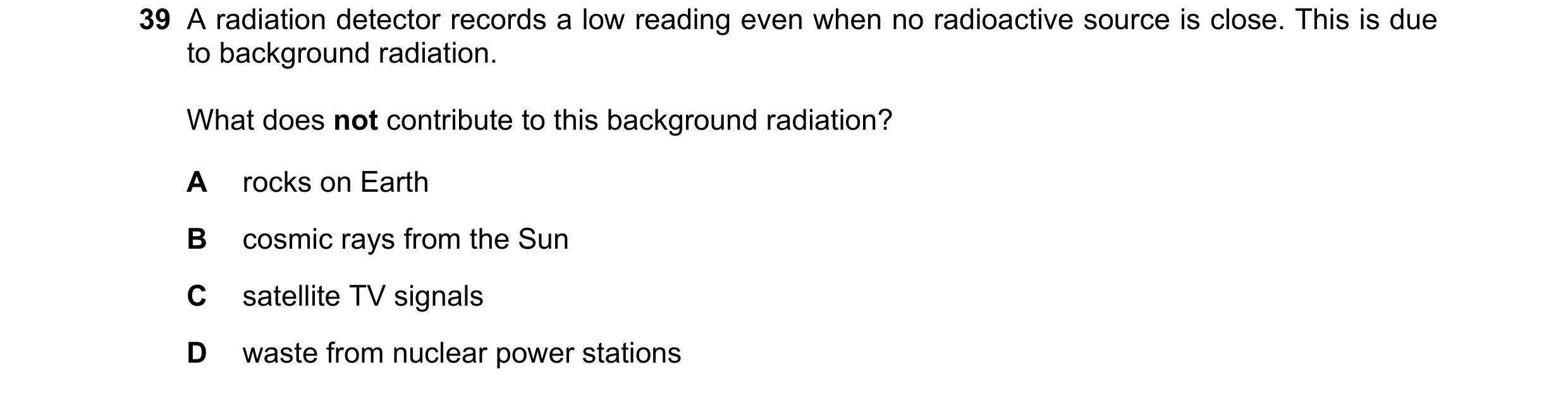
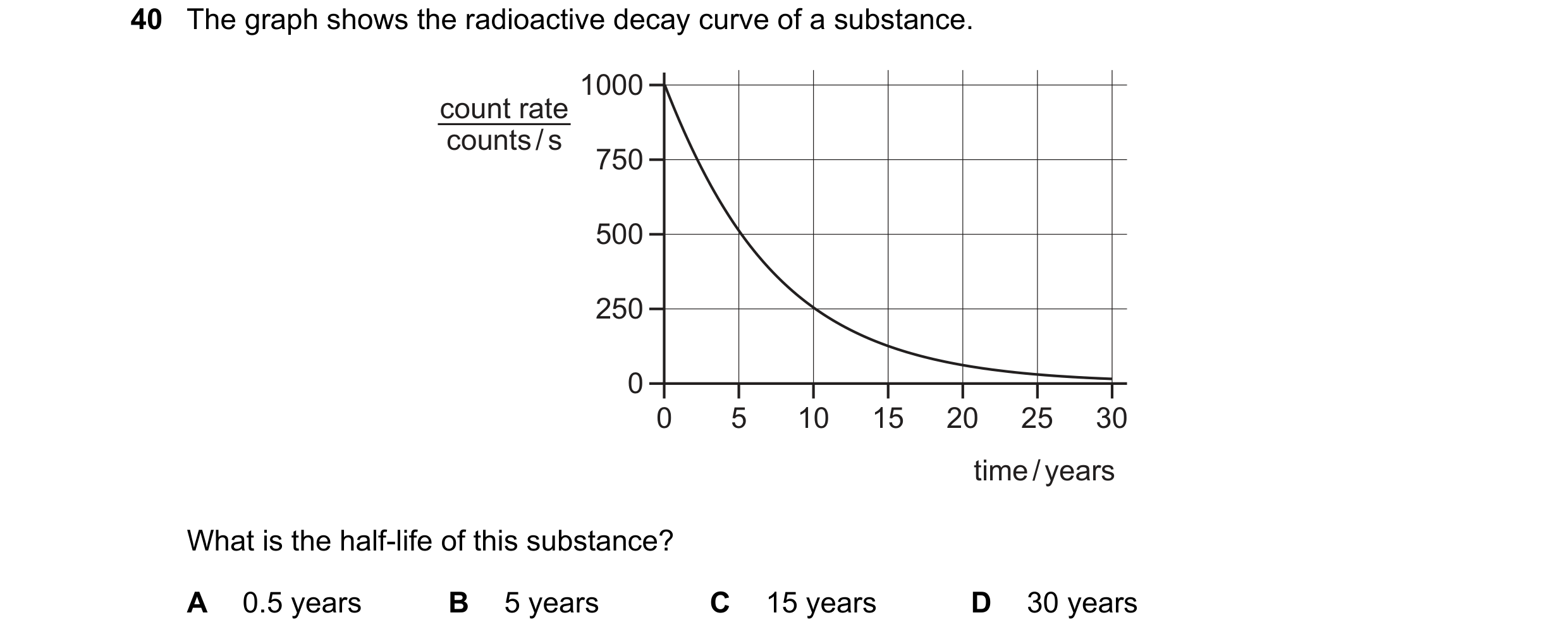 44 / 68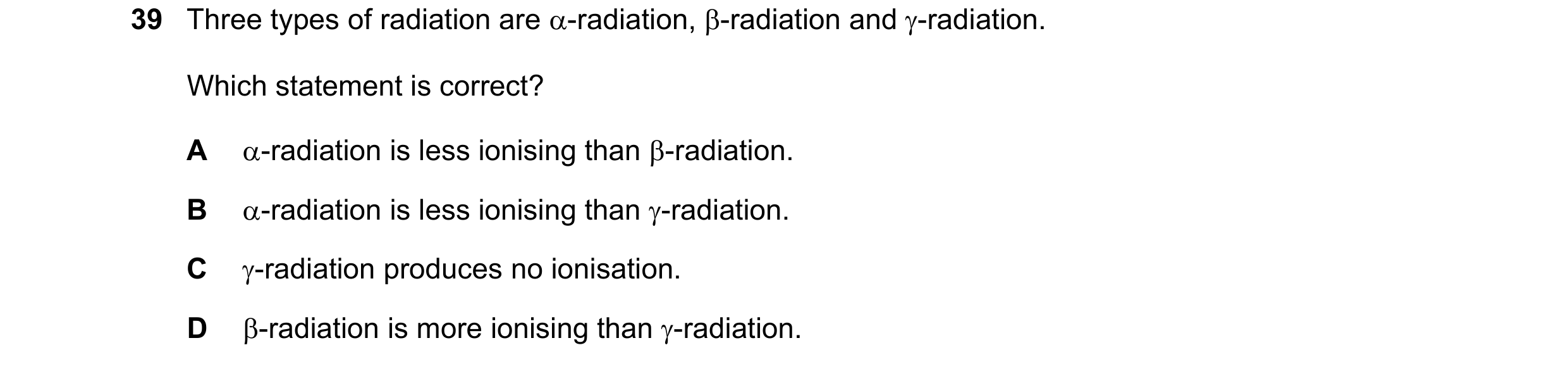
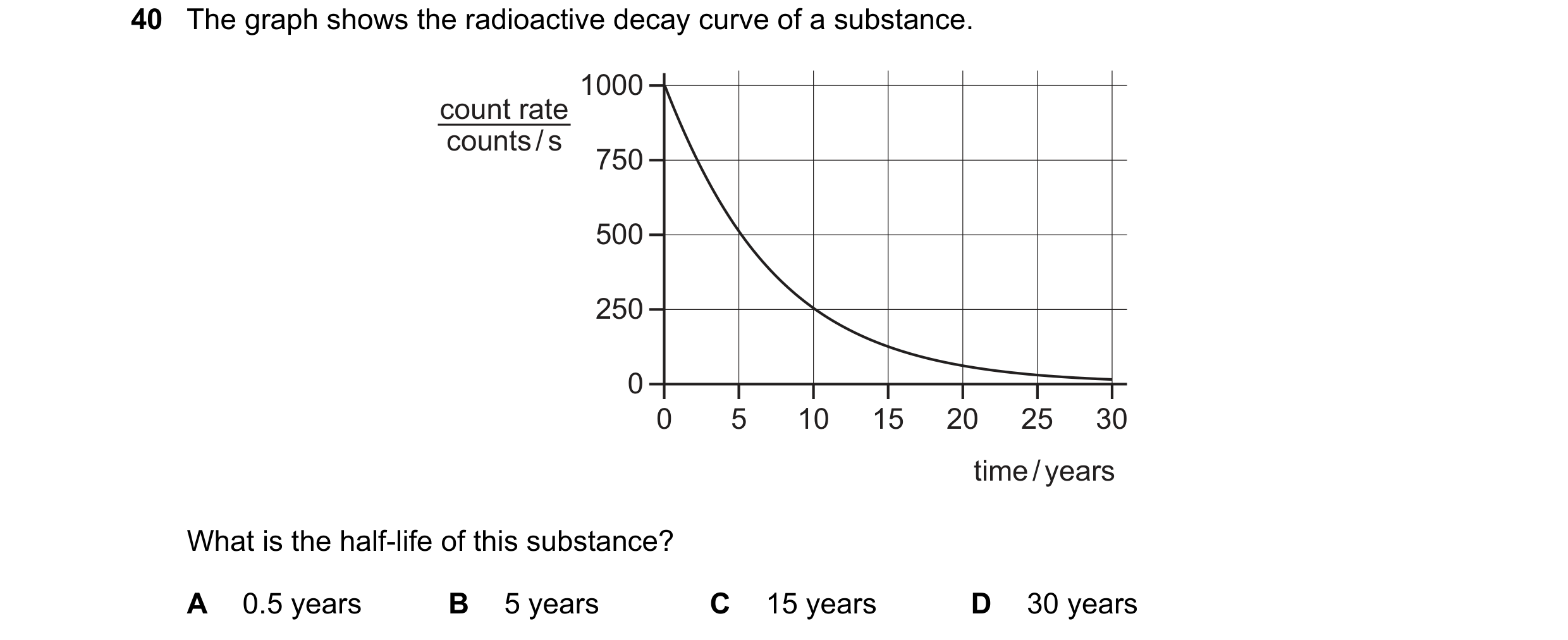
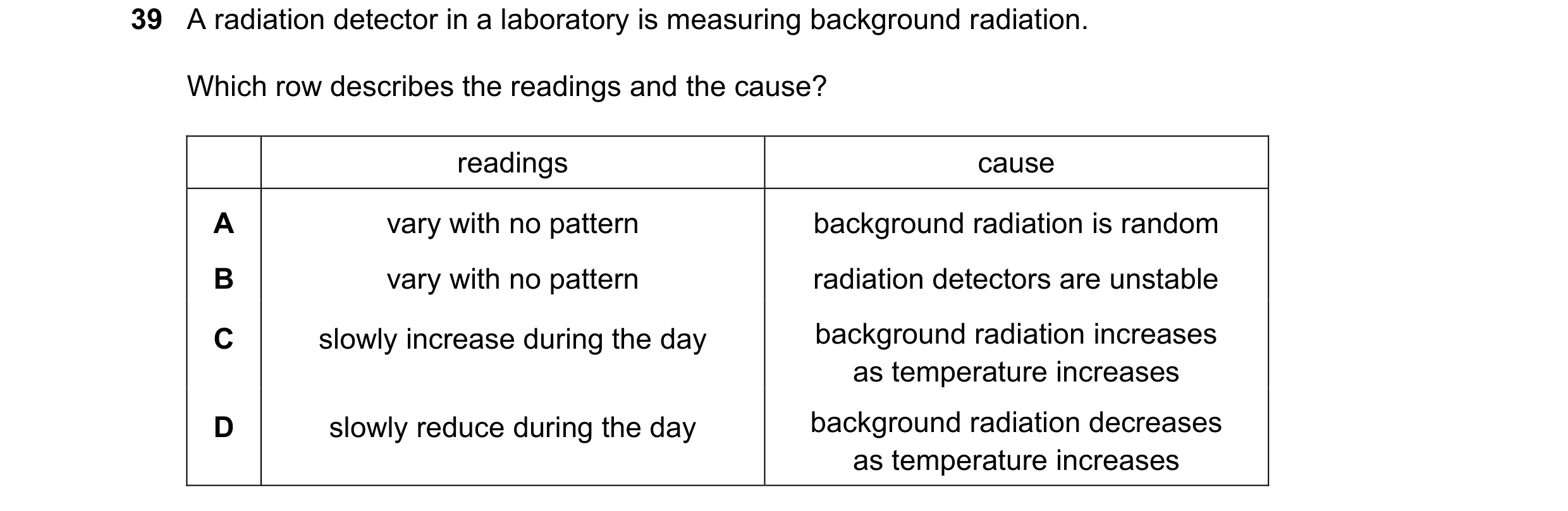 45 / 68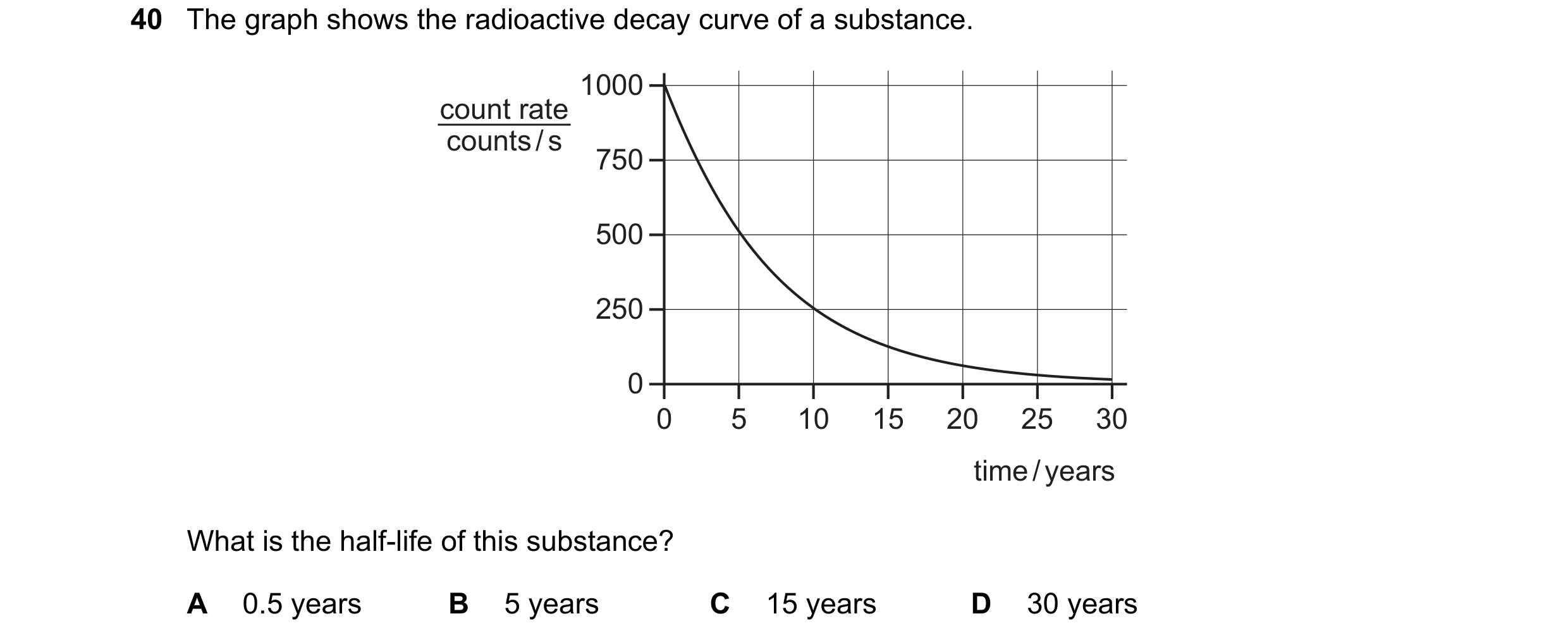
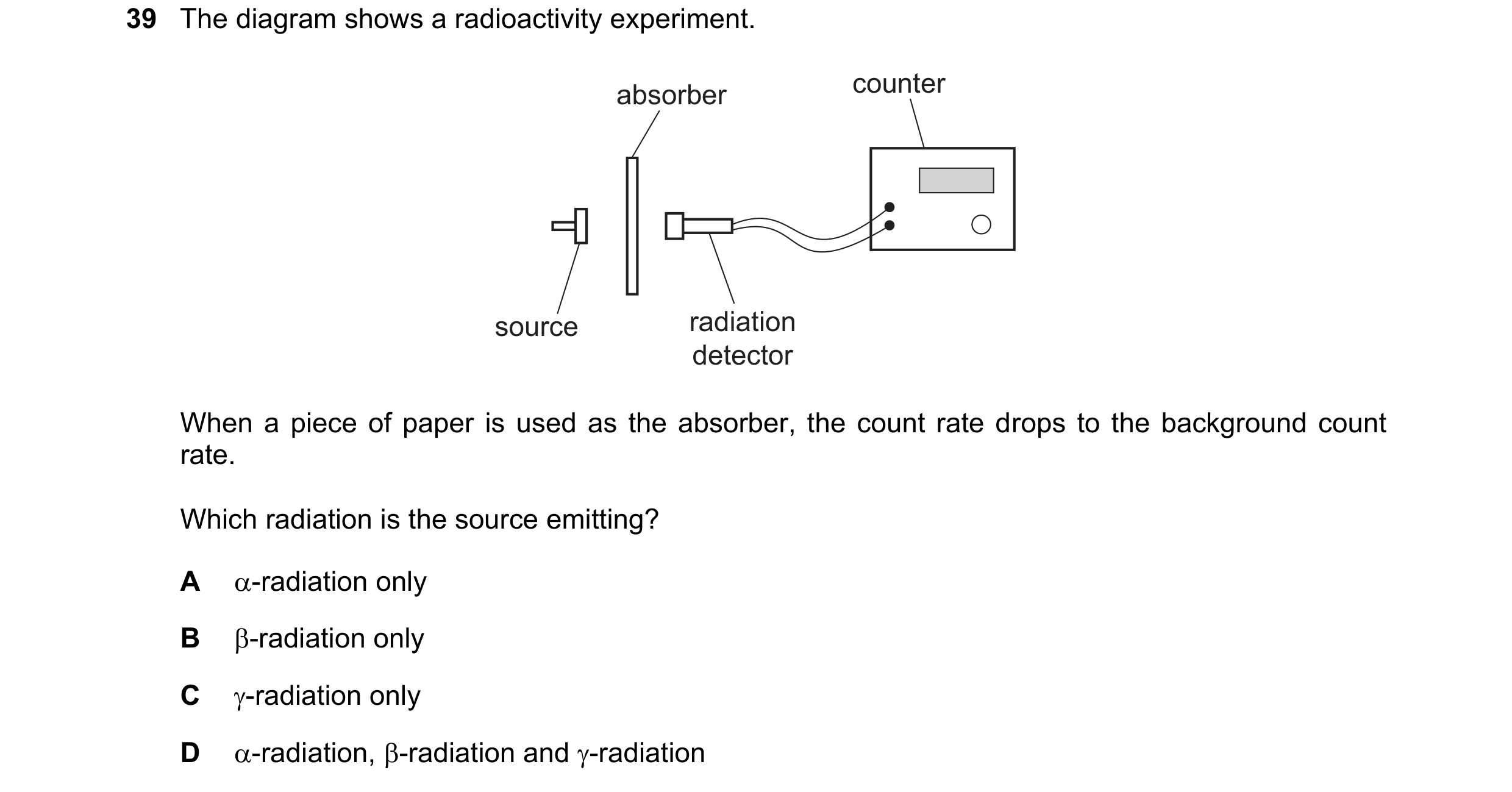 46 / 68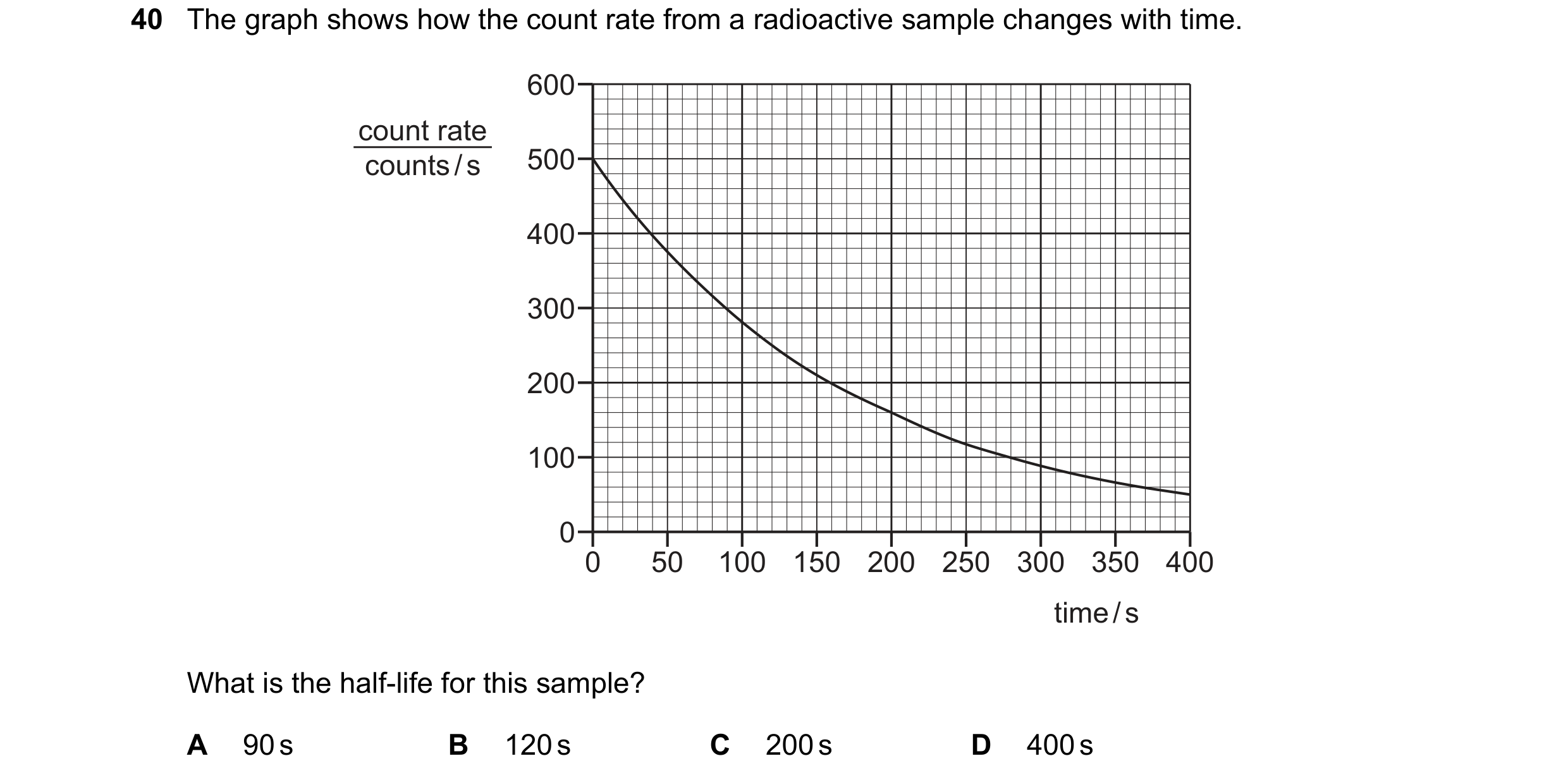
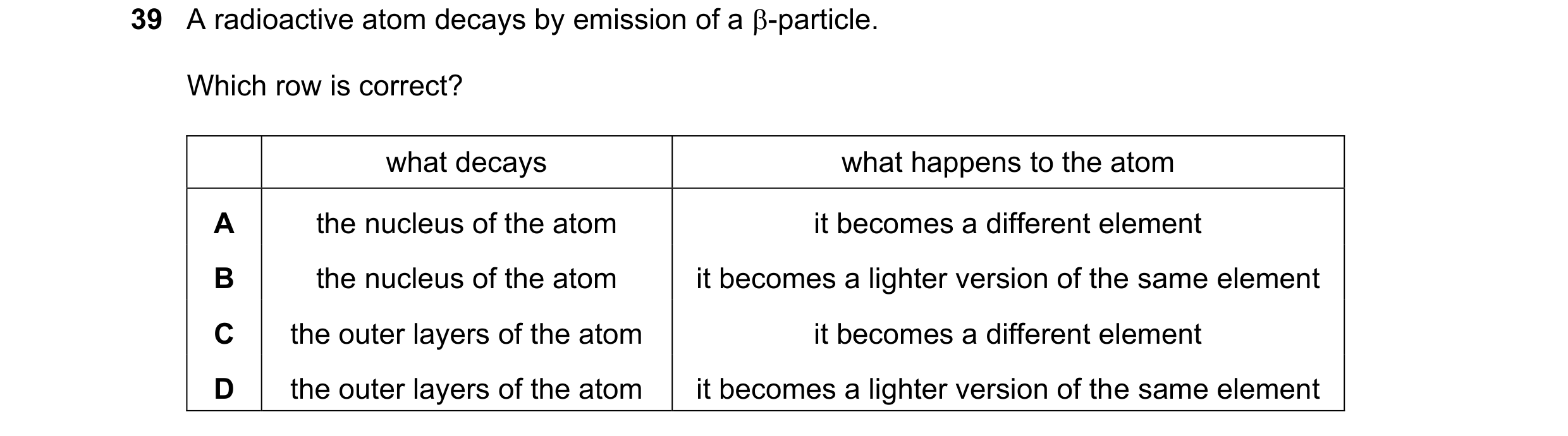
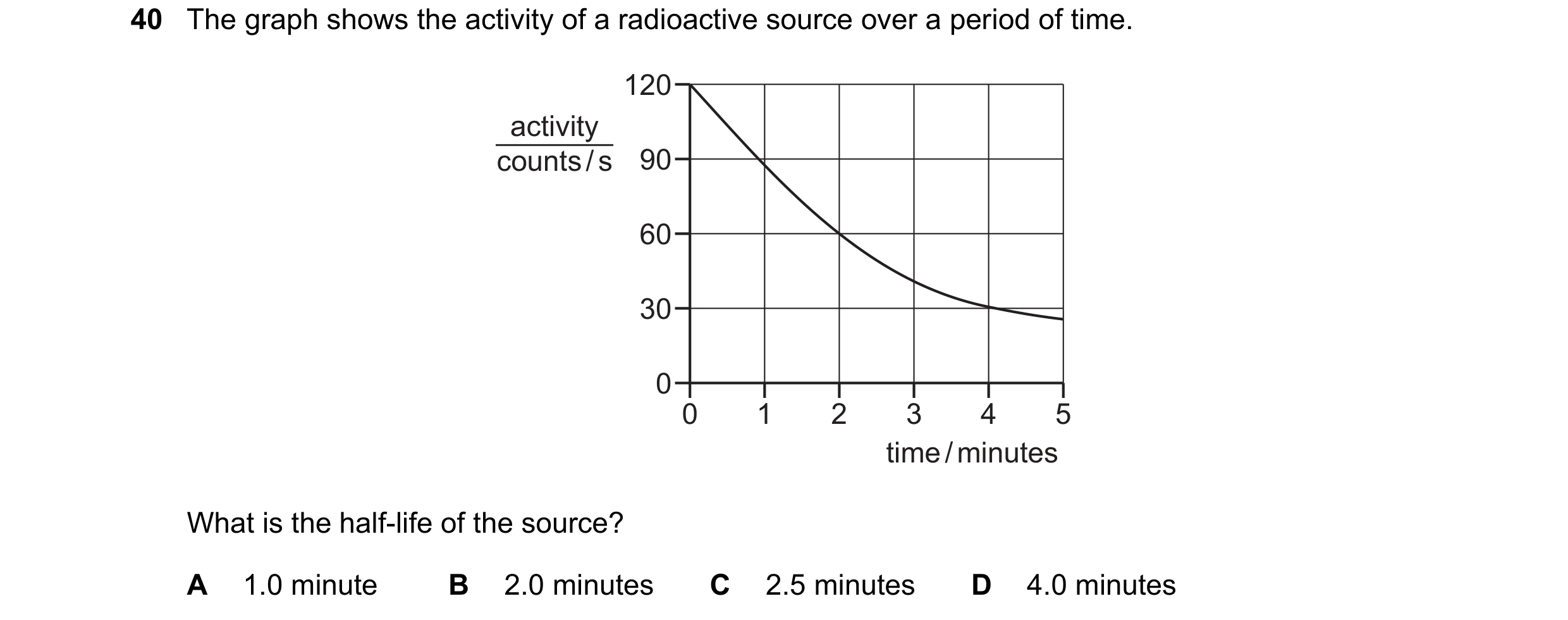 47 / 68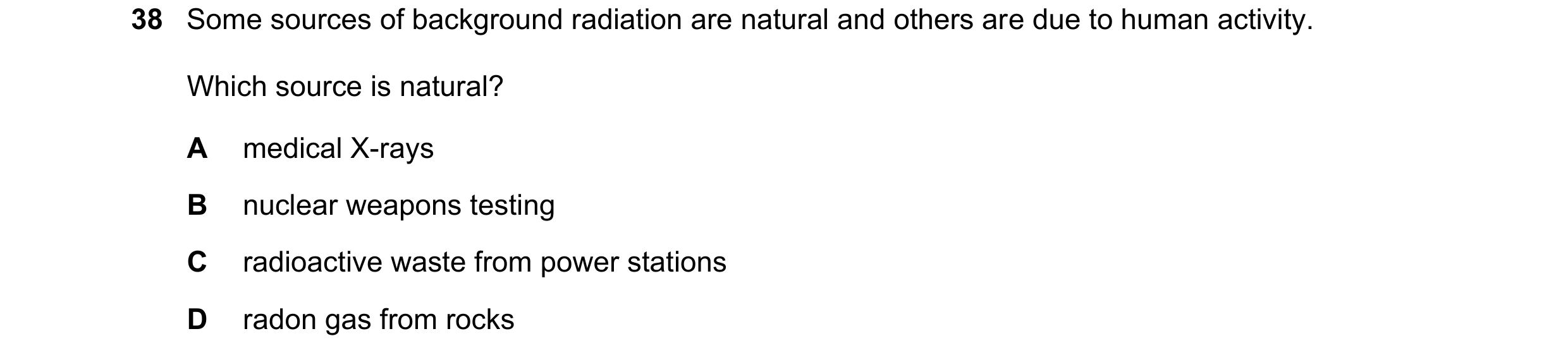
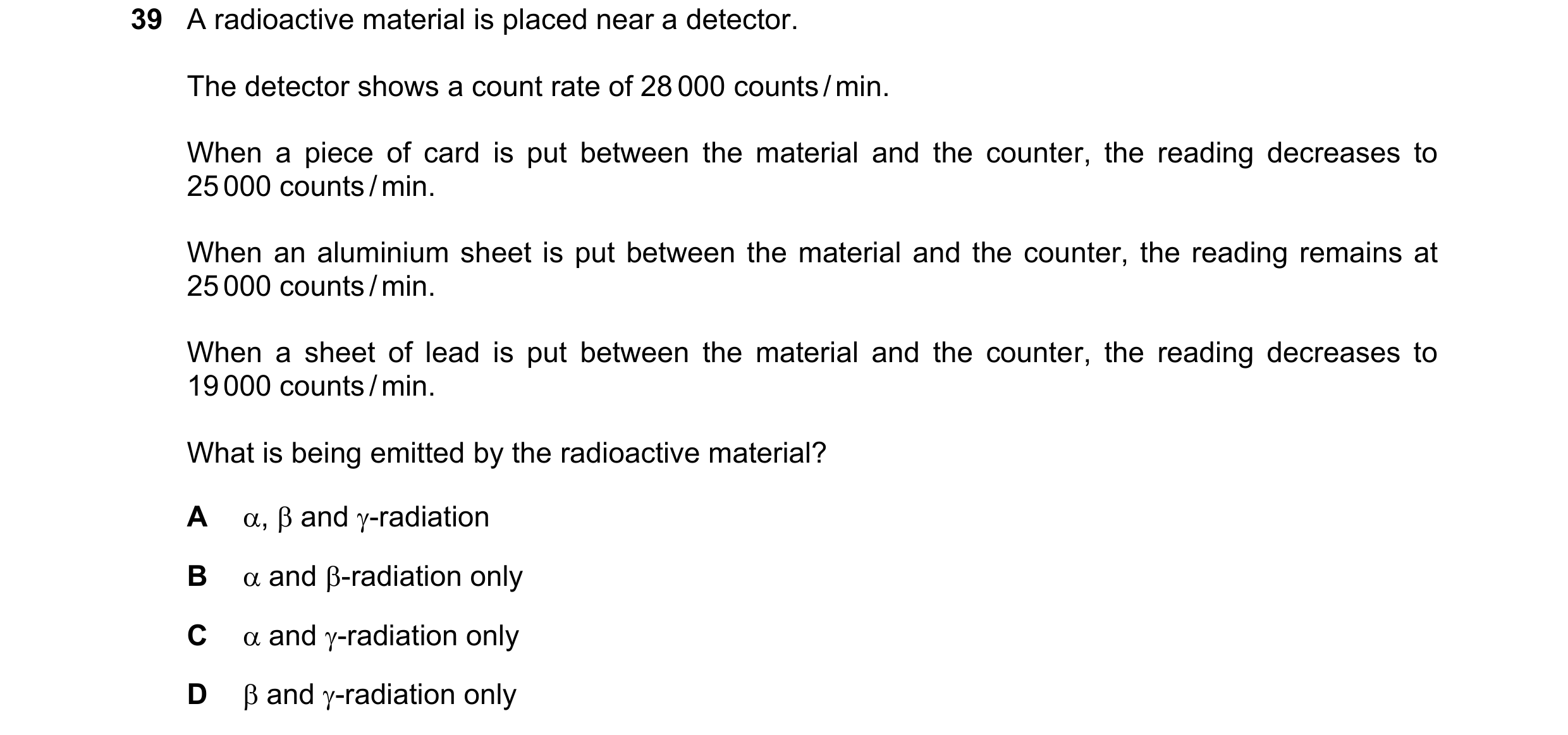
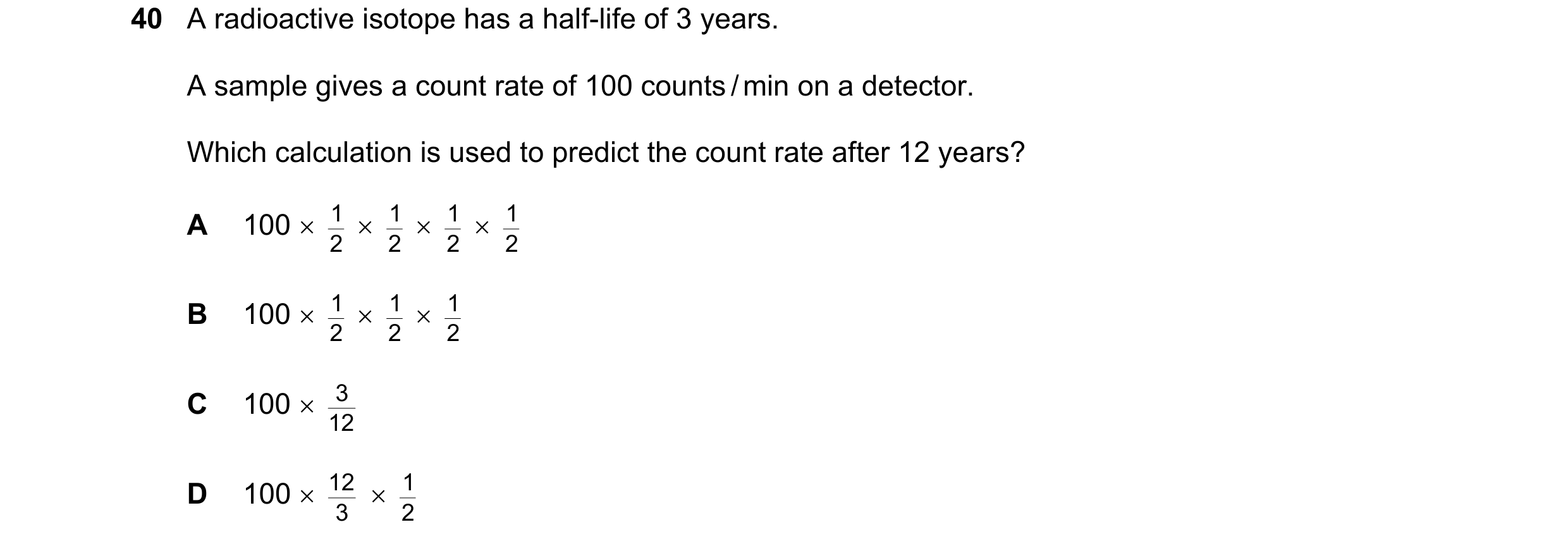
 48 / 68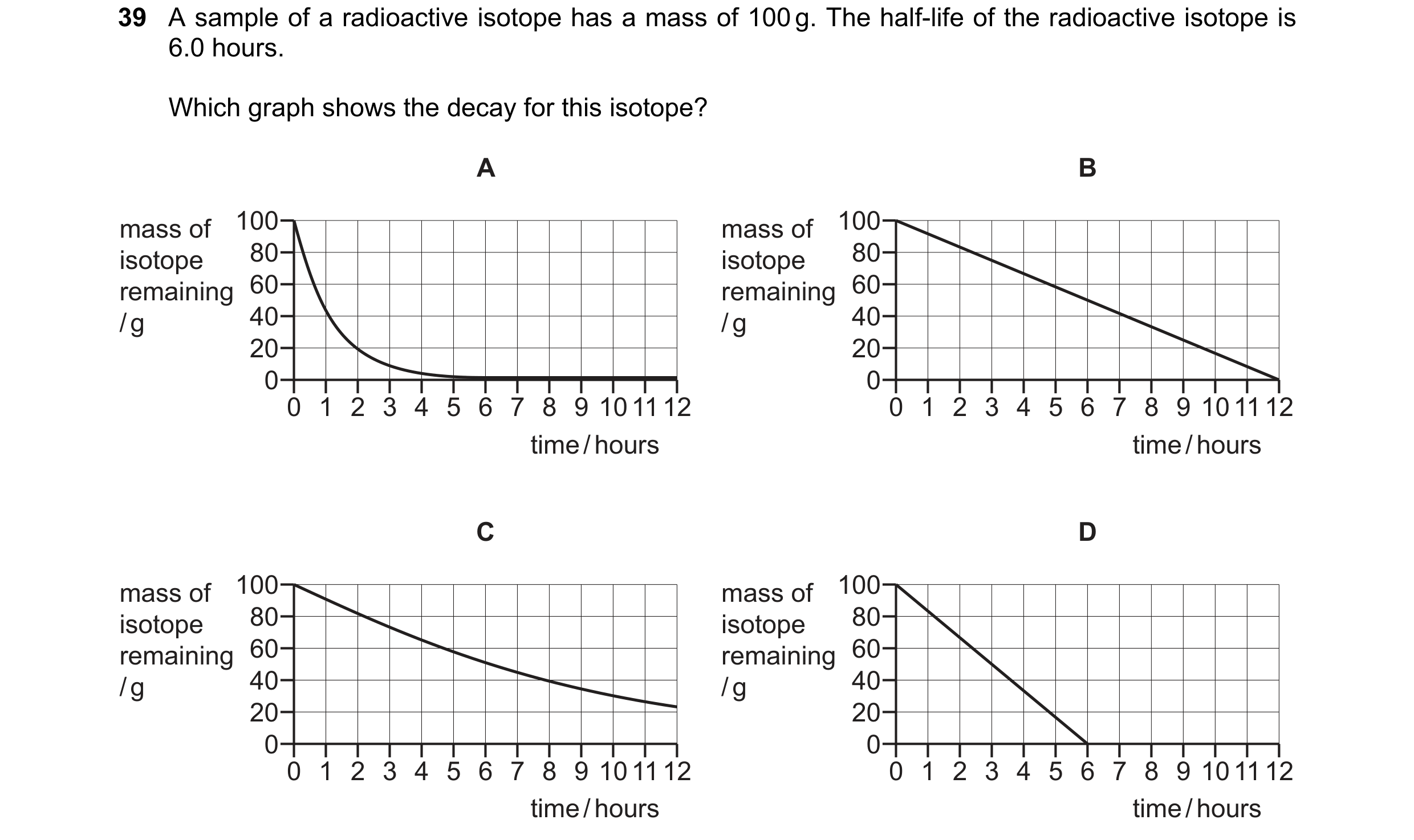

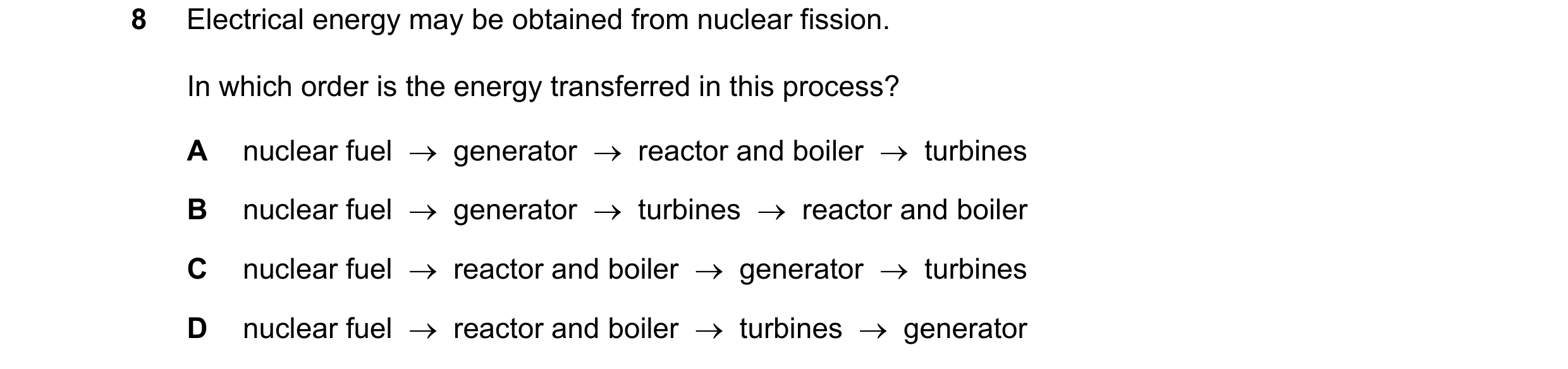
 49 / 68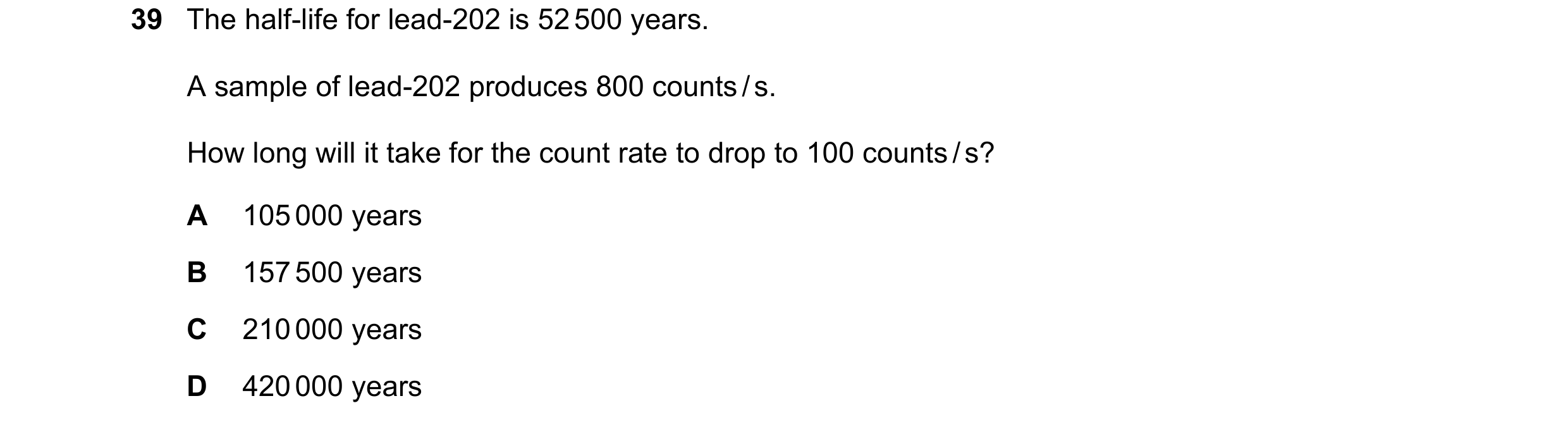

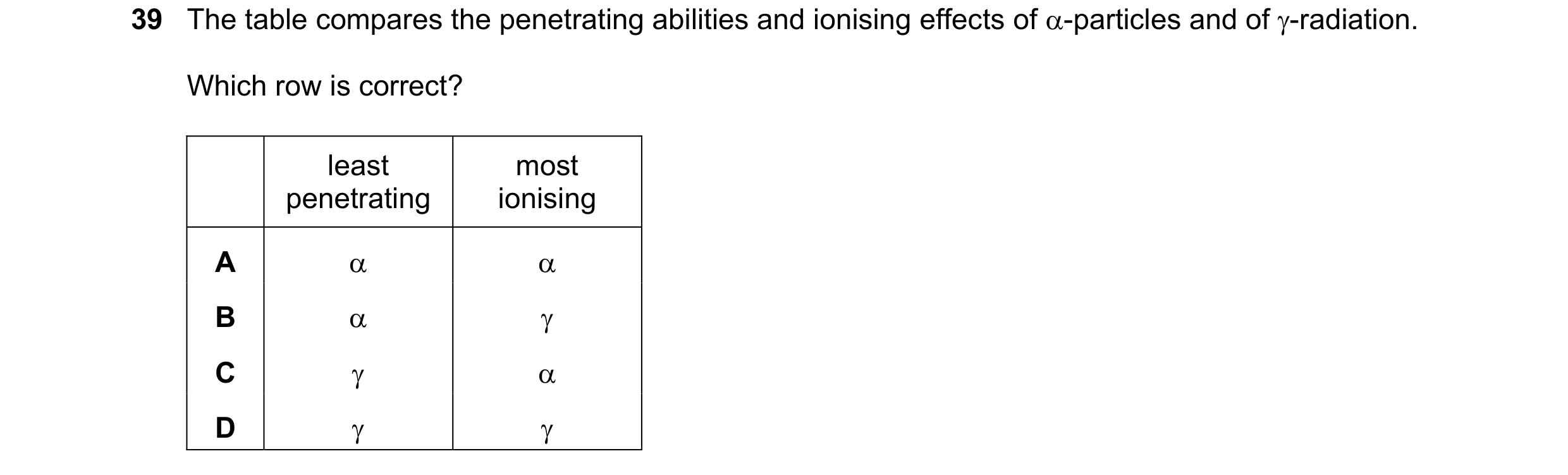
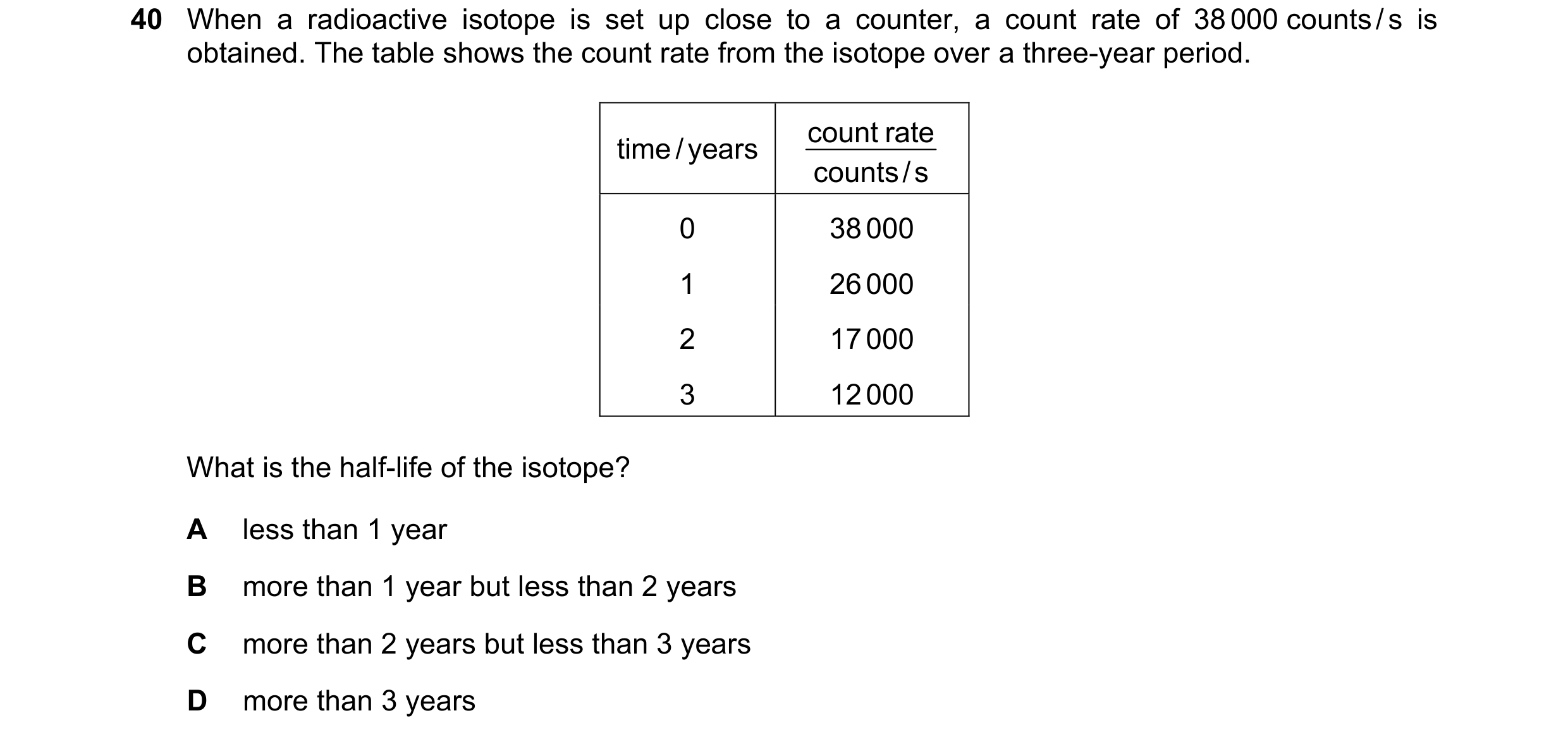 50 / 68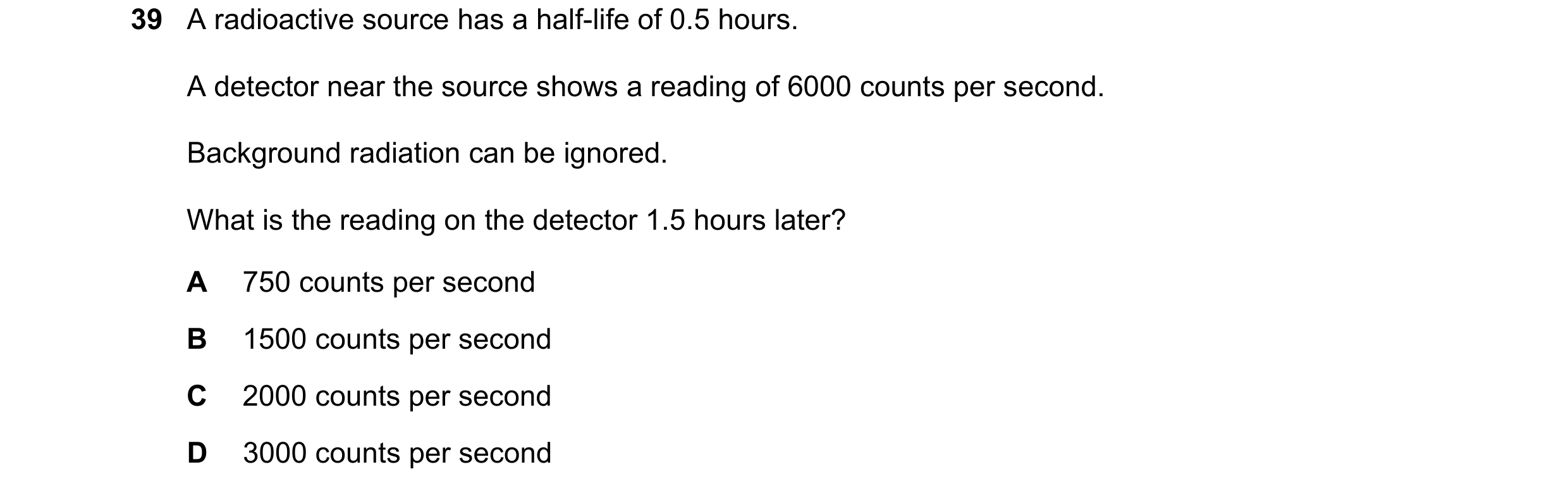

 51 / 68

 52 / 68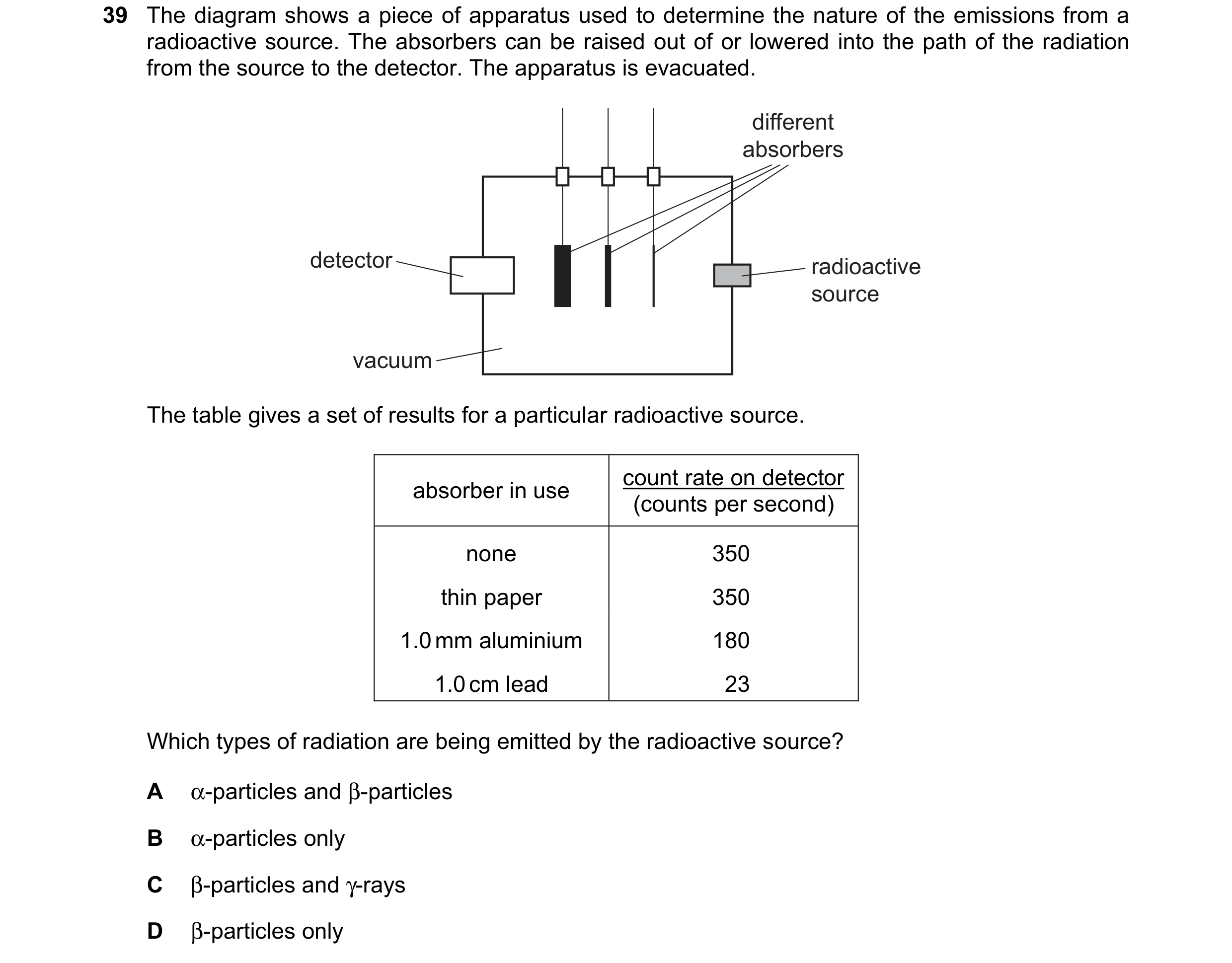
 53 / 68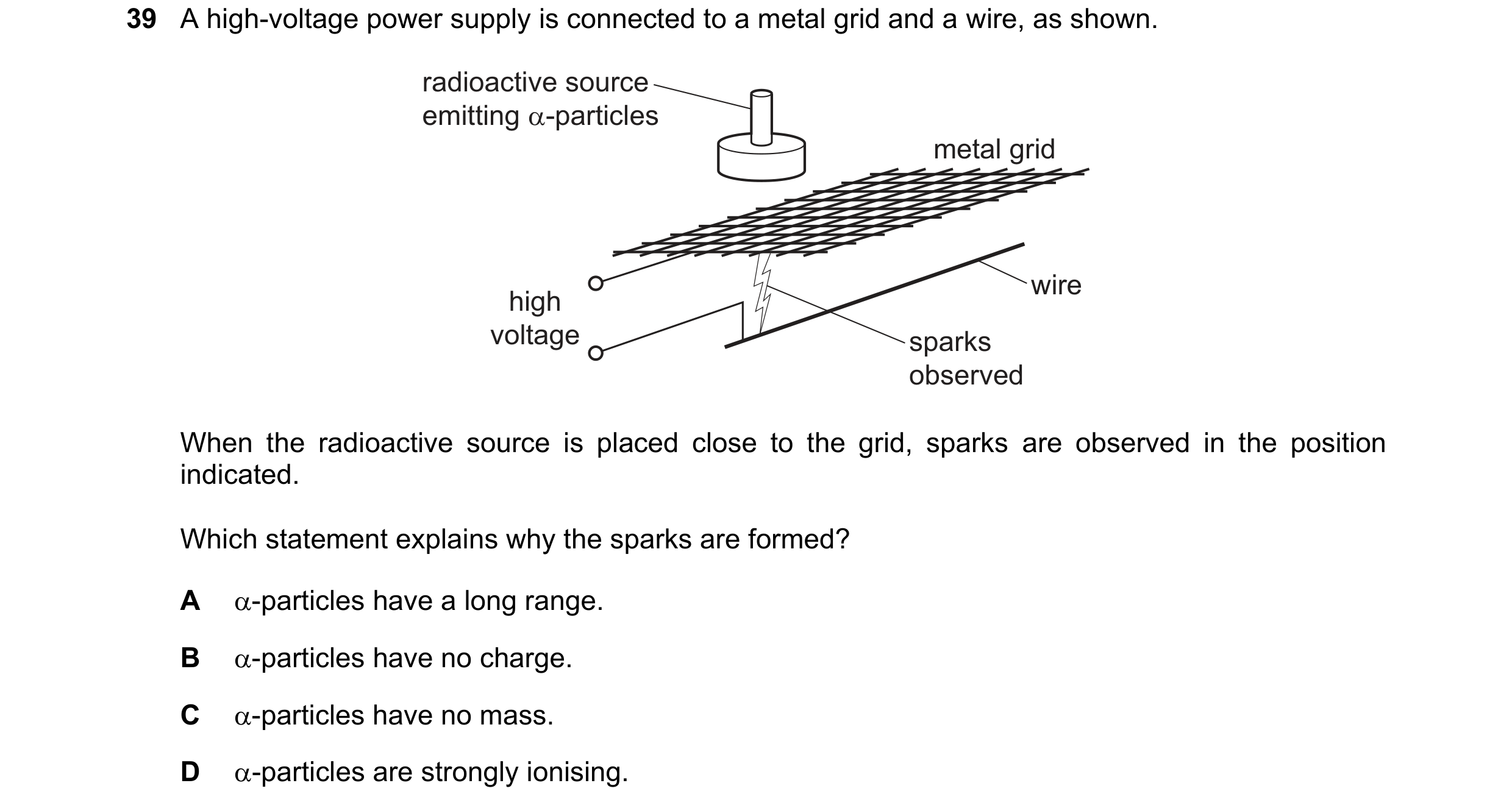



 54 / 68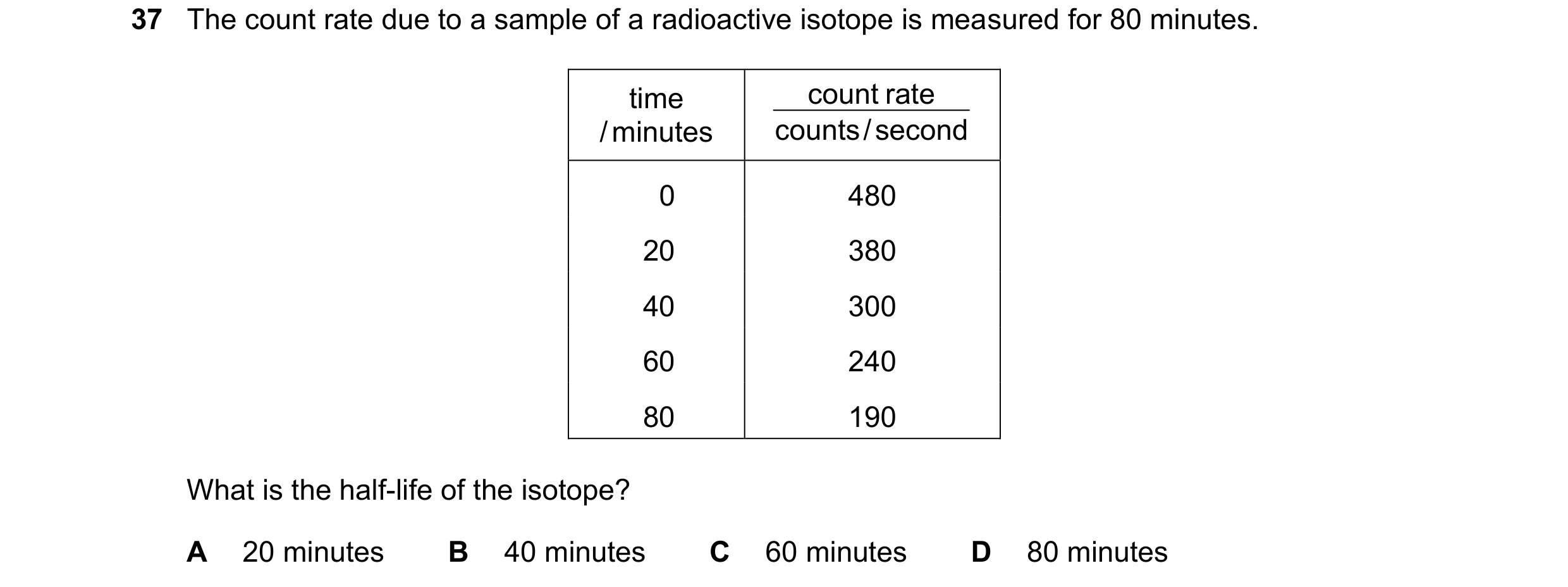

 55 / 68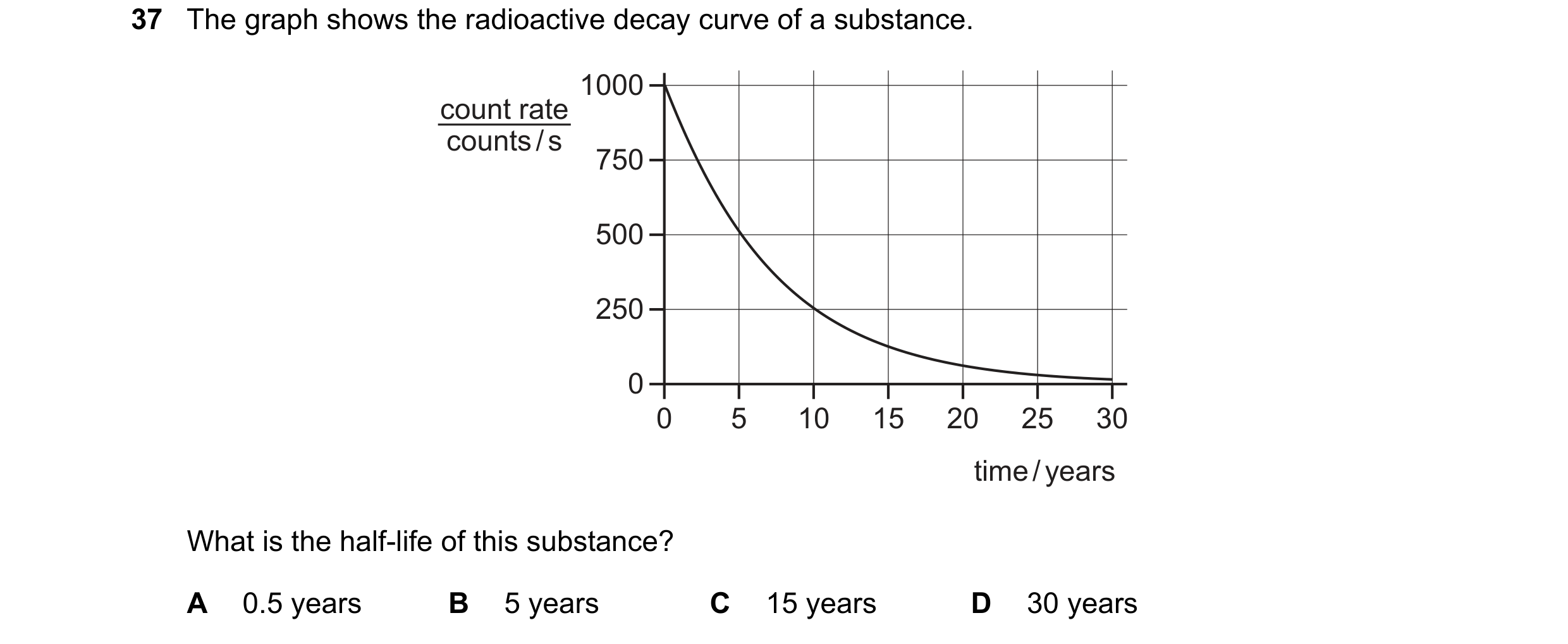
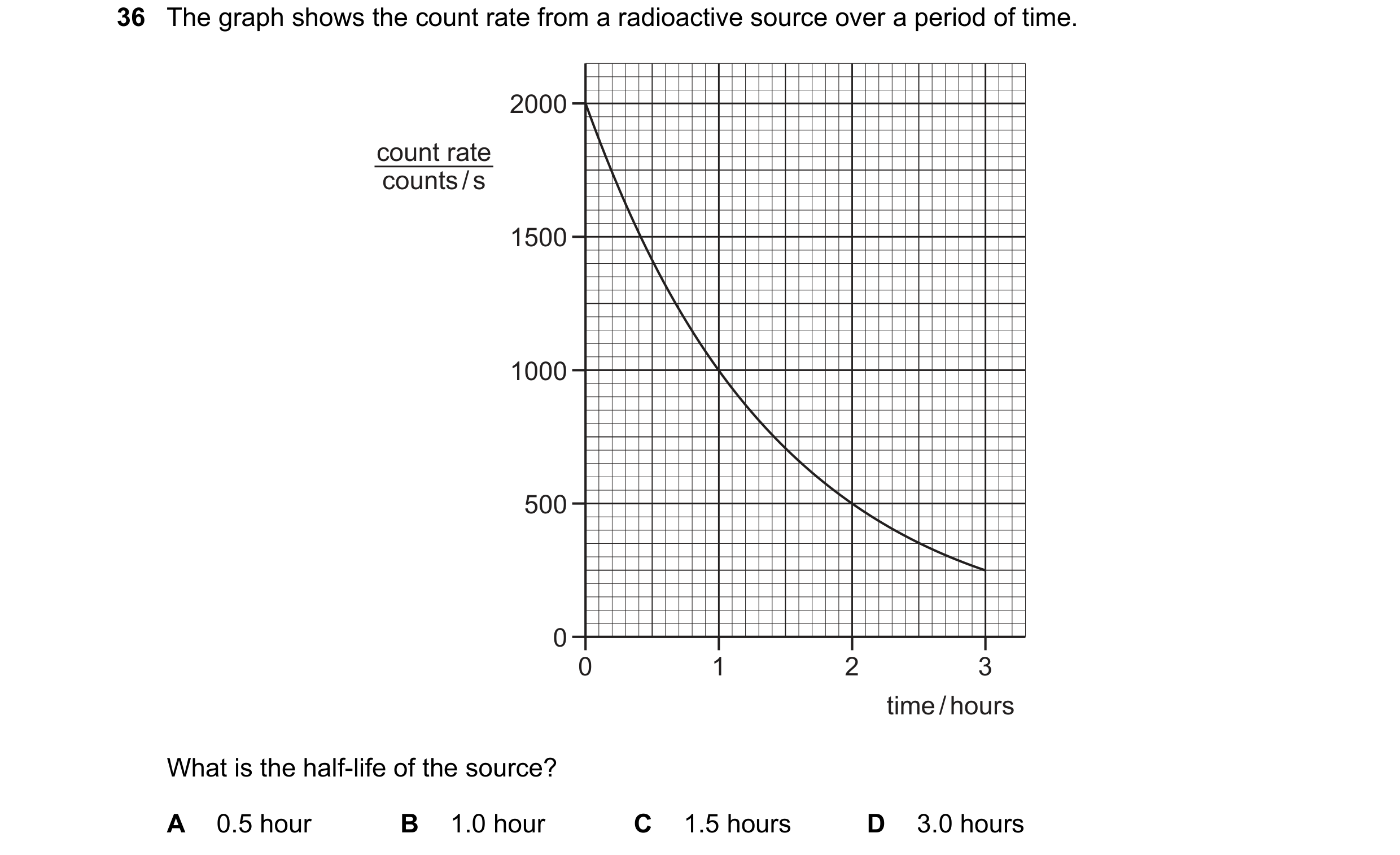 56 / 68
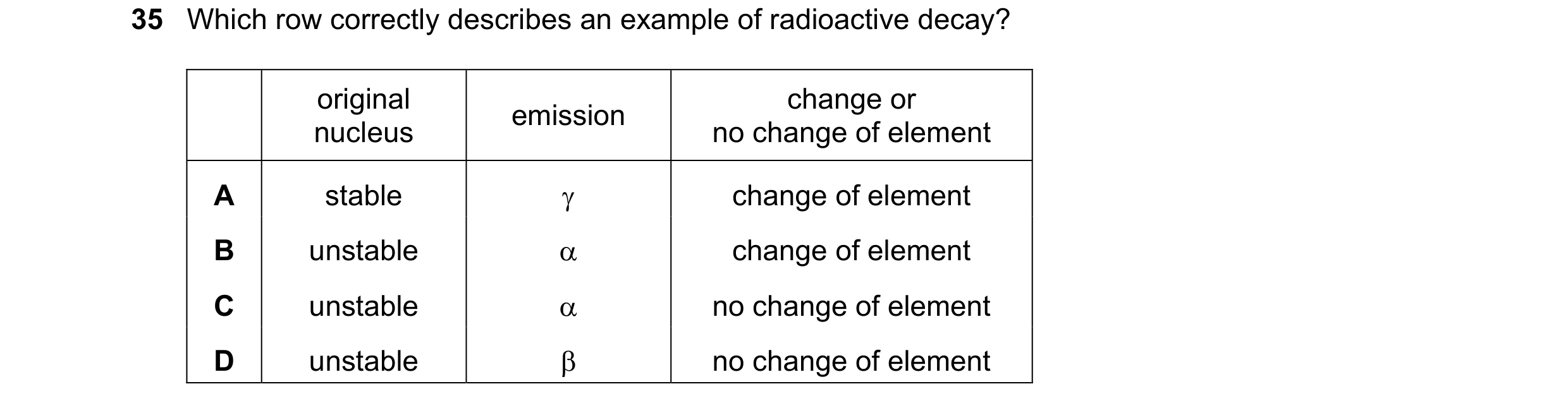
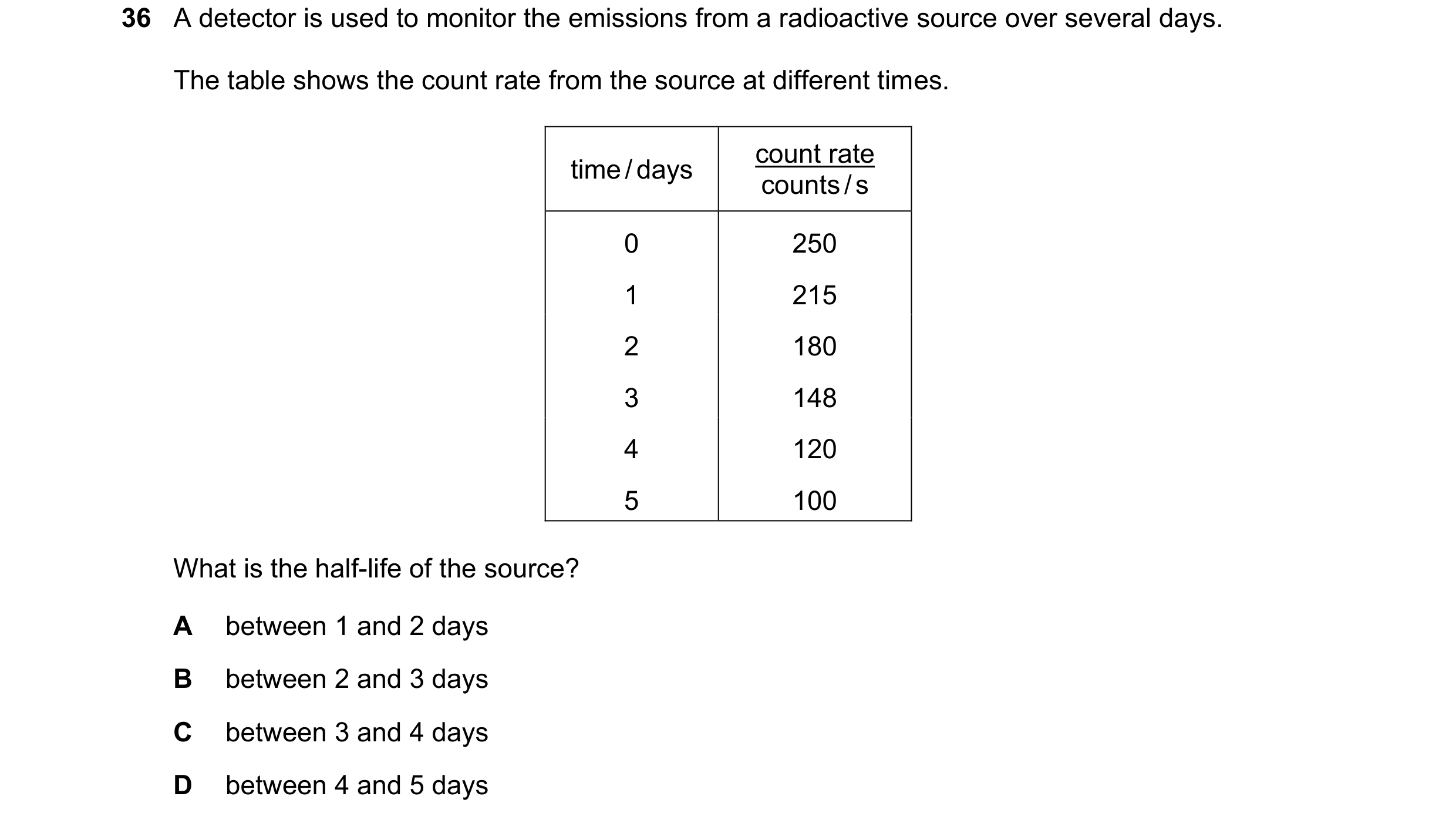
 57 / 68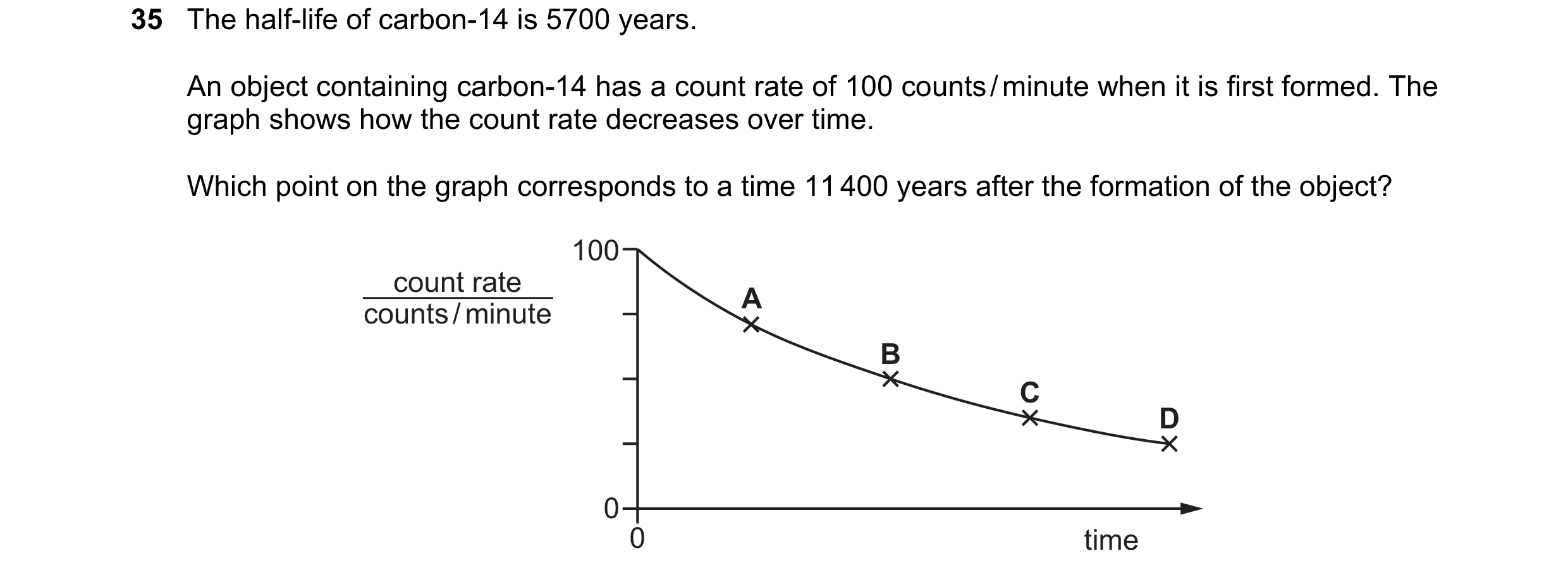
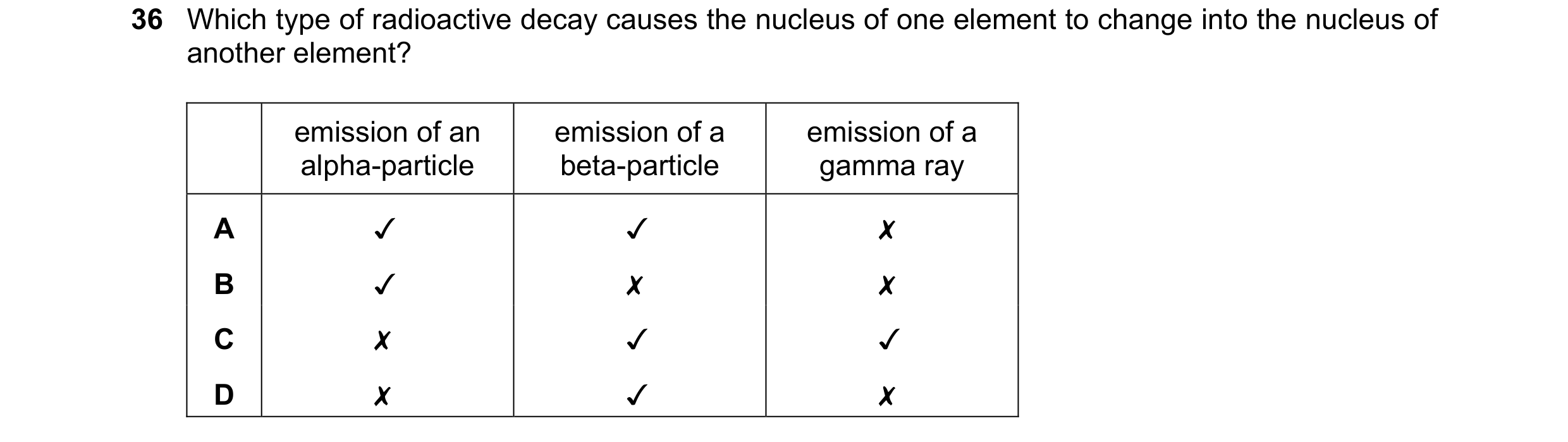

 58 / 68
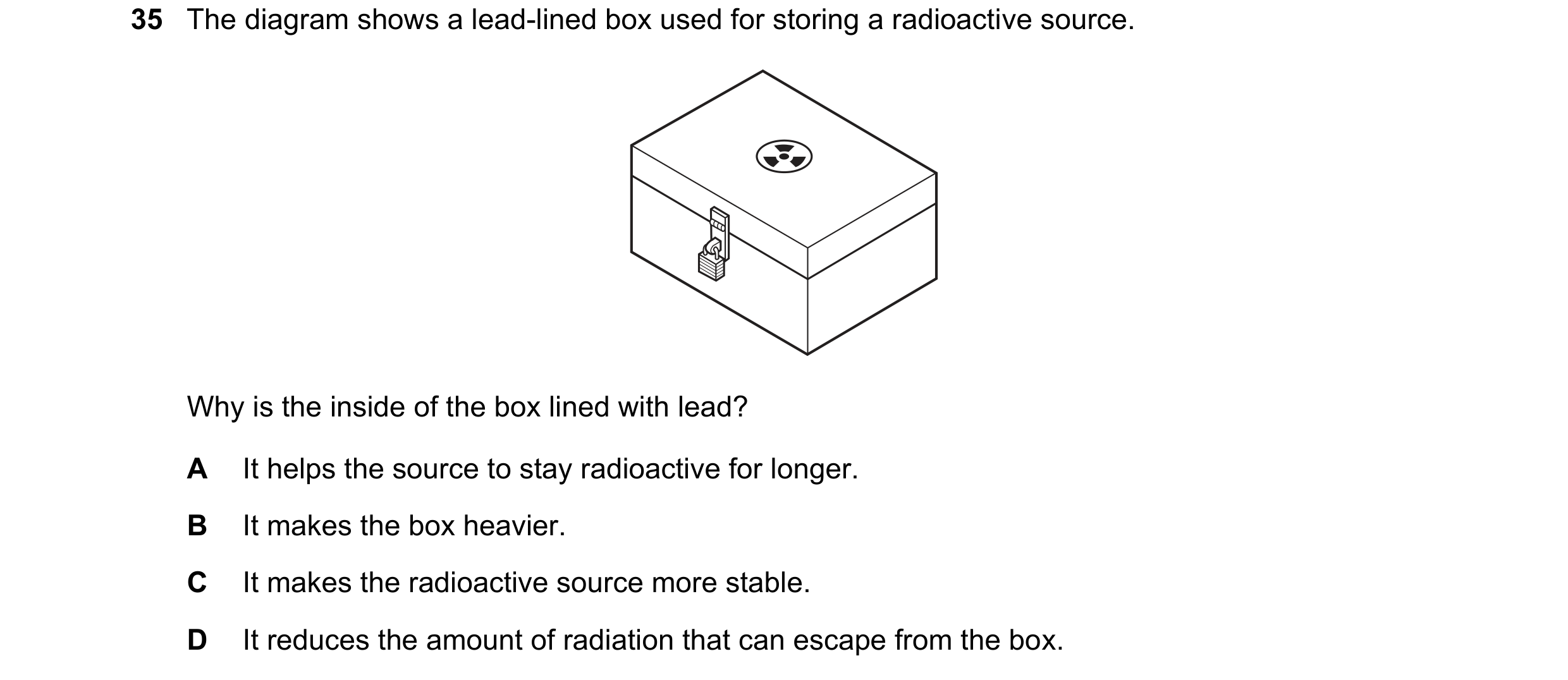
 59 / 68
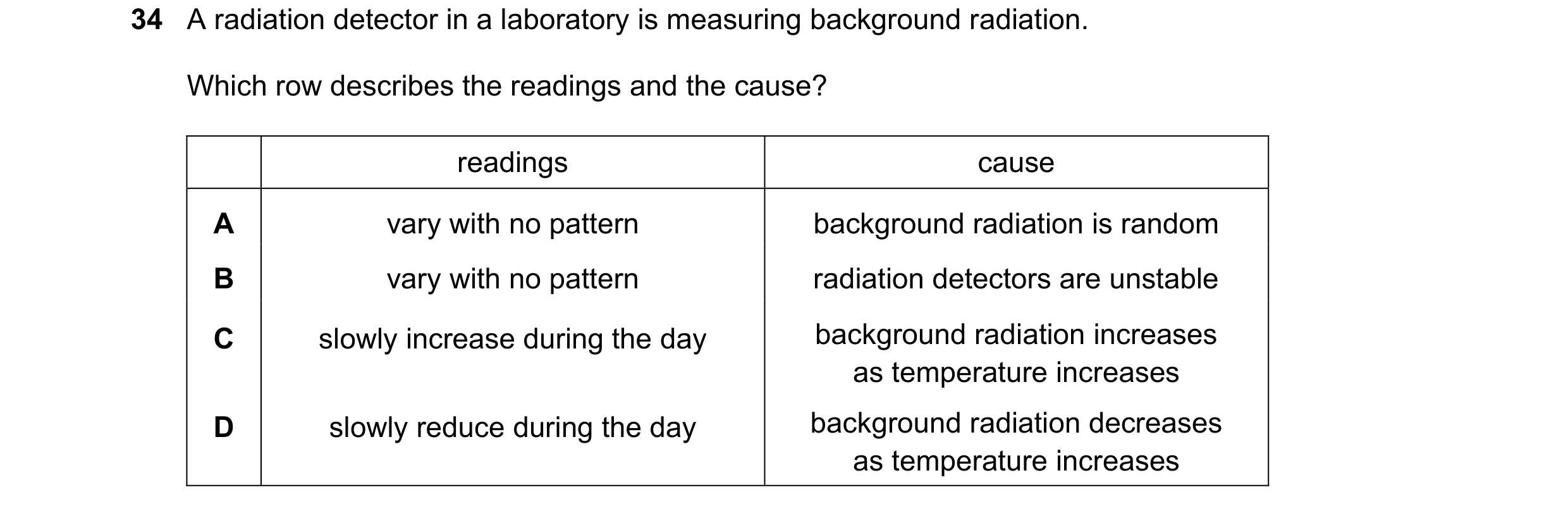
 60 / 68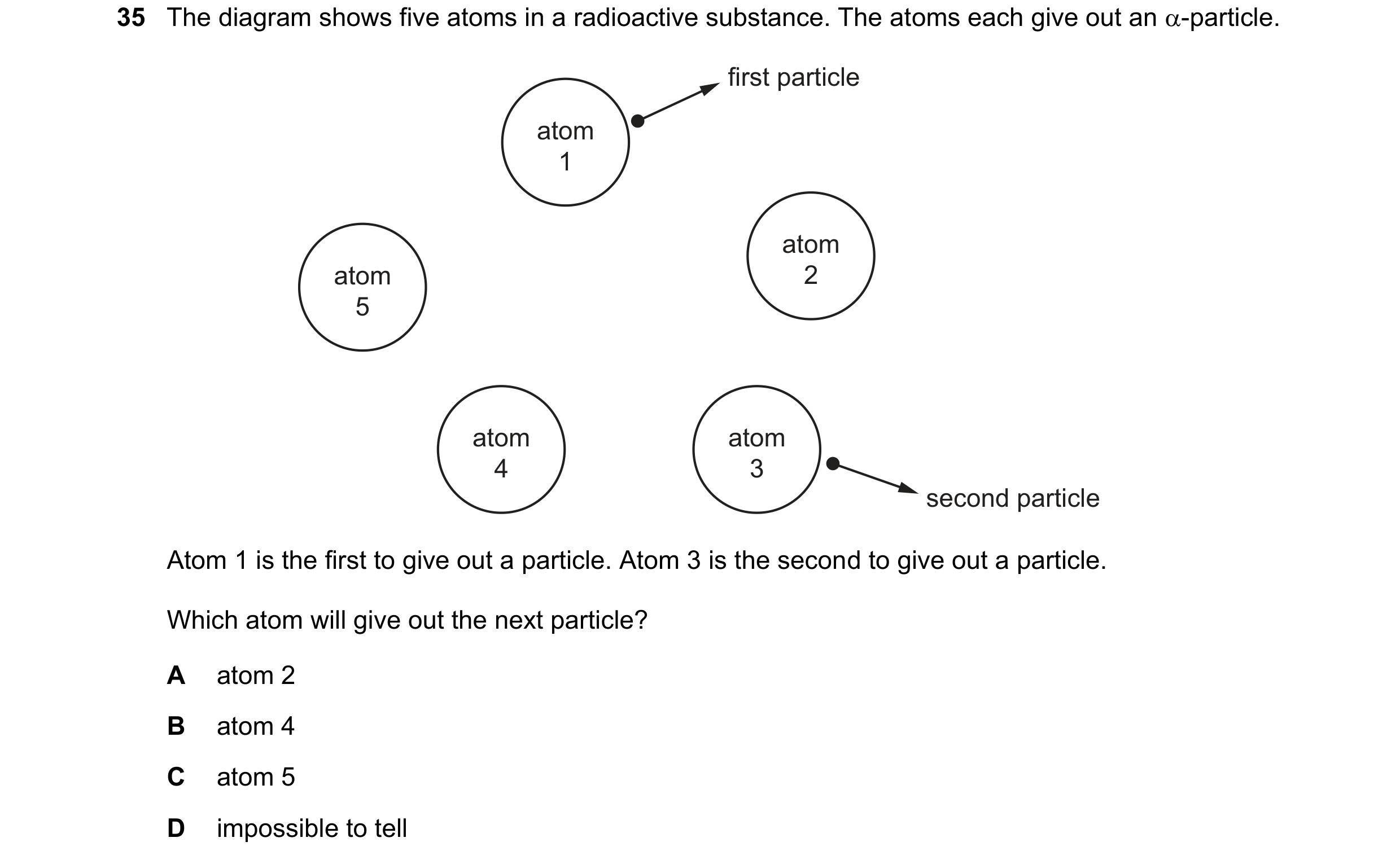
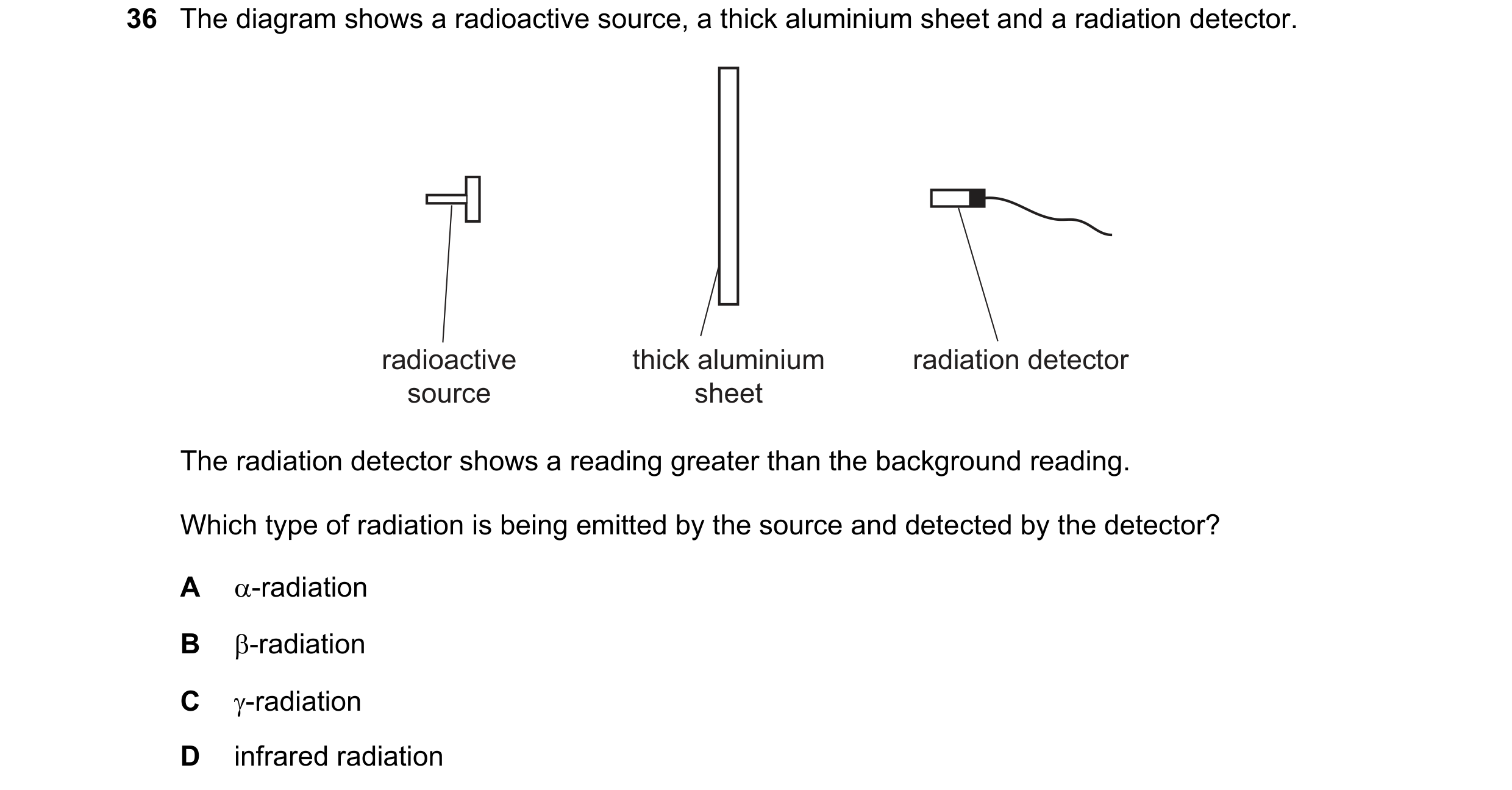
 61 / 68
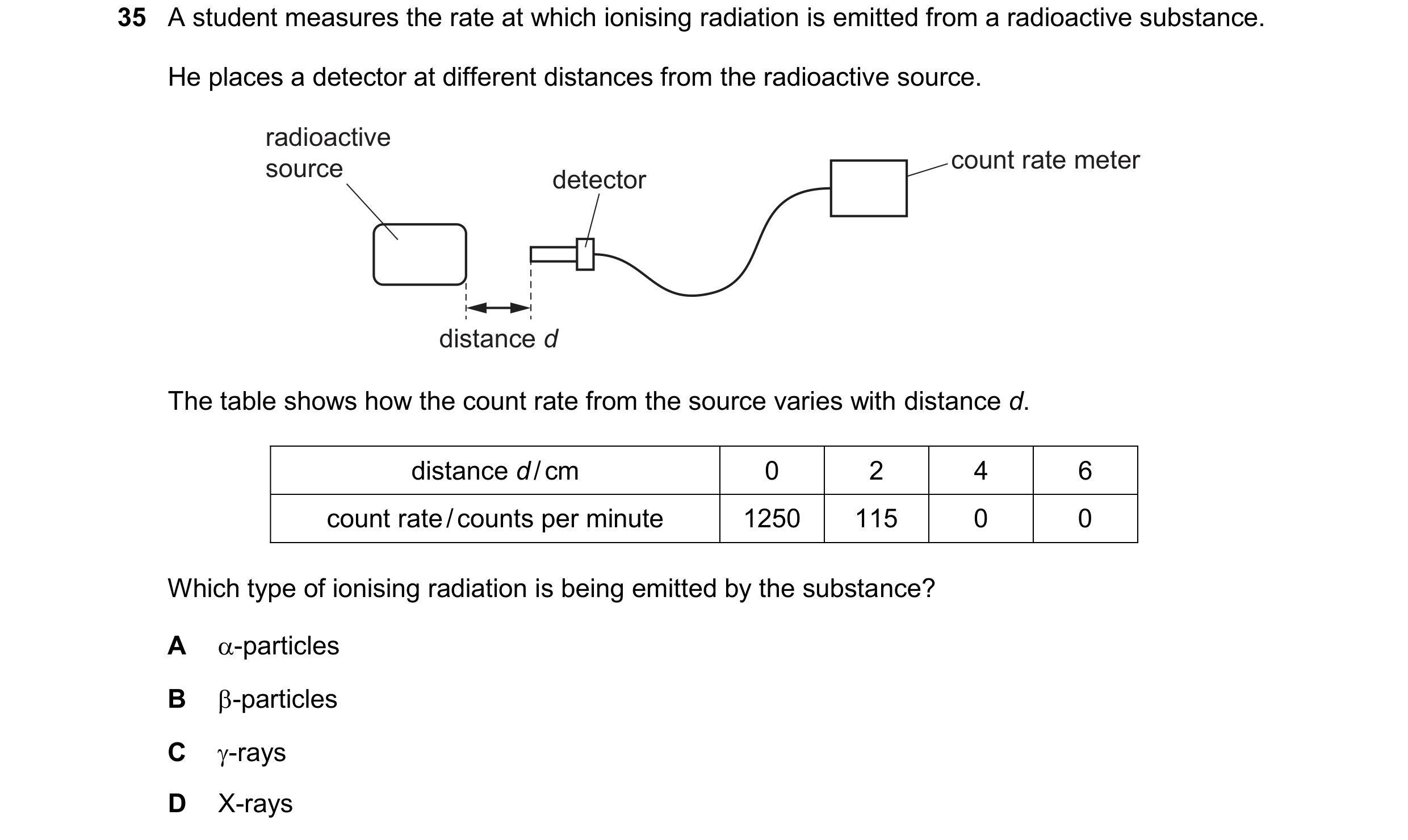
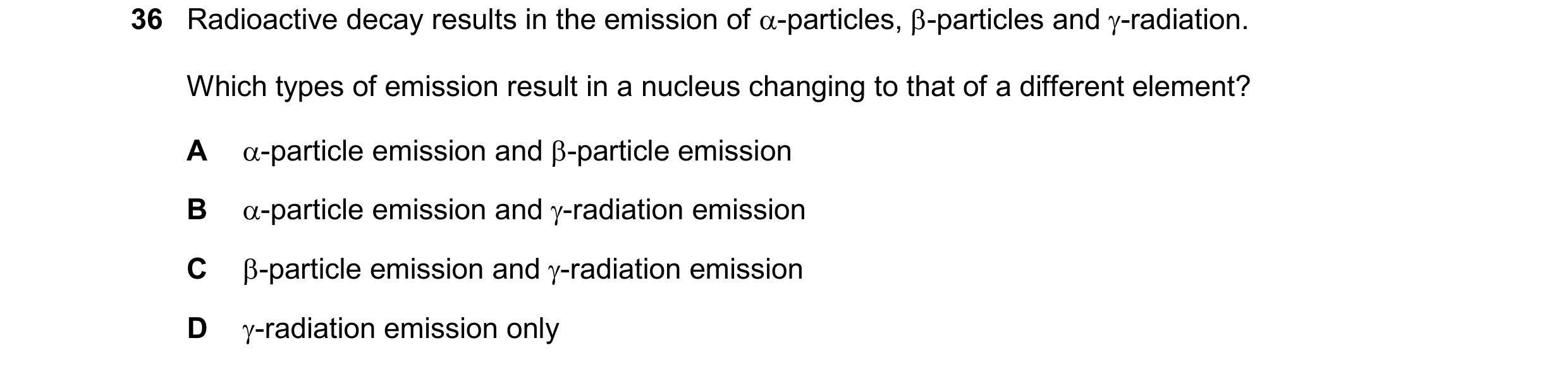
 62 / 68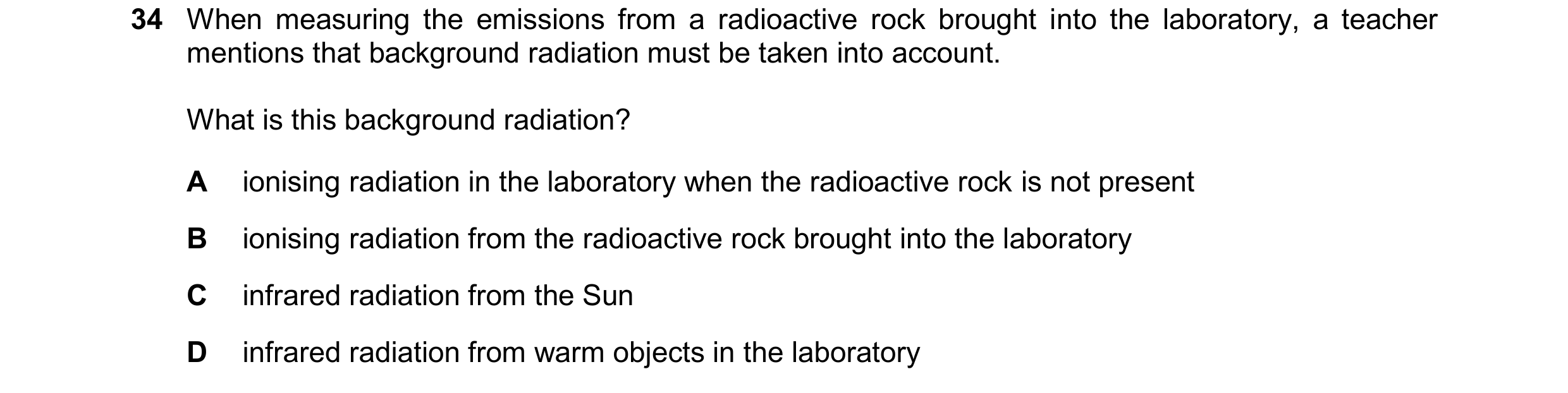
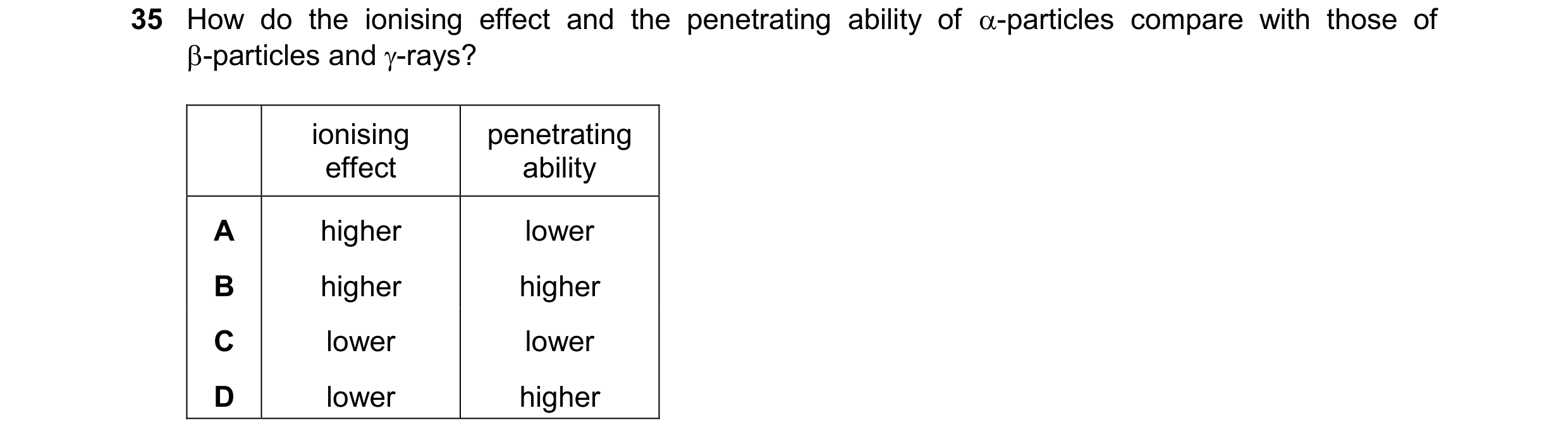
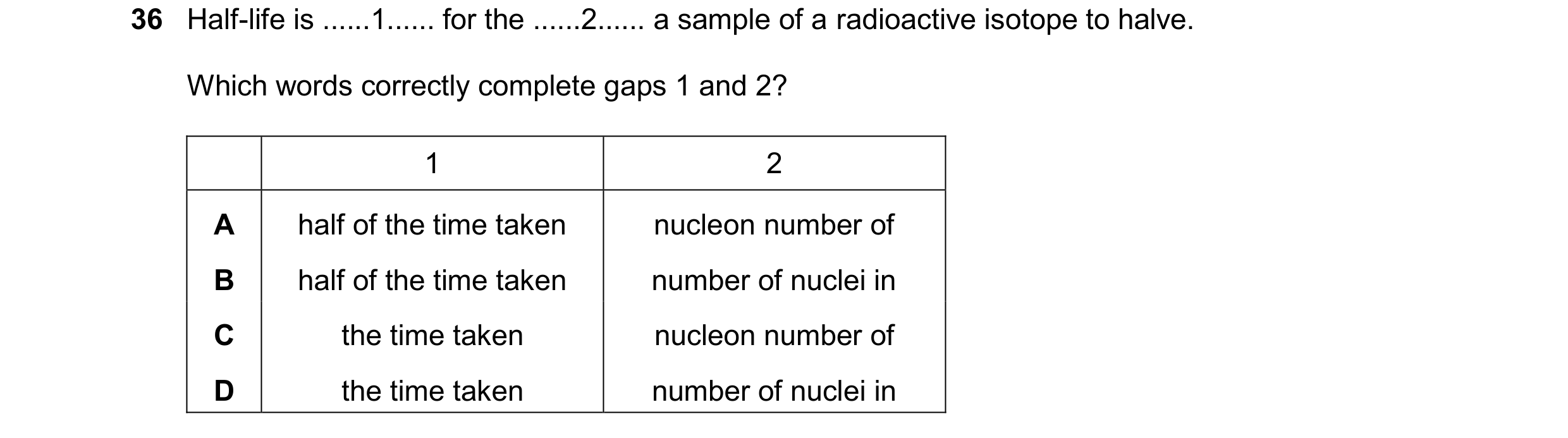
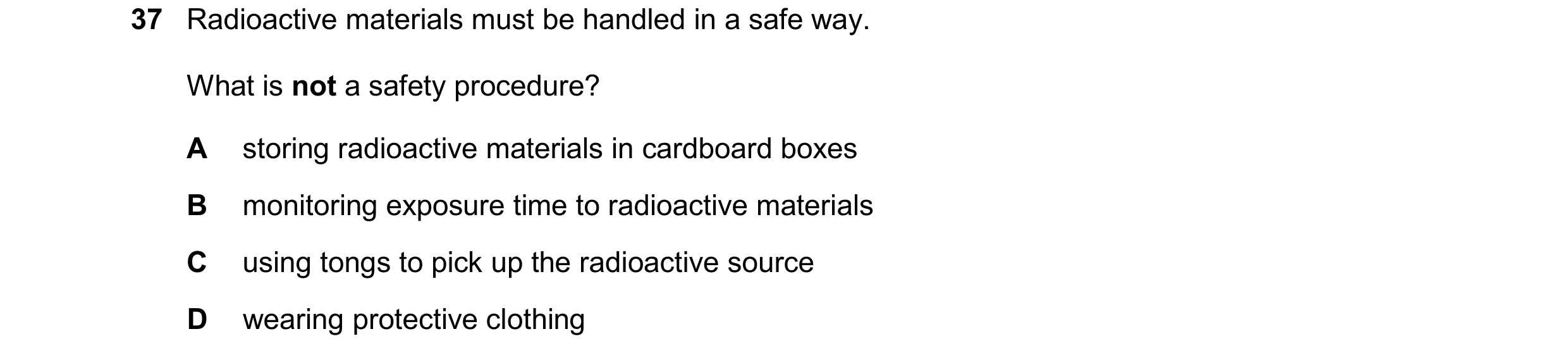 63 / 68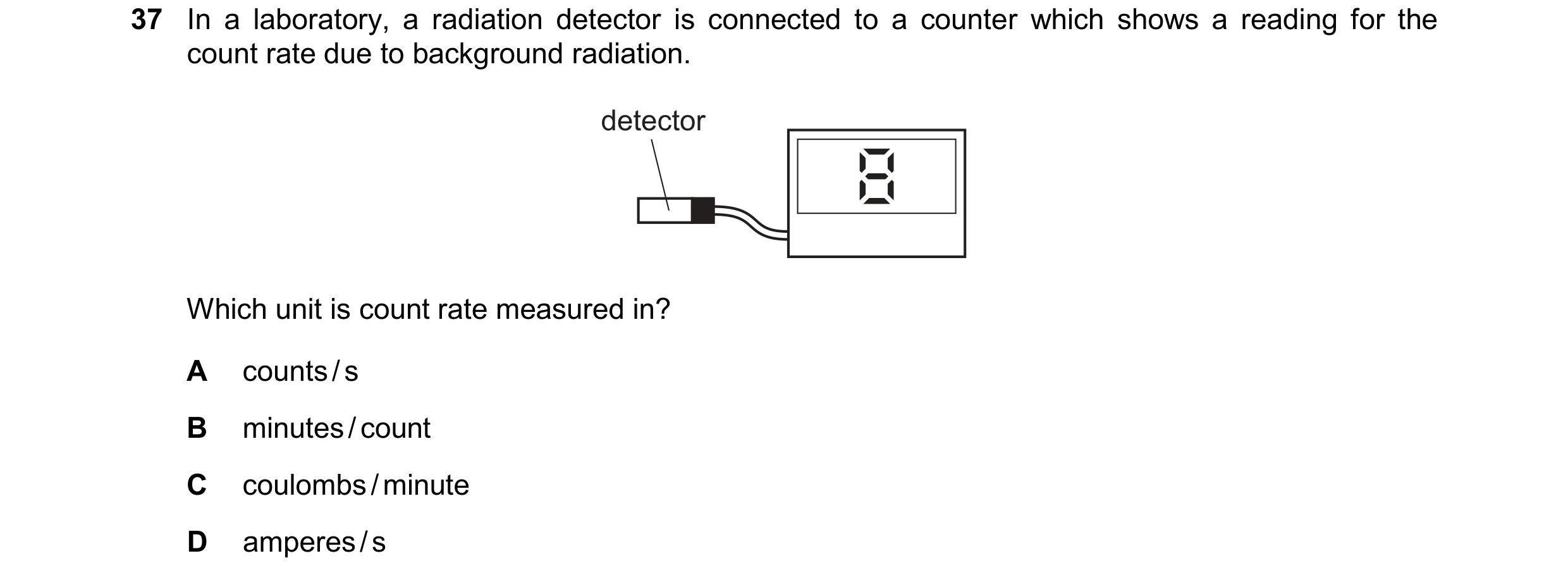


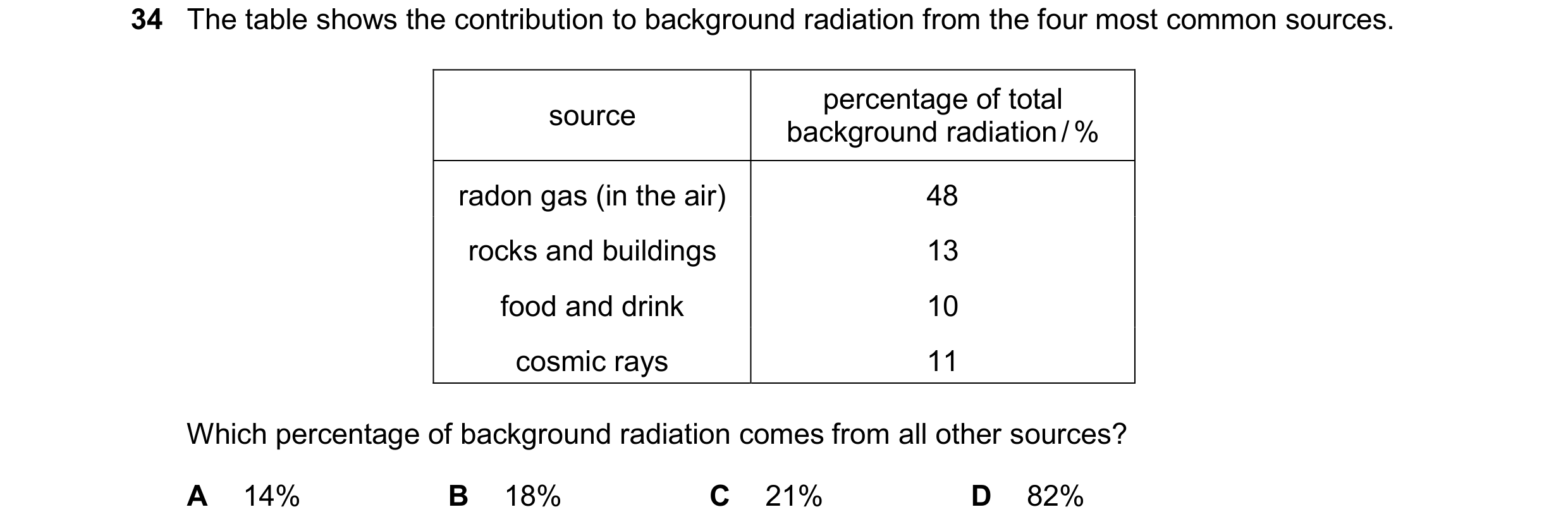 64 / 68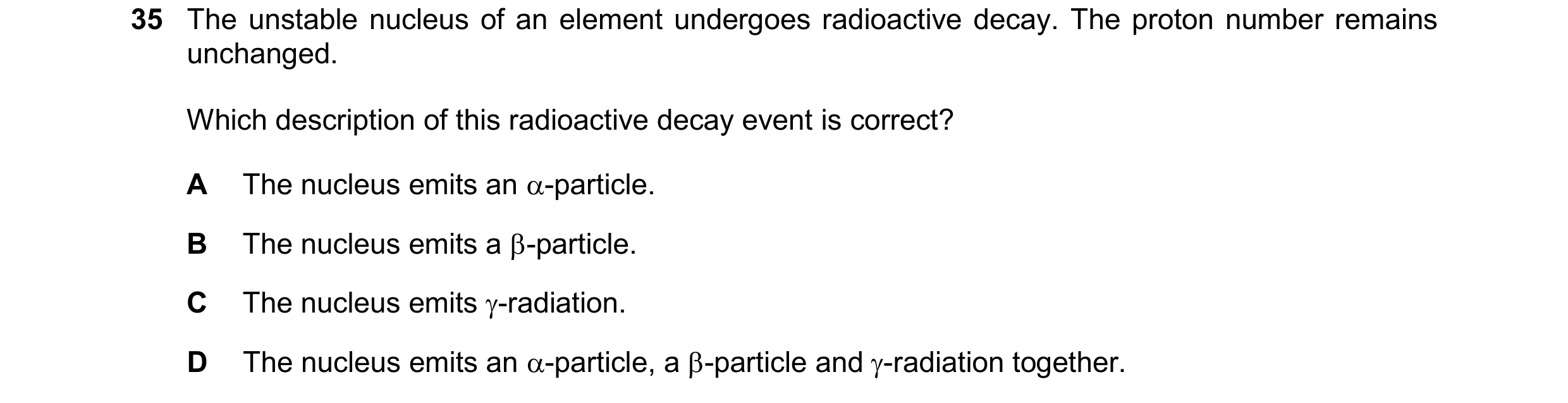
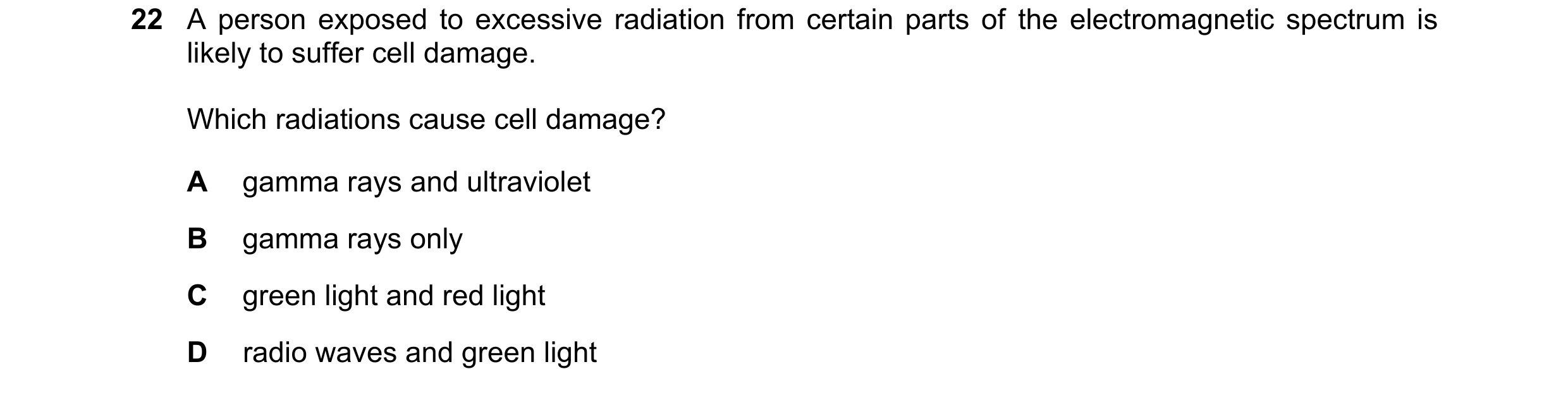

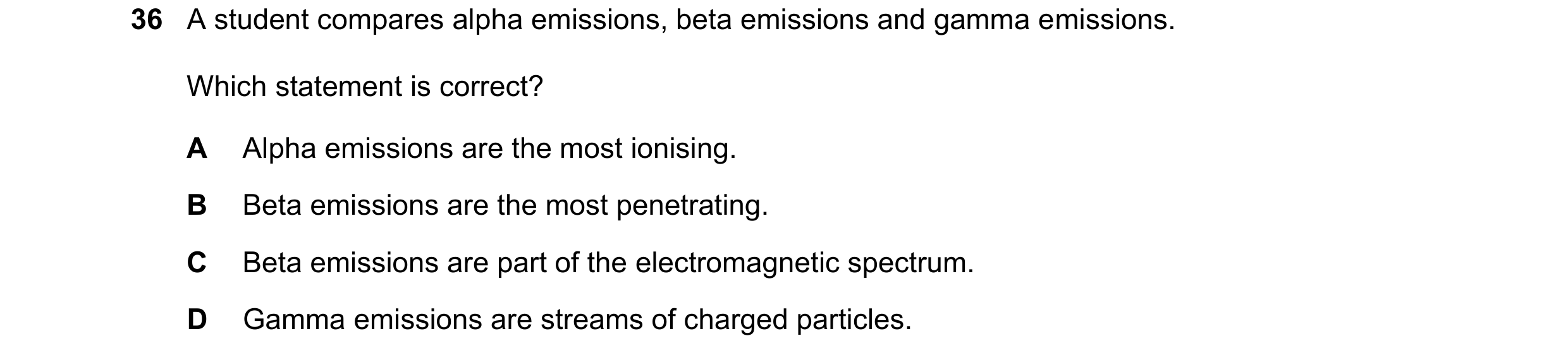
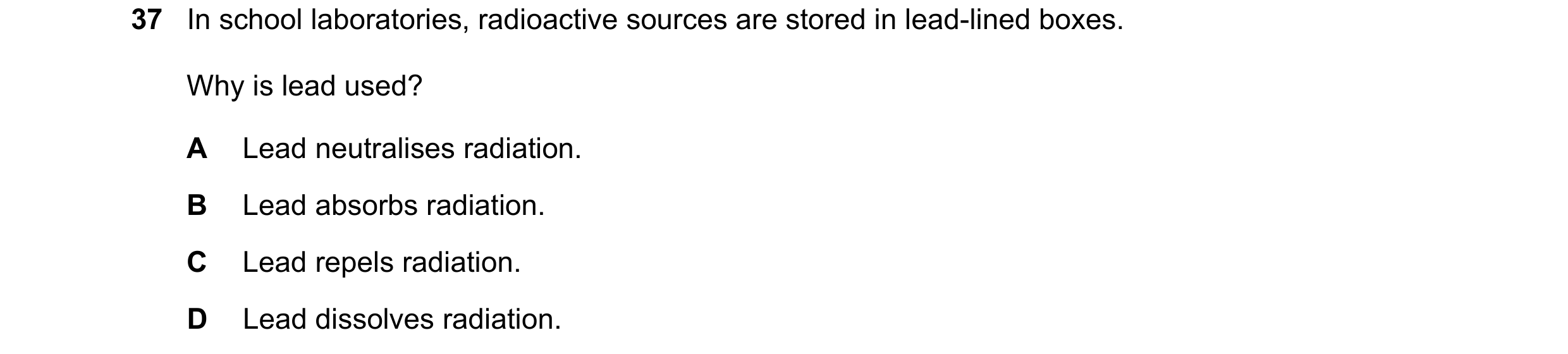 65 / 68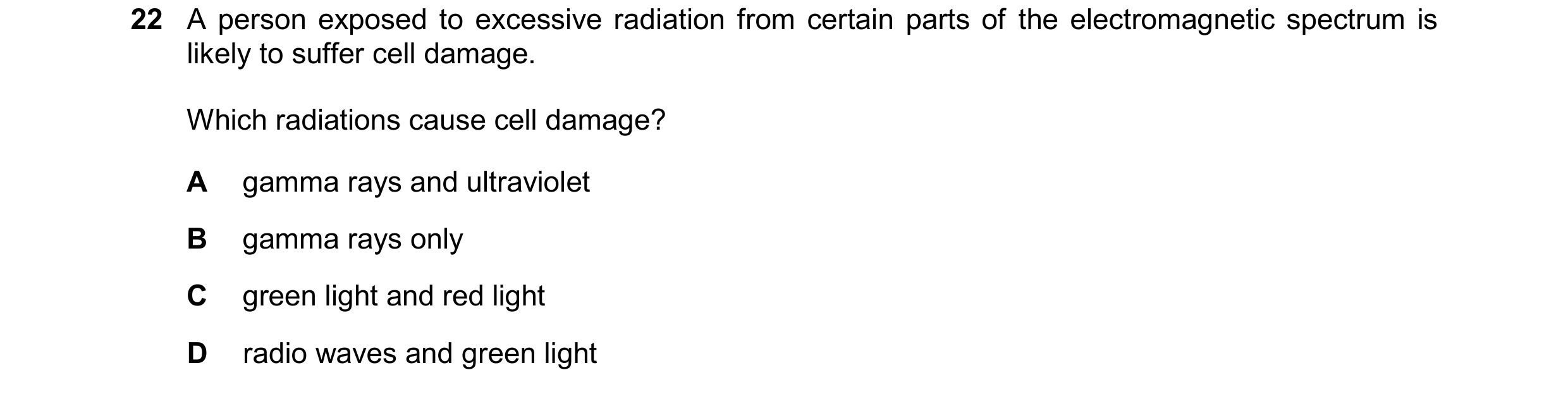

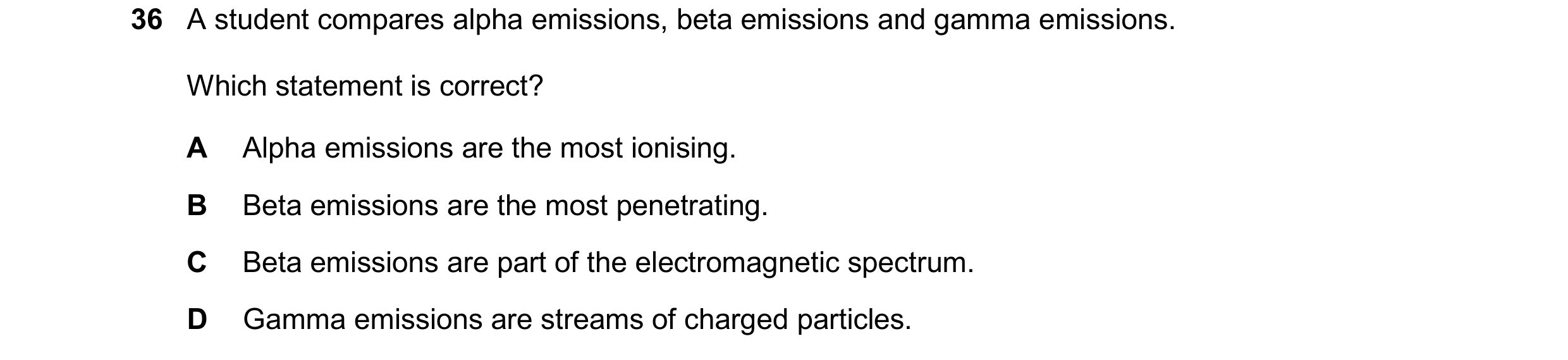
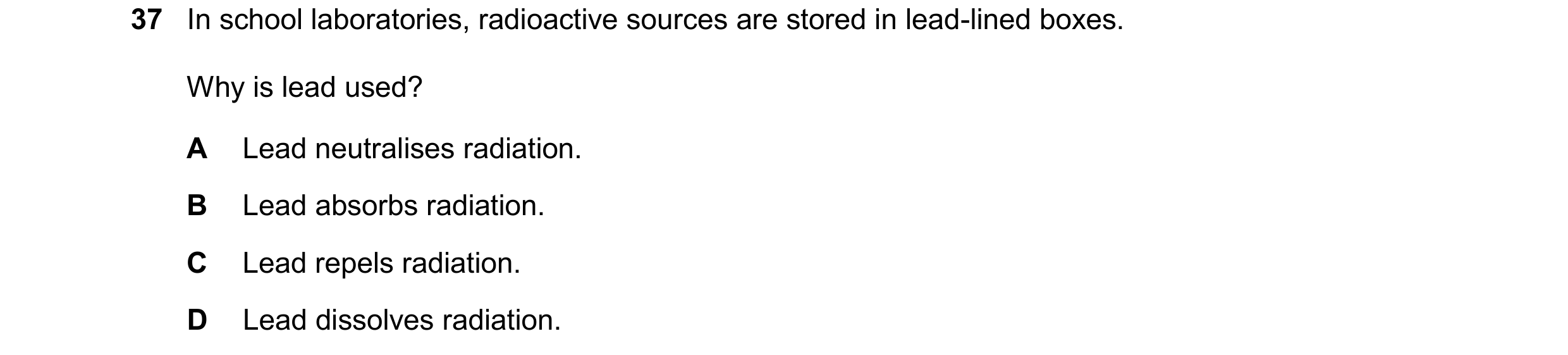
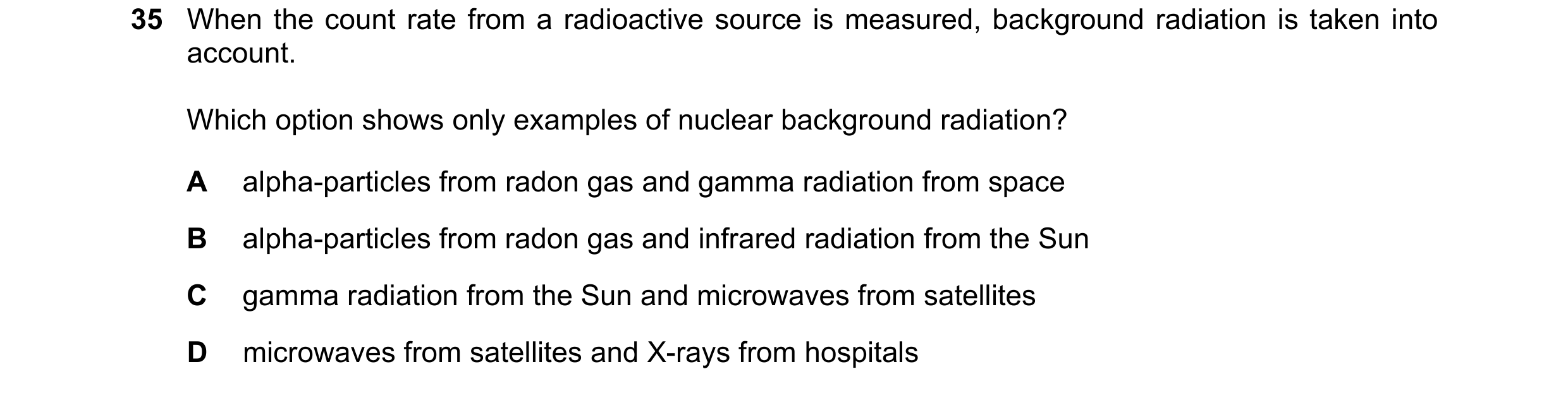 66 / 68
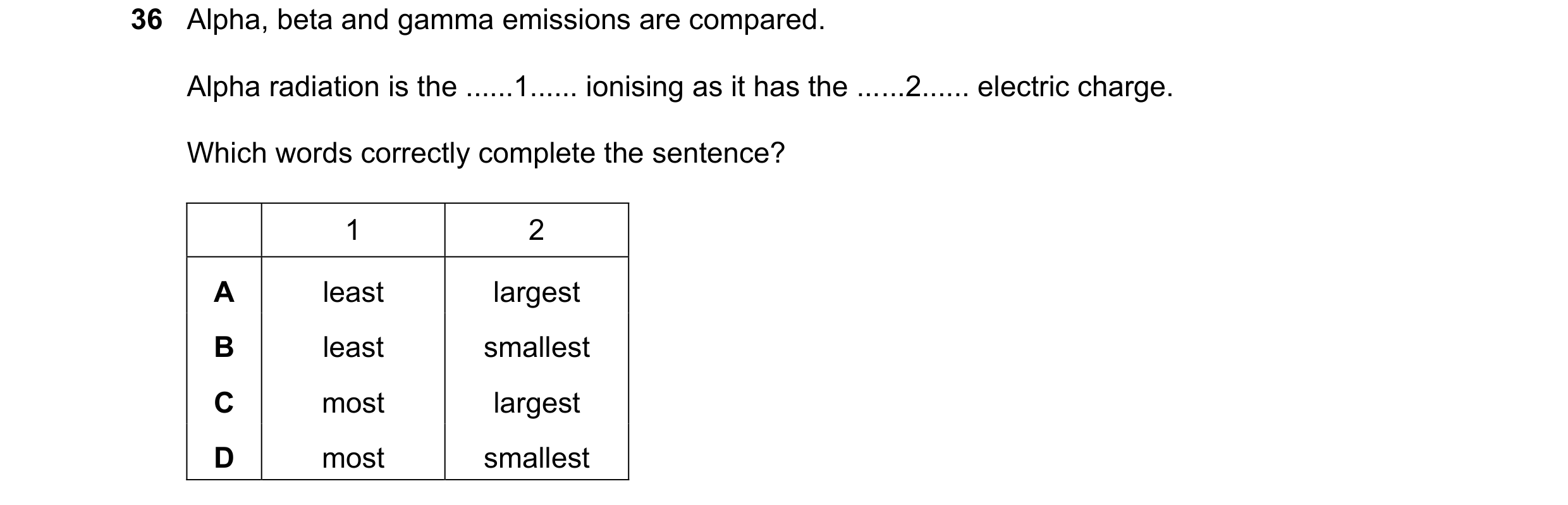 67 / 68
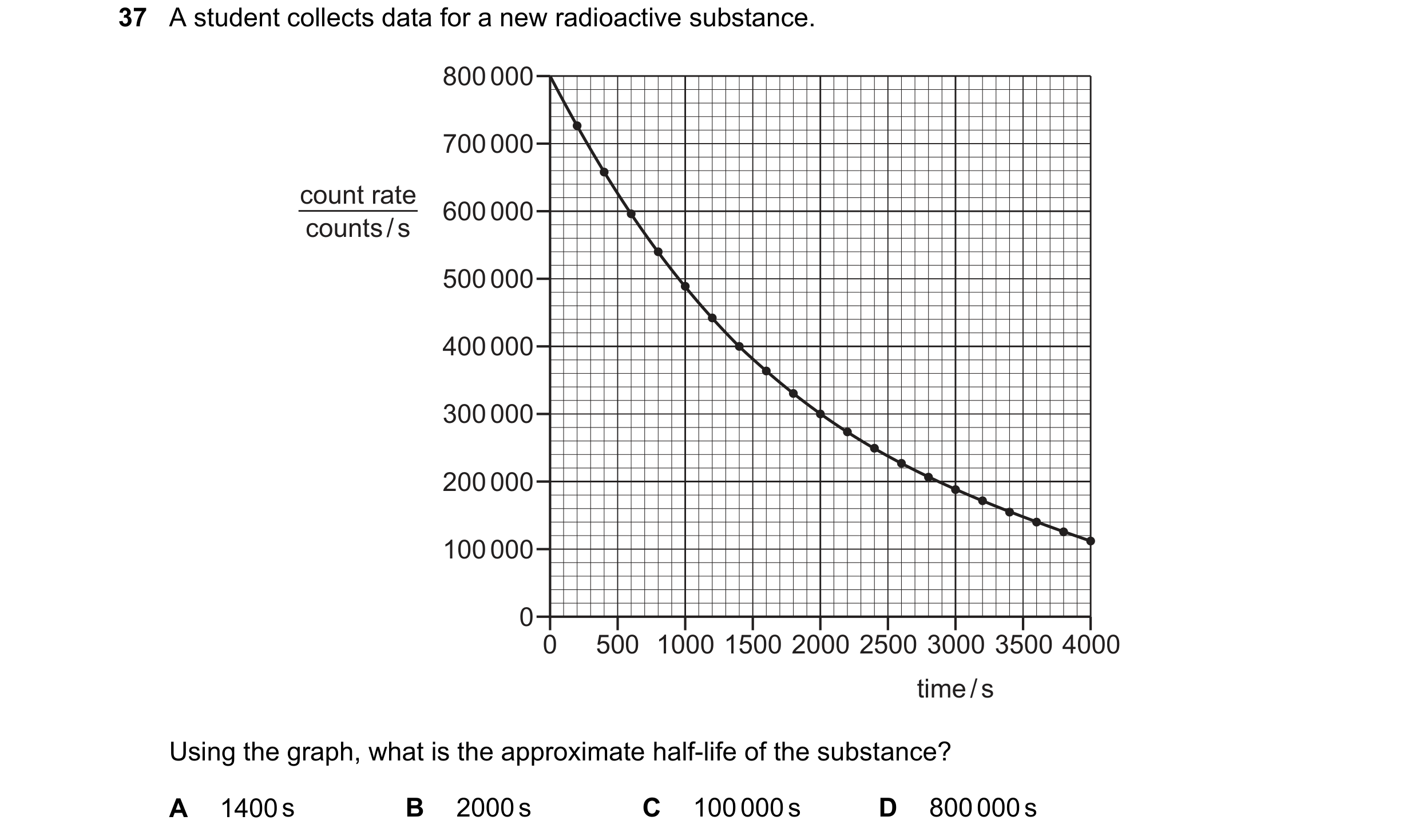 68 / 68