Cambridge IGCSE Physics 0625 — 2014 May/June Paper 3 · Variant 2
0625/32/M/J/14 · 11 questions · 80 marks · ≈90 min
The question paper and its mark scheme, free to read here and free to download. This is Cambridge’s own paper, exactly as it was sat.
Question paper20 pages

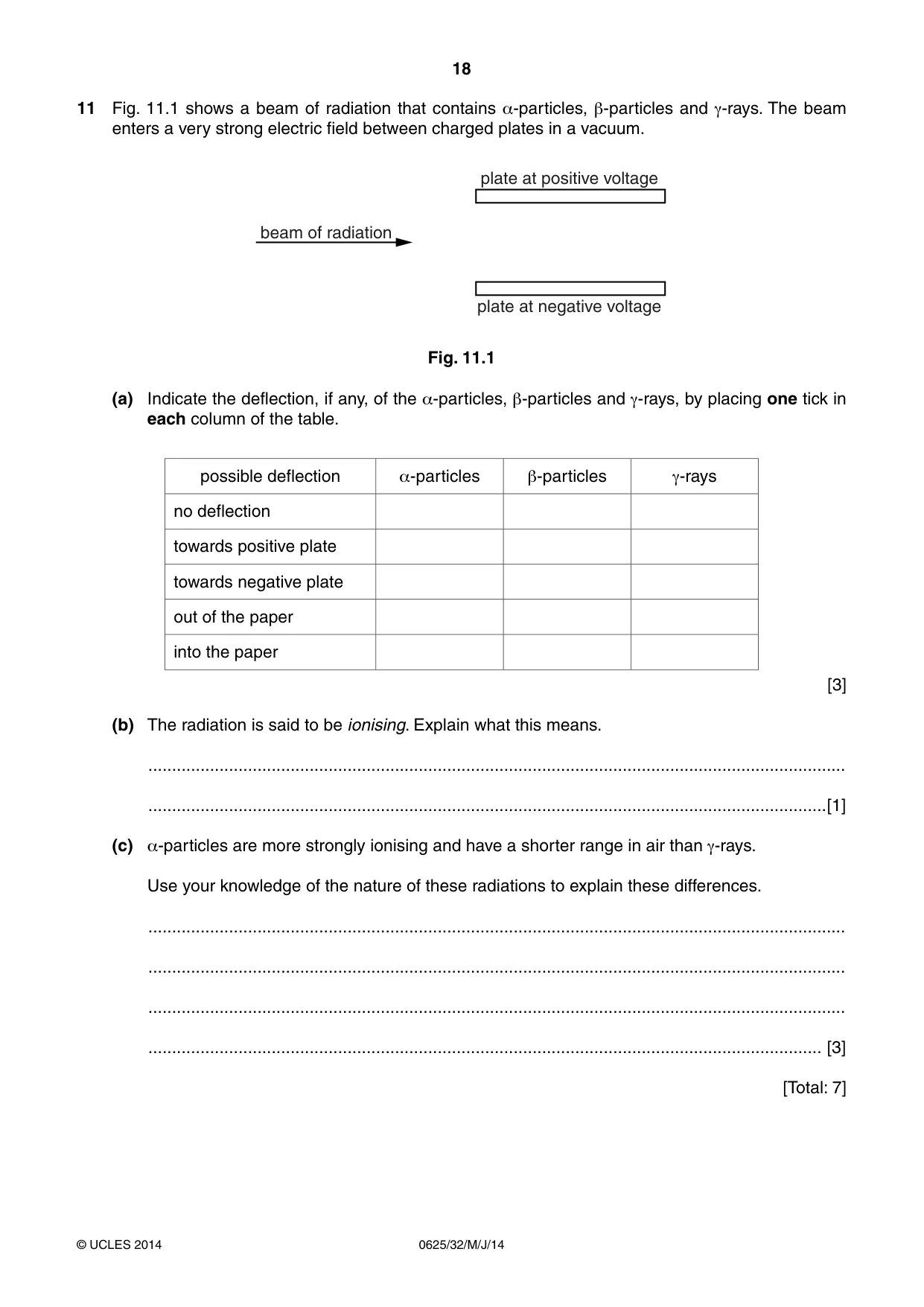

Mark scheme8 pages
Answers below. Sit the paper first if you are practising.
Questions as text
Q1 · A distance-time graph for a moving object
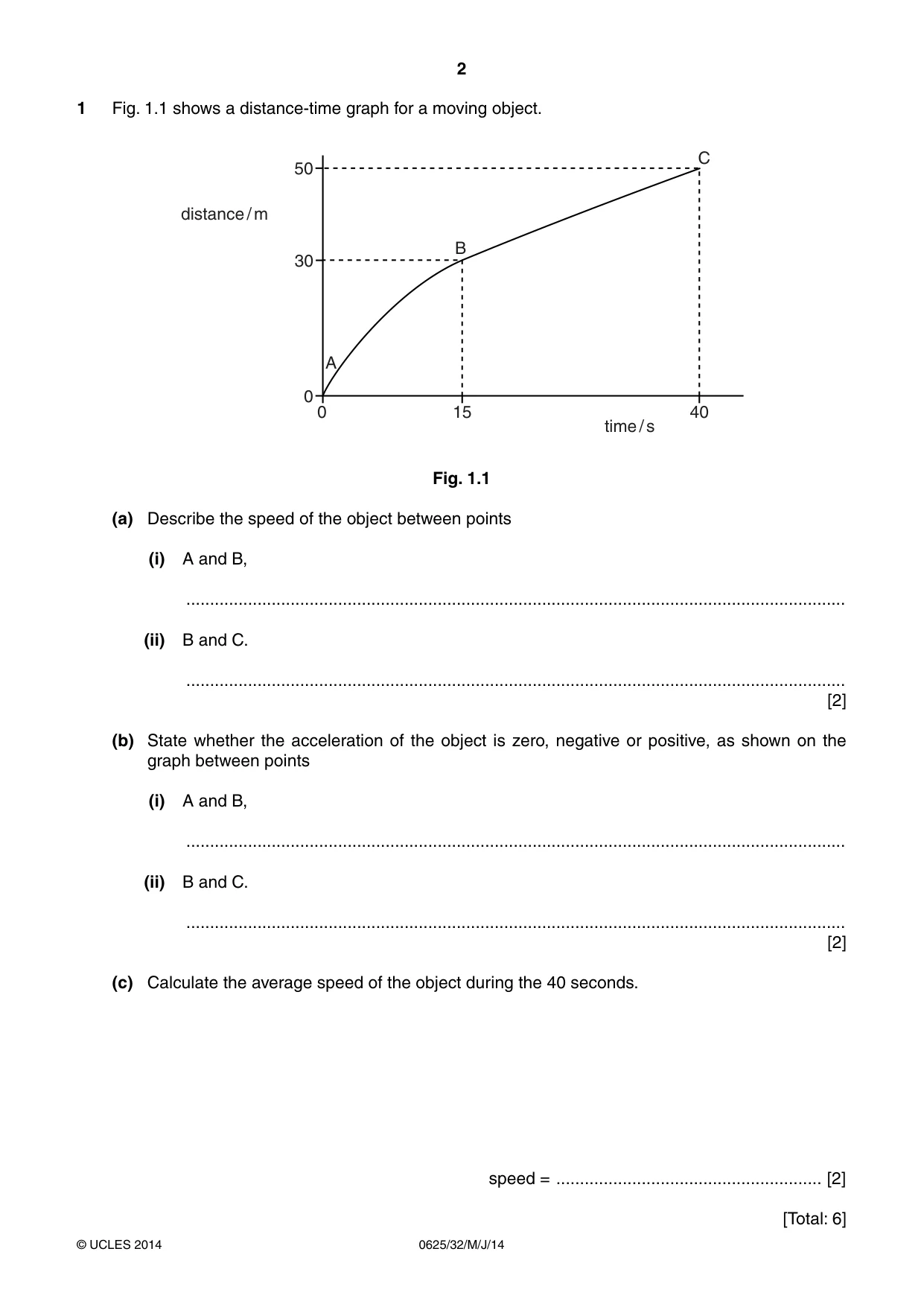
1 Fig. 1.1 shows a distance-time graph for a moving object. C 50 distance / m B 30 A 0 0 15 40 time / s Fig. 1.1 (a) Describe the speed of the object between points (i) A and B, ........................................................................................................................................... (ii) B and C. ........................................................................................................................................... [2] (b) State whether the acceleration of the object is zero, negative or positive, as shown on the graph between points (i) A and B, ........................................................................................................................................... (ii) B and C. ........................................................................................................................................... [2] (c) Calculate the average speed of the object during the 40 seconds. speed = ........................................................ [2] [Total: 6]
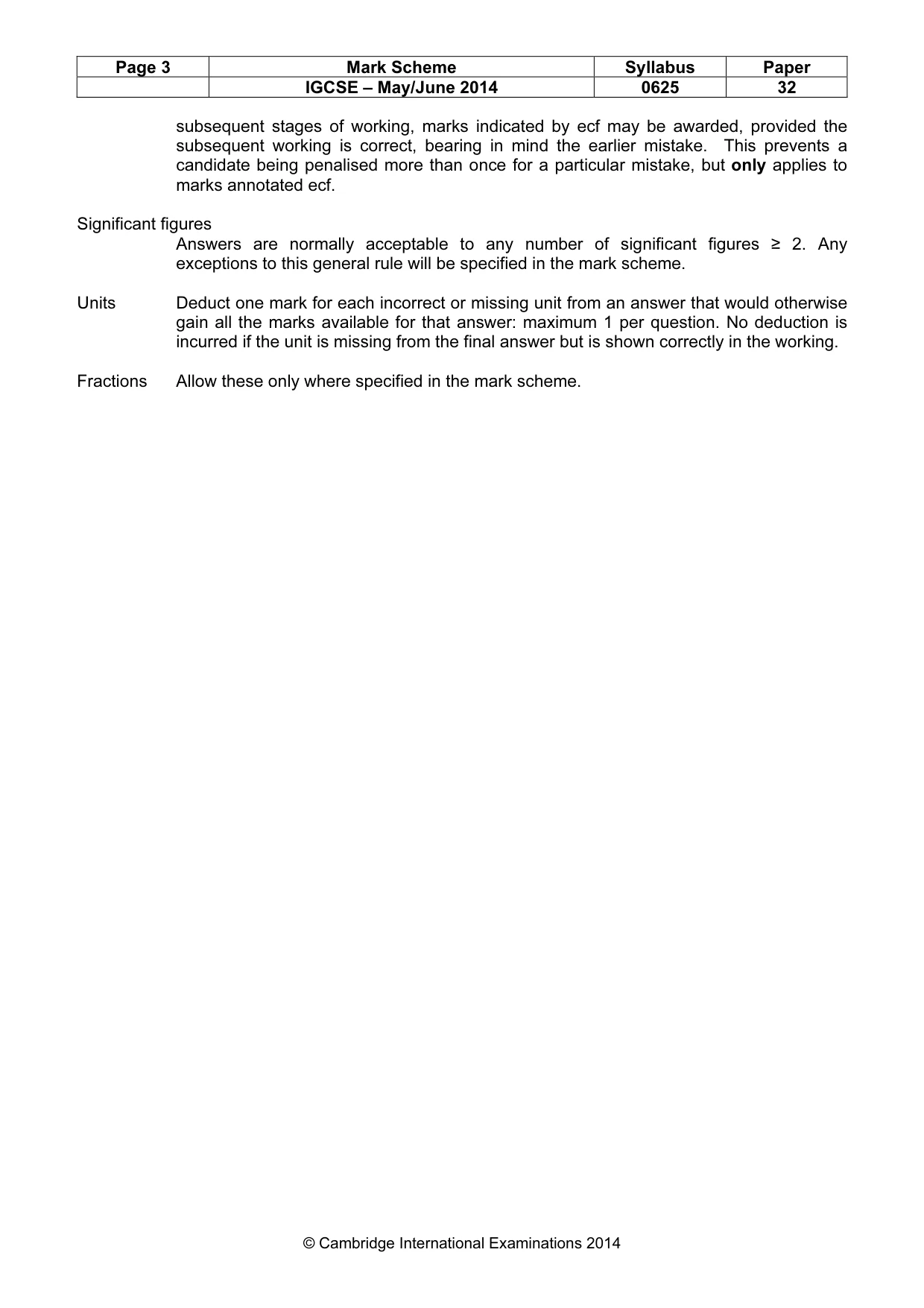
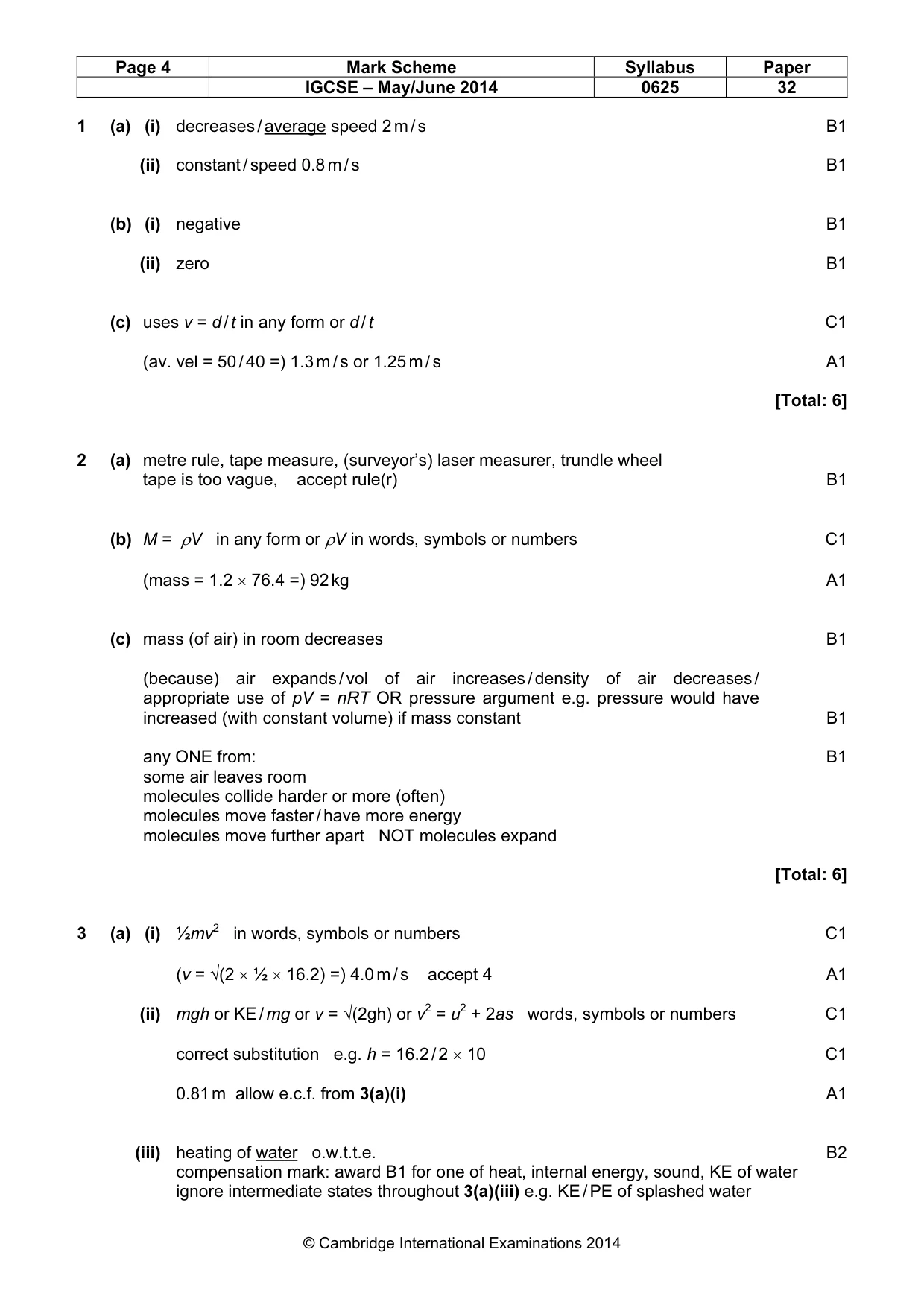
Mark scheme: 1 (a) (i) decreases / average speed 2 m / s B1 (ii) constant / speed 0.8 m / s B1 (b) (i) negative B1 (ii) zero B1 (c) uses v = d / t in any form or d / t C1 (av. vel = 50 / 40 =) 1.3 m / s or 1.25 m / s A1 [Total: 6]
Q2 · A surveyor measures the dimensions of a room of constant height
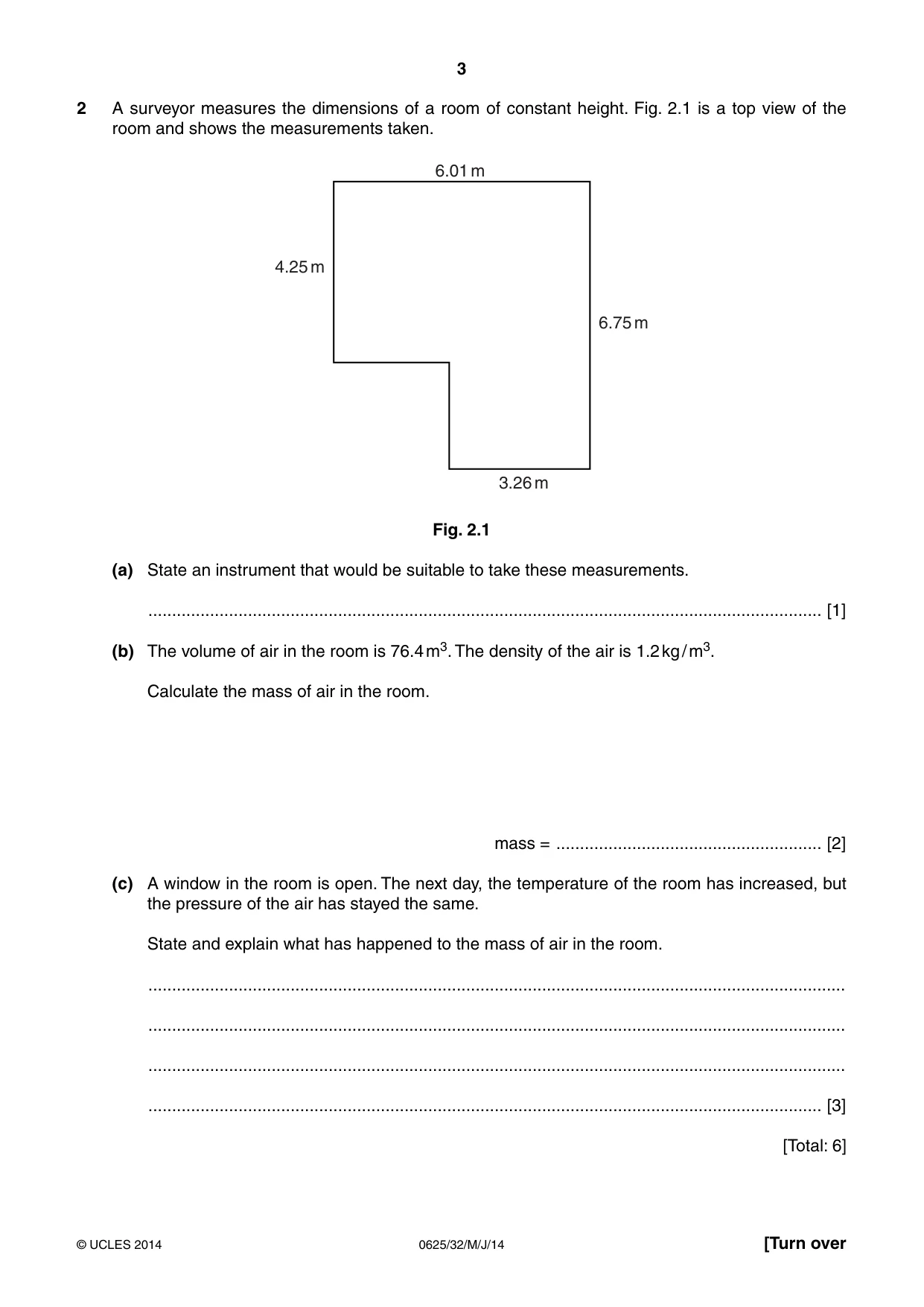
2 A surveyor measures the dimensions of a room of constant height. Fig. 2.1 is a top view of the room and shows the measurements taken. 6.01 m 4.25 m 6.75 m 3.26 m Fig. 2.1 (a) State an instrument that would be suitable to take these measurements. .............................................................................................................................................. [1] (b) The volume of air in the room is 76.4 m3. The density of the air is 1.2 kg / m3. Calculate the mass of air in the room. mass = ........................................................ [2] (c) A window in the room is open. The next day, the temperature of the room has increased, but the pressure of the air has stayed the same. State and explain what has happened to the mass of air in the room. ................................................................................................................................................... ................................................................................................................................................... ................................................................................................................................................... .............................................................................................................................................. [3] [Total: 6]
Mark scheme: 2 (a) metre rule, tape measure, (surveyor’s) laser measurer, trundle wheel tape is too vague, accept rule(r) B1 (b) M = ρV in any form or ρV in words, symbols or numbers C1 (mass = 1.2 × 76.4 =) 92 kg A1 (c) mass (of air) in room decreases B1 (because) air expands / vol of air increases / density of air decreases / appropriate use of pV = nRT OR pressure argument e.g. pressure would have increased (with constant volume) if mass constant B1 any ONE from: B1 some air leaves room molecules collide harder or more (often) molecules move faster / have more energy molecules move further apart NOT molecules expand [Total: 6] 2
Q3 · When a salmon swims up a river to breed, it often has to jump up waterfalls
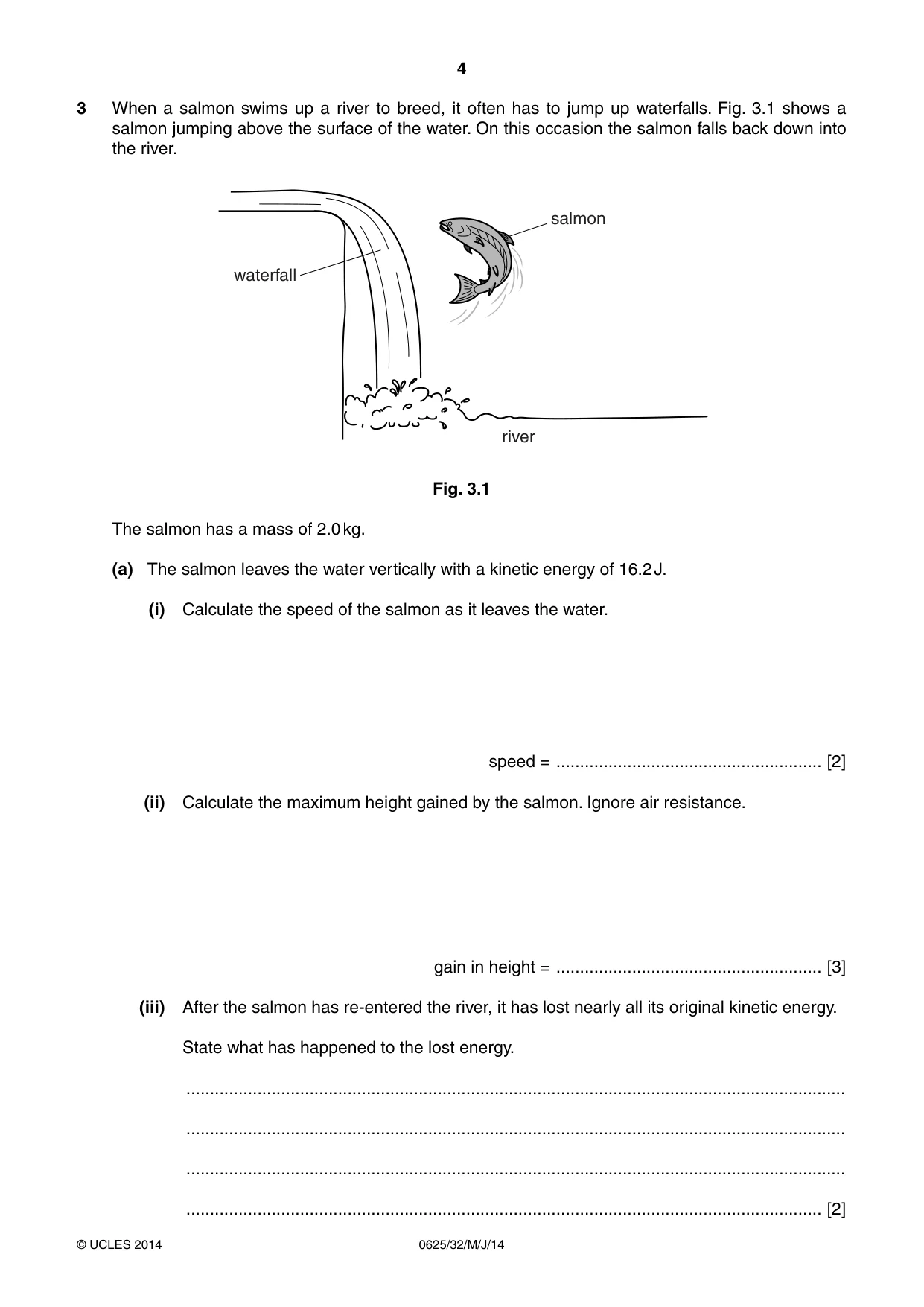
3 When a salmon swims up a river to breed, it often has to jump up waterfalls. Fig. 3.1 shows a salmon jumping above the surface of the water. On this occasion the salmon falls back down into the river. salmon waterfall river Fig. 3.1 The salmon has a mass of 2.0 kg. (a) The salmon leaves the water vertically with a kinetic energy of 16.2 J. (i) Calculate the speed of the salmon as it leaves the water. speed = ........................................................ [2] (ii) Calculate the maximum height gained by the salmon. Ignore air resistance. gain in height = ........................................................ [3] (iii) After the salmon has re-entered the river, it has lost nearly all its original kinetic energy. State what has happened to the lost energy. ........................................................................................................................................... ........................................................................................................................................... ........................................................................................................................................... ...................................................................................................................................... [2] (b) Another salmon, of much greater mass, leaves the water vertically with the same speed. State and explain how the height of this salmon’s jump compares to the height reached by the first salmon. ................................................................................................................................................... ................................................................................................................................................... .............................................................................................................................................. [2] [Total: 9]
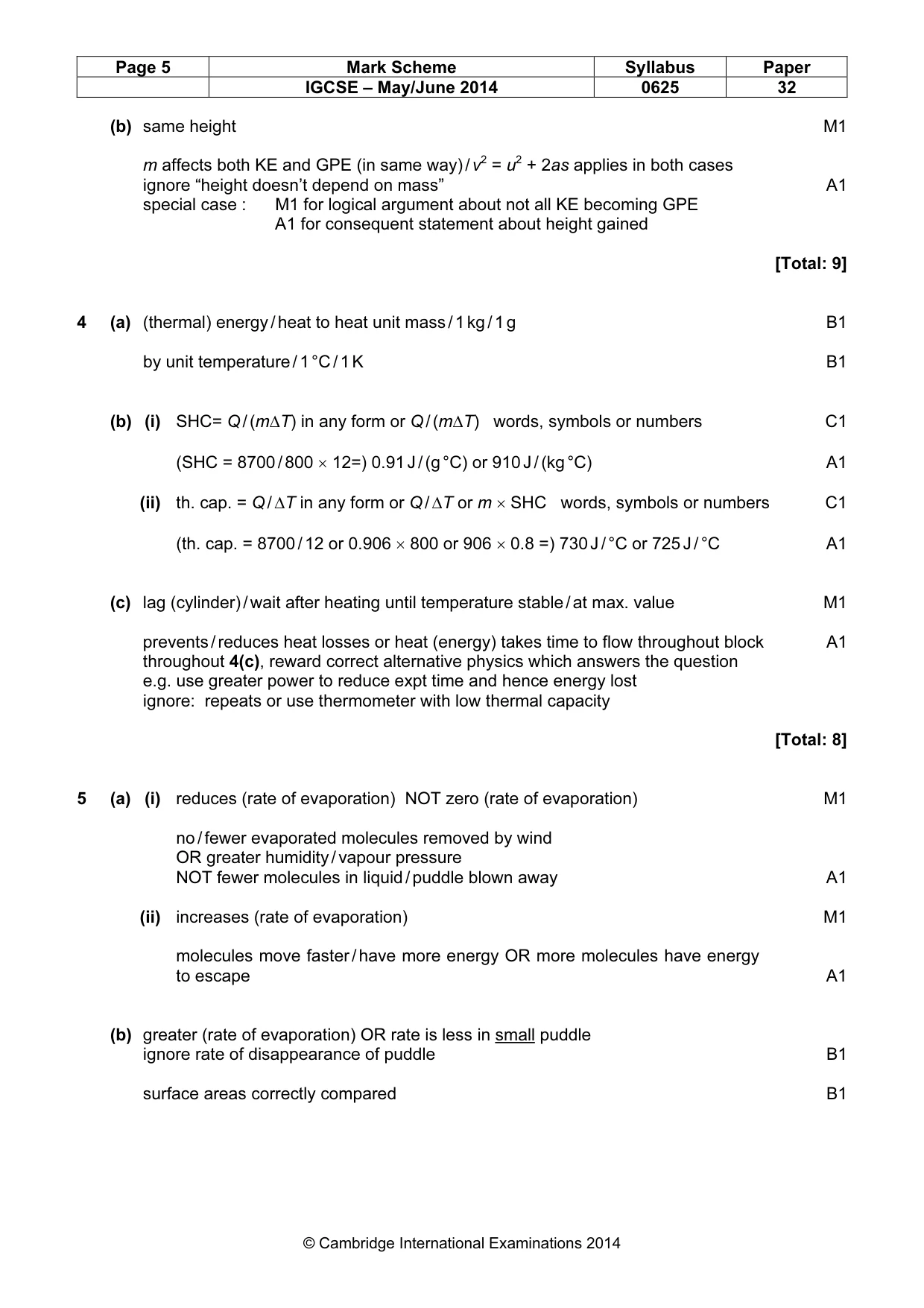
Mark scheme: 3 (a) (i) ½mv2 in words, symbols or numbers C1 (v = √(2 × ½ × 16.2) =) 4.0 m / s accept 4 A1 (ii) mgh or KE / mg or v = √(2gh) or v2 = u2 + 2as words, symbols or numbers C1 correct substitution e.g. h = 16.2 / 2 × 10 C1 0.81 m allow e.c.f. from 3(a)(i) A1 (iii) heating of water o.w.t.t.e. B2 compensation mark: award B1 for one of heat, internal energy, sound, KE of water ignore intermediate states throughout 3(a)(iii) e.g. KE / PE of splashed water IGCSE – May/June 2014 0625 32 (b) same height M1 m affects both KE and GPE (in same way) / v2 = u2 + 2as applies in both cases ignore “height doesn’t depend on mass” A1 special case : M1 for logical argument about not all KE becoming GPE A1 for consequent statement about height gained [Total: 9]
Q4 · Define the specific heat capacity of a substance
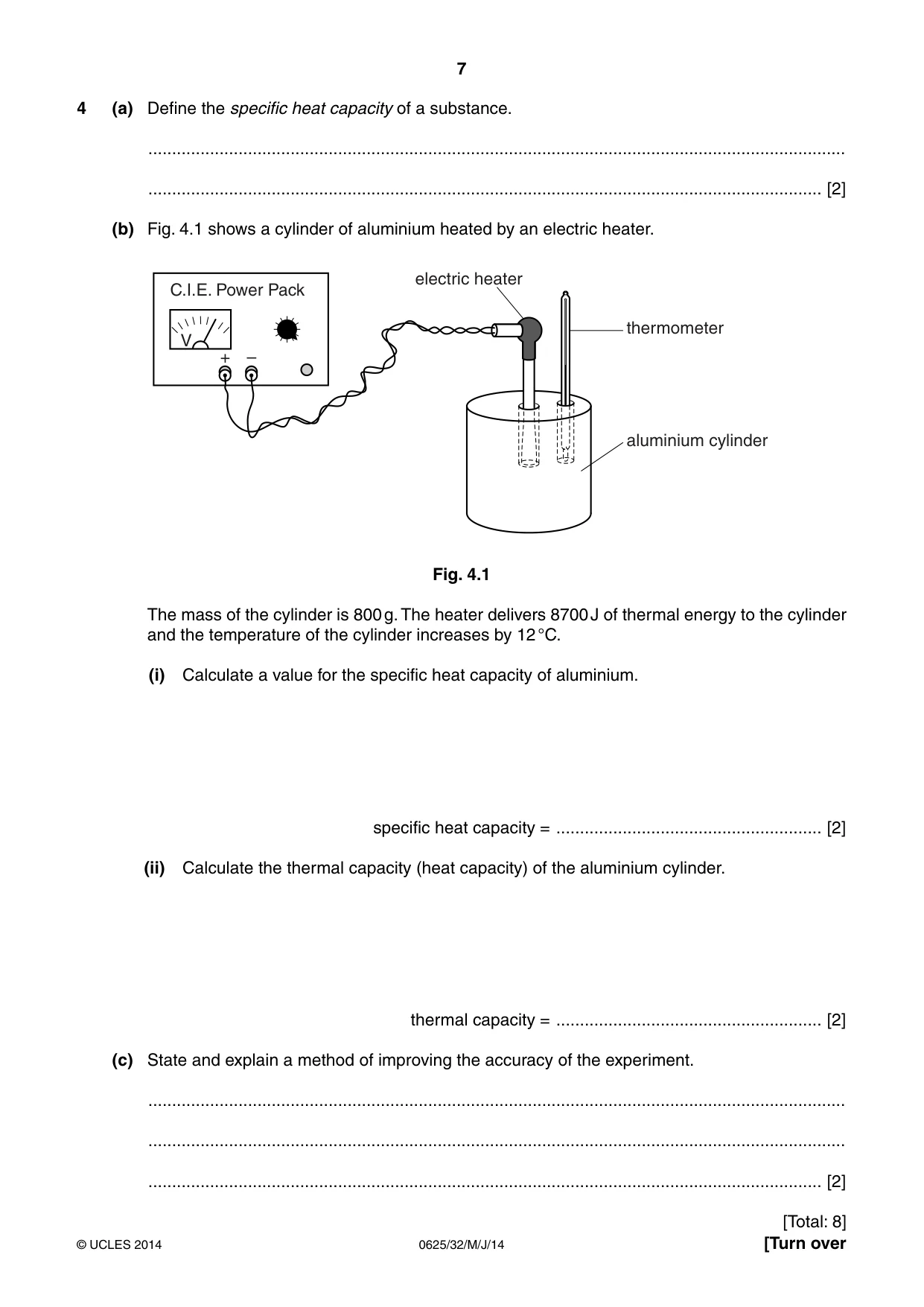
4 (a) Define the specific heat capacity of a substance. ................................................................................................................................................... .............................................................................................................................................. [2] (b) Fig. 4.1 shows a cylinder of aluminium heated by an electric heater. electric heater C.I.E. Power Pack thermometer V + – aluminium cylinder Fig. 4.1 The mass of the cylinder is 800 g. The heater delivers 8700 J of thermal energy to the cylinder and the temperature of the cylinder increases by 12 °C. (i) Calculate a value for the specific heat capacity of aluminium. specific heat capacity = ........................................................ [2] (ii) Calculate the thermal capacity (heat capacity) of the aluminium cylinder. thermal capacity = ........................................................ [2] (c) State and explain a method of improving the accuracy of the experiment. ................................................................................................................................................... ................................................................................................................................................... .............................................................................................................................................. [2] [Total: 8]
Mark scheme: 4 (a) (thermal) energy / heat to heat unit mass / 1 kg / 1 g B1 by unit temperature / 1 °C / 1 K B1 (b) (i) SHC= Q / (m∆T) in any form or Q / (m∆T) words, symbols or numbers C1 (SHC = 8700 / 800 × 12=) 0.91 J / (g °C) or 910 J / (kg °C) A1 (ii) th. cap. = Q / ∆T in any form or Q / ∆T or m × SHC words, symbols or numbers C1 (th. cap. = 8700 / 12 or 0.906 × 800 or 906 × 0.8 =) 730 J / °C or 725 J / °C A1 (c) lag (cylinder) / wait after heating until temperature stable / at max. value M1 prevents / reduces heat losses or heat (energy) takes time to flow throughout block A1 throughout 4(c), reward correct alternative physics which answers the question e.g. use greater power to reduce expt time and hence energy lost ignore: repeats or use thermometer with low thermal capacity [Total: 8]
Q5 · Puddles of water form on a path after rainfall on a windy day
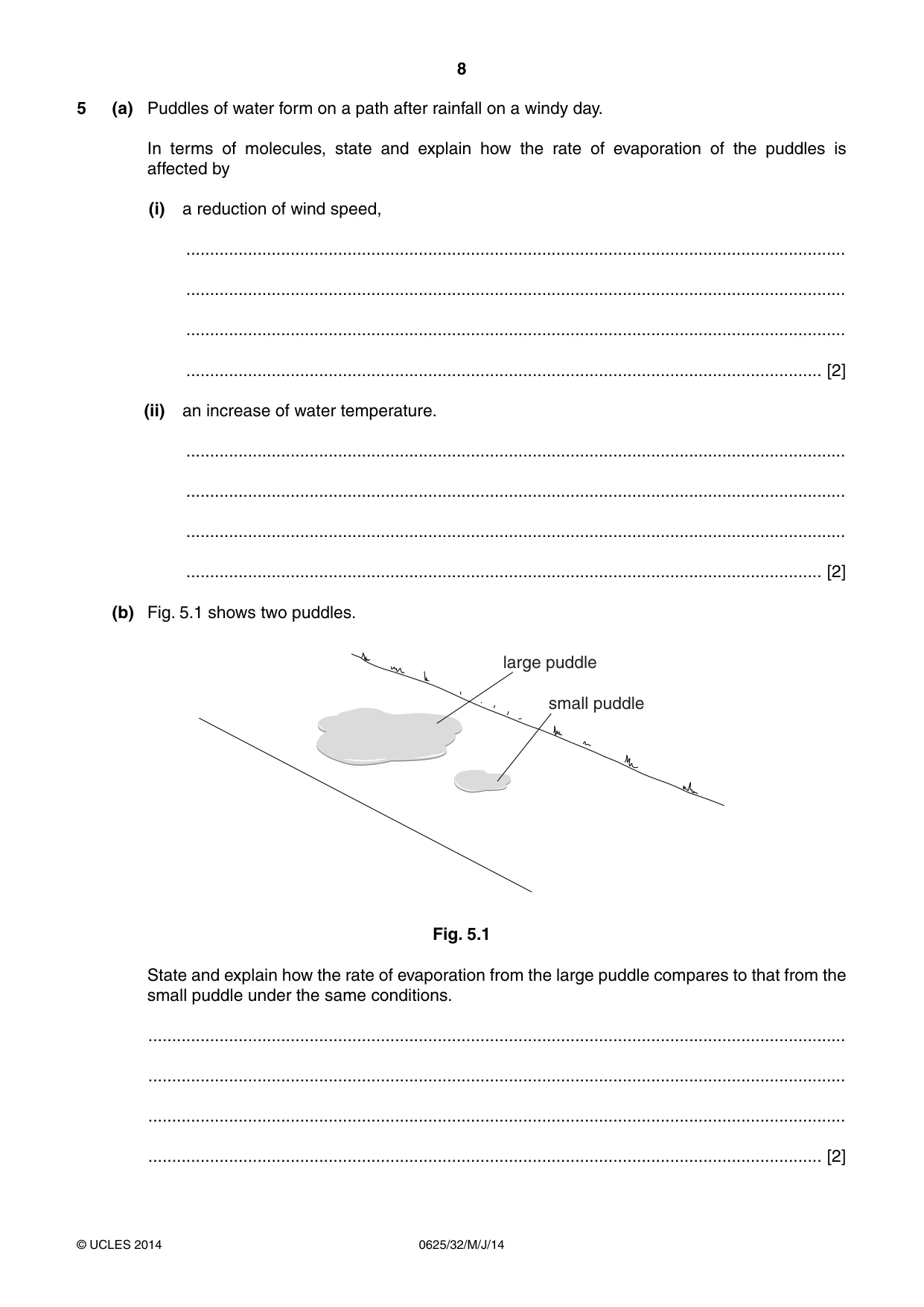
5 (a) Puddles of water form on a path after rainfall on a windy day. In terms of molecules, state and explain how the rate of evaporation of the puddles is affected by (i) a reduction of wind speed, ........................................................................................................................................... ........................................................................................................................................... ........................................................................................................................................... ...................................................................................................................................... [2] (ii) an increase of water temperature. ........................................................................................................................................... ........................................................................................................................................... ........................................................................................................................................... ...................................................................................................................................... [2] (b) Fig. 5.1 shows two puddles. large puddle small puddle Fig. 5.1 State and explain how the rate of evaporation from the large puddle compares to that from the small puddle under the same conditions. ................................................................................................................................................... ................................................................................................................................................... ................................................................................................................................................... .............................................................................................................................................. [2] (c) Describe an experiment to demonstrate the difference between good and bad emitters of infra-red radiation. You may include a diagram to help your description. State what readings should be taken. ................................................................................................................................................... ................................................................................................................................................... ................................................................................................................................................... ................................................................................................................................................... ................................................................................................................................................... ...............................................................................................................................................[3] [Total: 9]
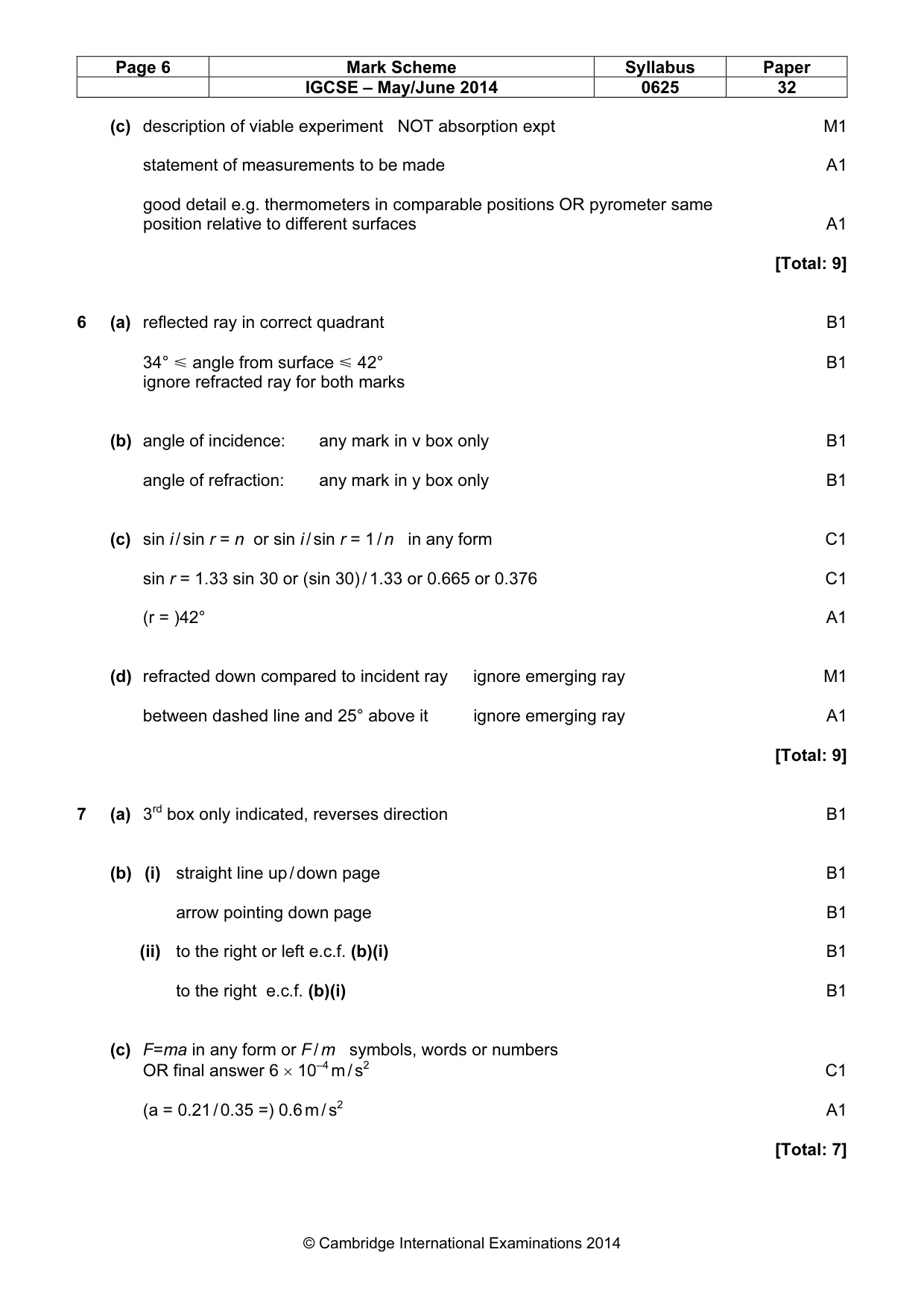
Mark scheme: 5 (a) (i) reduces (rate of evaporation) NOT zero (rate of evaporation) M1 no / fewer evaporated molecules removed by wind OR greater humidity / vapour pressure NOT fewer molecules in liquid / puddle blown away A1 (ii) increases (rate of evaporation) M1 molecules move faster / have more energy OR more molecules have energy to escape A1 (b) greater (rate of evaporation) OR rate is less in small puddle ignore rate of disappearance of puddle B1 surface areas correctly compared B1 IGCSE – May/June 2014 0625 32 (c) description of viable experiment NOT absorption expt M1 statement of measurements to be made A1 good detail e.g. thermometers in comparable positions OR pyrometer same position relative to different surfaces A1 [Total: 9]
Q6 · A ray of light incident on the surface of a glass block
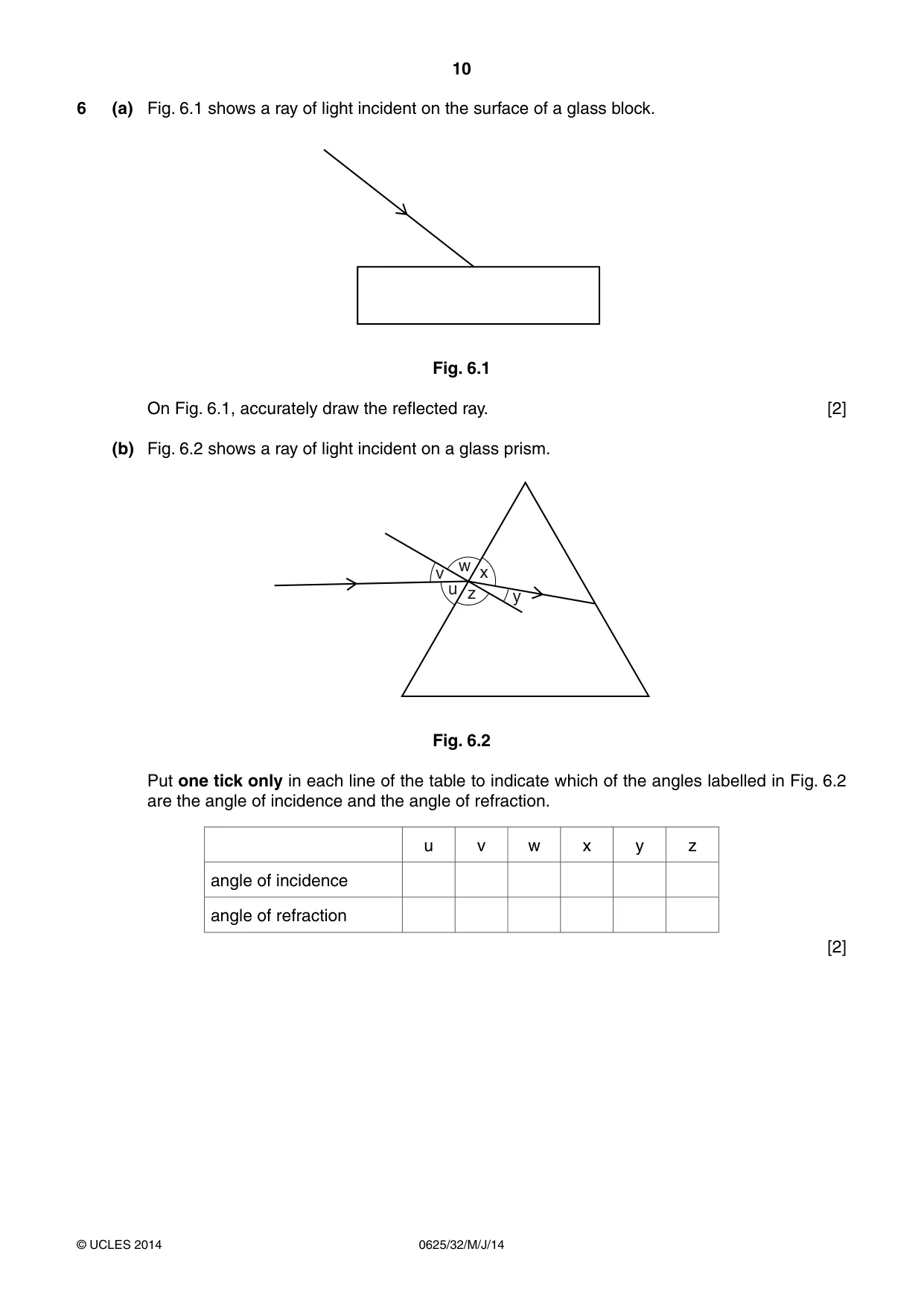
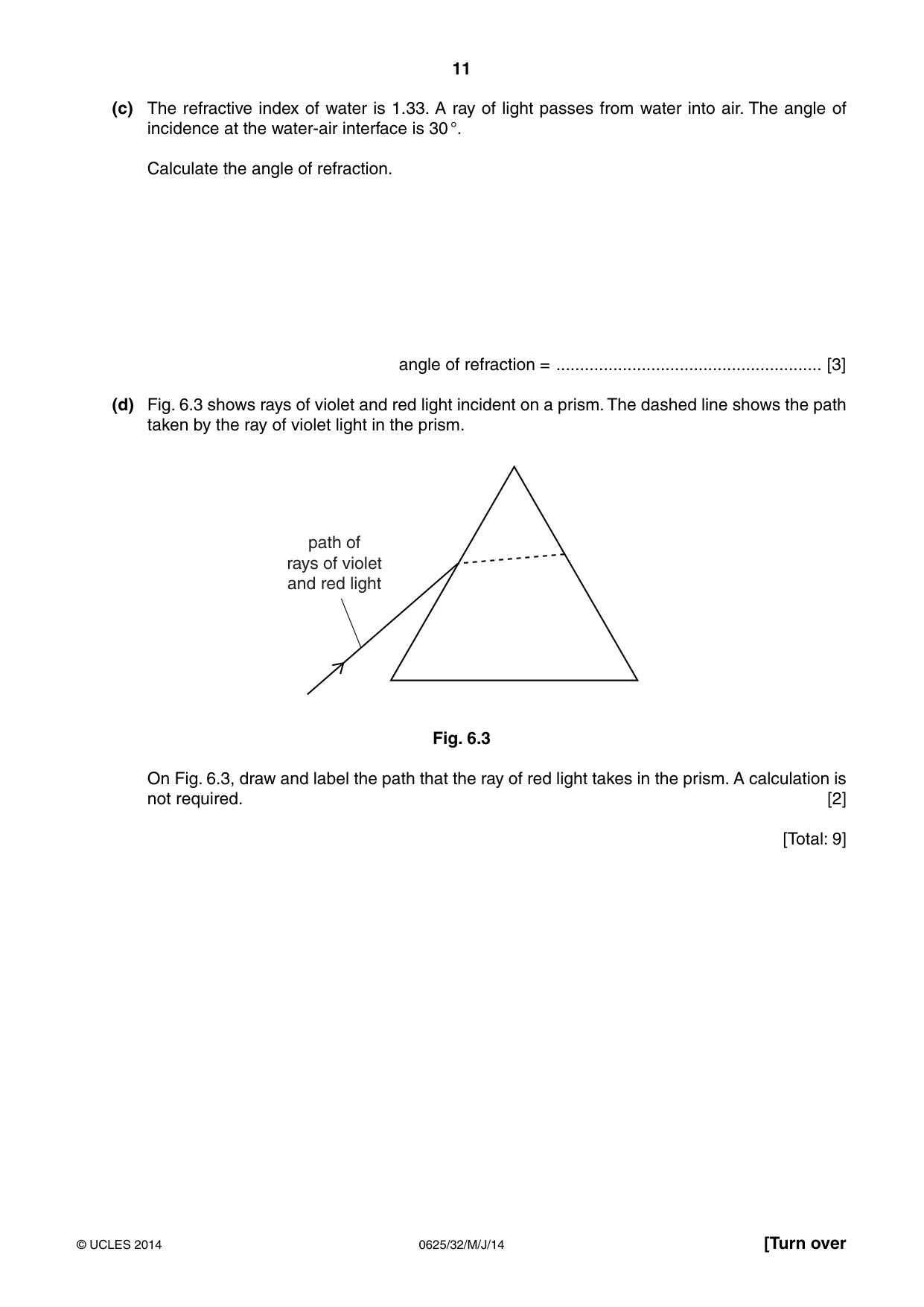
6 (a) Fig. 6.1 shows a ray of light incident on the surface of a glass block. Fig. 6.1 On Fig. 6.1, accurately draw the reflected ray. [2] (b) Fig. 6.2 shows a ray of light incident on a glass prism. w v x u z y Fig. 6.2 Put one tick only in each line of the table to indicate which of the angles labelled in Fig. 6.2 are the angle of incidence and the angle of refraction. u v w x y z angle of incidence angle of refraction [2] (c) The refractive index of water is 1.33. A ray of light passes from water into air. The angle of incidence at the water-air interface is 30 °. Calculate the angle of refraction. angle of refraction = ........................................................ [3] (d) Fig. 6.3 shows rays of violet and red light incident on a prism. The dashed line shows the path taken by the ray of violet light in the prism. path of rays of violet and red light Fig. 6.3 On Fig. 6.3, draw and label the path that the ray of red light takes in the prism. A calculation is not required. [2] [Total: 9]
Mark scheme: 6 (a) reflected ray in correct quadrant B1 34° Y angle from surface Y 42° B1 ignore refracted ray for both marks (b) angle of incidence: any mark in v box only B1 angle of refraction: any mark in y box only B1 (c) sin i / sin r = n or sin i / sin r = 1 / n in any form C1 sin r = 1.33 sin 30 or (sin 30) / 1.33 or 0.665 or 0.376 C1 (r = )42° A1 (d) refracted down compared to incident ray ignore emerging ray M1 between dashed line and 25° above it ignore emerging ray A1 [Total: 9] rd
Q7 · A solenoid connected to a battery produces a magnetic field
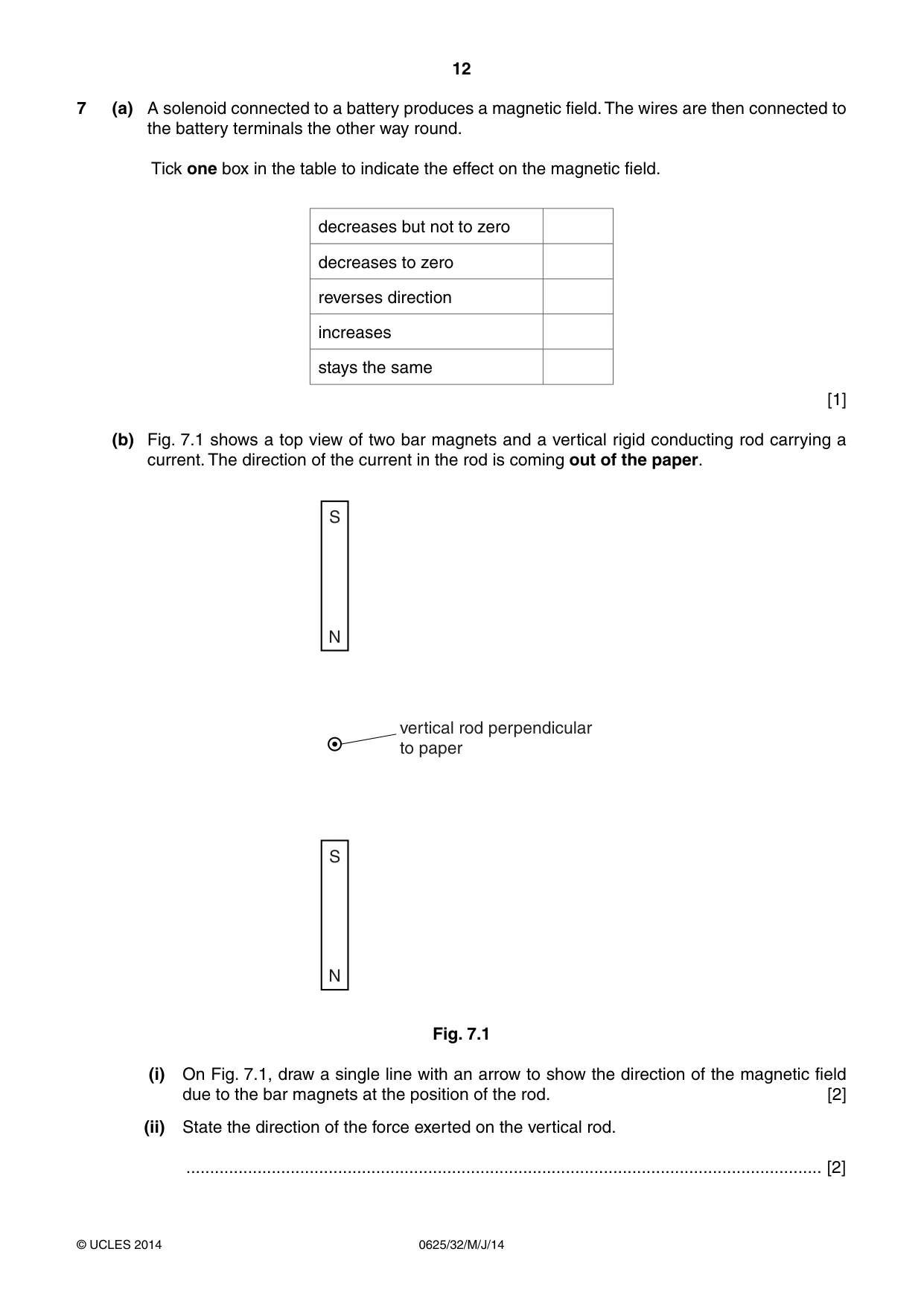
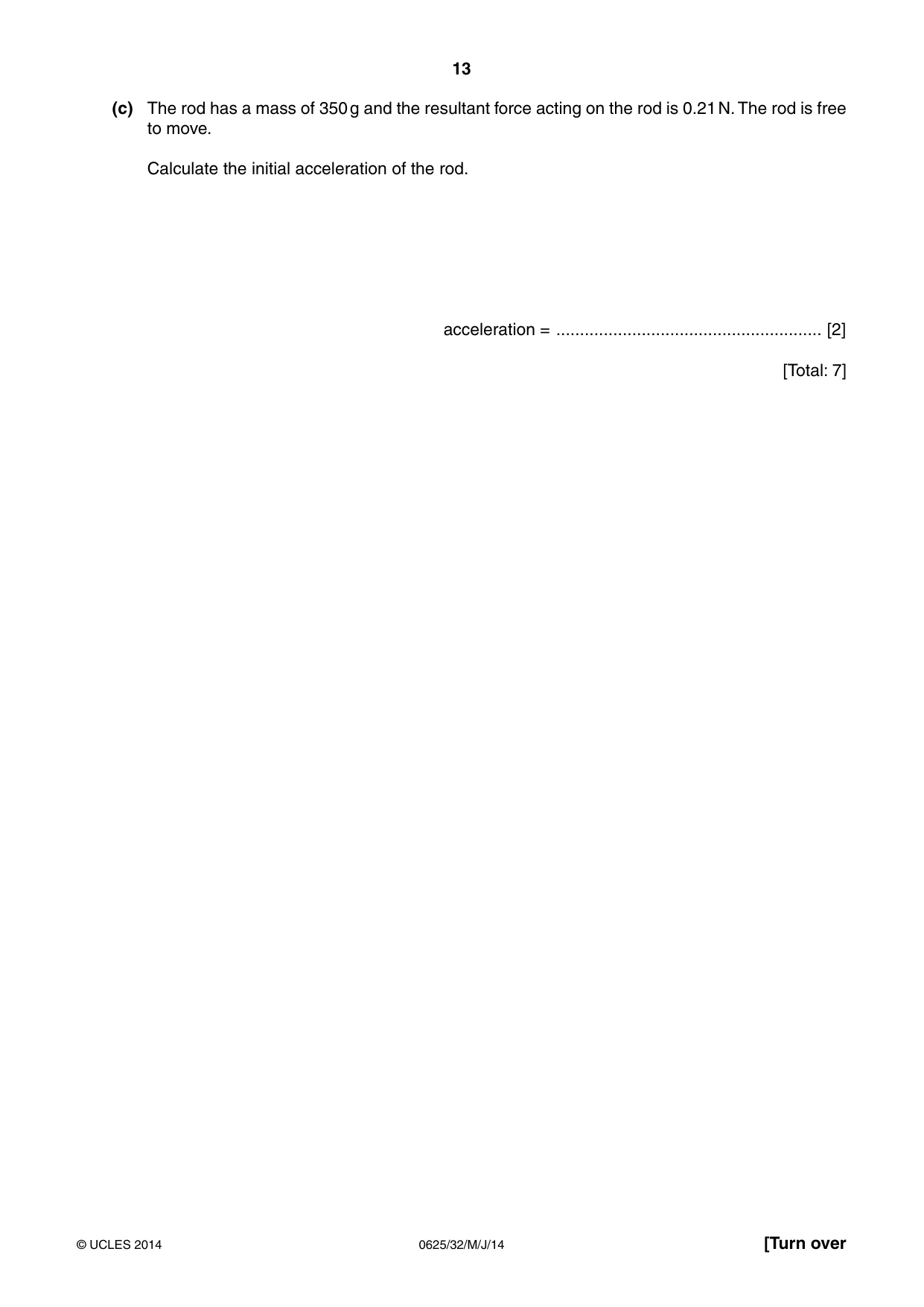
7 (a) A solenoid connected to a battery produces a magnetic field. The wires are then connected to the battery terminals the other way round. Tick one box in the table to indicate the effect on the magnetic field. decreases but not to zero decreases to zero reverses direction increases stays the same [1] (b) Fig. 7.1 shows a top view of two bar magnets and a vertical rigid conducting rod carrying a current. The direction of the current in the rod is coming out of the paper. S N vertical rod perpendicular to paper S N Fig. 7.1 (i) On Fig. 7.1, draw a single line with an arrow to show the direction of the magnetic field due to the bar magnets at the position of the rod. [2] (ii) State the direction of the force exerted on the vertical rod. ...................................................................................................................................... [2] (c) The rod has a mass of 350 g and the resultant force acting on the rod is 0.21 N. The rod is free to move. Calculate the initial acceleration of the rod. acceleration = ........................................................ [2] [Total: 7]
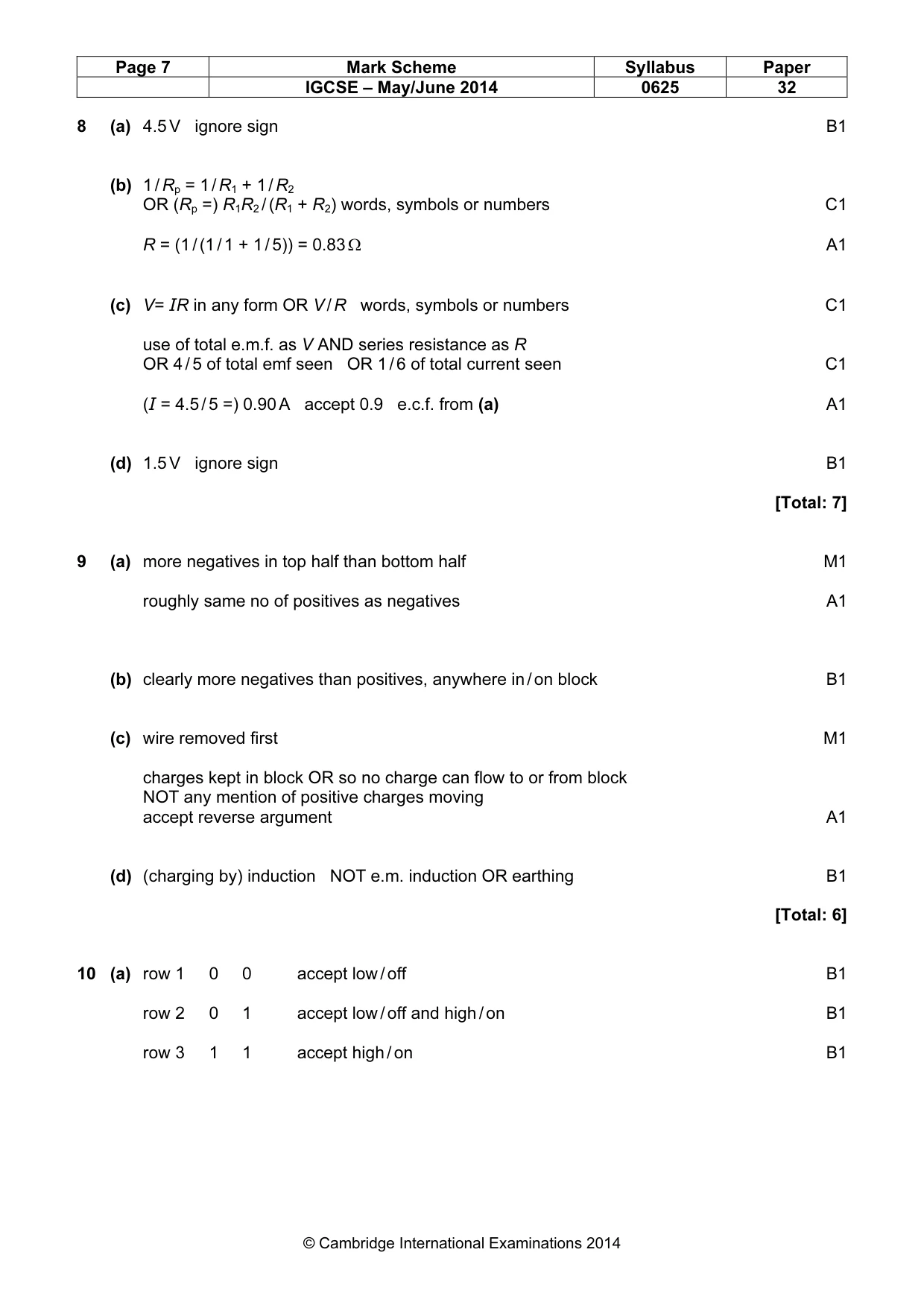
Mark scheme: 7 (a) 3rd box only indicated, reverses direction B1 (b) (i) straight line up / down page B1 arrow pointing down page B1 (ii) to the right or left e.c.f. (b)(i) B1 to the right e.c.f. (b)(i) B1 (c) F=ma in any form or F / m symbols, words or numbers OR final answer 6 × 10⁻⁴ m / s2 C1 (a = 0.21 / 0.35 =) 0.6 m / s2 A1 [Total: 7] IGCSE – May/June 2014 0625 32
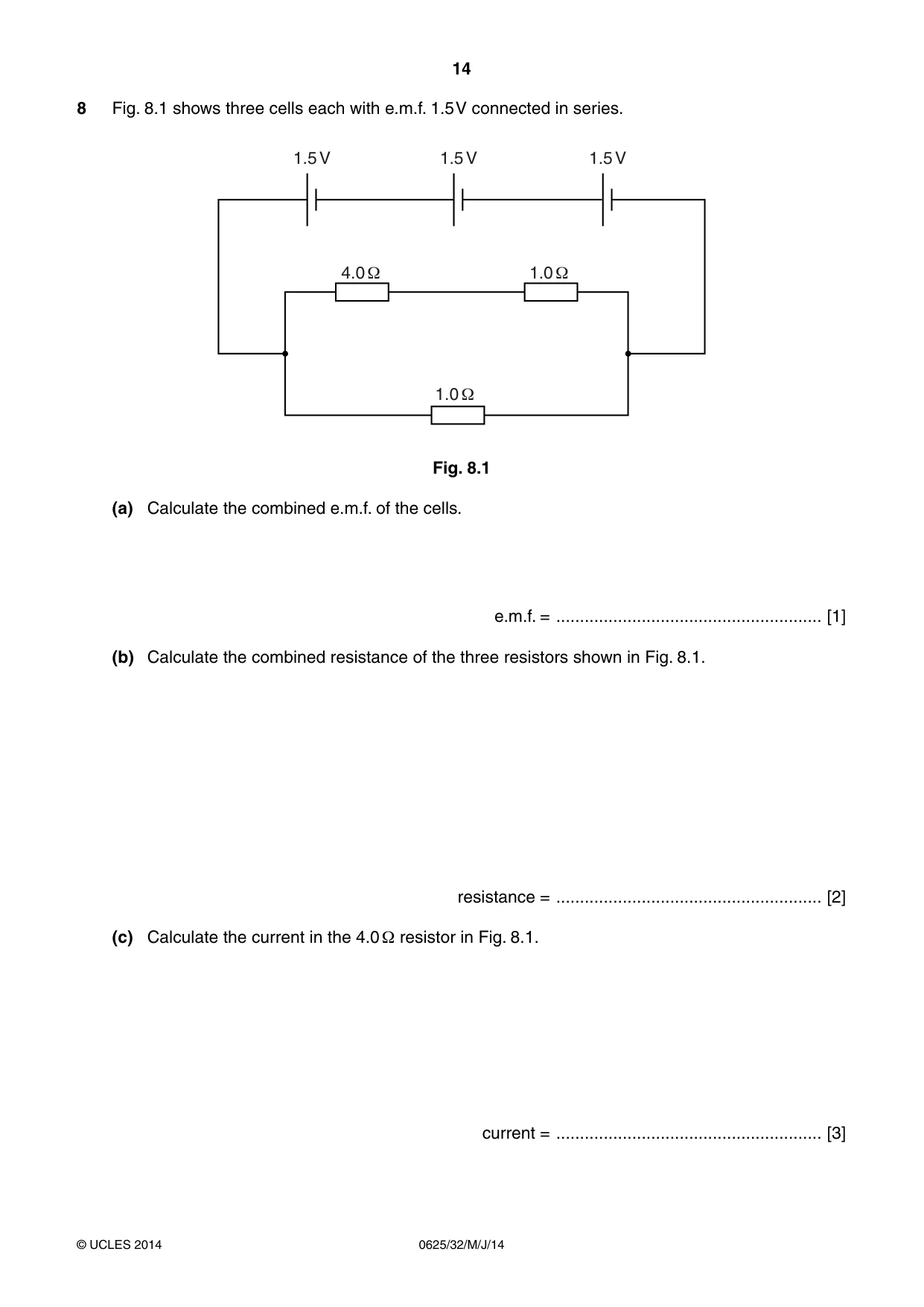
Q8 · Three cells each with e.m.f
8 Fig. 8.1 shows three cells each with e.m.f. 1.5 V connected in series. 1.5 V 1.5 V 1.5 V 4.0 1 1.0 1 1.0 1 Fig. 8.1 (a) Calculate the combined e.m.f. of the cells. e.m.f. = ........................................................ [1] (b) Calculate the combined resistance of the three resistors shown in Fig. 8.1. resistance = ........................................................ [2] (c) Calculate the current in the 4.0 Ω resistor in Fig. 8.1. current = ........................................................ [3] (d) Calculate the combined e.m.f. of the cells if one cell is reversed. e.m.f. = ........................................................ [1] [Total: 7]
Mark scheme: 8 (a) 4.5 V ignore sign B1 (b) 1 / Rp = 1 / R1 + 1 / R2 OR (Rp =) R1R2 / (R1 + R2) words, symbols or numbers C1 R = (1 / (1 / 1 + 1 / 5)) = 0.83 Ω A1 (c) V= IR in any form OR V / R words, symbols or numbers C1 use of total e.m.f. as V AND series resistance as R OR 4 / 5 of total emf seen OR 1 / 6 of total current seen C1 (I = 4.5 / 5 =) 0.90 A accept 0.9 e.c.f. from (a) A1 (d) 1.5 V ignore sign B1 [Total: 7]
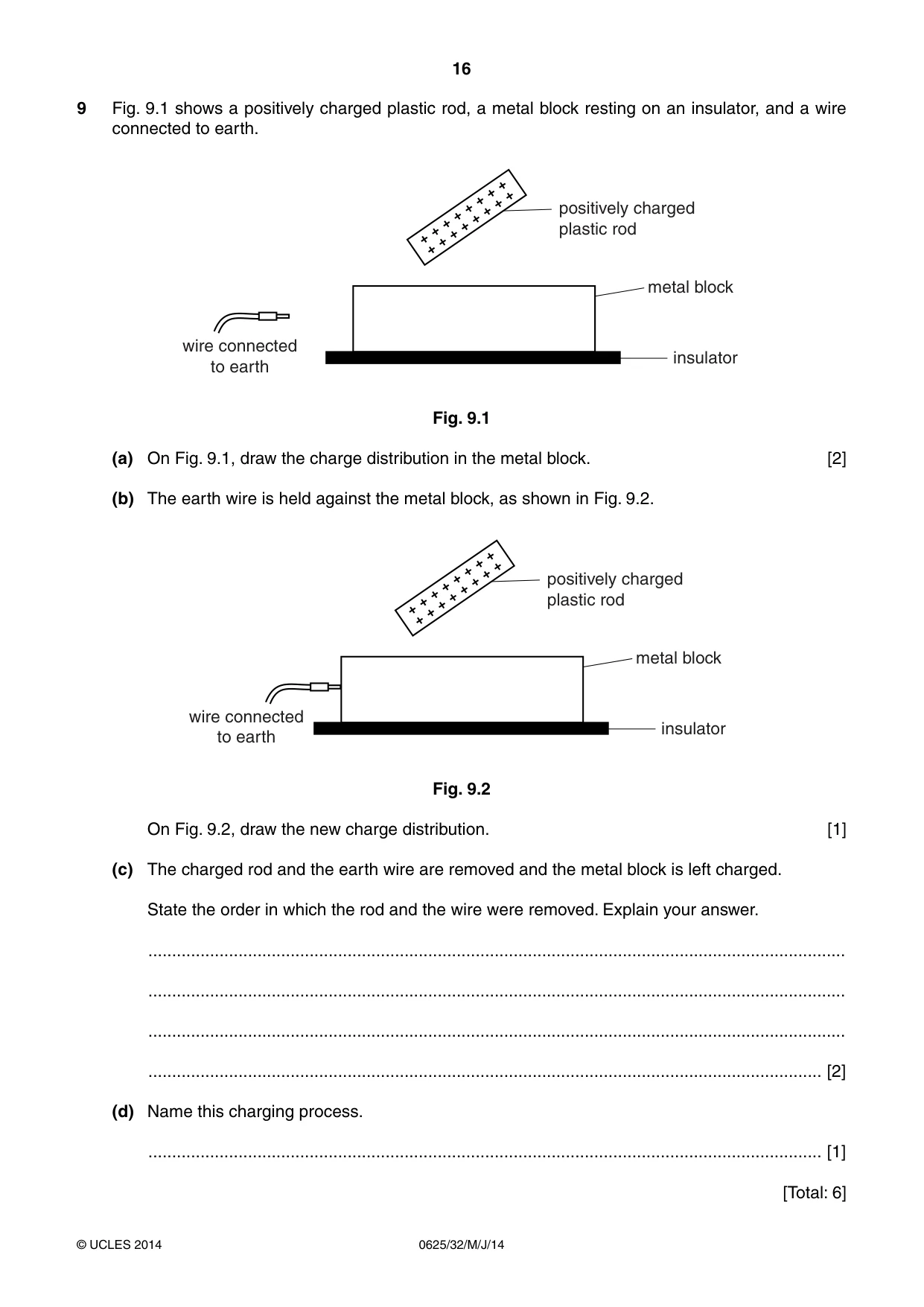
Q9 · A positively charged plastic rod, a metal block resting on an insulator, and a wire…
9 Fig. 9.1 shows a positively charged plastic rod, a metal block resting on an insulator, and a wire connected to earth. positively charged plastic rod metal block wire connected insulator to earth Fig. 9.1 (a) On Fig. 9.1, draw the charge distribution in the metal block. [2] (b) The earth wire is held against the metal block, as shown in Fig. 9.2. positively charged plastic rod metal block wire connected insulator to earth Fig. 9.2 On Fig. 9.2, draw the new charge distribution. [1] (c) The charged rod and the earth wire are removed and the metal block is left charged. State the order in which the rod and the wire were removed. Explain your answer. ................................................................................................................................................... ................................................................................................................................................... ................................................................................................................................................... .............................................................................................................................................. [2] (d) Name this charging process. .............................................................................................................................................. [1] [Total: 6]
Mark scheme: 9 (a) more negatives in top half than bottom half M1 roughly same no of positives as negatives A1 (b) clearly more negatives than positives, anywhere in / on block B1 (c) wire removed first M1 charges kept in block OR so no charge can flow to or from block NOT any mention of positive charges moving accept reverse argument A1 (d) (charging by) induction NOT e.m. induction OR earthing B1 [Total: 6]
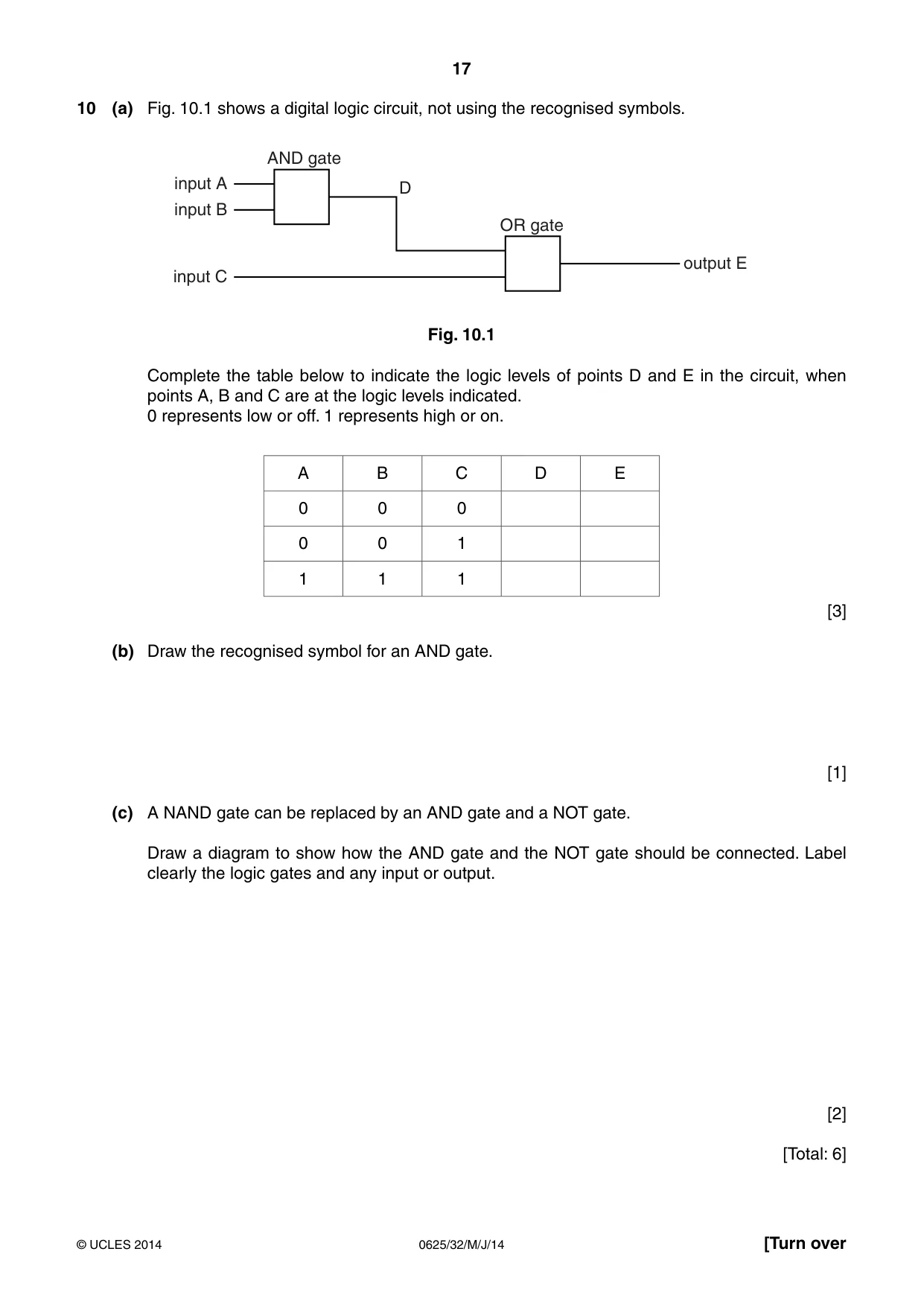
Q10 · A digital logic circuit, not using the recognised symbols
10 (a) Fig. 10.1 shows a digital logic circuit, not using the recognised symbols. AND gate input A D input B OR gate output E input C Fig. 10.1 Complete the table below to indicate the logic levels of points D and E in the circuit, when points A, B and C are at the logic levels indicated. 0 represents low or off. 1 represents high or on. A B C D E 0 0 0 0 0 1 1 1 1 [3] (b) Draw the recognised symbol for an AND gate. [1] (c) A NAND gate can be replaced by an AND gate and a NOT gate. Draw a diagram to show how the AND gate and the NOT gate should be connected. Label clearly the logic gates and any input or output. [2] [Total: 6]
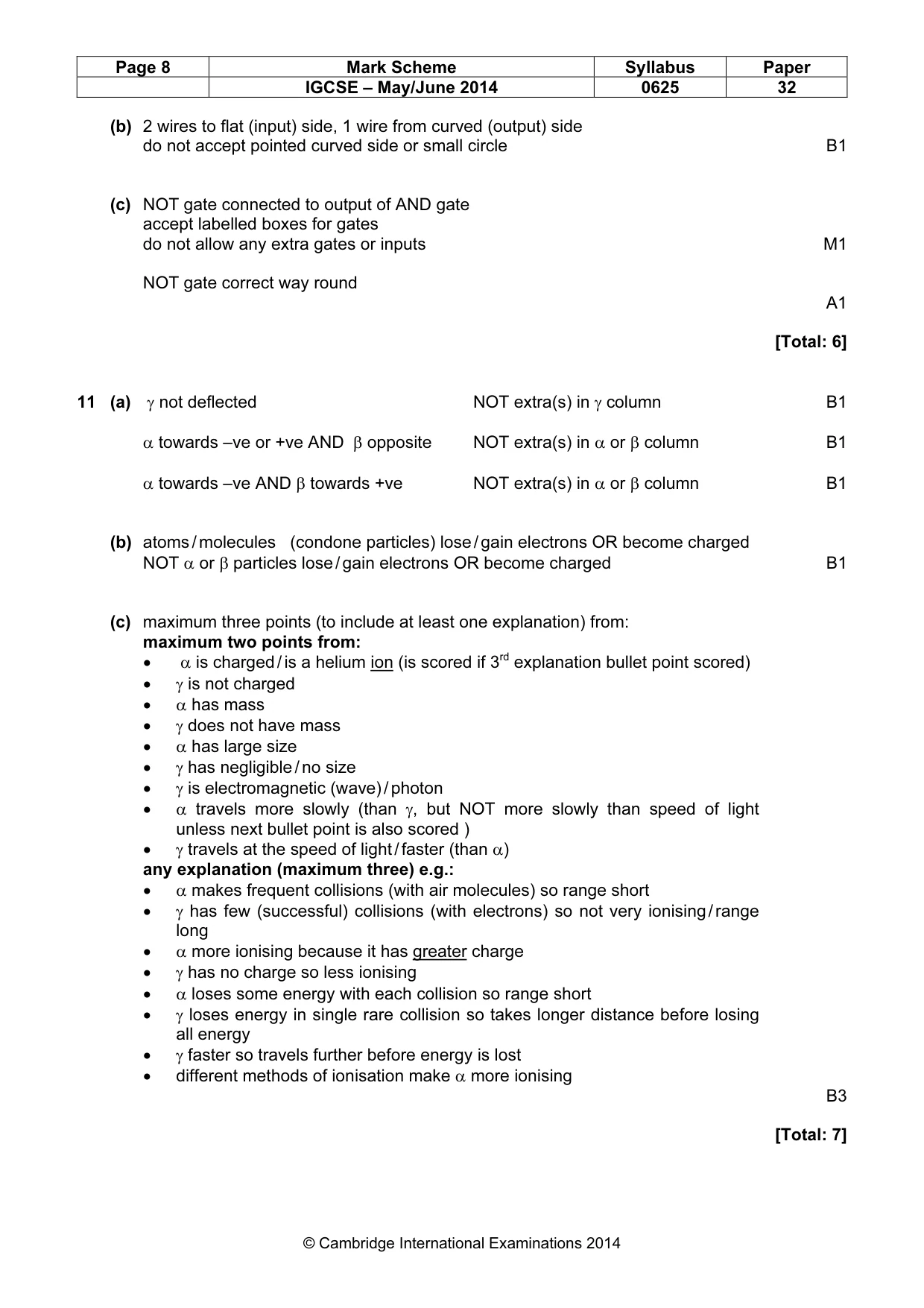
Mark scheme: 10 (a) row 1 0 0 accept low / off B1 row 2 0 1 accept low / off and high / on B1 row 3 1 1 accept high / on B1 IGCSE – May/June 2014 0625 32 (b) 2 wires to flat (input) side, 1 wire from curved (output) side do not accept pointed curved side or small circle B1 (c) NOT gate connected to output of AND gate accept labelled boxes for gates do not allow any extra gates or inputs M1 NOT gate correct way round A1 [Total: 6]
Q11 · A beam of radiation that contains α-particles, β-particles and γ-rays
11 Fig. 11.1 shows a beam of radiation that contains α-particles, β-particles and γ-rays. The beam enters a very strong electric field between charged plates in a vacuum. plate at positive voltage beam of radiation plate at negative voltage Fig. 11.1 (a) Indicate the deflection, if any, of the α-particles, β-particles and γ-rays, by placing one tick in each column of the table. possible deflection α-particles β-particles γ-rays no deflection towards positive plate towards negative plate out of the paper into the paper [3] (b) The radiation is said to be ionising. Explain what this means. ................................................................................................................................................... ...............................................................................................................................................[1] (c) α-particles are more strongly ionising and have a shorter range in air than γ-rays. Use your knowledge of the nature of these radiations to explain these differences. ................................................................................................................................................... ................................................................................................................................................... ................................................................................................................................................... .............................................................................................................................................. [3] [Total: 7]
Mark scheme: 11 (a) γ not deflected NOT extra(s) in γ column B1 α towards –ve or +ve AND β opposite NOT extra(s) in α or β column B1 α towards –ve AND β towards +ve NOT extra(s) in α or β column B1 (b) atoms / molecules (condone particles) lose / gain electrons OR become charged NOT α or β particles lose / gain electrons OR become charged B1 (c) maximum three points (to include at least one explanation) from: maximum two points from: • α is charged / is a helium ion (is scored if 3rd explanation bullet point scored) • γ is not charged • α has mass • γ does not have mass • α has large size • γ has negligible / no size • γ is electromagnetic (wave) / photon • α travels more slowly (than γ, but NOT more slowly than speed of light unless next bullet point is also scored ) • γ travels at the speed of light / faster (than α) any explanation (maximum three) e.g.: • α makes frequent collisions (with air molecules) so range short • γ has few (successful) collisions (with electrons) so not very ionising / range long • α more ionising because it has greater charge • γ has no charge so less ionising • α loses some energy with each collision so range short • γ loses energy in single rare collision so takes longer distance before losing all energy • γ faster so travels further before energy is lost • different methods of ionisation make α more ionising B3 [Total: 7]
What was in this paper
The subtopics covered by these 11 questions, and how many questions each got. Open one in a new tab to see every Cambridge question on it.
What you needed in this session
Cambridge’s own grade thresholds for 2014 May/June, Paper 3 · Variant 2. A higher threshold means an easier paper — the bar moves with how the cohort did.