Cambridge IGCSE Physics 0625 — 2018 May/June Paper 3 · Variant 2
0625/32/M/J/18 · 12 questions · 80 marks · ≈90 min
The question paper and its mark scheme, free to read here and free to download. This is Cambridge’s own paper, exactly as it was sat.
Question paper16 pages
Mark scheme10 pages
Answers below. Sit the paper first if you are practising.
Questions as text
Q1 · The speed-time graph for a car
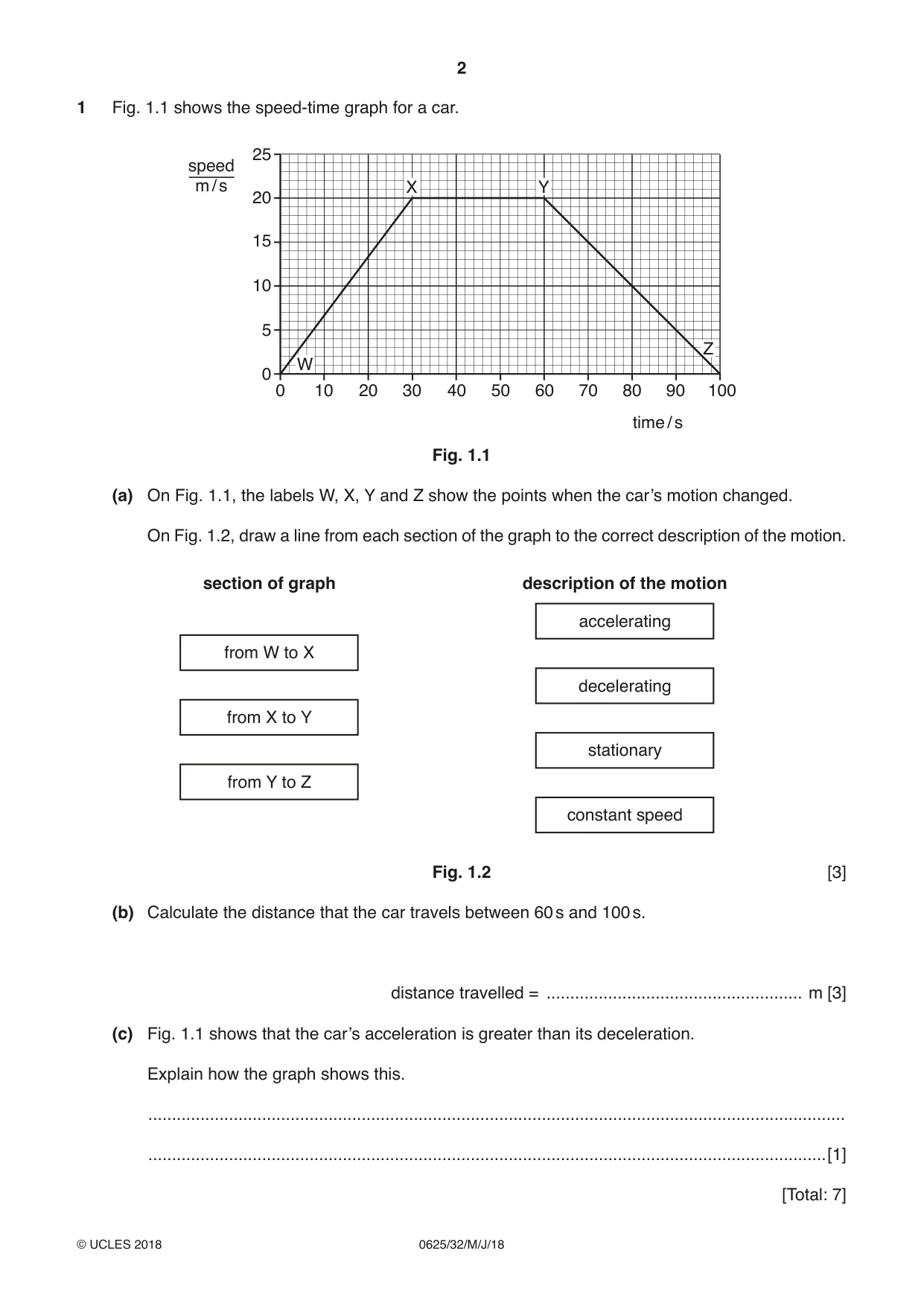
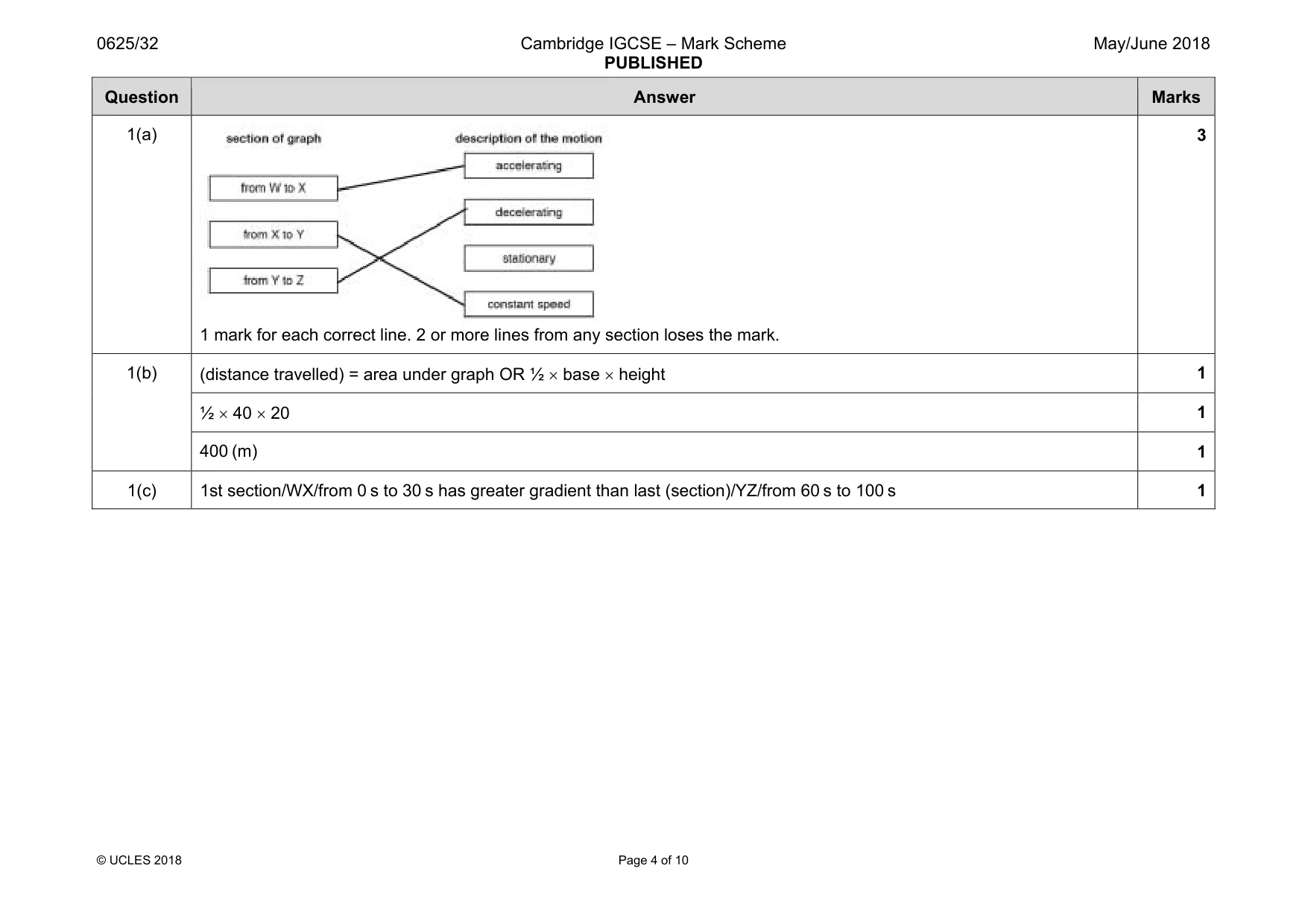
1 Fig. 1.1 shows the speed-time graph for a car. 25 speed m / s X Y 20 15 10 5 Z W 0 0 10 20 30 40 50 60 70 80 90 100 time / s Fig. 1.1 (a) On Fig. 1.1, the labels W, X, Y and Z show the points when the car’s motion changed. On Fig. 1.2, draw a line from each section of the graph to the correct description of the motion. section of graph description of the motion accelerating from W to X decelerating from X to Y stationary from Y to Z constant speed Fig. 1.2 [3] (b) Calculate the distance that the car travels between 60 s and 100 s. distance travelled = ...................................................... m [3] (c) Fig. 1.1 shows that the car’s acceleration is greater than its deceleration. Explain how the graph shows this. ................................................................................................................................................... ...............................................................................................................................................[1] [Total: 7]
Mark scheme: 1(a) 1 mark for each correct line. 2 or more lines from any section loses the mark. 3 1(b) (distance travelled) = area under graph OR ½ × base × height 1 ½ × 40 × 20 1 400 (m) 1 1(c) 1st section/WX/from 0 s to 30 s has greater gradient than last (section)/YZ/from 60 s to 100 s 1
Question 2
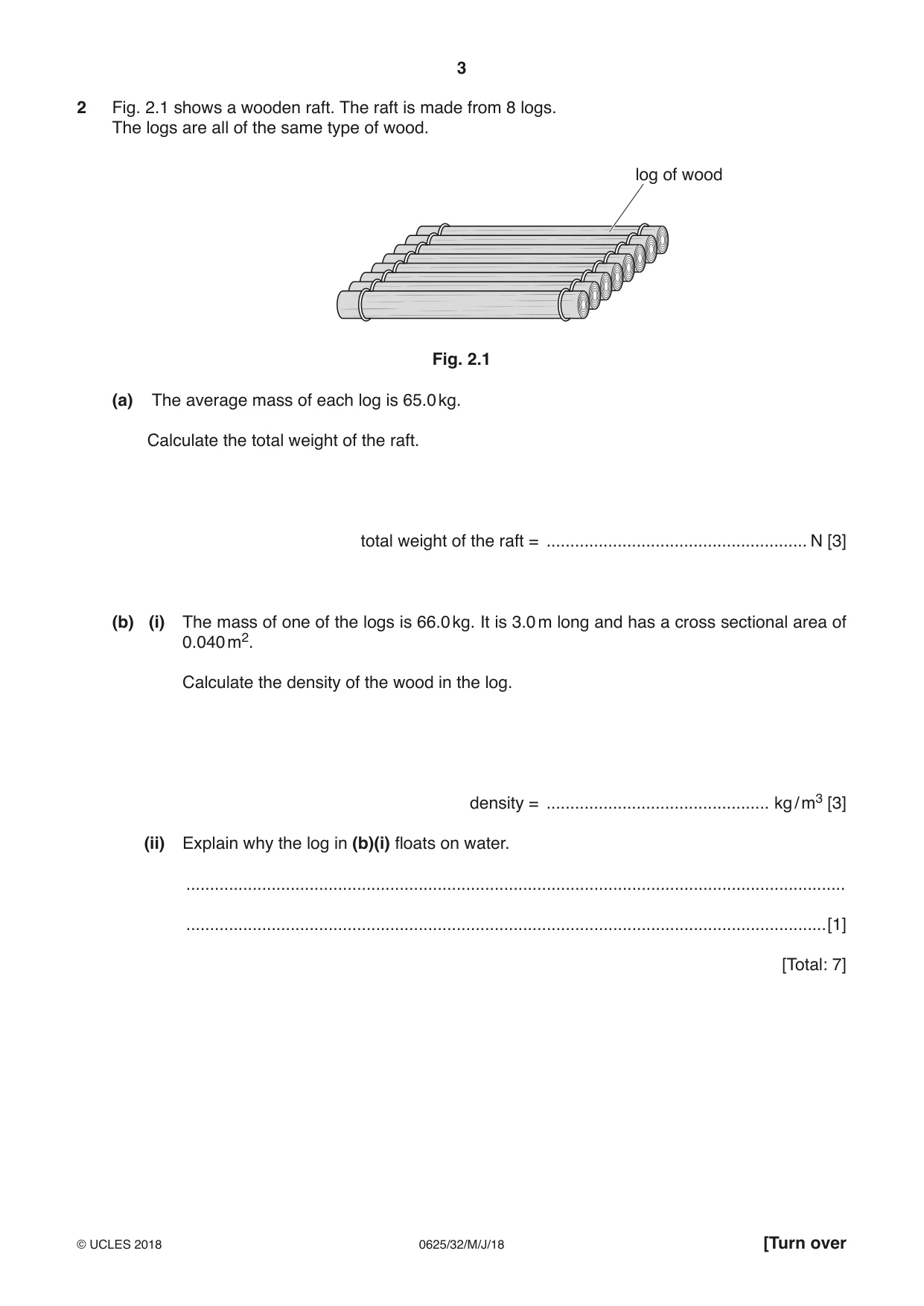
2 Fig. 2.1 shows a wooden raft. The raft is made from 8 logs. The logs are all of the same type of wood. log of wood Fig. 2.1 (a) The average mass of each log is 65.0 kg. Calculate the total weight of the raft. total weight of the raft = ....................................................... N [3] (b) (i) The mass of one of the logs is 66.0 kg. It is 3.0 m long and has a cross sectional area of 0.040 m2. Calculate the density of the wood in the log. density = ............................................... kg / m3 [3] (ii) Explain why the log in (b)(i) floats on water. ........................................................................................................................................... .......................................................................................................................................[1] [Total: 7]
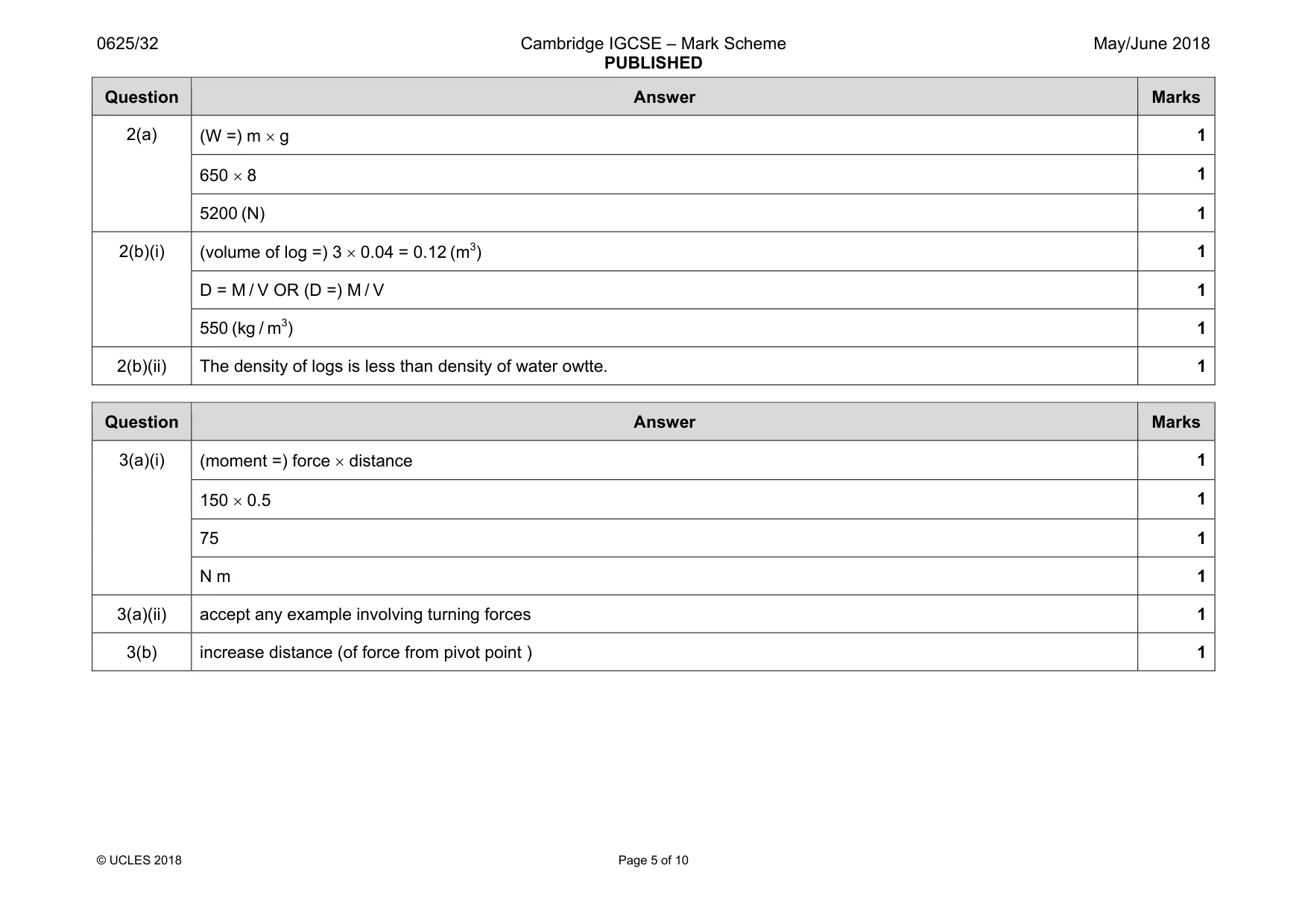
Mark scheme: 2(a) 1 650 × 8 1 5200 (N) 1 2(b)(i) (volume of log =) 3 × 0.04 = 0.12 (m3) 1 D = M / V OR (D =) M / V 1 550 (kg / m3) 1 2(b)(ii) The density of logs is less than density of water owtte. 1
Q3 · A man uses a metal bar to remove an iron nail from a piece of wood, as shown in Fig
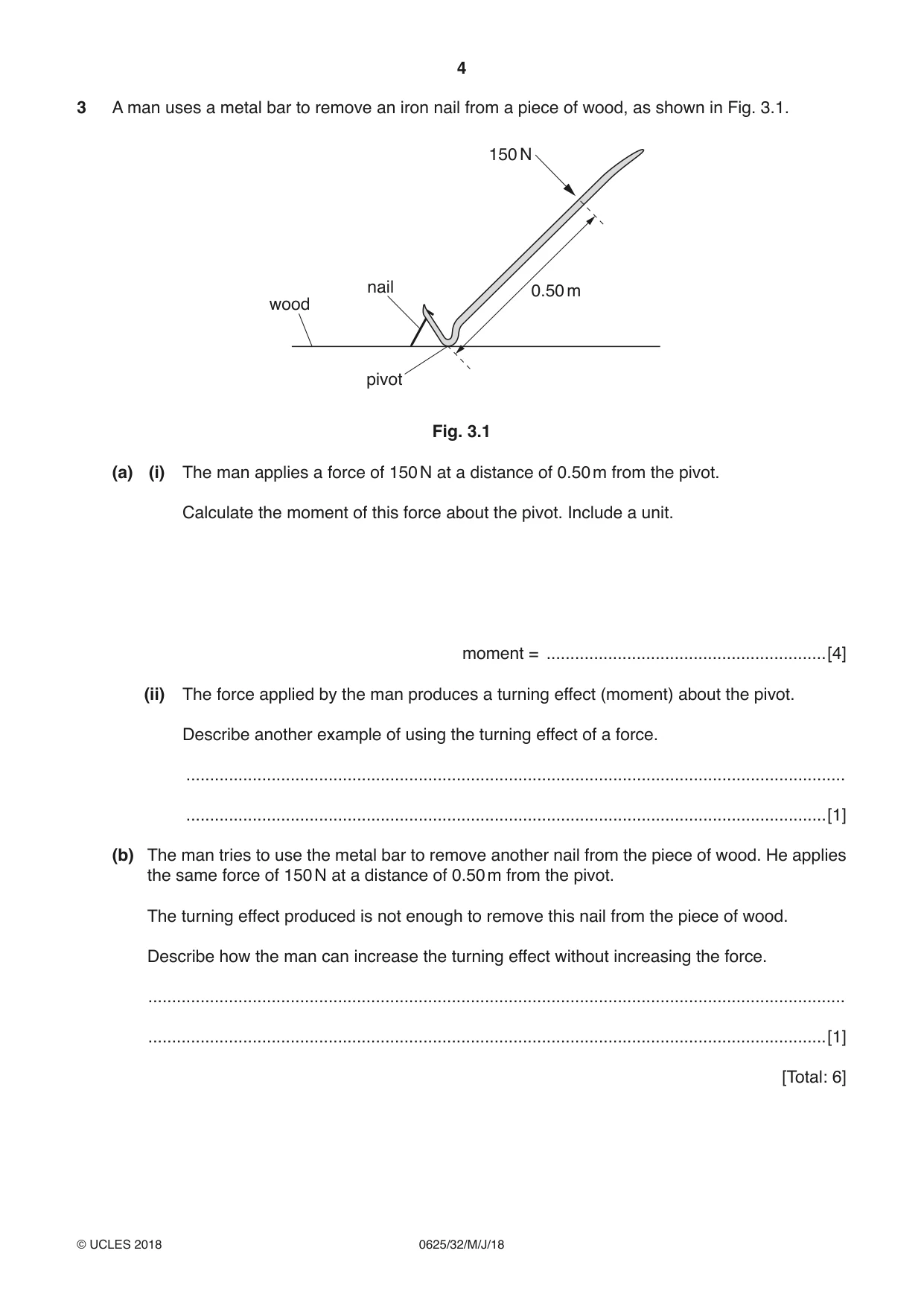
3 A man uses a metal bar to remove an iron nail from a piece of wood, as shown in Fig. 3.1. 150 N nail 0.50 m wood pivot Fig. 3.1 (a) (i) The man applies a force of 150 N at a distance of 0.50 m from the pivot. Calculate the moment of this force about the pivot. Include a unit. moment = ...........................................................[4] (ii) The force applied by the man produces a turning effect (moment) about the pivot. Describe another example of using the turning effect of a force. ........................................................................................................................................... .......................................................................................................................................[1] (b) The man tries to use the metal bar to remove another nail from the piece of wood. He applies the same force of 150 N at a distance of 0.50 m from the pivot. The turning effect produced is not enough to remove this nail from the piece of wood. Describe how the man can increase the turning effect without increasing the force. ................................................................................................................................................... ...............................................................................................................................................[1] [Total: 6]
Mark scheme: 3(a)(i) 1 150 × 0.5 1 75 1 N m 1 3(a)(ii) accept any example involving turning forces 1 3(b) increase distance (of force from pivot point ) 1
Q4 · A Bunsen burner heats a beaker of water, as shown in Fig
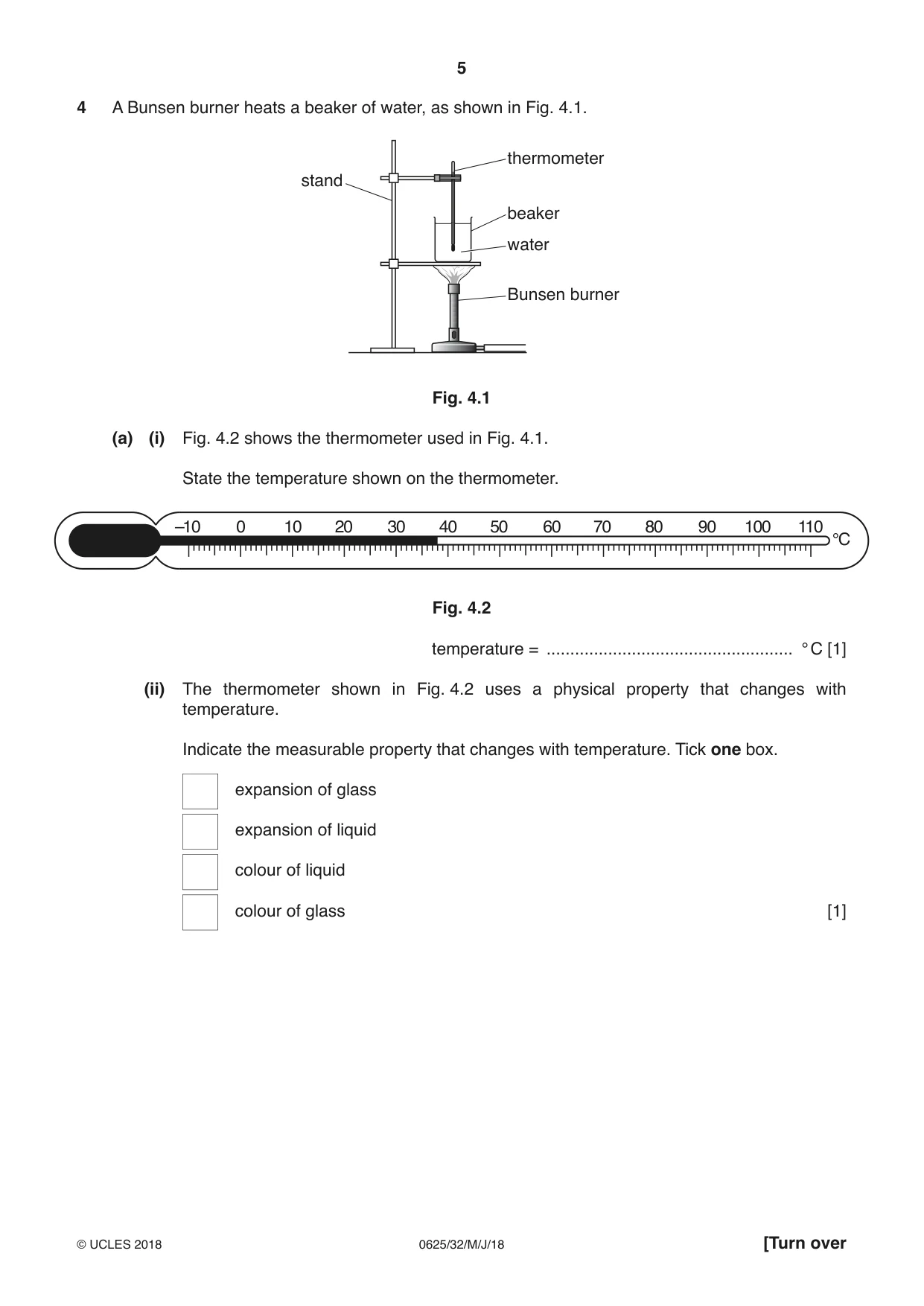
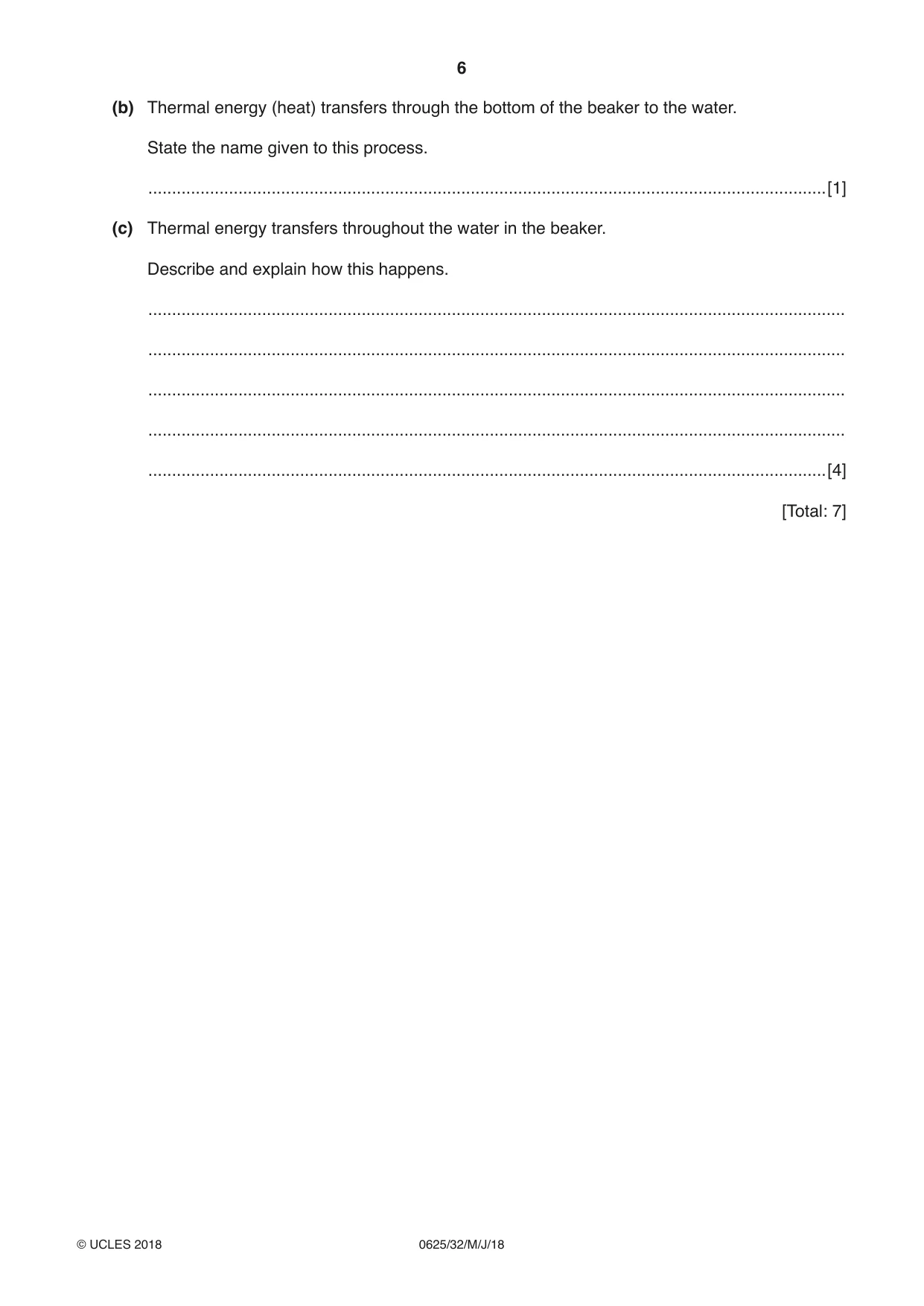
4 A Bunsen burner heats a beaker of water, as shown in Fig. 4.1. thermometer stand beaker water Bunsen burner Fig. 4.1 (a) (i) Fig. 4.2 shows the thermometer used in Fig. 4.1. State the temperature shown on the thermometer. –10 0 10 20 30 40 50 60 70 80 90 100 110 °C Fig. 4.2 temperature = .................................................... ° C [1] (ii) The thermometer shown in Fig. 4.2 uses a physical property that changes with temperature. Indicate the measurable property that changes with temperature. Tick one box. expansion of glass expansion of liquid colour of liquid colour of glass [1] (b) Thermal energy (heat) transfers through the bottom of the beaker to the water. State the name given to this process. ...............................................................................................................................................[1] (c) Thermal energy transfers throughout the water in the beaker. Describe and explain how this happens. ................................................................................................................................................... ................................................................................................................................................... ................................................................................................................................................... ................................................................................................................................................... ...............................................................................................................................................[4] [Total: 7]
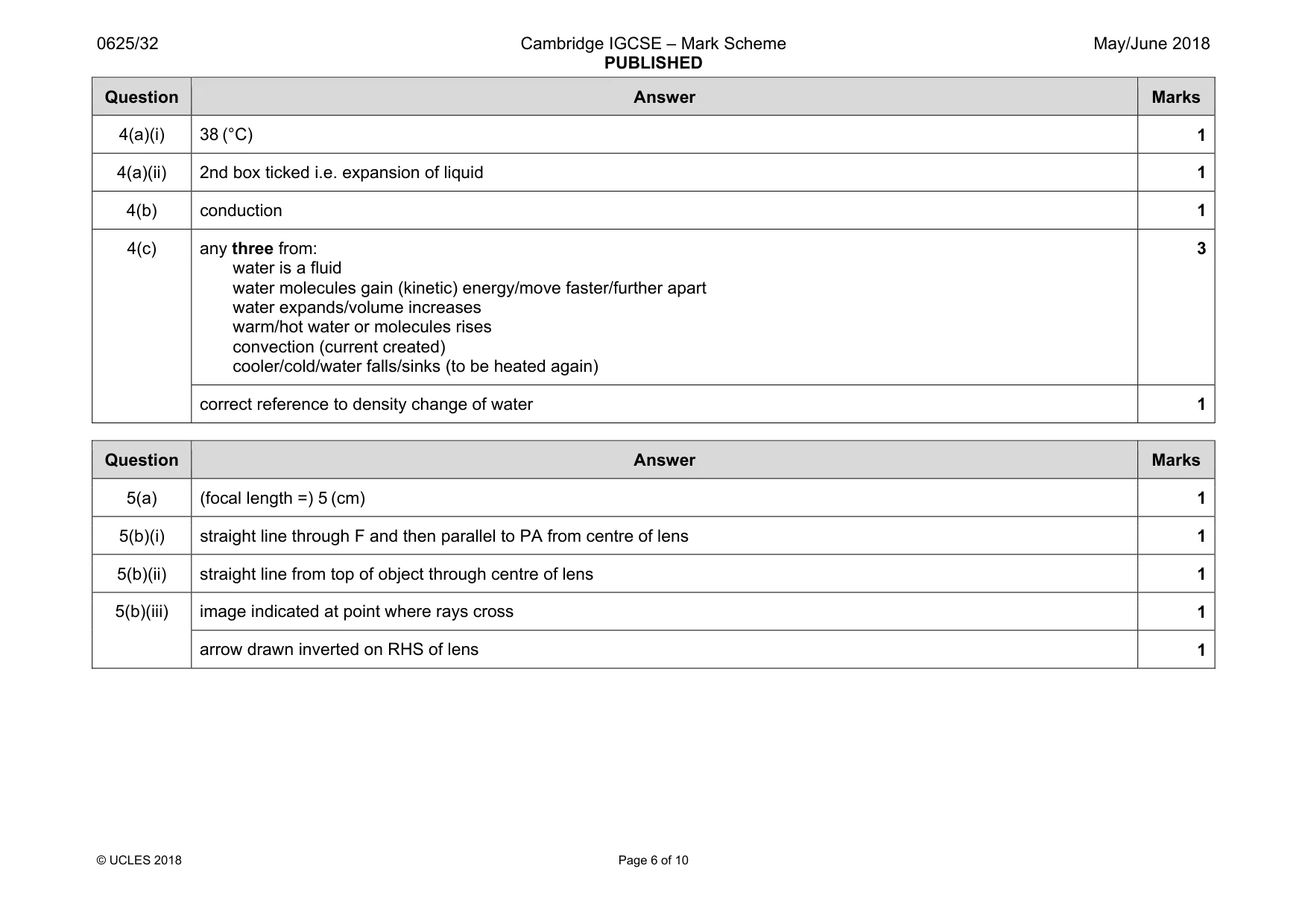
Mark scheme: 4(a)(i) 38 (°C) 1 4(a)(ii) 2nd box ticked i.e. expansion of liquid 1 4(b) conduction 1 4(c) any three from: water is a fluid water molecules gain (kinetic) energy/move faster/further apart water expands/volume increases warm/hot water or molecules rises convection (current created) cooler/cold/water falls/sinks (to be heated again) 3 correct reference to density change of water 1
Q5 · An object positioned on the principal axis of a thin lens
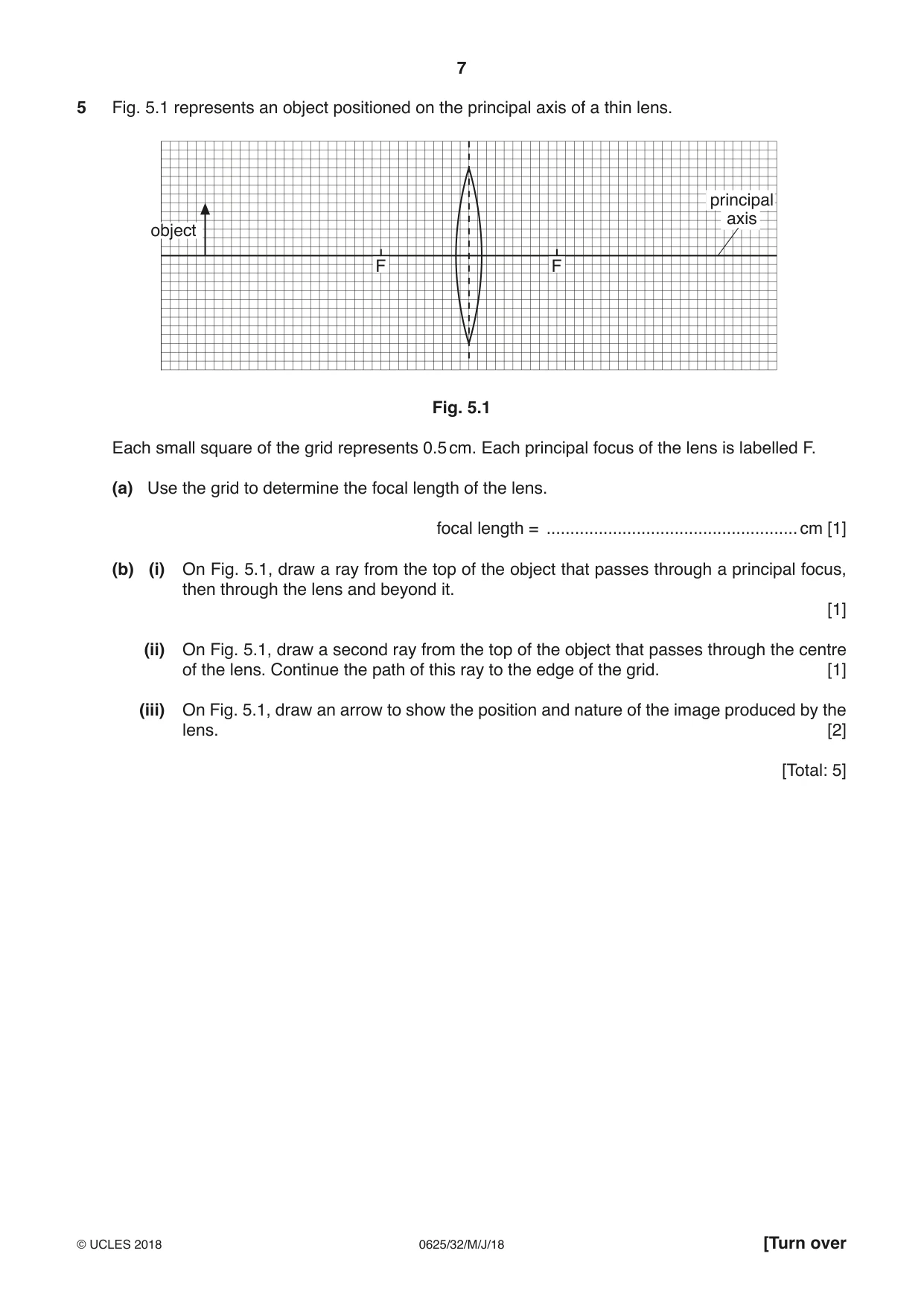
5 Fig. 5.1 represents an object positioned on the principal axis of a thin lens. principal axis object F F Fig. 5.1 Each small square of the grid represents 0.5 cm. Each principal focus of the lens is labelled F. (a) Use the grid to determine the focal length of the lens. focal length = .....................................................cm [1] (b) (i) On Fig. 5.1, draw a ray from the top of the object that passes through a principal focus, then through the lens and beyond it. [1] (ii) On Fig. 5.1, draw a second ray from the top of the object that passes through the centre of the lens. Continue the path of this ray to the edge of the grid. [1] (iii) On Fig. 5.1, draw an arrow to show the position and nature of the image produced by the lens. [2] [Total: 5]
Mark scheme: 5(a) (focal length =) 5 (cm) 1 5(b)(i) straight line through F and then parallel to PA from centre of lens 1 5(b)(ii) straight line from top of object through centre of lens 1 5(b)(iii) image indicated at point where rays cross 1 arrow drawn inverted on RHS of lens 1
Q6 · Nuclear fission is used in nuclear power stations to release thermal energy
6 Nuclear fission is used in nuclear power stations to release thermal energy. (a) Describe how the thermal energy is used to generate electricity. ................................................................................................................................................... ................................................................................................................................................... ................................................................................................................................................... ................................................................................................................................................... ................................................................................................................................................... ...............................................................................................................................................[3] (b) Describe two environmental problems that are due to using nuclear power stations. 1. ............................................................................................................................................... ................................................................................................................................................... 2. ............................................................................................................................................... ................................................................................................................................................... [2] [Total: 5]
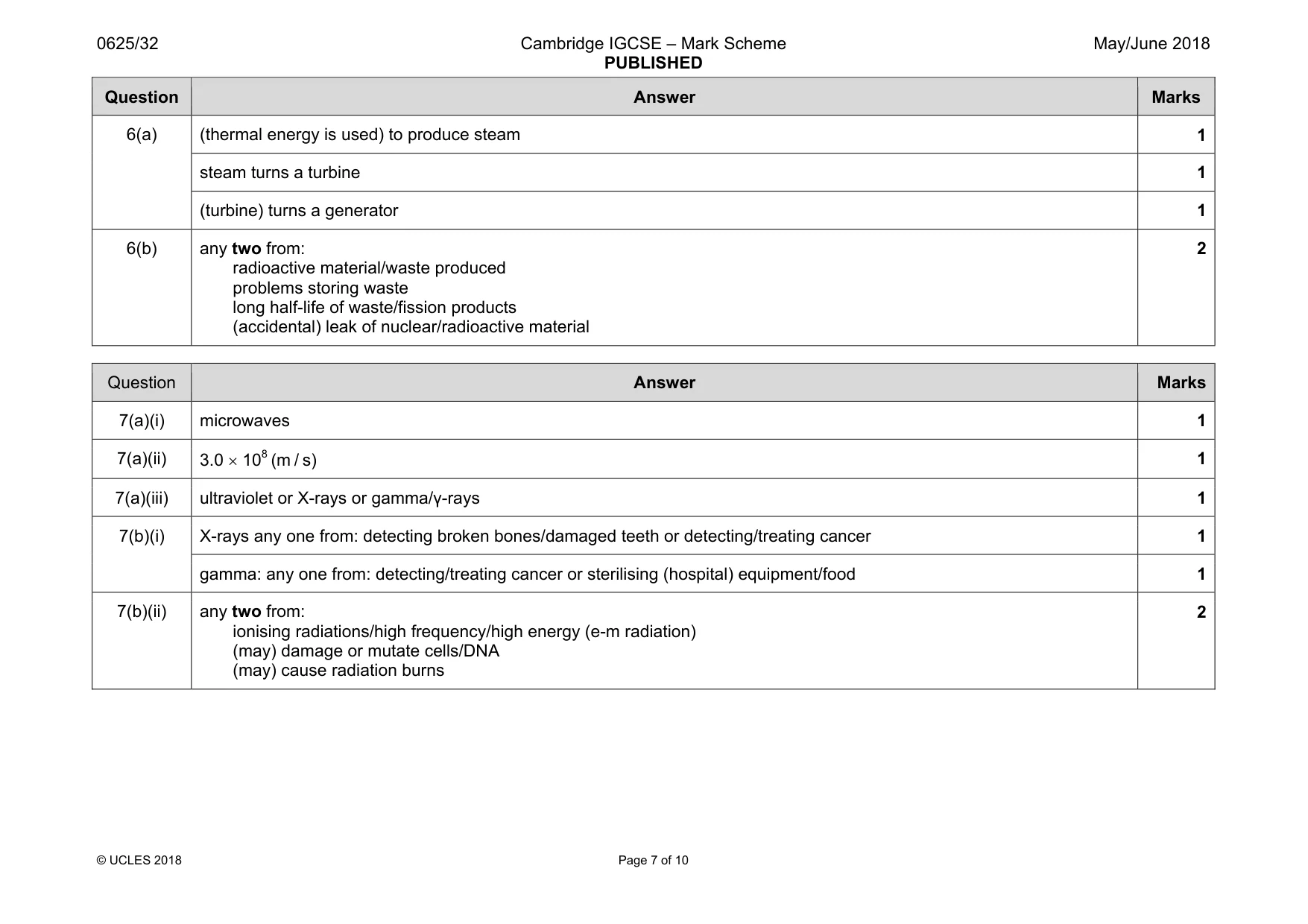
Mark scheme: 6(a) (thermal energy is used) to produce steam 1 steam turns a turbine 1 (turbine) turns a generator 1 6(b) any two from: radioactive material/waste produced problems storing waste long half-life of waste/fission products (accidental) leak of nuclear/radioactive material 2
Q7 · Some parts of the electromagnetic spectrum
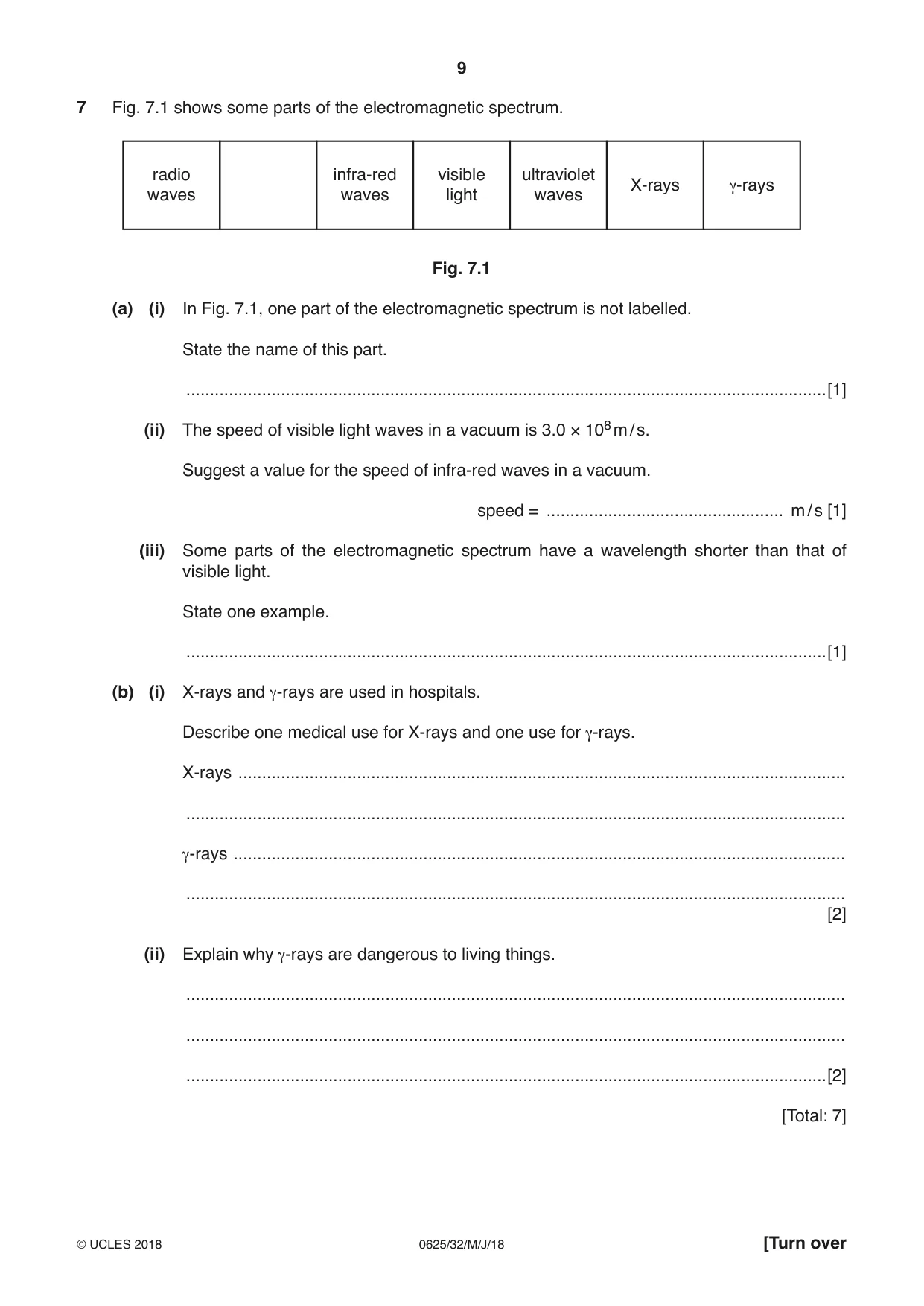
7 Fig. 7.1 shows some parts of the electromagnetic spectrum. radio infra-red visible ultraviolet X-rays γ-rays waves waves light waves Fig. 7.1 (a) (i) In Fig. 7.1, one part of the electromagnetic spectrum is not labelled. State the name of this part. .......................................................................................................................................[1] (ii) The speed of visible light waves in a vacuum is 3.0 × 10⁸ m / s. Suggest a value for the speed of infra-red waves in a vacuum. speed = .................................................. m / s [1] (iii) Some parts of the electromagnetic spectrum have a wavelength shorter than that of visible light. State one example. .......................................................................................................................................[1] (b) (i) X-rays and γ-rays are used in hospitals. Describe one medical use for X-rays and one use for γ-rays. X-rays ................................................................................................................................ ........................................................................................................................................... γ-rays ................................................................................................................................. ........................................................................................................................................... [2] (ii) Explain why γ-rays are dangerous to living things. ........................................................................................................................................... ........................................................................................................................................... .......................................................................................................................................[2] [Total: 7]
Mark scheme: 7(a)(i) microwaves 1 7(a)(ii) 3.0 × 10⁸ (m / s) 1 7(a)(iii) ultraviolet or X-rays or gamma/γ-rays 1 7(b)(i) X-rays any one from: detecting broken bones/damaged teeth or detecting/treating cancer 1 gamma: any one from: detecting/treating cancer or sterilising (hospital) equipment/food 1 7(b)(ii) any two from: ionising radiations/high frequency/high energy (e-m radiation) (may) damage or mutate cells/DNA (may) cause radiation burns 2
Q8 · Complete the sentences about sound
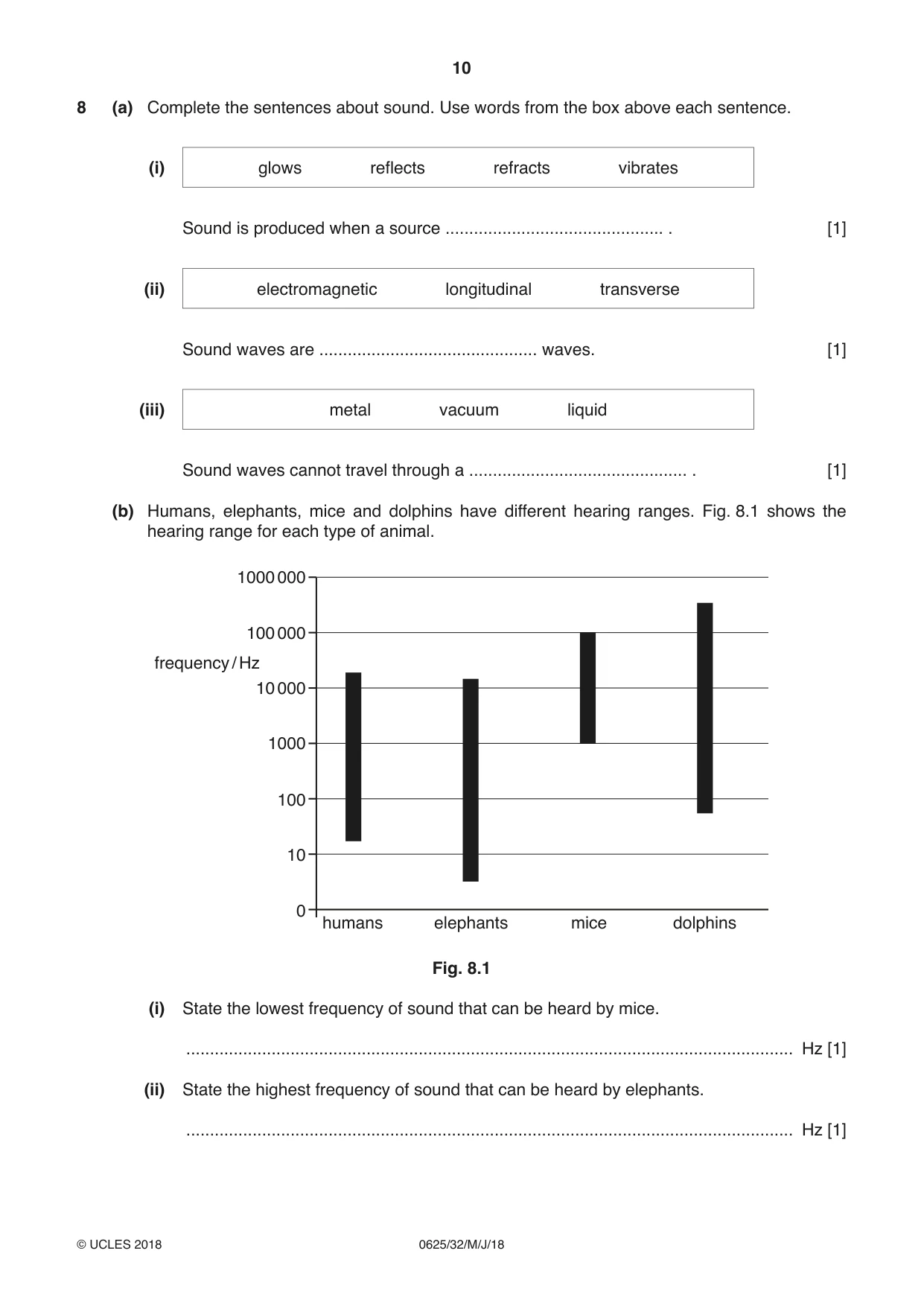
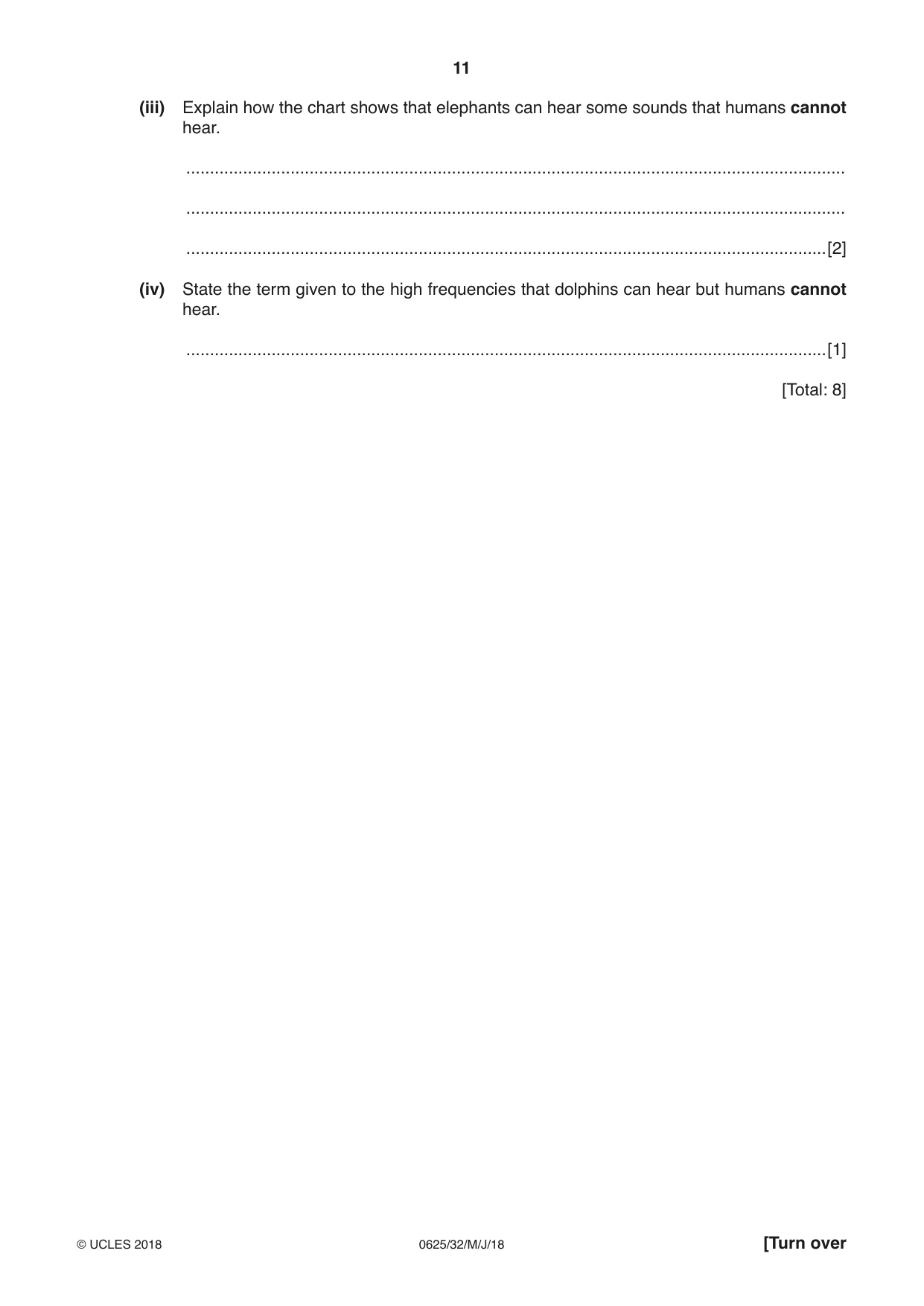
8 (a) Complete the sentences about sound. Use words from the box above each sentence. (i) glows reflects refracts vibrates Sound is produced when a source .............................................. . [1] (ii) electromagnetic longitudinal transverse Sound waves are .............................................. waves. [1] (iii) metal vacuum liquid Sound waves cannot travel through a .............................................. . [1] (b) Humans, elephants, mice and dolphins have different hearing ranges. Fig. 8.1 shows the hearing range for each type of animal. 1000 000 100 000 frequency / Hz 10 000 1000 100 10 0 humans elephants mice dolphins Fig. 8.1 (i) State the lowest frequency of sound that can be heard by mice. ................................................................................................................................ Hz [1] (ii) State the highest frequency of sound that can be heard by elephants. ................................................................................................................................ Hz [1] (iii) Explain how the chart shows that elephants can hear some sounds that humans cannot hear. ........................................................................................................................................... ........................................................................................................................................... .......................................................................................................................................[2] (iv) State the term given to the high frequencies that dolphins can hear but humans cannot hear. .......................................................................................................................................[1] [Total: 8]
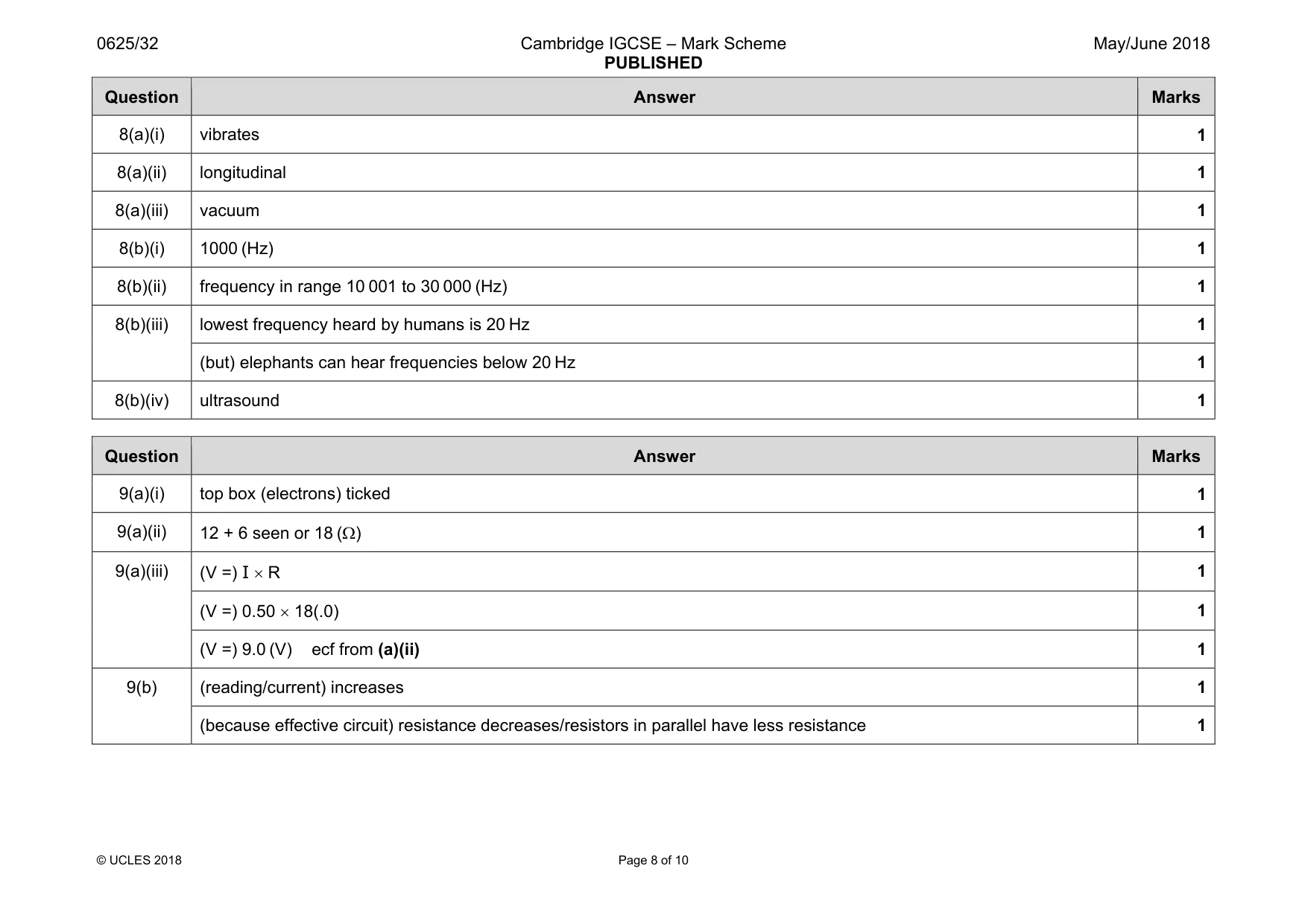
Mark scheme: 8(a)(i) vibrates 1 8(a)(ii) longitudinal 1 8(a)(iii) vacuum 1 8(b)(i) 1000 (Hz) 1 8(b)(ii) frequency in range 10 001 to 30 000 (Hz) 1 8(b)(iii) lowest frequency heard by humans is 20 Hz 1 (but) elephants can hear frequencies below 20 Hz 1 8(b)(iv) ultrasound 1
Question 9
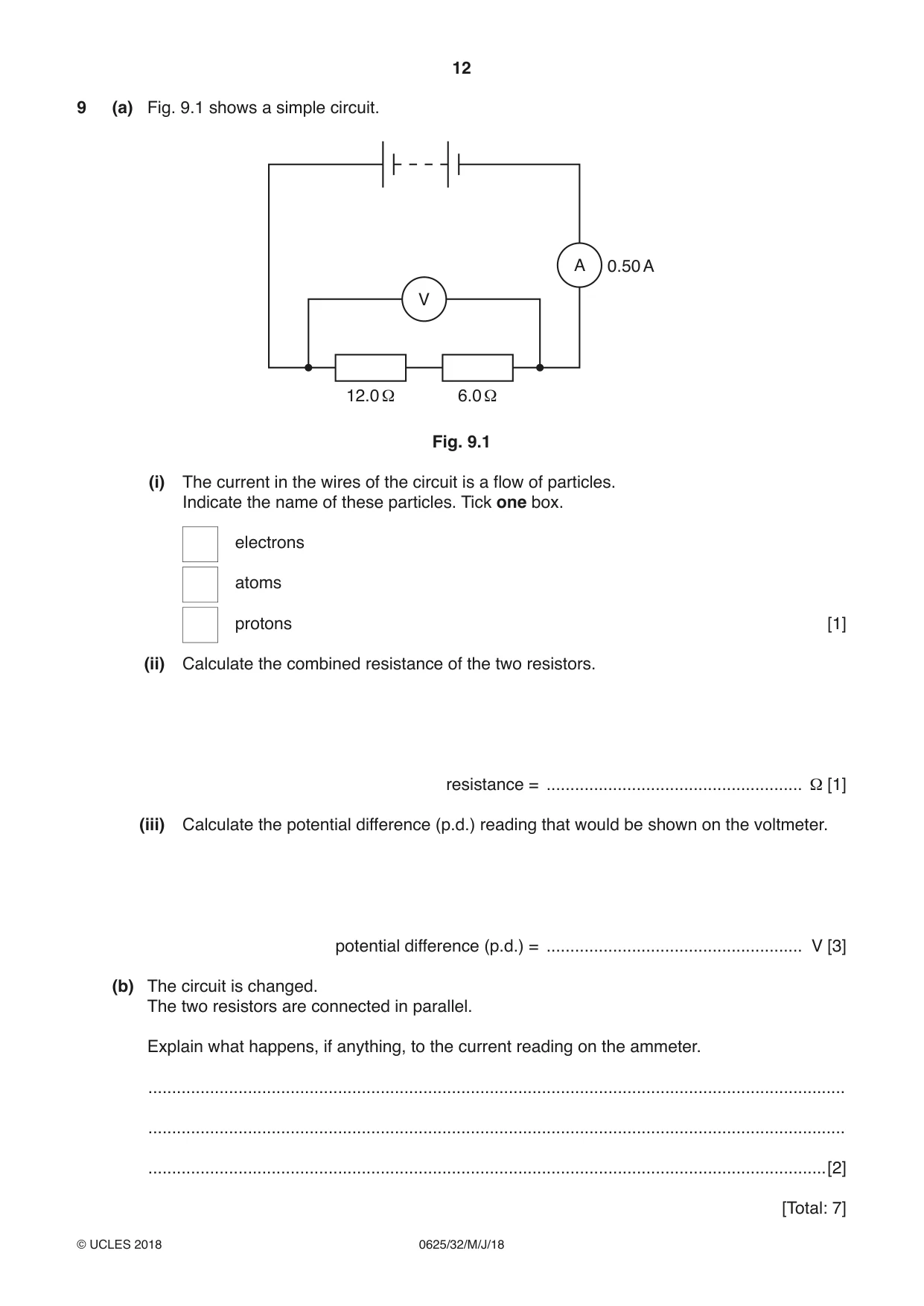
9 (a) Fig. 9.1 shows a simple circuit. A 0.50 A V 12.0 Ω 6.0 Ω Fig. 9.1 (i) The current in the wires of the circuit is a flow of particles. Indicate the name of these particles. Tick one box. electrons atoms protons [1] (ii) Calculate the combined resistance of the two resistors. resistance = ...................................................... Ω [1] (iii) Calculate the potential difference (p.d.) reading that would be shown on the voltmeter. potential difference (p.d.) = ...................................................... V [3] (b) The circuit is changed. The two resistors are connected in parallel. Explain what happens, if anything, to the current reading on the ammeter. ................................................................................................................................................... ................................................................................................................................................... ...............................................................................................................................................[2] [Total: 7]
Mark scheme: 9(a)(i) top box (electrons) ticked 1 9(a)(ii) 12 + 6 seen or 18 (Ω) 1 9(a)(iii) (V =) I × R 1 (V =) 0.50 × 18(.0) 1 (V =) 9.0 (V) ecf from (a)(ii) 1 9(b) (reading/current) increases 1 (because effective circuit) resistance decreases/resistors in parallel have less resistance 1
Q10 · A balloon hanging from an insulating thread
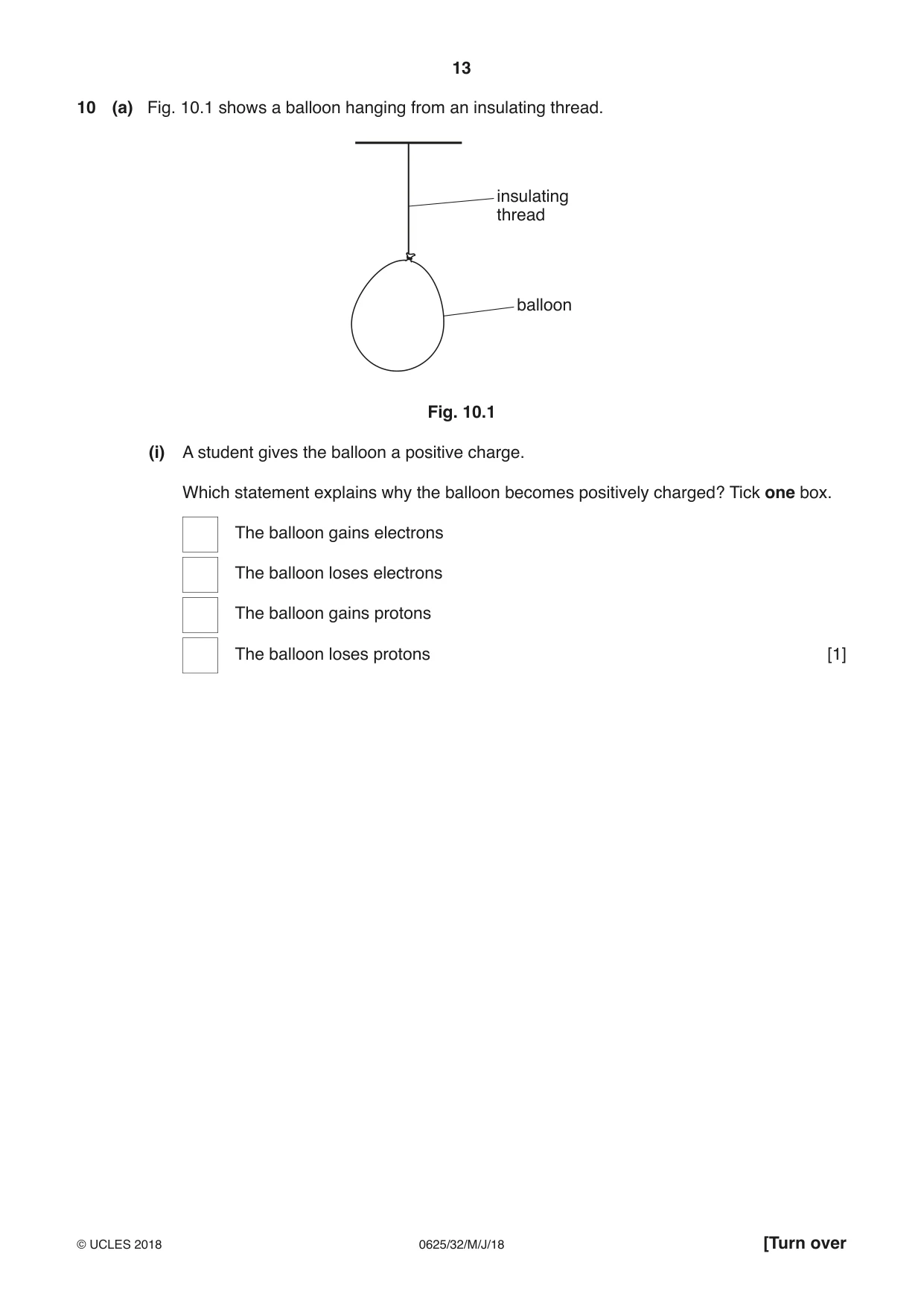
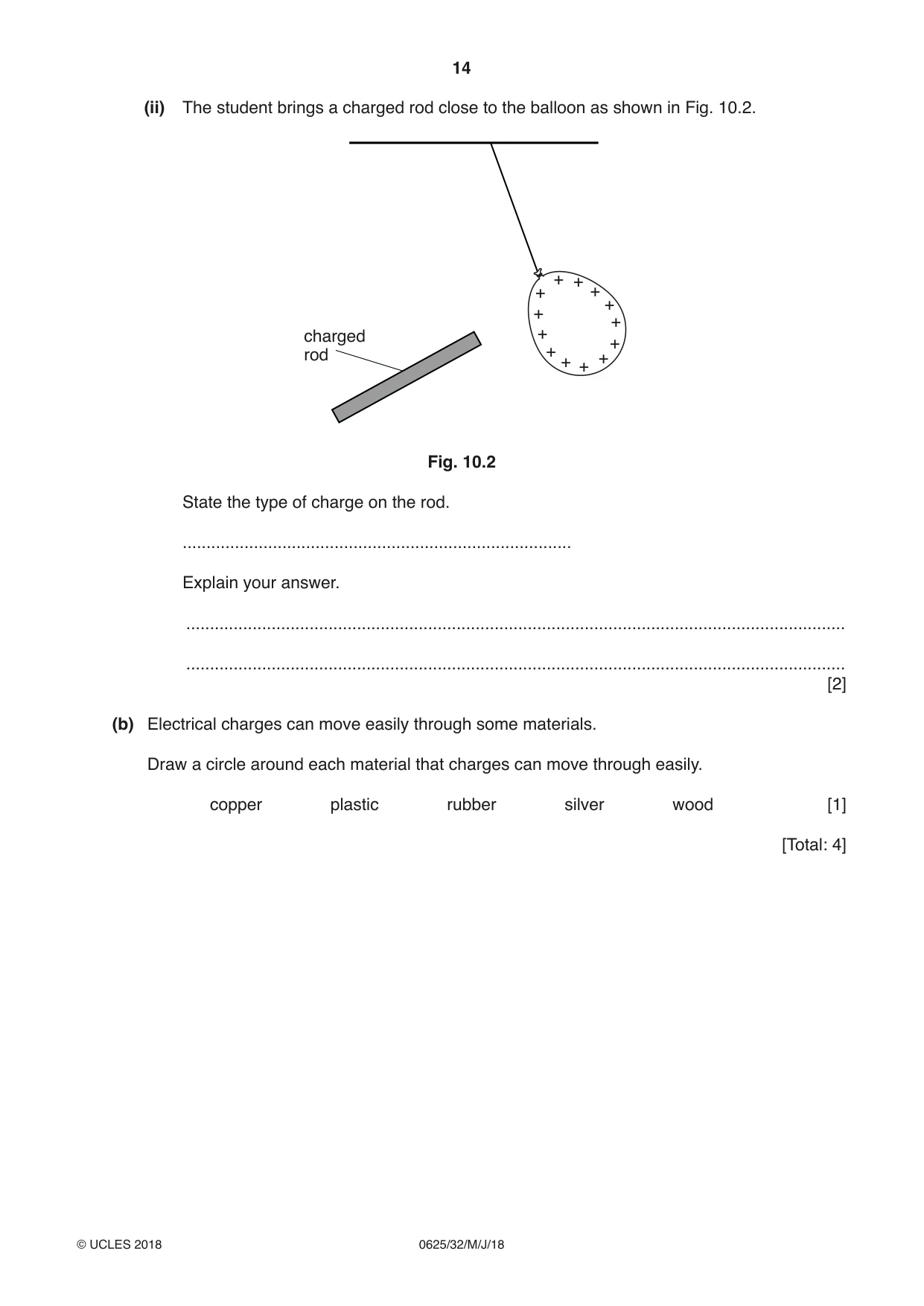
10 (a) Fig. 10.1 shows a balloon hanging from an insulating thread. insulating thread balloon Fig. 10.1 (i) A student gives the balloon a positive charge. Which statement explains why the balloon becomes positively charged? Tick one box. The balloon gains electrons The balloon loses electrons The balloon gains protons The balloon loses protons [1] (ii) The student brings a charged rod close to the balloon as shown in Fig. 10.2. + + + + + + + charged + + rod + + + + Fig. 10.2 State the type of charge on the rod. .................................................................................. Explain your answer. ........................................................................................................................................... ........................................................................................................................................... [2] (b) Electrical charges can move easily through some materials. Draw a circle around each material that charges can move through easily. copper plastic rubber silver wood [1] [Total: 4]
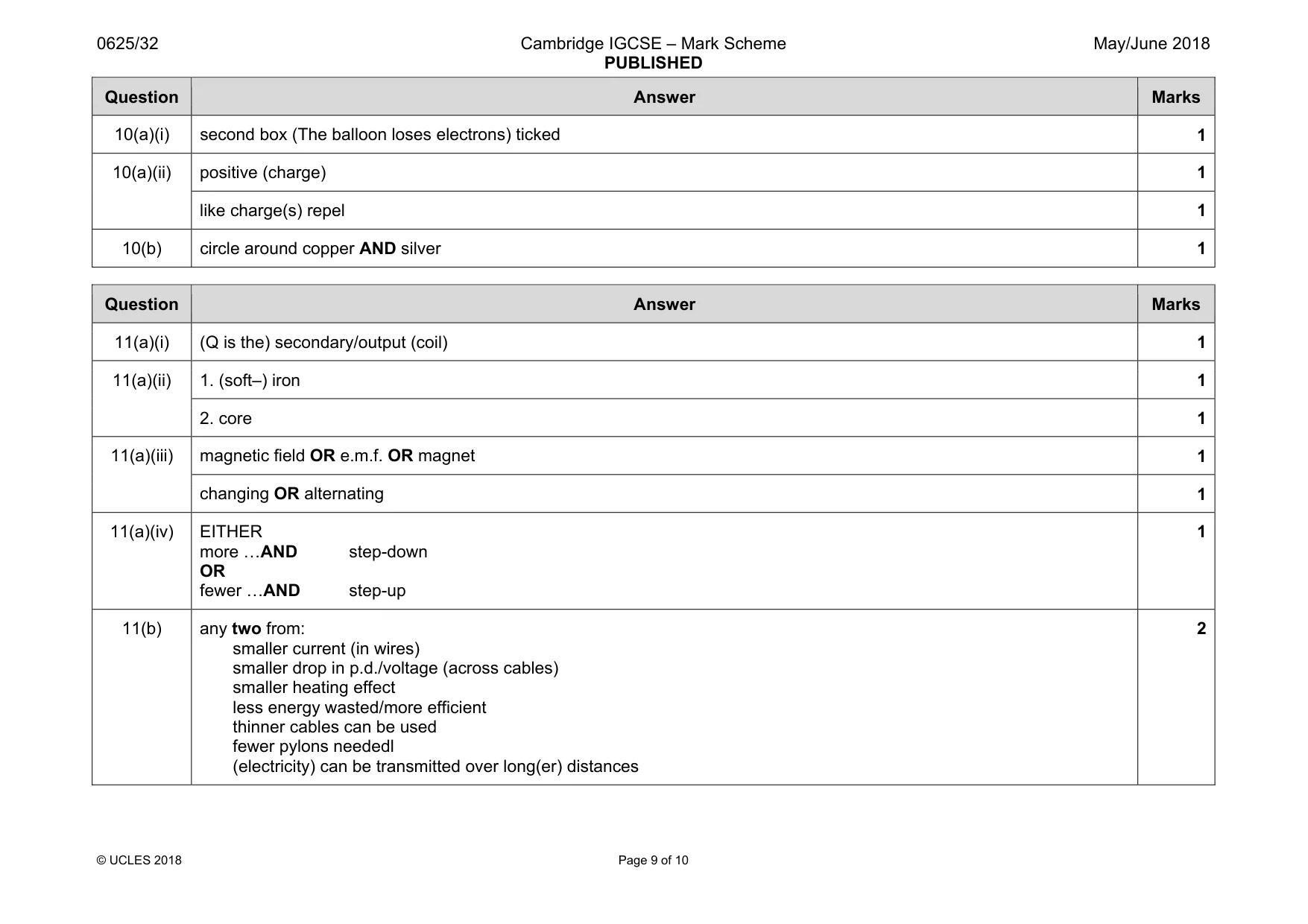
Mark scheme: 10(a)(i) second box (The balloon loses electrons) ticked 1 10(a)(ii) positive (charge) 1 like charge(s) repel 1 10(b) circle around copper AND silver 1
Question 11
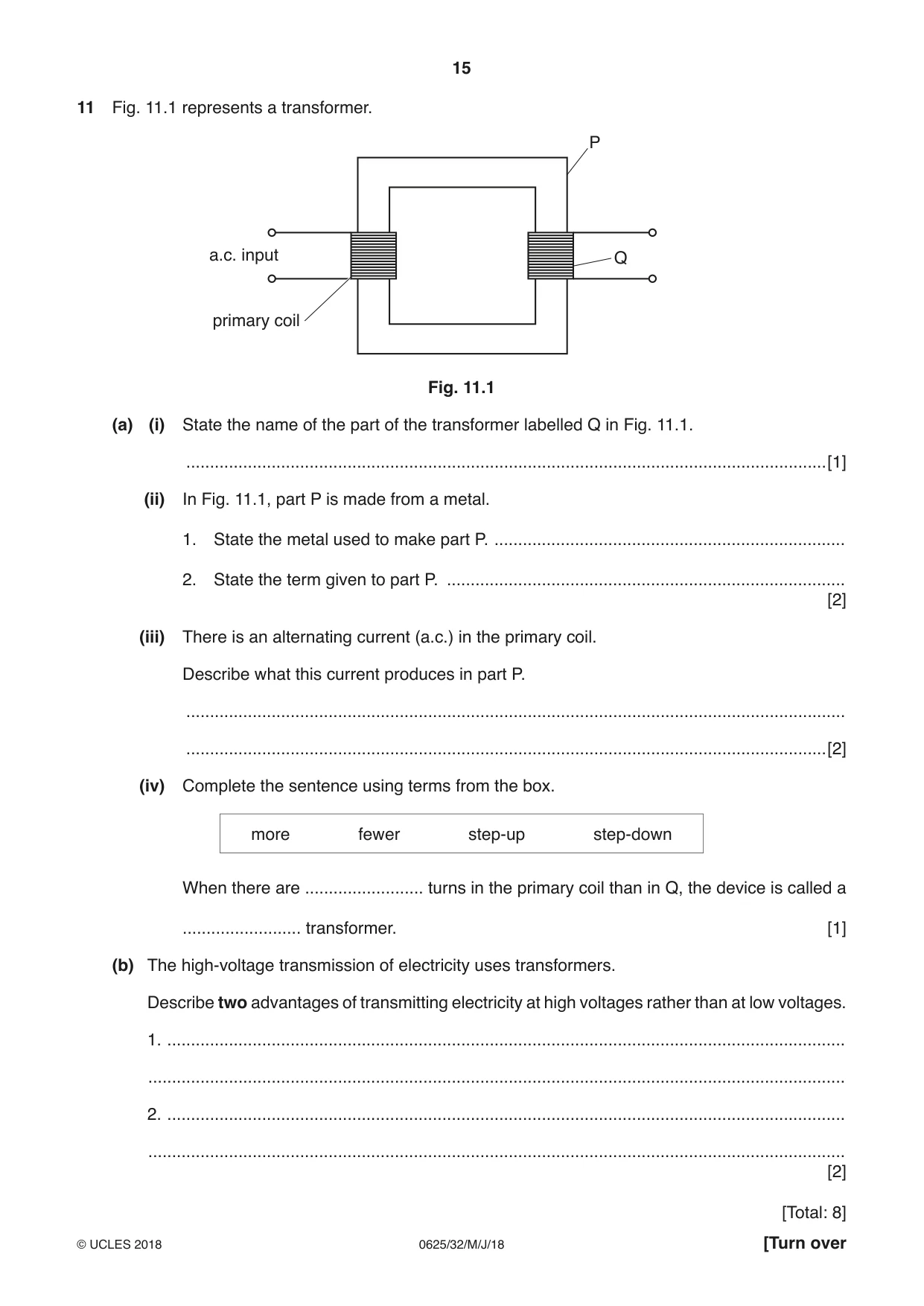
11 Fig. 11.1 represents a transformer. P a.c. input Q primary coil Fig. 11.1 (a) (i) State the name of the part of the transformer labelled Q in Fig. 11.1. .......................................................................................................................................[1] (ii) In Fig. 11.1, part P is made from a metal. 1. State the metal used to make part P. .......................................................................... 2. State the term given to part P. .................................................................................... [2] (iii) There is an alternating current (a.c.) in the primary coil. Describe what this current produces in part P. ........................................................................................................................................... .......................................................................................................................................[2] (iv) Complete the sentence using terms from the box. more fewer step-up step-down When there are ......................... turns in the primary coil than in Q, the device is called a ......................... transformer. [1] (b) The high-voltage transmission of electricity uses transformers. Describe two advantages of transmitting electricity at high voltages rather than at low voltages. 1. ............................................................................................................................................... ................................................................................................................................................... 2. ............................................................................................................................................... ................................................................................................................................................... [2] [Total: 8]
Mark scheme: 11(a)(i) (Q is the) secondary/output (coil) 1 11(a)(ii) 1. (soft–) iron 1 2. core 1 11(a)(iii) magnetic field OR e.m.f. OR magnet 1 changing OR alternating 1 11(a)(iv) EITHER more «AND step-down OR fewer «AND step-up 1 11(b) any two from: smaller current (in wires) smaller drop in p.d./voltage (across cables) smaller heating effect less energy wasted/more efficient thinner cables can be used fewer pylons neededl (electricity) can be transmitted over long(er) distances 2
Q12 · The nuclide notation AZ X describes the nucleus of one type of atom
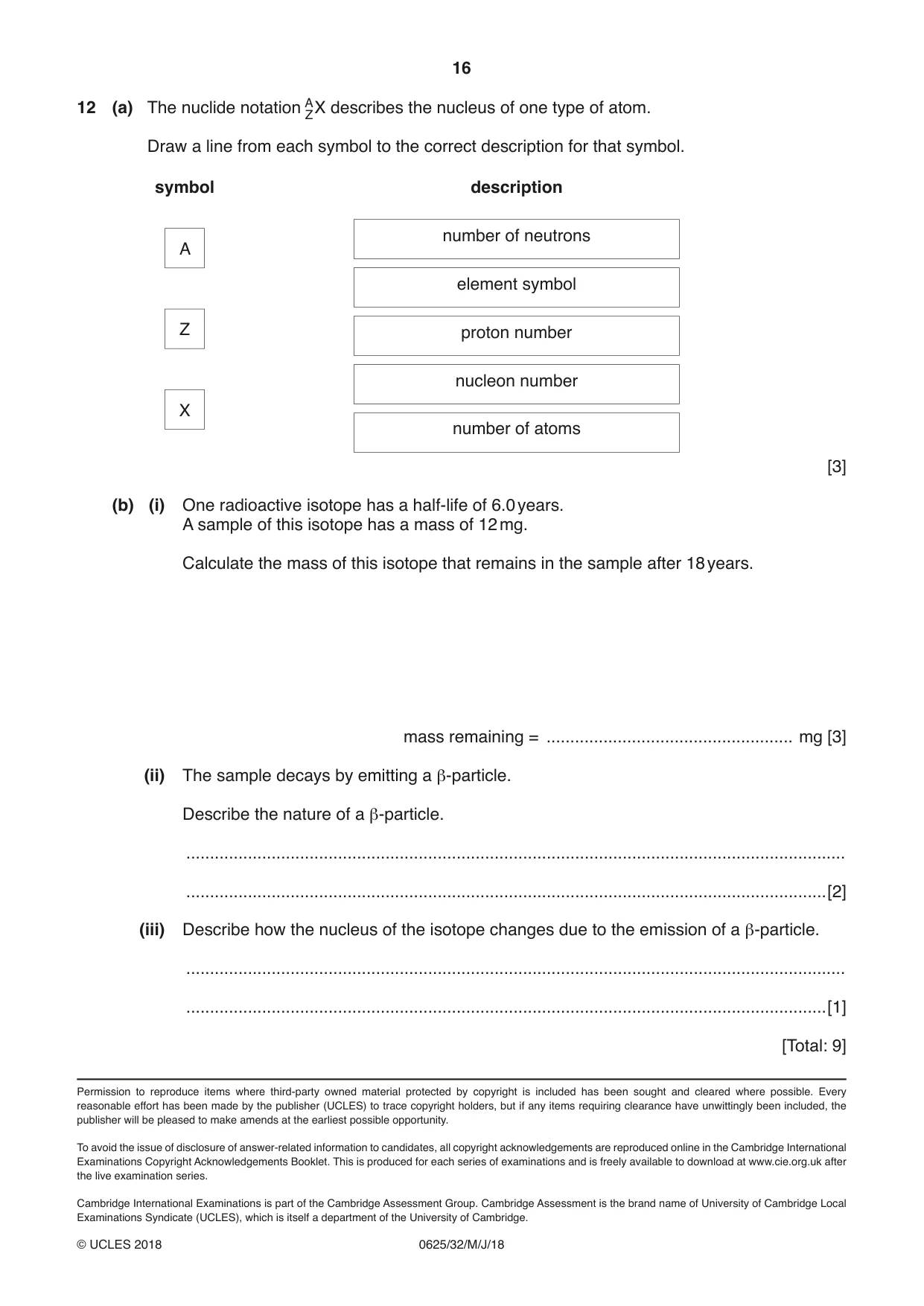
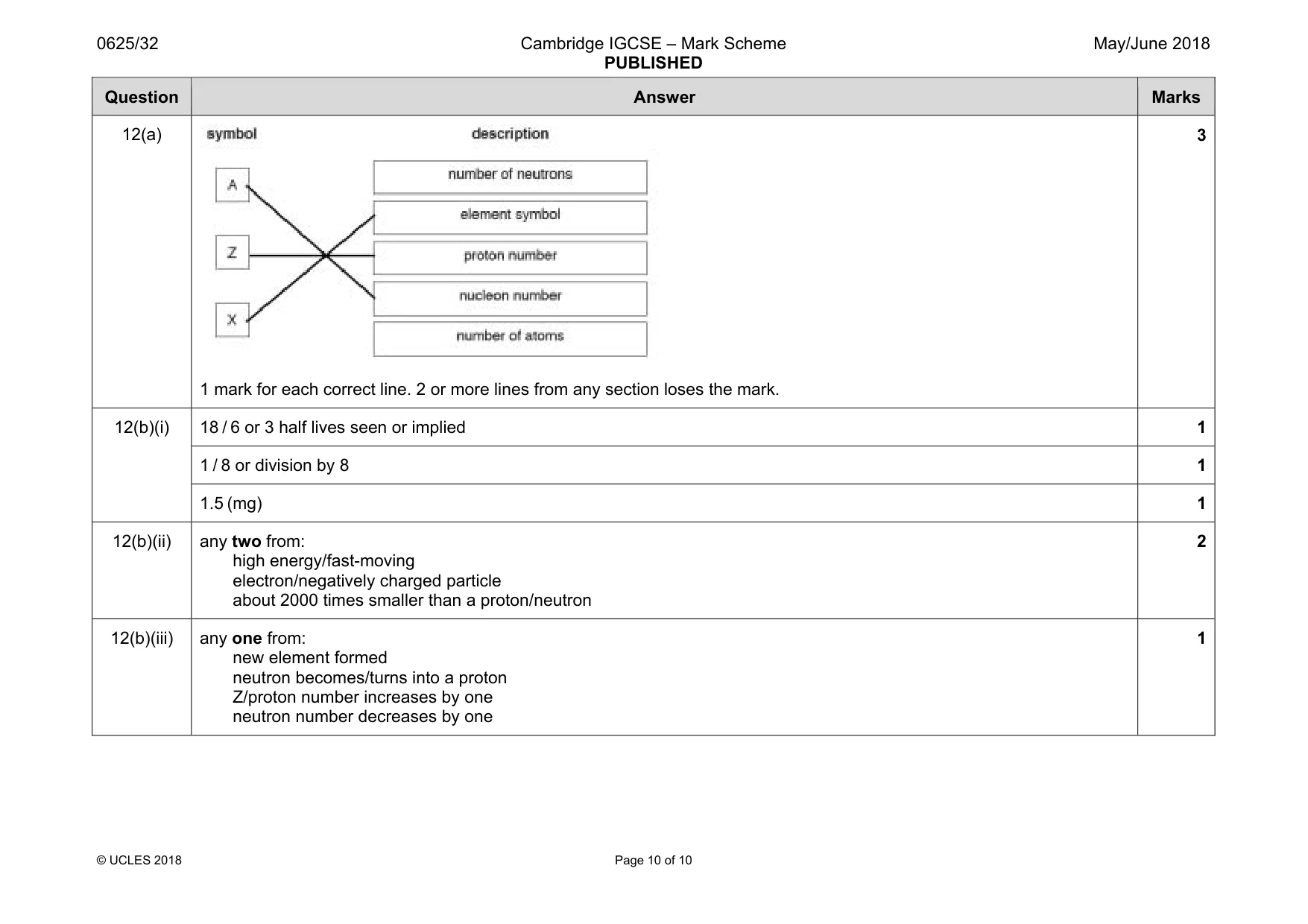
12 (a) The nuclide notation AZ X describes the nucleus of one type of atom. Draw a line from each symbol to the correct description for that symbol. symbol description number of neutrons A element symbol Z proton number nucleon number X number of atoms [3] (b) (i) One radioactive isotope has a half-life of 6.0 years. A sample of this isotope has a mass of 12 mg. Calculate the mass of this isotope that remains in the sample after 18 years. mass remaining = .................................................... mg [3] (ii) The sample decays by emitting a β-particle. Describe the nature of a β-particle. ........................................................................................................................................... .......................................................................................................................................[2] (iii) Describe how the nucleus of the isotope changes due to the emission of a β-particle. ........................................................................................................................................... .......................................................................................................................................[1] [Total: 9]
Mark scheme: 12(a) 1 mark for each correct line. 2 or more lines from any section loses the mark. 3 12(b)(i) 18 / 6 or 3 half lives seen or implied 1 1 / 8 or division by 8 1 1.5 (mg) 1 12(b)(ii) any two from: high energy/fast-moving electron/negatively charged particle about 2000 times smaller than a proton/neutron 2 12(b)(iii) any one from: new element formed neutron becomes/turns into a proton Z/proton number increases by one neutron number decreases by one 1
What was in this paper
The subtopics covered by these 12 questions, and how many questions each got. Open one in a new tab to see every Cambridge question on it.
What you needed in this session
Cambridge’s own grade thresholds for 2018 May/June, Paper 3 · Variant 2. A higher threshold means an easier paper — the bar moves with how the cohort did.