Cambridge IGCSE Physics 0625 — 2018 Oct/Nov Paper 3 · Variant 2
0625/32/O/N/18 · 12 questions · 80 marks · ≈90 min
The question paper and its mark scheme, free to read here and free to download. This is Cambridge’s own paper, exactly as it was sat.
Question paper16 pages
Mark scheme11 pages
Answers below. Sit the paper first if you are practising.
Questions as text
Q1 · A person on roller skates makes a journey
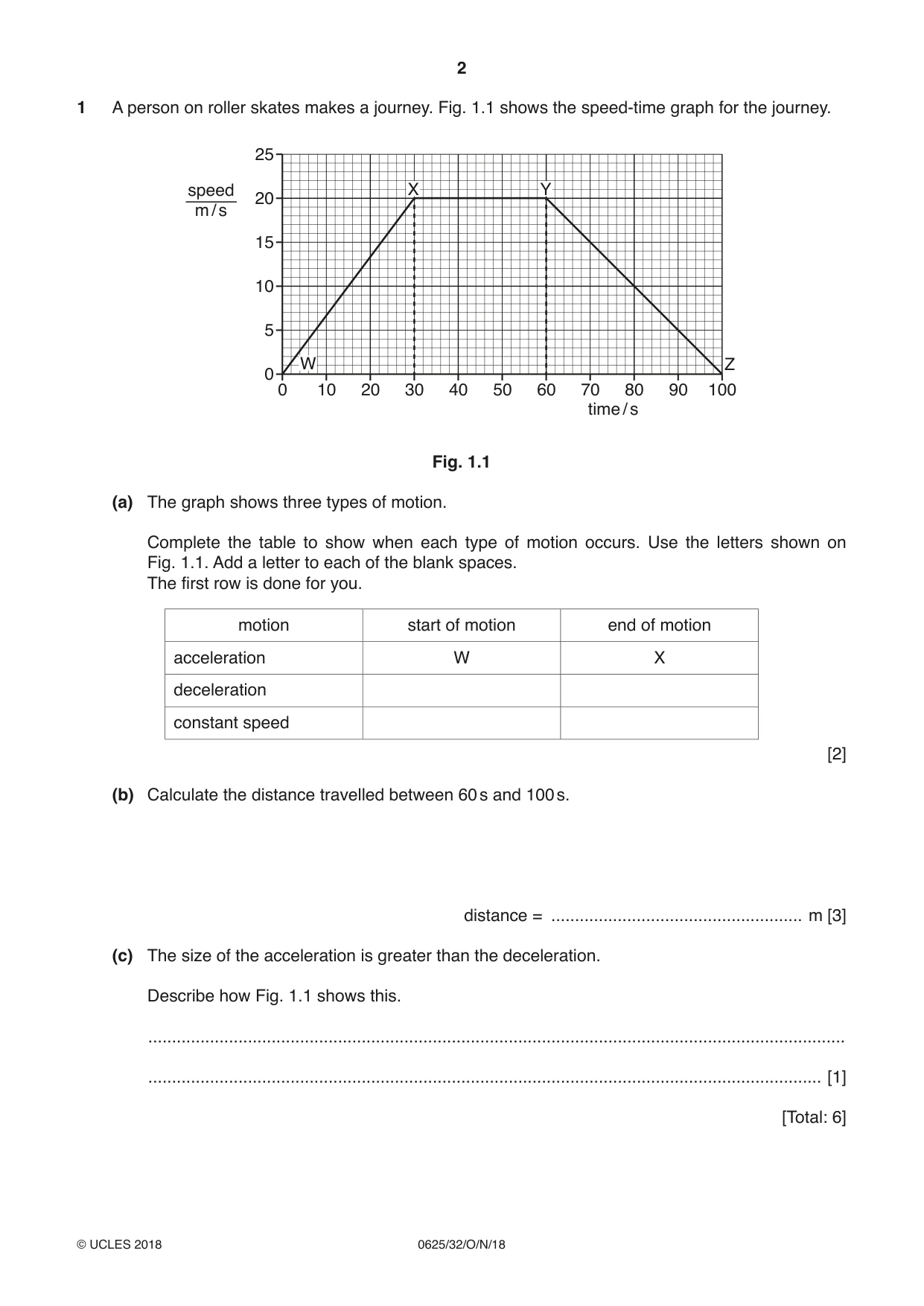
1 A person on roller skates makes a journey. Fig. 1.1 shows the speed-time graph for the journey. 25 speed X Y 20 m / s 15 10 5 W Z 0 0 10 20 30 40 50 60 70 80 90 100 time / s Fig. 1.1 (a) The graph shows three types of motion. Complete the table to show when each type of motion occurs. Use the letters shown on Fig. 1.1. Add a letter to each of the blank spaces. The first row is done for you. motion start of motion end of motion acceleration W X deceleration constant speed [2] (b) Calculate the distance travelled between 60 s and 100 s. distance = ..................................................... m [3] (c) The size of the acceleration is greater than the deceleration. Describe how Fig. 1.1 shows this. ................................................................................................................................................... .............................................................................................................................................. [1] [Total: 6]
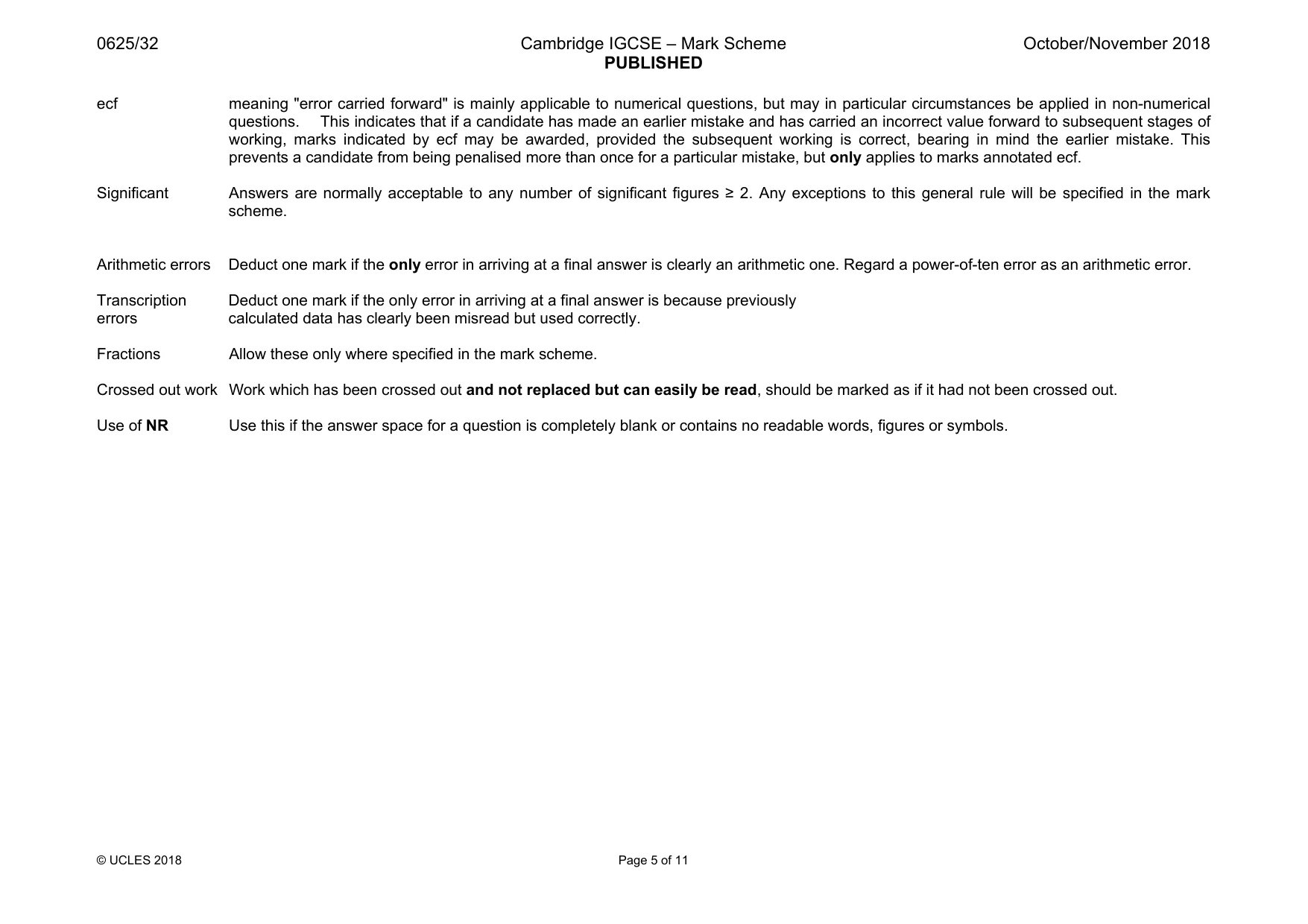
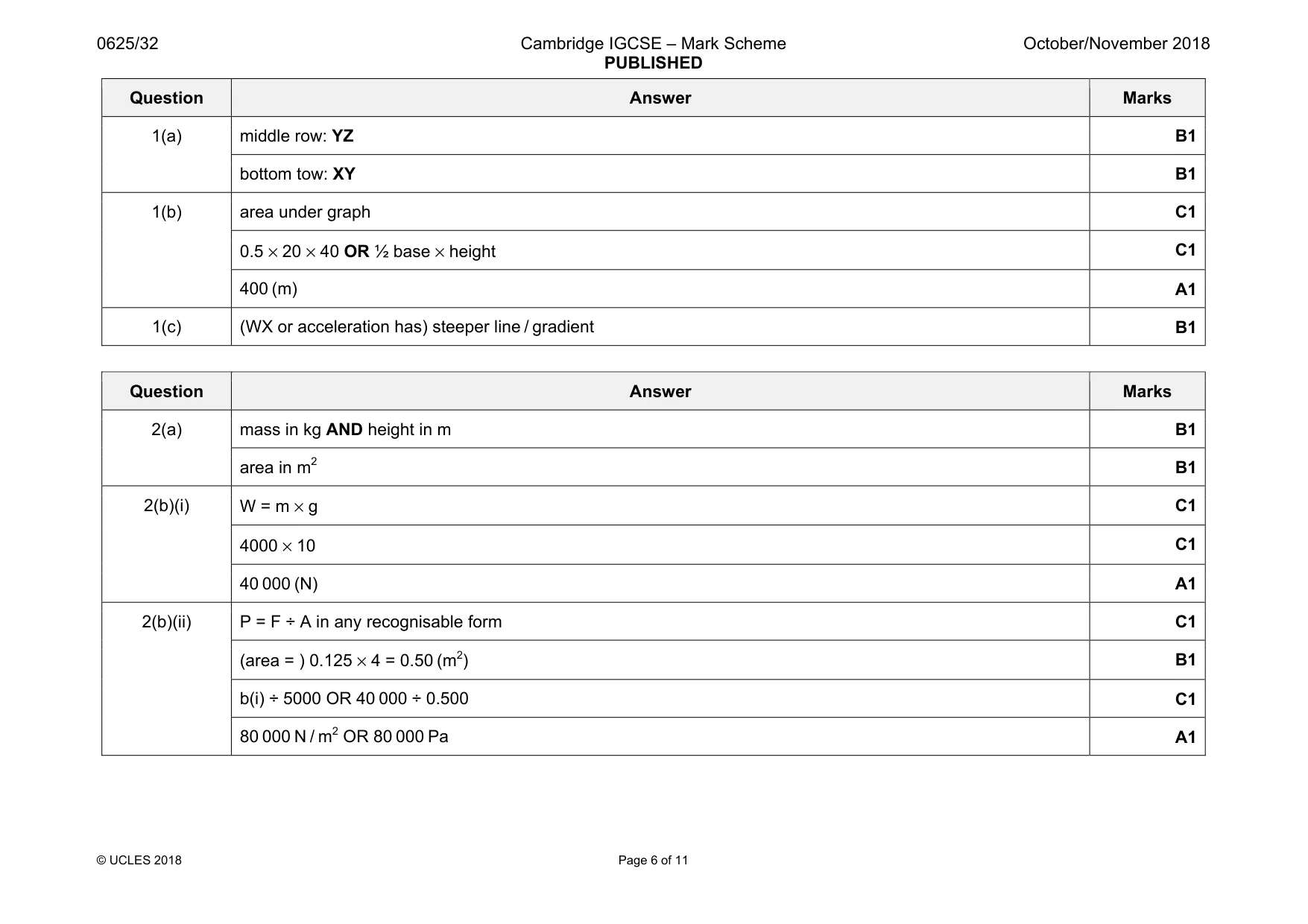
Mark scheme: 1(a) middle row: YZ B1 bottom tow: XY B1 1(b) area under graph C1 0.5 × 20 × 40 OR ½ base × height C1 400 (m) A1 1(c) (WX or acceleration has) steeper line / gradient B1
Q2 · A student is studying elephants
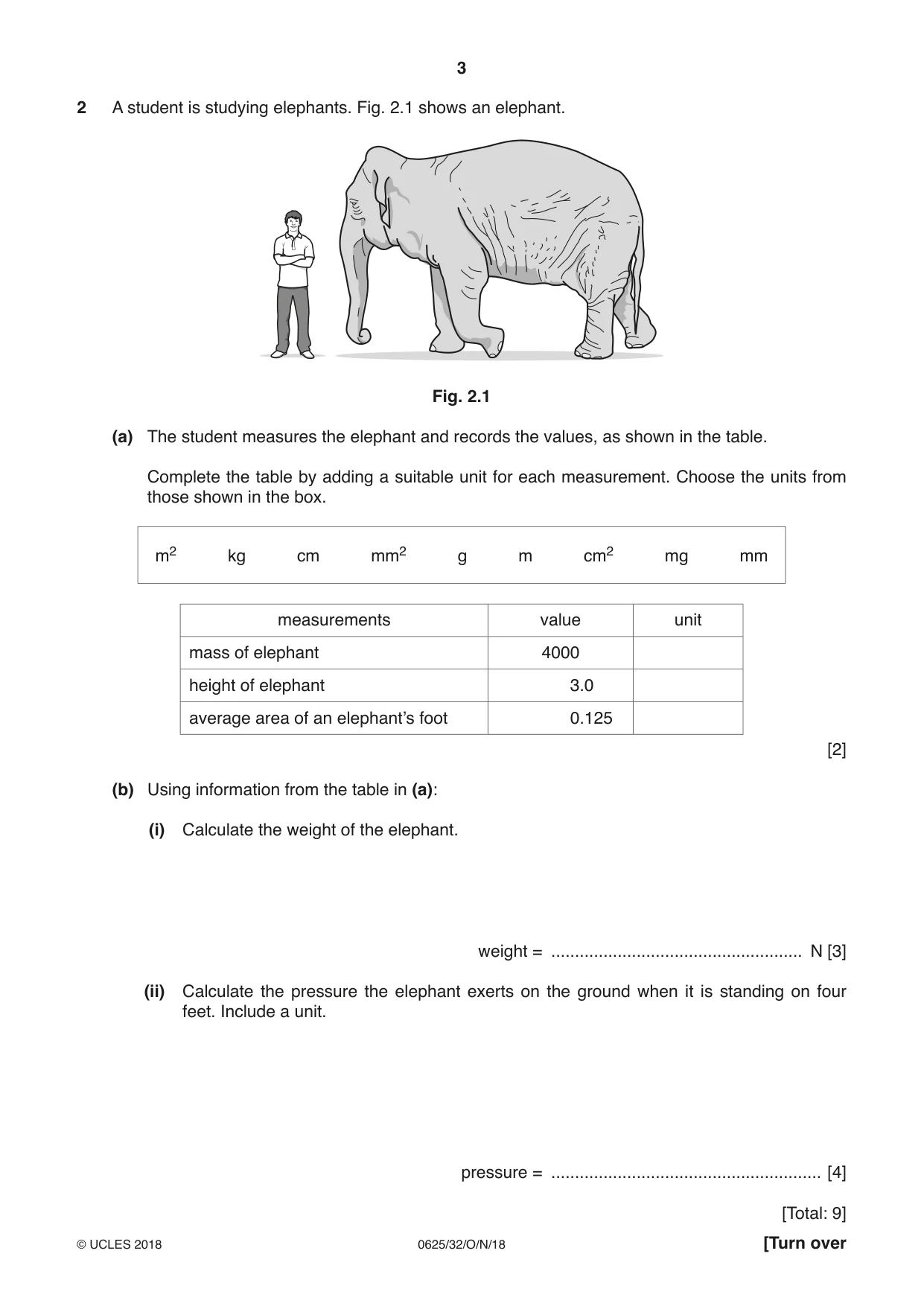
2 A student is studying elephants. Fig. 2.1 shows an elephant. Fig. 2.1 (a) The student measures the elephant and records the values, as shown in the table. Complete the table by adding a suitable unit for each measurement. Choose the units from those shown in the box. m2 kg cm mm2 g m cm2 mg mm measurements value unit mass of elephant 4000 height of elephant 3.0 average area of an elephant’s foot 0.125 [2] (b) Using information from the table in (a): (i) Calculate the weight of the elephant. weight = ..................................................... N [3] (ii) Calculate the pressure the elephant exerts on the ground when it is standing on four feet. Include a unit. pressure = ......................................................... [4] [Total: 9]
Mark scheme: 2(a) mass in kg AND height in m B1 area in m2 B1 2(b)(i) W = m × g C1 4000 × 10 C1 40 000 (N) A1 2(b)(ii) P = F ÷ A in any recognisable form C1 (area = ) 0.125 × 4 = 0.50 (m2) B1 b(i) ÷ 5000 OR 40 000 ÷ 0.500 C1 80 000 N / m2 OR 80 000 Pa A1
More questions on Physical quantities and measurement techniques
Q3 · A flask contains gas with a pressure lower than atmospheric pressure
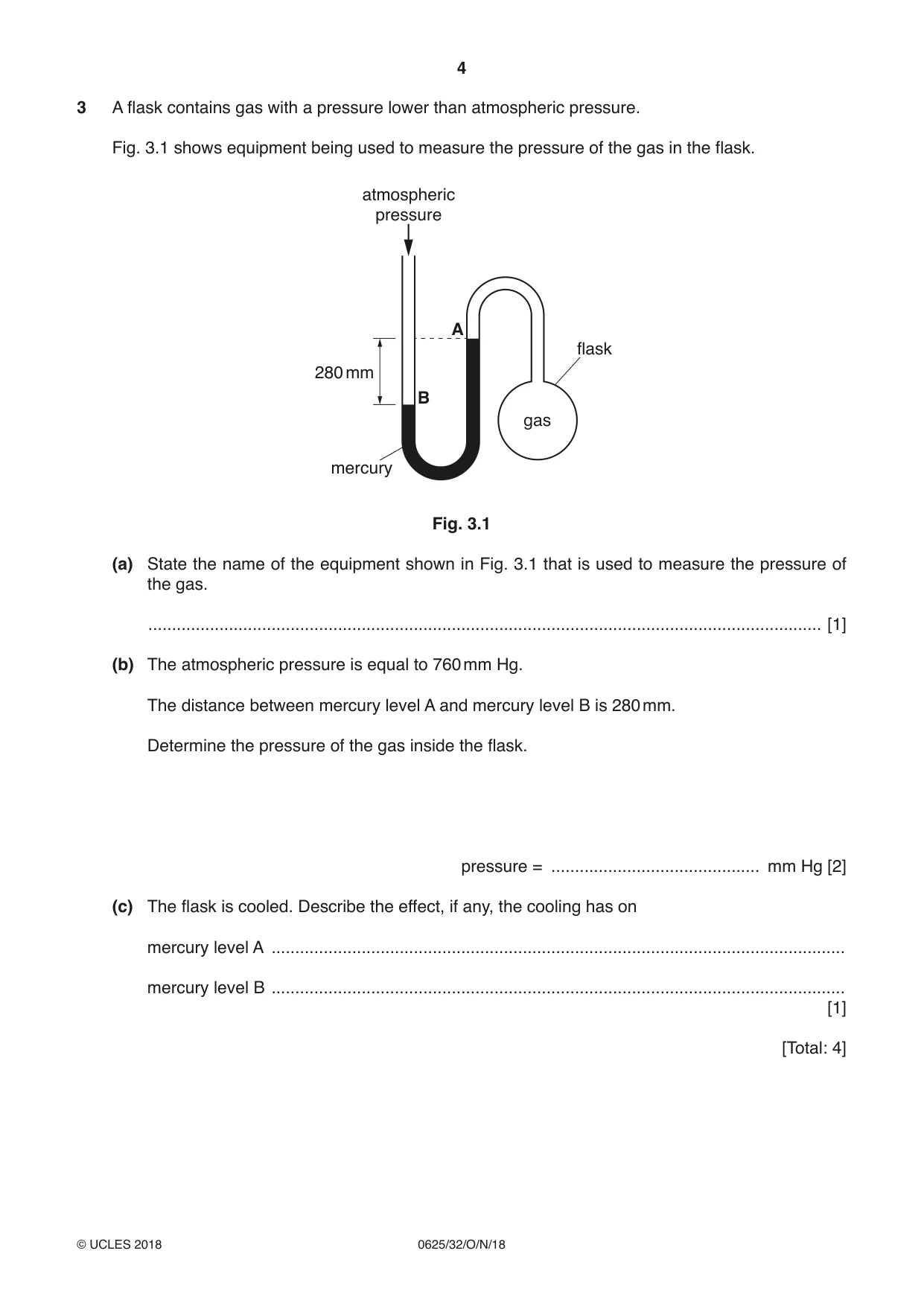
3 A flask contains gas with a pressure lower than atmospheric pressure. Fig. 3.1 shows equipment being used to measure the pressure of the gas in the flask. atmospheric pressure A flask 280 mm B gas mercury Fig. 3.1 (a) State the name of the equipment shown in Fig. 3.1 that is used to measure the pressure of the gas. .............................................................................................................................................. [1] (b) The atmospheric pressure is equal to 760 mm Hg. The distance between mercury level A and mercury level B is 280 mm. Determine the pressure of the gas inside the flask. pressure = ............................................ mm Hg [2] (c) The flask is cooled. Describe the effect, if any, the cooling has on mercury level A ......................................................................................................................... mercury level B ......................................................................................................................... [1] [Total: 4]
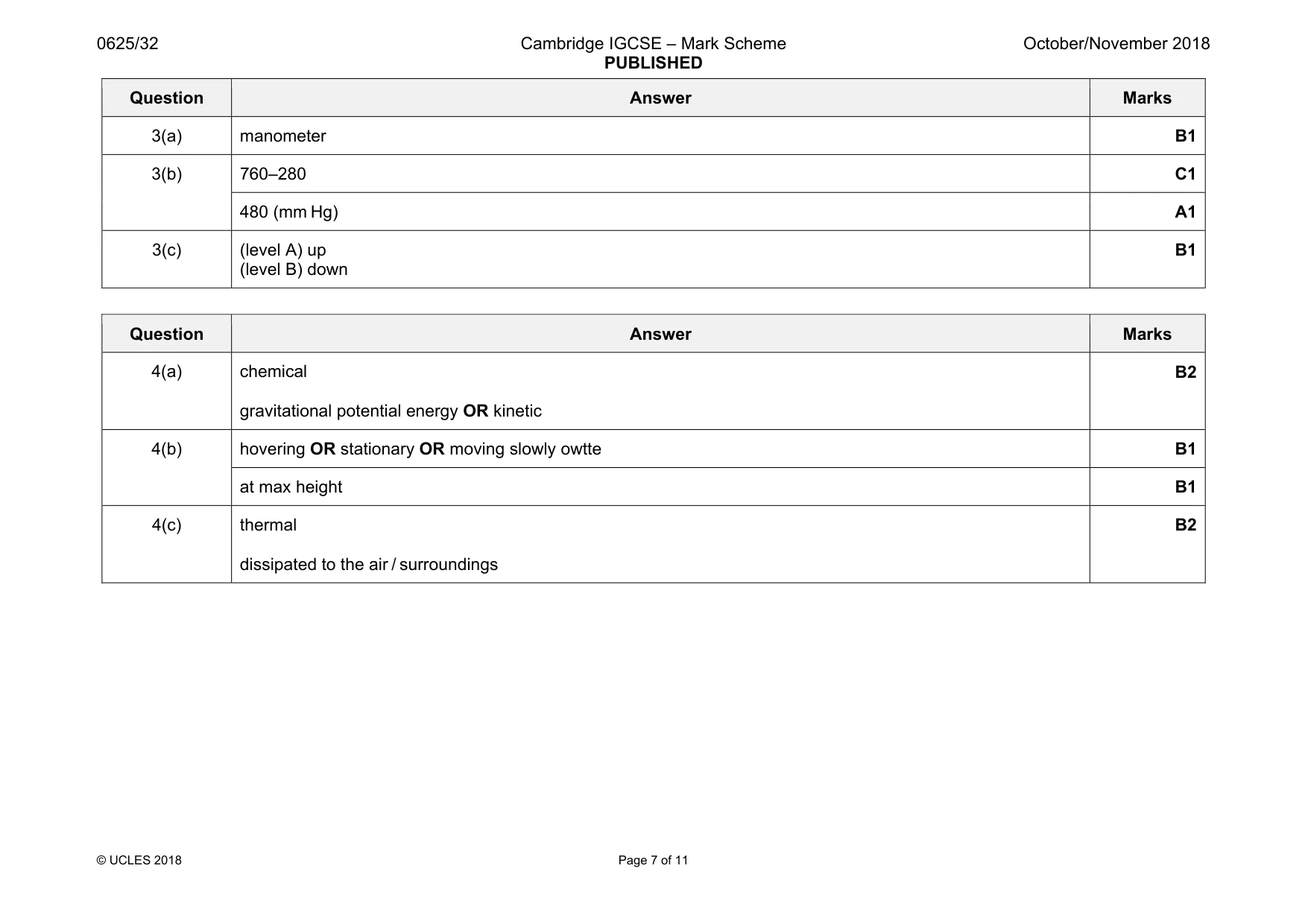
Mark scheme: 3(a) manometer B1 3(b) 760–280 C1 480 (mm Hg) A1 3(c) (level A) up (level B) down B1
Q4 · A drone is a machine that can fly
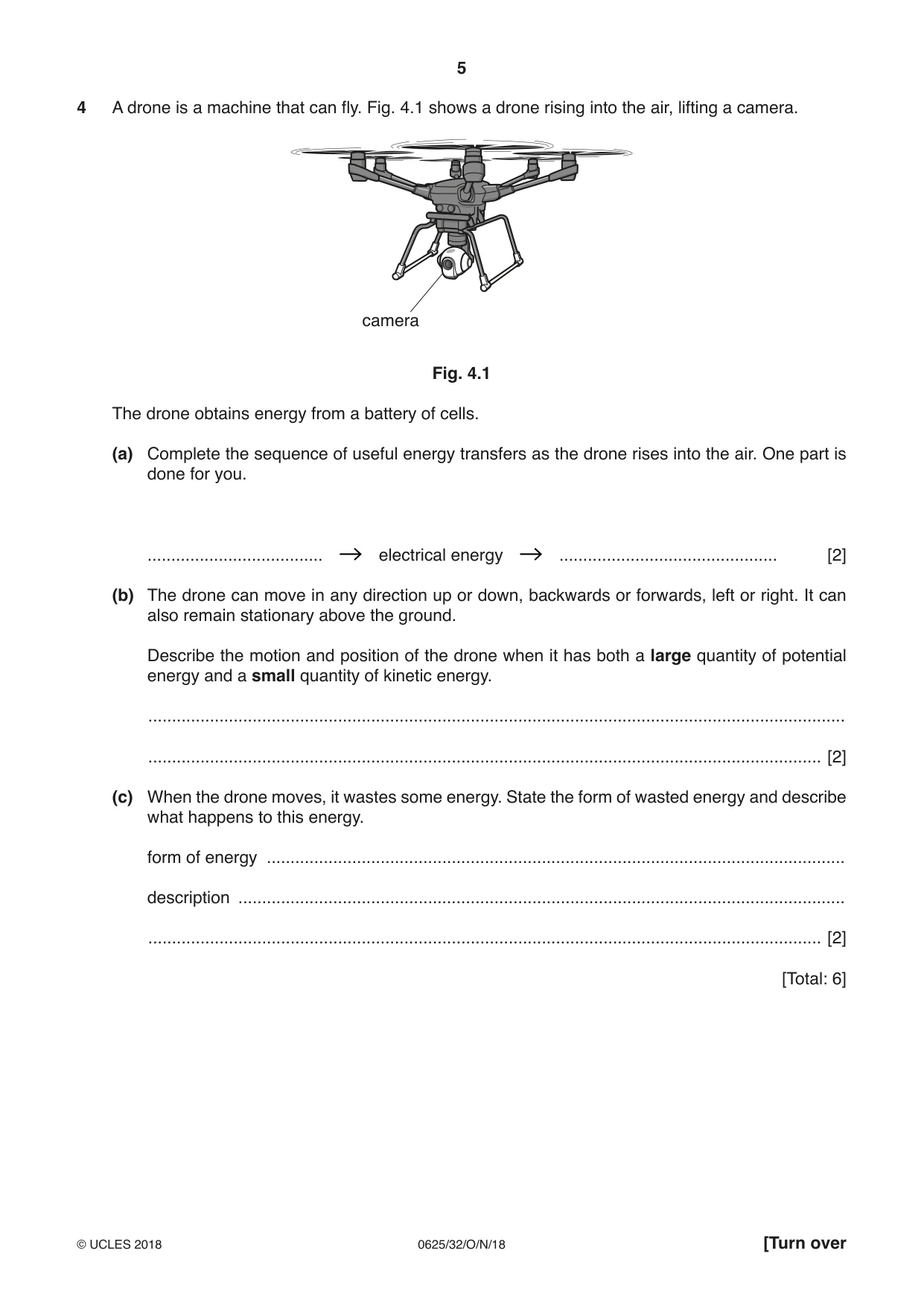
4 A drone is a machine that can fly. Fig. 4.1 shows a drone rising into the air, lifting a camera. camera Fig. 4.1 The drone obtains energy from a battery of cells. (a) Complete the sequence of useful energy transfers as the drone rises into the air. One part is done for you. ..................................... electrical energy .............................................. [2] (b) The drone can move in any direction up or down, backwards or forwards, left or right. It can also remain stationary above the ground. Describe the motion and position of the drone when it has both a large quantity of potential energy and a small quantity of kinetic energy. ................................................................................................................................................... .............................................................................................................................................. [2] (c) When the drone moves, it wastes some energy. State the form of wasted energy and describe what happens to this energy. form of energy .......................................................................................................................... description ................................................................................................................................ .............................................................................................................................................. [2] [Total: 6]
Mark scheme: 4(a) chemical gravitational potential energy OR kinetic B2 4(b) hovering OR stationary OR moving slowly owtte B1 at max height B1 4(c) thermal dissipated to the air / surroundings B2
Q5 · State the meaning of the term thermal capacity
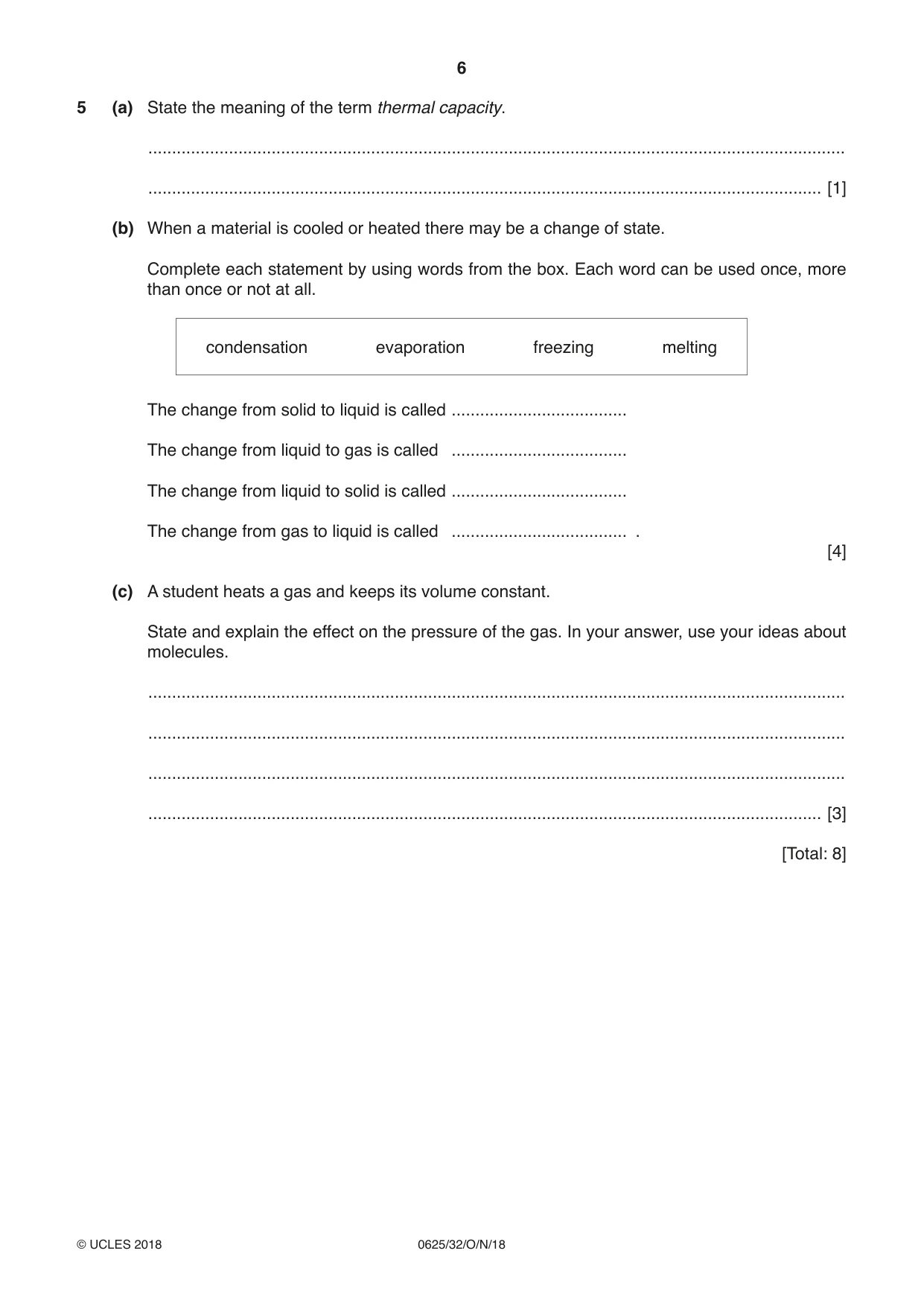
5 (a) State the meaning of the term thermal capacity. ................................................................................................................................................... .............................................................................................................................................. [1] (b) When a material is cooled or heated there may be a change of state. Complete each statement by using words from the box. Each word can be used once, more than once or not at all. condensation evaporation freezing melting The change from solid to liquid is called ..................................... The change from liquid to gas is called ..................................... The change from liquid to solid is called ..................................... The change from gas to liquid is called ..................................... . [4] (c) A student heats a gas and keeps its volume constant. State and explain the effect on the pressure of the gas. In your answer, use your ideas about molecules. ................................................................................................................................................... ................................................................................................................................................... ................................................................................................................................................... .............................................................................................................................................. [3] [Total: 8]
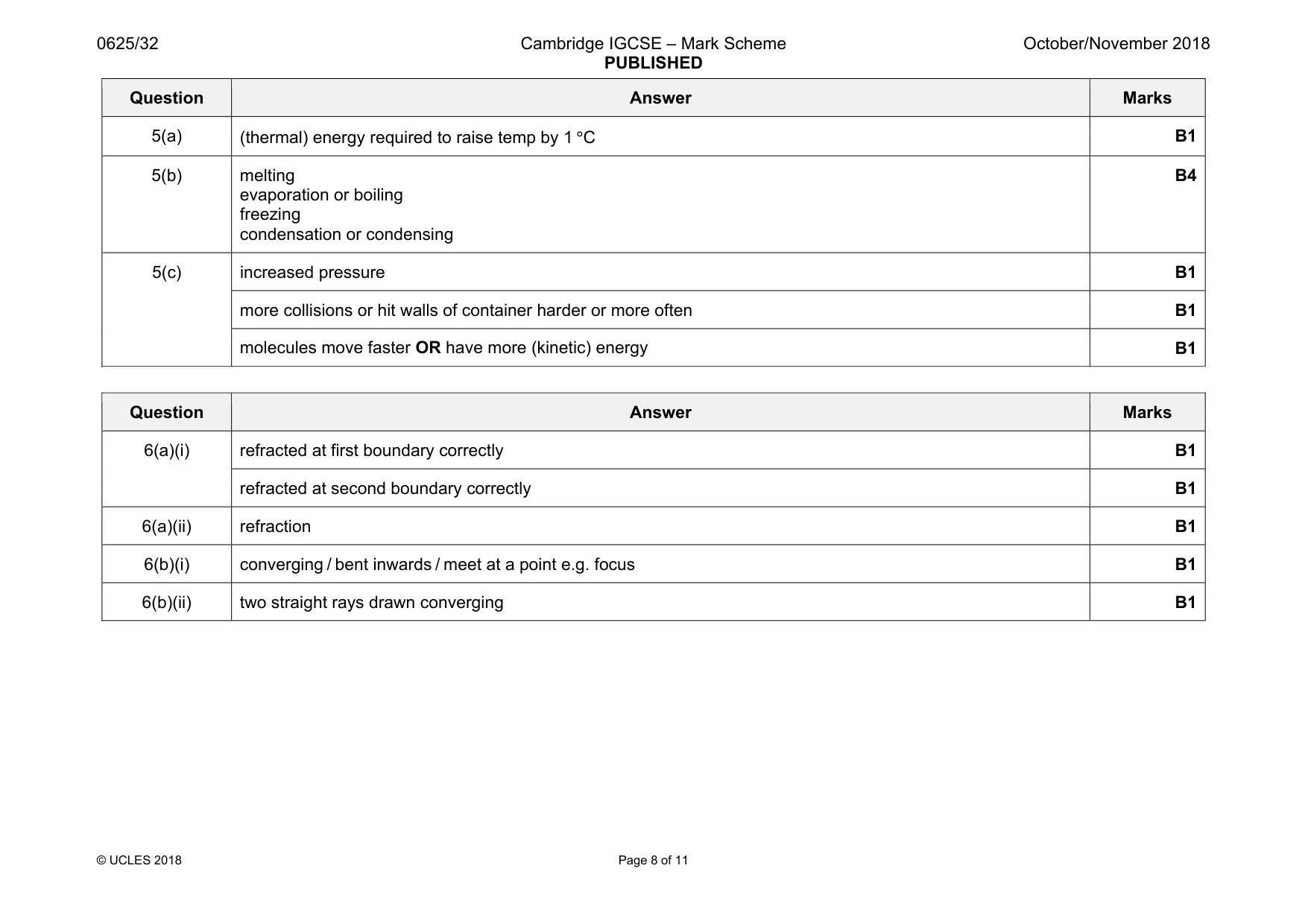
Mark scheme: 5(a) B1 5(b) melting evaporation or boiling freezing condensation or condensing B4 5(c) increased pressure B1 more collisions or hit walls of container harder or more often B1 molecules move faster OR have more (kinetic) energy B1
Q6 · A ray of red light incident on part of a lens
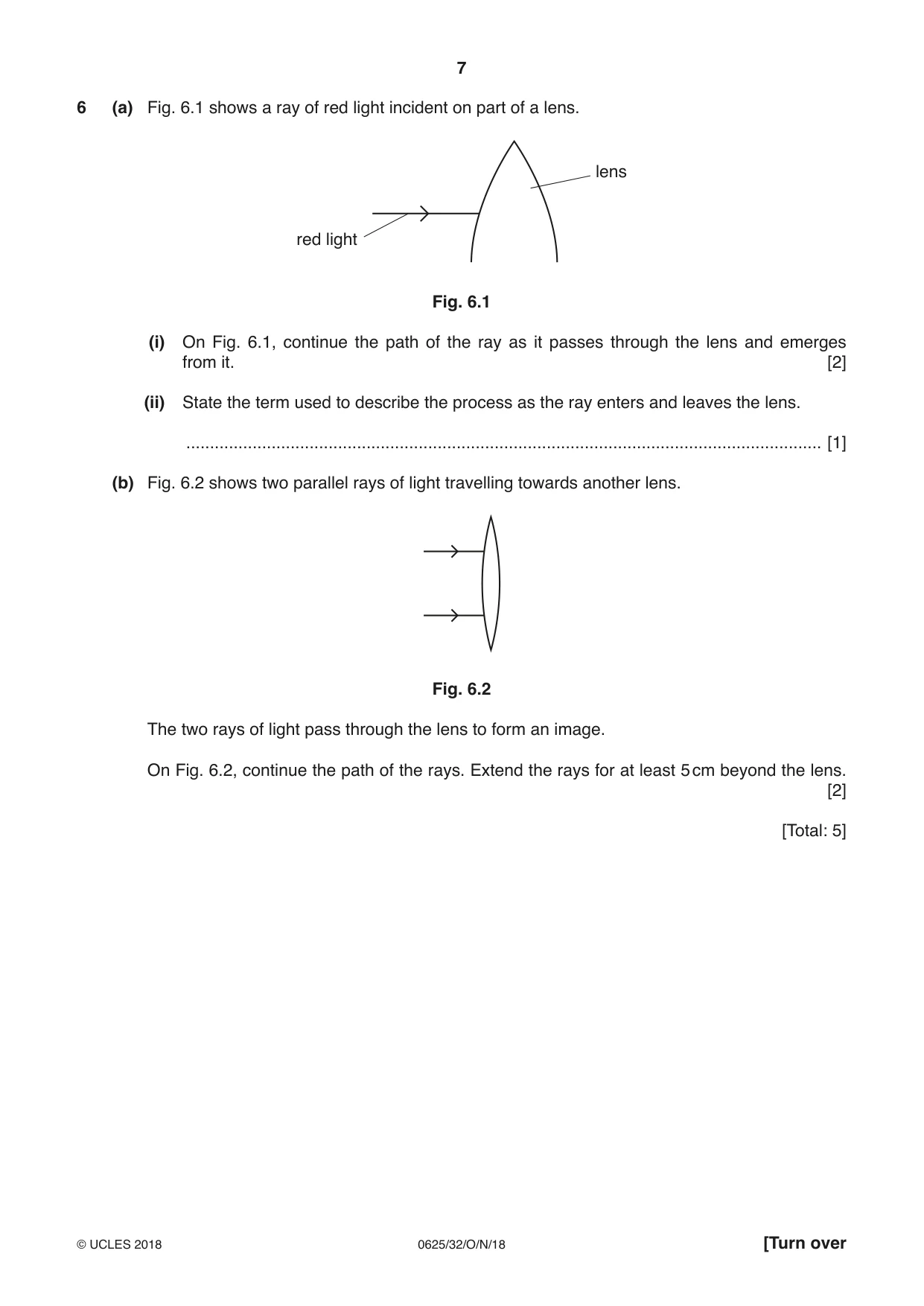
6 (a) Fig. 6.1 shows a ray of red light incident on part of a lens. lens red light Fig. 6.1 (i) On Fig. 6.1, continue the path of the ray as it passes through the lens and emerges from it. [2] (ii) State the term used to describe the process as the ray enters and leaves the lens. ...................................................................................................................................... [1] (b) Fig. 6.2 shows two parallel rays of light travelling towards another lens. Fig. 6.2 The two rays of light pass through the lens to form an image. On Fig. 6.2, continue the path of the rays. Extend the rays for at least 5 cm beyond the lens. [2] [Total: 5]
Mark scheme: 6(a)(i) refracted at first boundary correctly B1 refracted at second boundary correctly B1 6(a)(ii) refraction B1 6(b)(i) converging / bent inwards / meet at a point e.g. focus B1 6(b)(ii) two straight rays drawn converging B1
Q7 · A ray of white light is incident on a glass prism
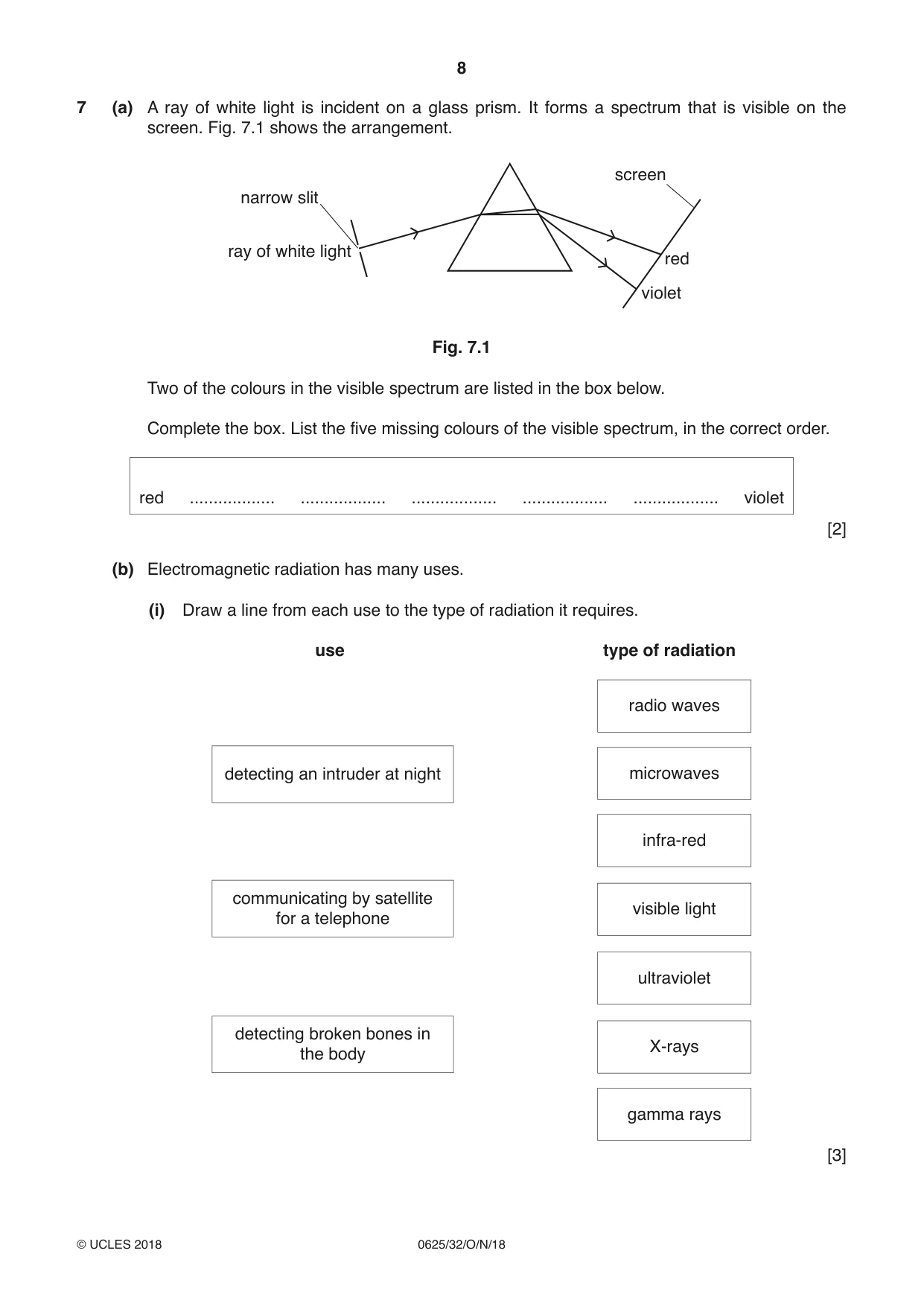
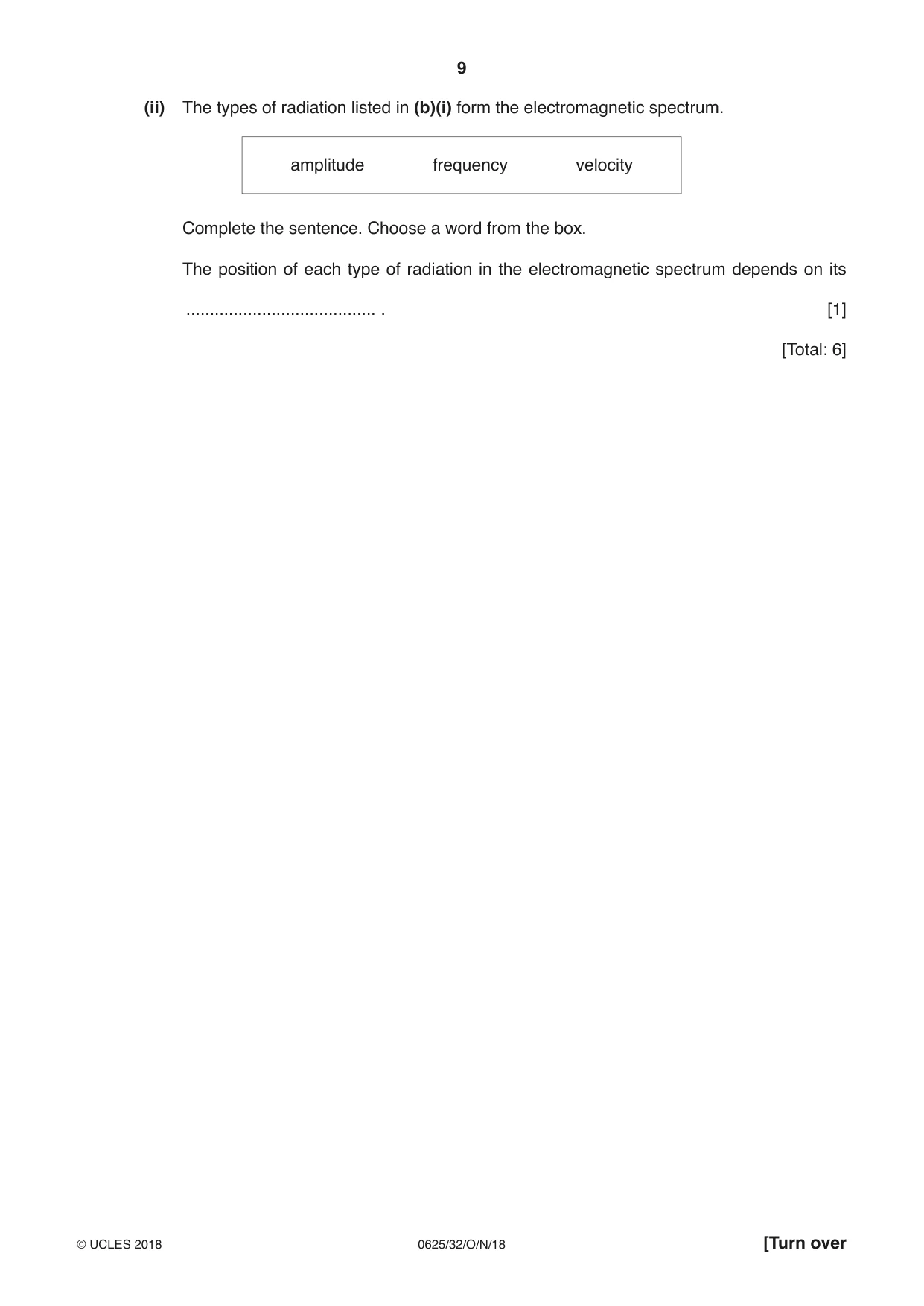
7 (a) A ray of white light is incident on a glass prism. It forms a spectrum that is visible on the screen. Fig. 7.1 shows the arrangement. screen narrow slit ray of white light red violet Fig. 7.1 Two of the colours in the visible spectrum are listed in the box below. Complete the box. List the five missing colours of the visible spectrum, in the correct order. red .................. .................. .................. .................. .................. violet [2] (b) Electromagnetic radiation has many uses. (i) Draw a line from each use to the type of radiation it requires. use type of radiation radio waves detecting an intruder at night microwaves infra-red communicating by satellite visible light for a telephone ultraviolet detecting broken bones in X-rays the body gamma rays [3] (ii) The types of radiation listed in (b)(i) form the electromagnetic spectrum. amplitude frequency velocity Complete the sentence. Choose a word from the box. The position of each type of radiation in the electromagnetic spectrum depends on its ........................................ . [1] [Total: 6]
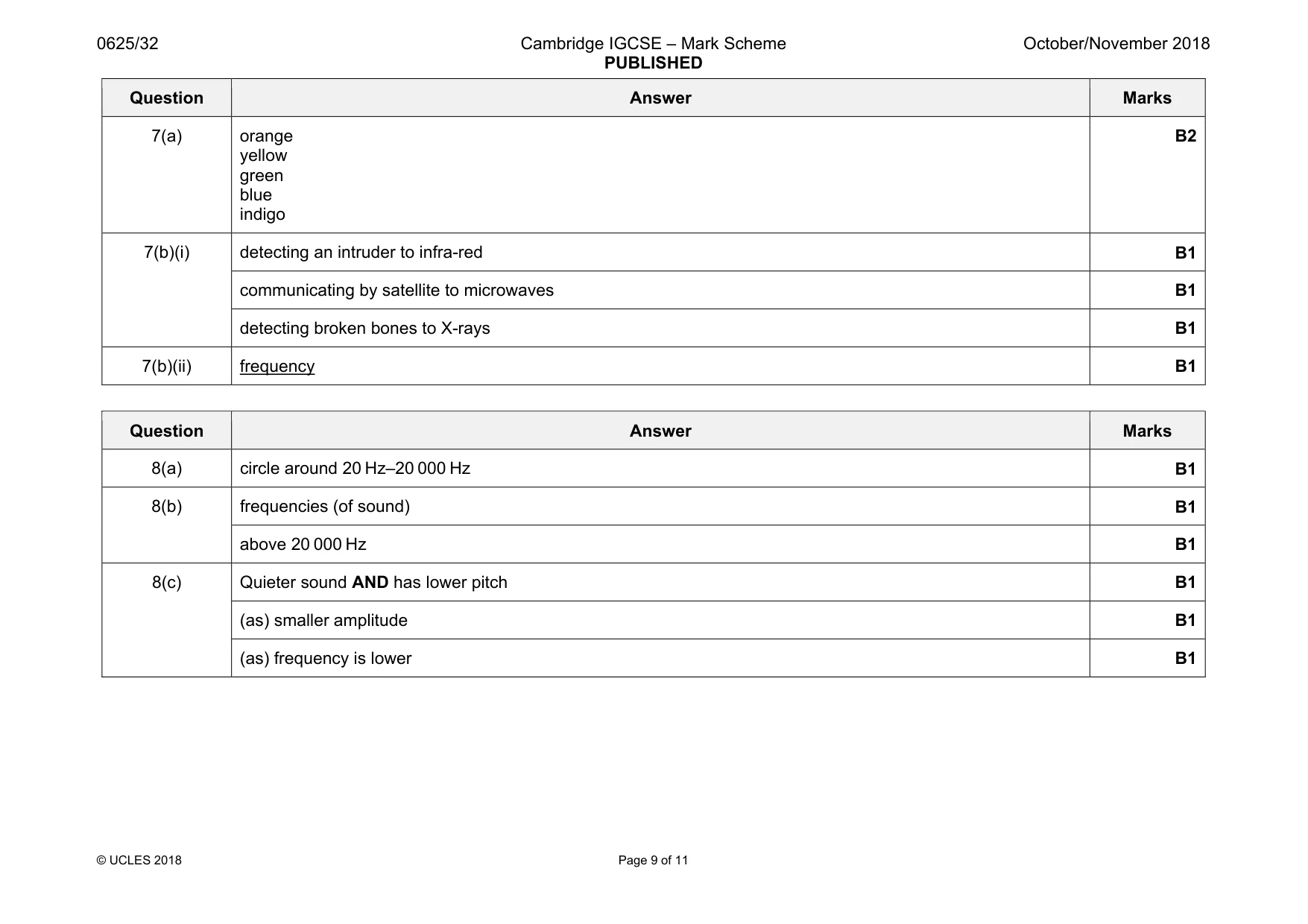
Mark scheme: 7(a) orange yellow green blue indigo B2 7(b)(i) detecting an intruder to infra-red B1 communicating by satellite to microwaves B1 detecting broken bones to X-rays B1 7(b)(ii) frequency B1
Q8 · A healthy human ear can hear a range of frequencies
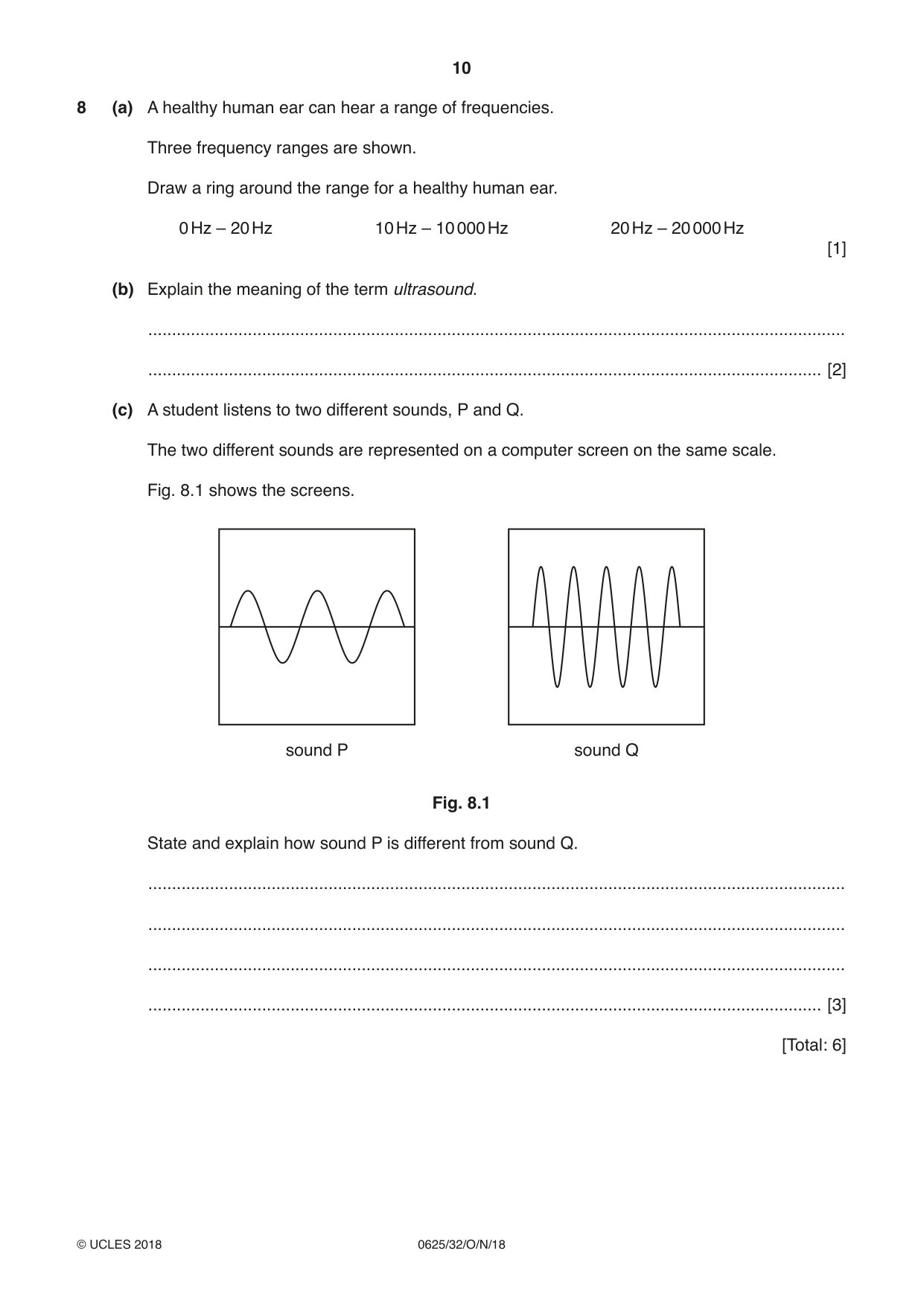
8 (a) A healthy human ear can hear a range of frequencies. Three frequency ranges are shown. Draw a ring around the range for a healthy human ear. 0 Hz – 20 Hz 10 Hz – 10 000 Hz 20 Hz – 20 000 Hz [1] (b) Explain the meaning of the term ultrasound. ................................................................................................................................................... .............................................................................................................................................. [2] (c) A student listens to two different sounds, P and Q. The two different sounds are represented on a computer screen on the same scale. Fig. 8.1 shows the screens. sound P sound Q Fig. 8.1 State and explain how sound P is different from sound Q. ................................................................................................................................................... ................................................................................................................................................... ................................................................................................................................................... .............................................................................................................................................. [3] [Total: 6]
Mark scheme: 8(a) circle around 20 Hz–20 000 Hz B1 8(b) frequencies (of sound) B1 above 20 000 Hz B1 8(c) Quieter sound AND has lower pitch B1 (as) smaller amplitude B1 (as) frequency is lower B1
Q9 · A student fits an electrical generator to a bicycle
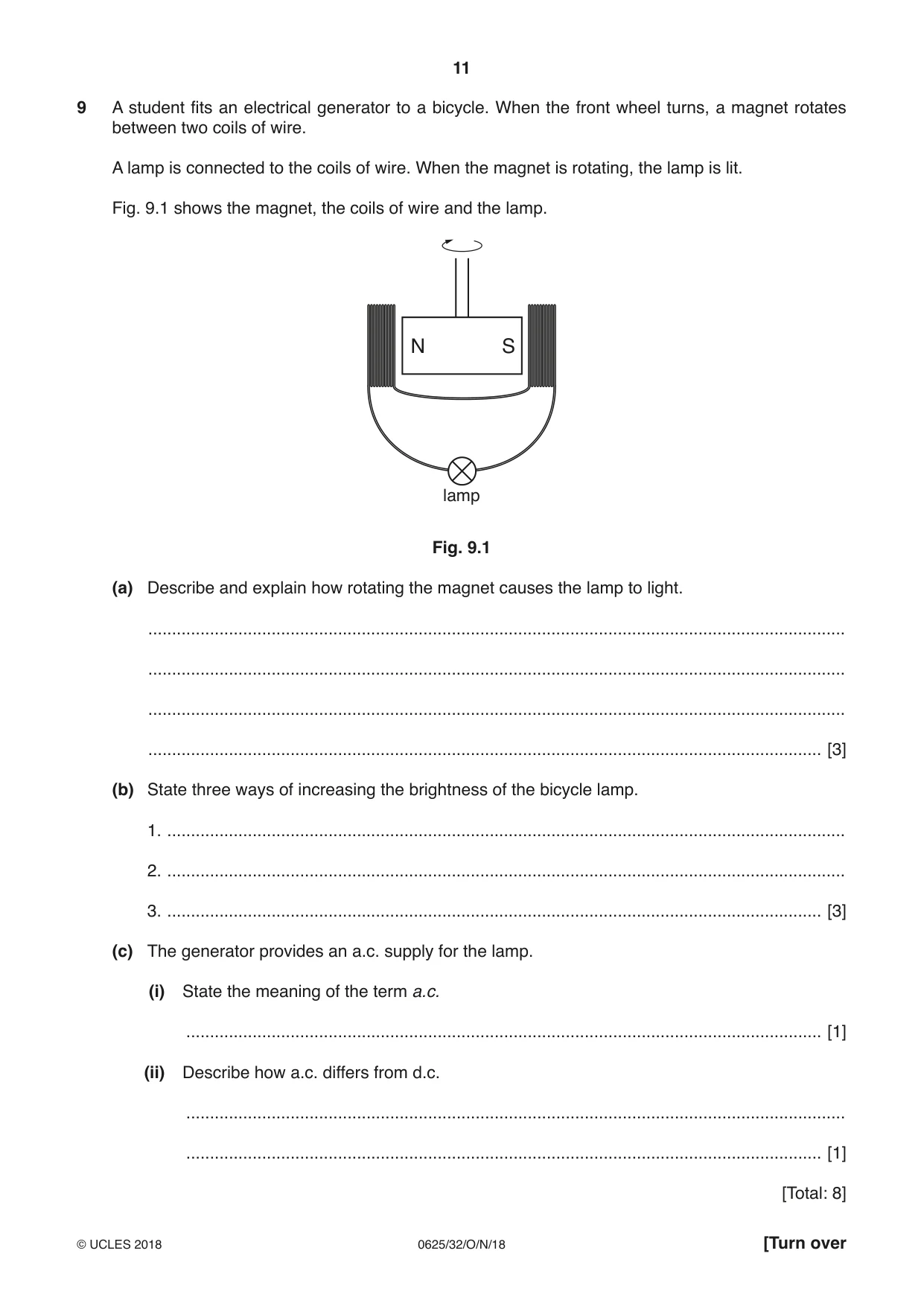
9 A student fits an electrical generator to a bicycle. When the front wheel turns, a magnet rotates between two coils of wire. A lamp is connected to the coils of wire. When the magnet is rotating, the lamp is lit. Fig. 9.1 shows the magnet, the coils of wire and the lamp. N S lamp Fig. 9.1 (a) Describe and explain how rotating the magnet causes the lamp to light. ................................................................................................................................................... ................................................................................................................................................... ................................................................................................................................................... .............................................................................................................................................. [3] (b) State three ways of increasing the brightness of the bicycle lamp. 1. ............................................................................................................................................... 2. ............................................................................................................................................... 3. .......................................................................................................................................... [3] (c) The generator provides an a.c. supply for the lamp. (i) State the meaning of the term a.c. ...................................................................................................................................... [1] (ii) Describe how a.c. differs from d.c. ........................................................................................................................................... ...................................................................................................................................... [1] [Total: 8]
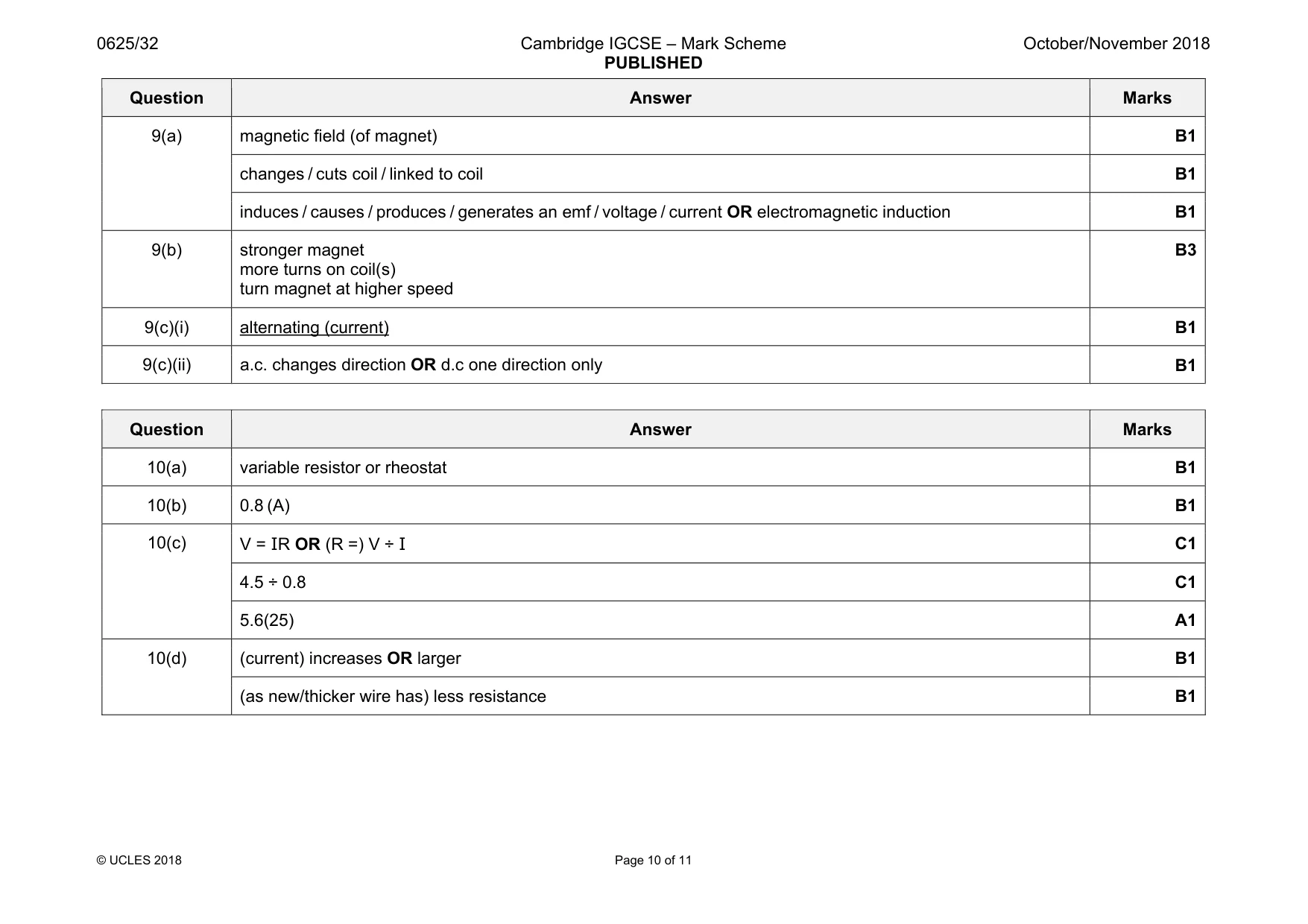
Mark scheme: 9(a) magnetic field (of magnet) B1 changes / cuts coil / linked to coil B1 induces / causes / produces / generates an emf / voltage / current OR electromagnetic induction B1 9(b) stronger magnet more turns on coil(s) turn magnet at higher speed B3 9(c)(i) alternating (current) B1 9(c)(ii) a.c. changes direction OR d.c one direction only B1
Q10 · A circuit used by a student to test a metal wire made of nichrome
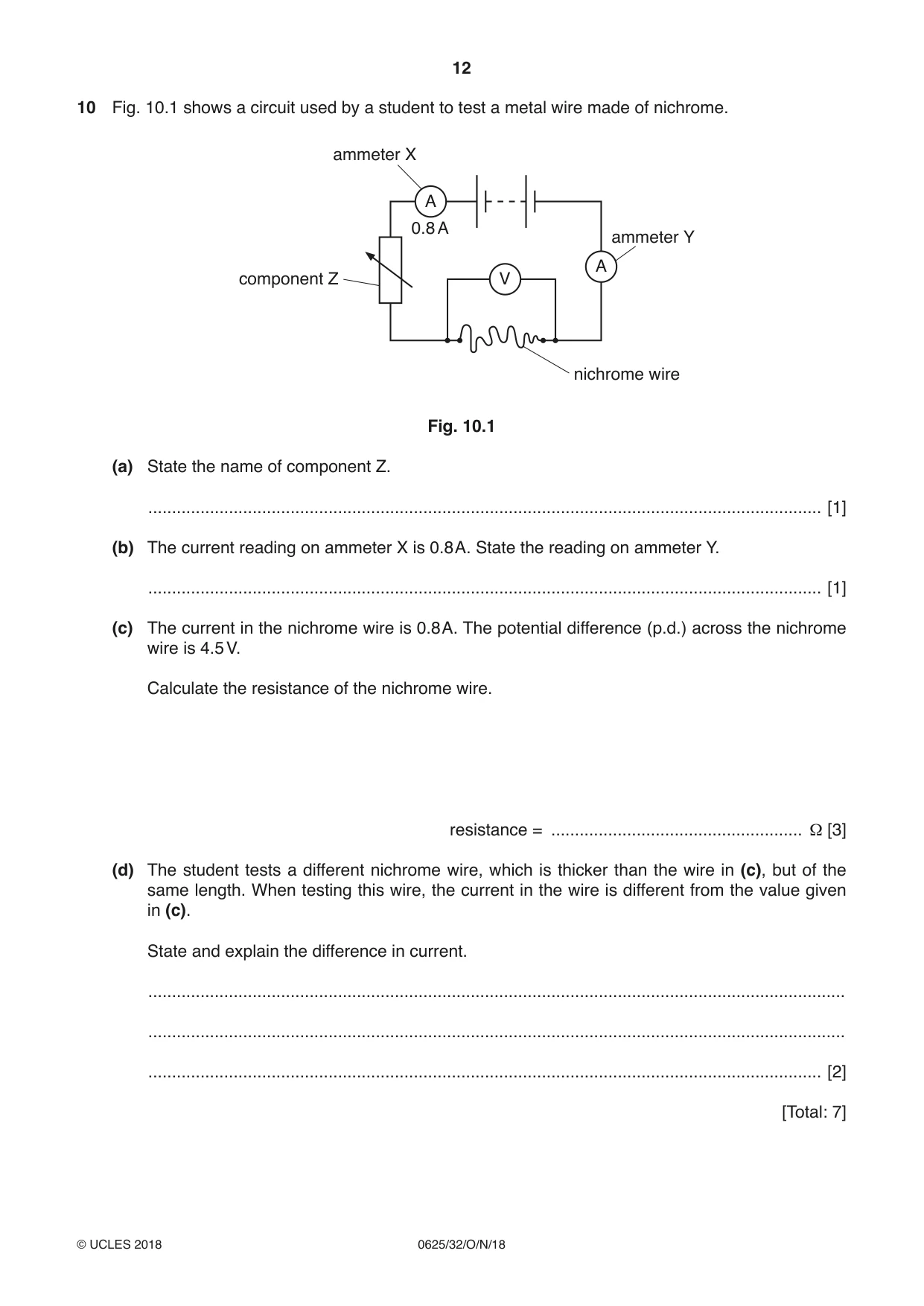
10 Fig. 10.1 shows a circuit used by a student to test a metal wire made of nichrome. ammeter X A 0.8 A ammeter Y A component Z V nichrome wire Fig. 10.1 (a) State the name of component Z. .............................................................................................................................................. [1] (b) The current reading on ammeter X is 0.8 A. State the reading on ammeter Y. .............................................................................................................................................. [1] (c) The current in the nichrome wire is 0.8 A. The potential difference (p.d.) across the nichrome wire is 4.5 V. Calculate the resistance of the nichrome wire. resistance = ..................................................... Ω [3] (d) The student tests a different nichrome wire, which is thicker than the wire in (c), but of the same length. When testing this wire, the current in the wire is different from the value given in (c). State and explain the difference in current. ................................................................................................................................................... ................................................................................................................................................... .............................................................................................................................................. [2] [Total: 7]
Mark scheme: 10(a) variable resistor or rheostat B1 10(b) 0.8 (A) B1 10(c) V = IR OR (R =) V ÷ I C1 4.5 ÷ 0.8 C1 5.6(25) A1 10(d) (current) increases OR larger B1 (as new/thicker wire has) less resistance B1
Q11 · A long straight wire passes through a piece of card
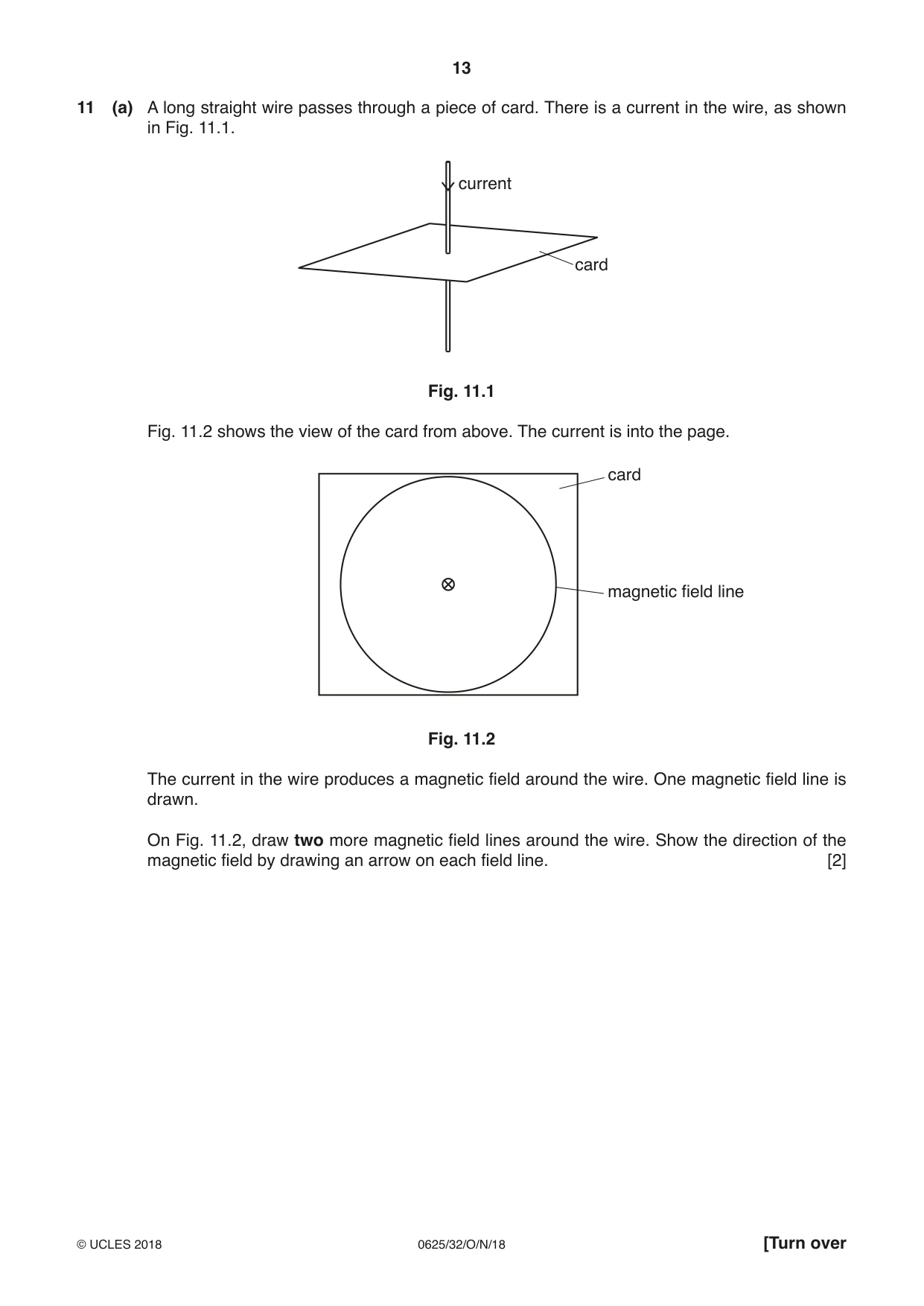
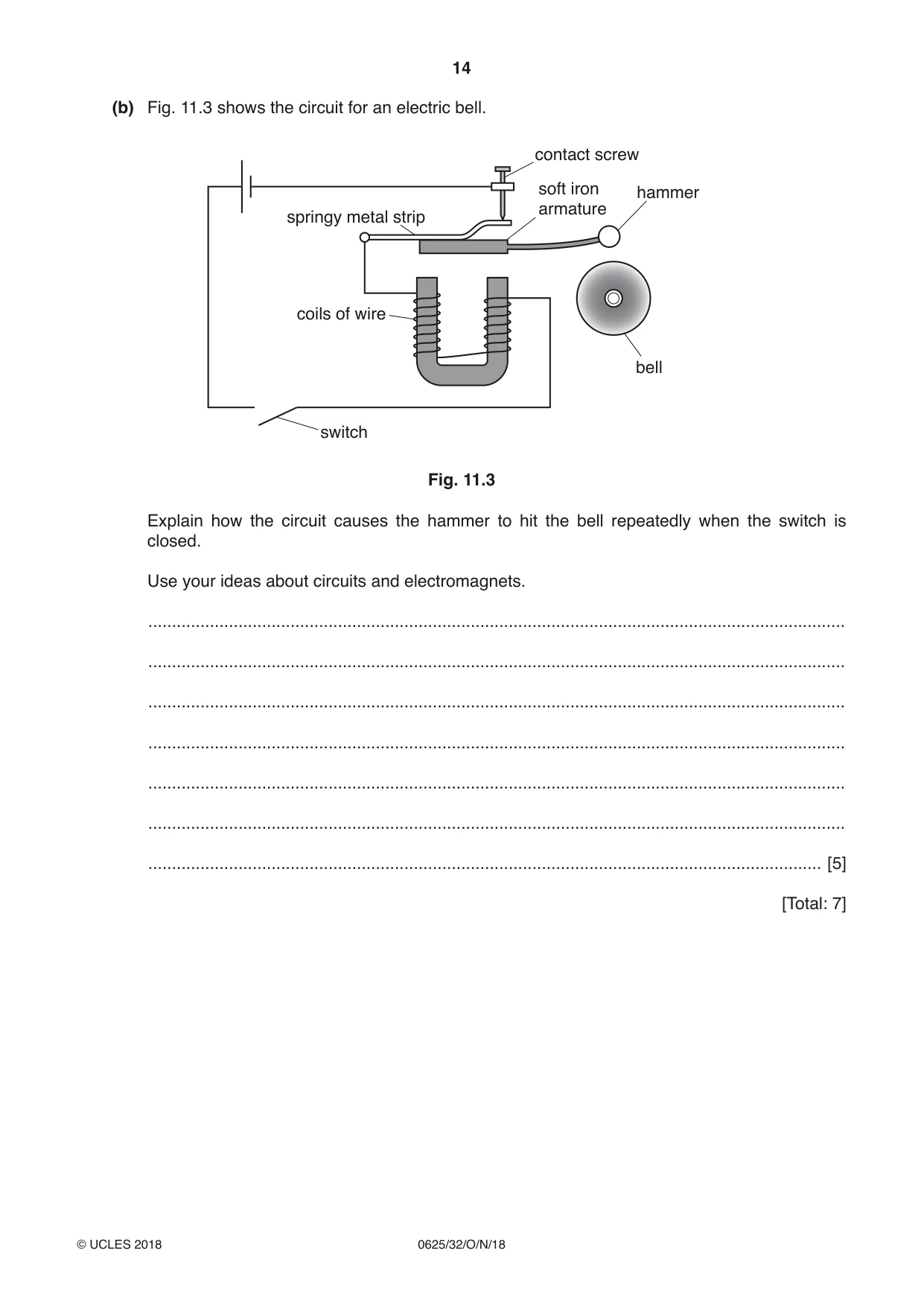
11 (a) A long straight wire passes through a piece of card. There is a current in the wire, as shown in Fig. 11.1. current card Fig. 11.1 Fig. 11.2 shows the view of the card from above. The current is into the page. card magnetic field line Fig. 11.2 The current in the wire produces a magnetic field around the wire. One magnetic field line is drawn. On Fig. 11.2, draw two more magnetic field lines around the wire. Show the direction of the magnetic field by drawing an arrow on each field line. [2] (b) Fig. 11.3 shows the circuit for an electric bell. contact screw soft iron hammer armature springy metal strip coils of wire bell switch Fig. 11.3 Explain how the circuit causes the hammer to hit the bell repeatedly when the switch is closed. Use your ideas about circuits and electromagnets. ................................................................................................................................................... ................................................................................................................................................... ................................................................................................................................................... ................................................................................................................................................... ................................................................................................................................................... ................................................................................................................................................... .............................................................................................................................................. [5] [Total: 7]
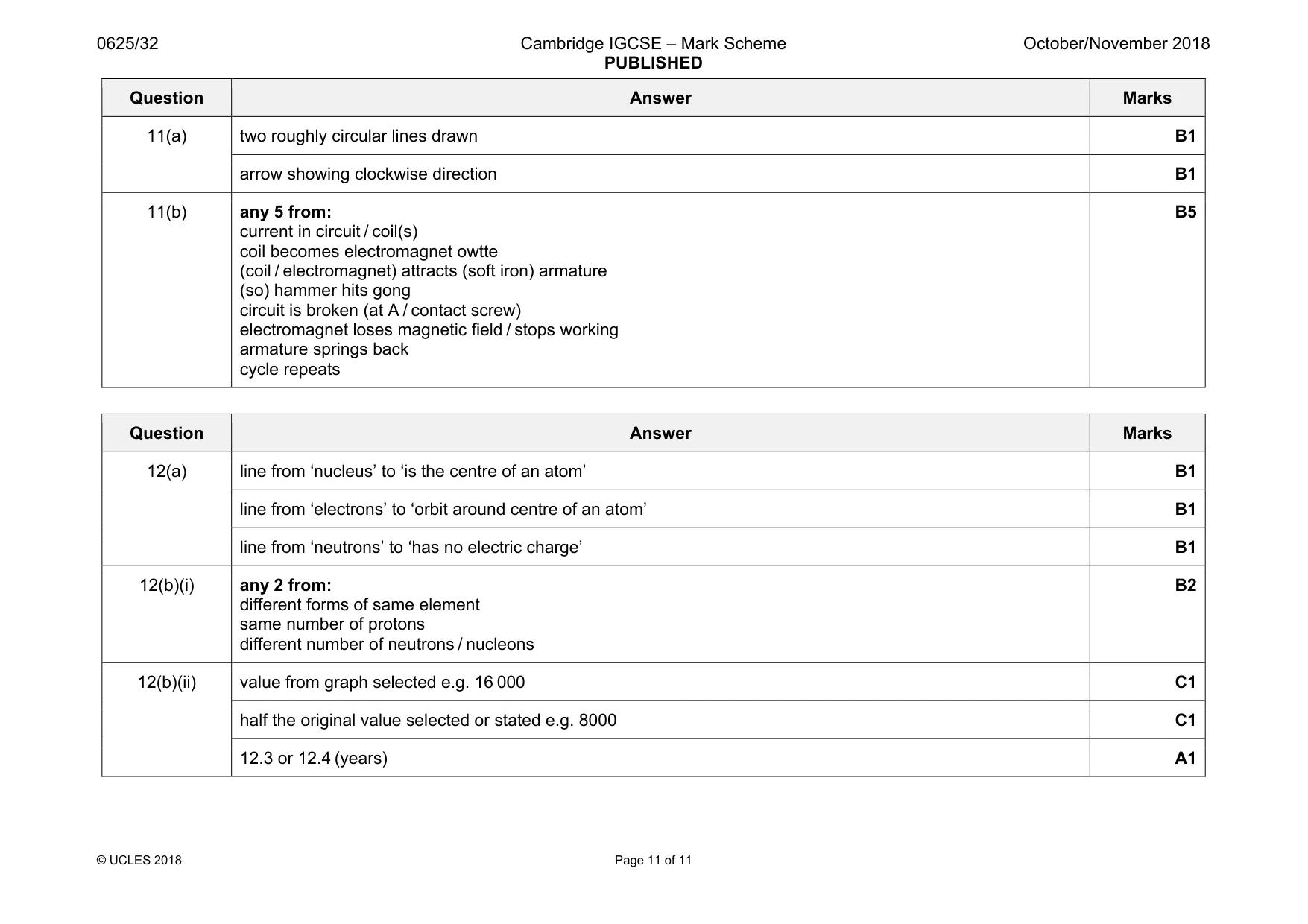
Mark scheme: 11(a) two roughly circular lines drawn B1 arrow showing clockwise direction B1 11(b) any 5 from: current in circuit / coil(s) coil becomes electromagnet owtte (coil / electromagnet) attracts (soft iron) armature (so) hammer hits gong circuit is broken (at A / contact screw) electromagnet loses magnetic field / stops working armature springs back cycle repeats B5
Q12 · Draw a line from each part of the atom to its description
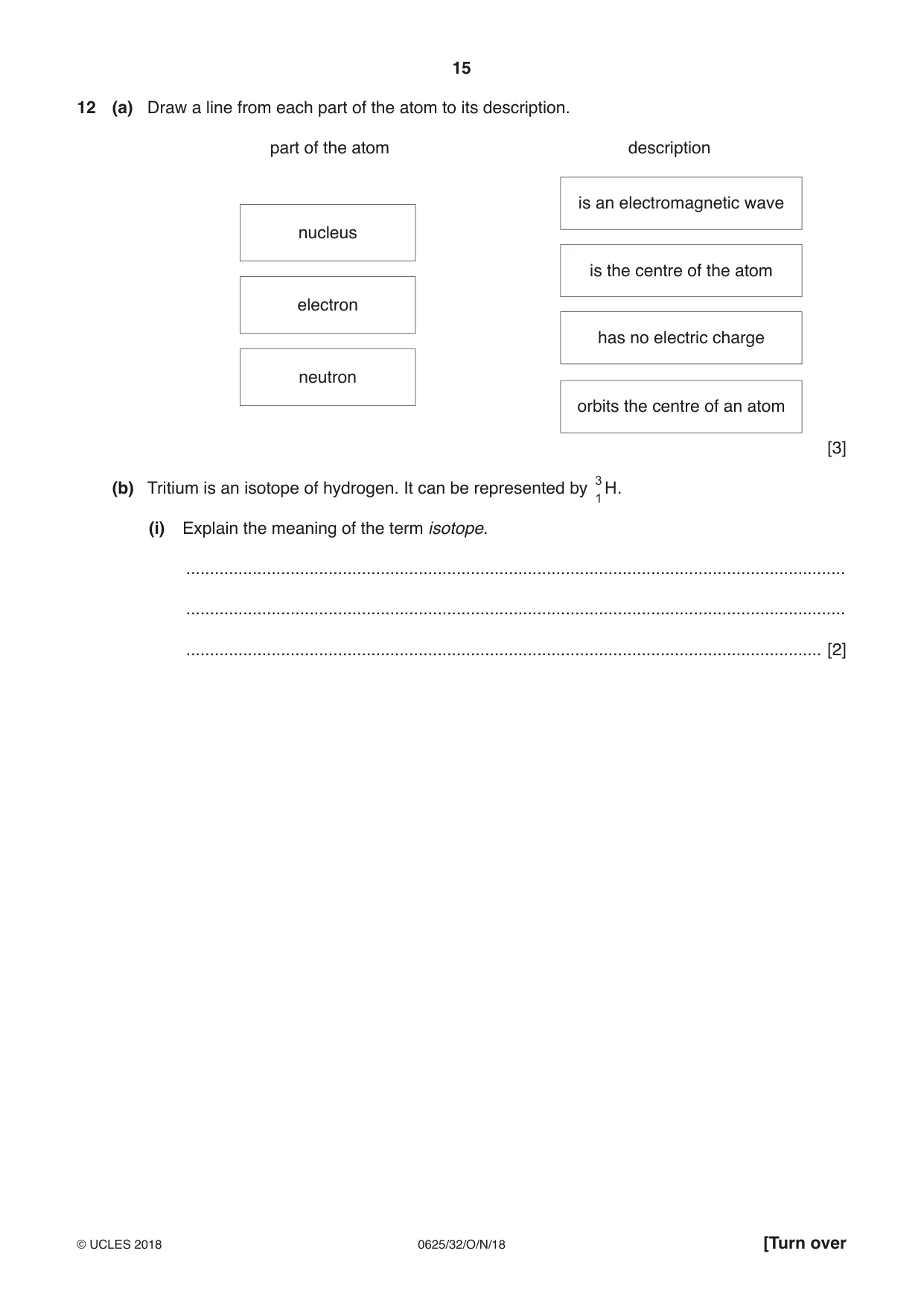
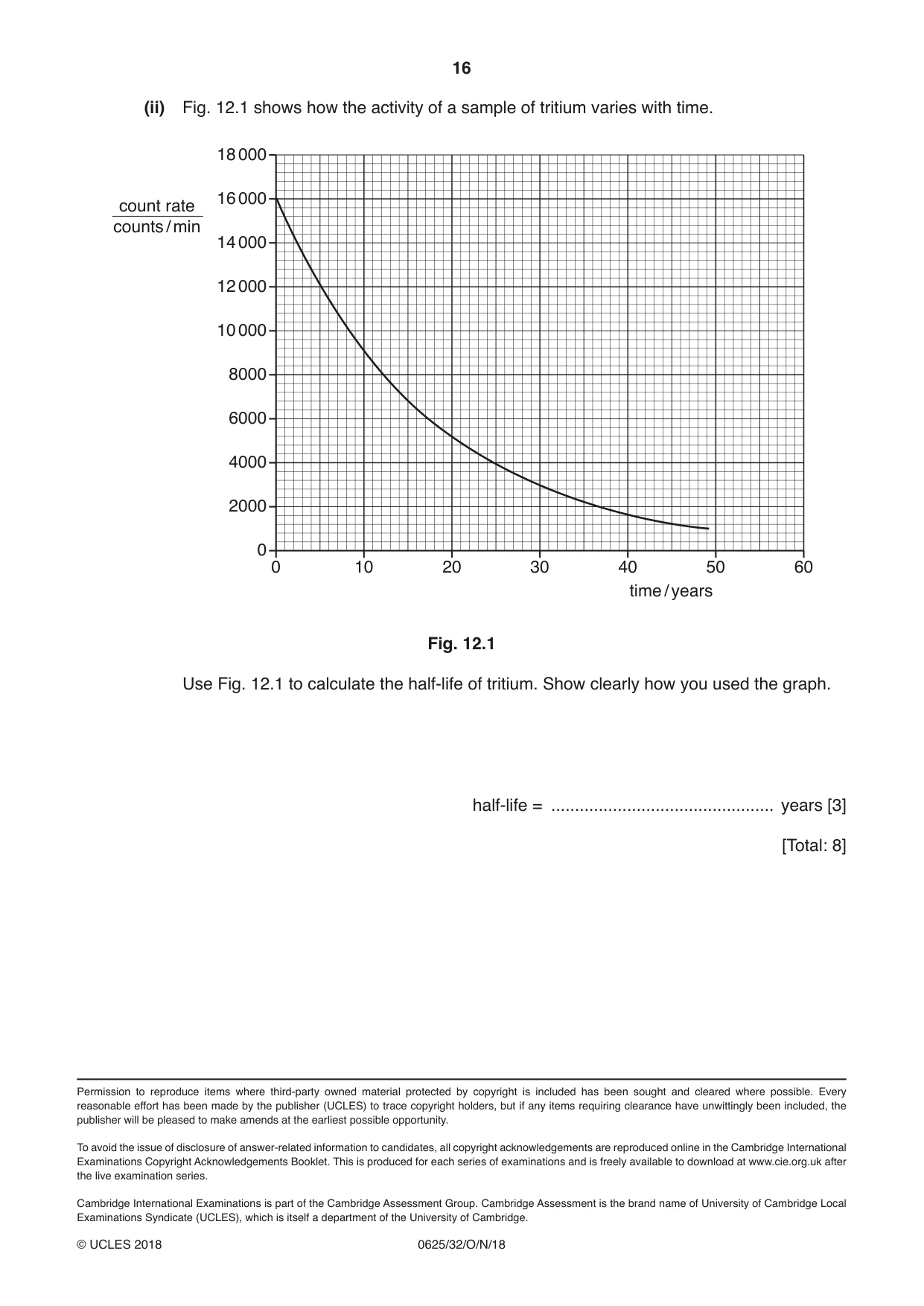
12 (a) Draw a line from each part of the atom to its description. part of the atom description is an electromagnetic wave nucleus is the centre of the atom electron has no electric charge neutron orbits the centre of an atom [3] (b) Tritium is an isotope of hydrogen. It can be represented by 3 H. 1 (i) Explain the meaning of the term isotope. ........................................................................................................................................... ........................................................................................................................................... ...................................................................................................................................... [2] (ii) Fig. 12.1 shows how the activity of a sample of tritium varies with time. 18 000 16 000 count rate counts / min 14 000 12 000 10 000 8000 6000 4000 2000 0 0 10 20 30 40 50 60 time / years Fig. 12.1 Use Fig. 12.1 to calculate the half-life of tritium. Show clearly how you used the graph. half-life = ............................................... years [3] [Total: 8]
Mark scheme: 12(a) line from ‘nucleus’ to ‘is the centre of an atom’ B1 line from ‘electrons’ to ‘orbit around centre of an atom’ B1 line from ‘neutrons’ to ‘has no electric charge’ B1 12(b)(i) any 2 from: different forms of same element same number of protons different number of neutrons / nucleons B2 12(b)(ii) value from graph selected e.g. 16 000 C1 half the original value selected or stated e.g. 8000 C1 12.3 or 12.4 (years) A1
What was in this paper
The subtopics covered by these 12 questions, and how many questions each got. Open one in a new tab to see every Cambridge question on it.
What you needed in this session
Cambridge’s own grade thresholds for 2018 Oct/Nov, Paper 3 · Variant 2. A higher threshold means an easier paper — the bar moves with how the cohort did.