Cambridge IGCSE Physics 0625 — 2025 Oct/Nov Paper 3 · Variant 3
0625/33/O/N/25 · 10 questions · 80 marks · ≈90 min
The question paper and its mark scheme, free to read here and free to download. This is Cambridge’s own paper, exactly as it was sat.
Question paper16 pages

Mark scheme19 pages
Answers below. Sit the paper first if you are practising.
Questions as text
Q1 · A stone falling from a cliff to a beach
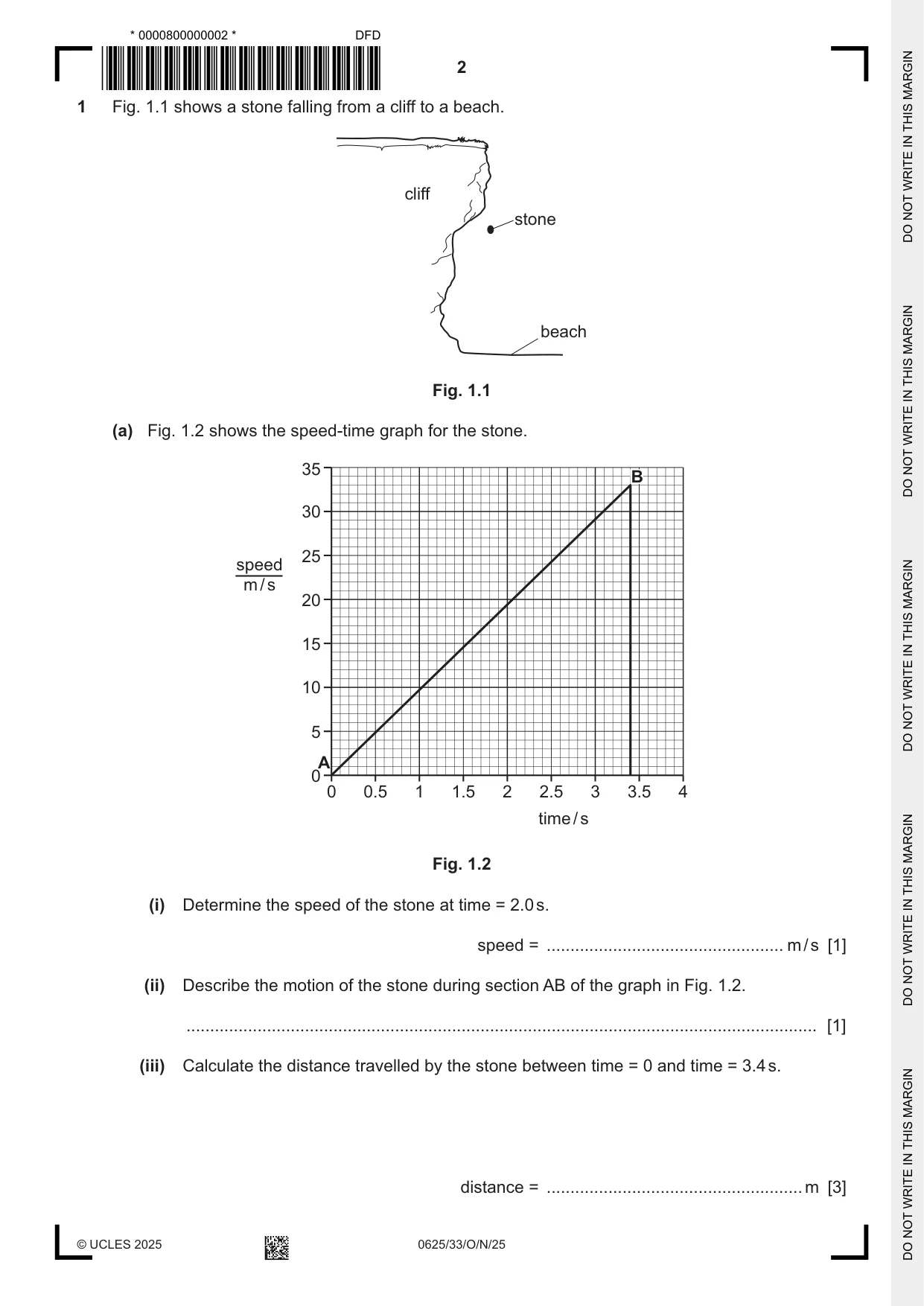
1 Fig. 1.1 shows a stone falling from a cliff to a beach. cliff stone beach Fig. 1.1 (a) Fig. 1.2 shows the speed-time graph for the stone. 35 B 30 25 speed m / s 20 15 10 5 A 0 0 0.5 1 1.5 2 2.5 3 3.5 4 time / s Fig. 1.2 (i) Determine the speed of the stone at time = 2.0 s. speed = .................................................. m / s [1] (ii) Describe the motion of the stone during section AB of the graph in Fig. 1.2. ..................................................................................................................................... [1] (iii) Calculate the distance travelled by the stone between time = 0 and time = 3.4 s. distance = ......................................................m [3] (b) The weight of the stone is 0.12 N. Calculate the mass of the stone. mass = ..................................................... kg [3] [Total: 8]
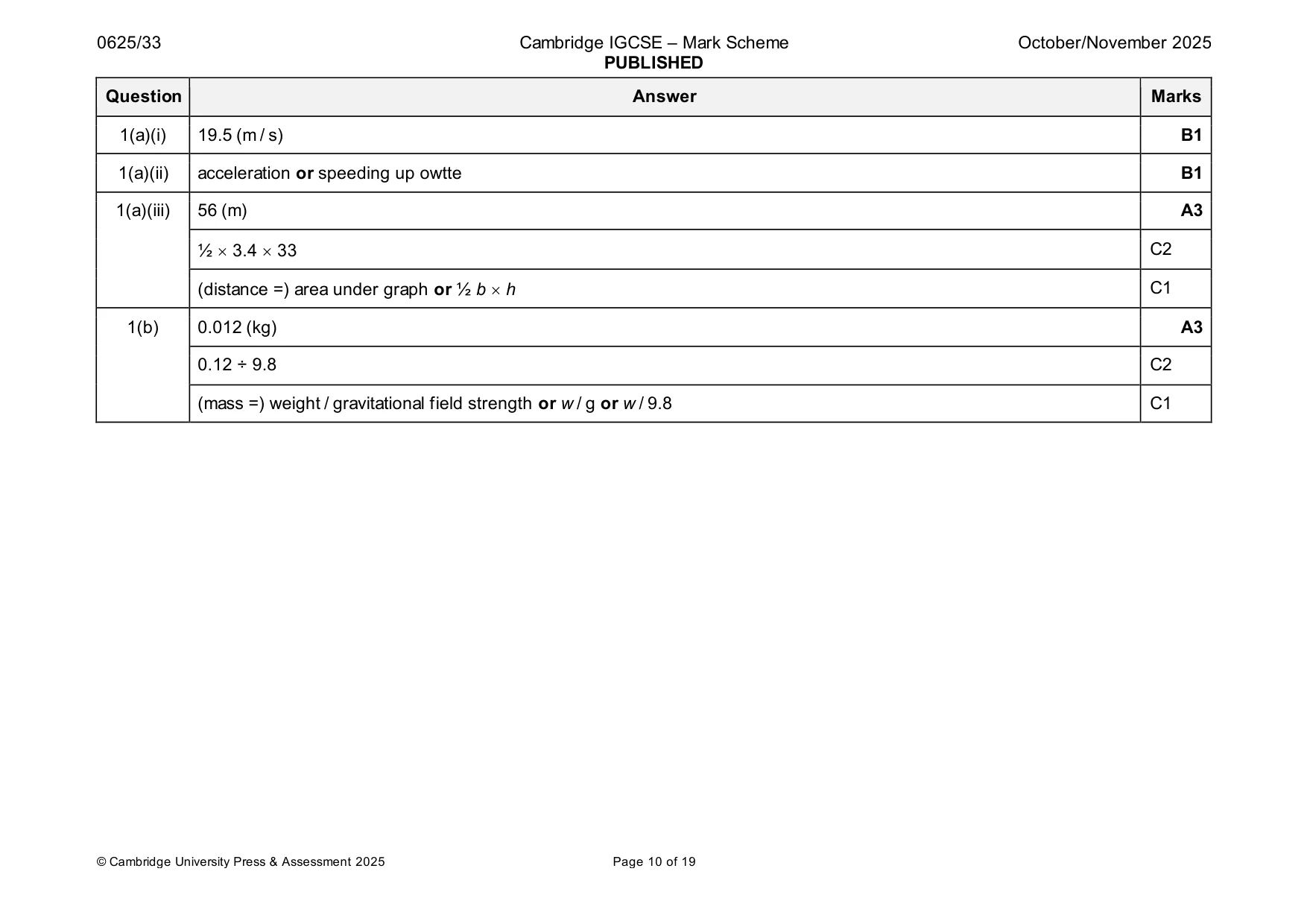
Mark scheme: Question Answer Marks 1(a)(i) 19.5 (m / s) B1 1(a)(ii) acceleration or speeding up owtte B1 1(a)(iii) 56 (m) A3 ½ 3.4 33 C2 (distance =) area under graph or ½ b h C1 1(b) 0.012 (kg) A3 0.12 ÷ 9.8 C2 (mass =) weight / gravitational field strength or w / g or w / 9.8 C1
Q2 · A builder uses a metal bar to raise one end of the rock
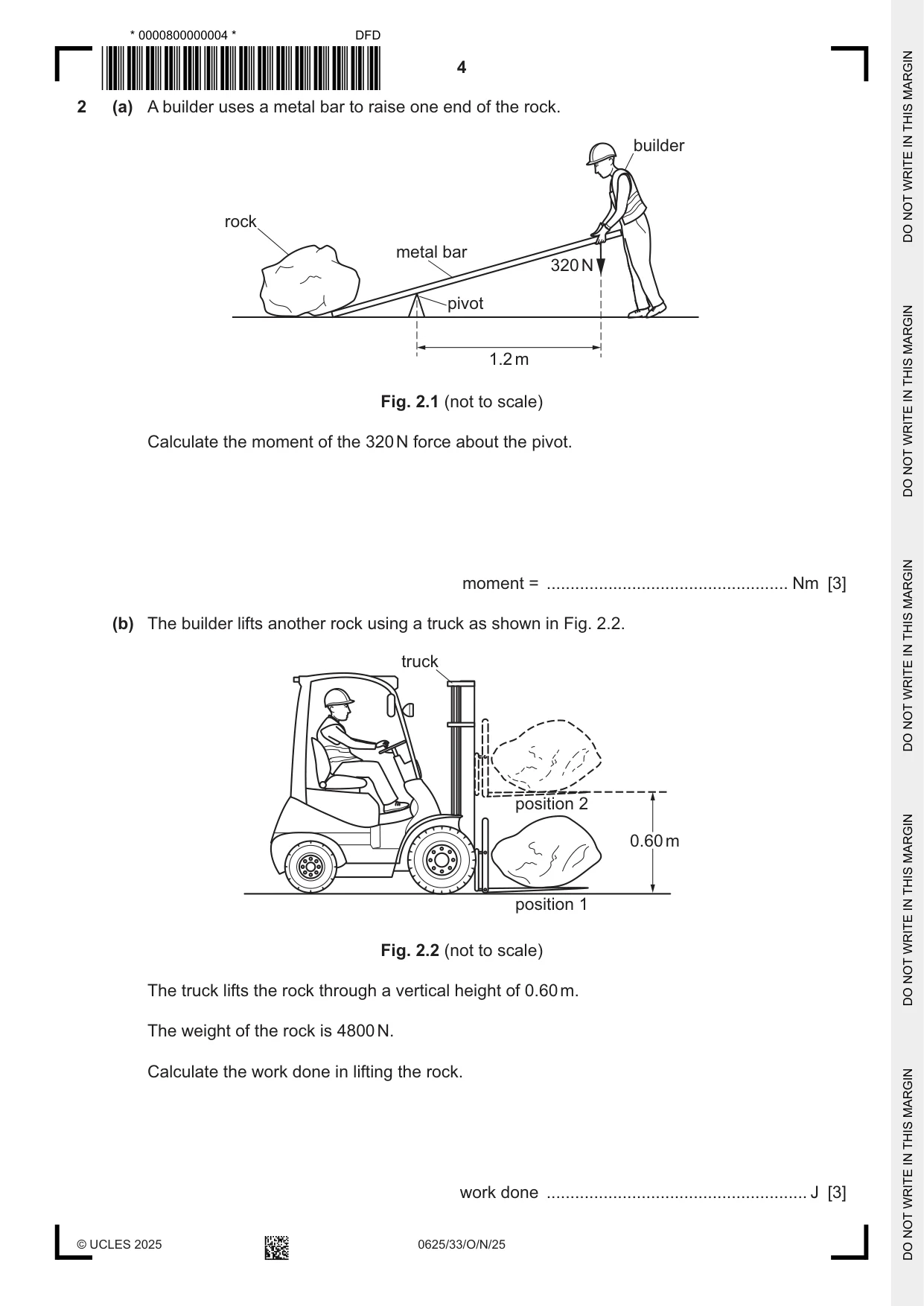
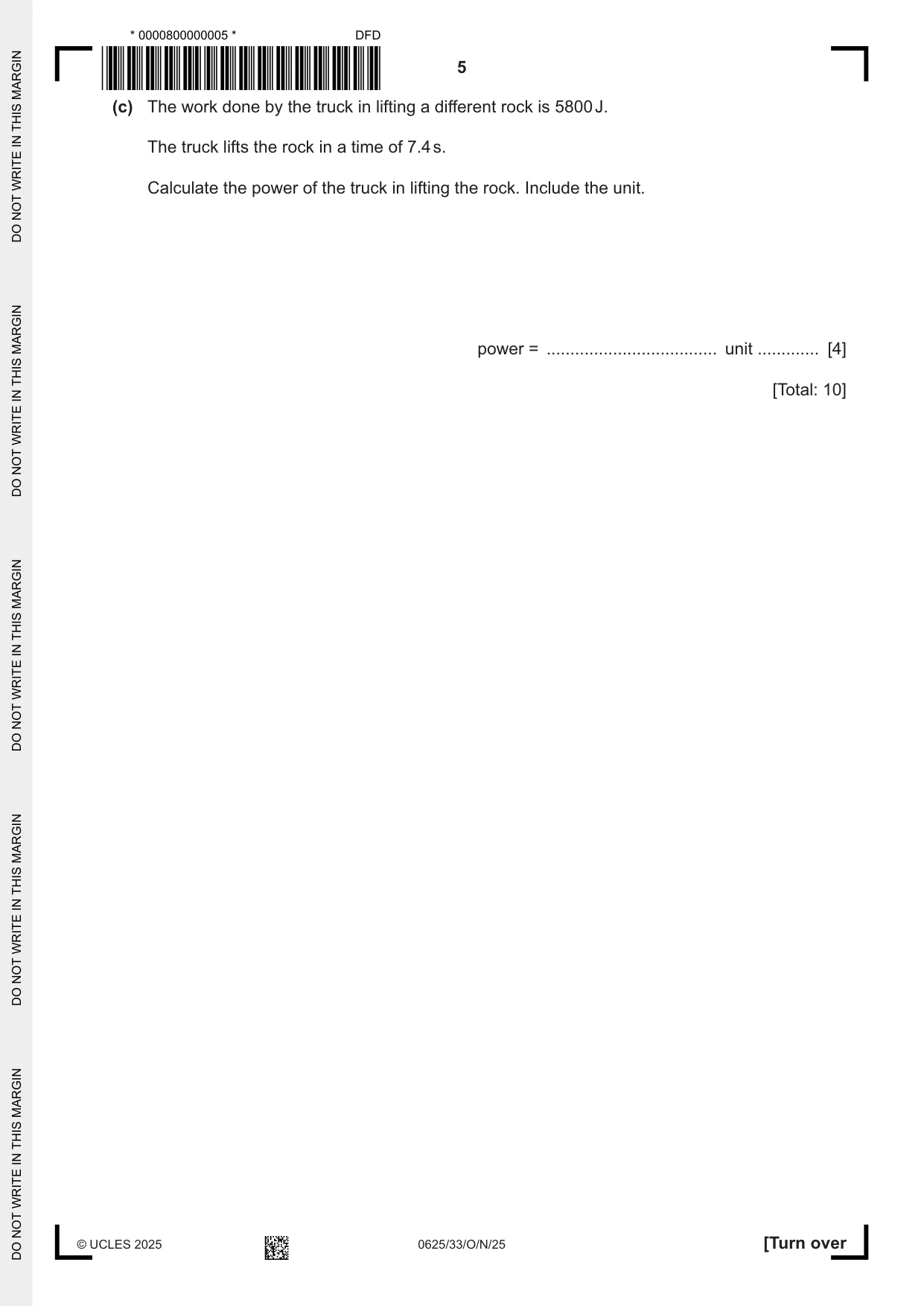
2 (a) A builder uses a metal bar to raise one end of the rock. builder rock metal bar 320 N pivot 1.2 m Fig. 2.1 (not to scale) Calculate the moment of the 320 N force about the pivot. moment = ................................................... Nm [3] (b) The builder lifts another rock using a truck as shown in Fig. 2.2. truck position 2 0.60 m position 1 Fig. 2.2 (not to scale) The truck lifts the rock through a vertical height of 0.60 m. The weight of the rock is 4800 N. Calculate the work done in lifting the rock. work done ....................................................... J [3] (c) The work done by the truck in lifting a different rock is 5800 J. The truck lifts the rock in a time of 7.4 s. Calculate the power of the truck in lifting the rock. Include the unit. power = .................................... unit ............. [4] [Total: 10]
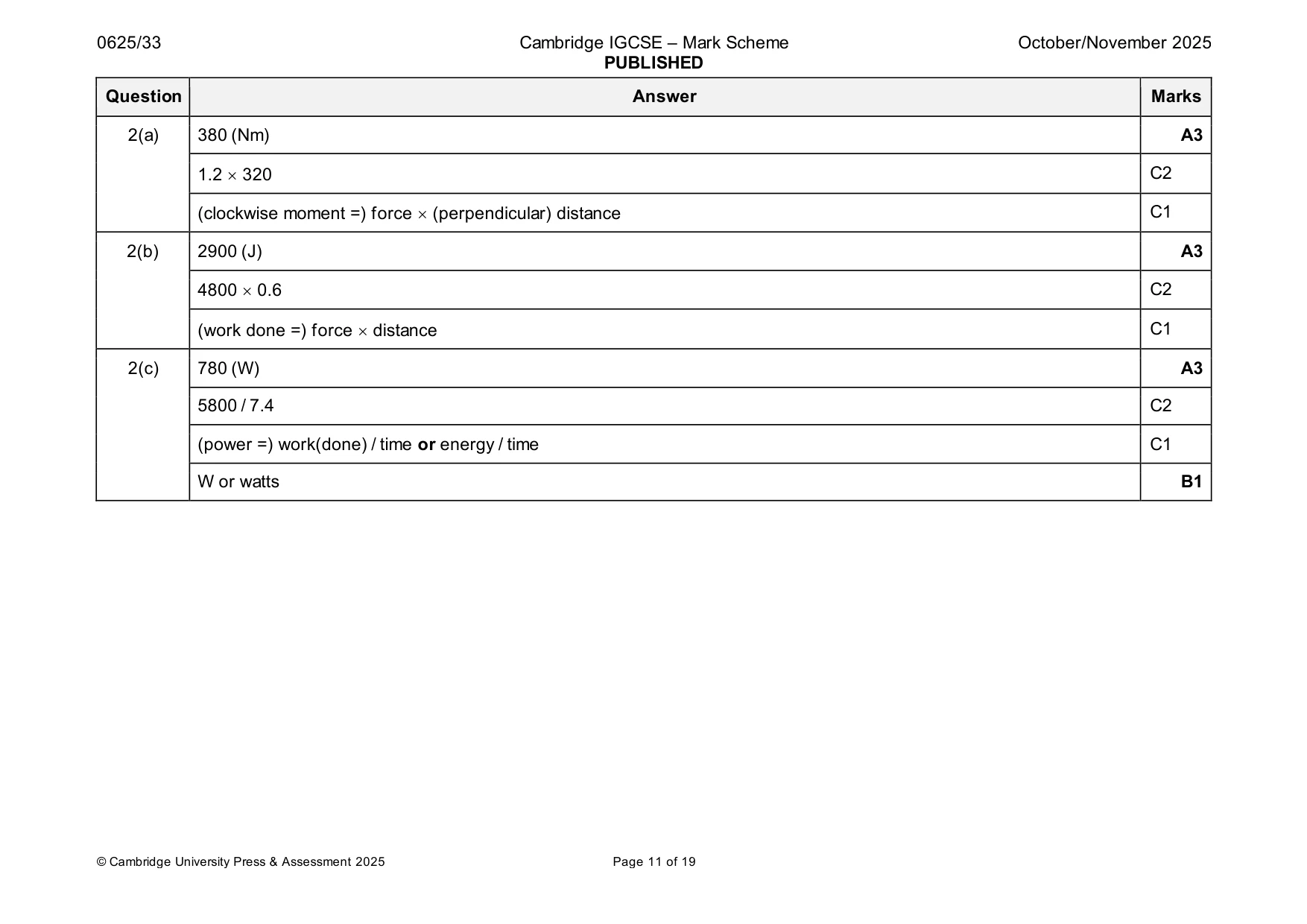
Mark scheme: 2(a) 380 (Nm) A3 1.2 320 C2 (clockwise moment =) force (perpendicular) distance C1 2(b) 2900 (J) A3 4800 0.6 C2 (work done =) force distance C1 2(c) 780 (W) A3 5800 / 7.4 C2 (power =) work(done) / time or energy / time C1 W or watts B1
Q3 · A scientist determines the density of a sample of sea water
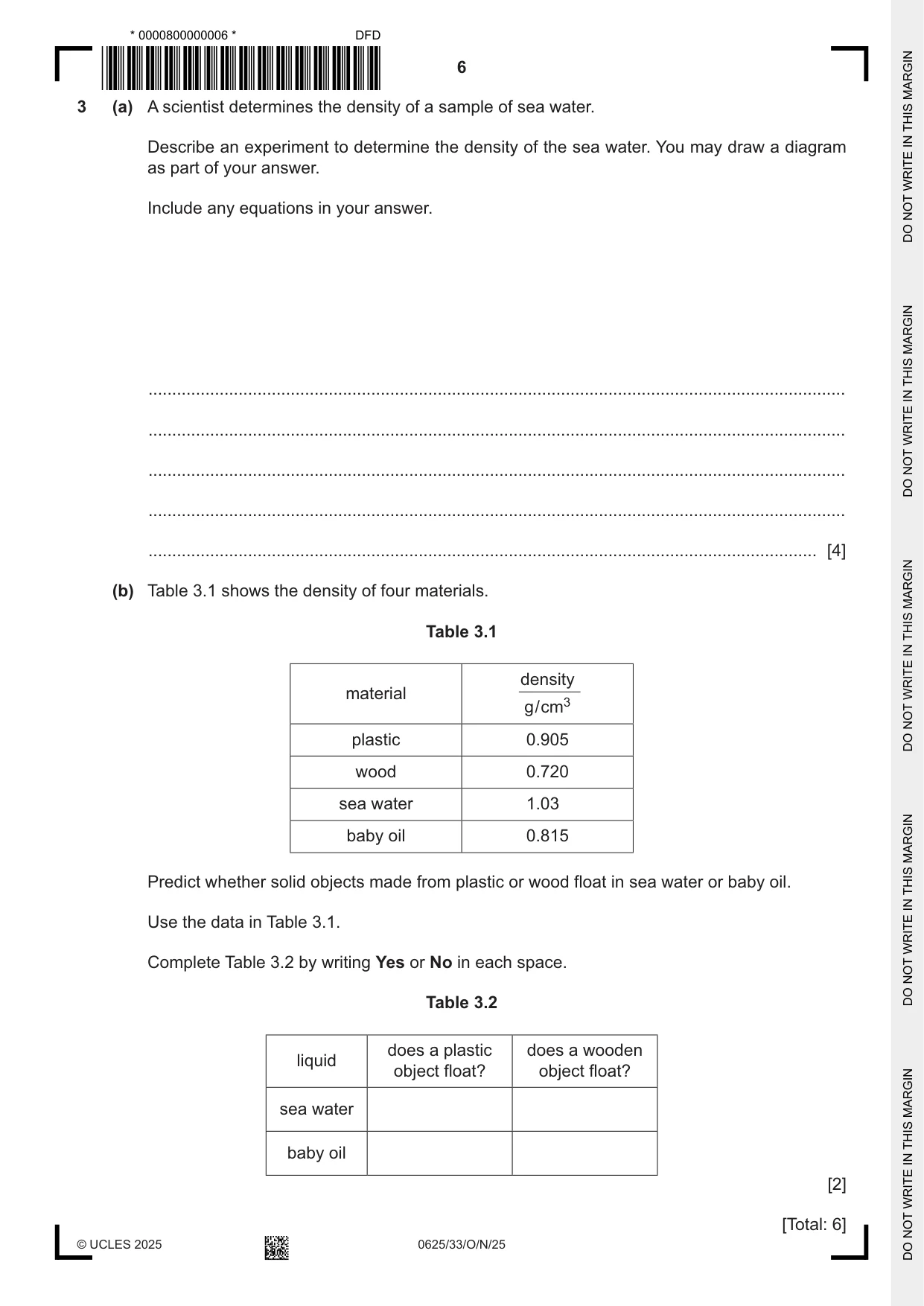
3 (a) A scientist determines the density of a sample of sea water. Describe an experiment to determine the density of the sea water. You may draw a diagram as part of your answer. Include any equations in your answer. ................................................................................................................................................... ................................................................................................................................................... ................................................................................................................................................... ................................................................................................................................................... ............................................................................................................................................. [4] (b) Table 3.1 shows the density of four materials. Table 3.1 density material g / cm3 plastic 0.905 wood 0.720 sea water 1.030 baby oil 0.815 Predict whether solid objects made from plastic or wood float in sea water or baby oil. Use the data in Table 3.1. Complete Table 3.2 by writing Yes or No in each space. Table 3.2 does a plastic does a wooden liquid object float? object float? sea water baby oil [2] [Total: 6]
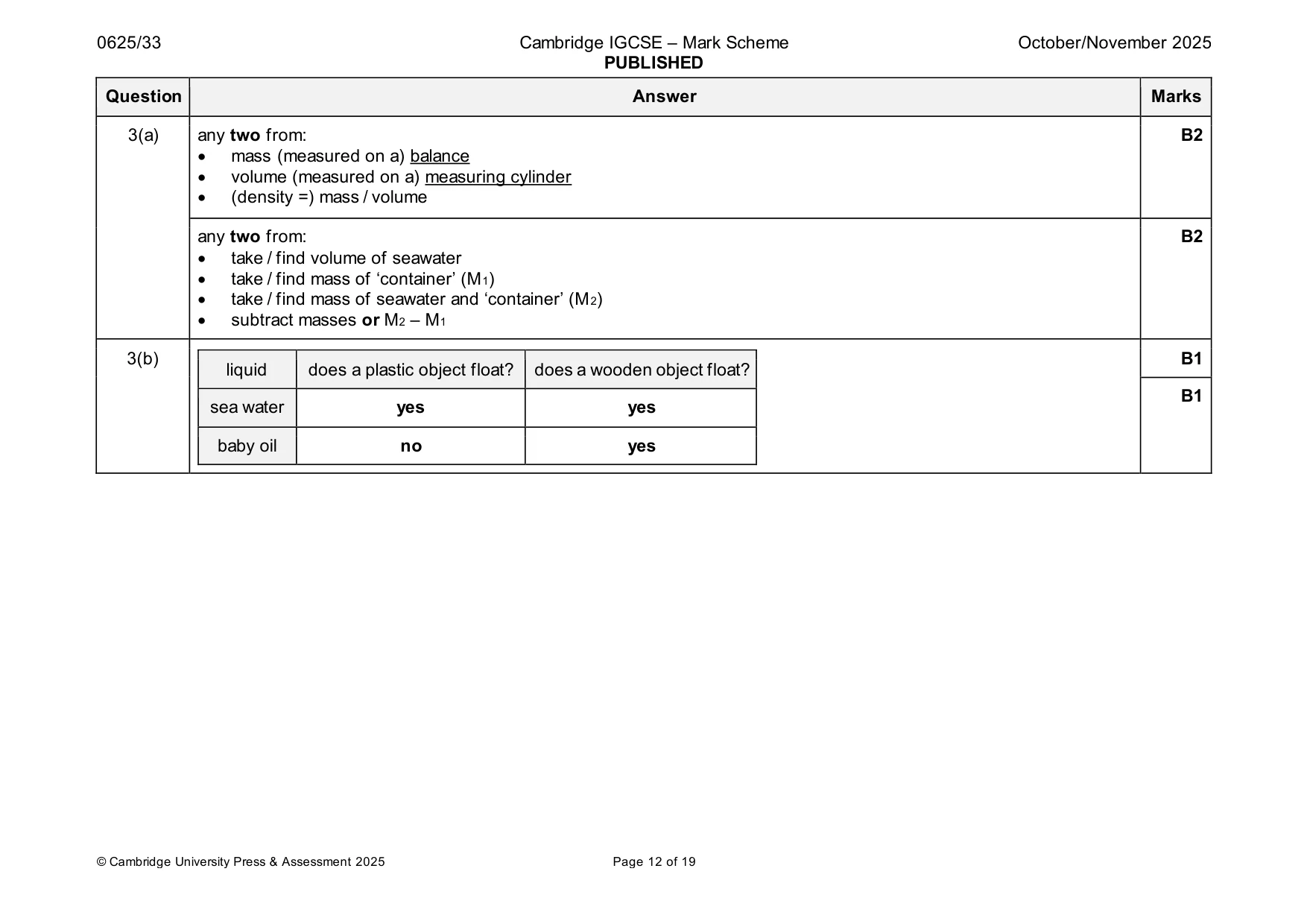
Mark scheme: 3(a) any two from: B2 • mass (measured on a) balance • volume (measured on a) measuring cylinder • (density =) mass / volume any two from: B2 • take / find volume of seawater • take / find mass of ‘container’ (M1) • take / find mass of seawater and ‘container’ (M2) • subtract masses or M2 – M1 3(b) B1 liquid does a plastic object float? does a wooden object float? B1 sea water yes yes baby oil no yes
Q4 · A teacher shows the class a demonstration about heat energy and states of matter
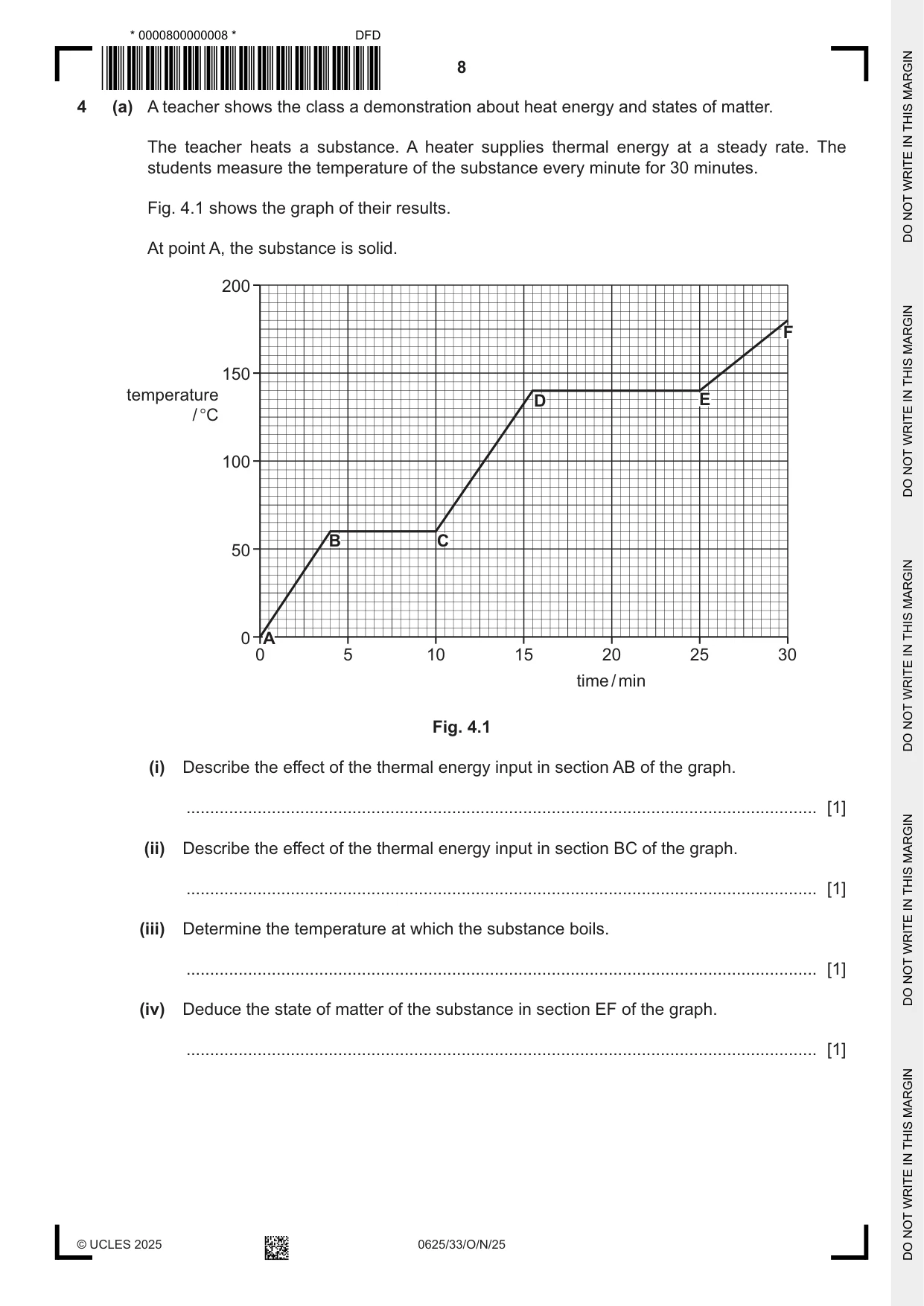
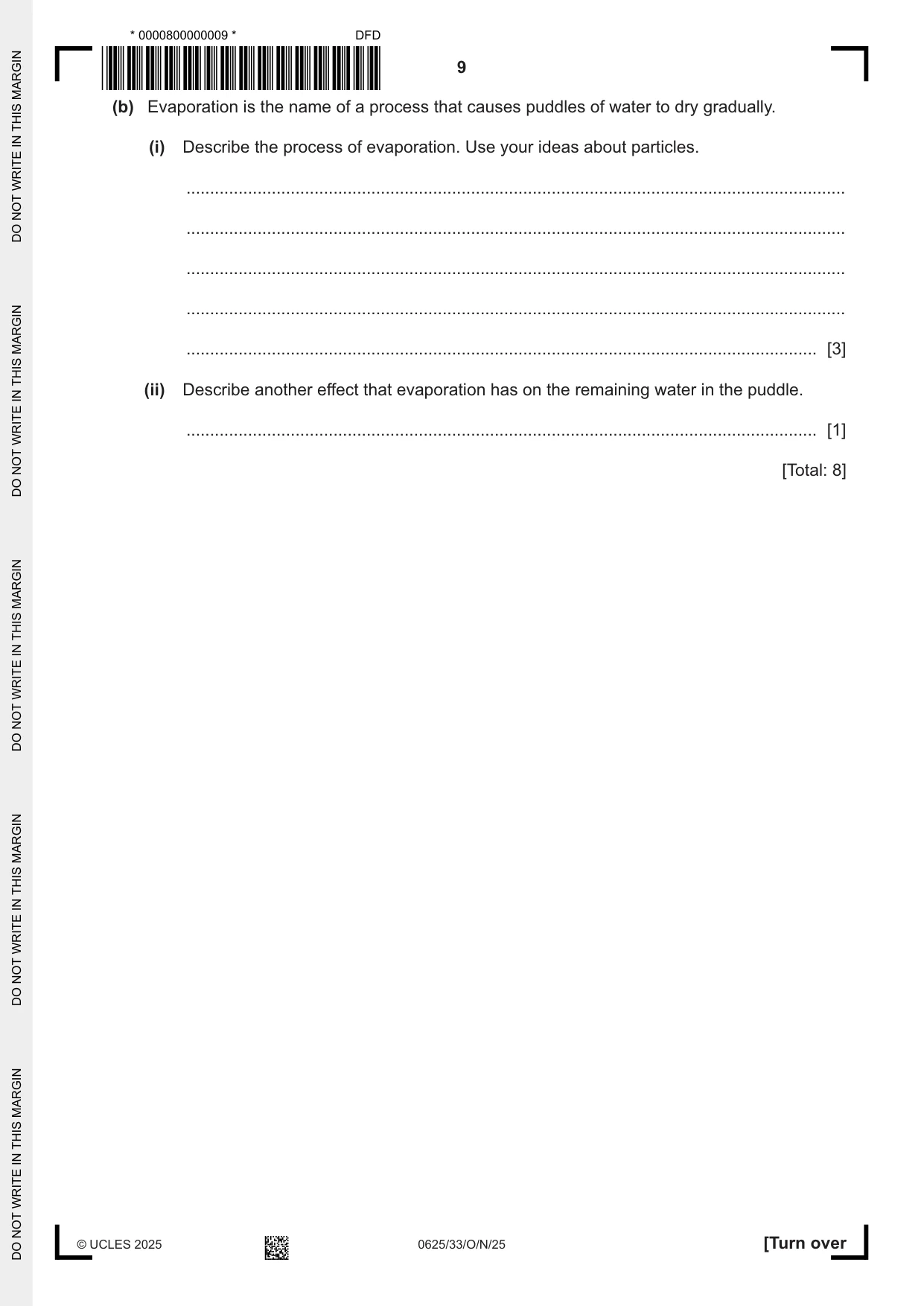
4 (a) A teacher shows the class a demonstration about heat energy and states of matter. The teacher heats a substance. A heater supplies thermal energy at a steady rate. The students measure the temperature of the substance every minute for 30 minutes. Fig. 4.1 shows the graph of their results. At point A, the substance is solid. 200 F 150 temperature D E / °C 100 B C 50 0 A 0 5 10 15 20 25 30 time / min Fig. 4.1 (i) Describe the effect of the thermal energy input in section AB of the graph. ..................................................................................................................................... [1] (ii) Describe the effect of the thermal energy input in section BC of the graph. ..................................................................................................................................... [1] (iii) Determine the temperature at which the substance boils. ..................................................................................................................................... [1] (iv) Deduce the state of matter of the substance in section EF of the graph. ..................................................................................................................................... [1] (b) Evaporation is the name of a process that causes puddles of water to dry gradually. (i) Describe the process of evaporation. Use your ideas about particles. ........................................................................................................................................... ........................................................................................................................................... ........................................................................................................................................... ........................................................................................................................................... ..................................................................................................................................... [3] (ii) Describe another effect that evaporation has on the remaining water in the puddle. ..................................................................................................................................... [1] [Total: 8]
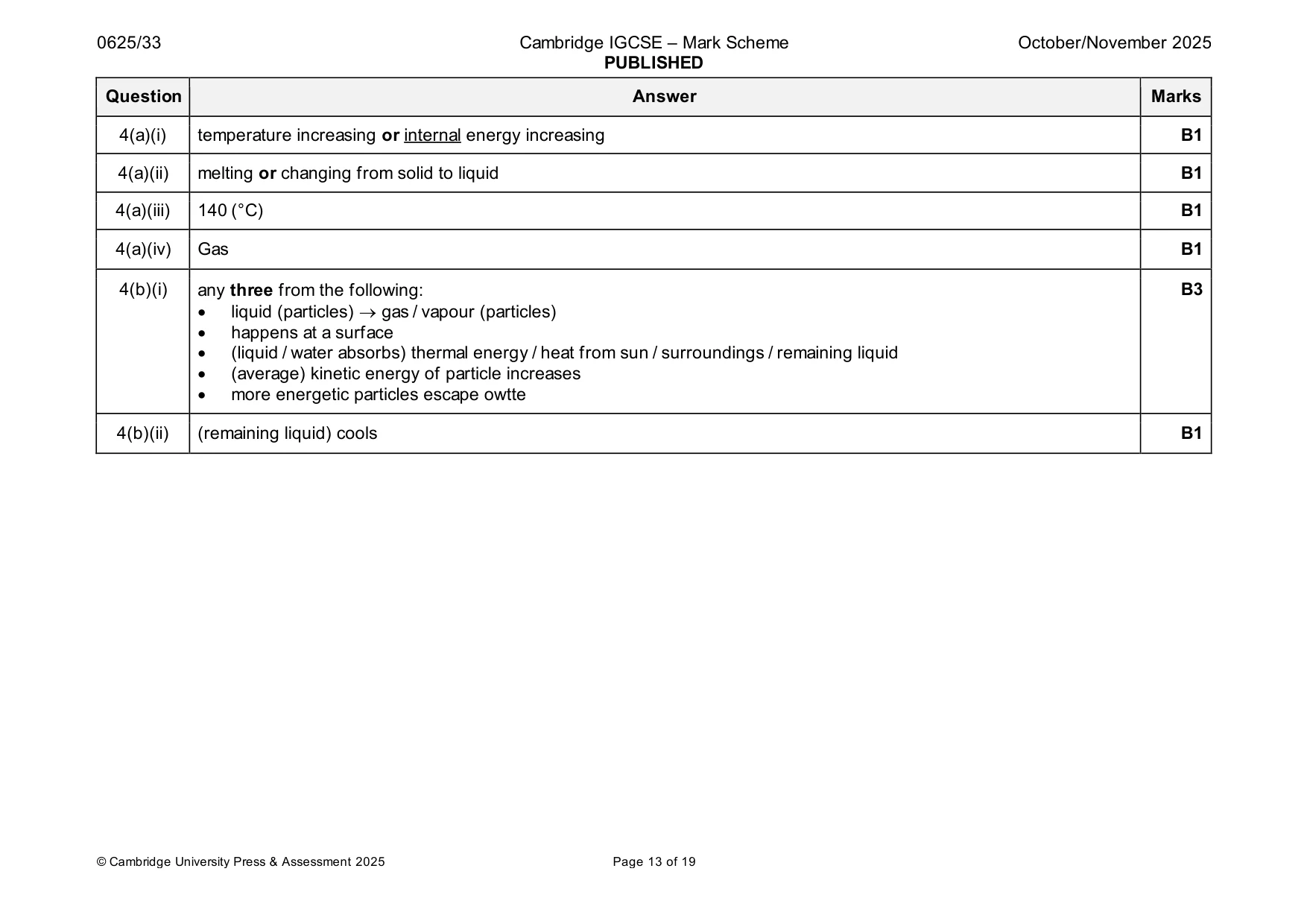
Mark scheme: 4(a)(i) temperature increasing or internal energy increasing B1 4(a)(ii) melting or changing from solid to liquid B1 4(a)(iii) 140 (°C) B1 4(a)(iv) Gas B1 4(b)(i) any three from the following: B3 • liquid (particles) → gas / vapour (particles) • happens at a surface • (liquid / water absorbs) thermal energy / heat from sun / surroundings / remaining liquid • (average) kinetic energy of particle increases • more energetic particles escape owtte 4(b)(ii) (remaining liquid) cools B1
Q5 · Whether some energy resources are renewable and whether they cause air pollution when…
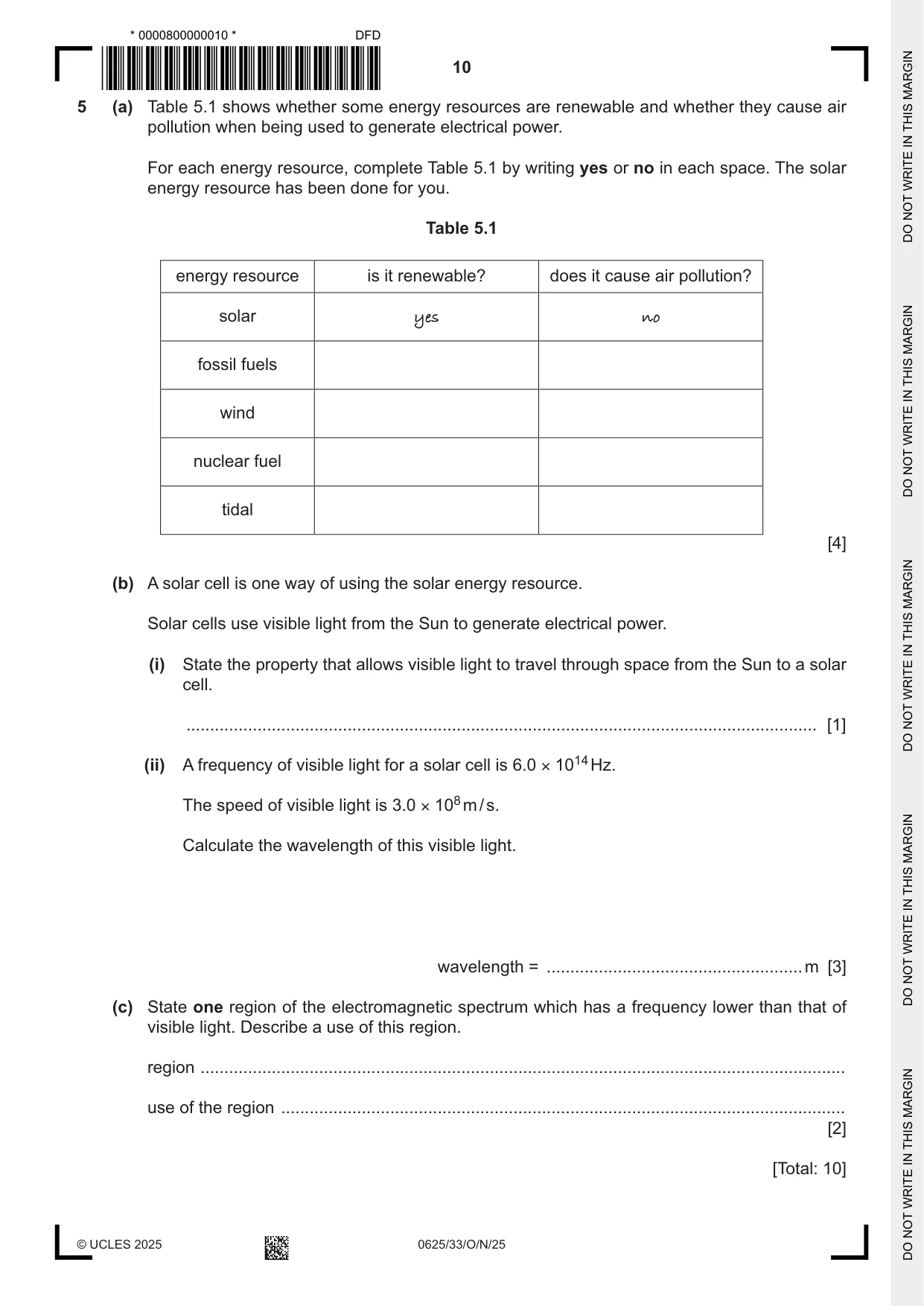
5 (a) Table 5.1 shows whether some energy resources are renewable and whether they cause air pollution when being used to generate electrical power. For each energy resource, complete Table 5.1 by writing yes or no in each space. The solar energy resource has been done for you. Table 5.1 energy resource is it renewable? does it cause air pollution? solar yes no fossil fuels wind nuclear fuel tidal [4] (b) A solar cell is one way of using the solar energy resource. Solar cells use visible light from the Sun to generate electrical power. (i) State the property that allows visible light to travel through space from the Sun to a solar cell. ..................................................................................................................................... [1] (ii) A frequency of visible light for a solar cell is 6.0 × 10¹⁴ Hz. The speed of visible light is 3.0 × 10⁸ m / s. Calculate the wavelength of this visible light. wavelength = ......................................................m [3] (c) State one region of the electromagnetic spectrum which has a frequency lower than that of visible light. Describe a use of this region. region ........................................................................................................................................ use of the region ....................................................................................................................... [2] [Total: 10]
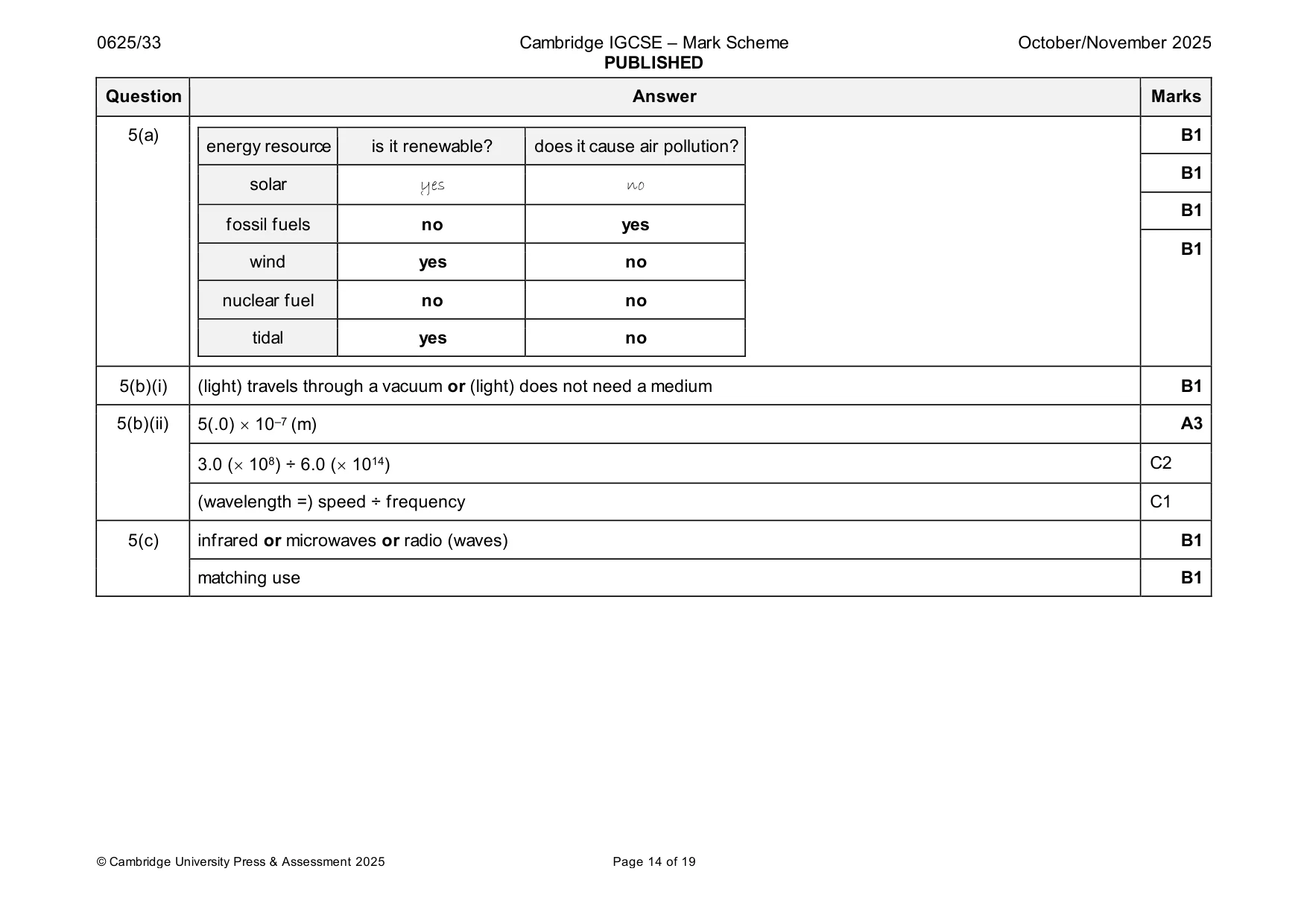
Mark scheme: 5(a) B1 energy resource is it renewable? does it cause air pollution? B1 solar yes no B1 fossil fuels no yes B1 wind yes no nuclear fuel no no tidal yes no 5(b)(i) (light) travels through a vacuum or (light) does not need a medium B1 5(b)(ii) 5(.0) 10–7 (m) A3 3.0 ( 108) ÷ 6.0 ( 1014) C2 (wavelength =) speed ÷ frequency C1 5(c) infrared or microwaves or radio (waves) B1 matching use B1
Q6 · The path of a ray of visible light travelling from the top of an object and passing…
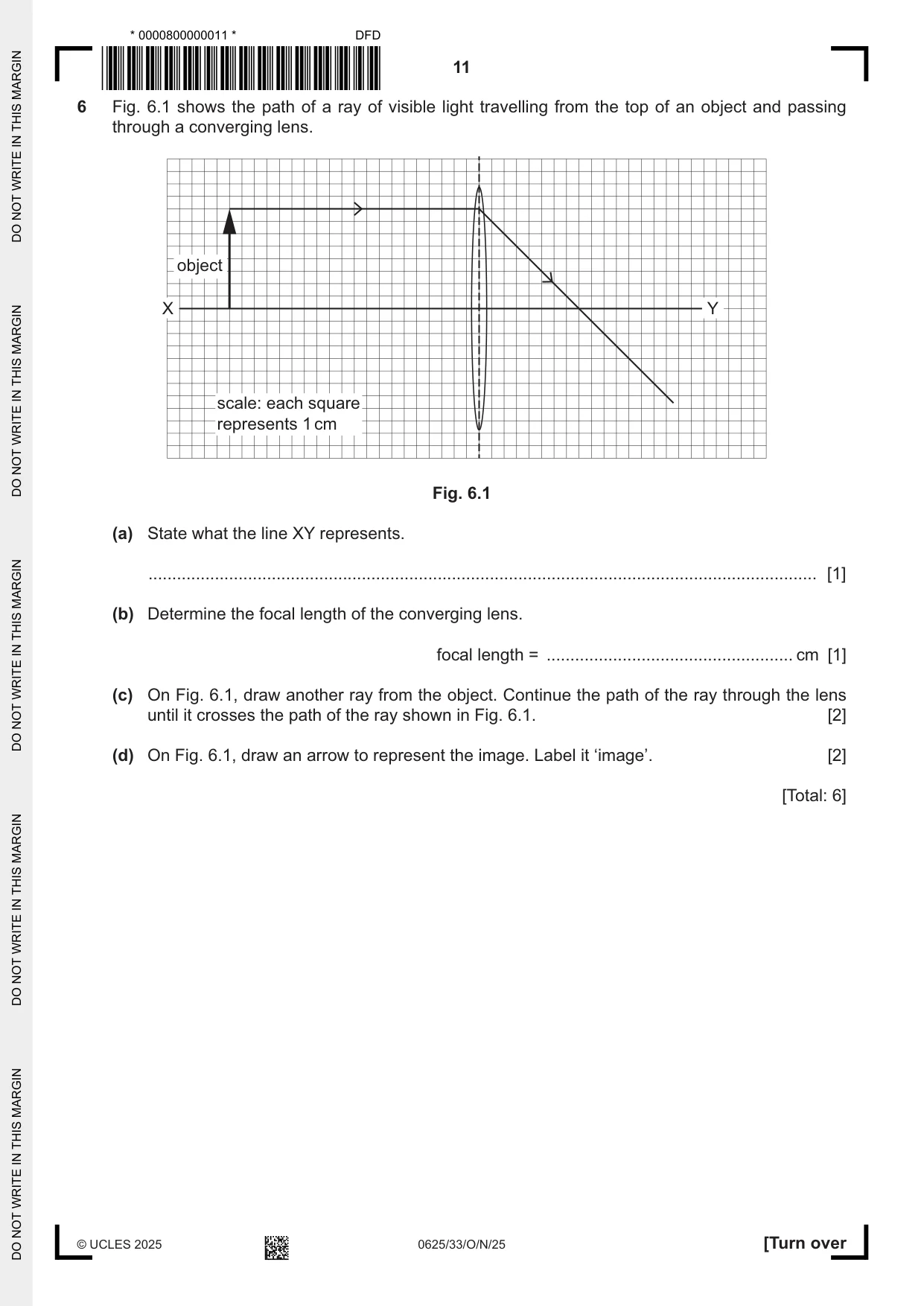
6 Fig. 6.1 shows the path of a ray of visible light travelling from the top of an object and passing through a converging lens. object X Y scale: each square represents 1 cm Fig. 6.1 (a) State what the line XY represents. ............................................................................................................................................. [1] (b) Determine the focal length of the converging lens. focal length = .................................................... cm [1] (c) On Fig. 6.1, draw another ray from the object. Continue the path of the ray through the lens until it crosses the path of the ray shown in Fig. 6.1. [2] (d) On Fig. 6.1, draw an arrow to represent the image. Label it ‘image’. [2] [Total: 6]
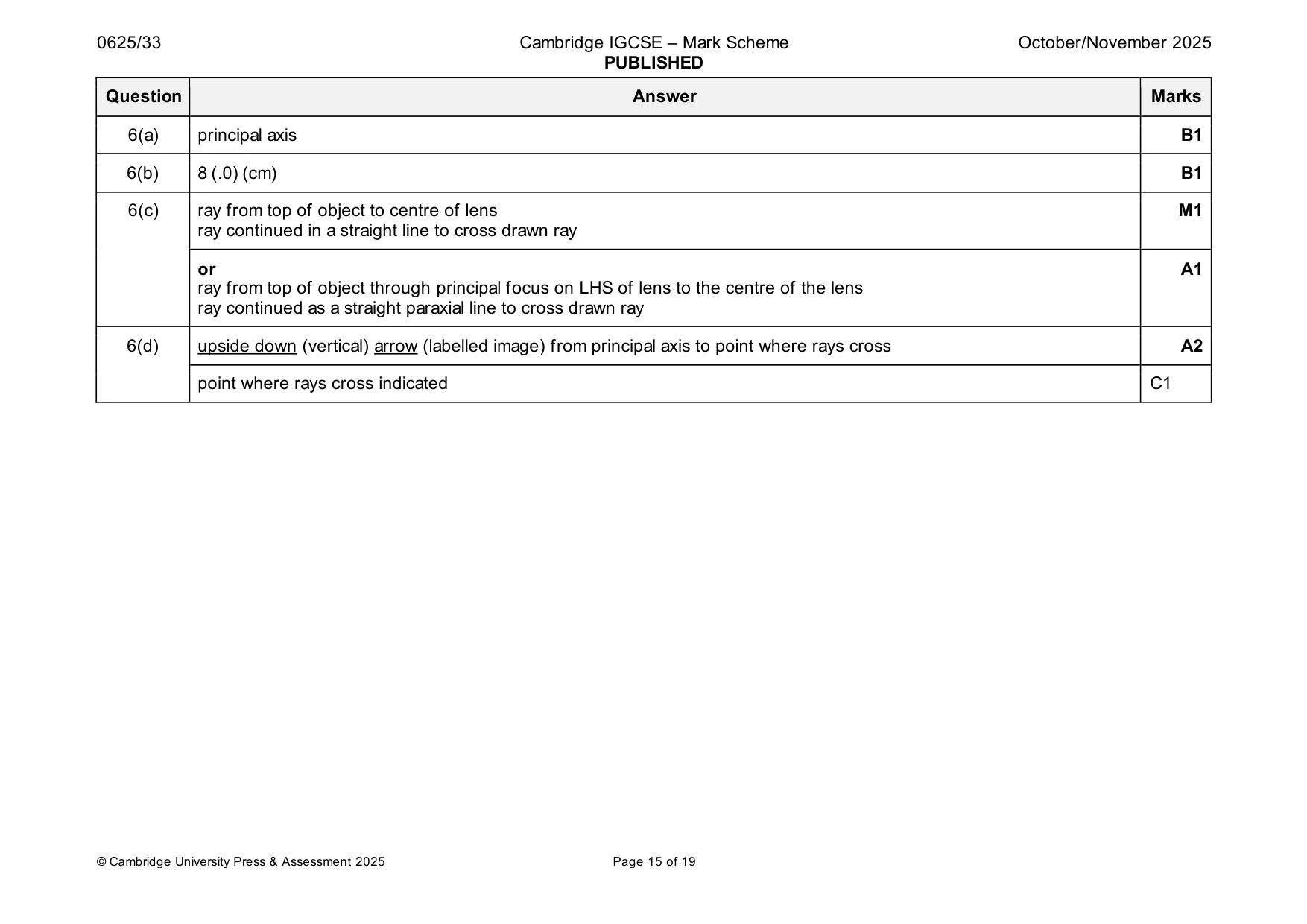
Mark scheme: 6(a) principal axis B1 6(b) 8 (.0) (cm) B1 6(c) ray from top of object to centre of lens M1 ray continued in a straight line to cross drawn ray or A1 ray from top of object through principal focus on LHS of lens to the centre of the lens ray continued as a straight paraxial line to cross drawn ray 6(d) upside down (vertical) arrow (labelled image) from principal axis to point where rays cross A2 point where rays cross indicated C1
Q7 · A student is making a torch
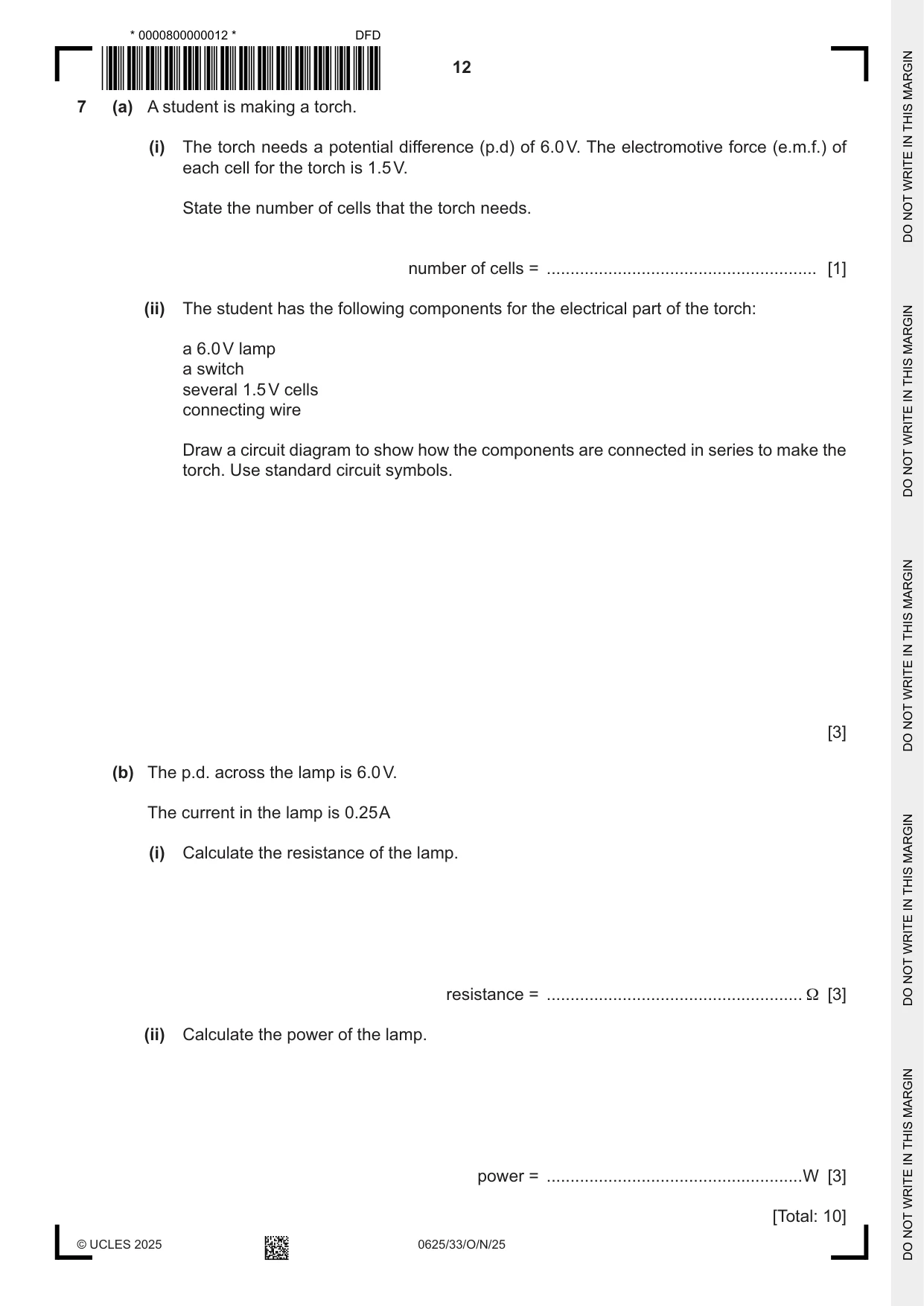
7 (a) A student is making a torch. (i) The torch needs a potential difference (p.d) of 6.0 V. The electromotive force (e.m.f.) of each cell for the torch is 1.5 V. State the number of cells that the torch needs. number of cells = ......................................................... [1] (ii) The student has the following components for the electrical part of the torch: a 6.0 V lamp a switch several 1.5 V cells connecting wire Draw a circuit diagram to show how the components are connected in series to make the torch. Use standard circuit symbols. [3] (b) The p.d. across the lamp is 6.0 V. The current in the lamp is 0.25 A (i) Calculate the resistance of the lamp. resistance = ...................................................... Ω [3] (ii) Calculate the power of the lamp. power = ......................................................W [3] [Total: 10]
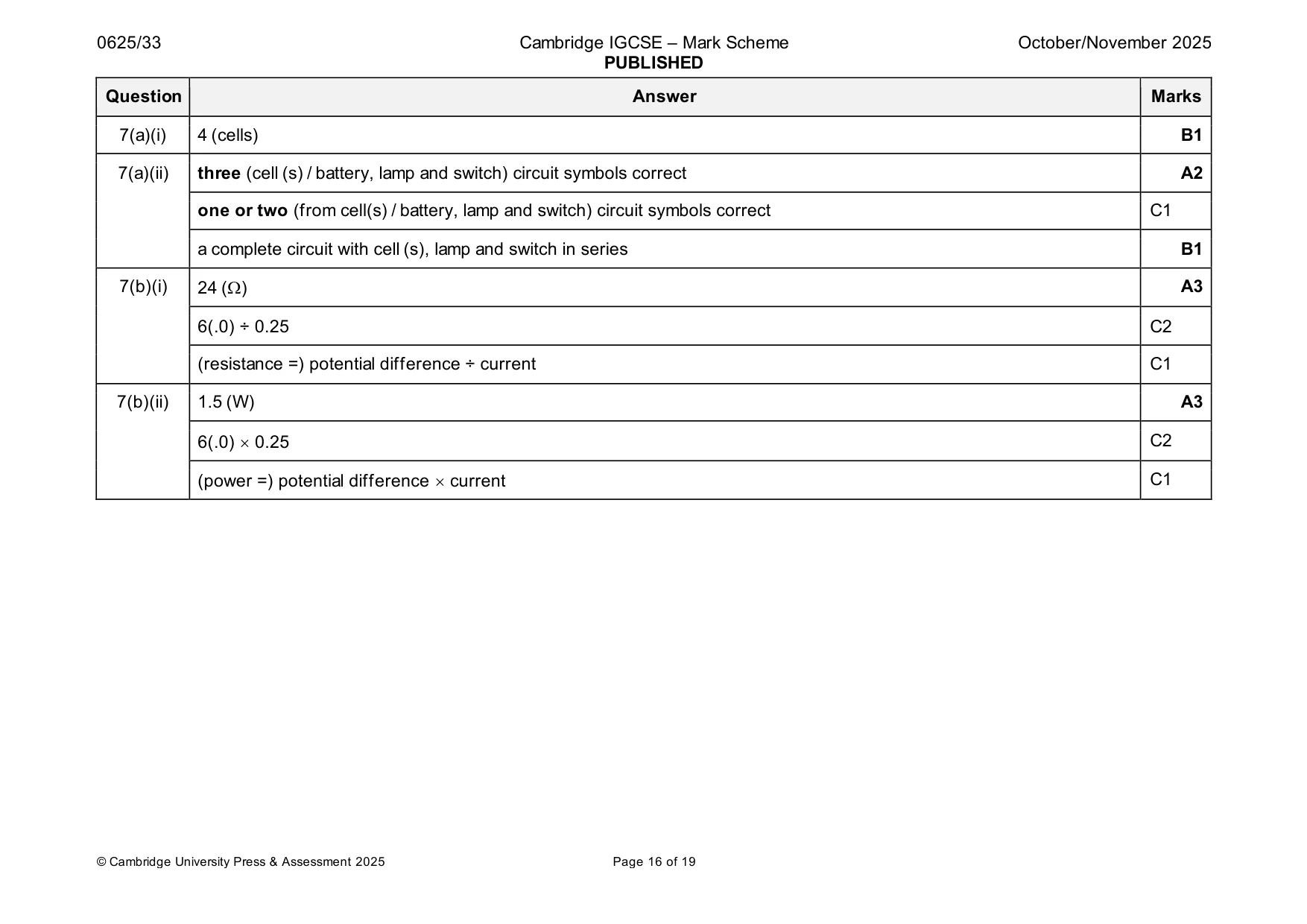
Mark scheme: 7(a)(i) 4 (cells) B1 7(a)(ii) three (cell (s) / battery, lamp and switch) circuit symbols correct A2 one or two (from cell(s) / battery, lamp and switch) circuit symbols correct C1 a complete circuit with cell (s), lamp and switch in series B1 7(b)(i) 24 () A3 6(.0) ÷ 0.25 C2 (resistance =) potential difference ÷ current C1 7(b)(ii) 1.5 (W) A3 6(.0) 0.25 C2 (power =) potential difference current C1
Q8 · A coal-fired power station is far from a city
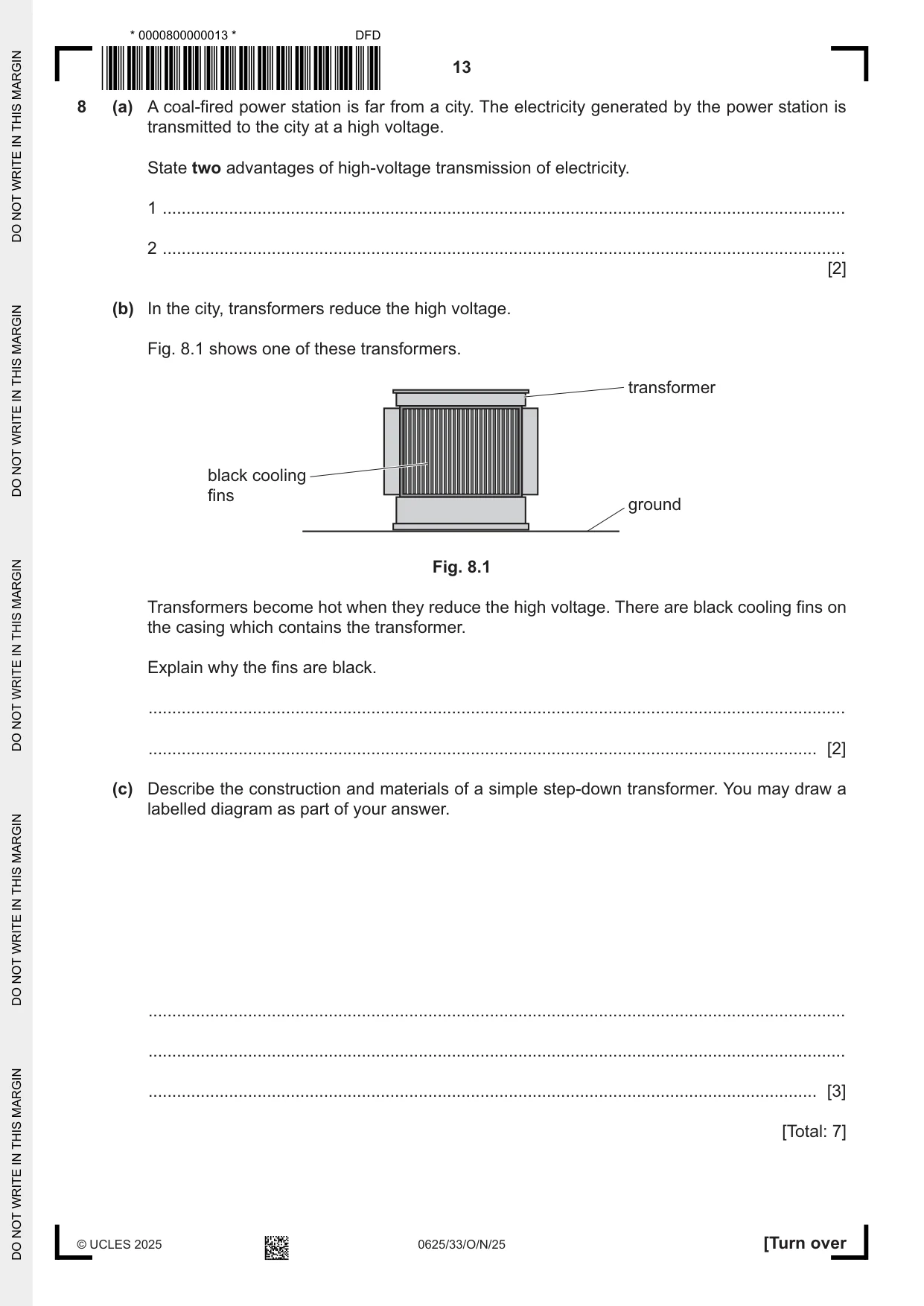
8 (a) A coal-fired power station is far from a city. The electricity generated by the power station is transmitted to the city at a high voltage. State two advantages of high-voltage transmission of electricity. 1 ................................................................................................................................................ 2 ................................................................................................................................................ [2] (b) In the city, transformers reduce the high voltage. Fig. 8.1 shows one of these transformers. transformer black cooling fins ground Fig. 8.1 Transformers become hot when they reduce the high voltage. There are black cooling fins on the casing which contains the transformer. Explain why the fins are black. ................................................................................................................................................... ............................................................................................................................................. [2] (c) Describe the construction and materials of a simple step-down transformer. You may draw a labelled diagram as part of your answer. ................................................................................................................................................... ................................................................................................................................................... ............................................................................................................................................. [3] [Total: 7]
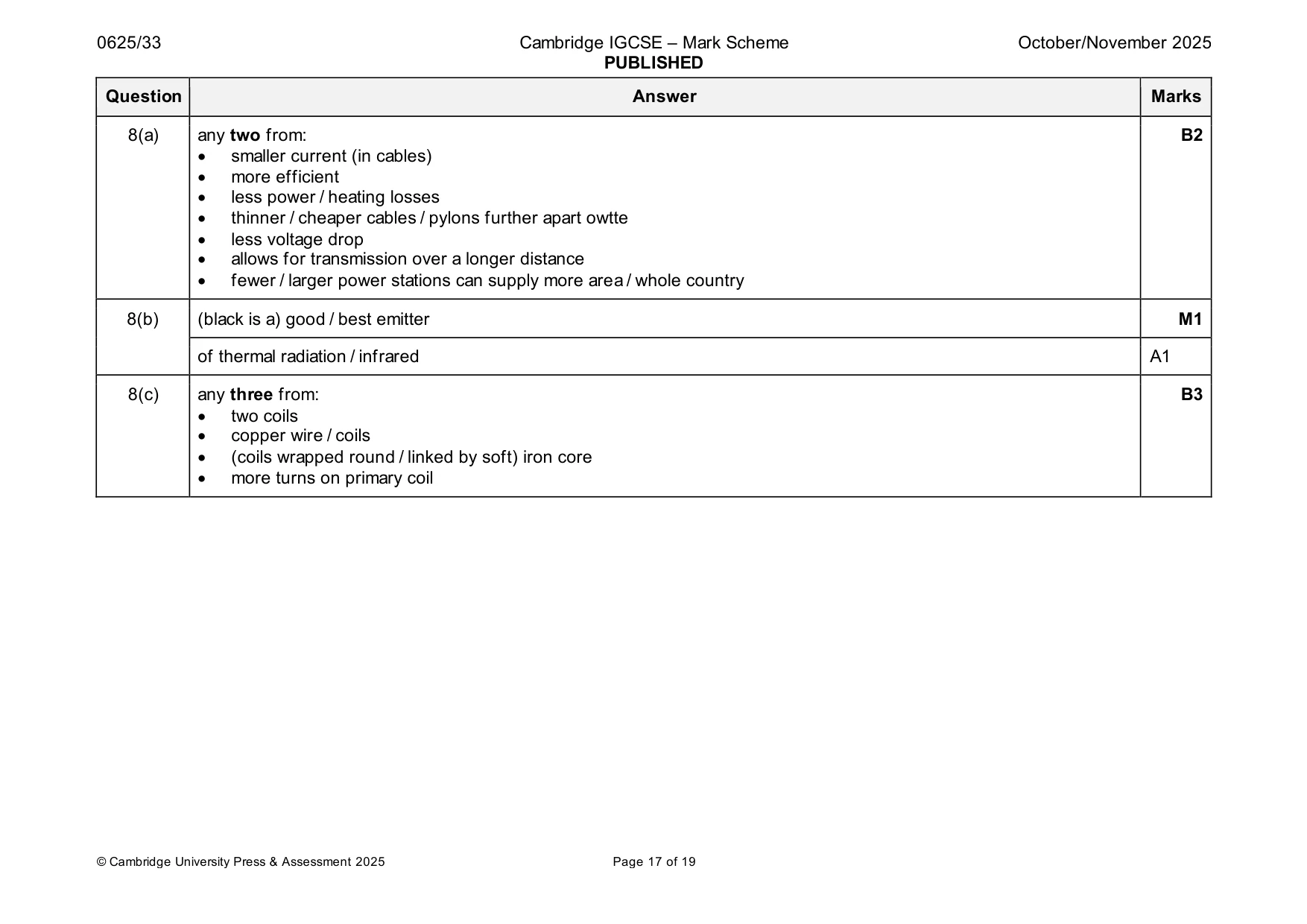
Mark scheme: 8(a) any two from: B2 • smaller current (in cables) • more efficient • less power / heating losses • thinner / cheaper cables / pylons further apart owtte • less voltage drop • allows for transmission over a longer distance • fewer / larger power stations can supply more area / whole country 8(b) (black is a) good / best emitter M1 of thermal radiation / infrared A1 8(c) any three from: B3 • two coils • copper wire / coils • (coils wrapped round / linked by soft) iron core • more turns on primary coil
Q9 · Information about particles in an atom
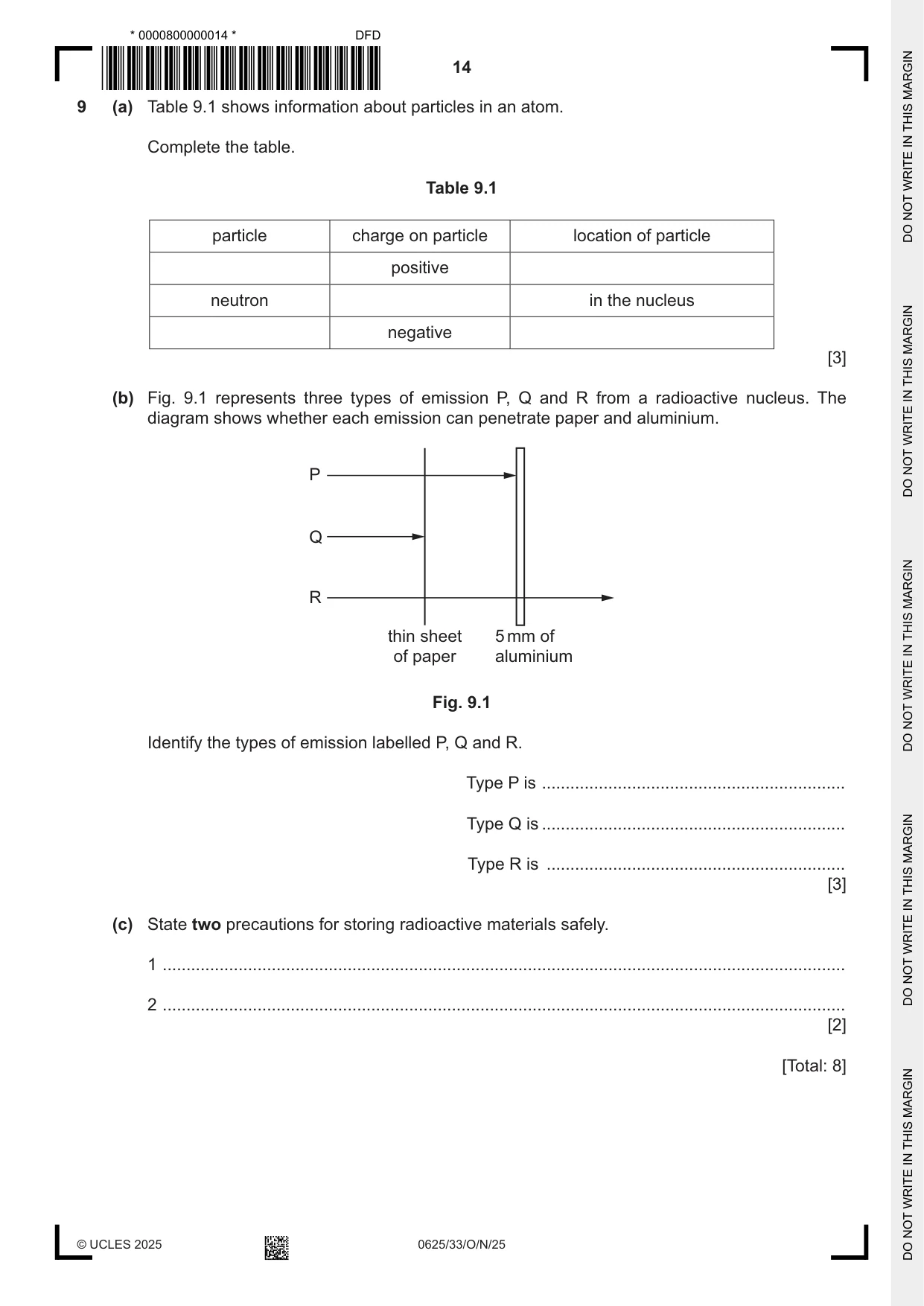
9 (a) Table 9.1 shows information about particles in an atom. Complete the table. Table 9.1 particle charge on particle location of particle positive neutron in the nucleus negative [3] (b) Fig. 9.1 represents three types of emission P, Q and R from a radioactive nucleus. The diagram shows whether each emission can penetrate paper and aluminium. P Q R thin sheet 5 mm of of paper aluminium Fig. 9.1 Identify the types of emission labelled P, Q and R. Type P is ................................................................ Type Q is ................................................................ Type R is ............................................................... [3] (c) State two precautions for storing radioactive materials safely. 1 ................................................................................................................................................ 2 ................................................................................................................................................ [2] [Total: 8]
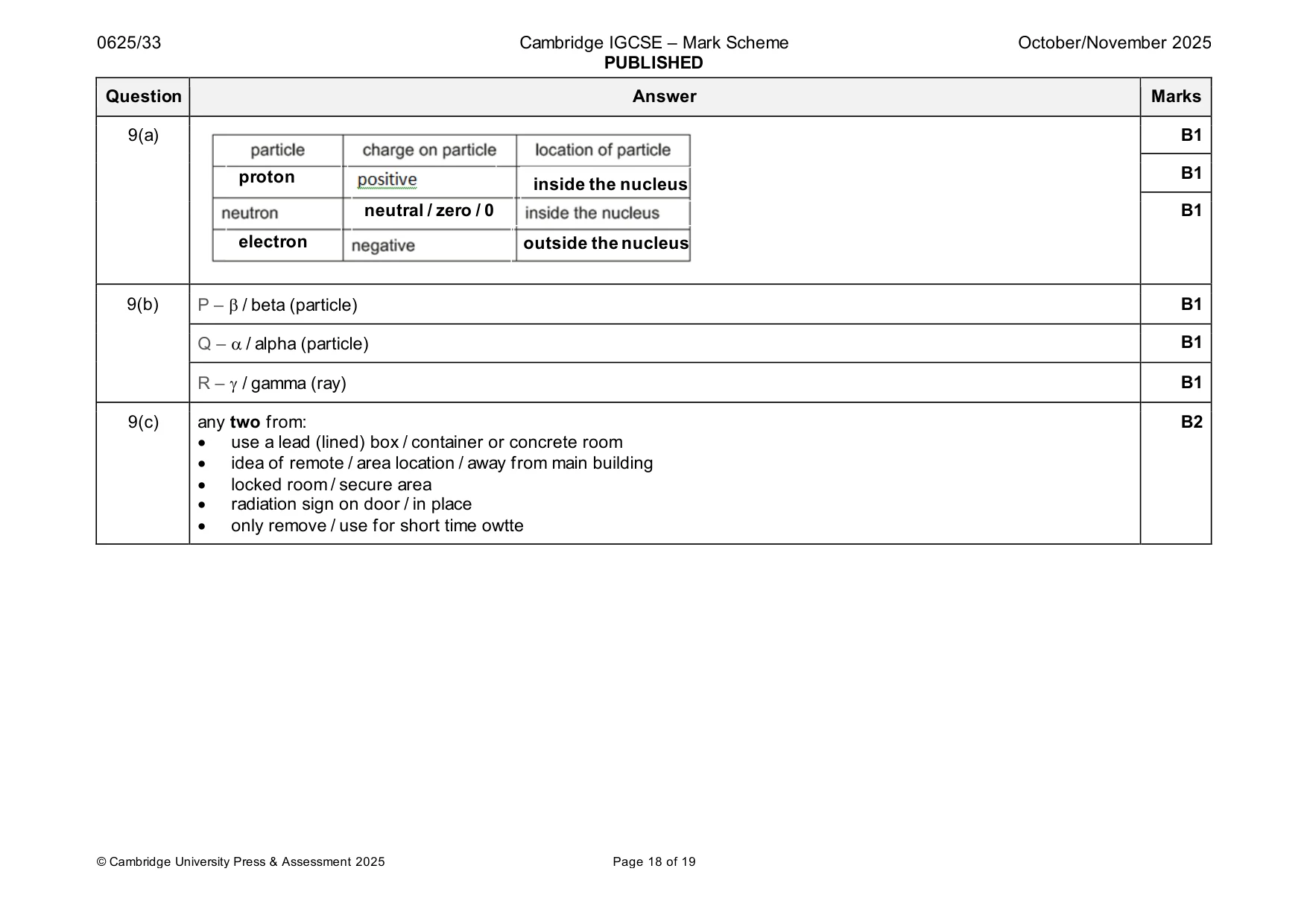
Mark scheme: 9(a) B1 proton B1 inside the nucleus neutral / zero / 0 B1 electron outside the nucleus 9(b) P – / beta (particle) B1 Q – / alpha (particle) B1 R – / gamma (ray) B1 9(c) any two from: B2 • use a lead (lined) box / container or concrete room • idea of remote / area location / away from main building • locked room / secure area • radiation sign on door / in place • only remove / use for short time owtte
Q10 · Each box in the left column shows a description of a unit of time
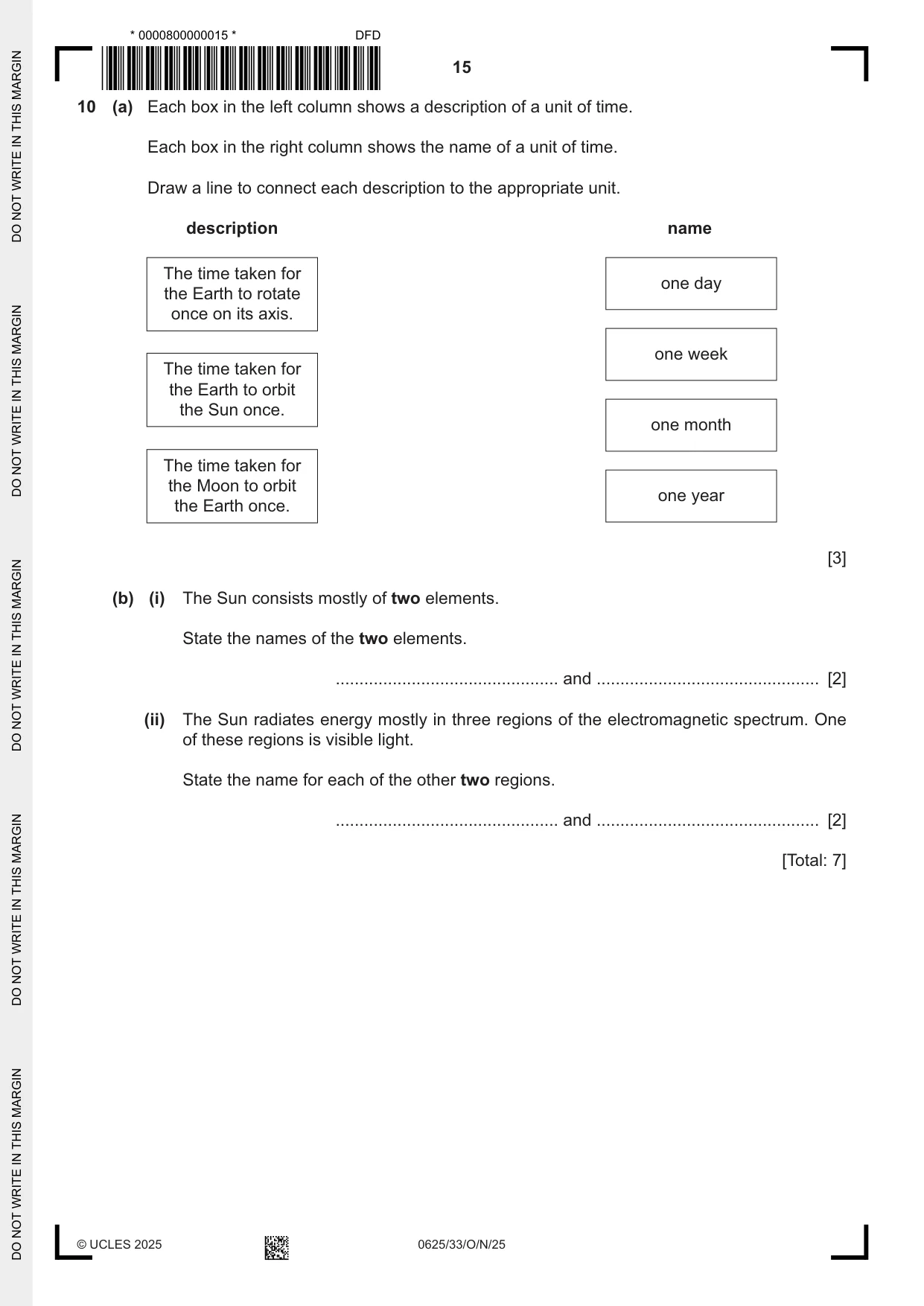
10 (a) Each box in the left column shows a description of a unit of time. Each box in the right column shows the name of a unit of time. Draw a line to connect each description to the appropriate unit. description name The time taken for one day the Earth to rotate once on its axis. one week The time taken for the Earth to orbit the Sun once. one month The time taken for the Moon to orbit one year the Earth once. [3] (b) (i) The Sun consists mostly of two elements. State the names of the two elements. ............................................... and ............................................... [2] (ii) The Sun radiates energy mostly in three regions of the electromagnetic spectrum. One of these regions is visible light. State the name for each of the other two regions. ............................................... and ............................................... [2] [Total: 7]
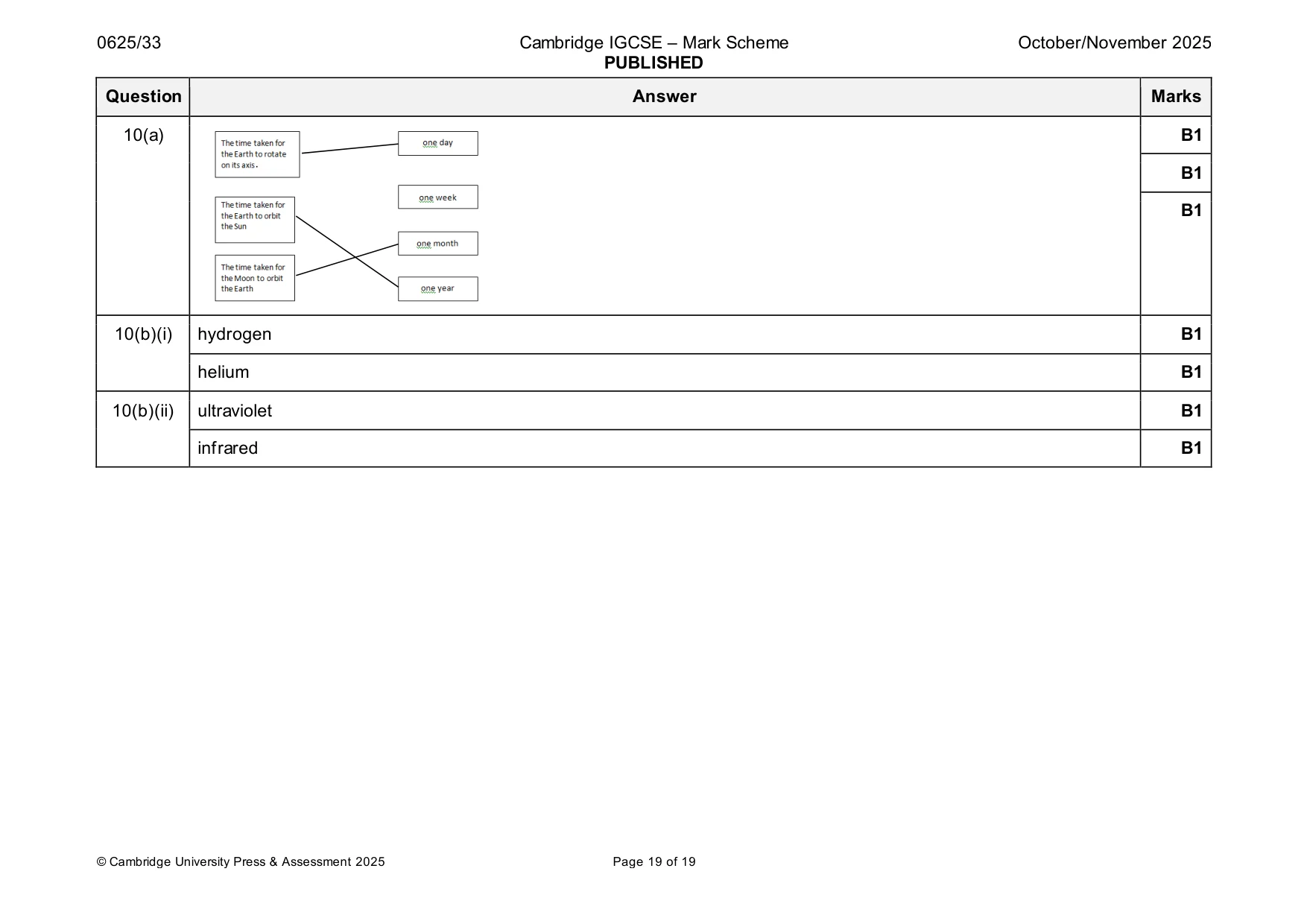
Mark scheme: 10(a) B1 B1 B1 10(b)(i) hydrogen B1 helium B1 10(b)(ii) ultraviolet B1 infrared B1
What was in this paper
The subtopics covered by these 10 questions, and how many questions each got. Open one in a new tab to see every Cambridge question on it.
What you needed in this session
Cambridge’s own grade thresholds for 2025 Oct/Nov, Paper 3 · Variant 3. A higher threshold means an easier paper — the bar moves with how the cohort did.