Cambridge IGCSE Physics 0625 — 2010 May/June Paper 3 · Variant 1
0625/31/M/J/10 · 11 questions · 80 marks · ≈90 min
The question paper and its mark scheme, free to read here and free to download. This is Cambridge’s own paper, exactly as it was sat.
Question paper20 pages
Mark scheme7 pages
Answers below. Sit the paper first if you are practising.
Questions as text
Q1 · The speed/time graph for a car travelling along a straight road
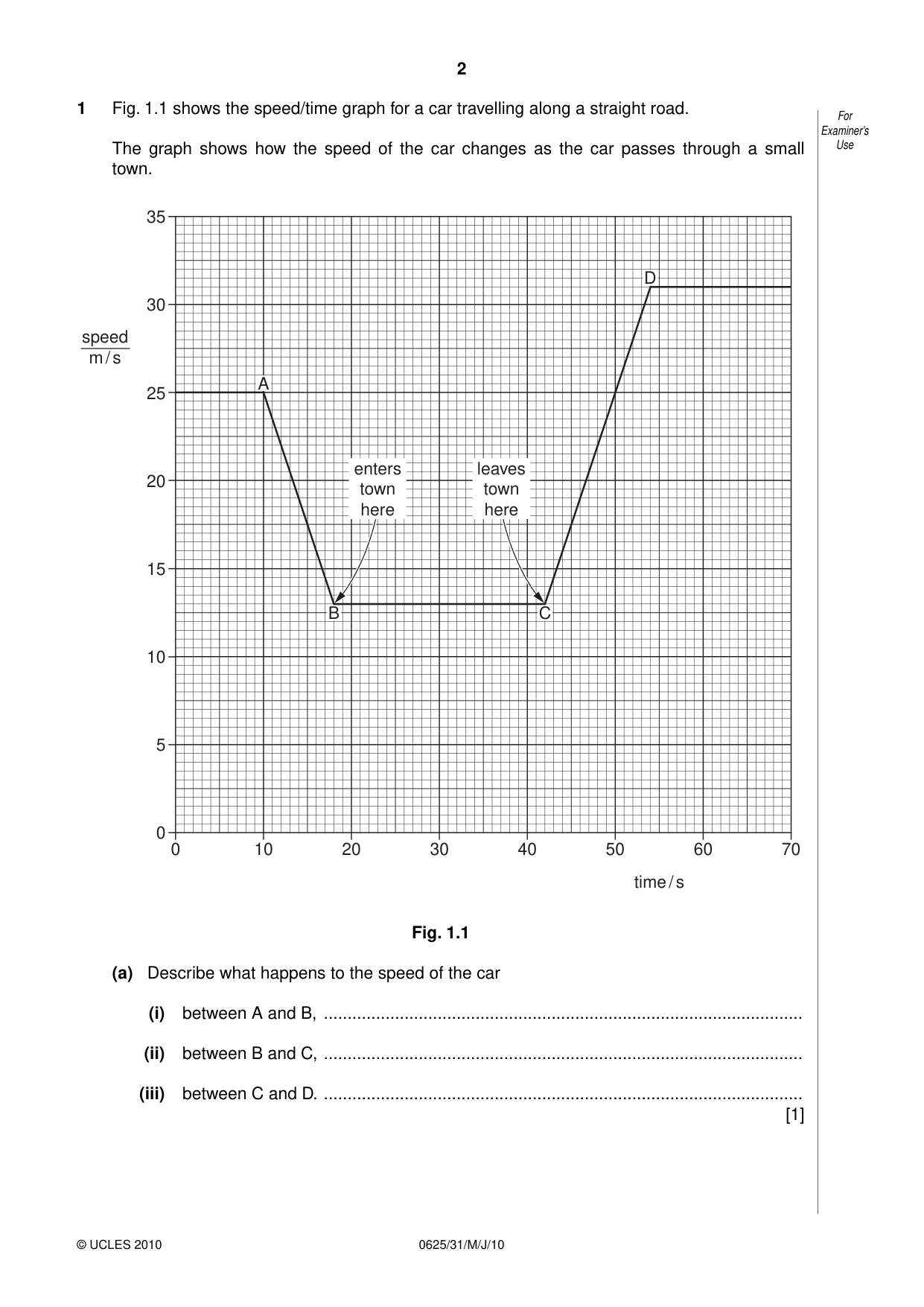
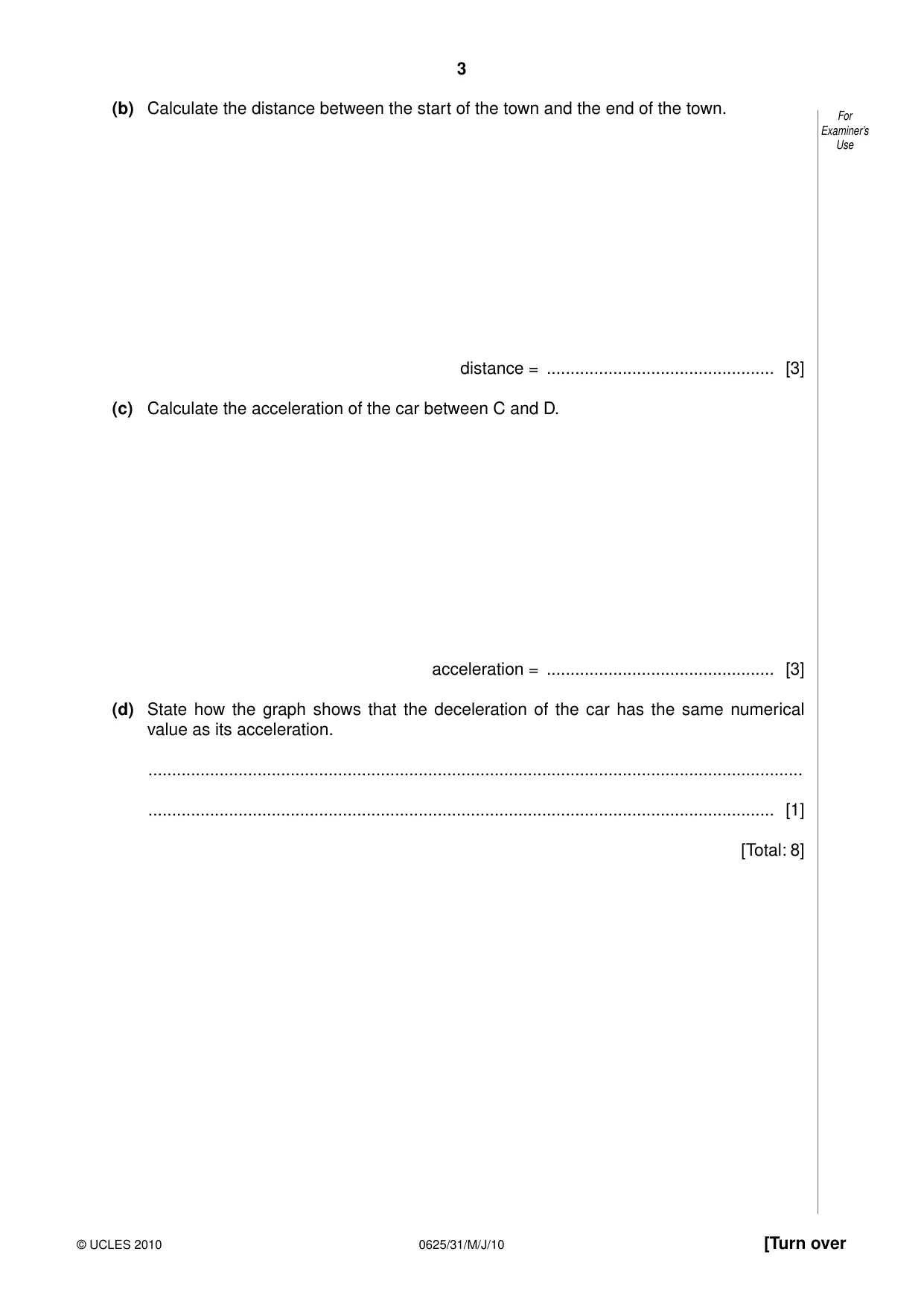
1 Fig. 1.1 shows the speed/time graph for a car travelling along a straight road. For Examiner’s The graph shows how the speed of the car changes as the car passes through a small Use town. 35 D 30 speed m / s A 25 enters leaves 20 town town here here 15 B C 10 5 0 0 10 20 30 40 50 60 70 time / s Fig. 1.1 (a) Describe what happens to the speed of the car (i) between A and B, ..................................................................................................... (ii) between B and C, ..................................................................................................... (iii) between C and D. ..................................................................................................... [1] (b) Calculate the distance between the start of the town and the end of the town. For Examiner’s Use distance = ................................................ [3] (c) Calculate the acceleration of the car between C and D. acceleration = ................................................ [3] (d) State how the graph shows that the deceleration of the car has the same numerical value as its acceleration. .......................................................................................................................................... .................................................................................................................................... [1] [Total: 8]
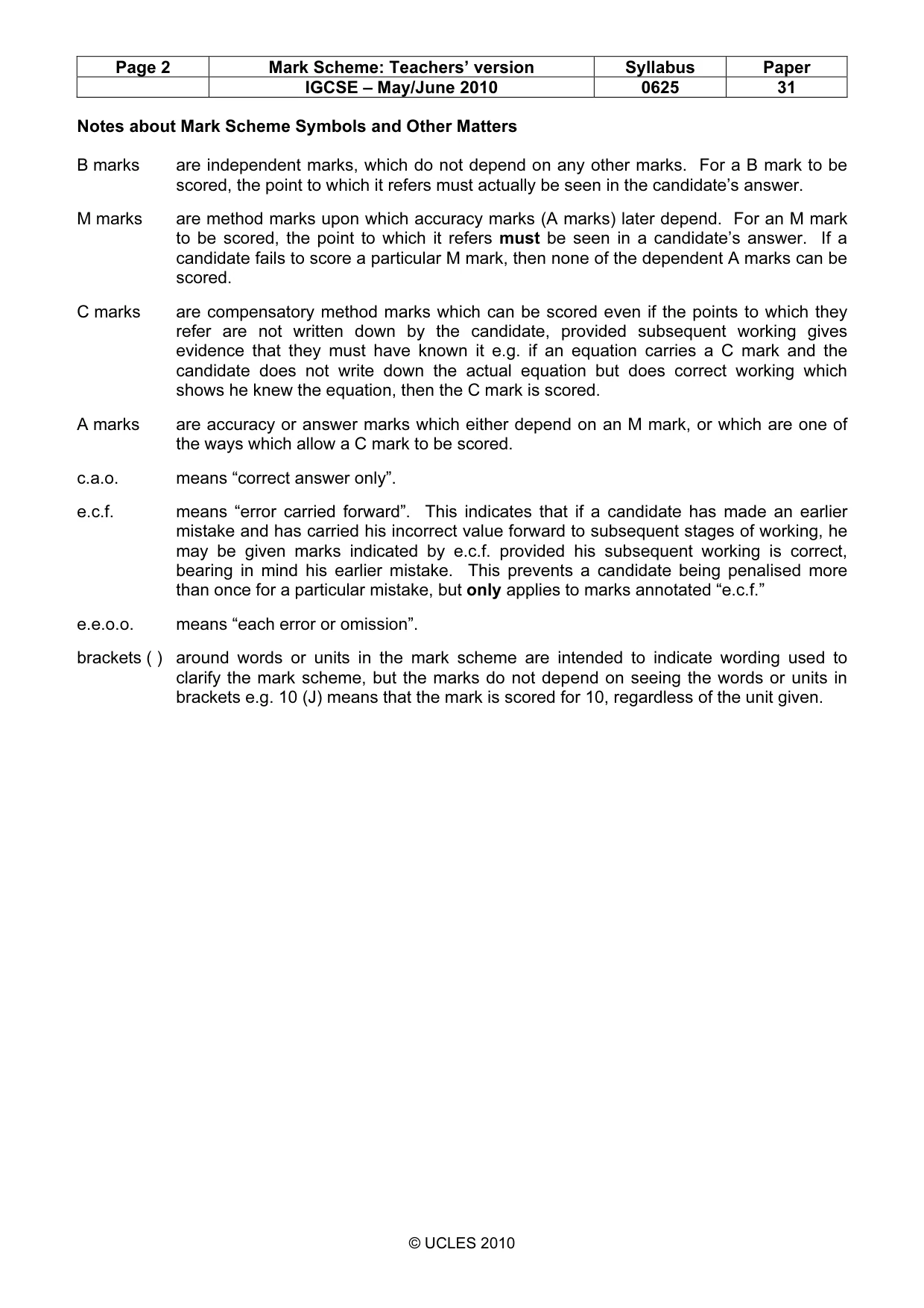
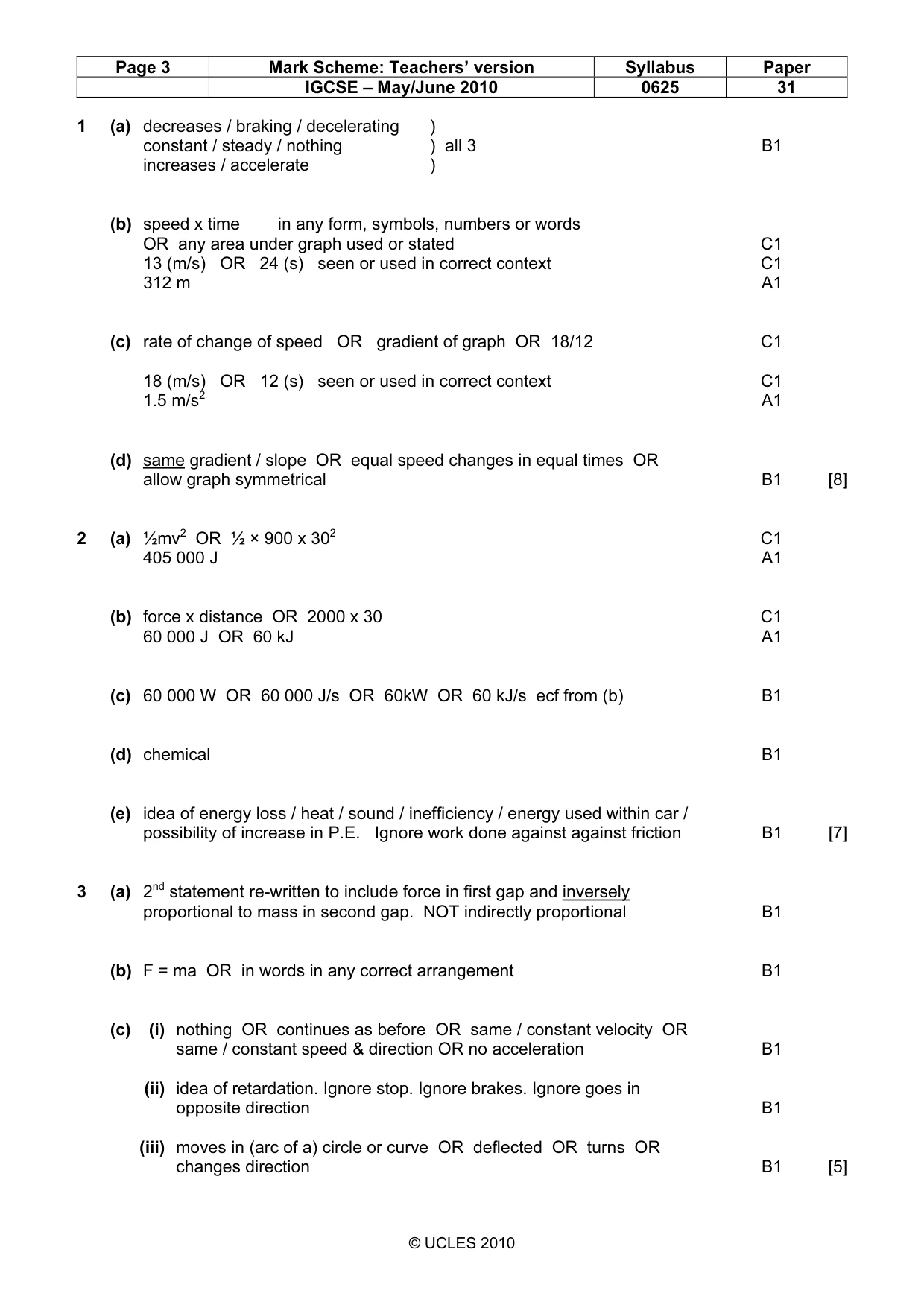
Mark scheme: 1 (a) decreases / braking / decelerating ) constant / steady / nothing ) all 3 B1 increases / accelerate ) (b) speed x time in any form, symbols, numbers or words OR any area under graph used or stated C1 13 (m/s) OR 24 (s) seen or used in correct context C1 312 m A1 (c) rate of change of speed OR gradient of graph OR 18/12 C1 18 (m/s) OR 12 (s) seen or used in correct context C1 1.5 m/s2 A1 (d) same gradient / slope OR equal speed changes in equal times OR allow graph symmetrical B1 [8] 2 2
Q2 · A car of mass 900 kg is travelling at a steady speed of 30 m / s against a resistive…
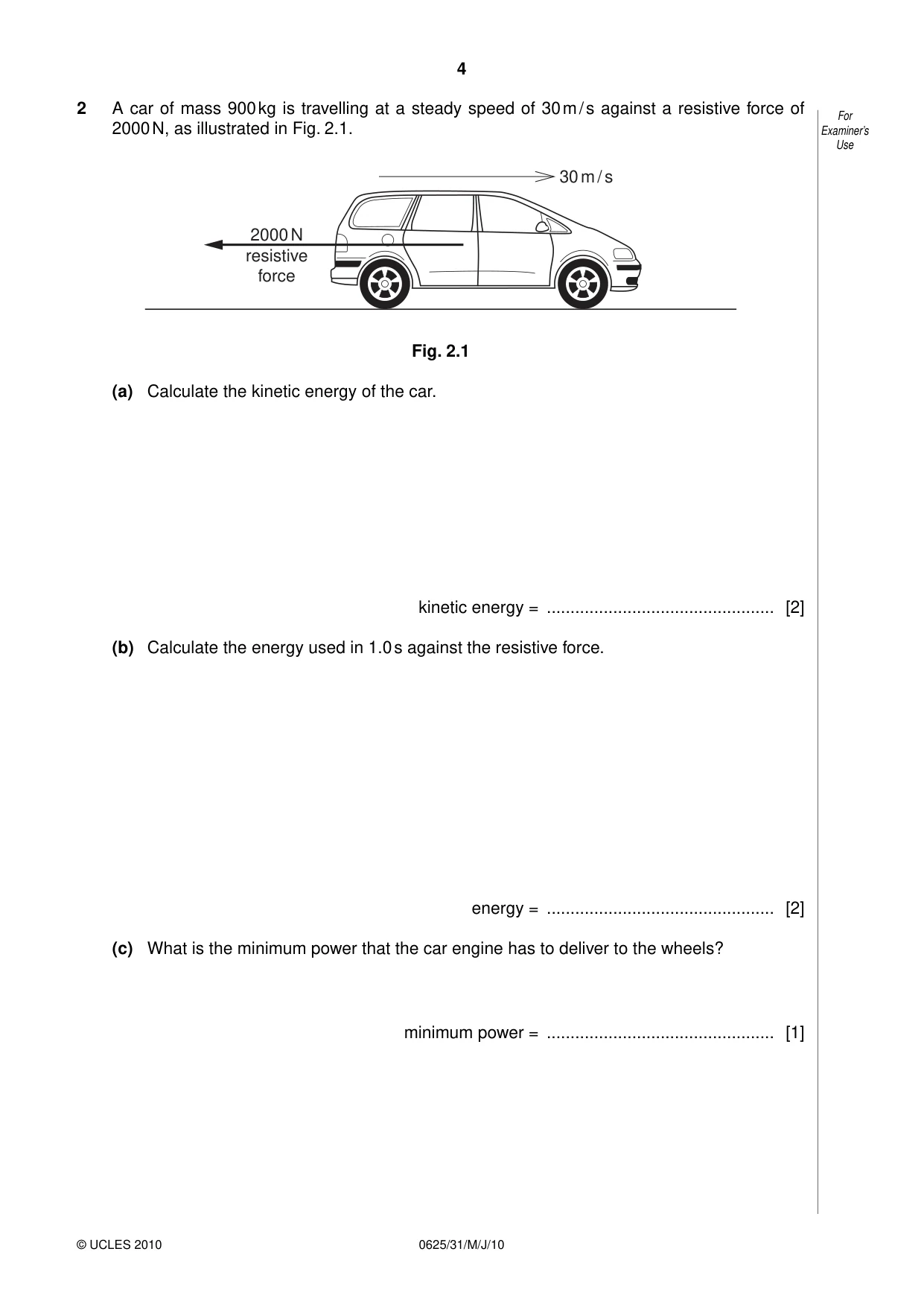
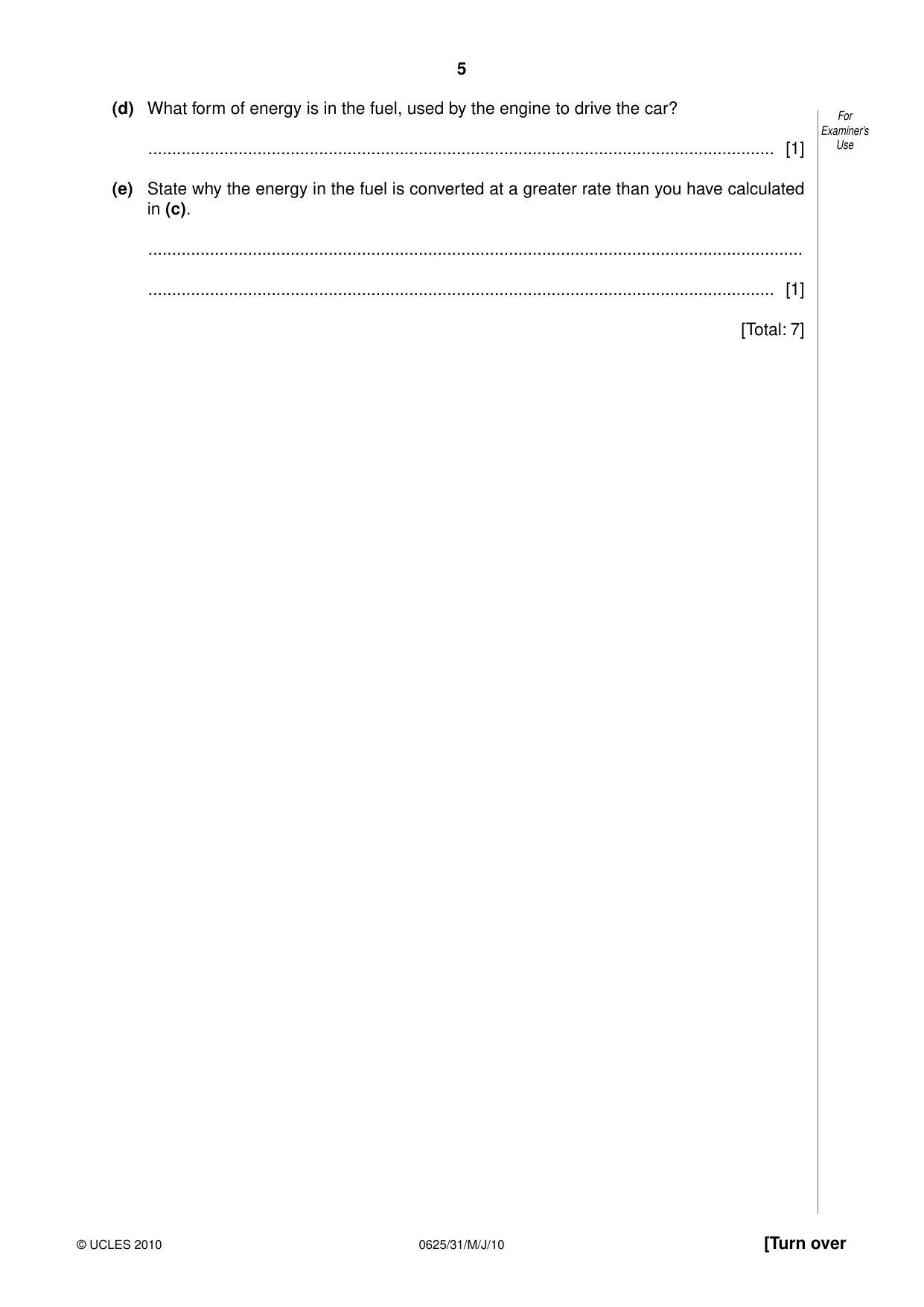
2 A car of mass 900 kg is travelling at a steady speed of 30 m / s against a resistive force of For 2000 N, as illustrated in Fig. 2.1. Examiner’s Use 30 m / s 2000 N resistive force Fig. 2.1 (a) Calculate the kinetic energy of the car. kinetic energy = ................................................ [2] (b) Calculate the energy used in 1.0 s against the resistive force. energy = ................................................ [2] (c) What is the minimum power that the car engine has to deliver to the wheels? minimum power = ................................................ [1] (d) What form of energy is in the fuel, used by the engine to drive the car? For Examiner’s .................................................................................................................................... [1] Use (e) State why the energy in the fuel is converted at a greater rate than you have calculated in (c). .......................................................................................................................................... .................................................................................................................................... [1] [Total: 7]
Mark scheme: 2 (a) ½mv2 OR ½ × 900 x 302 C1 405 000 J A1 (b) force x distance OR 2000 x 30 C1 60 000 J OR 60 kJ A1 (c) 60 000 W OR 60 000 J/s OR 60kW OR 60 kJ/s ecf from (b) B1 (d) chemical B1 (e) idea of energy loss / heat / sound / inefficiency / energy used within car / possibility of increase in P.E. Ignore work done against against friction B1 [7] nd
Q3 · Two students make the statements about acceleration that are given below
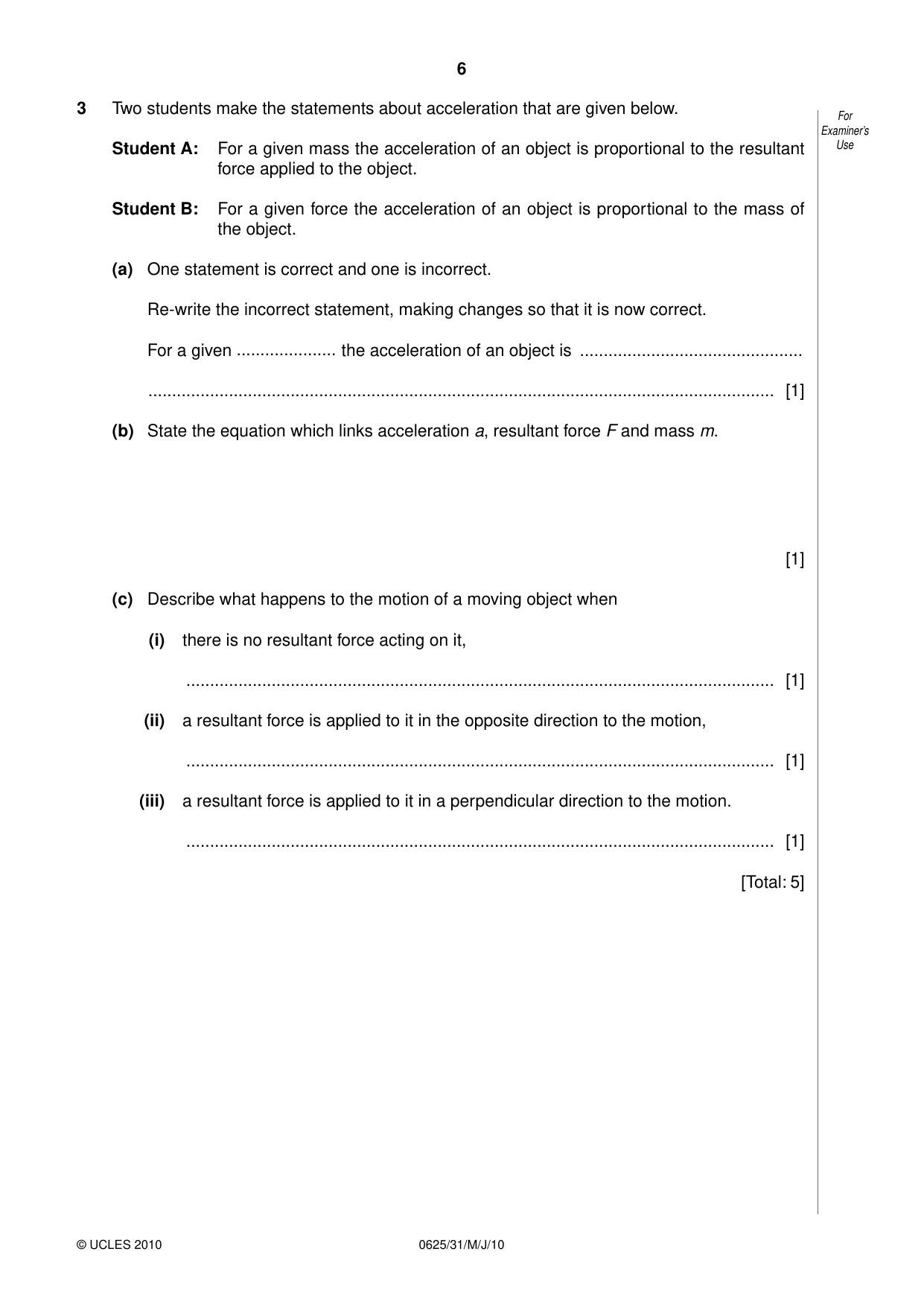
3 Two students make the statements about acceleration that are given below. For Examiner’s Student A: For a given mass the acceleration of an object is proportional to the resultant Use force applied to the object. Student B: For a given force the acceleration of an object is proportional to the mass of the object. (a) One statement is correct and one is incorrect. Re-write the incorrect statement, making changes so that it is now correct. For a given ..................... the acceleration of an object is ............................................... .................................................................................................................................... [1] (b) State the equation which links acceleration a, resultant force F and mass m. [1] (c) Describe what happens to the motion of a moving object when (i) there is no resultant force acting on it, ............................................................................................................................ [1] (ii) a resultant force is applied to it in the opposite direction to the motion, ............................................................................................................................ [1] (iii) a resultant force is applied to it in a perpendicular direction to the motion. ............................................................................................................................ [1] [Total: 5]
Mark scheme: 3 (a) 2nd statement re-written to include force in first gap and inversely proportional to mass in second gap. NOT indirectly proportional B1 (b) F = ma OR in words in any correct arrangement B1 (c) (i) nothing OR continues as before OR same / constant velocity OR same / constant speed & direction OR no acceleration B1 (ii) idea of retardation. Ignore stop. Ignore brakes. Ignore goes in opposite direction B1 (iii) moves in (arc of a) circle or curve OR deflected OR turns OR changes direction B1 [5] IGCSE – May/June 2010 0625 31
Q4 · Four identical metal plates, at the same temperature, are laid side by side on the ground
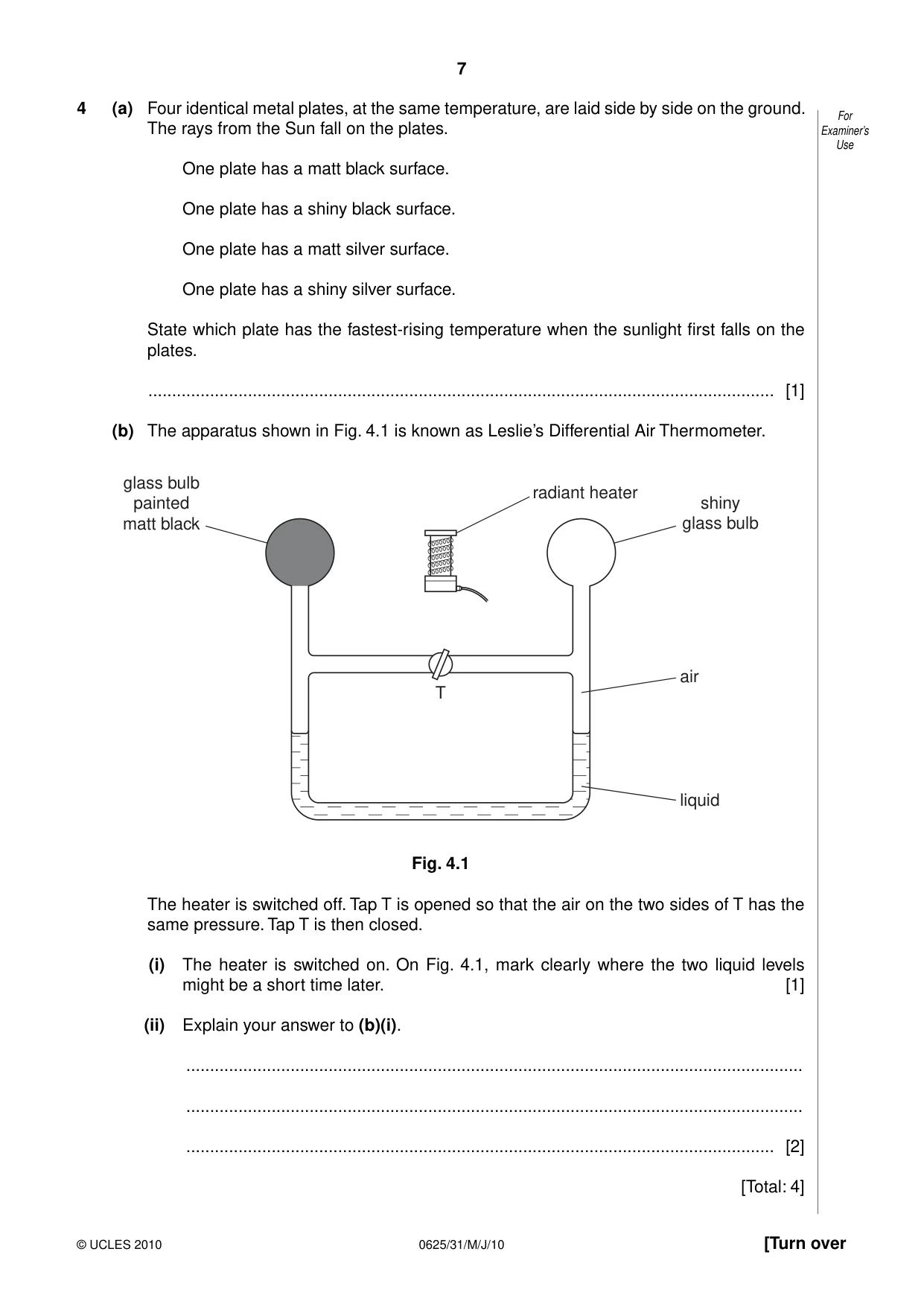
4 (a) Four identical metal plates, at the same temperature, are laid side by side on the ground. For The rays from the Sun fall on the plates. Examiner’s Use One plate has a matt black surface. One plate has a shiny black surface. One plate has a matt silver surface. One plate has a shiny silver surface. State which plate has the fastest-rising temperature when the sunlight first falls on the plates. .................................................................................................................................... [1] (b) The apparatus shown in Fig. 4.1 is known as Leslie’s Differential Air Thermometer. glass bulb radiant heater painted shiny matt black glass bulb air T liquid Fig. 4.1 The heater is switched off. Tap T is opened so that the air on the two sides of T has the same pressure. Tap T is then closed. (i) The heater is switched on. On Fig. 4.1, mark clearly where the two liquid levels might be a short time later. [1] (ii) Explain your answer to (b)(i). .................................................................................................................................. .................................................................................................................................. ............................................................................................................................ [2] [Total: 4]
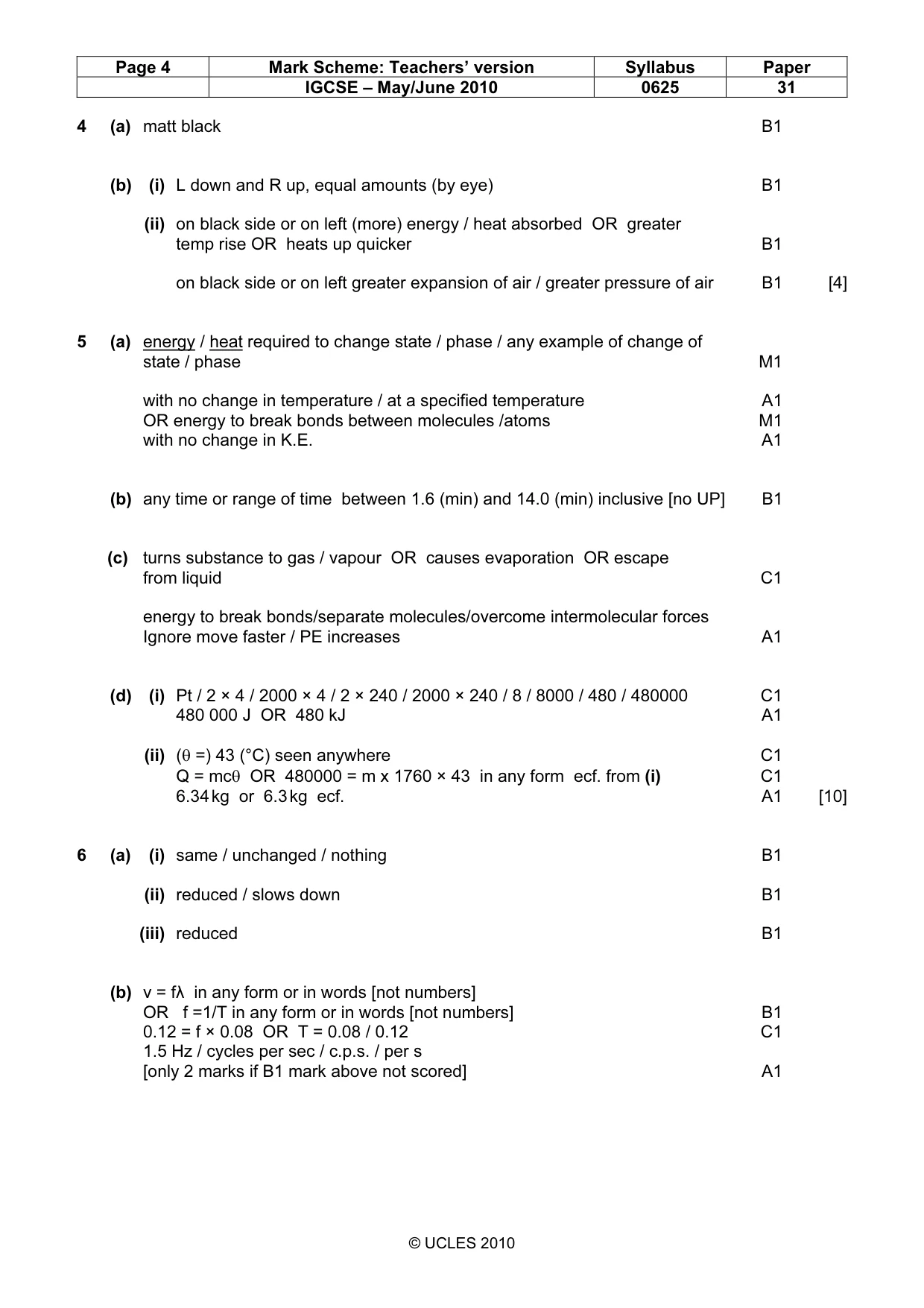
Mark scheme: 4 (a) matt black B1 (b) (i) L down and R up, equal amounts (by eye) B1 (ii) on black side or on left (more) energy / heat absorbed OR greater temp rise OR heats up quicker B1 on black side or on left greater expansion of air / greater pressure of air B1 [4]
Q5 · A certain substance is in the solid state at a temperature of –36 °C
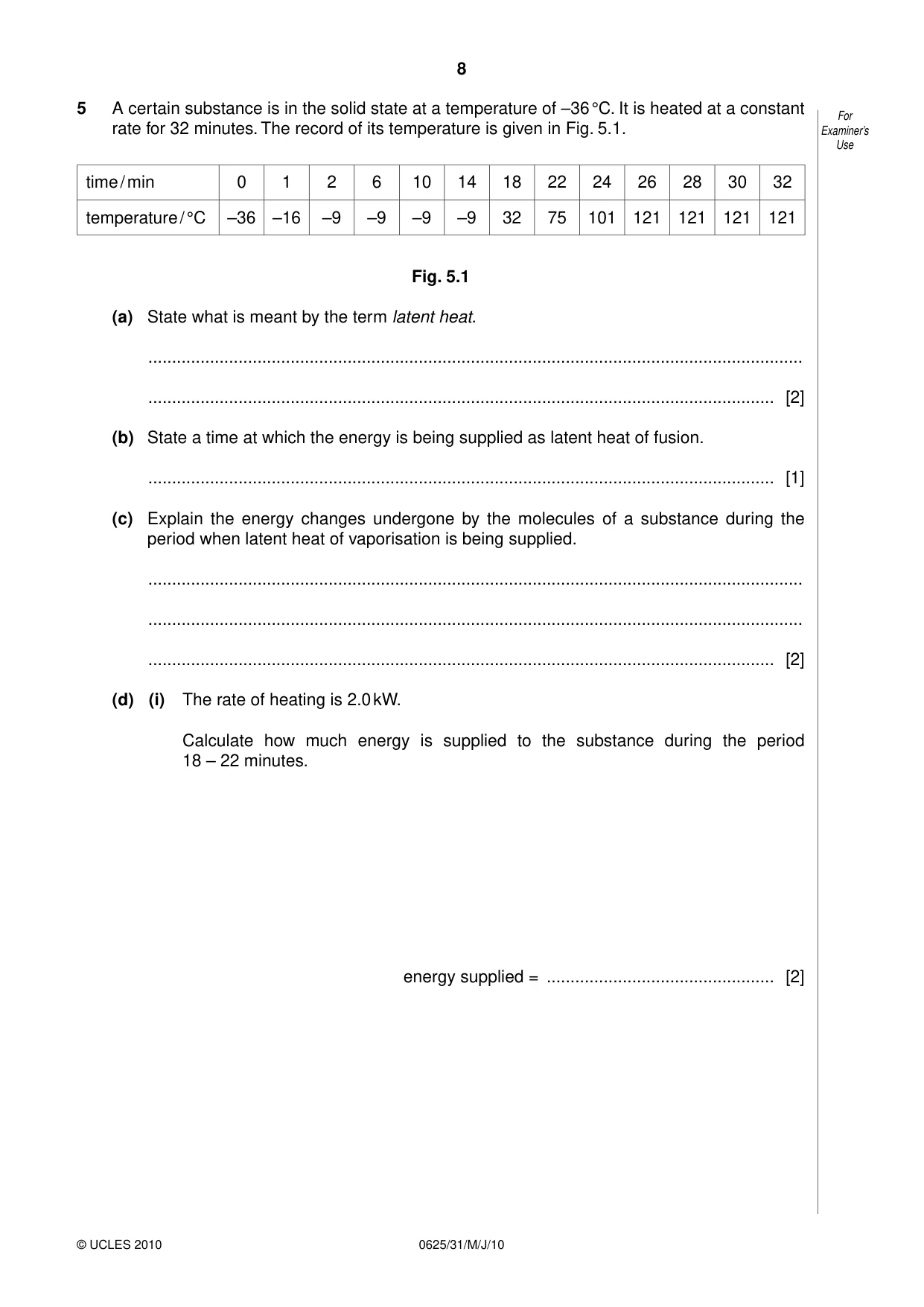
5 A certain substance is in the solid state at a temperature of –36 °C. It is heated at a constant For rate for 32 minutes. The record of its temperature is given in Fig. 5.1. Examiner’s Use time / min 0 1 2 6 10 14 18 22 24 26 28 30 32 temperature / °C –36 –16 –9 –9 –9 –9 32 75 101 121 121 121 121 Fig. 5.1 (a) State what is meant by the term latent heat. .......................................................................................................................................... .................................................................................................................................... [2] (b) State a time at which the energy is being supplied as latent heat of fusion. .................................................................................................................................... [1] (c) Explain the energy changes undergone by the molecules of a substance during the period when latent heat of vaporisation is being supplied. .......................................................................................................................................... .......................................................................................................................................... .................................................................................................................................... [2] (d) (i) The rate of heating is 2.0 kW. Calculate how much energy is supplied to the substance during the period 18 – 22 minutes. energy supplied = ................................................ [2] (ii) The specific heat capacity of the substance is 1760 J / (kg °C). For Examiner’s Use the information in the table for the period 18 – 22 minutes to calculate the Use mass of the substance being heated. mass heated = ................................................ [3] [Total: 10]
Mark scheme: 5 (a) energy / heat required to change state / phase / any example of change of state / phase M1 with no change in temperature / at a specified temperature A1 OR energy to break bonds between molecules /atoms M1 with no change in K.E. A1 (b) any time or range of time between 1.6 (min) and 14.0 (min) inclusive [no UP] B1 (c) turns substance to gas / vapour OR causes evaporation OR escape from liquid C1 energy to break bonds/separate molecules/overcome intermolecular forces Ignore move faster / PE increases A1 (d) (i) Pt / 2 × 4 / 2000 × 4 / 2 × 240 / 2000 × 240 / 8 / 8000 / 480 / 480000 C1 480 000 J OR 480 kJ A1 (ii) (θ =) 43 (°C) seen anywhere C1 Q = mcθ OR 480000 = m x 1760 × 43 in any form ecf. from (i) C1 6.34 kg or 6.3 kg ecf. A1 [10]
Q6 · Some plane waves travel on the surface of water in a tank
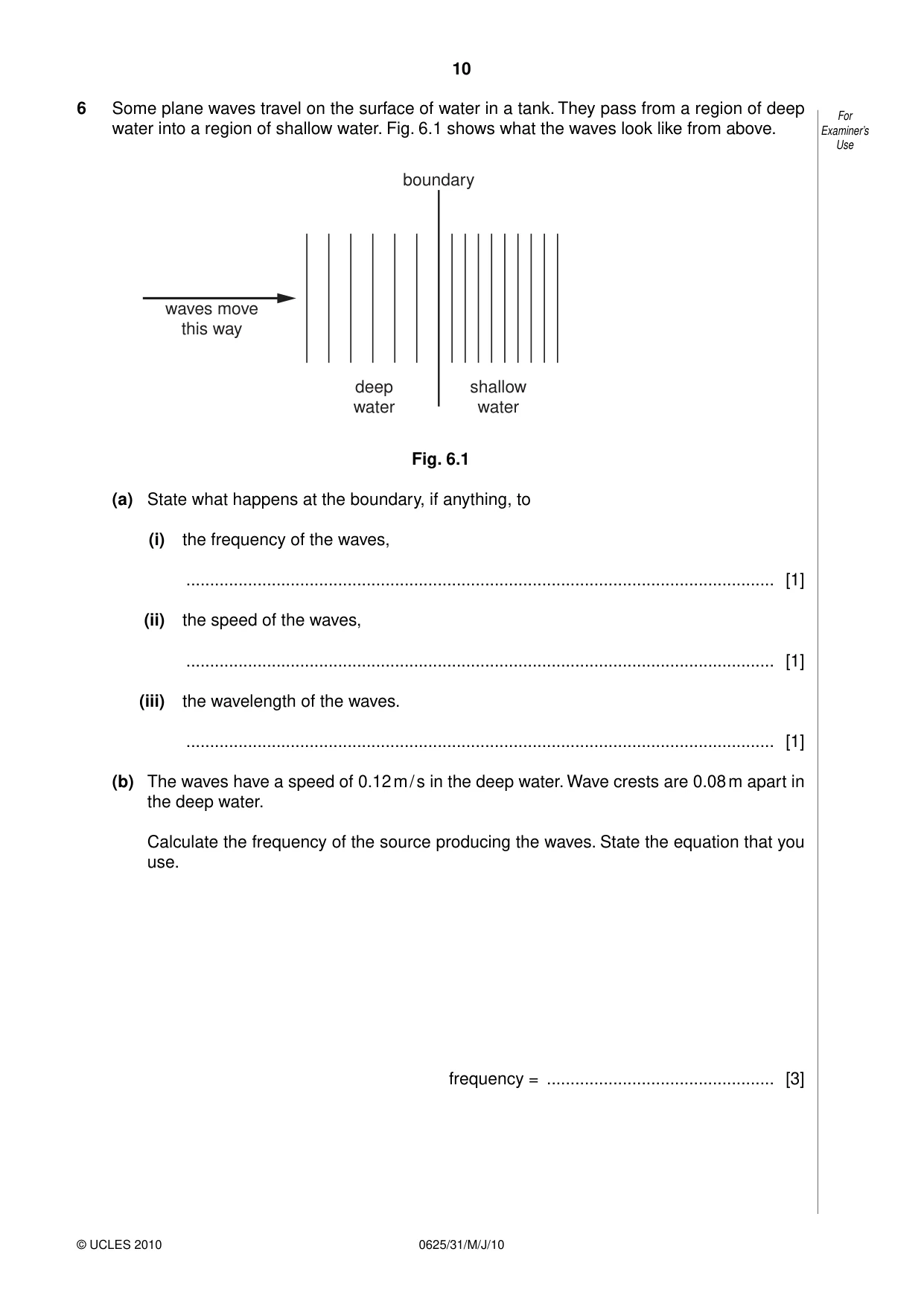
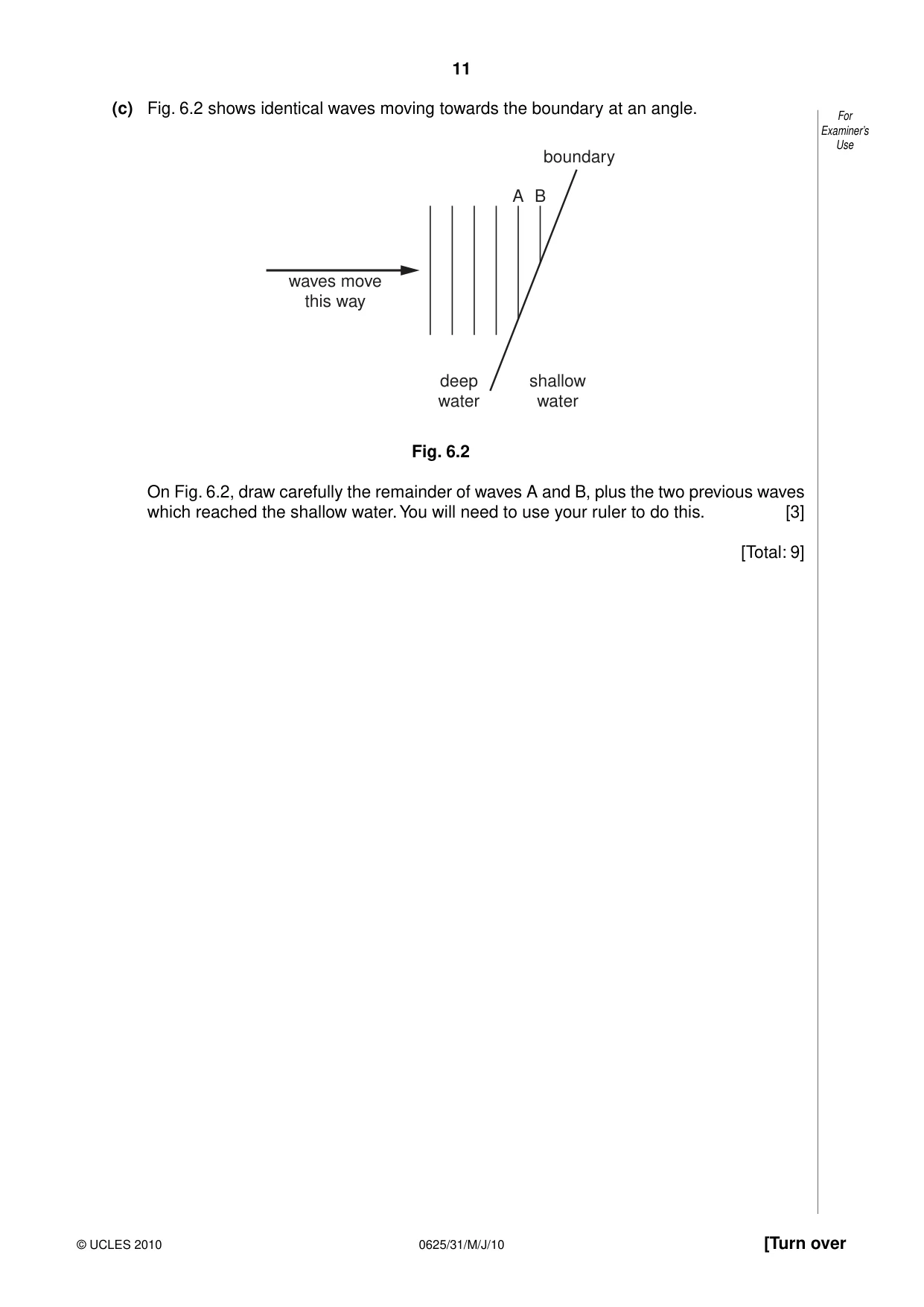
6 Some plane waves travel on the surface of water in a tank. They pass from a region of deep For water into a region of shallow water. Fig. 6.1 shows what the waves look like from above. Examiner’s Use boundary waves move this way deep shallow water water Fig. 6.1 (a) State what happens at the boundary, if anything, to (i) the frequency of the waves, ............................................................................................................................ [1] (ii) the speed of the waves, ............................................................................................................................ [1] (iii) the wavelength of the waves. ............................................................................................................................ [1] (b) The waves have a speed of 0.12 m / s in the deep water. Wave crests are 0.08 m apart in the deep water. Calculate the frequency of the source producing the waves. State the equation that you use. frequency = ................................................ [3] (c) Fig. 6.2 shows identical waves moving towards the boundary at an angle. For Examiner’s Use boundary A B waves move this way deep shallow water water Fig. 6.2 On Fig. 6.2, draw carefully the remainder of waves A and B, plus the two previous waves which reached the shallow water. You will need to use your ruler to do this. [3] [Total: 9]
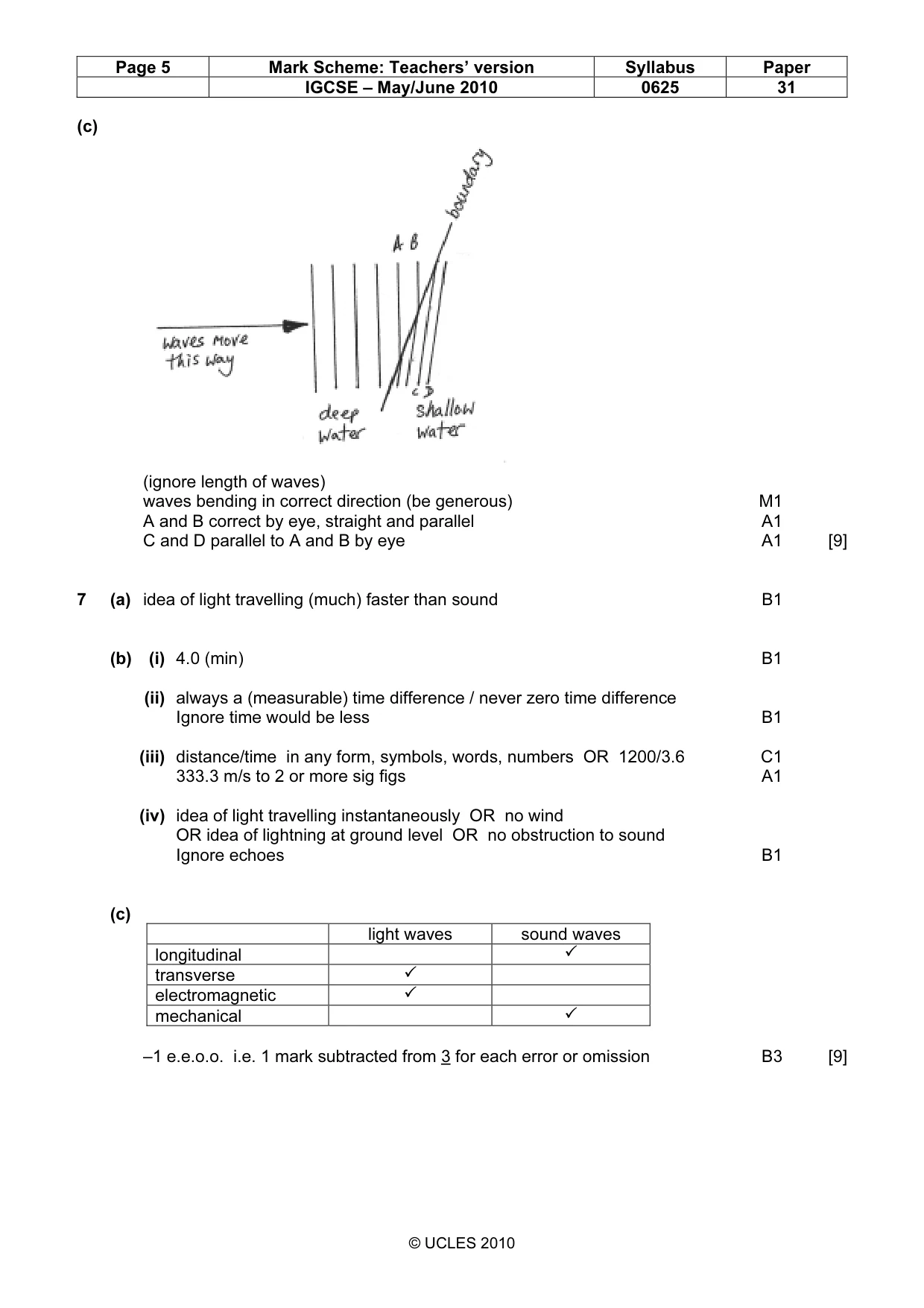
Mark scheme: 6 (a) (i) same / unchanged / nothing B1 (ii) reduced / slows down B1 (iii) reduced B1 (b) v = fλ in any form or in words [not numbers] OR f =1/T in any form or in words [not numbers] B1 0.12 = f × 0.08 OR T = 0.08 / 0.12 C1 1.5 Hz / cycles per sec / c.p.s. / per s [only 2 marks if B1 mark above not scored] A1 IGCSE – May/June 2010 0625 31 (c) (ignore length of waves) waves bending in correct direction (be generous) M1 A and B correct by eye, straight and parallel A1 C and D parallel to A and B by eye A1 [9]
Q7 · During a thunderstorm, thunder and lightning are produced at the same time
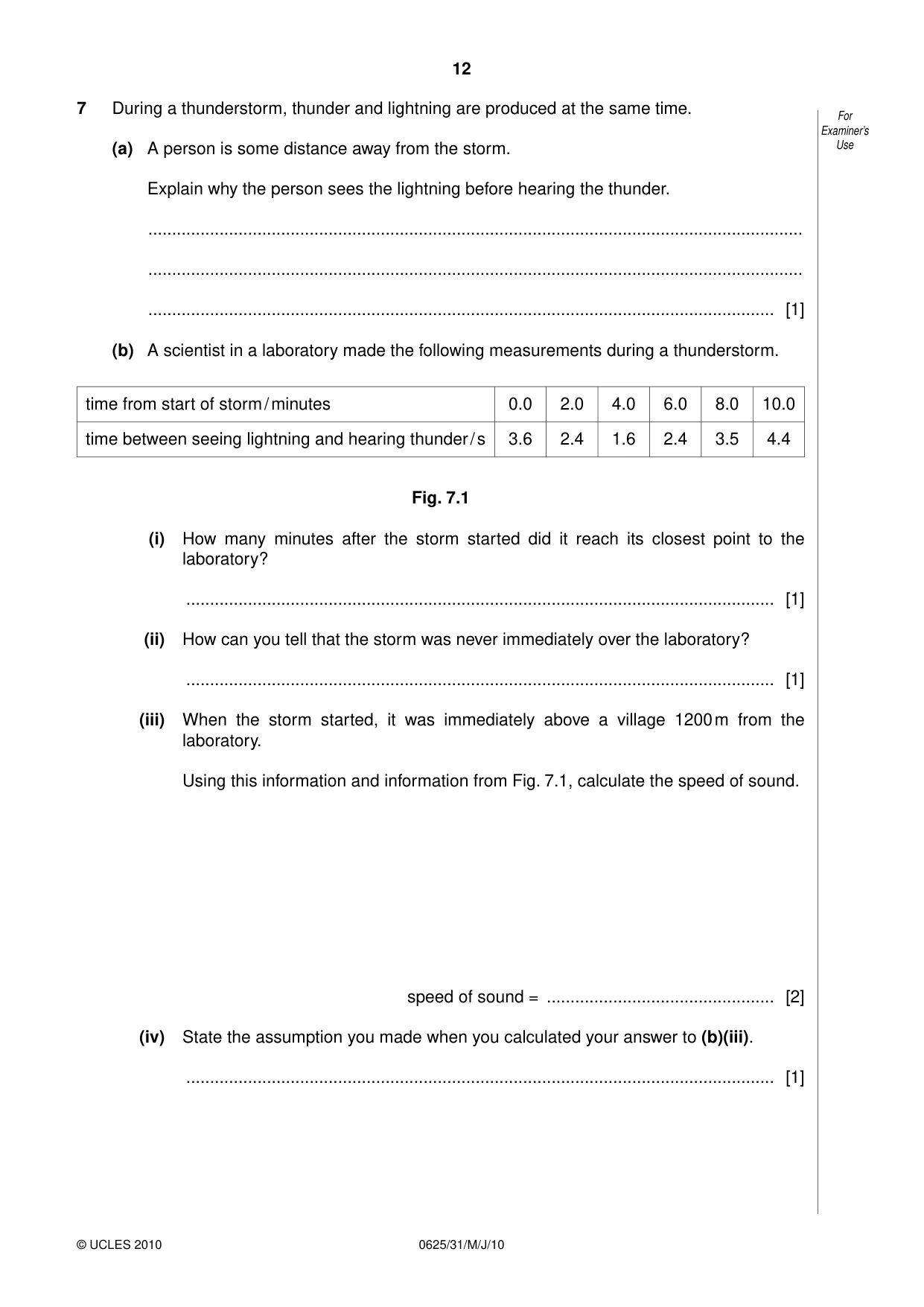
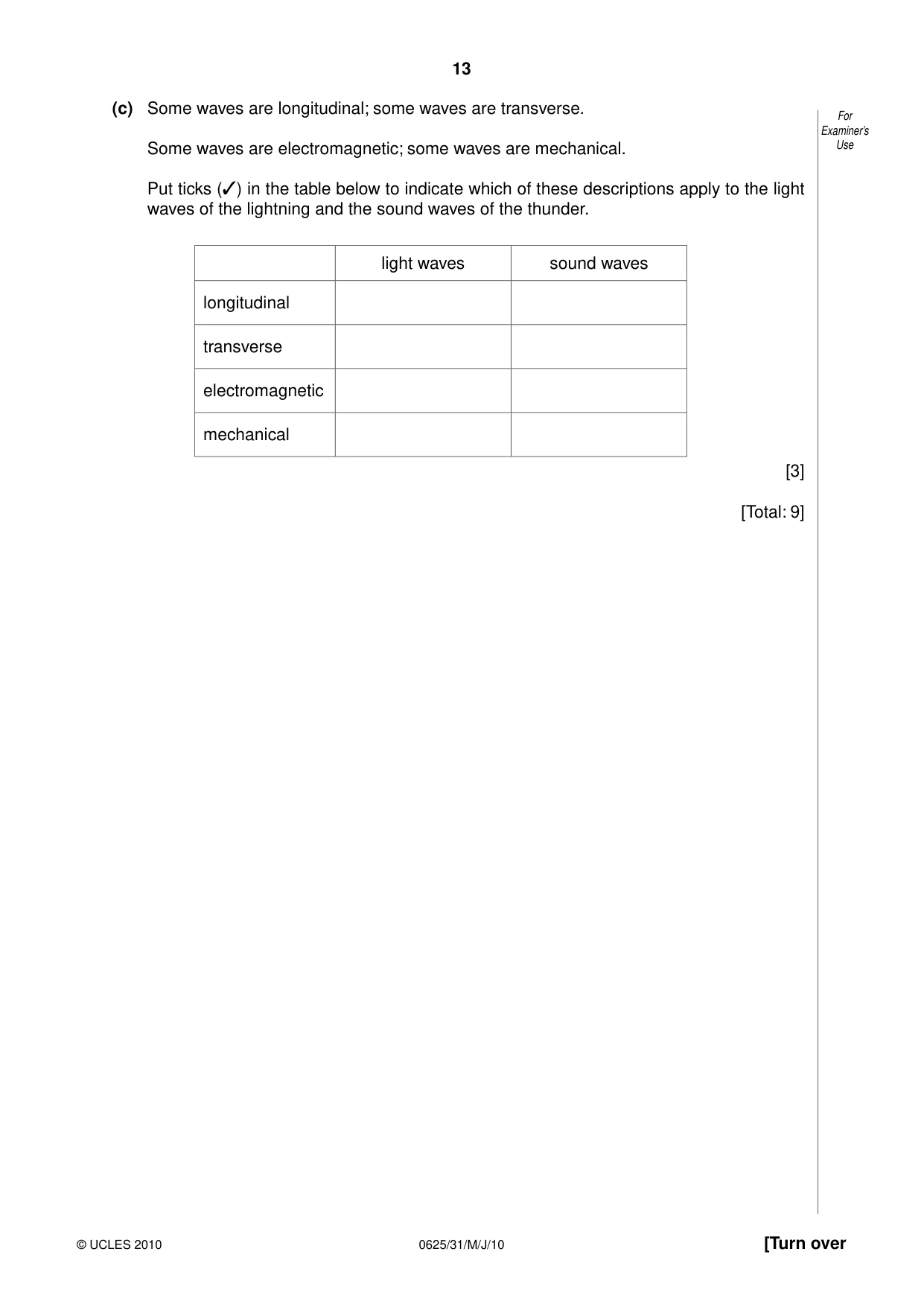
7 During a thunderstorm, thunder and lightning are produced at the same time. For Examiner’s (a) A person is some distance away from the storm. Use Explain why the person sees the lightning before hearing the thunder. .......................................................................................................................................... .......................................................................................................................................... .................................................................................................................................... [1] (b) A scientist in a laboratory made the following measurements during a thunderstorm. time from start of storm / minutes 0.0 2.0 4.0 6.0 8.0 10.0 time between seeing lightning and hearing thunder / s 3.6 2.4 1.6 2.4 3.5 4.4 Fig. 7.1 (i) How many minutes after the storm started did it reach its closest point to the laboratory? ............................................................................................................................ [1] (ii) How can you tell that the storm was never immediately over the laboratory? ............................................................................................................................ [1] (iii) When the storm started, it was immediately above a village 1200 m from the laboratory. Using this information and information from Fig. 7.1, calculate the speed of sound. speed of sound = ................................................ [2] (iv) State the assumption you made when you calculated your answer to (b)(iii). ............................................................................................................................ [1] (c) Some waves are longitudinal; some waves are transverse. For Examiner’s Some waves are electromagnetic; some waves are mechanical. Use Put ticks (✓) in the table below to indicate which of these descriptions apply to the light waves of the lightning and the sound waves of the thunder. light waves sound waves longitudinal transverse electromagnetic mechanical [3] [Total: 9]
Mark scheme: 7 (a) idea of light travelling (much) faster than sound B1 (b) (i) 4.0 (min) B1 (ii) always a (measurable) time difference / never zero time difference Ignore time would be less B1 (iii) distance/time in any form, symbols, words, numbers OR 1200/3.6 C1 333.3 m/s to 2 or more sig figs A1 (iv) idea of light travelling instantaneously OR no wind OR idea of lightning at ground level OR no obstruction to sound Ignore echoes B1 (c) light waves sound waves longitudinal ✓ transverse ✓ electromagnetic ✓ mechanical ✓ –1 e.e.o.o. i.e. 1 mark subtracted from 3 for each error or omission B3 [9] IGCSE – May/June 2010 0625 31
Q8 · The transformer in Fig
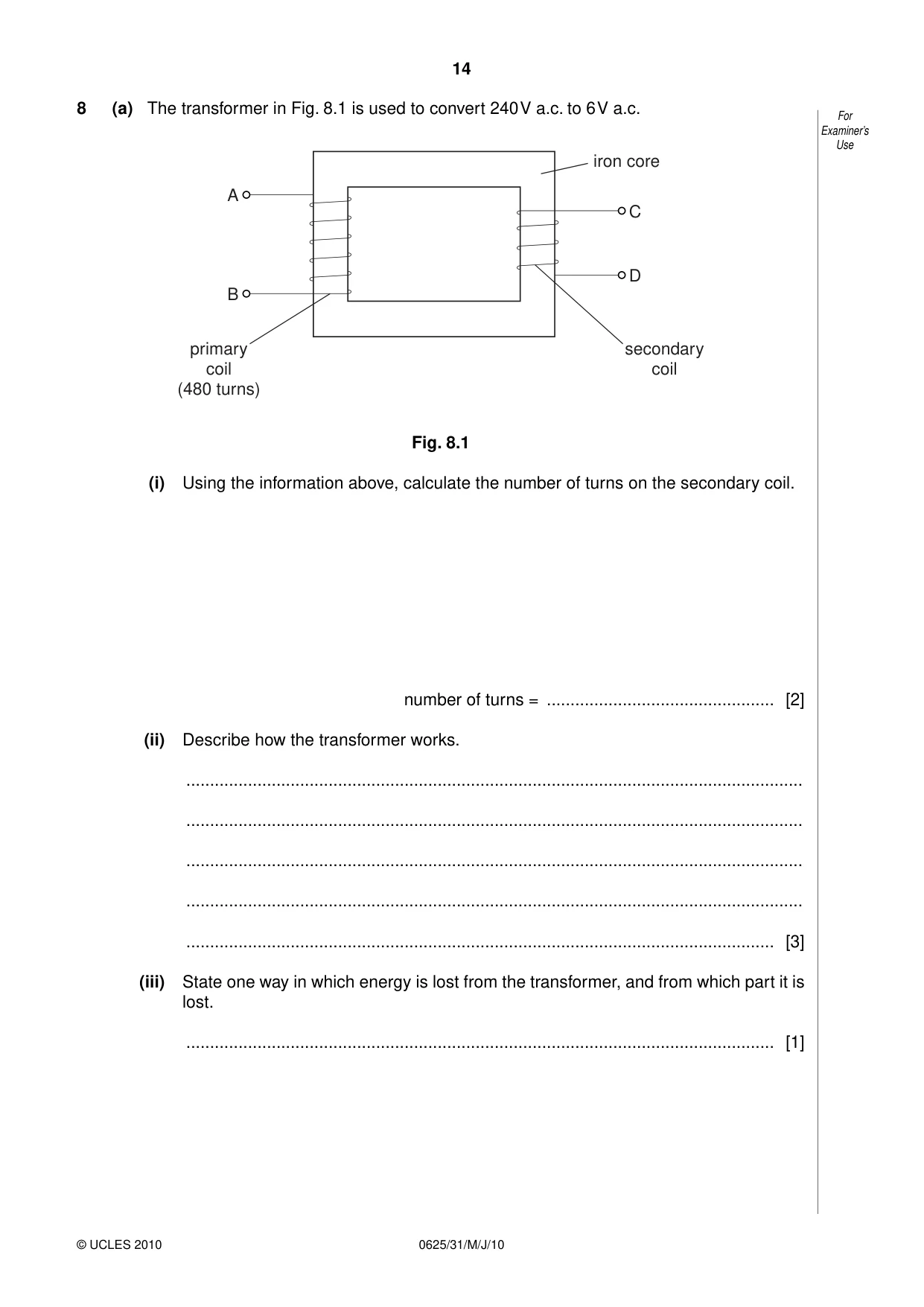
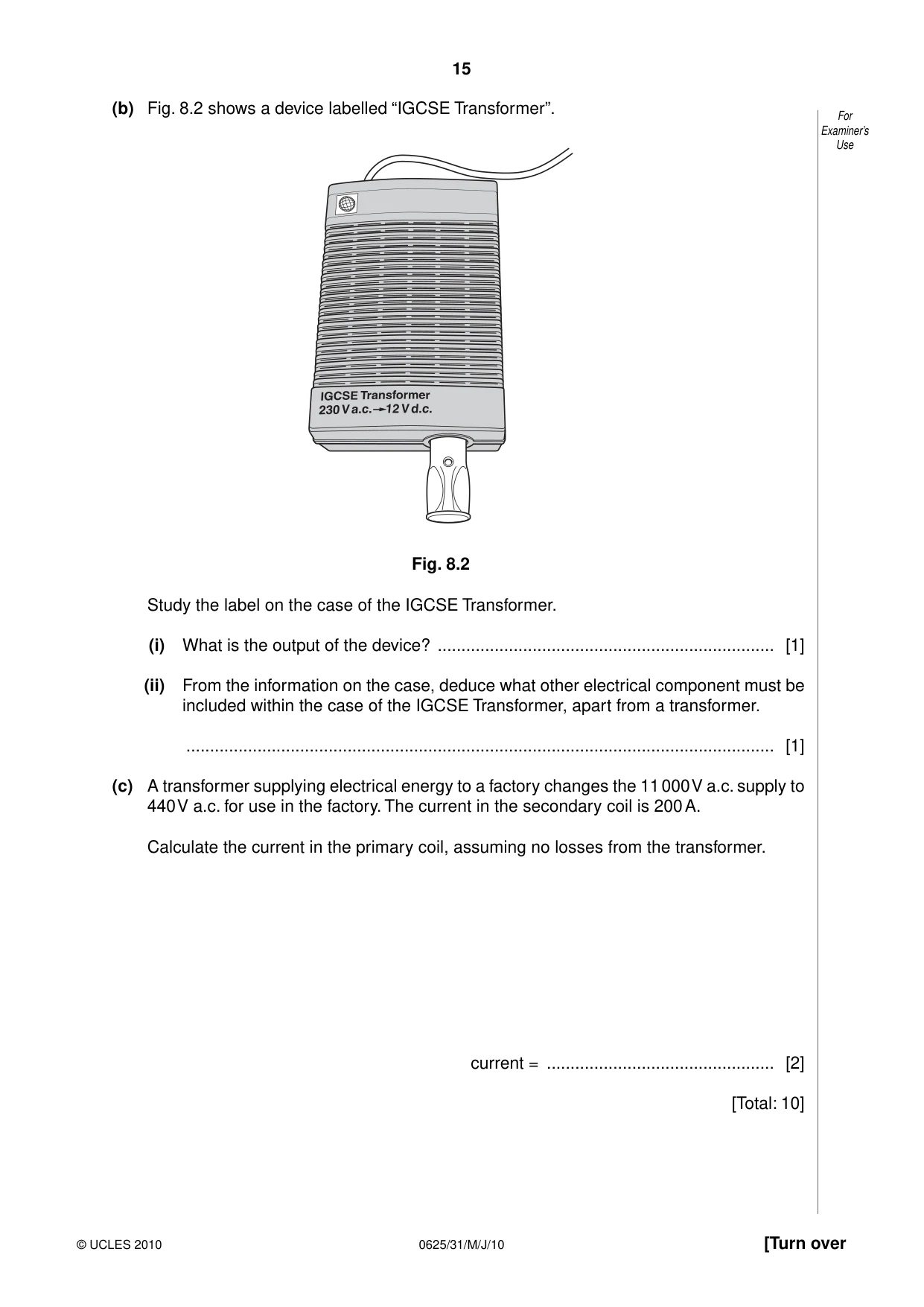
8 (a) The transformer in Fig. 8.1 is used to convert 240 V a.c. to 6 V a.c. For Examiner’s Use iron core A C D B primary secondary coil coil (480 turns) Fig. 8.1 (i) Using the information above, calculate the number of turns on the secondary coil. number of turns = ................................................ [2] (ii) Describe how the transformer works. .................................................................................................................................. .................................................................................................................................. .................................................................................................................................. .................................................................................................................................. ............................................................................................................................ [3] (iii) State one way in which energy is lost from the transformer, and from which part it is lost. ............................................................................................................................ [1] (b) Fig. 8.2 shows a device labelled “IGCSE Transformer”. For Examiner’s Use Fig. 8.2 Study the label on the case of the IGCSE Transformer. (i) What is the output of the device? ....................................................................... [1] (ii) From the information on the case, deduce what other electrical component must be included within the case of the IGCSE Transformer, apart from a transformer. ............................................................................................................................ [1] (c) A transformer supplying electrical energy to a factory changes the 11 000 V a.c. supply to 440 V a.c. for use in the factory. The current in the secondary coil is 200 A. Calculate the current in the primary coil, assuming no losses from the transformer. current = ................................................ [2] [Total: 10]
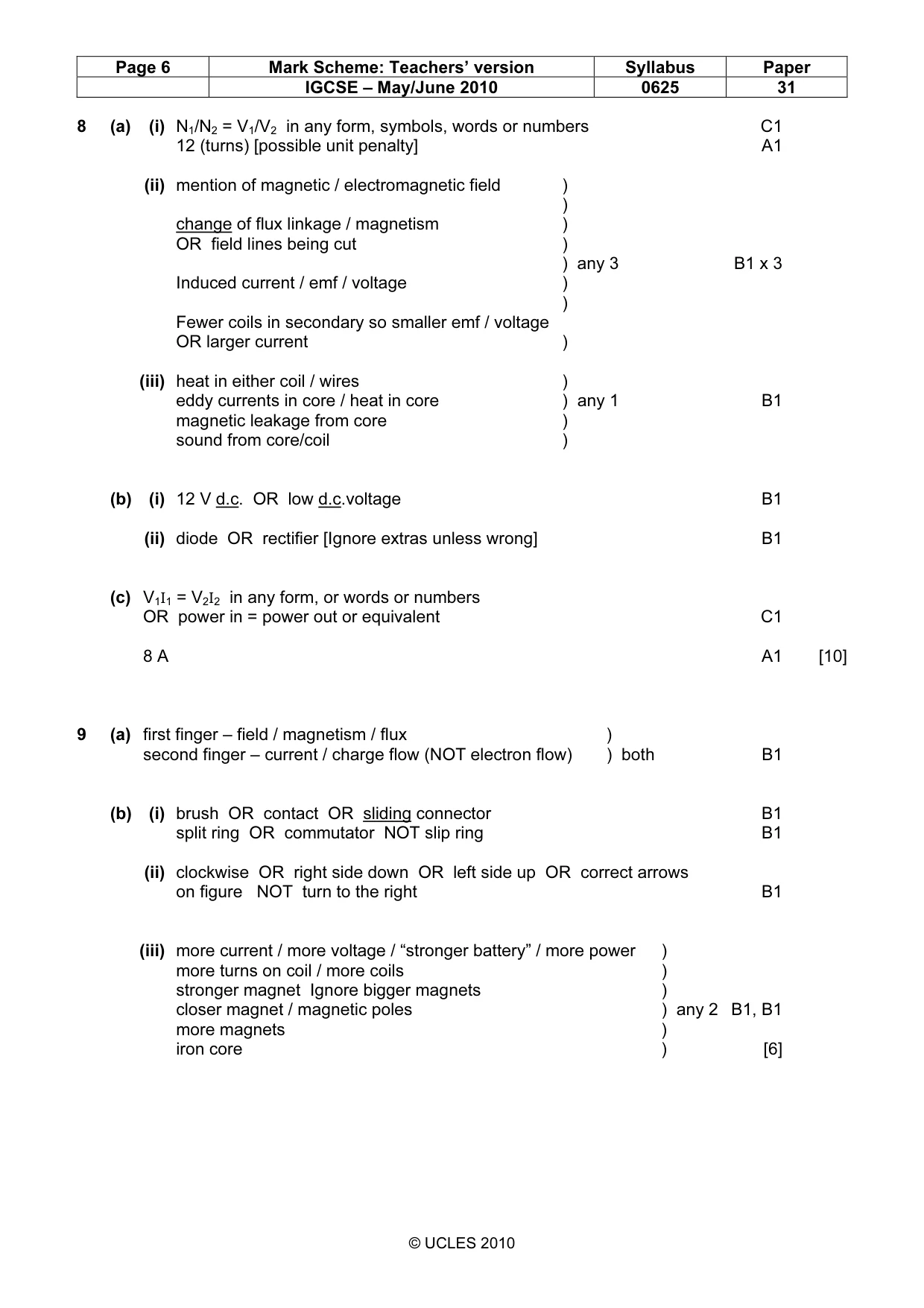
Mark scheme: 8 (a) (i) N1/N2 = V1/V2 in any form, symbols, words or numbers C1 12 (turns) [possible unit penalty] A1 (ii) mention of magnetic / electromagnetic field ) ) change of flux linkage / magnetism ) OR field lines being cut ) ) any 3 B1 x 3 Induced current / emf / voltage ) ) Fewer coils in secondary so smaller emf / voltage OR larger current ) (iii) heat in either coil / wires ) eddy currents in core / heat in core ) any 1 B1 magnetic leakage from core ) sound from core/coil ) (b) (i) 12 V d.c. OR low d.c.voltage B1 (ii) diode OR rectifier [Ignore extras unless wrong] B1 (c) V1I1 = V2I2 in any form, or words or numbers OR power in = power out or equivalent C1 8 A A1 [10]
Question 9
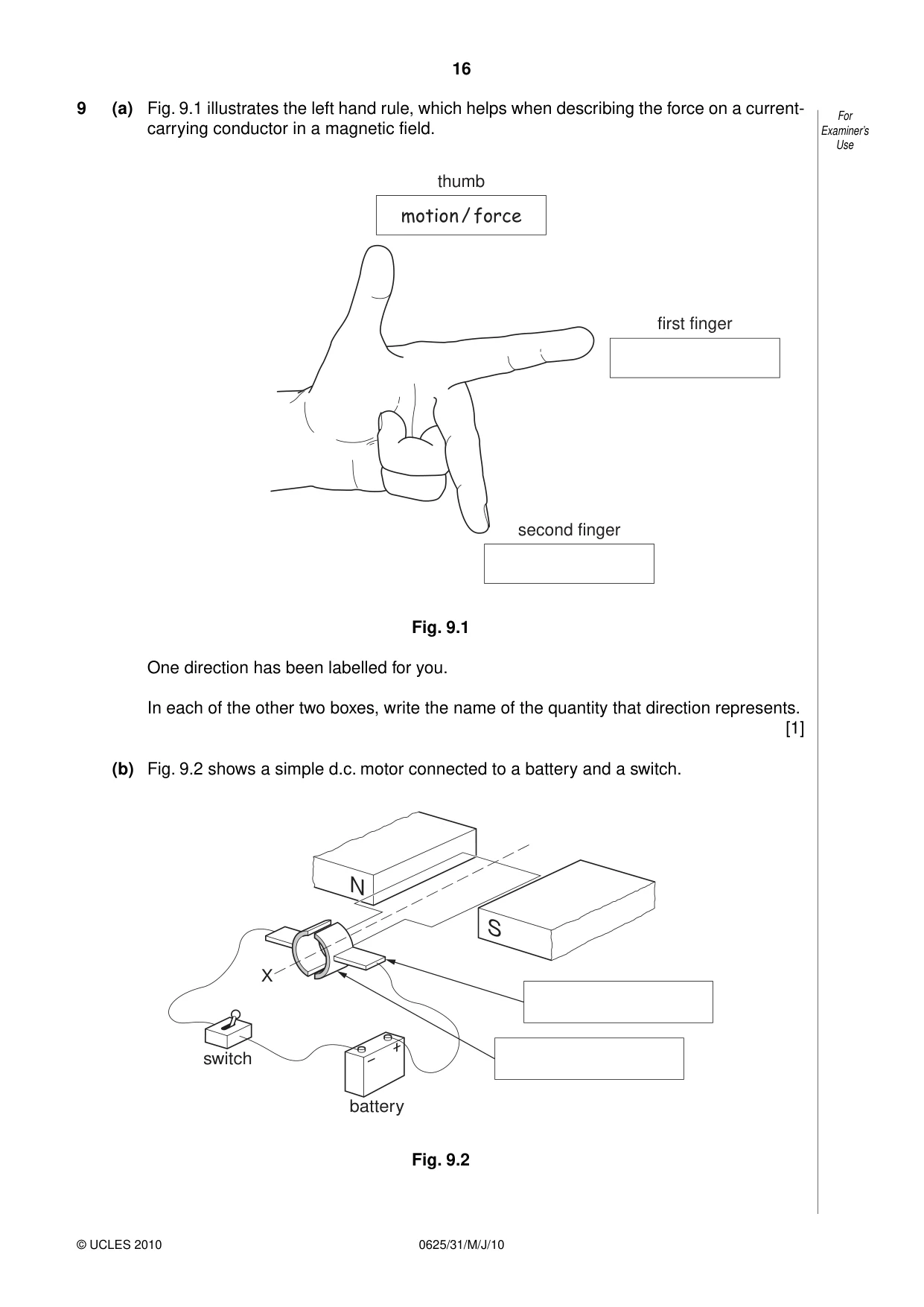
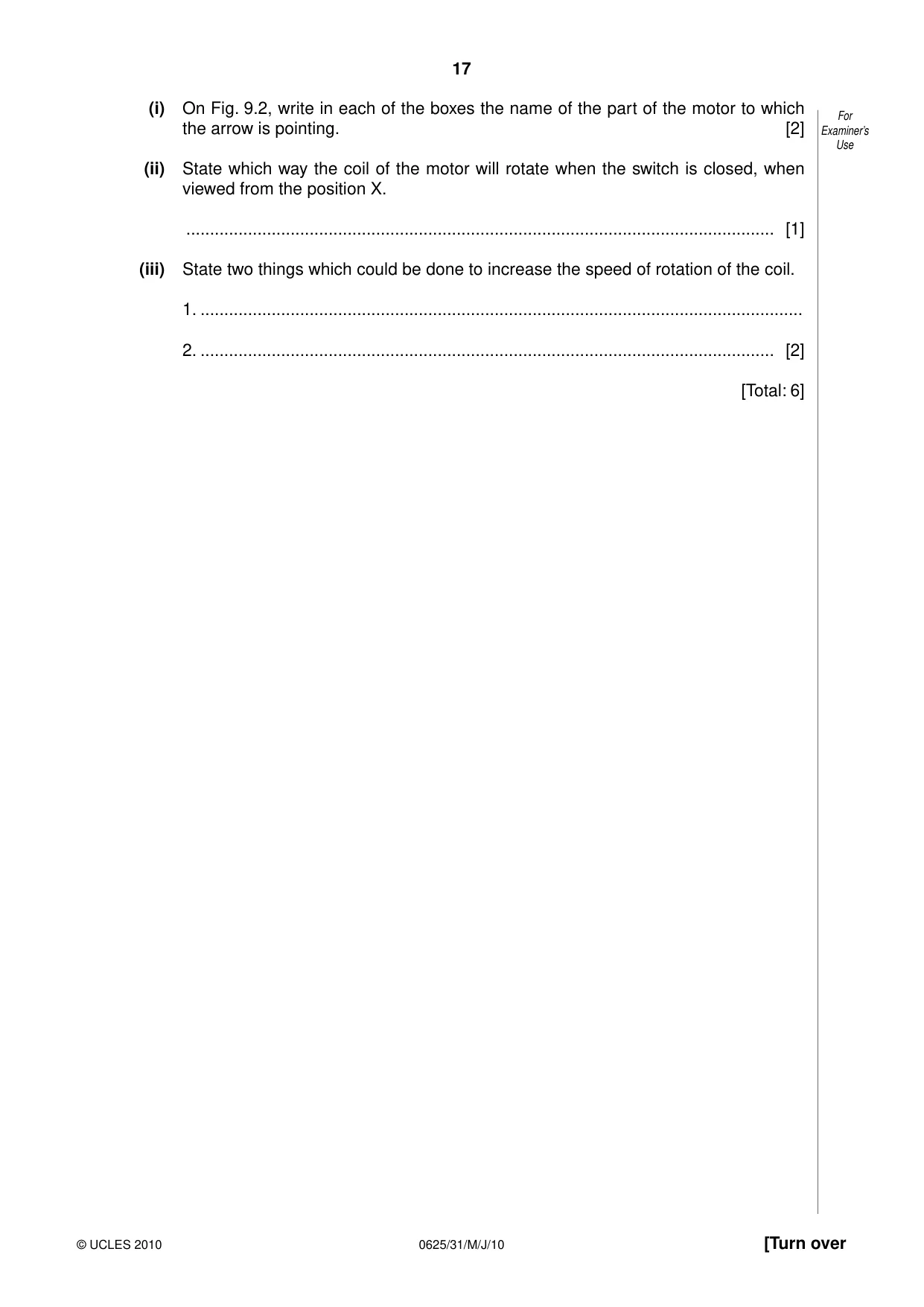
9 (a) Fig. 9.1 illustrates the left hand rule, which helps when describing the force on a current- For carrying conductor in a magnetic field. Examiner’s Use thumb motion / force first finger second finger Fig. 9.1 One direction has been labelled for you. In each of the other two boxes, write the name of the quantity that direction represents. [1] (b) Fig. 9.2 shows a simple d.c. motor connected to a battery and a switch. N S X switch battery Fig. 9.2 (i) On Fig. 9.2, write in each of the boxes the name of the part of the motor to which For the arrow is pointing. [2] Examiner’s Use (ii) State which way the coil of the motor will rotate when the switch is closed, when viewed from the position X. ............................................................................................................................ [1] (iii) State two things which could be done to increase the speed of rotation of the coil. 1. ............................................................................................................................... 2. ......................................................................................................................... [2] [Total: 6]
Mark scheme: 9 (a) first finger – field / magnetism / flux ) second finger – current / charge flow (NOT electron flow) ) both B1 (b) (i) brush OR contact OR sliding connector B1 split ring OR commutator NOT slip ring B1 (ii) clockwise OR right side down OR left side up OR correct arrows on figure NOT turn to the right B1 (iii) more current / more voltage / “stronger battery” / more power ) more turns on coil / more coils ) stronger magnet Ignore bigger magnets ) closer magnet / magnetic poles ) any 2 B1, B1 more magnets ) iron core ) [6] IGCSE – May/June 2010 0625 31
Q10 · A certain element is known to exist as two different isotopes
10 A certain element is known to exist as two different isotopes. For Examiner’s (a) State one thing that is the same for atoms of both isotopes. Use .................................................................................................................................... [1] (b) State one thing that is different between atoms of these two isotopes. .................................................................................................................................... [1] (c) An atom of one of these isotopes is unstable and decays into a different element by emitting a -particle. (i) State one thing about the atom that remains the same during this decay. ............................................................................................................................ [1] (ii) State one thing about the atom that changes as a result of this decay. ............................................................................................................................ [1] [Total: 4]
Mark scheme: 10 (a) proton number OR atomic number OR (number of) protons / electrons OR position in periodic table OR chemical properties B1 (b) mass (number) OR nucleon number OR (number of) neutrons / nucleons OR (number of) protons plus (number of) neutrons B1 (c) (i) mass (number) OR nucleon number OR (number of) nucleons OR (number of) protons plus (number of) neutrons B1 (ii) proton number OR atomic number OR (number of) neutrons OR (number of) protons / neutrons / electrons OR position in periodic table OR chemical properties OR a neutron changes into a proton B1 [4]
Q11 · A coil of wire is connected into a circuit containing a variable resistor and a battery
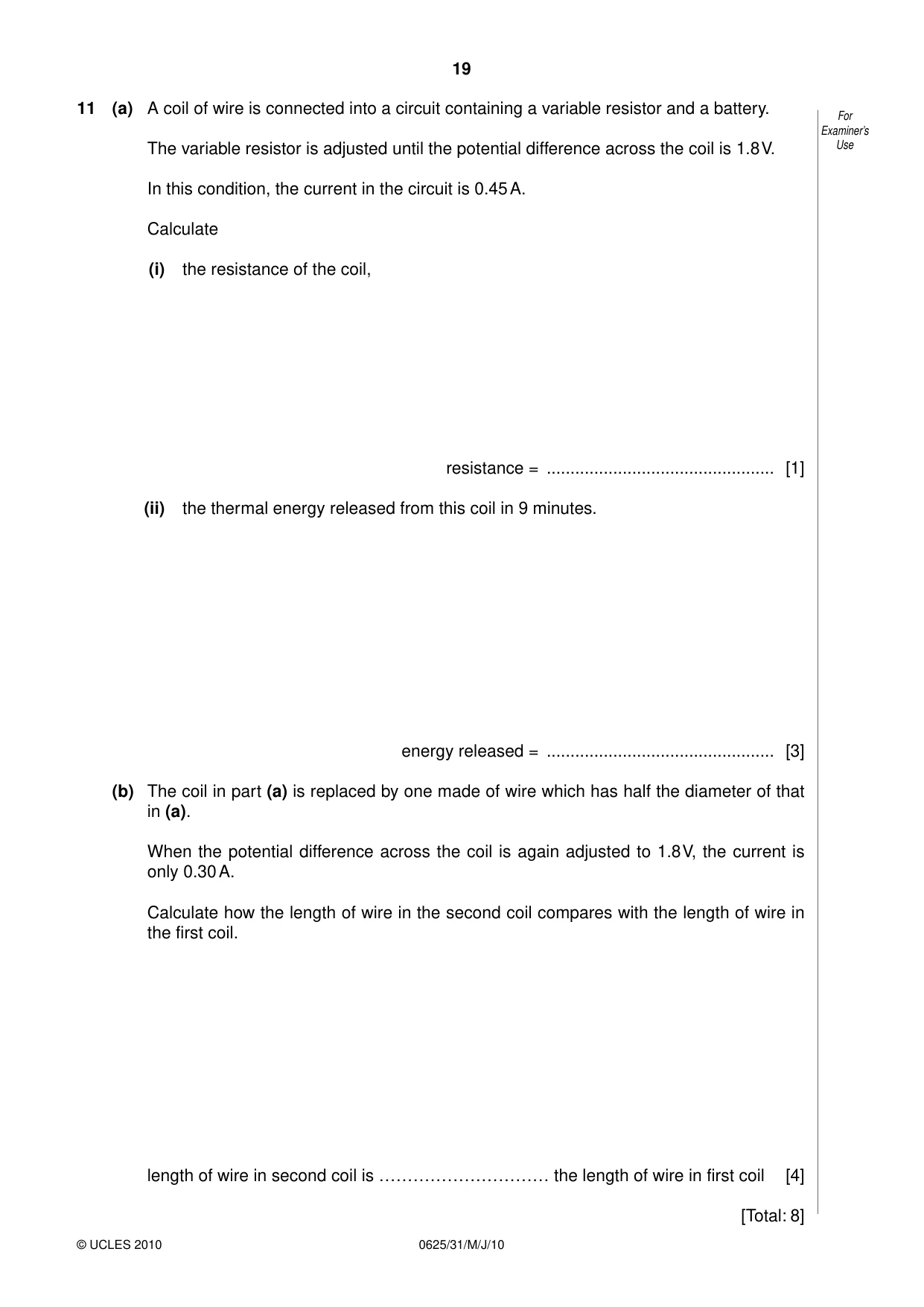
11 (a) A coil of wire is connected into a circuit containing a variable resistor and a battery. For Examiner’s The variable resistor is adjusted until the potential difference across the coil is 1.8 V. Use In this condition, the current in the circuit is 0.45 A. Calculate (i) the resistance of the coil, resistance = ................................................ [1] (ii) the thermal energy released from this coil in 9 minutes. energy released = ................................................ [3] (b) The coil in part (a) is replaced by one made of wire which has half the diameter of that in (a). When the potential difference across the coil is again adjusted to 1.8 V, the current is only 0.30 A. Calculate how the length of wire in the second coil compares with the length of wire in the first coil. length of wire in second coil is ………………………… the length of wire in first coil [4]
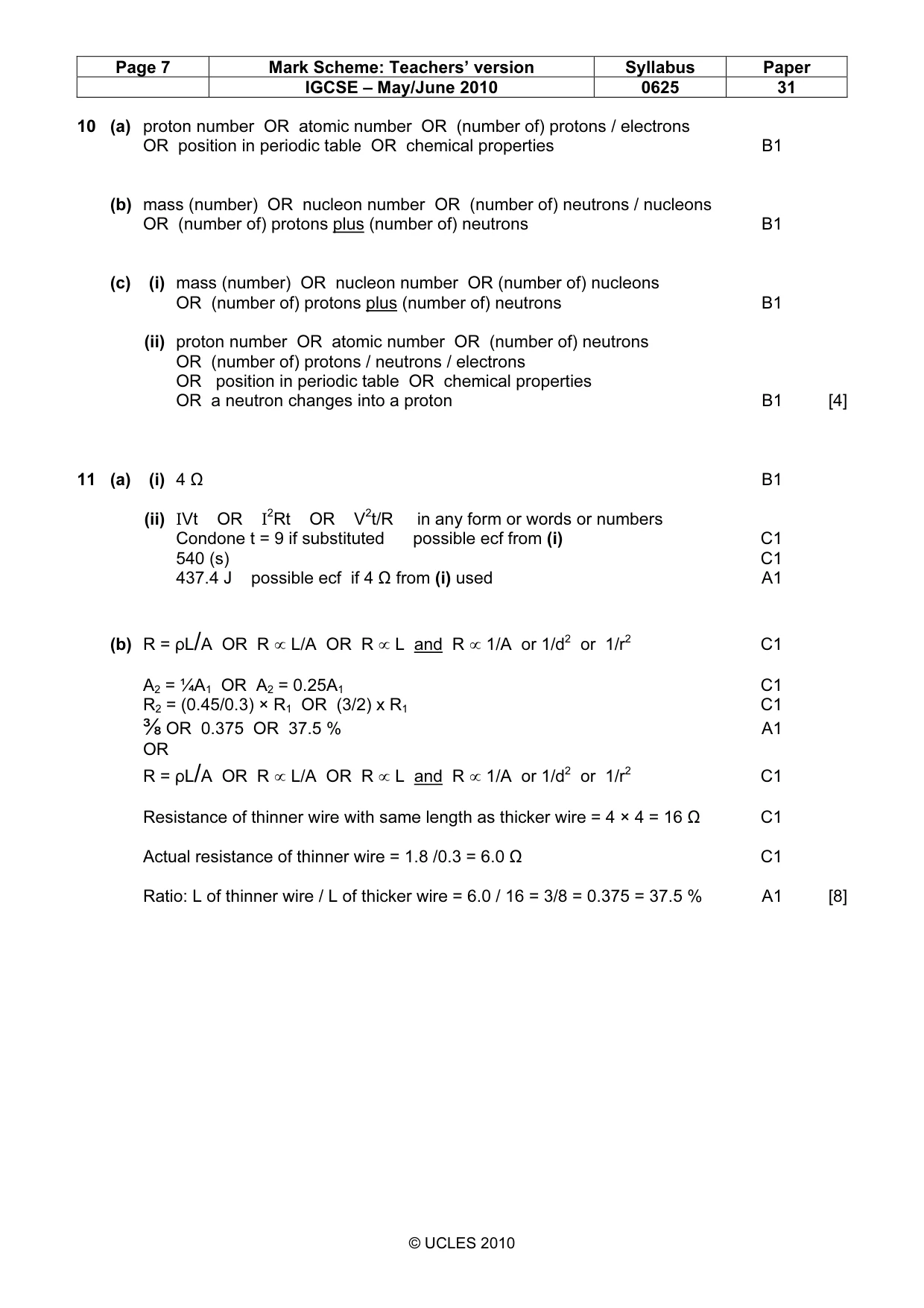
Mark scheme: 11 (a) (i) 4 Ω B1 (ii) IVt OR I2Rt OR V2t/R in any form or words or numbers Condone t = 9 if substituted possible ecf from (i) C1 540 (s) C1 437.4 J possible ecf if 4 Ω from (i) used A1 (b) R = ρL/A OR R ∝ L/A OR R ∝ L and R ∝ 1/A or 1/d2 or 1/r2 C1 A2 = ¼A1 OR A2 = 0.25A1 C1 R2 = (0.45/0.3) × R1 OR (3/2) x R1 C1 ⅜ OR 0.375 OR 37.5 % A1 OR R = ρL/A OR R ∝ L/A OR R ∝ L and R ∝ 1/A or 1/d2 or 1/r2 C1 Resistance of thinner wire with same length as thicker wire = 4 × 4 = 16 Ω C1 Actual resistance of thinner wire = 1.8 /0.3 = 6.0 Ω C1 Ratio: L of thinner wire / L of thicker wire = 6.0 / 16 = 3/8 = 0.375 = 37.5 % A1 [8]
What was in this paper
The subtopics covered by these 11 questions, and how many questions each got. Open one in a new tab to see every Cambridge question on it.
What you needed in this session
Cambridge’s own grade thresholds for 2010 May/June, Paper 3 · Variant 1. A higher threshold means an easier paper — the bar moves with how the cohort did.