Cambridge IGCSE Physics 0625 — 2024 May/June Paper 3 · Variant 2
0625/32/M/J/24 · 11 questions · 80 marks · ≈90 min
The question paper and its mark scheme, free to read here and free to download. This is Cambridge’s own paper, exactly as it was sat.
Question paper16 pages
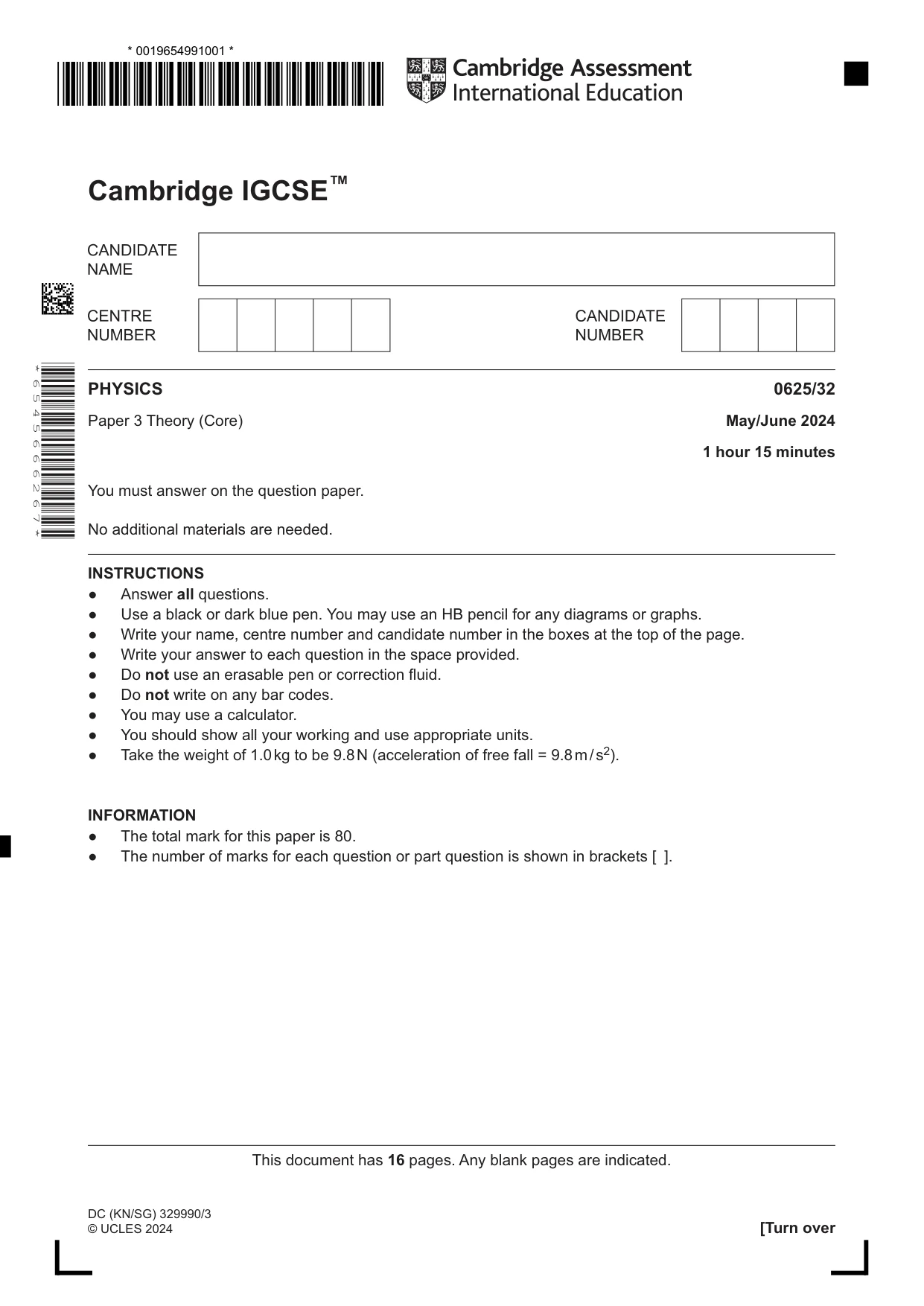
Mark scheme13 pages
Answers below. Sit the paper first if you are practising.
Questions as text
Q1 · The speed–time graph for a car travelling along a flat straight road
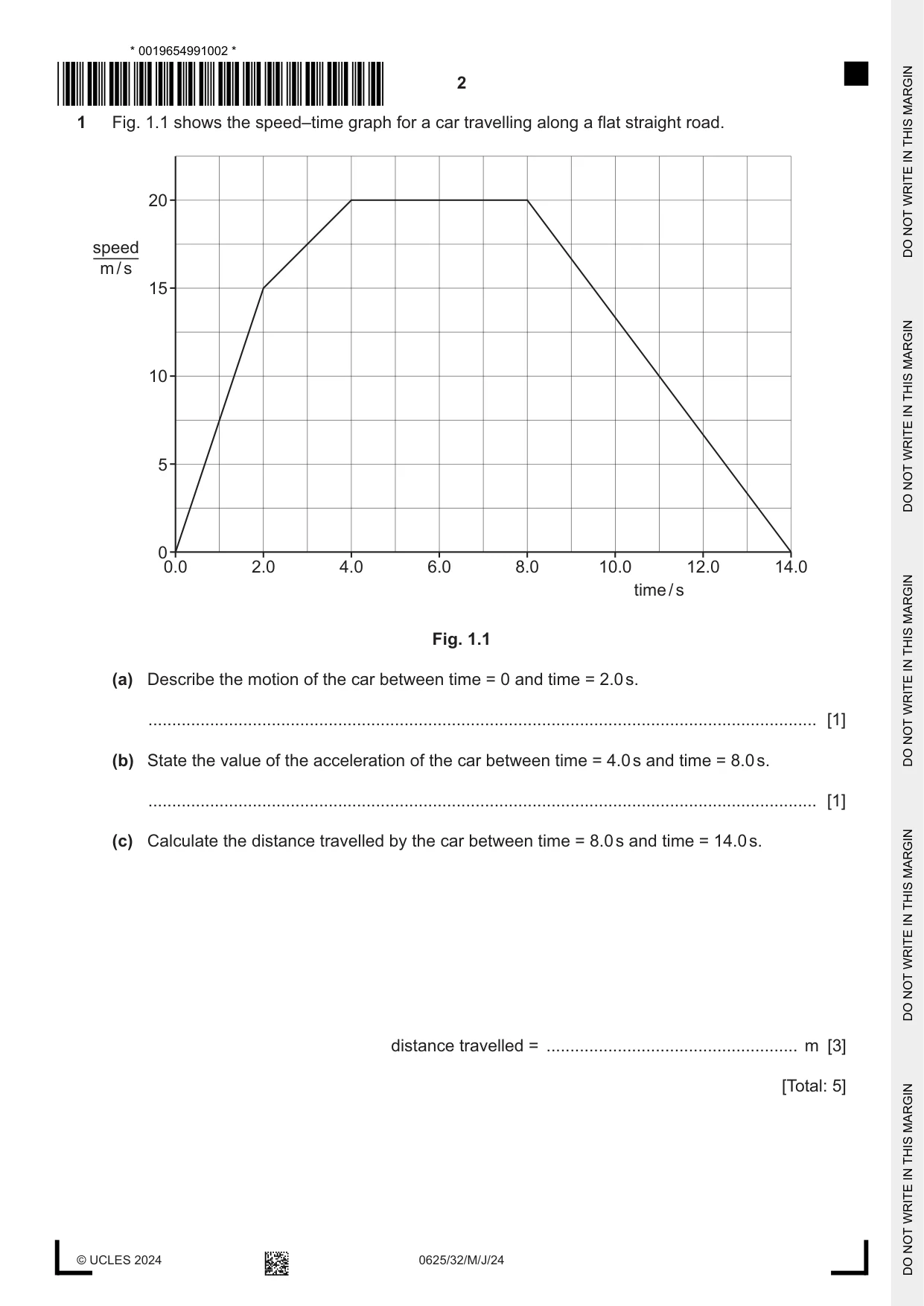
1 Fig. 1.1 shows the speed–time graph for a car travelling along a flat straight road. 20 speed m / s 15 10 5 0 0.0 2.0 4.0 6.0 8.0 10.0 12.0 14.0 time / s Fig. 1.1 (a) Describe the motion of the car between time = 0 and time = 2.0 s. ............................................................................................................................................. [1] (b) State the value of the acceleration of the car between time = 4.0 s and time = 8.0 s. ............................................................................................................................................. [1] (c) Calculate the distance travelled by the car between time = 8.0 s and time = 14.0 s. distance travelled = ..................................................... m [3] [Total: 5]
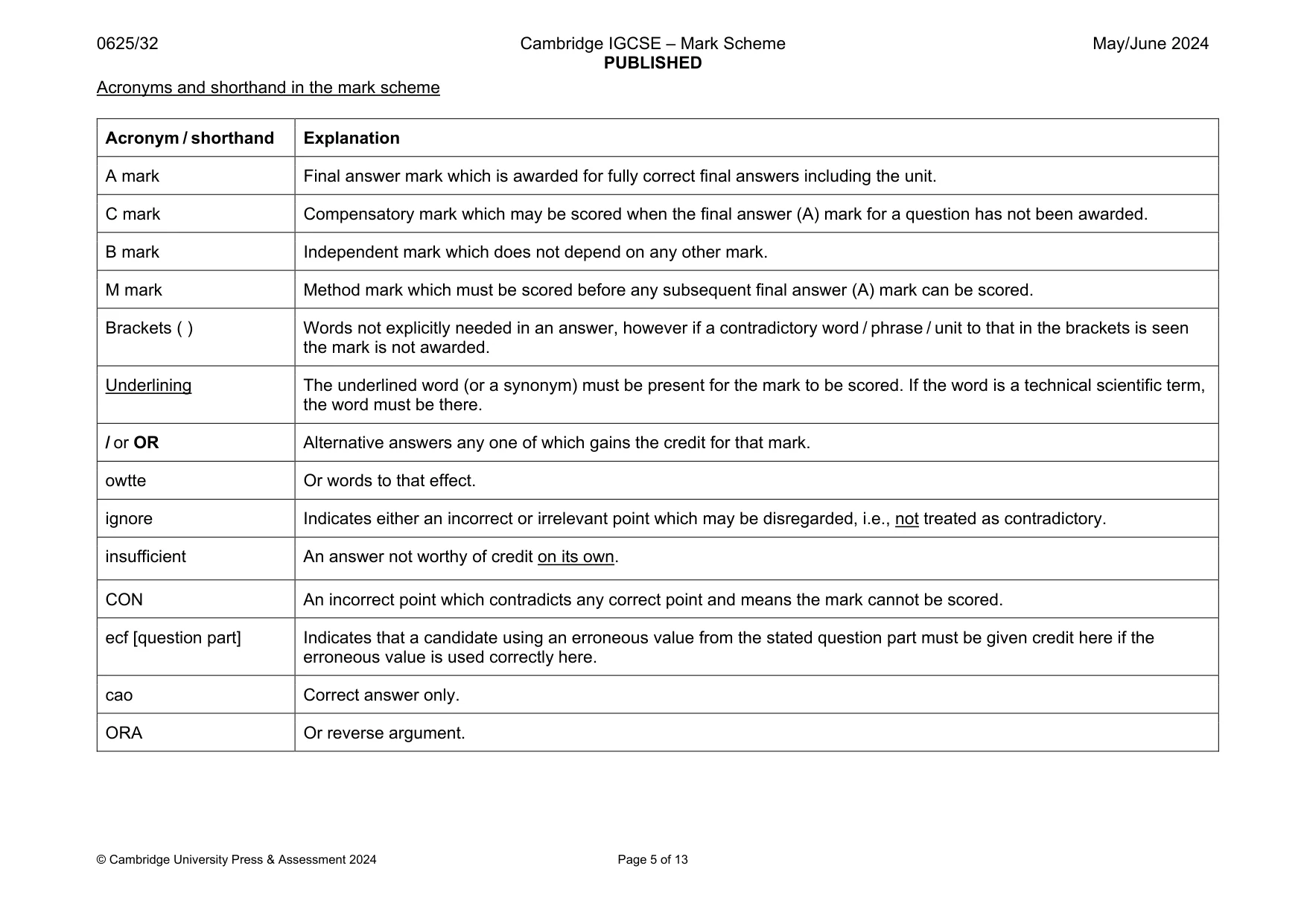
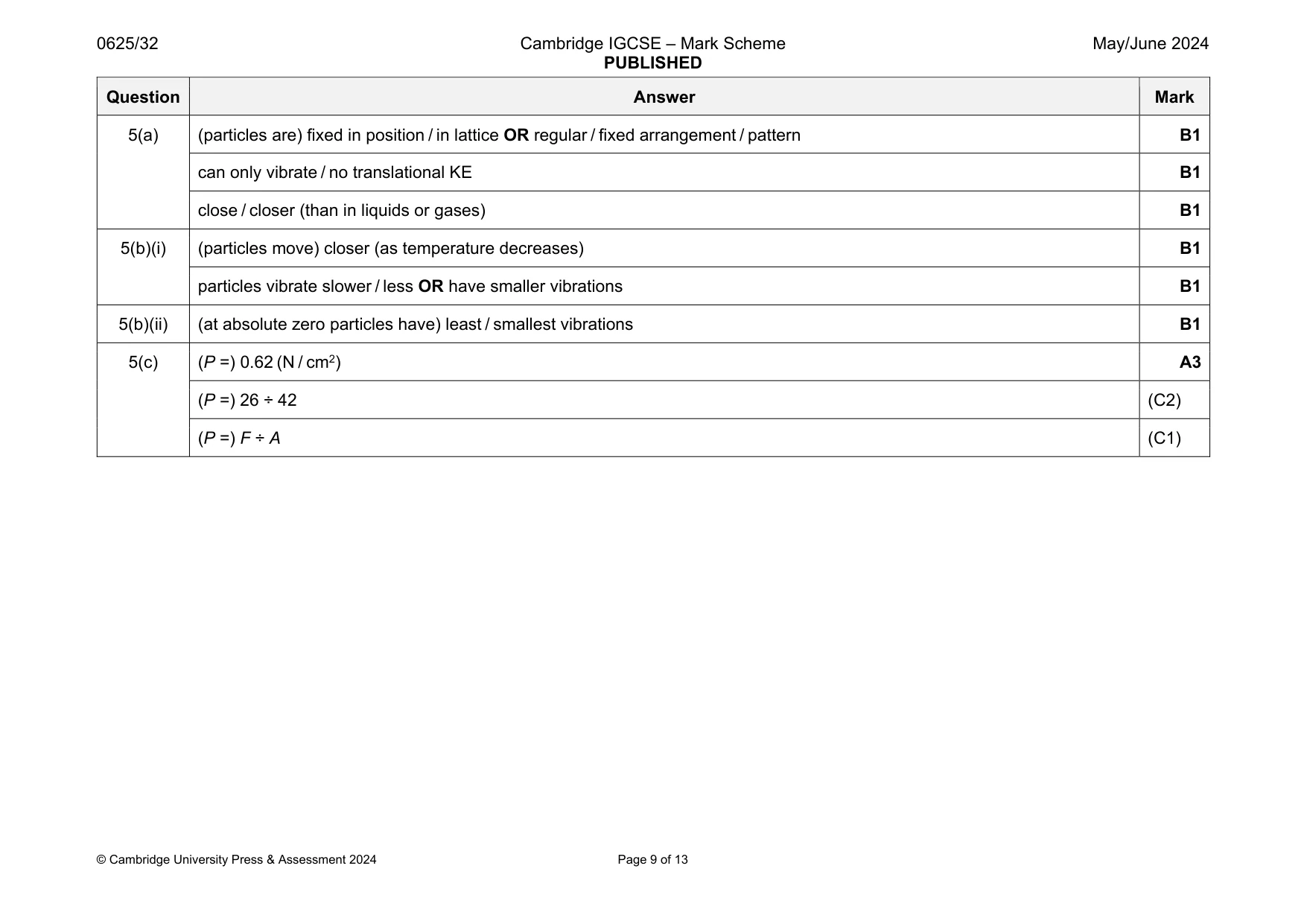
Mark scheme: 1(a) (constant) acceleration OR accelerating OR increasing speed B1 1(b) zero B1 1(c) 60 (m) A3 ½ 6(.0) 20 (C2) distance = area under (speed–time) graph OR ½ b h (C1)
Q2 · A student wants to find the volume of a piece of metal
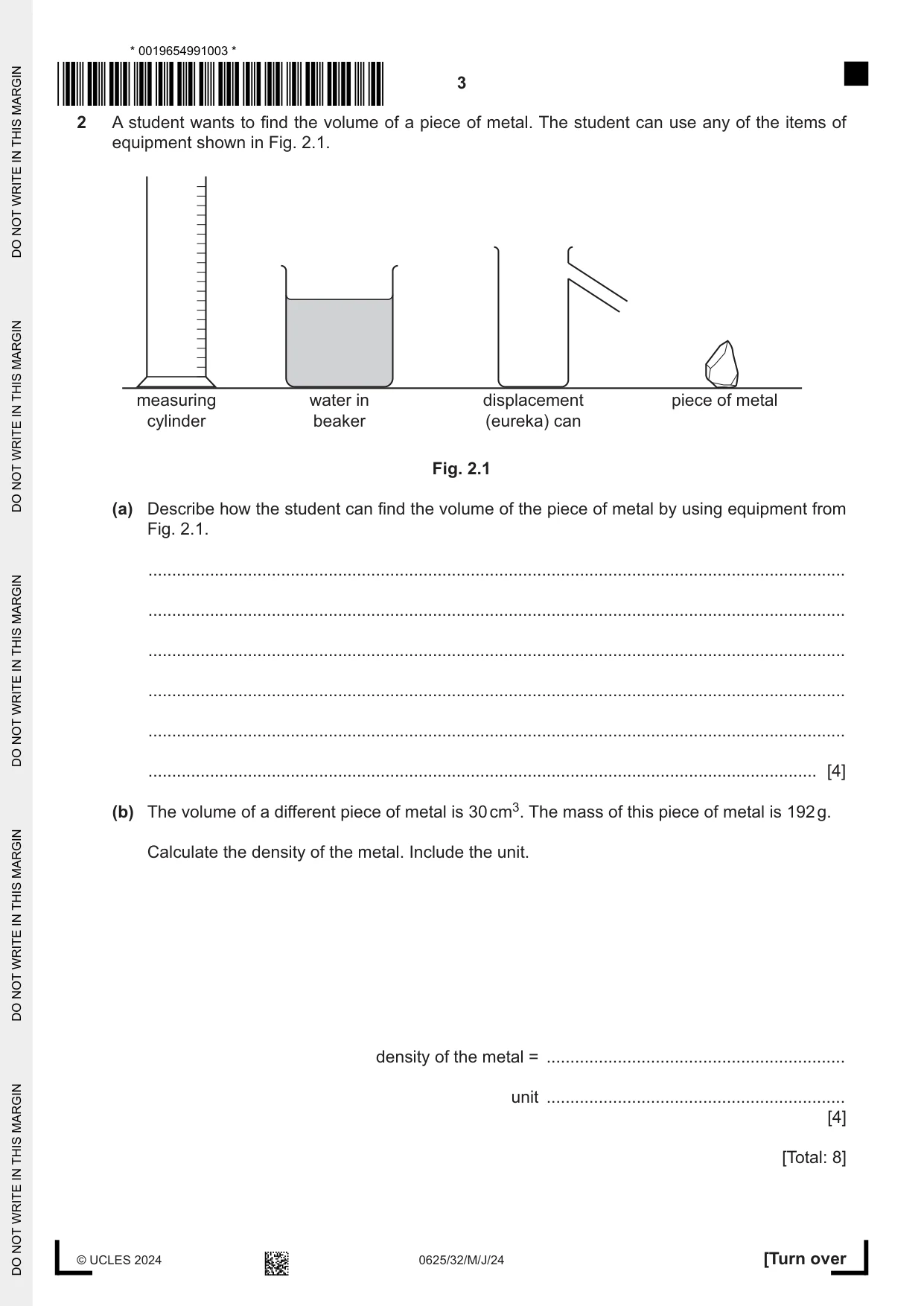
2 A student wants to find the volume of a piece of metal. The student can use any of the items of equipment shown in Fig. 2.1. measuring water in displacement piece of metal cylinder beaker (eureka) can Fig. 2.1 (a) Describe how the student can find the volume of the piece of metal by using equipment from Fig. 2.1. ................................................................................................................................................... ................................................................................................................................................... ................................................................................................................................................... ................................................................................................................................................... ................................................................................................................................................... ............................................................................................................................................. [4] (b) The volume of a different piece of metal is 30 cm3. The mass of this piece of metal is 192 g. Calculate the density of the metal. Include the unit. density of the metal = ............................................................... unit ............................................................... [4] [Total: 8]
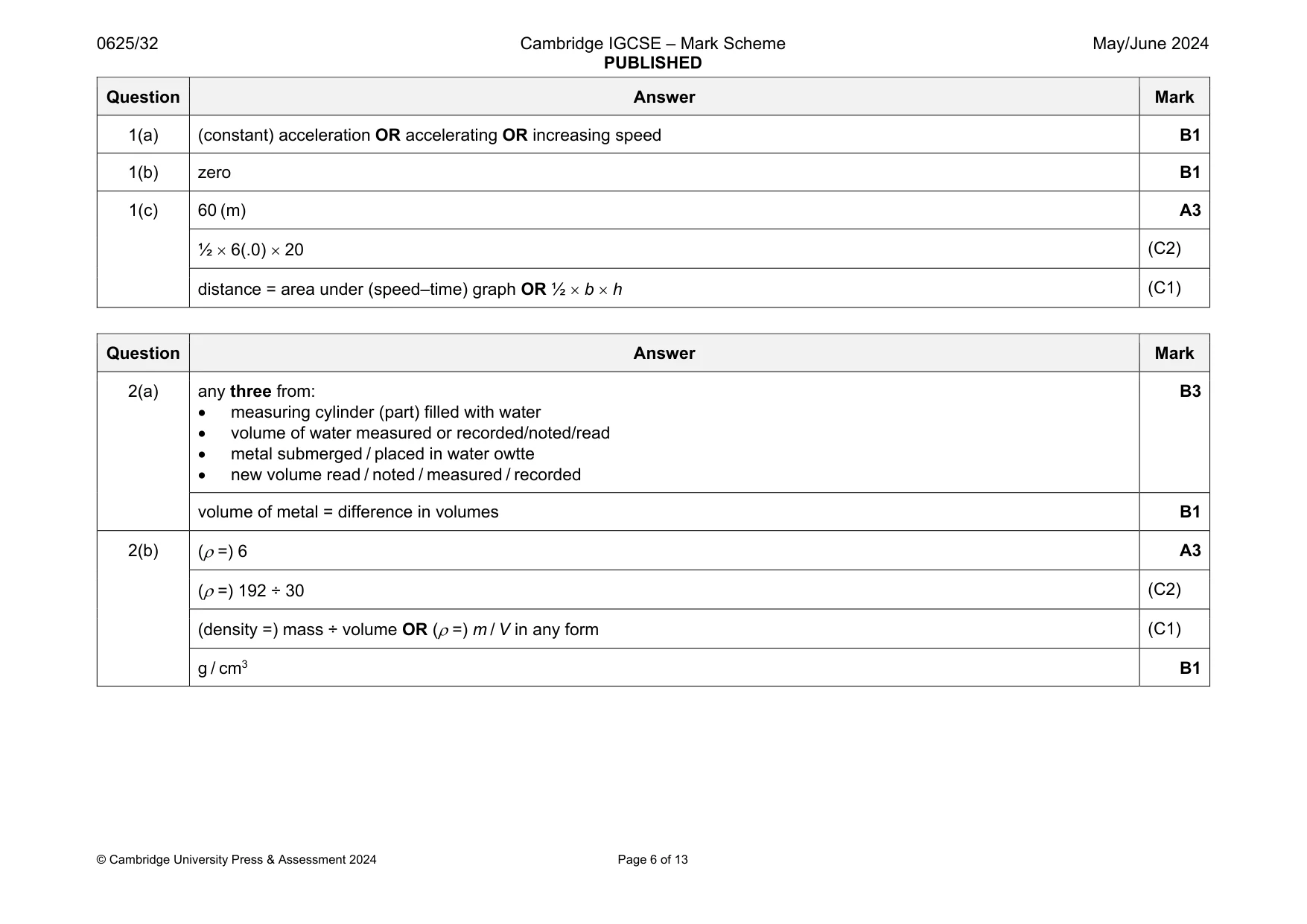
Mark scheme: 2(a) any three from: measuring cylinder (part) filled with water volume of water measured or recorded/noted/read metal submerged / placed in water owtte new volume read / noted / measured / recorded volume of metal = difference in volumes B1 2(b) ( =) 6 A3 ( =) 192 ÷ 30 (C2) (density =) mass ÷ volume OR ( =) m / V in any form (C1) g / cm3 B1
More questions on Physical quantities and measurement techniques
Q3 · Two solid shapes, a cylinder and a cone, which are made from the same material
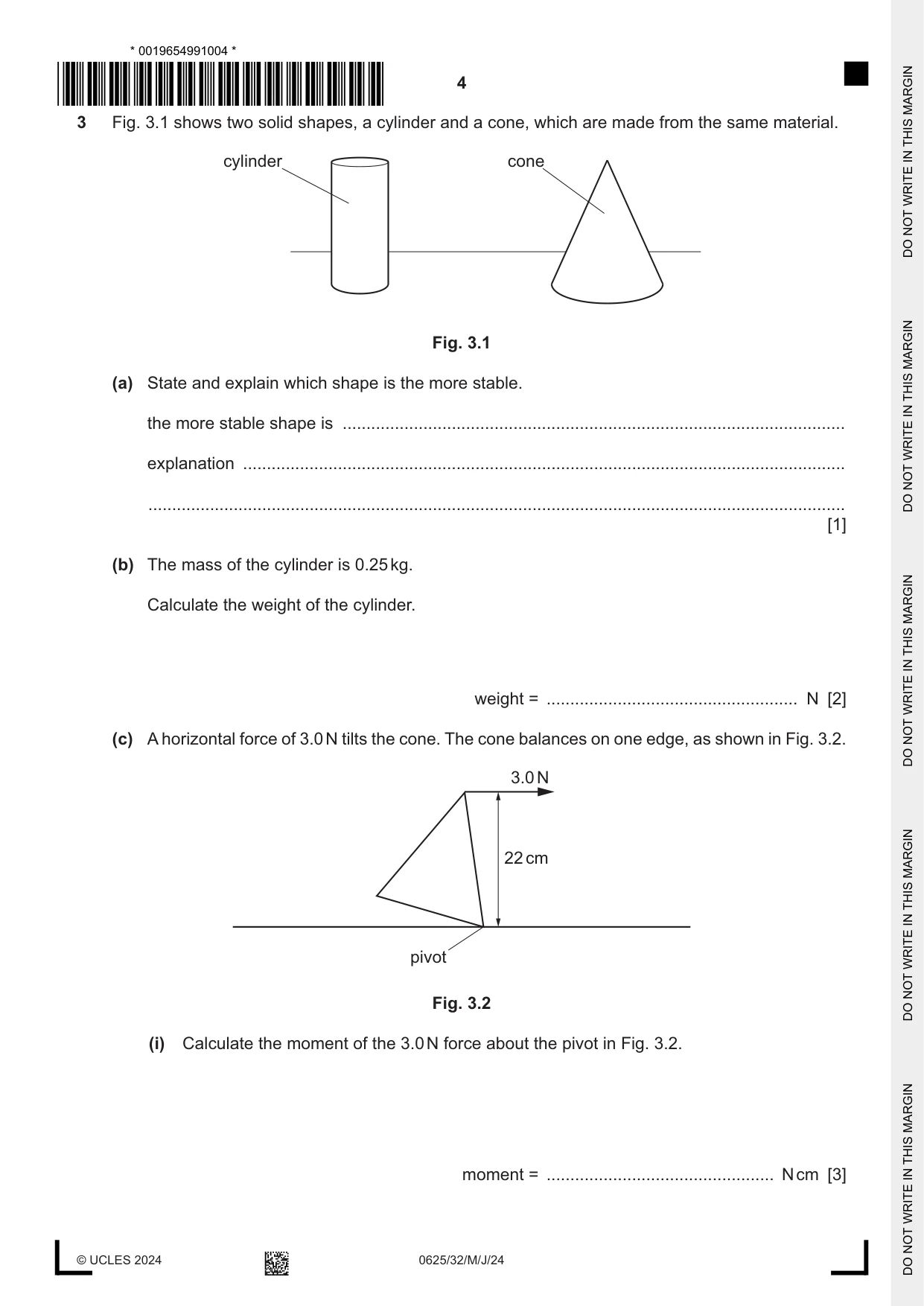
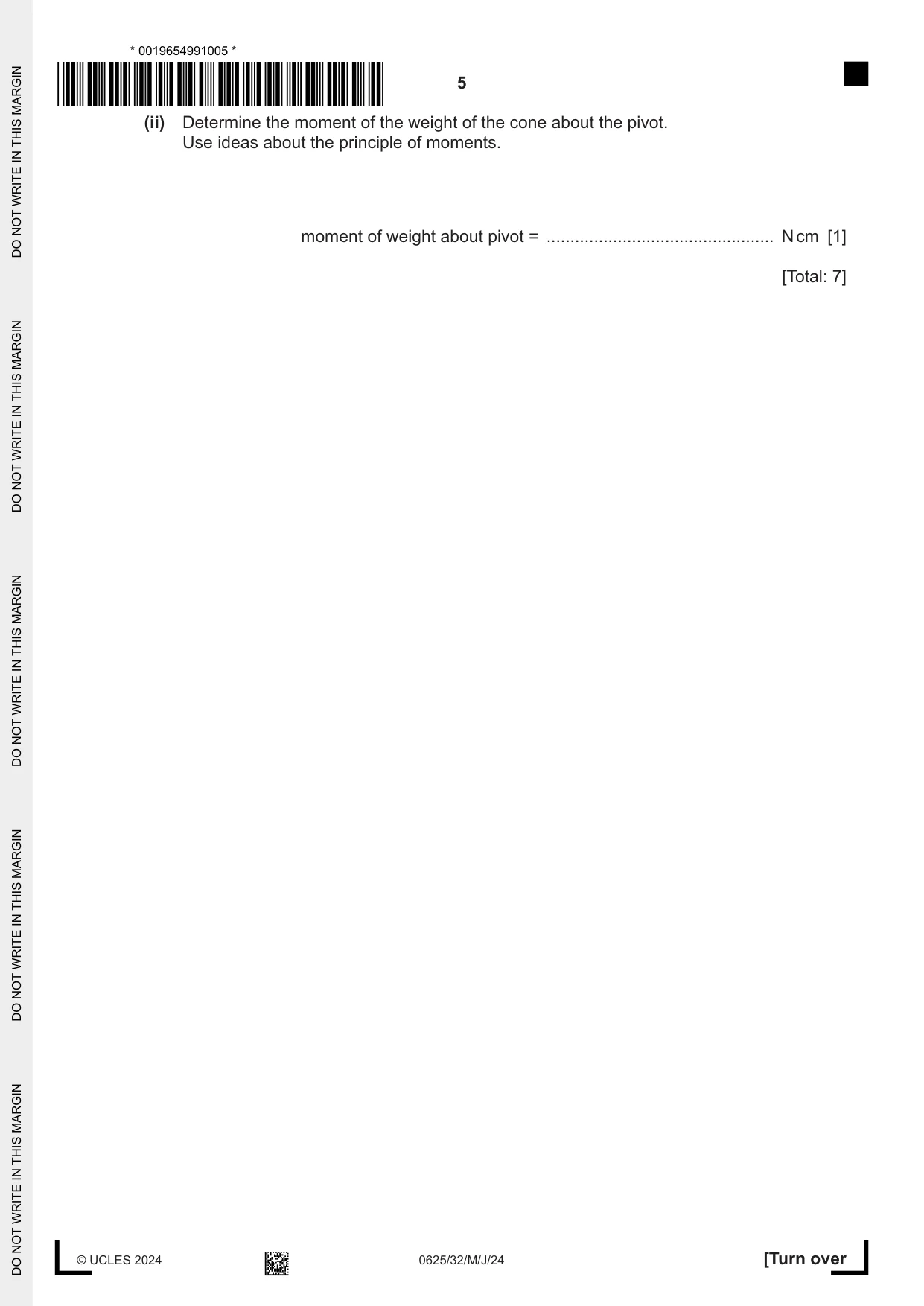
3 Fig. 3.1 shows two solid shapes, a cylinder and a cone, which are made from the same material. cylinder cone Fig. 3.1 (a) State and explain which shape is the more stable. the more stable shape is .......................................................................................................... explanation ............................................................................................................................... ................................................................................................................................................... [1] (b) The mass of the cylinder is 0.25 kg. Calculate the weight of the cylinder. weight = ..................................................... N [2] (c) A horizontal force of 3.0 N tilts the cone. The cone balances on one edge, as shown in Fig. 3.2. 3.0 N 22 cm pivot Fig. 3.2 (i) Calculate the moment of the 3.0 N force about the pivot in Fig. 3.2. moment = ................................................ N cm [3] (ii) Determine the moment of the weight of the cone about the pivot. Use ideas about the principle of moments. moment of weight about pivot = ................................................ N cm [1] [Total: 7]
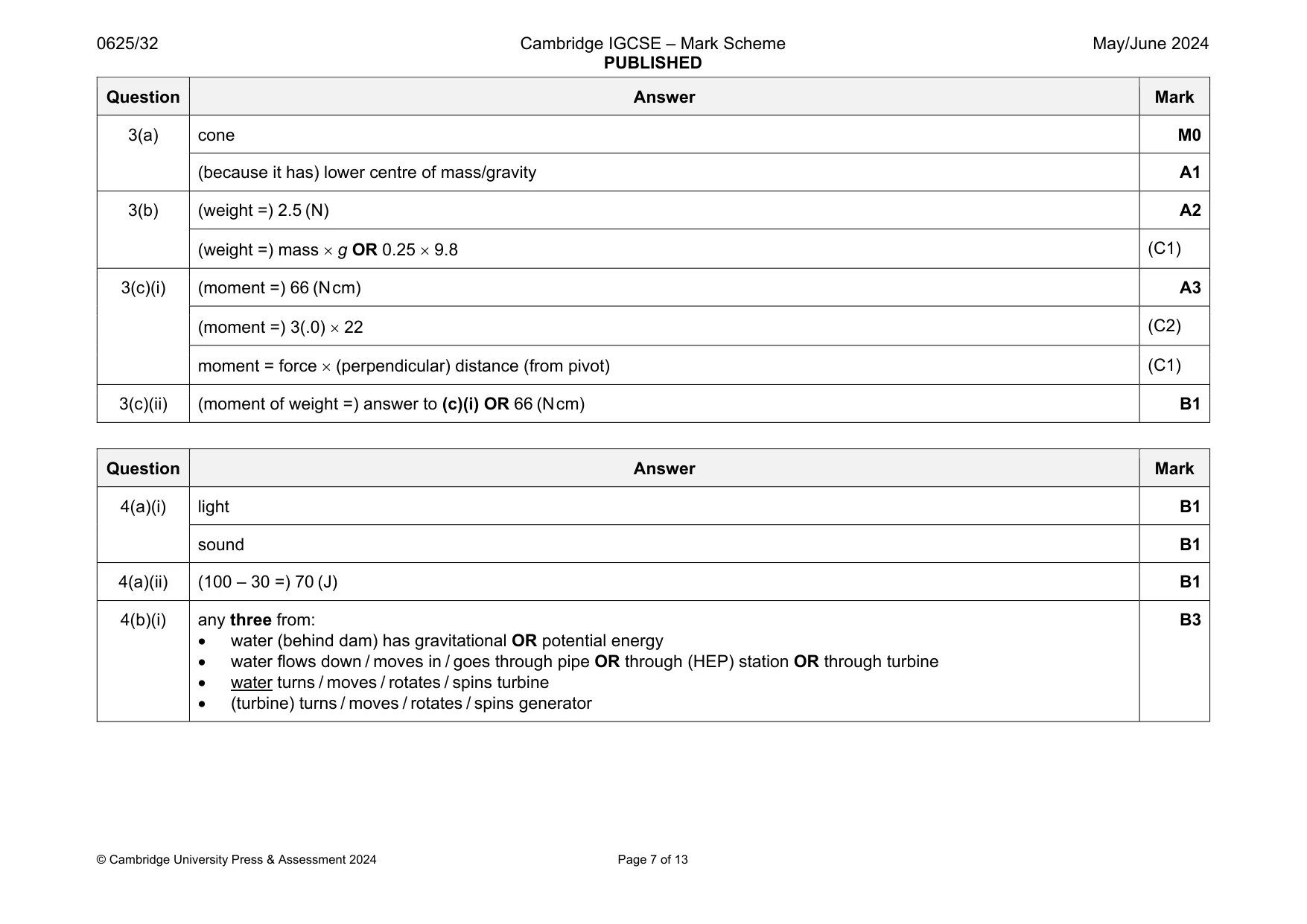
Mark scheme: 3(a) cone M0 (because it has) lower centre of mass/gravity A1 3(b) (weight =) 2.5 (N) A2 (weight =) mass g OR 0.25 9.8 (C1) 3(c)(i) (moment =) 66 (N cm) A3 (moment =) 3(.0) 22 (C2) moment = force (perpendicular) distance (from pivot) (C1) 3(c)(ii) (moment of weight =) answer to (c)(i) OR 66 (N cm) B1
Q4 · A flow diagram for the energy transferred in a television
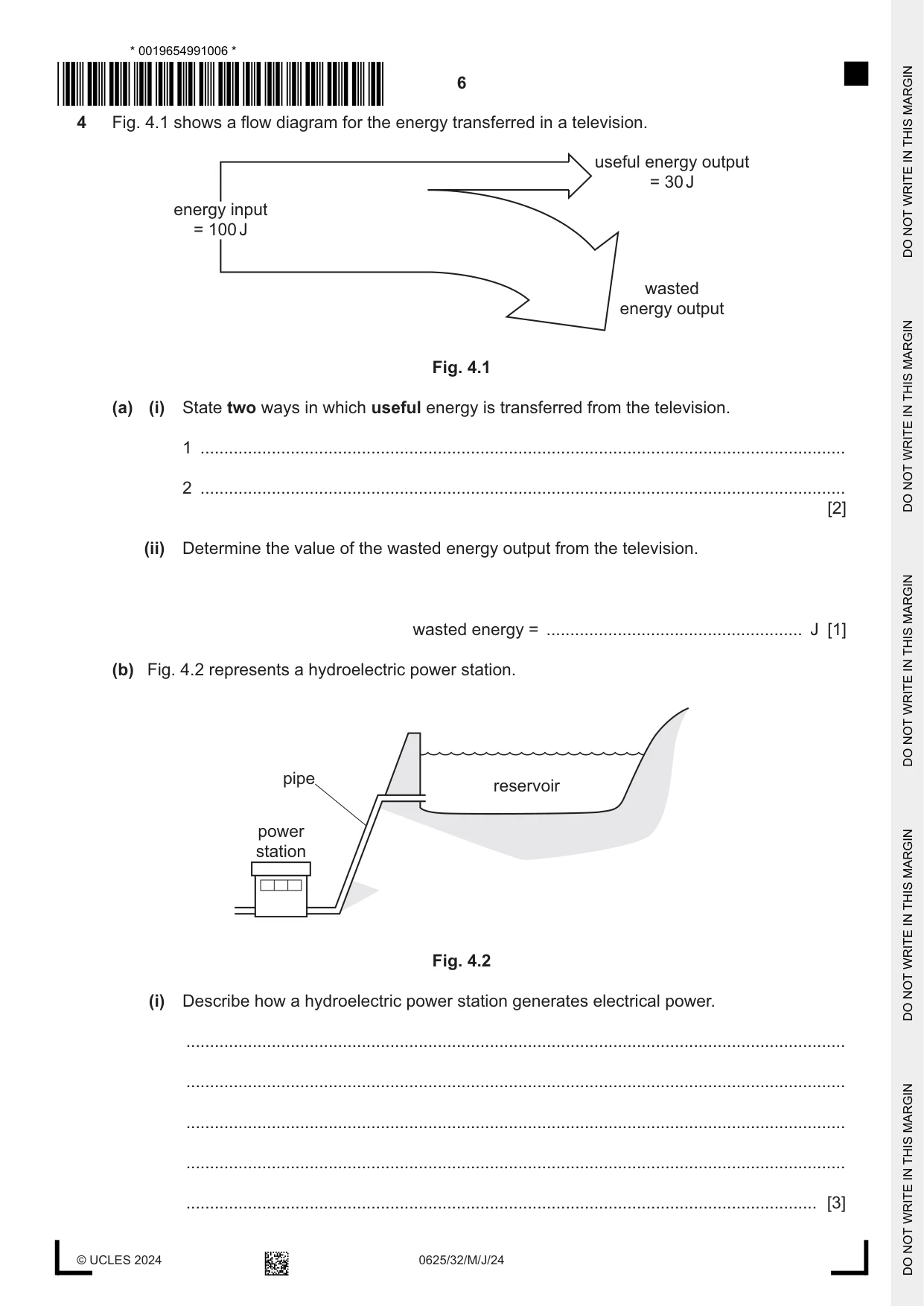
4 Fig. 4.1 shows a flow diagram for the energy transferred in a television. useful energy output = 30 J energy input = 100 J wasted energy output Fig. 4.1 (a) (i) State two ways in which useful energy is transferred from the television. 1 ........................................................................................................................................ 2 ........................................................................................................................................ [2] (ii) Determine the value of the wasted energy output from the television. wasted energy = ...................................................... J [1] (b) Fig. 4.2 represents a hydroelectric power station. pipe reservoir power station Fig. 4.2 (i) Describe how a hydroelectric power station generates electrical power. ........................................................................................................................................... ........................................................................................................................................... ........................................................................................................................................... ........................................................................................................................................... ..................................................................................................................................... [3] (ii) Apart from cost, state one advantage and one disadvantage of generating electrical power using a hydroelectric power station compared to a coal-fired power station. advantage ......................................................................................................................... ........................................................................................................................................... disadvantage ..................................................................................................................... ........................................................................................................................................... [2] [Total: 8]
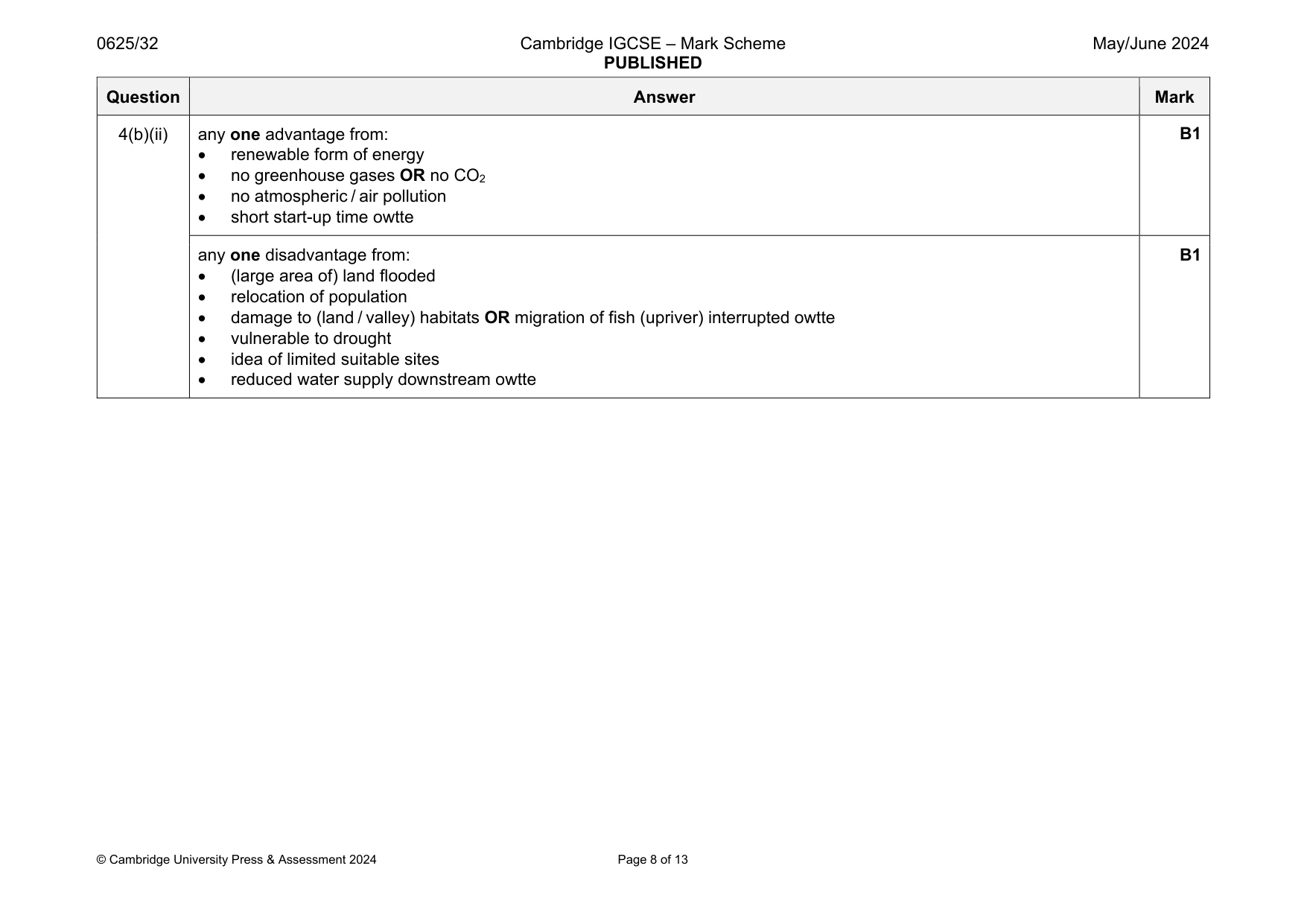
Mark scheme: 4(a)(i) light B1 sound B1 4(a)(ii) (100 – 30 =) 70 (J) B1 4(b)(i) any three from: water (behind dam) has gravitational OR potential energy water flows down / moves in / goes through pipe OR through (HEP) station OR through turbine water turns / moves / rotates / spins turbine (turbine) turns / moves / rotates / spins generator B3 Question Answer Mark 4(b)(ii) any one advantage from: renewable form of energy no greenhouse gases OR no CO2 no atmospheric / air pollution short start-up time owtte B1 any one disadvantage from: (large area of) land flooded relocation of population damage to (land / valley) habitats OR migration of fish (upriver) interrupted owtte vulnerable to drought idea of limited suitable sites reduced water supply downstream owtte B1
Q5 · A metal block at room temperature on a table
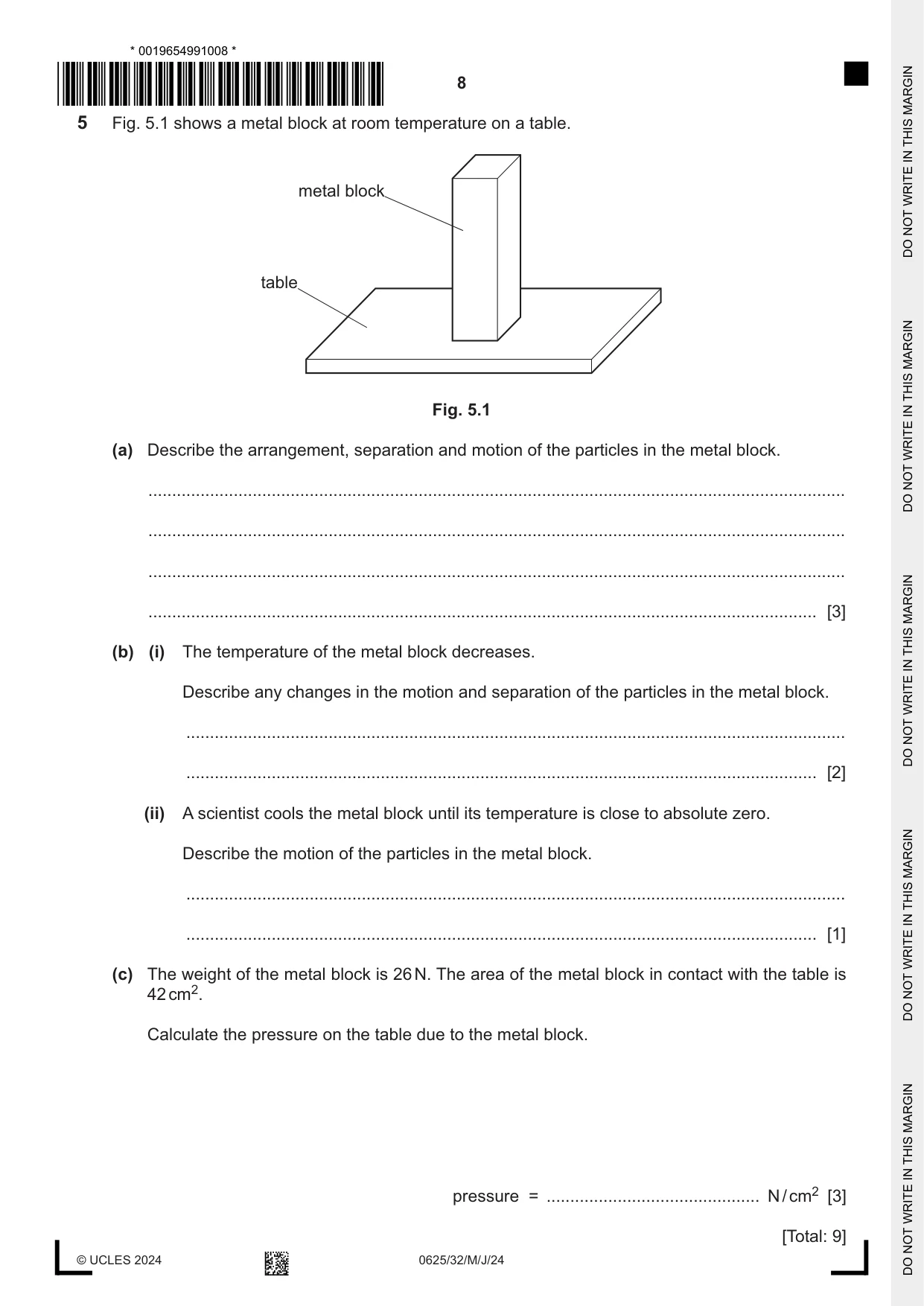
5 Fig. 5.1 shows a metal block at room temperature on a table. metal block table Fig. 5.1 (a) Describe the arrangement, separation and motion of the particles in the metal block. ................................................................................................................................................... ................................................................................................................................................... ................................................................................................................................................... ............................................................................................................................................. [3] (b) (i) The temperature of the metal block decreases. Describe any changes in the motion and separation of the particles in the metal block. ........................................................................................................................................... ..................................................................................................................................... [2] (ii) A scientist cools the metal block until its temperature is close to absolute zero. Describe the motion of the particles in the metal block. ........................................................................................................................................... ..................................................................................................................................... [1] (c) The weight of the metal block is 26 N. The area of the metal block in contact with the table is 42 cm2. Calculate the pressure on the table due to the metal block. pressure = ............................................. N / cm2 [3] [Total: 9]
Mark scheme: 5(a) (particles are) fixed in position / in lattice OR regular / fixed arrangement / pattern B1 can only vibrate / no translational KE B1 close / closer (than in liquids or gases) B1 5(b)(i) (particles move) closer (as temperature decreases) B1 particles vibrate slower / less OR have smaller vibrations B1 5(b)(ii) (at absolute zero particles have) least / smallest vibrations B1 5(c) (P =) 0.62 (N / cm2) A3 (P =) 26 ÷ 42 (C2) (P =) F ÷ A (C1)
Q6 · A student studies different types of wave
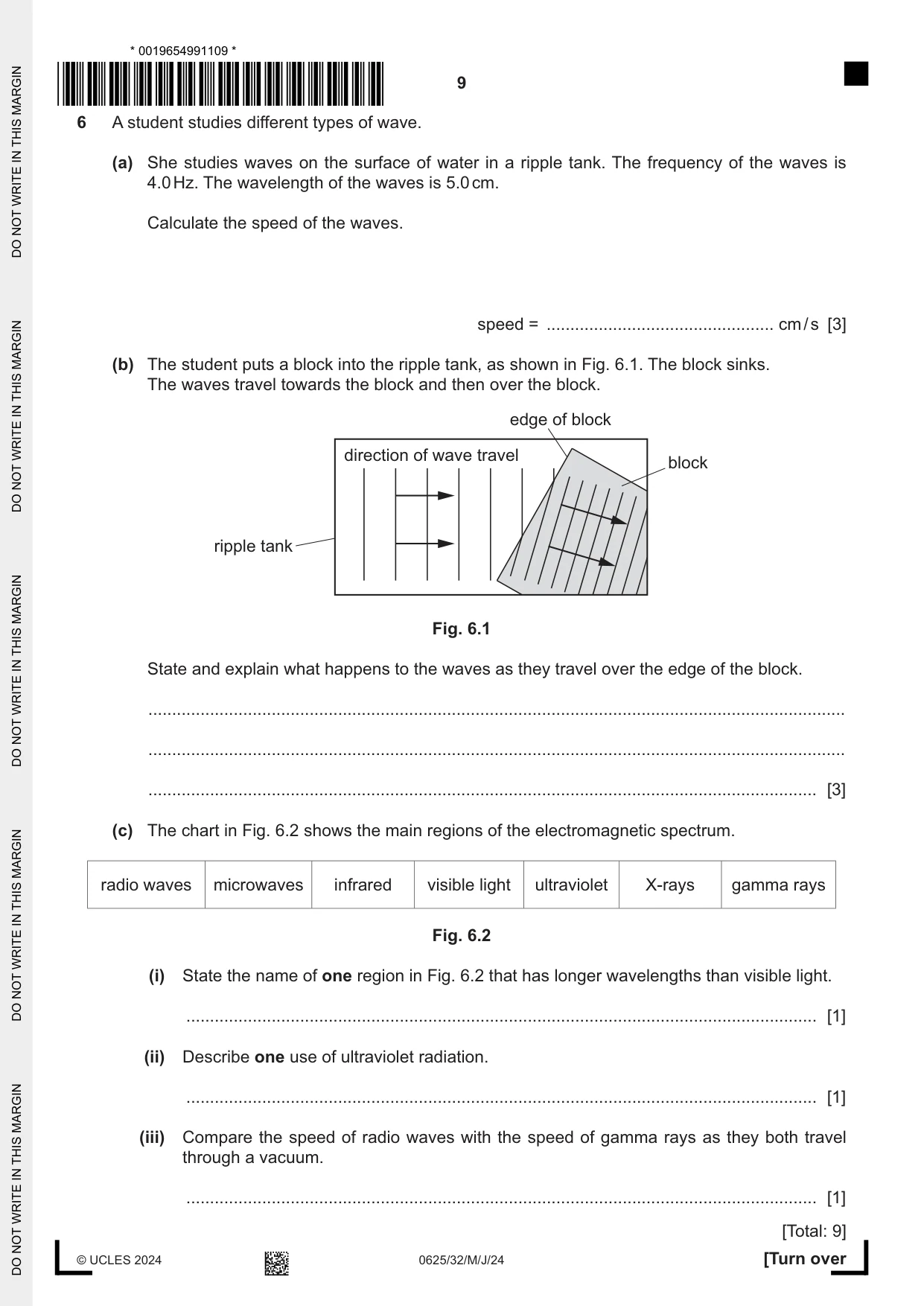
6 A student studies different types of wave. (a) She studies waves on the surface of water in a ripple tank. The frequency of the waves is 4.0 Hz. The wavelength of the waves is 5.0 cm. Calculate the speed of the waves. speed = ................................................ cm / s [3] (b) The student puts a block into the ripple tank, as shown in Fig. 6.1. The block sinks. The waves travel towards the block and then over the block. edge of block direction of wave travel block ripple tank Fig. 6.1 State and explain what happens to the waves as they travel over the edge of the block. ................................................................................................................................................... ................................................................................................................................................... ............................................................................................................................................. [3] (c) The chart in Fig. 6.2 shows the main regions of the electromagnetic spectrum. radio waves microwaves infrared visible light ultraviolet X-rays gamma rays Fig. 6.2 (i) State the name of one region in Fig. 6.2 that has longer wavelengths than visible light. ..................................................................................................................................... [1] (ii) Describe one use of ultraviolet radiation. ..................................................................................................................................... [1] (iii) Compare the speed of radio waves with the speed of gamma rays as they both travel through a vacuum. ..................................................................................................................................... [1] [Total: 9]
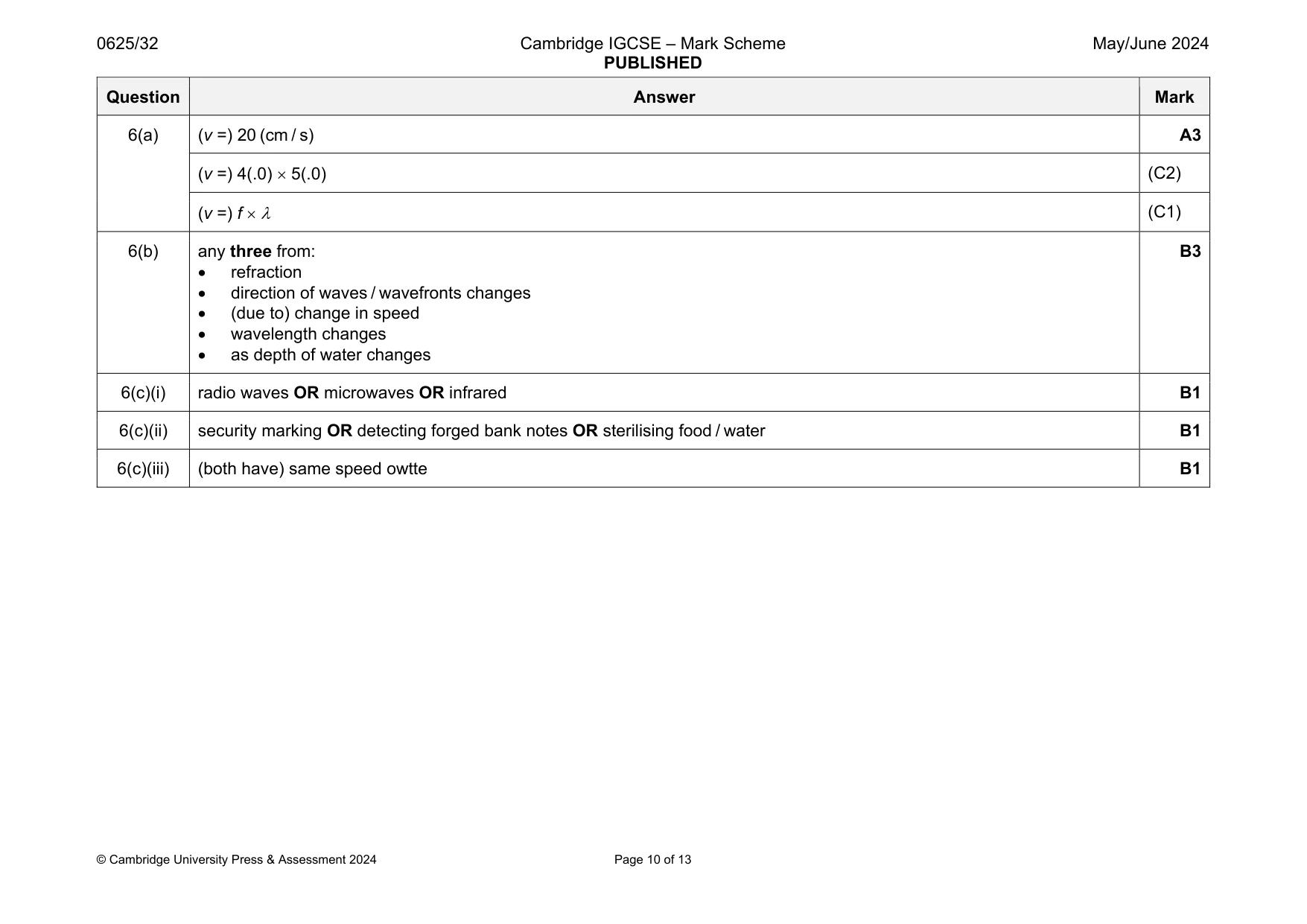
Mark scheme: 6(a) (v =) 20 (cm / s) A3 (v =) 4(.0) 5(.0) (C2) (v =) f (C1) 6(b) any three from: refraction direction of waves / wavefronts changes (due to) change in speed wavelength changes as depth of water changes B3 6(c)(i) radio waves OR microwaves OR infrared B1 6(c)(ii) security marking OR detecting forged bank notes OR sterilising food / water B1 6(c)(iii) (both have) same speed owtte B1
Q7 · A battery, a lamp L, a fixed resistor R and a switch S are connected as shown in Fig
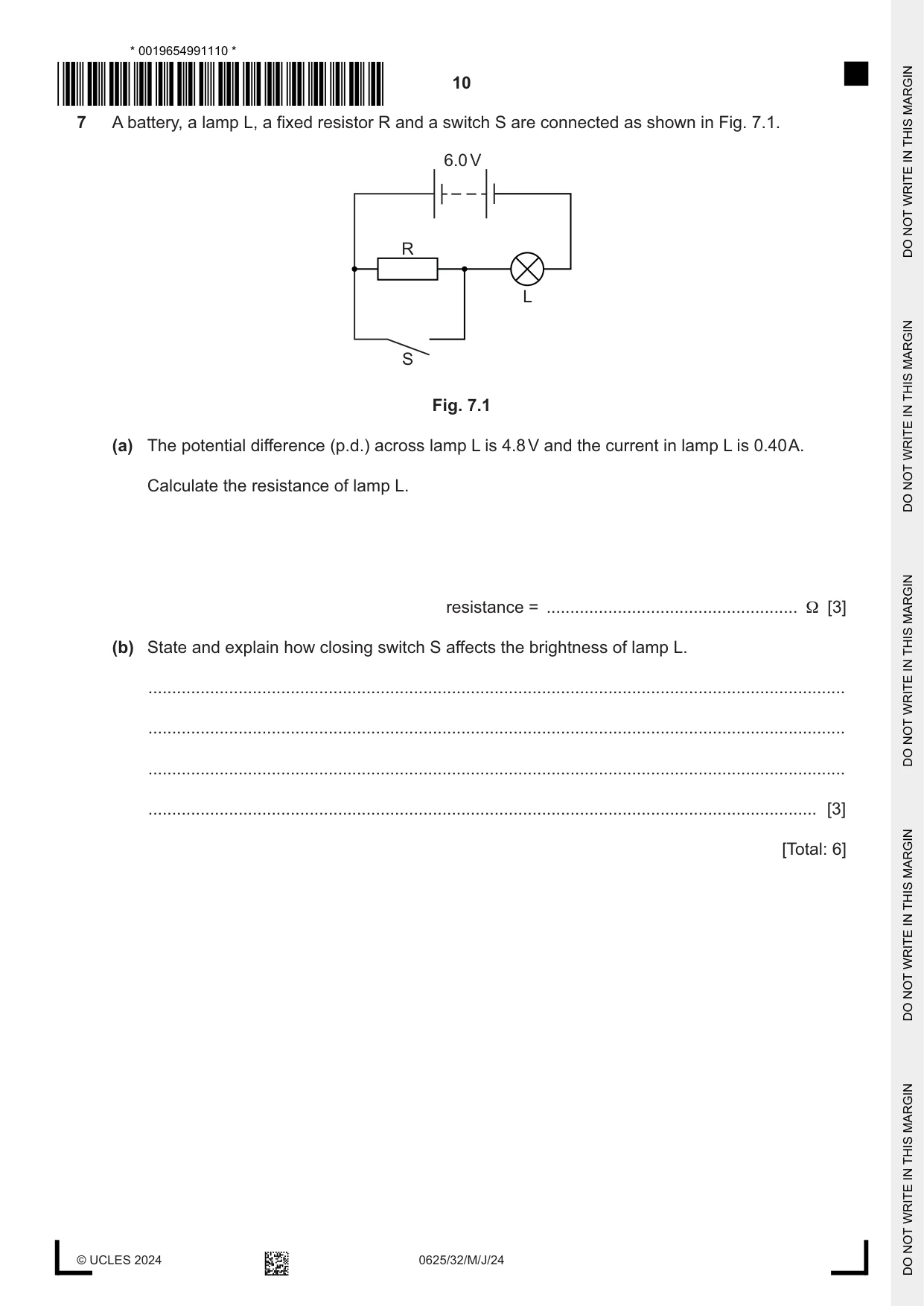
7 A battery, a lamp L, a fixed resistor R and a switch S are connected as shown in Fig. 7.1. 6.0 V R L S Fig. 7.1 (a) The potential difference (p.d.) across lamp L is 4.8 V and the current in lamp L is 0.40 A. Calculate the resistance of lamp L. resistance = ..................................................... Ω [3] (b) State and explain how closing switch S affects the brightness of lamp L. ................................................................................................................................................... ................................................................................................................................................... ................................................................................................................................................... ............................................................................................................................................. [3] [Total: 6]
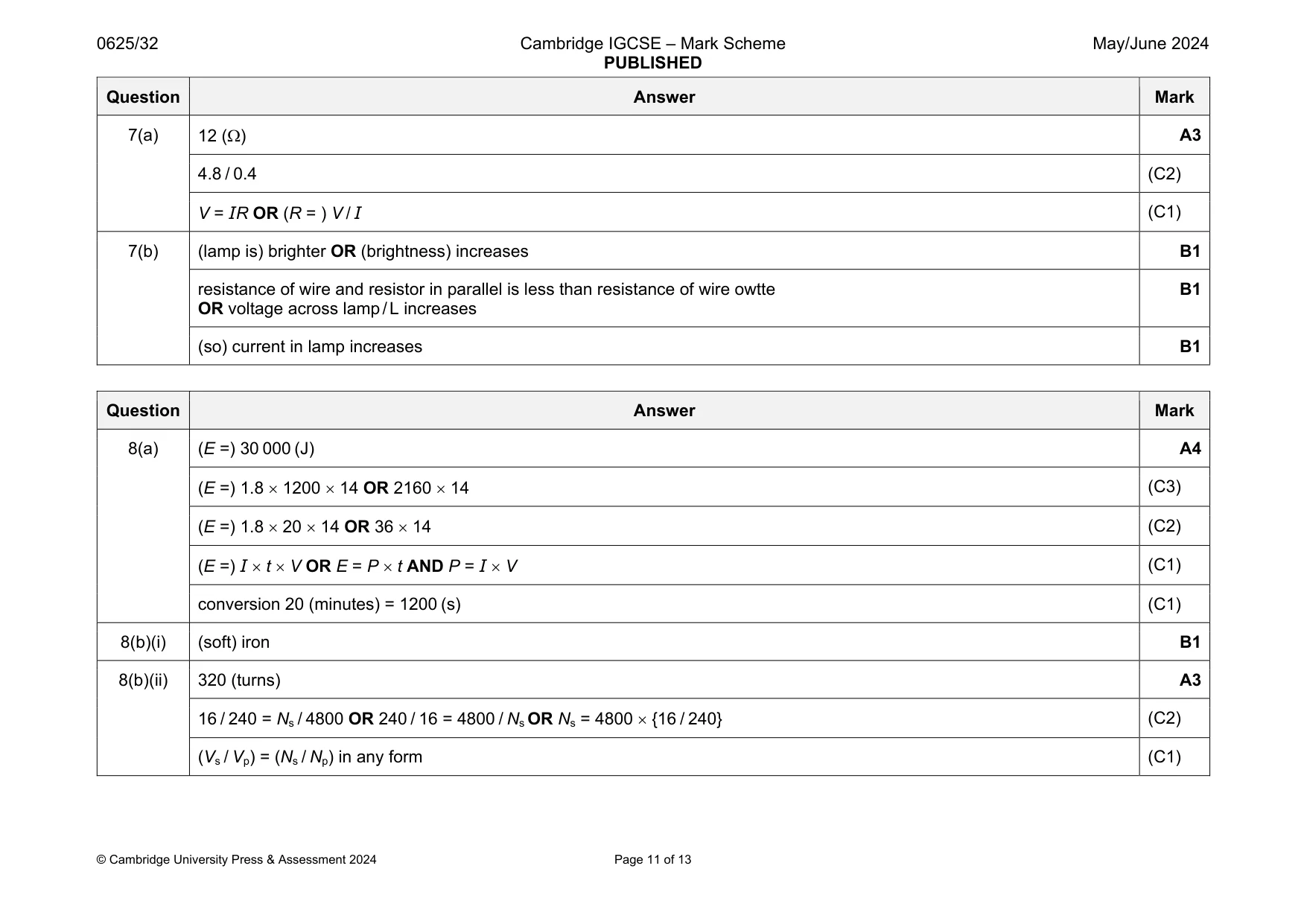
Mark scheme: 7(a) A3 4.8 / 0.4 (C2) V = IR OR (R = ) V / I (C1) 7(b) (lamp is) brighter OR (brightness) increases B1 resistance of wire and resistor in parallel is less than resistance of wire owtte OR voltage across lamp / L increases B1 (so) current in lamp increases B1
Q8 · The battery in a laptop computer is connected to a battery charger for 20 minutes
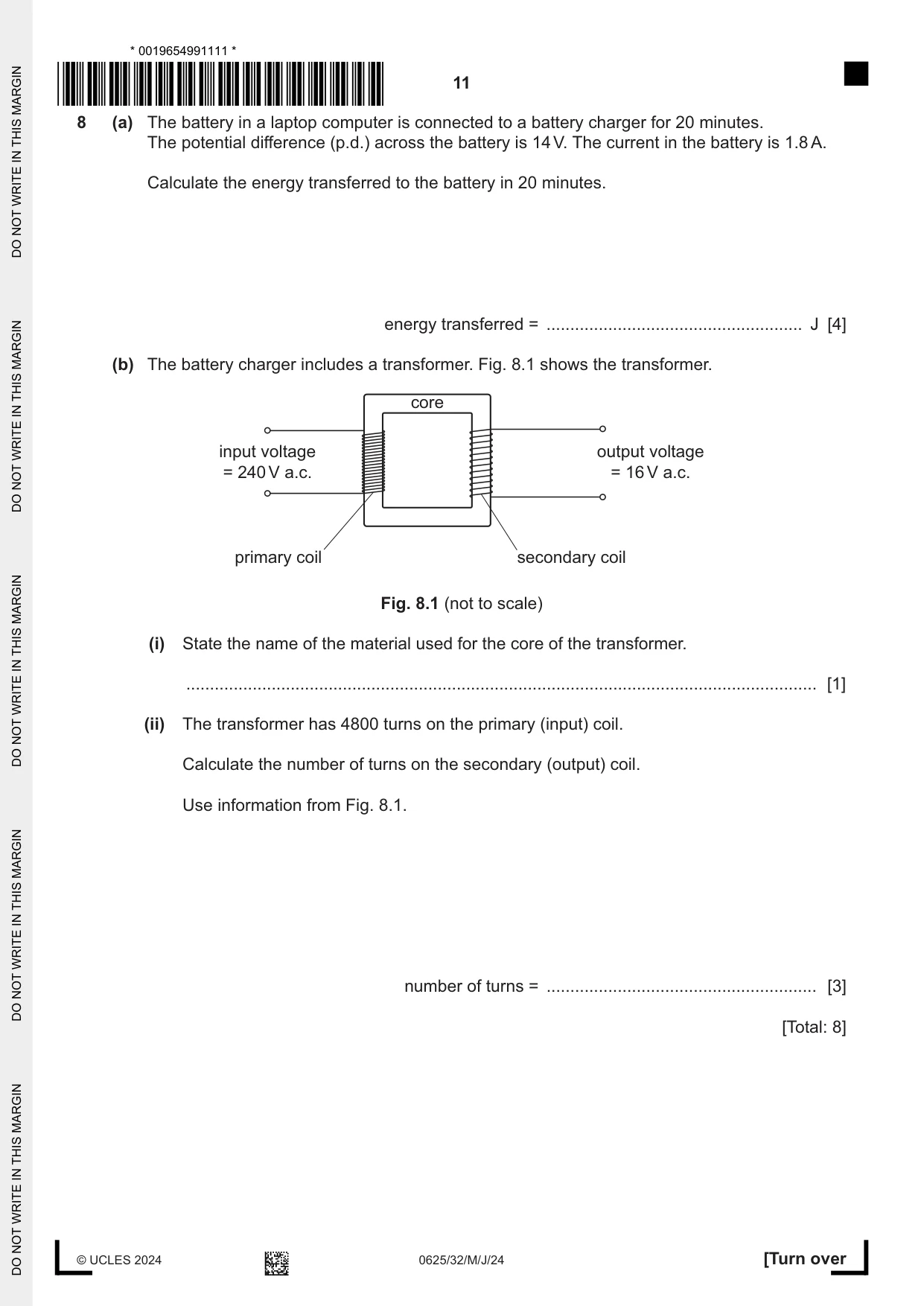
8 (a) The battery in a laptop computer is connected to a battery charger for 20 minutes. The potential difference (p.d.) across the battery is 14 V. The current in the battery is 1.8 A. Calculate the energy transferred to the battery in 20 minutes. energy transferred = ...................................................... J [4] (b) The battery charger includes a transformer. Fig. 8.1 shows the transformer. core input voltage output voltage = 240 V a.c. = 16 V a.c. primary coil secondary coil Fig. 8.1 (not to scale) (i) State the name of the material used for the core of the transformer. ..................................................................................................................................... [1] (ii) The transformer has 4800 turns on the primary (input) coil. Calculate the number of turns on the secondary (output) coil. Use information from Fig. 8.1. number of turns = ......................................................... [3] [Total: 8]
Mark scheme: 8(a) (E =) 30 000 (J) A4 (E =) 1.8 1200 14 OR 2160 14 (C3) (E =) 1.8 20 14 OR 36 14 (C2) (E =) I t V OR E = P t AND P = I V (C1) conversion 20 (minutes) = 1200 (s) (C1) 8(b)(i) (soft) iron B1 8(b)(ii) 320 (turns) A3 16 / 240 = Ns / 4800 OR 240 / 16 = 4800 / Ns OR Ns = 4800 {16 / 240} (C2) (Vs / Vp) = (Ns / Np) in any form (C1)
Q9 · An electricity cable that has a fault
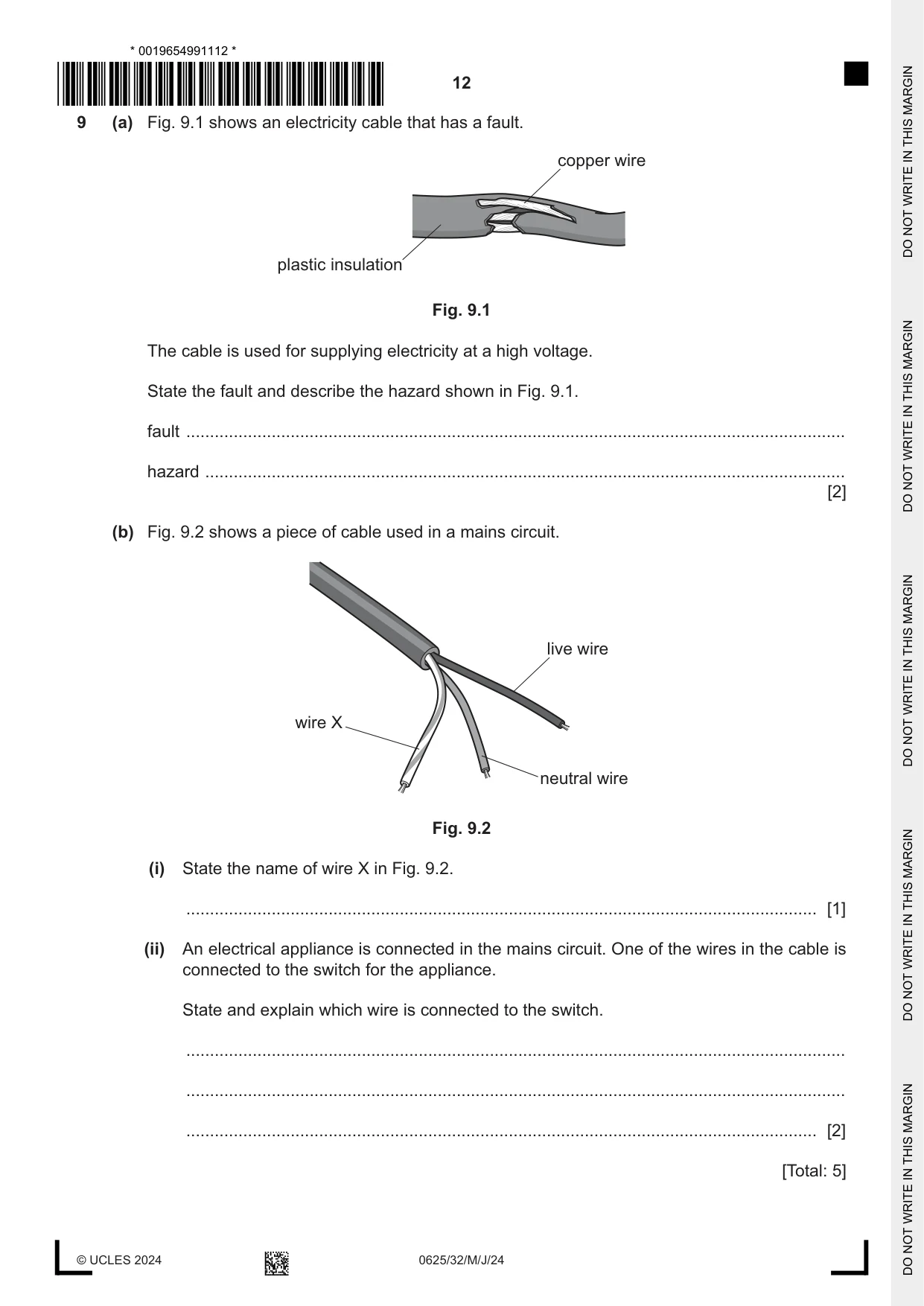
9 (a) Fig. 9.1 shows an electricity cable that has a fault. copper wire plastic insulation Fig. 9.1 The cable is used for supplying electricity at a high voltage. State the fault and describe the hazard shown in Fig. 9.1. fault ........................................................................................................................................... hazard ....................................................................................................................................... [2] (b) Fig. 9.2 shows a piece of cable used in a mains circuit. live wire wire X neutral wire Fig. 9.2 (i) State the name of wire X in Fig. 9.2. ..................................................................................................................................... [1] (ii) An electrical appliance is connected in the mains circuit. One of the wires in the cable is connected to the switch for the appliance. State and explain which wire is connected to the switch. ........................................................................................................................................... ........................................................................................................................................... ..................................................................................................................................... [2] [Total: 5]
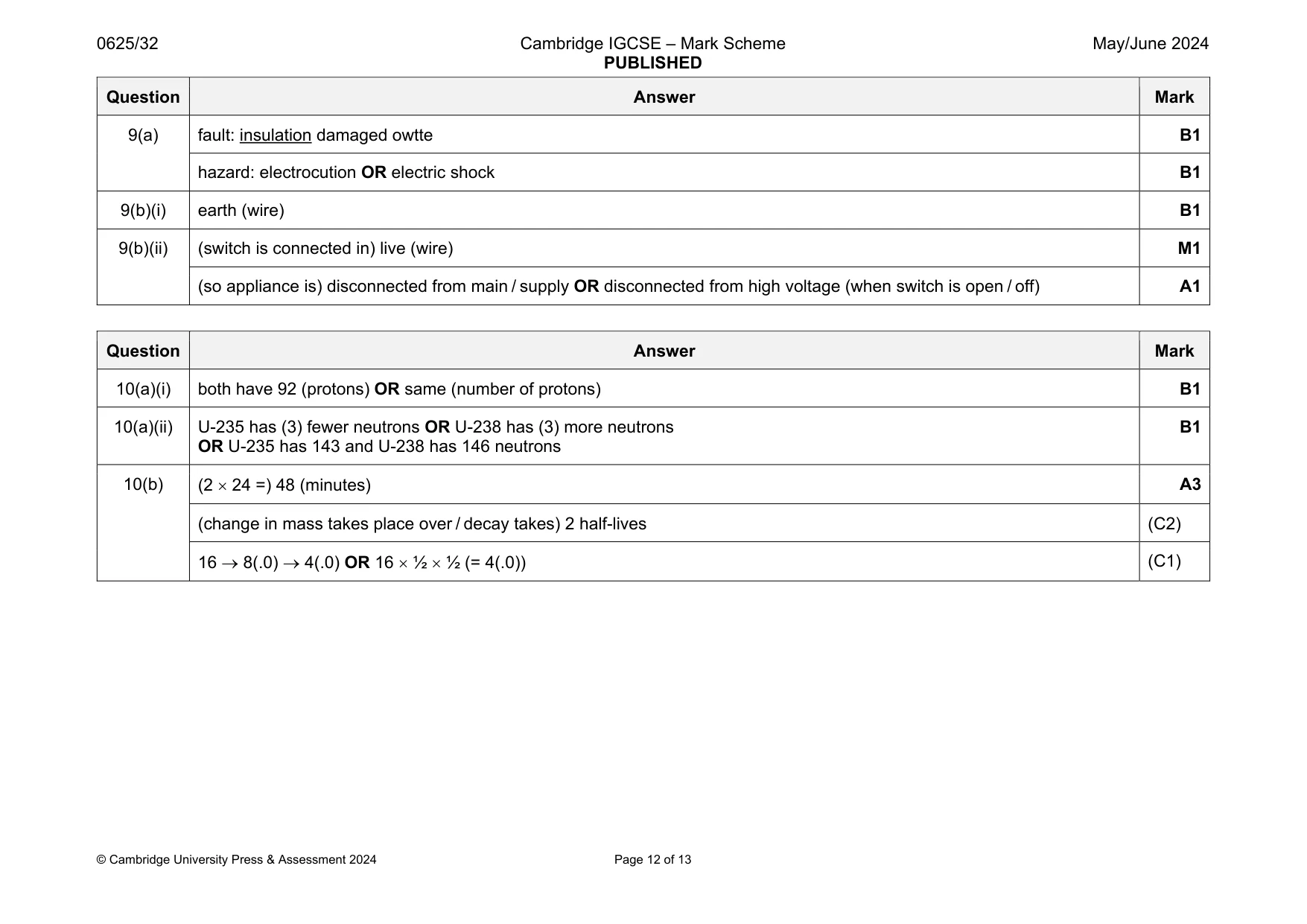
Mark scheme: 9(a) fault: insulation damaged owtte B1 hazard: electrocution OR electric shock B1 9(b)(i) earth (wire) B1 9(b)(ii) (switch is connected in) live (wire) M1 (so appliance is) disconnected from main / supply OR disconnected from high voltage (when switch is open / off) A1
Q10 · U-235 and U-238 are isotopes of uranium
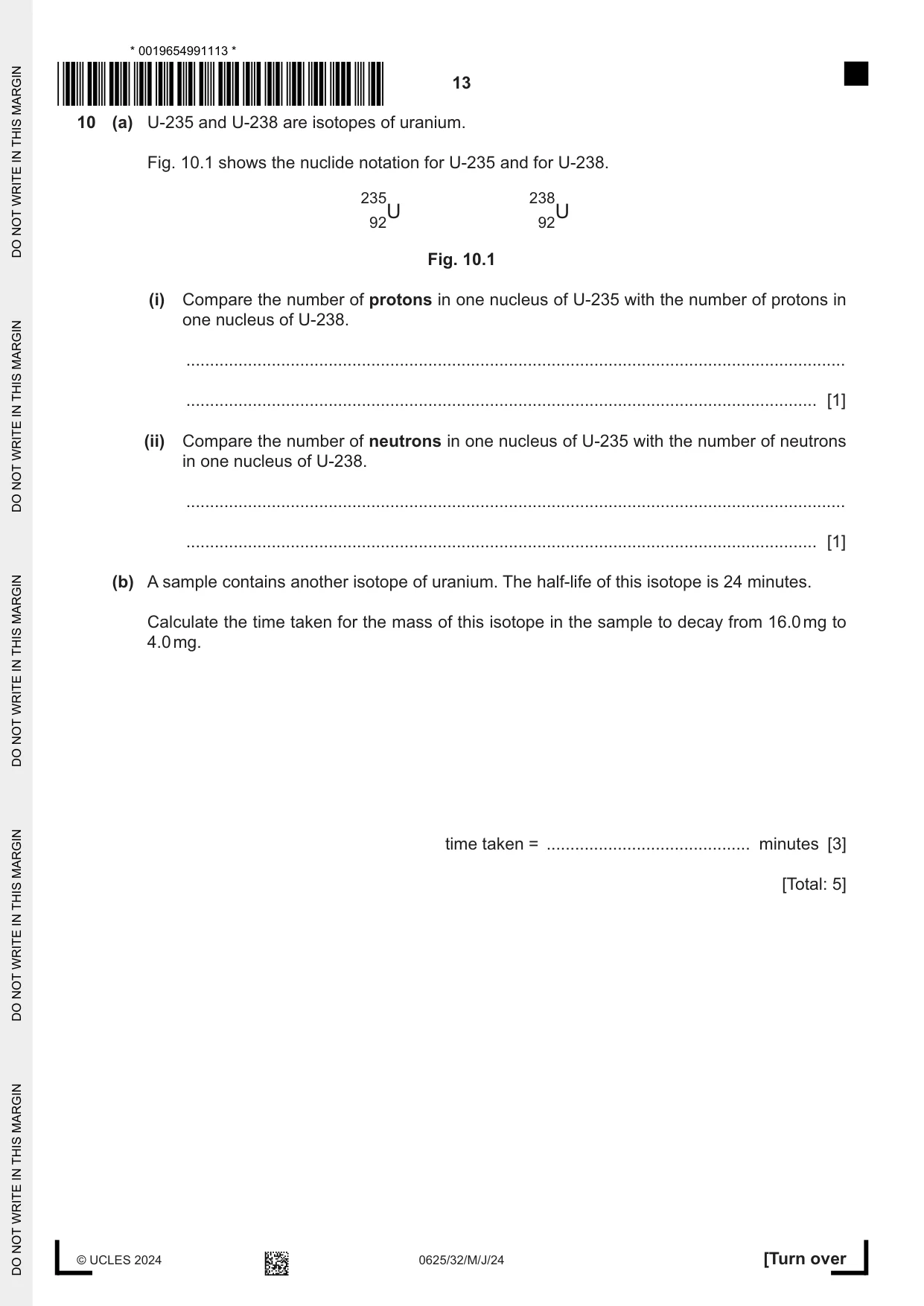
10 (a) U-235 and U-238 are isotopes of uranium. Fig. 10.1 shows the nuclide notation for U-235 and for U-238. 235 238 92U 92U Fig. 10.1 (i) Compare the number of protons in one nucleus of U-235 with the number of protons in one nucleus of U-238. ........................................................................................................................................... ..................................................................................................................................... [1] (ii) Compare the number of neutrons in one nucleus of U-235 with the number of neutrons in one nucleus of U-238. ........................................................................................................................................... ..................................................................................................................................... [1] (b) A sample contains another isotope of uranium. The half-life of this isotope is 24 minutes. Calculate the time taken for the mass of this isotope in the sample to decay from 16.0 mg to 4.0 mg. time taken = ........................................... minutes [3] [Total: 5]
Mark scheme: 10(a)(i) both have 92 (protons) OR same (number of protons) B1 10(a)(ii) U-235 has (3) fewer neutrons OR U-238 has (3) more neutrons OR U-235 has 143 and U-238 has 146 neutrons B1 10(b) (2 24 =) 48 (minutes) A3 (change in mass takes place over / decay takes) 2 half-lives (C2) 16 8(.0) 4(.0) OR 16 ½ ½ (= 4(.0)) (C1)
Q11 · Some information about two of the planets in the Solar System
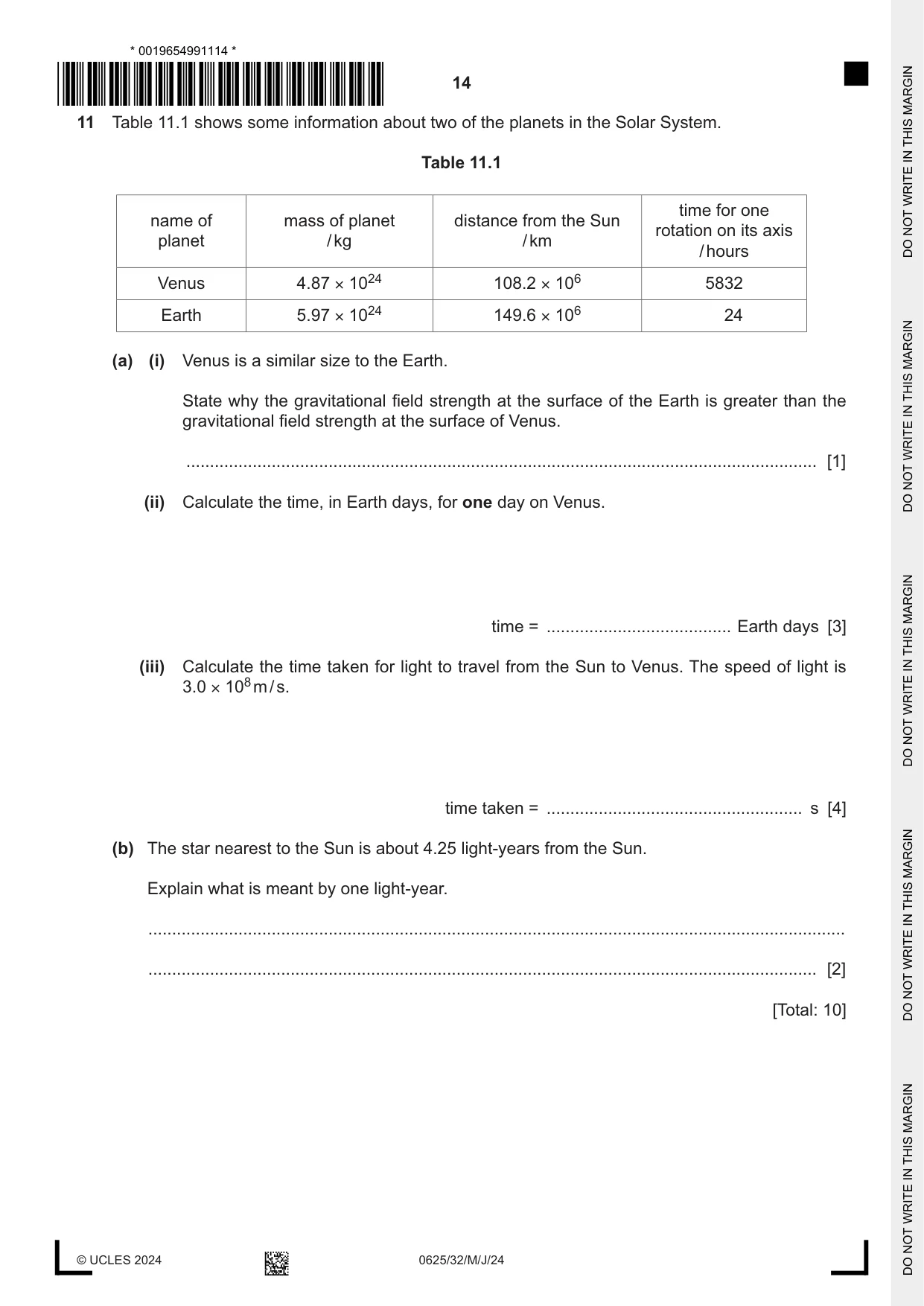
11 Table 11.1 shows some information about two of the planets in the Solar System. Table 11.1 time for one name of mass of planet distance from the Sun rotation on its axis planet / kg / km / hours Venus 4.87 × 1024 108.2 × 10⁶ 5832 Earth 5.97 × 1024 149.6 × 10⁶ 24 (a) (i) Venus is a similar size to the Earth. State why the gravitational field strength at the surface of the Earth is greater than the gravitational field strength at the surface of Venus. ..................................................................................................................................... [1] (ii) Calculate the time, in Earth days, for one day on Venus. time = ....................................... Earth days [3] (iii) Calculate the time taken for light to travel from the Sun to Venus. The speed of light is 3.0 × 10⁸ m / s. time taken = ...................................................... s [4] (b) The star nearest to the Sun is about 4.25 light-years from the Sun. Explain what is meant by one light-year. ................................................................................................................................................... ............................................................................................................................................. [2] [Total: 10]
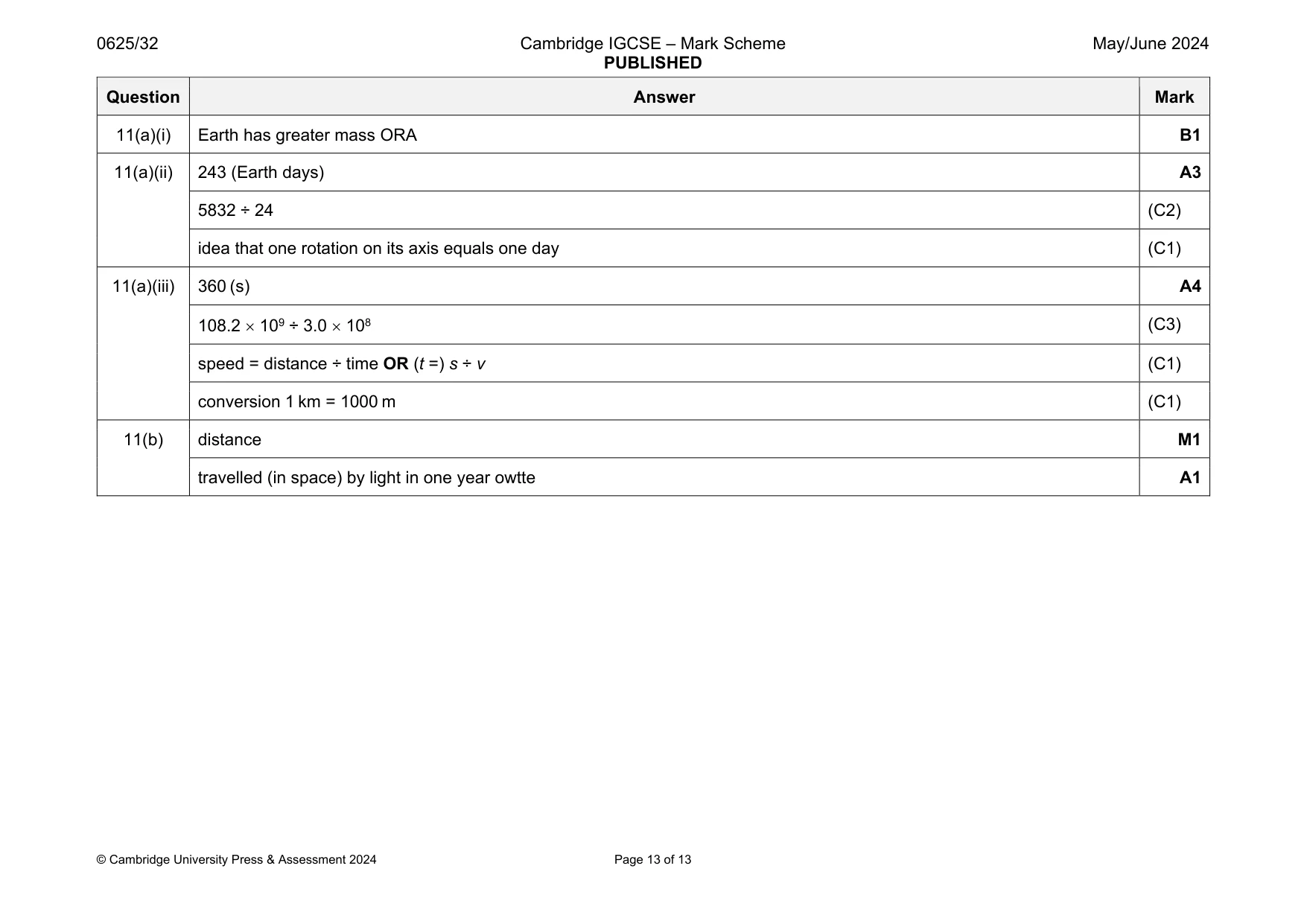
Mark scheme: 11(a)(i) Earth has greater mass ORA B1 11(a)(ii) 243 (Earth days) A3 5832 ÷ 24 (C2) idea that one rotation on its axis equals one day (C1) 11(a)(iii) 360 (s) A4 108.2 109 ÷ 3.0 108 (C3) speed = distance ÷ time OR (t =) s ÷ v (C1) conversion 1 km = 1000 m (C1) 11(b) distance M1 travelled (in space) by light in one year owtte A1
What was in this paper
The subtopics covered by these 11 questions, and how many questions each got. Open one in a new tab to see every Cambridge question on it.
What you needed in this session
Cambridge’s own grade thresholds for 2024 May/June, Paper 3 · Variant 2. A higher threshold means an easier paper — the bar moves with how the cohort did.