Cambridge IGCSE Physics 0625 — 2025 May/June Paper 3 · Variant 1
0625/31/M/J/25 · 11 questions · 80 marks · ≈90 min
The question paper and its mark scheme, free to read here and free to download. This is Cambridge’s own paper, exactly as it was sat.
Question paper16 pages
Mark scheme15 pages
Answers below. Sit the paper first if you are practising.
Questions as text
Q1 · The speed–time graph for a car travelling along a flat, straight road
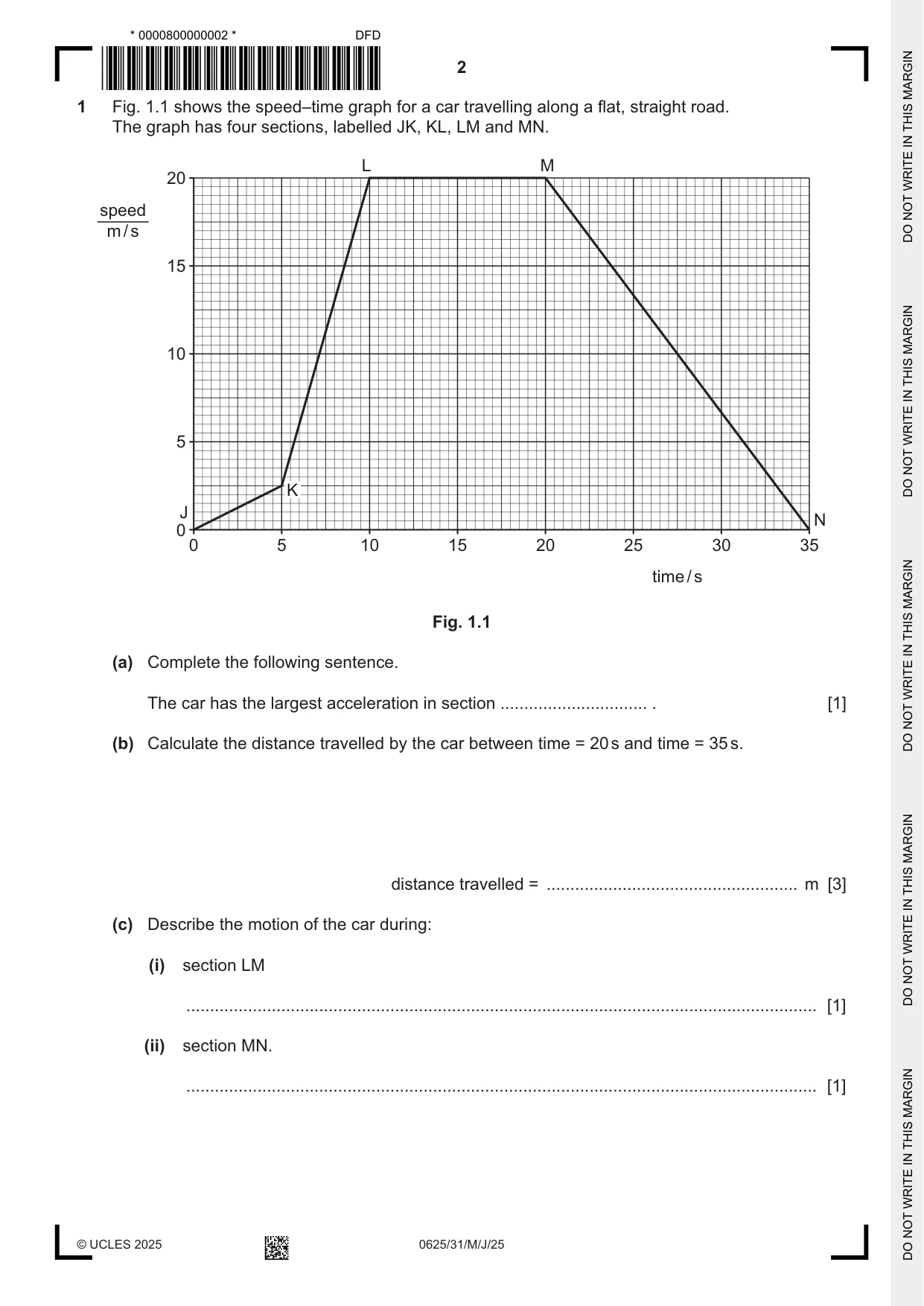
1 Fig. 1.1 shows the speed–time graph for a car travelling along a flat, straight road. The graph has four sections, labelled JK, KL, LM and MN. L M 20 speed m / s 15 10 5 K J N 0 0 5 10 15 20 25 30 35 time / s Fig. 1.1 (a) Complete the following sentence. The car has the largest acceleration in section ............................... . [1] (b) Calculate the distance travelled by the car between time = 20 s and time = 35 s. distance travelled = ..................................................... m [3] (c) Describe the motion of the car during: (i) section LM ..................................................................................................................................... [1] (ii) section MN. ..................................................................................................................................... [1] (d) Another car travels a distance of 500 m in a time of 20 s. Calculate the average speed of this car. average speed = ................................................. m / s [3] [Total: 9]
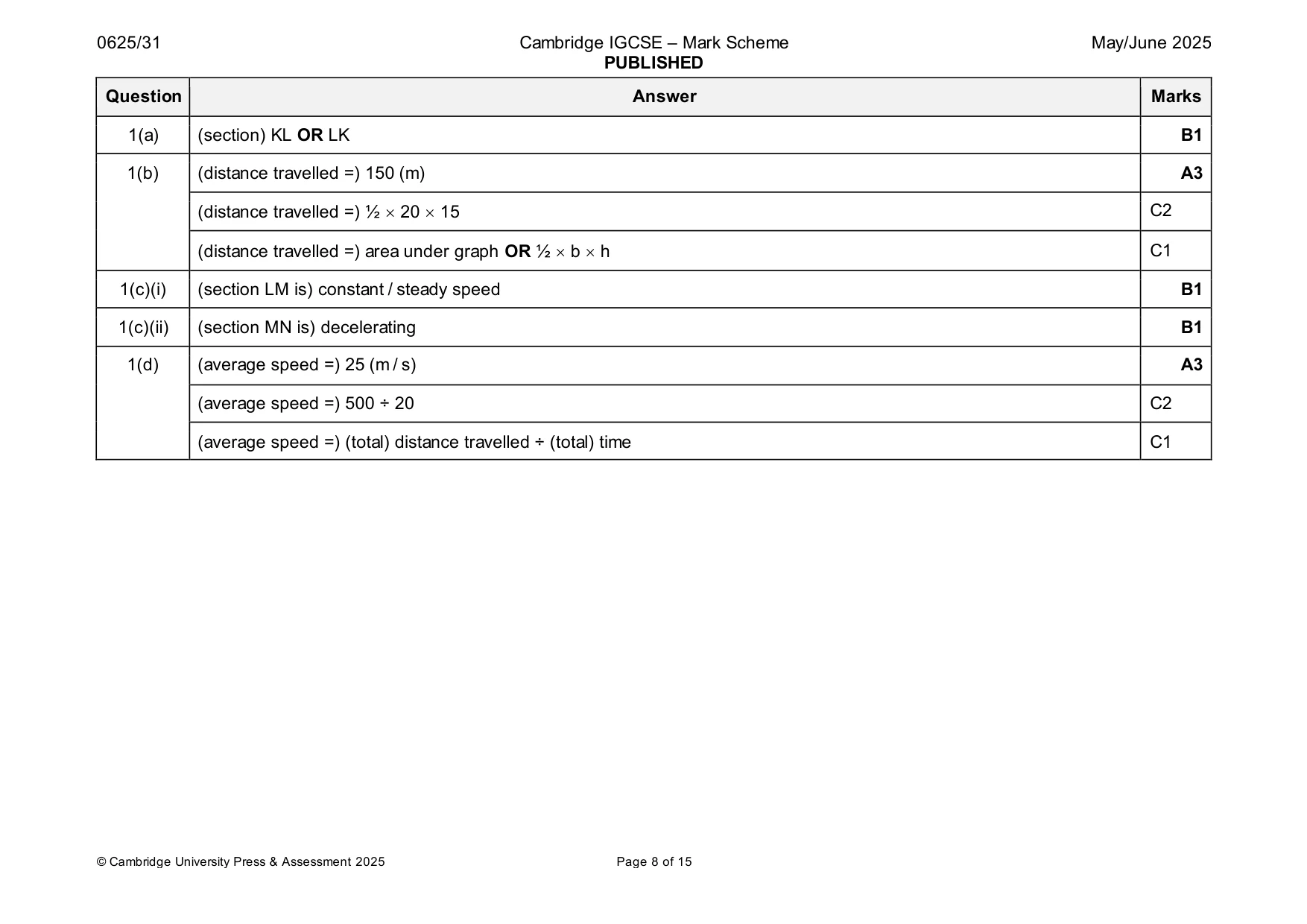
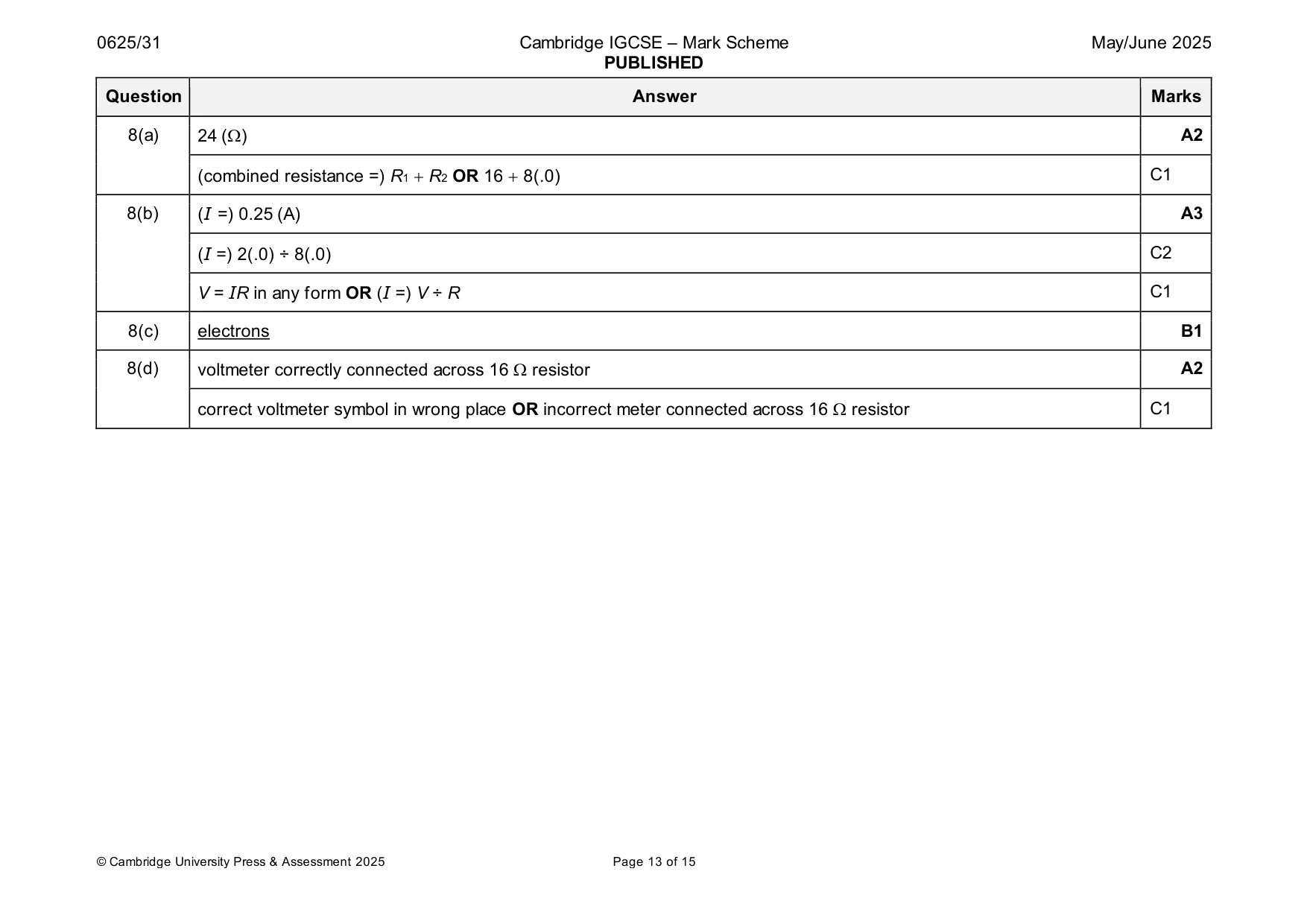
Mark scheme: Question Answer Marks 1(a) (section) KL OR LK B1 1(b) (distance travelled =) 150 (m) A3 (distance travelled =) ½ 20 15 C2 (distance travelled =) area under graph OR ½ b h C1 1(c)(i) (section LM is) constant / steady speed B1 1(c)(ii) (section MN is) decelerating B1 1(d) (average speed =) 25 (m / s) A3 (average speed =) 500 ÷ 20 C2 (average speed =) (total) distance travelled ÷ (total) time C1
Q2 · A student uses a stop-watch to measure the time for one complete oscillation of a pendulum
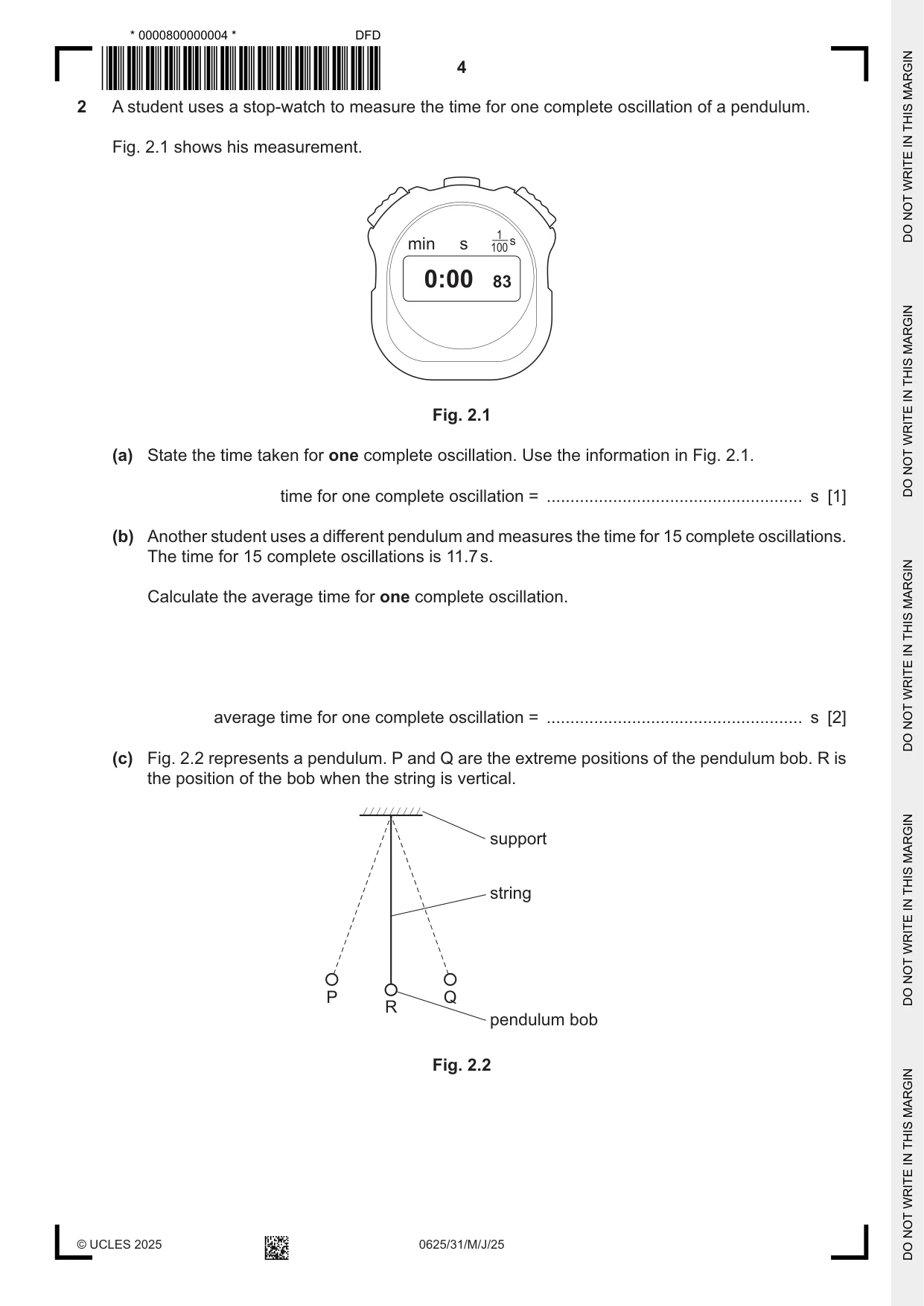
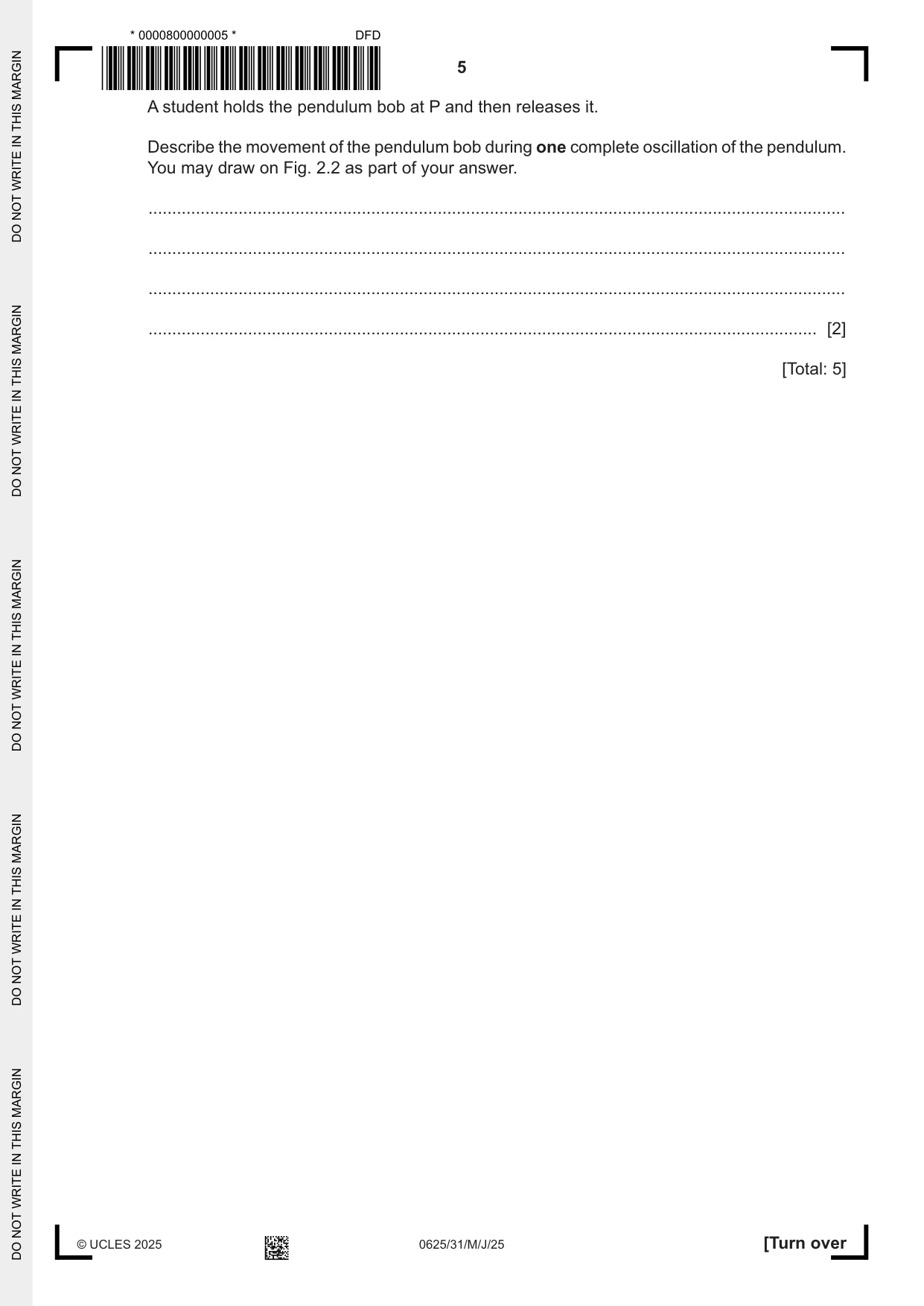
2 A student uses a stop-watch to measure the time for one complete oscillation of a pendulum. Fig. 2.1 shows his measurement. 1 min s 100 s 0:00 83 Fig. 2.1 (a) State the time taken for one complete oscillation. Use the information in Fig. 2.1. time for one complete oscillation = ...................................................... s [1] (b) Another student uses a different pendulum and measures the time for 15 complete oscillations. The time for 15 complete oscillations is 11.7 s. Calculate the average time for one complete oscillation. average time for one complete oscillation = ...................................................... s [2] (c) Fig. 2.2 represents a pendulum. P and Q are the extreme positions of the pendulum bob. R is the position of the bob when the string is vertical. support string P Q R pendulum bob Fig. 2.2 A student holds the pendulum bob at P and then releases it. Describe the movement of the pendulum bob during one complete oscillation of the pendulum. You may draw on Fig. 2.2 as part of your answer. ................................................................................................................................................... ................................................................................................................................................... ................................................................................................................................................... ............................................................................................................................................. [2] [Total: 5]
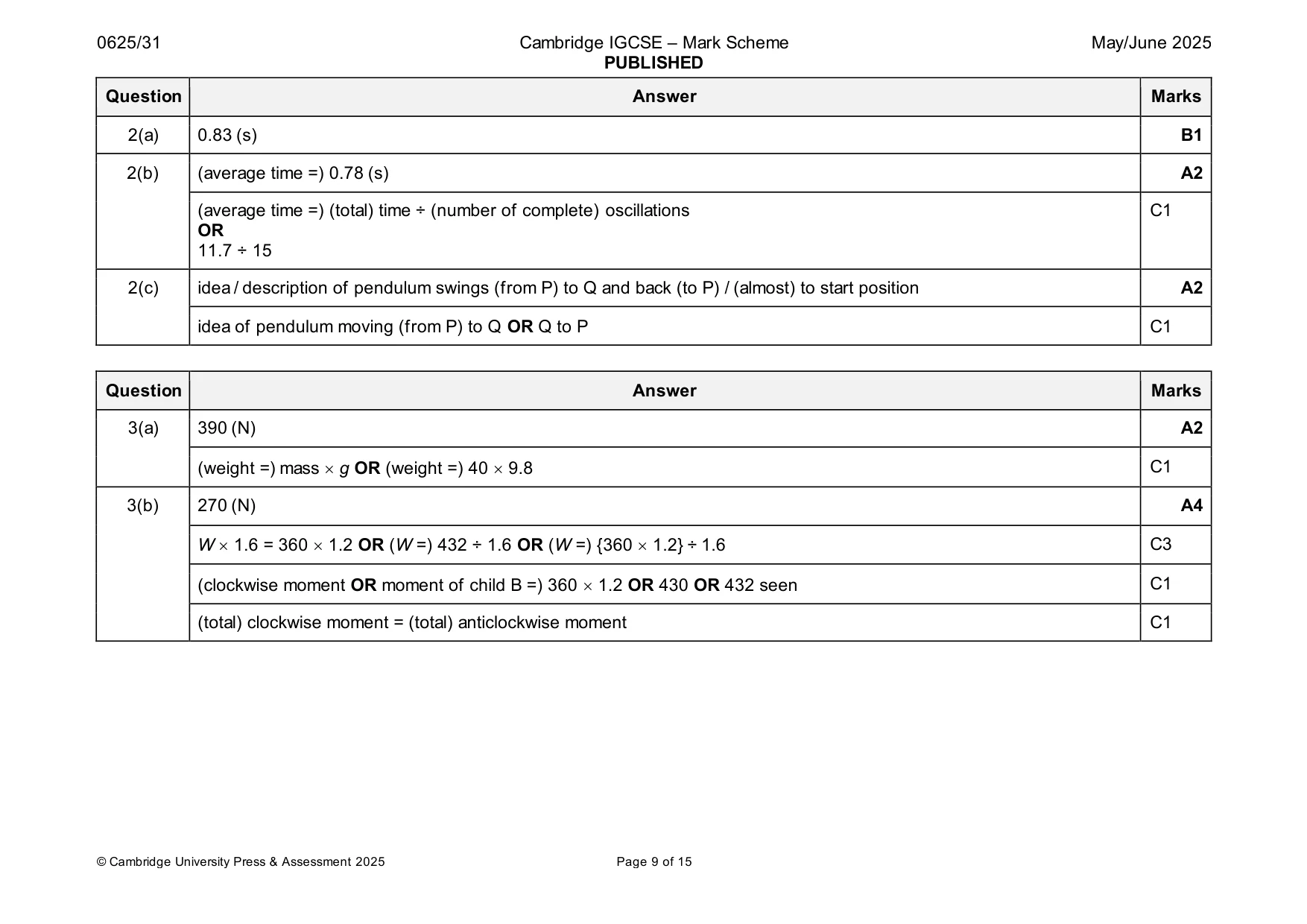
Mark scheme: 2(a) 0.83 (s) B1 2(b) (average time =) 0.78 (s) A2 (average time =) (total) time ÷ (number of complete) oscillations C1 OR 11.7 ÷ 15 2(c) idea / description of pendulum swings (from P) to Q and back (to P) / (almost) to start position A2 idea of pendulum moving (from P) to Q OR Q to P C1
Q3 · A wooden beam is used in a see-saw
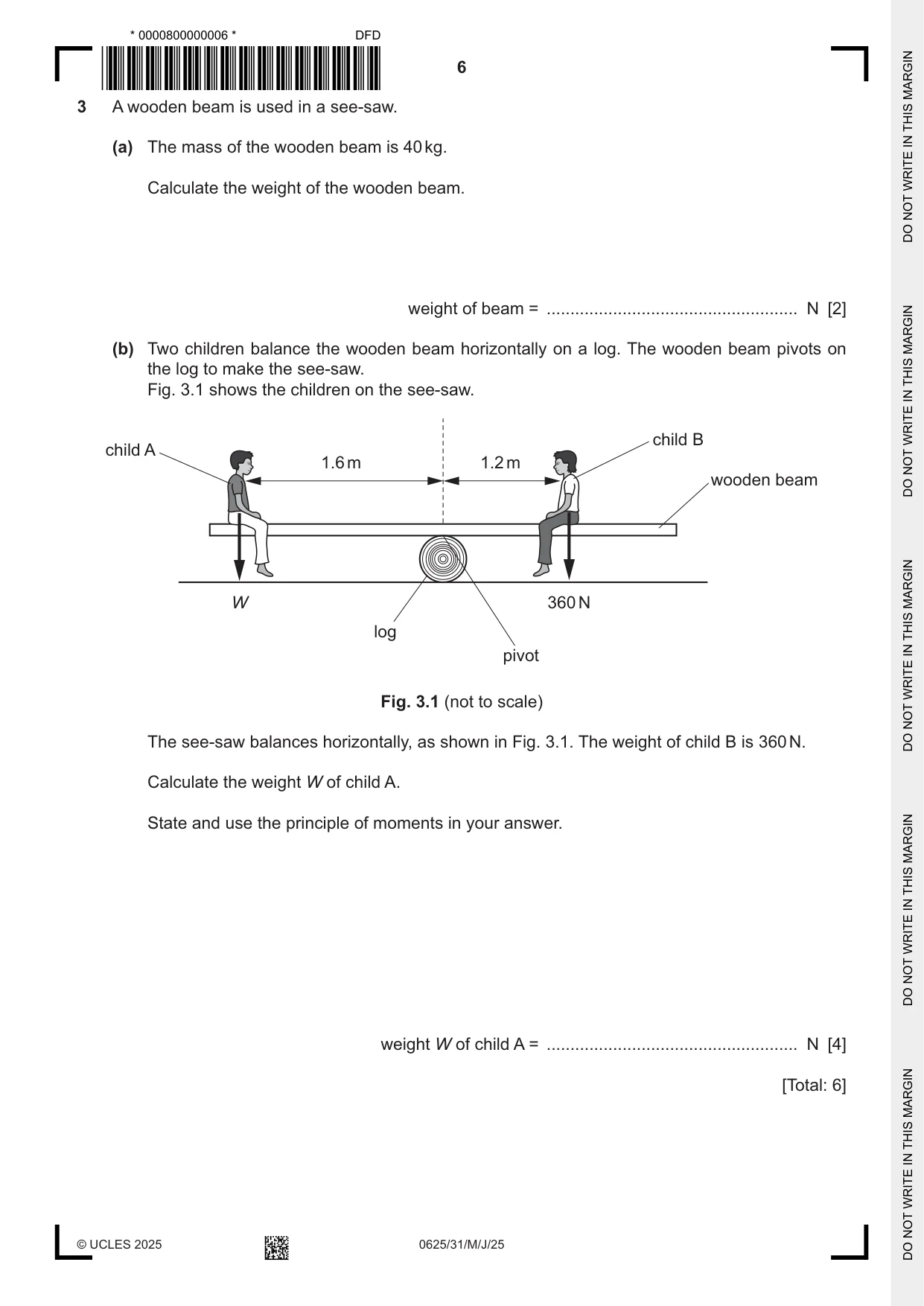
3 A wooden beam is used in a see-saw. (a) The mass of the wooden beam is 40 kg. Calculate the weight of the wooden beam. weight of beam = ..................................................... N [2] (b) Two children balance the wooden beam horizontally on a log. The wooden beam pivots on the log to make the see-saw. Fig. 3.1 shows the children on the see-saw. child B child A 1.6 m 1.2 m wooden beam W 360 N log pivot Fig. 3.1 (not to scale) The see-saw balances horizontally, as shown in Fig. 3.1. The weight of child B is 360 N. Calculate the weight W of child A. State and use the principle of moments in your answer. weight W of child A = ..................................................... N [4] [Total: 6]
Mark scheme: 3(a) 390 (N) A2 (weight =) mass g OR (weight =) 40 9.8 C1 3(b) 270 (N) A4 W 1.6 = 360 1.2 OR (W =) 432 ÷ 1.6 OR (W =) {360 1.2} ÷ 1.6 C3 (clockwise moment OR moment of child B =) 360 1.2 OR 430 OR 432 seen C1 (total) clockwise moment = (total) anticlockwise moment C1
Q4 · An electric motor lifts a load
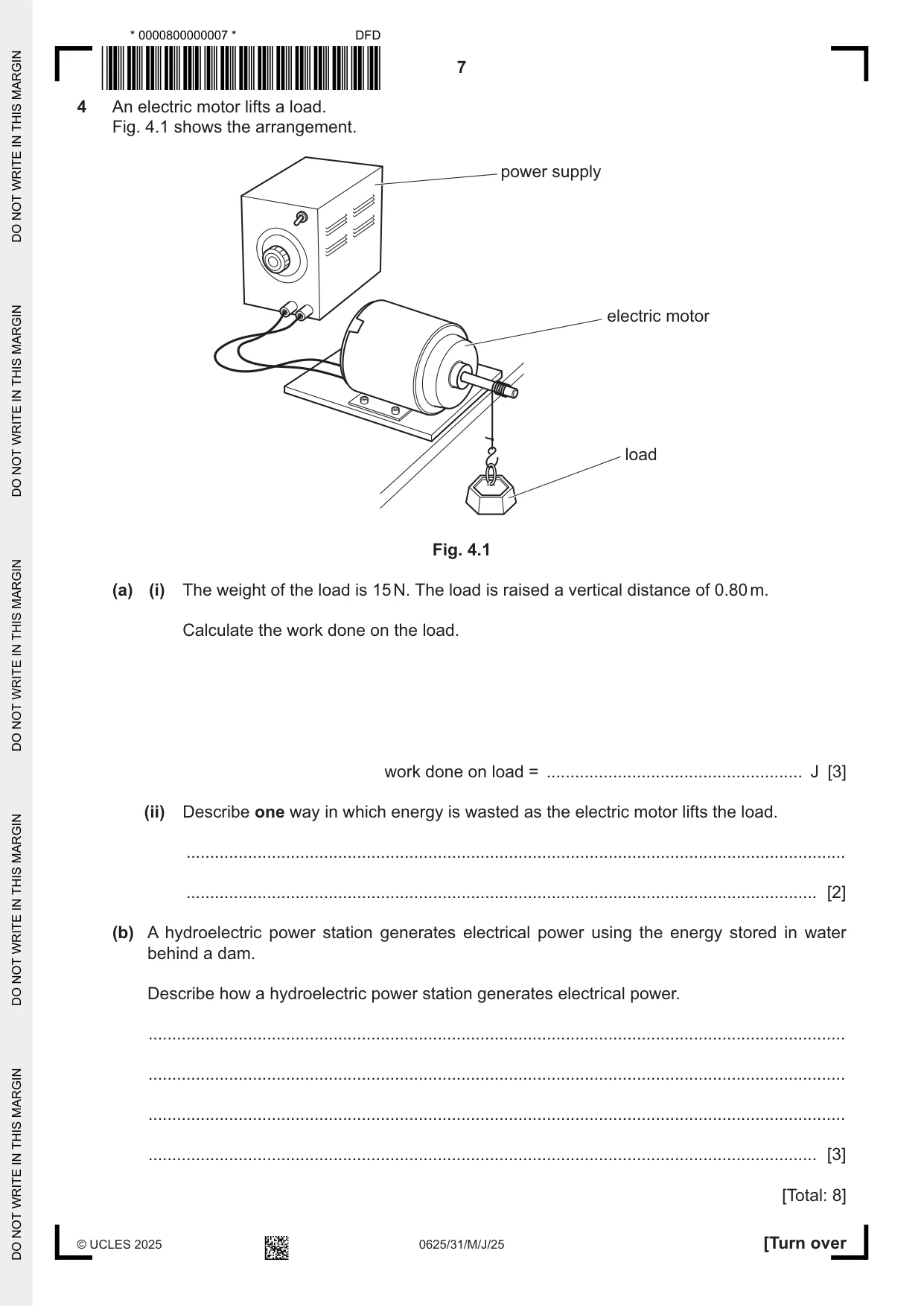
4 An electric motor lifts a load. Fig. 4.1 shows the arrangement. power supply electric motor load Fig. 4.1 (a) (i) The weight of the load is 15 N. The load is raised a vertical distance of 0.80 m. Calculate the work done on the load. work done on load = ...................................................... J [3] (ii) Describe one way in which energy is wasted as the electric motor lifts the load. ........................................................................................................................................... ..................................................................................................................................... [2] (b) A hydroelectric power station generates electrical power using the energy stored in water behind a dam. Describe how a hydroelectric power station generates electrical power. ................................................................................................................................................... ................................................................................................................................................... ................................................................................................................................................... ............................................................................................................................................. [3] [Total: 8]
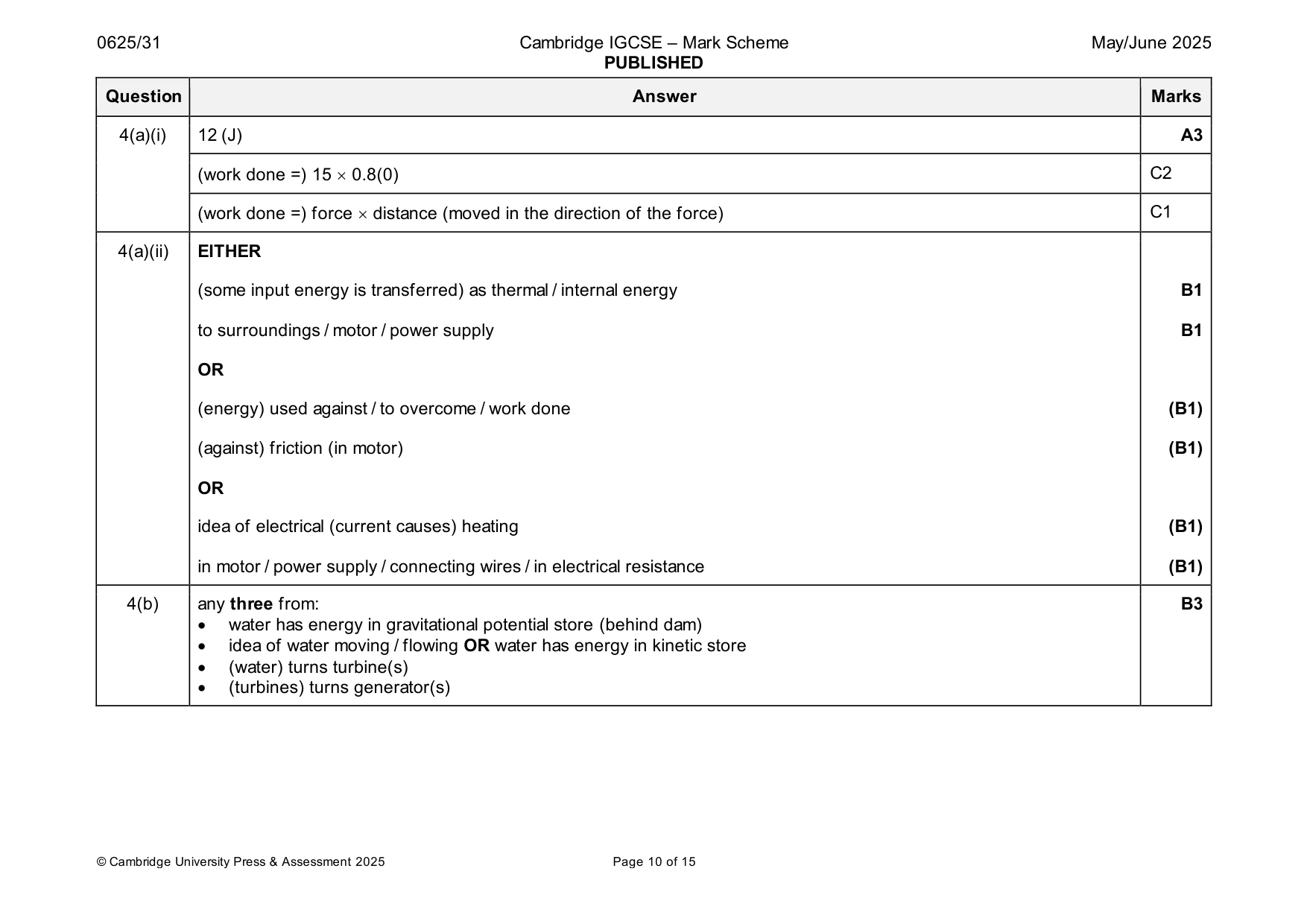
Mark scheme: 4(a)(i) 12 (J) A3 (work done =) 15 0.8(0) C2 (work done =) force distance (moved in the direction of the force) C1 4(a)(ii) EITHER (some input energy is transferred) as thermal / internal energy B1 to surroundings / motor / power supply B1 OR (energy) used against / to overcome / work done (B1) (against) friction (in motor) (B1) OR idea of electrical (current causes) heating (B1) in motor / power supply / connecting wires / in electrical resistance (B1) 4(b) any three from: B3 • water has energy in gravitational potential store (behind dam) • idea of water moving / flowing OR water has energy in kinetic store • (water) turns turbine(s) • (turbines) turns generator(s)
Q5 · A student uses the apparatus in Fig
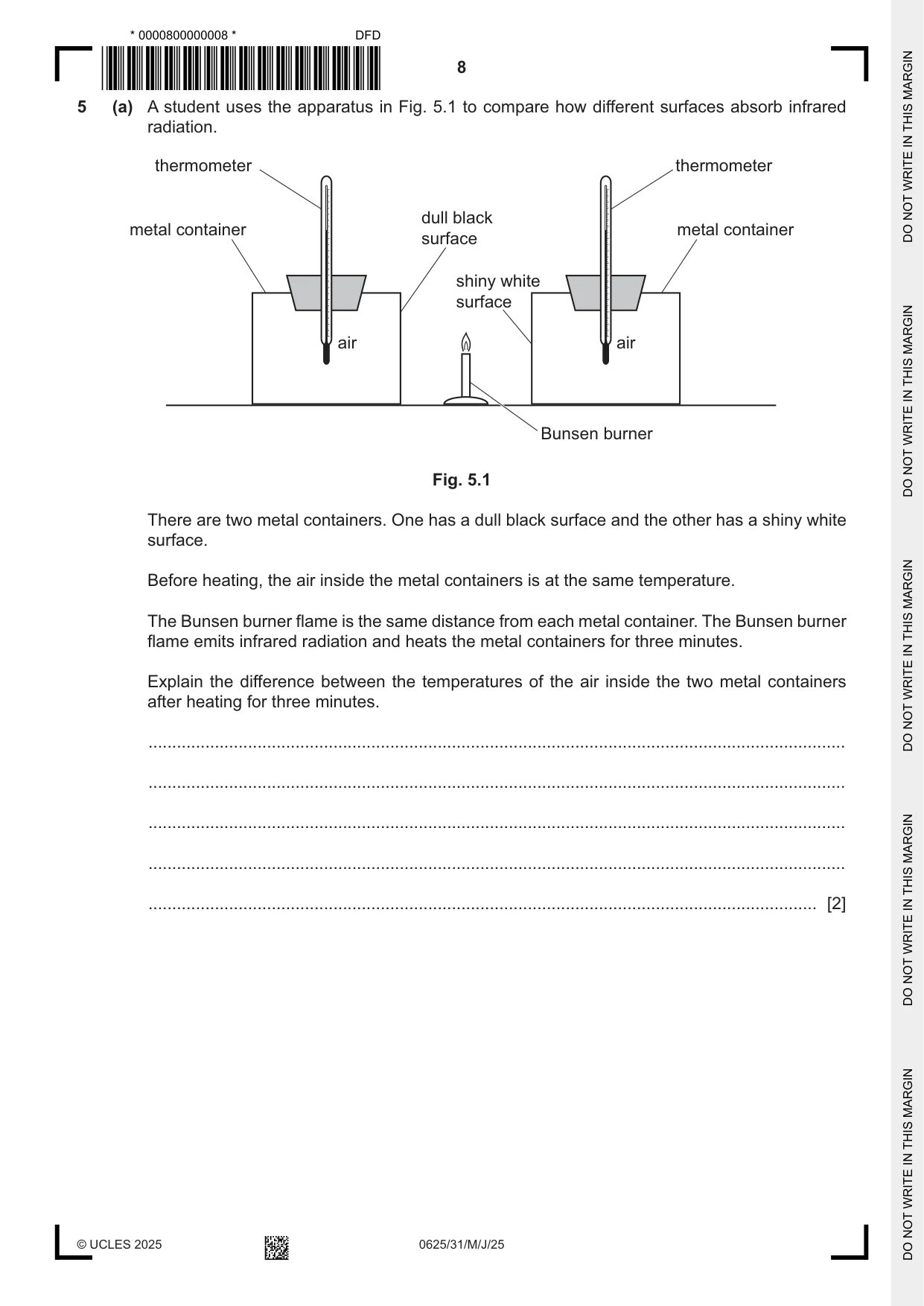
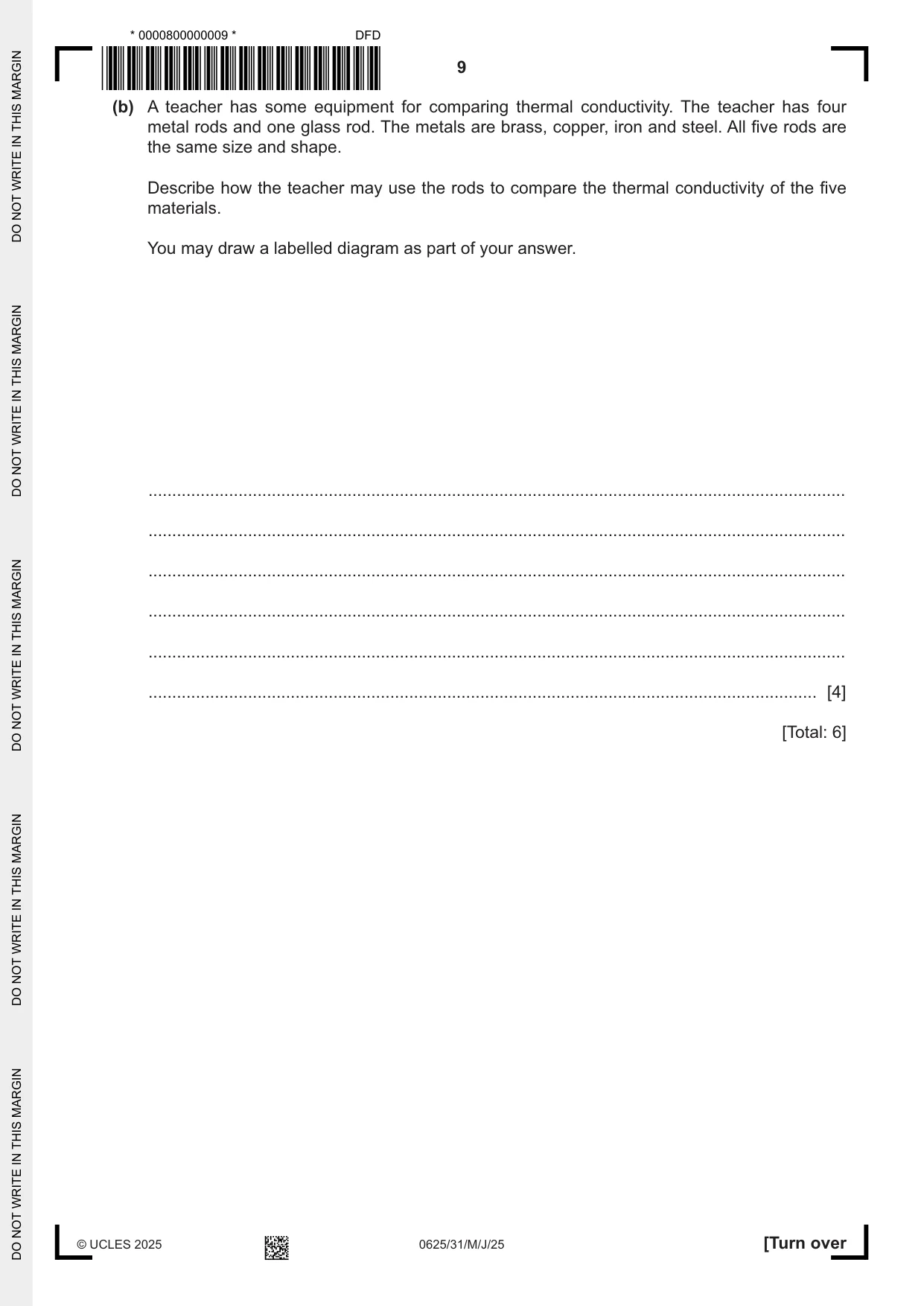
5 (a) A student uses the apparatus in Fig. 5.1 to compare how different surfaces absorb infrared radiation. thermometer thermometer dull black metal container metal container surface shiny white surface air air Bunsen burner Fig. 5.1 There are two metal containers. One has a dull black surface and the other has a shiny white surface. Before heating, the air inside the metal containers is at the same temperature. The Bunsen burner flame is the same distance from each metal container. The Bunsen burner flame emits infrared radiation and heats the metal containers for three minutes. Explain the difference between the temperatures of the air inside the two metal containers after heating for three minutes. ................................................................................................................................................... ................................................................................................................................................... ................................................................................................................................................... ................................................................................................................................................... ............................................................................................................................................. [2] (b) A teacher has some equipment for comparing thermal conductivity. The teacher has four metal rods and one glass rod. The metals are brass, copper, iron and steel. All five rods are the same size and shape. Describe how the teacher may use the rods to compare the thermal conductivity of the five materials. You may draw a labelled diagram as part of your answer. ................................................................................................................................................... ................................................................................................................................................... ................................................................................................................................................... ................................................................................................................................................... ................................................................................................................................................... ............................................................................................................................................. [4] [Total: 6]
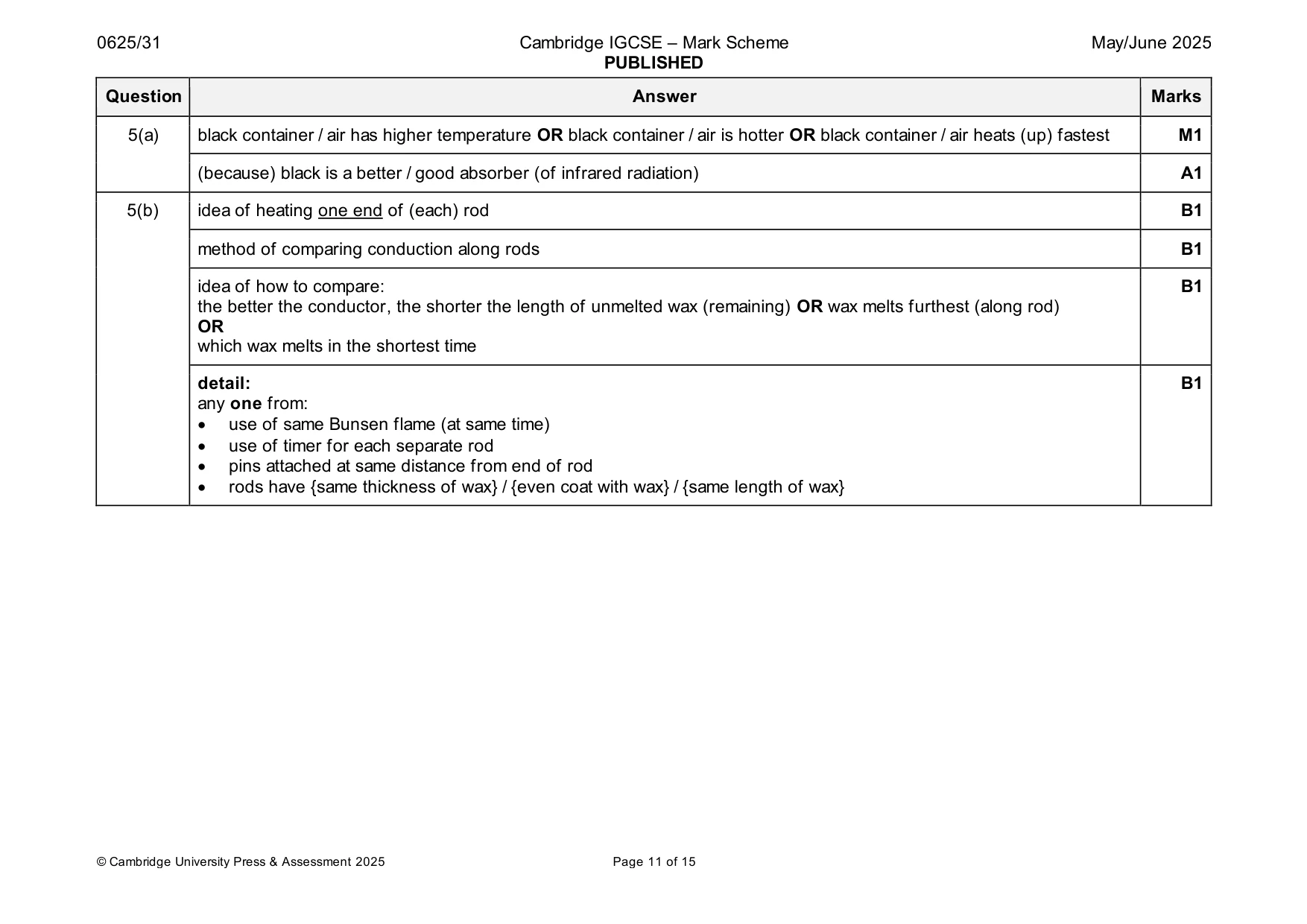
Mark scheme: 5(a) black container / air has higher temperature OR black container / air is hotter OR black container / air heats (up) fastest M1 (because) black is a better / good absorber (of infrared radiation) A1 5(b) idea of heating one end of (each) rod B1 method of comparing conduction along rods B1 idea of how to compare: B1 the better the conductor, the shorter the length of unmelted wax (remaining) OR wax melts furthest (along rod) OR which wax melts in the shortest time detail: B1 any one from: • use of same Bunsen flame (at same time) • use of timer for each separate rod • pins attached at same distance from end of rod • rods have {same thickness of wax} / {even coat with wax} / {same length of wax}
Q6 · A ray of red light travelling into and through a glass block
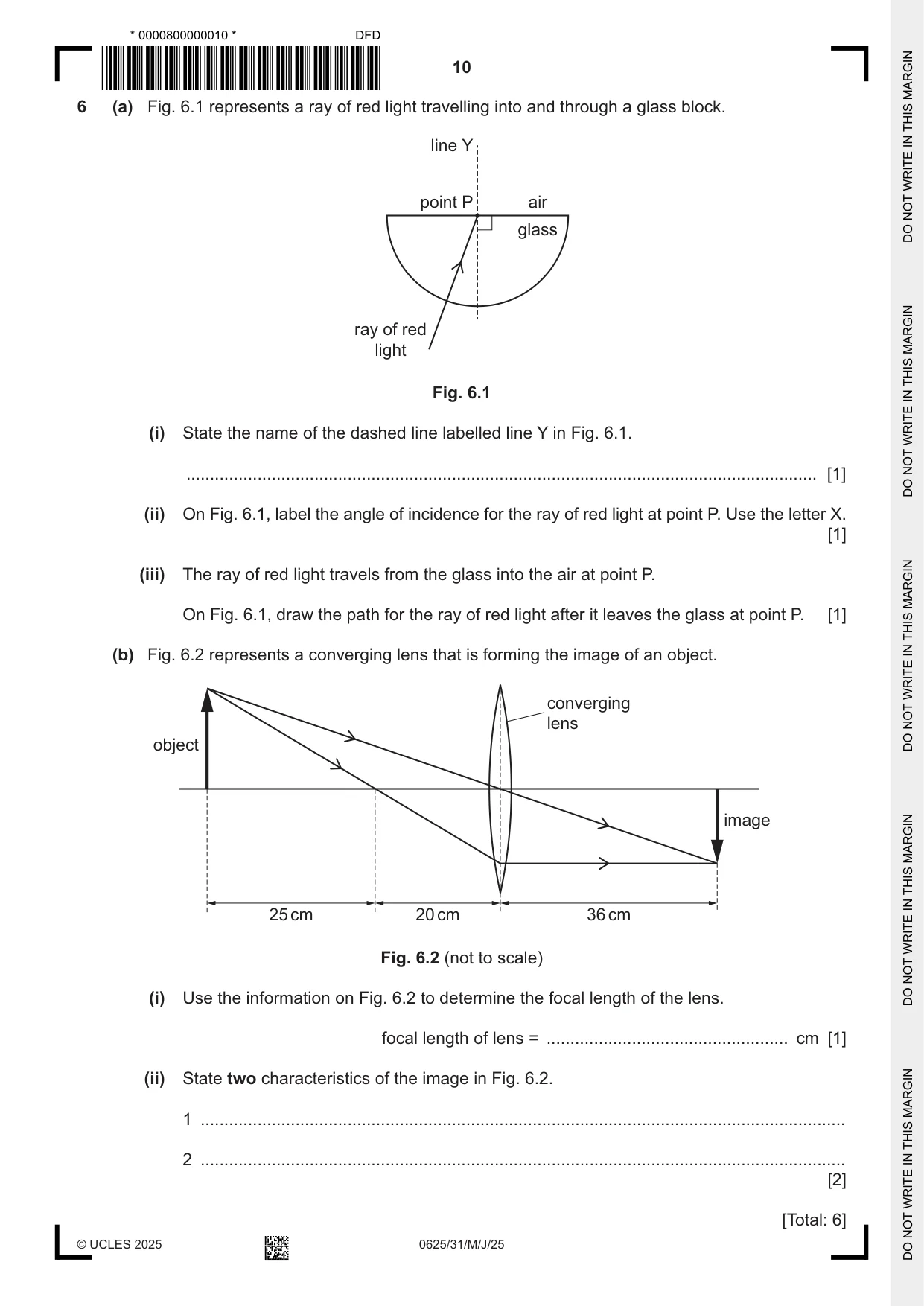
6 (a) Fig. 6.1 represents a ray of red light travelling into and through a glass block. line Y point P air glass ray of red light Fig. 6.1 (i) State the name of the dashed line labelled line Y in Fig. 6.1. ..................................................................................................................................... [1] (ii) On Fig. 6.1, label the angle of incidence for the ray of red light at point P. Use the letter X. [1] (iii) The ray of red light travels from the glass into the air at point P. On Fig. 6.1, draw the path for the ray of red light after it leaves the glass at point P. [1] (b) Fig. 6.2 represents a converging lens that is forming the image of an object. converging lens object image 25 cm 20 cm 36 cm Fig. 6.2 (not to scale) (i) Use the information on Fig. 6.2 to determine the focal length of the lens. focal length of lens = ................................................... cm [1] (ii) State two characteristics of the image in Fig. 6.2. 1 ........................................................................................................................................ 2 ........................................................................................................................................ [2] [Total: 6]
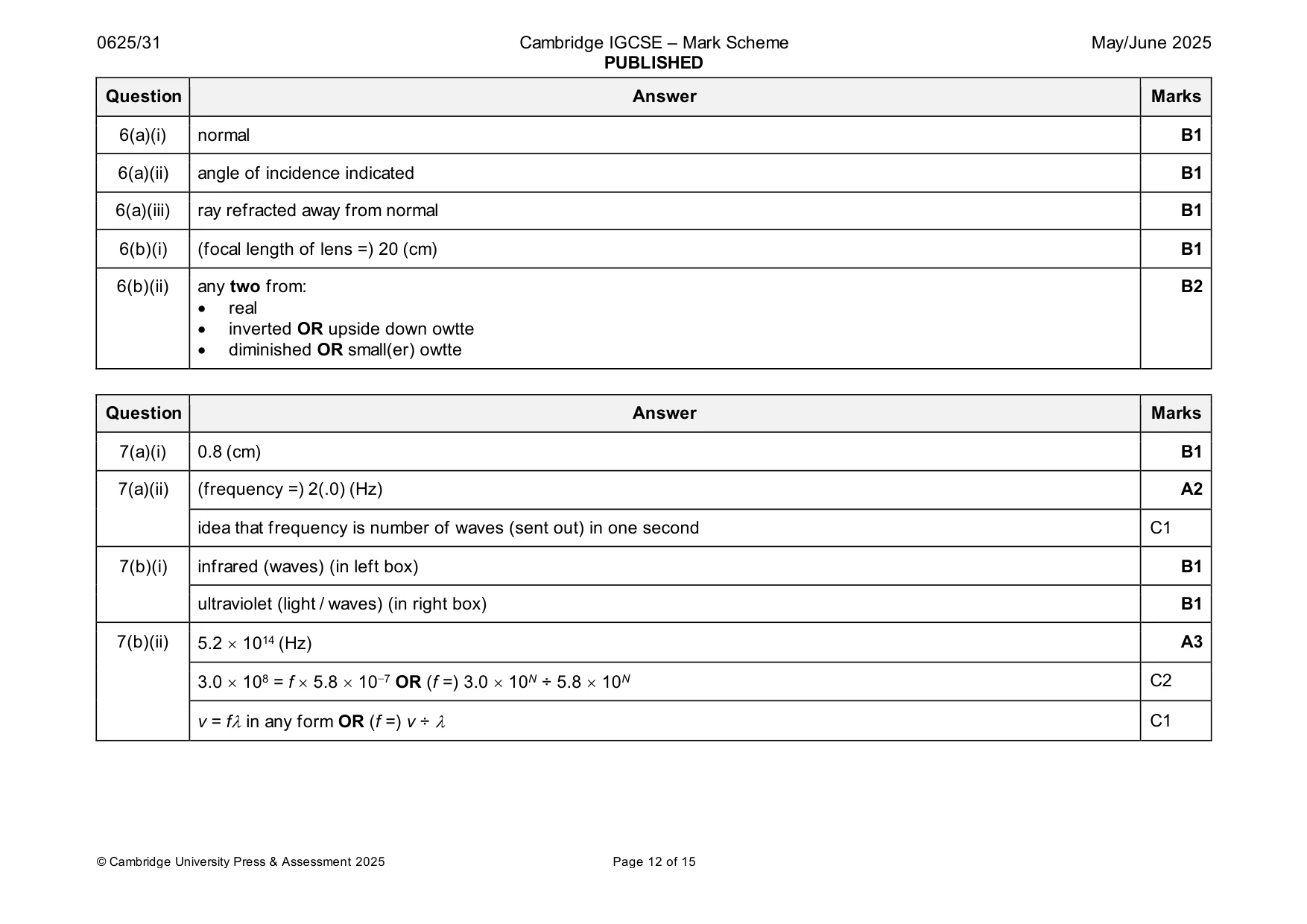
Mark scheme: 6(a)(i) normal B1 6(a)(ii) angle of incidence indicated B1 6(a)(iii) ray refracted away from normal B1 6(b)(i) (focal length of lens =) 20 (cm) B1 6(b)(ii) any two from: B2 • real • inverted OR upside down owtte • diminished OR small(er) owtte
Q7 · A transverse wave passes through a medium
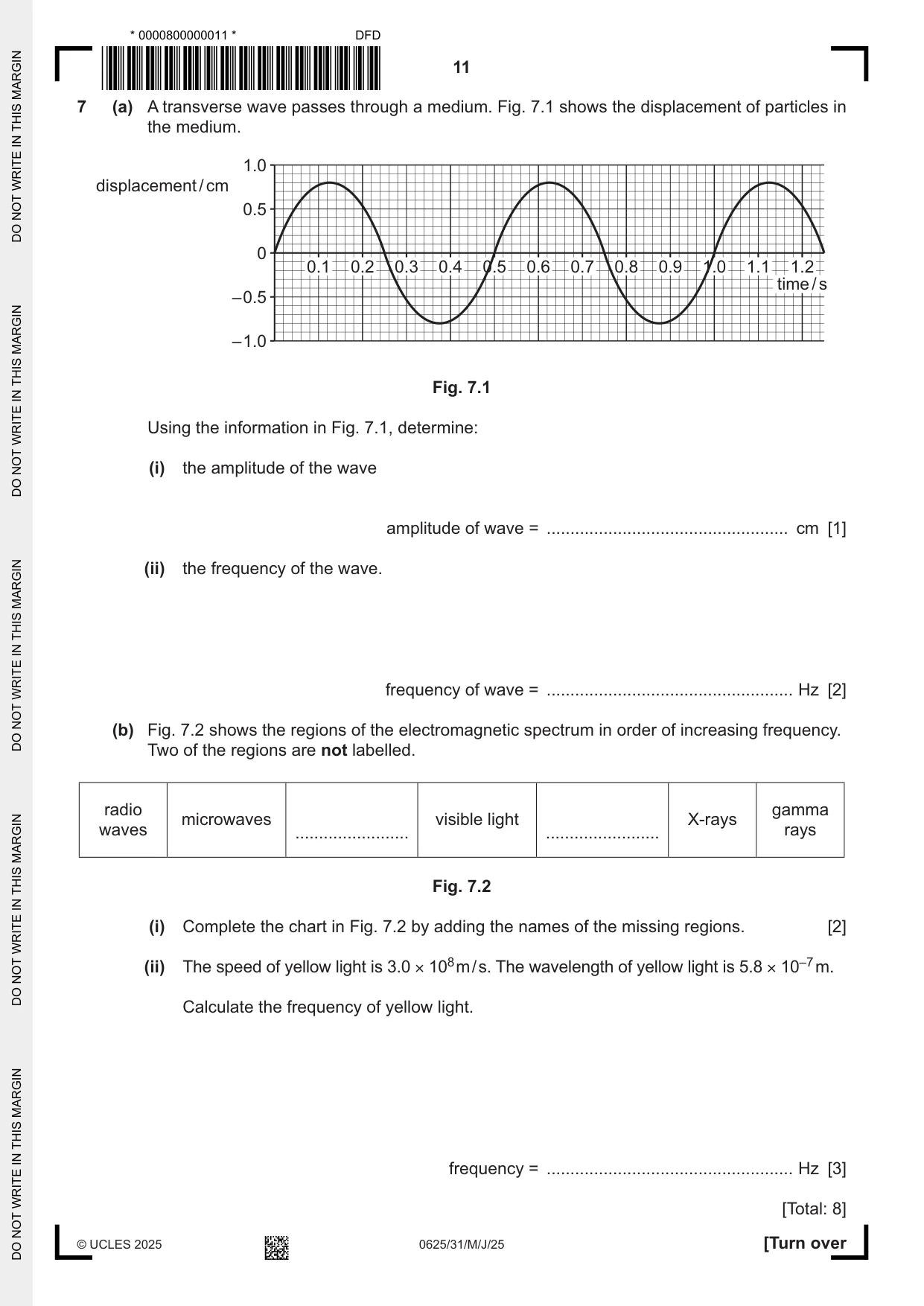
7 (a) A transverse wave passes through a medium. Fig. 7.1 shows the displacement of particles in the medium. 1.0 displacement / cm 0.5 0 0.1 0.2 0.3 0.4 0.5 0.6 0.7 0.8 0.9 1.0 1.1 1.2 time / s – 0.5 – 1.0 Fig. 7.1 Using the information in Fig. 7.1, determine: (i) the amplitude of the wave amplitude of wave = ................................................... cm [1] (ii) the frequency of the wave. frequency of wave = .................................................... Hz [2] (b) Fig. 7.2 shows the regions of the electromagnetic spectrum in order of increasing frequency. Two of the regions are not labelled. radio gamma microwaves visible light X-rays waves ........................ ........................ rays Fig. 7.2 (i) Complete the chart in Fig. 7.2 by adding the names of the missing regions. [2] (ii) The speed of yellow light is 3.0 × 10⁸ m / s. The wavelength of yellow light is 5.8 × 10⁻⁷ m. Calculate the frequency of yellow light. frequency = .................................................... Hz [3] [Total: 8]
Mark scheme: 7(a)(i) 0.8 (cm) B1 7(a)(ii) (frequency =) 2(.0) (Hz) A2 idea that frequency is number of waves (sent out) in one second C1 7(b)(i) infrared (waves) (in left box) B1 ultraviolet (light / waves) (in right box) B1 7(b)(ii) 5.2 1014 (Hz) A3 3.0 108 = f 5.8 10−7 OR (f =) 3.0 10N ÷ 5.8 10N C2 v = fin any form OR (f =) v ÷ C1
Q8 · The circuit diagram for a 16 Ω resistor and an 8.0 Ω resistor connected to a 6.0 V battery
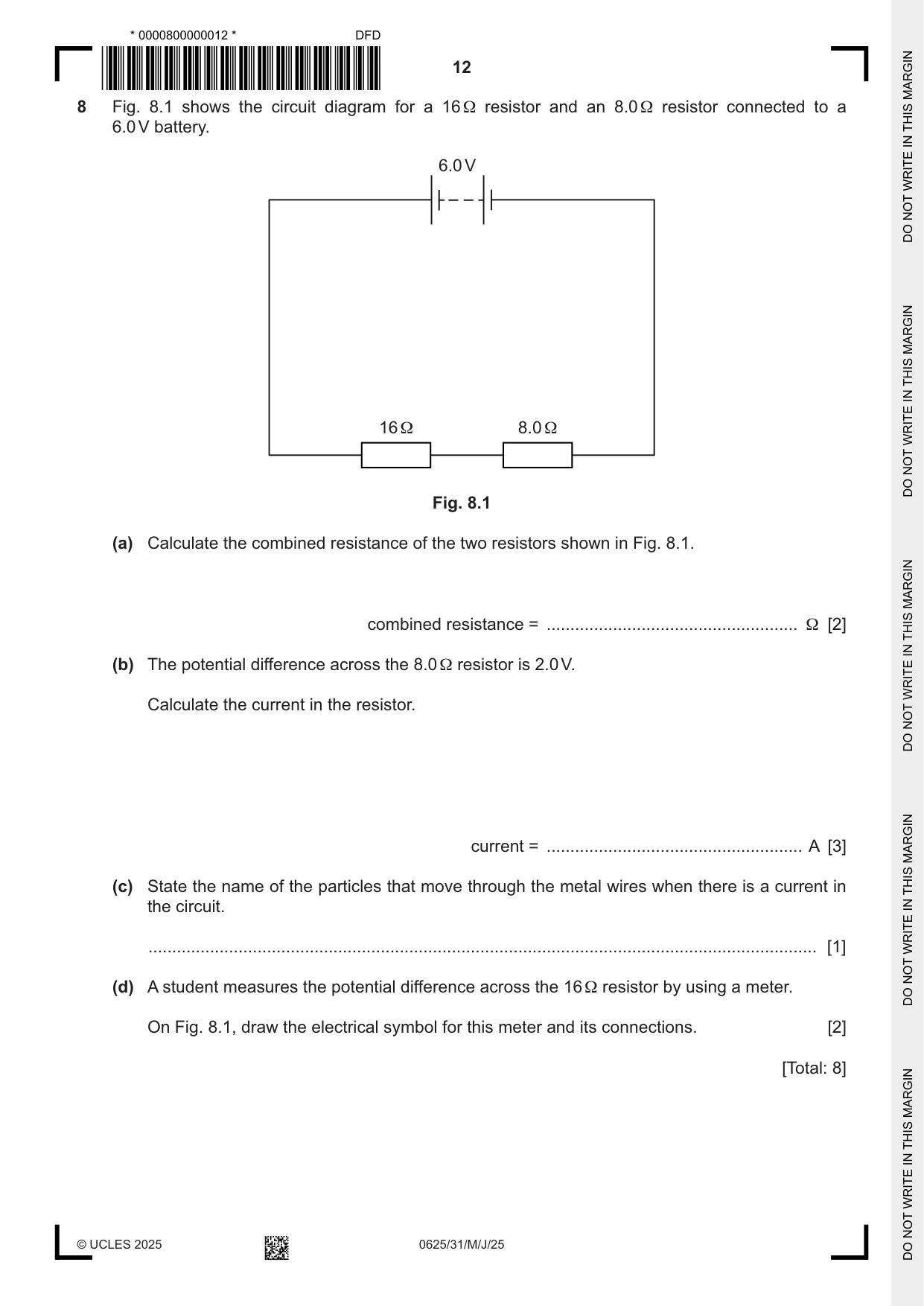
8 Fig. 8.1 shows the circuit diagram for a 16 Ω resistor and an 8.0 Ω resistor connected to a 6.0 V battery. 6.0 V 16 Ω 8.0 Ω Fig. 8.1 (a) Calculate the combined resistance of the two resistors shown in Fig. 8.1. combined resistance = ..................................................... Ω [2] (b) The potential difference across the 8.0 Ω resistor is 2.0 V. Calculate the current in the resistor. current = ...................................................... A [3] (c) State the name of the particles that move through the metal wires when there is a current in the circuit. ............................................................................................................................................. [1] (d) A student measures the potential difference across the 16 Ω resistor by using a meter. On Fig. 8.1, draw the electrical symbol for this meter and its connections. [2] [Total: 8]
Mark scheme: 8(a) 24 () A2 (combined resistance =) R1 + R2 OR 16 + 8(.0) C1 8(b) (I =) 0.25 (A) A3 (I =) 2(.0) ÷ 8(.0) C2 V = IR in any form OR (I =) V ÷ R C1 8(c) electrons B1 8(d) voltmeter correctly connected across 16 resistor A2 correct voltmeter symbol in wrong place OR incorrect meter connected across 16 resistor C1
Question 9
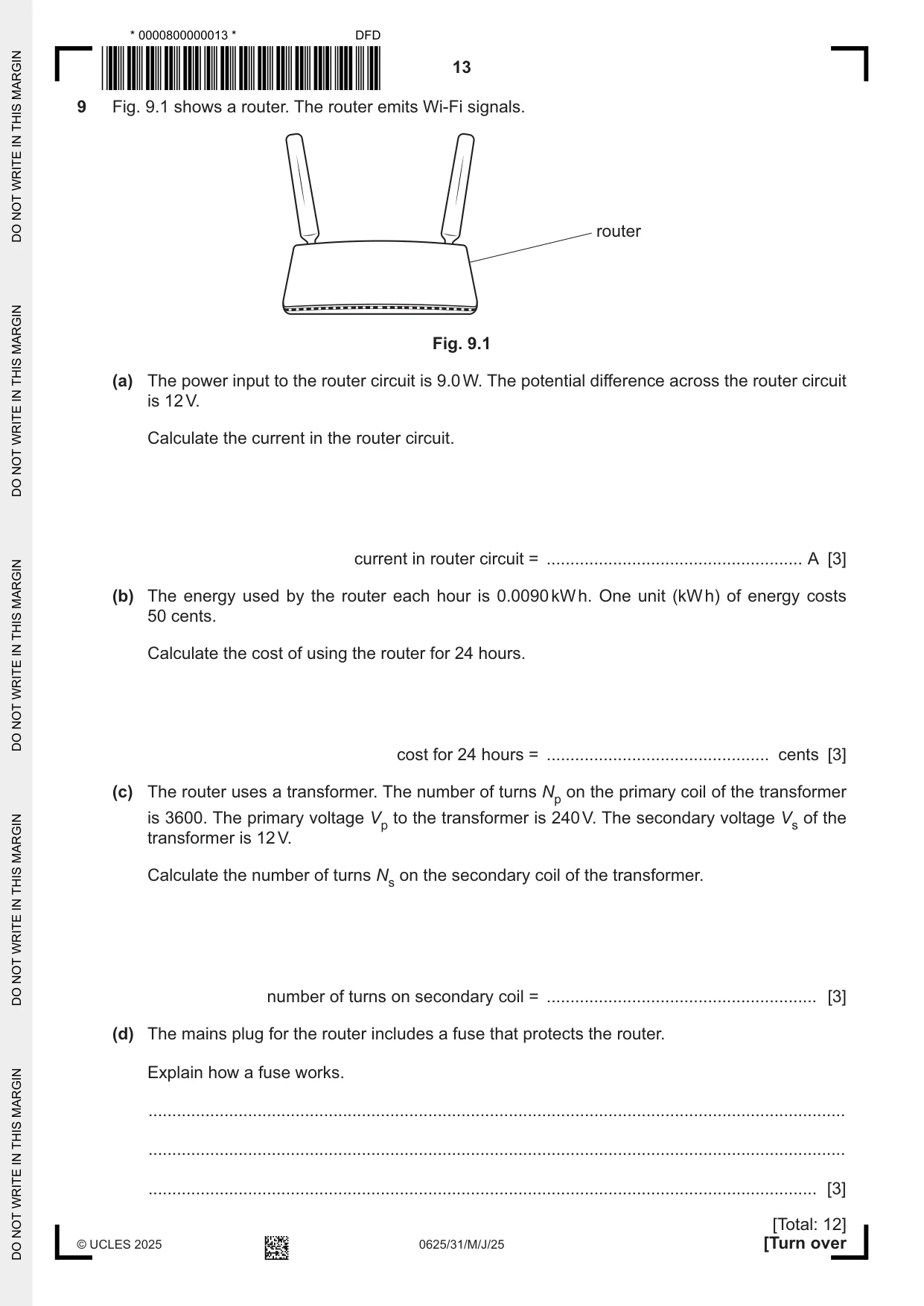
9 Fig. 9.1 shows a router. The router emits Wi-Fi signals. router Fig. 9.1 (a) The power input to the router circuit is 9.0 W. The potential difference across the router circuit is 12 V. Calculate the current in the router circuit. current in router circuit = ...................................................... A [3] (b) The energy used by the router each hour is 0.0090 kW h. One unit (kW h) of energy costs 50 cents. Calculate the cost of using the router for 24 hours. cost for 24 hours = ............................................... cents [3] (c) The router uses a transformer. The number of turns Np on the primary coil of the transformer is 3600. The primary voltage Vp to the transformer is 240 V. The secondary voltage Vs of the transformer is 12 V. Calculate the number of turns Ns on the secondary coil of the transformer. number of turns on secondary coil = ......................................................... [3] (d) The mains plug for the router includes a fuse that protects the router. Explain how a fuse works. ................................................................................................................................................... ................................................................................................................................................... ............................................................................................................................................. [3] [Total: 12]
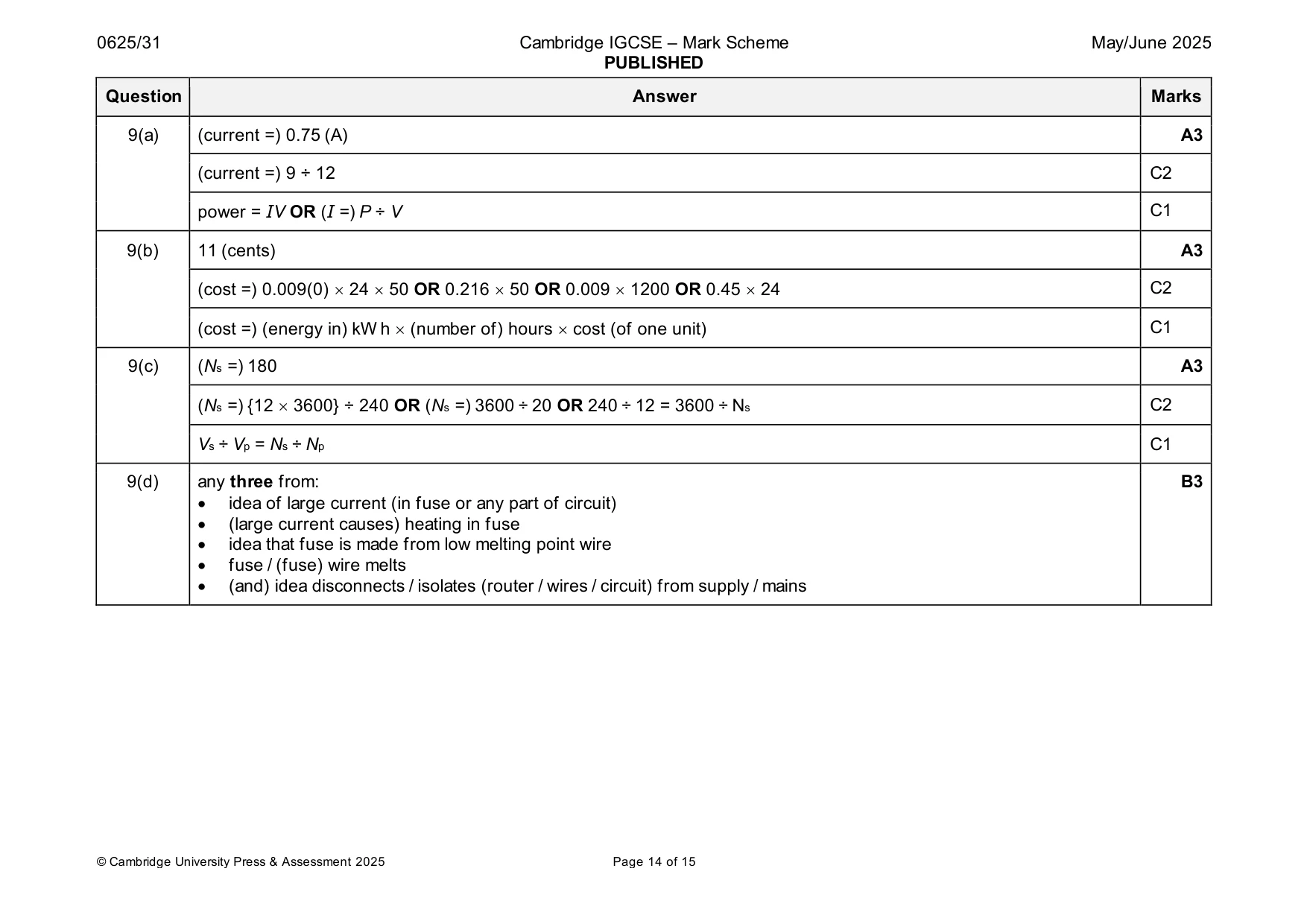
Mark scheme: 9(a) (current =) 0.75 (A) A3 (current =) 9 ÷ 12 C2 power = IV OR (I =) P ÷ V C1 9(b) 11 (cents) A3 (cost =) 0.009(0) 24 50 OR 0.216 50 OR 0.009 1200 OR 0.45 24 C2 (cost =) (energy in) kW h (number of) hours cost (of one unit) C1 9(c) (Ns =) 180 A3 (Ns =) {12 3600} ÷ 240 OR (Ns =) 3600 ÷ 20 OR 240 ÷ 12 = 3600 ÷ Ns C2 Vs ÷ Vp = Ns ÷ Np C1 9(d) any three from: B3 • idea of large current (in fuse or any part of circuit) • (large current causes) heating in fuse • idea that fuse is made from low melting point wire • fuse / (fuse) wire melts • (and) idea disconnects / isolates (router / wires / circuit) from supply / mains
Q10 · Table 10.1 describes four nuclides
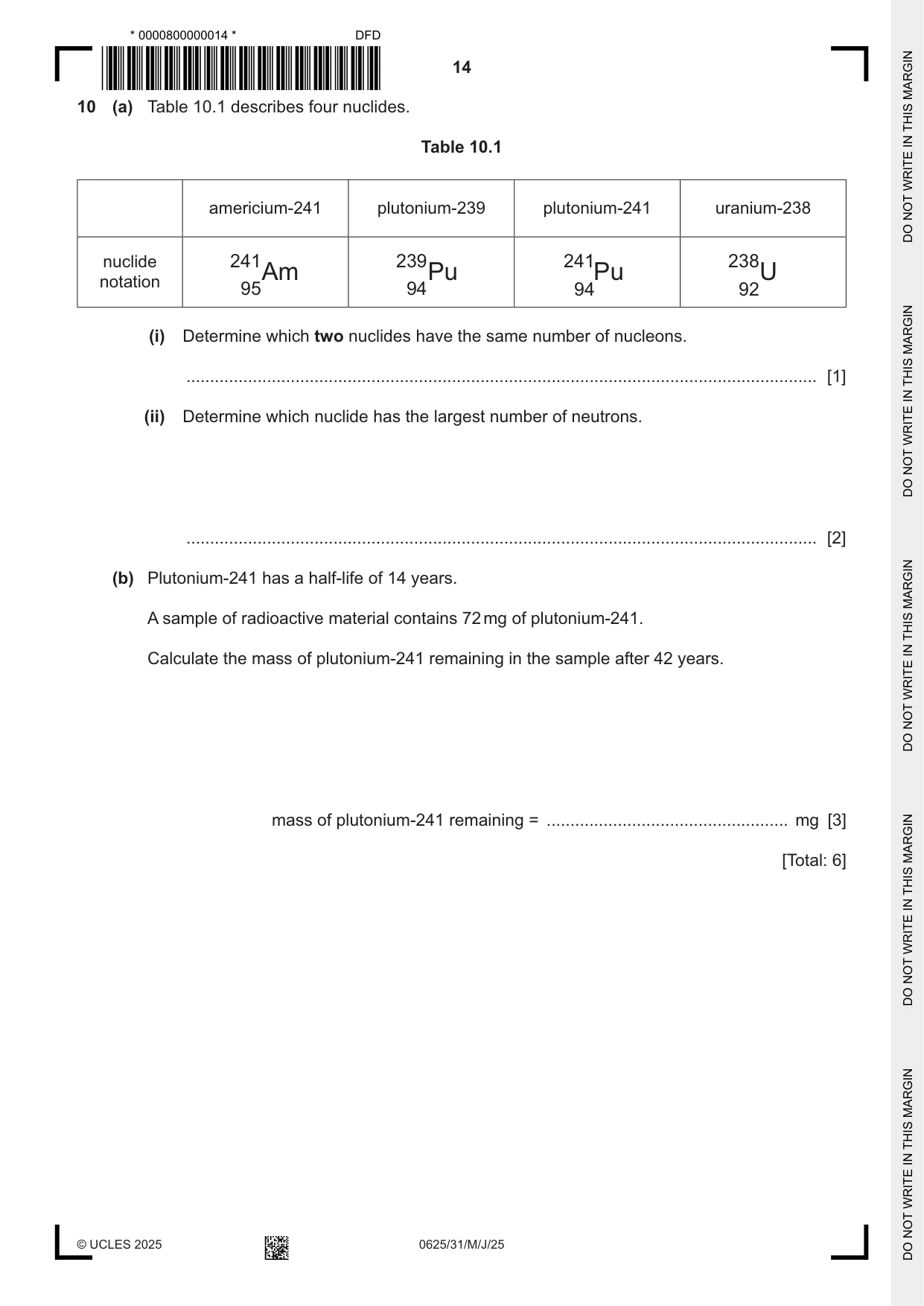
10 (a) Table 10.1 describes four nuclides. Table 10.1 americium-241 plutonium-239 plutonium-241 uranium-238 nuclide 241 239 241 238 Am Pu Pu U notation 95 94 94 92 (i) Determine which two nuclides have the same number of nucleons. ..................................................................................................................................... [1] (ii) Determine which nuclide has the largest number of neutrons. ..................................................................................................................................... [2] (b) Plutonium-241 has a half-life of 14 years. A sample of radioactive material contains 72 mg of plutonium-241. Calculate the mass of plutonium-241 remaining in the sample after 42 years. mass of plutonium-241 remaining = ................................................... mg [3] [Total: 6]
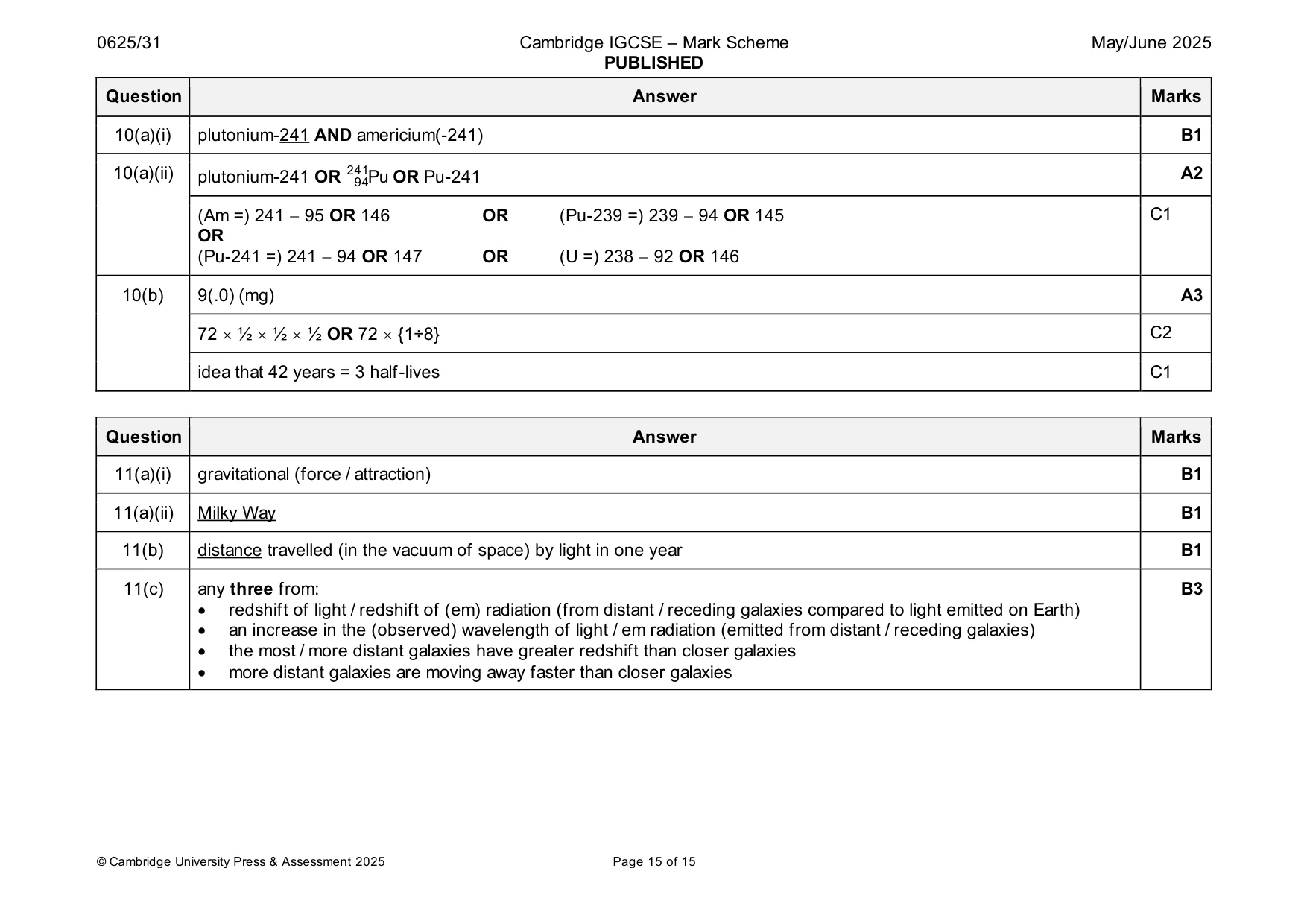
Mark scheme: 10(a)(i) plutonium-241 AND americium(-241) B1 10(a)(ii) plutonium-241 OR 24194Pu OR Pu-241 A2 (Am =) 241 − 95 OR 146 OR (Pu-239 =) 239 − 94 OR 145 C1 OR (Pu-241 =) 241 − 94 OR 147 OR (U =) 238 − 92 OR 146 10(b) 9(.0) (mg) A3 72 ½ ½ ½ OR 72 {1÷8} C2 idea that 42 years = 3 half-lives C1
Q11 · The Solar System includes the Sun and eight planets
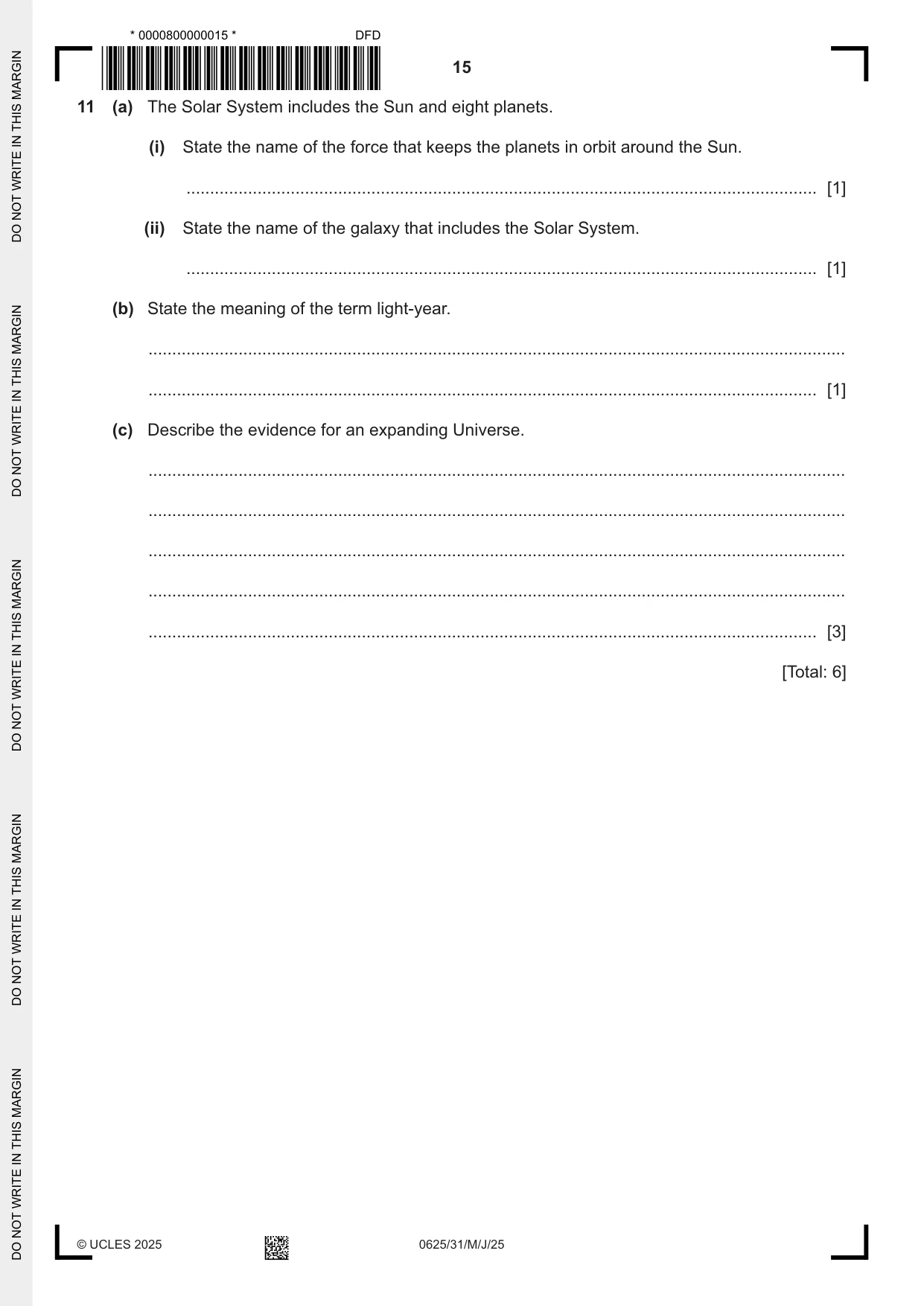
11 (a) The Solar System includes the Sun and eight planets. (i) State the name of the force that keeps the planets in orbit around the Sun. ..................................................................................................................................... [1] (ii) State the name of the galaxy that includes the Solar System. ..................................................................................................................................... [1] (b) State the meaning of the term light-year. ................................................................................................................................................... ............................................................................................................................................. [1] (c) Describe the evidence for an expanding Universe. ................................................................................................................................................... ................................................................................................................................................... ................................................................................................................................................... ................................................................................................................................................... ............................................................................................................................................. [3] [Total: 6]
Mark scheme: 11(a)(i) gravitational (force / attraction) B1 11(a)(ii) Milky Way B1 11(b) distance travelled (in the vacuum of space) by light in one year B1 11(c) any three from: B3 • redshift of light / redshift of (em) radiation (from distant / receding galaxies compared to light emitted on Earth) • an increase in the (observed) wavelength of light / em radiation (emitted from distant / receding galaxies) • the most / more distant galaxies have greater redshift than closer galaxies • more distant galaxies are moving away faster than closer galaxies
What was in this paper
The subtopics covered by these 11 questions, and how many questions each got. Open one in a new tab to see every Cambridge question on it.
What you needed in this session
Cambridge’s own grade thresholds for 2025 May/June, Paper 3 · Variant 1. A higher threshold means an easier paper — the bar moves with how the cohort did.