Cambridge IGCSE Physics 0625 — 2023 May/June Paper 3 · Variant 3
0625/33/M/J/23 · 10 questions · 80 marks · ≈90 min
The question paper and its mark scheme, free to read here and free to download. This is Cambridge’s own paper, exactly as it was sat.
Question paper16 pages
Mark scheme13 pages
Answers below. Sit the paper first if you are practising.
Questions as text
Q1 · The distance–time graph for an engineer’s journey
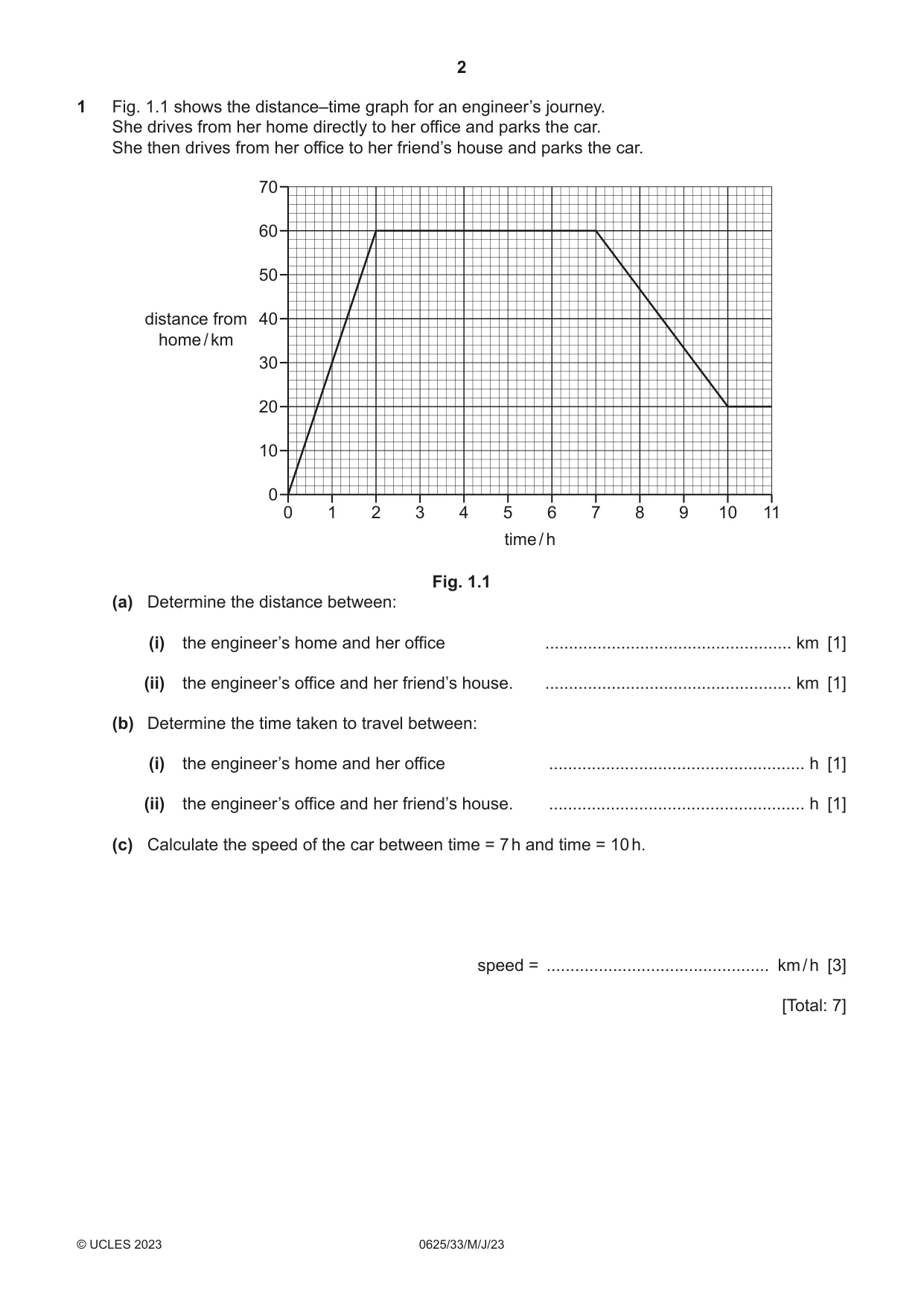
1 Fig. 1.1 shows the distance–time graph for an engineer’s journey. She drives from her home directly to her office and parks the car. She then drives from her office to her friend’s house and parks the car. 70 60 50 distance from 40 home / km 30 20 10 0 0 1 2 3 4 5 6 7 8 9 10 11 time / h Fig. 1.1 (a) Determine the distance between: (i) the engineer’s home and her office .................................................... km [1] (ii) the engineer’s office and her friend’s house. .................................................... km [1] (b) Determine the time taken to travel between: (i) the engineer’s home and her office ...................................................... h [1] (ii) the engineer’s office and her friend’s house. ...................................................... h [1] (c) Calculate the speed of the car between time = 7 h and time = 10 h. speed = ............................................... km / h [3] [Total: 7]
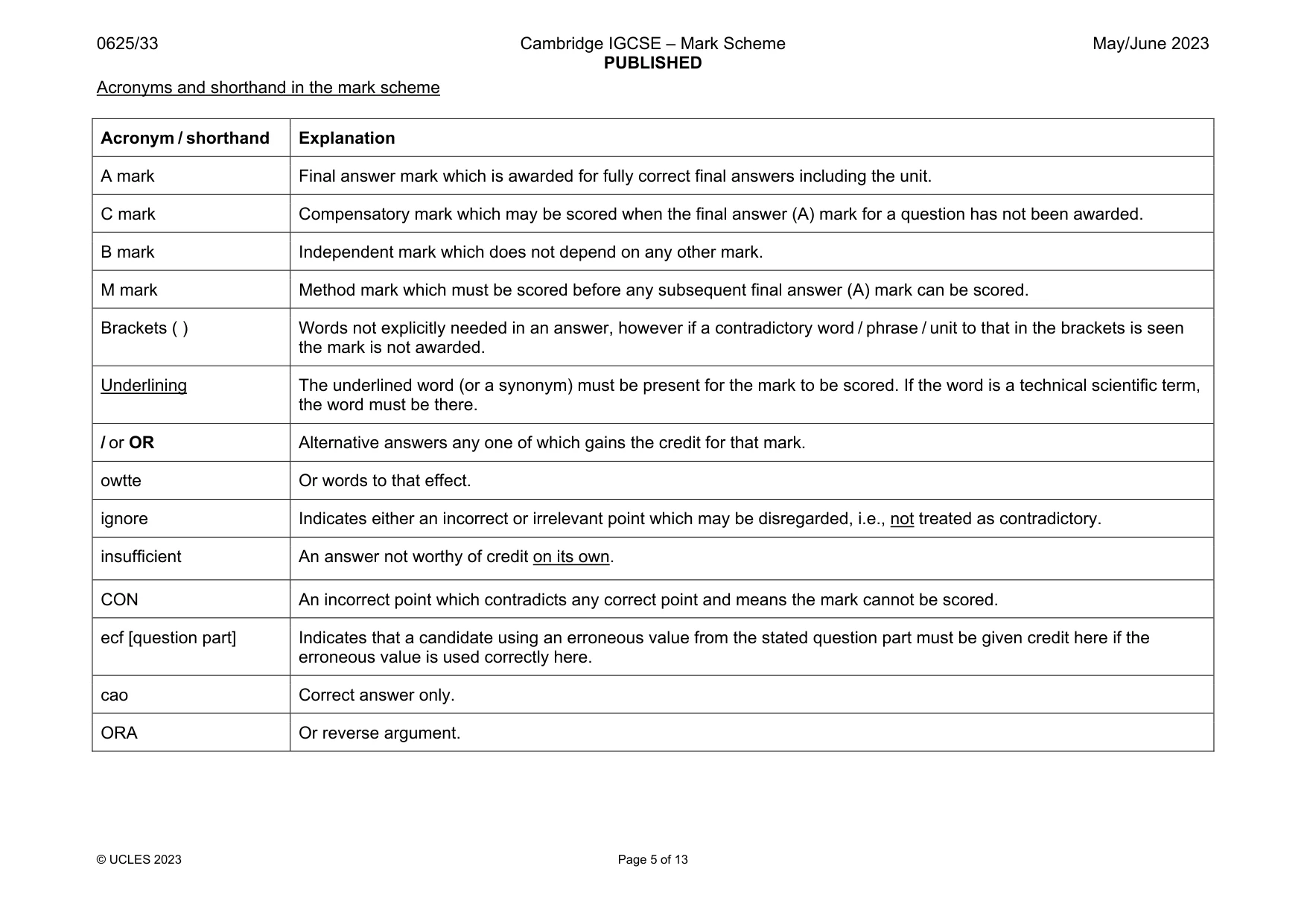
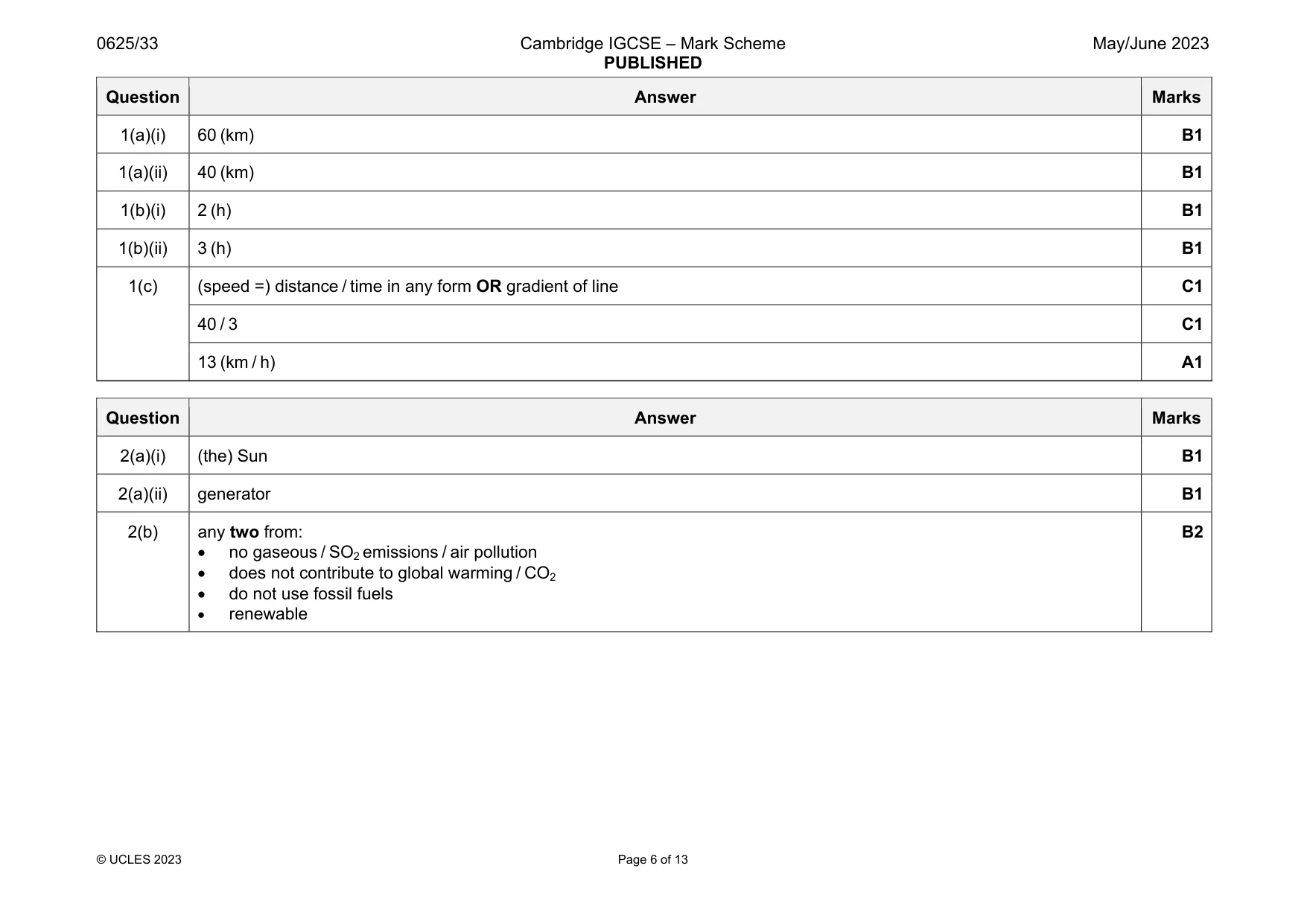
Mark scheme: 1(a)(i) 60 (km) B1 1(a)(ii) 40 (km) B1 1(b)(i) 2 (h) B1 1(b)(ii) 3 (h) B1 1(c) (speed =) distance / time in any form OR gradient of line C1 40 / 3 C1 13 (km / h) A1
Q2 · An engineer working with wind turbines
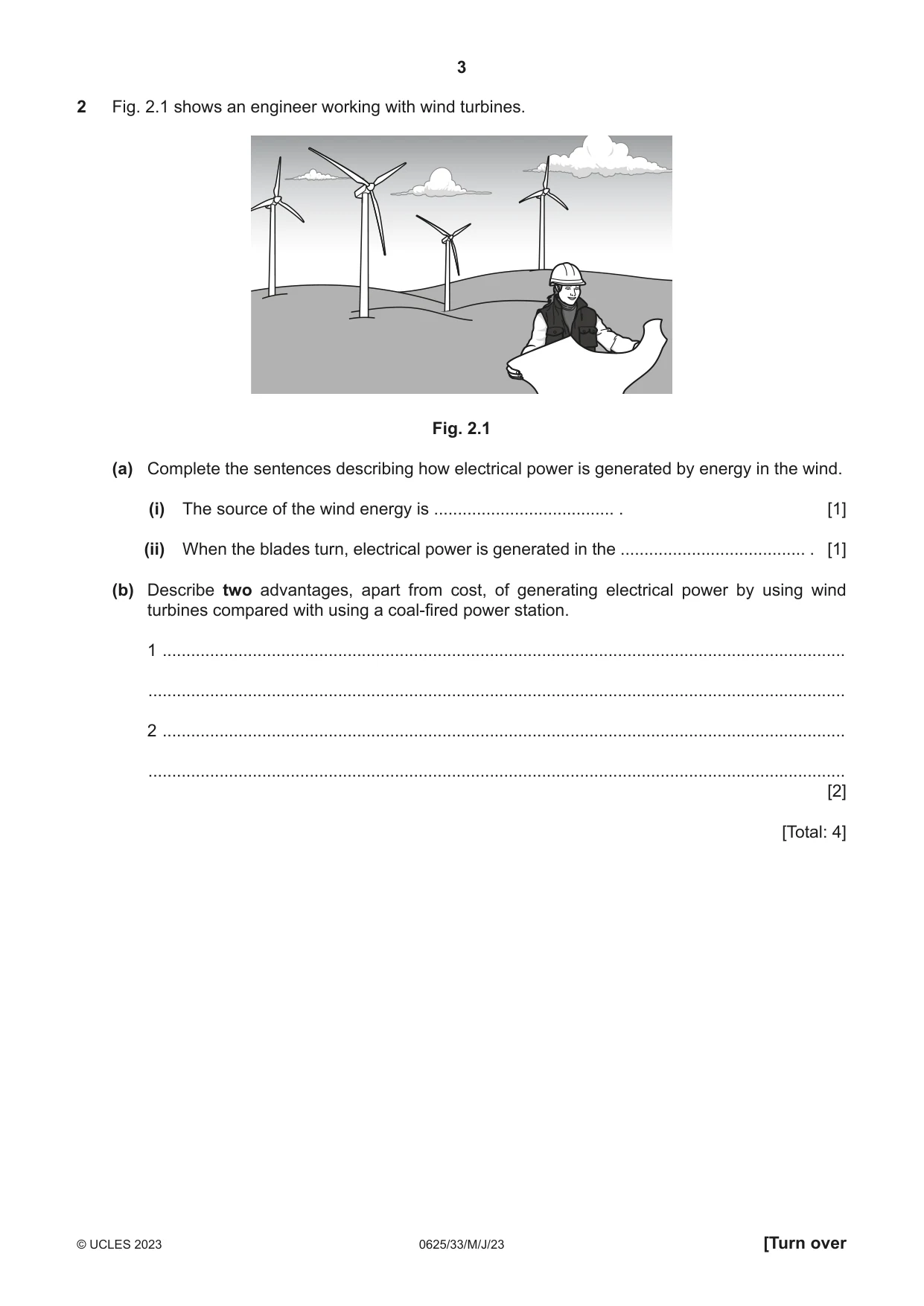
2 Fig. 2.1 shows an engineer working with wind turbines. Fig. 2.1 (a) Complete the sentences describing how electrical power is generated by energy in the wind. (i) The source of the wind energy is ...................................... . [1] (ii) When the blades turn, electrical power is generated in the ....................................... . [1] (b) Describe two advantages, apart from cost, of generating electrical power by using wind turbines compared with using a coal-fired power station. 1 ................................................................................................................................................ ................................................................................................................................................... 2 ................................................................................................................................................ ................................................................................................................................................... [2] [Total: 4]
Mark scheme: 2(a)(i) (the) Sun B1 2(a)(ii) generator B1 2(b) any two from: no gaseous / SO2 emissions / air pollution does not contribute to global warming / CO2 do not use fossil fuels renewable B2
Q3 · A student balances a beam on a pivot
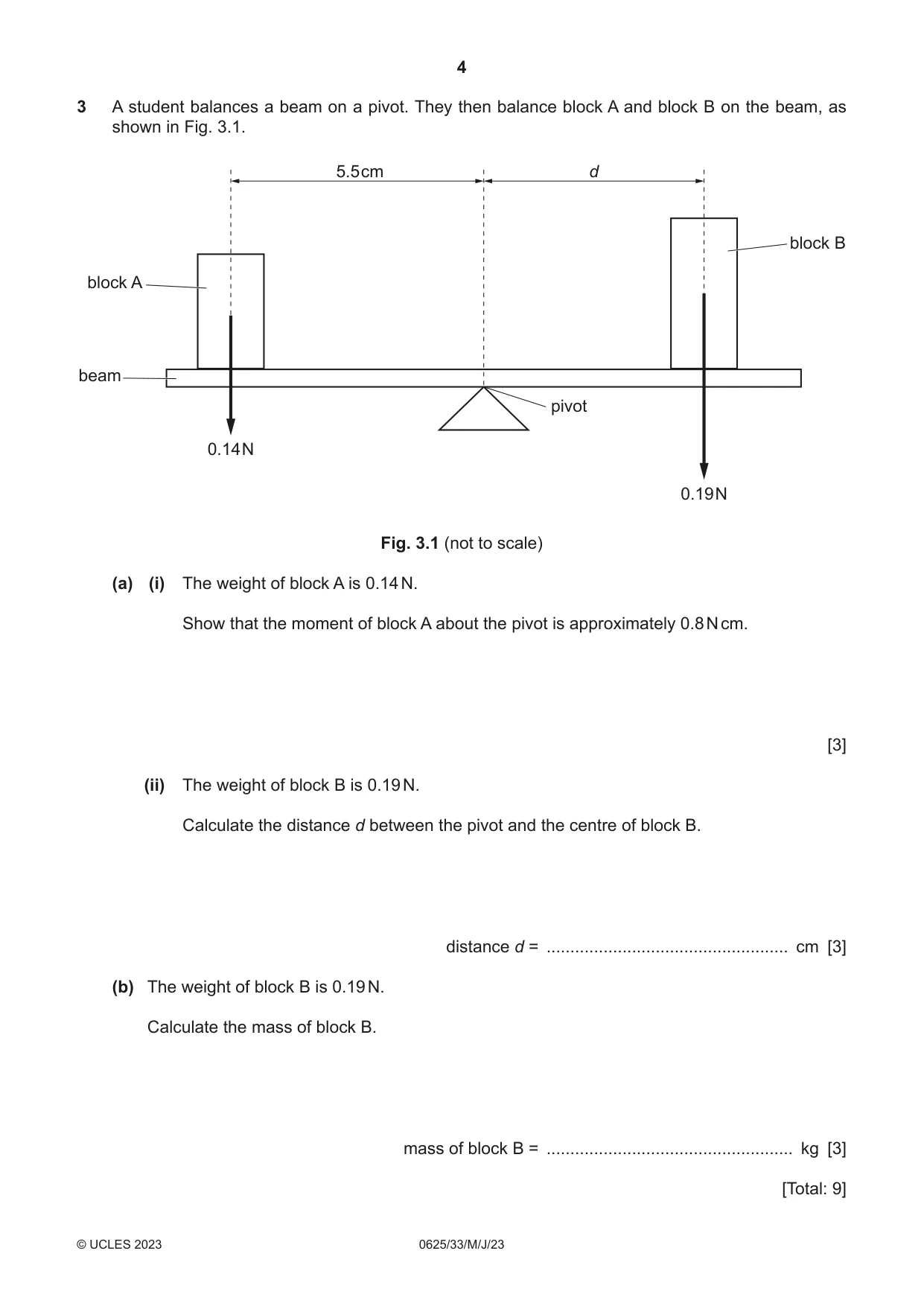
3 A student balances a beam on a pivot. They then balance block A and block B on the beam, as shown in Fig. 3.1. 5.5 cm d block B block A beam pivot 0.14 N 0.19 N Fig. 3.1 (not to scale) (a) (i) The weight of block A is 0.14 N. Show that the moment of block A about the pivot is approximately 0.8 N cm. [3] (ii) The weight of block B is 0.19 N. Calculate the distance d between the pivot and the centre of block B. distance d = ................................................... cm [3] (b) The weight of block B is 0.19 N. Calculate the mass of block B. mass of block B = .................................................... kg [3] [Total: 9]
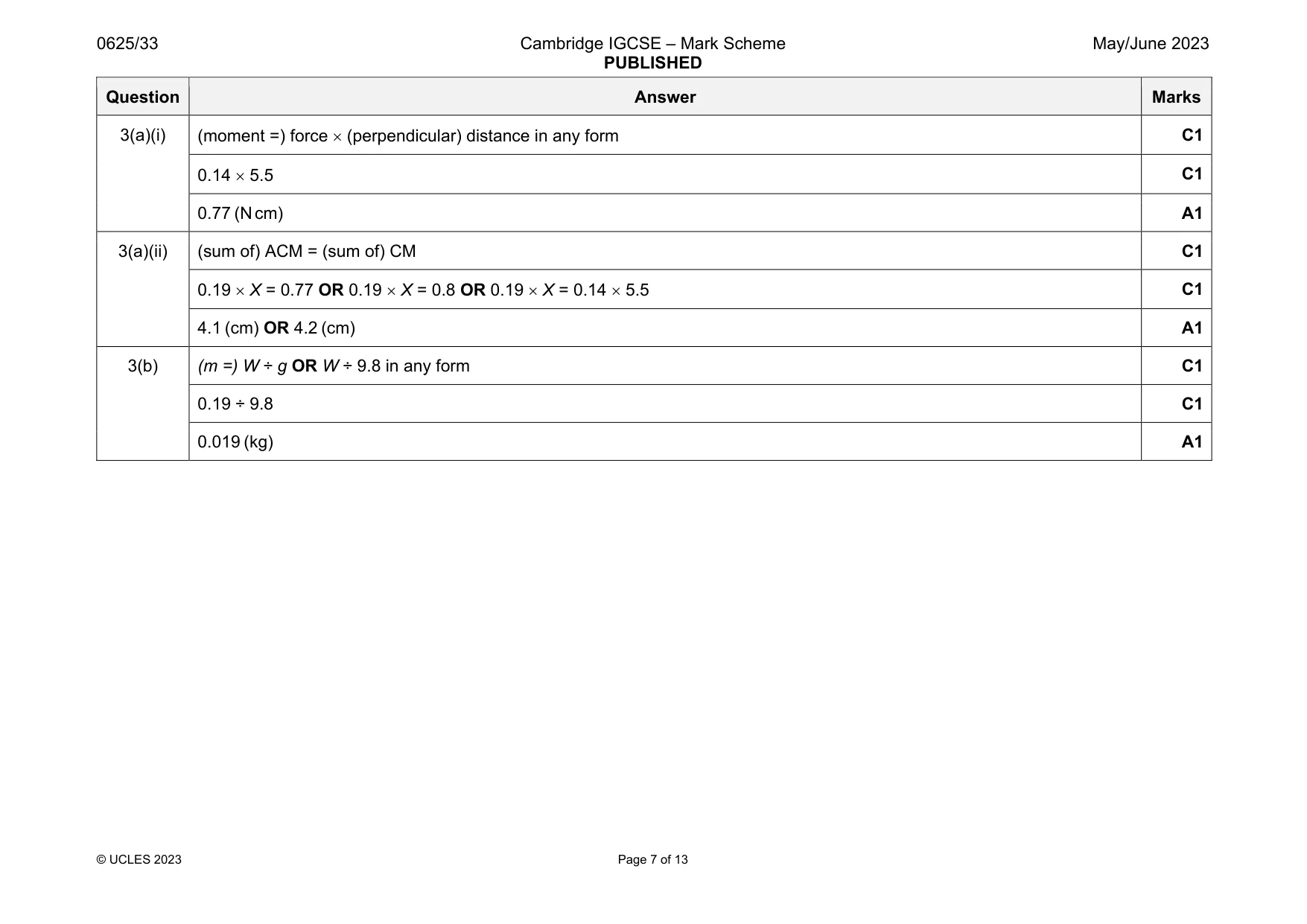
Mark scheme: 3(a)(i) C1 0.14 5.5 C1 0.77 (N cm) A1 3(a)(ii) (sum of) ACM = (sum of) CM C1 0.19 X = 0.77 OR 0.19 X = 0.8 OR 0.19 X = 0.14 5.5 C1 4.1 (cm) OR 4.2 (cm) A1 3(b) (m =) W ÷ g OR W ÷ 9.8 in any form C1 0.19 ÷ 9.8 C1 0.019 (kg) A1
Q4 · A tight-fitting lid keeps air inside a metal can
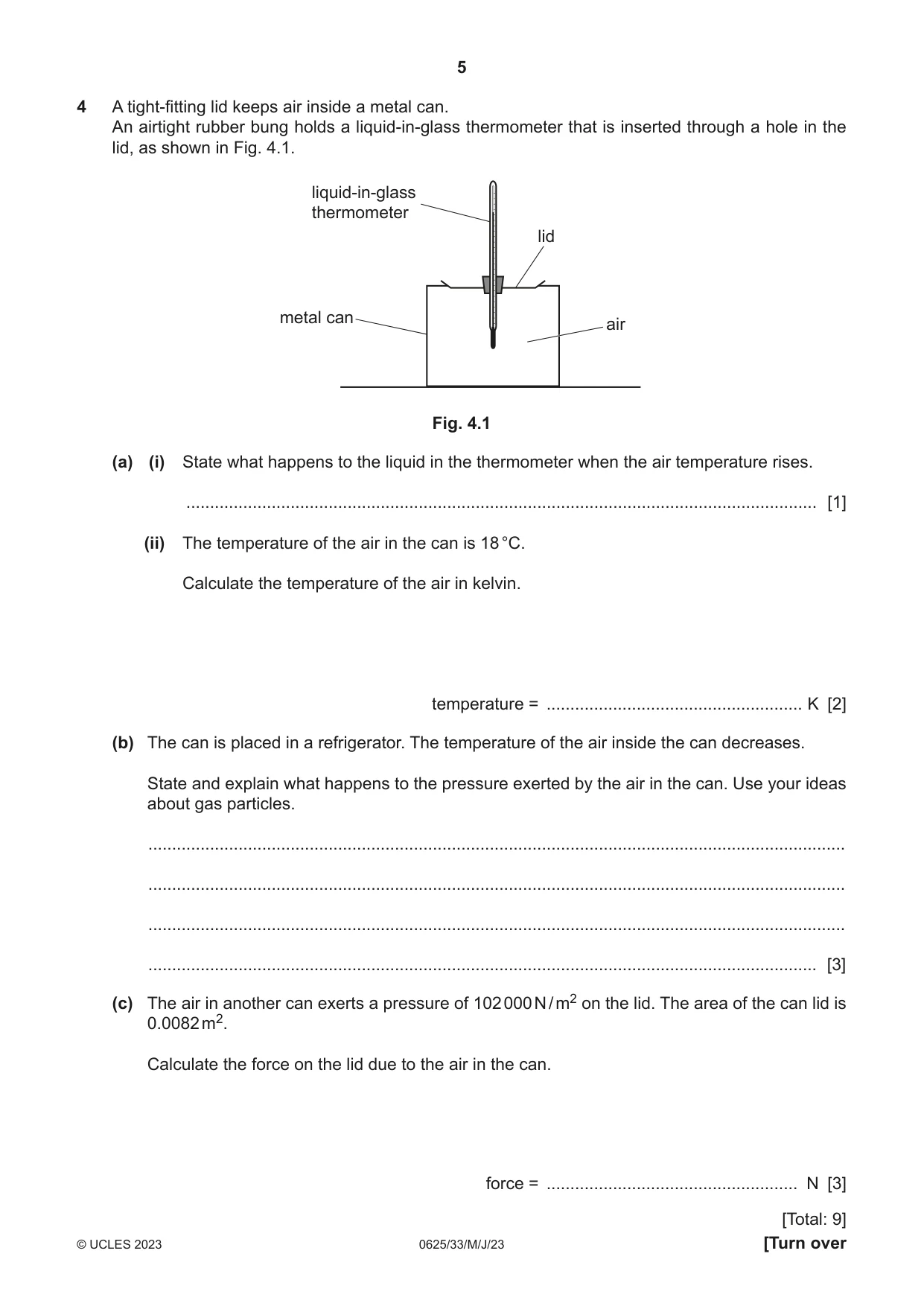
4 A tight-fitting lid keeps air inside a metal can. An airtight rubber bung holds a liquid-in-glass thermometer that is inserted through a hole in the lid, as shown in Fig. 4.1. liquid-in-glass thermometer lid metal can air Fig. 4.1 (a) (i) State what happens to the liquid in the thermometer when the air temperature rises. ..................................................................................................................................... [1] (ii) The temperature of the air in the can is 18 °C. Calculate the temperature of the air in kelvin. temperature = ...................................................... K [2] (b) The can is placed in a refrigerator. The temperature of the air inside the can decreases. State and explain what happens to the pressure exerted by the air in the can. Use your ideas about gas particles. ................................................................................................................................................... ................................................................................................................................................... ................................................................................................................................................... ............................................................................................................................................. [3] (c) The air in another can exerts a pressure of 102 000 N / m2 on the lid. The area of the can lid is 0.0082 m2. Calculate the force on the lid due to the air in the can. force = ..................................................... N [3] [Total: 9]
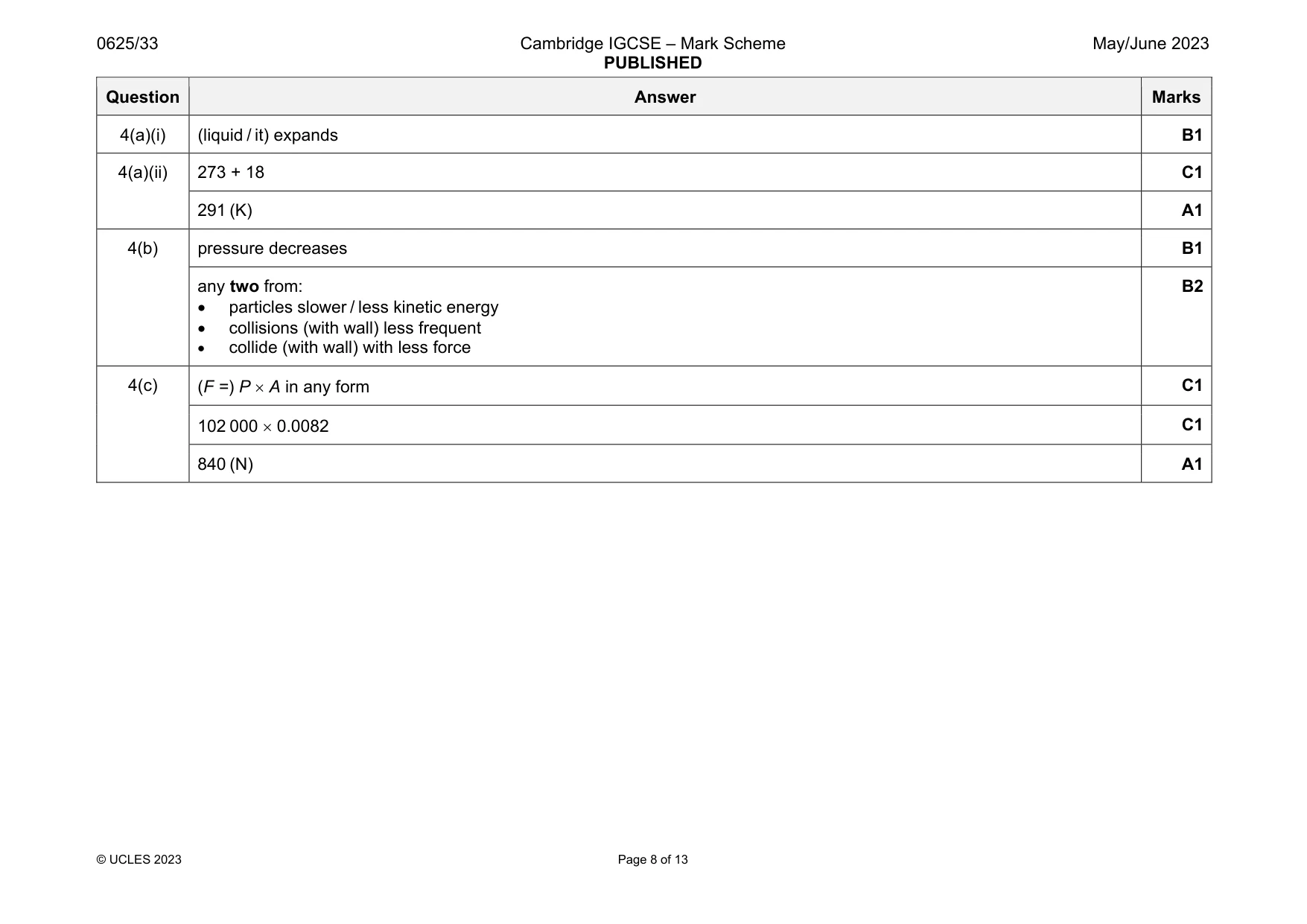
Mark scheme: 4(a)(i) (liquid / it) expands B1 4(a)(ii) 273 + 18 C1 291 (K) A1 4(b) pressure decreases B1 any two from: particles slower / less kinetic energy collisions (with wall) less frequent collide (with wall) with less force B2 4(c) (F =) P A in any form C1 102 000 0.0082 C1 840 (N) A1
Q5 · A teacher demonstrates the behaviour of waves by using water waves in a ripple tank
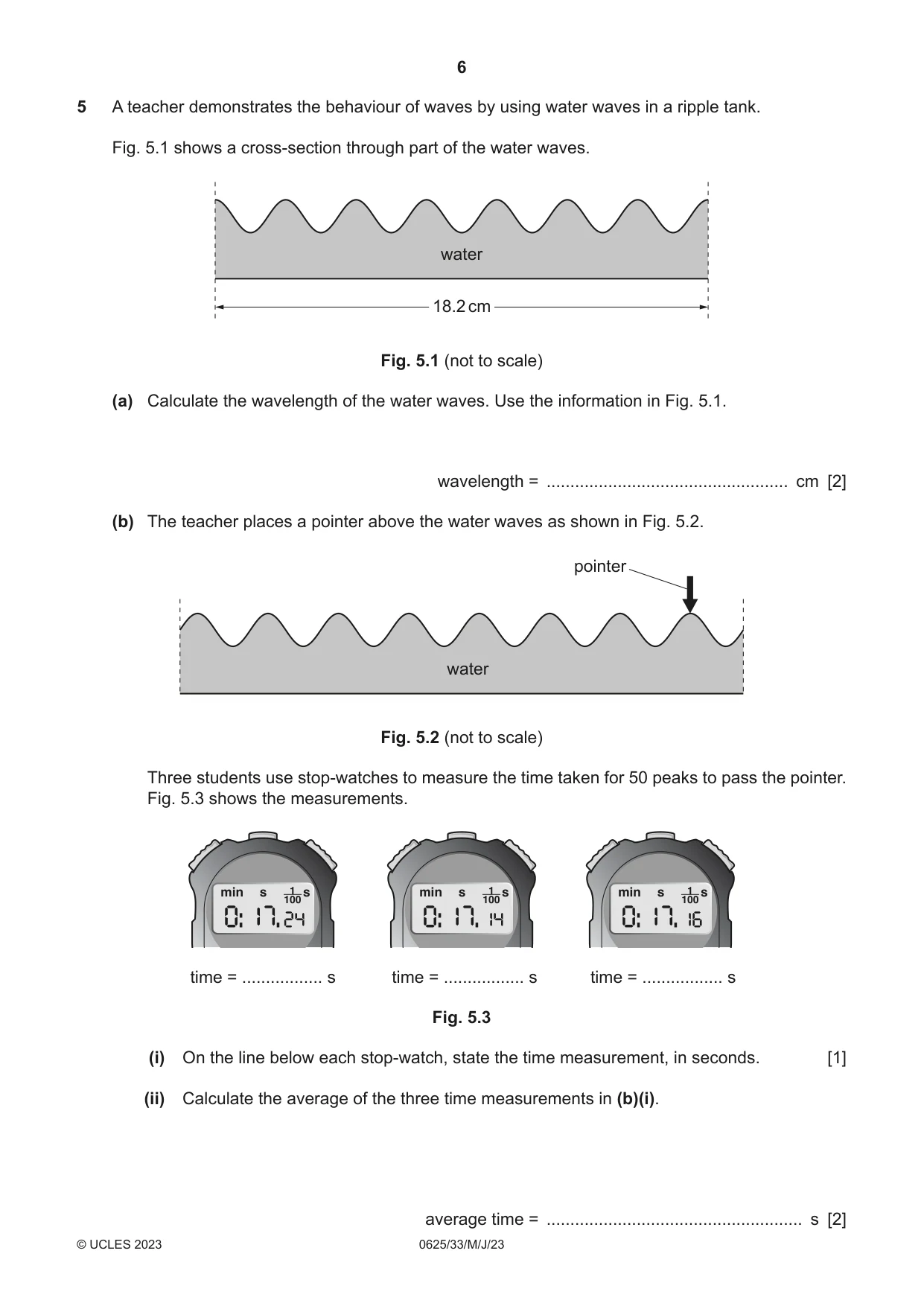
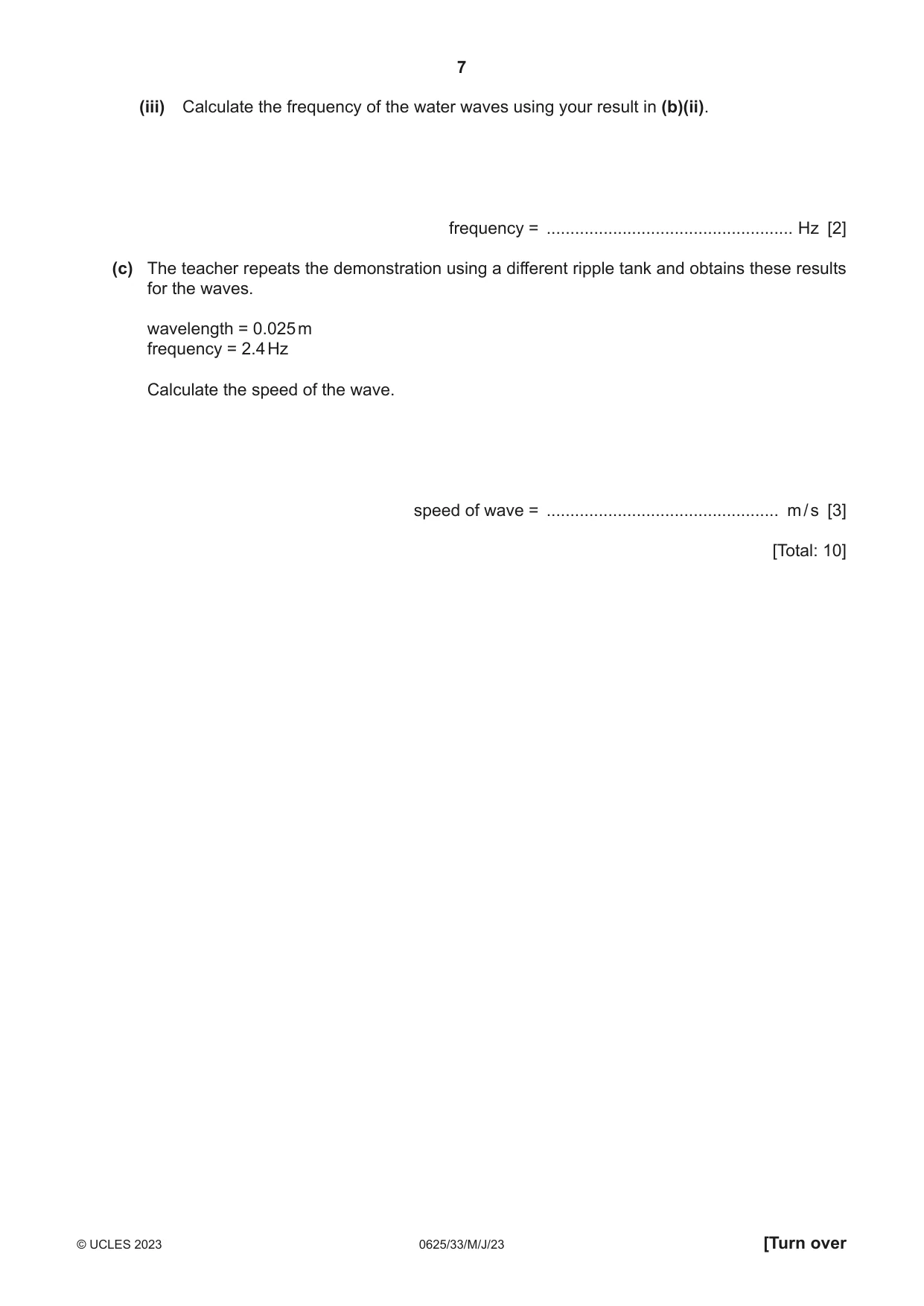
5 A teacher demonstrates the behaviour of waves by using water waves in a ripple tank. Fig. 5.1 shows a cross-section through part of the water waves. water 18.2 cm Fig. 5.1 (not to scale) (a) Calculate the wavelength of the water waves. Use the information in Fig. 5.1. wavelength = ................................................... cm [2] (b) The teacher places a pointer above the water waves as shown in Fig. 5.2. pointer water Fig. 5.2 (not to scale) Three students use stop-watches to measure the time taken for 50 peaks to pass the pointer. Fig. 5.3 shows the measurements. min s 1 s min s 1 s min s 1 s 100 100 100 time = ................. s time = ................. s time = ................. s Fig. 5.3 (i) On the line below each stop-watch, state the time measurement, in seconds. [1] (ii) Calculate the average of the three time measurements in (b)(i). average time = ...................................................... s [2] (iii) Calculate the frequency of the water waves using your result in (b)(ii). frequency = .................................................... Hz [2] (c) The teacher repeats the demonstration using a different ripple tank and obtains these results for the waves. wavelength = 0.025 m frequency = 2.4 Hz Calculate the speed of the wave. speed of wave = ................................................. m / s [3] [Total: 10]
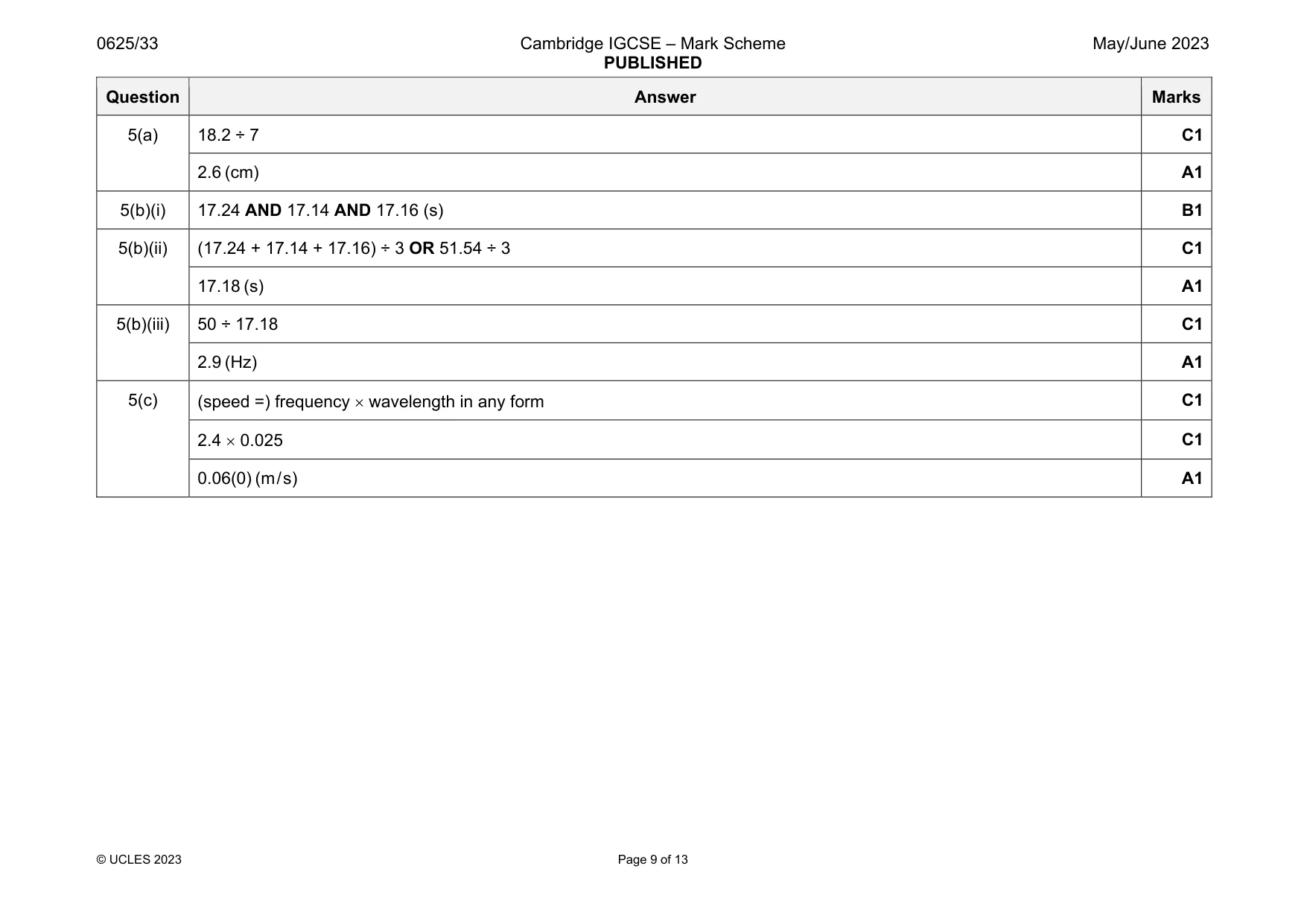
Mark scheme: 5(a) 18.2 ÷ 7 C1 2.6 (cm) A1 5(b)(i) 17.24 AND 17.14 AND 17.16 (s) B1 5(b)(ii) (17.24 + 17.14 + 17.16) ÷ 3 OR 51.54 ÷ 3 C1 17.18 (s) A1 5(b)(iii) 50 ÷ 17.18 C1 2.9 (Hz) A1 5(c) (speed =) frequency wavelength in any form C1 2.4 0.025 C1 0.06(0) (m / s) A1
Q6 · Regions of the electromagnetic (e.m.) spectrum
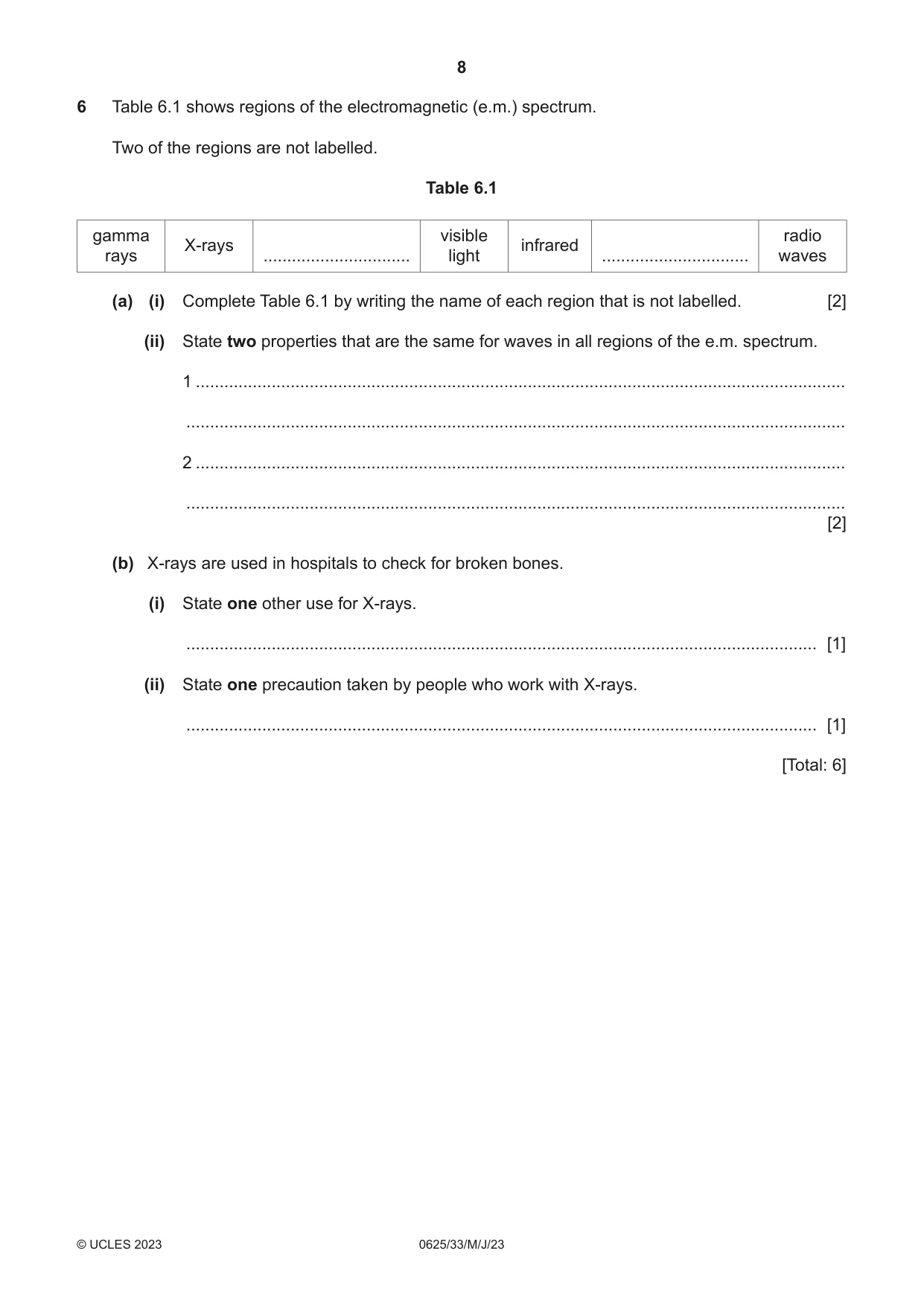
6 Table 6.1 shows regions of the electromagnetic (e.m.) spectrum. Two of the regions are not labelled. Table 6.1 gamma visible radio X-rays infrared rays ............................... light ............................... waves (a) (i) Complete Table 6.1 by writing the name of each region that is not labelled. [2] (ii) State two properties that are the same for waves in all regions of the e.m. spectrum. 1 ......................................................................................................................................... ........................................................................................................................................... 2 ......................................................................................................................................... ........................................................................................................................................... [2] (b) X-rays are used in hospitals to check for broken bones. (i) State one other use for X-rays. ..................................................................................................................................... [1] (ii) State one precaution taken by people who work with X-rays. ..................................................................................................................................... [1] [Total: 6]
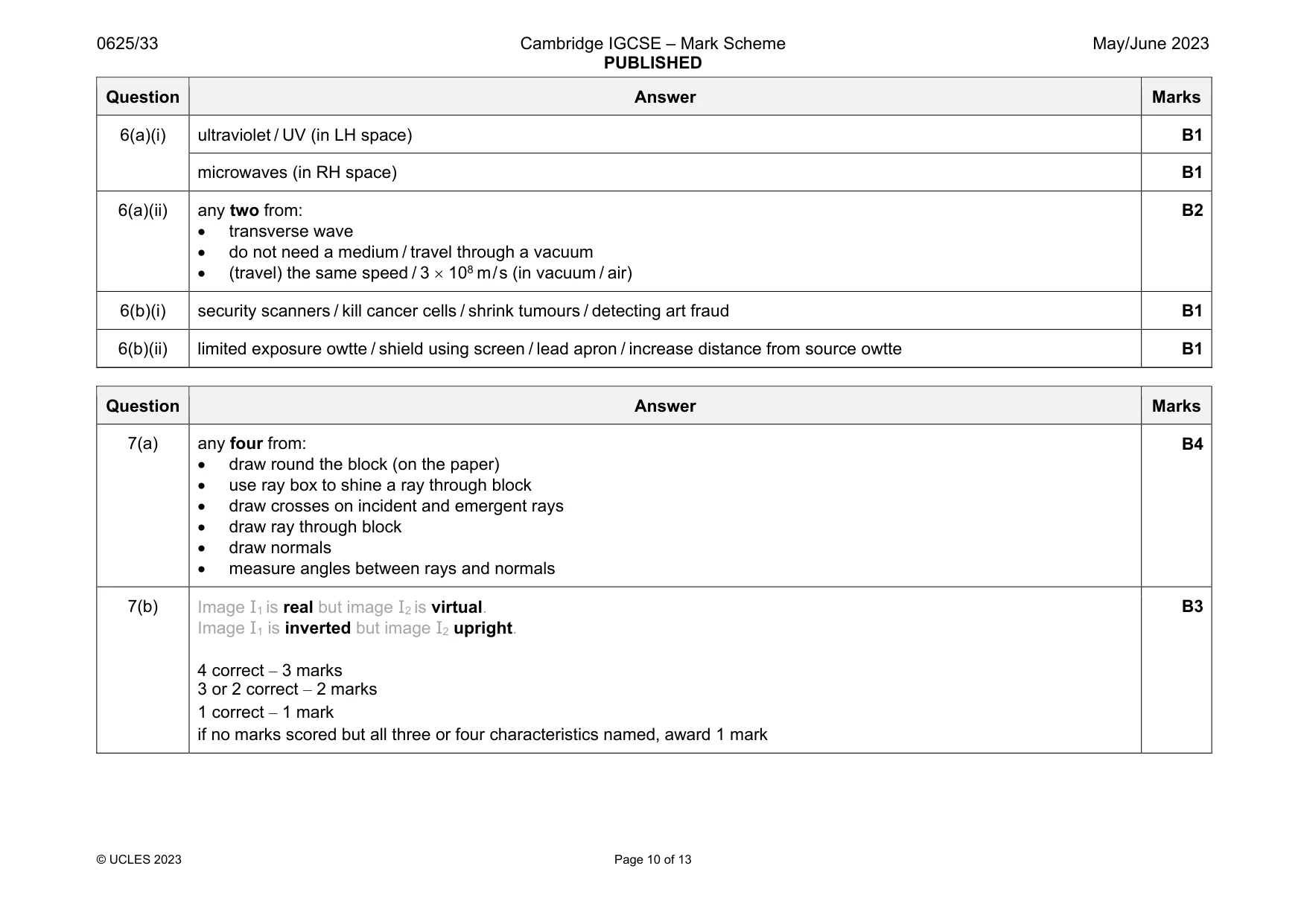
Mark scheme: 6(a)(i) ultraviolet / UV (in LH space) B1 microwaves (in RH space) B1 6(a)(ii) any two from: transverse wave do not need a medium / travel through a vacuum (travel) the same speed / 3 108 m / s (in vacuum / air) B2 6(b)(i) security scanners / kill cancer cells / shrink tumours / detecting art fraud B1 6(b)(ii) limited exposure owtte / shield using screen / lead apron / increase distance from source owtte B1
Q7 · Students are investigating the refraction of light as it travels from air into glass
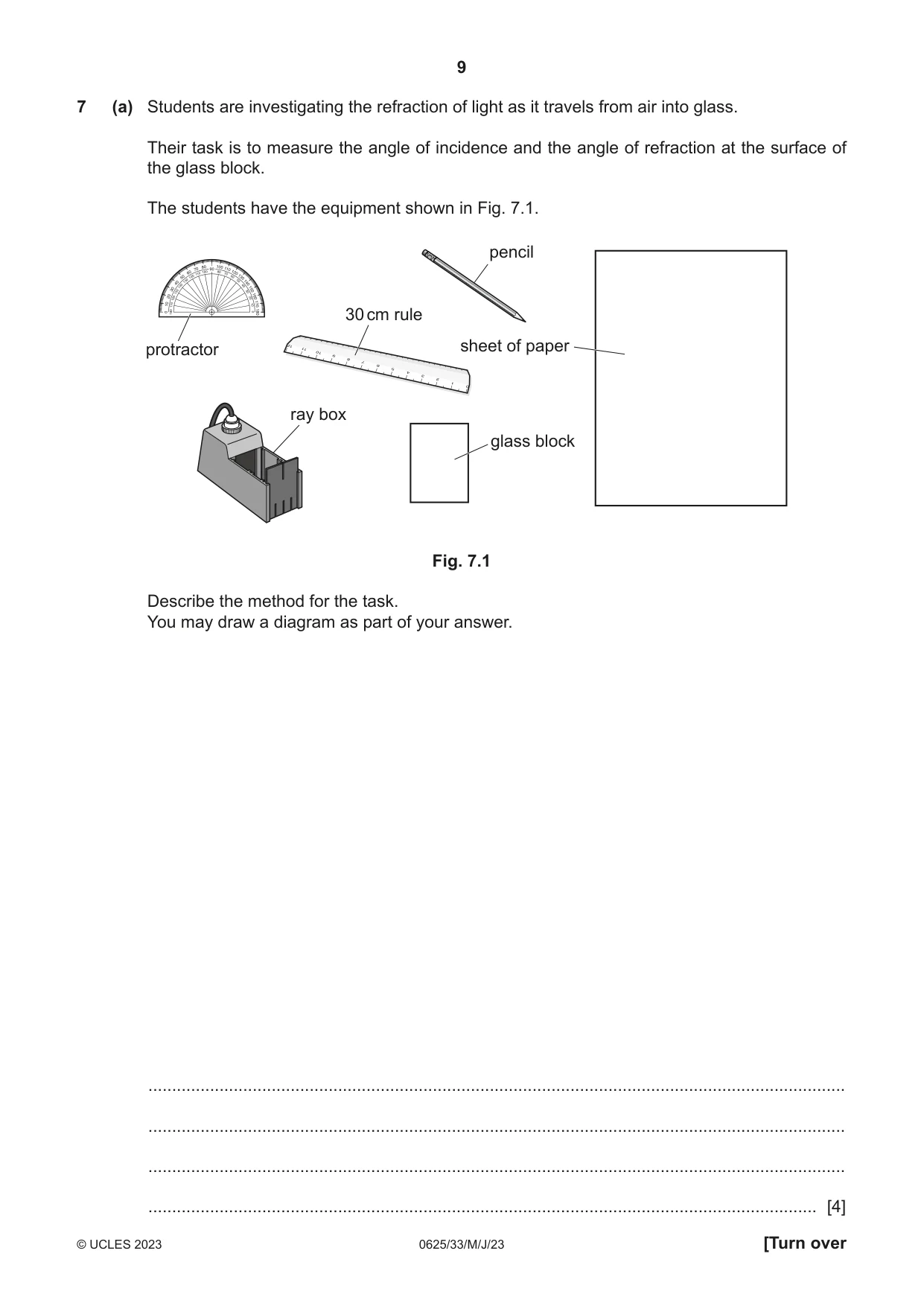
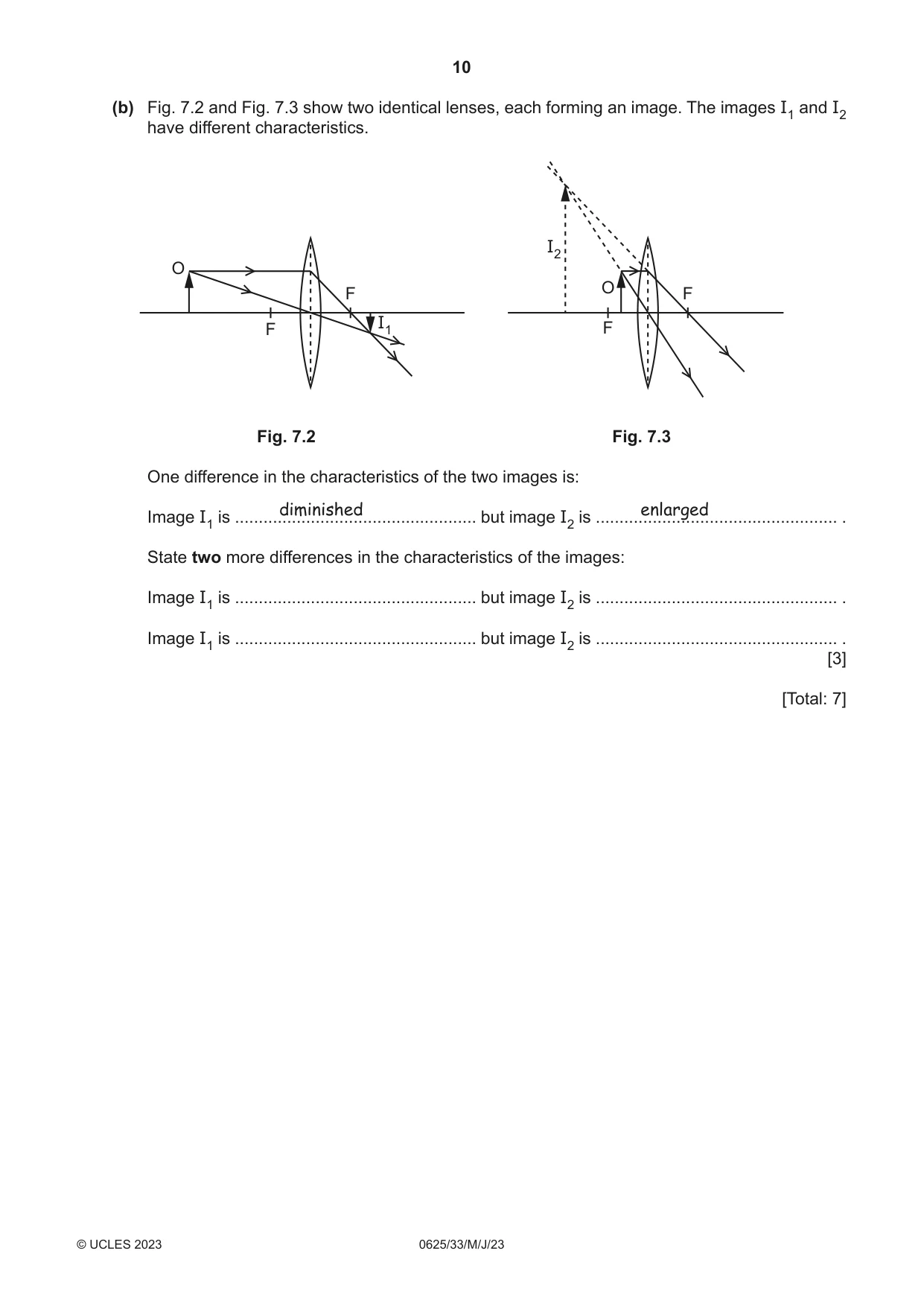
7 (a) Students are investigating the refraction of light as it travels from air into glass. Their task is to measure the angle of incidence and the angle of refraction at the surface of the glass block. The students have the equipment shown in Fig. 7.1. pencil 30 cm rule protractor sheet of paper ray box glass block Fig. 7.1 Describe the method for the task. You may draw a diagram as part of your answer. ................................................................................................................................................... ................................................................................................................................................... ................................................................................................................................................... ............................................................................................................................................. [4] (b) Fig. 7.2 and Fig. 7.3 show two identical lenses, each forming an image. The images I1 and I2 have different characteristics. I2 O O F F F I1 F Fig. 7.2 Fig. 7.3 One difference in the characteristics of the two images is: diminished enlarged Image I1 is ................................................... but image I2 is ................................................... . State two more differences in the characteristics of the images: Image I1 is ................................................... but image I2 is ................................................... . Image I1 is ................................................... but image I2 is ................................................... . [3] [Total: 7]
Mark scheme: 7(a) any four from: draw round the block (on the paper) use ray box to shine a ray through block draw crosses on incident and emergent rays draw ray through block draw normals measure angles between rays and normals B4 7(b) Image I1 is real but image I2 is virtual. Image I1 is inverted but image I2 upright. 4 correct – 3 marks 3 or 2 correct – 2 marks 1 correct – 1 mark if no marks scored but all three or four characteristics named, award 1 mark B3
Q8 · The electrical symbols for some circuit components
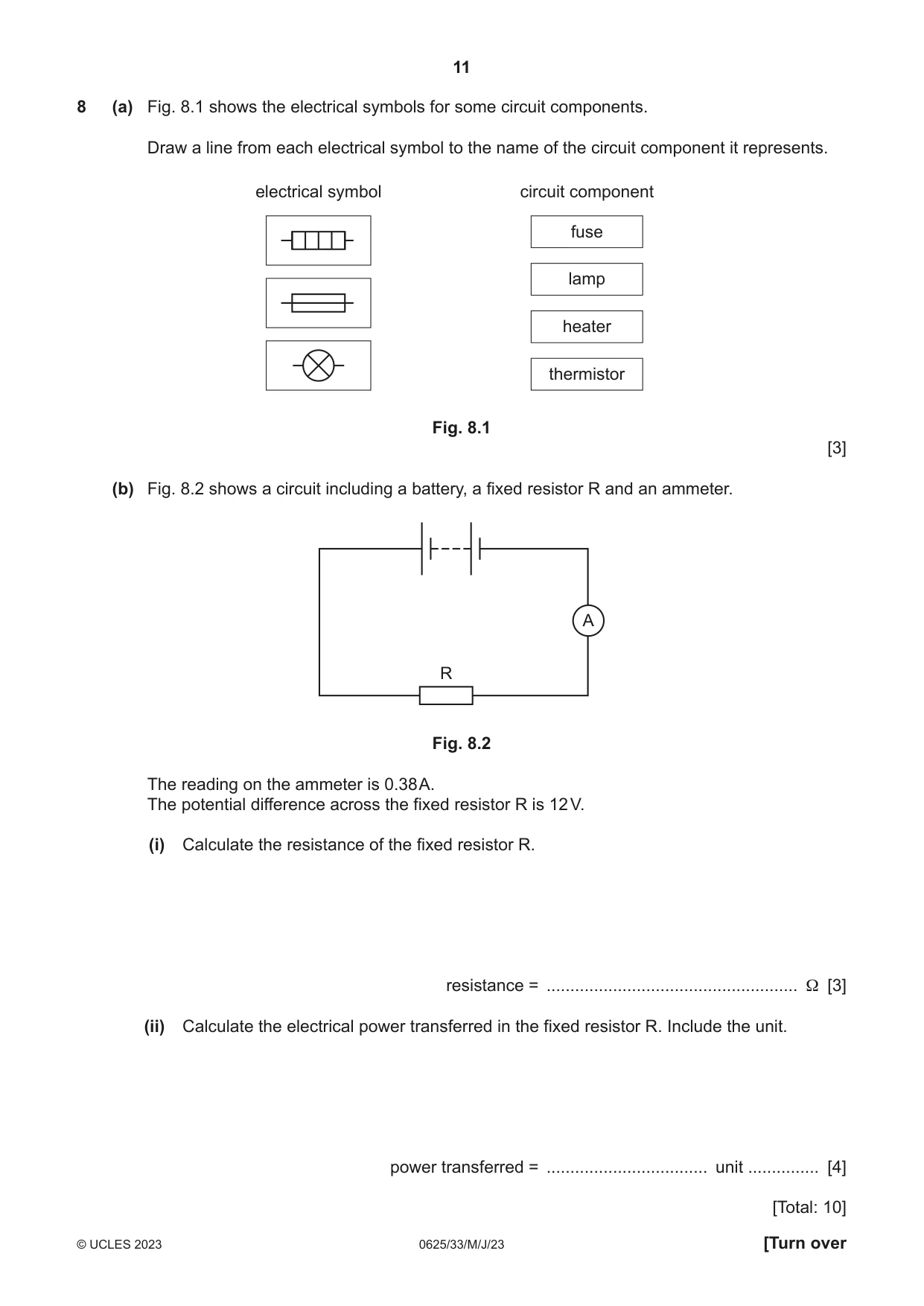
8 (a) Fig. 8.1 shows the electrical symbols for some circuit components. Draw a line from each electrical symbol to the name of the circuit component it represents. electrical symbol circuit component fuse lamp heater thermistor Fig. 8.1 [3] (b) Fig. 8.2 shows a circuit including a battery, a fixed resistor R and an ammeter. A R Fig. 8.2 The reading on the ammeter is 0.38 A. The potential difference across the fixed resistor R is 12 V. (i) Calculate the resistance of the fixed resistor R. resistance = ..................................................... Ω [3] (ii) Calculate the electrical power transferred in the fixed resistor R. Include the unit. power transferred = .................................. unit ............... [4] [Total: 10]
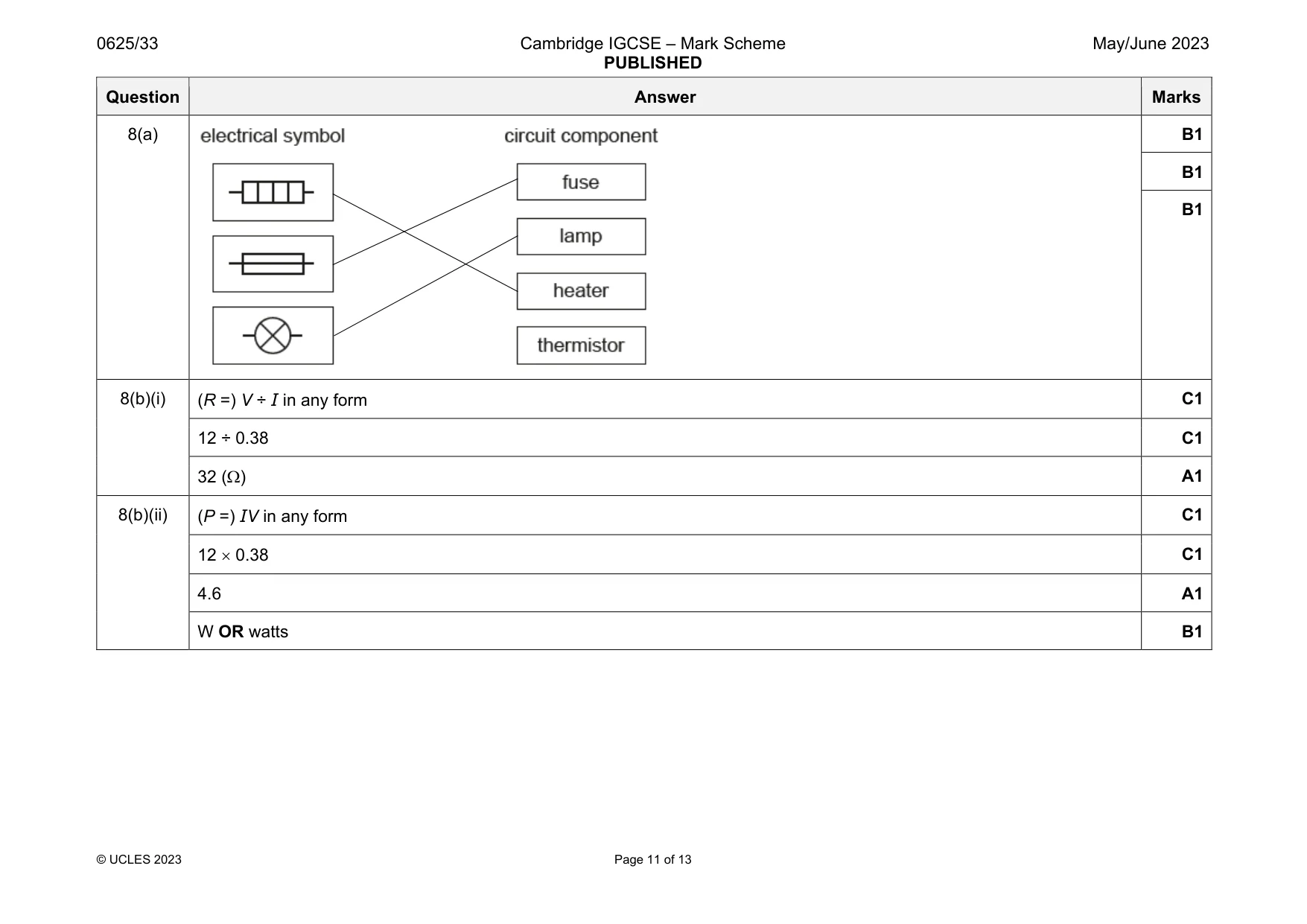
Mark scheme: 8(a) B1 B1 B1 8(b)(i) (R =) V ÷ I in any form C1 12 ÷ 0.38 C1 32 () A1 8(b)(ii) (P =) IV in any form C1 12 0.38 C1 4.6 A1 W OR watts B1
Q9 · An atom of beryllium
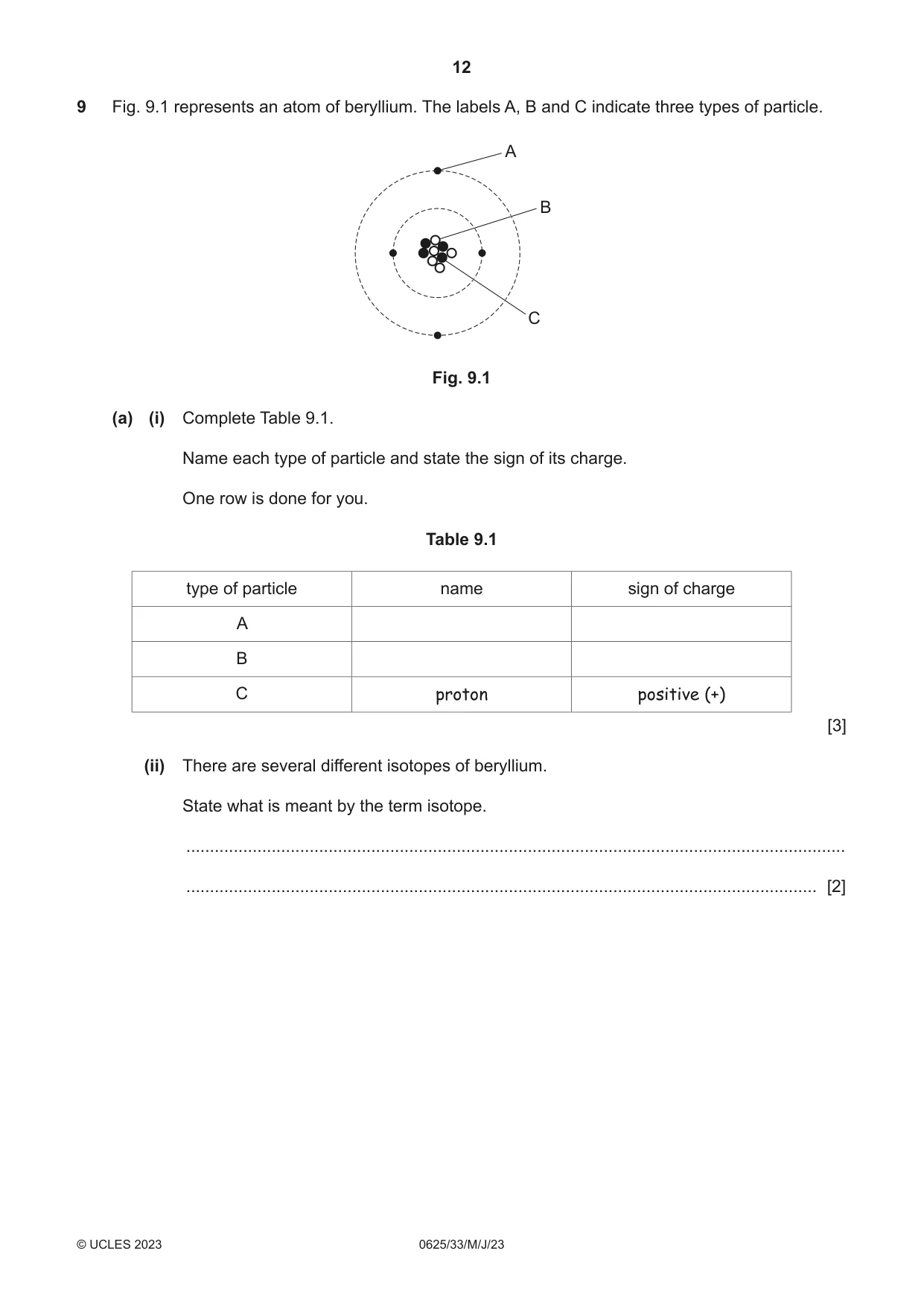
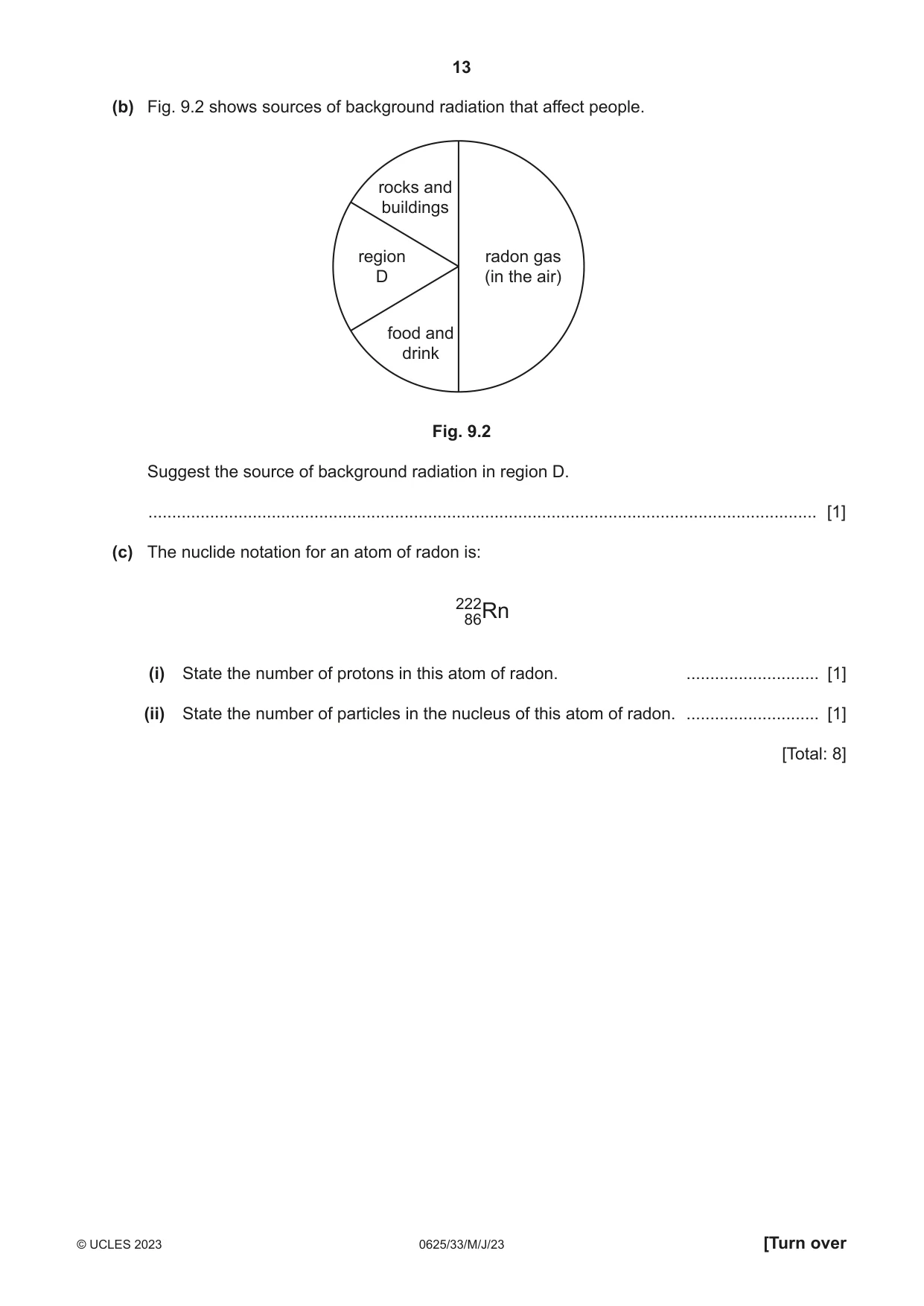
9 Fig. 9.1 represents an atom of beryllium. The labels A, B and C indicate three types of particle. A B C Fig. 9.1 (a) (i) Complete Table 9.1. Name each type of particle and state the sign of its charge. One row is done for you. Table 9.1 type of particle name sign of charge A B C proton positive (+) [3] (ii) There are several different isotopes of beryllium. State what is meant by the term isotope. ........................................................................................................................................... ..................................................................................................................................... [2] (b) Fig. 9.2 shows sources of background radiation that affect people. rocks and buildings region radon gas D (in the air) food and drink Fig. 9.2 Suggest the source of background radiation in region D. ............................................................................................................................................. [1] (c) The nuclide notation for an atom of radon is: 22286Rn (i) State the number of protons in this atom of radon. ............................ [1] (ii) State the number of particles in the nucleus of this atom of radon. ............................ [1] [Total: 8]
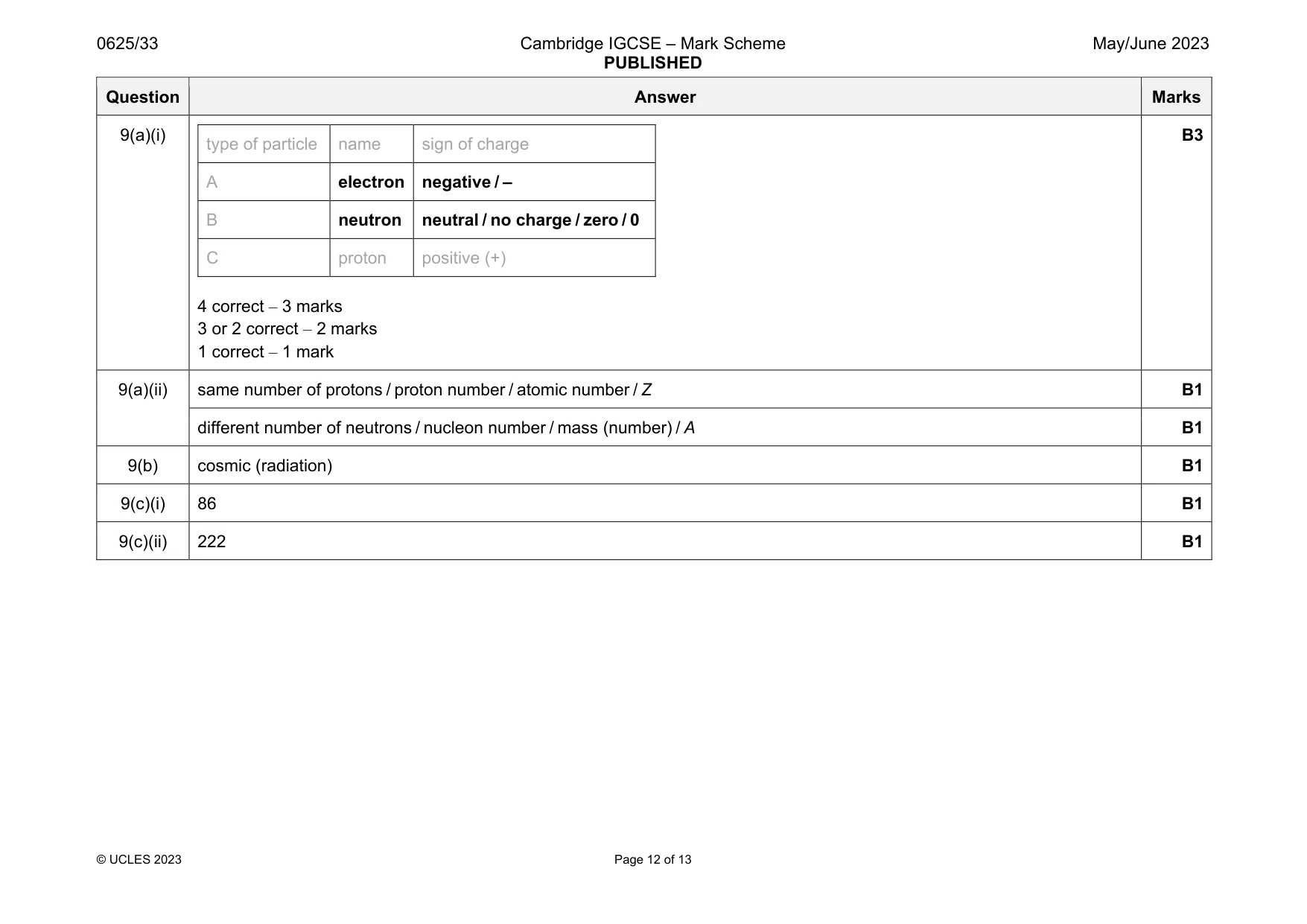
Mark scheme: 9(a)(i) type of particle name sign of charge A electron negative / – B neutron neutral / no charge / zero / 0 C proton positive (+) 4 correct – 3 marks 3 or 2 correct – 2 marks 1 correct – 1 mark B3 9(a)(ii) same number of protons / proton number / atomic number / Z B1 different number of neutrons / nucleon number / mass (number) / A B1 9(b) cosmic (radiation) B1 9(c)(i) 86 B1 9(c)(ii) 222 B1
Q10 · Part of the Solar System
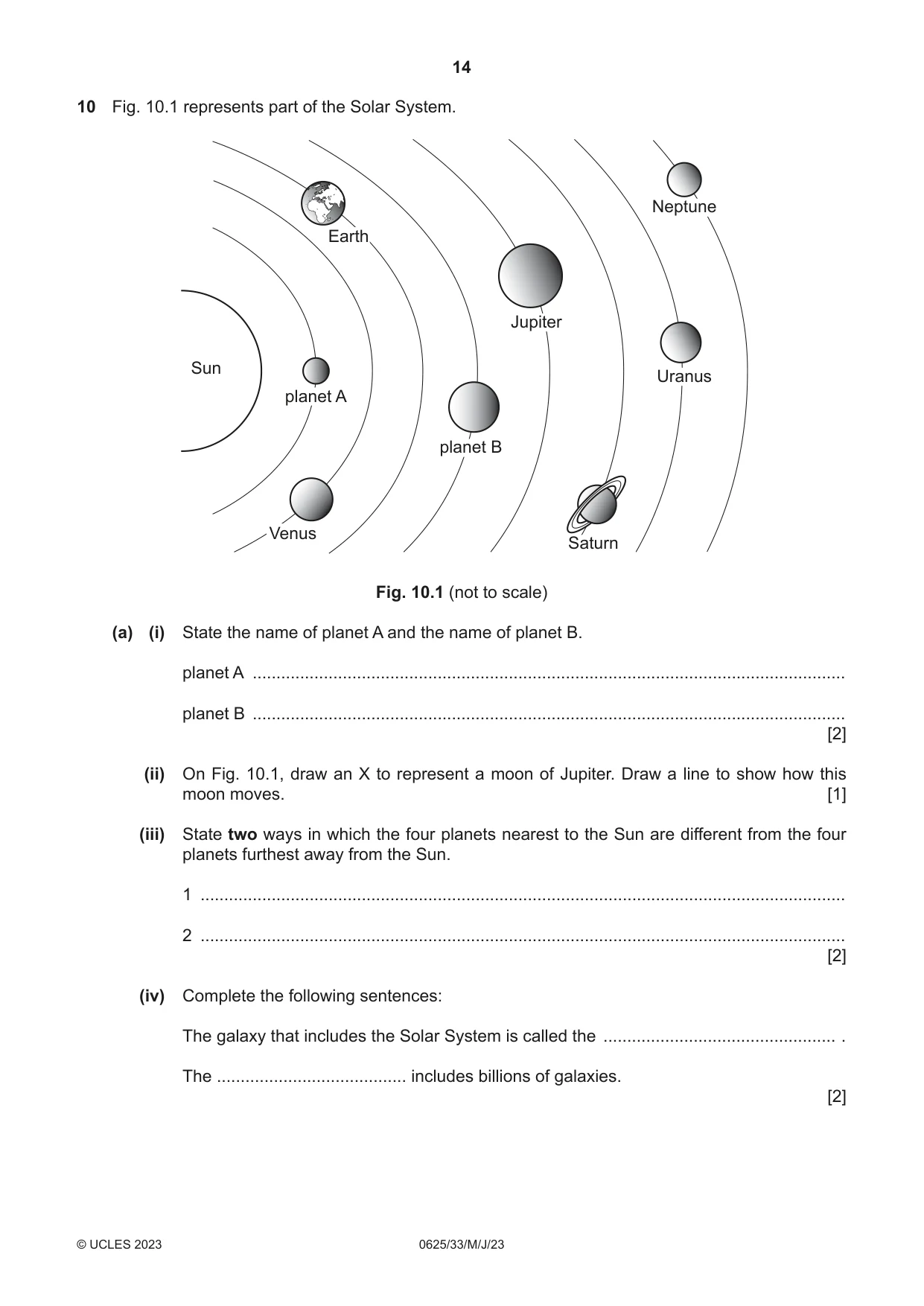
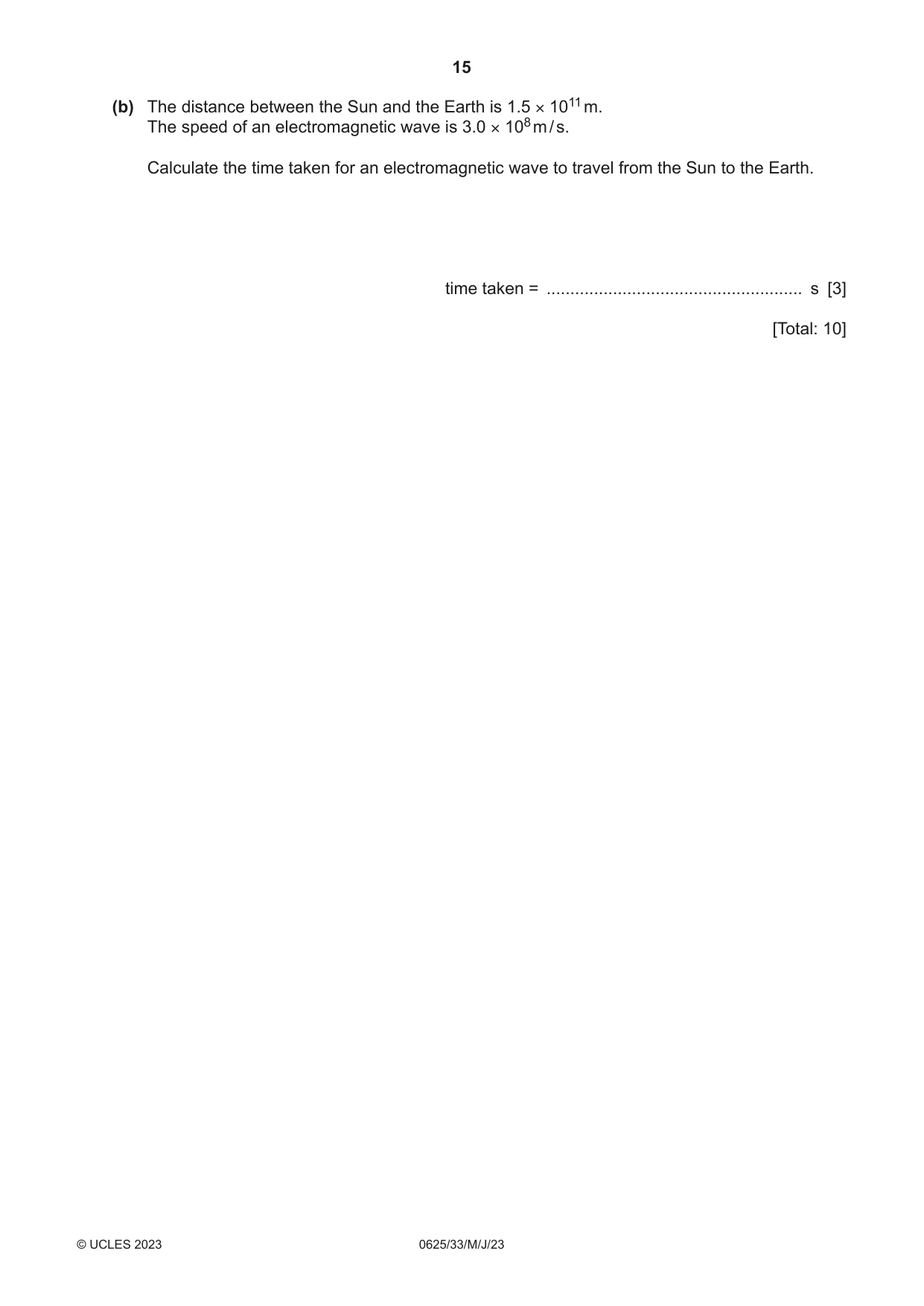
10 Fig. 10.1 represents part of the Solar System. Neptune Earth Jupiter Sun Uranus planet A planet B Venus Saturn Fig. 10.1 (not to scale) (a) (i) State the name of planet A and the name of planet B. planet A ............................................................................................................................. planet B ............................................................................................................................. [2] (ii) On Fig. 10.1, draw an X to represent a moon of Jupiter. Draw a line to show how this moon moves. [1] (iii) State two ways in which the four planets nearest to the Sun are different from the four planets furthest away from the Sun. 1 ........................................................................................................................................ 2 ........................................................................................................................................ [2] (iv) Complete the following sentences: The galaxy that includes the Solar System is called the ................................................. . The ........................................ includes billions of galaxies. [2] (b) The distance between the Sun and the Earth is 1.5 × 10¹¹ m. The speed of an electromagnetic wave is 3.0 × 10⁸ m / s. Calculate the time taken for an electromagnetic wave to travel from the Sun to the Earth. time taken = ...................................................... s [3] [Total: 10]
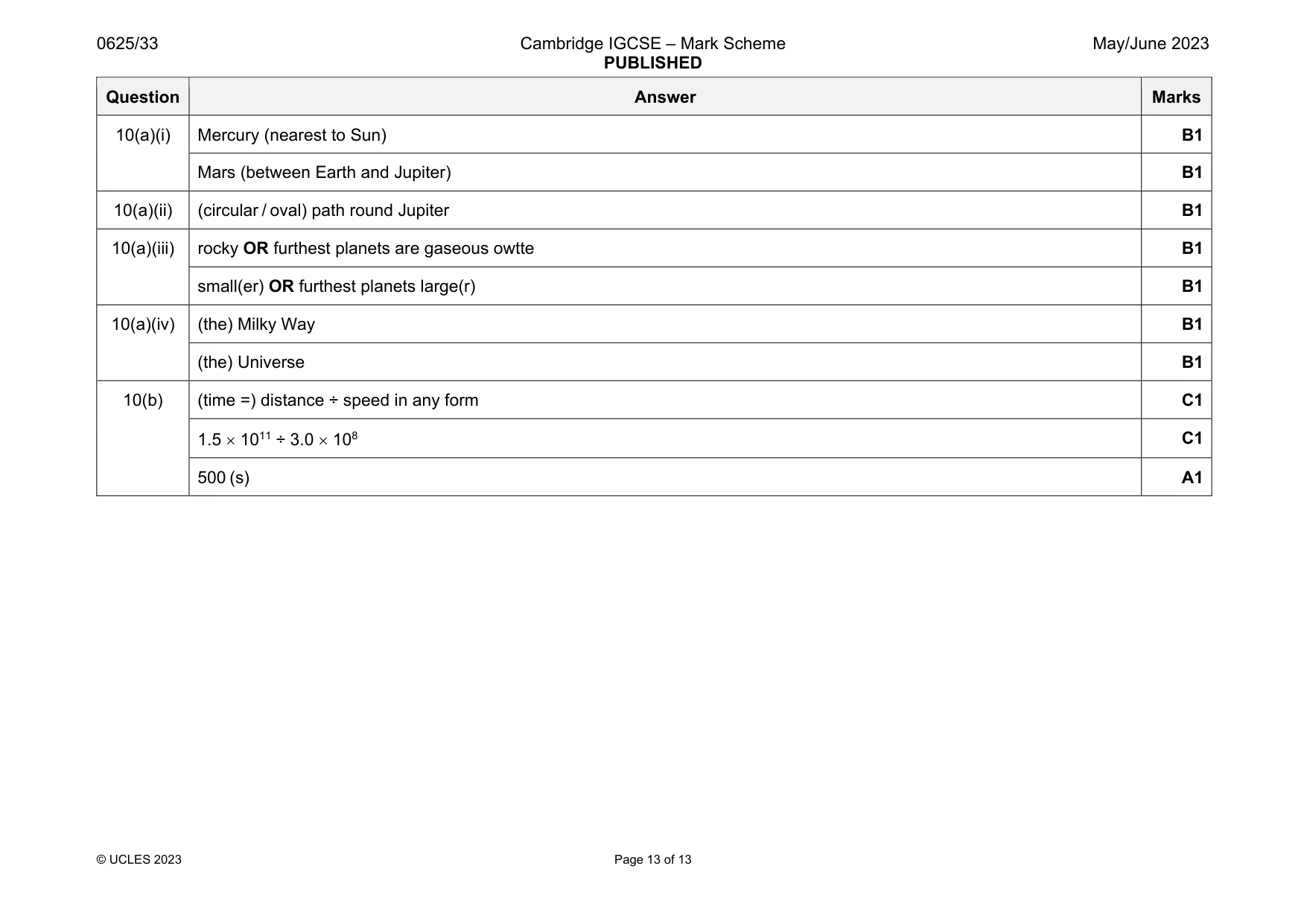
Mark scheme: 10(a)(i) Mercury (nearest to Sun) B1 Mars (between Earth and Jupiter) B1 10(a)(ii) (circular / oval) path round Jupiter B1 10(a)(iii) rocky OR furthest planets are gaseous owtte B1 small(er) OR furthest planets large(r) B1 10(a)(iv) (the) Milky Way B1 (the) Universe B1 10(b) (time =) distance ÷ speed in any form C1 1.5 1011 ÷ 3.0 108 C1 500 (s) A1
What was in this paper
The subtopics covered by these 10 questions, and how many questions each got. Open one in a new tab to see every Cambridge question on it.
What you needed in this session
Cambridge’s own grade thresholds for 2023 May/June, Paper 3 · Variant 3. A higher threshold means an easier paper — the bar moves with how the cohort did.