Cambridge IGCSE Physics 0625 — 2023 Oct/Nov Paper 3 · Variant 2
0625/32/O/N/23 · 12 questions · 80 marks · ≈90 min
The question paper and its mark scheme, free to read here and free to download. This is Cambridge’s own paper, exactly as it was sat.
Question paper20 pages

Mark scheme13 pages
Answers below. Sit the paper first if you are practising.
Questions as text
Q1 · The speed–time graph for a cyclist beginning a race
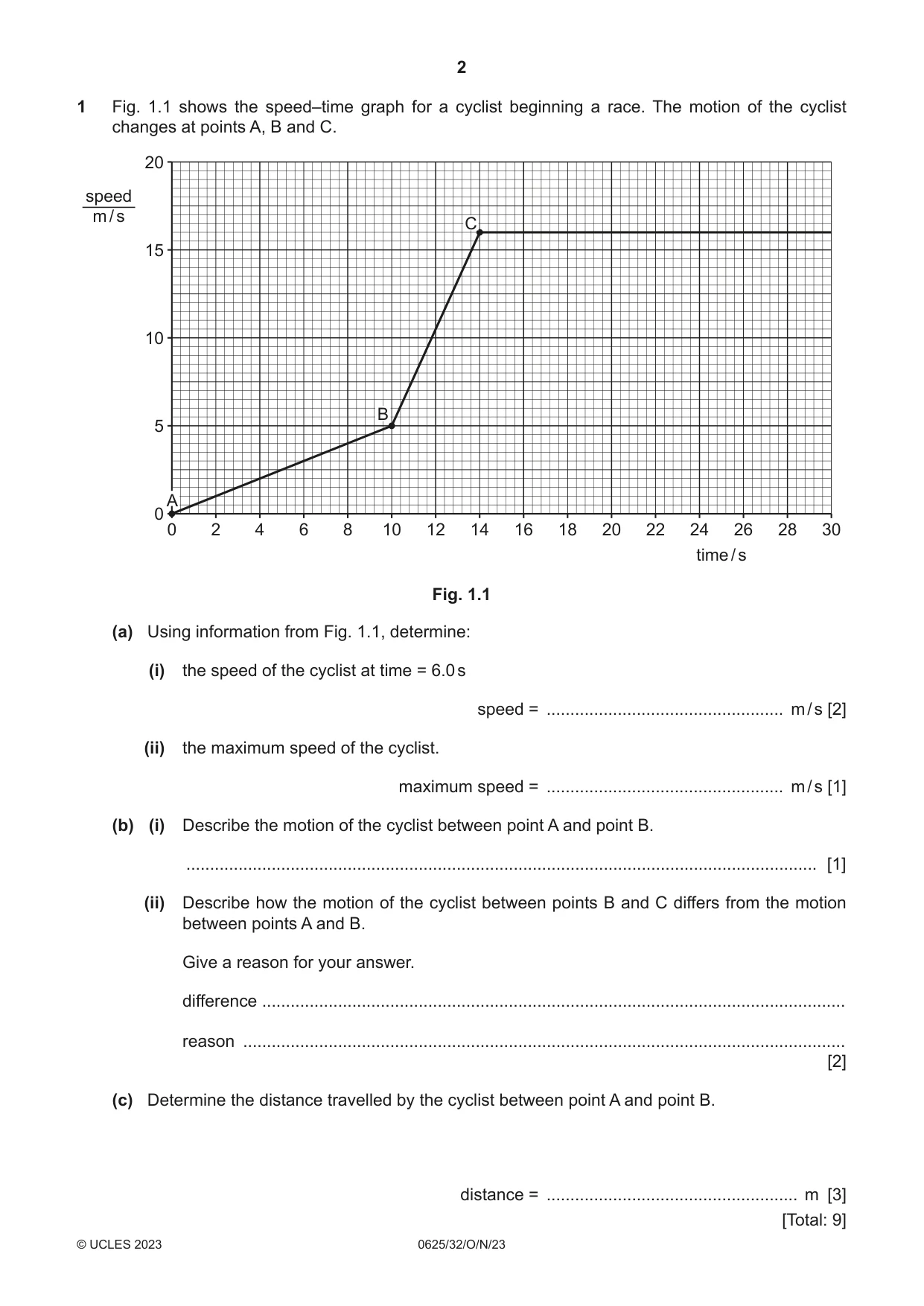
1 Fig. 1.1 shows the speed–time graph for a cyclist beginning a race. The motion of the cyclist changes at points A, B and C. 20 speed m / s C 15 10 B 5 A 0 0 2 4 6 8 10 12 14 16 18 20 22 24 26 28 30 time / s Fig. 1.1 (a) Using information from Fig. 1.1, determine: (i) the speed of the cyclist at time = 6.0 s speed = .................................................. m / s [2] (ii) the maximum speed of the cyclist. maximum speed = .................................................. m / s [1] (b) (i) Describe the motion of the cyclist between point A and point B. ..................................................................................................................................... [1] (ii) Describe how the motion of the cyclist between points B and C differs from the motion between points A and B. Give a reason for your answer. difference ........................................................................................................................... reason ............................................................................................................................... [2] (c) Determine the distance travelled by the cyclist between point A and point B. distance = ..................................................... m [3] [Total: 9]
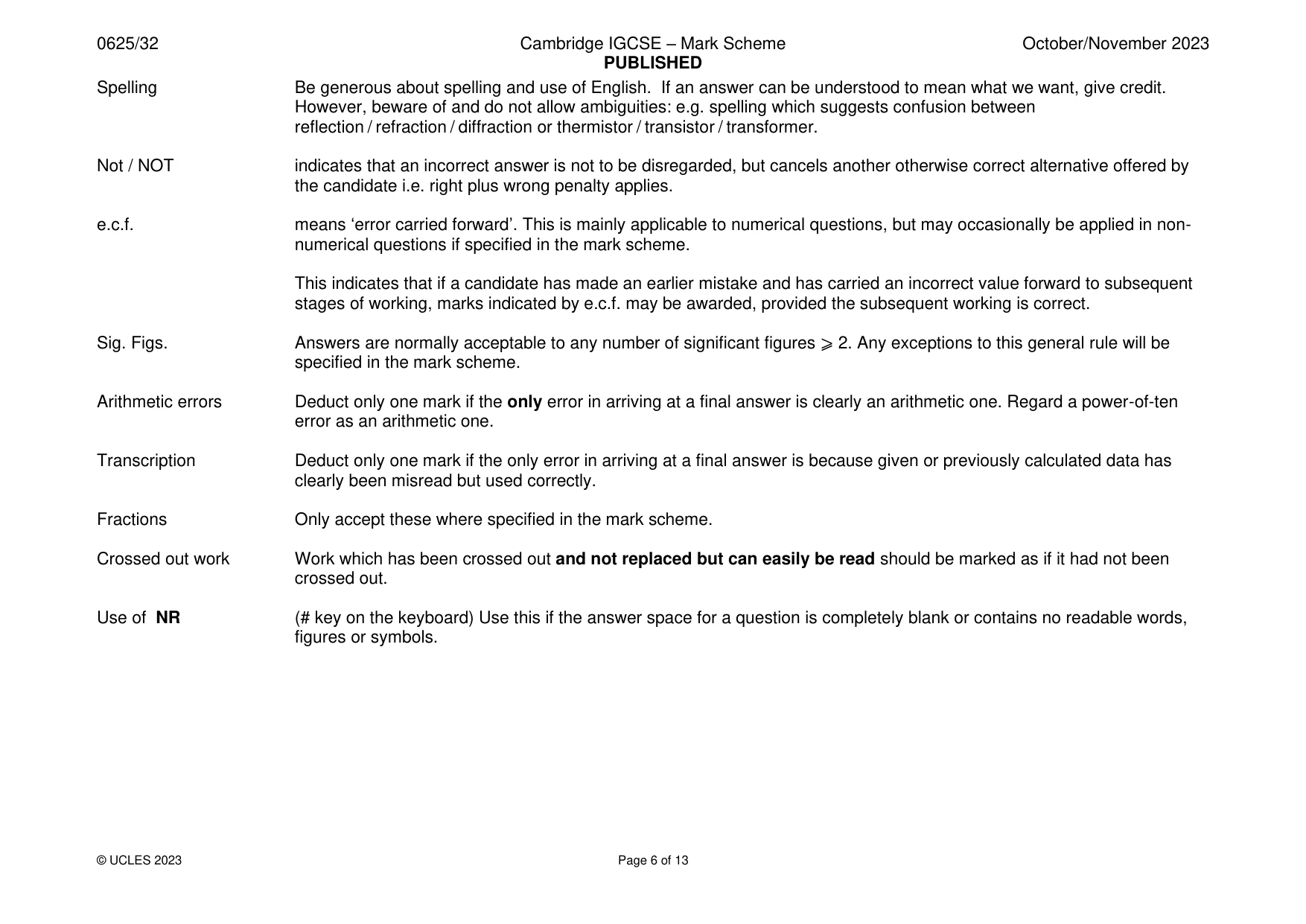
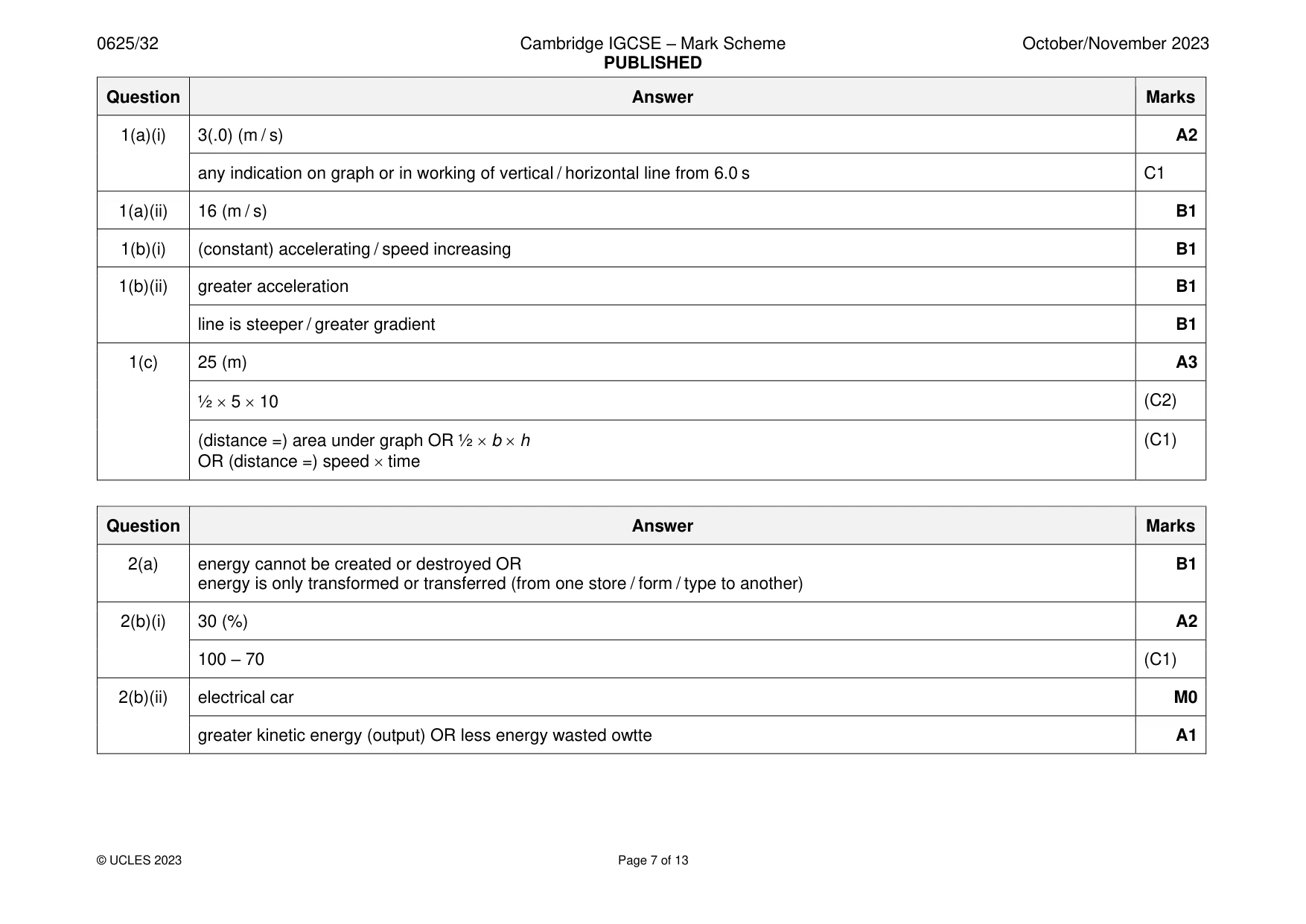
Mark scheme: Question Answer Marks 1(a)(i) 3(.0) (m / s) A2 any indication on graph or in working of vertical / horizontal line from 6.0 s C1 1(a)(ii) 16 (m / s) B1 1(b)(i) (constant) accelerating / speed increasing B1 1(b)(ii) greater acceleration B1 line is steeper / greater gradient B1 1(c) 25 (m) A3 ½ 5 10 (C2) (distance =) area under graph OR ½ b h (C1) OR (distance =) speed time
Q2 · State the principle of conservation of energy
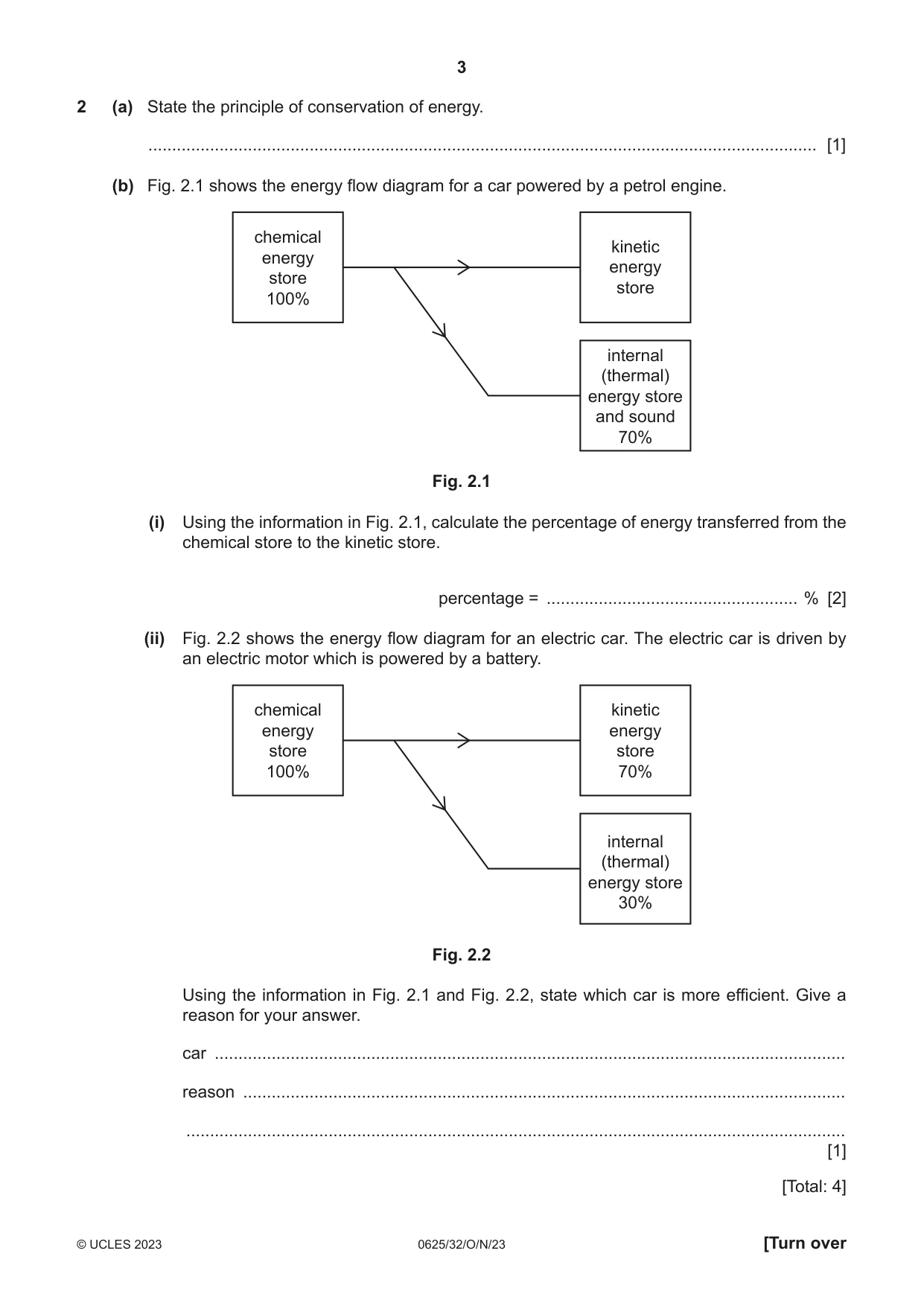
2 (a) State the principle of conservation of energy. ............................................................................................................................................. [1] (b) Fig. 2.1 shows the energy flow diagram for a car powered by a petrol engine. chemical kinetic energy energy store store 100% internal (thermal) energy store and sound 70% Fig. 2.1 (i) Using the information in Fig. 2.1, calculate the percentage of energy transferred from the chemical store to the kinetic store. percentage = ..................................................... % [2] (ii) Fig. 2.2 shows the energy flow diagram for an electric car. The electric car is driven by an electric motor which is powered by a battery. chemical kinetic energy energy store store 100% 70% internal (thermal) energy store 30% Fig. 2.2 Using the information in Fig. 2.1 and Fig. 2.2, state which car is more efficient. Give a reason for your answer. car ..................................................................................................................................... reason ............................................................................................................................... ........................................................................................................................................... [1] [Total: 4]
Mark scheme: 2(a) energy cannot be created or destroyed OR B1 energy is only transformed or transferred (from one store / form / type to another) 2(b)(i) 30 (%) A2 100 – 70 (C1) 2(b)(ii) electrical car M0 greater kinetic energy (output) OR less energy wasted owtte A1
Q3 · A platform rests on a pivot as shown in Fig
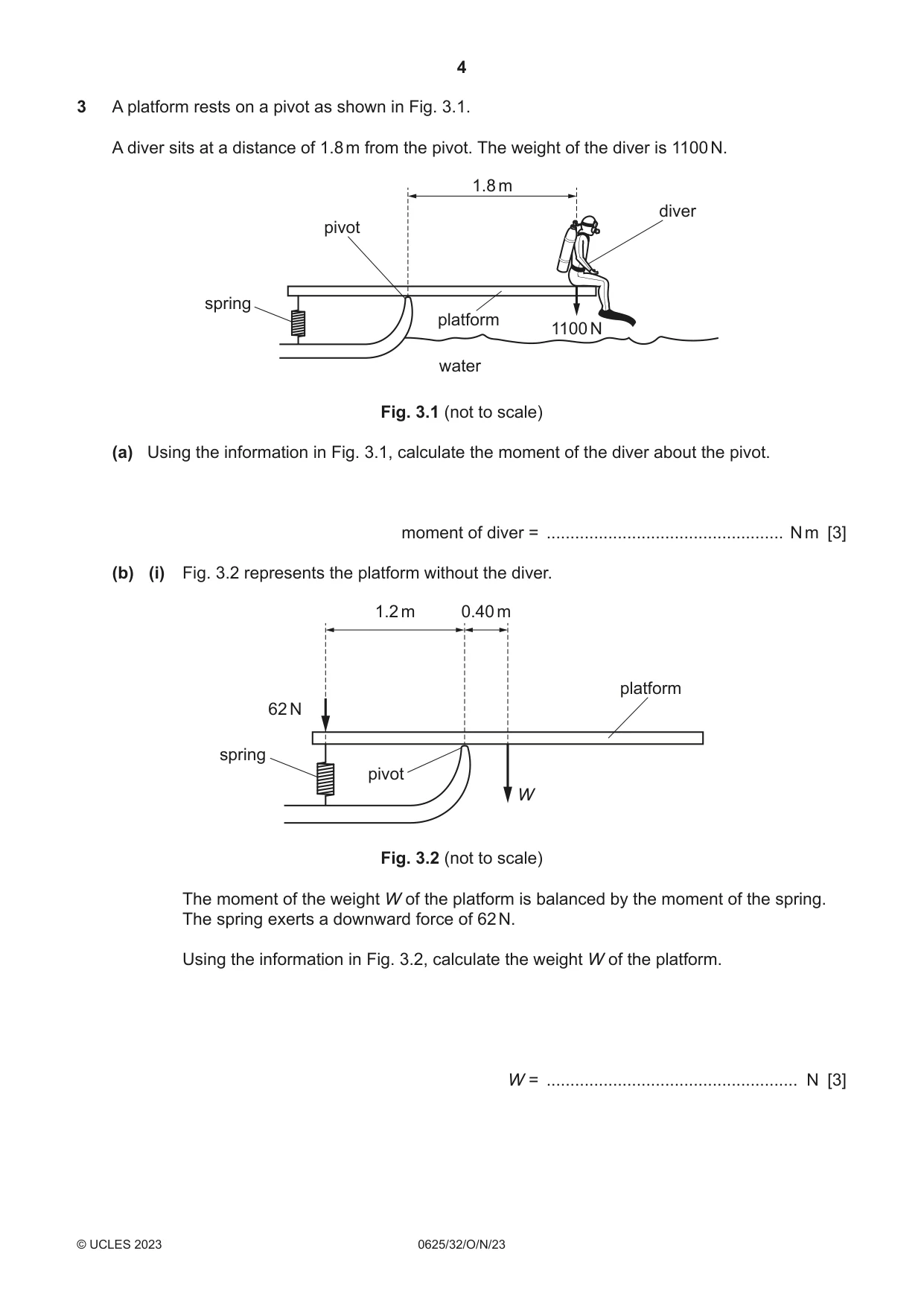
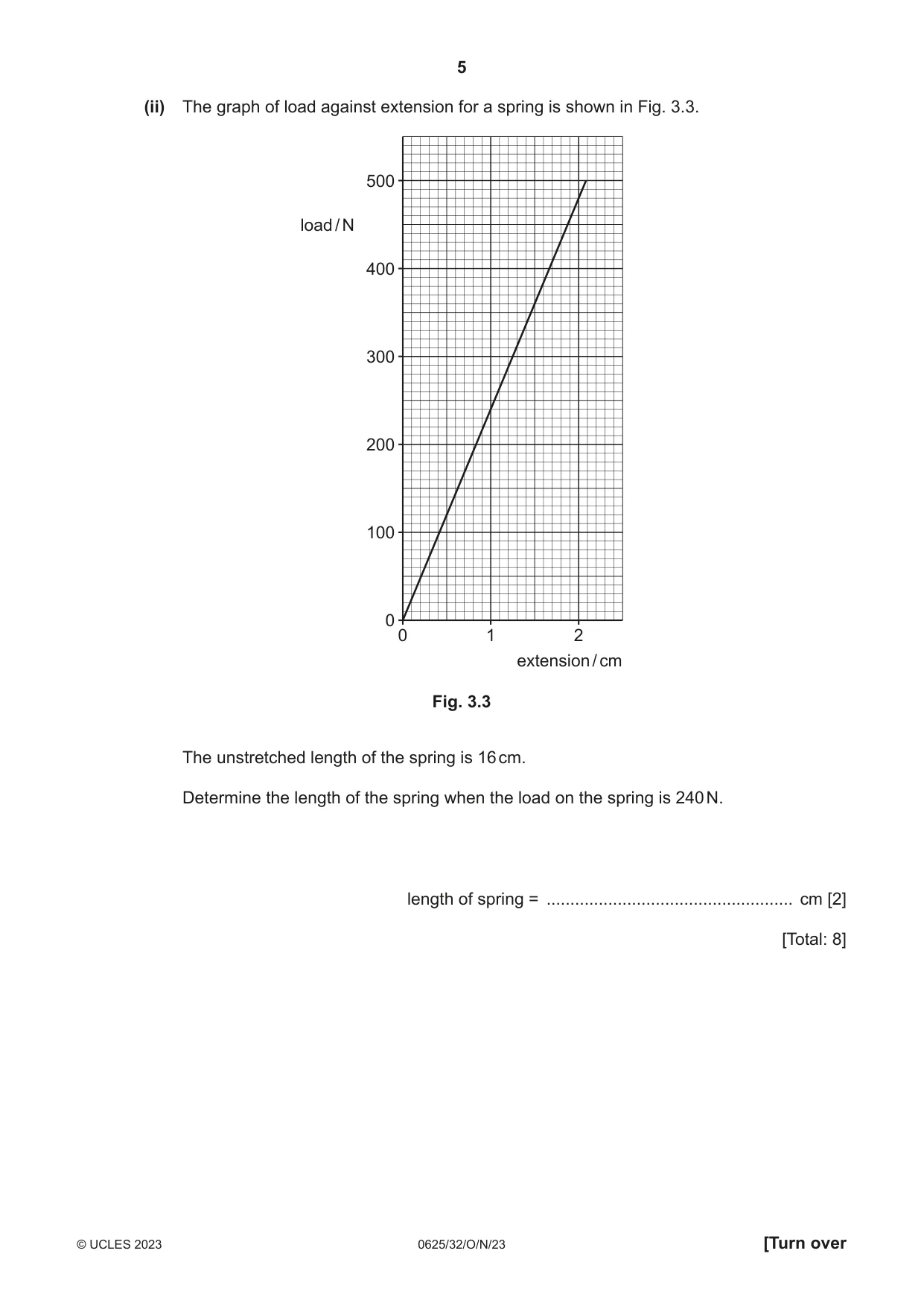
3 A platform rests on a pivot as shown in Fig. 3.1. A diver sits at a distance of 1.8 m from the pivot. The weight of the diver is 1100 N. 1.8 m diver pivot spring platform 1100 N water Fig. 3.1 (not to scale) (a) Using the information in Fig. 3.1, calculate the moment of the diver about the pivot. moment of diver = .................................................. N m [3] (b) (i) Fig. 3.2 represents the platform without the diver. 1.2 m 0.40 m platform 62 N spring pivot W Fig. 3.2 (not to scale) The moment of the weight W of the platform is balanced by the moment of the spring. The spring exerts a downward force of 62 N. Using the information in Fig. 3.2, calculate the weight W of the platform. W = ..................................................... N [3] (ii) The graph of load against extension for a spring is shown in Fig. 3.3. 500 load / N 400 300 200 100 0 0 1 2 extension / cm Fig. 3.3 The unstretched length of the spring is 16 cm. Determine the length of the spring when the load on the spring is 240 N. length of spring = .................................................... cm [2] [Total: 8]
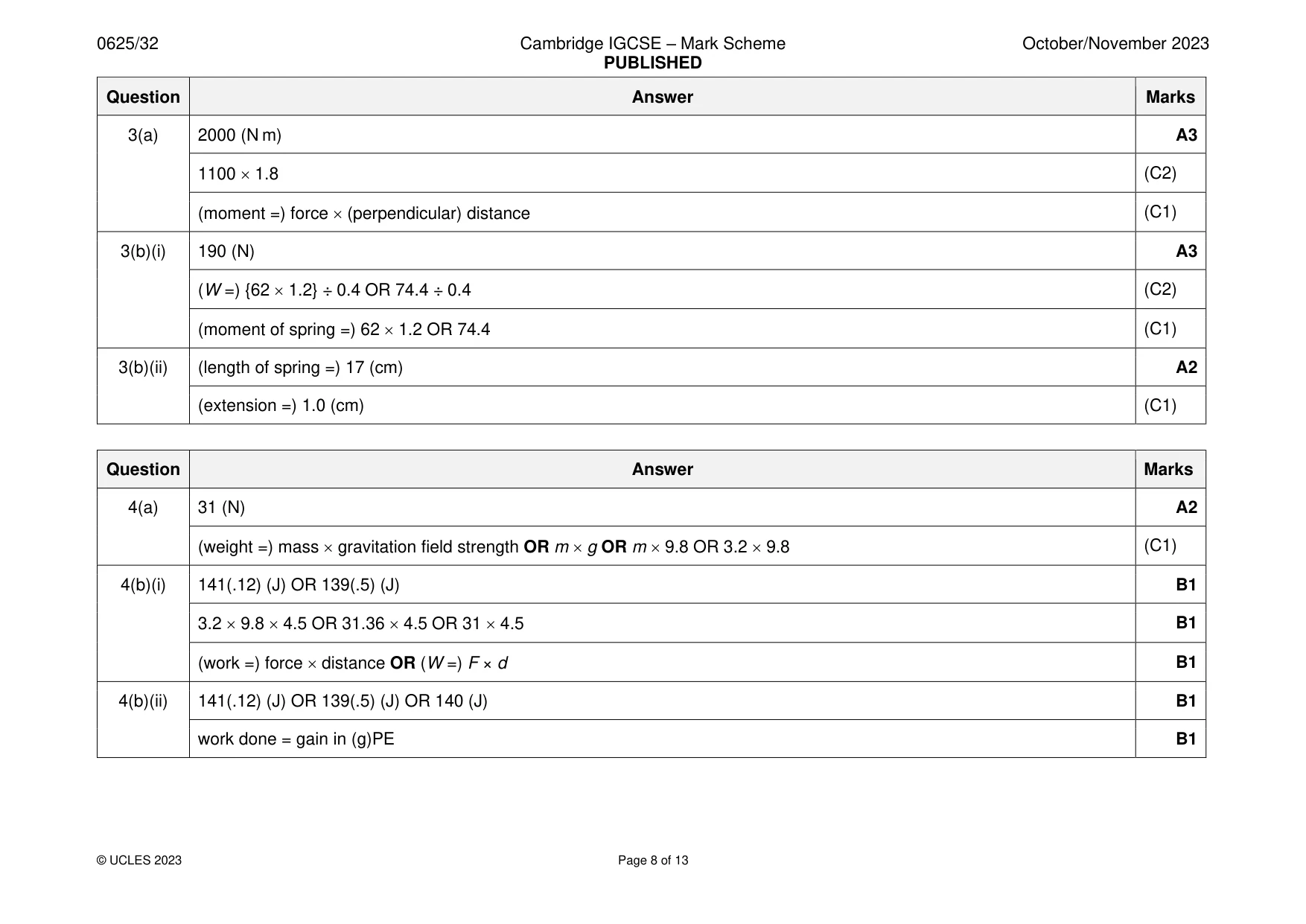
Mark scheme: 3(a) 2000 (N m) A3 1100 1.8 (C2) (moment =) force (perpendicular) distance (C1) 3(b)(i) 190 (N) A3 (W =) {62 1.2} ÷ 0.4 OR 74.4 ÷ 0.4 (C2) (moment of spring =) 62 1.2 OR 74.4 (C1) 3(b)(ii) (length of spring =) 17 (cm) A2 (extension =) 1.0 (cm) (C1)
Q4 · A student holds a pile of books
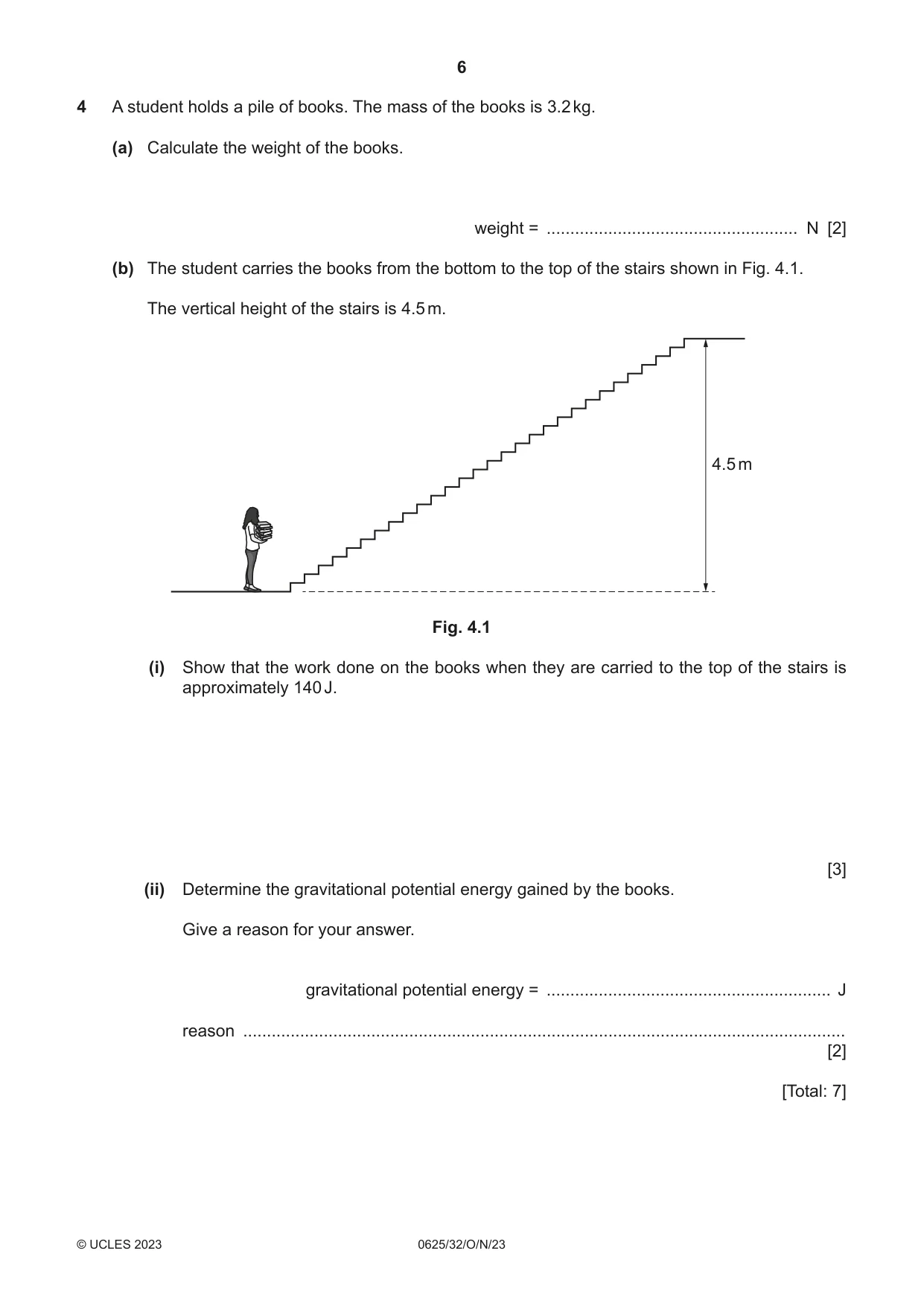
4 A student holds a pile of books. The mass of the books is 3.2 kg. (a) Calculate the weight of the books. weight = ..................................................... N [2] (b) The student carries the books from the bottom to the top of the stairs shown in Fig. 4.1. The vertical height of the stairs is 4.5 m. 4.5 m Fig. 4.1 (i) Show that the work done on the books when they are carried to the top of the stairs is approximately 140 J. [3] (ii) Determine the gravitational potential energy gained by the books. Give a reason for your answer. gravitational potential energy = ............................................................ J reason ............................................................................................................................... [2] [Total: 7]
Mark scheme: 4(a) 31 (N) A2 (weight =) mass gravitation field strength OR m g OR m 9.8 OR 3.2 9.8 (C1) 4(b)(i) 141(.12) (J) OR 139(.5) (J) B1 3.2 9.8 4.5 OR 31.36 4.5 OR 31 4.5 B1 (work =) force distance OR (W =) F × d B1 4(b)(ii) 141(.12) (J) OR 139(.5) (J) OR 140 (J) B1 work done = gain in (g)PE B1
Question 5
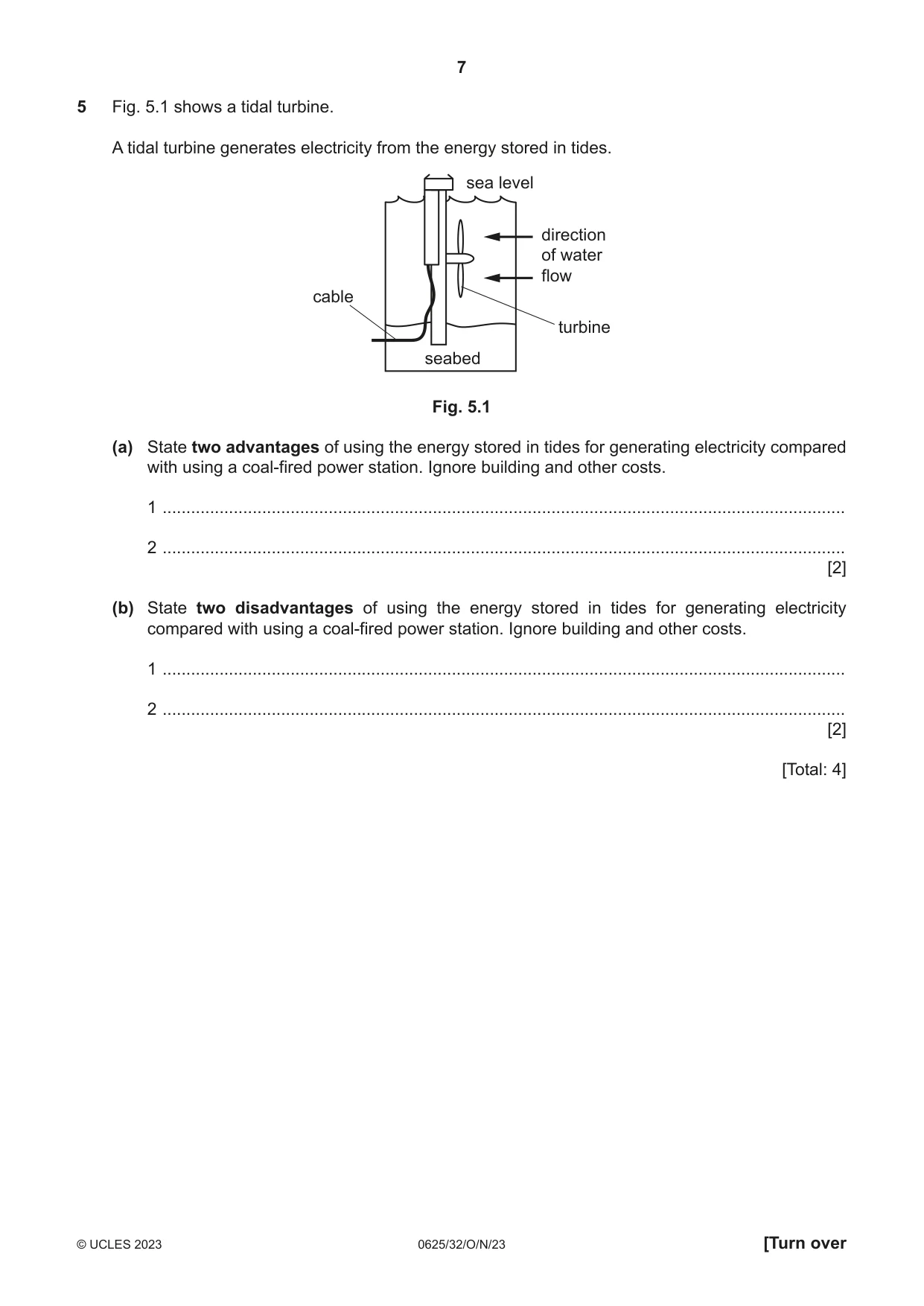
5 Fig. 5.1 shows a tidal turbine. A tidal turbine generates electricity from the energy stored in tides. sea level direction of water flow cable turbine seabed Fig. 5.1 (a) State two advantages of using the energy stored in tides for generating electricity compared with using a coal‑fired power station. Ignore building and other costs. 1 ................................................................................................................................................ 2 ................................................................................................................................................ [2] (b) State two disadvantages of using the energy stored in tides for generating electricity compared with using a coal‑fired power station. Ignore building and other costs. 1 ................................................................................................................................................ 2 ................................................................................................................................................ [2] [Total: 4]
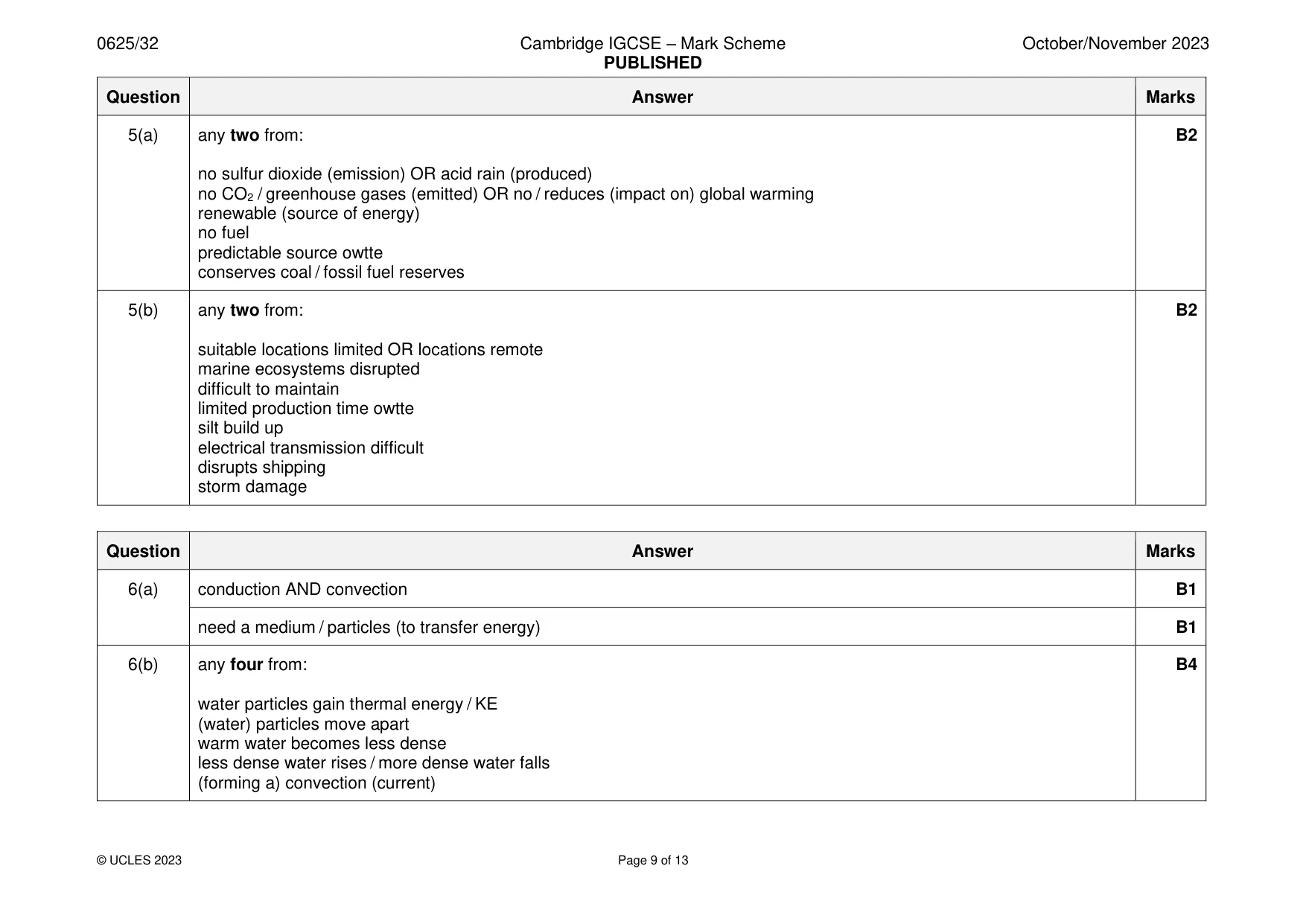
Mark scheme: 5(a) any two from: B2 no sulfur dioxide (emission) OR acid rain (produced) no CO2 / greenhouse gases (emitted) OR no / reduces (impact on) global warming renewable (source of energy) no fuel predictable source owtte conserves coal / fossil fuel reserves 5(b) any two from: B2 suitable locations limited OR locations remote marine ecosystems disrupted difficult to maintain limited production time owtte silt build up electrical transmission difficult disrupts shipping storm damage
Q6 · A cold drink in a thermal jug
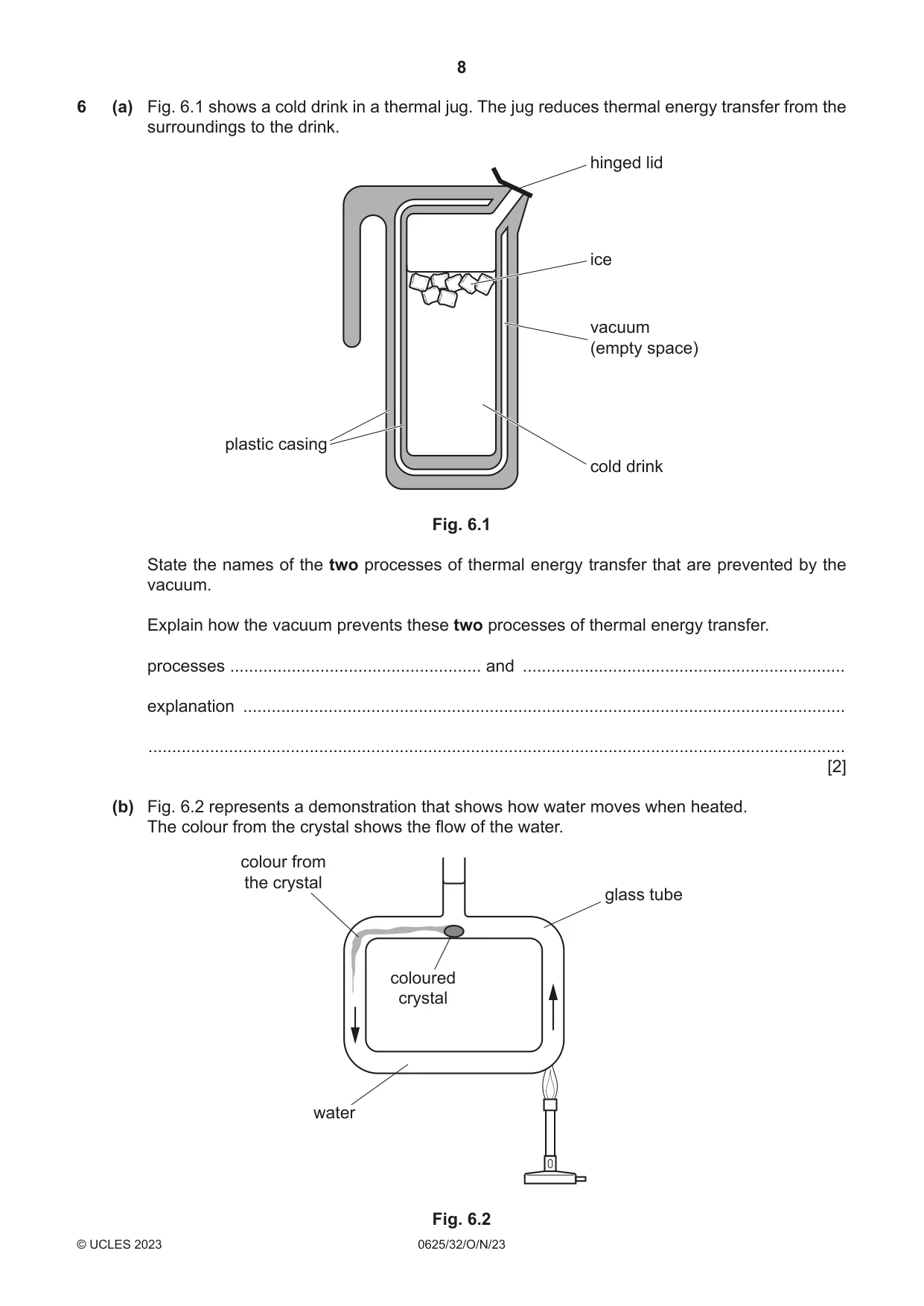
6 (a) Fig. 6.1 shows a cold drink in a thermal jug. The jug reduces thermal energy transfer from the surroundings to the drink. hinged lid ice vacuum (empty space) plastic casing cold drink Fig. 6.1 State the names of the two processes of thermal energy transfer that are prevented by the vacuum. Explain how the vacuum prevents these two processes of thermal energy transfer. processes ..................................................... and .................................................................... explanation ............................................................................................................................... ................................................................................................................................................... [2] (b) Fig. 6.2 represents a demonstration that shows how water moves when heated. The colour from the crystal shows the flow of the water. colour from the crystal glass tube coloured crystal water Fig. 6.2 The arrows in Fig. 6.2 show the direction of flow of water in the glass tube when the water is heated. Explain why the water moves in this way. Use your ideas about density. ................................................................................................................................................... ................................................................................................................................................... ................................................................................................................................................... ............................................................................................................................................. [4] [Total: 6]
Mark scheme: 6(a) conduction AND convection B1 need a medium / particles (to transfer energy) B1 6(b) any four from: B4 water particles gain thermal energy / KE (water) particles move apart warm water becomes less dense less dense water rises / more dense water falls (forming a) convection (current)
Q7 · A student can hear trains passing her house
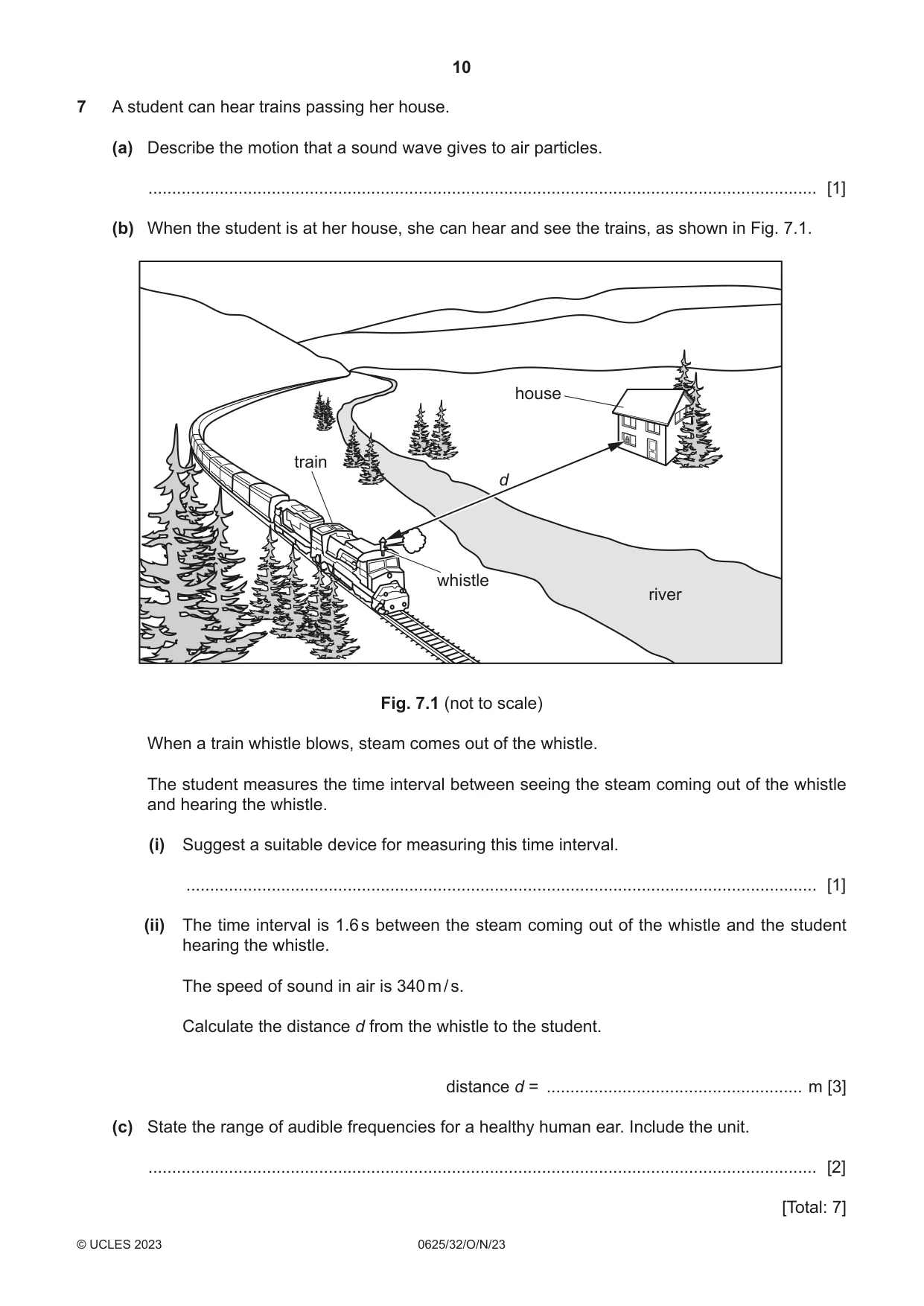
7 A student can hear trains passing her house. (a) Describe the motion that a sound wave gives to air particles. ............................................................................................................................................. [1] (b) When the student is at her house, she can hear and see the trains, as shown in Fig. 7.1. house train d whistle river Fig. 7.1 (not to scale) When a train whistle blows, steam comes out of the whistle. The student measures the time interval between seeing the steam coming out of the whistle and hearing the whistle. (i) Suggest a suitable device for measuring this time interval. ..................................................................................................................................... [1] (ii) The time interval is 1.6 s between the steam coming out of the whistle and the student hearing the whistle. The speed of sound in air is 340 m / s. Calculate the distance d from the whistle to the student. distance d = ...................................................... m [3] (c) State the range of audible frequencies for a healthy human ear. Include the unit. ............................................................................................................................................. [2] [Total: 7]
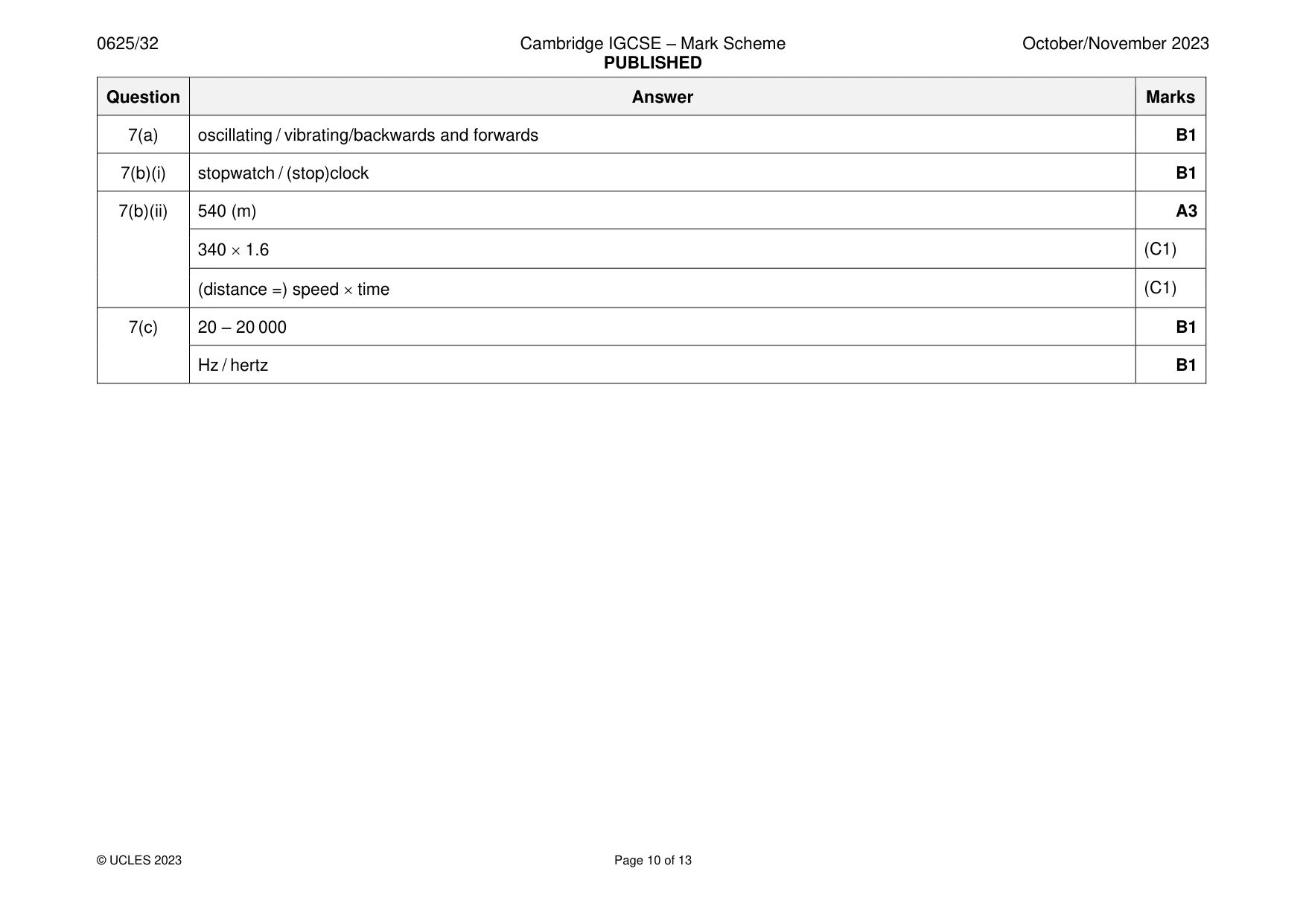
Mark scheme: 7(a) oscillating / vibrating/backwards and forwards B1 7(b)(i) stopwatch / (stop)clock B1 7(b)(ii) 540 (m) A3 340 1.6 (C1) (distance =) speed time (C1) 7(c) 20 – 20 000 B1 Hz / hertz B1
Question 8
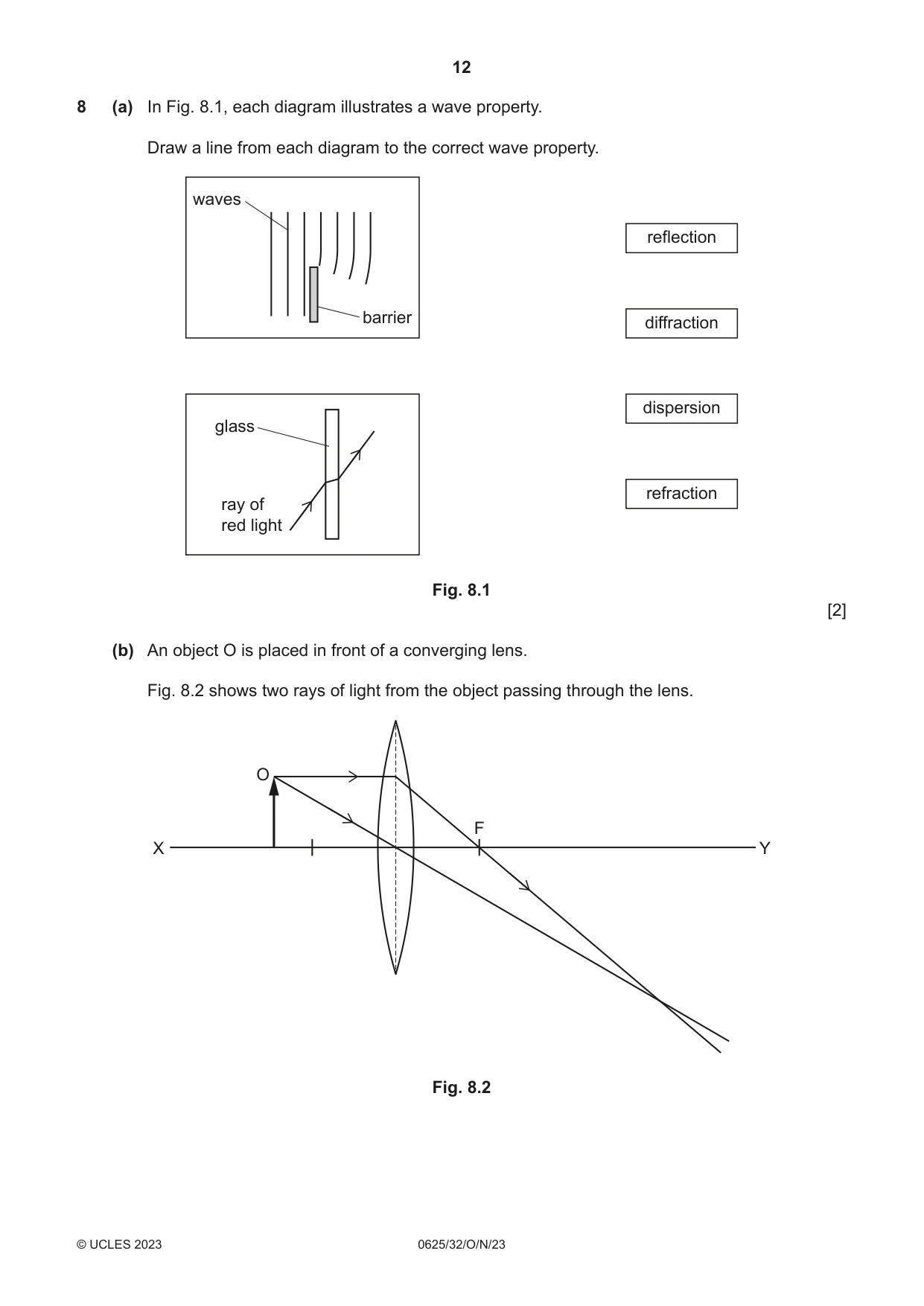
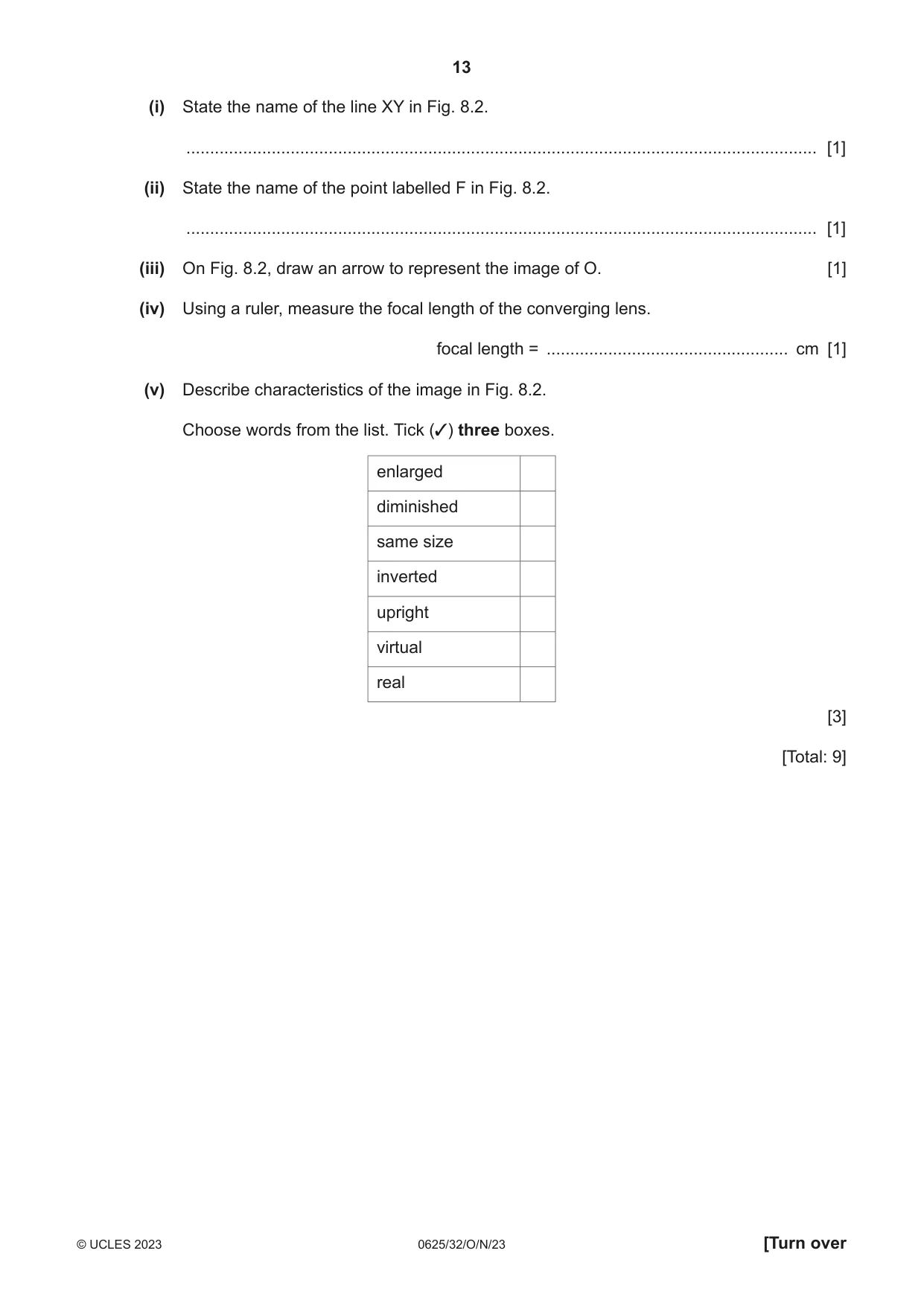
8 (a) In Fig. 8.1, each diagram illustrates a wave property. Draw a line from each diagram to the correct wave property. waves reflection barrier diffraction dispersion glass refraction ray of red light Fig. 8.1 [2] (b) An object O is placed in front of a converging lens. Fig. 8.2 shows two rays of light from the object passing through the lens. O F X Y Fig. 8.2 (i) State the name of the line XY in Fig. 8.2. ..................................................................................................................................... [1] (ii) State the name of the point labelled F in Fig. 8.2. ..................................................................................................................................... [1] (iii) On Fig. 8.2, draw an arrow to represent the image of O. [1] (iv) Using a ruler, measure the focal length of the converging lens. focal length = ................................................... cm [1] (v) Describe characteristics of the image in Fig. 8.2. Choose words from the list. Tick (3) three boxes. enlarged diminished same size inverted upright virtual real [3] [Total: 9]
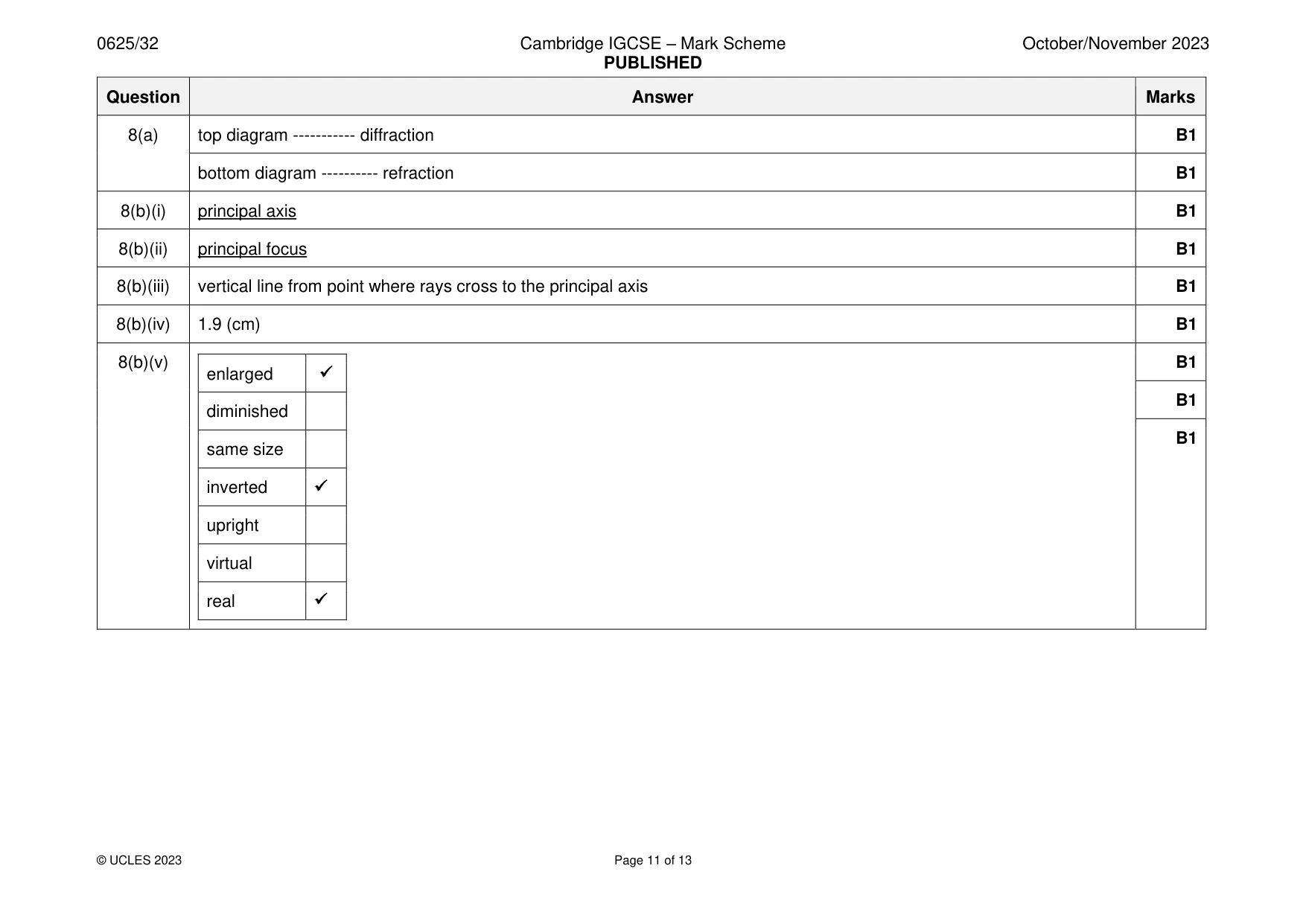
Mark scheme: 8(a) top diagram ----------- diffraction B1 bottom diagram ---------- refraction B1 8(b)(i) principal axis B1 8(b)(ii) principal focus B1 8(b)(iii) vertical line from point where rays cross to the principal axis B1 8(b)(iv) 1.9 (cm) B1 8(b)(v) B1 enlarged ✓ B1 diminished B1 same size inverted ✓ upright virtual real ✓
Q9 · An electric water heater
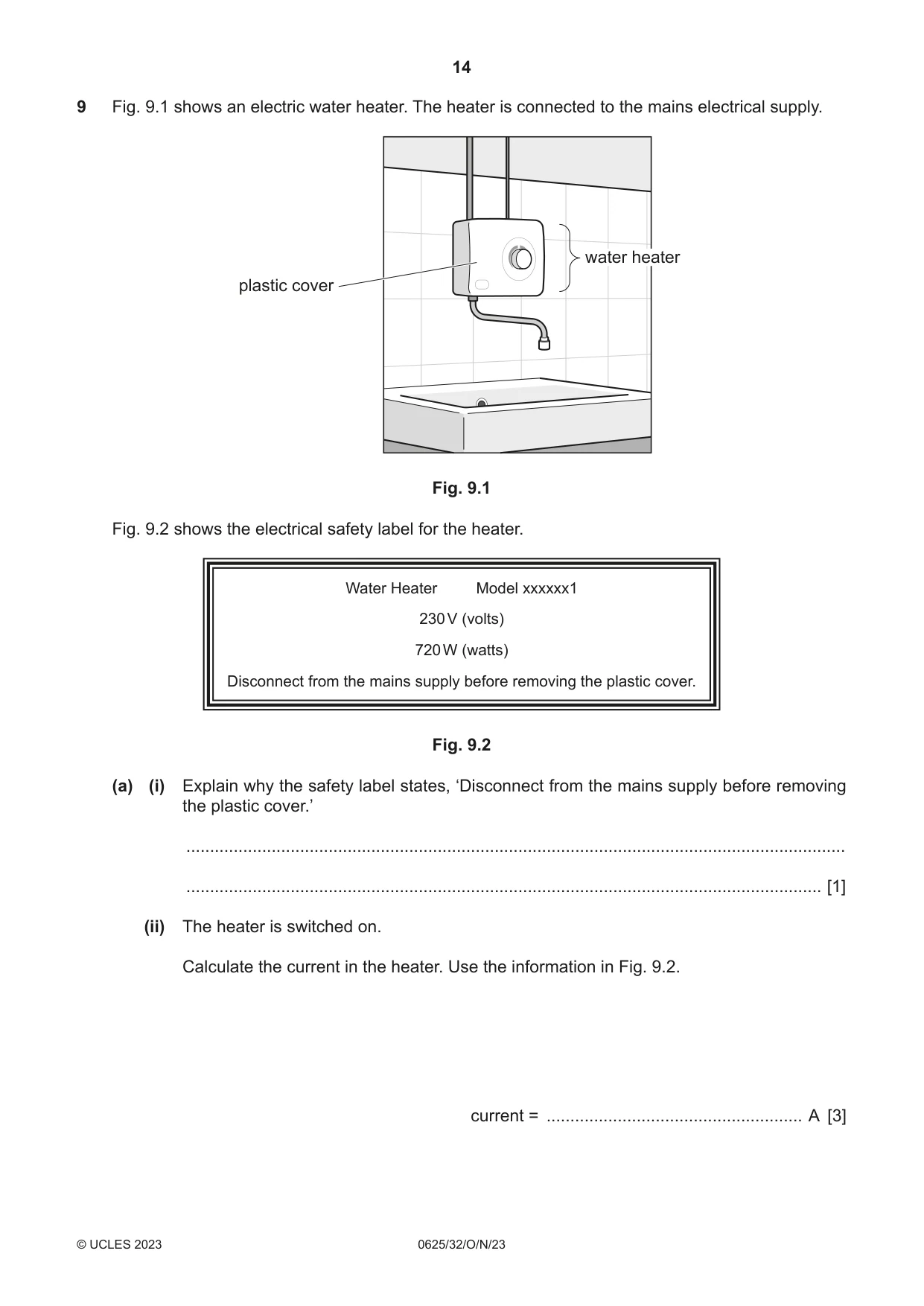
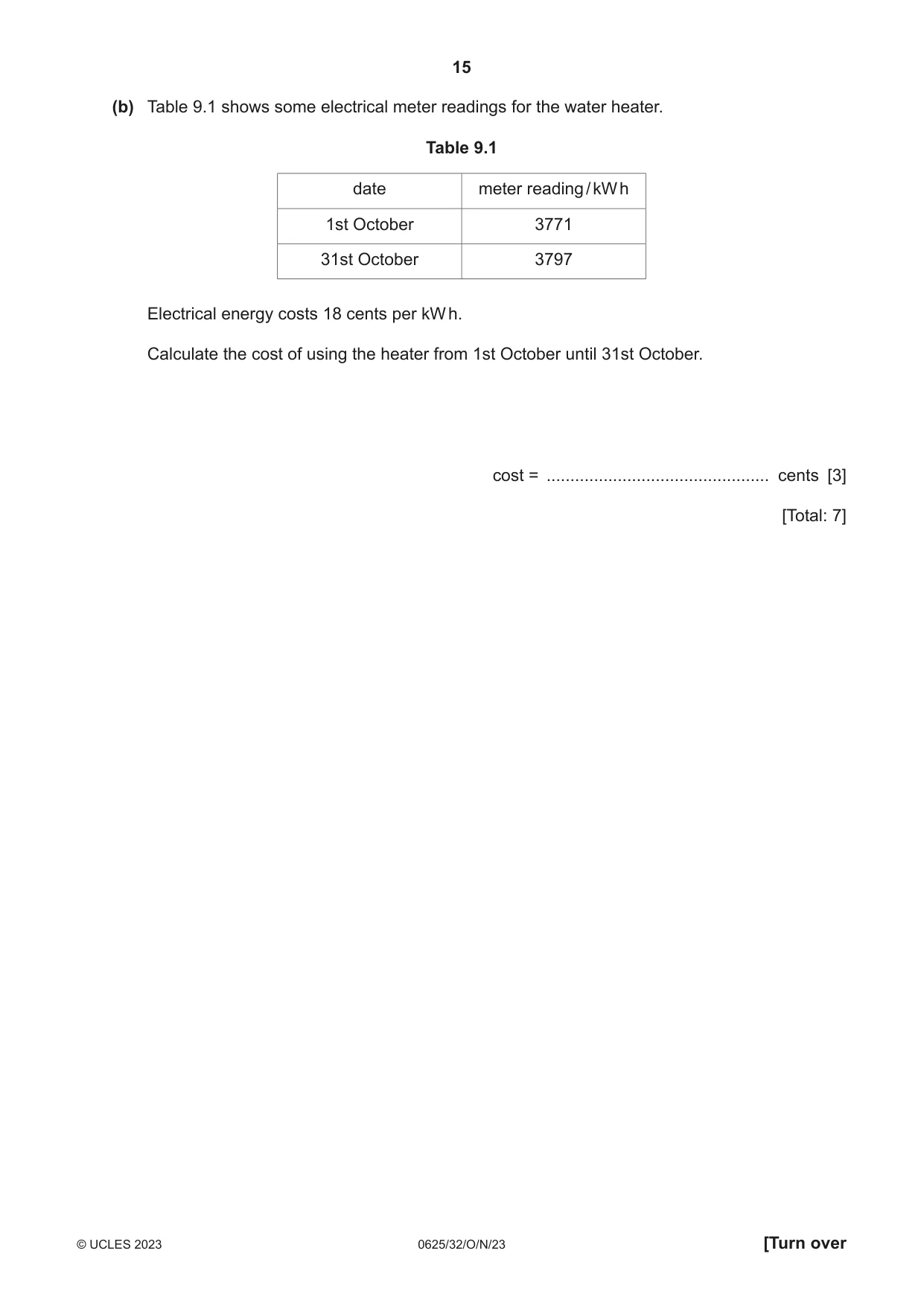
9 Fig. 9.1 shows an electric water heater. The heater is connected to the mains electrical supply. water heater plastic cover Fig. 9.1 Fig. 9.2 shows the electrical safety label for the heater. Water Heater Model xxxxxx1 230 V (volts) 720 W (watts) Disconnect from the mains supply before removing the plastic cover. Fig. 9.2 (a) (i) Explain why the safety label states, ‘Disconnect from the mains supply before removing the plastic cover.’ ........................................................................................................................................... ...................................................................................................................................... [1] (ii) The heater is switched on. Calculate the current in the heater. Use the information in Fig. 9.2. current = ...................................................... A [3] (b) Table 9.1 shows some electrical meter readings for the water heater. Table 9.1 date meter reading / kW h 1st October 3771 31st October 3797 Electrical energy costs 18 cents per kW h. Calculate the cost of using the heater from 1st October until 31st October. cost = ............................................... cents [3] [Total: 7]
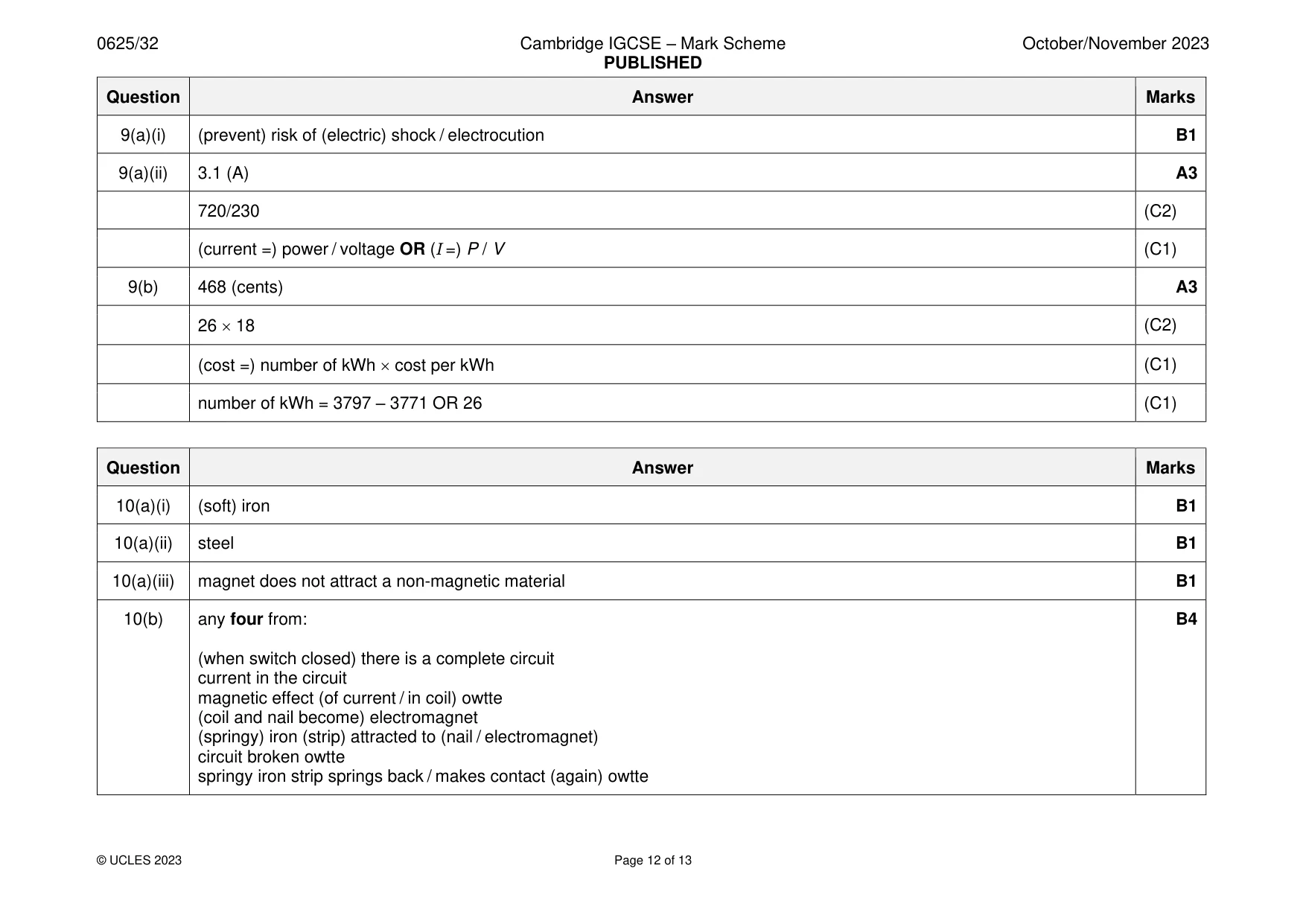
Mark scheme: 9(a)(i) (prevent) risk of (electric) shock / electrocution B1 9(a)(ii) 3.1 (A) A3 720/230 (C2) (current =) power / voltage OR (I =) P / V (C1) 9(b) 468 (cents) A3 26 18 (C2) (cost =) number of kWh cost per kWh (C1) number of kWh = 3797 – 3771 OR 26 (C1)
Q10 · Different materials have differing magnetic properties
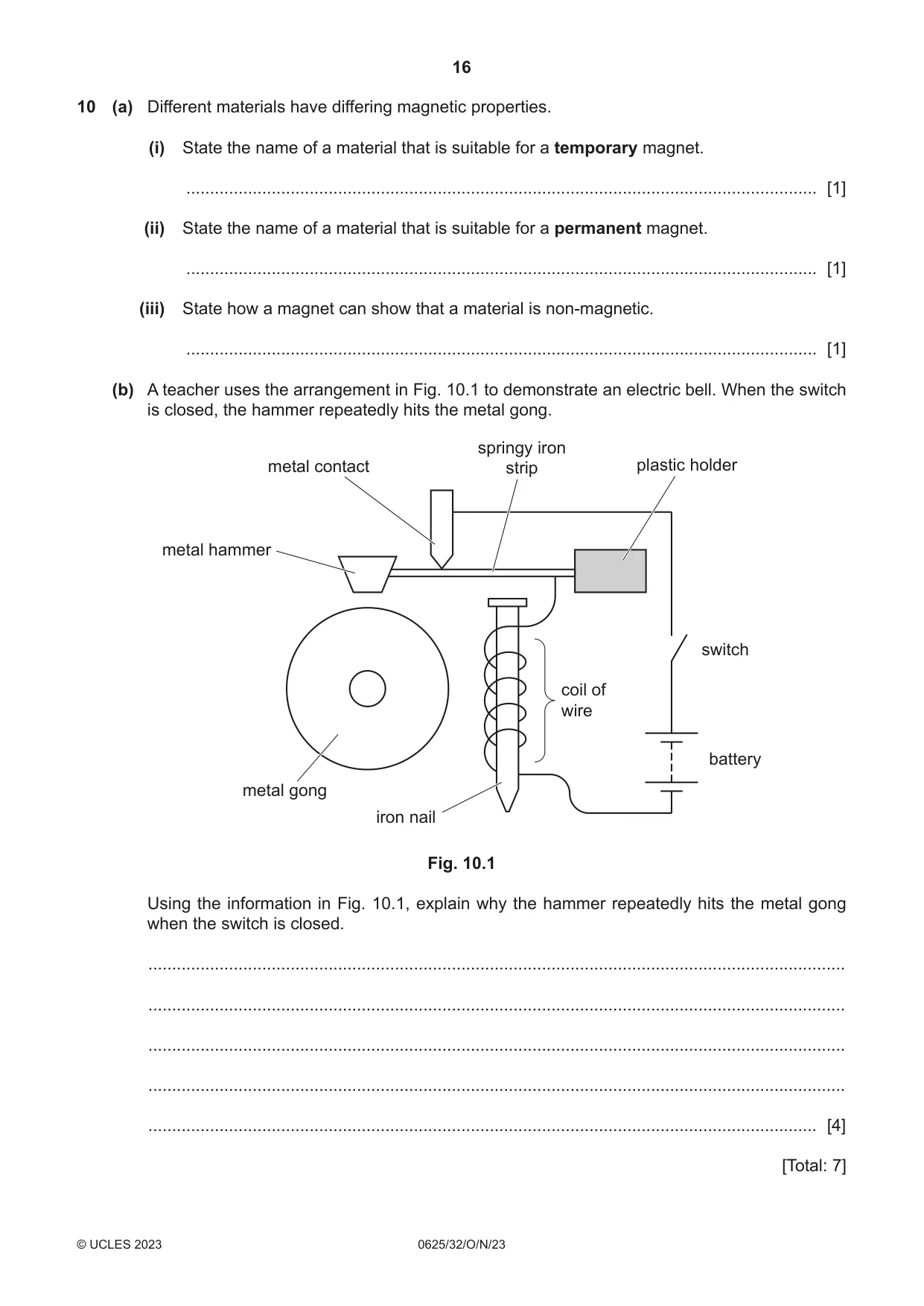
10 (a) Different materials have differing magnetic properties. (i) State the name of a material that is suitable for a temporary magnet. ..................................................................................................................................... [1] (ii) State the name of a material that is suitable for a permanent magnet. ..................................................................................................................................... [1] (iii) State how a magnet can show that a material is non‑magnetic. ..................................................................................................................................... [1] (b) A teacher uses the arrangement in Fig. 10.1 to demonstrate an electric bell. When the switch is closed, the hammer repeatedly hits the metal gong. springy iron metal contact strip plastic holder metal hammer switch coil of wire battery metal gong iron nail Fig. 10.1 Using the information in Fig. 10.1, explain why the hammer repeatedly hits the metal gong when the switch is closed. ................................................................................................................................................... ................................................................................................................................................... ................................................................................................................................................... ................................................................................................................................................... ............................................................................................................................................. [4] [Total: 7]
Mark scheme: 10(a)(i) (soft) iron B1 10(a)(ii) steel B1 10(a)(iii) magnet does not attract a non-magnetic material B1 10(b) any four from: B4 (when switch closed) there is a complete circuit current in the circuit magnetic effect (of current / in coil) owtte (coil and nail become) electromagnet (springy) iron (strip) attracted to (nail / electromagnet) circuit broken owtte springy iron strip springs back / makes contact (again) owtte
Q11 · All the particles in a beryllium atom
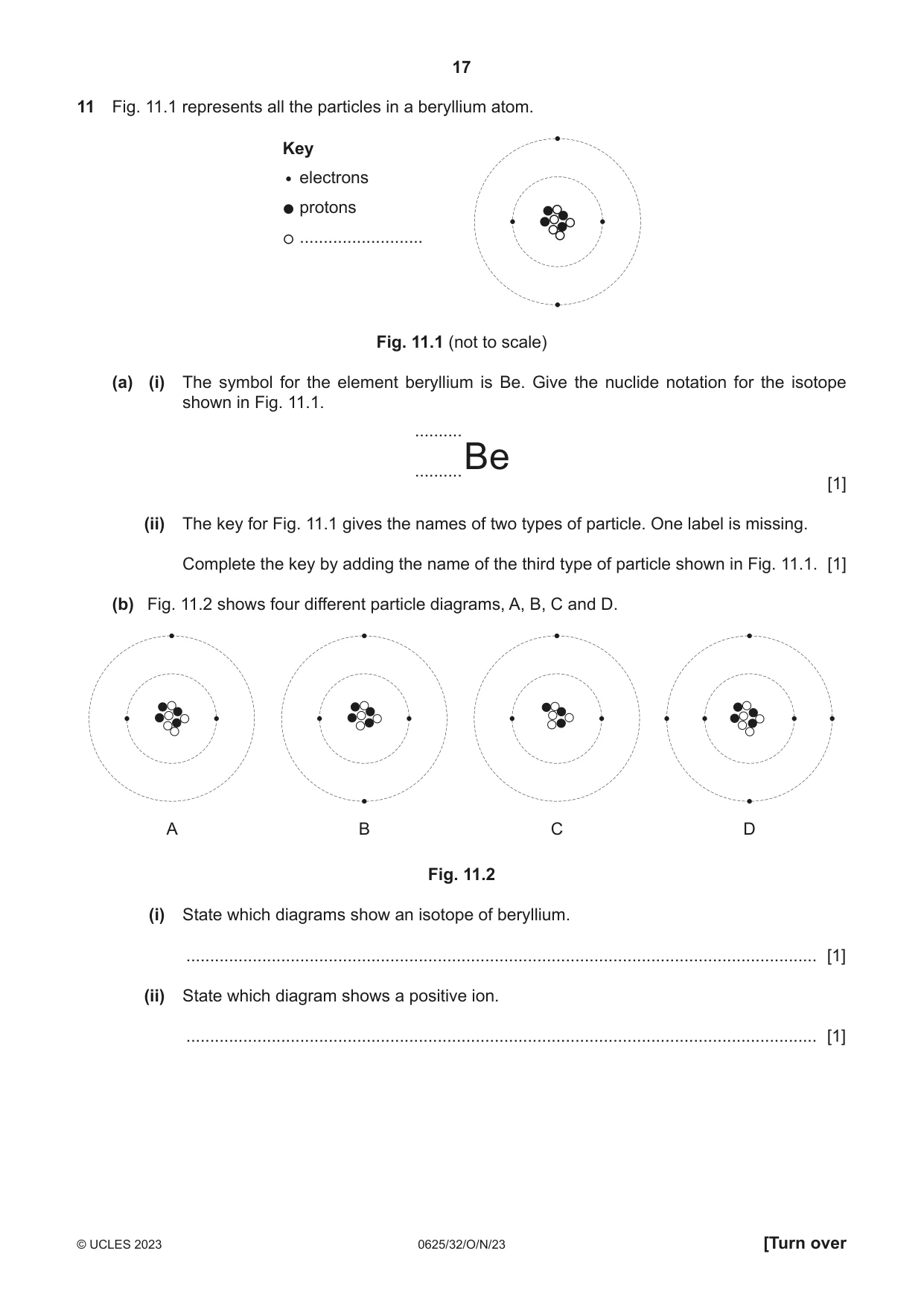
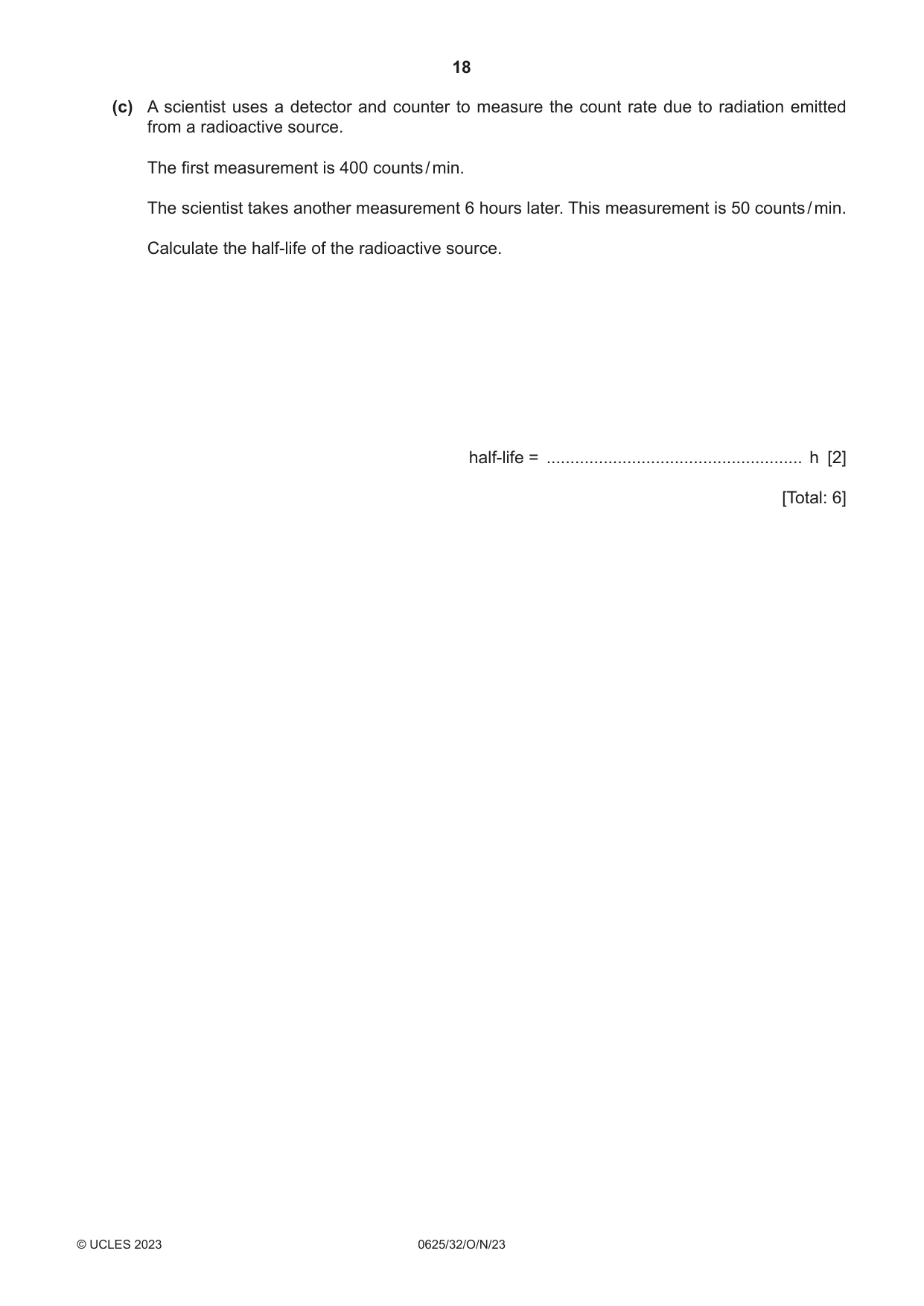
11 Fig. 11.1 represents all the particles in a beryllium atom. Key electrons protons .......................... Fig. 11.1 (not to scale) (a) (i) The symbol for the element beryllium is Be. Give the nuclide notation for the isotope shown in Fig. 11.1. .......... .......... Be [1] (ii) The key for Fig. 11.1 gives the names of two types of particle. One label is missing. Complete the key by adding the name of the third type of particle shown in Fig. 11.1. [1] (b) Fig. 11.2 shows four different particle diagrams, A, B, C and D. A B C D Fig. 11.2 (i) State which diagrams show an isotope of beryllium. ..................................................................................................................................... [1] (ii) State which diagram shows a positive ion. ..................................................................................................................................... [1] (c) A scientist uses a detector and counter to measure the count rate due to radiation emitted from a radioactive source. The first measurement is 400 counts / min. The scientist takes another measurement 6 hours later. This measurement is 50 counts / min. Calculate the half‑life of the radioactive source. half‑life = ...................................................... h [2] [Total: 6]
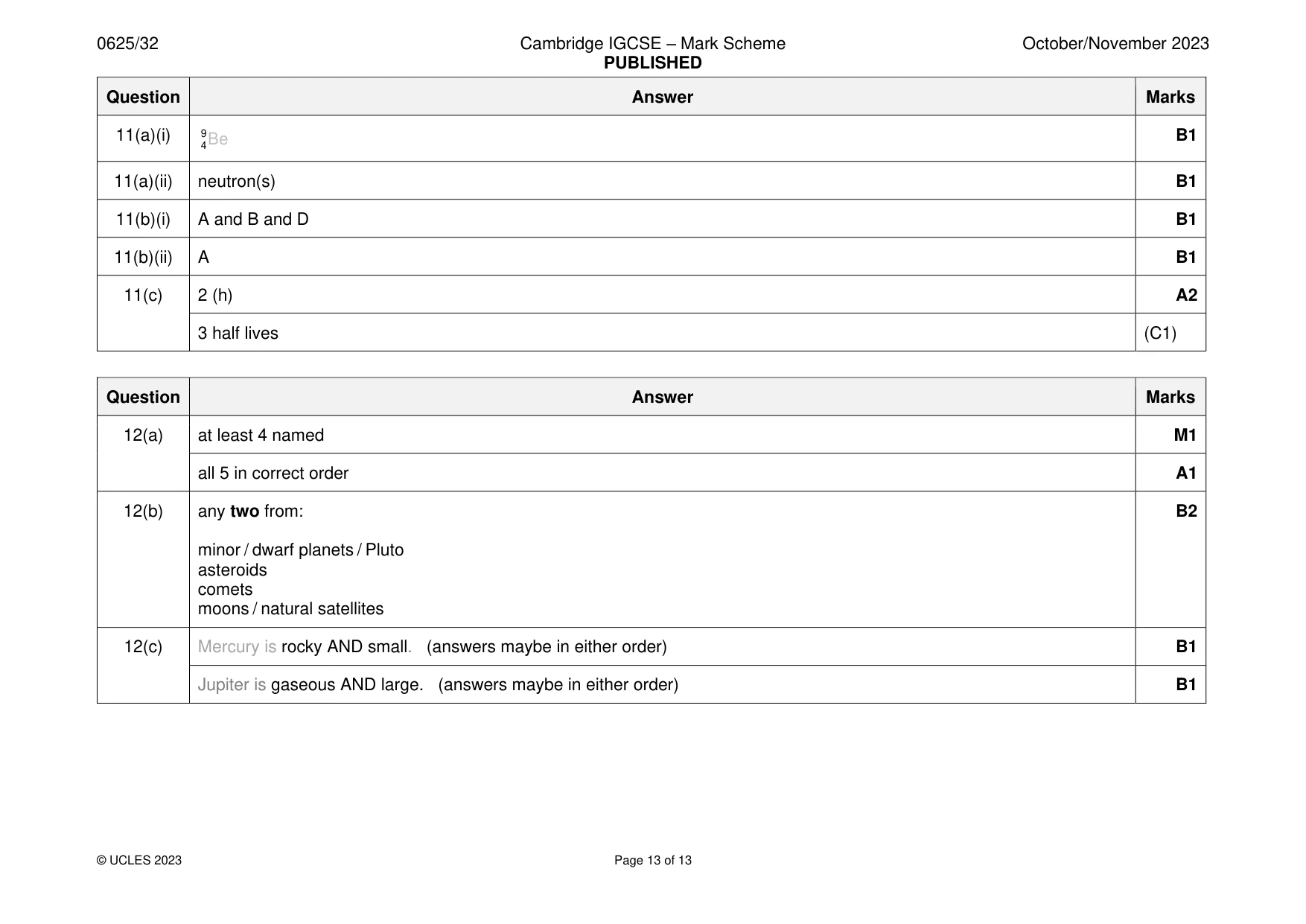
Mark scheme: 11(a)(i) 94Be B1 11(a)(ii) neutron(s) B1 11(b)(i) A and B and D B1 11(b)(ii) A B1 11(c) 2 (h) A2 3 half lives (C1)
Q12 · There are eight planets in our Solar System
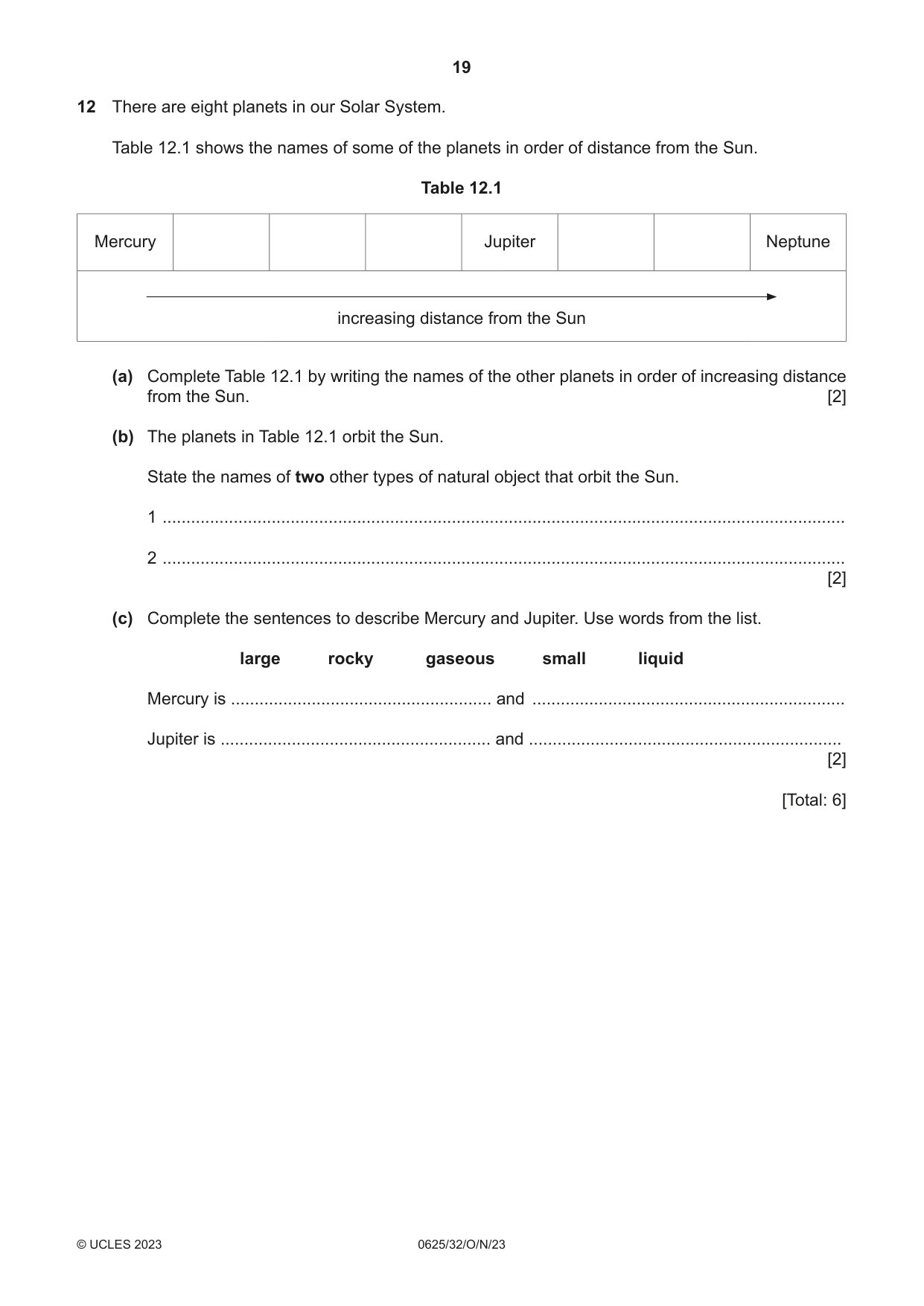
12 There are eight planets in our Solar System. Table 12.1 shows the names of some of the planets in order of distance from the Sun. Table 12.1 Mercury Jupiter Neptune increasing distance from the Sun (a) Complete Table 12.1 by writing the names of the other planets in order of increasing distance from the Sun. [2] (b) The planets in Table 12.1 orbit the Sun. State the names of two other types of natural object that orbit the Sun. 1 ................................................................................................................................................ 2 ................................................................................................................................................ [2] (c) Complete the sentences to describe Mercury and Jupiter. Use words from the list. large rocky gaseous small liquid Mercury is ....................................................... and .................................................................. Jupiter is ......................................................... and .................................................................. [2] [Total: 6]
Mark scheme: 12(a) at least 4 named M1 all 5 in correct order A1 12(b) any two from: B2 minor / dwarf planets / Pluto asteroids comets moons / natural satellites 12(c) Mercury is rocky AND small. (answers maybe in either order) B1 Jupiter is gaseous AND large. (answers maybe in either order) B1
What was in this paper
The subtopics covered by these 12 questions, and how many questions each got. Open one in a new tab to see every Cambridge question on it.
What you needed in this session
Cambridge’s own grade thresholds for 2023 Oct/Nov, Paper 3 · Variant 2. A higher threshold means an easier paper — the bar moves with how the cohort did.