Cambridge IGCSE Physics 0625 — 2013 Oct/Nov Paper 3 · Variant 2
0625/32/O/N/13 · 11 questions · 80 marks · ≈90 min
The question paper and its mark scheme, free to read here and free to download. This is Cambridge’s own paper, exactly as it was sat.
Question paper20 pages
Mark scheme8 pages
Answers below. Sit the paper first if you are practising.
Questions as text
Q1 · A school athlete does a sprint training run
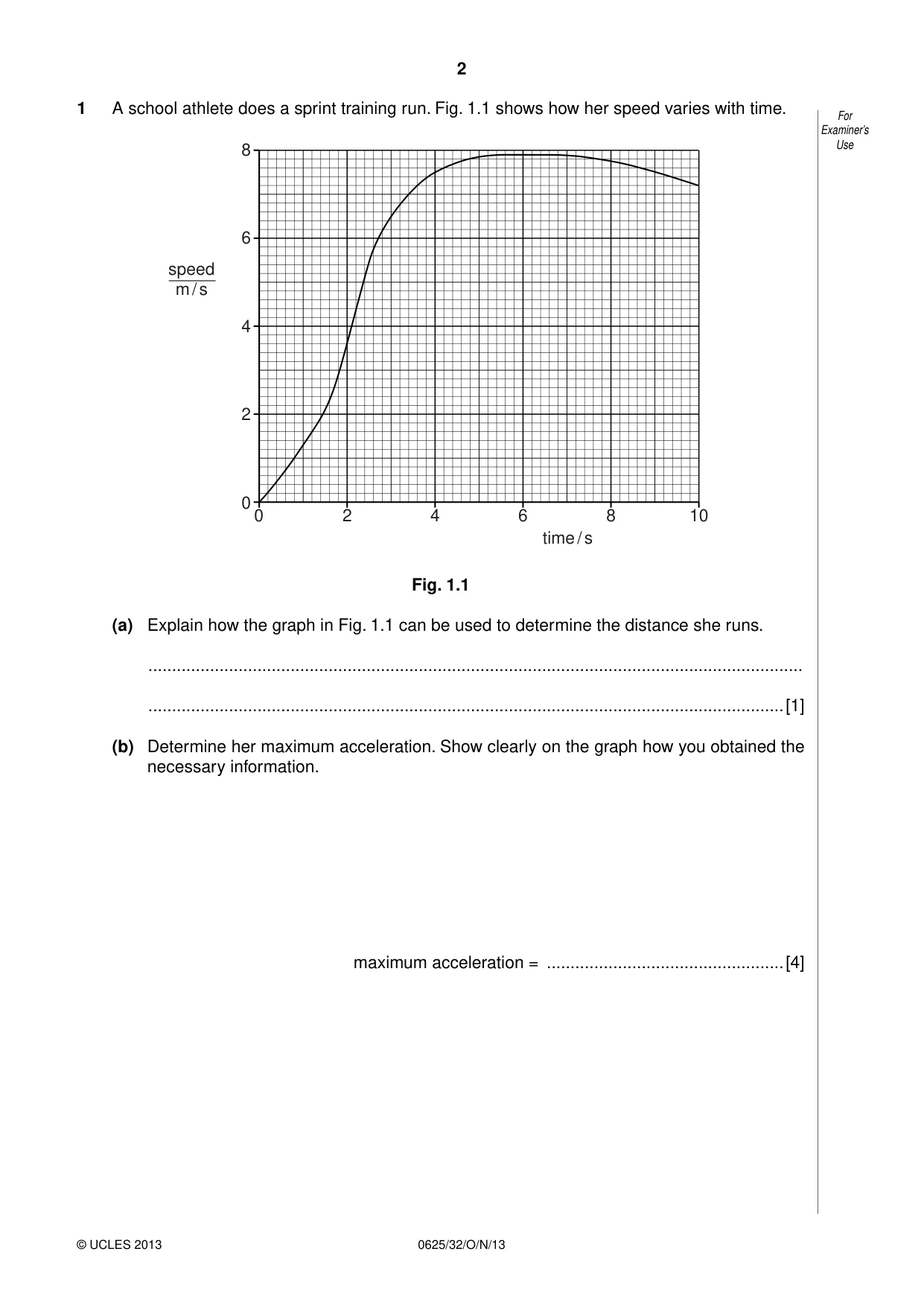
1 A school athlete does a sprint training run. Fig. 1.1 shows how her speed varies with time. For Examiner’s 8 Use 6 speed m / s 4 2 0 0 2 4 6 8 10 time / s Fig. 1.1 (a) Explain how the graph in Fig. 1.1 can be used to determine the distance she runs. .......................................................................................................................................... ......................................................................................................................................[1] (b) Determine her maximum acceleration. Show clearly on the graph how you obtained the necessary information. maximum acceleration = ..................................................[4] (c) She runs a distance of 62 m. For Examiner’s Calculate her average speed. Use average speed = ..................................................[2] [Total: 7]
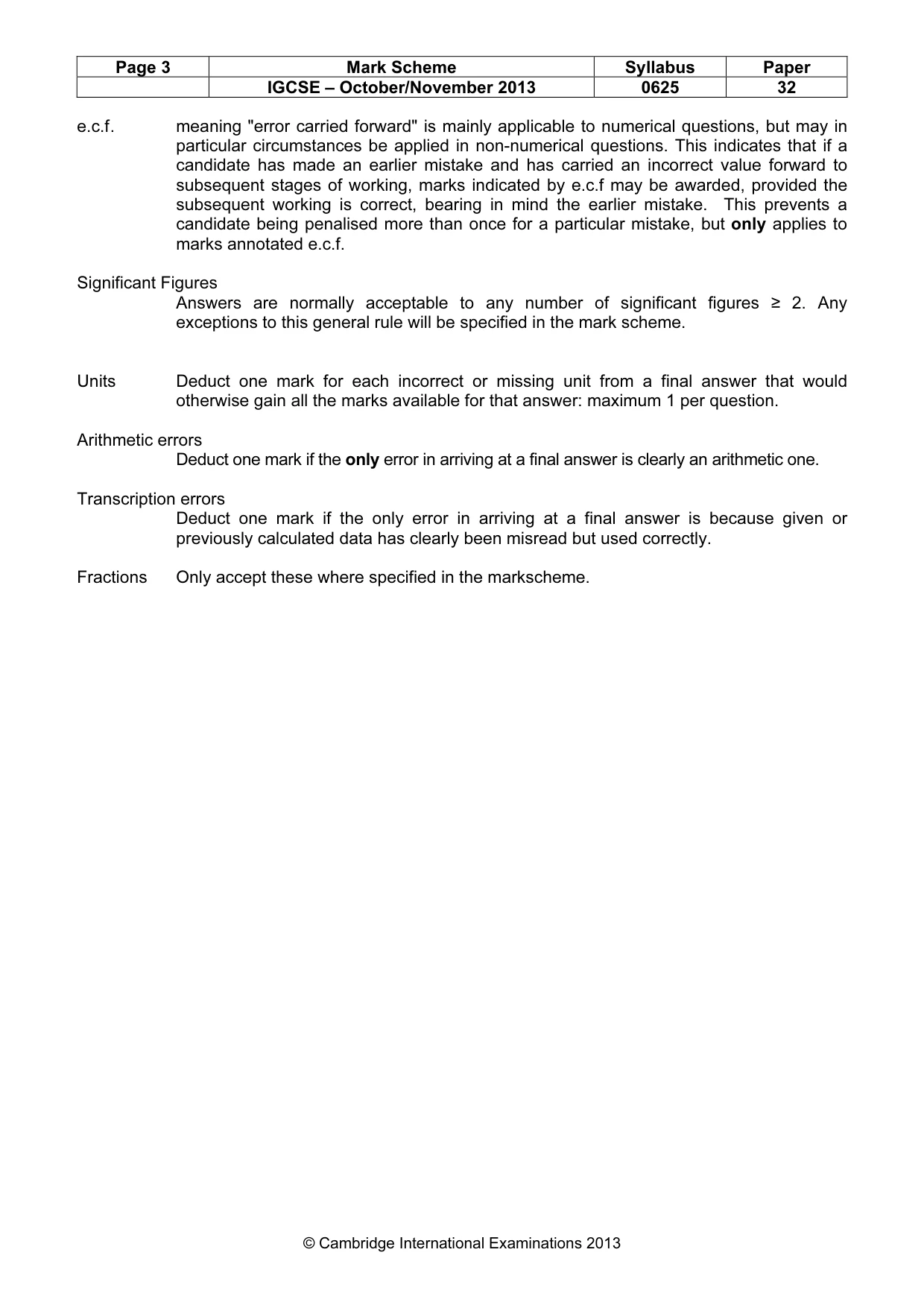
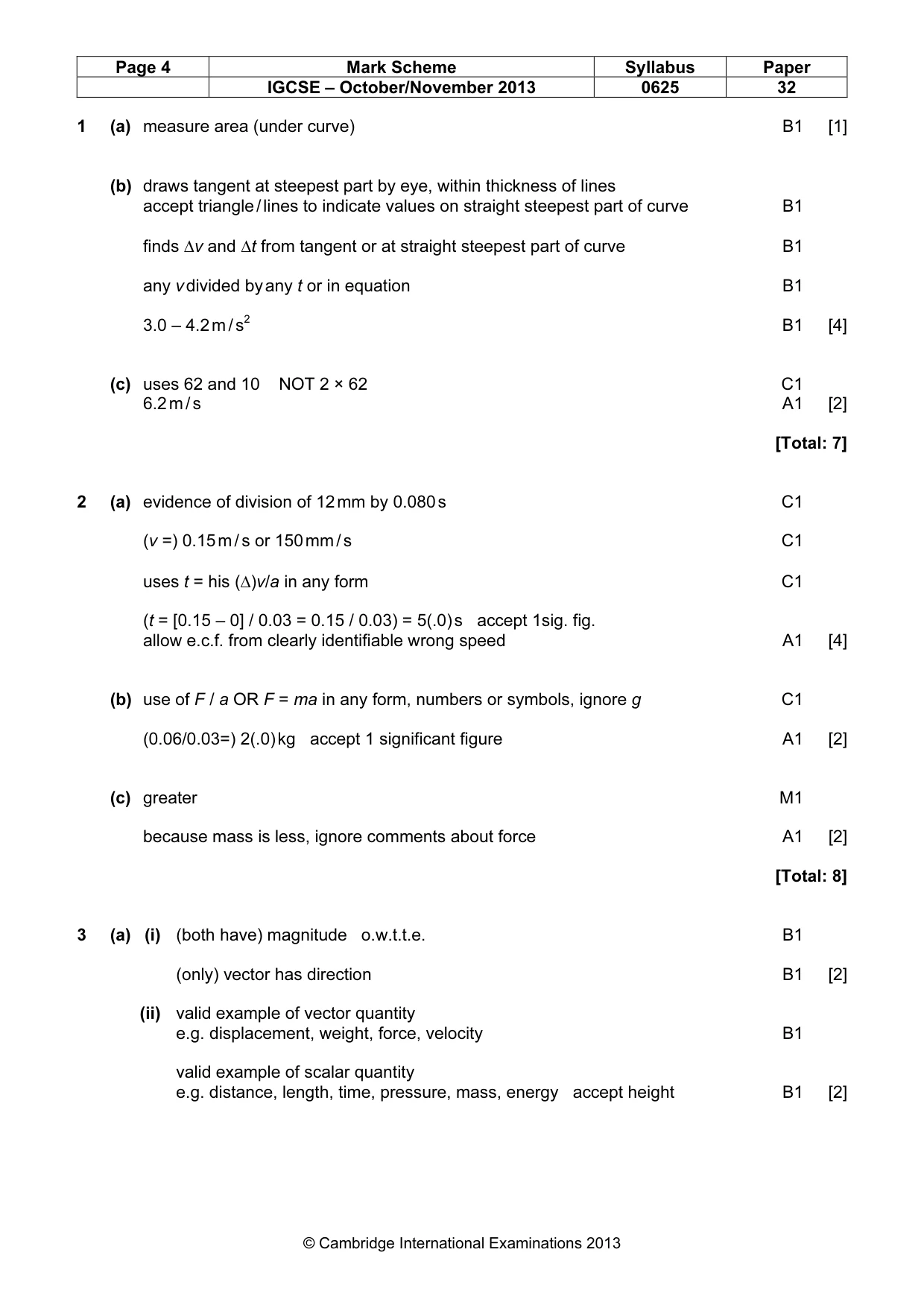
Mark scheme: 1 (a) measure area (under curve) B1 [1] (b) draws tangent at steepest part by eye, within thickness of lines accept triangle / lines to indicate values on straight steepest part of curve B1 finds ∆v and ∆t from tangent or at straight steepest part of curve B1 any v divided by any t or in equation B1 3.0 – 4.2 m / s2 B1 [4] (c) uses 62 and 10 NOT 2 × 62 C1 6.2 m / s A1 [2] [Total: 7]
Q2 · A model fire engine used by a student to take measurements of force and For motion
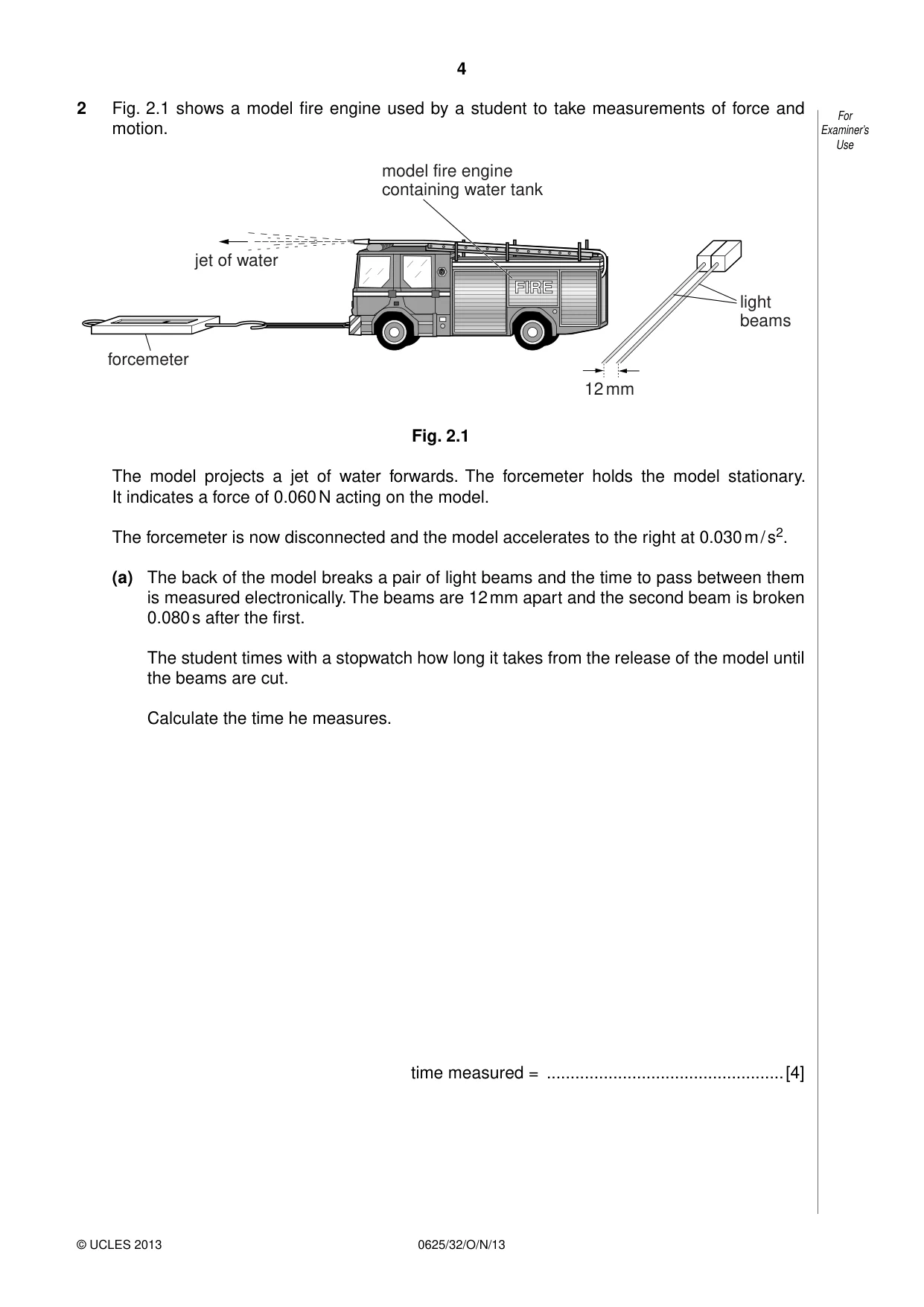
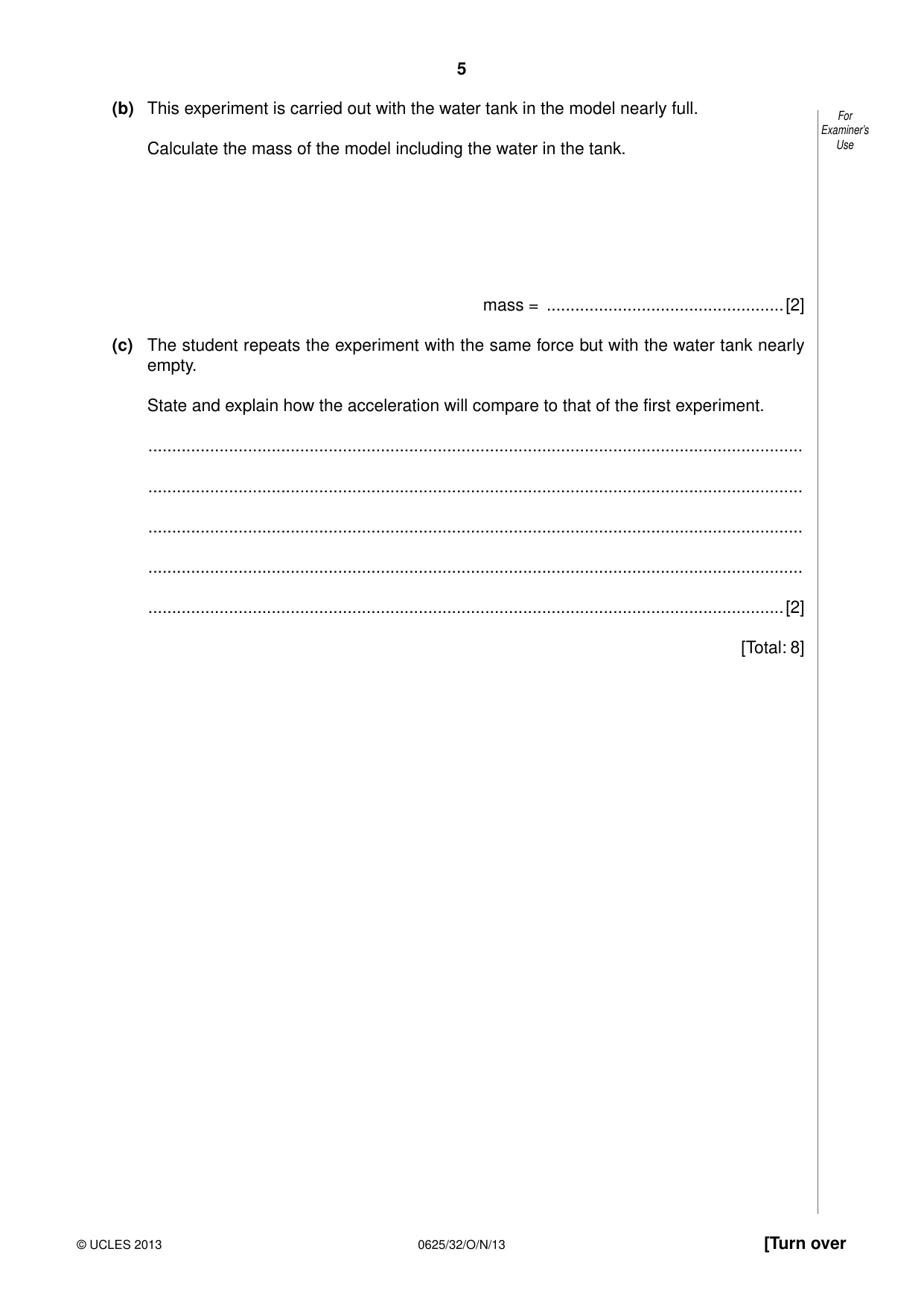
2 Fig. 2.1 shows a model fire engine used by a student to take measurements of force and For motion. Examiner’s Use model fire engine containing water tank jet of water FIRE light beams forcemeter 12 mm Fig. 2.1 The model projects a jet of water forwards. The forcemeter holds the model stationary. It indicates a force of 0.060 N acting on the model. The forcemeter is now disconnected and the model accelerates to the right at 0.030 m / s2. (a) The back of the model breaks a pair of light beams and the time to pass between them is measured electronically. The beams are 12 mm apart and the second beam is broken 0.080 s after the first. The student times with a stopwatch how long it takes from the release of the model until the beams are cut. Calculate the time he measures. time measured = ..................................................[4] (b) This experiment is carried out with the water tank in the model nearly full. For Examiner’s Calculate the mass of the model including the water in the tank. Use mass = ..................................................[2] (c) The student repeats the experiment with the same force but with the water tank nearly empty. State and explain how the acceleration will compare to that of the first experiment. .......................................................................................................................................... .......................................................................................................................................... .......................................................................................................................................... .......................................................................................................................................... ......................................................................................................................................[2] [Total: 8]
Mark scheme: 2 (a) evidence of division of 12 mm by 0.080 s C1 (v =) 0.15 m / s or 150 mm / s C1 uses t = his (∆)v/a in any form C1 (t = [0.15 – 0] / 0.03 = 0.15 / 0.03) = 5(.0) s accept 1sig. fig. allow e.c.f. from clearly identifiable wrong speed A1 [4] (b) use of F / a OR F = ma in any form, numbers or symbols, ignore g C1 (0.06/0.03=) 2(.0) kg accept 1 significant figure A1 [2] (c) greater M1 because mass is less, ignore comments about force A1 [2] [Total: 8]
Q3 · State one similarity and one difference between vector and scalar quantities
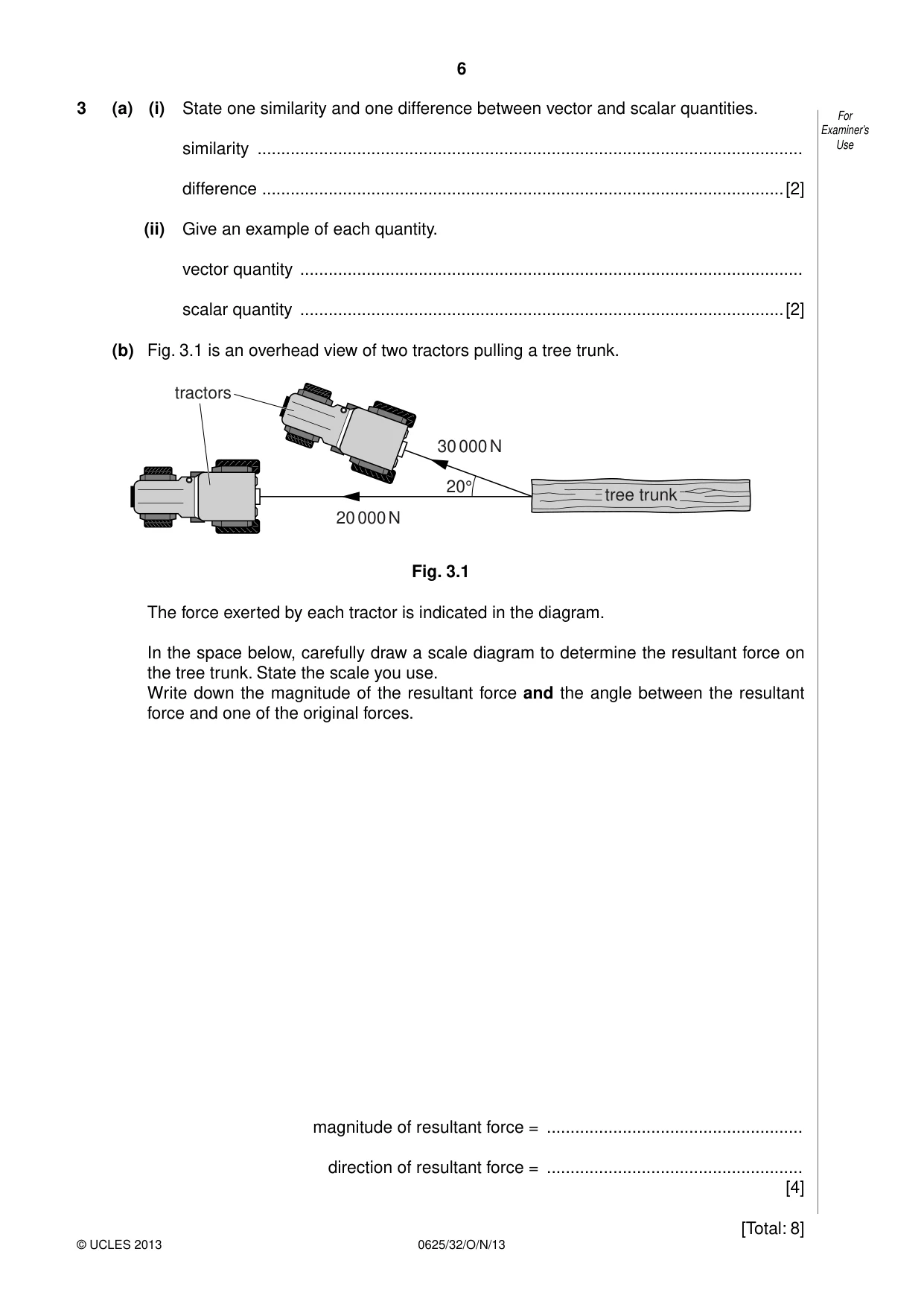
3 (a) (i) State one similarity and one difference between vector and scalar quantities. For Examiner’s similarity ................................................................................................................... Use difference ..............................................................................................................[2] (ii) Give an example of each quantity. vector quantity .......................................................................................................... scalar quantity ......................................................................................................[2] (b) Fig. 3.1 is an overhead view of two tractors pulling a tree trunk. tractors 30 000 N 20° tree trunk 20 000 N Fig. 3.1 The force exerted by each tractor is indicated in the diagram. In the space below, carefully draw a scale diagram to determine the resultant force on the tree trunk. State the scale you use. Write down the magnitude of the resultant force and the angle between the resultant force and one of the original forces. magnitude of resultant force = ...................................................... direction of resultant force = ...................................................... [4] [Total: 8]
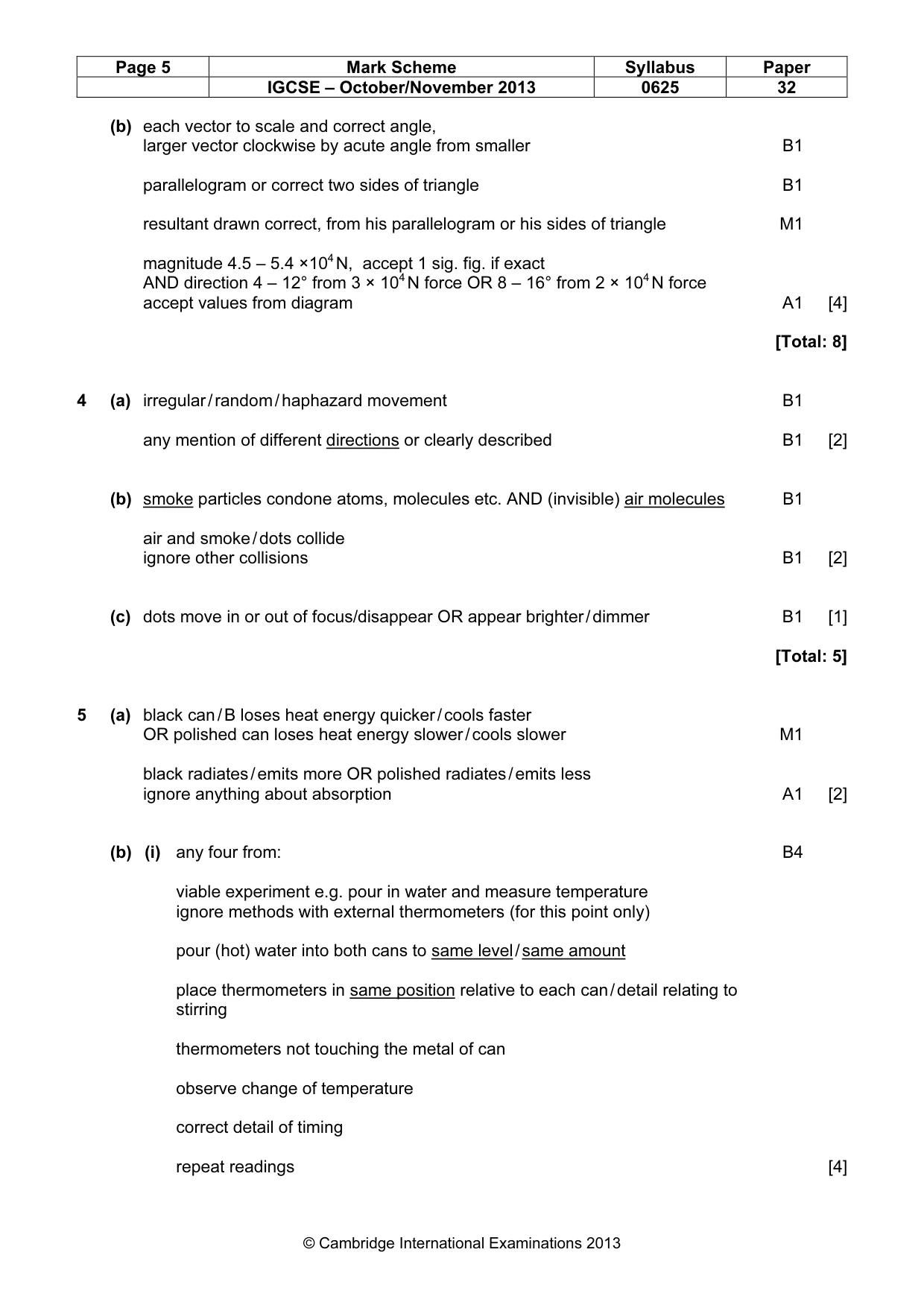
Mark scheme: 3 (a) (i) (both have) magnitude o.w.t.t.e. B1 (only) vector has direction B1 [2] (ii) valid example of vector quantity e.g. displacement, weight, force, velocity B1 valid example of scalar quantity e.g. distance, length, time, pressure, mass, energy accept height B1 [2] IGCSE – October/November 2013 0625 32 (b) each vector to scale and correct angle, larger vector clockwise by acute angle from smaller B1 parallelogram or correct two sides of triangle B1 resultant drawn correct, from his parallelogram or his sides of triangle M1 magnitude 4.5 – 5.4 ×10⁴ N, accept 1 sig. fig. if exact AND direction 4 – 12° from 3 × 10⁴ N force OR 8 – 16° from 2 × 10⁴ N force accept values from diagram A1 [4] [Total: 8]
Q4 · A small, closed, transparent chamber containing smoke
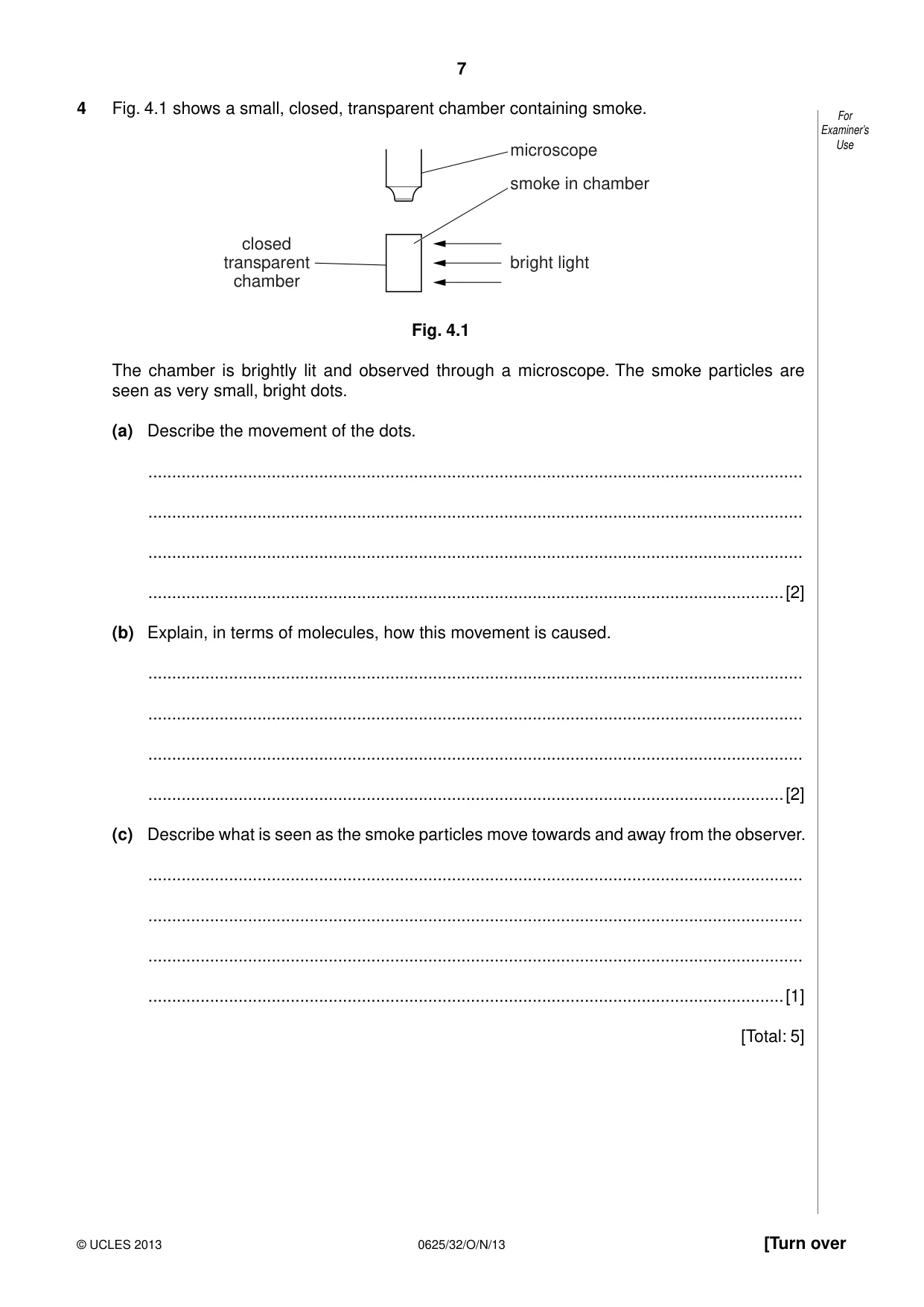
4 Fig. 4.1 shows a small, closed, transparent chamber containing smoke. For Examiner’s microscope Use smoke in chamber closed transparent bright light chamber Fig. 4.1 The chamber is brightly lit and observed through a microscope. The smoke particles are seen as very small, bright dots. (a) Describe the movement of the dots. .......................................................................................................................................... .......................................................................................................................................... .......................................................................................................................................... ......................................................................................................................................[2] (b) Explain, in terms of molecules, how this movement is caused. .......................................................................................................................................... .......................................................................................................................................... .......................................................................................................................................... ......................................................................................................................................[2] (c) Describe what is seen as the smoke particles move towards and away from the observer. .......................................................................................................................................... .......................................................................................................................................... .......................................................................................................................................... ......................................................................................................................................[1] [Total: 5]
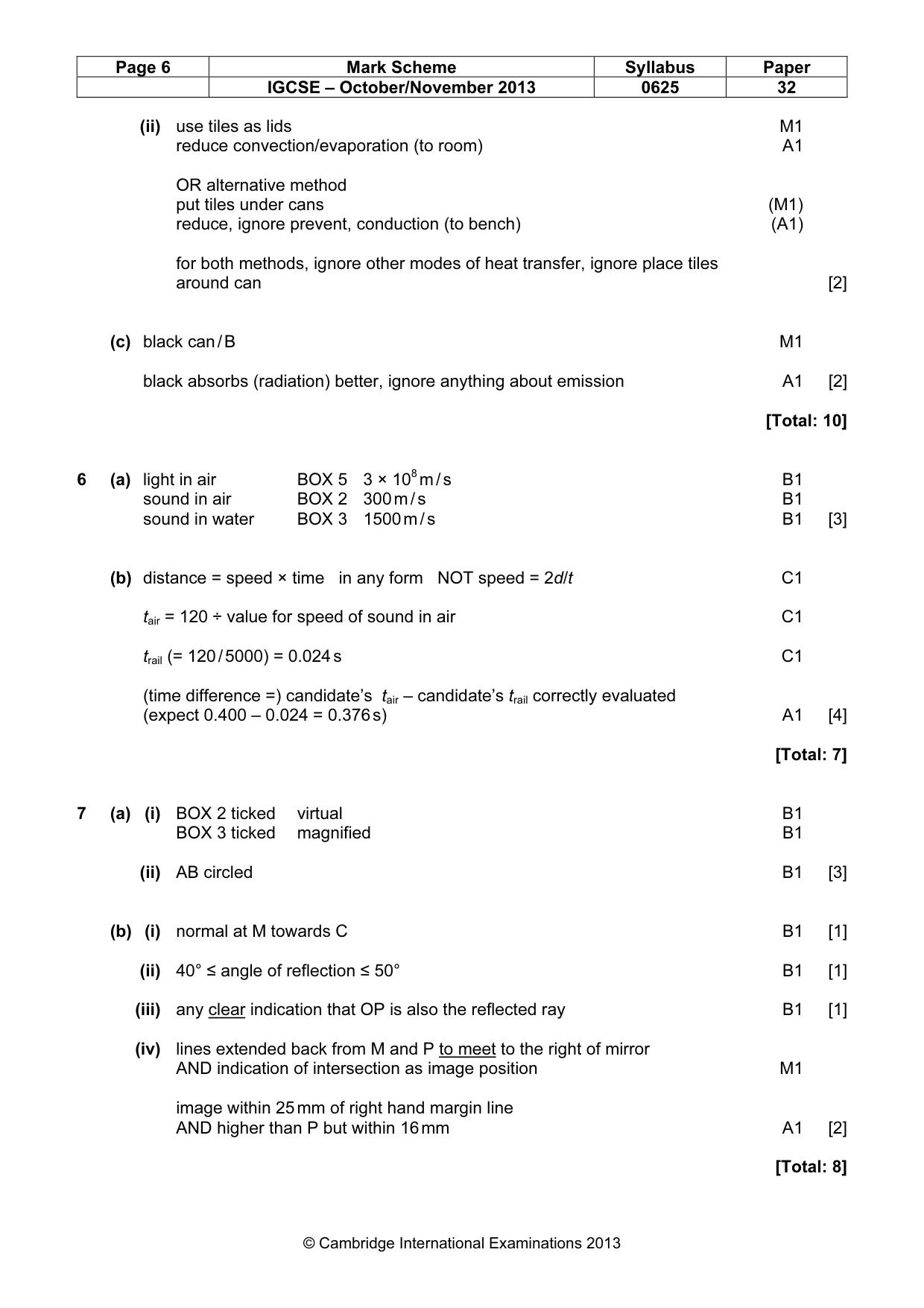
Mark scheme: 4 (a) irregular / random / haphazard movement B1 any mention of different directions or clearly described B1 [2] (b) smoke particles condone atoms, molecules etc. AND (invisible) air molecules B1 air and smoke / dots collide ignore other collisions B1 [2] (c) dots move in or out of focus/disappear OR appear brighter / dimmer B1 [1] [Total: 5]
Q5 · Two identical metal cans, open at the top, used in an experiment on thermal For energy
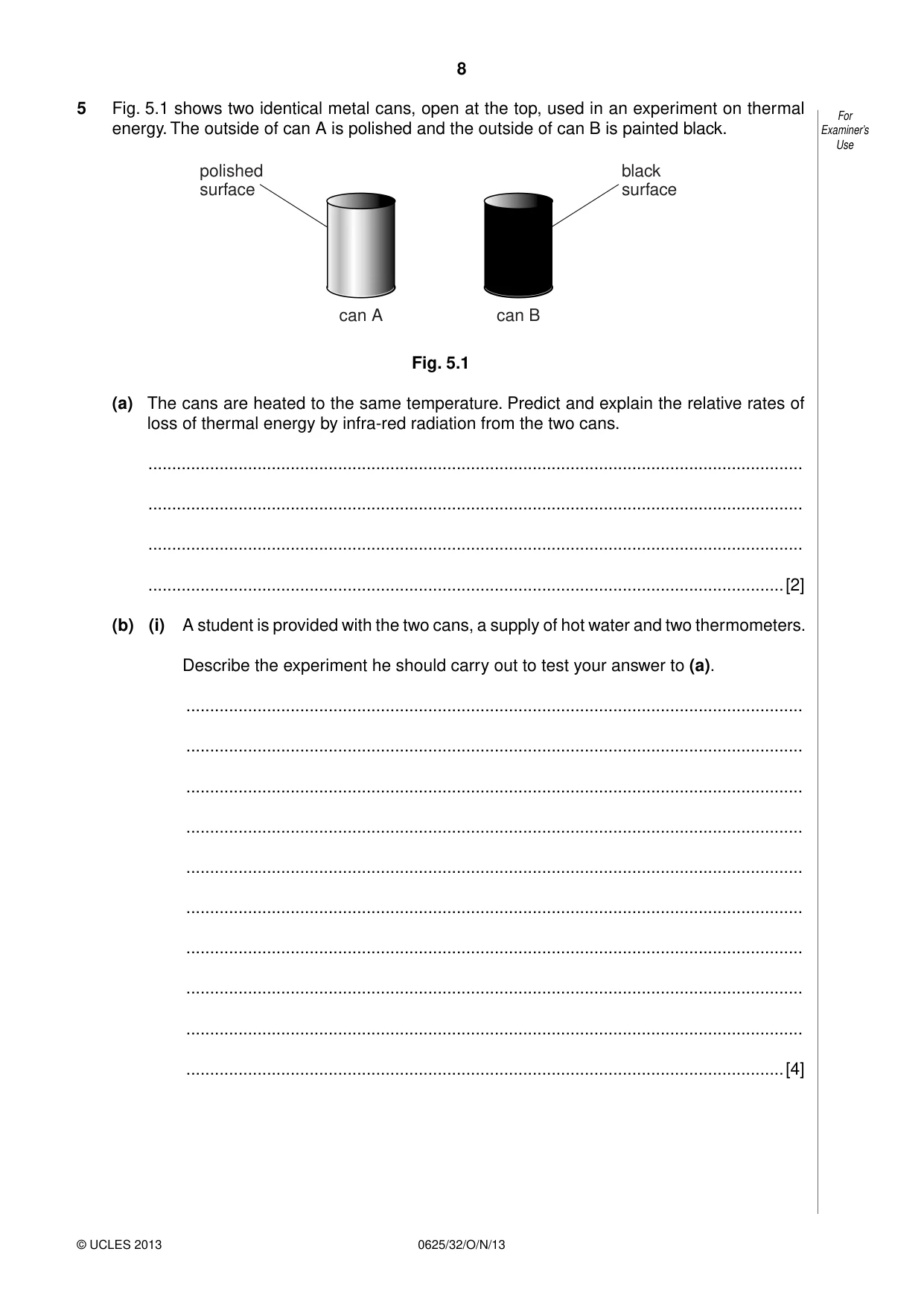
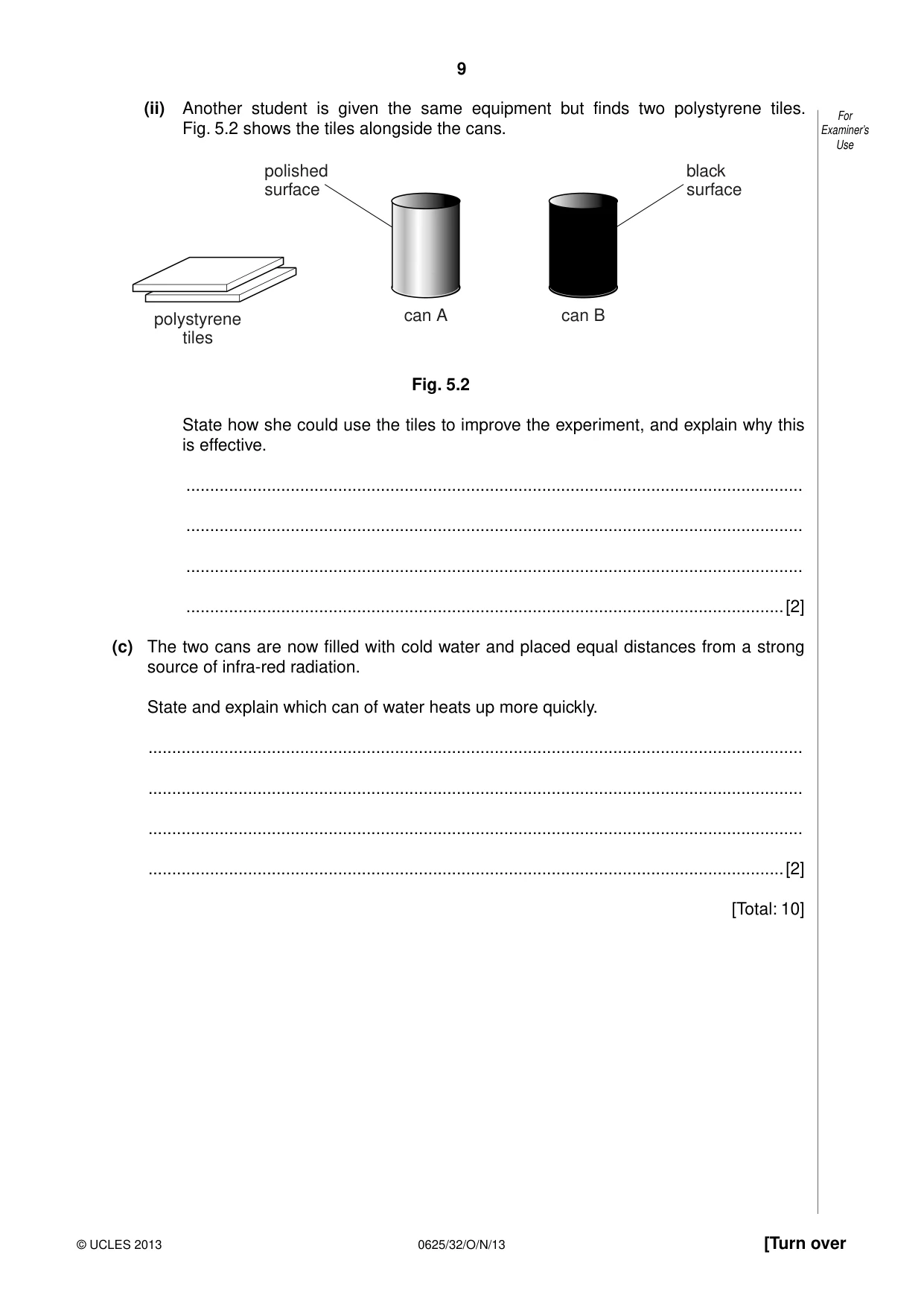
5 Fig. 5.1 shows two identical metal cans, open at the top, used in an experiment on thermal For energy. The outside of can A is polished and the outside of can B is painted black. Examiner’s Use polished black surface surface can A can B Fig. 5.1 (a) The cans are heated to the same temperature. Predict and explain the relative rates of loss of thermal energy by infra-red radiation from the two cans. .......................................................................................................................................... .......................................................................................................................................... .......................................................................................................................................... ......................................................................................................................................[2] (b) (i) A student is provided with the two cans, a supply of hot water and two thermometers. Describe the experiment he should carry out to test your answer to (a). .................................................................................................................................. .................................................................................................................................. .................................................................................................................................. .................................................................................................................................. .................................................................................................................................. .................................................................................................................................. .................................................................................................................................. .................................................................................................................................. .................................................................................................................................. ..............................................................................................................................[4] (ii) Another student is given the same equipment but finds two polystyrene tiles. For Fig. 5.2 shows the tiles alongside the cans. Examiner’s Use polished black surface surface polystyrene can A can B tiles Fig. 5.2 State how she could use the tiles to improve the experiment, and explain why this is effective. .................................................................................................................................. .................................................................................................................................. .................................................................................................................................. ..............................................................................................................................[2] (c) The two cans are now filled with cold water and placed equal distances from a strong source of infra-red radiation. State and explain which can of water heats up more quickly. .......................................................................................................................................... .......................................................................................................................................... .......................................................................................................................................... ......................................................................................................................................[2] [Total: 10]
Mark scheme: 5 (a) black can / B loses heat energy quicker / cools faster OR polished can loses heat energy slower / cools slower M1 black radiates / emits more OR polished radiates / emits less ignore anything about absorption A1 [2] (b) (i) any four from: B4 viable experiment e.g. pour in water and measure temperature ignore methods with external thermometers (for this point only) pour (hot) water into both cans to same level / same amount place thermometers in same position relative to each can / detail relating to stirring thermometers not touching the metal of can observe change of temperature correct detail of timing repeat readings [4] IGCSE – October/November 2013 0625 32 (ii) use tiles as lids M1 reduce convection/evaporation (to room) A1 OR alternative method put tiles under cans (M1) reduce, ignore prevent, conduction (to bench) (A1) for both methods, ignore other modes of heat transfer, ignore place tiles around can [2] (c) black can / B M1 black absorbs (radiation) better, ignore anything about emission A1 [2] [Total: 10] 8
Q6 · Draw a straight line from each wave to the most appropriate speed on the right
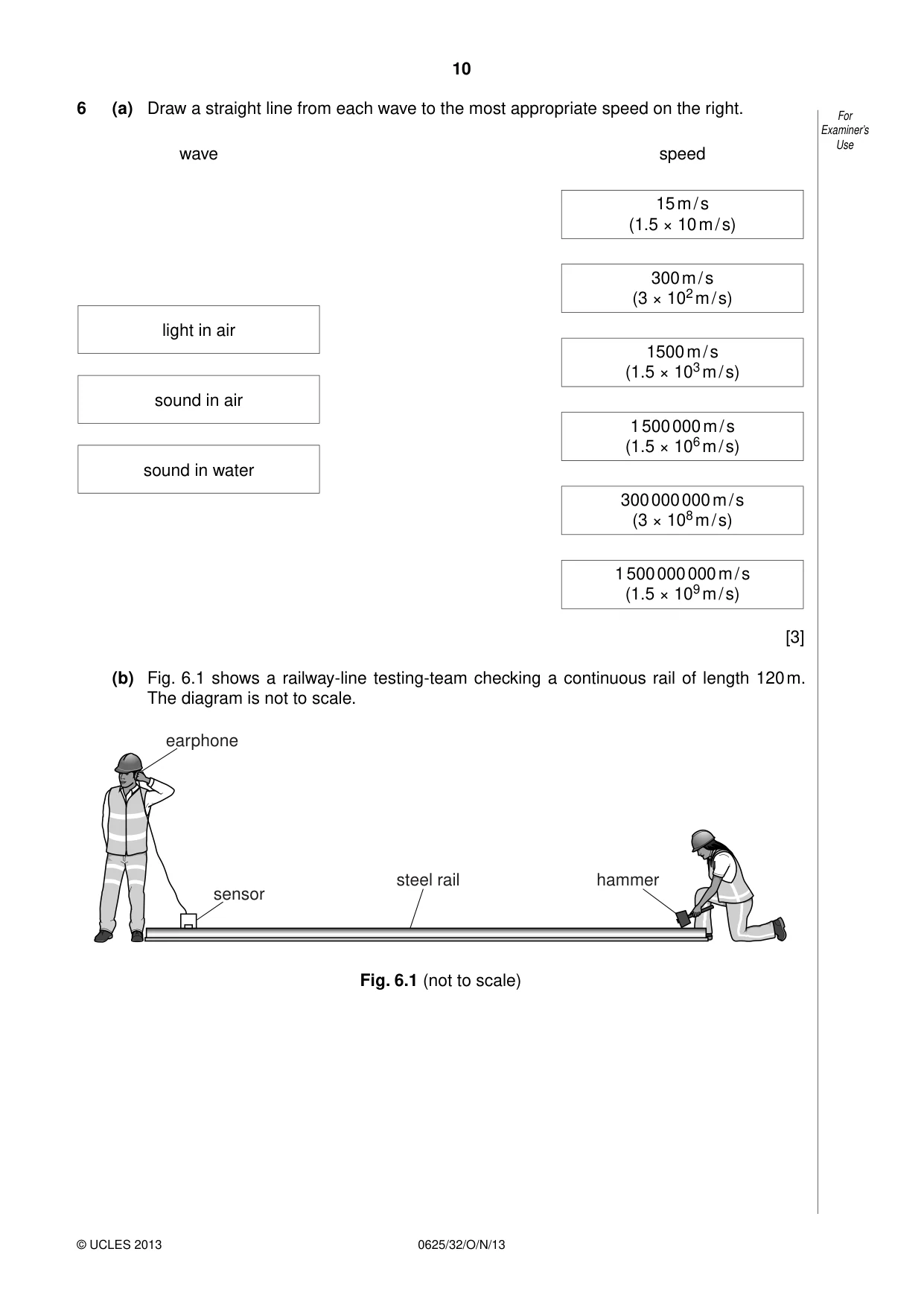
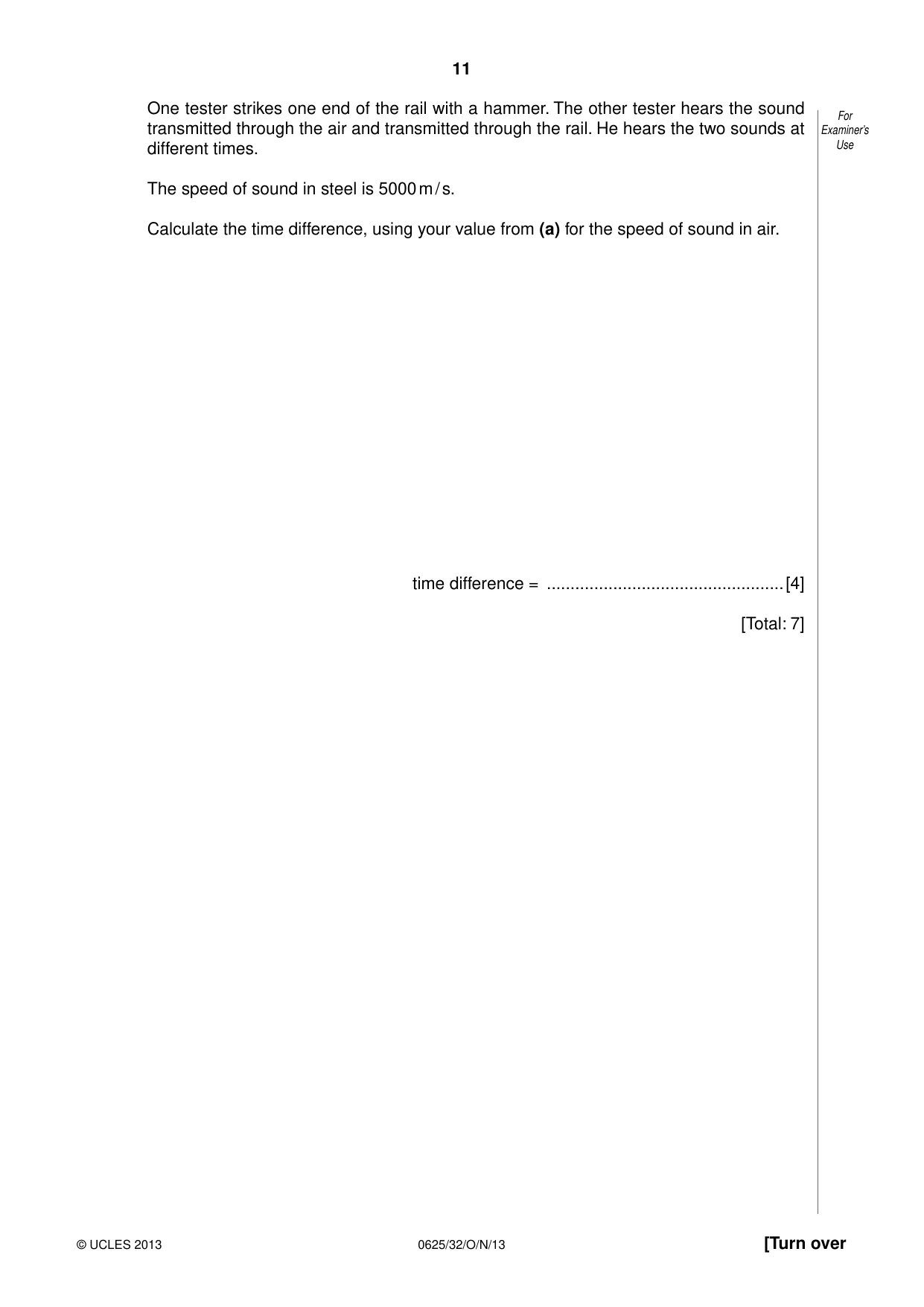
6 (a) Draw a straight line from each wave to the most appropriate speed on the right. For Examiner’s Use wave speed 15 m / s (1.5 × 10 m / s) 300 m / s (3 × 10² m / s) light in air 1500 m / s (1.5 × 10³ m / s) sound in air 1 500 000 m / s (1.5 × 10⁶ m / s) sound in water 300 000 000 m / s (3 × 10⁸ m / s) 1 500 000 000 m / s (1.5 × 10⁹ m / s) [3] (b) Fig. 6.1 shows a railway-line testing-team checking a continuous rail of length 120 m. The diagram is not to scale. earphone steel rail hammer sensor Fig. 6.1 (not to scale) One tester strikes one end of the rail with a hammer. The other tester hears the sound For transmitted through the air and transmitted through the rail. He hears the two sounds at Examiner’s different times. Use The speed of sound in steel is 5000 m / s. Calculate the time difference, using your value from (a) for the speed of sound in air. time difference = ..................................................[4] [Total: 7]
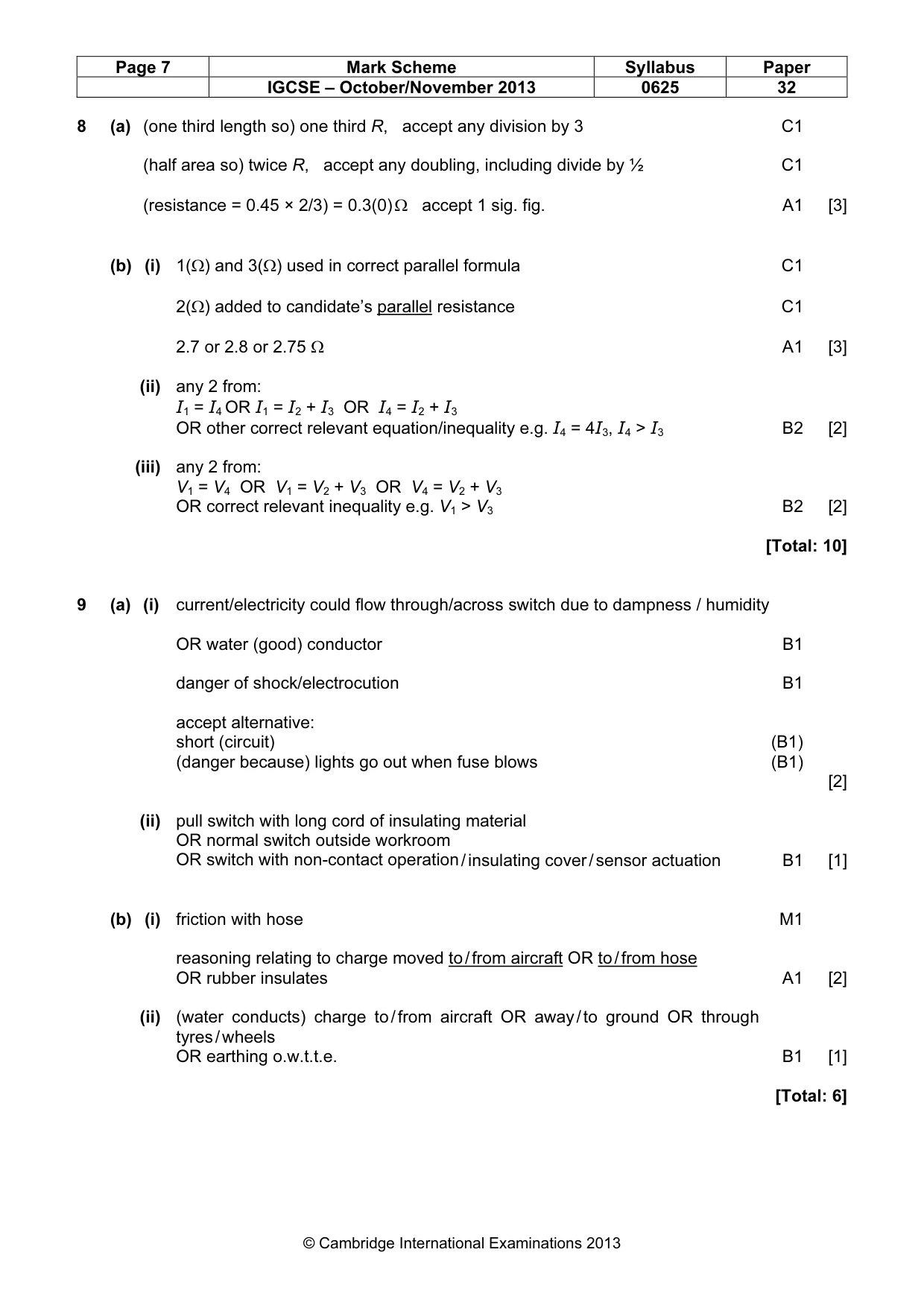
Mark scheme: 6 (a) light in air BOX 5 3 × 10⁸ m / s B1 sound in air BOX 2 300 m / s B1 sound in water BOX 3 1500 m / s B1 [3] (b) distance = speed × time in any form NOT speed = 2d/t C1 tair = 120 ÷ value for speed of sound in air C1 trail (= 120 / 5000) = 0.024 s C1 (time difference =) candidate’s tair – candidate’s trail correctly evaluated (expect 0.400 – 0.024 = 0.376 s) A1 [4] [Total: 7]
Q7 · A ray diagram of a converging lens forming the image I of the object O
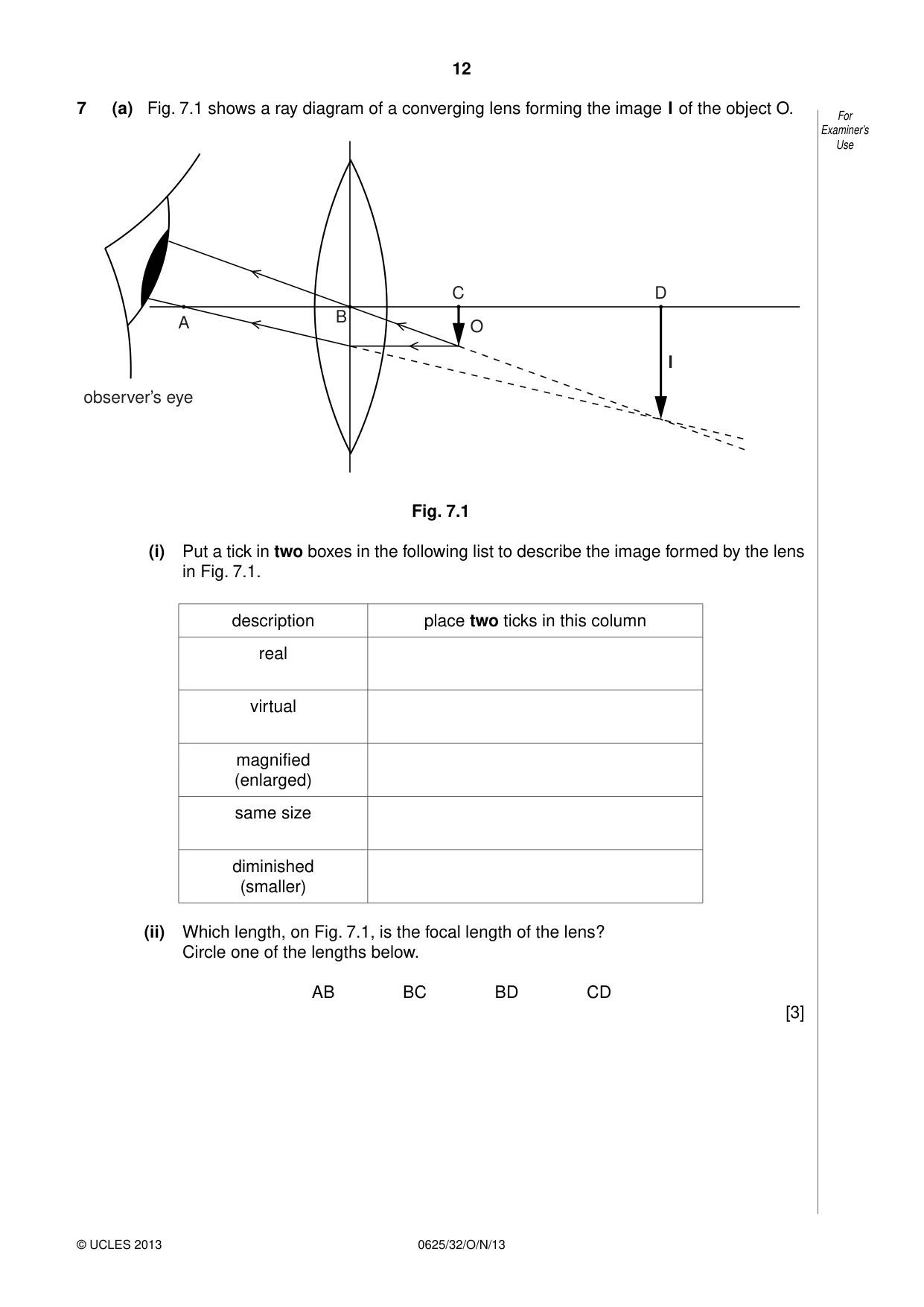
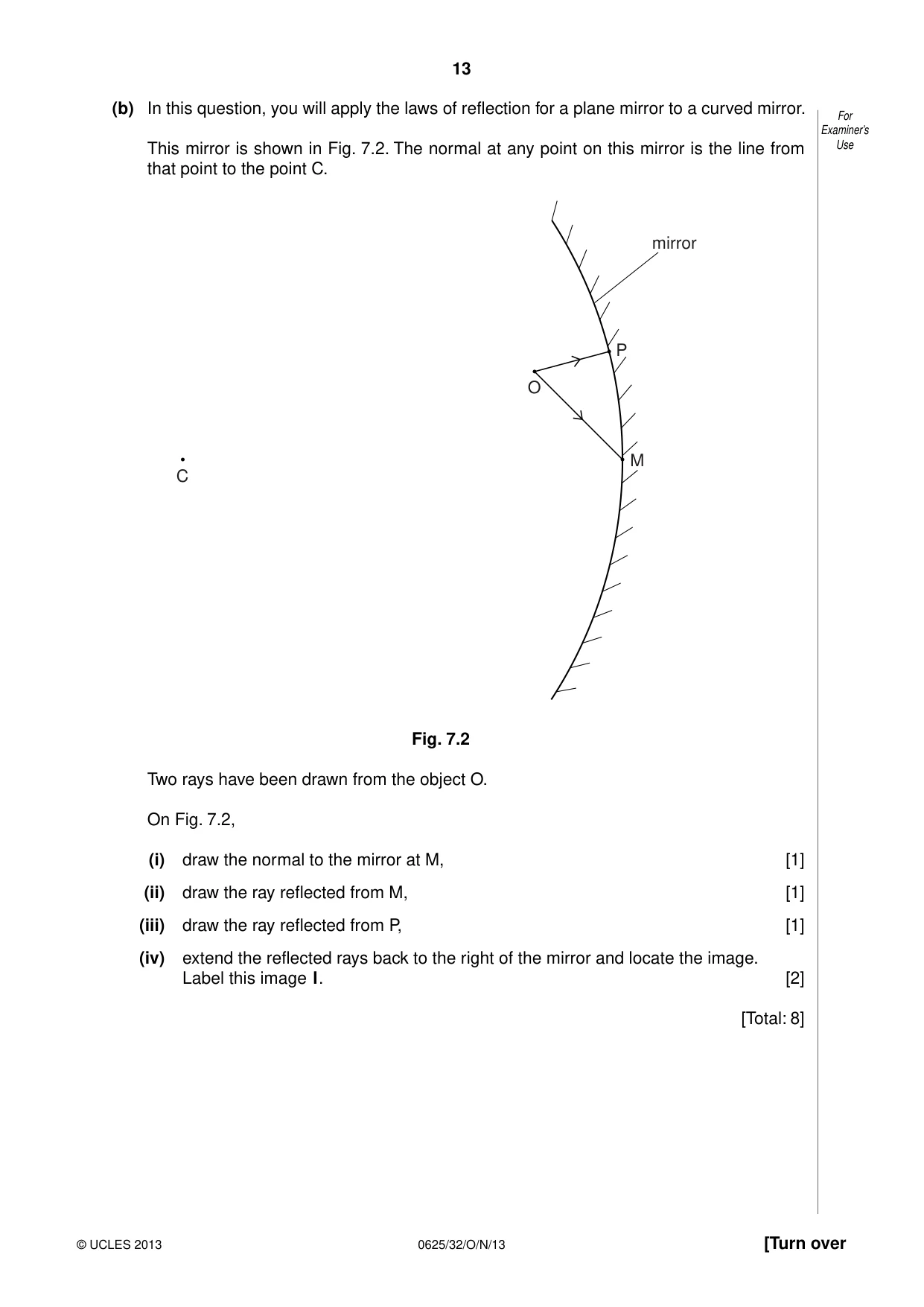
7 (a) Fig. 7.1 shows a ray diagram of a converging lens forming the image I of the object O. For Examiner’s Use C D B A O I observer’s eye Fig. 7.1 (i) Put a tick in two boxes in the following list to describe the image formed by the lens in Fig. 7.1. description place two ticks in this column real virtual magnified (enlarged) same size diminished (smaller) (ii) Which length, on Fig. 7.1, is the focal length of the lens? Circle one of the lengths below. AB BC BD CD [3] (b) In this question, you will apply the laws of reflection for a plane mirror to a curved mirror. For Examiner’s This mirror is shown in Fig. 7.2. The normal at any point on this mirror is the line from Use that point to the point C. mirror P O M C Fig. 7.2 Two rays have been drawn from the object O. On Fig. 7.2, (i) draw the normal to the mirror at M, [1] (ii) draw the ray reflected from M, [1] (iii) draw the ray reflected from P, [1] (iv) extend the reflected rays back to the right of the mirror and locate the image. Label this image I. [2] [Total: 8]
Mark scheme: 7 (a) (i) BOX 2 ticked virtual B1 BOX 3 ticked magnified B1 (ii) AB circled B1 [3] (b) (i) normal at M towards C B1 [1] (ii) 40° ≤ angle of reflection ≤ 50° B1 [1] (iii) any clear indication that OP is also the reflected ray B1 [1] (iv) lines extended back from M and P to meet to the right of mirror AND indication of intersection as image position M1 image within 25 mm of right hand margin line AND higher than P but within 16 mm A1 [2] [Total: 8] IGCSE – October/November 2013 0625 32
Q8 · A piece of wire has a resistance of 0.45 Ω
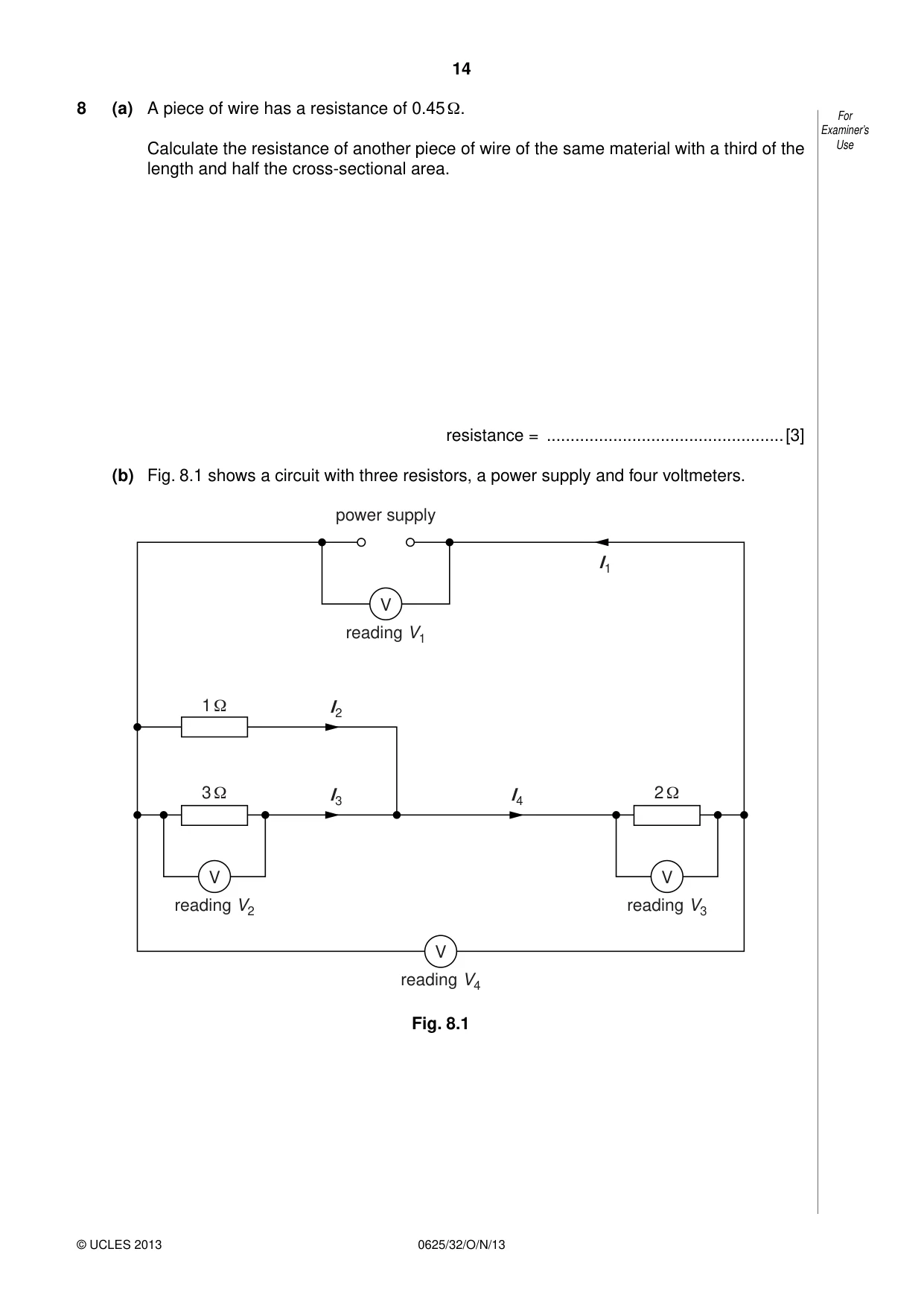
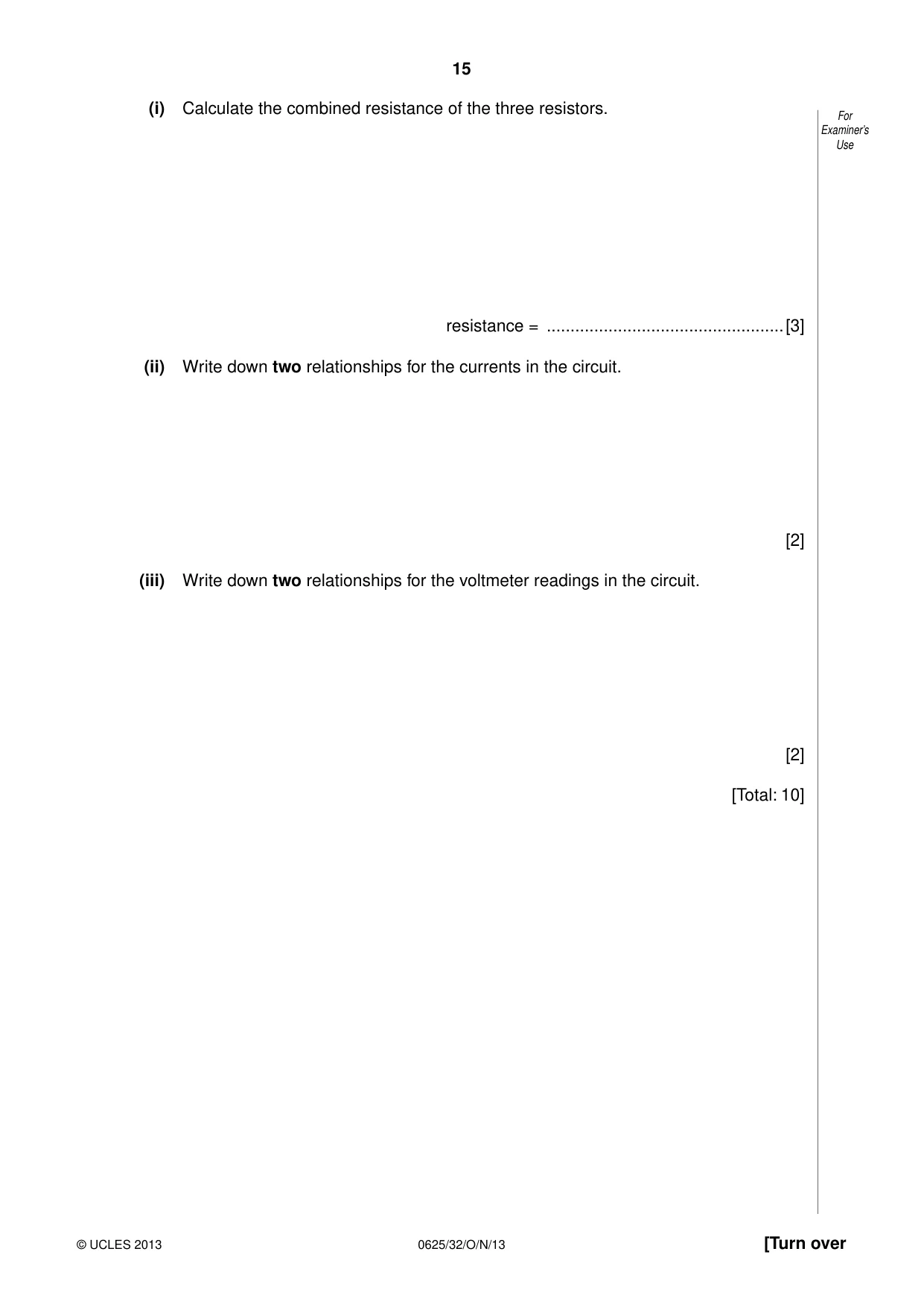
8 (a) A piece of wire has a resistance of 0.45 Ω. For Examiner’s Calculate the resistance of another piece of wire of the same material with a third of the Use length and half the cross-sectional area. resistance = ..................................................[3] (b) Fig. 8.1 shows a circuit with three resistors, a power supply and four voltmeters. power supply I1 V reading V1 1 1 I2 3 1 I3 I4 2 1 V V reading V2 reading V3 V reading V4 Fig. 8.1 (i) Calculate the combined resistance of the three resistors. For Examiner’s Use resistance = ..................................................[3] (ii) Write down two relationships for the currents in the circuit. [2] (iii) Write down two relationships for the voltmeter readings in the circuit. [2] [Total: 10]
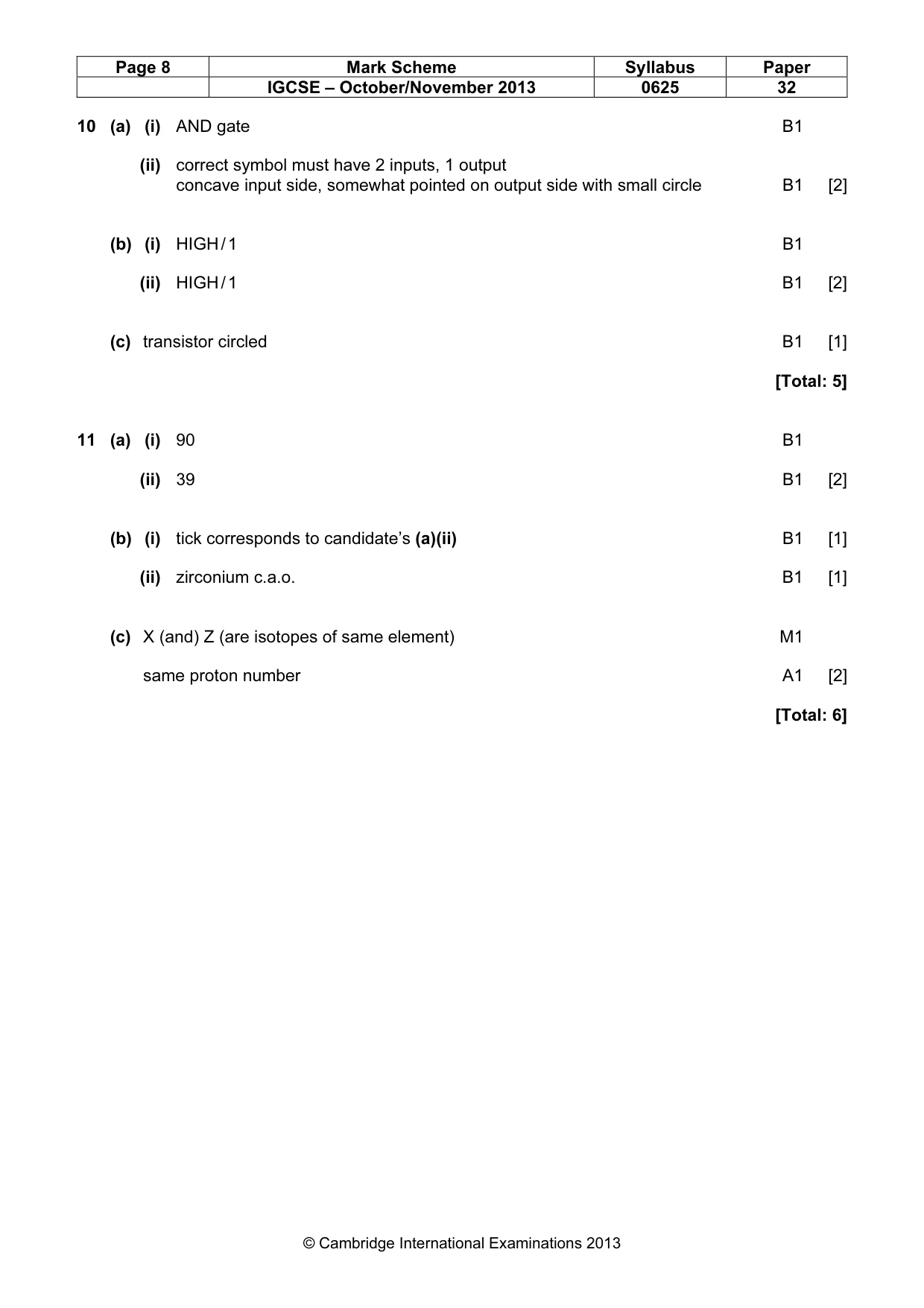
Mark scheme: 8 (a) (one third length so) one third R, accept any division by 3 C1 (half area so) twice R, accept any doubling, including divide by ½ C1 (resistance = 0.45 × 2/3) = 0.3(0) Ω accept 1 sig. fig. A1 [3] (b) (i) 1(Ω) and 3(Ω) used in correct parallel formula C1 2(Ω) added to candidate’s parallel resistance C1 2.7 or 2.8 or 2.75 Ω A1 [3] (ii) any 2 from: I1 = I4 OR I1 = I2 + I3 OR I4 = I2 + I3 OR other correct relevant equation/inequality e.g. I4 = 4I3, I4 > I3 B2 [2] (iii) any 2 from: V1 = V4 OR V1 = V2 + V3 OR V4 = V2 + V3 OR correct relevant inequality e.g. V1 > V3 B2 [2] [Total: 10]
Q9 · An electrical safety expert is inspecting a laundry
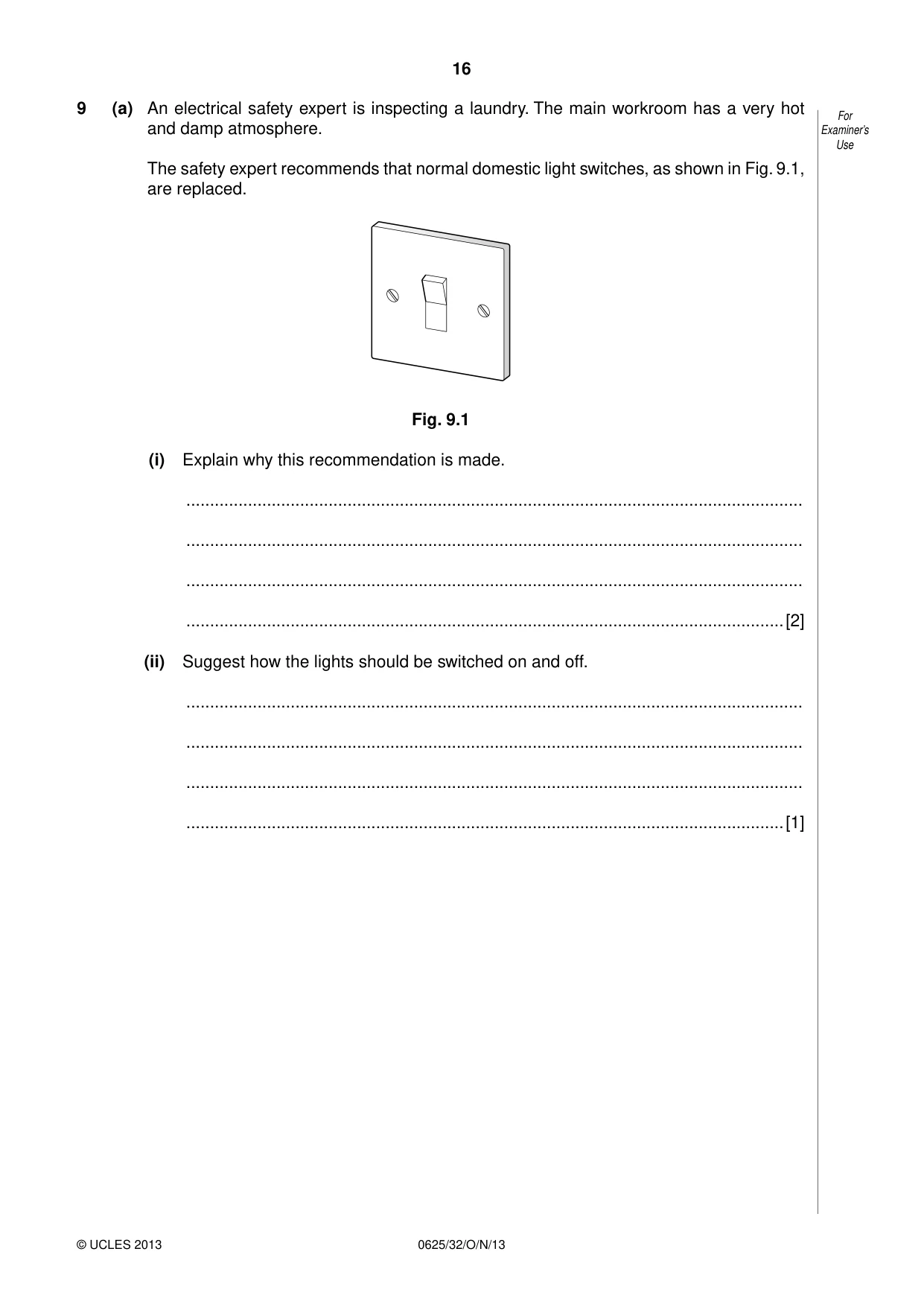
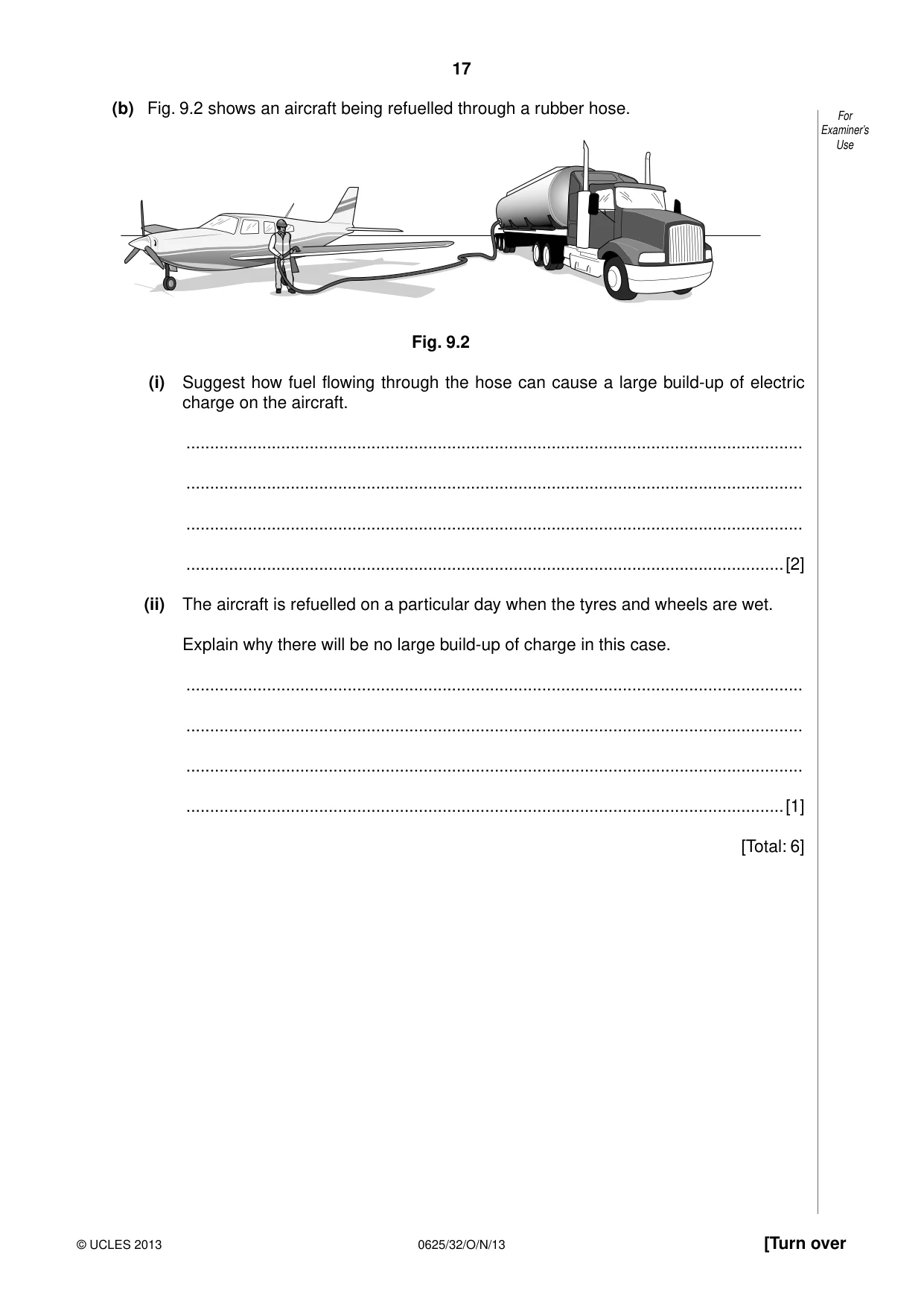
9 (a) An electrical safety expert is inspecting a laundry. The main workroom has a very hot For and damp atmosphere. Examiner’s Use The safety expert recommends that normal domestic light switches, as shown in Fig. 9.1, are replaced. Fig. 9.1 (i) Explain why this recommendation is made. .................................................................................................................................. .................................................................................................................................. .................................................................................................................................. ..............................................................................................................................[2] (ii) Suggest how the lights should be switched on and off. .................................................................................................................................. .................................................................................................................................. .................................................................................................................................. ..............................................................................................................................[1] (b) Fig. 9.2 shows an aircraft being refuelled through a rubber hose. For Examiner’s Use Fig. 9.2 (i) Suggest how fuel flowing through the hose can cause a large build-up of electric charge on the aircraft. .................................................................................................................................. .................................................................................................................................. .................................................................................................................................. ..............................................................................................................................[2] (ii) The aircraft is refuelled on a particular day when the tyres and wheels are wet. Explain why there will be no large build-up of charge in this case. .................................................................................................................................. .................................................................................................................................. .................................................................................................................................. ..............................................................................................................................[1] [Total: 6]
Mark scheme: 9 (a) (i) current/electricity could flow through/across switch due to dampness / humidity OR water (good) conductor B1 danger of shock/electrocution B1 accept alternative: short (circuit) (B1) (danger because) lights go out when fuse blows (B1) [2] (ii) pull switch with long cord of insulating material OR normal switch outside workroom OR switch with non-contact operation / insulating cover / sensor actuation B1 [1] (b) (i) friction with hose M1 reasoning relating to charge moved to / from aircraft OR to / from hose OR rubber insulates A1 [2] (ii) (water conducts) charge to / from aircraft OR away / to ground OR through tyres / wheels OR earthing o.w.t.t.e. B1 [1] [Total: 6] IGCSE – October/November 2013 0625 32
Q10 · The symbol for a logic gate
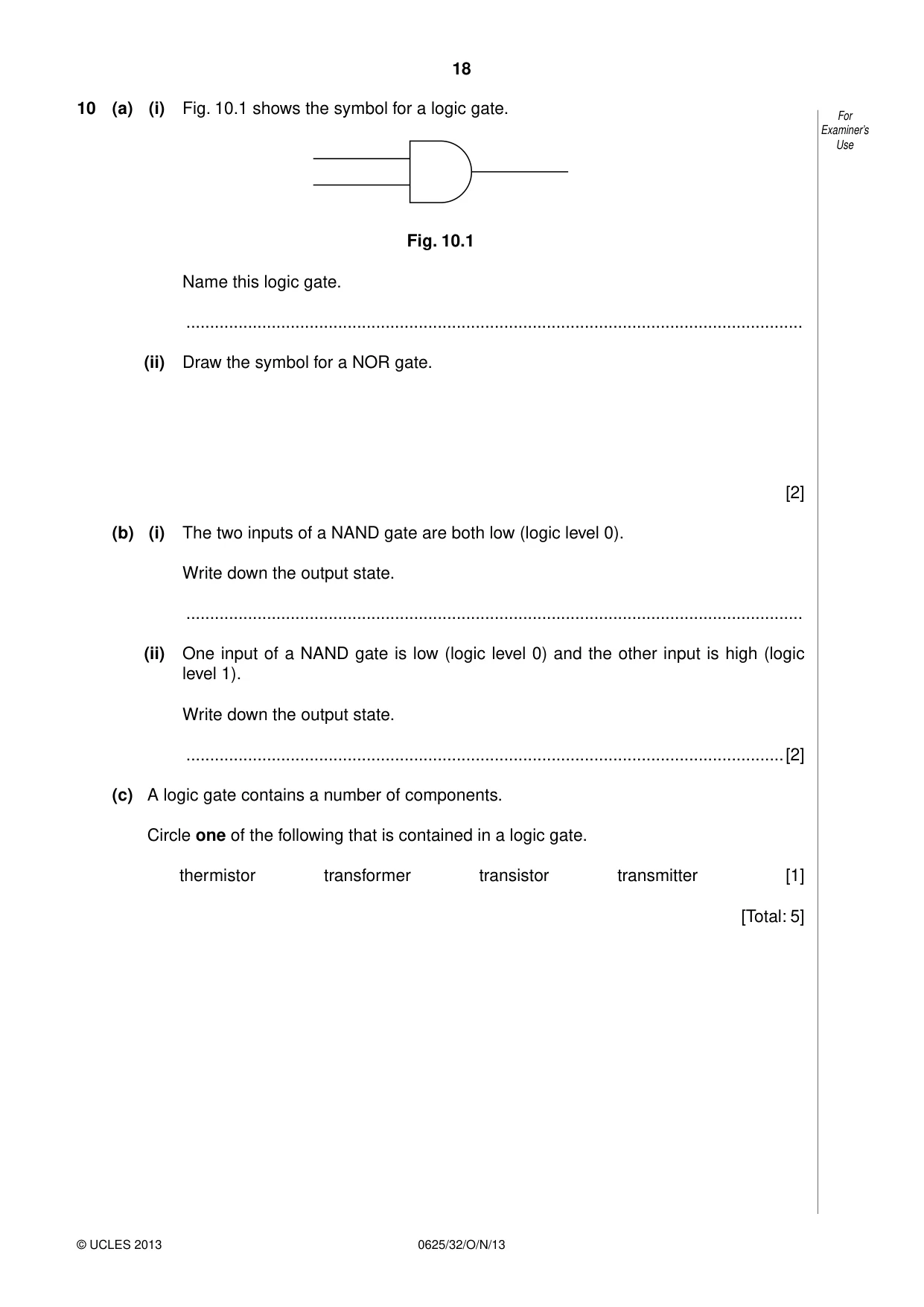
10 (a) (i) Fig. 10.1 shows the symbol for a logic gate. For Examiner’s Use Fig. 10.1 Name this logic gate. .................................................................................................................................. (ii) Draw the symbol for a NOR gate. [2] (b) (i) The two inputs of a NAND gate are both low (logic level 0). Write down the output state. .................................................................................................................................. (ii) One input of a NAND gate is low (logic level 0) and the other input is high (logic level 1). Write down the output state. ..............................................................................................................................[2] (c) A logic gate contains a number of components. Circle one of the following that is contained in a logic gate. thermistor transformer transistor transmitter [1] [Total: 5]
Mark scheme: 10 (a) (i) AND gate B1 (ii) correct symbol must have 2 inputs, 1 output concave input side, somewhat pointed on output side with small circle B1 [2] (b) (i) HIGH / 1 B1 (ii) HIGH / 1 B1 [2] (c) transistor circled B1 [1] [Total: 5]
Q11 · Strontium-90 is a radioactive isotope that emits β-particles as it decays
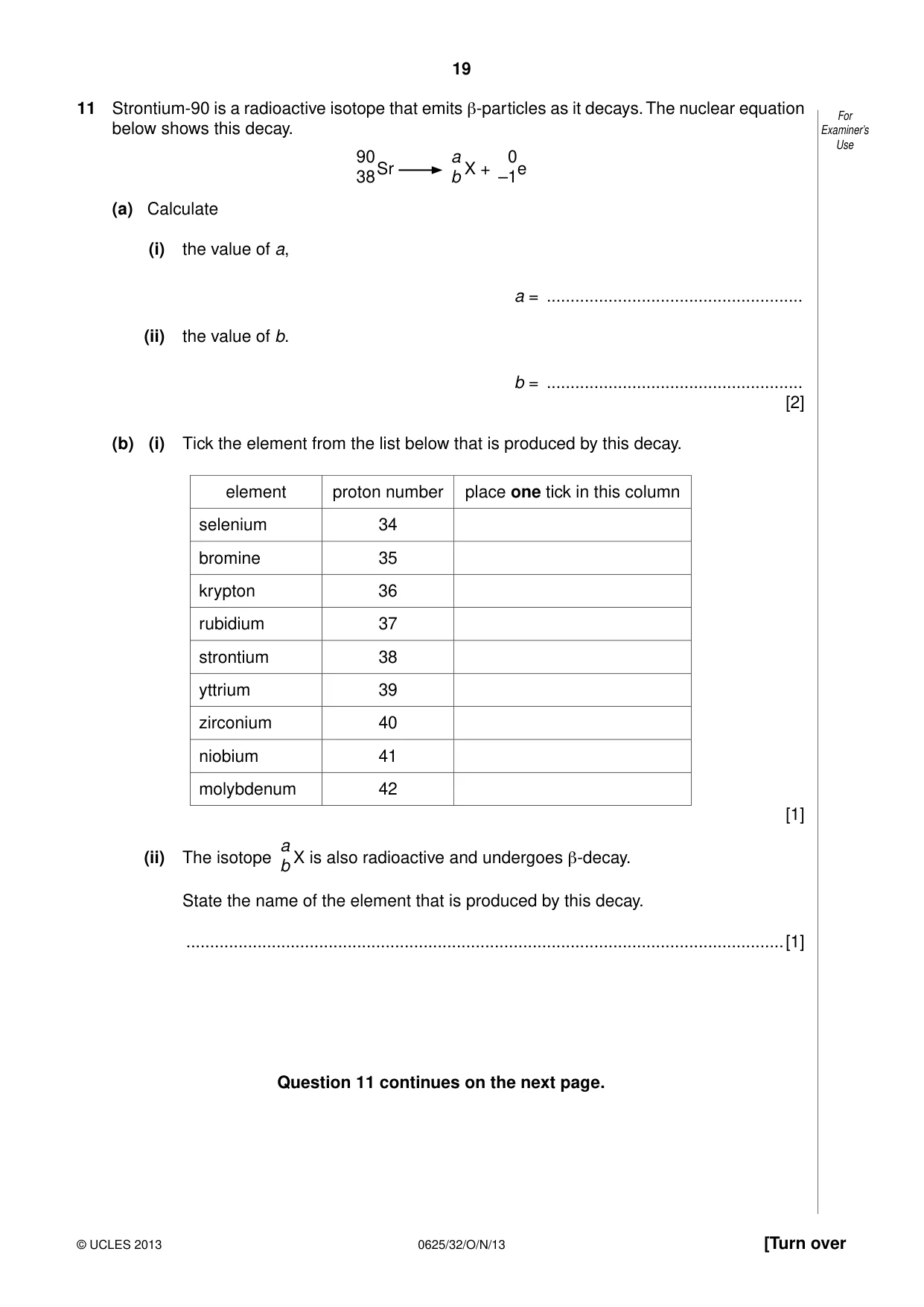
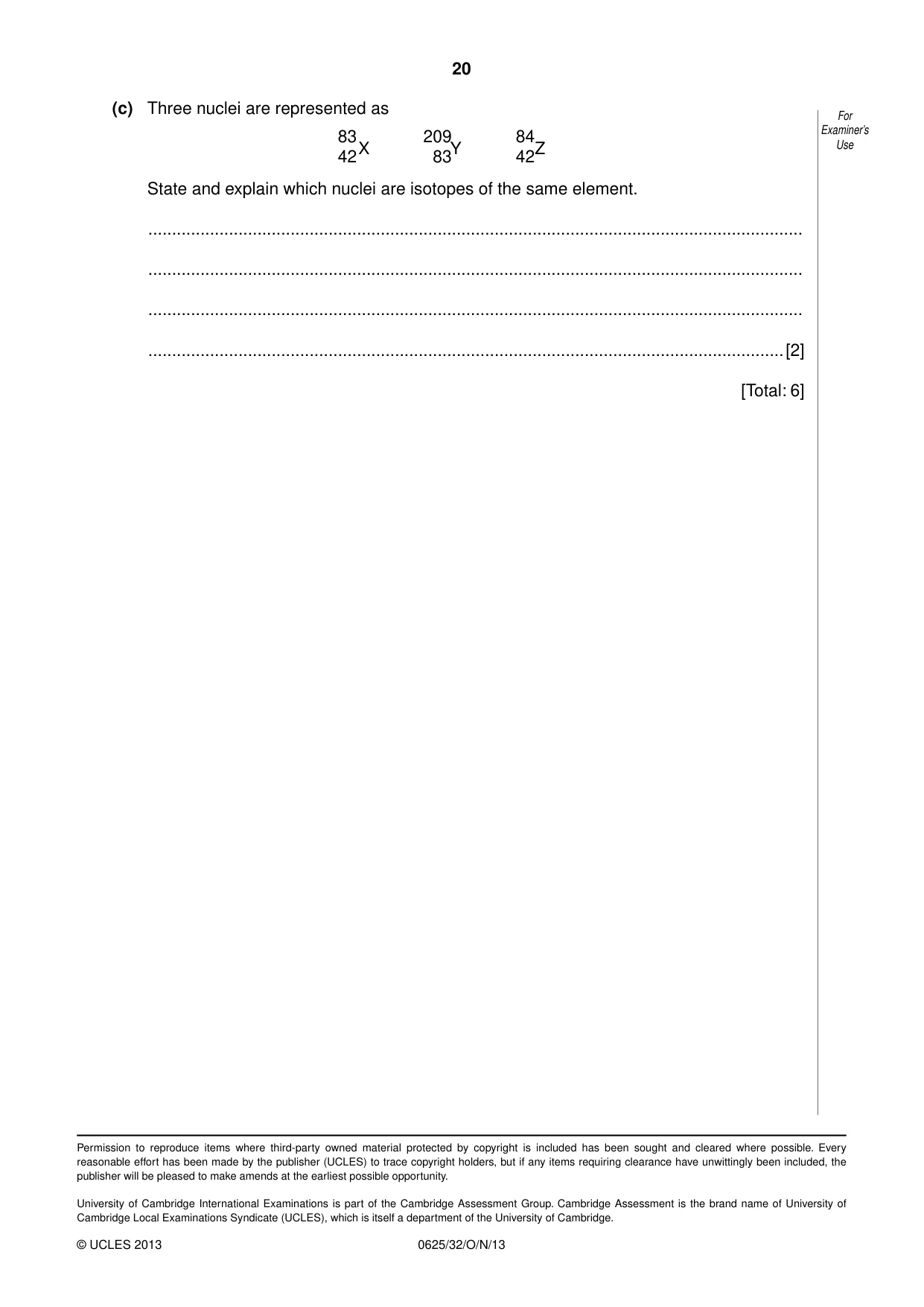
11 Strontium-90 is a radioactive isotope that emits β-particles as it decays. The nuclear equation For below shows this decay. Examiner’s Use 90 a 0 38Sr b X + –1e (a) Calculate (i) the value of a, a = ...................................................... (ii) the value of b. b = ...................................................... [2] (b) (i) Tick the element from the list below that is produced by this decay. element proton number place one tick in this column selenium 34 bromine 35 krypton 36 rubidium 37 strontium 38 yttrium 39 zirconium 40 niobium 41 molybdenum 42 [1] a (ii) The isotope X is also radioactive and undergoes β-decay. b State the name of the element that is produced by this decay. ..............................................................................................................................[1] Question 11 continues on the next page. (c) Three nuclei are represented as For 83 209 84 Examiner’s 42X 83Y 42Z Use State and explain which nuclei are isotopes of the same element. .......................................................................................................................................... .......................................................................................................................................... .......................................................................................................................................... ......................................................................................................................................[2] [Total: 6]
Mark scheme: 11 (a) (i) 90 B1 (ii) 39 B1 [2] (b) (i) tick corresponds to candidate’s (a)(ii) B1 [1] (ii) zirconium c.a.o. B1 [1] (c) X (and) Z (are isotopes of same element) M1 same proton number A1 [2] [Total: 6]
What was in this paper
The subtopics covered by these 11 questions, and how many questions each got. Open one in a new tab to see every Cambridge question on it.