Cambridge IGCSE Physics 0625 — 2023 Oct/Nov Paper 3 · Variant 3
0625/33/O/N/23 · 11 questions · 80 marks · ≈90 min
The question paper and its mark scheme, free to read here and free to download. This is Cambridge’s own paper, exactly as it was sat.
Question paper16 pages
Mark scheme12 pages
Answers below. Sit the paper first if you are practising.
Questions as text
Q1 · The speed–time graph for a bus journey
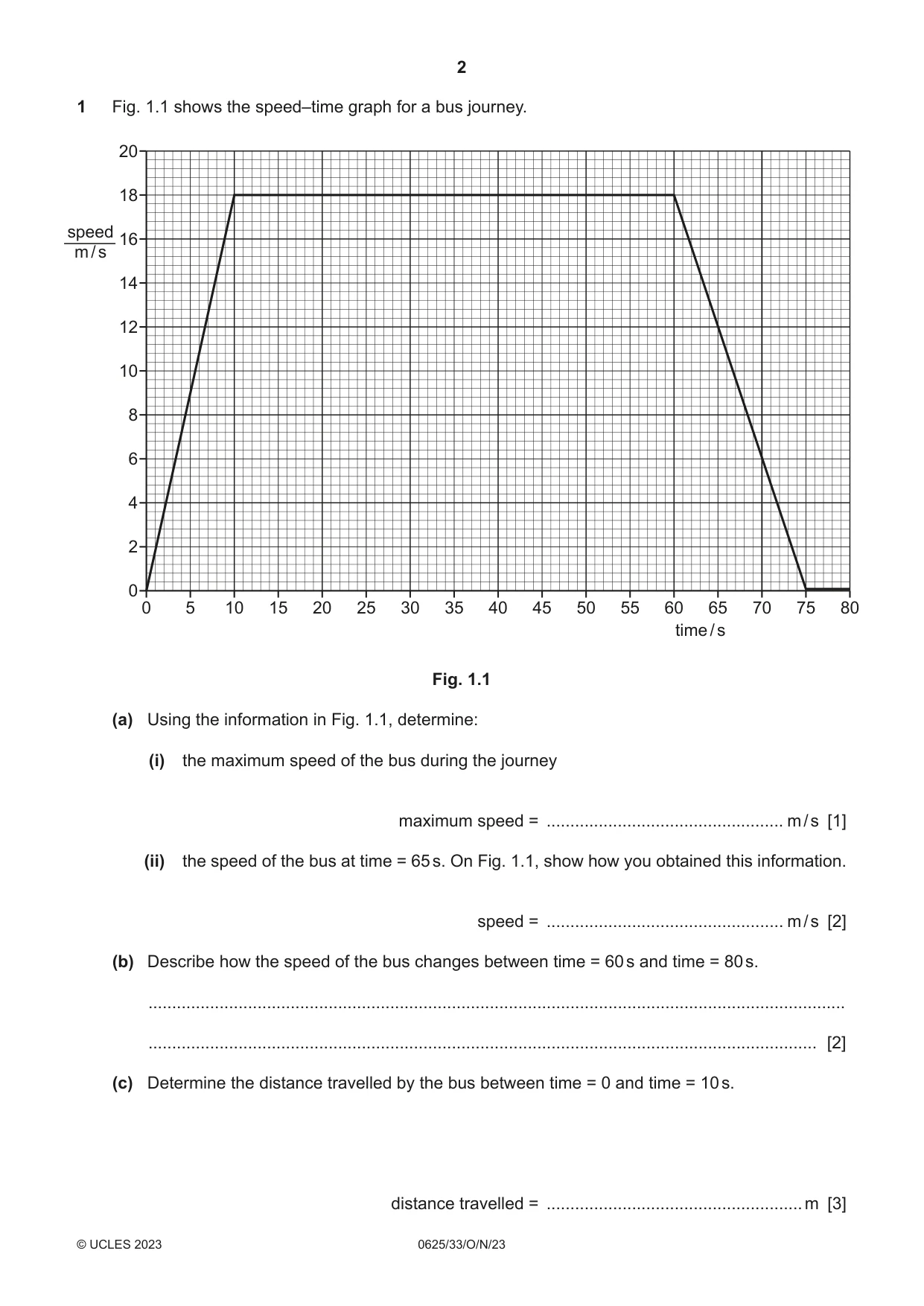
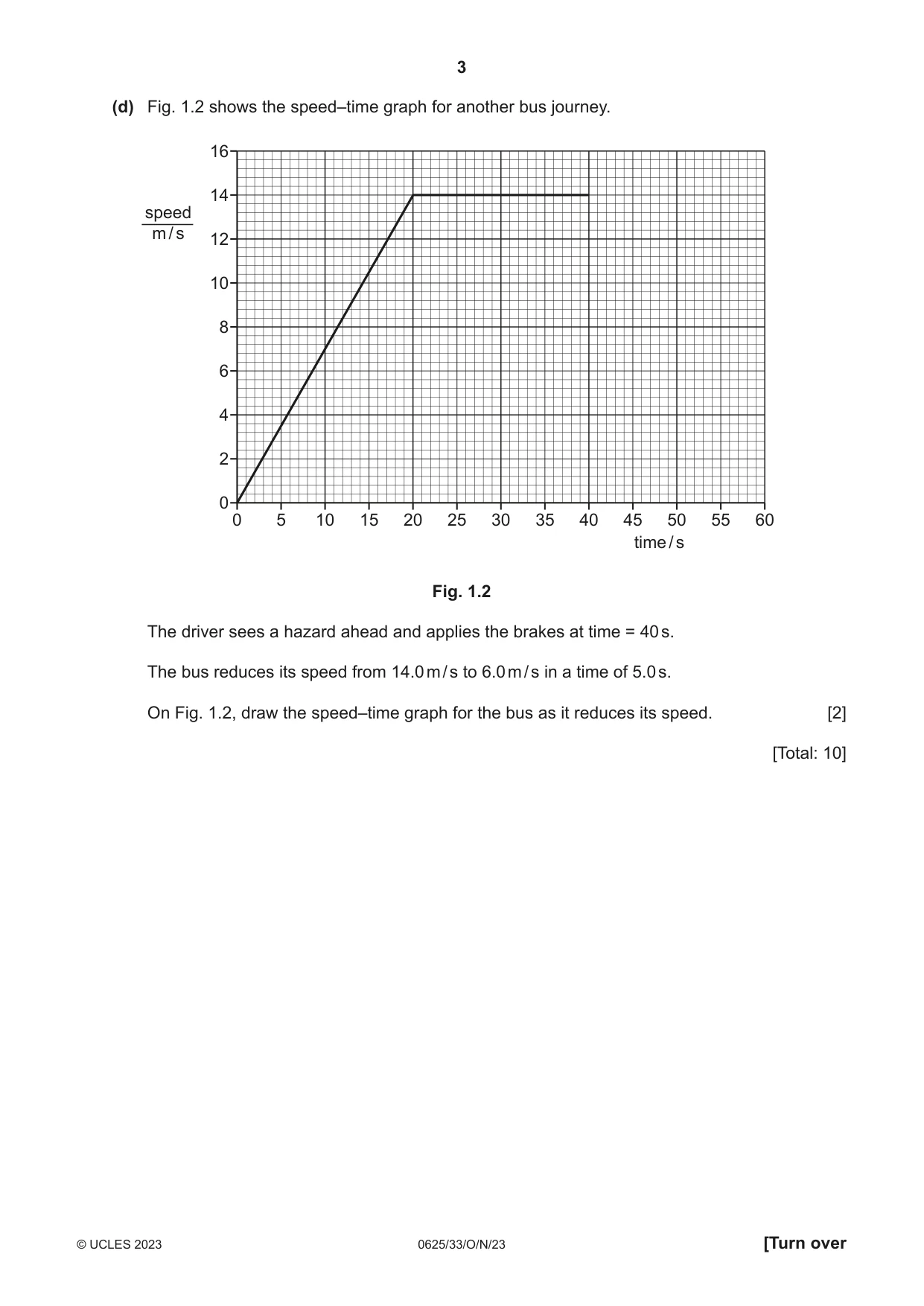
1 Fig. 1.1 shows the speed–time graph for a bus journey. 20 18 speed 16 m / s 14 12 10 8 6 4 2 0 0 5 10 15 20 25 30 35 40 45 50 55 60 65 70 75 80 time / s Fig. 1.1 (a) Using the information in Fig. 1.1, determine: (i) the maximum speed of the bus during the journey maximum speed = .................................................. m / s [1] (ii) the speed of the bus at time = 65 s. On Fig. 1.1, show how you obtained this information. speed = .................................................. m / s [2] (b) Describe how the speed of the bus changes between time = 60 s and time = 80 s. ................................................................................................................................................... ............................................................................................................................................. [2] (c) Determine the distance travelled by the bus between time = 0 and time = 10 s. distance travelled = ......................................................m [3] (d) Fig. 1.2 shows the speed–time graph for another bus journey. 16 14 speed m / s 12 10 8 6 4 2 0 0 5 10 15 20 25 30 35 40 45 50 55 60 time / s Fig. 1.2 The driver sees a hazard ahead and applies the brakes at time = 40 s. The bus reduces its speed from 14.0 m / s to 6.0 m / s in a time of 5.0 s. On Fig. 1.2, draw the speed–time graph for the bus as it reduces its speed. [2] [Total: 10]
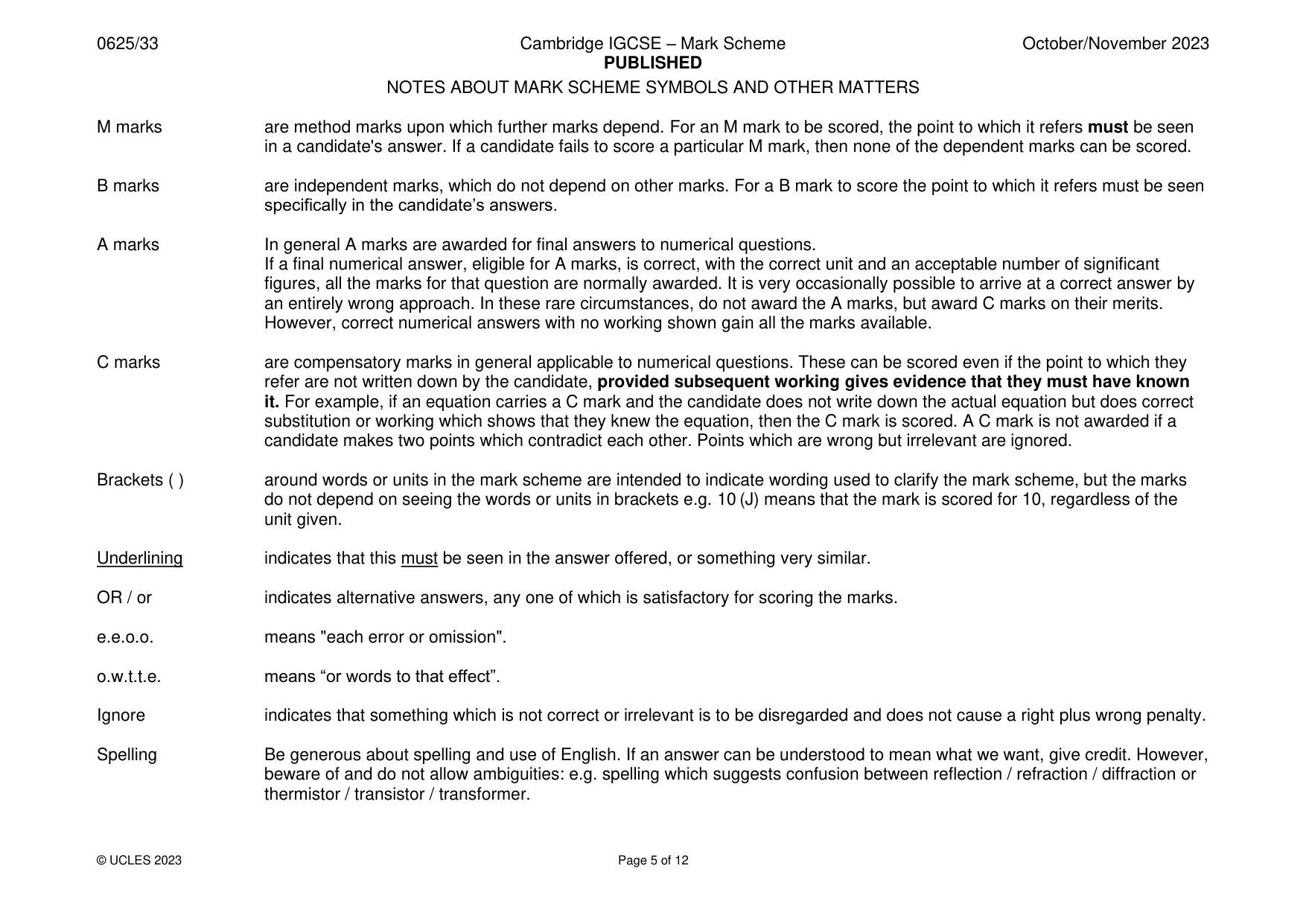
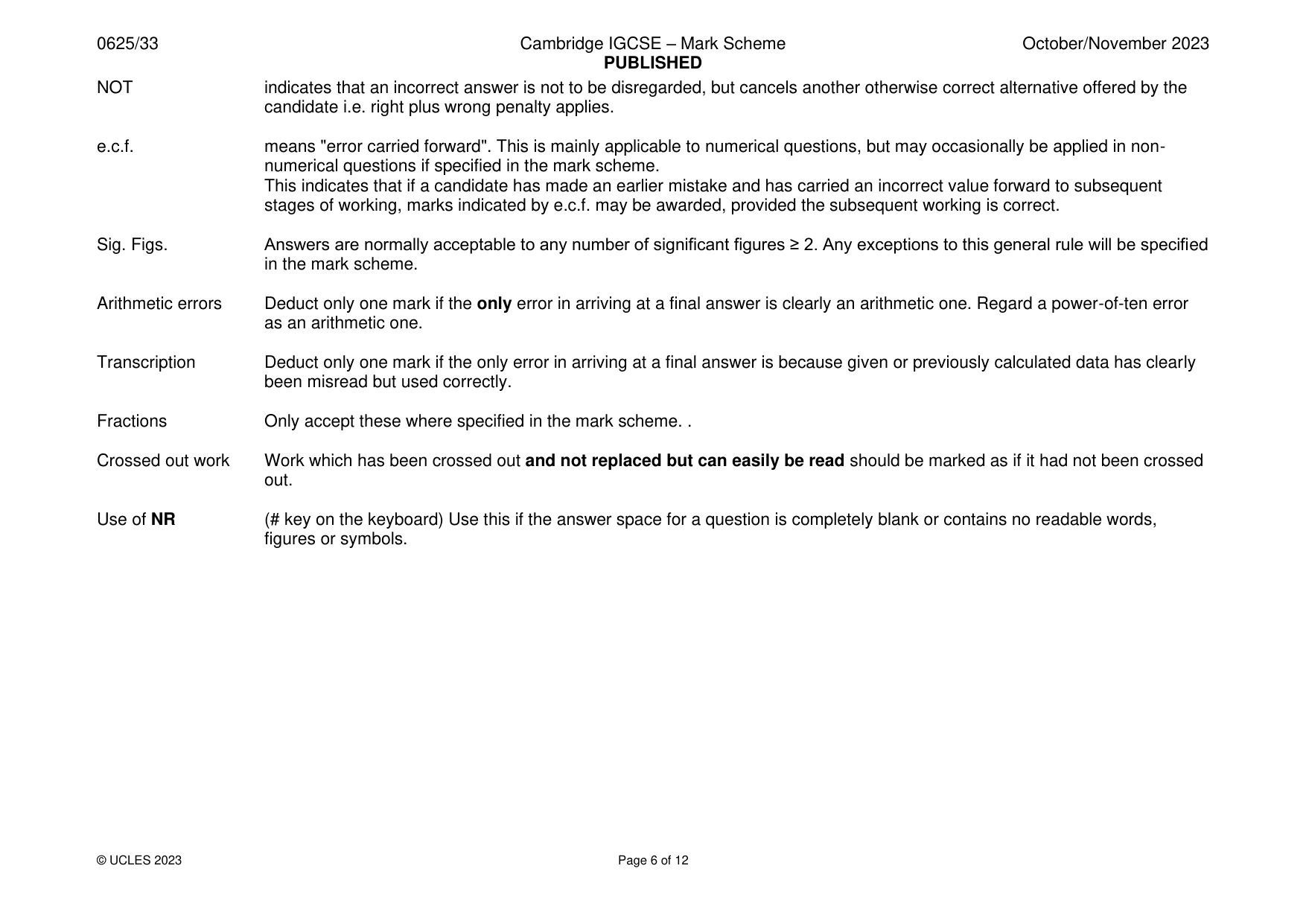
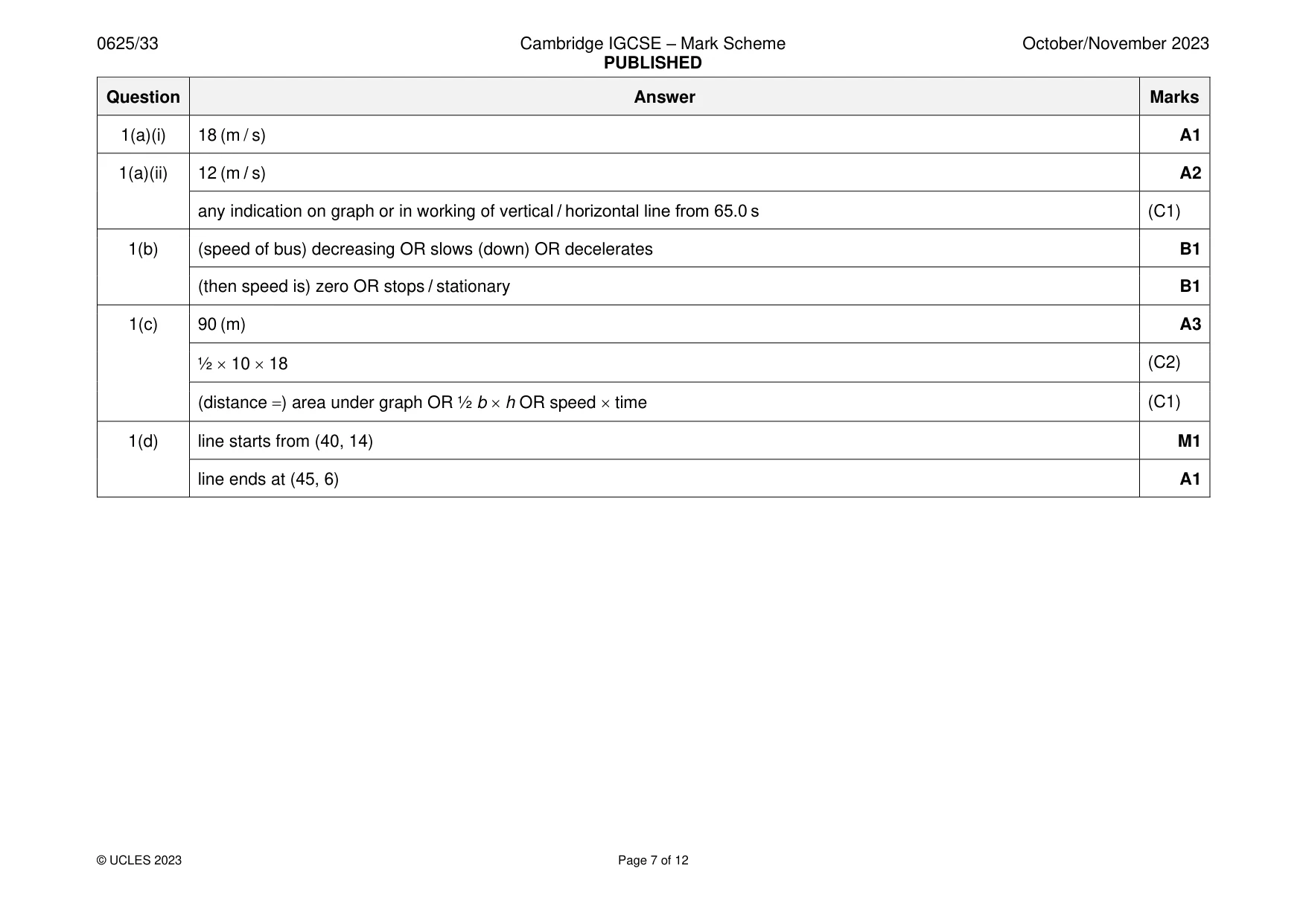
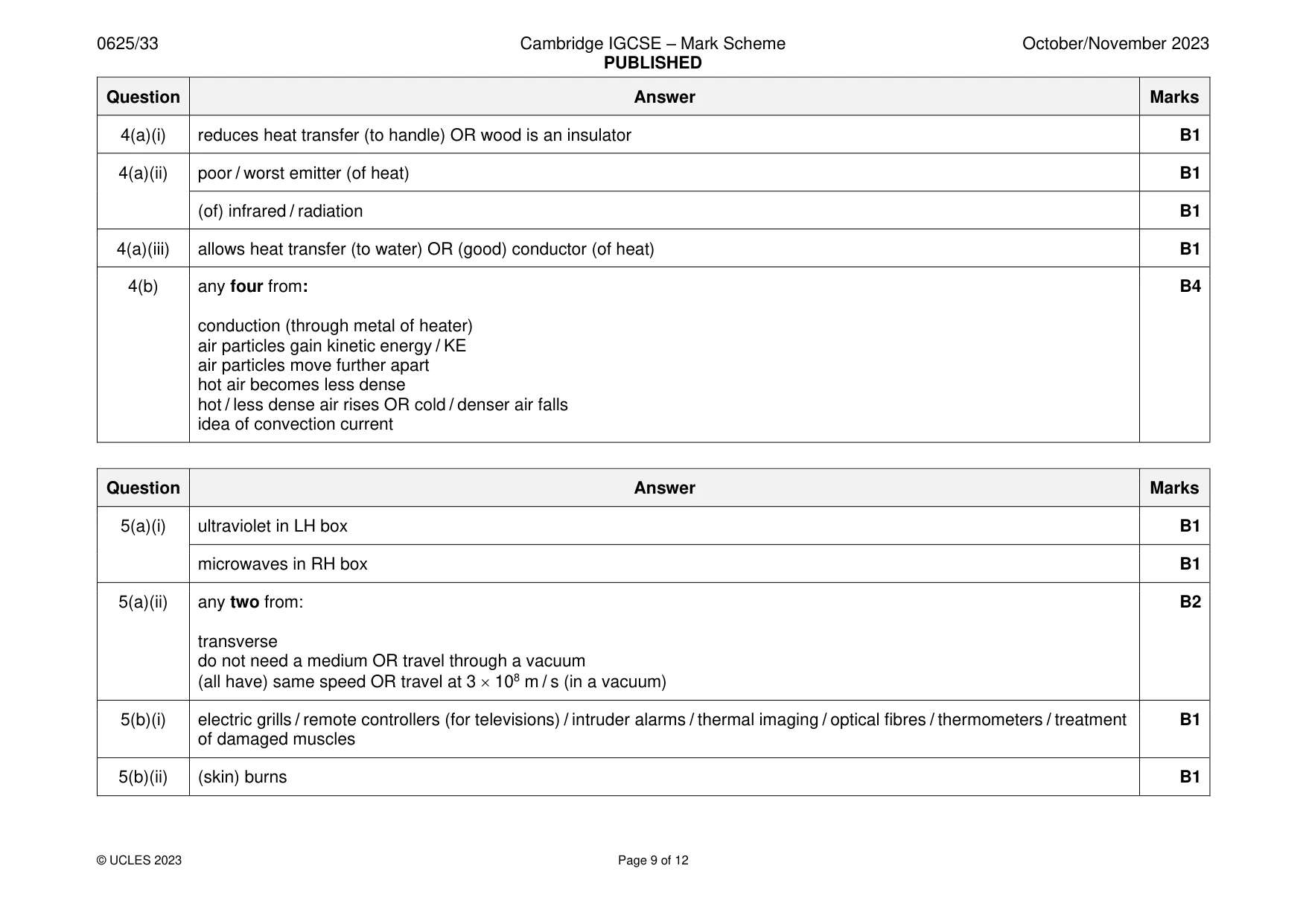
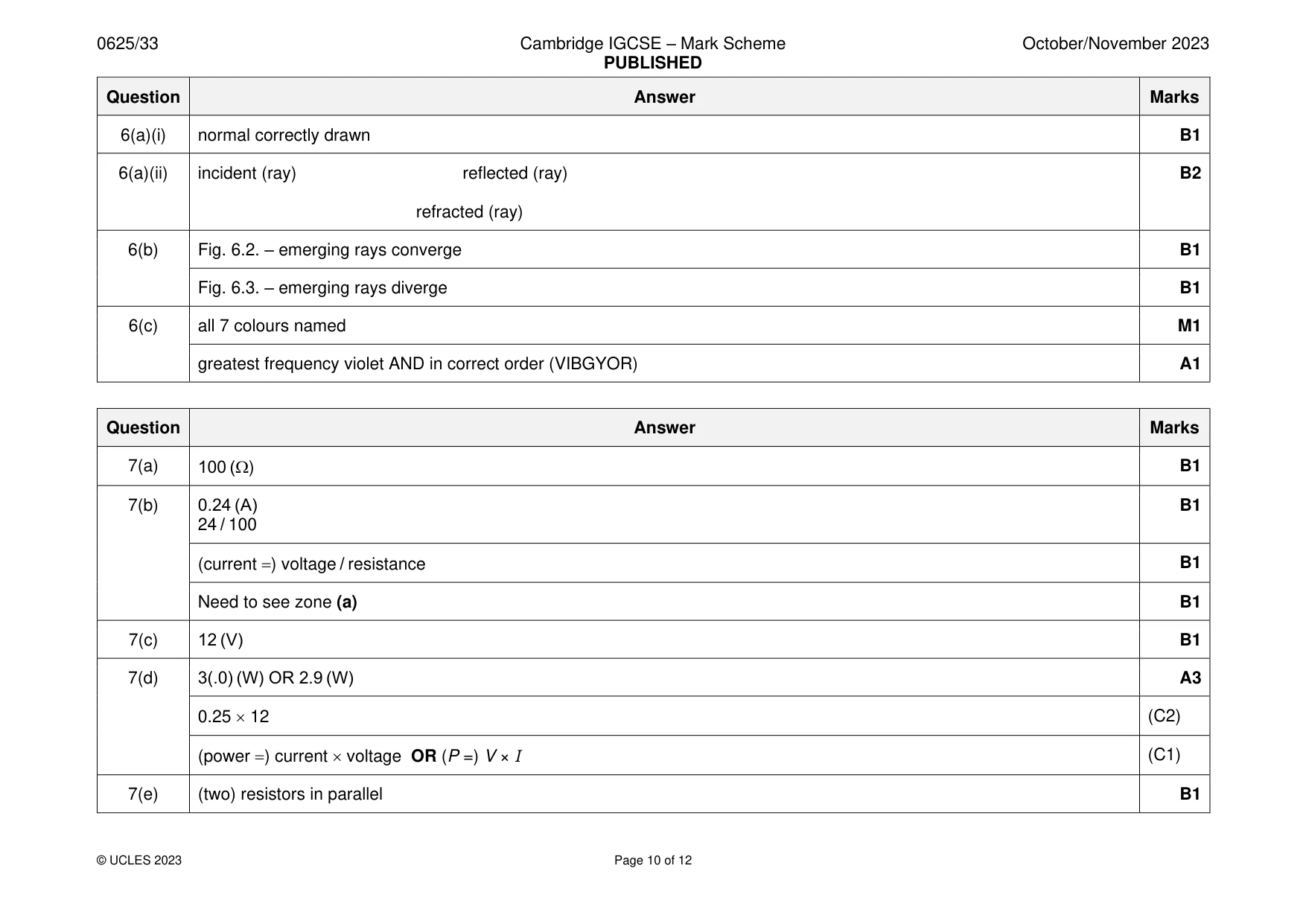
Mark scheme: Question Answer Marks 1(a)(i) 18 (m / s) A1 1(a)(ii) 12 (m / s) A2 any indication on graph or in working of vertical / horizontal line from 65.0 s (C1) 1(b) (speed of bus) decreasing OR slows (down) OR decelerates B1 (then speed is) zero OR stops / stationary B1 1(c) 90 (m) A3 ½ 10 18 (C2) (distance =) area under graph OR ½ b h OR speed time (C1) 1(d) line starts from (40, 14) M1 line ends at (45, 6) A1
Q2 · A farmer uses a rope to lift a barrel of fruit from the ground to a platform, as shown in…
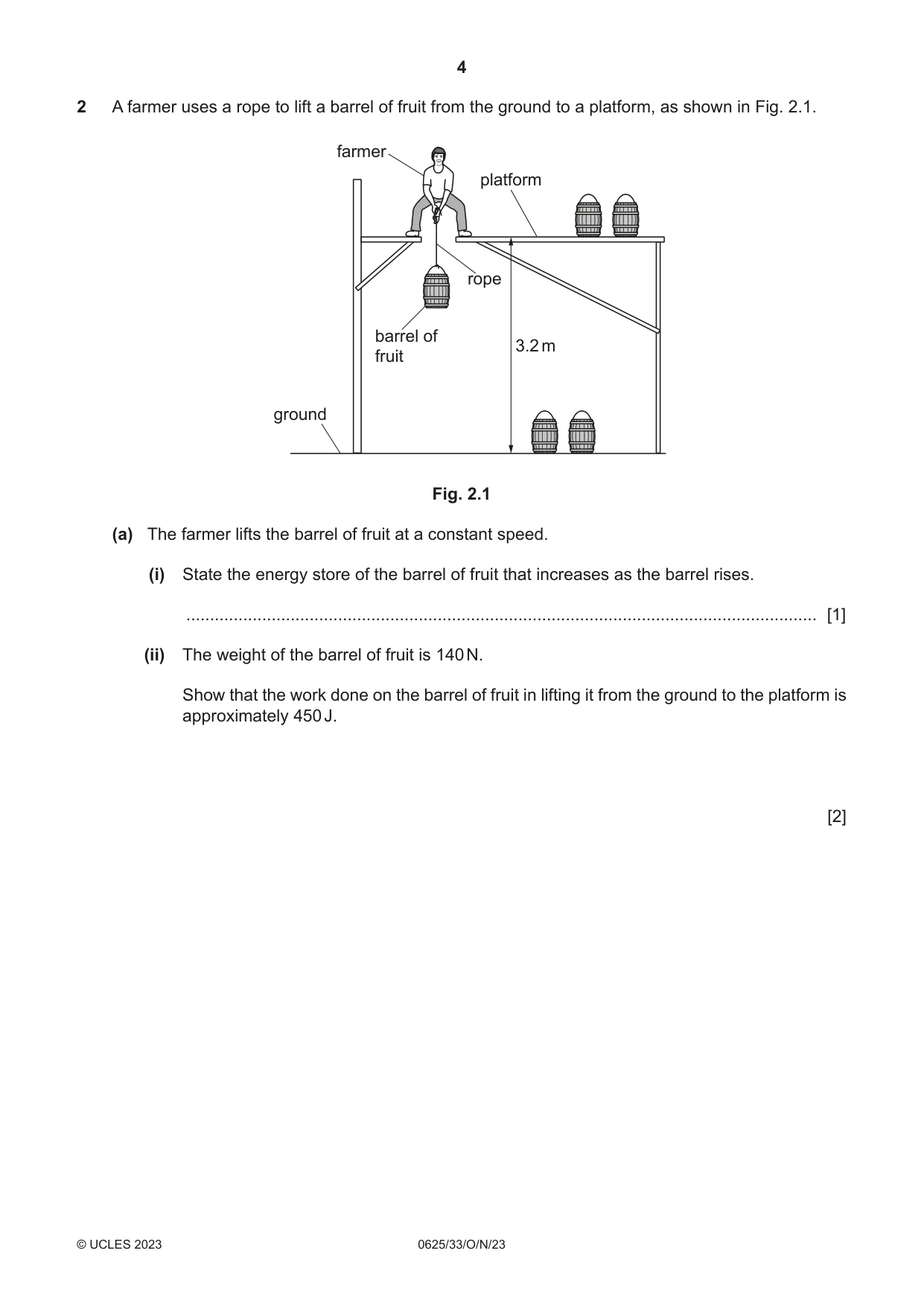
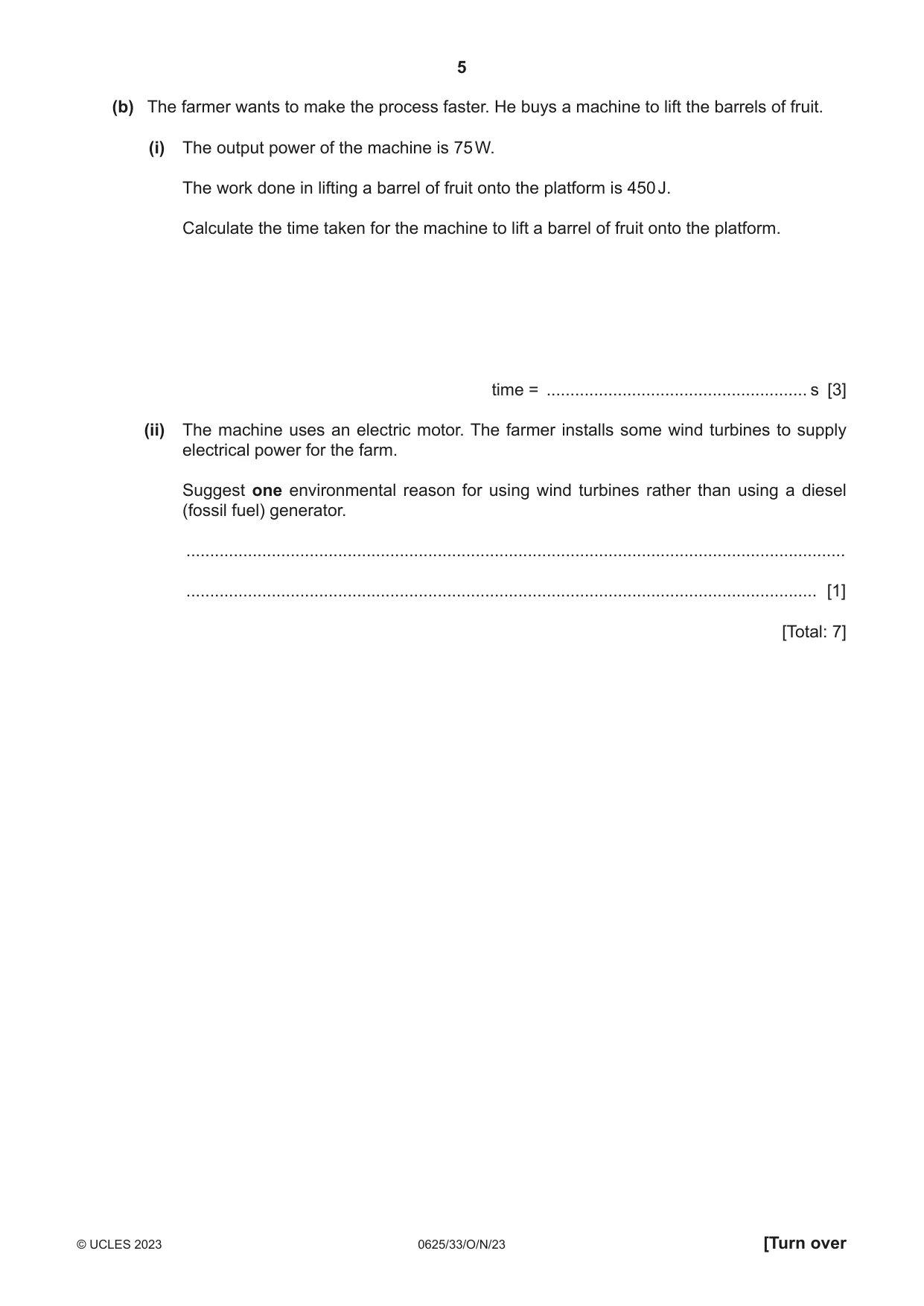
2 A farmer uses a rope to lift a barrel of fruit from the ground to a platform, as shown in Fig. 2.1. farmer platform rope barrel of 3.2 m fruit ground Fig. 2.1 (a) The farmer lifts the barrel of fruit at a constant speed. (i) State the energy store of the barrel of fruit that increases as the barrel rises. ..................................................................................................................................... [1] (ii) The weight of the barrel of fruit is 140 N. Show that the work done on the barrel of fruit in lifting it from the ground to the platform is approximately 450 J. [2] (b) The farmer wants to make the process faster. He buys a machine to lift the barrels of fruit. (i) The output power of the machine is 75 W. The work done in lifting a barrel of fruit onto the platform is 450 J. Calculate the time taken for the machine to lift a barrel of fruit onto the platform. time = ....................................................... s [3] (ii) The machine uses an electric motor. The farmer installs some wind turbines to supply electrical power for the farm. Suggest one environmental reason for using wind turbines rather than using a diesel (fossil fuel) generator. ........................................................................................................................................... ..................................................................................................................................... [1] [Total: 7]
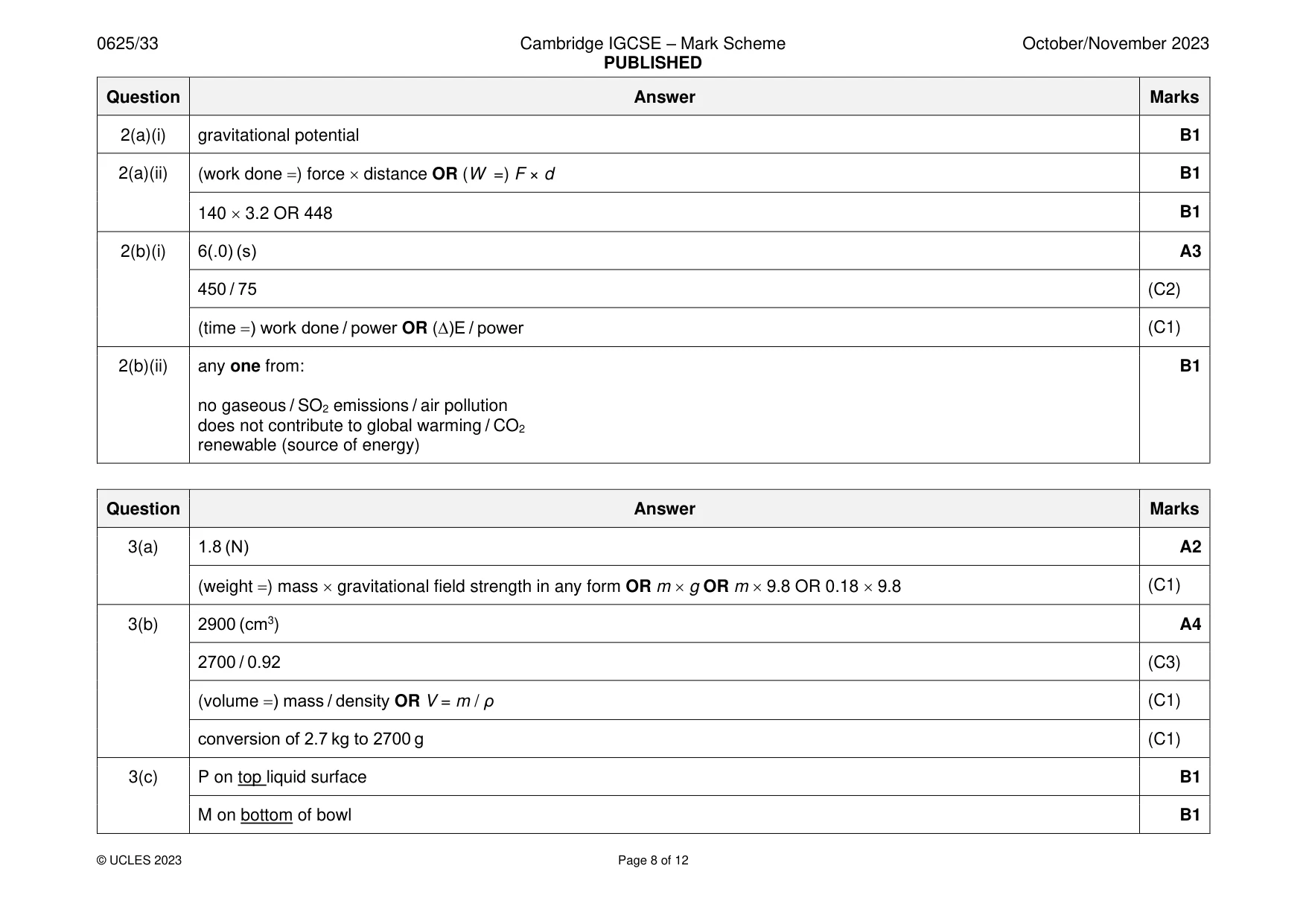
Mark scheme: 2(a)(i) gravitational potential B1 2(a)(ii) (work done =) force distance OR (W =) F × d B1 140 3.2 OR 448 B1 2(b)(i) 6(.0) (s) A3 450 / 75 (C2) (time =) work done / power OR ()E / power (C1) 2(b)(ii) any one from: B1 no gaseous / SO2 emissions / air pollution does not contribute to global warming / CO2 renewable (source of energy)
Q3 · The mass of a glass bottle is 0.18 kg
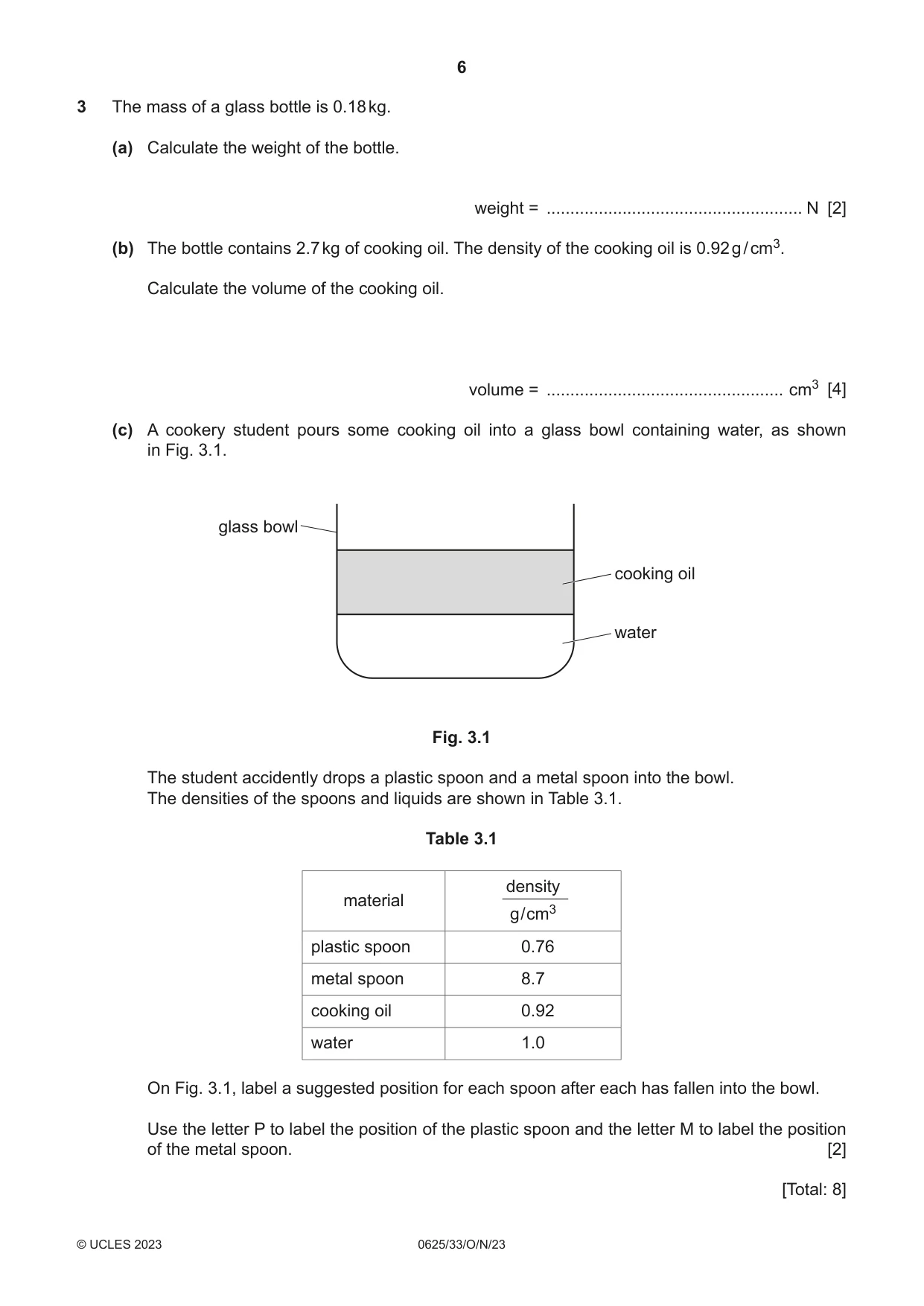
3 The mass of a glass bottle is 0.18 kg. (a) Calculate the weight of the bottle. weight = ...................................................... N [2] (b) The bottle contains 2.7 kg of cooking oil. The density of the cooking oil is 0.92 g / cm3. Calculate the volume of the cooking oil. volume = .................................................. cm3 [4] (c) A cookery student pours some cooking oil into a glass bowl containing water, as shown in Fig. 3.1. glass bowl cooking oil water Fig. 3.1 The student accidently drops a plastic spoon and a metal spoon into the bowl. The densities of the spoons and liquids are shown in Table 3.1. Table 3.1 density material g / cm3 plastic spoon 0.76 metal spoon 8.7 cooking oil 0.92 water 1.0 On Fig. 3.1, label a suggested position for each spoon after each has fallen into the bowl. Use the letter P to label the position of the plastic spoon and the letter M to label the position of the metal spoon. [2] [Total: 8]
Mark scheme: 3(a) 1.8 (N) A2 (weight =) mass gravitational field strength in any form OR m g OR m 9.8 OR 0.18 9.8 (C1) 3(b) 2900 (cm3) A4 2700 / 0.92 (C3) (volume =) mass / density OR V = m / ρ (C1) conversion of 2.7 kg to 2700 g (C1) 3(c) P on top liquid surface B1 M on bottom of bowl B1
Q4 · A pan on a hotplate
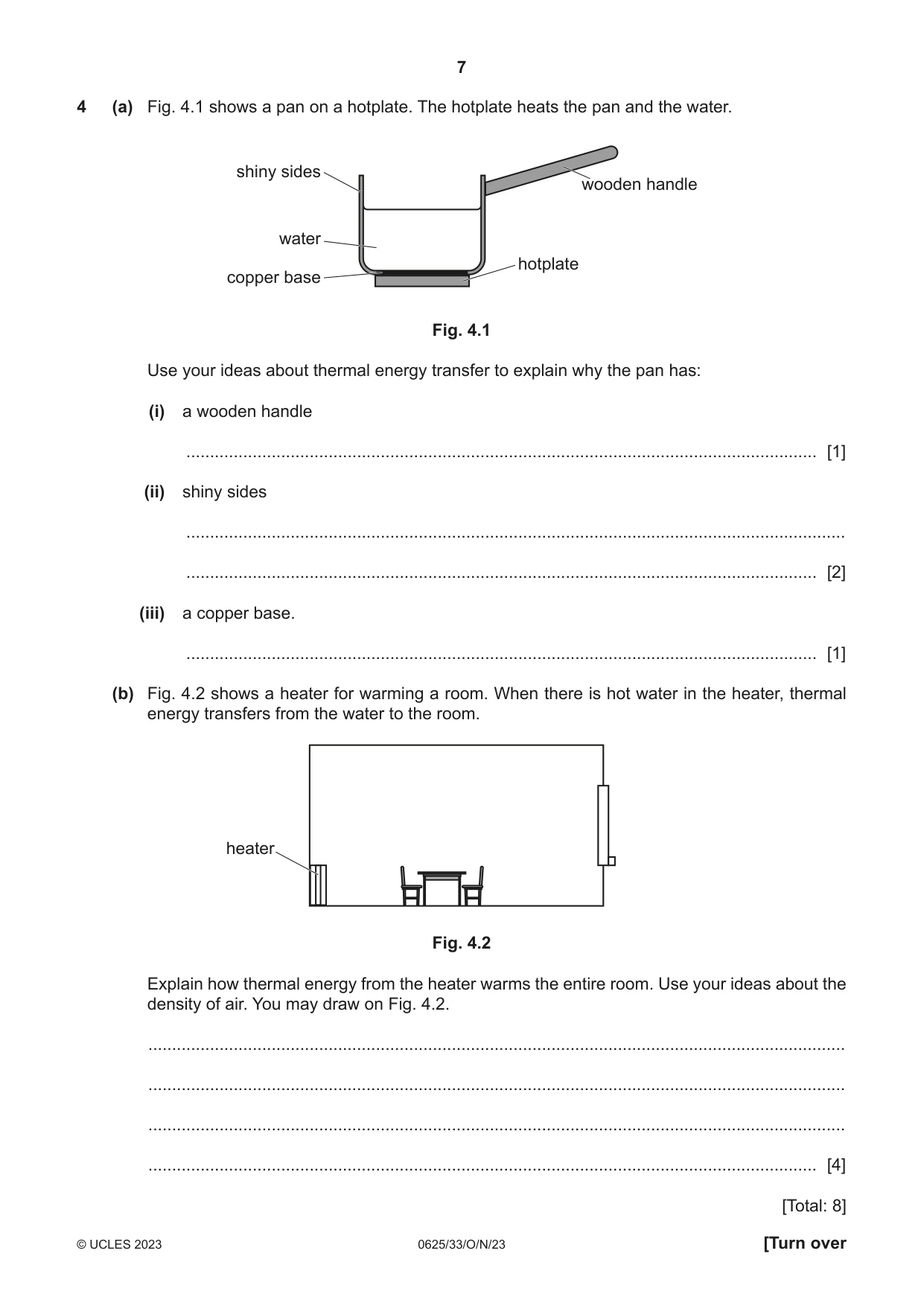
4 (a) Fig. 4.1 shows a pan on a hotplate. The hotplate heats the pan and the water. shiny sides wooden handle water hotplate copper base Fig. 4.1 Use your ideas about thermal energy transfer to explain why the pan has: (i) a wooden handle ..................................................................................................................................... [1] (ii) shiny sides ........................................................................................................................................... ..................................................................................................................................... [2] (iii) a copper base. ..................................................................................................................................... [1] (b) Fig. 4.2 shows a heater for warming a room. When there is hot water in the heater, thermal energy transfers from the water to the room. heater Fig. 4.2 Explain how thermal energy from the heater warms the entire room. Use your ideas about the density of air. You may draw on Fig. 4.2. ................................................................................................................................................... ................................................................................................................................................... ................................................................................................................................................... ............................................................................................................................................. [4] [Total: 8]
Mark scheme: 4(a)(i) reduces heat transfer (to handle) OR wood is an insulator B1 4(a)(ii) poor / worst emitter (of heat) B1 (of) infrared / radiation B1 4(a)(iii) allows heat transfer (to water) OR (good) conductor (of heat) B1 4(b) any four from: B4 conduction (through metal of heater) air particles gain kinetic energy / KE air particles move further apart hot air becomes less dense hot / less dense air rises OR cold / denser air falls idea of convection current
Q5 · Regions of the electromagnetic spectrum in order of increasing wavelength
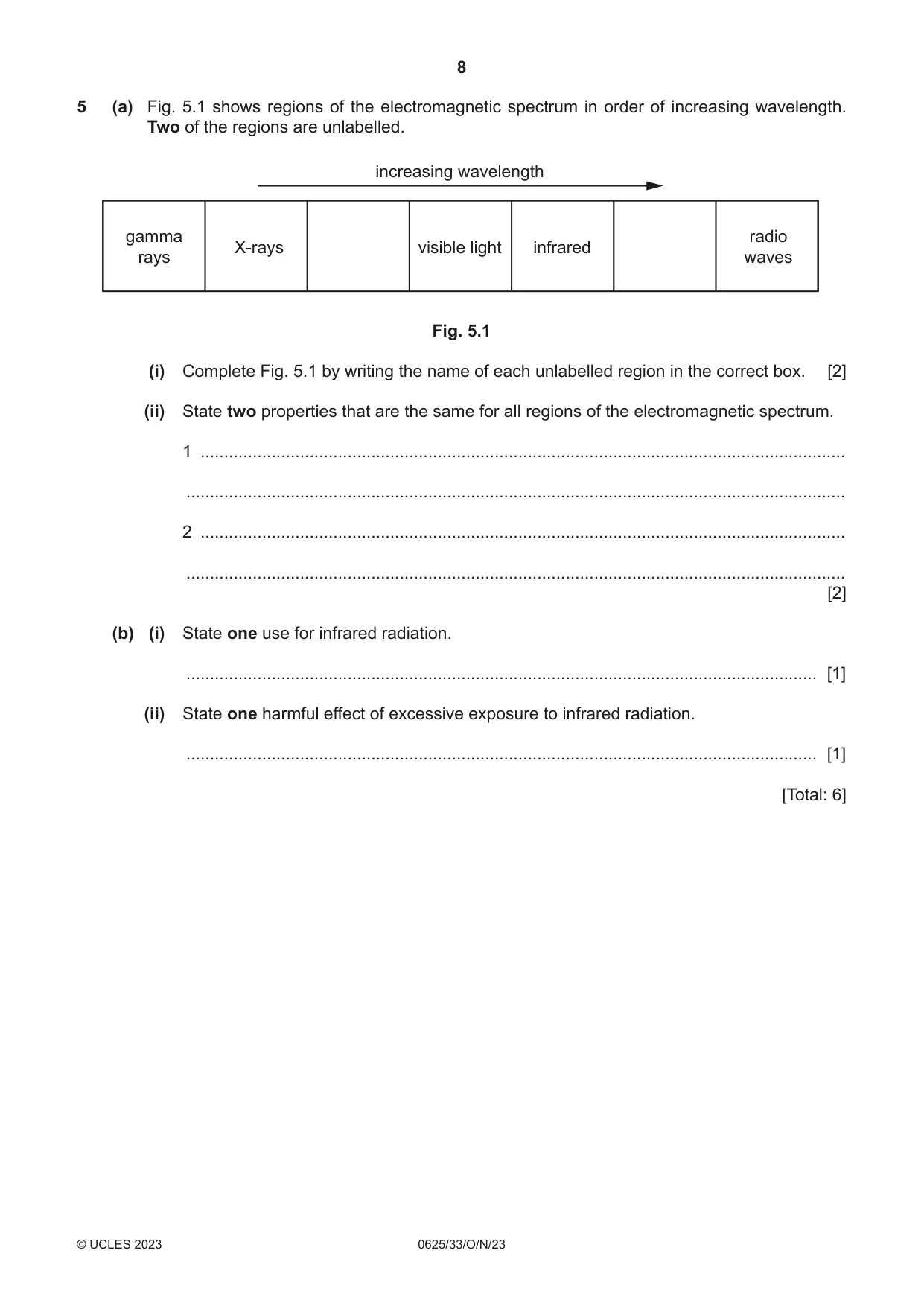
5 (a) Fig. 5.1 shows regions of the electromagnetic spectrum in order of increasing wavelength. Two of the regions are unlabelled. increasing wavelength gamma radio X-rays visible light infrared rays waves Fig. 5.1 (i) Complete Fig. 5.1 by writing the name of each unlabelled region in the correct box. [2] (ii) State two properties that are the same for all regions of the electromagnetic spectrum. 1 ........................................................................................................................................ ........................................................................................................................................... 2 ........................................................................................................................................ ........................................................................................................................................... [2] (b) (i) State one use for infrared radiation. ..................................................................................................................................... [1] (ii) State one harmful effect of excessive exposure to infrared radiation. ..................................................................................................................................... [1] [Total: 6]
Mark scheme: 5(a)(i) ultraviolet in LH box B1 microwaves in RH box B1 5(a)(ii) any two from: B2 transverse do not need a medium OR travel through a vacuum (all have) same speed OR travel at 3 108 m / s (in a vacuum) 5(b)(i) electric grills / remote controllers (for televisions) / intruder alarms / thermal imaging / optical fibres / thermometers / treatment B1 of damaged muscles 5(b)(ii) (skin) burns B1
Q6 · A student shines a ray of red light into a rectangular glass block, as shown in Fig
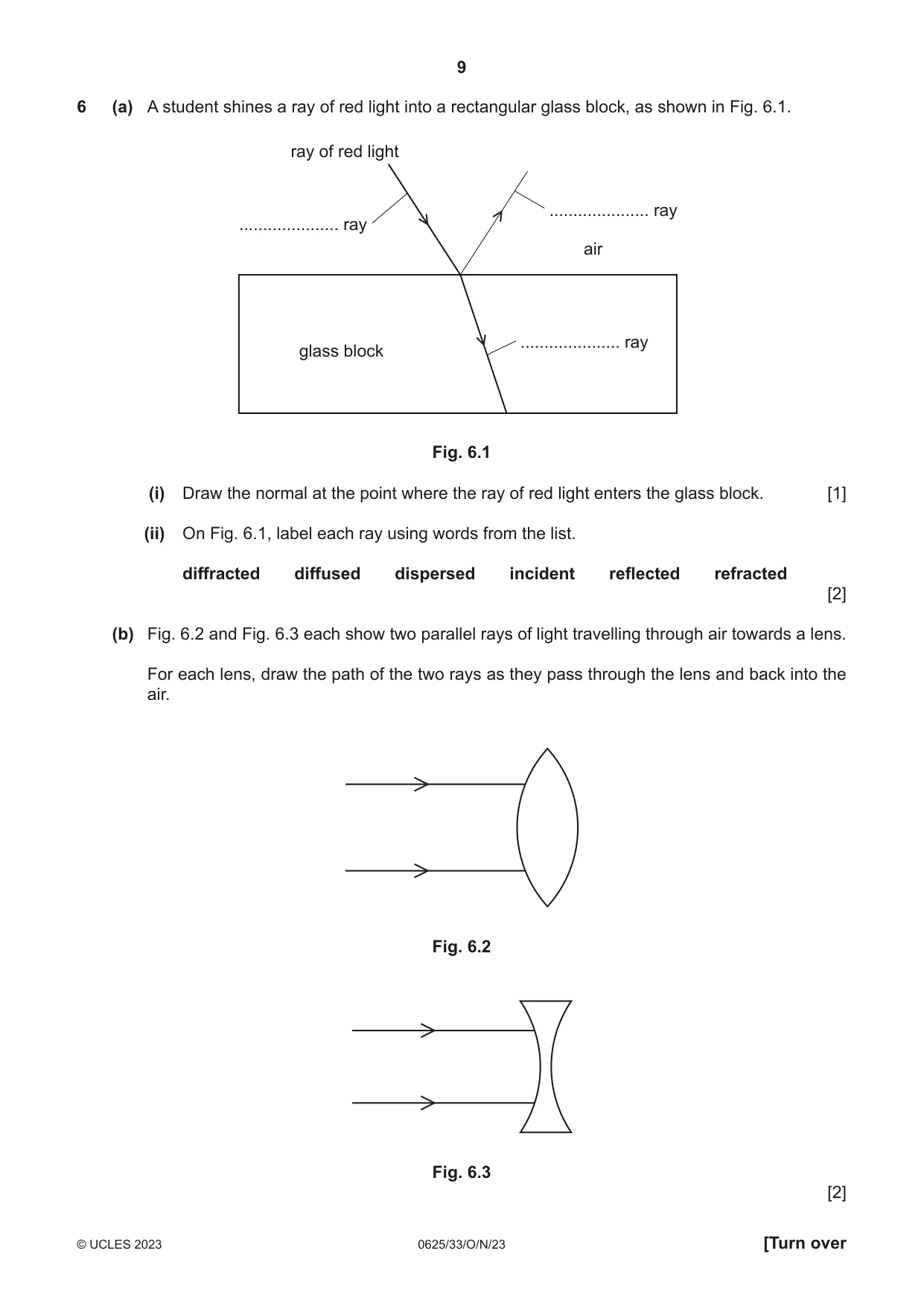
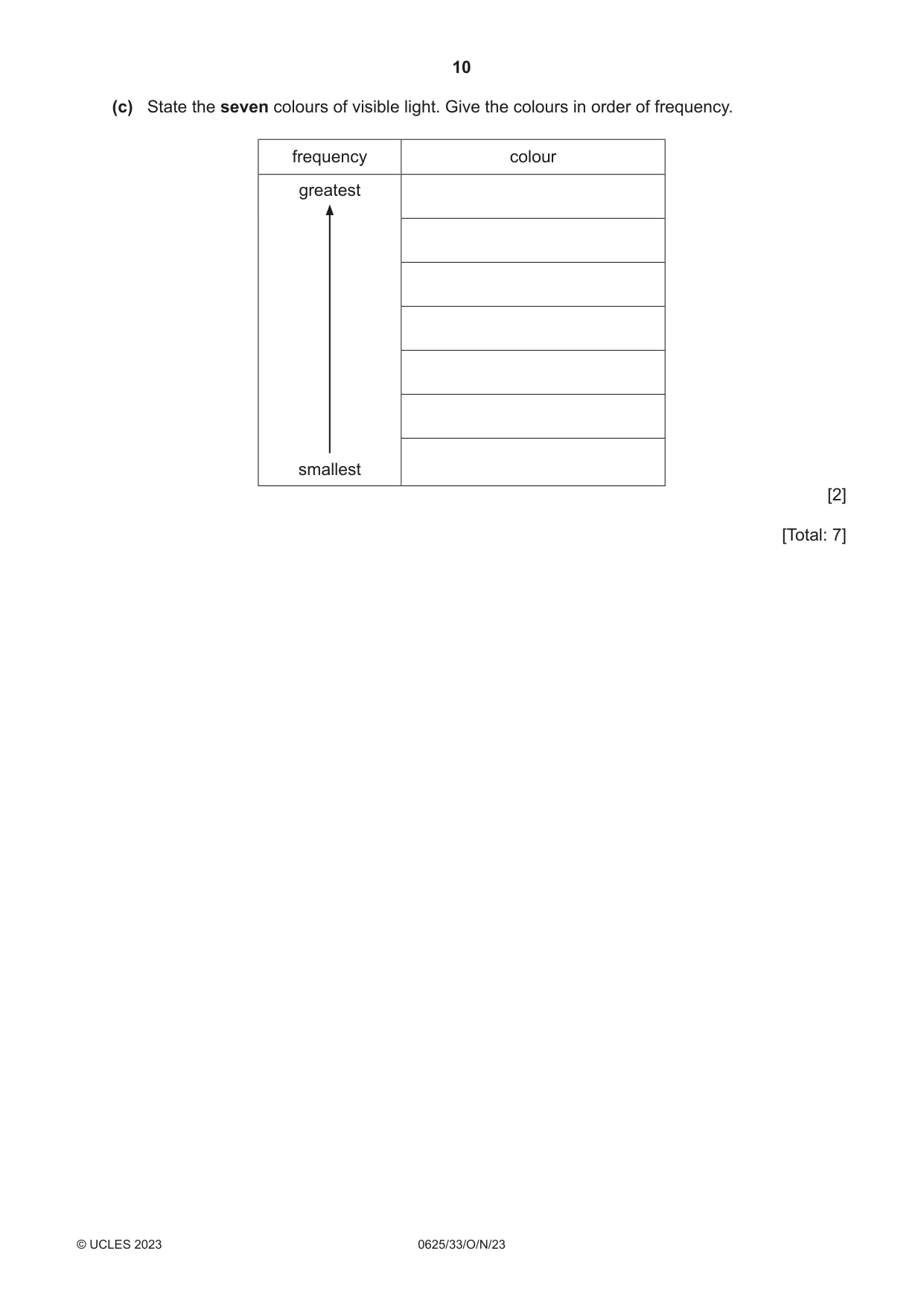
6 (a) A student shines a ray of red light into a rectangular glass block, as shown in Fig. 6.1. ray of red light ..................... ray ..................... ray air ..................... ray glass block Fig. 6.1 (i) Draw the normal at the point where the ray of red light enters the glass block. [1] (ii) On Fig. 6.1, label each ray using words from the list. diffracted diffused dispersed incident reflected refracted [2] (b) Fig. 6.2 and Fig. 6.3 each show two parallel rays of light travelling through air towards a lens. For each lens, draw the path of the two rays as they pass through the lens and back into the air. Fig. 6.2 Fig. 6.3 [2] (c) State the seven colours of visible light. Give the colours in order of frequency. frequency colour greatest smallest [2] [Total: 7]
Mark scheme: 6(a)(i) normal correctly drawn B1 6(a)(ii) incident (ray) reflected (ray) B2 refracted (ray) 6(b) Fig. 6.2. – emerging rays converge B1 Fig. 6.3. – emerging rays diverge B1 6(c) all 7 colours named M1 greatest frequency violet AND in correct order (VIBGYOR) A1
Q7 · Two identical resistors, R1 and R2, are connected to a 24 V battery, as shown in Fig
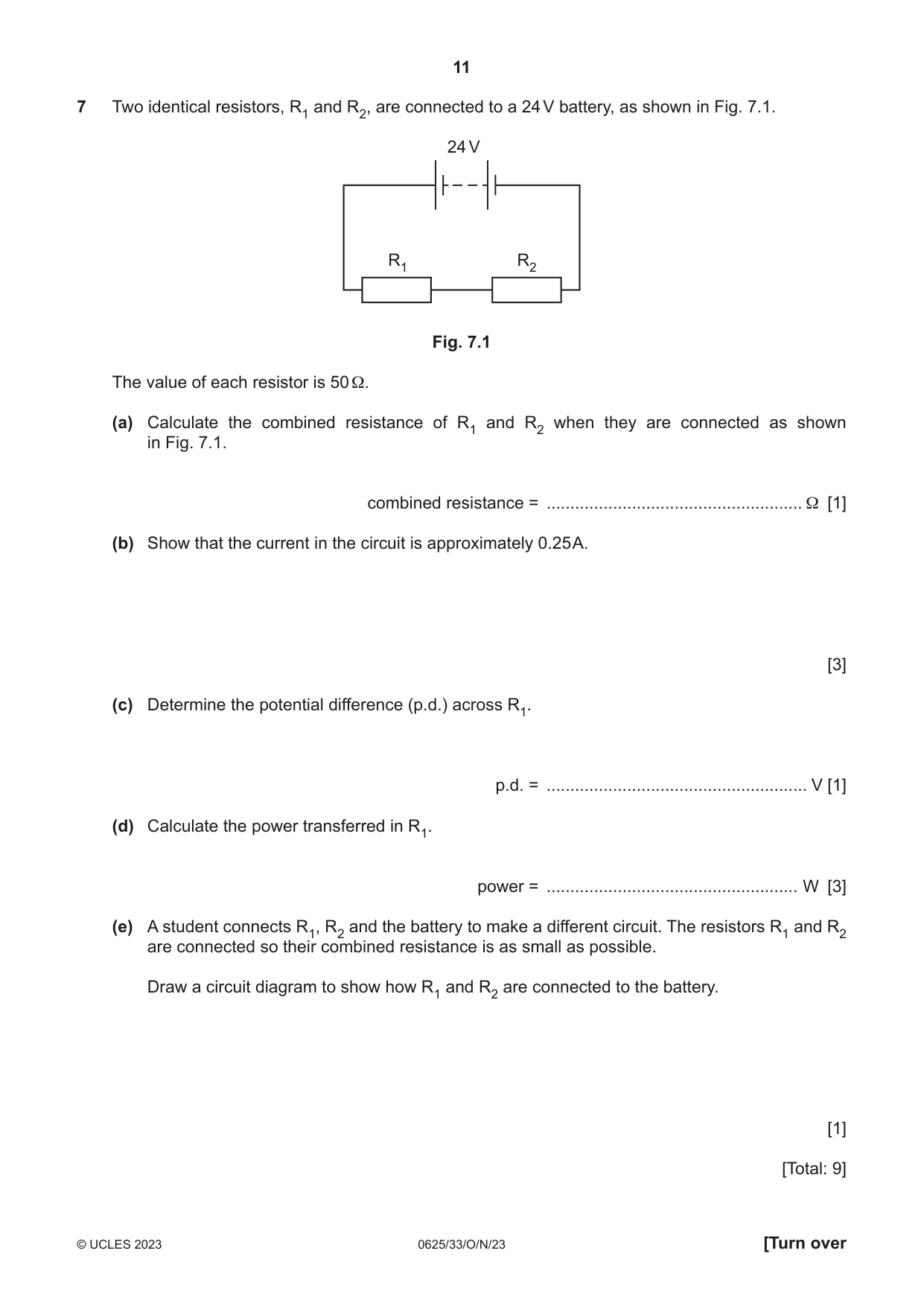
7 Two identical resistors, R1 and R2, are connected to a 24 V battery, as shown in Fig. 7.1. 24 V R1 R2 Fig. 7.1 The value of each resistor is 50 Ω. (a) Calculate the combined resistance of R1 and R2 when they are connected as shown in Fig. 7.1. combined resistance = ...................................................... Ω [1] (b) Show that the current in the circuit is approximately 0.25 A. [3] (c) Determine the potential difference (p.d.) across R1. p.d. = ....................................................... V [1] (d) Calculate the power transferred in R1. power = ..................................................... W [3] (e) A student connects R1, R2 and the battery to make a different circuit. The resistors R1 and R2 are connected so their combined resistance is as small as possible. Draw a circuit diagram to show how R1 and R2 are connected to the battery. [1] [Total: 9]
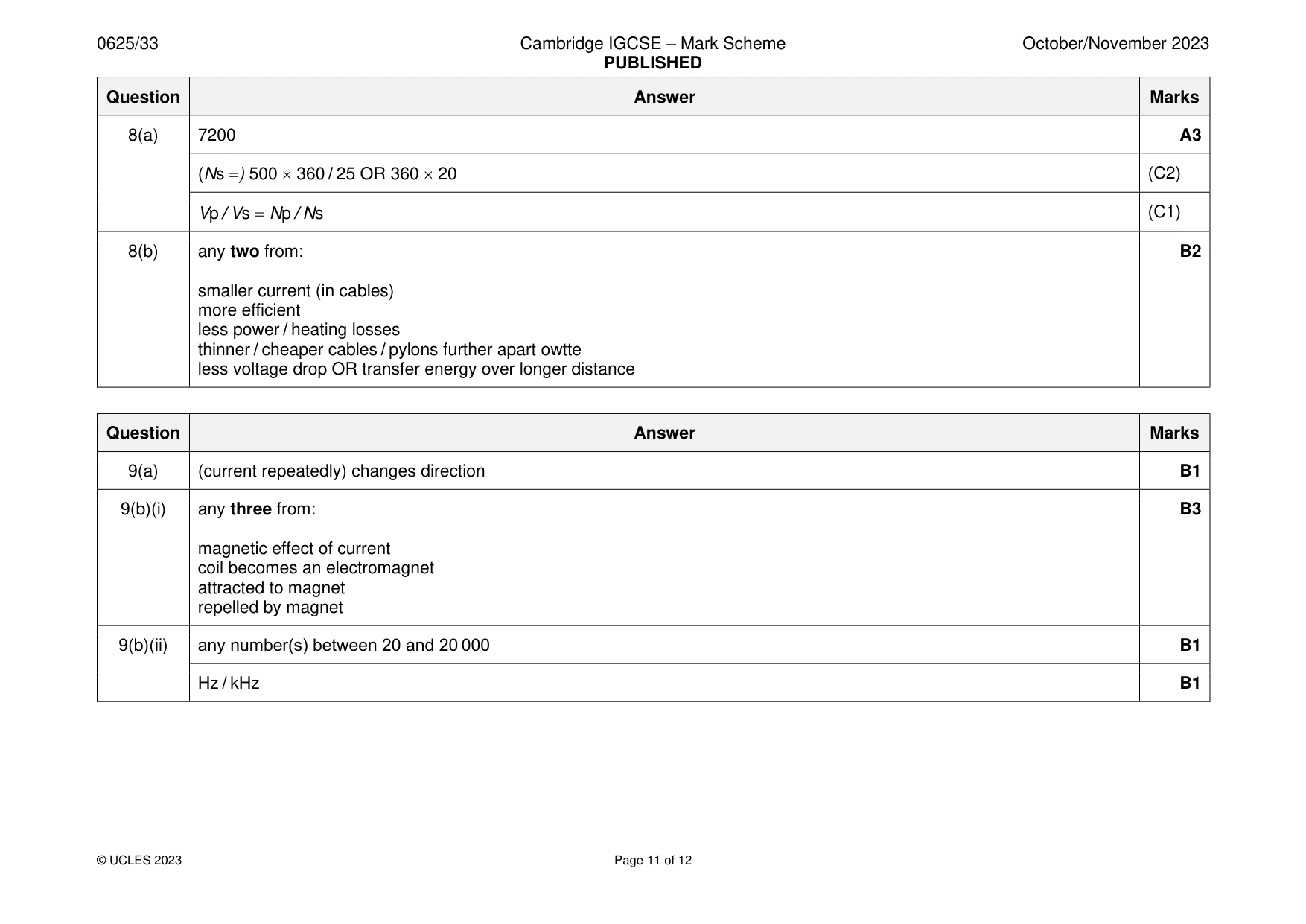
Mark scheme: 7(a) 100 () B1 7(b) 0.24 (A) B1 24 / 100 (current =) voltage / resistance B1 Need to see zone (a) B1 7(c) 12 (V) B1 7(d) 3(.0) (W) OR 2.9 (W) A3 0.25 12 (C2) (power =) current voltage OR (P =) V × I (C1) 7(e) (two) resistors in parallel B1
Q8 · An arrangement for transmitting electricity generated by a power station
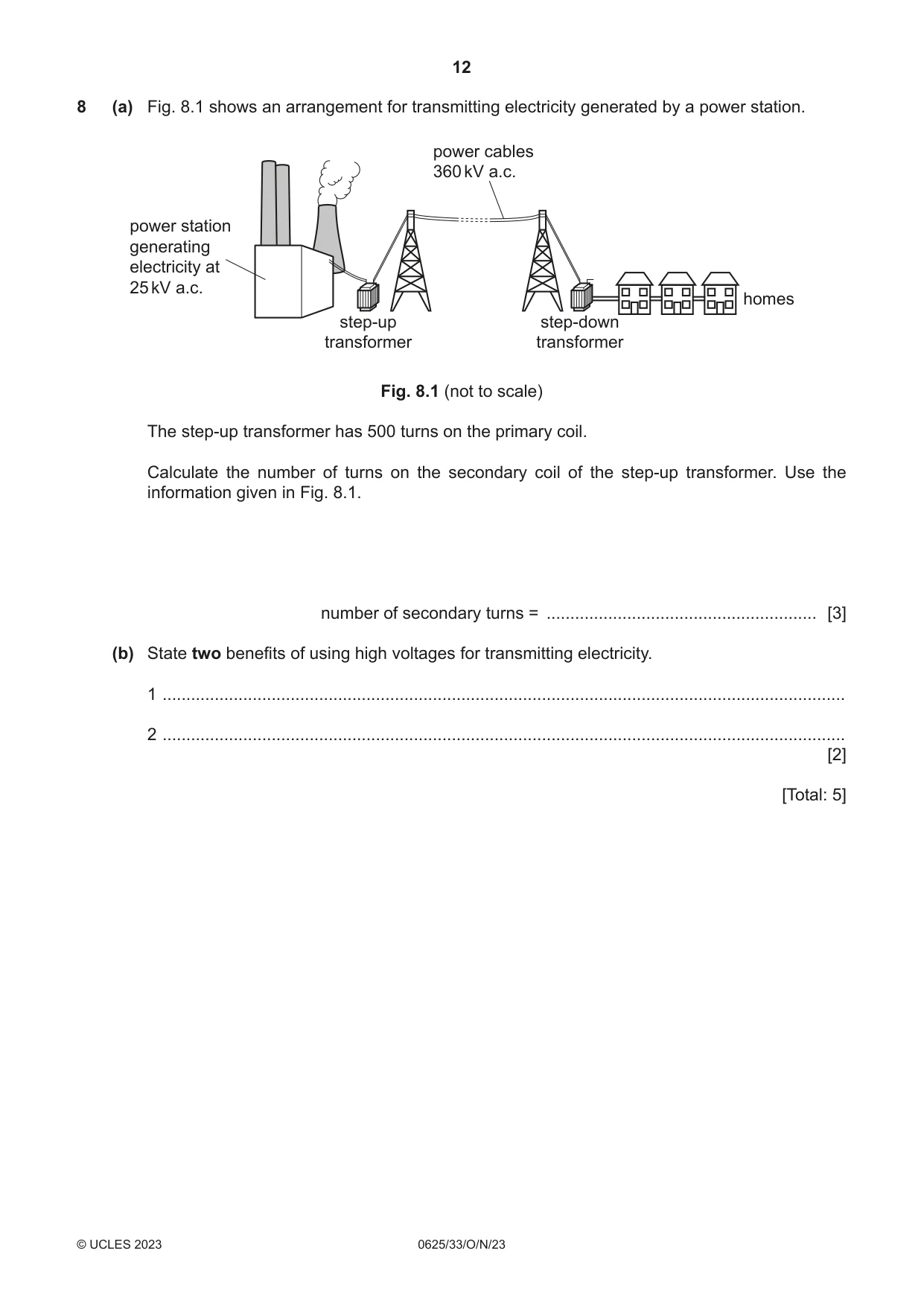
8 (a) Fig. 8.1 shows an arrangement for transmitting electricity generated by a power station. power cables 360 kV a.c. power station generating electricity at 25 kV a.c. homes step-up step-down transformer transformer Fig. 8.1 (not to scale) The step-up transformer has 500 turns on the primary coil. Calculate the number of turns on the secondary coil of the step-up transformer. Use the information given in Fig. 8.1. number of secondary turns = ......................................................... [3] (b) State two benefits of using high voltages for transmitting electricity. 1 ................................................................................................................................................ 2 ................................................................................................................................................ [2] [Total: 5]
Mark scheme: 8(a) 7200 A3 (Ns =) 500 360 / 25 OR 360 20 (C2) Vp / Vs = Np / Ns (C1) 8(b) any two from: B2 smaller current (in cables) more efficient less power / heating losses thinner / cheaper cables / pylons further apart owtte less voltage drop OR transfer energy over longer distance
Q9 · Describe what is meant by alternating current (a.c.)
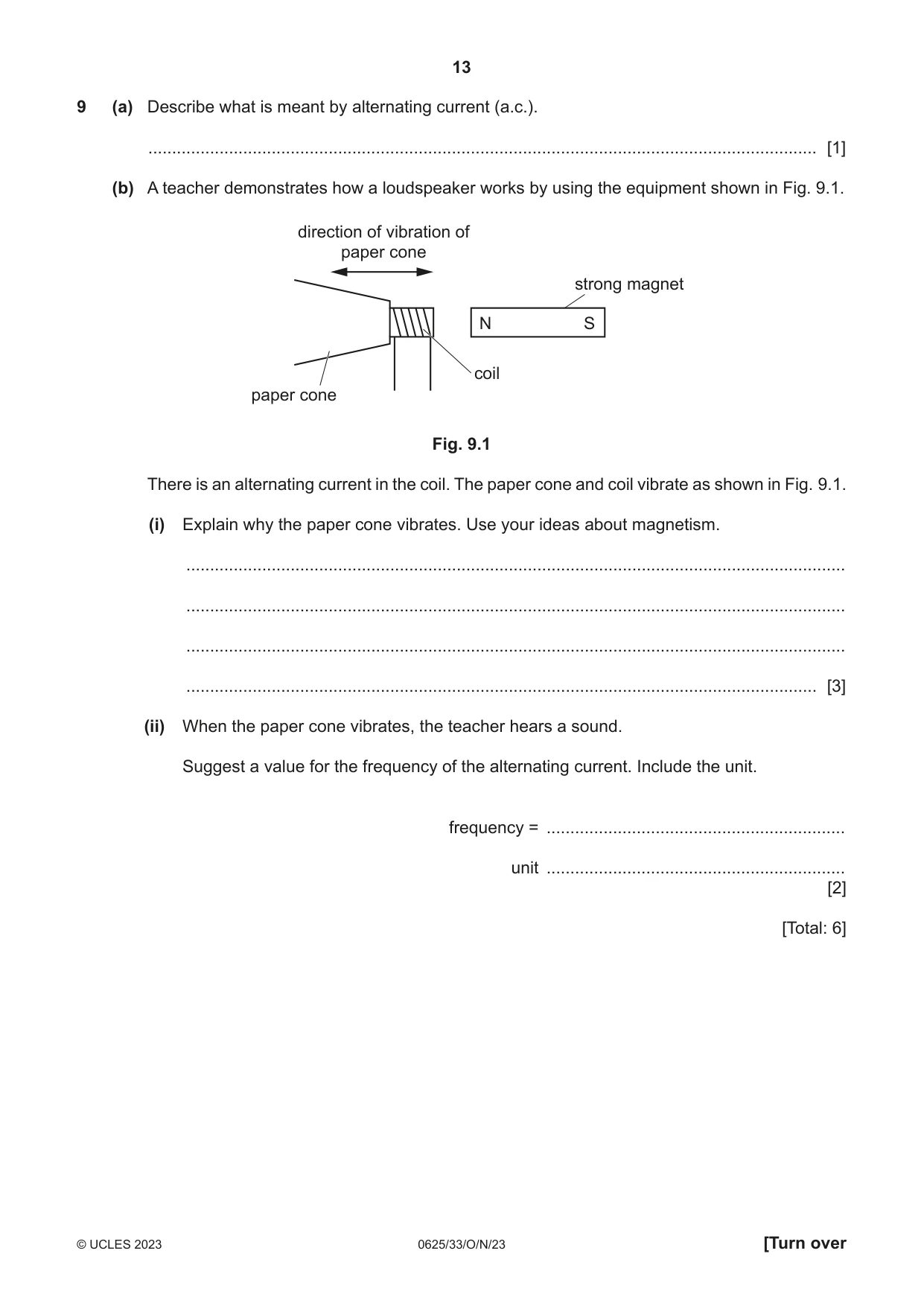
9 (a) Describe what is meant by alternating current (a.c.). ............................................................................................................................................. [1] (b) A teacher demonstrates how a loudspeaker works by using the equipment shown in Fig. 9.1. direction of vibration of paper cone strong magnet N S coil paper cone Fig. 9.1 There is an alternating current in the coil. The paper cone and coil vibrate as shown in Fig. 9.1. (i) Explain why the paper cone vibrates. Use your ideas about magnetism. ........................................................................................................................................... ........................................................................................................................................... ........................................................................................................................................... ..................................................................................................................................... [3] (ii) When the paper cone vibrates, the teacher hears a sound. Suggest a value for the frequency of the alternating current. Include the unit. frequency = ............................................................... unit ............................................................... [2] [Total: 6]
Mark scheme: 9(a) (current repeatedly) changes direction B1 9(b)(i) any three from: B3 magnetic effect of current coil becomes an electromagnet attracted to magnet repelled by magnet 9(b)(ii) any number(s) between 20 and 20 000 B1 Hz / kHz B1
Q10 · All the particles in a lithium atom
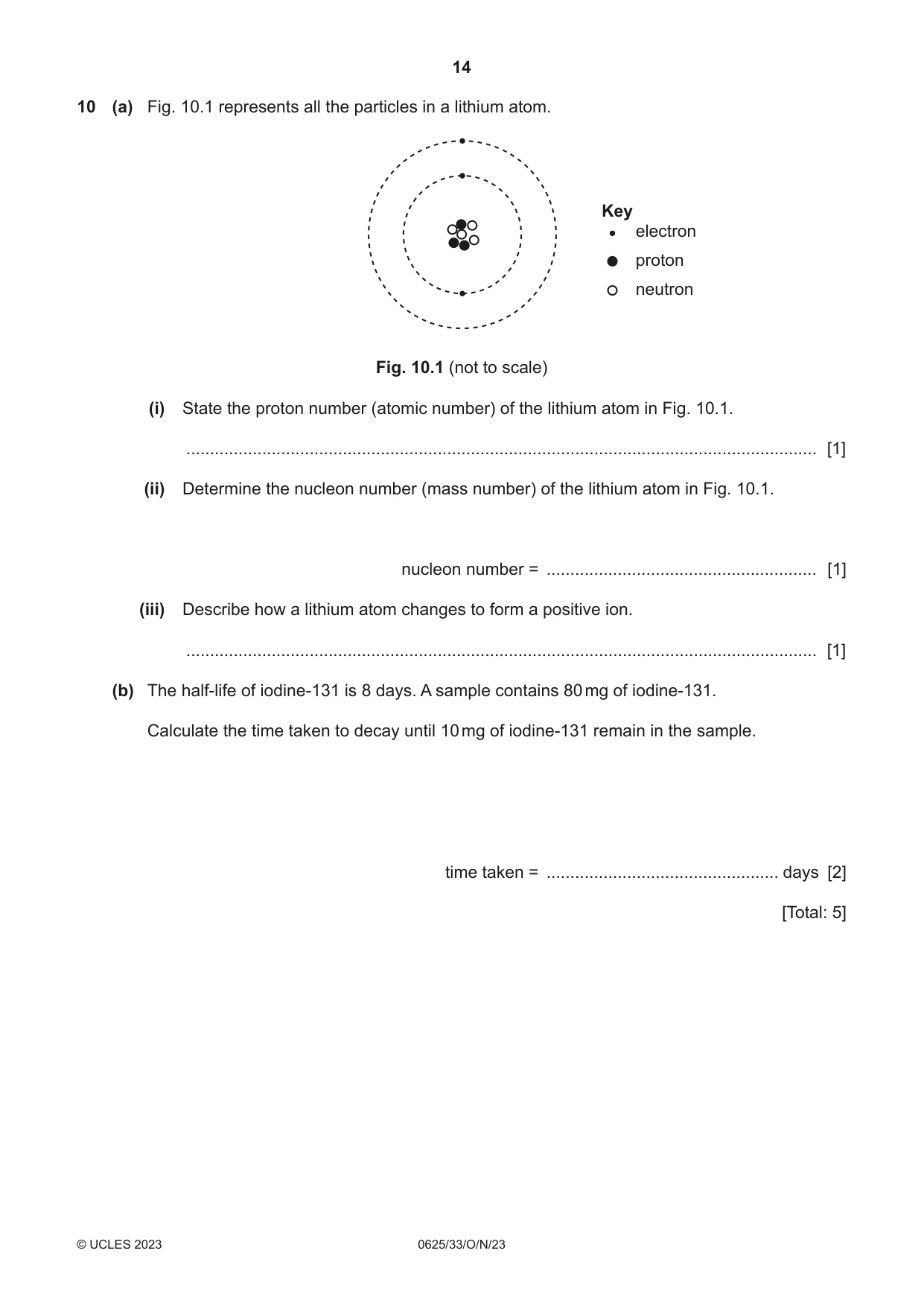
10 (a) Fig. 10.1 represents all the particles in a lithium atom. Key electron proton neutron Fig. 10.1 (not to scale) (i) State the proton number (atomic number) of the lithium atom in Fig. 10.1. ..................................................................................................................................... [1] (ii) Determine the nucleon number (mass number) of the lithium atom in Fig. 10.1. nucleon number = ......................................................... [1] (iii) Describe how a lithium atom changes to form a positive ion. ..................................................................................................................................... [1] (b) The half-life of iodine-131 is 8 days. A sample contains 80 mg of iodine-131. Calculate the time taken to decay until 10 mg of iodine-131 remain in the sample. time taken = ................................................. days [2] [Total: 5]
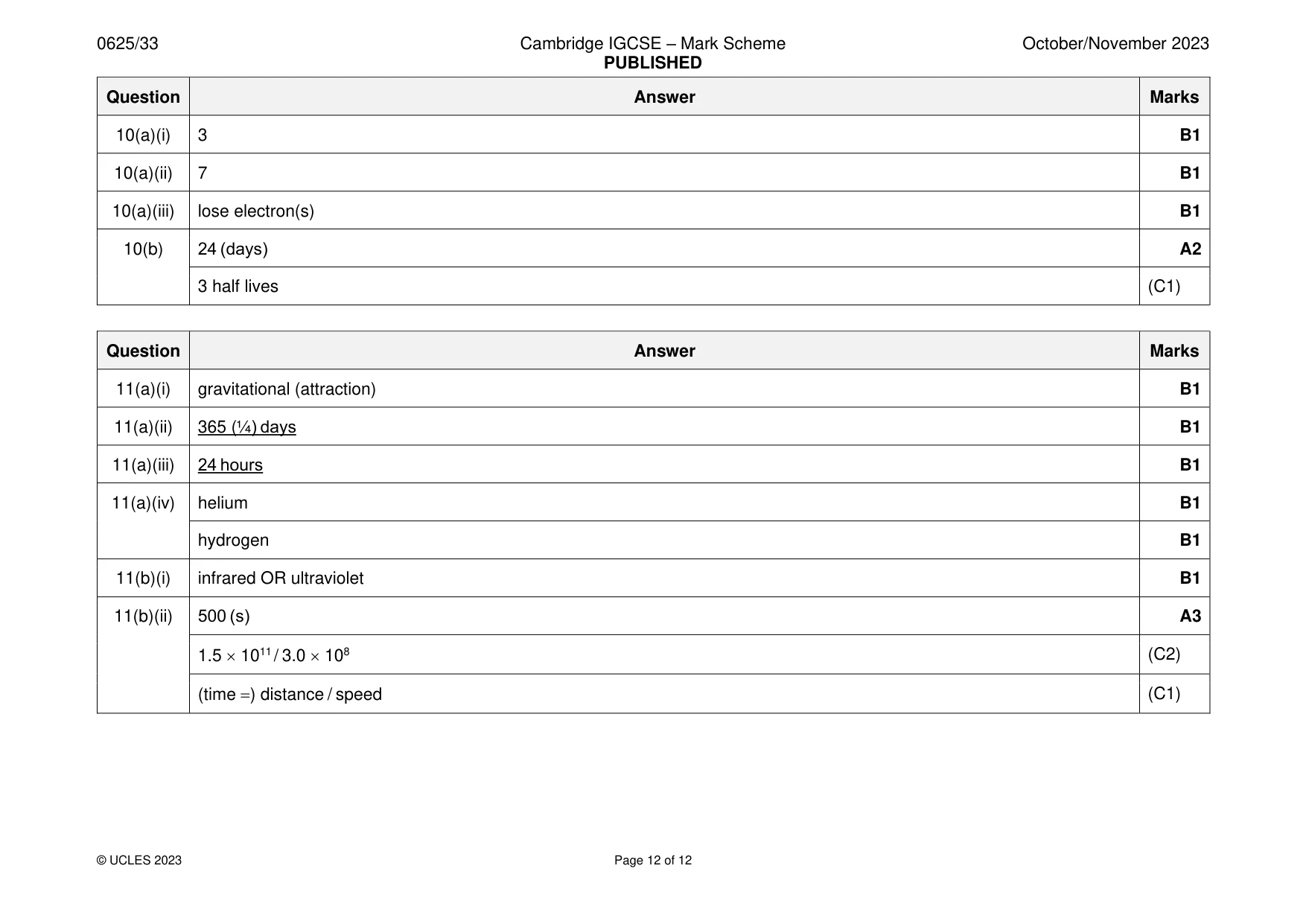
Mark scheme: 10(a)(i) 3 B1 10(a)(ii) 7 B1 10(a)(iii) lose electron(s) B1 10(b) 24 (days) A2 3 half lives (C1)
Q11 · The Earth in orbit around the Sun
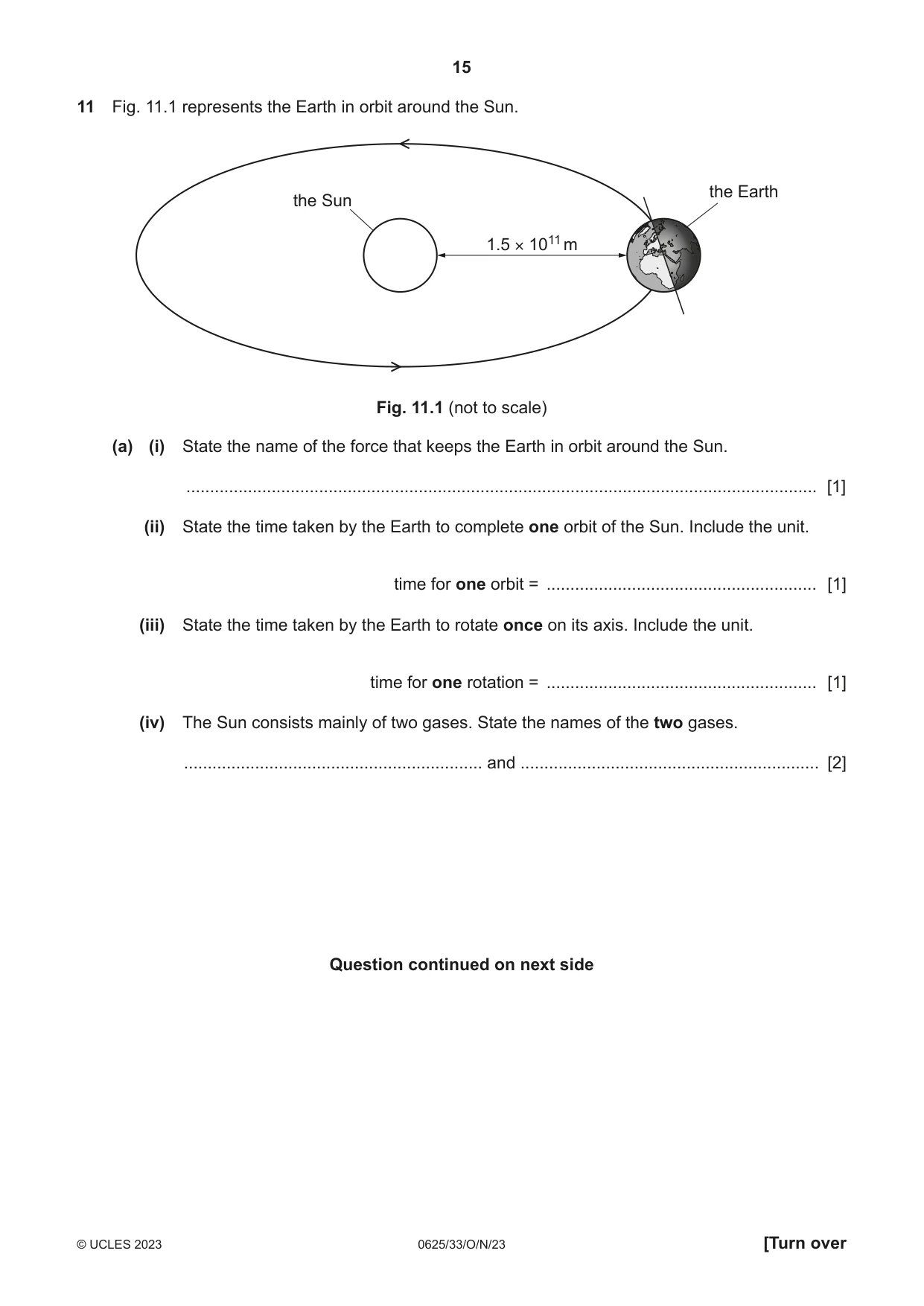
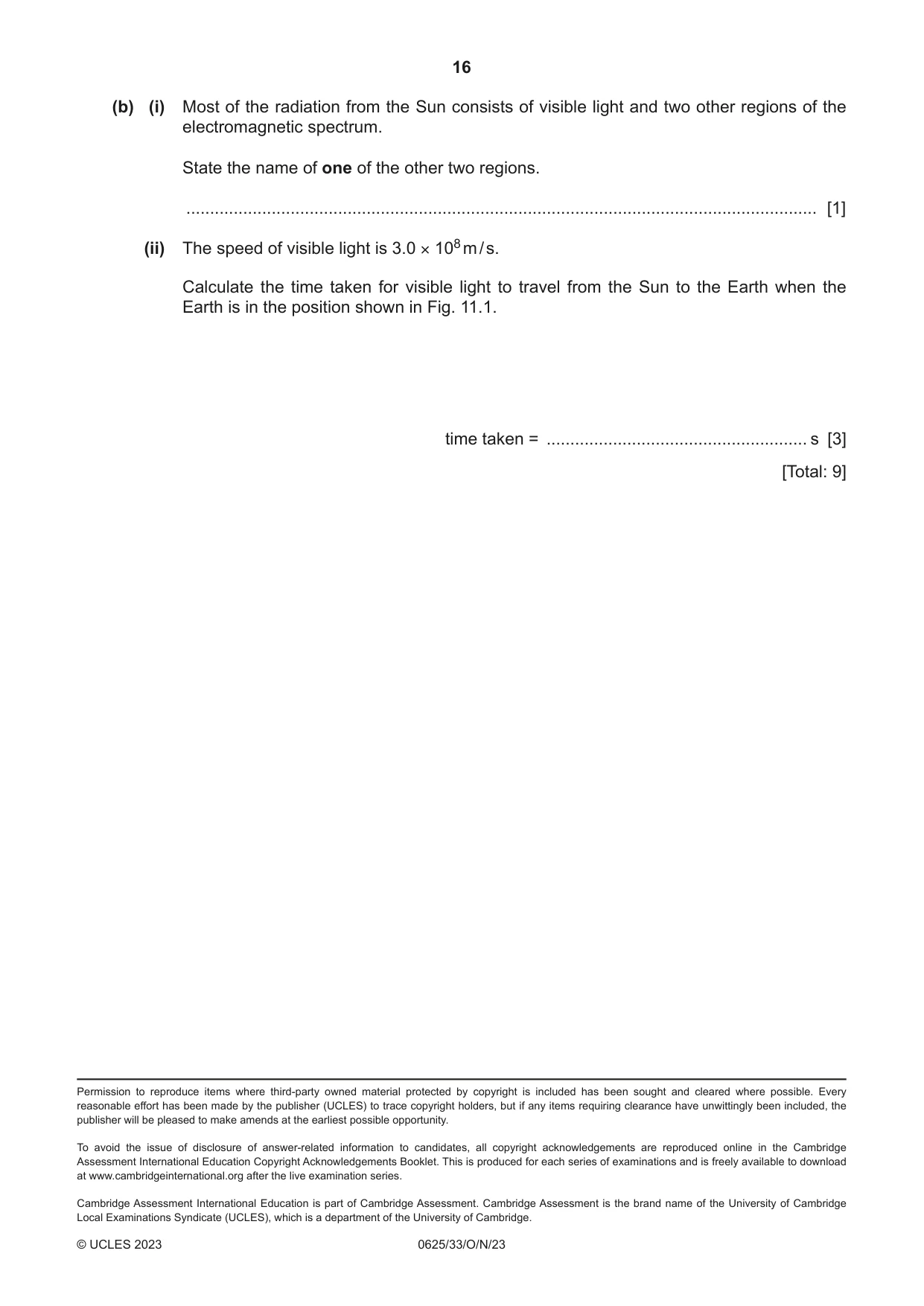
11 Fig. 11.1 represents the Earth in orbit around the Sun. the Earth the Sun 1.5 × 10¹¹ m Fig. 11.1 (not to scale) (a) (i) State the name of the force that keeps the Earth in orbit around the Sun. ..................................................................................................................................... [1] (ii) State the time taken by the Earth to complete one orbit of the Sun. Include the unit. time for one orbit = ......................................................... [1] (iii) State the time taken by the Earth to rotate once on its axis. Include the unit. time for one rotation = ......................................................... [1] (iv) The Sun consists mainly of two gases. State the names of the two gases. ............................................................... and ............................................................... [2] Question continued on next side (b) (i) Most of the radiation from the Sun consists of visible light and two other regions of the electromagnetic spectrum. State the name of one of the other two regions. ..................................................................................................................................... [1] (ii) The speed of visible light is 3.0 × 10⁸ m / s. Calculate the time taken for visible light to travel from the Sun to the Earth when the Earth is in the position shown in Fig. 11.1. time taken = ....................................................... s [3] [Total: 9]
Mark scheme: 11(a)(i) gravitational (attraction) B1 11(a)(ii) 365 (¼) days B1 11(a)(iii) 24 hours B1 11(a)(iv) helium B1 hydrogen B1 11(b)(i) infrared OR ultraviolet B1 11(b)(ii) 500 (s) A3 1.5 1011 / 3.0 108 (C2) (time =) distance / speed (C1)
What was in this paper
The subtopics covered by these 11 questions, and how many questions each got. Open one in a new tab to see every Cambridge question on it.
What you needed in this session
Cambridge’s own grade thresholds for 2023 Oct/Nov, Paper 3 · Variant 3. A higher threshold means an easier paper — the bar moves with how the cohort did.