Cambridge IGCSE Physics 0625 — 2010 May/June Paper 3 · Variant 3
0625/33/M/J/10 · 11 questions · 80 marks · ≈90 min
The question paper and its mark scheme, free to read here and free to download. This is Cambridge’s own paper, exactly as it was sat.
Question paper20 pages

Mark scheme7 pages
Answers below. Sit the paper first if you are practising.
Questions as text
Q1 · A ball player bounces a ball of mass 0.60 kg
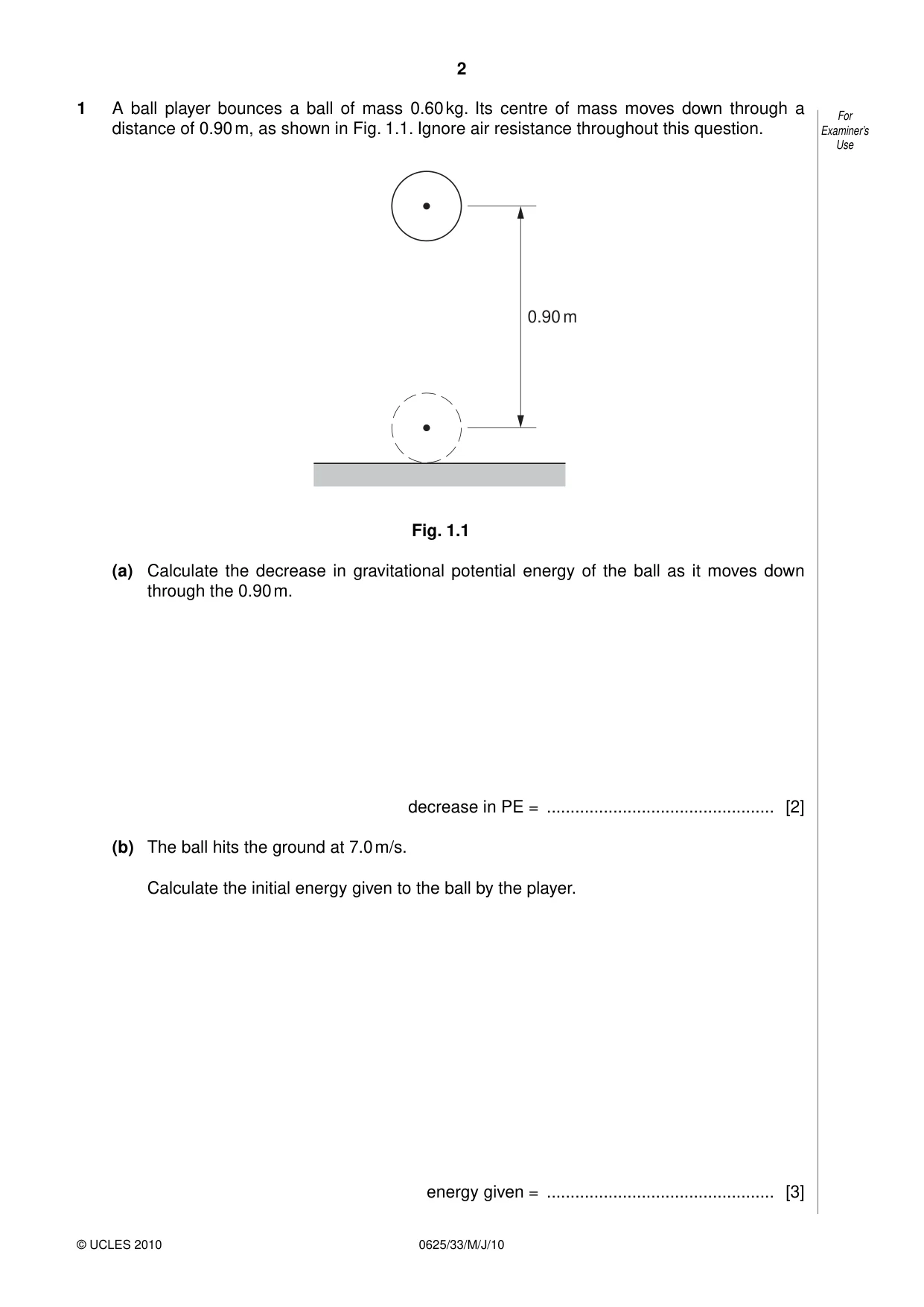
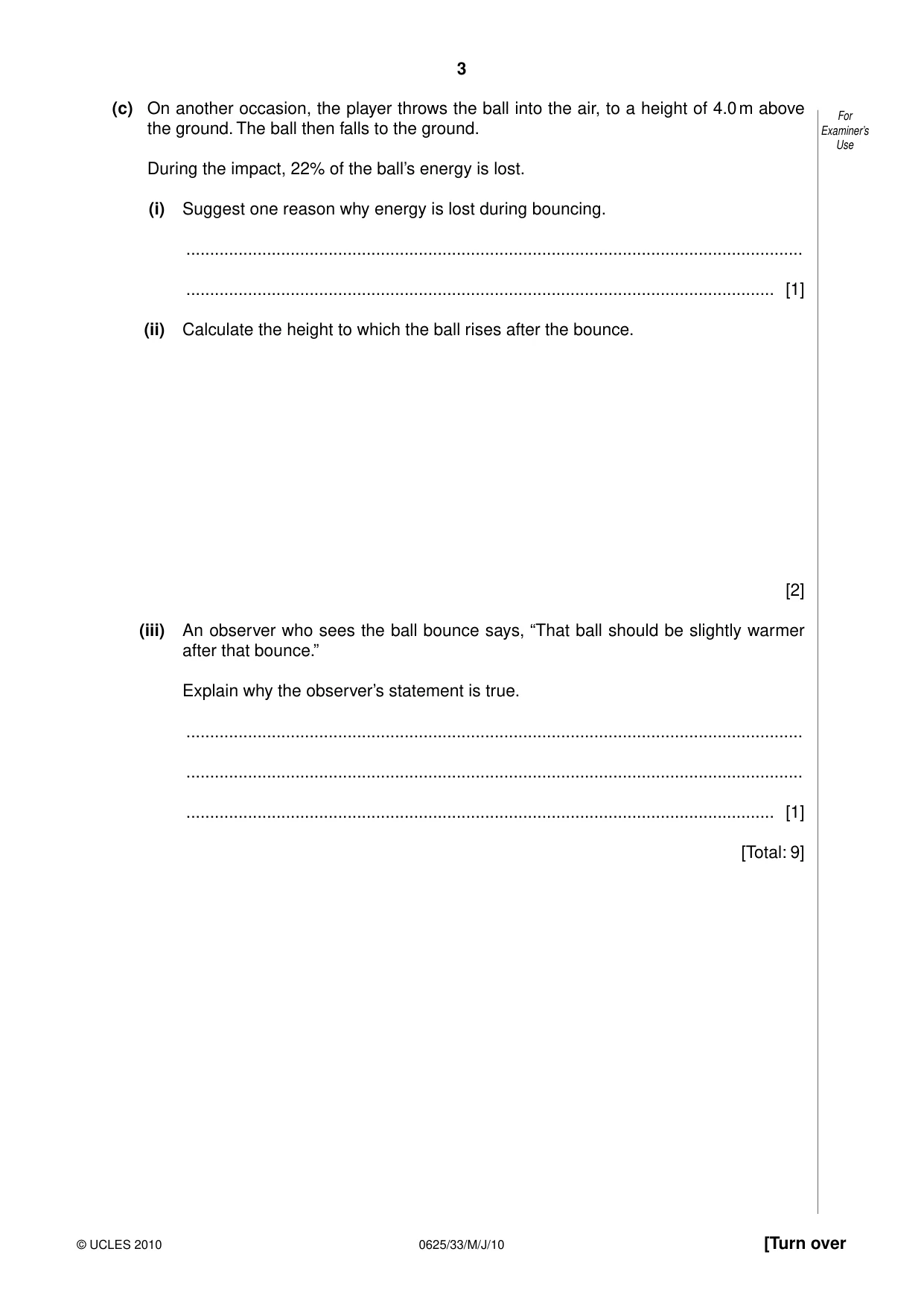
1 A ball player bounces a ball of mass 0.60 kg. Its centre of mass moves down through a For distance of 0.90 m, as shown in Fig. 1.1. Ignore air resistance throughout this question. Examiner’s Use 0.90 m Fig. 1.1 (a) Calculate the decrease in gravitational potential energy of the ball as it moves down through the 0.90 m. decrease in PE = ................................................ [2] (b) The ball hits the ground at 7.0 m/s. Calculate the initial energy given to the ball by the player. energy given = ................................................ [3] (c) On another occasion, the player throws the ball into the air, to a height of 4.0 m above For the ground. The ball then falls to the ground. Examiner’s Use During the impact, 22% of the ball’s energy is lost. (i) Suggest one reason why energy is lost during bouncing. .................................................................................................................................. ............................................................................................................................ [1] (ii) Calculate the height to which the ball rises after the bounce. [2] (iii) An observer who sees the ball bounce says, “That ball should be slightly warmer after that bounce.” Explain why the observer’s statement is true. .................................................................................................................................. .................................................................................................................................. ............................................................................................................................ [1] [Total: 9]
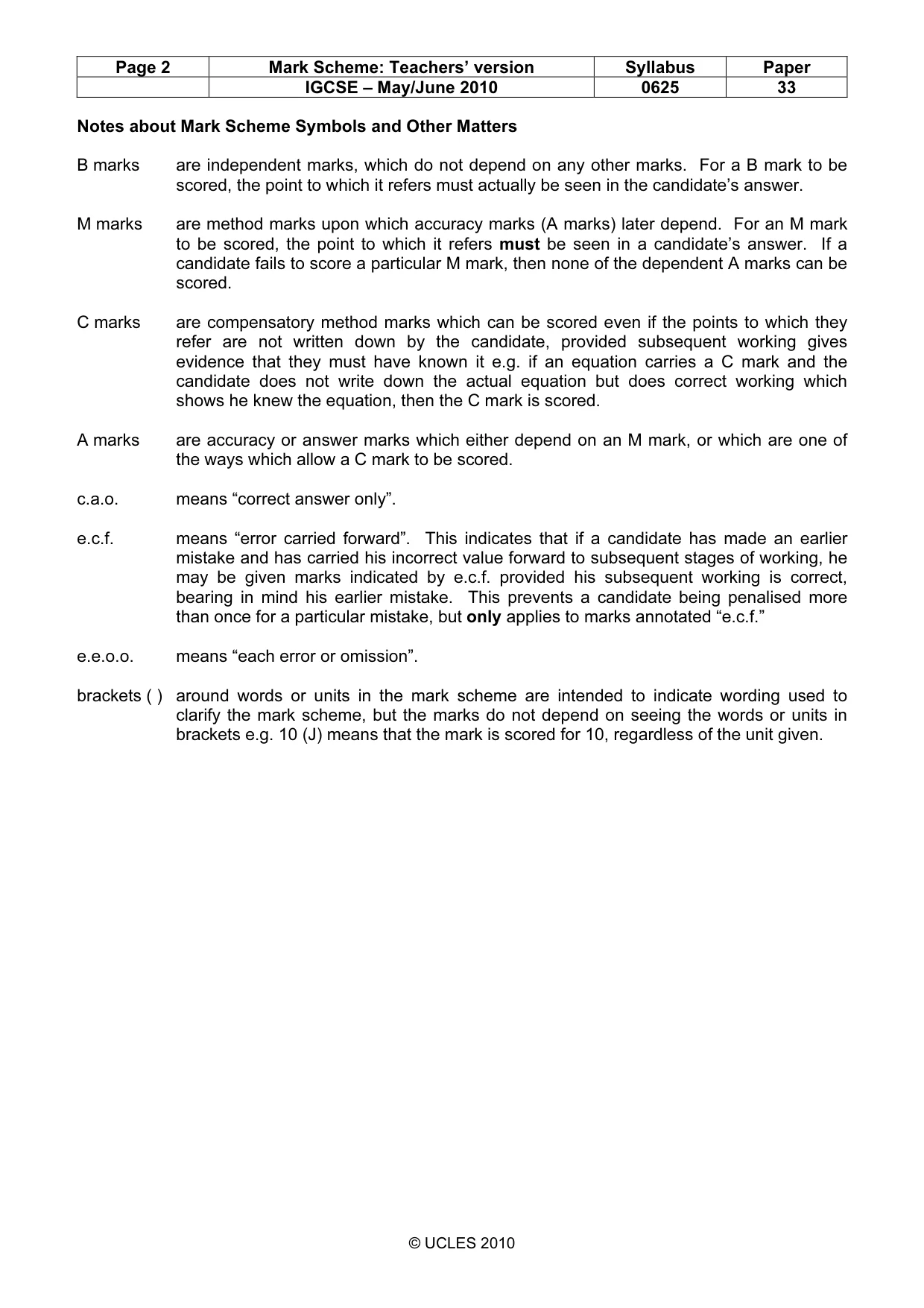
Mark scheme: 1 (a) mgh in any form, numbers, words, symbols C1 5.4 J OR 5.297 J OR 5.292 J OR 5.3 J OR 5.29 J A1 (b) ½mv2 in any form, numbers, words, symbols C1 14.7 (J) C1 (energy given by player =) 9.3 J OR his (b) – (a) correctly evaluated A1 (c) (i) friction with floor / inside ball OR energy to deform ball OR sound OR idea of hysteresis of rubber ignore heat / air resistance B1 (ii) 78% OR ratio of PEs accept (14.7 × 0.78 =) 11.47 (J) OR (0.78 × 0.9 =) 0.702 (m) C1 3.12 m to at least 2 sig figs A1 (iii) idea of (some of) energy lost / becomes / converted / transferred to heat in ball ignore friction B1 [9]
Q2 · Four students, A, B, C and D, each have a spring
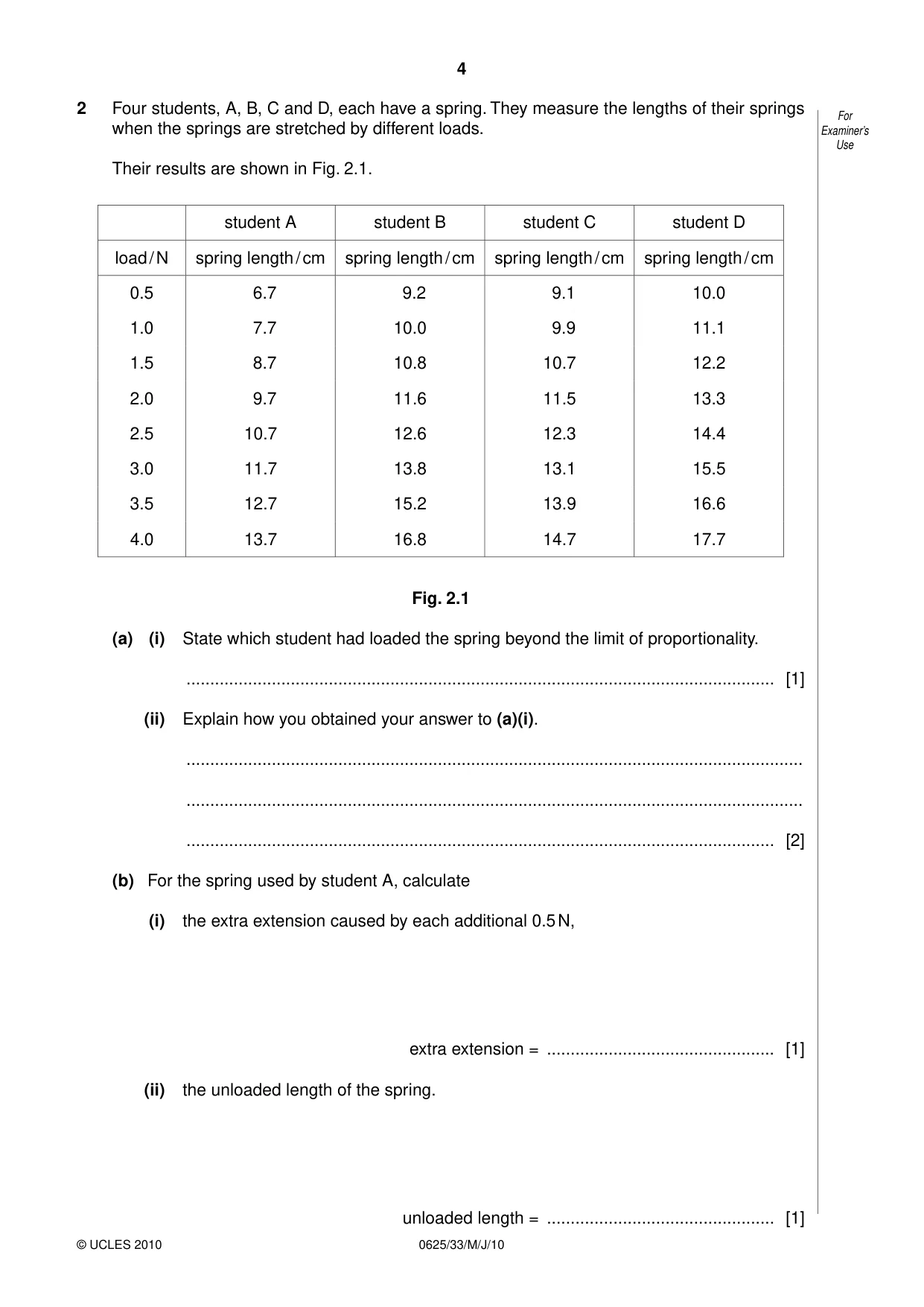
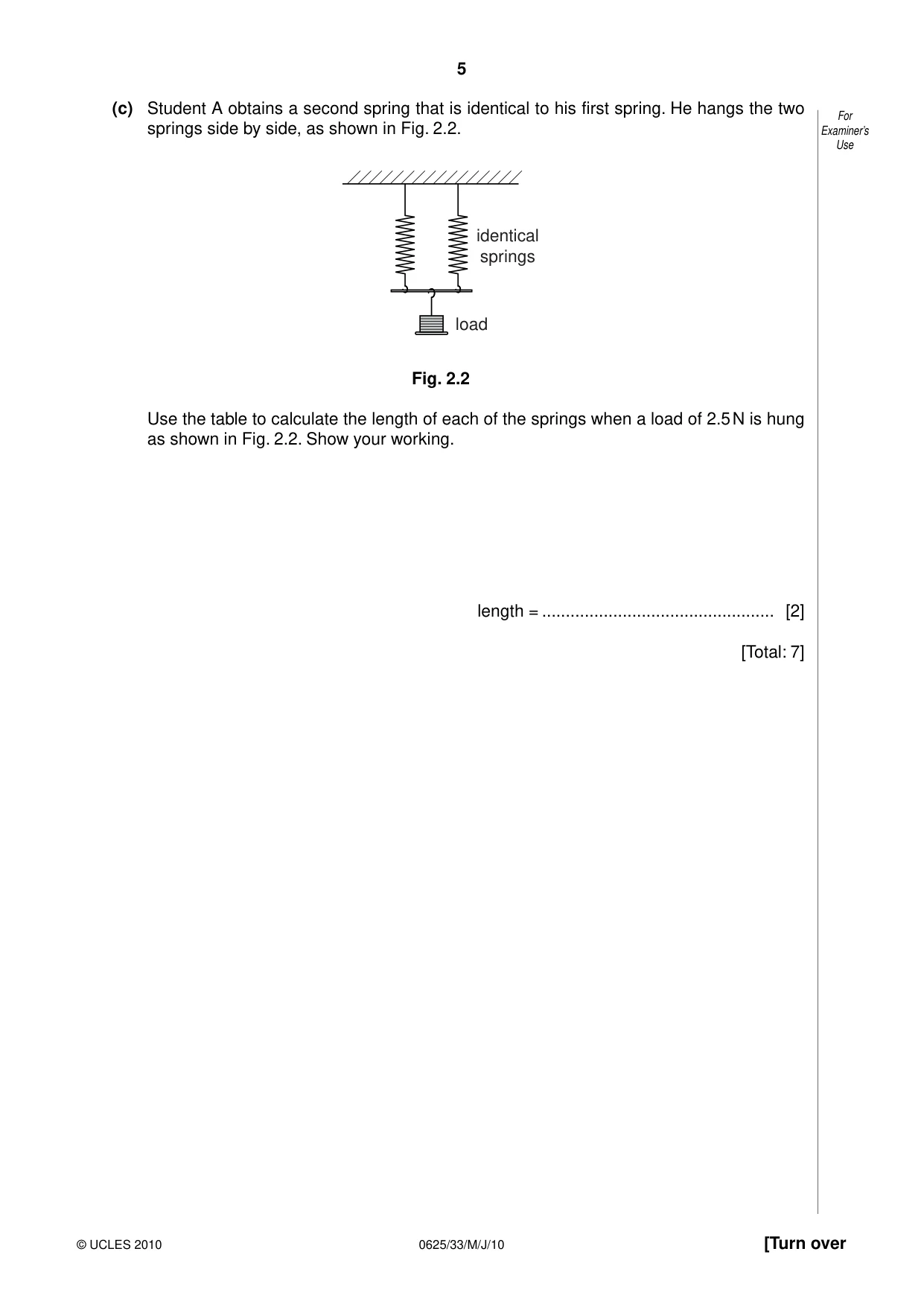
2 Four students, A, B, C and D, each have a spring. They measure the lengths of their springs For when the springs are stretched by different loads. Examiner’s Use Their results are shown in Fig. 2.1. student A student B student C student D load / N spring length / cm spring length / cm spring length / cm spring length / cm 0.5 6.7 9.2 9.1 10.0 1.0 7.7 10.0 9.9 11.1 1.5 8.7 10.8 10.7 12.2 2.0 9.7 11.6 11.5 13.3 2.5 10.7 12.6 12.3 14.4 3.0 11.7 13.8 13.1 15.5 3.5 12.7 15.2 13.9 16.6 4.0 13.7 16.8 14.7 17.7 Fig. 2.1 (a) (i) State which student had loaded the spring beyond the limit of proportionality. ............................................................................................................................ [1] (ii) Explain how you obtained your answer to (a)(i). .................................................................................................................................. .................................................................................................................................. ............................................................................................................................ [2] (b) For the spring used by student A, calculate (i) the extra extension caused by each additional 0.5 N, extra extension = ................................................ [1] (ii) the unloaded length of the spring. unloaded length = ................................................ [1] (c) Student A obtains a second spring that is identical to his first spring. He hangs the two For springs side by side, as shown in Fig. 2.2. Examiner’s Use identical springs load Fig. 2.2 Use the table to calculate the length of each of the springs when a load of 2.5 N is hung as shown in Fig. 2.2. Show your working. length = ................................................. [2] [Total: 7]
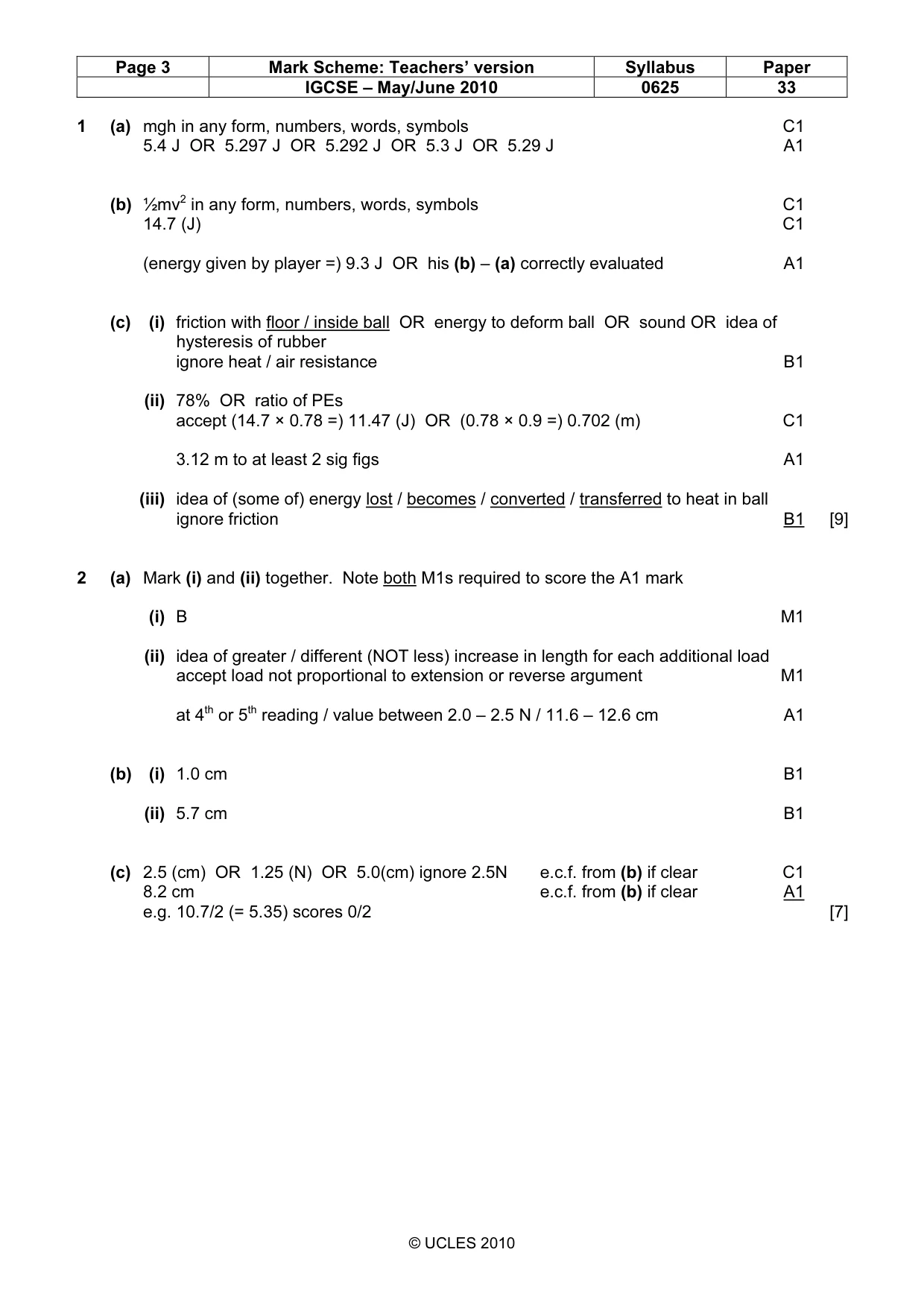
Mark scheme: 2 (a) Mark (i) and (ii) together. Note both M1s required to score the A1 mark (i) B M1 (ii) idea of greater / different (NOT less) increase in length for each additional load accept load not proportional to extension or reverse argument M1 at 4th or 5th reading / value between 2.0 – 2.5 N / 11.6 – 12.6 cm A1 (b) (i) 1.0 cm B1 (ii) 5.7 cm B1 (c) 2.5 (cm) OR 1.25 (N) OR 5.0(cm) ignore 2.5N e.c.f. from (b) if clear C1 8.2 cm e.c.f. from (b) if clear A1 e.g. 10.7/2 (= 5.35) scores 0/2 [7] IGCSE – May/June 2010 0625 33 3 3
Q3 · An ornamental garden includes a small pond, which contains a pumped system that causes…
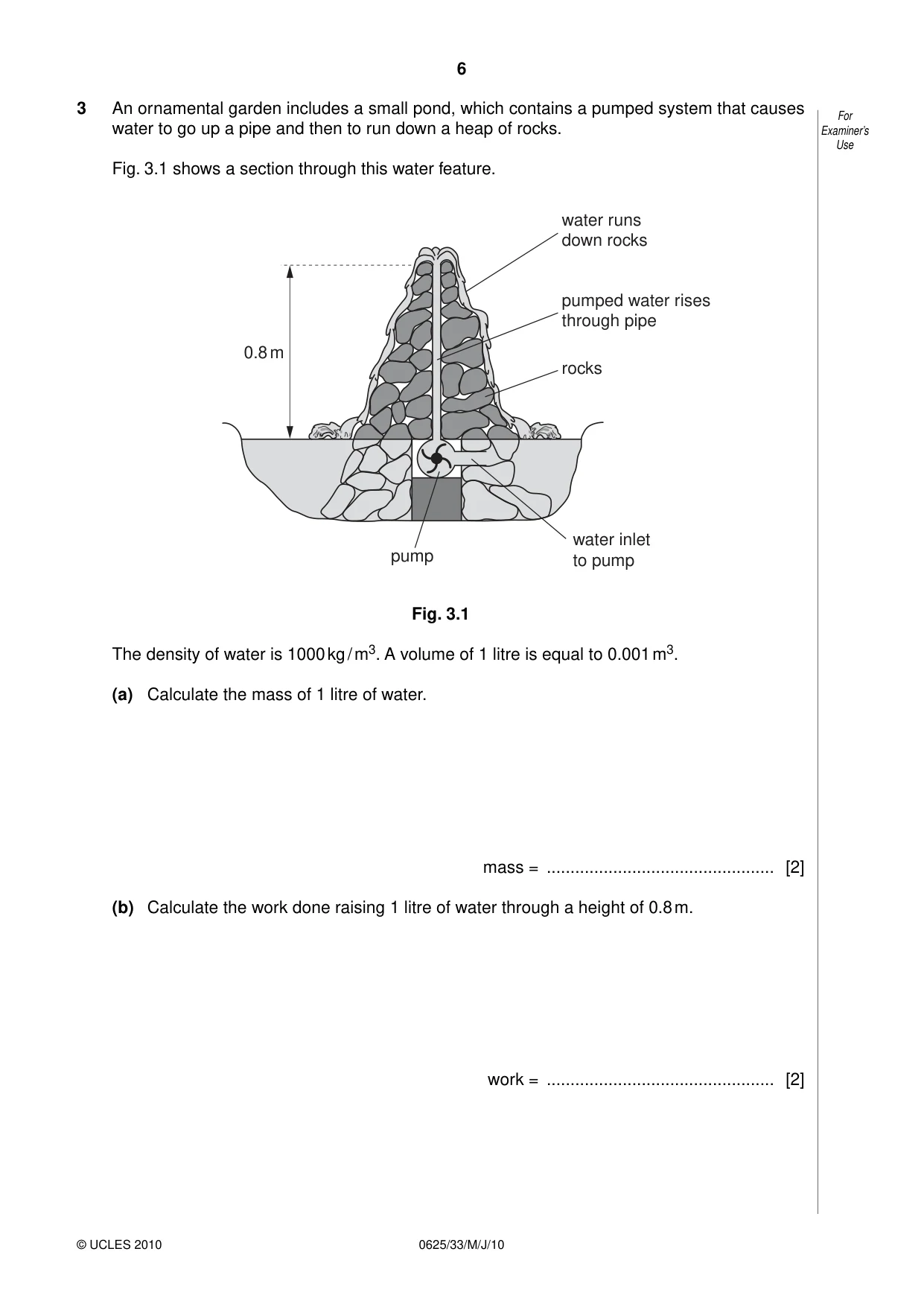
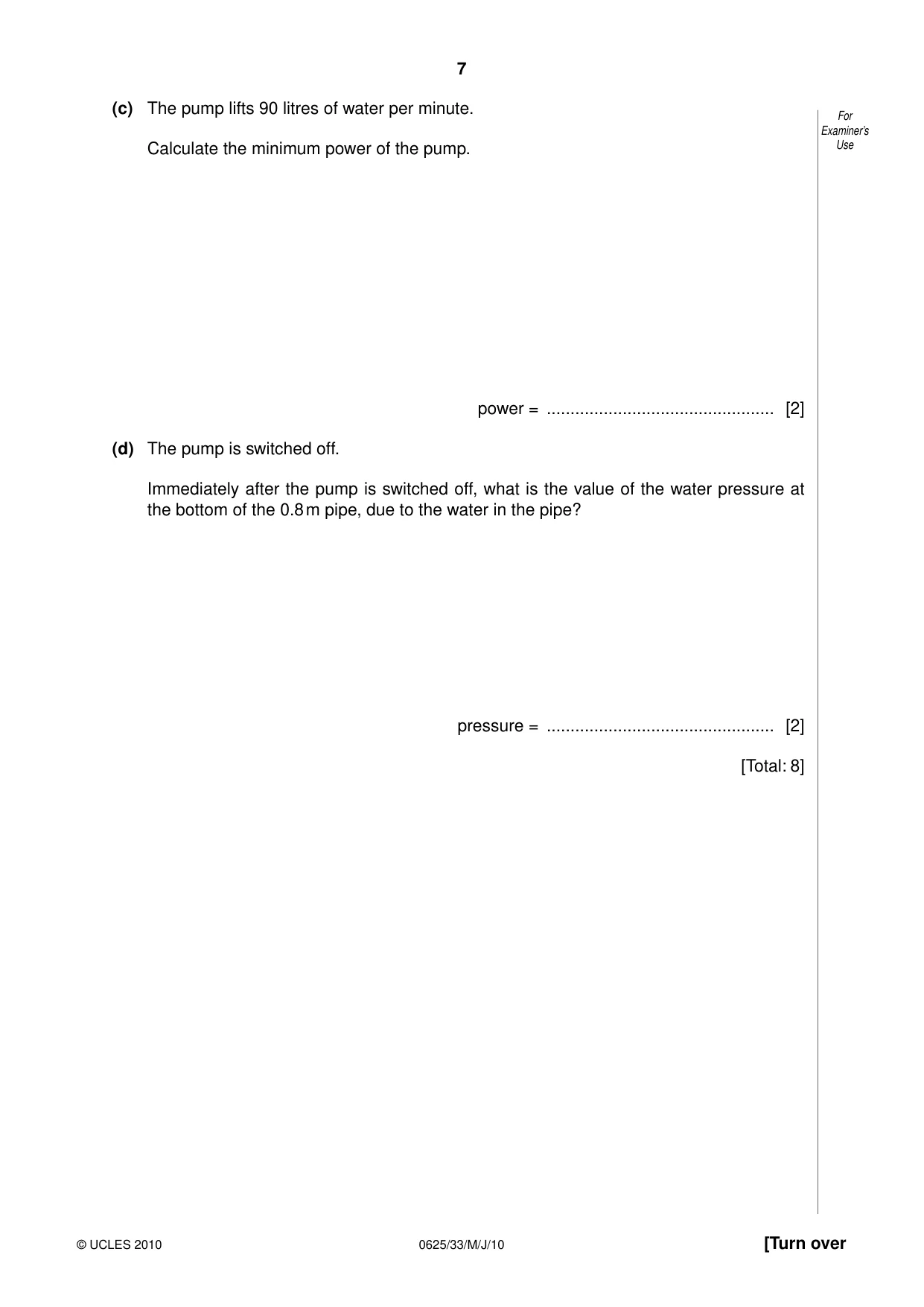
3 An ornamental garden includes a small pond, which contains a pumped system that causes For water to go up a pipe and then to run down a heap of rocks. Examiner’s Use Fig. 3.1 shows a section through this water feature. water runs down rocks pumped water rises through pipe 0.8 m rocks water inlet pump to pump Fig. 3.1 The density of water is 1000 kg / m3. A volume of 1 litre is equal to 0.001 m3. (a) Calculate the mass of 1 litre of water. mass = ................................................ [2] (b) Calculate the work done raising 1 litre of water through a height of 0.8 m. work = ................................................ [2] (c) The pump lifts 90 litres of water per minute. For Examiner’s Calculate the minimum power of the pump. Use power = ................................................ [2] (d) The pump is switched off. Immediately after the pump is switched off, what is the value of the water pressure at the bottom of the 0.8 m pipe, due to the water in the pipe? pressure = ................................................ [2] [Total: 8]
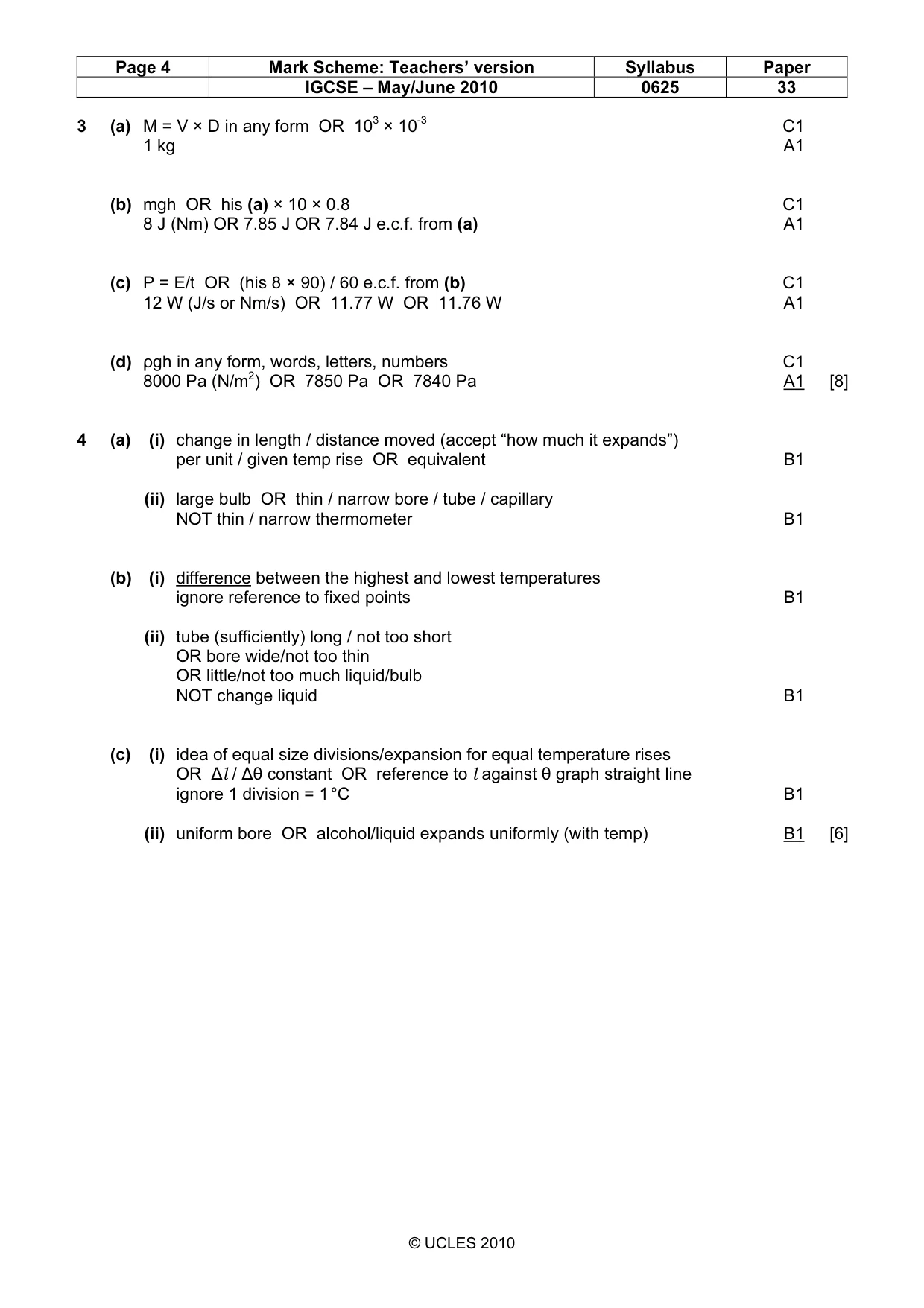
Mark scheme: 3 (a) M = V × D in any form OR 103 × 10-3 C1 1 kg A1 (b) mgh OR his (a) × 10 × 0.8 C1 8 J (Nm) OR 7.85 J OR 7.84 J e.c.f. from (a) A1 (c) P = E/t OR (his 8 × 90) / 60 e.c.f. from (b) C1 12 W (J/s or Nm/s) OR 11.77 W OR 11.76 W A1 (d) ρgh in any form, words, letters, numbers C1 8000 Pa (N/m2) OR 7850 Pa OR 7840 Pa A1 [8]
Q4 · A technician has been asked to design a liquid-in-glass thermometer, using alcohol as the…
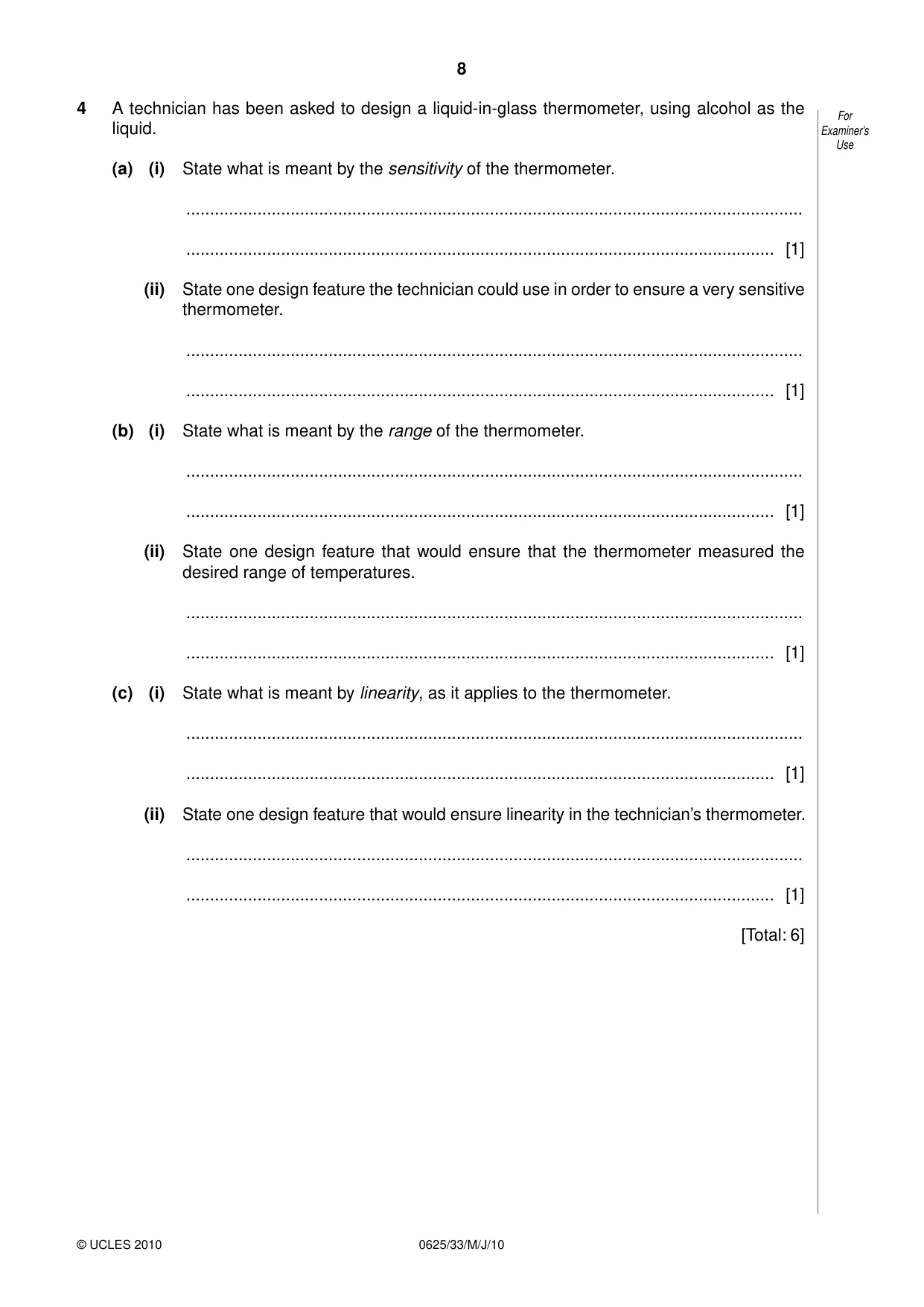
4 A technician has been asked to design a liquid-in-glass thermometer, using alcohol as the For liquid. Examiner’s Use (a) (i) State what is meant by the sensitivity of the thermometer. .................................................................................................................................. ............................................................................................................................ [1] (ii) State one design feature the technician could use in order to ensure a very sensitive thermometer. .................................................................................................................................. ............................................................................................................................ [1] (b) (i) State what is meant by the range of the thermometer. .................................................................................................................................. ............................................................................................................................ [1] (ii) State one design feature that would ensure that the thermometer measured the desired range of temperatures. .................................................................................................................................. ............................................................................................................................ [1] (c) (i) State what is meant by linearity, as it applies to the thermometer. .................................................................................................................................. ............................................................................................................................ [1] (ii) State one design feature that would ensure linearity in the technician’s thermometer. .................................................................................................................................. ............................................................................................................................ [1] [Total: 6]
Mark scheme: 4 (a) (i) change in length / distance moved (accept “how much it expands”) per unit / given temp rise OR equivalent B1 (ii) large bulb OR thin / narrow bore / tube / capillary NOT thin / narrow thermometer B1 (b) (i) difference between the highest and lowest temperatures ignore reference to fixed points B1 (ii) tube (sufficiently) long / not too short OR bore wide/not too thin OR little/not too much liquid/bulb NOT change liquid B1 (c) (i) idea of equal size divisions/expansion for equal temperature rises OR ∆l / ∆θ constant OR reference to l against θ graph straight line ignore 1 division = 1 °C B1 (ii) uniform bore OR alcohol/liquid expands uniformly (with temp) B1 [6] IGCSE – May/June 2010 0625 33
Q5 · The apparatus shown in Fig
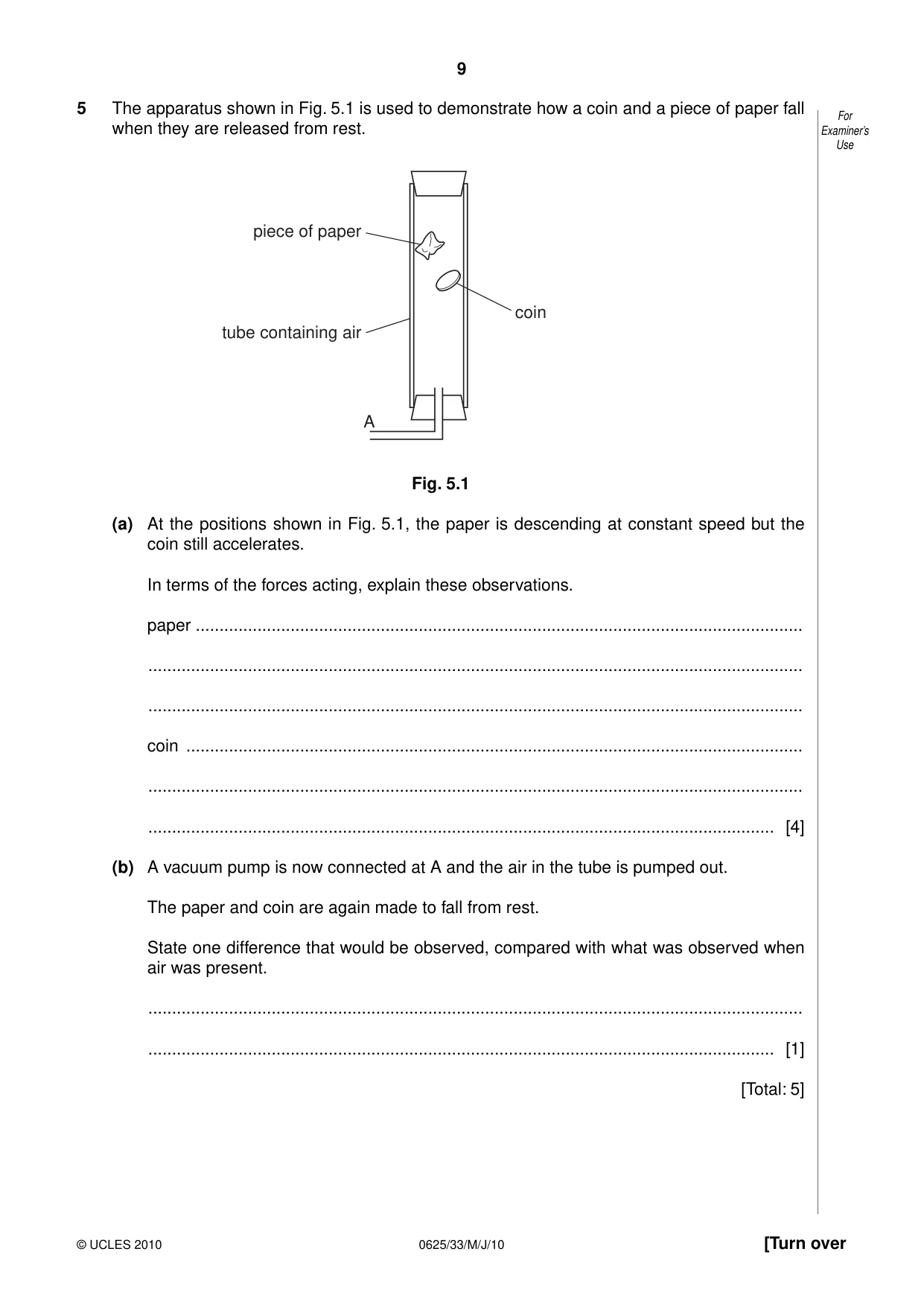
5 The apparatus shown in Fig. 5.1 is used to demonstrate how a coin and a piece of paper fall For when they are released from rest. Examiner’s Use piece of paper coin tube containing air A Fig. 5.1 (a) At the positions shown in Fig. 5.1, the paper is descending at constant speed but the coin still accelerates. In terms of the forces acting, explain these observations. paper ................................................................................................................................ .......................................................................................................................................... .......................................................................................................................................... coin .................................................................................................................................. .......................................................................................................................................... .................................................................................................................................... [4] (b) A vacuum pump is now connected at A and the air in the tube is pumped out. The paper and coin are again made to fall from rest. State one difference that would be observed, compared with what was observed when air was present. .......................................................................................................................................... .................................................................................................................................... [1] [Total: 5]
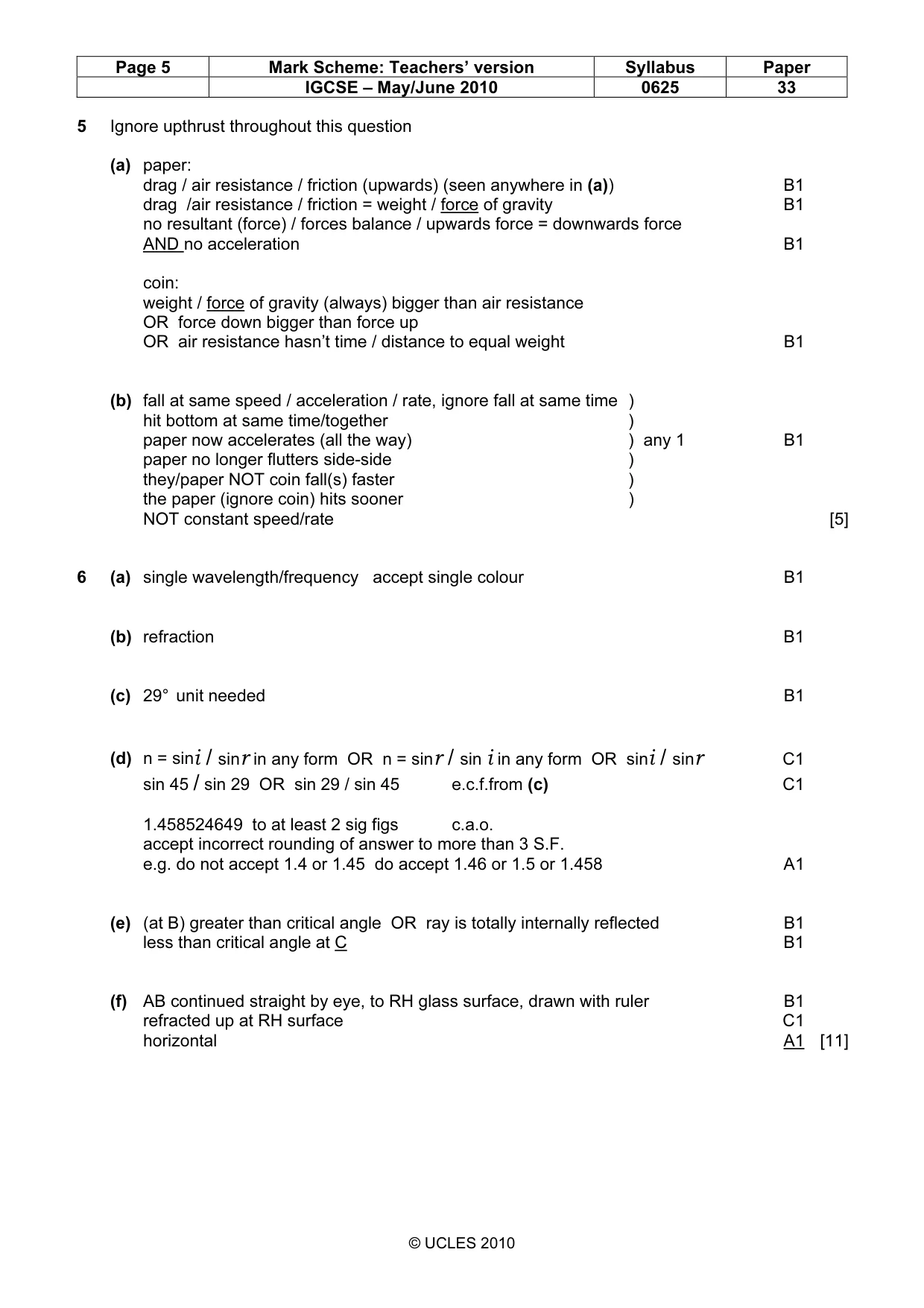
Mark scheme: 5 Ignore upthrust throughout this question (a) paper: drag / air resistance / friction (upwards) (seen anywhere in (a)) B1 drag /air resistance / friction = weight / force of gravity B1 no resultant (force) / forces balance / upwards force = downwards force AND no acceleration B1 coin: weight / force of gravity (always) bigger than air resistance OR force down bigger than force up OR air resistance hasn’t time / distance to equal weight B1 (b) fall at same speed / acceleration / rate, ignore fall at same time ) hit bottom at same time/together ) paper now accelerates (all the way) ) any 1 B1 paper no longer flutters side-side ) they/paper NOT coin fall(s) faster ) the paper (ignore coin) hits sooner ) NOT constant speed/rate [5]
Q6 · A ray of monochromatic light passes through the glass prism shown in Fig
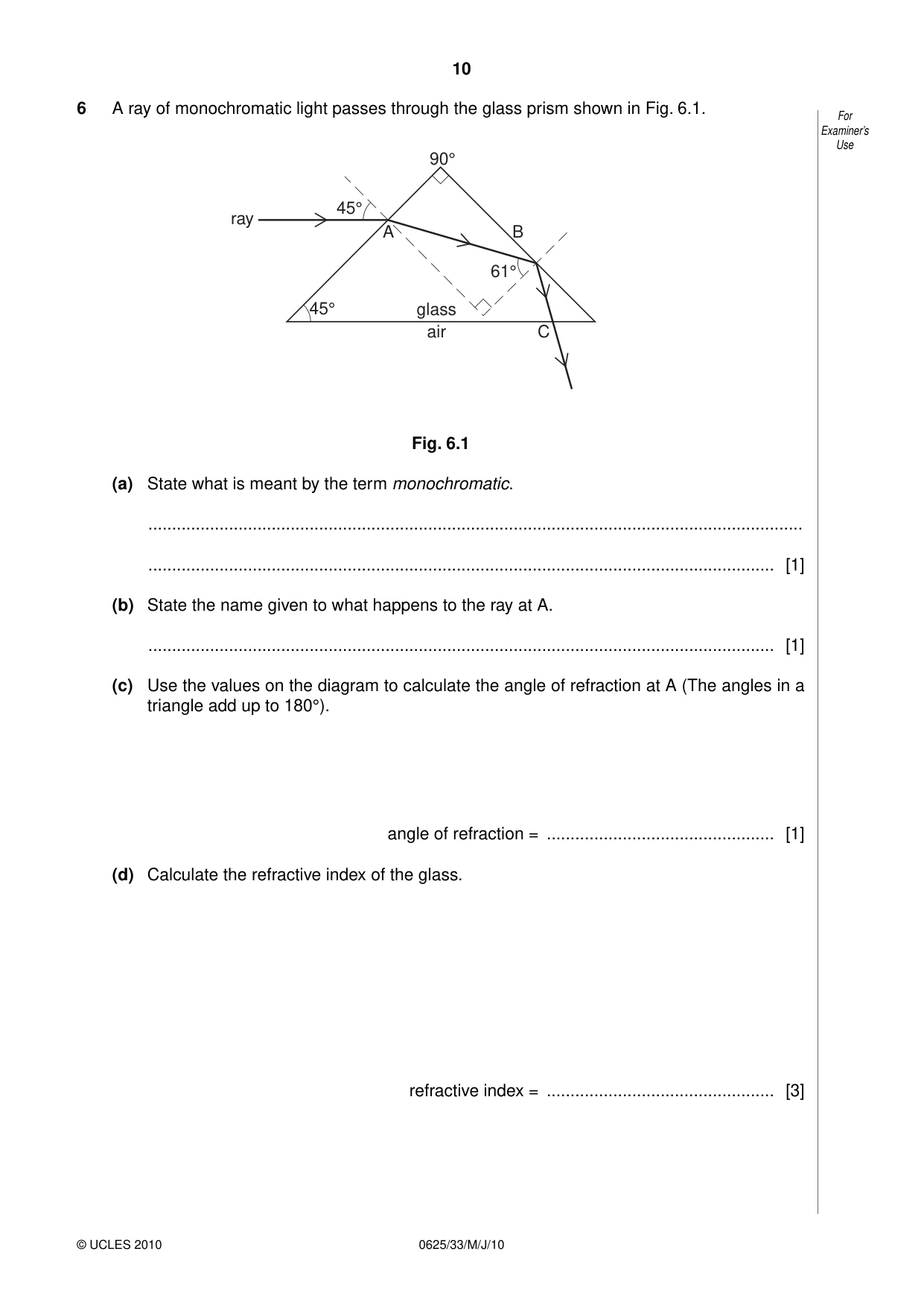
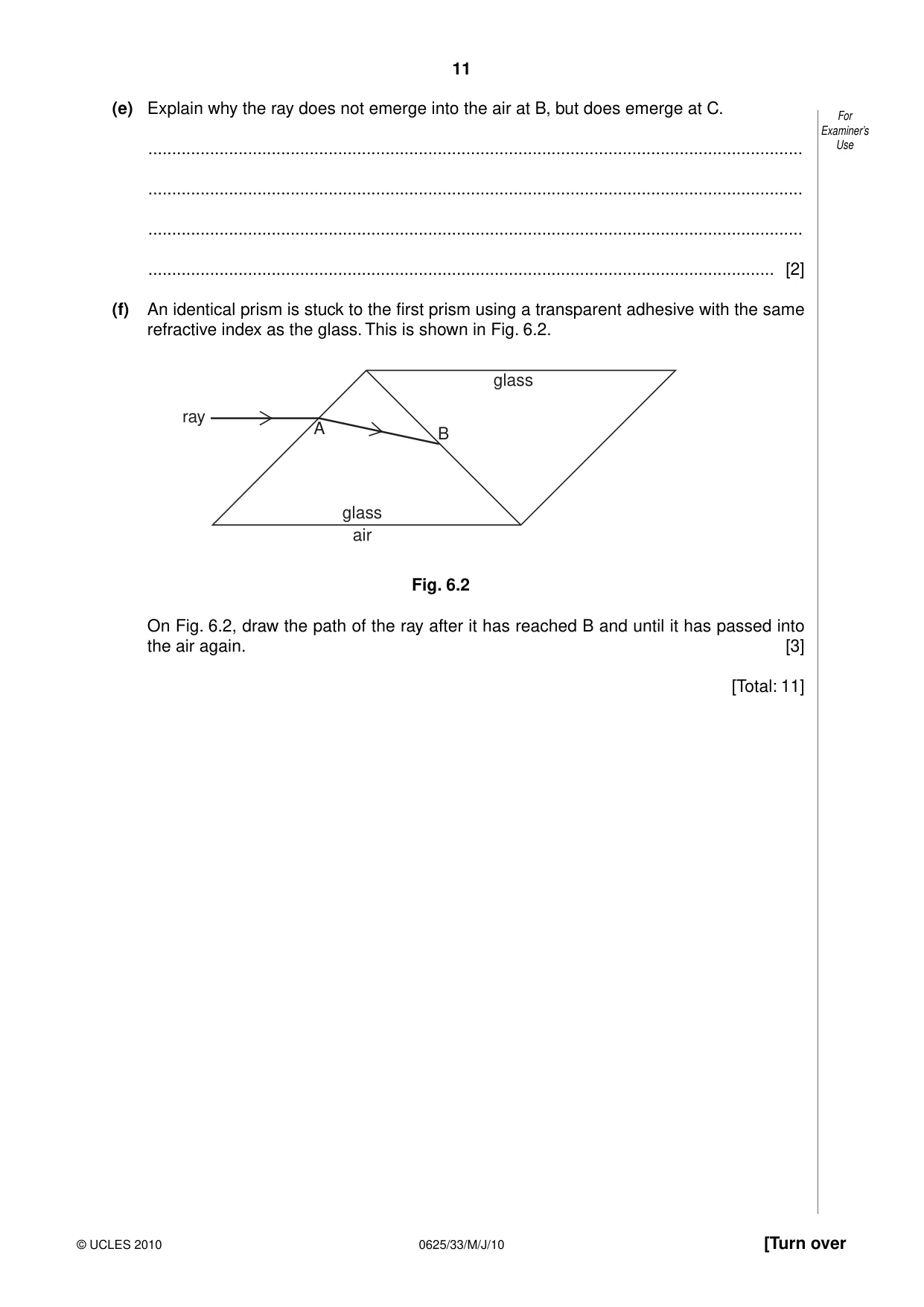
6 A ray of monochromatic light passes through the glass prism shown in Fig. 6.1. For Examiner’s Use 90° 45° ray A B 61° 45° glass air C Fig. 6.1 (a) State what is meant by the term monochromatic. .......................................................................................................................................... .................................................................................................................................... [1] (b) State the name given to what happens to the ray at A. .................................................................................................................................... [1] (c) Use the values on the diagram to calculate the angle of refraction at A (The angles in a triangle add up to 180°). angle of refraction = ................................................ [1] (d) Calculate the refractive index of the glass. refractive index = ................................................ [3] (e) Explain why the ray does not emerge into the air at B, but does emerge at C. For Examiner’s .......................................................................................................................................... Use .......................................................................................................................................... .......................................................................................................................................... .................................................................................................................................... [2] (f) An identical prism is stuck to the first prism using a transparent adhesive with the same refractive index as the glass. This is shown in Fig. 6.2. glass ray A B glass air Fig. 6.2 On Fig. 6.2, draw the path of the ray after it has reached B and until it has passed into the air again. [3] [Total: 11]
Mark scheme: 6 (a) single wavelength/frequency accept single colour B1 (b) refraction B1 (c) 29° unit needed B1 (d) n = sini / sinr in any form OR n = sinr / sin i in any form OR sini / sinr C1 sin 45 / sin 29 OR sin 29 / sin 45 e.c.f.from (c) C1 1.458524649 to at least 2 sig figs c.a.o. accept incorrect rounding of answer to more than 3 S.F. e.g. do not accept 1.4 or 1.45 do accept 1.46 or 1.5 or 1.458 A1 (e) (at B) greater than critical angle OR ray is totally internally reflected B1 less than critical angle at C B1 (f) AB continued straight by eye, to RH glass surface, drawn with ruler B1 refracted up at RH surface C1 horizontal A1 [11] IGCSE – May/June 2010 0625 33
Q7 · A disused railway line has a length of 300 m
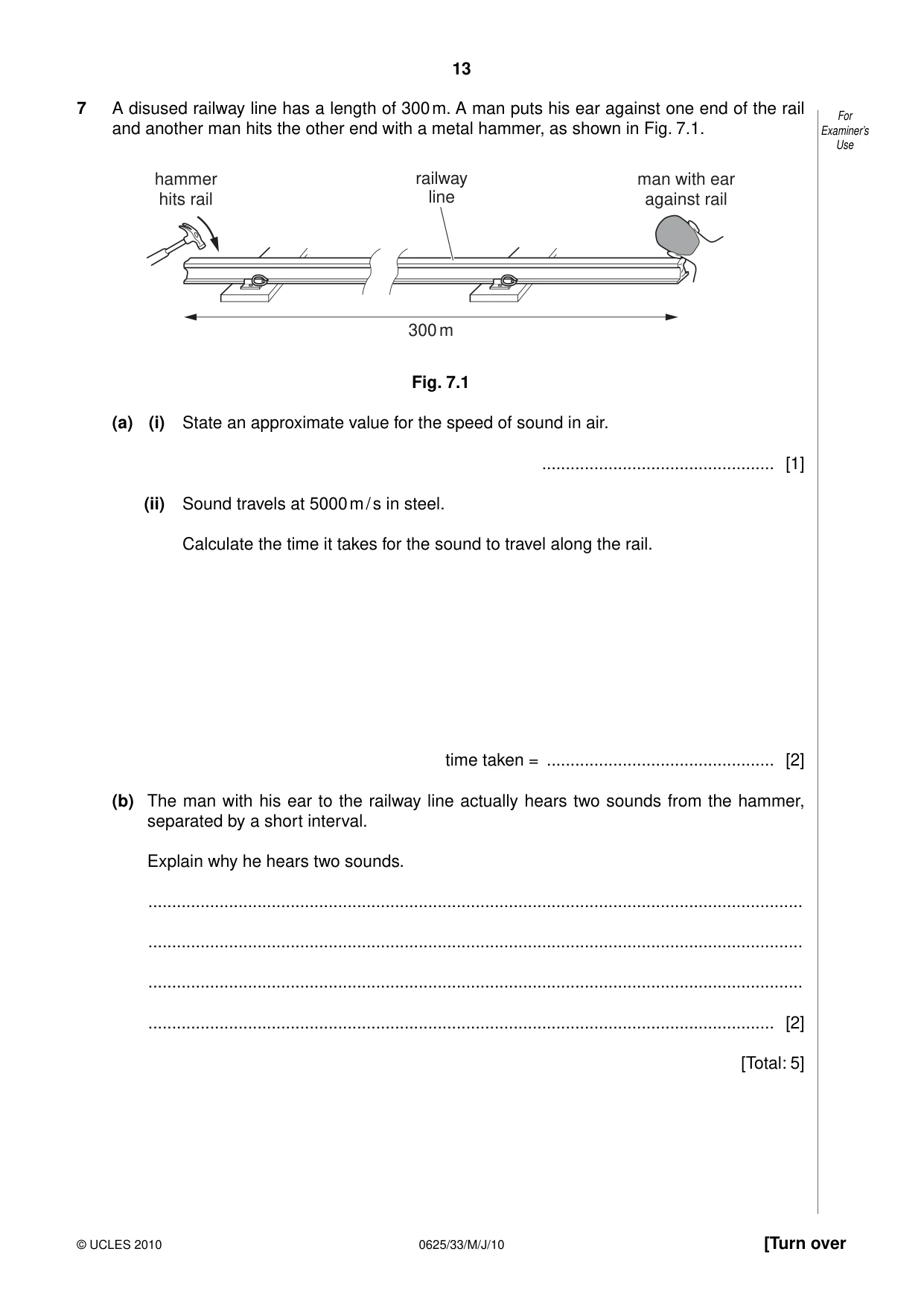
7 A disused railway line has a length of 300 m. A man puts his ear against one end of the rail For and another man hits the other end with a metal hammer, as shown in Fig. 7.1. Examiner’s Use hammer railway man with ear hits rail line against rail 300 m Fig. 7.1 (a) (i) State an approximate value for the speed of sound in air. ................................................. [1] (ii) Sound travels at 5000 m / s in steel. Calculate the time it takes for the sound to travel along the rail. time taken = ................................................ [2] (b) The man with his ear to the railway line actually hears two sounds from the hammer, separated by a short interval. Explain why he hears two sounds. .......................................................................................................................................... .......................................................................................................................................... .......................................................................................................................................... .................................................................................................................................... [2] [Total: 5]
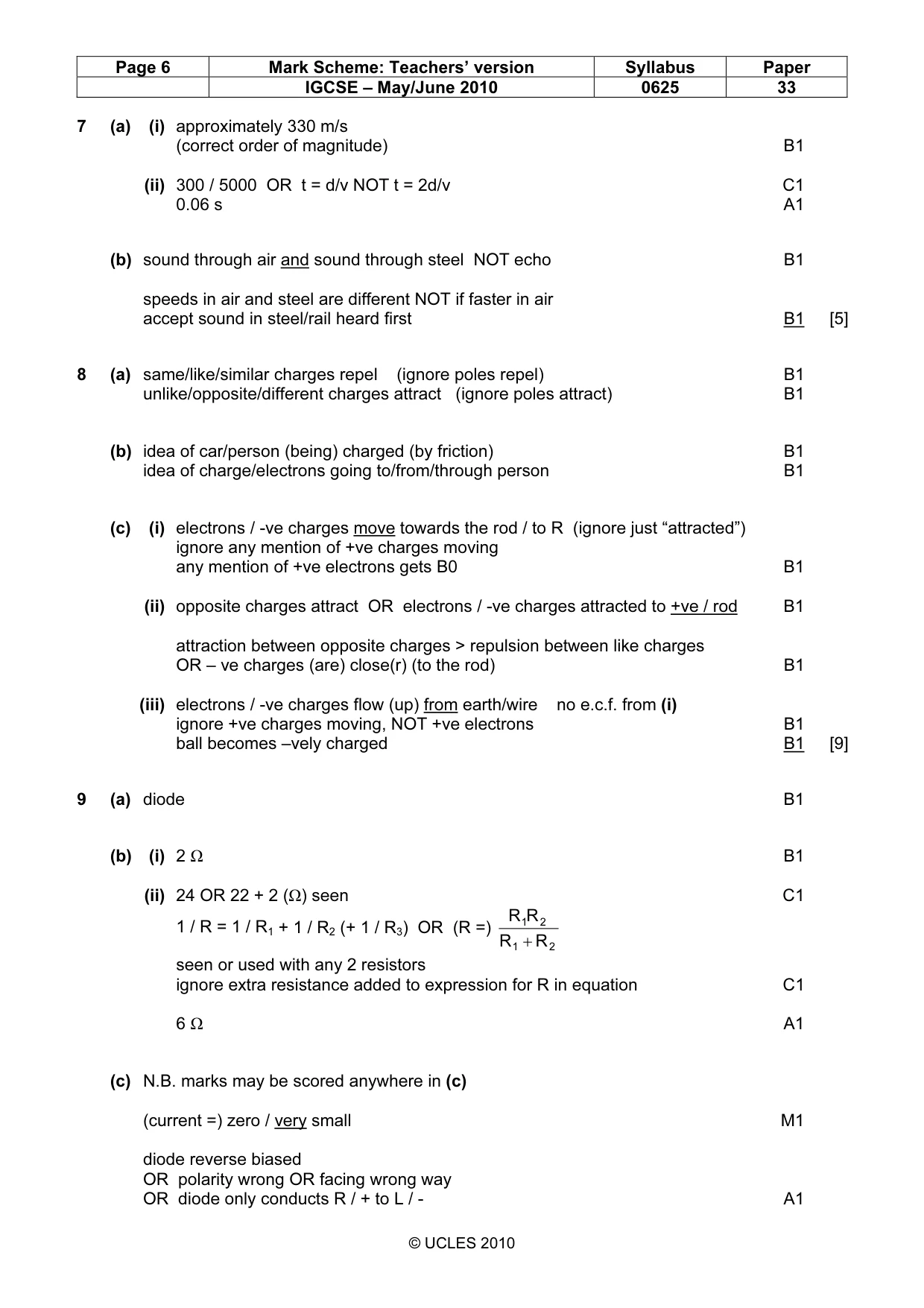
Mark scheme: 7 (a) (i) approximately 330 m/s (correct order of magnitude) B1 (ii) 300 / 5000 OR t = d/v NOT t = 2d/v C1 0.06 s A1 (b) sound through air and sound through steel NOT echo B1 speeds in air and steel are different NOT if faster in air accept sound in steel/rail heard first B1 [5]
Q8 · State the law of attraction and repulsion between electrostatic charges
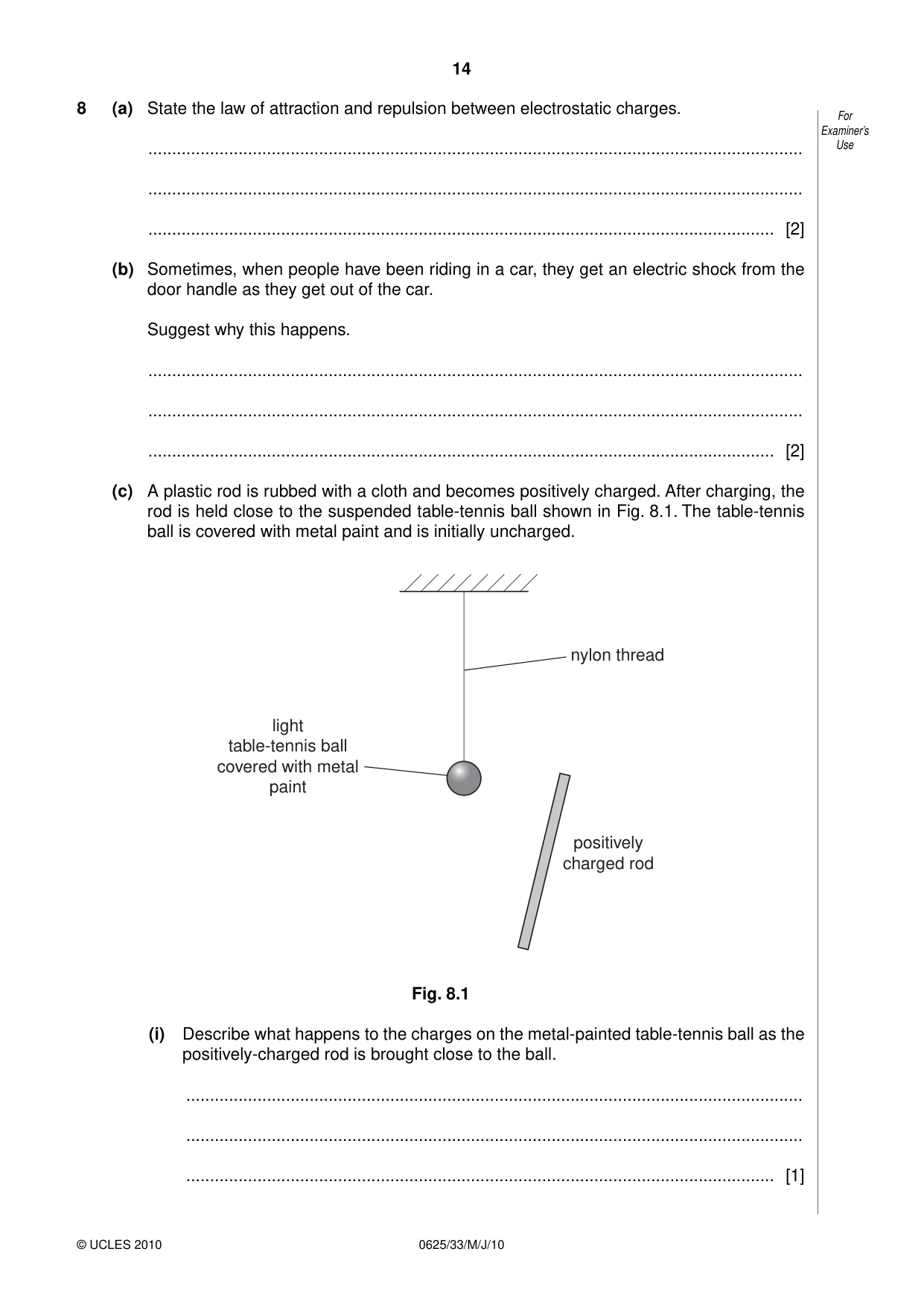
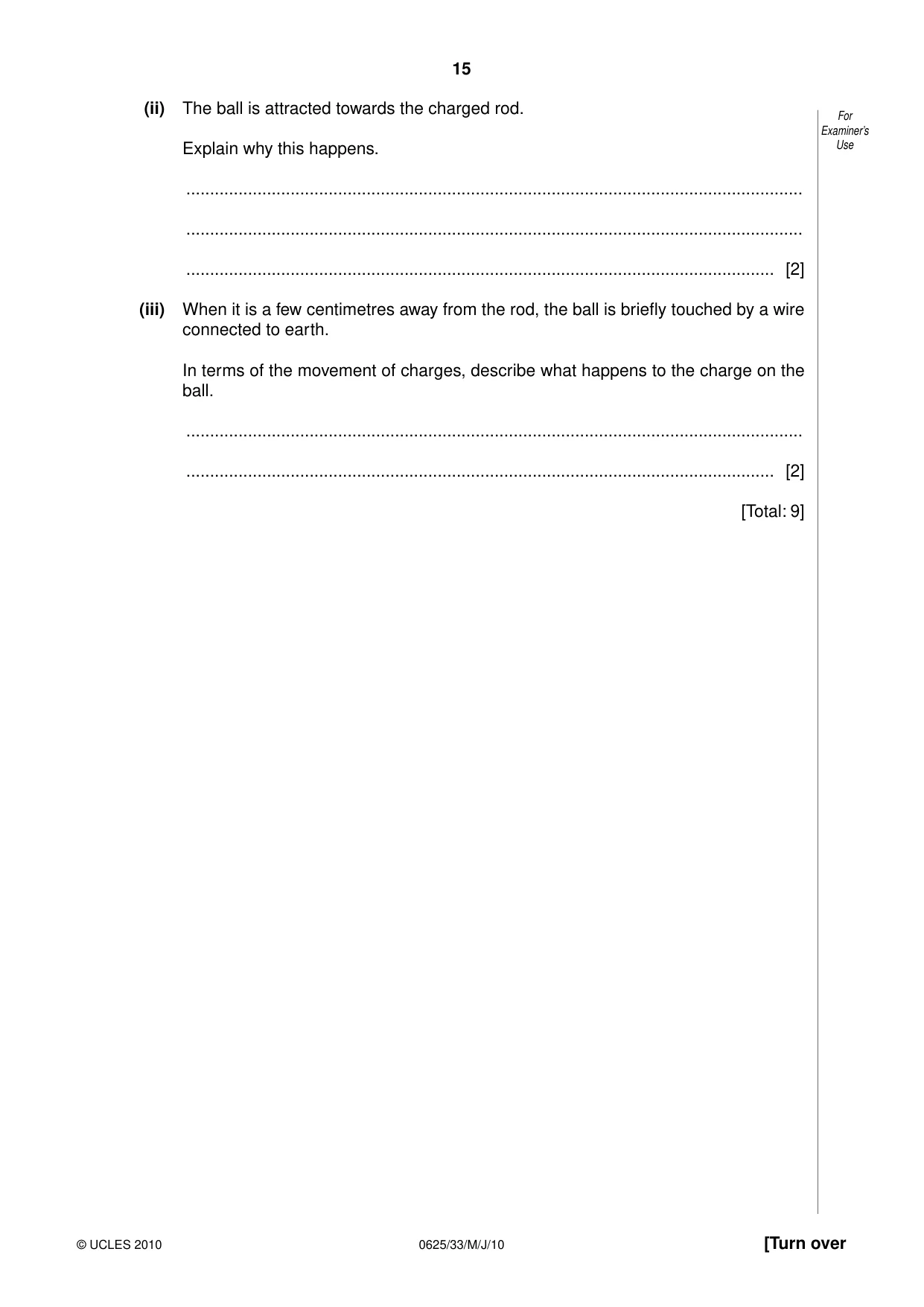
8 (a) State the law of attraction and repulsion between electrostatic charges. For Examiner’s .......................................................................................................................................... Use .......................................................................................................................................... .................................................................................................................................... [2] (b) Sometimes, when people have been riding in a car, they get an electric shock from the door handle as they get out of the car. Suggest why this happens. .......................................................................................................................................... .......................................................................................................................................... .................................................................................................................................... [2] (c) A plastic rod is rubbed with a cloth and becomes positively charged. After charging, the rod is held close to the suspended table-tennis ball shown in Fig. 8.1. The table-tennis ball is covered with metal paint and is initially uncharged. nylon thread light table-tennis ball covered with metal paint positively charged rod Fig. 8.1 (i) Describe what happens to the charges on the metal-painted table-tennis ball as the positively-charged rod is brought close to the ball. .................................................................................................................................. .................................................................................................................................. ............................................................................................................................ [1] (ii) The ball is attracted towards the charged rod. For Examiner’s Explain why this happens. Use .................................................................................................................................. .................................................................................................................................. ............................................................................................................................ [2] (iii) When it is a few centimetres away from the rod, the ball is briefly touched by a wire connected to earth. In terms of the movement of charges, describe what happens to the charge on the ball. .................................................................................................................................. ............................................................................................................................ [2] [Total: 9]
Mark scheme: 8 (a) same/like/similar charges repel (ignore poles repel) B1 unlike/opposite/different charges attract (ignore poles attract) B1 (b) idea of car/person (being) charged (by friction) B1 idea of charge/electrons going to/from/through person B1 (c) (i) electrons / -ve charges move towards the rod / to R (ignore just “attracted”) ignore any mention of +ve charges moving any mention of +ve electrons gets B0 B1 (ii) opposite charges attract OR electrons / -ve charges attracted to +ve / rod B1 attraction between opposite charges > repulsion between like charges OR – ve charges (are) close(r) (to the rod) B1 (iii) electrons / -ve charges flow (up) from earth/wire no e.c.f. from (i) ignore +ve charges moving, NOT +ve electrons B1 ball becomes –vely charged B1 [9]
Q9 · The circuit in Fig
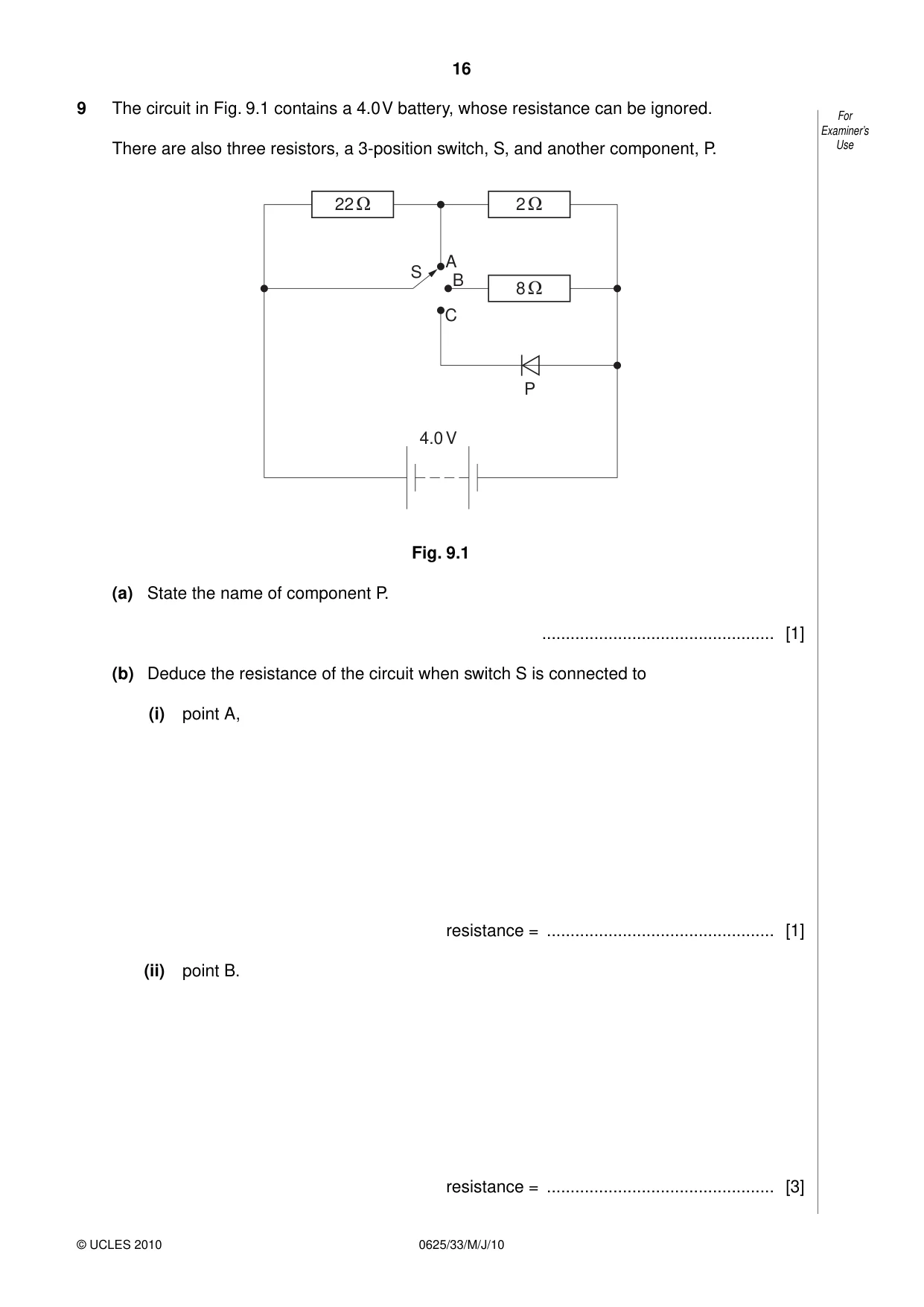
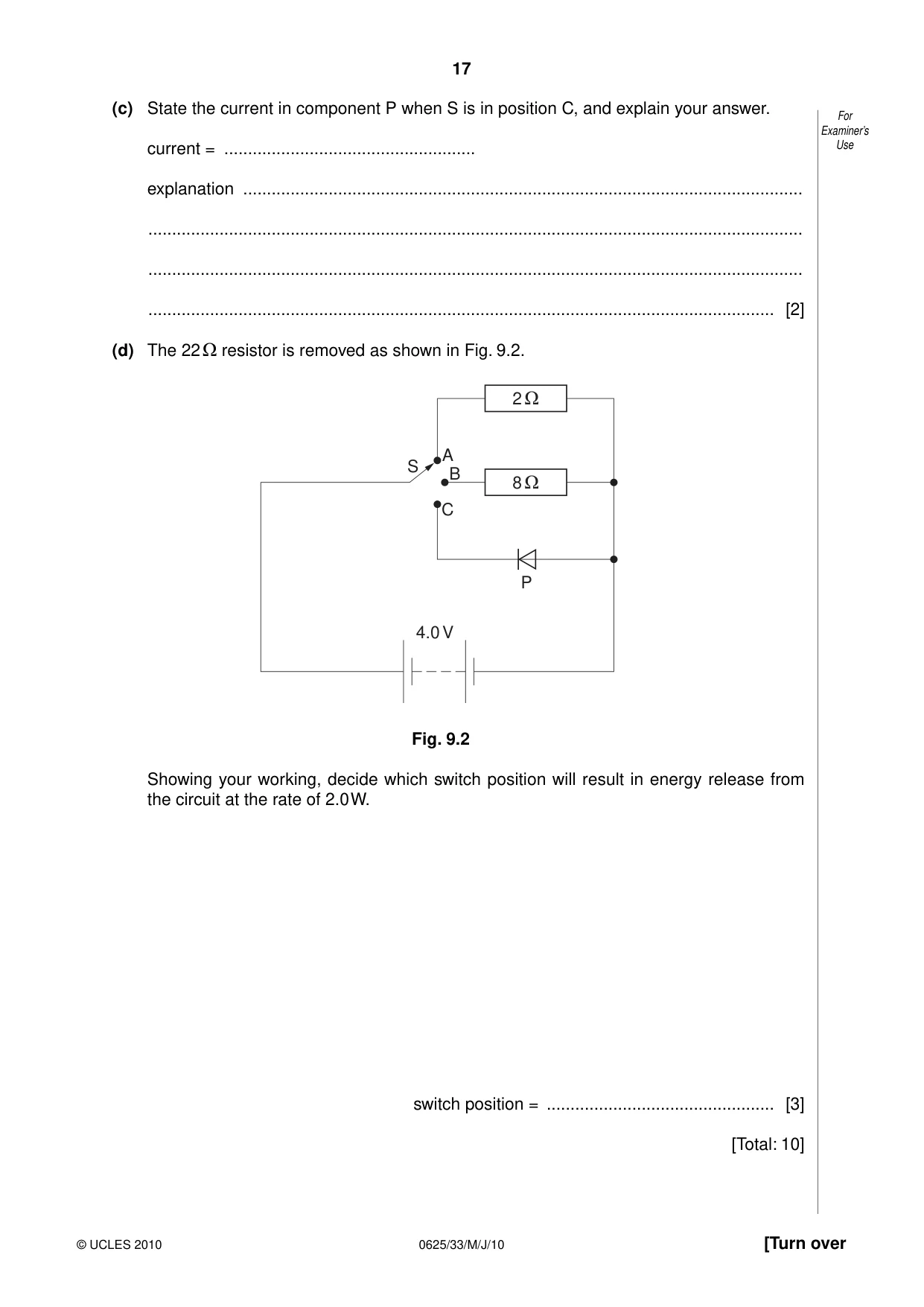
9 The circuit in Fig. 9.1 contains a 4.0 V battery, whose resistance can be ignored. For Examiner’s There are also three resistors, a 3-position switch, S, and another component, P. Use 22 2 A S B 8 C P 4.0 V Fig. 9.1 (a) State the name of component P. ................................................. [1] (b) Deduce the resistance of the circuit when switch S is connected to (i) point A, resistance = ................................................ [1] (ii) point B. resistance = ................................................ [3] (c) State the current in component P when S is in position C, and explain your answer. For Examiner’s current = ..................................................... Use explanation ...................................................................................................................... .......................................................................................................................................... .......................................................................................................................................... .................................................................................................................................... [2] (d) The 22 resistor is removed as shown in Fig. 9.2. 2 A S B 8 C P 4.0 V Fig. 9.2 Showing your working, decide which switch position will result in energy release from the circuit at the rate of 2.0 W. switch position = ................................................ [3] [Total: 10]
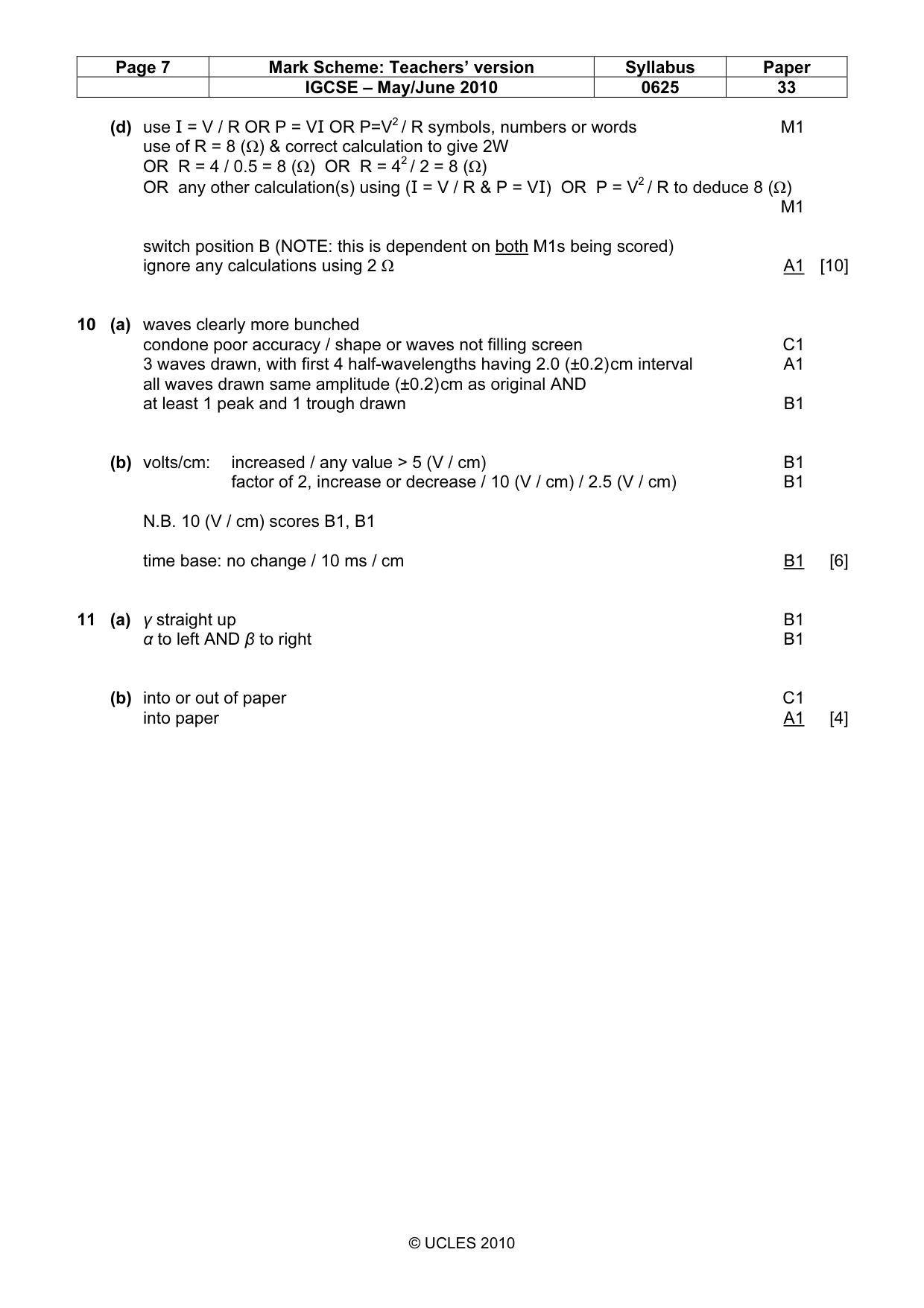
Mark scheme: 9 (a) diode B1 (b) (i) 2 Ω B1 (ii) 24 OR 22 + 2 (Ω) seen C1 R 1R 2 1 / R = 1 / R1 + 1 / R2 (+ 1 / R3) OR (R =) R 1 + R 2 seen or used with any 2 resistors ignore extra resistance added to expression for R in equation C1 6 Ω A1 (c) N.B. marks may be scored anywhere in (c) (current =) zero / very small M1 diode reverse biased OR polarity wrong OR facing wrong way OR diode only conducts R / + to L / - A1 IGCSE – May/June 2010 0625 33 (d) use I = V / R OR P = VI OR P=V2 / R symbols, numbers or words M1 use of R = 8 (Ω) & correct calculation to give 2W OR R = 4 / 0.5 = 8 (Ω) OR R = 42 / 2 = 8 (Ω) OR any other calculation(s) using (I = V / R & P = VI) OR P = V2 / R to deduce 8 (Ω) M1 switch position B (NOTE: this is dependent on both M1s being scored) ignore any calculations using 2 Ω A1 [10]
Q10 · A student is using a cathode-ray oscilloscope to display the waveform of an alternating…
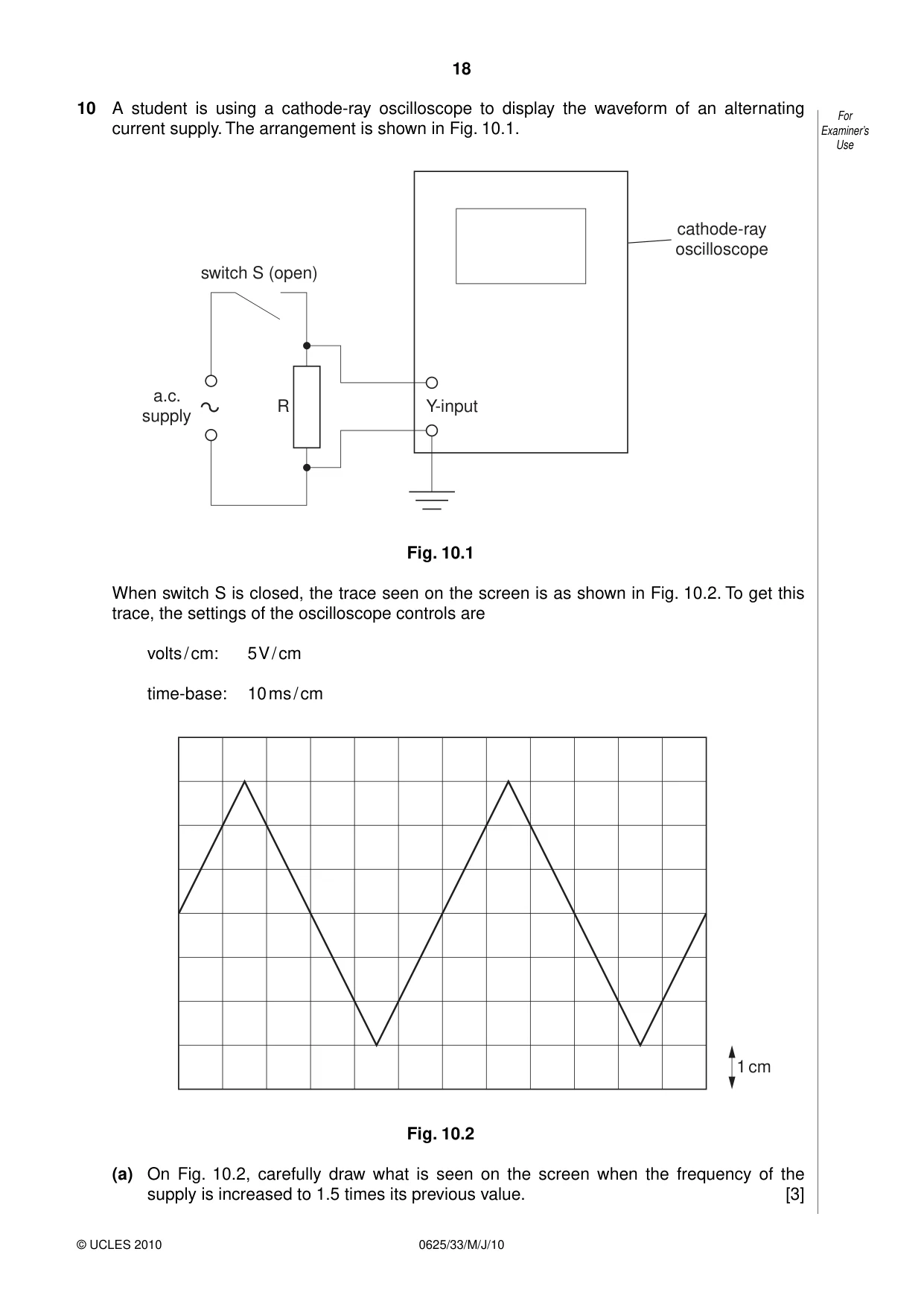
10 A student is using a cathode-ray oscilloscope to display the waveform of an alternating For current supply. The arrangement is shown in Fig. 10.1. Examiner’s Use cathode-ray oscilloscope switch S (open) a.c. R Y-input supply Fig. 10.1 When switch S is closed, the trace seen on the screen is as shown in Fig. 10.2. To get this trace, the settings of the oscilloscope controls are volts / cm: 5 V / cm time-base: 10 ms / cm 1 cm Fig. 10.2 (a) On Fig. 10.2, carefully draw what is seen on the screen when the frequency of the supply is increased to 1.5 times its previous value. [3] (b) What change, if any, must be made to the oscilloscope volts / cm and time-base controls For in order to reduce the peak-to-peak height of the trace to half that shown in Fig. 10.2? Examiner’s Use volts / cm setting ......................................................................................................... [2] time-base setting ....................................................................................................... [1] [Total: 6]
Mark scheme: 10 (a) waves clearly more bunched condone poor accuracy / shape or waves not filling screen C1 3 waves drawn, with first 4 half-wavelengths having 2.0 (±0.2) cm interval A1 all waves drawn same amplitude (±0.2) cm as original AND at least 1 peak and 1 trough drawn B1 (b) volts/cm: increased / any value > 5 (V / cm) B1 factor of 2, increase or decrease / 10 (V / cm) / 2.5 (V / cm) B1 N.B. 10 (V / cm) scores B1, B1 time base: no change / 10 ms / cm B1 [6]
Q11 · A radium source emits , and radiations
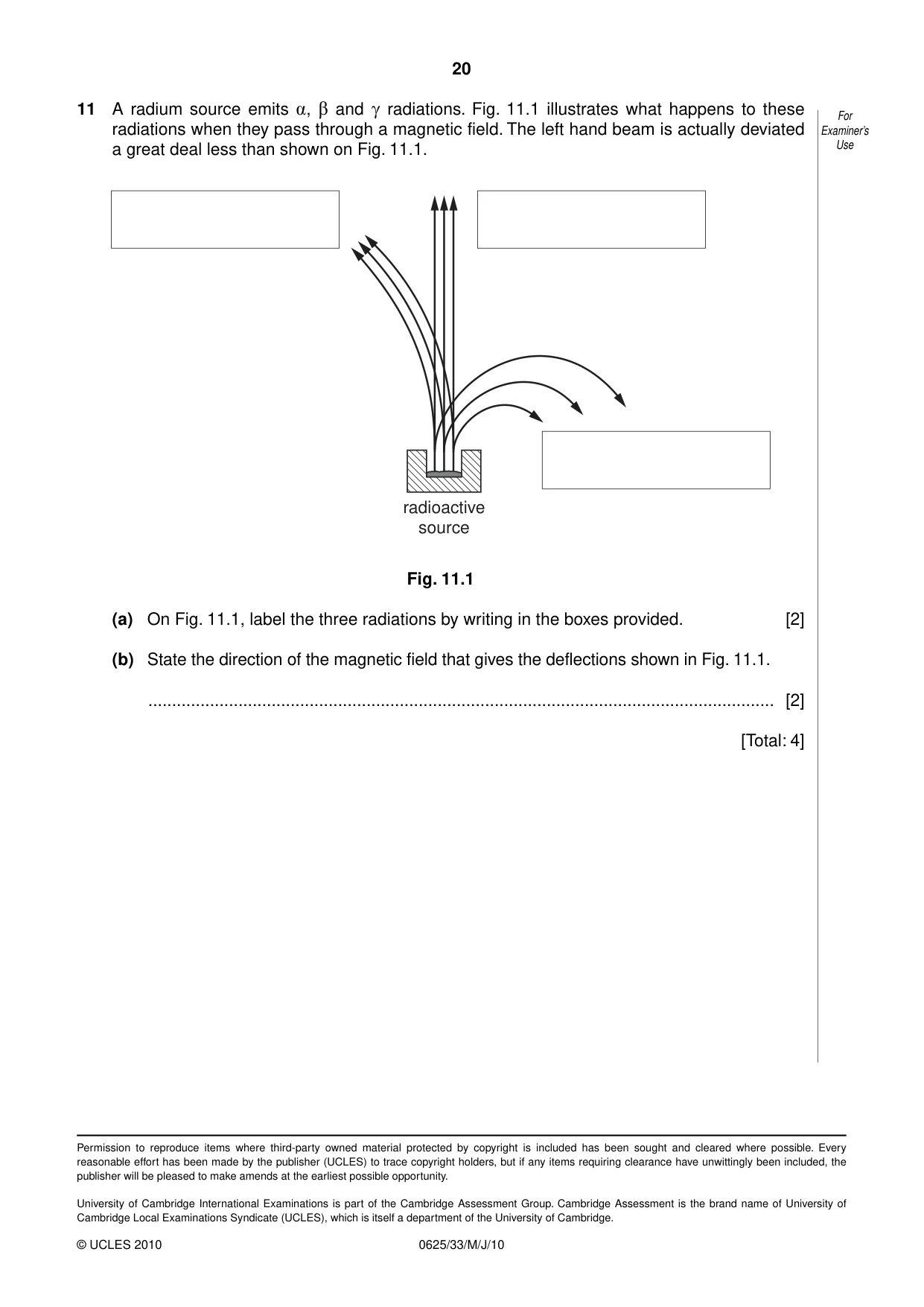
11 A radium source emits , and radiations. Fig. 11.1 illustrates what happens to these For radiations when they pass through a magnetic field. The left hand beam is actually deviated Examiner’s a great deal less than shown on Fig. 11.1. Use radioactive source Fig. 11.1 (a) On Fig. 11.1, label the three radiations by writing in the boxes provided. [2] (b) State the direction of the magnetic field that gives the deflections shown in Fig. 11.1. .................................................................................................................................... [2] [Total: 4]
Mark scheme: 11 (a) γ straight up B1 α to left AND β to right B1 (b) into or out of paper C1 into paper A1 [4]
What was in this paper
The subtopics covered by these 11 questions, and how many questions each got. Open one in a new tab to see every Cambridge question on it.
What you needed in this session
Cambridge’s own grade thresholds for 2010 May/June, Paper 3 · Variant 3. A higher threshold means an easier paper — the bar moves with how the cohort did.