Cambridge IGCSE Physics 0625 — 2015 May/June Paper 3 · Variant 3
0625/33/M/J/15 · 11 questions · 80 marks · ≈90 min
The question paper and its mark scheme, free to read here and free to download. This is Cambridge’s own paper, exactly as it was sat.
Question paper20 pages




Mark scheme7 pages
Answers below. Sit the paper first if you are practising.
Questions as text
Q1 · At a sports event, a champion runner and a car take part in a race
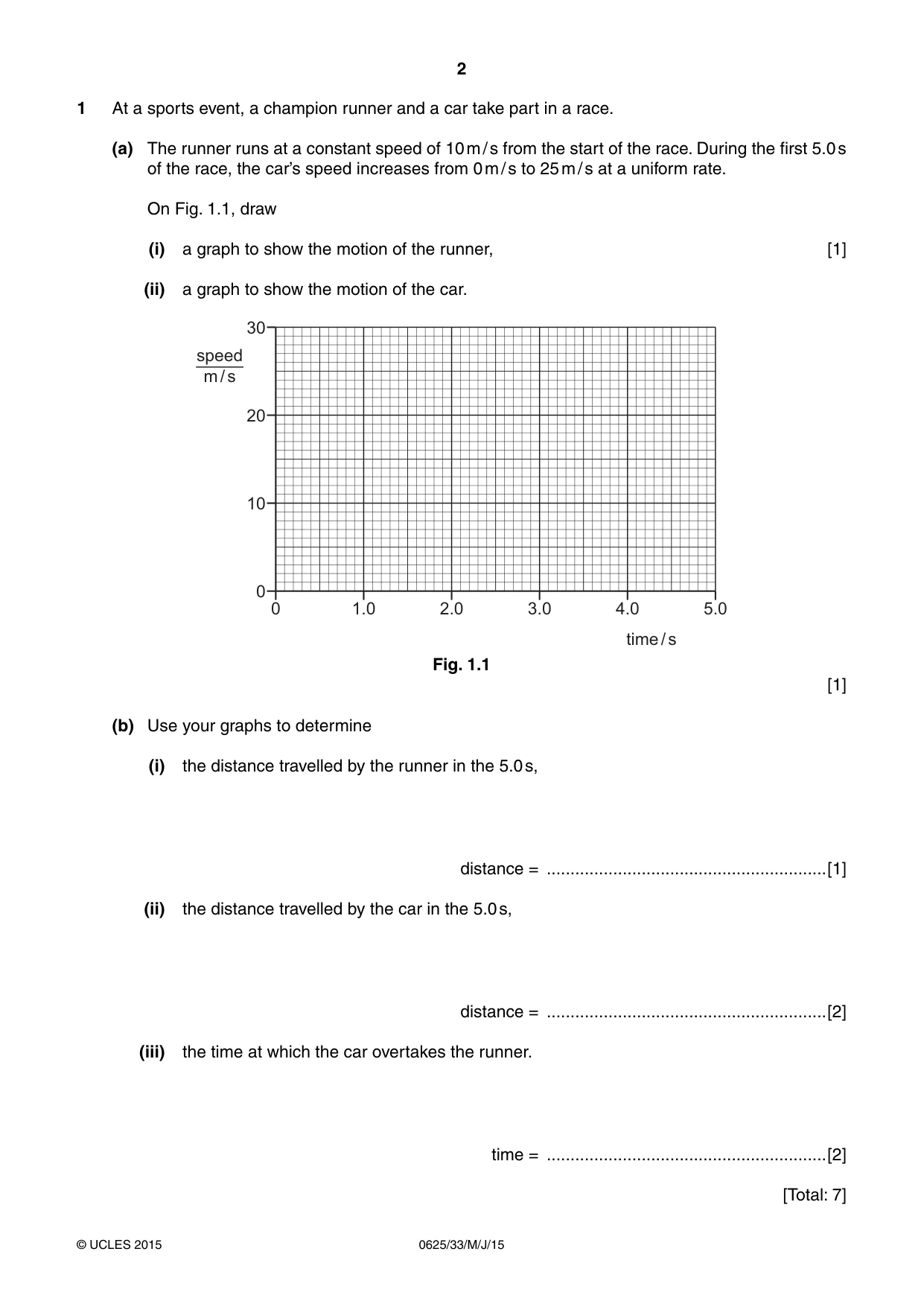
1 At a sports event, a champion runner and a car take part in a race. (a) The runner runs at a constant speed of 10 m / s from the start of the race. During the first 5.0 s of the race, the car’s speed increases from 0 m / s to 25 m / s at a uniform rate. On Fig. 1.1, draw (i) a graph to show the motion of the runner, [1] (ii) a graph to show the motion of the car. 30 speed m / s 20 10 0 0 1.0 2.0 3.0 4.0 5.0 time / s Fig. 1.1 [1] (b) Use your graphs to determine (i) the distance travelled by the runner in the 5.0 s, distance = ...........................................................[1] (ii) the distance travelled by the car in the 5.0 s, distance = ...........................................................[2] (iii) the time at which the car overtakes the runner. time = ...........................................................[2] [Total: 7]
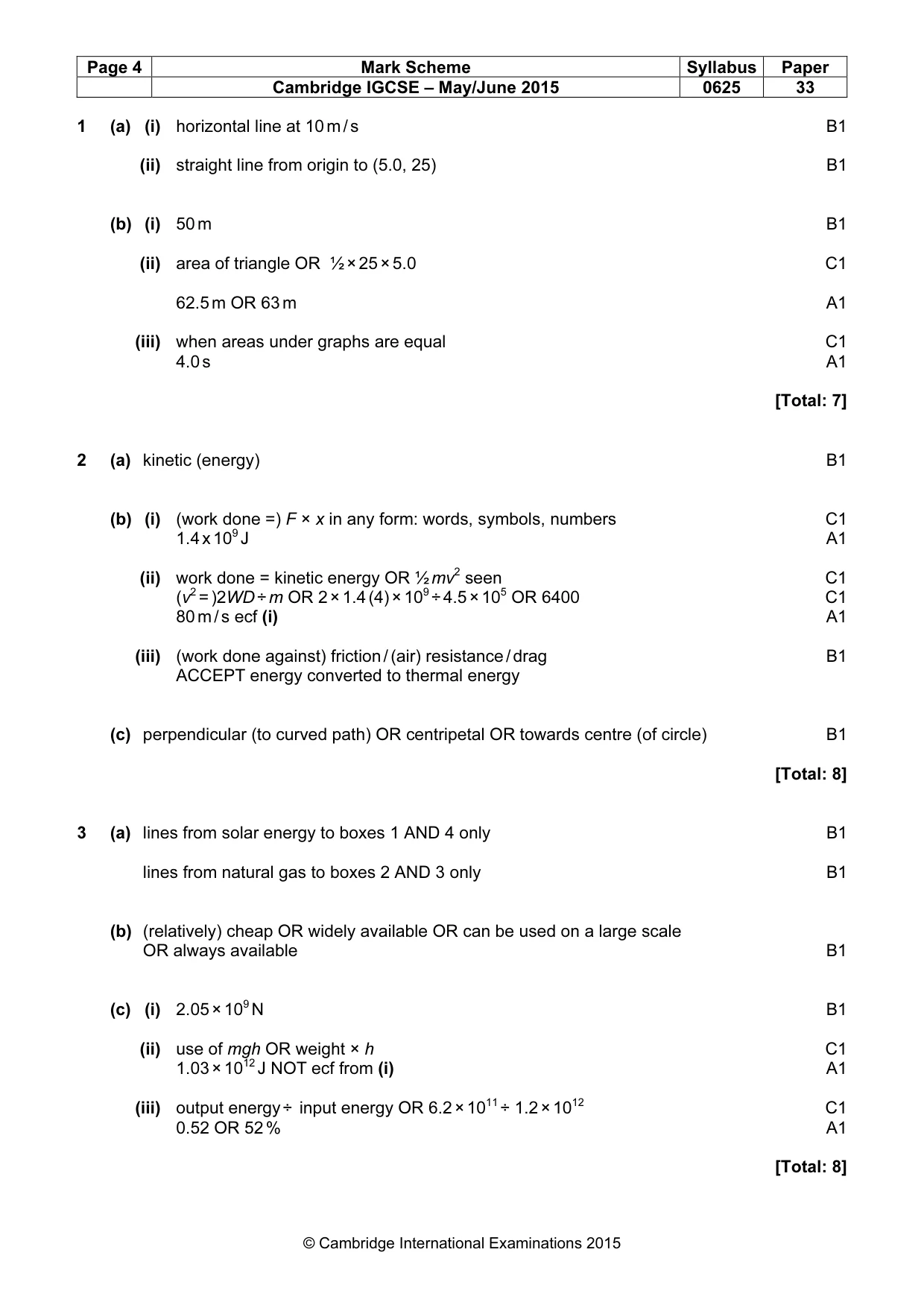
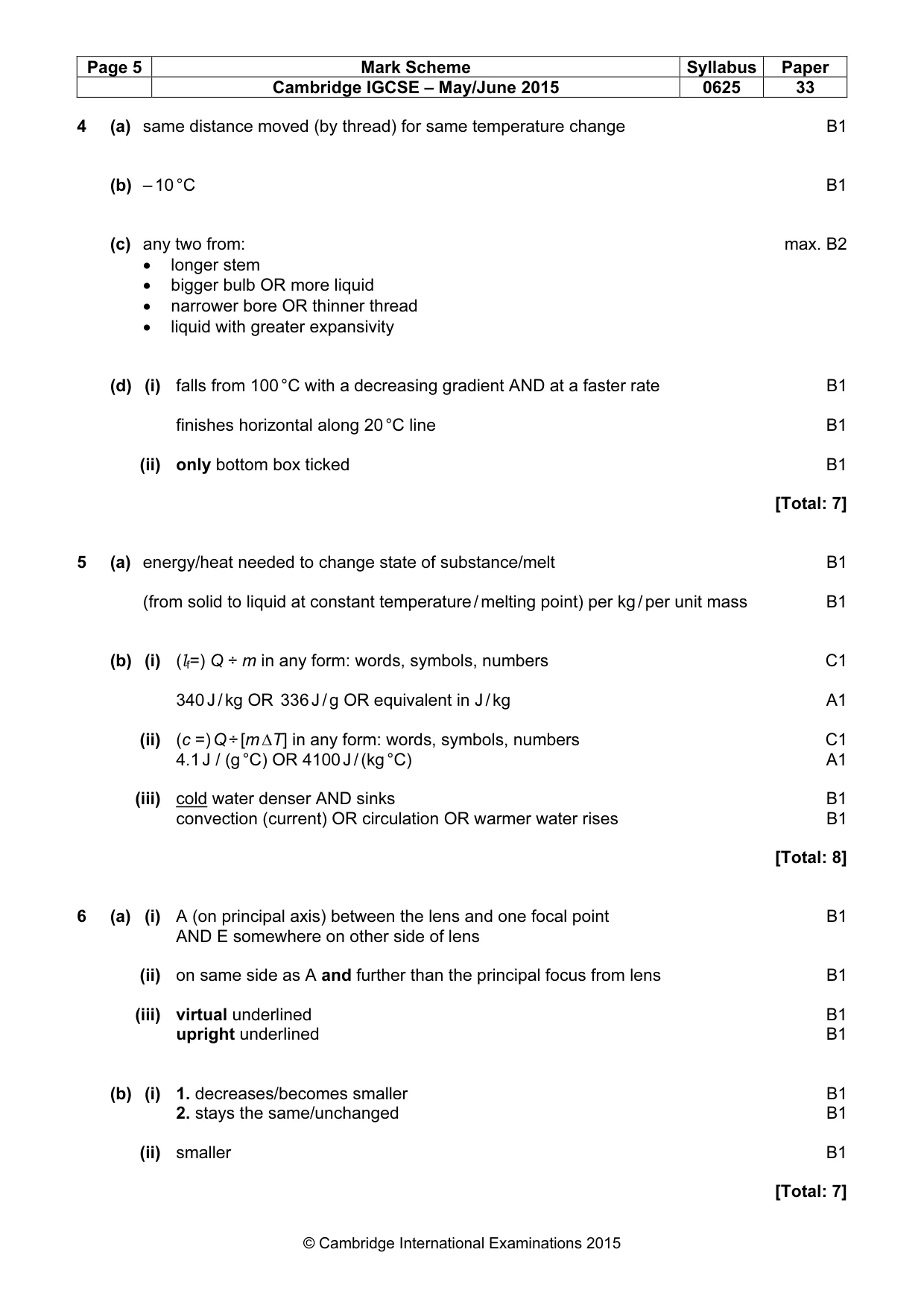
Mark scheme: 1 (a) (i) horizontal line at 10 m / s B1 (ii) straight line from origin to (5.0, 25) B1 (b) (i) 50 m B1 (ii) area of triangle OR ½ × 25 × 5.0 C1 62.5 m OR 63 m A1 (iii) when areas under graphs are equal C1 4.0 s A1 [Total: 7]
Q2 · An electric train is initially at rest at a railway station
2 An electric train is initially at rest at a railway station. The motor causes a constant force of 360 000 N to act on the train and the train begins to move. (a) State the form of energy gained by the train as it begins to move. ...............................................................................................................................................[1] (b) The train travels a distance of 4.0 km along a straight, horizontal track. (i) Calculate the work done on the train during this part of the journey. work done = ...........................................................[2] (ii) The mass of the train is 450 000 kg. Calculate the maximum possible speed of the train at the end of the first 4.0 km of the journey. maximum possible speed = ...........................................................[3] (iii) In practice, the speed of the train is much less than the value calculated in (ii). Suggest one reason why this is the case. ........................................................................................................................................... .......................................................................................................................................[1] (c) After travelling 4.0 km, the train reaches its maximum speed. It continues at this constant speed on the next section of the track where the track follows a curve which is part of a circle. State the direction of the resultant force on the train as it follows the curved path. ...............................................................................................................................................[1] [Total: 8]
Mark scheme: 2 (a) kinetic (energy) B1 (b) (i) (work done =) F × x in any form: words, symbols, numbers C1 1.4 x 10⁹ J A1 (ii) work done = kinetic energy OR ½ mv2 seen C1 (v2 = )2WD ÷ m OR 2 × 1.4 (4) × 109 ÷ 4.5 × 10⁵ OR 6400 C1 80 m / s ecf (i) A1 (iii) (work done against) friction / (air) resistance / drag B1 ACCEPT energy converted to thermal energy (c) perpendicular (to curved path) OR centripetal OR towards centre (of circle) B1 [Total: 8]
Q3 · The boxes on the left contain the names of some sources of energy
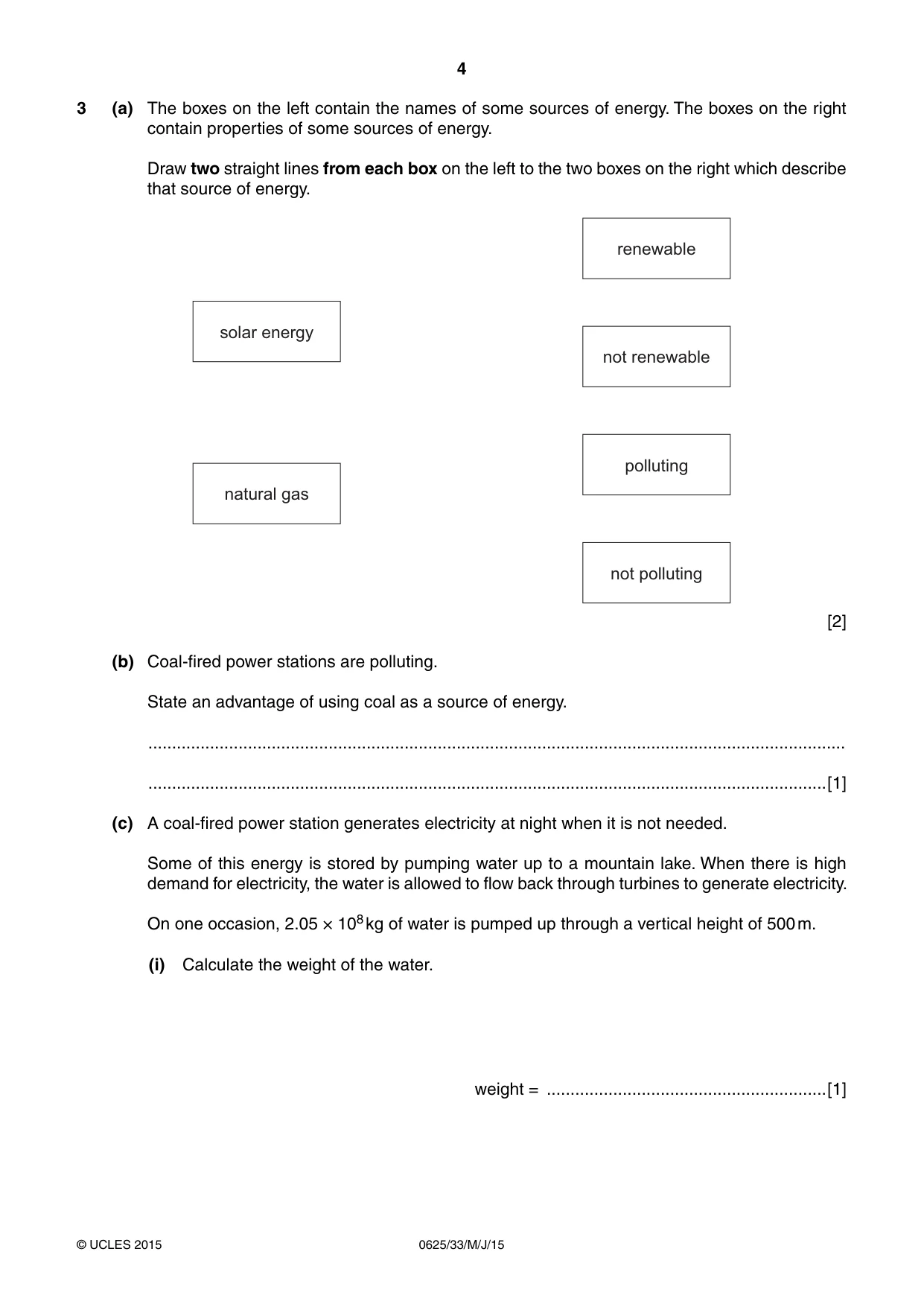
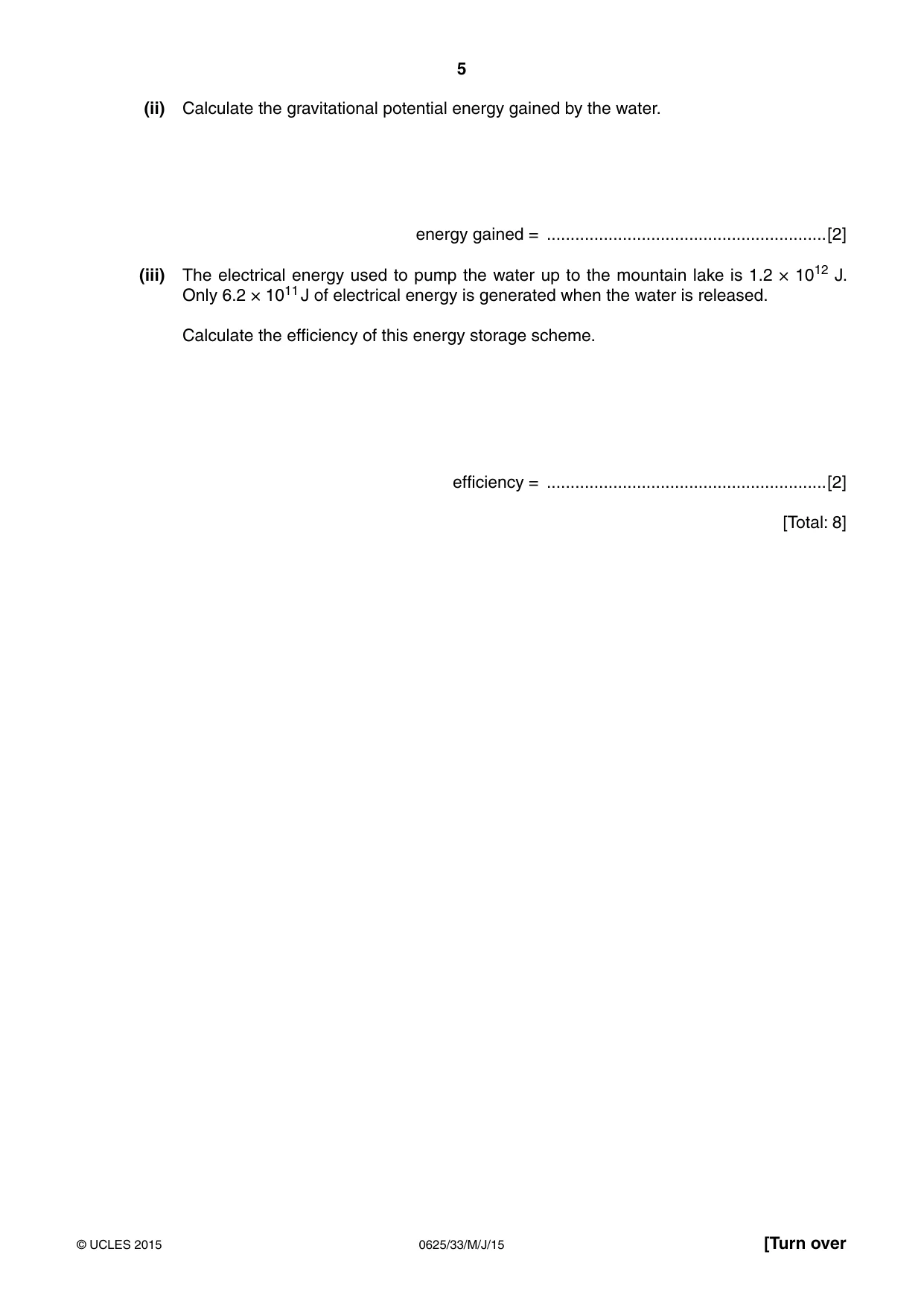
3 (a) The boxes on the left contain the names of some sources of energy. The boxes on the right contain properties of some sources of energy. Draw two straight lines from each box on the left to the two boxes on the right which describe that source of energy. renewable solar energy not renewable polluting natural gas not polluting [2] (b) Coal-fired power stations are polluting. State an advantage of using coal as a source of energy. ................................................................................................................................................... ...............................................................................................................................................[1] (c) A coal-fired power station generates electricity at night when it is not needed. Some of this energy is stored by pumping water up to a mountain lake. When there is high demand for electricity, the water is allowed to flow back through turbines to generate electricity. On one occasion, 2.05 × 10⁸ kg of water is pumped up through a vertical height of 500 m. (i) Calculate the weight of the water. weight = ...........................................................[1] (ii) Calculate the gravitational potential energy gained by the water. energy gained = ...........................................................[2] (iii) The electrical energy used to pump the water up to the mountain lake is 1.2 × 10¹² J. Only 6.2 × 10¹¹ J of electrical energy is generated when the water is released. Calculate the efficiency of this energy storage scheme. efficiency = ...........................................................[2] [Total: 8]
Mark scheme: 3 (a) lines from solar energy to boxes 1 AND 4 only B1 lines from natural gas to boxes 2 AND 3 only B1 (b) (relatively) cheap OR widely available OR can be used on a large scale OR always available B1 (c) (i) 2.05 × 10⁹ N B1 (ii) use of mgh OR weight × h C1 1.03 × 10¹² J NOT ecf from (i) A1 (iii) output energy ÷ input energy OR 6.2 × 10¹¹ ÷ 1.2 × 10¹² C1 0.52 OR 52 % A1 [Total: 8]
Q4 · A liquid-in-glass thermometer has a linear scale and a range of 120 °C
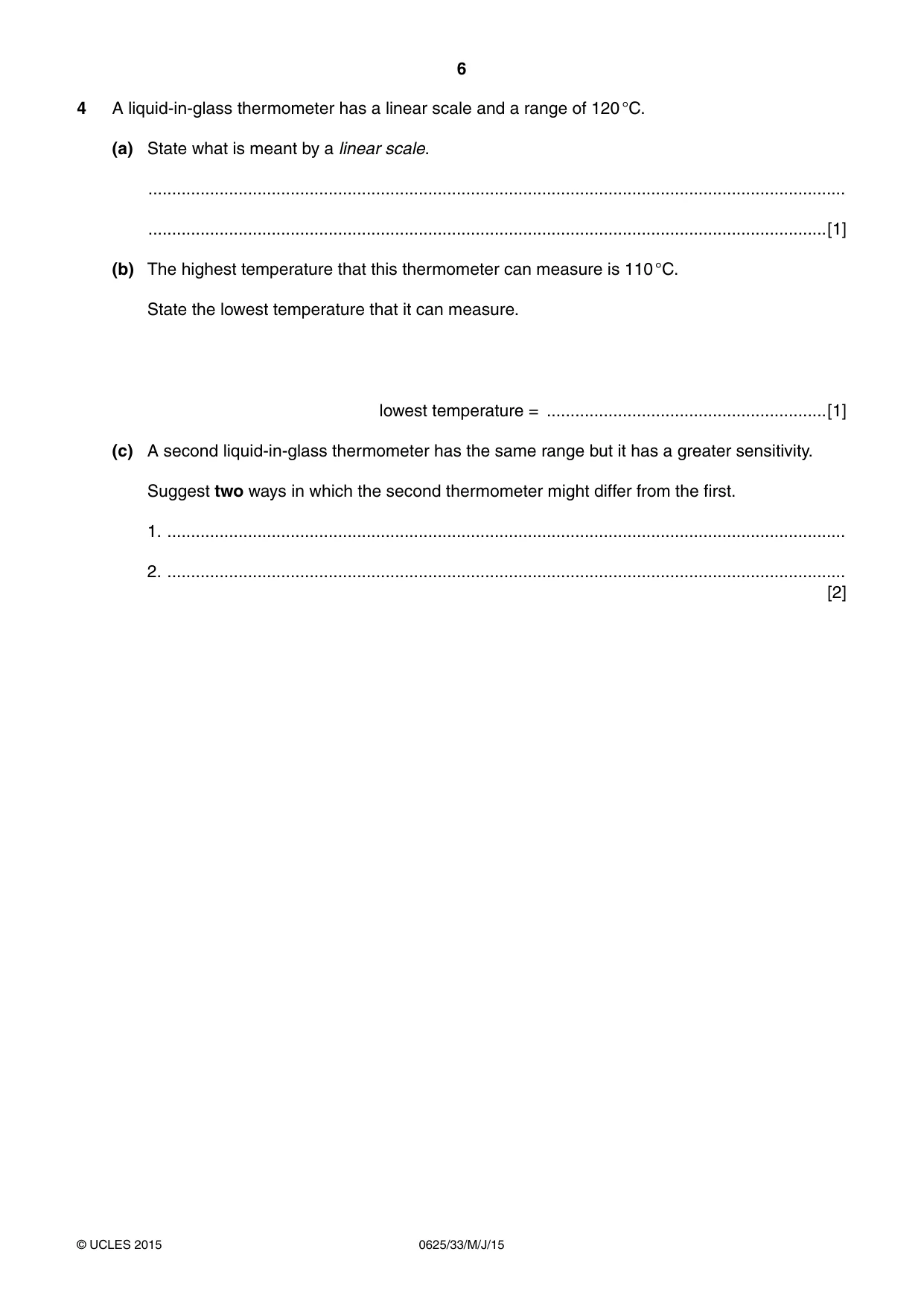
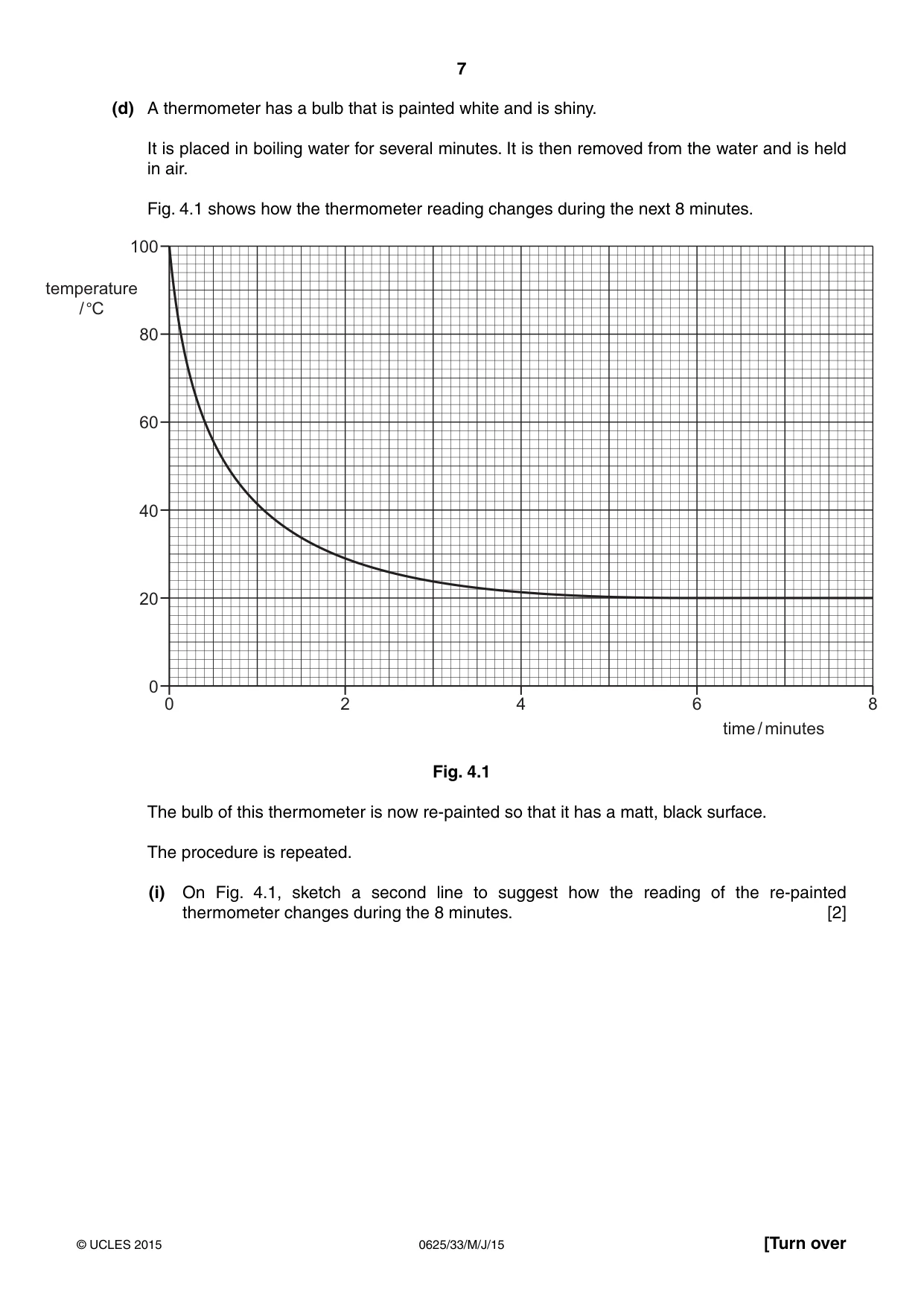
4 A liquid-in-glass thermometer has a linear scale and a range of 120 °C. (a) State what is meant by a linear scale. ................................................................................................................................................... ...............................................................................................................................................[1] (b) The highest temperature that this thermometer can measure is 110 °C. State the lowest temperature that it can measure. lowest temperature = ...........................................................[1] (c) A second liquid-in-glass thermometer has the same range but it has a greater sensitivity. Suggest two ways in which the second thermometer might differ from the first. 1. ............................................................................................................................................... 2. ............................................................................................................................................... [2] (d) A thermometer has a bulb that is painted white and is shiny. It is placed in boiling water for several minutes. It is then removed from the water and is held in air. Fig. 4.1 shows how the thermometer reading changes during the next 8 minutes. 100 temperature / °C 80 60 40 20 0 0 2 4 6 8 time / minutes Fig. 4.1 The bulb of this thermometer is now re-painted so that it has a matt, black surface. The procedure is repeated. (i) On Fig. 4.1, sketch a second line to suggest how the reading of the re-painted thermometer changes during the 8 minutes. [2] (ii) Tick one of the boxes to show how painting the bulb black affects the linearity of the scale, the range and the sensitivity of the thermometer. The linearity, the range and the sensitivity all change. Only the linearity and the range change. Only the linearity and the sensitivity change. Only the range and the sensitivity change. Only the linearity changes. Only the range changes. Only the sensitivity changes. None of these properties changes. [1] [Total: 7]
Mark scheme: 4 (a) same distance moved (by thread) for same temperature change B1 (b) – 10 °C B1 (c) any two from: max. B2 • longer stem • bigger bulb OR more liquid • narrower bore OR thinner thread • liquid with greater expansivity (d) (i) falls from 100 °C with a decreasing gradient AND at a faster rate B1 finishes horizontal along 20 °C line B1 (ii) only bottom box ticked B1 [Total: 7]
Q5 · State what is meant by the specific latent heat of fusion (melting) of a substance
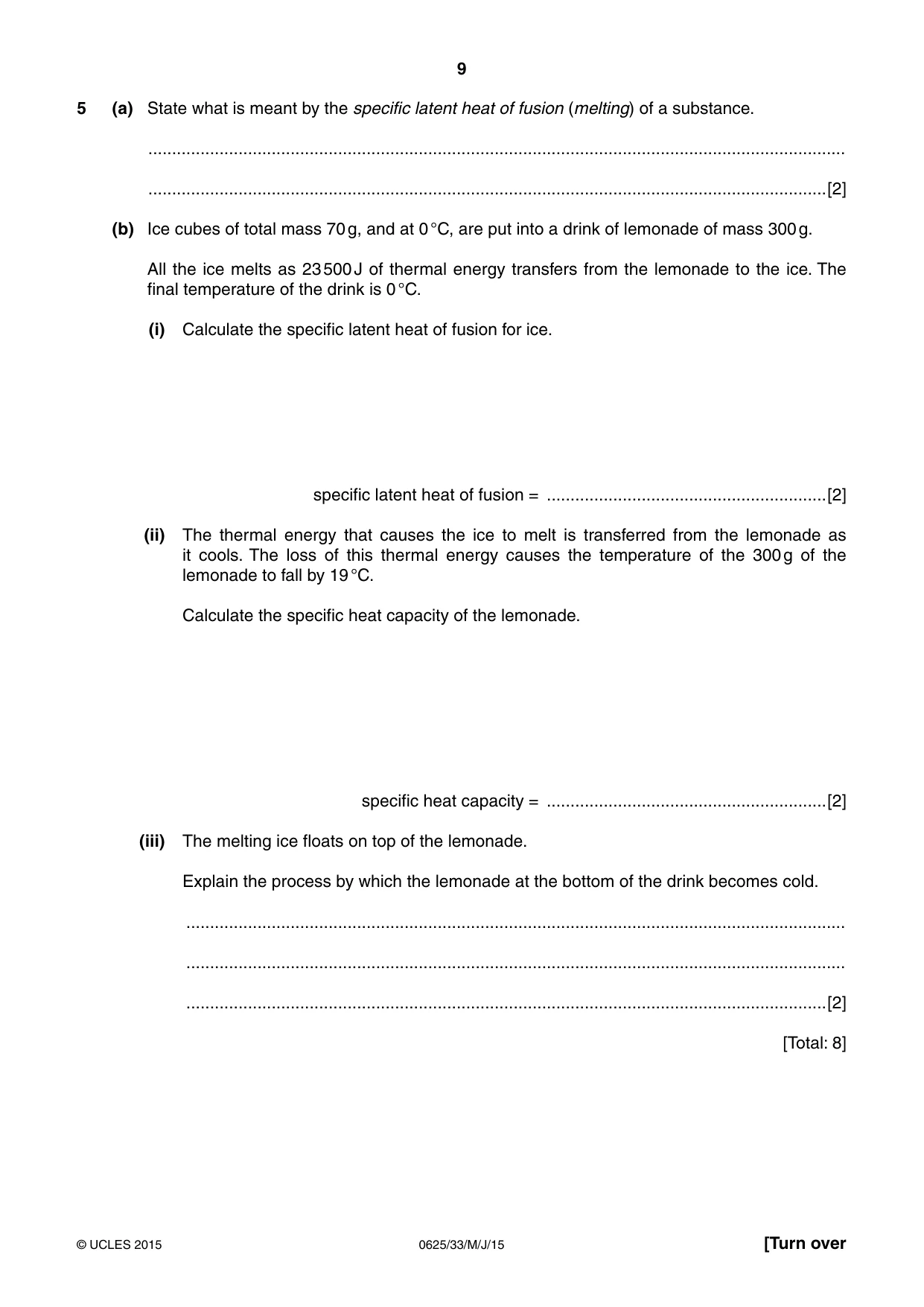
5 (a) State what is meant by the specific latent heat of fusion (melting) of a substance. ................................................................................................................................................... ...............................................................................................................................................[2] (b) Ice cubes of total mass 70 g, and at 0 °C, are put into a drink of lemonade of mass 300 g. All the ice melts as 23 500 J of thermal energy transfers from the lemonade to the ice. The final temperature of the drink is 0 °C. (i) Calculate the specific latent heat of fusion for ice. specific latent heat of fusion = ...........................................................[2] (ii) The thermal energy that causes the ice to melt is transferred from the lemonade as it cools. The loss of this thermal energy causes the temperature of the 300 g of the lemonade to fall by 19 °C. Calculate the specific heat capacity of the lemonade. specific heat capacity = ...........................................................[2] (iii) The melting ice floats on top of the lemonade. Explain the process by which the lemonade at the bottom of the drink becomes cold. ........................................................................................................................................... ........................................................................................................................................... .......................................................................................................................................[2] [Total: 8]
Mark scheme: 5 (a) energy/heat needed to change state of substance/melt B1 (from solid to liquid at constant temperature / melting point) per kg / per unit mass B1 (b) (i) (lf=) Q ÷ m in any form: words, symbols, numbers C1 340 J / kg OR 336 J / g OR equivalent in J / kg A1 (ii) (c =) Q ÷ [m ∆T] in any form: words, symbols, numbers C1 4.1 J / (g °C) OR 4100 J / (kg °C) A1 (iii) cold water denser AND sinks B1 convection (current) OR circulation OR warmer water rises B1 [Total: 8]
Q6 · A glass, converging lens is used as a magnifying glass to observe a red ant
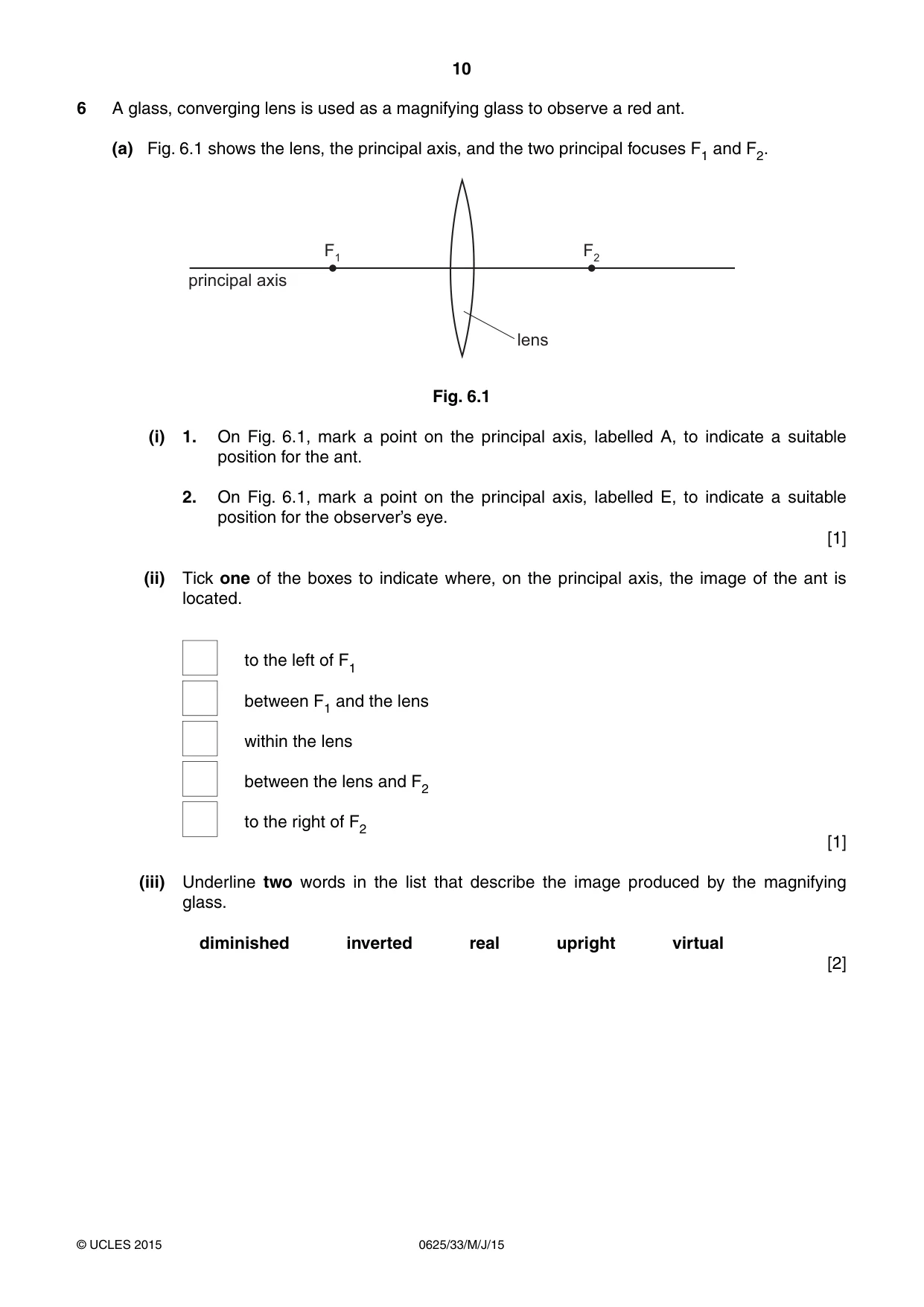
6 A glass, converging lens is used as a magnifying glass to observe a red ant. (a) Fig. 6.1 shows the lens, the principal axis, and the two principal focuses F1 and F2. F1 F2 principal axis lens Fig. 6.1 (i) 1. On Fig. 6.1, mark a point on the principal axis, labelled A, to indicate a suitable position for the ant. 2. On Fig. 6.1, mark a point on the principal axis, labelled E, to indicate a suitable position for the observer’s eye. [1] (ii) Tick one of the boxes to indicate where, on the principal axis, the image of the ant is located. to the left of F1 between F1 and the lens within the lens between the lens and F2 to the right of F2 [1] (iii) Underline two words in the list that describe the image produced by the magnifying glass. diminished inverted real upright virtual [2] (b) (i) The red light from the ant passes into the lens. As the light enters the lens, state what happens to 1. its wavelength, ................................................................................................................................[1] 2. its frequency. ................................................................................................................................[1] (ii) State how the wavelength of violet light in air differs from the wavelength of red light in air. .......................................................................................................................................[1] [Total: 7]
Mark scheme: 6 (a) (i) A (on principal axis) between the lens and one focal point B1 AND E somewhere on other side of lens (ii) on same side as A and further than the principal focus from lens B1 (iii) virtual underlined B1 upright underlined B1 (b) (i) 1. decreases/becomes smaller B1 2. stays the same/unchanged B1 (ii) smaller B1 [Total: 7]
Q7 · A sound wave in air consists of alternate compressions and rarefactions along its path
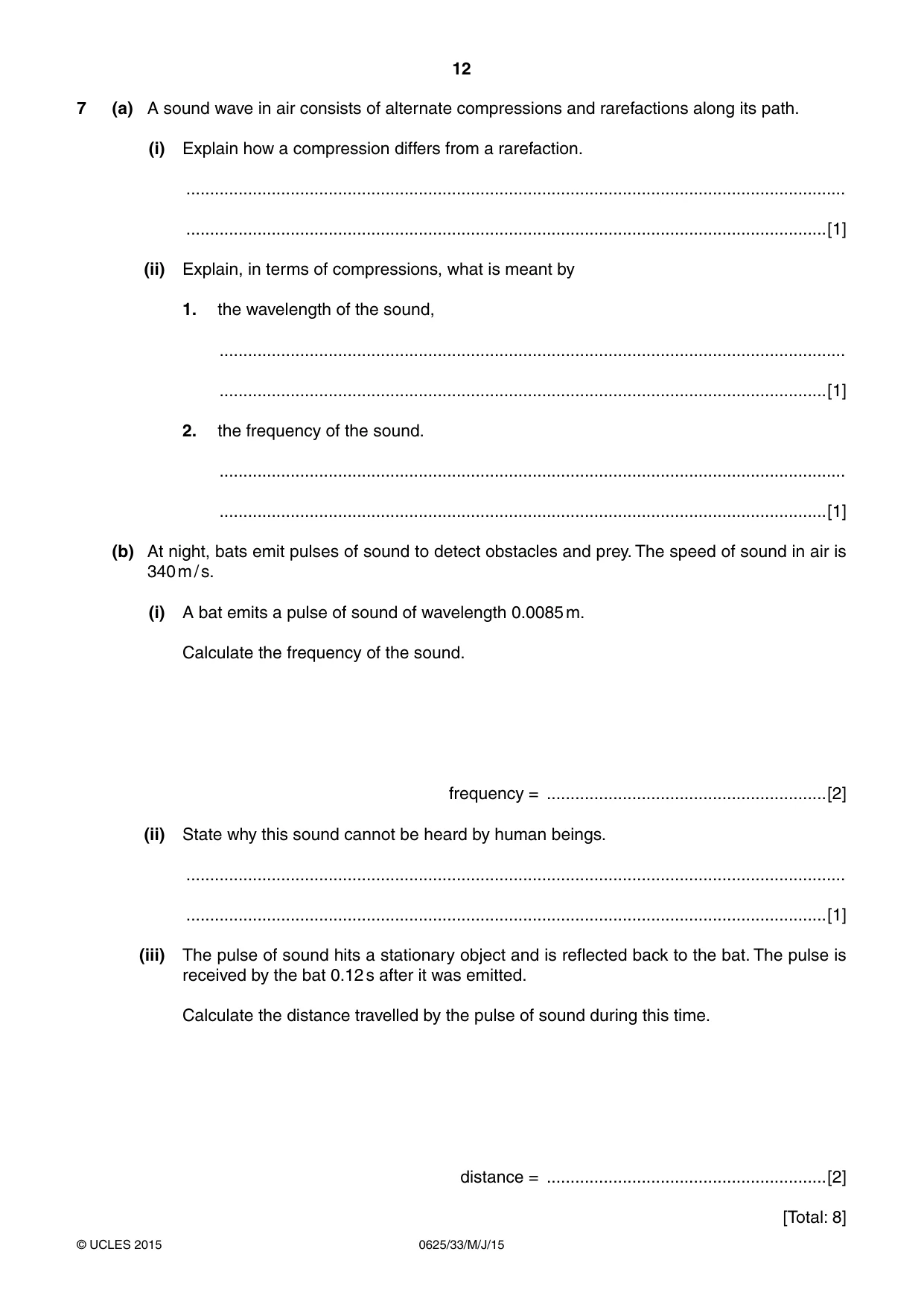
7 (a) A sound wave in air consists of alternate compressions and rarefactions along its path. (i) Explain how a compression differs from a rarefaction. ........................................................................................................................................... .......................................................................................................................................[1] (ii) Explain, in terms of compressions, what is meant by 1. the wavelength of the sound, .................................................................................................................................... ................................................................................................................................[1] 2. the frequency of the sound. .................................................................................................................................... ................................................................................................................................[1] (b) At night, bats emit pulses of sound to detect obstacles and prey. The speed of sound in air is 340 m / s. (i) A bat emits a pulse of sound of wavelength 0.0085 m. Calculate the frequency of the sound. frequency = ...........................................................[2] (ii) State why this sound cannot be heard by human beings. ........................................................................................................................................... .......................................................................................................................................[1] (iii) The pulse of sound hits a stationary object and is reflected back to the bat. The pulse is received by the bat 0.12 s after it was emitted. Calculate the distance travelled by the pulse of sound during this time. distance = ...........................................................[2] [Total: 8]
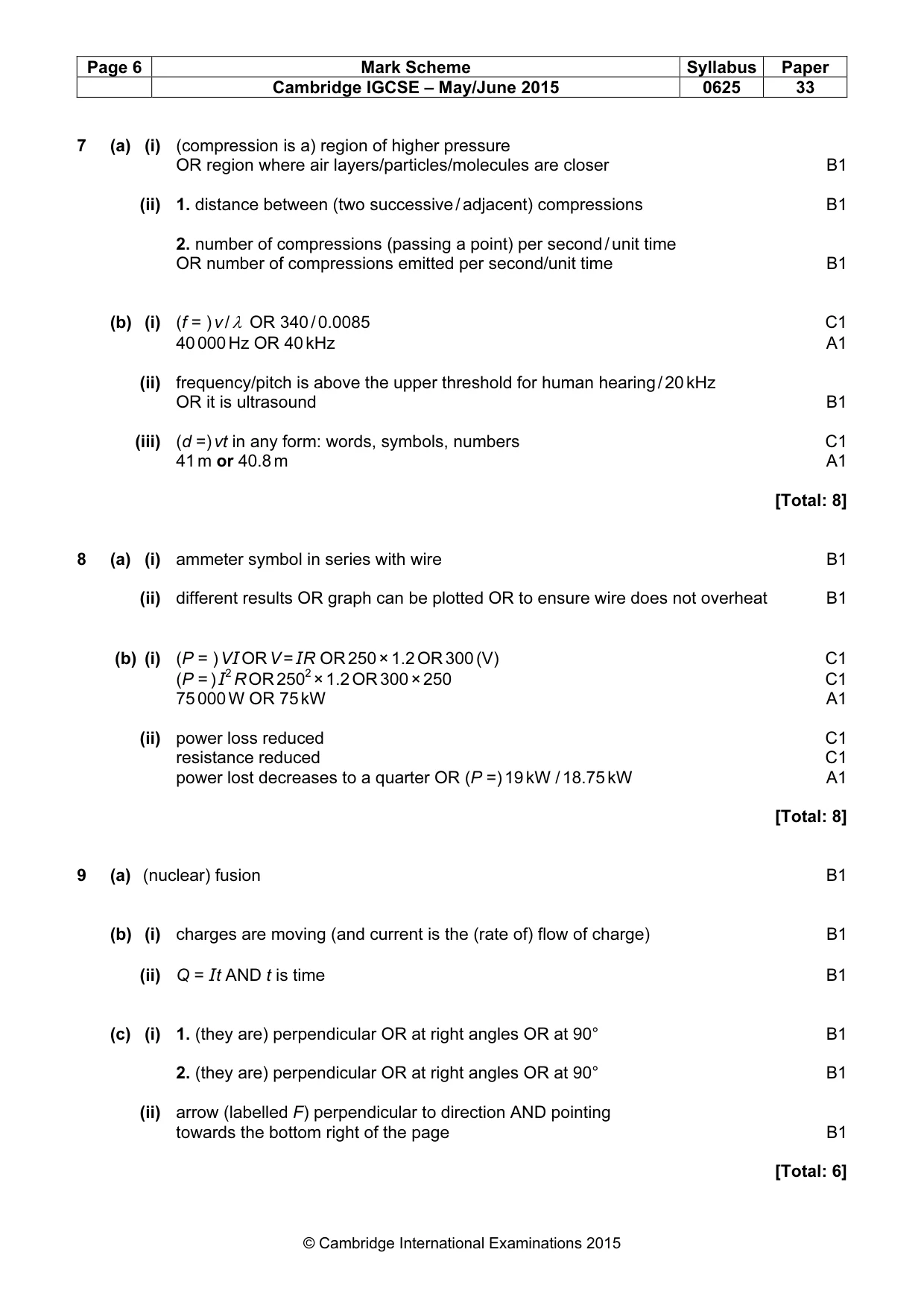
Mark scheme: 7 (a) (i) (compression is a) region of higher pressure OR region where air layers/particles/molecules are closer B1 (ii) 1. distance between (two successive / adjacent) compressions B1 2. number of compressions (passing a point) per second / unit time OR number of compressions emitted per second/unit time B1 (b) (i) (f = ) v /λ OR 340 / 0.0085 C1 40 000 Hz OR 40 kHz A1 (ii) frequency/pitch is above the upper threshold for human hearing / 20 kHz OR it is ultrasound B1 (iii) (d =) vt in any form: words, symbols, numbers C1 41 m or 40.8 m A1 [Total: 8]
Q8 · A student determines the resistance of a length of aluminium wire
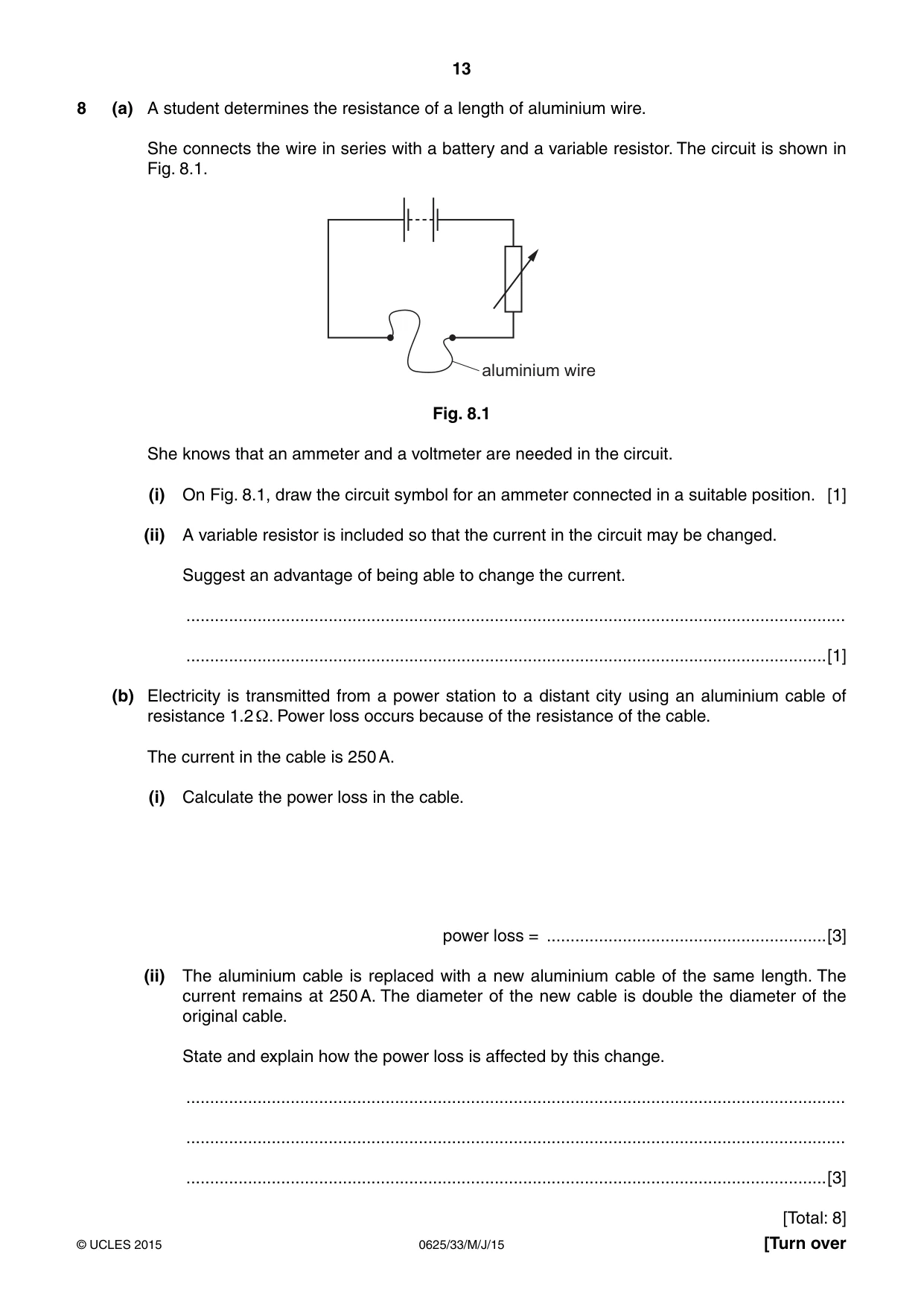
8 (a) A student determines the resistance of a length of aluminium wire. She connects the wire in series with a battery and a variable resistor. The circuit is shown in Fig. 8.1. aluminium wire Fig. 8.1 She knows that an ammeter and a voltmeter are needed in the circuit. (i) On Fig. 8.1, draw the circuit symbol for an ammeter connected in a suitable position. [1] (ii) A variable resistor is included so that the current in the circuit may be changed. Suggest an advantage of being able to change the current. ........................................................................................................................................... .......................................................................................................................................[1] (b) Electricity is transmitted from a power station to a distant city using an aluminium cable of resistance 1.2 Ω. Power loss occurs because of the resistance of the cable. The current in the cable is 250 A. (i) Calculate the power loss in the cable. power loss = ...........................................................[3] (ii) The aluminium cable is replaced with a new aluminium cable of the same length. The current remains at 250 A. The diameter of the new cable is double the diameter of the original cable. State and explain how the power loss is affected by this change. ........................................................................................................................................... ........................................................................................................................................... .......................................................................................................................................[3] [Total: 8]
Mark scheme: 8 (a) (i) ammeter symbol in series with wire B1 (ii) different results OR graph can be plotted OR to ensure wire does not overheat B1 (b) (i) (P = ) VI OR V = IR OR 250 × 1.2 OR 300 (V) C1 (P = ) I2 R OR 2502 × 1.2 OR 300 × 250 C1 75 000 W OR 75 kW A1 (ii) power loss reduced C1 resistance reduced C1 power lost decreases to a quarter OR (P =) 19 kW / 18.75 kW A1 [Total: 8]
Q9 · An extremely violent nuclear reaction is taking place at the centre of the Sun
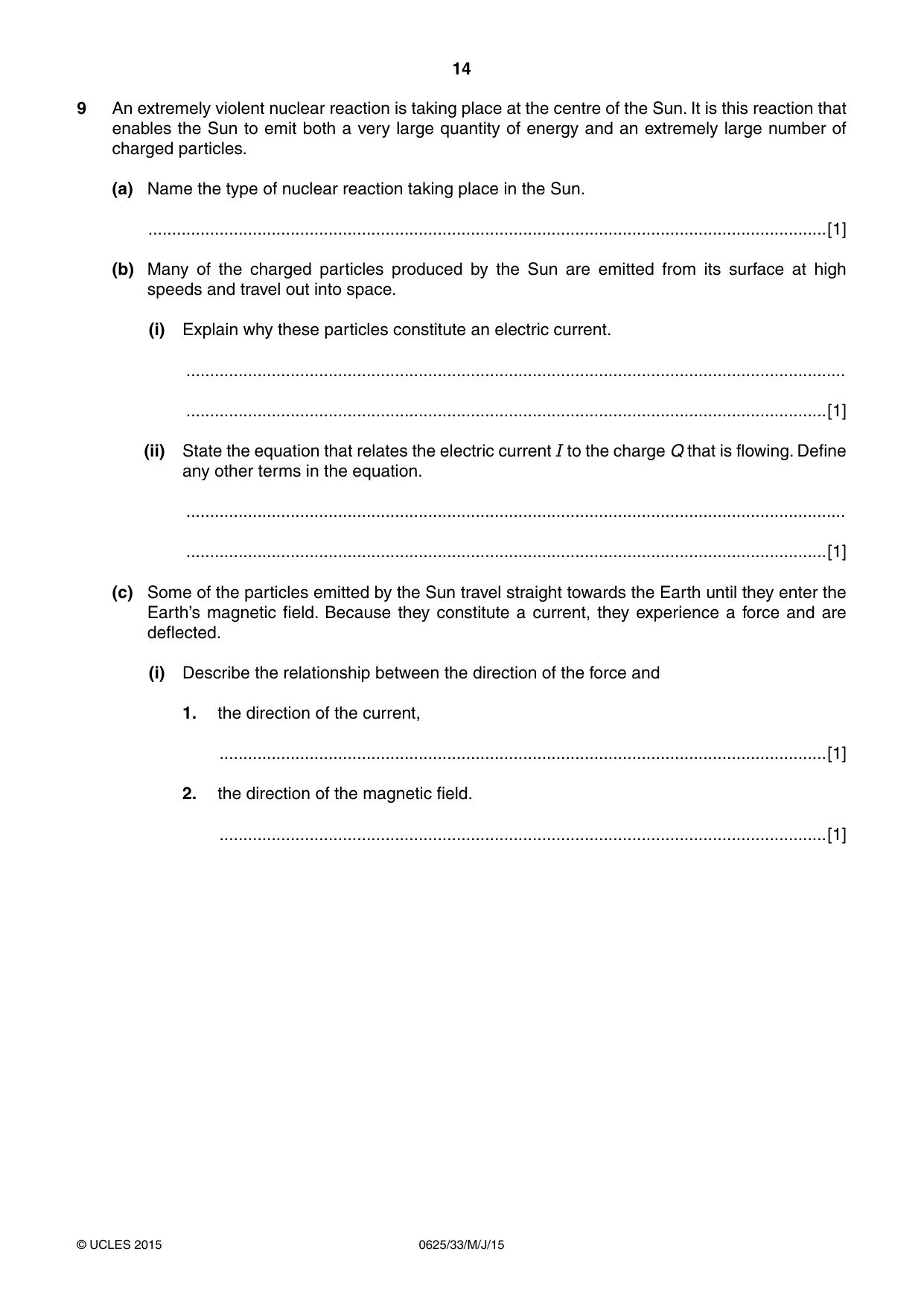
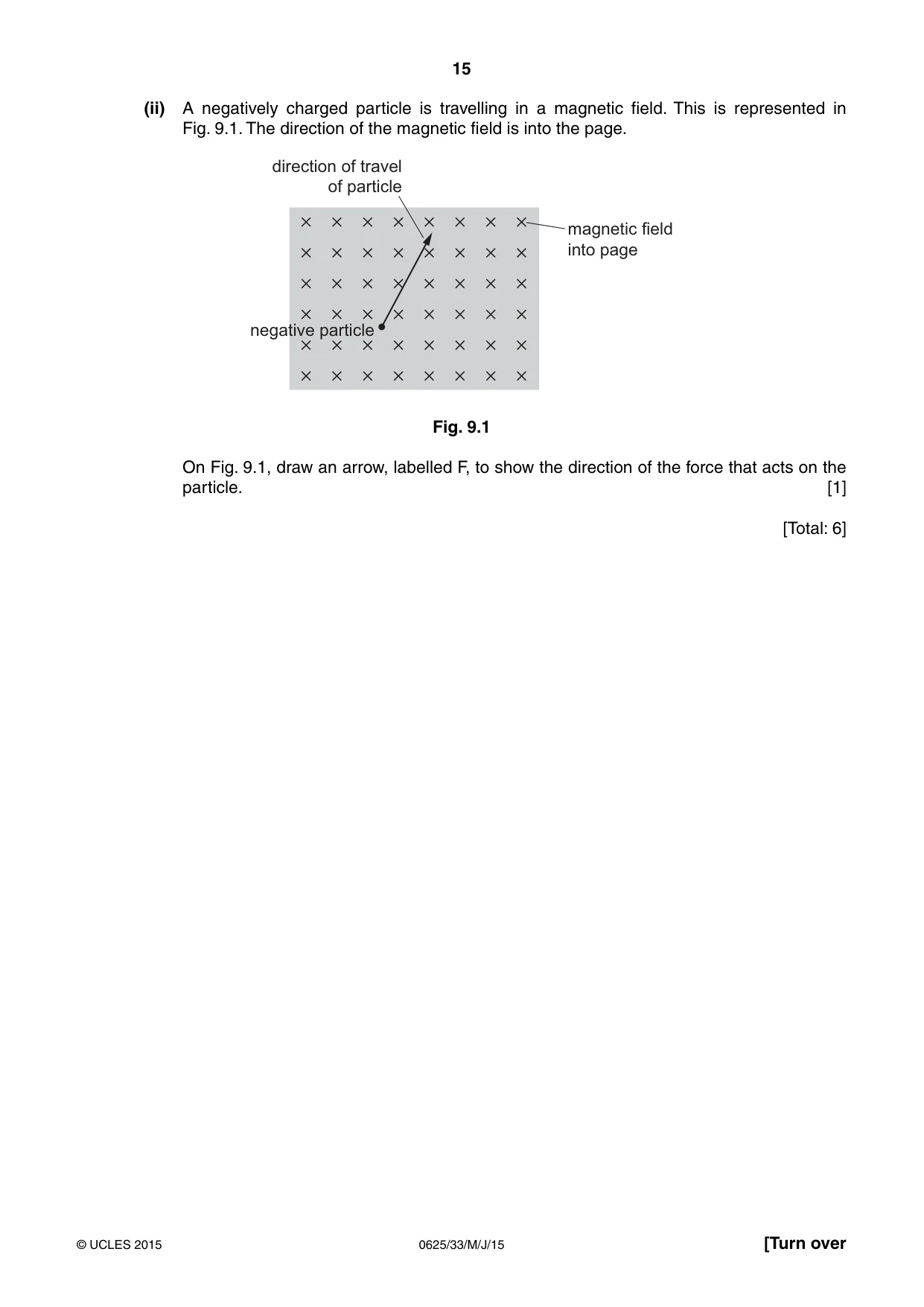
9 An extremely violent nuclear reaction is taking place at the centre of the Sun. It is this reaction that enables the Sun to emit both a very large quantity of energy and an extremely large number of charged particles. (a) Name the type of nuclear reaction taking place in the Sun. ...............................................................................................................................................[1] (b) Many of the charged particles produced by the Sun are emitted from its surface at high speeds and travel out into space. (i) Explain why these particles constitute an electric current. ........................................................................................................................................... .......................................................................................................................................[1] (ii) State the equation that relates the electric current I to the charge Q that is flowing. Define any other terms in the equation. ........................................................................................................................................... .......................................................................................................................................[1] (c) Some of the particles emitted by the Sun travel straight towards the Earth until they enter the Earth’s magnetic field. Because they constitute a current, they experience a force and are deflected. (i) Describe the relationship between the direction of the force and 1. the direction of the current, ................................................................................................................................[1] 2. the direction of the magnetic field. ................................................................................................................................[1] (ii) A negatively charged particle is travelling in a magnetic field. This is represented in Fig. 9.1. The direction of the magnetic field is into the page. direction of travel of particle magnetic field into page negative particle Fig. 9.1 On Fig. 9.1, draw an arrow, labelled F, to show the direction of the force that acts on the particle. [1] [Total: 6]
Mark scheme: 9 (a) (nuclear) fusion B1 (b) (i) charges are moving (and current is the (rate of) flow of charge) B1 (ii) Q = It AND t is time B1 (c) (i) 1. (they are) perpendicular OR at right angles OR at 90° B1 2. (they are) perpendicular OR at right angles OR at 90° B1 (ii) arrow (labelled F) perpendicular to direction AND pointing towards the bottom right of the page B1 [Total: 6]
Q10 · A solenoid is held in a vertical position
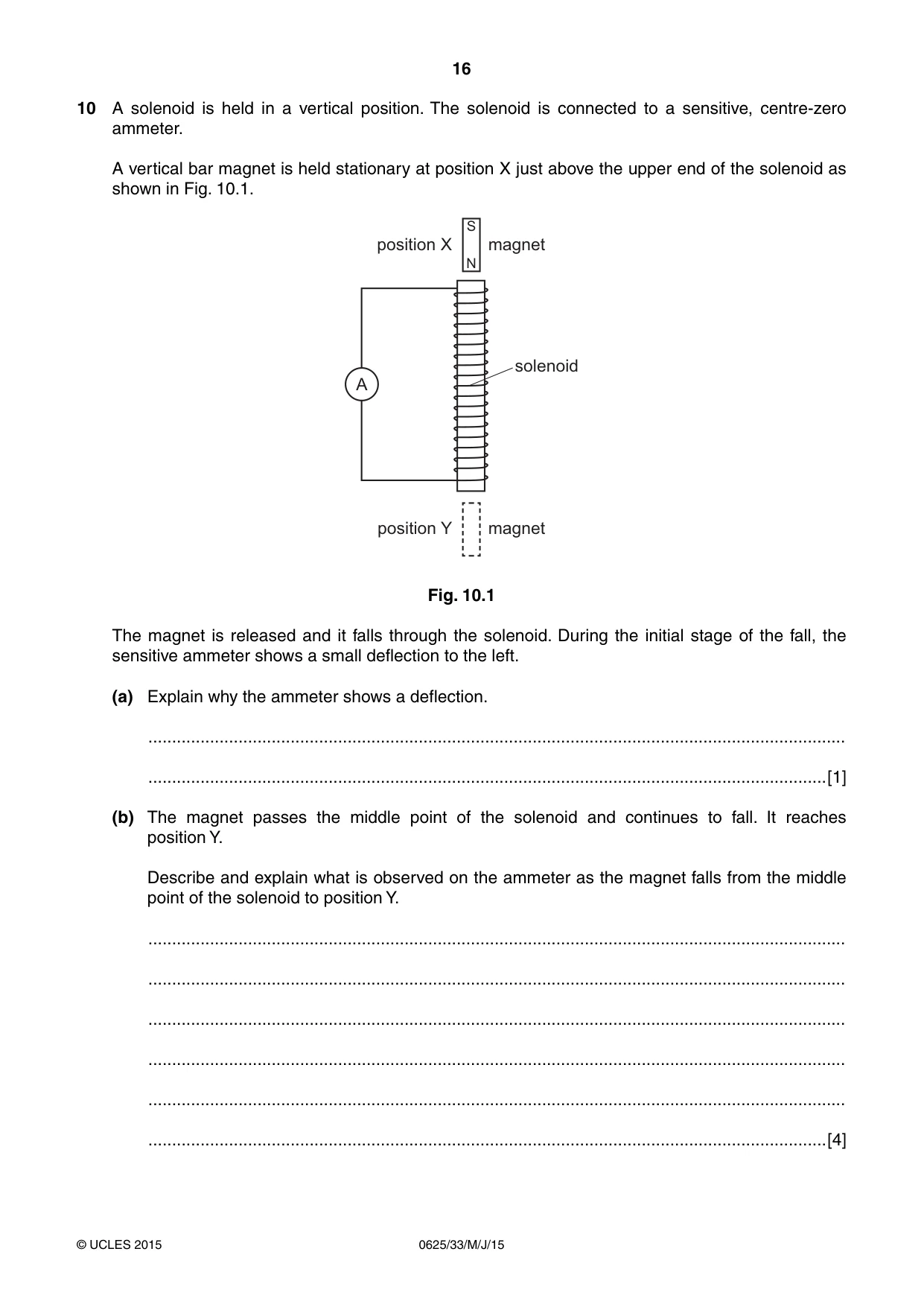
10 A solenoid is held in a vertical position. The solenoid is connected to a sensitive, centre-zero ammeter. A vertical bar magnet is held stationary at position X just above the upper end of the solenoid as shown in Fig. 10.1. S position X magnet N solenoid A position Y magnet Fig. 10.1 The magnet is released and it falls through the solenoid. During the initial stage of the fall, the sensitive ammeter shows a small deflection to the left. (a) Explain why the ammeter shows a deflection. ................................................................................................................................................... ...............................................................................................................................................[1] (b) The magnet passes the middle point of the solenoid and continues to fall. It reaches position Y. Describe and explain what is observed on the ammeter as the magnet falls from the middle point of the solenoid to position Y. ................................................................................................................................................... ................................................................................................................................................... ................................................................................................................................................... ................................................................................................................................................... ................................................................................................................................................... ...............................................................................................................................................[4] (c) Suggest two changes to the apparatus that would increase the initial deflection of the ammeter. 1. ............................................................................................................................................... ................................................................................................................................................... 2. ............................................................................................................................................... ................................................................................................................................................... [2] [Total: 7]
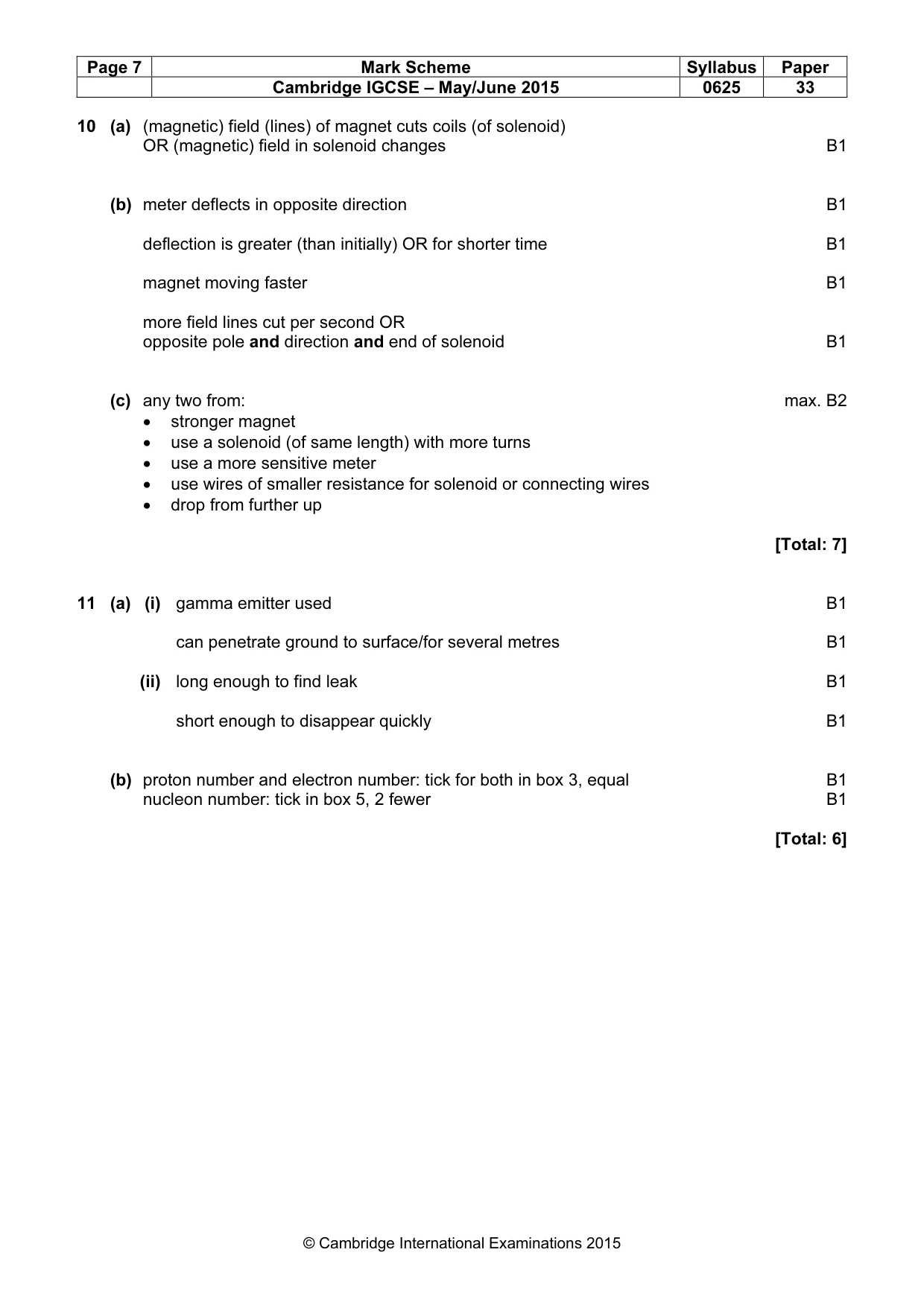
Mark scheme: 10 (a) (magnetic) field (lines) of magnet cuts coils (of solenoid) OR (magnetic) field in solenoid changes B1 (b) meter deflects in opposite direction B1 deflection is greater (than initially) OR for shorter time B1 magnet moving faster B1 more field lines cut per second OR opposite pole and direction and end of solenoid B1 (c) any two from: max. B2 • stronger magnet • use a solenoid (of same length) with more turns • use a more sensitive meter • use wires of smaller resistance for solenoid or connecting wires • drop from further up [Total: 7]
Q11 · An underground water pipe has cracked and water is leaking into the surrounding ground
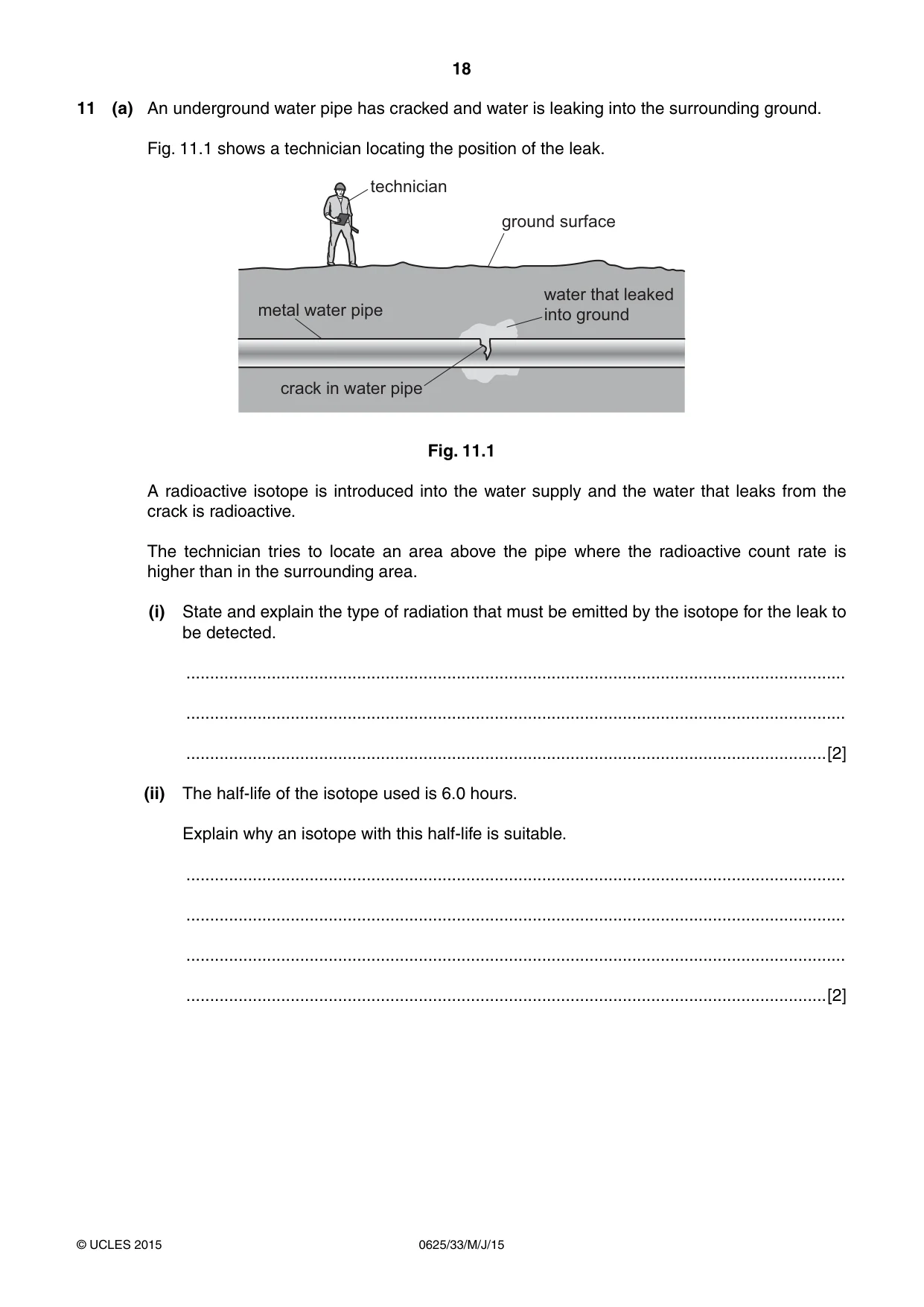
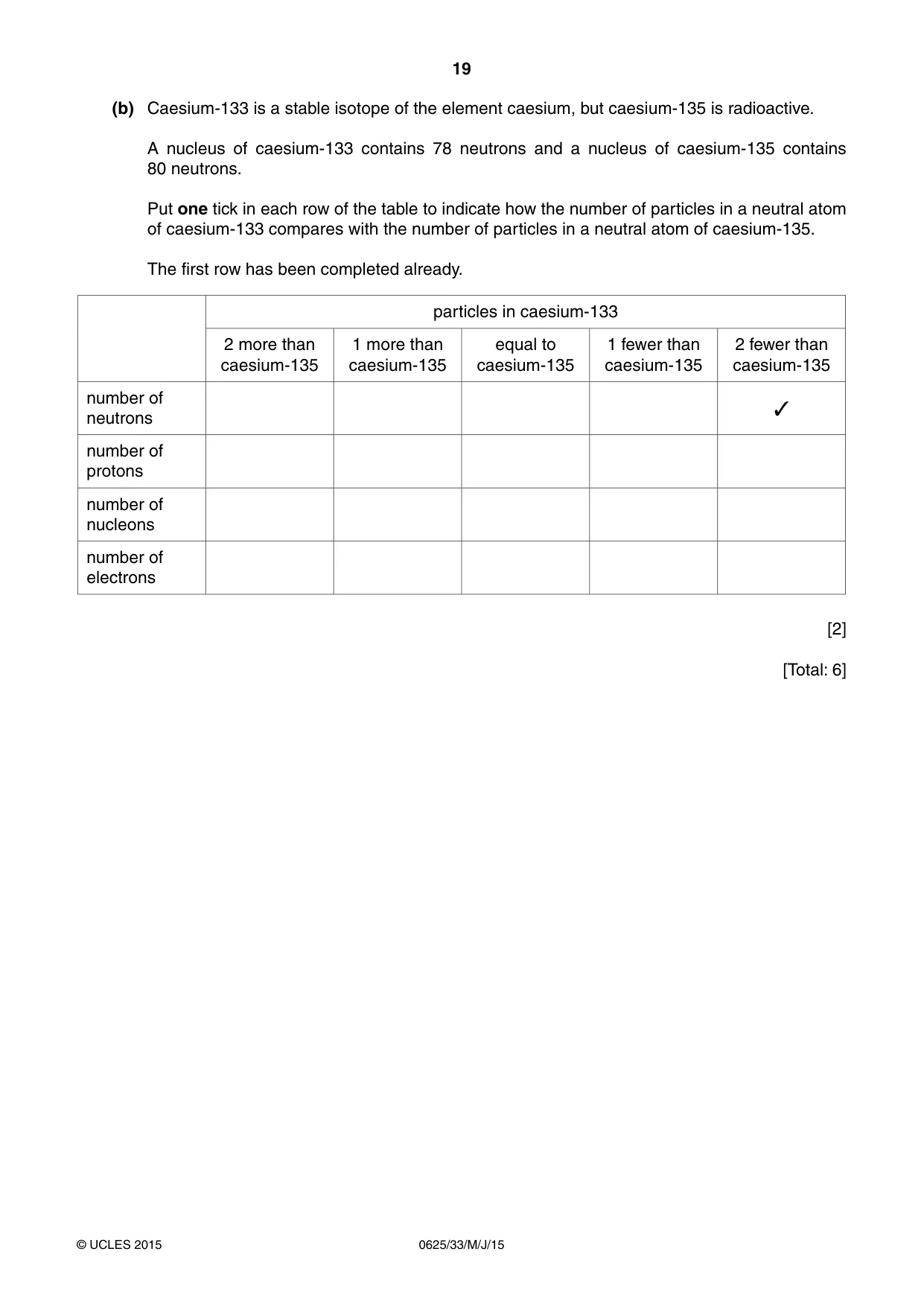
11 (a) An underground water pipe has cracked and water is leaking into the surrounding ground. Fig. 11.1 shows a technician locating the position of the leak. technician ground surface water that leaked metal water pipe into ground crack in water pipe Fig. 11.1 A radioactive isotope is introduced into the water supply and the water that leaks from the crack is radioactive. The technician tries to locate an area above the pipe where the radioactive count rate is higher than in the surrounding area. (i) State and explain the type of radiation that must be emitted by the isotope for the leak to be detected. ........................................................................................................................................... ........................................................................................................................................... .......................................................................................................................................[2] (ii) The half-life of the isotope used is 6.0 hours. Explain why an isotope with this half-life is suitable. ........................................................................................................................................... ........................................................................................................................................... ........................................................................................................................................... .......................................................................................................................................[2] (b) Caesium-133 is a stable isotope of the element caesium, but caesium-135 is radioactive. A nucleus of caesium-133 contains 78 neutrons and a nucleus of caesium-135 contains 80 neutrons. Put one tick in each row of the table to indicate how the number of particles in a neutral atom of caesium-133 compares with the number of particles in a neutral atom of caesium-135. The first row has been completed already. particles in caesium-133 2 more than 1 more than equal to 1 fewer than 2 fewer than caesium-135 caesium-135 caesium-135 caesium-135 caesium-135 number of ✓neutrons number of protons number of nucleons number of electrons [2] [Total: 6]
Mark scheme: 11 (a) (i) gamma emitter used B1 can penetrate ground to surface/for several metres B1 (ii) long enough to find leak B1 short enough to disappear quickly B1 (b) proton number and electron number: tick for both in box 3, equal B1 nucleon number: tick in box 5, 2 fewer B1 [Total: 6]
What was in this paper
The subtopics covered by these 11 questions, and how many questions each got. Open one in a new tab to see every Cambridge question on it.
What you needed in this session
Cambridge’s own grade thresholds for 2015 May/June, Paper 3 · Variant 3. A higher threshold means an easier paper — the bar moves with how the cohort did.