Cambridge IGCSE Physics 0625 — 2013 May/June Paper 3 · Variant 1
0625/31/M/J/13 · 11 questions · 80 marks · ≈90 min
The question paper and its mark scheme, free to read here and free to download. This is Cambridge’s own paper, exactly as it was sat.
Question paper20 pages
Mark scheme8 pages
Answers below. Sit the paper first if you are practising.
Questions as text
Question 1
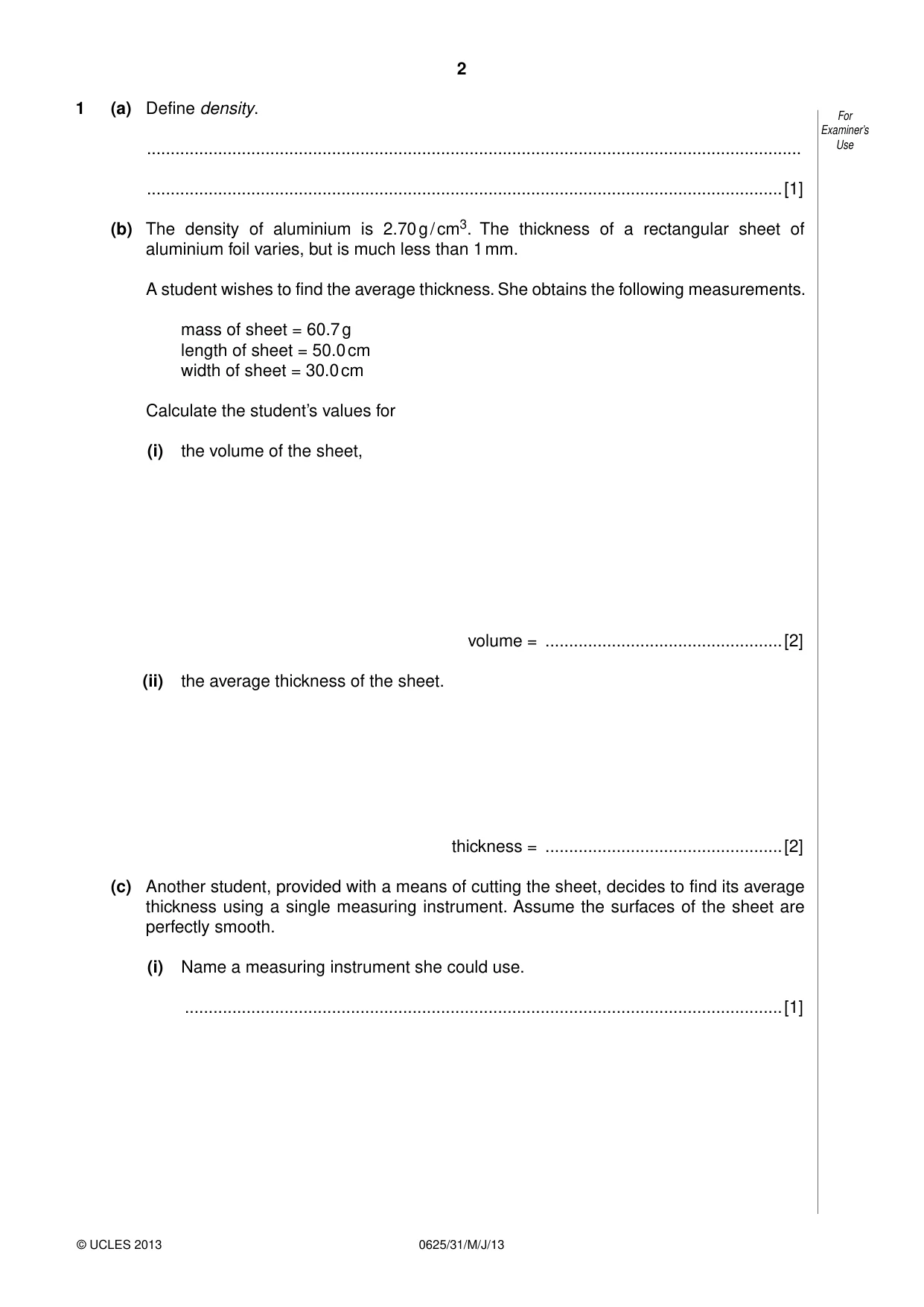
1 (a) Define density. For Examiner’s .......................................................................................................................................... Use ......................................................................................................................................[1] (b) The density of aluminium is 2.70 g / cm3. The thickness of a rectangular sheet of aluminium foil varies, but is much less than 1 mm. A student wishes to find the average thickness. She obtains the following measurements. mass of sheet = 60.7 g length of sheet = 50.0 cm width of sheet = 30.0 cm Calculate the student’s values for (i) the volume of the sheet, volume = ..................................................[2] (ii) the average thickness of the sheet. thickness = ..................................................[2] (c) Another student, provided with a means of cutting the sheet, decides to find its average thickness using a single measuring instrument. Assume the surfaces of the sheet are perfectly smooth. (i) Name a measuring instrument she could use. ..............................................................................................................................[1] (ii) Describe the procedure she should follow to obtain an accurate value of the For average thickness of the sheet. Examiner’s Use Details of how to read the instrument are not required. .................................................................................................................................. .................................................................................................................................. .................................................................................................................................. .................................................................................................................................. .................................................................................................................................. ..............................................................................................................................[3] [Total: 9]
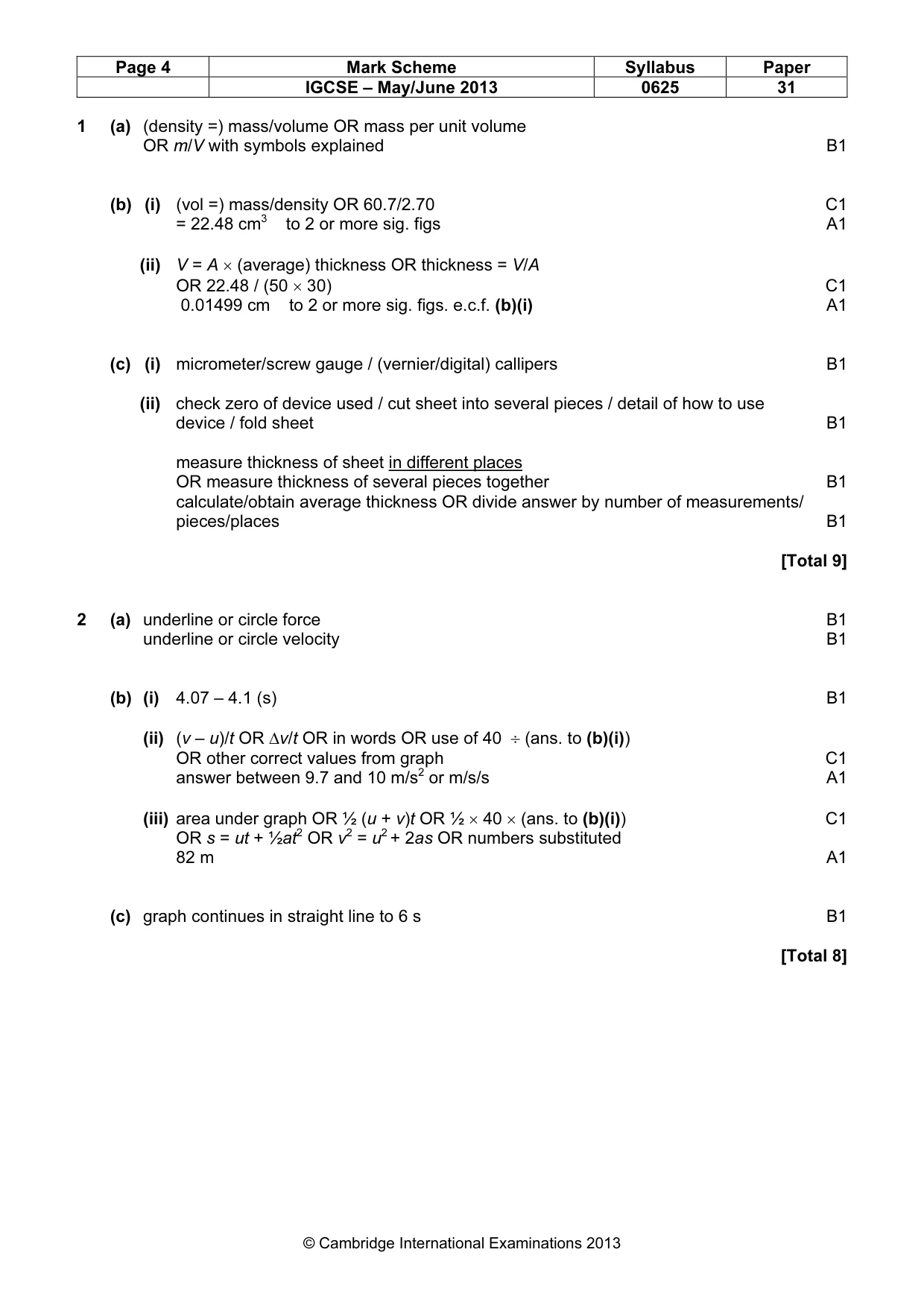
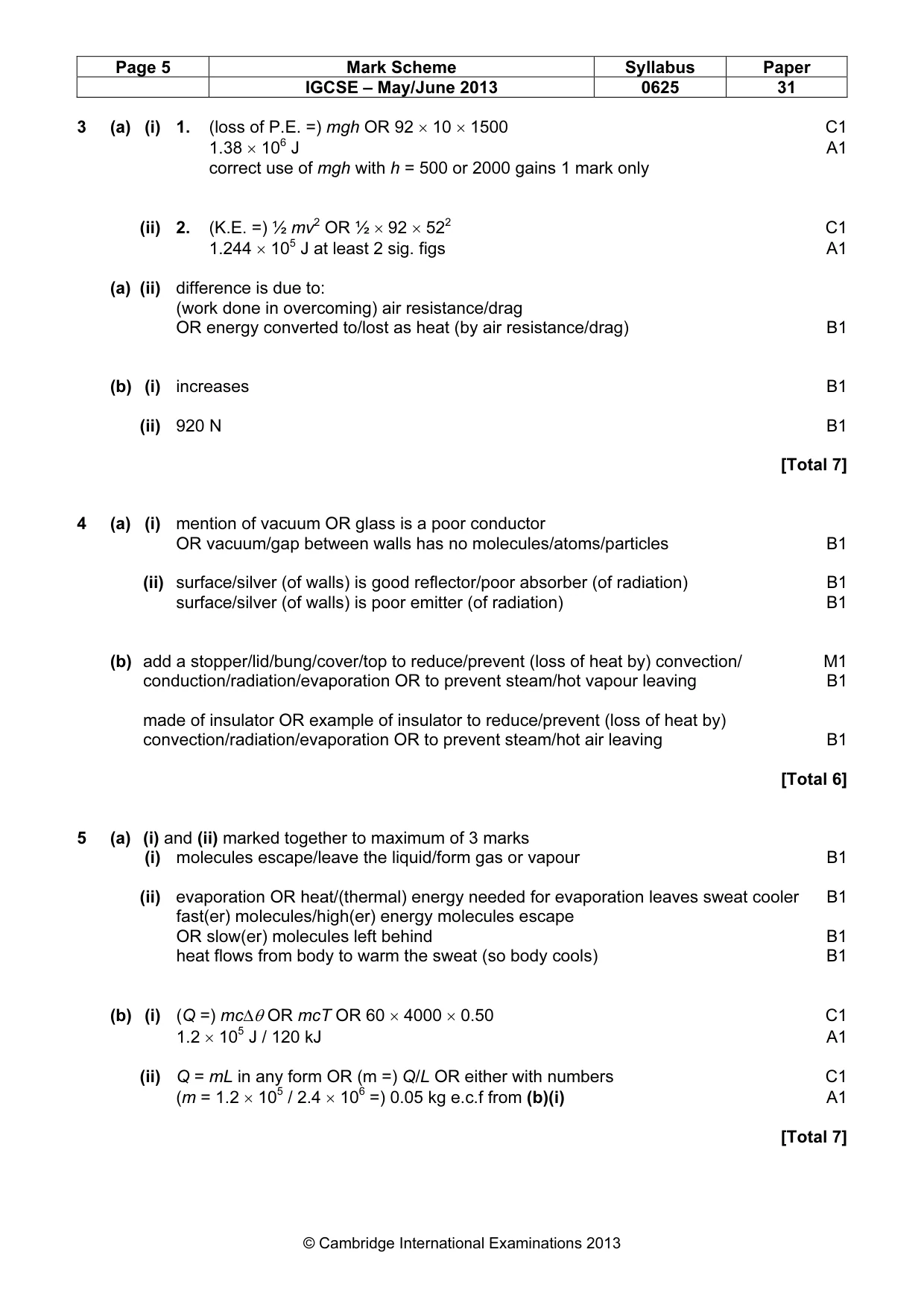
Mark scheme: 1 (a) (density =) mass/volume OR mass per unit volume OR m/V with symbols explained B1 (b) (i) (vol =) mass/density OR 60.7/2.70 C1 = 22.48 cm3 to 2 or more sig. figs A1 (ii) V = A × (average) thickness OR thickness = V/A OR 22.48 / (50 × 30) C1 0.01499 cm to 2 or more sig. figs. e.c.f. (b)(i) A1 (c) (i) micrometer/screw gauge / (vernier/digital) callipers B1 (ii) check zero of device used / cut sheet into several pieces / detail of how to use device / fold sheet B1 measure thickness of sheet in different places OR measure thickness of several pieces together B1 calculate/obtain average thickness OR divide answer by number of measurements/ pieces/places B1 [Total 9]
Q2 · Underline the vectors in the following list of quantities
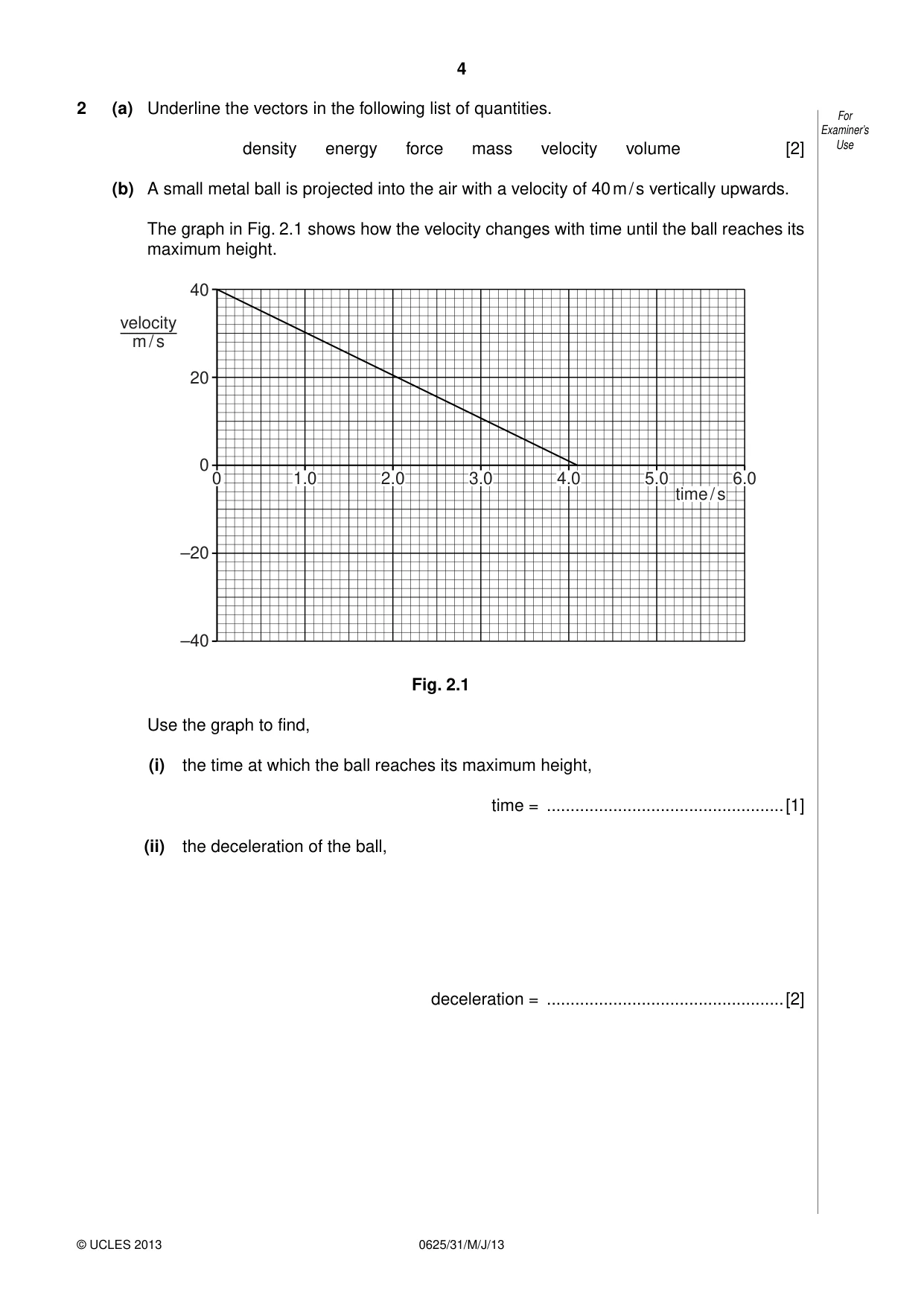
2 (a) Underline the vectors in the following list of quantities. For Examiner’s density energy force mass velocity volume [2] Use (b) A small metal ball is projected into the air with a velocity of 40 m / s vertically upwards. The graph in Fig. 2.1 shows how the velocity changes with time until the ball reaches its maximum height. 40 velocity m / s 20 0 0 1.0 2.0 3.0 4.0 5.0 6.0 time / s –20 –40 Fig. 2.1 Use the graph to find, (i) the time at which the ball reaches its maximum height, time = ..................................................[1] (ii) the deceleration of the ball, deceleration = ..................................................[2] (iii) the maximum height reached by the ball. For Examiner’s Use maximum height = ..................................................[2] (c) On Fig. 2.1, add a line to the graph to show how the velocity of the ball changes after it reaches its maximum height. Your line should extend to time 6.0 s. [1] [Total: 8]
Mark scheme: 2 (a) underline or circle force B1 underline or circle velocity B1 (b) (i) 4.07 – 4.1 (s) B1 (ii) (v – u)/t OR ∆v/t OR in words OR use of 40 ÷ (ans. to (b)(i)) OR other correct values from graph C1 answer between 9.7 and 10 m/s2 or m/s/s A1 (iii) area under graph OR ½ (u + v)t OR ½ × 40 × (ans. to (b)(i)) C1 OR s = ut + ½at2 OR v2 = u2 + 2as OR numbers substituted 82 m A1 (c) graph continues in straight line to 6 s B1 [Total 8] IGCSE – May/June 2013 0625 31
Q3 · The descent of a sky-diver from a stationary balloon
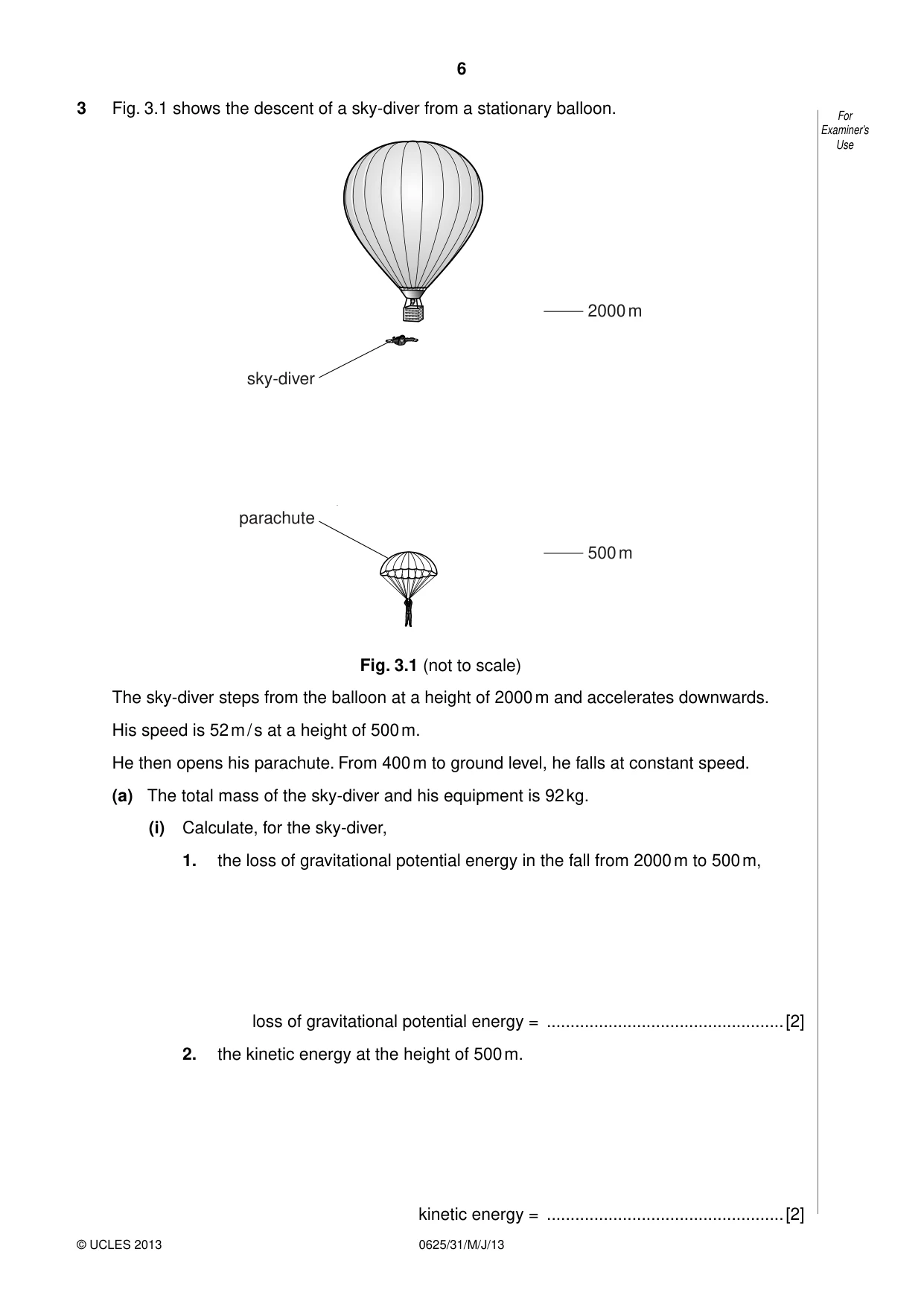
3 Fig. 3.1 shows the descent of a sky-diver from a stationary balloon. For Examiner’s Use 2000 m sky-diver parachute 500 m Fig. 3.1 (not to scale) The sky-diver steps from the balloon at a height of 2000 m and accelerates downwards. His speed is 52 m / s at a height of 500 m. He then opens his parachute. From 400 m to ground level, he falls at constant speed. (a) The total mass of the sky-diver and his equipment is 92 kg. (i) Calculate, for the sky-diver, 1. the loss of gravitational potential energy in the fall from 2000 m to 500 m, loss of gravitational potential energy = ..................................................[2] 2. the kinetic energy at the height of 500 m. kinetic energy = ..................................................[2] (ii) The kinetic energy at 500 m is not equal to the loss of gravitational potential energy. For Explain why there is a difference in the values. Examiner’s Use .................................................................................................................................. .................................................................................................................................. ..............................................................................................................................[1] (b) State (i) what happens to the air resistance acting on the sky-diver during the fall from 2000 m to 500 m, ..............................................................................................................................[1] (ii) the value of the air resistance during the fall from 400 m to ground. air resistance = ..................................................[1] [Total: 7]
Mark scheme: 3 (a) (i) 1. (loss of P.E. =) mgh OR 92 × 10 × 1500 C1 1.38 × 10⁶ J A1 correct use of mgh with h = 500 or 2000 gains 1 mark only (ii) 2. (K.E. =) ½ mv2 OR ½ × 92 × 522 C1 1.244 × 10⁵ J at least 2 sig. figs A1 (a) (ii) difference is due to: (work done in overcoming) air resistance/drag OR energy converted to/lost as heat (by air resistance/drag) B1 (b) (i) increases B1 (ii) 920 N B1 [Total 7]
Q4 · A cross-section of a double-walled glass vacuum flask, containing a hot liquid
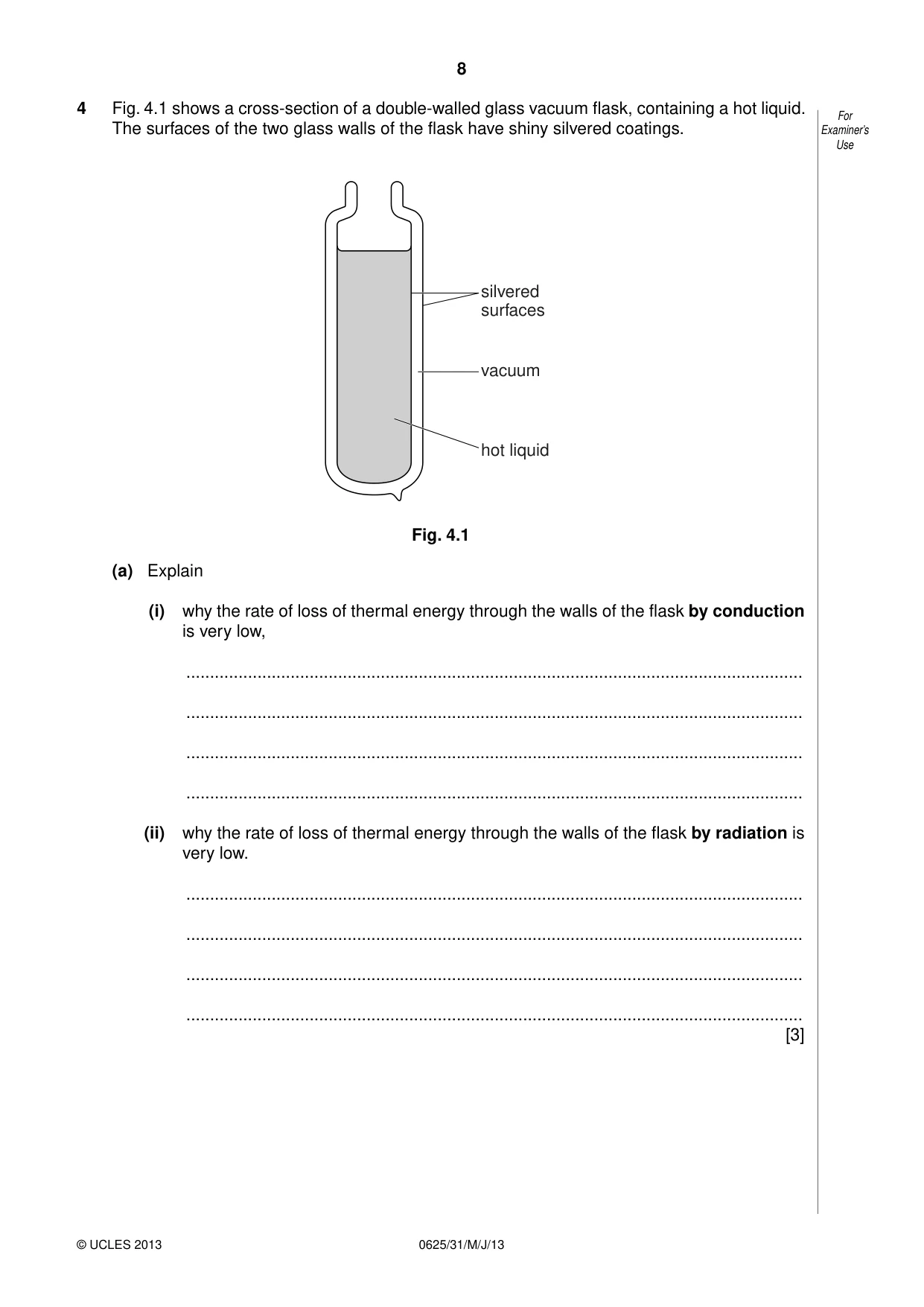
4 Fig. 4.1 shows a cross-section of a double-walled glass vacuum flask, containing a hot liquid. For The surfaces of the two glass walls of the flask have shiny silvered coatings. Examiner’s Use silvered surfaces vacuum hot liquid Fig. 4.1 (a) Explain (i) why the rate of loss of thermal energy through the walls of the flask by conduction is very low, .................................................................................................................................. .................................................................................................................................. .................................................................................................................................. .................................................................................................................................. (ii) why the rate of loss of thermal energy through the walls of the flask by radiation is very low. .................................................................................................................................. .................................................................................................................................. .................................................................................................................................. .................................................................................................................................. [3] (b) Suggest, with reasons, what must be added to the flask shown in Fig. 4.1 in order to For keep the liquid hot. Examiner’s Use .......................................................................................................................................... .......................................................................................................................................... .......................................................................................................................................... .......................................................................................................................................... ......................................................................................................................................[3] [Total: 6]
Mark scheme: 4 (a) (i) mention of vacuum OR glass is a poor conductor OR vacuum/gap between walls has no molecules/atoms/particles B1 (ii) surface/silver (of walls) is good reflector/poor absorber (of radiation) B1 surface/silver (of walls) is poor emitter (of radiation) B1 (b) add a stopper/lid/bung/cover/top to reduce/prevent (loss of heat by) convection/ M1 conduction/radiation/evaporation OR to prevent steam/hot vapour leaving B1 made of insulator OR example of insulator to reduce/prevent (loss of heat by) convection/radiation/evaporation OR to prevent steam/hot air leaving B1 [Total 6]
Q5 · On a hot day, sweat forms on the surface of a person’s body and the sweat evaporates
5 (a) On a hot day, sweat forms on the surface of a person’s body and the sweat evaporates. For Examiner’s Explain, in terms of the behaviour of molecules, Use (i) the process of evaporation, .................................................................................................................................. .................................................................................................................................. .................................................................................................................................. (ii) how this process helps the body to cool down. .................................................................................................................................. .................................................................................................................................. .................................................................................................................................. .................................................................................................................................. .................................................................................................................................. .................................................................................................................................. [3] (b) The temperature of a person of mass 60 kg falls from 37.2 °C to 36.7 °C. (i) Calculate the thermal energy lost from the body. The average specific heat capacity of the body is 4000 J / (kg °C). thermal energy lost = ..................................................[2] (ii) The cooling of the body was entirely due to the evaporation of sweat. For Examiner’s Calculate the mass of sweat which evaporated. The specific latent heat of Use vaporisation of sweat is 2.4 × 10⁶ J / kg. mass = ..................................................[2] [Total: 7]
Mark scheme: 5 (a) (i) and (ii) marked together to maximum of 3 marks (i) molecules escape/leave the liquid/form gas or vapour B1 (ii) evaporation OR heat/(thermal) energy needed for evaporation leaves sweat cooler B1 fast(er) molecules/high(er) energy molecules escape OR slow(er) molecules left behind B1 heat flows from body to warm the sweat (so body cools) B1 (b) (i) (Q =) mc∆θ OR mcT OR 60 × 4000 × 0.50 C1 1.2 × 10⁵ J / 120 kJ A1 (ii) Q = mL in any form OR (m =) Q/L OR either with numbers C1 (m = 1.2 × 10⁵ / 2.4 × 106 =) 0.05 kg e.c.f from (b)(i) A1 [Total 7] IGCSE – May/June 2013 0625 31
Question 6
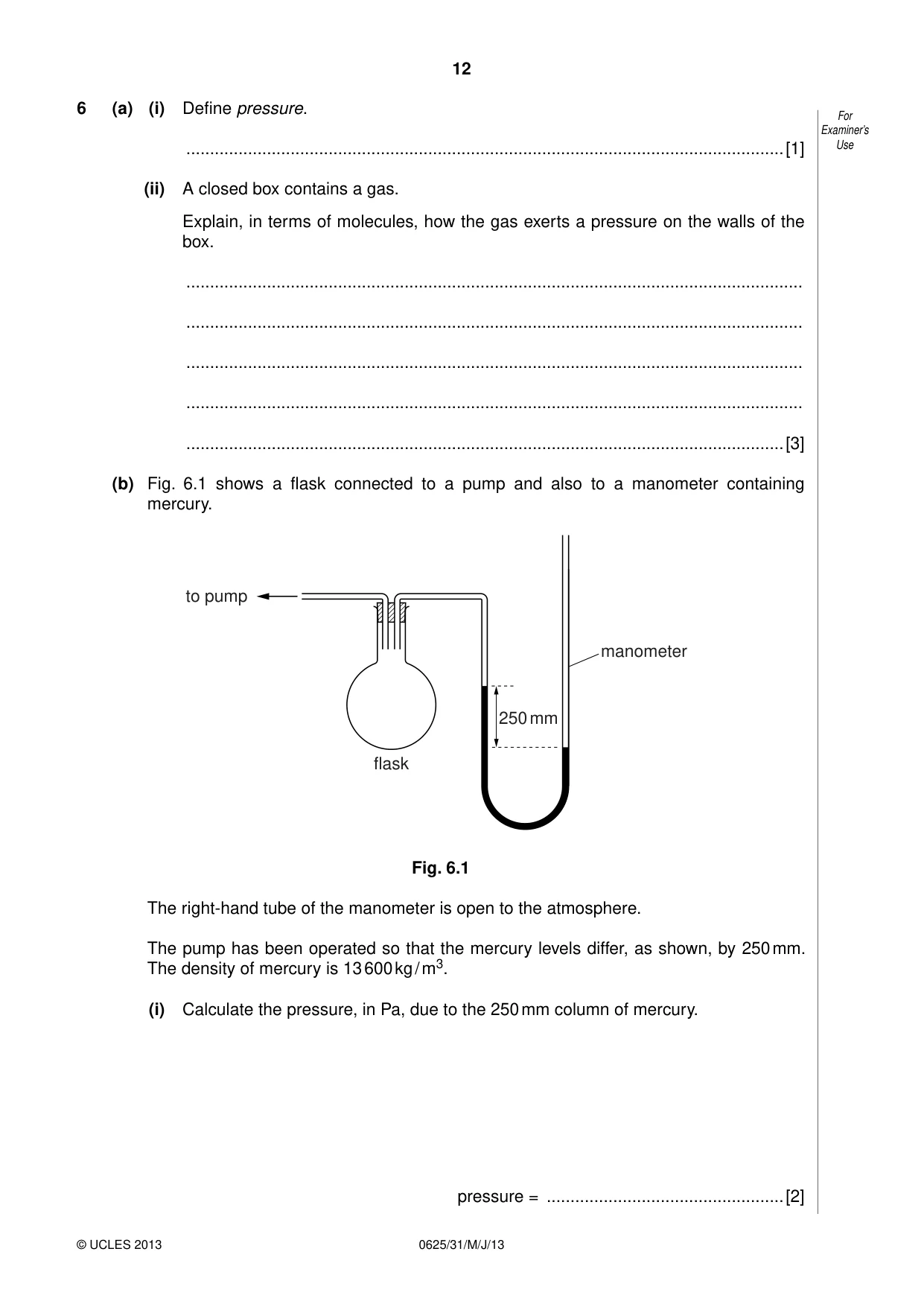
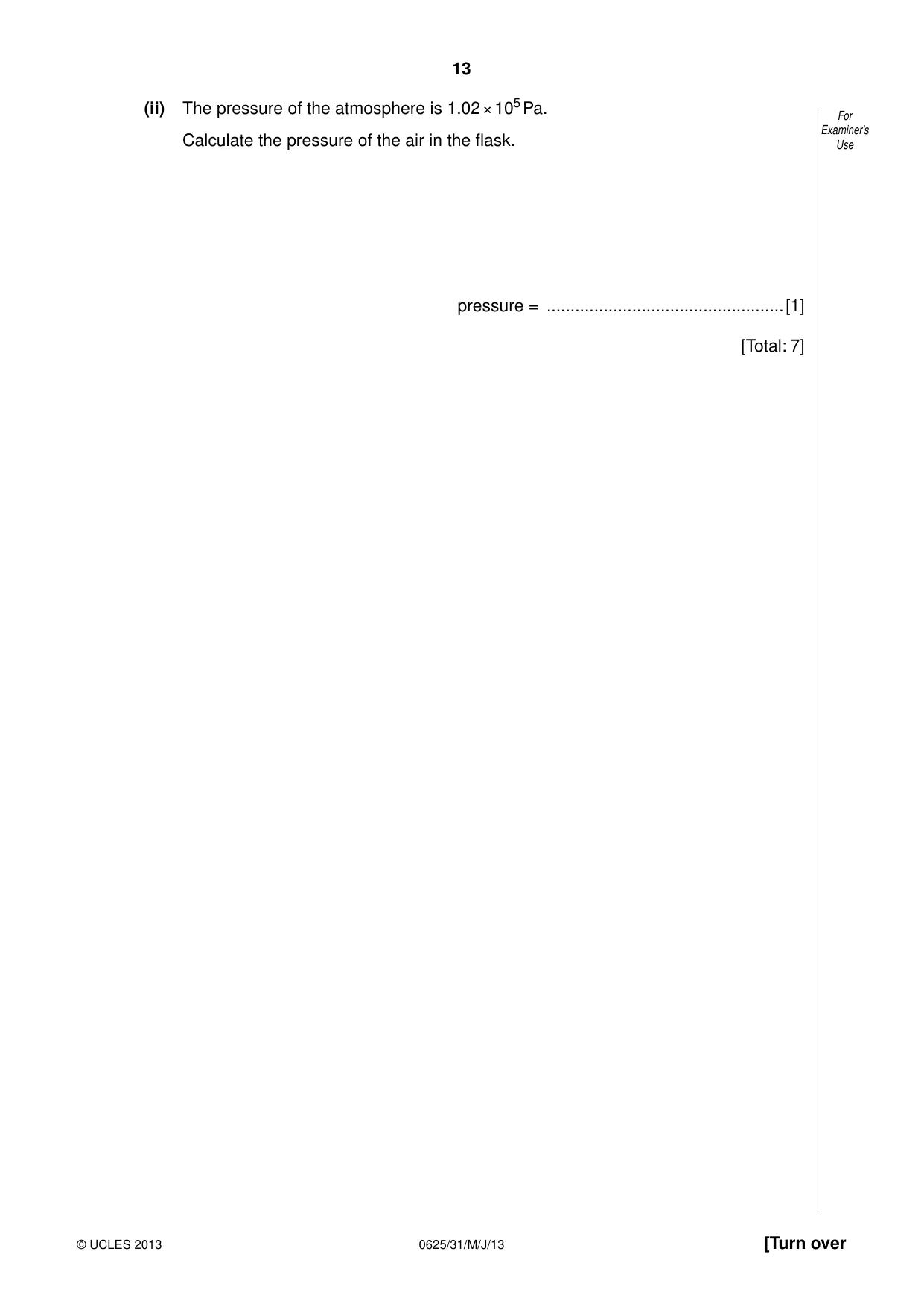
6 (a) (i) Define pressure. For Examiner’s ..............................................................................................................................[1] Use (ii) A closed box contains a gas. Explain, in terms of molecules, how the gas exerts a pressure on the walls of the box. .................................................................................................................................. .................................................................................................................................. .................................................................................................................................. .................................................................................................................................. ..............................................................................................................................[3] (b) Fig. 6.1 shows a flask connected to a pump and also to a manometer containing mercury. to pump manometer 250 mm flask Fig. 6.1 The right-hand tube of the manometer is open to the atmosphere. The pump has been operated so that the mercury levels differ, as shown, by 250 mm. The density of mercury is 13 600 kg / m3. (i) Calculate the pressure, in Pa, due to the 250 mm column of mercury. pressure = ..................................................[2] (ii) The pressure of the atmosphere is 1.02 × 10⁵ Pa. For Examiner’s Calculate the pressure of the air in the flask. Use pressure = ..................................................[1] [Total: 7]
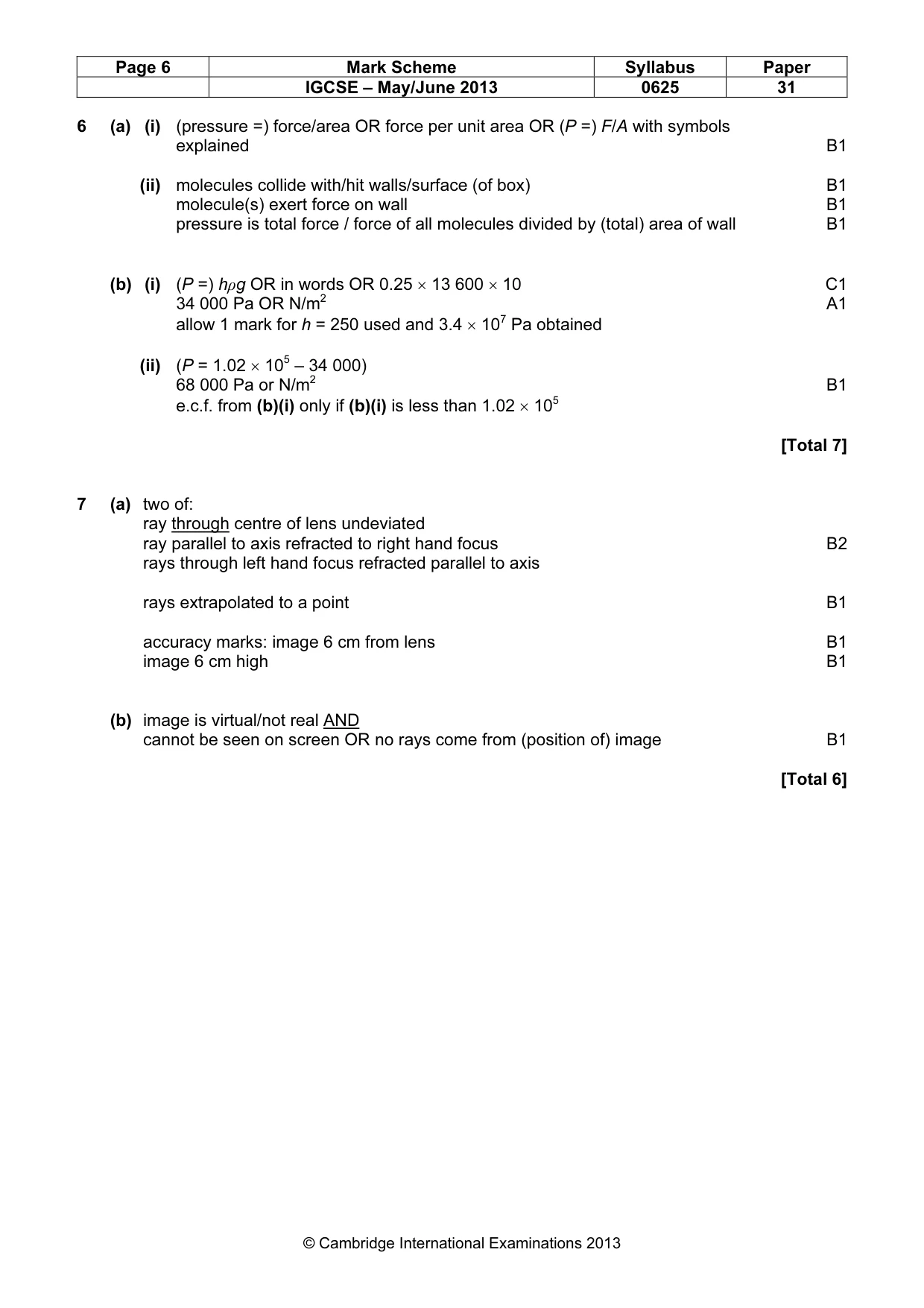
Mark scheme: 6 (a) (i) (pressure =) force/area OR force per unit area OR (P =) F/A with symbols explained B1 (ii) molecules collide with/hit walls/surface (of box) B1 molecule(s) exert force on wall B1 pressure is total force / force of all molecules divided by (total) area of wall B1 (b) (i) (P =) hρg OR in words OR 0.25 × 13 600 × 10 C1 34 000 Pa OR N/m2 A1 allow 1 mark for h = 250 used and 3.4 × 10⁷ Pa obtained (ii) (P = 1.02 × 10⁵ – 34 000) 68 000 Pa or N/m2 B1 e.c.f. from (b)(i) only if (b)(i) is less than 1.02 × 10⁵ [Total 7]
Q7 · The principal axis PQ of a converging lens and the centre line XY of the lens
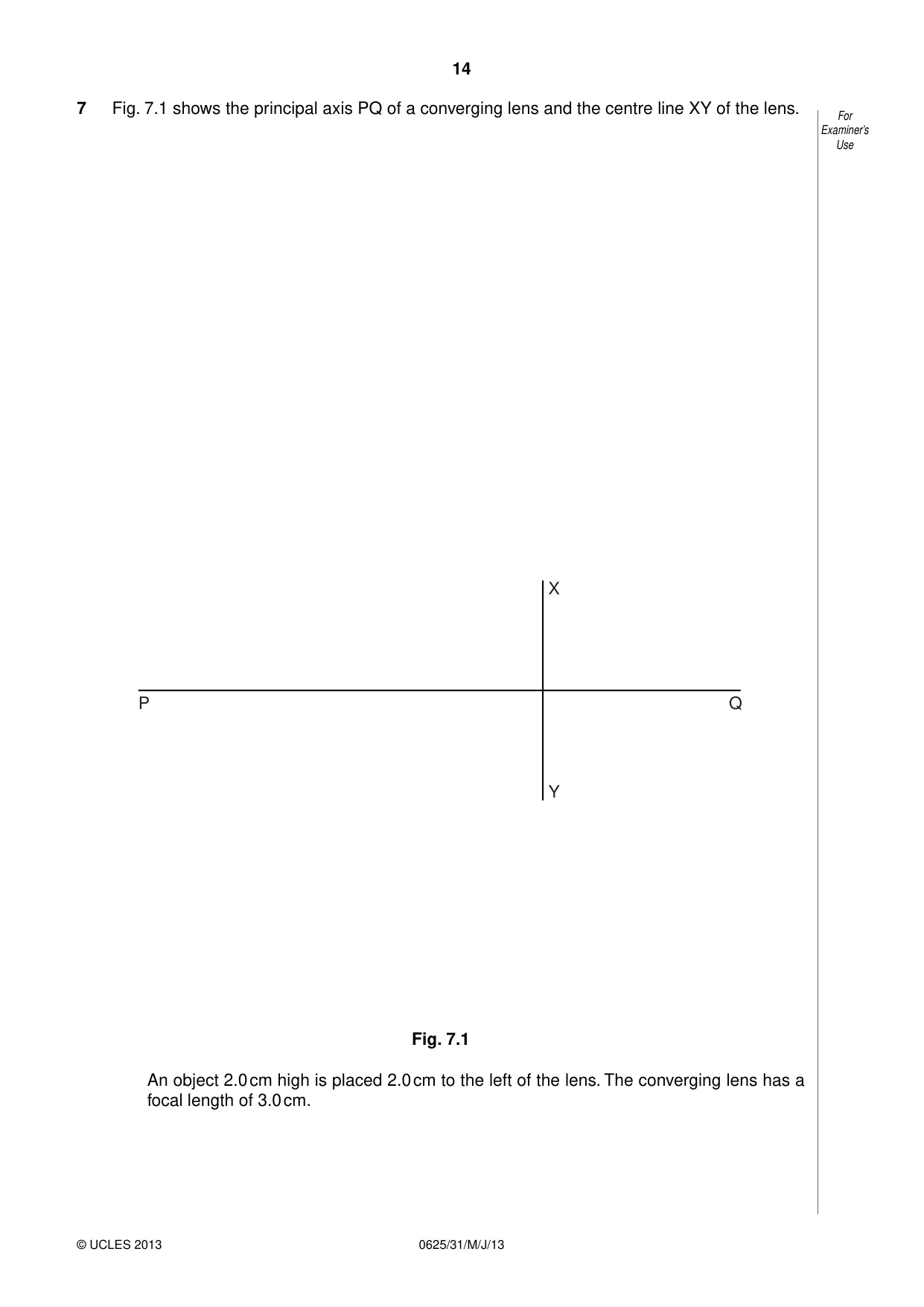
7 Fig. 7.1 shows the principal axis PQ of a converging lens and the centre line XY of the lens. For Examiner’s Use X P Q Y Fig. 7.1 An object 2.0 cm high is placed 2.0 cm to the left of the lens. The converging lens has a focal length of 3.0 cm. (a) On Fig. 7.1, draw a full-scale diagram to find the distance of the image from the lens, For and the height of the image. Examiner’s Use distance of image from the lens = ...................................................... height of image = ...................................................... [5] (b) State and explain whether the image in (a) is real or virtual. .......................................................................................................................................... ......................................................................................................................................[1] [Total: 6]
Mark scheme: 7 (a) two of: ray through centre of lens undeviated ray parallel to axis refracted to right hand focus B2 rays through left hand focus refracted parallel to axis rays extrapolated to a point B1 accuracy marks: image 6 cm from lens B1 image 6 cm high B1 (b) image is virtual/not real AND cannot be seen on screen OR no rays come from (position of) image B1 [Total 6] IGCSE – May/June 2013 0625 31
Q8 · State the range of frequencies of sound which can be heard by a healthy human ear
8 (a) State the range of frequencies of sound which can be heard by a healthy human ear. For Examiner’s ......................................................................................................................................[1] Use (b) Compressions and rarefactions occur along the path of sound waves. State, in terms of the behaviour of molecules, what is meant by (i) a compression, .................................................................................................................................. .................................................................................................................................. (ii) a rarefaction. .................................................................................................................................. .................................................................................................................................. [2] (c) State the effect on what is heard by a listener when there is (i) an increase in the amplitude of a sound, ..............................................................................................................................[1] (ii) a decrease in the wavelength of a sound. ..............................................................................................................................[1] (d) A student carries out an experiment to find the speed of sound in air. He stands facing a high cliff and shouts. He hears the echo 1.9 s later. He then walks 250 m further away from the cliff and shouts again, hearing the echo 3.5 s later. Calculate the speed of sound given by this experiment. speed = ..................................................[3] [Total: 8]
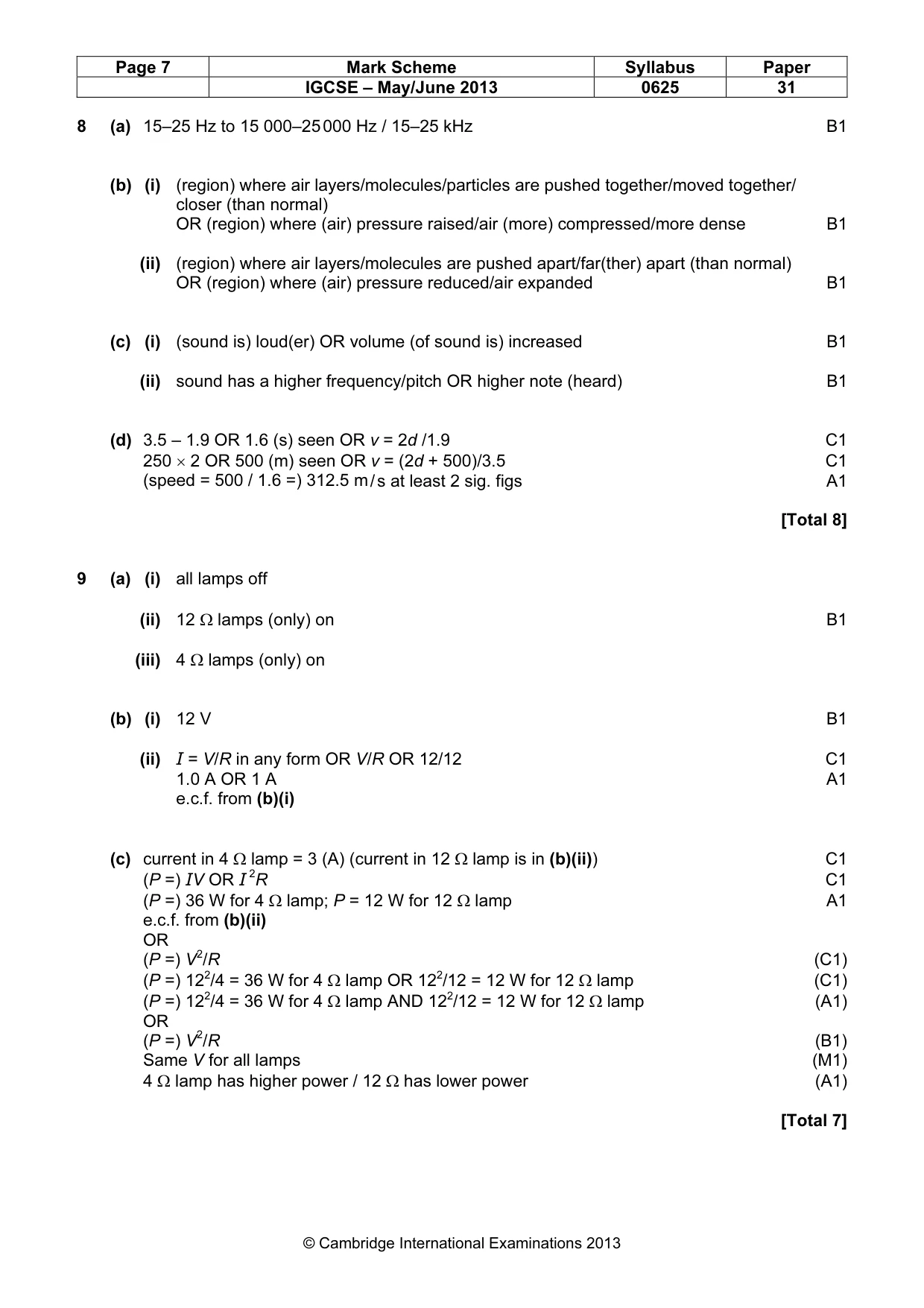
Mark scheme: 8 (a) 15–25 Hz to 15 000–25 000 Hz / 15–25 kHz B1 (b) (i) (region) where air layers/molecules/particles are pushed together/moved together/ closer (than normal) OR (region) where (air) pressure raised/air (more) compressed/more dense B1 (ii) (region) where air layers/molecules are pushed apart/far(ther) apart (than normal) OR (region) where (air) pressure reduced/air expanded B1 (c) (i) (sound is) loud(er) OR volume (of sound is) increased B1 (ii) sound has a higher frequency/pitch OR higher note (heard) B1 (d) 3.5 – 1.9 OR 1.6 (s) seen OR v = 2d /1.9 C1 250 × 2 OR 500 (m) seen OR v = (2d + 500)/3.5 C1 (speed = 500 / 1.6 =) 312.5 m / s at least 2 sig. figs A1 [Total 8]
Q9 · The circuit that operates the two headlights and the two sidelights of a car
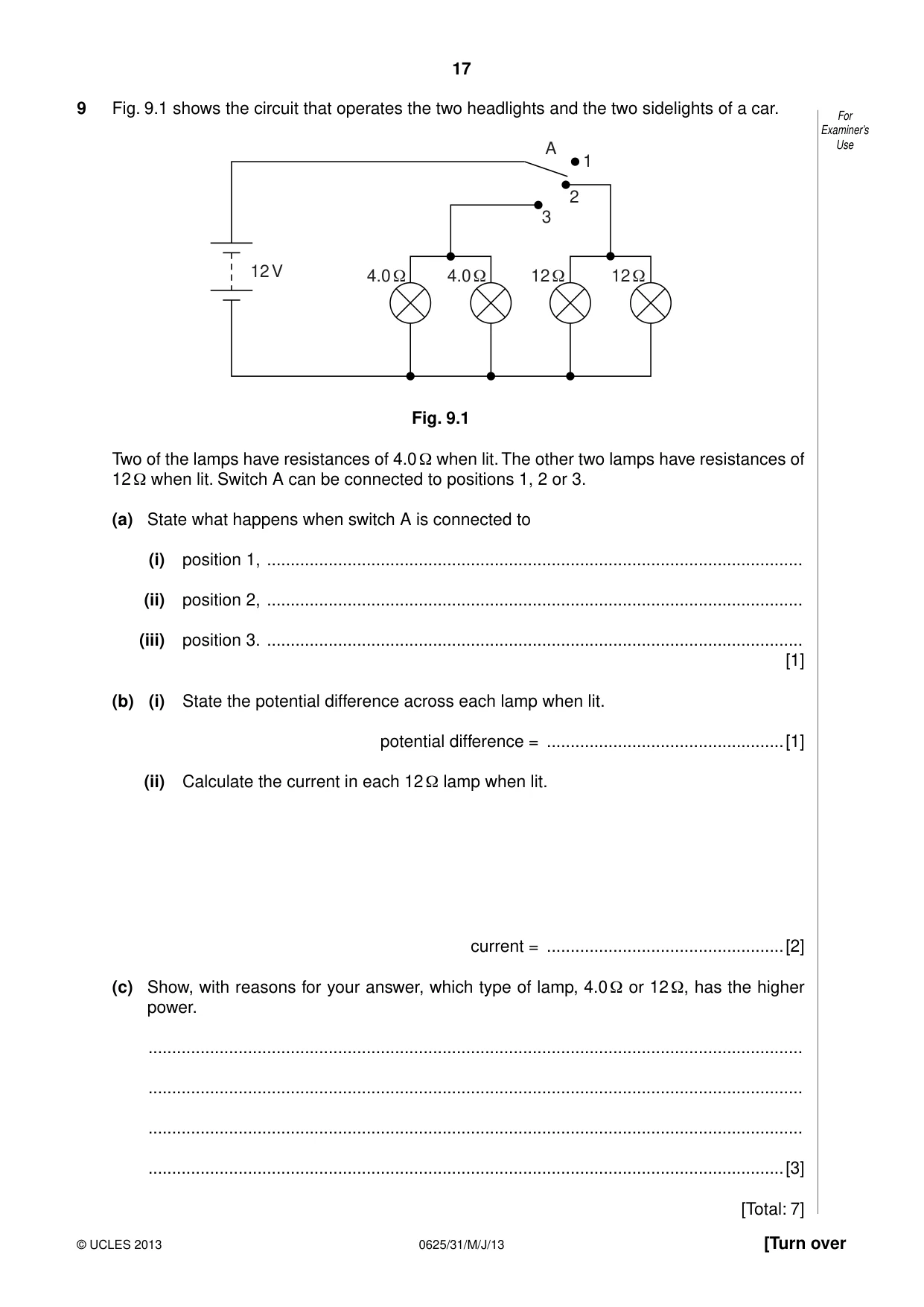
9 Fig. 9.1 shows the circuit that operates the two headlights and the two sidelights of a car. For Examiner’s A Use 1 2 3 12 V 4.0 1 4.0 1 12 1 12 1 Fig. 9.1 Two of the lamps have resistances of 4.0 Ω when lit. The other two lamps have resistances of 12 Ω when lit. Switch A can be connected to positions 1, 2 or 3. (a) State what happens when switch A is connected to (i) position 1, ................................................................................................................. (ii) position 2, ................................................................................................................. (iii) position 3. ................................................................................................................. [1] (b) (i) State the potential difference across each lamp when lit. potential difference = ..................................................[1] (ii) Calculate the current in each 12 Ω lamp when lit. current = ..................................................[2] (c) Show, with reasons for your answer, which type of lamp, 4.0 Ω or 12 Ω, has the higher power. .......................................................................................................................................... .......................................................................................................................................... .......................................................................................................................................... ......................................................................................................................................[3] [Total: 7]
Mark scheme: 9 (a) (i) all lamps off (ii) 12 Ω lamps (only) on B1 (iii) 4 Ω lamps (only) on (b) (i) 12 V B1 (ii) I = V/R in any form OR V/R OR 12/12 C1 1.0 A OR 1 A A1 e.c.f. from (b)(i) (c) current in 4 Ω lamp = 3 (A) (current in 12 Ω lamp is in (b)(ii)) C1 (P =) IV OR I 2R C1 (P =) 36 W for 4 Ω lamp; P = 12 W for 12 Ω lamp A1 e.c.f. from (b)(ii) OR (P =) V2/R (C1) (P =) 122/4 = 36 W for 4 Ω lamp OR 122/12 = 12 W for 12 Ω lamp (C1) (P =) 122/4 = 36 W for 4 Ω lamp AND 122/12 = 12 W for 12 Ω lamp (A1) OR (P =) V2/R (B1) Same V for all lamps (M1) 4 Ω lamp has higher power / 12 Ω has lower power (A1) [Total 7] IGCSE – May/June 2013 0625 31
Q10 · The cross-section of a wire carrying a current into the plane of the paper
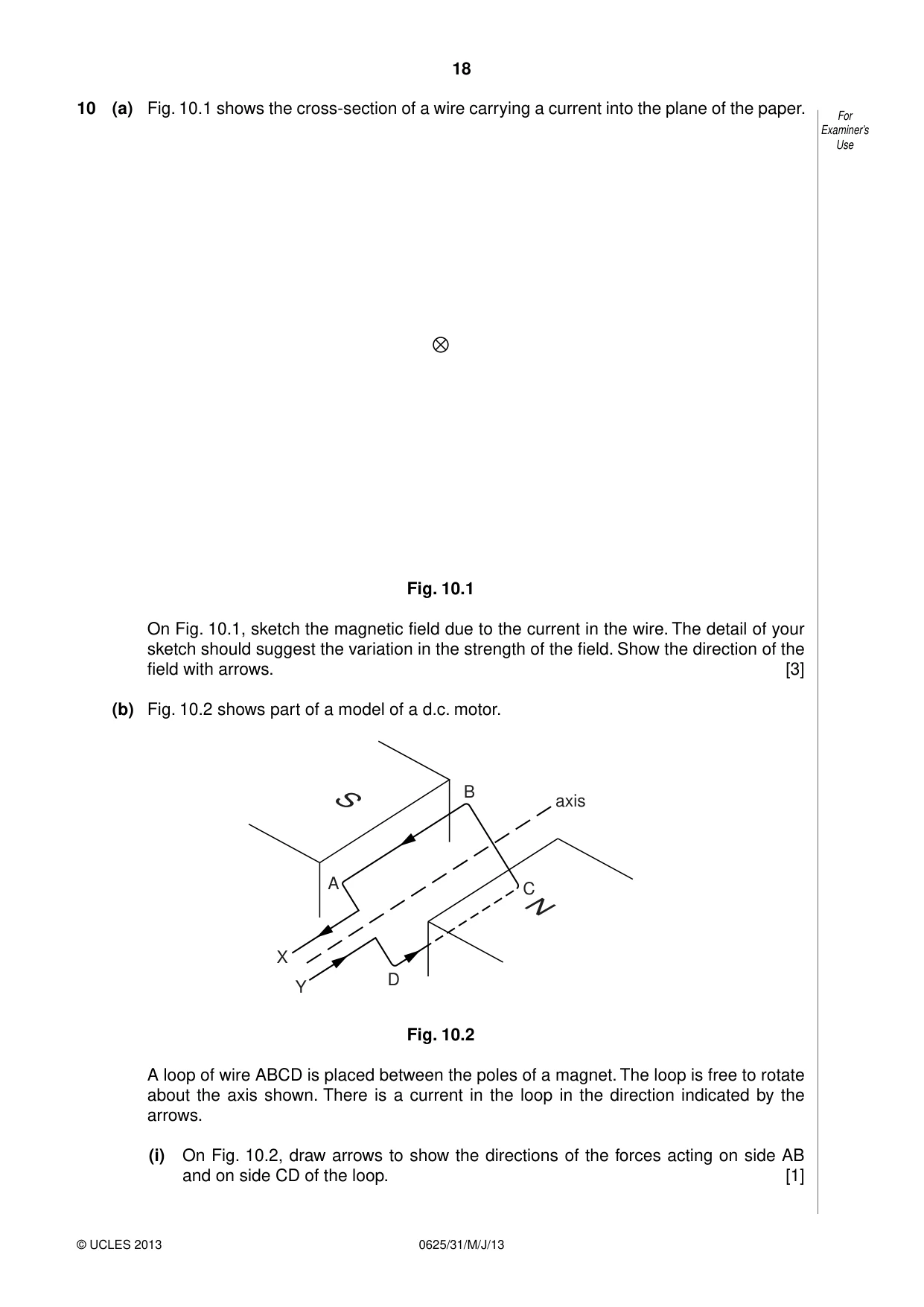
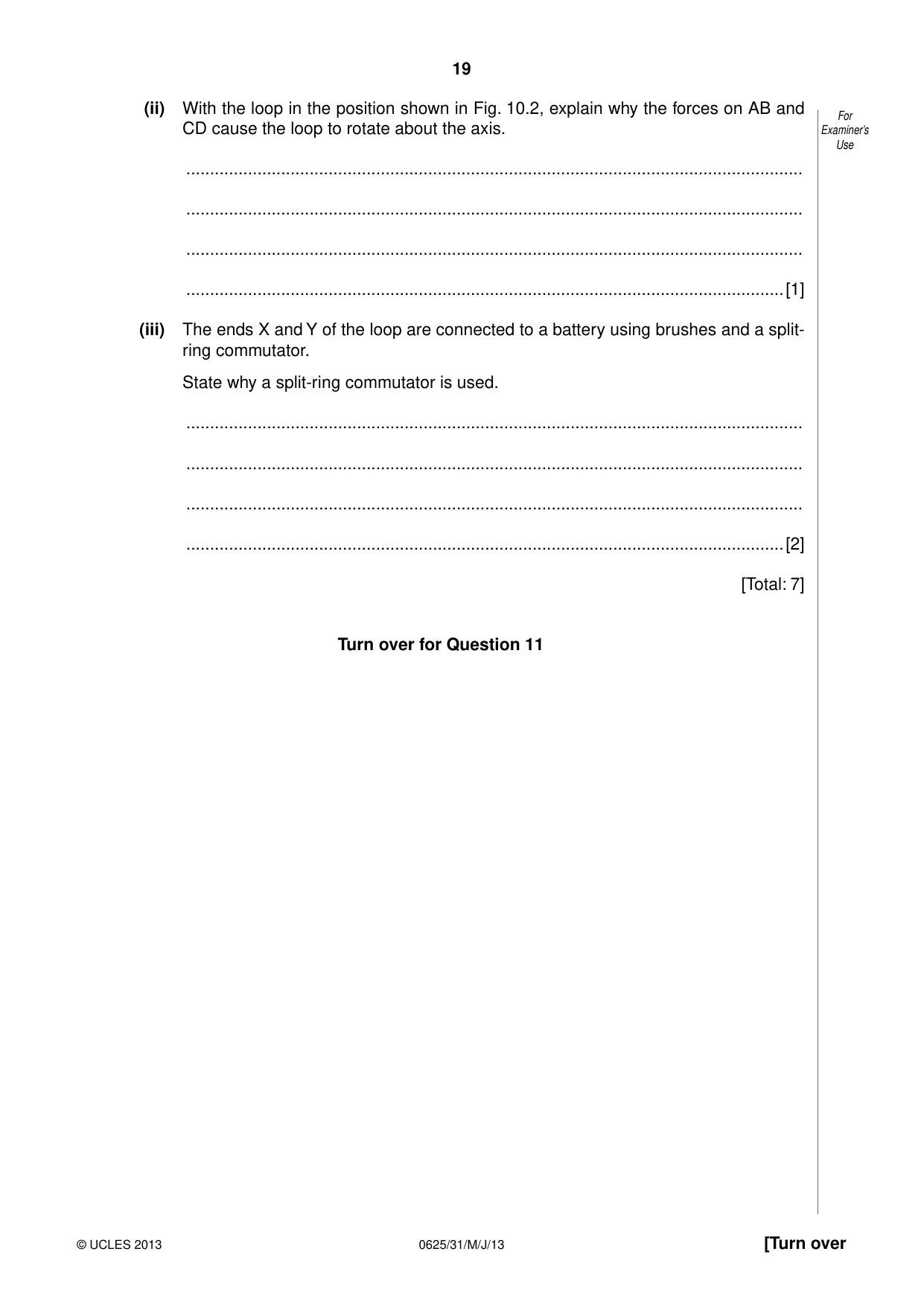
10 (a) Fig. 10.1 shows the cross-section of a wire carrying a current into the plane of the paper. For Examiner’s Use Fig. 10.1 On Fig. 10.1, sketch the magnetic field due to the current in the wire. The detail of your sketch should suggest the variation in the strength of the field. Show the direction of the field with arrows. [3] (b) Fig. 10.2 shows part of a model of a d.c. motor. S B axis A C N X D Y Fig. 10.2 A loop of wire ABCD is placed between the poles of a magnet. The loop is free to rotate about the axis shown. There is a current in the loop in the direction indicated by the arrows. (i) On Fig. 10.2, draw arrows to show the directions of the forces acting on side AB and on side CD of the loop. [1] (ii) With the loop in the position shown in Fig. 10.2, explain why the forces on AB and For CD cause the loop to rotate about the axis. Examiner’s Use .................................................................................................................................. .................................................................................................................................. .................................................................................................................................. ..............................................................................................................................[1] (iii) The ends X and Y of the loop are connected to a battery using brushes and a split- ring commutator. State why a split-ring commutator is used. .................................................................................................................................. .................................................................................................................................. .................................................................................................................................. ..............................................................................................................................[2] [Total: 7] Turn over for Question 11
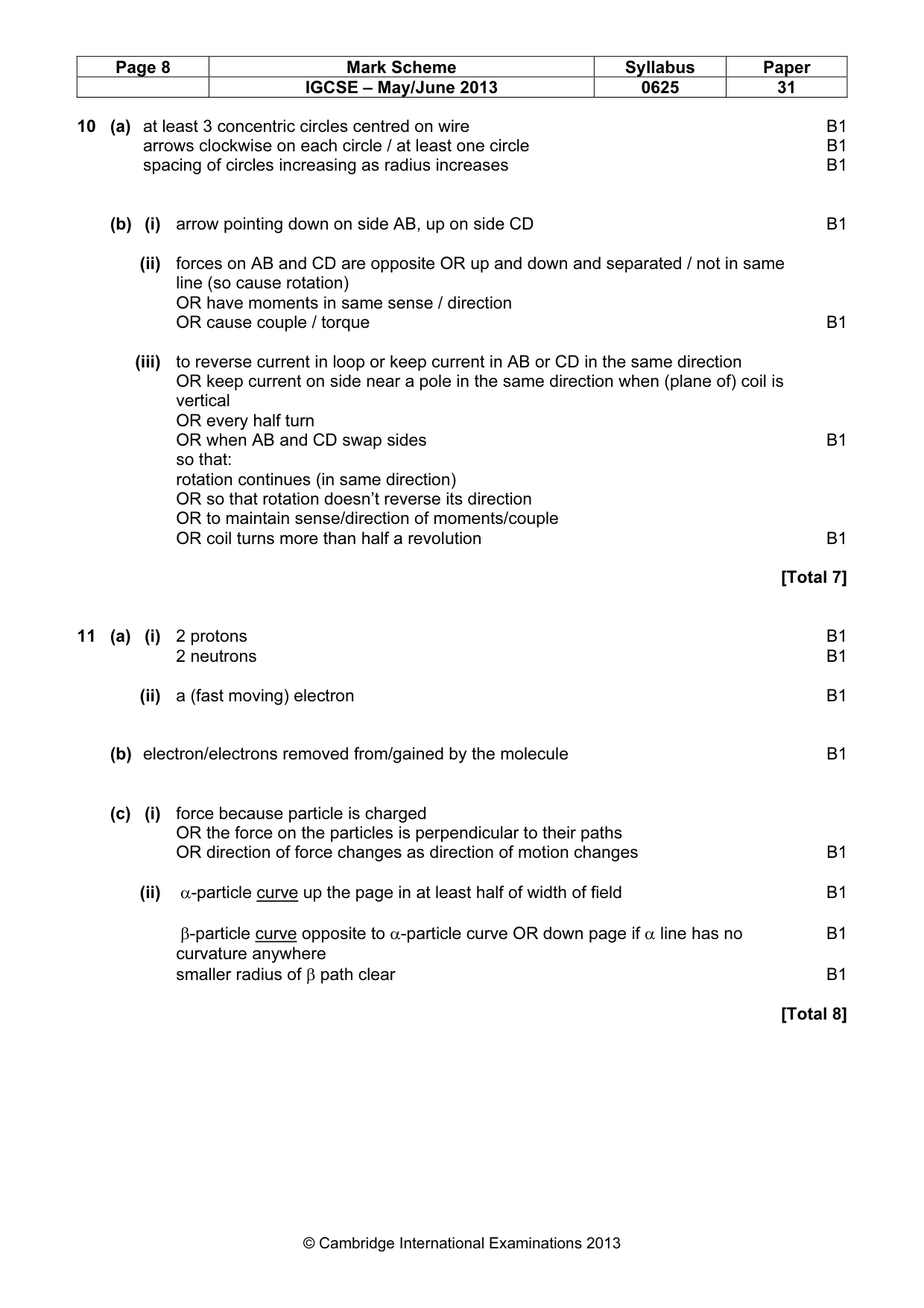
Mark scheme: 10 (a) at least 3 concentric circles centred on wire B1 arrows clockwise on each circle / at least one circle B1 spacing of circles increasing as radius increases B1 (b) (i) arrow pointing down on side AB, up on side CD B1 (ii) forces on AB and CD are opposite OR up and down and separated / not in same line (so cause rotation) OR have moments in same sense / direction OR cause couple / torque B1 (iii) to reverse current in loop or keep current in AB or CD in the same direction OR keep current on side near a pole in the same direction when (plane of) coil is vertical OR every half turn OR when AB and CD swap sides B1 so that: rotation continues (in same direction) OR so that rotation doesn’t reverse its direction OR to maintain sense/direction of moments/couple OR coil turns more than half a revolution B1 [Total 7]
Q11 · Complete the following statements
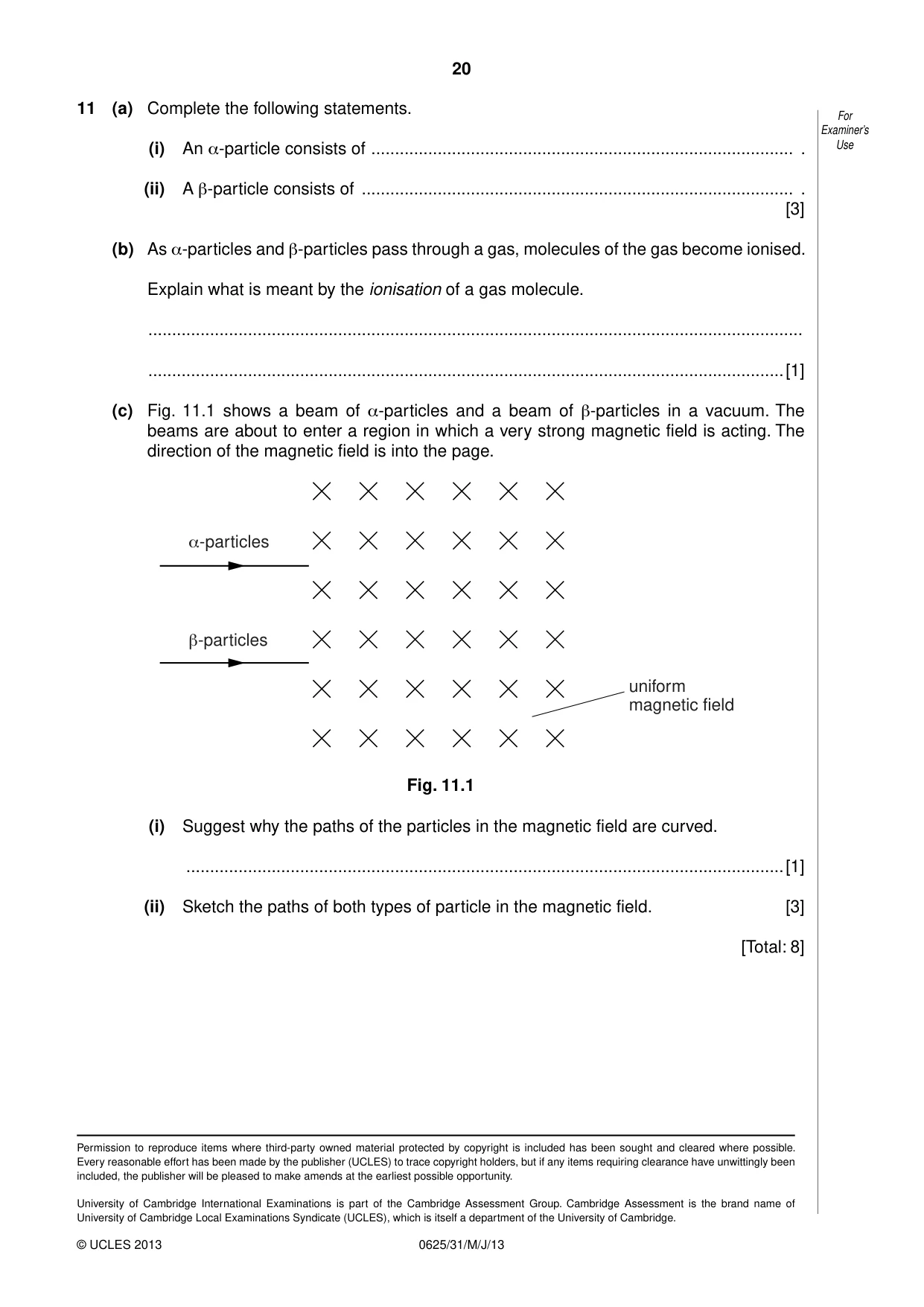
11 (a) Complete the following statements. For Examiner’s (i) An α-particle consists of ......................................................................................... . Use (ii) A β-particle consists of ........................................................................................... . [3] (b) As α-particles and β-particles pass through a gas, molecules of the gas become ionised. Explain what is meant by the ionisation of a gas molecule. .......................................................................................................................................... ......................................................................................................................................[1] (c) Fig. 11.1 shows a beam of α-particles and a beam of β-particles in a vacuum. The beams are about to enter a region in which a very strong magnetic field is acting. The direction of the magnetic field is into the page. _-particles `-particles uniform magnetic field Fig. 11.1 (i) Suggest why the paths of the particles in the magnetic field are curved. ..............................................................................................................................[1] (ii) Sketch the paths of both types of particle in the magnetic field. [3] [Total: 8]
Mark scheme: 11 (a) (i) 2 protons B1 2 neutrons B1 (ii) a (fast moving) electron B1 (b) electron/electrons removed from/gained by the molecule B1 (c) (i) force because particle is charged OR the force on the particles is perpendicular to their paths OR direction of force changes as direction of motion changes B1 (ii) α-particle curve up the page in at least half of width of field B1 β-particle curve opposite to α-particle curve OR down page if α line has no B1 curvature anywhere smaller radius of β path clear B1 [Total 8]
What was in this paper
The subtopics covered by these 11 questions, and how many questions each got. Open one in a new tab to see every Cambridge question on it.
What you needed in this session
Cambridge’s own grade thresholds for 2013 May/June, Paper 3 · Variant 1. A higher threshold means an easier paper — the bar moves with how the cohort did.