Cambridge IGCSE Physics 0625 — 2017 May/June Paper 3 · Variant 2
0625/32/M/J/17 · 12 questions · 80 marks · ≈90 min
The question paper and its mark scheme, free to read here and free to download. This is Cambridge’s own paper, exactly as it was sat.
Question paper20 pages
Mark scheme12 pages
Answers below. Sit the paper first if you are practising.
Questions as text
Q1 · Students about to start a 50.0 m swimming race
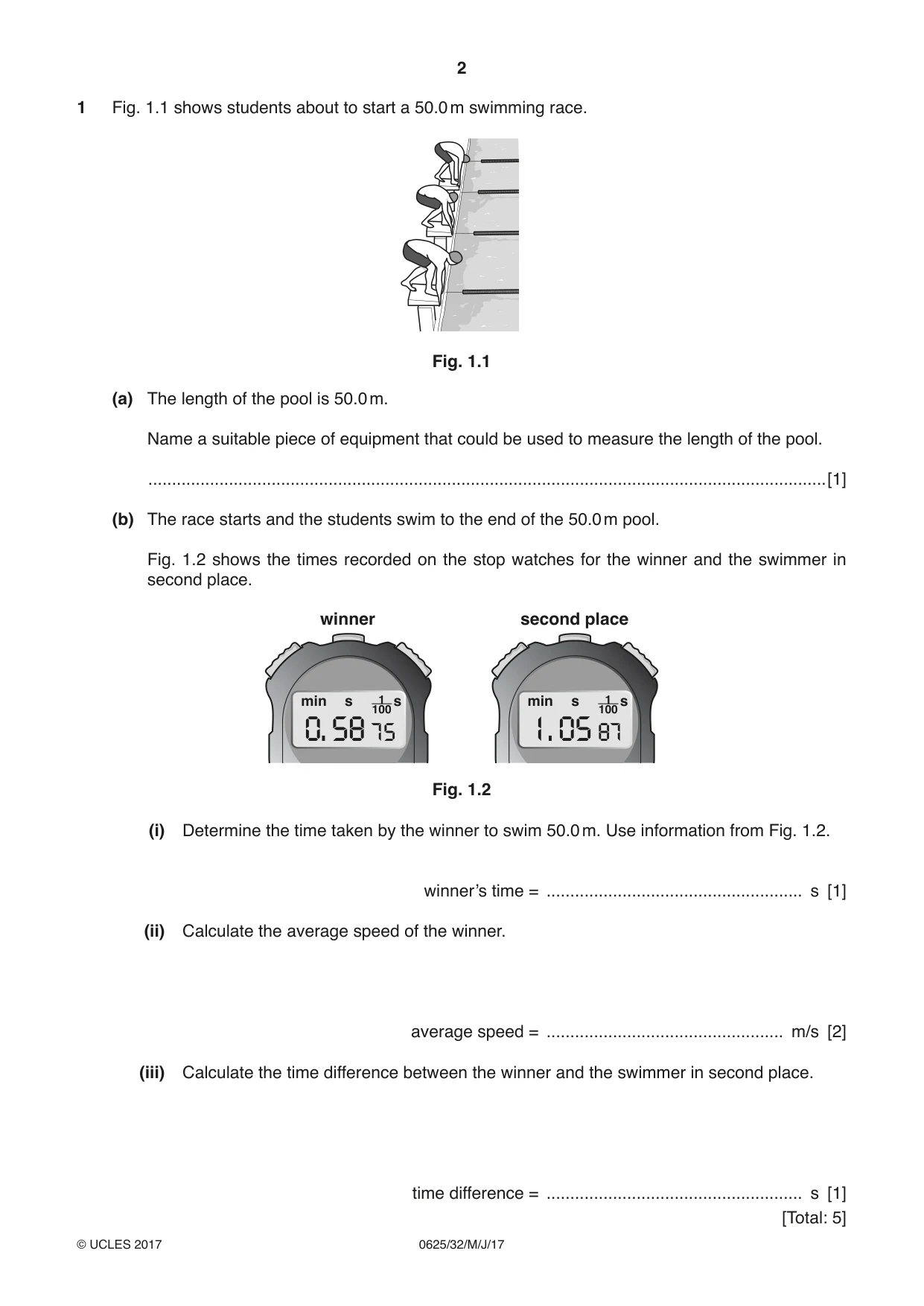
1 Fig. 1.1 shows students about to start a 50.0 m swimming race. Fig. 1.1 (a) The length of the pool is 50.0 m. Name a suitable piece of equipment that could be used to measure the length of the pool. ...............................................................................................................................................[1] (b) The race starts and the students swim to the end of the 50.0 m pool. Fig. 1.2 shows the times recorded on the stop watches for the winner and the swimmer in second place. winner second place min s 1 s min s 1 s 100 100 0. 58 75 1. 05 87 Fig. 1.2 (i) Determine the time taken by the winner to swim 50.0 m. Use information from Fig. 1.2. winner’s time = ...................................................... s [1] (ii) Calculate the average speed of the winner. average speed = .................................................. m/s [2] (iii) Calculate the time difference between the winner and the swimmer in second place. time difference = ...................................................... s [1] [Total: 5]
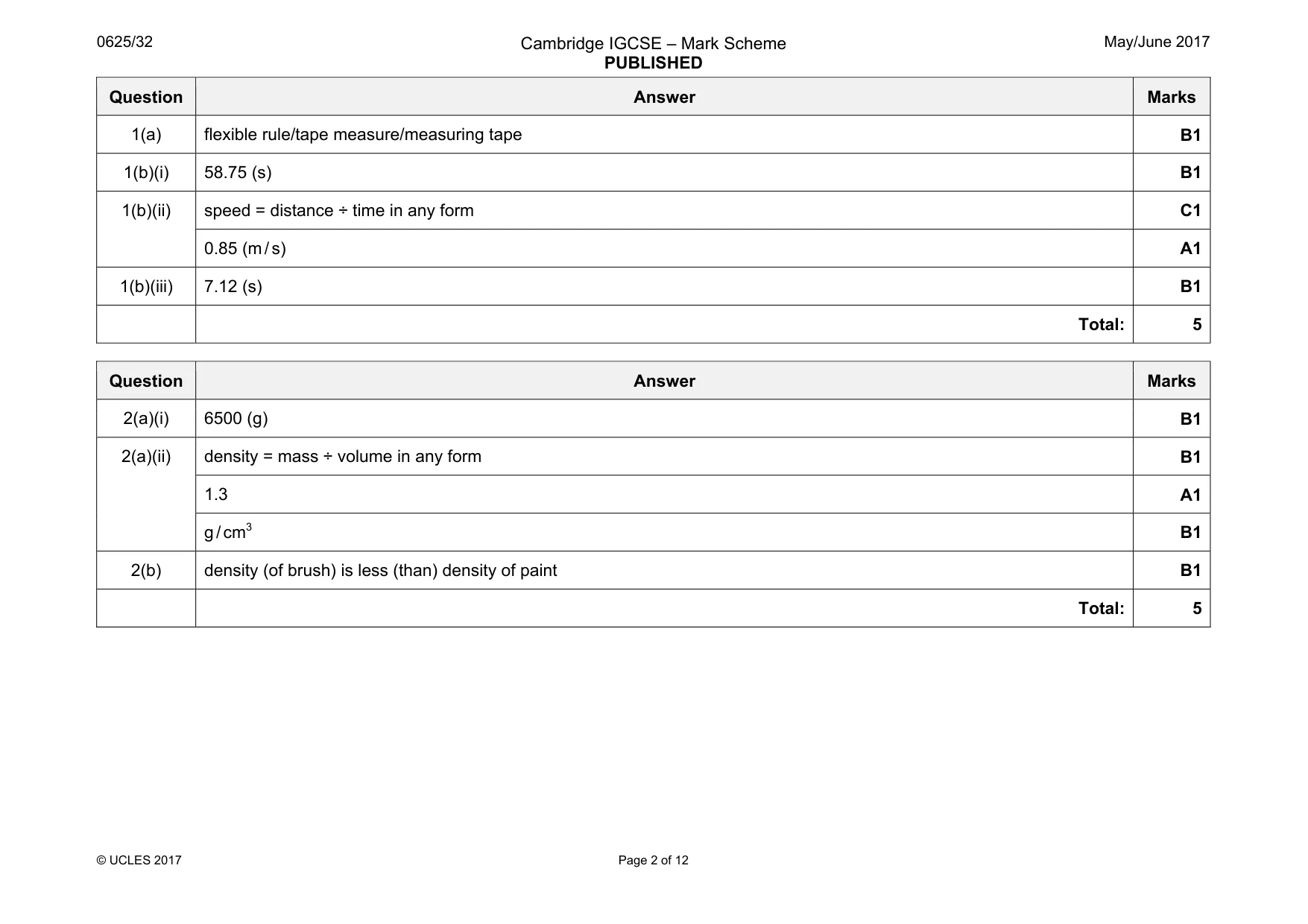
Mark scheme: 1(a) flexible rule/tape measure/measuring tape B1 1(b)(i) 58.75 (s) B1 1(b)(ii) speed = distance ÷ time in any form C1 0.85 (m / s) A1 1(b)(iii) 7.12 (s) B1 Total: 5
Q2 · The walls of a room are to be painted
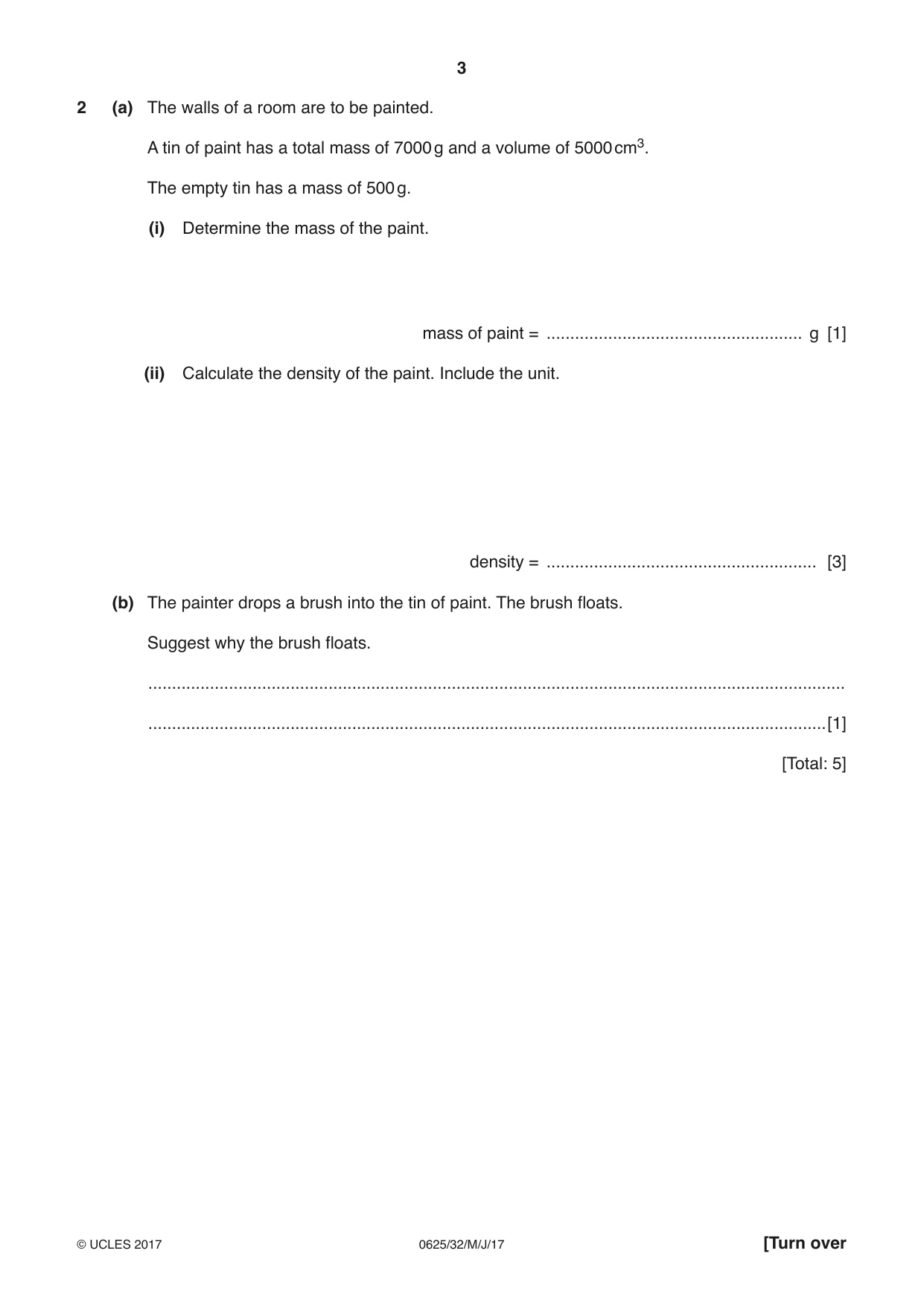
2 (a) The walls of a room are to be painted. A tin of paint has a total mass of 7000 g and a volume of 5000 cm3. The empty tin has a mass of 500 g. (i) Determine the mass of the paint. mass of paint = ...................................................... g [1] (ii) Calculate the density of the paint. Include the unit. density = ......................................................... [3] (b) The painter drops a brush into the tin of paint. The brush floats. Suggest why the brush floats. ................................................................................................................................................... ...............................................................................................................................................[1] [Total: 5]
Mark scheme: 2(a)(i) 6500 (g) B1 2(a)(ii) density = mass ÷ volume in any form B1 1.3 A1 g / cm3 B1 2(b) density (of brush) is less (than) density of paint B1 Total: 5
Question 3
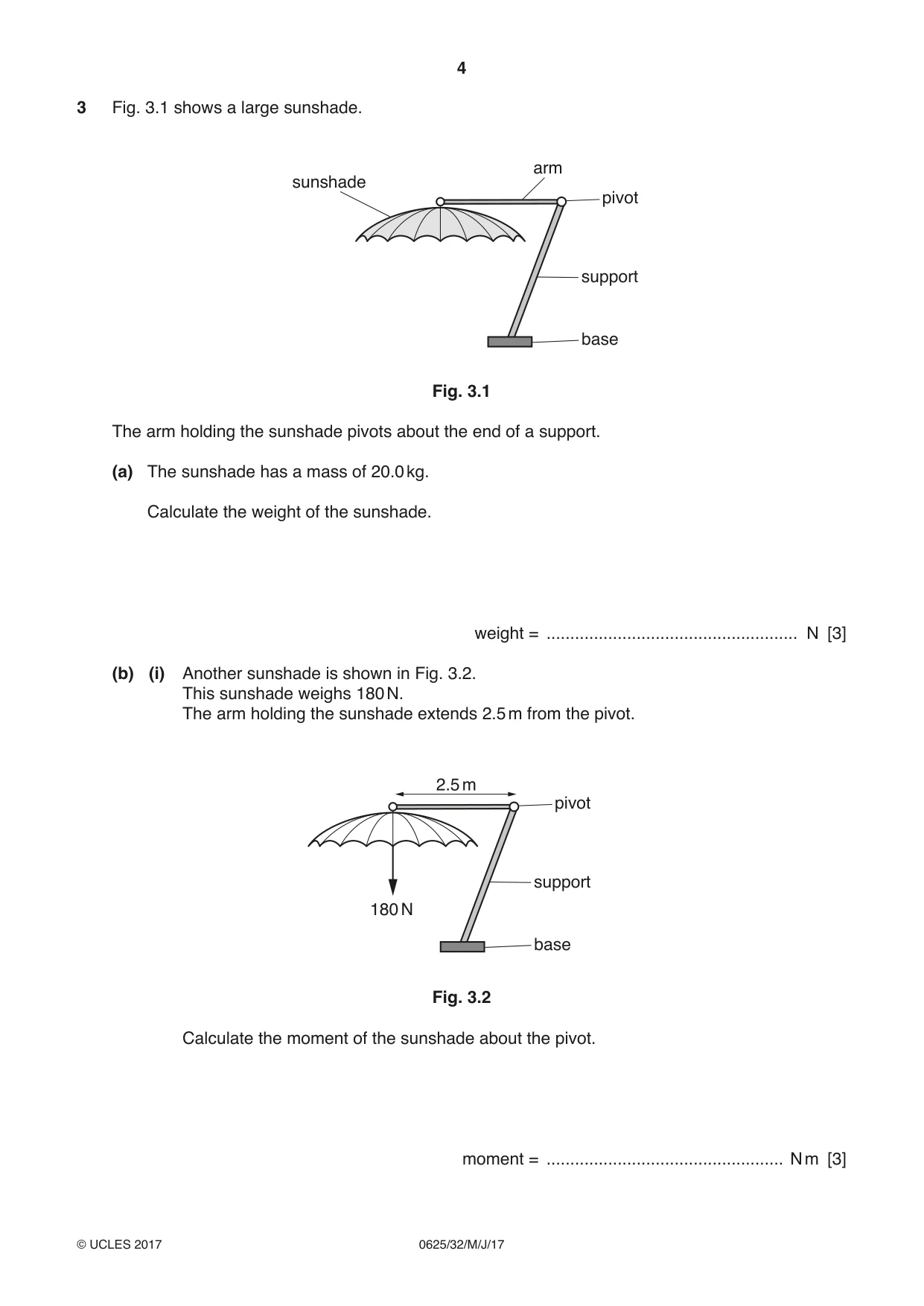
3 Fig. 3.1 shows a large sunshade. arm sunshade pivot support base Fig. 3.1 The arm holding the sunshade pivots about the end of a support. (a) The sunshade has a mass of 20.0 kg. Calculate the weight of the sunshade. weight = ..................................................... N [3] (b) (i) Another sunshade is shown in Fig. 3.2. This sunshade weighs 180 N. The arm holding the sunshade extends 2.5 m from the pivot. 2.5 m pivot support 180 N base Fig. 3.2 Calculate the moment of the sunshade about the pivot. moment = .................................................. N m [3] (ii) How can the moment produced by the sunshade be reduced? Tick one box. by decreasing the height of the support by decreasing the length of the arm holding the sunshade by increasing the weight of the base by increasing the weight of the sunshade [1] [Total: 7]
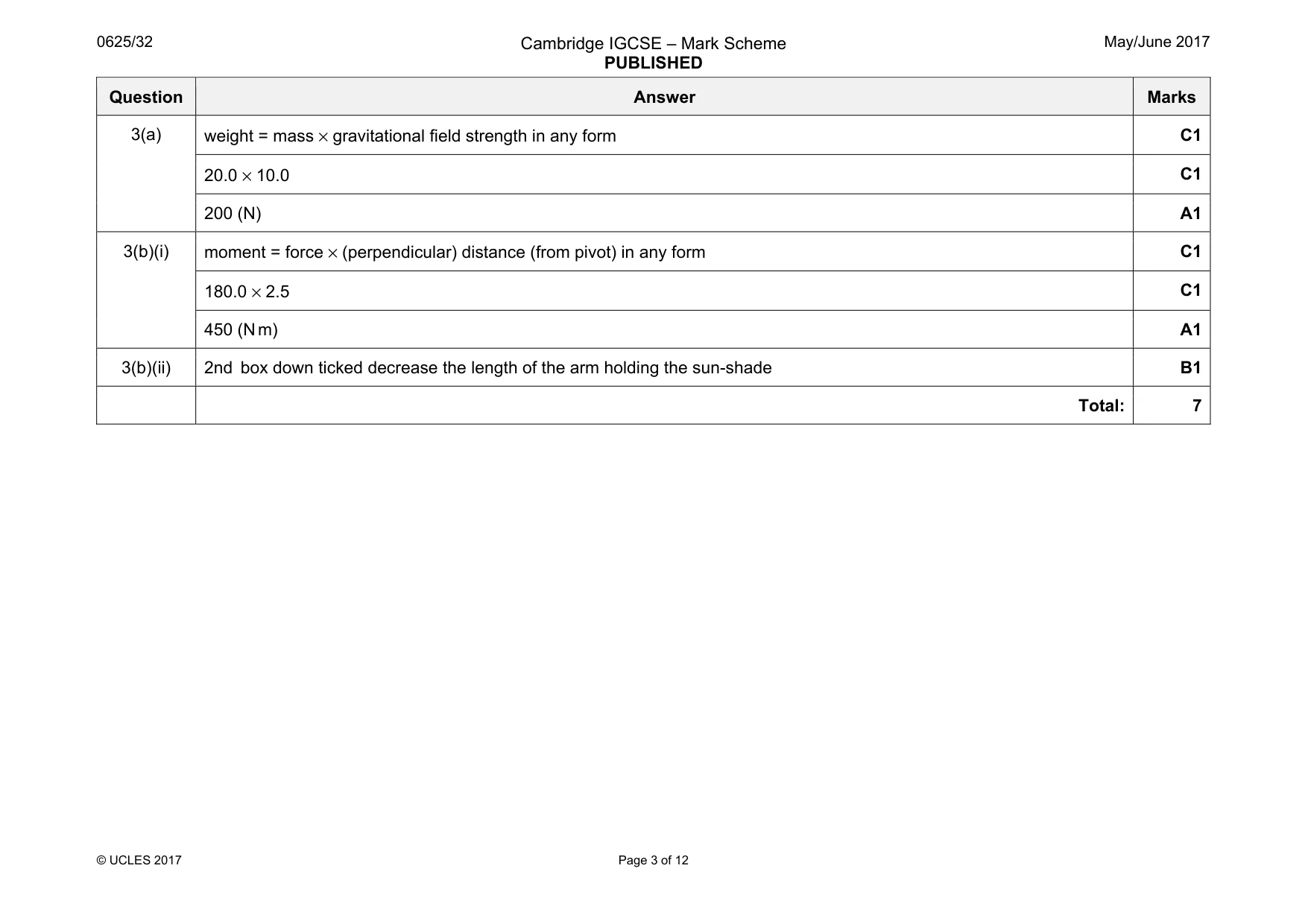
Mark scheme: 3(a) C1 20.0 × 10.0 C1 200 (N) A1 3(b)(i) moment = force × (perpendicular) distance (from pivot) in any form C1 180.0 × 2.5 C1 450 (N m) A1 3(b)(ii) 2nd box down ticked decrease the length of the arm holding the sun-shade B1 Total: 7
Q4 · A house has white wooden walls and a black wooden door, as shown in Fig
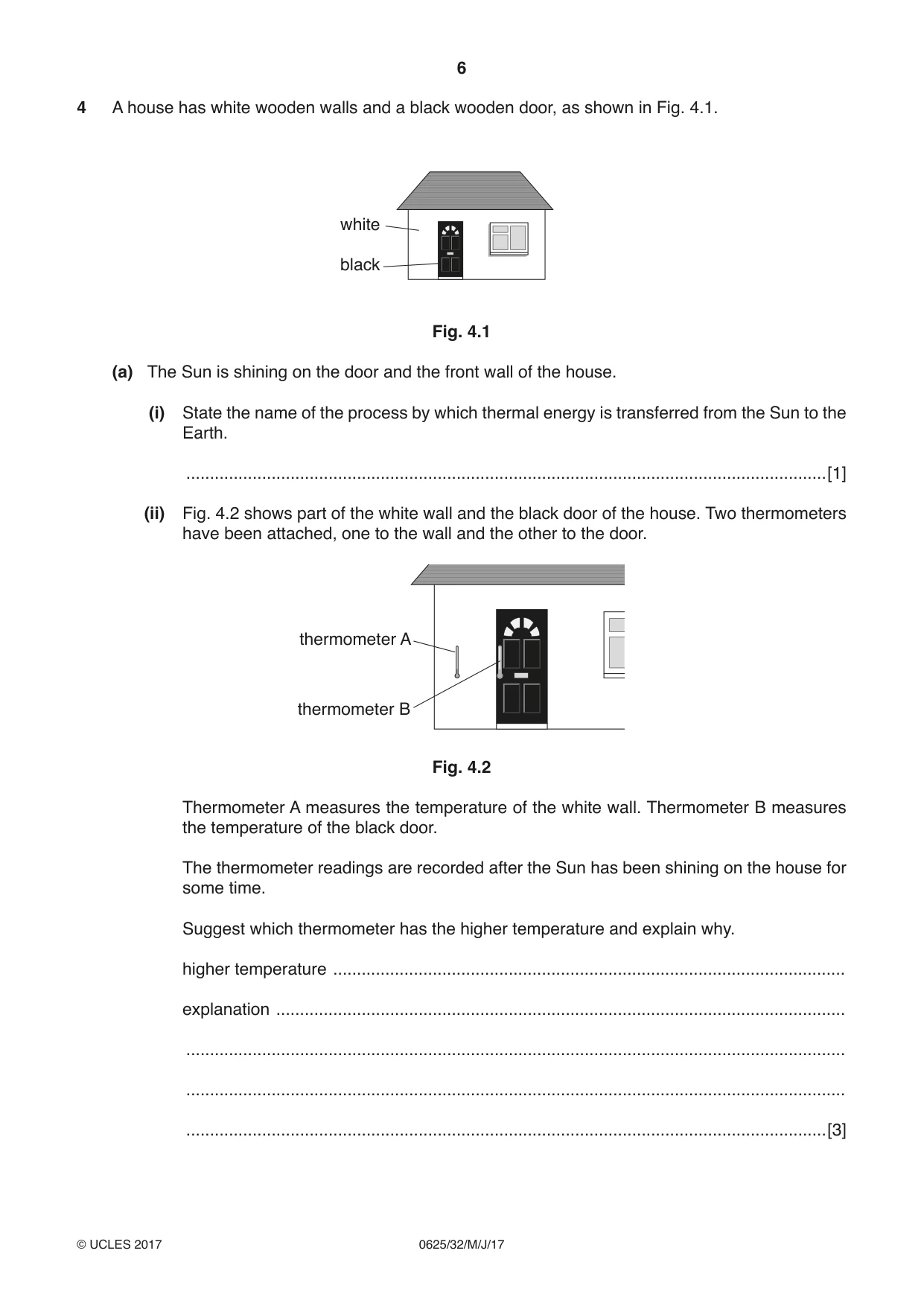
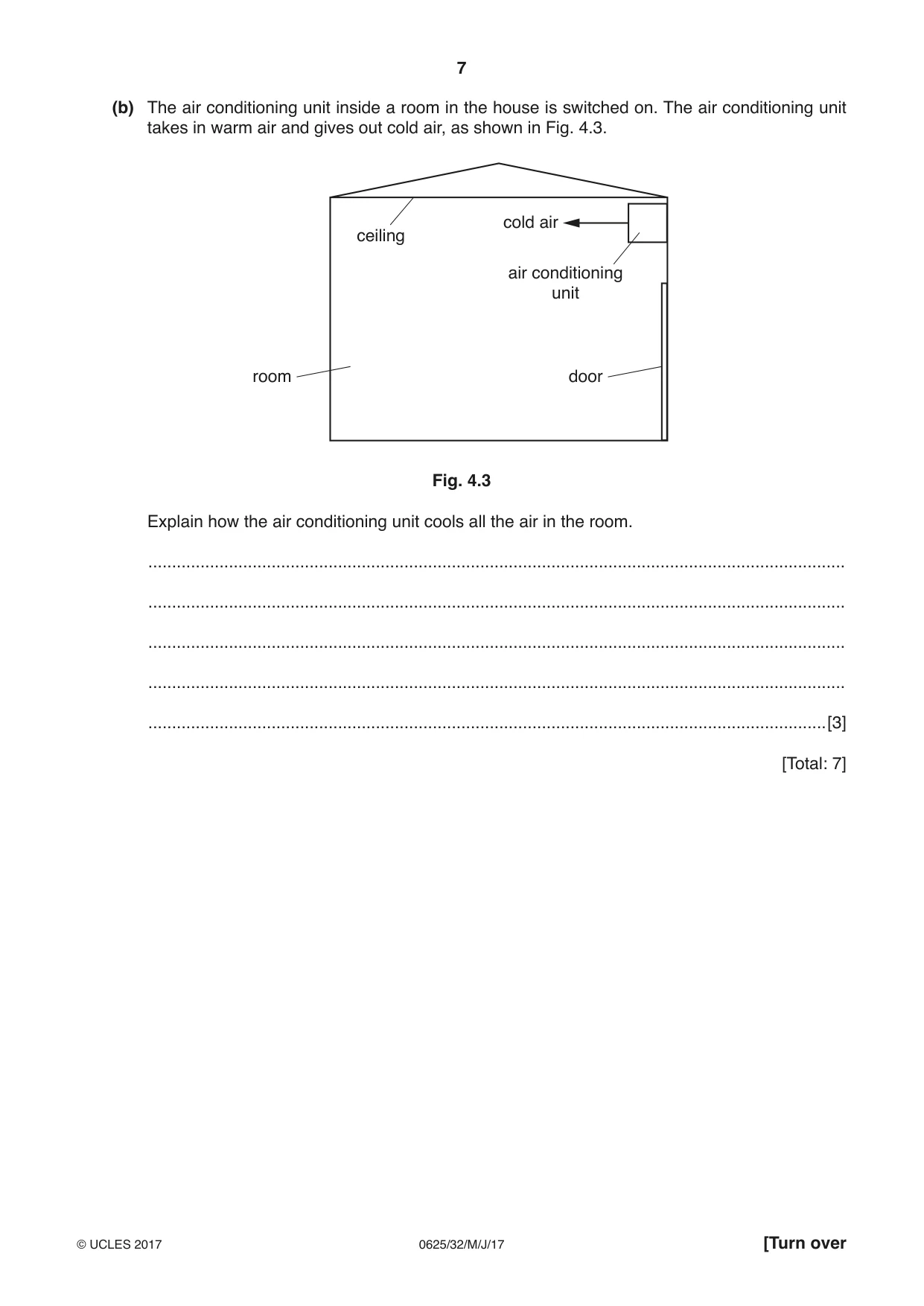
4 A house has white wooden walls and a black wooden door, as shown in Fig. 4.1. white black Fig. 4.1 (a) The Sun is shining on the door and the front wall of the house. (i) State the name of the process by which thermal energy is transferred from the Sun to the Earth. .......................................................................................................................................[1] (ii) Fig. 4.2 shows part of the white wall and the black door of the house. Two thermometers have been attached, one to the wall and the other to the door. thermometer A thermometer B Fig. 4.2 Thermometer A measures the temperature of the white wall. Thermometer B measures the temperature of the black door. The thermometer readings are recorded after the Sun has been shining on the house for some time. Suggest which thermometer has the higher temperature and explain why. higher temperature ............................................................................................................ explanation ........................................................................................................................ ........................................................................................................................................... ........................................................................................................................................... .......................................................................................................................................[3] (b) The air conditioning unit inside a room in the house is switched on. The air conditioning unit takes in warm air and gives out cold air, as shown in Fig. 4.3. cold air ceiling air conditioning unit room door Fig. 4.3 Explain how the air conditioning unit cools all the air in the room. ................................................................................................................................................... ................................................................................................................................................... ................................................................................................................................................... ................................................................................................................................................... ...............................................................................................................................................[3] [Total: 7]
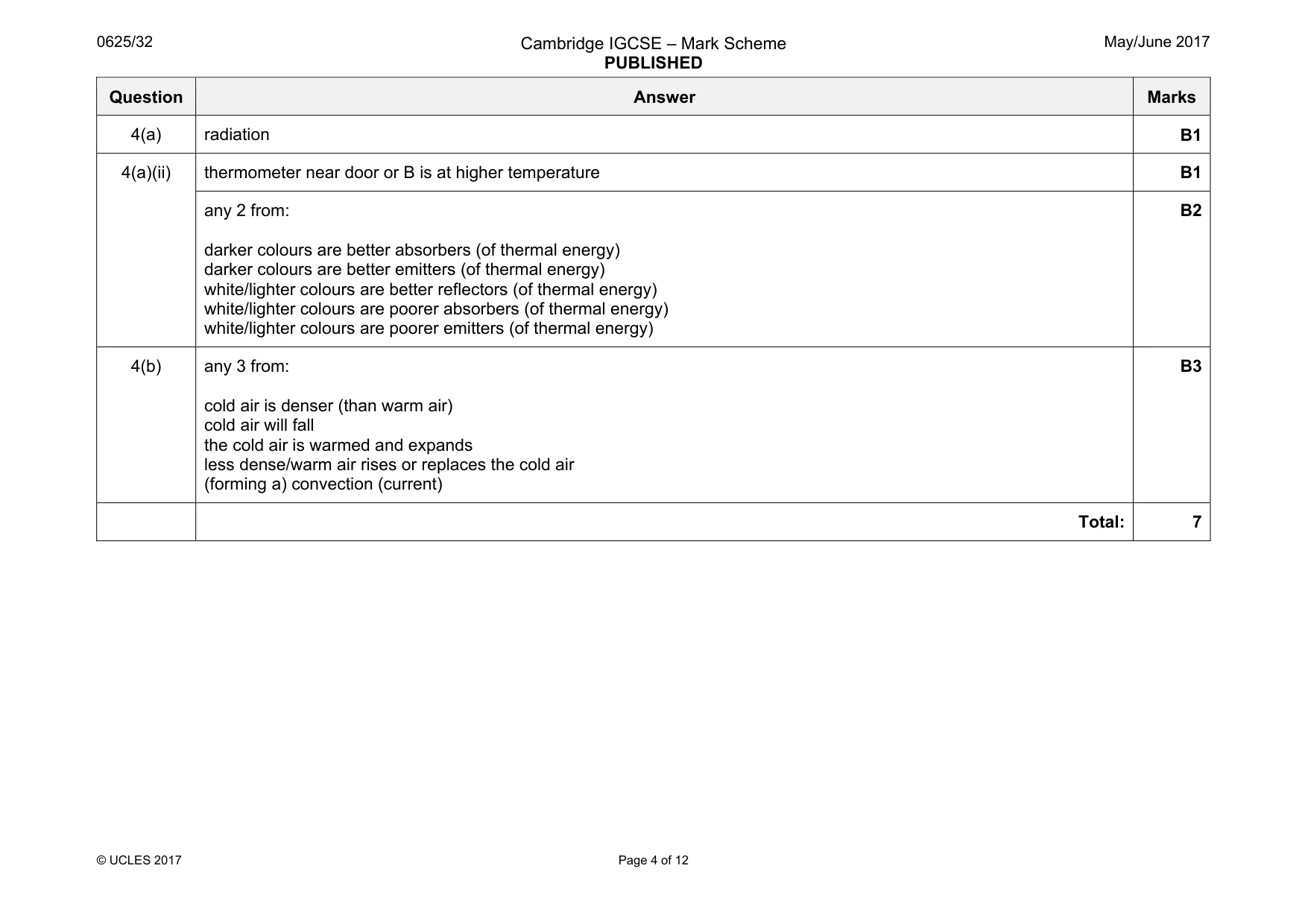
Mark scheme: 4(a) radiation B1 4(a)(ii) thermometer near door or B is at higher temperature B1 any 2 from: darker colours are better absorbers (of thermal energy) darker colours are better emitters (of thermal energy) white/lighter colours are better reflectors (of thermal energy) white/lighter colours are poorer absorbers (of thermal energy) white/lighter colours are poorer emitters (of thermal energy) B2 4(b) any 3 from: cold air is denser (than warm air) cold air will fall the cold air is warmed and expands less dense/warm air rises or replaces the cold air (forming a) convection (current) B3 Total: 7
Q5 · A potato snack packet is taken onto an aeroplane
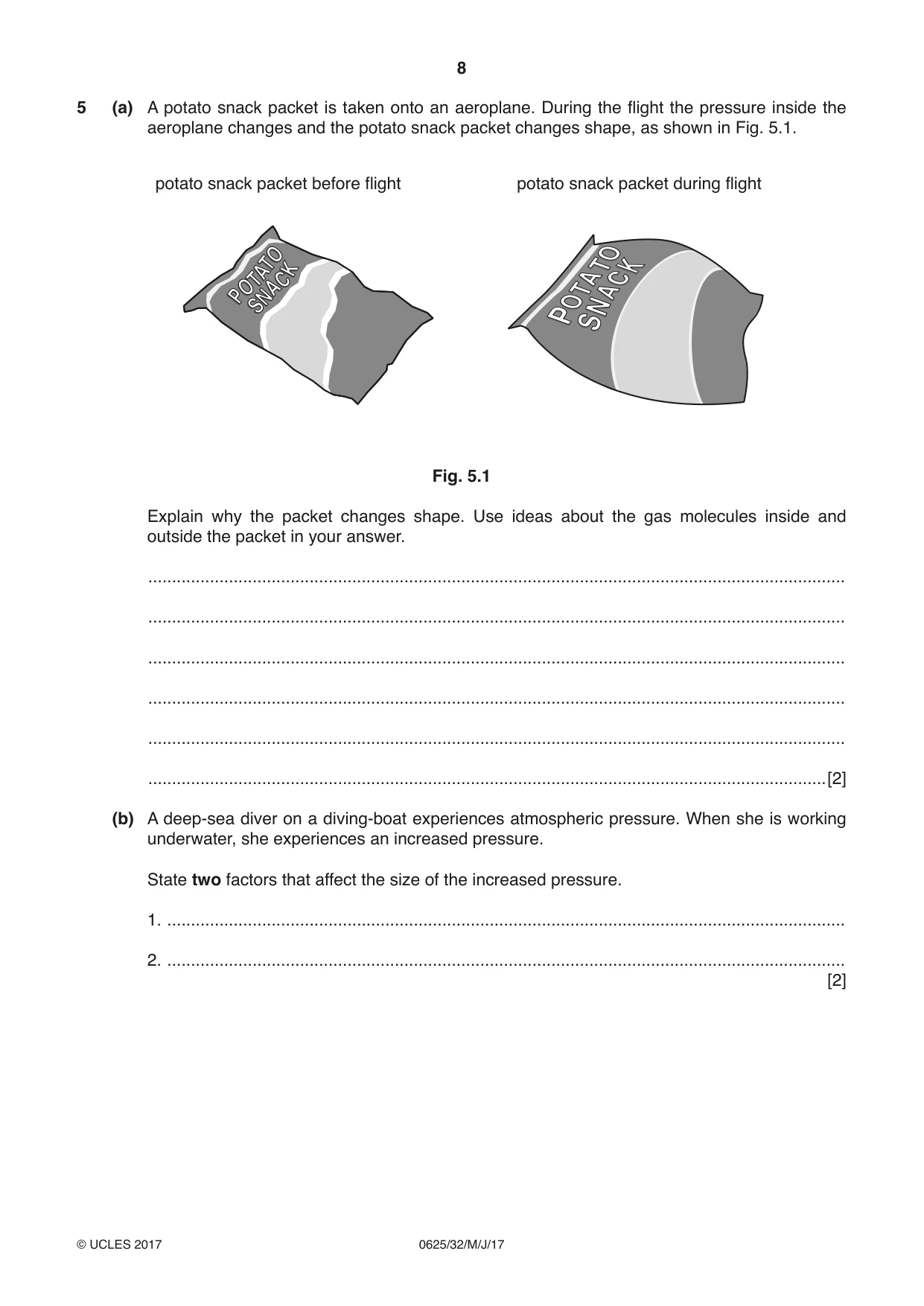
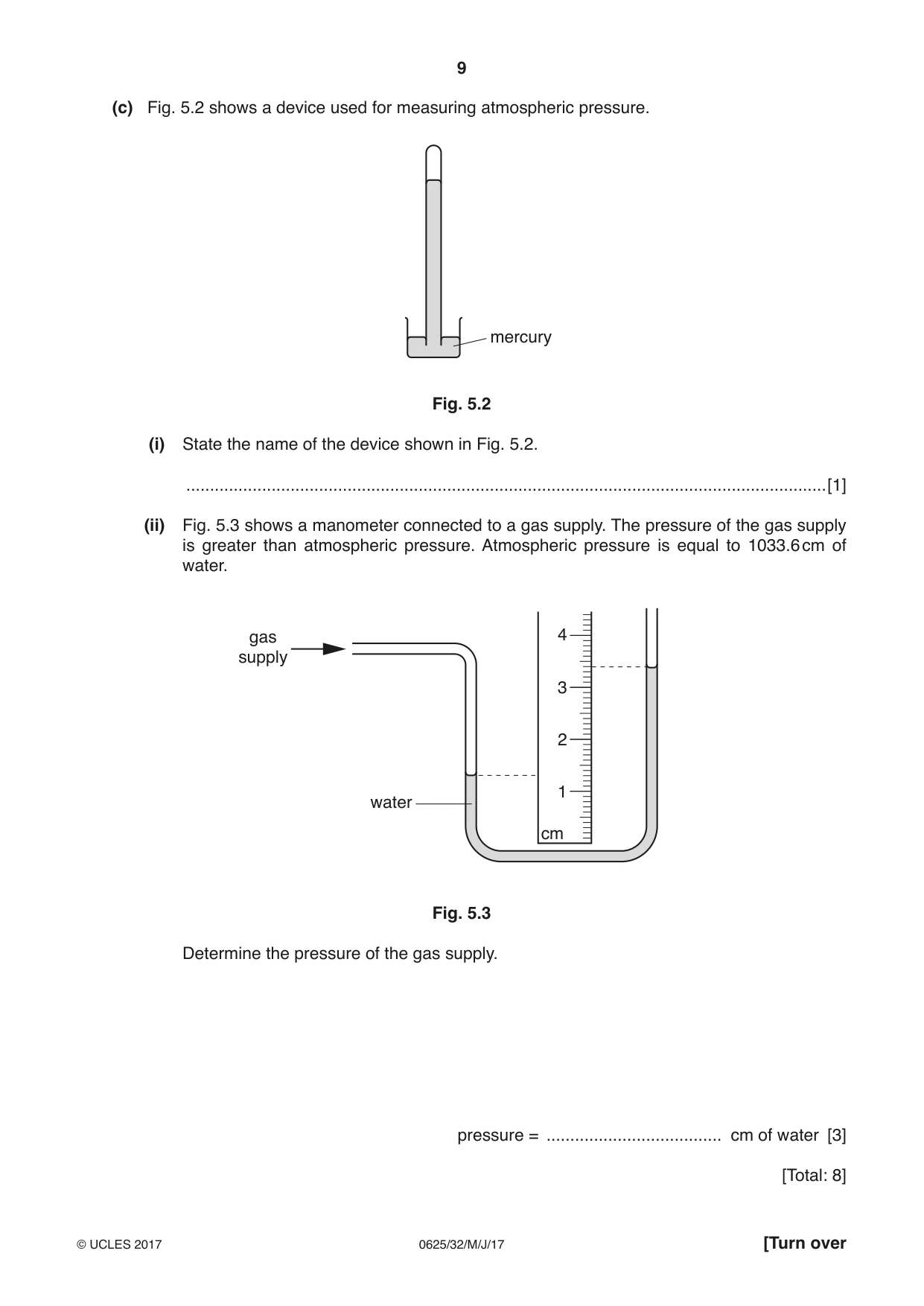
5 (a) A potato snack packet is taken onto an aeroplane. During the flight the pressure inside the aeroplane changes and the potato snack packet changes shape, as shown in Fig. 5.1. potato snack packet before flight potato snack packet during flight OO OO KK K TT ATATK CC TT OOACAC TATAAA PPSNSN OONN PP SS Fig. 5.1 Explain why the packet changes shape. Use ideas about the gas molecules inside and outside the packet in your answer. ................................................................................................................................................... ................................................................................................................................................... ................................................................................................................................................... ................................................................................................................................................... ................................................................................................................................................... ...............................................................................................................................................[2] (b) A deep-sea diver on a diving-boat experiences atmospheric pressure. When she is working underwater, she experiences an increased pressure. State two factors that affect the size of the increased pressure. 1. ............................................................................................................................................... 2. ............................................................................................................................................... [2] (c) Fig. 5.2 shows a device used for measuring atmospheric pressure. mercury Fig. 5.2 (i) State the name of the device shown in Fig. 5.2. .......................................................................................................................................[1] (ii) Fig. 5.3 shows a manometer connected to a gas supply. The pressure of the gas supply is greater than atmospheric pressure. Atmospheric pressure is equal to 1033.6 cm of water. gas 4 supply 3 2 1 water cm Fig. 5.3 Determine the pressure of the gas supply. pressure = ..................................... cm of water [3] [Total: 8]
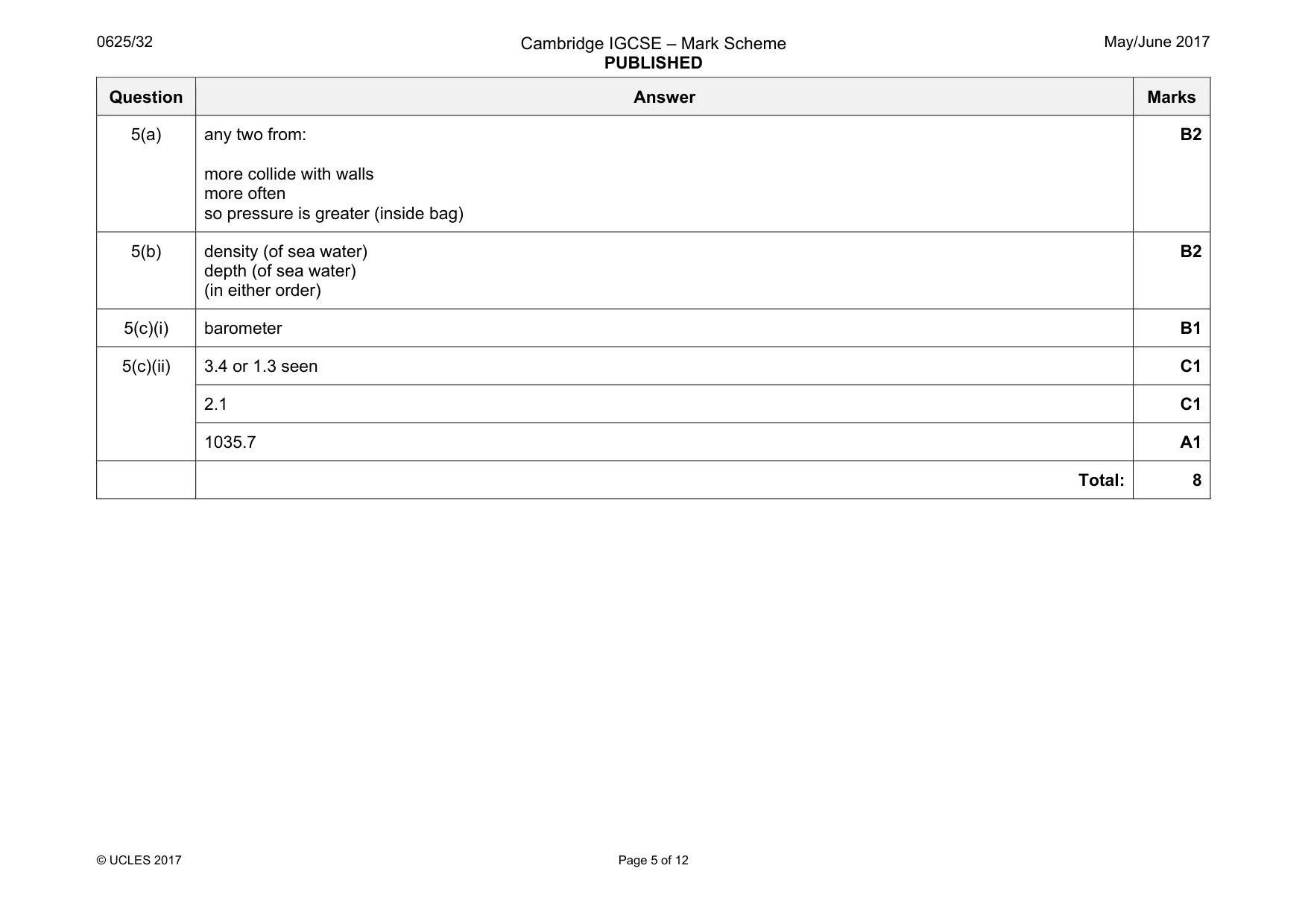
Mark scheme: 5(a) any two from: more collide with walls more often so pressure is greater (inside bag) B2 5(b) density (of sea water) depth (of sea water) (in either order) B2 5(c)(i) barometer B1 5(c)(ii) 3.4 or 1.3 seen C1 2.1 C1 1035.7 A1 Total: 8
Q6 · An overhead view of two cars approaching a road junction
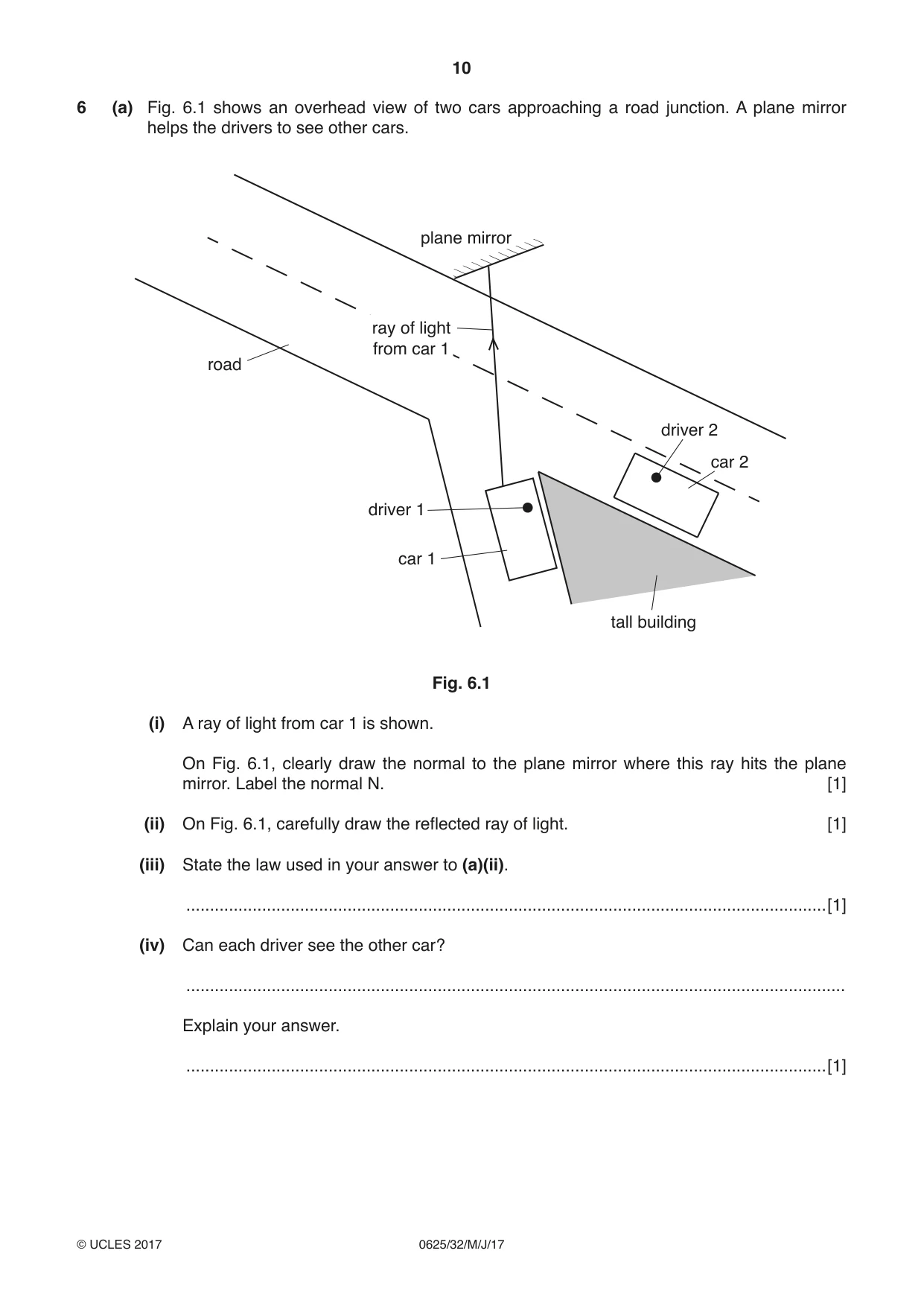
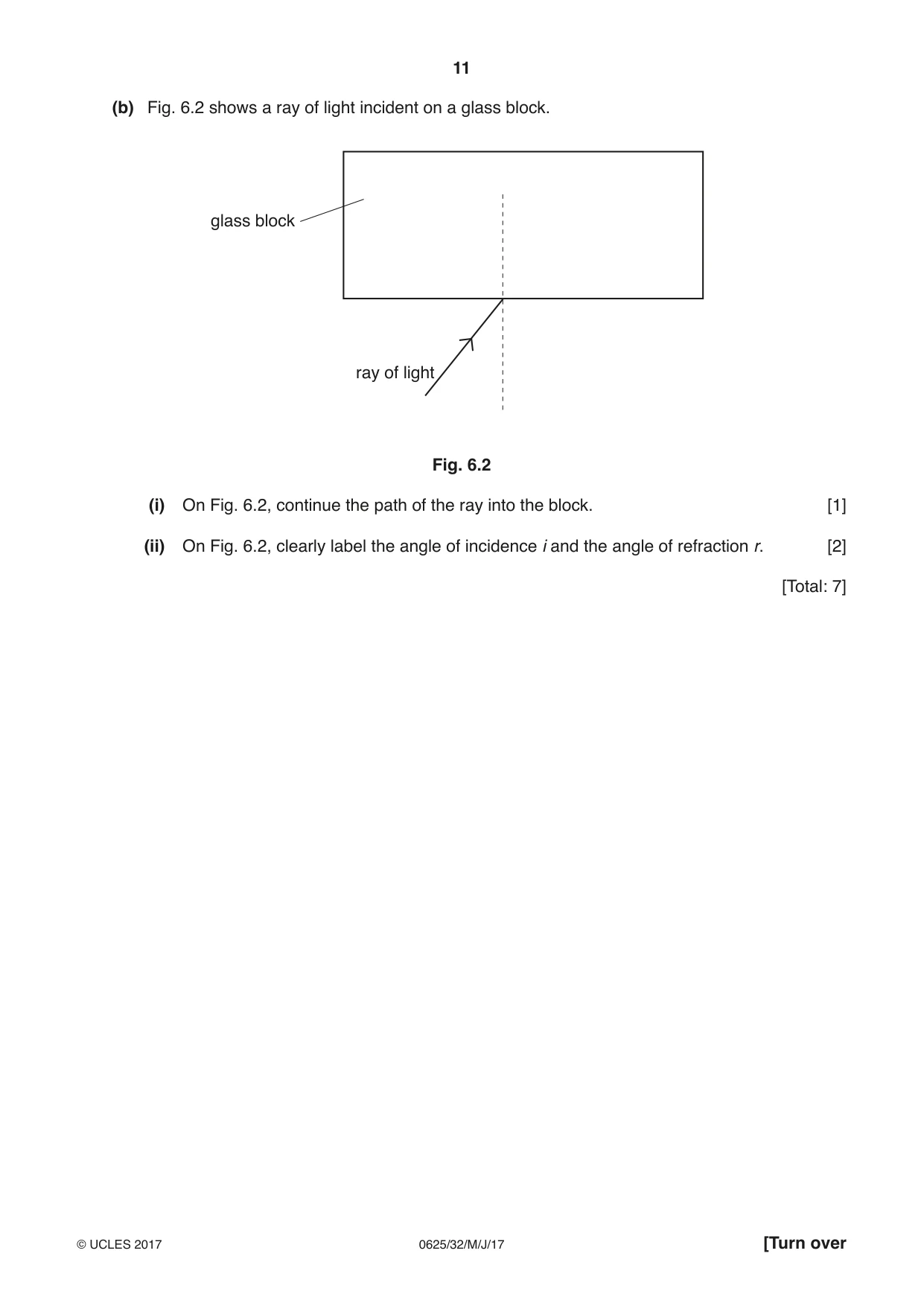
6 (a) Fig. 6.1 shows an overhead view of two cars approaching a road junction. A plane mirror helps the drivers to see other cars. plane mirror ray of light from car 1 road driver 2 car 2 driver 1 car 1 tall building Fig. 6.1 (i) A ray of light from car 1 is shown. On Fig. 6.1, clearly draw the normal to the plane mirror where this ray hits the plane mirror. Label the normal N. [1] (ii) On Fig. 6.1, carefully draw the reflected ray of light. [1] (iii) State the law used in your answer to (a)(ii). .......................................................................................................................................[1] (iv) Can each driver see the other car? ........................................................................................................................................... Explain your answer. .......................................................................................................................................[1] (b) Fig. 6.2 shows a ray of light incident on a glass block. glass block ray of light Fig. 6.2 (i) On Fig. 6.2, continue the path of the ray into the block. [1] (ii) On Fig. 6.2, clearly label the angle of incidence i and the angle of refraction r. [2] [Total: 7]
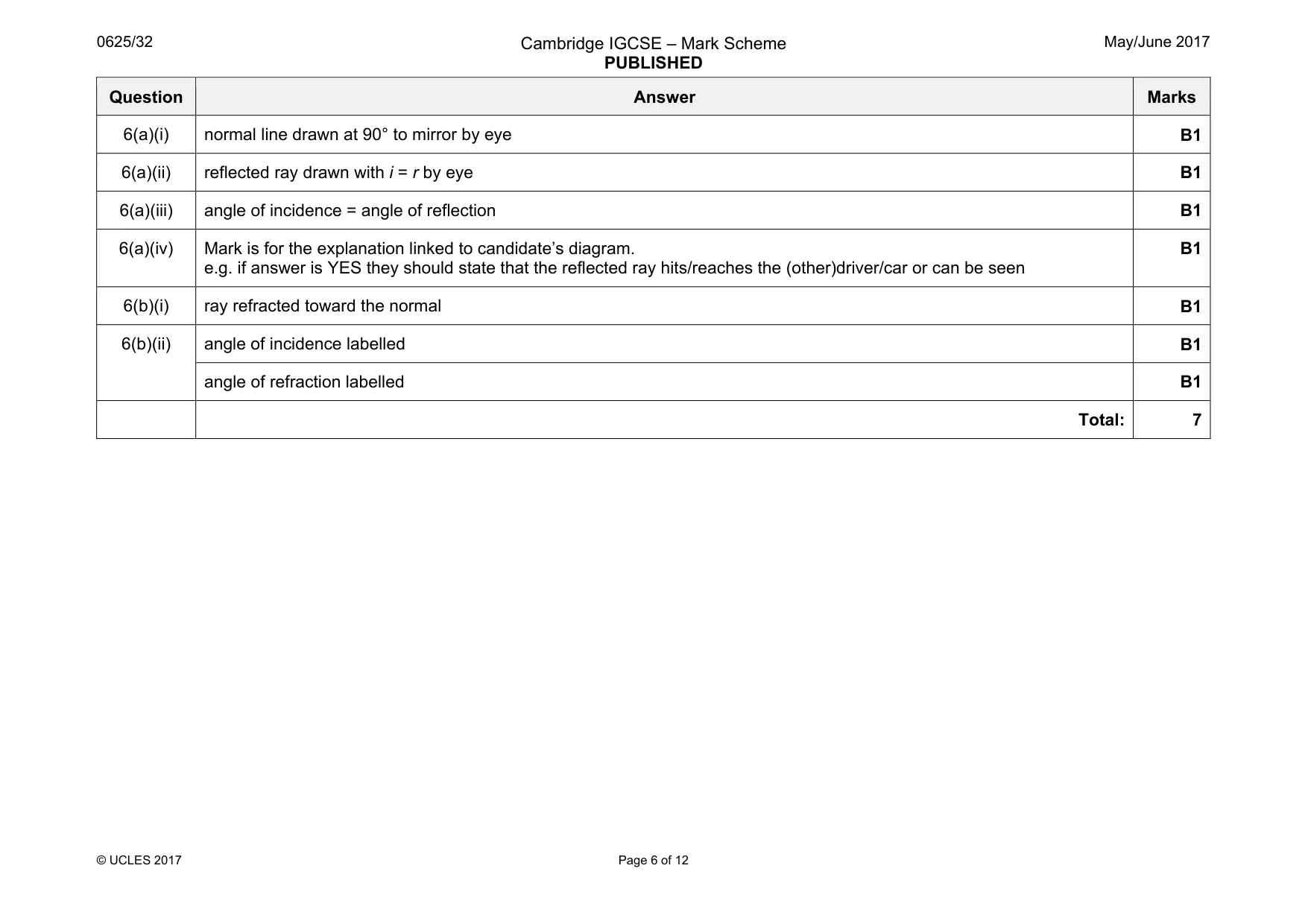
Mark scheme: 6(a)(i) normal line drawn at 90° to mirror by eye B1 6(a)(ii) reflected ray drawn with i = r by eye B1 6(a)(iii) angle of incidence = angle of reflection B1 6(a)(iv) Mark is for the explanation linked to candidate’s diagram. e.g. if answer is YES they should state that the reflected ray hits/reaches the (other)driver/car or can be seen B1 6(b)(i) ray refracted toward the normal B1 6(b)(ii) angle of incidence labelled B1 angle of refraction labelled B1 Total: 7
Q7 · The regions of the electromagnetic spectrum
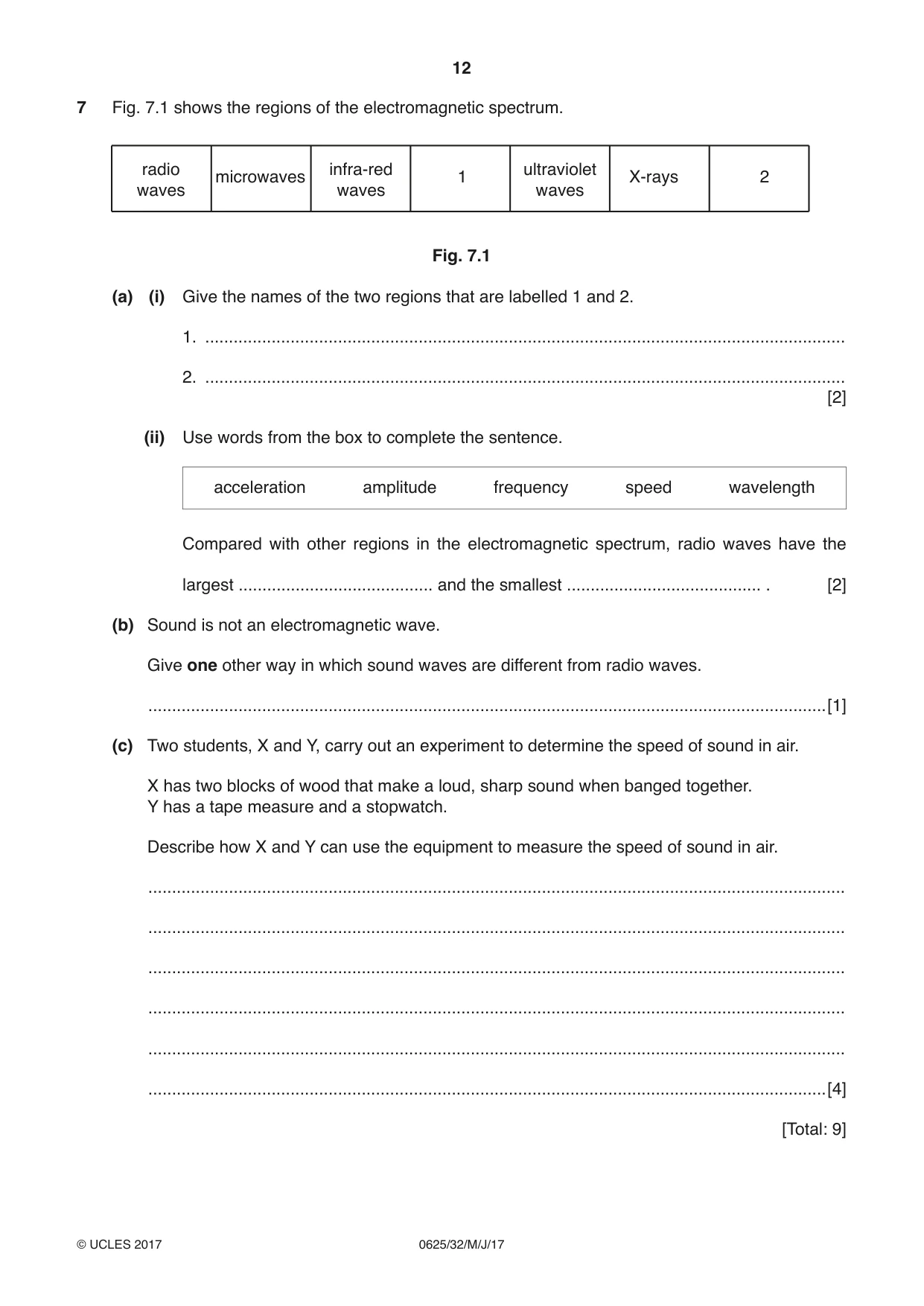
7 Fig. 7.1 shows the regions of the electromagnetic spectrum. radio infra-red ultraviolet microwaves 1 X-rays 2 waves waves waves Fig. 7.1 (a) (i) Give the names of the two regions that are labelled 1 and 2. 1. ....................................................................................................................................... 2. ....................................................................................................................................... [2] (ii) Use words from the box to complete the sentence. acceleration amplitude frequency speed wavelength Compared with other regions in the electromagnetic spectrum, radio waves have the largest ......................................... and the smallest ......................................... . [2] (b) Sound is not an electromagnetic wave. Give one other way in which sound waves are different from radio waves. ...............................................................................................................................................[1] (c) Two students, X and Y, carry out an experiment to determine the speed of sound in air. X has two blocks of wood that make a loud, sharp sound when banged together. Y has a tape measure and a stopwatch. Describe how X and Y can use the equipment to measure the speed of sound in air. ................................................................................................................................................... ................................................................................................................................................... ................................................................................................................................................... ................................................................................................................................................... ................................................................................................................................................... ...............................................................................................................................................[4] [Total: 9]
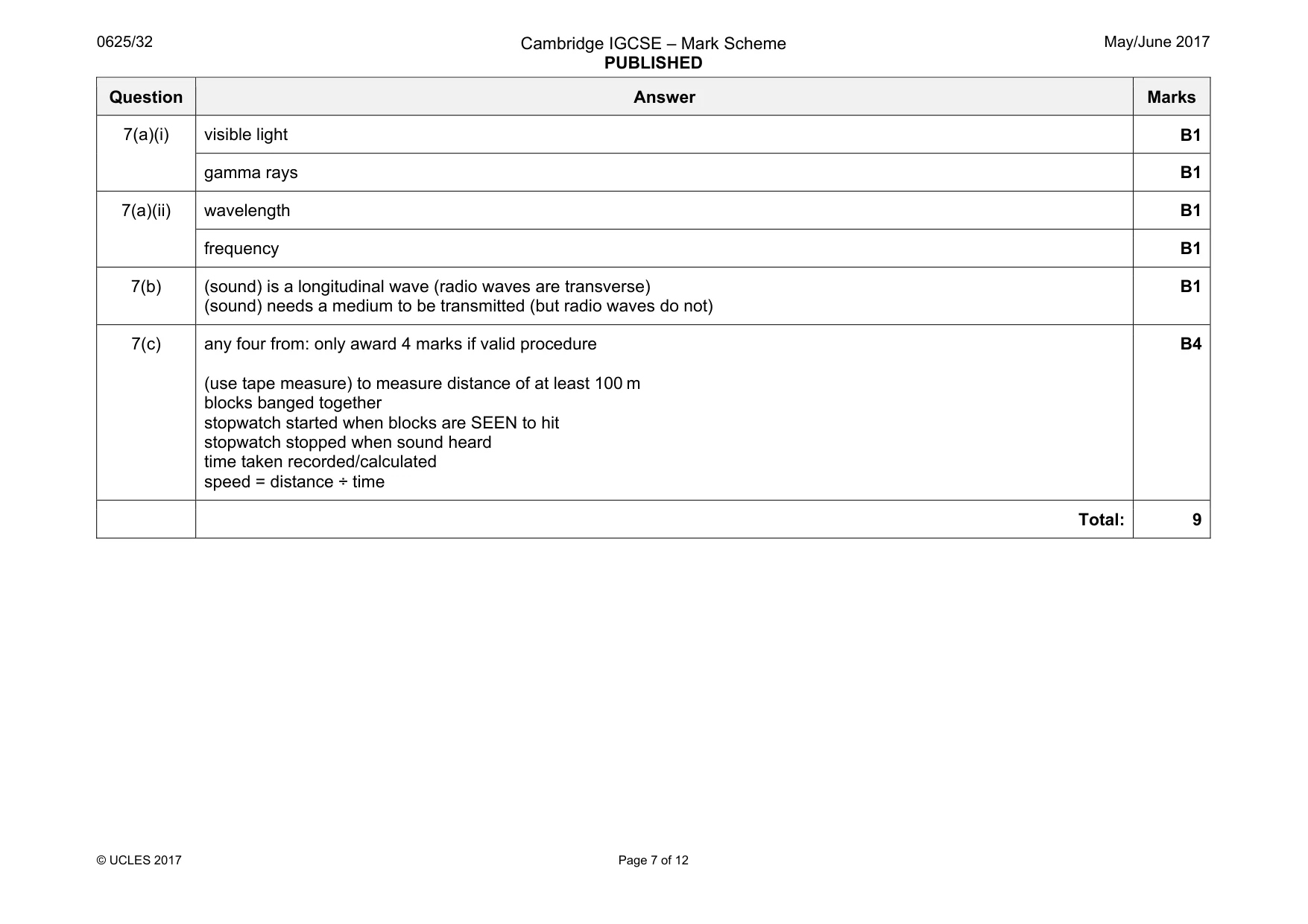
Mark scheme: 7(a)(i) visible light B1 gamma rays B1 7(a)(ii) wavelength B1 frequency B1 7(b) (sound) is a longitudinal wave (radio waves are transverse) (sound) needs a medium to be transmitted (but radio waves do not) B1 7(c) any four from: only award 4 marks if valid procedure (use tape measure) to measure distance of at least 100 m blocks banged together stopwatch started when blocks are SEEN to hit stopwatch stopped when sound heard time taken recorded/calculated speed = distance ÷ time B4 Total: 9
Question 8
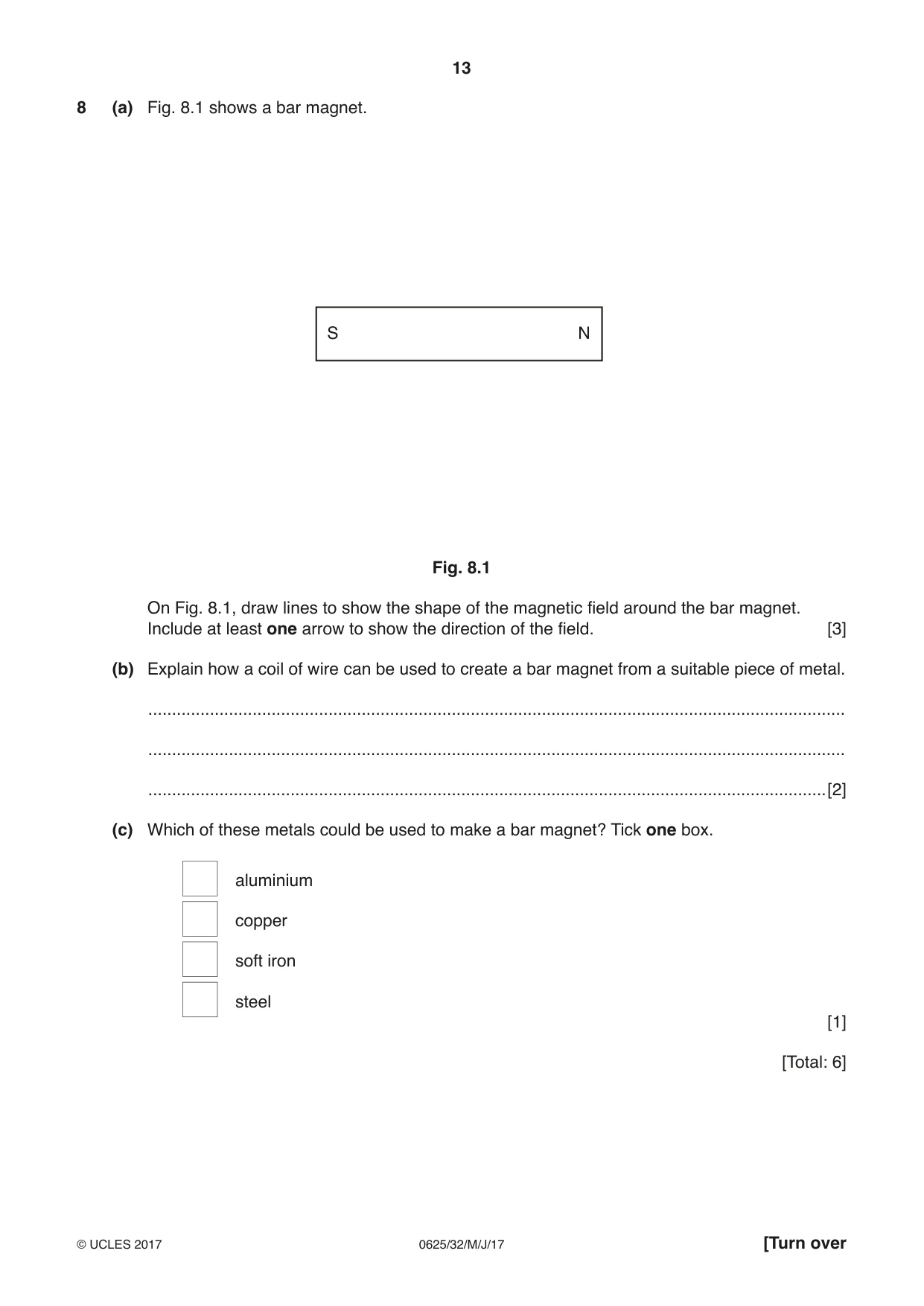
8 (a) Fig. 8.1 shows a bar magnet. S N Fig. 8.1 On Fig. 8.1, draw lines to show the shape of the magnetic field around the bar magnet. Include at least one arrow to show the direction of the field. [3] (b) Explain how a coil of wire can be used to create a bar magnet from a suitable piece of metal. ................................................................................................................................................... ................................................................................................................................................... ...............................................................................................................................................[2] (c) Which of these metals could be used to make a bar magnet? Tick one box. aluminium copper soft iron steel [1] [Total: 6]
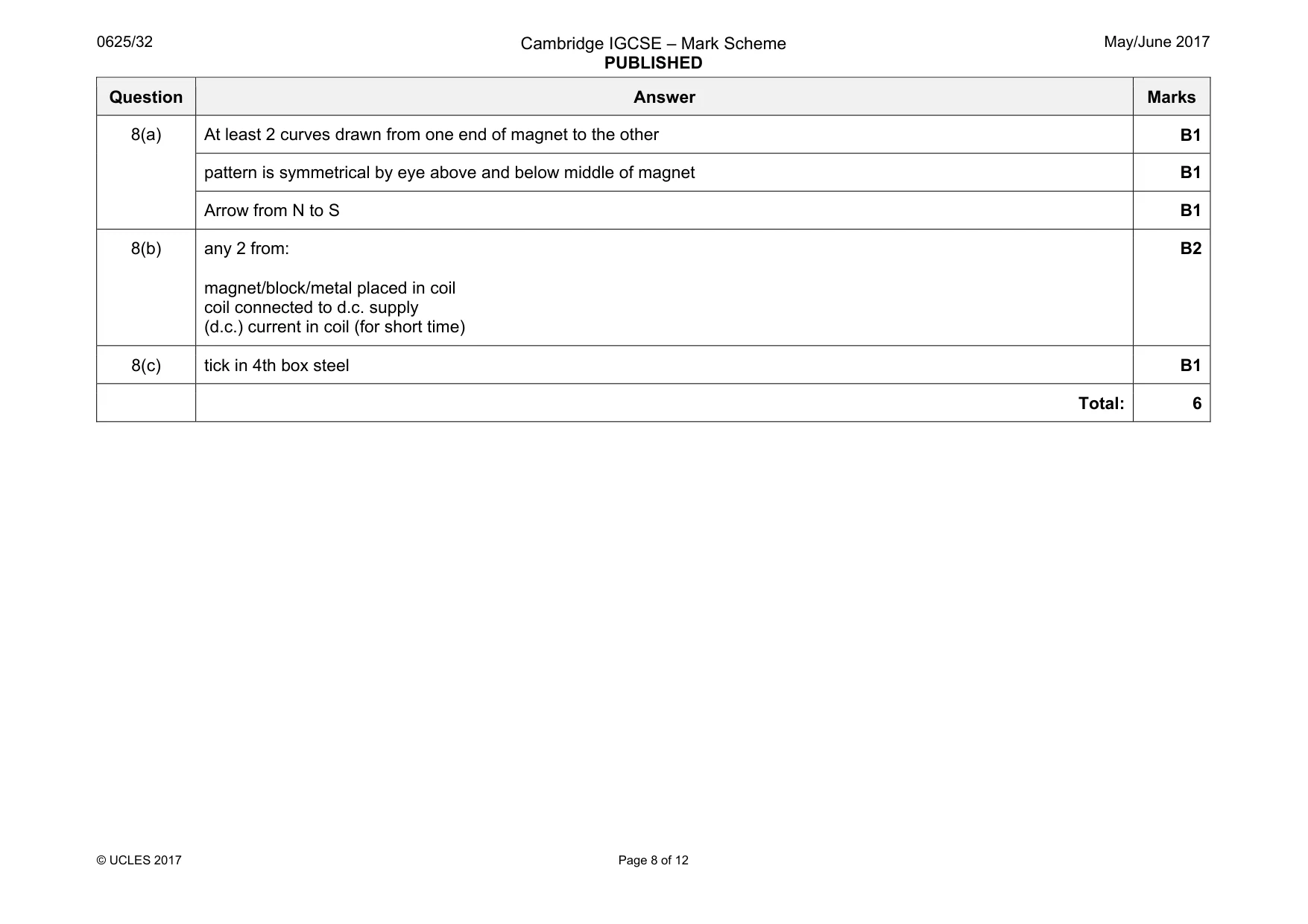
Mark scheme: 8(a) At least 2 curves drawn from one end of magnet to the other B1 pattern is symmetrical by eye above and below middle of magnet B1 Arrow from N to S B1 8(b) any 2 from: magnet/block/metal placed in coil coil connected to d.c. supply (d.c.) current in coil (for short time) B2 8(c) tick in 4th box steel B1 Total: 6
Q9 · A current-carrying coil in a magnetic field
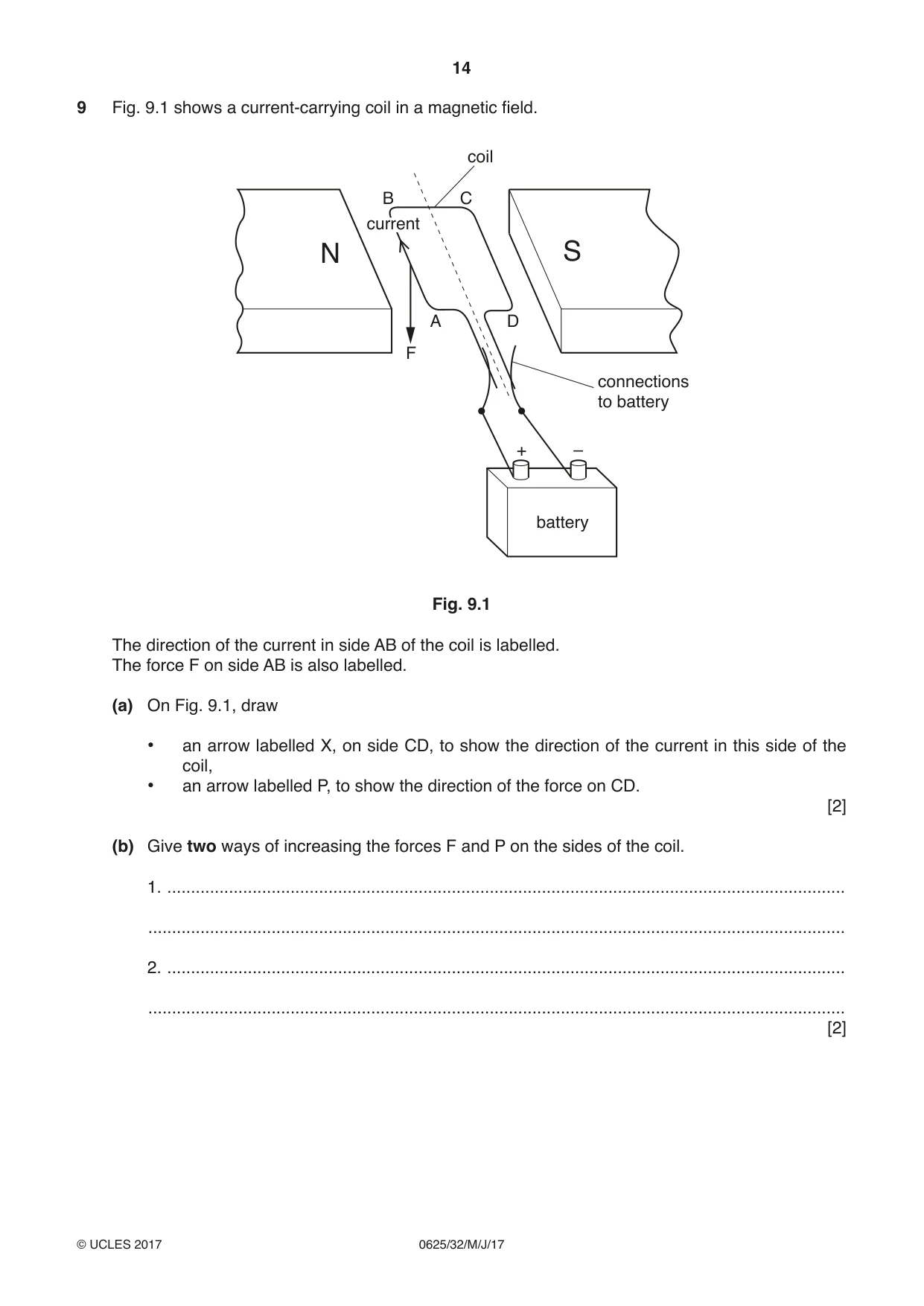
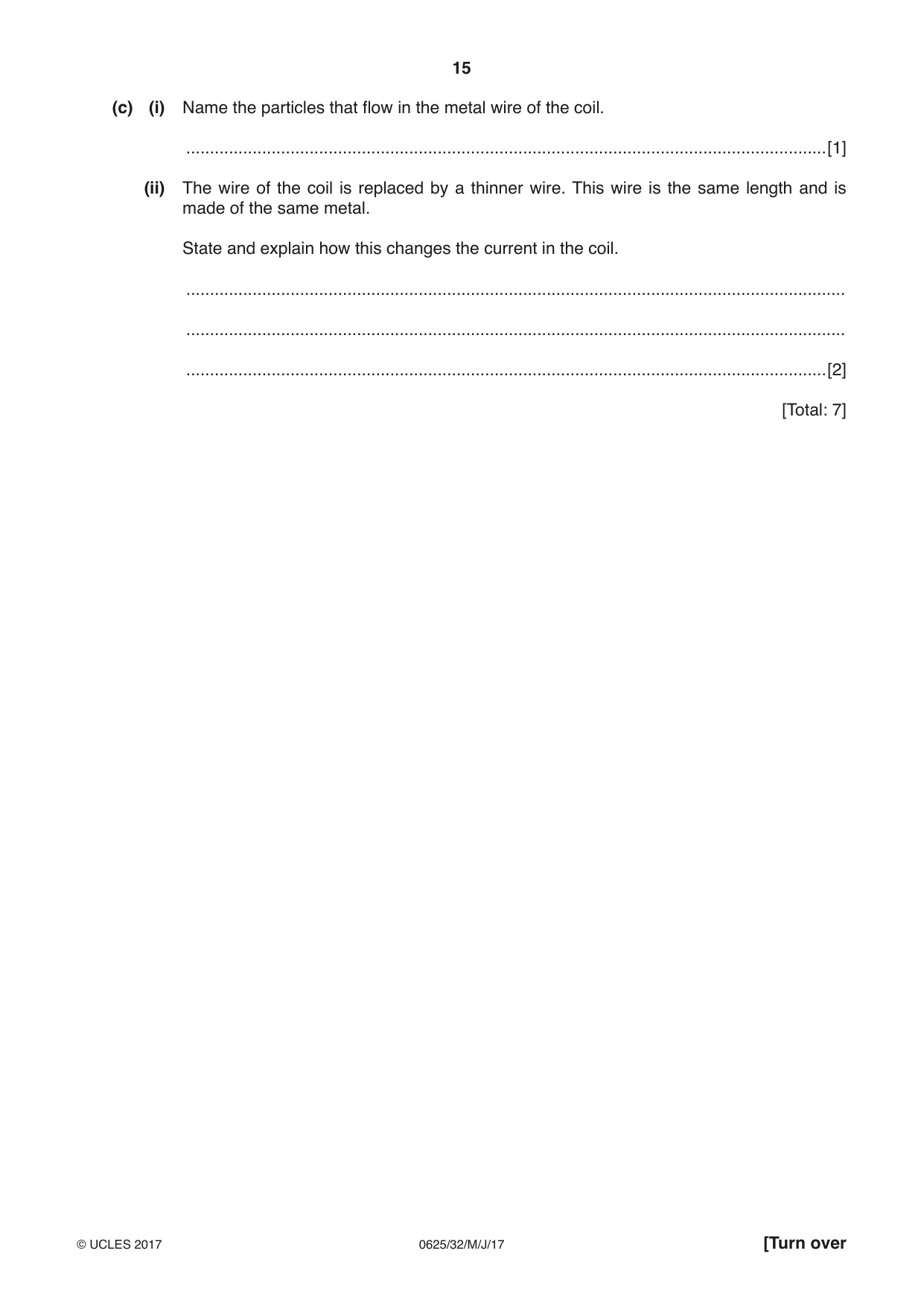
9 Fig. 9.1 shows a current-carrying coil in a magnetic field. coil B C current N S A D F connections to battery + – battery Fig. 9.1 The direction of the current in side AB of the coil is labelled. The force F on side AB is also labelled. (a) On Fig. 9.1, draw • an arrow labelled X, on side CD, to show the direction of the current in this side of the coil, • an arrow labelled P, to show the direction of the force on CD. [2] (b) Give two ways of increasing the forces F and P on the sides of the coil. 1. ............................................................................................................................................... ................................................................................................................................................... 2. ............................................................................................................................................... ................................................................................................................................................... [2] (c) (i) Name the particles that flow in the metal wire of the coil. .......................................................................................................................................[1] (ii) The wire of the coil is replaced by a thinner wire. This wire is the same length and is made of the same metal. State and explain how this changes the current in the coil. ........................................................................................................................................... ........................................................................................................................................... .......................................................................................................................................[2] [Total: 7]
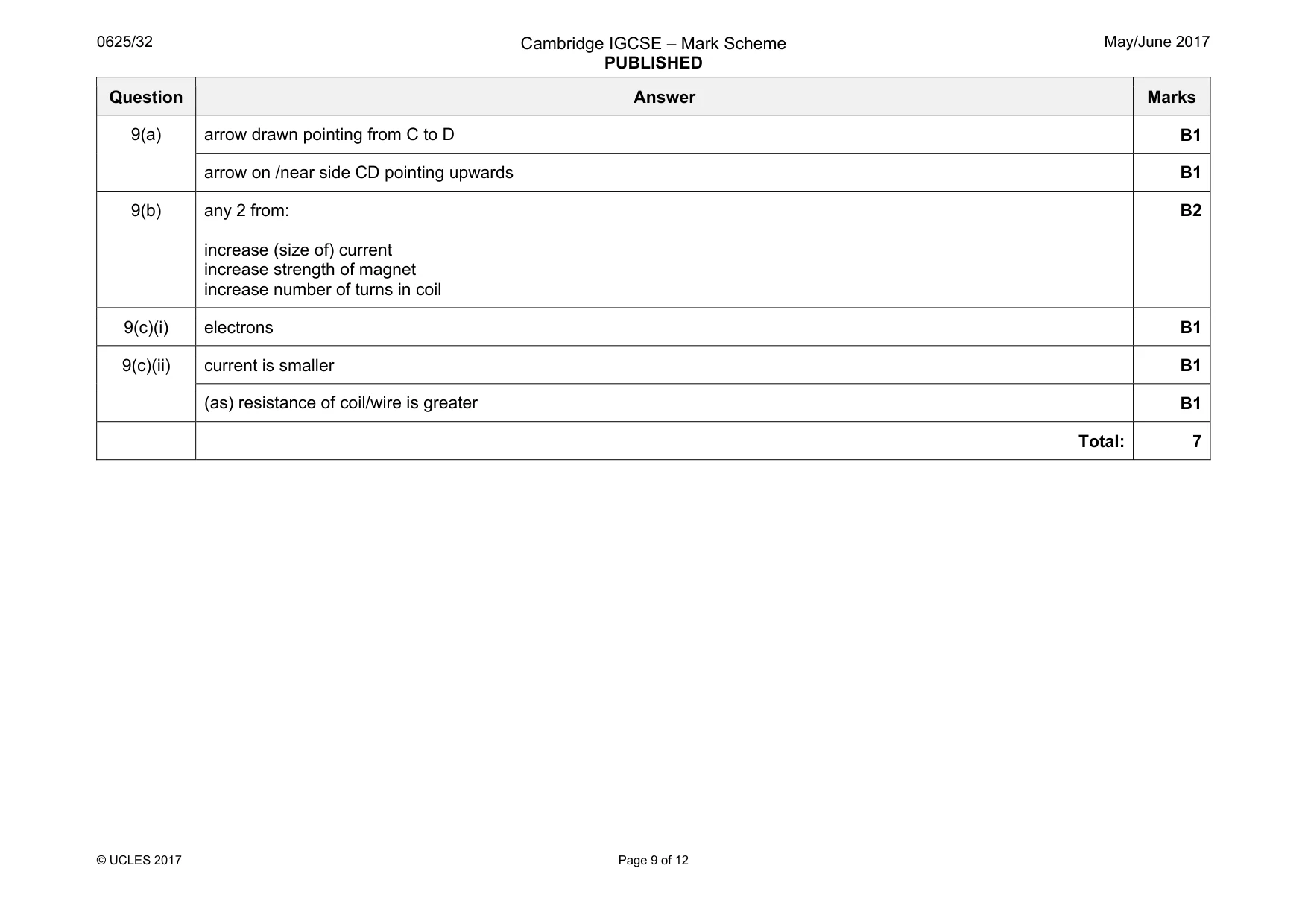
Mark scheme: 9(a) arrow drawn pointing from C to D B1 arrow on /near side CD pointing upwards B1 9(b) any 2 from: increase (size of) current increase strength of magnet increase number of turns in coil B2 9(c)(i) electrons B1 9(c)(ii) current is smaller B1 (as) resistance of coil/wire is greater B1 Total: 7
Q10 · A student wants to investigate how the resistance of a light-dependent resistor (LDR)…
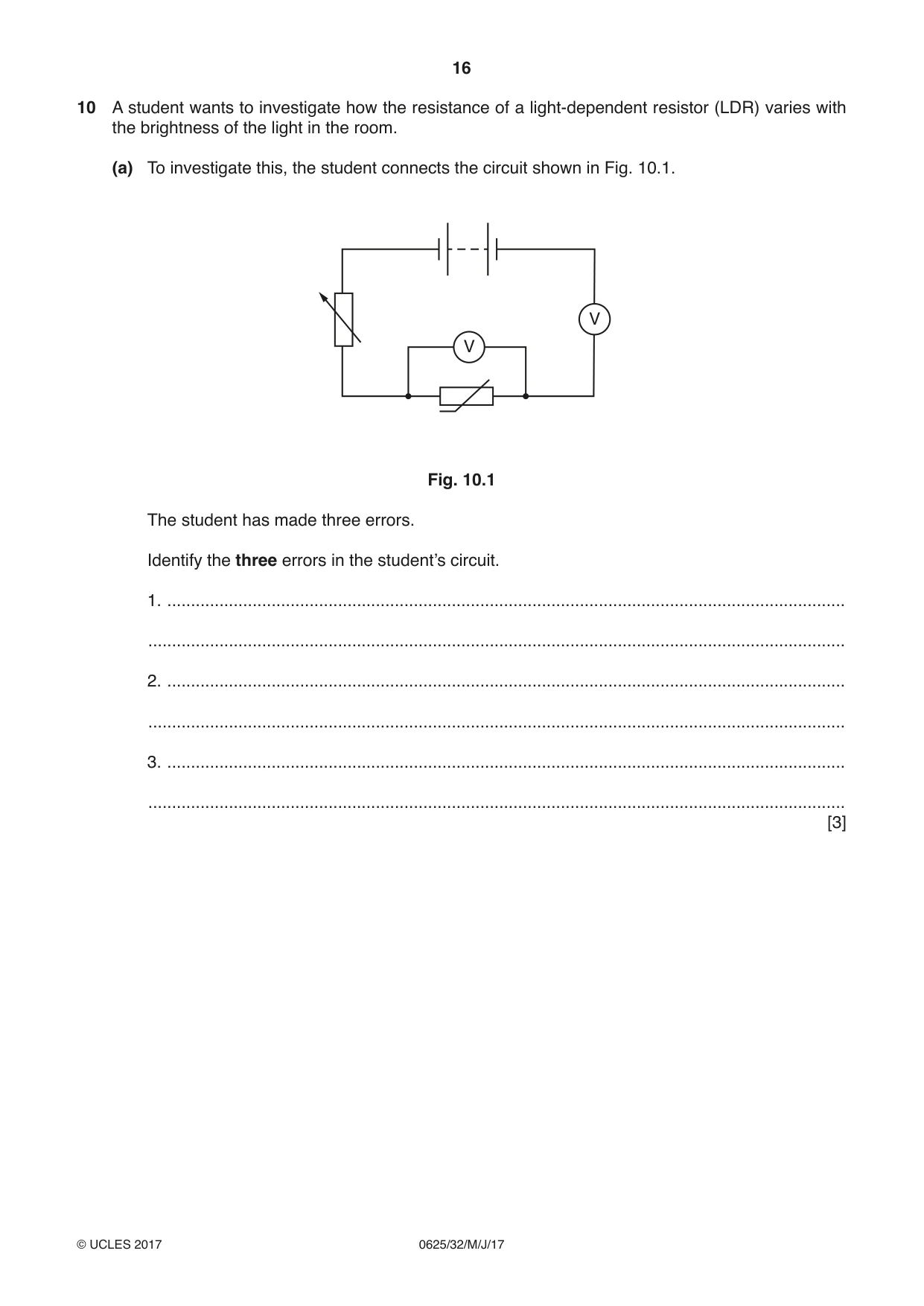
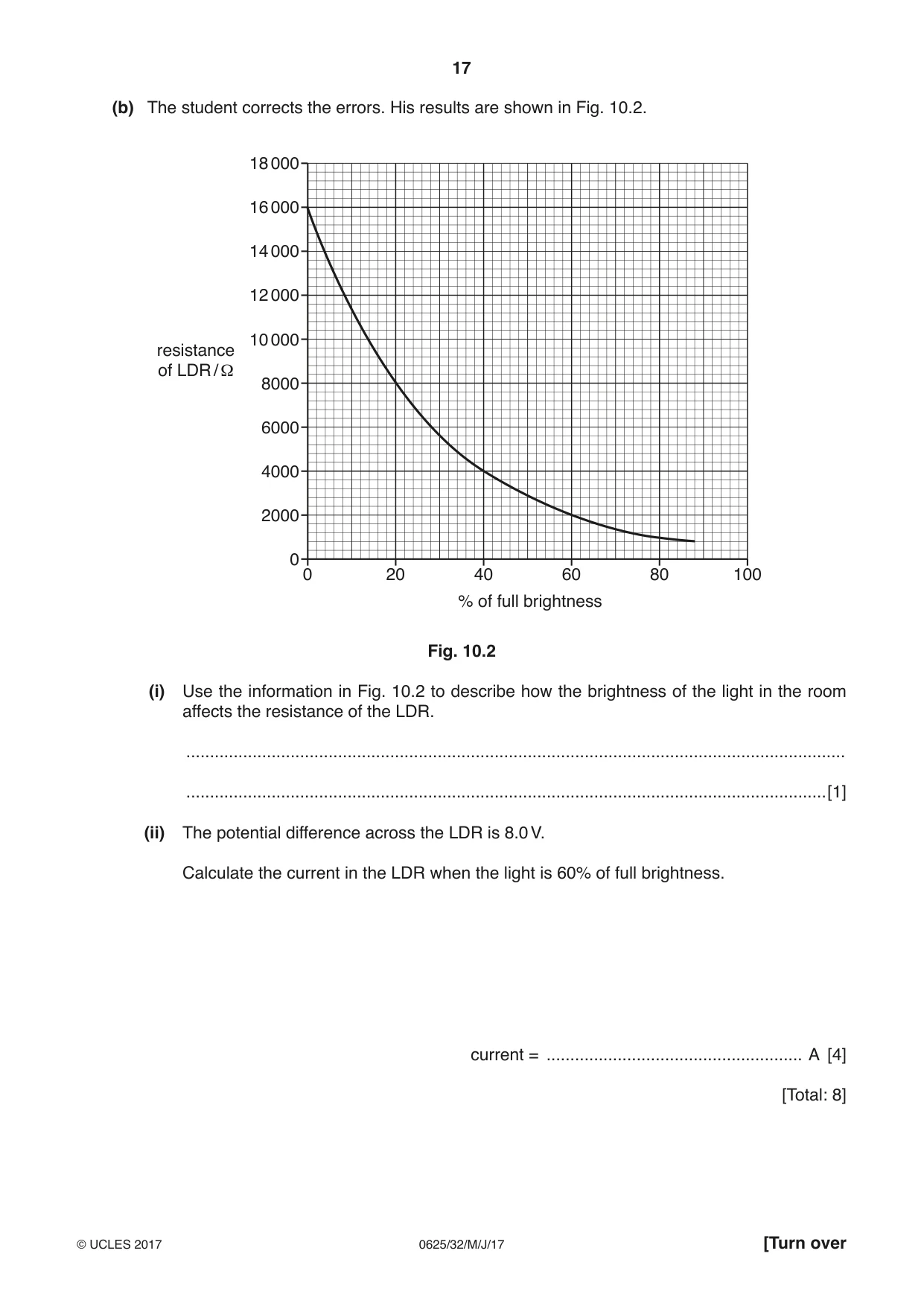
10 A student wants to investigate how the resistance of a light-dependent resistor (LDR) varies with the brightness of the light in the room. (a) To investigate this, the student connects the circuit shown in Fig. 10.1. V V Fig. 10.1 The student has made three errors. Identify the three errors in the student’s circuit. 1. ............................................................................................................................................... ................................................................................................................................................... 2. ............................................................................................................................................... ................................................................................................................................................... 3. ............................................................................................................................................... ................................................................................................................................................... [3] (b) The student corrects the errors. His results are shown in Fig. 10.2. 18 000 16 000 14 000 12 000 10 000 resistance of LDR / Ω 8000 6000 4000 2000 0 0 20 40 60 80 100 % of full brightness Fig. 10.2 (i) Use the information in Fig. 10.2 to describe how the brightness of the light in the room affects the resistance of the LDR. ........................................................................................................................................... .......................................................................................................................................[1] (ii) The potential difference across the LDR is 8.0 V. Calculate the current in the LDR when the light is 60% of full brightness. current = ...................................................... A [4] [Total: 8]
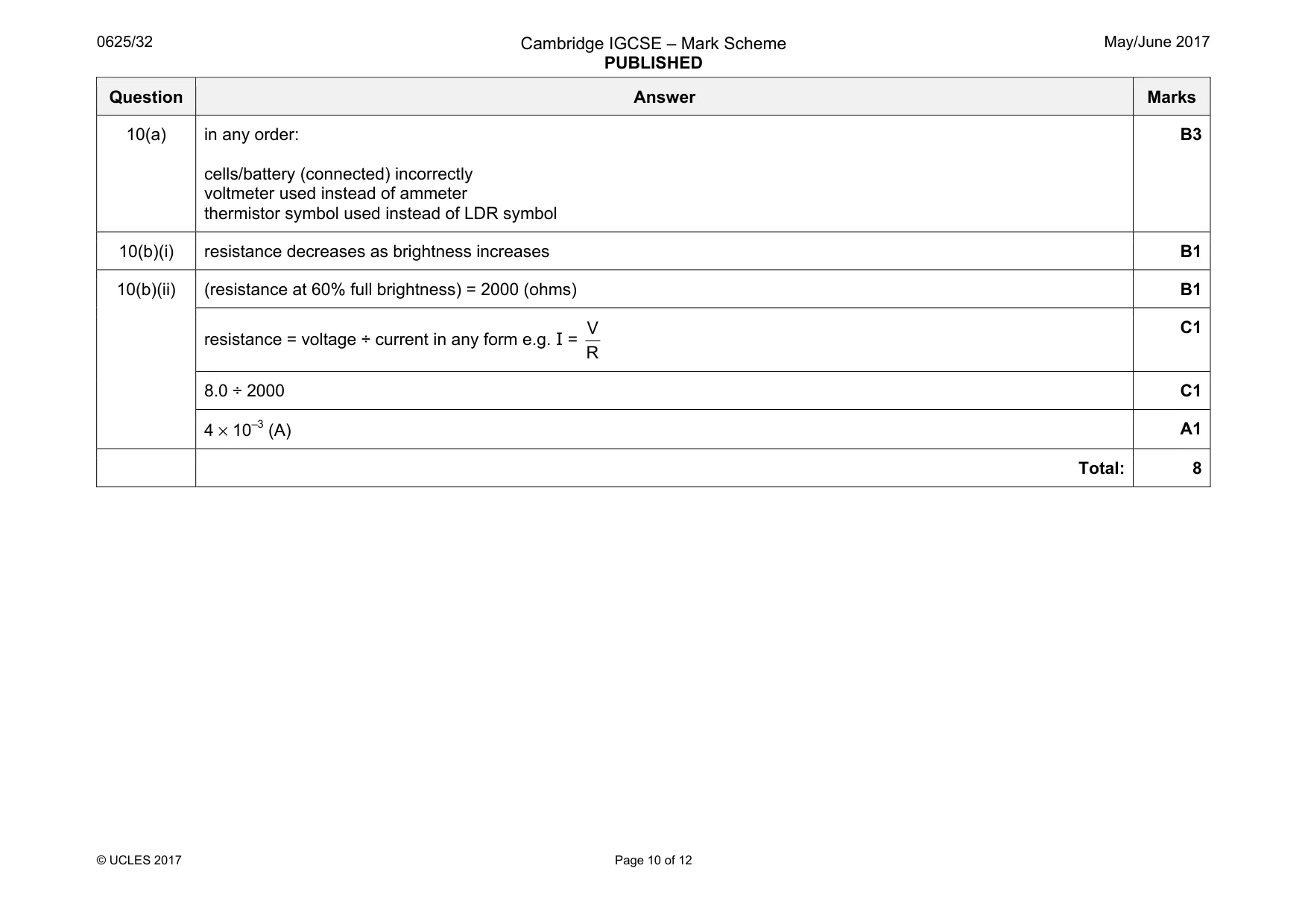
Mark scheme: 10(a) in any order: cells/battery (connected) incorrectly voltmeter used instead of ammeter thermistor symbol used instead of LDR symbol B3 10(b)(i) resistance decreases as brightness increases B1 10(b)(ii) (resistance at 60% full brightness) = 2000 (ohms) B1 resistance = voltage ÷ current in any form e.g. I = V R C1 8.0 ÷ 2000 C1 4 × 10⁻³ (A) A1 Total: 8
Q11 · The plug for a television contains a fuse
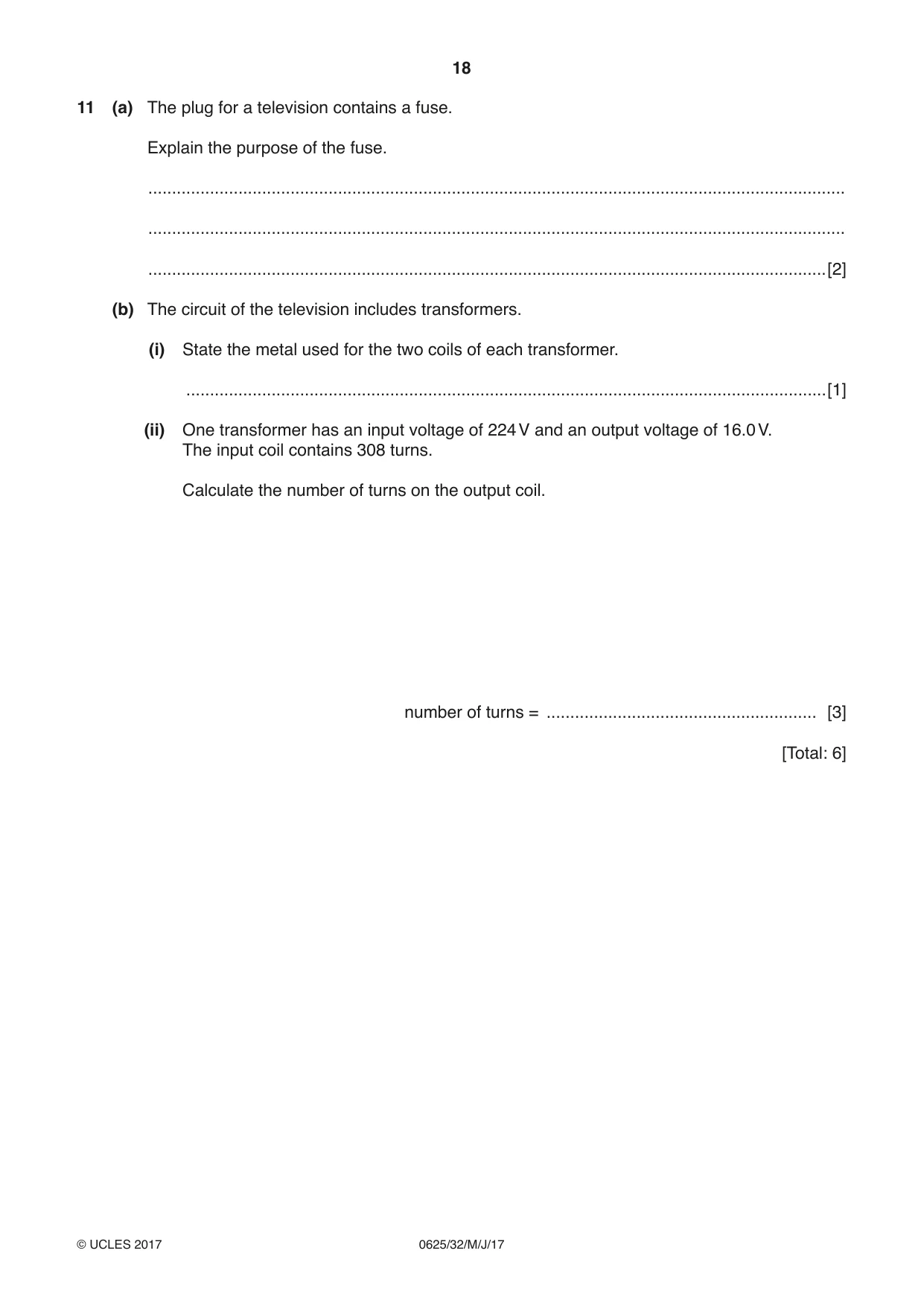
11 (a) The plug for a television contains a fuse. Explain the purpose of the fuse. ................................................................................................................................................... ................................................................................................................................................... ...............................................................................................................................................[2] (b) The circuit of the television includes transformers. (i) State the metal used for the two coils of each transformer. .......................................................................................................................................[1] (ii) One transformer has an input voltage of 224 V and an output voltage of 16.0 V. The input coil contains 308 turns. Calculate the number of turns on the output coil. number of turns = ......................................................... [3] [Total: 6]
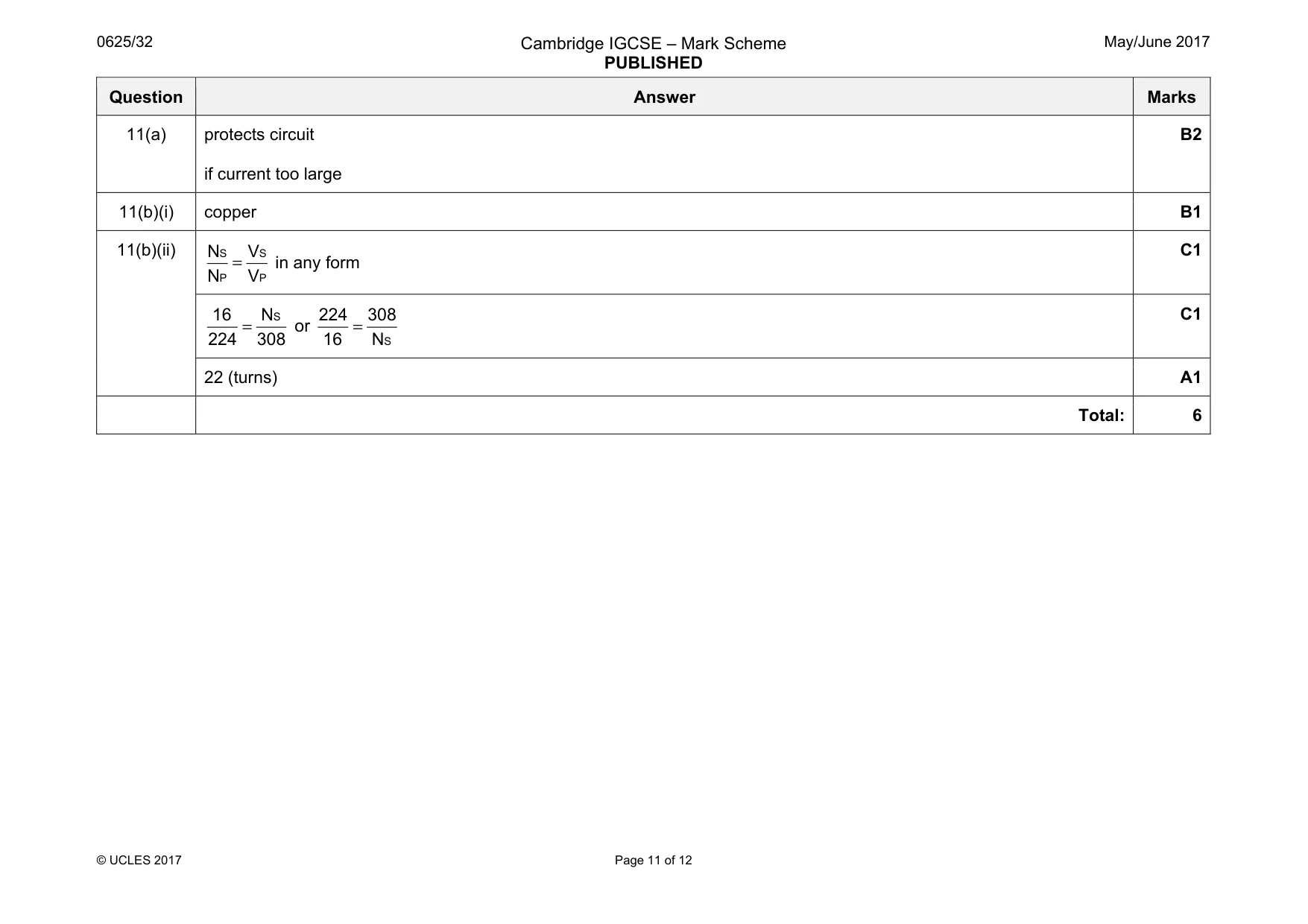
Mark scheme: 11(a) protects circuit if current too large B2 11(b)(i) copper B1 11(b)(ii) S S P P N V N V = in any form C1 S S 16 N 224 308 or 224 308 16 N = = C1 22 (turns) A1 Total: 6
Q12 · The particles in an atom of the element lithium
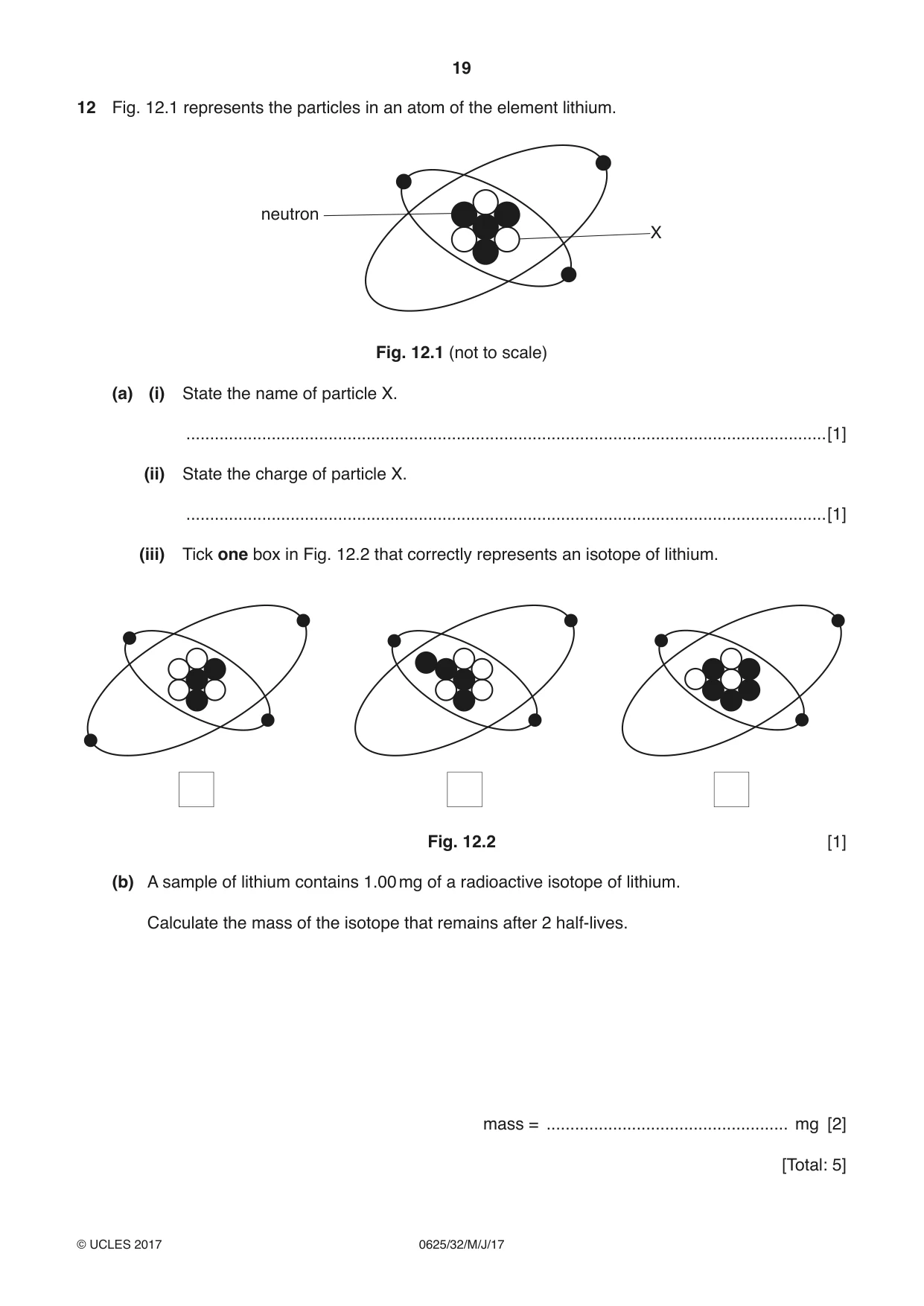
12 Fig. 12.1 represents the particles in an atom of the element lithium. neutron X Fig. 12.1 (not to scale) (a) (i) State the name of particle X. .......................................................................................................................................[1] (ii) State the charge of particle X. .......................................................................................................................................[1] (iii) Tick one box in Fig. 12.2 that correctly represents an isotope of lithium. Fig. 12.2 [1] (b) A sample of lithium contains 1.00 mg of a radioactive isotope of lithium. Calculate the mass of the isotope that remains after 2 half-lives. mass = ................................................... mg [2] [Total: 5]
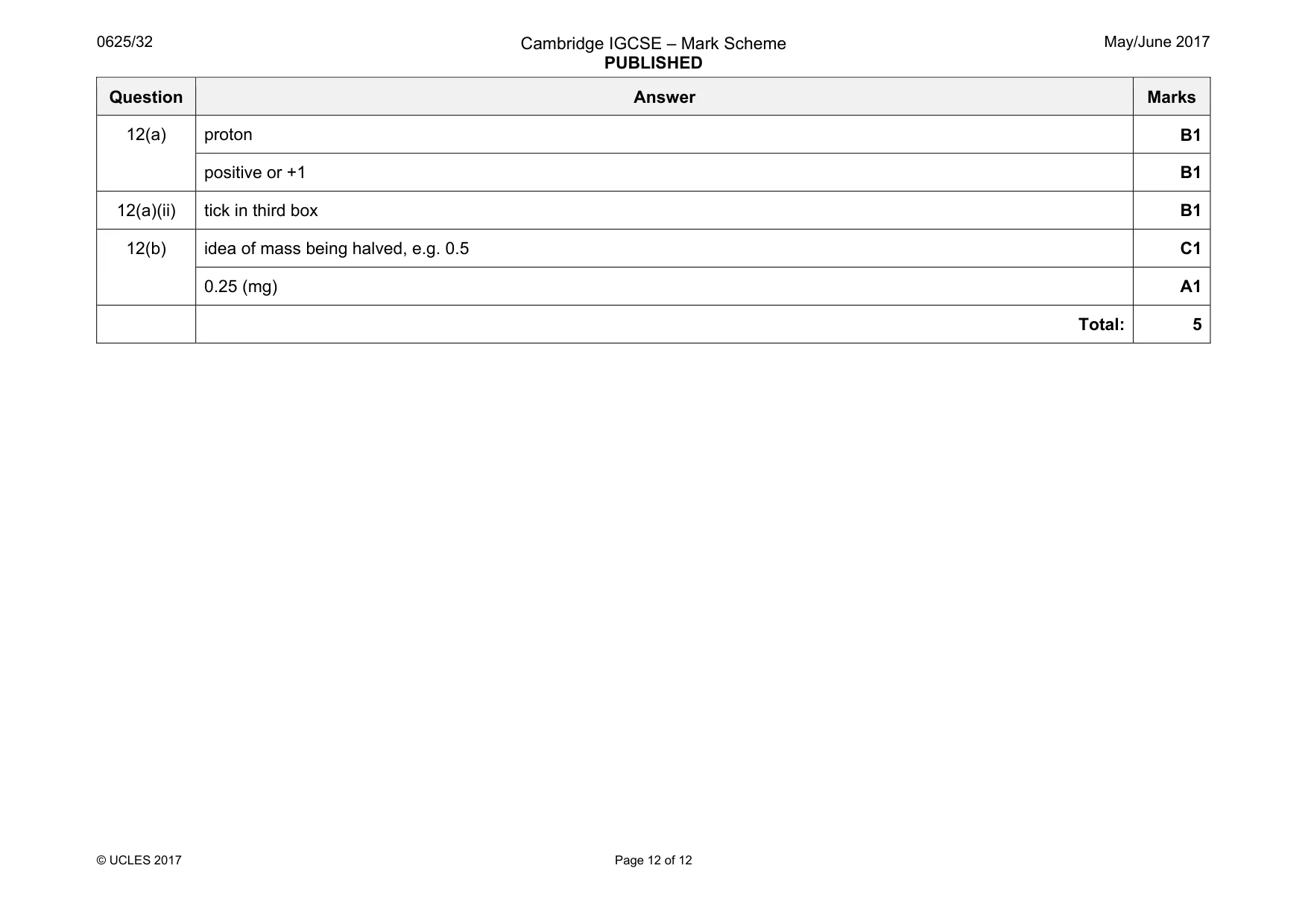
Mark scheme: 12(a) proton B1 positive or +1 B1 12(a)(ii) tick in third box B1 12(b) idea of mass being halved, e.g. 0.5 C1 0.25 (mg) A1 Total: 5
What was in this paper
The subtopics covered by these 12 questions, and how many questions each got. Open one in a new tab to see every Cambridge question on it.
What you needed in this session
Cambridge’s own grade thresholds for 2017 May/June, Paper 3 · Variant 2. A higher threshold means an easier paper — the bar moves with how the cohort did.