Cambridge IGCSE Physics 0625 — 2023 May/June Paper 3 · Variant 1
0625/31/M/J/23 · 12 questions · 80 marks · ≈90 min
The question paper and its mark scheme, free to read here and free to download. This is Cambridge’s own paper, exactly as it was sat.
Question paper16 pages
Mark scheme14 pages
Answers below. Sit the paper first if you are practising.
Questions as text
Q1 · A cyclist is travelling along a straight road
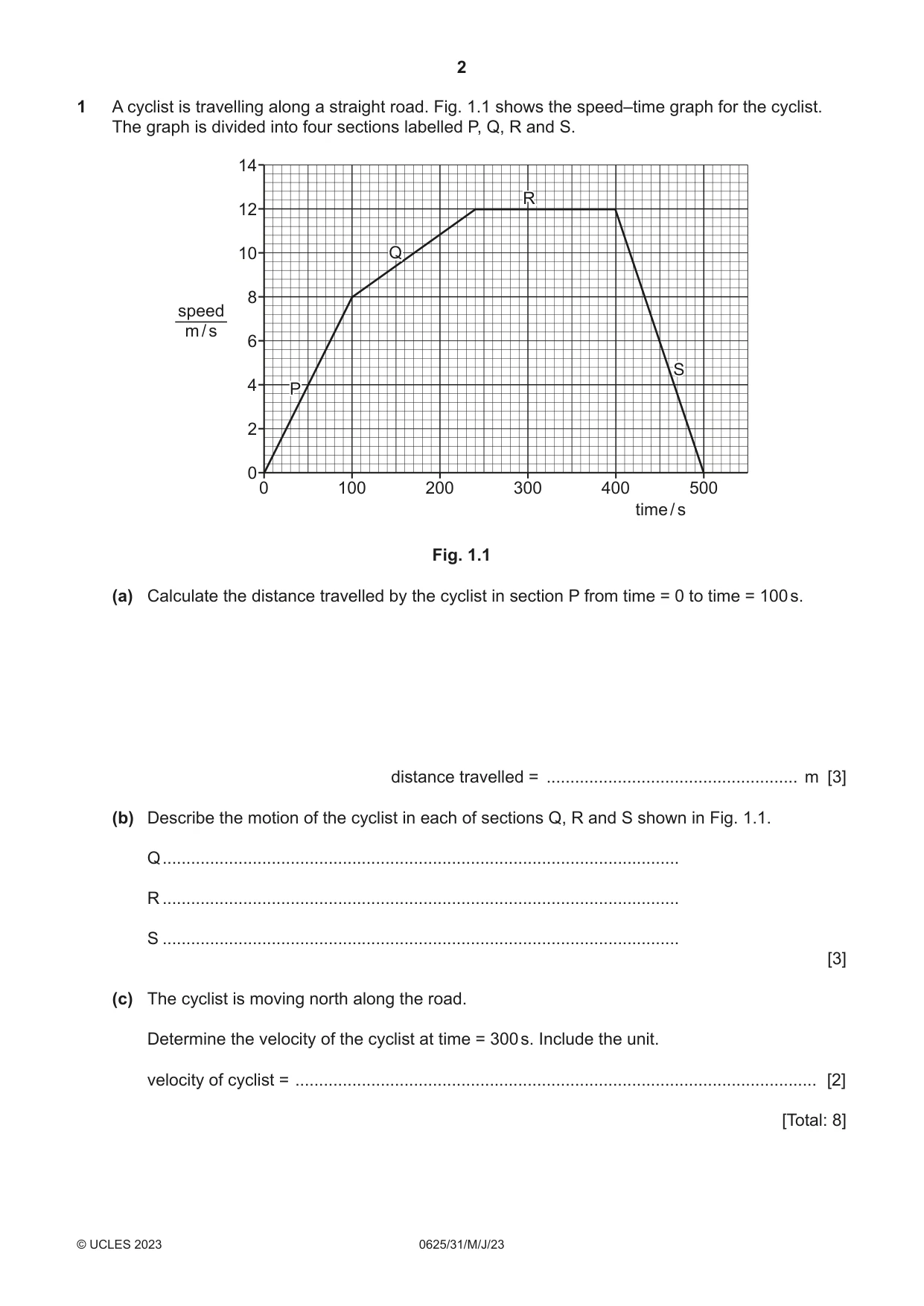
1 A cyclist is travelling along a straight road. Fig. 1.1 shows the speed–time graph for the cyclist. The graph is divided into four sections labelled P, Q, R and S. 14 R 12 10 Q 8 speed m / s 6 S 4 P 2 0 0 100 200 300 400 500 time / s Fig. 1.1 (a) Calculate the distance travelled by the cyclist in section P from time = 0 to time = 100 s. distance travelled = ..................................................... m [3] (b) Describe the motion of the cyclist in each of sections Q, R and S shown in Fig. 1.1. Q ............................................................................................................. R ............................................................................................................. S ............................................................................................................. [3] (c) The cyclist is moving north along the road. Determine the velocity of the cyclist at time = 300 s. Include the unit. velocity of cyclist = .............................................................................................................. [2] [Total: 8]
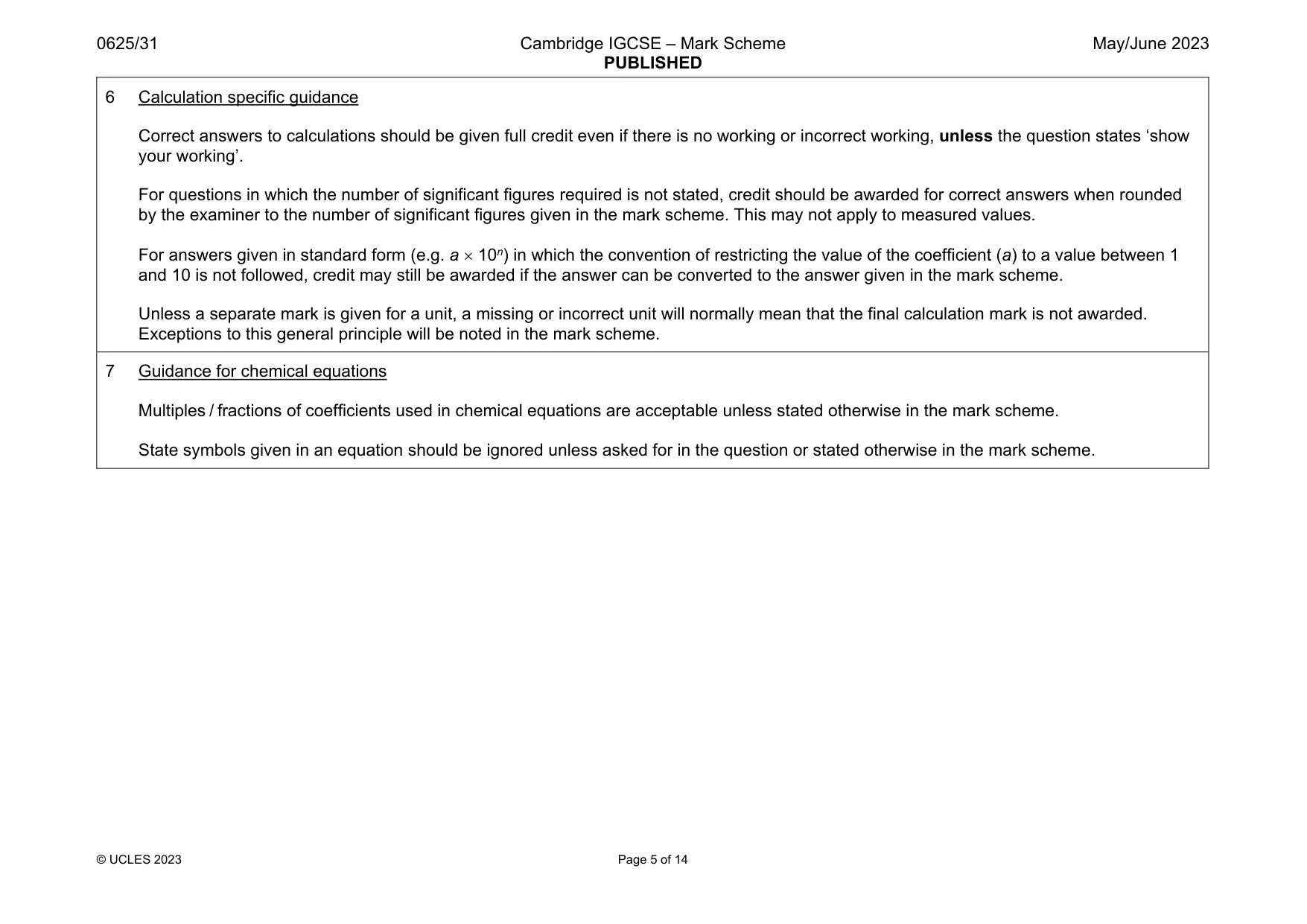
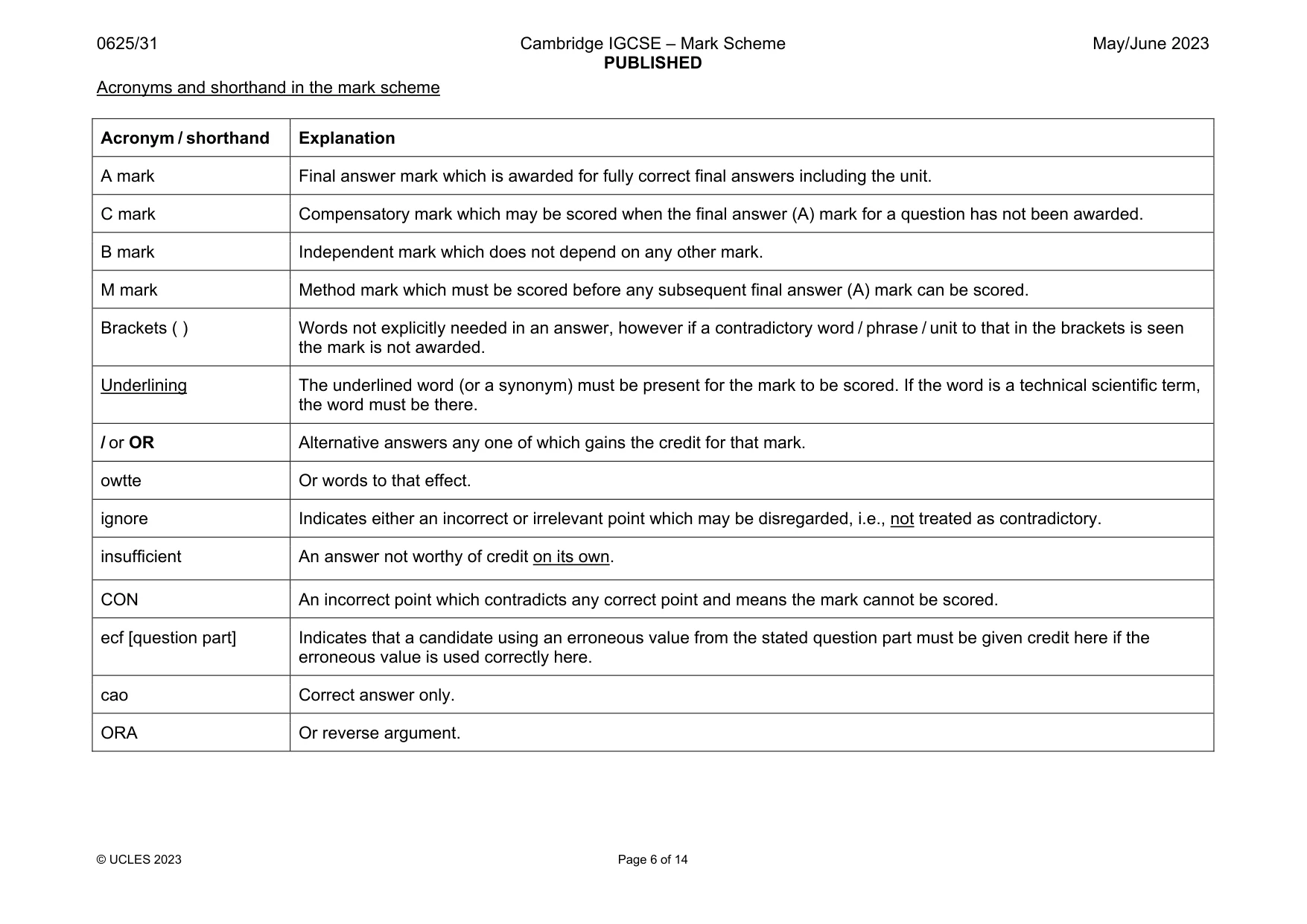
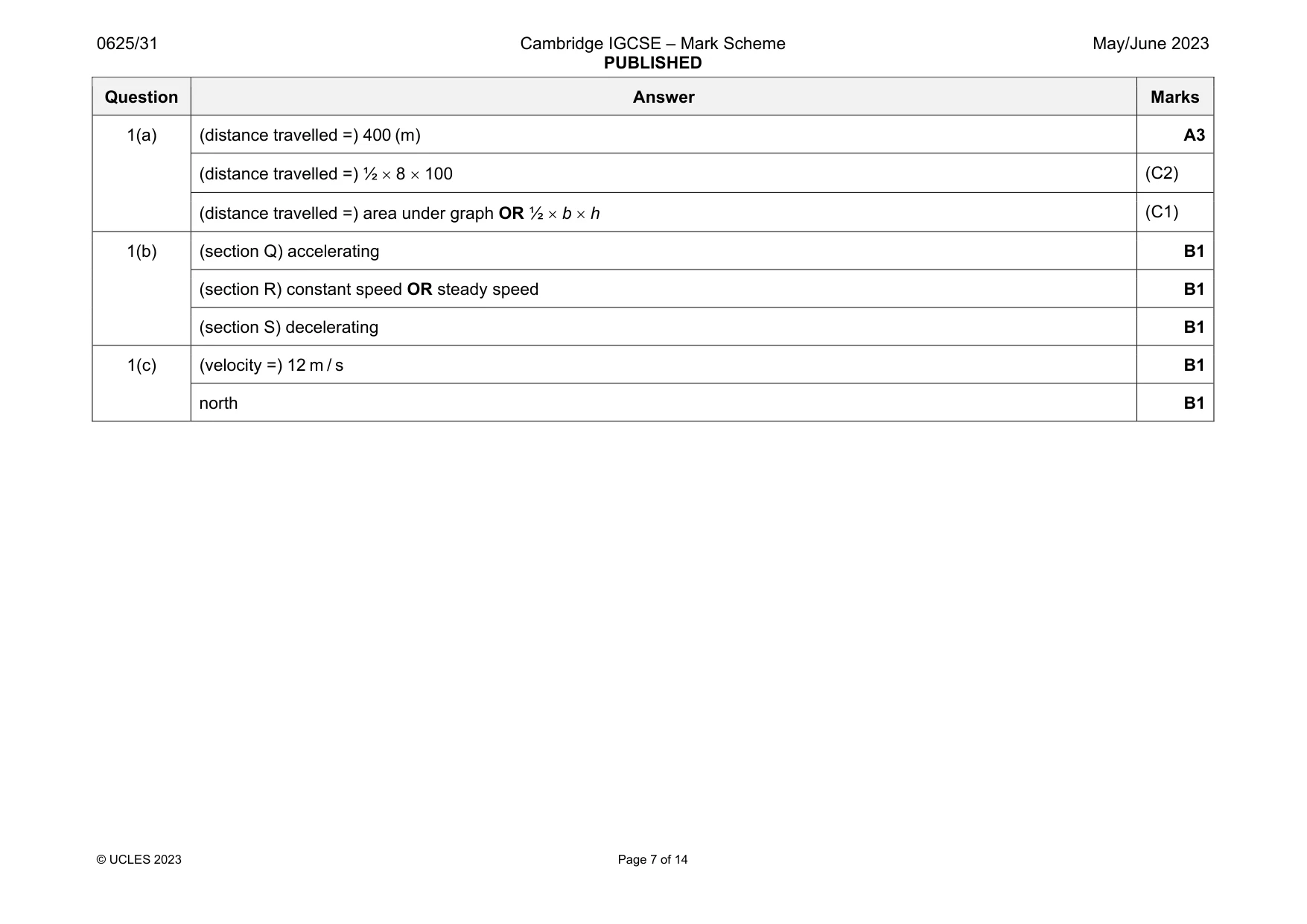
Mark scheme: 1(a) (distance travelled =) 400 (m) A3 (distance travelled =) ½ 8 100 (C2) (distance travelled =) area under graph OR ½ b h (C1) 1(b) (section Q) accelerating B1 (section R) constant speed OR steady speed B1 (section S) decelerating B1 1(c) (velocity =) 12 m / s B1 north B1
Q2 · A concrete beam resting on the ground
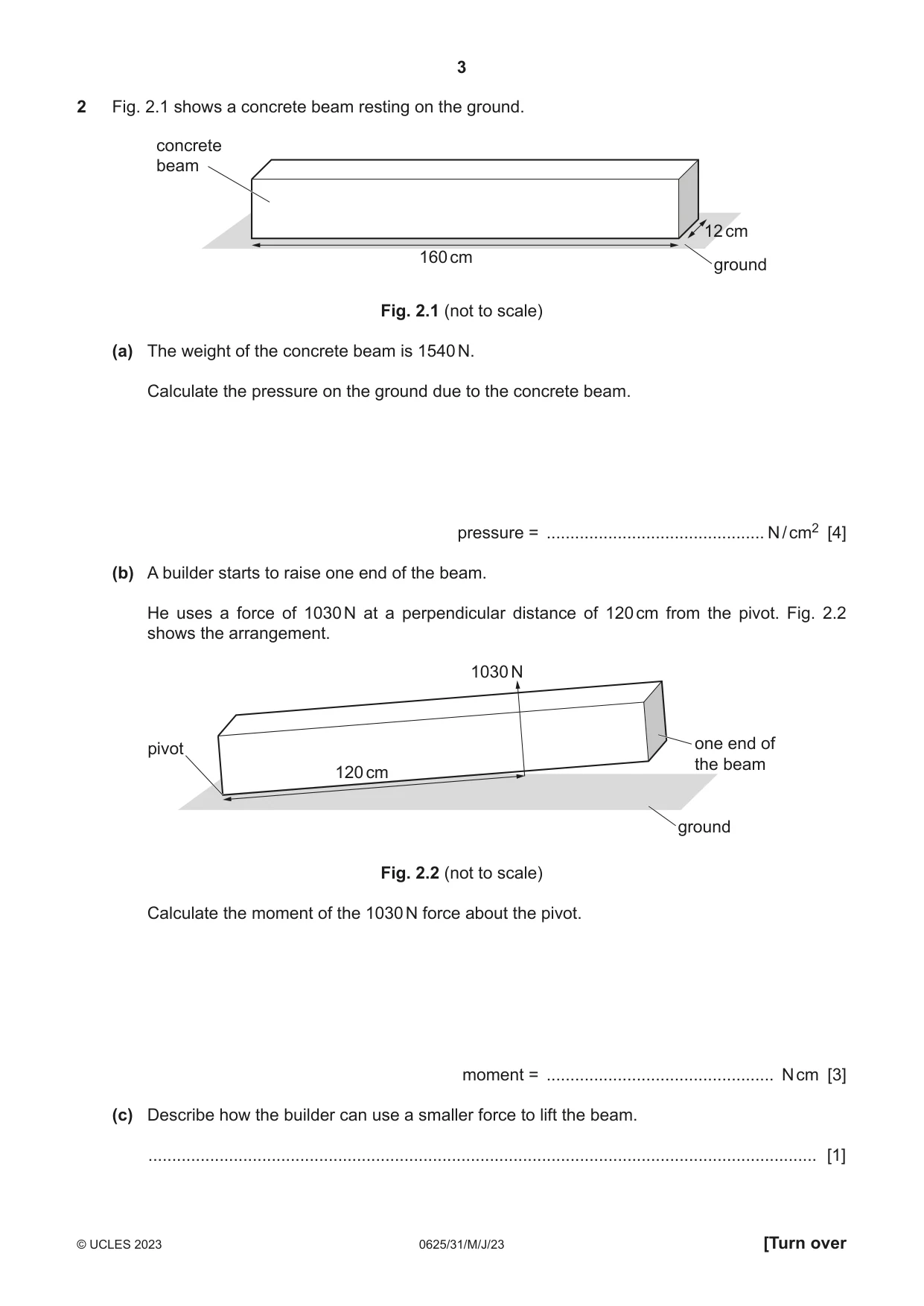
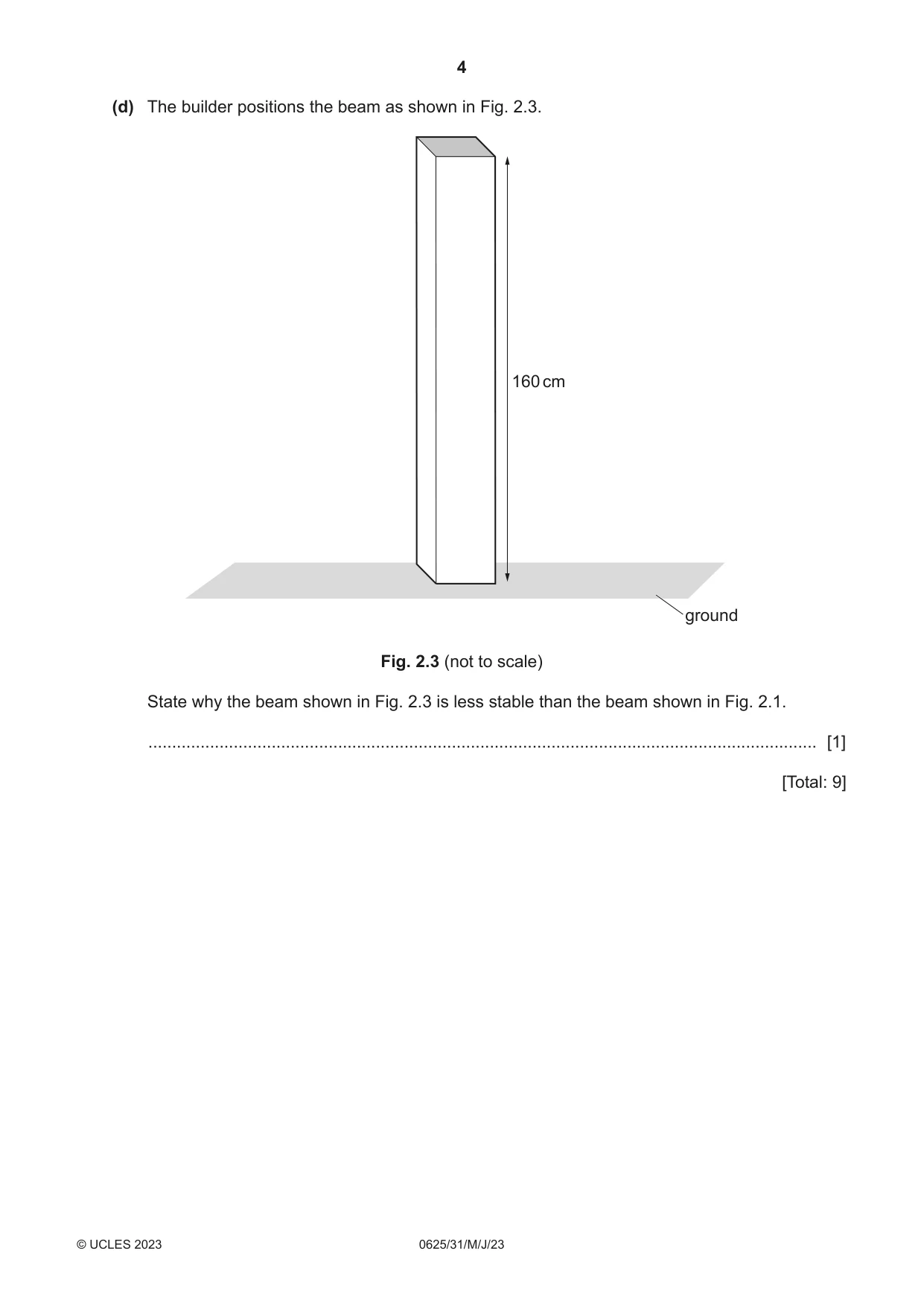
2 Fig. 2.1 shows a concrete beam resting on the ground. concrete beam 12 cm 160 cm ground Fig. 2.1 (not to scale) (a) The weight of the concrete beam is 1540 N. Calculate the pressure on the ground due to the concrete beam. pressure = .............................................. N / cm2 [4] (b) A builder starts to raise one end of the beam. He uses a force of 1030 N at a perpendicular distance of 120 cm from the pivot. Fig. 2.2 shows the arrangement. 1030 N one end of pivot the beam 120 cm ground Fig. 2.2 (not to scale) Calculate the moment of the 1030 N force about the pivot. moment = ................................................ N cm [3] (c) Describe how the builder can use a smaller force to lift the beam. ............................................................................................................................................. [1] (d) The builder positions the beam as shown in Fig. 2.3. 160 cm ground Fig. 2.3 (not to scale) State why the beam shown in Fig. 2.3 is less stable than the beam shown in Fig. 2.1. ............................................................................................................................................. [1] [Total: 9]
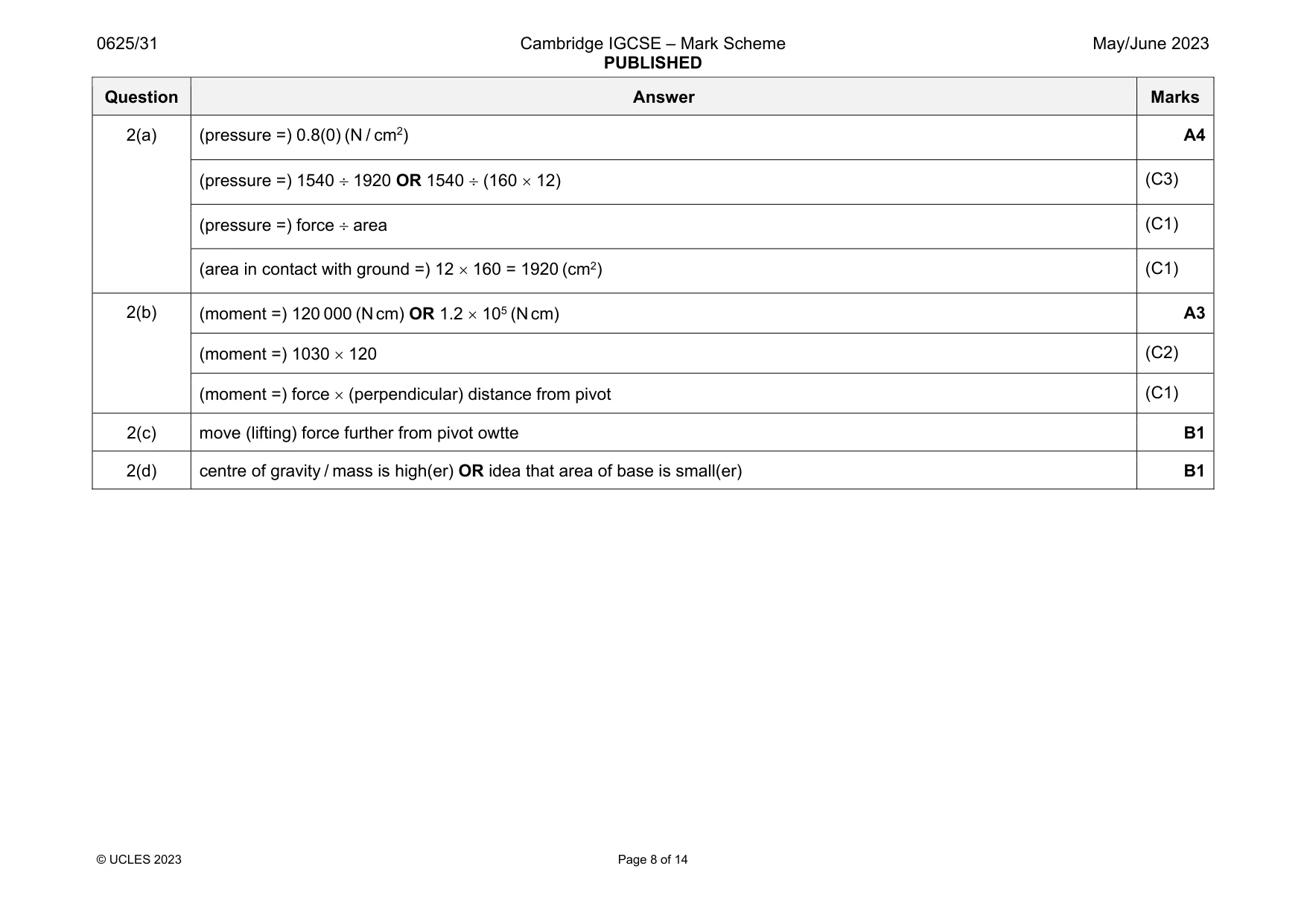
Mark scheme: 2(a) (pressure =) 0.8(0) (N / cm2) A4 (pressure =) 1540 1920 OR 1540 (160 12) (C3) (pressure =) force area (C1) (area in contact with ground =) 12 160 = 1920 (cm2) (C1) 2(b) (moment =) 120 000 (N cm) OR 1.2 105 (N cm) A3 (moment =) 1030 120 (C2) (moment =) force (perpendicular) distance from pivot (C1) 2(c) move (lifting) force further from pivot owtte B1 2(d) centre of gravity / mass is high(er) OR idea that area of base is small(er) B1
Q3 · Electricity is distributed from wind turbines to homes and industry
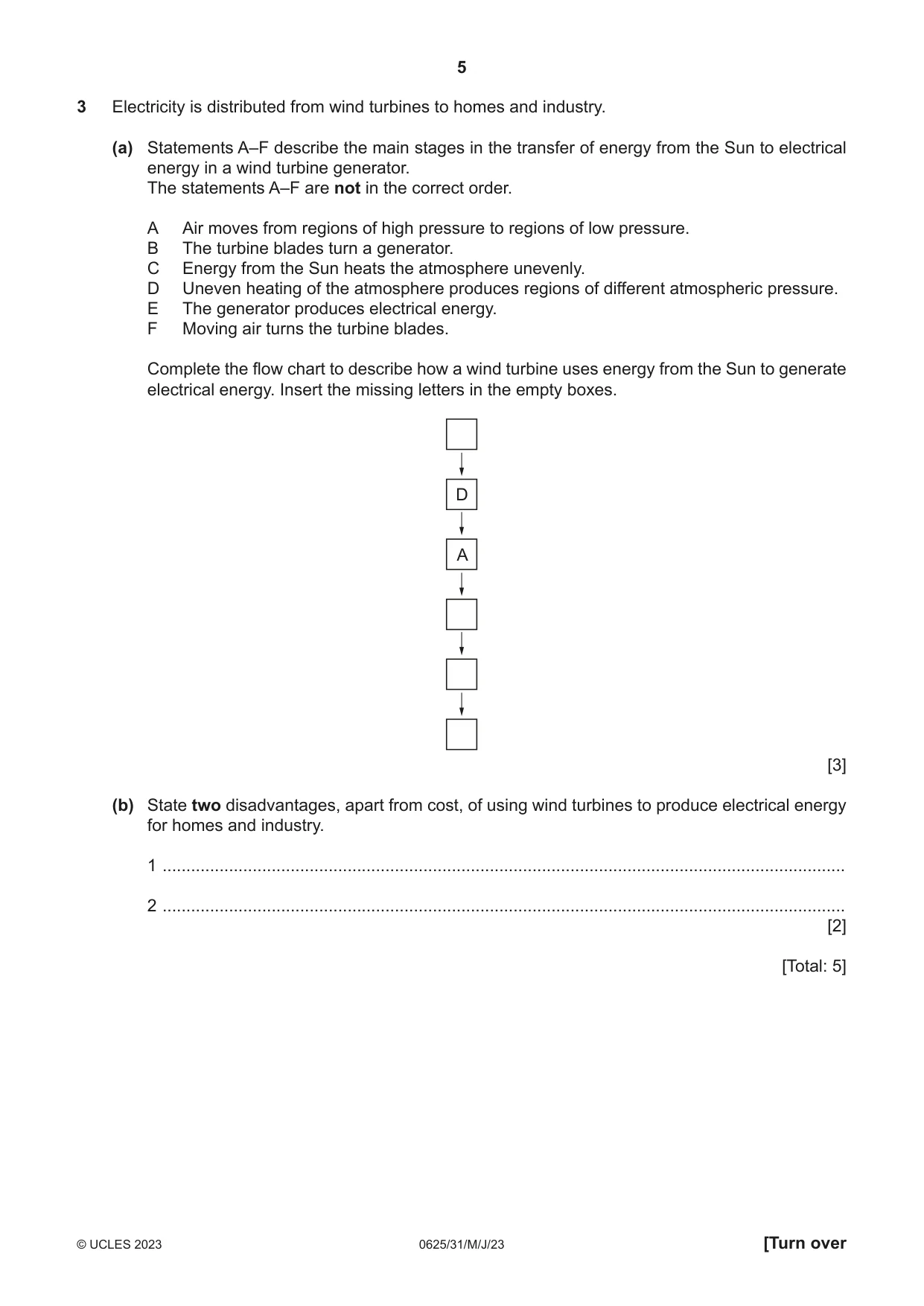
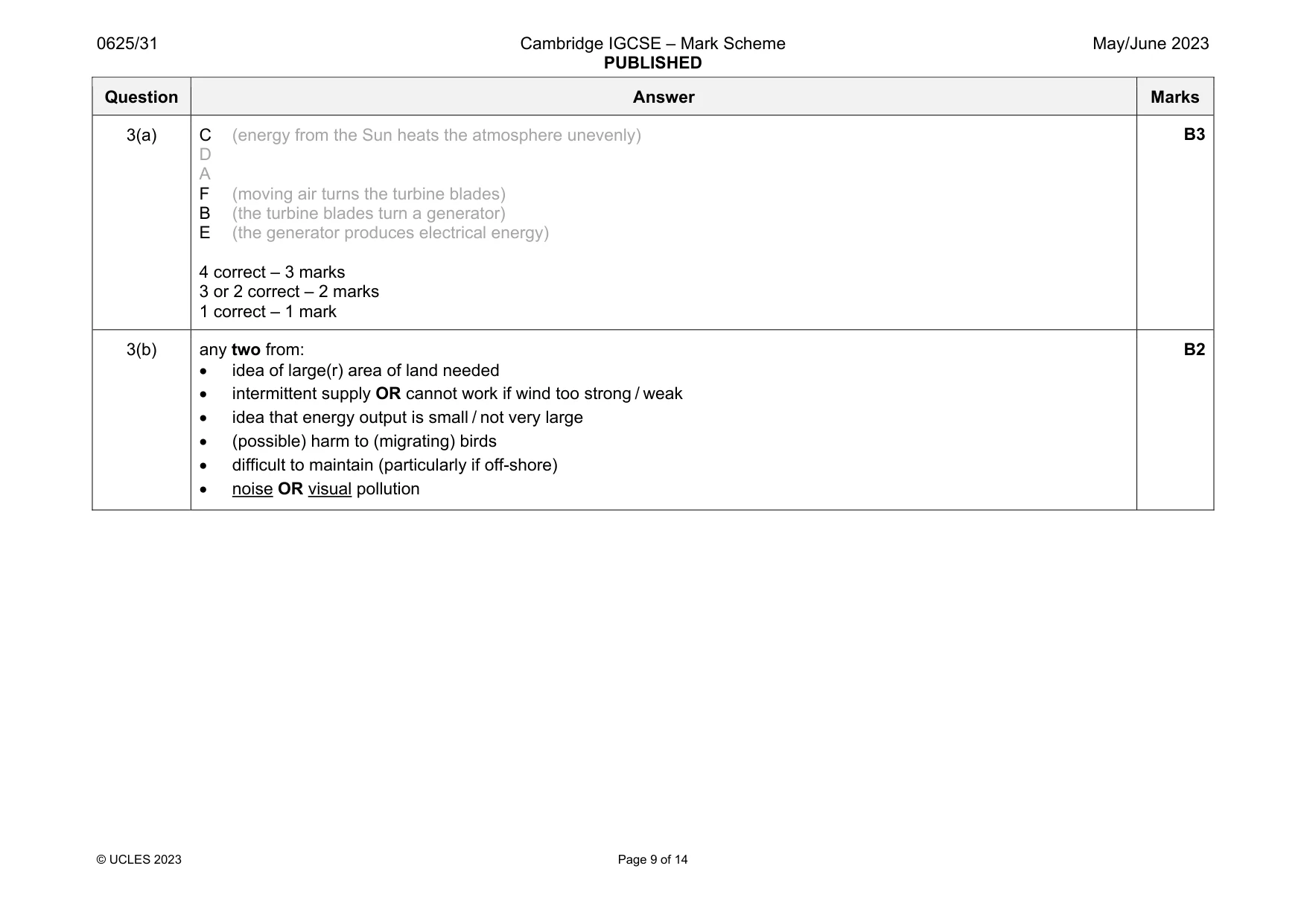
3 Electricity is distributed from wind turbines to homes and industry. (a) Statements A–F describe the main stages in the transfer of energy from the Sun to electrical energy in a wind turbine generator. The statements A–F are not in the correct order. A Air moves from regions of high pressure to regions of low pressure. B The turbine blades turn a generator. C Energy from the Sun heats the atmosphere unevenly. D Uneven heating of the atmosphere produces regions of different atmospheric pressure. E The generator produces electrical energy. F Moving air turns the turbine blades. Complete the flow chart to describe how a wind turbine uses energy from the Sun to generate electrical energy. Insert the missing letters in the empty boxes. D A [3] (b) State two disadvantages, apart from cost, of using wind turbines to produce electrical energy for homes and industry. 1 ................................................................................................................................................ 2 ................................................................................................................................................ [2] [Total: 5]
Mark scheme: 3(a) C (energy from the Sun heats the atmosphere unevenly) D A F (moving air turns the turbine blades) B (the turbine blades turn a generator) E (the generator produces electrical energy) 4 correct – 3 marks 3 or 2 correct – 2 marks 1 correct – 1 mark 3(b) any two from: idea of large(r) area of land needed intermittent supply OR cannot work if wind too strong / weak idea that energy output is small / not very large (possible) harm to (migrating) birds difficult to maintain (particularly if off-shore) noise OR visual pollution B2
Q4 · A student uses an electric motor to lift a load
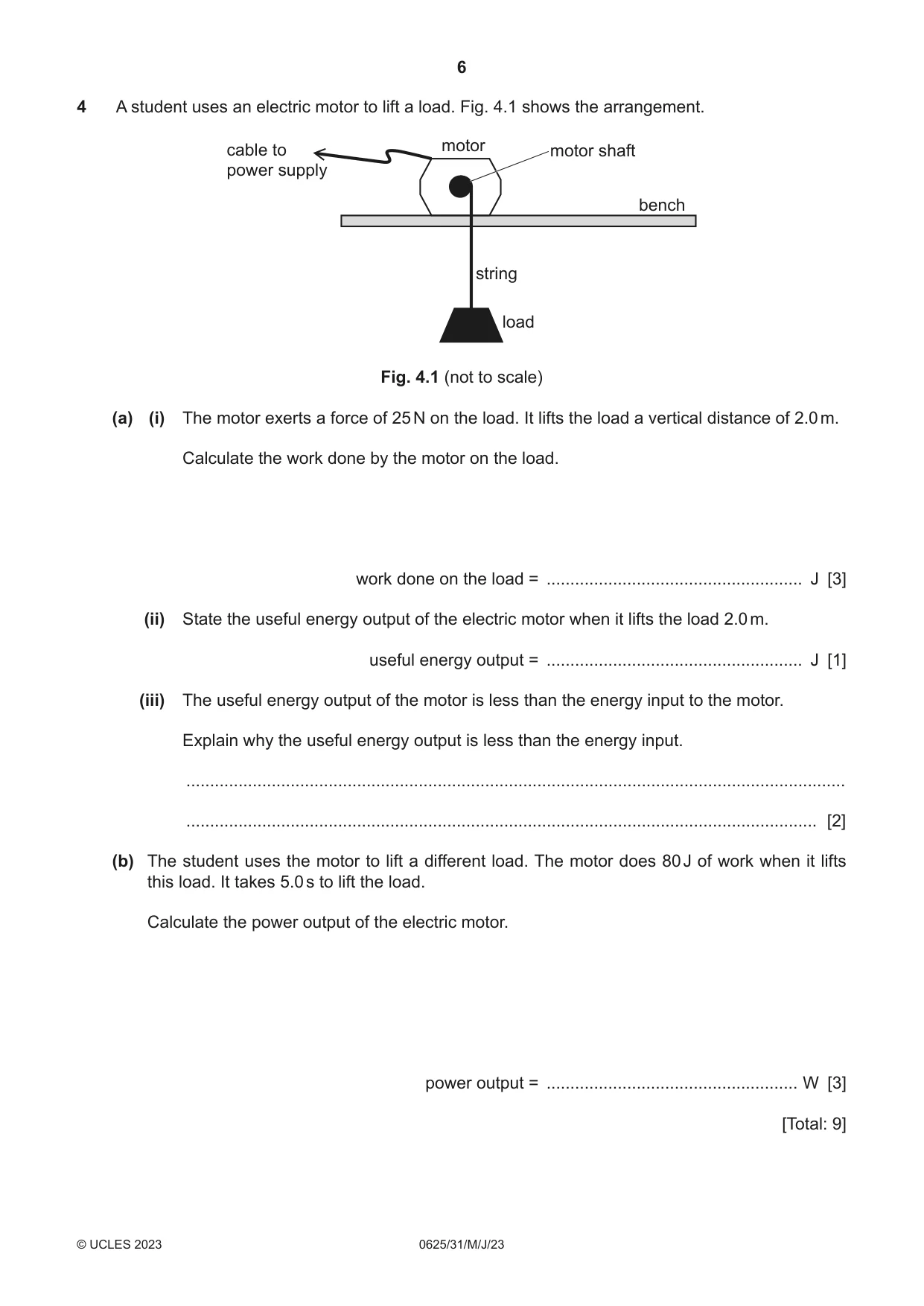
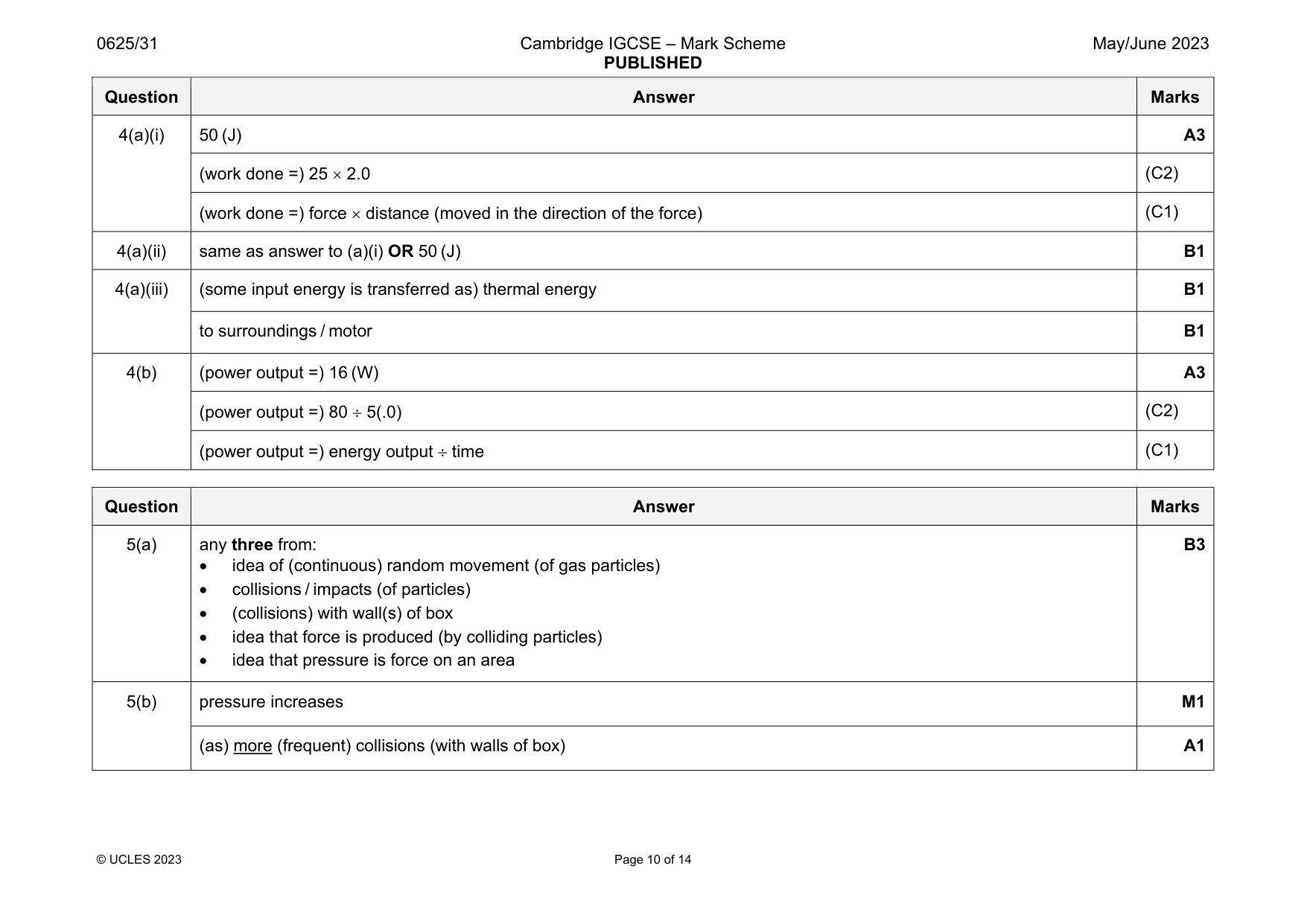
4 A student uses an electric motor to lift a load. Fig. 4.1 shows the arrangement. motor cable to motor shaft power supply bench string load Fig. 4.1 (not to scale) (a) (i) The motor exerts a force of 25 N on the load. It lifts the load a vertical distance of 2.0 m. Calculate the work done by the motor on the load. work done on the load = ...................................................... J [3] (ii) State the useful energy output of the electric motor when it lifts the load 2.0 m. useful energy output = ...................................................... J [1] (iii) The useful energy output of the motor is less than the energy input to the motor. Explain why the useful energy output is less than the energy input. ........................................................................................................................................... ..................................................................................................................................... [2] (b) The student uses the motor to lift a different load. The motor does 80 J of work when it lifts this load. It takes 5.0 s to lift the load. Calculate the power output of the electric motor. power output = ..................................................... W [3] [Total: 9]
Mark scheme: 4(a)(i) 50 (J) A3 (work done =) 25 2.0 (C2) (work done =) force distance (moved in the direction of the force) (C1) 4(a)(ii) same as answer to (a)(i) OR 50 (J) B1 4(a)(iii) (some input energy is transferred as) thermal energy B1 to surroundings / motor B1 4(b) (power output =) 16 (W) A3 (power output =) 80 5(.0) (C2) (power output =) energy output time (C1)
Q5 · Some particles of a gas in a metal box
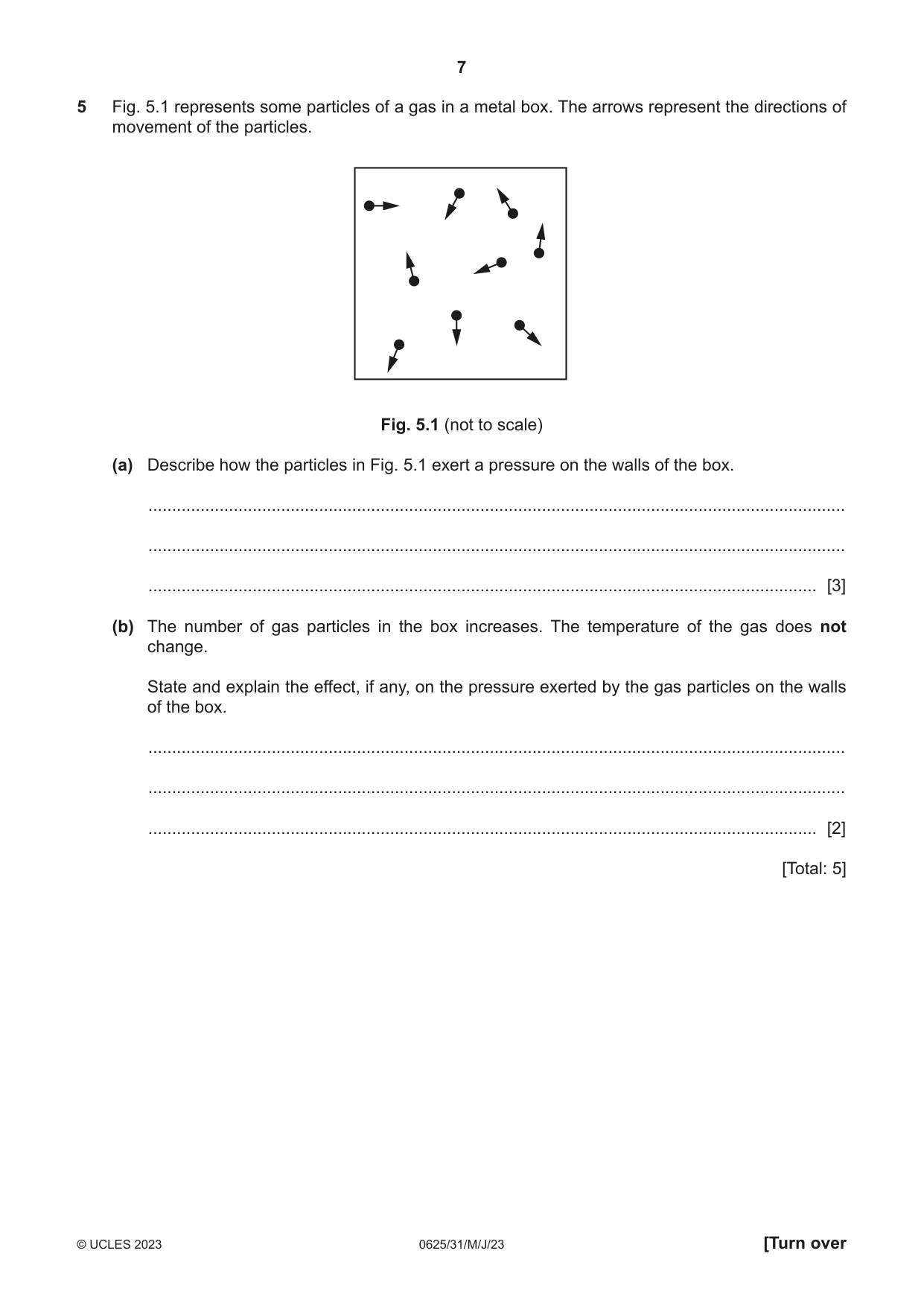
5 Fig. 5.1 represents some particles of a gas in a metal box. The arrows represent the directions of movement of the particles. Fig. 5.1 (not to scale) (a) Describe how the particles in Fig. 5.1 exert a pressure on the walls of the box. ................................................................................................................................................... ................................................................................................................................................... ............................................................................................................................................. [3] (b) The number of gas particles in the box increases. The temperature of the gas does not change. State and explain the effect, if any, on the pressure exerted by the gas particles on the walls of the box. ................................................................................................................................................... ................................................................................................................................................... ............................................................................................................................................. [2] [Total: 5]
Mark scheme: 5(a) any three from: idea of (continuous) random movement (of gas particles) collisions / impacts (of particles) (collisions) with wall(s) of box idea that force is produced (by colliding particles) idea that pressure is force on an area 5(b) pressure increases M1 (as) more (frequent) collisions (with walls of box) A1
Q6 · A student observes waves on the surface of water in a tank
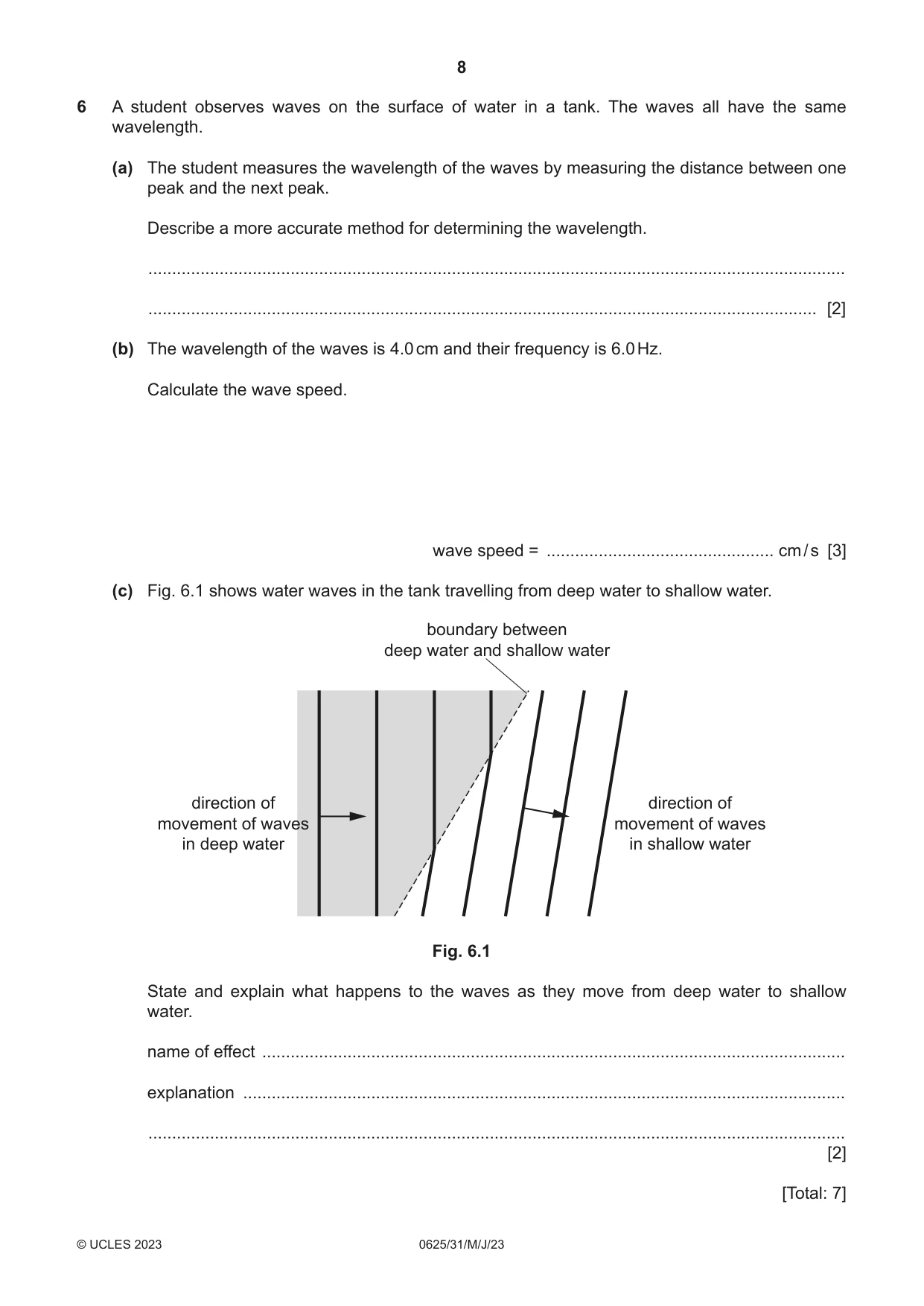
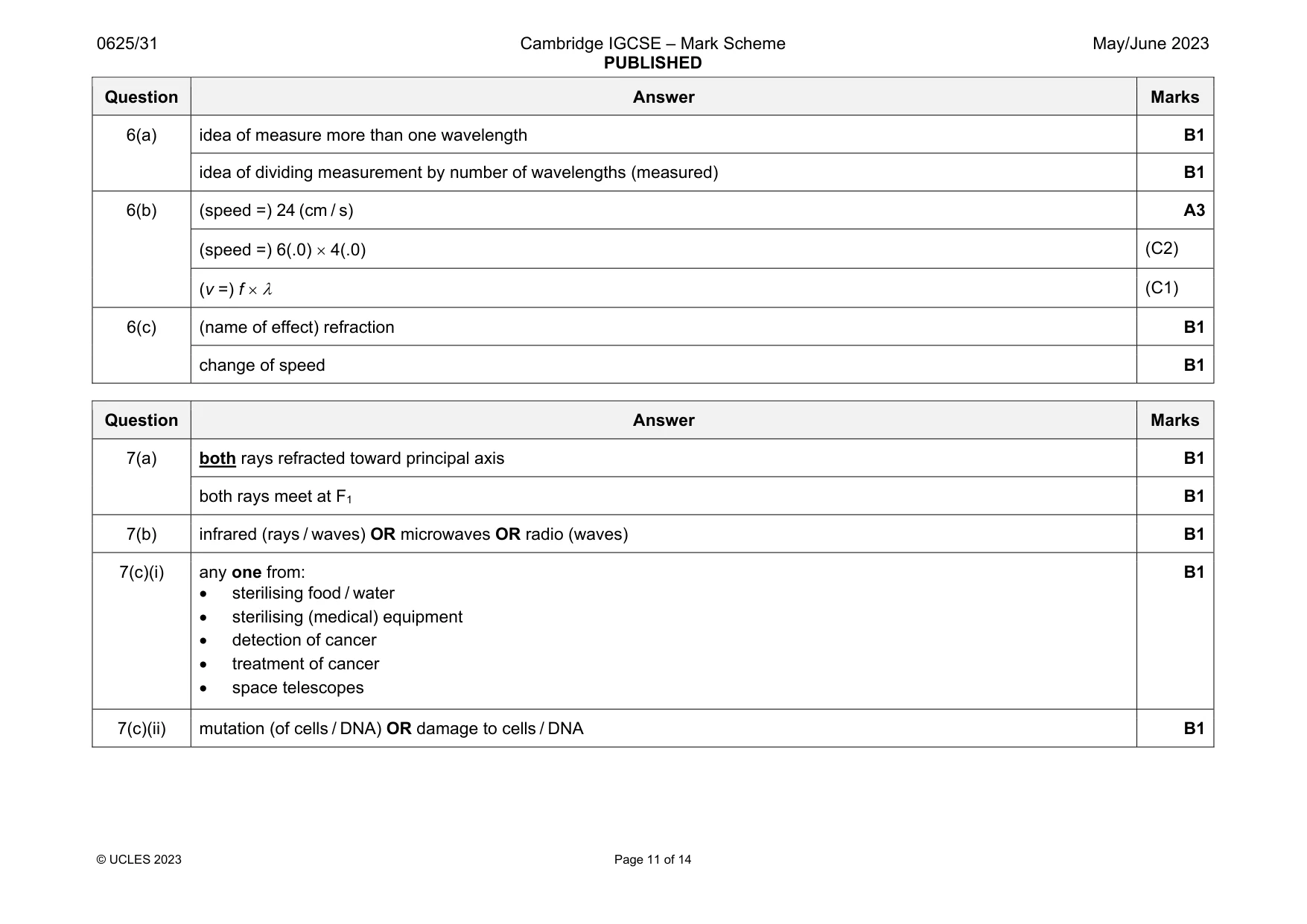
6 A student observes waves on the surface of water in a tank. The waves all have the same wavelength. (a) The student measures the wavelength of the waves by measuring the distance between one peak and the next peak. Describe a more accurate method for determining the wavelength. ................................................................................................................................................... ............................................................................................................................................. [2] (b) The wavelength of the waves is 4.0 cm and their frequency is 6.0 Hz. Calculate the wave speed. wave speed = ................................................ cm / s [3] (c) Fig. 6.1 shows water waves in the tank travelling from deep water to shallow water. boundary between deep water and shallow water direction of direction of movement of waves movement of waves in deep water in shallow water Fig. 6.1 State and explain what happens to the waves as they move from deep water to shallow water. name of effect ........................................................................................................................... explanation ............................................................................................................................... ................................................................................................................................................... [2] [Total: 7]
Mark scheme: 6(a) idea of measure more than one wavelength B1 idea of dividing measurement by number of wavelengths (measured) B1 6(b) (speed =) 24 (cm / s) A3 (speed =) 6(.0) 4(.0) (C2) (v =) f (C1) 6(c) (name of effect) refraction B1 change of speed B1
Q7 · Two rays of light striking a thin converging lens
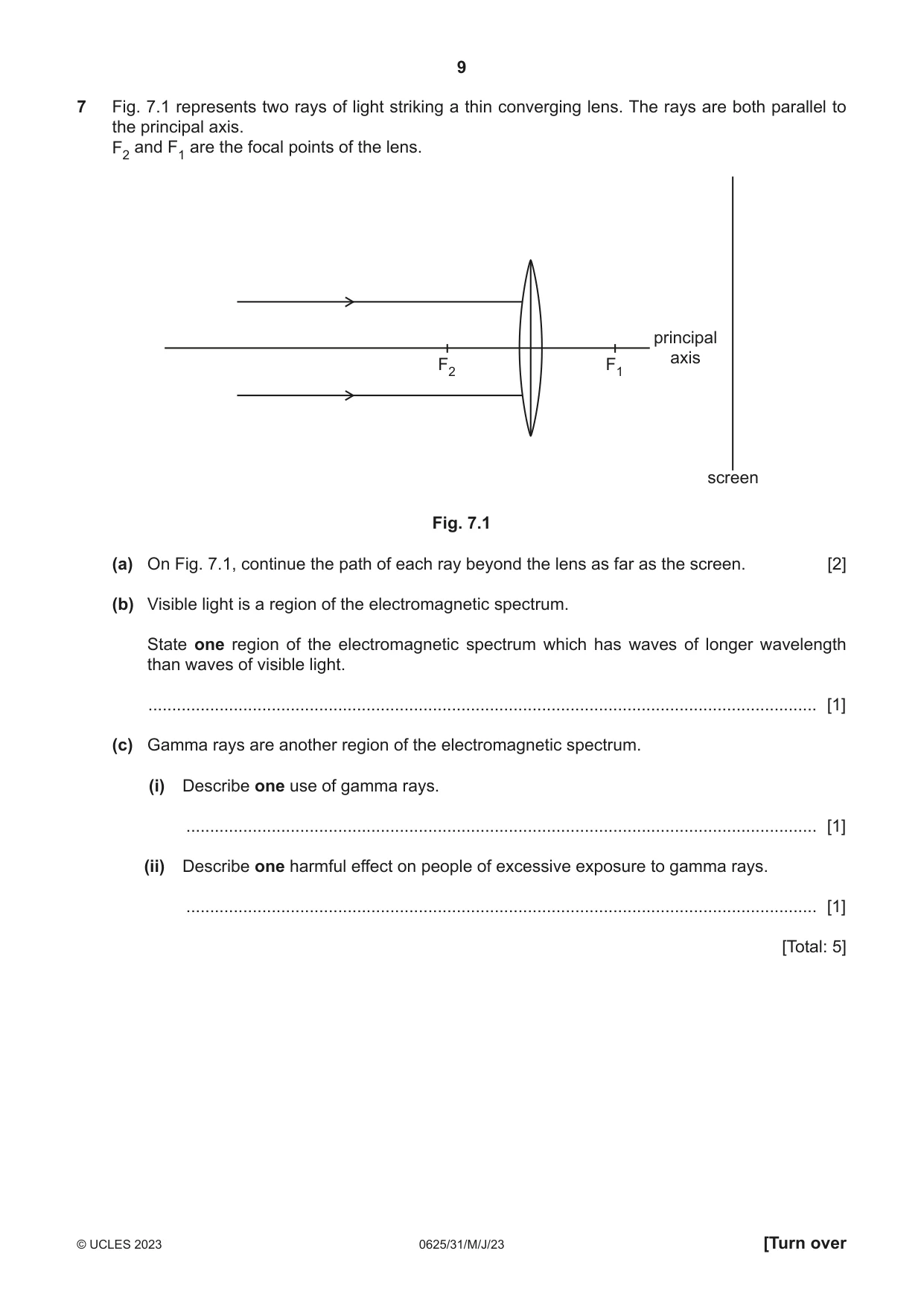
7 Fig. 7.1 represents two rays of light striking a thin converging lens. The rays are both parallel to the principal axis. F2 and F1 are the focal points of the lens. principal axis F2 F1 screen Fig. 7.1 (a) On Fig. 7.1, continue the path of each ray beyond the lens as far as the screen. [2] (b) Visible light is a region of the electromagnetic spectrum. State one region of the electromagnetic spectrum which has waves of longer wavelength than waves of visible light. ............................................................................................................................................. [1] (c) Gamma rays are another region of the electromagnetic spectrum. (i) Describe one use of gamma rays. ..................................................................................................................................... [1] (ii) Describe one harmful effect on people of excessive exposure to gamma rays. ..................................................................................................................................... [1] [Total: 5]
Mark scheme: 7(a) both rays refracted toward principal axis B1 both rays meet at F1 B1 7(b) infrared (rays / waves) OR microwaves OR radio (waves) B1 7(c)(i) any one from: sterilising food / water sterilising (medical) equipment detection of cancer treatment of cancer space telescopes B1 7(c)(ii) mutation (of cells / DNA) OR damage to cells / DNA B1
Q8 · The magnetic field pattern around two permanent magnets
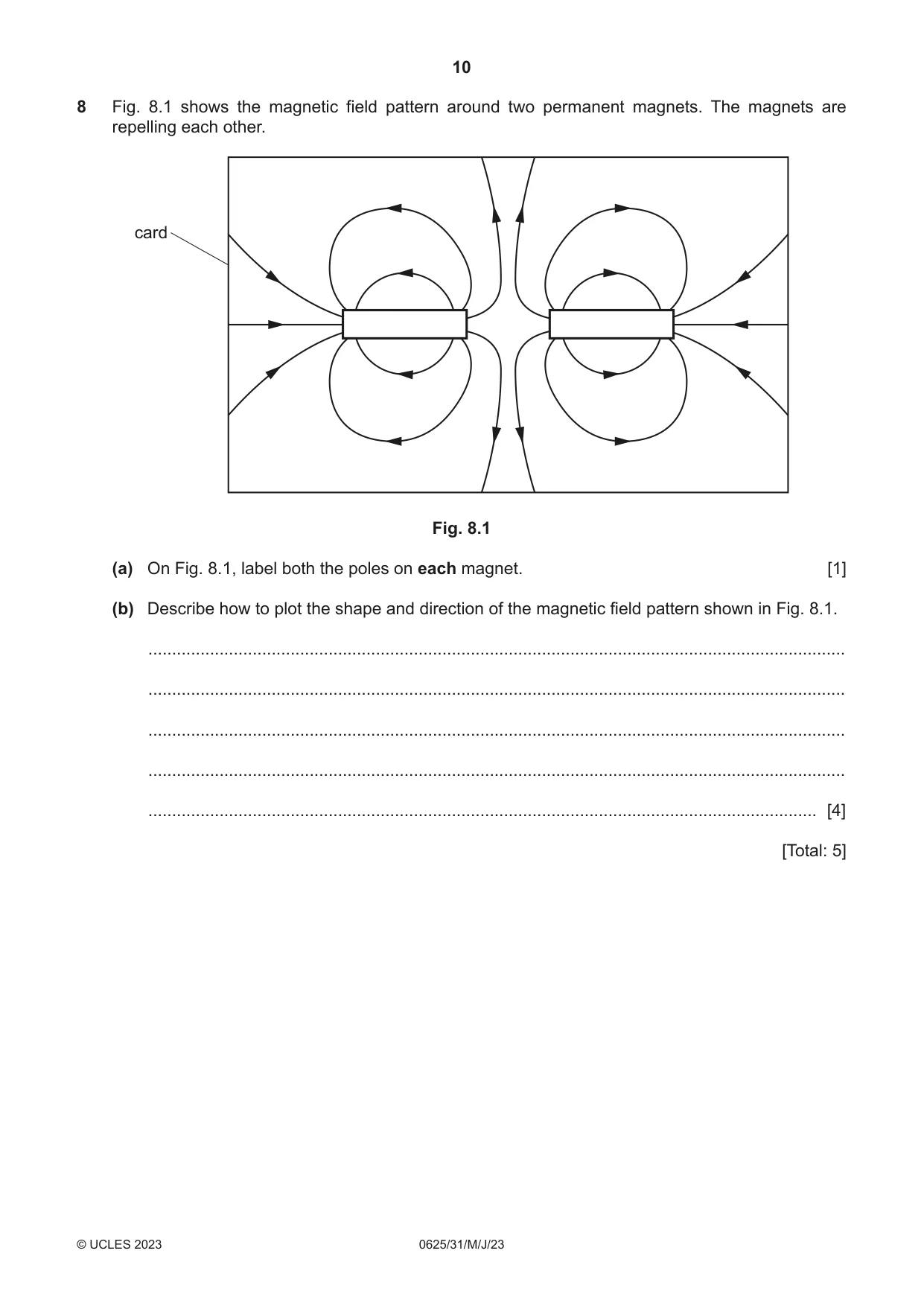
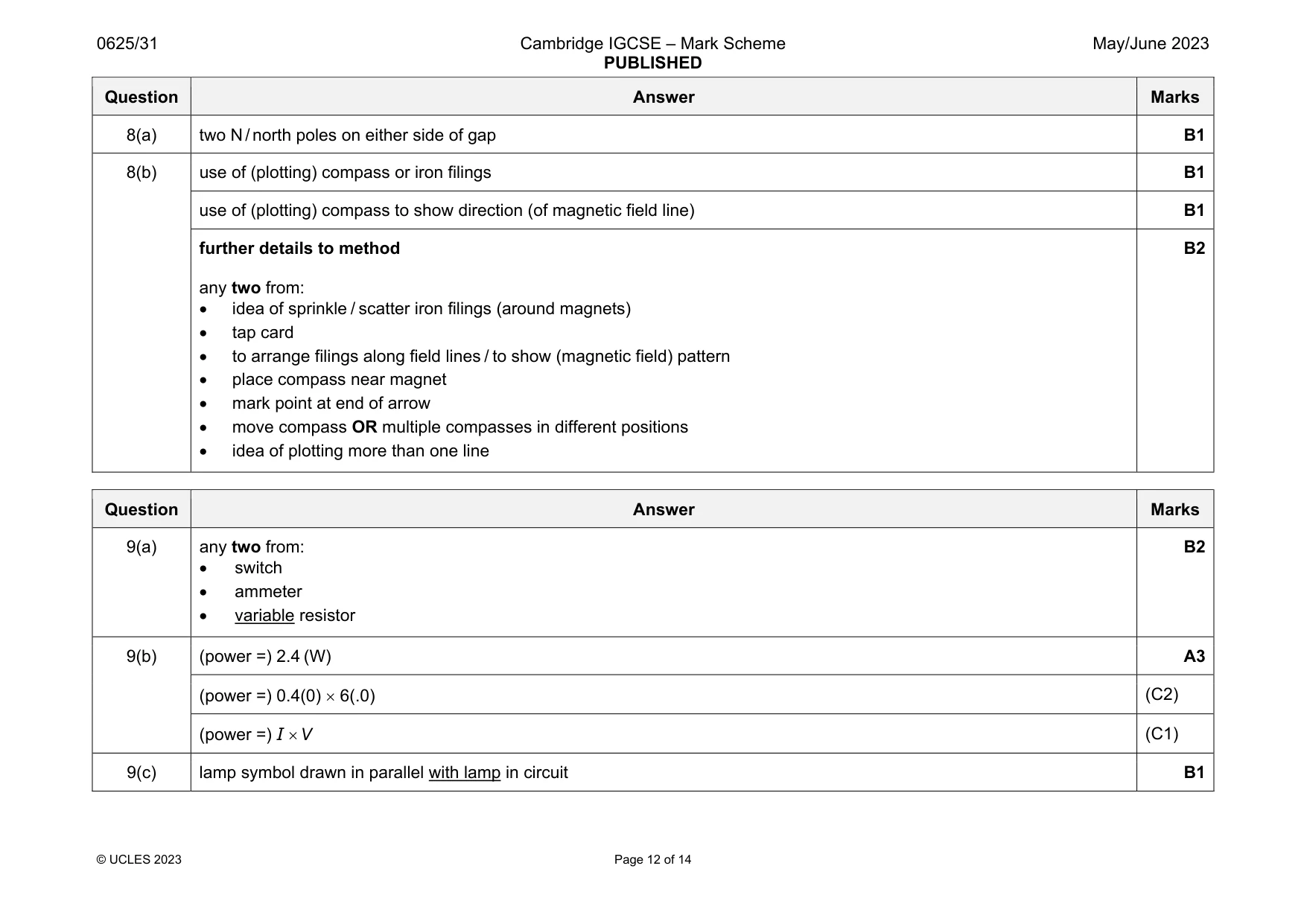
8 Fig. 8.1 shows the magnetic field pattern around two permanent magnets. The magnets are repelling each other. card Fig. 8.1 (a) On Fig. 8.1, label both the poles on each magnet. [1] (b) Describe how to plot the shape and direction of the magnetic field pattern shown in Fig. 8.1. ................................................................................................................................................... ................................................................................................................................................... ................................................................................................................................................... ................................................................................................................................................... ............................................................................................................................................. [4] [Total: 5]
Mark scheme: 8(a) two N / north poles on either side of gap B1 8(b) use of (plotting) compass or iron filings B1 use of (plotting) compass to show direction (of magnetic field line) B1 further details to method any two from: idea of sprinkle / scatter iron filings (around magnets) tap card to arrange filings along field lines / to show (magnetic field) pattern place compass near magnet mark point at end of arrow move compass OR multiple compasses in different positions idea of plotting more than one line B2
Question 9
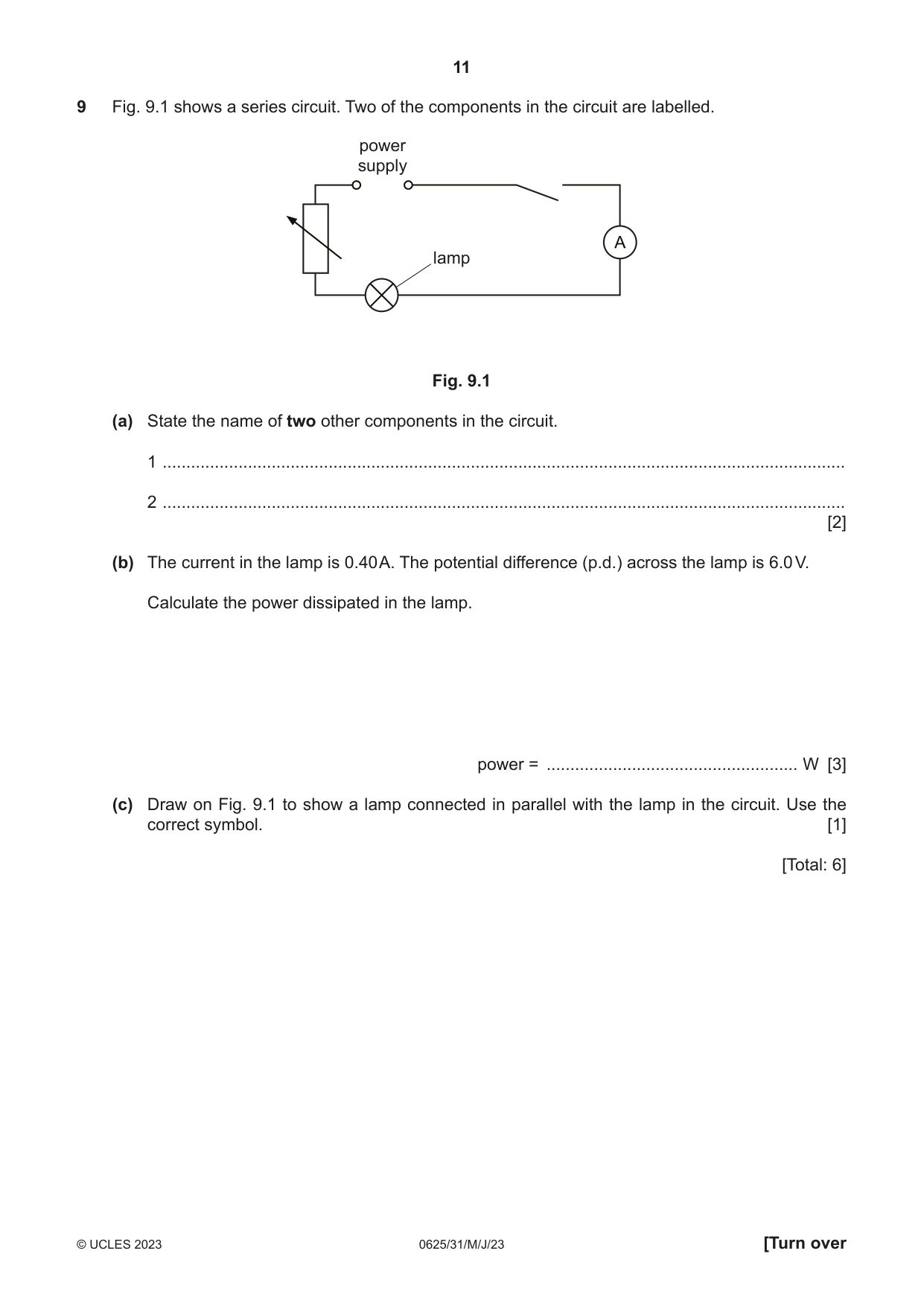
9 Fig. 9.1 shows a series circuit. Two of the components in the circuit are labelled. power supply lamp Fig. 9.1 (a) State the name of two other components in the circuit. 1 ................................................................................................................................................ 2 ................................................................................................................................................ [2] (b) The current in the lamp is 0.40 A. The potential difference (p.d.) across the lamp is 6.0 V. Calculate the power dissipated in the lamp. power = ..................................................... W [3] (c) Draw on Fig. 9.1 to show a lamp connected in parallel with the lamp in the circuit. Use the correct symbol. [1] [Total: 6]
Mark scheme: 9(a) any two from: switch ammeter variable resistor B2 9(b) (power =) 2.4 (W) A3 (power =) 0.4(0) 6(.0) (C2) (power =) I V (C1) 9(c) lamp symbol drawn in parallel with lamp in circuit B1
Q10 · An arrangement used to demonstrate electromagnetic induction
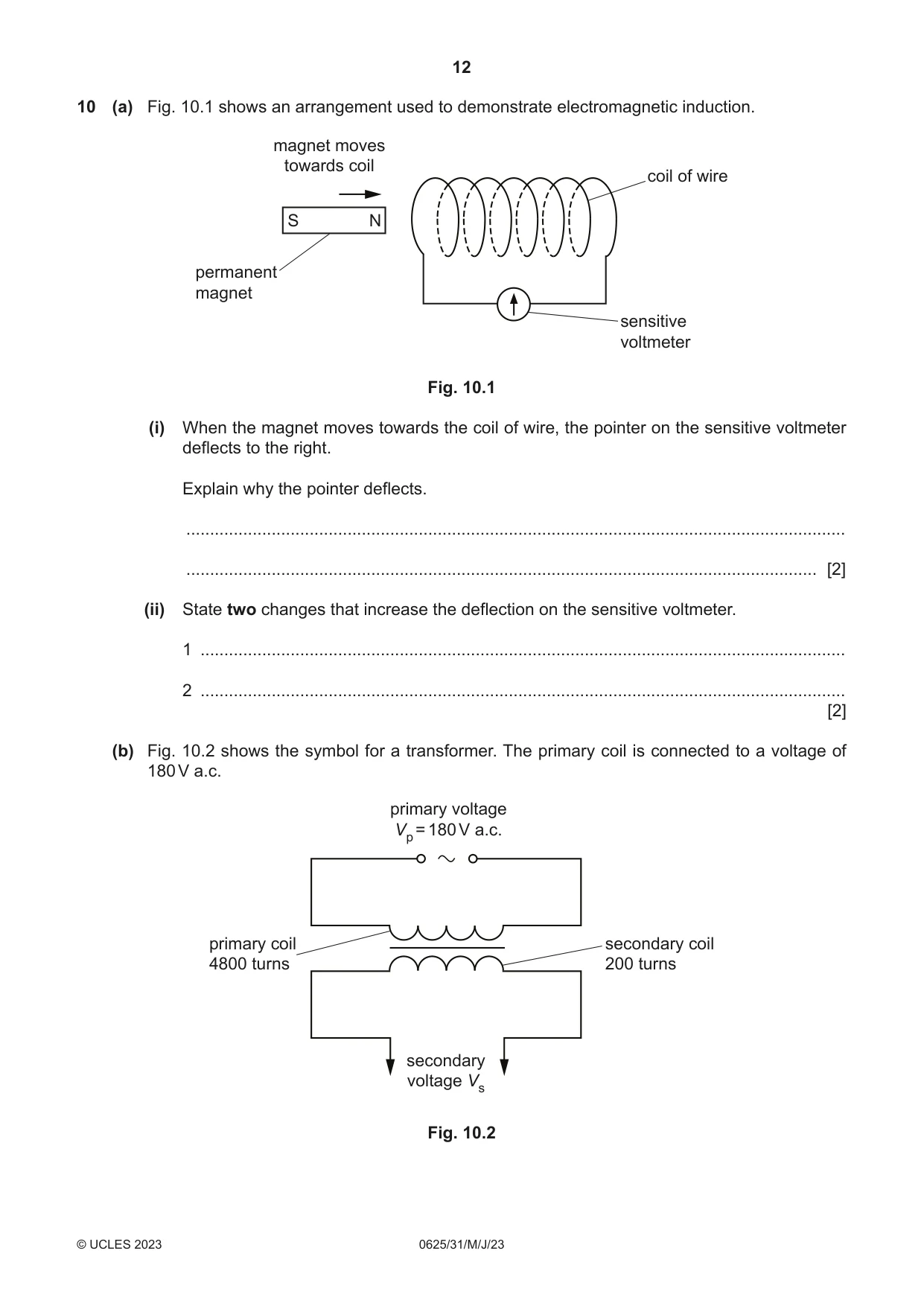
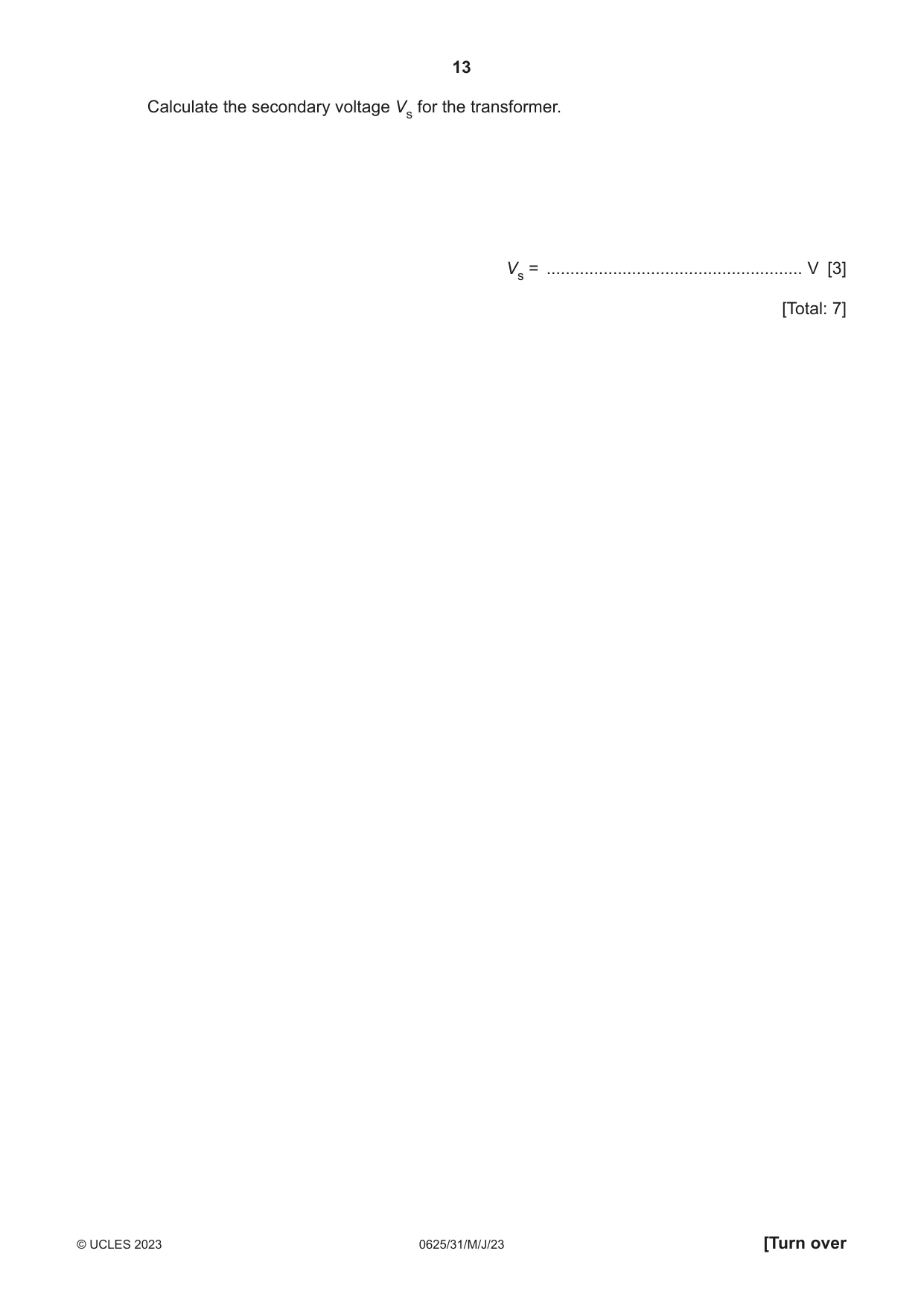
10 (a) Fig. 10.1 shows an arrangement used to demonstrate electromagnetic induction. magnet moves towards coil coil of wire S N permanent magnet sensitive voltmeter Fig. 10.1 (i) When the magnet moves towards the coil of wire, the pointer on the sensitive voltmeter deflects to the right. Explain why the pointer deflects. ........................................................................................................................................... ..................................................................................................................................... [2] (ii) State two changes that increase the deflection on the sensitive voltmeter. 1 ........................................................................................................................................ 2 ........................................................................................................................................ [2] (b) Fig. 10.2 shows the symbol for a transformer. The primary coil is connected to a voltage of 180 V a.c. primary voltage Vp = 180 V a.c. primary coil secondary coil 4800 turns 200 turns secondary voltage Vs Fig. 10.2 Calculate the secondary voltage Vs for the transformer. Vs = ...................................................... V [3] [Total: 7]
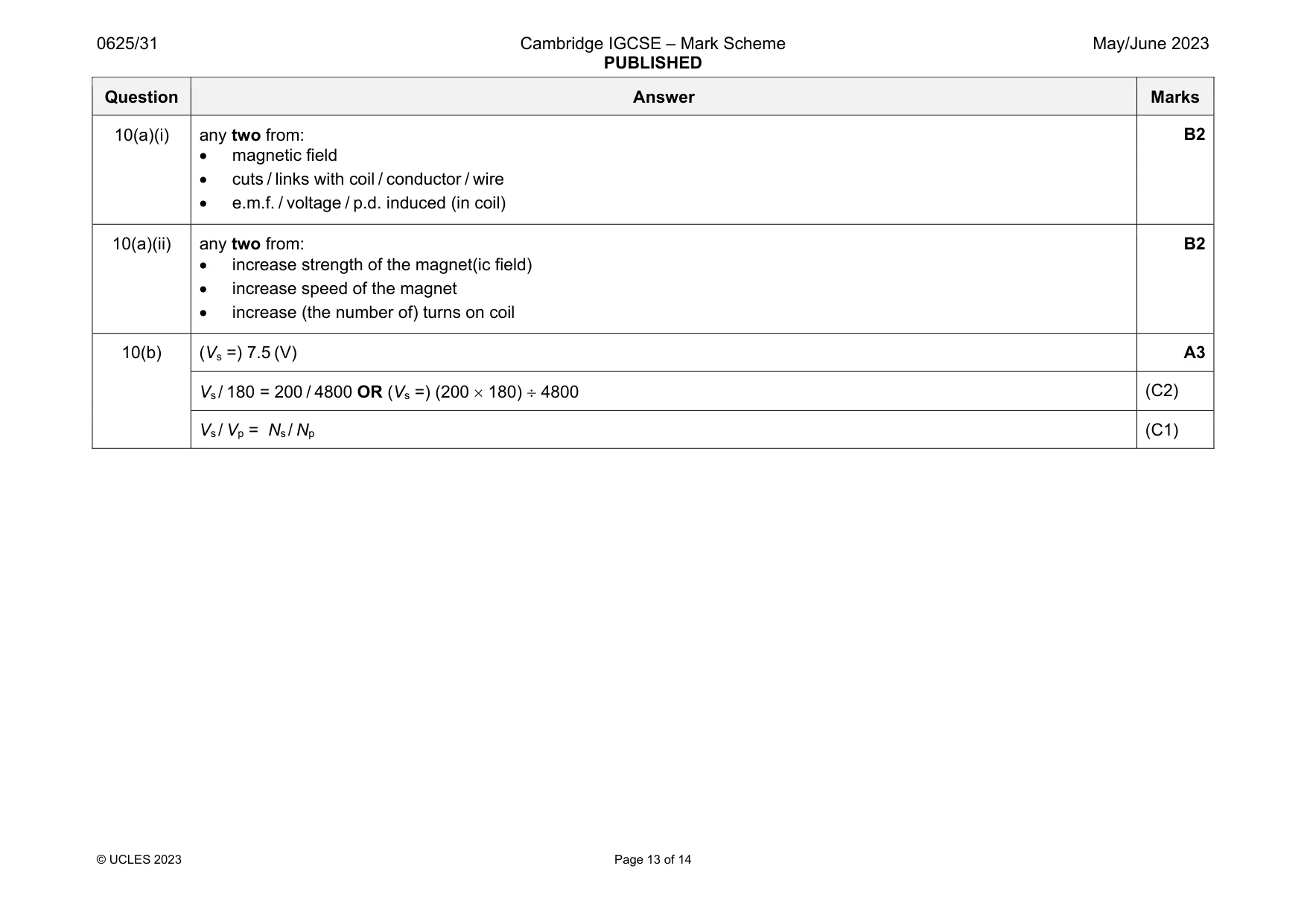
Mark scheme: 10(a)(i) any two from: magnetic field cuts / links with coil / conductor / wire e.m.f. / voltage / p.d. induced (in coil) 10(a)(ii) any two from: increase strength of the magnet(ic field) increase speed of the magnet increase (the number of) turns on coil B2 10(b) (Vs =) 7.5 (V) A3 Vs/ 180 = 200 / 4800 OR (Vs =) (200 180) 4800 (C2) Vs/ Vp = Ns/ Np (C1)
Q11 · All the particles in an atom which is a radioactive isotope of carbon
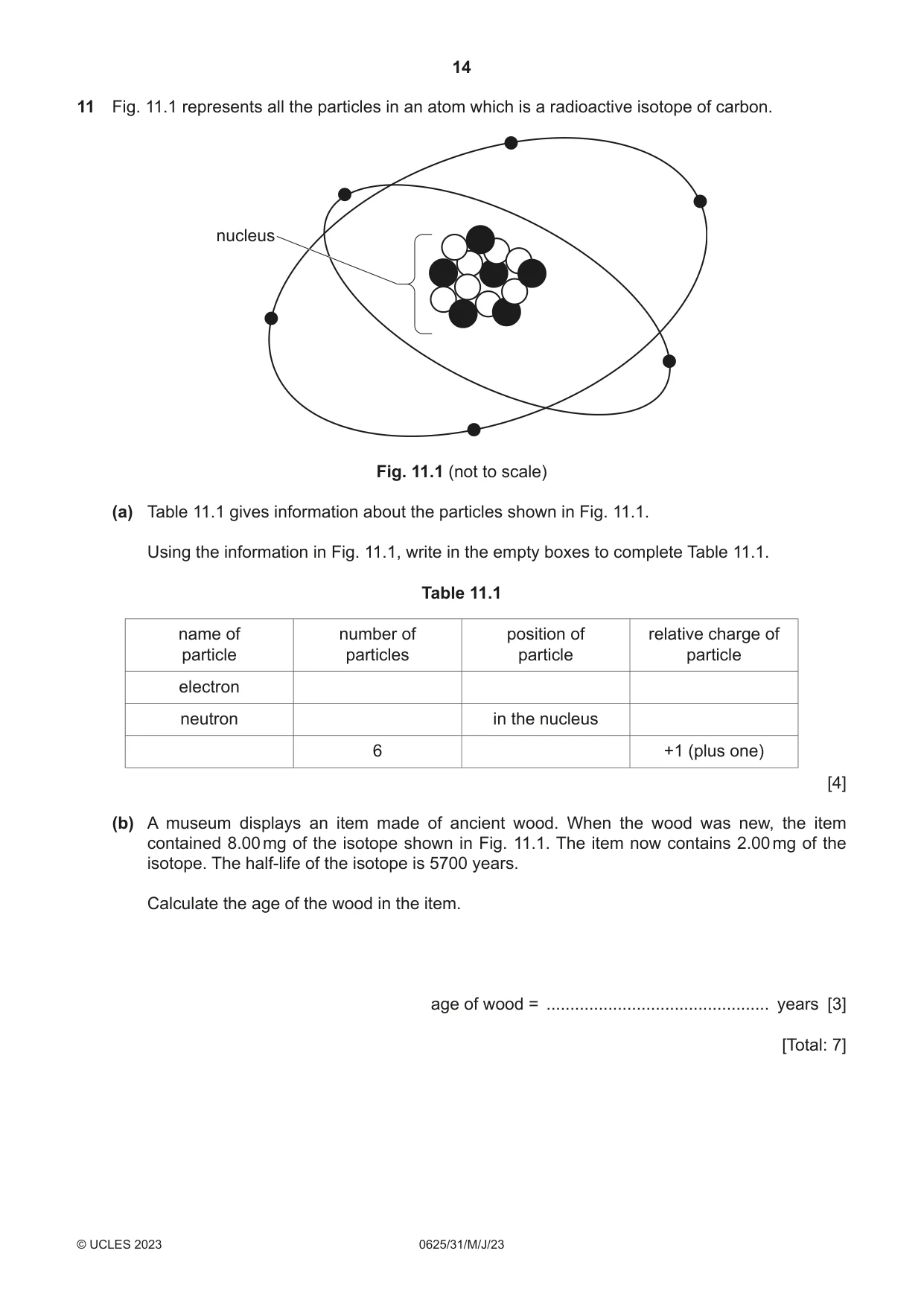
11 Fig. 11.1 represents all the particles in an atom which is a radioactive isotope of carbon. nucleus Fig. 11.1 (not to scale) (a) Table 11.1 gives information about the particles shown in Fig. 11.1. Using the information in Fig. 11.1, write in the empty boxes to complete Table 11.1. Table 11.1 name of number of position of relative charge of particle particles particle particle electron neutron in the nucleus 6 +1 (plus one) [4] (b) A museum displays an item made of ancient wood. When the wood was new, the item contained 8.00 mg of the isotope shown in Fig. 11.1. The item now contains 2.00 mg of the isotope. The half-life of the isotope is 5700 years. Calculate the age of the wood in the item. age of wood = ............................................... years [3] [Total: 7]
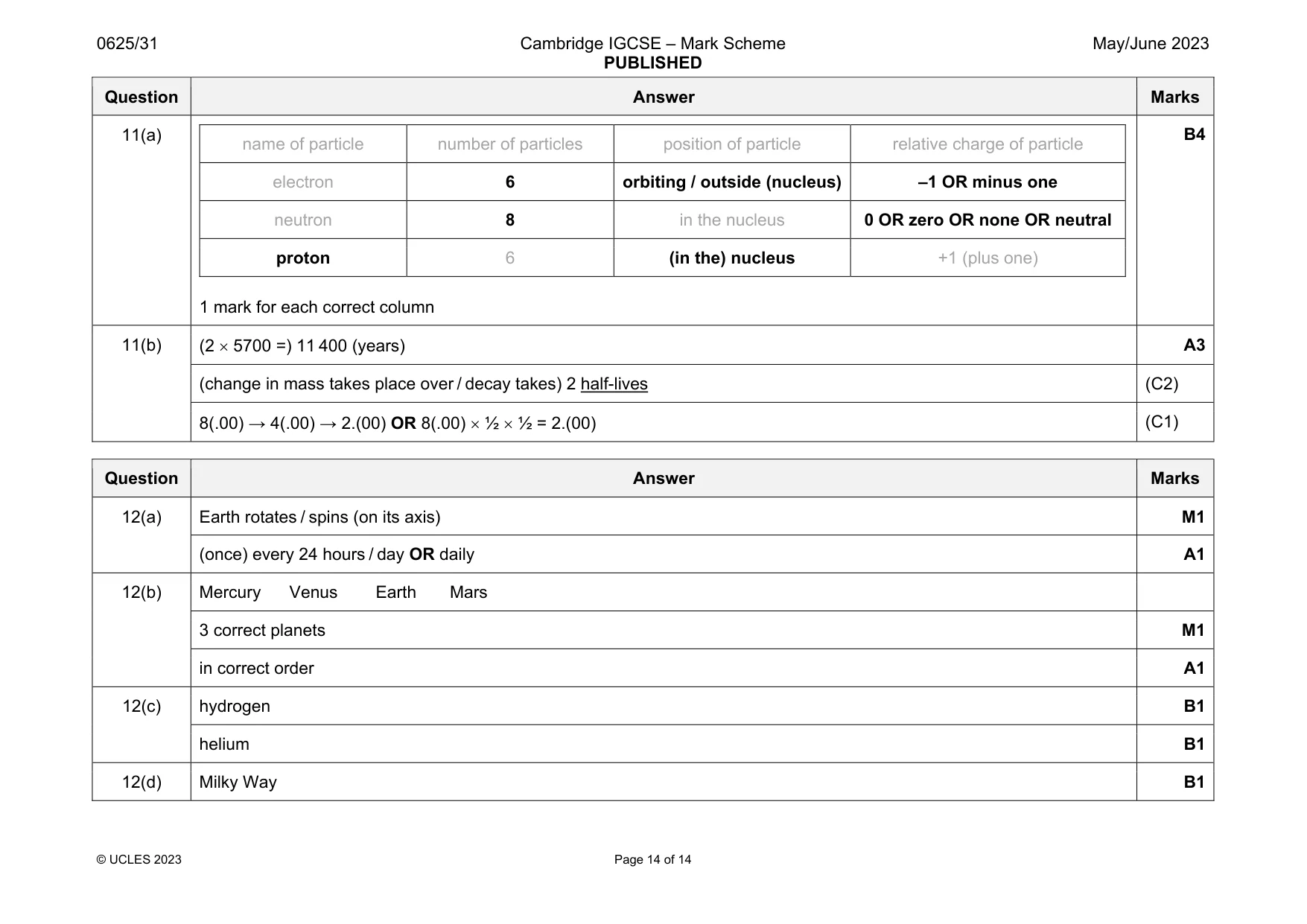
Mark scheme: 11(a) name of particle number of particles position of particle relative charge of particle electron 6 orbiting / outside (nucleus) –1 OR minus one neutron 8 in the nucleus 0 OR zero OR none OR neutral proton 6 (in the) nucleus +1 (plus one) 1 mark for each correct column 11(b) (2 5700 =) 11 400 (years) A3 (change in mass takes place over / decay takes) 2 half-lives (C2) 8(.00) → 4(.00) → 2.(00) OR 8(.00) ½ ½ = 2.(00) (C1)
Q12 · The Earth and the Sun at one point in the Earth’s orbit of the Sun
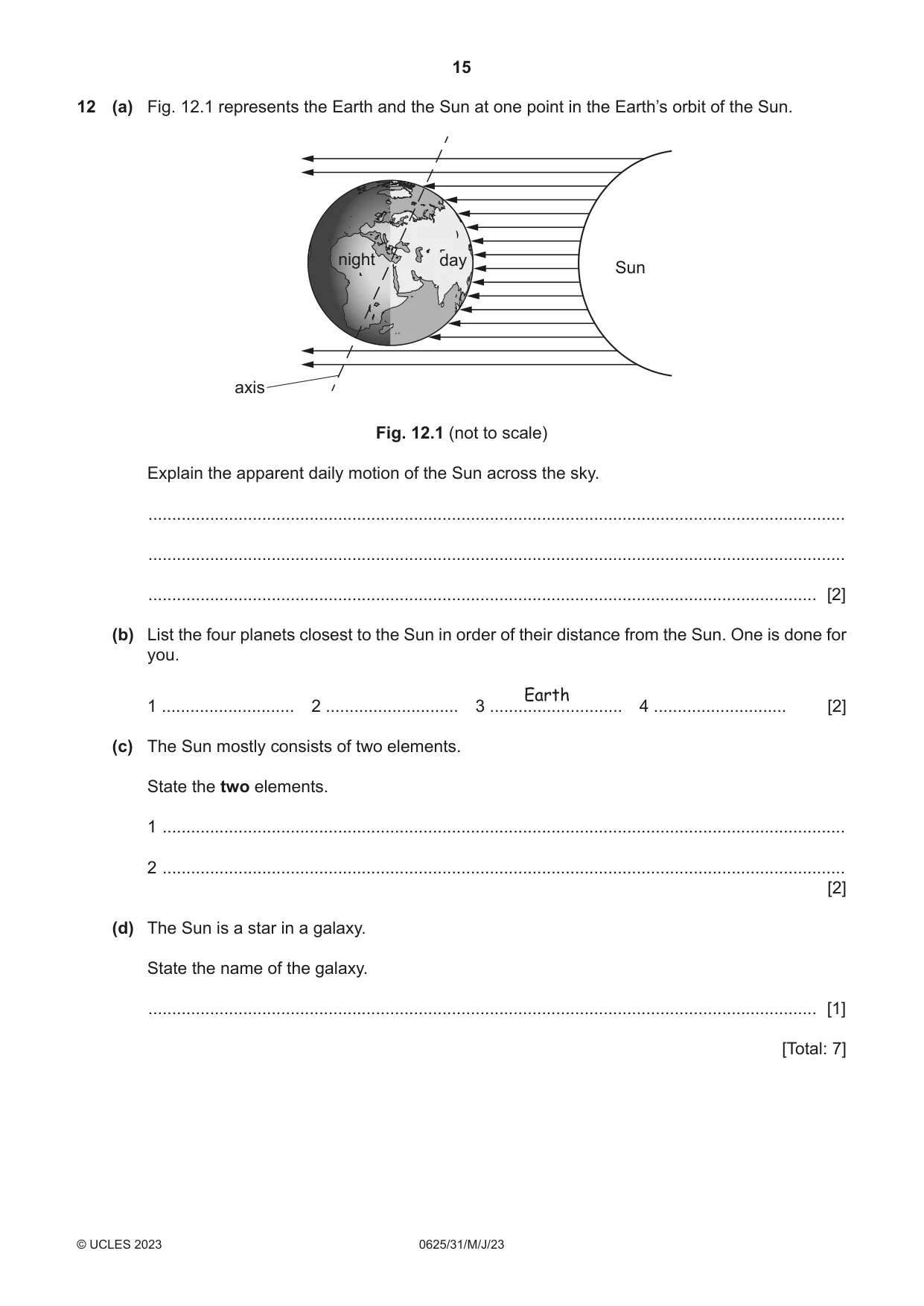
12 (a) Fig. 12.1 represents the Earth and the Sun at one point in the Earth’s orbit of the Sun. night day Sun axis Fig. 12.1 (not to scale) Explain the apparent daily motion of the Sun across the sky. ................................................................................................................................................... ................................................................................................................................................... ............................................................................................................................................. [2] (b) List the four planets closest to the Sun in order of their distance from the Sun. One is done for you. Earth 1 ............................ 2 ............................ 3 ............................ 4 ............................ [2] (c) The Sun mostly consists of two elements. State the two elements. 1 ................................................................................................................................................ 2 ................................................................................................................................................ [2] (d) The Sun is a star in a galaxy. State the name of the galaxy. ............................................................................................................................................. [1] [Total: 7]
Mark scheme: 12(a) Earth rotates / spins (on its axis) M1 (once) every 24 hours / day OR daily A1 12(b) Mercury Venus Earth Mars 3 correct planets M1 in correct order A1 12(c) hydrogen B1 helium B1 12(d) Milky Way B1
What was in this paper
The subtopics covered by these 12 questions, and how many questions each got. Open one in a new tab to see every Cambridge question on it.
What you needed in this session
Cambridge’s own grade thresholds for 2023 May/June, Paper 3 · Variant 1. A higher threshold means an easier paper — the bar moves with how the cohort did.