Cambridge IGCSE Physics 0625 — 2013 Oct/Nov Paper 3 · Variant 3
0625/33/O/N/13 · 11 questions · 80 marks · ≈90 min
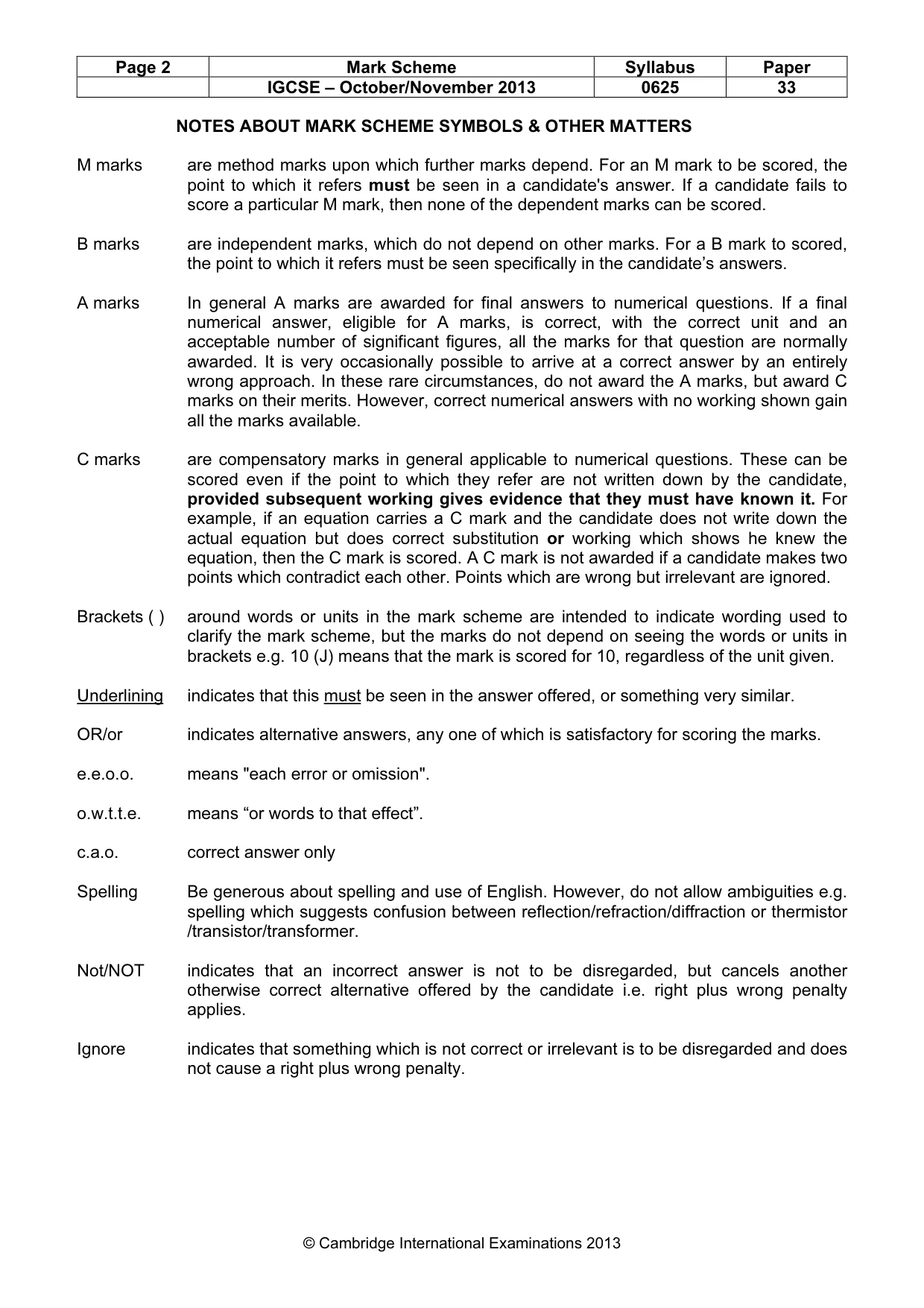
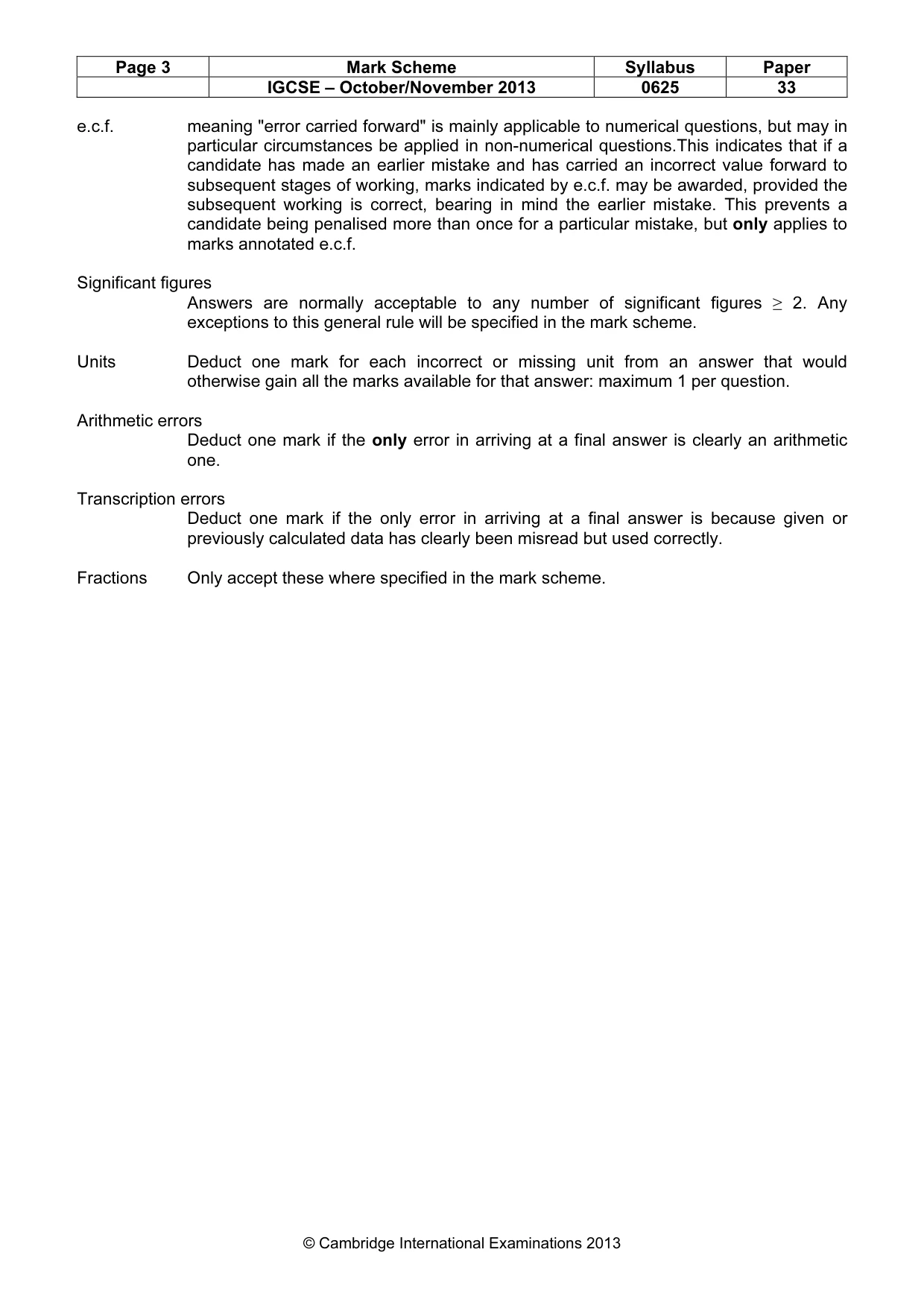
The question paper and its mark scheme, free to read here and free to download. This is Cambridge’s own paper, exactly as it was sat.
Question paper20 pages

Mark scheme7 pages
Answers below. Sit the paper first if you are practising.
Questions as text
Q1 · An archaeologist digging at an ancient site discovers a spoon
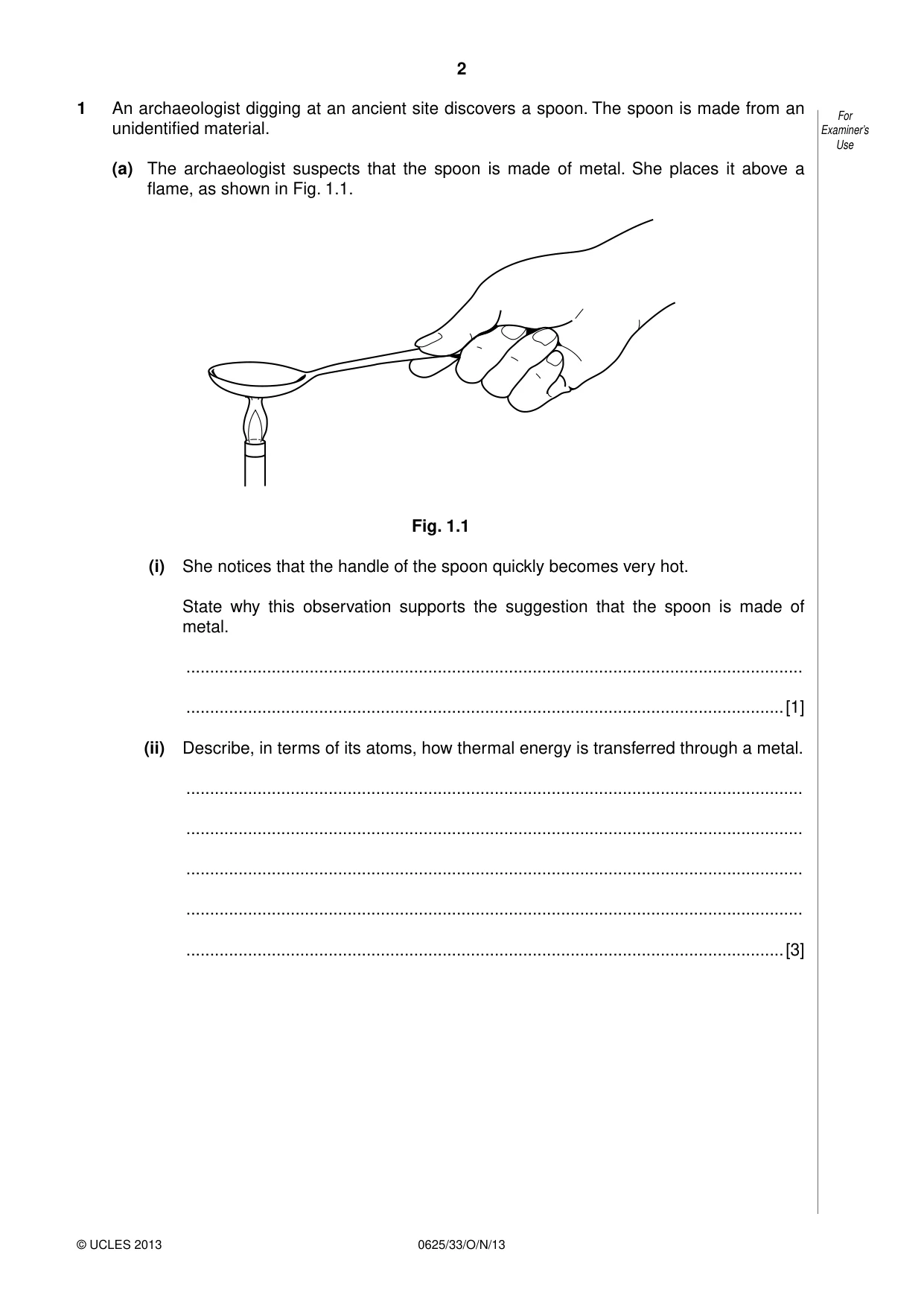
1 An archaeologist digging at an ancient site discovers a spoon. The spoon is made from an For unidentified material. Examiner’s Use (a) The archaeologist suspects that the spoon is made of metal. She places it above a flame, as shown in Fig. 1.1. Fig. 1.1 (i) She notices that the handle of the spoon quickly becomes very hot. State why this observation supports the suggestion that the spoon is made of metal. .................................................................................................................................. ..............................................................................................................................[1] (ii) Describe, in terms of its atoms, how thermal energy is transferred through a metal. .................................................................................................................................. .................................................................................................................................. .................................................................................................................................. .................................................................................................................................. ..............................................................................................................................[3] (b) The archaeologist hopes that, by determining its density, she will be able to identify the For metal. Examiner’s Use Describe a method for determining the density of the metal from which the spoon is made. .......................................................................................................................................... .......................................................................................................................................... .......................................................................................................................................... .......................................................................................................................................... .......................................................................................................................................... .......................................................................................................................................... ......................................................................................................................................[4] [Total: 8]
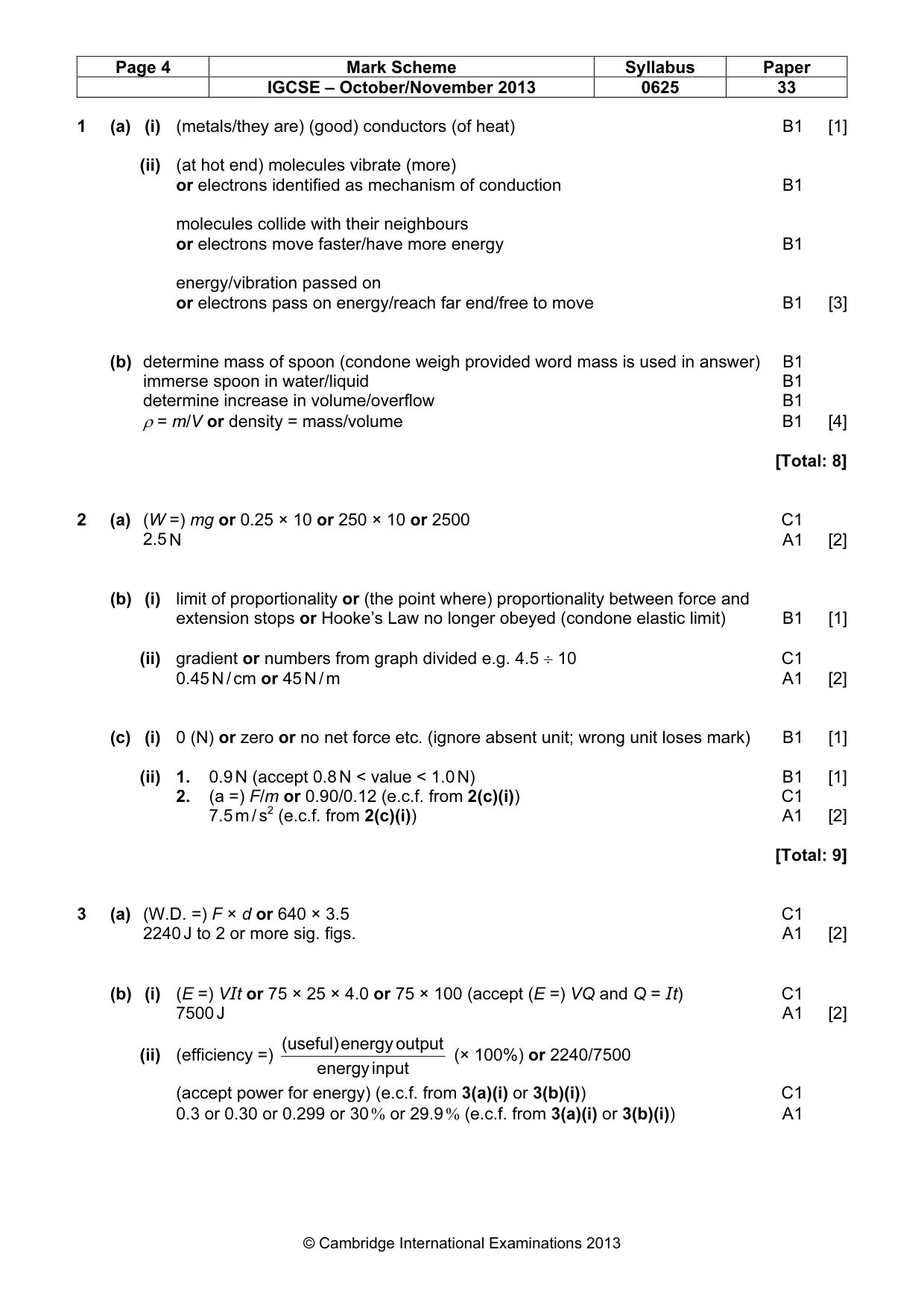
Mark scheme: 1 (a) (i) (metals/they are) (good) conductors (of heat) B1 [1] (ii) (at hot end) molecules vibrate (more) or electrons identified as mechanism of conduction B1 molecules collide with their neighbours or electrons move faster/have more energy B1 energy/vibration passed on or electrons pass on energy/reach far end/free to move B1 [3] (b) determine mass of spoon (condone weigh provided word mass is used in answer) B1 immerse spoon in water/liquid B1 determine increase in volume/overflow B1 ρ = m/V or density = mass/volume B1 [4] [Total: 8]
Q2 · A spring S is suspended from a clamp stand in a school laboratory
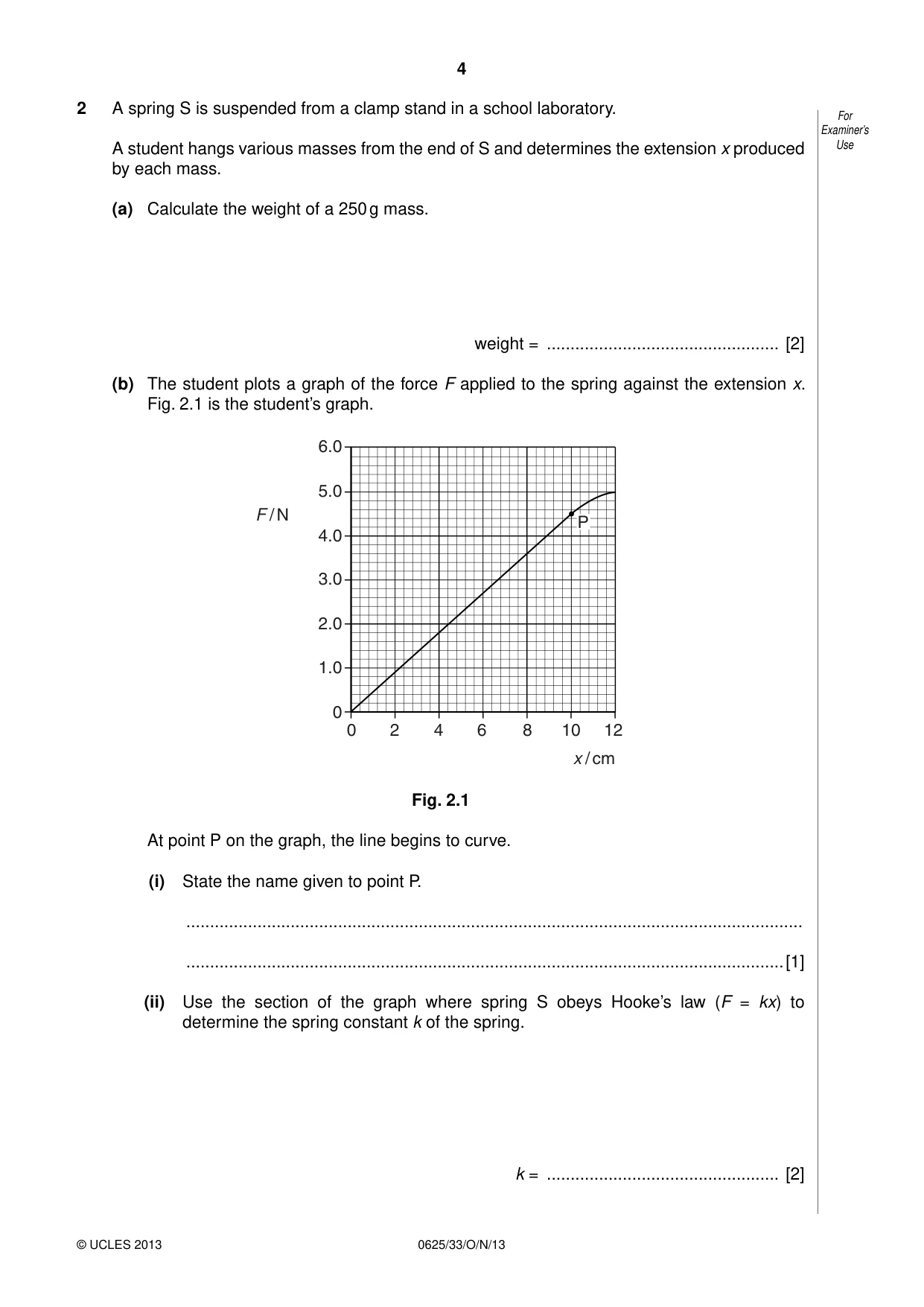
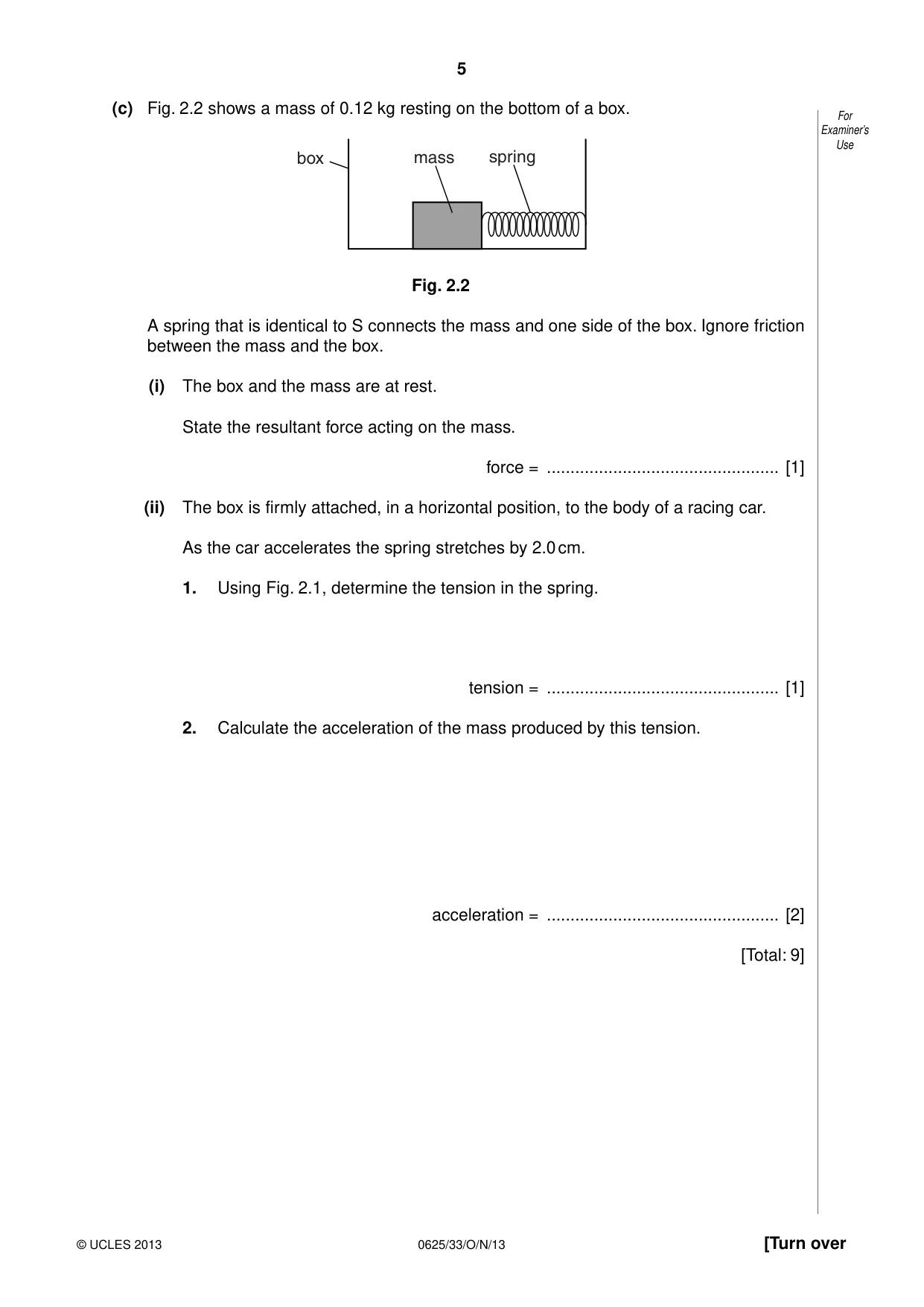
2 A spring S is suspended from a clamp stand in a school laboratory. For Examiner’s A student hangs various masses from the end of S and determines the extension x produced Use by each mass. (a) Calculate the weight of a 250 g mass. weight = ................................................. [2] (b) The student plots a graph of the force F applied to the spring against the extension x. Fig. 2.1 is the student’s graph. 6.0 5.0 F / N P 4.0 3.0 2.0 1.0 0 0 2 4 6 8 10 12 x / cm Fig. 2.1 At point P on the graph, the line begins to curve. (i) State the name given to point P. .................................................................................................................................. ..............................................................................................................................[1] (ii) Use the section of the graph where spring S obeys Hooke’s law (F = kx) to determine the spring constant k of the spring. k = ................................................. [2] (c) Fig. 2.2 shows a mass of 0.12 kg resting on the bottom of a box. For Examiner’s Use box mass spring Fig. 2.2 A spring that is identical to S connects the mass and one side of the box. Ignore friction between the mass and the box. (i) The box and the mass are at rest. State the resultant force acting on the mass. force = ................................................. [1] (ii) The box is firmly attached, in a horizontal position, to the body of a racing car. As the car accelerates the spring stretches by 2.0 cm. 1. Using Fig. 2.1, determine the tension in the spring. tension = ................................................. [1] 2. Calculate the acceleration of the mass produced by this tension. acceleration = ................................................. [2] [Total: 9]
Mark scheme: 2 (a) (W =) mg or 0.25 × 10 or 250 × 10 or 2500 C1 2.5 N A1 [2] (b) (i) limit of proportionality or (the point where) proportionality between force and extension stops or Hooke’s Law no longer obeyed (condone elastic limit) B1 [1] (ii) gradient or numbers from graph divided e.g. 4.5 ÷ 10 C1 0.45 N / cm or 45 N / m A1 [2] (c) (i) 0 (N) or zero or no net force etc. (ignore absent unit; wrong unit loses mark) B1 [1] (ii) 1. 0.9 N (accept 0.8 N < value < 1.0 N) B1 [1] 2. (a =) F/m or 0.90/0.12 (e.c.f. from 2(c)(i)) C1 7.5 m / s2 (e.c.f. from 2(c)(i)) A1 [2] [Total: 9]
Q3 · A fork-lift truck lifting a crate on to a high shelf in a warehouse
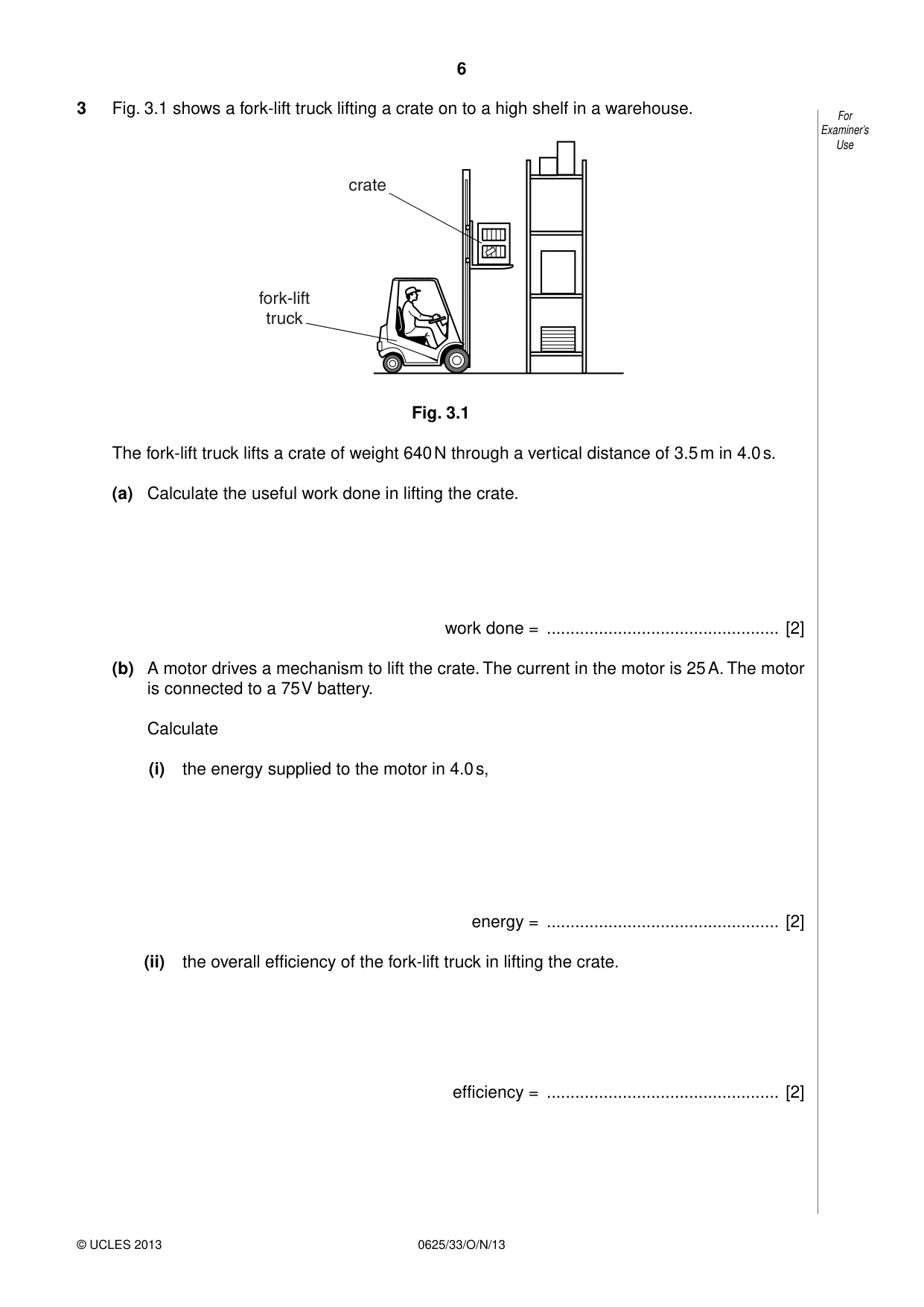
3 Fig. 3.1 shows a fork-lift truck lifting a crate on to a high shelf in a warehouse. For Examiner’s Use crate fork-lift truck Fig. 3.1 The fork-lift truck lifts a crate of weight 640 N through a vertical distance of 3.5 m in 4.0 s. (a) Calculate the useful work done in lifting the crate. work done = ................................................. [2] (b) A motor drives a mechanism to lift the crate. The current in the motor is 25 A. The motor is connected to a 75 V battery. Calculate (i) the energy supplied to the motor in 4.0 s, energy = ................................................. [2] (ii) the overall efficiency of the fork-lift truck in lifting the crate. efficiency = ................................................. [2] (c) Not all of the energy supplied is used usefully in lifting the crate. For Examiner’s Suggest two mechanisms by which energy is wasted. Use 1. ..................................................................................................................................... 2. ................................................................................................................................ [2] [Total: 8]
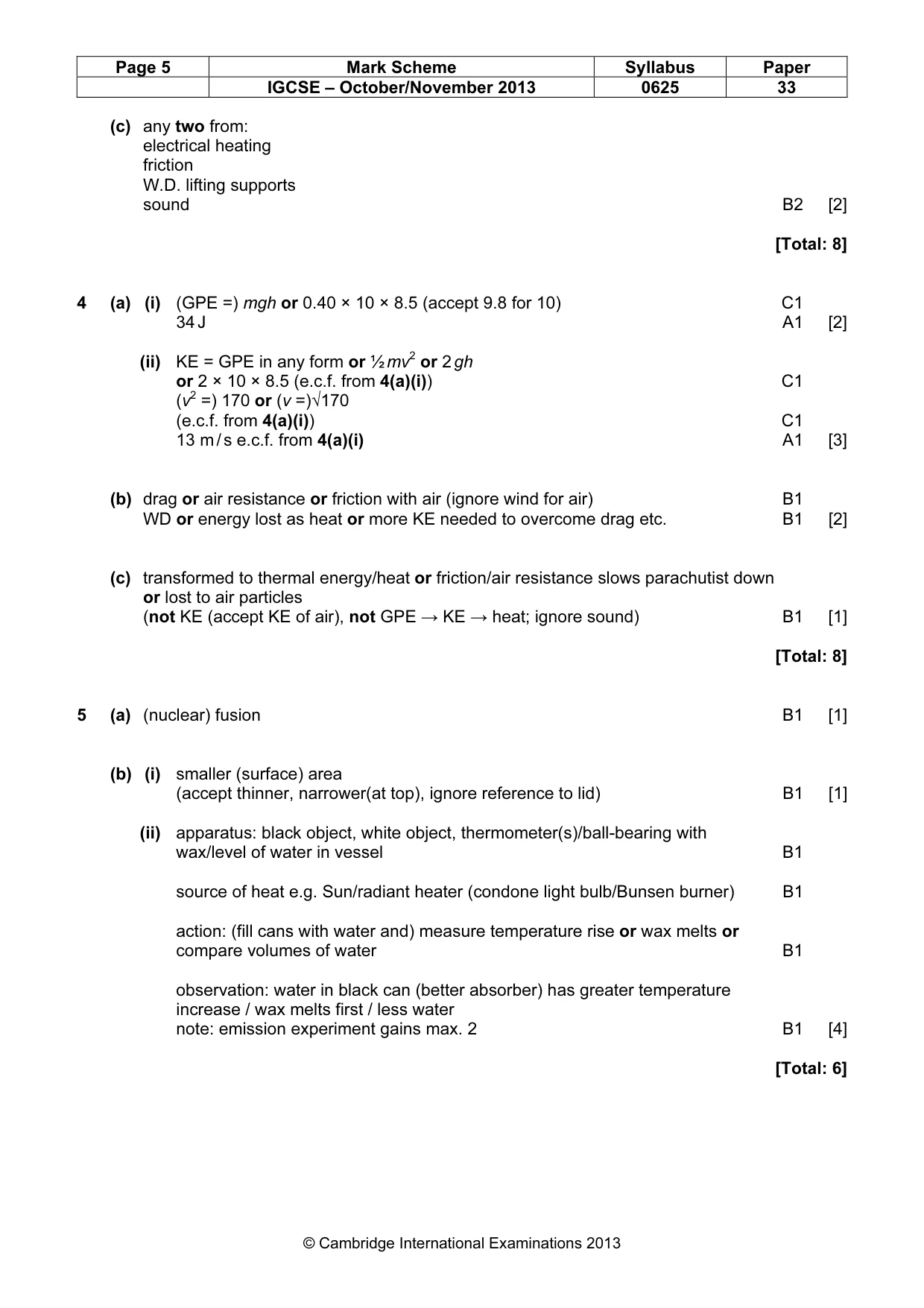
Mark scheme: 3 (a) (W.D. =) F × d or 640 × 3.5 C1 2240 J to 2 or more sig. figs. A1 [2] (b) (i) (E =) VIt or 75 × 25 × 4.0 or 75 × 100 (accept (E =) VQ and Q = It) C1 7500 J A1 [2] (useful) energy output (ii) (efficiency =) (× 100%) or 2240/7500 energy input (accept power for energy) (e.c.f. from 3(a)(i) or 3(b)(i)) C1 0.3 or 0.30 or 0.299 or 30 % or 29.9 % (e.c.f. from 3(a)(i) or 3(b)(i)) A1 IGCSE – October/November 2013 0625 33 (c) any two from: electrical heating friction W.D. lifting supports sound B2 [2] [Total: 8]
Q4 · A child’s toy launches a model parachutist of mass 0.40 kg vertically upwards
4 A child’s toy launches a model parachutist of mass 0.40 kg vertically upwards. The model For parachutist reaches a maximum height of 8.5 m. Examiner’s Use (a) Calculate (i) the gravitational potential energy gained by the model parachutist, energy = ................................................. [2] (ii) the minimum possible speed with which the model parachutist was launched. speed = ................................................. [3] (b) In practice, the launch speed must be greater than the value calculated in (a)(ii). Explain why. .......................................................................................................................................... .......................................................................................................................................... ..................................................................................................................................... [2] (c) As the model parachutist returns to the ground, it loses gravitational potential energy. Explain what happens to this energy as the model parachutist falls through the air at constant speed. .......................................................................................................................................... ..................................................................................................................................... [1] [Total: 8]
Mark scheme: 4 (a) (i) (GPE =) mgh or 0.40 × 10 × 8.5 (accept 9.8 for 10) C1 34 J A1 [2] (ii) KE = GPE in any form or ½ mv2 or 2 gh or 2 × 10 × 8.5 (e.c.f. from 4(a)(i)) C1 (v2 =) 170 or (v =)√170 (e.c.f. from 4(a)(i)) C1 13 m / s e.c.f. from 4(a)(i) A1 [3] (b) drag or air resistance or friction with air (ignore wind for air) B1 WD or energy lost as heat or more KE needed to overcome drag etc. B1 [2] (c) transformed to thermal energy/heat or friction/air resistance slows parachutist down or lost to air particles (not KE (accept KE of air), not GPE → KE → heat; ignore sound) B1 [1] [Total: 8]
Q5 · The Sun is a large sphere of high temperature gas
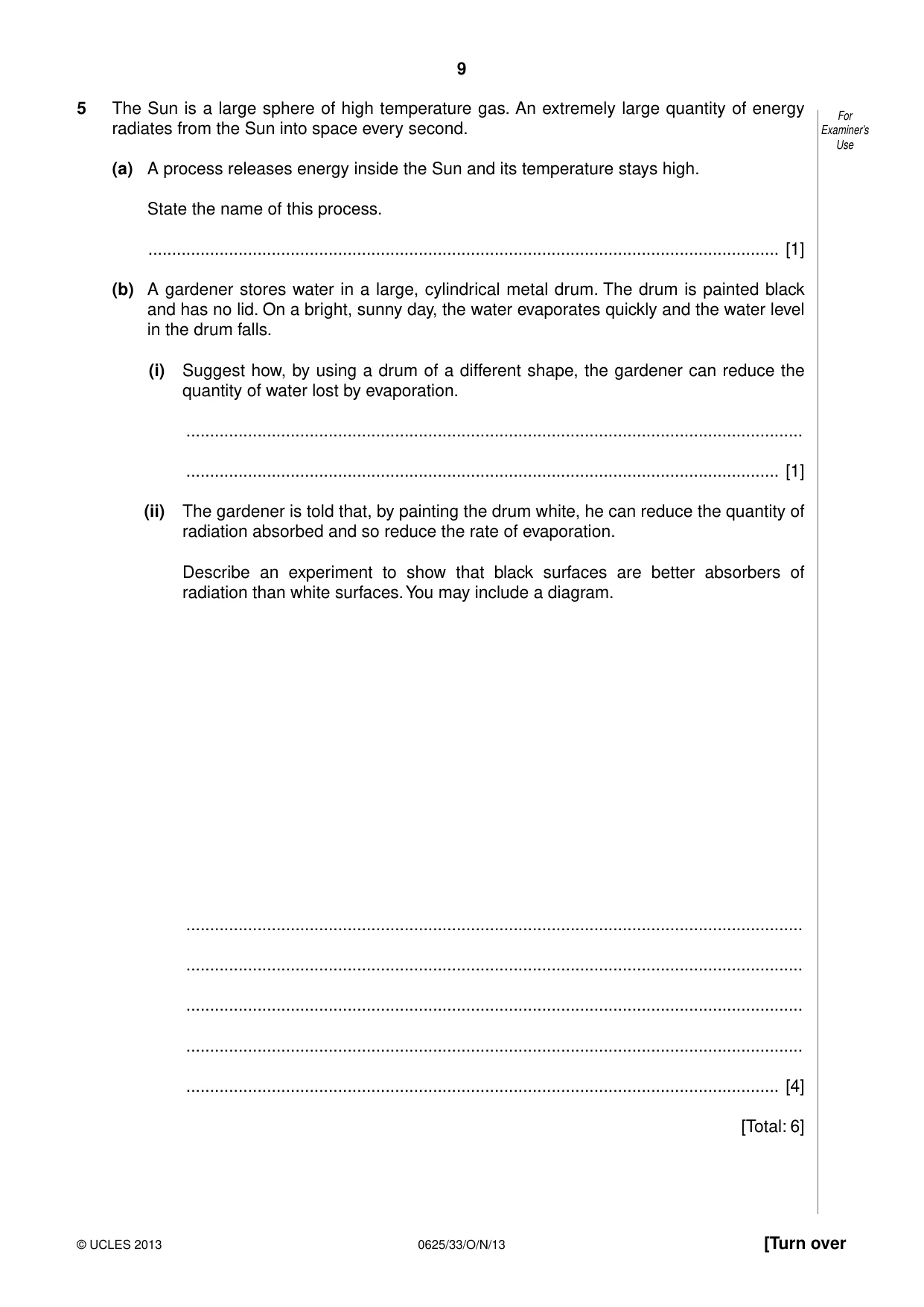
5 The Sun is a large sphere of high temperature gas. An extremely large quantity of energy For radiates from the Sun into space every second. Examiner’s Use (a) A process releases energy inside the Sun and its temperature stays high. State the name of this process. ..................................................................................................................................... [1] (b) A gardener stores water in a large, cylindrical metal drum. The drum is painted black and has no lid. On a bright, sunny day, the water evaporates quickly and the water level in the drum falls. (i) Suggest how, by using a drum of a different shape, the gardener can reduce the quantity of water lost by evaporation. .................................................................................................................................. ............................................................................................................................. [1] (ii) The gardener is told that, by painting the drum white, he can reduce the quantity of radiation absorbed and so reduce the rate of evaporation. Describe an experiment to show that black surfaces are better absorbers of radiation than white surfaces. You may include a diagram. .................................................................................................................................. .................................................................................................................................. .................................................................................................................................. .................................................................................................................................. ............................................................................................................................. [4] [Total: 6]
Mark scheme: 5 (a) (nuclear) fusion B1 [1] (b) (i) smaller (surface) area (accept thinner, narrower(at top), ignore reference to lid) B1 [1] (ii) apparatus: black object, white object, thermometer(s)/ball-bearing with wax/level of water in vessel B1 source of heat e.g. Sun/radiant heater (condone light bulb/Bunsen burner) B1 action: (fill cans with water and) measure temperature rise or wax melts or compare volumes of water B1 observation: water in black can (better absorber) has greater temperature increase / wax melts first / less water note: emission experiment gains max. 2 B1 [4] [Total: 6] IGCSE – October/November 2013 0625 33
Q6 · A student uses a 2400 W electric kettle to obtain a value for the specific heat capacity…
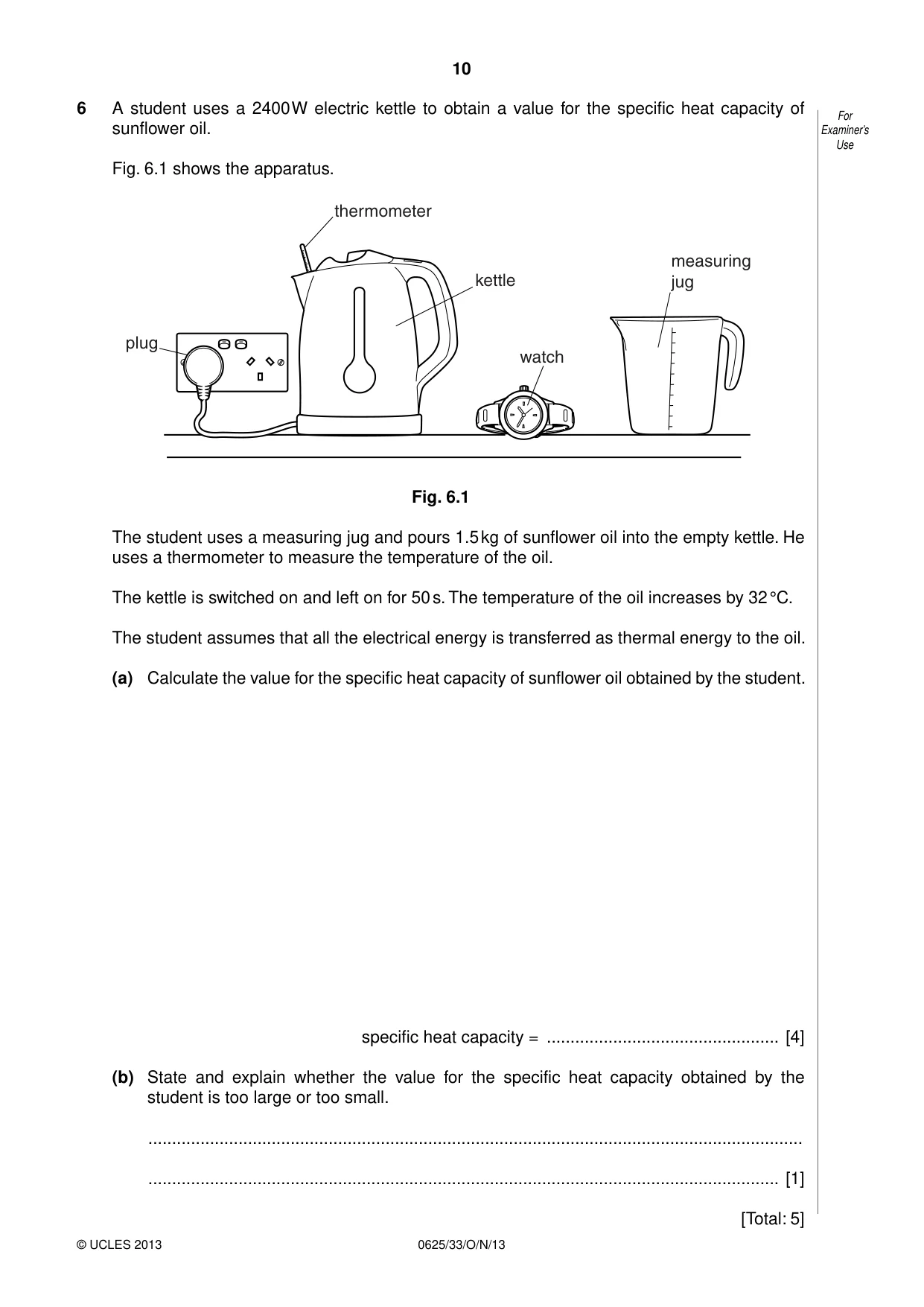
6 A student uses a 2400 W electric kettle to obtain a value for the specific heat capacity of For sunflower oil. Examiner’s Use Fig. 6.1 shows the apparatus. thermometer measuring kettle jug plug watch Fig. 6.1 The student uses a measuring jug and pours 1.5 kg of sunflower oil into the empty kettle. He uses a thermometer to measure the temperature of the oil. The kettle is switched on and left on for 50 s. The temperature of the oil increases by 32 °C. The student assumes that all the electrical energy is transferred as thermal energy to the oil. (a) Calculate the value for the specific heat capacity of sunflower oil obtained by the student. specific heat capacity = ................................................. [4] (b) State and explain whether the value for the specific heat capacity obtained by the student is too large or too small. .......................................................................................................................................... ..................................................................................................................................... [1] [Total: 5]
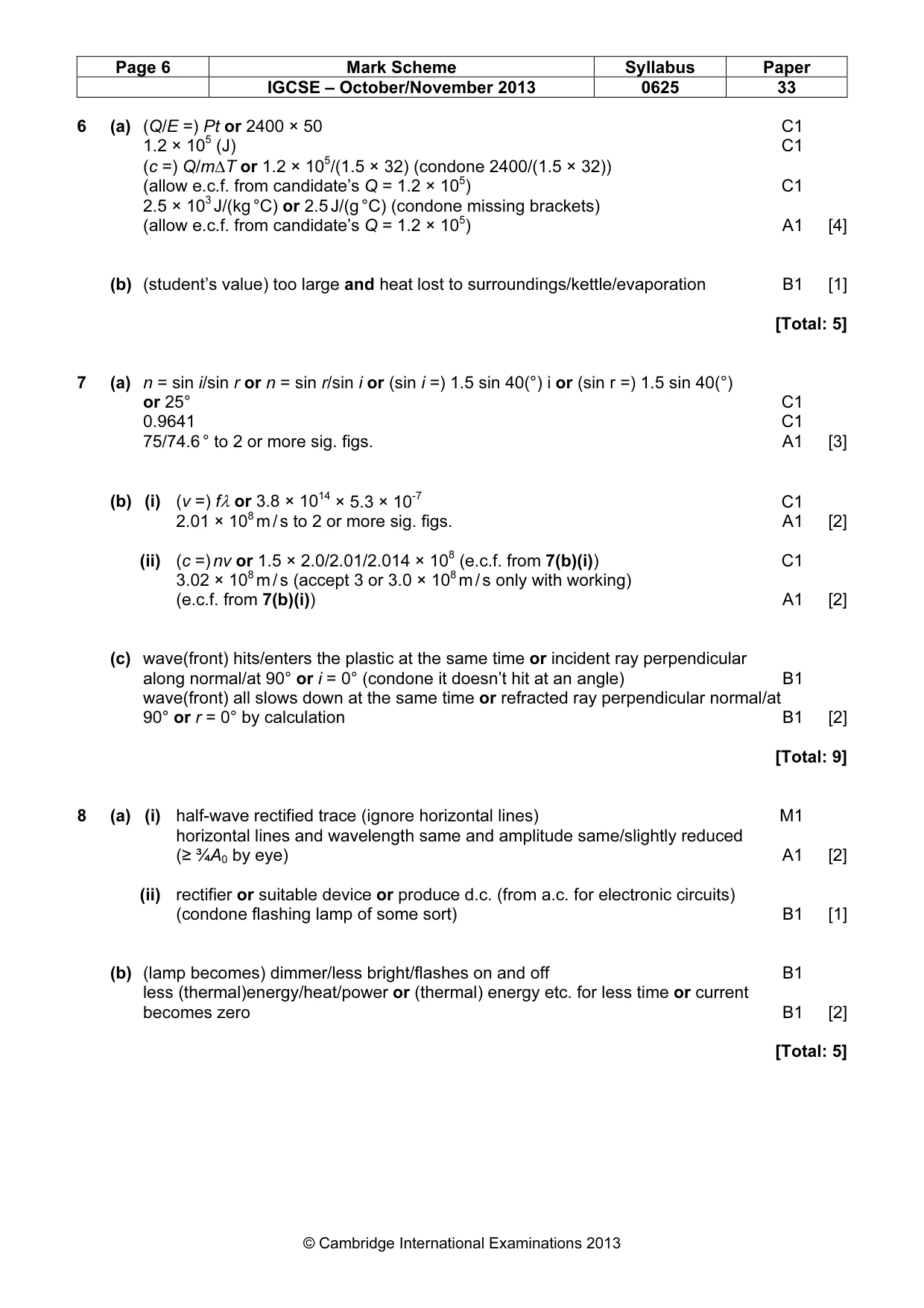
Mark scheme: 6 (a) (Q/E =) Pt or 2400 × 50 C1 1.2 × 10⁵ (J) C1 (c =) Q/m∆T or 1.2 × 10⁵/(1.5 × 32) (condone 2400/(1.5 × 32)) (allow e.c.f. from candidate’s Q = 1.2 × 10⁵) C1 2.5 × 10³ J/(kg °C) or 2.5 J/(g °C) (condone missing brackets) (allow e.c.f. from candidate’s Q = 1.2 × 10⁵) A1 [4] (b) (student’s value) too large and heat lost to surroundings/kettle/evaporation B1 [1] [Total: 5]
Q7 · A ray of light from a laser passes from air into a clear, semi-circular, plastic block
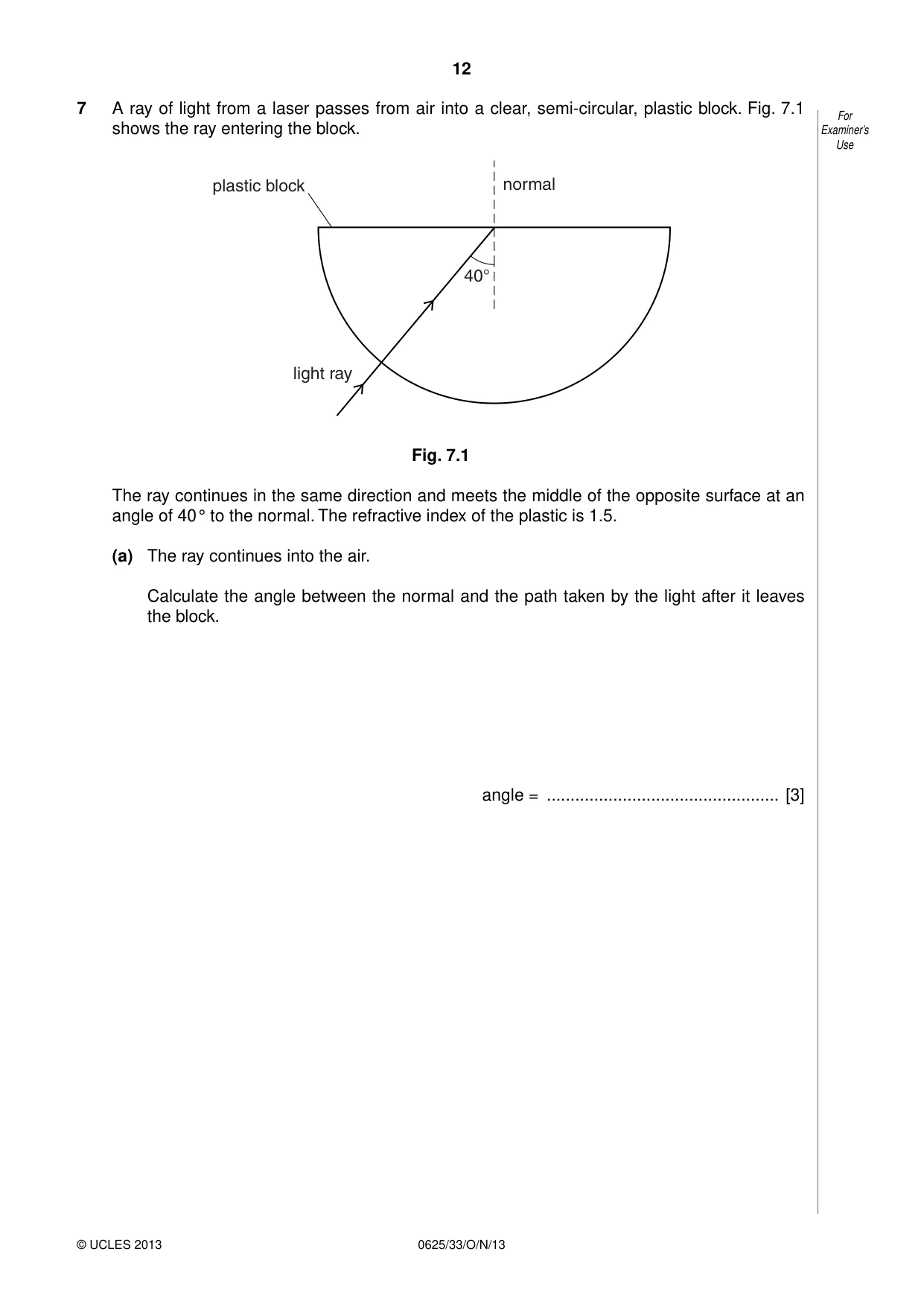
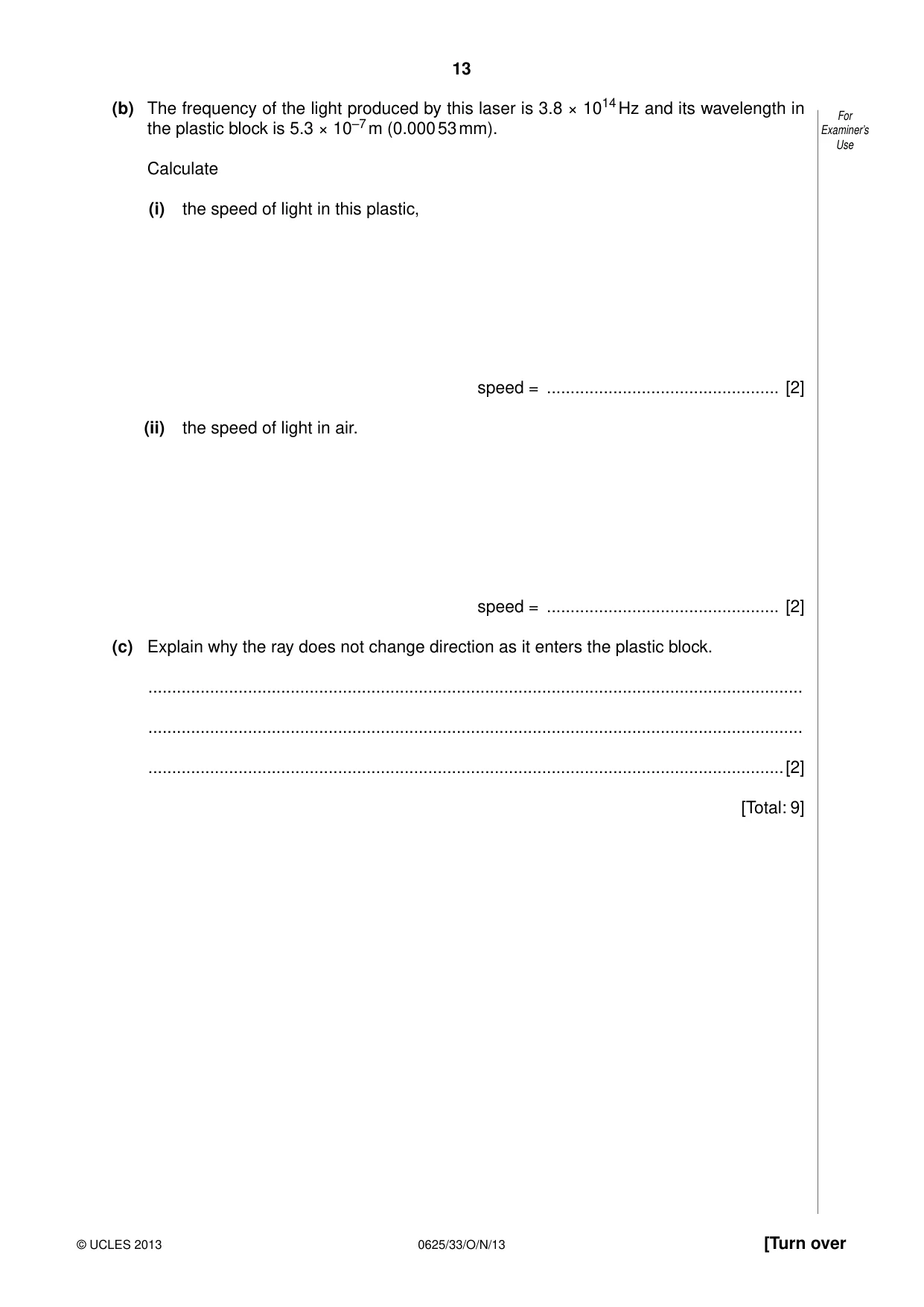
7 A ray of light from a laser passes from air into a clear, semi-circular, plastic block. Fig. 7.1 For shows the ray entering the block. Examiner’s Use plastic block normal 40° light ray Fig. 7.1 The ray continues in the same direction and meets the middle of the opposite surface at an angle of 40 ° to the normal. The refractive index of the plastic is 1.5. (a) The ray continues into the air. Calculate the angle between the normal and the path taken by the light after it leaves the block. angle = ................................................. [3] (b) The frequency of the light produced by this laser is 3.8 × 10¹⁴ Hz and its wavelength in For the plastic block is 5.3 × 10⁻⁷ m (0.000 53 mm). Examiner’s Use Calculate (i) the speed of light in this plastic, speed = ................................................. [2] (ii) the speed of light in air. speed = ................................................. [2] (c) Explain why the ray does not change direction as it enters the plastic block. .......................................................................................................................................... .......................................................................................................................................... ......................................................................................................................................[2] [Total: 9]
Mark scheme: 7 (a) n = sin i/sin r or n = sin r/sin i or (sin i =) 1.5 sin 40(°) i or (sin r =) 1.5 sin 40(°) or 25° C1 0.9641 C1 75/74.6 ° to 2 or more sig. figs. A1 [3] (b) (i) (v =) fλ or 3.8 × 1014 × 5.3 × 10-7 C1 2.01 × 10⁸ m / s to 2 or more sig. figs. A1 [2] (ii) (c =) nv or 1.5 × 2.0/2.01/2.014 × 108 (e.c.f. from 7(b)(i)) C1 3.02 × 10⁸ m / s (accept 3 or 3.0 × 10⁸ m / s only with working) (e.c.f. from 7(b)(i)) A1 [2] (c) wave(front) hits/enters the plastic at the same time or incident ray perpendicular along normal/at 90° or i = 0° (condone it doesn’t hit at an angle) B1 wave(front) all slows down at the same time or refracted ray perpendicular normal/at 90° or r = 0° by calculation B1 [2] [Total: 9]
Question 8
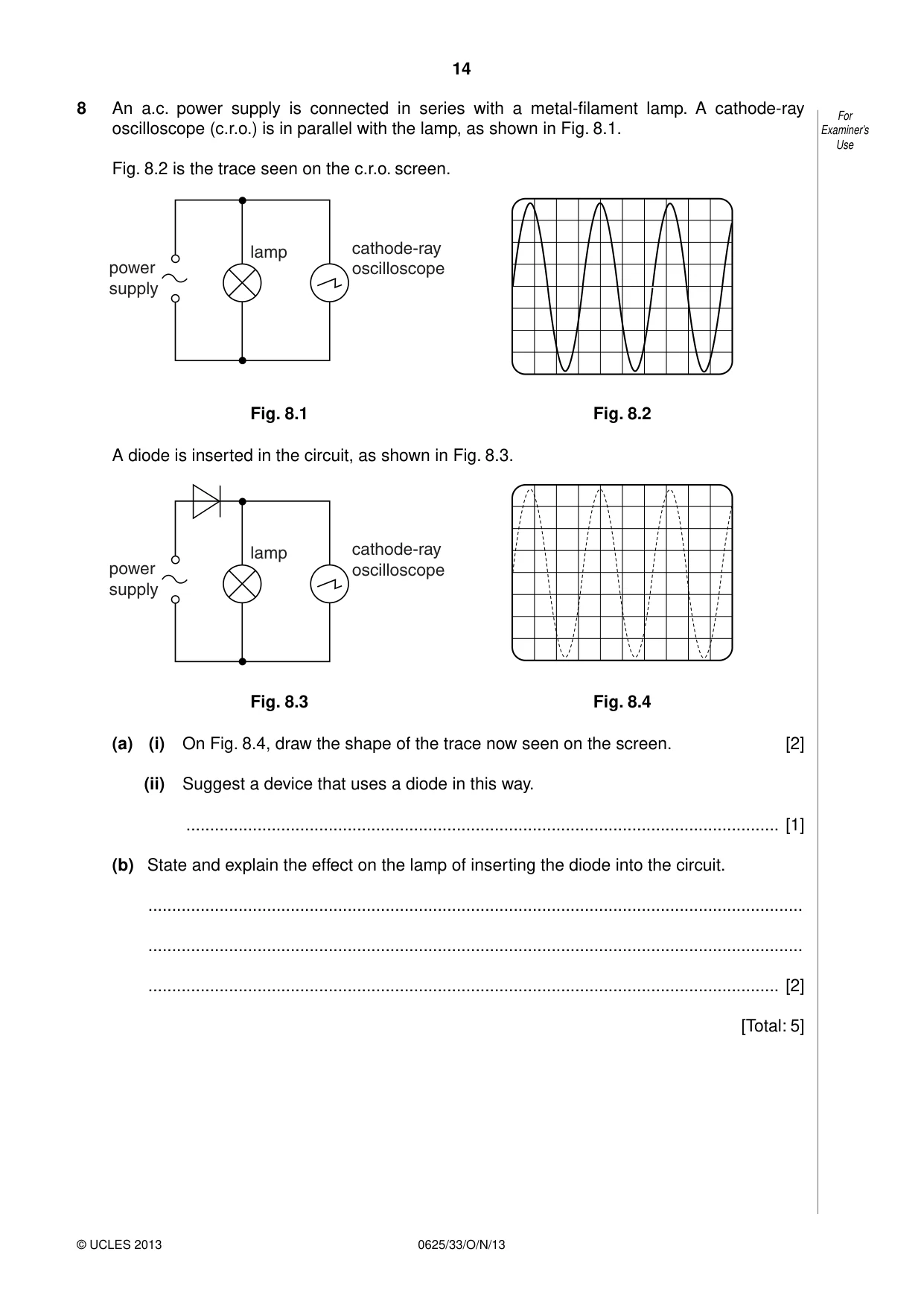
8 An a.c. power supply is connected in series with a metal-filament lamp. A cathode-ray For oscilloscope (c.r.o.) is in parallel with the lamp, as shown in Fig. 8.1. Examiner’s Use Fig. 8.2 is the trace seen on the c.r.o. screen. lamp cathode-ray power oscilloscope supply Fig. 8.1 Fig. 8.2 A diode is inserted in the circuit, as shown in Fig. 8.3. lamp cathode-ray power oscilloscope supply Fig. 8.3 Fig. 8.4 (a) (i) On Fig. 8.4, draw the shape of the trace now seen on the screen. [2] (ii) Suggest a device that uses a diode in this way. ............................................................................................................................. [1] (b) State and explain the effect on the lamp of inserting the diode into the circuit. .......................................................................................................................................... .......................................................................................................................................... ..................................................................................................................................... [2] [Total: 5]
Mark scheme: 8 (a) (i) half-wave rectified trace (ignore horizontal lines) M1 horizontal lines and wavelength same and amplitude same/slightly reduced (≥ ¾A0 by eye) A1 [2] (ii) rectifier or suitable device or produce d.c. (from a.c. for electronic circuits) (condone flashing lamp of some sort) B1 [1] (b) (lamp becomes) dimmer/less bright/flashes on and off B1 less (thermal)energy/heat/power or (thermal) energy etc. for less time or current becomes zero B1 [2] [Total: 5] IGCSE – October/November 2013 0625 33
Question 9
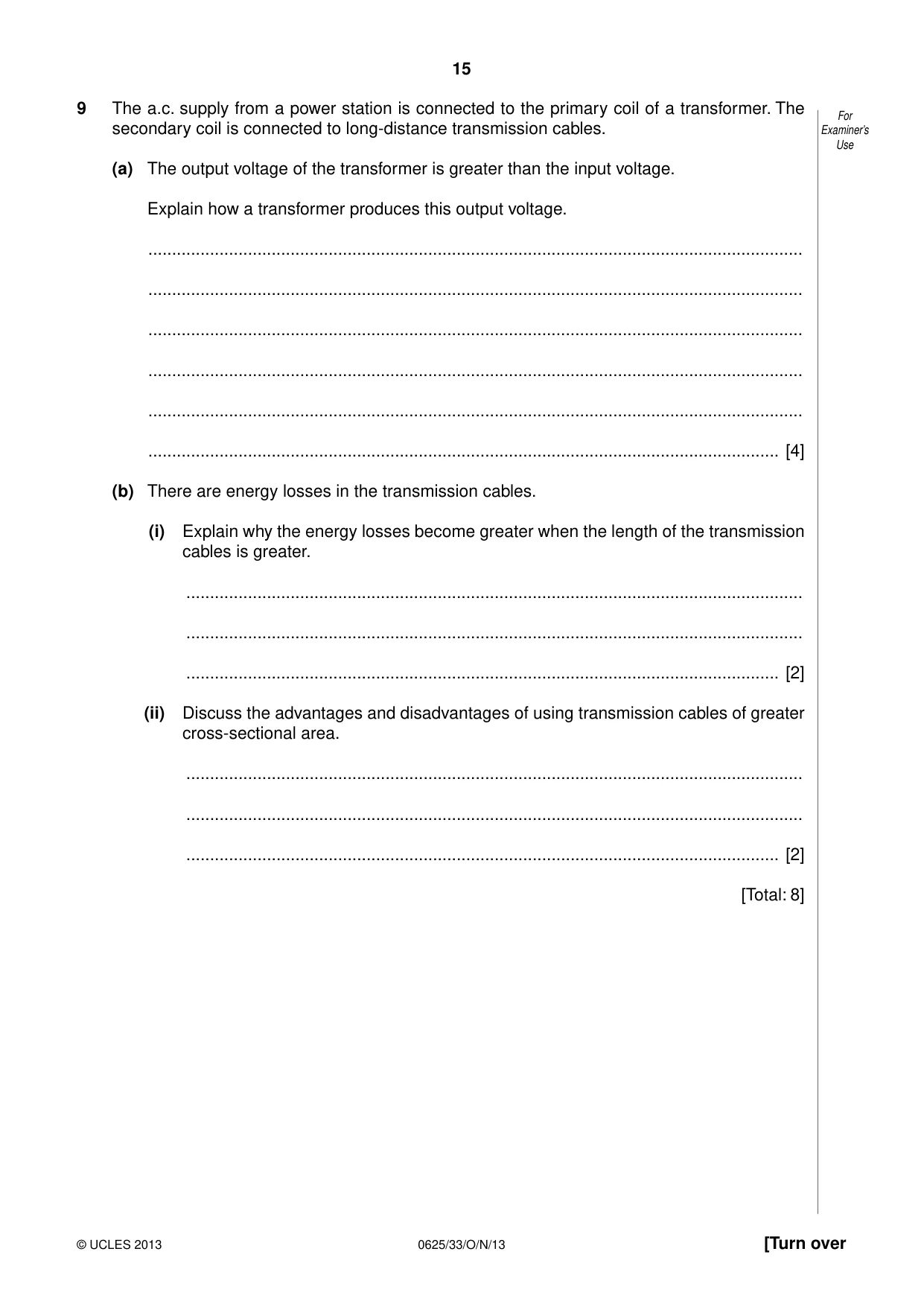
9 The a.c. supply from a power station is connected to the primary coil of a transformer. The For secondary coil is connected to long-distance transmission cables. Examiner’s Use (a) The output voltage of the transformer is greater than the input voltage. Explain how a transformer produces this output voltage. .......................................................................................................................................... .......................................................................................................................................... .......................................................................................................................................... .......................................................................................................................................... .......................................................................................................................................... ..................................................................................................................................... [4] (b) There are energy losses in the transmission cables. (i) Explain why the energy losses become greater when the length of the transmission cables is greater. .................................................................................................................................. .................................................................................................................................. ............................................................................................................................. [2] (ii) Discuss the advantages and disadvantages of using transmission cables of greater cross-sectional area. .................................................................................................................................. .................................................................................................................................. ............................................................................................................................. [2] [Total: 8]
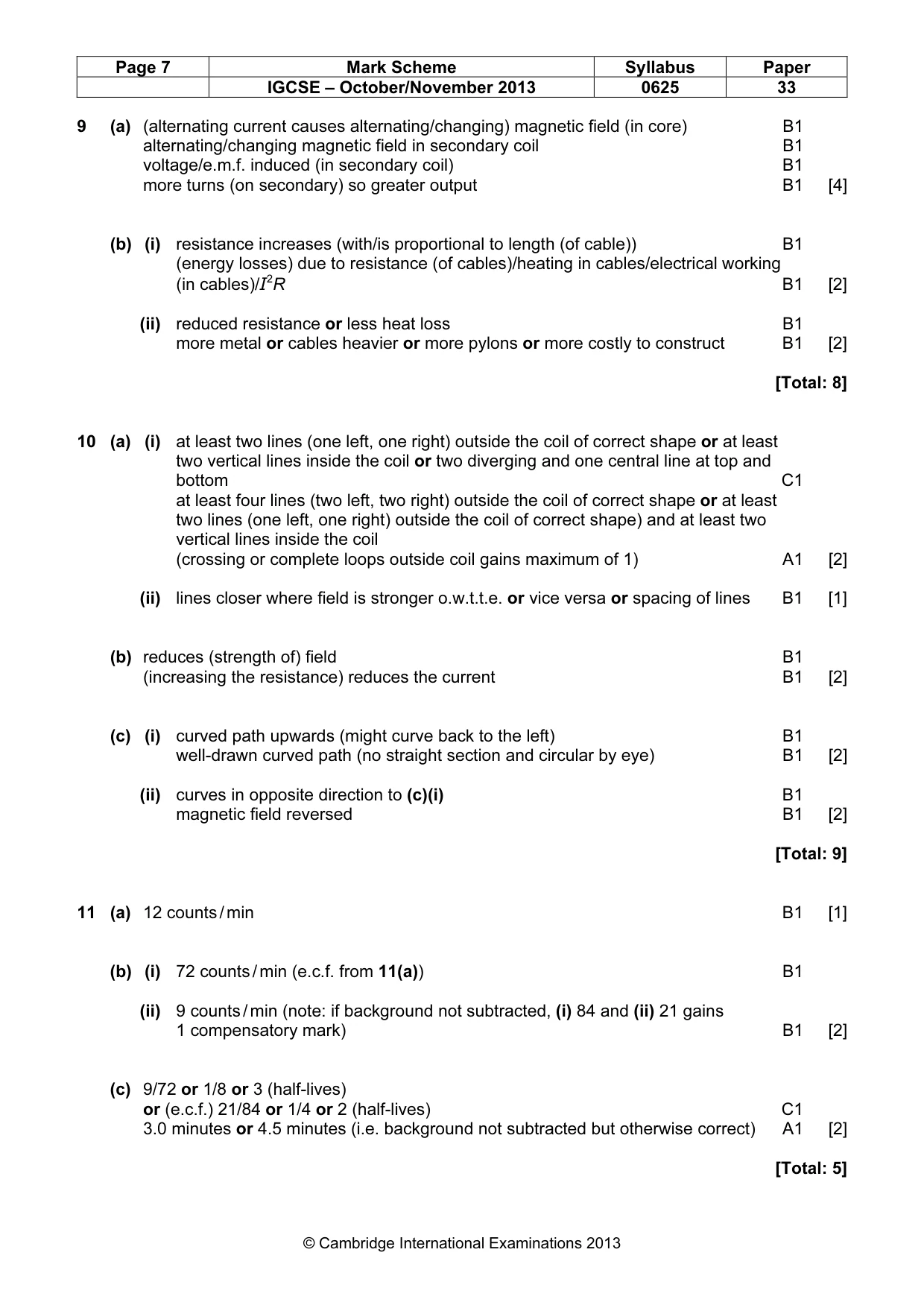
Mark scheme: 9 (a) (alternating current causes alternating/changing) magnetic field (in core) B1 alternating/changing magnetic field in secondary coil B1 voltage/e.m.f. induced (in secondary coil) B1 more turns (on secondary) so greater output B1 [4] (b) (i) resistance increases (with/is proportional to length (of cable)) B1 (energy losses) due to resistance (of cables)/heating in cables/electrical working (in cables)/I2R B1 [2] (ii) reduced resistance or less heat loss B1 more metal or cables heavier or more pylons or more costly to construct B1 [2] [Total: 8]
Q10 · A variable resistor (rheostat) and a solenoid (long coil) connected to a For battery
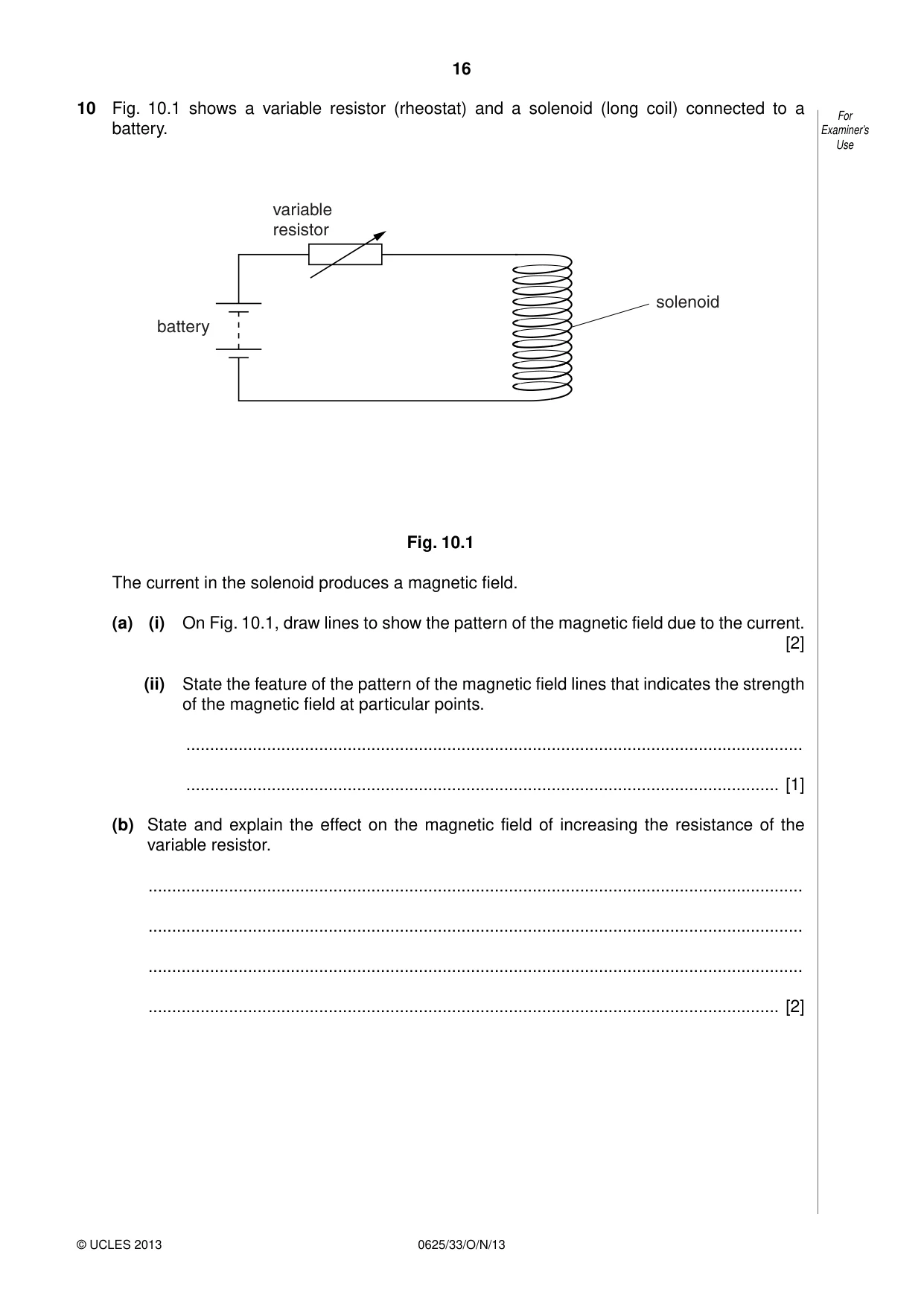
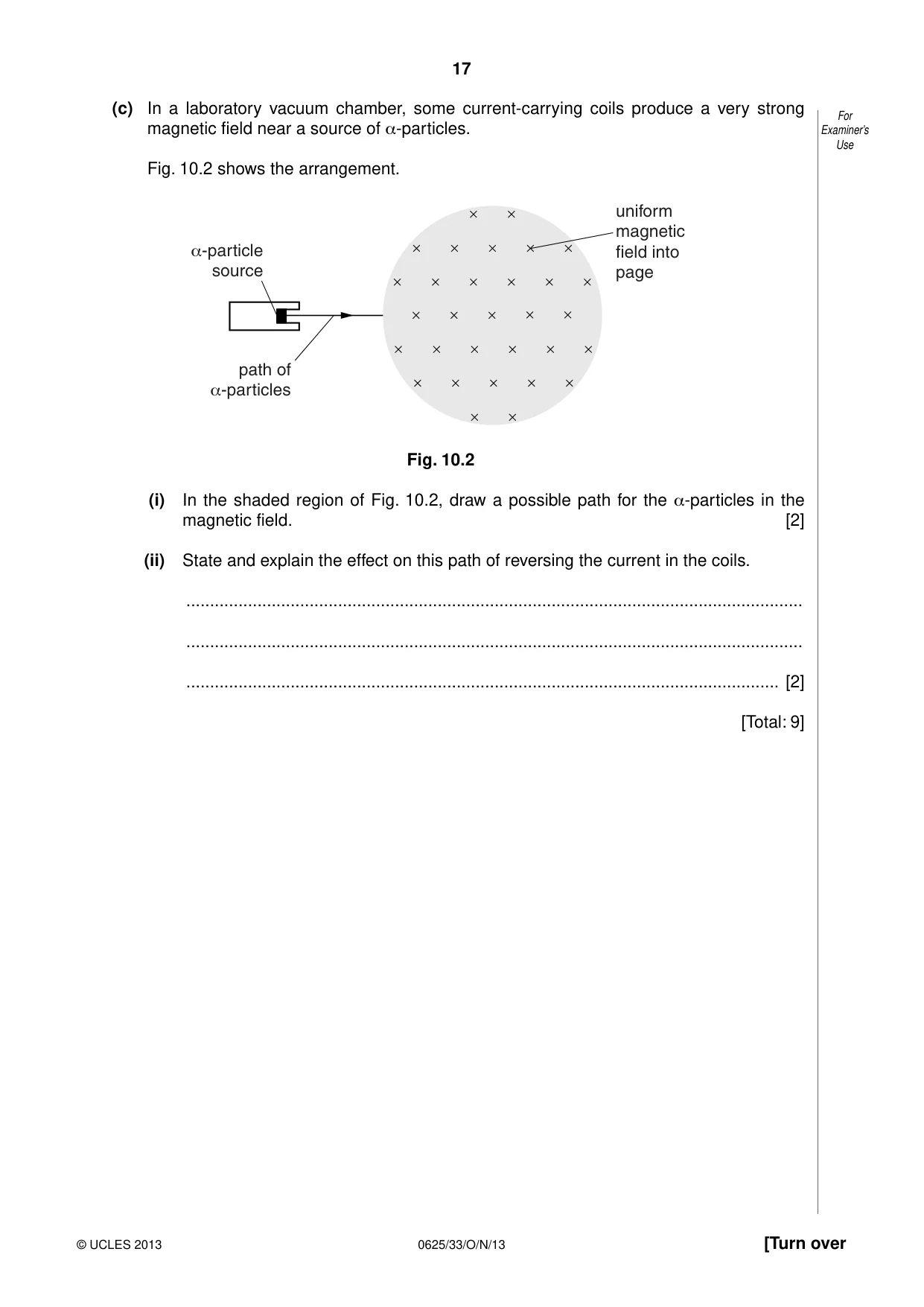
10 Fig. 10.1 shows a variable resistor (rheostat) and a solenoid (long coil) connected to a For battery. Examiner’s Use variable resistor solenoid battery Fig. 10.1 The current in the solenoid produces a magnetic field. (a) (i) On Fig. 10.1, draw lines to show the pattern of the magnetic field due to the current. [2] (ii) State the feature of the pattern of the magnetic field lines that indicates the strength of the magnetic field at particular points. .................................................................................................................................. ............................................................................................................................. [1] (b) State and explain the effect on the magnetic field of increasing the resistance of the variable resistor. .......................................................................................................................................... .......................................................................................................................................... .......................................................................................................................................... ..................................................................................................................................... [2] (c) In a laboratory vacuum chamber, some current-carrying coils produce a very strong For magnetic field near a source of α-particles. Examiner’s Use Fig. 10.2 shows the arrangement. uniform magnetic _-particle field into source page path of _-particles Fig. 10.2 (i) In the shaded region of Fig. 10.2, draw a possible path for the α-particles in the magnetic field. [2] (ii) State and explain the effect on this path of reversing the current in the coils. .................................................................................................................................. .................................................................................................................................. ............................................................................................................................. [2] [Total: 9]
Mark scheme: 10 (a) (i) at least two lines (one left, one right) outside the coil of correct shape or at least two vertical lines inside the coil or two diverging and one central line at top and bottom C1 at least four lines (two left, two right) outside the coil of correct shape or at least two lines (one left, one right) outside the coil of correct shape) and at least two vertical lines inside the coil (crossing or complete loops outside coil gains maximum of 1) A1 [2] (ii) lines closer where field is stronger o.w.t.t.e. or vice versa or spacing of lines B1 [1] (b) reduces (strength of) field B1 (increasing the resistance) reduces the current B1 [2] (c) (i) curved path upwards (might curve back to the left) B1 well-drawn curved path (no straight section and circular by eye) B1 [2] (ii) curves in opposite direction to (c)(i) B1 magnetic field reversed B1 [2] [Total: 9]
Q11 · In a laboratory at a nuclear power station, a radiation detector is connected to a…
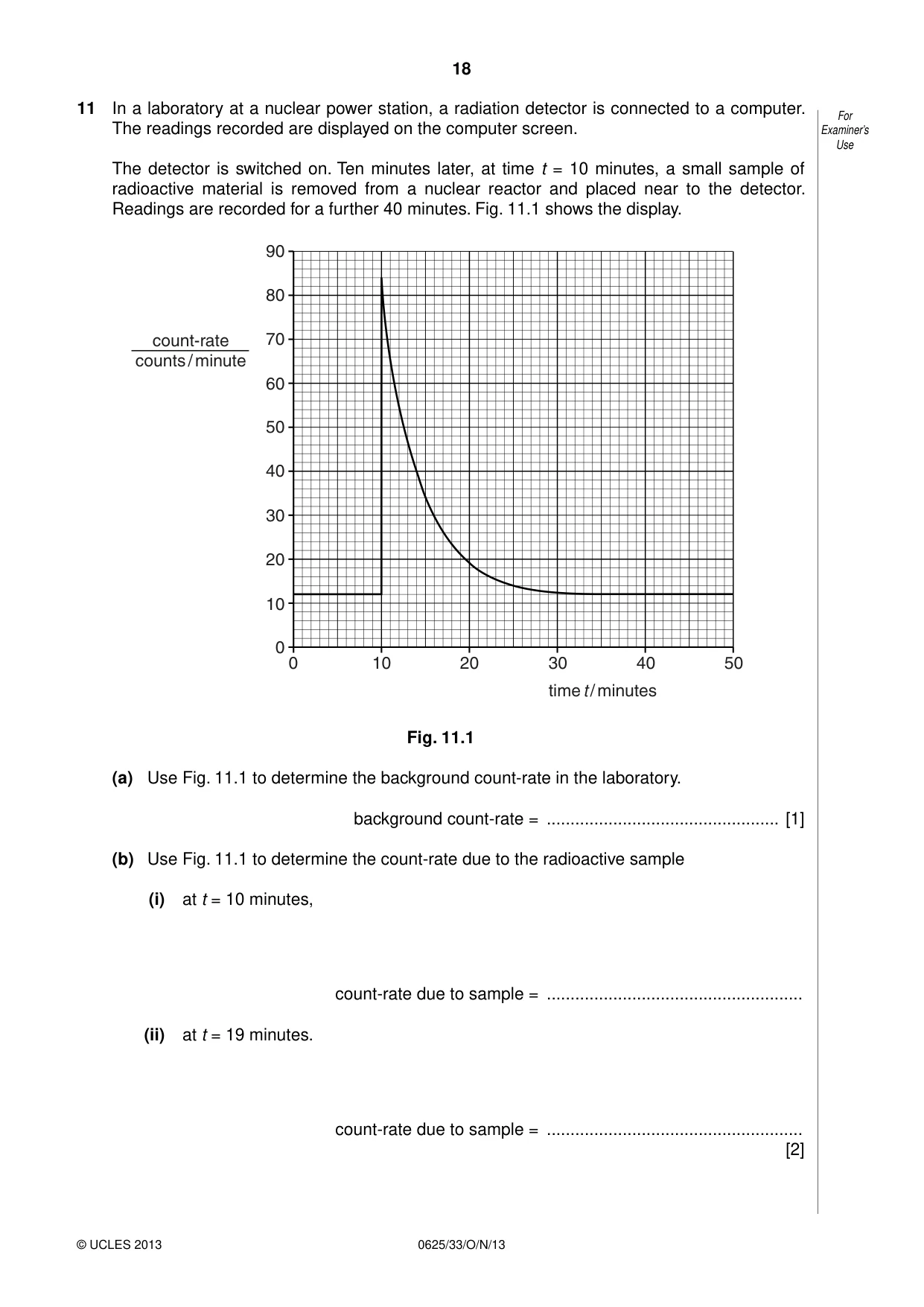
11 In a laboratory at a nuclear power station, a radiation detector is connected to a computer. For The readings recorded are displayed on the computer screen. Examiner’s Use The detector is switched on. Ten minutes later, at time t = 10 minutes, a small sample of radioactive material is removed from a nuclear reactor and placed near to the detector. Readings are recorded for a further 40 minutes. Fig. 11.1 shows the display. 90 80 count-rate 70 counts / minute 60 50 40 30 20 10 0 0 10 20 30 40 50 time t / minutes Fig. 11.1 (a) Use Fig. 11.1 to determine the background count-rate in the laboratory. background count-rate = ................................................. [1] (b) Use Fig. 11.1 to determine the count-rate due to the radioactive sample (i) at t = 10 minutes, count-rate due to sample = ...................................................... (ii) at t = 19 minutes. count-rate due to sample = ...................................................... [2] (c) Use the values obtained in (b) to estimate the half-life of the radioactive sample. For Examiner’s Use half-life = ................................................. [2] [Total: 5]
Mark scheme: 11 (a) 12 counts / min B1 [1] (b) (i) 72 counts / min (e.c.f. from 11(a)) B1 (ii) 9 counts / min (note: if background not subtracted, (i) 84 and (ii) 21 gains 1 compensatory mark) B1 [2] (c) 9/72 or 1/8 or 3 (half-lives) or (e.c.f.) 21/84 or 1/4 or 2 (half-lives) C1 3.0 minutes or 4.5 minutes (i.e. background not subtracted but otherwise correct) A1 [2] [Total: 5]
What was in this paper
The subtopics covered by these 11 questions, and how many questions each got. Open one in a new tab to see every Cambridge question on it.