Cambridge IGCSE Physics 0625 — 2010 Oct/Nov Paper 3 · Variant 1
0625/31/O/N/10 · 11 questions · 80 marks · ≈90 min
The question paper and its mark scheme, free to read here and free to download. This is Cambridge’s own paper, exactly as it was sat.
Question paper20 pages



Mark scheme7 pages
Answers below. Sit the paper first if you are practising.
Questions as text
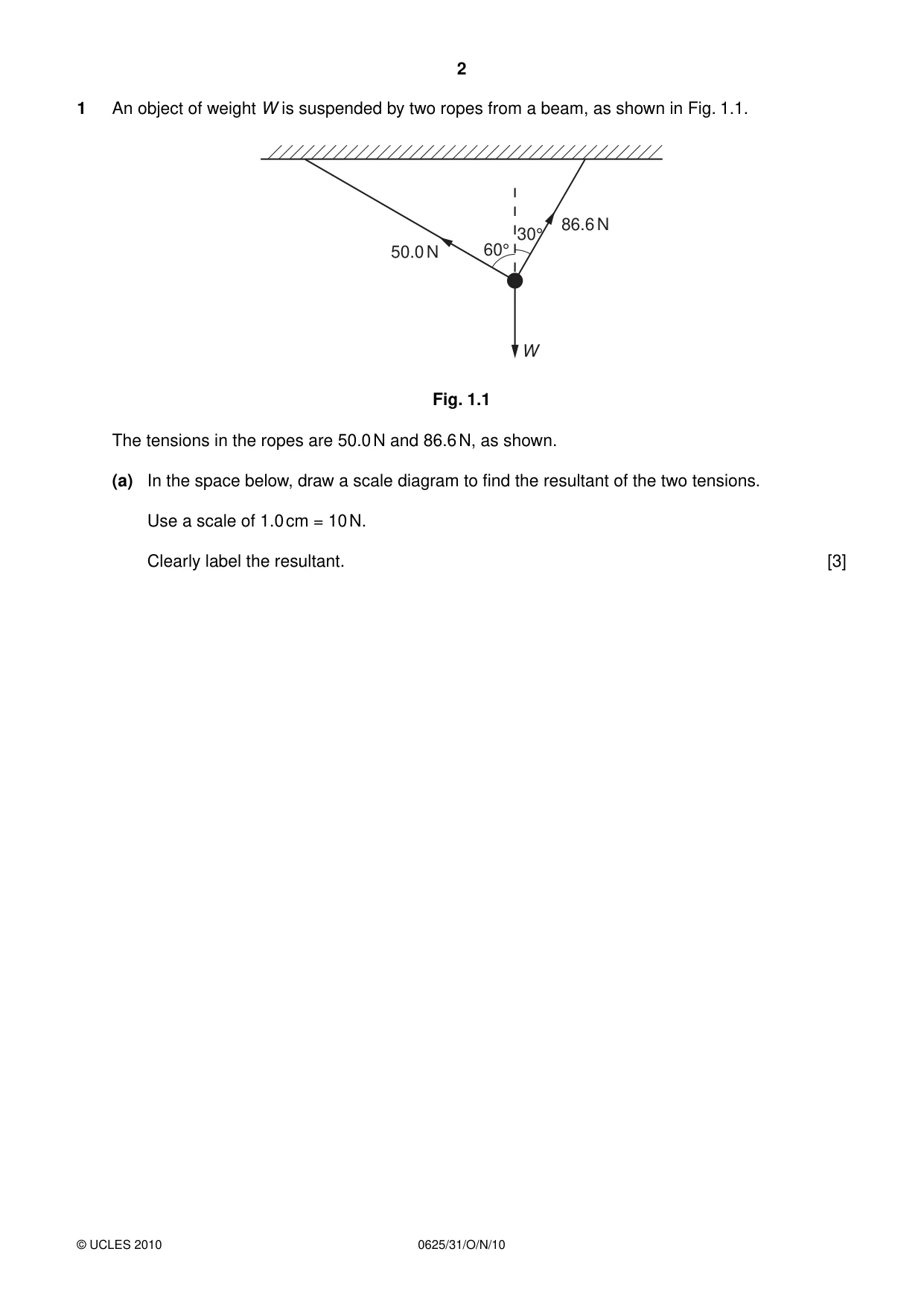
Q1 · An object of weight W is suspended by two ropes from a beam, as shown in Fig
1 An object of weight W is suspended by two ropes from a beam, as shown in Fig. 1.1. 86.6 N 30° 50.0 N 60° W Fig. 1.1 The tensions in the ropes are 50.0 N and 86.6 N, as shown. (a) In the space below, draw a scale diagram to find the resultant of the two tensions. Use a scale of 1.0 cm = 10 N. Clearly label the resultant. [3] (b) From your diagram, find the value of the resultant. resultant = ......................................................... [1] (c) State the direction in which the resultant is acting. ............................................................................................................................................. [1] (d) State the value of W. W = ......................................................... [1] [Total: 6]
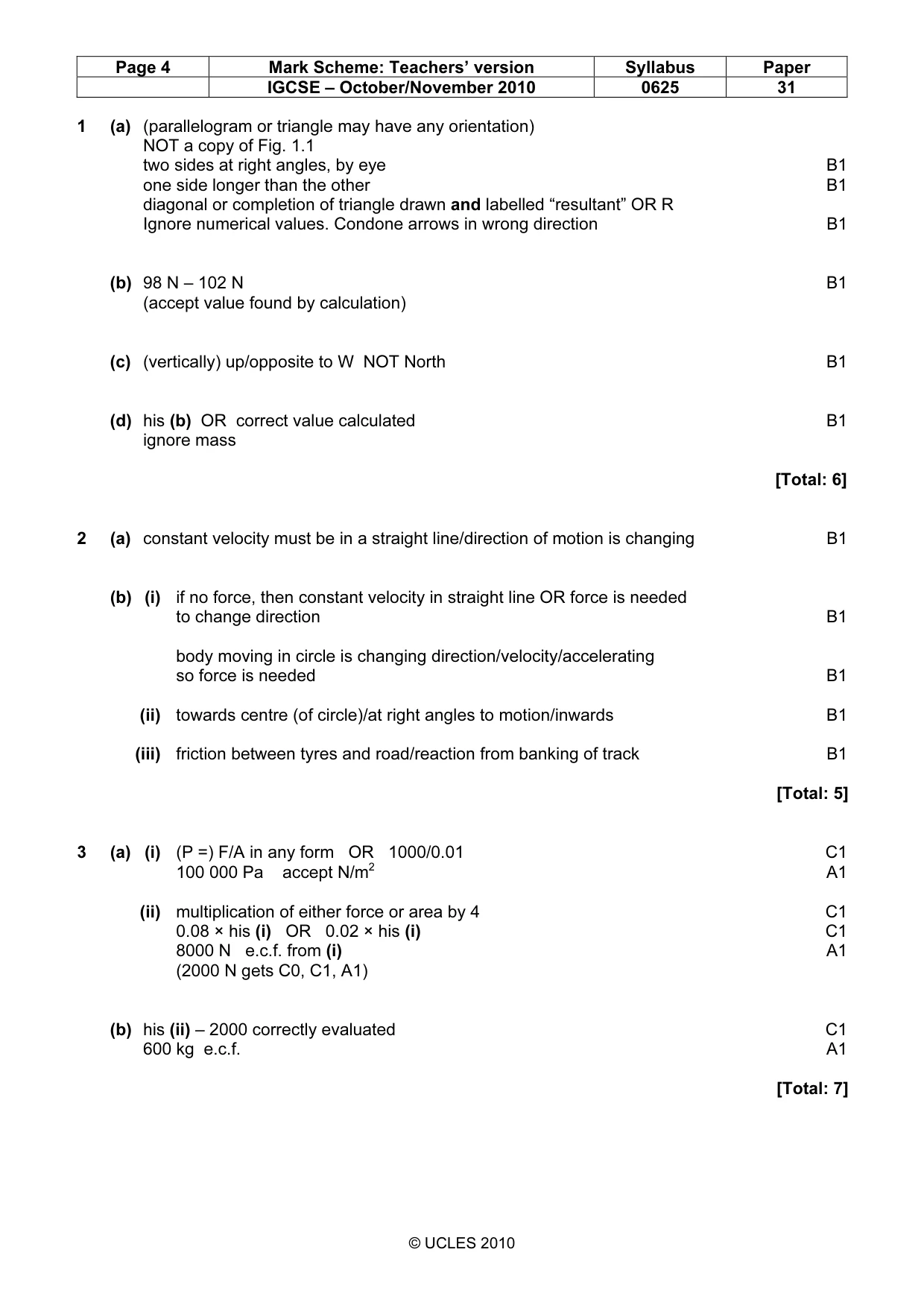
Mark scheme: 1 (a) (parallelogram or triangle may have any orientation) NOT a copy of Fig. 1.1 two sides at right angles, by eye B1 one side longer than the other B1 diagonal or completion of triangle drawn and labelled “resultant” OR R Ignore numerical values. Condone arrows in wrong direction B1 (b) 98 N – 102 N B1 (accept value found by calculation) (c) (vertically) up/opposite to W NOT North B1 (d) his (b) OR correct value calculated B1 ignore mass [Total: 6]
Q2 · A car travels around a circular track at constant speed
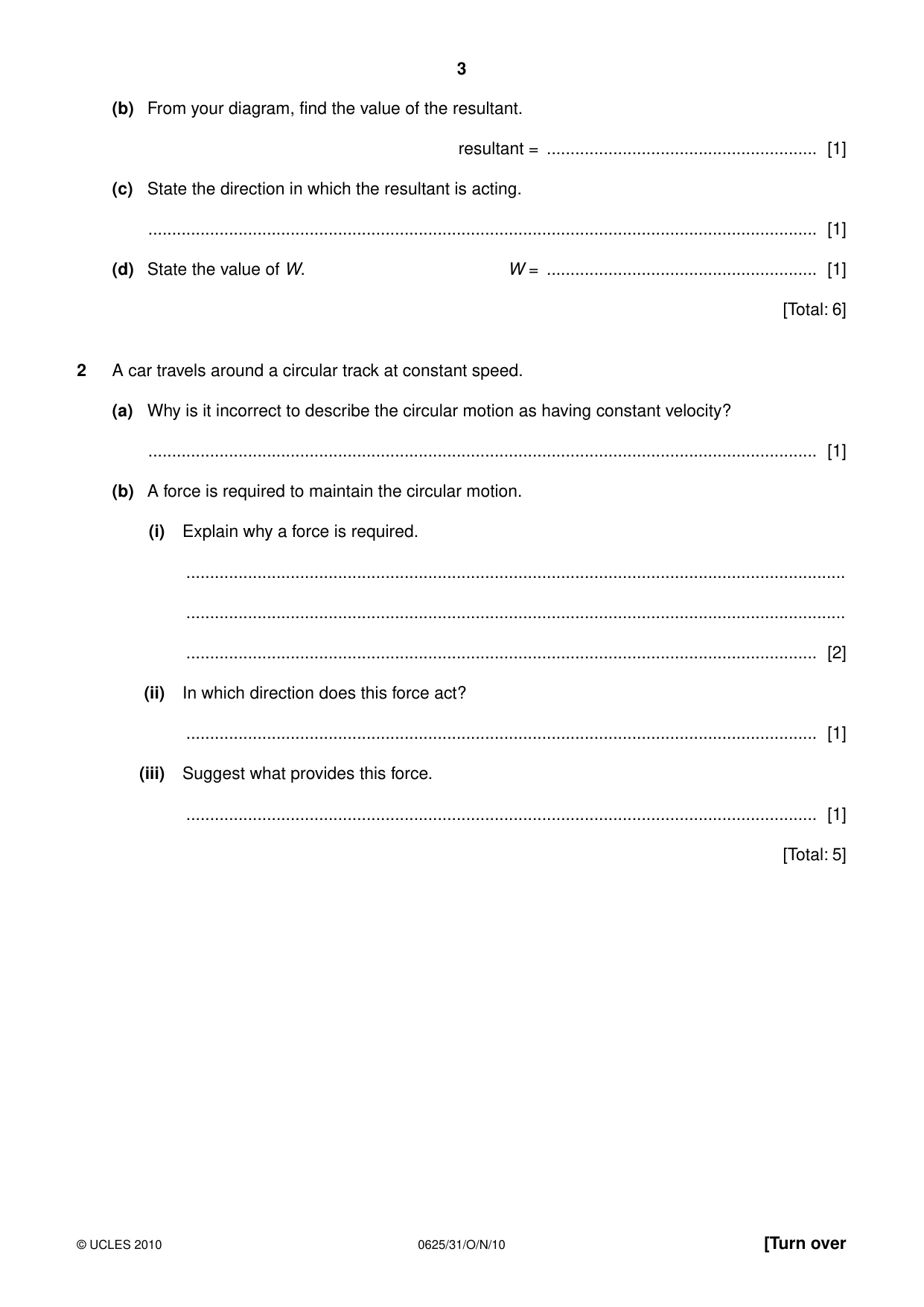
2 A car travels around a circular track at constant speed. (a) Why is it incorrect to describe the circular motion as having constant velocity? ............................................................................................................................................. [1] (b) A force is required to maintain the circular motion. (i) Explain why a force is required. ........................................................................................................................................... ........................................................................................................................................... ..................................................................................................................................... [2] (ii) In which direction does this force act? ..................................................................................................................................... [1] (iii) Suggest what provides this force. ..................................................................................................................................... [1] [Total: 5]
Mark scheme: 2 (a) constant velocity must be in a straight line/direction of motion is changing B1 (b) (i) if no force, then constant velocity in straight line OR force is needed to change direction B1 body moving in circle is changing direction/velocity/accelerating so force is needed B1 (ii) towards centre (of circle)/at right angles to motion/inwards B1 (iii) friction between tyres and road/reaction from banking of track B1 [Total: 5]
Q3 · A hydraulic lift in a car repair workshop
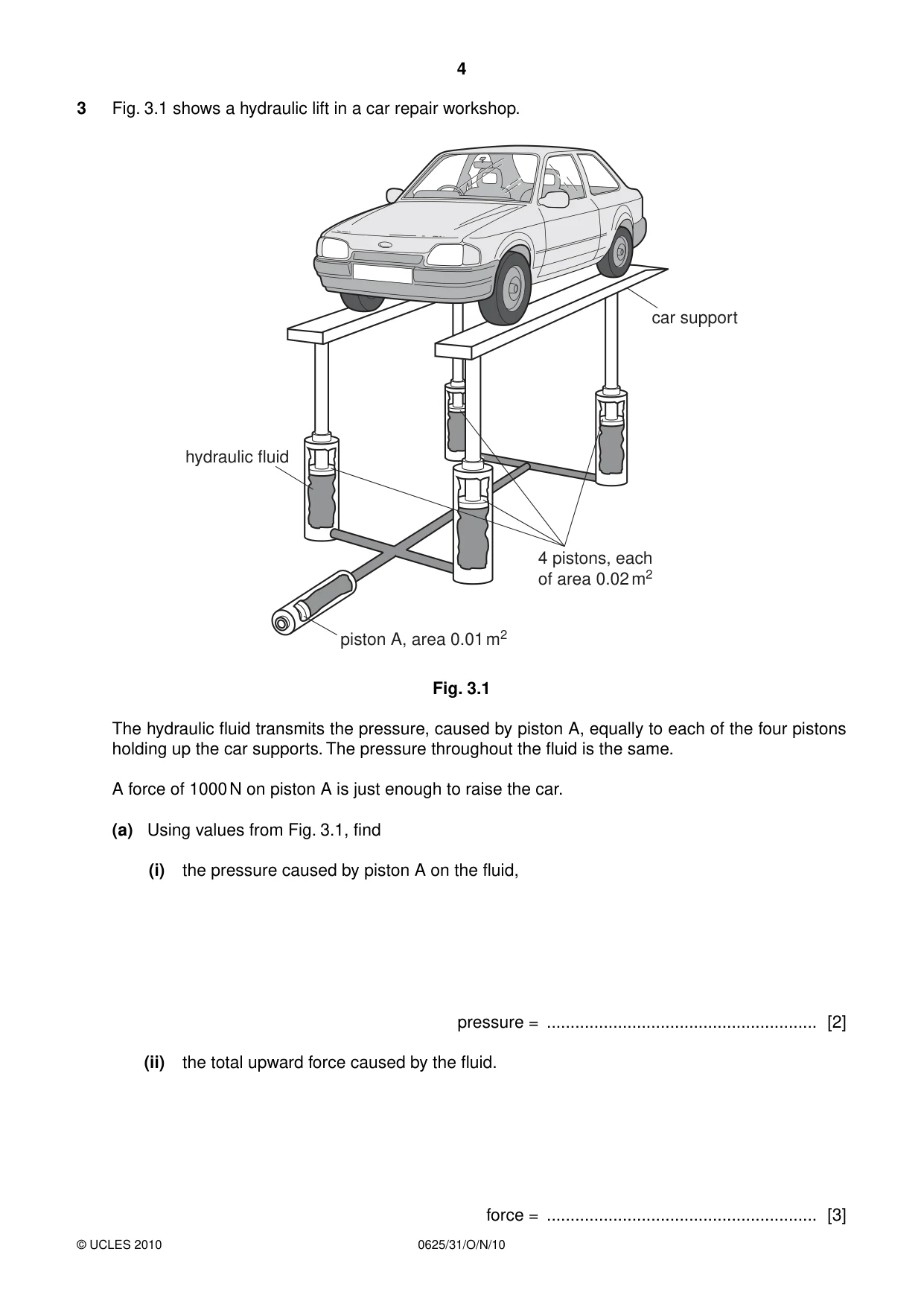
3 Fig. 3.1 shows a hydraulic lift in a car repair workshop. car support hydraulic fluid 4 pistons, each of area 0.02 m2 piston A, area 0.01 m2 Fig. 3.1 The hydraulic fluid transmits the pressure, caused by piston A, equally to each of the four pistons holding up the car supports. The pressure throughout the fluid is the same. A force of 1000 N on piston A is just enough to raise the car. (a) Using values from Fig. 3.1, find (i) the pressure caused by piston A on the fluid, pressure = ......................................................... [2] (ii) the total upward force caused by the fluid. force = ......................................................... [3] (b) The weight of each of the two car supports is 1000 N. Calculate the mass of the car. mass = ......................................................... [2] [Total: 7]
Mark scheme: 3 (a) (i) (P =) F/A in any form OR 1000/0.01 C1 100 000 Pa accept N/m2 A1 (ii) multiplication of either force or area by 4 C1 0.08 × his (i) OR 0.02 × his (i) C1 8000 N e.c.f. from (i) A1 (2000 N gets C0, C1, A1) (b) his (ii) – 2000 correctly evaluated C1 600 kg e.c.f. A1 [Total: 7] IGCSE – October/November 2010 0625 31
Q4 · A student in a laboratory uses the apparatus shown in Fig
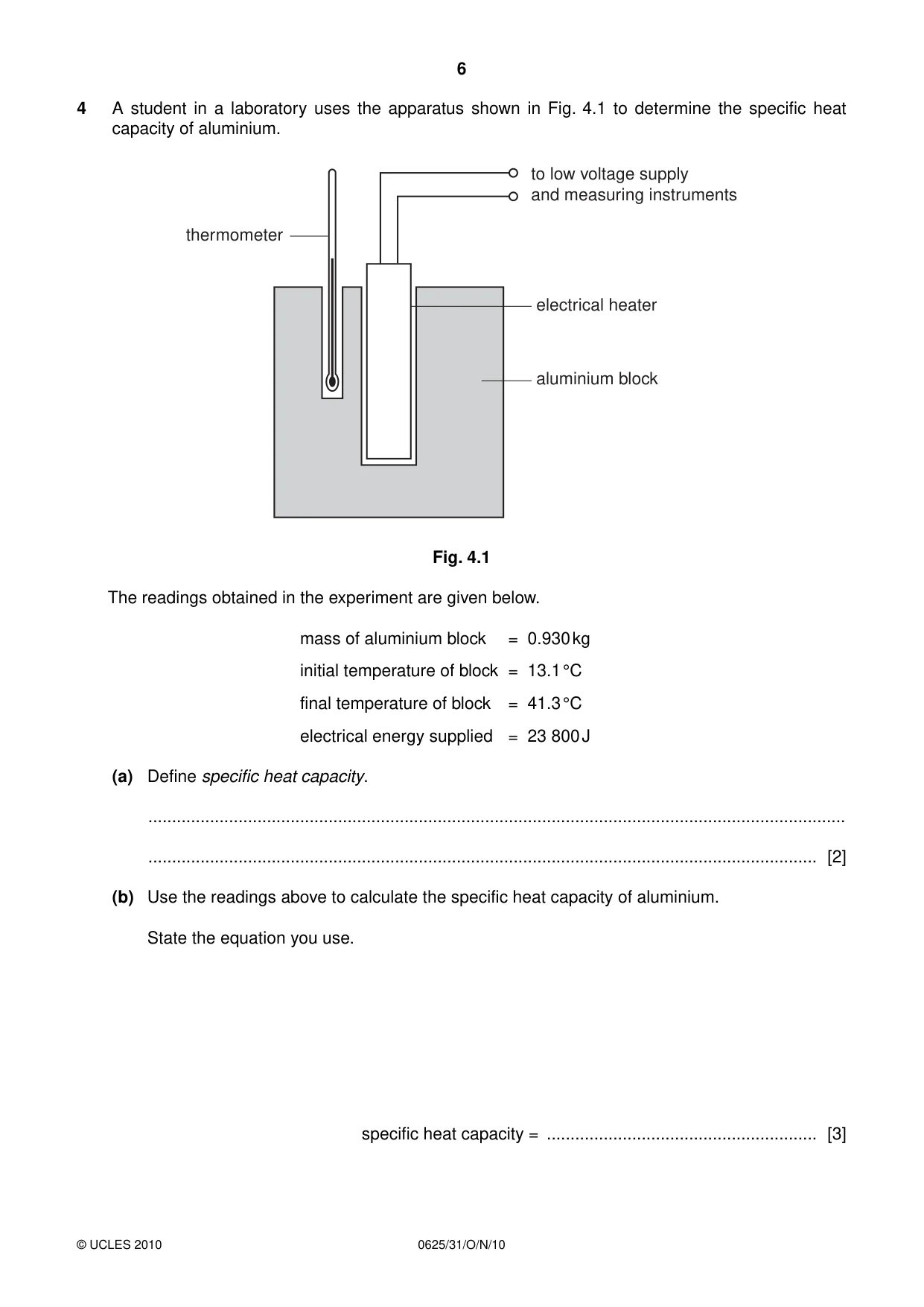
4 A student in a laboratory uses the apparatus shown in Fig. 4.1 to determine the specific heat capacity of aluminium. to low voltage supply and measuring instruments thermometer electrical heater aluminium block Fig. 4.1 The readings obtained in the experiment are given below. mass of aluminium block = 0.930 kg initial temperature of block = 13.1 °C final temperature of block = 41.3 °C electrical energy supplied = 23 800 J (a) Define specific heat capacity. ................................................................................................................................................... ............................................................................................................................................. [2] (b) Use the readings above to calculate the specific heat capacity of aluminium. State the equation you use. specific heat capacity = ......................................................... [3] (c) Because the student knows it is good scientific practice to repeat readings, after a short time he carries out the experiment again, supplying the same quantity of electrical energy. This time the temperature readings are: initial temperature of block = 41.0 °C final temperature of block = 62.1 °C (i) Use these figures to calculate a second value for the specific heat capacity of aluminium. specific heat capacity = ......................................................... [1] (ii) The student did not make any mistakes when taking the readings. Suggest why the second value for the specific heat capacity of the aluminium is greater than the first. ........................................................................................................................................... ..................................................................................................................................... [2] (d) Suggest two ways of improving the experiment in order to give as accurate a result as possible. 1. ............................................................................................................................................... ................................................................................................................................................... 2. ............................................................................................................................................... .............................................................................................................................................. [2] [Total: 10]
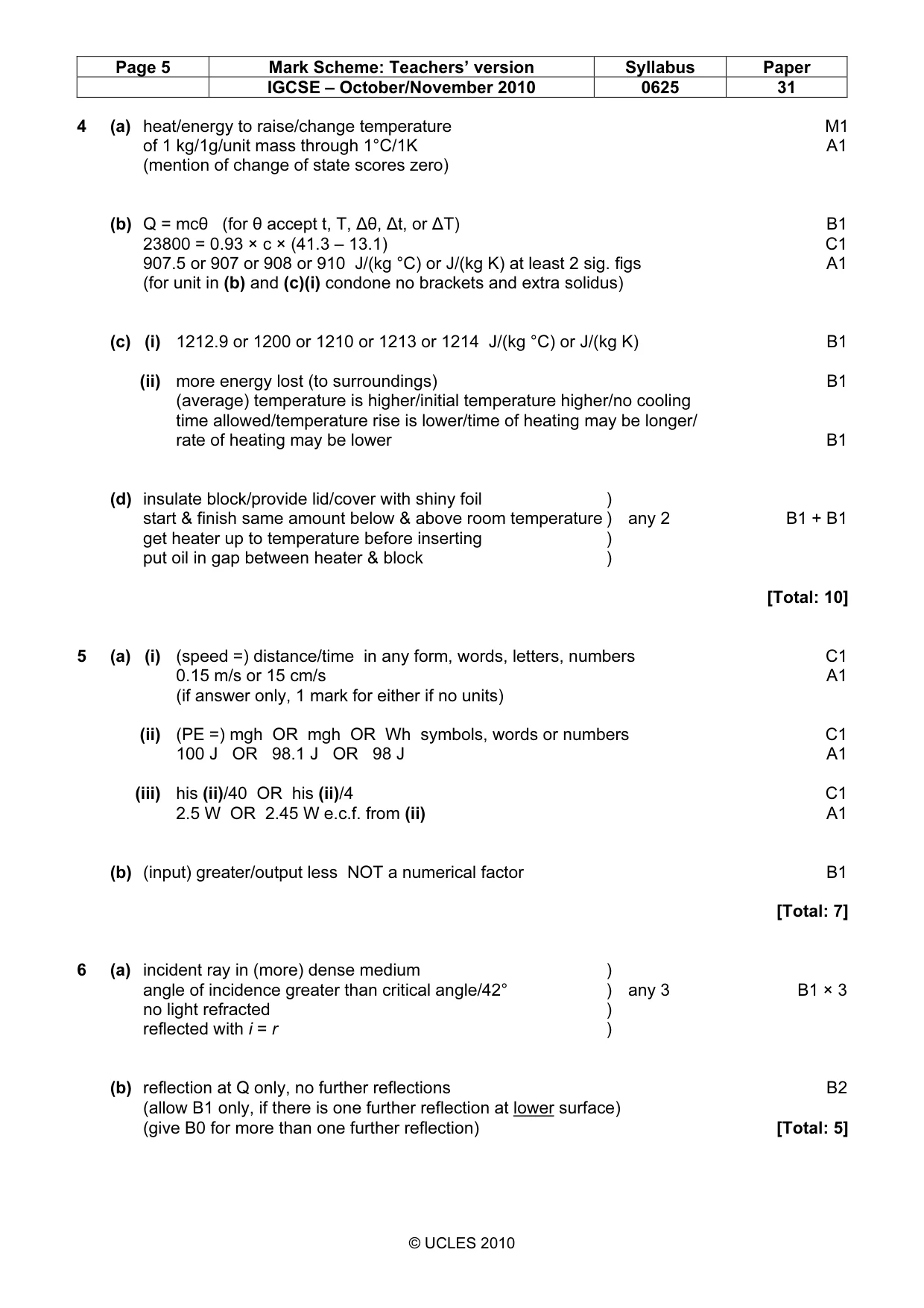
Mark scheme: 4 (a) heat/energy to raise/change temperature M1 of 1 kg/1g/unit mass through 1°C/1K A1 (mention of change of state scores zero) (b) Q = mcθ (for θ accept t, T, ∆θ, ∆t, or ∆T) B1 23800 = 0.93 × c × (41.3 – 13.1) C1 907.5 or 907 or 908 or 910 J/(kg °C) or J/(kg K) at least 2 sig. figs A1 (for unit in (b) and (c)(i) condone no brackets and extra solidus) (c) (i) 1212.9 or 1200 or 1210 or 1213 or 1214 J/(kg °C) or J/(kg K) B1 (ii) more energy lost (to surroundings) B1 (average) temperature is higher/initial temperature higher/no cooling time allowed/temperature rise is lower/time of heating may be longer/ rate of heating may be lower B1 (d) insulate block/provide lid/cover with shiny foil ) start & finish same amount below & above room temperature ) any 2 B1 + B1 get heater up to temperature before inserting ) put oil in gap between heater & block ) [Total: 10]
Q5 · A model cable-car system
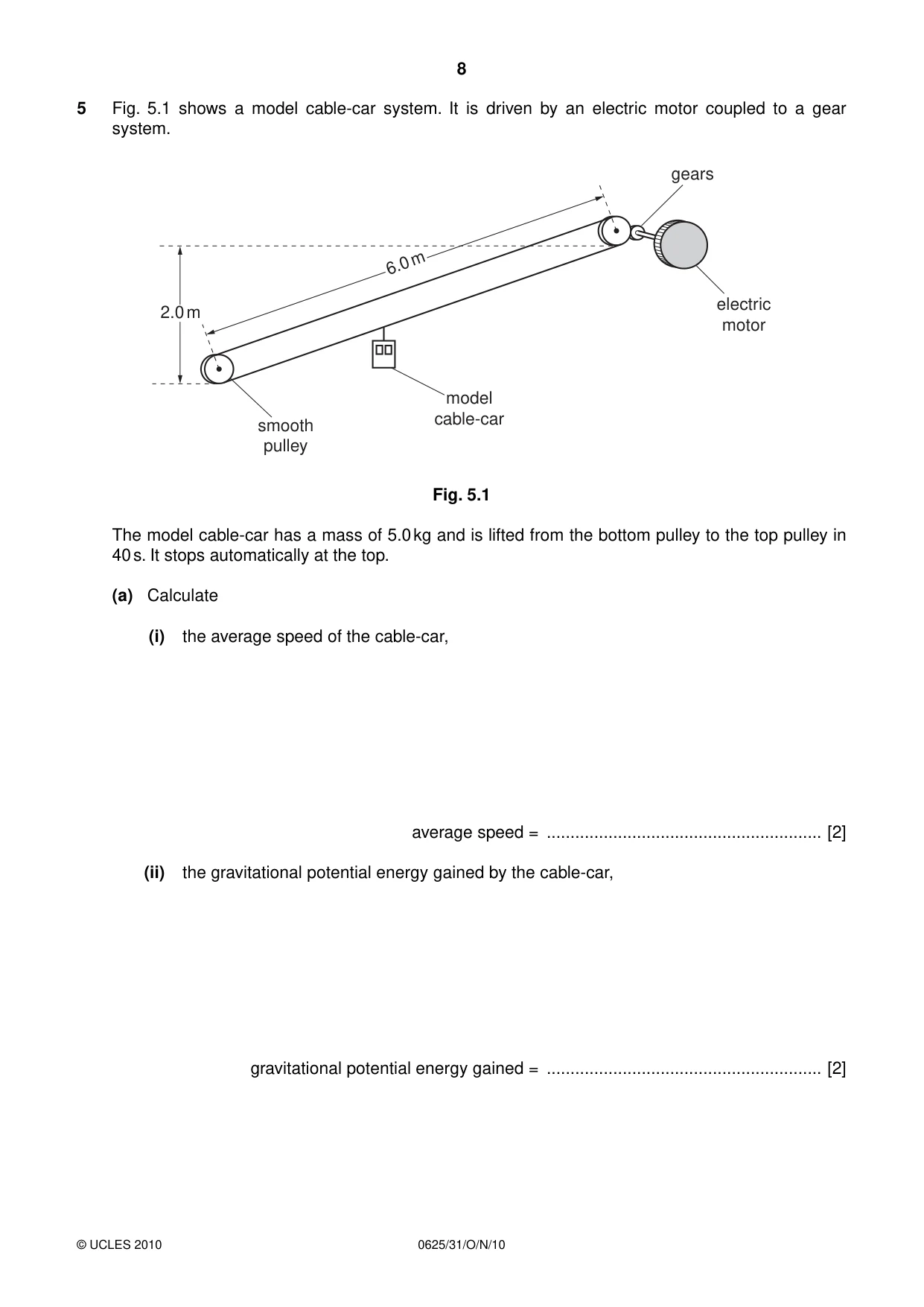
5 Fig. 5.1 shows a model cable-car system. It is driven by an electric motor coupled to a gear system. gears m 6.0 electric 2.0 m motor model cable-car smooth pulley Fig. 5.1 The model cable-car has a mass of 5.0 kg and is lifted from the bottom pulley to the top pulley in 40 s. It stops automatically at the top. (a) Calculate (i) the average speed of the cable-car, average speed = .......................................................... [2] (ii) the gravitational potential energy gained by the cable-car, gravitational potential energy gained = .......................................................... [2] (iii) the useful output power of the driving mechanism. power = ......................................................... [2] (b) How would the electrical power input to the motor compare with your answer to (a)(iii)? ............................................................................................................................................. [1] [Total: 7]
Mark scheme: 5 (a) (i) (speed =) distance/time in any form, words, letters, numbers C1 0.15 m/s or 15 cm/s A1 (if answer only, 1 mark for either if no units) (ii) (PE =) mgh OR mgh OR Wh symbols, words or numbers C1 100 J OR 98.1 J OR 98 J A1 (iii) his (ii)/40 OR his (ii)/4 C1 2.5 W OR 2.45 W e.c.f. from (ii) A1 (b) (input) greater/output less NOT a numerical factor B1 [Total: 7]
Q6 · Part of the path of a ray of light PQ travelling in an optical fibre
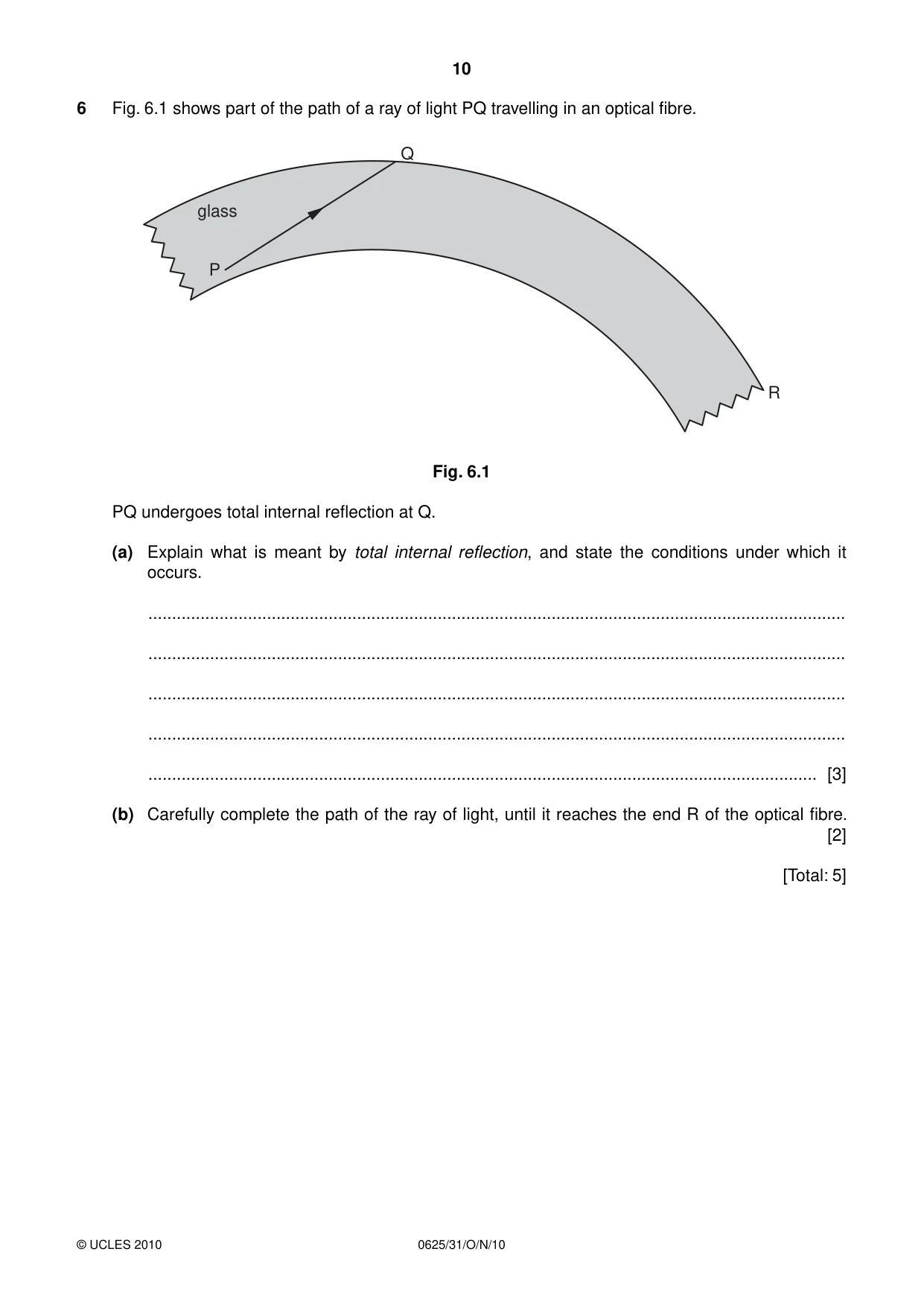
6 Fig. 6.1 shows part of the path of a ray of light PQ travelling in an optical fibre. Q glass P R Fig. 6.1 PQ undergoes total internal reflection at Q. (a) Explain what is meant by total internal reflection, and state the conditions under which it occurs. ................................................................................................................................................... ................................................................................................................................................... ................................................................................................................................................... ................................................................................................................................................... ............................................................................................................................................. [3] (b) Carefully complete the path of the ray of light, until it reaches the end R of the optical fibre. [2] [Total: 5]
Mark scheme: 6 (a) incident ray in (more) dense medium ) angle of incidence greater than critical angle/42° ) any 3 B1 × 3 no light refracted ) reflected with i = r ) (b) reflection at Q only, no further reflections B2 (allow B1 only, if there is one further reflection at lower surface) (give B0 for more than one further reflection) [Total: 5] IGCSE – October/November 2010 0625 31
Q7 · The following list contains the names of types of energy transfer by means of waves
7 (a) The following list contains the names of types of energy transfer by means of waves. γ-rays, infra-red, radio/TV/microwaves, sound, visible light, X-rays (i) Which one of these is not a type of electromagnetic wave? ..................................................................................................................................... [1] (ii) State the nature of the wave you have named in (a)(i). ..................................................................................................................................... [1] (iii) The remaining names in the list are all regions of the electromagnetic spectrum, but one region is missing. Name the missing region. ..................................................................................................................................... [1] (b) A television station emits waves with a frequency of 2.5 × 10⁸ Hz. Electromagnetic waves travel at a speed of 3.0 × 10⁸ m / s. Calculate the wavelength of the waves emitted by this television station. State the equation you use. wavelength = ......................................................... [3] [Total: 6]
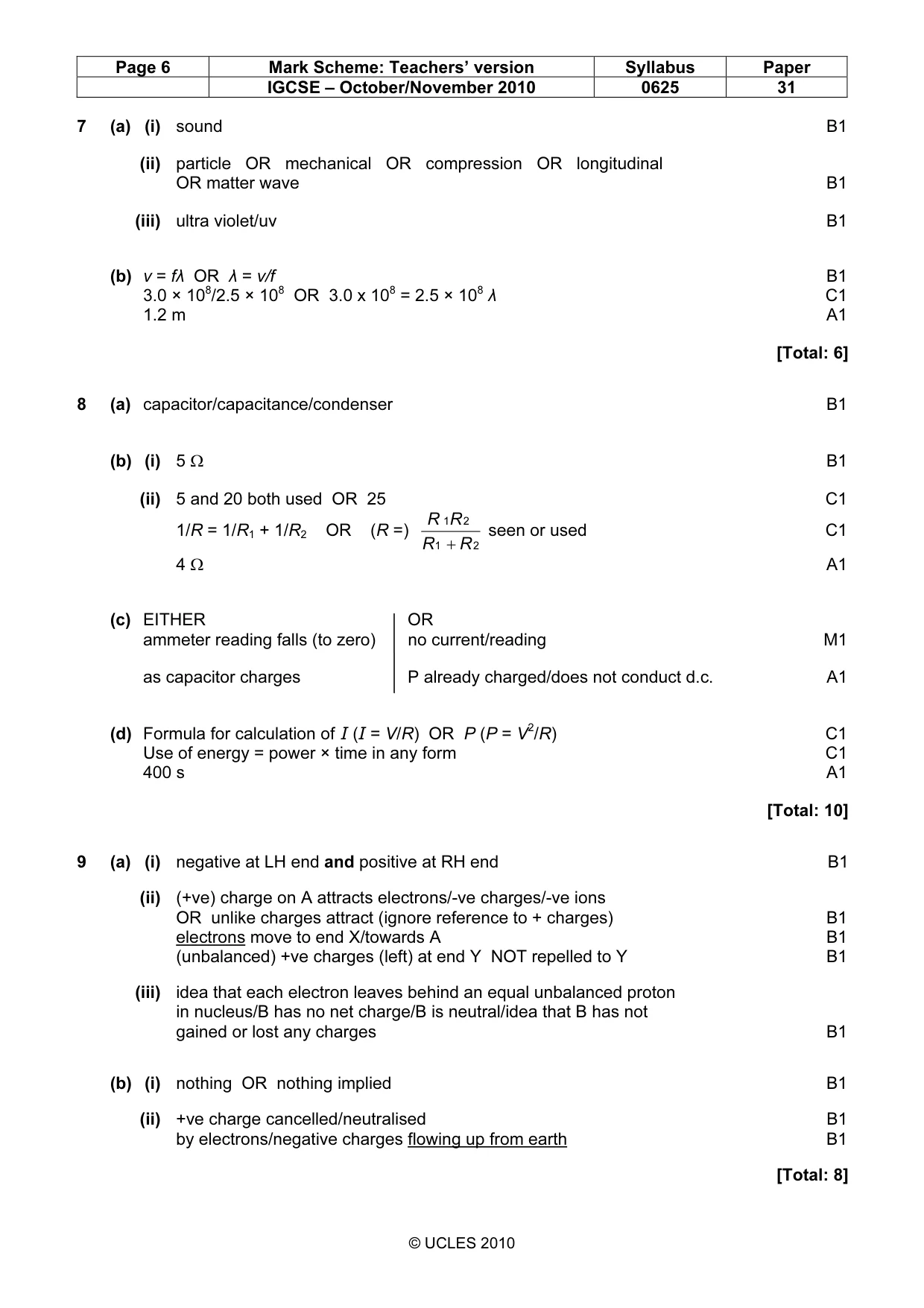
Mark scheme: 7 (a) (i) sound B1 (ii) particle OR mechanical OR compression OR longitudinal OR matter wave B1 (iii) ultra violet/uv B1 (b) v = fλ OR λ = v/f B1 3.0 × 10⁸/2.5 × 108 OR 3.0 x 108 = 2.5 × 10⁸ λ C1 1.2 m A1 [Total: 6]
Q8 · The circuit in Fig
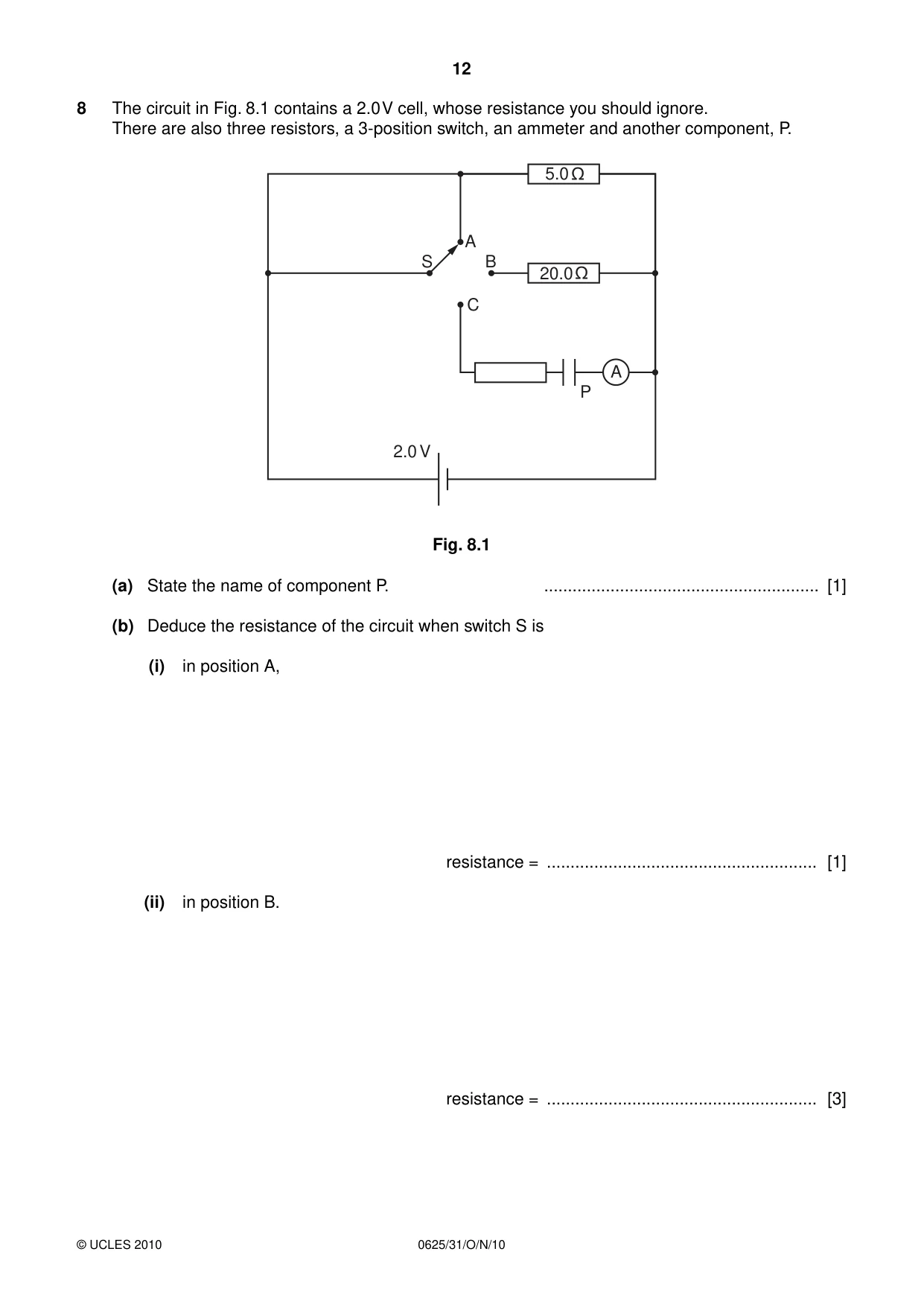
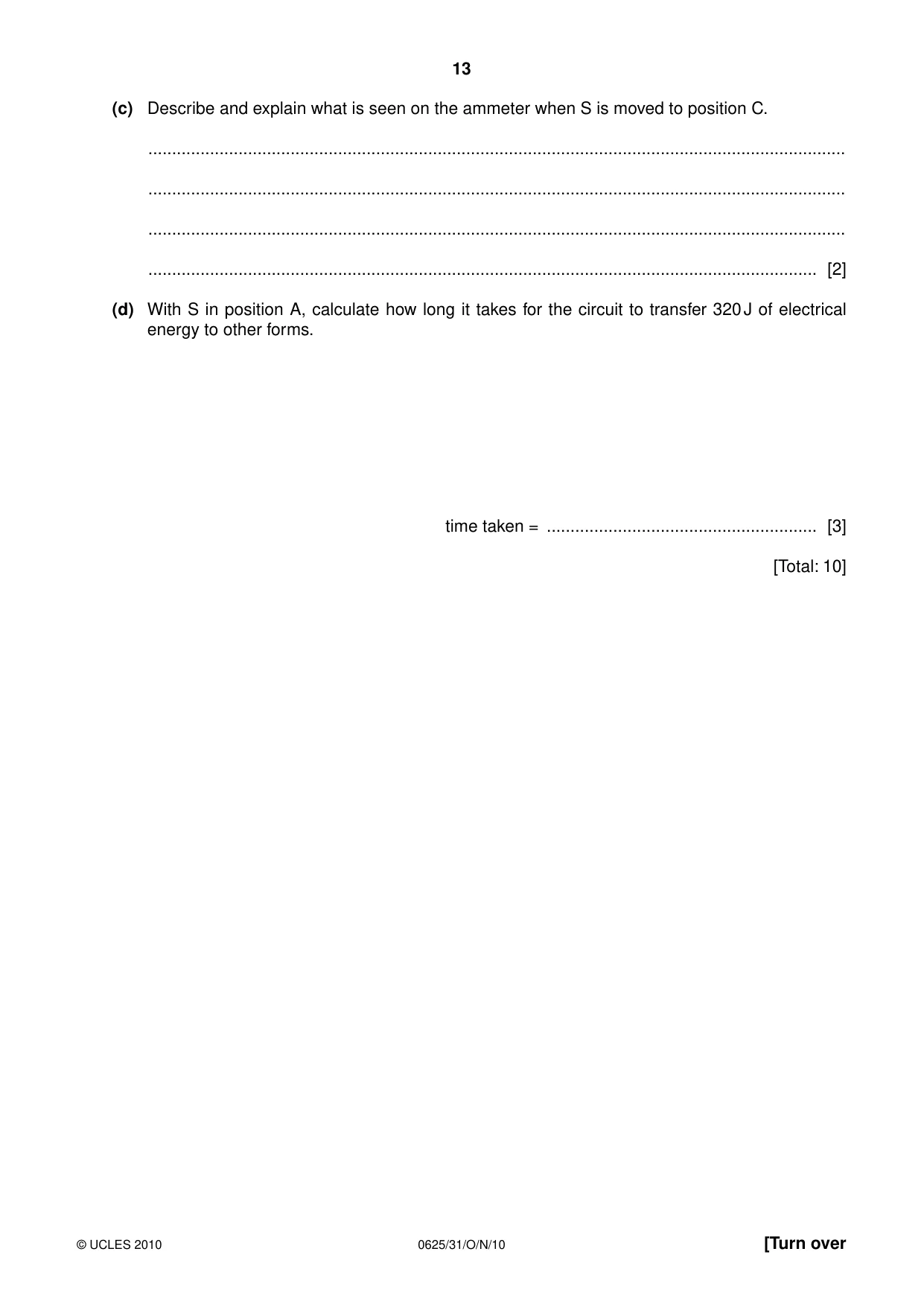
8 The circuit in Fig. 8.1 contains a 2.0 V cell, whose resistance you should ignore. There are also three resistors, a 3-position switch, an ammeter and another component, P. 5.0 A S B 20.0 C A P 2.0 V Fig. 8.1 (a) State the name of component P. .......................................................... [1] (b) Deduce the resistance of the circuit when switch S is (i) in position A, resistance = ......................................................... [1] (ii) in position B. resistance = ......................................................... [3] (c) Describe and explain what is seen on the ammeter when S is moved to position C. ................................................................................................................................................... ................................................................................................................................................... ................................................................................................................................................... ............................................................................................................................................. [2] (d) With S in position A, calculate how long it takes for the circuit to transfer 320 J of electrical energy to other forms. time taken = ......................................................... [3] [Total: 10]
Mark scheme: 8 (a) capacitor/capacitance/condenser B1 (b) (i) 5 Ω B1 (ii) 5 and 20 both used OR 25 C1 R 1 R 2 1/R = 1/R1 + 1/R2 OR (R =) seen or used C1 R 1 + R 2 4 Ω A1 (c) EITHER OR ammeter reading falls (to zero) no current/reading M1 as capacitor charges P already charged/does not conduct d.c. A1 (d) Formula for calculation of I (I = V/R) OR P (P = V2/R) C1 Use of energy = power × time in any form C1 400 s A1 [Total: 10]
Question 9
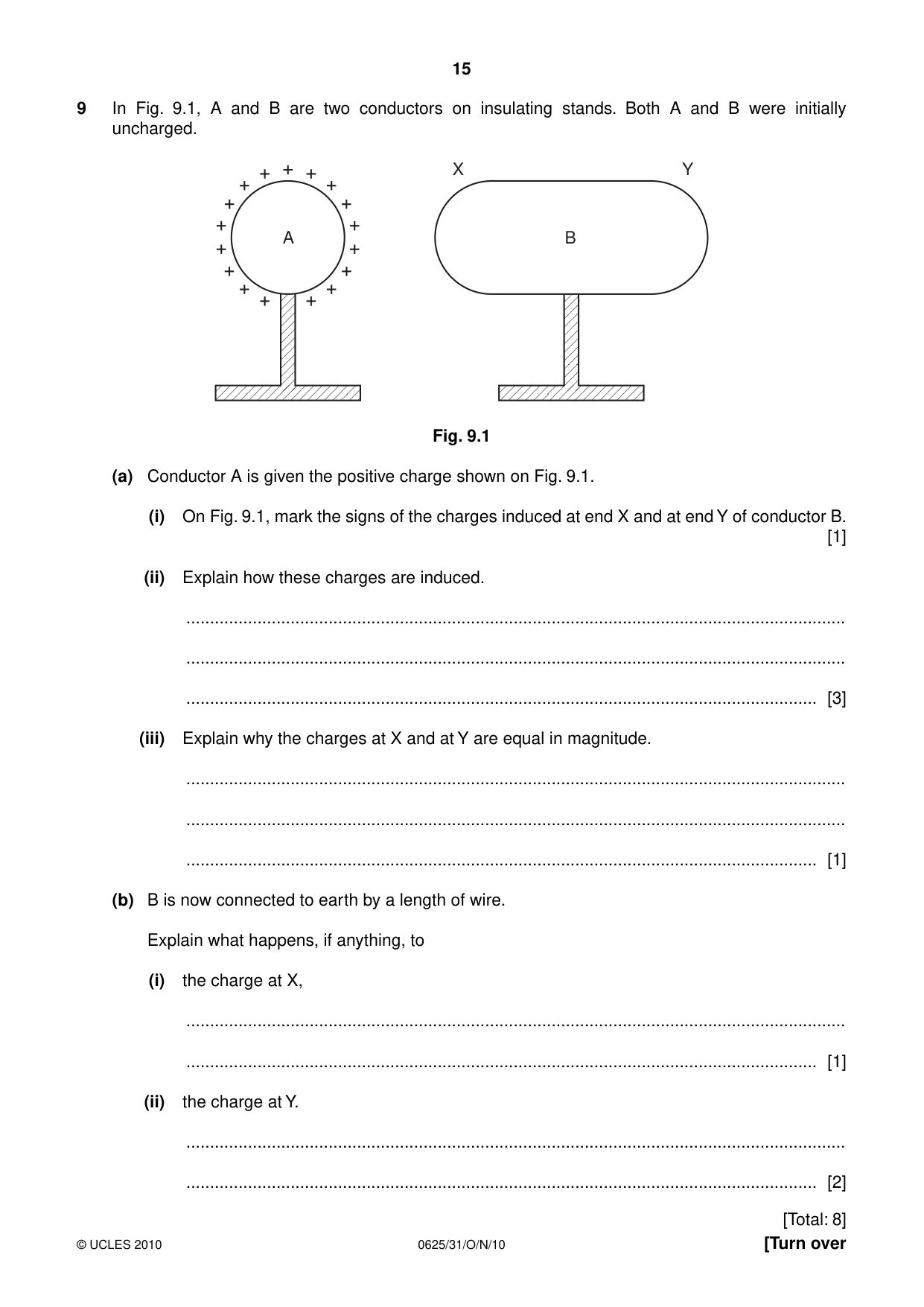
9 In Fig. 9.1, A and B are two conductors on insulating stands. Both A and B were initially uncharged. X Y A B Fig. 9.1 (a) Conductor A is given the positive charge shown on Fig. 9.1. (i) On Fig. 9.1, mark the signs of the charges induced at end X and at end Y of conductor B. [1] (ii) Explain how these charges are induced. ........................................................................................................................................... ........................................................................................................................................... ..................................................................................................................................... [3] (iii) Explain why the charges at X and at Y are equal in magnitude. ........................................................................................................................................... ........................................................................................................................................... ..................................................................................................................................... [1] (b) B is now connected to earth by a length of wire. Explain what happens, if anything, to (i) the charge at X, ........................................................................................................................................... ..................................................................................................................................... [1] (ii) the charge at Y. ........................................................................................................................................... ..................................................................................................................................... [2] [Total: 8]
Mark scheme: 9 (a) (i) negative at LH end and positive at RH end B1 (ii) (+ve) charge on A attracts electrons/-ve charges/-ve ions OR unlike charges attract (ignore reference to + charges) B1 electrons move to end X/towards A B1 (unbalanced) +ve charges (left) at end Y NOT repelled to Y B1 (iii) idea that each electron leaves behind an equal unbalanced proton in nucleus/B has no net charge/B is neutral/idea that B has not gained or lost any charges B1 (b) (i) nothing OR nothing implied B1 (ii) +ve charge cancelled/neutralised B1 by electrons/negative charges flowing up from earth B1 [Total: 8] IGCSE – October/November 2010 0625 31
Q10 · Emissions from a radioactive source pass through a hole in a lead screen and into a…
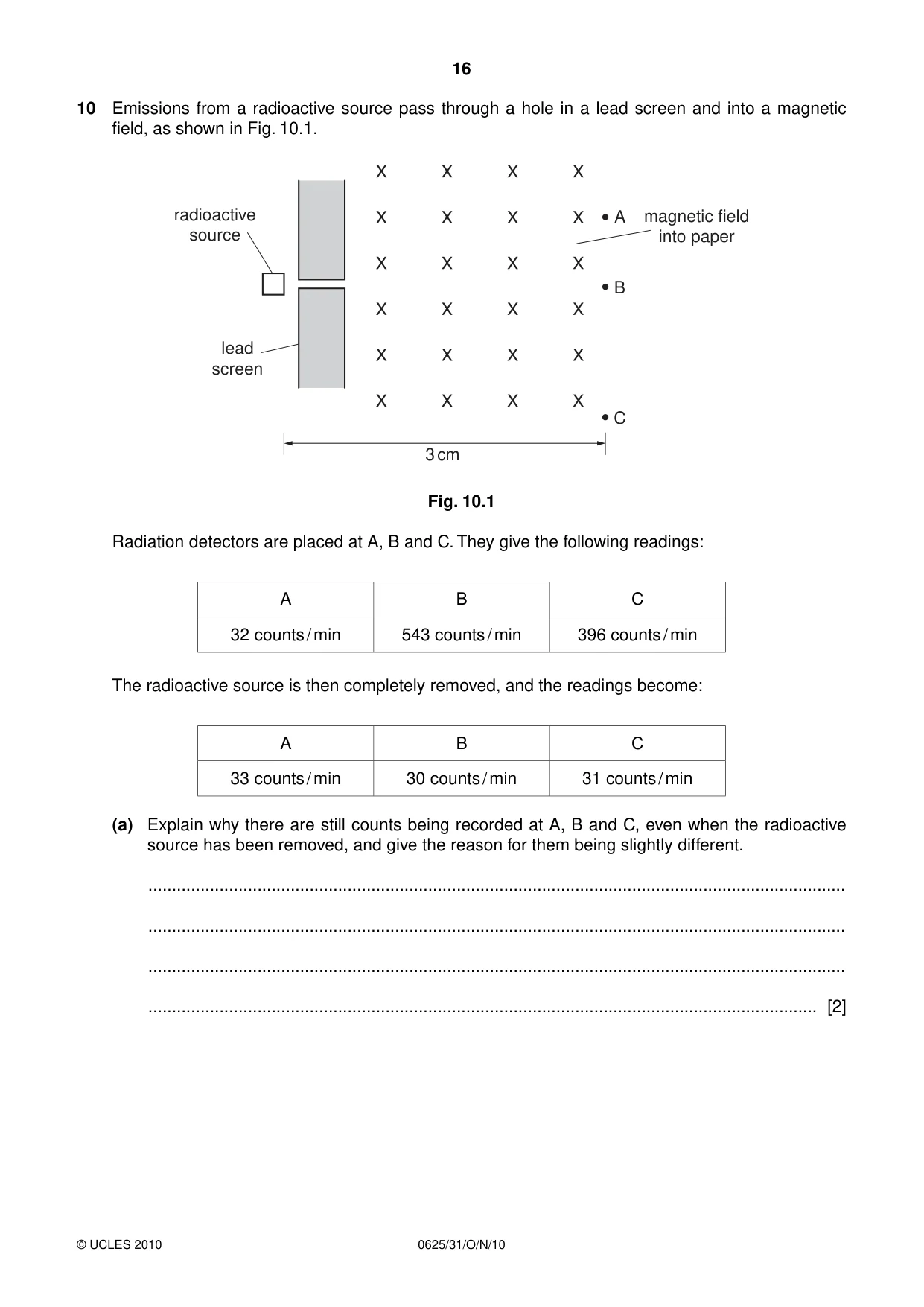
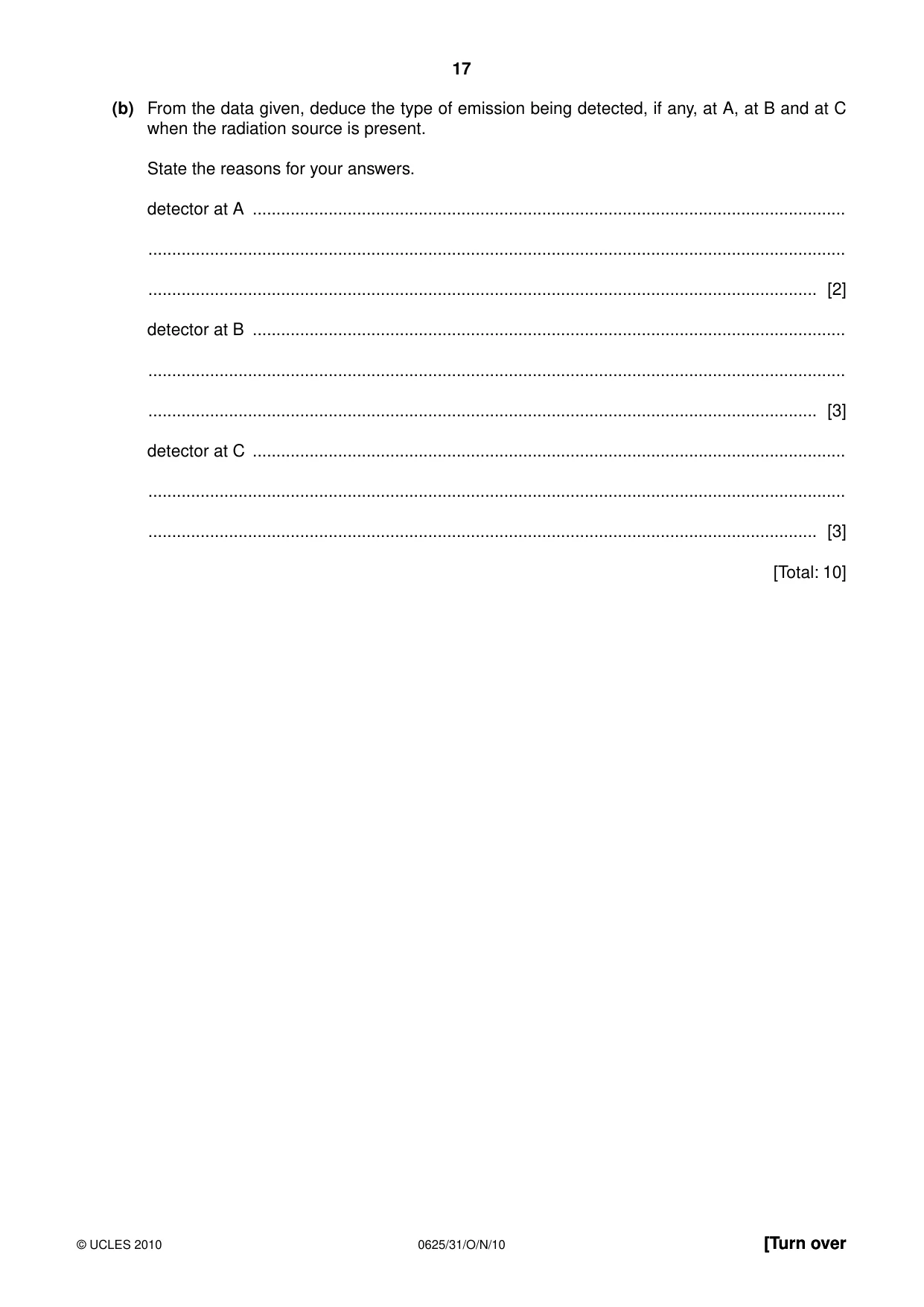
10 Emissions from a radioactive source pass through a hole in a lead screen and into a magnetic field, as shown in Fig. 10.1. radioactive A magnetic field source into paper B lead screen C 3 cm Fig. 10.1 Radiation detectors are placed at A, B and C. They give the following readings: A B C 32 counts / min 543 counts / min 396 counts / min The radioactive source is then completely removed, and the readings become: A B C 33 counts / min 30 counts / min 31 counts / min (a) Explain why there are still counts being recorded at A, B and C, even when the radioactive source has been removed, and give the reason for them being slightly different. ................................................................................................................................................... ................................................................................................................................................... ................................................................................................................................................... ............................................................................................................................................. [2] (b) From the data given, deduce the type of emission being detected, if any, at A, at B and at C when the radiation source is present. State the reasons for your answers. detector at A ............................................................................................................................. ................................................................................................................................................... ............................................................................................................................................. [2] detector at B ............................................................................................................................. ................................................................................................................................................... ............................................................................................................................................. [3] detector at C ............................................................................................................................. ................................................................................................................................................... ............................................................................................................................................. [3] [Total: 10]
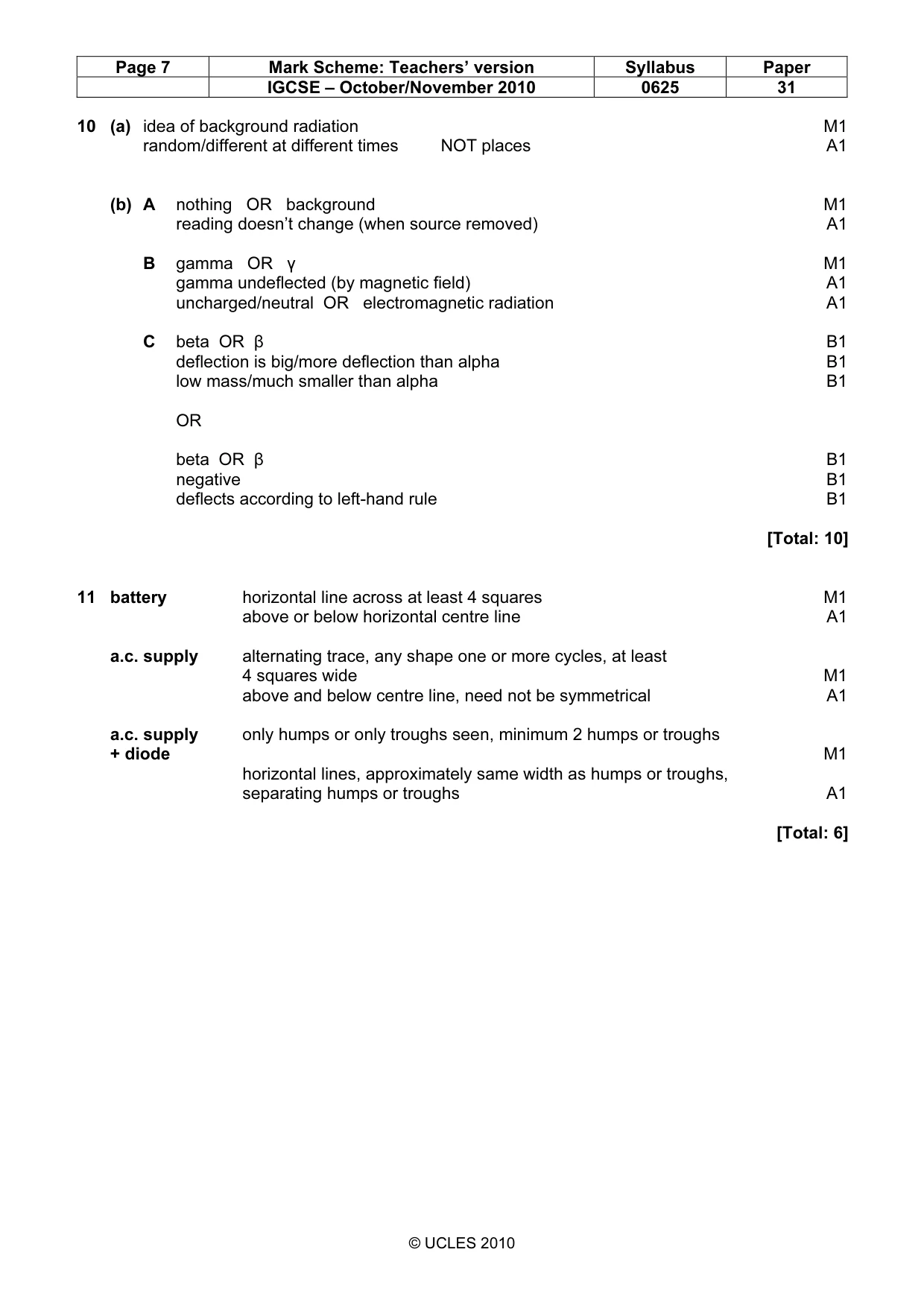
Mark scheme: 10 (a) idea of background radiation M1 random/different at different times NOT places A1 (b) A nothing OR background M1 reading doesn’t change (when source removed) A1 B gamma OR γ M1 gamma undeflected (by magnetic field) A1 uncharged/neutral OR electromagnetic radiation A1 C beta OR β B1 deflection is big/more deflection than alpha B1 low mass/much smaller than alpha B1 OR beta OR β B1 negative B1 deflects according to left-hand rule B1 [Total: 10]
Q11 · When no circuit is connected to the input of a cathode-ray oscilloscope (CRO), there is a…
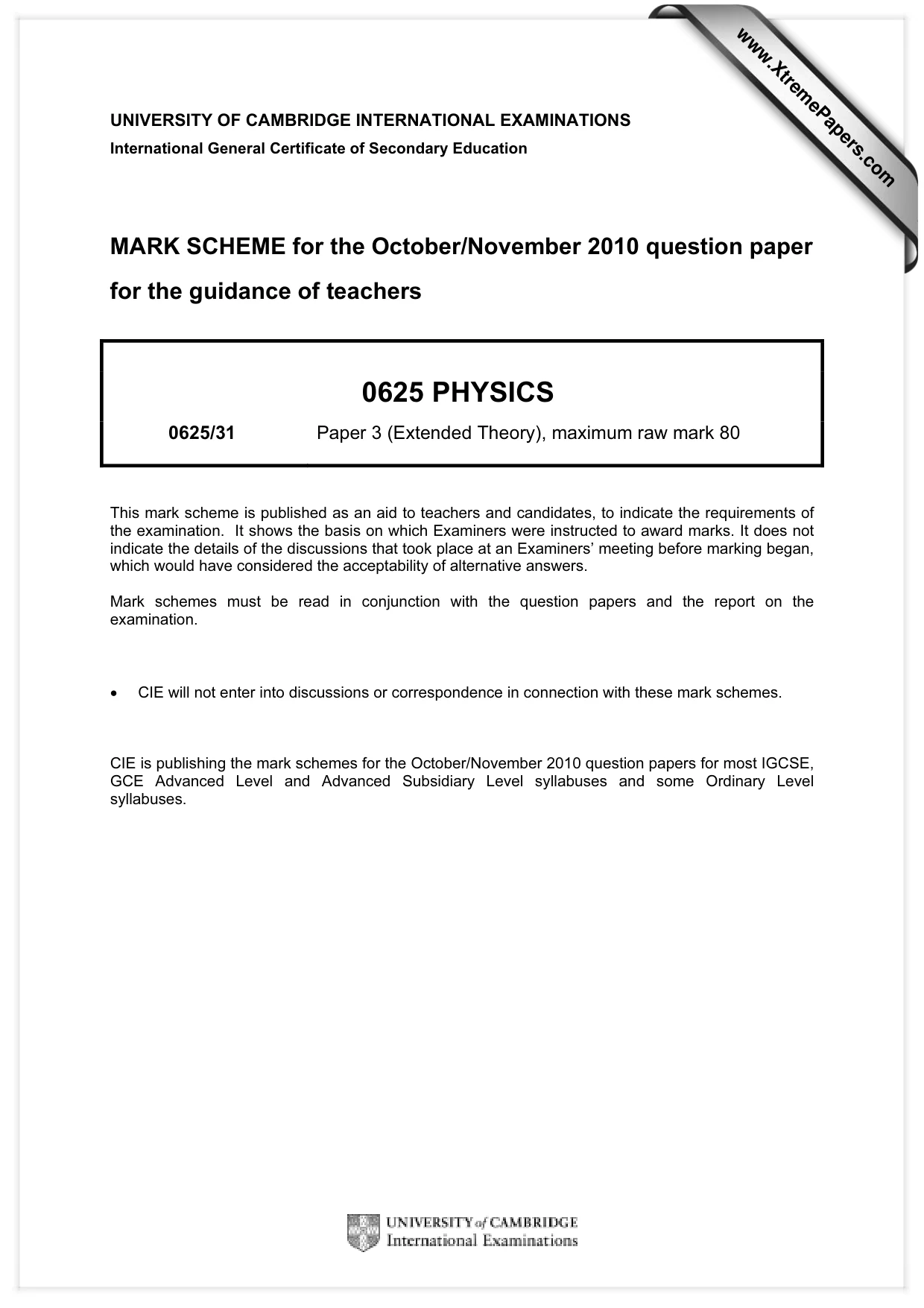
11 When no circuit is connected to the input of a cathode-ray oscilloscope (CRO), there is a horizontal trace across the middle of the screen. Fig. 11.1 shows three circuits, each connected to a CRO. On the grid alongside each circuit, draw the trace that might be seen on the screen of the CRO. + battery CRO – a.c. supply CRO a.c. supply CRO [6] Fig. 11.1 [Total: 6]
Mark scheme: 11 battery horizontal line across at least 4 squares M1 above or below horizontal centre line A1 a.c. supply alternating trace, any shape one or more cycles, at least 4 squares wide M1 above and below centre line, need not be symmetrical A1 a.c. supply only humps or only troughs seen, minimum 2 humps or troughs + diode M1 horizontal lines, approximately same width as humps or troughs, separating humps or troughs A1 [Total: 6]
What was in this paper
The subtopics covered by these 11 questions, and how many questions each got. Open one in a new tab to see every Cambridge question on it.
What you needed in this session
Cambridge’s own grade thresholds for 2010 Oct/Nov, Paper 3 · Variant 1. A higher threshold means an easier paper — the bar moves with how the cohort did.