Cambridge IGCSE Physics 0625 — 2011 May/June Paper 3 · Variant 3
0625/33/M/J/11 · 11 questions · 80 marks · ≈90 min
The question paper and its mark scheme, free to read here and free to download. This is Cambridge’s own paper, exactly as it was sat.
Question paper16 pages
Mark scheme7 pages
Answers below. Sit the paper first if you are practising.
Questions as text
Q1 · Complete the table below to identify the physical quantities as scalars or vectors
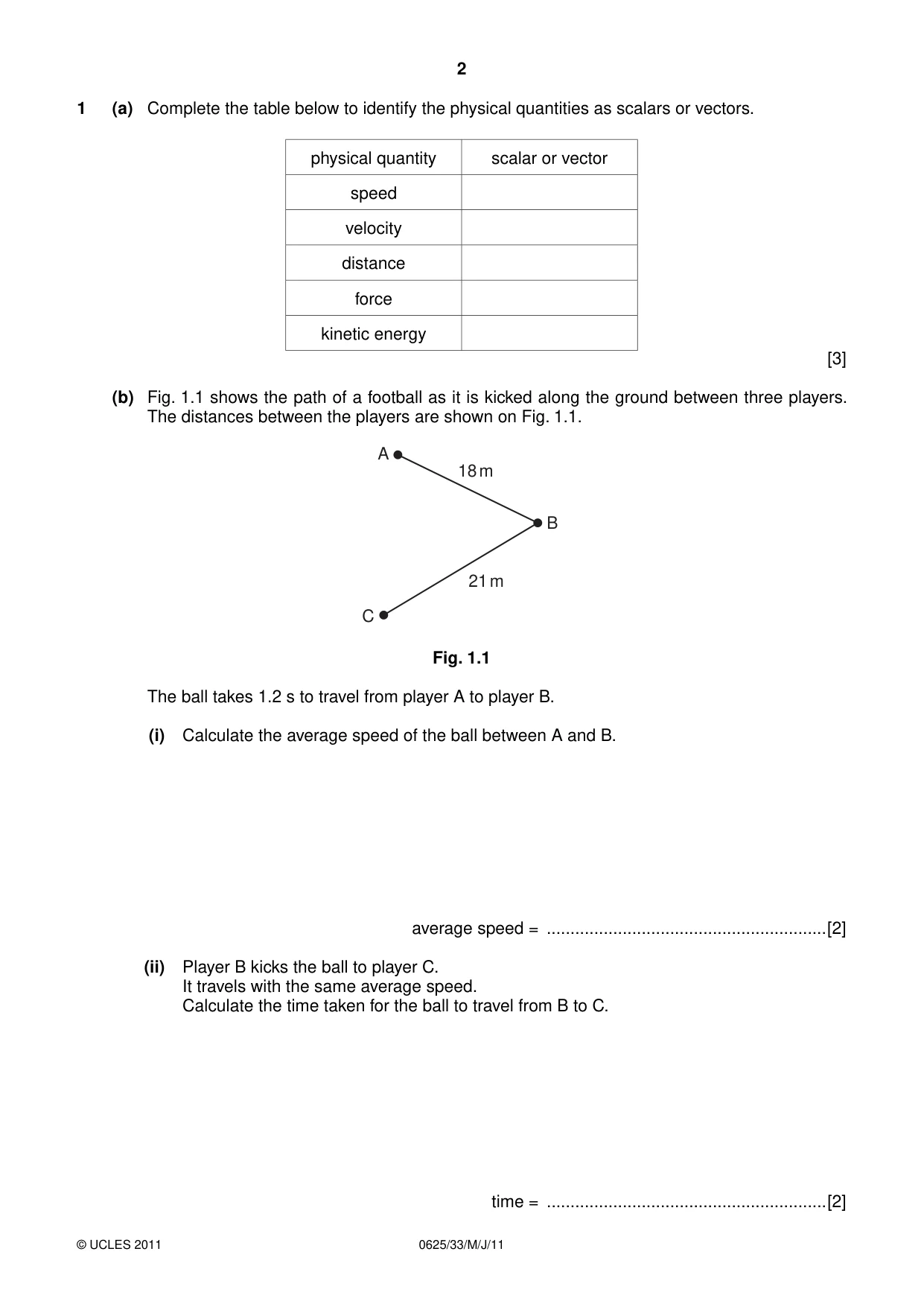
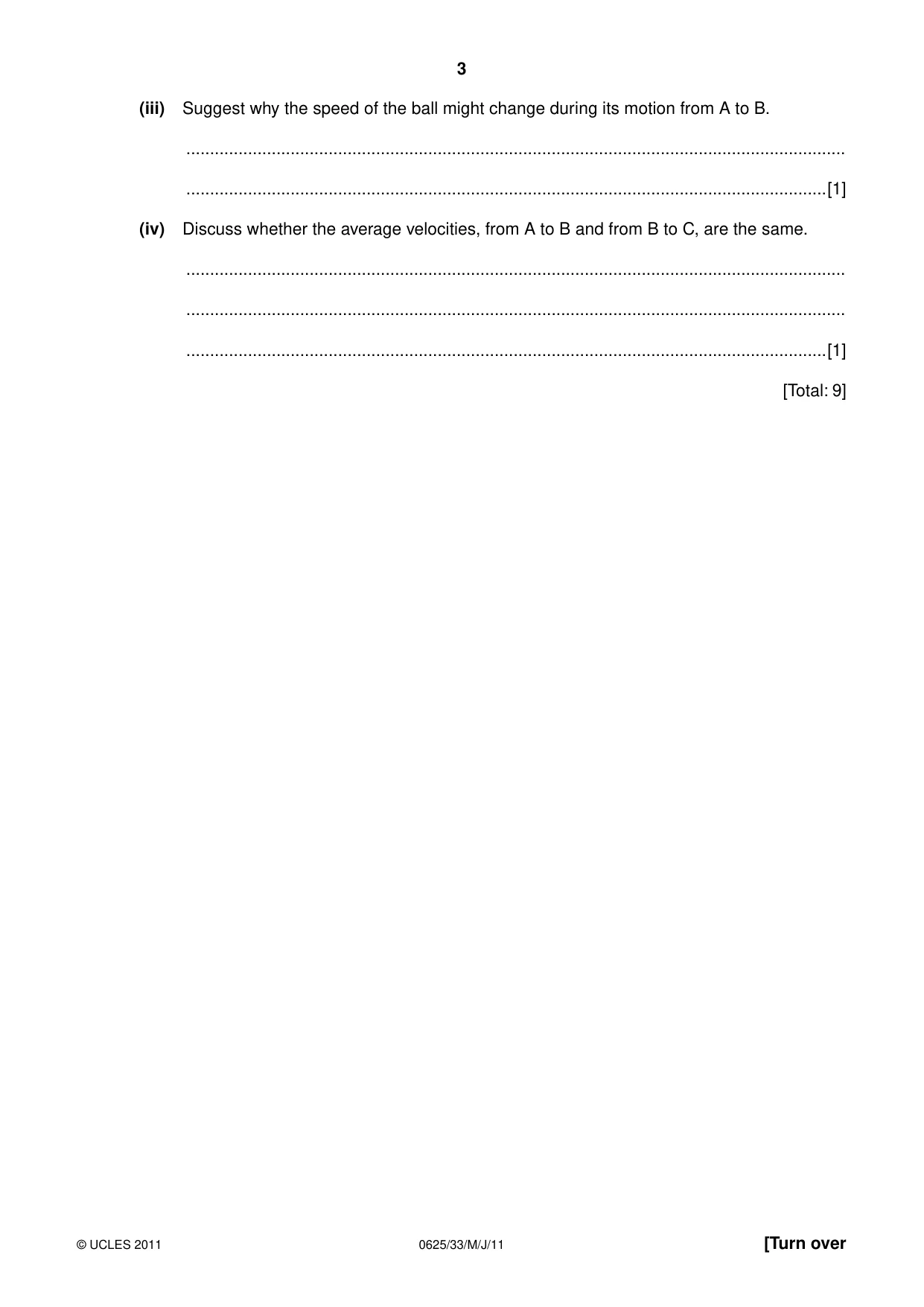
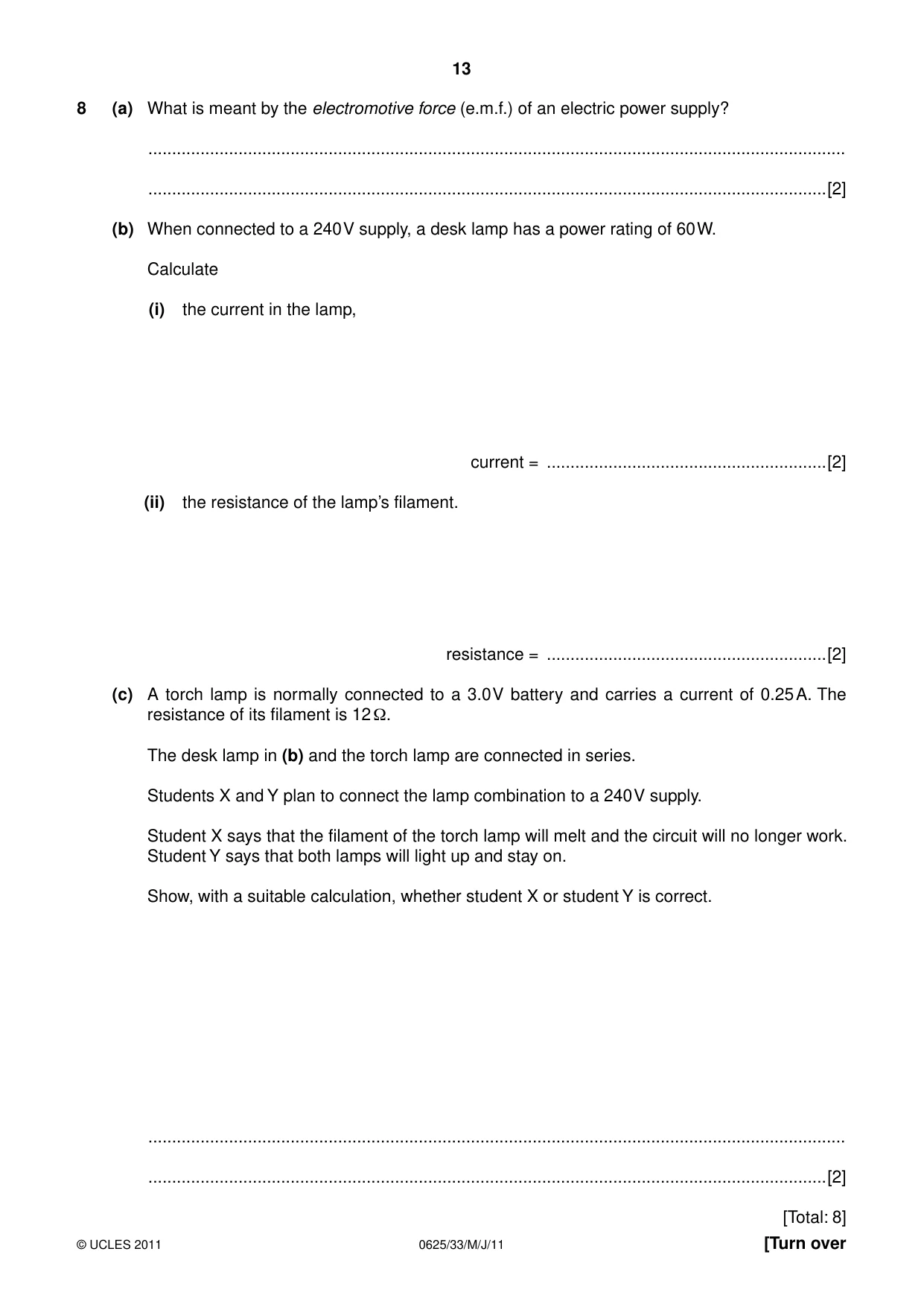
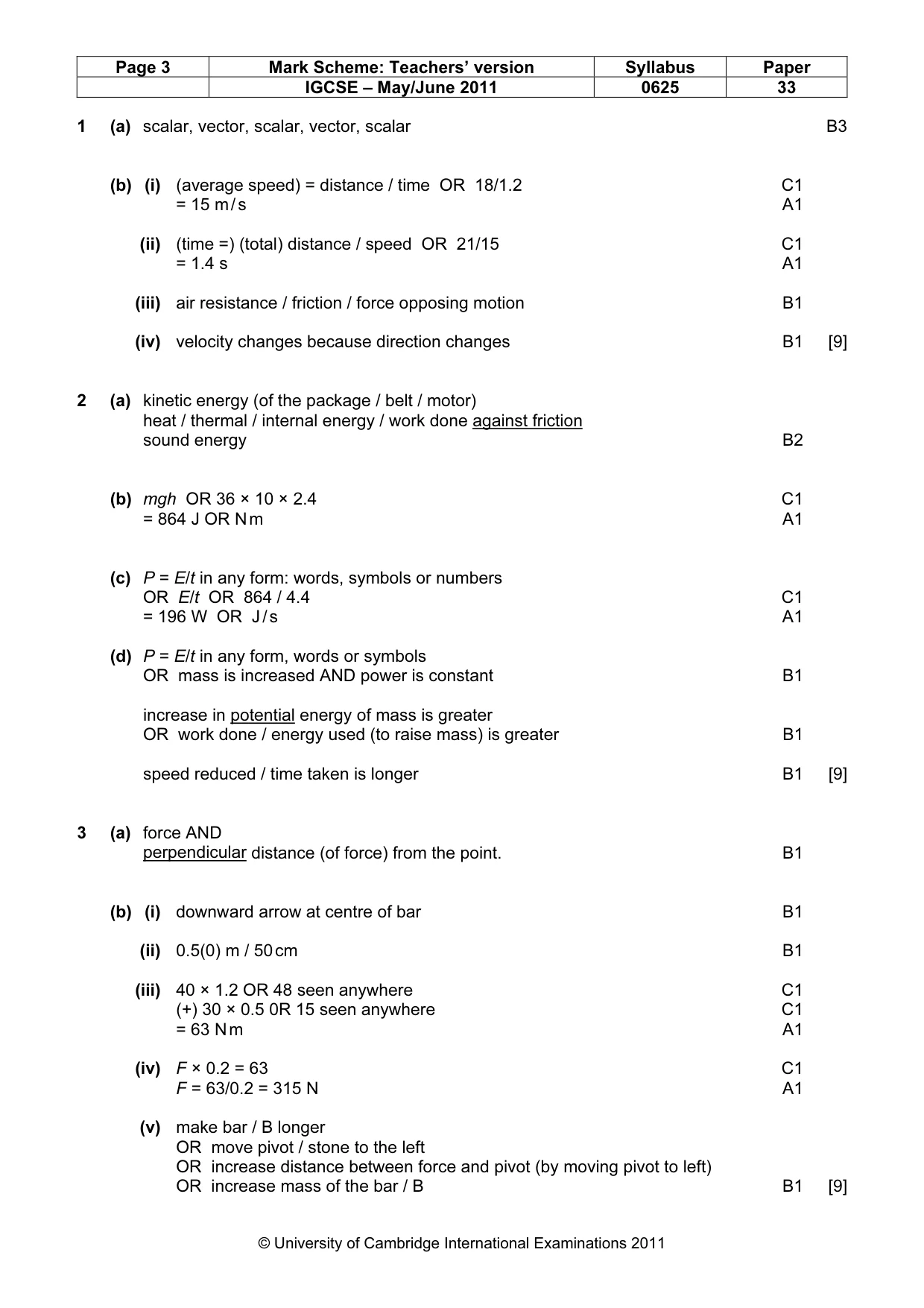
1 (a) Complete the table below to identify the physical quantities as scalars or vectors. physical quantity scalar or vector speed velocity distance force kinetic energy [3] (b) Fig. 1.1 shows the path of a football as it is kicked along the ground between three players. The distances between the players are shown on Fig. 1.1. A 18 m B 21 m C Fig. 1.1 The ball takes 1.2 s to travel from player A to player B. (i) Calculate the average speed of the ball between A and B. average speed = ...........................................................[2] (ii) Player B kicks the ball to player C. It travels with the same average speed. Calculate the time taken for the ball to travel from B to C. time = ...........................................................[2] (iii) Suggest why the speed of the ball might change during its motion from A to B. ........................................................................................................................................... .......................................................................................................................................[1] (iv) Discuss whether the average velocities, from A to B and from B to C, are the same. ........................................................................................................................................... ........................................................................................................................................... .......................................................................................................................................[1] [Total: 9]
Mark scheme: 1 (a) scalar, vector, scalar, vector, scalar B3 (b) (i) (average speed) = distance / time OR 18/1.2 C1 = 15 m / s A1 (ii) (time =) (total) distance / speed OR 21/15 C1 = 1.4 s A1 (iii) air resistance / friction / force opposing motion B1 (iv) velocity changes because direction changes B1 [9]
Q2 · A conveyor belt transporting a package to a raised platform
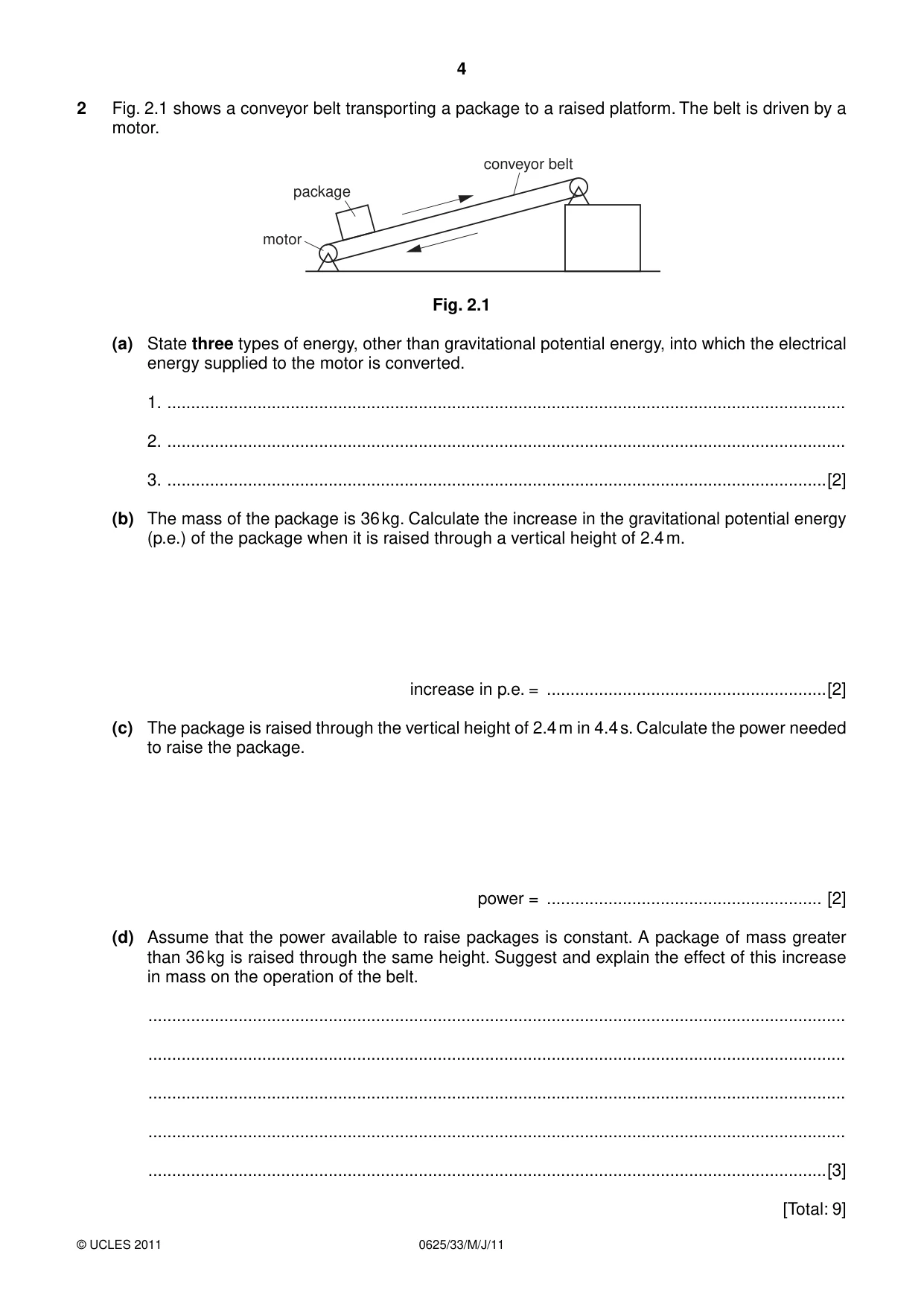
2 Fig. 2.1 shows a conveyor belt transporting a package to a raised platform. The belt is driven by a motor. conveyor belt package motor Fig. 2.1 (a) State three types of energy, other than gravitational potential energy, into which the electrical energy supplied to the motor is converted. 1. ............................................................................................................................................... 2. ............................................................................................................................................... 3. ...........................................................................................................................................[2] (b) The mass of the package is 36 kg. Calculate the increase in the gravitational potential energy (p.e.) of the package when it is raised through a vertical height of 2.4 m. increase in p.e. = ...........................................................[2] (c) The package is raised through the vertical height of 2.4 m in 4.4 s. Calculate the power needed to raise the package. power = .......................................................... [2] (d) Assume that the power available to raise packages is constant. A package of mass greater than 36 kg is raised through the same height. Suggest and explain the effect of this increase in mass on the operation of the belt. ................................................................................................................................................... ................................................................................................................................................... ................................................................................................................................................... ................................................................................................................................................... ...............................................................................................................................................[3] [Total: 9]
Mark scheme: 2 (a) kinetic energy (of the package / belt / motor) heat / thermal / internal energy / work done against friction sound energy B2 (b) mgh OR 36 × 10 × 2.4 C1 = 864 J OR N m A1 (c) P = E/t in any form: words, symbols or numbers OR E/t OR 864 / 4.4 C1 = 196 W OR J / s A1 (d) P = E/t in any form, words or symbols OR mass is increased AND power is constant B1 increase in potential energy of mass is greater OR work done / energy used (to raise mass) is greater B1 speed reduced / time taken is longer B1 [9]
Q3 · Complete the following statement: The moment of a force about a point is…
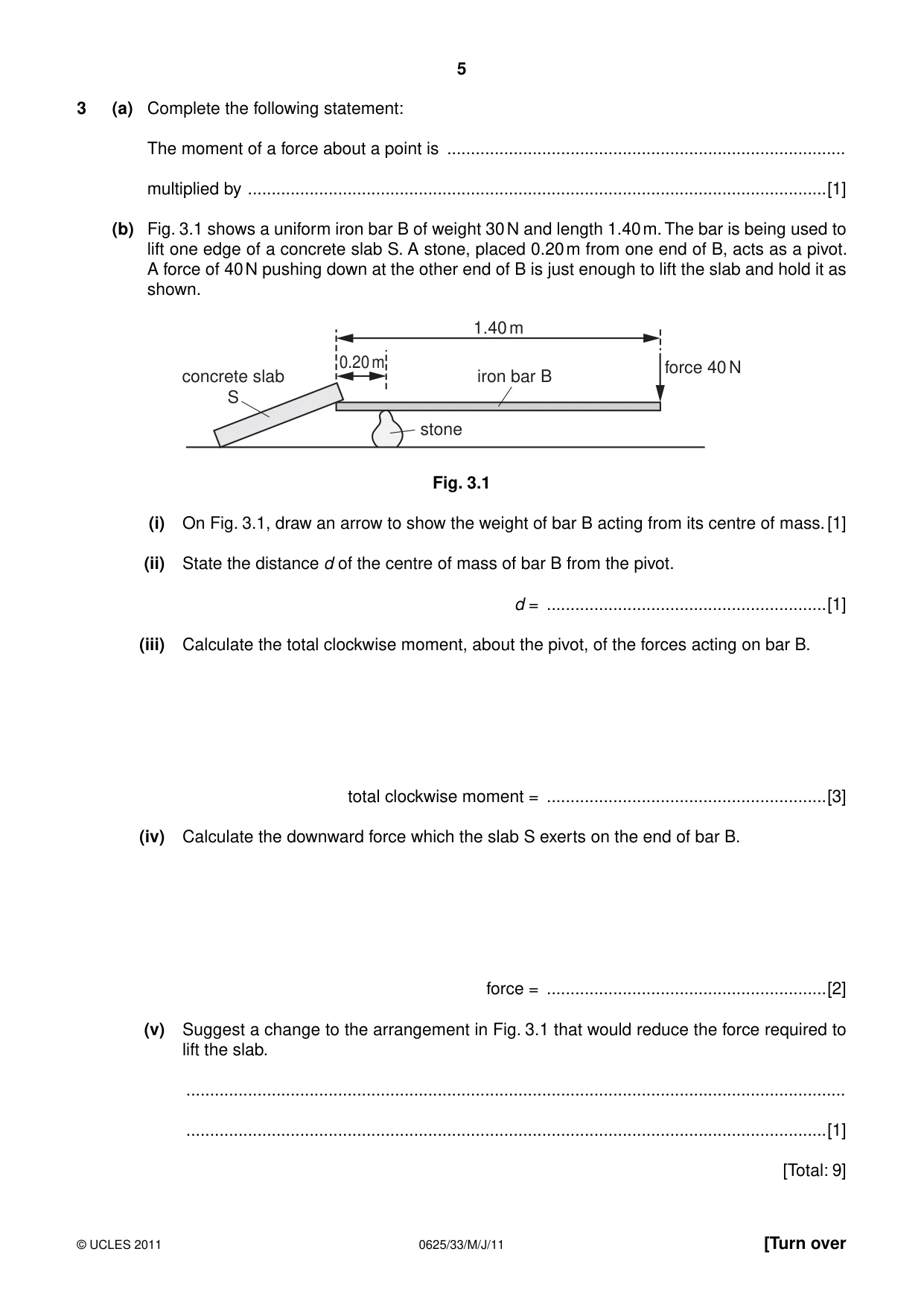
3 (a) Complete the following statement: The moment of a force about a point is .................................................................................... multiplied by ..........................................................................................................................[1] (b) Fig. 3.1 shows a uniform iron bar B of weight 30 N and length 1.40 m. The bar is being used to lift one edge of a concrete slab S. A stone, placed 0.20 m from one end of B, acts as a pivot. A force of 40 N pushing down at the other end of B is just enough to lift the slab and hold it as shown. 1.40 m 0.20 m force 40 N concrete slab iron bar B S stone Fig. 3.1 (i) On Fig. 3.1, draw an arrow to show the weight of bar B acting from its centre of mass. [1] (ii) State the distance d of the centre of mass of bar B from the pivot. d = ...........................................................[1] (iii) Calculate the total clockwise moment, about the pivot, of the forces acting on bar B. total clockwise moment = ...........................................................[3] (iv) Calculate the downward force which the slab S exerts on the end of bar B. force = ...........................................................[2] (v) Suggest a change to the arrangement in Fig. 3.1 that would reduce the force required to lift the slab. ........................................................................................................................................... .......................................................................................................................................[1] [Total: 9]
Mark scheme: 3 (a) force AND perpendicular distance (of force) from the point. B1 (b) (i) downward arrow at centre of bar B1 (ii) 0.5(0) m / 50 cm B1 (iii) 40 × 1.2 OR 48 seen anywhere C1 (+) 30 × 0.5 0R 15 seen anywhere C1 = 63 N m A1 (iv) F × 0.2 = 63 C1 F = 63/0.2 = 315 N A1 (v) make bar / B longer OR move pivot / stone to the left OR increase distance between force and pivot (by moving pivot to left) OR increase mass of the bar / B B1 [9] IGCSE – May/June 2011 0625 33
Q4 · Use the information in the table when answering this question
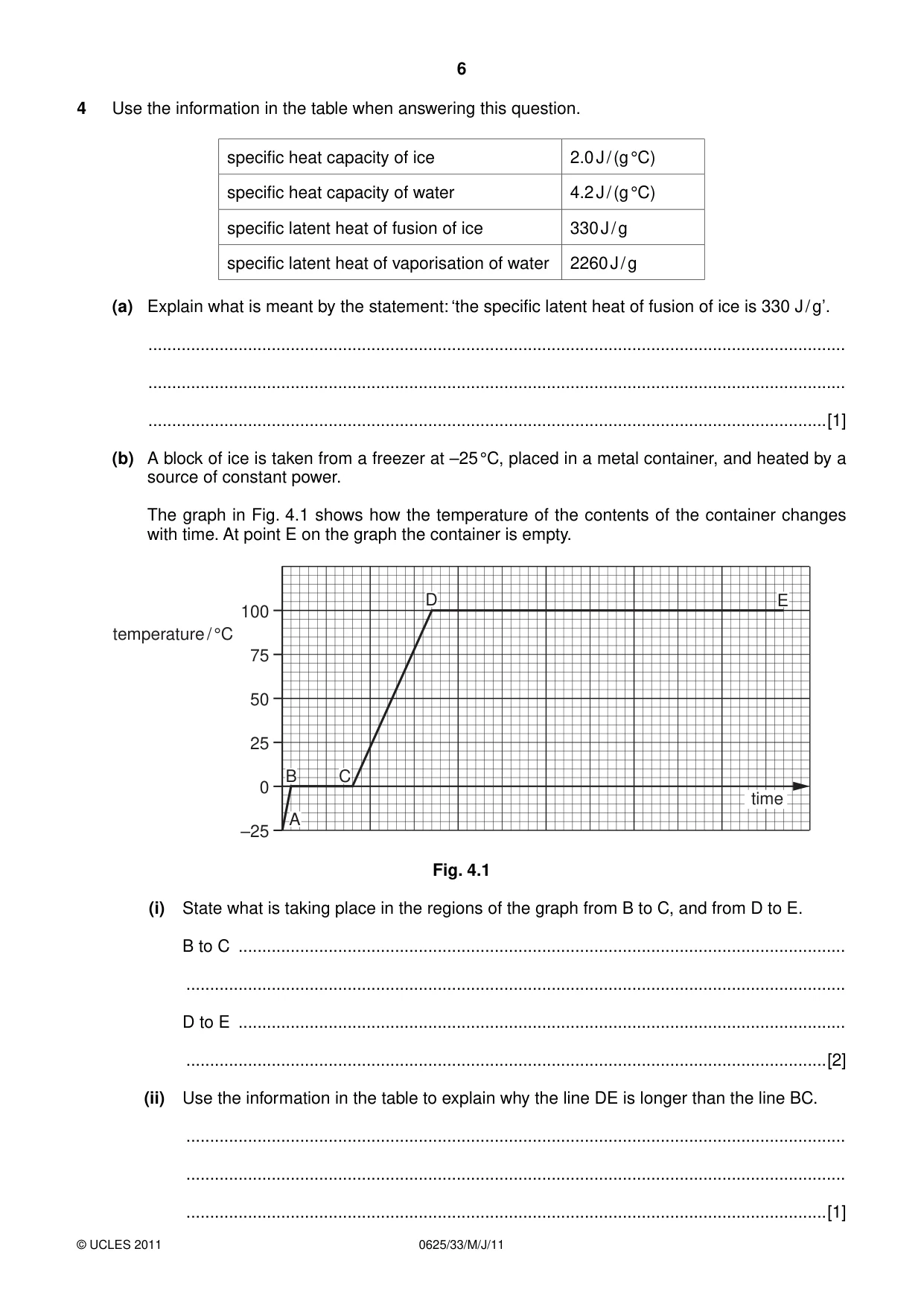
4 Use the information in the table when answering this question. specific heat capacity of ice 2.0 J / (g °C) specific heat capacity of water 4.2 J / (g °C) specific latent heat of fusion of ice 330 J / g specific latent heat of vaporisation of water 2260 J / g (a) Explain what is meant by the statement: ‘the specific latent heat of fusion of ice is 330 J / g’. ................................................................................................................................................... ................................................................................................................................................... ...............................................................................................................................................[1] (b) A block of ice is taken from a freezer at –25 °C, placed in a metal container, and heated by a source of constant power. The graph in Fig. 4.1 shows how the temperature of the contents of the container changes with time. At point E on the graph the container is empty. D E 100 temperature / °C 75 50 25 B C 0 time A –25 Fig. 4.1 (i) State what is taking place in the regions of the graph from B to C, and from D to E. B to C ................................................................................................................................ ........................................................................................................................................... D to E ................................................................................................................................ .......................................................................................................................................[2] (ii) Use the information in the table to explain why the line DE is longer than the line BC. ........................................................................................................................................... ........................................................................................................................................... .......................................................................................................................................[1] (iii) Use the information in the table to explain why the graph is steeper from A to B than from C to D. ........................................................................................................................................... ........................................................................................................................................... .......................................................................................................................................[2] [Total: 6]
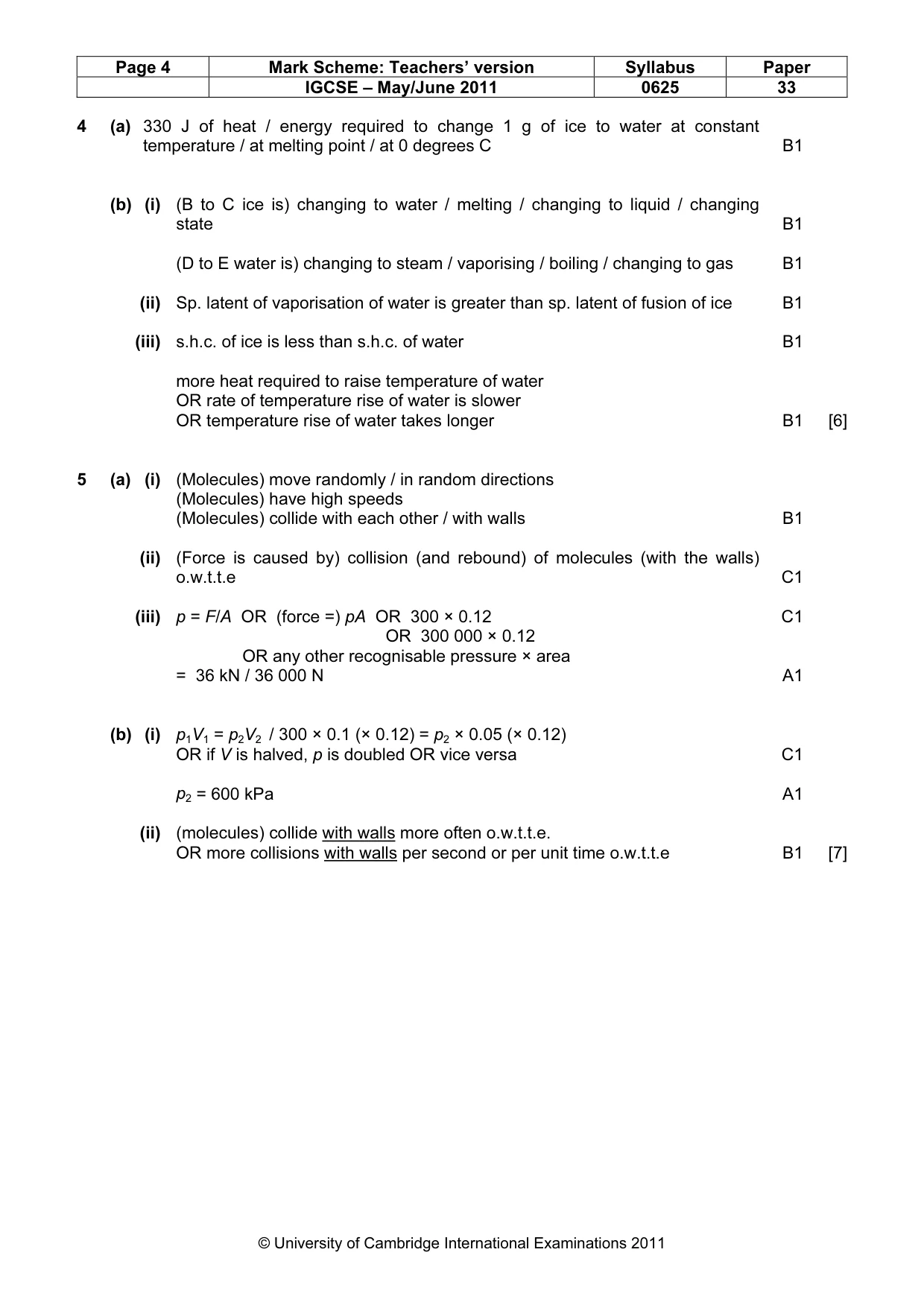
Mark scheme: 4 (a) 330 J of heat / energy required to change 1 g of ice to water at constant temperature / at melting point / at 0 degrees C B1 (b) (i) (B to C ice is) changing to water / melting / changing to liquid / changing state B1 (D to E water is) changing to steam / vaporising / boiling / changing to gas B1 (ii) Sp. latent of vaporisation of water is greater than sp. latent of fusion of ice B1 (iii) s.h.c. of ice is less than s.h.c. of water B1 more heat required to raise temperature of water OR rate of temperature rise of water is slower OR temperature rise of water takes longer B1 [6]
Q5 · A gas contained in a cylinder enclosed by a piston
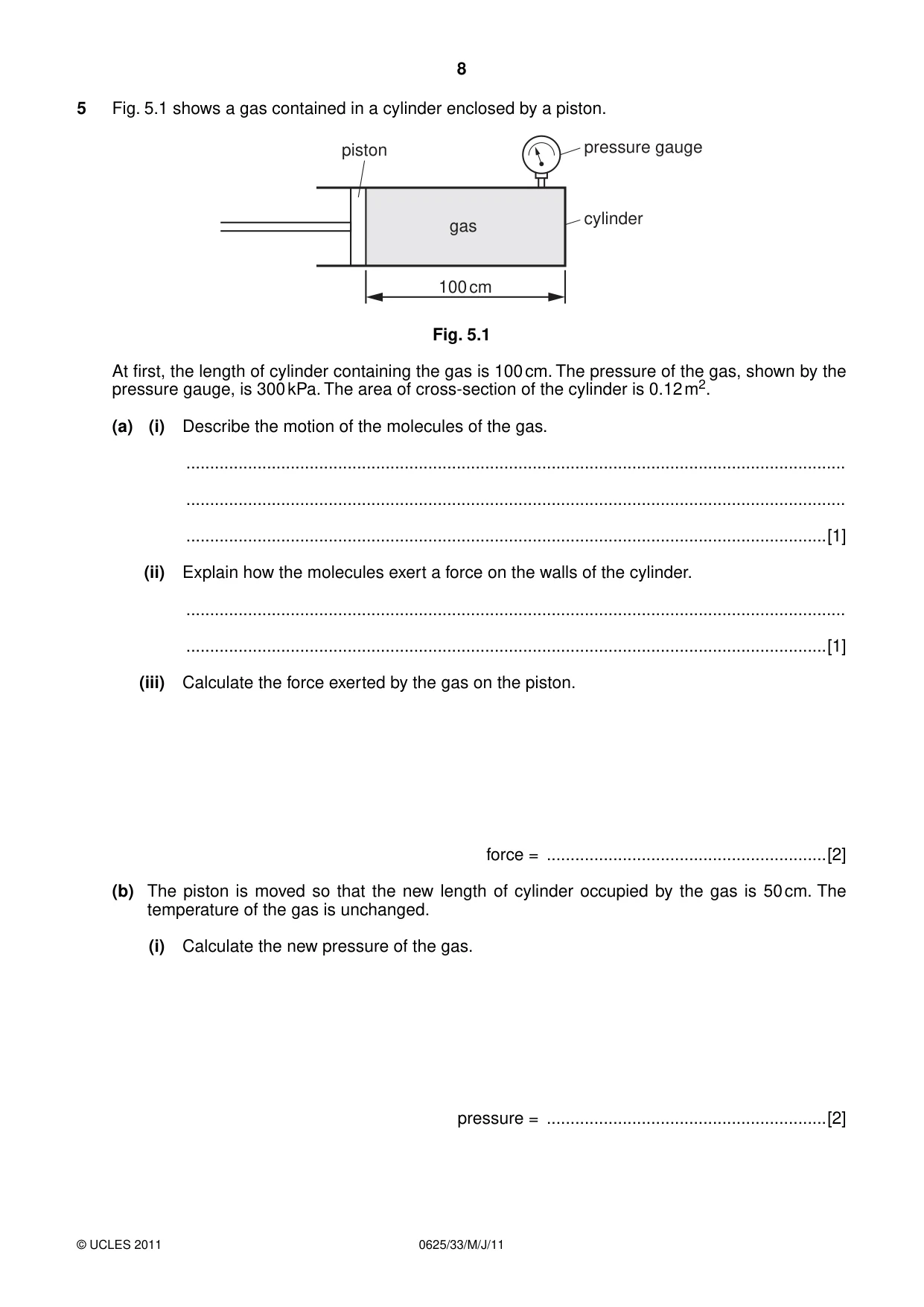
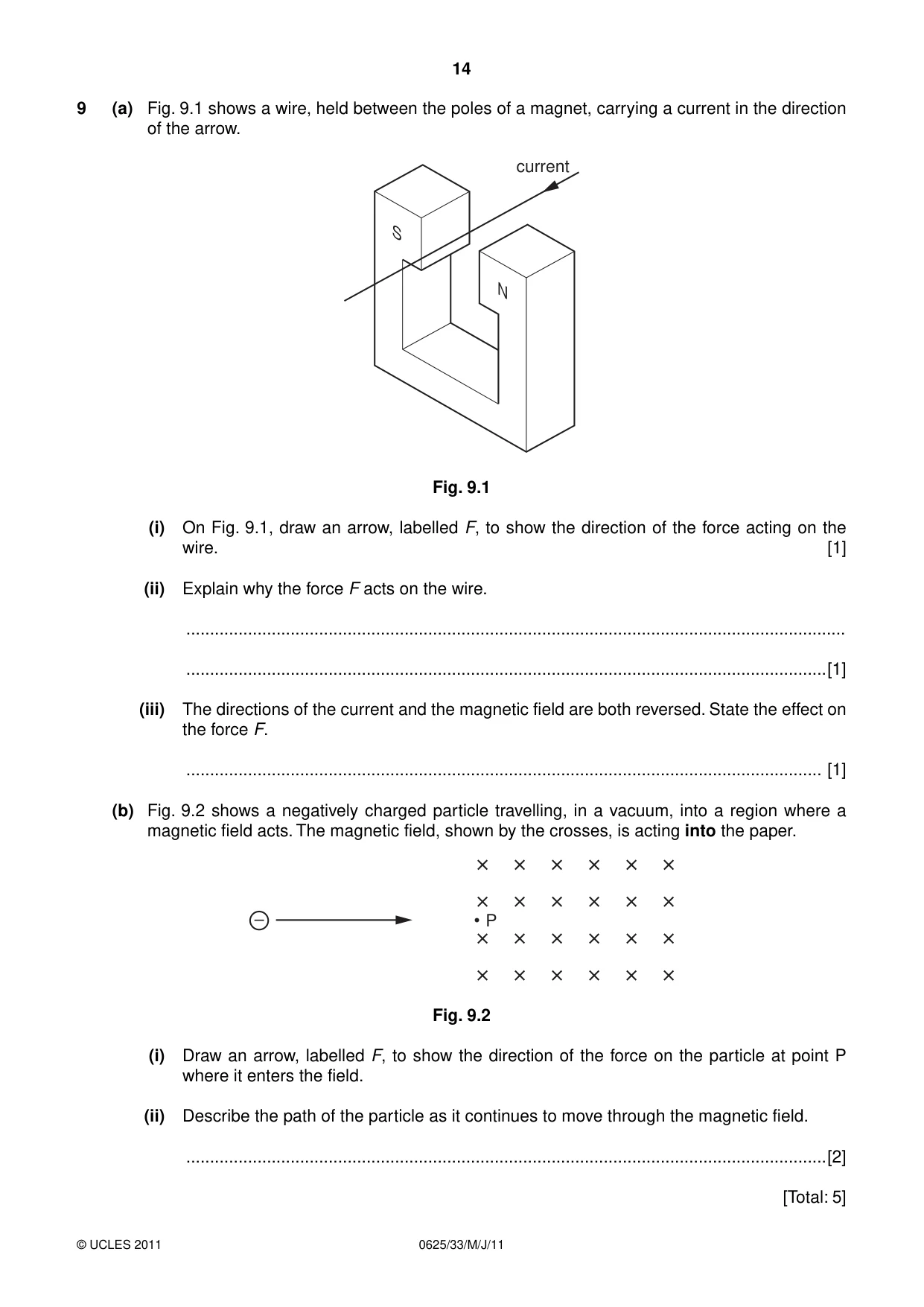
5 Fig. 5.1 shows a gas contained in a cylinder enclosed by a piston. piston pressure gauge cylinder gas 100 cm Fig. 5.1 At first, the length of cylinder containing the gas is 100 cm. The pressure of the gas, shown by the pressure gauge, is 300 kPa. The area of cross-section of the cylinder is 0.12 m2. (a) (i) Describe the motion of the molecules of the gas. ........................................................................................................................................... ........................................................................................................................................... .......................................................................................................................................[1] (ii) Explain how the molecules exert a force on the walls of the cylinder. ........................................................................................................................................... .......................................................................................................................................[1] (iii) Calculate the force exerted by the gas on the piston. force = ...........................................................[2] (b) The piston is moved so that the new length of cylinder occupied by the gas is 50 cm. The temperature of the gas is unchanged. (i) Calculate the new pressure of the gas. pressure = ...........................................................[2] (ii) Explain, in terms of the behaviour of the molecules, why the pressure has changed. ........................................................................................................................................... ........................................................................................................................................... .......................................................................................................................................[1] [Total: 7]
Mark scheme: 5 (a) (i) (Molecules) move randomly / in random directions (Molecules) have high speeds (Molecules) collide with each other / with walls B1 (ii) (Force is caused by) collision (and rebound) of molecules (with the walls) o.w.t.t.e C1 (iii) p = F/A OR (force =) pA OR 300 × 0.12 C1 OR 300 000 × 0.12 OR any other recognisable pressure × area = 36 kN / 36 000 N A1 (b) (i) p1V1 = p2V2 / 300 × 0.1 (× 0.12) = p2 × 0.05 (× 0.12) OR if V is halved, p is doubled OR vice versa C1 p2 = 600 kPa A1 (ii) (molecules) collide with walls more often o.w.t.t.e. OR more collisions with walls per second or per unit time o.w.t.t.e B1 [7] IGCSE – May/June 2011 0625 33
Q6 · A long rope, fixed at one end, is being used by a student to demonstrate transverse waves
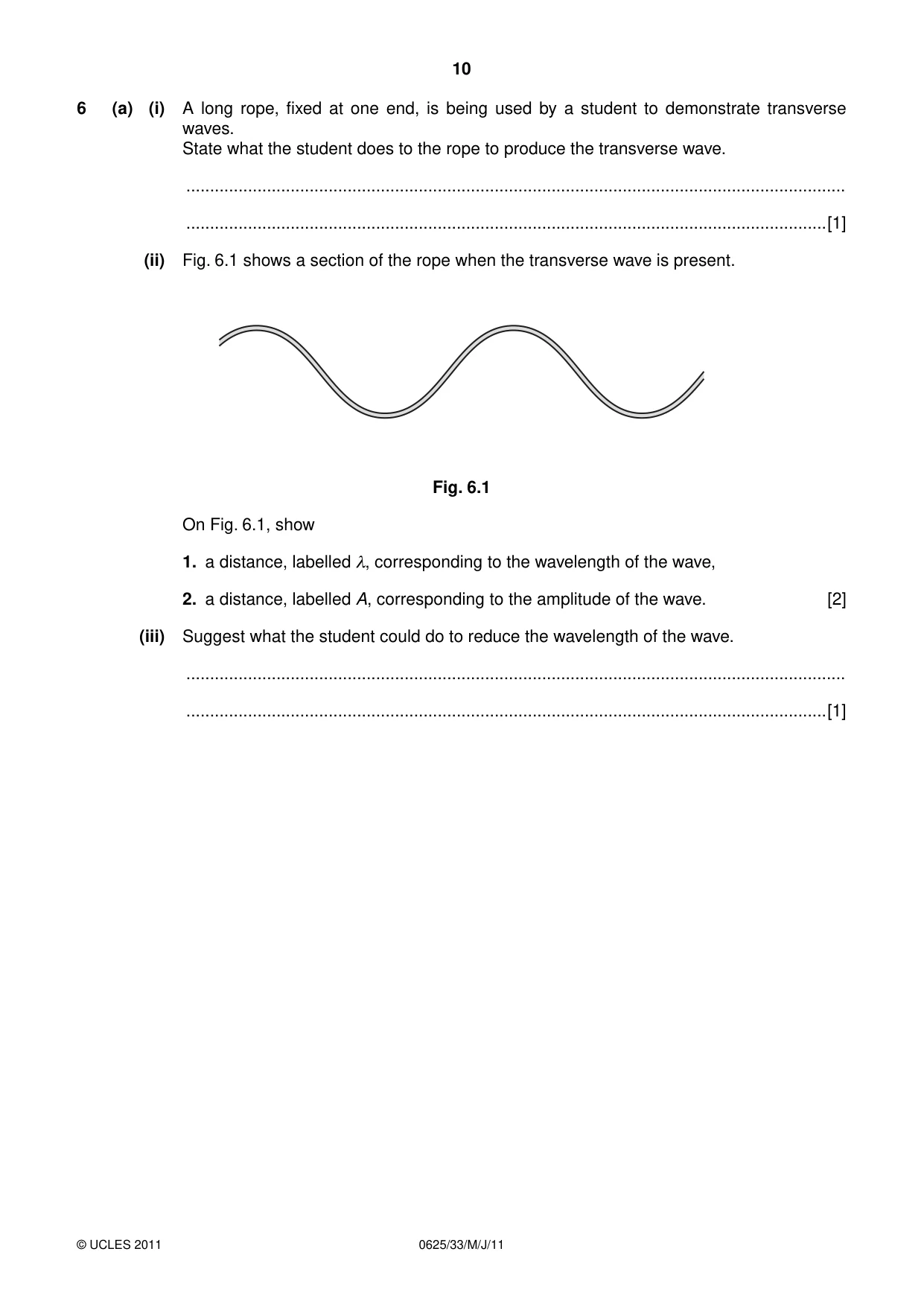
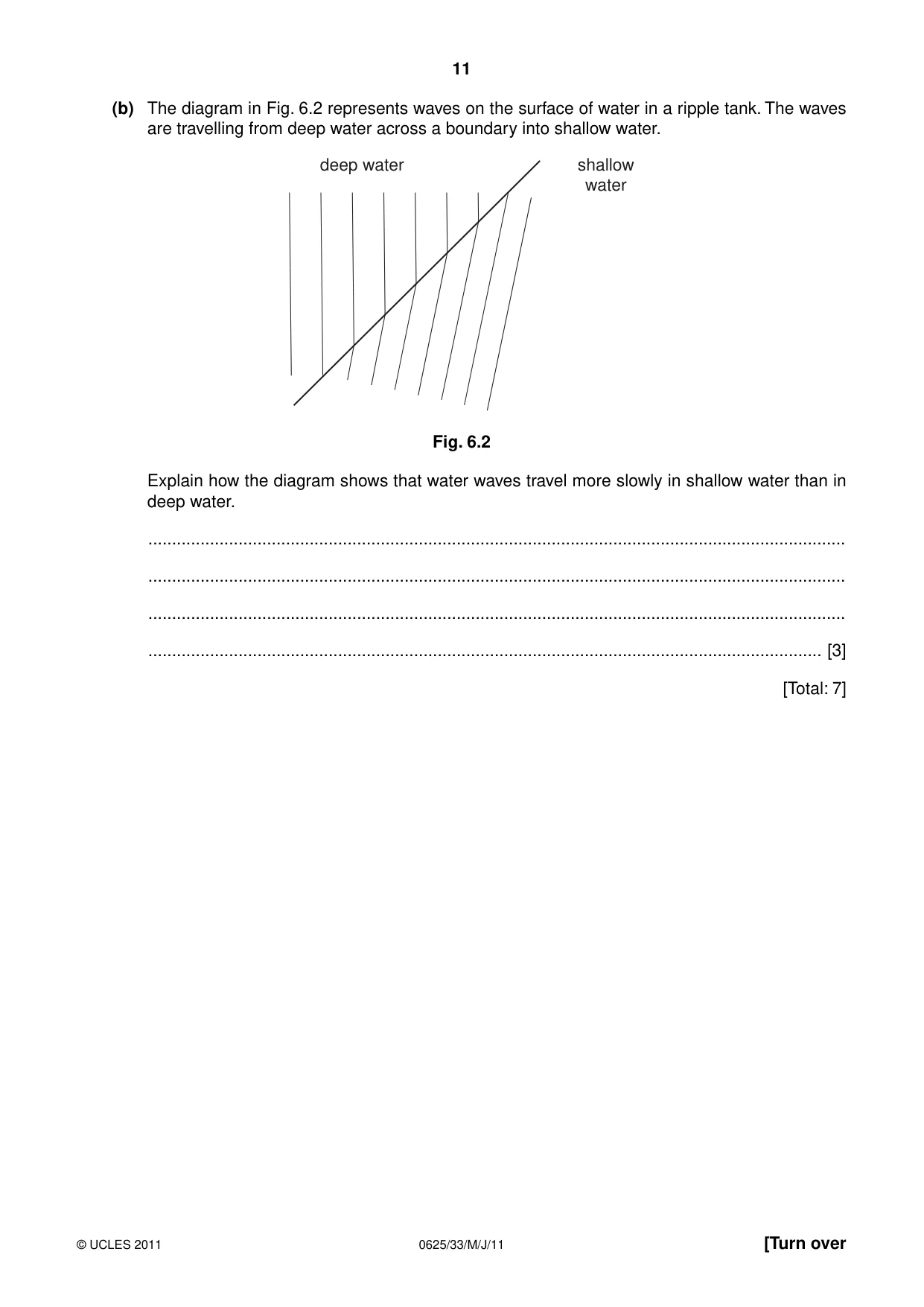
6 (a) (i) A long rope, fixed at one end, is being used by a student to demonstrate transverse waves. State what the student does to the rope to produce the transverse wave. ........................................................................................................................................... .......................................................................................................................................[1] (ii) Fig. 6.1 shows a section of the rope when the transverse wave is present. Fig. 6.1 On Fig. 6.1, show 1. a distance, labelled λ, corresponding to the wavelength of the wave, 2. a distance, labelled A, corresponding to the amplitude of the wave. [2] (iii) Suggest what the student could do to reduce the wavelength of the wave. ........................................................................................................................................... .......................................................................................................................................[1] (b) The diagram in Fig. 6.2 represents waves on the surface of water in a ripple tank. The waves are travelling from deep water across a boundary into shallow water. deep water shallow water Fig. 6.2 Explain how the diagram shows that water waves travel more slowly in shallow water than in deep water. ................................................................................................................................................... ................................................................................................................................................... ................................................................................................................................................... .............................................................................................................................................. [3] [Total: 7]
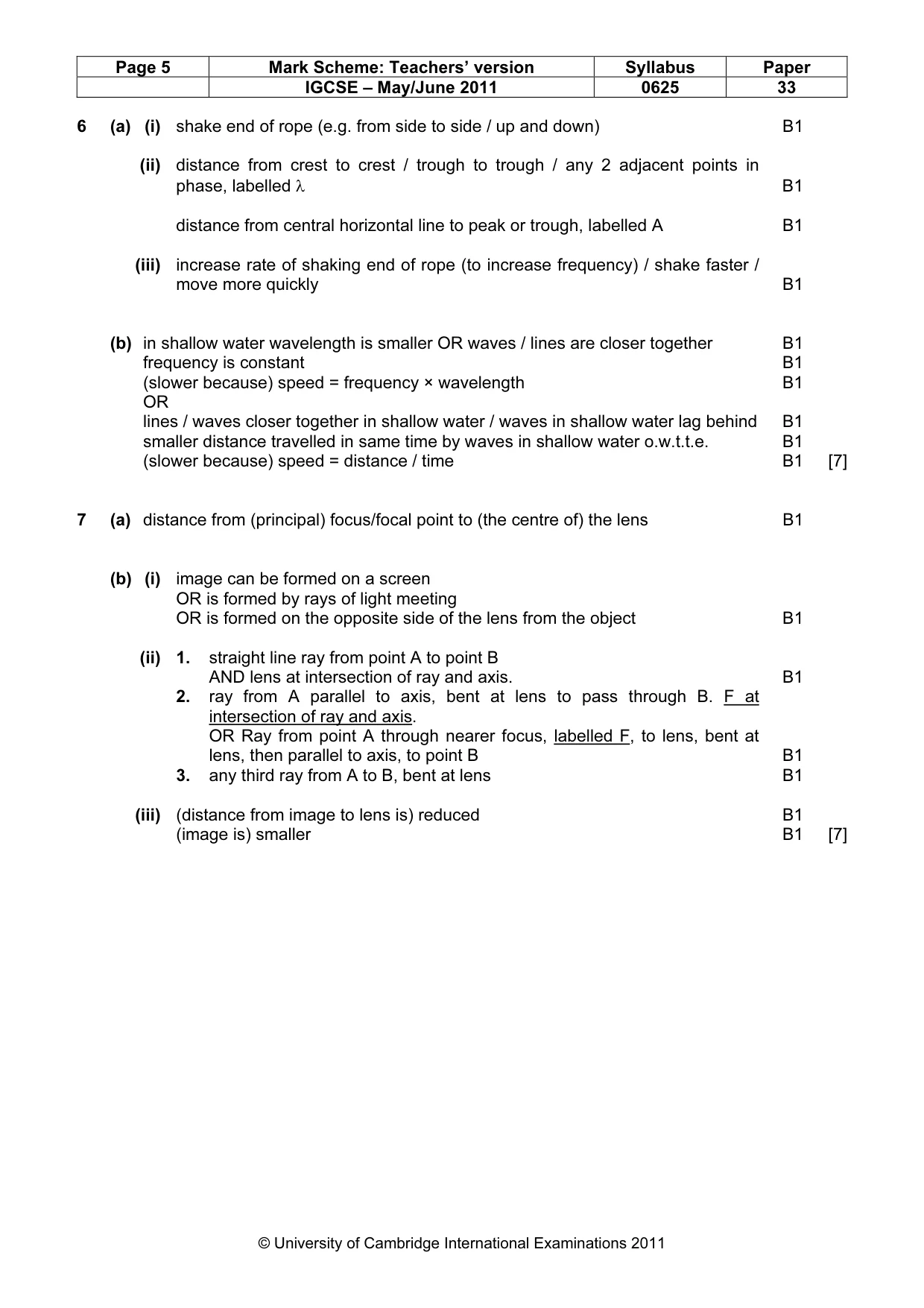
Mark scheme: 6 (a) (i) shake end of rope (e.g. from side to side / up and down) B1 (ii) distance from crest to crest / trough to trough / any 2 adjacent points in phase, labelled λ B1 distance from central horizontal line to peak or trough, labelled A B1 (iii) increase rate of shaking end of rope (to increase frequency) / shake faster / move more quickly B1 (b) in shallow water wavelength is smaller OR waves / lines are closer together B1 frequency is constant B1 (slower because) speed = frequency × wavelength B1 OR lines / waves closer together in shallow water / waves in shallow water lag behind B1 smaller distance travelled in same time by waves in shallow water o.w.t.t.e. B1 (slower because) speed = distance / time B1 [7]
Q7 · What is meant by the focal length of a converging lens?
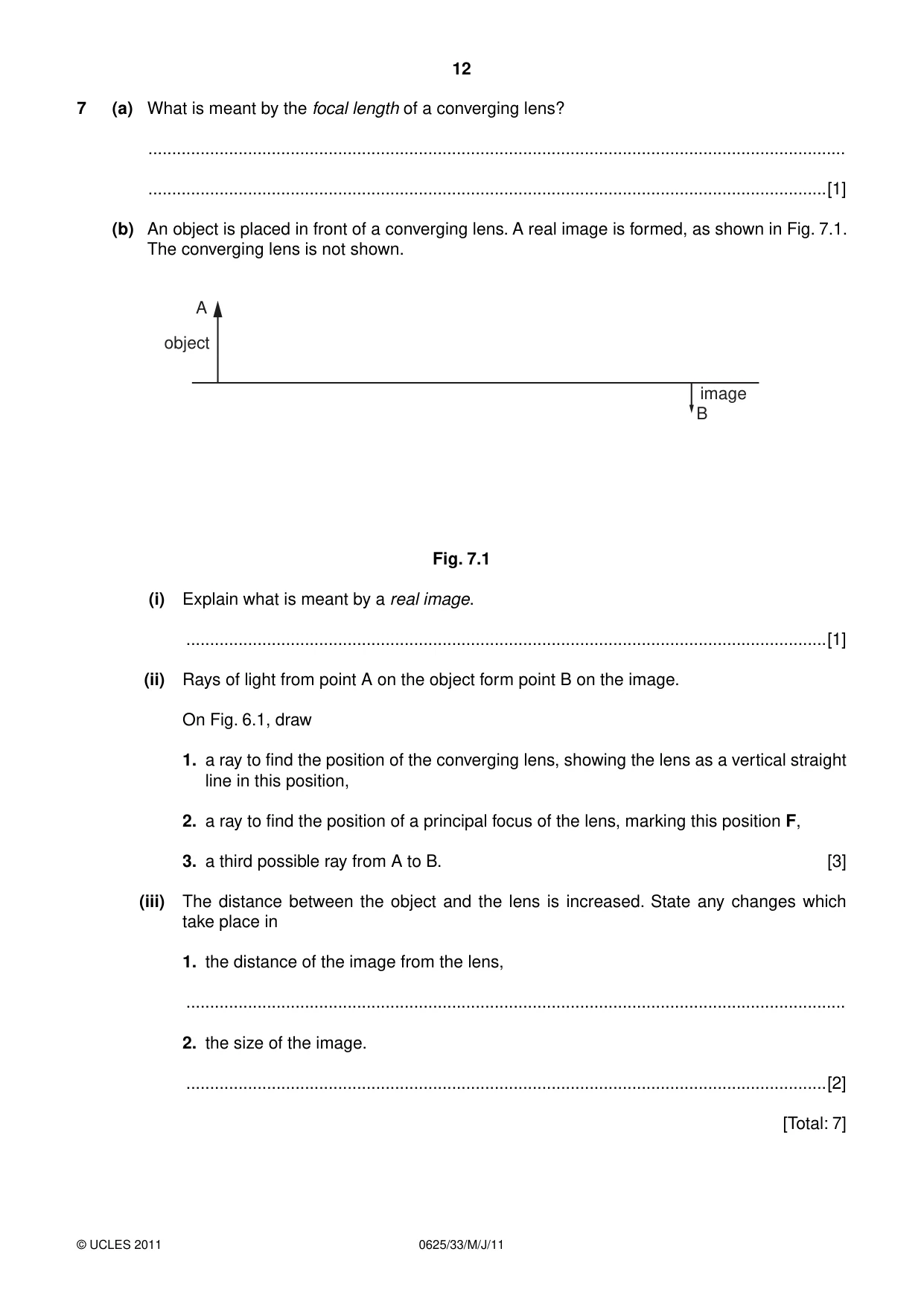
7 (a) What is meant by the focal length of a converging lens? ................................................................................................................................................... ...............................................................................................................................................[1] (b) An object is placed in front of a converging lens. A real image is formed, as shown in Fig. 7.1. The converging lens is not shown. A object image B Fig. 7.1 (i) Explain what is meant by a real image. .......................................................................................................................................[1] (ii) Rays of light from point A on the object form point B on the image. On Fig. 6.1, draw 1. a ray to find the position of the converging lens, showing the lens as a vertical straight line in this position, 2. a ray to find the position of a principal focus of the lens, marking this position F, 3. a third possible ray from A to B. [3] (iii) The distance between the object and the lens is increased. State any changes which take place in 1. the distance of the image from the lens, ........................................................................................................................................... 2. the size of the image. .......................................................................................................................................[2] [Total: 7]
Mark scheme: 7 (a) distance from (principal) focus/focal point to (the centre of) the lens B1 (b) (i) image can be formed on a screen OR is formed by rays of light meeting OR is formed on the opposite side of the lens from the object B1 (ii) 1. straight line ray from point A to point B AND lens at intersection of ray and axis. B1 2. ray from A parallel to axis, bent at lens to pass through B. F at intersection of ray and axis. OR Ray from point A through nearer focus, labelled F, to lens, bent at lens, then parallel to axis, to point B B1 3. any third ray from A to B, bent at lens B1 (iii) (distance from image to lens is) reduced B1 (image is) smaller B1 [7] IGCSE – May/June 2011 0625 33
Q8 · What is meant by the electromotive force (e.m.f.) of an electric power supply?
8 (a) What is meant by the electromotive force (e.m.f.) of an electric power supply? ................................................................................................................................................... ...............................................................................................................................................[2] (b) When connected to a 240 V supply, a desk lamp has a power rating of 60 W. Calculate (i) the current in the lamp, current = ...........................................................[2] (ii) the resistance of the lamp’s filament. resistance = ...........................................................[2] (c) A torch lamp is normally connected to a 3.0 V battery and carries a current of 0.25 A. The resistance of its filament is 12 Ω. The desk lamp in (b) and the torch lamp are connected in series. Students X and Y plan to connect the lamp combination to a 240 V supply. Student X says that the filament of the torch lamp will melt and the circuit will no longer work. Student Y says that both lamps will light up and stay on. Show, with a suitable calculation, whether student X or student Y is correct. ................................................................................................................................................... ...............................................................................................................................................[2] [Total: 8]
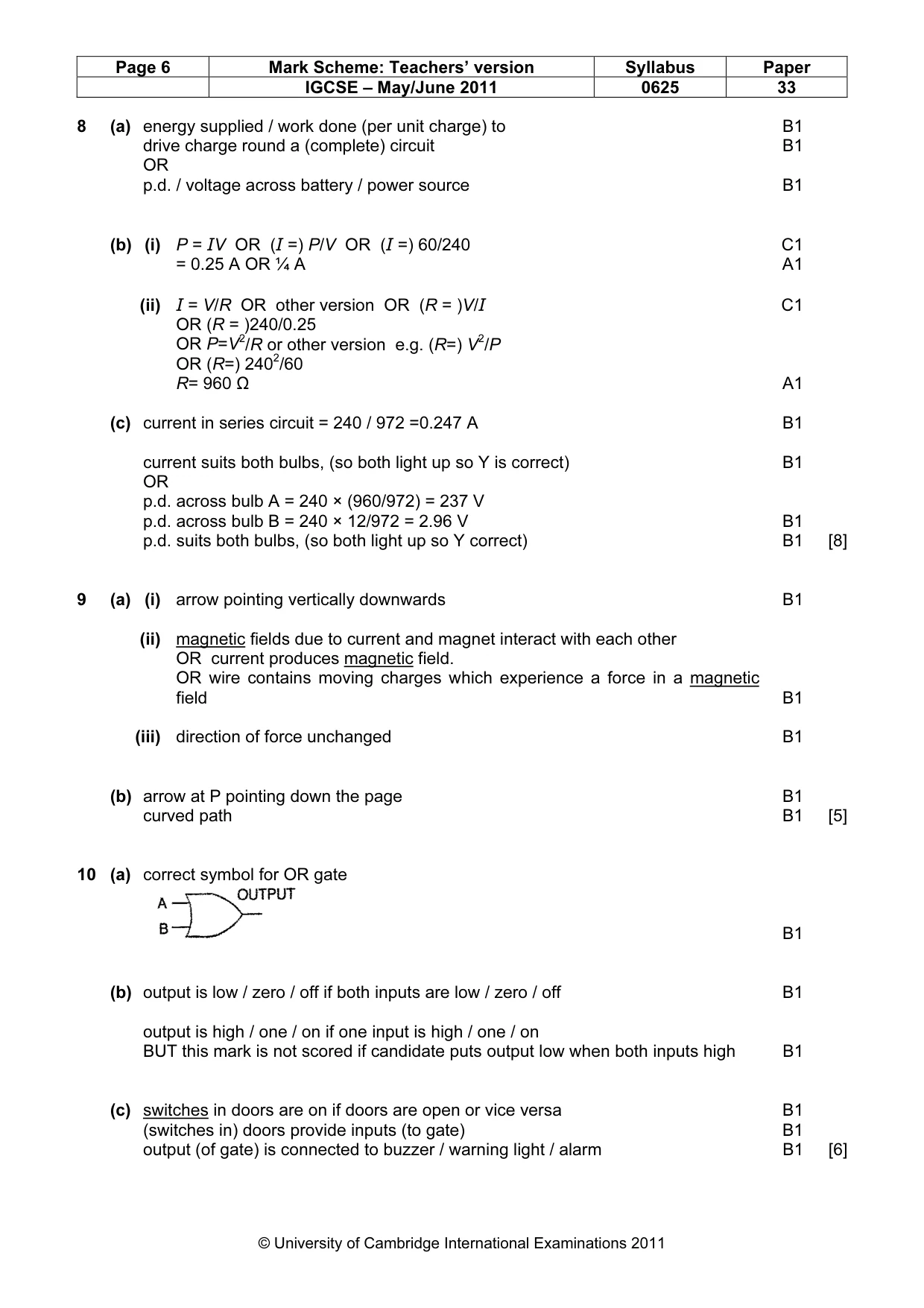
Mark scheme: 8 (a) energy supplied / work done (per unit charge) to B1 drive charge round a (complete) circuit B1 OR p.d. / voltage across battery / power source B1 (b) (i) P = IV OR (I =) P/V OR (I =) 60/240 C1 = 0.25 A OR ¼ A A1 (ii) I = V/R OR other version OR (R = )V/I C1 OR (R = )240/0.25 OR P=V2/R or other version e.g. (R=) V2/P OR (R=) 2402/60 R= 960 Ω A1 (c) current in series circuit = 240 / 972 =0.247 A B1 current suits both bulbs, (so both light up so Y is correct) B1 OR p.d. across bulb A = 240 × (960/972) = 237 V p.d. across bulb B = 240 × 12/972 = 2.96 V B1 p.d. suits both bulbs, (so both light up so Y correct) B1 [8]
Q9 · A wire, held between the poles of a magnet, carrying a current in the direction of the…
9 (a) Fig. 9.1 shows a wire, held between the poles of a magnet, carrying a current in the direction of the arrow. current S N Fig. 9.1 (i) On Fig. 9.1, draw an arrow, labelled F, to show the direction of the force acting on the wire. [1] (ii) Explain why the force F acts on the wire. ........................................................................................................................................... .......................................................................................................................................[1] (iii) The directions of the current and the magnetic field are both reversed. State the effect on the force F. ...................................................................................................................................... [1] (b) Fig. 9.2 shows a negatively charged particle travelling, in a vacuum, into a region where a magnetic field acts. The magnetic field, shown by the crosses, is acting into the paper. – P Fig. 9.2 (i) Draw an arrow, labelled F, to show the direction of the force on the particle at point P where it enters the field. (ii) Describe the path of the particle as it continues to move through the magnetic field. .......................................................................................................................................[2] [Total: 5]
Mark scheme: 9 (a) (i) arrow pointing vertically downwards B1 (ii) magnetic fields due to current and magnet interact with each other OR current produces magnetic field. OR wire contains moving charges which experience a force in a magnetic field B1 (iii) direction of force unchanged B1 (b) arrow at P pointing down the page B1 curved path B1 [5]
Q10 · In the space below, draw the symbol for an OR gate
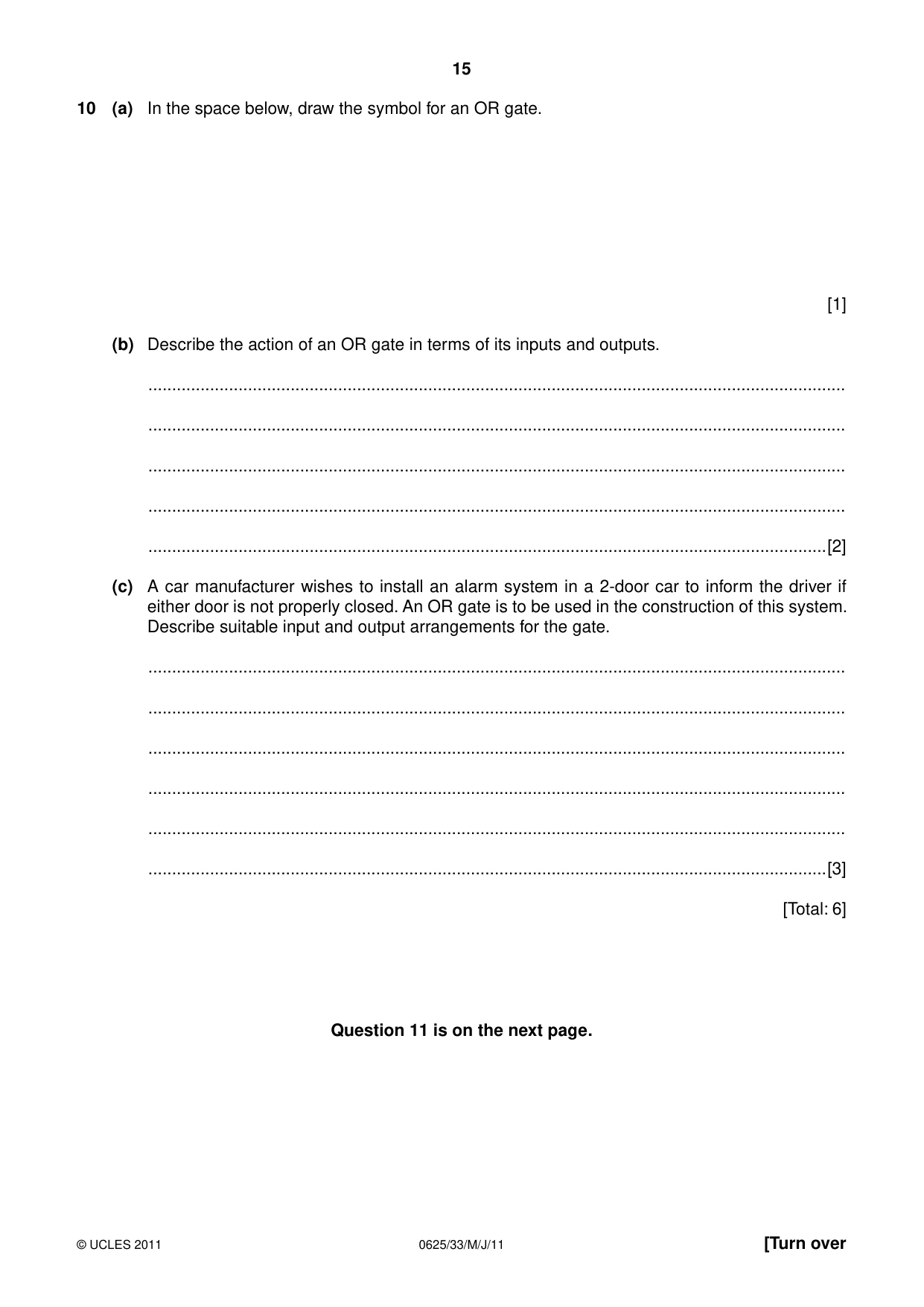
10 (a) In the space below, draw the symbol for an OR gate. [1] (b) Describe the action of an OR gate in terms of its inputs and outputs. ................................................................................................................................................... ................................................................................................................................................... ................................................................................................................................................... ................................................................................................................................................... ...............................................................................................................................................[2] (c) A car manufacturer wishes to install an alarm system in a 2-door car to inform the driver if either door is not properly closed. An OR gate is to be used in the construction of this system. Describe suitable input and output arrangements for the gate. ................................................................................................................................................... ................................................................................................................................................... ................................................................................................................................................... ................................................................................................................................................... ................................................................................................................................................... ...............................................................................................................................................[3] [Total: 6] Question 11 is on the next page.
Mark scheme: 10 (a) correct symbol for OR gate B1 (b) output is low / zero / off if both inputs are low / zero / off B1 output is high / one / on if one input is high / one / on BUT this mark is not scored if candidate puts output low when both inputs high B1 (c) switches in doors are on if doors are open or vice versa B1 (switches in) doors provide inputs (to gate) B1 output (of gate) is connected to buzzer / warning light / alarm B1 [6] IGCSE – May/June 2011 0625 33
Q11 · An atom consists of a nucleus made up of protons and neutrons, surrounded by orbiting…
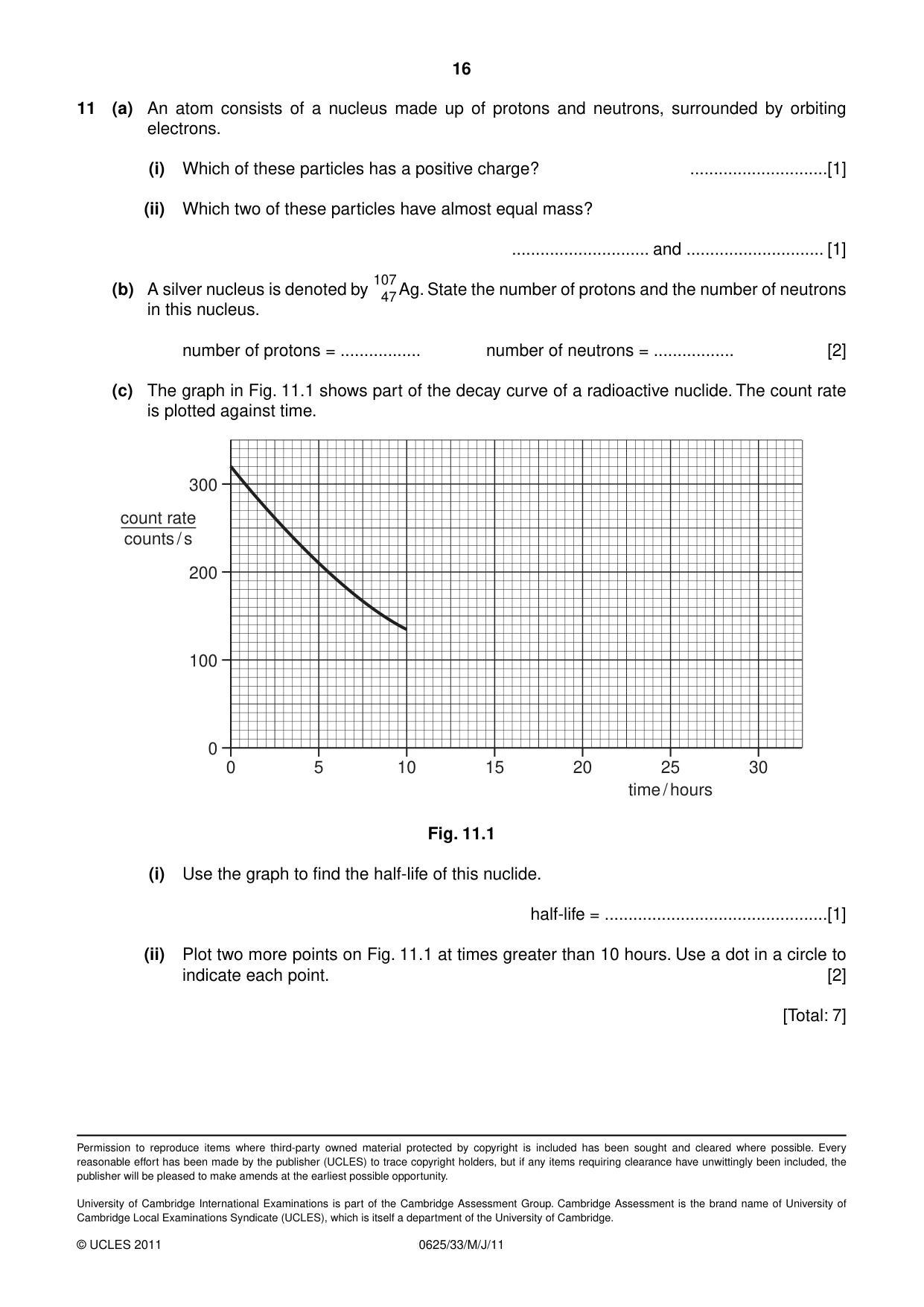
11 (a) An atom consists of a nucleus made up of protons and neutrons, surrounded by orbiting electrons. (i) Which of these particles has a positive charge? .............................[1] (ii) Which two of these particles have almost equal mass? ............................. and ............................. [1] 107 (b) A silver nucleus is denoted by Ag. State the number of protons and the number of neutrons 47 in this nucleus. number of protons = ................. number of neutrons = ................. [2] (c) The graph in Fig. 11.1 shows part of the decay curve of a radioactive nuclide. The count rate is plotted against time. 300 count rate counts / s 200 100 0 0 5 10 15 20 25 30 time / hours Fig. 11.1 (i) Use the graph to find the half-life of this nuclide. half-life = ...............................................[1] (ii) Plot two more points on Fig. 11.1 at times greater than 10 hours. Use a dot in a circle to indicate each point. [2] [Total: 7]
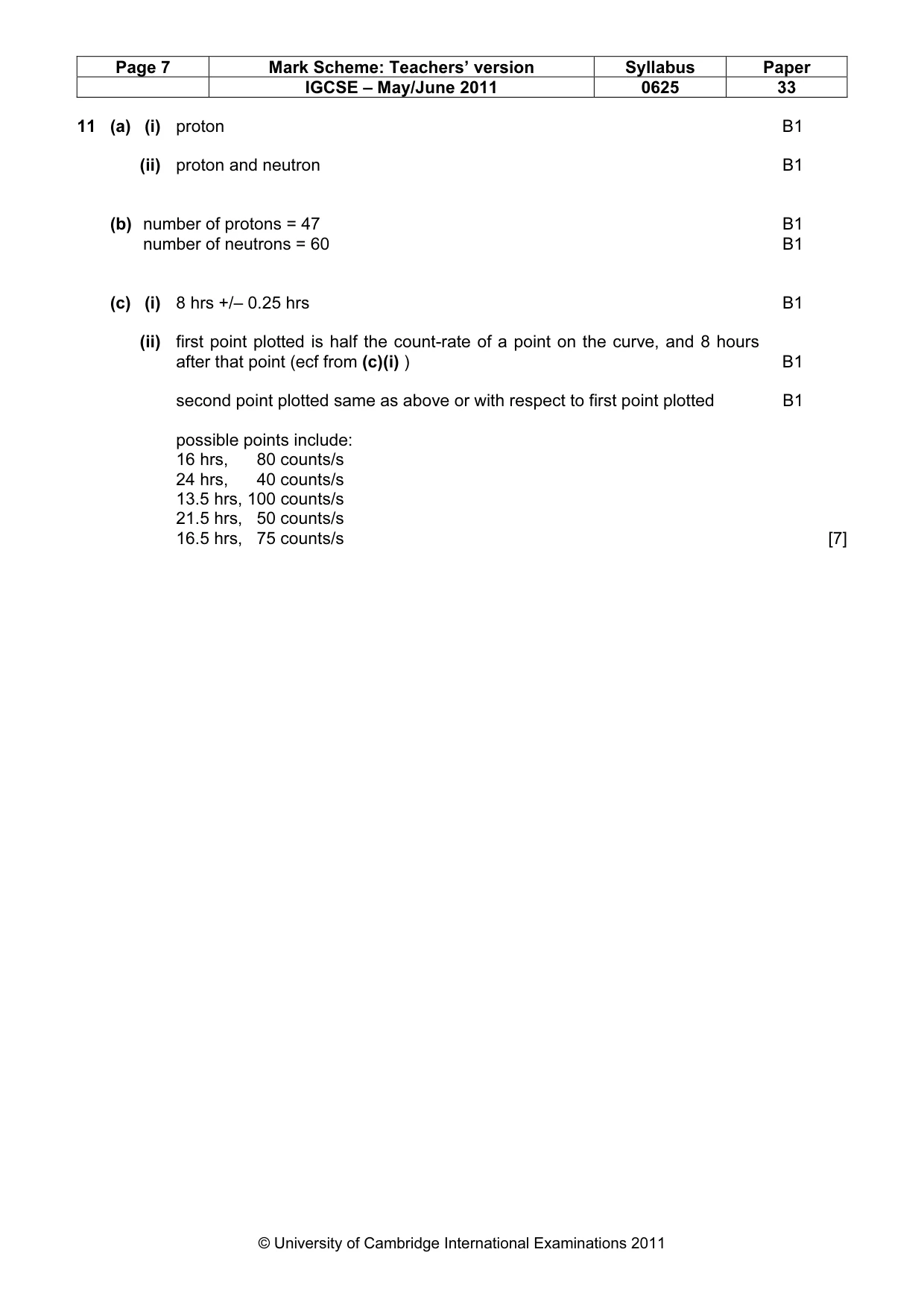
Mark scheme: 11 (a) (i) proton B1 (ii) proton and neutron B1 (b) number of protons = 47 B1 number of neutrons = 60 B1 (c) (i) 8 hrs +/– 0.25 hrs B1 (ii) first point plotted is half the count-rate of a point on the curve, and 8 hours after that point (ecf from (c)(i) ) B1 second point plotted same as above or with respect to first point plotted B1 possible points include: 16 hrs, 80 counts/s 24 hrs, 40 counts/s 13.5 hrs, 100 counts/s 21.5 hrs, 50 counts/s 16.5 hrs, 75 counts/s [7]
What was in this paper
The subtopics covered by these 11 questions, and how many questions each got. Open one in a new tab to see every Cambridge question on it.
What you needed in this session
Cambridge’s own grade thresholds for 2011 May/June, Paper 3 · Variant 3. A higher threshold means an easier paper — the bar moves with how the cohort did.