Cambridge IGCSE Physics 0625 — 2024 Oct/Nov Paper 3 · Variant 3
0625/33/O/N/24 · 11 questions · 80 marks · ≈90 min
The question paper and its mark scheme, free to read here and free to download. This is Cambridge’s own paper, exactly as it was sat.
Question paper16 pages
Mark scheme14 pages
Answers below. Sit the paper first if you are practising.
Questions as text
Q1 · The speed–time graph for a cyclist at the beginning of a race
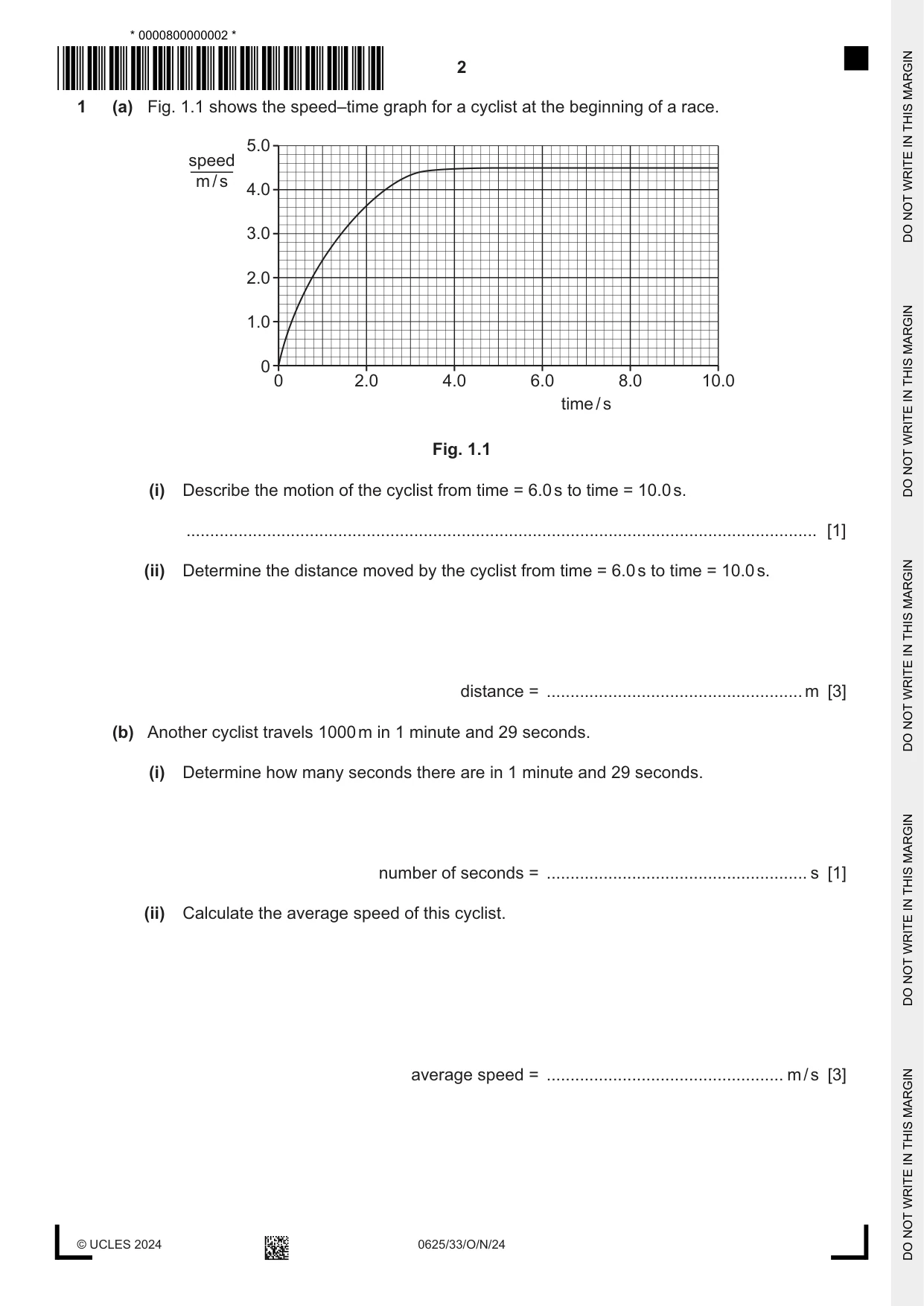
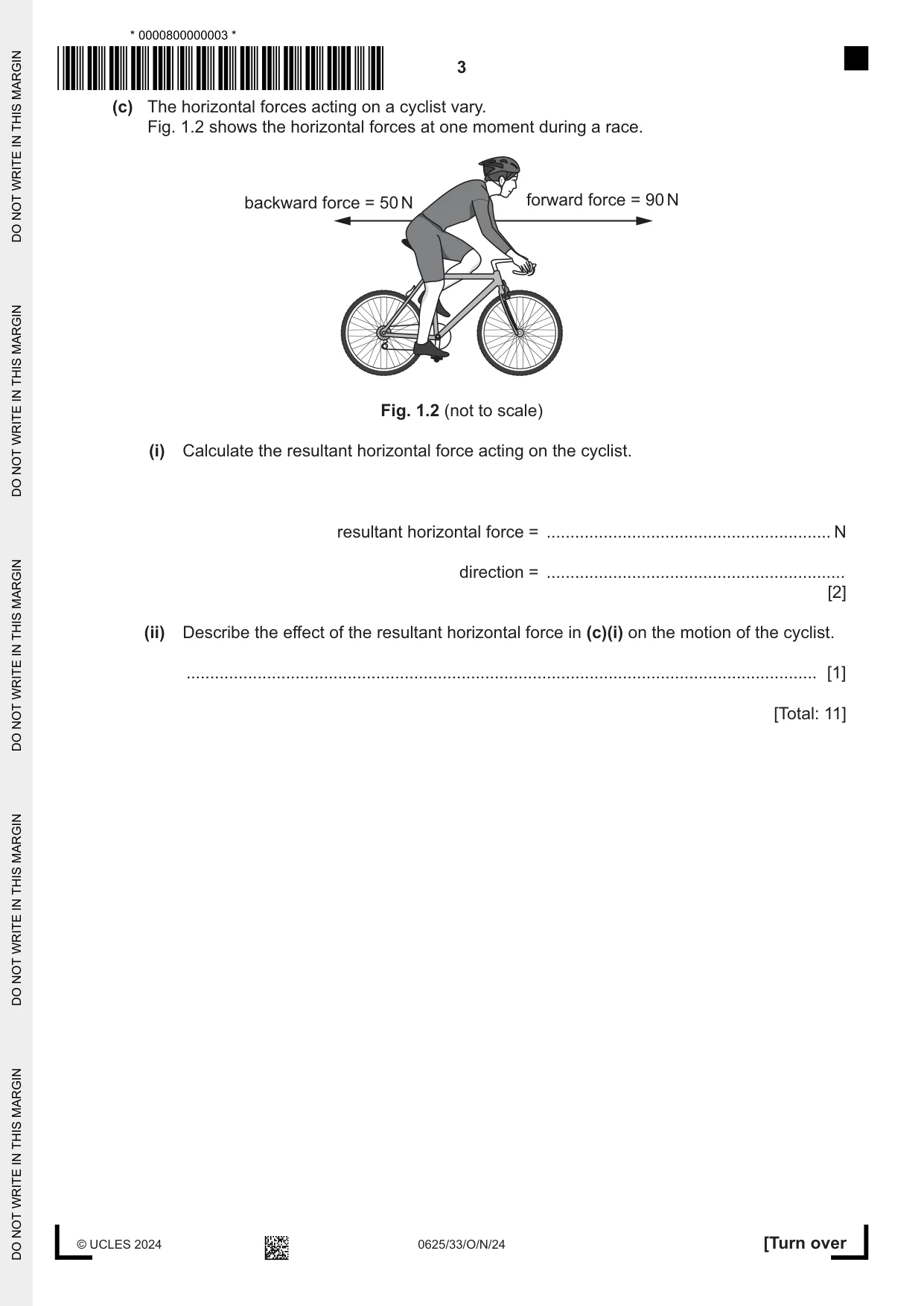
1 (a) Fig. 1.1 shows the speed–time graph for a cyclist at the beginning of a race. 5.0 speed m / s 4.0 3.0 2.0 1.0 0 0 2.0 4.0 6.0 8.0 10.0 time / s Fig. 1.1 (i) Describe the motion of the cyclist from time = 6.0 s to time = 10.0 s. ..................................................................................................................................... [1] (ii) Determine the distance moved by the cyclist from time = 6.0 s to time = 10.0 s. distance = ......................................................m [3] (b) Another cyclist travels 1000 m in 1 minute and 29 seconds. (i) Determine how many seconds there are in 1 minute and 29 seconds. number of seconds = ....................................................... s [1] (ii) Calculate the average speed of this cyclist. average speed = .................................................. m / s [3] (c) The horizontal forces acting on a cyclist vary. Fig. 1.2 shows the horizontal forces at one moment during a race. backward force = 50 N forward force = 90 N Fig. 1.2 (not to scale) (i) Calculate the resultant horizontal force acting on the cyclist. resultant horizontal force = ............................................................ N direction = ............................................................... [2] (ii) Describe the effect of the resultant horizontal force in (c)(i) on the motion of the cyclist. ..................................................................................................................................... [1] [Total: 11]
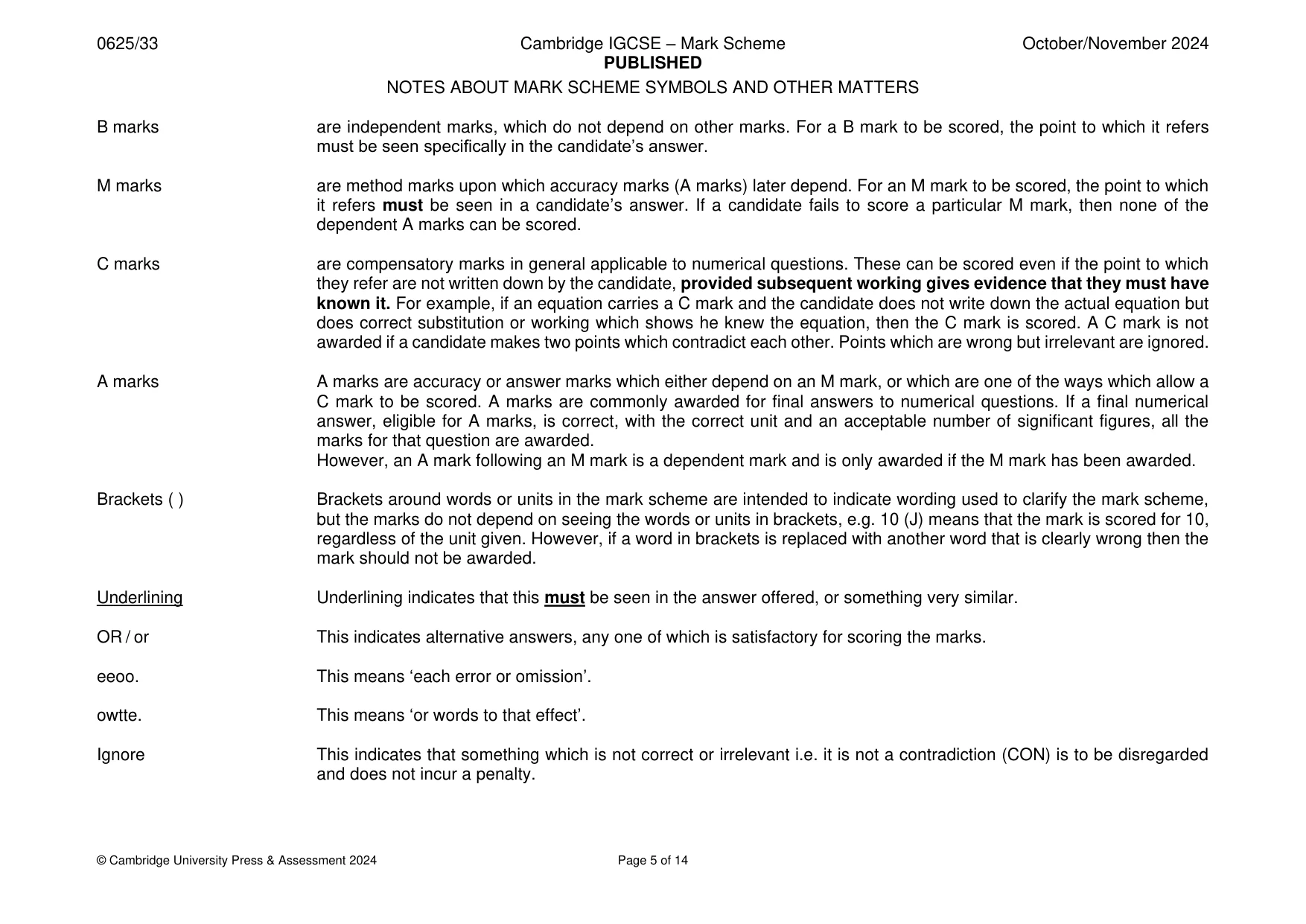
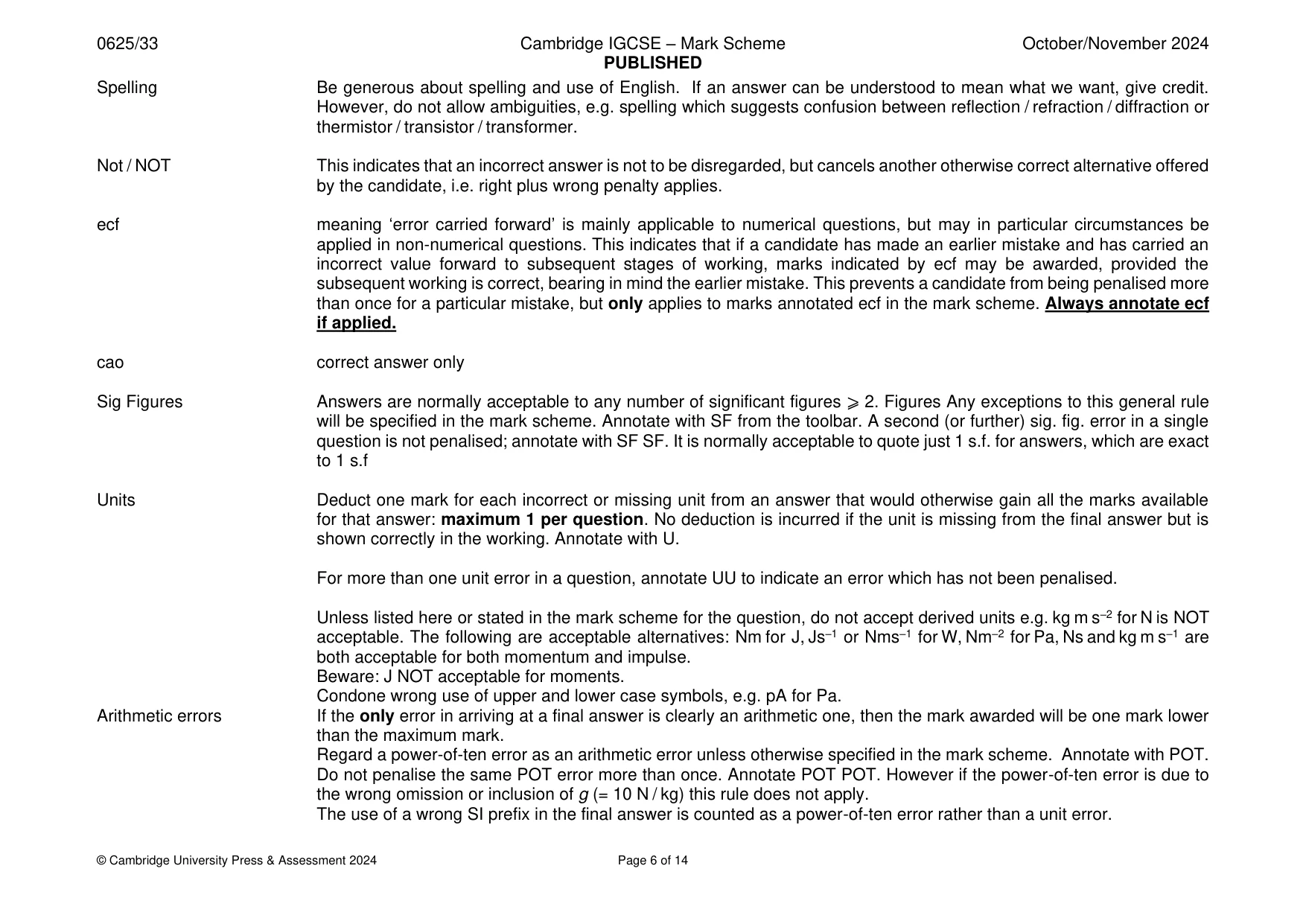
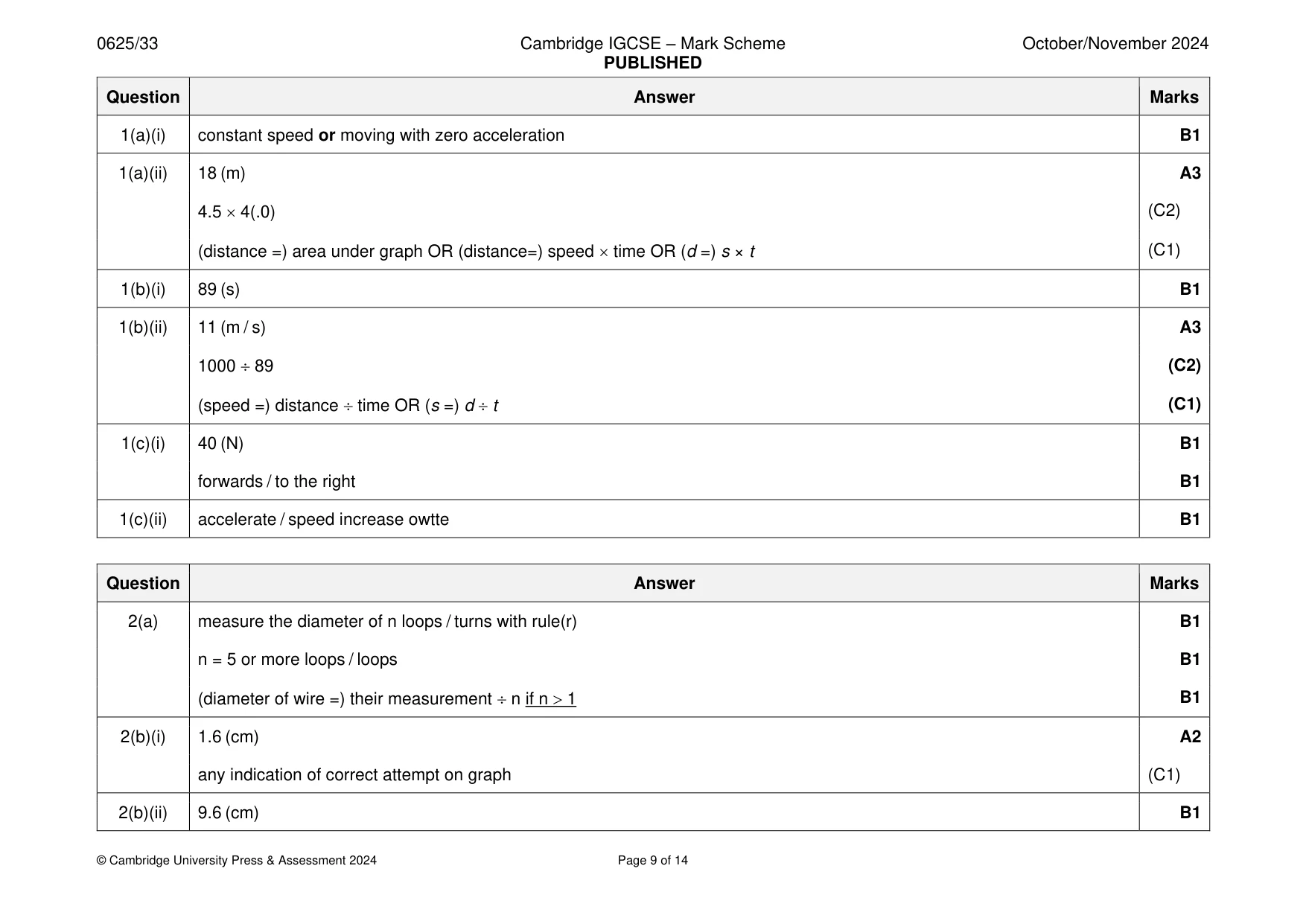
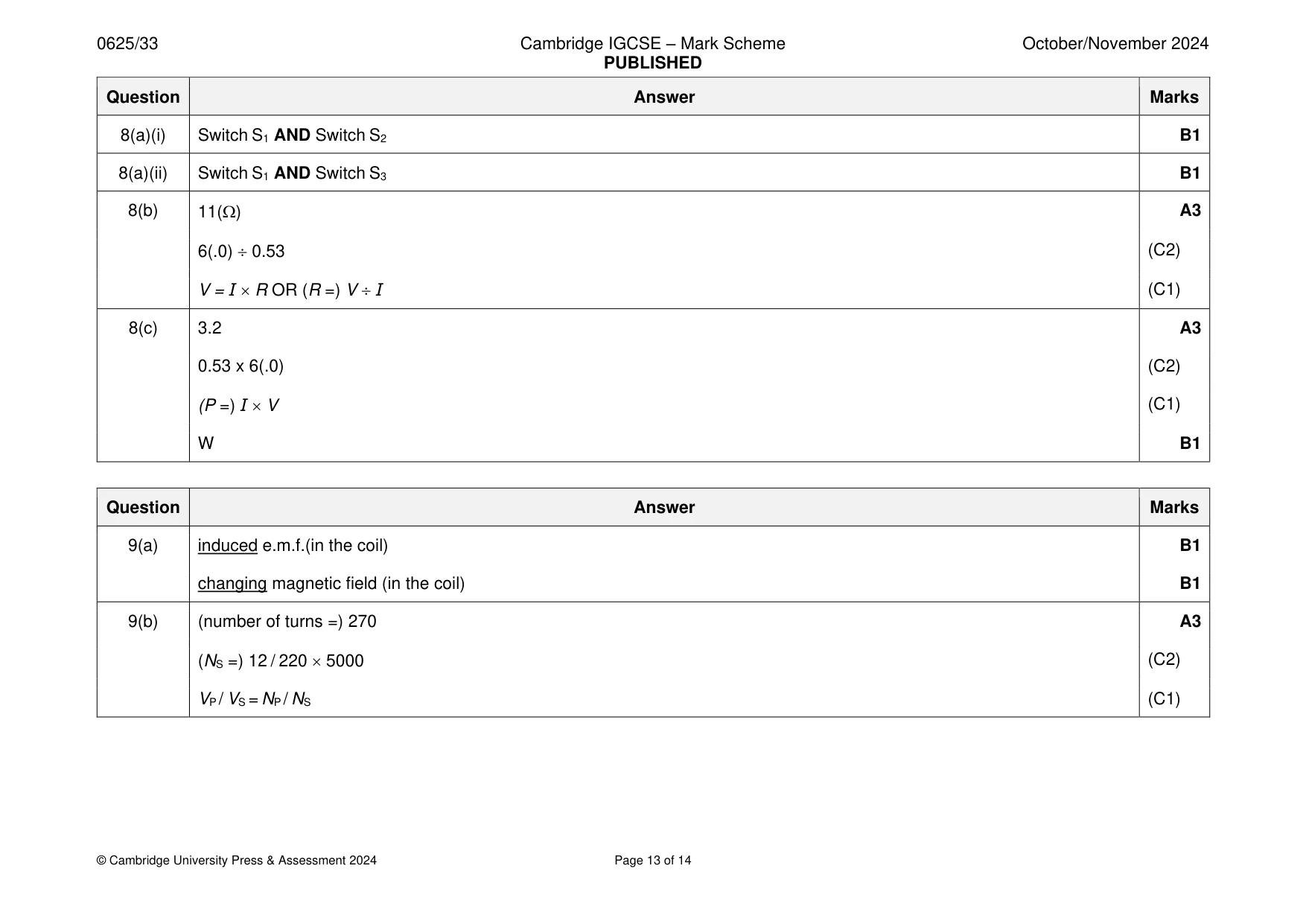
Mark scheme: Question Answer Marks 1(a)(i) constant speed or moving with zero acceleration B1 1(a)(ii) 18 (m) A3 4.5 4(.0) (C2) (distance =) area under graph OR (distance=) speed time OR (d =) s × t (C1) 1(b)(i) 89 (s) B1 1(b)(ii) 11 (m / s) A3 1000 89 (C2) (speed =) distance time OR (s =) d t (C1) 1(c)(i) 40 (N) B1 forwards / to the right B1 1(c)(ii) accelerate / speed increase owtte B1
Q2 · A teacher uses a spring in a demonstration
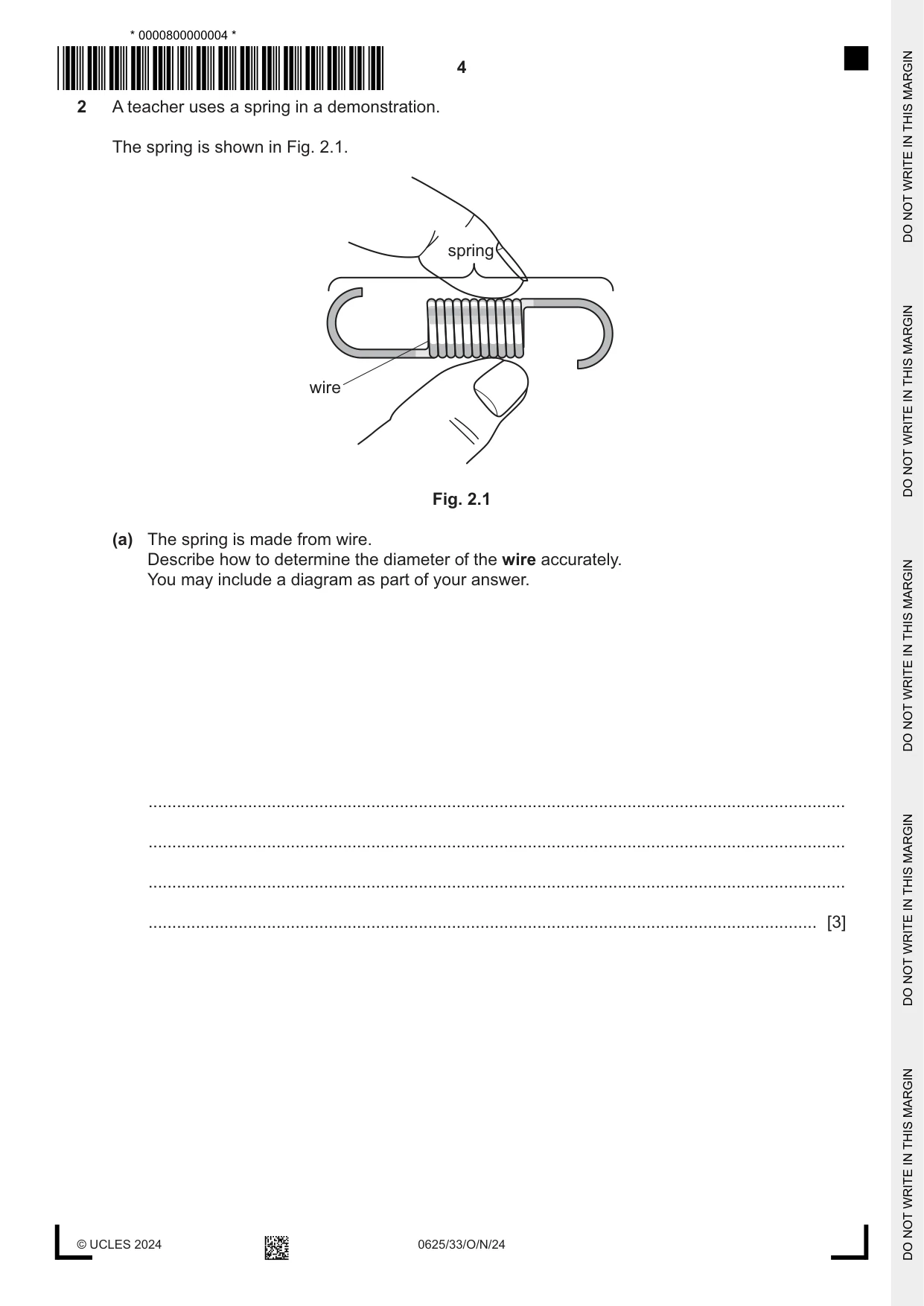
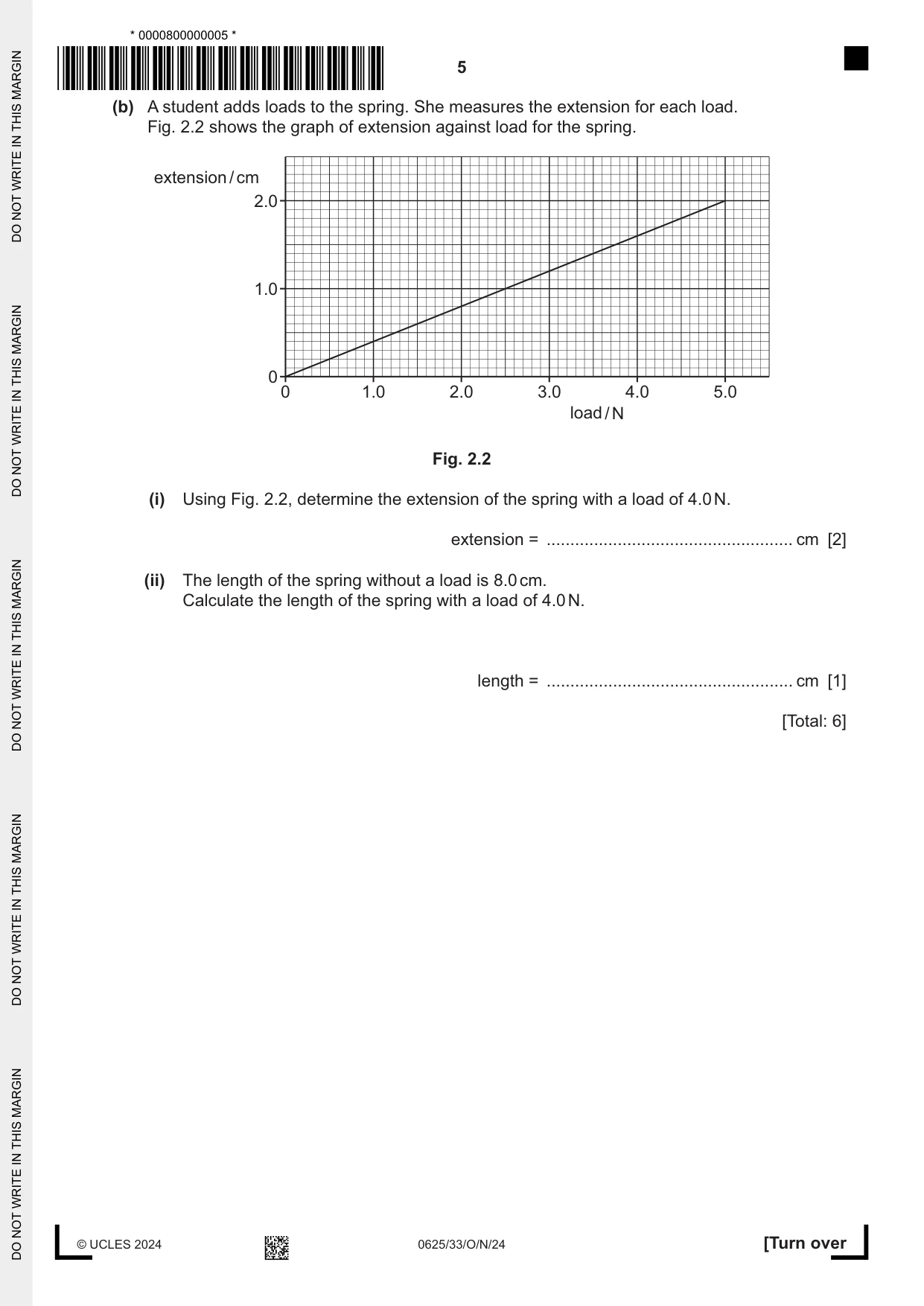
2 A teacher uses a spring in a demonstration. The spring is shown in Fig. 2.1. spring wire Fig. 2.1 (a) The spring is made from wire. Describe how to determine the diameter of the wire accurately. You may include a diagram as part of your answer. ................................................................................................................................................... ................................................................................................................................................... ................................................................................................................................................... ............................................................................................................................................. [3] (b) A student adds loads to the spring. She measures the extension for each load. Fig. 2.2 shows the graph of extension against load for the spring. extension / cm 2.0 1.0 0 0 1.0 2.0 3.0 4.0 5.0 load / N Fig. 2.2 (i) Using Fig. 2.2, determine the extension of the spring with a load of 4.0 N. extension = .................................................... cm [2] (ii) The length of the spring without a load is 8.0 cm. Calculate the length of the spring with a load of 4.0 N. length = .................................................... cm [1] [Total: 6]
Mark scheme: 2(a) measure the diameter of n loops / turns with rule(r) B1 n = 5 or more loops / loops B1 (diameter of wire =) their measurement n if n 1 B1 2(b)(i) 1.6 (cm) A2 any indication of correct attempt on graph (C1) 2(b)(ii) 9.6 (cm) B1
More questions on Physical quantities and measurement techniques
Q3 · A boy weighs 620 N
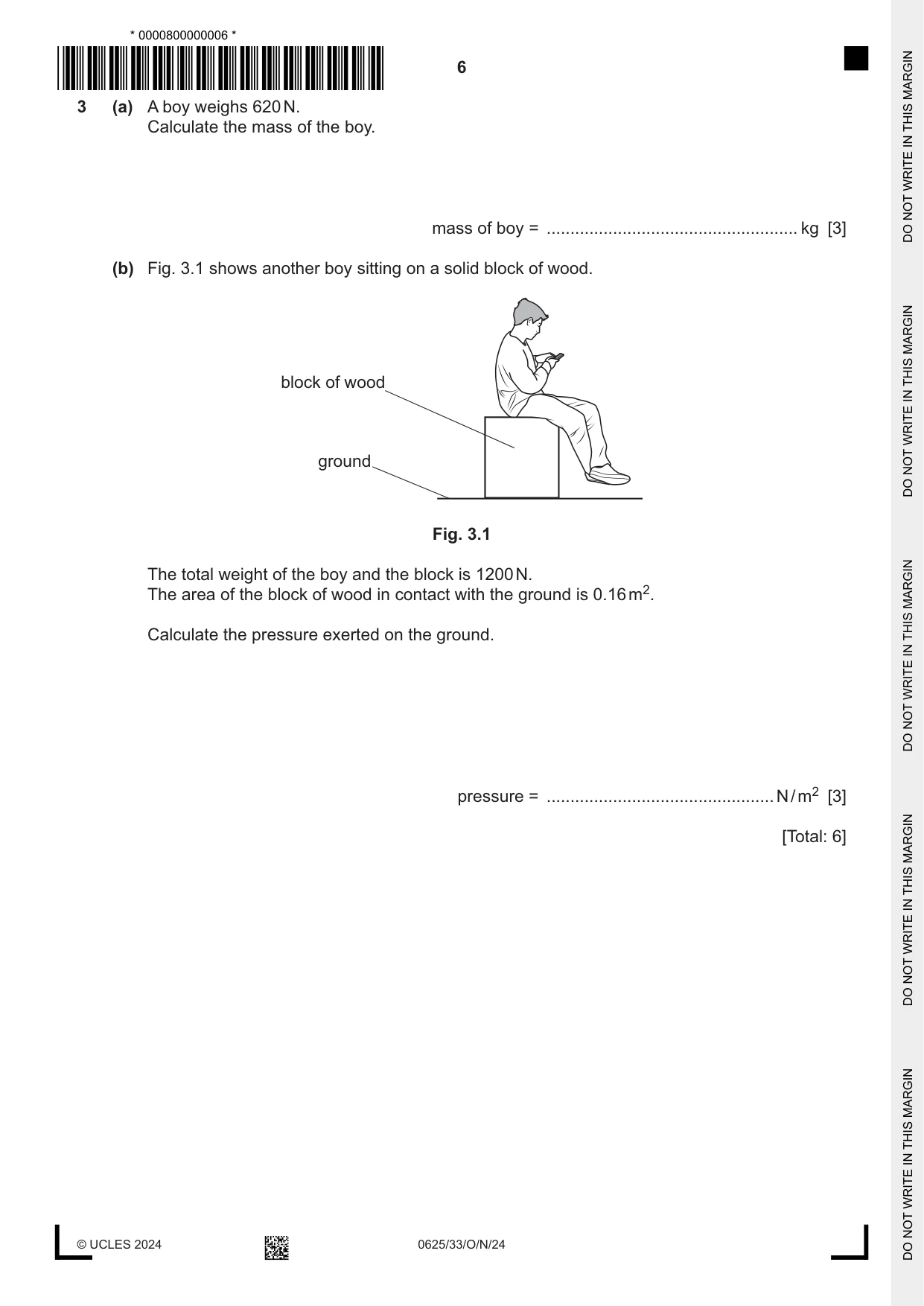
3 (a) A boy weighs 620 N. Calculate the mass of the boy. mass of boy = ..................................................... kg [3] (b) Fig. 3.1 shows another boy sitting on a solid block of wood. block of wood ground Fig. 3.1 The total weight of the boy and the block is 1200 N. The area of the block of wood in contact with the ground is 0.16 m2. Calculate the pressure exerted on the ground. pressure = ................................................N / m2 [3] [Total: 6]
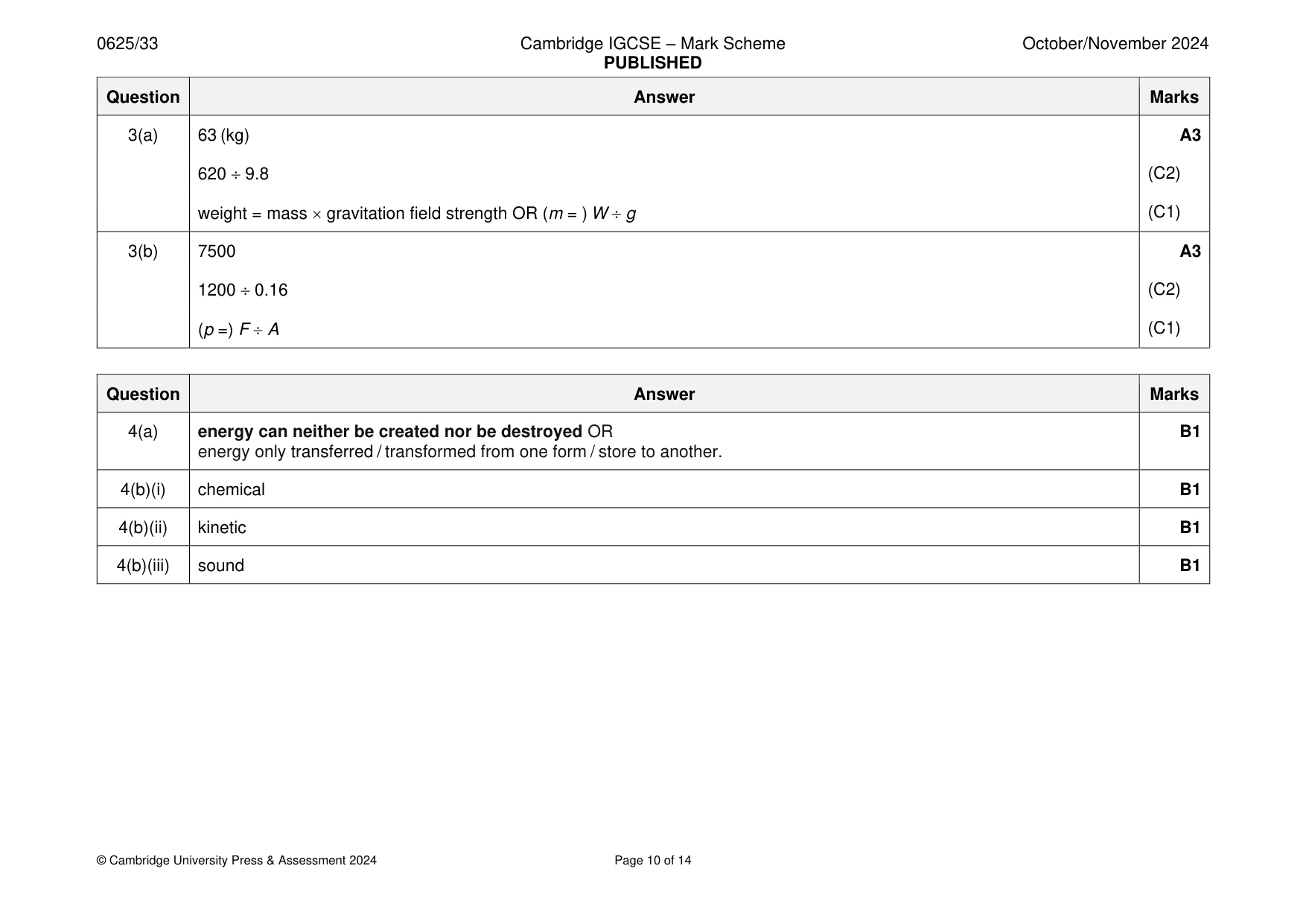
Mark scheme: 3(a) 63 (kg) A3 620 9.8 (C2) weight = mass gravitation field strength OR (m = ) W g (C1) 3(b) 7500 A3 1200 0.16 (C2) (p =) F A (C1)
Q4 · State the principle of conservation of energy
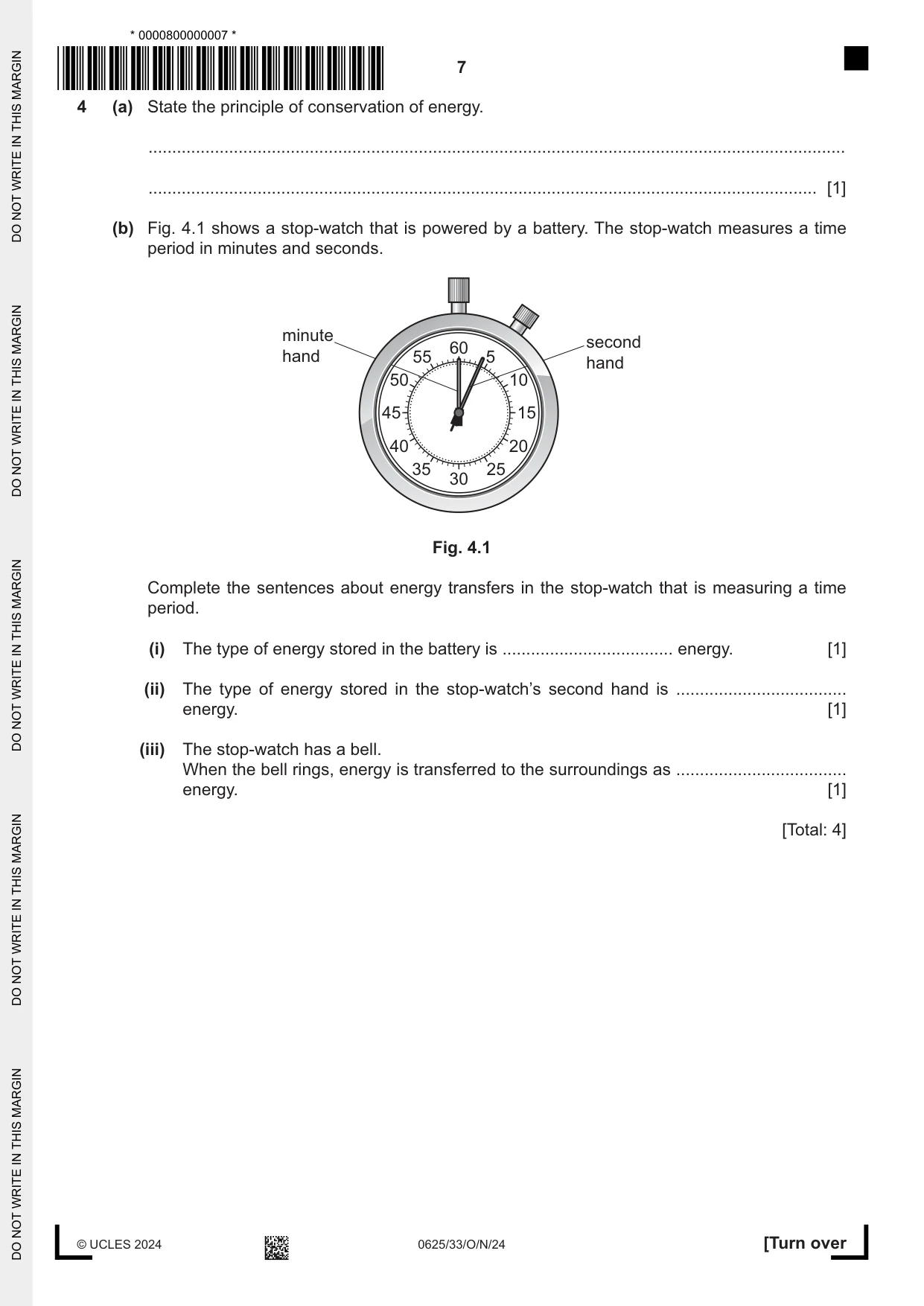
4 (a) State the principle of conservation of energy. ................................................................................................................................................... ............................................................................................................................................. [1] (b) Fig. 4.1 shows a stop-watch that is powered by a battery. The stop-watch measures a time period in minutes and seconds. minute second 60 hand 55 5 hand 50 10 45 15 40 20 35 25 30 Fig. 4.1 Complete the sentences about energy transfers in the stop-watch that is measuring a time period. (i) The type of energy stored in the battery is .................................... energy. [1] (ii) The type of energy stored in the stop-watch’s second hand is .................................... energy. [1] (iii) The stop-watch has a bell. When the bell rings, energy is transferred to the surroundings as .................................... energy. [1] [Total: 4]
Mark scheme: 4(a) energy can neither be created nor be destroyed OR B1 energy only transferred / transformed from one form / store to another. 4(b)(i) chemical B1 4(b)(ii) kinetic B1 4(b)(iii) sound B1
Q5 · Table 5.1 defines three specific temperatures
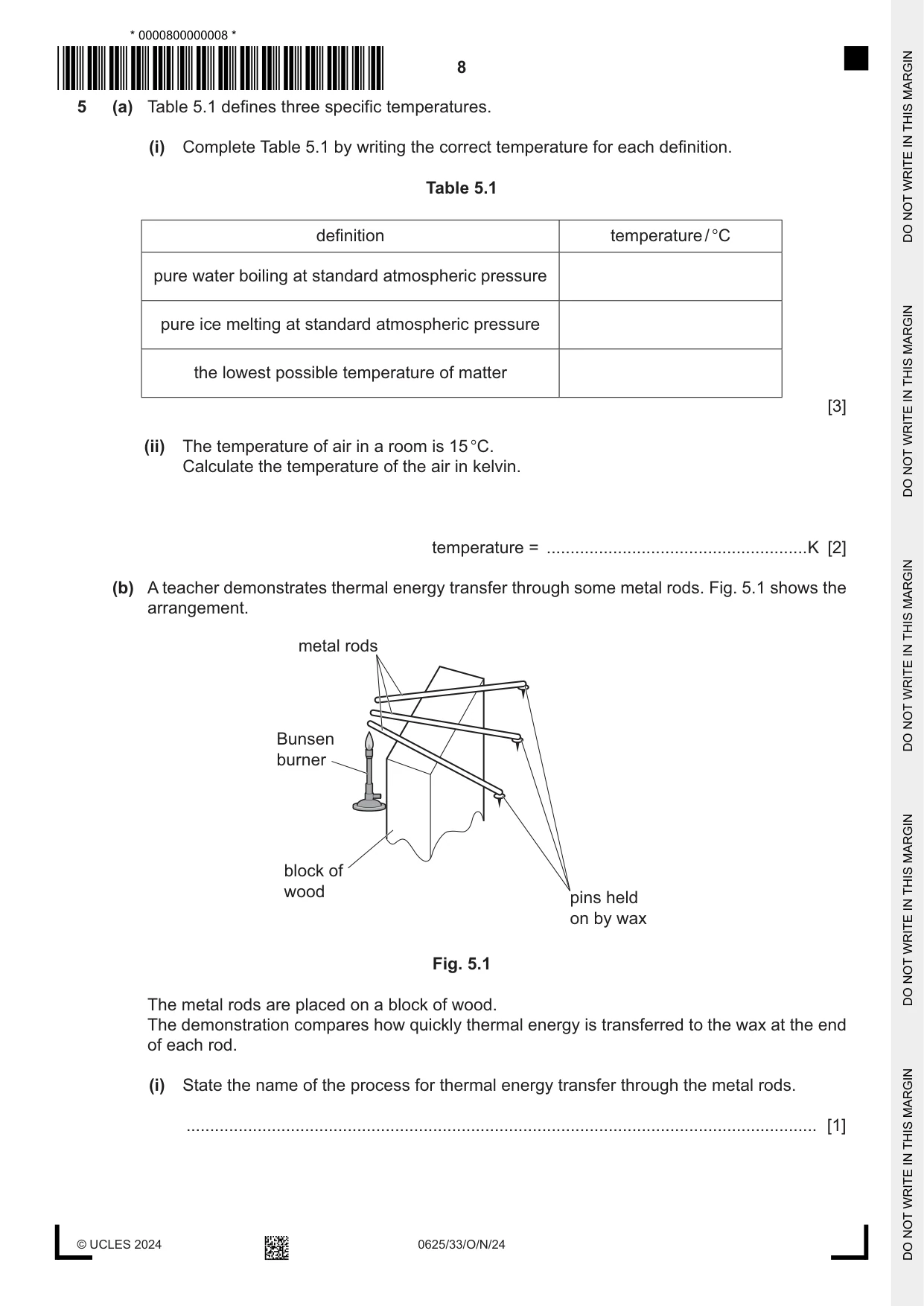
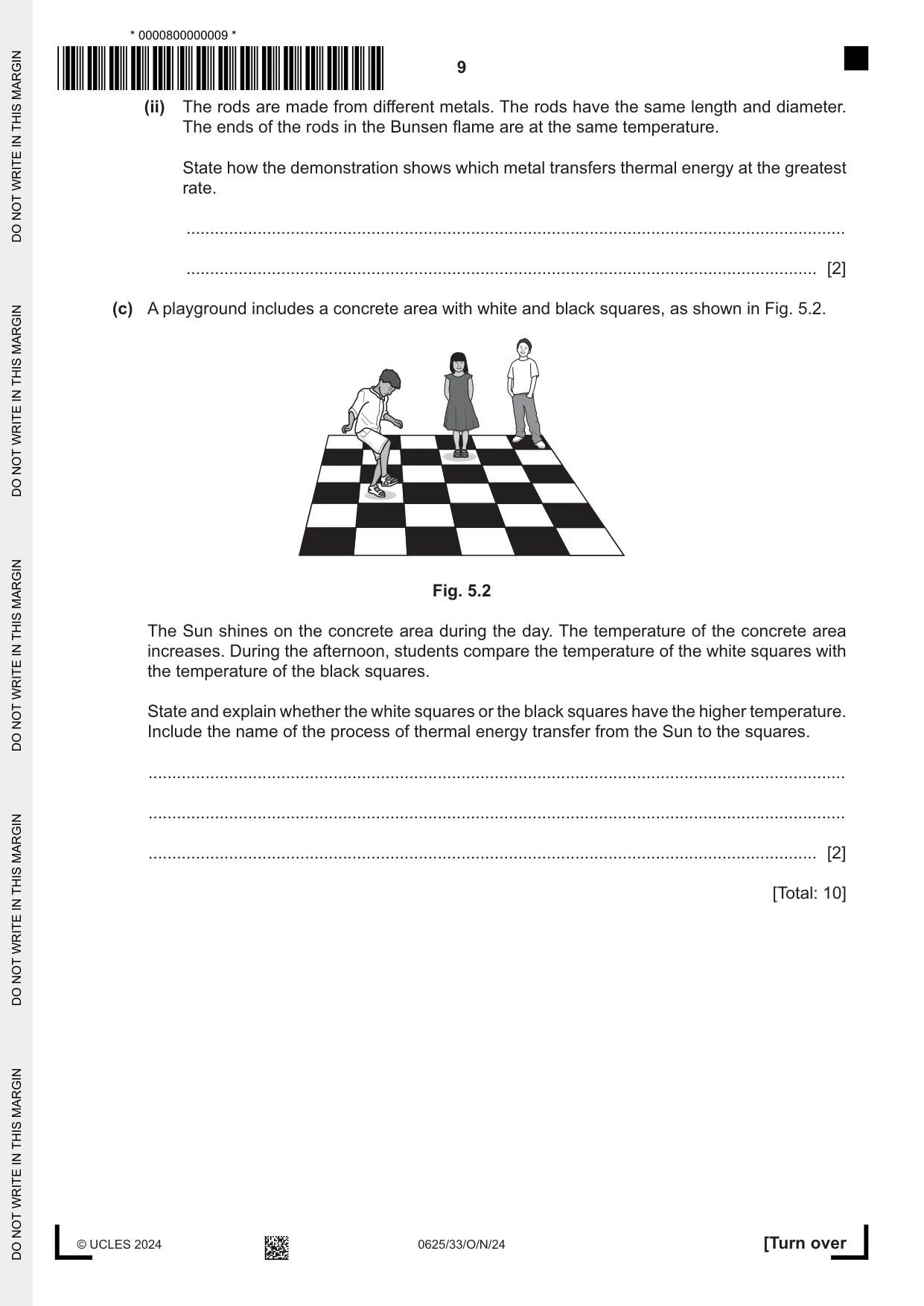
5 (a) Table 5.1 defines three specific temperatures. (i) Complete Table 5.1 by writing the correct temperature for each definition. Table 5.1 definition temperature / °C pure water boiling at standard atmospheric pressure pure ice melting at standard atmospheric pressure the lowest possible temperature of matter [3] (ii) The temperature of air in a room is 15 °C. Calculate the temperature of the air in kelvin. temperature = .......................................................K [2] (b) A teacher demonstrates thermal energy transfer through some metal rods. Fig. 5.1 shows the arrangement. metal rods Bunsen burner block of wood pins held on by wax Fig. 5.1 The metal rods are placed on a block of wood. The demonstration compares how quickly thermal energy is transferred to the wax at the end of each rod. (i) State the name of the process for thermal energy transfer through the metal rods. ..................................................................................................................................... [1] (ii) The rods are made from different metals. The rods have the same length and diameter. The ends of the rods in the Bunsen flame are at the same temperature. State how the demonstration shows which metal transfers thermal energy at the greatest rate. ........................................................................................................................................... ..................................................................................................................................... [2] (c) A playground includes a concrete area with white and black squares, as shown in Fig. 5.2. Fig. 5.2 The Sun shines on the concrete area during the day. The temperature of the concrete area increases. During the afternoon, students compare the temperature of the white squares with the temperature of the black squares. State and explain whether the white squares or the black squares have the higher temperature. Include the name of the process of thermal energy transfer from the Sun to the squares. ................................................................................................................................................... ................................................................................................................................................... ............................................................................................................................................. [2] [Total: 10]
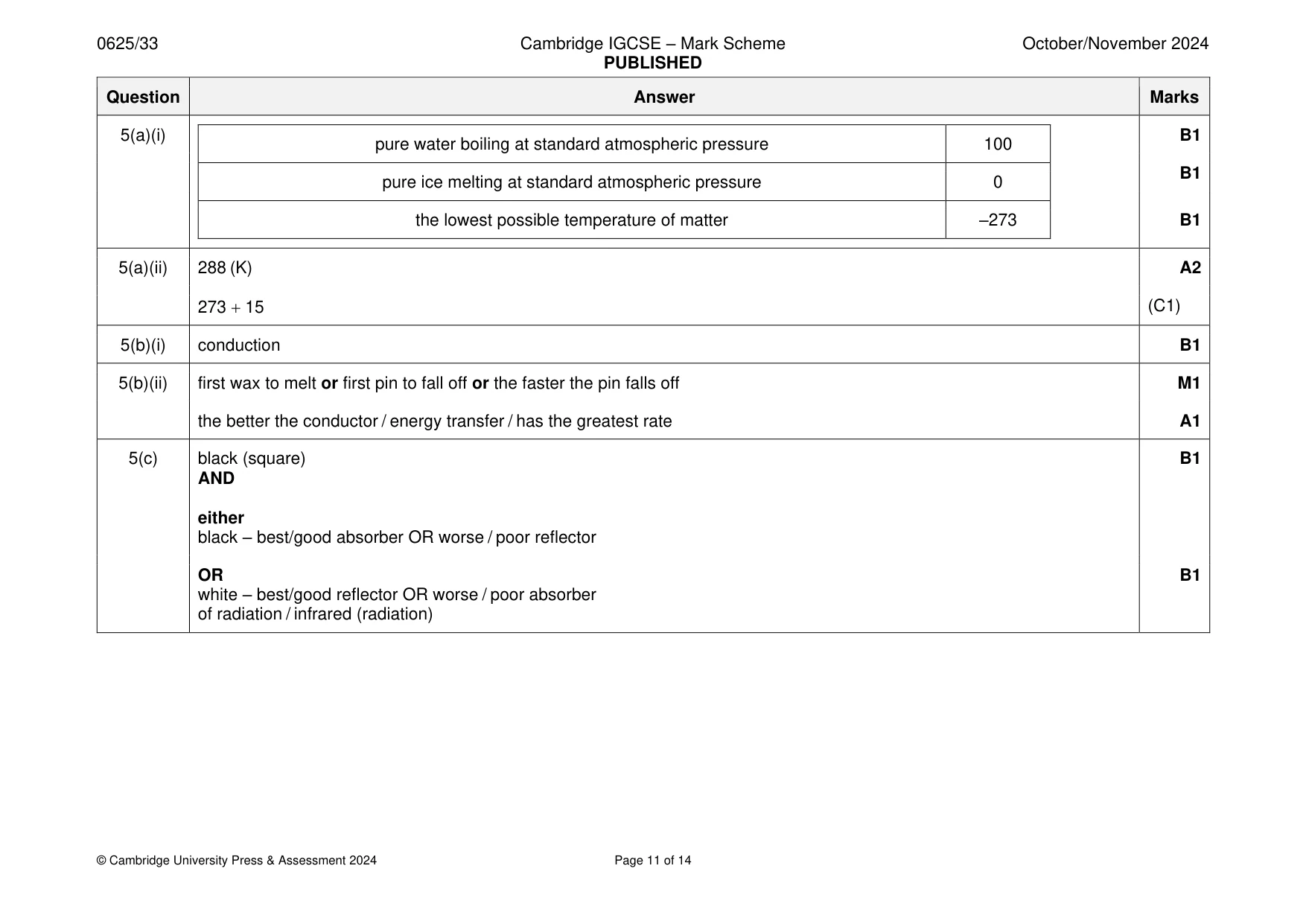
Mark scheme: 5(a)(i) B1 pure water boiling at standard atmospheric pressure 100 B1 pure ice melting at standard atmospheric pressure 0 the lowest possible temperature of matter –273 B1 5(a)(ii) 288 (K) A2 273 + 15 (C1) 5(b)(i) conduction B1 5(b)(ii) first wax to melt or first pin to fall off or the faster the pin falls off M1 the better the conductor / energy transfer / has the greatest rate A1 5(c) black (square) B1 AND either black – best/good absorber OR worse / poor reflector OR B1 white – best/good reflector OR worse / poor absorber of radiation / infrared (radiation)
Q6 · A teacher uses a ripple tank to demonstrate the properties of waves
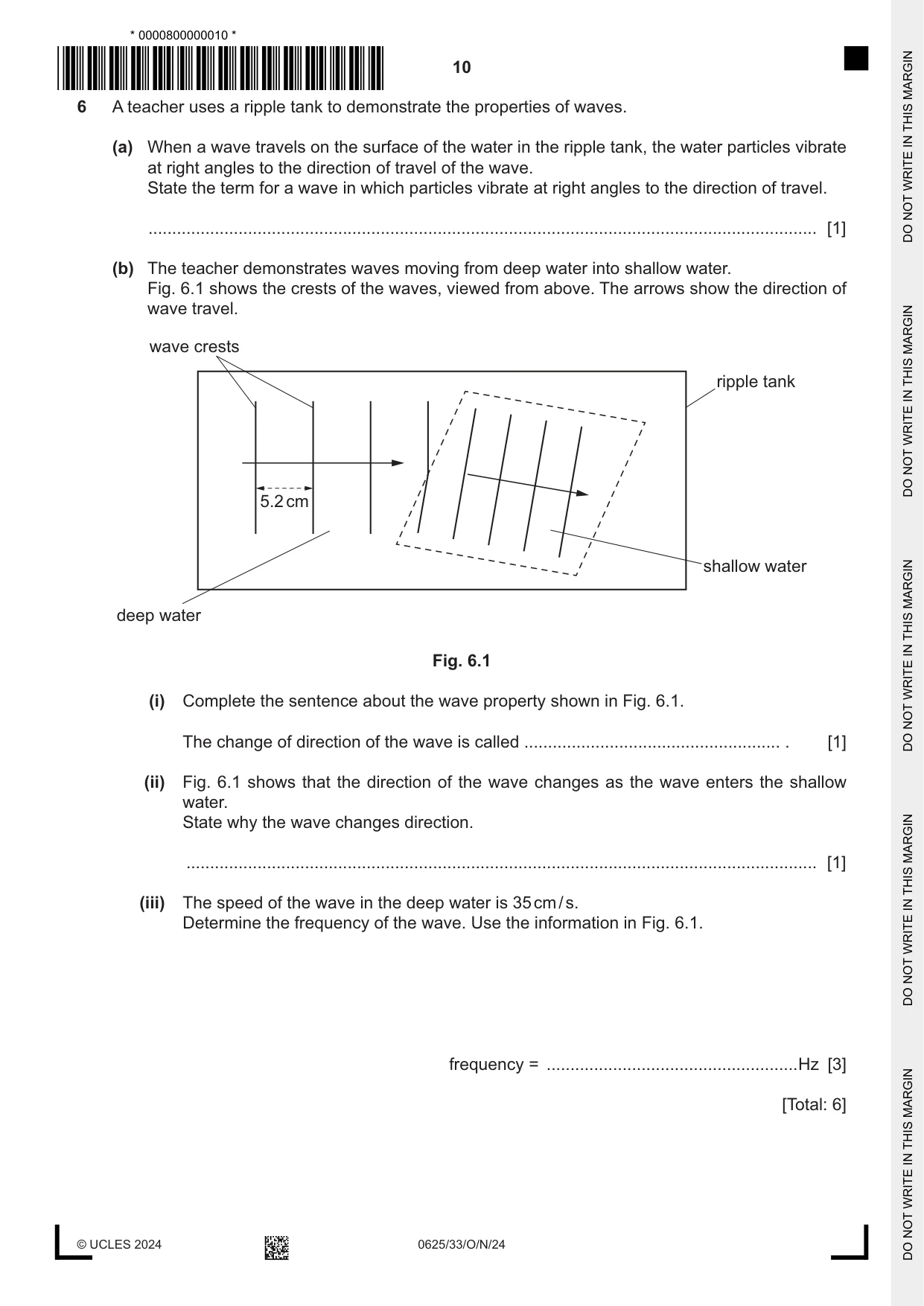
6 A teacher uses a ripple tank to demonstrate the properties of waves. (a) When a wave travels on the surface of the water in the ripple tank, the water particles vibrate at right angles to the direction of travel of the wave. State the term for a wave in which particles vibrate at right angles to the direction of travel. ............................................................................................................................................. [1] (b) The teacher demonstrates waves moving from deep water into shallow water. Fig. 6.1 shows the crests of the waves, viewed from above. The arrows show the direction of wave travel. wave crests ripple tank 5.2 cm shallow water deep water Fig. 6.1 (i) Complete the sentence about the wave property shown in Fig. 6.1. The change of direction of the wave is called ...................................................... . [1] (ii) Fig. 6.1 shows that the direction of the wave changes as the wave enters the shallow water. State why the wave changes direction. ..................................................................................................................................... [1] (iii) The speed of the wave in the deep water is 35 cm / s. Determine the frequency of the wave. Use the information in Fig. 6.1. frequency = .....................................................Hz [3] [Total: 6]
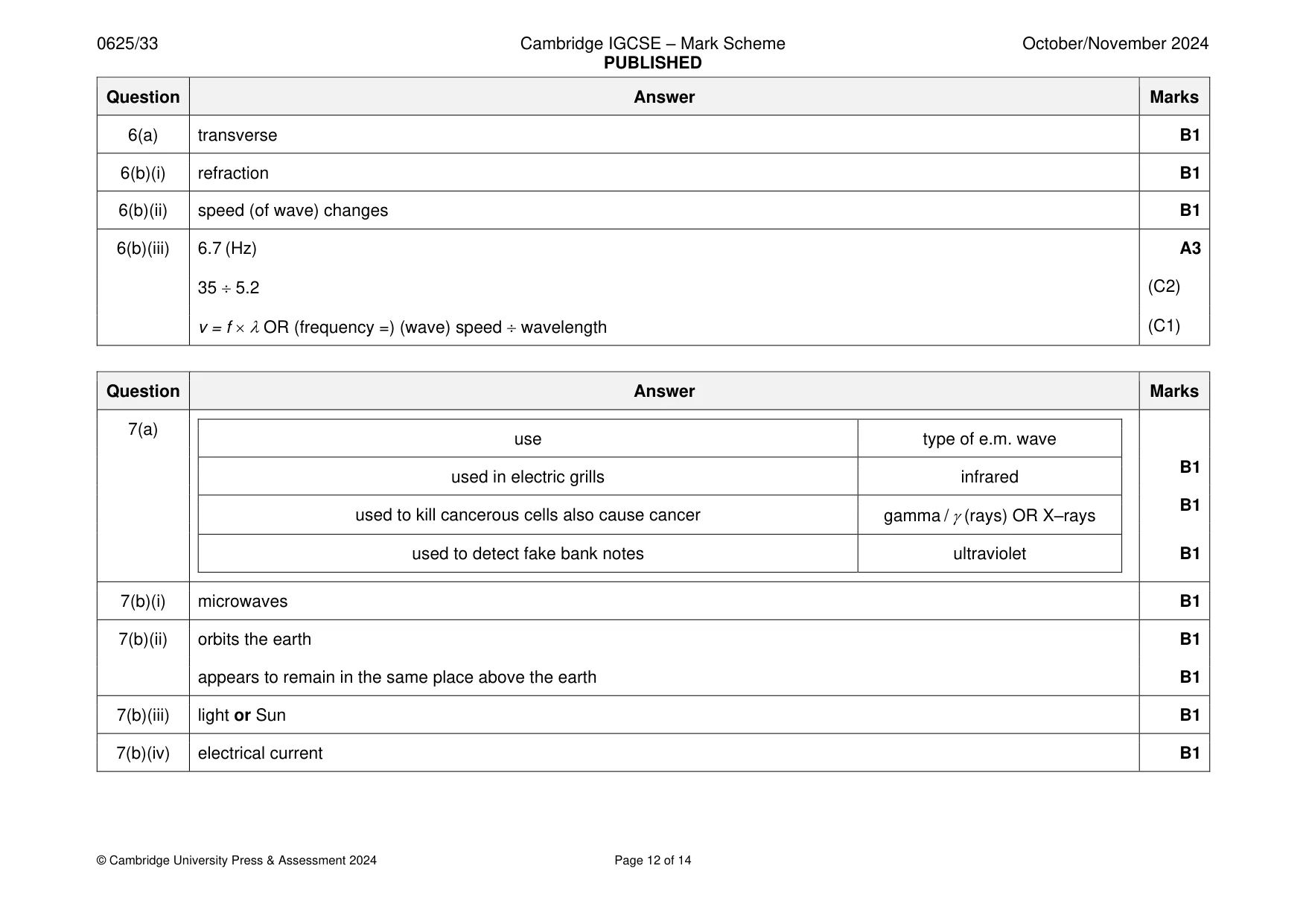
Mark scheme: 6(a) transverse B1 6(b)(i) refraction B1 6(b)(ii) speed (of wave) changes B1 6(b)(iii) 6.7 (Hz) A3 35 5.2 (C2) v = f OR (frequency =) (wave) speed wavelength (C1)
Q7 · Table 7.1 lists three uses of electromagnetic (e.m.) waves
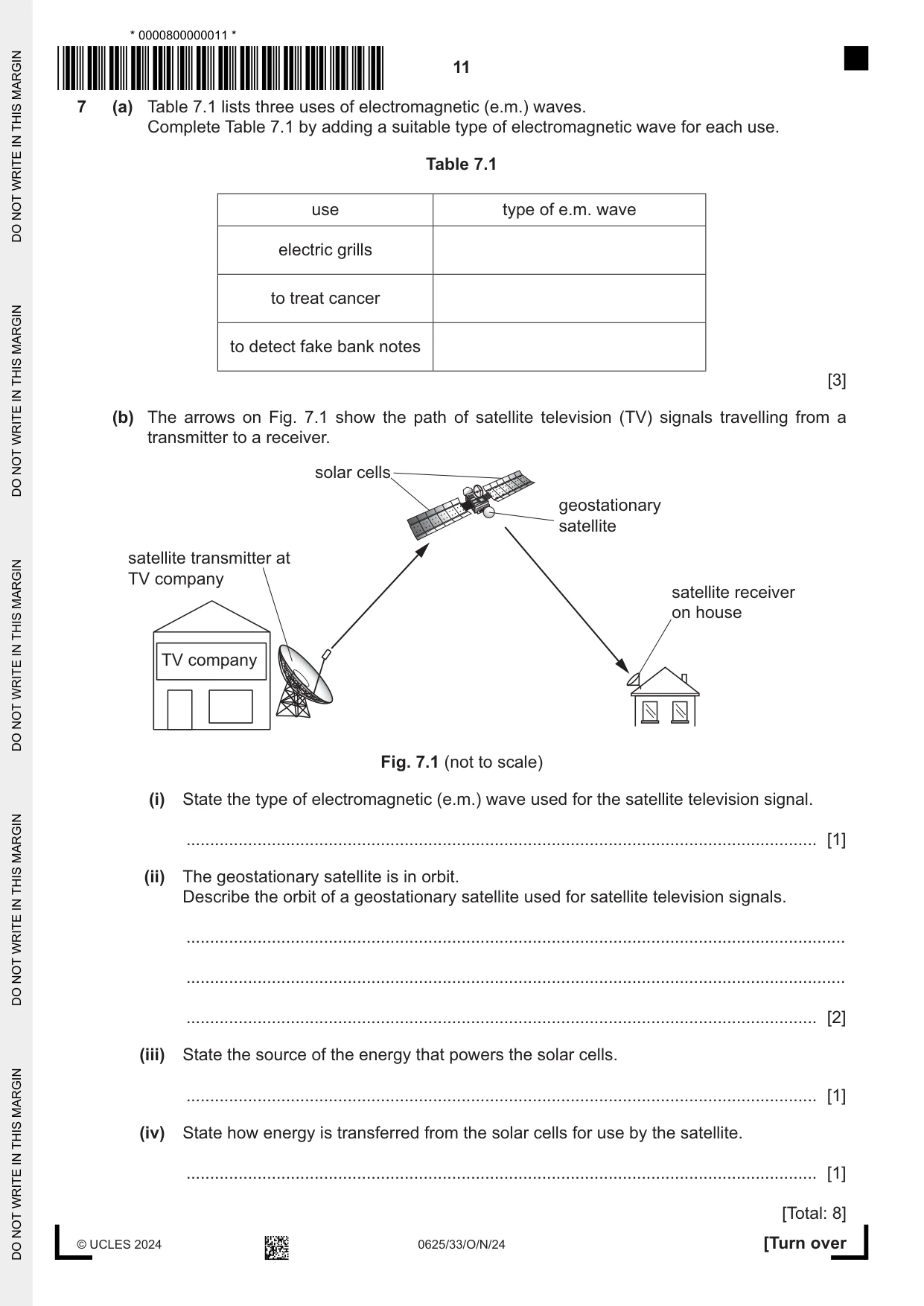
7 (a) Table 7.1 lists three uses of electromagnetic (e.m.) waves. Complete Table 7.1 by adding a suitable type of electromagnetic wave for each use. Table 7.1 use type of e.m. wave electric grills to treat cancer to detect fake bank notes [3] (b) The arrows on Fig. 7.1 show the path of satellite television (TV) signals travelling from a transmitter to a receiver. solar cells geostationary satellite satellite transmitter at TV company satellite receiver on house TV company Fig. 7.1 (not to scale) (i) State the type of electromagnetic (e.m.) wave used for the satellite television signal. ..................................................................................................................................... [1] (ii) The geostationary satellite is in orbit. Describe the orbit of a geostationary satellite used for satellite television signals. ........................................................................................................................................... ........................................................................................................................................... ..................................................................................................................................... [2] (iii) State the source of the energy that powers the solar cells. ..................................................................................................................................... [1] (iv) State how energy is transferred from the solar cells for use by the satellite. ..................................................................................................................................... [1] [Total: 8]
Mark scheme: 7(a) use type of e.m. wave B1 used in electric grills infrared B1 used to kill cancerous cells also cause cancer gamma / (rays) OR X–rays used to detect fake bank notes ultraviolet B1 7(b)(i) microwaves B1 7(b)(ii) orbits the earth B1 appears to remain in the same place above the earth B1 7(b)(iii) light or Sun B1 7(b)(iv) electrical current B1
Q8 · A student connects a circuit with two lamps and three switches, S1, S2 and S3, as shown…
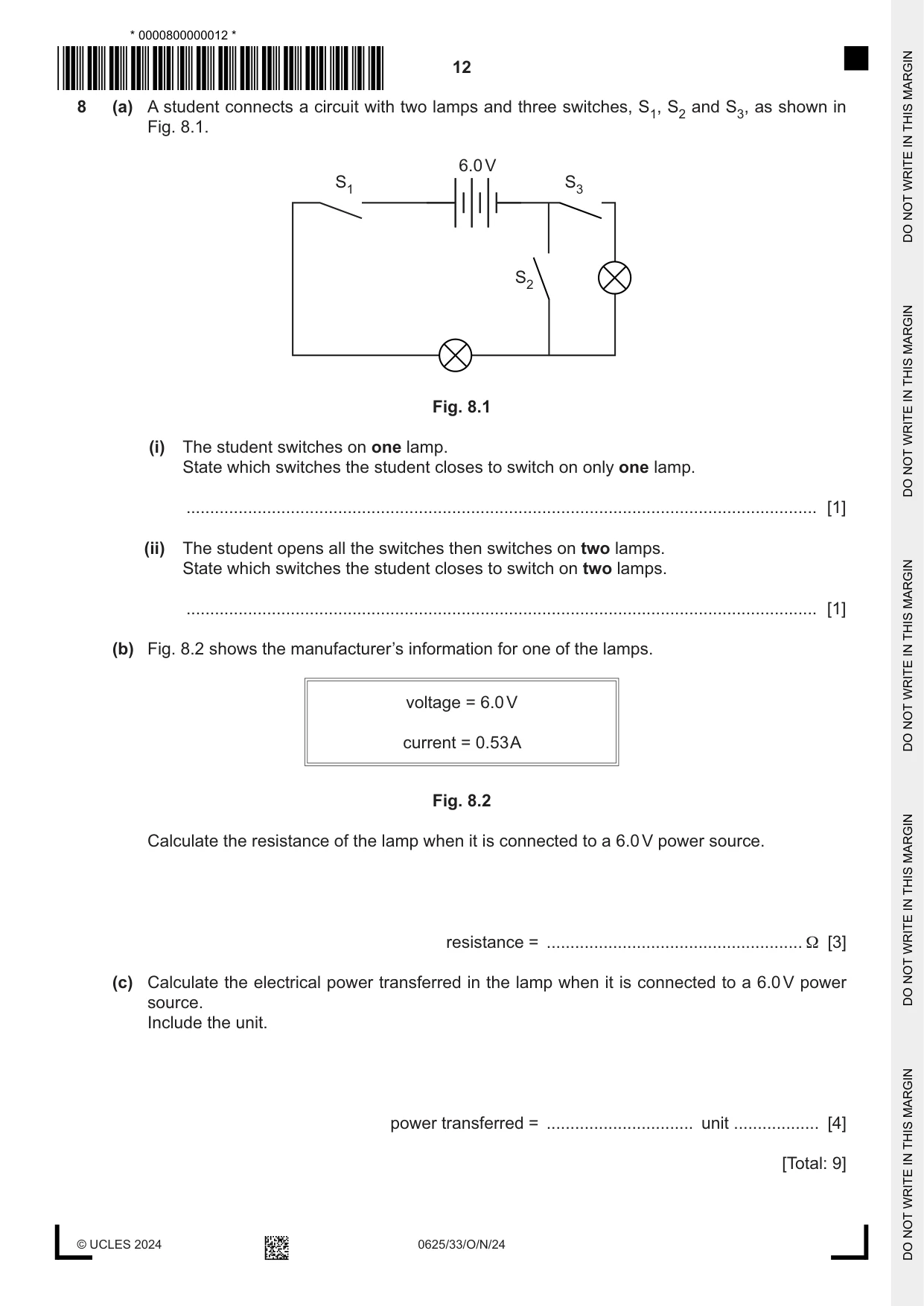
8 (a) A student connects a circuit with two lamps and three switches, S1, S2 and S3, as shown in Fig. 8.1. 6.0 V S1 S3 S2 Fig. 8.1 (i) The student switches on one lamp. State which switches the student closes to switch on only one lamp. ..................................................................................................................................... [1] (ii) The student opens all the switches then switches on two lamps. State which switches the student closes to switch on two lamps. ..................................................................................................................................... [1] (b) Fig. 8.2 shows the manufacturer’s information for one of the lamps. voltage = 6.0 V current = 0.53 A Fig. 8.2 Calculate the resistance of the lamp when it is connected to a 6.0 V power source. resistance = ...................................................... Ω [3] (c) Calculate the electrical power transferred in the lamp when it is connected to a 6.0 V power source. Include the unit. power transferred = ............................... unit .................. [4] [Total: 9]
Mark scheme: 8(a)(i) Switch S1 AND Switch S2 B1 8(a)(ii) Switch S1 AND Switch S3 B1 8(b) 11() A3 6(.0) 0.53 (C2) V = I R OR (R =) V I (C1) 8(c) 3.2 A3 0.53 x 6(.0) (C2) (P =) I V (C1) W B1
Q9 · A magnet spinning steadily near to a coil
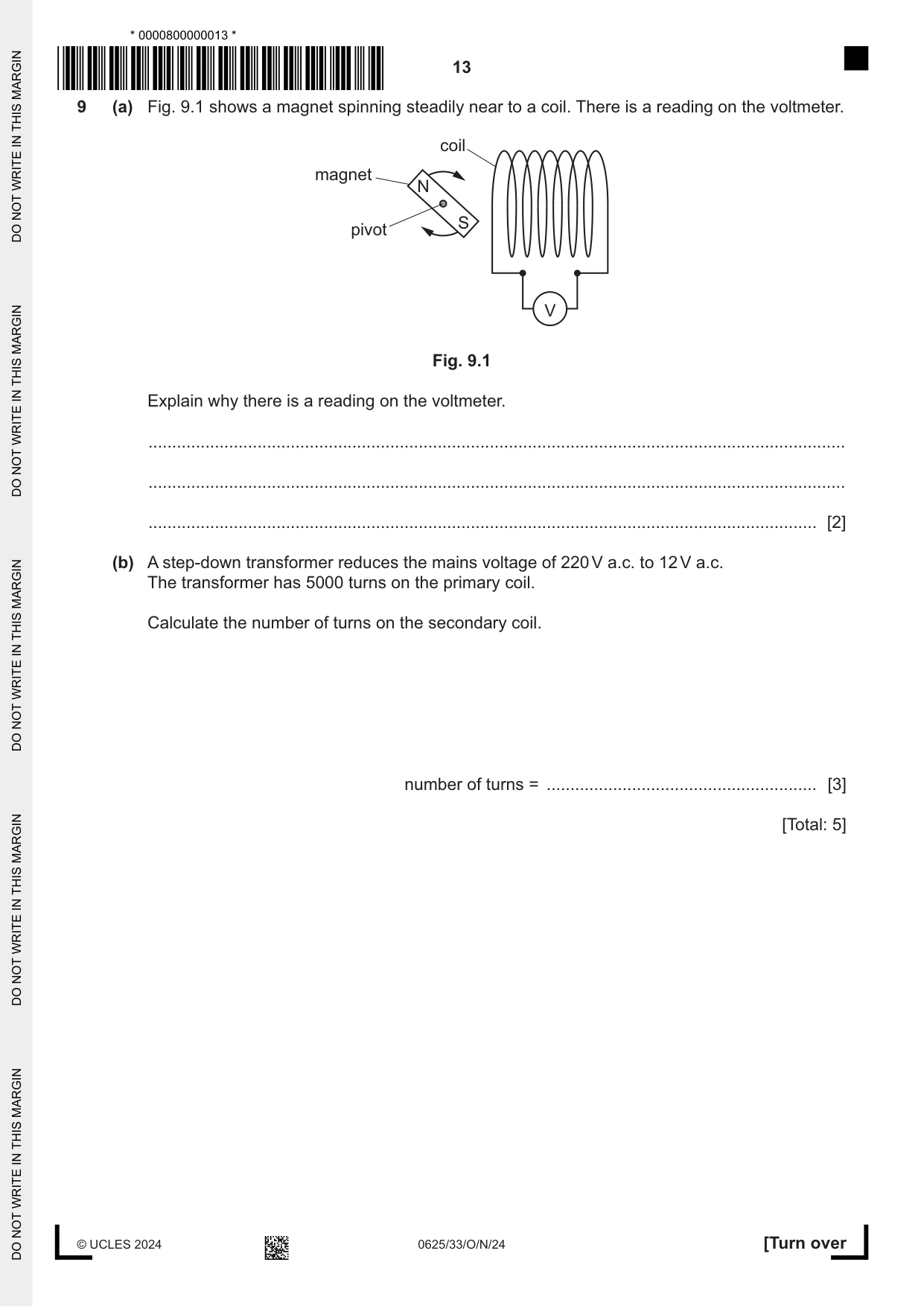
9 (a) Fig. 9.1 shows a magnet spinning steadily near to a coil. There is a reading on the voltmeter. coil magnet N S pivot V Fig. 9.1 Explain why there is a reading on the voltmeter. ................................................................................................................................................... ................................................................................................................................................... ............................................................................................................................................. [2] (b) A step-down transformer reduces the mains voltage of 220 V a.c. to 12 V a.c. The transformer has 5000 turns on the primary coil. Calculate the number of turns on the secondary coil. number of turns = ......................................................... [3] [Total: 5]
Mark scheme: 9(a) induced e.m.f.(in the coil) B1 changing magnetic field (in the coil) B1 9(b) (number of turns =) 270 A3 (NS =) 12 / 220 5000 (C2) VP / VS = NP / NS (C1)
Q10 · State how a neutral atom becomes a positive ion
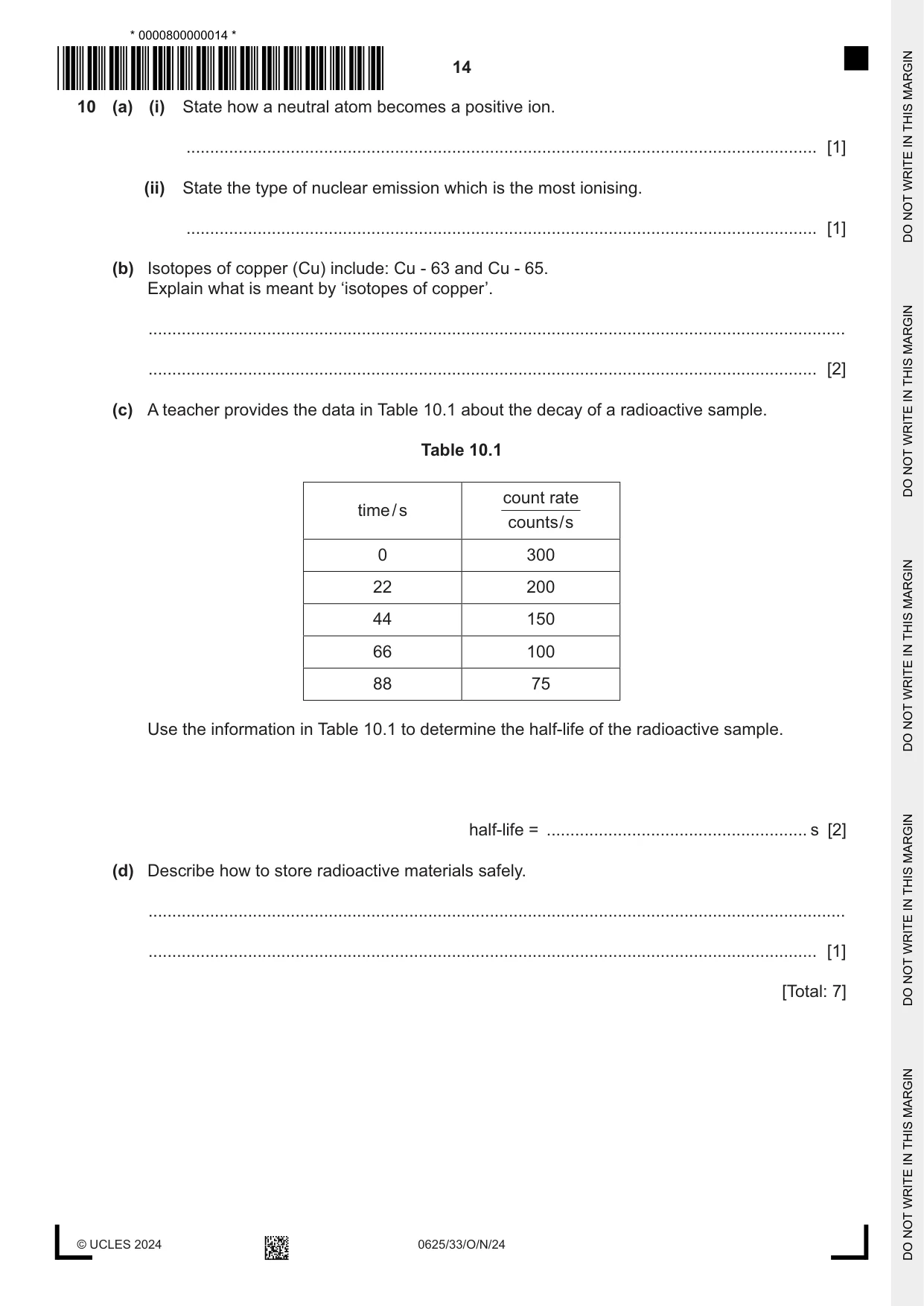
10 (a) (i) State how a neutral atom becomes a positive ion. ..................................................................................................................................... [1] (ii) State the type of nuclear emission which is the most ionising. ..................................................................................................................................... [1] (b) Isotopes of copper (Cu) include: Cu - 63 and Cu - 65. Explain what is meant by ‘isotopes of copper’. ................................................................................................................................................... ............................................................................................................................................. [2] (c) A teacher provides the data in Table 10.1 about the decay of a radioactive sample. Table 10.1 count rate time / s counts / s 0 300 22 200 44 150 66 100 88 75 Use the information in Table 10.1 to determine the half-life of the radioactive sample. half-life = ....................................................... s [2] (d) Describe how to store radioactive materials safely. ................................................................................................................................................... ............................................................................................................................................. [1] [Total: 7]
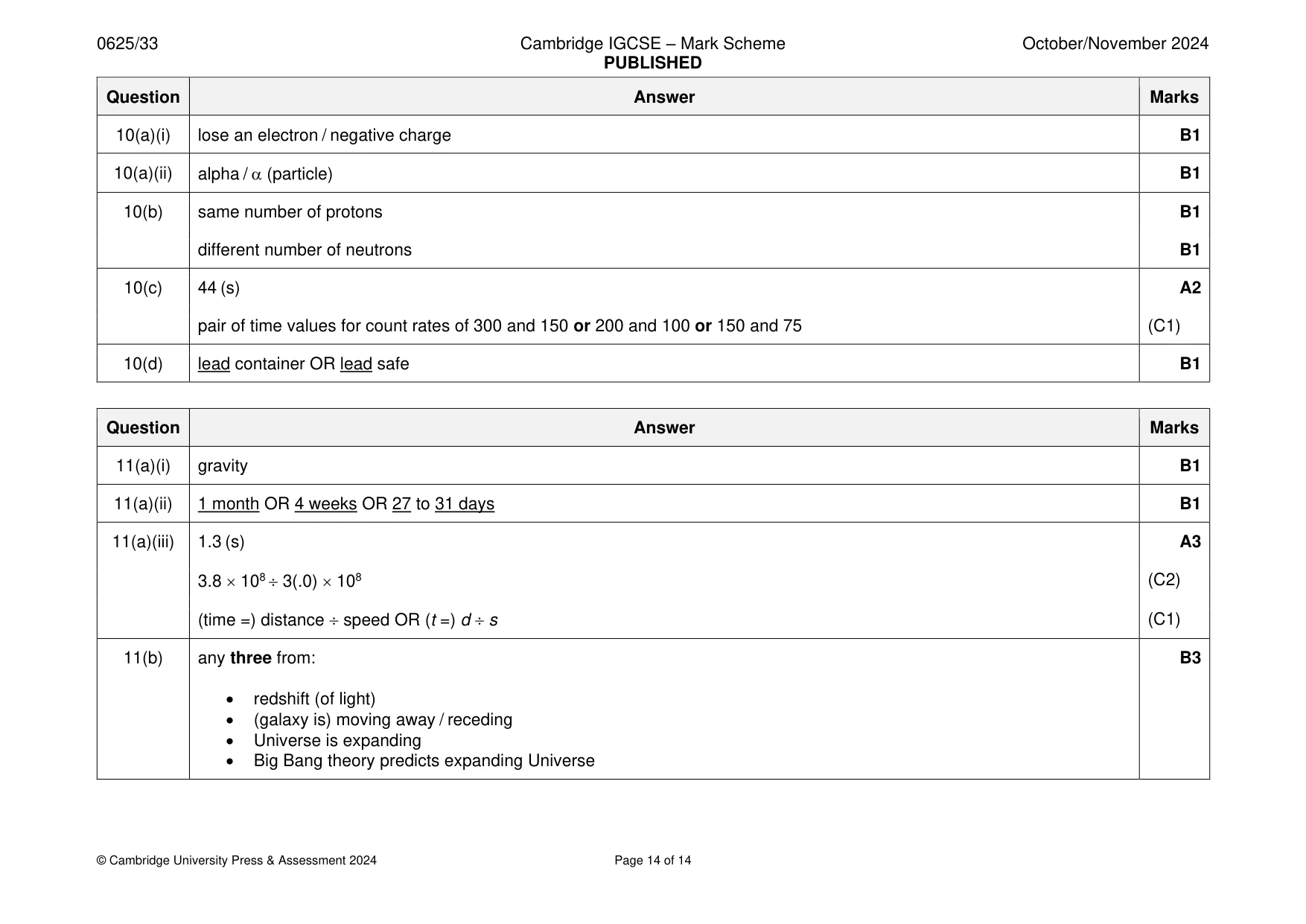
Mark scheme: 10(a)(i) lose an electron / negative charge B1 10(a)(ii) alpha / (particle) B1 10(b) same number of protons B1 different number of neutrons B1 10(c) 44 (s) A2 pair of time values for count rates of 300 and 150 or 200 and 100 or 150 and 75 (C1) 10(d) lead container OR lead safe B1
Q11 · The Moon orbiting the Earth
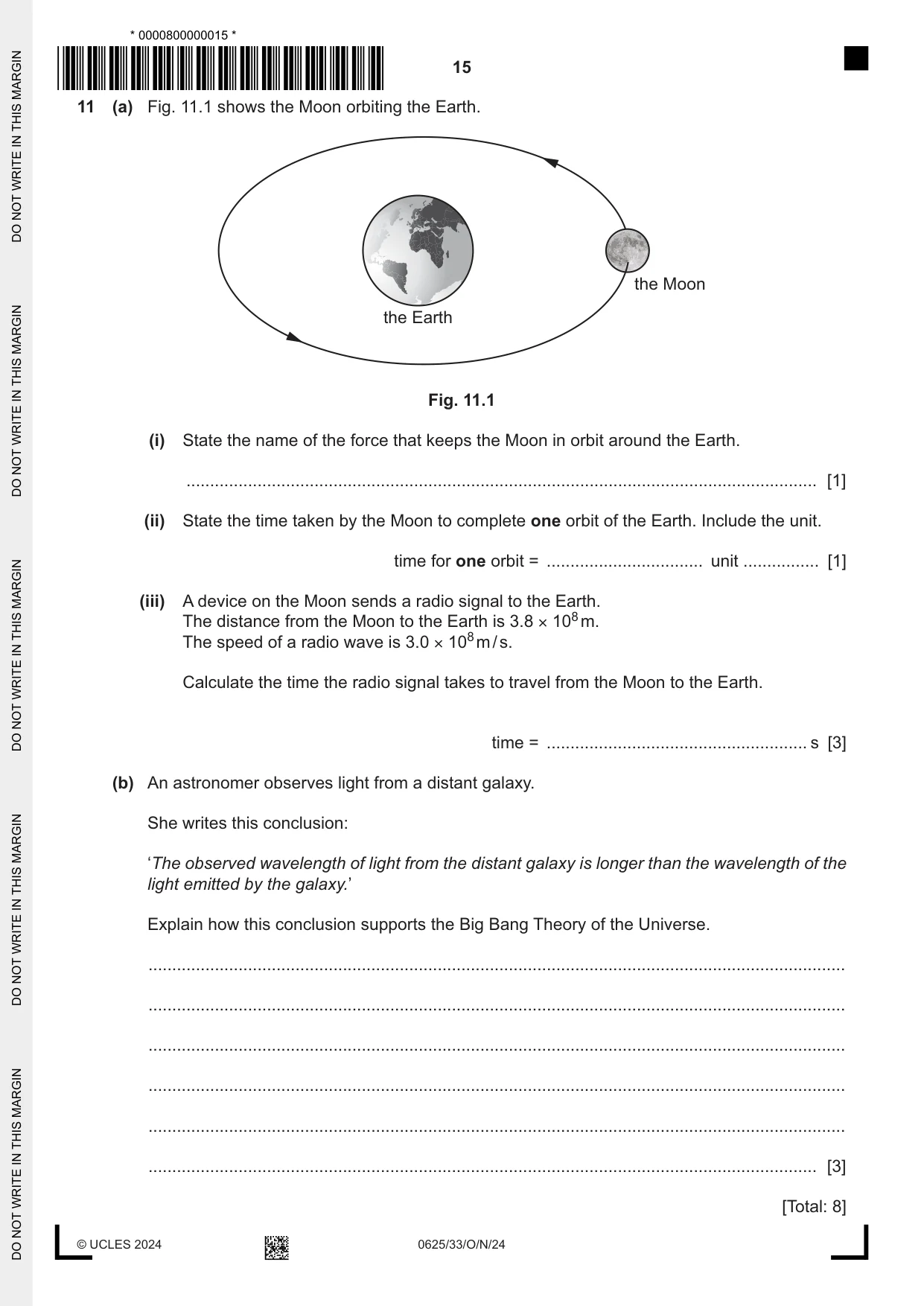
11 (a) Fig. 11.1 shows the Moon orbiting the Earth. the Moon the Earth Fig. 11.1 (i) State the name of the force that keeps the Moon in orbit around the Earth. ..................................................................................................................................... [1] (ii) State the time taken by the Moon to complete one orbit of the Earth. Include the unit. time for one orbit = ................................. unit ................ [1] (iii) A device on the Moon sends a radio signal to the Earth. The distance from the Moon to the Earth is 3.8 × 10⁸ m. The speed of a radio wave is 3.0 × 10⁸ m / s. Calculate the time the radio signal takes to travel from the Moon to the Earth. time = ....................................................... s [3] (b) An astronomer observes light from a distant galaxy. She writes this conclusion: ‘The observed wavelength of light from the distant galaxy is longer than the wavelength of the light emitted by the galaxy.’ Explain how this conclusion supports the Big Bang Theory of the Universe. ................................................................................................................................................... ................................................................................................................................................... ................................................................................................................................................... ................................................................................................................................................... ................................................................................................................................................... ............................................................................................................................................. [3] [Total: 8]
Mark scheme: 11(a)(i) gravity B1 11(a)(ii) 1 month OR 4 weeks OR 27 to 31 days B1 11(a)(iii) 1.3 (s) A3 3.8 108 3(.0) 108 (C2) (time =) distance speed OR (t =) d s (C1) 11(b) any three from: B3 • redshift (of light) • (galaxy is) moving away / receding • Universe is expanding • Big Bang theory predicts expanding Universe
What was in this paper
The subtopics covered by these 11 questions, and how many questions each got. Open one in a new tab to see every Cambridge question on it.
What you needed in this session
Cambridge’s own grade thresholds for 2024 Oct/Nov, Paper 3 · Variant 3. A higher threshold means an easier paper — the bar moves with how the cohort did.