Cambridge IGCSE Physics 0625 — 2014 Oct/Nov Paper 3 · Variant 2
0625/32/O/N/14 · 11 questions · 80 marks · ≈90 min
The question paper and its mark scheme, free to read here and free to download. This is Cambridge’s own paper, exactly as it was sat.
Question paper16 pages
Mark scheme8 pages
Answers below. Sit the paper first if you are practising.
Questions as text
Q1 · State the two conditions necessary for a system of forces acting on a body to be in…
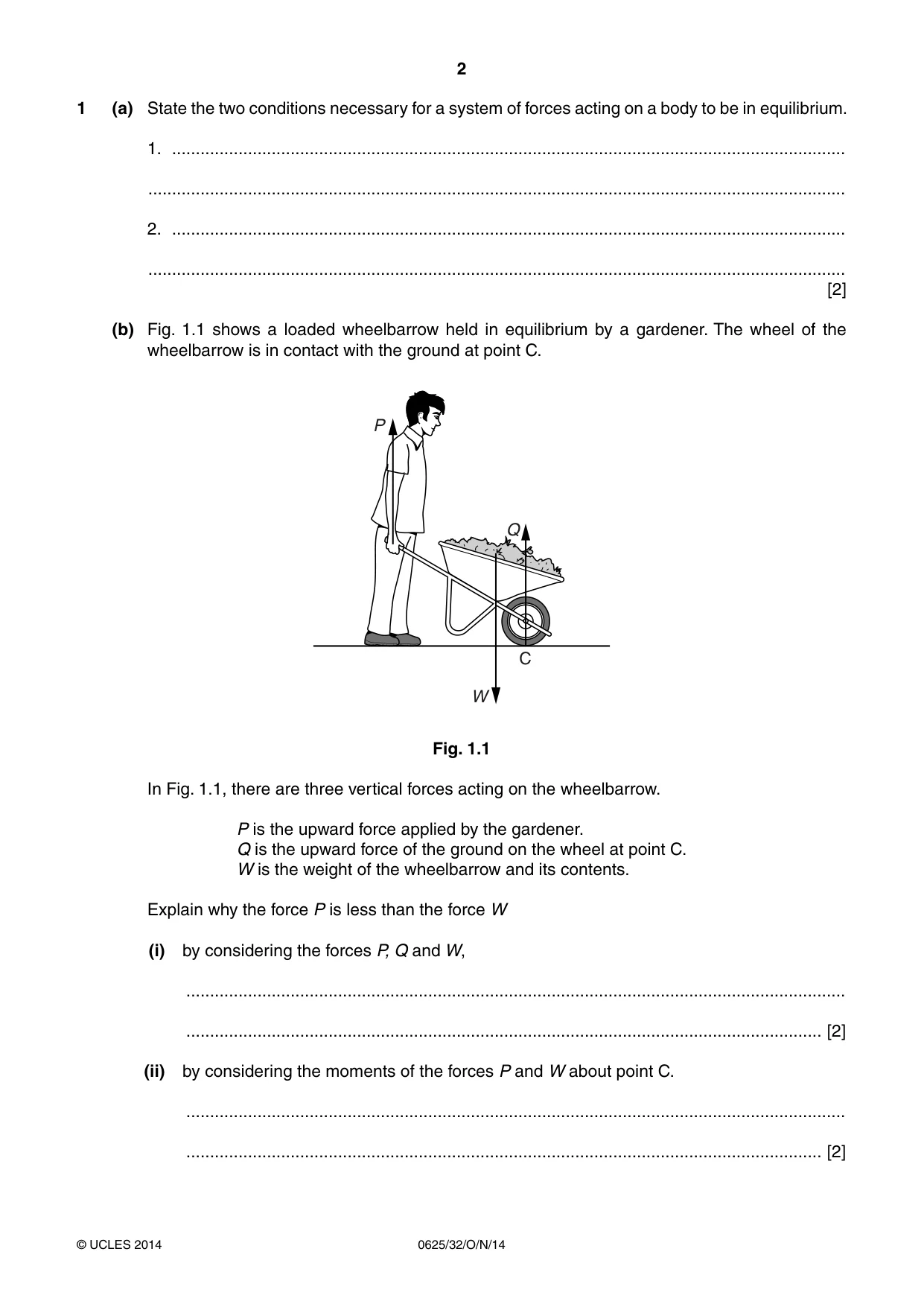
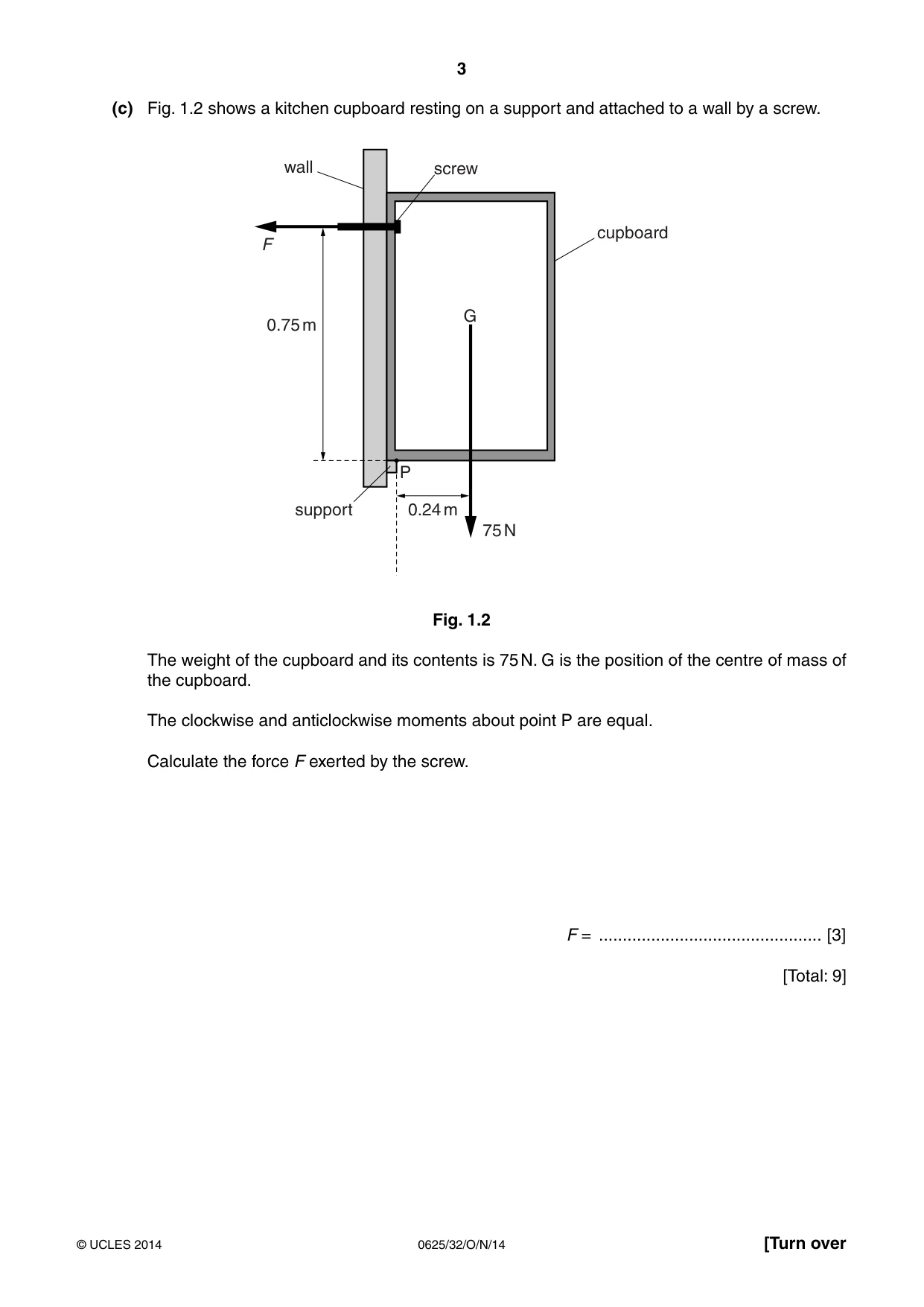
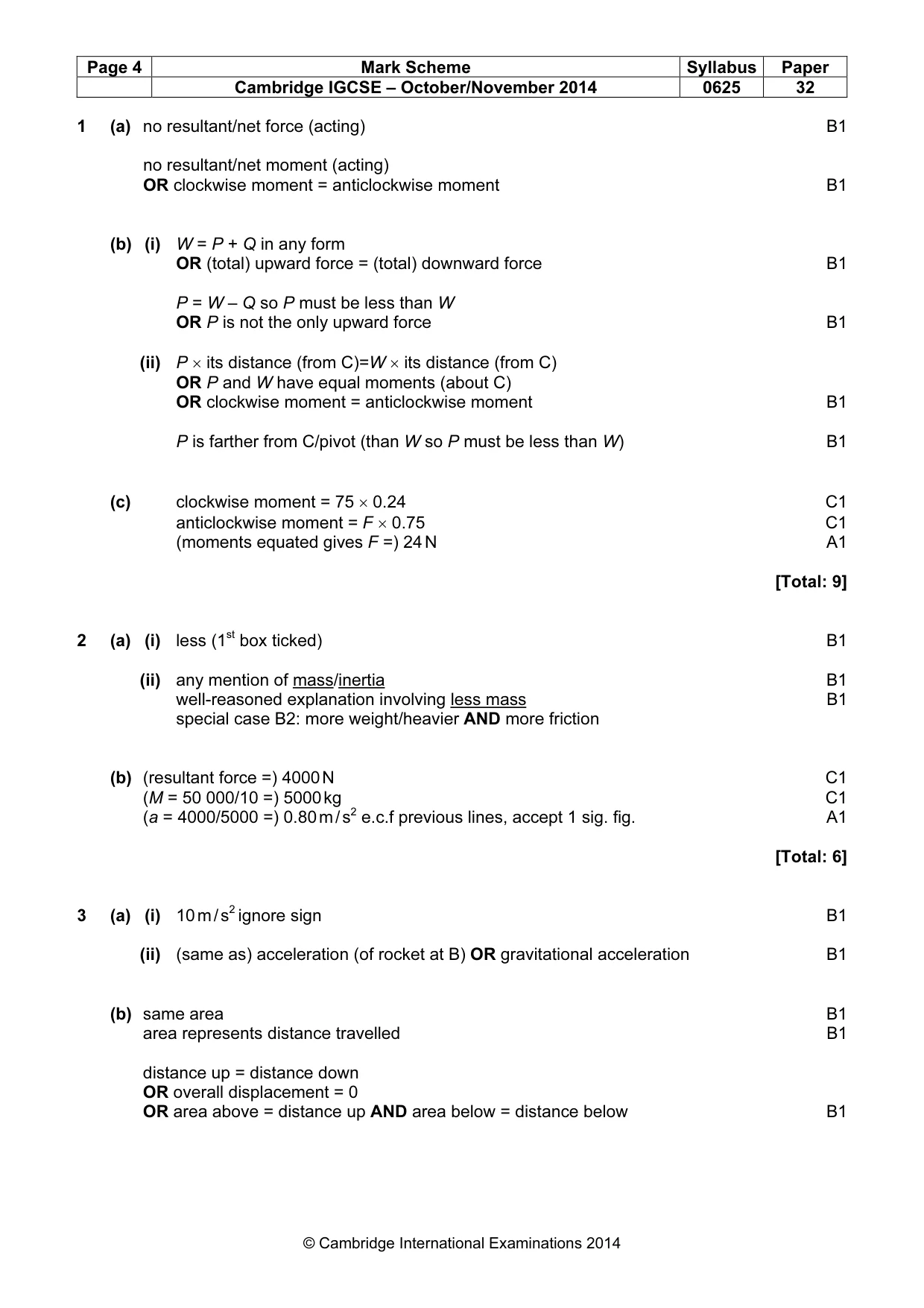
1 (a) State the two conditions necessary for a system of forces acting on a body to be in equilibrium. 1. .............................................................................................................................................. ................................................................................................................................................... 2. .............................................................................................................................................. ................................................................................................................................................... [2] (b) Fig. 1.1 shows a loaded wheelbarrow held in equilibrium by a gardener. The wheel of the wheelbarrow is in contact with the ground at point C. P Q C W Fig. 1.1 In Fig. 1.1, there are three vertical forces acting on the wheelbarrow. P is the upward force applied by the gardener. Q is the upward force of the ground on the wheel at point C. W is the weight of the wheelbarrow and its contents. Explain why the force P is less than the force W (i) by considering the forces P, Q and W, ........................................................................................................................................... ...................................................................................................................................... [2] (ii) by considering the moments of the forces P and W about point C. ........................................................................................................................................... ...................................................................................................................................... [2] (c) Fig. 1.2 shows a kitchen cupboard resting on a support and attached to a wall by a screw. wall screw cupboard F G 0.75 m P support 0.24 m 75 N Fig. 1.2 The weight of the cupboard and its contents is 75 N. G is the position of the centre of mass of the cupboard. The clockwise and anticlockwise moments about point P are equal. Calculate the force F exerted by the screw. F = ............................................... [3] [Total: 9]
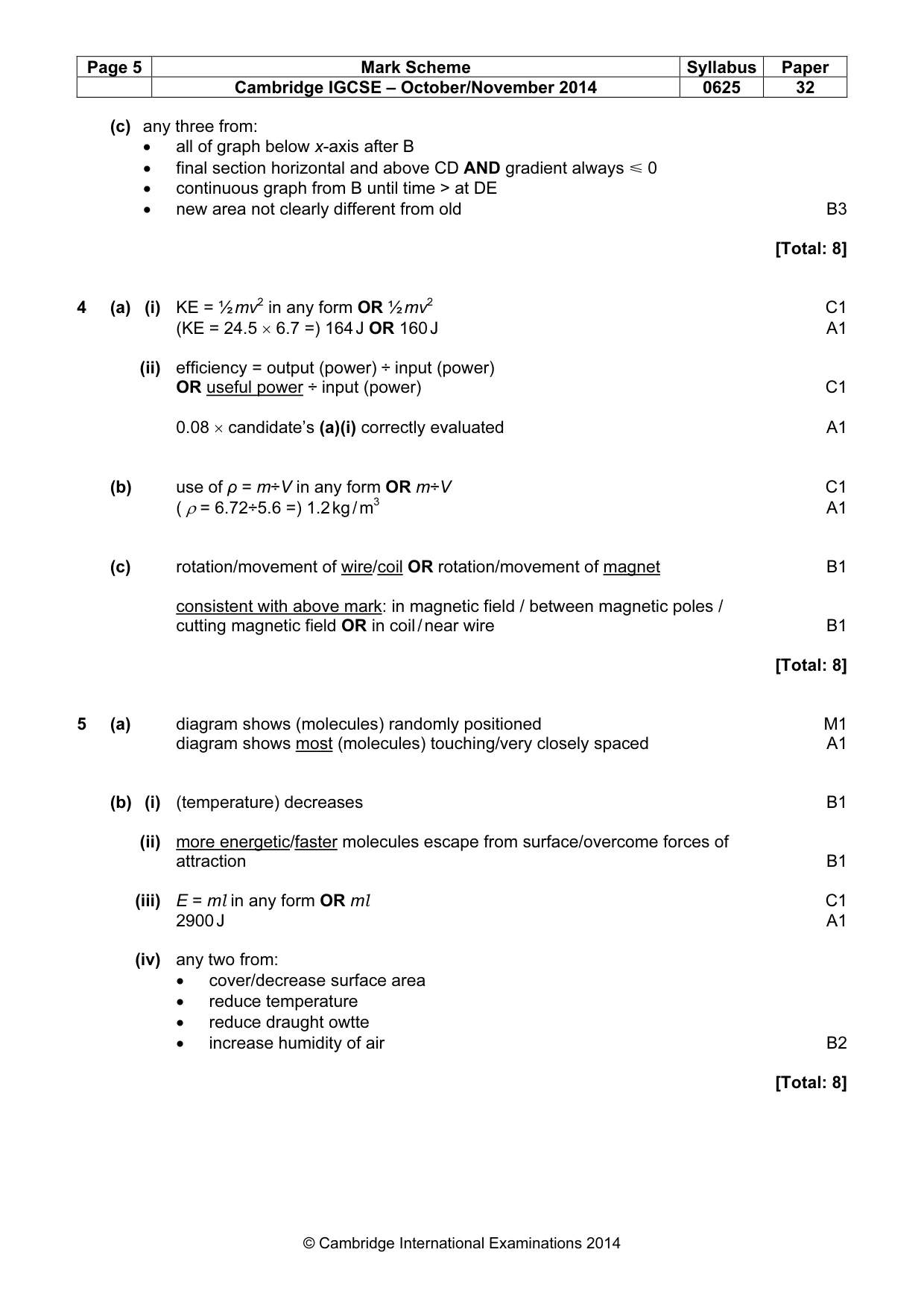
Mark scheme: 1 (a) no resultant/net force (acting) B1 no resultant/net moment (acting) OR clockwise moment = anticlockwise moment B1 (b) (i) W = P + Q in any form OR (total) upward force = (total) downward force B1 P = W – Q so P must be less than W OR P is not the only upward force B1 (ii) P × its distance (from C)=W × its distance (from C) OR P and W have equal moments (about C) OR clockwise moment = anticlockwise moment B1 P is farther from C/pivot (than W so P must be less than W) B1 (c) clockwise moment = 75 × 0.24 C1 anticlockwise moment = F × 0.75 C1 (moments equated gives F =) 24 N A1 [Total: 9] st
Q2 · A tanker lorry full of liquid
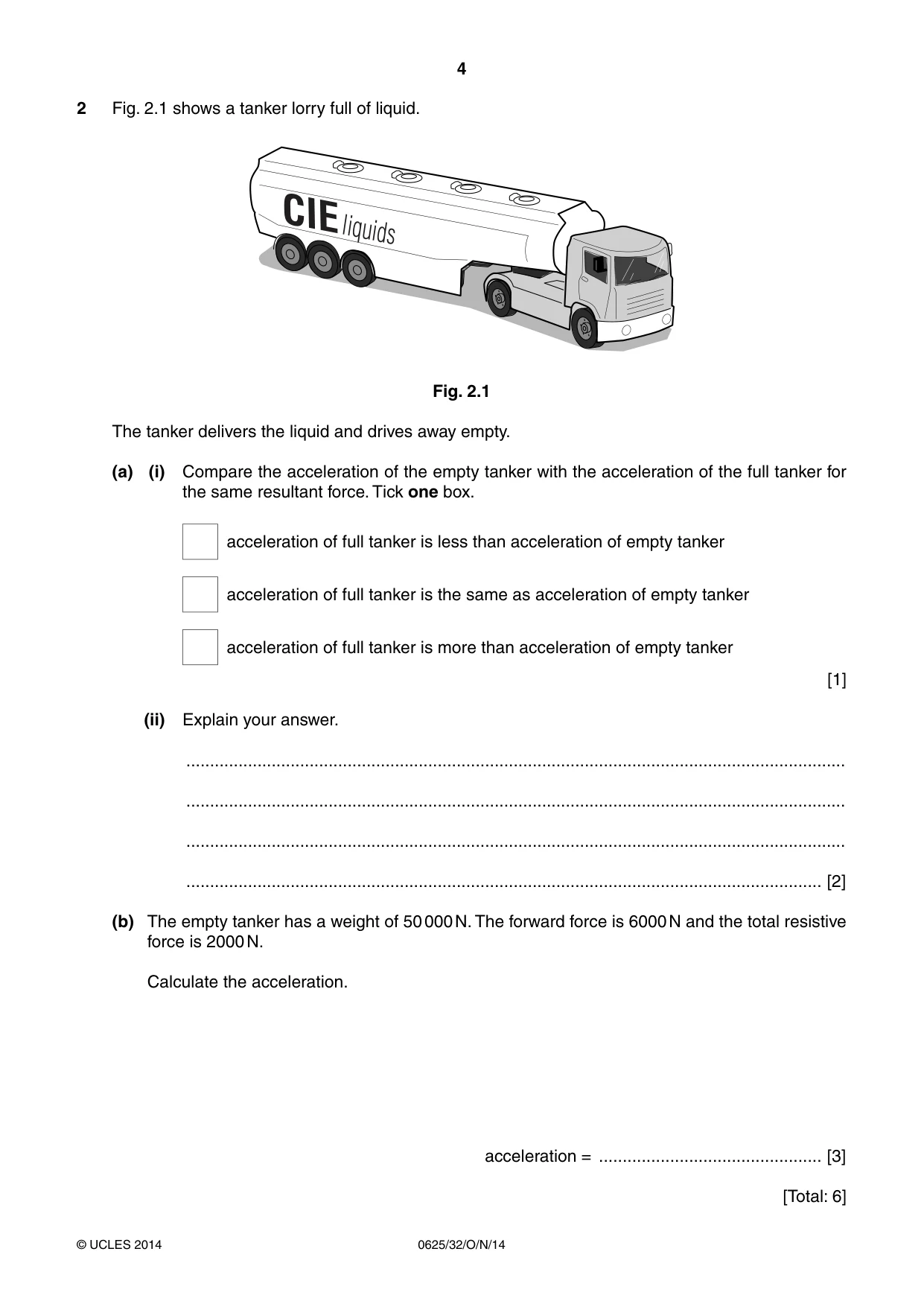
2 Fig. 2.1 shows a tanker lorry full of liquid. CIEliquids Fig. 2.1 The tanker delivers the liquid and drives away empty. (a) (i) Compare the acceleration of the empty tanker with the acceleration of the full tanker for the same resultant force. Tick one box. acceleration of full tanker is less than acceleration of empty tanker acceleration of full tanker is the same as acceleration of empty tanker acceleration of full tanker is more than acceleration of empty tanker [1] (ii) Explain your answer. ........................................................................................................................................... ........................................................................................................................................... ........................................................................................................................................... ...................................................................................................................................... [2] (b) The empty tanker has a weight of 50 000 N. The forward force is 6000 N and the total resistive force is 2000 N. Calculate the acceleration. acceleration = ............................................... [3] [Total: 6]
Mark scheme: 2 (a) (i) less (1st box ticked) B1 (ii) any mention of mass/inertia B1 well-reasoned explanation involving less mass B1 special case B2: more weight/heavier AND more friction (b) (resultant force =) 4000 N C1 (M = 50 000/10 =) 5000 kg C1 (a = 4000/5000 =) 0.80 m / s2 e.c.f previous lines, accept 1 sig. fig. A1 [Total: 6] 2
Q3 · The speed- time graph of a firework rocket as it rises and then falls to the ground
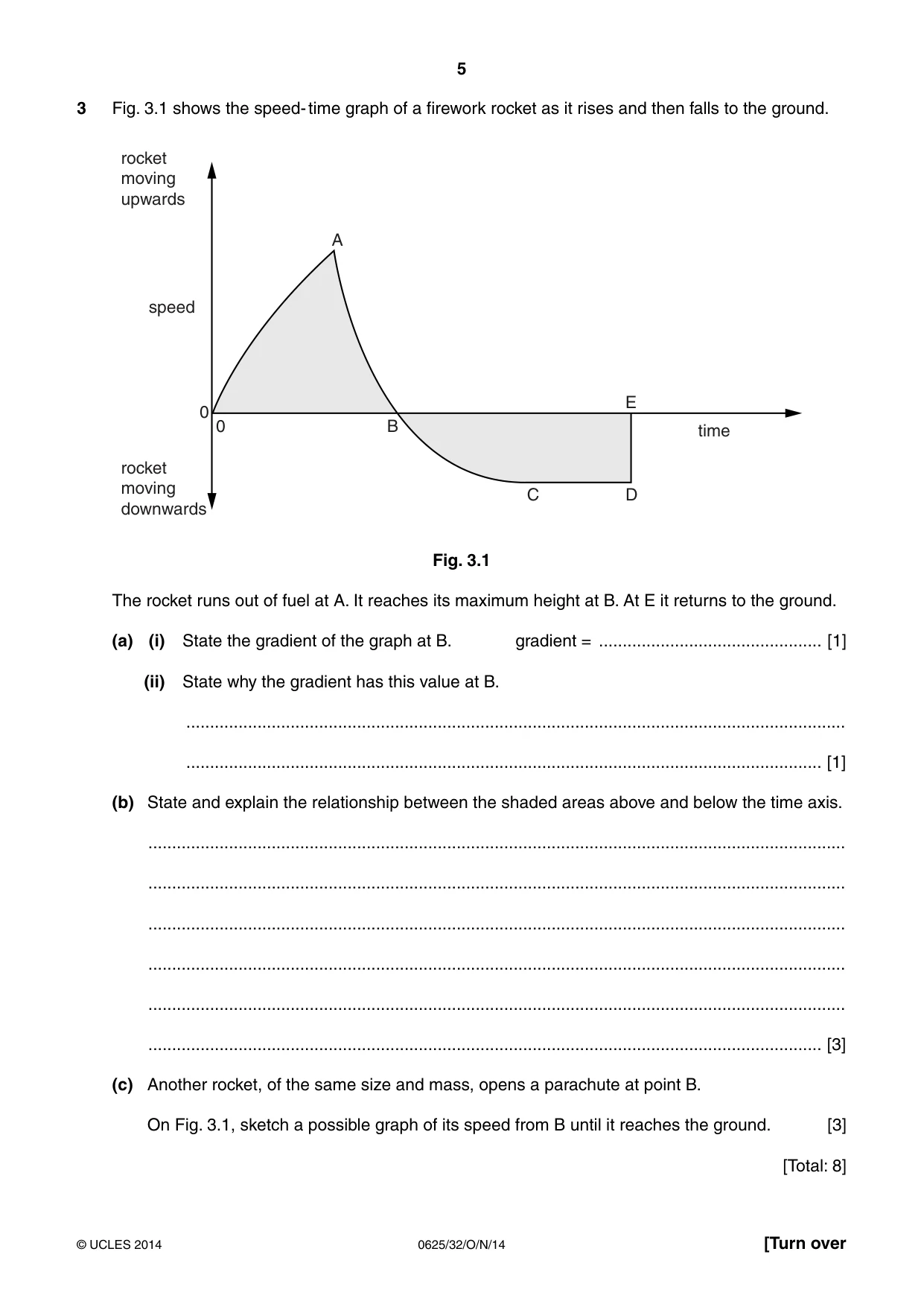
3 Fig. 3.1 shows the speed- time graph of a firework rocket as it rises and then falls to the ground. rocket moving upwards A speed E 0 0 B time rocket moving C D downwards Fig. 3.1 The rocket runs out of fuel at A. It reaches its maximum height at B. At E it returns to the ground. (a) (i) State the gradient of the graph at B. gradient = ............................................... [1] (ii) State why the gradient has this value at B. ........................................................................................................................................... ...................................................................................................................................... [1] (b) State and explain the relationship between the shaded areas above and below the time axis. ................................................................................................................................................... ................................................................................................................................................... ................................................................................................................................................... ................................................................................................................................................... ................................................................................................................................................... .............................................................................................................................................. [3] (c) Another rocket, of the same size and mass, opens a parachute at point B. On Fig. 3.1, sketch a possible graph of its speed from B until it reaches the ground. [3] [Total: 8]
Mark scheme: 3 (a) (i) 10 m / s2 ignore sign B1 (ii) (same as) acceleration (of rocket at B) OR gravitational acceleration B1 (b) same area B1 area represents distance travelled B1 distance up = distance down OR overall displacement = 0 OR area above = distance up AND area below = distance below B1 (c) any three from: • all of graph below x-axis after B • final section horizontal and above CD AND gradient always < 0 • continuous graph from B until time > at DE • new area not clearly different from old B3 [Total: 8] 2 2
Q4 · A small wind-turbine used to generate electricity
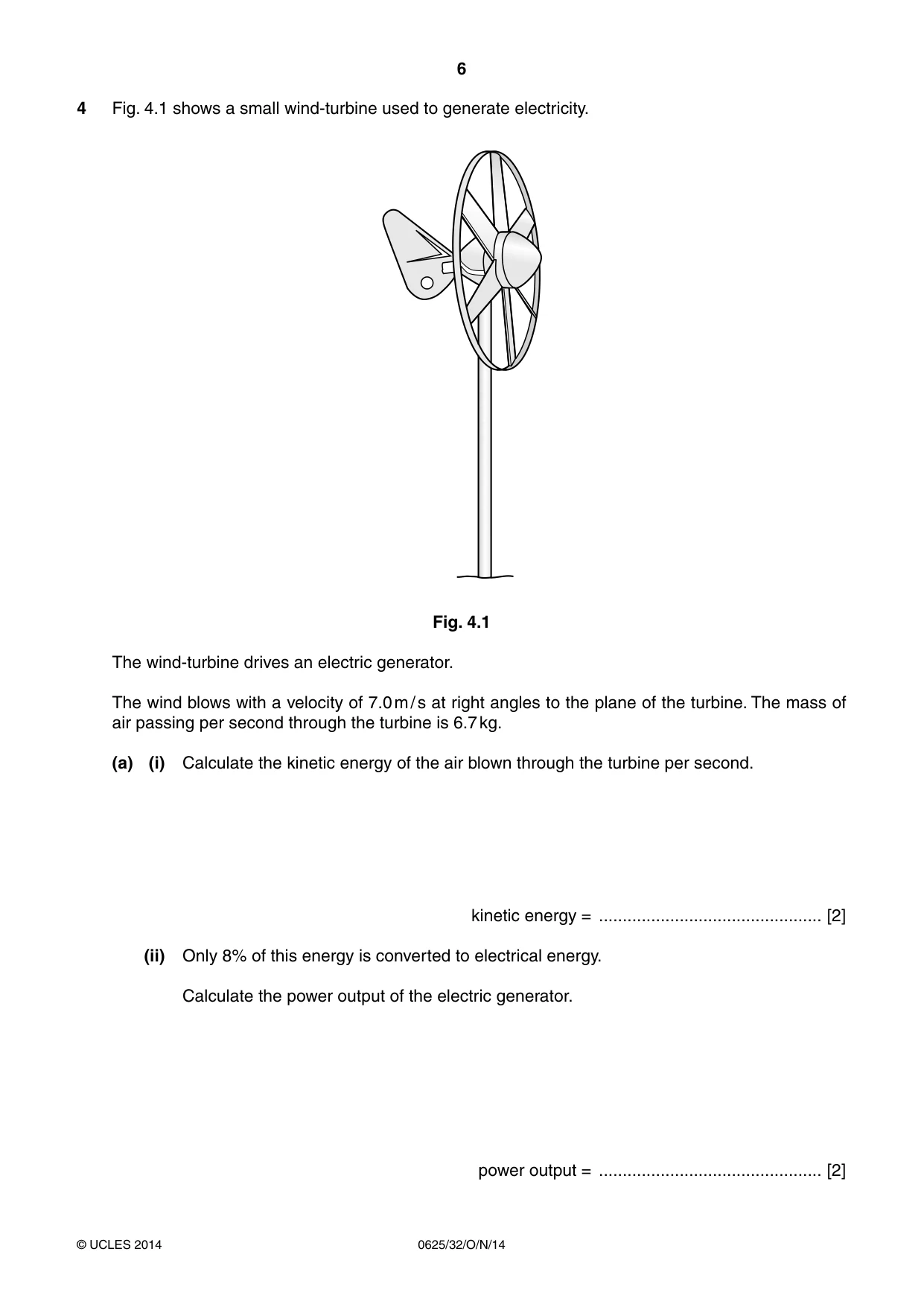
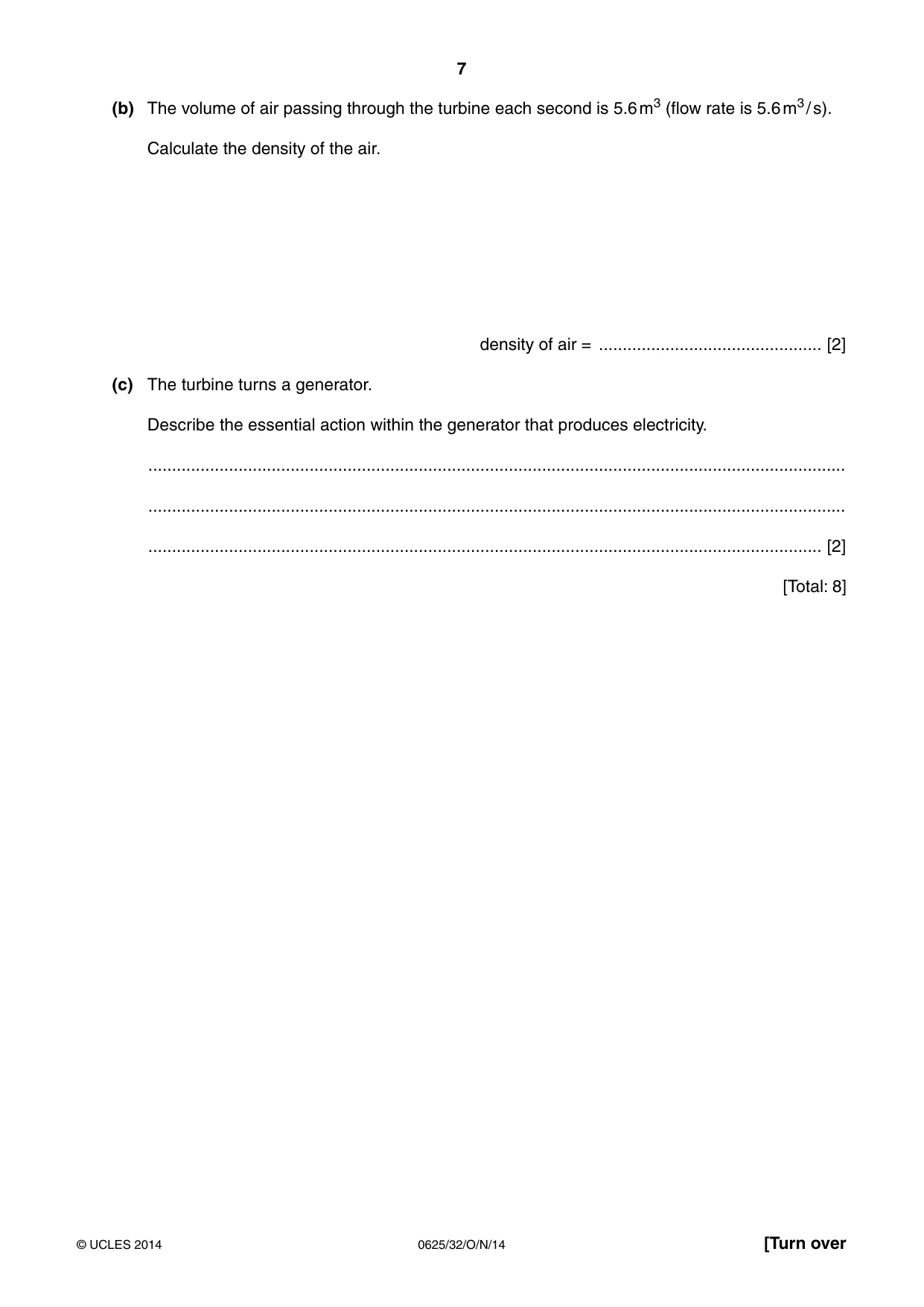
4 Fig. 4.1 shows a small wind-turbine used to generate electricity. Fig. 4.1 The wind-turbine drives an electric generator. The wind blows with a velocity of 7.0 m / s at right angles to the plane of the turbine. The mass of air passing per second through the turbine is 6.7 kg. (a) (i) Calculate the kinetic energy of the air blown through the turbine per second. kinetic energy = ............................................... [2] (ii) Only 8% of this energy is converted to electrical energy. Calculate the power output of the electric generator. power output = ............................................... [2] (b) The volume of air passing through the turbine each second is 5.6 m3 (flow rate is 5.6 m3 / s). Calculate the density of the air. density of air = ............................................... [2] (c) The turbine turns a generator. Describe the essential action within the generator that produces electricity. ................................................................................................................................................... ................................................................................................................................................... .............................................................................................................................................. [2] [Total: 8]
Mark scheme: 4 (a) (i) KE = ½ mv2 in any form OR ½ mv2 C1 (KE = 24.5 × 6.7 =) 164 J OR 160 J A1 (ii) efficiency = output (power) ÷ input (power) OR useful power ÷ input (power) C1 0.08 × candidate’s (a)(i) correctly evaluated A1 (b) use of ρ = m÷V in any form OR m÷V C1 ( ρ = 6.72÷5.6 =) 1.2 kg / m3 A1 (c) rotation/movement of wire/coil OR rotation/movement of magnet B1 consistent with above mark: in magnetic field / between magnetic poles / cutting magnetic field OR in coil / near wire B1 [Total: 8]
Q5 · In the box below, sketch a diagram to represent the molecular structure of a liquid
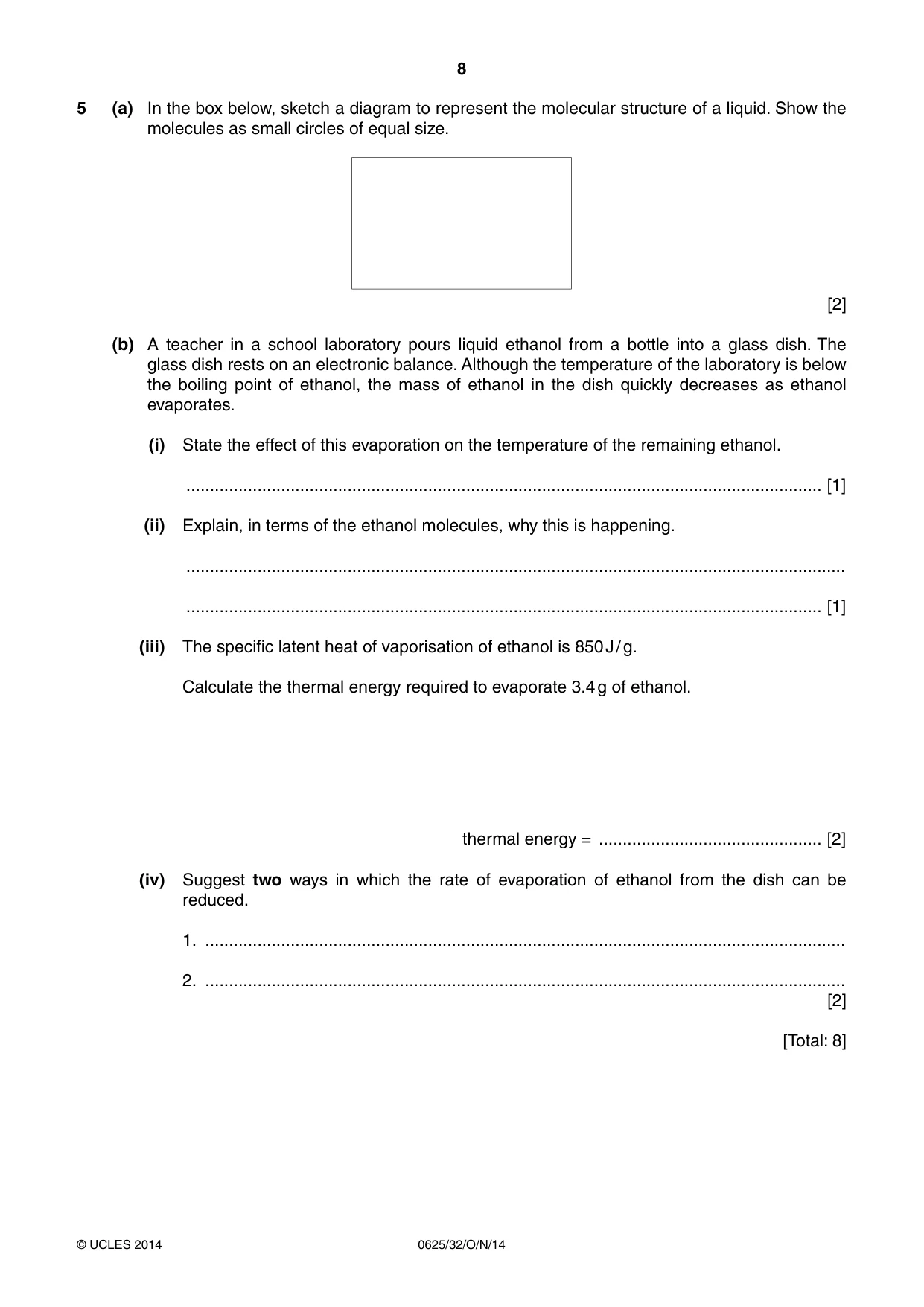
5 (a) In the box below, sketch a diagram to represent the molecular structure of a liquid. Show the molecules as small circles of equal size. [2] (b) A teacher in a school laboratory pours liquid ethanol from a bottle into a glass dish. The glass dish rests on an electronic balance. Although the temperature of the laboratory is below the boiling point of ethanol, the mass of ethanol in the dish quickly decreases as ethanol evaporates. (i) State the effect of this evaporation on the temperature of the remaining ethanol. ...................................................................................................................................... [1] (ii) Explain, in terms of the ethanol molecules, why this is happening. ........................................................................................................................................... ...................................................................................................................................... [1] (iii) The specific latent heat of vaporisation of ethanol is 850 J / g. Calculate the thermal energy required to evaporate 3.4 g of ethanol. thermal energy = ............................................... [2] (iv) Suggest two ways in which the rate of evaporation of ethanol from the dish can be reduced. 1. ....................................................................................................................................... 2. ....................................................................................................................................... [2] [Total: 8]
Mark scheme: 5 (a) diagram shows (molecules) randomly positioned M1 diagram shows most (molecules) touching/very closely spaced A1 (b) (i) (temperature) decreases B1 (ii) more energetic/faster molecules escape from surface/overcome forces of attraction B1 (iii) E = ml in any form OR ml C1 2900 J A1 (iv) any two from: • cover/decrease surface area • reduce temperature • reduce draught owtte • increase humidity of air B2 [Total: 8]
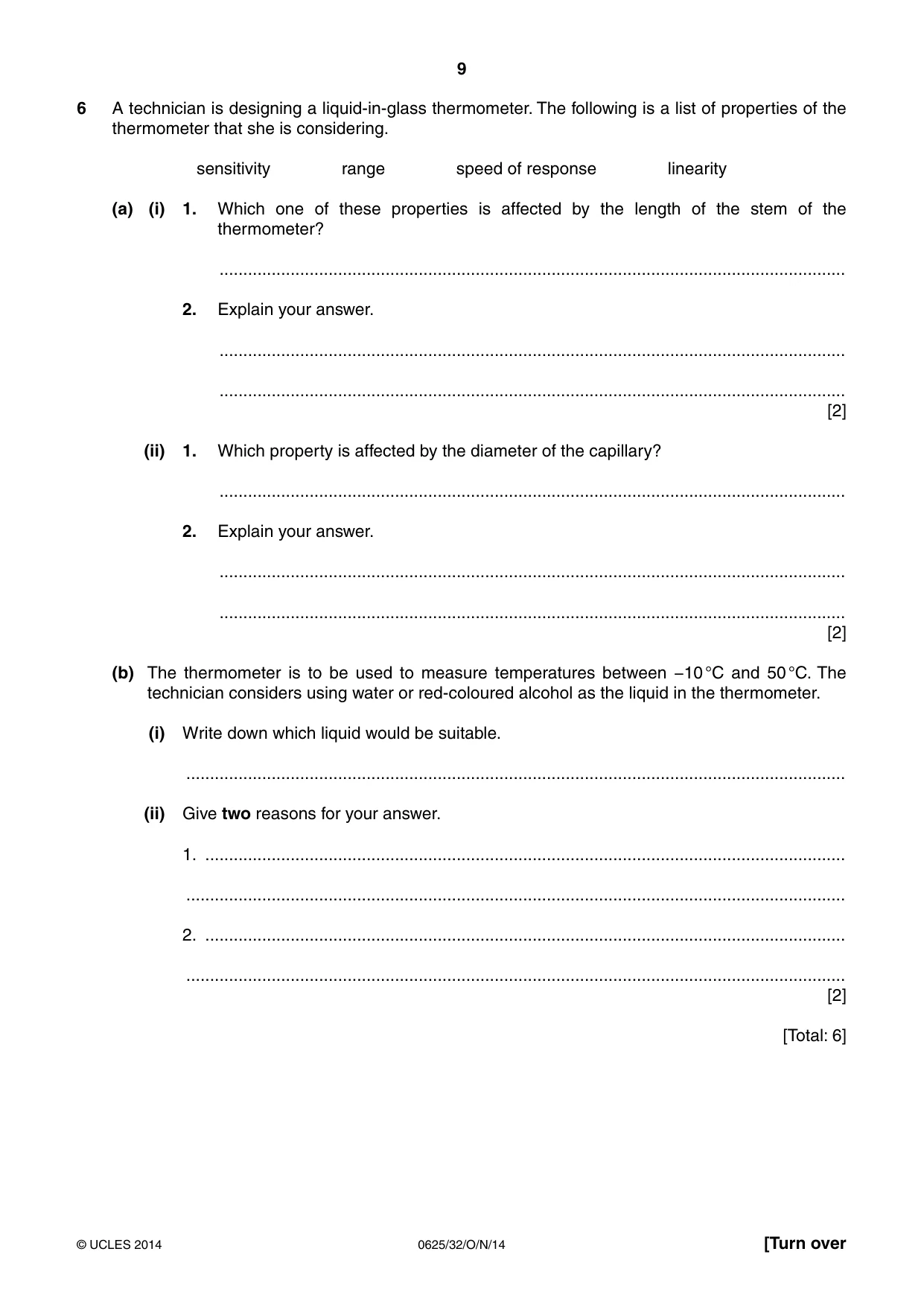
Q6 · A technician is designing a liquid-in-glass thermometer
6 A technician is designing a liquid-in-glass thermometer. The following is a list of properties of the thermometer that she is considering. sensitivity range speed of response linearity (a) (i) 1. Which one of these properties is affected by the length of the stem of the thermometer? .................................................................................................................................... 2. Explain your answer. .................................................................................................................................... .................................................................................................................................... [2] (ii) 1. Which property is affected by the diameter of the capillary? .................................................................................................................................... 2. Explain your answer. .................................................................................................................................... .................................................................................................................................... [2] (b) The thermometer is to be used to measure temperatures between −10 °C and 50 °C. The technician considers using water or red-coloured alcohol as the liquid in the thermometer. (i) Write down which liquid would be suitable. ........................................................................................................................................... (ii) Give two reasons for your answer. 1. ....................................................................................................................................... ........................................................................................................................................... 2. ....................................................................................................................................... ........................................................................................................................................... [2] [Total: 6]
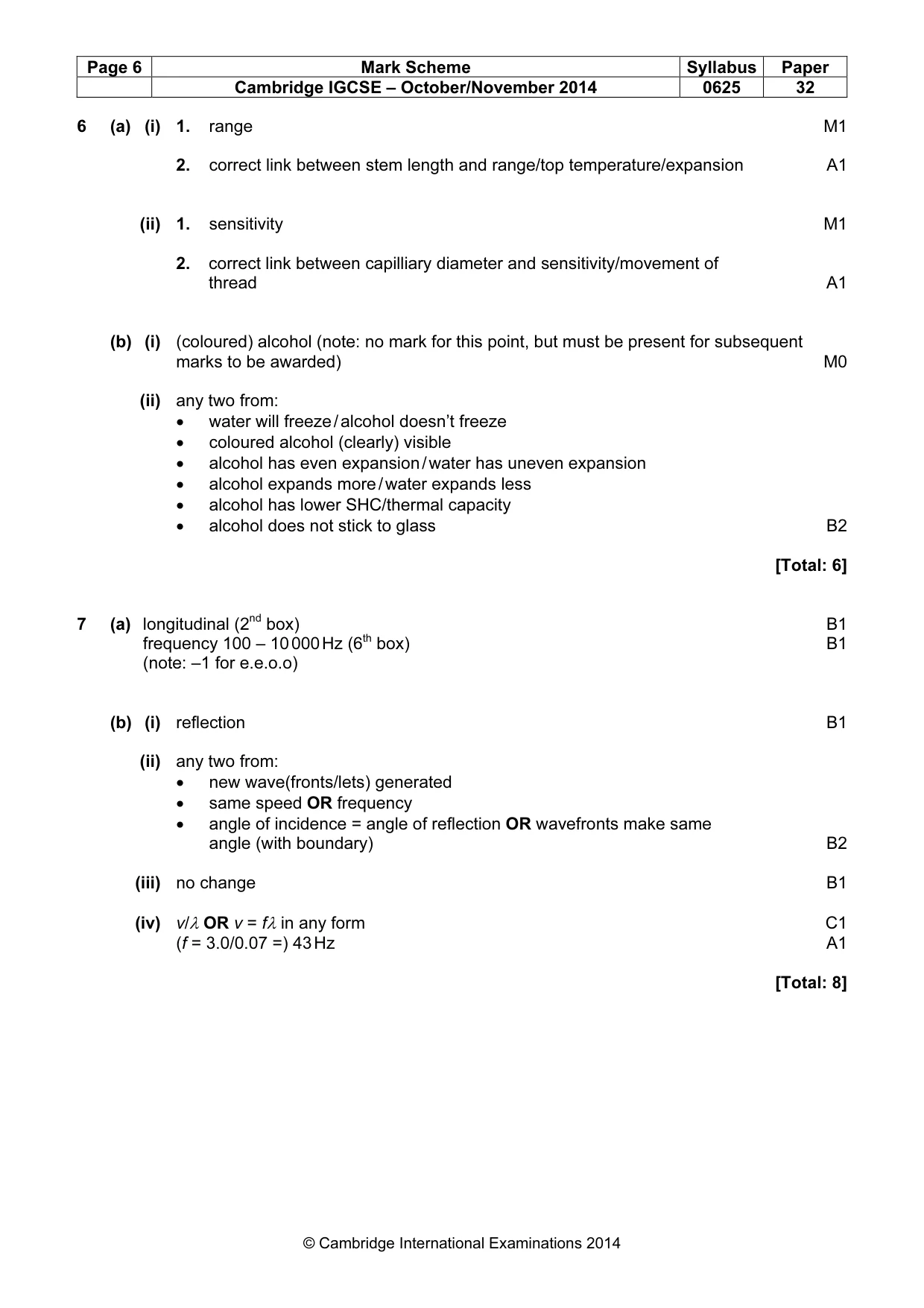
Mark scheme: 6 (a) (i) 1. range M1 2. correct link between stem length and range/top temperature/expansion A1 (ii) 1. sensitivity M1 2. correct link between capilliary diameter and sensitivity/movement of thread A1 (b) (i) (coloured) alcohol (note: no mark for this point, but must be present for subsequent marks to be awarded) M0 (ii) any two from: • water will freeze / alcohol doesn’t freeze • coloured alcohol (clearly) visible • alcohol has even expansion / water has uneven expansion • alcohol expands more / water expands less • alcohol has lower SHC/thermal capacity • alcohol does not stick to glass B2 [Total: 6] nd
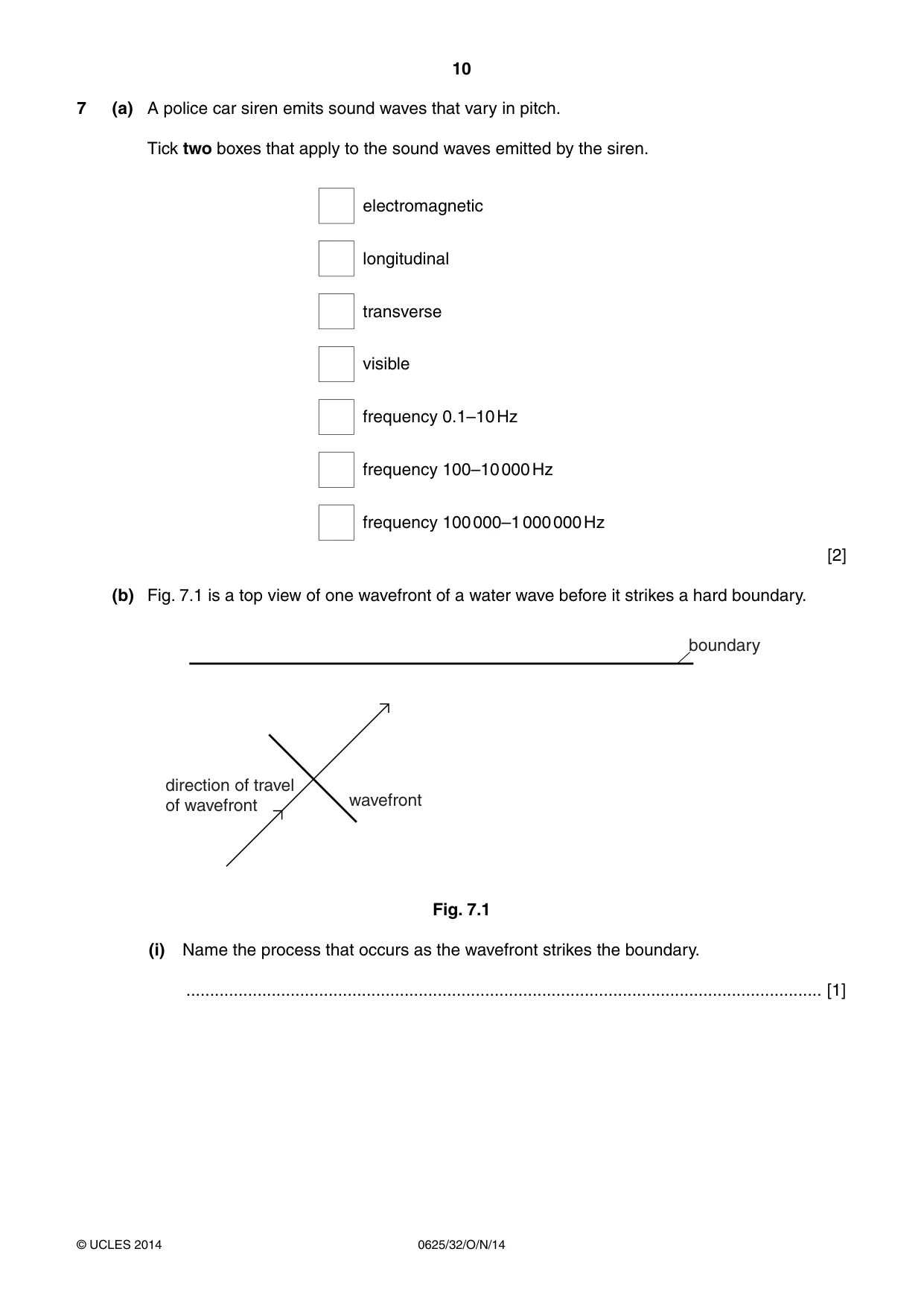
Q7 · A police car siren emits sound waves that vary in pitch
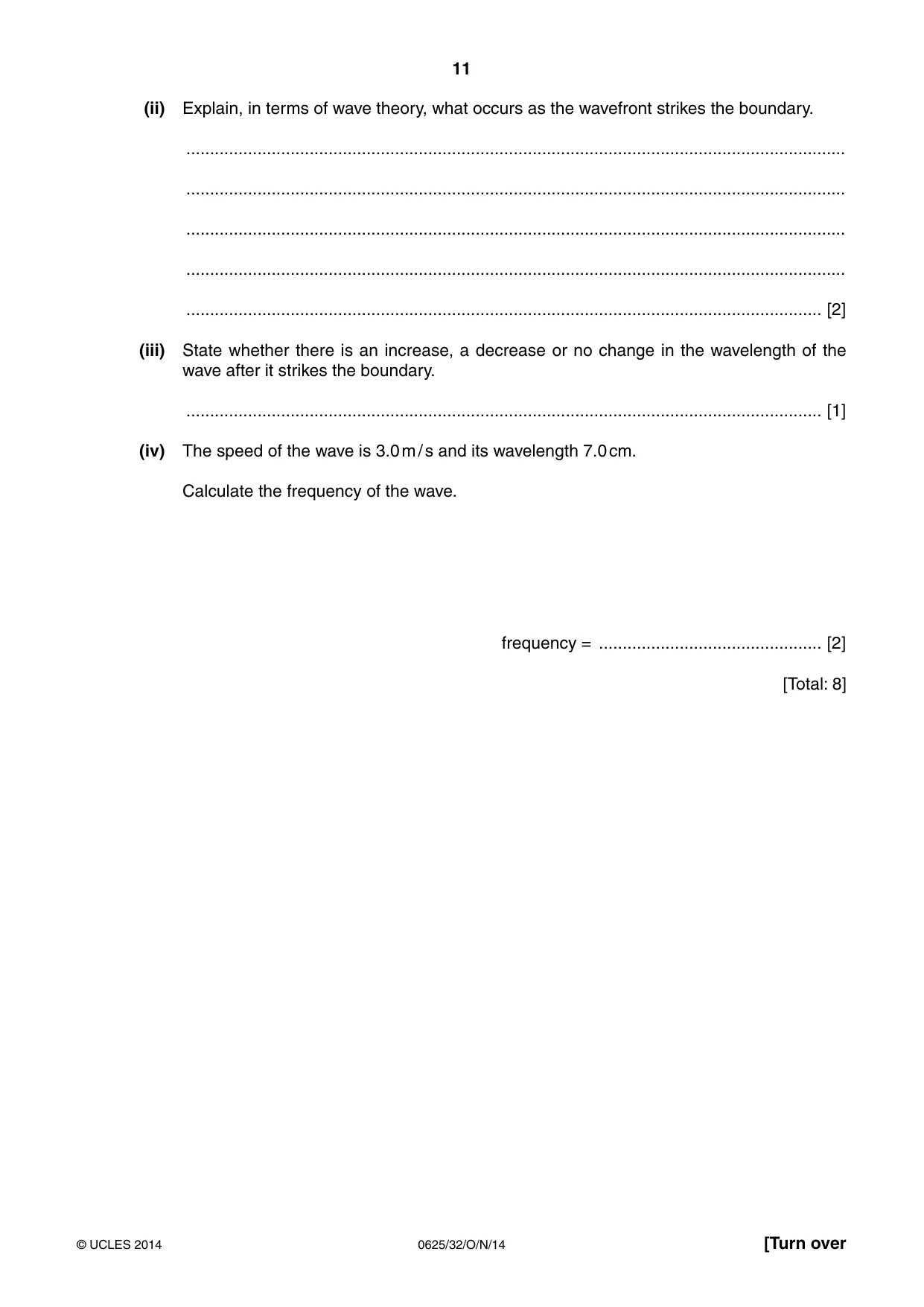
7 (a) A police car siren emits sound waves that vary in pitch. Tick two boxes that apply to the sound waves emitted by the siren. electromagnetic longitudinal transverse visible frequency 0.1–10 Hz frequency 100–10 000 Hz frequency 100 000–1 000 000 Hz [2] (b) Fig. 7.1 is a top view of one wavefront of a water wave before it strikes a hard boundary. boundary direction of travel wavefront of wavefront Fig. 7.1 (i) Name the process that occurs as the wavefront strikes the boundary. ...................................................................................................................................... [1] (ii) Explain, in terms of wave theory, what occurs as the wavefront strikes the boundary. ........................................................................................................................................... ........................................................................................................................................... ........................................................................................................................................... ........................................................................................................................................... ...................................................................................................................................... [2] (iii) State whether there is an increase, a decrease or no change in the wavelength of the wave after it strikes the boundary. ...................................................................................................................................... [1] (iv) The speed of the wave is 3.0 m / s and its wavelength 7.0 cm. Calculate the frequency of the wave. frequency = ............................................... [2] [Total: 8]
Mark scheme: 7 (a) longitudinal (2nd box) B1 frequency 100 – 10 000 Hz (6th box) B1 (note: –1 for e.e.o.o) (b) (i) reflection B1 (ii) any two from: • new wave(fronts/lets) generated • same speed OR frequency • angle of incidence = angle of reflection OR wavefronts make same angle (with boundary) B2 (iii) no change B1 (iv) v/λ OR v = fλ in any form C1 (f = 3.0/0.07 =) 43 Hz A1 [Total: 8]
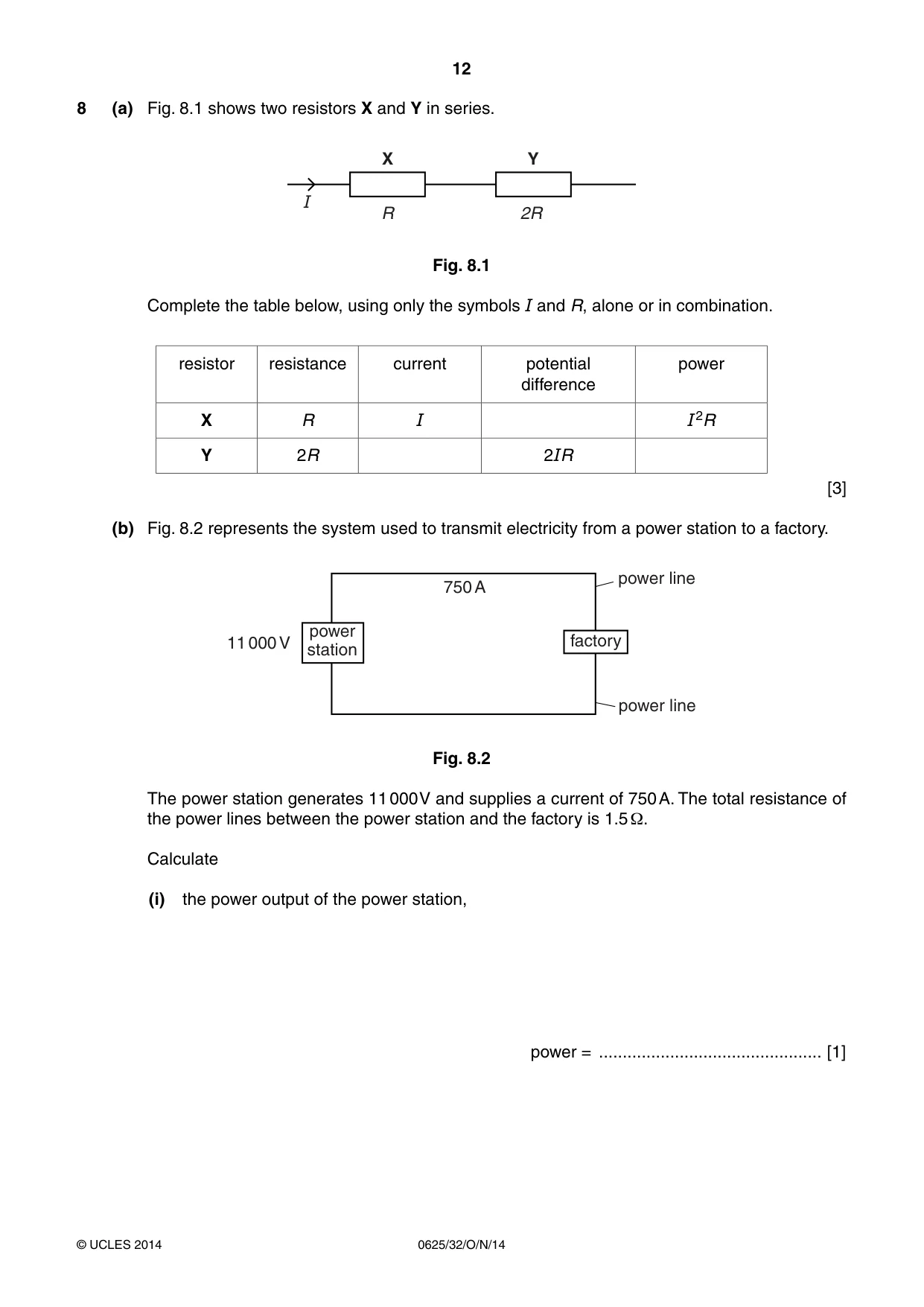
Q8 · Two resistors X and Y in series
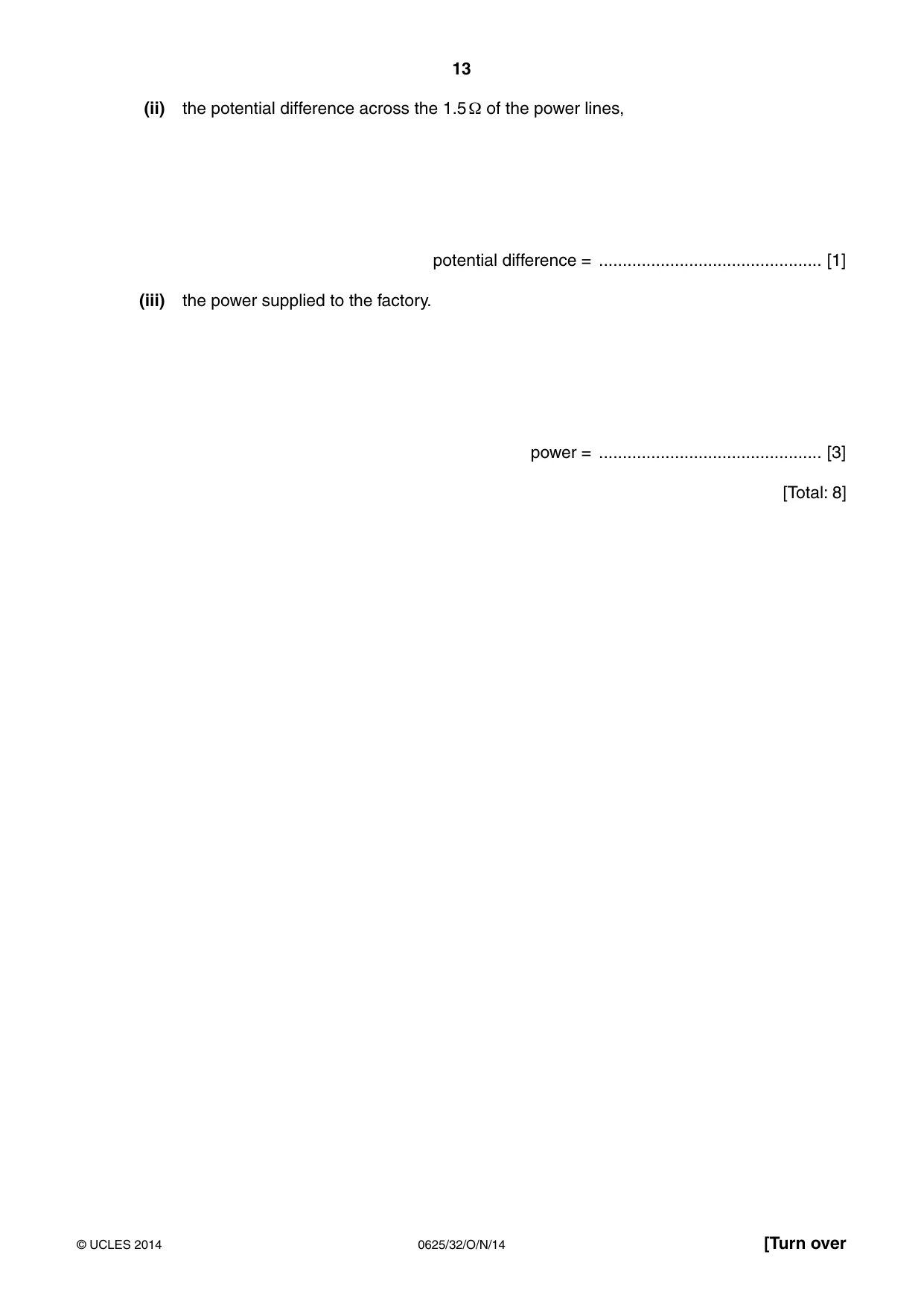
8 (a) Fig. 8.1 shows two resistors X and Y in series. X Y I R 2R Fig. 8.1 Complete the table below, using only the symbols I and R, alone or in combination. resistor resistance current potential power difference X R I I2R Y 2R 2IR [3] (b) Fig. 8.2 represents the system used to transmit electricity from a power station to a factory. power line 750 A power 11 000 V factory station power line Fig. 8.2 The power station generates 11 000 V and supplies a current of 750 A. The total resistance of the power lines between the power station and the factory is 1.5 Ω. Calculate (i) the power output of the power station, power = ............................................... [1] (ii) the potential difference across the 1.5 Ω of the power lines, potential difference = ............................................... [1] (iii) the power supplied to the factory. power = ............................................... [3] [Total: 8]
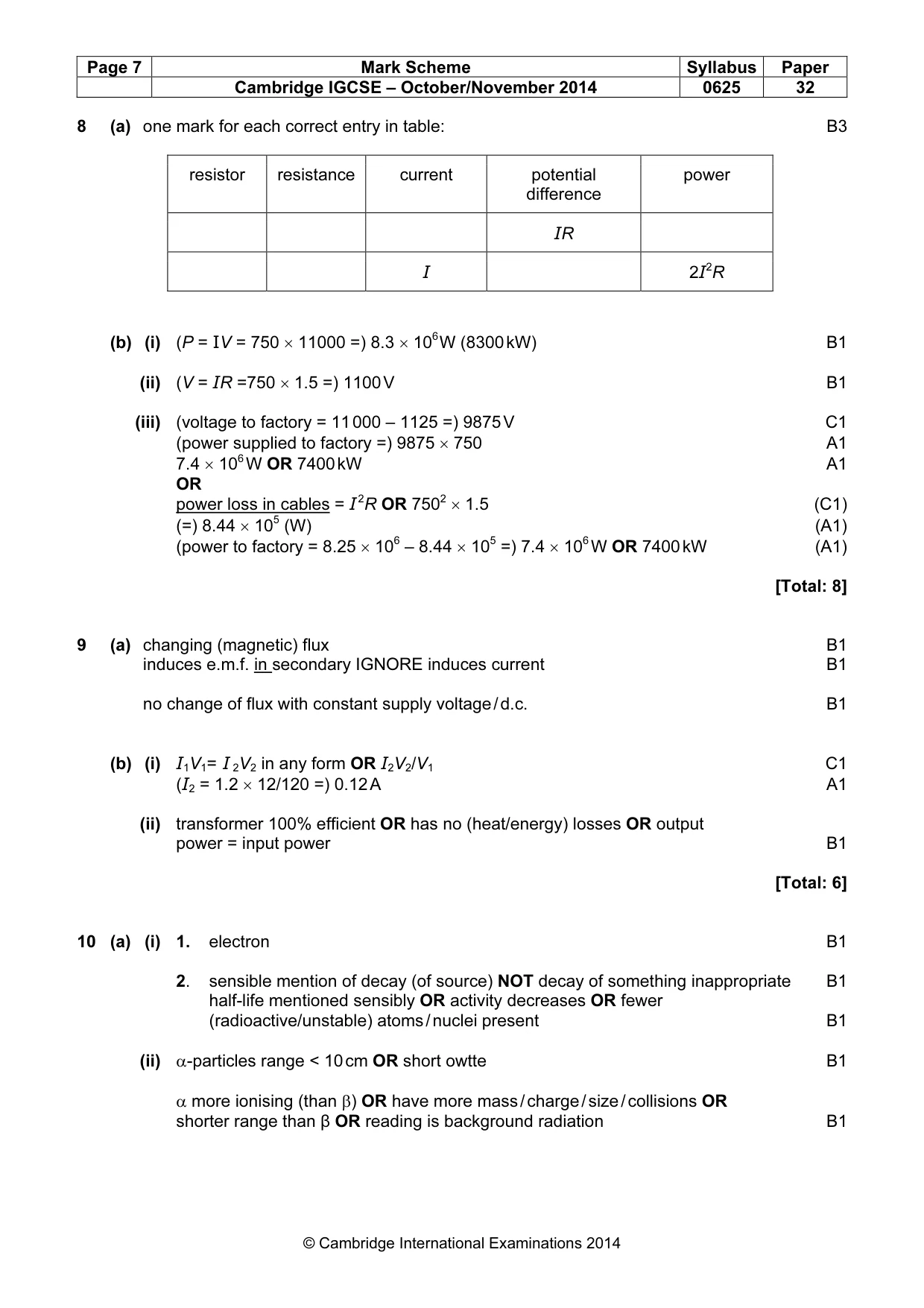
Mark scheme: 8 (a) one mark for each correct entry in table: B3 resistor resistance current potential power difference IR I 2I2R (b) (i) (P = IV = 750 × 11000 =) 8.3 × 10⁶ W (8300 kW) B1 (ii) (V = IR =750 × 1.5 =) 1100 V B1 (iii) (voltage to factory = 11 000 – 1125 =) 9875 V C1 (power supplied to factory =) 9875 × 750 A1 7.4 × 10⁶ W OR 7400 kW A1 OR power loss in cables = I 2R OR 7502 × 1.5 (C1) (=) 8.44 × 10⁵ (W) (A1) (power to factory = 8.25 × 10⁶ – 8.44 × 105 =) 7.4 × 10⁶ W OR 7400 kW (A1) [Total: 8]
Q9 · A transformer is used to reduce the voltage of a supply from 120 V a.c
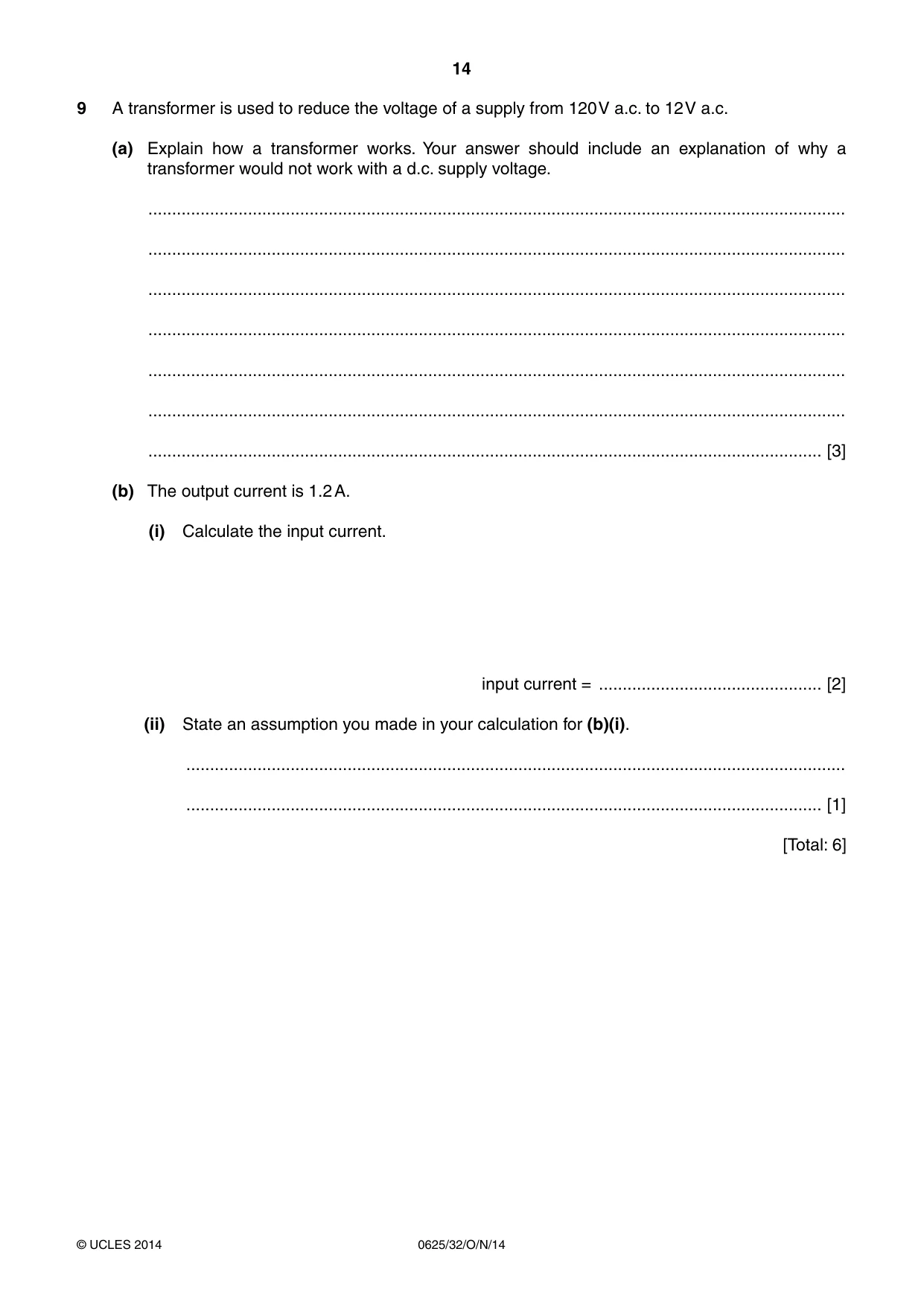
9 A transformer is used to reduce the voltage of a supply from 120 V a.c. to 12 V a.c. (a) Explain how a transformer works. Your answer should include an explanation of why a transformer would not work with a d.c. supply voltage. ................................................................................................................................................... ................................................................................................................................................... ................................................................................................................................................... ................................................................................................................................................... ................................................................................................................................................... ................................................................................................................................................... .............................................................................................................................................. [3] (b) The output current is 1.2 A. (i) Calculate the input current. input current = ............................................... [2] (ii) State an assumption you made in your calculation for (b)(i). ........................................................................................................................................... ...................................................................................................................................... [1] [Total: 6]
Mark scheme: 9 (a) changing (magnetic) flux B1 induces e.m.f. in secondary IGNORE induces current B1 no change of flux with constant supply voltage / d.c. B1 (b) (i) I1V1= I 2V2 in any form OR I2V2/V1 C1 (I2 = 1.2 × 12/120 =) 0.12 A A1 (ii) transformer 100% efficient OR has no (heat/energy) losses OR output power = input power B1 [Total: 6]
Q10 · A technician sets up a radiation detector in a university laboratory for use in a class…
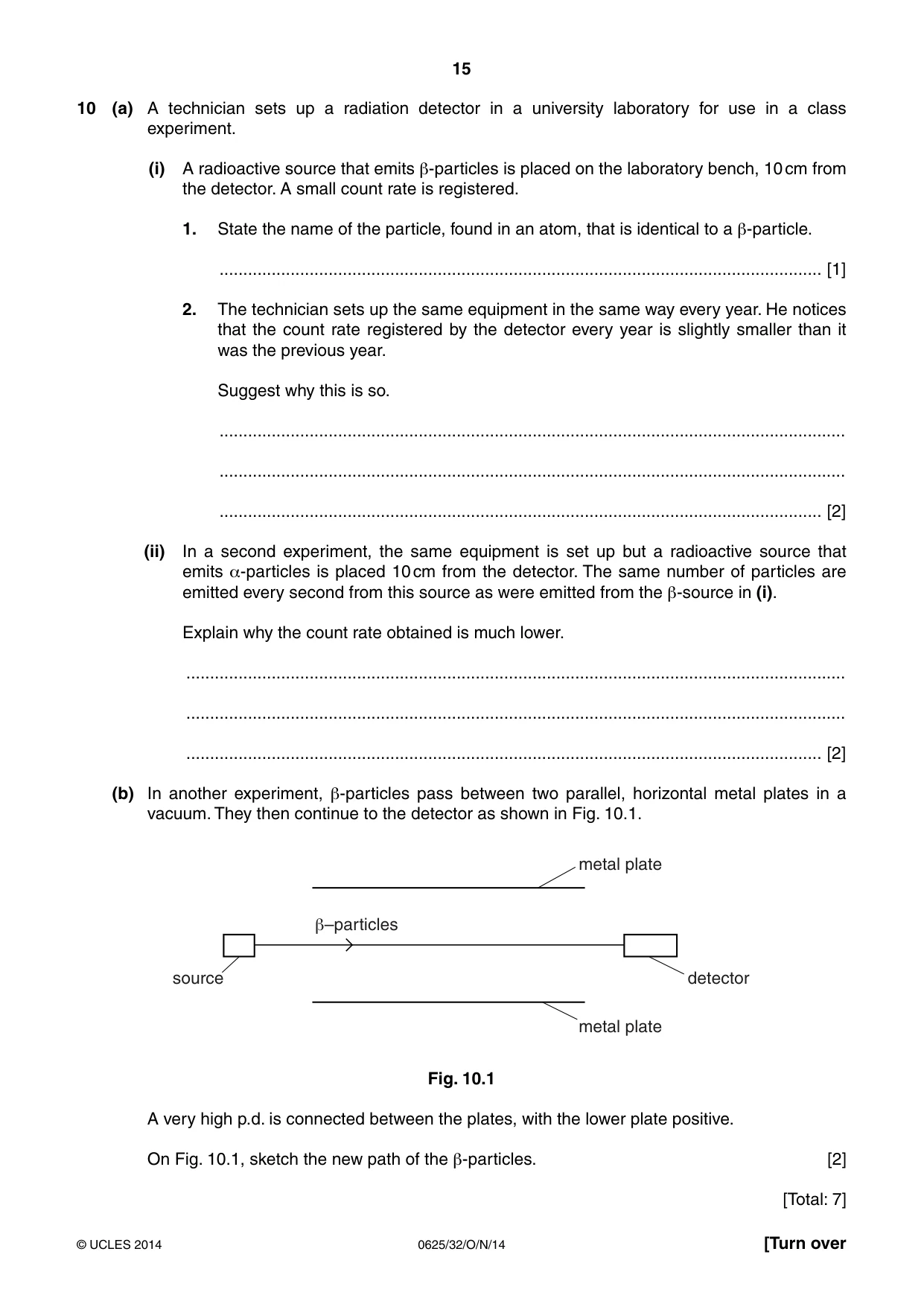
10 (a) A technician sets up a radiation detector in a university laboratory for use in a class experiment. (i) A radioactive source that emits β-particles is placed on the laboratory bench, 10 cm from the detector. A small count rate is registered. 1. State the name of the particle, found in an atom, that is identical to a β-particle. ............................................................................................................................... [1] 2. The technician sets up the same equipment in the same way every year. He notices that the count rate registered by the detector every year is slightly smaller than it was the previous year. Suggest why this is so. .................................................................................................................................... .................................................................................................................................... ............................................................................................................................... [2] (ii) In a second experiment, the same equipment is set up but a radioactive source that emits α-particles is placed 10 cm from the detector. The same number of particles are emitted every second from this source as were emitted from the β-source in (i). Explain why the count rate obtained is much lower. ........................................................................................................................................... ........................................................................................................................................... ...................................................................................................................................... [2] (b) In another experiment, β-particles pass between two parallel, horizontal metal plates in a vacuum. They then continue to the detector as shown in Fig. 10.1. metal plate `–particles source detector metal plate Fig. 10.1 A very high p.d. is connected between the plates, with the lower plate positive. On Fig. 10.1, sketch the new path of the β-particles. [2] [Total: 7]
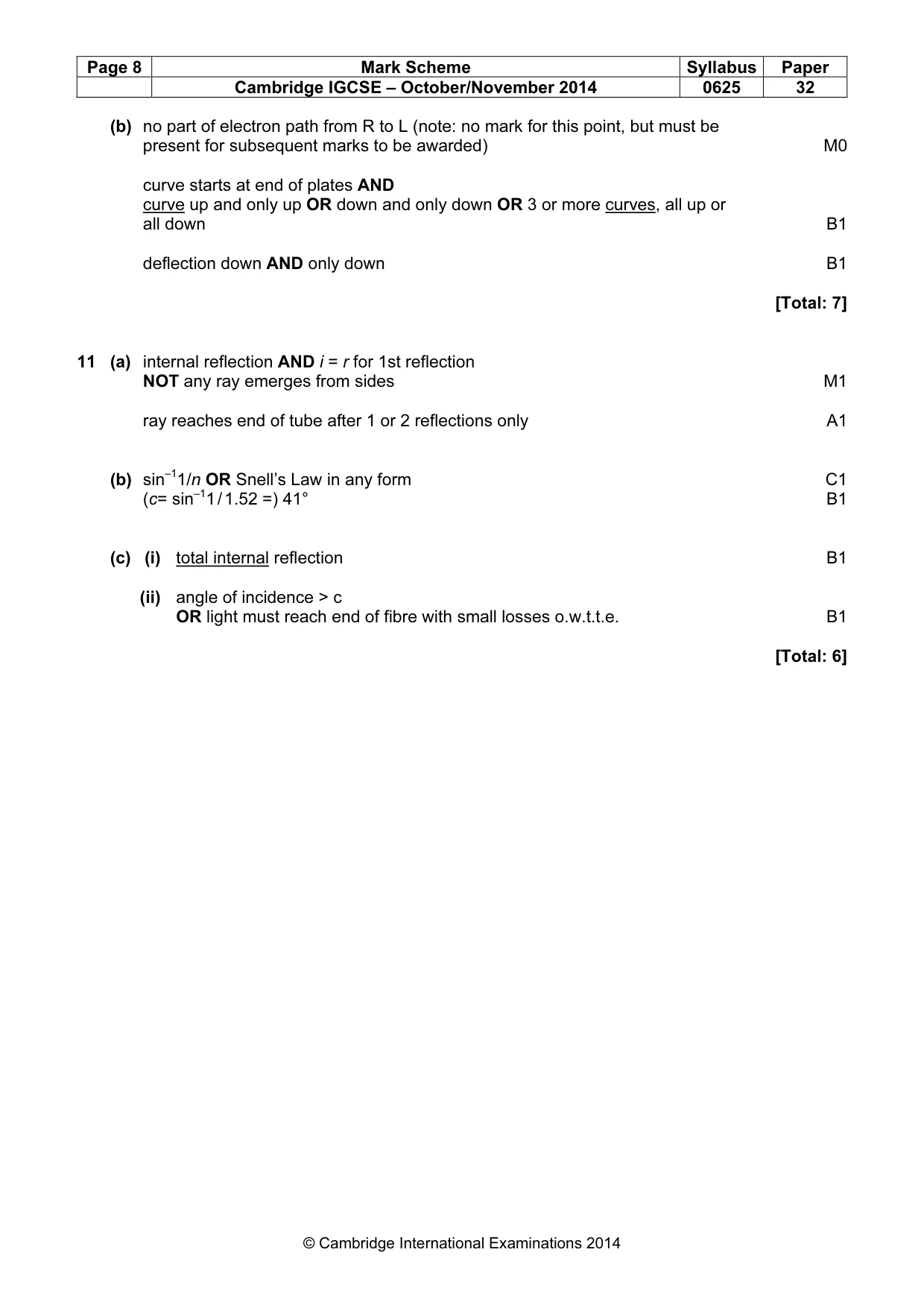
Mark scheme: 10 (a) (i) 1. electron B1 2. sensible mention of decay (of source) NOT decay of something inappropriate B1 half-life mentioned sensibly OR activity decreases OR fewer (radioactive/unstable) atoms / nuclei present B1 (ii) α-particles range < 10 cm OR short owtte B1 α more ionising (than β) OR have more mass / charge / size / collisions OR shorter range than β OR reading is background radiation B1 (b) no part of electron path from R to L (note: no mark for this point, but must be present for subsequent marks to be awarded) M0 curve starts at end of plates AND curve up and only up OR down and only down OR 3 or more curves, all up or all down B1 deflection down AND only down B1 [Total: 7]
Q11 · Part of the path of a ray of light PQ travelling in an optical fibre
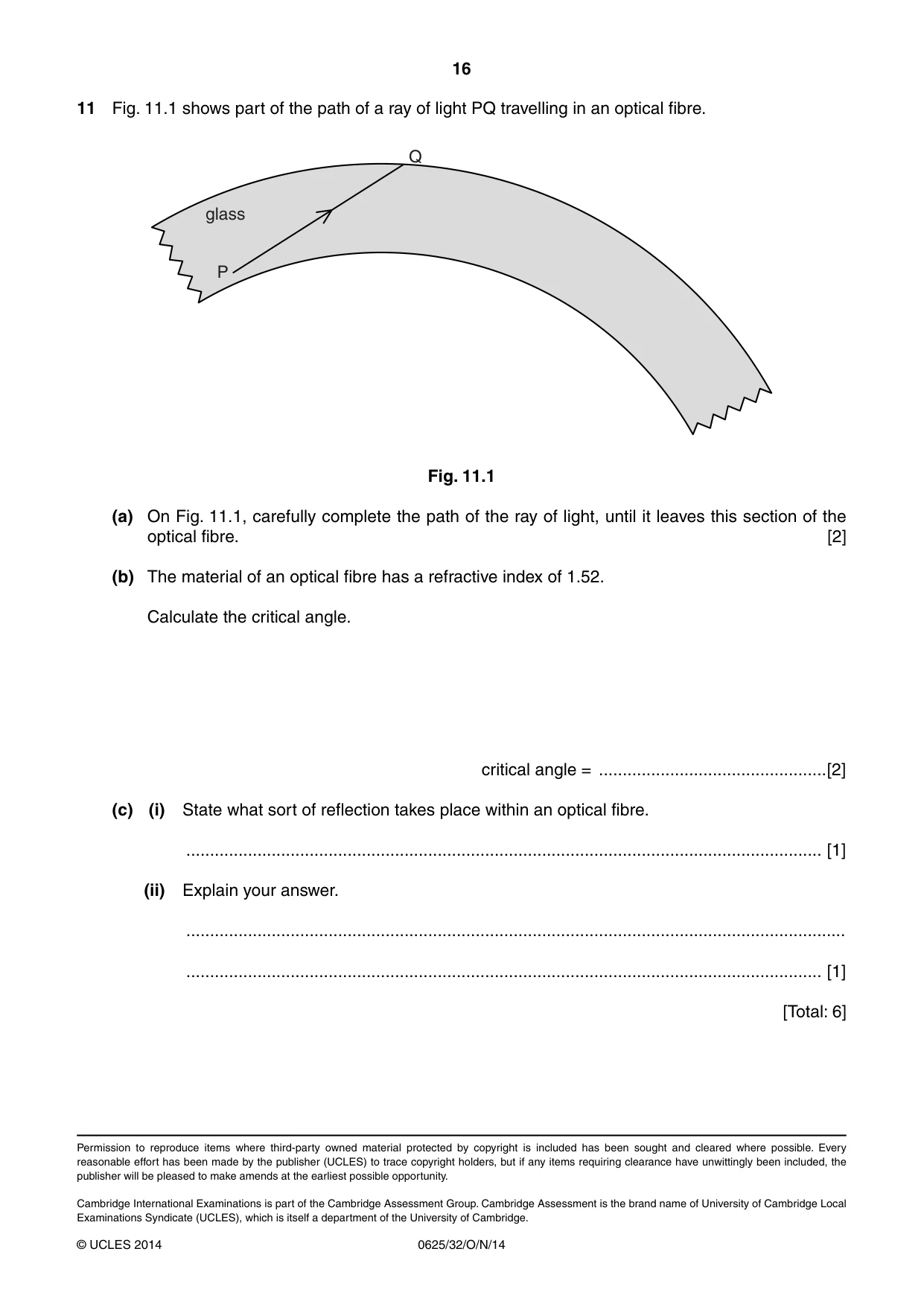
11 Fig. 11.1 shows part of the path of a ray of light PQ travelling in an optical fibre. Q glass P Fig. 11.1 (a) On Fig. 11.1, carefully complete the path of the ray of light, until it leaves this section of the optical fibre. [2] (b) The material of an optical fibre has a refractive index of 1.52. Calculate the critical angle. critical angle = ................................................[2] (c) (i) State what sort of reflection takes place within an optical fibre. ...................................................................................................................................... [1] (ii) Explain your answer. ........................................................................................................................................... ...................................................................................................................................... [1] [Total: 6]
Mark scheme: 11 (a) internal reflection AND i = r for 1st reflection NOT any ray emerges from sides M1 ray reaches end of tube after 1 or 2 reflections only A1 (b) sin–11/n OR Snell’s Law in any form C1 (c= sin–11 / 1.52 =) 41° B1 (c) (i) total internal reflection B1 (ii) angle of incidence > c OR light must reach end of fibre with small losses o.w.t.t.e. B1 [Total: 6]
What was in this paper
The subtopics covered by these 11 questions, and how many questions each got. Open one in a new tab to see every Cambridge question on it.
What you needed in this session
Cambridge’s own grade thresholds for 2014 Oct/Nov, Paper 3 · Variant 2. A higher threshold means an easier paper — the bar moves with how the cohort did.