Cambridge IGCSE Physics 0625 — 2021 Feb/March Paper 3 · Variant 2
0625/32/F/M/21 · 11 questions · 80 marks · ≈90 min
The question paper and its mark scheme, free to read here and free to download. This is Cambridge’s own paper, exactly as it was sat.
Question paper16 pages
Mark scheme10 pages
Answers below. Sit the paper first if you are practising.
Questions as text
Q1 · A box dropped from an aeroplane
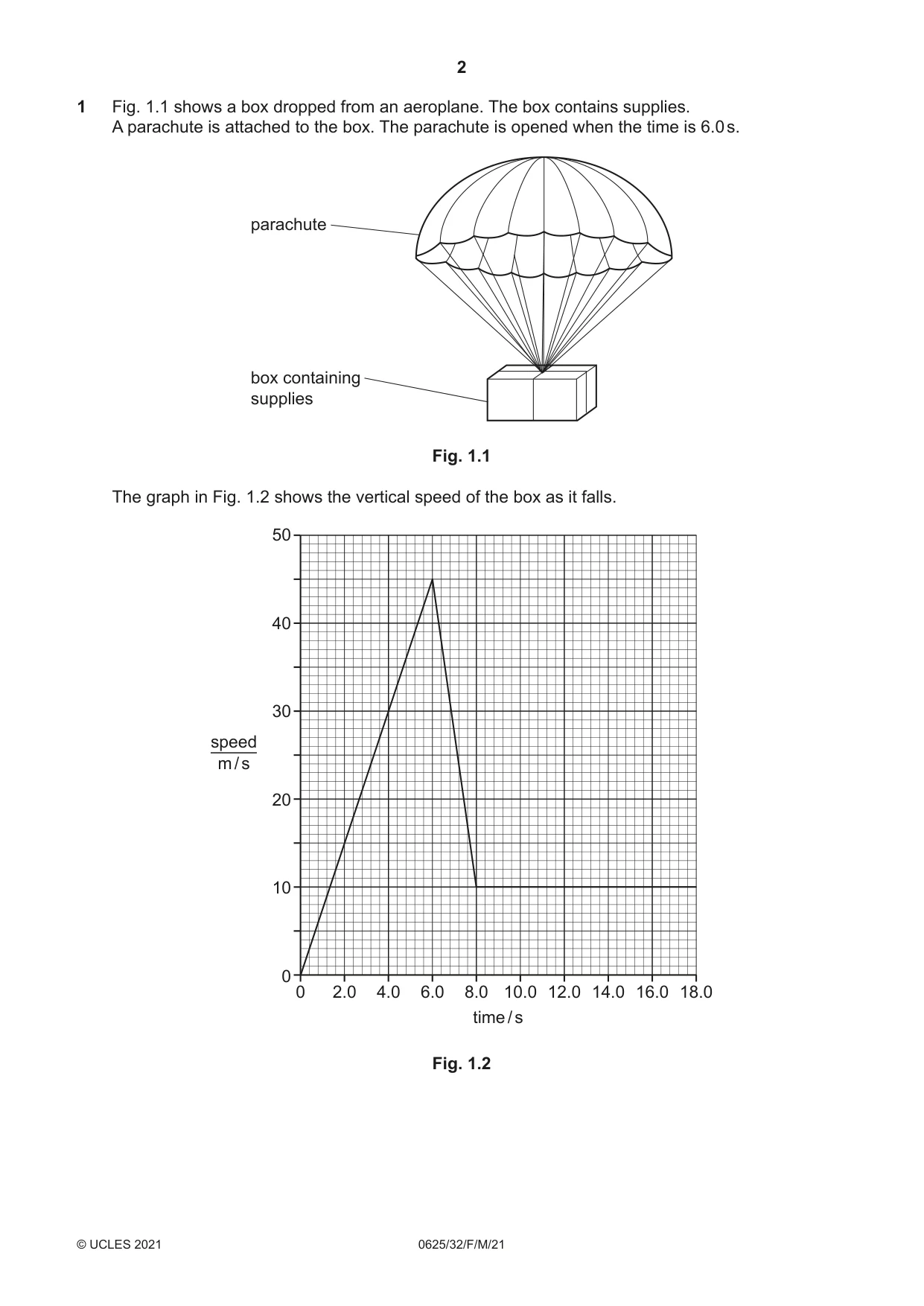
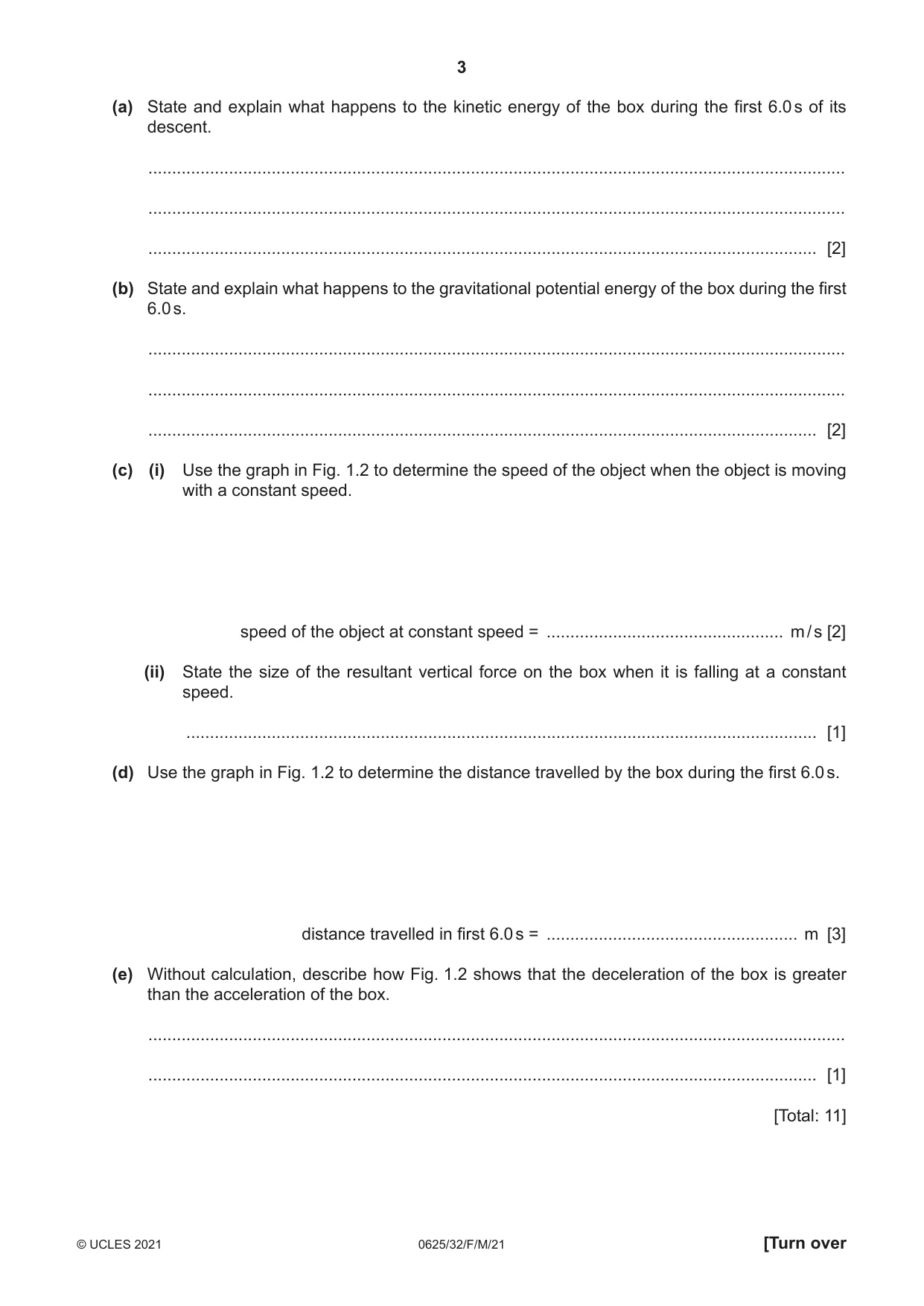
1 Fig. 1.1 shows a box dropped from an aeroplane. The box contains supplies. A parachute is attached to the box. The parachute is opened when the time is 6.0 s. parachute box containing supplies Fig. 1.1 The graph in Fig. 1.2 shows the vertical speed of the box as it falls. 50 40 30 speed m / s 20 10 0 0 2.0 4.0 6.0 8.0 10.0 12.0 14.0 16.0 18.0 time / s Fig. 1.2 (a) State and explain what happens to the kinetic energy of the box during the first 6.0 s of its descent. ................................................................................................................................................... ................................................................................................................................................... ............................................................................................................................................. [2] (b) State and explain what happens to the gravitational potential energy of the box during the first 6.0 s. ................................................................................................................................................... ................................................................................................................................................... ............................................................................................................................................. [2] (c) (i) Use the graph in Fig. 1.2 to determine the speed of the object when the object is moving with a constant speed. speed of the object at constant speed = .................................................. m / s [2] (ii) State the size of the resultant vertical force on the box when it is falling at a constant speed. ..................................................................................................................................... [1] (d) Use the graph in Fig. 1.2 to determine the distance travelled by the box during the first 6.0 s. distance travelled in first 6.0 s = ..................................................... m [3] (e) Without calculation, describe how Fig. 1.2 shows that the deceleration of the box is greater than the acceleration of the box. ................................................................................................................................................... ............................................................................................................................................. [1] [Total: 11]
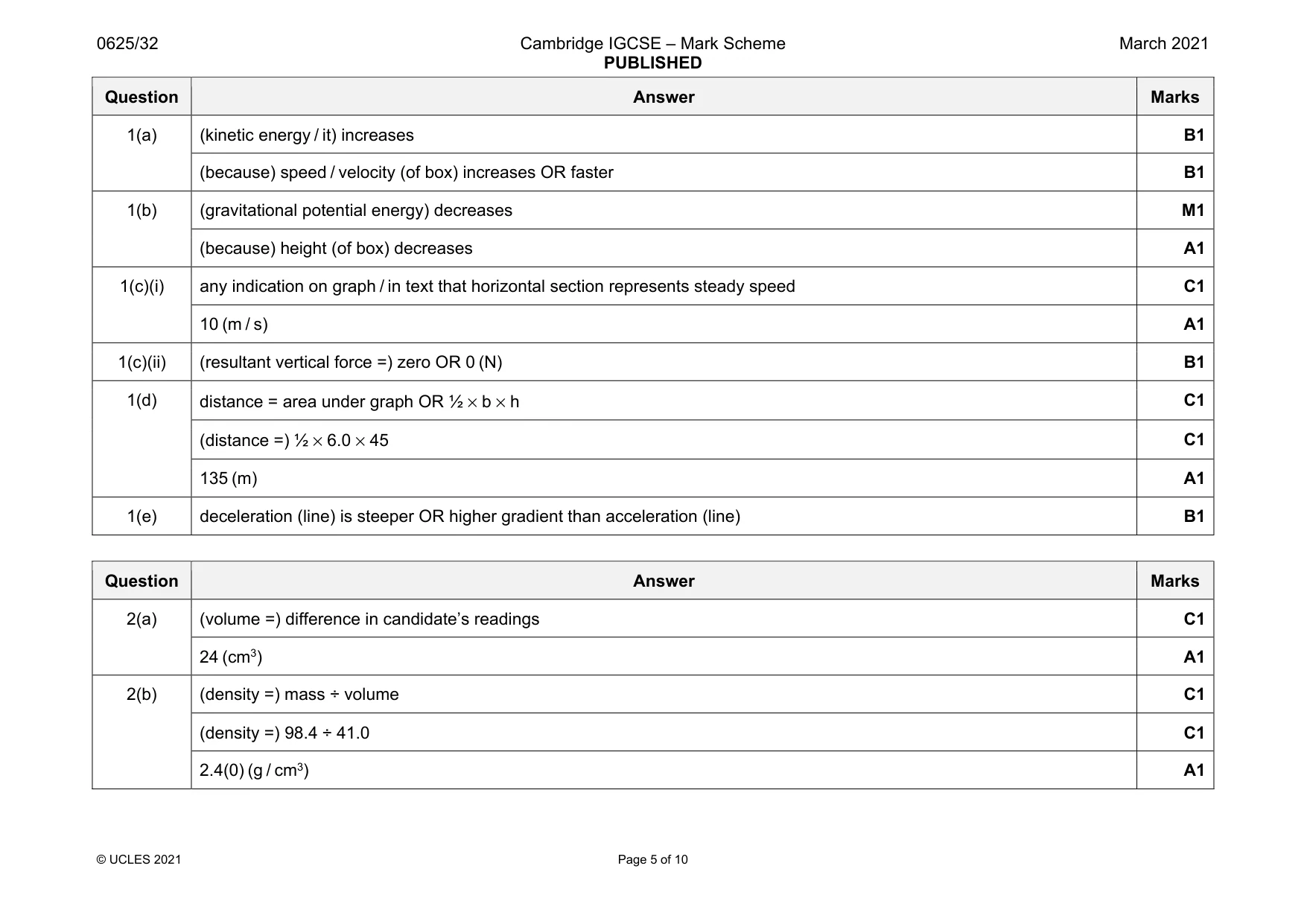
Mark scheme: 1(a) (kinetic energy / it) increases B1 (because) speed / velocity (of box) increases OR faster B1 1(b) (gravitational potential energy) decreases M1 (because) height (of box) decreases A1 1(c)(i) any indication on graph / in text that horizontal section represents steady speed C1 10 (m / s) A1 1(c)(ii) (resultant vertical force =) zero OR 0 (N) B1 1(d) distance = area under graph OR ½ × b × h C1 (distance =) ½ × 6.0 × 45 C1 135 (m) A1 1(e) deceleration (line) is steeper OR higher gradient than acceleration (line) B1
Q2 · A measuring cylinder containing water
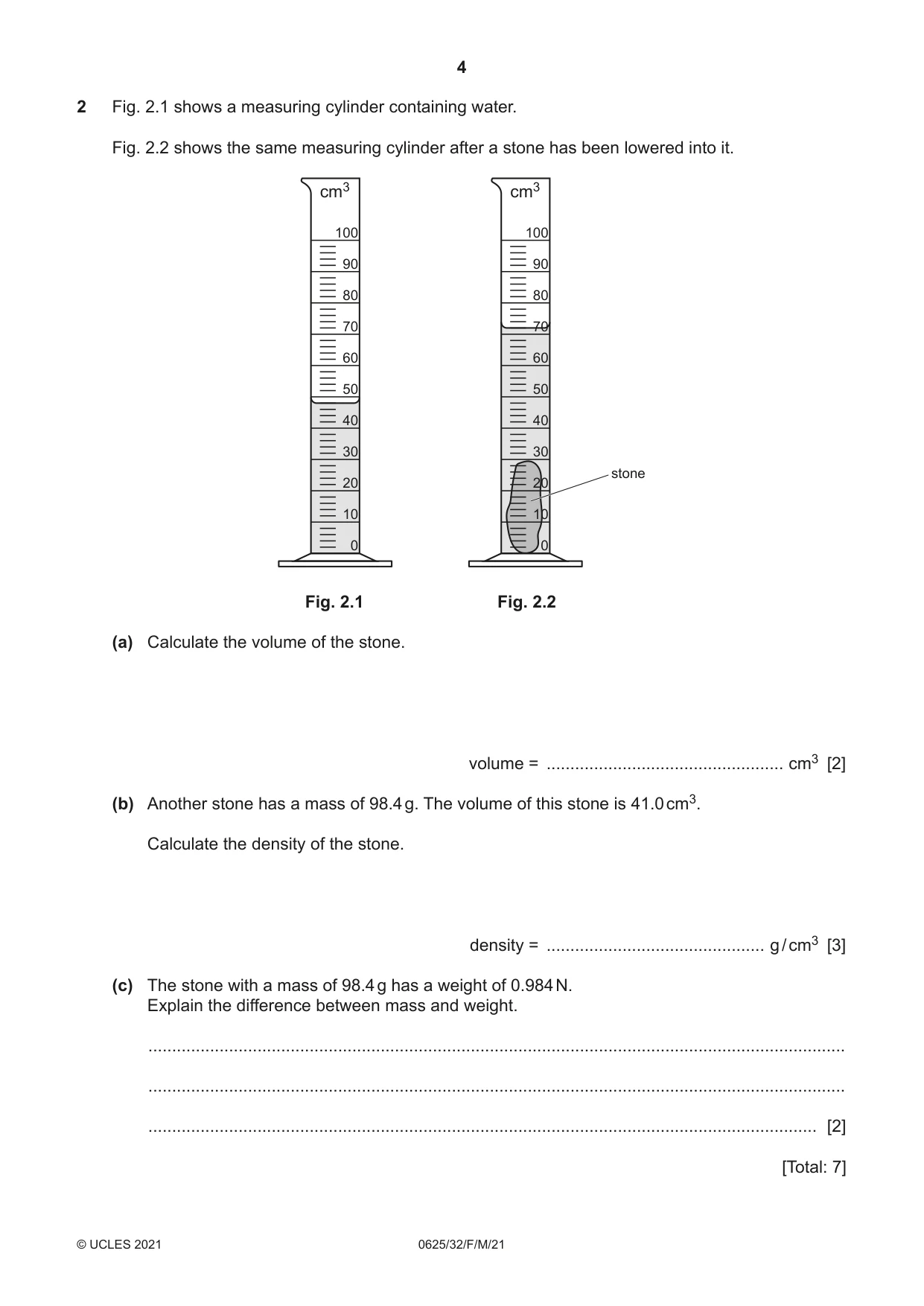
2 Fig. 2.1 shows a measuring cylinder containing water. Fig. 2.2 shows the same measuring cylinder after a stone has been lowered into it. cm3 cm3 100 100 90 90 80 80 70 70 60 60 50 50 40 40 30 30 stone 20 20 10 10 0 0 Fig. 2.1 Fig. 2.2 (a) Calculate the volume of the stone. volume = .................................................. cm3 [2] (b) Another stone has a mass of 98.4 g. The volume of this stone is 41.0 cm3. Calculate the density of the stone. density = .............................................. g / cm3 [3] (c) The stone with a mass of 98.4 g has a weight of 0.984 N. Explain the difference between mass and weight. ................................................................................................................................................... ................................................................................................................................................... ............................................................................................................................................. [2] [Total: 7]
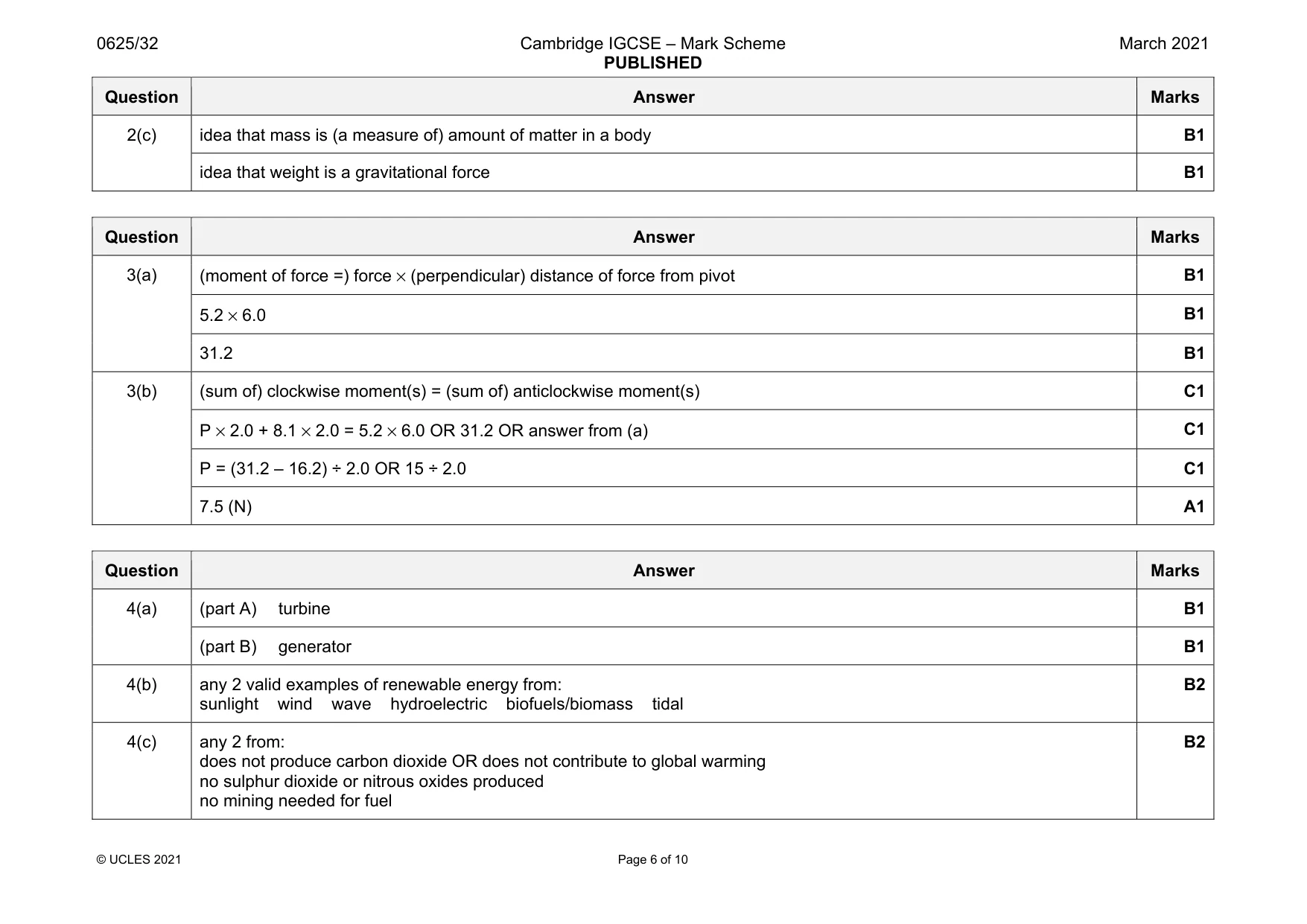
Mark scheme: 2(a) (volume =) difference in candidate’s readings C1 24 (cm3) A1 2(b) (density =) mass ÷ volume C1 (density =) 98.4 ÷ 41.0 C1 2.4(0) (g / cm3) A1 Question Answer Marks 2(c) idea that mass is (a measure of) amount of matter in a body B1 idea that weight is a gravitational force B1
Q3 · The forces acting on a uniform balanced beam
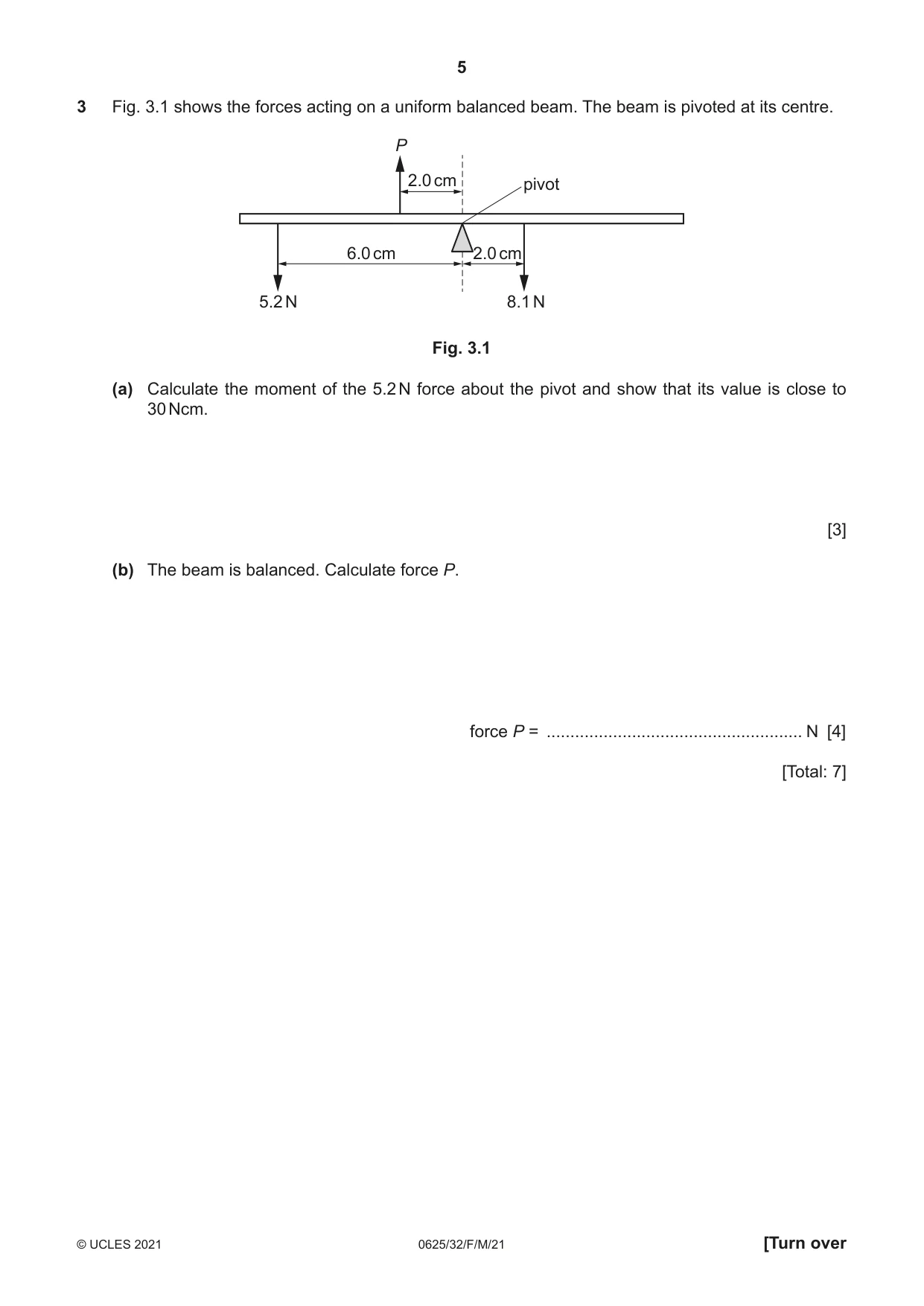
3 Fig. 3.1 shows the forces acting on a uniform balanced beam. The beam is pivoted at its centre. P 2.0 cm pivot 6.0 cm 2.0 cm 5.2 N 8.1 N Fig. 3.1 (a) Calculate the moment of the 5.2 N force about the pivot and show that its value is close to 30 Ncm. [3] (b) The beam is balanced. Calculate force P. force P = ...................................................... N [4] [Total: 7]
Mark scheme: 3(a) (moment of force =) force × (perpendicular) distance of force from pivot B1 5.2 × 6.0 B1 31.2 B1 3(b) (sum of) clockwise moment(s) = (sum of) anticlockwise moment(s) C1 P × 2.0 + 8.1 × 2.0 = 5.2 × 6.0 OR 31.2 OR answer from (a) C1 P = (31.2 – 16.2) ÷ 2.0 OR 15 ÷ 2.0 C1 7.5 (N) A1
Q4 · An outline of the main parts of a geothermal power station used to generate electricity
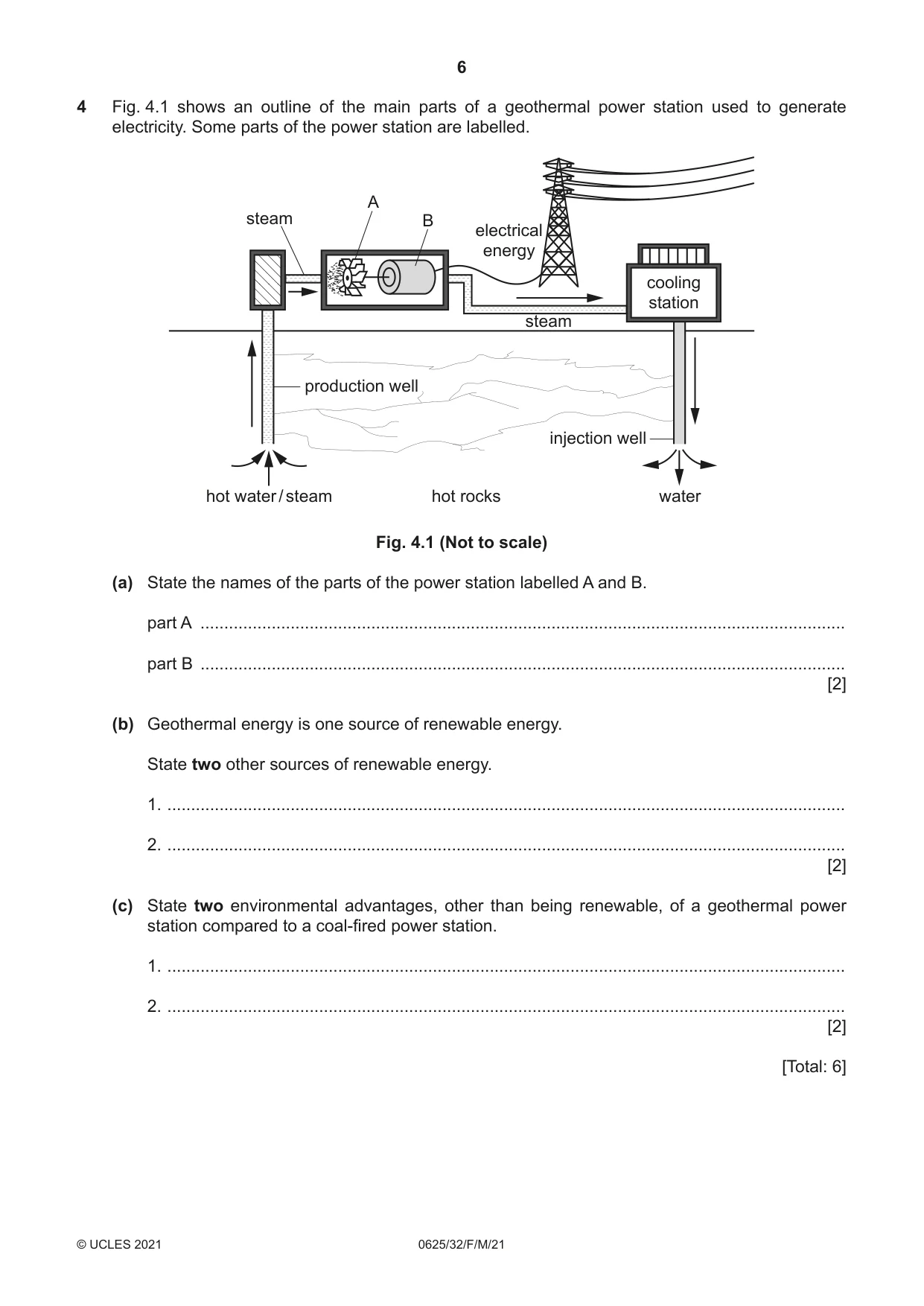
4 Fig. 4.1 shows an outline of the main parts of a geothermal power station used to generate electricity. Some parts of the power station are labelled. A steam B electrical energy cooling station steam production well injection well hot water / steam hot rocks water Fig. 4.1 (Not to scale) (a) State the names of the parts of the power station labelled A and B. part A ........................................................................................................................................ part B ........................................................................................................................................ [2] (b) Geothermal energy is one source of renewable energy. State two other sources of renewable energy. 1. ............................................................................................................................................... 2. ............................................................................................................................................... [2] (c) State two environmental advantages, other than being renewable, of a geothermal power station compared to a coal-fired power station. 1. ............................................................................................................................................... 2. ............................................................................................................................................... [2] [Total: 6]
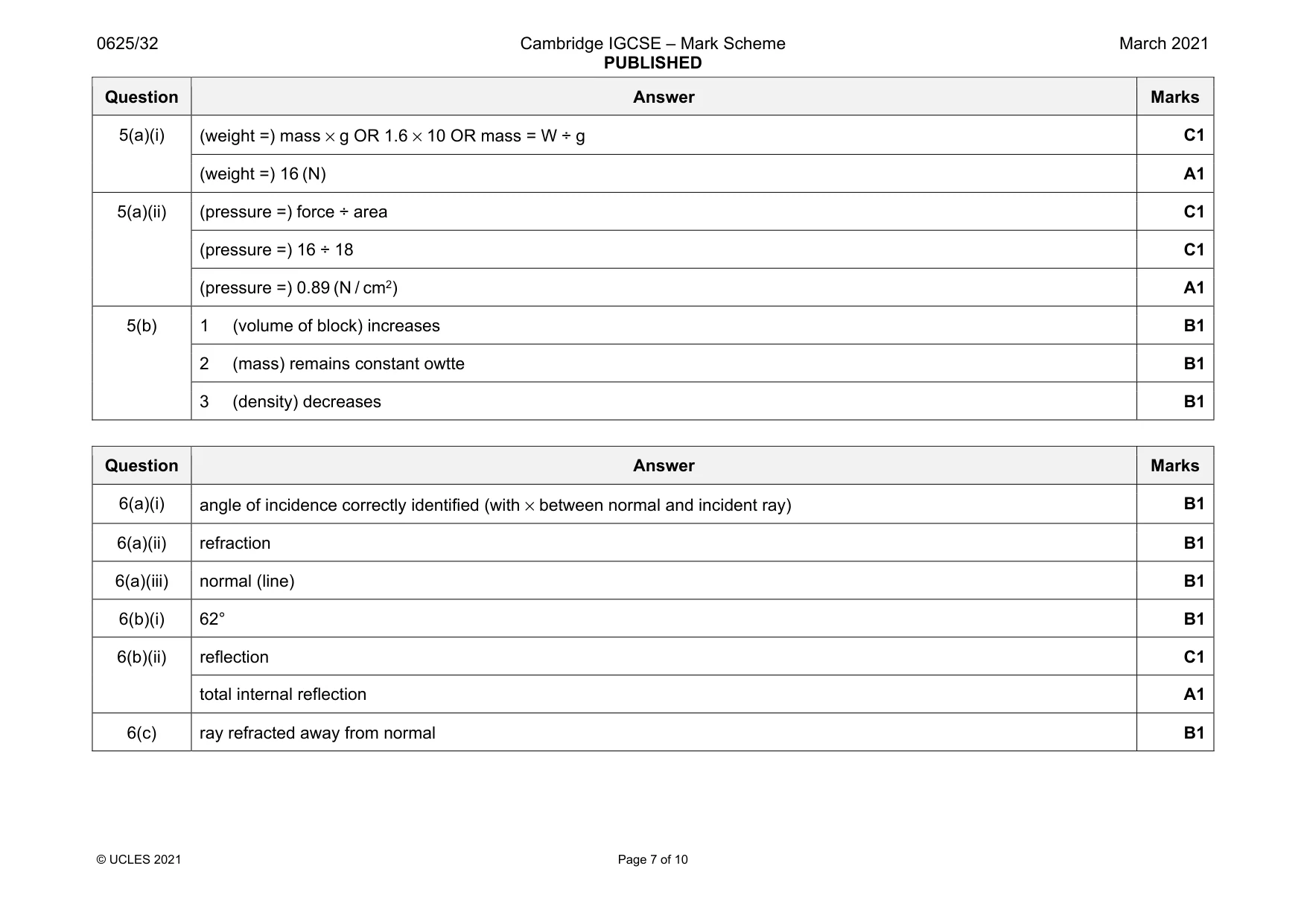
Mark scheme: 4(a) (part A) turbine B1 (part B) generator B1 4(b) any 2 valid examples of renewable energy from: sunlight wind wave hydroelectric biofuels/biomass tidal B2 4(c) any 2 from: does not produce carbon dioxide OR does not contribute to global warming no sulphur dioxide or nitrous oxides produced no mining needed for fuel B2
Q5 · A metal block on a flat surface
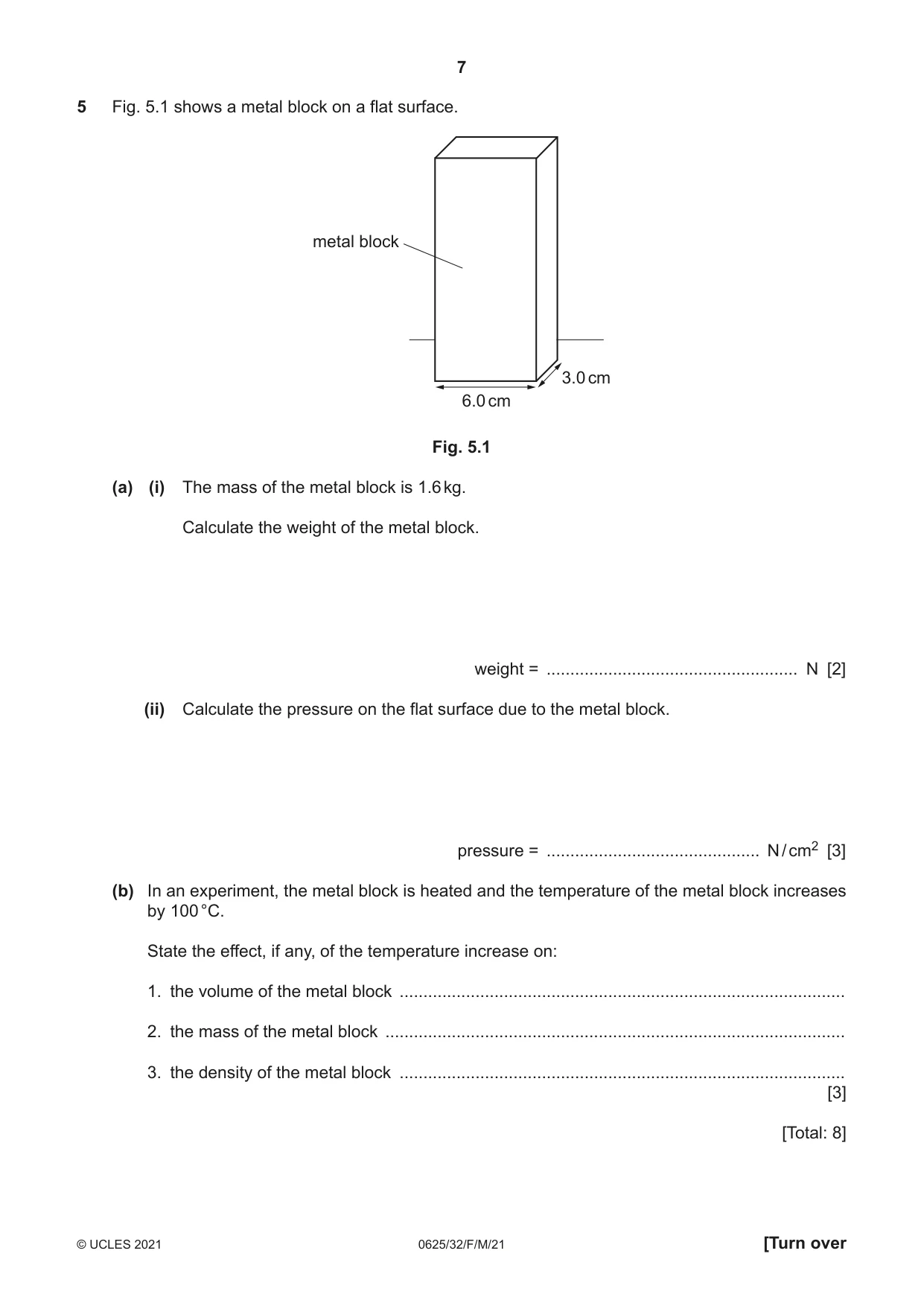
5 Fig. 5.1 shows a metal block on a flat surface. metal block 3.0 cm 6.0 cm Fig. 5.1 (a) (i) The mass of the metal block is 1.6 kg. Calculate the weight of the metal block. weight = ..................................................... N [2] (ii) Calculate the pressure on the flat surface due to the metal block. pressure = ............................................. N / cm2 [3] (b) In an experiment, the metal block is heated and the temperature of the metal block increases by 100 °C. State the effect, if any, of the temperature increase on: 1. the volume of the metal block .............................................................................................. 2. the mass of the metal block ................................................................................................. 3. the density of the metal block .............................................................................................. [3] [Total: 8]
Mark scheme: 5(a)(i) (weight =) mass × g OR 1.6 × 10 OR mass = W ÷ g C1 (weight =) 16 (N) A1 5(a)(ii) (pressure =) force ÷ area C1 (pressure =) 16 ÷ 18 C1 (pressure =) 0.89 (N / cm2) A1 5(b) 1 (volume of block) increases B1 2 (mass) remains constant owtte B1 3 (density) decreases B1
Q6 · The path of a ray of red light through a glass block in air
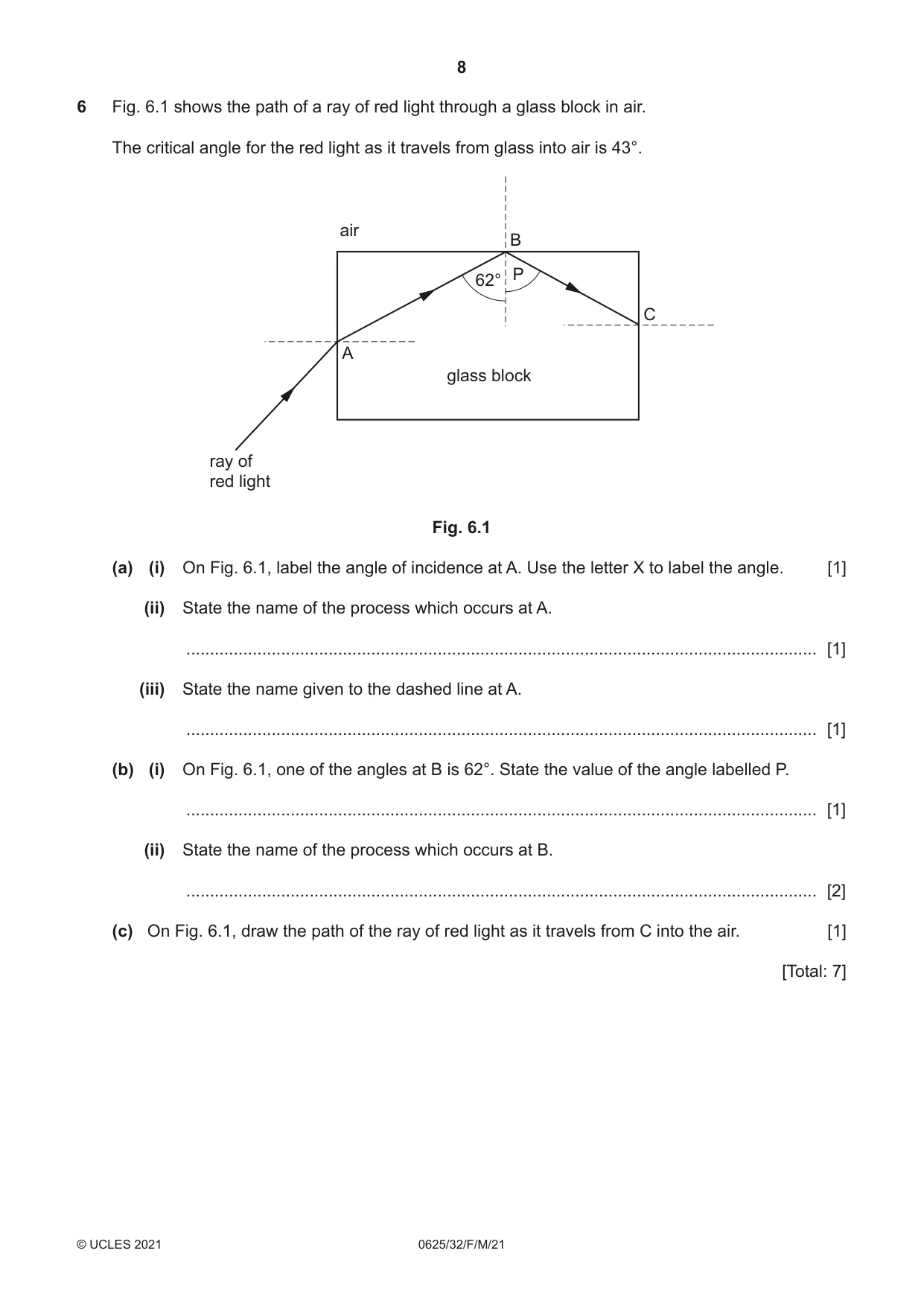
6 Fig. 6.1 shows the path of a ray of red light through a glass block in air. The critical angle for the red light as it travels from glass into air is 43°. air B P 62° C A glass block ray of red light Fig. 6.1 (a) (i) On Fig. 6.1, label the angle of incidence at A. Use the letter X to label the angle. [1] (ii) State the name of the process which occurs at A. ..................................................................................................................................... [1] (iii) State the name given to the dashed line at A. ..................................................................................................................................... [1] (b) (i) On Fig. 6.1, one of the angles at B is 62°. State the value of the angle labelled P. ..................................................................................................................................... [1] (ii) State the name of the process which occurs at B. ..................................................................................................................................... [2] (c) On Fig. 6.1, draw the path of the ray of red light as it travels from C into the air. [1] [Total: 7]
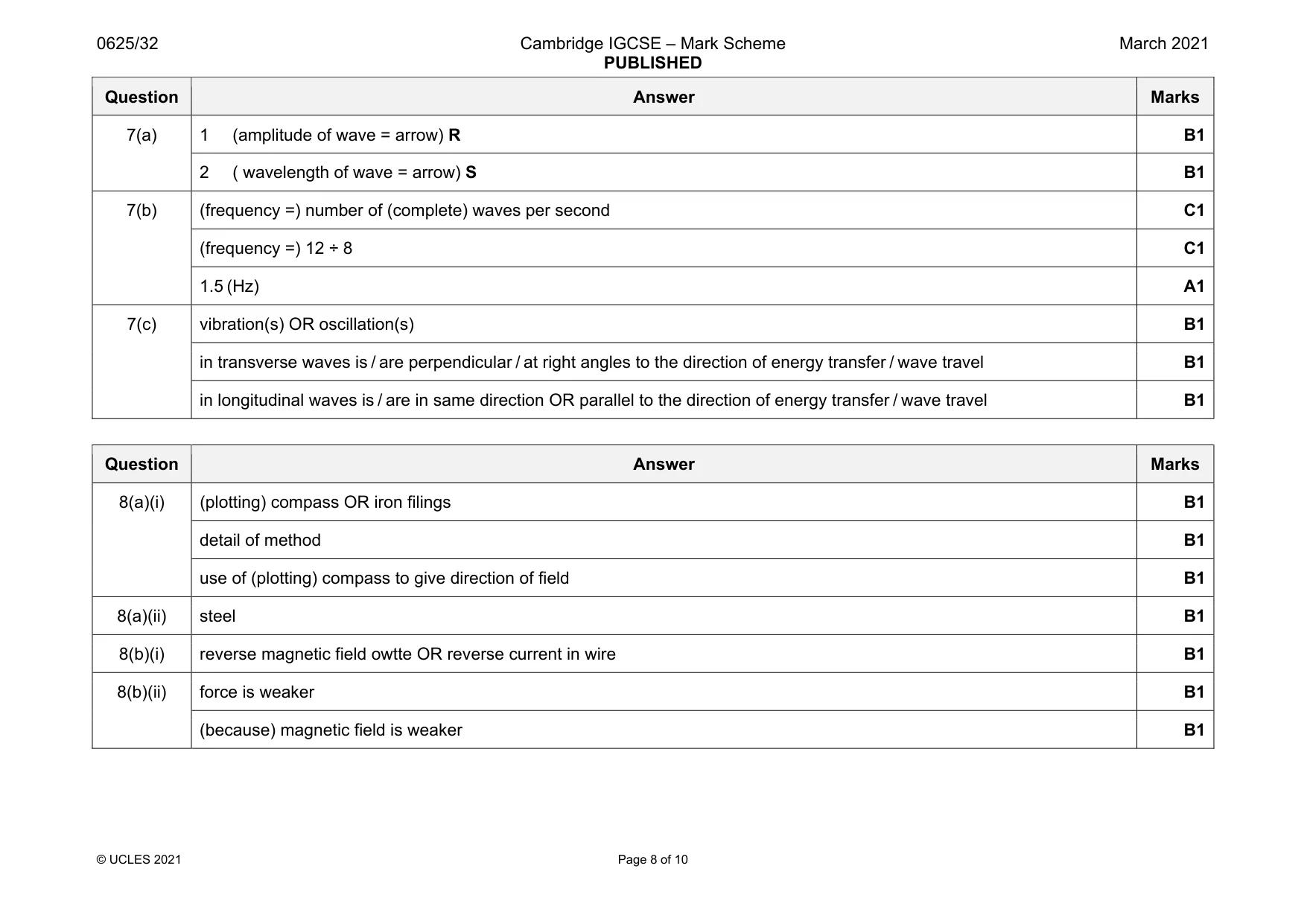
Mark scheme: 6(a)(i) angle of incidence correctly identified (with × between normal and incident ray) B1 6(a)(ii) refraction B1 6(a)(iii) normal (line) B1 6(b)(i) 62° B1 6(b)(ii) reflection C1 total internal reflection A1 6(c) ray refracted away from normal B1
Question 7
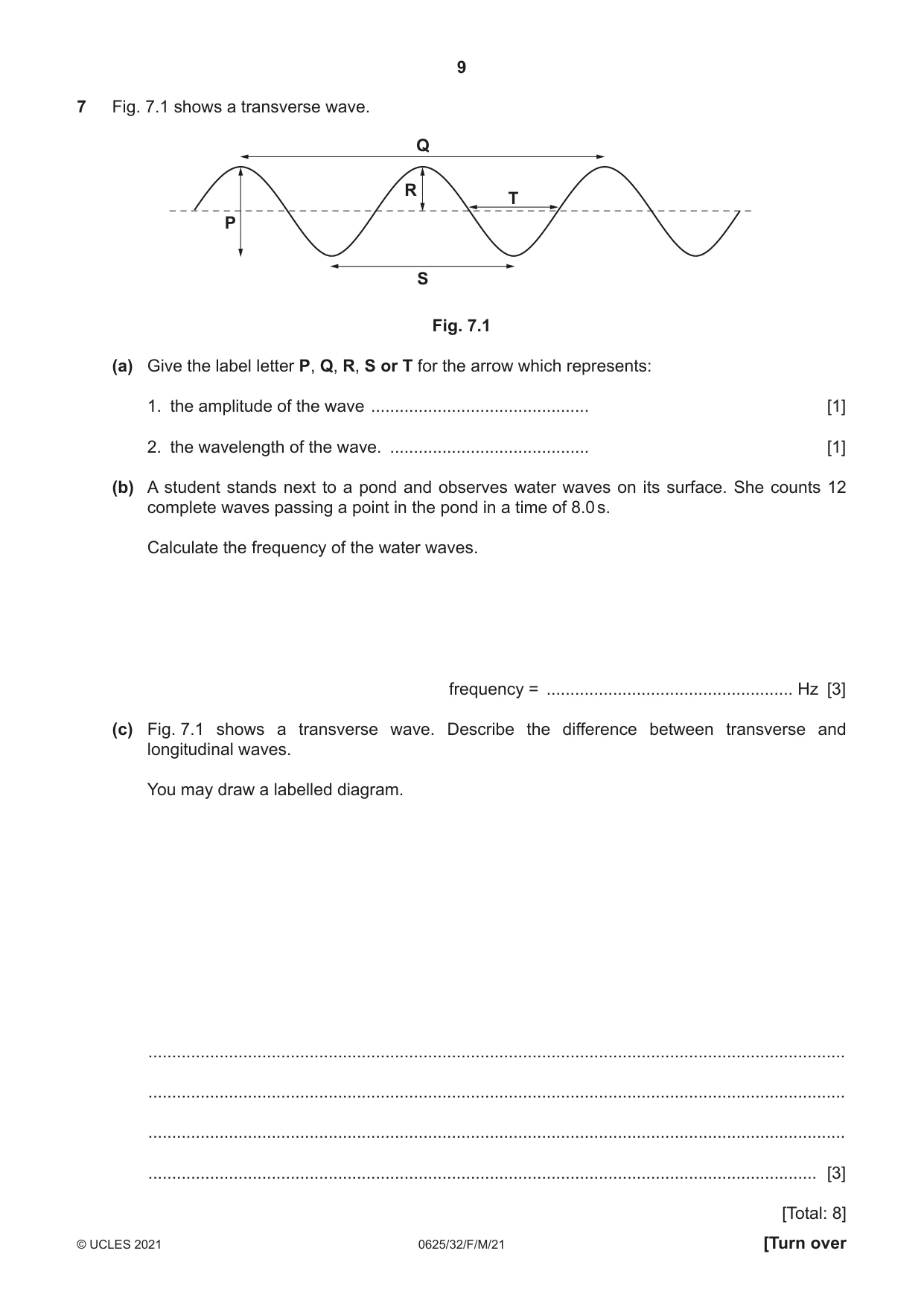
7 Fig. 7.1 shows a transverse wave. Q R T P S Fig. 7.1 (a) Give the label letter P, Q, R, S or T for the arrow which represents: 1. the amplitude of the wave .............................................. [1] 2. the wavelength of the wave. .......................................... [1] (b) A student stands next to a pond and observes water waves on its surface. She counts 12 complete waves passing a point in the pond in a time of 8.0 s. Calculate the frequency of the water waves. frequency = .................................................... Hz [3] (c) Fig. 7.1 shows a transverse wave. Describe the difference between transverse and longitudinal waves. You may draw a labelled diagram. ................................................................................................................................................... ................................................................................................................................................... ................................................................................................................................................... ............................................................................................................................................. [3] [Total: 8]
Mark scheme: 7(a) 1 (amplitude of wave = arrow) R B1 2 ( wavelength of wave = arrow) S B1 7(b) (frequency =) number of (complete) waves per second C1 (frequency =) 12 ÷ 8 C1 1.5 (Hz) A1 7(c) vibration(s) OR oscillation(s) B1 in transverse waves is / are perpendicular / at right angles to the direction of energy transfer / wave travel B1 in longitudinal waves is / are in same direction OR parallel to the direction of energy transfer / wave travel B1
Q8 · The magnetic field pattern around a bar magnet
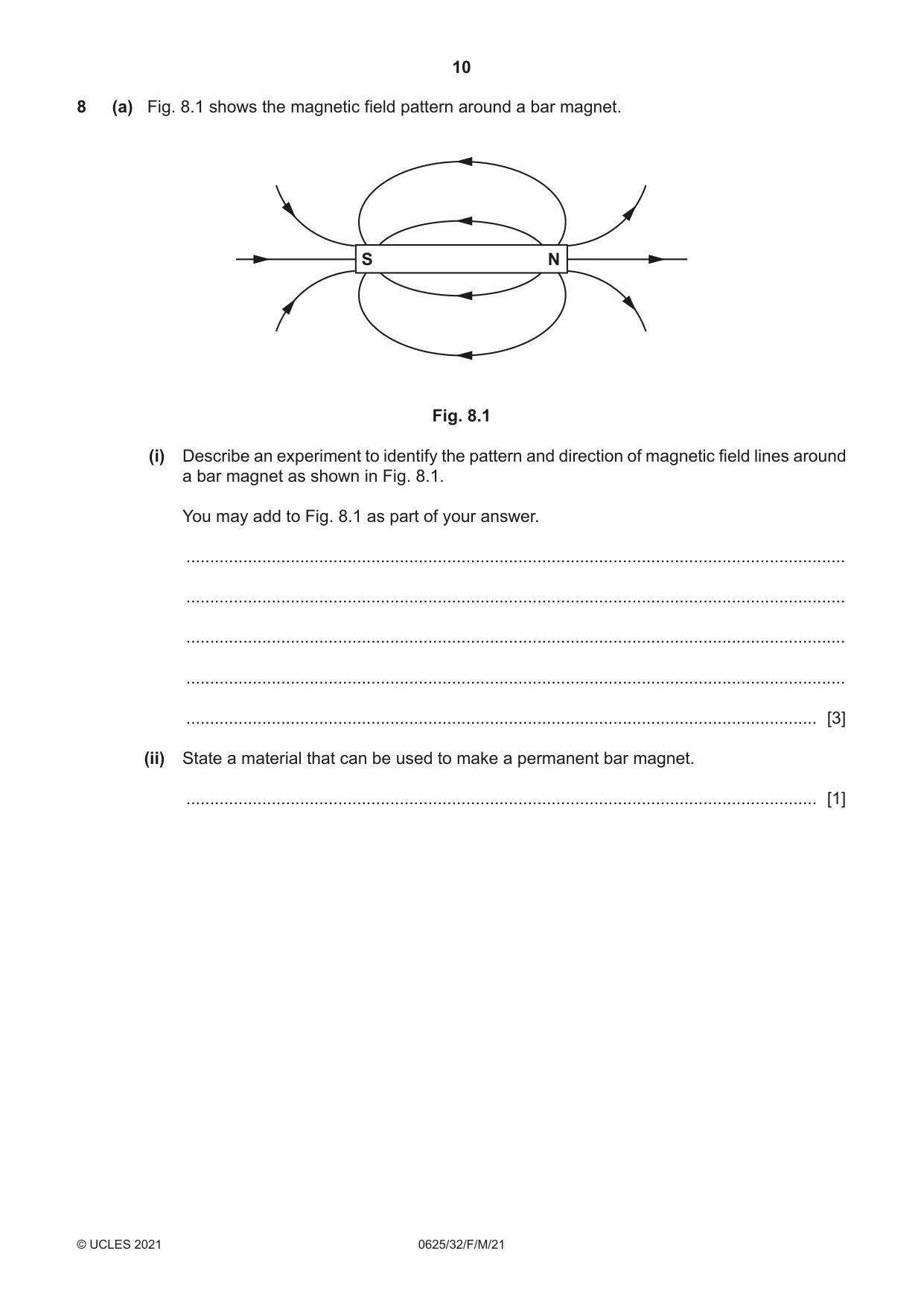
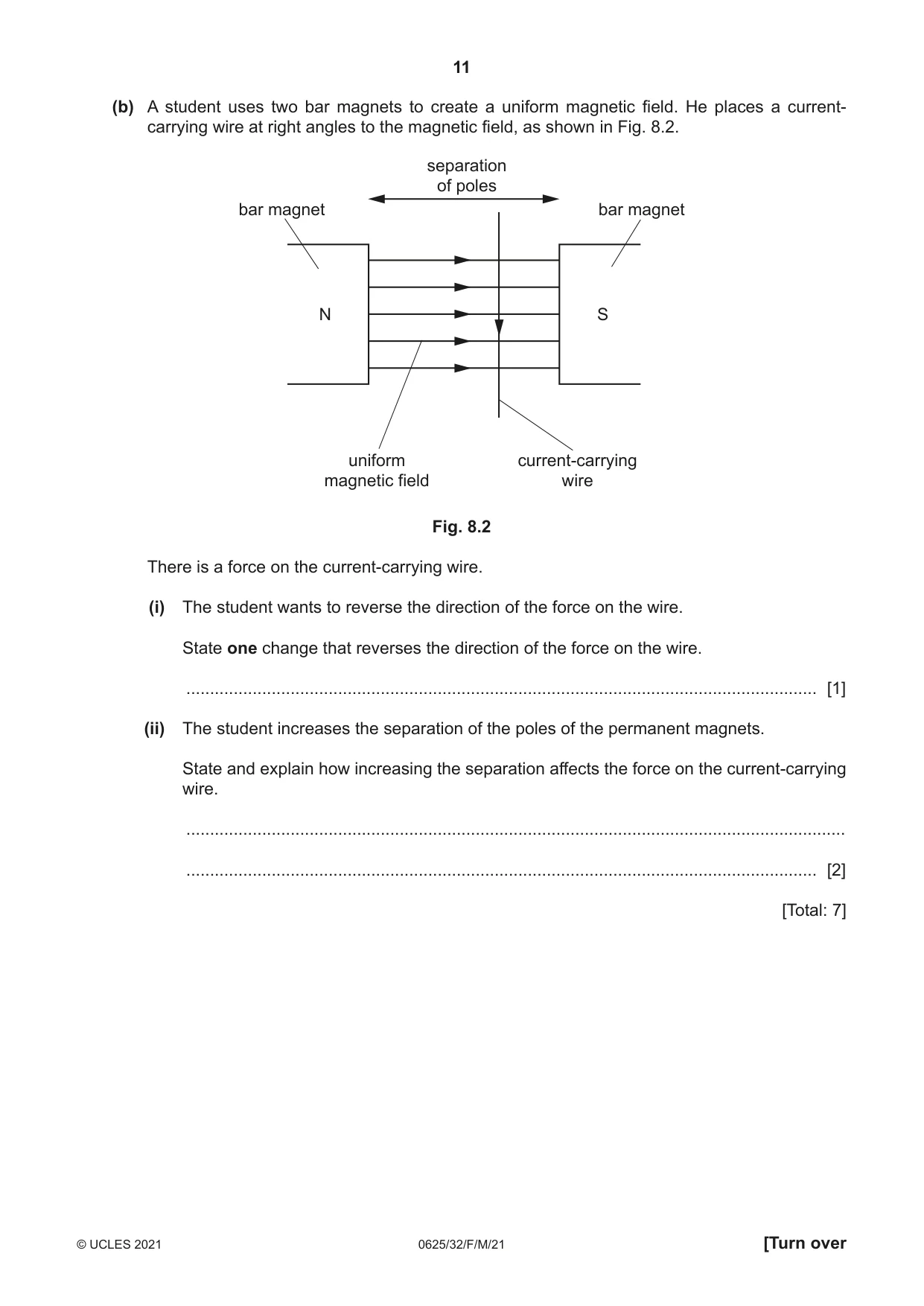
8 (a) Fig. 8.1 shows the magnetic field pattern around a bar magnet. S N Fig. 8.1 (i) Describe an experiment to identify the pattern and direction of magnetic field lines around a bar magnet as shown in Fig. 8.1. You may add to Fig. 8.1 as part of your answer. ........................................................................................................................................... ........................................................................................................................................... ........................................................................................................................................... ........................................................................................................................................... ..................................................................................................................................... [3] (ii) State a material that can be used to make a permanent bar magnet. ..................................................................................................................................... [1] (b) A student uses two bar magnets to create a uniform magnetic field. He places a current- carrying wire at right angles to the magnetic field, as shown in Fig. 8.2. separation of poles bar magnet bar magnet N S uniform current-carrying magnetic field wire Fig. 8.2 There is a force on the current-carrying wire. (i) The student wants to reverse the direction of the force on the wire. State one change that reverses the direction of the force on the wire. ..................................................................................................................................... [1] (ii) The student increases the separation of the poles of the permanent magnets. State and explain how increasing the separation affects the force on the current-carrying wire. ........................................................................................................................................... ..................................................................................................................................... [2] [Total: 7]
Mark scheme: 8(a)(i) (plotting) compass OR iron filings B1 detail of method B1 use of (plotting) compass to give direction of field B1 8(a)(ii) steel B1 8(b)(i) reverse magnetic field owtte OR reverse current in wire B1 8(b)(ii) force is weaker B1 (because) magnetic field is weaker B1
Question 9
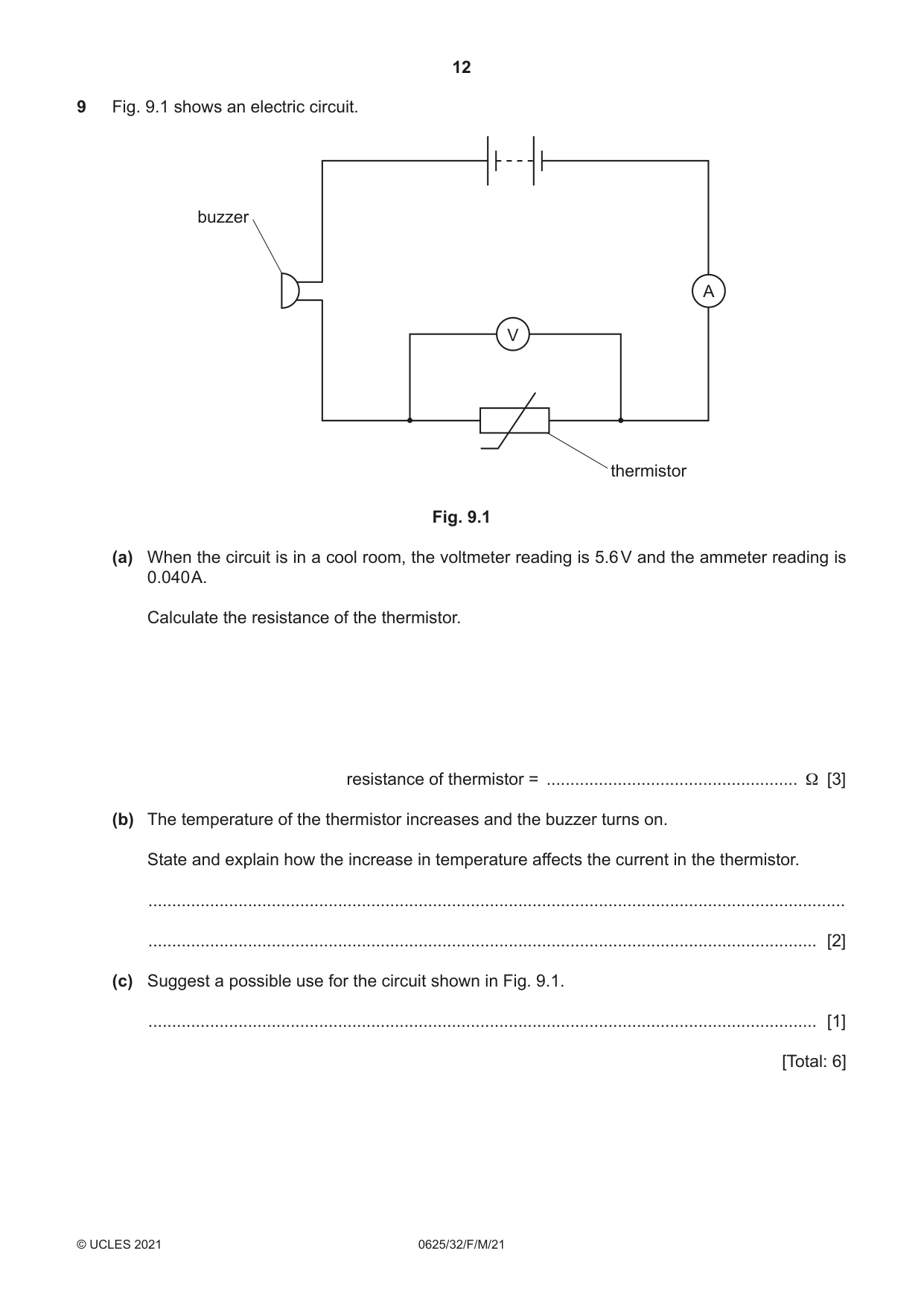
9 Fig. 9.1 shows an electric circuit. buzzer A V thermistor Fig. 9.1 (a) When the circuit is in a cool room, the voltmeter reading is 5.6 V and the ammeter reading is 0.040 A. Calculate the resistance of the thermistor. resistance of thermistor = ..................................................... Ω [3] (b) The temperature of the thermistor increases and the buzzer turns on. State and explain how the increase in temperature affects the current in the thermistor. ................................................................................................................................................... ............................................................................................................................................. [2] (c) Suggest a possible use for the circuit shown in Fig. 9.1. ............................................................................................................................................. [1] [Total: 6]
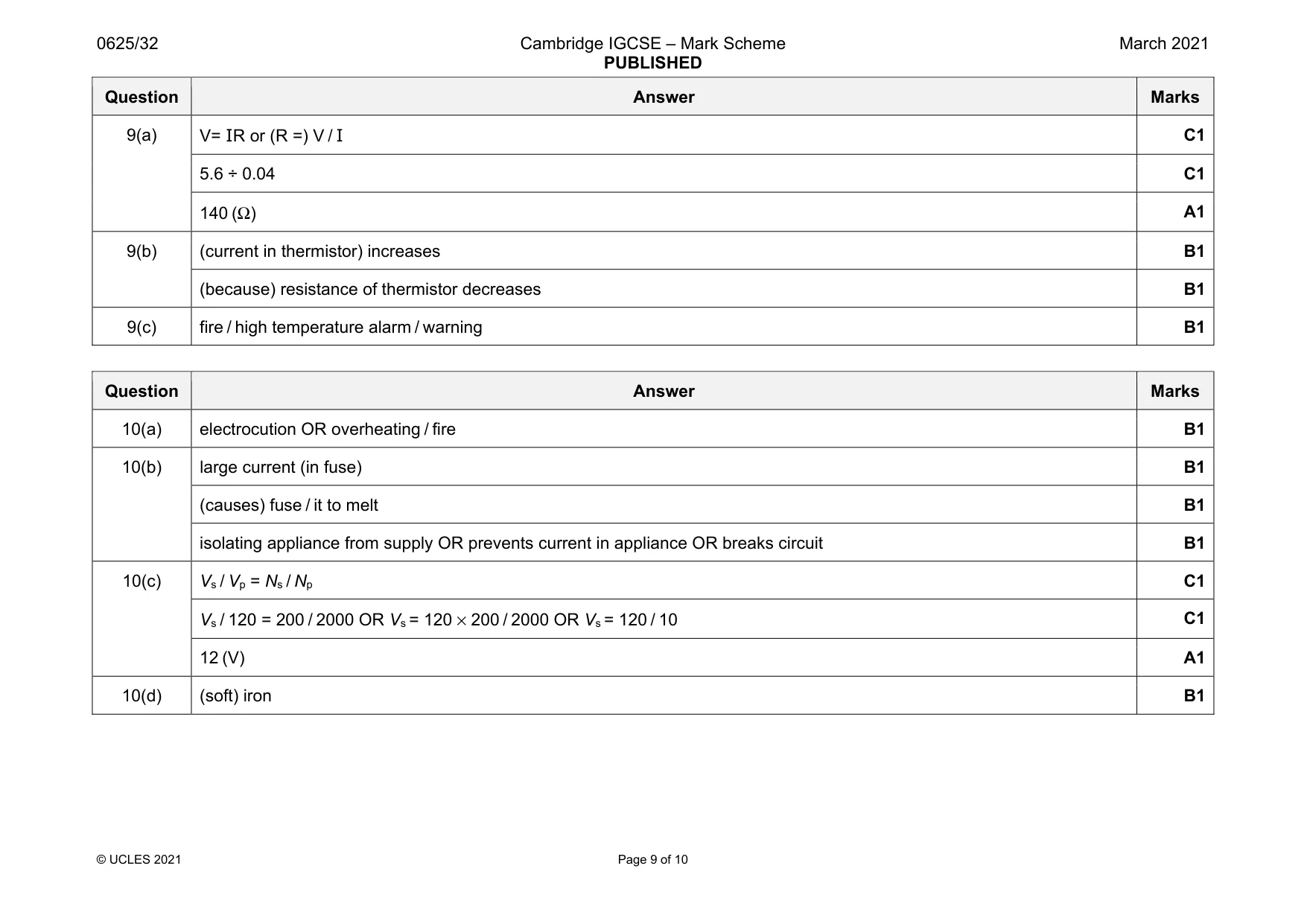
Mark scheme: 9(a) C1 5.6 ÷ 0.04 C1 140 (Ω) A1 9(b) (current in thermistor) increases B1 (because) resistance of thermistor decreases B1 9(c) fire / high temperature alarm / warning B1
Q10 · A student uses a laptop computer
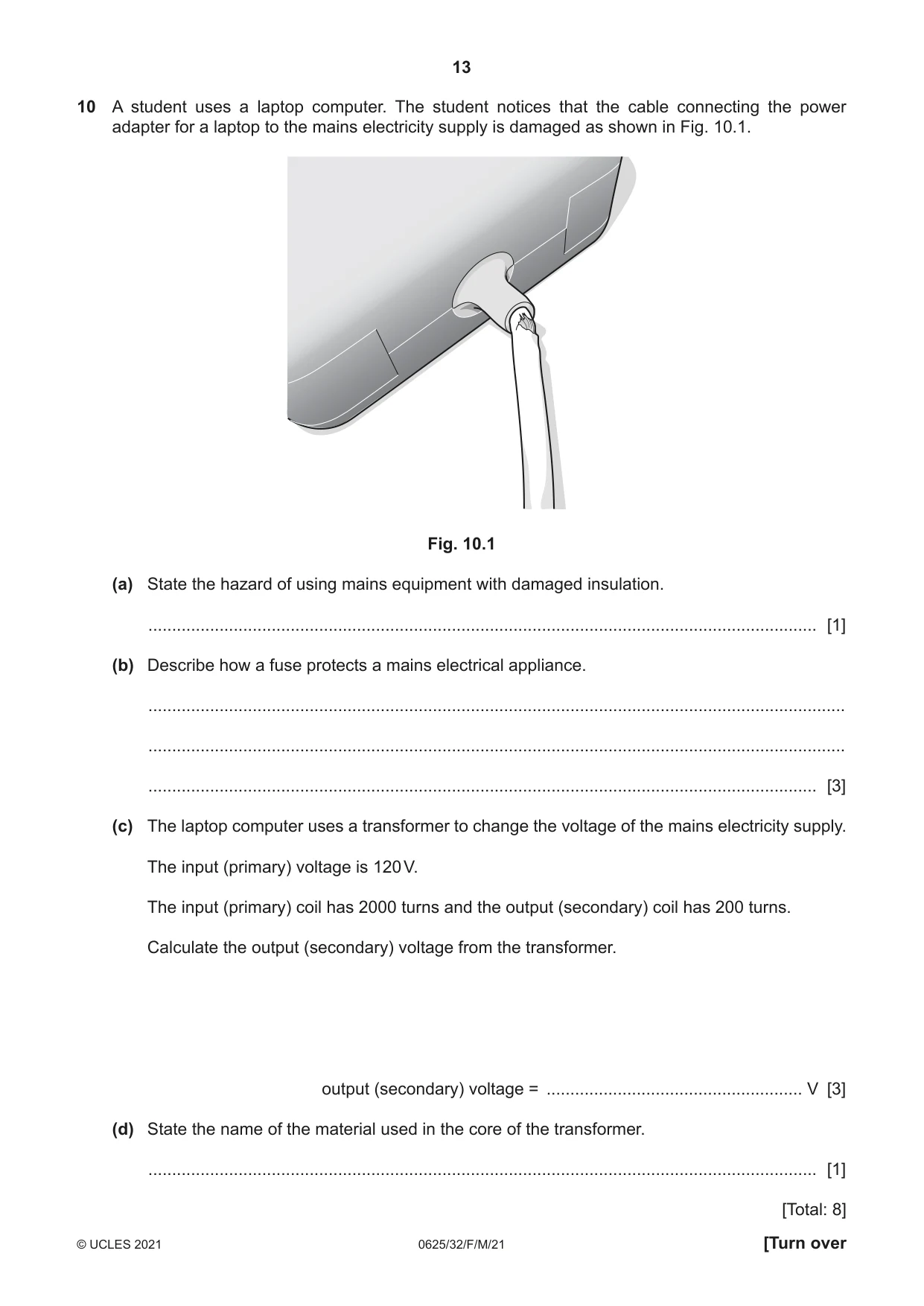
10 A student uses a laptop computer. The student notices that the cable connecting the power adapter for a laptop to the mains electricity supply is damaged as shown in Fig. 10.1. Fig. 10.1 (a) State the hazard of using mains equipment with damaged insulation. ............................................................................................................................................. [1] (b) Describe how a fuse protects a mains electrical appliance. ................................................................................................................................................... ................................................................................................................................................... ............................................................................................................................................. [3] (c) The laptop computer uses a transformer to change the voltage of the mains electricity supply. The input (primary) voltage is 120 V. The input (primary) coil has 2000 turns and the output (secondary) coil has 200 turns. Calculate the output (secondary) voltage from the transformer. output (secondary) voltage = ...................................................... V [3] (d) State the name of the material used in the core of the transformer. ............................................................................................................................................. [1] [Total: 8]
Mark scheme: 10(a) electrocution OR overheating / fire B1 10(b) large current (in fuse) B1 (causes) fuse / it to melt B1 isolating appliance from supply OR prevents current in appliance OR breaks circuit B1 10(c) Vs / Vp = Ns / Np C1 Vs / 120 = 200 / 2000 OR Vs = 120 × 200 / 2000 OR Vs = 120 / 10 C1 12 (V) A1 10(d) (soft) iron B1
Q11 · Carbon-12 is a stable isotope of carbon
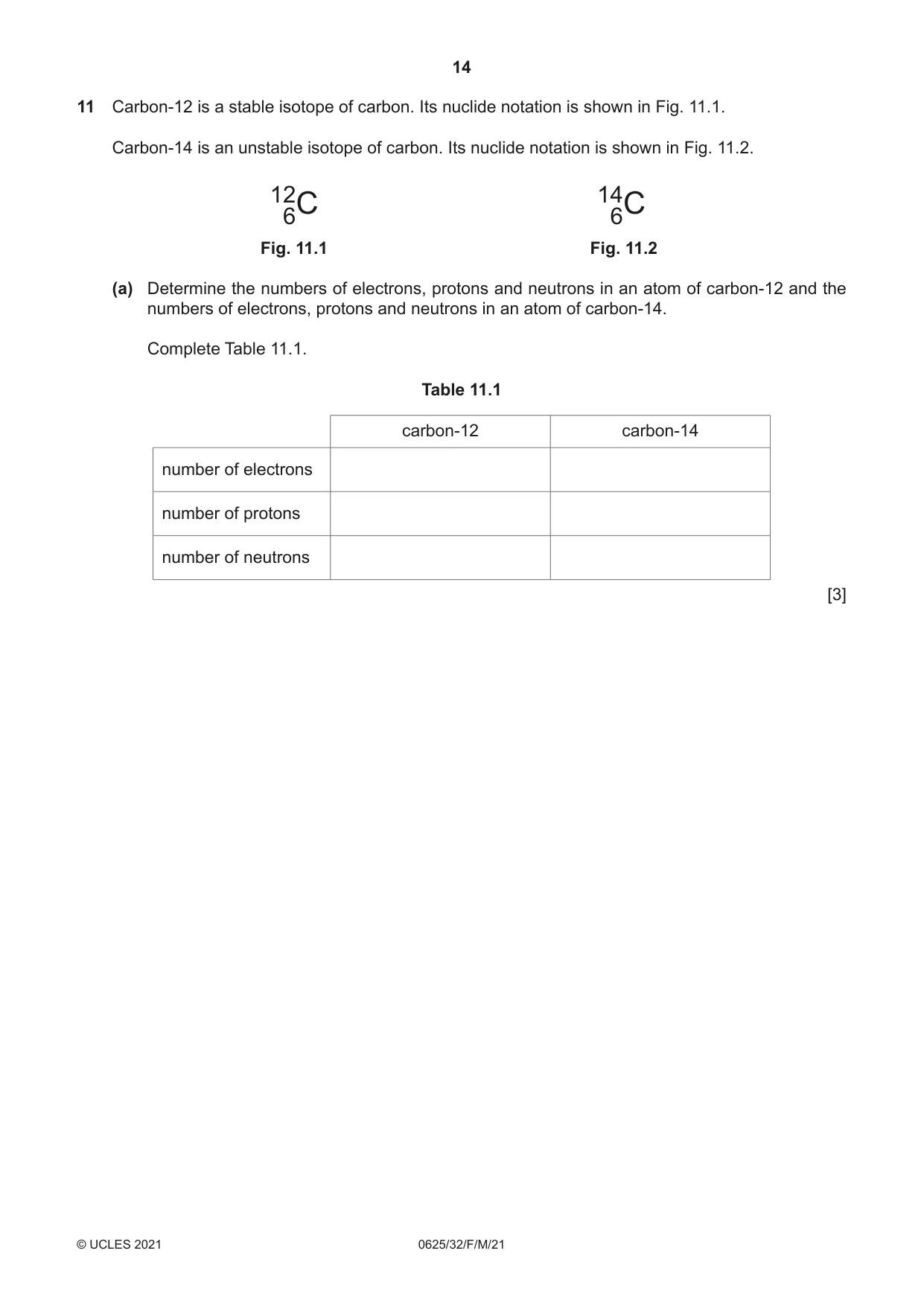
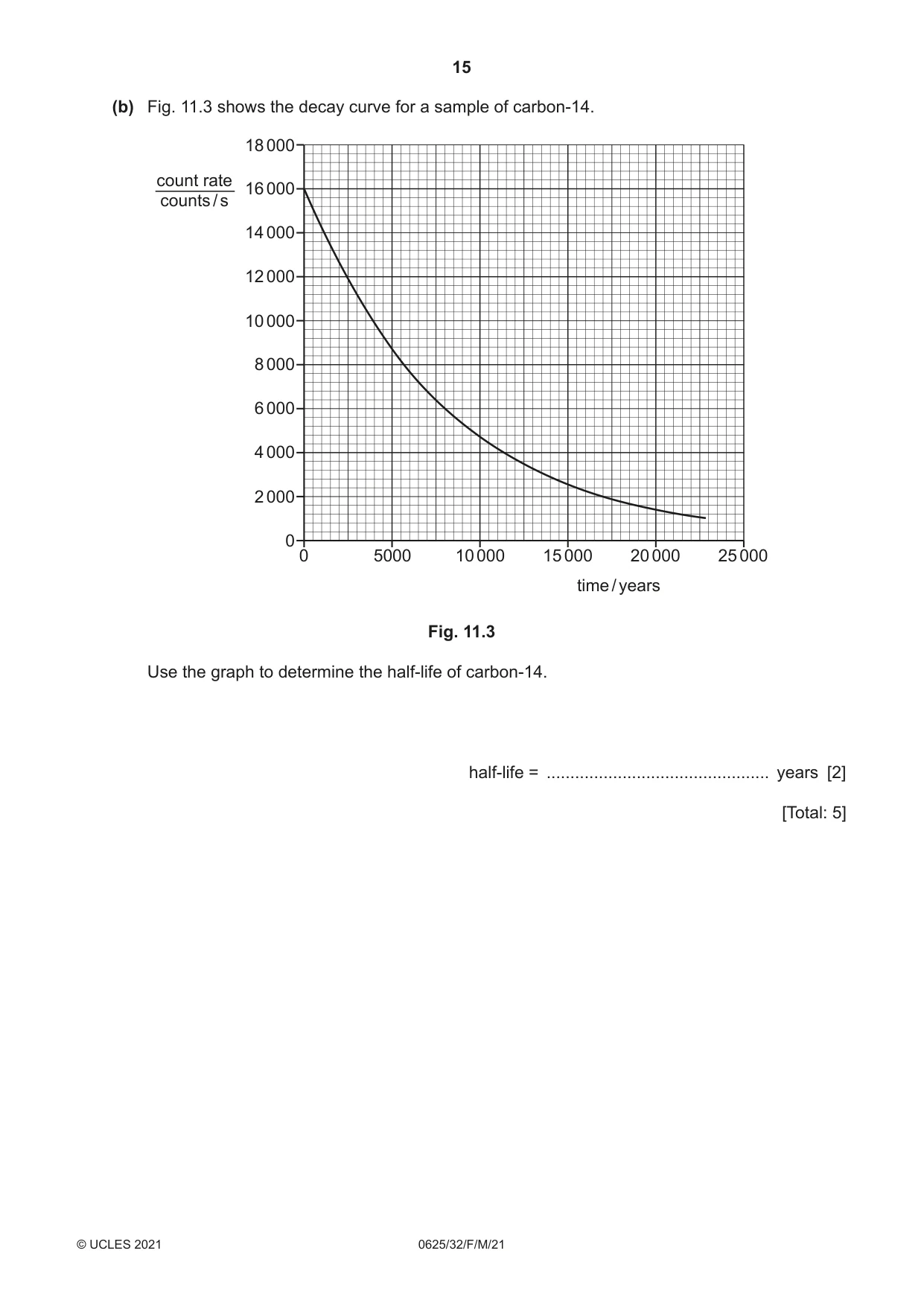
11 Carbon-12 is a stable isotope of carbon. Its nuclide notation is shown in Fig. 11.1. Carbon-14 is an unstable isotope of carbon. Its nuclide notation is shown in Fig. 11.2. 12C 14C 6 6 Fig. 11.1 Fig. 11.2 (a) Determine the numbers of electrons, protons and neutrons in an atom of carbon-12 and the numbers of electrons, protons and neutrons in an atom of carbon-14. Complete Table 11.1. Table 11.1 carbon-12 carbon-14 number of electrons number of protons number of neutrons [3] (b) Fig. 11.3 shows the decay curve for a sample of carbon-14. 18 000 count rate 16 000 counts / s 14 000 12 000 10 000 8 000 6 000 4 000 2 000 0 0 5000 10 000 15 000 20 000 25 000 time / years Fig. 11.3 Use the graph to determine the half-life of carbon-14. half-life = ............................................... years [2] [Total: 5]
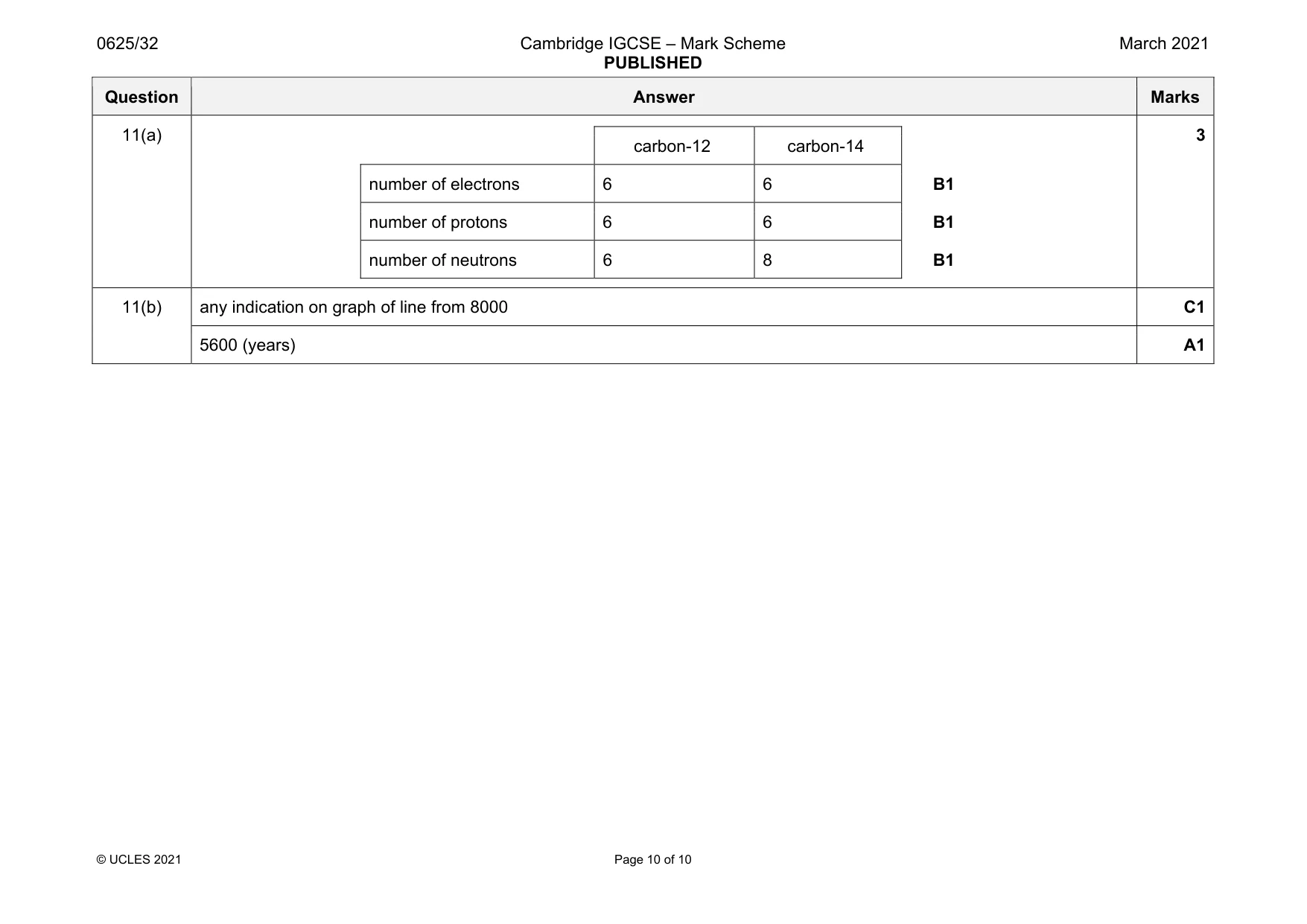
Mark scheme: 11(a) carbon-12 carbon-14 number of electrons 6 6 B1 number of protons 6 6 B1 number of neutrons 6 8 B1 3 11(b) any indication on graph of line from 8000 C1 5600 (years) A1
What was in this paper
The subtopics covered by these 11 questions, and how many questions each got. Open one in a new tab to see every Cambridge question on it.
What you needed in this session
Cambridge’s own grade thresholds for 2021 Feb/March, Paper 3 · Variant 2. A higher threshold means an easier paper — the bar moves with how the cohort did.