Cambridge IGCSE Physics 0625 — 2016 May/June Paper 3 · Variant 2
0625/32/M/J/16 · 12 questions · 80 marks · ≈90 min
The question paper and its mark scheme, free to read here and free to download. This is Cambridge’s own paper, exactly as it was sat.
Question paper20 pages
Mark scheme10 pages
Answers below. Sit the paper first if you are practising.
Questions as text
Q1 · A student investigates water dripping from a tap (faucet)
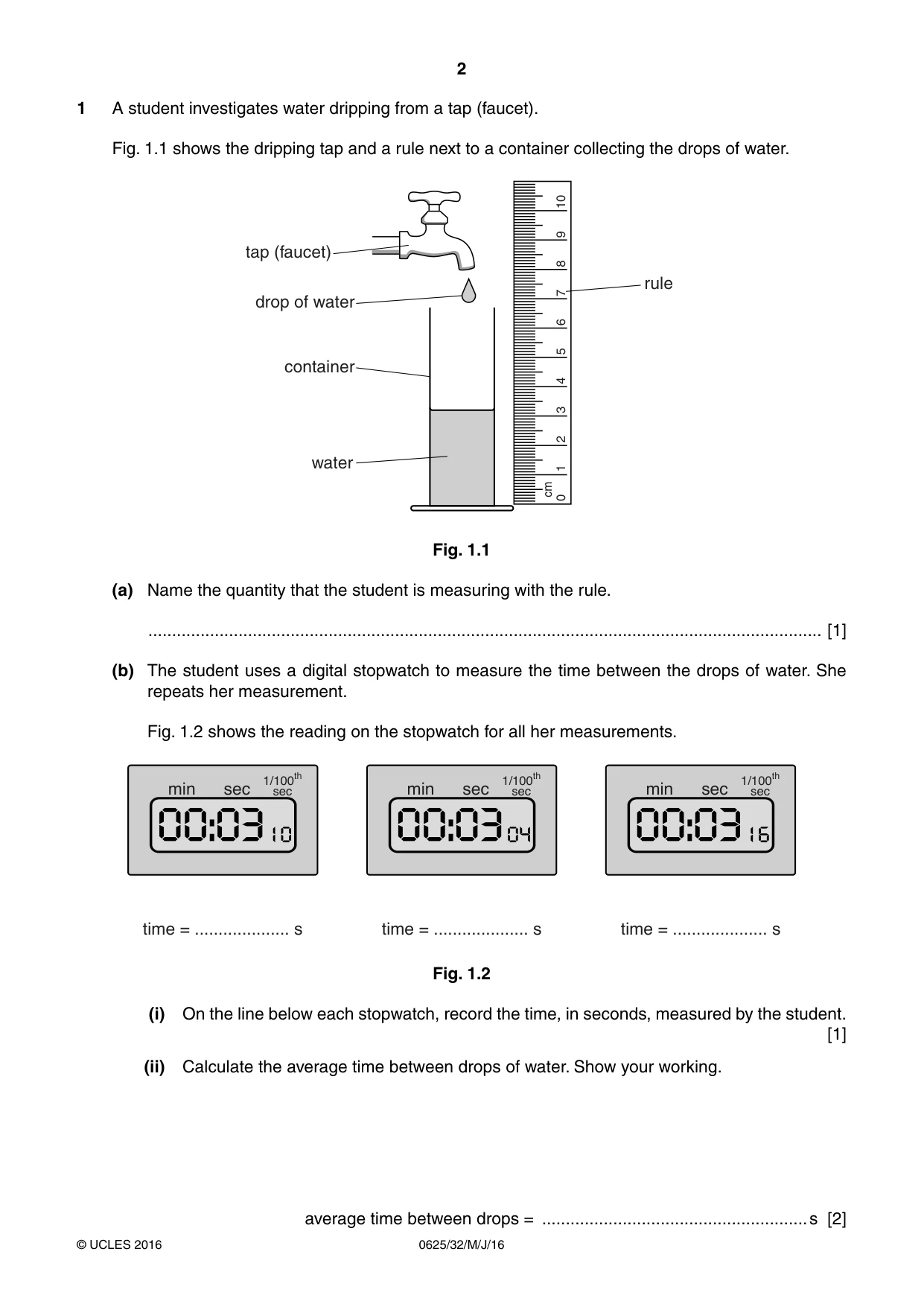
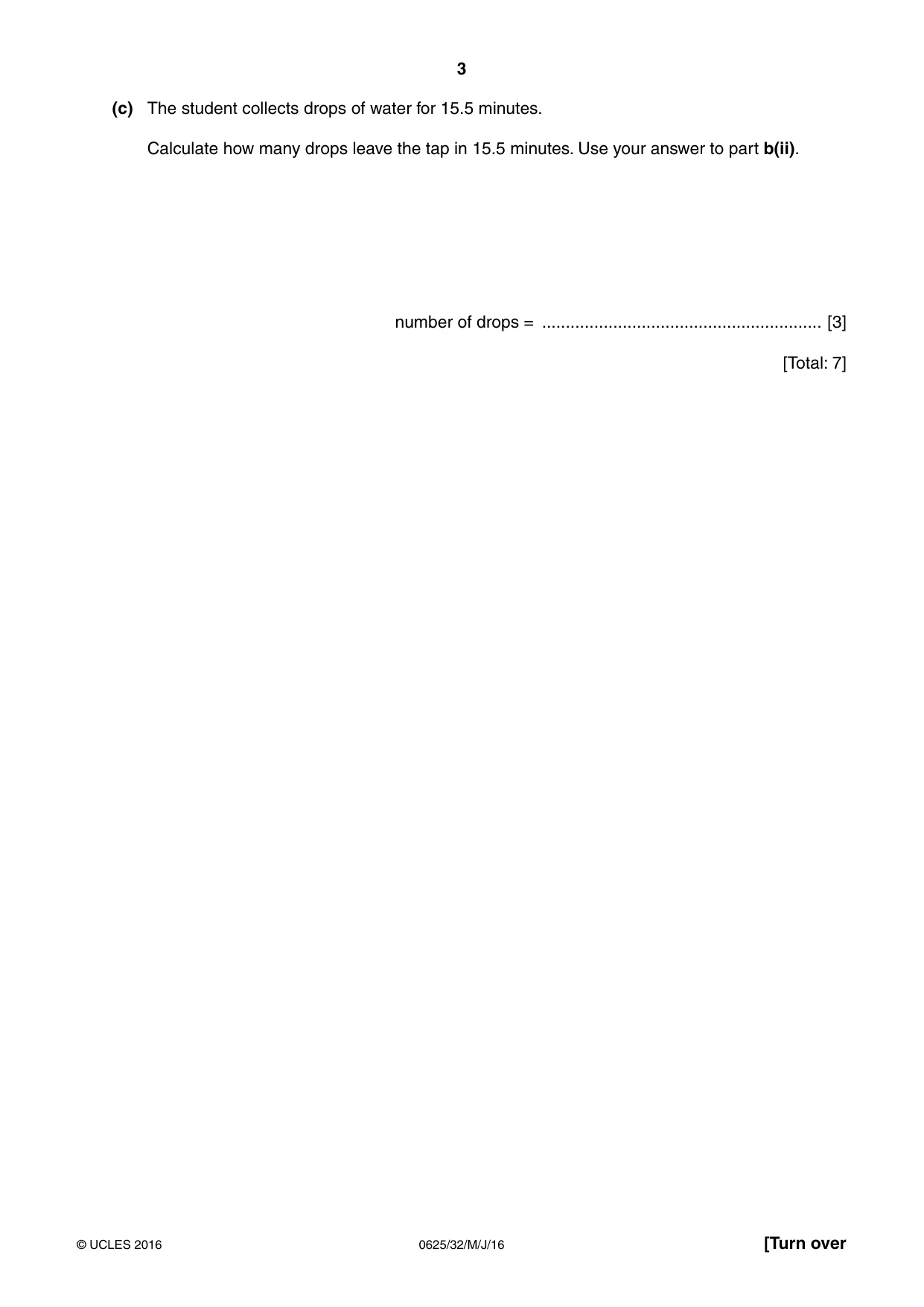
1 A student investigates water dripping from a tap (faucet). Fig. 1.1 shows the dripping tap and a rule next to a container collecting the drops of water. 10 9 tap (faucet) 8 7 rule drop of water 6 5 container 4 3 2 water 1 cm 0 Fig. 1.1 (a) Name the quantity that the student is measuring with the rule. .............................................................................................................................................. [1] (b) The student uses a digital stopwatch to measure the time between the drops of water. She repeats her measurement. Fig. 1.2 shows the reading on the stopwatch for all her measurements. 1/100th 1/100th 1/100th min sec sec min sec sec min sec sec time = .................... s time = .................... s time = .................... s Fig. 1.2 (i) On the line below each stopwatch, record the time, in seconds, measured by the student. [1] (ii) Calculate the average time between drops of water. Show your working. average time between drops = ........................................................ s [2] (c) The student collects drops of water for 15.5 minutes. Calculate how many drops leave the tap in 15.5 minutes. Use your answer to part b(ii). number of drops = ........................................................... [3] [Total: 7]
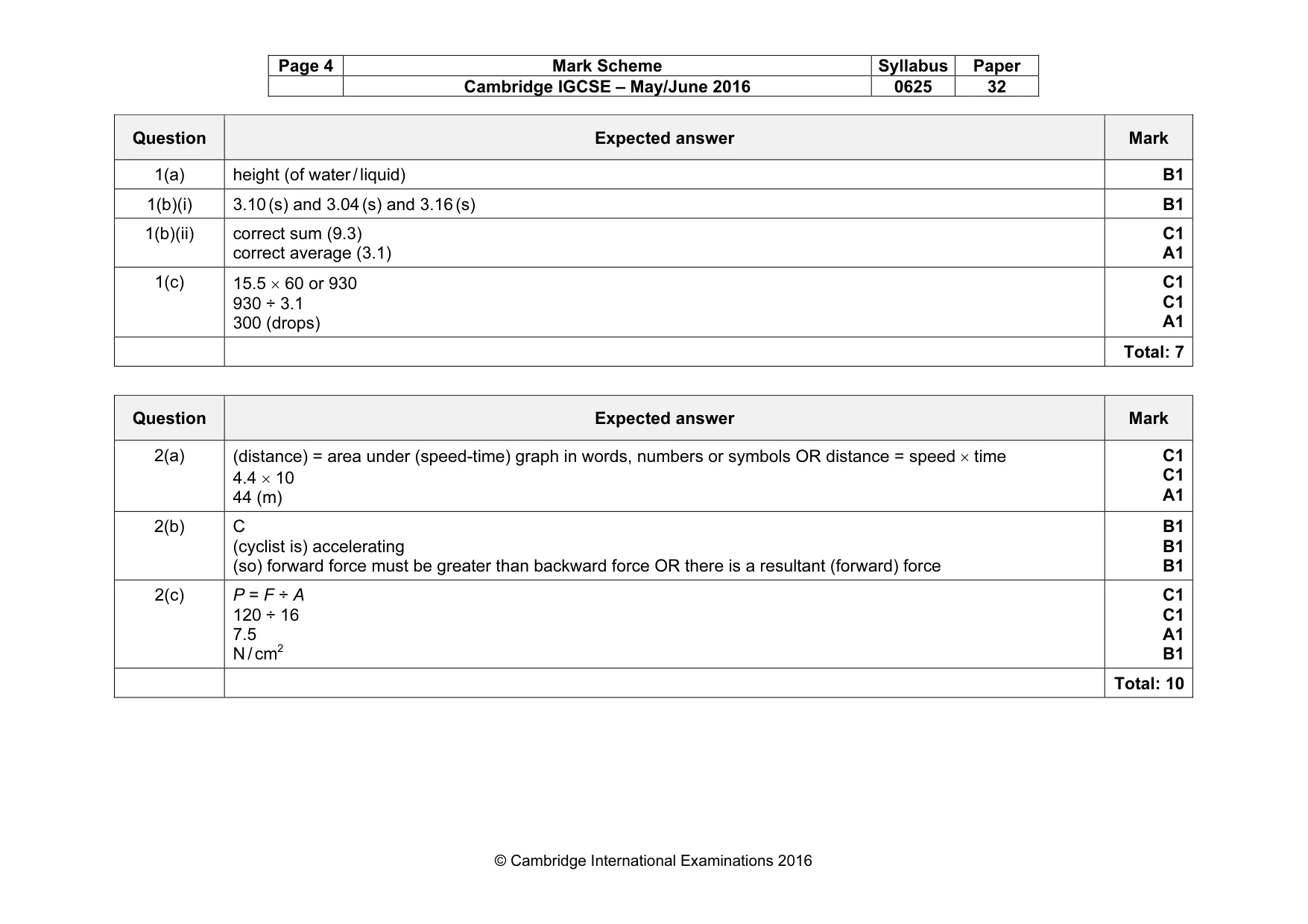
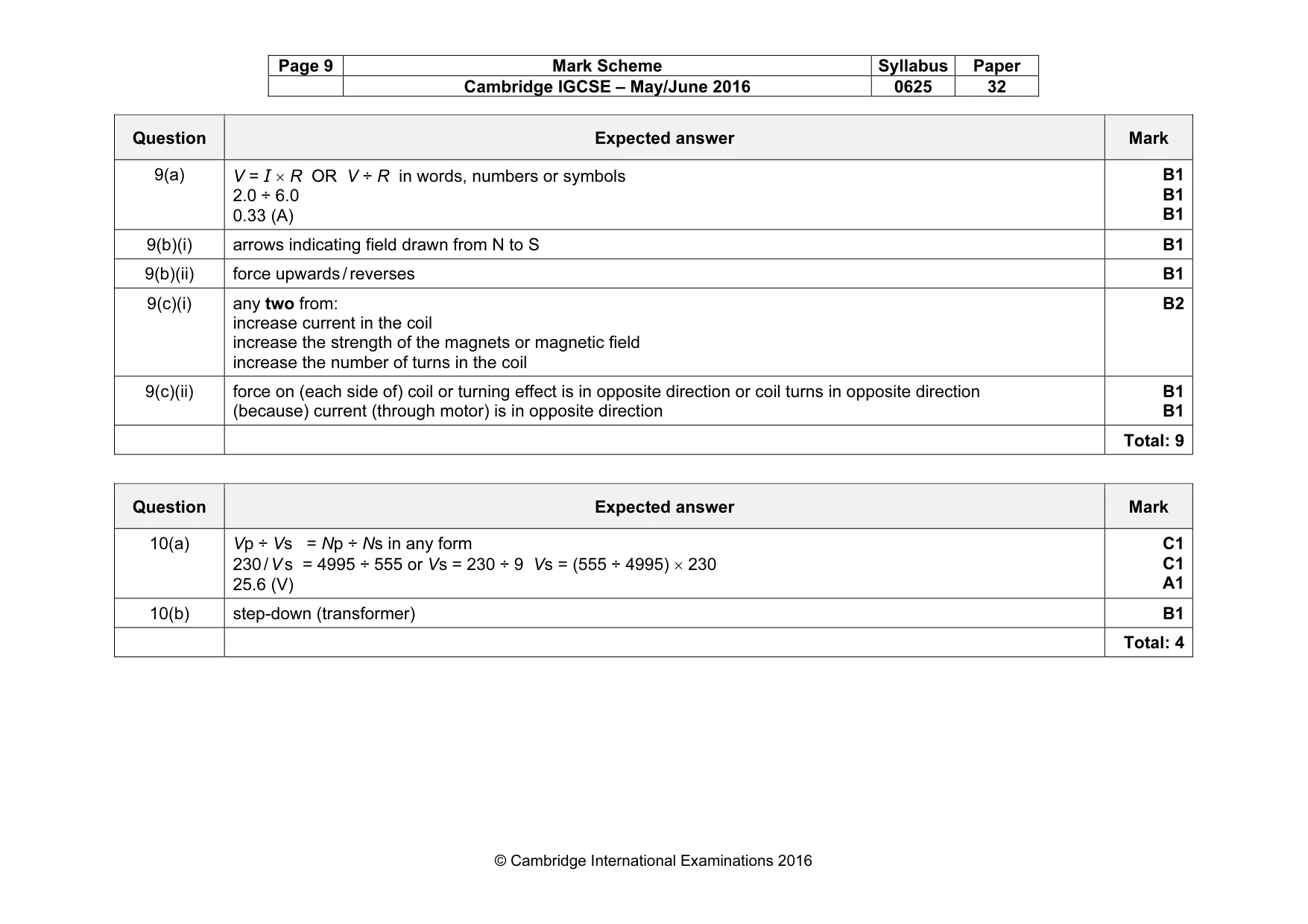
Mark scheme: 1(a) height (of water / liquid) B1 1(b)(i) 3.10 (s) and 3.04 (s) and 3.16 (s) B1 1(b)(ii) correct sum (9.3) correct average (3.1) C1 A1 1(c) 15.5 × 60 or 930 930 ÷ 3.1 300 (drops) C1 C1 A1 Total: 7
More questions on Physical quantities and measurement techniques
Q2 · The speed-time graph for a student cycling along a straight, flat road
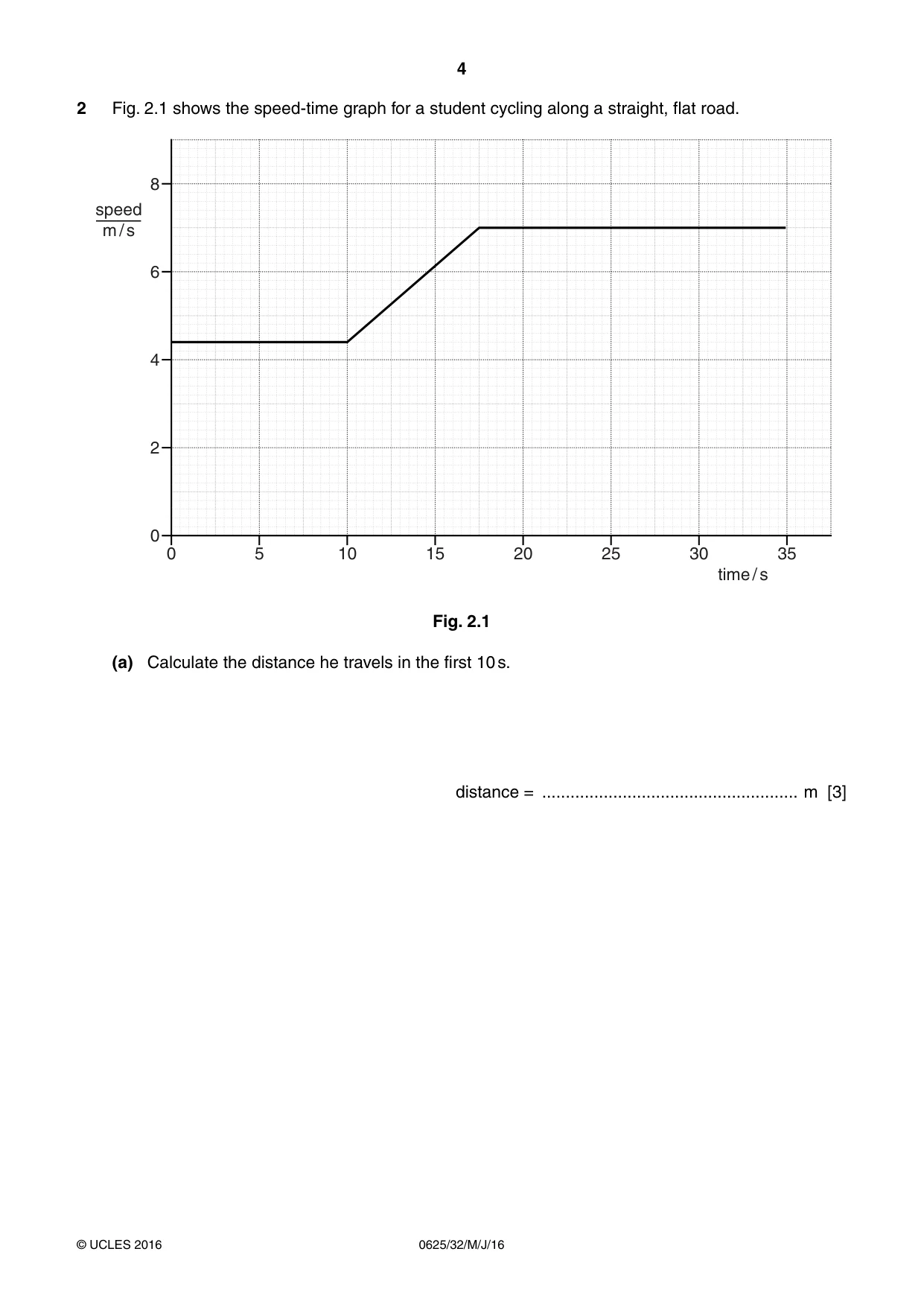
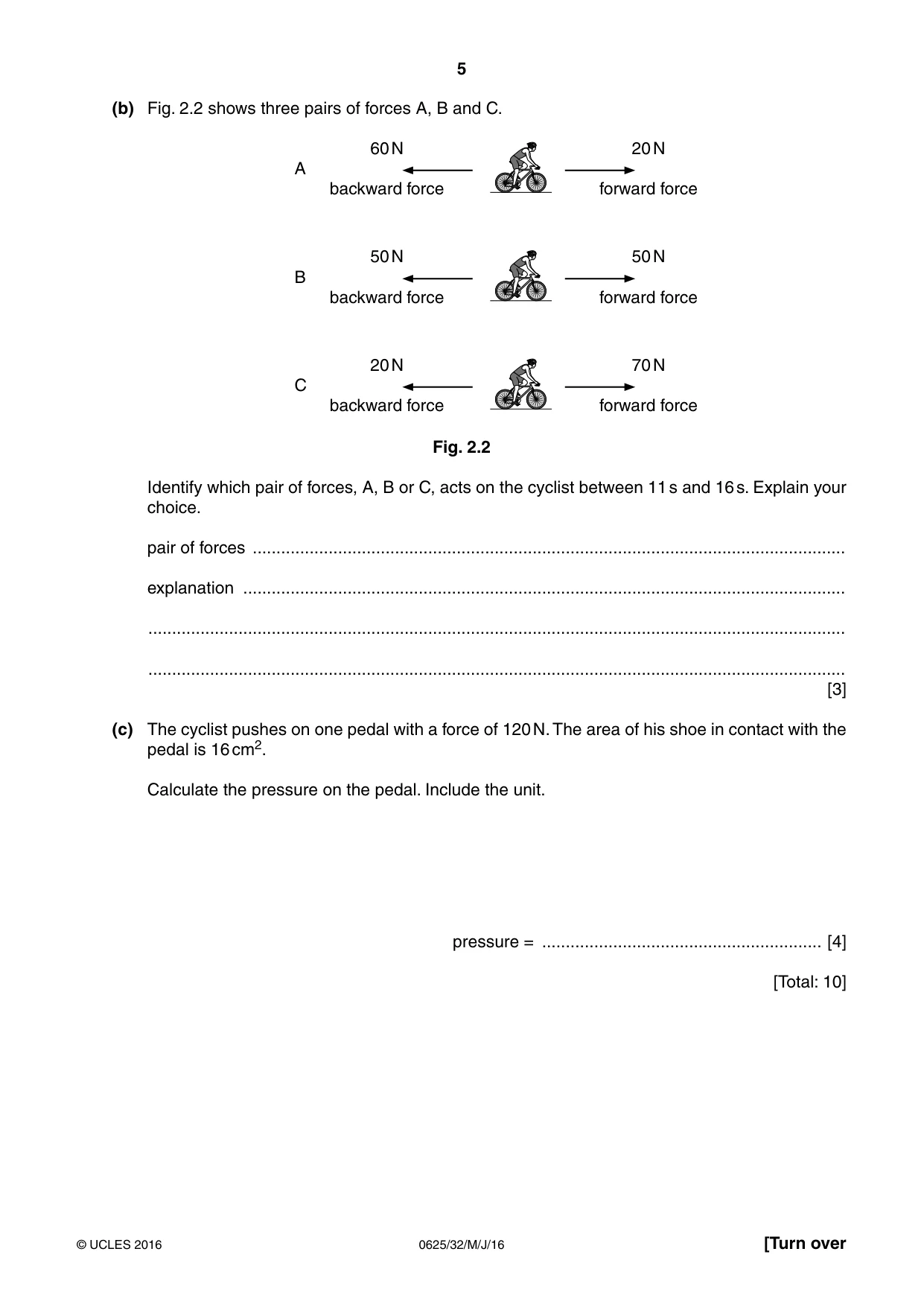
2 Fig. 2.1 shows the speed-time graph for a student cycling along a straight, flat road. 8 speed m / s 6 4 2 0 0 5 10 15 20 25 30 35 time / s Fig. 2.1 (a) Calculate the distance he travels in the first 10 s. distance = ...................................................... m [3] (b) Fig. 2.2 shows three pairs of forces A, B and C. 60 N 20 N A backward force forward force 50 N 50 N B backward force forward force 20 N 70 N C backward force forward force Fig. 2.2 Identify which pair of forces, A, B or C, acts on the cyclist between 11 s and 16 s. Explain your choice. pair of forces ............................................................................................................................. explanation ............................................................................................................................... ................................................................................................................................................... ................................................................................................................................................... [3] (c) The cyclist pushes on one pedal with a force of 120 N. The area of his shoe in contact with the pedal is 16 cm2. Calculate the pressure on the pedal. Include the unit. pressure = ........................................................... [4] [Total: 10]
Mark scheme: 2(a) (distance) = area under (speed-time) graph in words, numbers or symbols OR distance = speed × time 4.4 × 10 44 (m) C1 C1 A1 2(b) C (cyclist is) accelerating (so) forward force must be greater than backward force OR there is a resultant (forward) force B1 B1 B1 2(c) P = F ÷ A 120 ÷ 16 7.5 N / cm2 C1 C1 A1 B1 Total: 10
Q3 · A girl and a boy on a see-saw
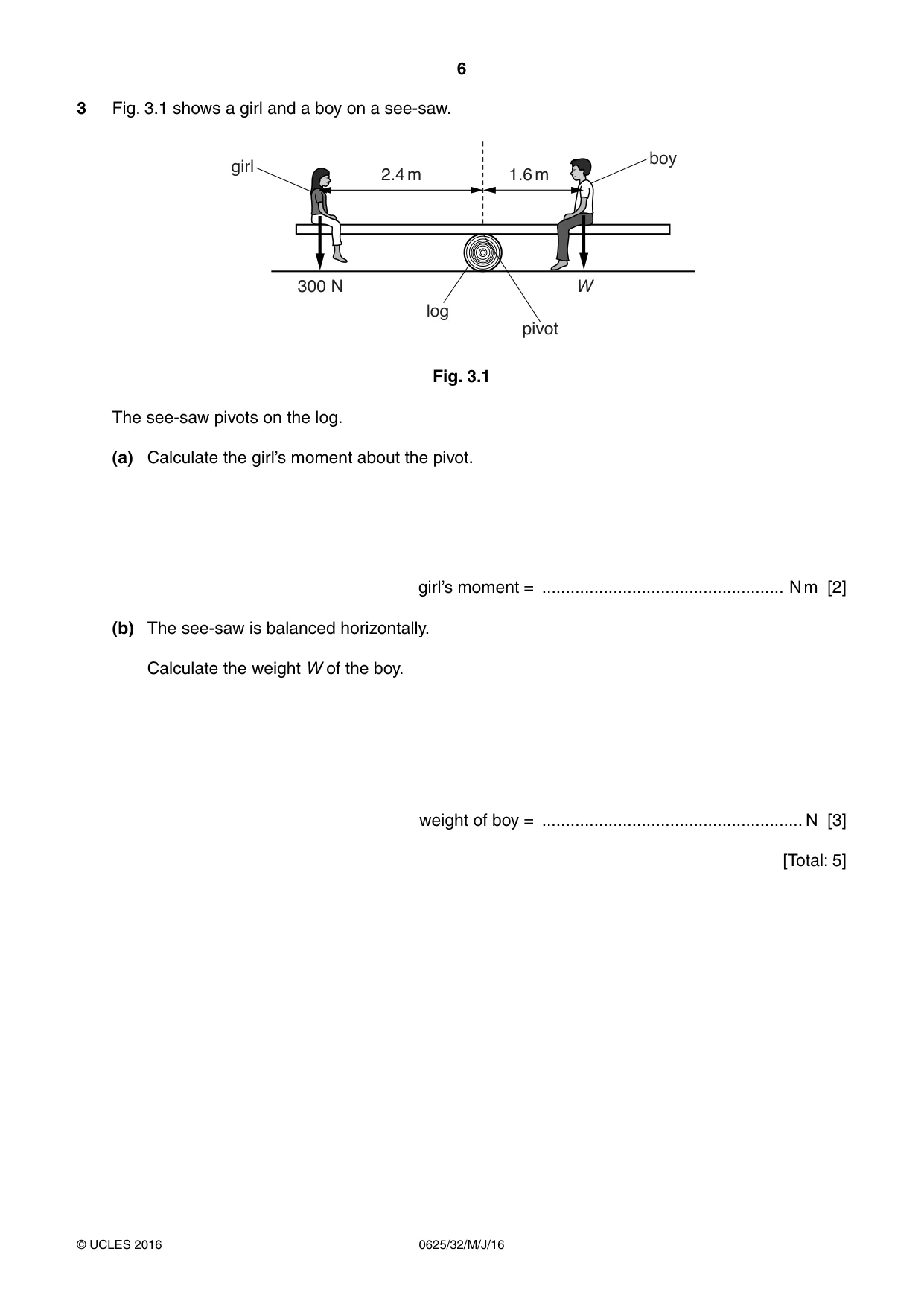
3 Fig. 3.1 shows a girl and a boy on a see-saw. boy girl 2.4 m 1.6 m 300 N W log pivot Fig. 3.1 The see-saw pivots on the log. (a) Calculate the girl’s moment about the pivot. girl’s moment = ................................................... N m [2] (b) The see-saw is balanced horizontally. Calculate the weight W of the boy. weight of boy = ....................................................... N [3] [Total: 5]
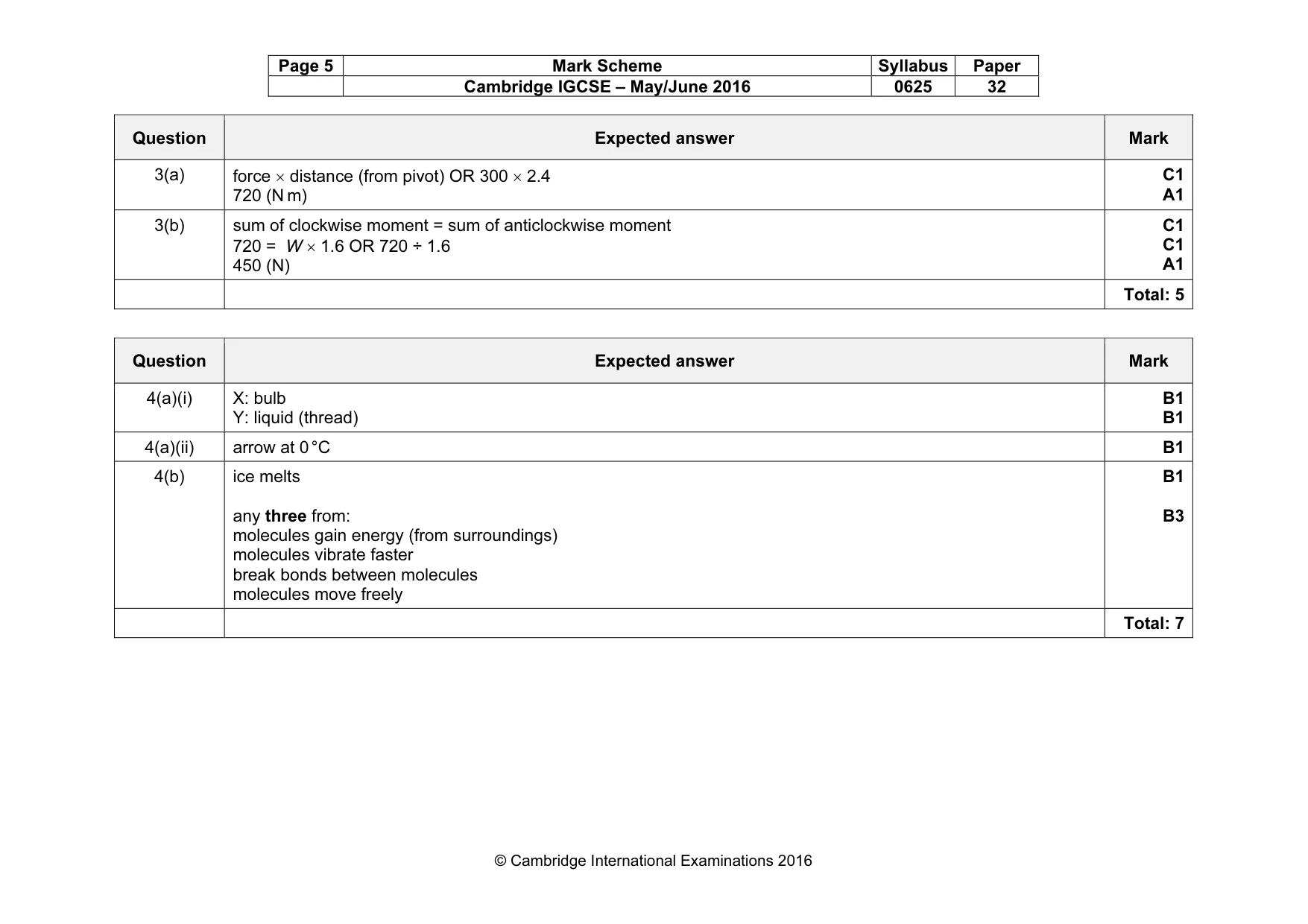
Mark scheme: 3(a) force × distance (from pivot) OR 300 × 2.4 720 (N m) C1 A1 3(b) sum of clockwise moment = sum of anticlockwise moment 720 = W × 1.6 OR 720 ÷ 1.6 450 (N) C1 C1 A1 Total: 5
Q4 · A student is investigating a mixture of water and ice
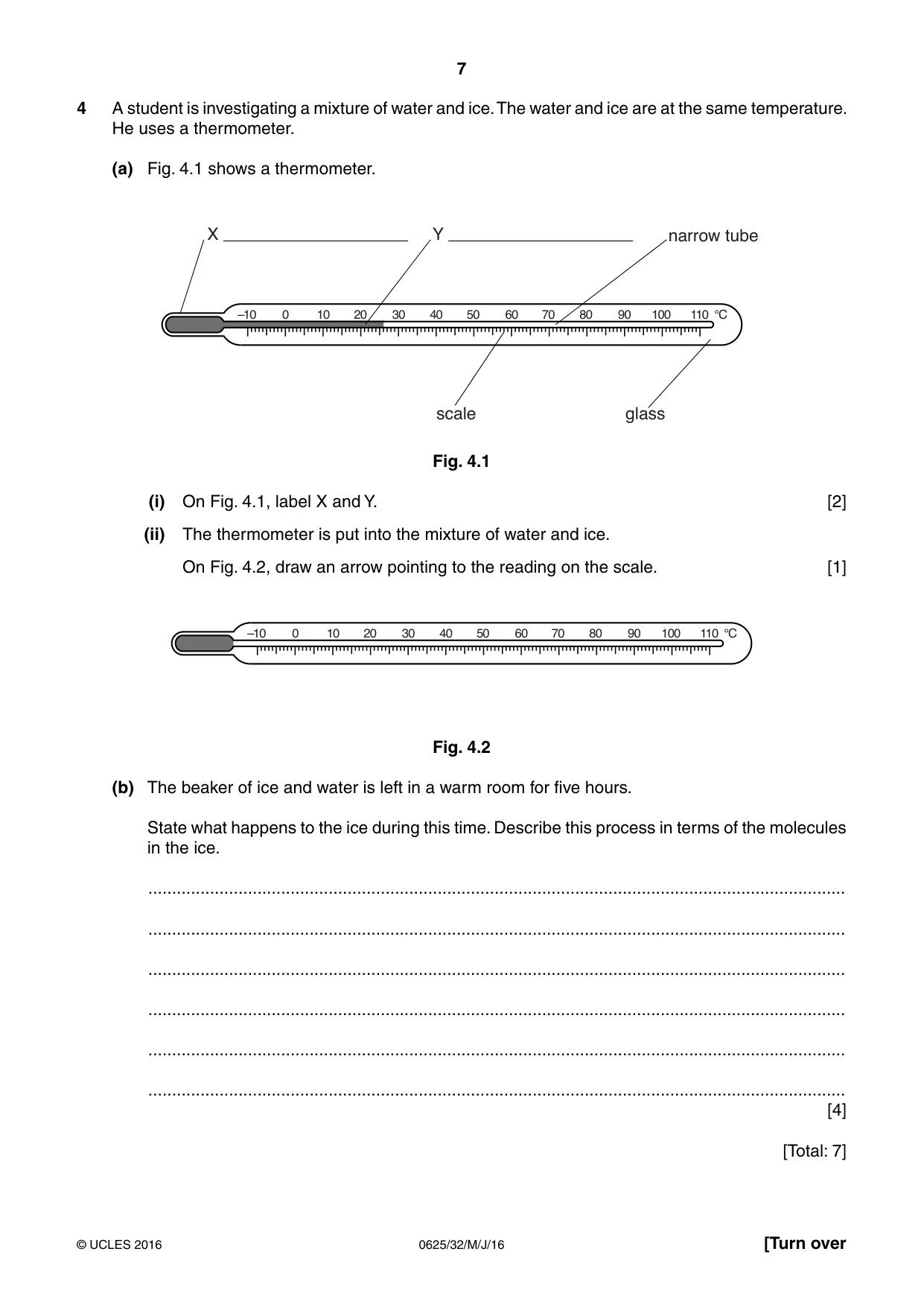
4 A student is investigating a mixture of water and ice. The water and ice are at the same temperature. He uses a thermometer. (a) Fig. 4.1 shows a thermometer. X Y narrow tube –10 0 10 20 30 40 50 60 70 80 90 100 110 °C scale glass Fig. 4.1 (i) On Fig. 4.1, label X and Y. [2] (ii) The thermometer is put into the mixture of water and ice. On Fig. 4.2, draw an arrow pointing to the reading on the scale. [1] –10 0 10 20 30 40 50 60 70 80 90 100 110 °C Fig. 4.2 (b) The beaker of ice and water is left in a warm room for five hours. State what happens to the ice during this time. Describe this process in terms of the molecules in the ice. ................................................................................................................................................... ................................................................................................................................................... ................................................................................................................................................... ................................................................................................................................................... ................................................................................................................................................... ................................................................................................................................................... [4] [Total: 7]
Mark scheme: 4(a)(i) X: bulb Y: liquid (thread) B1 B1 4(a)(ii) arrow at 0 °C B1 4(b) ice melts any three from: molecules gain energy (from surroundings) molecules vibrate faster break bonds between molecules molecules move freely B1 B3 Total: 7
Q5 · Two circuits, A and B
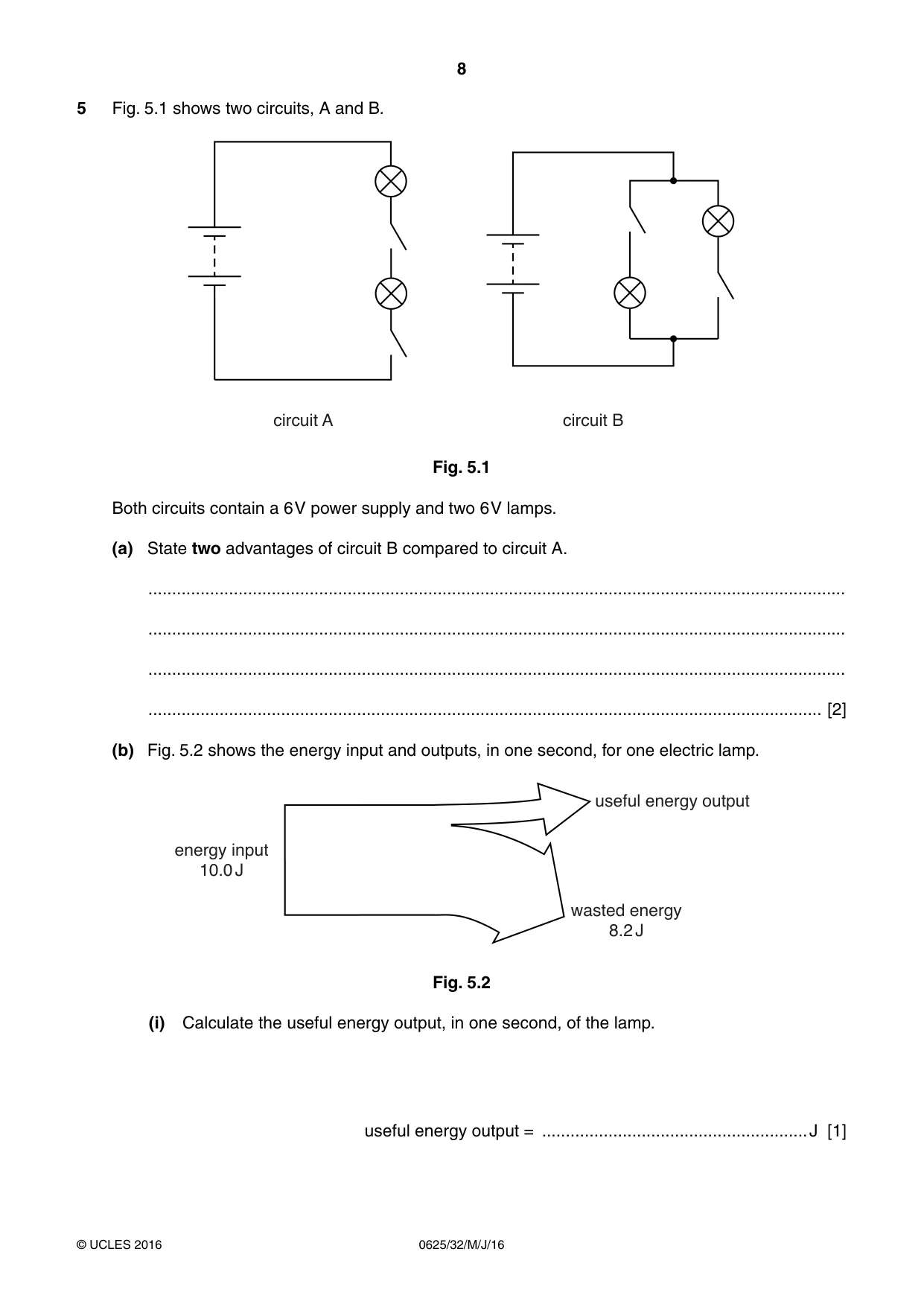
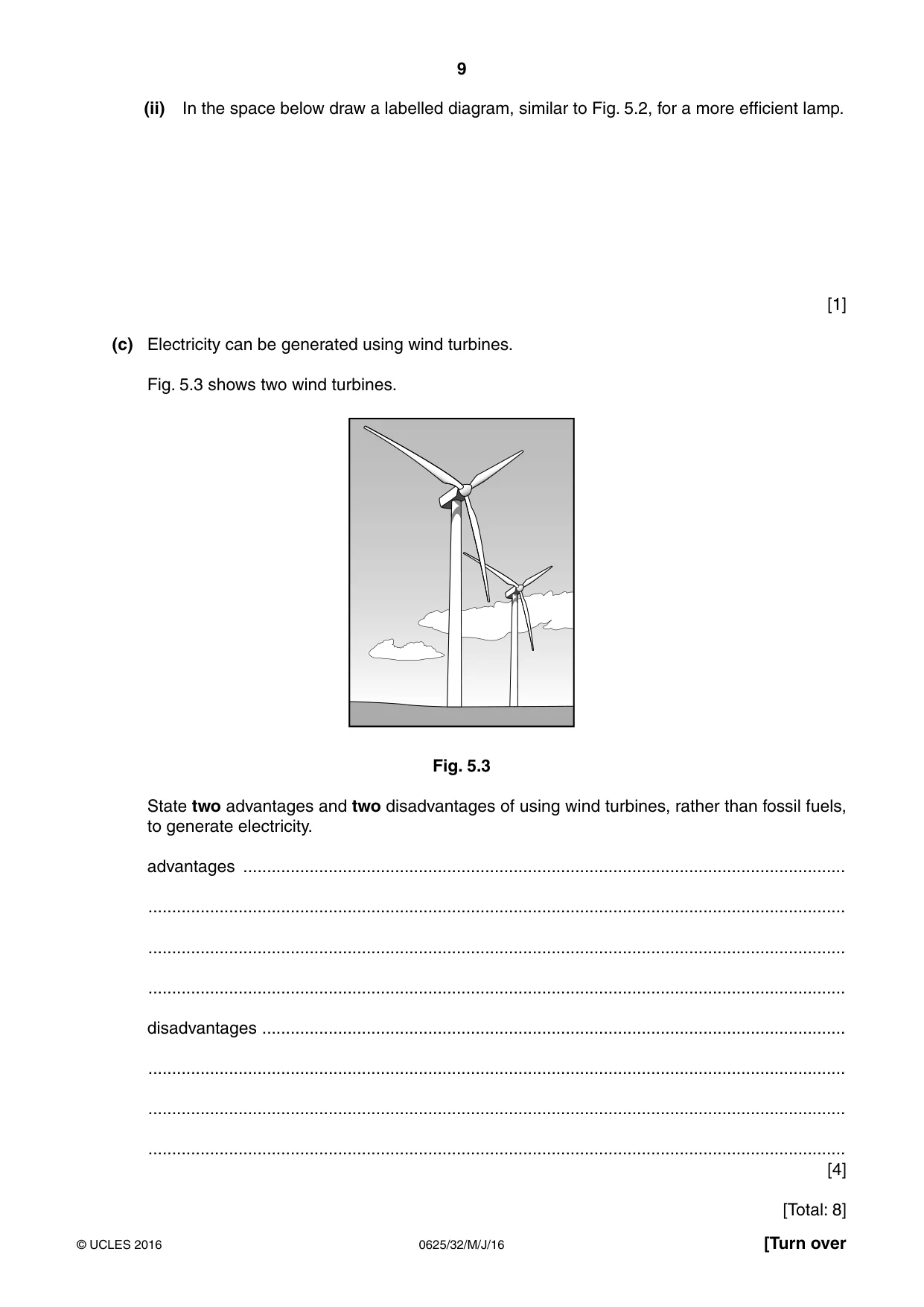
5 Fig. 5.1 shows two circuits, A and B. circuit A circuit B Fig. 5.1 Both circuits contain a 6 V power supply and two 6 V lamps. (a) State two advantages of circuit B compared to circuit A. ................................................................................................................................................... ................................................................................................................................................... ................................................................................................................................................... .............................................................................................................................................. [2] (b) Fig. 5.2 shows the energy input and outputs, in one second, for one electric lamp. useful energy output energy input 10.0 J wasted energy 8.2 J Fig. 5.2 (i) Calculate the useful energy output, in one second, of the lamp. useful energy output = ........................................................ J [1] (ii) In the space below draw a labelled diagram, similar to Fig. 5.2, for a more efficient lamp. [1] (c) Electricity can be generated using wind turbines. Fig. 5.3 shows two wind turbines. Fig. 5.3 State two advantages and two disadvantages of using wind turbines, rather than fossil fuels, to generate electricity. advantages ............................................................................................................................... ................................................................................................................................................... ................................................................................................................................................... ................................................................................................................................................... disadvantages ........................................................................................................................... ................................................................................................................................................... ................................................................................................................................................... ................................................................................................................................................... [4] [Total: 8]
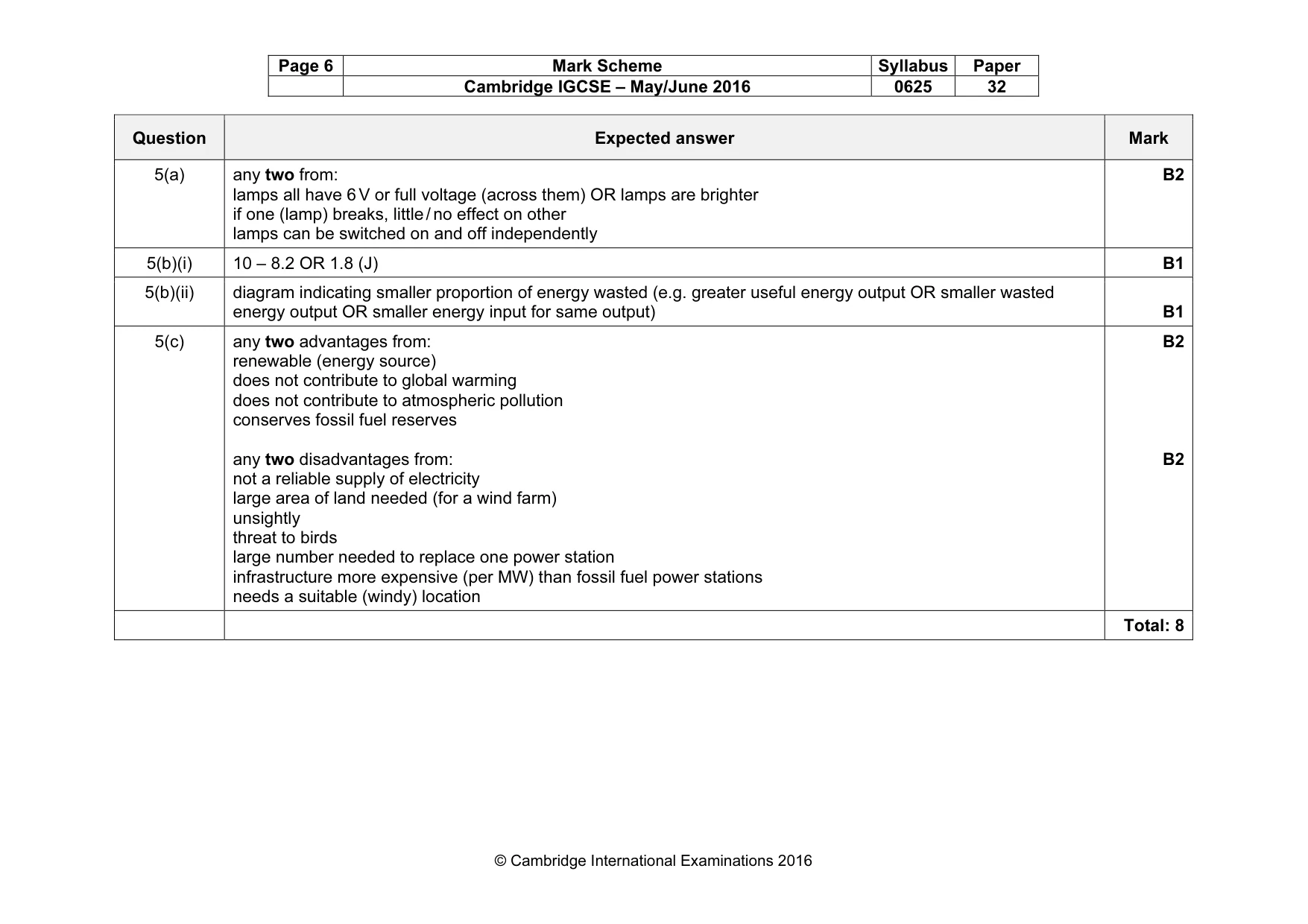
Mark scheme: 5(a) any two from: lamps all have 6 V or full voltage (across them) OR lamps are brighter if one (lamp) breaks, little / no effect on other lamps can be switched on and off independently B2 5(b)(i) 10 – 8.2 OR 1.8 (J) B1 5(b)(ii) diagram indicating smaller proportion of energy wasted (e.g. greater useful energy output OR smaller wasted energy output OR smaller energy input for same output) B1 5(c) any two advantages from: renewable (energy source) does not contribute to global warming does not contribute to atmospheric pollution conserves fossil fuel reserves any two disadvantages from: not a reliable supply of electricity large area of land needed (for a wind farm) unsightly threat to birds large number needed to replace one power station infrastructure more expensive (per MW) than fossil fuel power stations needs a suitable (windy) location B2 B2 Total: 8
Q6 · The regions of the electromagnetic spectrum
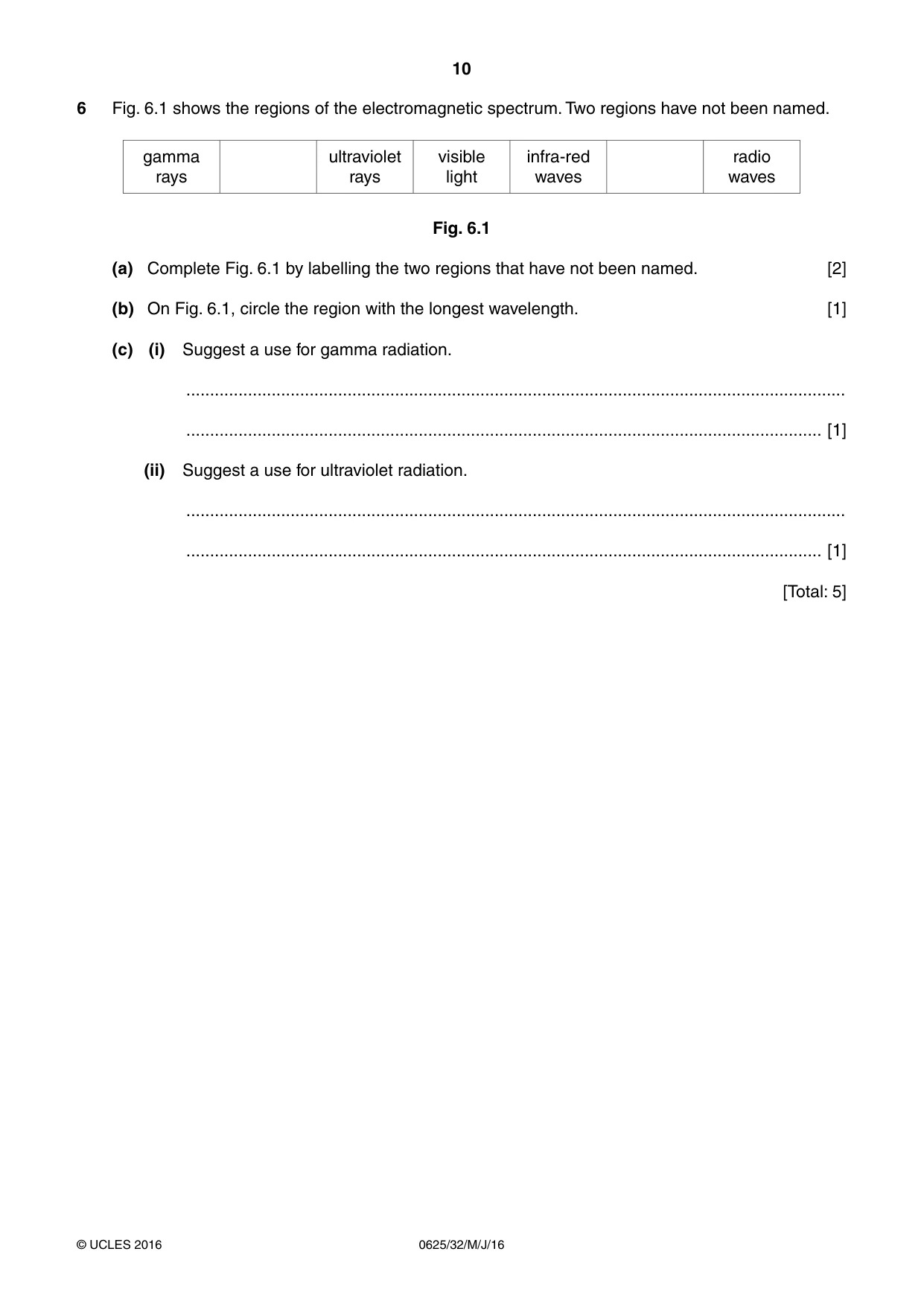
6 Fig. 6.1 shows the regions of the electromagnetic spectrum. Two regions have not been named. gamma ultraviolet visible infra-red radio rays rays light waves waves Fig. 6.1 (a) Complete Fig. 6.1 by labelling the two regions that have not been named. [2] (b) On Fig. 6.1, circle the region with the longest wavelength. [1] (c) (i) Suggest a use for gamma radiation. ........................................................................................................................................... ...................................................................................................................................... [1] (ii) Suggest a use for ultraviolet radiation. ........................................................................................................................................... ...................................................................................................................................... [1] [Total: 5]
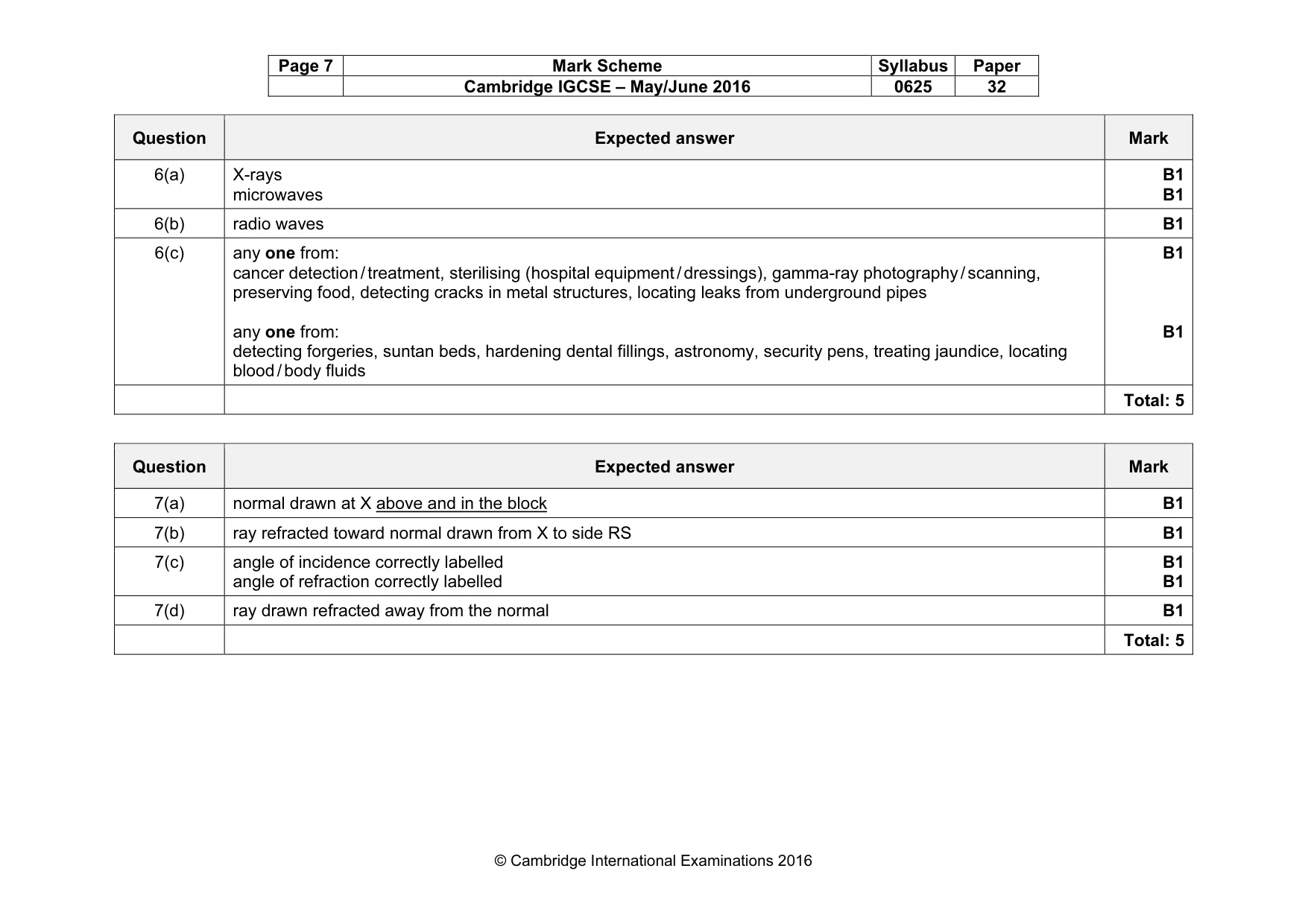
Mark scheme: 6(a) X-rays microwaves B1 B1 6(b) radio waves B1 6(c) any one from: cancer detection / treatment, sterilising (hospital equipment / dressings), gamma-ray photography / scanning, preserving food, detecting cracks in metal structures, locating leaks from underground pipes any one from: detecting forgeries, suntan beds, hardening dental fillings, astronomy, security pens, treating jaundice, locating blood / body fluids B1 B1 Total: 5
Q7 · A ray of light incident on a rectangular glass block at point X
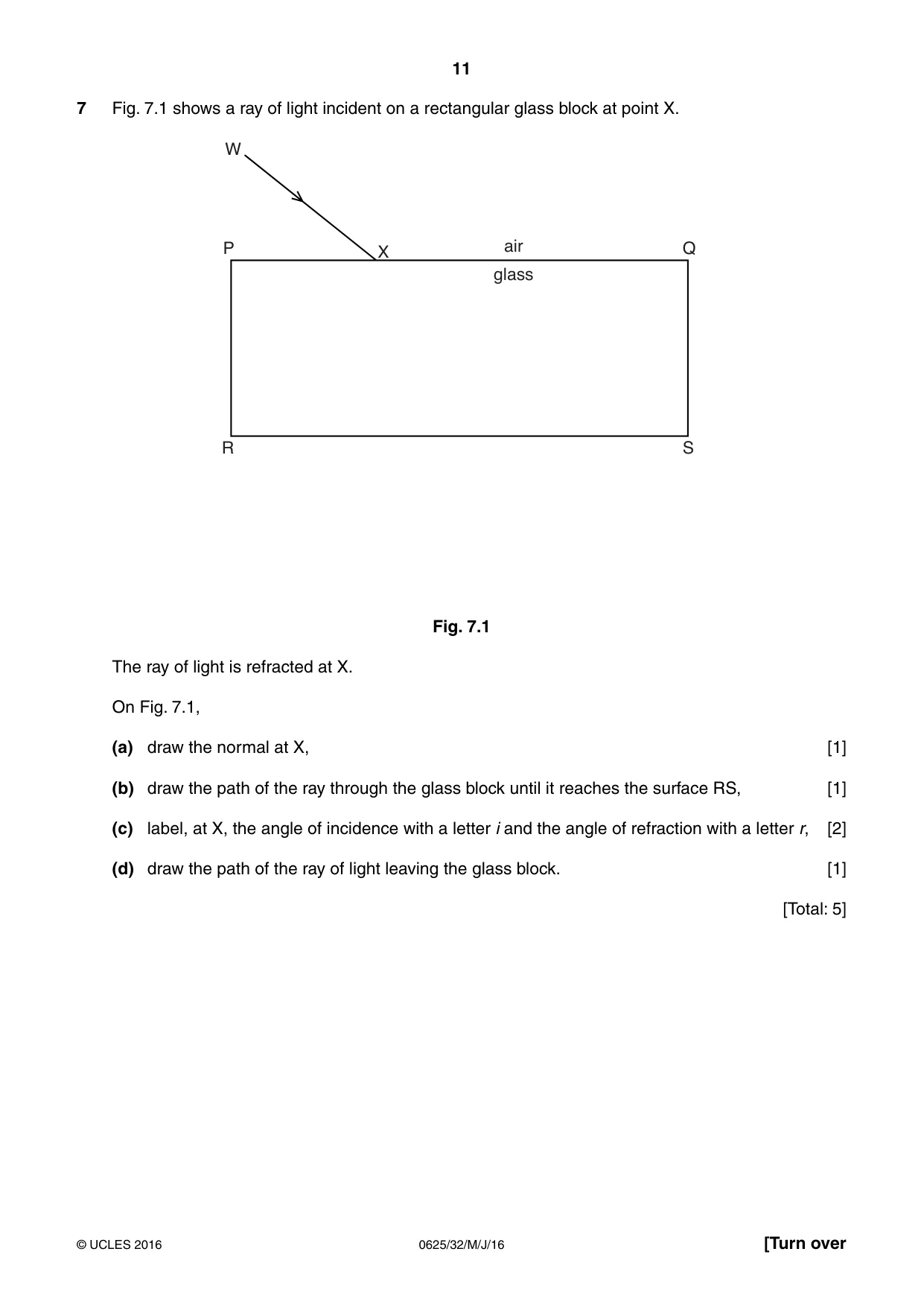
7 Fig. 7.1 shows a ray of light incident on a rectangular glass block at point X. W P X air Q glass R S Fig. 7.1 The ray of light is refracted at X. On Fig. 7.1, (a) draw the normal at X, [1] (b) draw the path of the ray through the glass block until it reaches the surface RS, [1] (c) label, at X, the angle of incidence with a letter i and the angle of refraction with a letter r, [2] (d) draw the path of the ray of light leaving the glass block. [1] [Total: 5]
Mark scheme: 7(a) normal drawn at X above and in the block B1 7(b) ray refracted toward normal drawn from X to side RS B1 7(c) angle of incidence correctly labelled angle of refraction correctly labelled B1 B1 7(d) ray drawn refracted away from the normal B1 Total: 5
Q8 · Researchers have found that the best temperature for drinking coffee is 60 °C
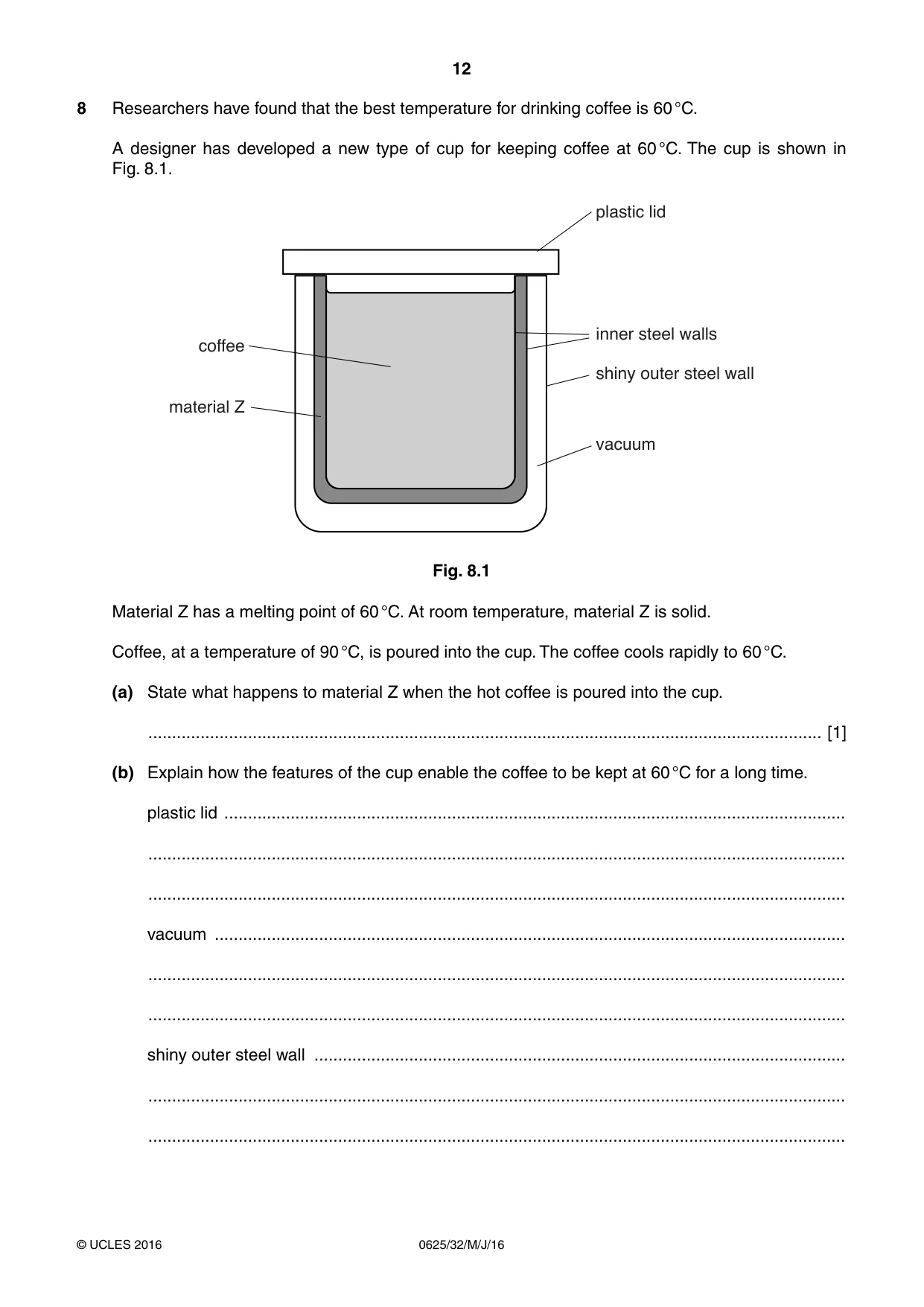
8 Researchers have found that the best temperature for drinking coffee is 60 °C. A designer has developed a new type of cup for keeping coffee at 60 °C. The cup is shown in Fig. 8.1. plastic lid inner steel walls coffee shiny outer steel wall material Z vacuum Fig. 8.1 Material Z has a melting point of 60 °C. At room temperature, material Z is solid. Coffee, at a temperature of 90 °C, is poured into the cup. The coffee cools rapidly to 60 °C. (a) State what happens to material Z when the hot coffee is poured into the cup. .............................................................................................................................................. [1] (b) Explain how the features of the cup enable the coffee to be kept at 60 °C for a long time. plastic lid ................................................................................................................................... ................................................................................................................................................... ................................................................................................................................................... vacuum ..................................................................................................................................... ................................................................................................................................................... ................................................................................................................................................... shiny outer steel wall ................................................................................................................ ................................................................................................................................................... ................................................................................................................................................... material Z .................................................................................................................................. ................................................................................................................................................... ................................................................................................................................................... ................................................................................................................................................... ................................................................................................................................................... [5] [Total: 6]
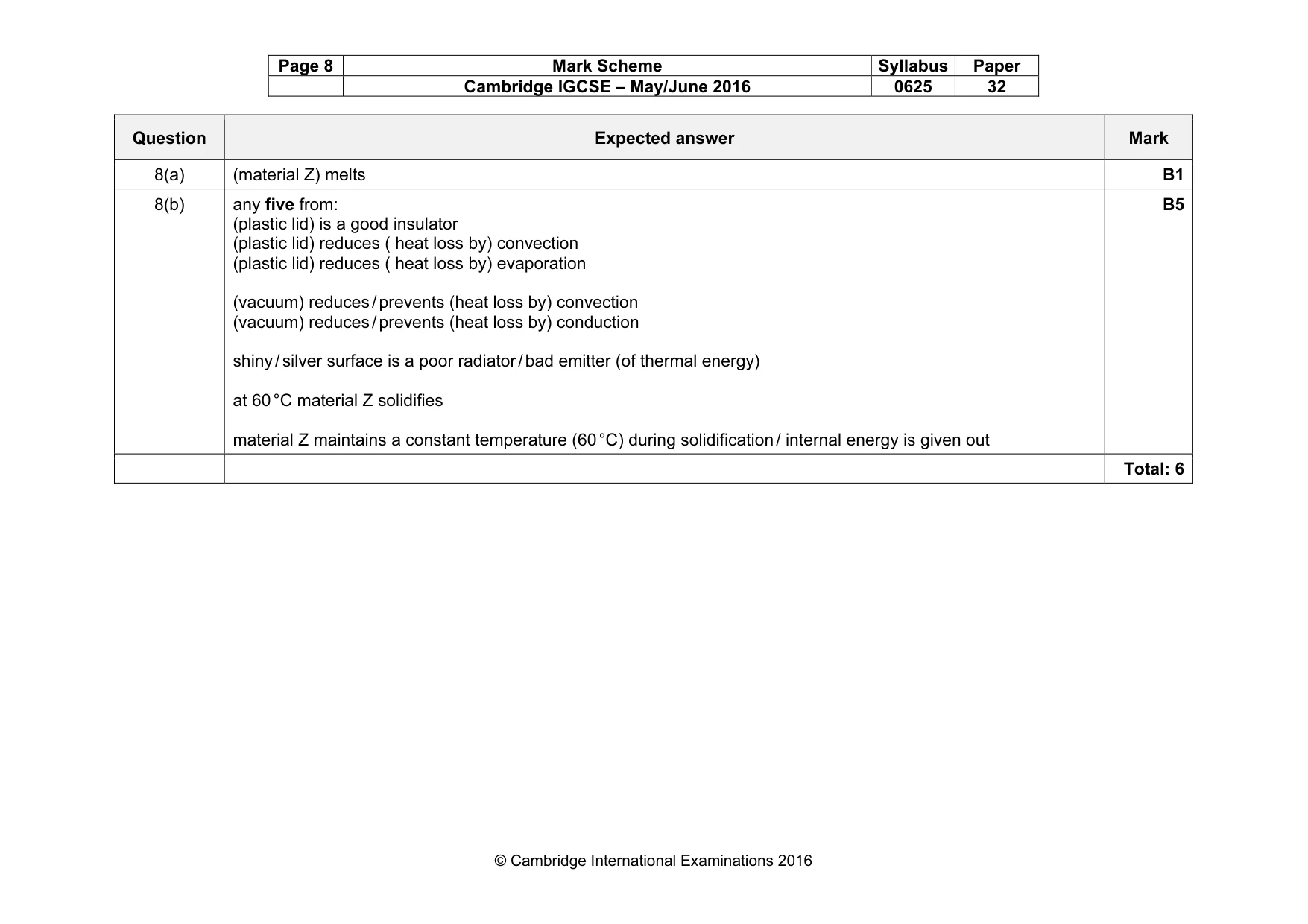
Mark scheme: 8(a) (material Z) melts B1 8(b) any five from: (plastic lid) is a good insulator (plastic lid) reduces ( heat loss by) convection (plastic lid) reduces ( heat loss by) evaporation (vacuum) reduces / prevents (heat loss by) convection (vacuum) reduces / prevents (heat loss by) conduction shiny / silver surface is a poor radiator / bad emitter (of thermal energy) at 60 °C material Z solidifies material Z maintains a constant temperature (60 °C) during solidification / internal energy is given out B5 Total: 6
Q9 · The resistance of a long piece of wire is 6.0 Ω
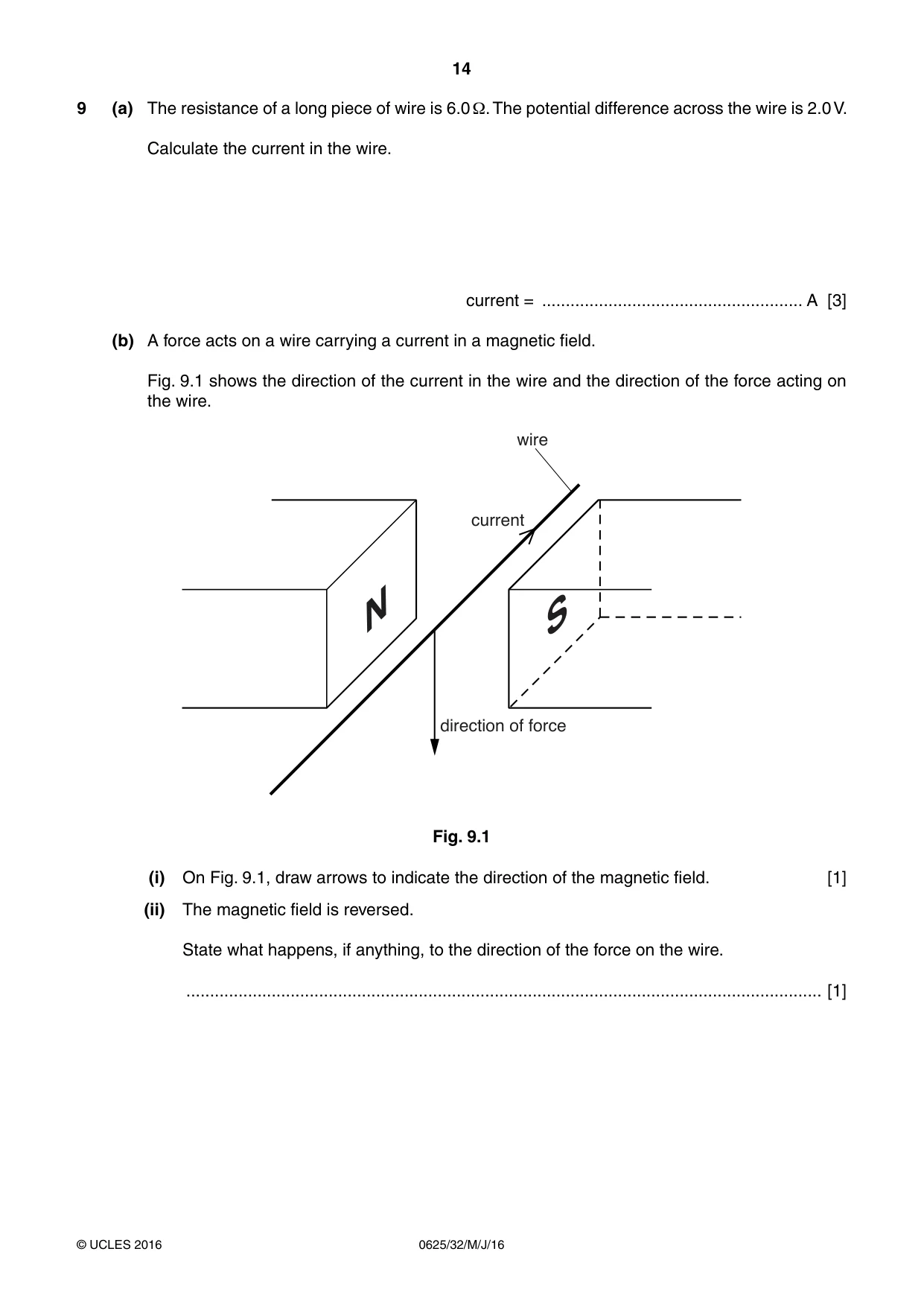
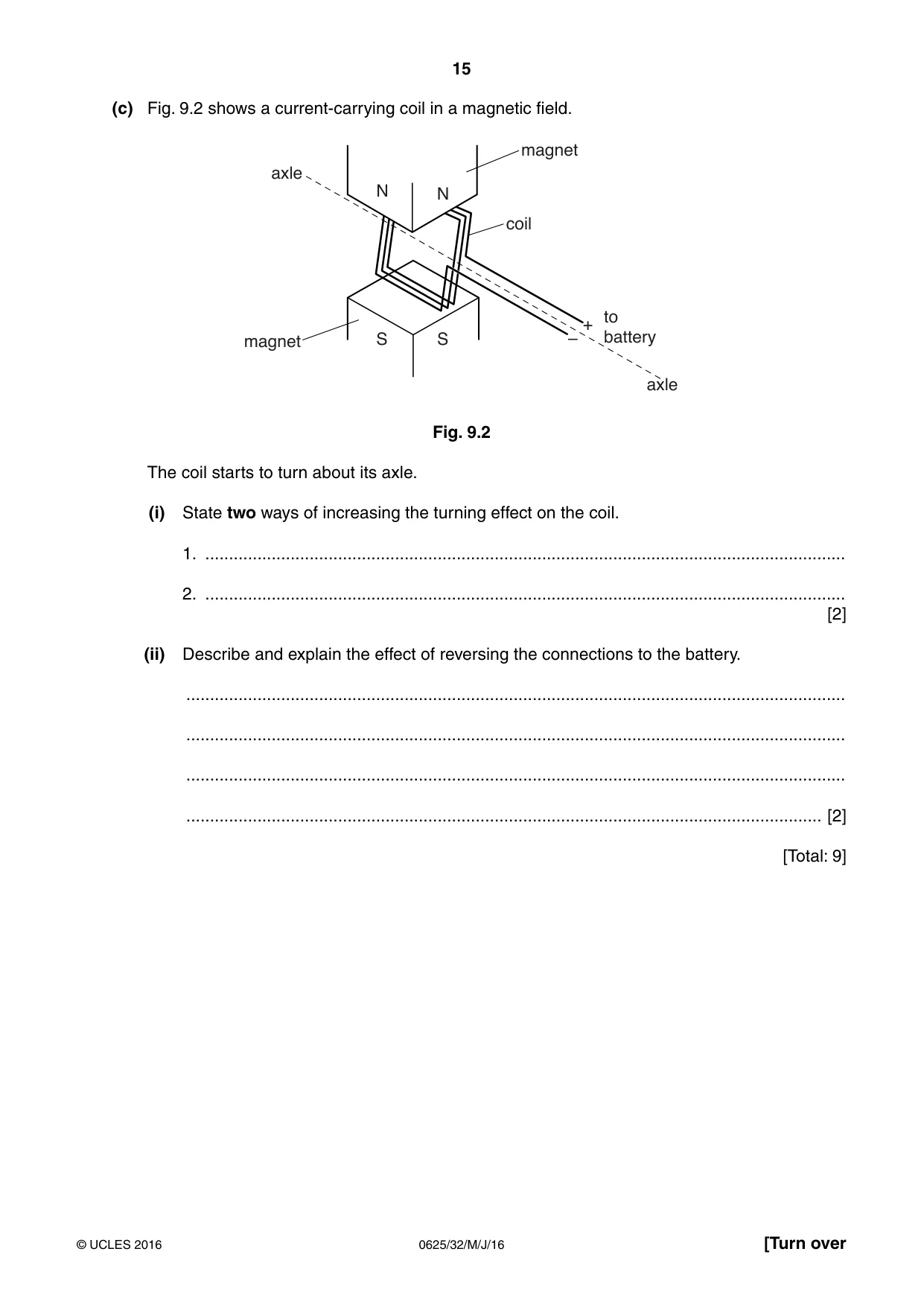
9 (a) The resistance of a long piece of wire is 6.0 Ω. The potential difference across the wire is 2.0 V. Calculate the current in the wire. current = ....................................................... A [3] (b) A force acts on a wire carrying a current in a magnetic field. Fig. 9.1 shows the direction of the current in the wire and the direction of the force acting on the wire. wire current N S direction of force Fig. 9.1 (i) On Fig. 9.1, draw arrows to indicate the direction of the magnetic field. [1] (ii) The magnetic field is reversed. State what happens, if anything, to the direction of the force on the wire. ...................................................................................................................................... [1] (c) Fig. 9.2 shows a current-carrying coil in a magnetic field. magnet axle N N coil to + magnet S S – battery axle Fig. 9.2 The coil starts to turn about its axle. (i) State two ways of increasing the turning effect on the coil. 1. ....................................................................................................................................... 2. ....................................................................................................................................... [2] (ii) Describe and explain the effect of reversing the connections to the battery. ........................................................................................................................................... ........................................................................................................................................... ........................................................................................................................................... ...................................................................................................................................... [2] [Total: 9]
Mark scheme: 9(a) V = I × R OR V ÷ R in words, numbers or symbols 2.0 ÷ 6.0 0.33 (A) B1 B1 B1 9(b)(i) arrows indicating field drawn from N to S B1 9(b)(ii) force upwards / reverses B1 9(c)(i) any two from: increase current in the coil increase the strength of the magnets or magnetic field increase the number of turns in the coil B2 9(c)(ii) force on (each side of) coil or turning effect is in opposite direction or coil turns in opposite direction (because) current (through motor) is in opposite direction B1 B1 Total: 9
Q10 · The charger for a laptop computer
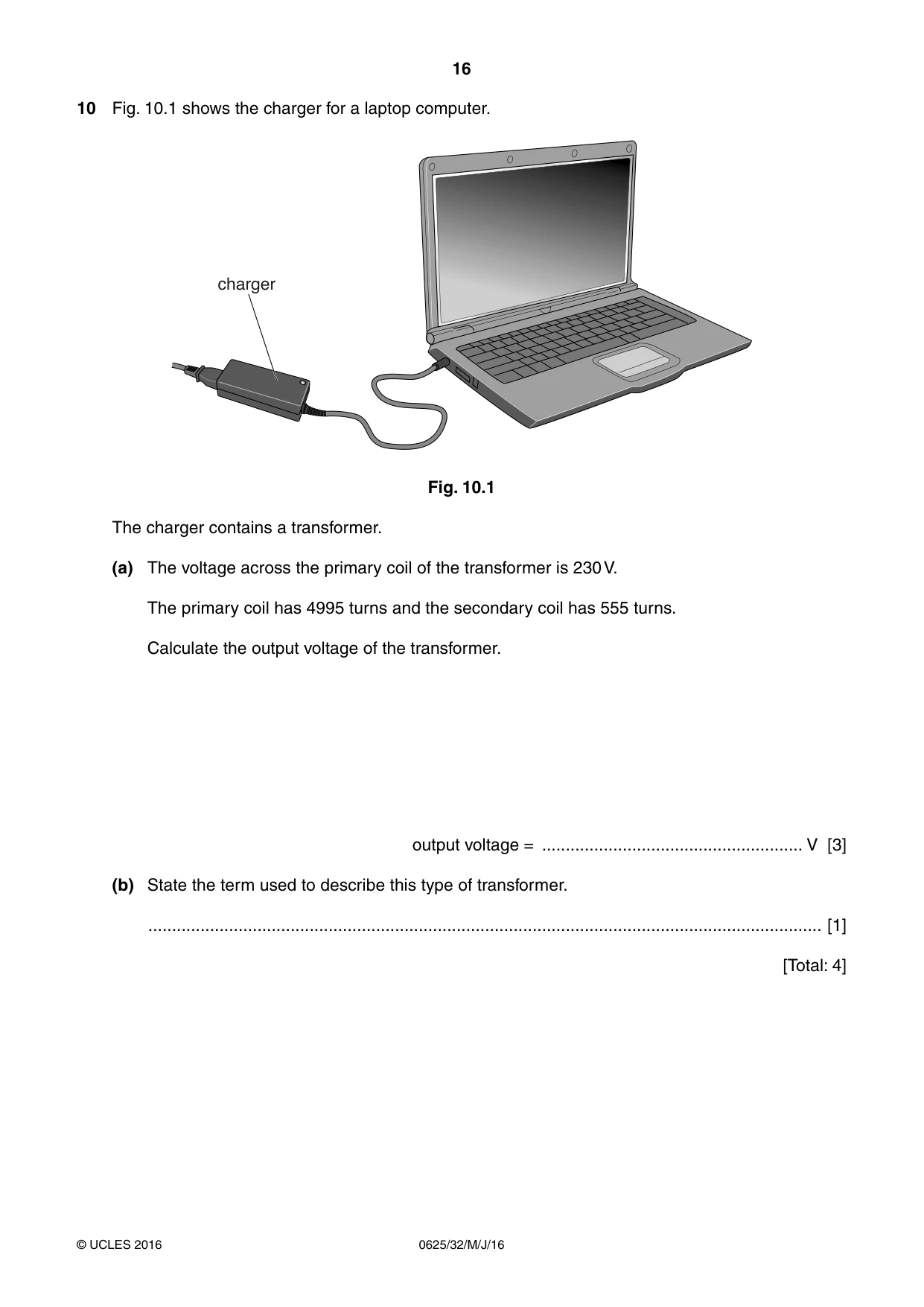
10 Fig. 10.1 shows the charger for a laptop computer. charger Fig. 10.1 The charger contains a transformer. (a) The voltage across the primary coil of the transformer is 230 V. The primary coil has 4995 turns and the secondary coil has 555 turns. Calculate the output voltage of the transformer. output voltage = ....................................................... V [3] (b) State the term used to describe this type of transformer. .............................................................................................................................................. [1] [Total: 4]
Mark scheme: 10(a) 230 / V s = 4995 ÷ 555 or Vs = 230 ÷ 9 Vs = (555 ÷ 4995) × 230 25.6 (V) C1 C1 A1 10(b) step-down (transformer) B1 Total: 4
Q11 · Any atomic nucleus can be represented as AZX
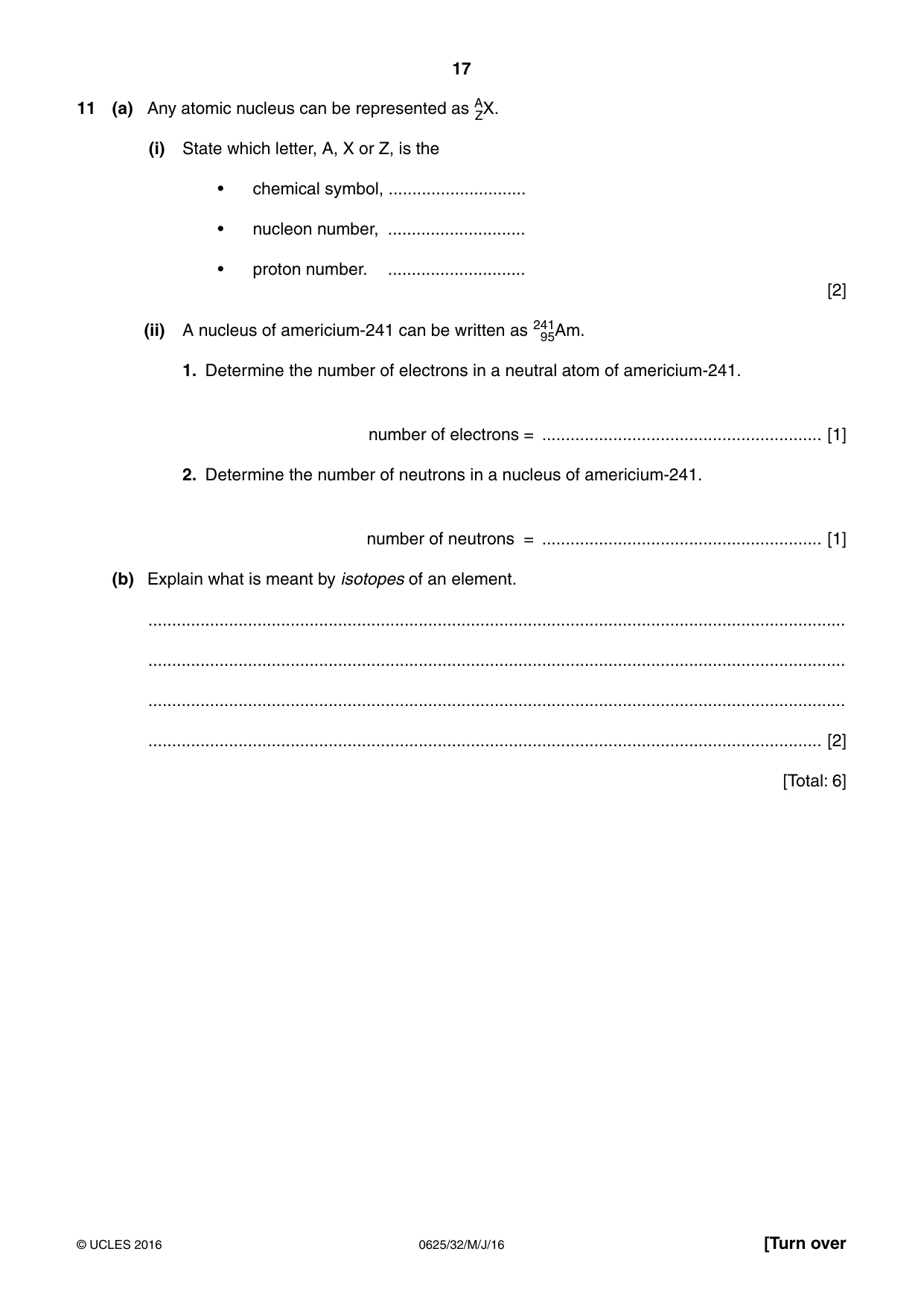
11 (a) Any atomic nucleus can be represented as AZX. (i) State which letter, A, X or Z, is the • chemical symbol, ............................. • nucleon number, ............................. • proton number. ............................. [2] (ii) A nucleus of americium-241 can be written as 24195Am. 1. Determine the number of electrons in a neutral atom of americium-241. number of electrons = ........................................................... [1] 2. Determine the number of neutrons in a nucleus of americium-241. number of neutrons = ........................................................... [1] (b) Explain what is meant by isotopes of an element. ................................................................................................................................................... ................................................................................................................................................... ................................................................................................................................................... .............................................................................................................................................. [2] [Total: 6]
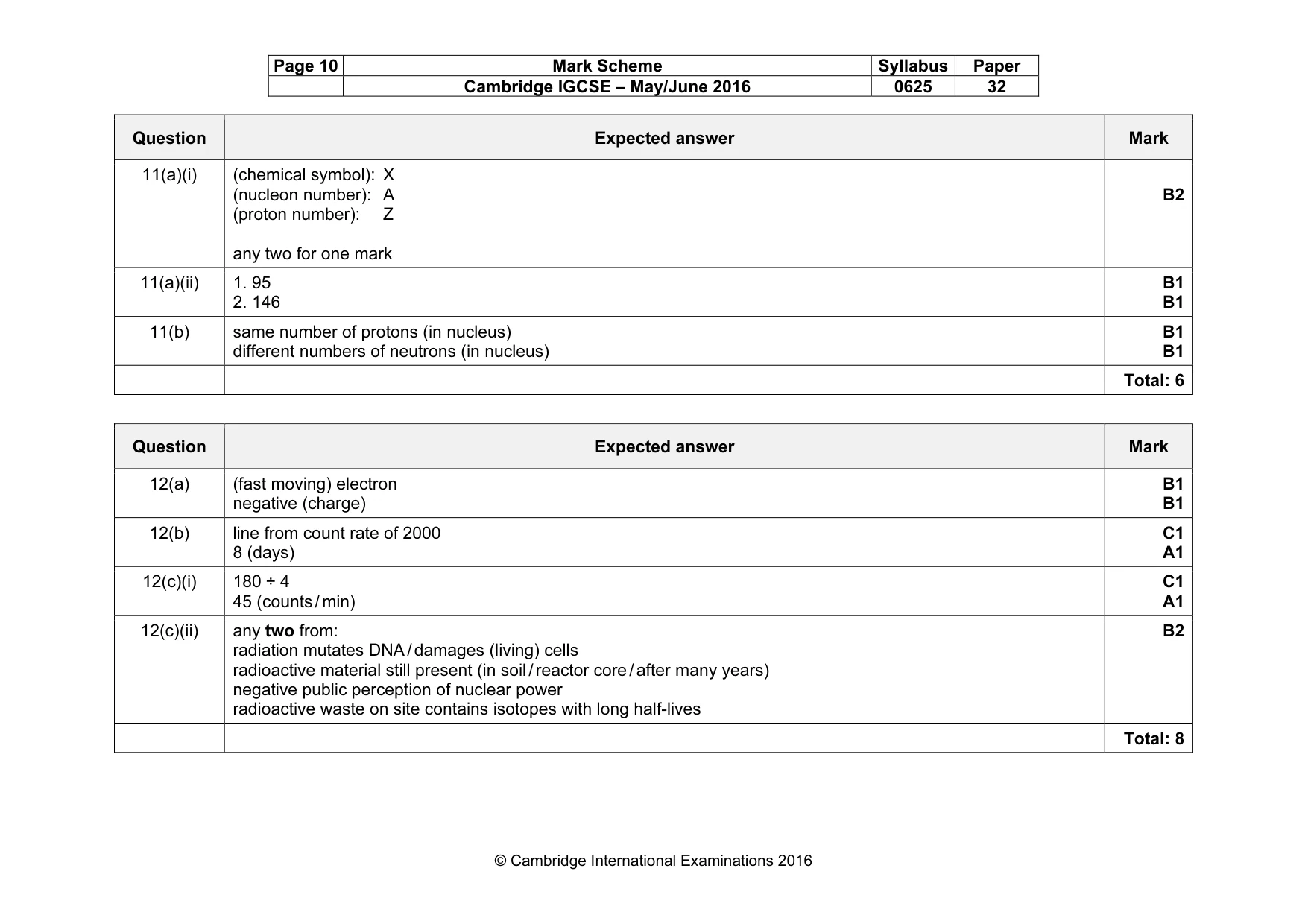
Mark scheme: 11(a)(i) (chemical symbol): X (nucleon number): A (proton number): Z any two for one mark B2 11(a)(ii) 1. 95 2. 146 B1 B1 11(b) same number of protons (in nucleus) different numbers of neutrons (in nucleus) B1 B1 Total: 6
Q12 · A radioactive nucleus decays by the emission of a β-particle
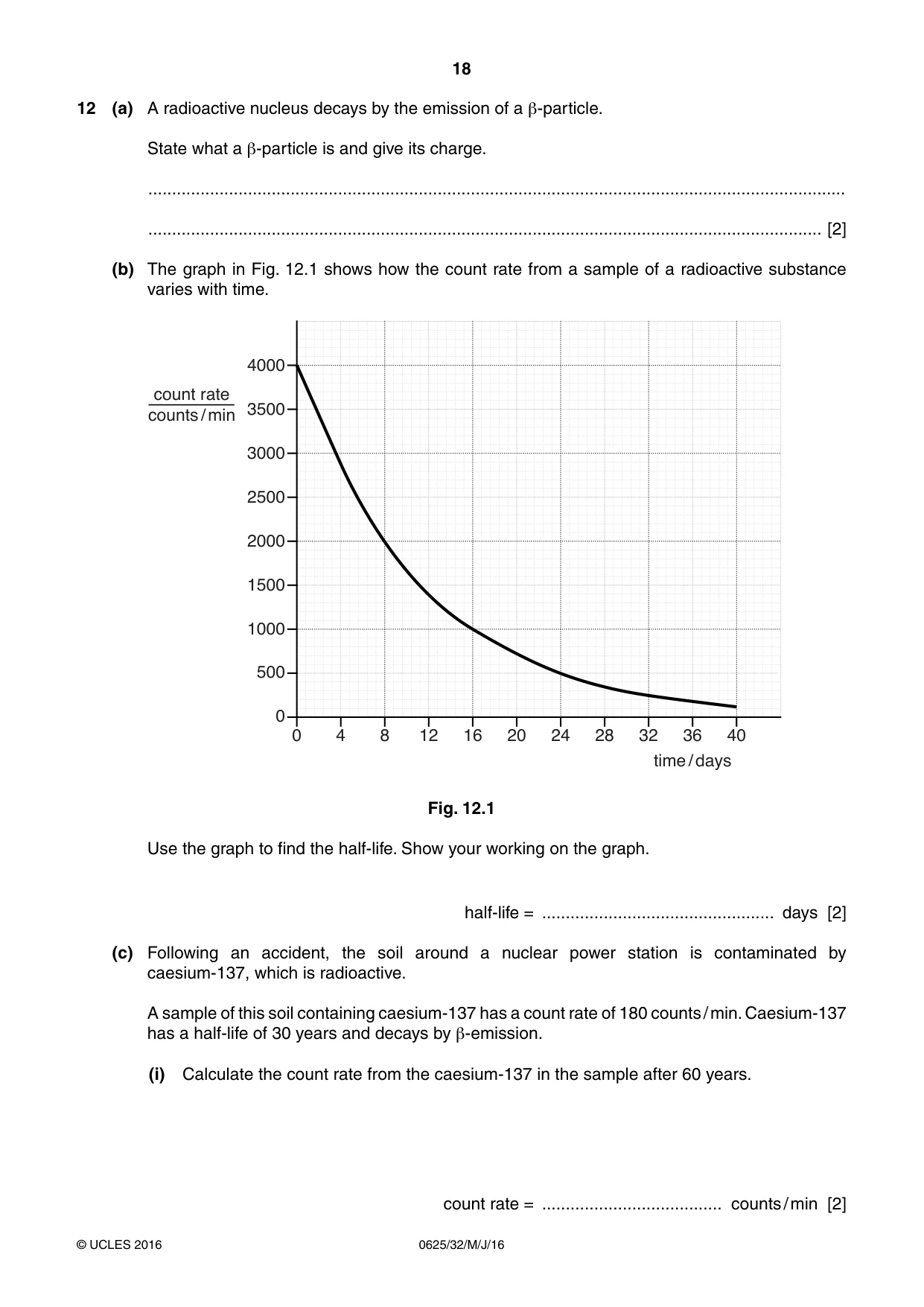
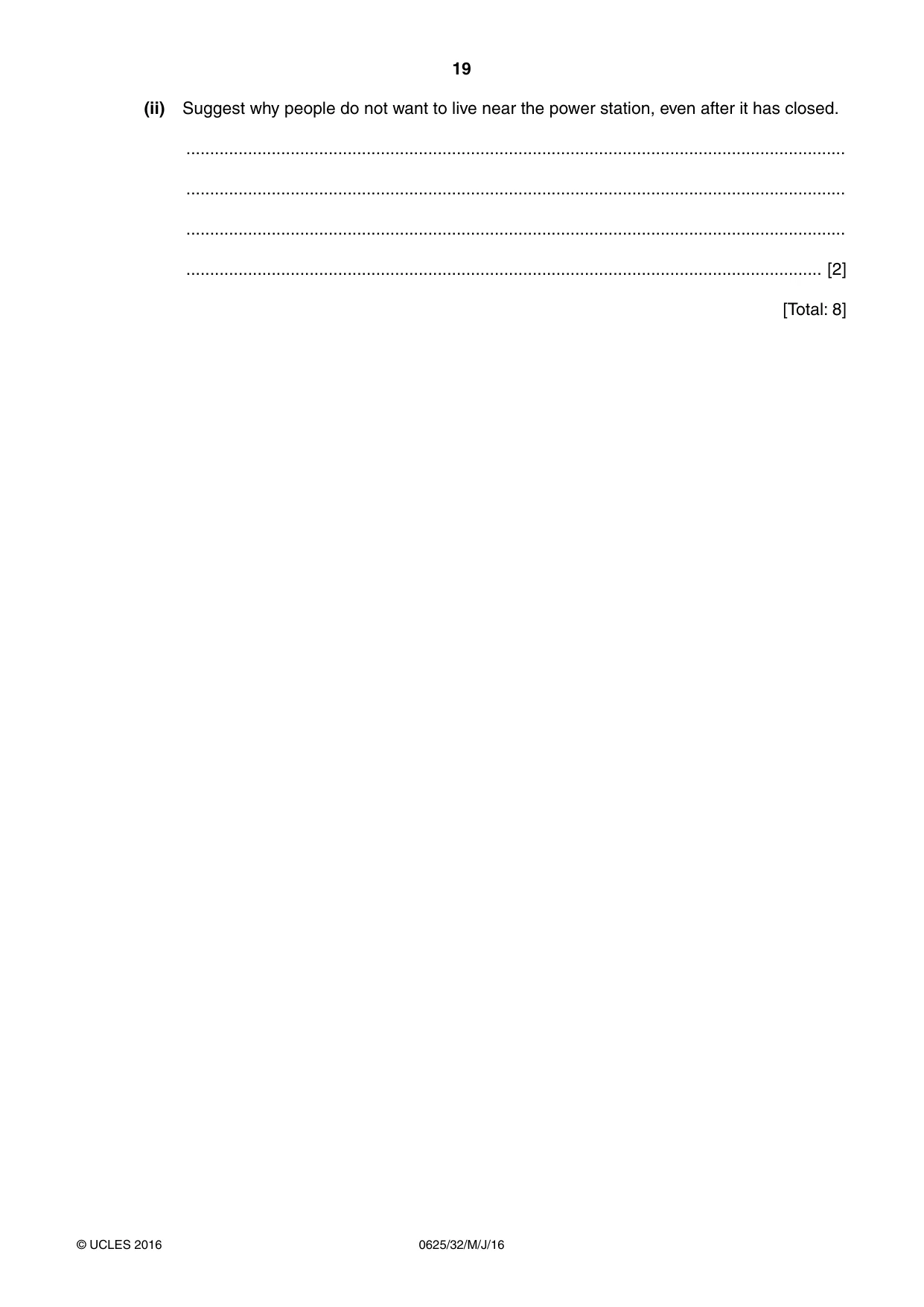
12 (a) A radioactive nucleus decays by the emission of a β-particle. State what a β-particle is and give its charge. ................................................................................................................................................... .............................................................................................................................................. [2] (b) The graph in Fig. 12.1 shows how the count rate from a sample of a radioactive substance varies with time. 4000 count rate 3500 counts / min 3000 2500 2000 1500 1000 500 0 0 4 8 12 16 20 24 28 32 36 40 time / days Fig. 12.1 Use the graph to find the half-life. Show your working on the graph. half-life = ................................................. days [2] (c) Following an accident, the soil around a nuclear power station is contaminated by caesium-137, which is radioactive. A sample of this soil containing caesium-137 has a count rate of 180 counts / min. Caesium-137 has a half-life of 30 years and decays by β-emission. (i) Calculate the count rate from the caesium-137 in the sample after 60 years. count rate = ...................................... counts / min [2] (ii) Suggest why people do not want to live near the power station, even after it has closed. ........................................................................................................................................... ........................................................................................................................................... ........................................................................................................................................... ...................................................................................................................................... [2] [Total: 8]
Mark scheme: 12(a) (fast moving) electron negative (charge) B1 B1 12(b) line from count rate of 2000 8 (days) C1 A1 12(c)(i) 180 ÷ 4 45 (counts / min) C1 A1 12(c)(ii) any two from: radiation mutates DNA / damages (living) cells radioactive material still present (in soil / reactor core / after many years) negative public perception of nuclear power radioactive waste on site contains isotopes with long half-lives B2 Total: 8
What was in this paper
The subtopics covered by these 12 questions, and how many questions each got. Open one in a new tab to see every Cambridge question on it.
What you needed in this session
Cambridge’s own grade thresholds for 2016 May/June, Paper 3 · Variant 2. A higher threshold means an easier paper — the bar moves with how the cohort did.