Cambridge IGCSE Physics 0625 — 2019 Feb/March Paper 3 · Variant 2
0625/32/F/M/19 · 12 questions · 80 marks · ≈90 min
The question paper and its mark scheme, free to read here and free to download. This is Cambridge’s own paper, exactly as it was sat.
Question paper17 pages
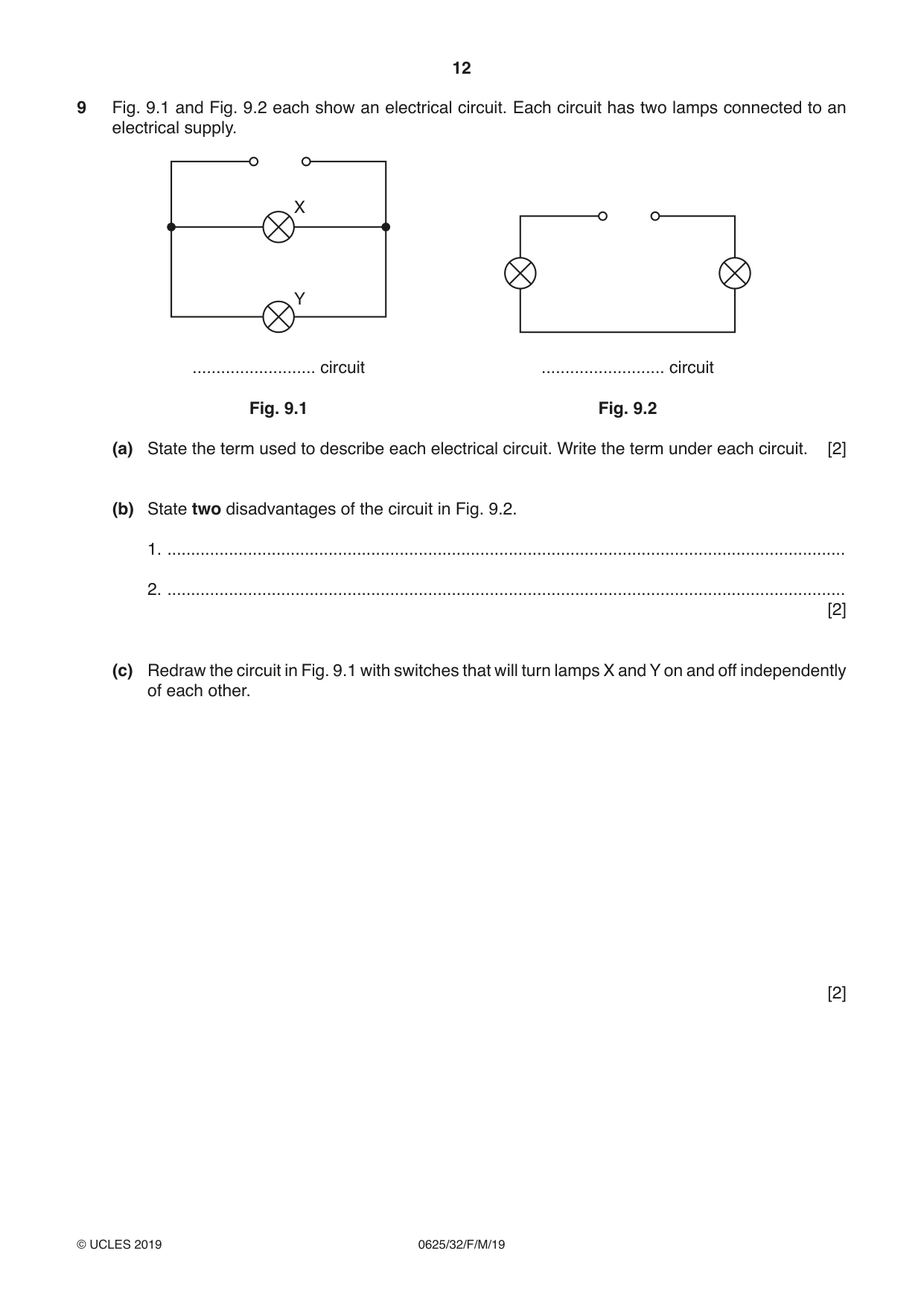
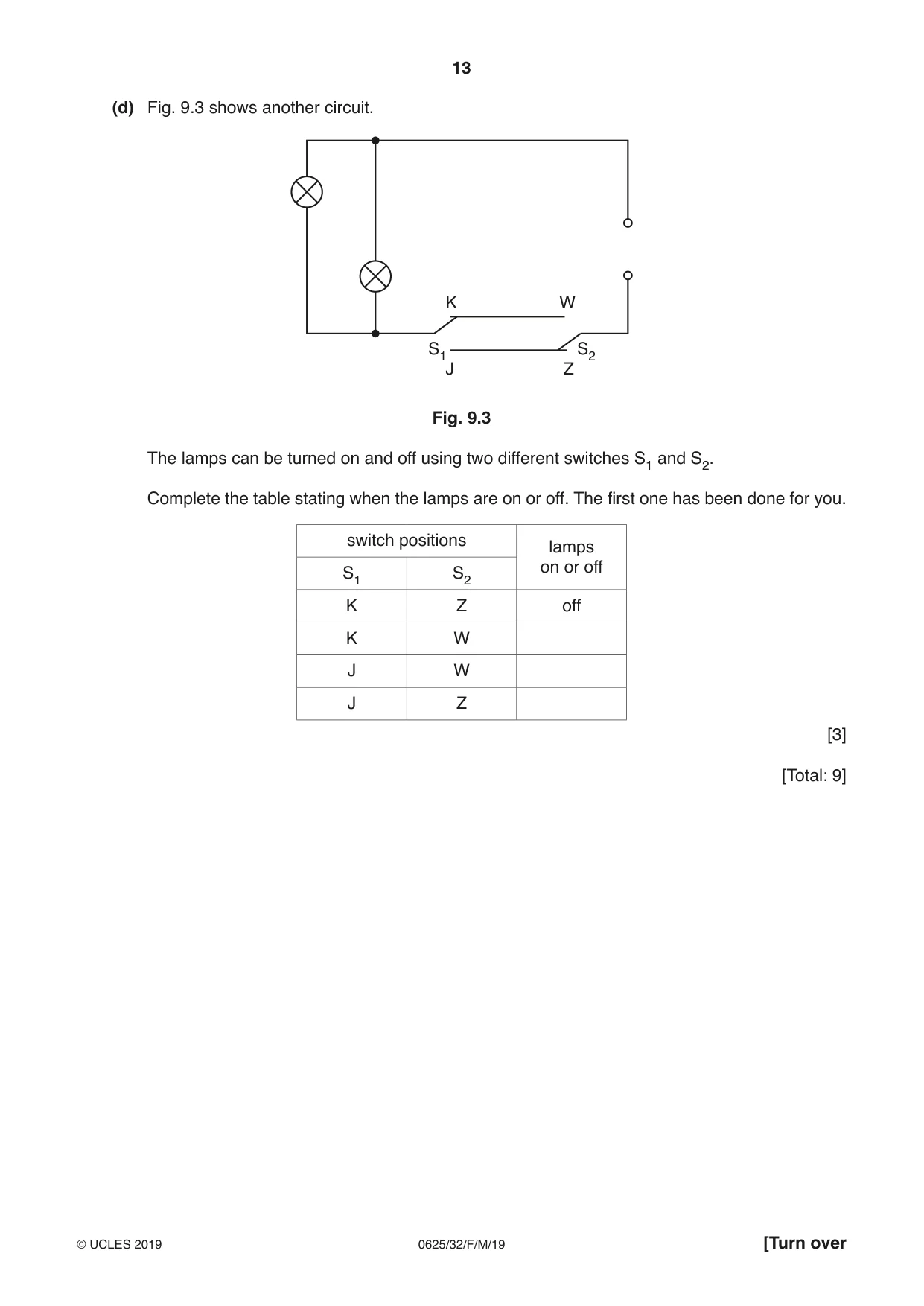
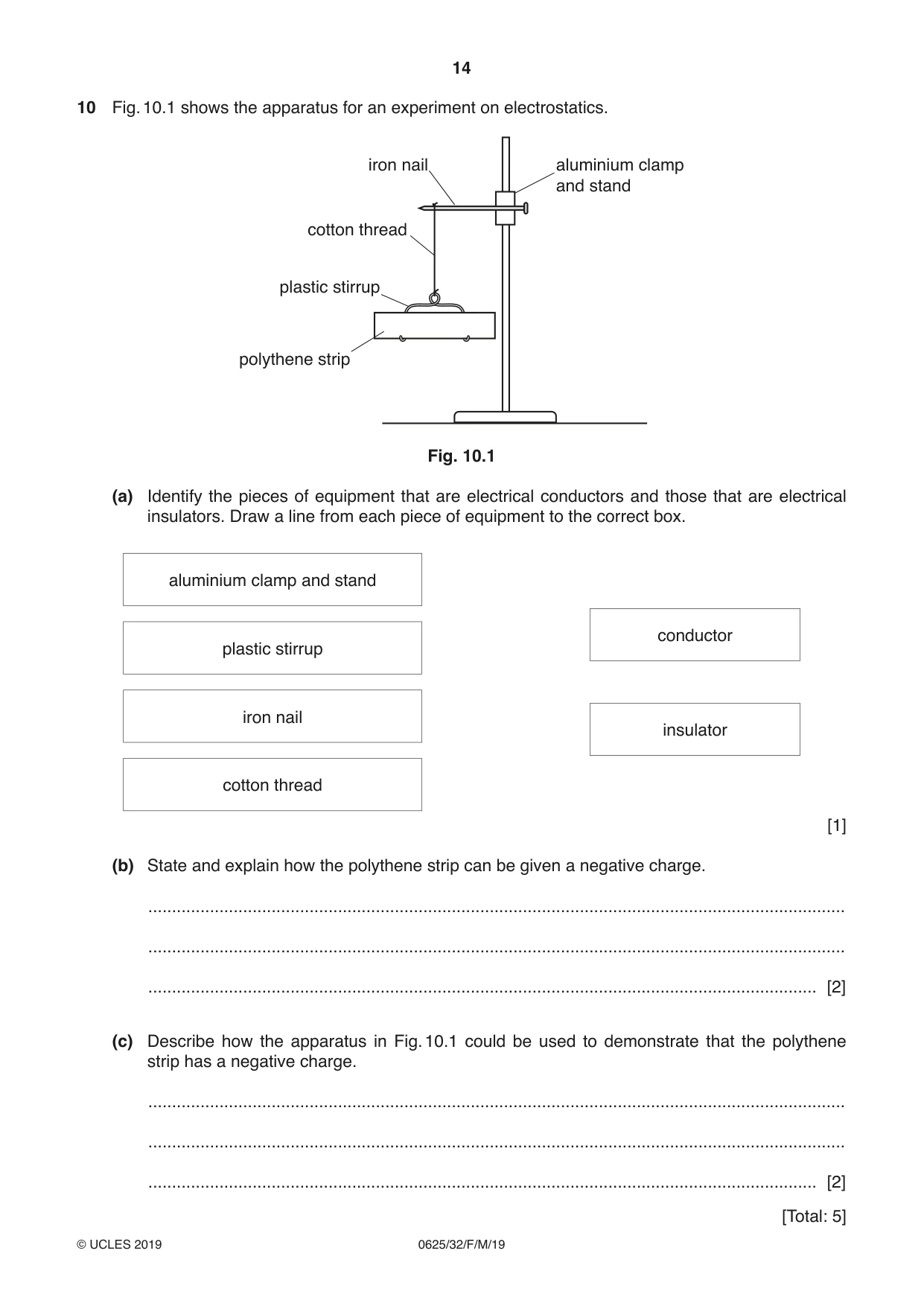
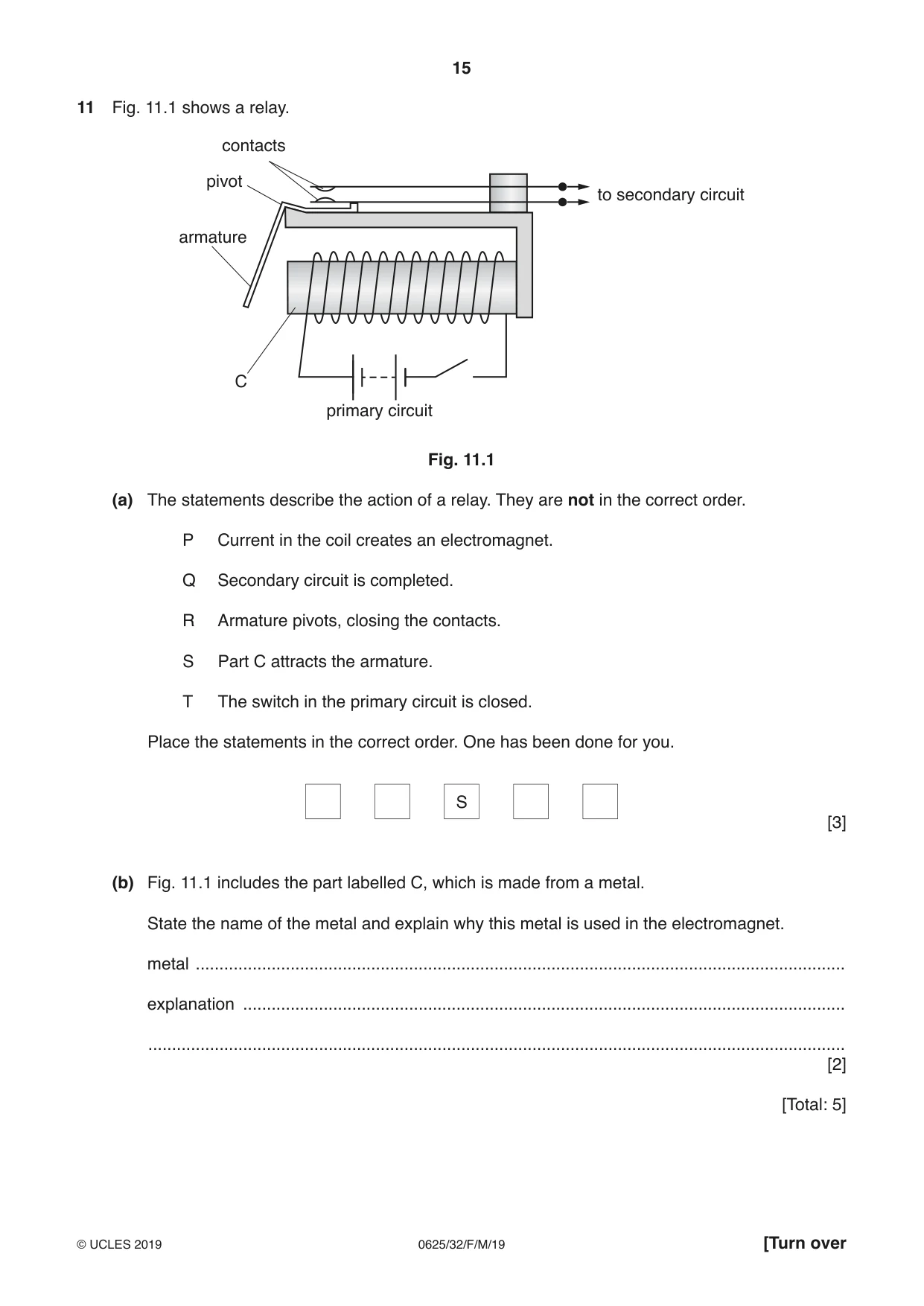
Mark scheme9 pages
Answers below. Sit the paper first if you are practising.
Questions as text
Q1 · A set of masses made from the same material
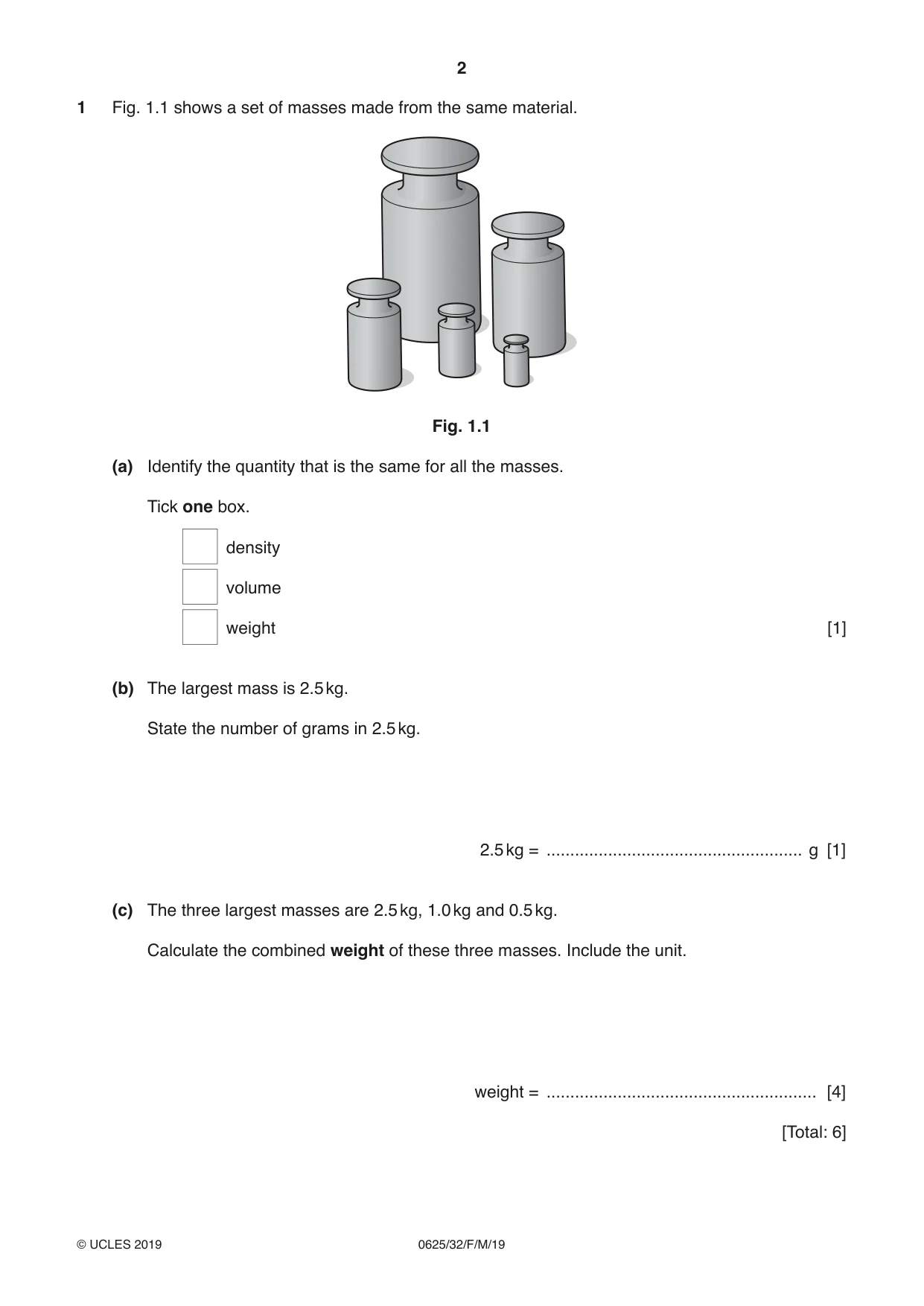
1 Fig. 1.1 shows a set of masses made from the same material. Fig. 1.1 (a) Identify the quantity that is the same for all the masses. Tick one box. density volume weight [1] (b) The largest mass is 2.5 kg. State the number of grams in 2.5 kg. 2.5 kg = ...................................................... g [1] (c) The three largest masses are 2.5 kg, 1.0 kg and 0.5 kg. Calculate the combined weight of these three masses. Include the unit. weight = ......................................................... [4] [Total: 6]
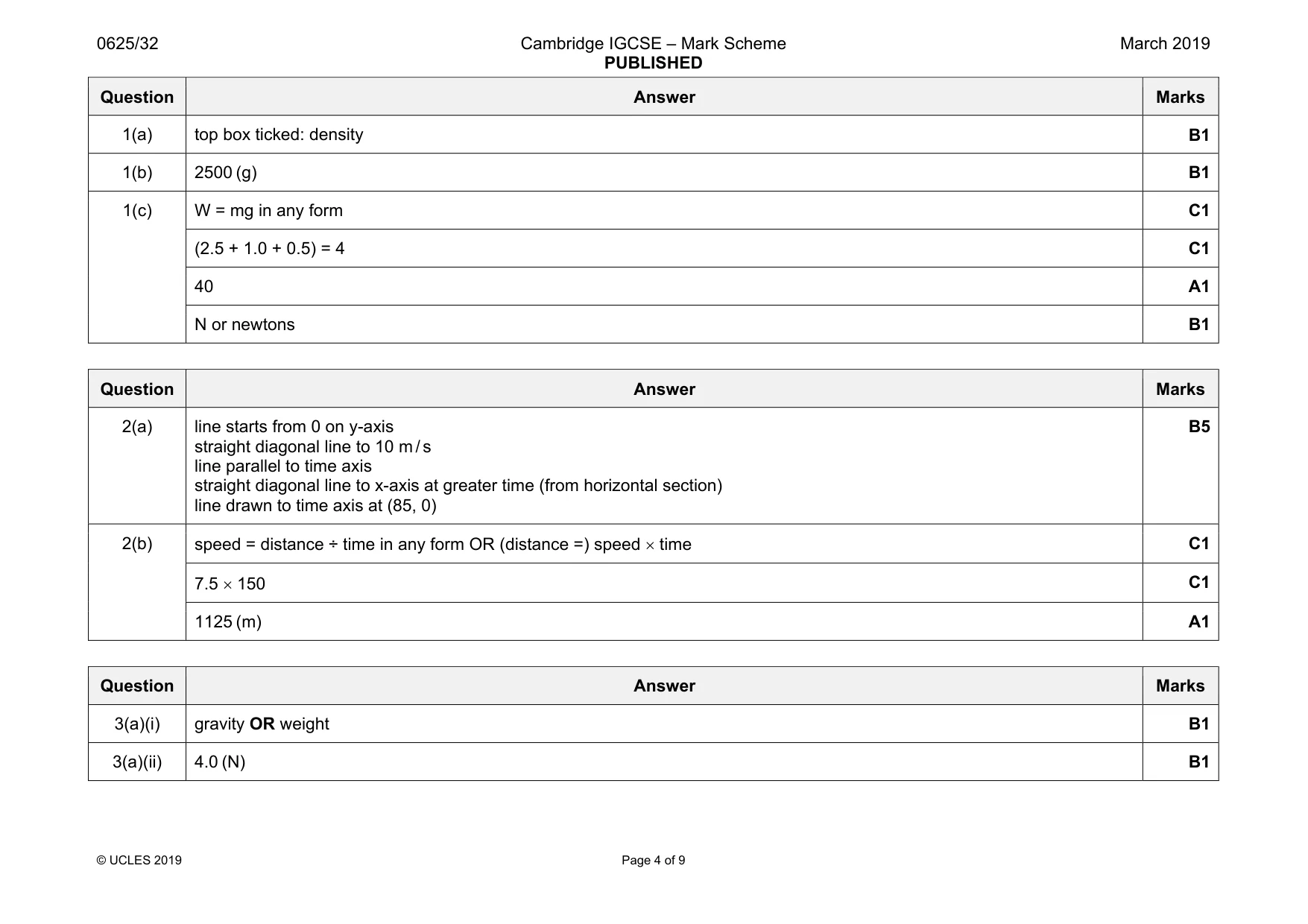
Mark scheme: 1(a) top box ticked: density B1 1(b) 2500 (g) B1 1(c) W = mg in any form C1 (2.5 + 1.0 + 0.5) = 4 C1 40 A1 N or newtons B1
Q2 · Students getting onto a school bus
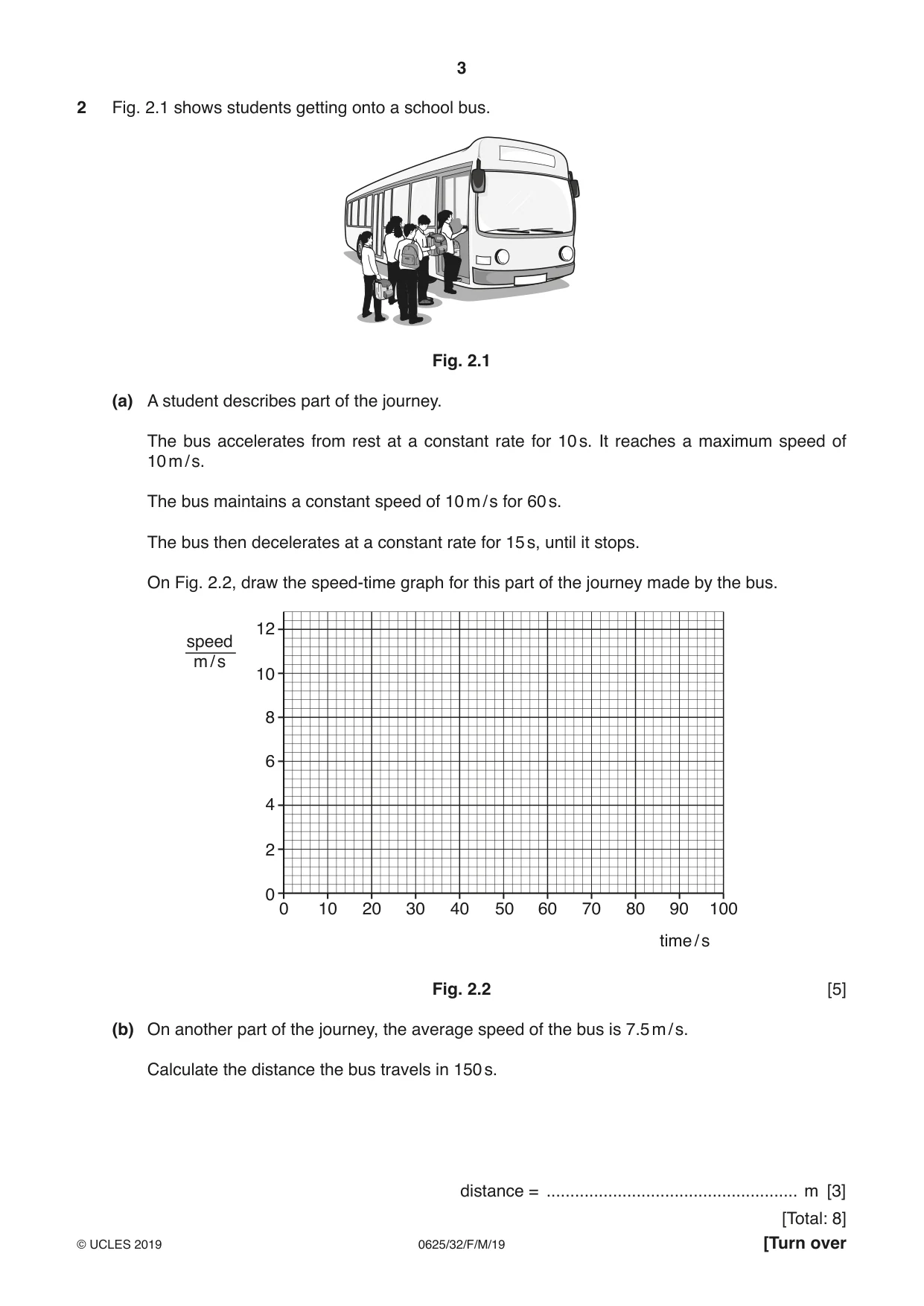
2 Fig. 2.1 shows students getting onto a school bus. Fig. 2.1 (a) A student describes part of the journey. The bus accelerates from rest at a constant rate for 10 s. It reaches a maximum speed of 10 m / s. The bus maintains a constant speed of 10 m / s for 60 s. The bus then decelerates at a constant rate for 15 s, until it stops. On Fig. 2.2, draw the speed-time graph for this part of the journey made by the bus. 12 speed m / s 10 8 6 4 2 0 0 10 20 30 40 50 60 70 80 90 100 time / s Fig. 2.2 [5] (b) On another part of the journey, the average speed of the bus is 7.5 m / s. Calculate the distance the bus travels in 150 s. distance = ..................................................... m [3]
Mark scheme: 2(a) line starts from 0 on y-axis straight diagonal line to 10 m / s line parallel to time axis straight diagonal line to x-axis at greater time (from horizontal section) line drawn to time axis at (85, 0) B5 2(b) speed = distance ÷ time in any form OR (distance =) speed × time C1 7.5 × 150 C1 1125 (m) A1
Q3 · A load is attached to a spring, as shown in Fig
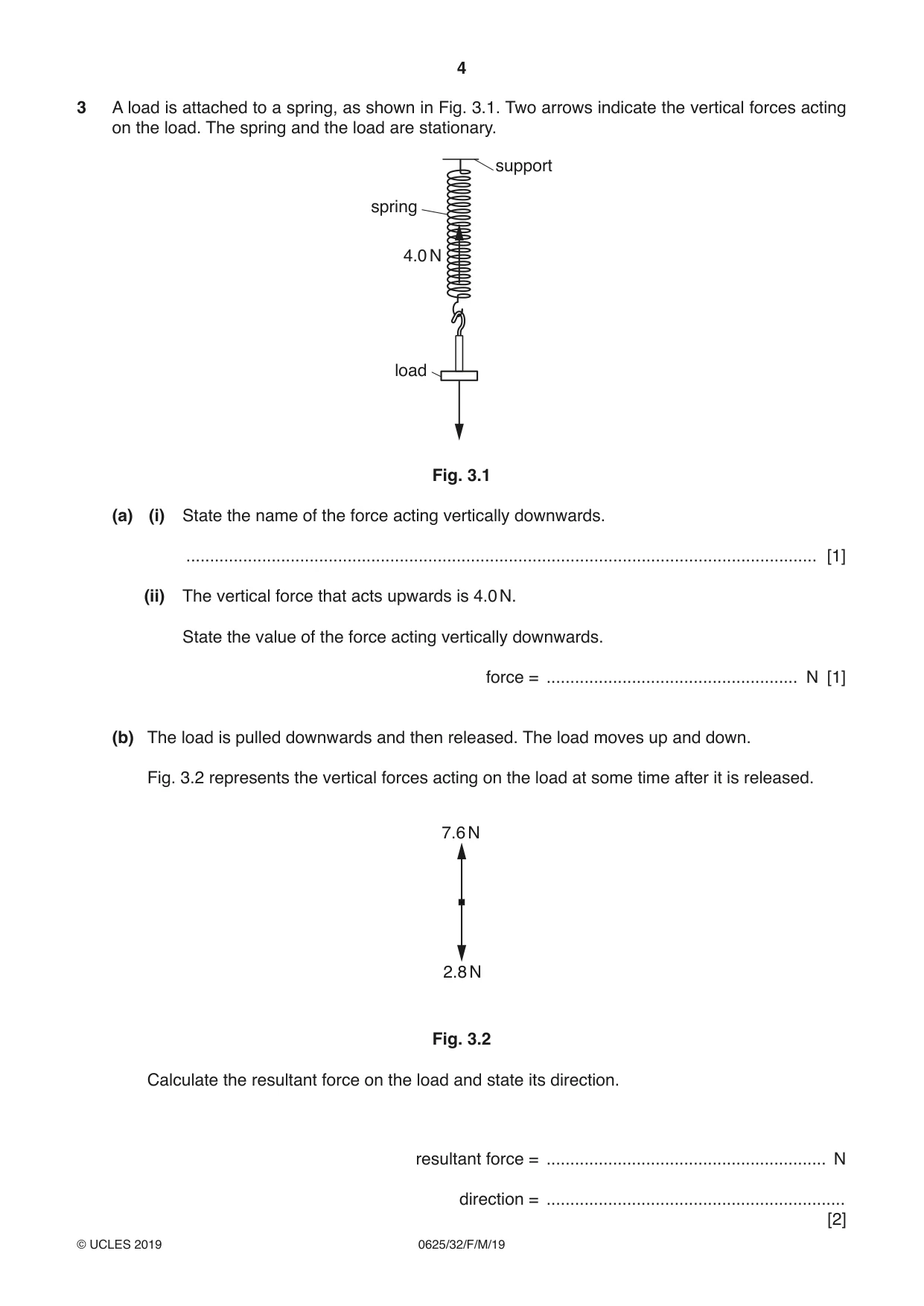
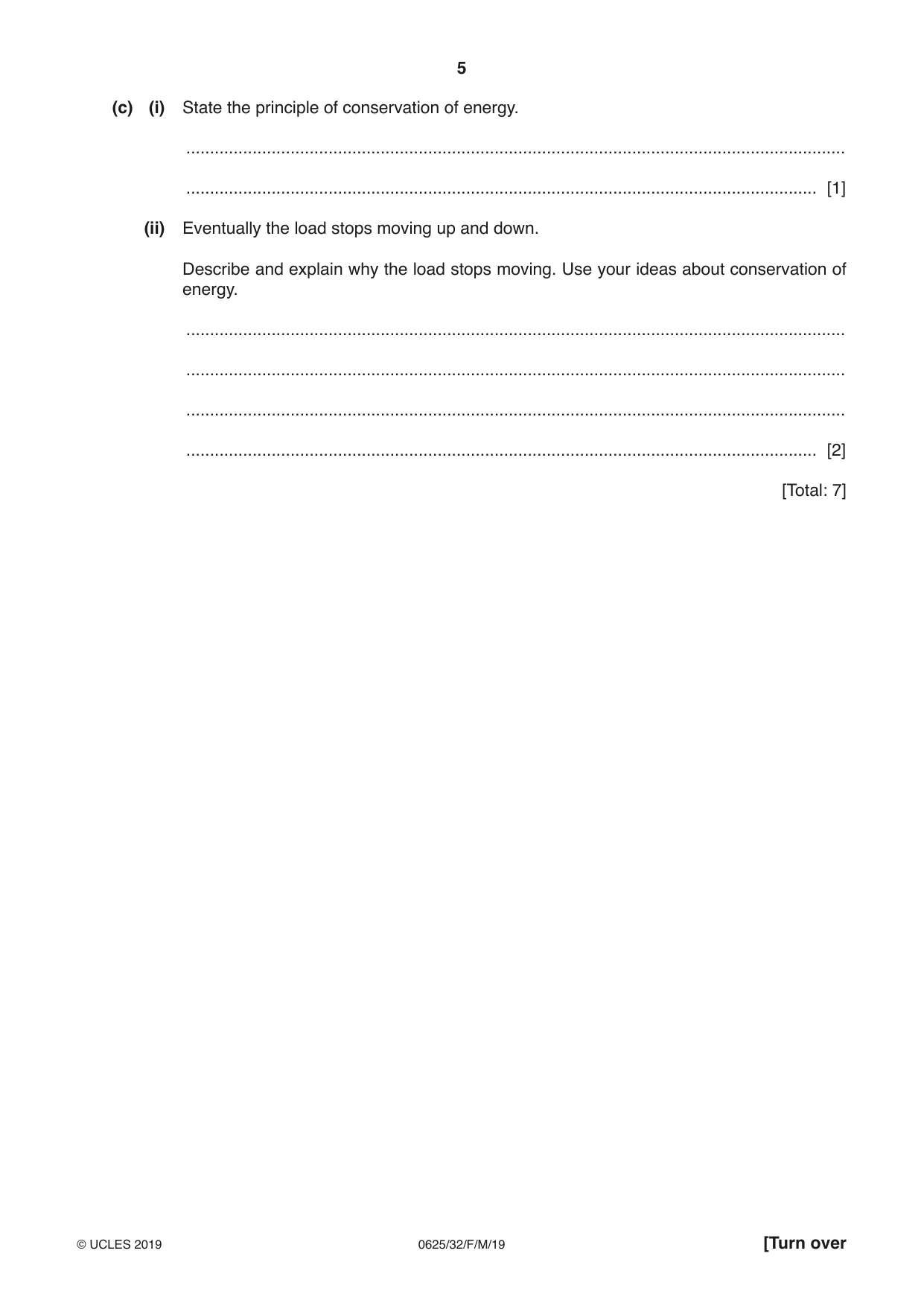
3 A load is attached to a spring, as shown in Fig. 3.1. Two arrows indicate the vertical forces acting on the load. The spring and the load are stationary. support spring 4.0 N load Fig. 3.1 (a) (i) State the name of the force acting vertically downwards. ..................................................................................................................................... [1] (ii) The vertical force that acts upwards is 4.0 N. State the value of the force acting vertically downwards. force = ..................................................... N [1] (b) The load is pulled downwards and then released. The load moves up and down. Fig. 3.2 represents the vertical forces acting on the load at some time after it is released. 7.6 N 2.8 N Fig. 3.2 Calculate the resultant force on the load and state its direction. resultant force = ........................................................... N direction = ............................................................... [2] (c) (i) State the principle of conservation of energy. ........................................................................................................................................... ..................................................................................................................................... [1] (ii) Eventually the load stops moving up and down. Describe and explain why the load stops moving. Use your ideas about conservation of energy. ........................................................................................................................................... ........................................................................................................................................... ........................................................................................................................................... ..................................................................................................................................... [2] [Total: 7]
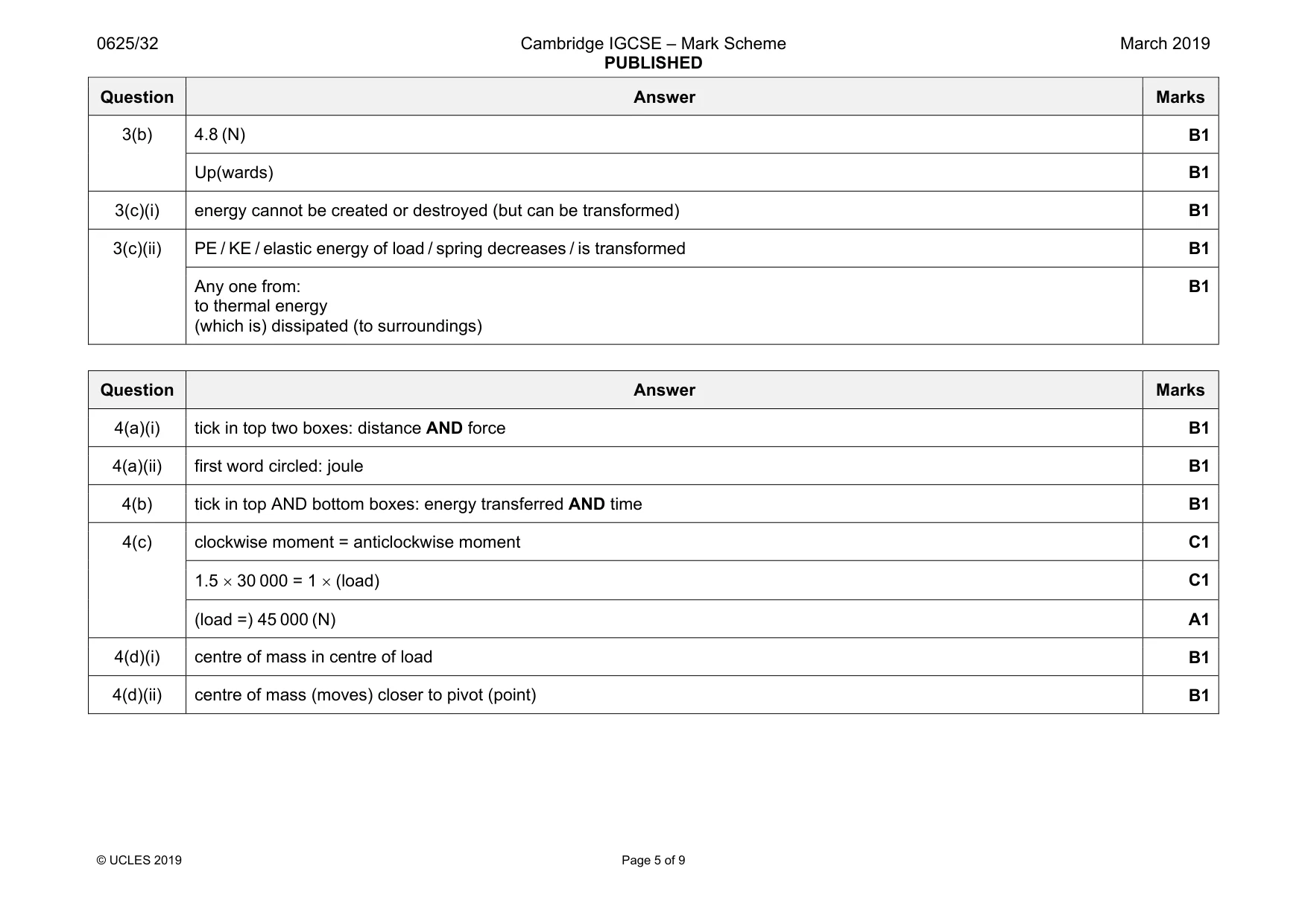
Mark scheme: 3(a)(i) gravity OR weight B1 3(a)(ii) 4.0 (N) B1 Question Answer Marks 3(b) 4.8 (N) B1 Up(wards) B1 3(c)(i) energy cannot be created or destroyed (but can be transformed) B1 3(c)(ii) PE / KE / elastic energy of load / spring decreases / is transformed B1 Any one from: to thermal energy (which is) dissipated (to surroundings) B1
Q4 · A truck lifting a heavy load
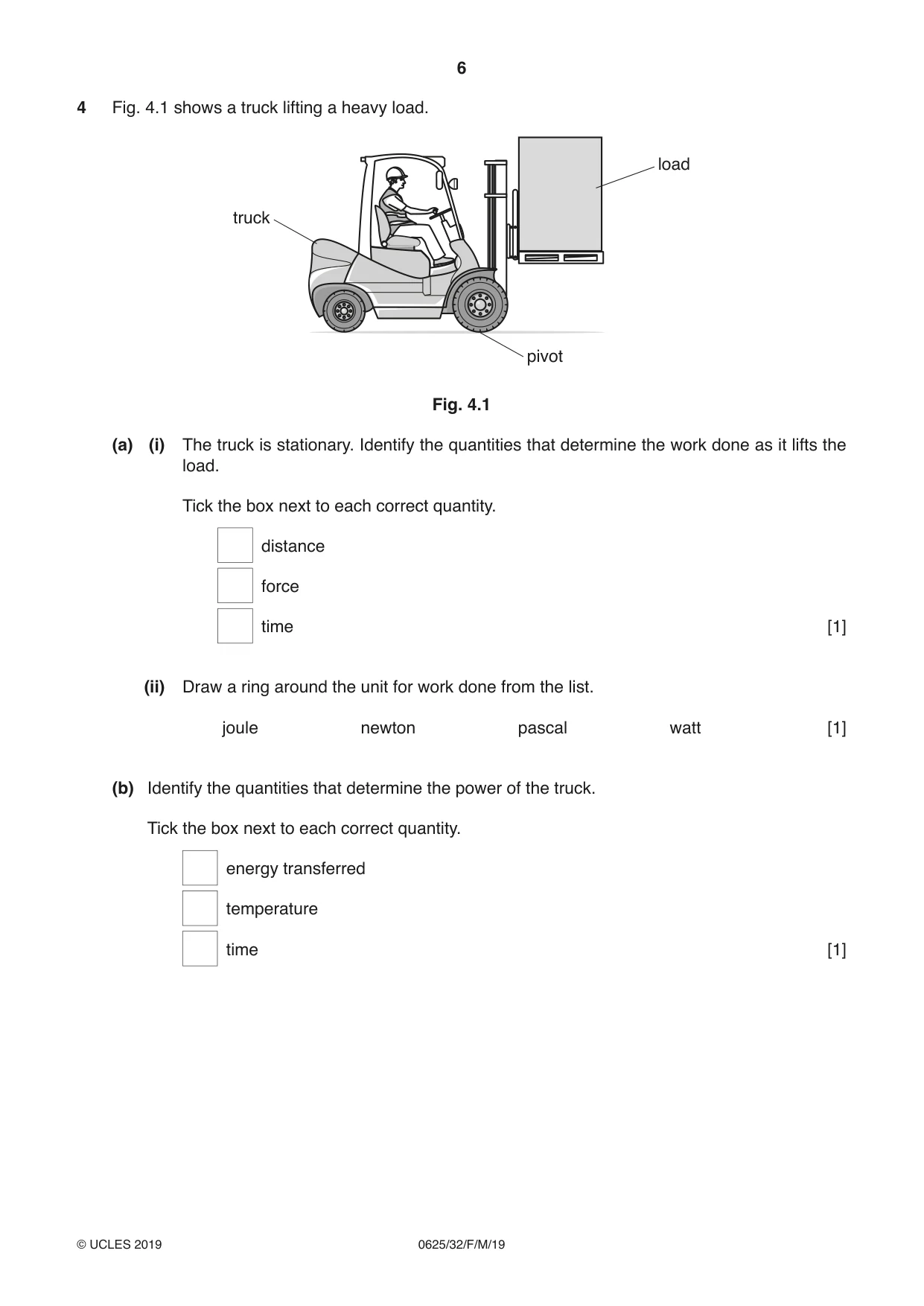
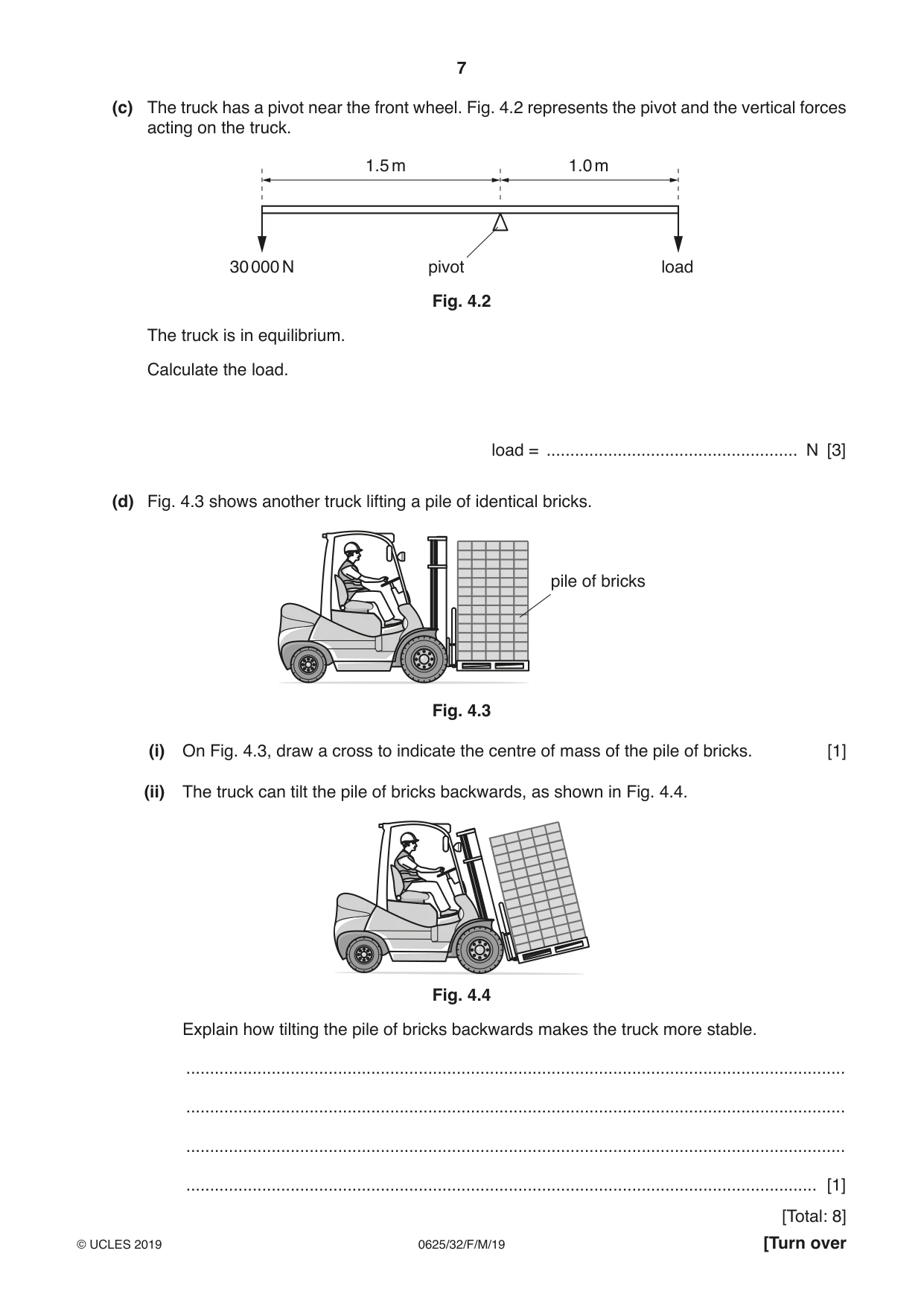
4 Fig. 4.1 shows a truck lifting a heavy load. load truck pivot Fig. 4.1 (a) (i) The truck is stationary. Identify the quantities that determine the work done as it lifts the load. Tick the box next to each correct quantity. distance force time [1] (ii) Draw a ring around the unit for work done from the list. joule newton pascal watt [1] (b) Identify the quantities that determine the power of the truck. Tick the box next to each correct quantity. energy transferred temperature time [1] (c) The truck has a pivot near the front wheel. Fig. 4.2 represents the pivot and the vertical forces acting on the truck. 1.5 m 1.0 m 30 000 N pivot load Fig. 4.2 The truck is in equilibrium. Calculate the load. load = ..................................................... N [3] (d) Fig. 4.3 shows another truck lifting a pile of identical bricks. pile of bricks Fig. 4.3 (i) On Fig. 4.3, draw a cross to indicate the centre of mass of the pile of bricks. [1] (ii) The truck can tilt the pile of bricks backwards, as shown in Fig. 4.4. Fig. 4.4 Explain how tilting the pile of bricks backwards makes the truck more stable. ........................................................................................................................................... ........................................................................................................................................... ........................................................................................................................................... ..................................................................................................................................... [1] [Total: 8]
Mark scheme: 4(a)(i) tick in top two boxes: distance AND force B1 4(a)(ii) first word circled: joule B1 4(b) tick in top AND bottom boxes: energy transferred AND time B1 4(c) clockwise moment = anticlockwise moment C1 1.5 × 30 000 = 1 × (load) C1 (load =) 45 000 (N) A1 4(d)(i) centre of mass in centre of load B1 4(d)(ii) centre of mass (moves) closer to pivot (point) B1
Q5 · Part of a solar farm
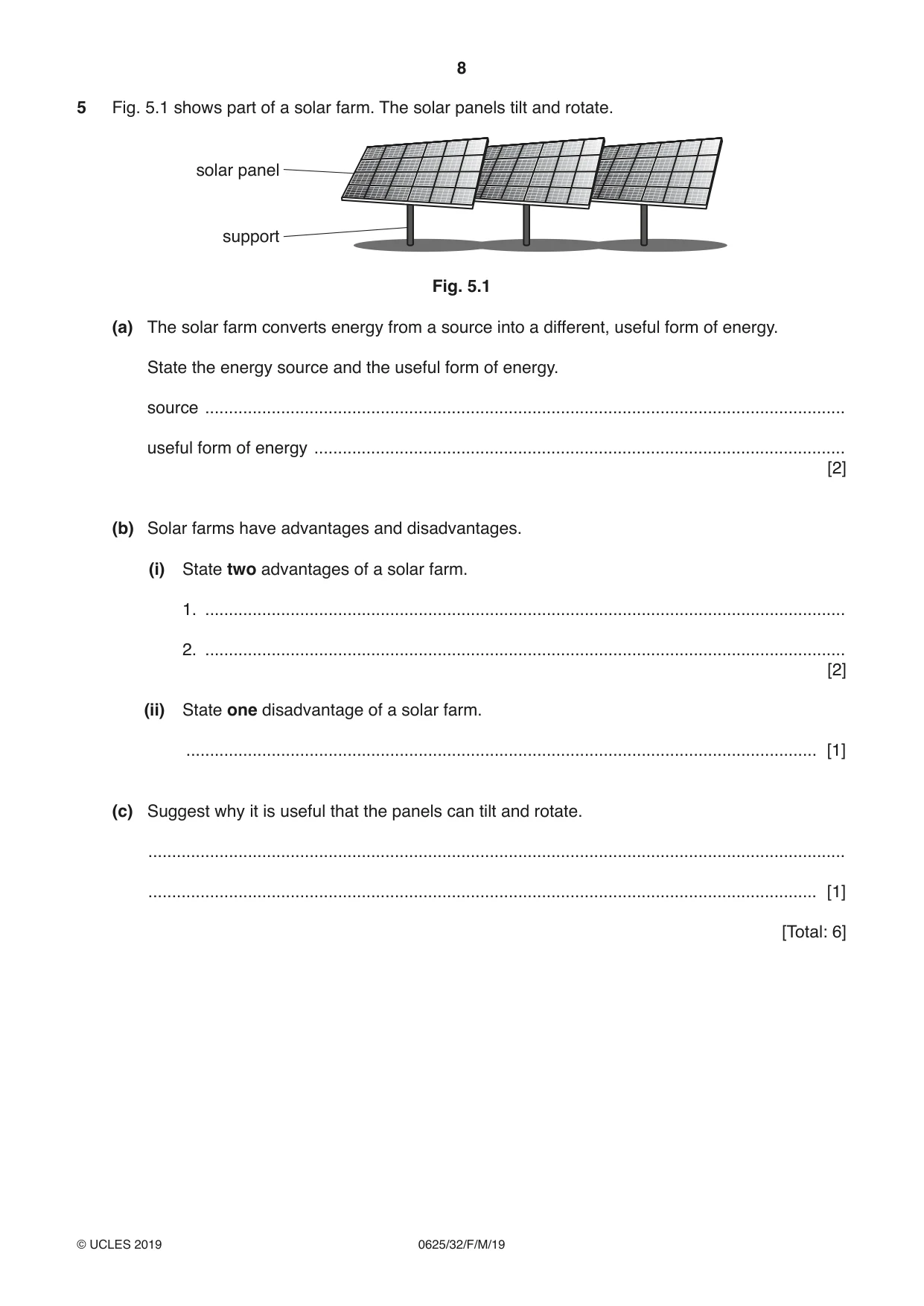
5 Fig. 5.1 shows part of a solar farm. The solar panels tilt and rotate. solar panel support Fig. 5.1 (a) The solar farm converts energy from a source into a different, useful form of energy. State the energy source and the useful form of energy. source ....................................................................................................................................... useful form of energy ................................................................................................................ [2] (b) Solar farms have advantages and disadvantages. (i) State two advantages of a solar farm. 1. ....................................................................................................................................... 2. ....................................................................................................................................... [2] (ii) State one disadvantage of a solar farm. ..................................................................................................................................... [1] (c) Suggest why it is useful that the panels can tilt and rotate. ................................................................................................................................................... ............................................................................................................................................. [1] [Total: 6]
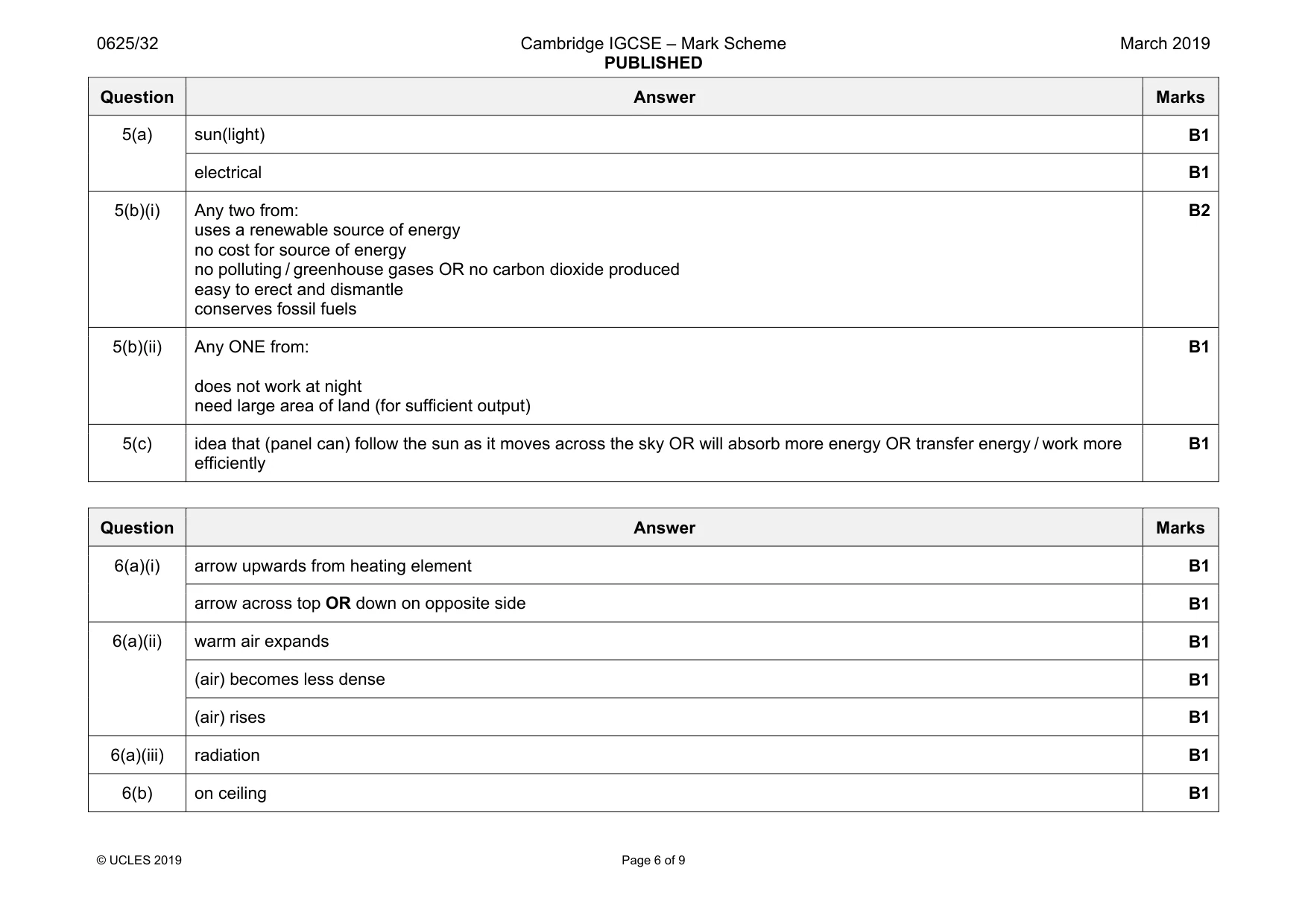
Mark scheme: 5(a) sun(light) B1 electrical B1 5(b)(i) Any two from: uses a renewable source of energy no cost for source of energy no polluting / greenhouse gases OR no carbon dioxide produced easy to erect and dismantle conserves fossil fuels B2 5(b)(ii) Any ONE from: does not work at night need large area of land (for sufficient output) B1 5(c) idea that (panel can) follow the sun as it moves across the sky OR will absorb more energy OR transfer energy / work more efficiently B1
Q6 · A cross-section of the inside of an electric oven
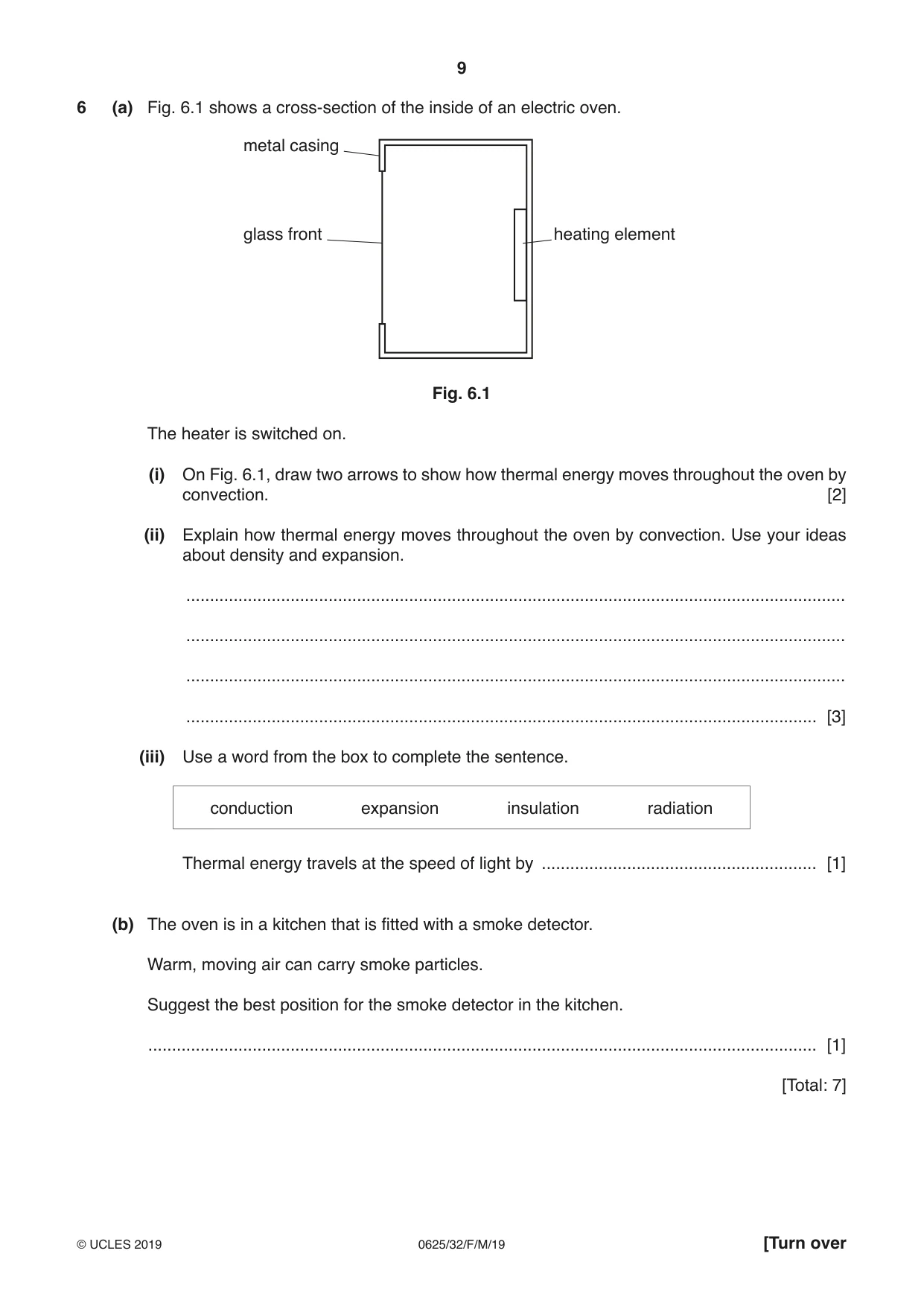
6 (a) Fig. 6.1 shows a cross-section of the inside of an electric oven. metal casing glass front heating element Fig. 6.1 The heater is switched on. (i) On Fig. 6.1, draw two arrows to show how thermal energy moves throughout the oven by convection. [2] (ii) Explain how thermal energy moves throughout the oven by convection. Use your ideas about density and expansion. ........................................................................................................................................... ........................................................................................................................................... ........................................................................................................................................... ..................................................................................................................................... [3] (iii) Use a word from the box to complete the sentence. conduction expansion insulation radiation Thermal energy travels at the speed of light by .......................................................... [1] (b) The oven is in a kitchen that is fitted with a smoke detector. Warm, moving air can carry smoke particles. Suggest the best position for the smoke detector in the kitchen. ............................................................................................................................................. [1] [Total: 7]
Mark scheme: 6(a)(i) arrow upwards from heating element B1 arrow across top OR down on opposite side B1 6(a)(ii) warm air expands B1 (air) becomes less dense B1 (air) rises B1 6(a)(iii) radiation B1 6(b) on ceiling B1
Q7 · Light and sound both travel as waves
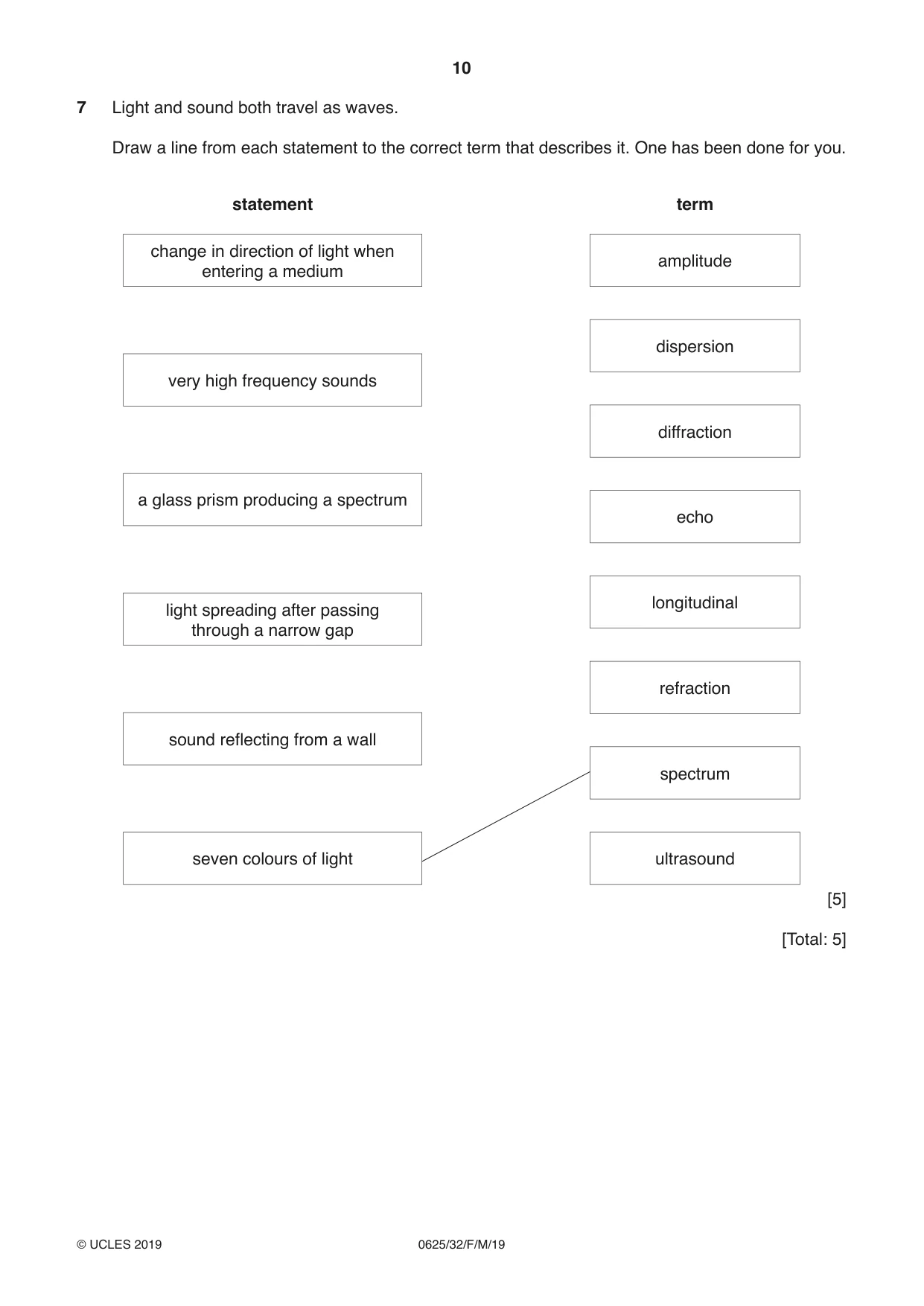
7 Light and sound both travel as waves. Draw a line from each statement to the correct term that describes it. One has been done for you. statement term change in direction of light when amplitude entering a medium dispersion very high frequency sounds diffraction a glass prism producing a spectrum echo longitudinal light spreading after passing through a narrow gap refraction sound reflecting from a wall spectrum seven colours of light ultrasound [5] [Total: 5]
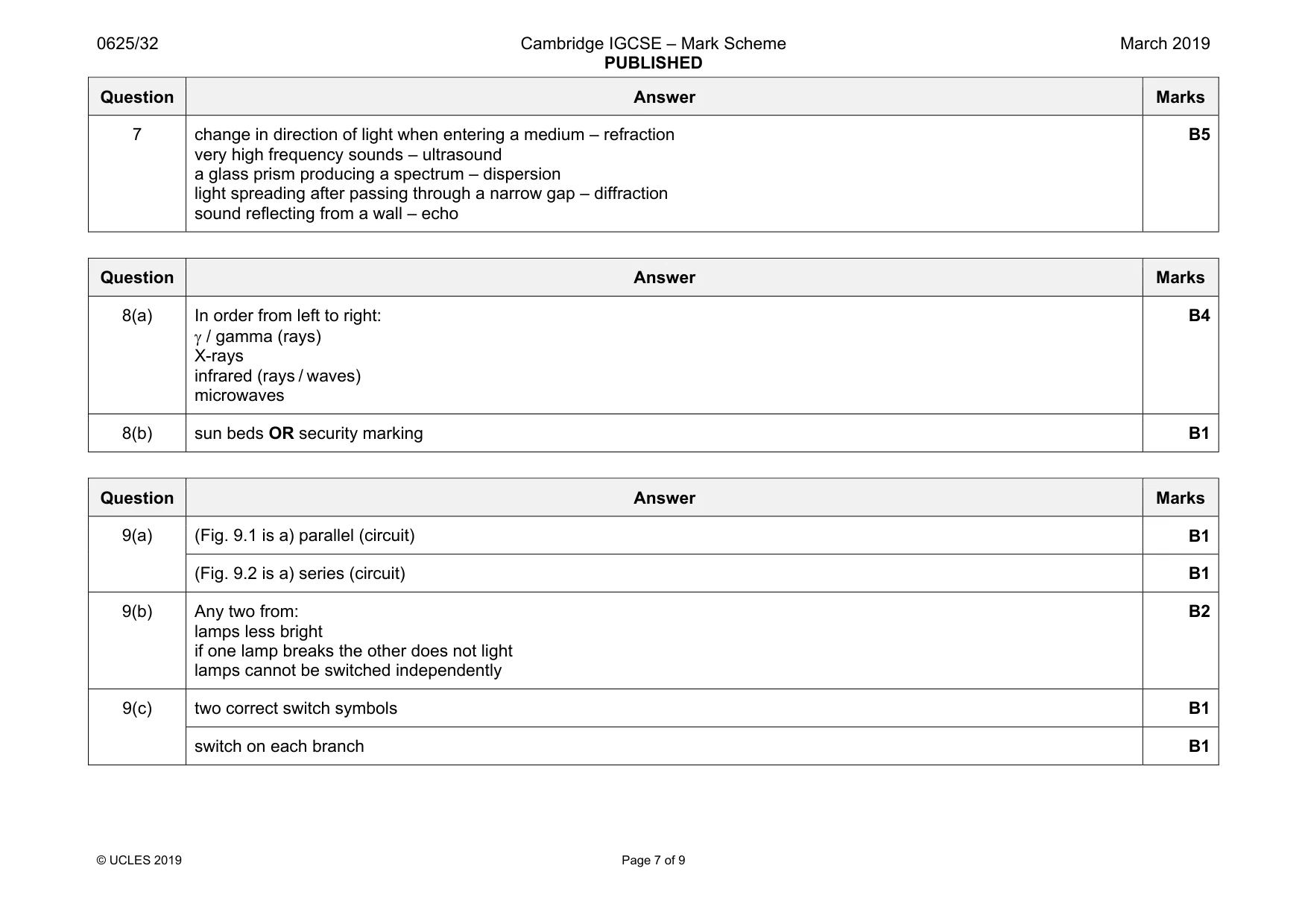
Mark scheme: 7 change in direction of light when entering a medium – refraction very high frequency sounds – ultrasound a glass prism producing a spectrum – dispersion light spreading after passing through a narrow gap – diffraction sound reflecting from a wall – echo B5
Q8 · An incomplete diagram of the electromagnetic spectrum
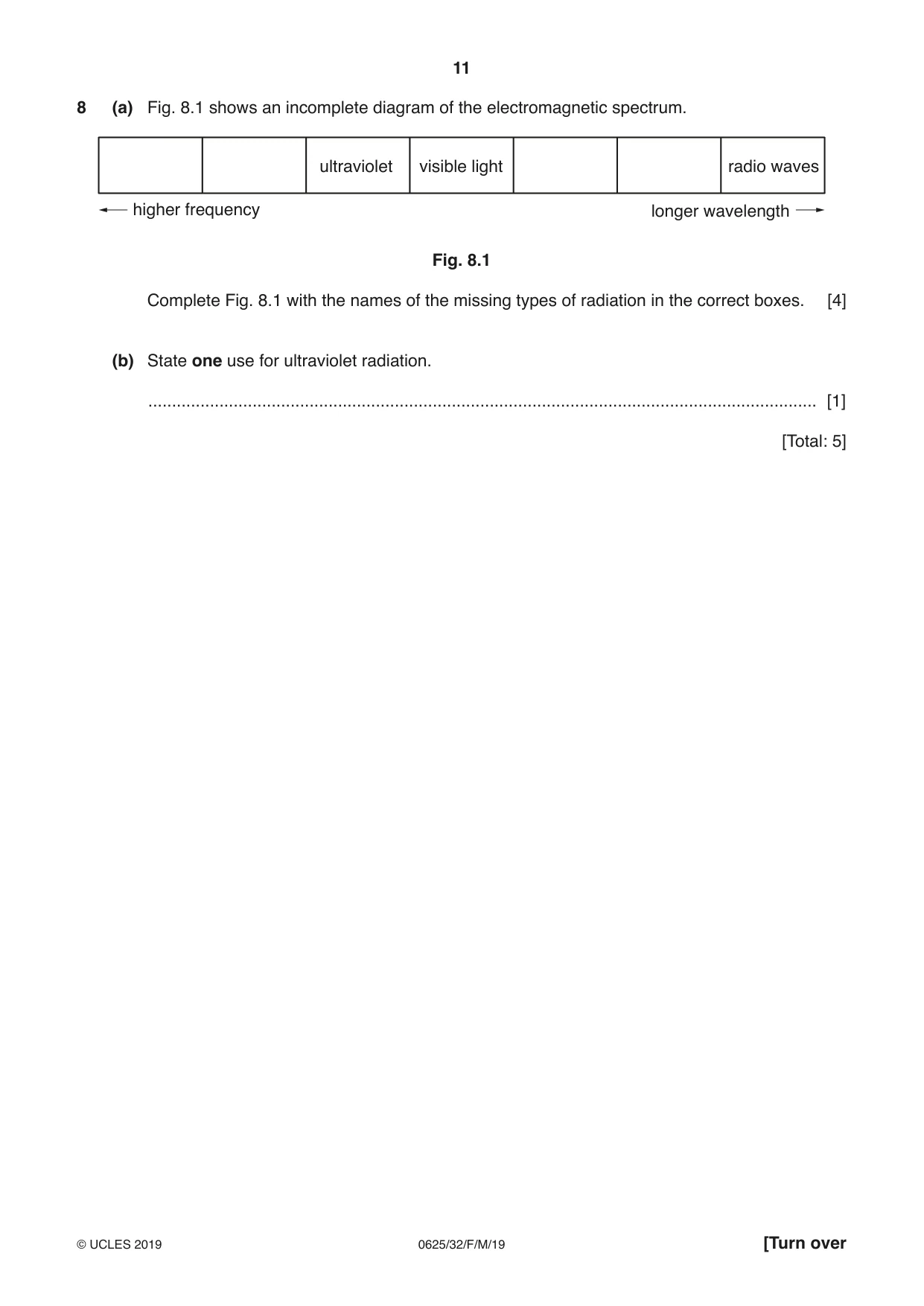
8 (a) Fig. 8.1 shows an incomplete diagram of the electromagnetic spectrum. ultraviolet visible light radio waves higher frequency longer wavelength Fig. 8.1 Complete Fig. 8.1 with the names of the missing types of radiation in the correct boxes. [4] (b) State one use for ultraviolet radiation. ............................................................................................................................................. [1] [Total: 5]
Mark scheme: 8(a) In order from left to right: γ / gamma (rays) X-rays infrared (rays / waves) microwaves B4 8(b) sun beds OR security marking B1
Question 9
9 Fig. 9.1 and Fig. 9.2 each show an electrical circuit. Each circuit has two lamps connected to an electrical supply. X Y .......................... circuit .......................... circuit Fig. 9.1 Fig. 9.2 (a) State the term used to describe each electrical circuit. Write the term under each circuit. [2] (b) State two disadvantages of the circuit in Fig. 9.2. 1. ............................................................................................................................................... 2. ............................................................................................................................................... [2] (c) Redraw the circuit in Fig. 9.1 with switches that will turn lamps X and Y on and off independently of each other. [2] (d) Fig. 9.3 shows another circuit. K W S1 S2 J Z Fig. 9.3 The lamps can be turned on and off using two different switches S1 and S2. Complete the table stating when the lamps are on or off. The first one has been done for you. switch positions lamps on or off S1 S2 K Z off K W J W J Z [3] [Total: 9]
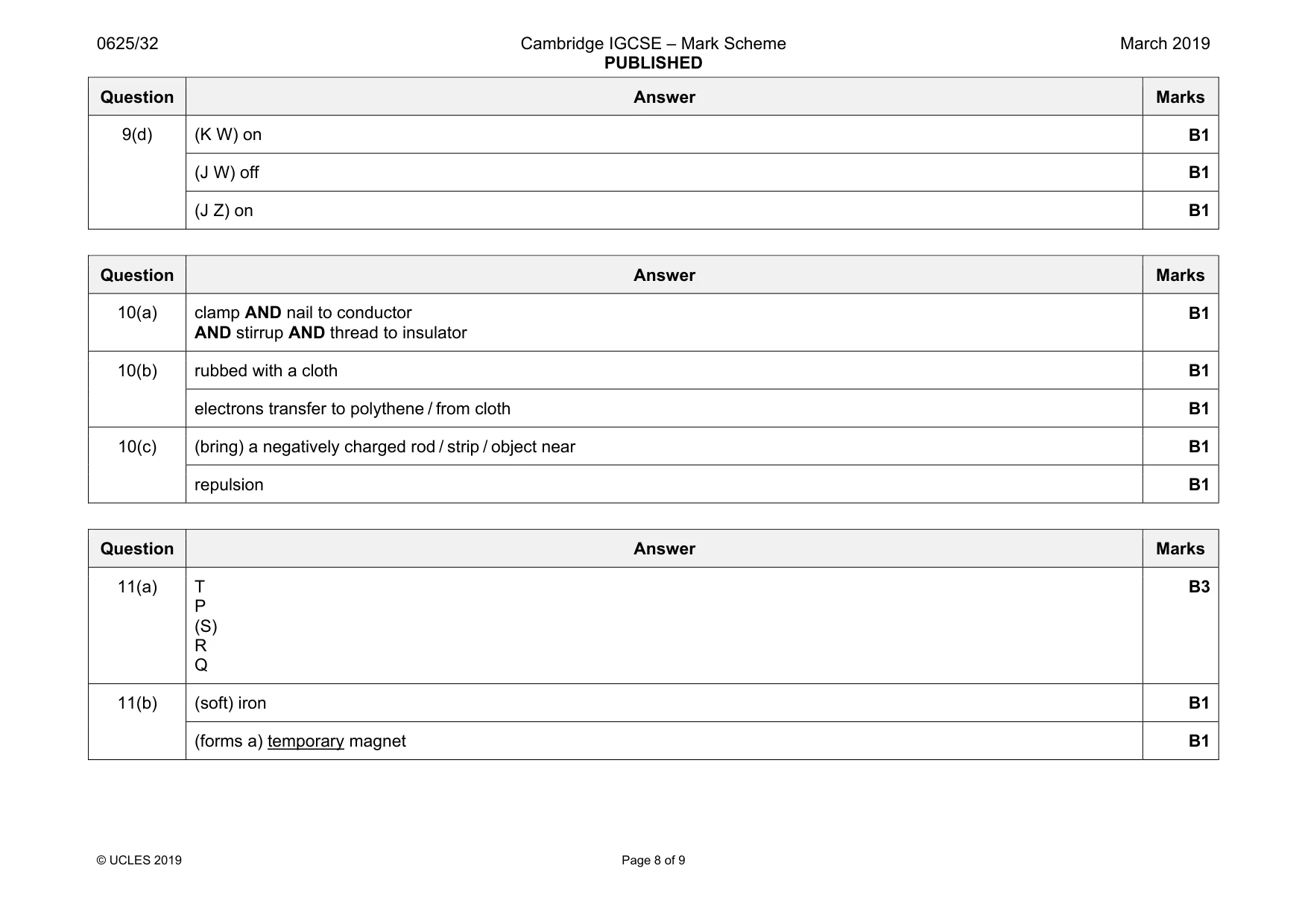
Mark scheme: 9(a) (Fig. 9.1 is a) parallel (circuit) B1 (Fig. 9.2 is a) series (circuit) B1 9(b) Any two from: lamps less bright if one lamp breaks the other does not light lamps cannot be switched independently B2 9(c) two correct switch symbols B1 switch on each branch B1 Question Answer Marks 9(d) (K W) on B1 (J W) off B1 (J Z) on B1
Q10 · The apparatus for an experiment on electrostatics
10 Fig. 10.1 shows the apparatus for an experiment on electrostatics. iron nail aluminium clamp and stand cotton thread plastic stirrup polythene strip Fig. 10.1 (a) Identify the pieces of equipment that are electrical conductors and those that are electrical insulators. Draw a line from each piece of equipment to the correct box. aluminium clamp and stand conductor plastic stirrup iron nail insulator cotton thread [1] (b) State and explain how the polythene strip can be given a negative charge. ................................................................................................................................................... ................................................................................................................................................... ............................................................................................................................................. [2] (c) Describe how the apparatus in Fig. 10.1 could be used to demonstrate that the polythene strip has a negative charge. ................................................................................................................................................... ................................................................................................................................................... ............................................................................................................................................. [2] [Total: 5]
Mark scheme: 10(a) clamp AND nail to conductor AND stirrup AND thread to insulator B1 10(b) rubbed with a cloth B1 electrons transfer to polythene / from cloth B1 10(c) (bring) a negatively charged rod / strip / object near B1 repulsion B1
Question 11
11 Fig. 11.1 shows a relay. contacts pivot to secondary circuit armature C primary circuit Fig. 11.1 (a) The statements describe the action of a relay. They are not in the correct order. P Current in the coil creates an electromagnet. Q Secondary circuit is completed. R Armature pivots, closing the contacts. S Part C attracts the armature. T The switch in the primary circuit is closed. Place the statements in the correct order. One has been done for you. S [3] (b) Fig. 11.1 includes the part labelled C, which is made from a metal. State the name of the metal and explain why this metal is used in the electromagnet. metal ......................................................................................................................................... explanation ............................................................................................................................... ................................................................................................................................................... [2] [Total: 5]
Mark scheme: 11(a) T P (S) R Q B3 11(b) (soft) iron B1 (forms a) temporary magnet B1
Q12 · Astatine-210 is a radioactive material
12 Astatine-210 is a radioactive material. The nucleus of astatine can be represented by the symbol shown. 21085At (a) Complete the table to describe the nucleus of astatine-210. type of particle number of particles charge on particle neutron positive [4] (b) Astatine-210 has a half-life of 8 hours. (i) The count rate of a sample of astatine-210 is measured over 24 hours. On Fig. 12.1, sketch a line to show how the count rate changes over the 24 hours. count rate 0 8 16 24 time / hours Fig. 12.1 [2] (ii) The mass of a sample of astatine-210 is 0.500 kg. Calculate how long it takes for 0.375 kg of the sample to decay. decay time = ............................................... hours [3] [Total: 9]
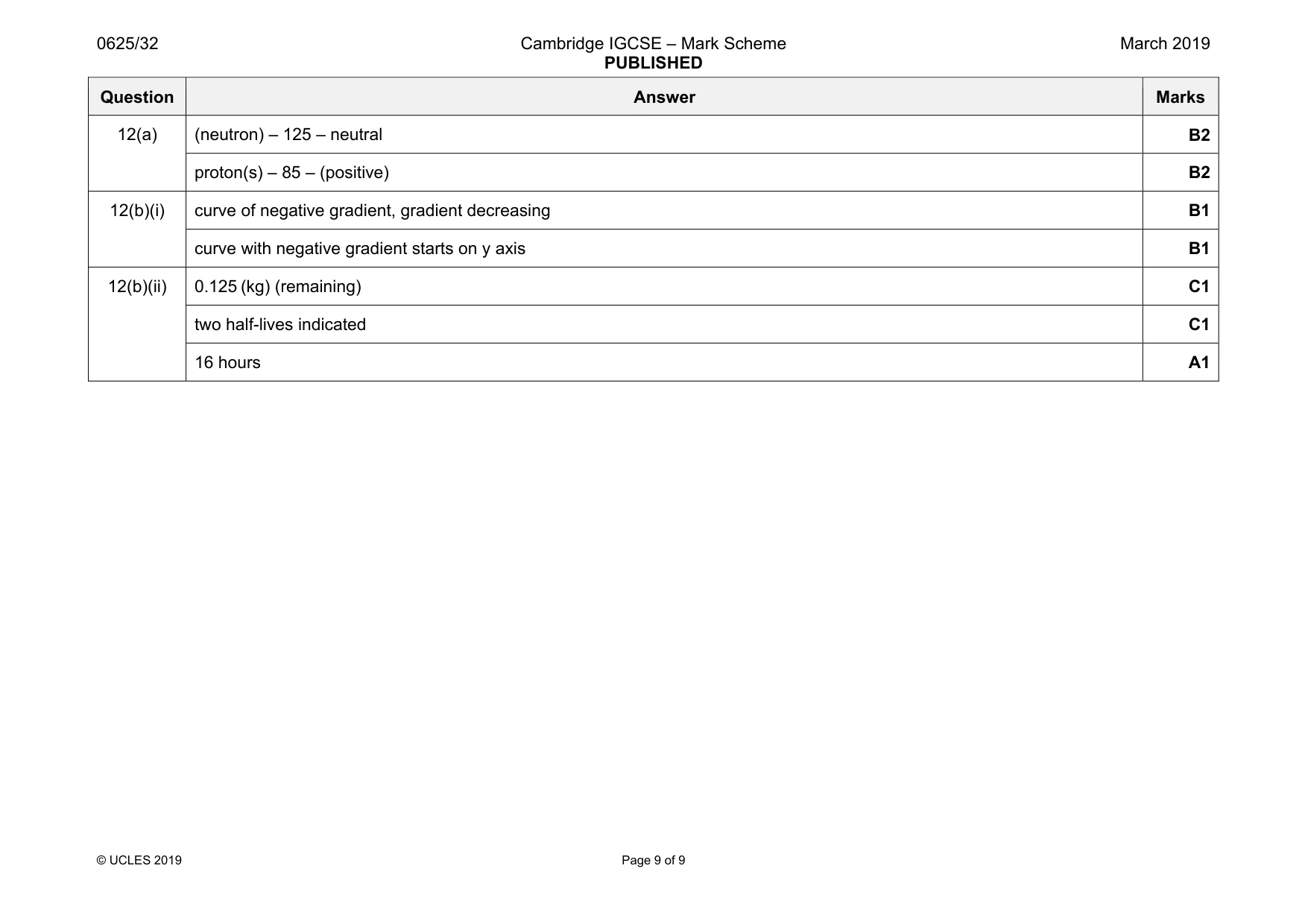
Mark scheme: 12(a) (neutron) – 125 – neutral B2 proton(s) – 85 – (positive) B2 12(b)(i) curve of negative gradient, gradient decreasing B1 curve with negative gradient starts on y axis B1 12(b)(ii) 0.125 (kg) (remaining) C1 two half-lives indicated C1 16 hours A1
What was in this paper
The subtopics covered by these 12 questions, and how many questions each got. Open one in a new tab to see every Cambridge question on it.
What you needed in this session
Cambridge’s own grade thresholds for 2019 Feb/March, Paper 3 · Variant 2. A higher threshold means an easier paper — the bar moves with how the cohort did.