Cambridge IGCSE Physics 0625 — 2025 Oct/Nov Paper 3 · Variant 1
0625/31/O/N/25 · 11 questions · 80 marks · ≈90 min
The question paper and its mark scheme, free to read here and free to download. This is Cambridge’s own paper, exactly as it was sat.
Question paper16 pages
Mark scheme13 pages
Answers below. Sit the paper first if you are practising.
Questions as text
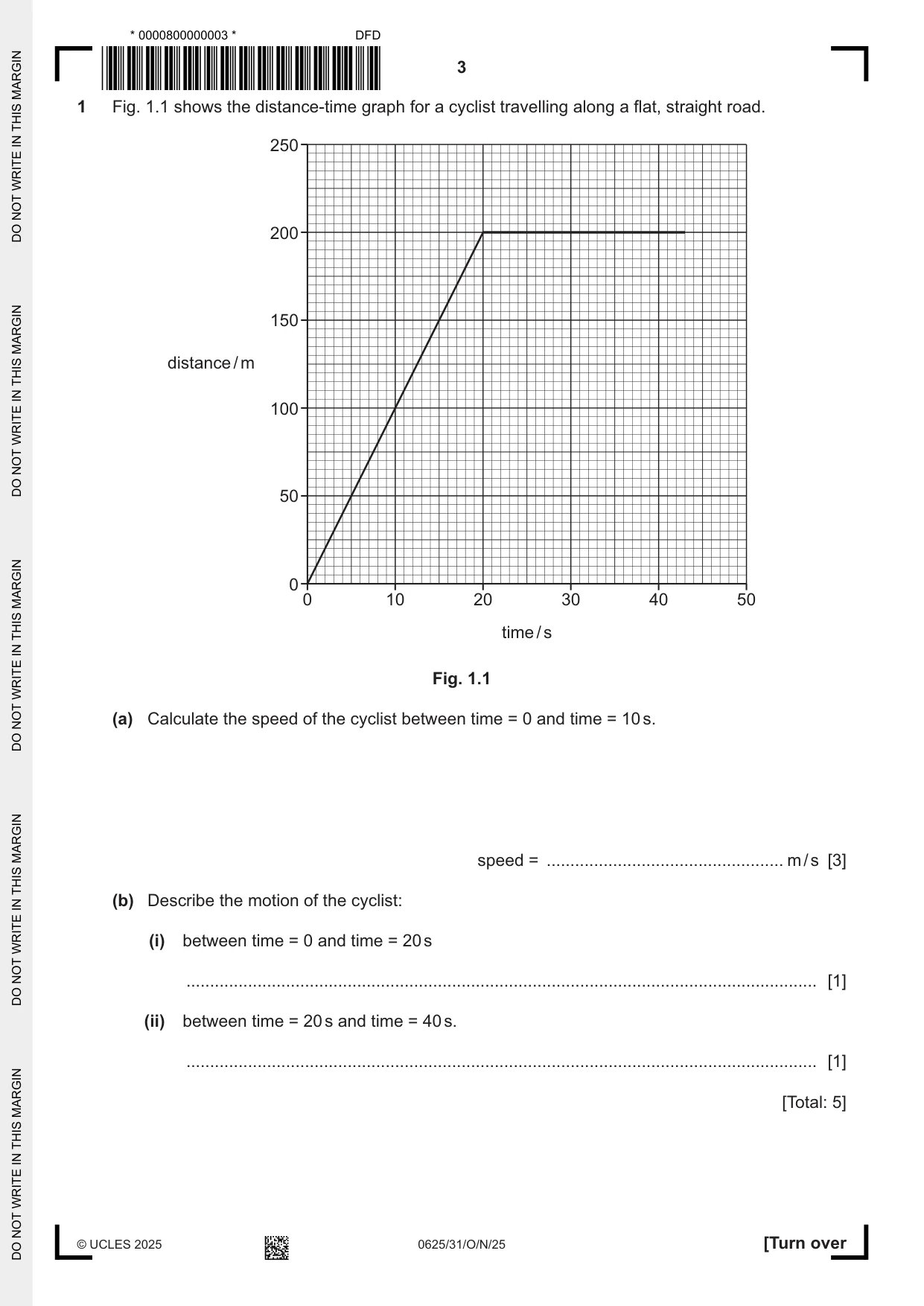
Q1 · The distance-time graph for a cyclist travelling along a flat, straight road
1 Fig. 1.1 shows the distance-time graph for a cyclist travelling along a flat, straight road. 250 200 150 distance / m 100 50 0 0 10 20 30 40 50 time / s Fig. 1.1 (a) Calculate the speed of the cyclist between time = 0 and time = 10 s. speed = .................................................. m / s [3] (b) Describe the motion of the cyclist: (i) between time = 0 and time = 20 s ..................................................................................................................................... [1] (ii) between time = 20 s and time = 40 s. ..................................................................................................................................... [1] [Total: 5]
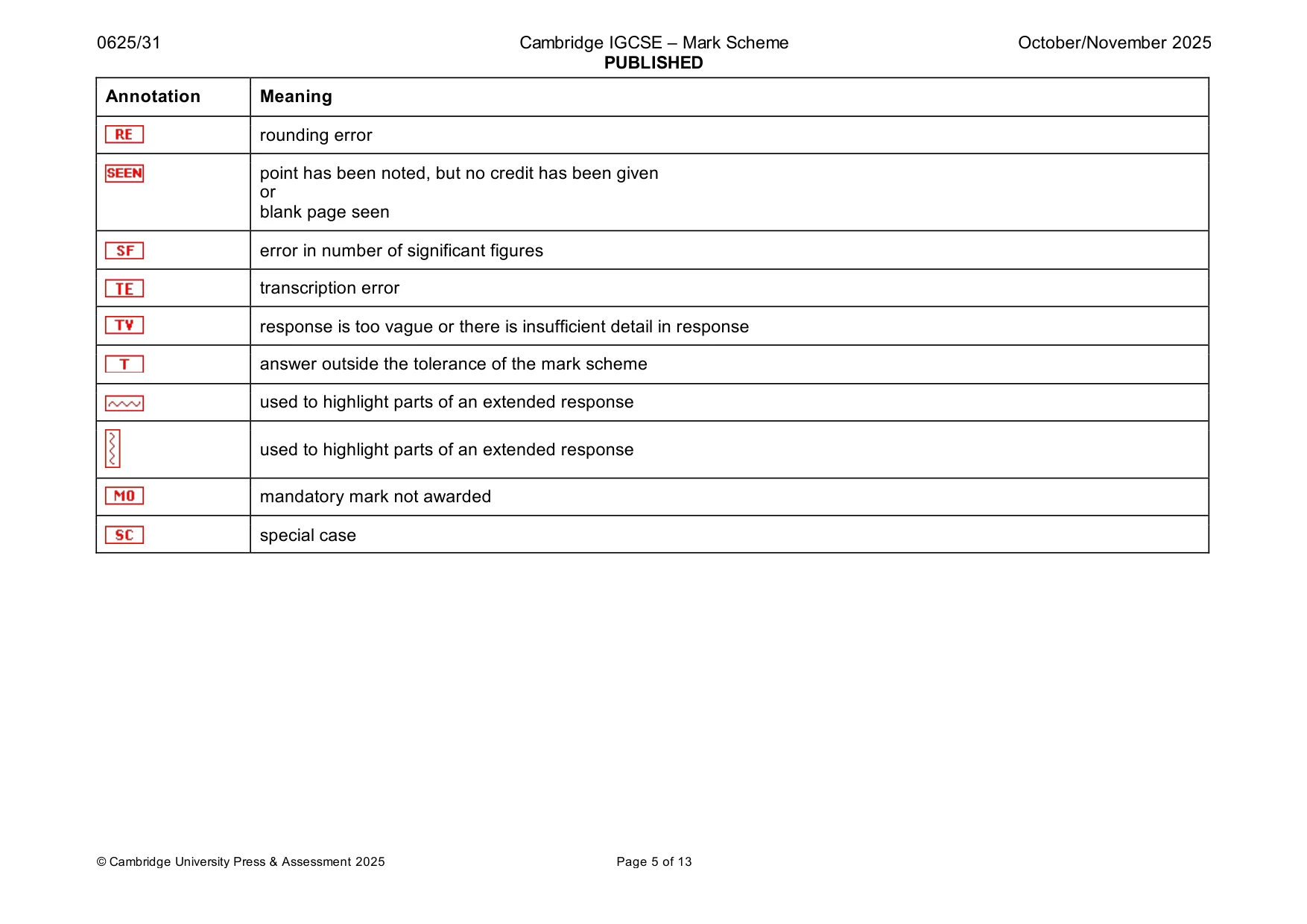
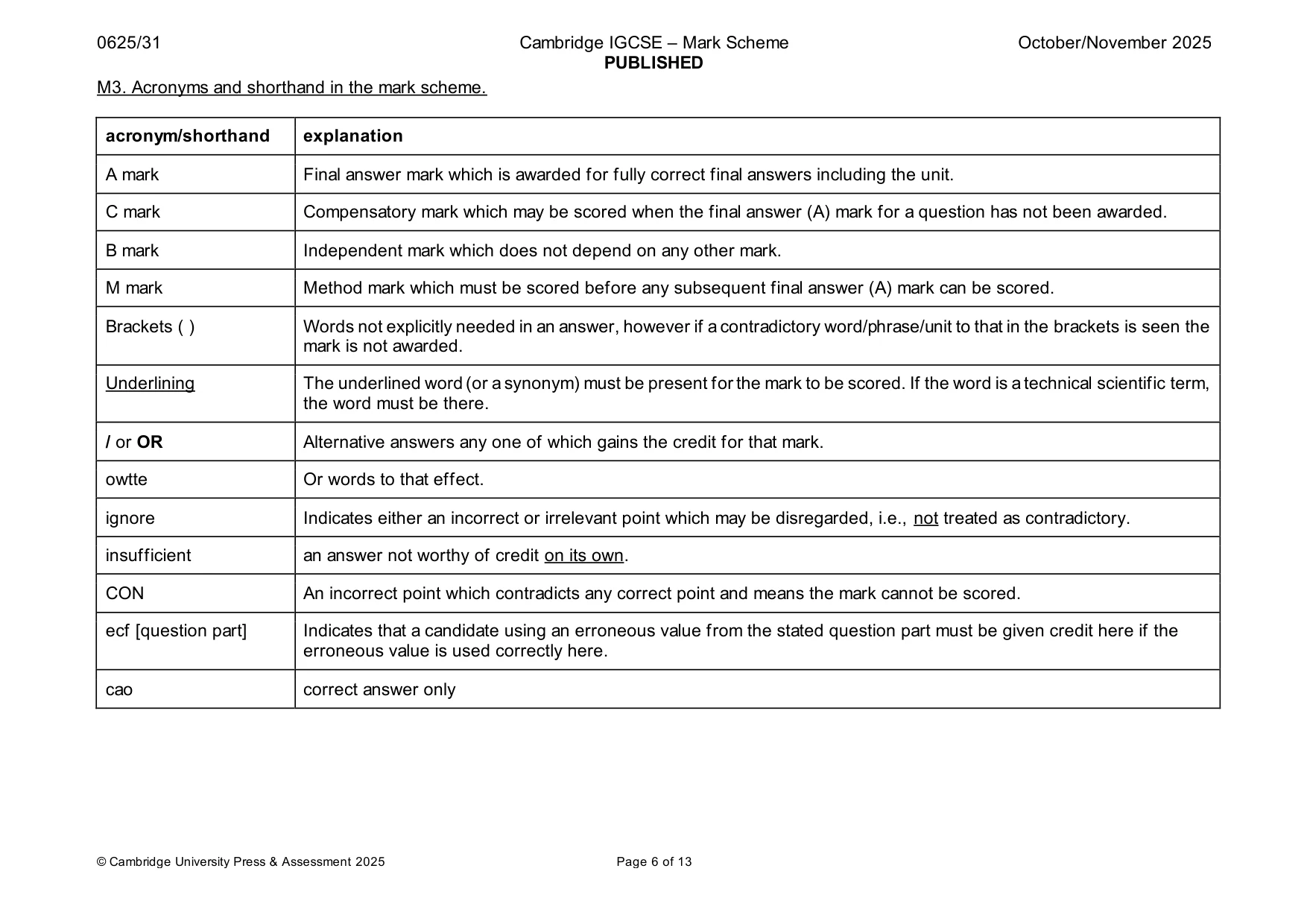
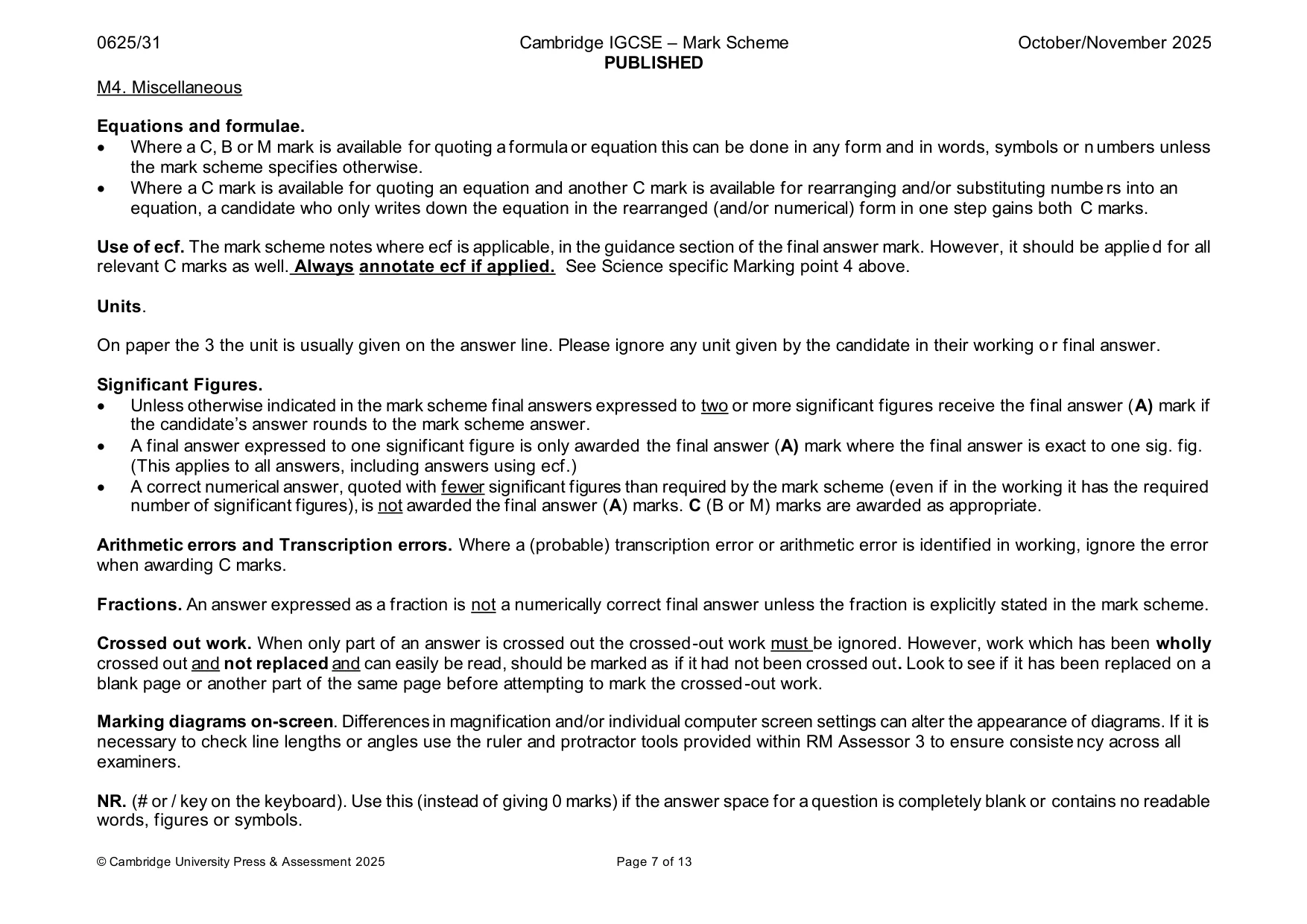
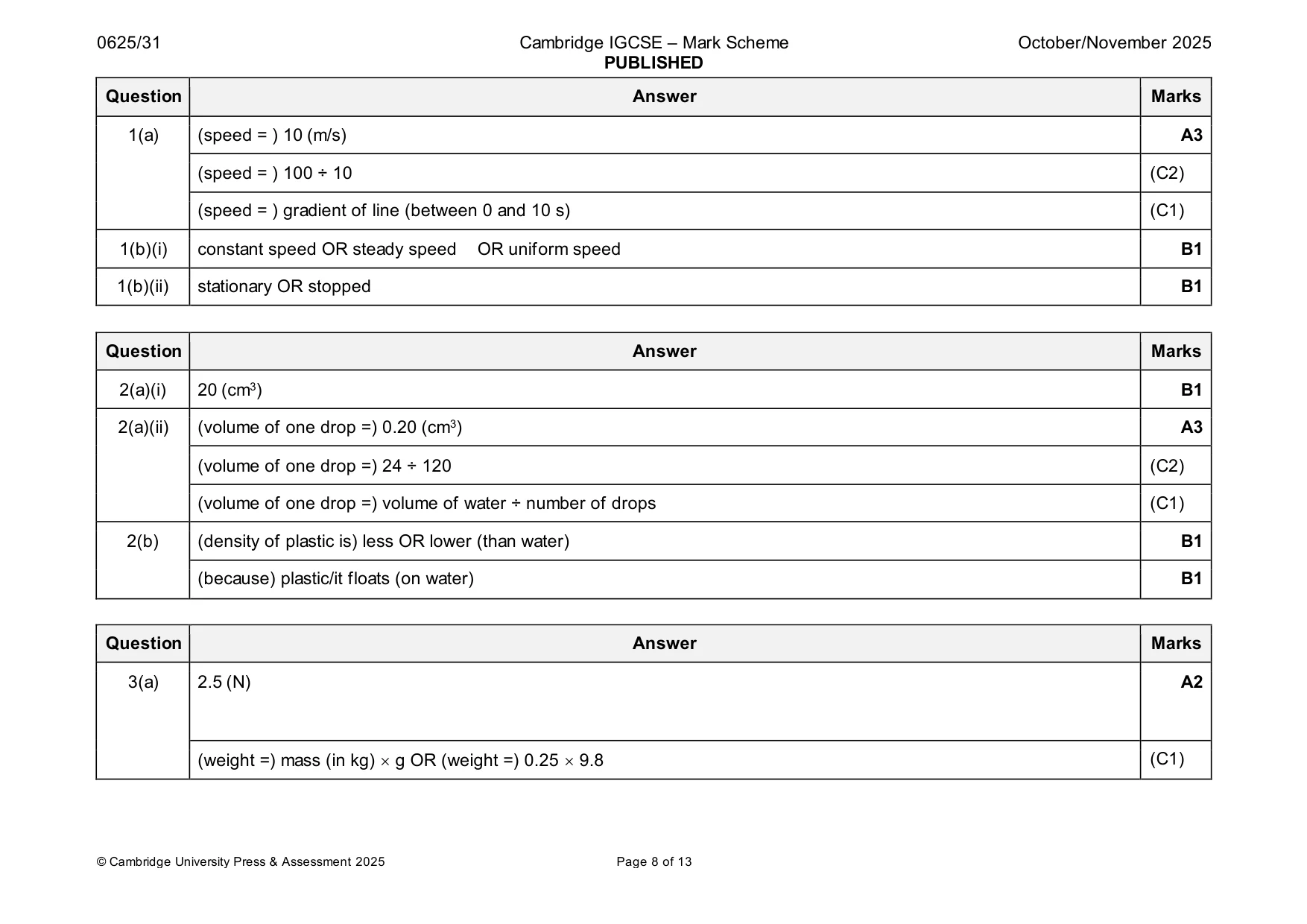
Mark scheme: Question Answer Marks 1(a) (speed = ) 10 (m/s) A3 (speed = ) 100 ÷ 10 (C2) (speed = ) gradient of line (between 0 and 10 s) (C1) 1(b)(i) constant speed OR steady speed OR uniform speed B1 1(b)(ii) stationary OR stopped B1
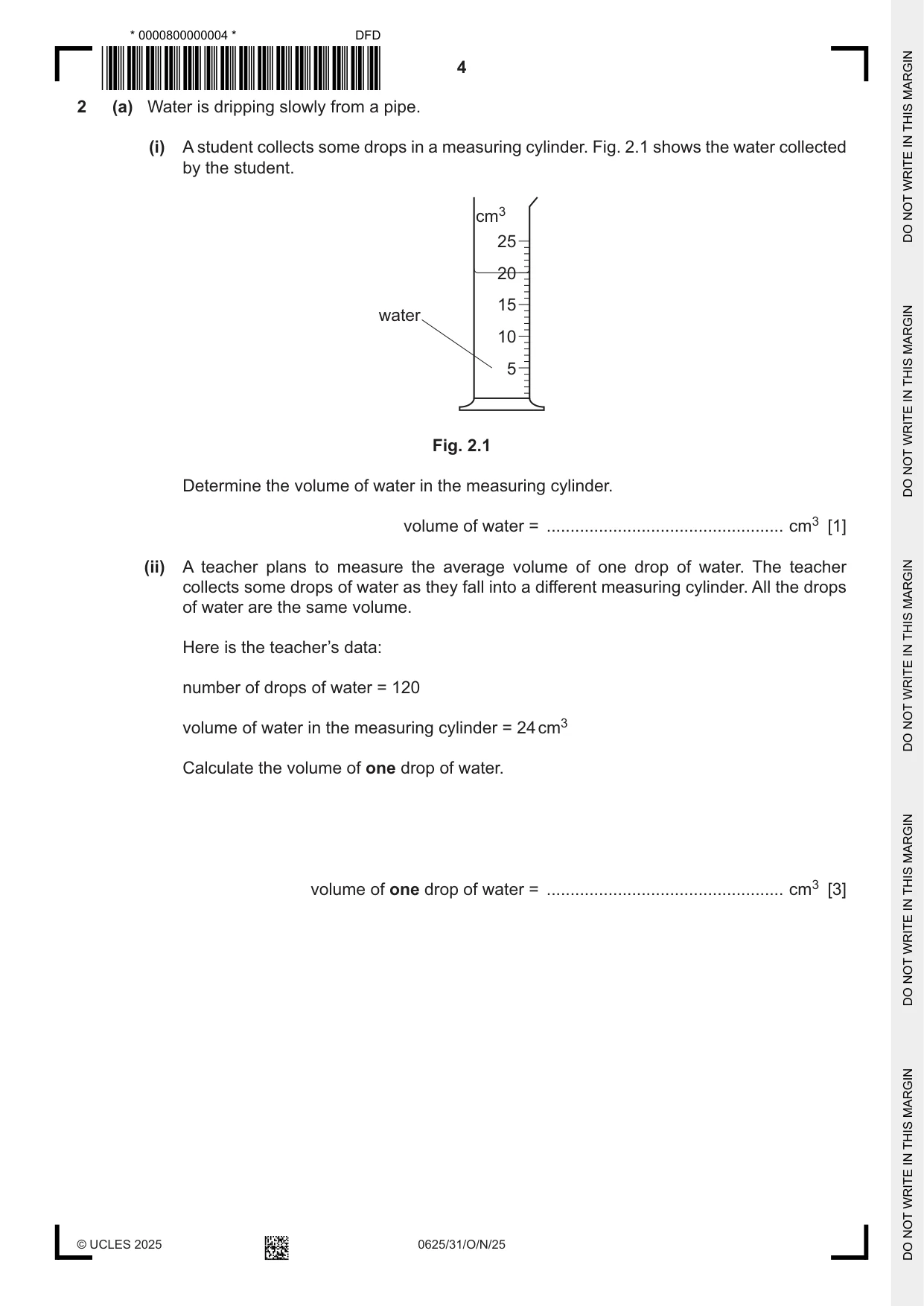
Q2 · Water is dripping slowly from a pipe
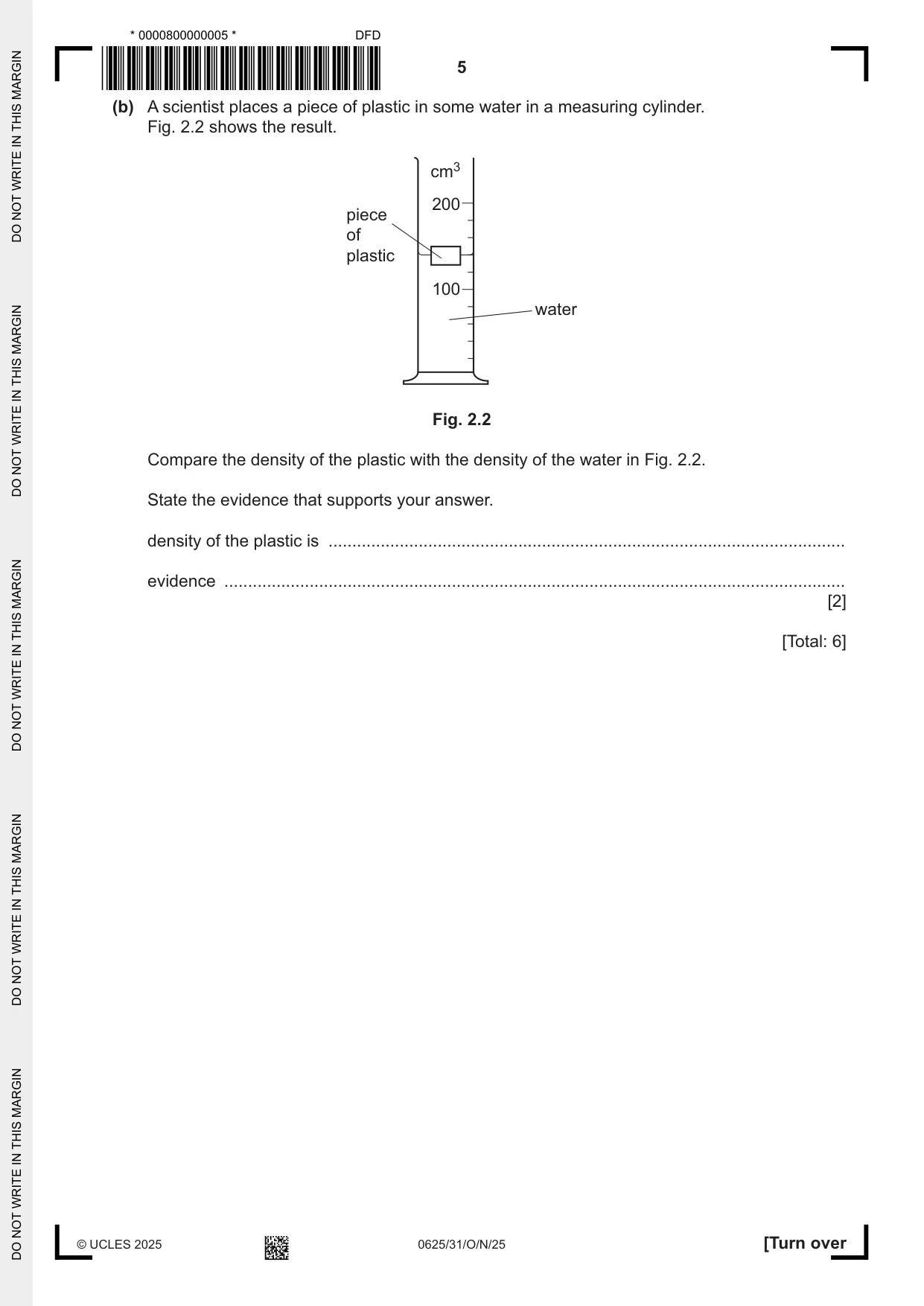
2 (a) Water is dripping slowly from a pipe. (i) A student collects some drops in a measuring cylinder. Fig. 2.1 shows the water collected by the student. cm3 25 20 15 water 10 5 Fig. 2.1 Determine the volume of water in the measuring cylinder. volume of water = .................................................. cm3 [1] (ii) A teacher plans to measure the average volume of one drop of water. The teacher collects some drops of water as they fall into a different measuring cylinder. All the drops of water are the same volume. Here is the teacher’s data: number of drops of water = 120 volume of water in the measuring cylinder = 24 cm3 Calculate the volume of one drop of water. volume of one drop of water = .................................................. cm3 [3] (b) A scientist places a piece of plastic in some water in a measuring cylinder. Fig. 2.2 shows the result. cm3 200 piece of plastic 100 water Fig. 2.2 Compare the density of the plastic with the density of the water in Fig. 2.2. State the evidence that supports your answer. density of the plastic is ............................................................................................................. evidence ................................................................................................................................... [2] [Total: 6]
Mark scheme: 2(a)(i) 20 (cm3) B1 2(a)(ii) (volume of one drop =) 0.20 (cm3) A3 (volume of one drop =) 24 ÷ 120 (C2) (volume of one drop =) volume of water ÷ number of drops (C1) 2(b) (density of plastic is) less OR lower (than water) B1 (because) plastic/it floats (on water) B1
More questions on Physical quantities and measurement techniques
Q3 · A student stretches a spring by suspending it and attaching metal discs to it, as shown…
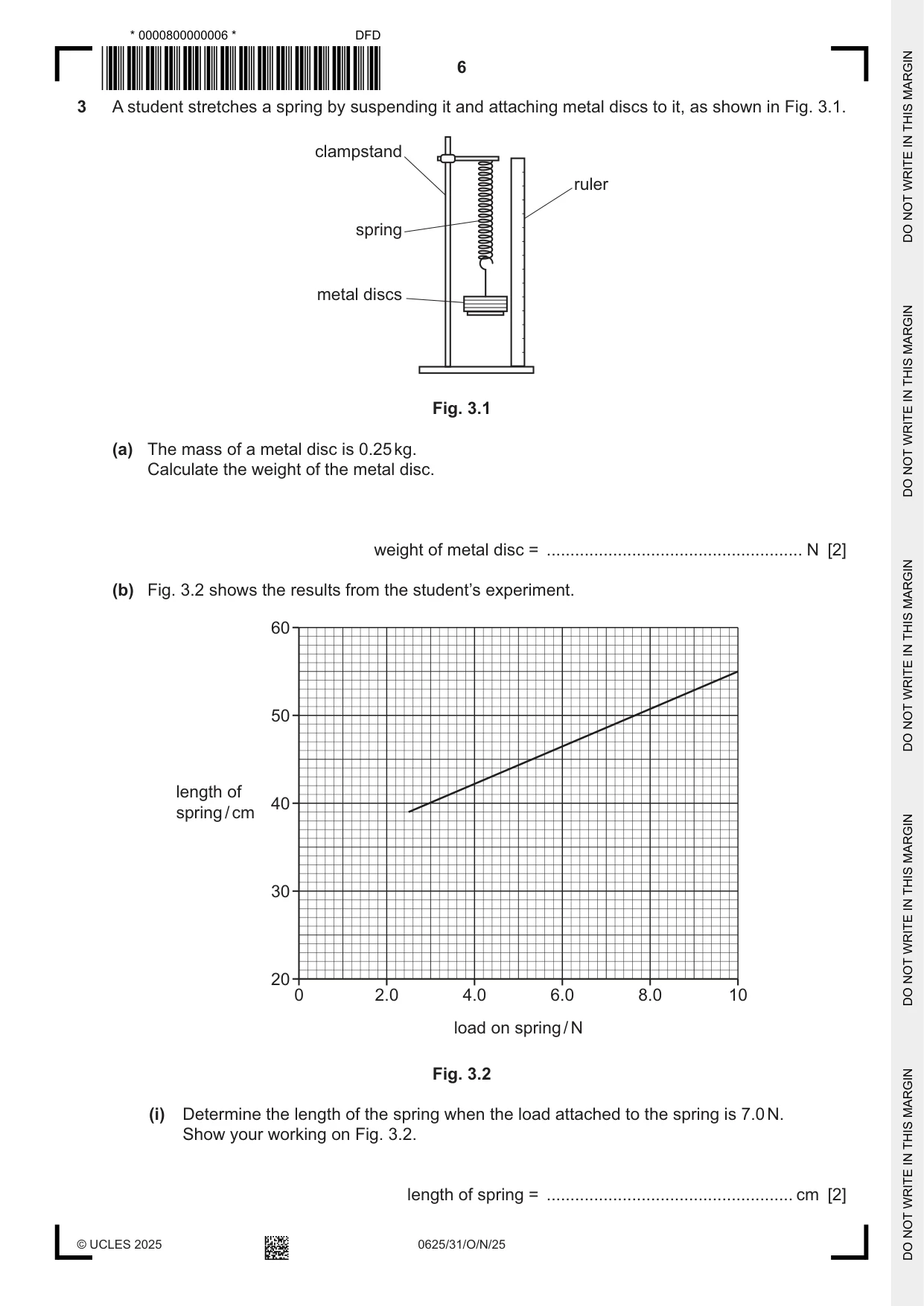
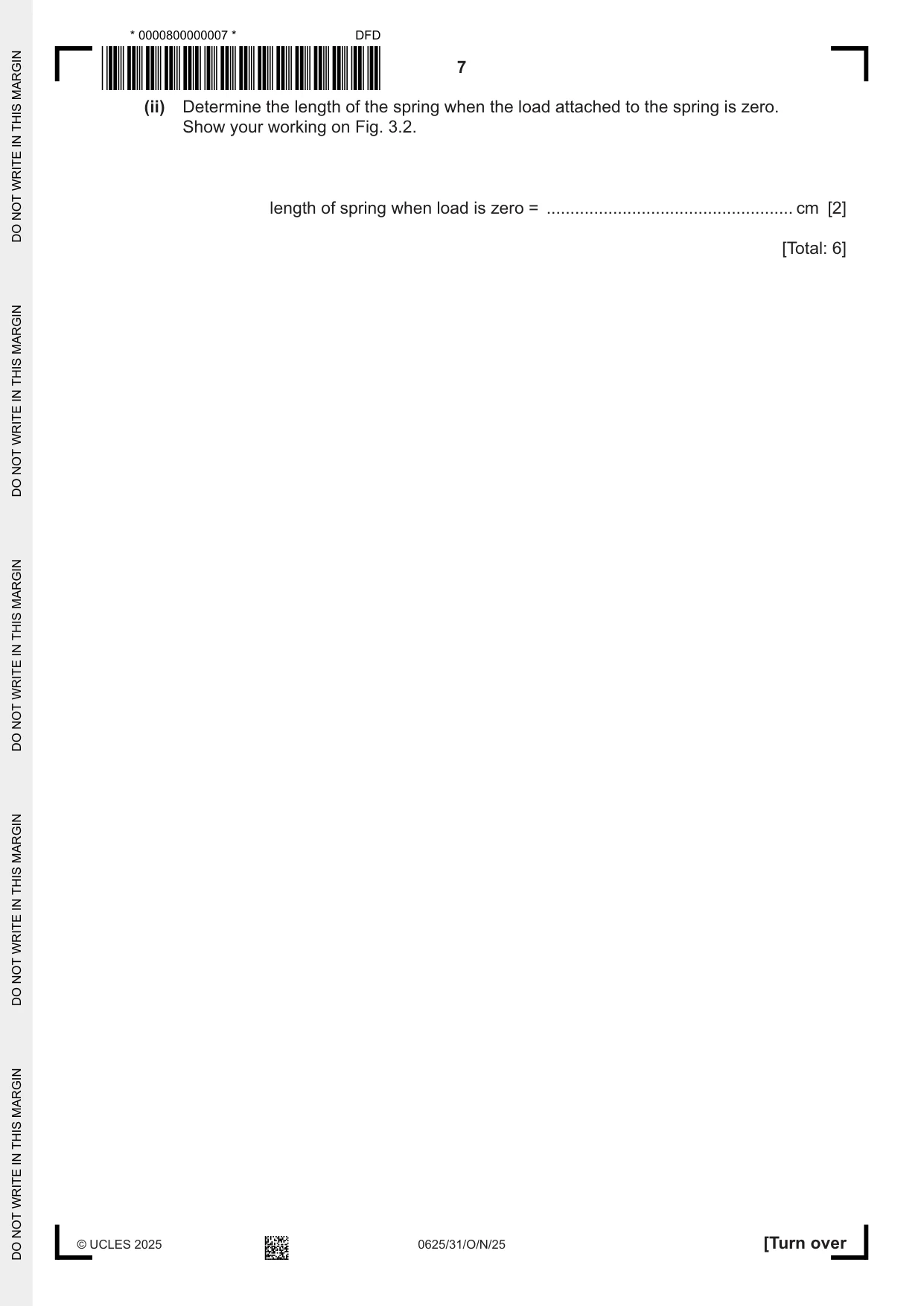
3 A student stretches a spring by suspending it and attaching metal discs to it, as shown in Fig. 3.1. clampstand ruler spring metal discs Fig. 3.1 (a) The mass of a metal disc is 0.25 kg. Calculate the weight of the metal disc. weight of metal disc = ...................................................... N [2] (b) Fig. 3.2 shows the results from the student’s experiment. 60 50 length of 40 spring / cm 30 20 0 2.0 4.0 6.0 8.0 10 load on spring / N Fig. 3.2 (i) Determine the length of the spring when the load attached to the spring is 7.0 N. Show your working on Fig. 3.2. length of spring = .................................................... cm [2] (ii) Determine the length of the spring when the load attached to the spring is zero. Show your working on Fig. 3.2. length of spring when load is zero = .................................................... cm [2] [Total: 6]
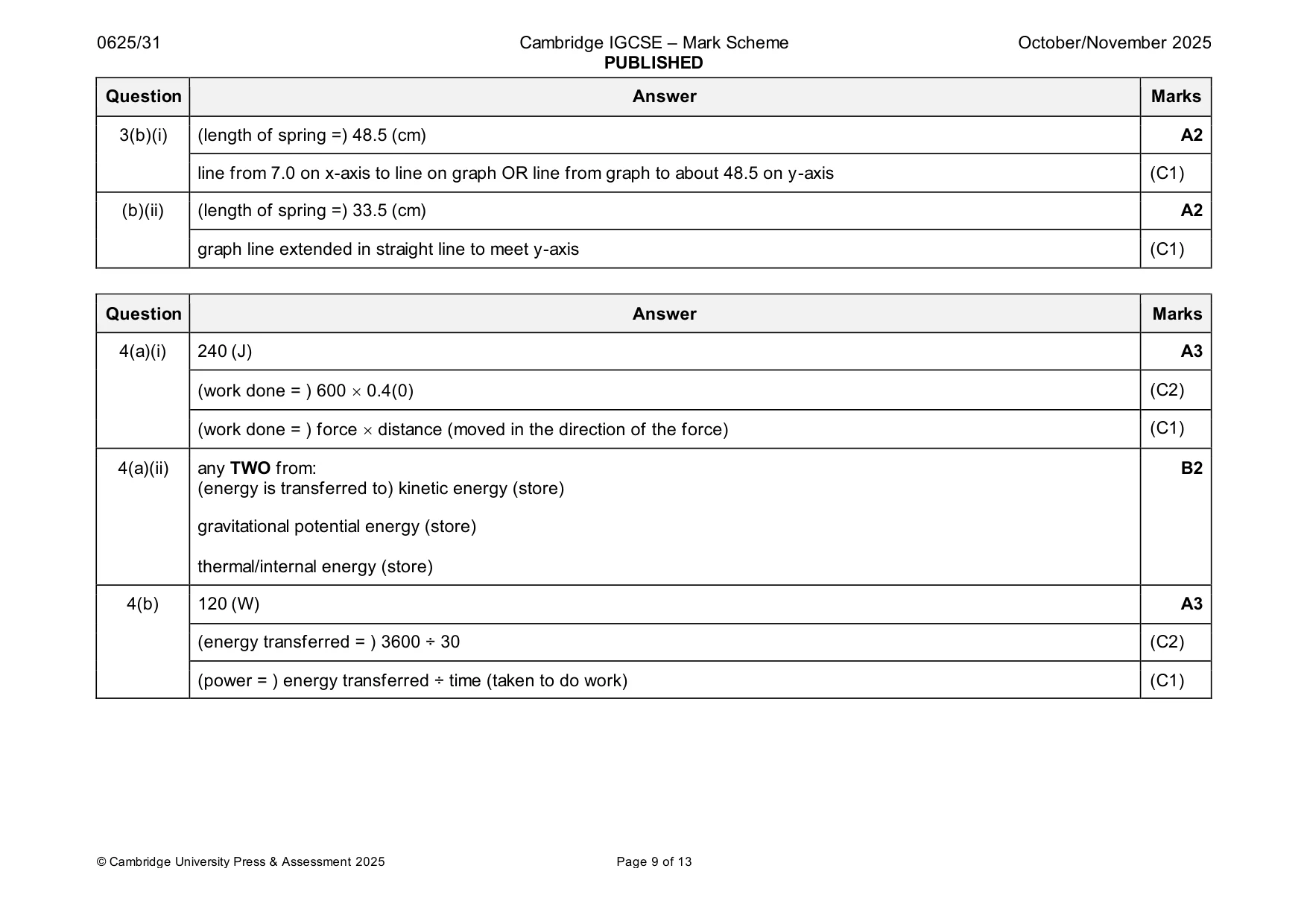
Mark scheme: 3(a) 2.5 (N) A2 (weight =) mass (in kg) g OR (weight =) 0.25 9.8 (C1) 3(b)(i) (length of spring =) 48.5 (cm) A2 line from 7.0 on x-axis to line on graph OR line from graph to about 48.5 on y-axis (C1) (b)(ii) (length of spring =) 33.5 (cm) A2 graph line extended in straight line to meet y-axis (C1)
Q4 · A student doing some repetitive ‘step-up’ exercises
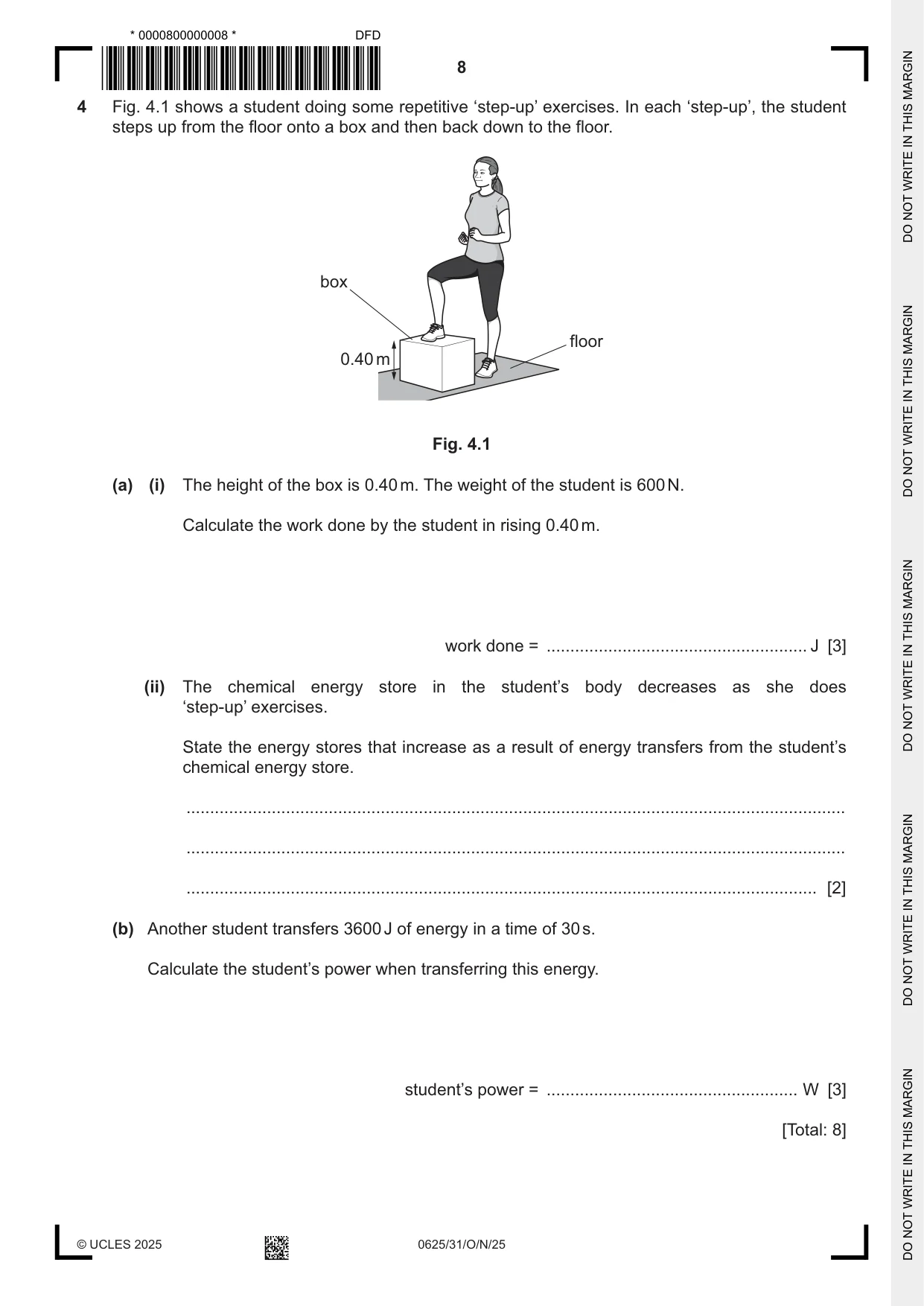
4 Fig. 4.1 shows a student doing some repetitive ‘step-up’ exercises. In each ‘step-up’, the student steps up from the floor onto a box and then back down to the floor. box floor 0.40 m Fig. 4.1 (a) (i) The height of the box is 0.40 m. The weight of the student is 600 N. Calculate the work done by the student in rising 0.40 m. work done = ....................................................... J [3] (ii) The chemical energy store in the student’s body decreases as she does ‘step-up’ exercises. State the energy stores that increase as a result of energy transfers from the student’s chemical energy store. ........................................................................................................................................... ........................................................................................................................................... ..................................................................................................................................... [2] (b) Another student transfers 3600 J of energy in a time of 30 s. Calculate the student’s power when transferring this energy. student’s power = ..................................................... W [3] [Total: 8]
Mark scheme: 4(a)(i) 240 (J) A3 (work done = ) 600 0.4(0) (C2) (work done = ) force distance (moved in the direction of the force) (C1) 4(a)(ii) any TWO from: B2 (energy is transferred to) kinetic energy (store) gravitational potential energy (store) thermal/internal energy (store) 4(b) 120 (W) A3 (energy transferred = ) 3600 ÷ 30 (C2) (power = ) energy transferred ÷ time (taken to do work) (C1)
Q5 · An empty metal cylinder
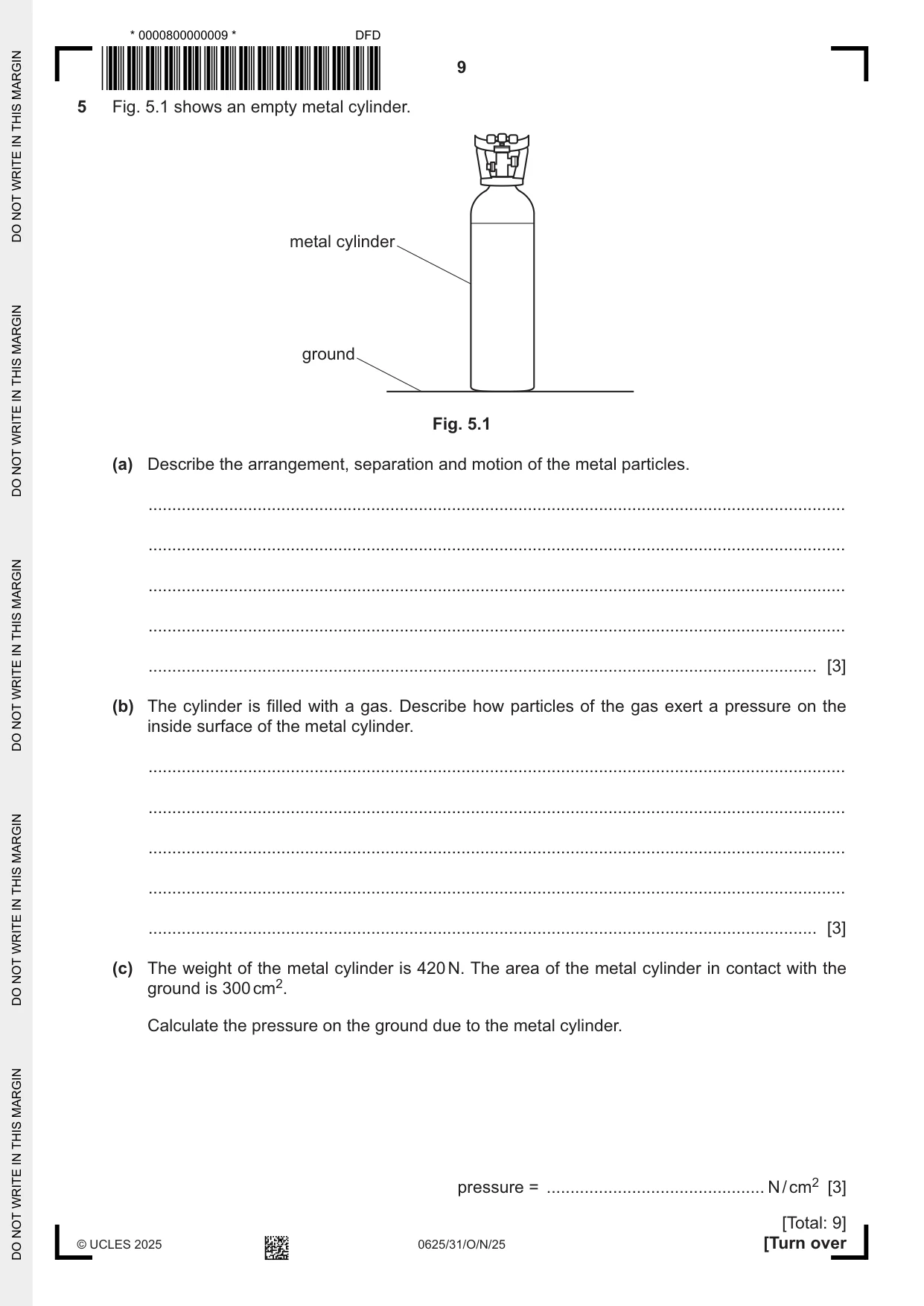
5 Fig. 5.1 shows an empty metal cylinder. metal cylinder ground Fig. 5.1 (a) Describe the arrangement, separation and motion of the metal particles. ................................................................................................................................................... ................................................................................................................................................... ................................................................................................................................................... ................................................................................................................................................... ............................................................................................................................................. [3] (b) The cylinder is filled with a gas. Describe how particles of the gas exert a pressure on the inside surface of the metal cylinder. ................................................................................................................................................... ................................................................................................................................................... ................................................................................................................................................... ................................................................................................................................................... ............................................................................................................................................. [3] (c) The weight of the metal cylinder is 420 N. The area of the metal cylinder in contact with the ground is 300 cm2. Calculate the pressure on the ground due to the metal cylinder. pressure = .............................................. N / cm2 [3] [Total: 9]
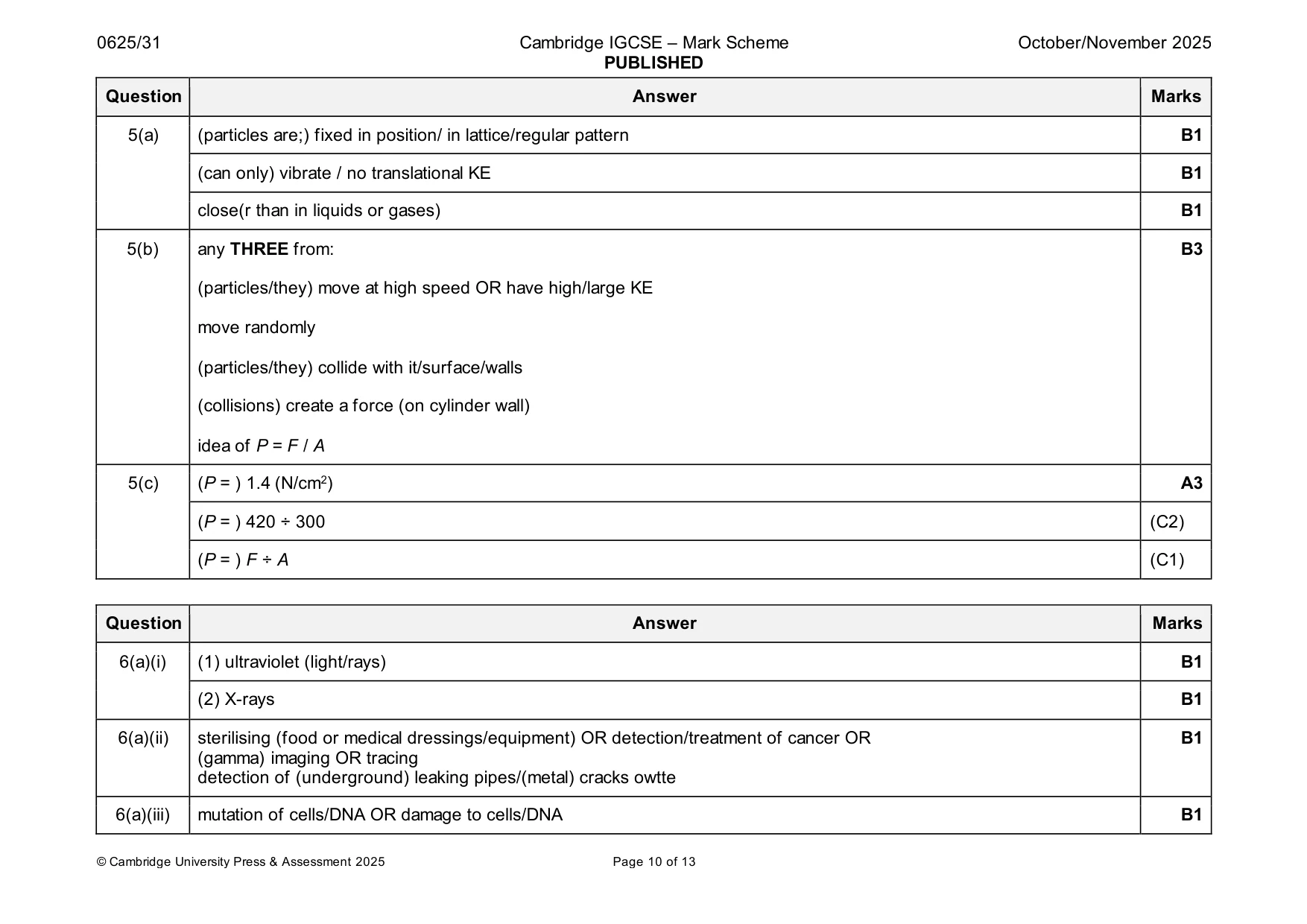
Mark scheme: 5(a) (particles are;) fixed in position/ in lattice/regular pattern B1 (can only) vibrate / no translational KE B1 close(r than in liquids or gases) B1 5(b) any THREE from: B3 (particles/they) move at high speed OR have high/large KE move randomly (particles/they) collide with it/surface/walls (collisions) create a force (on cylinder wall) idea of P = F / A 5(c) (P = ) 1.4 (N/cm2) A3 (P = ) 420 ÷ 300 (C2) (P = ) F ÷ A (C1)
Q6 · The main regions of the electromagnetic spectrum in order of increasing frequency
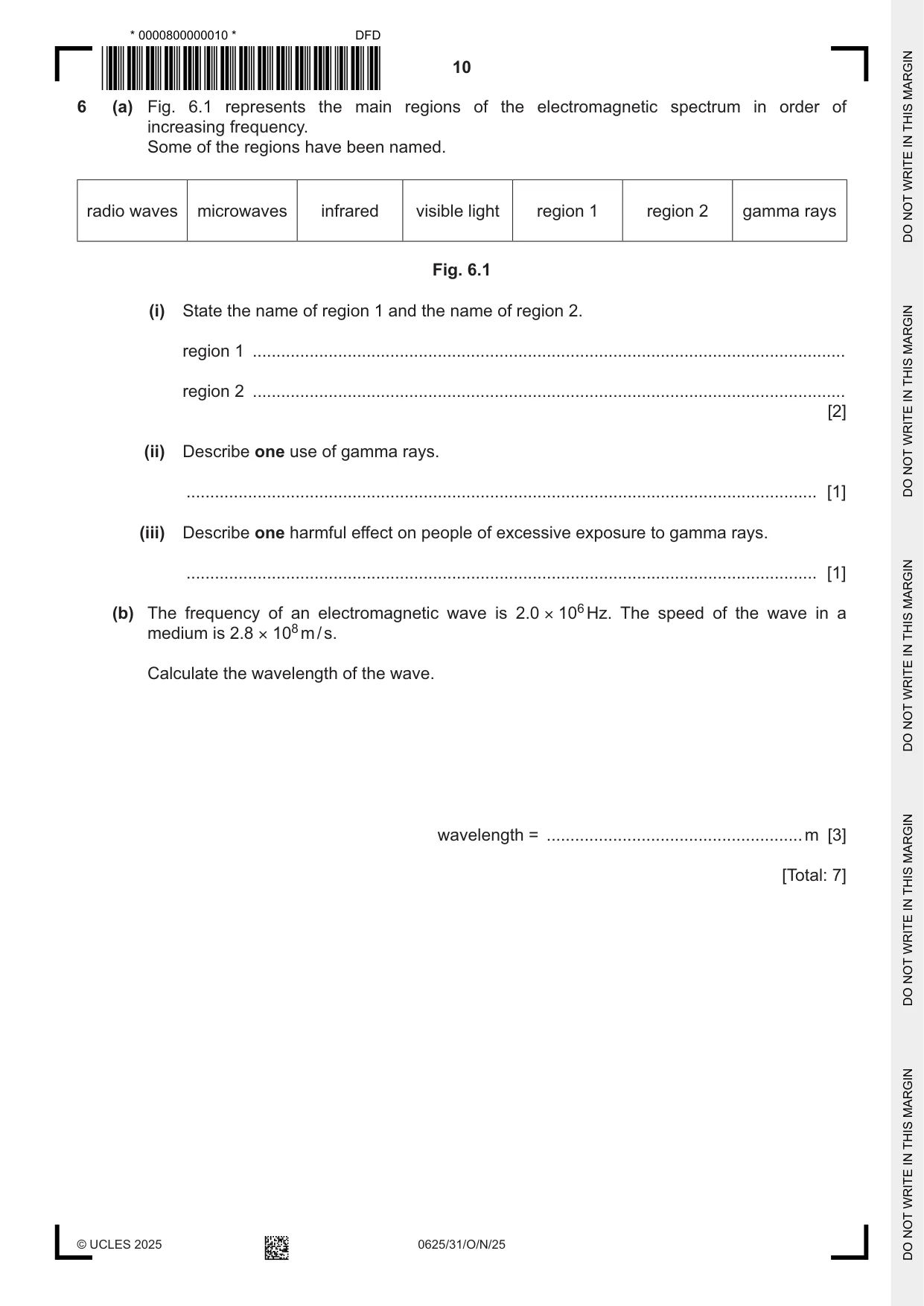
6 (a) Fig. 6.1 represents the main regions of the electromagnetic spectrum in order of increasing frequency. Some of the regions have been named. radio waves microwaves infrared visible light region 1 region 2 gamma rays Fig. 6.1 (i) State the name of region 1 and the name of region 2. region 1 ............................................................................................................................. region 2 ............................................................................................................................. [2] (ii) Describe one use of gamma rays. ..................................................................................................................................... [1] (iii) Describe one harmful effect on people of excessive exposure to gamma rays. ..................................................................................................................................... [1] (b) The frequency of an electromagnetic wave is 2.0 × 10⁶ Hz. The speed of the wave in a medium is 2.8 × 10⁸ m / s. Calculate the wavelength of the wave. wavelength = ...................................................... m [3] [Total: 7]
Mark scheme: 6(a)(i) (1) ultraviolet (light/rays) B1 (2) X-rays B1 6(a)(ii) sterilising (food or medical dressings/equipment) OR detection/treatment of cancer OR B1 (gamma) imaging OR tracing detection of (underground) leaking pipes/(metal) cracks owtte 6(a)(iii) mutation of cells/DNA OR damage to cells/DNA B1 6(b) (λ = ) 1.4 102 (m) A3 (λ = ) 2.8 ( 108) ÷ 2.0 ( 106) (C2) v = f × λ OR (λ = ) v ÷ f (C1)
Q7 · A student has six metal bars
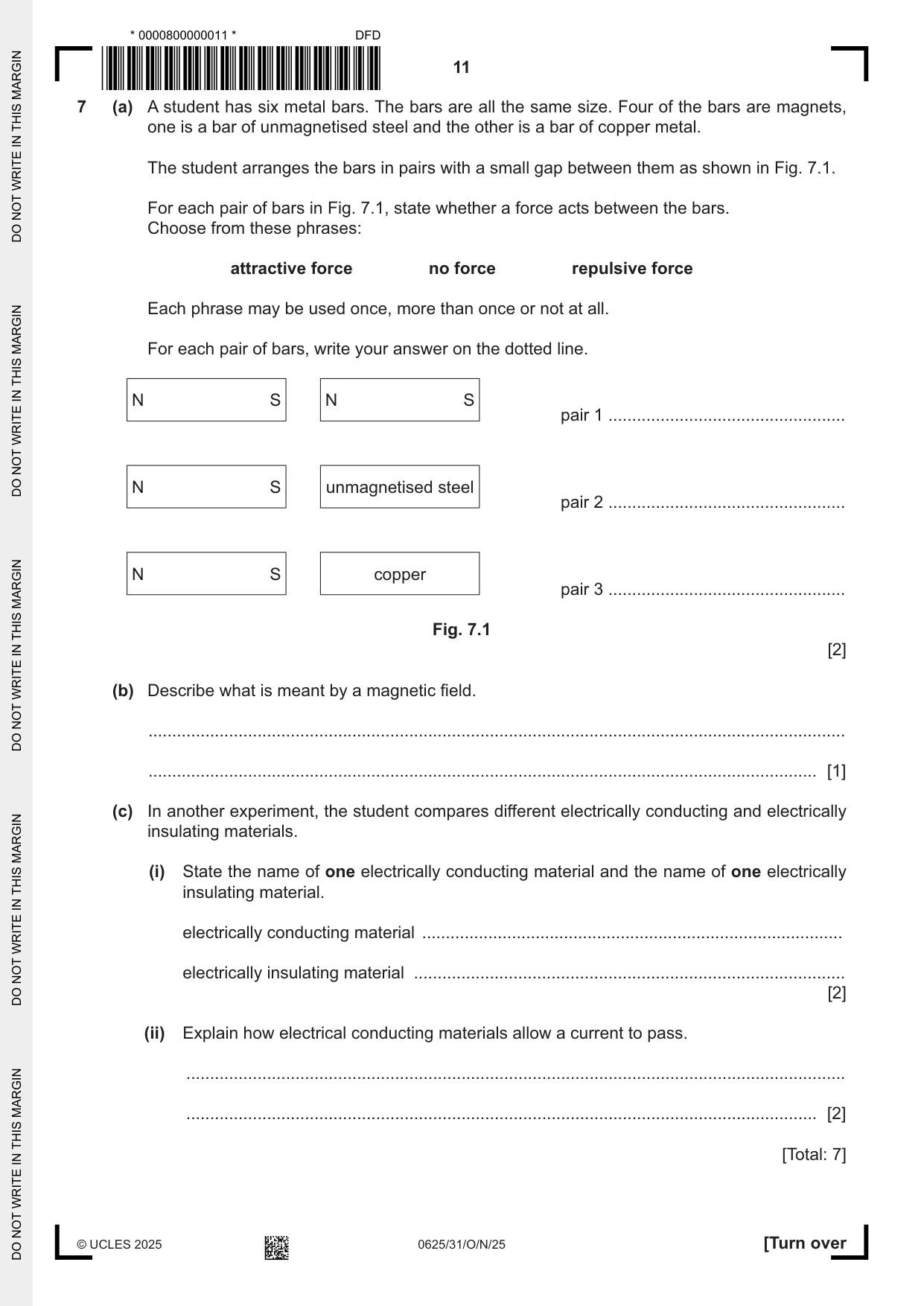
7 (a) A student has six metal bars. The bars are all the same size. Four of the bars are magnets, one is a bar of unmagnetised steel and the other is a bar of copper metal. The student arranges the bars in pairs with a small gap between them as shown in Fig. 7.1. For each pair of bars in Fig. 7.1, state whether a force acts between the bars. Choose from these phrases: attractive force no force repulsive force Each phrase may be used once, more than once or not at all. For each pair of bars, write your answer on the dotted line. N S N S pair 1 .................................................. N S unmagnetised steel pair 2 .................................................. N S copper pair 3 .................................................. Fig. 7.1 [2] (b) Describe what is meant by a magnetic field. ................................................................................................................................................... ............................................................................................................................................. [1] (c) In another experiment, the student compares different electrically conducting and electrically insulating materials. (i) State the name of one electrically conducting material and the name of one electrically insulating material. electrically conducting material ......................................................................................... electrically insulating material ........................................................................................... [2] (ii) Explain how electrical conducting materials allow a current to pass. ........................................................................................................................................... ..................................................................................................................................... [2] [Total: 7]
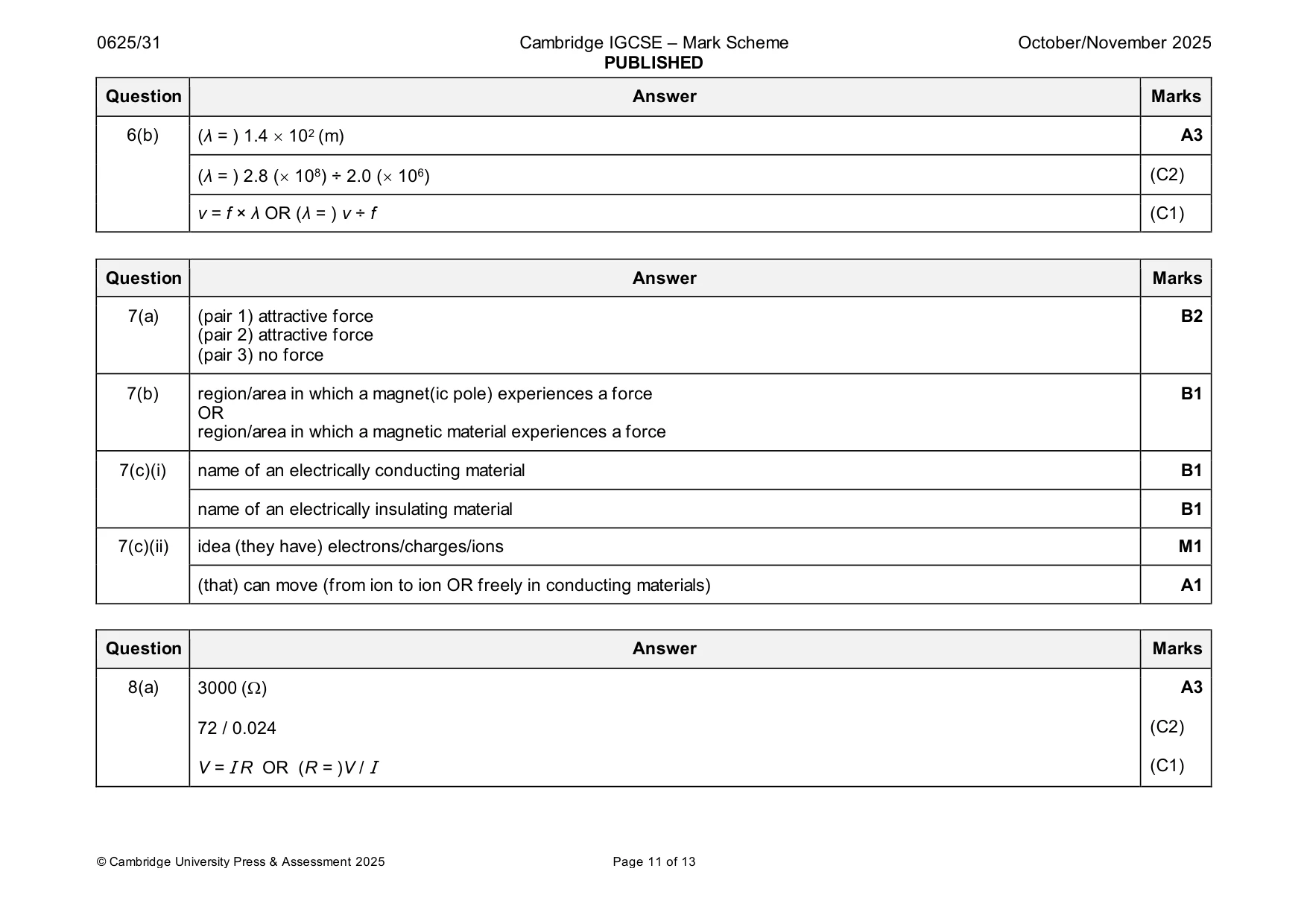
Mark scheme: 7(a) (pair 1) attractive force B2 (pair 2) attractive force (pair 3) no force 7(b) region/area in which a magnet(ic pole) experiences a force B1 OR region/area in which a magnetic material experiences a force 7(c)(i) name of an electrically conducting material B1 name of an electrically insulating material B1 7(c)(ii) idea (they have) electrons/charges/ions M1 (that) can move (from ion to ion OR freely in conducting materials) A1
Q8 · A television uses many electrical components
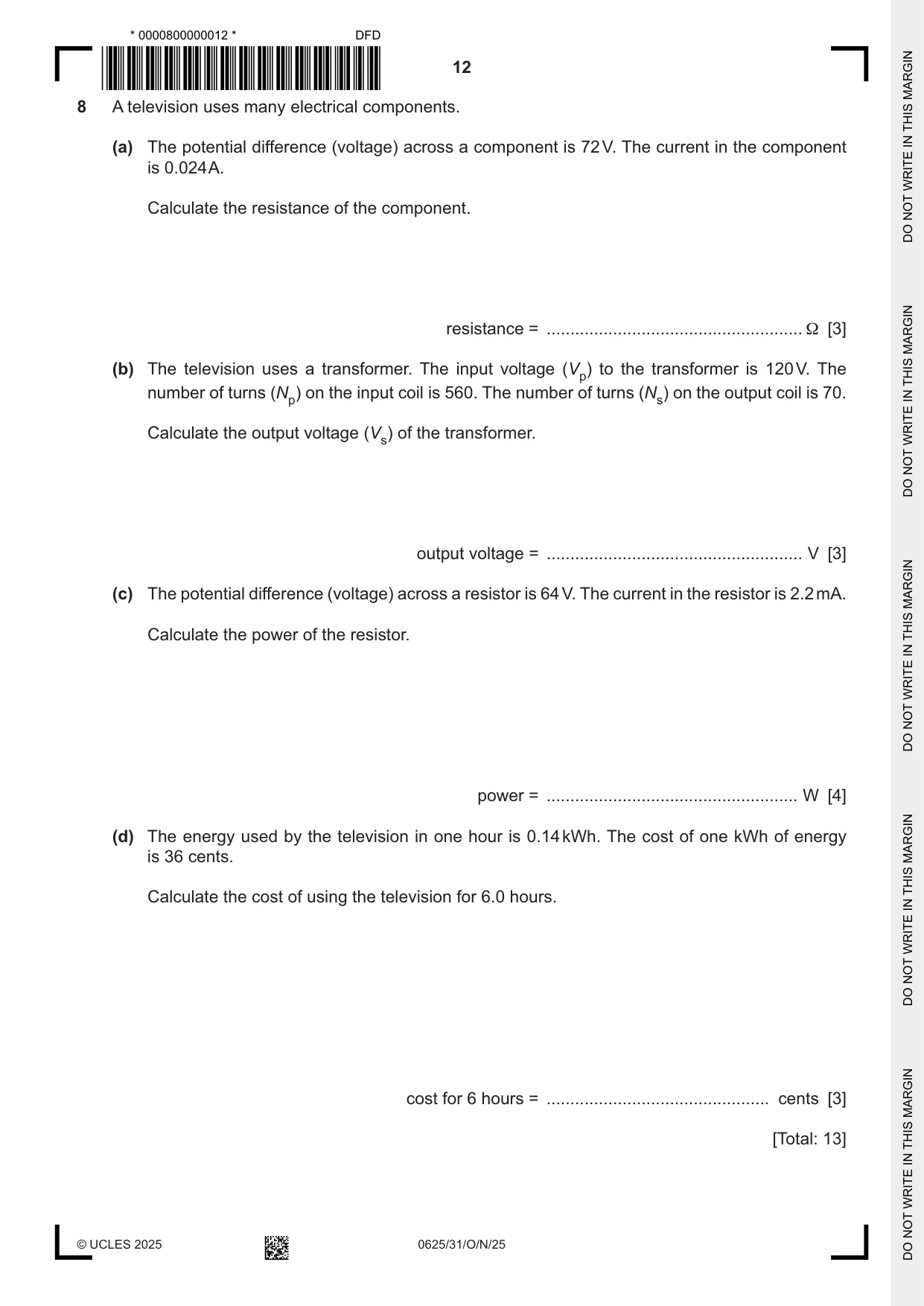
8 A television uses many electrical components. (a) The potential difference (voltage) across a component is 72 V. The current in the component is 0.024 A. Calculate the resistance of the component. resistance = ...................................................... Ω [3] (b) The television uses a transformer. The input voltage (Vp) to the transformer is 120 V. The number of turns (Np) on the input coil is 560. The number of turns (Ns) on the output coil is 70. Calculate the output voltage (Vs) of the transformer. output voltage = ...................................................... V [3] (c) The potential difference (voltage) across a resistor is 64 V. The current in the resistor is 2.2 mA. Calculate the power of the resistor. power = ..................................................... W [4] (d) The energy used by the television in one hour is 0.14 kWh. The cost of one kWh of energy is 36 cents. Calculate the cost of using the television for 6.0 hours. cost for 6 hours = ............................................... cents [3] [Total: 13]
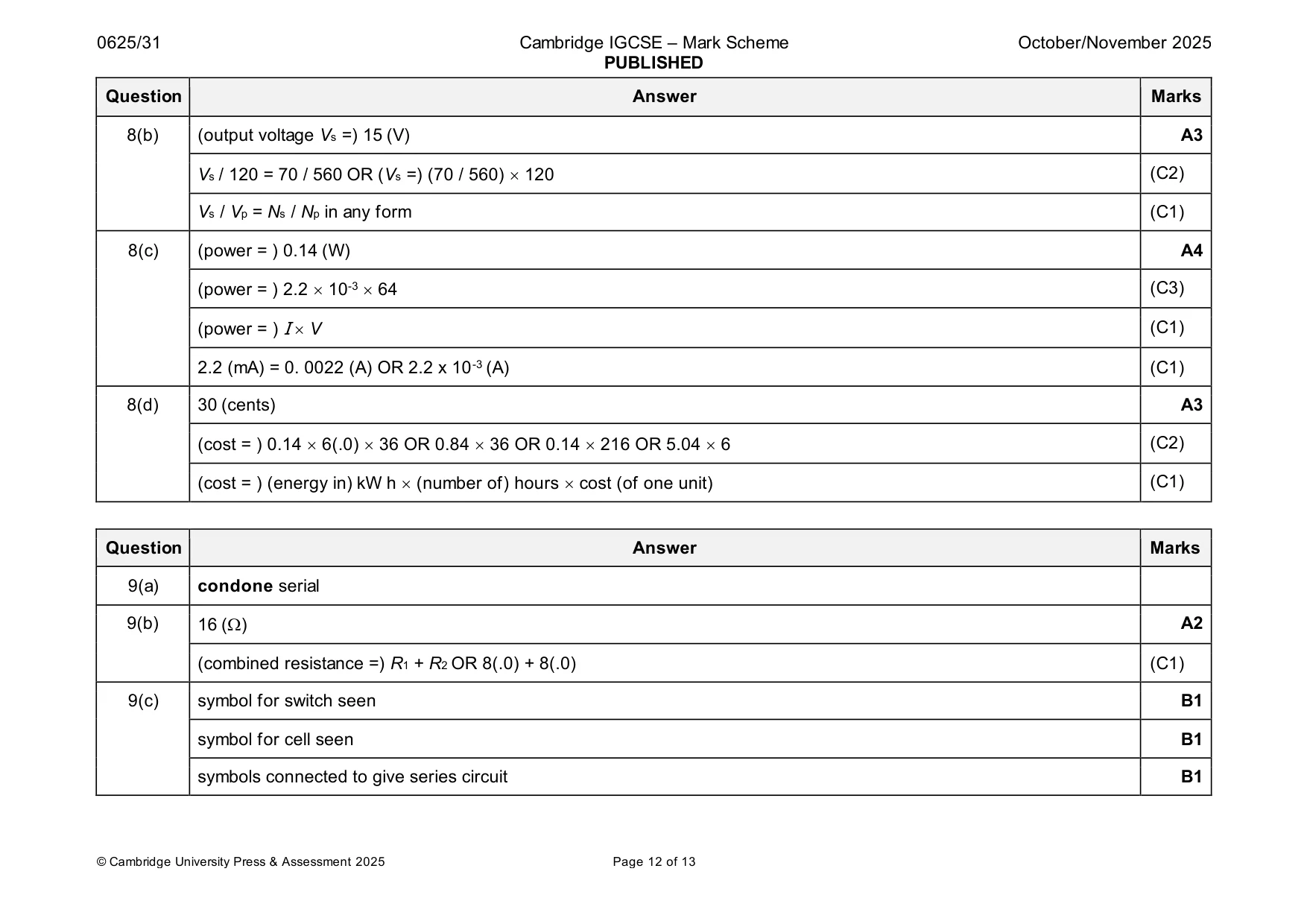
Mark scheme: 8(a) 3000 () A3 72 / 0.024 (C2) V = IR OR (R = )V / I (C1) 8(b) (output voltage Vs =) 15 (V) A3 Vs / 120 = 70 / 560 OR (Vs =) (70 / 560) 120 (C2) Vs / Vp = Ns / Np in any form (C1) 8(c) (power = ) 0.14 (W) A4 (power = ) 2.2 10-3 64 (C3) (power = ) I V (C1) 2.2 (mA) = 0. 0022 (A) OR 2.2 x 10⁻³ (A) (C1) 8(d) 30 (cents) A3 (cost = ) 0.14 6(.0) 36 OR 0.84 36 OR 0.14 216 OR 5.04 6 (C2) (cost = ) (energy in) kW h (number of) hours cost (of one unit) (C1)
Q9 · A teacher connects the circuit shown in Fig
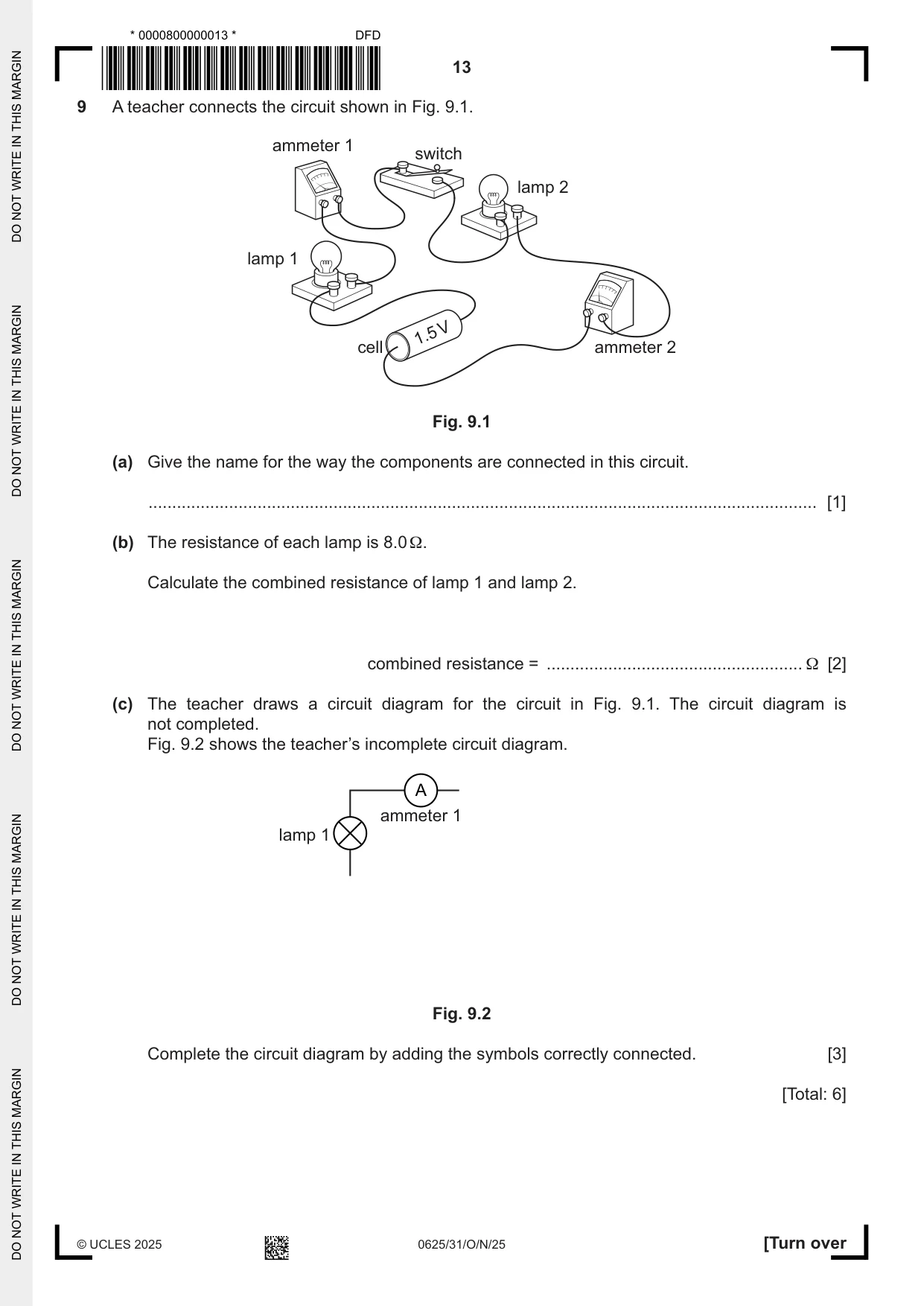
9 A teacher connects the circuit shown in Fig. 9.1. ammeter 1 switch lamp 2 lamp 1 V 1.5 cell ammeter 2 Fig. 9.1 (a) Give the name for the way the components are connected in this circuit. ............................................................................................................................................. [1] (b) The resistance of each lamp is 8.0 Ω. Calculate the combined resistance of lamp 1 and lamp 2. combined resistance = ...................................................... Ω [2] (c) The teacher draws a circuit diagram for the circuit in Fig. 9.1. The circuit diagram is not completed. Fig. 9.2 shows the teacher’s incomplete circuit diagram. A ammeter 1 lamp 1 Fig. 9.2 Complete the circuit diagram by adding the symbols correctly connected. [3] [Total: 6]
Mark scheme: 9(b) 16 () A2 (combined resistance =) R1 + R2 OR 8(.0) + 8(.0) (C1) 9(c) symbol for switch seen B1 symbol for cell seen B1 symbols connected to give series circuit B1
Q10 · Radium is a radioactive element with the chemical symbol Ra
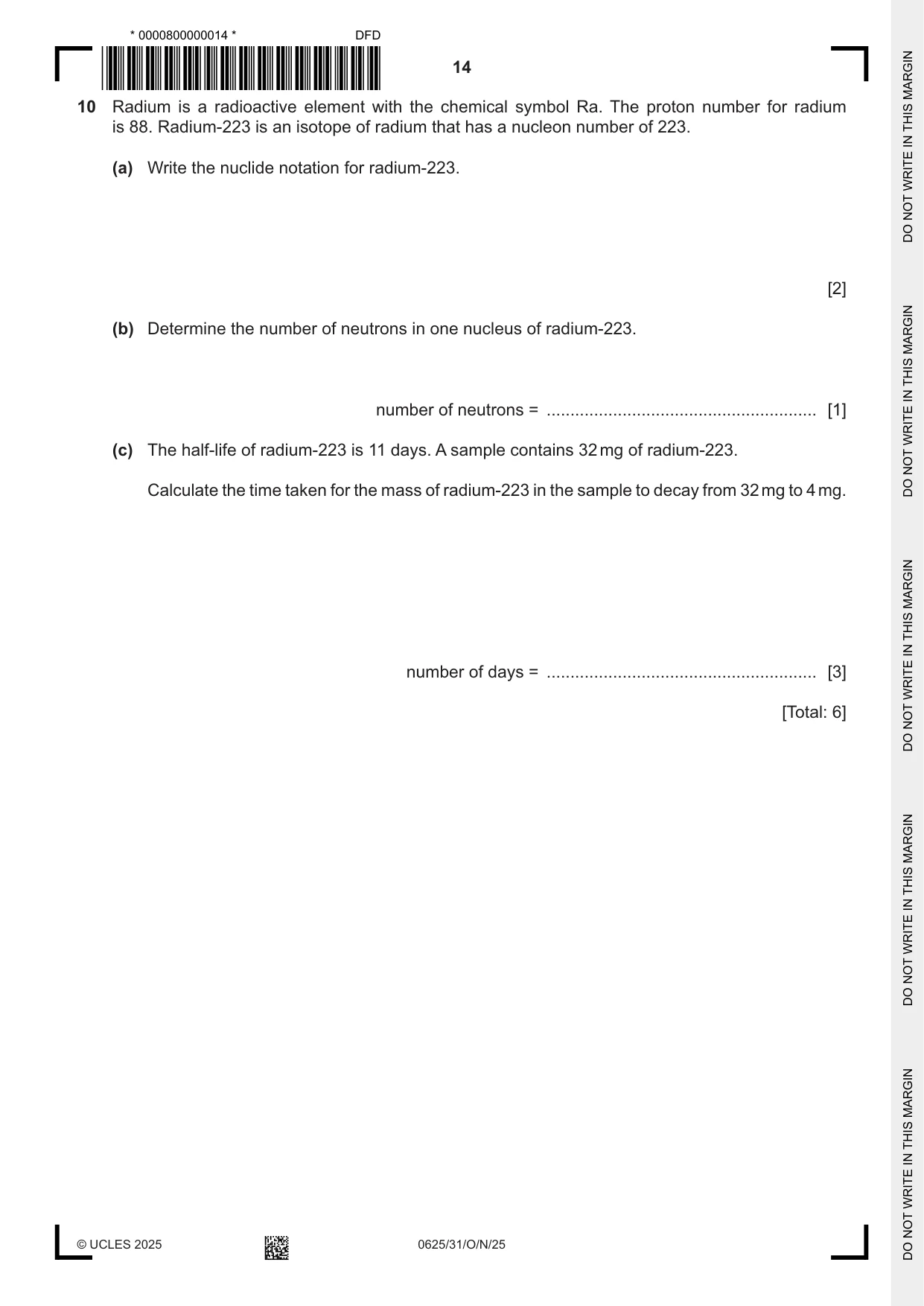
10 Radium is a radioactive element with the chemical symbol Ra. The proton number for radium is 88. Radium-223 is an isotope of radium that has a nucleon number of 223. (a) Write the nuclide notation for radium-223. [2] (b) Determine the number of neutrons in one nucleus of radium-223. number of neutrons = ......................................................... [1] (c) The half-life of radium-223 is 11 days. A sample contains 32 mg of radium-223. Calculate the time taken for the mass of radium-223 in the sample to decay from 32 mg to 4 mg. number of days = ......................................................... [3] [Total: 6]
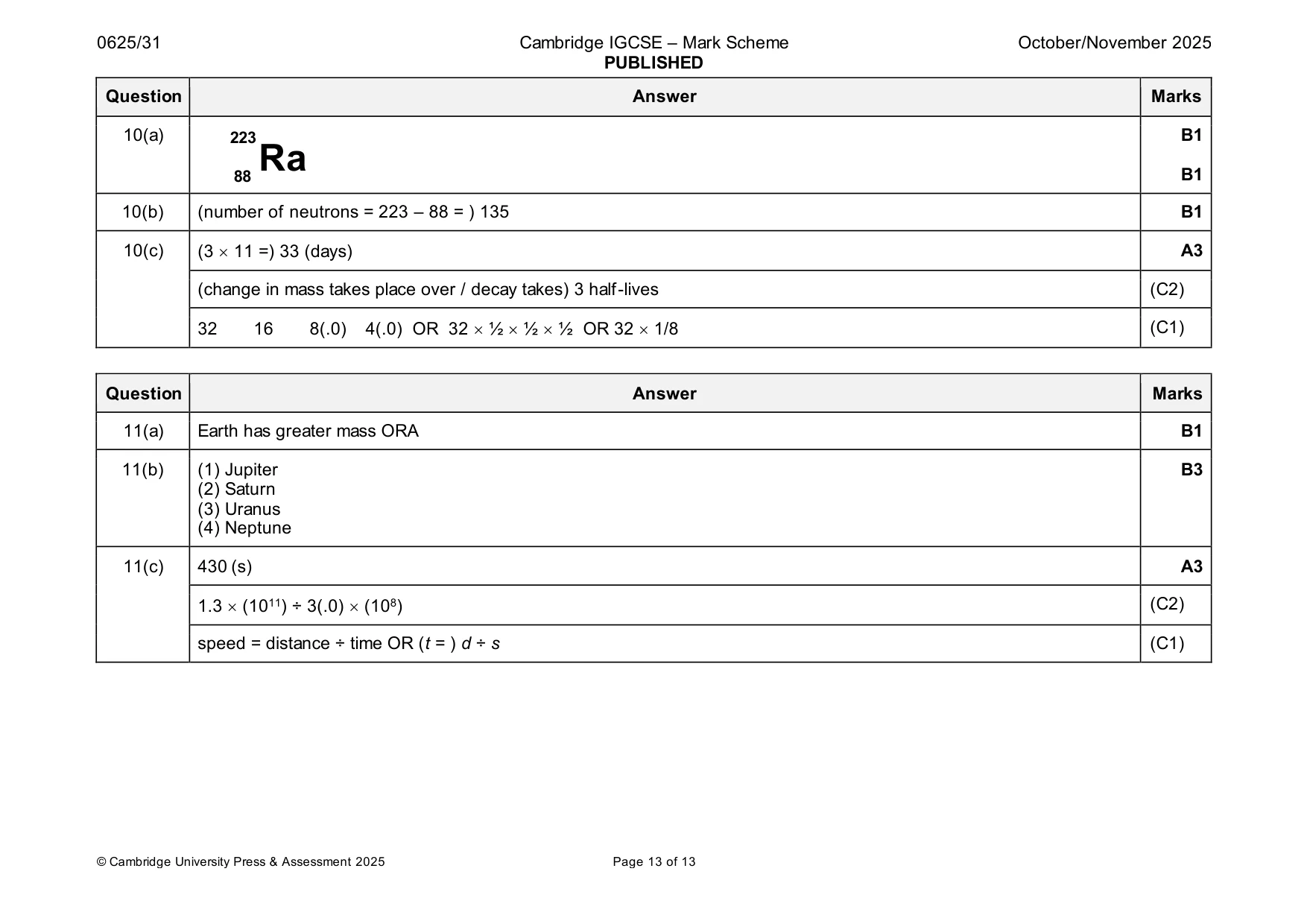
Mark scheme: 10(a) 223 B1 Ra 88 B1 10(b) (number of neutrons = 223 – 88 = ) 135 B1 10(c) (3 11 =) 33 (days) A3 (change in mass takes place over / decay takes) 3 half-lives (C2) 32 16 8(.0) 4(.0) OR 32 ½ ½ ½ OR 32 1/8 (C1)
Q11 · Mars is one of the four rocky planets nearest the Sun
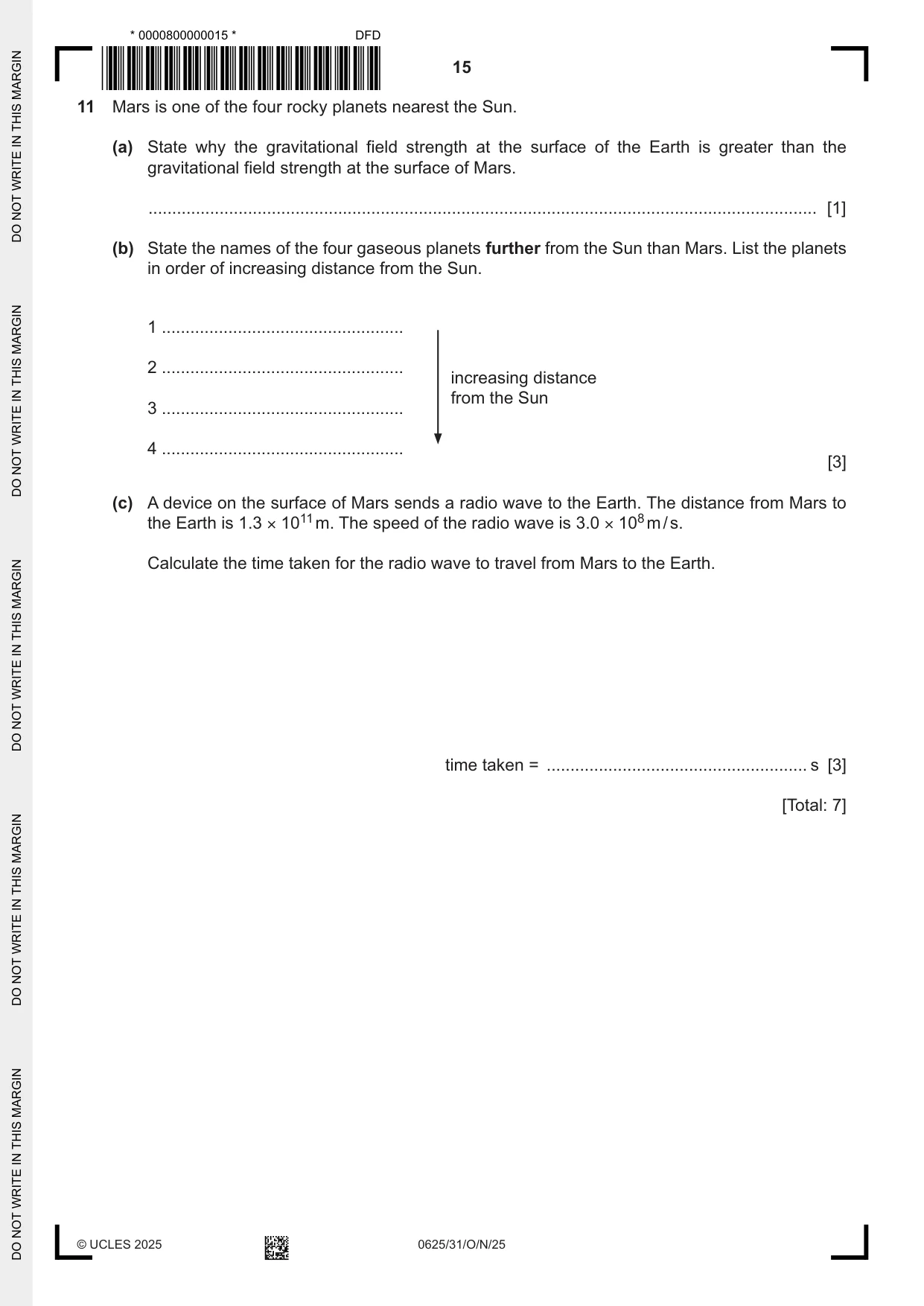
11 Mars is one of the four rocky planets nearest the Sun. (a) State why the gravitational field strength at the surface of the Earth is greater than the gravitational field strength at the surface of Mars. ............................................................................................................................................. [1] (b) State the names of the four gaseous planets further from the Sun than Mars. List the planets in order of increasing distance from the Sun. 1 ................................................... 2 ................................................... increasing distance from the Sun 3 ................................................... 4 ................................................... [3] (c) A device on the surface of Mars sends a radio wave to the Earth. The distance from Mars to the Earth is 1.3 × 10¹¹ m. The speed of the radio wave is 3.0 × 10⁸ m / s. Calculate the time taken for the radio wave to travel from Mars to the Earth. time taken = ....................................................... s [3] [Total: 7]
Mark scheme: 11(a) Earth has greater mass ORA B1 11(b) (1) Jupiter B3 (2) Saturn (3) Uranus (4) Neptune 11(c) 430 (s) A3 1.3 (1011) ÷ 3(.0) (108) (C2) speed = distance ÷ time OR (t = ) d ÷ s (C1)
What was in this paper
The subtopics covered by these 11 questions, and how many questions each got. Open one in a new tab to see every Cambridge question on it.
What you needed in this session
Cambridge’s own grade thresholds for 2025 Oct/Nov, Paper 3 · Variant 1. A higher threshold means an easier paper — the bar moves with how the cohort did.