Cambridge IGCSE Physics 0625 — 2018 May/June Paper 3 · Variant 3
0625/33/M/J/18 · 12 questions · 80 marks · ≈90 min
The question paper and its mark scheme, free to read here and free to download. This is Cambridge’s own paper, exactly as it was sat.
Question paper16 pages
Mark scheme10 pages
Answers below. Sit the paper first if you are practising.
Questions as text
Q1 · A student watches a car race around a track
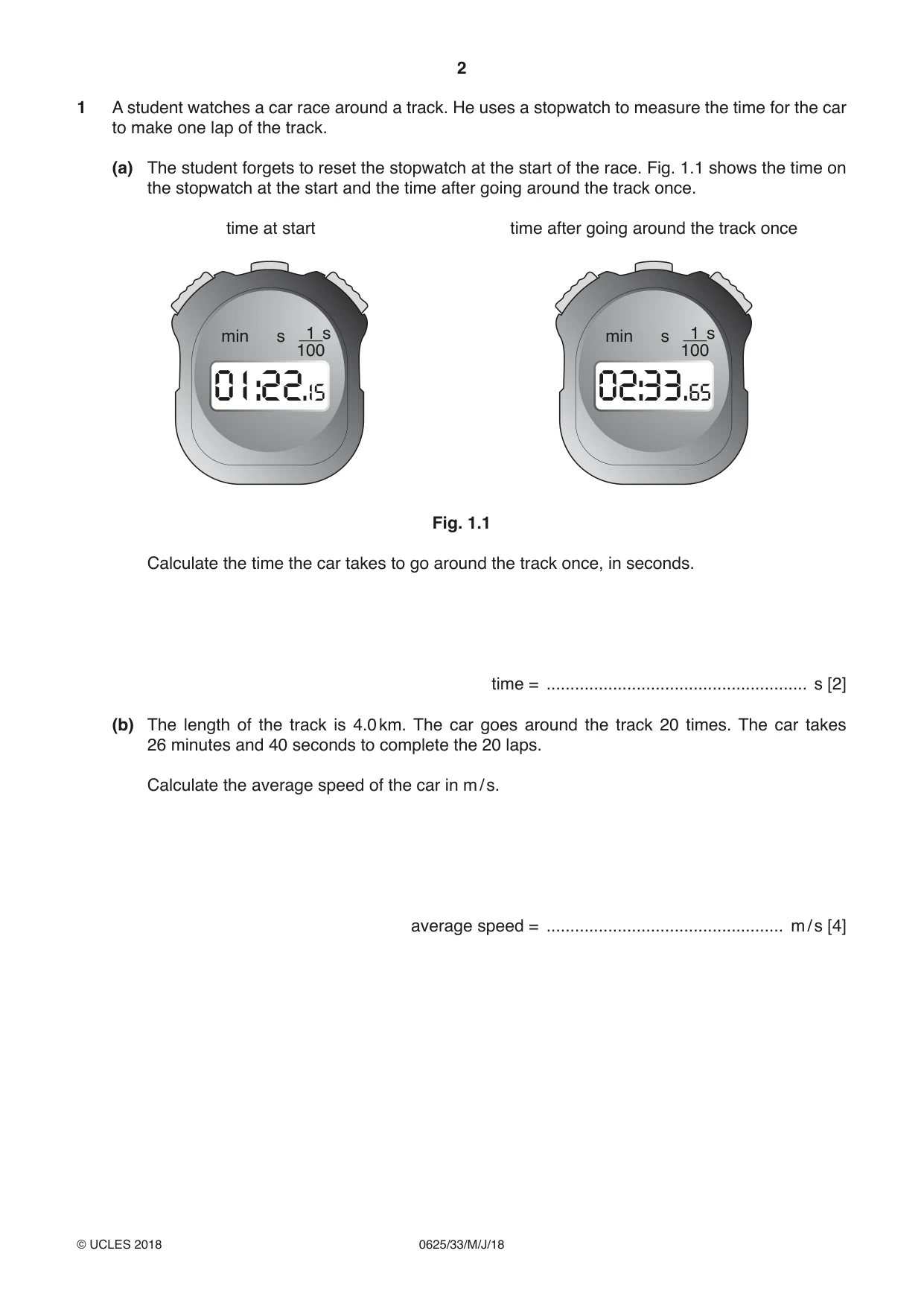
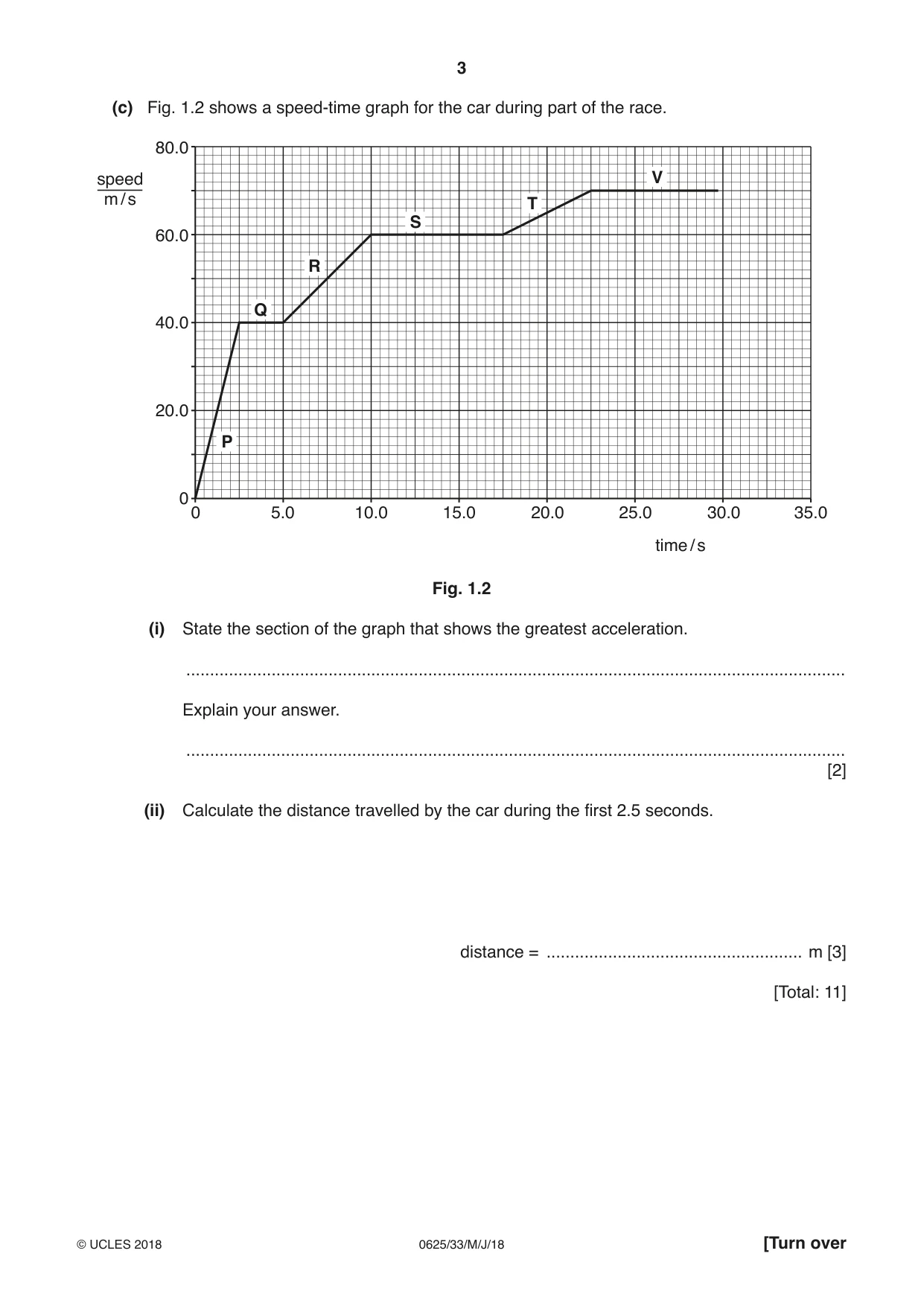
1 A student watches a car race around a track. He uses a stopwatch to measure the time for the car to make one lap of the track. (a) The student forgets to reset the stopwatch at the start of the race. Fig. 1.1 shows the time on the stopwatch at the start and the time after going around the track once. time at start time after going around the track once min s 1 s min s 1 s 100 100 01:22. 02:33. Fig. 1.1 Calculate the time the car takes to go around the track once, in seconds. time = ....................................................... s [2] (b) The length of the track is 4.0 km. The car goes around the track 20 times. The car takes 26 minutes and 40 seconds to complete the 20 laps. Calculate the average speed of the car in m / s. average speed = .................................................. m / s [4] (c) Fig. 1.2 shows a speed-time graph for the car during part of the race. 80.0 speed V m / s T S 60.0 R Q 40.0 20.0 P 0 0 5.0 10.0 15.0 20.0 25.0 30.0 35.0 time / s Fig. 1.2 (i) State the section of the graph that shows the greatest acceleration. ........................................................................................................................................... Explain your answer. ........................................................................................................................................... [2] (ii) Calculate the distance travelled by the car during the first 2.5 seconds. distance = ...................................................... m [3] [Total: 11]
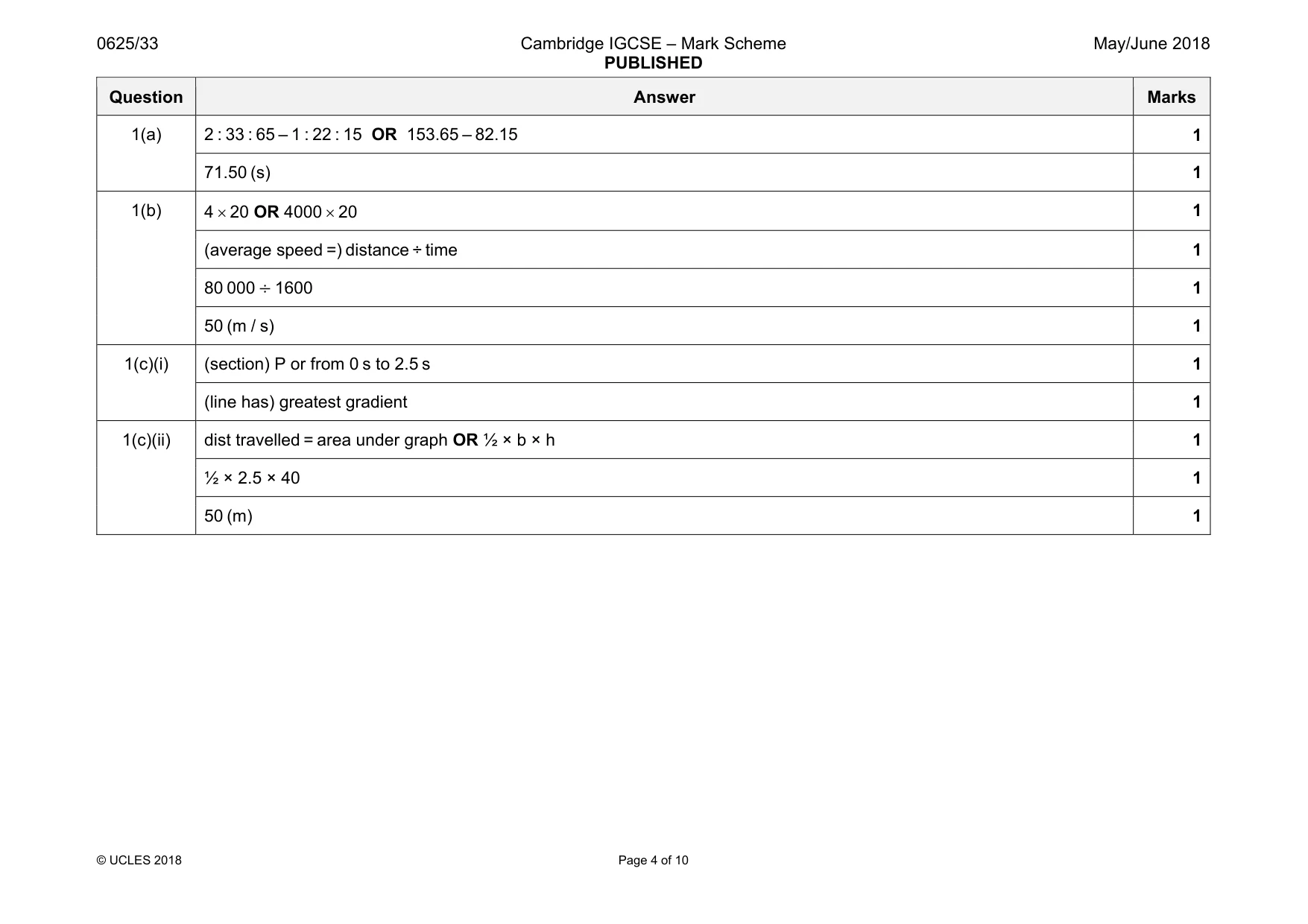
Mark scheme: 1(a) 2 : 33 : 65 – 1 : 22 : 15 OR 153.65 – 82.15 1 71.50 (s) 1 1(b) 4 × 20 OR 4000 × 20 1 (average speed =) distance ÷ time 1 80 000 ÷ 1600 1 50 (m / s) 1 1(c)(i) (section) P or from 0 s to 2.5 s 1 (line has) greatest gradient 1 1(c)(ii) dist travelled = area under graph OR ½ × b × h 1 ½ × 2.5 × 40 1 50 (m) 1
Q2 · A student is using some 50 g masses
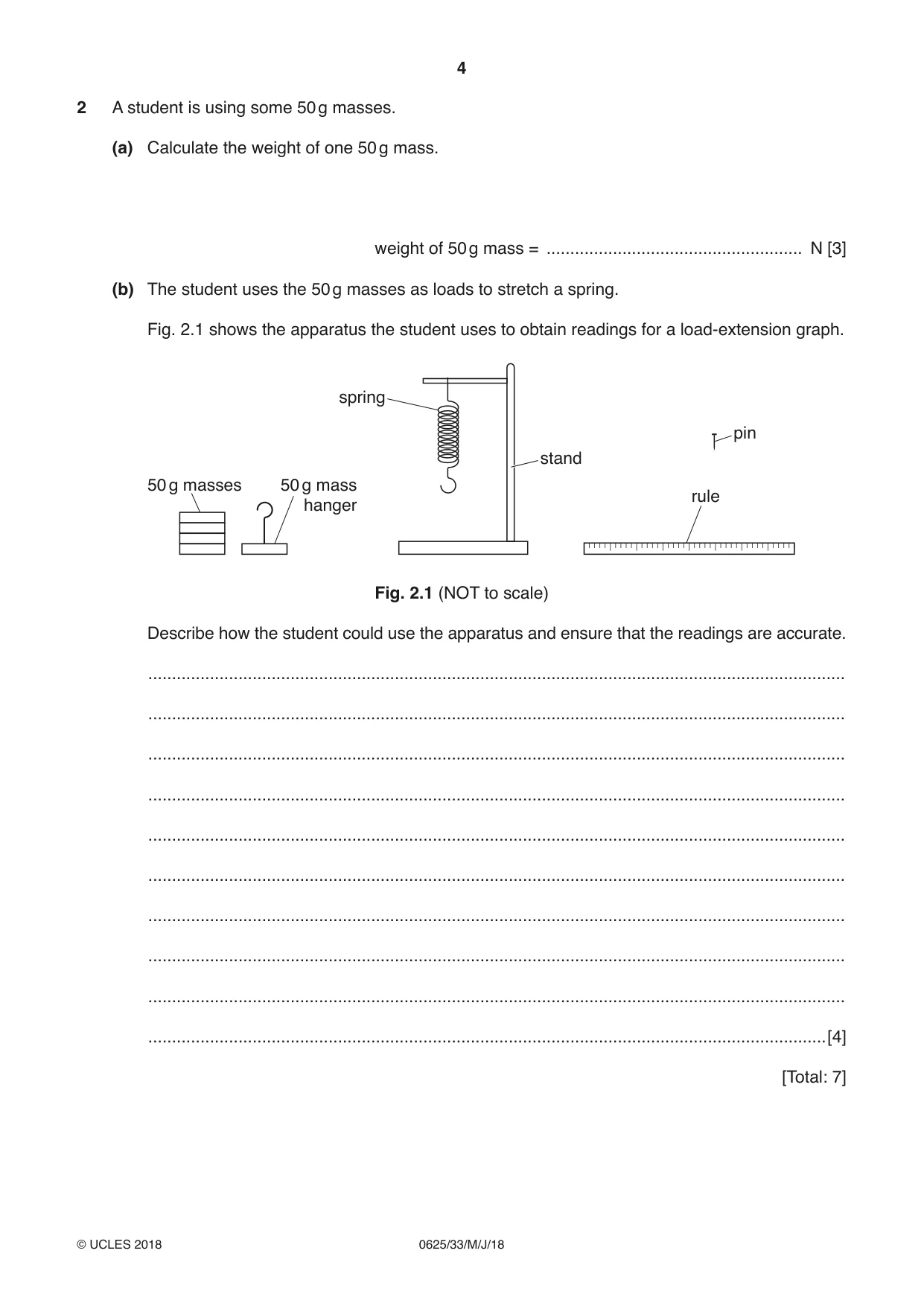
2 A student is using some 50 g masses. (a) Calculate the weight of one 50 g mass. weight of 50 g mass = ...................................................... N [3] (b) The student uses the 50 g masses as loads to stretch a spring. Fig. 2.1 shows the apparatus the student uses to obtain readings for a load-extension graph. spring pin stand 50 g masses 50 g mass rule hanger Fig. 2.1 (NOT to scale) Describe how the student could use the apparatus and ensure that the readings are accurate. ................................................................................................................................................... ................................................................................................................................................... ................................................................................................................................................... ................................................................................................................................................... ................................................................................................................................................... ................................................................................................................................................... ................................................................................................................................................... ................................................................................................................................................... ................................................................................................................................................... ...............................................................................................................................................[4] [Total: 7]
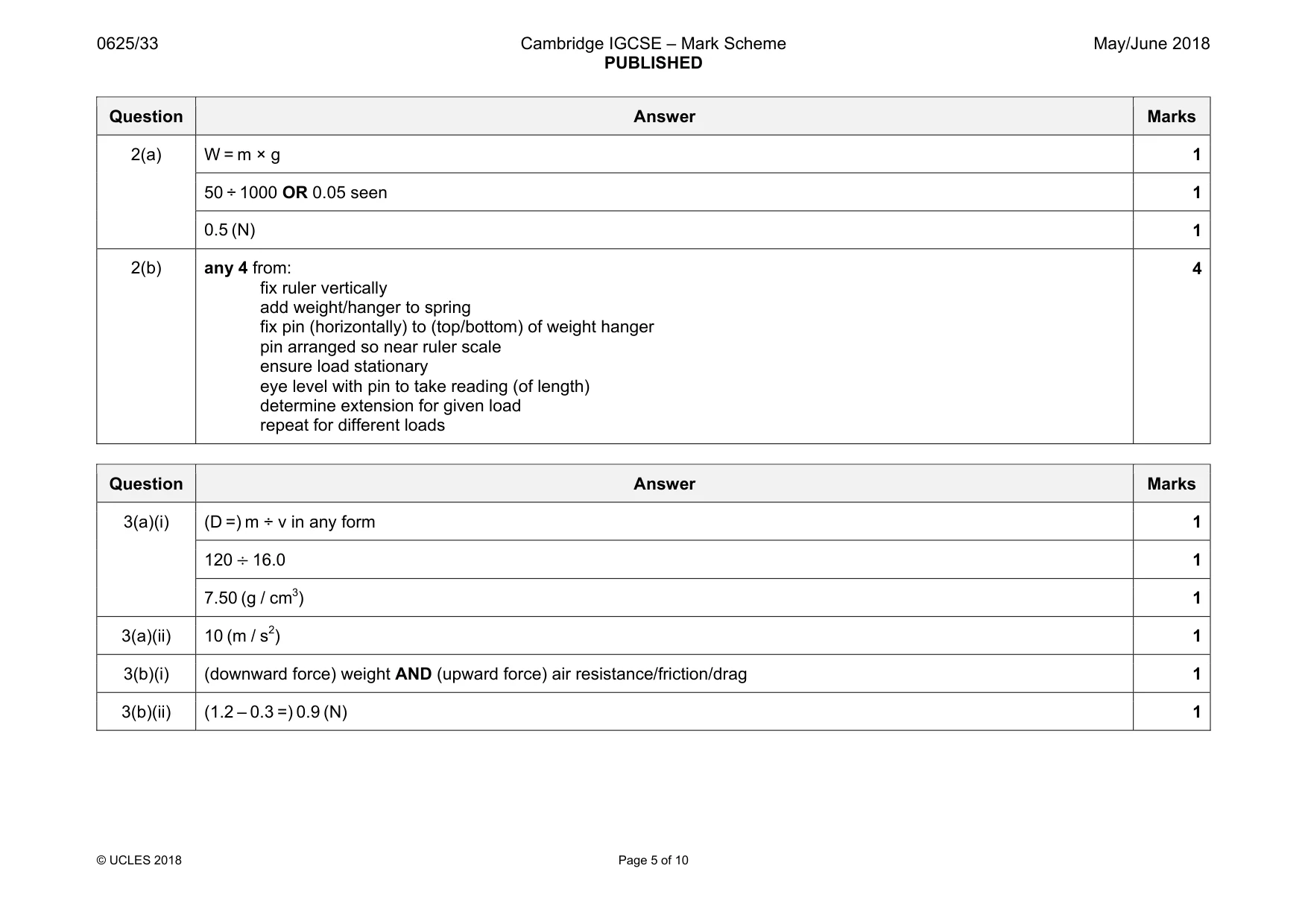
Mark scheme: 2(a) W = m × g 1 50 ÷ 1000 OR 0.05 seen 1 0.5 (N) 1 2(b) any 4 from: fix ruler vertically add weight/hanger to spring fix pin (horizontally) to (top/bottom) of weight hanger pin arranged so near ruler scale ensure load stationary eye level with pin to take reading (of length) determine extension for given load repeat for different loads 4
Q3 · The mass of a small steel ball is 120 g
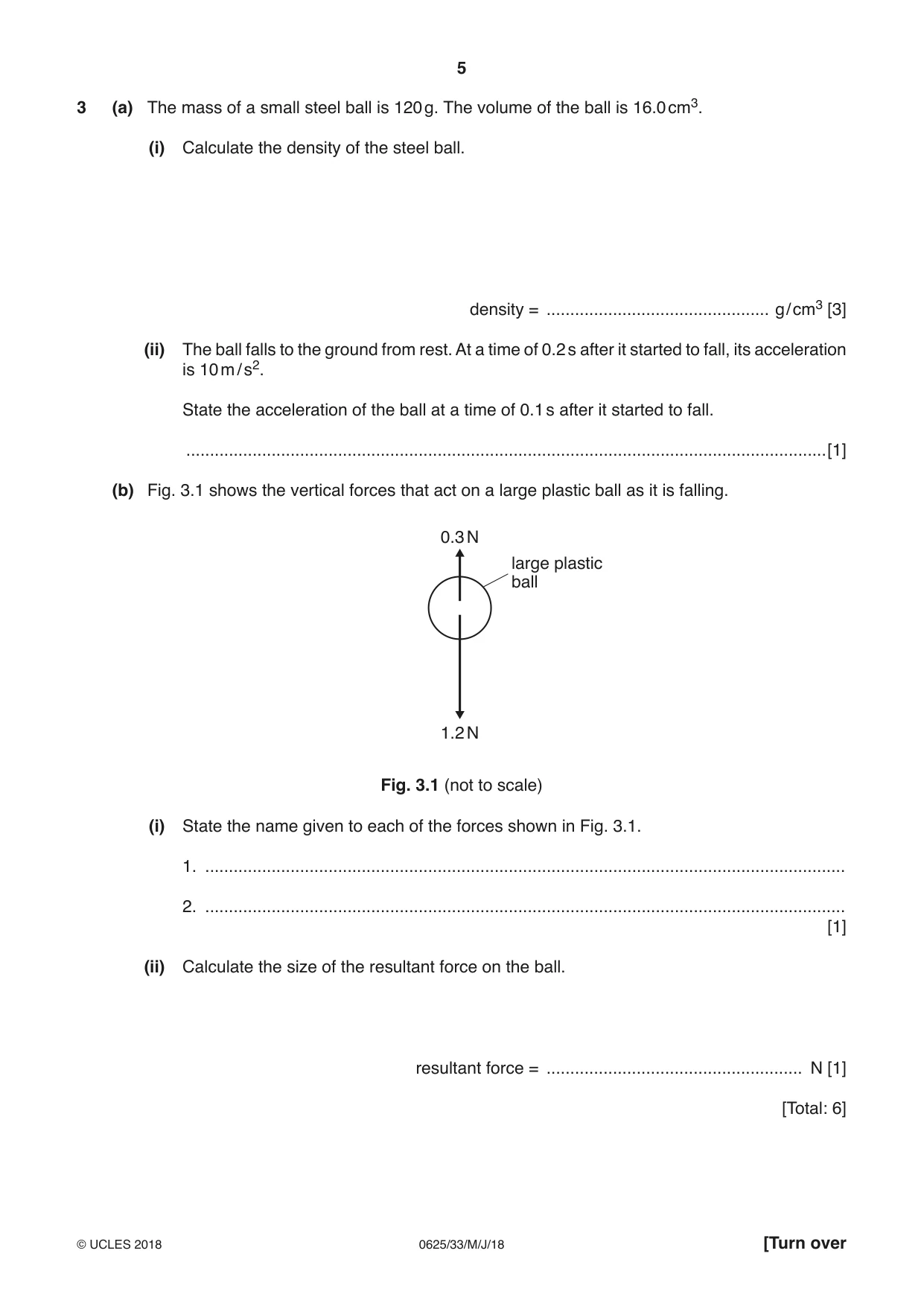
3 (a) The mass of a small steel ball is 120 g. The volume of the ball is 16.0 cm3. (i) Calculate the density of the steel ball. density = ............................................... g / cm3 [3] (ii) The ball falls to the ground from rest. At a time of 0.2 s after it started to fall, its acceleration is 10 m / s2. State the acceleration of the ball at a time of 0.1 s after it started to fall. .......................................................................................................................................[1] (b) Fig. 3.1 shows the vertical forces that act on a large plastic ball as it is falling. 0.3 N large plastic ball 1.2 N Fig. 3.1 (not to scale) (i) State the name given to each of the forces shown in Fig. 3.1. 1. ....................................................................................................................................... 2. ....................................................................................................................................... [1] (ii) Calculate the size of the resultant force on the ball. resultant force = ...................................................... N [1] [Total: 6]
Mark scheme: 3(a)(i) (D =) m ÷ v in any form 1 120 ÷ 16.0 1 7.50 (g / cm3) 1 3(a)(ii) 10 (m / s2) 1 3(b)(i) (downward force) weight AND (upward force) air resistance/friction/drag 1 3(b)(ii) (1.2 – 0.3 =) 0.9 (N) 1
Q4 · A lamp is attached to a wall, as shown in Fig
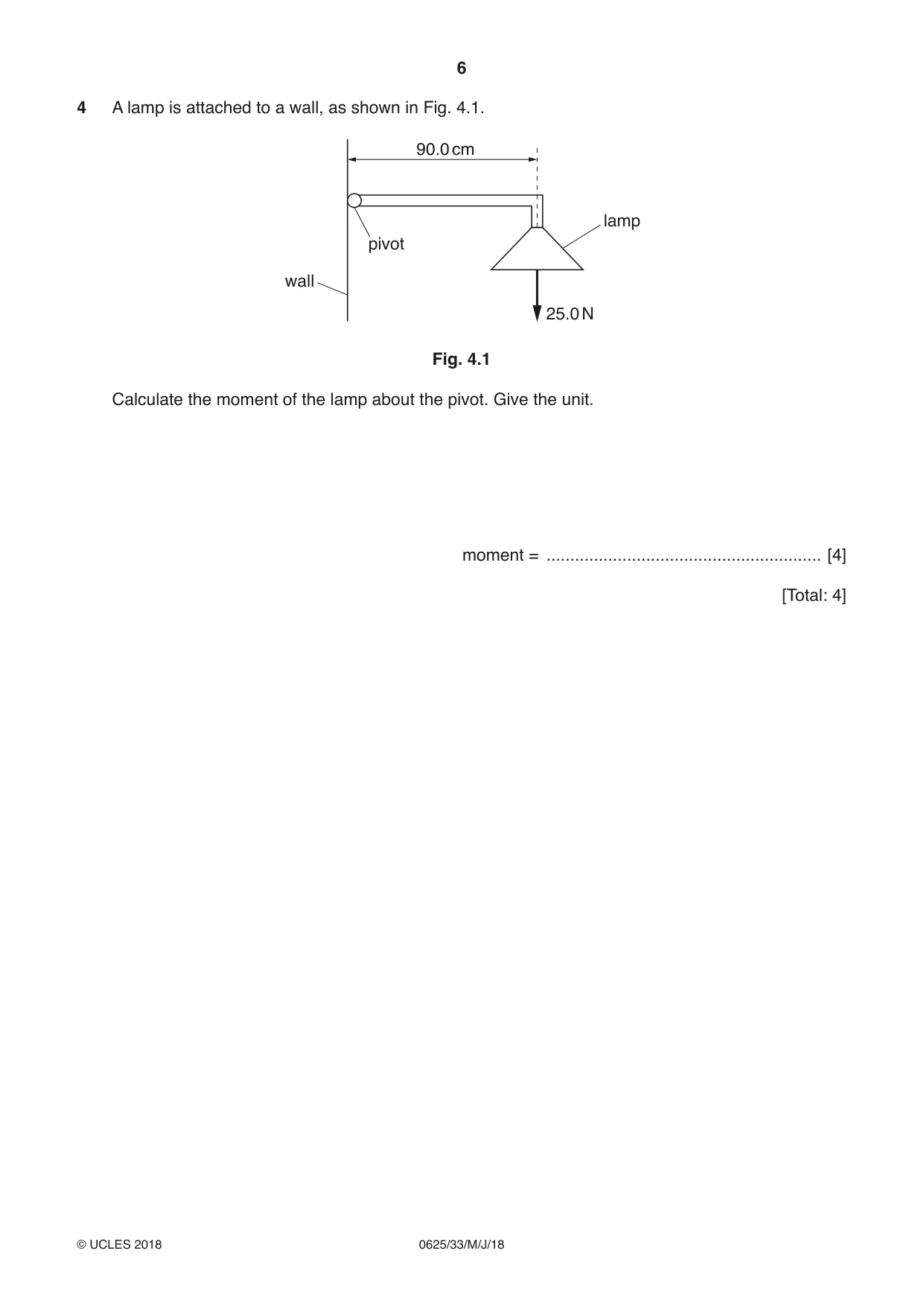
4 A lamp is attached to a wall, as shown in Fig. 4.1. 90.0 cm lamp pivot wall 25.0 N Fig. 4.1 Calculate the moment of the lamp about the pivot. Give the unit. moment = .......................................................... [4] [Total: 4]
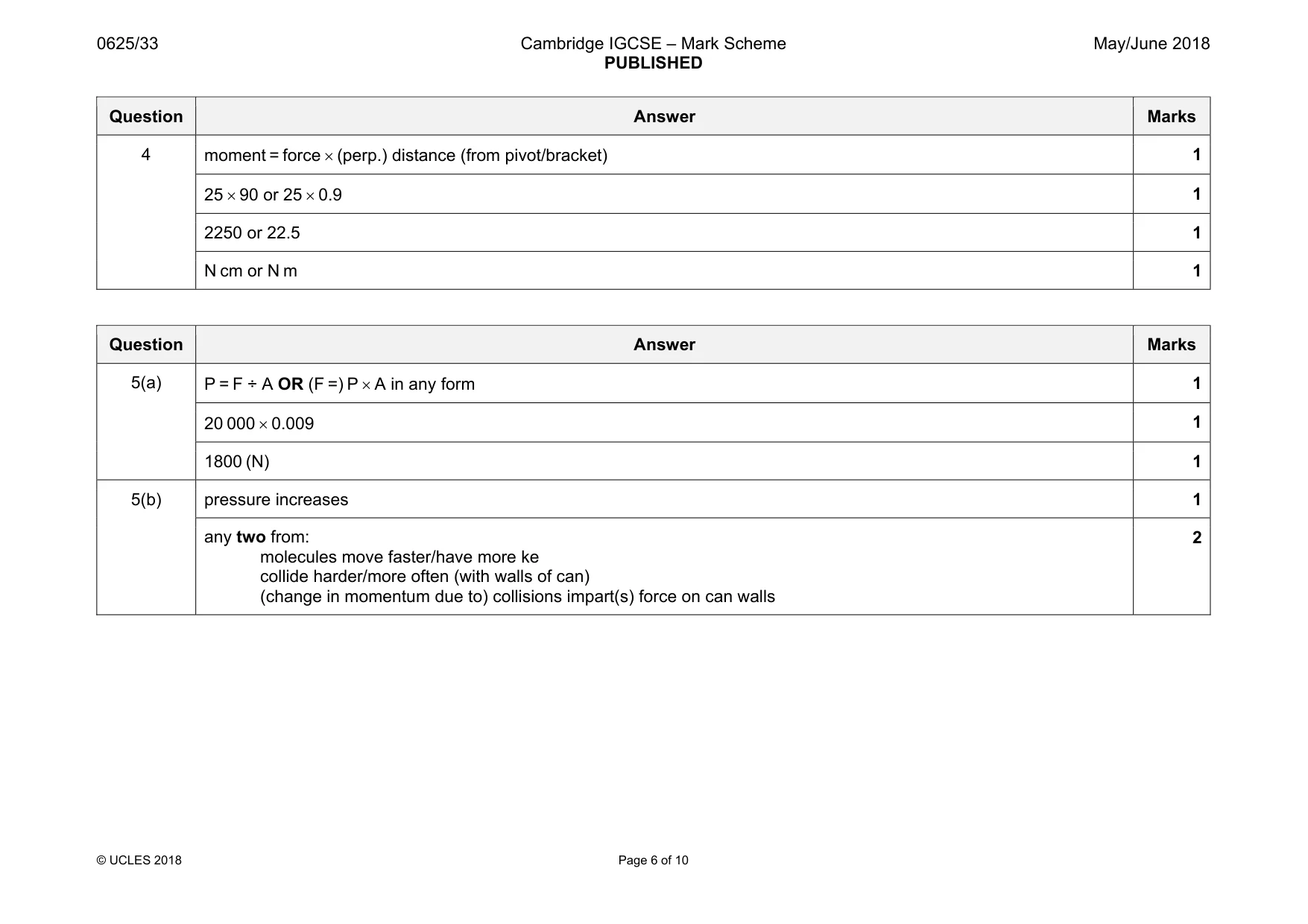
Mark scheme: 4 1 25 × 90 or 25 × 0.9 1 2250 or 22.5 1 N cm or N m 1
Q5 · A metal can containing air
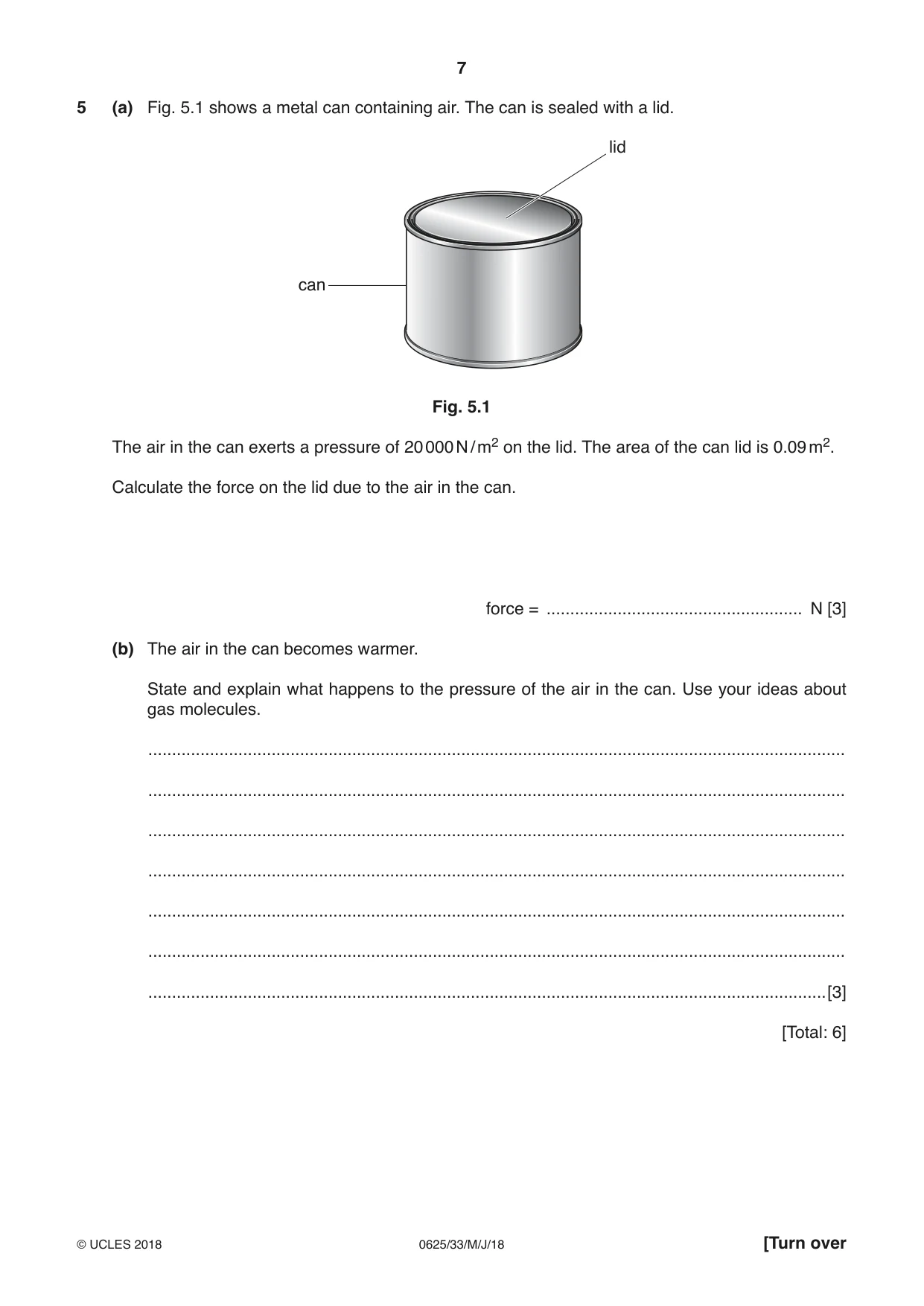
5 (a) Fig. 5.1 shows a metal can containing air. The can is sealed with a lid. lid can Fig. 5.1 The air in the can exerts a pressure of 20 000 N / m2 on the lid. The area of the can lid is 0.09 m2. Calculate the force on the lid due to the air in the can. force = ...................................................... N [3] (b) The air in the can becomes warmer. State and explain what happens to the pressure of the air in the can. Use your ideas about gas molecules. ................................................................................................................................................... ................................................................................................................................................... ................................................................................................................................................... ................................................................................................................................................... ................................................................................................................................................... ................................................................................................................................................... ...............................................................................................................................................[3] [Total: 6]
Mark scheme: 5(a) 1 20 000 × 0.009 1 1800 (N) 1 5(b) pressure increases 1 any two from: molecules move faster/have more ke collide harder/more often (with walls of can) (change in momentum due to) collisions impart(s) force on can walls 2
Q6 · A student investigates the thermal energy lost from two metal cans, X and Y
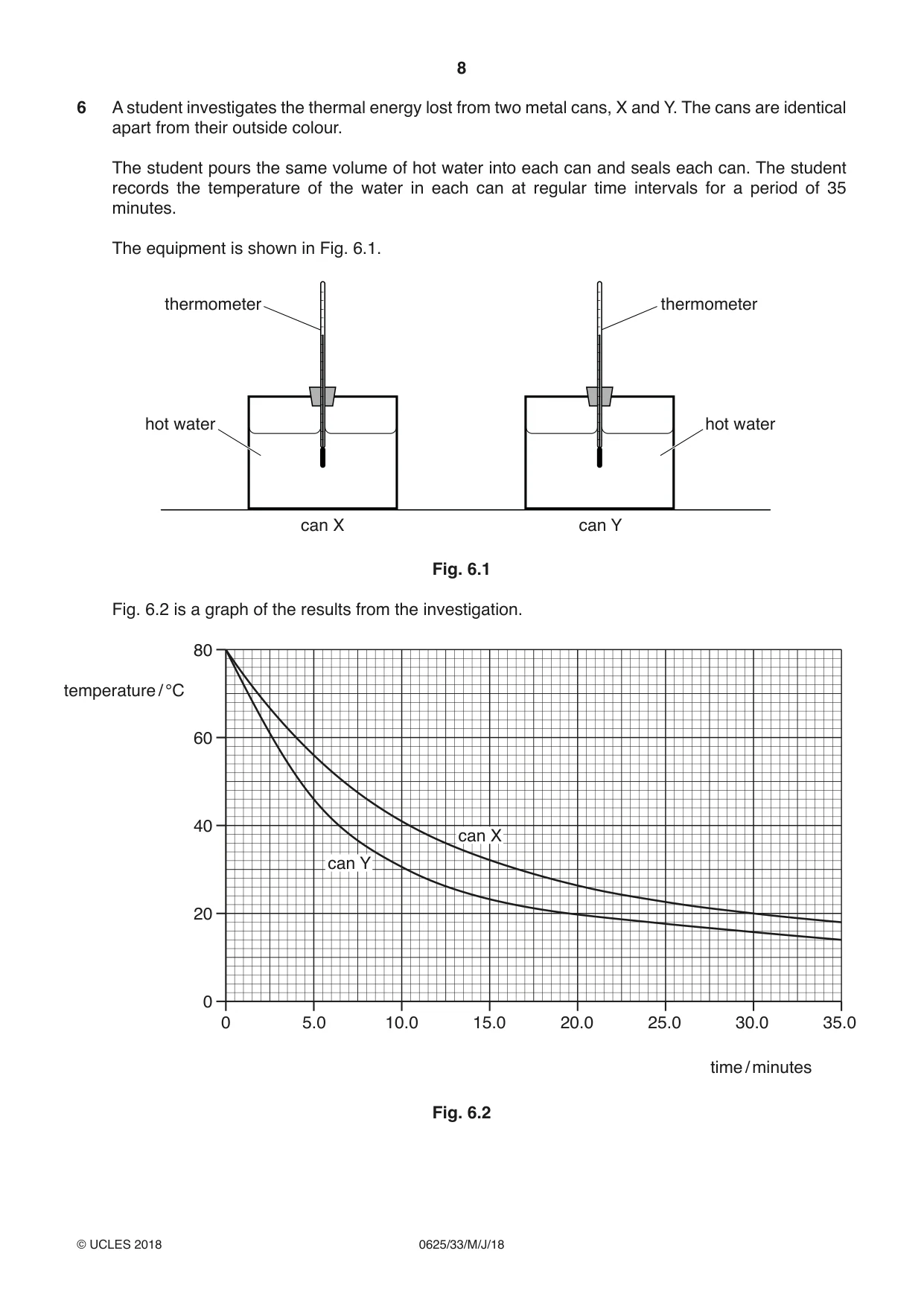
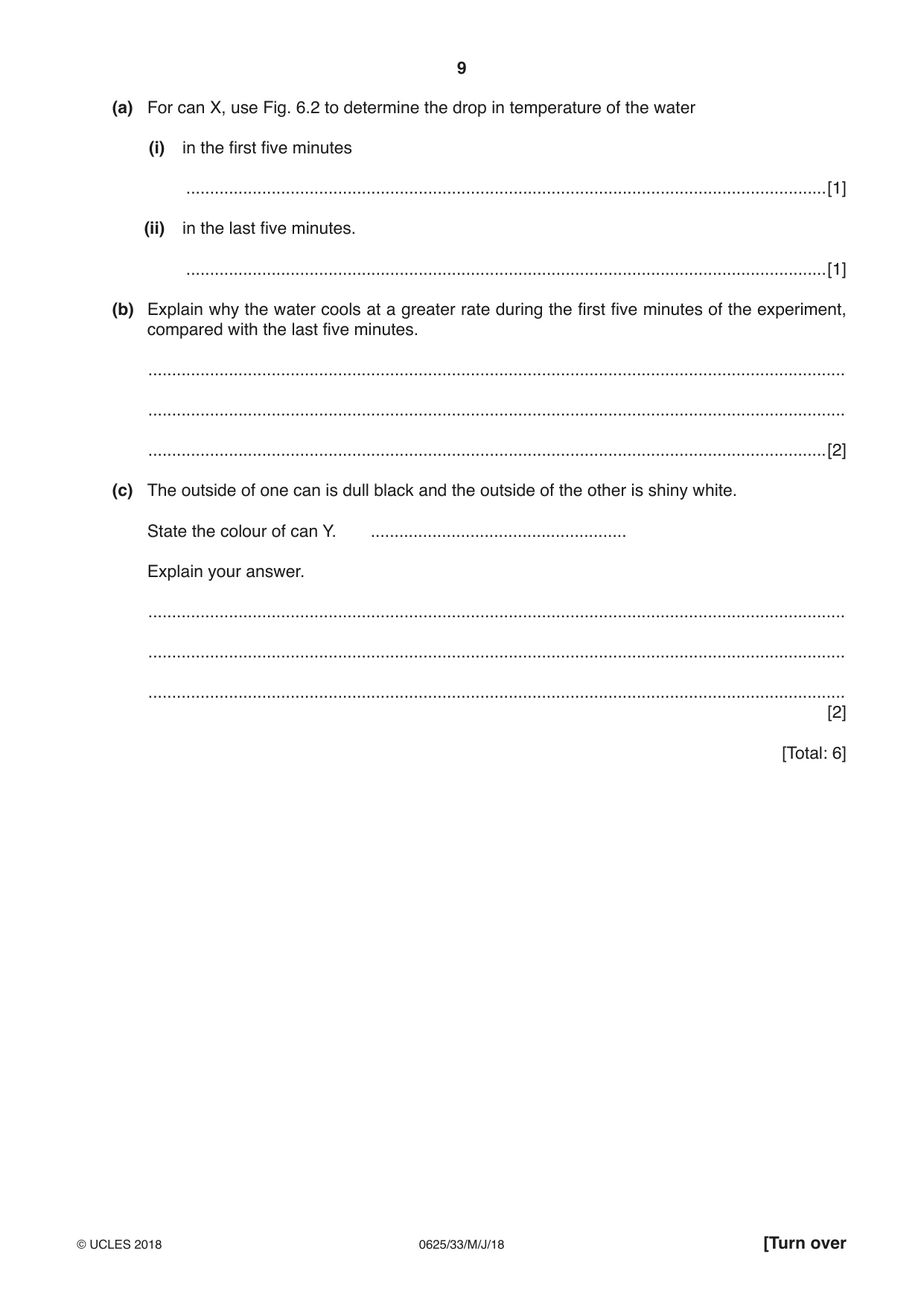
6 A student investigates the thermal energy lost from two metal cans, X and Y. The cans are identical apart from their outside colour. The student pours the same volume of hot water into each can and seals each can. The student records the temperature of the water in each can at regular time intervals for a period of 35 minutes. The equipment is shown in Fig. 6.1. thermometer thermometer hot water hot water can X can Y Fig. 6.1 Fig. 6.2 is a graph of the results from the investigation. 80 temperature / °C 60 40 can X can Y 20 0 0 5.0 10.0 15.0 20.0 25.0 30.0 35.0 time / minutes Fig. 6.2 (a) For can X, use Fig. 6.2 to determine the drop in temperature of the water (i) in the first five minutes .......................................................................................................................................[1] (ii) in the last five minutes. .......................................................................................................................................[1] (b) Explain why the water cools at a greater rate during the first five minutes of the experiment, compared with the last five minutes. ................................................................................................................................................... ................................................................................................................................................... ...............................................................................................................................................[2] (c) The outside of one can is dull black and the outside of the other is shiny white. State the colour of can Y. ...................................................... Explain your answer. ................................................................................................................................................... ................................................................................................................................................... ................................................................................................................................................... [2] [Total: 6]
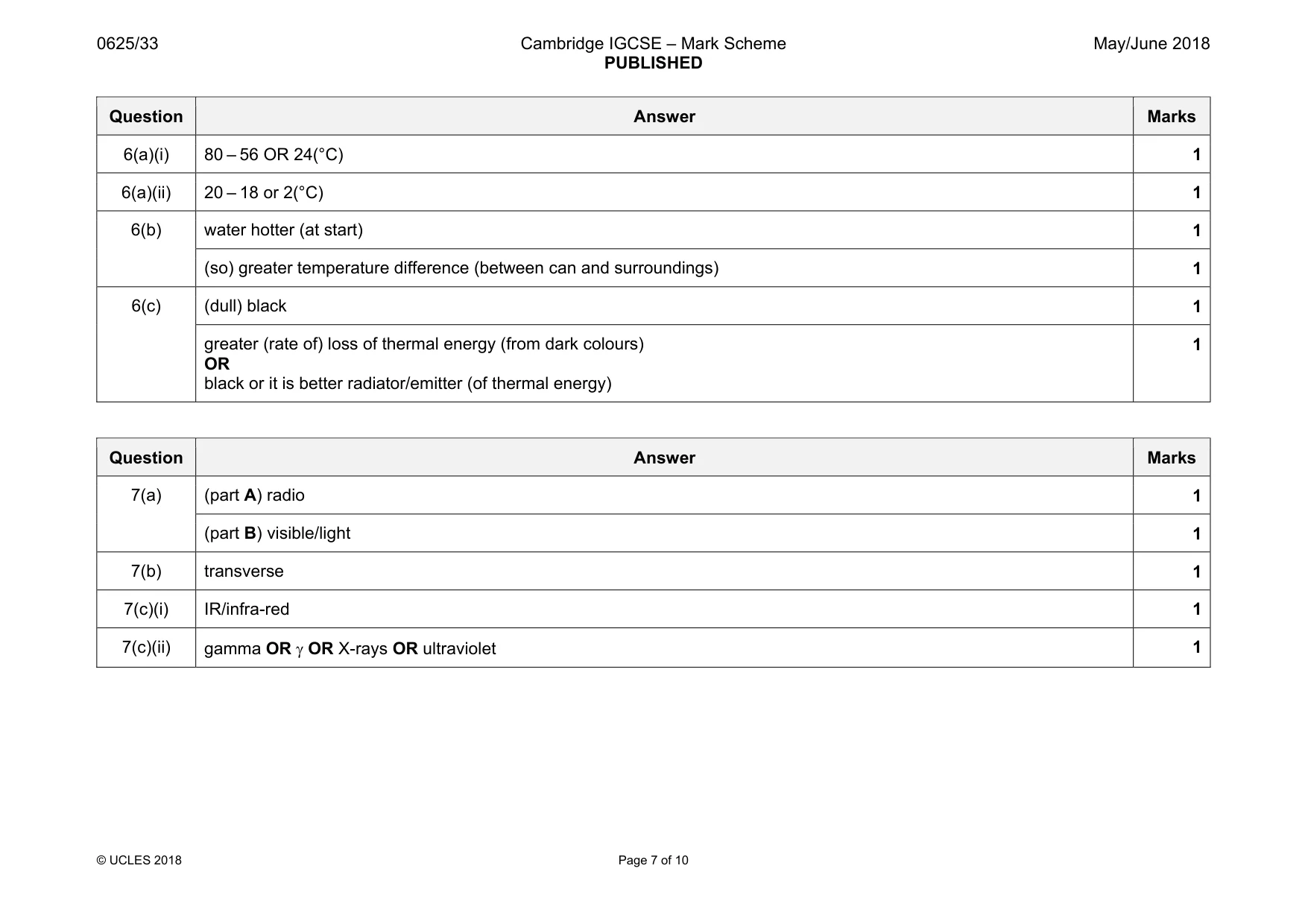
Mark scheme: 6(a)(i) 80 – 56 OR 24(°C) 1 6(a)(ii) 20 – 18 or 2(°C) 1 6(b) water hotter (at start) 1 (so) greater temperature difference (between can and surroundings) 1 6(c) (dull) black 1 greater (rate of) loss of thermal energy (from dark colours) OR black or it is better radiator/emitter (of thermal energy) 1
Q7 · An incomplete diagram of the electromagnetic spectrum
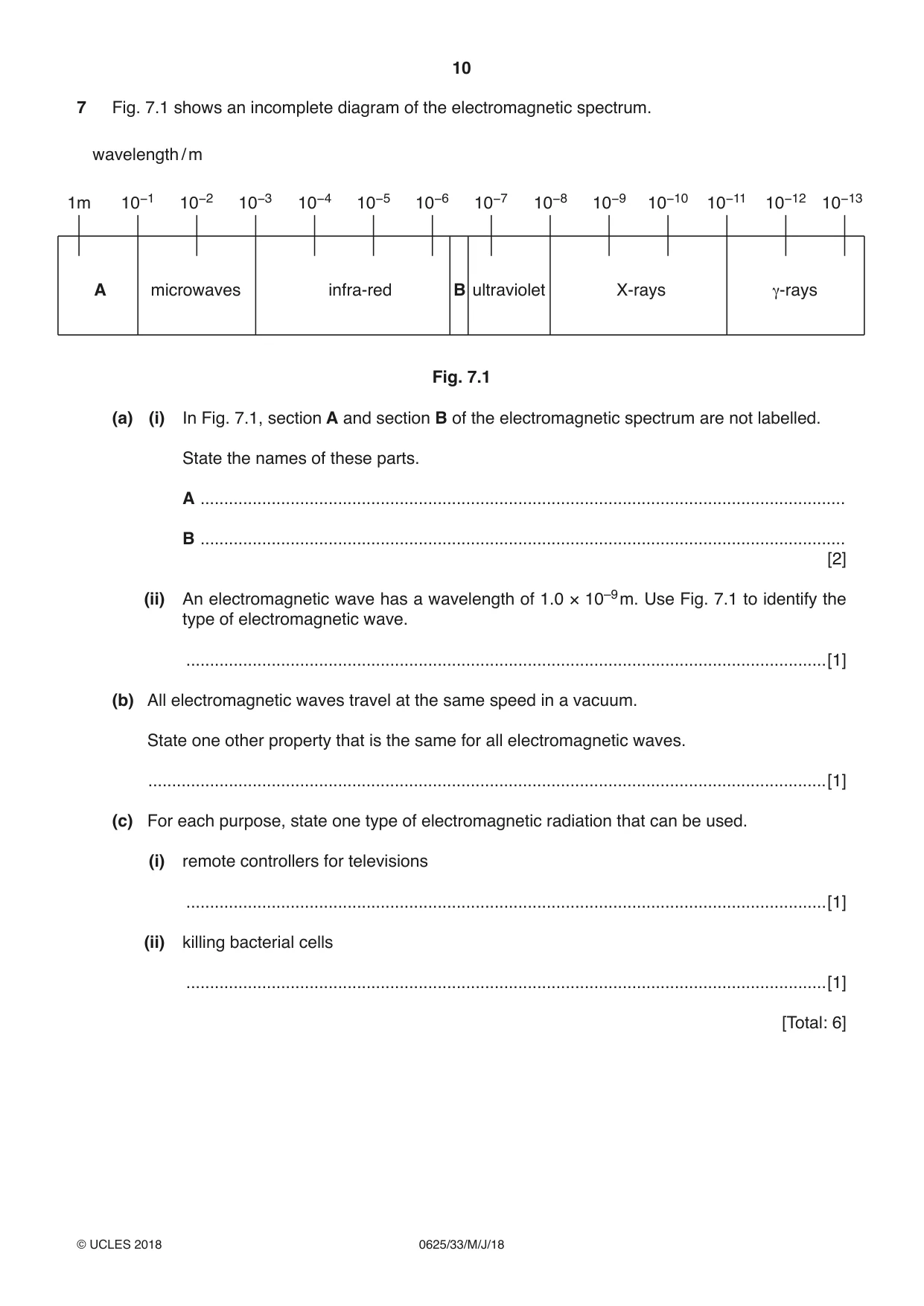
7 Fig. 7.1 shows an incomplete diagram of the electromagnetic spectrum. wavelength / m 1m 10−1 10−2 10−3 10−4 10−5 10−6 10−7 10−8 10−9 10−10 10−11 10−12 10−13 A microwaves infra-red B ultraviolet X-rays γ-rays Fig. 7.1
Mark scheme: 7(a) (part A) radio 1 (part B) visible/light 1 7(b) transverse 1 7(c)(i) IR/infra-red 1 7(c)(ii) gamma OR γ OR X-rays OR ultraviolet 1
Q8 · The boxes contain words about waves
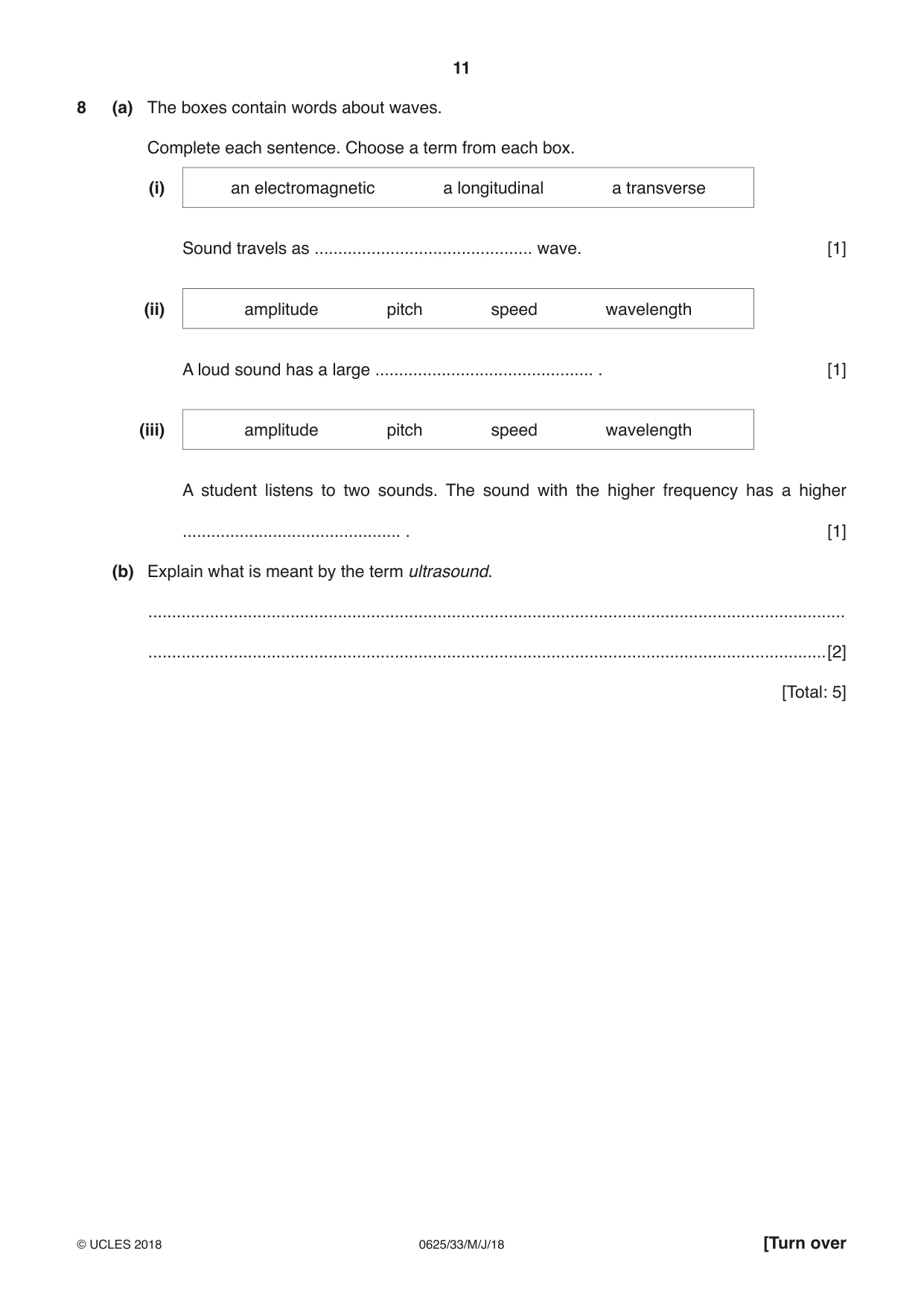
8 (a) The boxes contain words about waves. Complete each sentence. Choose a term from each box. (i) an electromagnetic a longitudinal a transverse Sound travels as .............................................. wave. [1] (ii) amplitude pitch speed wavelength A loud sound has a large .............................................. . [1] (iii) amplitude pitch speed wavelength A student listens to two sounds. The sound with the higher frequency has a higher .............................................. . [1] (b) Explain what is meant by the term ultrasound. ................................................................................................................................................... ...............................................................................................................................................[2] [Total: 5]
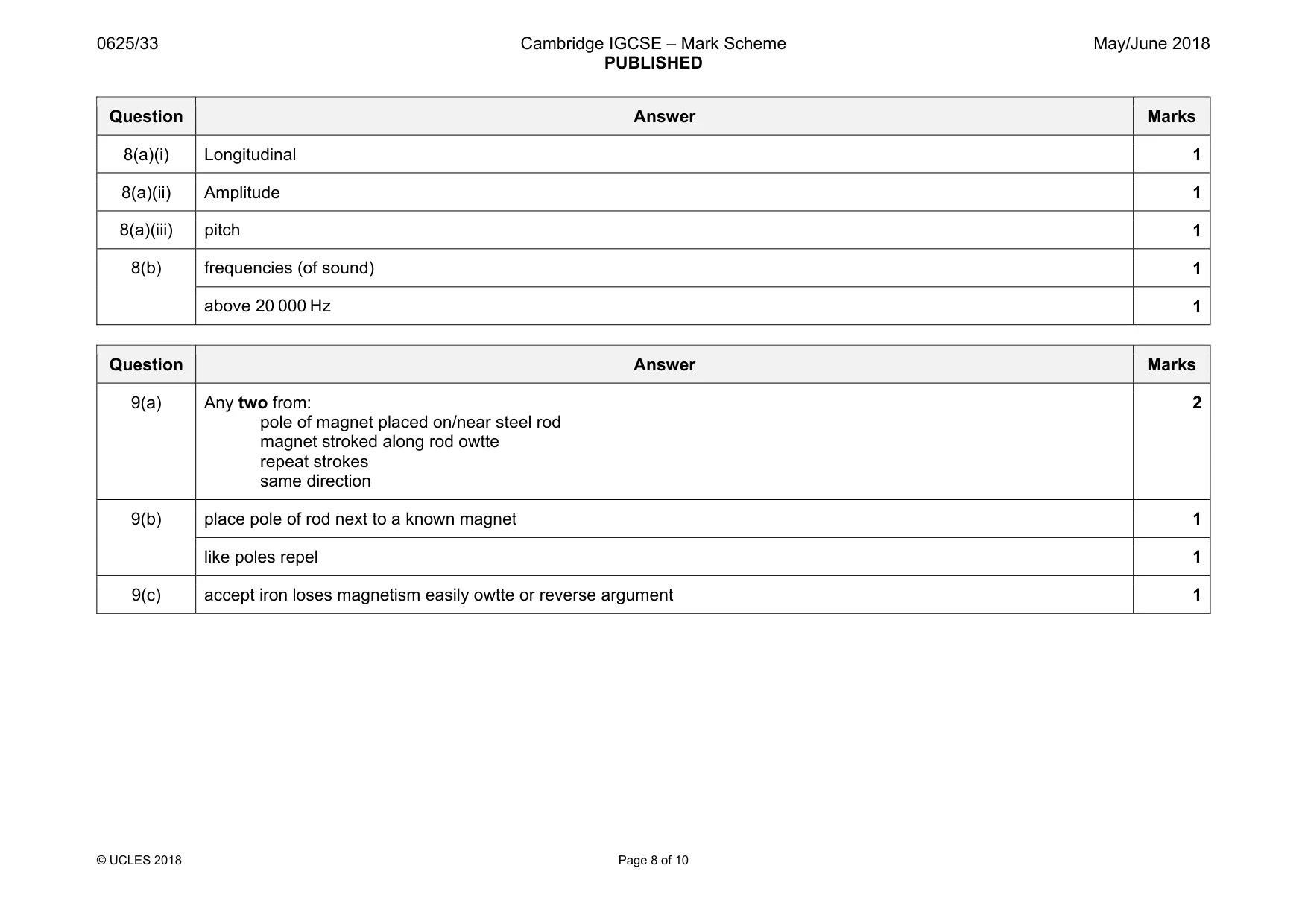
Mark scheme: 8(a)(i) Longitudinal 1 8(a)(ii) Amplitude 1 8(a)(iii) pitch 1 8(b) frequencies (of sound) 1 above 20 000 Hz 1
Q9 · A student magnetises a steel rod by using a permanent magnet
9 A student magnetises a steel rod by using a permanent magnet. (a) Describe a method that the student could use. You may draw a diagram to help you. ................................................................................................................................................... ................................................................................................................................................... ...............................................................................................................................................[2] (b) Explain how the student could test that the steel rod has been magnetised. ................................................................................................................................................... ................................................................................................................................................... ................................................................................................................................................... ...............................................................................................................................................[2] (c) Magnets can be made from soft iron or from steel. State one difference between the magnetic properties of soft iron and steel. ................................................................................................................................................... ................................................................................................................................................... ...............................................................................................................................................[1] [Total: 5]
Mark scheme: 9(a) Any two from: pole of magnet placed on/near steel rod magnet stroked along rod owtte repeat strokes same direction 2 9(b) place pole of rod next to a known magnet 1 like poles repel 1 9(c) accept iron loses magnetism easily owtte or reverse argument 1
Question 10
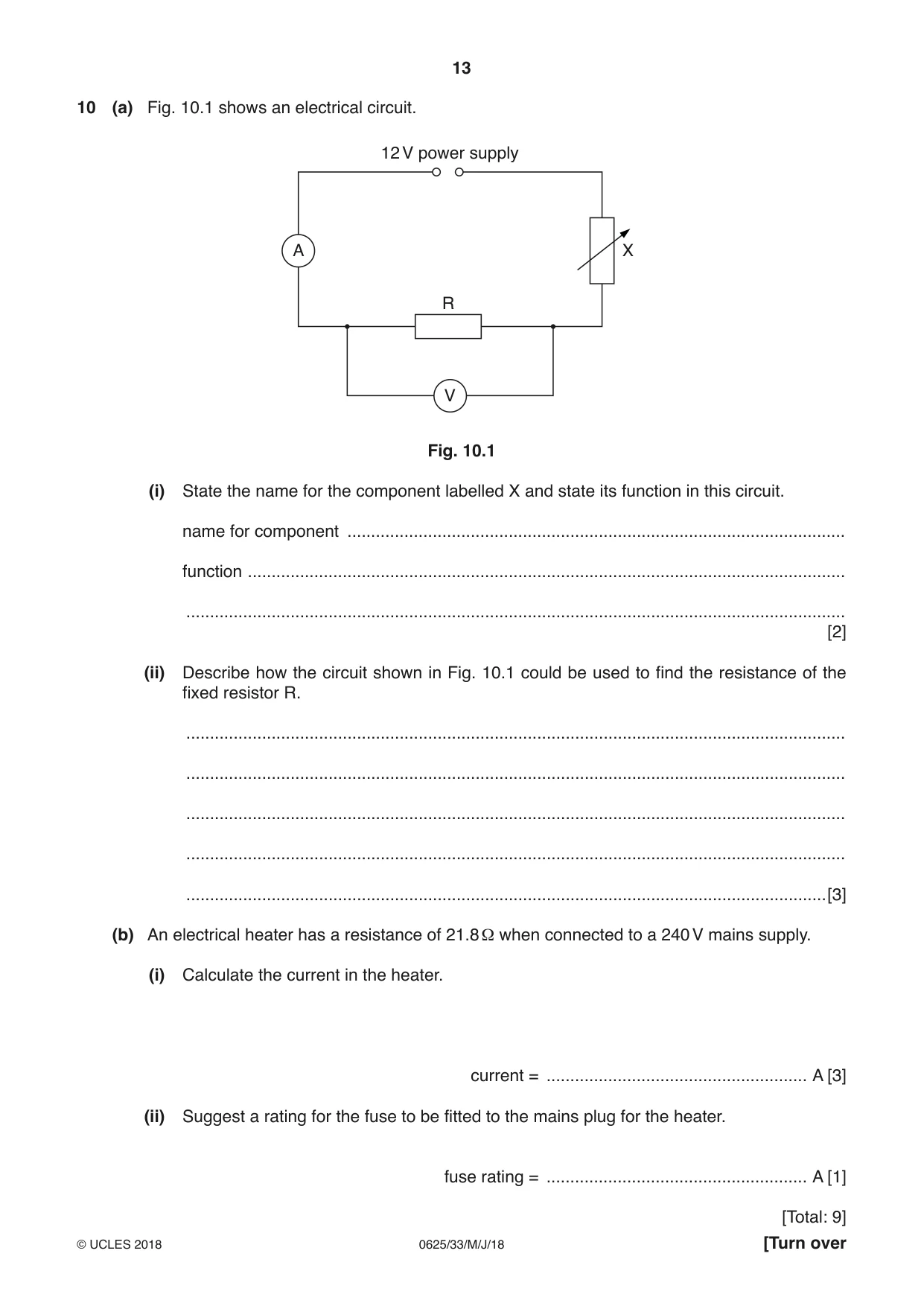
10 (a) Fig. 10.1 shows an electrical circuit. 12 V power supply A X R V Fig. 10.1 (i) State the name for the component labelled X and state its function in this circuit. name for component ......................................................................................................... function .............................................................................................................................. ........................................................................................................................................... [2] (ii) Describe how the circuit shown in Fig. 10.1 could be used to find the resistance of the fixed resistor R. ........................................................................................................................................... ........................................................................................................................................... ........................................................................................................................................... ........................................................................................................................................... .......................................................................................................................................[3] (b) An electrical heater has a resistance of 21.8 Ω when connected to a 240 V mains supply. (i) Calculate the current in the heater. current = ....................................................... A [3] (ii) Suggest a rating for the fuse to be fitted to the mains plug for the heater. fuse rating = ....................................................... A [1] [Total: 9]
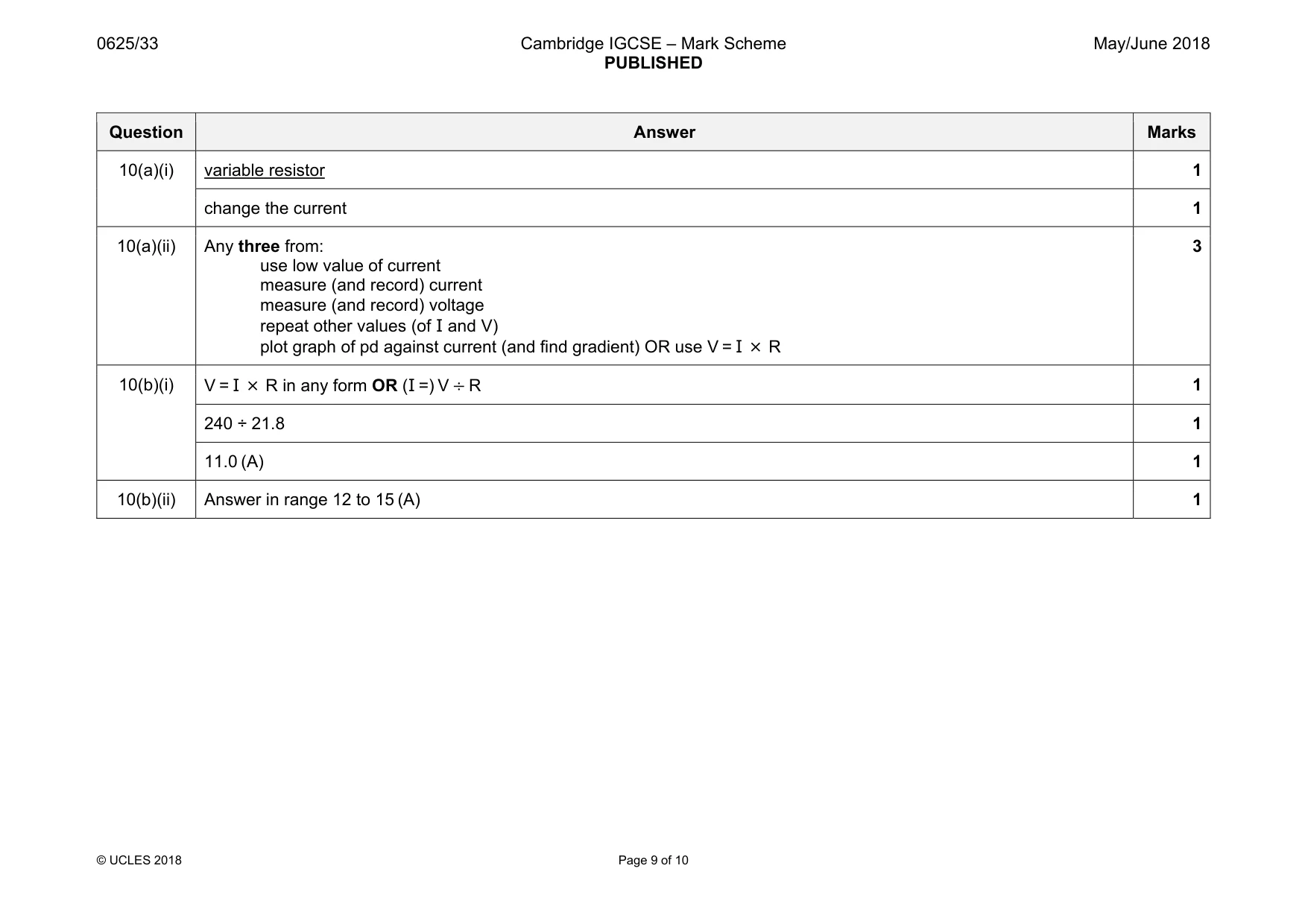
Mark scheme: 10(a)(i) variable resistor 1 change the current 1 10(a)(ii) Any three from: use low value of current measure (and record) current measure (and record) voltage repeat other values (of I and V) plot graph of pd against current (and find gradient) OR use V = I × R 3 10(b)(i) V = I × R in any form OR (I =) V ÷ R 1 240 ÷ 21.8 1 11.0 (A) 1 10(b)(ii) Answer in range 12 to 15 (A) 1
Q11 · A coil (solenoid) wrapped around a plastic tube
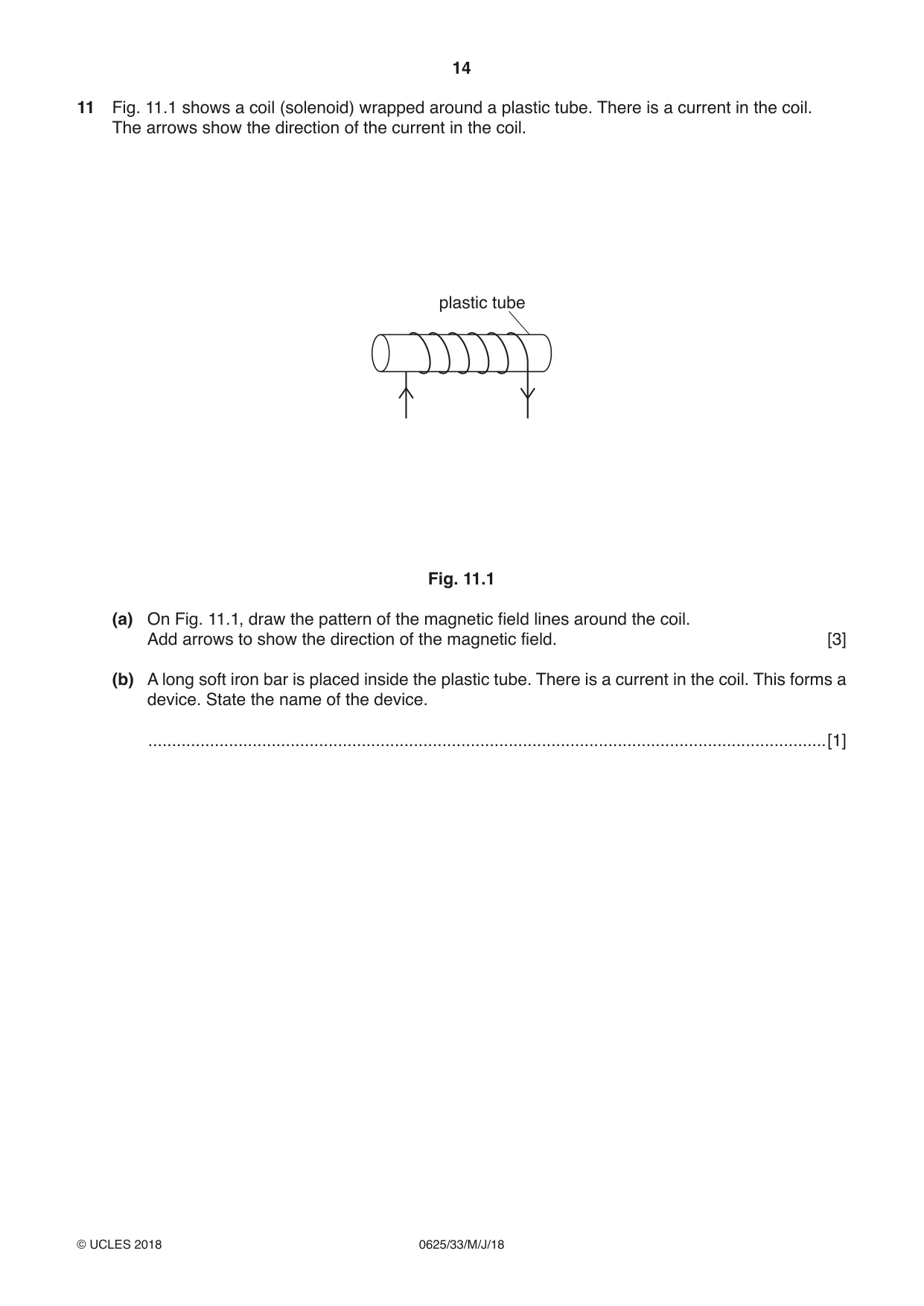
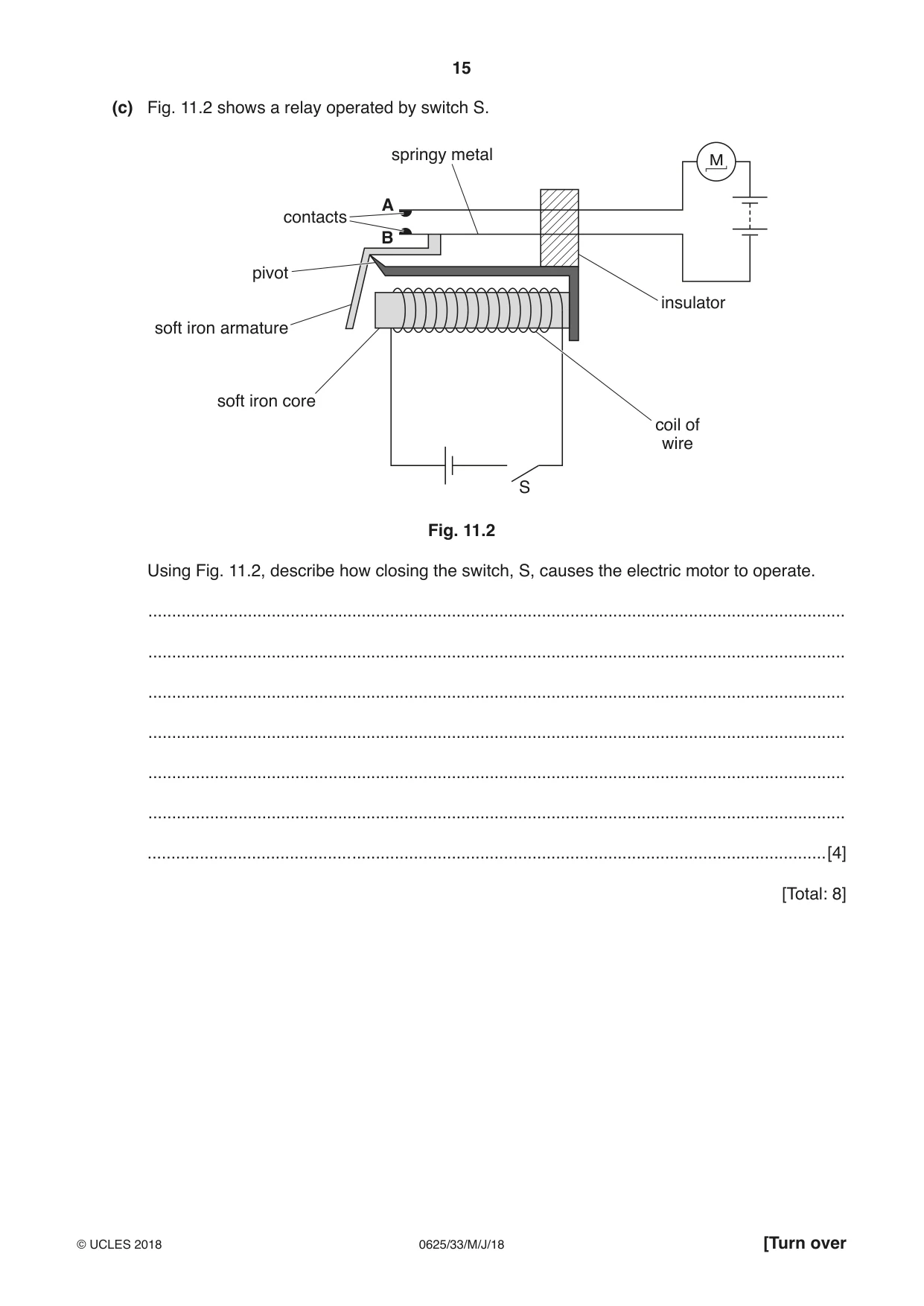
11 Fig. 11.1 shows a coil (solenoid) wrapped around a plastic tube. There is a current in the coil. The arrows show the direction of the current in the coil. plastic tube Fig. 11.1 (a) On Fig. 11.1, draw the pattern of the magnetic field lines around the coil. Add arrows to show the direction of the magnetic field. [3] (b) A long soft iron bar is placed inside the plastic tube. There is a current in the coil. This forms a device. State the name of the device. ...............................................................................................................................................[1] (c) Fig. 11.2 shows a relay operated by switch S. springy metal M A contacts B pivot insulator soft iron armature soft iron core coil of wire S Fig. 11.2 Using Fig. 11.2, describe how closing the switch, S, causes the electric motor to operate. ................................................................................................................................................... ................................................................................................................................................... ................................................................................................................................................... ................................................................................................................................................... ................................................................................................................................................... ................................................................................................................................................... ........................................... ....................................................................................................[4] [Total: 8]
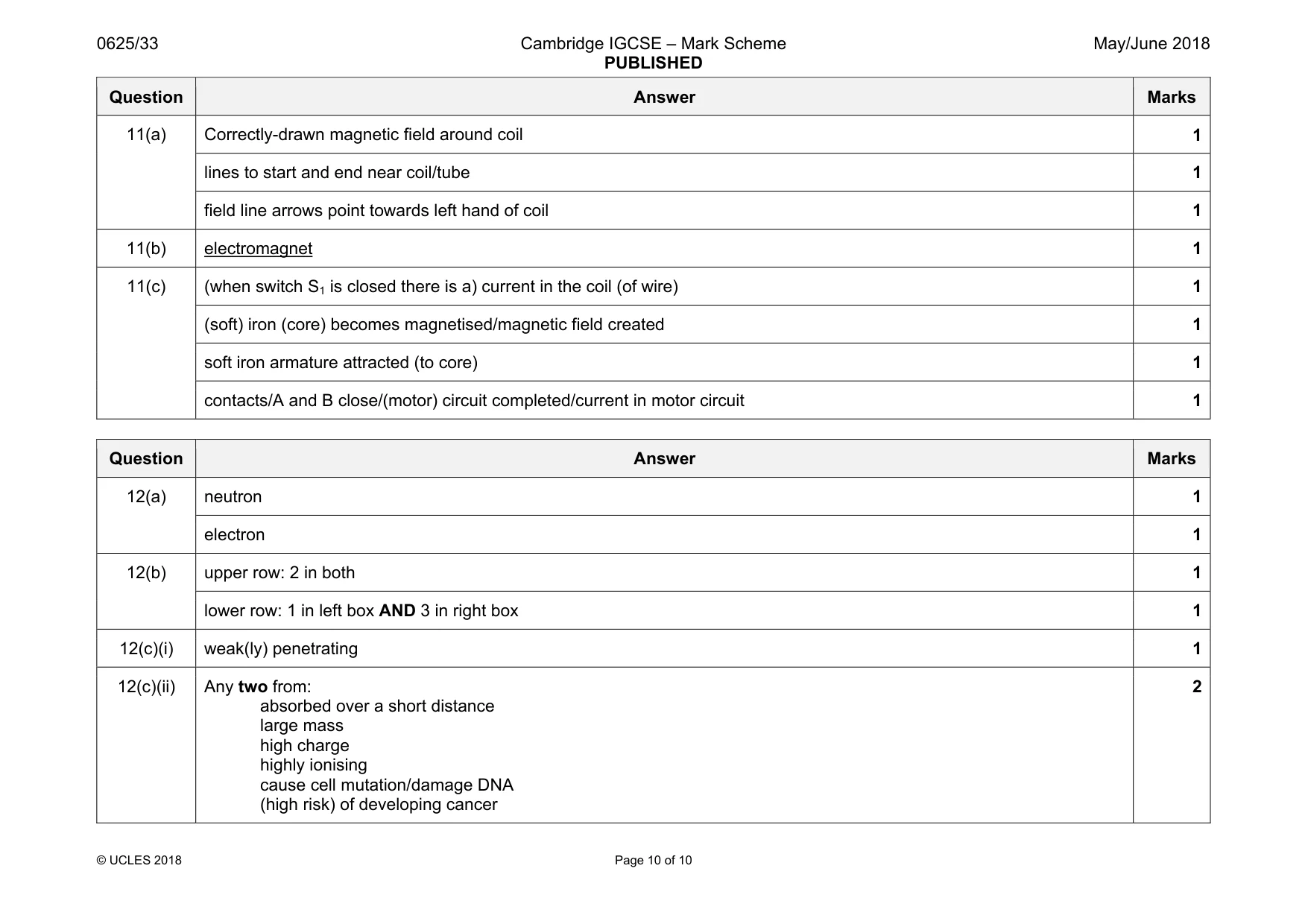
Mark scheme: 11(a) Correctly-drawn magnetic field around coil 1 lines to start and end near coil/tube 1 field line arrows point towards left hand of coil 1 11(b) electromagnet 1 11(c) (when switch S1 is closed there is a) current in the coil (of wire) 1 (soft) iron (core) becomes magnetised/magnetic field created 1 soft iron armature attracted (to core) 1 contacts/A and B close/(motor) circuit completed/current in motor circuit 1
Q12 · A diagram to represent a helium atom, and an incomplete key
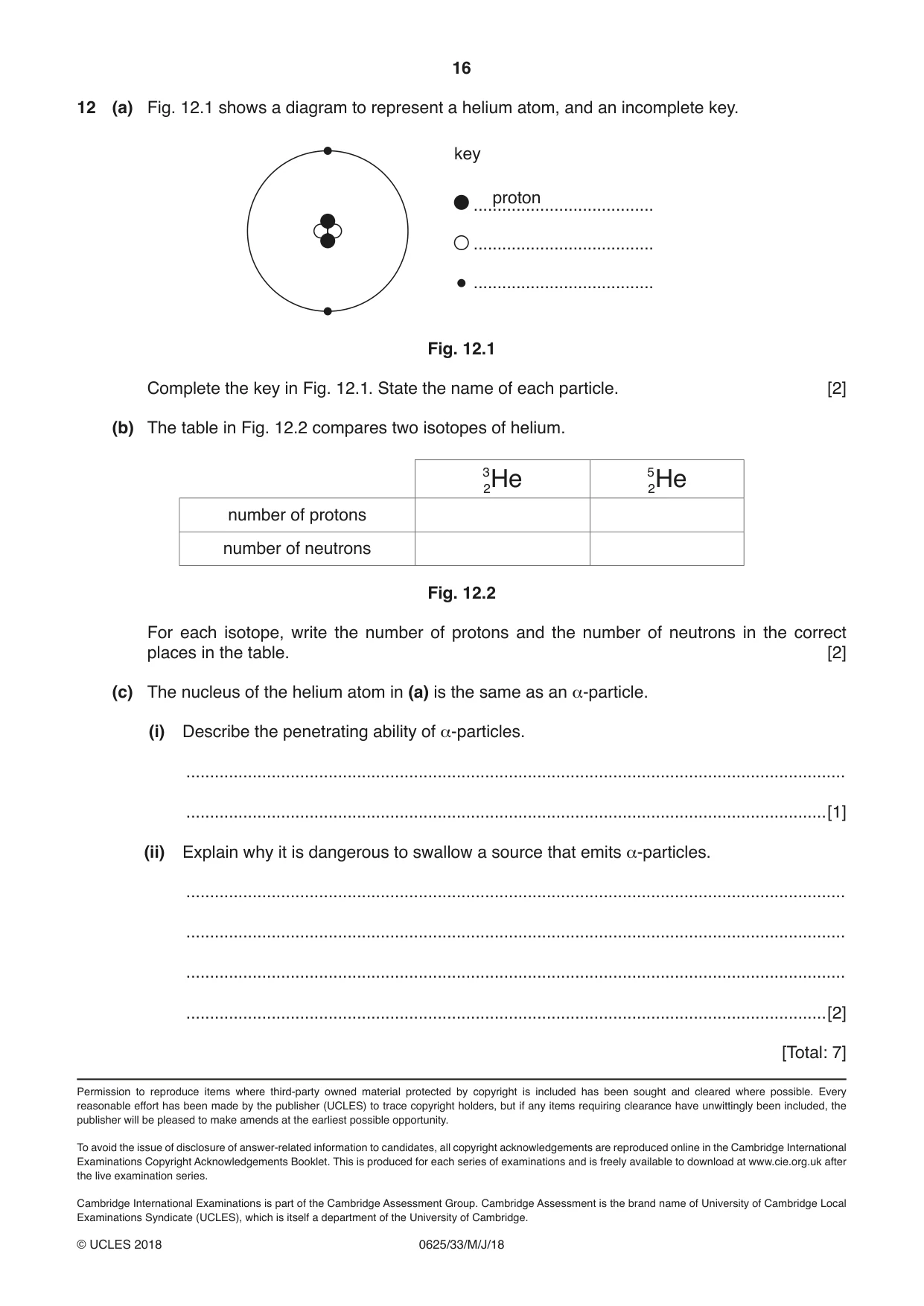
12 (a) Fig. 12.1 shows a diagram to represent a helium atom, and an incomplete key. key proton ...................................... ...................................... ...................................... Fig. 12.1 Complete the key in Fig. 12.1. State the name of each particle. [2] (b) The table in Fig. 12.2 compares two isotopes of helium. 32He 52He number of protons number of neutrons Fig. 12.2 For each isotope, write the number of protons and the number of neutrons in the correct places in the table. [2] (c) The nucleus of the helium atom in (a) is the same as an α-particle. (i) Describe the penetrating ability of α-particles. ........................................................................................................................................... .......................................................................................................................................[1] (ii) Explain why it is dangerous to swallow a source that emits α-particles. ........................................................................................................................................... ........................................................................................................................................... ........................................................................................................................................... .......................................................................................................................................[2] [Total: 7]
Mark scheme: 12(a) neutron 1 electron 1 12(b) upper row: 2 in both 1 lower row: 1 in left box AND 3 in right box 1 12(c)(i) weak(ly) penetrating 1 12(c)(ii) Any two from: absorbed over a short distance large mass high charge highly ionising cause cell mutation/damage DNA (high risk) of developing cancer 2
What was in this paper
The subtopics covered by these 12 questions, and how many questions each got. Open one in a new tab to see every Cambridge question on it.
What you needed in this session
Cambridge’s own grade thresholds for 2018 May/June, Paper 3 · Variant 3. A higher threshold means an easier paper — the bar moves with how the cohort did.